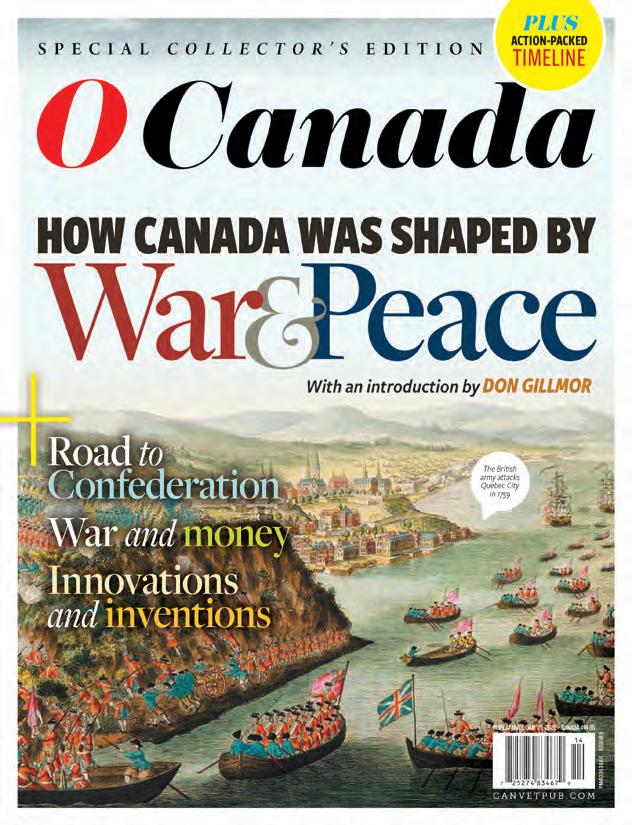
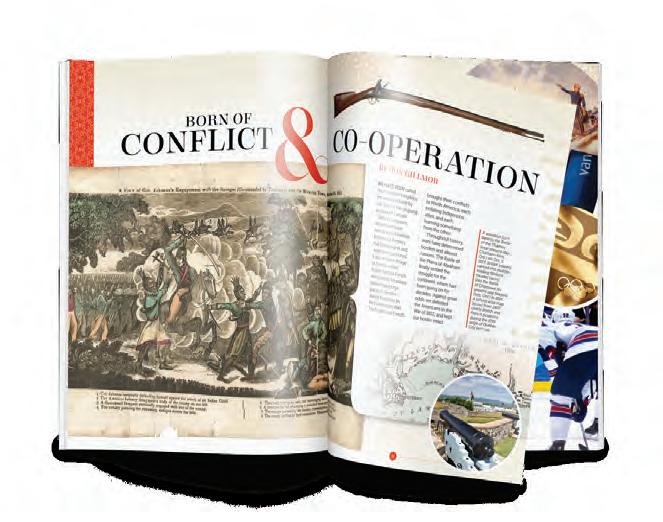
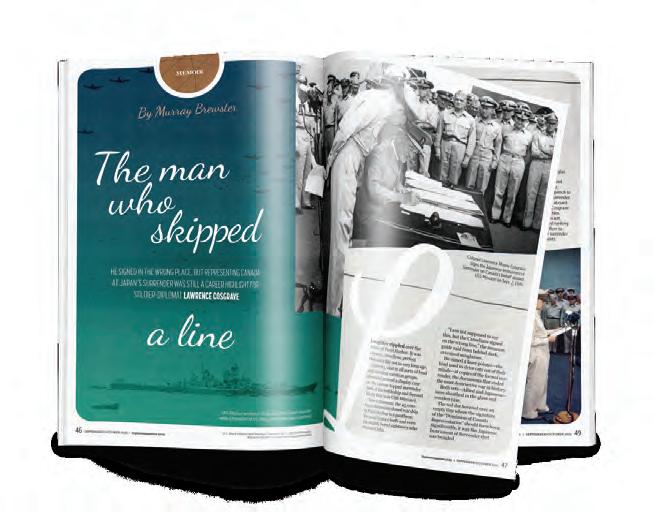
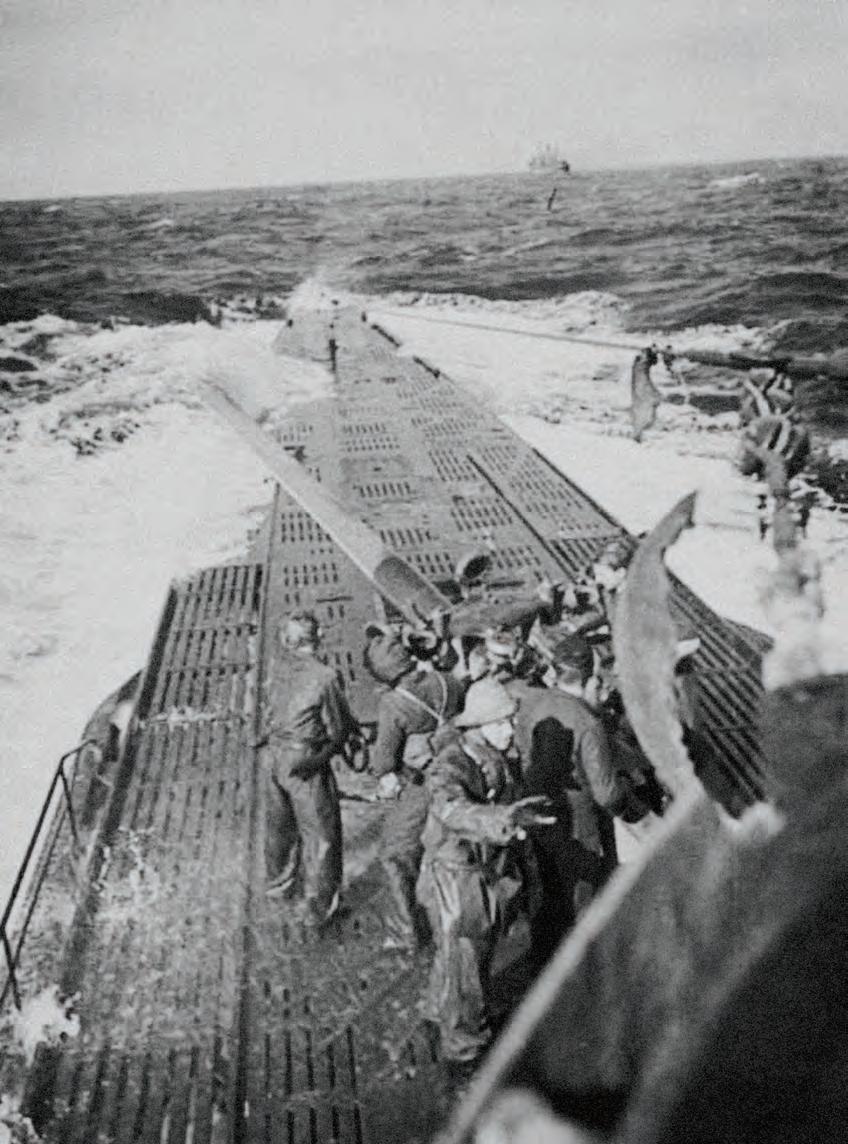
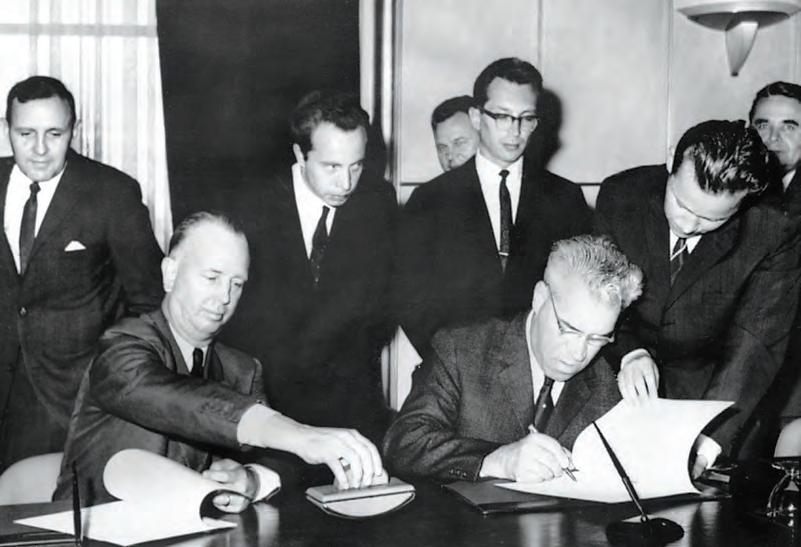
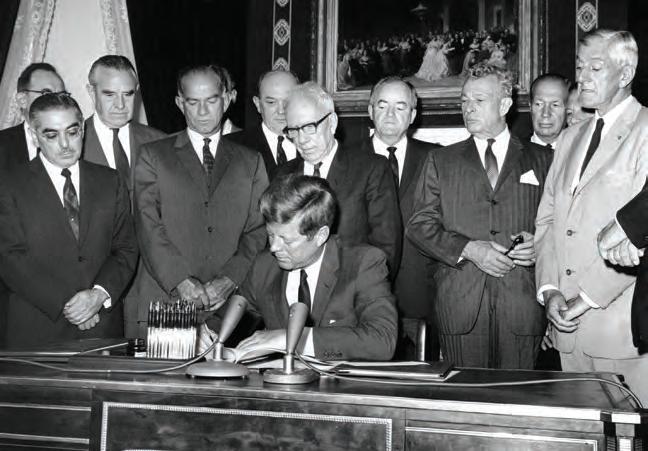
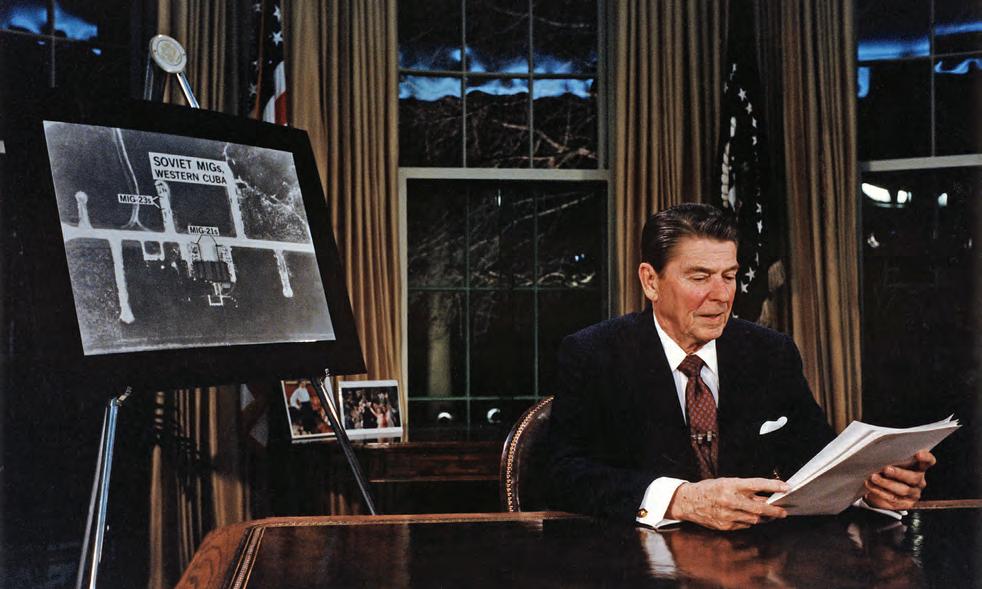
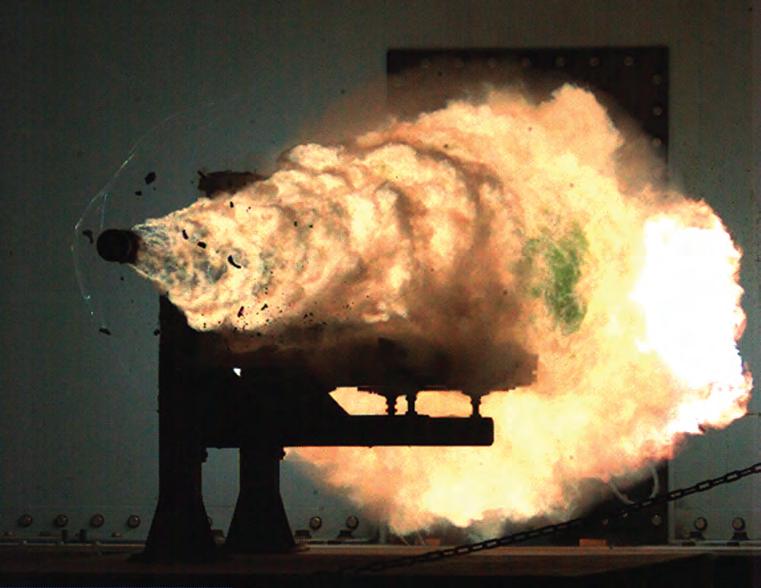
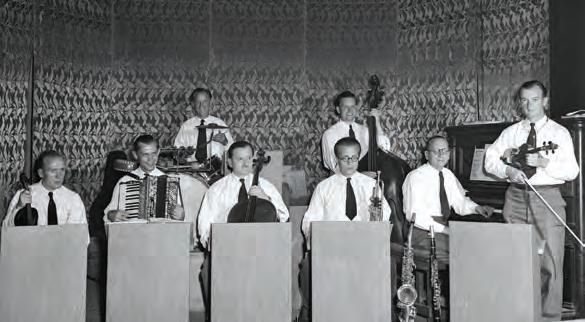
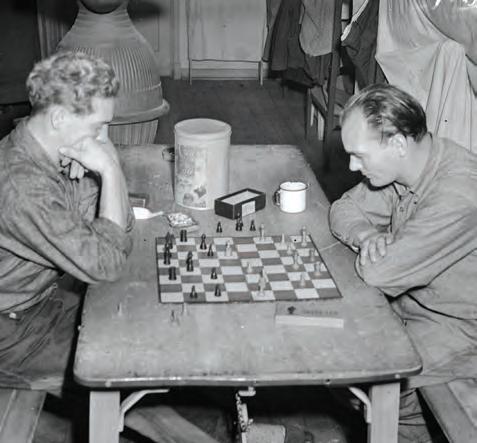
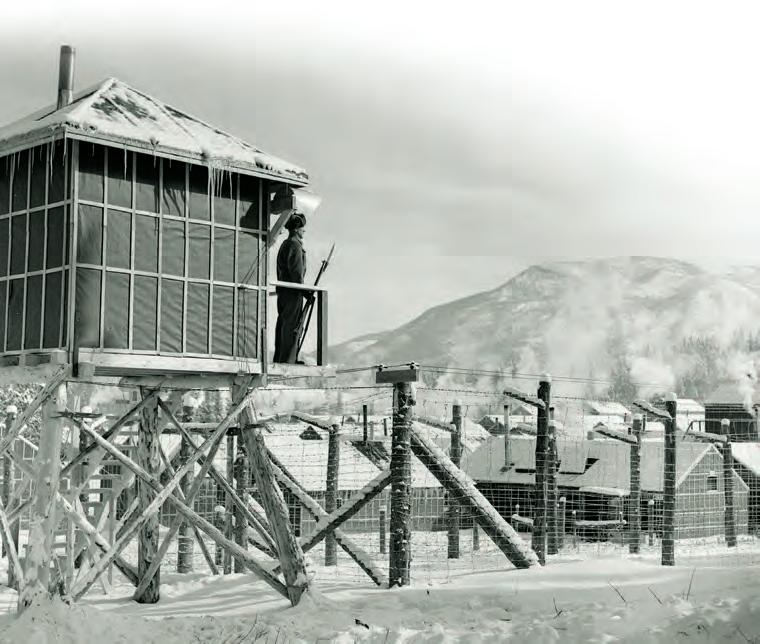
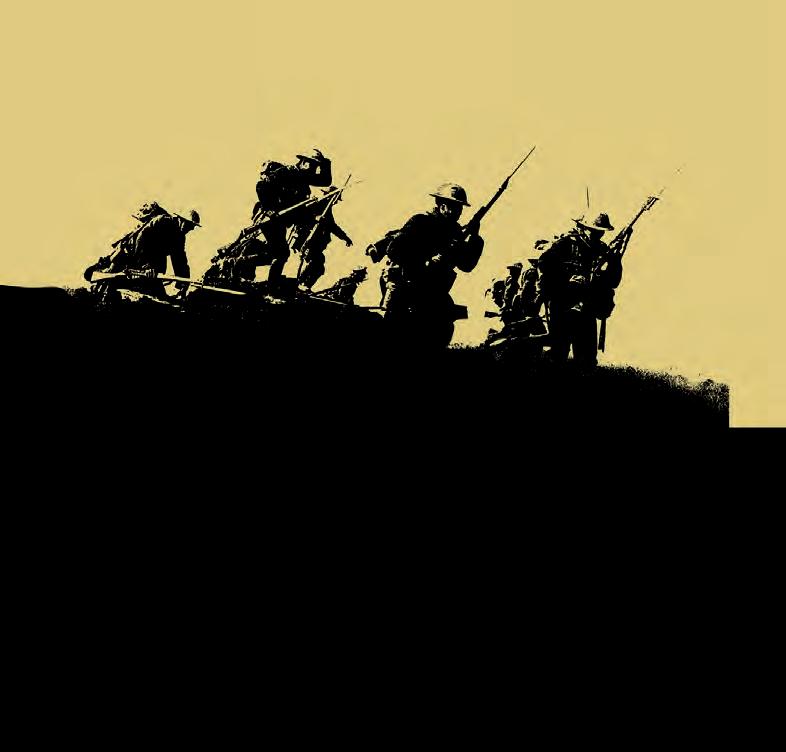
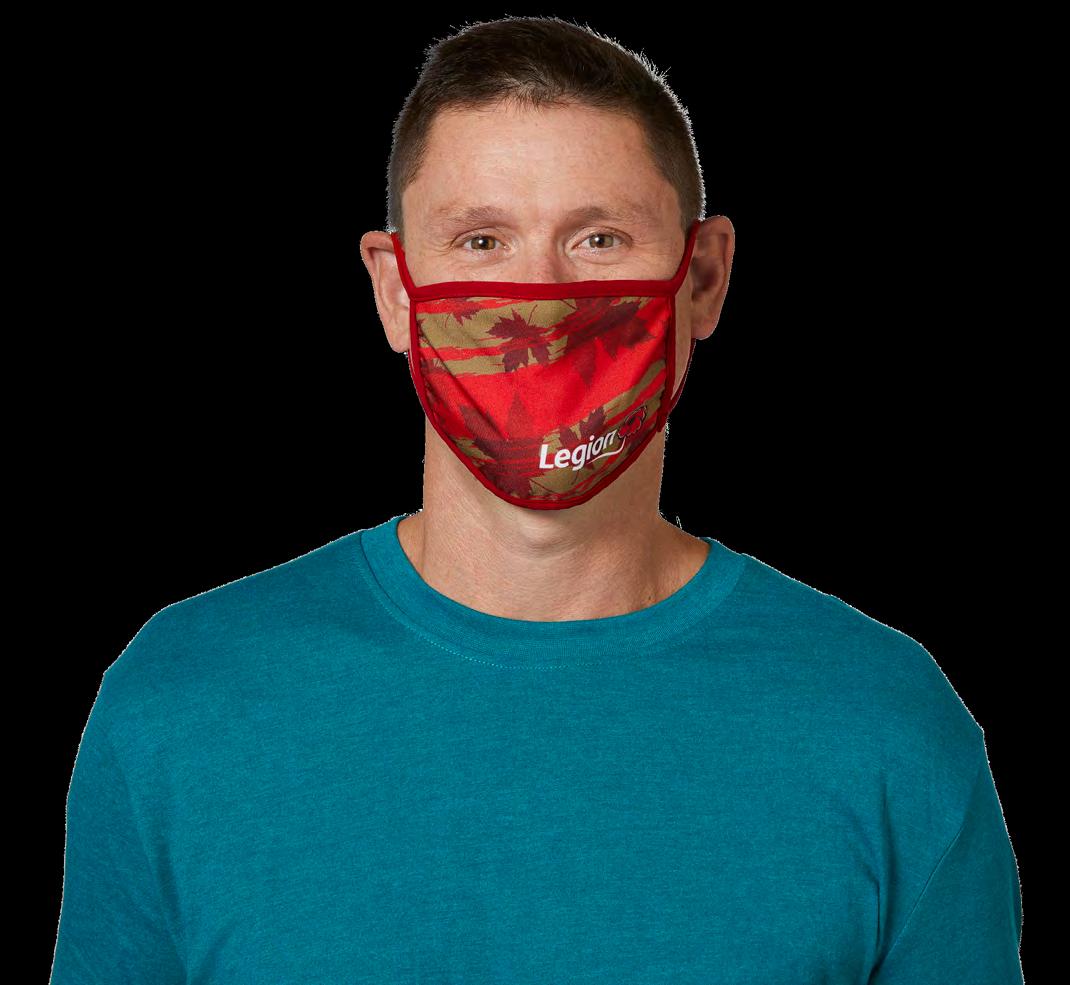
Since the first people arrived on this continent, the place that would be called Canada has been shaped by conflict and co-operation. The impacts of war and the bounties of friendship echo through the story of Canada.
To find out how Canada became the nation it is today, pick up a copy of “O Canada: War and Peace” on newsstands across Canada!
P
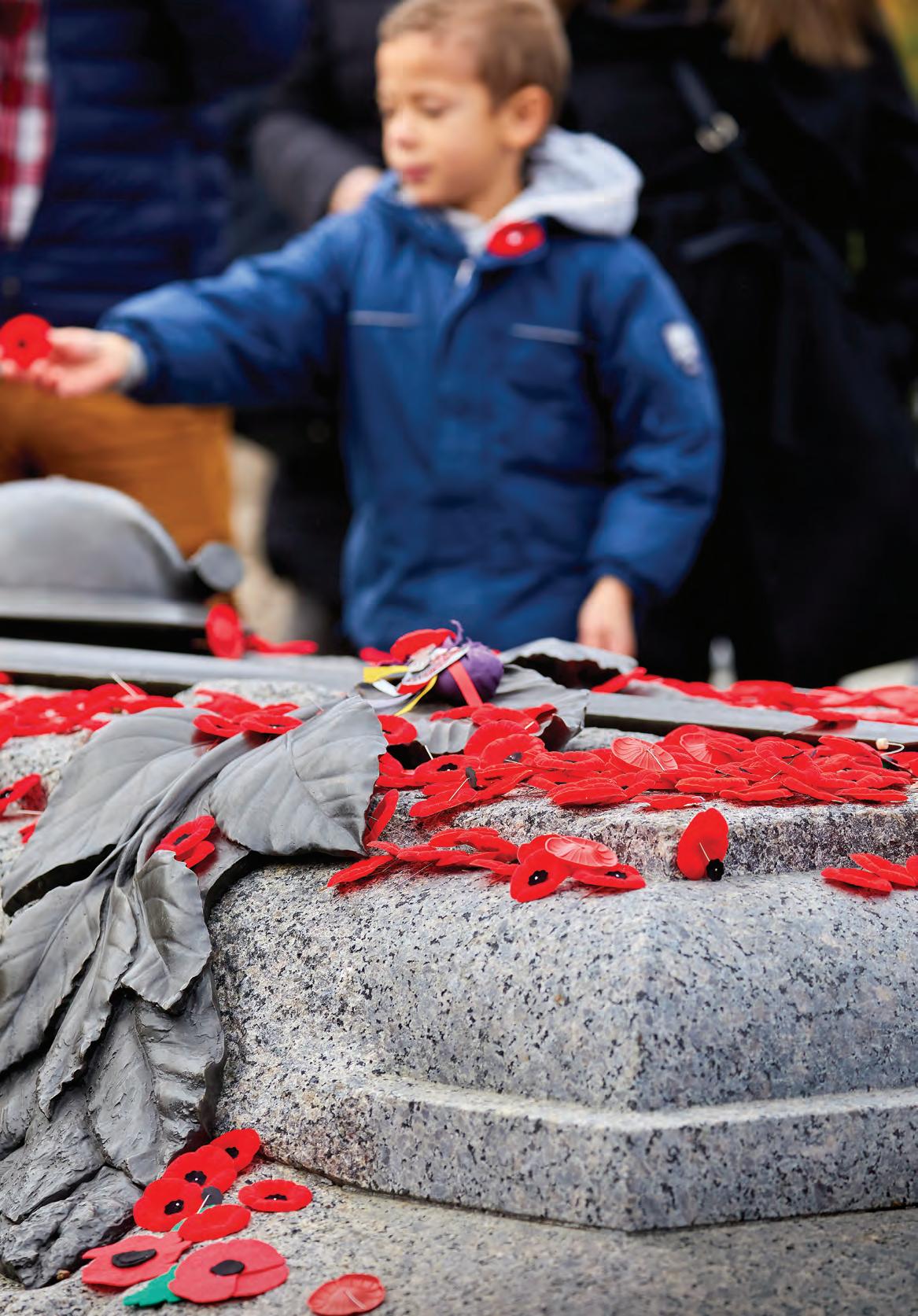
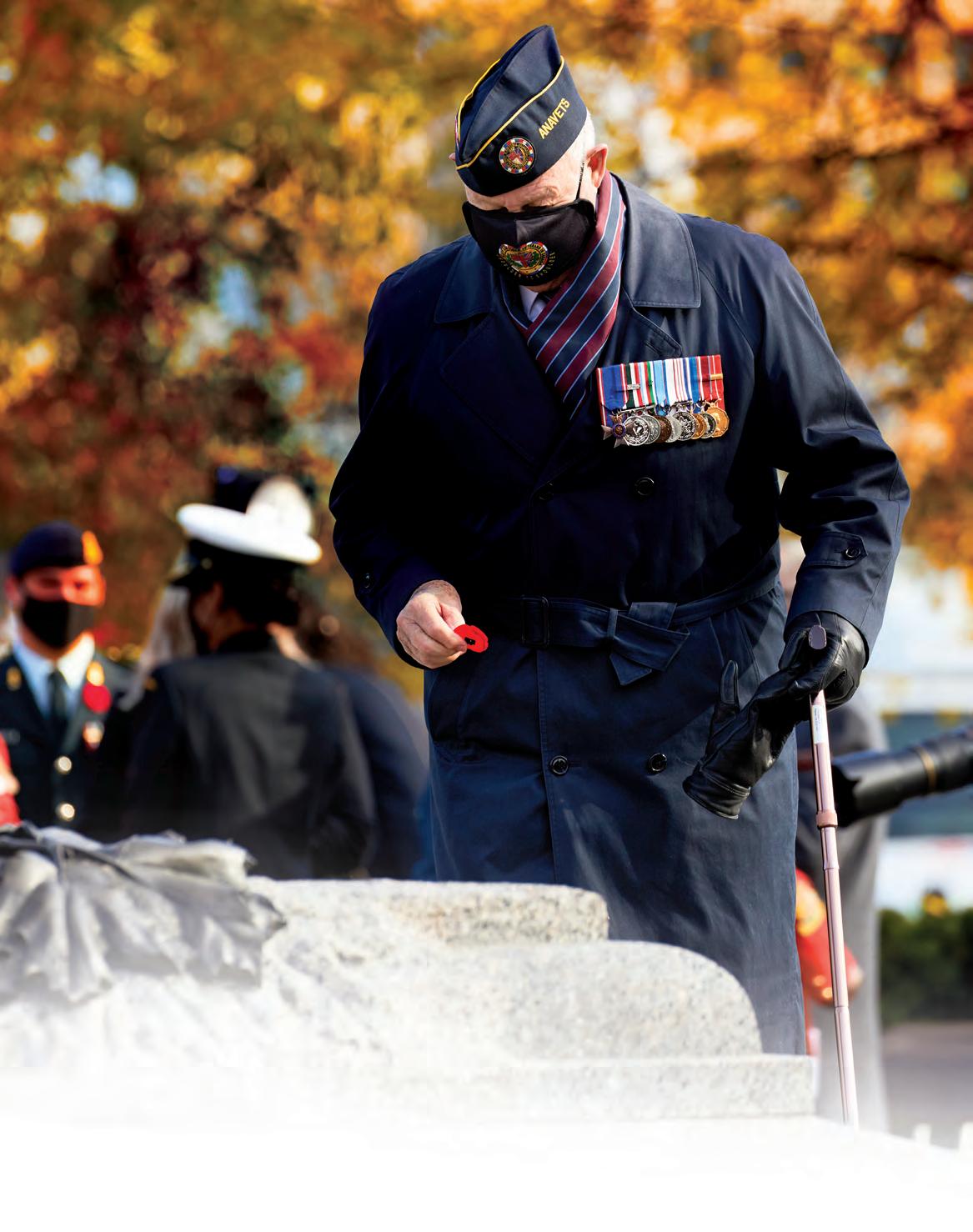
Placing poppies
Once the formal remembrance ceremony ends, attendees quietly place poppies on the Tomb of the Unknown Soldier.
See page 31
Features
18 TRENCH RAID
The attack on German dugouts at Calonne in 1917 was one of Canada’s most successful raids of the war
By J.L. Granatstein
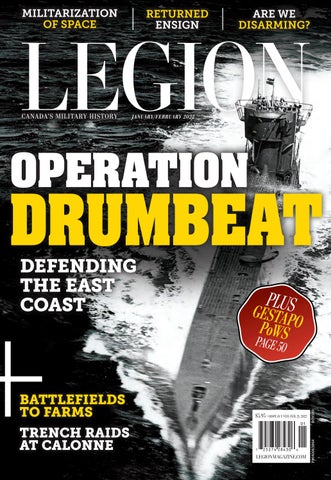
24 OPERATION DRUMBEAT
U-boats targeted East Coast shipping in the first half of 1942
By Marc Milner
31 A WELCOME RETURN
Thousands attended, but there was one notable absence on Remembrance Day in Ottawa
By Trevor Oattes
35 AN UNEXPECTED CROWD
Despite the pandemic and damp weather, droves of Victorians marked Remembrance Day
38 A CENTURY OF DISARMAMENT, PART 2
Thinkers, scientists and negotiators: arms control after the Second World War
By Stephen J. Thorne
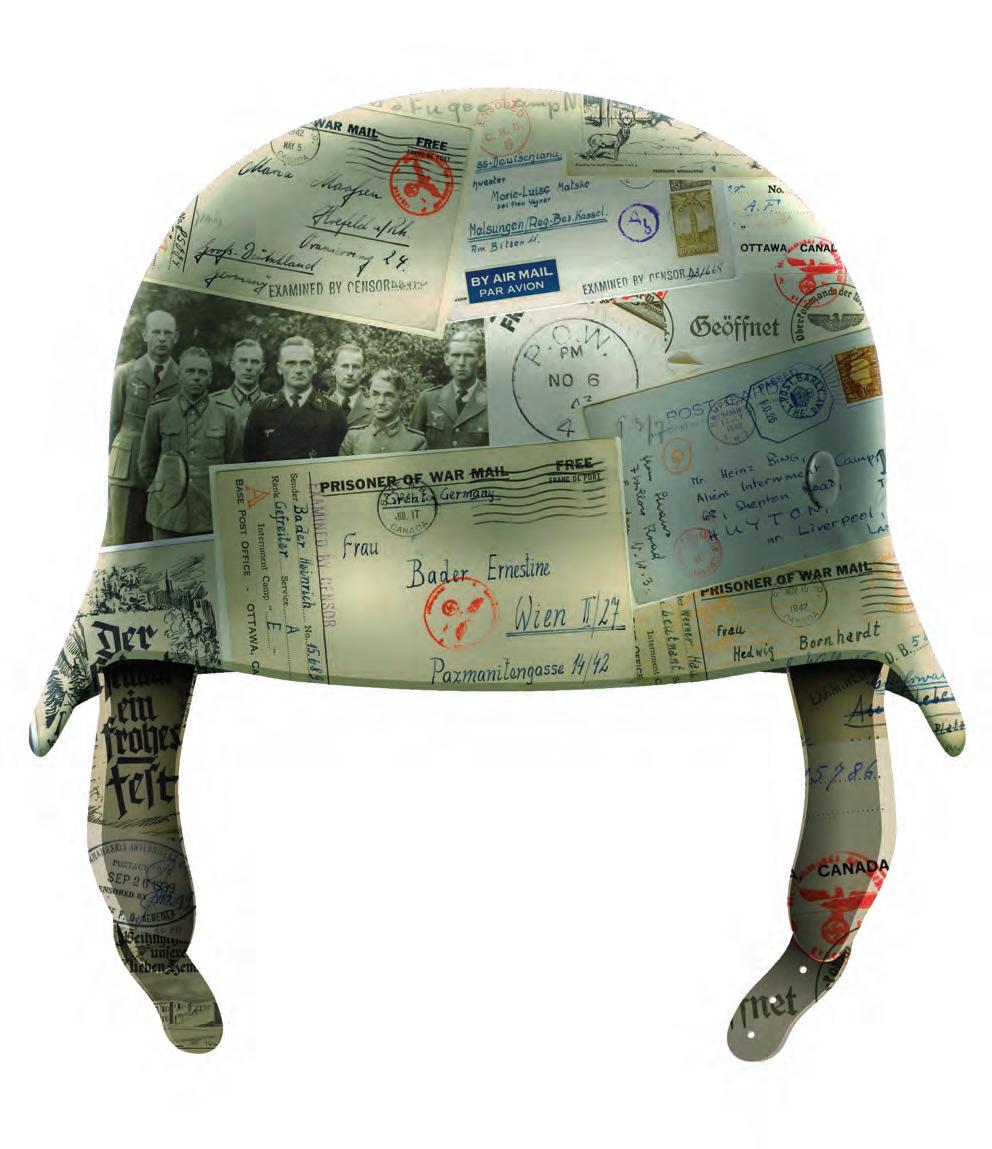
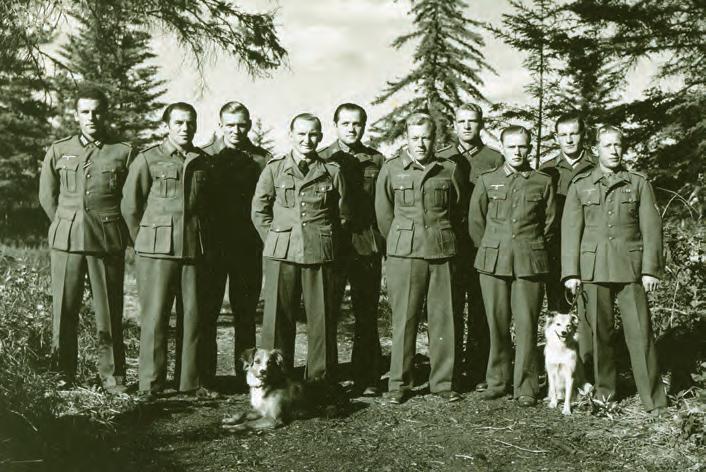
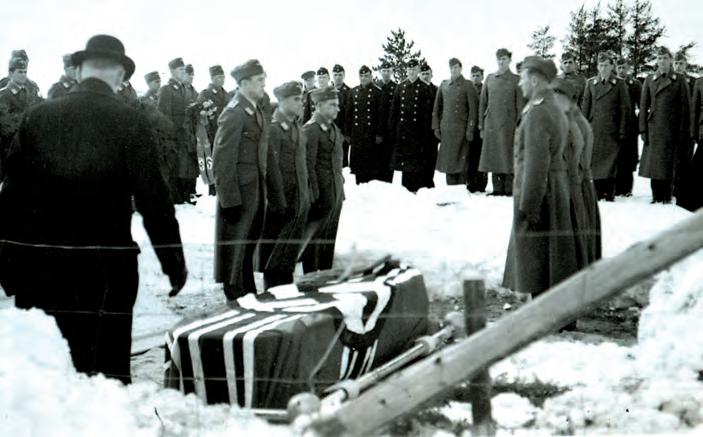
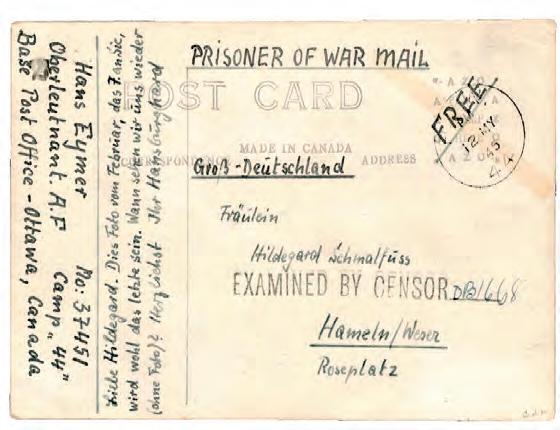
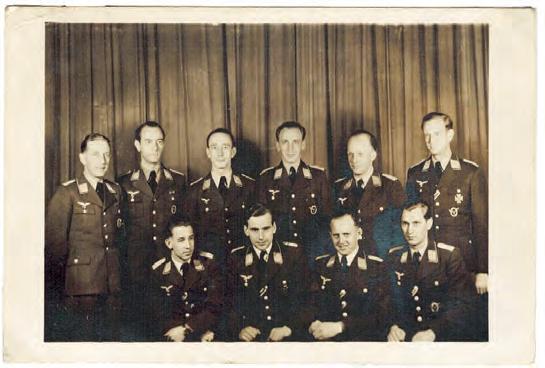
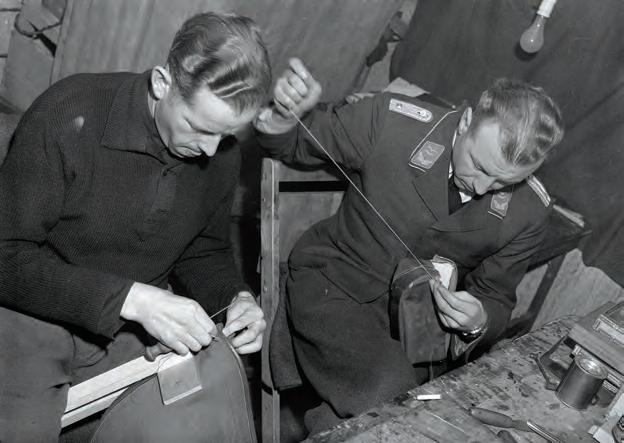
50 GESTAPO PoWs
Fanatical members of the Harikari Club plotted to escape, slaughter civilians, and wreak as much havoc as possible
By Sharon Adams
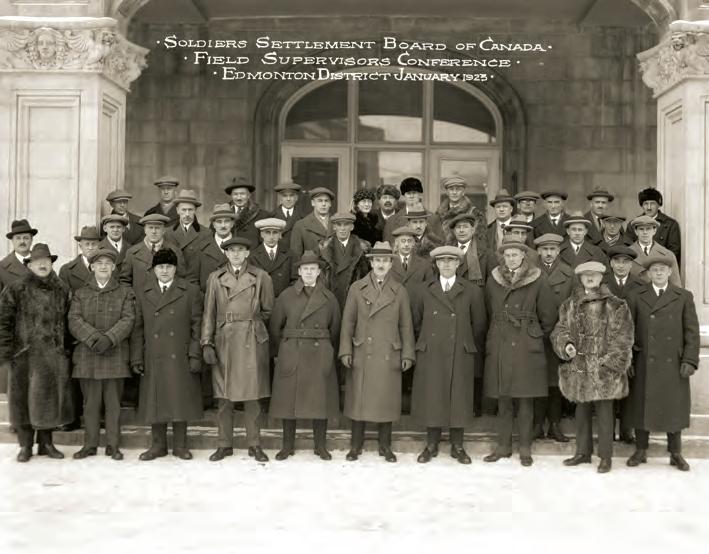
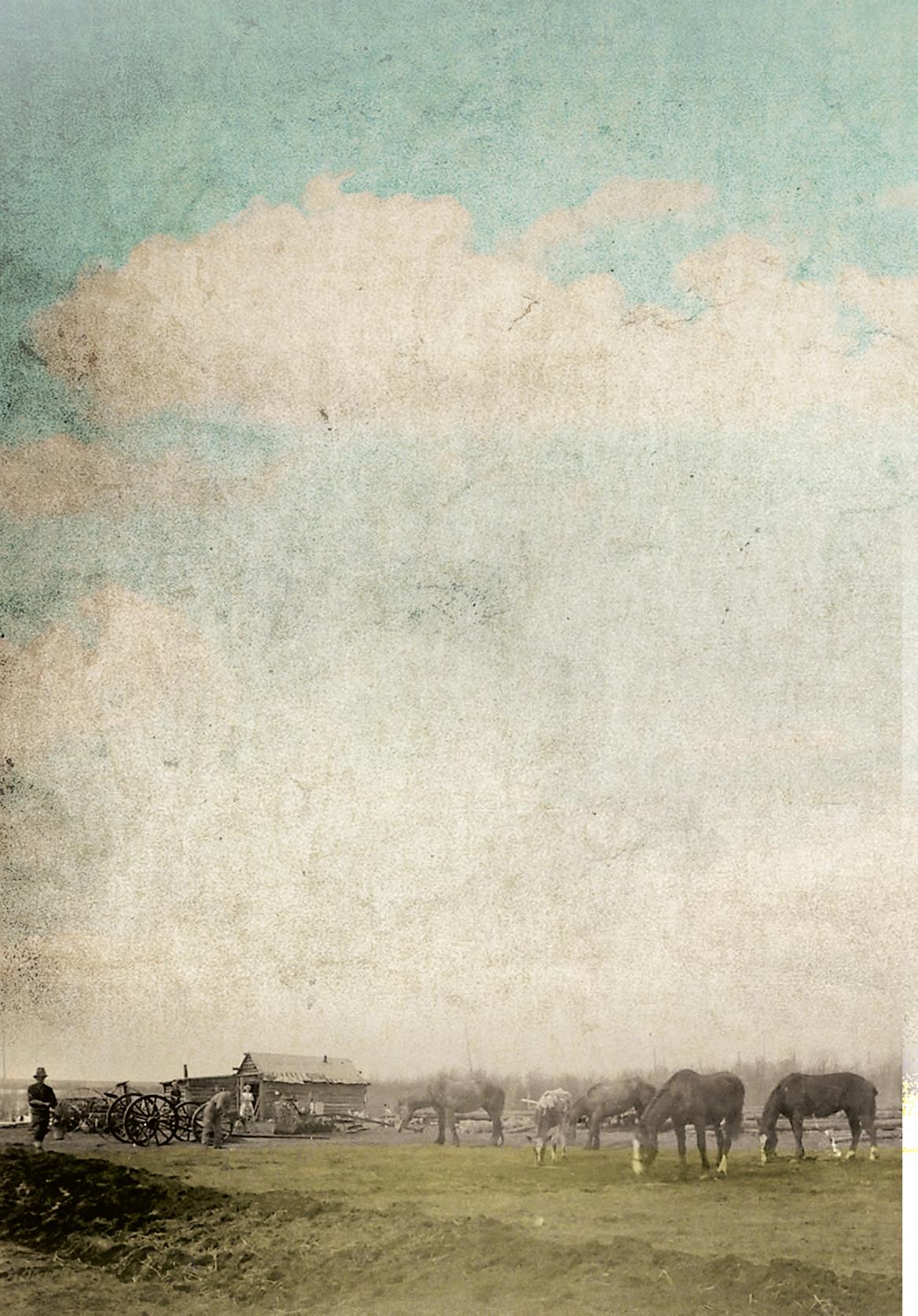
58 FROM BATTLEFIELDS TO FARM FIELDS
A legion of demobilized servicemen settled in Western Canada after the Armistice
By Graham Chandler
By Mark Zuehlke
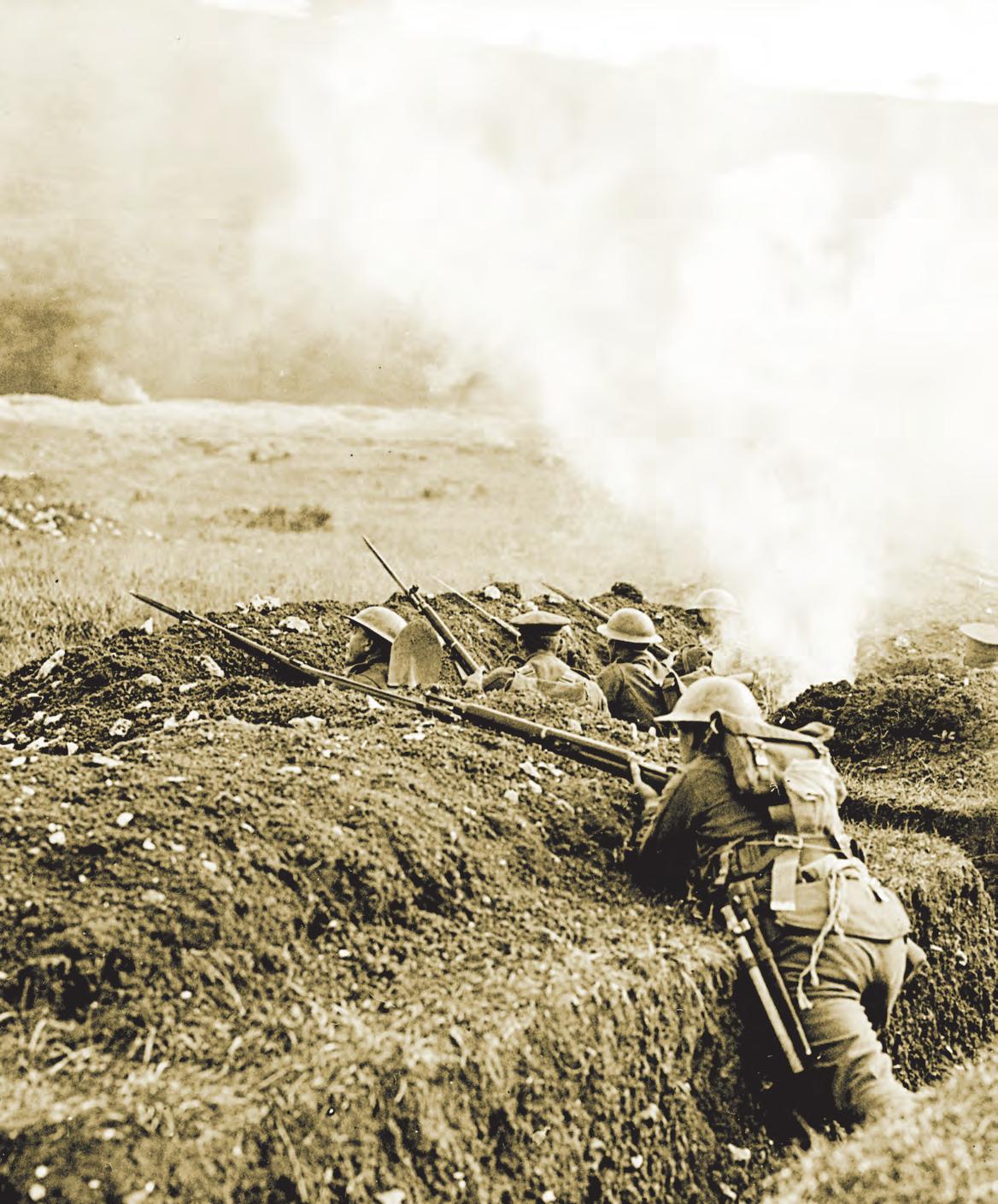
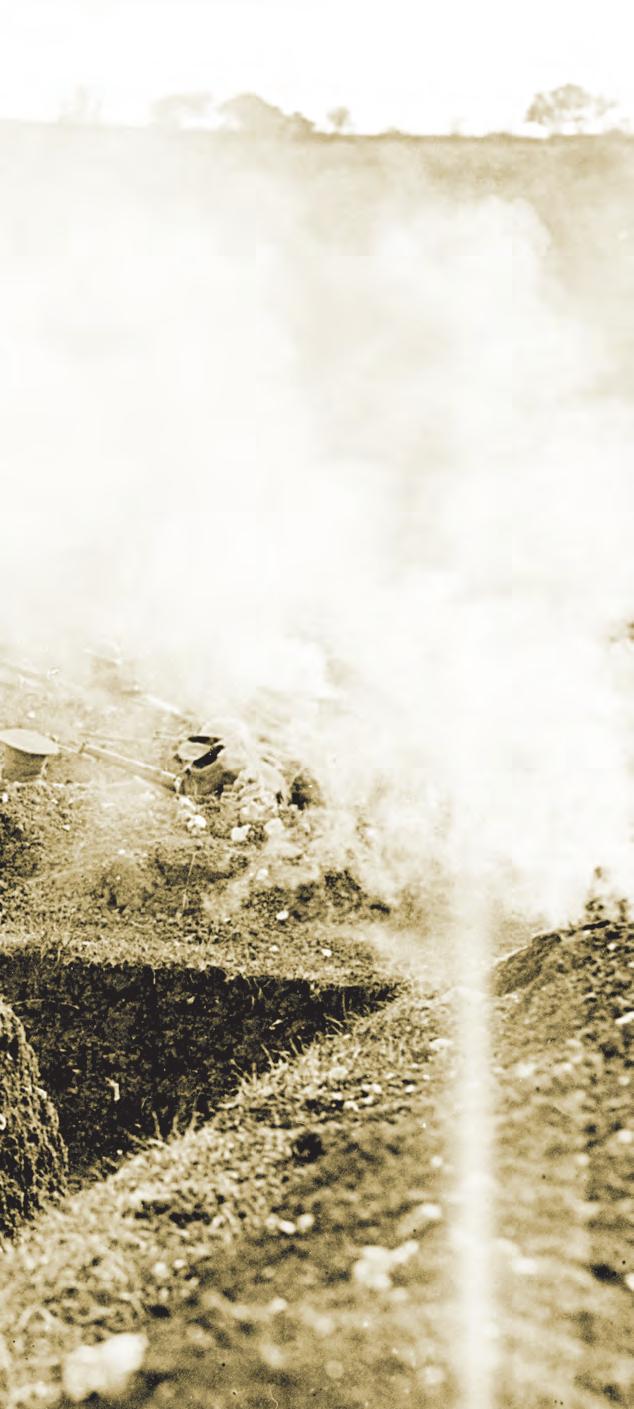
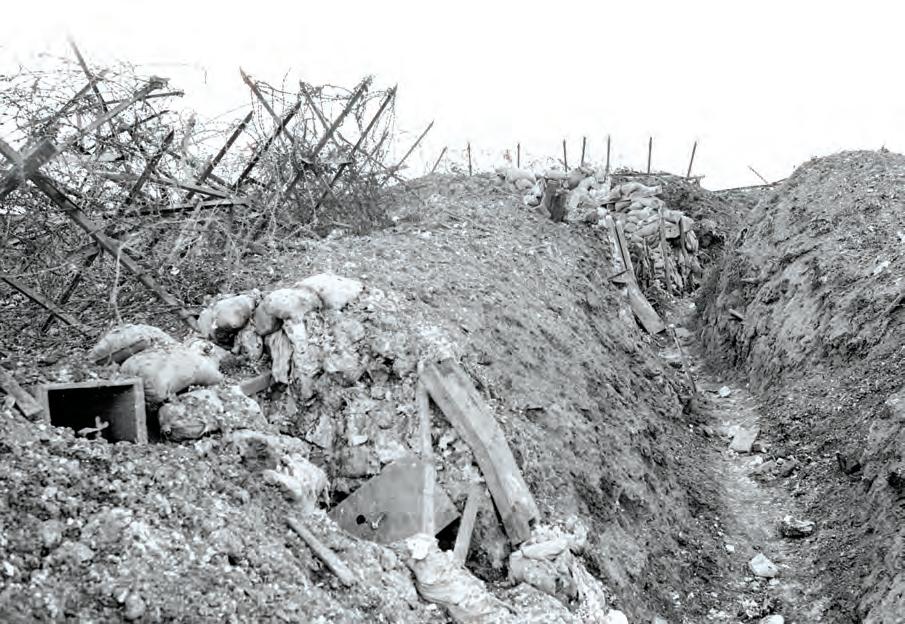
THIS PHOTO
Canadian soldiers of the First World War demonstrate trench warfare tactics in England.
DND/LAC/3404539
ON THE COVER
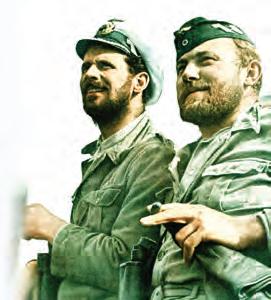
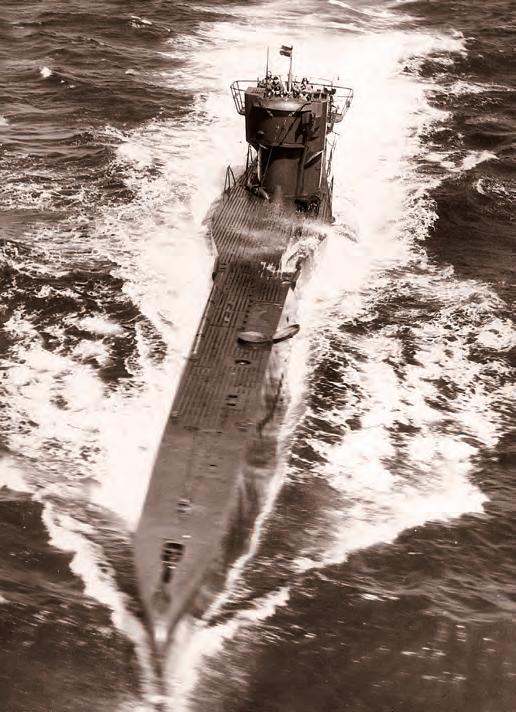
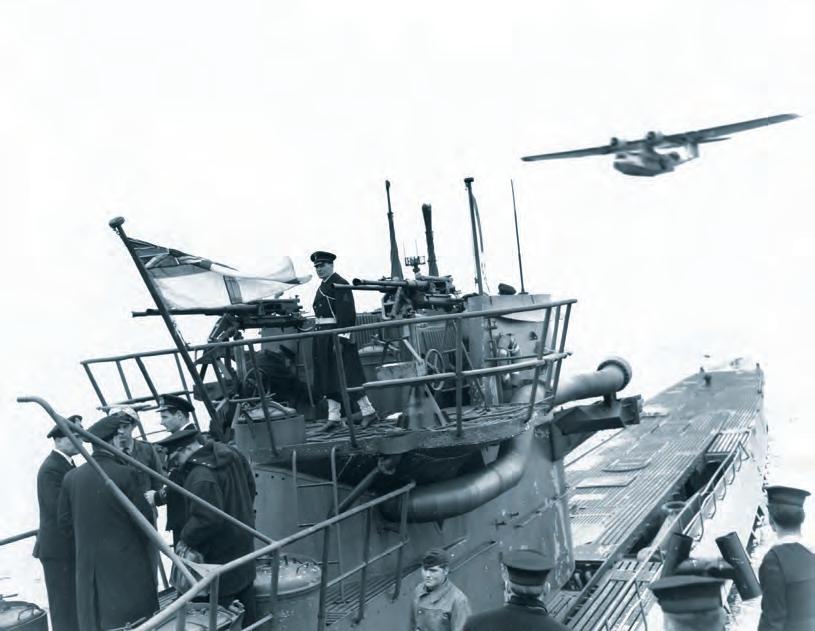
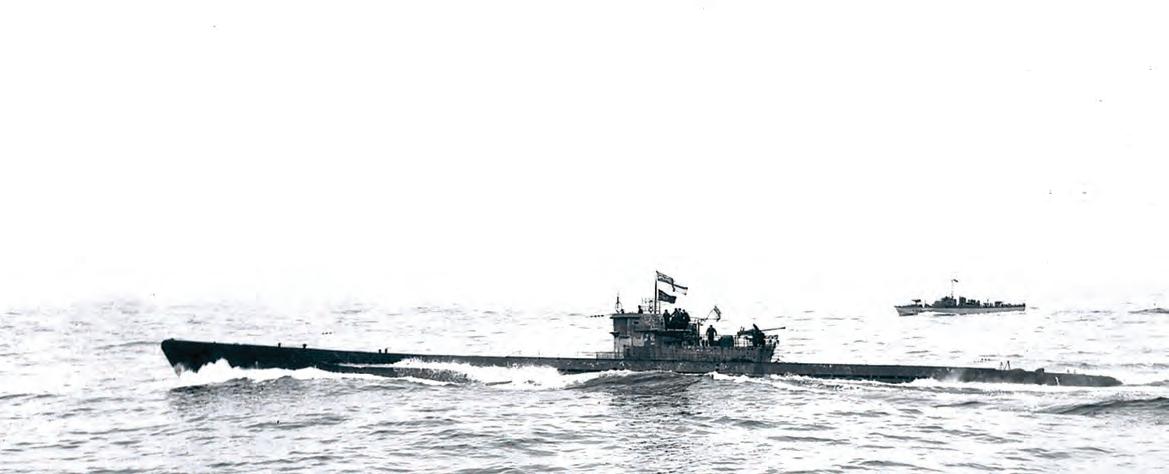
U-481 at sea. U-boats such as these caused massive damage to the Allied efforts during their attacks on North America’s East Coast.
Pen and Sword Books/Universal Images Group/Getty Images
CIMVHR forum highlights hidden health research possibilities
Militarization beyond the sky By Stephen J. Thorne 16 EYE ON DEFENCE
Are we disarming? By David J. Bercuson 46 FACE TO FACE
Should Canada increase its military involvement in the Indo-Pacific region? By
Ernie Regehr and David J. Bercuson
88 CANADA AND THE NEW COLD WAR
Defence on the cheap By J.L. Granatstein
90 HUMOUR HUNT
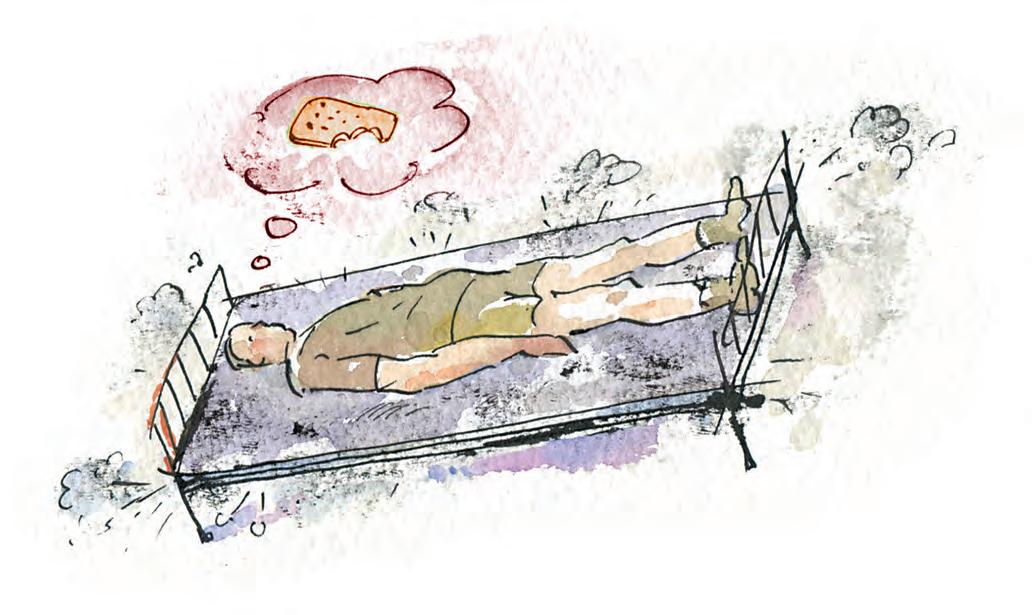
Biscuits in bed
92 HEROES AND VILLAINS
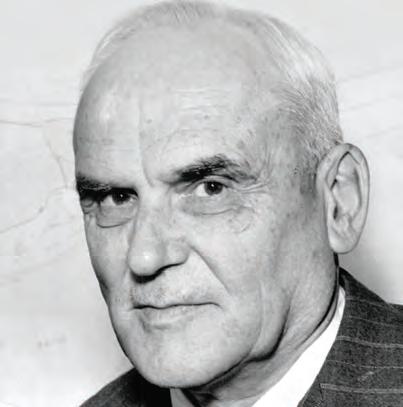
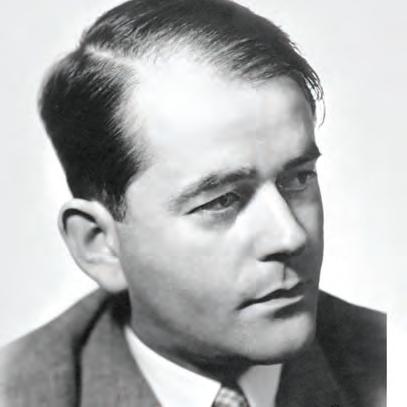
C.D. Howe and Albert Speer By Mark Zuehlke 94 ARTIFACTS
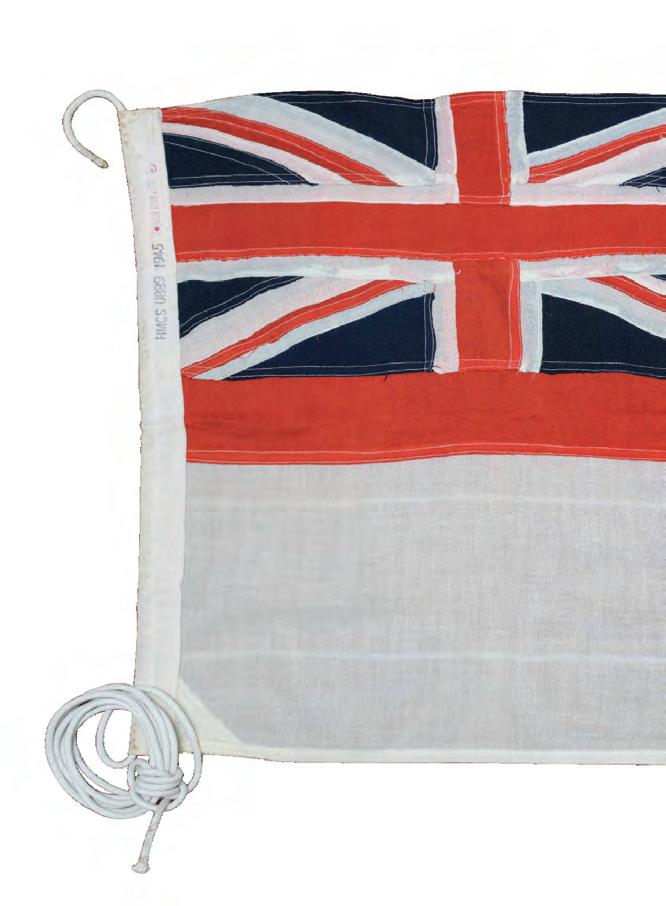
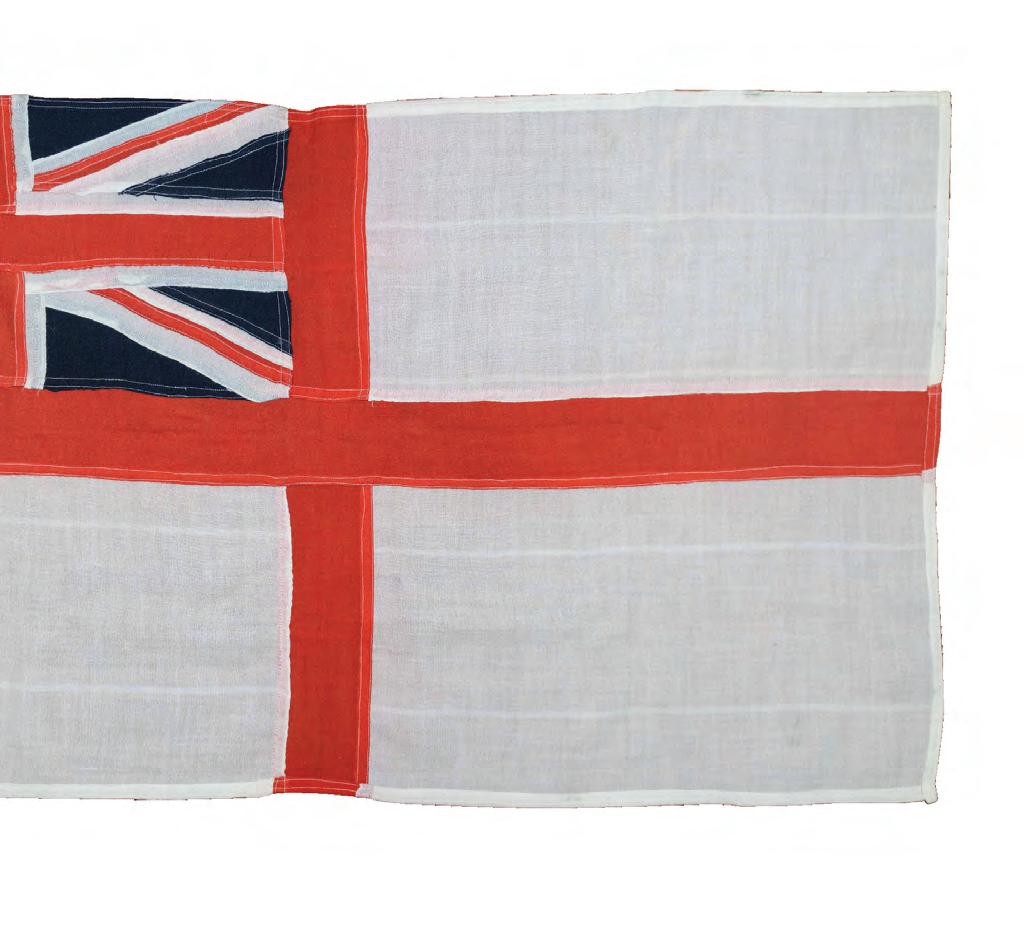
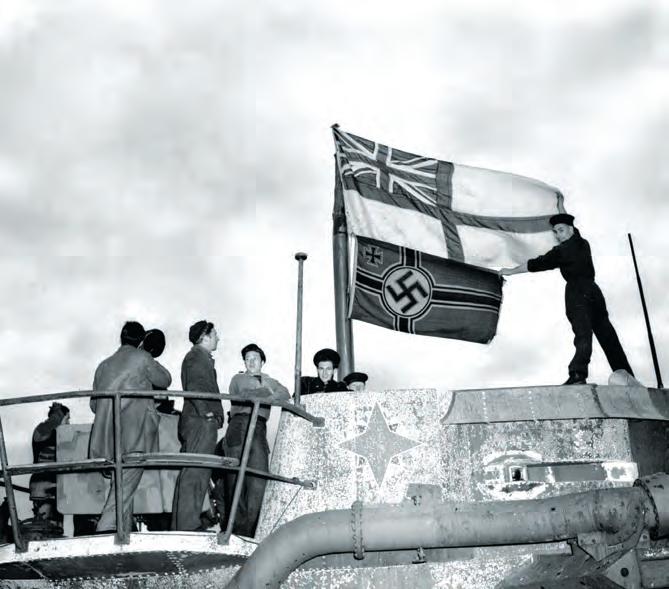
Returned ensign By Sharon Adams 96
CANADA
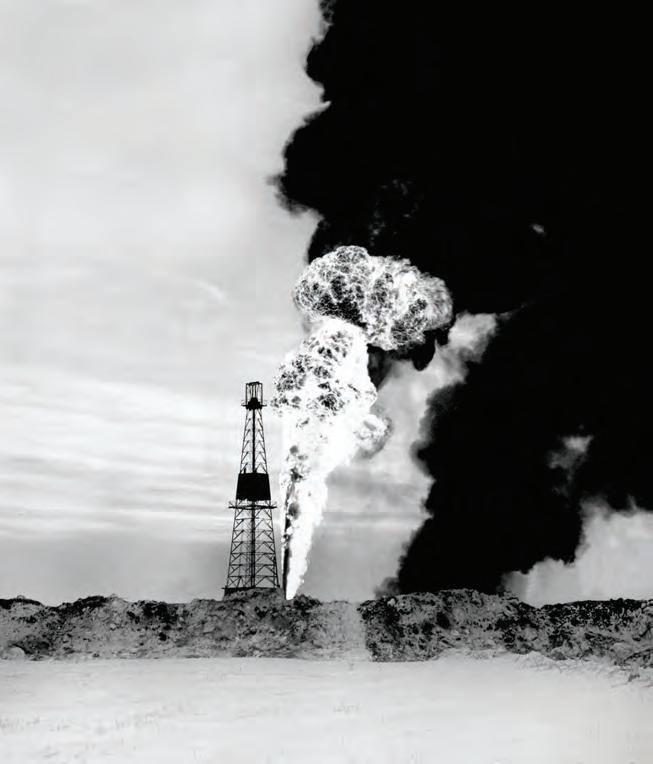
Alberta’s first (real) oil boom By Don Gillmor
Vol. 97, No. 1 | January/February 2022
Board of Directors
BOARD CHAIR Owen Parkhouse BOARD VICE-CHAIR Bruce Julian BOARD SECRETARY Bill Chafe DIRECTORS Tom Bursey, Steven Clark, Thomas Irvine, Berkley Lawrence, Sharon McKeown, Louise Tardif, Brian Weaver, Irit Weiser
Legion Magazine is published by Canvet Publications Ltd.
GENERAL MANAGER Jennifer Morse
ADMINISTRATIVE
SUPERVISOR
Doris Williams
RESEARCHER/ ADMINISTRATIVE
ASSISTANT
Stephanie Gorin
EDITOR
Eric Harris
ASSISTANT EDITOR
Trevor Oattes
STAFF WRITERS
Sharon Adams
Stephen J. Thorne
ART DIRECTOR, CIRCULATION AND PRODUCTION MANAGER
Jason Duprau
SENIOR DESIGNER AND PRODUCTION CO-ORDINATOR
Jennifer McGill
DESIGNERS
Derryn Allebone
Sophie Jalbert
SENIOR DESIGNER AND MARKETING CO-ORDINATOR
Dyann Bernard
WEB DESIGNER
Ankush Katoch
WEB AND SOCIAL MEDIA
CO-ORDINATOR
Eric Salgado-Valle
Advertising Sales CANIK MARKETING SERVICES TORONTO advertising@legionmagazine.com
DOVETAIL COMMUNICATIONS INC mmignardi@dvtail.com OR CALL 613-591-0116 FOR MORE INFORMATION
Published six times per year, January/February, March/April, May/June, July/August, September/October and November/December. Copyright Canvet Publications Ltd. 2022. ISSN 1209-4331
Subscription Rates
Legion Magazine is $9.96 per year ($19.93 for two years and $29.89 for three years); prices include GST. FOR ADDRESSES IN NS, NB, NL, PE a subscription is $10.91 for one year ($21.83 for two years and $32.74 for three years). FOR ADDRESSES IN ON a subscription is $10.72 for one year ($21.45 for two years and $32.17 for three years).
TO PURCHASE A MAGAZINE SUBSCRIPTION visit www.legionmagazine.com or contact Legion Magazine Subscription Dept., 86 Aird Place, Kanata, ON K2L 0A1 or phone 613-591-0116. The single copy price is $5.95 plus applicable taxes, shipping and handling.
Change of Address
Send new address and current address label. Or, new address and old address, plus all letters and numbers from top line of address label. If label unavailable, enclose member or subscription number. No change can be made without this number. Send to: Legion Magazine Subscription Department, 86 Aird Place, Kanata, ON K2L 0A1. Or visit www.legionmagazine.com. Allow eight weeks.
Editorial and Advertising Policy
Opinions expressed are those of the writers. Unless otherwise explicitly stated, articles do not imply endorsement of any product or service. The advertisement of any product or service does not indicate approval by the publisher unless so stated. Reproduction or recreation, in whole or in part, in any form or media, is strictly forbidden and is a violation of copyright. Reprint only with written permission.
PUBLICATIONS MAIL AGREEMENT NO. 40063864
Return undeliverable Canadian addresses to Legion Magazine Subscription Department 86 Aird Place, Kanata, ON K2L 0A1 | magazine@legion.ca
U.S. Postmasters’ Information
United States: Legion Magazine, USPS 000-117, ISSN 1209-4331, published six times per year (January/February, March/April, May/June, July/August, September/October, November/December). Published by Canvet Publications, 866 Humboldt Pkwy., Buffalo, NY 14211-1218. Periodicals postage paid at Buffalo, NY. The annual subscription rate is $9.49 Cdn. The single copy price is $5.95 Cdn. plus shipping and handling. Circulation records are maintained at Adrienne and Associates, 866 Humboldt Pkwy., Buffalo, NY 14211-1218. U.S. Postmasters send covers only and address changes to Legion Magazine, PO Box 55, Niagara Falls, NY 14304.
Member of CCAB, a division of BPA International. Printed in Canada.
We acknowledge the financial support of the Government of Canada. Version française disponible. On occasion, we make our direct subscriber list available to carefully screened companies whose product or services we feel would be of interest to our subscribers. If you would rather not receive such offers, please state this request, along with your full name and address, and e-mail magazine@legion.ca or write to Legion Magazine, 86 Aird Place, Kanata ON K2L 0A1 or phone 613-591-0116.
In The right decision
November, soon after her appointment as Canada’s new defence minister, Anita Anand announced that the civilian police and court systems will investigate and prosecute military sexual misconduct cases.
This has been recommended by three former Supreme Court justices, dating to Marie Deschamp’s 2015 review of military sexual misconduct. She described an “underlying sexualized culture” that was eroding the integrity, professionalism and efficiency of the Canadian Armed Forces.
MOVING CRIMINAL SEXUAL ASSAULT CASES INTO CIVILIAN COURTS WILL HELP REBUILD TRUST
She said that culture dissuaded victims from reporting assaults, which prevented those in command from seeing the true extent of the problem.
In 2021, the extent of the problem became blatantly obvious as nearly a dozen leaders, including some at the highest rank, were investigated for sexual misconduct, with criminal charges laid against two. As well, other leaders were disciplined over their mishandling of sexual misconduct cases.
In June, Morris J. Fish recommended the civilian justice system handle prosecution
of sexual misconduct pending reform of the military system. And on Oct. 20, Louise Arbour recommended immediate transfer of all alleged sexual assaults and other criminal offences of a sexual nature under the Criminal Code to civilian authorities on an interim basis.
Experts and survivors of military sexual trauma have long argued the civilian system is better suited to handle investigation and prosecution of sexual offences, not least because it is outside the chain of command.
CAF members have for decades been reluctant to report assaults due to fear they wouldn’t be believed, that their complaints would be handled by insensitive people in the chain of command, that they would be denied promotions and assignments, and that they would be subject to reprisal from assailants and comrades.
Following the 2015 report, the military established Operation Honour, to change the culture through education about sexual misconduct, punishment of perpetrators, and survivor support at the Sexual Misconduct Response Centre.
But sexual harassment and assault did not stop.
Moving criminal sexual assault cases into civilian courts will help rebuild trust both inside and outside the military. It removes the chain of command from the process and ensures transparency.
Anand wrote that this unprecedented public scrutiny “represents an equally unprecedented opportunity for meaningful change to build confidence.”
Her decision should spur military personnel of all ranks to focus on the hard work of culture change. It is something all Canadians expect. L
Life as a
PoW
Iread with great interest “The man who skipped a line” (September/October).
Comments
can be sent to: Letters, Legion Magazine , 86 Aird Place, Kanata, ON K2L 0A1 or e-mailed to: magazine@ legion.ca
It provided a window into my grandfather’s experience as a prisoner of war in Japan. Charles C. Meechan was a gunner with the Royal Artillery and was captured at the fall of Singapore in 1942. He was in Nagasaki when the atomic bomb was dropped but, as he was working in the mines, he was protected from the fallout. He told my brother many horrific stories of what life was like as a PoW, sparing me the details. After my grandfather died, I heard the stories from my grandmother and my brother.
The photo you included of British Lieutenant-General Arthur Percival gave me a glimpse of someone who likely knew my grandfather and shared some of his experiences. His gaunt face reminded me of the suffering my grandfather had endured. Charles immigrated to Canada in 1946 and spent the rest of his life in Toronto. My father, his only son, joined the navy and served on HMCS Algonquin out of Halifax. That’s where he met my mother, who was in the air force, working at RCAF Station Beaverbank. I joined the air force reserves in 1989.
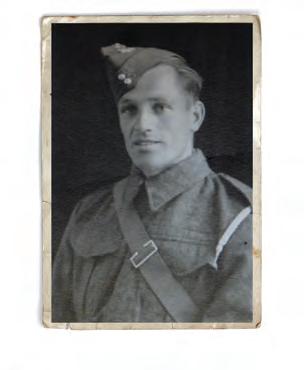
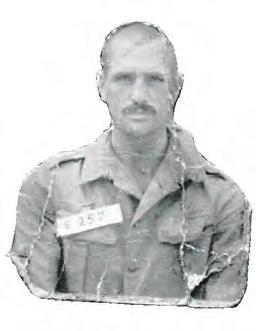
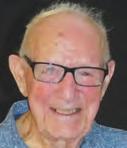
I am proud to be the granddaughter of this man who, against the odds, survived a horror that hopefully none of us will ever have to endure. I have photos (above) of my grandfather as a recruit and then as a PoW.
KIM MEECHAN,
HALIFAX
Minesweepers needed
I take issue with my friend Doug Thomas (Social Signals, November/December) who wrote, “We need ships and personnel of a quantity and sophistication to protect all of Canada’s borders which includes the Arctic. This means nuclear submarines as well as surface ships and ice breakers.”
In all these urgent discussions, there is never any mention of mine-warfare vessels.
I appreciate we have the 12 multipurpose Kingston-class maritime coastal defence vessels which, when ordered, were to include modest minesweeping abilities. But again, as when the last of the Bay-class minesweepers were taken out of service, our concentration is on replacement submarines and frigates.
Those are necessary, but we
ignore the threat of mines at our peril. Harbours—such as Halifax, Sydney, Vancouver, even the Cabot Strait—can easily be mined by a potential enemy, large (China, Russia) or small (rogue nations), that takes offence to our position. Sophisticated mining can be undertaken by minor countries using fishing trawlers. It could seal off supply routes or a response until we dealt with it.
We better put mine detection warfare on the agenda and start low-level production of at least a few capable ships. And train experienced sailors and officers in the latest sea mines being developed by potential enemies and our allies.
FRASER M. M c KEE, TORONTO
Keep it coming
I am 91 years old and living with my wife in a very nice seniors retirement suite in Regina. We
enjoyed my 25 years in the RCAF when I served on bases in Canada, Germany and Egypt. During the past 40 years serving the Legion, I have educated school classes in the history of the wars and my actions as a peacekeeper. It is surprising how little our kids in grades 9 to 11 know about this. I enjoy the stories in Legion Magazine, so please keep it coming.
ROBERT DAVIES, REGINA
Lucky break
“Some Came Home” (November/ December 2021) mentioned Captain William Durie of the 58th Battalion. While commanding ‘A’ Company, he, his sergeant major and a private were killed in a trench mortar attack near Lens in December 1917. My grandfather, Lieutenant C.E. Little, MM, had been the sergeant major for that company and was
fortunate to have been invalided home by then. More on Durie and the story of his clandestine repatriation by his mother can be found in Second to None: The Fighting 58th Battalion of the Canadian Expeditionary Force.
JIM LITTLE
TURNER VALLEY, ALTA.
Bomber museum
In the article “Online monument” (November/ December), Kurt Johnson of Renfrew, Ont., says “Canadians can’t find their own stories in Canada…. We should be creating our own website with all these bios.”
Please be aware of the Bomber Command Museum in Nanton, Alta. (www.bombercommandmuseumarchives.ca), which maintains a dossier of information and a huge collection relating to Bomber Command personnel, aircraft, missions and more.
SHIRLEE MATHESON, CALGARY
wing” (September/ October 2021) provides overdue recognition of the development of plastic surgery to treat disfigured aircrew burn victims. The ingenuity and leadership of Wing Commander Ross Tilley, RCAF, is highlighted. My book, S.S. Nerissa: the Final Crossing, includes details of Tilley’s transit to the United Kingdom in the in January was sunk by a U-boat.
a military historian for most of my long life and I’ve been involved with the regular force and reserves at Gagetown, Petawawa, Kingston and Borden. I have spent decades in military reenactments—the 1759 conflict; Canadian involvement in the American Revolution; and the world wars.
I wanted to tell you that your magazine is without doubt the best military history publication that we have in this country. thanks for such good work.
GAVIN K. WATT, KING CITY, ONT. L
Northern Lights
Canadian Woods
34.5" x 34.5"
Dan George
SOCIAL SIGNALS
What’s trending for Legion Magazine
My grandfather, Alexander Singleton, was there in 1916-1918.
Timothy L. Sanford
Love this poppy image. Comments on: “Eternal poppy” (November/December 2021)
Jim Anderson
Lots of the Irish and Scots who settled in Newfoundland were of Scandinavian descent. Ryder Butler
Christopher Columbus hit the snooze alarm one too many times and came second place. Comments on: “Vikings settled Newfoundland centuries before Columbus sailed: new research” (Front Lines Weekly, Oct. 27, 2021)
Paige Runolfson
Thank you Legion Magazine for helping us never forget. Blessings back to you all. Our men and women were amazing. Lest we forget what our superheroes and superheroines did 104 years ago. Comment on: “George
Pearkes and the Battle of Passchendaele” (Military Milestones, Nov. 7, 2019)
Marc Gauvin
With what?
Cyrus Schönshekel
Couldn’t beat Afghans but think they have a chance with Russia. OK, boomer. Comments on: “Should Canada boost its military presence in the Arctic?”
(Face to Face, September/October 2021)
Gary Kirkpatrick
So do it. Time to catch up with the ideals of the 21st century. Okay. The “Star Trek” version. But a better future version would be nice. Let’s do better than the police state south of the border. Comment on: “RCMP needs ‘fundamental
transformation’ to end systemic racism, says report” (September/October 2021)
Linda Conron
Thank you for your honourable service. Godspeed. Comment on: “Early days: Canadian troops in Afghanistan 2002-2004” (Front Lines Weekly, Sept. 14, 2021)
Kevin Milne
I like Norm MacDonald’s comment “… and who does Germany go to war against? The world! And you’d think it would take about five seconds for the world to win, but no; it was close.” Anyway, I love my freedom; thanks to those who serve and those who pay the ultimate price. Comment on: “After Dunkirk” (May/June 2020)
Follow Legion Magazine on social media to keep up to date with the latest
Legion and Arbor Alliances
2 January 1929
Canada and the United States sign a joint agreement to protect and beautify Niagara Falls.
January
8 January 1940
3 January 1947
Mackenzie King becomes Canada’s first citizen after passage of the Canadian Citizenship Act
4 January 1932
Members of the RCMP set out on a northern expedition to apprehend Albert Johnson, the “Mad Trapper,” leading to a manhunt, several shootings and at least two deaths.
5 January 1919
The German Workers’ Party is formed in Munich, laying the groundwork for the birth of the Nazi Party 13 months later.
7 January 2000
Beverley McLachlin becomes the first female chief justice of the Supreme Court of Canada.
Food rationing begins in Britain; Canada tightens its belt and sends flour, bacon, eggs, cheese and milk to its beleaguered ally.
11 January 1815
John A. Macdonald is born in Glasgow, Scotland.
12 January 1930
Future NHL defenceman and coffee kingpin Tim Horton is born in Cochrane, Ont.
14 January 1994
Presidents Bill Clinton and Boris Yeltsin sign the Kremlin Accords, reducing the threat of global nuclear conflict.
15 January 1991
Australia becomes the first nation of the Commonwealth to create its own Victoria Cross; Canada follows suit two years later.
16 January 2001
U.S. President Bill Clinton awards Theodore Roosevelt a posthumous Medal of Honor for his actions in the SpanishAmerican War.
17 January 1948
First flight in Canada of the Royal Canadian Air Force Vampire III fighter jet.
18 January 1967
Yellowknife is announced as the capital of the Northwest Territories.
19 January 1943
Princess Margriet of the Netherlands is born at the Ottawa Civic Hospital, in a room officially designated as Dutch territory.
23 January 1879
A British force of about 150 successfully defends a mission station against more than 3,000 Zulu warriors at the Battle of Rorke’s Drift.
24 January 1972
After hiding in the jungles of Guam for nearly 30 years, Second World War-era Japanese soldier Shoichi Yokoi is subdued by local fishermen.
26 January 1961
Canadian icon and hockey legend Wayne Gretzky is born in Brantford, Ont.
28 January 1916
Manitoba is the first province to give women the vote and the right to run for office.
February
1 February 1796
The town of York becomes Upper Canada’s second capital; it would be renamed Toronto in 1834.
4 February 1915
Lieutenant William Sharpe is killed during his only solo flight, the first Canadian military aviator casualty of the First World War.
5 February 1944
A German mortar kills 19 members of the Perth Regiment near Ortona, Italy, as they line up for dinner.
6 February 1951
The newly formed 2nd Battalion, Princess Patricia’s Canadian Light Infantry, becomes the first Canadian unit to take part in the Korean War.
8 February 1944
Disguised as a farmer, Devil’s Brigade soldier Tommy Prince fixes a broken communication wire in full view of German soldiers.
9 February 1945
10 February 1763
The Treaty of Paris is signed, formally ending the Seven Years’ War. France cedes its North American territories to the British as a result.
11 February 1869
Patrick James Whelan is hanged for the assassination of Thomas D’Arcy McGee, one of the Fathers of Confederation.
12 February 1747
The British capitulate after an attack by a French, Mi’kmaq and Acadian force at Grand-Pré, N.S., the previous day.
13 February 1969
The Front de libération du Québec bombs the Montreal Stock Exchange, injuring 27.
14 February 1876
Alexander Graham Bell is credited with a patent for the first telephone.
16 February 1881
The Canadian Pacific Railway is incorporated.
18 February 1943
19 February 1942
Winnipeg stages “If Day,” a full-scale mock Nazi invasion, in order to frighten people into buying war bonds.
20 February 1989
A Canadian Human Rights Tribunal ruling removes barriers to women in military occupations, except in submarines.
23 February 1942
Japanese submarines shell the town of Ellwood, Calif., triggering a wave of panic across the United States.
25 February 1941
British forces capture Mogadishu in North Africa.
26 February 1815
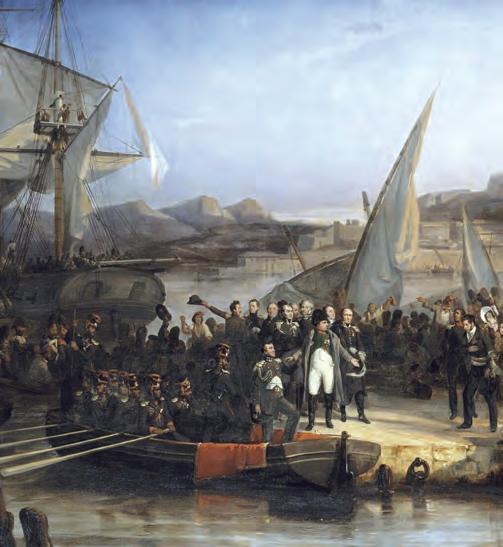
Napoleon Bonaparte escapes from his exile on the island of Elba and sets sail for Paris.
HMS Venturer stalks and sinks U-864 off the coast of Norway, the only recorded example of submerged submarine-tosubmarine combat.
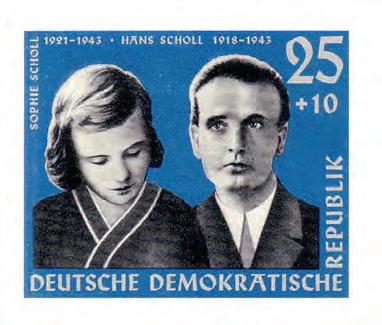
White Rose members Hans and Sophia Scholl are arrested after dispersing anti-Nazi literature at the University of Munich; they are executed four days later.
By Sharon Adams
An CIMVHR forum highlights hidden health research possibilities
explosion of knowledge has occurred since the Canadian Institute for Military and Veteran Health Research was founded a little more than a decade ago.
With a network of about 1,700 researchers across dozens of universities in Canada, CIMVHR has produced significant research in support of veterans, serving military and their families. This knowledge has been used to help doctors diagnose problems, establish severity and propose solutions.
The organization has contributed to disseminating this knowledge through its annual forums, which have been held virtually during the pandemic.
Well done, all.
But they could be doing better, suggests a group of CIMVHR researchers who shone the spotlight on the work itself this year, revealing some significant gaps in what is studied and how.
The group included Jim Thompson, a research medical consultant who made the presentation at the virtual forum, as well as David Pedlar, CIMVHR’s scientific director; Dianne Groll, assistant scientific director; and Stéphanie Belanger, associate scientific director.
They took a hard look at some
1,300 forum presentations between 2012 and 2019, 200 articles from the Journal of Military, Veteran and Family Health and 100 studies undertaken for the Canadian Armed Forces and Department of National Defence. What they discovered should help shape future research.
First, they found that most of the studies presented over the years at the forum focused on just two of seven factors that are said to contribute to human well-being.
integration and financial health.
As well, of the forum’s 415 health presentations, 197 focused on mental health and 138 on physical health, while the topics of social and spiritual health, pain, addiction and suicide were far less represented.
Of the 732 topics explored regarding cultural and social health, the majority of presentations were about health care interventions and services, again mostly focusing on mental and physical health rather than other aspects of care.
THE STUDY OF VETERANS’ ISSUES HAS LAGGED.
“IS IT MAKING A REAL DIFFERENCE FOR THEM IN THEIR LIVES?”
The majority of research, 55 per cent, focused on social environment/cultural issues and a further 31 per cent examined health topics. Other factors important to well-being got shorter shrift, such as employment/ meaningful activity, life skills, physical environment, social
Secondly, serving military personnel—mostly those of the regular force—were the focus of 604 of the 1,341 presentations. Though the number of presentations on the families of veterans and service members has grown steadily, the study of veterans’ issues has lagged.
Thirdly, much of the research,
regardless of topic studied, focused on diagnosing issues and suggesting possible solutions; there was much less research into actual implementation and evaluation.
“There’s a fair bit of research on possible causes,” said Thompson. “And a lot of research on proposed solutions for those problems.
“But what we’re not seeing is a lot of research on how those solutions were implemented in a real world setting and how they were evaluated…is it making a difference…in their kitchens, in their homes, not [just] in the clinic, but is it making a real difference for them in their lives?”
The CIMVHR team exposed a need to increase the focus on implementation and evaluation, expand the range of study to include other aspects of well-being and broaden research to include reservists.
This analysis can help guide decision-makers and may result in much more thorough and balanced research that attends to more needs than those currently grabbing headlines.
But what good is this information if it can’t be shared?
The CIMVHR team also identified a pressing need to organize the cumulated knowledge from all this Canadian research.
The production of scientific knowledge on military members, veterans and their families is “vast and accelerating,” said Thompson.
“It far exceeds what a busy clinician or busy policy analyst can access in a short time period.... Chances are someone somewhere already knows an awful [lot] about a topic that a researcher might want to study.”
There might even be information from an earlier era that is pertinent today—if the researcher can find it.
What’s needed, said Thompson, is an interface similar to what has been developed to handle the explosion of information
about COVID-19 research.
“We need that for the military and veteran [research] world,” he said. “But it won’t be cheap to set up or cheap to maintain.”
That is certainly a cue for funding agencies, charities, advocacy groups and philanthropists.
Investment in such a ‘library’ is one more step to ensuring that those who are funding this research get the biggest bang for their buck, that serving military, veterans and their families are getting the best possible support and that research keeps pace with evolving needs. L
Medipac Travel Insurance
Militarization
beyond the sky
Recent jaunts into near space by entrepreneurs, actor William Shatner and the ultra-wealthy have inspired waves of criticism among those who insist their fortunes could be better spent on Earth.
How, they say, can Jeff Bezos and Elon Musk invest billions in next-generation space technology when so many are starving? How can the privileged few blow US$250,000 a head for 10 minutes outside Earth’s atmosphere when others are in need?
Even Prince William weighed in.
“We need some of the world’s greatest brains and minds fixed on trying to repair this planet, not trying to find the next place to go and live,” he told BBC.
But commercializing space travel, as Bezos and Musk are doing, is just one more step toward other
lofty goals: space-based technology development (including systems that could help save the planet), exploration and colonization.
Seven decades after the Soviet satellite Sputnik launched the space race, the unmentioned threat confronting humanity is the militarization of the skies above the stratosphere. That’s according to a team of three space experts—two from McGill University in Montreal.
Space science is important to advancing humankind’s understanding of the planet and its place in the universe. And it has practical applications: navigation, tracking weather, enhancing land use, etc. But the writers cautioned against space-based conflict.
“The desire to counter the space ambitions of others and to achieve superiority in space seems to have re-emerged,” they said. “Despite
the proliferation and commercialization of space activities, and the recognition of space as an essential part of every country’s economic, social and scientific progress, there is an alarming build-up of counterspace capabilities worldwide.”
The authors are Kuan-Wei Chen, executive director of McGill’s Centre for Research in Air and Space Law; Ram S. Jakhu, acting director of McGill’s Institute of Air and Space Law; and Steven Freeland, emeritus professor of international law at Western Sydney University in Australia.
Their essay on the militarization of space appeared Oct. 11 in The Conversation, a series of online think pieces written by academic experts and researchers and distributed by a network of not-for-profit media outlets.
“Even as private citizens can now crew space missions, military strategists are warning the competitive and congested nature of space will lead to an outbreak of conflict in outer space,” they wrote.
“Simmering tensions on Earth increase the risk that humanity may somehow lurch into an unimaginable space war, destroying economies and critical civilian and military infrastructure that have become so heavily space-dependent.”
In September, General John Raymond, chief of the fledgling U.S. Space Force, said the security of the final frontier is facing
a “full spectrum of threats” from China that must be countered through international co-operation.
The Chinese are developing “everything from reversible jammers of our GPS system—which provides navigation and timing with precision—to jamming of communications satellites,” Raymond told the Nikkei Asia news service.
“They’ve got missiles they can launch from the ground and destroy satellites. I’m convinced that these capabilities that they’re developing would be utilized by them in their efforts in any potential conflict.”
Raymond said space also underpins “all of our instruments of national power…diplomatic, economic, information and national security.”
“It goes across all facets of governments. Space is critical to that.” In November, Russia conducted a missile test that destroyed one of its own satellites and cre-
“SIMMERING TENSIONS ON EARTH INCREASE THE RISK.”
ated a debris field that forced the International Space Station crew to take shelter in their capsules.
Such developments appear to run contrary to international treaties prohibiting the weaponization of space and U.S. President John F. Kennedy’s September 1962 declaration that essentially laid down the rules of the space race:
“Its conquest deserves the best of all mankind, and its opportunity for peaceful co-operation may never come again.”
Advertisement
In June, G7 nations agreed on a plan to advance international rulemaking at the United Nations and other global bodies. China and Russia have expressed willingness to co-operate and have called for limits on space weapons.
As for world hunger, Musk called out the director of the World Food Program, David Beasley, in October after the UN official challenged him and other billionaires to donate $6 billion to help end famine.
Musk replied that if the WFP could show the accounting of exactly how $6 billion would solve the problem, he’d sell Tesla stock and donate the entire amount. Beasley subsequently posted a 1,000-word executive summary on how $6.6 billion could “avert catastrophe” among 40 million people in 43 countries. The world awaited Musk’s response. L
EYE
ON DEFENCE
By David J. Bercuson
Are we
disarming?
Last fall, the Royal Navy offered to help Canada guard our strategic interests in the Arctic.
The offer was not noticed much by Canadian newspapers focused on the COVID crisis, the federal election, the subsequent leadership manoeuvrings of our political parties and the AUKUS security pact—a new submarine-sharing agreement between the United States, United Kingdom and Australia.
But Britain’s offer—really a pity hug—should remind us that 90 years after the Statute of Westminster 1931, which brought outright independence to Canada, the British are still ready to return to Halifax and Esquimalt should we ask them.
Some Canadians complained bitterly in September when the United States and Britain
agreed to help Australia acquire nuclear submarines and nuclear technology. Why weren’t we asked? Was the Five Eyes intelligence alliance now being reduced to Three Eyes? Aren’t we the most important ally to the United States, even though U.S. President Joe Biden bestowed that honour on Australia?
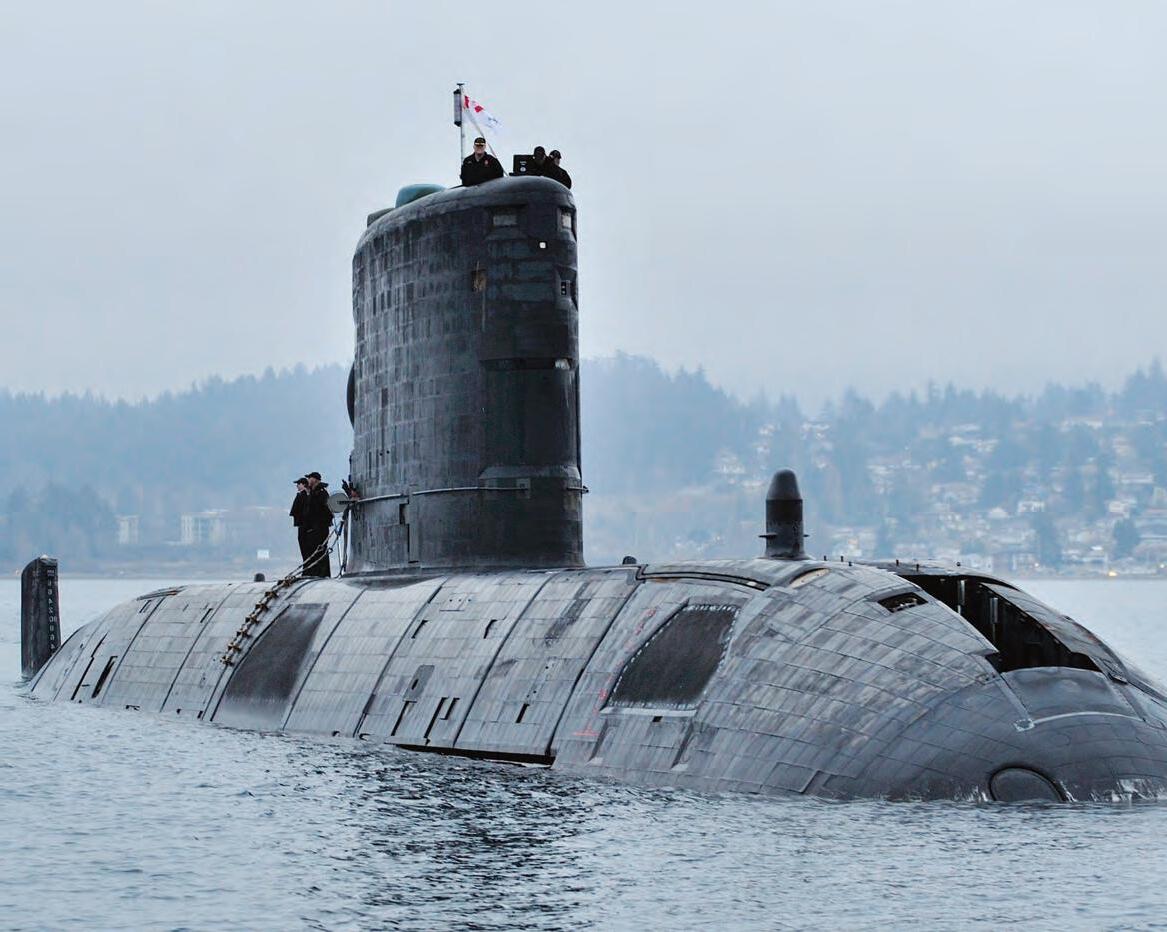
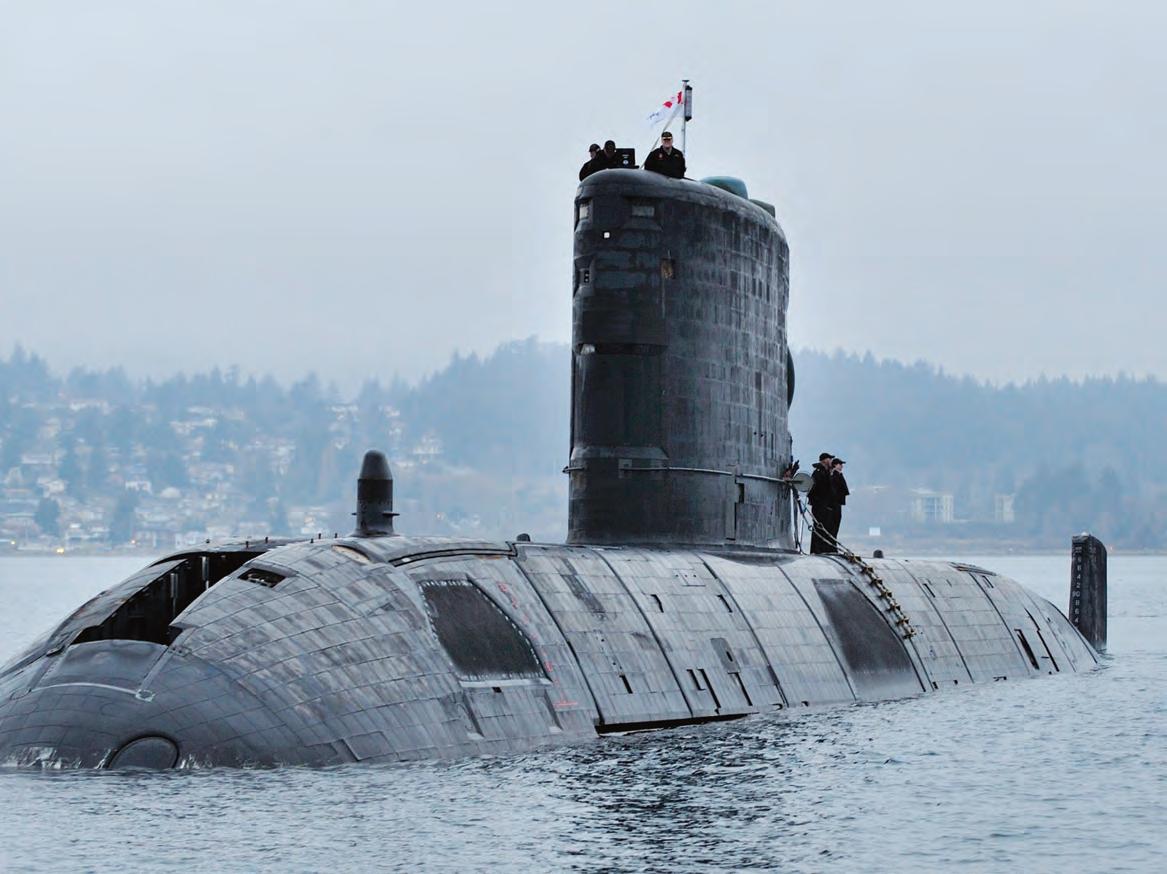
Canada has four obsolete British-built subs, obtained in the 1990s in exchange for Britain continuing to use their armoured training base at CFB Suffield. The subs have had misadventures, accidents, equipment failures and other incidents over the past two decades. It is rare when two of them can be deployed at one time, and they have no underice capability. The 2017 defence policy projected that these
boats should be upgraded in the 2030s—to what, it doesn’t say. We have effectively gone out of the submarine business.
We are going out of the surfacecombatant business too. We have gone out of the auxiliary oiler replenishment ship business, replacing proper naval AORs with a commercial vessel that is not allowed in a war zone.
We are almost out of the fighter jet business, flying a fleet that mixes out-of-date CF-18s with second-hand Australian F/A-18s. Our troops still carry a sidearm that dates back to the Second World War (although replacements are due in 2022).
We have upgraded most of the LAV IIIs that we took to war in Afghanistan—they are now LAV V Is—but we have cut the size of the fleet by about a third. We are acquiring new
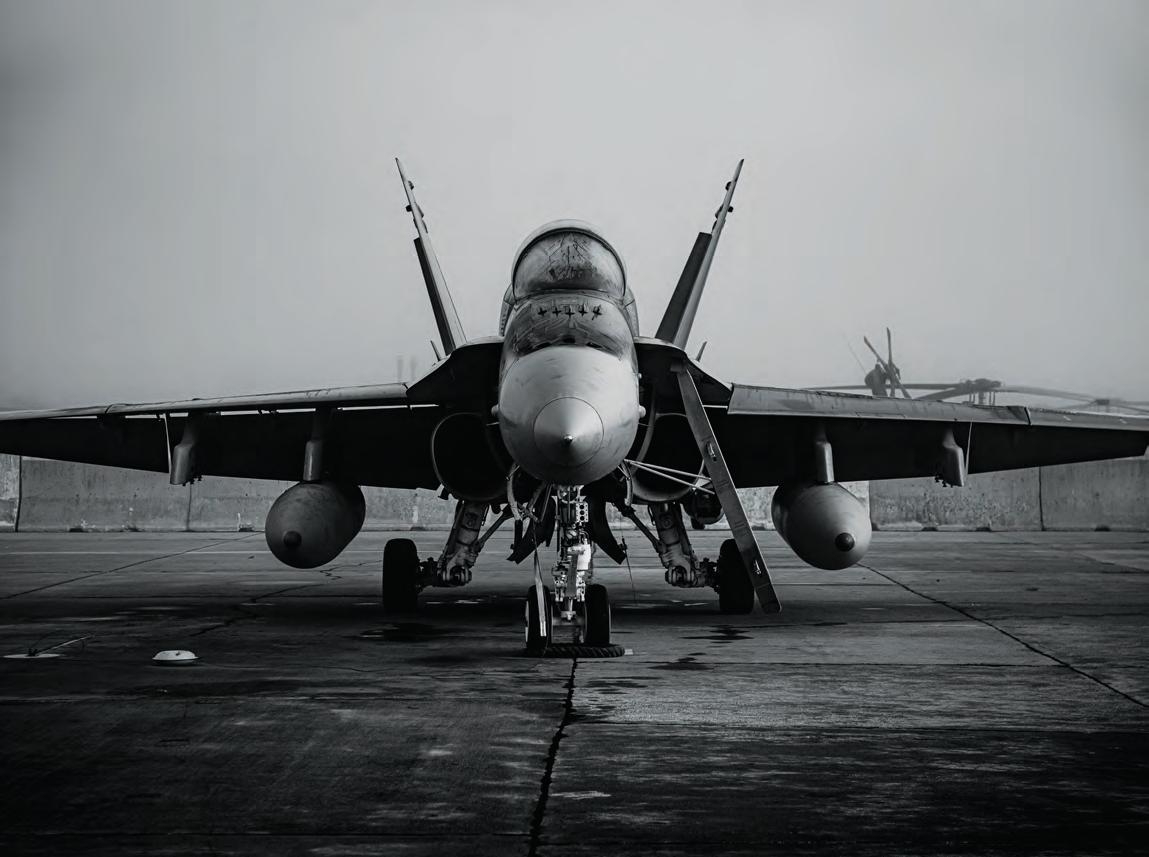
An RCAF CF-188 Hornet sits on the ramp at an air base in Romania during Operation Reassurance in October.
armoured patrol vehicles, but they remain plagued by problems ranging from rollovers to fires.
The defence establishment has not decided what to do with the Leopard tanks we acquired from Germany and Holland when we were in Afghanistan. And the list goes on.
Canada has been essentially disarming itself for most of the past decade.
In defence spending, Canada stood only 13th among the top 15 countries in 2020, dedicating 1.4 per cent of our gross domestic product to it. With only a quarter of our population and a quarter per cent of our land area, Israel spent 5.6 per cent of its GDP on defence. It can certainly be argued that Australia and Israel live in dangerous neighbourhoods and Canada does not. That was what Senator
WE ARE ALMOST OUT OF THE FIGHTER JET BUSINESS.
Raoul Dandurand, Canada’s delegate to the League of Nations, argued in 1924 when he said we live “in a fireproof house, far from inflammable materials.” This, of course, did not save us from going to war with Germany in 1939. Would we stand idly by if China attacked Taiwan? Would we stay neutral while China’s regime conquered 23 million people, gained unfettered access to the Central Pacific, and took control of the most productive chip manufacturing nation in the world? Would we wash our
hands while China dominated the South and East China seas and the Indian Ocean—or even the Arctic Ocean? Would we sleep while Chinese nuclear submarines armed with hypersonic missiles cruised the waters of the Arctic Archipelago? If we stand by, we are fools. A nation’s number one priority is the defence of its sovereignty, people and interests. When we disarm ourselves, we defend none of those things. No wonder the United States, Britain and Australia pay us no mind. L
raid trEnCH
The attack on German dugouts at Calonne in 1917 was one of Canada’s most successful raids of the war
By J.L. Granatstein
The war diary of the 21st Battalion (Eastern Ontario) on Jan. 7, 1917, was brief and to the point:
“The battalion was relieved by the 19th Battalion in the right subsector this morning… and three companies proceeded to Bully for special training. The remainder of the battalion together with a company of the 20th Battalion formed Brigade Support. Casualties nil.”
The battalion’s operation order detailed the personnel of the three companies: two majors, two captains, nine lieutenants, four signallers, 12 stretcher-bearers, 400 selected other ranks, with seven Lewis guns.
The next day, the diary indicated the purpose of the special training: a raid on German trenches northeast of Calonne, France.
The aim, as the order stated, was for “the 21st Battalion attacking party [to] enter the enemy trench...for the purpose of inflicting casualties, making prisoners, securing booty and wrecking dugouts in the system of trenches in the area attacked.” A similar raiding party from the 20th Battalion (Central Ontario) was also preparing to assault the German trenches facing them.
This was to be one of the most successful raids ever carried out by the Canadian Corps, a major effort that was to involve 860 soldiers organized into five companies, with
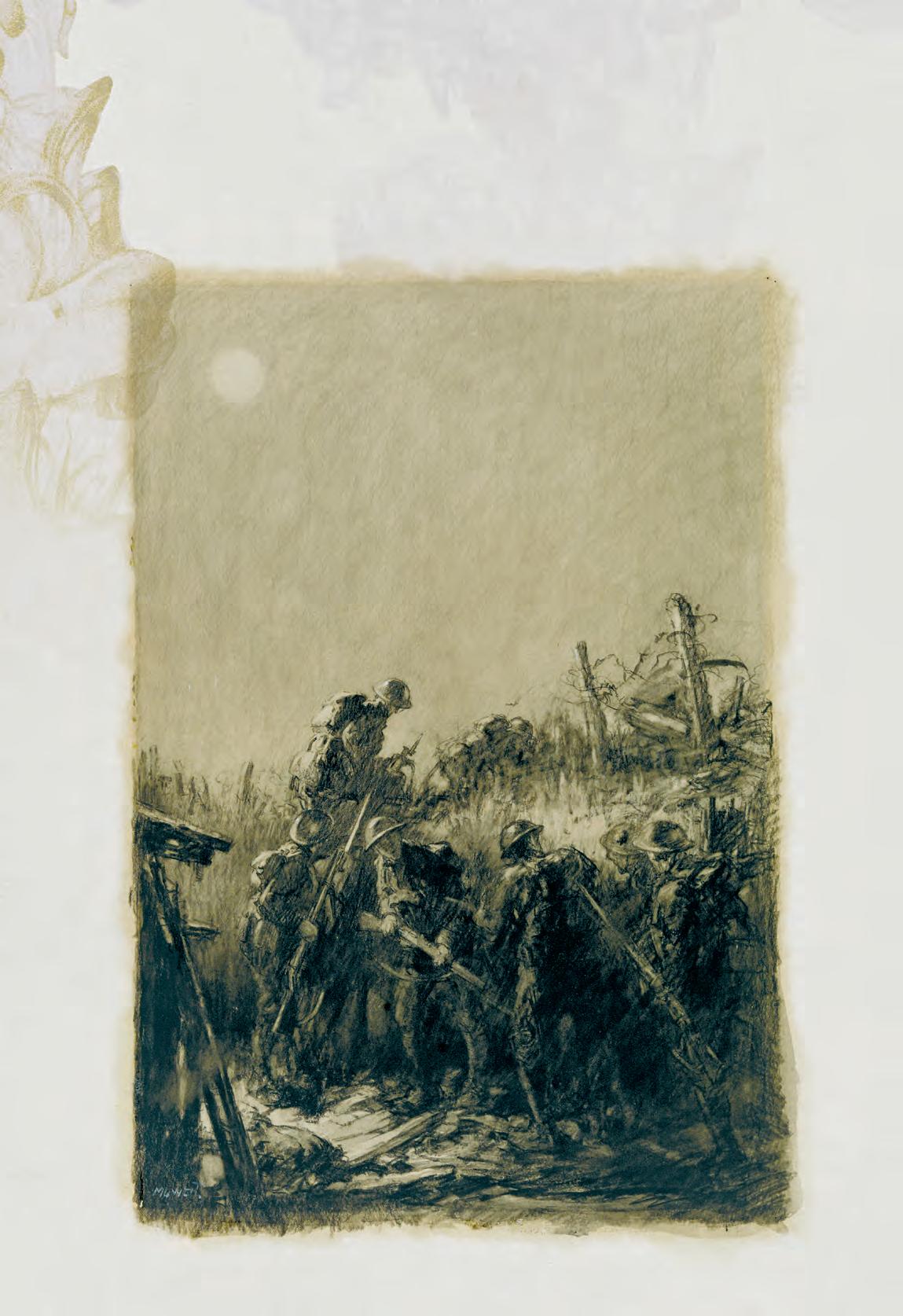
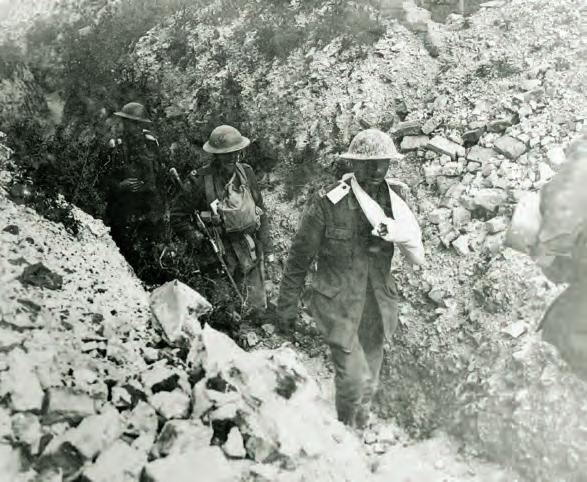
The charcoal sketch “Trench Raid” (opposite) by Harold J. Mowat shows seven Canadians leaving a trench, possibly an advanced listening post, on a nighttime raid. Tired, dirty and wounded, three Canadians (below) return from a July 1917 trench raid at Avion, France.
careful planning to include hard training, artillery support, deception measures and careful consideration of communications, all occurring under the watchful eye of the corps commander, Lieutenant-General Julian Byng, and the headquarters of the 2nd Canadian Division’s 6th Brigade.
The attackers blew up more than 40 dugouts.
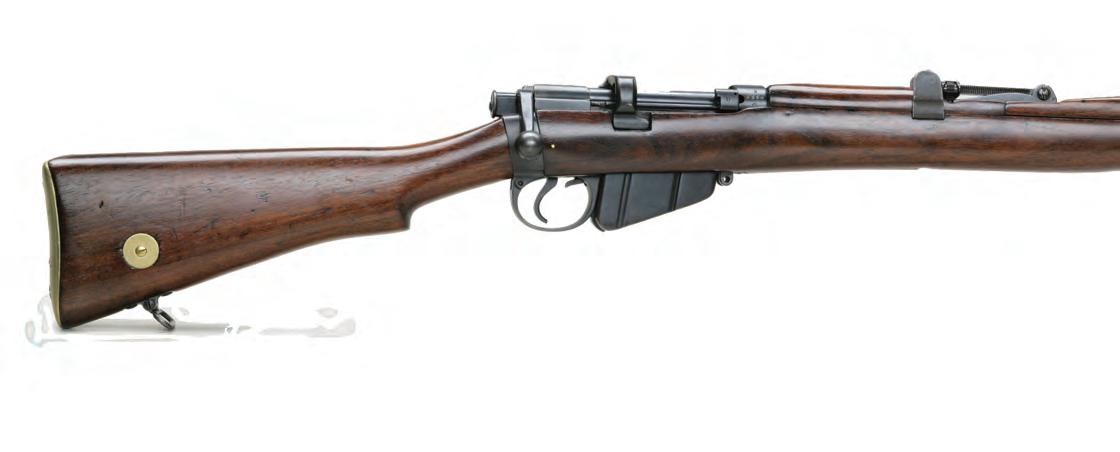
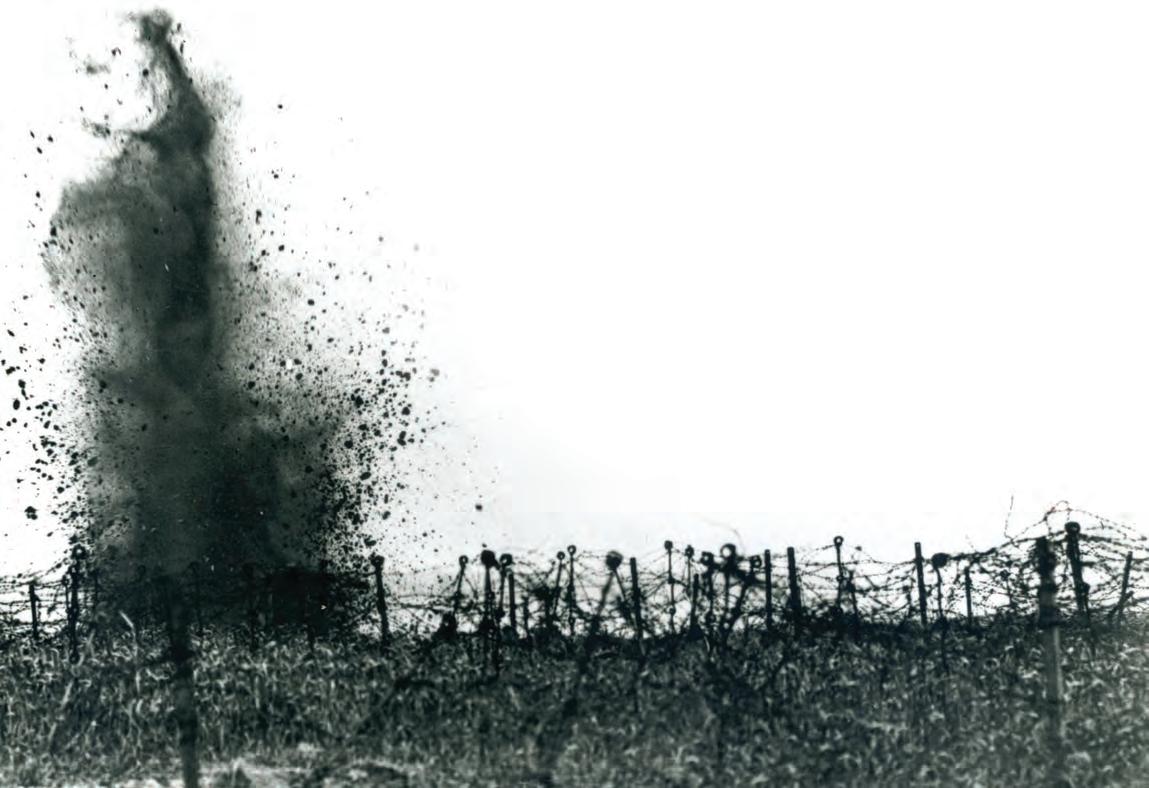
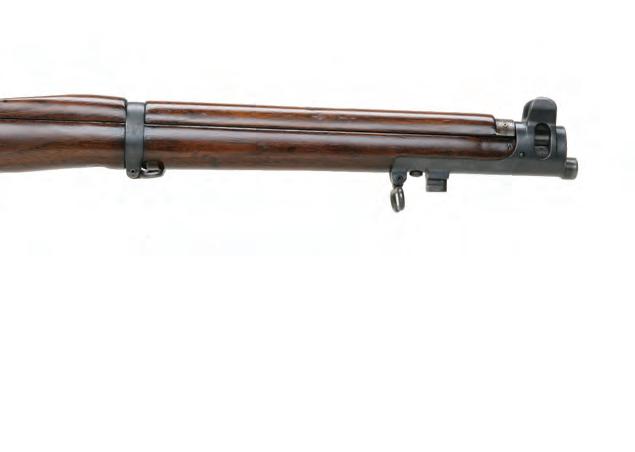
The Lee-Enfield No. 1 Mk III rifle (above) was more robust and reliable than the weapon it replaced, the much-maligned Canadian-made Ross rifle. While the Ross was still used for training in England, all front-line Canadian battalions were using the LeeEnfield by late 1916. Trench mortars (below) smash barbed wire at Vimy in 1917.
Trench raids had become a specialty of the Canadian Corps by 1917. The Princess Patricia’s Canadian Light Infantry, serving with the British 27th Division, launched the first raid by Canadian troops in February 1915, and the Canadian division soon began raids of its own.
Canadian headquarters believed trench raids were good for morale, a way of encouraging an aggressive spirit, securing control of the no man’s land between the trench lines, and relieving the tedium of life in the front line. The division, and the three Canadian divisions that joined it in late 1915 and 1916, became adept at staging raids. Whether the soldiers shared the enthusiasm of headquarters for trench raids was doubtful.
Most of the men likely preferred the unofficial truces that often developed in quiet parts of the front line that stretched from the North Sea to the Swiss border.
The raids went on nevertheless, most by small parties of men.
By the beginning of 1917, with planning for the Canadian assault on Vimy Ridge already well underway, raids had increased in number and in size and were often carried out in daylight.
The aim was to get as much information as possible about the enemy and make the Germans fearful, thus affecting their morale and reducing their own patrolling. Even more important, the tactics employed in the larger raids were shaping the template for the forthcoming attack at Vimy.
First came the training. Men detailed for the raid went out on patrols to get the lay of the land they would assault. Engineers at Bully-Grenay, northwest of Vimy and just behind the front, had created a trench system that duplicated the German lines at Calonne and the raiders and their attached sappers had done their rehearsals.
Each platoon formed a separate party: with riflemen (some with wire cutters attached to their Lee-Enfields), bombers, stretcherbearers and engineers carrying charges and gun cotton to wreck dugouts and machine-gun emplacements. They would constitute the first wave and provide cover for the withdrawal.
The second wave of infantry intended to seize the support line and establish blocks along the communication trenches. It had a Lewis gunner in each platoon. The third wave was to provide carrying parties and technical support. Machine guns and artillery were positioned on the flanks of the raid to minimize the German response.
Each soldier carried a rifle and bayonet, 100 rounds of ammunition, 10 bombs, a sandbag, a water bottle and a haversack. Each company had six men carrying 10 rifle grenades, and the companies had canvas to throw over the enemy wire if necessary.
Signallers lugged telephone wire to establish contact between the raiders and headquarters. Engineers, the most heavily laden, had ladders to bridge trenches or carry wounded. There were also smoke bombs and mortar bombs adapted to be thrown into dugouts. The rehearsals and the careful preparation satisfied Byng that the raiders were ready.
Aggressive patrolling scouted the enemy’s barbed wire entanglements and the 2nd Division’s artillery was tasked to destroy it. Too often, attackers got hung up on the rows of wire and were shot by the defenders. Patrols on Jan. 16 confirmed the wire was largely destroyed.
By this stage of the war, the Germans ordinarily ranged their defences in depth with few men in the trenches and most of their troops in well-constructed dugouts in the support line. Their machine guns supported each other with fixed arcs of fire, their officers could call on mortars and artillery for support, and they anticipated that attackers who broke through the lightly defended front line would then be smashed by rapid counterattacks.
But the Canadians were fully aware of the German tactics. They had pinpointed most of the enemy machine guns and dugouts and planned to hit them with artillery. The infantry and sappers were to take out strongpoints one by one with bombs. There were to be no more futile frontal assaults with their inevitable heavy casualties, and the raiders’ intent now was to create gaps through which the infantry could move forward.
Starting at dawn on Jan. 17, the companies from Bully took up positions at the front. At 7:45, the artillery opened fire and the first wave moved to the assault, followed at 50-metre intervals by the next two waves.
The Germans, into their morning standdown, were carrying out routine tasks when their lines were pummelled by Canadian gunfire. At the same time, two battalions on the left flank staged diversionary attacks and the gunners laid down smoke in front of the raiders.
Fifteen minutes after zero hour, British tunnellers exploded a mine to the north, further distracting the enemy. Within five minutes, the first wave reached the German wire and easily breached it, thanks to the artillery preparation.
Details of the raid were described in the history of the 20th Battalion:
We discovered five sentry groups in the front line, which were quickly killed or captured. The line was lightly held. Numerous dugouts were examined, most of which were unoccupied and full of water, and in only two of them did we take prisoners. Very wide at the top—almost impossible to jump—the trench had fallen in at many points and was badly damaged by shellfire….
The second wave passed over the German front line shortly after the first reached it. Some of us bombed our way up the communication trenches, in which a number of dugouts were found and bombed; others went overland, the wire between the first and second lines being too badly cut to form a serious obstacle.
We succeeded in advancing to the line of the second barrage, which was on the support line, some minutes before it lifted. At twenty-four minutes past “zero” we had entered the support line and final objective; the artillery having lifted to a protective barrage.
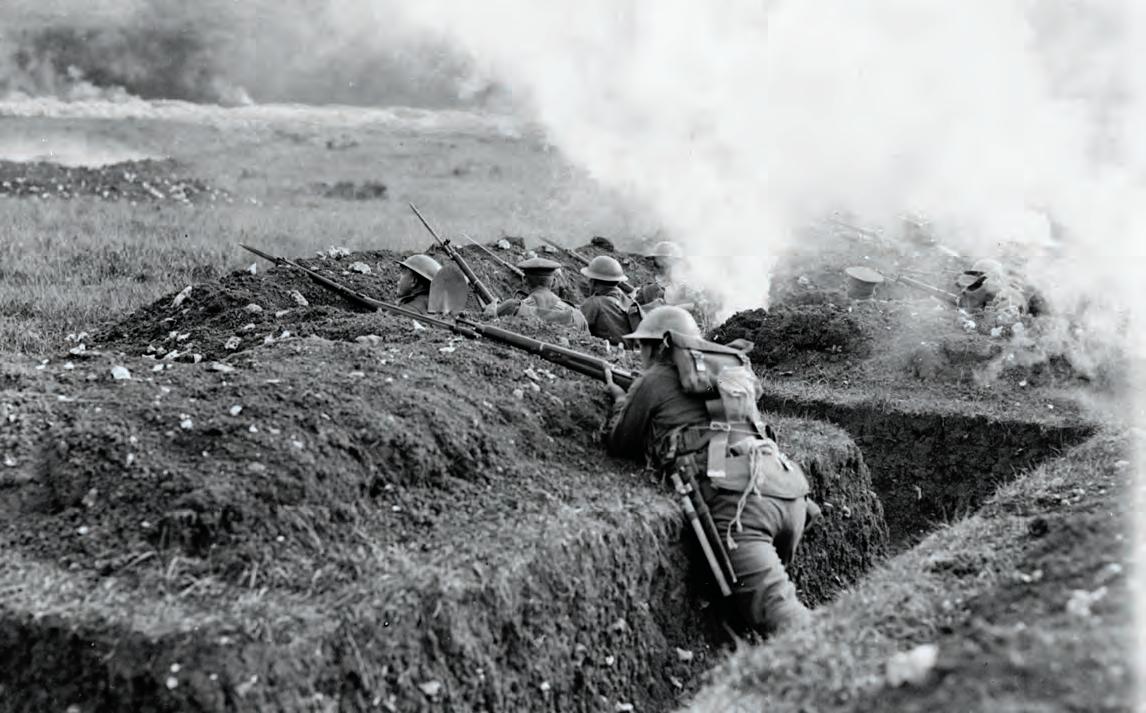
Canadian troops, in this instance armed with American manufactured P14 rifles, mount a demonstration in England in 1917.
Headquarters
believed trench raids were good for morale.
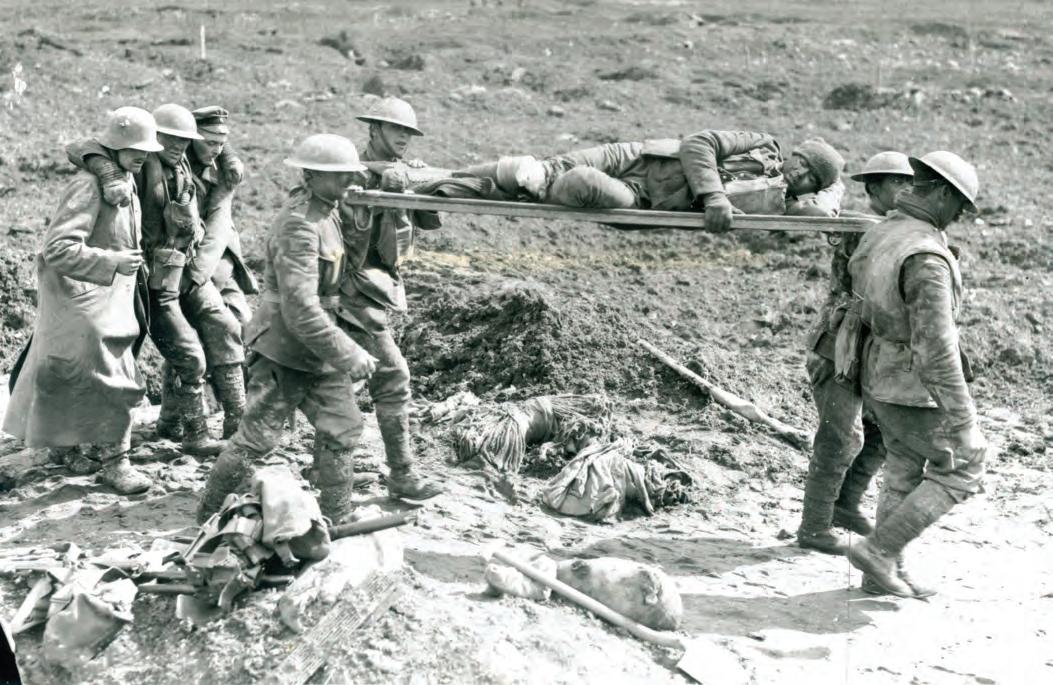
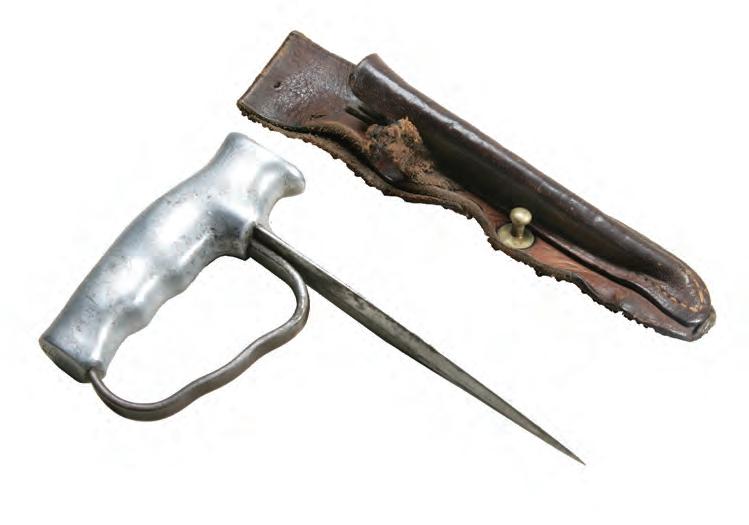
Stretcher-bearers and German prisoners (top) bring in wounded during the Battle of Vimy Ridge in April 1917. Push daggers, like this Robbins of Dudley example, were used in handto-hand combat. They were privately bought by men looking for that little something extra during trench raids.
In the support line we found two trench mortar emplacements, both totally destroyed by our artillery fire, and a machine-gun emplacement demolished….
The dugouts here were more numerous, and their occupants extremely unwilling to leave them; as time did not allow much persuasion, mobile charges were thrown in and dugouts and men annihilated together….
The engineers, who carried the mobile charges, were enjoying themselves. One of them was asked how he was getting on. “Fine!” he replied.
“You come to a dugout—light the fuse—drop the charge in—run like hell—look over your shoulder and see the dugout come out of the door.”
By 8:40, the 20th’s raiders returned to their lines with no man left behind.
As for the 21st Battalion, three German prisoners were sent back at 7:55, and two minutes later the major in command of the 21st’s raiders said he was at the German front line, that all was well, and that two men had been wounded by the supporting gunfire. Enemy retaliation was said to be slight.
By 8:12, all the 21st’s raiding parties but one had reached their objectives on the enemy support line, and soon enemy artillery and mortar fire began to increase, as did Canadian casualties. The withdrawal began at 8:30 and enemy retaliation was “almost nil.”
But that did not last long. The German artillery started firing at the battalion’s front line. The withdrawal continued, well covered by the Canadian artillery. Just after nine o’clock, the raid ended and the German retaliation ceased.
The Calonne trench raid was a success.
The attackers blew up more than 40 dugouts, exploded three ammunition dumps, captured two machine guns and two trench mortars and destroyed more.
More than 100 prisoners were taken by the raiding parties and many of the enemy were killed, including unknown numbers in the dugouts destroyed by the sappers and infantry. The Germans later claimed that their losses were 18 dead, 51 wounded
and 61 missing, figures that had certainly been heavily massaged. The Canadian losses, however, were serious, with 40 killed, 135 wounded and three missing. One raiding company of the 21st lost almost a quarter of its men killed or wounded.
A detailed study of the Calonne raid by historian Andrew Godefroy argued persuasively that the knowledge and experience
gained from raiding had moved beyond simply harassing the enemy; by 1917, it had become on-the-job training. And combined-arms warfare, as employed during the raid, was on the way to becoming the new Canadian doctrine. This doctrine was unquestionably the foundation of the Canadian Corps’ later successes at Vimy in April 1917 and in the Hundred Days of 1918. L
WeretREnCH rAidS PrOduCtiVE?
g
Generals liked raids on the enemy. They raised the troops’ morale, they said, and they kept the enemy fearful of sudden death. But trench raids also invited retaliation—the Canadians and the Germans were both good at the tactic—and produced casualties on both sides. When well planned, as at Calonne, a large raiding party could take many prisoners
enemy dugouts. But the raid at Calonne also left 175 Canadians dead and wounded, and they were seasoned soldiers. Poorly planned raids could be even more costly. On March 1, 1917, the 4th Canadian Division launched a raid at Vimy with some 1,700 men and suffered a 40 per cent casualty rate—so many that the Germans offered a truce to recover the bodies. This bungled raid may have harmed
German trenches demolished by artillery in July 1916.
Sensible commanders like General Arthur Currie supported raids that had a genuine purpose, but he looked at others—raids designed solely for the purpose of raiding—as the vanity projects of senior officers. LieutenantGeneral Julian Byng, however, was a true believer in raiding, and Currie said they had their one heated discussion on this subject. Currie’s doubts made sense, but the merits of trench
WORLD WAR
Drumbeat Operation
U-boats targeted East Coast shipping in the first half of 1942
By
Marc Milner
Canadian Air Force sent off a Catalina. Red Deer eventually rescued 93 survivors. No trace of U-123 was found.
the early hours of Jan. 12, 1942, wireless stations around the North Atlantic picked up a distress call from the British passenger freighter, SS Cyclops. The 9,076-ton vessel with 181 people aboard was 230 kilometres southeast of Cape Sable, N.S., and had just been struck by two torpedoes from U-123. The Royal Canadian Navy dispatched the minesweepers Red Deer and Burlington to the scene, while the Royal
The sinking of Cyclops marked the start of U-boat attacks on Allied shipping in the Western Hemisphere. Attacks in Canadian and Newfoundland waters were deflected by rapid expansion of the system of escorted convoys. Farther south, however, the U-boats operated with impunity in the face of grossly inadequate American defences.
The U-boats sank more Allied ships in this period than they did in any previous year of the war. By the time it was finished, Operation Paukenschlag (drumbeat) constituted America’s greatest naval defeat. It should never have happened.
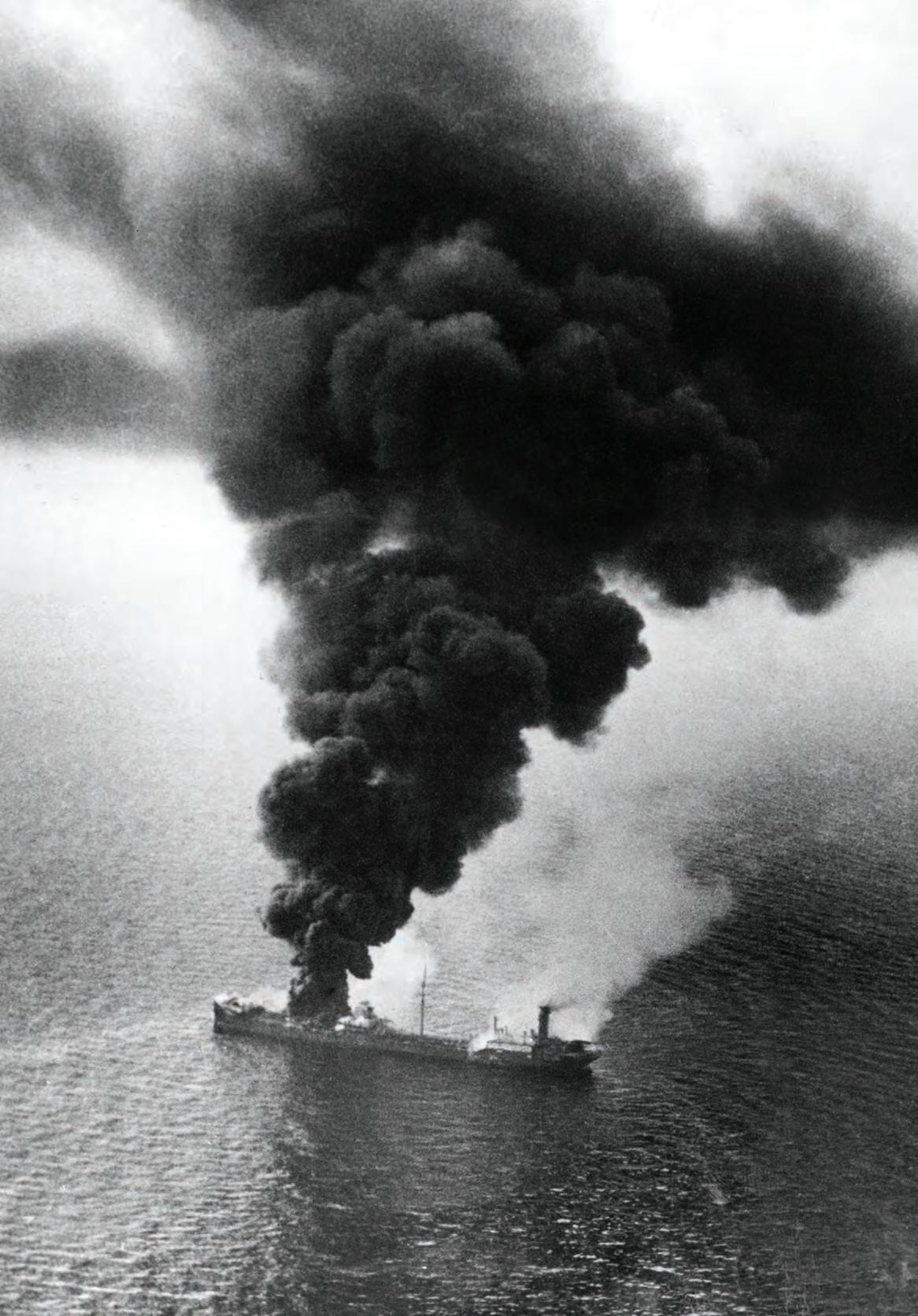
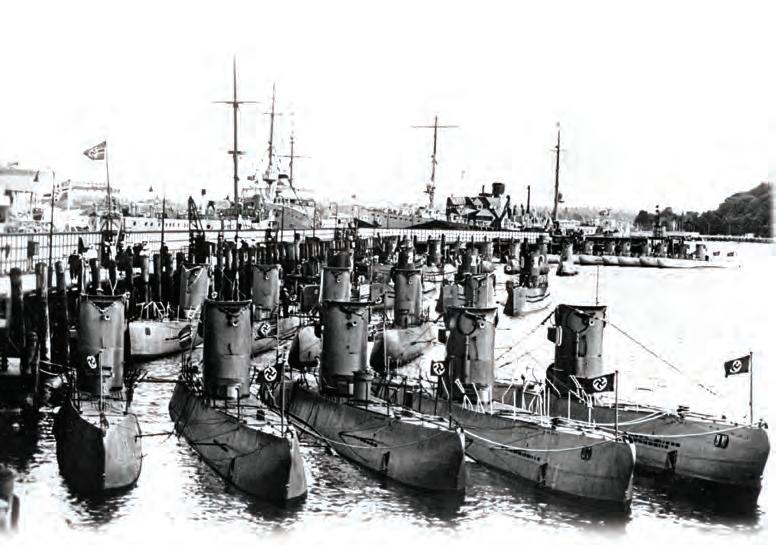
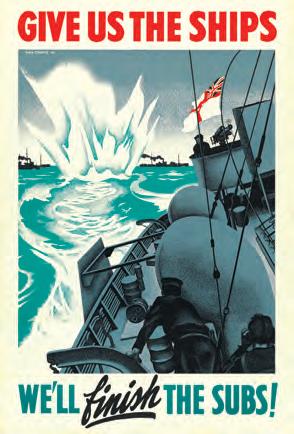
A ship, believed to be the British tanker Empire Mica, burns a few kilometres off the Florida coast (opposite). It was torpedoed by U-67 on June 29, 1942, during Operation Drumbeat. U-boats are displayed (above) at Kiel, Germany. Canadian Army war artist Alex Colville painted this poster (left) in 1941.
Gunners aboard U-123 (below)
Within days of Germany’s declaration of war on the United States on Dec. 11, 1941, Admiral Karl Dönitz, commander of the U-boat fleet, dispatched the first wave of attackers.
Five large Type IX U-boats of Group Paukenschlag were ordered westward: two to operate off Nova Scotia and three
The primary task of the escort was destruction of the enemy.
between Cape Cod, Mass., and Cape Hatteras, N.C.
A dozen smaller Type VIIs of Group Zieten (named for a German cavalry officer of the 1700s) left a few weeks later to attack shipping along the great circle route south of Cape Race, Nfld.
While Group Zieten fed on shipping dispersed on the Grand Banks from westbound transatlantic convoys, great drama unfolded farther south. On Jan. 14-15, U-123 sank two ships off Rhode Island, then
moved to Cape Hatteras where it sank three more and damaged one on Jan. 19.
“It is a pity there were not 10 or 20 submarines [here] instead of just one,” wrote Reinhard Hardegen, U-123’s captain. “I am sure they would have found targets in plenty.”
Hardegen also found the American coast utterly unprepared for war: navigation lights operated normally and there was no blackout—Atlantic City and Miami feared that blackouts would hurt tourism. To the Germans the American shoreline looked like a carnival: “It is unbelieveable,” Hardegen commented to one of his lookouts as they gazed in amazement.
For U-66, it was the lights of the New Jersey shore that silhouetted the Canadian passenger steamer Lady Hawkins on the evening of Jan. 19. Despite steaming in blackout condition and zigzagging, the ship was easy to track and hit. Only 71 of Lady Hawkins’ 320 passenger and crew were rescued five days later. It would not be the last ship sunk against the glow of America’s cities before the coast finally went dark in April.
The arrival of the U-boats should have been no surprise. An assault on the American coast was expected and Allied intelligence tracked the westward movement of the U-boats. The British and Canadians had also shared their hard-won experience and their sophisticated
organization for the defence of shipping with the U.S. Canada controlled the routing of all Allied merchant ships and convoys in the Western Hemisphere north of the equator. This included an organization for naval control of shipping throughout the United States using “consular shipping agents”—naval officers in civilian clothes— to provide routing information to Allied ships.
In 1941, this system was unmasked to the Americans. They were provided with all the relevant confidential books and special publications on control of shipping, and their local port directors were tasked with working alongside the British shipping agents.
There was every expectation that the Americans would adopt a system of escorted convoys in early 1942. In fact, the infrastructure was in place—put there by
the British and Canadians. In the fall of 1941, the U.S. navy had started escorting Allied convoys between Newfoundland and Iceland alongside the RCN. So, they knew how things worked.
But the simple British/ Canadian solution of putting everything into escorted convoys and pushing them through ran counter to the U.S. navy’s earnest desire to fight.
Their convoy escort doctrine in late 1941 specified that the primary task of a U.S. escort was destruction of the enemy. If the escort could not do that, it was better to have no convoy at all. Only destroyers met the U.S. navy’s standard for effective convoy escorts in 1942, and most of those were soon on their way to the Pacific. In March 1942, the navy’s Board on the Organization of East Coast Convoys concluded that poorly escorted convoys
were too dangerous: they simply assembled targets for the enemy. It was better to keep those targets dispersed. So they did, but with catastrophic results.
In February 1942, U-boats sank 71 ships in the North Atlantic, most of them independently routed vessels in the western Atlantic. Group Zieten, operating
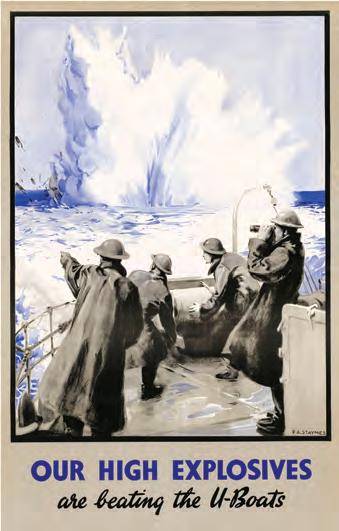
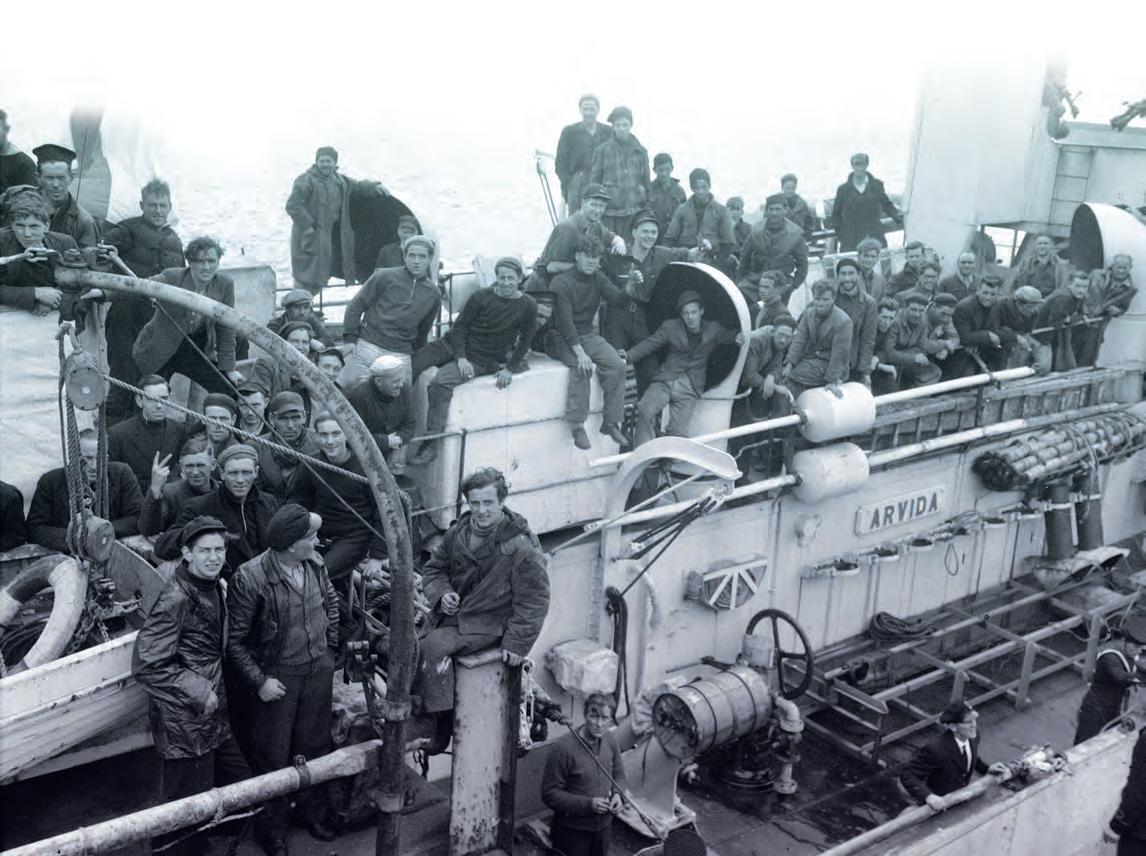
A British poster (above), introduced in 1942, encouraged war production. Survivors of a torpedoed merchant ship (below) crowd aboard HMCS Arvida, a Flowerclass corvette, as it enters St. John’s Harbour in Newfoundland on Sept. 15, 1942.
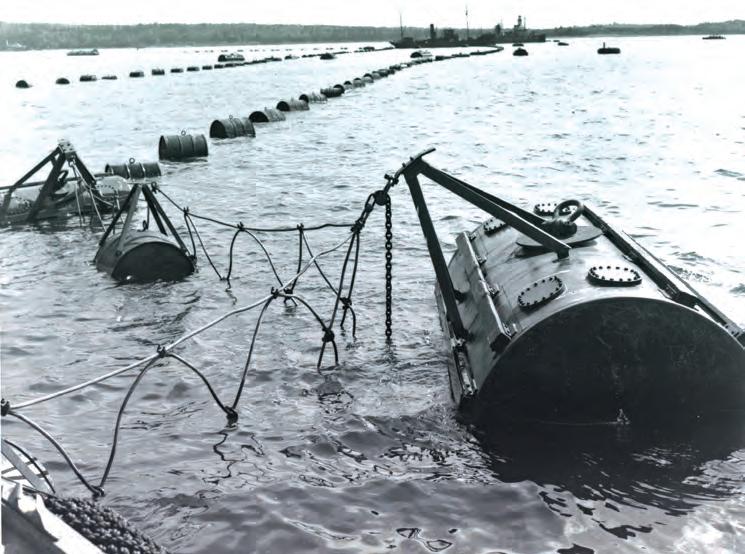
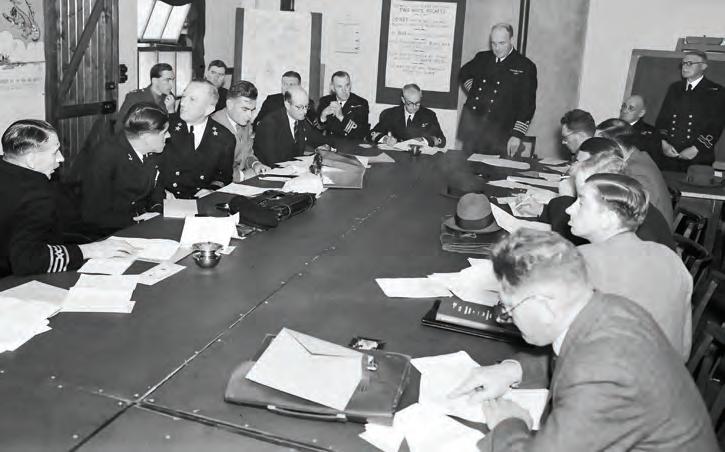
An anti-submarine net (top) stretches between York Redoubt and McNabs Island in Halifax Harbour in May 1942. Navy brass and merchant marine officials gather (above) for a British convoy conference at the height of the U-boat threat in August 1942.
south of the Grand Banks, took a fair share of these from dispersed westbound transatlantic convoys.
That problem was fixed by bringing westbound convoys right into Halifax in March: this became a Canadian task. That same month the RCN established the first escorted convoy route between Halifax and Boston. By then convoys between Saint John, N.B., and Halifax were running routinely.
But nothing the British and Canadians did in the
spring of 1942 convinced the Americans of the merits of convoys. Most of the 92 ships sunk by U-boats in March were independently routed south of New York. April was no better.
American defences consisted largely of designated shipping corridors which the merchant ships travelled at widely spaced intervals. These lanes were patrolled— with rigorous routine—by the few available U.S. navy destroyers and patrol ships and covered by military and
civilian air patrols. The result, paradoxically, was a safe operating zone for U-boats, free of interference by other ships and—between the regular patrols—free of enemy warships, too. To conserve torpedoes, the U-boats could often resort to sinking ships rather leisurely with gunfire.
As bad as the first four months of 1942 were along the U.S. coast, nothing compared to May and June. By May, the U-boat strength in American waters peaked at 19. They were kept on station longer by U-459, a U-tanker stationed northwest of Bermuda by late April. In two weeks, it transferred 600 tonnes of fuel (and a few torpedoes) to 14 subs, allowing the smaller Type VII U-boats to penetrate deeper into the Caribbean. In May, U-boats finally arrived in the Gulf of Mexico in strength, where little had been done to protect shipping. In that month alone, U-boats sank 115 ships in the Atlantic—nearly half of these in the Gulf of Mexico.
The British sent help in May. Two mid-ocean escort groups redeployed to the Caribbean to defend British convoys and several trawlers went to the American east coast. This modest increment in escort strength may have been all the U.S. navy needed. In mid-May the first American convoys in the Eastern Sea Frontier began operating between Key West, Fla., and Hampton Roads, Va. It was a start, and it encouraged the Germans to move south in search of easier targets. Meanwhile, the RCN responded to the spreading attacks by developing its own convoy routes.
It encouraged the Germans to move south in search of easier targets.
When U-553 penetrated the St. Lawrence River and torpedoed the steamers Leto and Nicoya off Cap-Chat, Que., on May 12, convoys between Sydney, N.S., and Quebec City started. And in late May the RCN began Canadian oil tanker convoys between Halifax and Aruba in the Caribbean. These convoys operated through the U.S. navy’s Eastern Sea Frontier without loss until the end of the summer, in stark contrast to the calamity unfolding nearby.
Monthly sinkings by U-boats peaked—for the war—at 128 in June. Only 14 of these ships had been sailing in a convoy, most of the rest were sunk in the Gulf of Mexico.
Patrols and the dim-out along the U.S. coast did little to deter the Germans from operating close inshore, even in daylight.
On June 15, two U.S. freighters were sunk off Virginia Beach, Va., while holidaymakers watched. Expansion of the interlocking coastal convoy system stopped the carnage, but not until July.
The British and Canadians had always understood that escorted convoys were not perfect but were essential to sharply reducing the rate of losses. U-boats operating inshore were invariably individual submarines operating in free-fire zones. The system of ‘safe lanes’ had presented these submariners with a steady stream of unprotected targets.
Convoys swamped the individual submariner with targets and did so in the presence of escort vessels and aircraft. Lone hunters usually had one chance at a coastal convoy and seldom hit more
his success using a formula of “tonnage sunk per U-boat day at sea.” As targets were harder to find or attack, Dönitz pushed his U-boats farther afield, down along the U.S. coast, into the Gulf of Mexico and finally south across the Caribbean.
The expansion of convoys along the U.S. coast soon pushed the most profitable operational zones beyond the range of Dönitz’s most numerous U-boats, the small Type VII. As attacks concentrated off the South American coast in the late summer, only Type XI U-boats were effective.
By August, Dönitz was withdrawing the Type VIIs for a renewed pack campaign in mid-ocean. The carnage off America was largely over.
The Americans handled this defeat by simply deeming it irrelevant. The U.S. Office
For a time one of the war’s most effective weapons, the U-boat (above) provided a cloak of invisibility that offered its crew large measures of both risk and reward. Survivors of the torpedoed steamer Nicoya (below) exit a boat in May 1942.
Lone hunters usually had one chance at a coastal convoy.
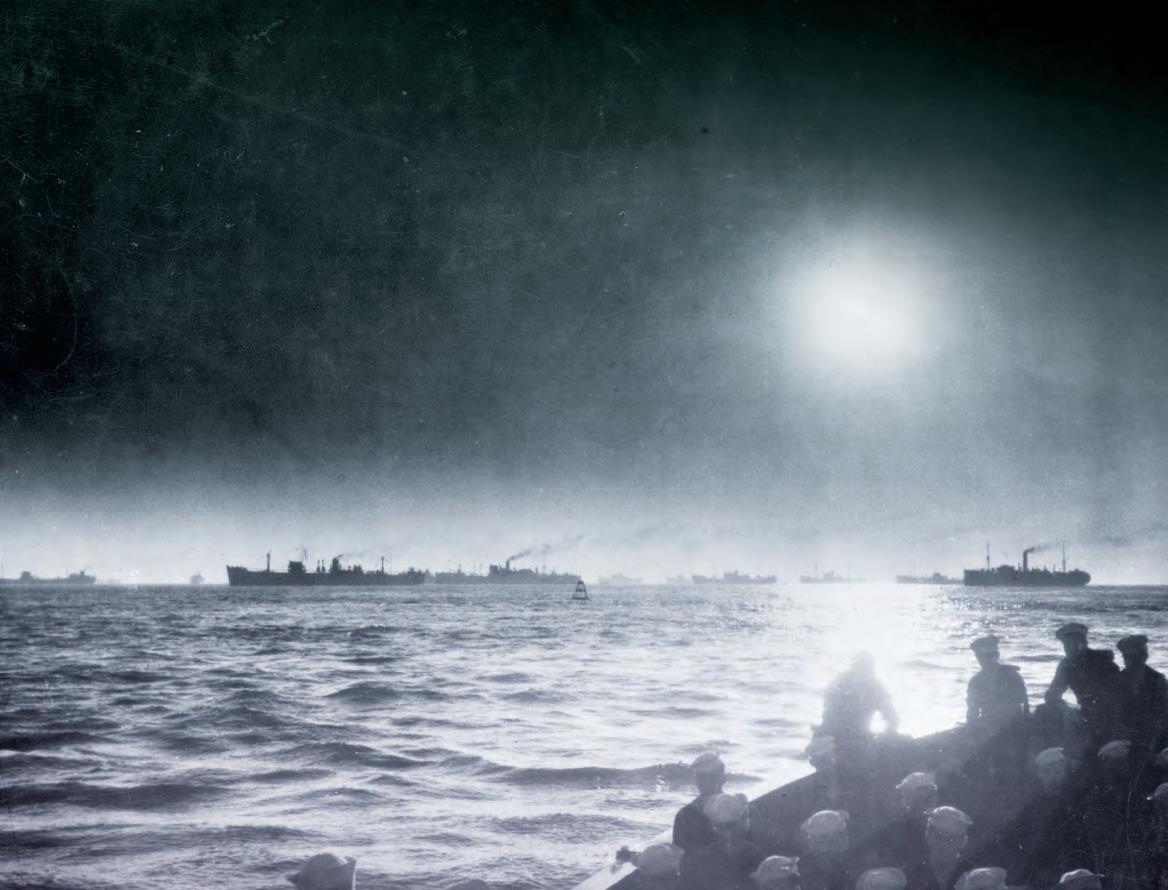
A convoy sets sail in 1942. Washington severely underestimated the threat U-boats posed to coastal shipping after the United States joined the war. Largely as a result, some 360 vessels were lost in American waters in the first six months of 1942.
of War Information told the media in the spring of 1942 to concentrate on America’s shipbuilding program: they would produce more new ships than the Germans could sink. And they did: new production outstripped losses in October 1942 and never fell behind again.
But the assault on shipping off the U.S. coast was never just about America. Nearly 60 per cent of the ships lost in the American zone in early 1942 were British Commonwealth and Empire ships, or European vessels operating under British charter.
In theory, this too ought not to have mattered. A British-American allocation board was supposed to equitably assign new Americanbuilt merchant ships—many of them originally ordered to British account under the Lend-Lease policy. But the U.S. Joint Chiefs of Staff controlled merchant ship allocation and simply refused to give any to the British: they wanted the ships for military purposes.
British merchant ship losses spiked again in the fall, when they abandoned convoys in the South Atlantic to find escorts for Operation Torch, the North African landings.
The looming import crisis in 1943 prompted the British to appeal directly to U.S. President Franklin D. Roosevelt to release new construction to Britain. Roosevelt fought his military staff over the allocation of ships to
Britain during the winter of 1942-43 without success.
Finally, in the spring of 1943, FDR bought 80 Liberty ships from Canada and transferred them to Britain under Lend-Lease, but they took time to arrive. Meanwhile, British imports reached their lowest point of the war that year.
Between January and June 1942, some 360 ships were lost in American waters. It was a stunning defeat for the Americans—and for the Allies. It was also a disaster that was totally avoidable, as the Canadian example amply demonstrates.
The American failure to adopt a system of coastal convoys from the outset remains one of the great errors of judgment in modern naval history. Perhaps, in the end, that defeat really did not matter to Americans because the real victim was Great Britain. L
A
return welcome
By Trevor Oattes
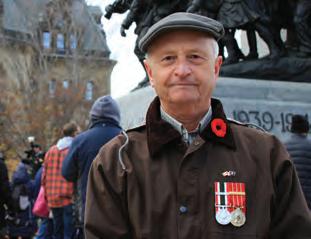
A veteran prepares to place his poppy on the Tomb of the Unknown Soldier in Ottawa after the Remembrance Day ceremony.
Thousands
attended, but there was one notable absence on
Remembrance Day in Ottawa
An
estimated 15,000 people converged on the National War Memorial in Ottawa on Nov. 11, a welcome return after the near-empty streets of the previous year’s ceremony.
Bundled in parkas and sweaters despite the unusually warm weather, pockets of people had already arrived at the barricades around the monument by 8:30 a.m. As
the ceremony’s 11 o’clock start time approached, a wave of spectators wearing red poppies amassed. Among the thousands were veterans, active armed forces members, family of military personnel and people without ties to the military, there simply as a gesture of respect.
“I was here last year, among the five people who stood way down at the end of the road,” said Adwin Gallant, a 28-year
veteran of the Royal Canadian Air Force. Gallant said he has been to every Remembrance Day ceremony in Ottawa since 1995. “The fact that the public is here makes it more meaningful...because they get to see the appreciation of what people have done before us.”
Sergeant Kyle Crego arrived early to the ceremony, clad in
“The fact that the public is here makes it more meaningful.”
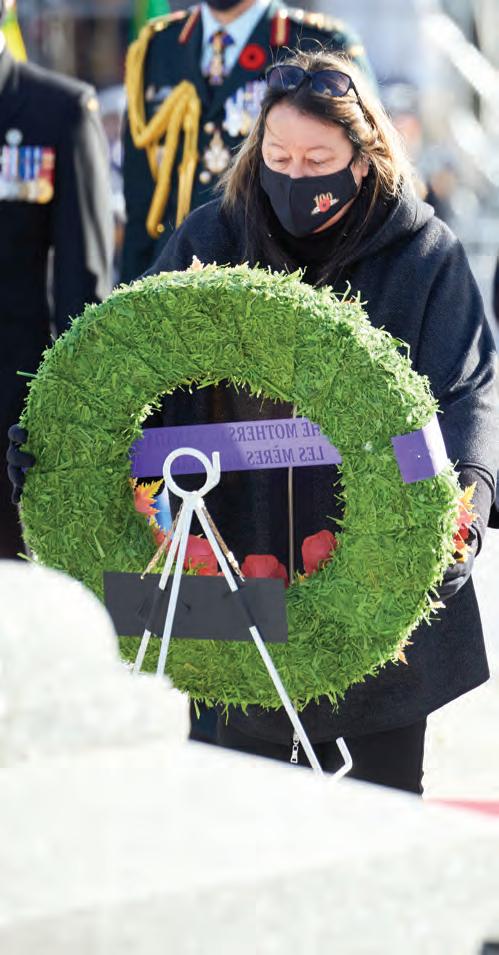
Dignitaries including Silver Cross Mother
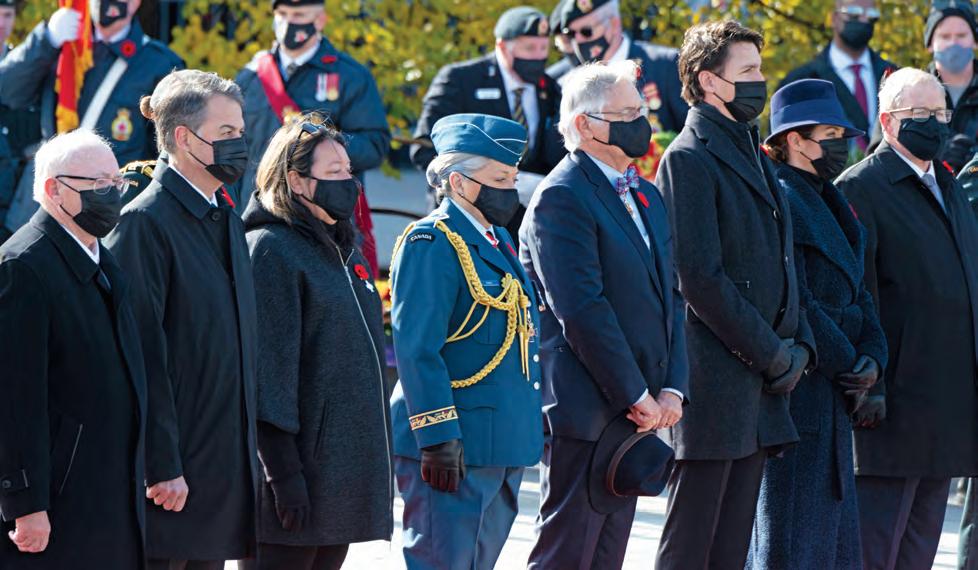
Josée Simard, Governor General Mary Simon and Prime Minister Justin Trudeau stand during the Remembrance Day ceremony (above).
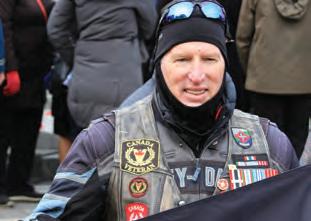
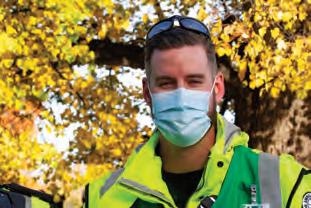
Veteran Adwin Gallant, Sergeant Kyle Crego and veteran Robert Henry were among the attendees at the ceremony (right).
a neon green first-responder’s parka. A 10-year volunteer with St. John Ambulance and a 12-year member of the Governor General’s Foot Guards army reserve, Crego chose to spend the ceremony serving as a paramedic. Few serious medical issues arise during the ceremony, he noted, save for the occasional faint or fall. But Crego was glad to be there providing a service for his fellow military members.
“I just want to be here for the soldiers in uniform,” he said. “The medical staff here do a good job but they’re [spread] thin, so I like to come in and just be in the chain and try and help out.
“[Remembrance Day] is, to me, mostly about reflection over the people who have unfortunately been lost, those
who have come before and those who serve today. I get a lot of pride from it. There’s a lot of people walking around in uniform with stories on their chest, in their medals. I always get quite inspired...just seeing what they’ve done.”
There was no veterans’ parade this year, a result of pandemic restrictions. Black sedans and SUVs arrived late—due to a security issue investigated by the RCMP a few minutes before the ceremony. Governor General Mary Simon, Prime Minister Justin Trudeau and Sophie Grégoire Trudeau, and 2021 National Memorial (Silver) Cross Mother Josée Simard soon took their positions.
Simard is the mother of Corporal Karine Blais, who was killed by a roadside bomb in 2009, making her the second Canadian woman to die in combat in Afghanistan. Simard’s role as Silver Cross Mother is to represent all mothers in Canada who have lost a child in military service. When asked about her daughter, Simard described her happy memories, the hopes that Blais had held for the future and the
impact her death had on the people in her life.
“Karine adored Christmas. We baked a gingerbread house together every year. At first snow, we had hot chocolate. She had a contagious laugh and a cheerful disposition.
“Coming back from [her] mission, she wanted to start a family—I already bought a cradle and everything—and to continue her career in the army.
“When Karine died, my life stopped; time stopped for many people. Our lives are restarting a little bit every year.”
Because of the delayed arrival of the dignitaries, the first few minutes of the ceremony were disjointed: Simard and the Trudeaus arrived at their positions after the tolling of the bell and 21-gun salute had begun. The Governor General arrived during the
two minutes of silence, the sounds of police motorcycles cutting through the quiet.
Simon took her position after a flyover by two CF-18 Hornet fighter jets, which was originally scheduled to take place 15 minutes after her arrival.
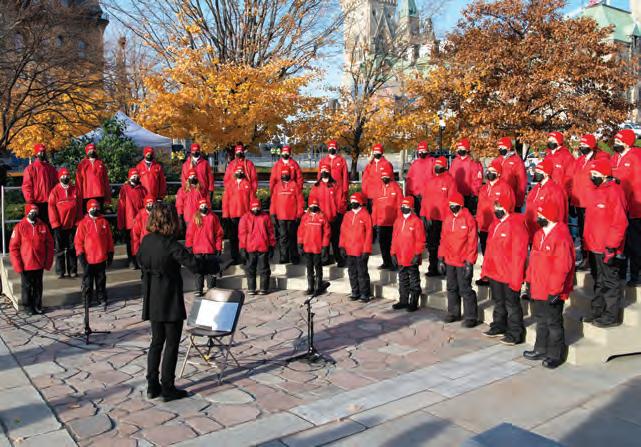
“O Canada,” sung by the Ottawa Children’s Choir, was followed by “Last Post,” “The Lament” and “The Rouse.”
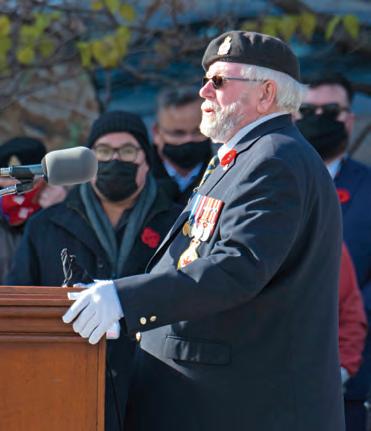
The Act of Remembrance was read in English by The Royal Canadian Legion’s Dominion President Bruce Julian, in French by Dominion Grand President Larry Murray and in the Indigenous language of Michif by Métis veteran Paul Pirie.
There was a notable absence during the ceremony. Rabbi
Black sedans and SUVs arrived late—due to a security issue.
Reuven Bulka, who had performed the Remembrance Day benediction since 1991, died in June after a six-month battle with cancer.
As the Legion’s honorary chaplain, Bulka gave many speeches that spoke of loss, courage, brotherhood and sacrifice. His words have touched the lives and hearts of many across the country and his absence added another layer of grief to the sombre ceremony.
Silver Cross Mother Josée Simard (top left) places a wreath representing the mothers of Canada. The Ottawa Children’s Choir (top) sings at the ceremony. Dominion President Bruce Julian (above) reads the Act of Remembrance.
Spectators then descended on the tomb, quietly placing their poppies.
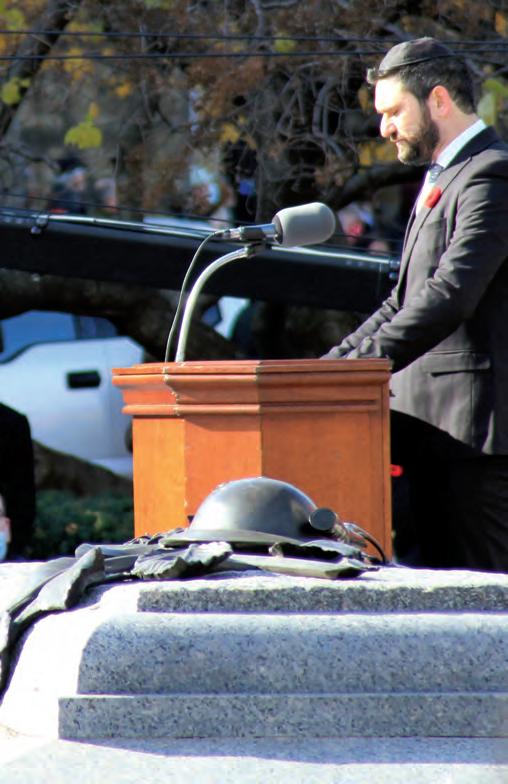
Rabbi Idan Scher (above) presents the annual benediction, honouring both Canada’s veterans and the late Reuven Bulka.
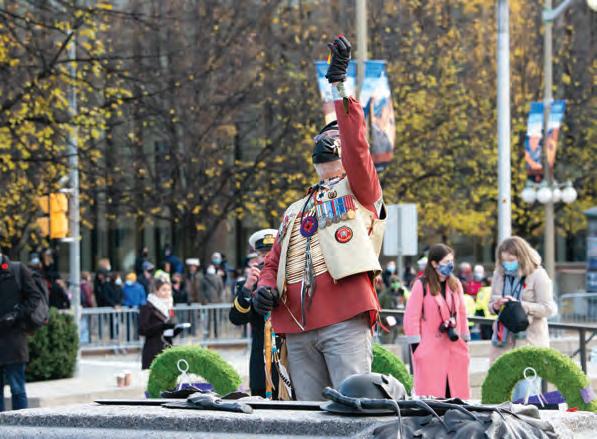
An Indigenous veteran (top right) holds a poppy aloft before placing it on the Tomb of the Unknown Soldier.
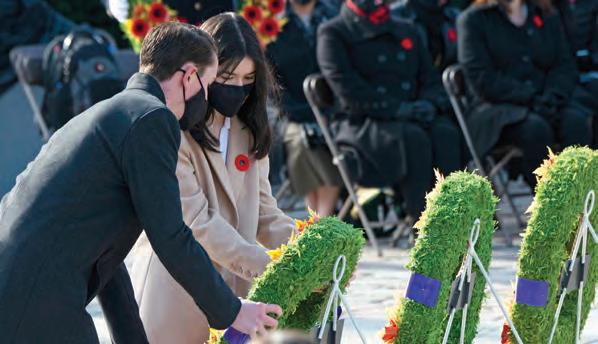
Legion poster and literary contest winners Ryan McCardle and Louise McCrow (above right) place a wreath representing Canada’s youth.
The Legion invited Rabbi Idan Scher to present this year’s benediction. Scher is, in many ways, Bulka’s successor: he leads the congregation at Machzikei
Hadas, the synagogue Bulka led for nearly 50 years, and he was referred to as Bulka’s protégé in an article by the Canadian Jewish News
“I stand here today with overflowing emotion,” said Scher. “With the weight of history and memory, both recent and past, on my heart.... I stand here today and reflect on these stories and the countless others they represent.”
Scher touched on many of Bulka’s favourite themes: the sacrifices of brave men and women, the continued fight for freedom around the globe and the actions of service members on home soil, combating floods and
fires around the country. He made special note of the veterans who returned “with body intact” but with the “deep, invisible wounds” of trauma and mental illness. He ended his speech by quoting a passage from Bulka’s final Remembrance Day benediction in 2020—presented just eight months before his death.
“‘Let us continue to make Canada worthy of our veterans’ ongoing dedication and sacrifice; a country defined by respect, harmony, inclusion, responsibility and kindness to all.’”
A bilingual rendition of “God Save the Queen” followed Scher’s speech, ending the formal ceremony. The dignitaries then spoke with the assembled veterans and guests of honour, rows of medals glinting on the chests of many, before
laying poppies on the Tomb of the Unknown Soldier.
Spectators then descended on the tomb, quietly placing their poppies down on it, covering it in red.
Robert Henry, a 30-year veteran of the RCAF, watched as his son-in-law, Petty Officer Second Class Jacob Russell, relieved the sentries from duty. Remembrance Day holds a special place in his heart, he said, coming from a long line of veterans, including some who never made it home.
“My father served in World War II. I have uncles who served in World War I. I’ve had uncles die overseas…. This all means a lot to me, as a military guy,” said Henry. “I’ve been to Vimy. I was at the 100th anniversary of the Armistice in Mons, Belgium.… Remembrance Day means a lot, to everybody.” L
An
unexpected
By Mark Zuehlke
Despite the pandemic and damp weather, droves of Victorians marked
Remembrance Day
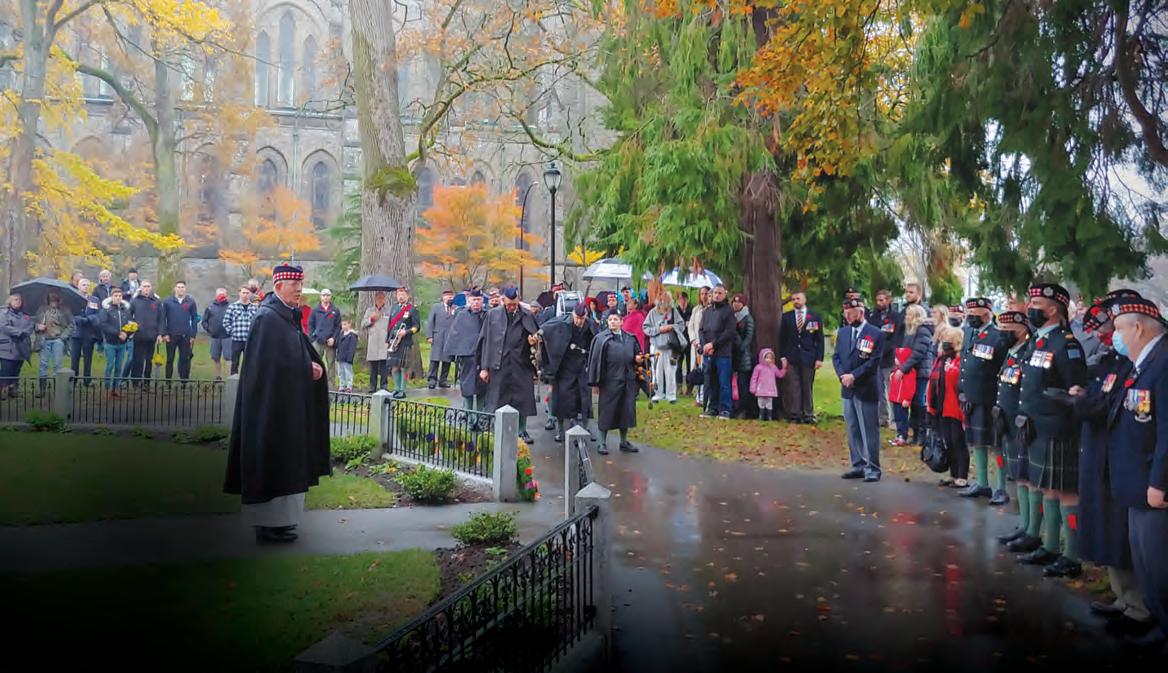
RReverend Andrew Gates addresses the gathering at the Canadian Scottish Regiment cenotaph. Christ Church Cathedral is in the background.
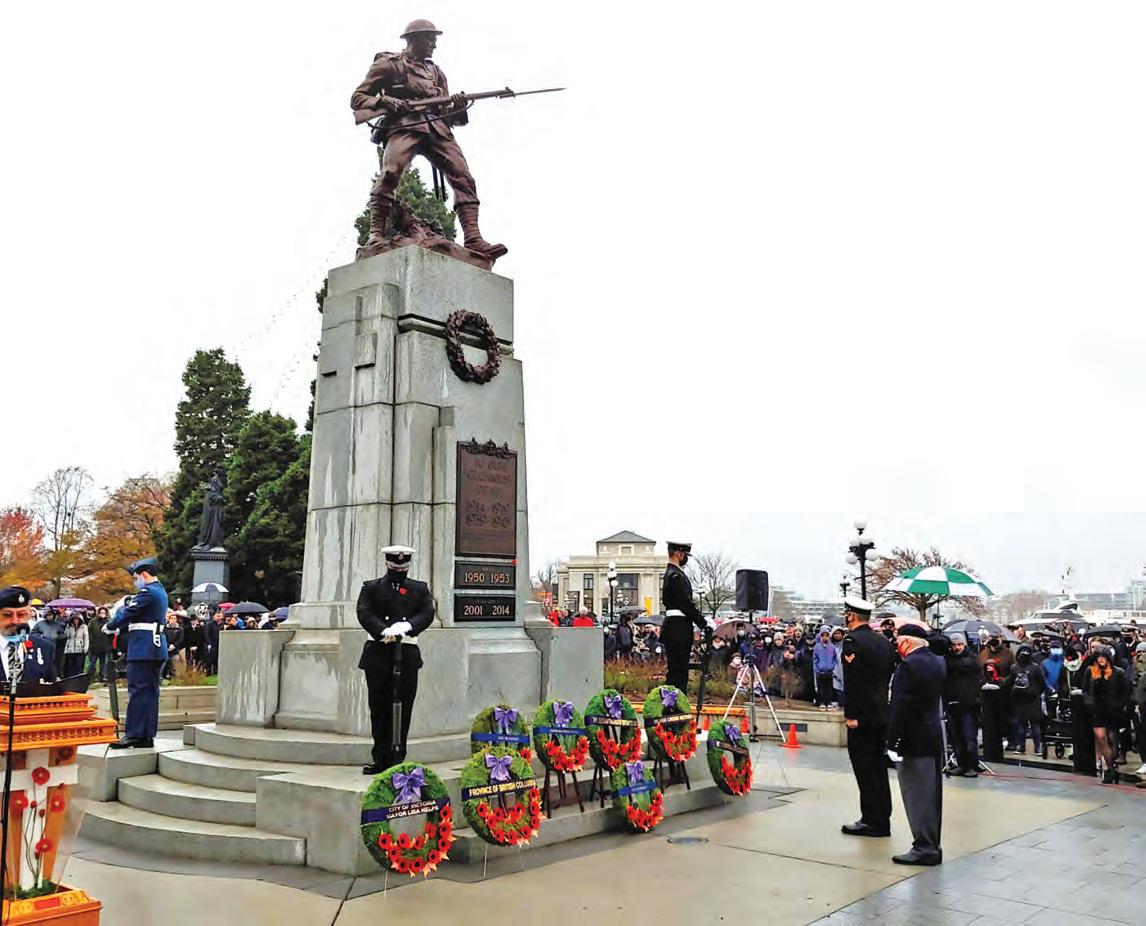
everend Andrew Gates looked out over the large crowd gathered around the cenotaph on the grounds of the British Columbia legislature in Victoria. Light drizzle came and went, but the temperature was mild with a little breeze. There was some social distancing, but with more than 3,000 people, the space was crowded.
Remembrance Day is a provincial holiday in B.C., so there were only a couple of small school groups. Instead though, there were many families with children of all ages. The crowd spilled off the legislature grounds, blocked Belleville Street,
and extended in a long, broad column up Government Street between the harbour and Fairmont Empress Hotel to the edge of the downtown business district.
“We only made 200 programs, thinking there would be only maybe 50 people here,” Gates told the audience. “It’s wonderful to see you.”
The crowd was utterly unexpected, agreed Angus Stanfield, chair of the Victoria Remembrance Day committee poppy fund. Hoping to reduce potential public COVID-19 exposure, the organizers had announced a muchreduced program and asked people to stay home
and watch the event on local television instead.
“Having not been able to participate in remembrance ceremonies last year due to the pandemic, people were clearly determined to show their respects this time. We respect that,” said Stanfield. With vaccination rates in Greater Victoria health regions ranging from 88 to 92 per cent, Victorians seemed confident that they could safely attend ceremonies. Certainly, turnout—whether in Esquimalt, Langford, Sidney or elsewhere—exceeded expectations. The ceremony at the Cross of Sacrifice in the Commonwealth War Graves Commission sector in Ross Bay Cemetery usually attracts a few dozen. This year, several hundred turned out. Some said they attended to avoid events where crowds might be larger.
Mark Zuehlke
Others set their poppies on it—the light grey stone scattered with droplets of red.
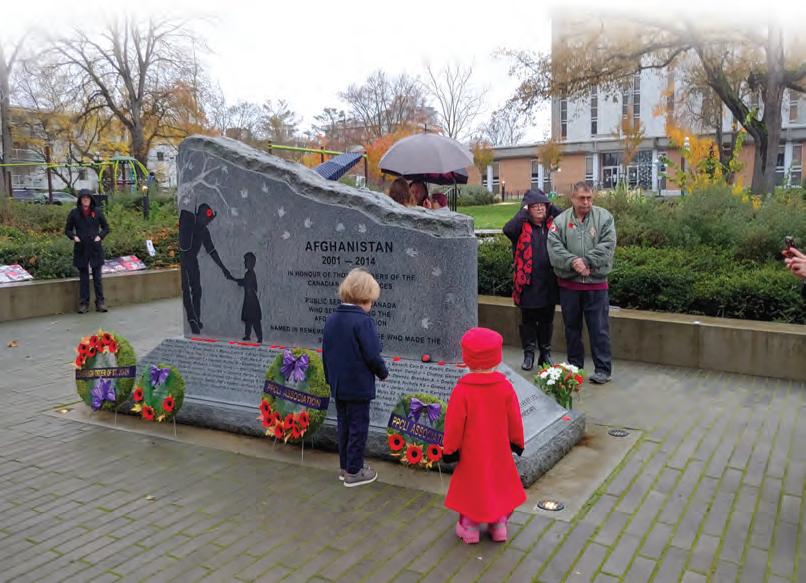
Children place their poppies on the BC Afghanistan Memorial.
One of the first ceremonies was held at 9:45 a.m. at the BC Afghanistan Memorial behind the provincial courthouse and across from Christ Church Cathedral. A granite memorial with the image of a Canadian soldier and an Afghan child reaching out to each other, the base is inscribed with the names and dates of death of Canadian Armed Forces and public service personnel lost in the Afghanistan war. The image was inspired by a photo taken by Reuters photographer Finbarr O’Reilly of Canadian Lieutenant Michael McCauley in southern Afghanistan on July 13, 2007.
Retired colonel Jamie Hammond, who served more than 18 months in Afghanistan and commanded the Special Operations Task Force in 2002, presided.
“This year the…memorial holds even greater
significance than in the past,” he said. “Yes, we will be inspired by the fallens’ commitment to others…. Yet, with the withdrawal of U.S. and coalition military forces from Afghanistan and the re-establishment of Taliban rule, we all have to ask—was it worth it?”
Hammond answered with a resounding “Yes.” He cited 25 million Afghans under age 25 schooled between 2001 and 2014, much improved medical care and “a new generation of young women who are aware of their rights.” There is, he said, no going back to the 1990s and the Taliban knows that. “Canadians gave Afghanistan a new generation. What Afghans do is now up to them.”
Those who died during the war “served without knowing what the final result would be,” said Hammond. “But
they gave everything because they believed in intangibles like duty, respect for others and those even more elusive Canadian values. That is what makes real heroes—doing the right thing even when the path is dangerous and difficult, or the goal distant.”
Bing Chow was among the gathered crowd of about 150. He served with the Canadian Provincial Reconstruction Team in 2008. He came to show his respect, Chow said, and for his two daughters— Katie and Ellie—to learn about the war. “They are old enough now to understand.”
When the formal ceremony ended, Chow and his daughters huddled before the memorial as he pointed to names. They then placed a bouquet of flowers before it while others set their poppies on it—the light grey stone scattered with droplets of red.
Most of those at the Afghanistan Memorial walked about 15 minutes through drizzle, arriving at the legislature cenotaph minutes before the ceremony began. Running about 30 minutes—shorter than normal and without the traditional parade from the legislature past a reviewing stand looking out on the harbour—it still encompassed the essentials: “O Canada,” “Last Post,” the silence, “The Lament” and a hymn, a prayer and a blessing.
Referring to the Spanish flu of 1918, Gates said, “O great and mighty One, this pandemic is different, though no less deadly, but not much else has changed over the past 100 years. We still grieve those who are missing…. Even our prayers are much the same, and we say them
Both: Mark Zuehlke
year after year after year after year. Teach us the love that will make this stop.”
Gates then offered what he called a “paradox blessing” that ended with the hope for people to be blessed “with the foolishness to think that you can make a difference in the world, so that you will do the things which others tell you cannot be done.”
Only eight wreaths were placed—by B.C. Lieutenant Governor Janet Austin, B.C. Silver Cross Mother Sheila Fynes, two Canadian Forces representatives, the Australian army’s Deputy Chief Major-General Anthony Rawlins, two political representatives and Stanfield on behalf of The Royal Canadian Legion BC/Yukon Command.
Scottish Regiment (Princess Mary’s) cenotaph stands adjacent in Pioneer Square. This cenotaph was originally a wooden cross erected on Vimy Ridge after the battle. It was installed in the square in 1938, then replaced in 1951 by the current stone cross; the wooden one is preserved at the Bay Street Armoury. This is where the regiment gathers every Nov. 11 after the legislature ceremony. Normally, the event is well publicized, but this year the regiment issued no formal public invitation. Yet people gathered. Soon a small group of uniformed and kilted Can Scots and retired members in regimental Glengarry bonnets arrived.
Gates—now in his role as regimental association padre—stood in front of the cenotaph, seemingly oblivious to the increasingly heavy rain. Then a pared-down contingent of the regiment’s pipe-and-drum band marched up a path from beside the cathedral to the cenotaph. By now, more than 250 people—many young and in civilian dress—had gathered under umbrellas or standing unmindful of the rain dampening clothes and faces. After the brief ceremony led by Gates, the pipers and drummers retired. People approached the cenotaph to place poppies at its base. One man, dressed entirely in black with a heavy black mask, then walked across
Angus Stanfield, chair of the Victoria Remembrance Day committee poppy fund, stands before the cenotaph in front of the provincial legislature after placing a wreath on behalf of The Royal Canadian Legion BC/Yukon Command and for the youth of British Columbia.
“People were clearly determined to show their respects this time.”
A century of
THINKERS, SCIENTISTS AND NEGOTIATORS: ARMS CONTROL AFTER THE SECOND WORLD WAR
By Stephen J. Thorne
There is a single principle that, to one degree or another, underlies virtually all the 25 or so nuclear weapons treaties signed since the United States dropped the bombs on Hiroshima and Nagasaki in 1945.
It’s called mutual assured destruction or, in what one critic of the day described as a “cleverly pejorative acronym”: MAD.
It is a deterrence principle that the launch of nuclear weapons by either side in a dispute would inevitably lead to the mass destruction of both. Older generations know it well.
The term was coined in 1962 by Donald Brennan, a strategist at the Hudson Institute, a conservative think tank in Washington. In short, he said, America and the Soviet Union were each holding “the other side’s population hostage.”
Brennan was essentially an independent thinker, working outside the channels
of government policy and diplomatic negotiation. And for all the treaties and agreements signed over the years, it is his rather twisted principle, more than any other, that has prevented a nuclear holocaust of unimaginable proportions.
“Throughout much of the Cold War, U.S. declaratory policy (i.e., what policymakers said in public) closely approximated MAD,” wrote Columbia University professor Robert Jervis in the journal Foreign Policy in 2009.
“The view, most clearly articulated by then Secretary of Defense Robert McNamara, was that there was little utility in adding strategic weapons above those needed for MAD, that nuclear superiority was meaningless, that defense was useless, and that this bizarre configuration was in everyone’s interest.”
He said the implication was that the U.S. “should not only avoid menacing the Soviets’ retaliatory capability but also help the Soviets make their weapons invulnerable.”
Madness, indeed.
Mathematician and social critic Bertrand Russell (opposite) boosted the nuclear disarmament movement in 1955 with the RussellEinstein Manifesto, urging world leaders to seek peace not war.
An anti-nuclear demonstration (above) in New York in 1962.
U.S. representative
Charles Stelle (left) and his Soviet counterpart
Semyon Tsarapkin sign an agreement to set up a hotline communications link between the two superpowers on June 20, 1963, in Geneva.
The anti-nuclear movement began in high places with the release of the RussellEinstein Manifesto in London on July 9, 1955, by mathematician, writer and social conscience Bertrand Russell. Coming as Cold War tensions heated up, it emphasized the dangers posed by nuclear weapons and urged world leaders to seek peaceful resolutions to international conflict. Eleven distinguished intellectuals and scientists signed the declaration. Albert Einstein signed it just days before he died in 1955.
Shortly after, philanthropist Cyrus S. Eaton responded to the manifesto’s call for a conference, offering up his seaside compound in his birthplace of Pugwash, N.S.
“Your brilliant statement on nuclear warfare has made a dramatic worldwide impact,” he told Russell.
The first session of the Pugwash Conferences on Science and World Affairs was held in July 1957, bringing together
A dispute would
inevitably
lead to the mass destruction of both.
22 eminent scientists from 10 countries. Nuclear disarmament would be a prevailing theme of the conferences, which—along with founder, Polish-born physicist Joseph Rotblat—would jointly receive the 1995 Nobel Peace Prize “for their efforts to diminish the part played by nuclear arms in international politics and, in the longer run, to eliminate such arms.”
The conference’s first 15 years coincided with the Cold War’s greatest tensions: the Berlin Crisis, the Cuban Missile Crisis, the Hungarian Revolution, the Warsaw Pact invasion of Czechoslovakia and the Vietnam War.
Pugwash, as the conferences became known, “afforded a rare channel of communication between scientists from East and West,” MIT’s Journal of Cold War Studies reported in 2018. “In subsequent years, it came to provide a forum for second-track nuclear diplomacy.”
Indeed, the Nobel committee noted that the Pugwash movement helped open communication backchannels during an era that alternated between silence and periods of high tension marked by threats and hyperbole between East and West.
It provided background work to the Partial Test Ban Treaty (1963), the Non-Proliferation Treaty (1968), the Anti-Ballistic Missile Treaty (1972), the Biological Weapons Convention (1972) and the Chemical Weapons Convention (1993).
In a 1999 interview with the University of California (Berkeley), McNamara credited a backchannel Pugwash initiative, codenamed PENNSYLVANIA, with laying the groundwork for talks that ended the Vietnam War.
The Soviet Union’s last leader, Mikhail Gorbachev, acknowledged in a 2004 interview with The Journal of the Federation of American Scientists that the Pugwash organization influenced his decision-making.
There have been 61 conferences and the primary goals of Pugwash remain
the elimination of nuclear weapons and weapons of mass destruction.
“It is good to know that the [conference] is an ongoing, vibrant project that continues to bring together concerned scientists who fully understand the responsibility to humankind,” Gorbachev said in a statement prior to the 50-year anniversary conference.
He called for “an intellectual foundation for agreements that would dramatically cut the arsenals of nuclear weapons on their way to their elimination and prevent an arms race in space. We need your brainpower, not just to analyze the problem, but to find solutions.”
Concrete efforts to control the spread and influence of nuclear weapons essentially began with the 1959 Antarctic Treaty, banning militarization of the planet’s coldest continent.
In 1963, the Americans and Soviets negotiated the Hot Line Agreement to reduce the risk of a nuclear exchange due to accident, miscalculation or surprise attack. A dedicated transatlantic cable and radiotelegraph circuits assured direct communications between the two sides. The system was updated in 1971 with two satellite communications circuits. Secure computer links and encrypted e-mail systems are used now.
Also in 1963, the Soviet Union, United Kingdom and U.S. negotiated the Partial Test Ban Treaty, prohibiting tests of nuclear devices in the atmosphere, in outer space and underwater. It allowed nuclear testing to continue underground, so long as radioactive debris is confined to the territorial limits of the testing state.
The treaty has since been signed, acceded or succeeded by 135 countries. Two major nuclear powers, France and China, have not
U.S. President John F. Kennedy signs the document ratifying the 1963 nuclear test ban treaty. There have been more than two dozen treaties and agreements governing the production, storage, distribution and use of nuclear weapons.
signed but they have abided by its provisions.
Treaties have since prohibited the deployment of nuclear and other weapons of mass destruction in orbit, on the moon, on the seabed, in Africa, Southeast and Central Asia, Latin America and the Caribbean and the South Pacific.
The 1968 Nuclear Non-Proliferation Treaty limits the spread of military nuclear technology by the recognized nuclear-weapon states (U.S., U.S.S.R., U.K., France and China) to non-nuclear-weapon states seeking to develop or acquire such weapons.
Non-nuclear-weapon states agreed not to acquire nuclear arms and countries with nuclear weapons would negotiate for disarmament. The UN International Atomic Energy Agency oversees nuclear facilities in non-weapons states.
The treaty has been signed, acceded or succeeded by 190 states and was extended indefinitely in May 1995. India, Pakistan, Israel, South Sudan and North Korea are not party to the treaty.
By the 1990s, the two main rivals in the nuclear arms race were negotiating reductions, beginning with the 1991 Strategic Arms Reduction Treaty, or START. It set a ceiling of 1,600 strategic nuclear delivery vehicles and 6,000 “accountable” warheads for each country. It cut U.S. long-range nuclear warheads by 15 per cent and the Soviets’ by 25 per cent.
Shortly after the treaty was signed, however, the Soviet Union dissolved. The former republics that possessed nuclear weapons—Russia, Belarus, Kazakhstan and Ukraine—endorsed the treaty by signing the START I Protocol. It took effect in 1994 and, by 2002, Belarus, Kazakhstan and Ukraine no longer had nuclear arms.
Reagan characterized MAD as “ a suicide pact.”
U.S. President Ronald Reagan addresses Americans from the Oval Office on March 23, 1983, and announces the Strategic Defense Initiative, known as the “Star Wars” Initiative.
START II, signed 1993, prohibited intercontinental ballistic missiles with multiple independently targetable re-entry vehicles. It was scrapped after Russia withdrew in 2002.
The two countries signed the New START Treaty in 2010, each pledging to reduce their strategic nuclear missiles by half.
The Treaty on the Prohibition of Nuclear Weapons, or the Nuclear Weapons Ban Treaty, negotiated in 2017, was the first legally binding international agreement to prohibit nuclear weapons with the ultimate goal being their total elimination. It entered into force on Jan. 22, 2021.
A total of 197 states may become parties to the treaty, including all 193 UN-member states. As of July 2021, 56 states had ratified or acceded to the treaty. Signatories are prohibited from developing, testing, producing, stockpiling, stationing, transferring, using or threatening to use nuclear weapons.
For nuclear-armed states joining the treaty, it provides a framework for negotiations leading to the verified and irreversible elimination of their nuclear weapons programs.
Despite all the treaties, Jervis wrote that, privately, most generals and top civilian leaders were “never convinced of the utility of MAD, and that skepticism was reflected in both Soviet and U.S. war planning.
“Each side strove for advantage, sought to minimize damage to its society, deployed defenses when deemed practical, and sought limited nuclear options that were militarily effective,” he said.
“Yet, for all these efforts, it is highly probable that a conventional war in Europe or, even more likely, the limited use of nuclear weapons would have prompted a full-scale nuclear war that would have resulted in mutual destruction.”
Toward the end of the Cold War, the Soviet military buildup convinced U.S. policymakers that the U.S.S.R. did not believe in MAD and was seeking nuclear advantage. Jervis said the 1979 Soviet invasion of Afghanistan and its escalating involvements in Africa revealed that MAD could not protect all U.S. interests.
Talk drifted into the topics of nuclear superiority and the possibility of surviving nuclear war. Ultimately, President Ronald Reagan called for a resolution to the issue—and not by negotiation.
“To look down to an endless future with both of us sitting here with these horrible missiles aimed at each other and the only thing preventing a holocaust is just so long as no one pulls the trigger— this is unthinkable,” Reagan declared.
He characterized MAD as “a suicide pact,” and in March 1983 created something of an international crisis by announcing America’s
intention to develop the Strategic Defense Initiative (SDI), or “Star Wars” program.
The project to develop a revolutionary, potentially space-based system to protect the United States from attack by intercontinental and submarine-launched ballistic missiles represented a gamechanging technology that would threaten the balance of power, potentially tipping it decisively in America’s favour and, as a result, rekindling a Cold War-style arms race that was likely to end who-knows-where.
As Jervis put it, “according to MAD, trying to protect yourself is destabilizing because it threatens the other side.”
Preliminary research and testing went ahead on all manner of science fiction-sounding technologies such as X-ray lasers, neutral particle-beam accelerators, deuterium fluoride lasers and hypervelocity railgun technologies.
But by 1987, the American Physical Society—made up mainly of physicists— concluded that the most promising technologies were still decades away from use and at least another decade of research was needed before it was determined whether such systems were even possible.
The program’s budget was repeatedly cut after the report was published and political support for SDI ultimately collapsed. The program officially ended in 1993 when the Bill Clinton administration redirected efforts to theatre ballistic missiles.
After the Soviet Union and East Bloc communism crumbled, concerns shifted to resurging terrorism and preventing the spread of nuclear weapons among
The U.S. navy tests an electromagnetic railgun at the Naval Surface Warfare Center in Dahlgren, Va., on Jan. 31, 2008. The high-energy, 3.2-kilogram projectile had a record-setting muzzle velocity of 2,520 metres per second.
non-state actors working outside the confines of international law and government—most recently among groups like al-Qaida and the Islamic State (ISIS).
In 2005, the United Nations General Assembly adopted the International Convention for the Suppression of Acts of Nuclear Terrorism, which upgraded the global legal framework to counter terrorist threats.
Based on a proposal made by the Russian Federation in 1998, it defines acts of nuclear terrorism and covers a broad range of potential targets, including nuclear power plants and reactors. It encourages co-operation and information-sharing between countries, including provisions for joint investigations and extraditions.
Other treaties addressed the widespread dissemination of conventional weapons.
Inspired by a group of powerful nongovernmental organizations, the Convention on the Prohibition of the Use, Stockpiling, Production and Transfer of Anti-Personnel Mines and on their Destruction, known informally as the Mine Ban Treaty or simply the Ottawa Treaty, targeted anti-personnel landmines worldwide. It was negotiated in 1997 and took effect in 1999.
To date, there are 165 state parties to the treaty; 32 UN states did not sign on, including China, Russia and the United States.
The Americans unilaterally committed to abandoning so-called “persistent” landmines, claiming its declaration is more comprehensive than Ottawa’s. American landmines now self-destruct within two days—four hours,
in most cases—or deactivate when their batteries run out, usually within two weeks.
Although 31 signatories to the Ottawa Treaty had cleared all known mines from their territories by the end of 2015, accounting for millions of devices, critics say progress in overall reduction of mine usage is lacking.
Children sort defective ammunition at a dump in Syria in March 2021. The business of collecting and trading artillery rounds, cluster bombs and other unexploded ordnance— some banned by international convention—is a risky one.
The 2016 Landmine Monitor Report, which measures the impact of the Ottawa Treaty, revealed that the number of new casualties of anti-personnel mines and explosive remnants of war rose 75 per cent to at least 6,461 people killed or wounded in 2015, compared to 3,695 in 2014. It was the largest number of casualties reported by the monitor since 2006.
“Mines still present in 63 countries and territories continue to kill and maim,” said Anne Héry, head of advocacy at Handicap International. “Almost every hour, a new casualty of these weapons is reported somewhere in the world. More than threequarters of these casualties are civilians, and a third are children. Although clear advances have been made in the fight against mines, our struggle is not over yet.”
The 2020 report by the monitoring group said new use of improvised landmines by non-state armed groups was exacting a continuing high toll in civilian casualties.
The latest report noted that more than
80 per cent of the world is bound by the Ottawa Treaty, while most of the 32 countries remaining outside of it are acting in de facto compliance, 23 years after it was adopted.
“This is a humanitarian success story,” said Steve Goose, Human Rights Watch arms division director and a contributor to the 2020 report.
Only one state that is not party to the treaty—Myanmar—was confirmed to have used anti-personnel landmines during the reporting period from mid-2019 through October 2020.
During that time, non-state actors were found to have used anti-personnel mines in at least six countries: Afghanistan, Colombia, India, Libya, Myanmar and Pakistan.
“The vast destruction of anti-personnel mine stocks continues to be one of the great successes of the Mine Ban Treaty,” said a report summary. “To date, States Parties have destroyed more than 55 million stockpiled anti-personnel mines, including more than 269,000 destroyed in 2019.”
Still, at least 5,554 casualties were recorded, more than half of them (2,949) caused by improvised mines. Civilians accounted for the vast majority (80 per cent) and children represented nearly half of those (43 per cent).
The 1998 Convention on Cluster Munitions, adopted in May 2008 in Dublin, has met with similar rates of success and failure.
The treaty, which by July 2021 had been joined by 123 states, prohibits the use, transfer, production and stockpiling of cluster bombs. It also sets out a framework for victim assistance, clearance of contaminated sites, risk reduction education and stockpile destruction.
Cluster bombs can scatter more than 2,000 “submunitions”—known as bomblets—over wide areas. Up to 40 per cent don’t explode on impact, either because they are too light, the ground is too soft, or they have faulty mechanisms. Many remain active. Like anti-personnel landmines they can explode at any time.
The landmine and cluster munitions monitoring group reported on Sept. 15 that there were at least 360 new cluster munition-related casualties in 2020, caused either by attacks (142) or remnants (218).
“This represents a continued increase from the updated annual totals in 2019 (317 casualties) and 2018 (277 casualties),” said the Cluster Munition Monitor 2021. “The real number of new casualties is likely to be much higher as many have gone unrecorded due to challenges with data collection.”
Civilians remained the primary victims of cluster munitions at the time of the attacks and after conflict had ended, accounting for all casualties recorded in 2020; 44 per cent of those whose ages are known were children.
Incidents were recorded in Afghanistan, Cambodia, Iraq, Laos, South Sudan, Syria, Yemen and Nagorno-Karabakh. Twentysix countries and three other areas are contaminated by unexploded bomblets.
and training purposes, leaving only 10 countries with such permitted stockpiles.
Additionally, about 63 square kilometres of cluster munition-contaminated land was cleared and 81,000 submunitions were subsequently destroyed. Croatia and Montenegro brought to 12 the number of countries that have cleared their contaminated areas.
Since 2013, 130 countries have signed or acceded to the UN-sponsored Arms Trade Treaty, regulating the international trade in conventional weapons.
“Almost every hour, a new casualty of these weapons is reported.”
“Unexploded submunitions remain an enduring threat,” said the monitor’s editor, Loren Persi. “Despite challenges, progress was reported in the work to clear and return land to communities, to provide focused risk education to those most under threat, and to deliver on the obligation of providing assistance to victims.”
The report cited stockpile destruction as a convention success story: 36 countries had destroyed 99 per cent of all declared cluster munitions stocks. In the last year alone, it said, Bulgaria, Peru and Slovakia destroyed 2,273 cluster munitions and more than 52,000 submunitions.
The Czech Republic, the Netherlands and Slovakia destroyed their respective stocks of cluster munitions retained for research
Since the Second World War, the international community has negotiated some 40 arms control treaties and agreements, with varying degrees of success.
Limiting humankind’s penchant for self-destruction is a constant process. More pacts are in the works, from attempts to limit the global trade in small arms (there are an estimated 100 million AK-47s alone in circulation) to decades-old talks aimed at banning weapons in space, an attempt to build on the 1967 Outer Space Treaty, which forms the basis of international space law.
The roles of NGOs, scientists, independent thinkers and popular movements are fundamental to these processes and achievements. L
Versions of the Kalashnikov AK-47 automatic assault rifle are ubiquitous the world over. International negotiators are attempting to limit the distribution of small arms as well as large ones.
De-escalating military tensions and halting the drift toward a Cold War with China are prerequisites for effectively addressing the Indo-Pacific region’s all-tooreal security challenges. These include North Korea’s nuclear weapons, territorial disputes among South China Sea coastal states, limits on freedom of navigation and the increasing danger of war over Taiwan.
Deterrence—in the form of disincentives to armed combat— is part of the security equation, but is undermined when threats and counter threats escalate tensions and induce arms races.
Until recently, China exercised restraint on the international military stage. Its military spending lagged well behind the West and it is still less than half that of the United States. China generally eschewed foreign military bases, compared with more than 750 foreign bases maintained by the Pentagon. Beijing’s strategic nuclear arsenal is roughly a tenth of American or Russian arsenals.
But the days of restraint are over. America’s investments in strategic ballistic missile defence (BMD) now provoke serious Chinese responses, no matter how much Washington insists its focus is North Korea alone. Beijing
Should Canada increase its military involvement in the Indo-Pacific region?
now sees American BMD as a potential threat to its retaliatory deterrent forces, and so it expands its inventory of intercontinental missiles to ensure that they can overwhelm American defences.
LIKE IT OR NOT, CHINA IS NOW ONE OF THE INDISPENSABLE STATES
Hypersonic weapons are being pursued to evade missile defences altogether. Military challenges inevitably beget military challengers.
India’s wariness of China is also more pointed, and its place in the Quadrilateral Security Dialogue with Japan, the U.S. and Australia is a significant shift. Even so, the world’s most populous country and soon-to-be largest economy is not about to be militarily, economically or diplomatically marginalized—and the opposite should be the objective.
Like it or not, China is now one of the indispensable states—the climate crisis won’t be seriously mitigated without it, North Korea’s nuclear obsession won’t end without it, the region’s boundary
disputes and the question of an agreed code of navigation norms will be settled only with China’s concurrence, not by sidelining it.
So, what’s a middle power to do?
As a dialogue partner with the Association of Southeast Asian Nations, Canada is already a regular participant in regional discussions on defence and security issues.
Forums, such as the Seoul and Tokyo defence forums, the Shangri-La Dialogue and others, are regarded by Ottawa as credible efforts to de-escalate conflicts and prevent proxy conflicts in which the U.S. and China square off. Military exercises like the Rim of the Pacific Exercise, which in 2020 involved about 500 CAF personnel and two frigates, are also part of Canada’s engagement with the Indo-Pacific.
But it is the tempo of multilateral engagement, not military operations, that needs to increase. Patrols like the recent voyage of HMCS Winnipeg through the Taiwan Strait alongside a U.S. destroyer are neither destined nor designed to reduce tensions. Instead, diplomacy to promote strategic stability talks and build broad regional support for collective responses to Indo-Pacific security challenges is what will ultimately facilitate the stability on which the region’s security depends. L
Ernie Regehr says NO
Canada was a Pacific nation long before achieving official nationhood with the Statute of Westminster in 1931. The main reason for building the Canadian Pacific Railway was to link Eastern Canada with British Columbia; another was to claim a portion of transpacific trade with Asia.
A century and a half later, Canada has the tenth largest economy in the world and a population approaching 40 million. The Port of Vancouver is one of the largest on the West Coast. In 2019, Canada did $26 billion in trade with Japan and more than $10 billion with India. Our trade with the Philippines, Vietnam and Indonesia is growing rapidly. China is our second largest trading partner, after the United States.
For these reasons alone, Canada has a vital national interest in what develops in the Indo-Pacific region. But Canada’s interests there are much larger than Canada-Indo-Pacific trade.
Japan is a full-fledged democracy and a major guarantor of freedom of the seas with one of the world’s largest navies and aspirations to expand its military power even more. Japan is reacting directly to the growth of China’s military power but
ERNIE REGEHR is senior fellow in Arctic Security and Defence at The Simons Foundation and co-founder of Project Ploughshares.
also China’s belligerence in territorial disputes with it and other nations on the rim of the South and East China seas.
Through its creation of midocean naval and air assets sitting on tiny reefs dredged into military bases, its large “fishing fleet,” its armed coast guard vessels and its reckless diplomacy, China is now the brute of the Asia-Pacific region.
CHINA IS NOW THE BRUTE OF THE ASIAPACIFIC REGION.
In the coming years, will China try to stem the flow of Middle East oil to Japan through the South China Sea? Will it decide to crush the democratic and strategically vital island of Taiwan? Will China continue to threaten, cajole, bully Vietnam? Indonesia? Singapore? Thailand?
What is Canada doing about this new threat to global peace?
Virtually nothing. Why?
Because we have allowed our naval power to shrink almost
DAVID J. BERCUSON, author of the “Eye on Defence” column in Legion Magazine, is director of the Centre for Military, Security and Strategic Studies at the University of Calgary.
to insignificance. Because we tiptoe around China as if we alone are the target of Beijing’s belligerence. Because we have not yet produced a current Indo-Pacific diplomatic strategy. Because when it comes to taking a stand to deter China, we let Australia do the job for us, even though our Commonwealth cousins have much more to lose in their relationship with China than we do.
Our lack of intestinal fortitude stems in part from a generation of diplomats who still believe that trade with China will smooth out the rough edges of Chinese Communist diplomacy.
If there is any doubt about that idea, ask Michael Kovrig and Michael Spavor. According to Beijing, they were not hostages. But they were miraculously released within 48 hours of the release of Huawei’s Meng Wanzhou from Canadian custody. What a coincidence! Canada must take a much firmer stand against the ruthless regime in Beijing. L
> To voice your opinion on this question, go to www.legionmagazine.com/ FaceToFace
David J. Bercuson says YES
AWARD WINNER
WW I: The war that shaped a nation It was supposed to be the war to end all wars but the Great War was the most brutal era in Canadian history.
The fight for Italy
More than 92,000 Canadians served in the Italian Campaign waged by Allied forces from July 1943 to February 1945.
Battle of the Pacific: Courage in the Far East
Canada’s war in the Pacific began on December 7, 1941, when Japanese aircraft attacked the U.S. Navy base at Pearl Harbor, Hawaii.
WW II: The war that had to be won
The cost was high, but the war that had to be won was a decisive victory over the forces of evil.
Battle of the Atlantic
The Royal Canadian Navy played a pivotal role in this critical campaign, which raged on open and treacherous seas from September 1939 to May 1945.
O Canada: The history of our home and native land
O Canada tells our story from our first peoples through to our achievements in space. Intro by Canadian comedian and author Rick Mercer.
*Conditions apply. 40% off back issues expires February 28, 2022.
Korea:
The forgotten war
Korea: The forgotten war sheds light on the third major war of the 20th century. Includes archival images, a timeline and five maps.
Twenty-five great Canadian aviators
From early birds to astronauts, every one of these nationally celebrated and lesser-known flyers has made important contributions to Canada’s aviation heritage.
Vimy: The birth of a nation
The hard-fought WW I Battle of Vimy Ridge is sometimes called “the birth of the nation.” In April 1917, the Canadian Corps fought together for the first time and achieved success where others had failed.
Victoria Cross
The most famous decoration for courage in the Western world, the Victoria Cross has been awarded to dozens of Canadians and the lore behind the VC is sprinkled with strange and heartwrenching stories.
AWARD WINNER
The Somme The Somme examines the role of the Newfoundland Regiment and the Canadian Expeditionary Force in the monumental First World War battle that took place in France from July 1 to Nov. 18, 1916.
The Royals: The fight to rule Canada**
Everything you need to know about Canada’s royal heritage from the earliest kings and queens who dispatched explorers to the New World to the modern British monarchy.
Canada’s Ultimate Story engages readers with captivating stories of Canadian events and fascinating people from our earliest days to present times and editions are filled with little-known facts and trivia relating to our great country.
Liberating
Normandy: The road to victory
The Battle of Normandy was the beginning of the end of the Second World War in Northwest Europe.
War Photos
War Photos showcases the stunning images and rare photos from the men and women who went into battle with only a camera.
World War I: True stories from Vimy to victory
More compelling stories from the First World War are told in memoirs by surviving Canadian soldiers.
AWARD WINNER
Canada and the Great War: The battles From Ypres in April 1915 through to the Hundred Days campaign, Canadian soldiers experienced one fierce ground battle after another.
War Stories: True stories from the First World War
When the First World War started in 1914, Canada’s population was less than 8 million, yet more than 620,000 enlisted. Many of the surviving soldiers share their stories in this special issue.
Canada’s brutal victory
The Canadian Corps was thrust into a battlefield of mud and craters to help Allied forces in the Battle of Passchendaele— Canada’s third major victory of 1917.
Passchendaele:
Crime:
Canadian style
Take a trip to Canada’s seedy underbelly and meet the perpetrators of some of the country’s most notorious felonies and misdemeanors.
Battle of Ortona
Late in 1943, Canadian troops attacked the German-held Italian city of Ortona. In fierce fighting, Canada pushed up Italy’s east coast and prevailed.
1945: Canada and the end of the Second World War
The year 1945 started with a massive German bomber attack on Allied airfields. But the Allies soon pushed back and Canadian troops led the advance across Belgium and into the Netherlands. The endgame was at hand.
Canada and the Second World War: The battles
Canadians played pivotal roles in many of the most important and costly conflicts of the Second World War. Includes large battle map.
D-Day: The free world fights back
It was the spring of 1944 and the Allies could not wait any longer. British, American and Canadian forces would land on five beaches on France’s Normandy coast in the early hours of June 6, 1944.
Canada and the liberation of the Netherlands
From late 1944 to May 5, 1945, Canadian troops focused on the Netherlands, occupied by Germany since 1940. Canada liberated the Dutch, town by town, village by village.
The march to victory: Canada’s final 100 days of the Great War
The Canadian Corps fought several great battles before Germany surrendered, ending “the war to end all wars.”
O Canada: Discover your land
Big land, bigger oceans, huge mountains, wide waterways and wildlife wilderness—Canada offers breathtaking vistas in every direction. Intro by Canadian comedian Cathy Jones.
Canadians in the Battle of Britain
By July 1940, Europe had fallen under Hitler’s advance. Before the Luftwaffe could cross the English Channel, their pilots had to master the skies over Britain. British, Commonwealth and other pilots awaited them. “The Few” included 112 Canadians.
O Canada: The best of everything
Find out what really makes our country tick. Packed with Canadian people, places, wildlife, cities, culture, feats and innovations. Intro by Canadian comedian Ron James.
No one ever set out to earn a Victoria Cross, which is awarded for “valour in the face of the enemy.” They were mostly spontaneous acts in the heat of battle. Of 98 Canadian recipients, 36 received their award posthumously. Experience a piece of Canada
John McCrae and the Battles of Flanders John McCrae—doctor, gunner and poet—was shaken by the battlefield death of a friend in May 1915, and wrote the poem “In Flanders Fields” in tribute. The poem remains today a renowned symbol of remembrance.
Canada and the Victoria Cross
Canada and the Great War: Liberation In the final five weeks of the First World War, Canadian soldiers liberated more than 200 cities, towns and villages in France. “They were so glad to see us,” said one Canadian soldier, “they wept with joy.”
Canada’s great naval battles
The sea brought explorers, colonizers and navies from Europe to North America—as well as rivalries and wars. Join naval historian Marc Milner as he retraces Canada’s history—all from a nautical perspective.
Canada and the brutal battles of the Somme
The Battle of the Somme lasted 141 days, from July 1 to Nov. 18, 1916. For the Canadian Corps, the Somme was a coming of age, setting the stage for their seminal victories to follow.
GESTAPO PoWs
By Sharon Adams
FANATICAL MEMBERS OF THE HARIKARI CLUB PLOTTED TO ESCAPE , SLAUGHTER CIVILIANS , AND WREAK AS MUCH HAVOC AS POSSIBLE
About 34,000 German prisoners of war were housed in more than two dozen internment camps across Canada during the Second World War. Most were enlisted or conscripted soldiers serving their country in time of war. Most were peaceful prisoners. Thousands even emigrated here after the war.
But among them were dedicated and fanatical Nazis determined to uphold their fascist philosophy while imprisoned—and not go gently at war’s end. Nazis established their own regime behind the barbed wire.
Under terms of the Geneva Conventions, prisoners of war were allowed to choose their own internal leaders; in camps with plenty of fascists, Nazis soon assumed the roles. They were arrogant, defiant, aggressive, well-organized and well-armed—with clubs, knives and other weapons made from scrounged material.
“Because they believed Canada would someday be invaded by German armed forces and become a colony of Nazi Germany,
Prisoners of war (above) pose with pets at the Whitewater labour camp 300 kilometres northwest of Winnipeg. A montage (opposite) includes postcards and letters from German prisoners of war in Canada on a Second World War helmet.
many German officers worked to keep the Nazi spirit alive inside the camp,” wrote Martin Auger in an article in Canadian Military History entitled “The HARIKARI Club.” ‘Hara-kiri’ is the historic Japanese samurai warrior suicide ritual.
They formed intelligence sections to spy on fellow prisoners and control news of the war in the camps, propaganda sections to keep prisoners in the Nazi fold, escape committees and their own Gestapo units to brutalize those judged as traitors to the cause.
In 1941, a German prisoner kangaroo court in a British PoW camp tried and convicted a U-boat captain in absentia for cowardice.
“Although the sentence had been passed in a camp in Britain, it was enforced in Canadian Camp 44,” wrote prisoner Franz-Karl Stanzel in a 2018 Canadian Military History article about his experiences as a PoW. (Camp 44 in Grande-Ligne, Que., 50 kilometres southeast of Montreal, opened in 1943.) The captain was kept in solitary confinement by fellow prisoners, denied personal comforts and ostracized.
Similar Nazi organizations existed at other camps and woe betide prisoners who expressed different political ideas or questioned Nazi leadership.
German prisoners of war use the library (top) at Camp 42 in Sherbrooke, Que., on June 18, 1944.
A German PoW’s coffin (above) is draped with a Nazi flag at a funeral in the camp at Espanola, Ont., in 1942.
“The Gestapo element…is extremely active,” wrote Captain J.A. Milne, an intelligence officer quoted by J.J. Kelly in an article for the Dalhousie Review.
Members of the Nazi secret police threatened immediate punishment of fellow PoWs who provided information to camp staff, to be followed by a court martial with the death penalty in Germany after the war. In April 1943, for example, outgoing mail from Camp 40 in Farnham, Que., 65 kilometres southeast of Montreal, was found to include a pack of cigarette papers containing a smuggled letter destined for Germany listing names of prisoners deemed anti-Nazi.
Immediate Gestapo punishment included physical beatings and psychological torment. “Prisoners threatened by Nazis feared for their lives; finding a noose in one’s bed was
extremely traumatizing,” wrote Auger in Prisoners on the Home Front.
Camp Gestapo monitored the prisoners’ mail to keep news of Nazi setbacks out of the camp, identify anti-Nazis, and keep prisoners in line by threatening to withhold it.
“Holding back prisonerof-war mail is probably even more effective than beatings as a means of making the prisoners of war a ‘loyal’ Nazi,” reported one intelligence director.
“Under the influence of the Gestapo element, everyone was watched by everyone else,” wrote a prisoner in Medicine Hat, Alta., whose diary was included in a 1944 intelligence report quoted by Kelly. “Were we not a German island in enemy land? It is clear that one [could] not have an opinion of his own.”
The Gestapo was also responsible for a riot in July 1942 in the temporary camp that housed about 10,000 PoWs in Ozada, Alta., 70 kilometres west of Calgary.
In July 1943, seven PoW officers were transferred to Medicine Hat with orders from General Artur Schmitt, Canada’s highest-ranking German prisoner of war, who decreed that suspected traitors were to be identified and killed.
“All possible affairs of the camp…were then carried through as if ordered by General Schmidt [sic],” wrote the prisoner. “Such a spy system stated that no one could say a word anymore. Beatings were daily occurrences….
“It was the privilege of the Gestapo to stroll through the camp at night and do their dirty work. Some prisoners of war were tired of being duped any more by these uniformed tramps and got together to bring about an overthrow of these elements.”
But they were betrayed. Several were brought in by camp Gestapo for questioning on July 22. Even before questioning began, prisoner August Plaszek was seized, beaten
bloody, then hanged. A military court of inquiry said that while those guilty were not found, “a good many prisoners of war, strongly Nazi, who either assisted in, connived at, or approved of the hanging, were uncovered.”
There was a second murder in the Medicine Hat camp in September 1943. Teacher Karl Lehmann, who translated newspaper reports for use in his camp classroom, had the misfortune of musing aloud about the possibility of a German defeat. He was also beaten and hanged.
A code of secrecy enforced by camp Gestapo stymied the murder investigations at the time, but PoWs were not returned home until well after hostilities ceased and the military occupation of Germany ended. More fruitful investigation continued after the war, followed by murder trials.
RCMP undercover agent George Krause was assigned to investigate Lehmann’s murder.
“By this time, the Nazi element had lost their control over inmates and the previous rule of fear disappeared,” he said, quoted in David J. Carter’s Behind Canadian Barbed Wire. “The prisoners we contacted did not refuse knowledge or information when we questioned them” after the war.
In 1946, four PoWs were hanged for Lehmann’s murder. Three others— Johannes Wittinger, Adolph Kratz and Werner Schwalb—were tried for the murder of Plaszek. Wittinger was acquitted and Kratz’s death
THEY BELIEVED CANADA WOULD SOMEDAY BE INVADED BY GERMAN ARMED FORCES.
sentence was commuted to life imprisonment. A staunch Nazi and former panzer gunner who earned the Iron Cross in 1940, Schwalb offered to testify in the Lehmann trial in return for clemency but was turned down. He was hanged on June 26, 1946, in Lethbridge, Alta.
Schwalb’s last words were, “My Führer, I follow thee.”
The Nazi nerve centre was in PoW camps in Ontario and Quebec where senior officers were held. A provision of the 1929 Geneva Convention called for officers to be interned separately from other ranks; by following through on this, Canada inadvertently created think tanks for Nazi terrorism.
By 1942, officers’ camps at Bowmanville and Gravenhurst in Ontario were bursting. Another camp was needed. A boarding school for young men—the Feller Institute in GrandeLigne, Que.—was the perfect site for Camp 44.
Displacing the students for the duration of the war, the federal government signed a $15,000 annual lease for the property, which boasted a four-storey stone building and a gymnasium, eight houses, a barn and other outbuildings on nearly 100 hectares.
By June 1943, wire fences and guard towers completed the transformation of the campus into a camp with a commandant, LieutenantColonel Eric Kippen, and a security force of 250 men of the Veterans Guard of Canada. Nazis were present from the get-go. Luftwaffe and Kriegsmarine officers, prisoners from the Battle of Britain and Battle of the Atlantic, arrived first, followed by army officers captured in the North Africa campaign. They soon established their apparatus for autocracy.
Photographs of prisoners, including these in Grande-Ligne, Que., were reproduced on postcards sent to family and friends in Germany. Even when passed by censors, some contained secret messages in invisible ink.
The propaganda section organized Nazi celebrations, complete with regalia, wrote Auger. It also held secret lectures on Nazism and provided a forum for honing officers’ military skills.
A highlight of Hitler’s birthday celebration at the camp in April 1944 was a speech by General Johann von Ravenstein, who was backed by two enormous swastika flags, wrote Grande-Ligne prisoner Stanzel. “The Canadians turned a blind eye to this as if it were none of their concern.”
The intelligence section kept abreast of war developments using a jury-rigged radio made from scrounged wire, tin cans, aluminum foil and an amplifier from a record player. Stanzel believed the radio tubes were smuggled in with a food delivery by Nazi supporters outside the wire. The intelligence section also passed messages among the camps and to Germany. Ordinary correspondence contained separate ‘invisible’ messages written in ink from milk, oranges, potatoes or urine that could be decoded by recipients.
The escape committees were like those of Allied prisoners in Europe, who employed much the same tactics, and for much the
same reason: Allied and Axis PoWs believed escape to be a duty (see “Prisoners of War,” March/April and May/June 2018).
Thousands of Allied PoWs attempted escapes and many downed air crews eluded escape to rejoin their comrades and continue the fight.
“From the moment of capture, your first thought is to try to escape,” wrote Canadian Staff Sergeant R.E. Crumb, taken prisoner in the raid on Dieppe, France, in August 1942. “The thought possesses you day and night. You examine every possibility.”
It took him six attempts until he finally made it in April 1945, reuniting with Allied troops just as the war in Europe was ending.
There were only about 600 escape attempts reported in Canada. This was partly because capture was almost certain (what with needing to go undetected across a continent and an ocean to get back home) and partly because many PoWs enjoyed better living conditions in Canada than the privations of wartime Europe.
“I can…state positively that 70 per cent of prisoners of war had not fared so well at home as they did here,” said a Medicine Hat prisoner quoted by Kelly. Canada lived up to its Geneva Convention obligations, providing good-quality food and lodgings, recreation opportunities such as sports, drama clubs and orchestras, and academic courses and training in trades.
Only one German prisoner is known to have made it back to Europe. Fighter pilot Franz von Werra, who had already been recaptured twice in Britain, was sent to Canada where he leapt from a train on the way to an Ontario PoW camp. He made his way to the southern
“FINDING A NOOSE IN ONE’S BED WAS EXTREMELY TRAUMATIZING.”
border and crossed over to the United States before it joined the war. Diplomacy found him a route back to Germany. Most escapees headed for the U.S., where they could get help from German sympathizers. After escaping from Gravenhurst camp in August 1944, Luftwaffe Lieutenant Walter Manhard managed to live undercover in the U.S., even marrying an American navy officer. In 1952, he turned himself in.
Several mass escapes were plotted. In 1941, a 45-metre tunnel in Camp X in Ontario was meant to facilitate a mass escape of 80 prisoners on April 20, Hitler’s birthday. But plans were moved up due to heavy rains: on April 18, 28 PoWs escaped and spread out across the country. Two were killed in the ensuing weeklong, nationwide manhunt in which prisoners were recaptured in Montreal, Ottawa, near the Ontario-U.S. border and near Medicine Hat.
The first escapes from the Grande-Ligne camp were spy expeditions. Escapees were tasked with reconnoitering bridges, factories and airfields and the data was shared with the camp intelligence section (and likely passed on to Germany).
“The Nazi government is conducting a systematic campaign amongst PoWs in Canada,” noted a Canadian intelligence memo in 1944, “to preserve them as a physically fit, well trained and thoroughly indoctrinated body of soldiers to continue the struggle for power even after a German military defeat.”
In August 1944, Canada’s Psychological Warfare Committee began identifying Nazis, anti-Nazis and those with no political convictions and separating them in different camps. The staunchest Nazis were in Camp 44, where nefarious plans were already afoot.
Depressed by the D-Day landings in June 1944, senior Nazi officers in the Grande-Ligne camp created the Harikari Club, named after
the samurai ritual. The club made plans to carry on the war in Canada if Germany capitulated, plotting to murder anti-Nazi prisoners and as many camp staff as they could, storm the guard towers and break out, go to industrial areas and airports, kill as many people and do as much damage as possible before being killed. Capture was not an option.
“Their only thought is to go to their deaths in a final blaze of glory, taking as many of the enemy and as much of his property as possible with them to destruction,” reported Colonel W.W. Murray, director of military intelligence.
But Roman Catholic priest Georg Felber, a German civilian internee, spilled the beans to camp intelligence officers on Oct. 3, 1944, in a letter outlining the club’s plans and identifying the ringleaders and a list of about 100 supporters.
The information was confirmed nine days later in the interrogation of anti-Nazi prisoner Alois Frank, who went to Montreal for medical treatment. He identified some of the targets, including munitions dumps at nearby airports. His list of names was nearly identical to Felber’s.
Canadian intelligence services and camp officials girded for the worst, having learned how much damage was done in a mass escape in Cowra, Australia, just weeks earlier. More than 900 Japanese PoWs set the compound on fire, charged and overcame armed guards in six towers and two machine-gun crews and scrambled over the fences. Nearly 400 prisoners made it out and spread across the countryside. Four guards and more than 200 PoWs were killed, some committed suicide, and more than 100 were injured in the nine days it took to round them all up.
Grande-Ligne was within striking distance of Montreal and industrial plants, shipyards, military installations, airports. Essential war facilities and irreplaceable war workers could be lost in such an attack.
Many PoWs turned to simple pursuits to pass the time: mending clothing in Grande-Ligne, playing chess in Farnham and performing music in Sherbrooke.
CANADA INADVERTENTLY CREATED THINK TANKS FOR NAZI TERRORISM.
First, security was beefed up at GrandeLigne with the addition of an armoured fighting vehicle and a universal carrier, six Vickers heavy machine guns, portable radio sets (in case communication lines were cut), tear-gas generators, grenades and parachute flares. Guard towers were reinforced and six machine-gun posts were installed, extra barbed wire was put up and more guards were brought in. Veterans Guard reserve platoons were stationed nearby if backup was needed.
“Cabinet decided not to increase the number…because those we have are a real menace,” Prime Minister Mackenzie King wrote in his diary. “We have not sufficient adequate protection for them and there is reason to believe they are forming suicide squads which may cause great trouble later on.”
The wisdom of that decision was borne out on Dec. 30, when a routine inspection in Grande-Ligne turned up an anonymous letter warning of upcoming violence and urging the transfer of Nazi officers involved.
Transfers had already been discussed.
Troublesome
Nazi prisoners in Quebec were rounded up and sent to Kananaskis Camp in Alberta, where escape was more difficult.
Steps were taken to increase security at electric power plants, war factories, shipyards, ammunition dumps, airports, bridges and railway stations. Freight and passenger trains were monitored. Two Veterans Guard platoons were tasked with protecting civilians if a breakout occurred. The military aircraft of the British Commonwealth Air Training Plan at Saint-Jean could be tapped for aerial reconnaissance. RCMP, border patrols, provincial and state police and the U.S. Federal Bureau of Investigation were all alerted.
In December, Canada turned down a British request to take on 50,000 more German PoWs from overcrowded European camps.
“The danger of continuing to allow the present rabid clique of Nazi officers to remain at Grande-Ligne becomes increasingly more apparent,” said Eric Acland of the directorate of military intelligence, quoted by Auger. But others feared transferring Nazi leaders to new camps would result in spreading the idea of mass escapes across the country.
It was decided to transfer troublesome Nazis to a camp far from urban centres, airports and industrial facilities. Camp 130 in the Rocky Mountains near Seebe, Alta., was considered ideal.
Built in 1939 and locally called Kananaskis Camp, it was about 80 kilometres west of Calgary. It had seven main and two secondary watchtowers and was surrounded by an electric chain-link fence. An eighth tower, which survives to this day, was added after an escape tunnel was uncovered.
In the middle of the night on Feb. 6, 1945, more than 100 fanatical Nazis in Grande-Ligne camp were rounded up. The camp was thoroughly searched and the radio receiver and various aids for escape and evasion were seized.
The prisoners were uneventfully transferred to Camp 130. Young officers wanted to carry on the Harikari Club plans there, but they fizzled for lack of support.
At Grande-Ligne, Nazi fervour faded and programs to familiarize prisoners with democratic institutions—called de-Nazification— were put in place. By the time Germany surrendered in May 1945, Nazism was no longer a threat in Canadian prisoner of war camps, mostly for fear that bad behaviour might delay the repatriation process. At the end of the war, everybody just wanted to go home. Everybody, that is, except the 6,000 or so German PoWs who applied to stay. L
GREAT, AND NOT SO GREAT, ESCAPES
Military prisoners consider escape a duty—but some obviously felt more duty-bound than others. Perhaps Karl Rabe, a physician and Kriegsmarine U-boat sailor, was the most dutiful of all, even though he was foiled five times.
Rabe was captured when U-35 was scuttled in November 1939. He escaped from a hospital in Toronto, stole a boat, and tried to row across Lake Ontario to the United States, but he became disoriented in fog and came ashore on the Canadian side.
He made four more attempts from a prison camp in Lethbridge, Alta., in 1943, each more elaborate than the one before. He hid in a wooden box used for bread delivery and tried to saw his way out. The noise of the saw attracted a crowd of guards who cheerfully escorted him to a cell back inside the camp.
He was given a two-week detention, a punishment repeated for the next attempt, when he escaped through storm drains, got hung up on the exit grating and had to call for help.
Next, he rigged a zip-line device on electric wires to get over the fence, but the wires drooped, stranding him in the dark too far above ground to jump. Fellow prisoners answered the call for help this time, so no punishment ensued.
In his most elaborate attempt, Rabe tore apart sleeping bags, dipped them in a glue solution, and sewed them together to make a hot air balloon. He filled it with heating gas until it resembled a monstrous pumpkin, but it was heavier than
air and did not lift off. Rabe and Wile E. Coyote, soul mates.
Rabe was promoted during the war, from matrose, the German navy’s lowest rank, to oberleutnant, perhaps due to his many escape attempts. After the war, he returned to Germany and practised medicine.
There were other great escapes, and escape attempts, in Canada.
After being recaptured twice in Britain—once while trying to steal an aircraft—Franz von Werra escaped a third time en route to a PoW camp in Ontario on Jan. 21, 1941. He went to the U.S., neutral at the time, then made his way back to Europe.
Peter Krug escaped from the Bowmanville, Ont., camp on April 17, 1942, and was recaptured in San Antonio, Texas, having been slipped the addresses of sympathizers in the U.S. He escaped again, and was caught again in October 1943.
Nineteen prisoners escaped through a drainage pipe in Kingston, Ont., in August 1943, but were soon recaptured.
An escape from Bowmanville camp was orchestrated from Germany in 1943. Canadian officials allowed the plan, hoping to capture a U-boat. Four prisoners were to escape through a tunnel in September and rendezvous with a U-boat. But the tunnel
ONLY ONE GERMAN PRISONER IS KNOWN TO HAVE MADE IT BACK TO EUROPE.
On April 18, 1941, guards at the Angler Camp on Lake Superior discovered a mass breakout in progress: 28 of 80 PoWs made it to freedom through a 45-metre tunnel. Two were killed and the remainder recaptured.
Ulrich Steinhilper, disguised as a painter, used a ladder to escape over barbed-wire fences on Feb. 18, 1942, making it to Watertown, N.Y., where he was recaptured. It was his third, but not final, escape attempt—he tried twice more.
collapsed and, in the confusion, a different PoW, Wolfgang Heyda, sneaked over the barbed wire and made his way to the meeting point 1,400 kilometres away. He was recaptured, and the U-boat got away.
Who can blame Max Weidauer for escaping in August 1944 from murderous Nazis in Medicine Hat camp who killed a fellow prisoner? He was temporarily sheltered by a local farmer and for his own protection was sent to a different camp.
A legion of demobilized servicemen settled in Western Canada after the Armistice
“On FA R M F I E LDS BATTLEFIELDS to From
“On
the field of battle, they developed alertness and wisdom, and they will return with both shedding from every pore. Action was their byword, and it will stand them in good stead now that the din of battle no longer rings in their ears....”
So proclaimed the pamphlet Canada West: The Last Best West in 1919. From 1904 to 1930, the annual publication was part of Ottawa’s decades-long drive to attract immigrants to settle and till the soils of the four western provinces. It had traditionally targeted British, Americans and northern and eastern Europeans, but this 1919 issue was aimed squarely at returning Canadian servicemen.
“The Canadian people, under the supreme test of a war such as the world has never seen before, have borne themselves in a way that has made an enduring name for the Dominion.… The end of the war has opened new perspectives…particularly to the Canadian West,” the narrative continued.
Pitched at soldiers who had returned home to find original jobs gone or no longer attractive, it went on to pronounce “farm life will doubtless appeal to them.… By following the pursuit of agriculture, the returned soldier will continue the cause he so greatly advanced when fighting on the field of battle,” referring to the war-shattered nations of Europe that now needed sustenance.
The journey home was a long one for Canadian war veterans after the Armistice in 1918. After years spent far away under often harsh and deadly conditions, they now faced a difficult return and readjustment to their country and their families.
A horse race forms up during a veterans’ picnic in Orion, Alta. (below) on July 16, 1919. A new kind of recruitment poster (above) declares Western Canada “The New Eldorado.”
Field supervisors from the Soldiers Settlement Board gather (above) for a 1923 conference in Edmonton. The board helped returning soldiers settle in the West, including in Peace River, Alta. (below). They learned the farm trade and converted newly acquired land into productive fields.
On the day after the Armistice, some 275,000 active soldiers were still overseas and anxious to get home as quickly as possible. The first task facing the Canadian Corps was to successfully demobilize this massive force of soldiers and non-permanent army personnel.
Since the turn of the century, the federal government had been trying to populate the western provinces with new immigrants willing to put in the work to bring their fields into production and help build a new agriculture-based industry for Canada. Annual immigrations had numbered in the hundreds of thousands, but the war had collapsed that to a trickle. What better way to fill the gap than with thousands of proven and fit young men in their prime who were looking for a new back-to-the-land life after experiencing such unimaginable horrors?
The Dominion government already had in place free land grants of 160 acres to homesteaders who were required to develop it to federal specifications within three years
" Bring all the horses you can."
before being granted legal title. But in anticipation of a rush of demobilized soldiers seeking new lives, it passed the Soldier Settlement Act in 1917 which, among other incentives, offered a loan of $2,500 to help returning soldiers buy and equip a farm. The standard free homestead was still available as well. Later updates raised it to $3,000 for livestock and equipment. Terms were 25 years at five per cent interest.
The act, updated in 1919, created a Soldier Settlement Board to oversee all aspects of the western resettlement program. Special committees were formed. One evaluated applicants for suitability and classed each as (1) fit and ready; (2) needing farming training; or (3) definitely unfit.
The board had a field staff of some 150 men, mostly ex-soldiers with farming experience—many with degrees in agriculture—who visited new settlers and offered advice. One of the many policy considerations was “to help the inexperienced or citybred wife in the development of her home and its economic and social relations.”
The board offered extensive support to those with little or no farming experience. It provided official plans and drawings for house construction, ranging in four types from “A: one man” to “D: man, wife and large family.” The plans allowed for easy expansion to a larger type as a farmer grew from bachelor to family man.
The house plans were solid: double floors, sheathing of rabbet-jointed shiplap, government-approved roofing in two colours, interior walls finished in wood panelling, storm sashes for winter and screens for summer. Plans also suggested appropriate house furnishings, machinery, harnesses, wagons and more.
The board also designed and provided plans for an easy-to-build lean-to barn large enough to accommodate four horses and two cattle. Each had divided stalls and mangers. And cost estimates were included.
The T. Eaton Co. Limited spotted an opportunity and spent considerable time designing several optional one-stop, ready-made packages that met the board’s specifications, including everything from precut eight-inch floor joists to roofing. The company’s 1919 brochure invited prospective new farmers to view its range of equipment and implements at display rooms in Winnipeg, Regina and Saskatoon.
“We have opened a Soldiers’ Settlement Department, which will handle all soldiers’ equipment orders,” said the brochure’s text. “You have the privilege of leaving with us the loading of your cars, the packing and shipping of your goods, the careful consideration of all your needs, and the dispatch of the goods on time.”
Canada West was the most visual of efforts to woo veterans to the fields of Western Canada. Artistic covers portrayed an idyllic life of blue skies, golden crops, happy families, friendly neighbours, sunshine and independence.
Artistic covers portrayed an idyllic life of blue skies.
Its pages were packed with advice, regulations and practical information for the prospective pioneer. Hints abounded, from “For the Man Who Has Less than $300” (he’d better work for wages the first year) to “What $1,200 Will Buy” (decent equipment including a $20 stubble plough). And much more: colour maps with township borders showed new farmland available and proximities to rivers, towns, roads and railways—everything needed to entice.
In that 1919 issue, “Valuable Hints for the Man About to Start” included tips for those heading west and bringing their own effects.
“Bring all the horses you can. Five big horses can pull a 12-inch gang through the sod but six can do it easier and you can use four on the harrow,” said the article. “The first two years on the new land is hard on horses, and you will need plenty.”
Freight regulations limited livestock to 10 head and lumber to 2,500 feet in total length. To care for livestock on the journey, “one man will be passed free in charge of full carloads of settlers’ effects when containing live stock, to feed, water and care for them in transit.”
The overall pitch was rosy and government efforts were noble, but the Crown lands available to returned soldiers were not all in desirable locations.
Many were far from railways, were heavily forested, or had poor soils—the very reasons why they weren’t already homesteaded or were abandoned by previous homesteaders. The Interlake region of
Store catalogues, magazines and government pamphlets took returning troops through the stepby-step process of acquiring land and setting up farms.
Indigenous elders sit alongside soldiers (below) in the uniform of the Canadian Expeditionary Force, circa 1916-17. Back row, from left: David Bird, Joe McKay, Joe Peters, Ed Sanderson; third row: L. Harry Stonechild, Leonard Creely, Jack Walker, Alex Brass, Ernest Goforth; second row: Moostatik, Feather, W.M. Graham of the Department of Indian Affairs, Pimotat, Kee-wisk; front row: Jos McNab, Shavetail, Day Walker, Jack Fisher.
Manitoba, Peace River Country and the arid Palliser Triangle were typical examples.
But there was other excellent land in Western Canada sitting vacant, unused and unproductive and which wasn’t Dominion land. It was the vast acreages held for speculation by the railways, the Hudson’s Bay Company and other companies and individuals. (Most were from historic rights-of-way and fur-trade land grants.)
Indeed, the influential Grain Growers’ Guide estimated that 30,000 acres of good farmland in districts served by rail in the three Prairie provinces were “absolutely idle.” This land was a “national asset,”
the guide said, but “a comparatively few men and corporations have hogged it.”
However, little action was taken against land speculators. Instead, the government seemed to favour acquiring valuable Indigenous reserve lands (see below).
Six years after the Armistice, more than 30,000 former soldiers had been settled on 5.8 million acres of former Crown lands in the Prairie provinces. Despite the good life depicted on the cover of Canada West, the program’s success was debatable: by the end of 1924, the board reported, only about a third of those war veterans were “soundly on their feet.” L
INDIGENOUS VETERANS
LO S T O U T
An Indigenous
Much of the land offered to returning soldiers had been part of Indian reserves.
The Soldiers Settlement Act allowed the government to purchase “any Indian lands which, under the Indian Act, have been validly released or surrendered.”
The Indian Act was amended in 1918 to allow the seizure of Indigenous land without majority consent. Earlier amendments had allowed its sale to the government. In all, 85,000 acres of mostly rich agricultural Indigenous land was purchased and distributed to veterans.
Indigenous veterans received little: of approximately 4,000 applicants, only 224 (six per cent) received loans from the Settlement Board. The average for all veteran applicants was 79 per cent. Because of their patriotism, high enlistment rate and distinguished war record, Indigenous soldiers had received wide attention. Despite this, their rights and land base were both eroded.
“Possibly no race of British people contributed so much toward the winning of the war as did the Canadian Indians,” commented The Farmer’s Sun in 1919.
farmer in Manitoba circa 1900.
BIRDS OF PREY SERIES POSTERS: Photography by Stephen J. Thorne. The Birds of Prey series captures the power, grace and majesty of Canada’s largest birds. Masterful flyers and deadly hunters, these raptors were photographed in all their glory in the Canadian wild. Four varieties to choose from. 12" x 18" only $12.99* each
VINTAGE WARBIRDS POSTERS: Photography by Stephen J. Thorne. Choose from Spitfire, Harvard, Mustang, Corsair and Kittyhawk aircraft. 12" x 18" and 24" x 36" starting at only $12.99* each
By Stephen J. Thorne
Veterans spearhead Afghanistan evacuation efforts
By Stephen J. Thorne
By Lynn Curwin
LBy John Gardner
By Sharon Adams
Sharon Adams
ed by three former generals, a group of Canadian veterans has evacuated more than 1,500 Afghans who faced potential reprisals from the conquering Taliban, spending more than $2.4 million in private donations after Ottawa abandoned its effort.
First created to save about 115 former military-employed interpreters and their families, the Afghanistan Strategic Evacuation Team (ASET) has tapped resources across Canada, inside Afghanistan and beyond to help a growing list of people in need.
Canadian authorities had identified up to 40,000 vulnerable Afghans as potential evacuees when Kabul fell on Aug. 15, including locally employed civilians, former government employees, advisers and non-governmental organization workers.
After airlifting 3,700 people from the country, most of them Canadian citizens and permanent residents, the federal government practically abandoned the effort Aug. 31, the same day the Americans, who had gotten 82,300 out, ended theirs. Most refugee claimants never received the Canadian visas they had been promised. A long and complex approval process impeded many who were contending with spotty internet, cell and electricity services—and unrelenting risk.
ASET was supporting about 1,760 people in Kabul safe houses when,
for all intents and purposes, it ran out of money. As of mid-November, a private donor had provided funds to evacuate another 320, at a cost of about $3,000 per person.
The group had just enough left in its bank account to pay for some perilous overland evacuations, which routinely encountered multiple Taliban checkpoints and corrupt Pakistani border agents.
Group organizers estimated there were 10,000 Afghans who fall under its purview—civilian workers and their family members—still looking for a way out.
Retired major-general Denis Thompson said it was time the Canadian government eased eligibility restrictions, established an efficient approval process, and put more money toward the effort.
“If we can do it, why can’t you?” Thompson said in an interview with Legion Magazine, referring to politicians and bureaucrats. “These people moved to Kabul based on the belief Canada was going to help them.”
Thompson emphasized the importance of a renewed government commitment on the Afghan file. The issue took a back seat to the federal election, which was called on Aug. 15, the same day the Afghan capital fell.
The election call impeded the bureaucracy, leaving it in caretaker mode and unable to make key decisions that might have helped streamline the process and get more people out, said Thompson.
IN THE NEWS
The notoriously brutal Taliban have purportedly exercised restraint during their first months in power to boost their legitimacy and curry favour with the international community. But Thompson doubts that will last, especially if the new rulers don’t gain the recognition they seek.
There have been reports out of Afghanistan of summary executions, torture and other heinous acts. Thompson, who commanded coalition forces in Kandahar in 2008-2009, said there are known cases in which potential evacuees
have been threatened, beaten, imprisoned, tortured or killed.
“It’s not widespread yet,” he said, noting that the former interpreters all cleared military security processes before they were hired. “The reason it’s not widespread yet is because the Taliban are working like hell to buff up their credentials. They’re playing nice, at least in their eyes.”
ASET was formed after a plea from Afghan-Canadian Interpreters, an advocacy group
headed by Wendy Noury Long of Niagara Falls, Ont., who’s been trying to get former interpreters out of the country for several years, with mixed results.
The group is working with a network of organizations and individuals, including the Veterans Transition Network, Journalists for Human Rights and the group that oversaw the safe houses, Aman Lara, a Canadian non-profit headed by retired lieutenant-colonel Eleanor Taylor. All are volunteers. L
Afghan vets honoured with art exhibits
Canadian and other coalition troops wounded during the war in Afghanistan are front and centre in two exhibitions currently showing in France and Canada.
In France, a combined exhibition of photographs and writings by a dozen wounded French veterans of the 20-year war opened on Oct. 18 and showed for 12 days at the Cercle National des Armées in Paris.
The photographs, accompanied by memories, insights and descriptions written by the troops who took the pictures, depict life on a typical deployment fraught with danger.
“They experienced the insidious threat of a suicide bomber, of their armoured vehicle exploding [on] an
IED,” said a release. “Unlike [some of] their brothers in arms, they have emerged alive from attacks.
“They left a part of [themselves] over there, far from their loved ones.”
After its Paris run, the show— featuring work by officers and enlisted personnel—was scheduled to travel to Lyon and Bordeaux before opening in Lille-RoubaixTourcoing in early 2022. Other sites, all French garrison towns, were to be announced.
Meanwhile, “The Wounded,” a Canadian War Museum/Legion Magazine exhibition of pictures and stories of Canadian veterans wounded in Afghanistan, photographed and written by magazine
staffer Stephen J. Thorne, reopened Oct. 16 for a four-month run at Museum London in Ontario.
The exhibition showed at the Canadian War Museum in Ottawa for four months in 2019, then began a planned cross-country tour in the Niagara Region before the COVID-19 pandemic put further plans on pause.
Leah Cuffe, who is featured in “The Wounded” with her husband, IED survivor Mike Trauner, described it as an “incredible exhibition and emotional experience.”
Added veterans’ advocate and trainer Peter Morel: “Every Canadian needs to see this exhibit.”
“The Wounded” is showing at Museum London through Feb. 13. L
ONTARIO CONVENTION
Continuing to stand strong 55th Nova Scotia/Nunavut Convention
By Lynn Curwin
The pandemic has changed the way they do things, but members of The Royal Canadian Legion’s Nova Scotia/Nunavut Command have continued to make positive contributions to their communities.
Delegates who gathered in Truro, N.S., Oct. 8-11 for the command’s 55th convention—themed “Standing Strong for Veterans and their Families”—looked back at what had been achieved and planned for the future.
“I would like to congratulate our district commanders, our zone commanders and all the branch members for this dedication in keeping branches open, in keeping our veterans protected, in making sure they are looked after and that they’re not in harm’s way, and if they were, they reached out and assisted them,” said outgoing president Marion Fryday-Cook.
EVEN THOUGH COVID-19 RESULTED IN TEMPORARY CLOSURES, NOT A SINGLE BRANCH WAS LOST
She noted that even though COVID-19 resulted in temporary closures, not a single branch was lost. She also pointed out that they learned the value of Zoom meetings and will continue to use them.
She thanked members and staff for their help during her term as president, becoming choked up when acknowledging the assistance provided by executive director Valerie Mitchell-Veinotte.
Because of pandemic restrictions, there were no presentations from outside groups at the convention. There were 118 accredited delegates with 99 proxies who gathered at The Inn on Prince conference centre.
“We do need to stay safe,” said Legion Grand President Larry
Murray. “We need to be careful, but we need to move forward and overcome some of the inertia, and this convention is a big part of that in the Legion.
“Personally, and on behalf of Dominion President Bruce [Julian], I’d like to thank you and to pass on a big naval ‘Bravo Zulu’ for your outstanding efforts in stepping up so generously over the past 18 months, going above and beyond to make sure people were looked after, despite the challenges.”
He pointed out that in 2021, the Legion commemorated the 100th anniversary of the poppy as a symbol of remembrance, and the national poppy campaign now raises almost $20 million each year to help veterans and communities.
“From combating homelessness to helping veterans fill out forms to get the benefits they deserve, the work is incredibly important,” said Murray. He added that the Legion had been attracting new members, but that because of the pandemic, the growth couldn’t be sustained. New members, both veterans and civilians, are now needed.
The Nova Scotia/Nunavut Command service bureau handled 877 Veterans Affairs Canada files in 2019 and 813 in 2020. Numbers for 2021 were similar at the time of the convention. The only
Lynn Curwin
NEW MEMBERS, BOTH VETERANS AND CIVILIANS, ARE NOW NEEDED.
number that was down was that for home visits, due to COVID-19.
Legion members support service dog training (Paws Fur Thought), operate the Veteran Farm Project Society, assist those in need through the benevolent fund, provide bursaries and scholarships, and support cadets and amateur sport.
They also assist the Royal Commonwealth Ex-Services League, which supports veterans and widows in several Caribbean countries. During the convention, a collection raised $952 for the RCEL.
One of the difficulties faced in 2020 was that volunteers were unable to operate in Nova Scotia Liquor Corporation stores for poppy sales. Don McCumber, chair of the poppy and remembrance committee, reported that one volunteer at a time was permitted to attend each poppy box in 2021.
Nova Scotia’s Department of Communities, Culture and Heritage provided the Legion with a grant of $75,000 in March. Nova Scotia/Nunavut Command executive agreed to apply the grant to the Command Poppy Trust Fund, which supports the command service bureau.
Delegates debated a resolution to have the Canadian flag replaced by the poppy on Nova Scotia licence plates. Steve Wessel and Ron Trowsdale, past presidents of Nova Scotia/Nunavut Command, both said the licence plate was designed to thank living veterans, so the flag was the appropriate symbol.
“It took me and others over 15 months of negotiations with provincial committees and the minister of the day to get this design
and the legal documents agreed to before the first plate ever hit the road, and that plate hit the road in February 2003,” said Wessel.
There are now more than 15,000 veterans’ plates on vehicles in Nova Scotia. An amendment to the resolution was made, to have both the flag and the poppy on plates. The amendment and the resolution were both defeated.
This year marks the 20th year since Nova Scotia and Nunavut joined to form Nova Scotia/Nunavut Command. Clifford Laurin, representing District G, read a letter from John Graham, former district commander in Nunavut. Graham said the spirit of comradeship is alive and well in both Nunavut branches and the Legion has remained highly visible and made a positive impact.
During the election of officers, Donna McRury was acclaimed as president. She and Marion Fryday-Cook were nominated but Fryday-Cook declined.
Merv Steadman was the only nominee for the first vice president position and was acclaimed. George Della Valle and Don McCumber were nominated for second vice president and, following a vote by ballot, Della Valle was elected. Conrad Gilbert was the sole nominee for the position of treasurer and was acclaimed. There were two nominees for the position of chair but, following the withdrawal of Douglas Moore, Tom Young was acclaimed.
“I would first like to thank you for allowing me to become the president of NS/NU Command,” said McRury. “When I started out with The Royal Canadian Legion, it was my way of saying thank you to all veterans for signing their name on the dotted line—to serve our country—and you’ve never
asked for anything in return. I was and will always be a very proud Canadian and it’s due to the work of veterans. I’m in awe of you.
“As I stand before you today, I can only promise you one thing and that will be to give my best.”
The 2023 convention is being planned for Whitney Pier in Sydney. The date has not been finalized but is expected to be in May. L
Newly elected President Donna McRury (middle) and Second Vice George Della Valle (top) speak to delegates. Legion Grand President Larry Murray (above) makes a presentation to outgoing president Marion Fryday-Cook. McRury (opposite, far left) is joined by other command executive members.
ONTARIO CONVENTION Dedication and determination in New Brunswick 85th New Brunswick Convention
By John Gardner
elegates met for the 85th New Brunswick Command convention at the Beaverbrook Kin Centre in Miramichi, N.B., on Sept. 18-19.
The opening ritual was conducted by New Brunswick Command President Terry Campbell, who welcomed delegates and offered greetings to guests. Dominion President Bruce Julian declared the convention open.
In the president’s report, Campbell outlined the command’s accomplishments during his two-year tenure. The organization worked to remain active while facing the challenges of the COVID-19 pandemic, particularly with the numerous and everchanging rules, he said. Technology was the answer and Zoom meetings became the norm.
“We have weathered the storm and come out the other side much stronger,” said Campbell. He gave credit to Legion members. “Without our members, we would be unable to deliver programs of remembrance and support our veterans, their dependents and youth. And be the go-to organization in our communities.”
In anticipation of the 100th anniversary of The Royal Canadian Legion from June 2025 to July 2026, Campbell requested that district commanders submit candidates for the centenary committee.
New Brunswick Command
received $778,754 from Veterans Affairs Canada through the Veteran Organizations Emergency Support Fund. This was in addition to $123,222 received from the Dominion Command Branch Emergency Funds. The funds went to New Brunswick branches to help them keep operating.
“We had a very successful 2020 poppy campaign,” said provincial poppy and remembrance committee chair Daryl Alward. “I thought with the pandemic, we would have received less.”
The campaign raised $950,000.
All branches managed to stay afloat despite the pandemic, said provincial executive director Jack Clayton. “Even with closed doors for the first eight months,
then with scaled-down openings, Legionnaires were still able to assist their communities,” he said.
“This shows the dedication and determination of our members.”
The command office was closed to walk-in traffic, but provisions were put in place to stay operational. Clayton raised the alarm on declining membership: New Brunswick Command membership was 6,618 as of Aug. 16, 2021, down from 7,358 the previous year.
“We all have to recruit new members and retain our current members,” he said.
There were two new members of note, Clayton said. One was a 96-year-old from Saint Andrews, N.B., who wanted to “enlist” in the Legion. He said he flew 40 missions
Newly elected President Daryl Alward (centre) is flanked by First Vice Tony Chevalier (left) and Second Vice Harold Defazio as other officers look on.
Both: John Gardner
as a tail gunner in 1943-1945.
The other was Lieutenant-Governor Brenda Murphy. Murphy and her partner Linda Doyle attended the convention on Saturday afternoon and placed a wreath at the cenotaph service.
Gary McDade presented the treasurer’s report. “During the COVID era, branches came to realize how vulnerable they are to any major disruption.” New Brunswick Command reported a surplus of $311,037 in 2020, down from $368,087 the previous year.
Julian brought greetings from Dominion Command and then asked delegates to come forward with their donations to the Royal Commonwealth Ex-Services League. Delegates raised $19,577 to help veterans and widows in Caribbean countries.
Jean Stevens reported on the provincial poster and literary contests. Caleb Pettinger, a Grade 5 student from Saint John, N.B., submitted his black-and-white poster to Lancaster, N.B., Branch and won first prize in the primary category, then placed first at the provincial level. He advanced again and placed second at the national level. New Brunswick had two firstplace finishes, one second and two thirds at the national level in 2021.
Padre Peter Gillies presented the bursary report. The committee awarded 20 bursaries in 2020 and 22 in 2021. More than 80 applications were received each year. A past recipient donated $1,000 in honour of her two grandfathers who had served. The donation was to be used in the bursary program.
During the Cadet Medal of Excellence report, Sgt.-at-Arms Henry D’Eon explained that, due to the pandemic, the process for awarding medals was handled differently this year: the Legion received a list
“WE HAVE WEATHERED THE STORM AND COME OUT THE OTHER SIDE MUCH STRONGER.”
of recipients’ names but not the application forms. Steps have been taken to ensure the Legion reviews applications next year. Nevertheless, this year’s medals were issued.
Murphy addressed delegates on Saturday afternoon, noting that many Canadians have ties to the armed services. “Through gatherings like this one, and the many activities and commemorative services organized by the Legion, we keep their memory alive.”
Inclement weather kept the cenotaph service indoors: wreaths were placed by Murphy, MP Pat Finnigan, member of the legislative assembly Lisa Harris, Julian, Campbell, Stevens, Miramichi mayor Adam Lordon and Peter Murphy, president of Miramichi Branch.
On the second day of the convention, more committee reports were given and a new Provincial Executive Council was elected.
The New Brunswick Command Ladies Auxiliary also faced pandemic-related challenges, said Past President Jean Stevens, reporting on behalf of President Susan Brooks. “We have had to reduce meetings to conference calls, e-mails and correspondence.
Alward (left) stands with Sgt.-at-Arms Henry D’Eon during the installation ceremony while Raymond Harding looks on.
Our convention for 2020 was postponed to 2022,” she said.
Tony Chevalier, chair of the reopening committee, told delegates that the committee was formed in April 2020 to ensure all branches followed provincial directives and guidelines during reopening. All branches prepared plans and the committee reviewed and approved them.
The resolutions committee report by Steve Gourdeau included five motions to amend the provincial bylaws. Three carried: a change in wording in Article II, Section 203 from “Senior Elected Officers” to “Senior Executive Officers”; the addition in Article II, Section 204 of “the Deputy Commanders of the following Districts”; and the deletion from Article II, Section 223 of “the Deputy District Commander.” Elections took place next. There were 95 accredited delegates present and 199 proxy votes. A total of 122 attended the convention, including 18 guests and nine observers. Julian chaired the election.
Honorary President John Ladouceur was acclaimed. Terry Campbell declined a nomination to stand for another term and Daryl Alward was acclaimed as the new provincial president.
Leo Doiron declined a nomination for first vice and Tony Chevalier was acclaimed. Harold Defazio was elected second vice over Leo Doiron. Gary McDade remained treasurer. Gourdeau was acclaimed as chair.
After the elections, a special presentation was made to Marianne Harris for her service as the New Brunswick command correspondent for Legion Magazine
The colour party assembled, the flagpoles were lifted from the stands, and the 85th NB Command convention came to a close. The next convention is to be hosted by Oromocto, N.B., Branch in September 2023. L
The pandemic’s toll on veterans
LBy Sharon Adams
oneliness, isolation and interruptions in healthcare services due to the COVID-19 pandemic have all contributed to a mental health toll on veterans.
In the first longitudinal survey examining the mental health of Canadian veterans during the pandemic, a research team representing 10 universities and research centres recruited 1,139 veterans for an online health and well-being survey and followup every three months for a year and a half.
More than half of respondents reported their mental health worsened during the pandemic, reported Don Richardson, medical director of the Parkwood Institute’s Operational Stress Injury Clinic in London, Ont., at the 2021 Canadian Institute for Military and Veteran Health Research Forum.
“Preliminary results show that about 56 per cent reported worsening of mental health function,” he said, and 39 to 53 per cent said mental health symptoms were directly related to, or exacerbated by, the pandemic.
“Veterans represent an at-risk population [and are] more likely to have mental health conditions compared to the general population,” said Richardson. Research has shown that 21 per cent of Canadian Armed Forces veterans meet diagnosis criteria for posttraumatic stress disorder and 14 per cent meet criteria for depression.
Of survey respondents, 36 per cent reported PTSD symptoms, 37.9 per cent reported major depressive disorder symptoms and 23.9 per cent reported thinking about suicide. They also reported higher rates of loneliness. Loneliness is correlated
to symptoms of depression, anxiety, PTSD and increased alcohol use.
Nearly half reported difficulty accessing health care. About 18 per cent of respondents turned to telehealth services during the pandemic, and 72.9 per cent of that group said they would continue to use that service even after the pandemic.
While not representative of the whole population of veterans, cautioned Richardson, the study does raise questions that can be addressed by policy makers to inform service improvements for veterans and postpandemic use of telehealth care.
The CIMVHR forum drew more than 1,200 participants from across the country to take in some 70 research and 65 poster presentations delivered in weekly virtual sessions throughout October. Most sessions were pre-recorded and many were followed by a live, online question-and-answer period.
Researchers from across Canada, the United States and Britain presented studies on a wide array of issues affecting military personnel, veterans and their families as well as topics pertaining to public safety personnel.
More than half a dozen sessions were devoted to exploration of PTSD.
Innovative treatments were addressed by psychiatrist Barbara Rothbaum, director of the trauma and anxiety recovery program at Emory University School of
Scholarship awarded for TBI research
A chronic pain researcher is the recipient of the $30,000 Royal Canadian Legion Masters Scholarship in Veteran Health Research.
Meredith Seager of the University of Manitoba’s community health sciences department will research chronic pain as it relates to traumatic brain injury, Dominion President Bruce Julian announced during the Canadian Institute for Military and Veterans Health Research’s fall virtual forum.
“Her evaluation will provide us with a much better understanding of the mental and physical health issues surrounding traumatic brain injury,” said Julian. Her work will help in the development of treatment and intervention strategies for chronic pain
after traumatic brain surgery.
“In the longer term, her results could lead to new policies and procedures to help doctors and others identify and treat those dealing with chronic pain.”
Two other scholarships were announced at the forum.
The $40,000 Wounded Warriors of Canada Doctoral Scholarship was awarded to Sarah Watling of the University of Toronto’s medical faculty, who will use brain imaging to identify proteins and processes implicated in post-traumatic stress disorder, research aimed at improving treatment.
Sophia Roth of McMaster University is the recipient of the Dr. Mark Zamorski Award. She will research stress and trauma and identity-related moral injury among LGBTQ+ veterans.
Medicine in Atlanta, Ga., and a pioneer in virtual reality exposure.
“Fear and anxiety are a normal response to trauma,” she said. “For most people those feelings will extinguish over time, but for a significant minority [they] won’t.”
Avoidance is a key factor in those who do not improve. “There is no way to the other side of the pain, but through it,” she said. Avoidance prevents emotional processing, “and that’s how it comes to haunt them.”
Virtual reality therapy allows people to confront their fears and process associated emotions.
The simulations are so real patients’ bodies respond as if they are encountering an actual threat, producing physical reactions and hormones that can be measured to determine strength of the response.
Researchers found that startle response and cortisol production declined during virtual reality therapy and some reactions continued to decline for months after treatment. “Their bodies are learning to become less reactive,” said Rothbaum.
Virtual reality can also be used to measure the effect of pharmaceuticals, including MDMA (methylenedioxymethamphetamine) and magic mushrooms (psilocybin), both of which are promising PTSD therapies.
It can also be used to show which drugs should not be used in combination. Research on non-PTSD patients showed MDMA helped calm the fear response, but not if the patient was taking SSRIs (selective serotonin reuptake inhibitors) which are frequently used in treating depression.
Rothbaum’s research has also shown that early intervention after severe trauma halves the risk of developing PTSD.
In other research, cognitive neuroscientist Benjamin Dunkley of the Hospital for Sick Children reported persistent exposure to low-level blasts, as experienced by snipers and breachers, causes disruption of brain circuits and slows down neural activity and is implicated in mental health issues. Massimo Cau, the 2019 recipient of the Legion’s Masters Scholarship, presented research on a new self-propelled method for delivering clotting agents on abdominal wounds, a leading cause of preventable death on the battlefield.
Other topics explored included treatment of chronic pain, including use of cannabis; challenges of deployment in frigid weather; the impact of military sexual trauma; use of virtual reality in training; and barriers and facilitators to mental health care.
Many presentations delved into issues affecting families of military members and veterans: children’s understanding of deployment; families’ role in easing transition; effect of the pandemic on military families; and military marriages, among others.
Issues of interest to public safety personnel, who share many of the same health challenges as military members and veterans, included the impact of the pandemic on mental health; handling stress before it becomes an injury; unique needs of families of public responders; resiliencebuilding mobile applications; implementation of mental health interventions in public safety organizations; and paramedics’ exposure to workplace violence. L
Lost Canadian WW I vets receive headstones at Houston gravesite
By Stephen J. Thorne
When the Houston-based Lady Washington chapter of the Daughters of the American Revolution set out to put headstones on the graves of unrecognized veterans, they didn’t expect to find a couple of lost Canadians.
But that’s just what they did at an area cemetery known as Little Arlington, where the unmarked burial plots of two Canadian veterans of the First World War turned up among at least 70 recorded but unmarked graves.
They are Lawrence Leslie Van Every of Galt, Ont., and James Edward Morton of Victoria.
“I couldn’t believe they were essentially forgotten,” said Christine Herron, a local society member who, along with her mother Pat, a retired U.S. army colonel, spearheaded the Texas project.
“We needed to make sure that they were properly honoured.”
The mother-daughter team researched each American buried without recognition of their wartime service. U.S. Veterans Affairs picked up the tab for the American headstones, while the society and the cemetery split the installation costs.
Van Every’s history landed in the lap of Katherine Shelley, an American-born immigrant to Canada descended from four Mayflower passengers and seven colonial soldiers of the 1775-1783 American Revolutionary War. She now lives in Toronto and is the recording secretary for the society’s Upper Canada chapter.
“I got to know these guys,” said Shelley, whose grandfather fought in the First World War and father in the Second World War. While Shelley immersed herself in the family history, Pat Herron secured headstones for Van Every and Morton through Veterans Affairs Canada.
They were installed just ahead of Remembrance Day 2020 and a year later, on Nov. 6, 2021, Shelley delivered a talk and made some presentations to The Royal Canadian Legion branch in Galt.
Van Every was one of six in his family who enlisted for wartime service, including two brothers and three uncles, two of whom died during the war, one in combat.
Van Every was 19 when he walked into the recruiting office in Galt, listing his address as 78 Ainslie Street
head wound in October 1916 and was shot in the right hip in April 1917, possibly at Vimy Ridge.
Besides his wounds, he was plagued by a litany of health problems not uncommon among First World War soldiers. His military service, however, was rather uncommon. In June 1917, he disappeared for more than eight weeks. To make matters worse, he’d lost his regimental kit.
“WE NEEDED TO MAKE SURE THAT THEY WERE PROPERLY HONOURED.”
North, 800 metres down the road from the present-day Legion branch where Shelley spoke.
Private Van Every, a wood craftsman, or turner, ended up with a reserve battalion, was assigned to the Canadian Army Service Corps (CASC), caught a minor
He was convicted of being absent without leave and having “deficiencies in his kit and equipment.” It cost him 23 days’ pay and allowances.
But the colourful Van Every wasn’t done. He deserted in January 1918 and spent 46 days on the lam.
While 25 Canadian deserters got a firing squad during the First World War, a March 1918 court martial sentenced Van Every to two years in one of Britain’s largest prisons.
The catalyst to his misdeeds appears to have been love. In June 1919, while in detention at His Majesty’s Prison Wandsworth in southwest London, the War Office granted him permission to marry, an extraordinary concession to an imprisoned two-time deserter. Not only did he avoid death, his sentence was “remitted,” or suspended, on July 23, 1919, and he was shipped home on Sept. 3.
Upon his return to Canada, Van Every and his English bride emigrated to Detroit. He worked railroads across America, at one point losing a job in Washington. In 1929,
the couple had a son, Laurence, who died childless in 2002.
The details of how Van Every ended up in Texas are lost to time, but that’s where he died of congestive heart failure in 1951, age 55.
Through her research, Shelley found the Van Every family left the Netherlands for the A merican colonies in 1653. During the Revolution, McGregory Van Every was persecuted for his staunch United Empire Loyalist views. His sons, active members of Butler’s Rangers—a British unit in the Niagara region—received generous land grants in Upper Canada’s Niagara Peninsula and Wentworth County after the war.
Morton, the other Canadian buried without a marker in the Woodlawn Cemetery, joined up
at age 38. He was a house painter living in St. Louis, Mo., with no family and served with the 9th Battalion, Canadian Railway Troops, and later the CASC.
He was discharged in Montreal on March 12, 1919, and died in 1936.
Besides her presentation, Shelley made a donation to Galt’s poppy fund on behalf of the Daughters of the American Revolution and presented the branch with memorial plaques commemorating the six local Van Everys who served.
The society was founded in 1890 “to preserve the memory and spirit of those who contributed to securing American independence.” Women 18 or older with proven lineal descent from “a patriot of the American Revolution” can join. It has nearly 185,000 members worldwide. L
Study shows impact of pandemic restrictions on long-term care homes
By Sharon Adams
Anongoing study in Ontario is shedding light on how COVID-19 restrictions are impacting the quality of life of seniors and veterans in long-term care homes and their caregivers.
This data w ill help managers and policy-makers during f uture pandemics and disease outbreaks, said Annie Robitaille, who holds t he research chair on frailty care at Perley Health in Ottawa (formerly t he Perley and R ideau Veterans’ Health Centre).
The research is not solely based at Perley Health, which is
home to more than 600 seniors and veterans in long-term care. Research is being conducted at seven long-term care homes in order to illuminate the effects of different decisions and practices during the COVID-19 crisis on residents’ quality of life as well as the impacts on caregivers. The research has received financial support from the L egion National Foundation.
By November, weekly interviews had been conducted w ith 43 caregivers over a five-month period to track how changes affected residents and caregivers.
Preliminary results show caregivers carried a huge burden of guilt during the pandemic about “keeping t heir loved ones in long-term care, not knowing how they’re doing and not being able to see them,” said Robitaille.
Restrictions greatly complicated caregiving. Sometimes v isits were not a llowed, other times homes restricted the number of caregivers a llowed in, making it difficult for families who work in teams to provide care for loved ones. Some had to choose which person would be designated, and “when responsibility falls on one
RESTRICTIONS GREATLY COMPLICATED CAREGIVING.
individual, the emotional burden becomes a factor,” said Robitaille. Families greatly appreciated flexibility, the “many times staff understood some of the challenges faced by families and their loved ones.” Those challenges included allowing family members to briefly remove their masks or move temporarily closer so residents could recognize them. Though it is too early in the
process for recommendations, said Robitaille, who stressed that these are preliminary results, there are several commonalities among caregivers.
First, technology to keep residents in touch with family caregivers “worked nicely for some people, but not for everyone.”
Secondly, “a lot of caregivers felt government was to blame for decisions and restrictions,
rather than long-term care homes and staff,” said Robitaille. Respondents felt much more needed to be done to prioritize quality of life while observing safety and security measures.
“A long-term care home definitely needs to be viewed as someone’s home,” said Robitaille. “[Residents] can and should be able to make choices with regard to their own lives.”
The next step in the process is to interview seniors and veterans who live in the long-term care centres and the volunteers and staff who work there. Results of the study were to be available early in 2022. L
Canada Post issues commemorative poppy stamp
By Sharon Adams
Canada Post has issued a stamp to celebrate the 100th anniversary of the adoption of the poppy as a symbol of remembrance in Canada.
The image on the stamp closely resembles the poppy distributed by The Royal Canadian Legion during the weeks leading up to Remembrance Day. The red ink was specially created to match the crimson of the flower worn by millions of Canadians every year, and a spot of metallic ink represents the pin used to attach it to lapels.
The stamp was issued to immortalize the flower and to give Canadians another way to honour the more than 117,000 Canadians who have died in service to their country, said a Canada Post press release.
The delicate but doughty flower
that grew over the graves of fallen soldiers and on churned-up battlefields of the First World War was immortalized by Canadian military physician John McCrae, who wrote the poem “In Flanders Fields” in 1915 after the death of a friend. It was subsequently published in Punch magazine in London and became one of the most quoted poems of the war.
The Great War Veterans’ Association (predecessor of
the Legion) adopted the poppy as a symbol of remembrance in 1921. It is at the centre of the annual fundraising campaign that supports programs and benefits for veterans. The stamp was issued in conjunction with the Legion’s 2021 Poppy Campaign.
Canada Post has produced 2.5 million stamps, sold in booklets of 10. The collectible official first day cover features the stamp against a crimson red background, with a stylized 100 as the cancellation mark.
The Royal Canadian Mint has issued a commemorative coin annually since 2004. The reverse of the 2021 one-ounce silver coin features a wreath arrangement of red poppies surrounded by engraved forget-me-nots, the remembrance symbol in Newfoundland. L
George Olscamp 1919-2021
most of his life in Summerside, P.E.I. A banker by trade, he joined the Royal Canadian Navy in 1942 and served as a paymaster in Halifax. At the time of his death, he was believed to be the oldest Second World War veteran in Prince Edward Island.
Former Prince Edward Island Command president and Second World War veteran George Olscamp died on Sept. 29 in Charlottetown. He was 102.
Olscamp was born in the village of Atholville, N.B., and spent
SERVING YOU
DHe left the military in 1946 and joined the George Pearkes VC Branch of The Royal Canadian Legion in Summerside, remaining a member for 75 years. He served as branch president from 1969 to 1970 and then climbed the ranks to become Prince Edward Island
Command president, a position he held from 1975 to 1977.
In addition to his service with the Legion, Olscamp was active in the Summerside community as a volunteer with his church, the Knights of Columbus, Meals on Wheels and t he Canadian Cancer Society.
Olscamp’s wife, Rita, passed away in 2017 after nearly 75 years of marriage. They are survived by their children John, Paul, David, Judy and Lynda, as well as 11 grandchildren and 23 great-grandchildren. L
SERVING YOU is written by Legion command service officers. To reach a service officer, call toll-free 1-877-534-4666, or consult a command website. For years of archives, visit www.legionmagazine.com
Beds for veterans
uring the dominion convention in August, there were many questions on the definition of a contract bed and a preferred admission bed.
As part of Canada’s commitment to the care of injured, disabled and aging veterans, Veterans Affairs Canada supports veterans who require facility-based care. This care is provided in provincially licensed, regulated or operated health-care facilities, most of which provide care to other provincial residents as well as veterans, including in the following settings:
• Facilities such as nursing homes and other long-term care facilities with beds that are open to veterans as well as other provincial residents; and
• Facilities with beds designated through contractual
arrangements with the province, health authority and/or facility for priority access for veterans of the Second World War and Korean War. These are defined as contract beds.
Eligibility for long-term care support for veterans, as well as the type of long-term care setting, depends on the type and location of military service, income, healthcare need, and whether the need for long-term care is related to a disability from military service. VAC contributes up to 100 per cent of the cost of contract beds, depending on the veteran’s eligibility and the facility they access.
All other veterans—such as those who served with Allied armed forces, war veterans who served in Canada only, and Canadian Armed Forces veterans who need care
due to service-related disability or frailty—may be eligible for financial support for long-term care in community beds. Veterans can access these beds in the same manner as other Canadians and may be placed on a provincial waiting list. Prior to June 2016, there was increased demand on VAC to broaden the eligibility for contract beds at former veterans’ hospitals. VAC responded by working with provincial partners to reach agreements to re-profile beds that respected existing program eligibilities and allowed expedited access to a broader group of veterans (including Allied veterans, Canada service veterans and CAF veterans) at 18 former veterans’ hospitals. This became known as the preferred admission beds initiative. L
SNAPSHOTS
Volunteering in the community
Legion branches donate more than
P.E.I. Command President Duane MacEwen presents $3,000 to Kathleen Murphy, communication director of Queen Elizabeth Hospital in Charlottetown. J. YEO
receives the $1,000 Joyce
President
from
Planting a second Vimy oak tree at a cenotaph in Morell, P.E.I., are (from left) Kurt Laird of Laird Tree Care, who provided the tree; Dominion First Vice Owen Parkhouse; Mike MacDonald and Danny Kelly. O. PARKHOUSE
Lieut. (N) Cory Arsenault of 85 Summerside sea cadets receives $3,338 from cadet liaison Ray Crozier (right) and President Gordon Perry of George
Addie MacPhee
Paynter Memorial Education Award
Cheryl Paynter (left) and
Gerald Coyle of Charlottetown Branch.
Pearkes VC Branch in Summerside, P.E.I. KAREN GAMBLE
P.E.I. Command President Duane MacEwen (from left), Defence Attaché Keun-sik Moon of the Republic of Korea embassy, Borden-Carleton Branch Sgt.-at-Arms Mario Henry and P.E.I. Command Chair John Yeo attend a ceremony marking the 70th anniversary of the Korean War ceasefire.
DARIA VALKENBURG
president Chris Valgardson
Belva Martin of Eatonia Cemetery (centre) poses with members of Kindersley, Sask., Branch (from left) Garrett Trayhorne, David Burke, Ernie Krepps and Al Drozd. The branch donated a plaque commemorating the Boer War and marked veterans’ graves in the cemetery with Canadian flags. DAVID BURKE
Karen Churchill-Gamble of George Pearkes VC Branch in Summerside, P.E.I., presents bursary awards to sisters Olivia (left) and Isabella Southcott. KAREN GAMBLE
Carol Bligh of Regency Manor care home receives a donation from President George Willard of Central Butte, Sask., Branch. IVAR HOLSWICK
President George Willard of Central Butte, Sask., Branch presents a donation to Warren Nicholson of Iver Main Place personal care home. IVAR HOLSWICK
Past
(right) of Lumsden, Sask., Branch presents $1,000 to Fire Chief Dan Carey of the Lumsden & District Volunteer Fire Department to help buy a rapid response vehicle. CHRIS VALGARDSON
Poppy chair John Dalgarno of Hudson, Que., Branch presents $2,000 to Patricia Sévigny of Maison des soins palliatifs Vaudreuil-Soulanges.
Quebec District 3 Commander Jean St-Laurent presents a commemorative plaque to Marie-France Côté for her role as a Canada Post supervisor in promoting the annual poppy campaign in 35 post offices throughout Baie-Comeau and Sept-Îles.
Jack Gammon (centre) and Ron Kappert of Greenfield Park, Que., Branch, assisted by local group Granny Grunts, raise the flag on Canada Day.
Robert Grondin Branch in Shawinigan, Que., marks the 100th birthday of D-Day veteran Albert Pellerin (centre).
Shannon Westlake and Christopher Wheatley of Chomeday Branch in Laval, Que., present $4,000 to Cite de la Santé palliative care, represented by Samira Gouzi.
Normand Desharnais of Danville-Windsor Branch in Danville, Que., places a flag on the grave of his father, a Second World War veteran, during the branch’s annual Geste du petit drapeau (gesture of the small flag).
Lt.-Col.
Members of Trois-Rivières, Que., Branch and Les Fusiliers Mont-Royal celebrate Paul-Émile Beaumier’s 100th birthday. ERIC DE WALLENS
Ernie Mugford of Bay Roberts, N.L., Branch presents $2,000 to Hellen Hillier to help buy a wheelchair-accessible van.
President John Blackwood (left) of Mount Pearl, N.L., Branch presents the 50 Years Long Service Medal to Boyd Parsons.
Kallin MacDonald (centre) of HMCS St. John’s receives $250 for the Make-A-Wish Foundation from Brigus, N.L., Branch, represented by (from left) treasurer Kevin Power, Second Vice Ron Camp, President Gerald Mercer and First Vice Mike Hedderson.
Poppy chair Roy Buchanan of Alberni Valley Branch in Port Alberni, B.C., presents $1,000 to Marlene Dietrich of Abbeyfield retirement home.
At the presentation of $10,000 to Delta Hospital Foundation by Delta, B.C., Branch are (from left) branch President Gerry Bramhill, foundation manager Shari Barr, foundation executive director Lisa Hoglund and branch treasurer Tom Easton.
Bowser, B.C., Branch President Norm Anderson speaks during the dedication of the branch’s new gazebo. From left: Qualicum First Nation Chief Michael Recalma, Courtenay-Alberni MP Gord Johns, Nanaimo city councillor Tyler Brown, Branch President Norm Anderson, gazebo chair Doug Harrison; Deputy Zone Commander Rick Nickerson, Central Vancouver Island Zone commander Achim Sen and padre Brian Kirby.
Sgt.-at-Arms Roy Buchanan of Alberni Valley Branch in Port Alberni, B.C., presents $1,000 to Gerri Thomas of Rainbow Gardens long-term care facility.
Princess Patricia’s Canadian Light Infantry Association members (from left) President Dougal Salmon and former paratroopers Bruce Dickey and Gerry Nugent pose with a mannequin of a paratrooper installed in the foyer of the Trafalgar/Pro Patria Branch in Victoria in a joint project of the branch and association.
Padre Brian Kirby of Bowser, B.C., Branch presents a cheque for $650 to CPO2 Maya Kamel of 189 Admiral Yanow naval cadet corps, accompanied by Lieut. (N) Mike Harrison.
Sculptor David Seven Deers restores the names of soldiers on a First World War cenotaph in Grand Forks, B.C. The first panel, which holds 24 names, was expected to be complete for 2021 Remembrance Day ceremonies of Grand Forks Branch.
President Linda Higgins of Armstrong, B.C., Branch (centre right) presents a new wheelchair to volunteers (from left) Roger Dupuis, Donna Mazur and Judy Wilde of the Armstrong Spallumcheen Medical Equipment Loan Cupboard Society.
K. Knudtson Branch in Osoyoos, B.C., is sporting two new murals, created by artist Cody Robinson, honouring veterans and celebrating the centenary of the poppy as a symbol of remembrance.
President Kathy Campbell of Peninsula Branch in Clifton Royal, N.B., presents $1,000 to Principal Ellen Whittaker-Brown and cafeteria worker Sarah Davis of Macdonald Consolidated School in support of the school’s Milk and Meal program.
Saint John, N.B., District dedicates a new grave marker at Cedar Hill Cemetery for First World War Private Reginald Shamper. From left are Bernard Cormier of Lancaster Branch in Saint John, family members Joshua D. Thomson, Bill Thomson, Barbara Jean Robson-Thomson, Kerliee Tyner and Chris Thomson, and District Commander Jean Stevens. H.E. WRIGHT
Tony Chevalier (left), President Joe Bennett and poppy chair Walter Gillet of Alfred Ashburn Memorial Branch in Gagetown, N.B., present $500 to Debbie McAllister of Orchard View Long Term Care Facility.
Secretary Gilles LePage of Dalhousie, N.B., Branch presents $500 to Capt. Alaina Noel of 866 Dalhousie Squadron air cadet corps.
President Eugene Godin of Herman Good VC Branch in Bathurst, N.B., presents cheques to two local cadet units: 275 Chaleur sea cadet corps, represented by Lieut. (N) Gilles Levesque, and 640 Squadron air cadets, represented by Capt. Jason Legacy.
Life member and Second World War veteran George Kelley, 103, of Jervis Bay, N.B., Memorial Branch presents $1,000 to Marion Goguen of the East Saint John Food Bank. H.E. WRIGHT
President Audrey McDonagh (right) and First Vice Lois Foster (left) of Port Arthur L.A. in Thunder Bay, Ont., present $1,000 to Navy League Vice President Carol Davis. GEORGE ROMICK
Charis Vander Klippe is awarded second prize for poetry in the intermediate category of the national Legion poster and literary contest. Presenting are (from left) Zone C-3 youth education chair Barb Wakeford, District C youth education chair John Lowe and youth education chair Chantelle Moon of Maj. Andrew McKeever Branch in Listowel, Ont.
Greg Kobold of Port Perry, Ont., Branch (right) presents a poppy hoodie commemorating the 100th year of the poppy symbol to Stewart Bray on his 100th birthday.
St. Catharines, Ont., Mayor Walter Sendzik and Sgt.-at-Arms Ron Chassie of H.T. Church Branch mark Legion Week by raising the Legion flag at the St. Catharines City Hall.
Members of the Silver Seniors Club and Renfrew, Ont., Branch present $2,000 to Hospice Renfrew, represented by executive director Marjorie Joly (back, third from left).
Poppy chair Rob Gable (left) and President Ian Adamson of Woodstock, Ont., Branch present $6,000 to the veterans comfort fund at Parkwood Institute-St. Joseph’s Health Care Foundation in London, Ont., represented by development director Sue Hardy.
President Stéphane Guy of Barrhaven Branch in Ottawa presents $2,000 to the Ottawa Mission, represented by Kimberley Banks.
Sgt.-at-Arms Ron Chassie and President Gary Clement of H.T. Church Branch in St. Catharines, Ont., congratulate veteran Bob Bell on his 100th birthday.
First Vice Dave Sereda of Barrhaven Branch in Ottawa, presents $2,000 to Falkland sea cadets CO Robert Lafrance.
The executive of Captain Brien Branch in Essex, Ont., plant an oak tree marking its 90th anniversary. From left are Tim O’Hagan, Rick Watson, Dave Renaud, Jim Cosgrove, Rev. Kim Gilliland, President Erroll Caza, Dan Gray and Nicole Gray.
Coldwater, Ont., Branch presents the first-place award in the Legion’s provincial seniors literary competition to essay writer Lydia Ehmcke for her entry titled “Eisenhower’s Death Camps.”
Mark Platts, Shashi Bhatia, Usha Chahar and Wayne Wilson of Bay Ridges Branch in Pickering, Ont., collect $10,000 worth of items in support of Indigenous students at Dennis Franklin Cromarty High School in Thunder Bay, Ont.
First Vice Ron Realesmith of Sarnia, Ont., Branch presents $2,000 to St. Joseph’s Hospice Sarnia-Lambton, represented by fund development manager Maria Muscedere.
District F Commander Lynn Deering (left) and Deputy Commander Dave Harnden, along with council members, present $107,650 to the ‘Ruck to Remember’ team who marched 150 kilometres to raise funds for, and awareness of, homeless veterans in Ontario.
President Dennis Driscoll of Portland, Ont., Branch (right), presents a cheque to President Larry Lynch of Lancaster, Ont., Branch to assist in its operations.
B.J. CORMIER
Tweed, Ont., Branch commissions and dedicates a monument to war veterans. Attending are (from left) Sgt.-at-Arms Wayne Marsh, padre Wendell White, piper Peter Smith, Tweed mayor Jo-Anne Albert, Zone F-3 Sgt.-at-Arms Steve McGee, Zone F-3 Commander Judy Heasman and OPP district commander Staff Sgt. James Locke. DEACON PHOTOGRAPHY
Interim President Bill Redmond (left) and poppy chair Ray Barker of Eastview Branch in Ottawa present $20,030 for veterans care to the Perley Health Foundation, represented by executive director Delphine Haslé.
President Norm Marion of Coldwater, Ont., Branch lays a wreath commemorating the Battle of Britain while First Vice Wayne Tutt and Immediate Past President Betty-Jean Murray look on.
President John Cormier of Leslie Sutherland Branch in Corunna, Ont., presents $250 to Rowdy Fisher of the Garage Gym to purchase a digital scale for the youth weightlifting program.
District G Chair Aubrey Callan presents $5,000 to the Perley Health Foundation in Ottawa on behalf of Smith Falls, Ont., Branch. Accepting the donation are Lorie Stuckless (left), foundation executive director Delphine Haslé and CEO Akos Hoffer.
Barry’s Bay, Ont., Branch presents $1,180 to fund upgrades to veterans rooms at the Perley Health Foundation in Ottawa. From left are the director of support services Lorie Stuckless, branch member Donna Smith, branch President Heather Poliquin, Dave Eagles, foundation executive director Delphine Haslé and CEO Akos Hoffer.
First Vice Morgan Kennedy (left) and President Rich McClenaghan of Last Post Branch in Port Stanley, Ont., present $5,000 to St. Thomas Elgin General Hospital Foundation, represented by Jacqueline Bloom.
CORRESPONDENTS’ ADDRESSES
Legion National Foundation board member Larry Murray presents a $25,000 cheque to the Perley Health Foundation representative Danielle Sinden.
Legion National Foundation members Steven Clark (left) and Larry Murray (right) present Veterans’ House representatives Suzanne Le and Neil Raynor with $200,000 to assist veterans facing homelessness.
MANITOBA-NORTHWESTERN ONTARIO
Port Arthur Branch in Thunder Bay, Ont., presents the Cadet Medal of Excellence to WO Guinevere Miecznikowski of 2294 (Thunder Bay) Service Battalion army cadet corps.
Send your photos and news of The Royal Canadian Legion in action in your community to your Command Correspondent. Each branch and ladies auxiliary is entitled to two photos in an issue. Any additional items will be published as news only. Material should be sent as soon as possible after an event. We do not accept material that will be more than a year old when published, or photos that are out of focus or lack contrast. The Command Correspondents are:
BRITISH COLUMBIA/YUKON: Graham Fox, 4199 Steede Ave., Port Alberni, BC V9Y 8B6, gra.fox@icloud.com
PRINCE EDWARD ISLAND: John Yeo, 657 Rte. 19, Meadow Bank, PE C0E 1H1, islander657@yahoo.ca
NEWFOUNDLAND AND LABRADOR: Brenda Slaney, Box 5745, St. John’s, NL A1C 5X3, bslaney@nfld.net
DOMINION COMMAND ZONES: EASTERN U.S. ZONE, Gord Bennett, 803-190 Cedar St., Cambridge, ON NIS 1W5, Captglbcd@aol.com; WESTERN U.S. ZONE, Douglas Lock, 1531 11th St., Manhattan Beach, CA 90266, doug.lock@verizon.net.
Submissions for the Honours and Awards page (Palm Leaf, MSM, MSA and Life Membership) should be sent directly to Doris Williams, Legion Magazine, 86 Aird Place, Kanata, ON K2L 0A1 or magazine@legion.ca.
TECHNICAL SPECS FOR PHOTO SUBMISSIONS
DIGITAL PHOTOS—Photos submitted to Command Correspondents electronically must have a minimum width of 1,350 pixels, or 4.5 inches. Final resolution must be 300 dots per inch or greater. As a rough guideline, colour JPEGs would be between 0.5 megabytes (MB) and 1 MB.
PHOTO PRINTS—Glossy prints from a photofinishing lab are best because they do not contain the dot pattern that some printers produce. If possible, please submit digital photos electronically.
FRENCH INSERT—To receive a French insert of Legion Magazine content, please contact MagazineSubscriptions@legion.ca or call 613-591-3335.
75 years
ALFRED BRISBOIS Oshawa Br., Ont.
TOM TINDAL Colonel R.H. Britton Br., Gananoque, Ont.
LONG SERVICE AWARDS
55 years
ALLAN WHITE Smeaton Br., Sask.
PALM LEAF
EDWARD WHAN District F, Ontario Command
PHYLLIS ROBINSON Hartland L.A., N.B.
BRIAN STEWART Calais Br., Lower Sackville, N.S.
50 years
FRED HILLER Fergus Br., Ont.
MAUREEN CYR Calais Br., Lower Sackville, N.S.
LIFE MEMBER AWARDS
BC/YUKON
DAVID KELLY Comox Br.
ERNEST STEFANIK Comox Br.
ROBERT DRINKWATER Qualicum Beach Br.
ONTARIO
JUANITA KEMP Apsley Br.
NOVA SCOTIA/ NUNAVUT
MERITORIOUS SERVICE MEDALS AND MERITORIOUS SERVICE AWARDS
GREG KOBOLD District F, Ontario Command
LAWRENCE MacDONALD
Capt. Angus L. MacDonald Br., Inverness, N.S.
SHIRLEY GALLOP Qualicum Beach Br.
ELIZABETH LANE Qualicum Beach Br.
LARRY LANE Qualicum Beach Br.
JOE MacDOUGALL Qualicum Beach Br.
ROBERT STEVENS Qualicum Beach Br.
DON TAYLOR Qualicum Beach Br.
VALERIE MITCHELL-VEINOTTE Bridgewater Br.
SHEILA HANSEN Calais Br., Lower Sackville
MARJORIE HOLM-LAURSEN Calais Br., Lower Sackville
BETTE THISTLE Calais L.A., Lower Sackville
KAREN LYNCH Eastern Marine Br., Gaetz Brook
LOST TRAILS
KEARNS, PAUL—Lieutenant-colonel, second in command at CFB Gagetown, 2004-2005. Former neighbour on MacDonald Avenue in Oromocto, N.B., looking to reconnect. Edward N.J. Lawrence, 1100 Oxford St., Unit 51, Oshawa ON L1J 6G4, 905-723-0029, fast_eddie6@outlook.com.
CROSSMAN, WILLARD L.—Seeking friends, colleagues of corporal in ‘C’ Company, North Shore Regiment. Wounded July 4, 1944, at the capture of Carpiquet airport. Seeking anyone who knew father in the Canadian Army with the 2nd British Army in the 3rd Canadian Infantry Division. Ken L. Crossman, 53 Adelie Lane, Moncton NB E1A 0N4, 506-383-9919, kenjunec@ nb.sympatico.ca.
DUPUIS, J.A.R.—LAC 221231, or family. Looking to return to him or his family his two honours diplomas in A/C trade special electronics and one from the aircraft trade for special electronics with a distinguished pass. Also, a group picture of the men who took the course with him with their names and signatures on the reverse. The documents are dated Dec. 18, 1959, from CFB Borden. Marie Harper (nee Torrington), 4568-219th Street, Langley BC V3A 9H5, larmarh@telus.net.
CLARKE, FRANCIS JAMES WESTON
Nicknamed “Boo,” from Hamilton Mountain, Ont. He was an apprentice in the Royal Canadian Army Service Corps in 1959-1961; served in 1 Tpt Coy, Fort Chambly in Soest, West Germany, between 1962 and 1964. Gerald (Jake) Carroll, 140 Lakeside Drive, Apt. 41, Riverview NB E1B 3G9, 506 852-4945, hoarderpro@gmail.com.
REQUESTS
RCEME HOCKEY—Have 1960s-era team picture with husband and coach Capt. James H. Fawcett. Seeking any related information. Ruth Fawcett, 1 James St., Napanee ON K7R 3E8, rfawcett5@cogeco.ca.
REUNIONS
RCAF AIRWOMEN 15—May 24-26, 2022, at Hilton Winnipeg Airport Suites, Winnipeg. Leah Mosher, PO Box 96, Osgoode ON K0A 2W0, 613-316-2205, rcaf_airwomen@ yahoo.com. More details at https:// rcafairwomen.ca.
Personalized Mailing Labels
Floral Emblems of Canada
Flowers of the 13 Canadian provinces and territories are represented in beautifully illustrated watercolours.
Canadian Wildlife
Three varieties to choose from: grizzly bear, loon and timber wolf.
Winter Birch
Birches and saplings cast long shadows across a snowy stage.
Autumn Maple
Colourful Canadian autumn leaves stand out against the bright blue sky. Two varieties to choose from.
Celebrating Canada
Three varieties to choose from: maple leaf, “Yes I am from Canada” and “True North Strong & Free.”
Poppies
The enduring symbol of remembrance. Two varieties to choose from.
Defence on the cheap Canada’s military policy needs a serious review
Canada’s military is in trouble. Allegations of sexual misconduct by senior officers are a deeply troubling symptom that has drawn into question the military’s leadership more than anything since the Somalia affair in 1993. And there are other deep-rooted problems.
To start with, the Canadian Armed Forces is understrength. The Royal Canadian Navy is short of recruits to crew its vessels and the Royal Canadian Air Force has been contending with a shortage of pilots and other trained personnel. Army combat units and domestic bases are seriously understaffed while overseas missions continue.
Equipment is wearing out and becoming obsolete. The Department of National Defence is following up its bewildering purchase of well-used Australian F-18 fighter jets with a search of commercial markets for old cargo and VIP aircraft.
The air force does not have a large enough budget to upgrade its search-andrescue helicopters and the purchase of next-generation fighters is still unsettled. Senior officers want the F-35, for which Canada has provided development funding, but the government delays, delays and delays—wary of public condemnation at the eventual $77-billion life-cycle price tag.
The navy is putting small, lightly armed Arctic and offshore patrol vessels in the water, but the ships it really needs— replenishment vessels and surface combatants—are years, perhaps decades, away.
Few now expect the government to build all the 15 originally promised Canadian Surface Combatant (CSC) ships.
The four submarines purchased from the Royal Navy in 1998 are aging and the RCN is beginning to make a case for new ones. There is little to no chance of this happening given the initial cost of the CSC ships the navy really requires: $80 billion and rising with every year of delay. And even more than that for the fighter jets.
There are no signs that DND’s broken procurement system will be fixed. Decision-making for DND procurement is shared, uneasily, by three ministers and four departments: National Defence, Canadian Coast Guard, Public Services and Procurement Canada and Innovation, Science and Economic Development Canada. Bureaucratic turf wars happen, and they undermine a military already facing an uncertain future.
“Canadians do not have to take defence seriously, and unsurprisingly, we do not take defense seriously,” wrote Queen’s University political scientist Kim Richard Nossal. “We spend as little as we can get away with.”
He’s right. We are willing to be marginal players militarily and happy to let the Americans defend us. It has always been defence on the cheap.
This is just another reason why the CAF is having trouble with enlistment. Who wants to serve in inferior equipment, aging ships or second-hand aircraft while worrying that adversaries are better equipped?
Our potential foes are spending heavily on their militaries.
China is building a huge fleet of aircraft carriers, destroyers, submarines and vessels with up-to-date missiles while expanding its control over the South China Sea and negotiating a network of bases around the Pacific.
Russia’s economy may be enduring Western sanctions, oil price drops and a shrinking population, but its military seems to get everything it wants.
Russia and China’s neighbours are right to be worried, as both powers are eyeing the Arctic and its shrinking ice cap as a new field for economic development and military control. That ought to bother our government and citizens, but there is no sign it does.
The Nanisivik Naval Facility on Baffin Island promised by Stephen Harper’s government in 2007 remains incomplete. Norad needs major, expensive upgrades and Canada has two options: proceed or infuriate Washington. Funding for this will be found only by cutting other defence priorities.
The CAF must accept its portion of the blame for the crisis facing the military.
Since the Second World War, generals and admirals have wanted the CAF to be able to fill all combat roles, even though it is something voters in every party do not want to pay for. Despite this, each general and admiral continues to call for it lest their service be sharply cut.
But what admiral with any sense, with the slightest understanding of political reality, would ask the government for new submarines today? Cabinet ministers, Liberal and Conservative alike, have pretended to go along with all this while knowing that their governments— and the Canadian public—would never provide the funds necessary for state-ofthe-art equipment for all three services.
WHO WANTS TO SERVE IN INFERIOR EQUIPMENT, AGING SHIPS OR SECOND-HAND AIRCRAFT?
With Ottawa’s finances so deep in the red thanks to COVID-19 and heavy spending on social programs, the possibility of the CAF escaping the budget cutters is slim. There is a tiny defence lobby in Canada, while those who favour doing less are much more vocal and better connected.
In July, an open letter signed by more than 100 politicians, academics, activists and artists urged the federal government not to buy new fighter jets. It argued that the real threat is from climate change and pandemics and that the money should be invested in health care, education, housing, clean water, green infrastructure and Indigenous communities.
Those are important issues, of course, but so is national defence.
The result, as Nossal stated, is that Canada does not take defence seriously. It’s time for a serious, thorough defence review to find out what kind of military Canada really needs. L
HMCS Victoria in the Strait of Juan de Fuca in 2015. It is one of four submarines purchased from the Royal Navy in 1998.
in bed Biscuits
Many Canadian soldiers arriving in Britain at the start of the Second World War found themselves billeted at Aldershot, which had been a training ground for more than 80 years. The Canadians were issued mattresses which came in three pieces called biscuits, which they suspected dated back to the opening of the camp. The biscuits were hard and filthy, impregnated with soot from the coal-burning stoves that heated the barracks. The Canadians soon dubbed them “sons of biscuits.”
During the Gulf War, a hotel in Dubai became a home base for a collection of Canadian war correspondents and
military personnel, including public affairs officers and staff members. There was no bar, but the hotel did offer a mini bowling alley for entertainment and the Canadians tended to congregate there in the evenings to bowl, spectate or kibitz.
One night a hotel bellman walked in, apparently searching for a guest.
“Scott Allerd,” he said tentatively. The Canadians gave no response.
“Scott Allerd!” he repeated in a louder voice. Again, no reaction.
He became agitated, repeating his mantra of “Scott Allerd!” without eliciting an answer.
One of the Canadians walked over. He looked at the anxious bellman and thought for a moment, then his eyes widened.
> Do you have a funny and true tale from Canada’s military culture? Send your story to magazine@legion.ca
He grabbed the man by the shoulder.
“Scud alert?” he asked. The bellman grinned and nodded enthusiastically.
“Scud alert!” the Canadian shouted, ending the bowling and triggering a scramble for the shelter in the hotel basement.
During the war, the Iraqis fired dozens of their modified Scud missiles around the region. That night in Dubai, the Scud alert was a false alarm. It did, however, provoke conversations with the hotel management, which promised to entrust future alerts to staffers more fluent in English.
George Zwaagstra of Halifax joined the Royal Canadian Air Force in 1954 and, after training, worked as an electrician posted to the Central Experimental and Proving Establishment at RCAF Station Rockliffe in Ottawa.
One day, he and his fellow electricians were installing 10 gyrocompasses for an airborne experiment. A corporal named Jerry was supervising.
Zwaagstra explains the rest:
“I was on my back under a bench doing the wiring and Jerry was installing the compasses on the bench, or so I thought.
“I said, ‘Jerry, pass me the wrench, please.’ A hand with the pliers, an arm with three golden bands and a head with a cap decorated in gold appeared.”
The corporal had left to fetch something.
“When I came back to the section, our squadron sergeant told me that the squadron leader wanted to see me in his office. I knocked on the door. ‘Come in.’ I opened the door and, to my surprise, there was a wing commander talking to the squadron leader.
“They looked very serious. All I could think was, ‘George, you are in deep trouble.’
“The squadron leader looked at me and said: ‘George, I’d like you to meet Jerry’ and to the wing commander he said, ‘Jerry meet George.’
“I apologized. He shook hands with me and smiled.”
The trio had a good laugh and a relieved George went back to work.
“ALL I COULD THINK WAS, GEORGE, YOU ARE IN DEEP TROUBLE.”
The Canadian Armed Forces is in the process of acquiring a new pistol to replace the Browning Hi-Power.
The weapon has been around for a while. It has been used by Canadian forces since 1944, so it’s not unreasonable to be looking for a replacement.
The CAF tends to get a lot of service out of their small arms.
The venerable short magazine Lee-Enfield No. 1 Mark III—a bolt-action rifle—was introduced to the British army in 1907. It was officially adopted by Canada in 1916 and remained the standard issue infantry rifle until 1943. The No. 4 Mk I* Lee-Enfield was finally replaced in 1958 by the Belgiandesigned FN rifle, designated in Canada as the C1A1. That was itself replaced by the C7 in the mid-1980s, giving it over 30 years of service by now.
None of these are even close to the record for longest service. The British army’s Brown Bess musket was introduced in 1722 and retired in 1851!
And the Browning pistol may be around for a while longer. In July, the procurement process was delayed by a complaint from one of the would-be suppliers, which claims the government specifications favoured a competitor.
In the years leading up to the Second World War, Admiral Percy Nelles was chief of the naval staff and ran the Royal Canadian Navy. He was a dour, diminutive man, although his wife, Helen, was considered much more formidable. One admiral recounted in his memoirs that when naval headquarters went to expand on the outbreak of war, it was thought prudent to look for new quarters off-site rather than ask the Naval Officers Wives organization to vacate the offices they occupied and clash with Mrs. Nelles. L
HEROES AND VILLAINS
By Mark Zuehlke
WHowe
Canada’s war production ultimately outpaced Germany’s
C.D. HOWE
hen war broke out in September 1939, Parliament passed the Department of Munitions and Supply Act. Consequently, a civilian department to oversee the nation’s war production was created with Liberal Transport Minister Clarence Decatur (C.D.) Howe appointed minister.
An engineer and the most successful businessman-politician of his day, Howe had a blunt, straightforward approach that suited him to the formidable task of reshaping the nation’s industry and economy to a wartime footing.
HE BECAME KNOWN AS THE “MINISTER OF EVERYTHING.”
millionaires emerging from this war” Howe said as he introduced measures limiting profits to levels lower than in pre-war peacetime.
“If we lose the war, nothing will matter.”
—C.D. Howe
“If we lose the war, nothing will matter,” Howe declared.
Howe sailed for Britain in December 1940 aboard the unescorted passenger ship Western Prince to secure vital war material blueprints and specifications to get the factories up and running.
The ship was torpedoed on Dec. 14. Howe spent eight hours afloat in a raft before being rescued along with most of the other passengers. He dismissed the incident as trifling and instead lamented that he had failed to acquire complete specs for corvettes and would have to improvise their production.
To prevent the ministry from becoming overly bureaucratic, Howe recruited 107 executives from the private sector to organize production. The “dollar-a-year men” dedicated their time and talent to ensure Canada’s war effort succeeded.
“I feel confident that there will be no new
&
To break bureaucratic roadblocks, Howe created 28 Crown corporations, such as Polymer (responsible for synthetic rubber production) and the bomber-building Victory Aircraft Limited.
Training was needed for more than 600,000 of the roughly 1.1 million available workers who had no former factory experience. By 1944, with so many men serving in the military, 373,000 factory workers were women.
More than $1 billion was invested in new industrial plants and converting most others to war production. By its peak in late 1943, the largest industrial organization ever established in Canada was also one of the world’s largest business operations. While Howe was minister, production included 500,000 vehicles, 85,000 heavy guns, 12,000 aircraft, 600 ships and millions of tonnes of military supplies. Canada manufactured more military vehicles than Germany, Italy and Japan combined.
In October 1944, Howe was appointed minister of reconstruction to oversee the transition to a peacetime economy. He became known as the “minister of everything.” After the war, Howe reverted the nation’s economy to a free-enterprise system. He appeared on the cover of Time magazine in February 1952. He died in 1960. L
Speer
ALBERT SPEER
InJanuary 1931, 26-year-old
Albert Speer, enthralled by Adolf Hitler’s oratory, joined the National Socialist Party.
“I felt that Hitler was the person [to] help Germany get out of the difficulties of this time. [I put aside] all thoughts I should have had about Hitler’s aims,” he later claimed.
As the stage director for many Nazi rallies, Speer became close friends with Hitler. An architect, he designed various Nazi monuments, decorations and the Nuremberg parade grounds where a party congress was held in 1934. This public rally became the archetype for Nazi spectacles with huge marching uniformed crowds, expansive light shows and countless waving Swastika flags.
In 1937, Hitler appointed Speer to the position of general building inspector for the Reich capital. He became Hitler’s personal architect, tasked with constructing the Reich Chancellery in Berlin and the Nazi headquarters in Nuremberg.
Speer was instrumental in the eviction of Jews in Berlin and oversaw the reallocation of their apartments—a task that grew as the mass deportation to camps intensified in 1941. He replaced Fritz Todt as minister of armaments when Todt died in a plane crash in February 1942.
Speer became the principal architect of Germany’s war economy—responsible for military production as well as strategic road construction and defensive structures.
Despite disruptions by Allied bombings,
Speer managed a sharp increase in arms production. In 1944, Germany cranked out 35,350 front-line military vehicles and 17,300 tanks; three years earlier, it was 9,540 vehicles and 4,900 tanks. This was made possible only by the forced labour of prisoners of war and civilian slaves. Some 7.5 million slave labourers and two million PoWs worked in the factories by September 1944.
“I did everything to strengthen Hitler’s armies,” Speer said in 1970.
War lost, Speer was tried at Nuremberg in 1945 and convicted of war crimes and crimes against humanity—particularly for his employment of slave labourers and PoWs in German armaments production.
Unlike most other tried Nazis, Speer accepted responsibility “for everything which happened during the time I was minister.… This included all of the terrible crimes.… Mainly the extermination of the Jews.” Whether Speer was truly remorseful or just trying to gain sympathy from the court is a matter of historical debate.
Speer was sentenced to 20 years and served the entire sentence. Then he released the autobiography Inside the Third Reich, in which he positioned himself as a technician disinterested in politics. He spent the rest of his life falsely claiming innocence or ignorance of many Nazi crimes, claims which historians have thoroughly debunked. Speer died in London in 1981. L
SPEER WAS SENTENCED TO 20 YEARS
“I
did everything to strengthen Hitler’s armies.”
—Albert Speer
By Sharon Adams
Returned
ensign
It flew on a surrendered U-boat, then was taken as a trophy
Aship’s ensign indicates the vessel’s national identity. It also embodies its crew’s honour.
Another captured sub—U-190—is escorted (below) to Newfoundland on June 3, 1945.
‘Nailing the colours to the mast’ showed a crew’s determination to never surrender, as demonstrated by the German battleship Bismarck, which went down in 1941, its battle ensign still flying, after a right royal pounding by the British navy.
This Canadian Naval Ensign (above) was flown on the German submarine U-889 after it surrendered (left) near Shelburne, N.S., on May 13, 1945. The flag was then taken as a trophy.
The alternative was to ‘strike the colours’—surrender the ensign, and the ship, to the victors, who would replace it with their own ensign—a powerful symbolic action Bismarck denied the British.
But it was one freely granted to Canada at the end of the war: the Canadian naval ensign was flown on two U-boats that surrendered in the Western Atlantic.
On May 4, 1945, Admiral Karl Dönitz ordered U-boat crews to return to port or surrender to the Allies, later reassuring them “you will not be staining your honour.”
At the time, 156 German submarines were at sea. Two patrolling in the Western Atlantic surrendered to Canadian
“I thought it would be a good idea to give it back to the navy.”
2
U-boats surrendered to Canadian vessels in the Western Atlantic
63.5 x 132 cm
Dimensions of the U-889 ensign
1911
—Able Seaman Bob Haden
Year the Royal Canadian Navy adopted the White Ensign of the Royal Navy
off Newfoundland’s southeast coast and officially surrendered on May 13 upon arrival in Shelburne, N.S.
The next day, it was commissioned into the Royal Canadian Navy. The sub “was fitted with the newest submarine technology,” said navy Captain Jean Stéphane Ouellet, commander of the Canadian Submarine Force at Esquimalt, B.C.
HMCS U-889 flew the Canadian navy ensign at the Naval Research Establishment in Halifax while its technology, particularly the acoustic torpedoes and hydrophone array, was studied and tested.
Although trophy collecting was discouraged, U-889 was going to be handed over to the United States navy and “it is not unreasonable to assume that officers and sailors alike wanted to have a keepsake,” said Ouellet.
Able Seaman Bob Haden, a motor mechanic posted to the U-boat, had his eye on a brass clock, he said in a story in Lookout. But the timepiece had also caught the eye
1965
Year the Maple Leaf flag replaced the White Ensign
2013
Year the current Naval Ensign of Canada was introduced
the age of 97, Haden decided to return it to the navy, handing it over to Ouellet in the fall of 2021 in a ceremony at the Royal Canadian Legion’s Prince Edward Branch in Victoria.
The ensign is to be mounted, framed and displayed at the Canadian Submarine Force headquarters in Esquimalt, next to the Canadian ensign from HMCS U-190, the sub that sank HMCS Esquimalt in April 1945, the last Canadian ship lost to enemy action.
U-889 was scuttled by the United States in 1947 but U-190 had a more symbolic ending: at the site where it sank Esquimalt, it was targeted and sunk on July 24, 1947, by Royal Canadian Navy ships and aircraft of the Naval Air Arm. L
A Kriegsmarine sailor’s cap (top) taken as a war trophy. A Canadian Naval Ensign (below) flies above a Kriegsmarine war ensign on the snorkel of U-190 as it is escorted to Canada.
By Don Gillmor
THE RELEASE VALVES WERE OPENED AND OIL SPEWED OUT, GUSHING 15 METRES UPWARD
Imperial Oil alone spent $23 million ($195 million in today’s currency) drilling 133 dry holes. In November 1946, Imperial started drilling its 134th hole on the farm property of Mike Turta, 15 kilometres west of Leduc (left).
The man running the operation was Vern (Dry Hole) Hunter, who came by his nickname honestly. Hunter didn’t have any faith that the Leduc No. 1 well would be any different. At first, it appeared that he was right. After drilling 1,200 metres, there were traces of oil and gas, though nothing that excited the geologists.
ALBERTA’S FIRST (REAL) OIL BOOM
*InFind many more stories in our O Canada special issues, NOW available in our SHOP!
May 1914 , the Dingman well in Turner Valley, Alta., blew in, heralding an oil boom. Only 50 wells were drilled, but by summer there were 500 newly incorporated oil companies in Calgary. Few had any experience or equipment, but it didn’t stop them from selling shares to gullible investors. Some had jars of sewing machine oil in their storefront windows labelled, “Genuine Dingman Gold!”
But the Dingman well turned out to be a false spring. Little oil was found, and the companies vanished, leaving a trail of debt. In August 1914, war was declared and the boom was over.
But the idea of oil remained, and for the next 33 years, oil companies continued to drill throughout Alberta, spending millions in the process. There were a handful of minor discoveries and thousands of dry holes.
But on Feb. 3, oil kicked back out of the hole and they knew they had something. Imperial asked Hunter when the well would become a gusher, planning to make it a public event. Hunter had extensive experience drilling dusters, but little experience at hitting oil. He took a guess at Feb. 13. Imperial invited hundreds of people to drive out to Turta’s farm in bitter winter temperatures to witness the gusher. Hunter prayed that he had guessed right. Unfortunately, on Feb. 13, the rig broke down and it took most of the day to fix it. Some of the spectators drifted away. But shortly after 4 p.m., the release valves were opened and oil spewed out, gushing 15 metres upward. A roughneck threw a burning sack into it and the oil caught fire and the flames roared into the flat afternoon light. The 500 people who had stayed for the event weren’t disappointed; they were witnessing history. Leduc No. 1 transformed both the oil business and the province.
The oil boom was officially underway, though it turned out that the geologists’ theory as to why there would be oil at Leduc was wrong; they’d simply gotten lucky. The Leduc oil field would eventually support 1,278 wells. By the time it was capped in 1984, Leduc No. 1 had produced 240 million barrels of oil. By this time, another boom had come and gone and Alberta was in the midst of a bust. Bumper stickers appeared on trucks that read, “Please God, send us another oil boom and we promise not to piss it away this time.” L
Your Legion needs you
Many Legion Branches are open again. But to continue serving Canada’s Veterans, they need your support more than ever.