


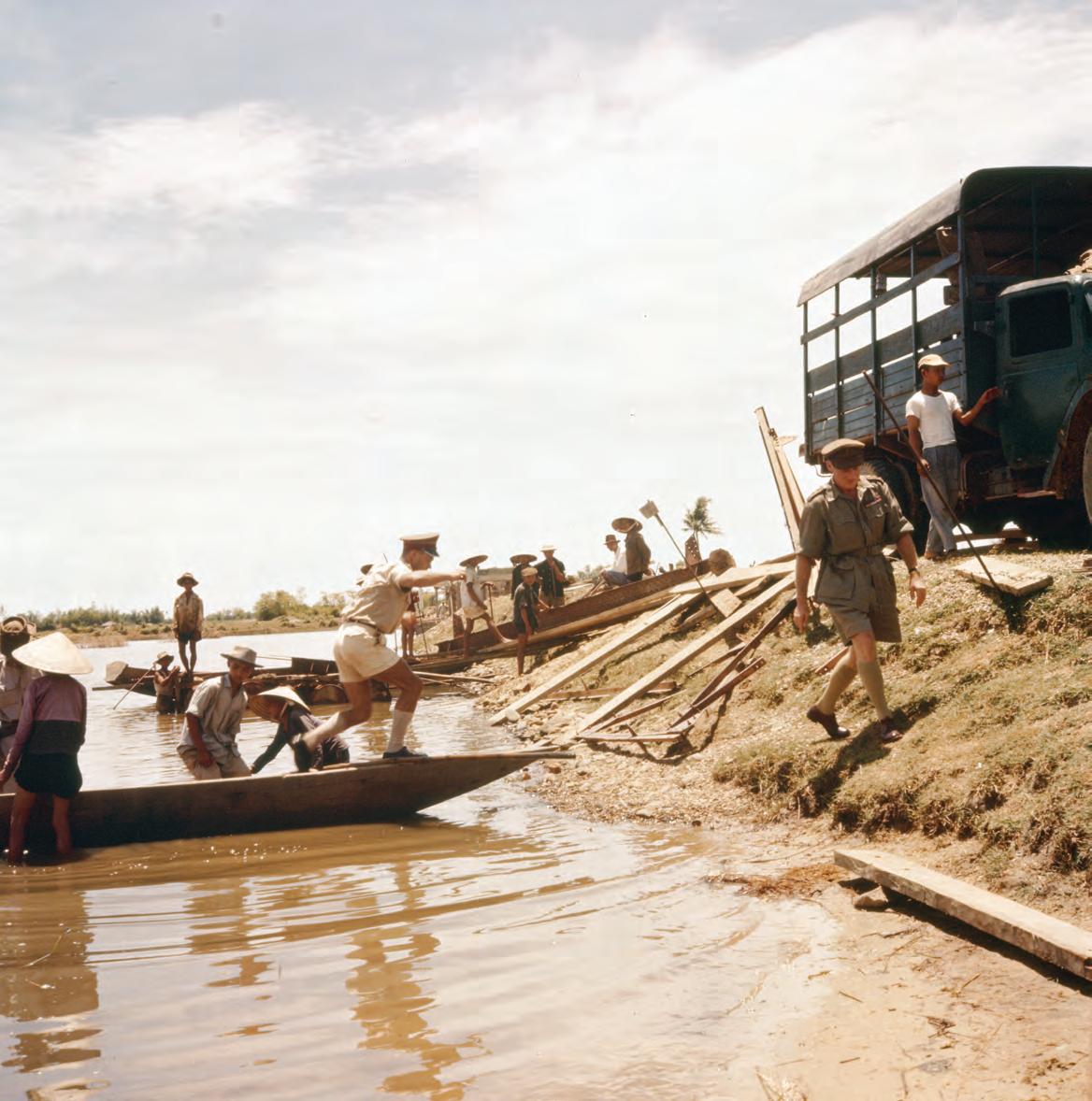
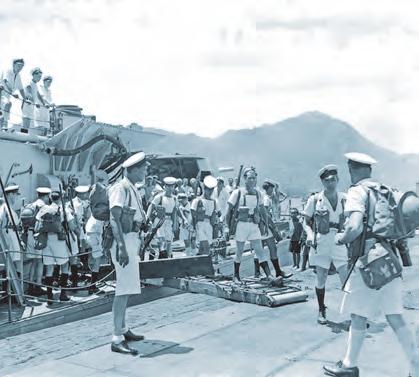
Military members of the Canadian delegation to the International Commission move ashore in South Vietnam as part of the truce supervisory mission.
See page 44

18 LICENCE TO
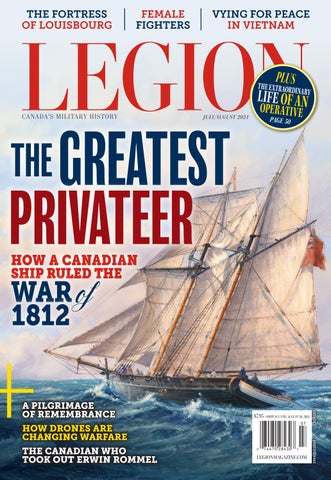
Privateers played an important role in wars throughout the 18th century
By Stephen J. Thorne
26 “THOSE DAMN WOMEN”
Canadian female fighter jet pilots first took to the skies 30-plus years ago—but few have followed in their vapour trails
By Paige Jasmine Gilmar
32 THE WEIGHT OF WAR
Insights into Canada’s First World War experience from the 2023 Legion Pilgrimage of Remembrance
By Aaron Kylie
38 A LIBERATION LEGACY
Fulfilling a dying wish to commemorate Canadian soldiers
By John Goheen
44 THE PEACEMAKERS
During their lengthy truce supervisory mission in Vietnam, Canadian military personnel played many roles
By John Boileau
50 SPECIAL OPERATIONS
How Douglas Jung went from a man with no country to Second World War intelligence service and a postwar citizen of firsts
By Sharon Adams
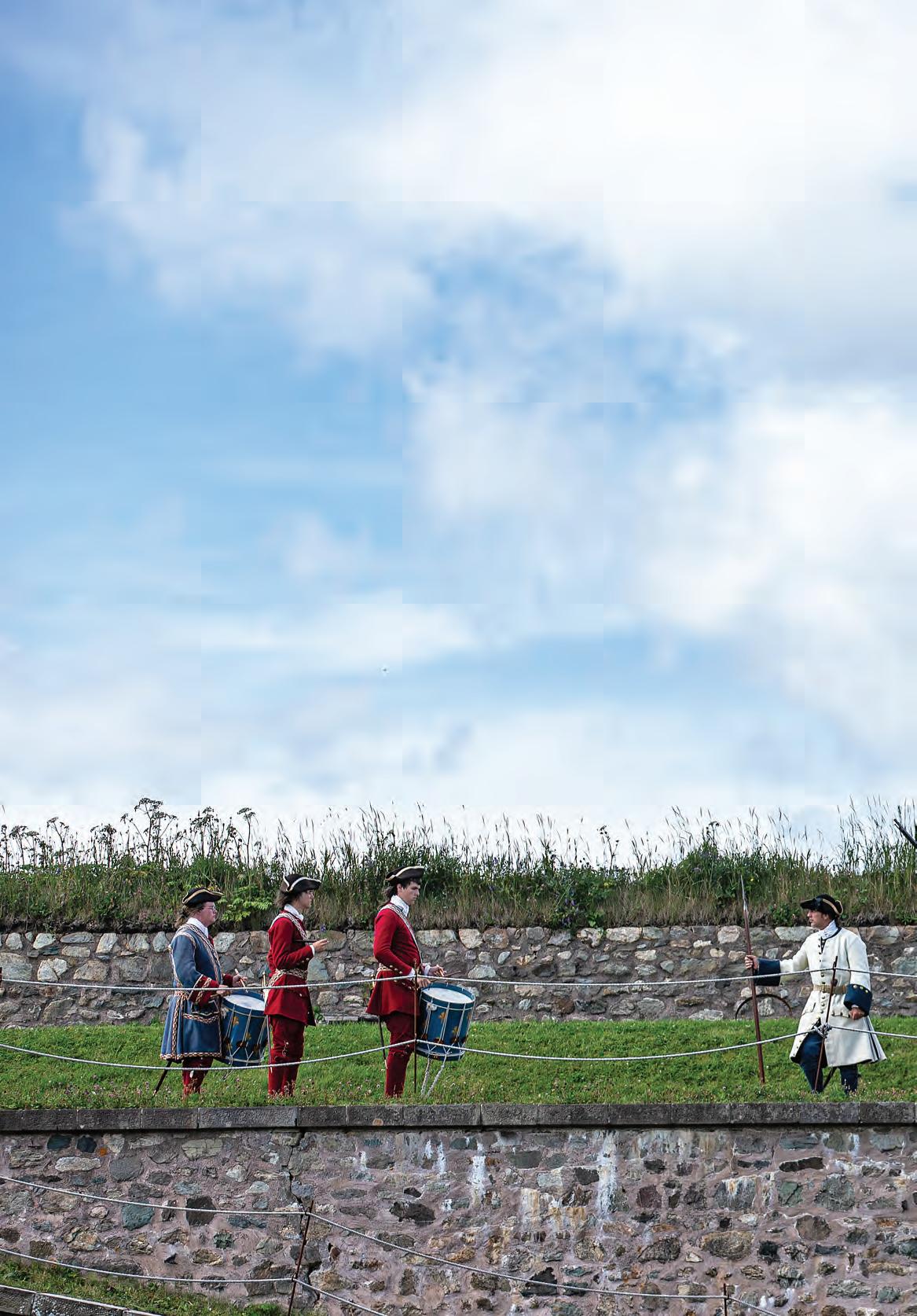
56 THE FORTRESS
For much of the 18th century, Louisbourg on Cape Breton Island dominated access to North America
Photography and words by Stephen J. Thorne
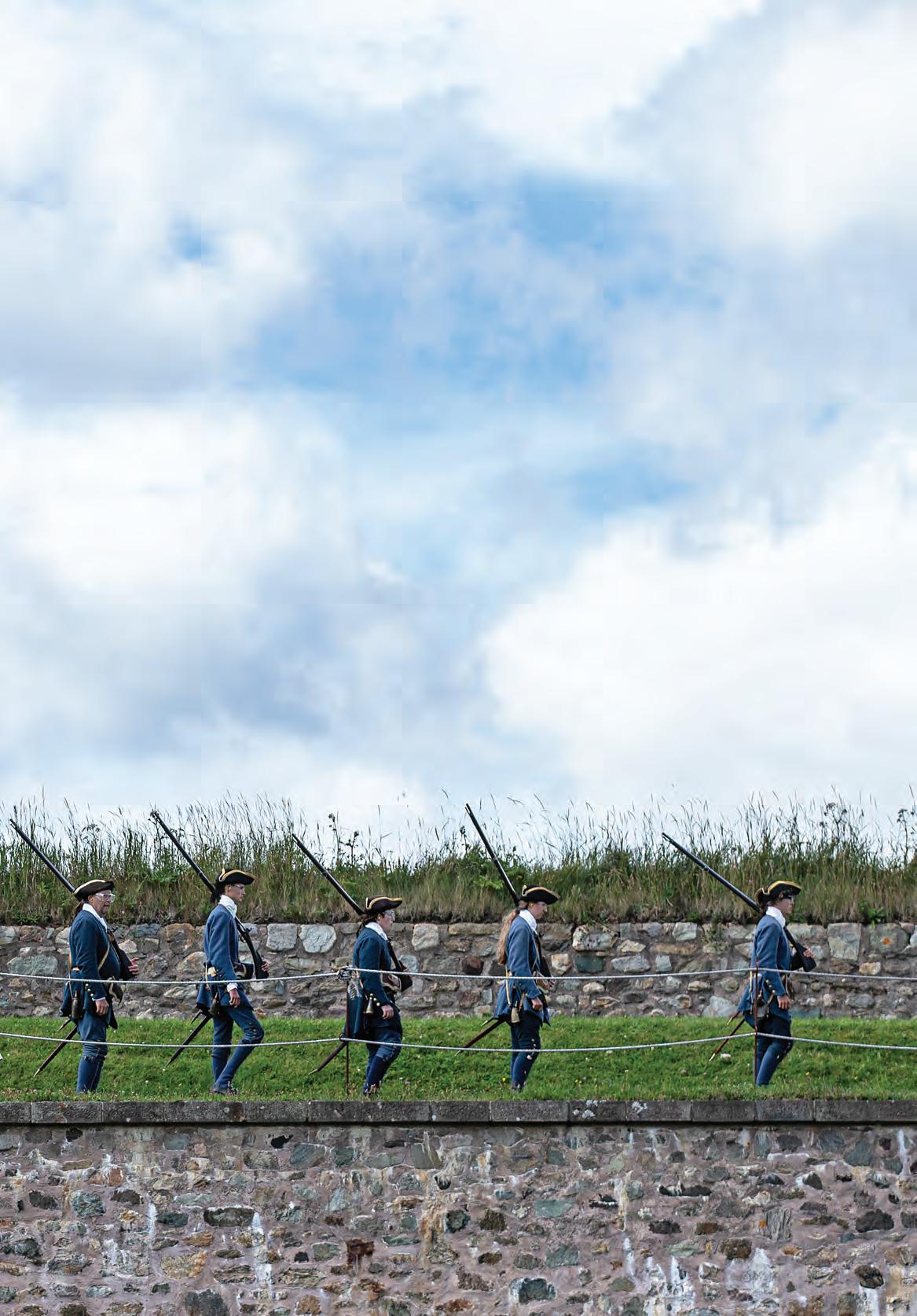
Re-enactors march on the ramparts of the reconstructed 18th century fortress at Louisbourg, N.S.
Stephen J. Thorne/LM
ON
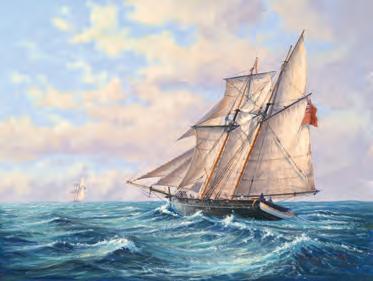
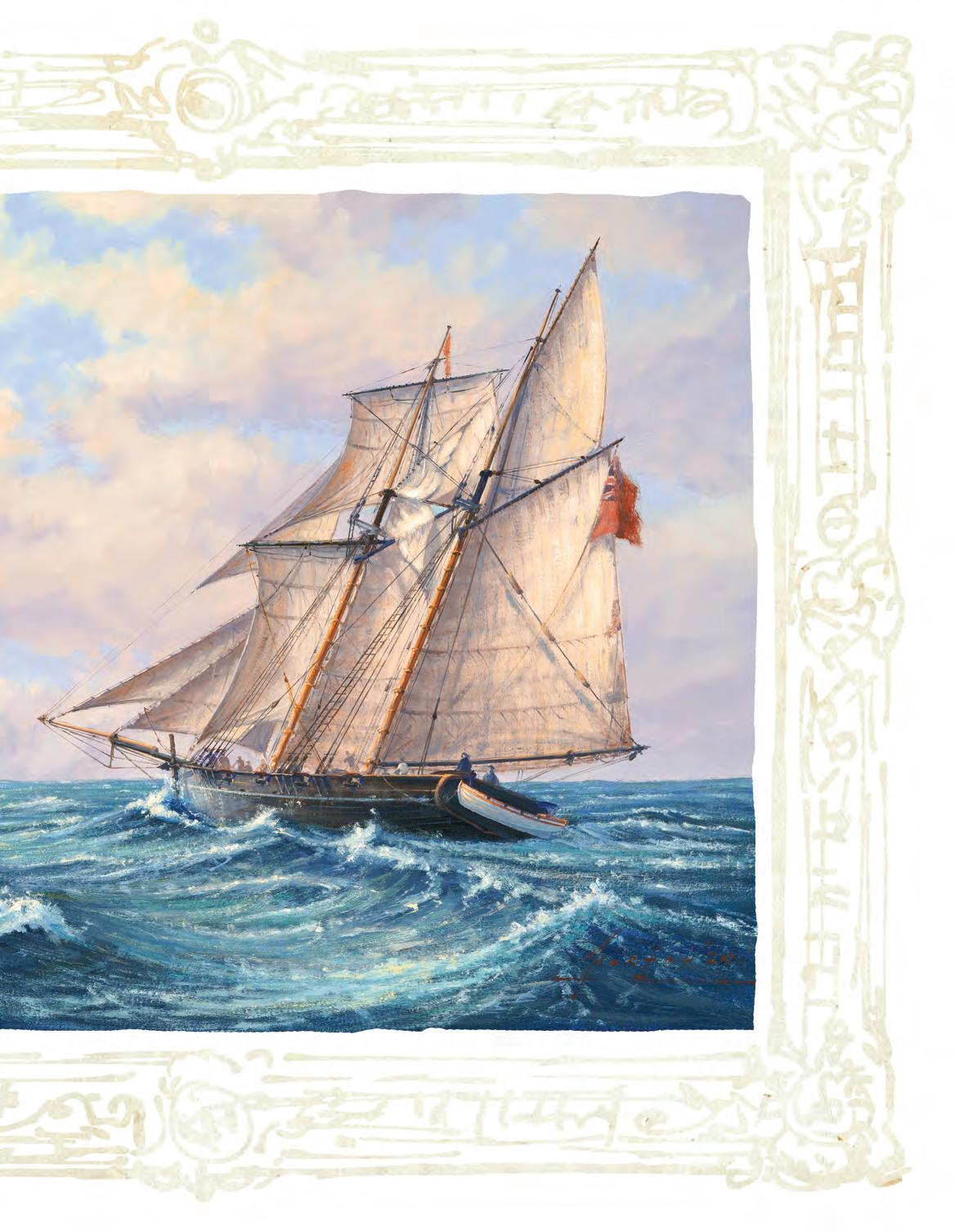
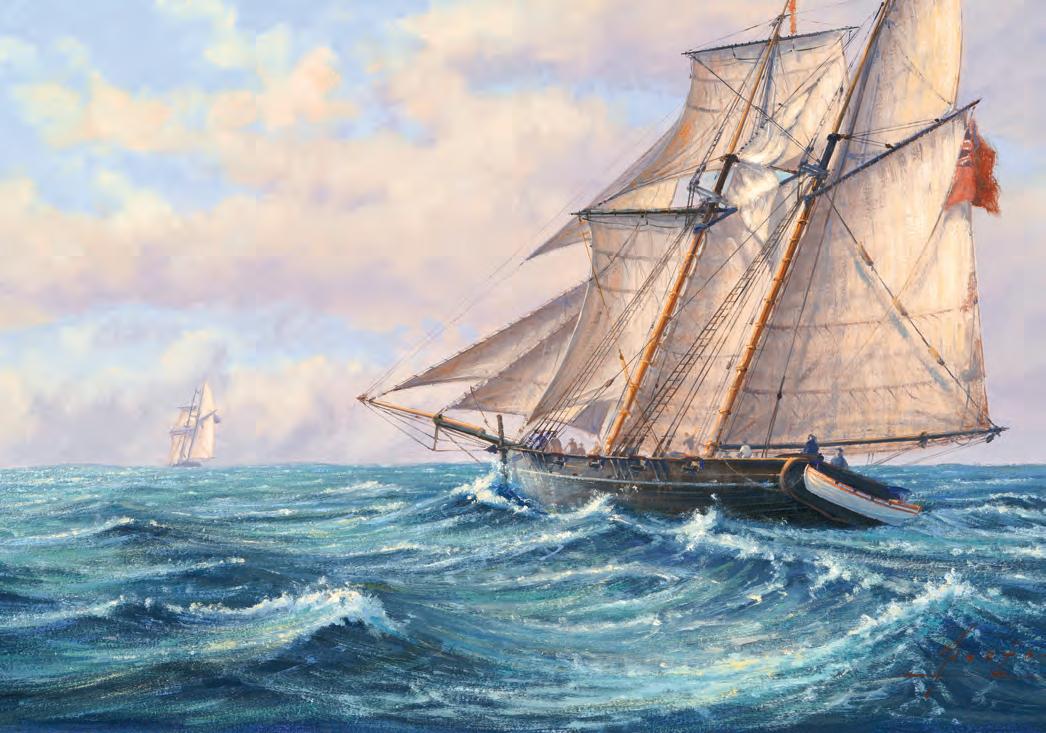
“Stern Chase” by renowned, modern-day, Canadian marine artist John M. Horton (www.johnhorton.ca) depicts the notorious privateer Liverpool Packet chasing a prize off the Massachusetts coast during the War of 1812.
John M. Horton
fail to make the most of its

Vol. 99, No. 4 | July/August 2024
BOARD CHAIR Berkley Lawrence BOARD VICE-CHAIR Bruce Julian BOARD SECRETARY Bill Chafe
DIRECTORS Tom Bursey, Steven Clark, Thomas Irvine, Jack MacIsaac, Sharon McKeown, Brian Weaver, Irit Weiser Legion Magazine is published by Canvet Publications Ltd.

ADMINISTRATIVE
SUPERVISOR
Stephanie Gorin
SALES/
ADMINISTRATIVE ASSISTANT
Lisa McCoy
ADMINISTRATIVE ASSISTANT
Chantal Horan


GENERAL MANAGER Jason Duprau
EDITOR
Aaron Kylie
ASSISTANT EDITOR
Michael A. Smith
SENIOR STAFF WRITER
Stephen J. Thorne
STAFF WRITER
Alex Bowers

ART DIRECTOR, CIRCULATION AND PRODUCTION MANAGER
Jennifer McGill
SENIOR DESIGNER AND PRODUCTION CO-ORDINATOR
Derryn Allebone
SENIOR DESIGNER
Sophie Jalbert
DESIGNER
Serena Masonde


Advertising Sales CANIK MARKETING SERVICES
TORONTO advertising@legionmagazine.com
DOVETAIL COMMUNICATIONS INC mmignardi@dvtail.com
OR CALL 613-591-0116 FOR MORE INFORMATION
SENIOR DESIGNER AND MARKETING CO-ORDINATOR
Dyann Bernard
Ankush Katoch

Published six times per year, January/February, March/April, May/June, July/August, September/October and November/December. Copyright Canvet Publications Ltd. 2024. ISSN 1209-4331
Legion Magazine is $9.96 per year ($19.93 for two years and $29.89 for three years); prices include GST.
FOR ADDRESSES IN NS, NB, NL, PE a subscription is $10.91 for one year ($21.83 for two years and $32.74 for three years). FOR ADDRESSES IN ON a subscription is $10.72 for one year ($21.45 for two years and $32.17 for three years).
TO PURCHASE A MAGAZINE SUBSCRIPTION visit www.legionmagazine.com or contact Legion Magazine Subscription Dept., 86 Aird Place, Kanata, ON K2L 0A1 or phone 613-591-0116. The single copy price is $7.95 plus applicable taxes, shipping and handling.
Send new address and current address label, or, send new address and old address. Send to: Legion Magazine Subscription Department, 86 Aird Place, Kanata, ON K2L 0A1. Or visit www.legionmagazine.com/change-of-address. Allow eight weeks.
Opinions expressed are those of the writers. Unless otherwise explicitly stated, articles do not imply endorsement of any product or service. The advertisement of any product or service does not indicate approval by the publisher unless so stated. Reproduction or recreation, in whole or in part, in any form or media, is strictly forbidden and is a violation of copyright. Reprint only with written permission.
PUBLICATIONS MAIL AGREEMENT NO. 40063864
Return undeliverable Canadian addresses to Legion Magazine Subscription Department 86 Aird Place, Kanata, ON K2L 0A1 | magazine@legion.ca
U.S. Postmasters’ Information
United States: Legion Magazine, USPS 000-117, ISSN 1209-4331, published six times per year (January/February, March/April, May/June, July/August, September/October, November/December). Published by Canvet Publications, 866 Humboldt Pkwy., Buffalo, NY 14211-1218. Periodicals postage paid at Buffalo, NY. The annual subscription rate is $9.49 Cdn. The single copy price is $7.95 Cdn. plus shipping and handling. Circulation records are maintained at Adrienne and Associates, 866 Humboldt Pkwy., Buffalo, NY 14211-1218. U.S. Postmasters send covers only and address changes to Legion Magazine, PO Box 55, Niagara Falls, NY 14304.
Member of Alliance for Audited Media and BPA Worldwide. Printed in Canada.
We acknowledge the financial support of the Government of Canada. Version française disponible.
On occasion, we make our direct subscriber list available to carefully screened companies whose product or services we feel would be of interest to our subscribers. If you would rather not receive such offers, please state this request, along with your full name and address, and e-mail magazine@legion.ca or write to Legion Magazine, 86 Aird Place, Kanata ON K2L 0A1 or phone 613-591-0116.
on’t get me wrong. It’s important, but it was really hard to convince people that that was a worthy goal.” So Defence Minister Bill Blair said in a speech this past May to the Canadian Global Affairs Institute, a foreign affairs think tank, about conversations with cabinet colleagues about funding Canada’s military to NATO’s standard of two per cent of the country’s gross domestic product (GDP).
THE GOVERNMENT DOESN’T WANT TO INCREASE MILITARY SPENDING BECAUSE CANADIANS AT LARGE DON’T WANT THEM TO
Blair called that expectation a “magical threshold” and said: “Nobody knows what that means, [cabinet] didn’t know how much that is and they didn’t know what we were going to spend the money on, so I couldn’t make a defence policy argument to meet the spreadsheet target.”
So, Canada’s defence minister couldn’t explain to his colleagues that two per cent of the country’s $1.927 trillion GDP is $38.54 billion? He couldn’t explain the current $26.5 billion defence budget is 1.38 per cent of GDP? He couldn’t explain that the military is an estimated 16,500 members under strength? He couldn’t explain that Canada’s four submarines spent just seven and a half months, combined (!), at sea between 2000 and 2003? He couldn’t explain that there’s a miliary housing crisis? He couldn’t explain that there are critical equipment shortfalls?
We can’t possibly imagine what Canada’s military would spend the money on, either. Nor do we believe cabinet members are that simpleminded.
Let’s get it straight: the government doesn’t want to increase military spending because Canadians at large don’t want them to. MPs serve their constituents—and ultimately try to give them what they want.
The defence chief, General Wayne Eyre, who is set to retire this summer, has similarly been steadfast in standing up for his charges throughout his tenure. Just before Minister Blair’s May speech, Eyre was having difficulty answering questions at a town hall meeting about how the government’s latest cuts and funding reallocations in the defence budget squared with promises made in April’s defence policy statement to increase spending.
“We’re being asked to suck and blow at the sa me time,” Eyre told about 1,300 Forces’ members. “This year on the operations and maintenance side, we are facing some challenges. And you talk about confusion—I don’t have complete clarity yet either, as the finance staff continue to analyze the impact of this year’s federal budget.”
In February, the government outlined defence spending reductions of $810 million in fiscal 2024-25, $851 million the following year and just under $981 million in 2026-27. The new defence policy subsequently promised an additional $81 billion for the miliary in the near-term and more than $73 billion during the next two decades.
Despite the confusion, the minister and the defence chief apparently agree that the NATO target is a red herring.
“I don’t care about percentage of GDP in terms of spending,” Eyre said at the town hall. “What I care about is, what does the armed forces and the department produce as an output metric, which is capabilities and readiness?”
On that score, Canada is failing. At the very least, it’s long past time the country’s leaders clear up that confusion. That’s a worthy goal, no? L
Comments can be sent to: Letters, Legion Magazine , 86 Aird Place, Kanata, ON K2L 0A1 or emailed to: magazine@legion.ca
The use of a service dog can help many struggling veterans (“The dogs of postwar,” May/June). Having had pets during my military career and afterward helped me. They give you unconditional love and support and can be trained to be more attentive. Post-traumatic stress disorder is no joke, and any way you can cope and have comfort is good. I have noticed
In “Heroes and Villains” (May/June), it states that the North Nova Scotia Highlanders were supported by tanks of Les Fusiliers de Sherbrooke. They were supported by The Sherbooke Fusiliers
a difference in my mental and physical health since I lost my dog. Even simply having the routine of feeding, going for walks and interacting with others is helpful. I think the cost of caring for a dog is where the approval of service dogs for veterans gets hung up. People need help affording and training their pet.
S. DEDLA FORT SASKATCHEWAN, ALTA.
Regiment, which had been formed by the union of The Sherbrooke Regiment and Les Fusiliers de Sherbrooke Regiment. After the war, The Sherbrooke Fusiliers Regiment once again returned to the two former regiments.
JACK R. GARNEAU SAWYERVILLE, QUE.
I loved the article by Andy Sparling about the RCAF Streamliners in your May/June issue (“Sentimental journey”). As someone who has read numerous biographies of famed musicians, this ranks as one of the best stories ever, an example of how “ordinary” people achieved something extraordinary, then went back to their lives.
INTA
LIEPINS


SAINT JOHN,
N.B.
In the “Humor Hunt” section of Legion Magazine (March/ April) there was an item about the Halifax VE-Day riot. My late father was in the navy and in the city at the time and had shared some interesting observations about the incident. It’s true that
there wasn’t a good relationship between Halifax residents and the navy. The citizens considered the sailors unruly and the sailors felt that the local merchants gouged them on purchases. In dad’s opinion, the worst thing that the city did was close the bars. If they had remained open, the sailors would have let off some steam, had a few drinks, and things would have subsided. He said that no one had much money anyway. When the trouble started, it’s true that the majority of the rioters were sailors, but there were also members of the other services involved, as well as some civilians who saw what was happening and wanted to get in on the action. He didn’t condone it, but the Halifax riot was a situation that, in his opinion, could have been avoided.
ROBERT J. RUSSELL VICTORIA
I was strolling through Atlantic Superstore and noticed Wing Commander Hugh Godefroy staring skyward from the cover of Legion’s special issue RCAF




Much of military history comes from battles mythicized over time or recent atrocities that people are still trying to contextualize. Sometimes
historians can overlook decades of military work between wars that were critical to keeping world peace.
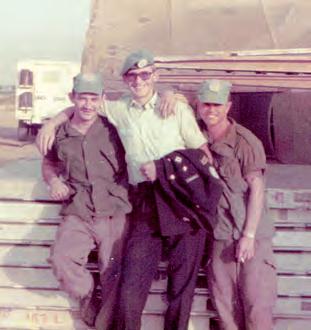
Many such operations took place as Canada took on a peacekeeping role with the United Nations on the world stage. One of the many Canadians who were deployed overseas for the military during peacetime was Sergeant Lech Kwasiborski. In the summer of 1974, he was serving in Egypt (pictured) when a Canadian transport flight of the United Nations Emergency Force II (UNEF II) was shot down by missiles fired from Syria, killing all nine aboard. It was an event that took Kwasiborski 50 years to process in his own words.
In a web-exclusive memoir available on LegionMagazine.com,
nial of the Royal Canadian Air Force (Winter 2024). The first time I met Godefroy, he slapped me on the butt. Why? He had just delivered me into this world in a small hospital in Grand-Mère, Que., and that slap was my cue to start breathing. He was our family doctor until we moved to Montreal when I was five, so I don’t have a lot of memories of him. He transferred his practice to the U.S., returned to Canada— my mother became his patient again, I had moved to Toronto— and went back to the U.S. where he passed 22 years ago. Godefroy wrote an account of his wartime endeavours, Lucky 13, in 1983.
KEVIN FINCH VIA EMAIL
Get notified of all the latest updates on legionmagazine.com by signing up for our weekly e-newsletter at www.legionmagazine.com /newsletter-signup
Kwasiborski remembers the events leading up to his Egyptian summer, how peacekeeping doesn’t guarantee safety and how, for him and many others, luck can play a major role in life.
As Aug. 9, now National Peacekeepers Day in commemoration of the ill-fated UNEF II flight, approaches, Kwasiborski reminds readers not to forget the sacrifices of peacetime Canadian military personnel. When peacekeepers are deployed, they’re often not met with peace. During the summer of 1974, Canada lost 11 peacekeepers, four military personnel in active training and six cadets. And as Kwasiborski describes in his reflection, a chance change of plans kept him from being included in the tally. L
On 17 January 2024 the Federal Court approved a settlement in a class action involving alleged underpayment of certain disability pension benefits administered by Veterans Affairs Canada (“VAC”) payable to members or former members of the Canadian Armed Forces (“CAF”) and the Royal Canadian Mounted Police (“RCMP”) and their spouses, commonlaw partners, survivors, other related individuals, and estates (the “Settlement”).
If you received any of the disability-related benefits listed below at any time between 2003 and 2023, you may be entitled to compensation under the Settlement. As the executor, estate trustee, administrator, or family member of a deceased class member who collected VAC-administered disability benefits, you may also be able to claim on behalf of the estate. If you are entitled to compensation under the Settlement and you have an active payment arrangement with VAC, such as direct deposit, you do not need to do anything to receive payment. If you are claiming on behalf of a deceased veteran of the CAF or RCMP, including as the executor, trustee, administrator of an estate, or a family member, you must submit a Claim Form to KPMG Inc., the administrator responsible for handling claims available at: KPMG Inc.
C/O Disability Pension Class Action Claims Administrator 600 boul. de Maisonneuve West, Suite 1500 Montréal, Québec H3A 0A3 Online: https://veteranspensionsettlement.kpmg.ca/ E-mail: veteranspension@kpmg.ca
For assistance with submitting a Claim Form, please contact the Administrator’s dedicated call center at 1-833-839-0648, available Monday to Friday, 8:00 AM to 8:00 PM (Eastern Time).
The deadline to submit a claim is 19 March 2025. All eligible claimants are entitled to receive legal assistance free of charge from Class Counsel for purposes relating to implementing the Settlement, including preparing and/or submitting a claim to the Administrator.
You may contact Class Counsel for more information or for assistance with filing a claim, at info@vetspensionerror.ca, or 1-866-545-9920. To see the full text of the Final Settlement Agreement, please visit https://vetspensionerror.ca/court-documents/. WHO IS INCLUDED?
The Settlement covers members and former members of the CAF and the RCMP and their spouses, common–law partners, dependents, survivors, orphans, and any other individuals, including eligible estates of all such persons, who received—at any time between 2003 and 2023—disability benefits based on annual adjustments of the basic pension under s. 75 of the Pension Act (the “Class Members”). The terms of the Settlement are binding on Class Members. The Settlement includes releases of claims asserted in the certified Class Action.
The Settlement affects prescribed annual adjustments of the following benefits:
• Pension Act pensions for disability, death, attendance allowance, allowance for wear and tear of clothing or for specially made apparel and/or exceptional incapacity allowance;
• RCMP Disability Benefits awarded in accordance with the Pension Act;
• Civilian War-related Benefits Act war pensions and allowances for salt water fishers, overseas headquarters staff,
air raid precautions works, and injury for remedial treatment of various persons and voluntary aid detachment (World War II);
• Flying Accidents Compensation Regulations flying accidents compensation;
• Veterans Well-being Act clothing allowance.
The Settlement provides direct compensation to Class Members who receive (or have previously received) any of the Affected Benefits listed above, since 1 January 2003. Class Members will receive a single payment of about 2% of all Affected Benefits they have received since 1 January 2003. The total amount of compensation paid by Canada to the Class could be as much as $817,300,000. This is only a summary of the benefits available under the Settlement. The full text of
the Final Settlement Agreement (“FSA”) is available online at https://vetspensionerror.ca/ court-documents/. You should review the entire FSA in order to determine your entitlement and any steps you may need to take to access compensation.
Eligible Class Members who are currently collecting VAC-administered disability benefits or pensions will receive a Settlement payment automatically through the same payment method they currently use to collect benefits, including by direct deposit.
Class Members who received Affected Benefits between 2003 and 2023 but who do not have a current payment arrangement with VAC will be required to make a claim with the Claims Administrator. This includes all Class Members who are deceased, and where an executor, estate trustee, administrator of an estate, or a family member is making a claim on behalf of that Class Member.
However, if a deceased Class Member has a survivor who is in receipt of VAC benefits and has a current payment arrangement, that survivor will automatically receive the deceased Class Member’s entitlement without the need to make a claim with the Claims Administrator.
If you do not have an active payment arrangement with VAC, you must submit a claim form with the Administrator.
You must submit a completed and signed Claim Form to the Administrator within the Claim Period. You are encouraged to use the Claim Form submission link available online at https://veteranspensionsettlement.kpmg.ca/. You may, however, submit your Claim Form to the Administrator using one of the following three methods: 1. online at https://veteranspensionsettlement.kpmg.ca; 2. by e-mail to veteranspension@kpmg.ca; or 3. by mail to: KPMG Inc.
C/O Disability Pension Class Action Claims Administrator 600 boul. de Maisonneuve West, Suite 1500 Montréal, Québec H3A 0A3
You may download a copy of the Claim Form available online at: https://veteranspensionsettlement.kpmg.ca/download/Claim-Form.pdf.
If submitting electronically, the Administrator must receive your completed and signed Claim Form no later than 19 March 2025. If submitting by mail, your completed and signed Claim Form must be postmarked no later than 19 March 2025. For assistance with submitting a Claim Form, please contact the Administrator’s dedicated call center at 1-833-839-0648, available Monday to Friday, 8:00 AM to 8:00 PM (Eastern Time).
Please read and follow the instructions on the Claim Form. Class Counsel are also available, free of charge, to answer your questions and assist you with preparing your claim form.
The deadline to file a claim is 19 March 2025.
AM
You are not responsible for payment of legal fees. The Federal Court has approved Class Counsel’s fees (including HST) and disbursements to be automatically calculated and deducted from the Settlement amount you are entitled to receive before the payment is issued.
The Federal Court approved payments to Class Counsel equal to approximately 17% of each payment made under the Settlement for legal fees, disbursements, and HST.
The FSA contains additional details about Class Counsel fees, available online at https://vetspensionerror.ca/court-documents/.
Class Counsel are available to assist Class Members through the claims process free of charge.
FURTHER INFORMATION?
For further information or to get help with your claim, contact Class Counsel at: https://vetspensionerror.ca/ or Call: 1-866-545-9920 or info@vetspensionerror.ca
DO YOU KNOW ANY OTHER RECIPIENTS OF A VAC DISABILITY PENSION?
Please share this information with them.


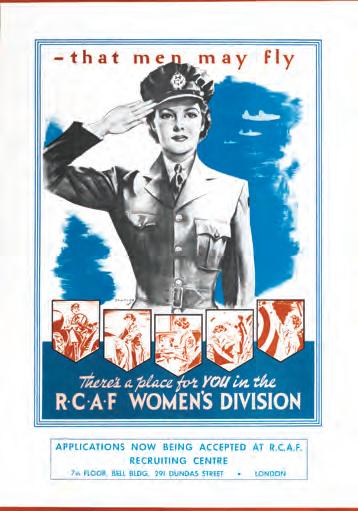
2 July 1941
An Order-in-Council authorizes the creation of the Canadian Women’s Auxiliary Air Force, which was renamed the Royal Canadian Air Force Women’s Division in 1942.
4 July 1955
A group of anti-submarine torpedo specialists take flight as sonar operators for six Sikorsky H04S-3s in a new navy antisubmarine helicopter squadron.
5 July 1950
HMC ships Cayuga, Athabaskan and Sioux depart for Korea.
6 July 2003
8 July 1944
The 9th Canadian Infantry Brigade (9 CIB) takes part in Operation Charnwood, the British I Corps’ final assault on Caen, France.
9 July 1943
The 1st Canadian Infantry Division and the 1st Canadian Army Tank Brigade arrive to join the invasion armada of nearly 3,000 Allied ships and landing craft during the assault on Sicily.
10 July 1943
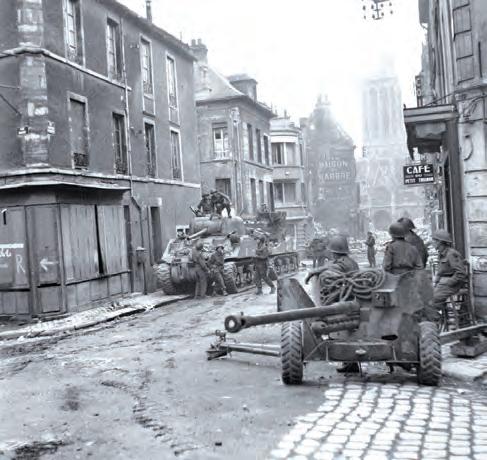
17 July 1944
Canadian Spitfire pilot Charley Fox strafes a black car, wounding German Field Marshal Erwin Rommel, known as the Desert Fox (see “Heroes and Villains,” page 92).
Canadian troops come ashore near Pachino close to the southern tip of Sicily and take up the left flank of five British units as part of Operation Husky.
18 July 1925
Mein Kampf, Adolph Hitler’s blueprint for the Third Reich, is published.

11 July 1973
Operation Caravan, Canada’s role in the French-led United Nations Organization Stabilization Mission in the Democratic Republic of Congo, comes to an end.
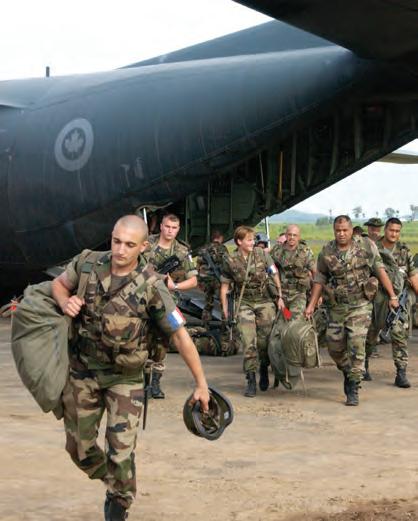
Canadian Forces’ Hercules aircraft begin food-relief missions in response to the drought-induced famine in West Africa.
12 July 1812
American General William Hull invades Upper Canada from Detroit.
15 July 1870
The Hudson’s Bay Company sells the region known as Rupert’s Land—a quarter of North America’s landmass—to Canada for $1.5 million.
19 July 1870
Franco-Prussian War starts.
20 July 1974
Turkey invades Cyprus. Two Canadian peacekeepers die and 30 are wounded foiling attempts to capture the airport.
22 July 1943
Canadian soldiers capture the Italian town of Assoro.
24 July 1942
A German U-boat wolf pack attacks convoy ON-113. While five Allied ships are sunk, HMCS St. Croix takes out U-90
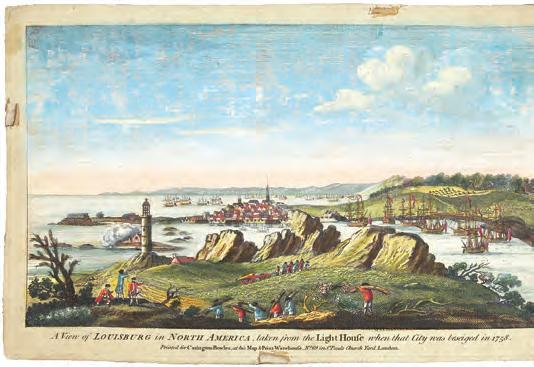
26 July 1758
The French fortress at Louisbourg surrenders to the British (see “The fortress,” page 56).
12 August 1917
2 August 1990
Iraq invades Kuwait. Canada joins a U.S.-led international coalition in response, contributing a naval task group and later, an air task group.
3 August 1981
Egypt and Israel sign a peace treaty, the Sinai is returned to Egypt and a multinational force begins peacekeeping.
8 August 1918
The Hundred Days Offensive of the First World War begins with the launch of a major attack east of Amiens, France.
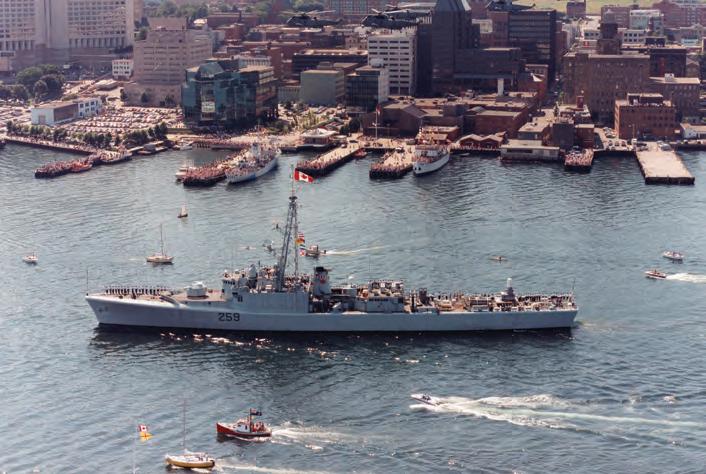
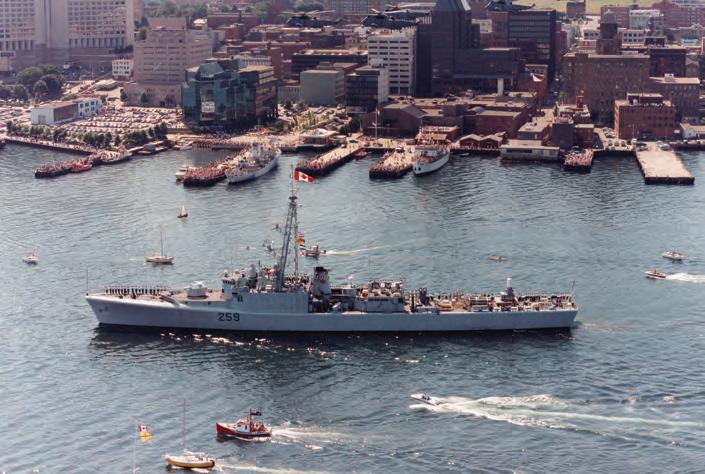
HMCS Shearwater and submarines CC-1 and CC-2 are the first Canadian warships to pass through the Panama Canal.
16 August 1900
In South Africa, Boer troops withdraw at news of approaching British reinforcements, bringing an end to the Battle of Elands River.
17 August 1943
Sicily is liberated; Canada incurs 2,310 casualties, including 562 killed, in the campaign.
9 August 1974

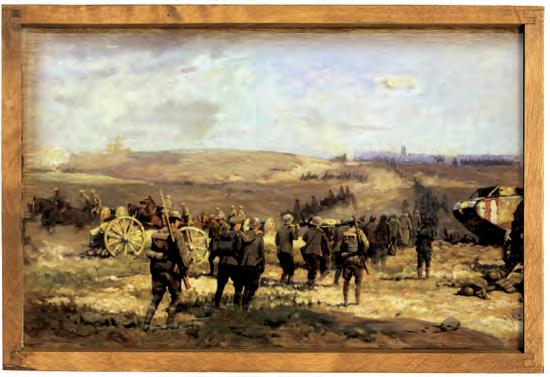
Nine Canadian peacekeepers die when their Buffalo aircraft is shot down by Syrian missiles.
10 August 1930
Bellanca aircraft enter service with the RCAF.
11 August 1718
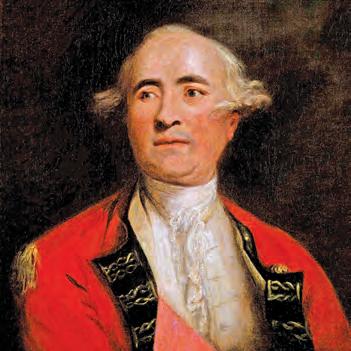
Frederick Haldimand is born. As governor of Quebec, he helps resettle United Empire Loyalists and Six Nations of Iroquois in Canada following the American Revolution.
18 August 1944
HMC ships Ottawa, Kootenay and Chaudière sink U-621 in the Bay of Biscay.
20 August 1915
The Newfoundland Regiment leaves for the Mediterranean.
21 August 1853
HMS Breadalbane is trapped and crushed by ice, sinking in the Northwest Passage. Its crew of 21 is rescued by sibling ship, HMS Phoenix
22 August 2001
The defence minister announces that Canada will deploy troops to NATO operations in Macedonia.
24 August 1814
British troops march into Washington, D.C., and burn public buildings.
25 August 1944
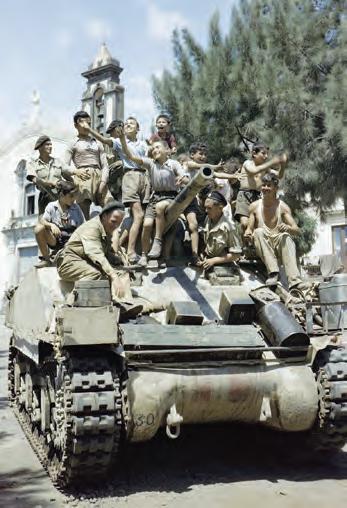
In Italy, Canadian, British and Polish forces attack the Gothic Line.
28 August 1992
Canada announces 750 troops to aid the United Nations Operation in Somalia.
30 August 1945
HMCS Prince Robert sails into Kowloon, Hong Kong, liberating Canadian prisoners of war.
By Alex Bowers
here’s a swing bridge, and all they tell you to do is walk,” said retired master corporal Mike Trauner. “Just walk in a straight line across the bridge.”
Beginners, he explained, have on ly a light breeze rocking the flimsy span back and forth. “But for me...the bridge is just swinging wildly out of control.”
Trauner, an Afghanistan combat veteran who uses prosthetic legs—the result of two improvised explosive devices detonating under him on Dec. 5, 2008—recalled grabbing the handles to gain stability before pushing on.
Yet despite the almighty gusts, despite the swaying structure and despite the seemingly perilous risk of falling, he remembered being unafraid.
The bridge, in reality, never truly ex isted. Nor did the wind.
But in Trauner’s case, alongside other Canadians who returned from Afghanistan with lifechanging wounds, the so-called Caren (Computer-Assisted Rehabilitation Environment) system has brought—and for some still brings—a virtual reality capable of producing tangible results.
One of only two such facilities in Canada, The Ottawa Hospital’s Caren lab has, since being installed in 2010 in partnership with the Canadian Armed Forces, enabled patients to push boundaries in a sa fe and controlled setting.
The technology, monitored by a collaborative team of rehabilitation experts, psychologists, occupational therapists, physiotherapists, researchers and more, encompasses an entire room dominated by a large projection screen. A moving platform, which can tilt in different directions depending on the patient’s movements, and a remote-controlled treadmill add to the immersive experience as participants are secured in a harness attached to a fall-restraint system.
“It allows us to simulate so many different environments besides flat-level ground walking,” explained Dr. Nancy Dudek, medical director of the hospital’s amputee program. “It likewise affords a great degree of comfort knowing that if it doesn’t go as planned, [the patient] is not going to sustain injuries.”
Considered an accompaniment to other aspects of the rehabilitation process, the virtual reality program captures data that medical professionals can assess and adapt according to the patient’s needs. Its scope, meanwhile, can reach beyond combat-related wounds to the likes of traumatic brain or spinal cord injuries, neuromuscular disease, mental health conditions or chronic pain.
“The Caren system can be just as beneficial to, say, a 28-year-old
who happened to be in a civilian motor accident as to a 28-yearold member of the Canadian Armed Forces wounded in the field,” said Dr. Dudek.
And then there are the scenarios themselves, which can cater to individual circumstances, goals, interests and requirements. While some, such as traipsing across a rickety bridge, bear an arguably closer resemblance to fantastical video games, others draw inspiration from everyday life.
A three-dimensional map of downtown Ottawa is just one example, where crowds throng the streets, vehicles drive by and obstacles can spontaneously present themselves. “The idea is to give [patients] mental challenges, which is what happens in the real world when somebody walks in front of you or you have to suddenly move,” noted Dr. Dudek.
Another, Trauner recalled, placed him on a boat. Here, balance and weight dispersal become critical as patients navigate around a series of buoys, all the while building confidence in their abilities and those of their prosthetics.
Bushra Saeed-Khan also remembered cruising over virtual waters during her rehabilitation. On Dec. 30, 2009, the 25-year-old Canadian diplomat was only eight weeks into a one-year assignment when her light-armoured vehicle encountered an improvised explosive device near Kandahar.
“There were 10 of us [in the vehicle]. Five of us passed away immediately, and five of us survived,” explained SaeedKhan, whose wounds resulted in the loss of a leg, while the other was severely damaged.
By the time she arrived at the rehabilitation centre in Ottawa, Saeed-Khan’s recovery had extended beyond the physical and into mental barriers.
“I was still knee-deep in my rehab and surgeries...for the
first few months,” she said, “until I reached a point where I almost felt I started to stagnate a bit. I wanted to go back home and back to work. But there was still this fear of being back in the community because I was so comfortable in the rehab centre. It was accessible, it was safe.”
The Caren system helped her push physical boundaries.
The program’s importance to mental health, as Saeed-Khan herself recognizeed, cannot be overstated: “It took me a few efforts to trust the Caren system. But it helped me figure out what was possible and what was not.”
Whether walking over uneven ground in a virtual forest or steadying herself on a virtual bus, each accomplished task brought Saeed-Khan closer to the life she hoped to lead. Even when specific
scenarios—and their varying difficulty settings—posed challenges beyond her new circumstances, the diplomat remained grateful for the clarity that came with knowing her limitations.
One of Saeed-Khan’s long-term goals, however, posed an entirely different challenge with a unique set of considerations: motherhood.
“Not only did I want to physically have [children] if possible,” she said, “but just play with them and engage with them. Everything I did at the rehab centre, every surgery, every exercise, I wondered how it would affect that.”
Beyond the rehabilitation lab, trials and tribulations awaited Saeed-Khan over the subsequent years as the prospect of pregnancy was complicated by her past wounds. Nevertheless, in 2018, she and her husband welcomed their daughter into
the world. More recently, SaeedKhan gave birth to a son.
“They’re like mini Caren systems,” she joked of her five-year-old and two-year-old children. “They’ve just got to push you sometimes.”
In part due to her virtual reality journey, together with The Ottawa Hospital’s dedicated team that helped her along the way, Saeed-Khan eventually returned to work. She is currently posted to the UN in New York.
Trauner’s sporting career continues to flourish. In 2023, the veteran served as games ambassador at The Royal Canadian Legion’s National Youth Track and Field Championships, a position he will take on again in 2024.
“I think the military made me the person I am today,” said Trauner. “But ultimately, in a way, the Caren system fine-tuned me.” L
Stephen J.Thorne
Itis a blight on the hypocritical, arguably corrupt and highly politicized International Olympic Committee that the 1936 Olympic Games were ever allowed to take place in Nazi Germany. But the controversial call gave one Black athlete a grand platform on which to upstage Adolf Hitler and the racist policies of his fascist regime.
Jesse Owens’ achievements at the Berlin Games would not change the course of history. They wouldn’t prevent a world war or the Holocaust. They wouldn’t even alleviate racism in his native United States.
“When I came back to my native country, after all the stories about Hitler, I couldn’t ride in the front of the bus,” said the sharecropper’s son from Oakville, Ala. “I had to go to the back door. I couldn’t live where I wanted.
“I wasn’t invited to shake hands with Hitler, but I wasn’t invited to the White House to shake hands with the President, either.”
But his four gold medals did humiliate “the master race” and “single-handedly [crush] Hitler’s myth of Aryan supremacy,” wrote ESPN columnist Larry Schwartz.
Berlin’s selection as the Games’ host city took place in 1931, two years before Hitler was appointed chancellor. But the evil nature of his Nazi regime became evident immediately, and by 1935 German Jews had lost virtually all their rights.
Still, the Games went ahead— some countries, including the

U.S., even removed Jews from their teams to avoid offending Germany’s Nazi regime.
“Politics has no place in sport,” declared Avery Brundage, future IOC president and head of the U.S. Olympic Committee at the time. Brundage nevertheless became a Nazi apologist and one of Berlin’s biggest backers after a 1934 “fact-finding” trip to Germany.
The issue was argued in Canada, too.
In November 1935, the University of Manitoba hosted a debate on whether the country should attend the Berlin Olympics. Attendees voted 90-20 to boycott.
Participation proponents argued that a withdrawal would antagonize Germany and compound Nazi hostility toward Jews. They claimed IOC bans on racial and religious discrimination would protect minorities. Opponents said competing represented tacit support for Nazi racial policies.
In a Nov. 1, 1935, piece, Vancouver Sun columnist Hal Straight said the Berlin Games should be cancelled altogether.
“ The Olympics do not belong to Hitler, nor Germany,” he wrote. “ They belong to the world and are just being staged in Germany to that country’s request because it brings great beneficial returns. Hitler is being done a favor.”
> Check out the Front lines podcast series! Go to legionmagazine.com/en-frontlines
Canadian Olympic officials ignored the protests. The annual meeting of the Amateur Athletic Union of Canada, held behind closed doors in Halifax, did not air the issue. Its resolutions committee instead suggested following Britain’s lead and attending the Games.
According to the Vancouver Holocaust Education Centre, the resolution was approved without discussion. Canada would send 79 men and 18 women to Berlin. They earned a gold medal, three silver and a bronze.
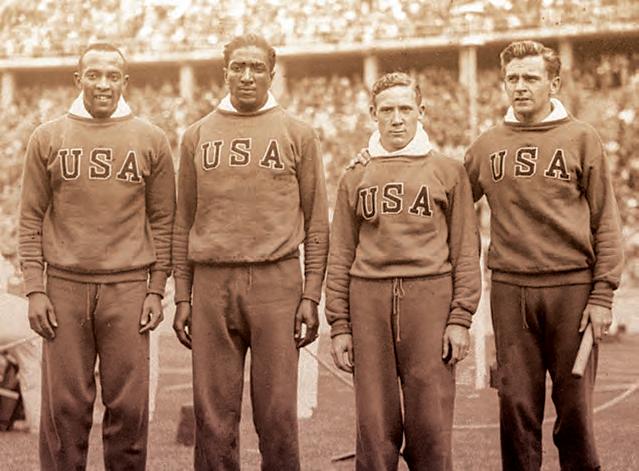
Fifty-one countries—14 more than participated at Los Angeles in 1932—gave Hitler what he wanted. The U.S. even switched out two Jewish relay runners, Sam Stoller and future New York broadcaster Marty Glickman, for Owens and Ralph Metcalfe.
Spain, on the other hand, boycotted Berlin and staged its own parallel “People’s Olympiad,” attended by some 6,000 athletes from 49 countries.
By the time the Games were held, German Jews had lost citizenship and were banned from universities and many fields of work,
their businesses boycotted and vandalized. They were regularly harassed in the streets, and worse.
The persecution and violence would escalate until, finally, in 1941, the Nazis implemented the “Final Solution,” a euphemism for the systematic extermination of Europe’s Jewish population.
German team bans on Jewish and Romani athletes were condemned internationally. The pressure gained such momentum that the Nazis allowed a part-Jewish athlete, 1928 fencing gold medallist Helene Mayer, to return to the German team. She won silver in Berlin.
Owens became an instant superstar in Berlin, in spite of it all. German fans chanted his name whenever he entered the Olympic stadium and mobbed him for autographs in the street. He took gold in the 100 metres, long jump, 200 metres and 4×100 relay—proof, the international press would declare, that the Nazi “master race” was a myth. Owens would be given a tickertape parade in Manhattan. Afterward, he wasn’t allowed to pass through the main doors of the Waldorf Astoria. He was
forced to go to the reception honouring him in a freight elevator.
He struggled to find work and took on menial jobs as a gas station attendant, playground janitor and manager of a drycleaning firm. He sometimes raced against motorcycles, cars, trucks and horses for cash prizes before he filed for bankruptcy and was convicted of tax evasion.
A lifelong Republican, his fortunes turned in 1955 at the hand of President Dwight D. Eisenhower, who made Owens a goodwill ambassador and sent him to India, the Philippines and Malaya to promote physical exercise and American culture.
In 1972, the emerging civilrights icon travelled to Munich for the Summer Olympics as a special guest of the West German government. He was greeted by Chancellor Willy Brandt and boxing legend Max Schmeling.
Berlin would be the last Games for 14 years. On Sept. 1, 1939, the forces of Nazi Germany invaded Poland, sparking a world war that would become the deadliest and most destructive conflict in history. L

By David J. Bercuson
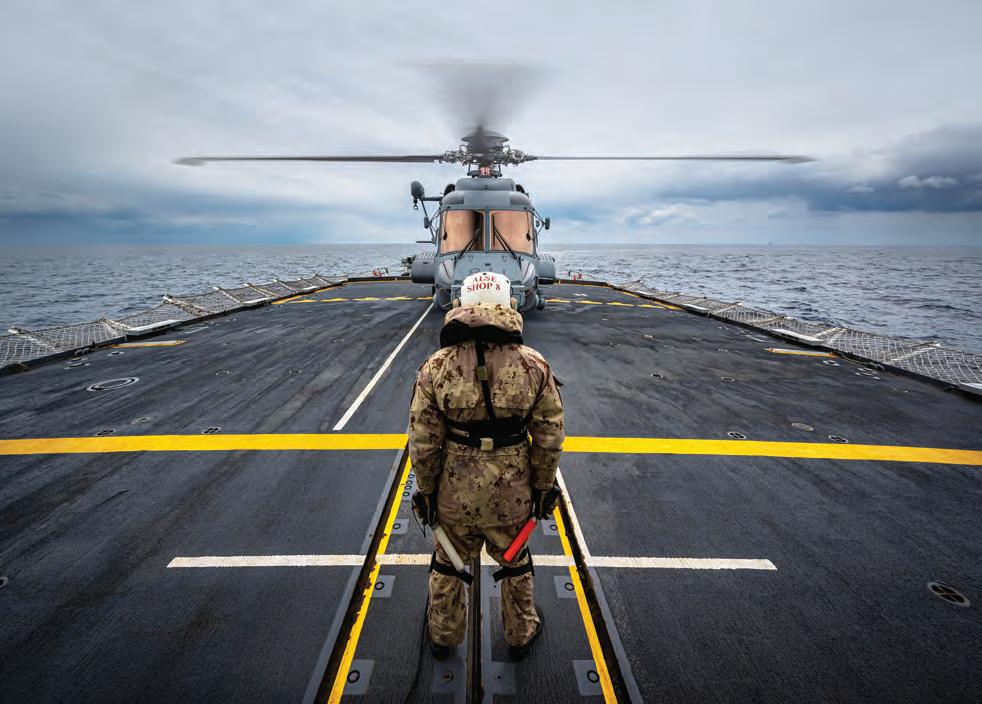
anada’s military has long been plagued with procurement problems. It took 30 years to go from the Progressive Conservative’s announcement to order replacement helicopters for the aging CH-124 Sea King to when the last of that venerable aircraft retired. And it will be nearly a decade until the succeeding fleet is fully operational.
That lengthy drama began in 1993 when Jean Chretien’s Liberals won the largest majority in the country’s history. The Conservative government that preceded his, first under Brian Mulroney then Kim Campbell, had concluded a long competition to find a Sea King replacement. Its choice was the EH-101, built in Britain by AgustaWestland.


The Tories had ordered 35 of the helicopters in 1987, but Chretien had campaigned, in part, on a promise to cancel the contract because, he said, they were too elaborate and expensive.
Not long after this, a search was initiated to replace the Sea Kings; it took 10 years to get to the preliminary approval stage with a civilian Sikorsky design (the S-92). The government intended to buy the S-92 as a military helicopter, dubbed the CH-148 Cyclone, with major modifications that would enable it to perform at sea in rough weather, with shipborne landing pads that danced and jumped with every wave that crashed against a ship’s hull.
The first Cyclone was delivered in June 2015, but continuing delays—caused mostly by the civilian-to-military-purpose conversion—mean Canada still doesn’t have all the helicopters it ordered; the navy is awaiting the final two aircraft now. Thus,
it took 30 years from the cancellation of the EH-101 to receive the penultimate CH-148s.
During most of that time, the Sea Kings continued to fly even though maintenance costs grew yearly, as did downtime due to maintenance, which resulted in mission delays.
So, how has the CH-148 fared since it went into service? Constant problems, some of them serious, have plagued the aircraft. For example, early this past February, the CBC’s Murray Brewster reported that some Cyclone main rotor blades were “defective [and] could rip apart in flight.” Known as “debonding,” it’s described as when “the skin of the blade peels off while the helicopter is in the air.”
But this is only the latest in a growing list of problems with the CH-148. Others? The estimated life-cycle cost of the Cyclone has risen from $14.8 billion to $15.9 billion, all while its weapons
systems are becoming rapidly obsolete. Then there was the April 2020 crash of a Cyclone into the Ionian Sea, apparently at full speed, that took the lives of six Canadian sailors.
A lawsuit against Sikorsky filed by the families of the dead crew alleges that the incident was caused by a failure of the aircraft’s flight-control system. Sikorsky denies the allegations. The root of the problem, however, lies in the initial decision to purchase the civilian S-92 and convert it to military use. The latter is much harder on any vehicle—land, air or sea—than the former. That’s why military trucks are large, with strong tires, robust frames and engines, and designed to run well in all types of weather and no matter the condition of the road, or lack thereof, or the circumstances surrounding them. The same essential characteristics are necessary for military helicopters.
There are no exceptions, and such designs aren’t cheap. In the case of replacing the Sea King after Chretien’s decision to cancel the EH-101 contract—which cost the government $478 million in penalties, by the way—there were several viable off-the-shelf candidates that could have been selected. For example, the U.S.-built Black Hawk is now flown by 34 countries.
Perhaps that family of utility military helicopter was considered too expensive or didn’t have the carrying capacity of the S-92/ CH-148 aircraft. But, when reflecting on the last 30 years and seeing how difficult the conversion from civilian to military configuration was, some people in Ottawa might well question the decision to buy the Cyclone in the first place.
When it comes to military procurement, the proverb “better safe than sorry” means all that much more. L

Stephen J. Thorne
the War of 1812.



God damn them all, I was told We’d cruise the seas for American gold We’d fire no guns, shed no tears
Now I’m a broken man on a Halifax pier
The last of Barrett’s privateers
—“Barrett’s Privateers,” by Stan Rogers
may have been the best investment Enos Collins, Benjamin Knaut and John and Ja mes Barss ever made.
In 1811, the merchants of Liverpool, N.S., purchased Severn, a former tender to a Spanish slaver captured by the Royal Navy, for a few hundred British pounds (tens of thousands of dollars today). Lucky for them, war broke out with the United States a few months later, and the boys were in business, big-time.
They renamed the Baltimore clipper-style schooner Liverpool Packet, and initially ran mail
between their hometown and Ha lifax.
With the outbreak of the War of 1812, however, they acquired a letter of marque from the king of England and embarked on the most successful privateering spree mounted by any of the 40-odd
Canadians licensed as maritime mercenaries during the conflict.
Liverpool, with its sheltered harbour on the province’s South Shore and boundless access to the region’s rich sailing stock, was considered the privateering capital of British North America at the time and the speedy, upstart Packet, with its five guns and 45 crew, proved a formidable presence along the New England coast.
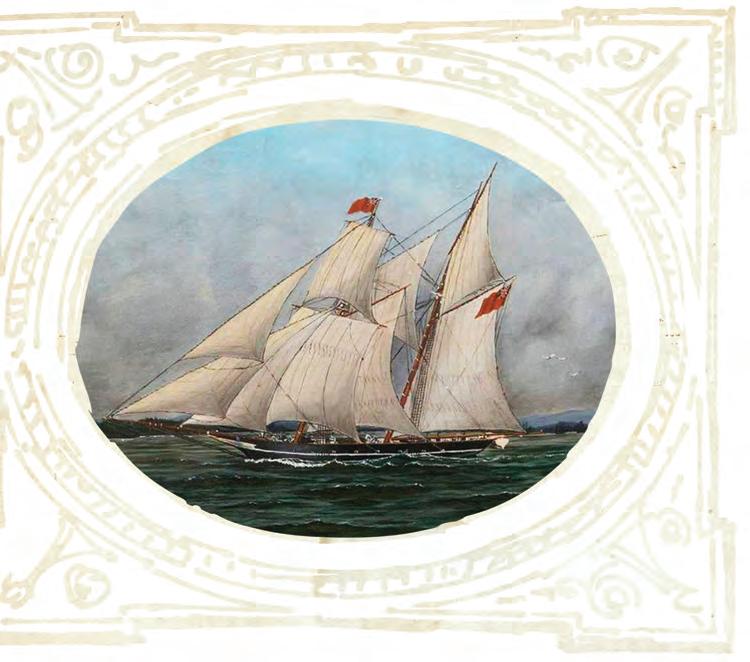
During its war-long spree, the ship captured some 50 American vessels and their cargoes, then worth between $262,000 and $1 million (equivalent to the 2023 purchasing power of C$4.8M-$18.6M).
Classic naval engagements such as the Battle of Lake Erie and the clash between HMS Shannon and USS Chesapeake, which ended with a captured Chesapeake paraded up Halifax Harbour, earned much of historians’
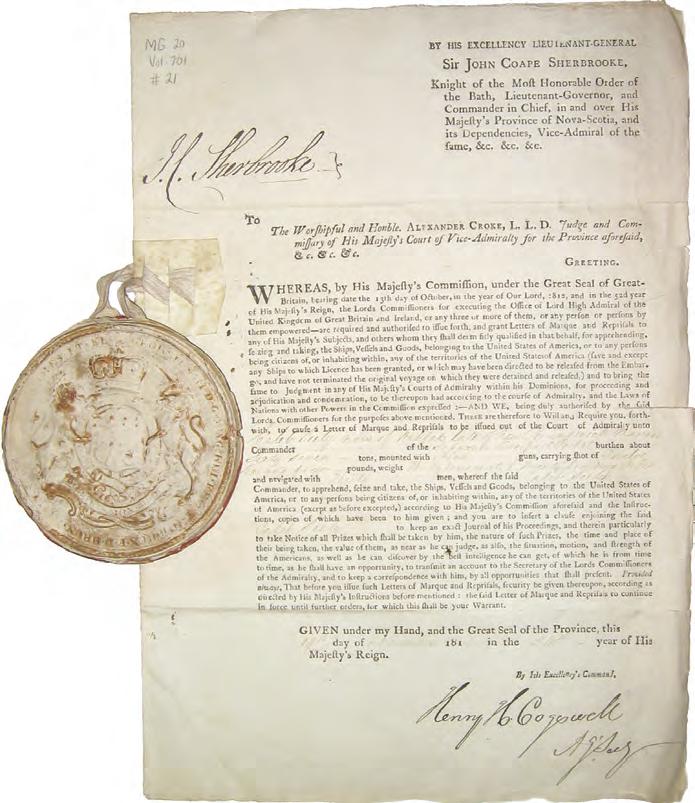
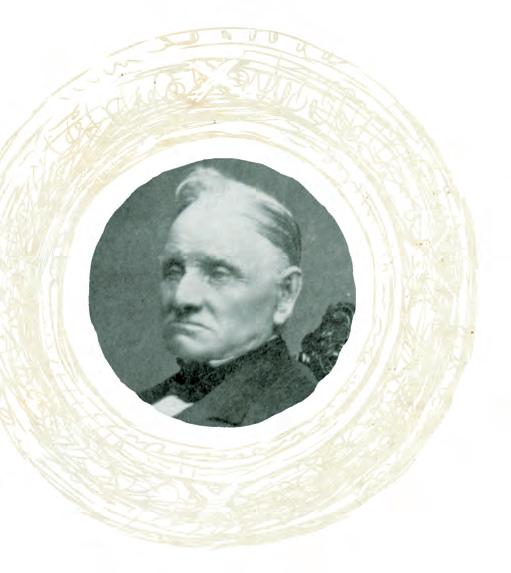
Enos Collins (opposite), Packet ’s principal owner, was rumoured to be the richest man in Canada when he died in 1871. One of the ship’s letters of marque— its licence to plunder. HMS Shannon escorts its war prize, USS Chesapeake, up Halifax Harbour on June 1, 1813.
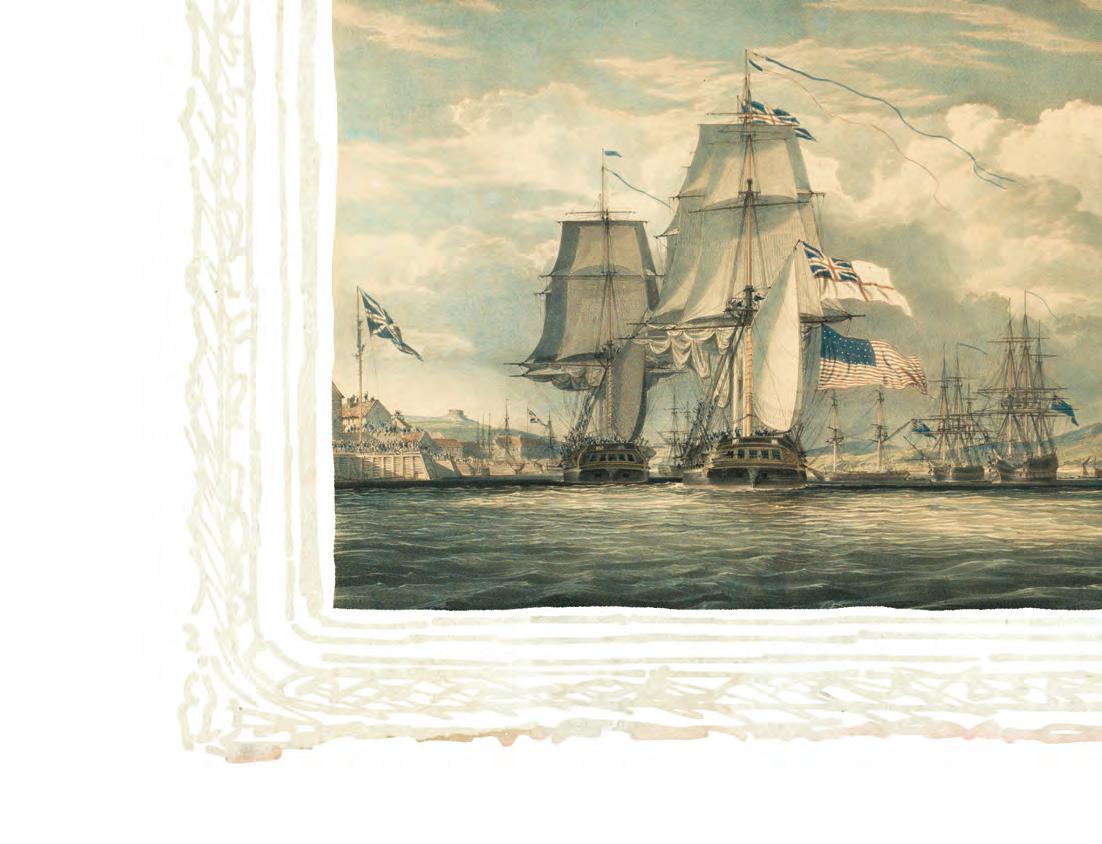
attention. But skirmishes between what were at their core small, souped-up cargo and fishing vessels were a continuing feature of the last great conflict between the U.S. and Britain.
Colonial privateers had played a key role in the 1775-1783 War of Independence, capturing hundreds of British vessels and seizing coveted muskets and gunpowder for the Continental Army.
During the War of 1812, it’s estimated that American privateers captured millions in British commerce, much of it off the British Isles. By 1814, British maritime insurance firms were routinely charging a whopping 13 per cent on shipments between England and Ireland. The Naval Chronicle reported that was triple what it was when Britain was at war with “all of Europe.”
The British monarch and his representatives issued some 3,000 letters of marque during the Napoleonic Wars, which included the period 1812 through 1815.
The documents—licences to plunder—represented gains for everyone involved, save the hapless victims. They essentially legitimized the practice of piracy against an enemy country’s sea-going vessels, no matter how innocent they might be. By seizing and looting merchant ships, fishing boats, whalers and others, privateers interfered with commerce, disrupted supply, distracted naval resources and, in some cases, made themselves fortunes.
The golden age of piracy was long over. Names such as Blackbeard, Calico Jack, Henry Morgan and Samuel (Black Sam) Bellamy had become the stuff of legend, their long-lost treasures lying at the bottom of the Caribbean or buried, perhaps, beneath Nova Scotia’s Oak Island.
A century after the Jolly Roger terrorized seafarers around the world, the needs and desires of the English king had bestowed a measure of legitimacy on the
practice, and opportunists were more than willing to cash in.
“The privateers of Nova Scotia played an integral role in closing American ports during the War of 1812,” wrote James H. Harsh in The Canadian Encyclopedia. “They were a valuable source of intelligence for the Royal Navy on American strength and ship movements.”
For the privateers, however, the benefits were less certain.
Their handpicked crews were made up mostly of volunteer fishermen with dreams of fame and fortune. None was offered wages; their rewards were to be shares in the prizes they captured.
Yet 15 of the 40-some commissioned privateering ships from New Br unswick and Nova Scotia failed to capture a single prize; another 10 took just one each. The rest made fortunes for their owners.
And none more than Liverpool Packet.
The 53-footer (16-metre) was at anchor in Halifax Harbour on June 27, 1812, when the British frigate Belvidera arrived in port bearing news of the American declaration of war with England nine days earlier. The ship had on board 17 casualties from a day-long fight with five American ships.
Packet ’s crew hastily loaded five rusty cannons aboard their vessel and made for Liverpool to await Britain’s response to the American challenge—and an anticipated letter of marque. By mid July, the Nova Scotia coast was swarming with American privateers, who were capturing merchantmen almost daily.
Packet would acquire its licence to raid and captured at least 33 American ships in the war’s first year. The ship, first commanded by an aging John Freeman—a privateering veteran of the French and Spanish wars—and later a younger but seasoned mariner, Joseph Barss Jr would lie in wait near Cape Cod, Mass., attacking U.S. vessels headed to Boston and New York.
“All awake!” trumpeted Boston’s Columbian Centinel newspaper on Dec. 19, 1812. “The Liverpool Packet has again raided our coast.” The privateer returned to Liverpool two days later with a pair of prizes in its wake.
Enemy ships weren’t the only perils Packet faced. A storm that month forced Barss to take the ship out into the open ocean where he could ride it out. “At midnight tremendious Gails and Sea on,” noted a logbook, “the seas breaking over the vessel from Stem to Stearn.”
But the rewards proved astounding.
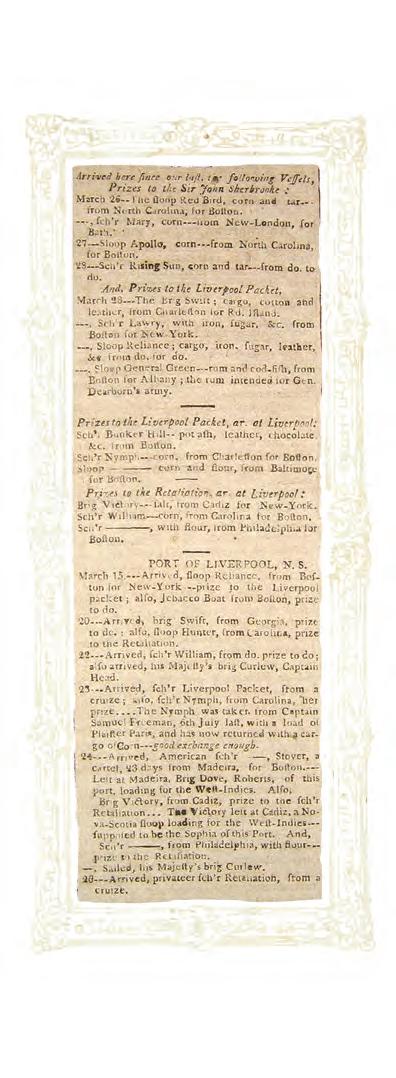
A list of prizes published in the Nova Scotia Royal Gazette on March 31, 1813, includes four taken on March 28 alone: the brig Swif t, captured while en route from Charleston, S.C., to Rhode
Island with a load of cotton and leather; the schooner Lawry with a load of sugar, iron and cotton bound for New York from Boston; and the sloop Reliance, headed for an undetermined destination with iron, sugar, leather and cotton. It also captured the sloop General Green, destined for Albany, N.Y., from Boston with codfish and rum for the army of General Henry Dearborn.
Other prizes taken by Packet were anchored at Liverpool, including the schooner Bunker Hill loaded with chocolate.
Packet ’s owners were so inspired
Thorn. With a displacement of 273 tons, the warship had 18 guns and was crewed by 150 men. It has been said that it achieved the fastest success of any Canadian privateer, but estimates of its prizes vary widely.
Its notoriety spread far and wide, Packet earned the nicknames New England’s Bane and The Black Joke, a moniker borne by several infamous slave ships.
Packet was a veteran privateer by the spring of 1813 and three months out of port when its run of good luck took a turn: it came upon the American privateer Thomas out of Portsmouth, N.H.—twice Packet ’s size, wielding 15 guns with a crew of 100.
The five-hour chase began in light winds at 9 a.m. on June 9. Packet ’s crew dumped all but one of t he ship’s short-range guns overboard to lighten their load, and moved their one remaining six-pounder to the stern. As their pursuer closed, they fed the cannon with six-pound shot, then tried a four-pound ball wrapped in canvas. It split the muzzle.
“At 2 p.m., coming up with the chase very fast, the schooner hoisted her colours and commenced firing her stern chasers,” Liverpool historian George E.E. Nichols related in a 1904 presentation entitled “Notes on Nova Scotian Privateers.”
“Overtaken by the American, she rounded to, struck her colours and ran alongside the Thomas. In the act of veering, she fouled the Thomas, and thinking their opponents about to board their vessel, the respective crews engaged in a hand to hand encounter.
“After striking her colours, the officers and crew of the Thomas repeatedly fired into the Liverpool Packet and threatened to give her crew no quarter. Greatly outnumbered, they were compelled to surrender, but not

its
spree, the ship captured some 50 American vessels and their cargoes.
before several of the crew of the Thomas had been killed.”
Three weeks later, the American ship was taken by a British frigate after a 32-hour chase. It was brought to Halifax and sold to Liverpool privateers, the largest shareholder among them Barss’ father, Joseph Sr., a Queen’s County representative in the House of Assembly.
The Thomas of Portsmouth became the Wolverine of Liverpool. It took eight prizes before the year was out.
Meanwhile, Joseph Jr. was taken to Portsmouth, where he was kept under armed guard
for several months before John Coape Sherbrooke, lieutenantgovernor of Nova Scotia, a former British army general and namesake of the aforementioned privateer, secured his release.
Liverpool Packet was converted to an American privateer and eventually renamed Portsmouth Packet. But in October 1813, HMS Fantome, an 18-gun brigsloop, encountered the schooner off Mount Desert Island, Maine.
A chase ensued, lasting 13 hours before Fantome seized its quarry and brought the prize to Halifax. Packet was repurchased by its
Thomas Hayhurst depicts Packet in full sail. The Nova Scotia Royal Gazette of March 31, 1813, reports the prizes taken in recent months by privateers Sir John Sherbrooke and Liverpool Packet
former owners, its Liverpool name restored. It resumed its plundering under the command of Caleb Seely.
Packet ’s second letter of marque is now held in the Nova Scotia Archives.
Dated Nov. 19, 1813, it authorized Seely and his ship “to apprehend, seize and take, the Ships, Vessels and Goods, belonging to the United States of America, or to any persons being citizens of, or inhabiting within, any territories of the United States of America…according to His Majesty’s Commission.”
As part of his privateering duties, Seely was ordered to take note of “the situation, motion, and strength of the Americans, as well as he can discover by the best intelligence he can get.”
Packet closed the year with three more prize vessels to its credit.
The ship had a successful 1814, too, capturing prizes in May and June, then taking two more alongside Shannon near New York and Bridgeport, Conn. Packet worked often with British naval vessels through the end of the war.
Barss was appointed skipper of his former captor, Wolverine, in 1814 and sailed as a trader to the West Indies. The Americans considered his mere presence on the high seas a violation of his parole, however, and his seafaring days ended on his return to Liverpool in August.
American privateers continued their campaign off the Americas, their commissions issued on a per-voyage basis by the Continental Congress and state governments.
Working out of ports like Savannah, Ga.; Elizabeth City, N.C.; and Mobile, Ala., skippers such as John Peter Chazel, Hugh Ca mpbell and Herman Perry sailed fast schooners and brigs along the continent’s east coast raiding merchant vessels.
American privateers didn’t limit their prey to British merchants, either. Records show they also captured Swedish, Spanish, Portuguese and Russian ships.
Believed to be the most successful of the Americans was a six-gun schooner dubbed Saucy Jack, owned by Charleston, N.C., merchant John Everingham. On its maiden voyage, Saucy Jack, captained by Thomas Jervey, took the brig William Rathbone, along with its 14 guns and a cargo worth about C$7M today. Though the British ship, known as a West Indianman, was later recaptured, the incident was a harbinger for the American’s successes under three different captains.
The log of Saucy Jack’s last and most successful privateer skipper, Chazal, tells of a bloody encounter with the 540-ton, 10-gun British trader Pelham between Cuba and Santo Domingo on April 30, 1814.
“In the act of boarding, Stephen Dunham, one of our seamen, was shot dead and our First Lieutenant, Dale Carr, mortally wounded while fighting on the enemy’s deck,” Chazal wrote. “At the same time our second Lieutenant Lewis Jantzen and John St. Amand, Lieutenant of Marines, was severely wounded, together with 7 of our men. Making our loss 2 killed and nine wounded, 8 of which badly.
“On board the Pelham there were 4 killed and 11 wounded; among the latter, the Captain and his Chief Mate (since died).”
With hostilities over and privateering all but ended by the Treaty of Ghent and shifting Royal Navy policy, ship owners from both sides, including Everingham, tended to go back to what they knew best, merchant trading.
Privateers who continued raiding after their commission expired or a peace treaty was signed could face piracy charges. The penalties were harsh—convicts were hanged at the beach in Halifax, then tarred and hung in chains (gibbetted) at the harbour entrance as a warning to other mariners.
Thus, combined with an expanding naval role on the high seas, privateering all but disappeared by the end of the 19th century.
“The Liverpool privateersmen were of excellent stock, all leading citizens of the community, well and favorably known to British
naval officers of the time,” Janet E. Mullins wrote in The Dalhousie Review. “When the wars were over, many filled positions of honour as members of parliament, judges, ship-owners, merchants.”
Packet ’s owners sold their feisty little ship in Kingston, Jamaica. Its fate beyond that is unknown. Several ships have since carried its name.
The vessel’s success helped launch the great fortune of its principal owner, Enos Collins, who would go on to co-found the Halifax Banking Company, which merged with the Canadian Bank of Commerce in 1903.
Born to a merchant family in Liverpool, he had sailed on a few privateering escapades to the West Indies in his youth. He was rumoured to be the richest man in Canada when he died in 1871 at the age of 97. L


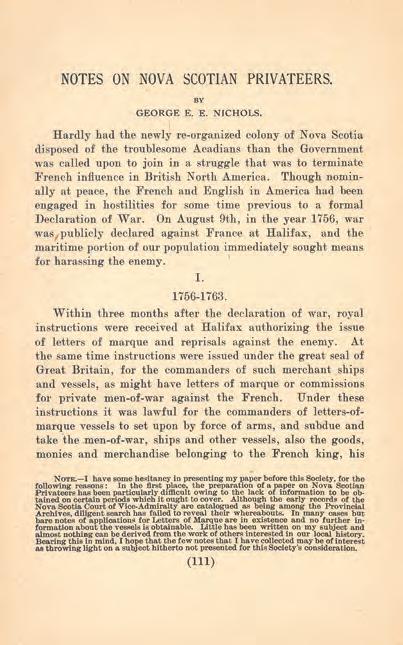
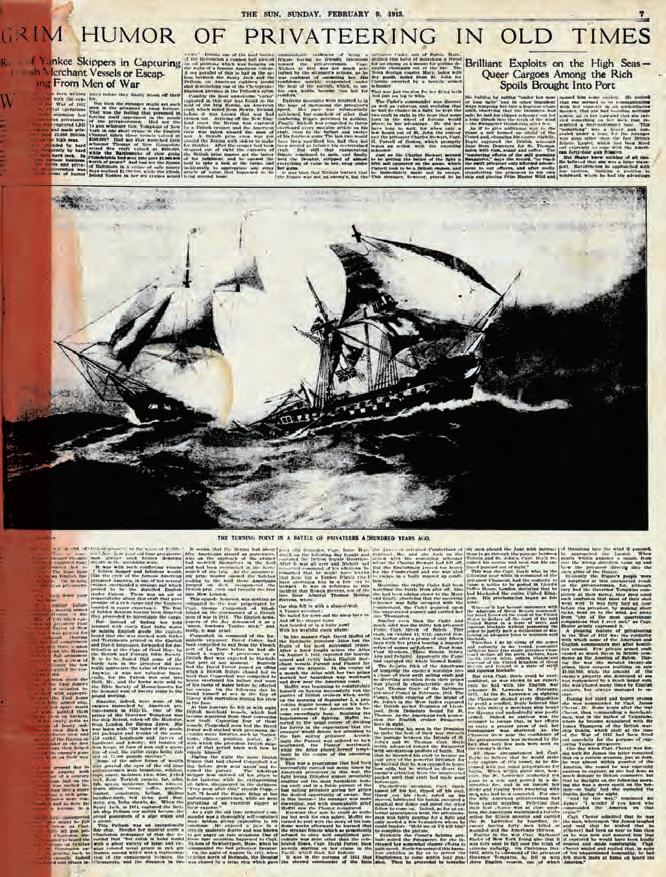
In 1904, Liverpool, N.S., native and passionate amateur historian George E.E. Nichols gave a presentation entitled “Notes on Nova Scotian Privateers,” which included a strident defence of the practice that, by some, was considered immoral.
Private vessels of war, he noted, operated under strict regulations set down by the Crown. None could go on a prizehunting cruise without first obtaining a licence, known as a letter of marque.
no one taken or surprised in any vessel, though known to be of the enemy, were to be killed in cold blood, tortured, maimed or inhumanely treated “contrary to the common usages of war.” Prisoners were not to be ransomed;
privateers were not permitted, under peril, to fly any colours usually shown by the king’s ships. They were required to fly a Red Ensign;
The Feb. 9, 1913, edition of The New York Sun commemorates the privateers of a century before. George E.E. Nichols’ 1904 “Notes on Nova Scotian Privateers” sought to clarify the history and correct some negative interpretations of the trade.

To obtain one, a ship’s owners had to meet a series of requirements and undertakings: their vessel’s tonnage, armament, ammunition, etc., together with the names of the owners, officers and men were to be registered with the Admiralty Court—in Nova Scotia’s case, in Halifax;
a regular account of captures and proceedings had to be kept in a logbook and any potentially valuable information obtained about the enemy reported;
bail with sureties (guarantors) was required either on behalf of the owners, if residents, or the captain. The amount varied according to the number of crew. If they exceeded 150 men, 3,000 pounds sterling [about C$500,000 today] was required, while fewer than 150 demanded half the cost.
Prizes were to be taken to the most convenient port in the dominions of the Crown, where they would be adjudicated upon by the Court of Admiralty. Once declared a legitimate seizure, the captors were permitted to sell the vessel and its cargo in an open market “to their best advantage.” The proceeds were typically distributed by percentage between the privateers’ sponsors, shipowners, captains and crew. And a share usually went to the issuer of the commission (the Crown).
“ ”

Canadian female fighter jet pilots first took to the skies 30-plus years ago— but few have followed in their vapour trails
By Paige Jasmine Gilmar

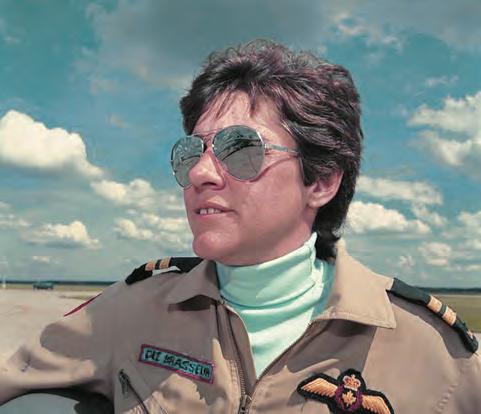
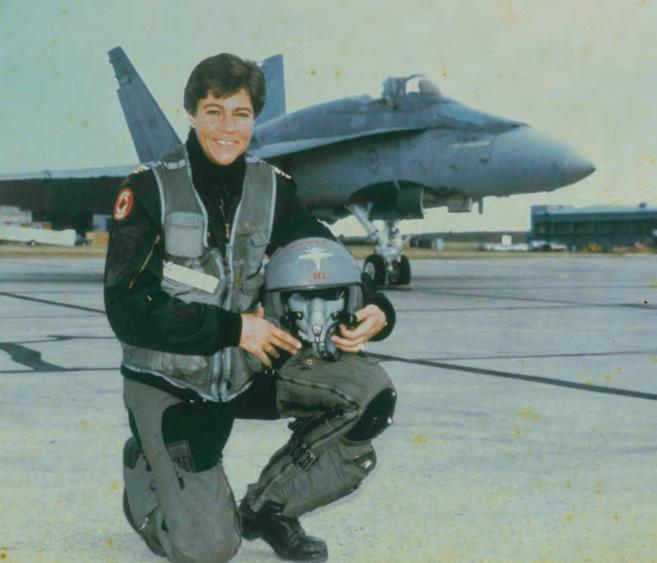
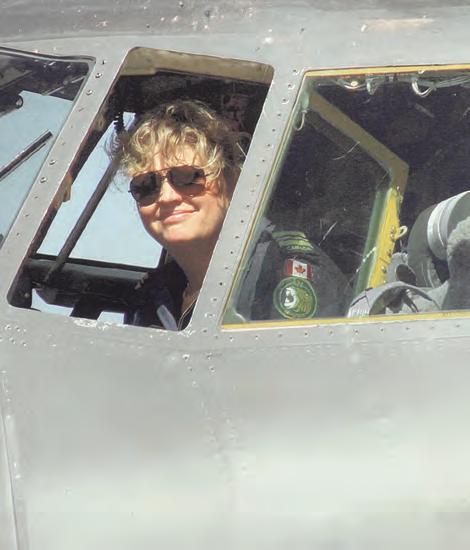
Captains Jane Foster and Deanna (Dee) Brasseur stand atop a CF-18 in 1989 shortly after they became Canada’s first female fighter jet pilots.

nthe early 1980s, a man who signed himself as “Ex Aircrew Earl Everson” had a lot to say about the 1979 Servicewomen in Non-Traditional Environments and Roles (SWINTER) Aircrew Trial. Conducted over six years, the purpose of the initiative was to test the effectiveness of mixed units in operation, as the roles for women in the Canadian Armed Forces continued to expand. However, many airmen such as Everson didn’t take too kindly to the evolution of what some considered to be “the most exclusive boys’ club in Canada.”
“I sure don’t go for the Air Force having these girl pilots,” wrote Everson in a letter to the editor of a military newspaper in 1981. “I don’t feel too safe underneath with women pilots.
“You know what they’ll be doing, don’t you? All the time the aeroplane is trying to land, they’ll be patting down their hair and pulling out their eyebrows and looking into their mirrors and putting on eye-makeup and all during the whole landing, that’s what.”
This was the cultural climate that greeted the trials’ female applicants.
“There was me with my volunteer hand,” said Deanna (Dee) Brasseur, “and I got picked.”
Born in 1953, Brasseur grew up to the sights and sounds of Chipmunk trainer airplanes taking off from her father’s air force base near London, Ont. She joined the forces in 1972 and was selected for the initial SWINTER Aircrew Trial. As a result,
she was the first of three women to earn her operational military wings and became Canada’s first female fighter pilot.
“It’s been a heck of a road,” she told Legion Magazine. “It’s been a long and challenging and hard course.”
For women such as Brasseur, the road to equality was, and remains, a bumpy one, despite the services’ goal to increase female representation in the military to 25 per cent by 2026. In fact, the air force has only had seven women fighter pilots since 1989.
By 1971, Canadian women had been in uniform for more than 85 years, though their roles had been primarily limited to wartime nursing. While female employment opportunities in the military expanded out of necessity during the Second World War and the Korean War, such growth remained largely temporary and the future of woman in the forces was uncertain.
Following the 1970 report from the Royal Commission on the Status Women in Canada, the Defence Department lifted its cap of 1,500 servicewomen and gradually expanded employment opportunities for them to nontraditional positions such as vehicle drivers and firefighters. Nevertheless, females still couldn’t fill combat positions (like piloting or aircrew), be on sea duty or in remote locations.
When the Canadian Human Rights Act passed in 1977 and with the military facing the very tangible reality of recruitment shortages in the 1980s, in January 1979 the defence minister announced “a limited experimental basis in near combat roles on land, sea, or in the air” for women.
And yet, despite calls to create greater employment options for females in the military, women didn’t jump at the new opportunity dangling in front of them. In fact, out of some 6,000 women in the armed forces in 1979, only 11 applied to the SWINTER trials (including those for army and navy), Brasseur among them.

So, it became the first of many hurdles the program’s women had to overcome.
“You knew you were on trial. Every step you took, people were watching,” said Brasseur. “If you had one button on your uniform undone, somebody would notice that.
“It’s like being thrown to the wolves.”
When SWINTER began, though, Air Command made a firm declaration: women would be treated the same as men. Circumstances, though, proved this would be impossible; female participants were working against more than just their sex.
A media blitz followed the announcement of trials and the program’s female students became the centre of attention. With non-stop calls, interviews and photo sessions, jealousy eroded potential friendships between male and female co-workers.
“The boys were saying, ‘If we’re all supposed to be equal, how come you guys are covered by the media and we’re not?’” said Brasseur. “Oh, poor boys!”
What’s more, because many of the women who joined the program were already ranking military officers well acquainted with most of their instructors, there was a perceived power imbalance with the mainly young male recruits in the trial.
“We saw that as brown-nosing,” one former male colleague of Brasseur’s was quoted as saying in Shirley Render’s No Place for a Lady: The Story of Canadian Women Pilots 1928-1992. “We had our own problems trying to adjust to military life and worrying about washing out. Most of us saw them as ‘those damn women.’”
With so many factors complicating men’s adjustments to the new culture, the reception to female recruits was mixed, with beliefs ranging from “it was high time that women were admitted” to “the military was going to pot.” Indeed, the airmen even went so far as
“ ”
You knew you were on trial. Every step you took, people were watching. It’s like being thrown to the wolves.
to refer to the last all-male class to graduate as the “LCWB,” or the “last class with balls.”
“I have all these people telling me I shouldn’t be doing it,” said Brasseur. “They think I should be barefoot, pregnant and in the kitchen.”
Retired Royal Canadian Air Force pilot Micky Colton, who joined the SWINTER program in 1981, said attitudes during the initiative’s early years were sour.
“There was this misconception,” she said, “that if girls were meant to fly, they would have been born with wings on their back.
“My wings were quite hidden.”
Both female and male trial participants had difficulty understanding what was expected of them. With no role models to imitate, many women experienced loneliness and had to experiment with different behaviours to be taken seriously, from acting like “one of the boys” to employing a healthy sense of humour.
Brasseur joined the military in 1972 at 19 and was among the first three women to earn military wings in 1981.
Meanwhile, instructors were worried about going too hard or too easy on the women (though they often leaned toward the former) while getting over preconceived notions of what women could and couldn’t do. Similarly, male students were confused about whether to act like colleagues or gentlemen with their female counterparts, especially during the program’s social events.
Sexual harassment and assault were also a reality for some of the women. One reported that instructors “kept humming songs like Let’s Get Physical or You’re Having My Baby to get a reaction out of me… we put up with a lot of shit and abuse.”
Colton noted that men engaged in sexually inappropriate conversations in front of her (such as talking about their genitalia while she was in the cockpit), while Brasseur confronted sexual assault when a commanding officer tried to grope her at a restaurant. “You feel betrayed,” said Brasseur, “by somebody you thought you liked or was a nice person.”
They toppled the popular masculine myth about the alleged shortcomings of women in a man’s world. They became good solid military pilots. ”
Colton recalled a poignant memory that best summarized the attitudes and perceptions women had to overcome at the time. While stationed in Europe, her crew met another crew for dinner. As everyone loosened up after a few drinks, the other crew’s first officer, who was older and outranked Colton, began disparaging her.
“There was a lot of profanity in it,” she sa id, ‛you know, you effing woman; you shouldn’t be on airplanes; what the eff are you doing? you should be at home.’
“It was, like, biblical,” she laughed. “The whole table went quiet. Nobody even breathed.”
Anti-female sentiment gripped more than just the air force’s culture, however. Sexism was a systemic issue that affected more than just the military’s policies and procedures.

From ill-fitting uniforms to doctors who knew relatively little about women’s physiology, the very fabric of the military had been built for men. This was particularly true regarding policies on marriage and family.
Officials viewed marriage as potentially problematic. While wives traditionally followed their military husbands who occupied different postings, female pilots whose husbands were also pilots faced the possibility of not seeing their spouses for months. Colton, who was, and remains, married to a pilot remembered their time apart none too fondly.
“We spent some time apart,” she said. “There was some separation anxiety in there. It was a really long year. Let’s just say that.”
Even female pilots with civilian husbands still faced the same mobility issues, with their husbands usually having jobs that made it more difficult for female officers to transfer.
Worse, though, was the air force’s inconsistent policies on pregnancy, with some pilots claiming that the military often punished women for motherhood. Female pilots faced limited maternity leave, no paternity leave and rejections to requests to be put on the ground to ease bodily strain during their pregnancies.
“I only got four months off when I had my baby and then I had to go back to work,” said Colton. “It was very hard to turn over somebody that small to daycare.”
In October 1985, the SWINTER Aircrew Trial concluded and the results were, for all intents and purposes, deemed successful. Twenty-one women got their wings and proved that females had their place in the air force.
“They toppled the popular masculine myth about the alleged shortcomings

of women in a man’s world,” wrote Render. “They met the standards and became good solid military pilots.”
While Defence Minister Perrin Beatty declared that women could serve as pilots, navigators and flight engineers in July 1986, other questions remained: Could women go into combat? Could women become fighter pilots?
Citing a lack of evidence on the operational effectiveness of mixed-gender crews in action, the CAF announced another trial. But while Air Command prepped for a 10-woman combat program—with Brasseur once again being one of the first to sign up—so few female pilots volunteered that by July 1987, the trial was cancelled. All areas of air force employment, including fighter pilot, were now open to women.

More than that, though, a paper published by National Defence in 2022 asserted that the forces fail to provide female-specific recruitment strategies and sustainment plans so that women join and stay in the military. Brasseur, for her pa rt, recommended more fleshed-out and publicly known incentive programs.
For instance, inflexible and fragmented policies spur women to choose between work and their family lives and service couples or women in nontraditional families/marriages often get little support from the CAF.
Sexism was still a challenge, however.
“We don’t get basic training and say to the guys, ‘Okay, guys, you have to hate women; they’re no good; they can’t do anything,’” said Brasseur. “We get attitudes, values and perspectives toward women from the general population.”
And even though Brasseur opened the door for future female fighter pilots, few have even dared to step onto the welcome mat.
With the number of female fighter pilots since 1989 left in the single digits, an overarching question remains: why? For Brasseur, the answer is based on changing cultural attitudes toward values of service.
“It makes it harder to recruit forces,” she sa id, “if your societal value of service to the country is not part of your makeup.”
“We need more family-friendly help,” said Ontario MPP Karen McCrimmon, who was the forces’ first female navigator and the first female to command a squadron, “like military family support networks and military family resource centres. I don’t think we fund them well enough yet.”
Even strategic documents are too generalizable and aren’t usually developed to an operational level. According to the 2022 paper, policies need to be truly holistic and ensure they don’t unfairly disadvantage certain military members.
McCrimmon also believes these policies can be informed by greater health and sociological research on serving women, an area that’s sorely lacking in scientific literature.
“We need research,” she said. “The fighter pilot, it’s hard on the human body. I don’t think people who’ve never done it realize how challenging it really is because none of that research is there.”
“Until you get equality in numbers,” said one female pilot, “you don’t truly get equality in attitude.” L
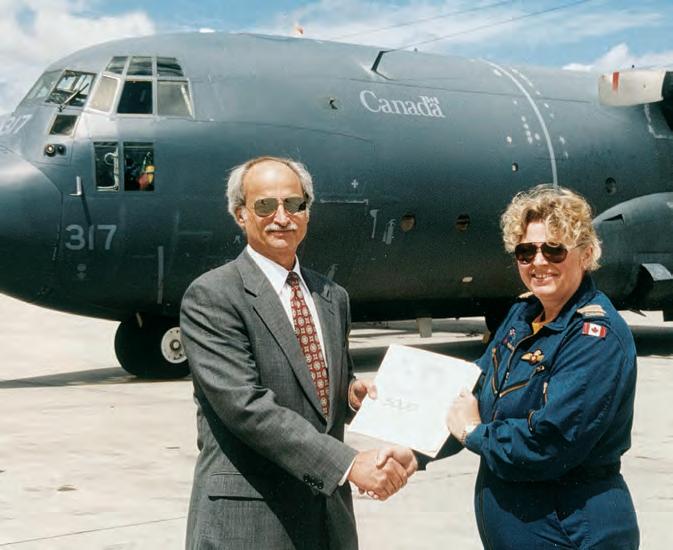
Trial in 1981. She became the first female pilot to reach 5,000 flying hours in a CC-130 Hercules. Richard Singer of Lockheed congratulates Colton on the achievement.
By Aaron Kylie

The Canadian National Vimy Memorial was the last stop of the 2023 Royal Canadian Legion Pilgrimage of Remembrance. Pilgrims pose for a group photo at the St. Julien Canadian Memorial in Belgium.
Now it feels personal. Whether you’re in the medieval courtyard of Abbaye d’Ardenne in France, where the Nazis brutally executed 18 Canadian prisoners of war less than 48 hours after D-Day; or you’re standing on an unmarked dirt track in a wheat field just east of a tiny French hamlet where Lieutenant Reginald Barker died valiantly saving five of his Canadian comrades from being ruthlessly gunned down by SS troops around the same time; or you’re at
the Adegem Canadian War Cemetery in Belgium standing over the grave of Sergeant William S. Hawthorne, who died on Sept. 9, 1944, at the age of 26, honouring the epitaph on his marker: “His grave we may never see but may some kind friend say a prayer at this sacred spot for me;” when you stand on these hallowed grounds, you gain a new appreciation of the weight of war—and remembrance.
Some two dozen Canadians, including select rank-and-file members of
The Royal Canadian Legion, provincial RCL representatives, a trio of Legion headquarters’ staff, and guests, participated in the organization’s biennial Pilgrimage of Remembrance in July 2023. The 14-day tour of First and Second World War sites in France and Belgium focused exclusively on Canadian battlefields, cemeteries and memorials and unmarked rural roadside battle sites—where few, if any, other such excursions stop.
“It’s John’s middle-ofnowhere tours,” said John Goheen, the pilgrimage’s voraciously knowledgeable guide-cum-narrator. (Or, as one pilgrim put it: “I’m beginning to realize that every field tells a story.”) An avid military historian and former school principal from Port Coquitlam, B.C., Goheen is an expert storyteller, bringing life—and equally evocative death—to staid granite monuments and quiet abandoned hillsides alike.
The pilgrimage was, of course, much more than history lessons. A camaraderie developed among attendees



recounting was compelling, but three in particular, when combined, manifest an intriguing snapshot of Canada’s role in WW I.
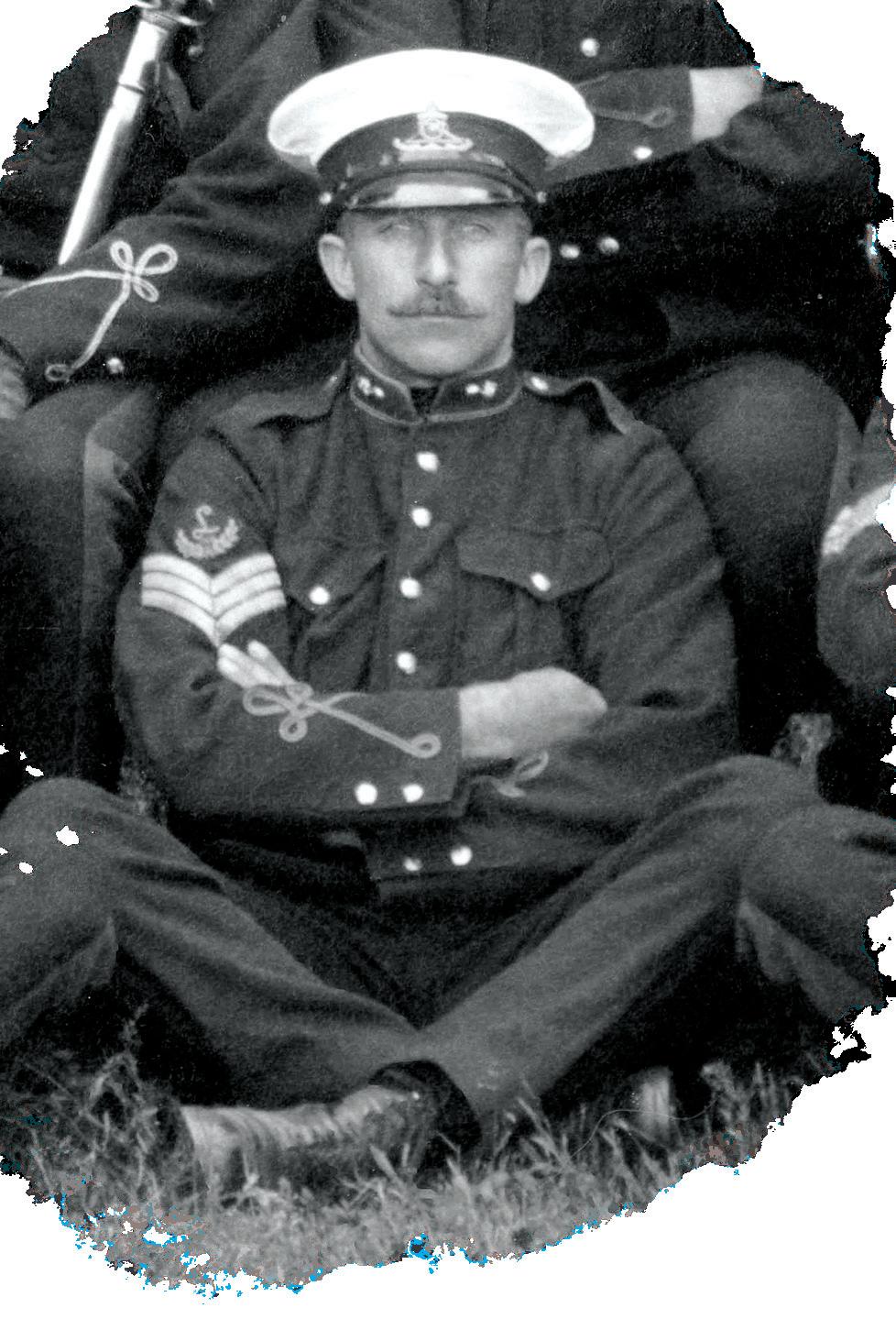
Just steps from famed John McCrae’s plot in the Wimereux Communal Cemetery in the small French town on the Strait of Dover, lies the far-lessfamous Sergeant Robert Parker of Victoria.
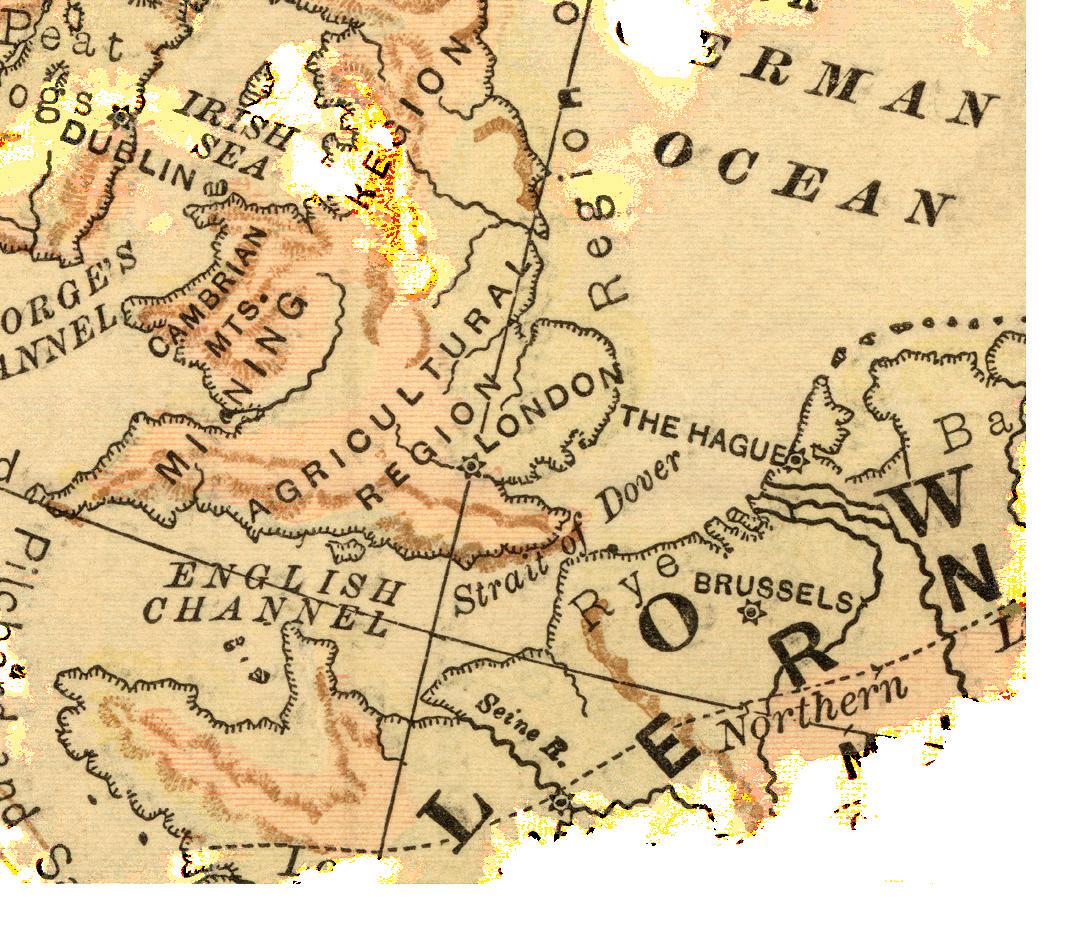
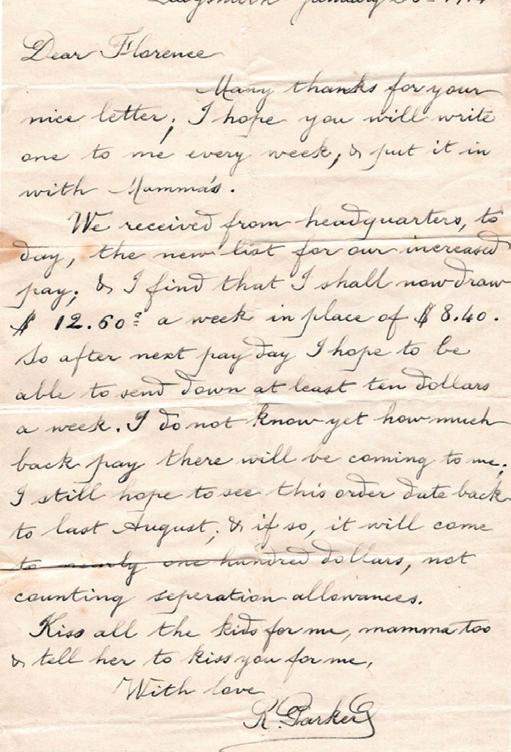
Sergeant Robert Parker of Victoria died on May 31, 1915, from wounds suffered during the Battle of Festubert. In a letter home
just months earlier he wished “that the war come to a speedy end.”
The tombstone of Private Russell Bernard Tobin in the New British Passchendaele Cemetery. Pilgrims Anastasia Dufour (left) and Madonna Jackson salute during a cemetery service.
(what would a day be without another joke from Padre Paul?); friendships were made and rekindled (Louison earned the nickname Google); fun and frivolity reined on bus rides (particularly with faa-thur at the back of the bus); bus drivers were loved (yeah Jaco!) or loathed (unnamed for his protection); refreshments were imbibed and solemn formal ceremonies were held.
Still, among the jampacked days, what stood out were the stories of those who made the ultimate sacrifice. And while a story of the tour could be told in dozens of different ways, guide Goheen involved participants in a particularly memorable part of the pilgrimage: relate the story of a First World War soldier at his gravesite. Each pilgrim’s
Parker’s tombstone, like all those in the Wimereux burial ground, lies flat. The sandy soil is too unstable for upright markers. Nearly 110 years after Parker’s death, pilgrim Ken Pendergast, an executive member of B.C.’s Prince George Legion Branch, is standing over Parker’s final resting place.
Pendergast, now 79, joined the Royal Canadian Air Force at 17. After a few years of service, he ended up in Prince George, eventually building a career as a top provincial forestry bureaucrat, then consultant. He retired in 2007, though in addition to his work with the Legion, he’s a consummate helping hand with numerous other community organizations. Word is, if you need a local volunteer to make it happen, you call Pendergast.
Mid-July 2023, Pendergast has the rapt attention of his fellow pilgrims as he shares details of Parker’s life and service.
Heeding the country’s call to arms, the five-foot, five-inch carpenter enlisted on Sept. 22, 1914, four months shy of his 39th birthday. Despite a reluctance to take older men with families—he was married with seven children, his youngest just five months,
his eldest 14—Parker had militia experience, having served for 12 years in the 5th Regiment, Canadian Garrison Artillery. He was also born in Caen, France, though he grew up as part of the city’s wealthy English population, so there was likely strong dual patriotic duty at play.
As a teenager, he and his older brother, Herbert, immigrated to Canada, settling on a farm near the Qu’Appelle River valley east of Regina. After marrying, he moved to Victoria with most of his in-law’s family in 1901.
“The war came, and he had to go,” his last surviving child, Gladys George, told an interviewer in 2005. She was two years old when her father sailed with the first Canadian contingent overseas in late September 1914. She would never see him again.
The following spring, Parker was assigned to the 7th Battalion (1st British Columbia). He joined shortly after the 7th had fought in Canada’s first major action in the Great War during the Second Battle of Ypres. Its men had watched as the Germans unleashed the first-ever gas attack on April 22. Then days later, as it fought to hold the line northeast of Saint Julien, the battalion had been decimated. Just about a third of its troops answered roll call on April 25. Parker was among a group of reinforcements for the 7th that arrived at the front on May 7.
The 7th was soon back in action at the Battle of Festubert, considered the second major engagement fought by Canadian troops

during the war. The First Canadian Division joined a wider British attack on the German front line near the French village on May 18. The offensive’s costliest day for the Allies was six days later.
Parker’s 7th suffered among them on May 24.
The battalion’s commanding officer, Major Victor Odlum, wrote in the unit’s war diary that, at 4:30 p.m., “shelling has been heavy during last hour and casualties are again very numerous.” Less than three hours later he noted that the “entire reserve company will be put to evacuating wounded as soon as it is dark. We are collecting all stretchers to be found in neighbourhood.”
The 7th sustained nearly 200 killed and wounded that day.
Parker was among the casualties, machine-gun bullets having ripped into his chest and thighs during the fighting. He survived, however, and was taken to a dressing station near the battlefield, then transported via train to Wimereux, 100 kilometres away, to the Rawalpindi British General Hospital. There wounded soldiers were stabilized so they could be sent back to England for further treatment.
But Parker didn’t make it. He died of his wounds a week after he was hit, May 31. He was buried the following day. Just months earlier he had written home: “God only knows what is in store for me. May He grant, for all your sakes, that the war may come to a speedy end.”
Parker’s war lasted just nine months. For the world, it would continue for another 53.
Private Russell Bernard Tobin rests in the Passchendaele New British Cemetery, likely about two kilometres from where he fell on Oct. 30, 1917. Fighting with the 85th Battalion (Nova Scotia Highlanders), Tobin was one of more than 4,000 Canadians killed in the Allied offensive that ultimately claimed the ruined Belgian village on the Western Front.
The Canadian Corps joined the battle on Oct. 26 and, despite attacking on a muddy, open battlefield under heavy enemy fire, it reached the outskirts of Passchendaele by the end of a second push during a driving rainstorm on the day Tobin died.
But in mid-July 2023, a bright blue sky greeted pilgrims visiting his gravesite.
Captain Madonna Jackson, a Legion member from Dr. C.B. Lumsden Branch in Wolfville, N.S., readied to relay his story to her fellow Legionnaires. Jackson, 57, is a cadet instructor cadre officer with the 106 Royal Canadian Air Cadet Squadron, having served nearly 20 years in the reserves as part of the training program.
In a creative turn, Jackson took on Tobin’s persona, sharing elements of his life and service with her fellow pilgrims as if she were him.
“This girl you sent to give me my voice did some digging for me,” began Jackson. Tobin was born on May 23, 1890, on Sable Island, a 35-kilometre long, 1.6-kilometre wide, sandspit some 300 kilometres south of Halifax, famed today for its wild horse population. The island’s earliest inhabitants were families of lifesaving crews and lighthouse keepers. Reportedly only two people have been born on Sable since 1920. Tobin’s family later moved to Woodlawn, N.S., then a rural farming community, today a suburban area of Dartmouth. Tobin listed his occupation as farmer when he enlisted, just before his 26th birthday, on Mar. 22, 1916. He was single, five-foot7.5-inches tall, 167 pounds, with blue eyes, dark hair and a fair complexion. He sailed overseas eight months later aboard RMS Olympic, Titanic’s sister ship. A year later, Tobin was fighting at Passchendaele, amid what some historians call the worst horrors of the Great War.


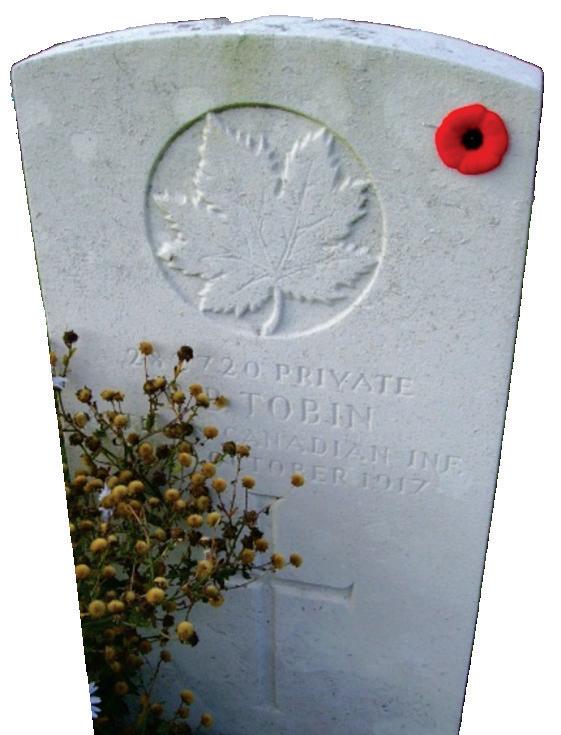
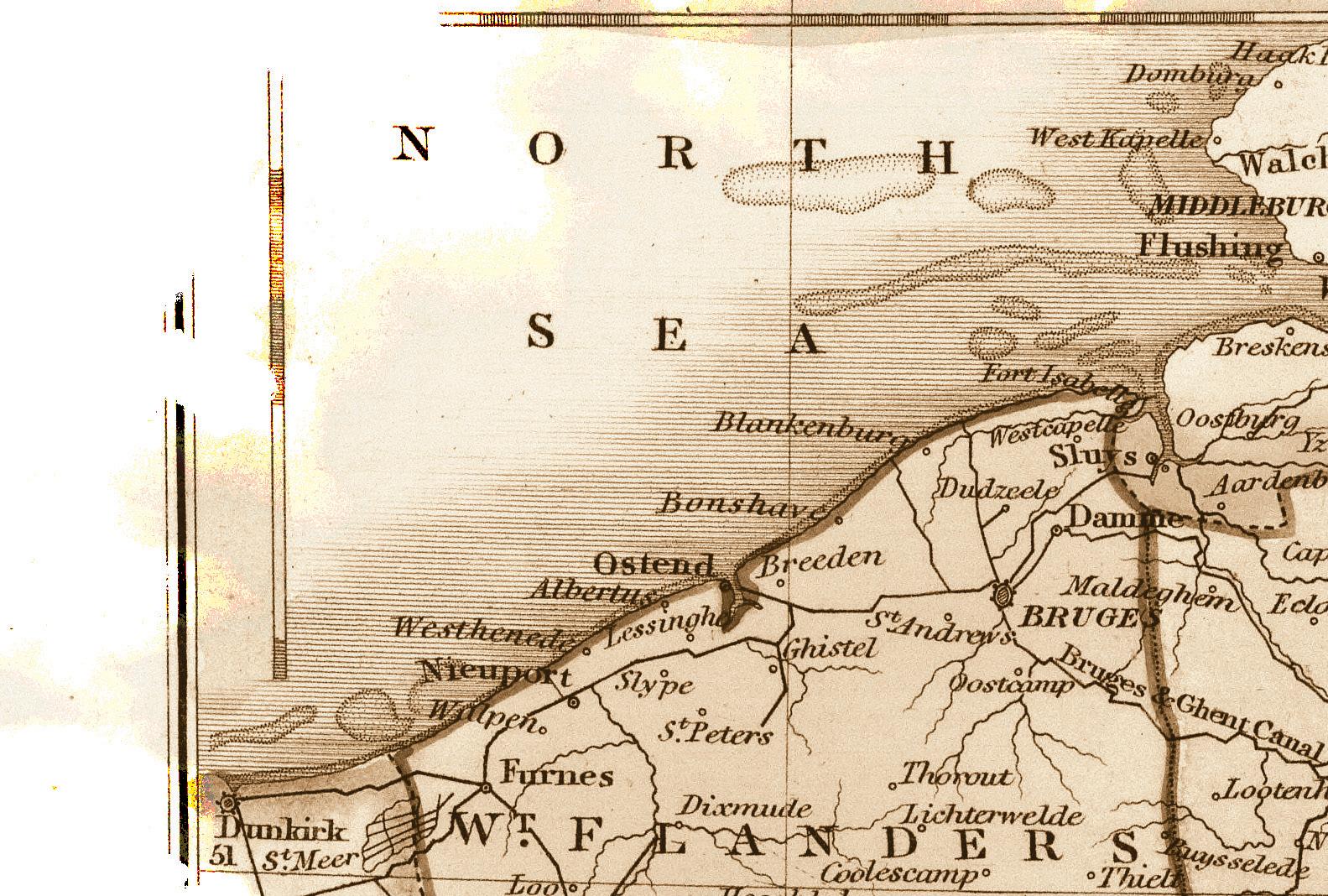

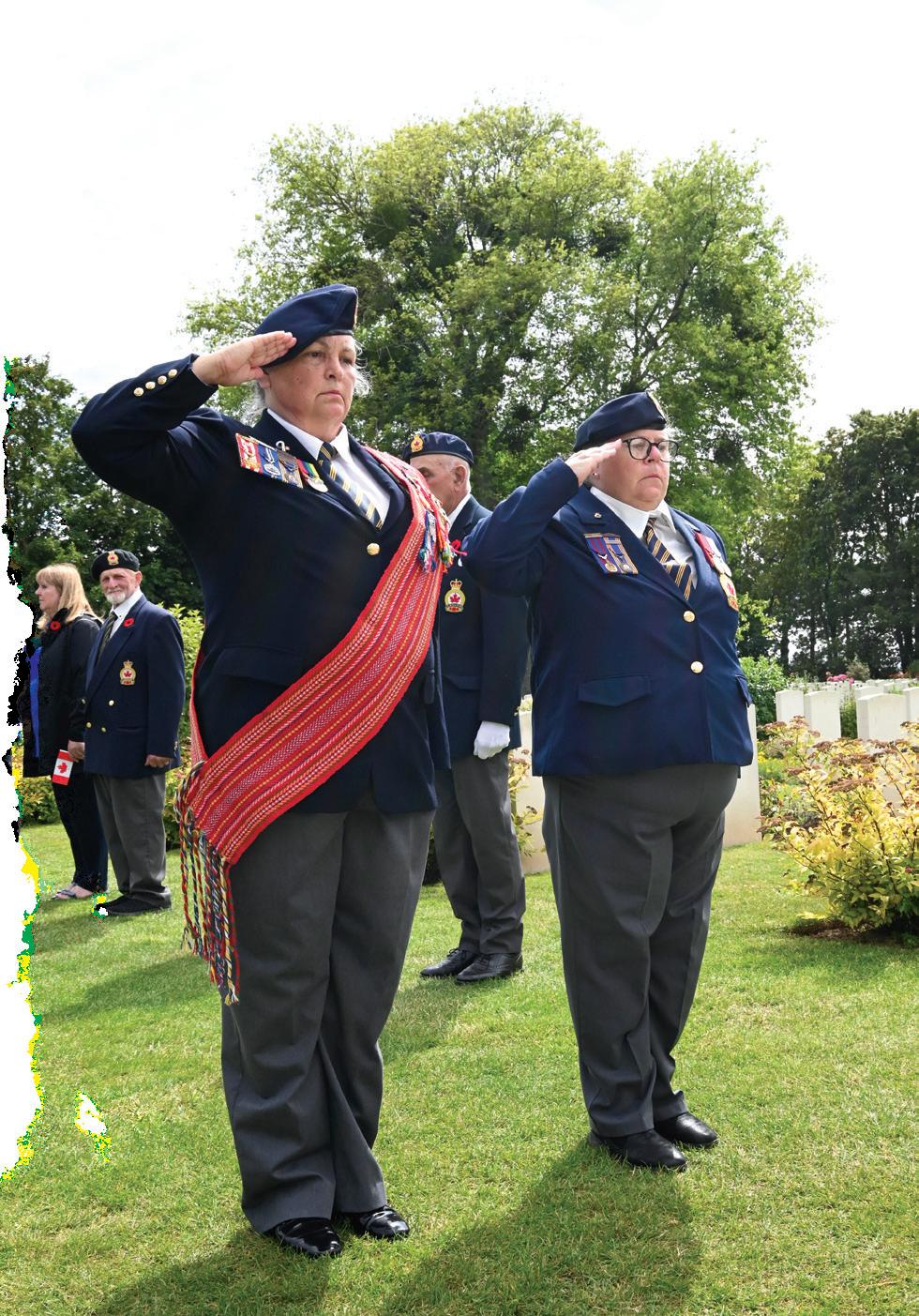

Pilgrim Gayle Mueller poses for a photo by the grave of Private Stephen Arsenault, who died some six weeks before the end of the war. The Vimy Memorial has drawn war-site pilgrims since its unveiling in 1936.

“During the morning of 29/10/17 Major [Percival] Anderson on reconnoitring his front line, discovered that the Hun was in strength about thirty yards on the right flank and about one hundred and fifty yards away on the left flank,” noted the war diary of Tobin’s 85th.
The Canadians launched a barrage at the Germans as the 85th temporarily fell back. In the afternoon, “a considerable amount of sniping and Machine Gun fire played about the area” reported the diary. Shortly after dusk, all was set for the next day’s push involving ‘A,’ ‘B’ and ‘C’ companies.
They were in position at 4:50 a.m. Tobin’s ‘A’ was on the left.
“At Zero hour [5:50] the first sound heard was the Brigade machine guns,” noted the diary. “On this, all Companies pushed forward. They were met by heavy machine-gun and rifle fire.”
his feet, waved his arms over his head, shouted ‘Come on, ‘A’ Company,’ made direct for the nest of machine-guns in front—and fell dead.”
The firefight lasted 10-30 minutes. The objective captured just 50 minutes after the push had begun. But the 85th suffered heavily, nearly 400 killed and wounded of some 700.
Tobin was reported wounded and missing that day, but later confirmed killed in action. There are no exact details of his demise, though one wonders if he fearlessly followed Rushton, popping from a shell hole in a daring stab at silencing the Germans guns.
lead to the conflict’s conclusion, was near its midpoint when Arsenault died on Sept. 28, 1918.
Pilgrim Gayle Mueller stood behind Arsenault’s tombstone on a sunny mid-July 2023 day, poised to deliver details of his life and service.
Mueller is vice-president of the Legion branch in Summerside, P.E.I., which is named in honour of Great War veteran George Pearkes, recipient of the Victoria Cross for his actions at Passchendaele. Mueller, now 75, served herself, joining the family business, if you will, with 17 immediate relatives in the military. She enlisted with the RCAF in July 1967, working as a “crypto girl,” coding, decoding and transmitting messages for five years, before being forced out to raise a family.
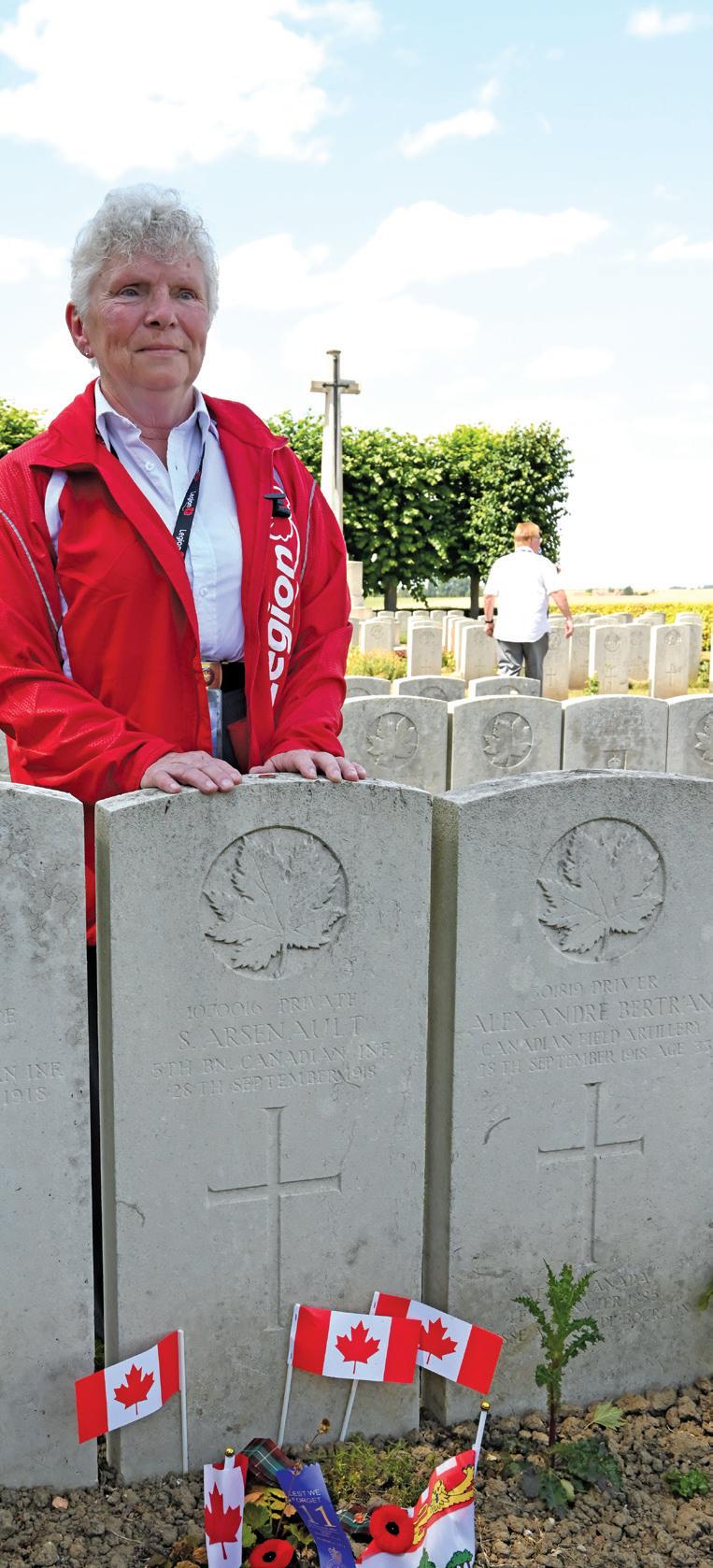
Two company commanders were killed instantly.
Still, they advanced passed their old front lines, “then in No Man’s Land a fierce fight took place,” wrote the diarist. “The line was drawn closer and closer to the enemy…men jumping from shell-hole to shell-hole, but anyone who attempted to walk upright instantly became a casualty.”
The diary noted there were several instances of this, including by Tobin’s comrade, Sergeant Oscar Rushton, “who sprang to
“Long time since I had a wet,” said Jackson still channelling Tobin as she concluded her story by proposing a toast. “She and I were going to have one together. But then she thought, there’s that guy that keeps trying to preserve this history,” Jackson continued, referring to pilgrimage guide Goheen. “He keeps telling our story and bringing people here to give us our voice. And maybe I’d like him to have a wet, too.
“This girlie promises to always tell the story. Cheers.”
Private Stephen Arsenault lies in the Bucquoy Road Cemetery just south of Arras, France, due west of the autumn 1918 war front. The Hundred Days Offensive, the Allied push that would
Mueller began her telling of Arsenault’s story by relating her early struggle to translate his service file into a biography: “Just the bare necessities were there.”
He was born in Abrams Village (now AbramVillage), P.E.I., just west of Summerside, on April 2, 1893. He was a single, five-foot-three-inch tall, 146pound, 24-year-old labourer residing in Lawrence, Mass., when he enlisted in January 1918. He sailed for England in early March and arrived at the front mid-month, assigned to the 5th Battalion (Saskatoon Light Infantry).
But Mueller wanted more. She started making
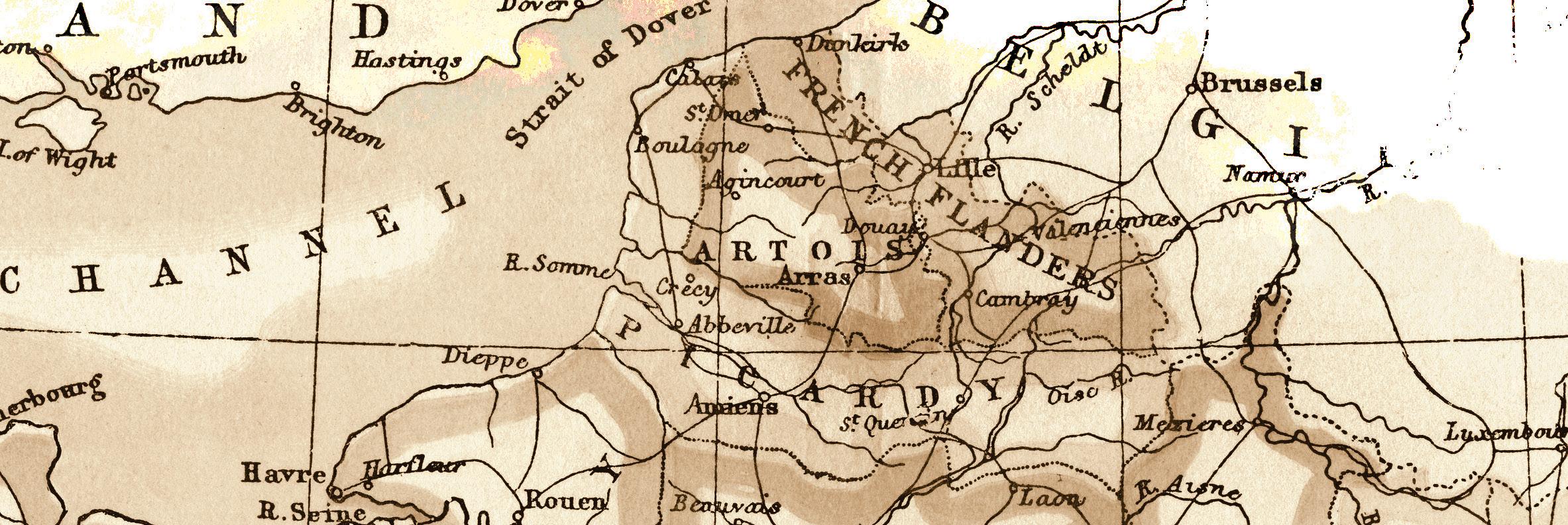

calls and visited the Legion branch closest to AbramVillage in Wellington. She heard a common response to her queries: “You’ve got to talk to Earl Arsenault.”
The Arsenault family historian helped Mueller paint a picture of the early life and family of her “solider boy.”
“You don’t need to worry, girlie,” Earl told Mueller. “I’ve got it all.”
The family had 14 children, eight boys, six girls, living in a small farmstead in the tiny rural community of farmers and fishermen. Music was important: dad played the fiddle, mom the piano, and the home was regularly brimming with song and dance. They were hardworking and readily helped neighbours in need.
“Stephen,” Earl told Mueller, “learned about hard work and sacrifice at a very young age.”
Stephen Arsenault’s greatest sacrifice came amid the late September 1918 Battle of the Canal du Nord. Historians say it was among the most costly but impressive engagements fought by the Canadian Corps during WW I.
The 95-kilometre-long, 35-metre-wide Nord waterway runs north-south in northern France just west of Cambrai. It connects two other canals. Construction began in 1908, but stopped when the war began. In the
On Sept. 27 at around 5:30 a.m., the Canadians launched a creeping barrage with four battalions, Arsenault’s 5th among them, to bridge it.
“Heavy rain fell during the night, which, although materially assisting the movement of the men into Assembly positions, was most uncomfortable for them,” reported the 5th’s war diarist. Still, “everyone was in a boisterous spirit, eager and anxious to take part in the great fight.”
The canal was crossed at 11 a.m. and the day’s objective was reached by 2 p.m. The following day, the Canadians continued their move, clearing the sector’s trenches and the villages of Raillencourt and Sailly in heavy fighting. They were stopped, though, by heavy German shelling. Arsenault was cut down during the day’s action, sustaining a shrapnel wound to his right thigh, his hip and his left leg. He died of his wounds. His battalion was relieved the following day. Arsenault was one of 23 5th men killed and 220 total casualties in the four days.
The battle concluded on Oct. 1. The Canadian Corps at large suffered more than 10,000 casualties. The losses, however, contributed greatly to the liberation of Cambrai a few days later and the continued
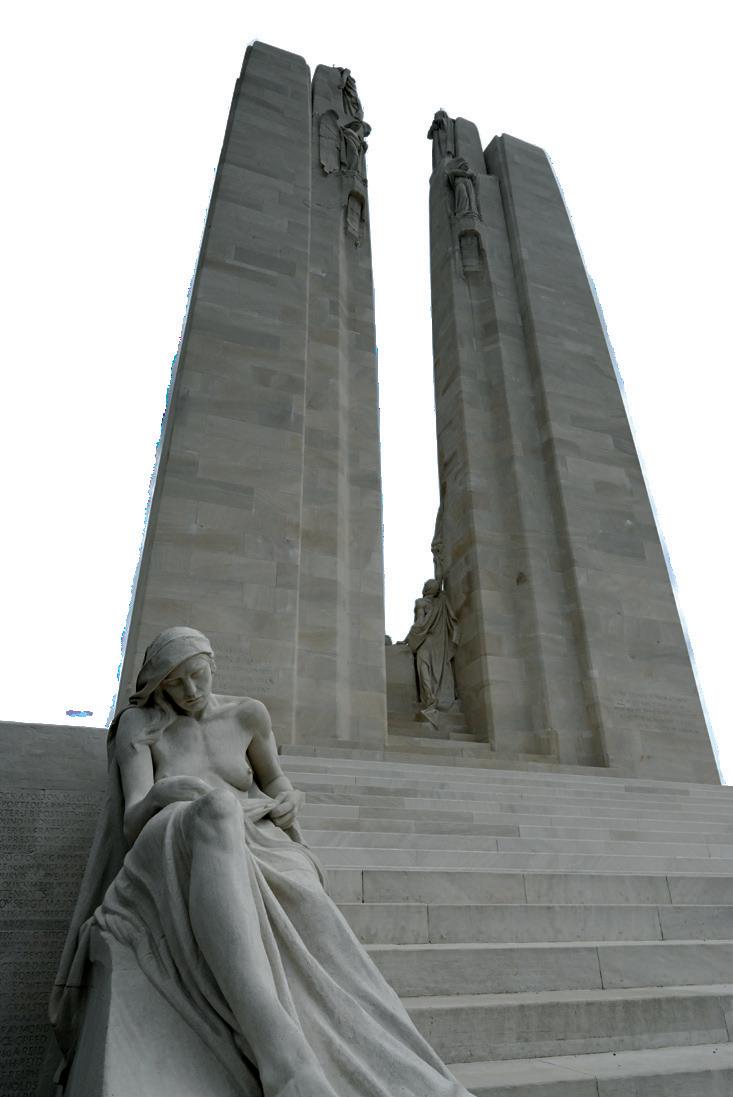
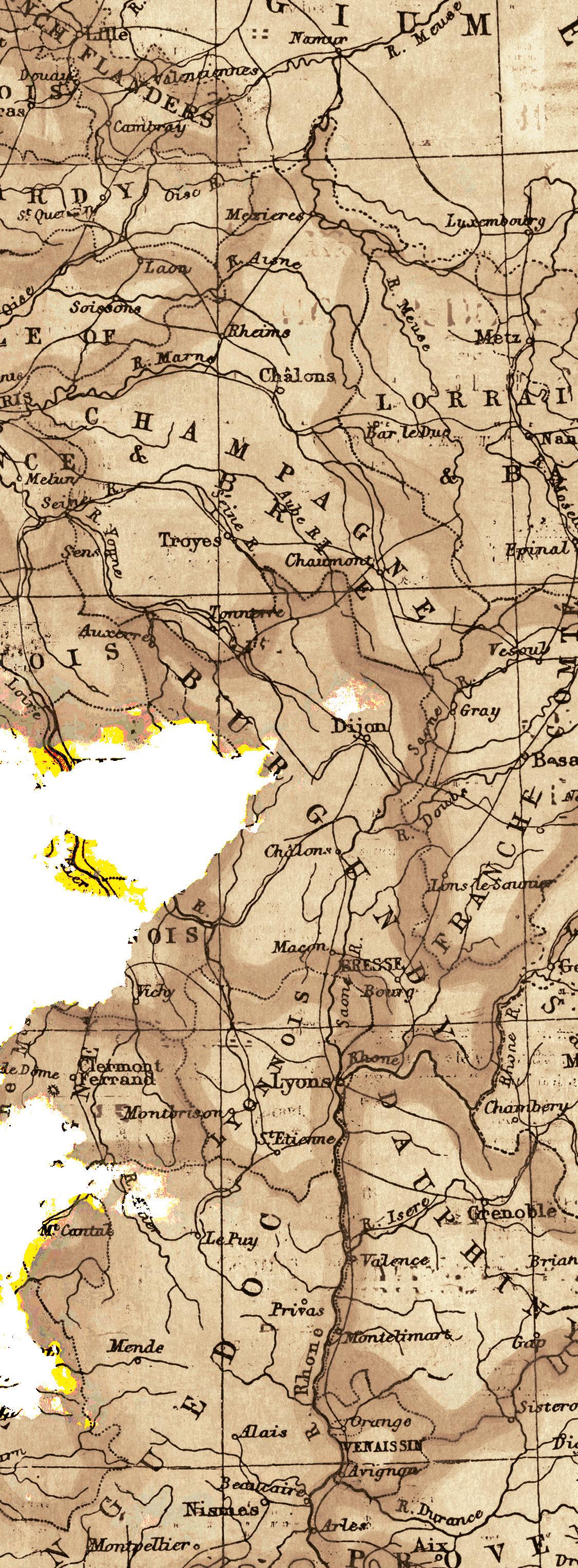
The Legion first hosted a war-site pilgrimage to France in 1936 for the unveiling of the Canadian National Vimy Memorial, the iconic tribute to all Canadians who served in WW I and that bears the names of 11,285 of its sons who died in France with no known grave. Some 6,500 veterans and their family members made the trip on five ships.
A second Legion pilgrimage to the Netherlands occurred in 1962, though with a much smaller contingent of 79. Seventeen such trips followed during the next decade, with Dutch families hosting more than 2,000 Canadian visitors over the years.
In 1986, 10 younger Legionnaires, one from each province, returned to Vimy for the 50th anniversary of the memorial’s unveiling. After a three-year gap, the program resurfaced as the Legion’s Youth Leaders’ Pilgrimage of Remembrance. It continued annually until 1997.
In 2013, the initiative took on its current form, in which one Legion member from each of the organization’s 10 territories is selected to participate—and subsequently share their experiences with their families, friends and communities at large.
By John Goheen

German soldiers march in Belgium in 1940 (above).
The Van Landschoot family picks strawberries to sell to the invaders (opposite top) and works grain fields on their farm (left).
Maurice Van Landschoot (right, opposite bottom) and other local boys harvest land near the WW II Luftwaffe airfield.
Maurice Van Landschoot was only 14 when the Germans arrived. The young Belgian’s world was turned upside down when his country capitulated just 18 days after the Nazis invaded the Low Countries and France in May 1940.
For the Van Landschoot family, a longestablished Belgian clan with roots in the region dating back to the Crusades, living under German occupation offered little prospects for hope. Their prosperous farm, near Adegem, was just a few kilometres from the newly established Flugplatz Maldegem, a Luftwaffe airfield.

It didn’t take long for the occupiers to help themselves to whatever they wanted in this abundant agricultural area, including the Van Landschoot’s horses and cows. The airbase, however, needed a regular supply of fresh food and, so, the Va n Landschoot’s were permitted to keep two of their horses to work the land. It was Maurice’s job to deliver produce, bread and other foodstuffs to the Germans. Soon, the red-headed kid became a familiar face around the base and some of Luftwaffe personnel even considered the young Belgian a friend.

Little did they know how much Maurice despised them. He hated how they treated his parents and stole their food and livestock. Over time, the teen found ways to resist. During the next four years, Maurice embarked on a covert and increasingly dangerous life that included acts of sabotage.
During his routine deliveries to the airfield, Maurice began tampering with the planes. He would partially disconnect their fuel lines so that once airborne, the engine’s vibration would cause them to detach com pletely, thereby bringing the aircraft down.
Maurice also shared intel with the Allies using a radio transmitter that he kept hidden under the floorboards of the family barn.

to London. If he needed to move the unit, he concealed it in a small case his younger sister would carry. The Germans never suspected anything as the little girl walked among them. The soldiers just thought
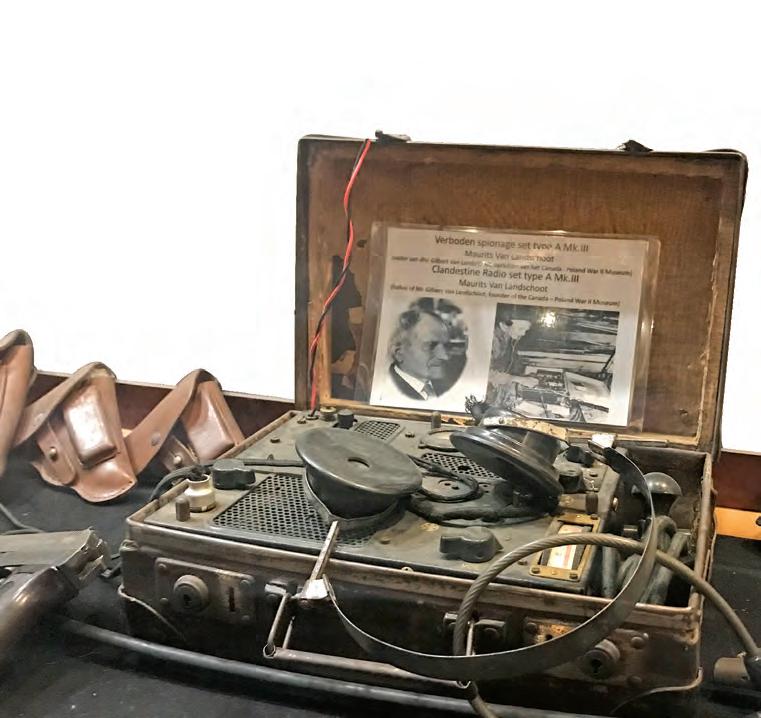
suspicious of the now 18-year-old’s activities. It seemed only a matter of time before they would uncover the truth. And, when they did, it would be a matter of life or death.
Maurice’s chances of survival improved greatly, however, after the Allied invasion of Normandy in June 1944. By midSeptember, Canadian and Polish troops had liberated the Adegem area. For the Van Landschoot’s and their neighbours in east Flanders, the occupation was over.
Maurice’s resistance didn’t just take the form of sabotage. He also shared intel with the Allies using a radio transmitter that he kept hidden under the floorboards of the family barn. Maurice’s secret identity code was “151,” which he tapped out on the transmitter before sending information
But not everyone in the community welcomed the liberators. Some had collaborated with the Nazis and even prospered under them. Maurice, fearing retribution from some revenge-seeking Nazi sympathizer, remained silent about his wartime activities; even his own family wouldn’t know about his clandestine role for more than 40 years.
In 1987, a dying Maurice finally revealed his long-held secret to his son Gilbert. Before he passed, Maurice made Gilbert promise to do something to honour and remember the Canadians and Poles who had liberated their part of Belgium and to whom he surely owed his life. Said the father to his boy: “If once somebody has helped you out, you’ve got to do something in return.”
On the anniversary of the area’s liberation the year after his dad’s death, Gilbert brought flowers to the nearby Adegem Canadian War Cemetery. Gilbert felt, however, he needed to do much more to fulfil his vow to his father. With the 50th anniversary of the liberation approaching in 1994, the time seemed ideal to honour those who saved his father and set his beloved homeland free.
Not everyone shared in Gilbert’s enthusiasm for a commemoration. Local politicians dithered and the community debated how, and even if, the liberation should be recognized. Some weren’t keen to recall the war; those who had collaborated with the Nazis, and their descendants, didn’t want to revive those memories. Gilbert attended public meetings and soon realized there was no consensus and, that likely, nothing would be done.
Undeterred, Gilbert had his own plan: he envisioned a museum dedicated to the Canadians and Poles so that younger generations would know what was done for them. He bypassed the politicians and the bureaucrats and appealed directly to the citizens of east Flanders. Did they not remember the many relationships that developed between Belgian women and their Canadian “loverboys” or the soldiers who subsequently became known as “water rats” for fighting across the soggy Scheldt landscape?
The response from locals was overwhelming. Many had artifacts from the war—uniforms, equipment, weapons—in their attics, basements and garages. Items of every description, from Canadian issue toothbrushes to Bren gun carriers, soon materialized. Gilbert, along with a handful of helpers, started work on the building in late May 1995 on the grounds of his parents’ farm.
They worked day and night and completed the Canada Poland War II Museum, from groundbreaking to grand opening with full displays, in just 34 days. The king and queen of Belgium were the first visitors.
They, like all guests, encountered a breathtaking array of Christian symbolism, beauty and history that binds the family’s Crusader origins to the wartime fighters from Canada and Poland.
The facility’s foyer is dominated by four massive stained-glass windows that feature Canadian, Polish and Belgian heraldic and regimental crests. Just past them is a large great room, where a huge column in the middle supports two cross beams, their intersection forming a cross. The ceiling’s four quadrants represent the four seasons, and its main beam runs the room’s length and is touted as the largest oak beam in the world.

in various
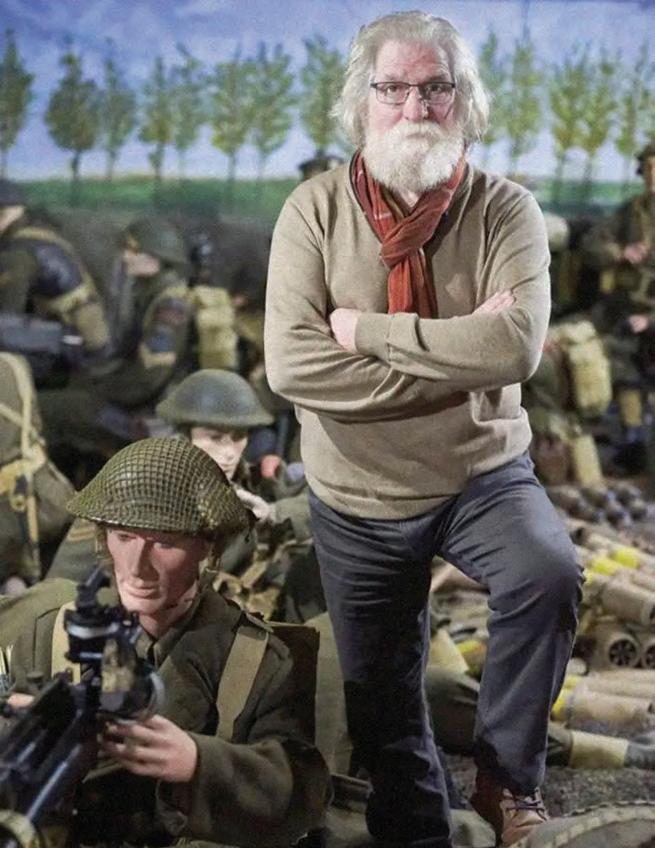
“If once somebody has helped you out, you’ve got to do something in return.”
Courtesy Van Landschoot family

The museum boasts one of the best collections of military memorabilia anywhere.
Further subdividing the ceiling are 52 cross beams, one for each week in a year. These sections are split further by 366 smaller beams, equal to the number of days in 1944, the leap year the area was liberated. Supporting all this are 12 freestone pillars representing the 12 apostles, as well as the 12 months of the year. Three larger round pillars symbolize the Holy Trinity.
The great room’s bar, meanwhile, features ironwork from the former communion table of a long destroyed medieval church, while the pillars behind the counter are from its loft. The room also serves as a studio where locals gather and where Gilbert’s daughter, Alexandra, operates a dance school. The dance floor was a deliberate homage to the lover boys who wooed the local girls.
Then there’s the museum proper, boasting one of the best collections of military memorabilia anywhere. More than 370 authentically
The Van Landschoot’s collection of Second World War artifacts includes many items so rare that major museums around the world offer staggering sums to purchase them. It also boasts a series of detailed battlefield dioramas.
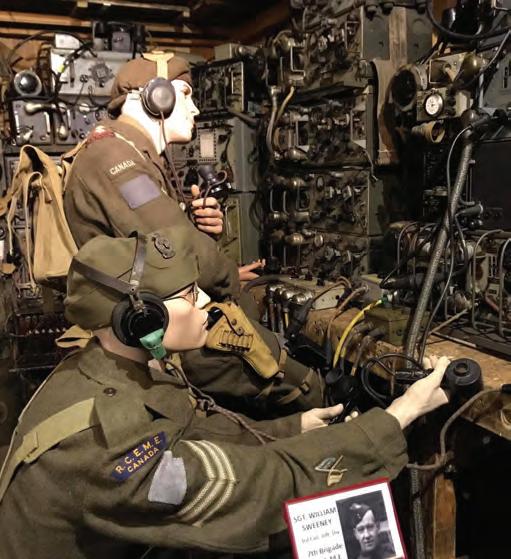
dressed mannequins feature in the facility’s diorama displays. Gilbert’s attention to detail, right down to the hobnails and spent shell casings, is apparent throughout. Visitors walk through a timeline of the area’s wartime history, from the heroic but ill-fated Belgian defense in 1940, through the dark years of Nazi occupation, to the arrival of the Canadians and Poles in 1944.
Some of the artifacts are so rare that major museums around the world have offered staggering sums to purchase them. “But,” says Gilbert, “they are not sale.” He prides himself on the fact that not one euro of government money has ever funded his collection.
Gilbert’s institution was the result of his determination to fulfil a death-bed promise to his father. It preserves the memory of those who came from far away to fight for Belgium. “New generations come to learn that many soldiers died for the peace and freedom for their future,” said Alexandra.
The museum, now nearing 30 years of operation, is surely a tribute to Gilbert, too. He has honoured his vow do something in return. L
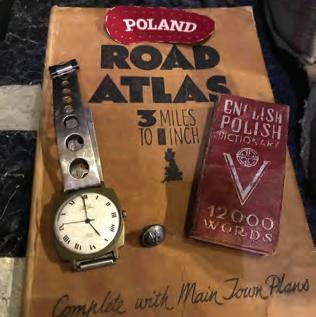

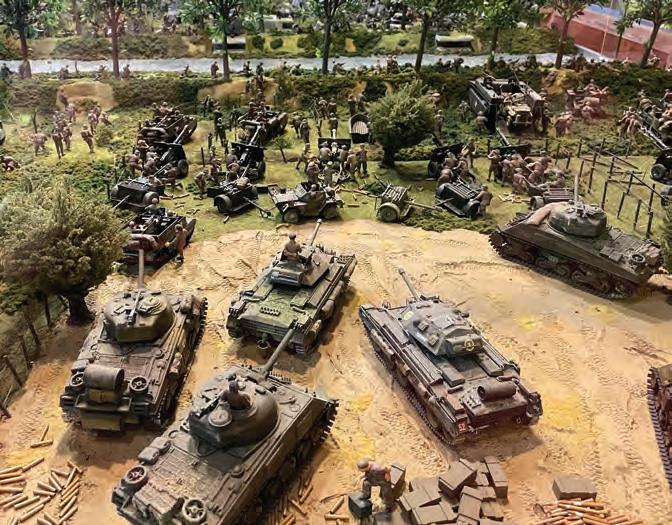





By John Boileau
DURING THEIR LENGTHY TRUCE SUPERVISORY MISSION IN VIETNAM, CANADIAN MILITARY PERSONNEL PLAYED MANY ROLES
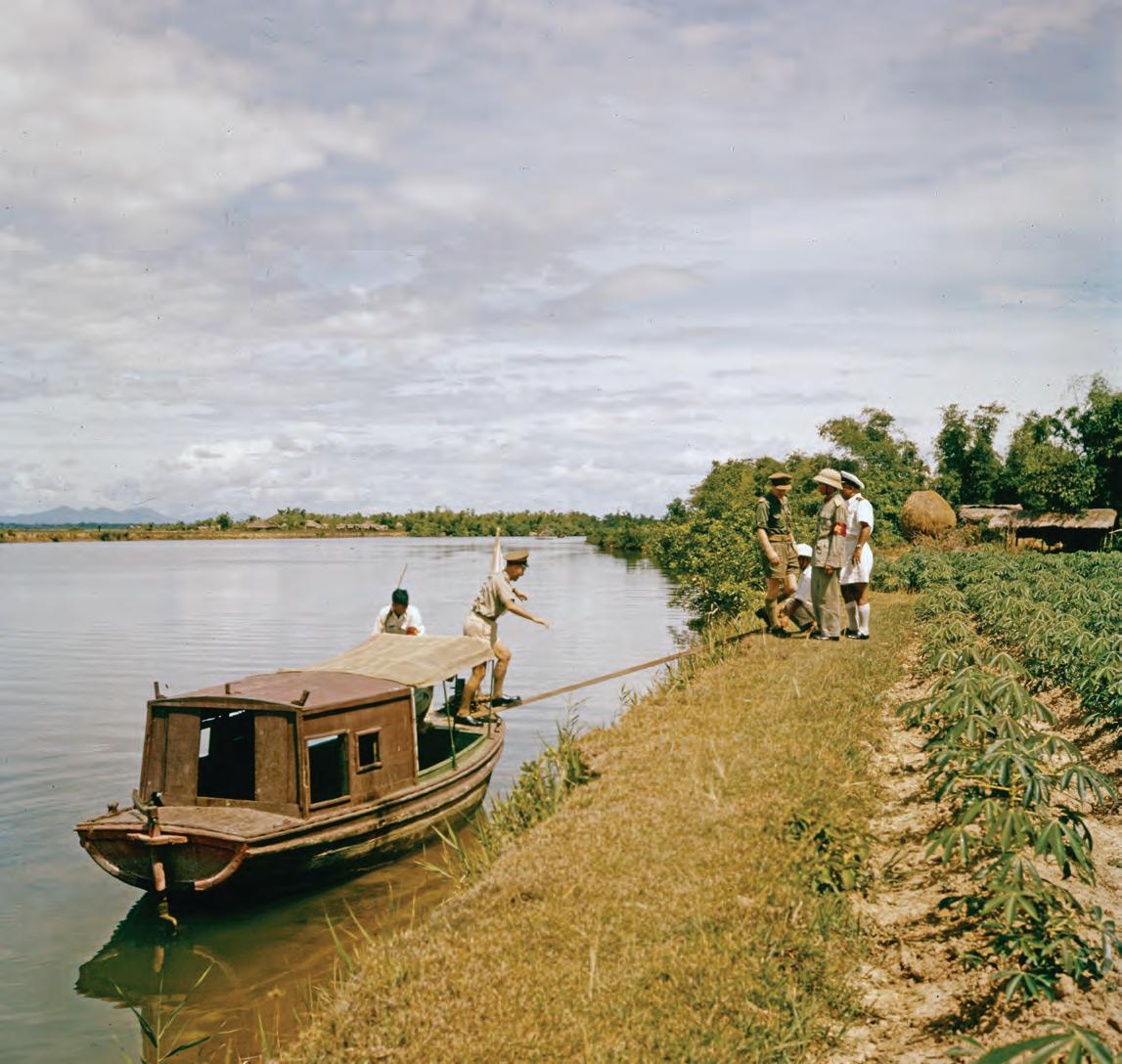

Vietnamese refugees board a ship in October 1954. Unidentified military members of the Canadian delegation to the international control commission in South Vietnam.
Inthe last half of the 19th century, France gradually established control over the southeast Asian monarchies of Vietnam, Cambodia and Laos, an area collectively known as French Indochina. The French attempted to preserve the traditional way of life, while exploiting the colony’s resources.
During the Second World War, Japan allowed the Vichy French to administer Indochina. Japanese forces stationed 30,000 soldiers there and used Vietnamese ports for their other operations throughout southeast Asia.
By the time Japan surrendered at the end of the war, the communist Viet Minh under Ho Chi Minh had emerged as the leading representatives of Vietnamese nationalist ambitions. Without opposition, the Viet Minh seized power.
With the initial assistance of Britian, France began to reoccupy its former colony, but was unsuccessful in the face of local resistance movements. Two Vietnams emerged: a communist north and a non-communist south.
Irreconcilable differences between the French and the Viet Minh—the former wanted to re-establish colonial rule, while the latter wanted complete independence—led to a protracted guerilla war in late 1946. In 1949, with the assistance of the new Communist government in China, the Viet Minh were ultimately successful.
Between April and July 1954, the Geneva Accords were negotiated, which resulted in a ceasefire and the temporary division of Vietnam into
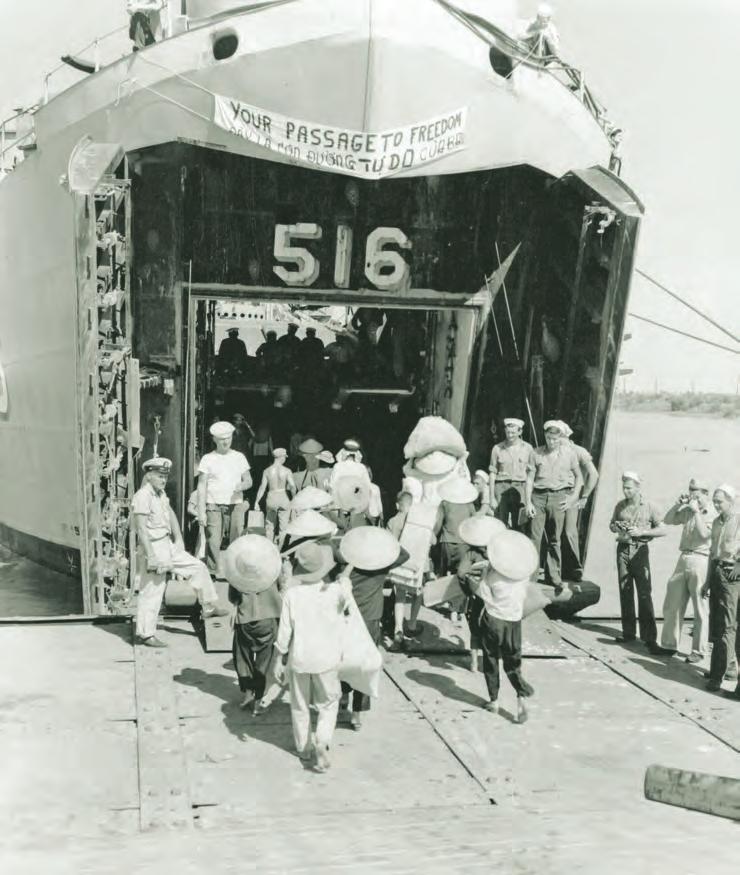
two separate entities at the 17th parallel, along a demilitarized zone.

The conference that produced the accords was attended by representatives of the United States, United Kingdom, France, the Soviet Union and China, plus Cambodia, Laos and both Vietnams. The French, Vietnamese, Cambodian and Laotian representatives signed the agreement, but none of its provisions were binding. Canada had three observers at the conference, led by secretary of state for external affairs and future prime minister, Lester B. Pearson.
The Geneva Accords also established the International Commission for Supervision and Control. The ICSC was to monitor the exchange and withdrawal of military forces, equipment and supplies, as well as to supervise the transfer of power from the French to the governments of North and South Vietnam.
The commission was also to ensure that no new military
equipment entered Vietnam, except as replacements for equipment that had been destroyed, and that no new military facilities were constructed. Another task was to oversee the return of displaced persons and refugees within a limited period. Any violations of the agreement were to be reported to the ICSC, which would then send teams to investigate.
The final declaration of the Geneva Accords called for the commission to supervise elections. These were to be held throughout Vietnam in July 1956 to unify the nation.
Three countries were asked to supervise the ceasefire agreement: Belgium, Poland and India, representing respectively the non-communist, communist and non-aligned blocs. But Belgium, as a former colonial power, was unacceptable to the Chinese and Vietnamese, so Canada was asked instead. India provided the chair and most of the logistical and command and control support for the ICSC.

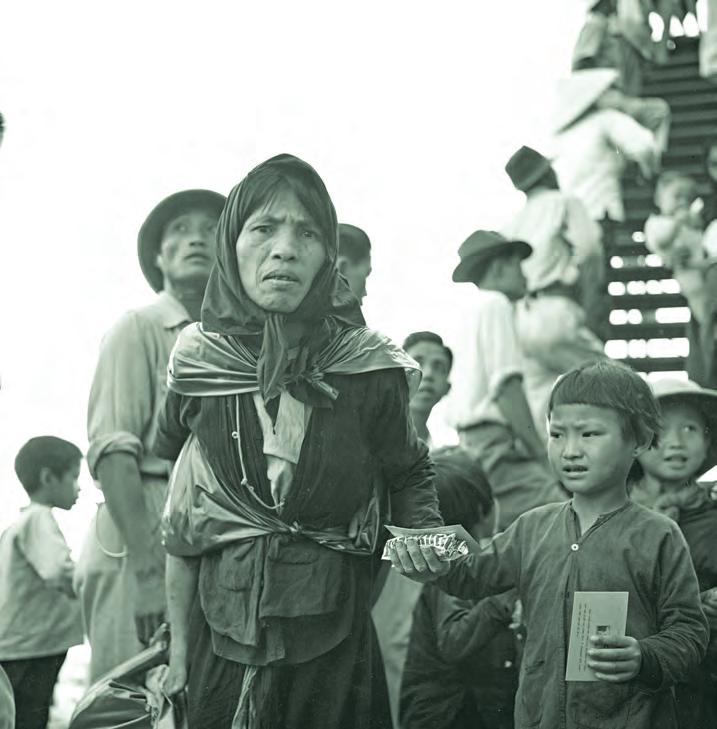
It was an unenviable task for Canada that was doomed from the start, given the opposing ideologies not only of North and South Vietnam, but also of the member nations of the ICSC. The involvement of so many stakeholders in the preparation of the accords resulted in much of their content being confusing, contradictory and ambiguous. Despite the foreshadowing of failure, most Canadian diplomats believed the country had no choice but to serve when asked.
The Canadian ICSC members came largely from the army. Besides inspectors, the army provided clerks and signallers, as well as medical and security personnel. Initially, 150 Canadians deployed to Vietnam in August 1954, 135 of them from the military.
John Holmes, the external affairs officer responsible for Indochina, credited the army for the accomplishments of the initial deployment: “[The Canadian Army] rounded up on short notice the
best staff-trained officers who could be taken away from their present duties and fielded within a few weeks teams for Vietnam, Cambodia, and Laos which carried on their unaccustomed duties of soldier, diplomat, and judge with remarkable success.”
The Royal Canadian Air Force supplied three officers who, besides providing technical advice,
Vietnamese refugees disembark a ship in Saigon in May 1955. Members of the control commission check a cargo manifest. Canadian military members of the commission board a flight in South Vietnam.
inspected airfields to confirm they were not being used for military purposes. They could also scrutinize aircraft unloading cargo, although the Vietnamese on both sides usually obstructed any attempts to carry out such tasks.
The Royal Canadian Navy, meanwhile, provided three officers as advisors and to inspect facilities. Both the north and south supplied boats to the naval officers to patrol the coastline, but they rarely saw anything because the Vietnamese carried out any illegal operations in areas where inspectors were not visiting.
The ICSC established its headquarters in Hanoi in North Vietnam along with 14 teams—seven in the south and seven in the north. Each six-man team had two members from each contributing country. Teams were stationed at air, rail and sea entry points and assigned areas in which to operate.
An undetermined number of mobile teams were also
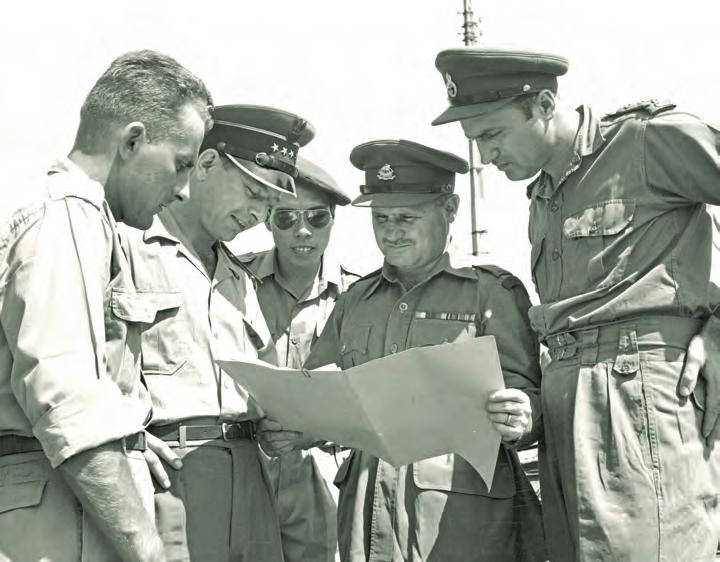
allowed—each with one member from a commission nation—which were to have complete freedom of movement across the border and in the demilitarized zone. These teams were to patrol areas between the fixed teams, but were never permitted to operate as planned.
The commission’s most significant drawback was that it had no executive power. Reports from teams were passed to ICSC headquarters, which could do little more than record them and send them on to the accords’ co-sponsors, Britain and the Soviet Union, then to a joint commission composed of France and North Vietnam.
Despite this challenge, the ICSC did accomplish some of its assigned tasks. In its first year, it had successfully supervised the transfer of power from France to new regimes in North and South Vietnam, as well as the withdrawal of French forces from the area.
According to philosopher Charles Taylor, normally a critic of Canada’s involvement in the commission, this “was an achievement in which Canadian diplomats and soldiers rightly took enormous pride.”
The task of overseeing the return of refugees and displaced persons remained a continuing problem throughout the ICSC’s existence, while the job of preventing new military equipment and personnel from entering the new countries failed entirely.
Probably the most difficult issue was that of holding free and fair elections by 1956. Canada and other western countries realized that the Communists would likely win an election and unite the country under a socialist regime.
With anti-communist feelings running high at the time, the West did not want such a system imposed on South Vietnam. The south postponed the elections, a decision quietly approved by the West.
Both countries arranging the teams’ visit locations and dates

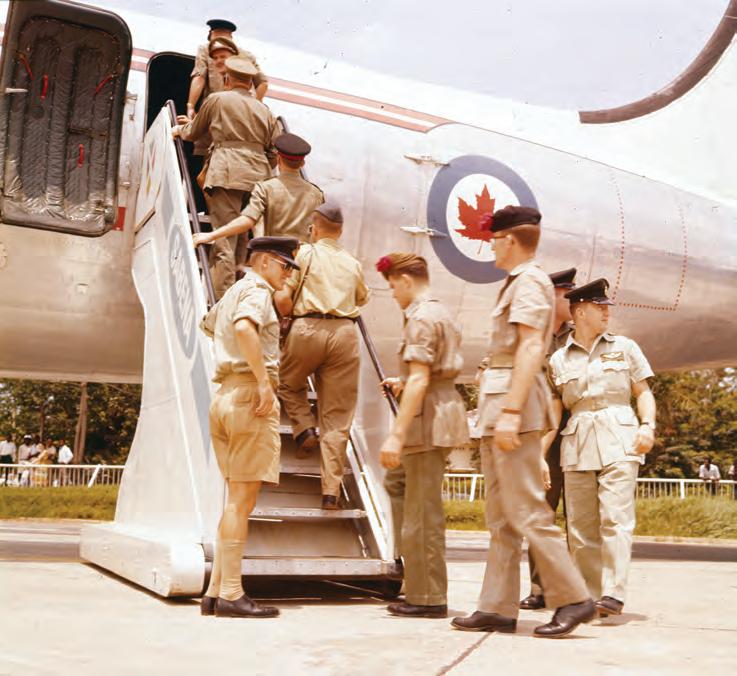
so that they never found anything in violation of the accords also hindered the commission’s effectiveness. Additionally, the teams’ visits required agreement among their members, a unanimity that was only occasionally achieved.
In fact, the terms of the Geneva Accords had doomed the commission from the start. Without a signed agreement, the ICSC lacked the authority to supervise or control most situations. This resulted in both the north and the south importing weapons through ports
and airfields to which they denied the commission temporary access.
Plus, none of the ICSC members were completely neutral in carrying out their mandate. “The Canadians pressed, the Poles obstructed, and the Indians dithered,” concluded historian Robert Bothwell.
Once France had completed its withdrawal from Indochina, however, it left the joint commission with North Vietnam as its only member. At that point, South Vietnam refused to be bound by the accords and the ICSC became ineffective.
As a result, North Vietnam began to send communist agents into the south, where they were to generate support for the north and encourage revolution from within. Open warfare followed in 1965, the same year that the U.S. began to send active combat units to help South Vietnam, where previously it had only provided advisers.

In March, the north forced commission headquarters out of Hanoi (it relocated to Saigon), along with the seven fixed teams stationed in the country. The rationale used by the North Vietnamese was they could no longer protect ICSC members from American attacks. Canada remained a member of the commission despite its
External affairs policymakers continued to hope that the ICSC’s presence might lead to a resolution of the war.
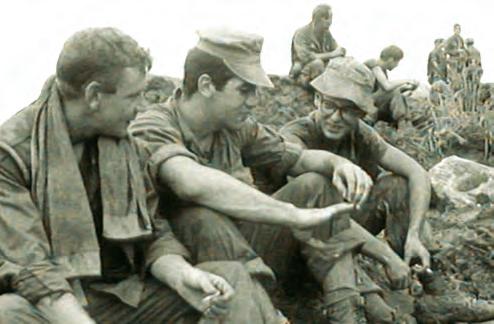
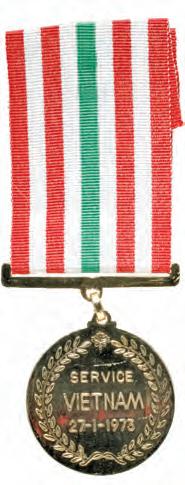
ineffectiveness and the presence of U.S. combat forces in large numbers. Bothwell described the commission’s operation during this period as “a routine of tr ips North, trips South, trips out, reports, and debate.”
Despite the frustration of Canadian inspectors on the ground, external affairs policymakers continued to live in hope that the ICSC’s presence might somehow lead to a resolution of the war. From 1960, however, Canada reduced its numbers slowly, leaving only 20 by the start of 1970. The mission ended in January 1973.
That same month, the U.S. asked Canada to be a member of a new commission to monitor the ceasefire signed at the Paris Peace Conference, which ended the Vietnam War. Canada agreed,
Some 12,000 Canadians served in combat roles with U.S. forces during the Vietnam War, including Ron Payne, Richard Dextraze and Arthur Fisher (left). The International Commission for Supervision and Control Indo-China Medal was awarded to Canadians with 90 days of cumulative service with the unit. A U.S. Vietnam War propaganda poster. Canadian members of the commission board a flight in South Vietnam in January 1973 as their mission ends.

Estimates vary, but somewhere between 20,000 and 40,000 Canadians enlisted in the U.S. forces during the Vietnam War, with approximately 12,000 serving in combat roles. At least 134 died or were declared missing in action.
Twenty-one-year-old U.S. Marine Corps Lance Corporal Richard Dextraze was one of those killed. He was the youngest son of then Major-General Jacques Dextraze, later Canada’s defence chief and known to all as “Jadex.”
Richard Dextraze, a reconnaissance scout, was awarded a posthumous Silver Star Medal for his bravery. On April 23, 1969, although already wounded in the face, he continued to deliver suppressive fire onto an enemy machine-gun post when he was mortally wounded. He is buried beside his father in Montreal’s Notre-Damedes-Neiges Cemetery.
Toronto-born Peter Lemon, meanwhile, received the highest American military award—the Medal of Honor. On April 1, 1970, the 19-year-old assistant machine gunner fought off a heavy enemy attack with a combination of machine-gun and rifle fire, grenades and hand-to-hand combat and was wounded three times during the battle.
Five Canadians died while serving on the international Vietnam commissions. On Oct. 18, 1965, Sergeant James Byrne, Royal Canadian Army Service Corps, and Corporal Vernon Perkin, The Black Watch (Royal Highland Regiment) of Canada, were killed in an airplane crash, along with Canadian diplomat John Turner. Their bodies were never recovered. On May 8, 1970, army clerk Philip MacDonald died in Saigon.
On April 7, 1973, International Commission for Control and Supervision member Captain Charles Laviolette, 12e Régiment blindé du Canada, and eight other commission members died when their helicopter was shot down over Viet Cong territory.
In addition, on June 28, captains Ian Patten of The Royal Canadian Regiment and Fletcher Thomson, an RCAF engineer, were detained, interrogated as “spies” and held by the Viet Cong for 18 days. When released, Thomson noted he “weighed twenty-five pounds less.”
In a bizarre twist of fate, on April 1, 1975, Patten was killed by an allegedly stray bullet as he stood on the balcony of his room in the Ledra Palace Hotel in Nicosia. He was serving on his third peacekeeping tour in Cyprus.

providing it could withdraw if the group was not effective. Besides Canada, the similarly named International Commission for Control and Supervision had three other members: Poland, Indonesia and Hungary.
The ICCS totalled 1,160 personnel. Canada provided 240 armed forces members and 50 diplomats to the new organization, which arranged for the release and transfer of more than 32,000 prisoners of war, including 500 Americans. One of them was U.S. Navy Lieutenant-Commander John McCain, who had been
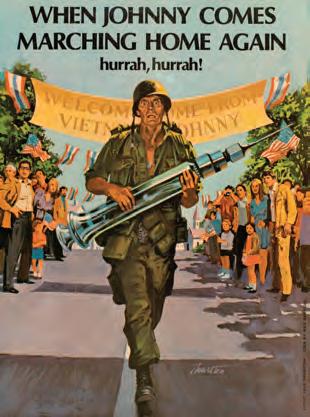
held for five and a half years and later became a senator and presidential candidate.
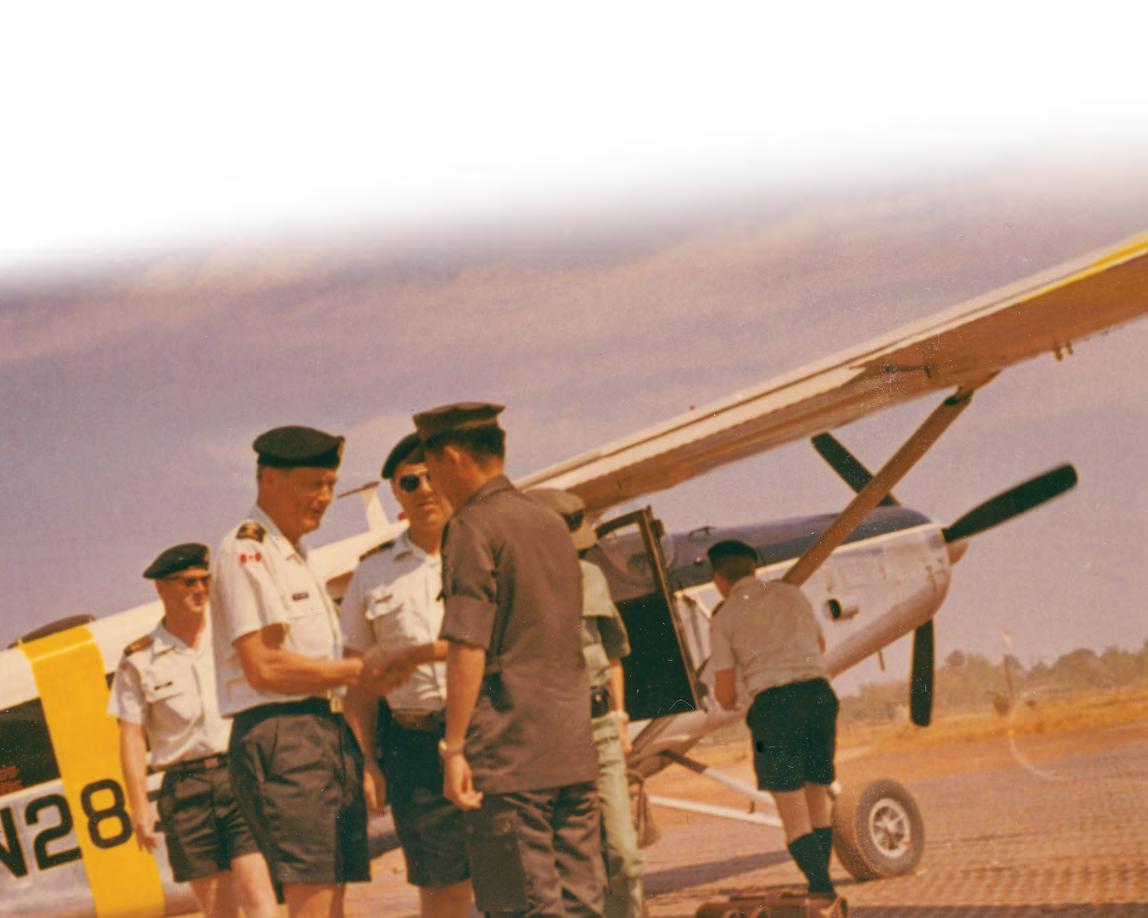
Due to its ineffectiveness, Canada unilaterally withdrew from the ICCS in July 1973; a first in the country’s peacekeeping history. Iran took Canada’s place and the commission operated until April 1975.
One of Canada’s earliest forays into peacekeeping had not been as effective as hoped. L
DOUGLAS
WENT FROM A MAN WITH NO COUNTRY TO SECOND WORLD WAR INTELLIGENCE SERVICE AND A POSTWAR CITIZEN OF FIRSTS
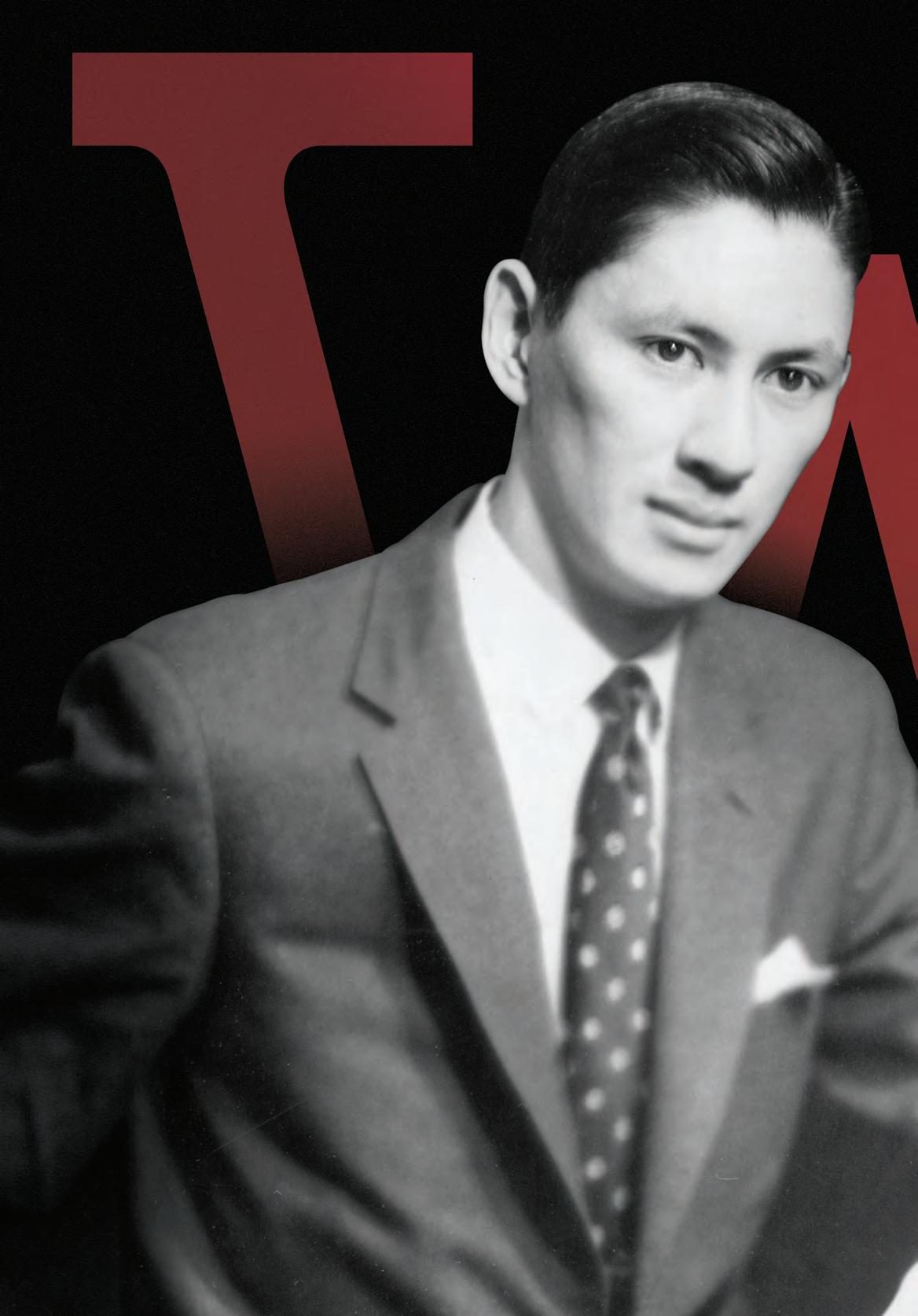
By Sharon Adams
When Douglas Jung was born in Victoria a century ago, no one could have dreamt he would one day become a veteran, a lawyer, a member of Parliament and a United Nations representative. He spent his early life limited by laws that decreed where those of Chinese heritage could live and work and what jobs they could have. Racism was rooted deep in Canadian history.
Lacking labour to build the Canadian Pacific Railway in the West, workers were imported from China. Of the 9,000 western railway workers in 1882, 6,500 were of Chinese heritage. About 4,300 settled in Canada, mostly in B.C.

eccentricities, Chinese immorality, Asiatic principles altogether opposite to our wishes,” Prime Minister John A. Macdonald said in the House of Commons in 1885.
That year, the federal government passed the Chinese Immigration Act, imposing a $50 head tax; it was raised to $100 in 1901. Still, anti-Chinese racism grew; immigrants and residents of Chinese heritage were targets of bitter discrimination, hatred, riots and violence.
In 1903, the federal head tax was raised to $500. That amount proved an effective deterrent as only eight Chinese immigrants legally entered the country the following year.
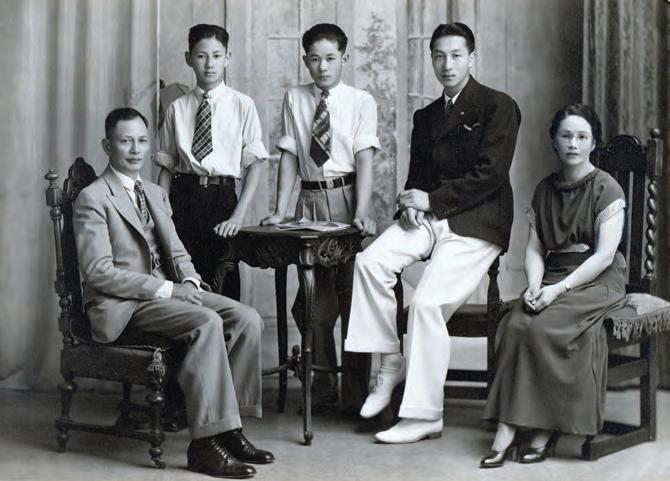
But once the line was completed, Chinese labour was no longer needed and Chinese immigrants no longer wanted by many Canadians. If Chinese “came in great numbers…they would send Chinese representatives to sit here, who would represent Chinese
(Illegal entries were another matter.) Regardless, the tax ultimately wasn’t enough to stymie immigration. Before it was removed in 1923, some 82,000 Chinese migrants raised the money, sometimes with help from employers who needed more (or cheaper) workers.
Despite being born in Canada, Jung was not considered a citizen. His father, Jung Yik Ching, emigrated from China to Victoria, where he married Elizabeth Chan, a housemaid who became a teacher, in 1920. The Jung family couldn’t buy property in certain neighbourhoods or swim in public pools; they were not allowed in “white” restaurants and were segregated in movie theatres. People of Chinese heritage were barred from becoming doctors,
lawyers, pharmacists and from jobs in the public service. They mainly worked as labourers in sawmills and coal mines or in restaurants and laundries. They were not allowed to vote—regardless of whether they, or even their parents, had been born in Canada. Jung was one of hundreds of young men who saw the Second World War as an opportunity to gain citizenship, over community objections to fighting for a country that treated them as second class.
“WE WERE PREPARED TO LAY OURSELVES DOWN FOR NOTHING. THERE WAS NO GUARANTEE THE GOVERNMENT WAS GOING TO GIVE US THE FULL RIGHTS OF CANADIAN CITIZENSHIP.”
“Some of us realized that unless we volunteered to serve Canada during this hour of need, we would be in a very difficult position after the war ended to demand our rights as Canadian citizens because the Canadian government would say to us: ‘What did you do during the war when everybody else was out fighting for Canada?’” said Jung in a biographical video produced by Veterans Affairs Canada.
Jung joined the army, following his older brothers into military service. Arthur flew 30 sorties in La ncaster bombers, becoming a postwar commercial pilot. Ross, who served in North Africa as a surgeon in the Royal Canadian Army Medical Corps, rose to the rank of major. After the war, he served with the U.S. Army Medical Corps and the Central Intelligence Agency before a long civilian medical career in Washington, D.C.
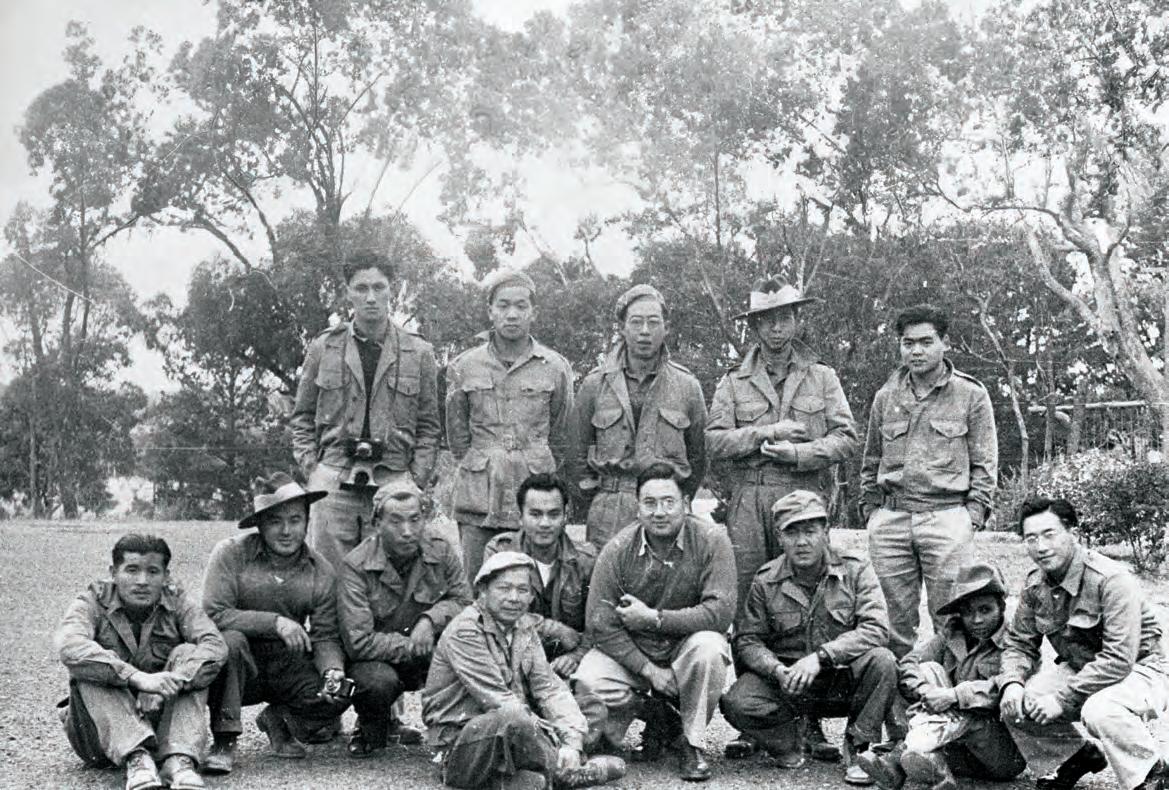
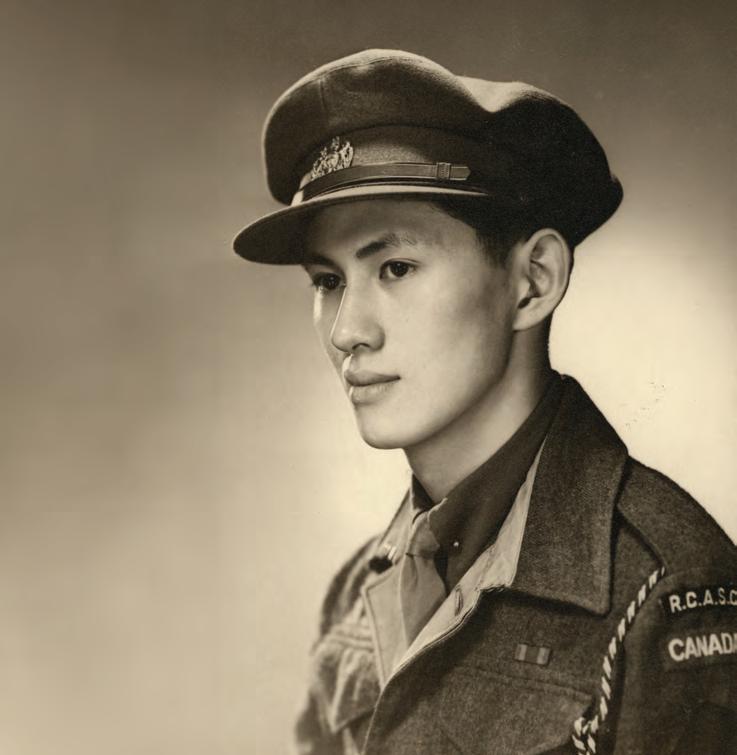
When Japan entered the war in 1940, Chinese Canadians’ language skills were seen as an asset for spying behind Japanese lines in southeast Asia. Jung, who had taken an intelligence course, worked in Pacific Command Security Intelligence under Major-General George Pearkes.
The British wanted to set up an organization in Asia like the Special Operations Executive in Europe, which ran sabotage and espionage behind enemy lines.
“My group was probably the first to join up,” Jung said. Eventually 150 volunteered.
A British officer meeting with Pearkes asked Jung if he knew any other serving Chinese Canadians.
“I happen to know all of them,” Jung replied.
He and a dozen comrades signed a copy of the Official Secrets Act, agreeing not to talk about their wartime roles, and began Force 136 training about 15 kilometres north of Penticton, B.C., in a small cove they called Goose Bay, now the Commando Bay historic site.
Originally recruited for Operation Oblivion to build a resistance army in China, the mission changed to spying behind Japanese lines in New Guinea and Borneo—setting up intelligence networks, communication and observation posts and training local resistance fighters.
“And generally playing hell,” said Jung.
Force 136 members learned how to swim quietly, over long distances, burdened with a 23-kilogram pack and a waterproofed rifle. They mastered wireless equipment and the use of explosives. And how to kill silently.
They left in October 1944 for more exercises in Australia, where they took parachute training and learned survival skills to help them in a jungle filled with ferocious monkeys, venomous snakes, poisonous plants, leeches, mosquito-borne malaria, unfriendly locals and enemy Japanese.
“We looked like cutthroats,” said Jung in Unwanted Soldiers, a 1999 National Film Board
Jung sits for a photo while training in Australia in 1944. He was one of the first recruits for Force 136 (opposite, back row left), a Second World War Allied special ops team dedicated to the Pacific theatre.
documentary. “We were not in military uniform and we were unshaven, dishevelled. We were on our own and we had to survive.”
They were issued cyanide pills; if captured, the Japanese would torture and kill them.
“We were prepared to lay ourselves down for nothing,” said Jung. “There was no guarantee the Canadian government was going to give us the full rights of Canadian citizenship. We were taking a gamble.”
Sergeant Jung broke his ankle during a parachute jump, ironically landing on an ambulance. The war ended while he recovered, but he remained overseas during postwar cleanup and rescue operations.
“My father never talked about his war experiences,” said Jung’s son Arthur. Until, that is, one night he opened up while watching The Bridge Over the River Kwai, criticizing the film’s depiction of jungle warfare.
Jung returned to Canada in 1946. The country still didn’t recognize him as a citizen. His fight was not over.
“Learning how to live together is much more difficult than learning how to fight together,” he would later say in an address to the House of Commons.
“We were willing to work for everything that we wanted, which was no more than…the rights that every other Canadian enjoys,” said Jung in that VAC video.
“We never won any great military victories,” said Jung in Unwanted Soldiers. “But the victory that we did win far surpassed any military victory.”
“DOUGLAS JUNG AND OTHERS LIKE HIM ARE DIRECTLY RESPONSIBLE FOR MAKING CANADA THE COUNTRY IT IS TODAY.”
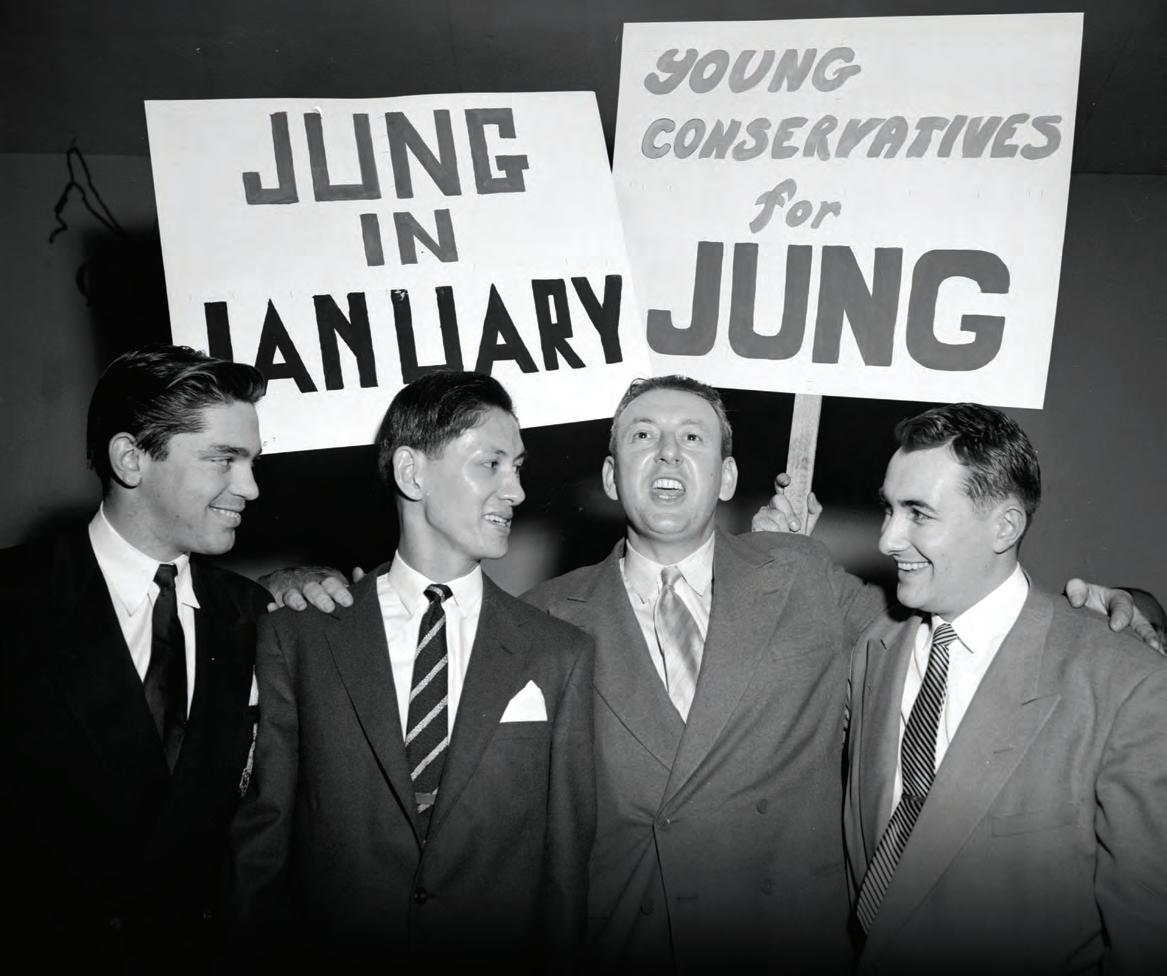
It was hard work. Chinese veterans relentlessly campaigned for citizenship and challenged bans. Soon, they were swimming in community pools, getting public service jobs and studying for professional careers.
“We did something for the Chinese community no other group could ever have done,” Jung said at a veterans’ reunion in 1987. “Without our contribution to Canada as members of the armed forces during the Second World War, none of the rights that exist in the Chinese community today would be possible.”
Citizenship was finally granted in 1947, the year the Chinese Immigration Act was repealed. Chinese Canadians could
finally vote in federal elections, and soon after, in municipal and provincial elections.
As a citizen and free to choose a profession, Jung first took a federal public service job, then studied law at the University of British Columbia; he began practising in 1954, specializing in immigration law.
Then he had several firsts for Chinese Canadians: appearing before the B.C. Court of Appeal in 1955; running in a provincial election in 1956 (he lost); and becoming national president of the Progressive Conservative Party youth wing.
In 1957, Jung became known as the giant killer after soundly defeating the favoured
Liberal incumbent, Defence Minister Ralph Ca mpney, in a federal byelection in the Va ncouver-Centre riding.
“When you elected me to the House of Commons, I felt, for the first time in my life, that I was truly a Canadian,” he told a reporter the night of the election.
In 1907, Canadian roughnecks came “into Vancouver Chinatown where they smashed all the stores, took the Chinese and tied them together by their pigtails and threw them and their belongings into False Creek. Fifty years later that same constituency…made amends by electing the first Chinese Canadian member of Parliament,” said Jung in the documentary I Am the Canadian Delegate.
Jung was the first Chinese Canadian elected to Parliament in 1957 and served as the president of the Progressive Conservative Party youth wing.
He was re-elected in the Progressive Conservative landslide in 1958 and served as a member of Parliament for five years. He advocated for equal standards for Chinese and European immigrants and for citizenship for Chinese forced to come to Canada under false names due to restrictive prewar immigration policies.
Families split apart by the head tax now faced restrictions on which family members could immigrate, including children over the age of 18.
“The people of Canada do not wish as a result of mass immigration, to make a fundamental alteration in the character of our population. Large-scale immigration from the Orient would change the fundamental composition of the Canadian population,” Prime Minister Mackenzie King said in the House of Commons on May 1, 1947.
Jung fought for amendments to immigration regulations to allow 6,000 wives and dependants of Chinese Canadians into the country and for financial aid for Hong Kong refugees.
“I believe we have a moral obligation to those early Chinese immigrants, who sacrificed so much and received so little, to become reunited with their families,” he told the House of Commons in 1960.
But immigration and equality for Chinese Canadians weren’t his only interests. Jung also fought for benefits for pensioners and students and urged the federal government to establish Canada as a leader in relations with Pacific Rim countries. He also helped create the National Productivity Council, the precursor to the Economic Council of Canada.
Jung was appointed to Canada’s legal delegation to the United Nations by Prime Minister John Diefenbaker.
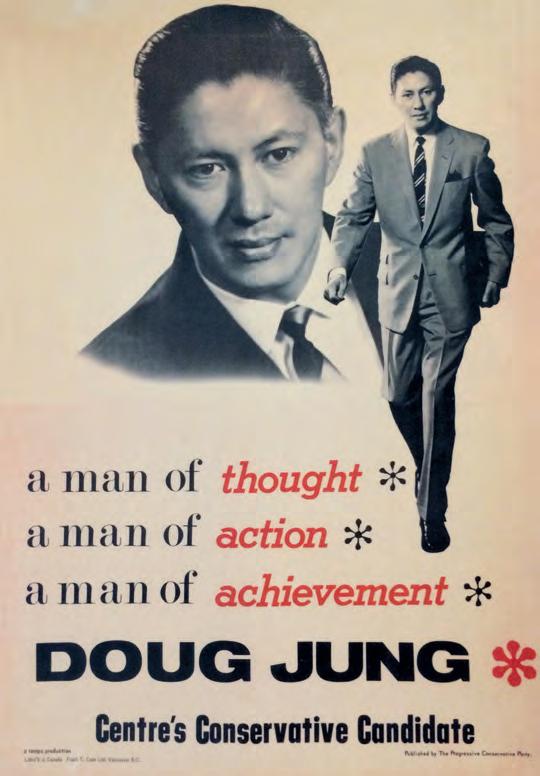
“By that one stroke he told the world that here in Canada we no longer had racial discrimination,” said Jung.
But the news travelled slowly.
“The first day I took my seat at the United Nations, one of the ushers came over to me and said, ‘I’m sorry sir, I think you are sitting in the wrong seat. This is for the Canadian delegate.’
“I said: ‘I am the Canadian delegate.’”
That was not his only impassioned feeling. “I don’t think that anyone can understand the surge of emotions that went through me when I took my seat… in that period of nine years from being a non-person, I had risen to the position of representing Canada at the United Nations.”
After leaving politics, Jung returned to his law practice and community service. He continued supporting veterans; was appointed a judge on the Immigration Appeal
Board in Ottawa; served as director of Far East relations of the Former Parliamentarians Association; and was president of the Japan Karate Association of Canada.
Among Jung’s honours are the Order of Canada and the Order of British Columbia. He was also Life President of Unit #280 of the Army, Navy & Air Force Veterans in Canada.
In 1995, Jung suffered a heart attack while marching with fellow veterans; he died in 2002. After his death, a federal office building was named in his honour.
But he lives on.
“Douglas Jung was a trailblazer who was not only a pillar and hero to our community, but he and others like him are directly responsible for making Canada the country it is today,” wrote artist Miles Tsang in a 2020 Facebook posting accompanying a portrait of Jung he had created.
“His legacy should never be forgotten.” L
Fortress Louisbourg, once known as the gateway to the continent, stands in majestic repose at the mouth of the harbour that still shelters a thriving fishing fleet. Sieges in 1745 and 1758 were turning points in the Anglo-French struggle for what would become Canada.
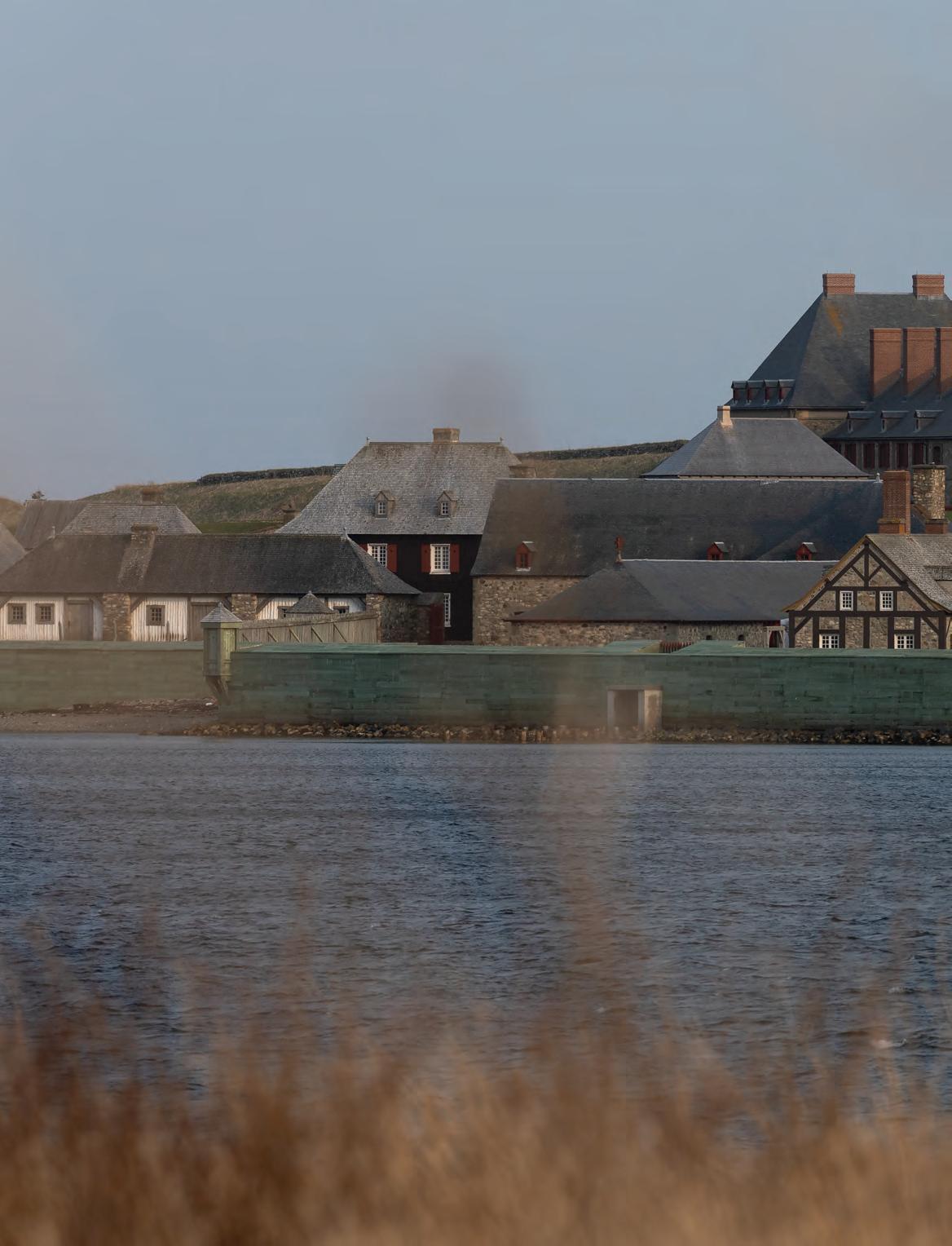

FOR MUCH OF THE 18TH CENTURY, LOUISBOURG ON CAPE BRETON ISLAND DOMINATED ACCESS TO NORTH AMERICA
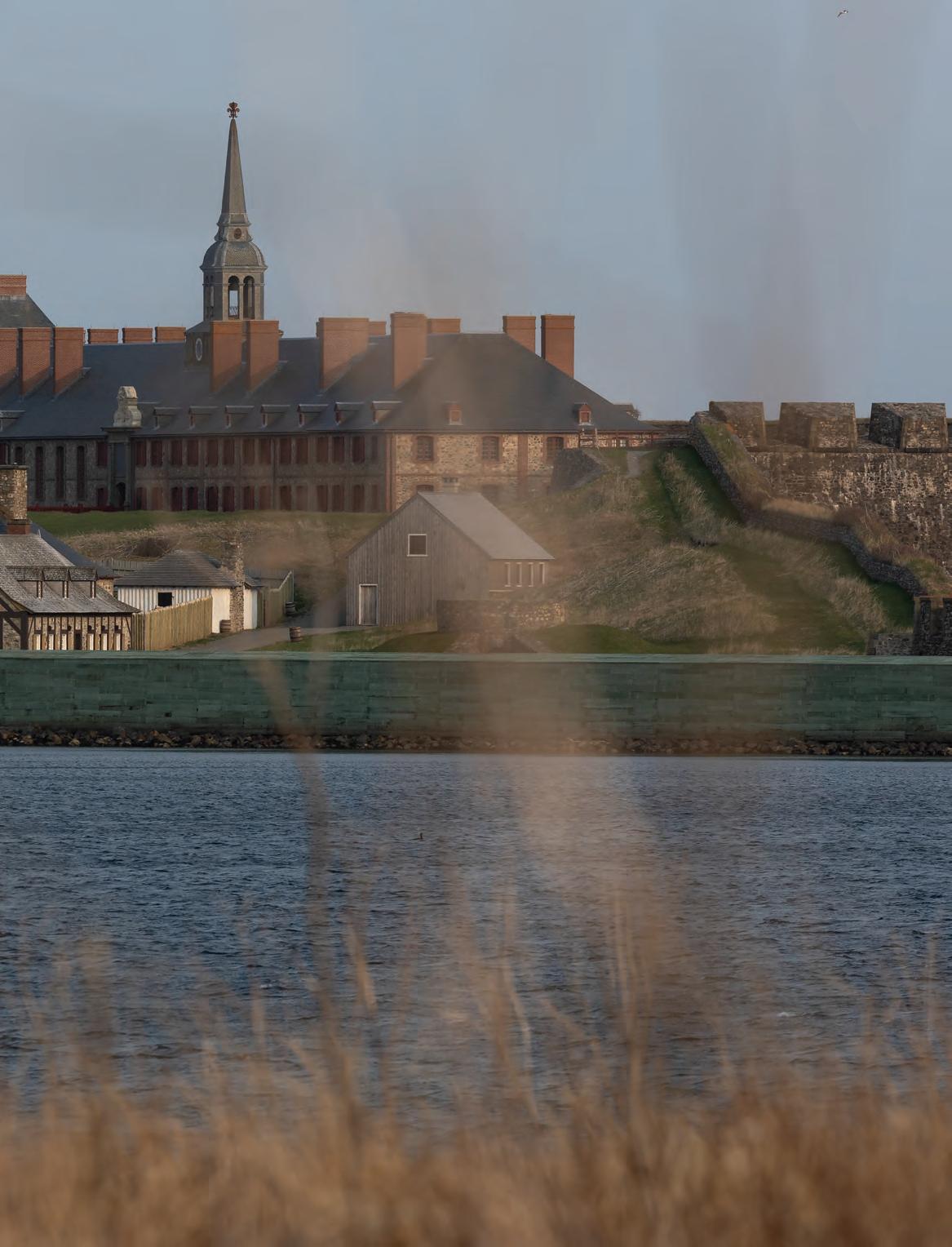
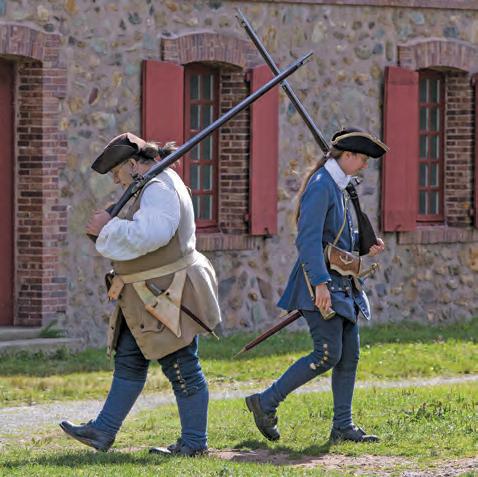
The world was a far bigger place in the 17th and 18th centuries.
A transatlantic crossing of 5,500 kilometres (3,000 nautical miles) from England was a perilous, month-long endeavour, even in favourable seas and skies.
North America was still very much the New World to Europeans—a wild and unexplored continent that, despite the designs of white men far
away, was still the land of its Indigenous Peoples. What began as a search for a westward route to the Orient became a voyage of discovery, a religious quest, a hunt for untold riches, a centuries-long pursuit of prestige and glory. Some 500 years after Vikings first settled in what is now Newfoundland, then left, European monarchs set their sights on the shores of the continent.
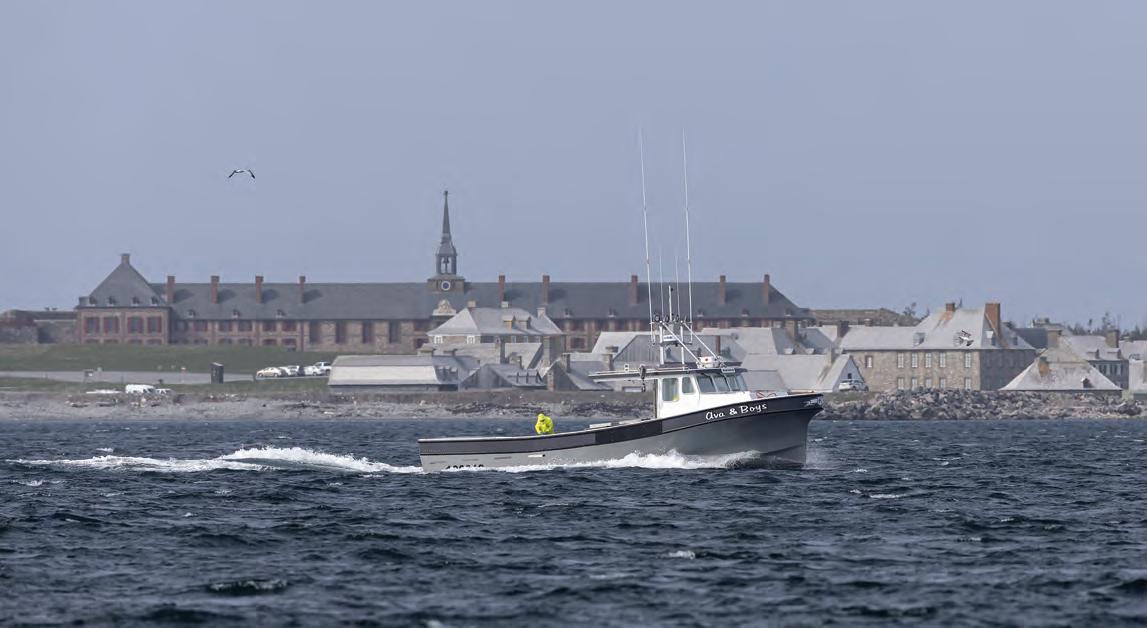
Now a national historic site, Louisbourg is populated during the summer months by French-speaking re-enactors representing French military and colonial life between 1713 and 1758. The fishery that attracted many Europeans presses on.
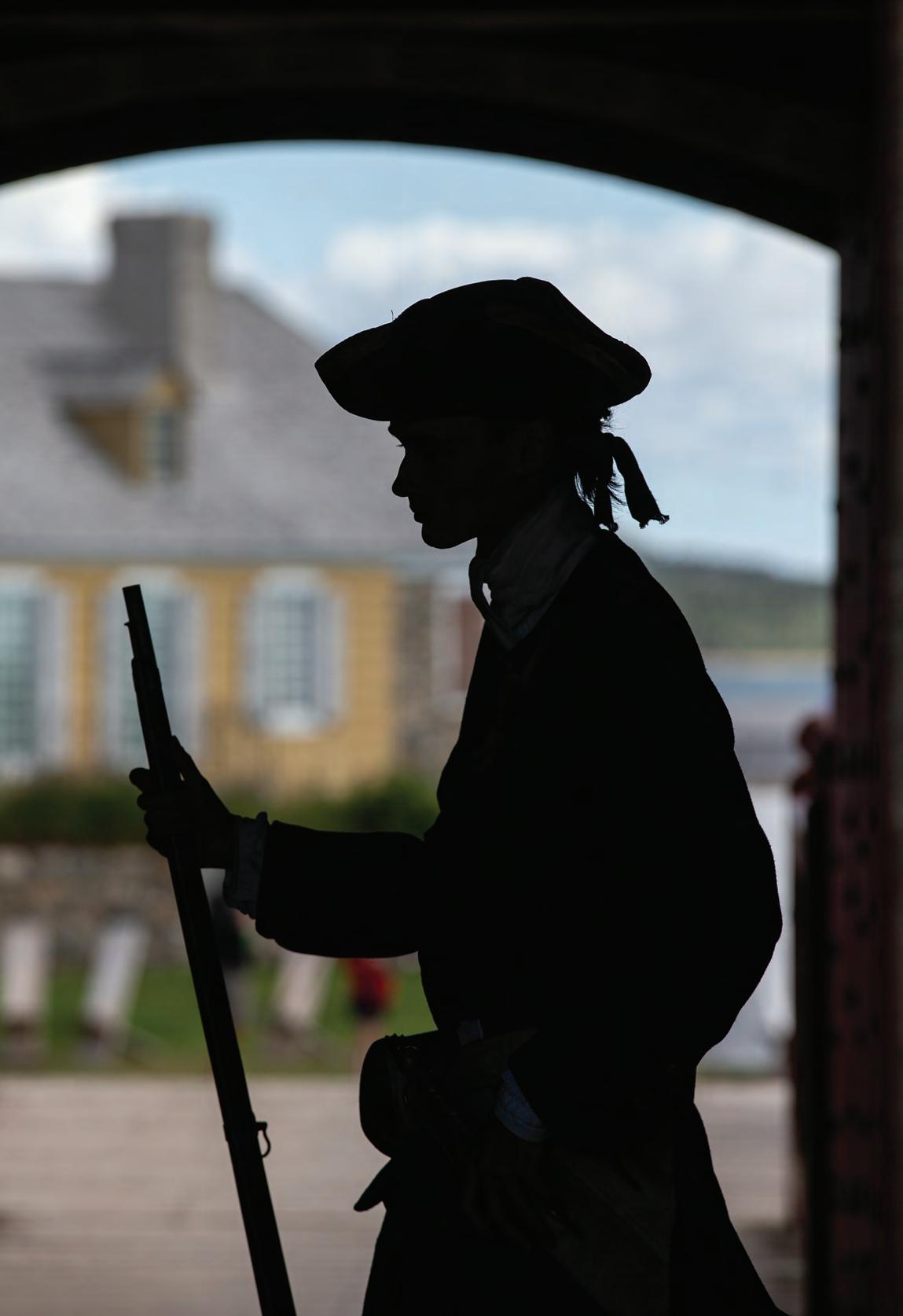
LOUISBOURG WOULD BECOME ONE OF THE MOST COMPLEX, COSTLY AND CONTESTED FORTIFICATIONS ON THE CONTINENT.
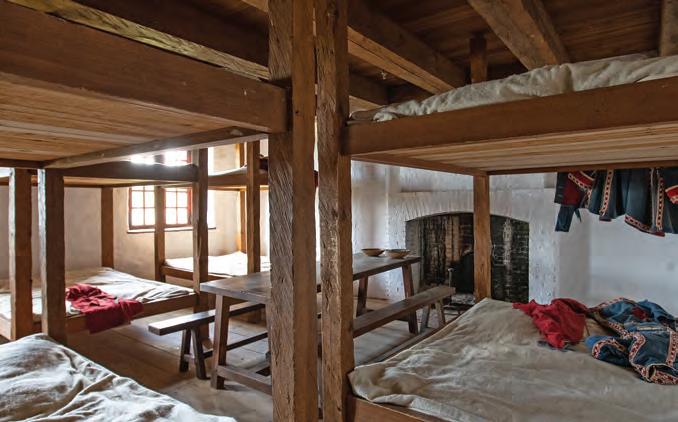

The site is described as North America’s largest historical reconstruction. In its heyday, it was the land of L’nu, also known as the Mi’kmaq. French, Basque, German, English, Irish, Scottish and African peoples came to its shores.

The Spanish colonized the Caribbean island of Hispaniola in 1493. The English settled Jamestown, Virginia, in 1607 (Cupids, in the British colony of Newfoundland, was settled in 1610). In 1534, Jacques Cartier sailed into the Gulf of St. Lawrence and declared it New France.
The age of exploration and discovery would become the
age of conquest and imperialism when the great powers of Europe colonized the world. These far-off possessions became sources of commerce, fields of battle in Europe’s continuing wars, and bargaining chips in the great power struggles of the 18th and 19th centuries.
So it was with Louisbourg, the great fortress known as the gateway to North America.
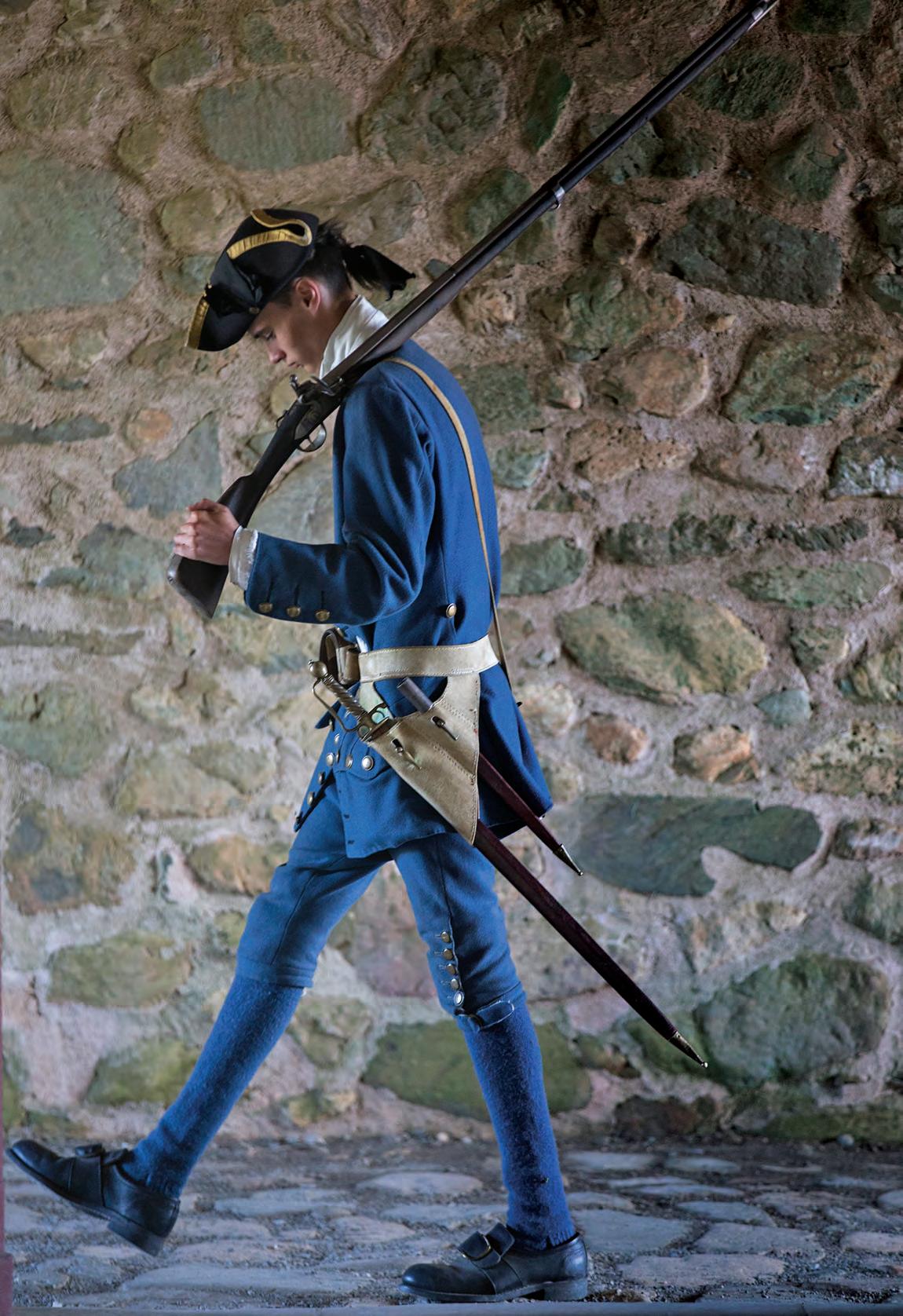
NORTH AMERICA WAS STILL VERY MUCH THE NEW WORLD TO EUROPEANS.
French colonial troops march to the beat of the drums.
A gun crew loads a cannon on the ramparts of the fortress.
A re-enactor looks up from her work in the kitchen gardens.
Île Royale, now Cape Breton Island, was first settled by the French in the early18th century. It would be a linchpin in the fight for North America, and the fishing village at Havre à l’Anglois would become its focal point.
Havre à l’Anglois would grow into a major commercial port and the fortress that defended it, Louisbourg—named for French King Louis XIV— would become one of the most complex, costly and contested fortifications on the continent.
Situated at the southeastern tip of the island, it posed a commanding presence near the mouth of the Gulf of St. Lawrence, over the French settlements of Acadia, and on the approaches to the eastern seaboard.
But, surrounded by hills, the low-lying garrison was primarily designed to address seaborne assaults; its la nd defences were relatively weak.
The British captured Louisbourg in 1745, only to make it a major bargaining chip in negotiations leading to the 1748 treaty ending the War of the Austrian Succession. The French got it back in exchange for border towns in what is today Belgium. It was recaptured in 1758 by British forces during the Seven Years’ War, leading to the fall of Quebec the following year—and subsequently an end to French rule in North America.
British engineers blew the fortress to rubble. By 1785, the site had been completely abandoned. Reconstruction of the defences and the community they housed, now a national historic site, began in 1961, continued into the 1970s, and resumed in 2018. Fisheries remain a key economic driver in the area, but the spectacular fortress and the tourism it generates form its foundation. L

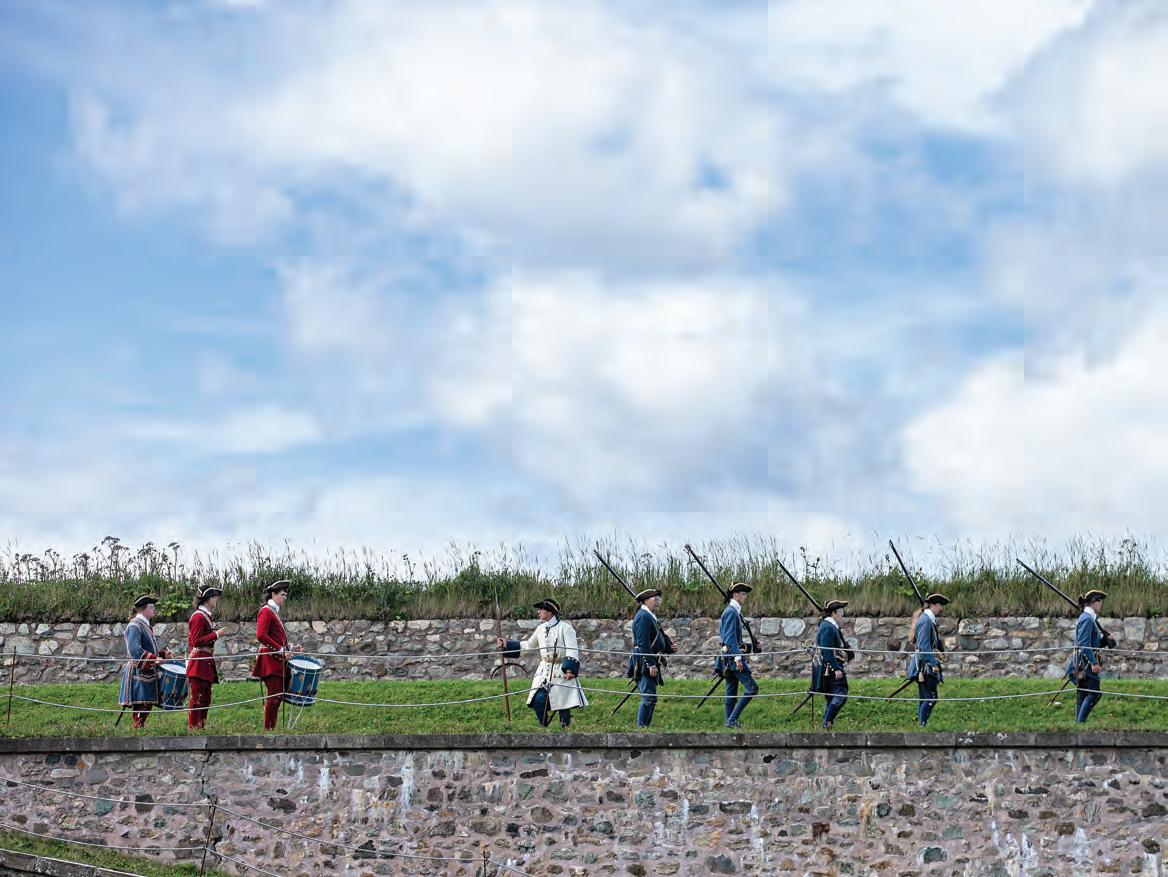
BRITISH ENGINEERS BLEW THE FORTRESS TO RUBBLE. BY 1785, THE SITE HAD BEEN COMPLETELY ABANDONED.
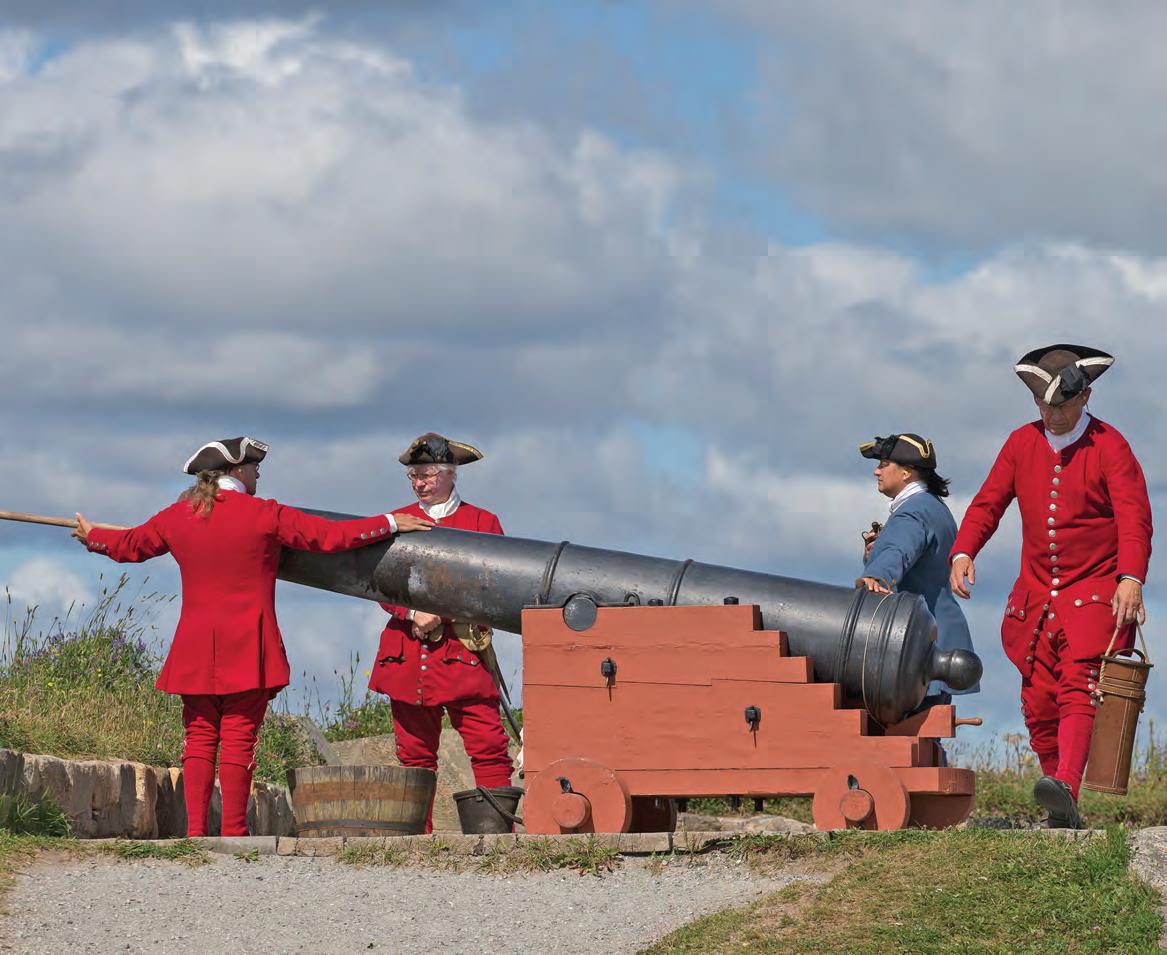



he lack of battle experience undoubtedly had its due effect,” historian Colonel Charles P. Stacey concluded in his analysis of Canada’s army during the Normandy Campaign. “They did well, but they would certainly have done better had they not been learning the business as they fought.” Stacey’s disappointment with First Canadian Army’s performance is evident, but is it valid?
Canada’s soldiers struggled during this long, costly campaign at all levels—from privates advancing through grain fields under fire to generals managing the operations. It’s worth remembering, however, that while the Canadian army grew to more than 600,000 officers and men during the war, that juggernaut bloomed out of the country’s Permanent Force of just 5,000 all ranks and a militia of some 50,000. Most Canadians who landed in Normandy were not professional soldiers.
Instead, as veteran Reginald H. Roy observed in 1944: The Canadians in Normandy, “they had a keen, if quiet, sense of duty and perseverance. They had all volunteered, and in the fire of battle their determination to complete the job was strengthened.” The 18,444 First Canadian Army casualties, 5,021
Did, as Charles Stacey wrote in his official history of the Canadian Army in the Second World War, Canada fail to make the most of its opportunities in the Normandy Campaign?
Mark Zuehlke says NO
of these killed in action or having died of wounds, stands as stark testimony to the intensity of the struggle and its costs.
All Allied armies in Normandy suffered heavy losses and faced command challenges from the bottom to the top. Despite meeting weaker German divisions, the Americans mired in the hedgerows crossing their front. The British, directly commanded by General Bernard Montgomery, were stymied far too long in taking Caen, then botched the Operation Goodwood breakout from the city toward Falaise. Ultimately the Canadians had to take over that advance.
DURING THE FOUR DAYS OF TOTALIZE, THE CANADIANS SHATTERED THE GERMAN CORDON
The first Canadian push toward Falaise—the attack on Verrières Ridge on July 25— was a disaster, a result more of hurried and poor planning by Lieutenant-General Guy Simonds than its execution by 2nd Infantry Division. After that, however,
Simonds launched Operation Totalize, unquestionably the Normandy Campaign’s most successful and innovative offensive.
The decision to improvise armoured personnel carriers by modifying M7 self-propelled guns enabled the infantry to advance in conc ert with the armoured regiments. Nicknamed Kangaroos, this thoroughly Canadian invention proved a game changer for future British and Canadian operations. During the four days of Totalize, the Canadians shattered the German cordon— advancing 15 kilometres and halfway to Falaise. They did so despite facing a defence in depth offered by 11 German infantry battalions, richly supported by 12th SS Panzer Division battle groups and much artillery.
Operation Tractable followed, then the grinding fight to close the Falaise gap ended the campaign.
It’s fitting to give Allied Supreme Commander General Dwight D. Eisenhower the final analysis: “Without the great sacrifices made here by the AngloCanadian armies in the series of brutal, slugging battles, first for Caen and then for Falaise, the spectacular advances made elsewhere by the Allied forces could never have come about.” L
> To voice your opinion on this question, go to www.legionmagazine.com/FaceToFace

There is no perfect military campaign. The most a battlefield commander can hope for is success with minimal losses. By the end of the Normandy Campaign, Canada had fielded First Canadian Army, which included II Canadian Corps consisting of one armoured and two infantry divisions. Altogether, these forces provided two armoured and seven infantry brigades, plus attached British and Polish formations. Canadian soldiers, most of them in their first battle, fought bravely and eventually overcame experienced German defenders.
But did their formation commanders make the most of the various opportunities offered them? Examples at each level demonstrate they did not.
The two assault brigades could not make it off the beaches in a timely fashion—certainly understandable given the circumstances—causing the reserve brigade to land late. No one told Major-General Rod Keller, commander 3rd Canadian Infantry Division, the navy had closed one of the beaches, forcing the reserve brigade to land at one already overcrowded beach. The resulting traffic jam caused a critical delay.
Meanwhile, some commanders reverted to a training mentality. One night, after several failed
MARK ZUEHLKE is a military historian and the author of the 13-book Canadian battle series as well as The Canadian Military Atlas He is a recipient of the Governor General’s History Award for Popular Media: The Pierre Berton Award.
JOHN BOILEAU is a retired army colonel and the author of hundreds of articles and 15 books on Canadian general and military history. He is a 2022 recipient of the Order of Nova Scotia.
attempts, 4th Canadian Armoured Division commander MajorGeneral George Kitching finally located Brigadier Leslie Booth, commander 4th Canadian Armoured Brigade, asleep in his tank.
At the divisional level, failure to use reconnaissance regiments to locate the enemy and scout terrain, resulted in tanks and infantry blundering into unknown German positions and suffering unnecessary casualties. Plus, there were failures to step in and take charge when brigade commanders lost control.
DID FORMATION COMMANDERS MAKE THE MOST OF THEIR OPPORTUNITIES?
EXAMPLES AT EACH LEVEL DEMONSTRATE THEY DID NOT.
At the corps level, not understanding the flexibility in timings of tanks and infantry required led to missed opportunities.
Lieutenant-General Guy Simonds, commander of II Canadian Corps, was an artilleryman by training. He was more familiar with the rigid timings of artillery fire plans, which were not subject to the whims of terrain, weather,
minefields, casualties or enemy positions, while such conditions did hinder or stop tanks and infantry. There was also failure to understand and implement manoeuvre warfare. During operations Totalize and Tractable, Simonds lined up tanks and newly invented armoured personnel carriers in parade-ground fashion. Armoured regiments were squeezed into space normally used by a squadron, which caused the loss of tanks and their crews.
Then, in complete contradiction of accepted armoured procedures, Simonds had tanks lead at night. They moved slowly and were essentially blind.
Lastly, First Canadian Army, commanded by Lieutenant-General Harry Crerar, became operational in late July. While Simonds was commanding the equivalent of two corps and operations were beginning to fall apart, Crerar did not step in and take control, but merely observed it.
There is perhaps no greater indication of the failure of formations to seize the opportunities offered them than the fact that by the end of the campaign, one division commander and six brigade commanders were replaced. Keller li kely would have been fired, too, had he not been wounded on Aug. 8, while Booth also probably should have been let go. L
By Michael A. Smith
By Stephen J. Thorne
By Michael A. Smith
By Aaron Kylie

The Royal Canadian Legion’s centennial celebration crawls closer, its Dominion Executive Council (DEC) came together this past April for its annual meeting, which not only discussed the organization’s latest results, but also made plans to ensure its growth into its next 100 years, while still maintaining focus on what matters most—veterans.
“In a clinic it doesn’t matter who you are. Everyone is positive and everyone helps each other.”
He acknowledged that if the Legion doesn’t manage the development, implementation and education related to its EDI statement as equal to other issues then it “risks becoming a social club for older white men.”


The more than 40 enthusiastic representatives from the various commands and special sections nationwide who gathered at Legion House in Ottawa, made it clear from the jump what topics were important to them. Discussion of the group’s forthcoming equity, diversity and inclusion (EDI) statement was threaded through the twoday weekend meeting, along with talk about new initiatives geared toward growing membership and, of course, advocacy was discussed— in particular regarding veterans struggling with homelessness and the seemingly never-ending tug-of-war with Veterans Affairs Canada about benefits.
In his opening remarks, Grand President Larry Murray laid out the session’s hot topic when he solemnly compared how the Legion should operate to that of a medical treatment centre, and asserting how critical a role the EDI statement will play in securing the Legion’s future.
“We need to treat each other as if we’re in a cancer clinic and we’re trying to save lives,” said Murray.
The Legion’s membership increased by 7.7 per cent yearover-year, he noted. And it had also gone up by 3.8 per cent in 2022, which was the first year of net positive membership growth in more than three decades, momentum that must be sustained.
The council convened after three days of meetings, workshops, tours and planning, which Dominion President Bruce Julian acknowledged, along with the last DEC meetings, as “emotional,” but important work to prepare them for not just the weekend, but the year ahead. In his welcome statements he specifically referenced touring the Pepper Pod, a retreat centre for female veterans, earlier in the week, and praised their “amazing and dedicated staff,” who he said are “exceptional at what they do.”
The meeting not only served as a sounding and planning opportunity for the council, but also provided chances for its members to learn from high-profile guest speakers who presented various new initiatives and addressed questions and concerns.
Following the welcome statements were the installations
of two newly elected officers. Murray first called forward Jack MacIsaac and swore him in as the new Dominion Vice-President. Berkley Lawrence followed and was officially welcomed as the new Dominion First Vice, replacing Owen Parkhouse who resigned in late 2023.
Rear-Admiral Chris Sutherland, deputy commander of military personnel command and assistant chief of military personnel, along with Chief Warrant Officer of Military Personnel Command Martin Rousseau tag-teamed the first guest presentation.
They represented the chief of military personnel (CMP) whose focus is improving recruitment and retention challenges, as well as supporting military families and veterans transitioning to civilian life.
The CMP is also in the process of reviewing and arguing for change to more than 600 items of governmental policy. Frustration was expressed about the difficulty in explaining to lawmakers the unique needs of CAF members compared to the average public servant. Although both are government employees, they do vastly different jobs and, it was argued, their benefits and resources should reflect the differences.
Just as the Legion strives to grow, evolve and modernize, so does the CAF, which is facing a personnel shortage that has left the regular force about 10,000 short of its 71,500 capacity.
Maintaining a healthy retentionto-attrition ratio has become difficult, not just for Canada, said Sutherland, but for the country’s allies as well. “Our attrition is about 5,000 per year, our goal is to bring in about 7,000 a year. This year, we did 4,200,” he said.
“We are back to pre-pandemic levels, but we are still losing. Our max capacity that our system can handle bringing in is 6,500. If we
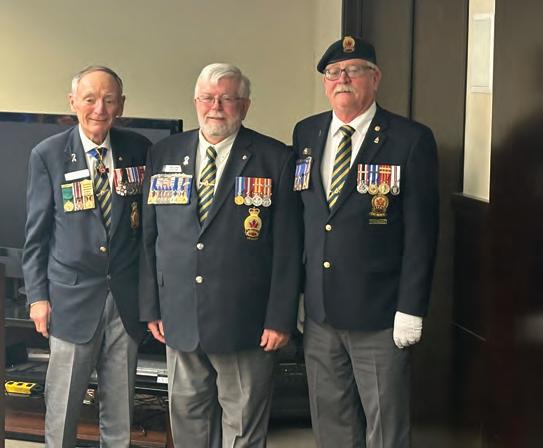
Royal Canadian Legion Grand President Larry Murray and Dominion President Bruce Julian welcome new Dominion VicePresident Jack MacIsaac.
THE NEW EDI STATEMENT IS THE LEGION’S ATTEMPT TO CONSCIOUSLY MOVE TOWARD BECOMING A MORE ACCEPTING AND INCLUSIVE
can reach that and sustain losses of 5,000, we will achieve the number 71,500 by 2032,” noted Sutherland.
Sutherland explained the top priorities with recruitment are digitalizing and simplifying the process. He clarified that that won’t happen overnight, but once complete, those changes could significantly bridge the gap between those interested in enlisting and those who actually do.
Sutherland highlighted three barriers most affecting recruitment: taking the aptitude test in person; medical requirements; and security checks—it’s currently a two-year process to vet permanent residents who want to join the military.
Rousseau discussed the all-toocommon housing troubles and plans to build more affordable accommodations for both current service members and veterans. He also explained how new transition centres are helping veterans adjust to civilian life by providing professional, personalized and standardized services to members, veterans and their families.
But the biggest challenge, said Rousseau, is similar to the Legion’s: it’s changing the culture—from top to bottom. “We need to look at inclusivity as a thing of power,” he explained. Without embracing inclusivity wholeheartedly, it’s hard to imagine a future, he said.
Other guest speakers included the Last Post Fund’s Project Co-ordinator Maria Trujillo who spoke about the Indigenous Veterans Initiative and the group’s mandate to leave no grave unmarked. The Indigenous project set out to identify and memorialize the graves of First Nations, Inuit and Métis veterans, who disproportionately lie in unknown areas with no markings. Trujillo also showed a short film about the identification process that can be viewed on the Last Post Fund’s website.
Retired brigadier-general Alan Mulawyshyn, executive director of Veterans’ House Canada, gave a presentation about the permanent, affordable and supportive housing his organization provides to veterans who are experiencing homelessness. The first home is the Andy Carswell Building in Ottawa, which has 40 bachelor units for veterans who are at risk of, or currently experiencing, homelessness. Their goal is to build at least three more buildings in different cities across the country to assist the estimated 3,000-5,000 veterans living without a home.
The headline speaker was Veterans Affairs Minister Ginette Petitpas Taylor. The minister, who, at the time, had overseen the
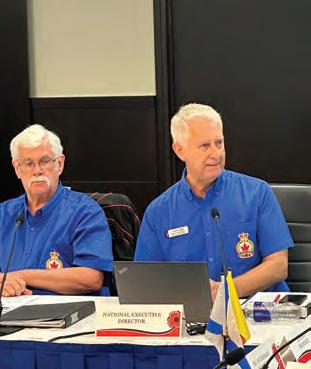
portfolio for about nine months, noted her “number one priority continues to be, and always will be, to continue to provide services to veterans in a timely manner.” Backlogged VAC claims have been a longstanding issue for veterans. Petitpas Taylor said more than 70 per cent of backlogged claims have been addressed.
Council members were given ample opportunity to share questions and concerns with the minister, many of which were long and complicated. They ranged from defining or redefining who the government considers a veteran to concerns about accessing practitioners and various services.
As for Legion business, Dominion Treasurer Donna McRury reported that like the struggling Canadian economy, the Legion had “a challenging year as well.” The Legion’s unrealized gain for the year amounted to $940,000, while dividends and interest earned, which the Legion relies heavily on, were down by 13 per cent. The net revenue for 2023 was $954,652 and operating income was $282,519.
The supply department, meanwhile, had a “terrific” 2023, bringing in $3,596,185 in sales, which was up from $2.8 million in 2022, and more than originally expected.
Overall costs for member services declined by $41,720, mostly due to personnel staffing changes. In 2023, 69 per cent of members were processed online, which is accompanied by extra credit card and telephone costs.
Information technology was $82,726 over budget due
to increases with maintenance, contracts and support.
During the weekend new initiatives and amendments were voted on as well. One was an update to the Legion’s code of ethics. A new part was added to the “personal excellency” section. It states that members must “fully disclose any history of/or refrain from engaging in, any conduct, whether as a Legion member or private citizen, that is or could be deemed harmful to the Legion’s reputation, makes it difficult for the Legion to manage its operations, or renders one unable to perform their organizational obligations in a satisfactory manner.”
The second day of the meeting began with a lively debate regarding a major initiative that was positioned as vital to ensuring the Legion survives for years to come. The new EDI statement proposed by the EDI committee is the Legion’s attempt to consciously move toward becoming a more accepting and inclusive organization so that more minority individuals feel welcome.
It’s no secret that the Legion’s demographics lean toward old and white. The statement’s “goal is to ensure that the Royal Canadian Legion projects a culture where all Veterans and Legion members, regardless of their age, ethnicity,
race, nationality, disability, economic status, gender identity, sex and sexual orientation feel welcome and included.”
The council was nearly unanimous that the statement was a step in the right direction and, as Cohen Rutledge, the ManitobaNorthwestern Ontario Command executive assistant director, put it succinctly, “it’s about following the golden rule and treating others the way you want to be treated.”
The EDI statement was approved by the council.
During the provincial command reports there were common issues raised by numerous provinces. Avoiding associations with outlaw motorcycle gangs was a shared concern, so much so that one province was working with undercover police to stay alert and avoid infiltration. And dealing with stolen valour was also an issue for many.
Plans for National Legion Day (July 17) were a top priority, as was gearing up for the RCL’s 100th anniversary in 2026. It was also announced that the national eight ball tournament will be May 23, 2025, at New Brunswick’s Fredericton Branch. National cribbage will be held April 28, 2025, at Ontario’s Whitby Branch and the national darts championship will be April 27, 2025, at Last Post Branch in Port Stanley, Ont. L
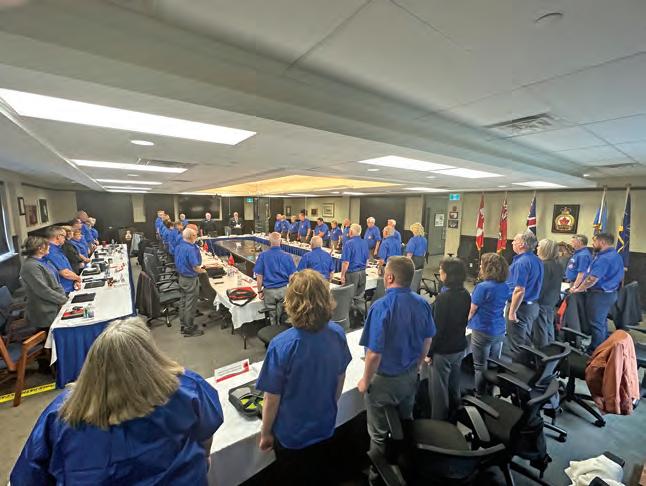
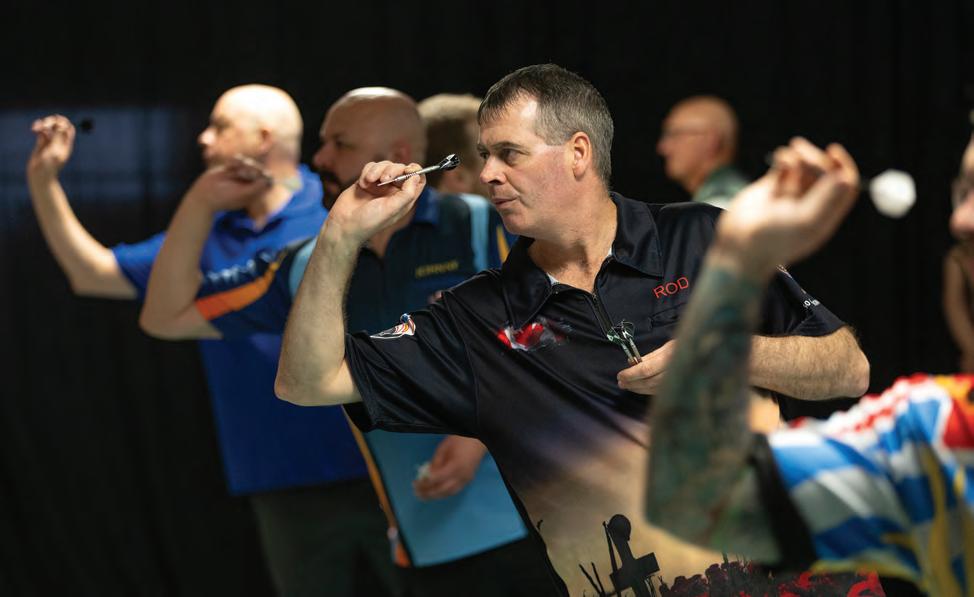
By Stephen J. Thorne
British Columbia/ Yukon recorded five three-game sweeps over nine matches to tie Ontario in regulation play at the Legion national team darts tournament in Laval, Que., on May 5, then won the last two games of a playoff to take the title.
The Kamloops squad of Bryce Book, Dalton Desmarais, Chris Purdy and Jim Brown notched B.C./Yukon’s first-ever national team darts victory after Ontario had taken all three games in their round-robin match.
Winning captain Book said his team didn’t check the scoreboard until the last of their roundrobin matches at Chomedey Legion Branch was over.
“We were looking at the scores and it was all of a sudden a tie,” he said. “Ho-lee. What a way to end a day!
“Even the boys had their darts put away. I was like, ‘hey guys, I think we’re in a playoff here.’ It was crazy. They had no idea.”
Rodney Tobin of Newfoundland and Labrador took the singles title on the first day of competition, while the Nova Scotia/Nunavut duo of Coady Burke and Jason Smith won doubles for the second straight year.
Sunday’s team play was a rollercoaster. There were nine lead changes with six teams holding or sharing the top spot over the course of nine rounds.
Coming off three straight sweeps, the Oshawa, Ont., foursome of Jeremy Howell, Derrick Hynes, Dean Persad and Mark Matereo had 18 wins through eight, good for a one-win lead over Nova Scotia/Nunavut going into the final set.
At two back, B.C./Yukon delivered in its final match, taking all three games in handing Prince Edward Island its seventh shutout of the day. The Dartmouth, N.S., boys, meanwhile, managed just one win against Quebec to fall
out of contention while Ontario dropped two to Quebec, their single win enough to force the playoff.
Ontario took the opener in the best-of-three extra round before B.C./Yukon came roaring back to take the final two.
“I think [the key to] darts overall—especially four-man team or even any team event—is having people that you play with, that you’re comfortable with, and you have a good time playing with,” said Book, a chef at the chain restaurant, Moxies.
“There’s no animosity among us. We had some bad shots today; we had lots of good ones, obviously. But you support each other, you keep each other going and focus on the game. And we have a good group like that.”
It was a similar story for Smith and Burke, long-time friends and teammates who found themselves in a playoff after losing 2-1 to Rod Petten and Warren Cheeseman of Conception Bay,

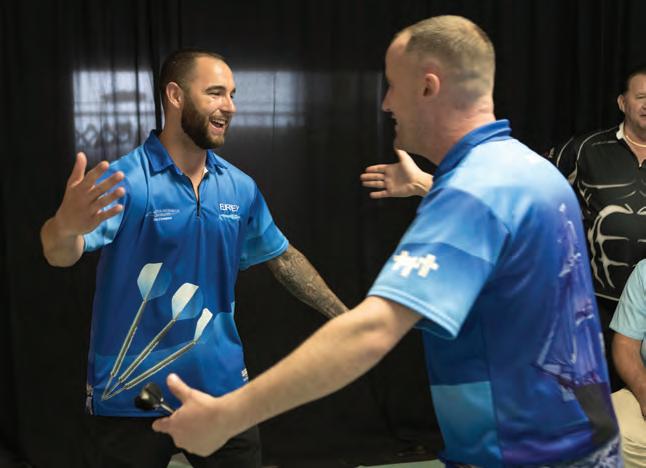
N.L., in the last round-robin match. The two pa irs had 20 wins apiece.
The Bluenosers took the extra round 2-1 for their second straight doubles title. The teammates, now with Dartmouth’s Centennial Branch, won the four-man title with MacDonald Memorial Branch in Lakeside, N.S., in 2018 and 2019 before COVID forced the tournament into a three-year hiatus.
Smith, a food inspector, and Burke, an ironworker, have known each other for more than a decade. They’ve won an event all four times they’ve competed nationally. Their secret?
“Chemistry,” said Burke. “Friendship. Friendship is huge. We’ve known each other for years. We played a lot of darts against
each other. And when we finally played together, we really clicked.
“Jason is a powerhouse scorer… a 140 [scoring] machine. So if I ca n double us on early, we’ve got the edge against a lot of teams. I know that and so does he.”
Alberta-N.W.T.’s John Hannon came out strong in singles play, sweeping his first four matches for 12 wins. But he managed only five the rest of the way as Conception Bay’s Rod Tobin put up consistent numbers with on ly one sweep to his credit in a n 18-win round-robin.
Another player oblivious to the standings, Tobin, who owns a roofing company, didn’t know he was positioned to win until his last match was over.
Chris Purdy, Jim Brown, Bryce Book and Dalton Desmarais from B.C./Yukon took the 2024 Legion national team darts title. Coady Burke (below, left) and teammate Jason Smith of Nova Scotia/Nunavut celebrate their doubles playoff victory.
“You can’t pay attention to the board,” Tobin insisted after playing his first national singles event. “You pay attention to the board, you just put pressure on yourself.
“I just went in there, played my da rts, and hoped for the best.”
Hannon ended the round-robin in a second-place tie with Sylvain Boudreau of Dorval, Que., at 17 wins. The two played an extra round, with Boudreau taking it.
Chomedey Branch was formed on the island north of Montreal in 1963 after about a dozen Second World War veterans from various regiments started gathering in a basement in what was, at the time, farm country.
The branch rented a small building near its present location, which it bought in 1972. It leases the downstairs to a caterer. Christopher Wheatley, the branch’s chief cook and service officer, says membership peaked at about 500 around 1973-74. Currently, it numbers 165. Barely a handful are veterans.
“It’s challenging,” said Branch President Dean McKay. “But we’re lucky. We have a good group of people here and we’ve been fortunate with the rental downstairs that we’ve managed to stay afloat.
“We do a lot of charity work for the community besides the poppy campaign.”
He said the branch, which held national crib in 2004, learned two years ago it would be hosting darts. He thanked the dozens of volunteers who were involved in planning and preparations.
“Without them, this wouldn’t happen.” L
By Aaron Kylie
With back-to-back singles champion
Bill Nelligan of Cranbrook, B.C., Branch not making the 2024 Royal Canadian Legion’s national Cribbage Championships held in Shediac, N.B., in April, the field was open for a new hand to take his crown. Enter “the Bulldozer.”
Judy Dove of Woodstock, N.B., Branch, says she earned the moniker for her ferocious dominance at Texas hold ’em, which she was only too happy to bring over to cribbage after not having played the game much for years. Fellow branch members recruited the local poker star and their bet paid off, with Bulldozer Dove compiling 17 points in nine sets to best all her singles comrades.
Like so many players, cribbage was a family pastime for Dove growing up. She recalled at just two years old watching her grandfather practise the game by “playing the devil” for hours by his home’s front window. Cribbage pegs eventually turned to poker chips until she was recently lured back to the board.
“I didn’t know it wasn’t for money. I don’t play if it ain’t for money,” said Dove who ultimately made an exception to her rule for the Legion games.
Coincidentally, Ronald White of George Pearkes Branch in Princeton, B.C., who unseated Nelligan as B.C./Yukon singles champ, nabbed second with 14 points. While he had tied at that score with Kevin Duchschere of Nipawin, Sask., Branch, White took the tiebreaker, having bested Duchschere 3-0 in the eighth set.
That minor setback aside, B.C./Yukon continued its overall dominance at the event, capturing both the doubles and team titles.
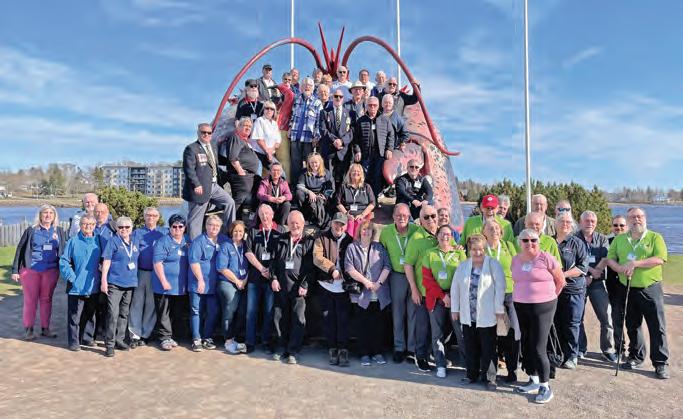
Barry Dillon and Richard Falle from Prince Edward Branch in Victoria, both Newfoundlanders who moved West in the 1980s, topped the doubles board for an unprecedented seventh time in nine championships. Grant Graham and Darrell Gorvett of Perth-Upon-Tay Branch in Perth, Ont., nabbed second in a tiebreaker over Wayne Lucas and Joseph Perrier of Stephenville, N.L., Branch. Meanwhile, in the team event, six foursomes were separated by just two points after the penultimate set. The B.C./Yukon group—Dillon and Falle, joined by branch-mates Tammy Shiells and Fredrick Horsman—scored four points in the final set to vault to the title. Dove and fellow Woodstock, N.S., Branch members Sonja Foster, Tanya Blaney and Cindy Delong garnered second in a tiebreaker over the Manitoba-Northwestern Ontario team of Valerie Wiebe, Robin Wiebe, George Fieber and Barry Gunther of Morden, Man., Branch.
Forty-seven Legionnaires from across Canada played 180 sets over two days at the Shediac Branch, which was a gracious and hospitable host, in keeping with the area’s downhome Acadian heritage. The local organizing committee, led by Branch President Ryan Seguin, put on a traditional East Coast kitchen party on the Friday evening, featuring chicken fricot, an Acadian fave, and music by local Nelson Jessome, a prime rib dinner on Saturday night and offered up lobster rolls at cost for Sunday lunch.
Like so many Legion branches, Shediac had recently faced dwindling membership. Indeed, when Lee Doiron took over as president in the early 2010s “we were ready to close the door,” he told CBC in February 2021. But, as they say, where there’s a will, there’s a way.
The turnaround started with The Bunker, a new basement bar and the ditching of some outdated
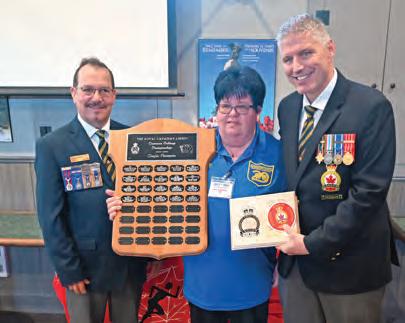
2024 singles crib champ Judy Dove of Woodstock, N.B., Branch with provincial command sports chair Harold Defazio (left) and host branch President Ryan Seguin.
rules (no gum chewing or wearing hats), which combined to attract a different, and younger, crowd. Membership nearly quadrupled. Then the branch bought
an adjacent property and set to building a two-storey, eightunit apartment complex geared toward modern-day veterans. It welcomed tenants in early 2021, despite the pandemic.
The project was such a success that the branch has begun building 12 more units, eight of which will be subsidized. They are to be completed late this year. The revenue from the initiative has been invested back into the branch said Seguin. And it shows, from the building’s updated facade to its clean, modern main floor hall space. And in hosting a national championship.
The tables abuzz with crib games, many of the players vying
for a side $5 buy-in high-hand pot, Seguin said he wasn’t sure how Shediac came to welcome the country’s top Legion cribbage players, particularly given that the branch doesn’t host an event for the game itself. It’s a holdover from his predecessor Mike LeBlanc and originally slated to be held a few years ago, but delayed because of the pandemic. But it was a vision in the same sense of The Bunker and the housing units—build it and they will come. Come they did. And, as it turns out, Dove did make her money, winning the draw among the nine tied with 24 for high hand. Don’t bet against the Bulldozer. Or B.C./Yukon, as it turns out. L
Since 1926, the Legion’s veterans services officers have assisted veterans, including RCMP members, and their families through representation, benevolent assistance and advocacy. This includes serving homeless or near-homeless veterans.
Launched in 2012 by Ontario Command, the national homeless veterans program, called Leave the St reets Behind, has a mission to contact homeless veterans, or near-homeless veterans, and provide immediate financial assistance and support when and where it’s needed, while also connecting them with the appropriate social and community services to help establish long-term solutions. The Legion is committed to meeting the demand to help
vulnerable veterans in every province, which is facilitated by the veterans services network and service officers who have the experience, knowledge and capacity to make a difference.
It’s anticipated that there will be an increase in veterans, many with physical and/or psychological wounds, in need of support because of increases in the cost of living across the country. Legion branches throughout Canada have been fielding a greater number of poppy trust fund requests from veterans of all ages and backgrounds, and in particular from near-homeless veterans, to assist with rent, food, clothing and emergency needs.
With the program expanded to new areas of the country,
the Legion has partnered with the Military Veteran Wellness Program, other police and emergency services, the RCMP and Built for Zero, an organization dedicated to bringing together communities to support homeless veterans. These organizations will for ward any homeless veteran they encounter to a service officer and Veterans Affairs Canada so they can receive the support they’re owed.
If you’re aware of a homeless veteran or of a veteran needing assistance, please call 613-591-3335 or 1-877-534-4666 toll-free, to speak with a service officer, or ema il veteransservices@ legion.ca. You can also visit the Legion’s website (www.legion.ca) to contact a CSO in your area. L
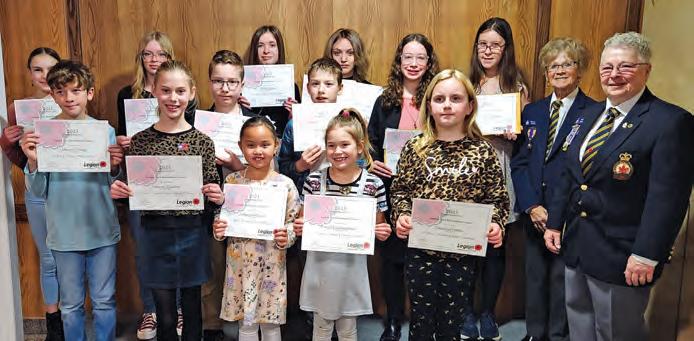
local

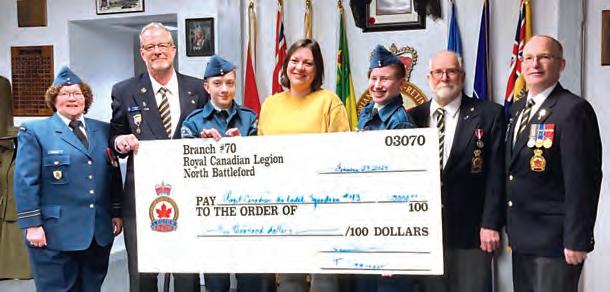
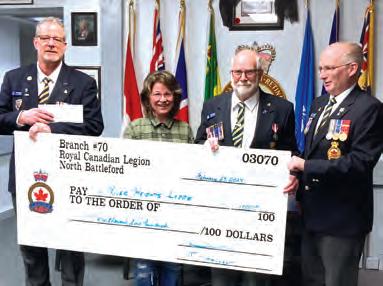
North Battleford, Sask., Branch presents $1,000 to River Heights Lodge, a long-term care facility. Represented are President Daniel Sigouin (left), River Heights Lodge facility manager Kelly Day, First Vice Gord Brown and Second Vice Darren Roberts. LOUISE OSTER
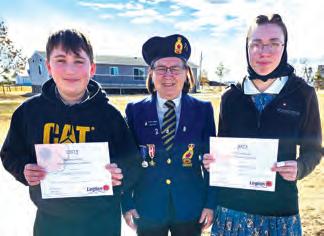
President Valerie Priestley of Leask, Sask., Branch (centre) congratulates local poster and literary contest winners Tanner Wollman and Marilyn Wollman. Tanner achieved third place in the intermediate essay category, and Marilyn secured first place in senior black and white poster. LEASK BRANCH
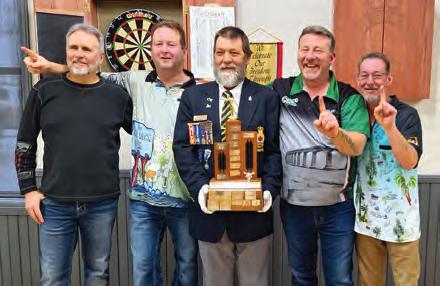
Provincial Vice-President Gordon Perry presents the P.E.I. provincial darts trophy to the winning team from Lt.-Col. E.W. Johnstone Branch in Kensington, P.E.I. Pictured are Corey Leforte, Dean Arsenault, James Madsen and Darren Bailey.
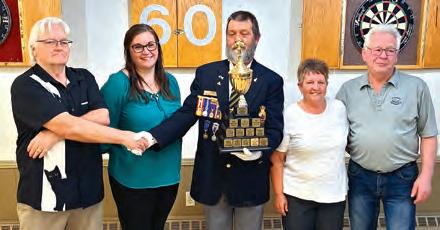
Provincial Vice-President Gordon Perry presents the P.E.I. Command senior darts trophy to the winning team from Ellerslie, P.E.I., Branch. Pictured are Gordon Millar, Sandra Williams, Myrna Millar and William Durant.
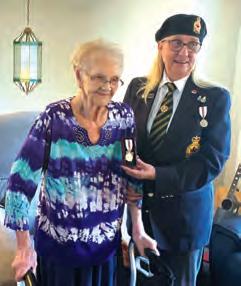
Battleford, Sask., Branch
President Esther Stolar presents Second World War veteran June O’Laney, 97, with the Queen Elizabeth II’s Platinum Jubilee Medal. ED STOLAR
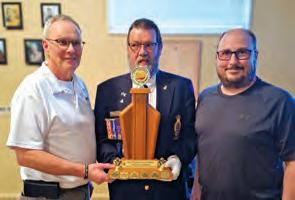
Provincial Vice-President Gordon Perry presents the P.E.I. Command cribbage championship award to winning doubles members Alan Crane (left) and Shaun MacArthur, both of Kingston Branch in New Haven, P.E.I.
President LeRoy Gamble and First Vice Gayle Mueller of George Pearkes VC Branch in Summerside, P.E.I., present $500 to George Dalton of the Lest We Forget organization. KAREN GAMBLE
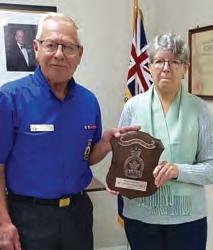
Montague, P.E.I., Branch
President Brian Rector presents Maxine Evans with the Legionnaire of the Year award.
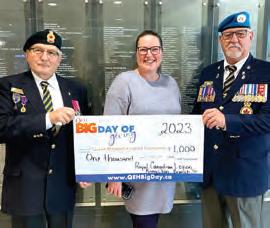
President David Cosh (left) and Ray Gaudet of Kingston Branch in New Haven, P.E.I., present $1,000 to Meredith Smith, representative of the Queen Elizabeth Hospital Foundation. RAY GAUDET
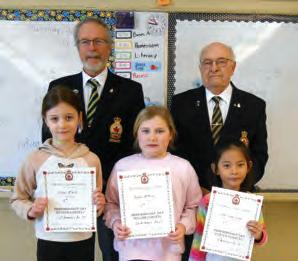
President Alan Curtis (right) and Alan Leard of Saint Anthony Branch in Bloomfield, P.E.I., congratulate local poster and literary contest winners from Alberton Elementary School. The students are (left) Claire McNeil, Payton McNeil and Elli Ligan J. Cha.
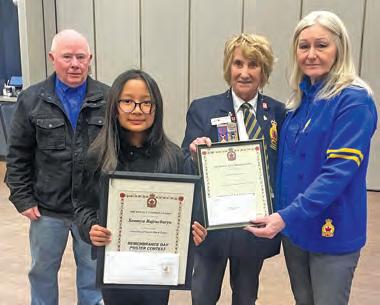
First Vice Jill Bilesky (right) of Whalley Branch in Surrey, B.C., joins Sgt.-at-Arms Charlie Carroll and Second Vice Brenda Knowles in congratulating poster contest winner Soumya Bajracharya. Soumya achieved first place in the primary black and white poster category at the zone and provincial levels.
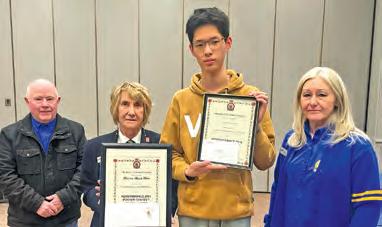
Whalley Branch in Surrey, B.C., congratulates Dayou Maya Hou (centre, right) after winning first place in the intermediate black and white poster contest at the zone and provincial levels. The branch representatives pictured are Sgt.-at-Arms Charlie Carroll, Second Vice Brenda Knowles and First Vice Jill Bilesky.

Bursary chair Tim Murphy of Alberni Valley Branch in Port Alberni, B.C., presents a $500 bursary to Caden Trembly.

Kelowna, B.C., Branch presents $5,000 to the Central Okanagan Hospice Association. Pictured are Second Vice Doug Affleck, philanthropy officer Shannon Perdok, Legion volunteer Joy Wallace and First Vice Michael Loewen.
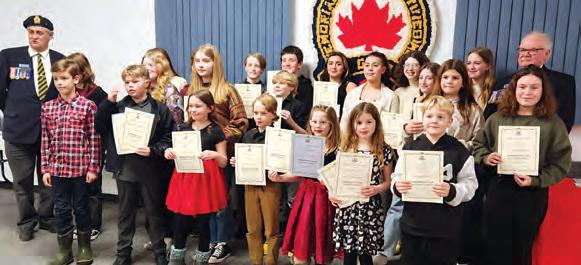
Trail, B.C., Branch recently held an awards ceremony for the 2023 poster and literary contest winners for the West Kootenay zone and branch.
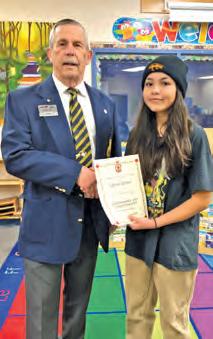
Rod Wilkins of Mount Arrowsmith Branch in Parksville, B.C., congratulates Aeleyah Olenick who placed third in the intermediate colour poster category for B.C./Yukon command.
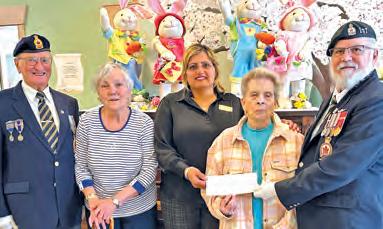
Campbell River, B.C., Branch presents $5,000 to the Campbell River and District Adult Care Society. Represented are Rosaire Bernard (left), Marilyn Keddy, Pam Mann, Shirley Koch and Branch President Alain Chatigny.
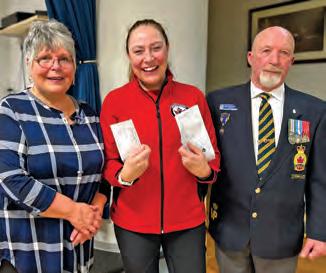
Alberni Valley Branch President Roy Buchanan of Port Alberni, B.C., joins bingo chair Jenny Neuwirth in presenting $5,000 to Wounded Warriors representative Jacqueline Zweng.
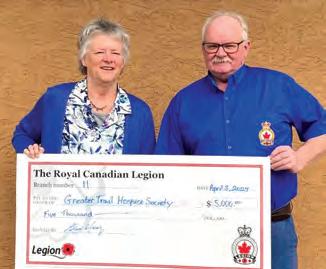
Trail, B.C., Branch President Glenn Hodge presents $5,000 to Brenda Hooper of the Greater Trail Hospice Society. The funds will go toward the renovation of the community palliative care rooms at Columbia View Lodge.
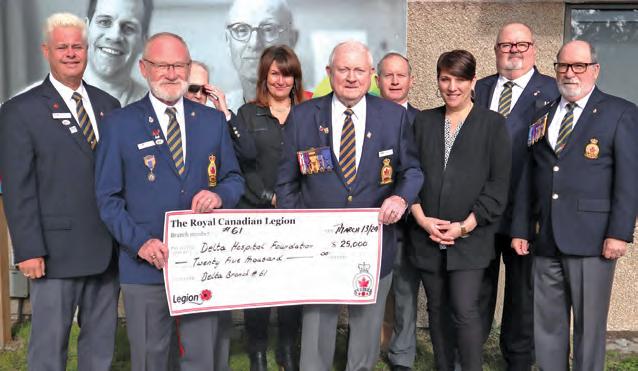
Delta, B.C., Branch presents $25,000 to the Delta Hospital and Community Health Foundation for the purchase of a pressure mapping system.

Malahat Branch in Shawnigan Lake, B.C., celebrates its 90th anniversary on April 12, 2024. Branch President Isabelle Hammer cuts a cake to mark the occasion.
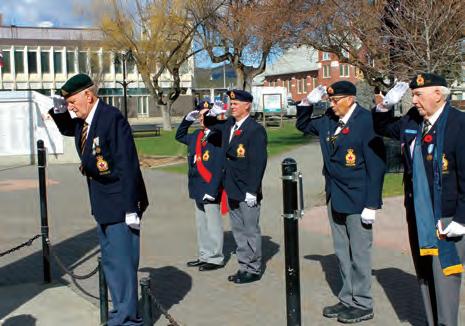
Cranbrook, B.C., Branch places a wreath to commemorate the Battle of Vimy Ridge. Represented are Bill Cnossen, Sgt.-at-Arms Troy Dulmage, Jay Nelson, Rick Schrader and branch padre Gordon Henry.
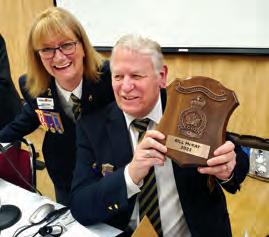
President Laurie Grubb of Mount Benson Branch in Nanaimo, B.C., presents Bill McKay with the Legionnaire of the Year award.
Valerie Noyes of Saanich Peninsula Branch in Sidney, B.C., presents $15,000 to Rod Hughes, President of the Board of Directors for Legion Manor.
Sharon Scott of Port Arthur Branch in Thunder Bay, Ont., congratulates Jack Walker after winning first place in the intermediate colour category of the local poster contest. GEORGE ROMICK
Nova Scotia Deputy Commissioner (Ret’d) Steve W. Graham presents N.S./Nunavut Command President Don McCumber and Executive Director Craig Hood with $1,000 for their Benevolent Fund.
Kentville, N.S., Branch receives $5,000 from the Mud Creek Rotary Club to refinish the facility’s hall floor.
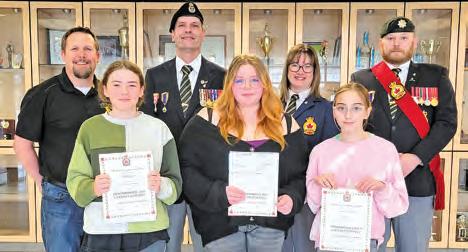
Members of Oxford Branch in Oxford Junction, N.S., with the local poster and literary contest winners from Oxford Regional Education Centre.
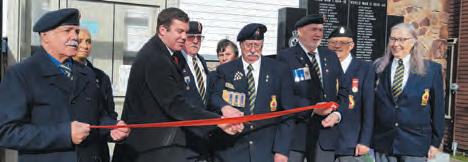
Kentville N.S., Branch celebrates the installation of their new chair lift. MP Kody Blois and branch President Bud Johnson cut the ribbon while branch members watch alongside.
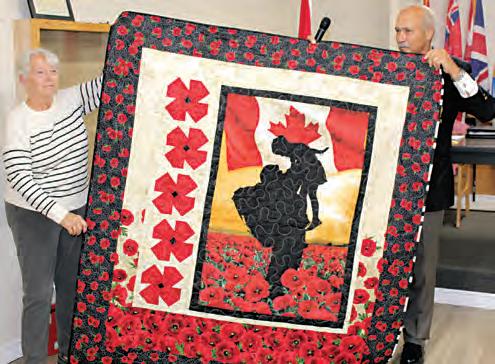
Linda
of the
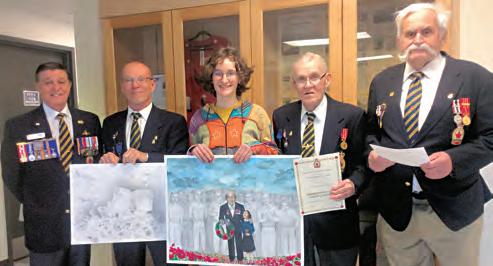
New Germany, N.S., Branch President Howard Gibson (left) and Zone 13 Commander Ron Langevin with Rachel Lowe, the N.S./Nunavut Command winner in the intermediate colour poster contest.
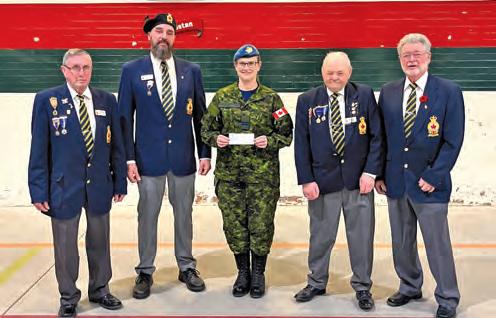
Cadet liaison Bob Stephenson, First Vice Derek Systma, Ernie Sicard and Reg Hunt of Mallorytown, Ont., Branch present $1,800 to 870 Vampire squadron, represented by its commanding officer, Captain Cristal Boudreau.
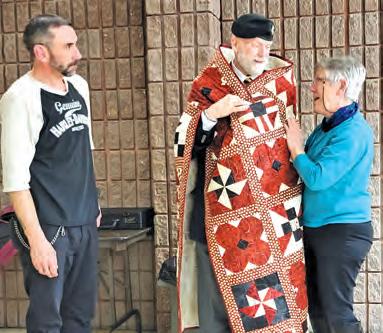
At Limestone City Branch in Kingston, Ont., Kate Maloney from Quilts of Valour, Rideau Lakes Westport group, accompanied by Jason Poirier, presents a quilt to Jean Blain, branch veteran service officer.
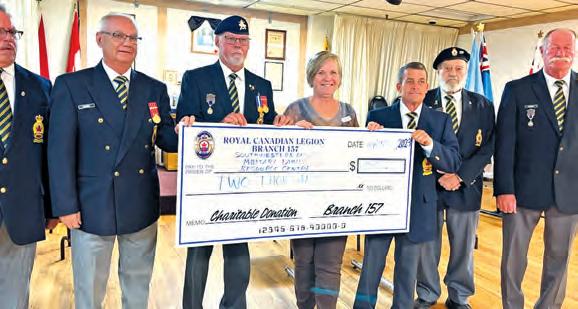
Members of Fort Malden Branch in Amherstburg, Ont., present $2,000 to the Southwestern Ontario Military Family Resource Centre, represented by Denise O’Neil.
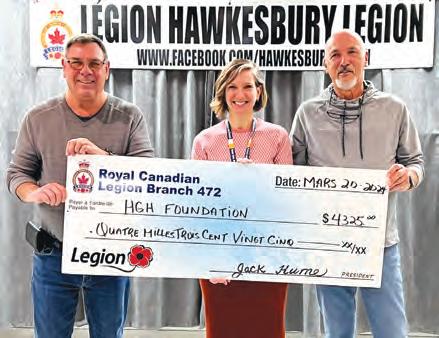
Yves Paquette and Yvon Doiron of Georges Vanier Branch in Hawkesbury, Ont., present $4,325 to the cardiology department of HGH Foundation, represented by Eve de Grosbois.
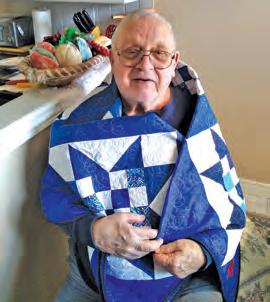
Ian Mason, a 66-year member of Riverside Branch in Windsor, Ont., receives a Quilt of Valour.
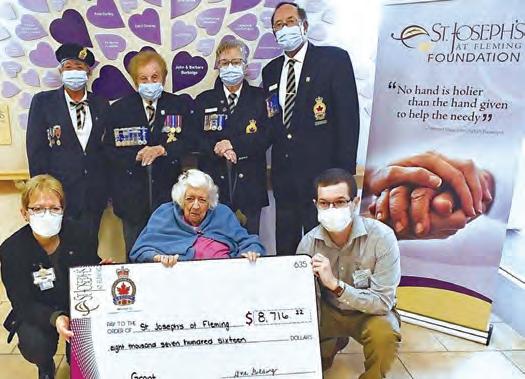
Peterborough, Ont., Branch presents $8,716.22 to the St. Joseph’s at Fleming Foundation. From left are First Vice Terri-Lynn Leahy-Lafreniere, President Una Golding, Sheila Davidson, Past President Joel Chandler, foundation CEO Carol Rodd, veteran Betty Pagett and the foundation’s director of corporate services Matthew Boyles.
Rob Butchart of Paisley, Ont., Branch presents $1,000 to Alex Taylor for the Port Elgin 340 air cadet squadron.
Service Officer Brian Budden of Highland Creek Branch in Scarborough, Ont., presents $2,000 to the corps Sgt.-Maj. of the 876 Lincoln Alexander air cadets.
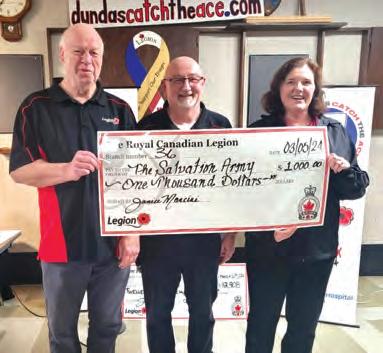
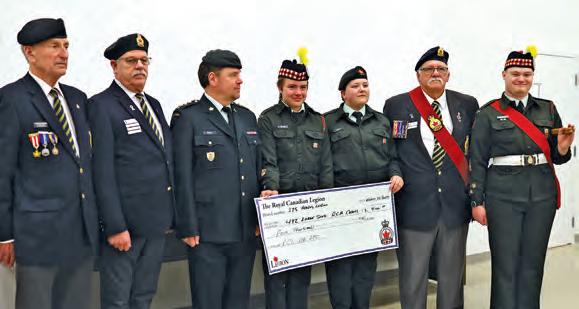
Capt. Darren Storey, WO Pierre Waltho, cadet Sergeant Rachel Nijenhuis and CWO Ethan Austin of Fergus Lorne Scots 492 cadet corps are presented with $4,000 by Malcolm McCulloch (left), Second Vice Dave Evans and Sgt.-at-Arms Conrad Sawyer of Fergus, Ont., Branch.
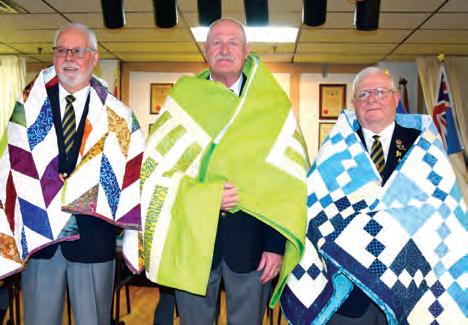
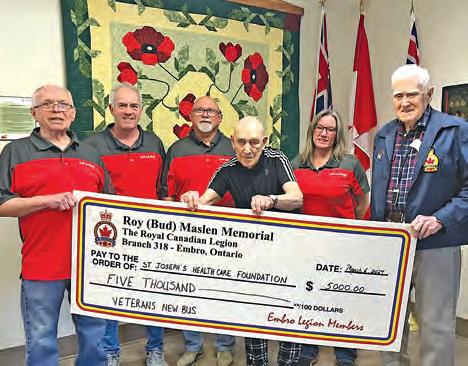

Wiarton Ont., Branch Vice-President Joe Vanderzand presents $10,000 to April Patry, executive director of Bruce Peninsula Hospitals Foundation, accompanied by Wiarton nurses Jennifer Heathers and Brianna Sylvest.
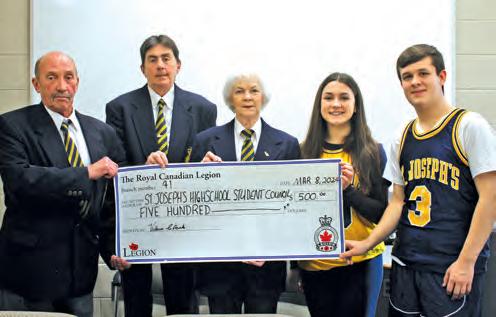

President David Thompson and L.A. President Sue Koehler of Col. John McCrae Memorial Branch in Guelph, Ont., present $10,000 to Andrew Moore of the St. Joseph’s Health Centre Foundation on behalf of the Ontario Command Branches and L.A. Charitable Foundation.
Membership chair Dave Patterson of H.T. Church Branch in St. Catharines, Ont., welcomes new members Brian Arsenault, Brian Clement, Lisa Smart and Heather Greenfield.
Dave Bawtinheimer, L.A. President Karen Shorter and President Jerry Derochie of Maj. W.D. Sharpe Branch in Brampton, Ont., present $15,000 to the William Osler Health Systems Foundation, represented by VP of development, Shelagh Barry.
President Rev. Bruce Ferguson and Second Vice Tena Miller of Renfrew, Ont., Branch present $1,000 to the Renfrew and Area Food Bank, represented by its vice-president Carol Little.
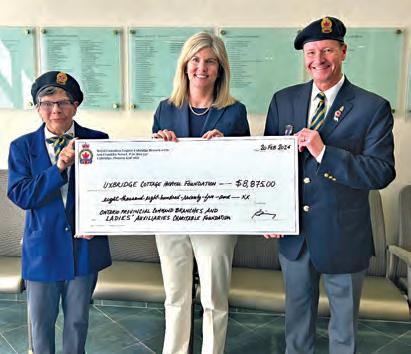
L.A. President Marion Low and President Peter Viney of Uxbridge, Ont., Branch present $8,875 to the Uxbridge Hospital Foundation, represented by executive director Michele Varela.
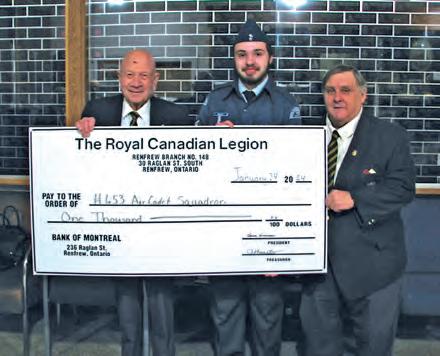
President
Bruce
and First Vice Greg

President Jeff Burns and Second Vice Susan Stevenson of Port Dalhousie Branch in St. Catharines, Ont., present $5,370 to Hospice Niagara, represented by care director Debbie Costa, support counsellor Alissa Davis and nurse Daniella Barichello.

Barry’s Bay, Ont., Branch presents $12,950 to St. Francis Valley Healthcare Foundation. Pictured are the hospital’s manager of health records Kim Stewart, Valley Manor care director Gail Yantha, Valley Manor CEO Trisha DesLaurier, Branch President Heather Poliquin, foundation board chair Cheryl Reid, board member Marie Finnerty and foundation executive director Erin Gienow.

Peggy Wiens of Maj. Andrew McKeever Branch in Listowel, Ont., presents $1,000 to the Salvation Army Food Bank, represented by co-ordinator Carolyn Saunders.
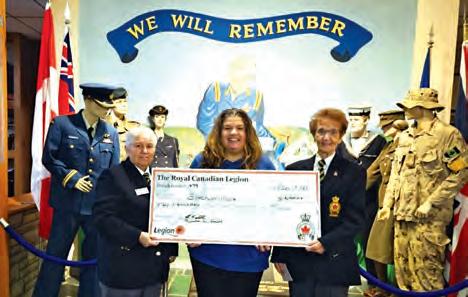
First Vice Toni Russell and President Elaine Hall of A.C. McCallum Branch in Niagara Falls, Ont., present $2,000 to Birchway House, Niagara, represented by Alicia MacMillan.

Walkerton, Ont., Branch presents $10,000 to the Walkerton and District Hospital Foundation.
At Limestone City Branch in Kingston, Ont., Kate Maloney from Quilts of Valour, Rideau Lakes Westport group, accompanied by Jason Poirier, presents a quilt to George Grant.
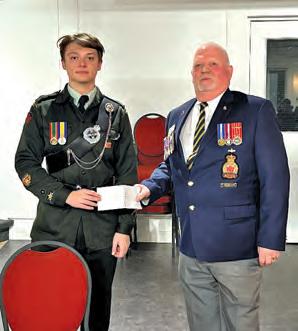
Service Officer Brian Budden of Highland Creek Branch in Scarborough, Ont., presents $2,000 to 2881 QOR (RCAC) Army cadet corps, represented by Regimental Sgt.-Maj. Brendan Tescione.

Newbury, Ont., Branch
President Rick Close presents $1,000 for the Newbury/ Wardsville Food Bank to Rev. Deb Dolbear-Van Bilsen.
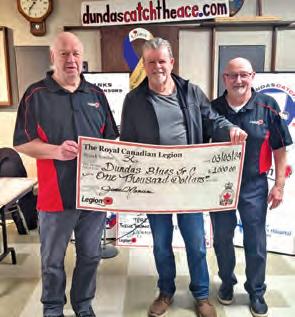
First Vice Bill Ralston and Third Vice Peter Howard of Valley City Branch in Dundas, Ont., present $1,000 to Jim McIntyre for the Dundas Blues Junior C hockey team. PETER HOWARD

Service Officer
William Graham of Col. Tom Kennedy Branch in Mississauga, Ont., presents $750 to Food Banks Mississauga CEO Meghan Nicholls.
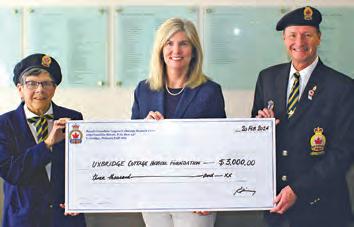
L.A. President Marion Low and Legion
President Peter Viney of Uxbridge, Ont., Branch present $3,000 to Uxbridge Hospital Foundation’s executive director, Michele Varela.
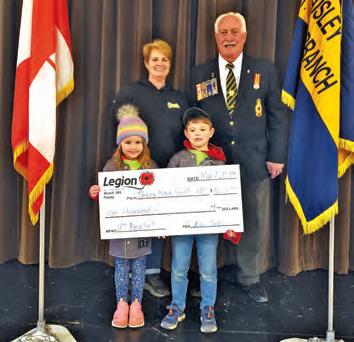
President Glen Hanley of Paisley, Ont., Branch presents $1,000 for Paisley Minor Sports U-7 baseball to manager Kim Craddock, Thea Gamble and Colton Hindman.
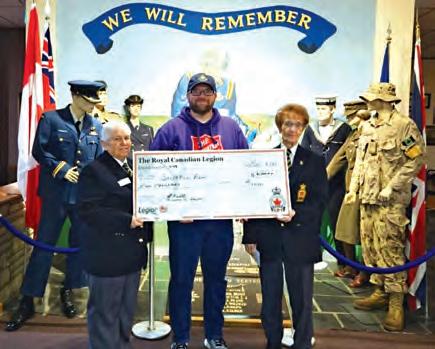
First Vice Toni Russell and President Elaine Hall of A.C. McCallum Branch in Niagara Falls, Ont., present $2,000 to the Salvation Army, represented by Pastor Mark Braye.
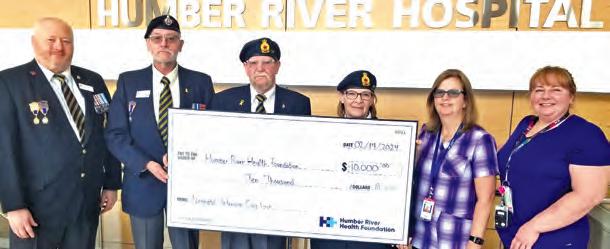
Wilson Branch in North York, Ont., donates $10,000 to the Humber River Health Foundation. From left are Branch President Randy Frewin, First Vice Brian Macdonald, Second Vice Terry Frewin, treasurer Mike Jones and two nurses.
Lancaster Branch in Saint John, N.B., has three WW II veterans who recently turned 100 years old.
Kay Stevens (left) served with the RCN, George Cooper with the Canadian Army and Winnie Rice with the British Army. H.E. WRIGHT
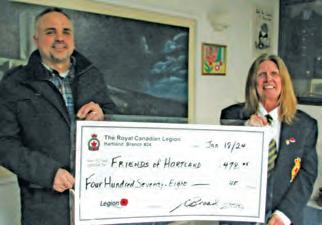
Treasurer Cheryl Broad of Hartland, N.B., Branch presents $478.45 to Lee Patterson, fundraising co-chair for the Friends of Hartland. The branch has donated $45,408.79 in Chase the Ace proceeds to the group over the past 7.5 years. GLORIA FOSTER

President Kathy Campbell of Peninsula Branch in Clifton Royal, N.B., (right) presents $1,000 to the MacDonald Consolidated Breakfast Program.

Sgt.-at-Arms Carolyn Clark of Peninsula Branch in Clifton Royal, N.B., presents $500 to the KV Food Bank at Foodland in Quispamsis, N.B., represented by Foodland employee Tammy Hatfield and foodbank volunteer Bryan Rignanes.

President James Hanley of St. George, N.B., Branch (right) presents $3,500 to Jim Landry of 250 (Saint John) Wing, RCAFA Inc. The contribution is for the new RCAF 100 Pennfield Ridge Air Force Memorial for 70 aviators killed at Pennfield Ridge during the Second World War. H.E. WRIGHT
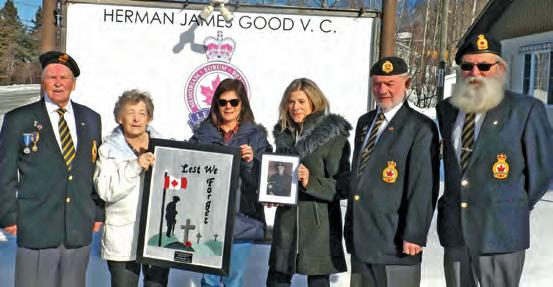
The Herman Good VC Branch in Bathurst, N.B., receives a painting from the Sealy family in memory of their late father Stanley Sealy, a Korean War veteran. Grant Smith (left), artist Shirley Rainville, Sealy daughters Patricia Branch and Elda Archibald, along with branch President Graham Wiseman and First Vice Danny Glendenning.
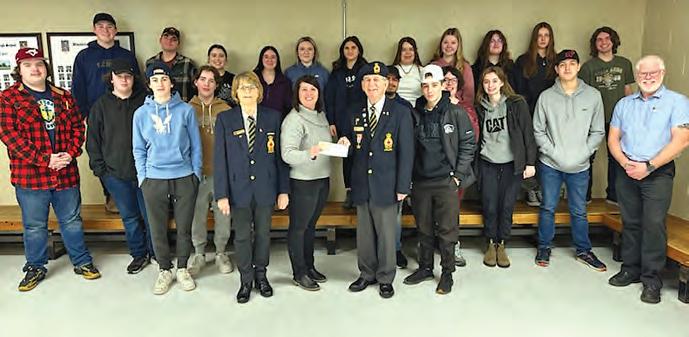
President Greg Matchett and secretary Valerie Stewart of Blackville, N.B., Branch present $500 from N.B. Command to students and teachers travelling to the 80th anniversary of D-Day in France. KATHERINE HENNESSY
L.A. President Joan Caverhill of Fredericton Branch presents President Don Swain with $1,000 toward a new kitchen.
First Vice Katherine Hennessy and secretary Pauline Underhill of Blackville, N.B., Branch present $2,000 to students and teachers going to France for the 80th anniversary of D-Day.

President Don Swain of Fredericton Branch accepts $1,200 from Eastern College instructor Lori Brown and her students.
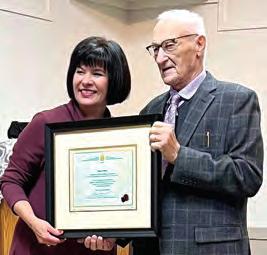
Second World War Veteran Roméo H. LeBlanc of Memramcook, N.B., is recognized by Veterans Affairs Minister Ginette Petitpas Taylor for his 100th birthday and 70 years as a Legion member.
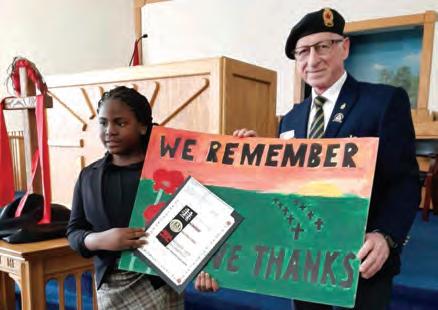
Jerome Ennis of Mount Pearl Park-Glendale Branch in Mount Pearl, N.L., presents student Moyinoluwa Owwatoyinbo of First Baptist School, St. John’s, N.L., with her winnings. Moyinoluwa achieved 1st place in the local poster contest and 2nd place at the provincial level.
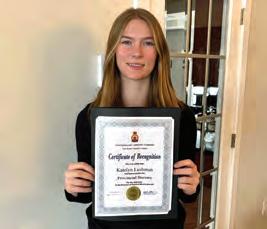
Newfoundland and Labrador Command present a provincial bursary to Katelyn Lushman of St. John’s. Katelyn is the greatgrandchild of Pte. Howard Leopold Morry, who served with ‘C’ Company, 1st Battalion, Royal Newfoundland Regiment.
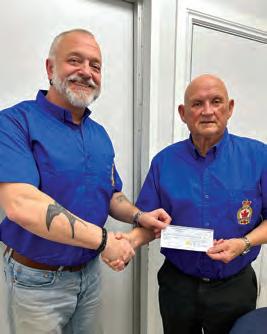
President Jim Hancock (left) of Botwood, N.L., Branch presents $500 to Arch Rice, chair of the Exploits Memorial Veterans Pavilion action committee.
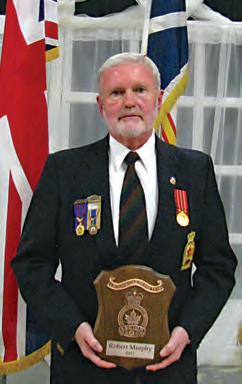
Robert Murphy of the Corner Brook, N.L., Branch receives the Legionnaire of the Year award.
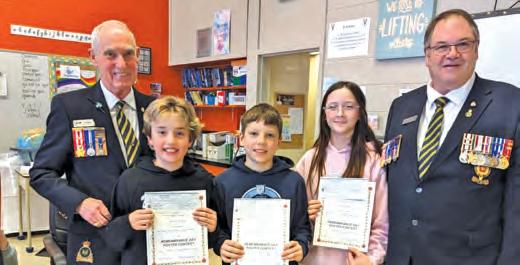
Third Vice Al Pardy (left) and First Vice David Broom from Pleasantville Branch in St. John’s, N.L., congratulate students of Vanier Elementary School who participated in the Legion National Youth Remembrance Contests.
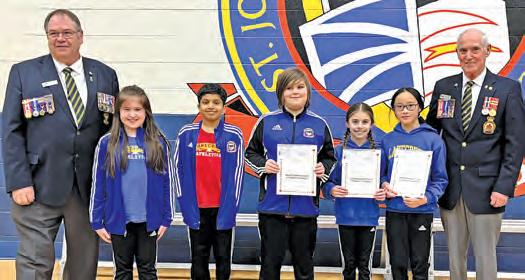
Pleasantville Branch in St. John’s, N.L., congratulates students from Lakecrest Independent School who entered the Legion National Youth Remembrance Contests. Represented are First Vice David Broom (left) and Third Vice Al Pardy.
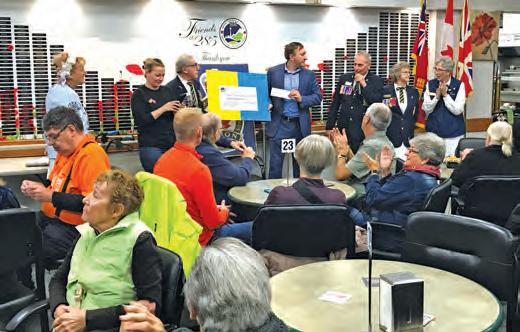
Centennial Branch in Calgary presents $5,000 to the Canadian Ukrainian Foundation’s board of directors. Branch representatives standing at the front are liaison officer Karen Davidson (left), chair Joey Bleviss, President Rob Danberger, L.A. President Wanda Bellefontaine and L.A. vice-president Sandy Neiley. SKYLINE NEWS WENDY DYPOLT
Send your photos and news of The Royal Canadian Legion in action in your community to your Command Correspondent. Each branch and ladies auxiliary is entitled to two photos in an issue. Any additional items will be published as news only. Material should be sent as soon as possible after an event. We do not accept material that will be more than a year old when published, or photos that are out of focus or lack contrast. The Command Correspondents are:
BRITISH COLUMBIA/YUKON: Graham Fox, 4199 Steede Ave., Port Alberni, BC V9Y 8B6, gra.fox@icloud.com
ALBERTA–NORTHWEST TERRITORIES: Bobbi McCoy, 2020 – 15 St. NW, Calgary, AB T2M 3N8, bobbi-mccoy@shaw.ca
SASKATCHEWAN: Tara Brown, 2267 Albert St., Regina, SK S4P 2V5, admin@sasklegion.ca
MANITOBA: George Romick, 320 Admiral Court, Thunder Bay, ON P7A 8B5, romickg@tbaytel.net
NORTHWESTERN ONTARIO: George Romick, 320 Admiral Court, Thunder Bay, ON P7A 8B5, romickg@tbaytel.net
ONTARIO: Roy Eaton, 567-294B North Channel Dr., Little Current, ON P0P 1K0, reaton@on.legion.ca
QUEBEC: Mary-Ann Latimer, 105-2727 rue St. Patrick, Montreal, QC H3K 0A8, msmarts@bell.net
NEW BRUNSWICK: Harold Wright, 2-299 Main St., Saint John, NB E2K 1J1, foulis20@gmail.com
NOVA SCOTIA/NUNAVUT: James Leadbeater, 4129 New Waterford Highway, New Victoria, NS B1H 5T4, james.leadbeater@hotmail.com
PRINCE EDWARD ISLAND: John Yeo, 657 Rte. 19, Meadow Bank, PE C0E 1H1, islander657@yahoo.ca
NEWFOUNDLAND AND LABRADOR: Brenda Slaney, Box 5745, St. John’s, NL A1C 5X3, bslaney@nfld.net
DOMINION COMMAND ZONES: EASTERN U.S. ZONE, Gord Bennett, 803-190 Cedar St., Cambridge, ON N1S 1W5, Captglbcd@aol.com; WESTERN U.S. ZONE, Douglas Lock, 1531 11th St., Manhattan Beach, CA 90266, douglock@fastmail.com
Submissions for the Honours and Awards page (Palm Leaf, MSM, MSA and Life Membership) should be sent directly to Michael A. Smith, Legion Magazine, 86 Aird Place, Kanata, ON K2L 0A1 or magazine@legion.ca.
DIGITAL PHOTOS—Photos submitted to Command Correspondents electronically must have a minimum width of 1,350 pixels, or 4.5 inches. Final resolution must be 300 dots per inch or greater. As a rough guideline, colour JPEGs would be between 0.5 megabytes (MB) and 1 MB.
PHOTO PRINTS—Glossy prints from a photofinishing lab are best because they do not contain the dot pattern that some printers produce. If possible, please submit digital photos electronically.
FRENCH INSERT—To receive a French insert of Legion Magazine content, please contact MagazineSubscriptions@legion.ca or call 613-591-3335.



50 years







Falls Br., Ont.
ONTARIO
MARILYN CLOUGH
Brechin-Mara Br.
HEARYHER SHIER
Brechin-Mara Br.
LEONARD SHIER
Brechin-Mara Br.
HUGH A. McCALLUM
Hensall Br.
TOMMY PRIDHAM
Edward MacDonald Br., Angus
SHARON COUSINS
Goderich Br.
CHRIS INGERSOLL
Lt.-Col. Harry Babcock, Br., Napanee
KATHY GARDNER
Lt.-Col. Harry Babcock, Br., Napanee
DEBBY FRASER
Forest Br.
REV. BRUCE FERGUSON

Uxbridge Br.
GLORIA ENG
Uxbridge Br.
JOHN VILLENEUVE
Richmond Br.
WILLIAM MONTGOMERY
Eastview Br., Vanier
WINSTON SPRATT
South Carleton Br., Manotick
SHARON COUSINS
Goderich Br.
LAURIN COLWELL
Millville Br.
Renfrew Br. SHERILL HODGSON
Moose Jaw Br.
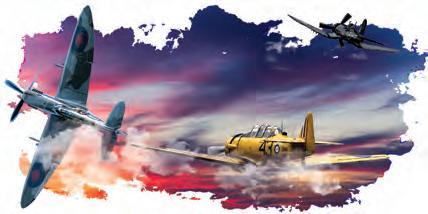

By J.L. Granatstein
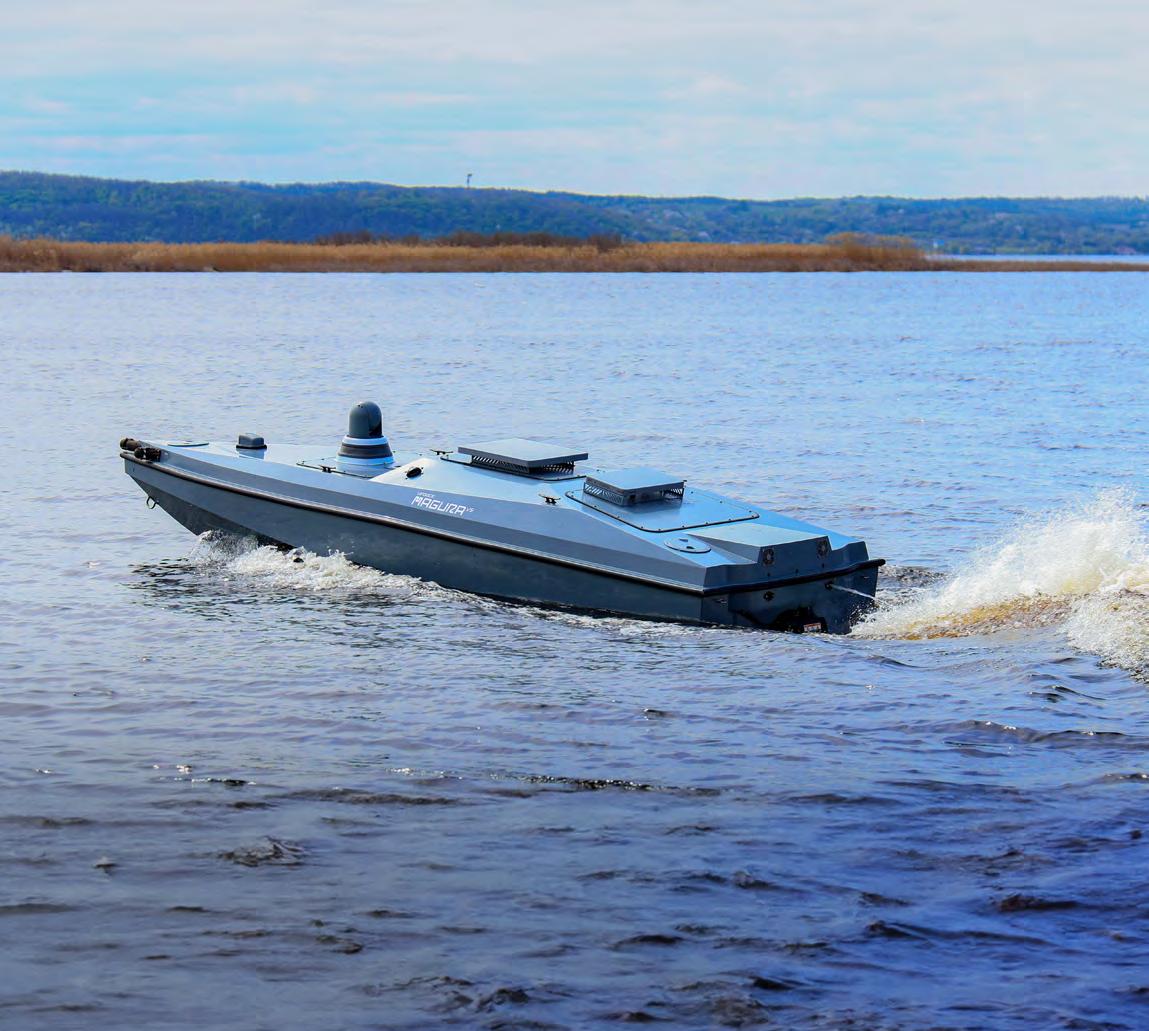
General Valery Zaluzhny, relieved of his command of the Ukrainian forces this pa st February, was blunt in remarks he made to The Economist in November 2023.
“Just like in the First World War we have reached the level of technology that puts us into a stalemate,” he said. “There will most likely be no deep and beautiful breakthrough.”
What was the problem affecting both his troops and those of the Russians? Modern technology, including the expansive use of drones and the ability to jam them, and precision weapons were preventing troops from breaching enemy lines.
“We need to ride the power embedded in new technologies,” he said.
Drones had changed the battle space, Zaluzhny correctly believed, and they were present in the thousands in both the Uk rainian and Russian arsenals. In September 2023, Ukraine was using about 10,000 a month; by December, the soldiers in
the field were employing 50,000 drones of all types. The government’s aim was to have one million drones on hand by the end of 2024.
For its part, Moscow claimed to be producing 300,000 drones a month and it was also importing drones from Iran—paid for in gold. How the Russians were building so many, given their shortage of computer chips, was unclear, though holes in the West’s sanctions and Chinese exports were likely responsible. (One media source claimed that Canadian components were found in a downed Russian drone.) And Moscow’s drones weren’t all inexpensive—its Lancets, with a purported range of 40 kilometres, cost an estimated US$35,000 each.
Russian forces used their drones to attack Ukrainian entrenchments and dugouts at the front, clearing the way for infantry assaults. They also used them to attack civilian sites such as apartment buildings, hotels and markets—war crimes in a war being waged in many illegal ways.
The Ukrainians, by and large, were more discreet in employment of their weaponry. They used so-called “kamikaze” loitering munitions, which can fly above the battleground until a suitable target—a tank or armoured personnel carrier, for instance— appears, then crash into it and explode, destroying both the drone and wrecking or disabling whatever it hits. These firstperson view drones, controlled by operators from miles away, can also spy a tank with its hatch open, and drop a small bomb into it, killing its crew. It can then return to its base and be used again the next day. Drone attacks on armour and artillery were, the Ukrainian military claimed, outpacing the Russian ability to produce replacements, and killing or wounding experienced soldiers in large numbers. Russia had suffered nearly 480,000 casualties in Ukraine by May 2024.
The Ukrainians have also developed seaborne drones that can attack naval targets. These drones, resembling small speedboats, can sink large vessels such as cor vettes and submarines, and their successes effectively made the western Black Sea a no-go area for the Russian navy. This was important because it allowed Ukraine to safely resume grain exports, a critical source of revenue for Kyiv and an important food source for African nations.
And, as Ukrainian drones became more effective and capable of longer ranges, Kyiv launched attacks on Moscow, St. Petersburg and oil production and storage sites throughout Russia, the latter significantly impacting the major oil producer and exporter. Ukrainian attacks in January 2024 cut Russia’s gas exports by 37 per cent and diesel exports by 23 per cent, worsening Moscow’s already weak financial position. The destruction of the one large refinery on the Black Sea coast also hampered operations of what remained of the Russian fleet there.
Both sides also relied on electronic countermeasures to stop such attacks (and the anti-drone sites were, of course, prime targets). Each country regularly claimed to have identified and destroyed large numbers of invading drones. On Feb. 7, for example, the Ukrainians said they shot down 15 of 20 drones launched at them and used their electronic warfare systems to seize control of an incoming drone and safely land it.
At the same time, the use of drones in reconnaissance was massively impacting the battlefield. Airborne surveillance pinpointed the location of enemy targets, thus increasing the accuracy of missile strikes. The Ukrainians relied on HIMARS—High Mobility Artillery Rocket Systems—supplied by the United States and some other NATO countries. HIMARS were expensive, but the system’s missiles, launched from a truck, are extremely accurate (within a metre from 300 kilometres away), and drone reconnaissance meant that they were unlikely to miss their target.
Moreover, and even more importantly, recce by drones ostensibly prevented any large massing of weaponry and/or troops, thereby preventing surprise attacks. This made last summer’s Ukrainian offensive unsuccessful. But, it also forced the Russians into using so-called “meat assaults,” in which they sent small groups of infantry, sometimes supported by armour, repeatedly into Ukrainian defences until, aided by drone attacks on trenches, they could force a withdrawal of a few hundred metres. These assaults were extraordinarily costly in soldiers and tanks, but the Russians were willing to accept such losses.
The manoeuvrability of a MAGURA V5, a Ukrainian unmanned surface vehicle, is demonstrated in April 2024. Ukraine has used such drones to attack Russian vessels.
WHAT’S NOW CLEAR TO OBSERVERS IN EVERY MILITARY, IS THAT DRONES HAVE CHANGED WARFARE.
What’s now clear to observers in every military, is that drones have changed warfare. Artillery remains decisive in battles, but drones might be on the verge of overcoming its dominance. Currently, the technology is running ahead of countermeasures that aim to defeat it.
Still, both sides in the Russo-Ukrainian War are trying to advance the development of their anti-drone defences; so, too, are the Americans, the Chinese and every country worrying about how its soldiers might fare in future conflicts.
For the sake of their men and women in uniform, Canadians should hope that Ottawa is doing the same. L
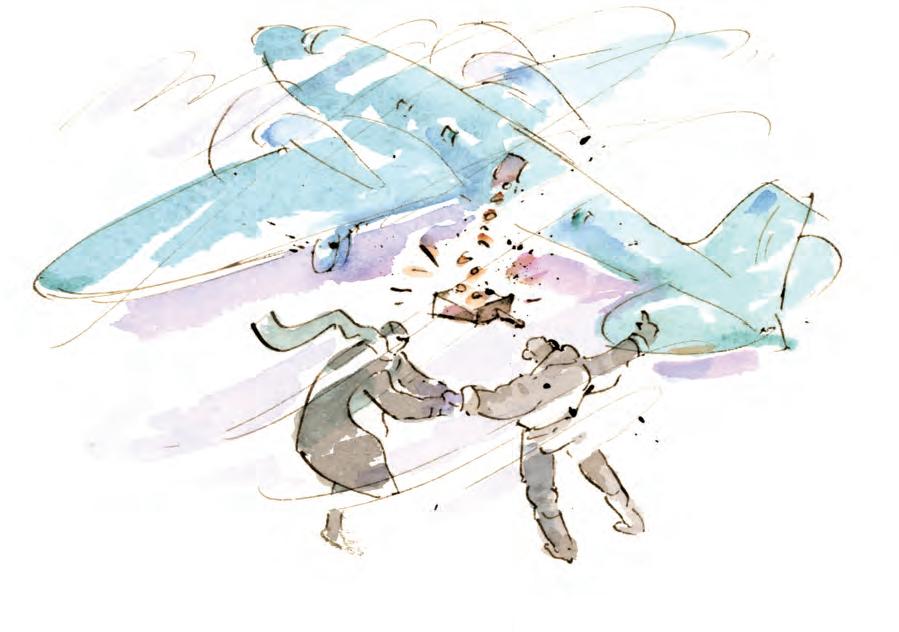
Inthe 1960s, a transport plane was trying to land in Newfoundland at Canadian Forces Base Gander as rough weather closed in. Blowing snow wiped out visibility. Watchers down below could hear the aircraft as it made a ground-controlled approach, hoping to get close enough for the pilot to see the end of the runway and land. The plane finally touched down, to the relief of both onlookers and, of course, the passengers. One grizzled flight sergeant stepped off the aircraft and was greeted by the padre, who commented that it must have been a stressful experience.
“It sure was, padre,” replied the sergeant. “I was so nervous I almost did something religious.”
The padre looked at him suspiciously and asked what that might be.
“Why, I almost took up a collection!”
Mel Goddard of Blenheim, Ont., says the recent Legion Magazine article about the Golden Hawks aerobatic team (“Artifacts,” January/February), reminded him of his own encounter with the flyers.
In the mid-1960s, Goddard was a leading aircraftman (LAC) in Chatham, N.B., where the Hawks were based. One day, he and another LAC, Jack Whittle, were servicing some visiting T-Birds (T-33 jets).
“Usually at about 3 p.m., the Hawks would take off to do their practice routines. It was not unusual to look up and see two ‘Swords’ approaching each other at about 30 feet (10 metres) off the deck and passing each other right overhead.
“One day, an aircraft came too low, and the downwash blew Whittle off the wing, while he was refueling a T-Bird. The fuel nozzles on the bowsers take a moment to shut off, and he got drenched in fuel.”
Dripping with fuel, Whittle stormed off to the wing commander’s office.
“I understand that he gave the wingco holy hell. The next day, the Hawks ‘played’ over the field away from us.”
> Do you have a funny and true tale from Canada’s military culture? Send your story to magazine@legion.ca
Being able to jury-rig solutions to problems is a valuable military skill. For ex ample, when the Royal Canadian Air Force first began to operate jets, no one had thought about noise levels or protective devices for ground crews.
During the Second World War, HMCS Stadacona was the Royal Canadian Navy’s barracks in Halifax. It saw a constant stream of sailors passing through on their way to and from ships. As there was no training going on there, petty officers tended to look upon these sailors as handy labour sources for any job they could think of, from picking up trash and guarding mental patients to digging ditches.
One sailor, however, was determined to avoid being dragooned into anything like that. Every morning, he would take a folded piece of paper in his hand and stride purposefully along the corridors of the base, looking like someone in the process of delivering a signal to someone. It worked like a charm. Since he looked like he was doing something meaningful, people assumed he was. Amazingly, his ruse worked for almost a month, until a suspicious petty officer demanded to see the signal. Luckily, the sailor’s posting came through the nex t day.
Lilliput was a British humour magazine published from 1937 to 1960. During the war, it produced the following breakdown of how the average soldier spent his time:
33.3 per cent—Sleeping 20 per cent—Polishing, cleaning kit
16.6 per cent—Drilling 8.2 per cent—Standing in line
4.5 per cent—Eating
4.15 per cent—Drinking beer
2.00 per cent—Going out with girls, more if Canadian or Polish 1.2 per cent—Writing letters
0.0014 per cent—Shaving 0.00005 per cent—Fighting
The magazine also claimed the soldier sewed on 300 buttons using 150 metres of thread. And in an average day, he swore 144 times, stamped his feet 200 times and saluted 84 times.
The article offered no information on how it collected the data.
by Malcolm Jones
As more people reported hearing problems, a search began for a solution. Ear plugs were found impractical and the radio headsets of the day didn’t muffle the damaging, high-frequency sounds. A senior engineering officer mused that some sort of lining in the earphones might work. But what kind?
He happened to be absently window shopping one day while considering the problem when he found the solution hanging in the window of a women’s clothing shop. It was a padded bra with small foam inserts in the cups. He rushed in, somewhat embarrassed, and bought the smallest set. When fitted into specially formed earpieces, the inserts became prototype ear protectors.
“IT SURE WAS, PADRE,” REPLIED THE SERGEANT. “ I WAS SO NERVOUS I ALMOST DID SOMETHING RELIGIOUS.”
The sailing events of the 1976 Montreal Summer Olympics were held on Lake Ontario off Kingston, Ont., and the RCN kept a destroyer offshore as part of the security arrangements. The ship’s boats were kept busy shuttling to and from shore until one of the vessels sprung a leak when a gasket on the propeller shaft gave out. A replacement would have to come from the coast, and no one knew how long the boat would be out of service. So, the engineers looked for a faster solution.
“What does this damn gasket look like?” one asked.
“Kinda like a hockey puck,” a seaman replied.
“Go get a couple of pucks and see what we can do.”
Sure enough, they found that a puck could be ground to fit and drilled to take the prop shaft. The boat was back running within hours. L
By Mark Zuehlke
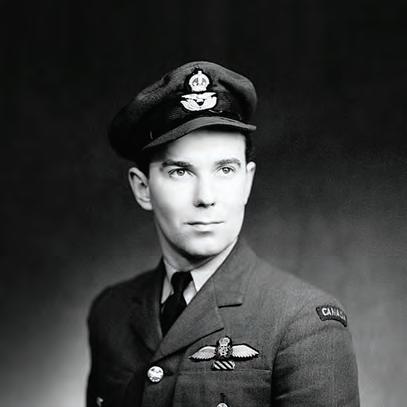

“I
knew I got him. I saw hits on the car and I saw it start to go off the road.”
—Charles Fox

the late afternoon of July 17, 1944, Royal Canadian Air Force Flight Lieutenant Charles (Charley) Fox’s Spitfire took off from B4 airstrip outside Bény-sur-Mer in France’s Normandy region. Since June 18, Fox’s 412 Squadron, RCAF, had been operating from this square-mesh track forward operating strip situated a short distance inland from Juno Be ach. With a wingman, Fox was flying an armed reconnaissance sortie in search of ta rgets of opportunity.
The 24-year-old from Guelph, Ont., had en listed in October 1940, and became a fighter pilot in May 1943. He deployed overseas that August. In January 1944, he joined 412 Squadron and, on D-Day, he flew three sorties over the beaches. Fox’s squadron specialized in ground attacks, and he was considered one of its most accurate marksmen.
Just outside the village of Sainte-Foy-deMontgommery, Fox spotted a Horch convertible. “I saw this staff car coming along between a line of trees on a main road. I did a diving, curving attack down and
I probably started firing at about 300 ya rds. I timed the shots so that I was able to fire and get him as the car came through a small opening in the trees. I got him on that pass. We were moving pretty fast, but I knew I got him. I saw hits on the car and I saw it start to curve and go off the road.”
Fox and his wingman didn’t immediately realize their attack had just so critically wounded Army Group B commander Erwin Rommel that his military career was over.
Reports late that evening indicating Rommel had been severely injured by Allied aircraft led Fox and his squadron intelligence officer to conclude the “Desert Fox” had been in the wrecked staff car. Fox noted the information in his logbook. By next morning, four other Allied pilots were claiming credit. In 2004, a detailed assessment of RCAF and German military records confirmed the aircraft involved was a Spitfire with the times, location, and sortie profiles matching Fox’s account.
At the end of an operational tour in January 1945 that had entailed 224 sorties, Fox was credited with destroying or da maging 22 locomotives, 153 vehicles in total and four aircraft. Along the way, he had been awarded a Distinguished Flying Cross and a bar. Fox died in a car accident on Oct. 18, 2008, at age 88. L

OnJuly 17, 1944, Generalfeldmarschall
Erwin Rommel left Army Group B headquarters at La Roche-Guyon on the Seine River well east of the Normandy battlegrounds in France to personally inspect preparations of 1 SS Panzer Division positions on Bourguébus Ridge aimed at blocking the Allied advance from Caen toward Falaise. Although an aide reportedly cautioned him against using main roads and suggested travelling in a standard military command car rather than his Horch convertible, Rommel ignored the advice. Daylight movement of German vehicles anywhere on the roads of Normandy risked attack by the scores of prowling Allied fighters. Rommel must have known this, as the Norman roadways were littered with destroyed columns of German trucks, tanks and other military vehicles. Just outside the village of Sainte-Foy, an aircraft spotter sitting on the back of Rommel’s car shouted a warning that two Spitfires were sweeping toward them. Rommel ordered the driver to increase speed and to swerve onto an approaching side road. There was no time for evasive manoeuvre, however, as fire from the lead Spitfire ripped into the car. The car overturned and Rommel was thrown out. He suffered multiple skull fractures and his face was spattered with glass fragments.
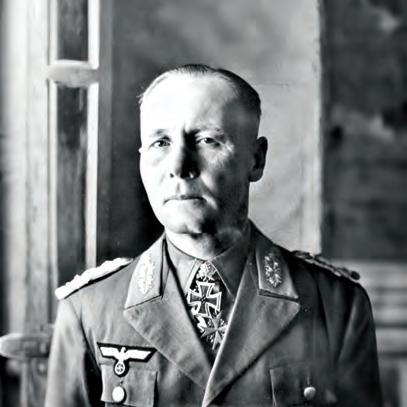

Rescuers carried Rommel into the village of Sainte-Foy where a pharmacist dressed his wounds. He was then moved to a Luftwaffe hospital in Bernay. After his condition stabilized, Rommel was evacuated to Germany for extensive treatment and recuperation. Rommel had only just arrived in Germany when a group of German Wehrmacht officer corps conspirators attempted to assassinate Hitler on July 20. Rommel knew of the plot, but reportedly opposed the plan to kill Hitler. Instead, he wanted him arrested and tried. Some historians have argued that had he not been wounded, Rommel could have contributed sufficient credibility to the plot that it might have succeeded. This seems a dubious assertion at best.
AS FIRE FROM THE LEAD SPITFIRE RIPPED INTO THE CAR, IT OVERTURNED AND ROMMEL WAS THROWN OUT.
On Oct. 14, 1944, Rommel was convalescing at home in Herrlingen, Germany, when two generals came for lunch ostensibly to discuss a future posting. Instead, he was accused of treason. The two officers gave him cyanide pills and advised that Hitler invited him to commit suicide and, if he did so, would take no action against his family. Because the “Desert Fox” was highly esteemed throughout Germany, the cause of his death was covered up and the wounds suffered in the air attack were blamed. L
“I
shall have to revise my lectures…. No man can be alive with wounds like that.”
—Albrecht von Graefe upon examining Rommel in Germany
Muggins was an expert fundraiser, collecting more than $21,000 for veterans’ associations and the Red Cross during the two world wars (about $400,000 today). He was also a highly decorated volunteer, receiving eight medals and international acclaim for his efforts. Most incredibly, Muggins was, in fact, a dog.
Boasting a fluffy white coat, this purebred Spitz was a staple in downtown Victoria during the 1910s. When he died of pneumonia in 1920 at the age of seven, he was taken to a skilled taxidermist who kept his figure intact, in tribute to his war efforts. During WW II, his mount was displayed at a couple of locations in Victoria to raise money once again for the war effort. By the mid-1950s, however, Muggins was largely forgotten and had been shuffled between so many hands that by the time historians tried to locate his likeness, Muggins had disappeared. Until recently. Discovered in the shed of a resident in Victoria’s View Royal suburb, Muggins’ mount was restored to its former glory and is set to be displayed at B.C.’s
Government House, the official residence of the province’s lieutenant governor, this summer.
Muggins was born in 1913 into a wealthy household. Passed from famous Calgary entrepreneur and philanthropist William Roper Hull to members in the Hull family, Muggins finally found himself with Beatrice Woodward, a British woman living in Victoria with a fierce commitment to activism and community. Though experts can only speculate how Woodward was able to train Muggins so well, the dog soon became part of the essential framework for Red Cross WW I donations. With two Red Cross tins strapped on his back, Muggins


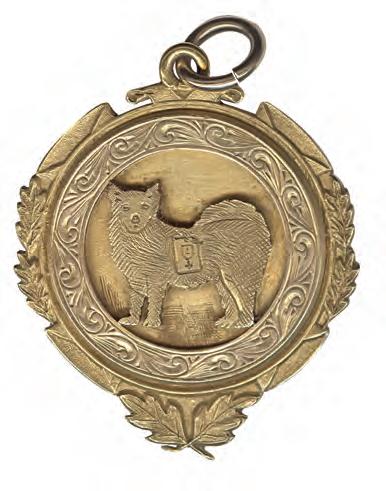
Empress Hotel and at the wharf, seeking donations from locals with the swift wag of his tail.
Dedicated to the cause, Muggins sometimes went to work alone, boarding ferries and freightliners to nudge gamblers and visitors for a few coins. Raising thousands of dollars for the Red Cross, Muggins became a famed mascot, meeting the Prince of Wales and famous Canadian general Arthur Currie.
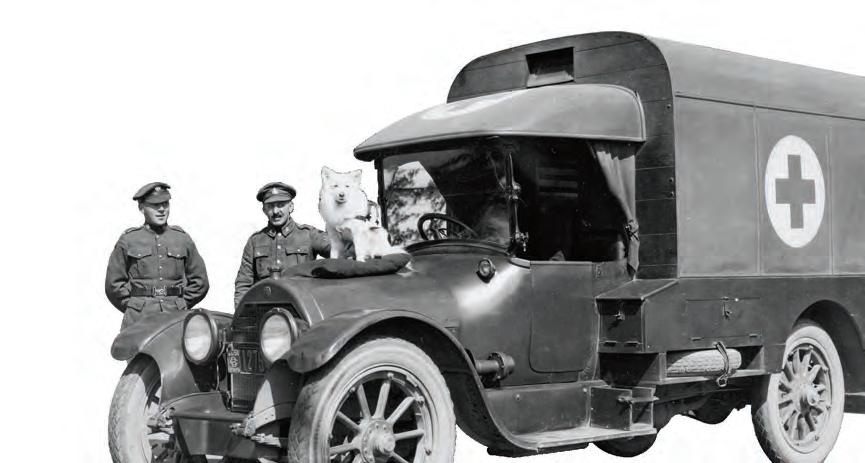
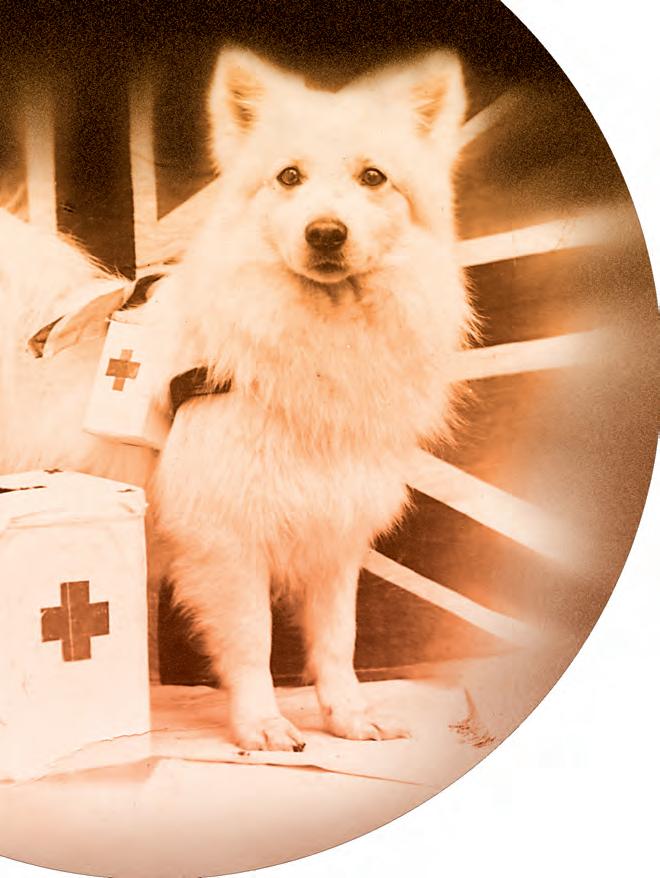
Muggins the fundraising dog appeared on postcards (centre and opposite bottom), was awarded medals and even posed for a photo with General Arthur Currie in 1919.

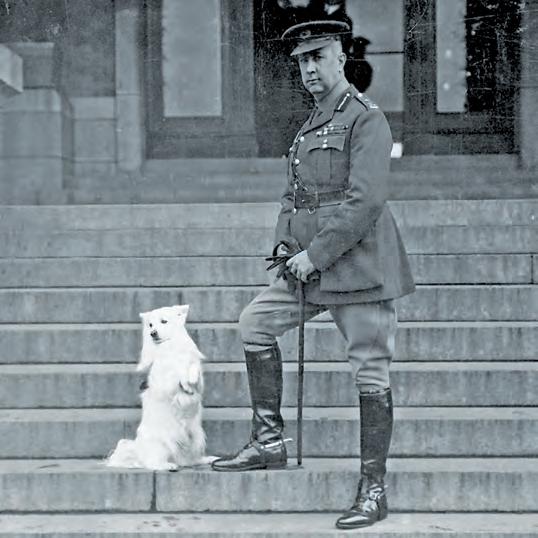
The dog soon became part of the essential framework for Red Cross WW I donations.
According to Grant HayterMenzies, author of Muggins: The Life and Afterlife of a Canadian Canine War Hero, the dog was known to show visible signs of distress when he felt like his tins weren’t heavy enough and didn’t have enough coins. “He was a war hero even though he never went on the battlefield,” he said.
While drafting a Red Cross history project, retired military police officer Paul Jenkins became fascinated with Muggins’ life, but had little hope of locating the dog’s missing mount. Still, the Red Cross
published appeals calling for any information on the pup’s whereabouts. And one day, they got a lead to that shed in View Royal.
Hayter-Menzies funded the mount’s restoration with money from his book’s royalties and Muggins’ restored figure now lives in Jenkins’ workshop in a plexiglass case. While Muggins will be displayed at Government House temporarily this summer, Jenkins is still trying to find a forever home for it.
To Jenkins, the importance of Muggins can’t be overstated: “Muggins was about bringing hope in a polarized world.” L
BY THE NUMBERS

$400,000
Approximate value of donations in current dollars raised by Muggins
$21,000
Actual total of donations collected by Muggins
8
Number of medals awarded to Muggins
4
Number of main locations where Muggins collected donations


By Don Gillmor
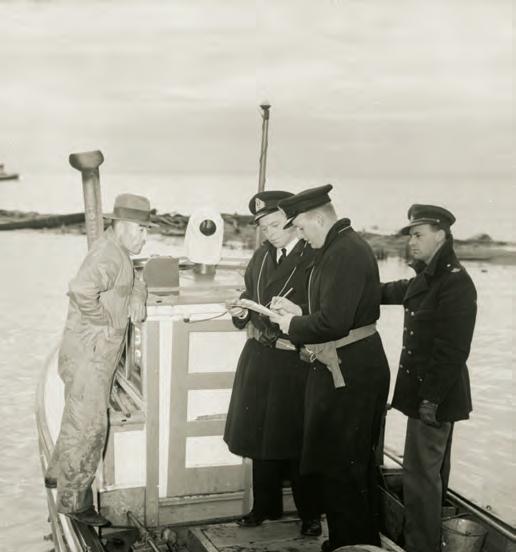

THE COUNTRY BANNED HUNDREDS OF PUBLICATIONS, INTERNED THOUSANDS OF CIVILIANS AND CONFISCATED THEIR PROPERTY
where it was once more used to censor newspapers and periodicals and ban more than 30 religious, political and cultural organizations. What is most remembered, however, are the tens of thousands of Canadians of German, Italian and Japanese descent who were interned and had their property confiscated; some were even deported after the war.
TRoyal Canadian Navy officers question a Japanese Canadian fisherman near Esquimalt, B.C., in December 1941.
he War Measures Act went into law on Aug. 4, 1914, allowing the cabinet to bypass the House of Commons and the Senate and to rule by decree in the event of “war, invasion or insurrection, real or apprehended.”
It is the last word in this definition that caused the most problems. If cabinet perceived anyone or anything a threat, it could act unilaterally and outside the law and the central pillars of democracy. The government could censor publications, arrest, detain and deport individuals without trial, control trade and seize private property.



And it did. The country was faced with the horrors of the first modern war, and subsequently banned hundreds of publications, interned thousands of civilians and confiscated their property.
The modern version was Prime Minister Pierre Trudeau’s use of the War Measures Act in 1970 to deal with the FLQ crisis. That year, the Front de libération du Québec kidnapped British trade commissioner James Cross, and a few days later they kidnapped Pierre Laporte, Quebec’s labour minister. Premier Robert Bourassa asked Trudeau to invoke the War Measures Act and on Oct. 16, it was proclaimed. That morning, hundreds of people were arrested.
The FLQ had been adept in projecting itself as a large organization, and it garnered a lot of sympathy among nationalists. But when Laporte’s body was found in a trunk, that understanding vanished. Years after the so-called October Crisis, it was ascertained that the FLQ had only about 35 members.
population was controversial, and Trudeau announced he would amend it, but it didn’t happen during his tenure.
In 1988, four years after Trudeau left office, the War Measures Act was replaced by the Emergencies Act. The crucial difference between the two is that cabinet can no longer act on its own and that any action is subject to the Bill of Rights and the Charter of Rights and Freedoms. It also prescribed compensation for those affected by the act. That same year, Prime Minister Brian Mulroney apologized to Japanese Canadians for their treatment during the war and awarded compensation of $21,000 to each survivor. Since its inception, the War Measures Act courted controversy, because those powers could so easily be abused, all democratic safeguards ignored. The Emergencies Act has proved only slightly less controversial.

The War Measures Act was used again in 1939,
Invoking the War Measures Act to suspend the rights and civil liberties of a
In February 2022, Prime Minister Justin Trudeau invoked it after anti-vaccine protesters had occupied Ottawa for several weeks. It was the first time it had been used. The protesters were arrested or escorted out of town. But the move resulted in an inquiry on whether it was necessary and whether the law should be changed. L
Think about the things you loved to do that are dif cult today — going for a walk or just sitting comfortably while reading a book. And remember the last time you got a great night’s sleep?
As we get older, health issues or even everyday aches, pains and stress can prevent us from enjoying life.
So what’s keeping you from having a better quality of life?
Check all the conditions that apply to you.
Personal Checklist:

A Safe Step Tub can help increase mobility, boost energy and improve sleep.

It’s got everything you should look for in a walk-in tub:
• Heated Seat – Providing soothing warmth from start to nish.
Lower Back Poor
Then read on to learn how a Safe Step Walk-In Tub can help. Feel better, sleep better, live better
A Safe Step Walk-In Tub lets you indulge in a warm, relaxing bath that can help relieve life’s aches, pains and worries.
• MicroSoothe® Air Therapy System – helps oxygenate and soften skin while offering therapeutic bene ts.
• Pain-relieving therapy – Hydro massage jets target sore muscles and joints.
• Safety features – Low step-in, grab bars and more can help you bathe safely and maintain your independence.
• Free Shower Package – shower while seated or standing.