Seed treatments are designed to provide added protection for your crop when it is most vulnerable. But what sounds like a very simple function is actually a complex process with benefits that go well beyond the seedling stage.
Not only do seed treatments take years of research and development, they require a collaborative team dedicated to providing innovative solutions to growers’ greatest challenges. To stay ahead of insect and disease pressure we seek to better understand pest populations through extensive data analysis and incorporating innovative technologies that better harness the power of advantageous soil microbes.
Pooling resources from around the globe, the Bayer SeedGrowth™ team looks well beyond product efficacy to examine how seed treatment products work as a system. Our handson approach considers customer needs, the regulatory environment, conditional stability and pest dynamics to ensure a consistent, reliable performance.
Whether you have a question or need some friendly advice, the Bayer SeedGrowth team is here to help you with all your seed and soil- related concerns with information on products, seed coatings, and equipment. Our goal is to help your seed emerge healthy and strong enough to achieve its full yield potential at harvest no matter what kind of seasonal stresses you encounter.
All the best for a successful 2019 season.
Krista Anderson SeedGrowth Development Manager, Bayer
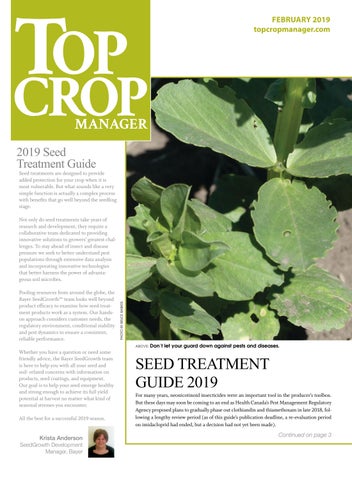
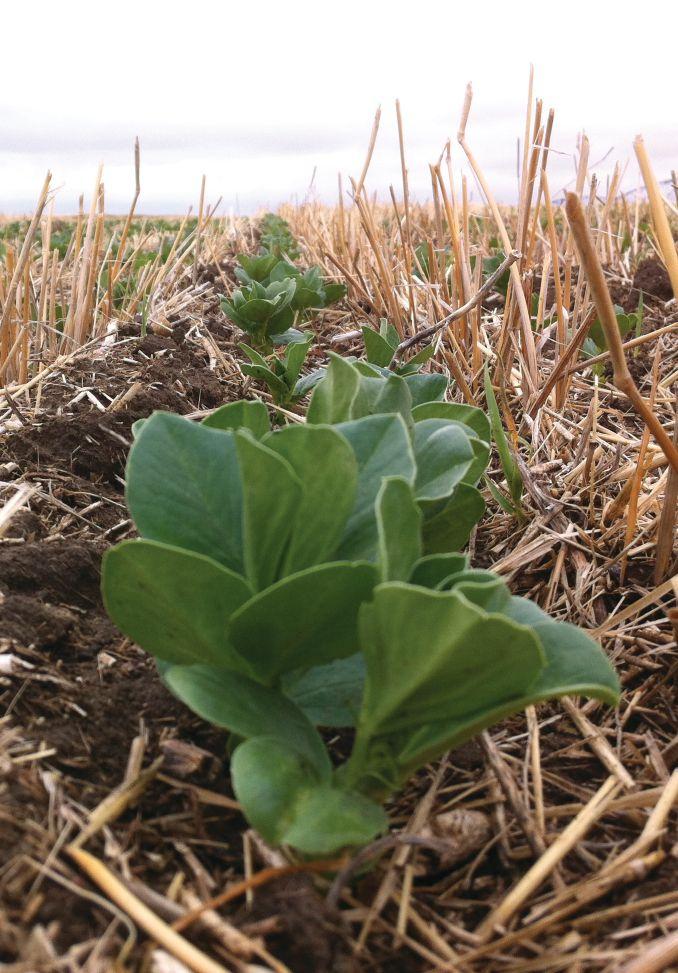
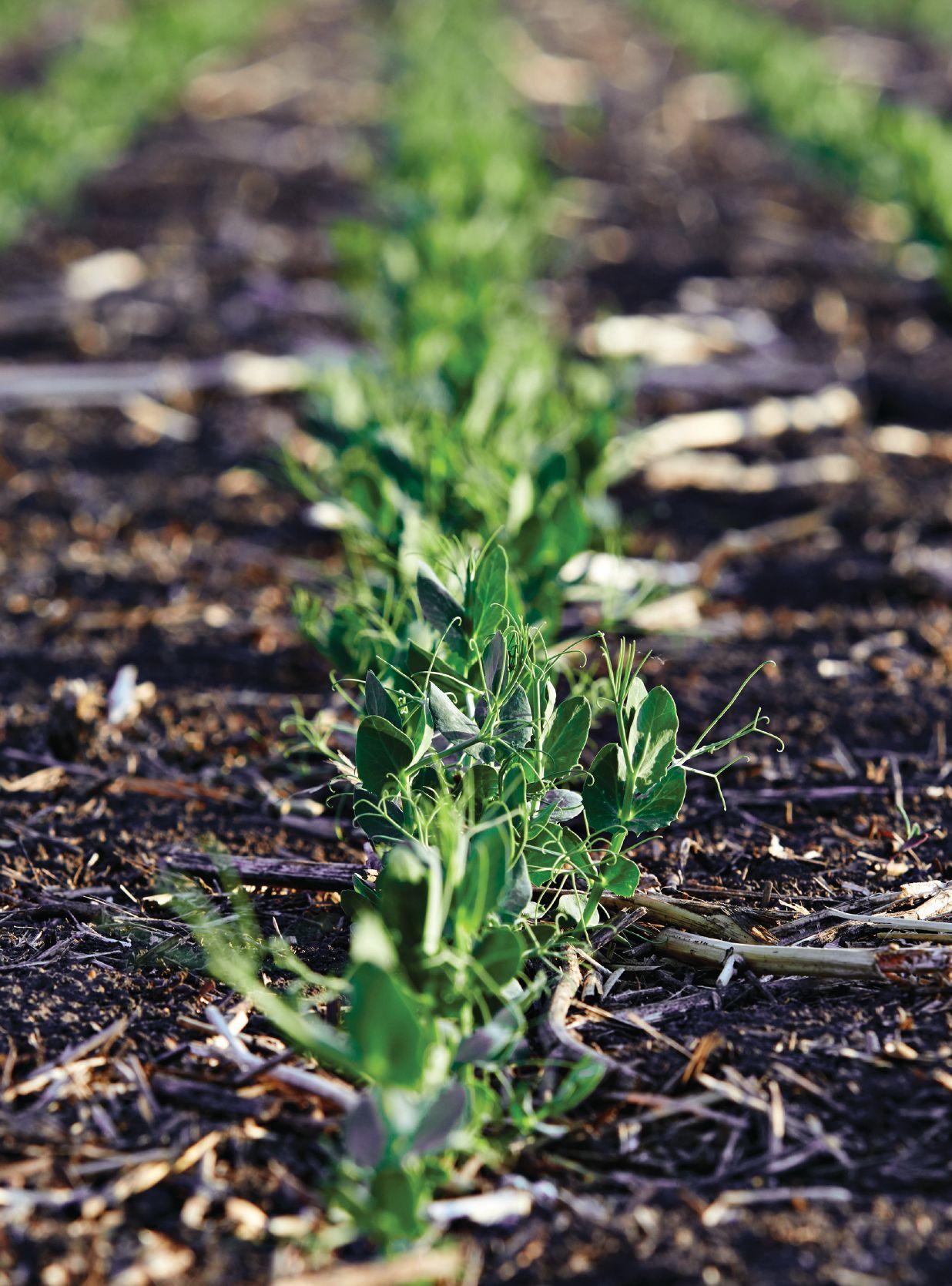
ABOVE: Don’t let your guard down against pests and diseases.
SEED TREATMENT
GUIDE 2019
For many years, neonicotinoid insecticides were an important tool in the producer’s toolbox. But these days may soon be coming to an end as Health Canada’s Pest Management Regulatory Agency proposed plans to gradually phase out clothiandin and thiamethoxam in late 2018, following a lengthy review period (as of this guide’s publication deadline, a re-evaluation period on imidacloprid had ended, but a decision had not yet been made).
Continued on page 3
PHOTO BY BRUCE BARKER.
Seed Treatment Guide 2019
Top Crop Manager would like to thank Bayer for sponsoring this year’s Seed Treatment Guide. Through their supportwe are able to publish this information guide to assist our readers.
We are grateful to the numerous weed management specialists for their assistance and helpful suggestions contained in Top Crop Manager’s Seed Treatment Guide.
Continued from page 1
Published as part of Top Crop Manager, February 2019, by: Annex Publishing & Printing Inc.
PO Box 530, 105 Donly Drive South, Simcoe, ON N3Y 4N5 Canada Tel: (519) 429-3966 Fax: (519) 429-3094
EDITOR Stefanie Croley
ASSOCIATE EDITOR Stephanie Gordon
WESTERN
Bruce Barker
ASSOCIATE
Michelle Allison
VP PRODUCTION/GROUP
Diane Kleer
Charts compiled by Mike Strang and Jennifer Strang
Despite the uncertainty and frustration that comes with these changes, Canadian growers still have access to a variety of seed treatments to help grow healthy, strong and profitable crops, and it’s up to stakeholders in all facets of the agriculture industry to make mindful decisions about the tools used each growing season. To simplify this process, Top Crop Manager is pleased to present the 2019 Seed Treatment Guide, a handy reference tool listing products registered (at publication time) for cereal, corn, soybean, pulse and canola crops.
In this year’s guide, we’ve also included two articles that demonstrate the importance of a variety of tools in the toolbox, including seed treatment. You can read about new potential and recommendations for growing red lentils and an update on control methods for pea leaf weevil – a serious pest in pea and fababeans – on page 6.
As always, we strive to make the tables in this guide as concise and user-friendly as possible. With that said, however, this guide is adapted and compiled from crop protection resources and companies, and is not a definitive text. Growers should always double-check provincial guides and product labels, and consult a professional, to avoid errors.
Growers have access to a variety of tools to grow healthy, strong and profitable crops.
PHOTO BY TOP CROP MANAGER
CLEARFIELD RED LENTIL PRODUCTION IN ALBERTA
If you can grow peas, you can grow lentils.
by Bruce Barker
When the price of red lentils rose to 40 cents per pound, Alberta growers rushed into planting around 500,000 acres of lentils in 2016 and 2017. While prices declined in 2018 because of the Indian tariffs, grower interest in lentil remained high – about 420,000 acres were still grown in 2018.
Jenn Walker, research manager with Alberta Pulse Growers says lentil performance was variable across the province in 2018, similar to other pulse crops. Yields in general were below average, but varied from area to area depending on the spotty rainfall that fell across Alberta.
“We are seeing growers in non-traditional areas like the Peace and in the Black soils experimenting with lentils. In the Black soils, we’re seeing more success along the eastern side of Alberta than the central area,” Walker says.
Robyne Bowness, a pulse specialist with Alberta Agriculture and Forestry has been researching Clearfield red lentil production practices in Alberta. Based on four years of research, she has developed a recipe for success for growing Alberta lentils.
“Overall, we have had good success and surprising results from some areas. I was very surprised to see good performance at Falher in the Peace region, likely because of the longer daylight hours,” Bowness says.
Field selection
Pick fields with lighter, sandy loam to loam soils that are well drained. Low-lying fields are not a good choice as lentils don’t like to have their feet wet and cannot tolerate excess moisture. They don’t
tolerate salinity, either. Red lentils are quite drought tolerant and can withstand higher temperatures during the growing season than other crops.
Avoid fields with high nitrogen levels that will reduce nodulation and nitrogen fixation. Because of lack of in-crop control options, choose fields relatively free of perennial weeds like Canada thistle, sow thistle, dandelion and quackgrass.
Seeding
Red lentils can tolerate up to 4 C of frost, so they can be seeded early. Seed at a depth of around two inches into cool, moist soils and inoculate with a strain of Rhizobia developed for lentil. Optimum seeding rate was 12 seeds per square foot (110 to 120 seeds per square metre). Check thousand kernel weight (TKW) as seed size varies in red lentil, and use a seed calculator to determine the correct seeding rate.
“We tested a range from four to 20 plants per square foot and noticed differences in plant structure. Higher seeding rates produced taller plants while lower seeding rates produced short, bushier plants,” Bowness says. “We found the optimum to be 12 plants per square foot.”
Land rolling
Avoiding stony fields is advised. Land rolling was found to be even more important with lentils than peas, because of the short height of lentils. Pre-emergence timing is best. Avoid wet conditions that may result in soil compaction (that reduces emergence). Clay soils may
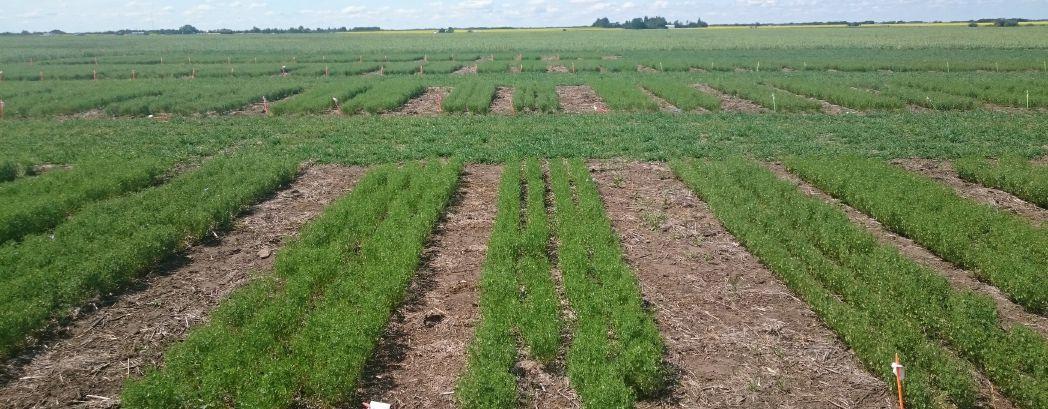
ABOVE: Red lentil can be successfully grown in Alberta.
be prone to crusting when rolled. Rolling is safe post-emergent up to the sixth node, but time must be left between post-emergent rolling and herbicide application so that lentil recovers from rolling stress prior to herbicide application.
Fertility
Phosphorus fertility is most important. Lentil requires around 0.8 pounds P205 per bushel of yield. The safe rate of seed-applied phosphate fertilizer is 17 pounds P205 per acre under good moisture conditions. Additional phosphate fertilizer should be banded away from the seed.
Potassium and sulphur fertility is usually not a problem in Alberta lentil production, except possibly on sandy soils. Micronutrients are of minor concern and deficiencies are not widely documented.
Bowness had heard anecdotal reports that starter nitrogen (N) might be beneficial. Her research found that as starter N increased, nodulation decreased. However, she found a small benefit in applying 15 pounds N per acre.
“We didn’t see a positive yield effect every time, but overall, there was a benefit with 15 pounds starter N, but don’t go above 30 pounds as yields are reduced,” Bowness says.
Weed control
Lentils are poor competitors with weeds but the Clearfield trait helps with weed control. Group 2 herbicides Odyssey, Solo and Ares are registered on Clearfield lentils. Sencor, a Group 5 herbicide, is also registered for post-emergence suppression of broadleaf weeds.
These Group 2 herbicides can be a bit hard on lentil, but Bowness’ research didn’t find any difference in plant growth or days to flower or maturity. Nodulation and yield were sometimes affected compared to control plots, but the impacts varied by year and location and were not consistent.
“It is more important to control the weeds than to worry about the inconsistent impacts on nodulation and yield,” Bowness says.
There are several Group 1 post-emergent herbicides registered for grassy weed control, with good control and good crop safety. Pre-emergent Edge and trifluralin (Group 3) are also registered for grassy and broadleaf weed control.
Seedling disease
In Alberta, the root rot complex is common. The two main pathogen
RED LENTIL VS. FIELD PEA
Comparing red lentil and field pea, Bowness has observed some differences. For red lentils:
• Well-drained fields are more important
• Lighter soils are more important
• Seeding rate is higher (12 plants per square foot)
• Starter N is beneficial
• Rolling your fields is necessary
• Herbicides are more limited
• Clean fields are more important
• Sclerotinia can be more of a concern
• Harvest can be trickier
• Desiccation is more important
• Gentle handling is more important
groups are Fusarium and aphanomyces. Fusarium is widely distributed, with good fungicidal seed treatment options. These seed treatments also control pythium Pythium and botrytis seed rots.
Aphanomyces is highly aggressive on both pea and lentil. Aphanomyces infection can occur any time during the growing season, but usually infects early. No seed treatments are registered for control, and in-crop fungicides have no effect on the pathogen. Recent surveys have found Aphanomyces throughout Alberta.
Foliar disease
Sclerotinia white mould is the biggest foliar disease concern. It can cause large economic losses in wet years. In the Black soil zone at St. Albert, research trials consistently saw white mould in the plots. Growers in wetter areas with higher organic matter can expect to see the disease. Foliar fungicides are available and work well when applied before canopy closure.
Ascochyta has the potential to be very destructive on lentil. However, Bowness says there is good resistance in the germplasm with most varieties rated as Moderately Resistant.
Two diseases of note, but not usually a problem, are Anthracnose and Botrytis Grey mould. Very few reports have been received of Anthracnose causing a significant economic impact in Alberta. Botrytis Grey mould can be widespread in a wet year but not usually of economic importance.
Growers should scout for the diseases and spray with a fungicide if conditions warrant.
Harvest
Lentils mature at around 95 days. Desiccation with Reglone (diquat) can help to dry down the crop. The Reglone label recommends application at a similar stage as when swathing would occur, when the lower-most pods are yellow-brown and seeds rattle. Check with your lentil buyers and processors to ensure there aren’t any export restrictions with diquat desiccation.
Harvest at 16 to 18 per cent moisture to help reduce seed damage during harvest. Store at 14 per cent moisture.
Where acreage goes in 2019 will depend on the relative price of lentils compared to other pulses. But should growers decide to grow red lentils again, the foundation of a good crop has been well researched for Alberta farmers.
Courtesy of Robyne Bowness, Alberta Agriculture and Forestry.
DON’T LET YOUR GUARD DOWN ON PEA LEAF WEEVIL
Survey numbers were lower in 2018, but that’s happened before.
by Bruce Barker
First confirmed in southern Alberta in 1997, the pea leaf weevil (Sitona lineatus) has gradually extended its range into northern Alberta and most of Saskatchewan. The insect has not been found in Manitoba. A serious pest of field pea and fababean, entomologists continue to monitor for the insect and search for control methods that work across the Prairies.
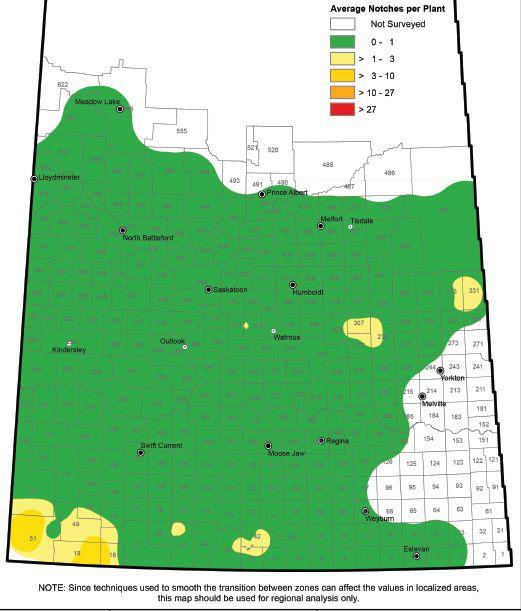
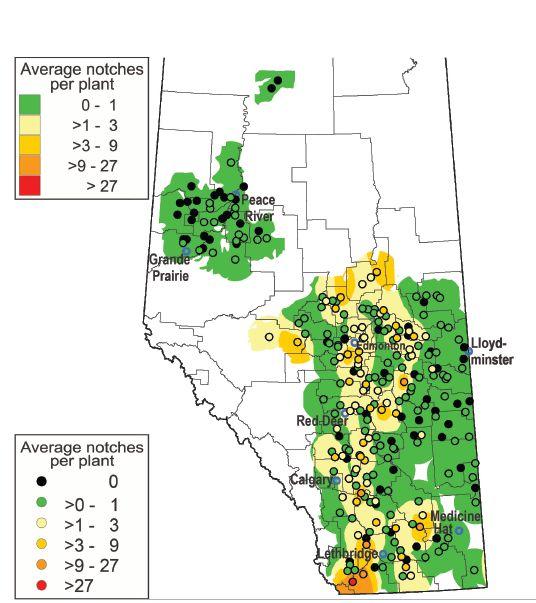
“There first thing that jumps out is a much lower level of damage by pea leaf weevil,” says provincial entomologist Scott Meers in Brooks, Alta., in describing the 2018 Alberta pea leaf survey map.
The annual pea leaf weevil survey is carried out in late May and early June in Alberta and Saskatchewan. Damage rating is assessed by counting the average number of notches per plant. The surveys are not a forecast, but rather an indication of the level of pea leaf weevil populations during the spring.
In Saskatchewan, provincial entomologist James Tansey notes that pea leaf weevil populations were also much lower in 2018, although the insect continued to spread east and north.
“There has been some discussion on why feeding levels were
lower in 2018,” says Tansey. “It could be the drier weather or that they aren’t as cold tolerant as some other insects and more died off over the winter.”
Maya Evenden at the University of Alberta, and Meghan Vankosky, research scientist with Agriculture and Agri-Food Canada in Saskatoon, also started pheromone-based survey and monitoring in 2017. The pheromone monitoring attracts both male and female adults, and is useful for monitoring adults for spring and fall activity.
The adults emerge from pupae in the soil in late April and early May and feed on legume plants. They then move to pea and faba bean fields where they reproduce. Females lay 1,000 to 1,500 eggs in the soil near seedlings. After hatching, the larvae feed underground on the Rhizobium nodules on pea and faba bean roots for about six weeks. For lentil growers, there is good news. “Pea leaf weevil hate lentils,” Vankosky says.
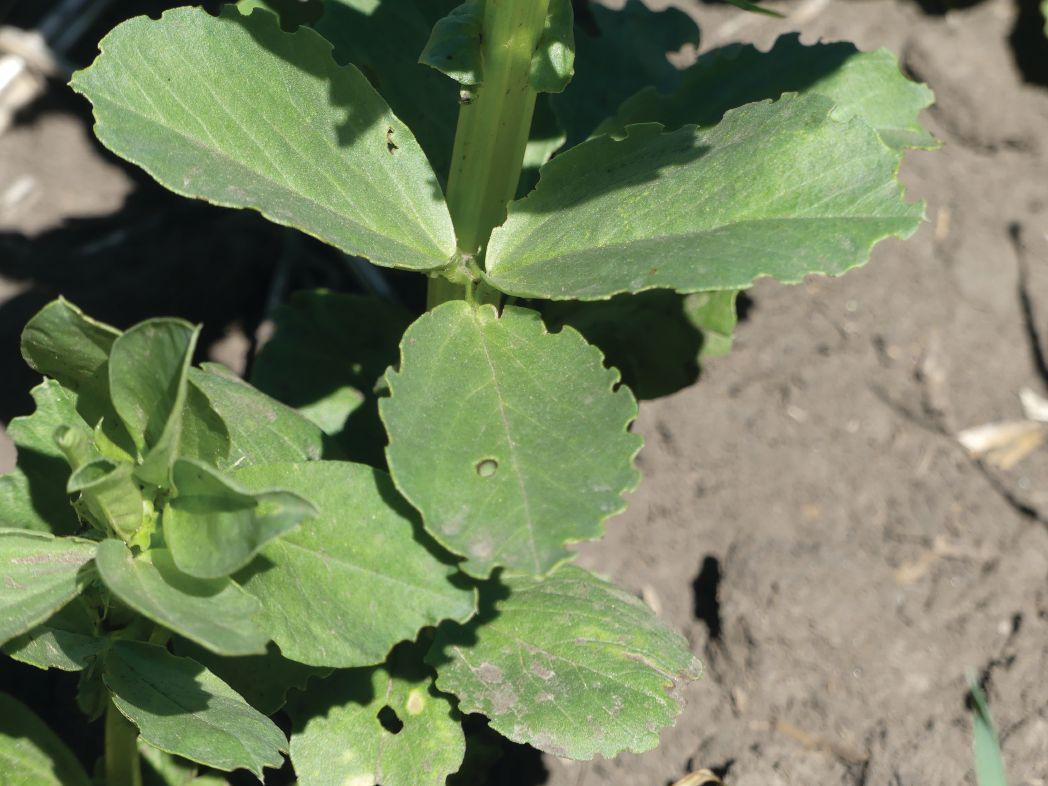
Larvae cause most of the yield loss by feeding on nodules, ABOVE: Pea leaf weevil populations were lower in 2018, but don’t let your guard down in 2019.
PHOTO
resulting in poor nitrogen fixation, poor plant growth and increased drought stress. Research has found that 98 per nodule loss equates to a 27 per cent yield loss.
Vankosky says that adult foliar damage may kill small seedlings and can reduce pod production. In greenhouse trials, cumulative foliar damage resulted in 28 per cent pea yield loss, but she says yield loss in the field is much more variable.
Cultural control
Crop rotations can help minimize infestations, although the adults are strong fliers. Vankosky says that planting a pea or fababean crop beside any legume stubble increases the risk.
No-till seeding systems also help to reduce the impact of pea leaf weevil. Vankosky says that colonization and adult emergence is lower on no-till because it takes longer for the weevils to find pea or faba bean seedlings. This information is based on work conducted in the Pacific Northwest of the United States.
Inoculation is also important. Vankosky’s research found that regardless of whether pea leaf weevil was present or absent from a pea field, yield was always significantly higher with inoculated seed.
Chemical control
In Alberta research, a systemic insecticidal seed treatment provided the most consistent control of pea leaf weevil. There was also a synergy between Rhizobium inoculant and seed treatment effects. Total nodulation was higher when inoculant and seed treatments were used compared to just Rhizobium inoculation.
Foliar application to control adult feeding on leaves was not effective in controlling yield losses in Alberta. If pea leaf weevil adults are sprayed early, later flushes of females will still lay eggs. Later spraying will mean that some females will have already laid their eggs in the
soil, which means the larvae will hatch to feed on the nodules, and also to perpetuate the life cycle.
“Foliar spraying is just revenge spraying. It may limit foliar feeding, but you’re not going to limit yield loss from the larvae feeding on nodules,” Meers says.
In Saskatchewan at Swift Current, Vankosky’s preliminary research in 2017 found that insecticide seed treatment resulted in higher yield. However, there was no advantage to combining a systemic insecticide seed treatment along with a post-emergent foliar insecticide spray. The research carried on in 2018, but because of low pea leaf weevil infestations, results were inconclusive.
“There hasn’t been a lot of research in Saskatchewan, but of the work that has been done, fortunately the results are fairly consistent with Alberta research,” Vankosky says.
Biological control
No parasitoids of the pea leaf weevil have been reported in Canada. However small ground beetles eat pea leaf weevil eggs. Large ground beetles are reported to eat adults and larvae in Europe, and similar beetles exist on the Prairies.
Vankosky says that on-going research is being conducted on many aspects of pea leaf weevil biology, distribution, and insecticidal and biological control. In the meantime, the best control option in areas with pea leaf weevil is to inoculate pea and faba bean seed with a Rhizobium inoculant, use a registered insecticidal seed treatment, plant away from fields with a history of legumes, and scout fields as pea and faba bean seedlings emerge until the six-node growth stage to monitor pea leaf weevil populations.
“Be careful backing off on pea leaf weevil seed treatment based on a one year dip in populations. We have seen low years before and they can rebound quickly,” Meers says.
APPLICATION TIPS FOR TACKLING SEED TREATING IN CANADA
Here in Canada, weather is not only a key factor throughout the growing season, it also can impact a seed’s potential before it’s even in the ground. Which is why Raxil® PRO’s unique formulation is designed to provide enhanced coverage and distribution, and a wider window of temperature hardiness, making it the right fit for Canadian conditions.
To start the season right, it’s important to consider not only the efficacy of a seed treatment, but how the product is applied. When determining ease-of-use, think about both the stability of the product formulation and treated seed flowability. Both of these contribute to consistency, which is key to ensuring the seed treatment protects seed potential.
Consider the product’s vulnerability at different temperatures, because the greater fluctuation in viscosity the greater the impact to seed treatment flow rate. For example, Raxil PRO is specifically formulated for low viscosity even at fluctuating temperatures, which is critical to ensuring you’re applying the right amount of product.
VISCOSITY TRIAL
TIME IS AN INCREDIBLY VALUABLE COMMODITY FOR GROWERS, SO IT’S IMPORTANT THAT A SEED TREATMENT OFFER NOT ONLY BEST-IN-CLASS DISEASE PROTECTION, BUT ALSO CONSISTENT FLOWABILITY THAT MINIMIZES THE NEED FOR RECALIBRATION.
It’s important to consider how seed temperature affects product adherence. Treatments are less likely to adhere properly to cold seeds, and lower temperatures can lead to uneven coating and impact overall effectiveness. If your seed is stored below freezing, try to bring its temperature up prior to treating as this will help the product work optimally. A helpful trick is to use a fan to increase seed temperature a few days prior as this will help ensure the greatest benefit from treatment. Limit moving or handling seeds to minimize abrasion, and prevent high seed moisture by fan-drying seed prior to application.
Following the above advice should help you promote a healthy, robust plant below and above the ground.