Spray once to tackle both leaf spot diseases and Fusarium head blight.
PG. 3
Turns out, you really can capture lightning in a bottle when you re-think what’s possible in pulse disease control. Say—like putting together three high-performing modes-of-action for the first time. Count on new Miravis® Neo fungicide to deliver consistent, long-lasting control so you can set the stage for healthier-standing, higheryielding, better quality pea and chickpea crops.
Lightning in a bottle?
More like, “a better crop in the bin.”
We’ve captured it! 3 modes of action, 1 powerful product. For more information, visit Syngenta.ca/Miravis-Neo-pulses, contact our Customer Interaction Centre at 1-87-SYNGENTA (1-877-964-3682) or follow @SyngentaCanada on Twitter. Always read and follow
PESTS AND DISEASES
Fungicide Guide 2020
3 Fungicide timing in spring wheat by Julienne Isaacs
FUNGICIDE TIMING IN SPRING WHEAT
Study: spray once to tackle both leaf spot diseases and Fusarium head blight.
by Julienne Isaacs
AON THE COVER
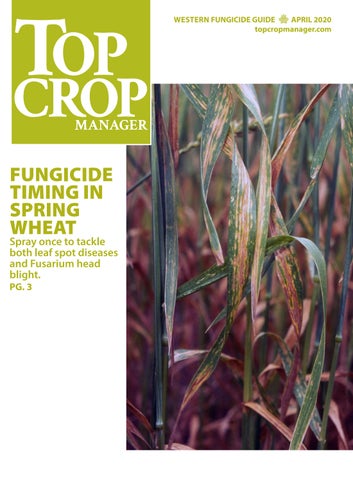
Septoria tritici blotch on spring wheat.
PHOTO COURTESY OF RANDY KUTCHER.
Top Crop Manager thanks Syngenta for sponsoring this year’s Fungicide Guide.
Top Crop Manager thanks the numerous disease management specialists who contributed to this guide. We do our best to ensure accuracy, but in case of any discrepancies, please refer to your provincial crop protection guide.
TOP CROP
Published as part of Top Crop Manager, April 2020, by: Annex Publishing & Printing Inc. PO Box 530, 105 Donly Drive South, Simcoe, ON N3Y 4N5 Canada Tel: (519) 429-3966 Fax: (519) 429-3094
EDITORIAL DIRECTOR, AGRICULTURE Stefanie Croley
ASSOCIATE EDITOR Alex Barnard
WESTERN FIELD EDITOR Bruce Barker
ASSOCIATE PUBLISHER Michelle Allison
VP PRODUCTION/GROUP PUBLISHER Diane Kleer
Charts compiled by Mike Strang and Jennifer Strang.
Canada’s original technical crop production magazine, The Western edition of Top Crop Manager, is published nine times a year. To be sure of your copies, either mail, fax or e-mail your name and full postal address to Top Crop Manager, or subscribe at topcropmanager.com. There is no charge for qualified readers.
study published in 2018 shows a single fungicide pass can tackle both leaf spot diseases and Fusarium head blight (FHB). Pathologist Randy Kutcher and master’s student Dustin MacLean at the University of Saskatchewan’s Crop Development Centre conducted the study, which ran between 2013 and 2015. Their collaborators on the project included Ken Coles at Farming Smarter in Lethbridge, Mike Harding at Alberta Agriculture and Forestry, and Agriculture and Agri-Food Canada scientists Bill May, Gary Peng and Kelly Turkington.
Prior to the study period, Kutcher says, FHB was moving from the southeast across Saskatchewan and emerging as a greater economic threat than leaf spot diseases.
The study was instigated after producers began asking then-provincial plant pathologist Faye Dokken Bouchard whether they really needed to be spraying fungicide at flag leaf timing and again at anthesis. The researchers wanted to establish optimal fungicide timing for tackling both diseases.
In Saskatchewan, leaf spot diseases are “insidious – they’re always there,” Kutcher says. Economic damage from leaf spot is typically less than 15 per cent, according to Saskatchewan Agriculture, but can go as high as 30 to 40 per cent during severe epidemics.
Varieties are available with a wide range of resistance to leaf spot diseases, from very poor to fair. But cereal producers typically choose varieties based on many factors, including market demand, rather than only for disease resistance packages, Kutcher says.
Both leaf spot diseases and FHB typically need to be managed with fungicide when the environment is conducive to disease to reduce their impact on yield and quality.
The study was conducted at sites in Saskatoon, Indian Head and Melfort, Sask., and Lethbridge and Brooks, Alta., in 2013. A site was added in Lacombe in 2014 but removed in 2015 due to hail damage. Fungicides were applied at flag-leaf, anthesis and both growth stages to the Canada Western Red
Spring wheat variety AC Carberry, which is moderately resistant to FHB but moderately susceptible to leaf spotting diseases. “This choice of variety was made to help reduce the confounding effects between leaf spots and FHB,” the authors note.
The researchers found differences in leaf disease severity between flag-leaf and anthesis application timings were only detected in areas with high disease severity; at those locations, applying fungicide at the flag-leaf stage reduced leaf disease by only six per cent relative to fungicide application at anthesis.
The most effective treatment in the study was the dual application, which reduced leaf disease severity from 73 per cent in the untreated check plot to between six and 13.7 per cent in the low disease locations and 20.2 per cent in the high disease locations.
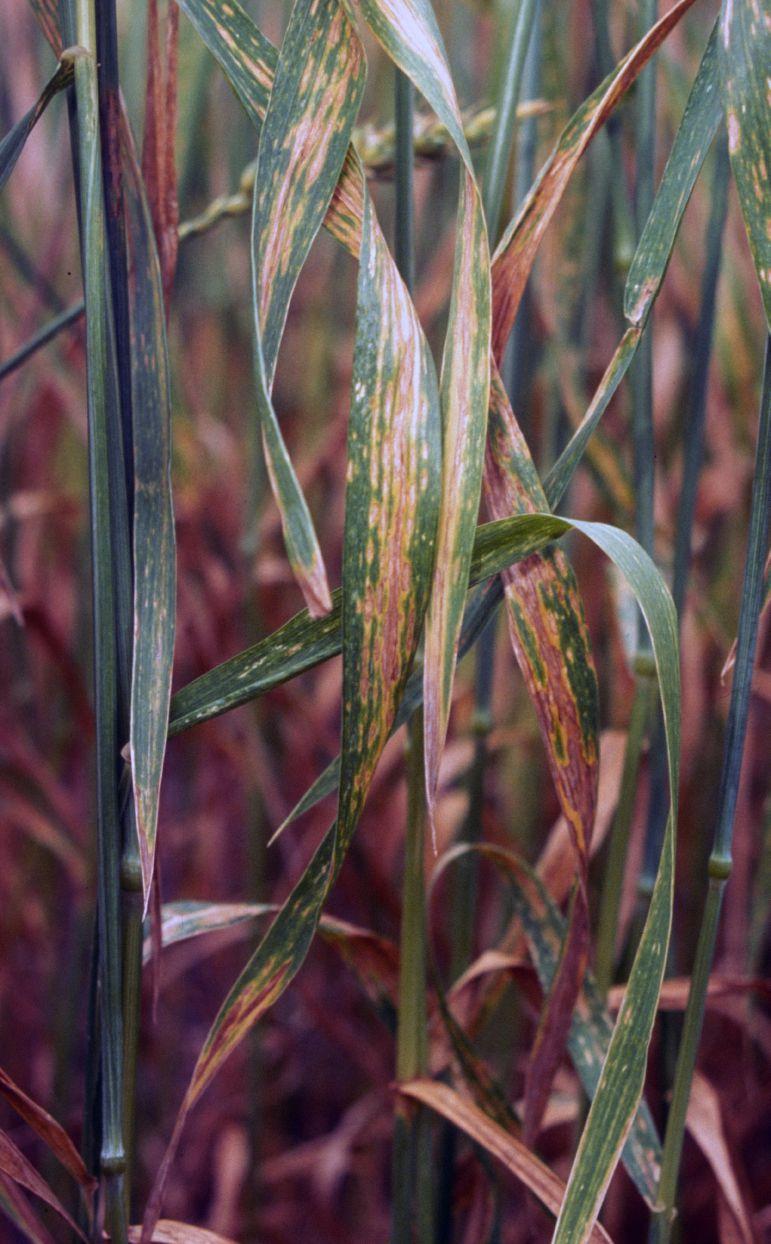
Septoria tritici blotch from the Western Committee on Plant Disease collection.
PHOTO COURTESY OF RANDY KUTCHER.
FUNGICIDES 2020
FUNGICIDE TIMING IN SPRING WHEAT
Continued from page 3
But beyond economic feasibility, there are problems with dual applications: applying chemistries from the same fungicide family twice during a growing season leads to the potential for greater selection pressure on pathogen populations that can tolerate the fungicide, which leads to bigger problems down the road.
Economically, Kutcher says, there was no real benefit to spraying twice: some leaf spot control was sacrificed when applying fungicide at anthesis, but control was still reasonable. “It was a wash in terms of yield – we were getting better thousand kernel weight (improved kernel filling), so that the slightly increased leaf spot disease severity when fungicide was applied at anthesis didn’t make a difference in terms of yield. This suggests to farmers that they can get by with a single application at anthesis time,” he says.
Control of leaf spot wasn’t perfect, and if leaf spot is producers’ primary concern, rather than FHB, they might consider spraying earlier, he adds.
Kutcher says it’s recommended that producers adopt a broad integrated pest management (IPM) strategy, including the use of clean seed, use of a seed treatment if seed is carrying multiple Fusarium species and diverse rotations, including pulses and oilseeds, to give the cereal crop residue more time
to break down in the field. His program centres on IPM, but he supports CDC breeders in disease screening and assessment and analyzing rust races to get a sense of what producers should expect in terms of disease pressures.
New varieties are constantly arriving on the market with improved resistance to leaf spot and FHB. There is moderate resistance to FHB in the hard red spring category, but the best level of resistance to FHB in durum is still moderately susceptible, although there are some varieties that are slightly better than others within that category, Kutcher says.
“Especially for FHB, progress is incremental,” he says. “We haven’t found genes that provide 100 per cent resistance. With FHB, breeding involves gathering up small sources of resistance and putting them together.”
Producers have several fungicide options for controlling leaf spot diseases. Application timing for FHB is the same for Group 3 fungicides: once the first few anthers can be seen at growth stage 61 after the spike has fully emerged, before spores have a chance to get into the flowers, Kutcher says.
“Wait until you see as many of those spikes as possible at that stage, then you’ve got three or four days until all the anthers have extruded in the spikes,” he says.
FUNGICIDES 2020
CEREALS
(mancozeb)
FUNGICIDES 2020
(azoxystrobin, benzovindiflupyr, propiconazole)
(metconazole, pyraclostrobin)
(penthiopyrad)
FUNGICIDES 2020
OILSEED AND PULSE CROPS
(fluazinam)
Ascochyta
(metconazole)
(Coniothyrium minitans)
(copper sulphate)
(boscalid, prothioconazole)
(prothioconazole, trifloxystrobin)
RAINSHIELD (mancozeb)
(Bacillus amyloliquefaciens D747)
(fluxapyroxad, pyraclostrobin)
(chlorothalonil)
(azoxystrobin, benzovindiflupyr)
(fluoxastrobin)
KUMULUS DF (sulphur)
LANCE (boscalid) LANCE AG (boscalid, pyraclostrobin)
Parasol Products - DP, WP, Flowable, WG M copper hydroxide
Penncozeb 75DF Raincoat M mancozeb
Polyram DF M metiram
50 DF 11, 27 famoxadone, cymoxanil
Tattoo C 28, M propamocarb HCl, chlorothalonil
Zampro 40, 45 ametoctradin, dimethomorph
Works harder. Lasts longer.
Put the power of three to work in your cereals. Trivapro® fungicide combines three powerful modes of action to control a broad spectrum of leaf diseases. Choose Trivapro for preventative, curative and long-lasting disease control that protects your crop all season long.
Elatus® and pulses… A match made in heaven.
Wrap your pulses up in disease protection you can trust. An early application of Elatus® fungicide helps keep key diseases like Anthracnose in lentils at bay.
Show your pulses some love and watch them thrive with Elatus.
For more information, visit Syngenta.ca, contact our Customer Interaction Centre at 1-87-SYNGENTA (1-877-964-3682) or follow @SyngentaCanada on Twitter.