Margaret Land • (519) 429-5190, (888) 599-2228, ext 269 mland@annexweb.com
Contributing Editors
James Careless, Tony Kryzanowski, Diane Mettler, Angela Rieck-Hinz
Advertising director
Martin McAnulty • (519) 427-8927, (888) 599-2228, ext 252 mmcanulty@annexweb.com
Sales Assistant
Ryan Culver • (519) 429-5183, (888) 599-2228, ext 219 rculver@annexweb.com
Production Manager Angela Simon
group Publisher Martin McAnulty mmcanulty@annexweb.com
President Mike Fredericks mfredericks@annexweb.com
Publication Mail Agreement #40065710
RETURN UNDELIVERABLE CANADIAN ADDRESSES TO CIRCULATION DEPARTMENT, P.O. BOX 530, SIMCOE, ON N3Y 4N5
e-mail: mweiler@annexweb.com
Printed in Canada
Circulation
e-mail: mweiler@annexweb.com
Tel: 866-790-6070 ext. 211 Fax: 877-624-1940
Mail: P.O. Box 530 Simcoe, ON N3Y 4N5
Subscription Rates
Canadian Subscriptions (gST included)
$37 Cdn, one year - $65 Cdn, two years
U.S. Subscriptions: $37 US, one year - $64 US, two years
international Subscriptions
$70 US, one year
From time to time, we at Manure Manager make our subscription list available to reputable companies and organizations whose products and services we believe maybe of interest to you. If you do not want your name to be made available, contact our circulation department in any of the four ways listed above.
All advertising is subject to the publisher's approval. Such approval does not imply any endorsement of the products or services advertisted. Publisher reserves the right to refuse advertising that does not meet the standards of the publication.
Website: www.manuremanager.com
By Margaret Land
Getting real about the high price of bias
During the past month or so, the agricultural community has been abuzz with concern and criticism of time magazine’s recent cover story, getting Real About the High Price of Cheap food, penned by Bryan Walsh.
i’m hesitant to call the time tirade an article as Walsh’s more than 3,000-word horror story reads more like an opinion piece, and a rather misinformed one at that. Back in the day when i had less grey hair and a lot more energy, i left the family farm and toddled off to college where i was taught that journalism involved writing a BA l ANC ed article, including both sides of an issue or story. if you wanted to spout off about your opinions or feelings, you became a columnist. or an editor. of course, back then, time used to have journalistic integrity and was considered a news magazine, not a vehicle for pushing writers’ opinions and agendas. that obviously isn’t the case now.
“it’s ultimately the story we decided to do and this is the angle we’ve been taking,” Walsh explained in a recent interview with mike Adams, host of Agritalk. “time (magazine) is trying to say rather than do a story where you do 50 percent on one side and 50 percent on another, you allow the writer to look at it and make some of his own judgments. that’s why the story came out in many ways the way it does. Coming from my perspective, it was the information i saw and i thought this is the angle i’d like to take.” Well, i’ve looked at it, made some of my own judgments based on the information i’ve seen and this is the angle i’ve decided to take – Bryan Walsh should be ashamed to call himself a journalist; he’s more of a fiction writer.
in his story, he talks of manure management systems on larger hog farms receiving “little oversight.” Really? it’s quite apparent he didn’t bother to speak to a hog farmer about manure management plans, National Pollutant discharge elimination System (NP de S) permitting, plus many of the regulations farms must meet at the state and county level. None of it is mentioned in his story. instead, he talks of “that mess” being disposed of in “open-air lagoons, which can overflow in heavy rains and contaminate nearby streams and rivers.” Really? He obviously didn’t bother to learn about the many regulations farmers face around constructing manure lagoons or the many hours of monitoring and record keeping that go into maintaining the structures. None of that information is contained in his story either.
According to National Pork Board (NPB) president tim Bierman, a hog producer based in iowa, Walsh didn’t even bother to contact the NPB for input. if he had, “he quickly would have learned how pork producers – through their own programs as well as through governmental regulation – have made environmental stewardship a way of life,” Bierman said in a National Hog farmer article.
Chuck Jolley with the Cattle Network stated that Walsh was introduced to several people within the U.S. beef cattle industry but used none of the information he was provided with in his article.
“He only managed to wedge in one quote,” Jolley said in his online blog – a quote that had to do with antibiotic use.
there’s an old saying in agriculture that goes something like this: if it looks like crap and smells like crap, it’s probably crap. And Bryan Walsh’s “getting Real” story is definitely that – crap.
PORK
Now, more than ever, pork producers recognize the impact their operations can have on the world around them.
Proactive eco-management with MicroSource S can help reduce environmental burdens. The result:
• Reduction in noxious manure gases, like ammonia and VFAs, for less odor
• Increased nitrogen retention in manure for an improved N:P ratio
• Lower manure viscosity so less power is required for pump outs
• Decreased stickiness of manure for easier/less cleaning.
MicroSource S contains selected microbes that digest the solids in hog manure. It begins to work even before the manure hits the floor and continues to act on manure during handling and storage. MicroSource S can help you balance today’s environmental challenges with efficient pork production.
To learn more, contact your feed supplier or go to www.unlimitednutrition-na.dsm.com.
NEWS HIGHLIGHTS
exporting manure?
University examining cow power
Settlement reached in Wisconsin manure spill
manure major source of greenhouse gas farmer indicted on pollution charges
obscure manure rule stirs controversy
How do you dispose of 10,000 dead cattle?
Cargill, idaho Power okayed for power pact farmers look to alternative energy dairy forum focuses on going ‘green’
WEB EXCLUSIVE
Workshops encourage farmers to try water-friendly practices says study
minnesota farmers and producers who participated in University of minnesotasponsored small group manure management workshops are likely to adopt waterfriendly practices that also save them money, according to a survey by the university’s Water Resources Center.
during the winter of 2008-2009, Water Resources Center researchers held “Value of manure” small group workshops in 22 counties across the state. the 267 workshop participants — 87 percent of who were agricultural producers — learned to use a university-developed spreadsheet program to compare costs and returns from alternative manure management practices on their own farms.
As a result of the workshop and spreadsheet findings, 74 percent of workshop attendees said they would change their application rates and timings. And between one-quarter and one-third of all attendees who weren’t already testing, calibrating and keeping a record of their manure applications said they would start as a result of the workshops.
Read the full story at www.manuremanager.com
NEW PRODUCTS
Instinct™ Nitrogen Stabilizer protects liquid manure applications dow AgroSciences recently announced that federal registration had been received for instinct™ nitrogen stabilizer for use with UAN and liquid manure. According to dow, instinct protects nitrogen at the plant root zone, keeping it easily available to corn during key yield-determining growth stages. Studies also show that nitrapyrin, the active ingredient in instinct, optimizes the yield potential of corn by increasing grain protein, improving standability, reducing the risk of stalk rot and enabling faster crop drydown. Under a 24(c) Special local Needs Registration in iowa in 2008, on-farm field trials showed that fields treated with instinct out-yielded nontreated fields by an average of five bushels per acre.
Kuhn Knight launches new line of box spreaders
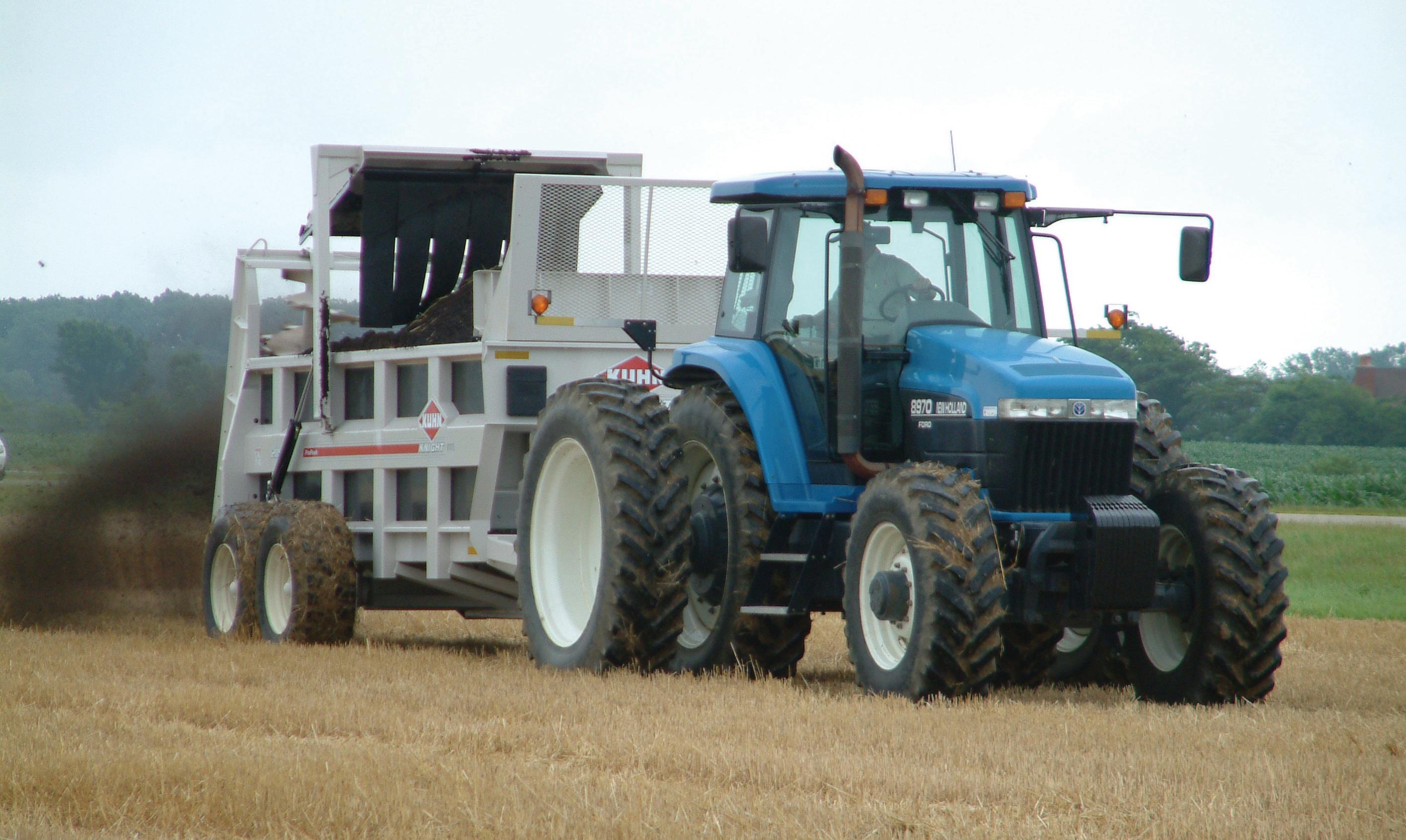
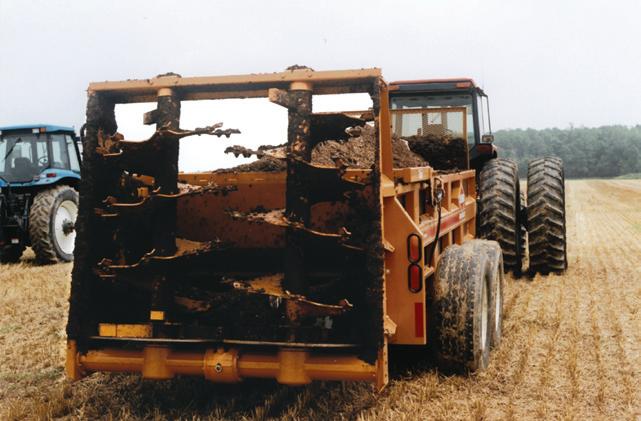
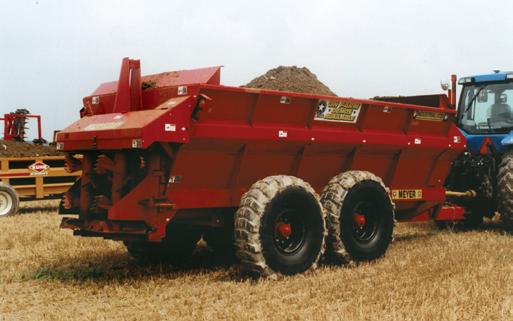
Kuhn North America, inc., of Brodhead, W i, recently introduced the new PSC Series ProSpread Commercial apron box spreaders. the truck and trailer models are designed for operators who need a high-capacity, heavy-duty machine to spread the toughest solid materials. they provide consistent performance and long life with their sturdy all-welded construction, friction-resistant poly floor and innovative split-apron drive. A hydraulically-controlled, variable-speed apron allows even spreading of pen pack, feedlot and dairy manure, and many other solid materials.
BUYERS GUIDE
The 2009 Manure Manager Buyers Guide is your key reference tool to bring the entire industry together in just one directory.
DIGITAL MAGAZINE
To sign up for a free trial of Manure Manager’s digital version, go to www.manuremanager.com.
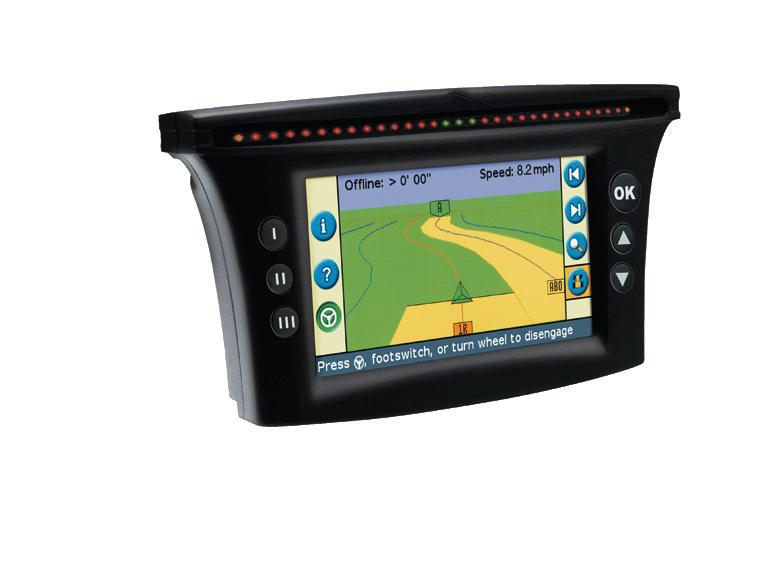
Trimble’s EZ-Guide 250 and EZ-Guide 500 lightbars can now provide record-keeping, tracking and feature mapping of your liquid and dry manure applications. Combine this new technology with Trimble’s proven guidance capability in order to more easily fulfill EPA and DNR manure handling record-keeping requirements. Increase efficiency by using colorful on-screen maps to eliminate gaps or overlaps, and avoid restricted application zones or tile lines.
To find a Trimble dealer, visit www.trimble.com/agriculture or call 800-865-7438. Trimble Agriculture. The line everyone follows.
No weeping over
this system
By Diane Mettler
Sierra dairy of dublin, texas, realizes multiple benefits from its weeping wall waste management system
The Sierra dairy, in dublin, texas, underwent an extensive expansion from 2005 to 2008. the farm’s owners, the VanderHorst family — Alan, his wife Becca and their five children — transformed the 1980’s era 1,000-head, open stall barn dairy into a 3,500-head free stall barn facility. the dairy now boasts a 60-cow rotary parlor, a flush system and an economical and innovative weeping wall waste separation system.
the dairy was already familiar with weeping wall systems. they had a smallerscale system at another dairy and believed a larger version would work well for Sierra.
“one of the things we really like about the weeping wall system is that it uses gravity over any kind of electrical power,” says lance Reeves, operations manager at Sierra dairy. “So, it requires little maintenance.”
A flush system for 3,500 cows
equates to roughly 250,000 to 300,000 gallons of water flushed per day. to handle that kind of volume, the dairy turned to Agricultural engineering Associates (A e A) to design a state-ofthe-art system.
Achieving goals
While designing the system, A e A were mindful of the Sierra dairy’s goals. first was to recycle as much sand as possible for bedding.
“We were also looking for economy, ease of construction as well as the ability to lower the moisture content of the settled manure solids so that the solids could be easily loaded out,” says Jeff m urphy, staff engineer at A e A.
the design A e A developed allows the dairy to:
Recycle up to 75 percent of the sand.
Reuse the flush water.
economically separate solids and liquids for spreading and irrigation.
Separate most of the phosphorous in the form of manure solids, so it can be spread farther from the dairy. Spend less time on maintenance compared to a mechanical separation system.
Sand settling basin
the system is primarily gravity fed. the water is flushed through the free stall barns four times a day and travels first through a sand-settling channel.
“it is sized with the right width and slope to bring the effluent flow to the right velocities to allow settling of sand, but keeps manure solid in suspension,” says murphy. “they clean the sand out of the channel with the loader, spread it out, and allow ultraviolet radiation to reduce bacterial counts. then they reuse it for bedding in the stalls.”
dr. Saqib mukhtar, a Phd and associate professor of Biological and Agricultural engineering with texas Agrilife extension, has been out to do studies on the system and is impressed. “this is one of the very few dairies where i have seen a nicely, properly designed shallow, but narrow, long and effective, sand settling basin,” he says.
Solid settling channel
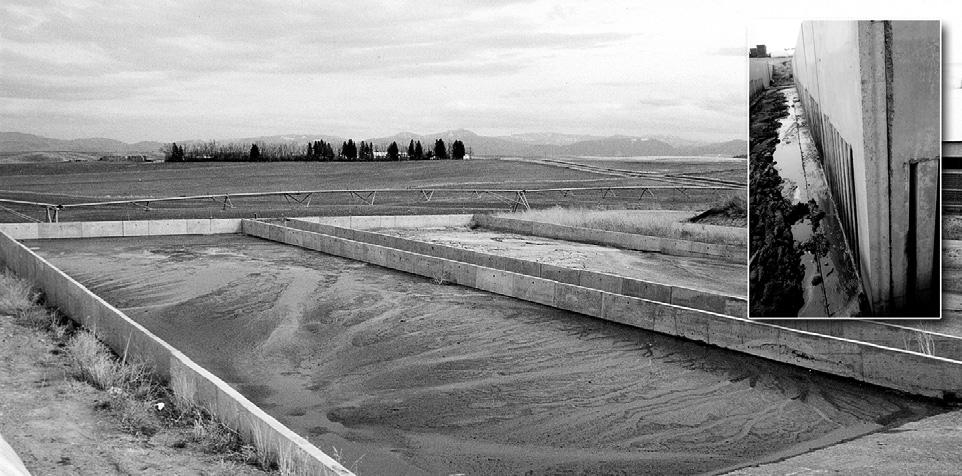
the effluent travels to two of the four primary cells or basins. each cell is 40-feet x 300 feet x 8 feet deep, with a capacity of approximately 718,000 gallons. (Combined, the four cells hold approximately 2.9 million gallons.) inside the cells, the water “weeps” from the
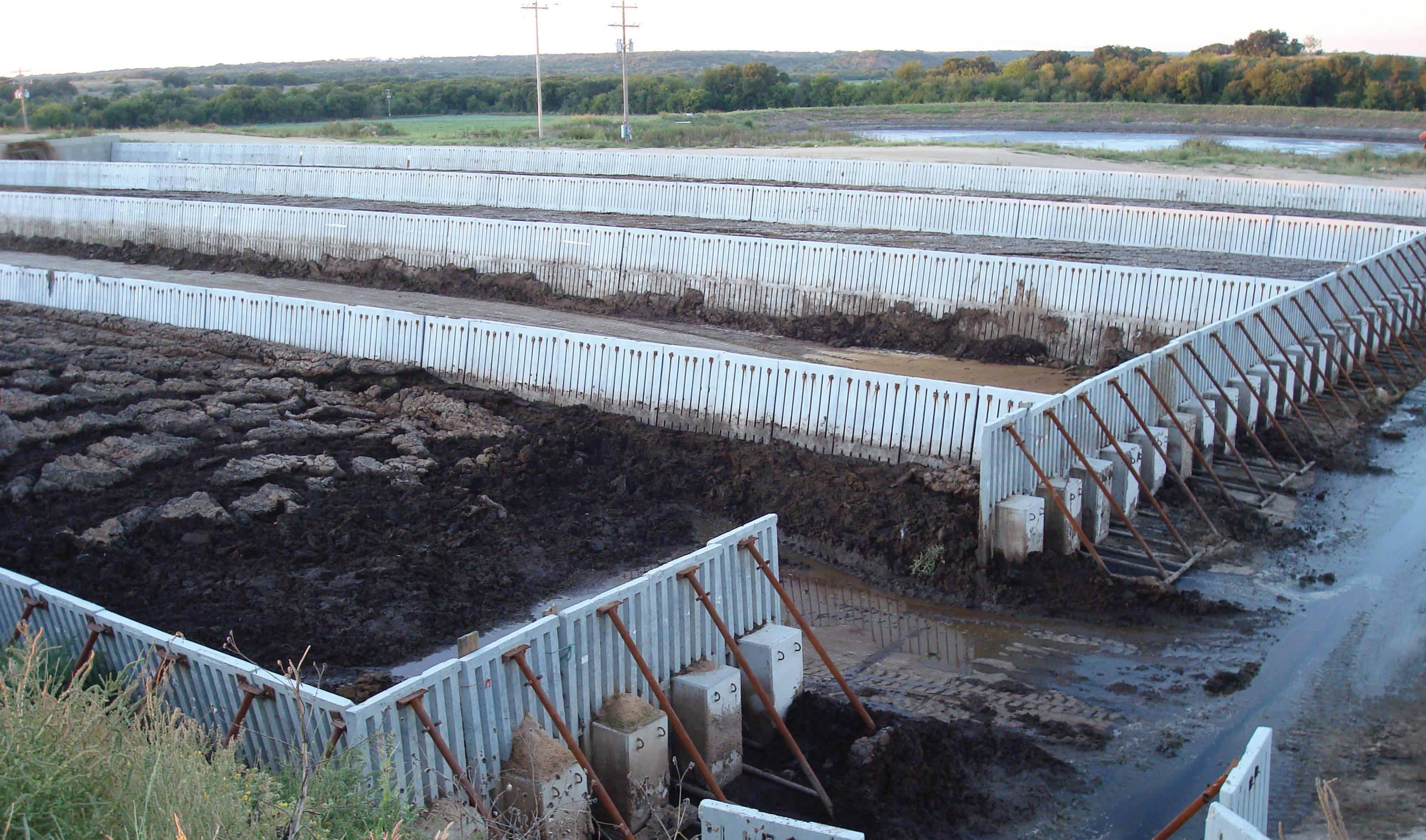
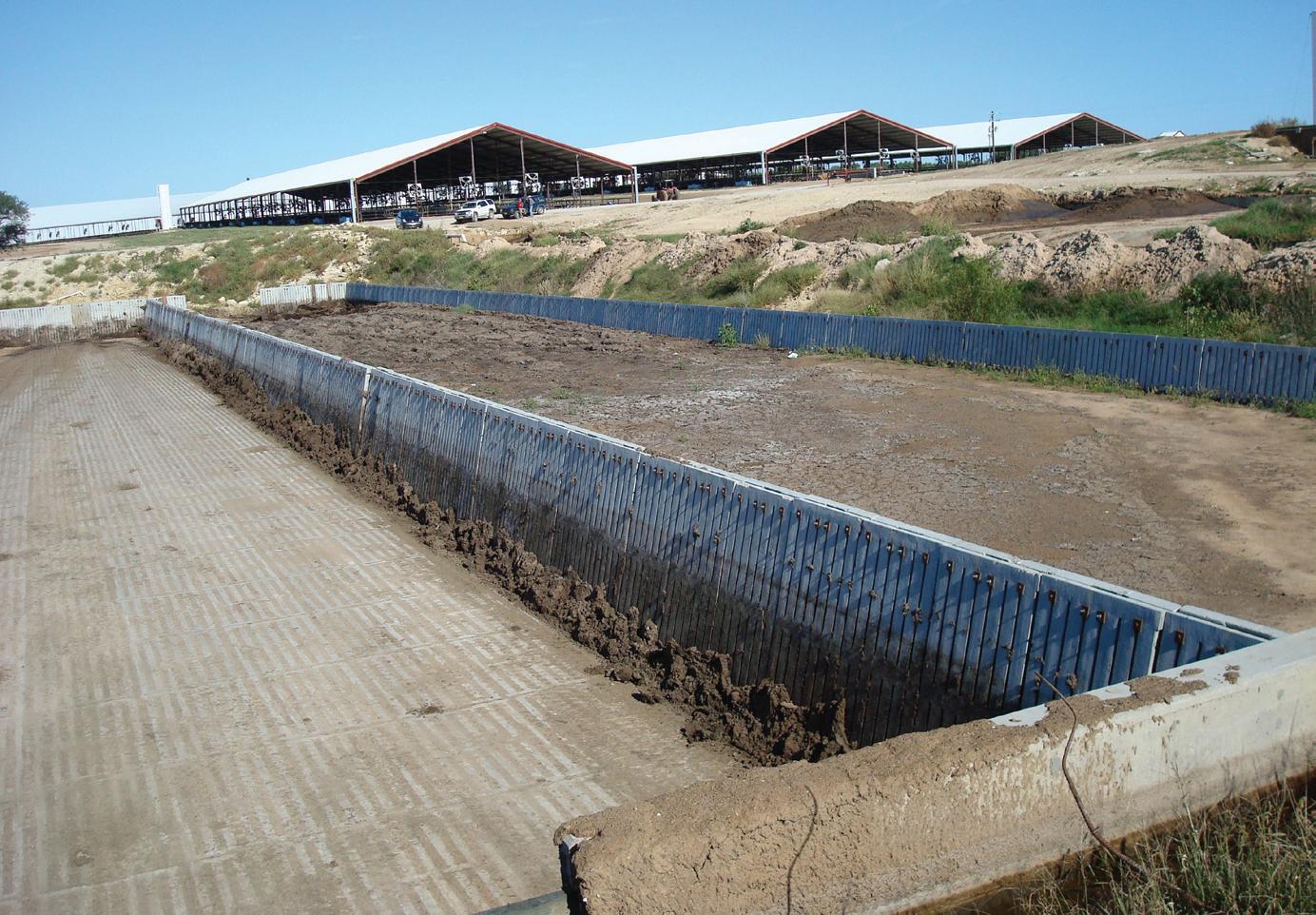
The downstream end of the primary weeping wall system. The effluent leaving the system is conveyed to a concrete tank where a pump conveys the effluent to the secondary weeping wall system for further treatment. Photos by Deanne Meyer
vertical slots in the walls, separating the water and solids via gravity. What makes these cells unique is that they are some of the first to have holes at the bottom to allow even more liquids to escape.
“Having multiple basins allows you to alternate which ones you’re filling,” says murphy. “So while you’re filling one, the other one that’s just been filled can be dried and cleaned out and be ready to be filled again.”
once the water seeps from the first cells it’s then pumped to a set of secondary cells, which are identical to the primary, just smaller.
Normally the secondary cells would be gravity fed. “But in this case, the footprint of these two systems is so large that they couldn’t build a secondary system downstream from the primary,” explains mukhtar. “So they have to expend this extra energy.”
The key component the water that weeps from these secondary chambers is either pumped back up to tanks on top of the barn, where it will be used for flushing out the stalls, or gravity fed to liquid manure storage ponds (also referred to as lagoons), where the water will be used for irrigation.
“the key factor that makes this system work well and really makes it user friendly, is that we don’t bring any water back from the lagoons,” says Reeves. “once our excess flush water leaves the secondary and goes to the lagoon it never comes back.”
He adds, “the benefit of that is we don’t have to keep our lagoons full so we can get good flush water. We can basically pump them dry and it doesn’t affect us. it really opens up the possibilities and really doesn’t tie you to managing your lagoons to your flush systems”
the flush water stored in the storage ponds is used to water crops during the growing season. “We cut fresh grass off our fields daily during the growing season and bring it back in here as feed,” says Reeves. “And we have five lagoons — the largest being 82 acre-feet — so we’ve got a lot of storage.”
the water recycling system is so efficient that the only fresh water that’s added comes from the natural process water from the parlor.
Removing the solids it takes approximately 60 to 90 days to fill two primary basins. once they’re full, the system switches to the other two primary basins and the solids in the first two are allowed to dry out for another 60 days.
dr. mukhtar says that the separated
Looking upstream at the primary weeping wall. The sand settling lane runs along this weeping wall. The ramp to remove settled sand from the channel, and the recovered sand (foreground) and the stockpiled dried sand to be recycled as freestall bedding are visible in this picture.
material, once dried, is normally at about 30 to 35 percent solids and about 65 to 70 percent moisture. At that consistency, liquid is no longer running out freely.
When the solids are dry enough to remove, the end walls of the basins are removed — lifted out with the loader and set to the side. this allows dozers and skid steers to drive directly into the basin to clean it out.
Although the walls are also a unique feature of this system, it’s one thing the dairy wouldn’t do again. “We would make
it a ramp system,” says Reeves. “the removable walls have probably been the Achilles heel of the whole thing. they tend to break and just moving them in and out is labor intensive — plus they’re very fragile. they’re not really made to be moved.”
As for the spreading of the solids, Sierra dairy hires a custom spreader to apply the solids to the dry land fields. in fact, one of the highlights of the project has been the dryness of the product, says Reeves. “it’s very easily handled and loaded in trucks. Since it’s a
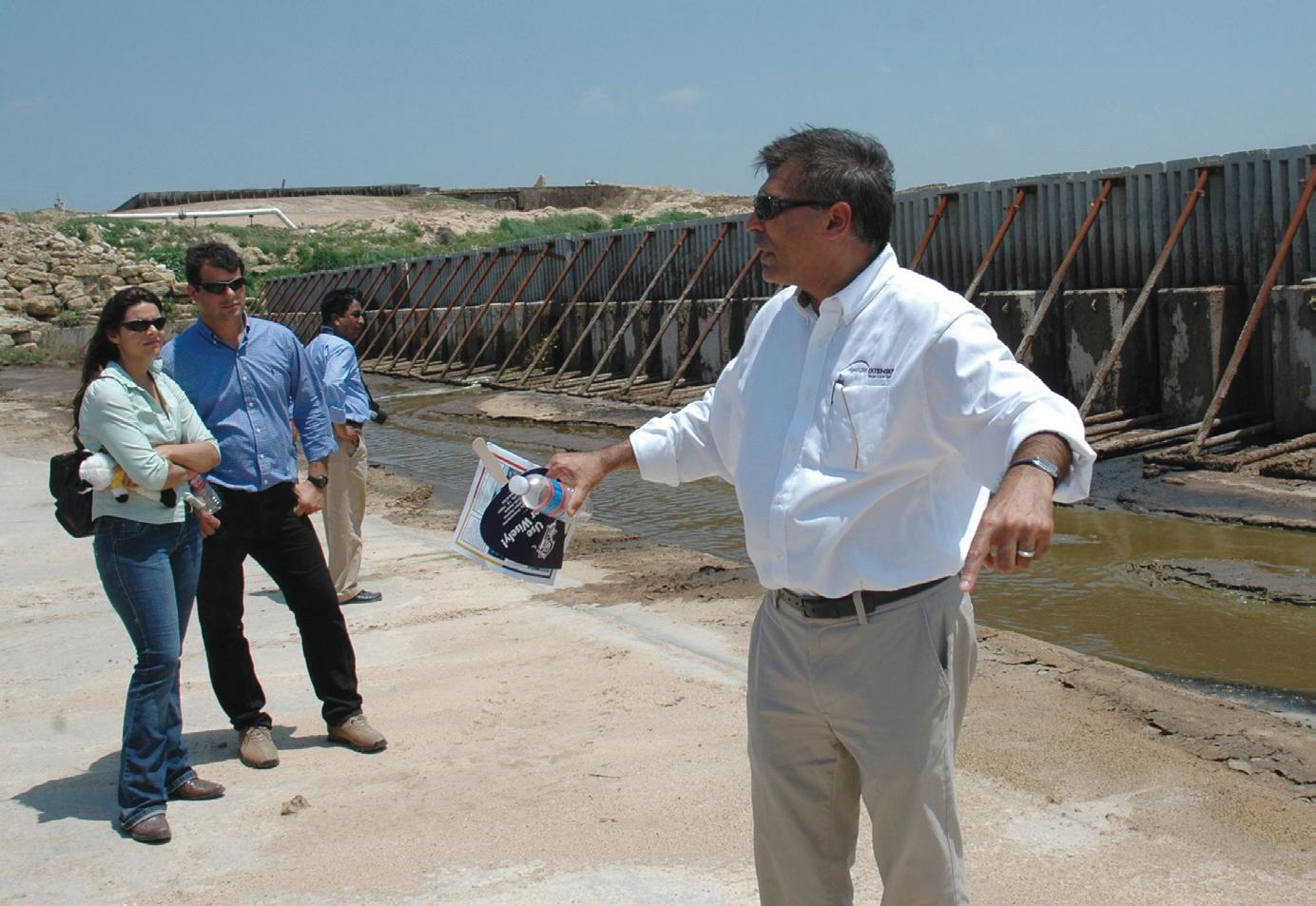
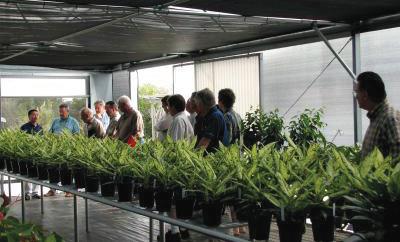
Dr. Saqib Mukhtar points out the weeping wall features to the attendees of the Southwest Dairy Day at the Alan VanderHorst dairy near Dublin, Texas.
drier product, versus the Honey Vac that we used before the expansion, we’re able to truck it farther distances to some of our other fields. it’s a lot less expensive because we’re not hauling water.”
Although there aren’t likely to be odor complaints near a dairy town like dublin, they have been lessened. “the odors are reduced by separating the solids from liquids and taking the liquids to the storage pond where they’re diluted,” says dr. mukhtar. “the odors are reduced because you are also removing some of the volatile compounds with the separated solids in the weeping wall basins and storing them. And also being drained and dried, the lesser the moisture, the better the aerobic conditions, and lesser the odors.”
Planning for a system
dr. mukhtar says the weeping wall system isn’t for every dairy. Anyone planning a new waste management system or treatment system needs to look at the entire picture. “they need to ask themselves, ‘What is the objective? is there enough land? Are they going to add some value by separating solids? Should i use those solids for composting? Would there be a market for that?’”
He adds, “for example, you can compost, and properly composted manure is an excellent source of fertilizer and organic matter, but if you can’t utilized on your cropland and there is no one living within 30 miles and no one is willing to come in and pick it up (hopefully buy it), you’re adding another stream of labor intensive manure that you then need to tackle.”
in this case, the weeping wall system has been an ideal solution and Reeves
Nitrous oxide has now become the largest ozone-depleting substance emitted through human activities, according to scientists with the National oceanic and Atmospheric Administration (NoAA).
A study by the N oAA evaluated nitrous oxide emissions from human activities in terms of their potential impact on earth’s ozone layer. As chlorofluorocarbons (C f Cs), which have been phased out by international agreement, ebb in the atmosphere, nitrous oxide will remain a significant ozone-destroyer, the study found. today, nitrous oxide emissions from human activities are more than twice as high as the next leading ozone-depleting gas.
Nitrous oxide is emitted from natural
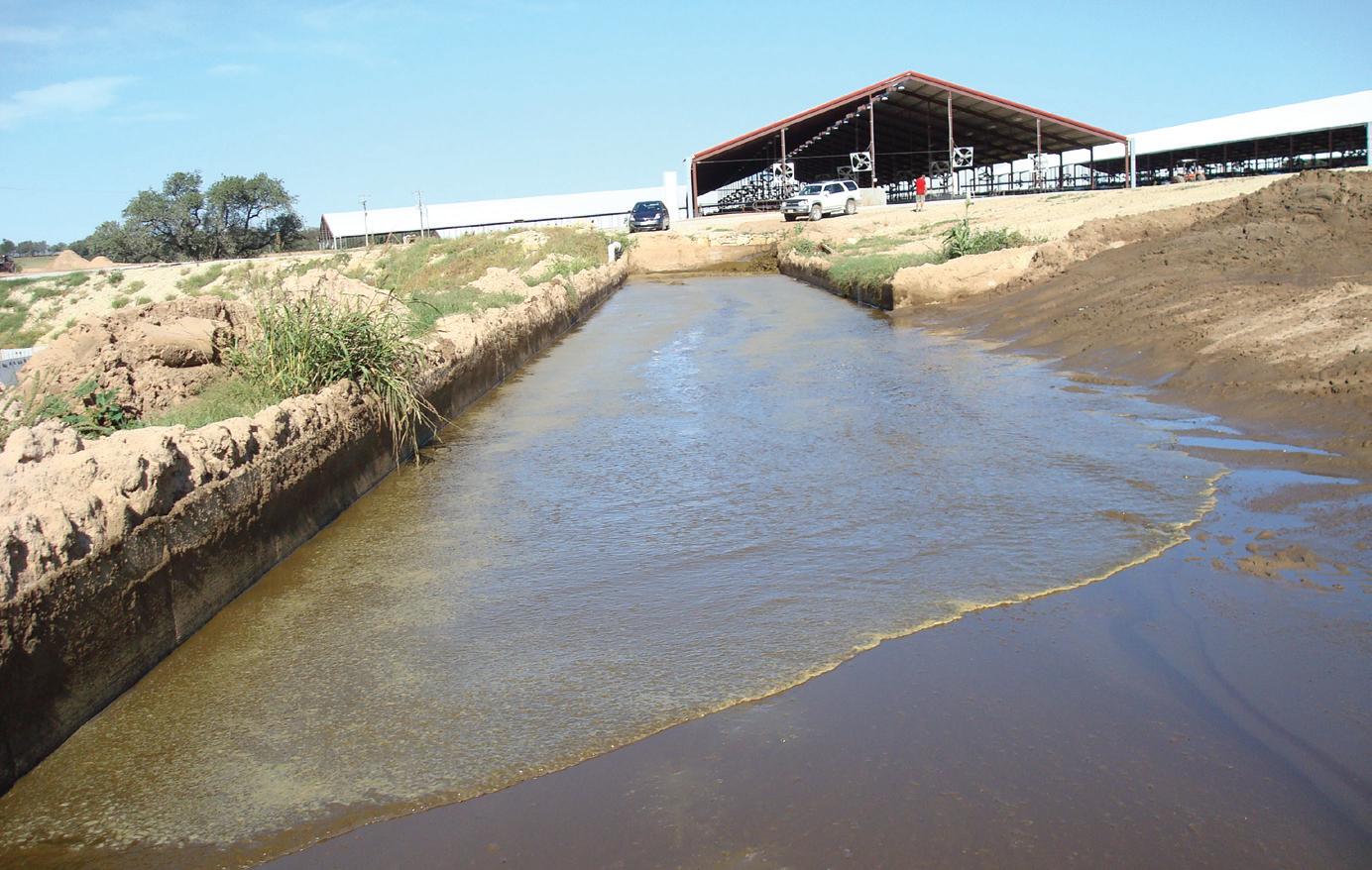
Final effluent leaving the chambers of the secondary weeping wall. This liquid is conveyed to lagoons for storage and treatment. Lagoon liquid is then used for flushing the manure alleys in free-stalls.
believes it’s something farms should look into. for Sierra dairy, the system is paying for itself — in part it’s able to recycle much of its bedding.
“Not a lot of people are pushing it because there are no replacement parts to sell and no service to sell,” says Reeves. “Not everyone wants to hear that. But the manufacturers generally try to push things that are going to make them money in the long term. And this isn’t one of those systems because it’s an up front investment. And there’s not a lot of money or maintenance to be spent on it down the road.”
dr. mukhtar presented his findings on the efficacy of the Sierra dairy weeping wall as a solid-liquid separation
sources and as a byproduct of agricultural fertilization. in addition to soil fertilization, nitrous oxide is emitted from livestock manure, sewage treatment, combustion and certain other industrial processes. the study was authored by A.R. Ravishankara, J.S. daniel and Robert W. Portmann with N oAA’s earth System Research laboratory (e SR l) chemical sciences division.
“the dramatic reduction in C f Cs over the last 20 years is an environmental success story. But manmade nitrous oxide is now the elephant in the room among ozone-depleting substances,” said Ravishankara, lead author of the study and director of the e SR l Chemical
system at the texas Animal manure management issues (tA mmi) Conference held Sept. 29 and 30, 2009 at the Austin marriott North in Round Rock, texas. the tA mmi Conference provided education and information on proper animal manure management for environmental protection and a thriving animal industry in texas, in the context of evolving regulatory and public relations environment. Continuing education units will be available to participants. for more information, see the tA mmi website at http://grovesite.com/tamu/tammi.
Agricultural Engineering Associates can be contacted at www.agengineering.com, or by calling 620-756-1000.
Sciences division in Boulder, Colo. though the role of nitrous oxide in ozone depletion has been known for several decades, the NoAA study is the first to calculate that role using the same measures that have been applied to CfCs, halons and other chlorine- and brominecontaining ozone-depleting substances. in nature, bacteria in soil and the oceans break down nitrogen-containing compounds, releasing nitrous oxide. About one-third of global nitrous oxide emissions are from human activities. Nitrous oxide, like CfCs, is stable when emitted at ground level, but breaks down when it reaches the stratosphere to form other gases, called nitrogen oxides, which trigger ozone-destroying reactions.
Study shows nitrous oxide now top ozone-depleting emission
An oldie but A Goodie
By Tony Kryzanowski
California plug flow anaerobic digester was one of the first installed in North America
Dairy owners, leo and linda langerwerf know how it feels to be a lightning rod for the well-funded and star-studded environmental activist crowd in California, but they have no regrets about their decision back in 1982 to be among the first to adopt anaerobic digestion as their primary manure management method.
“As a dairy farmer, you have a heck of a lot of crap to deal with and do you need that extra job? Probably not,” says leo. “But if you are having some environmental or regulatory concerns, it is one way to combat some of that stuff.”
He adds that in any situation where there are a lot of animals being managed in a confined area, “it just doesn’t make any sense why people wouldn’t do something like this. i sell more power than i use, so why wouldn’t anybody else want to do that?”
one published estimate says that the entire methane recovery system at the langerwerf dairy adds about $68,000 per year to their revenues.
in terms of return on investment, leo says that it is likely that farms would build a manure collection, anaerobic digestion, and by-product disposal system comparable to the amount of manure that they generate. So a reasonably priced system could be designed depending on the circumstances.
in addition to providing a new income source, installing an anaerobic digester does benefit the environment.
“ i t makes you handle your manure on a daily basis,” leo says. “ i t helps to keep your farm cleaned up of all
your manure because you need that manure to put in the digester so that it’s digested down and creates gas. So, to keep that steady flow of gas, you have to take care of it. You have to be a better manager of your manure than you used to be.”
the need for hands-on involvement to properly manage the anaerobic digester is nothing new for dairy farmers.
“Whoever is doing this is going to have animals,” says leo, “and it is just an extension of the animal. You have to take care of it every day, just like you do the animal every day, seven days a week, and there is no getting around it.”
methane recovery from manure digestion to generate power is only one income stream. there are also the benefits of using the nutrient-rich liquid by-product for crop fertilizer, and the dry compost by-product for free stall animal bedding. it is also a marketable, weed free and pathogen free compost product
that can be sold to landscapers and other dairy operations. the compost is weed free because the seeds germinate in the digester’s high temperature environment, but there is no oxygen. So the seeds die.
once the methane is extracted and the nutrients broken down into a finer material through the anaerobic digestion process, langerwerf believes it is a better crop fertilizer because it takes a lot less time for the soil to absorb that fine material versus application of a raw manure slurry. then, there are the intangibles.
“it helps a great deal in fly control and smell,” says langerwerf. “in fact, we hardly have flies at all like we used to prior to the digester.”
the langerwerfs operate an 800cow dairy on about 130 acres north of Sacramento and were among the first in North America to install a plug flow anaerobic digester for manure disposal. it measures 14 feet deep, 25 feet wide and
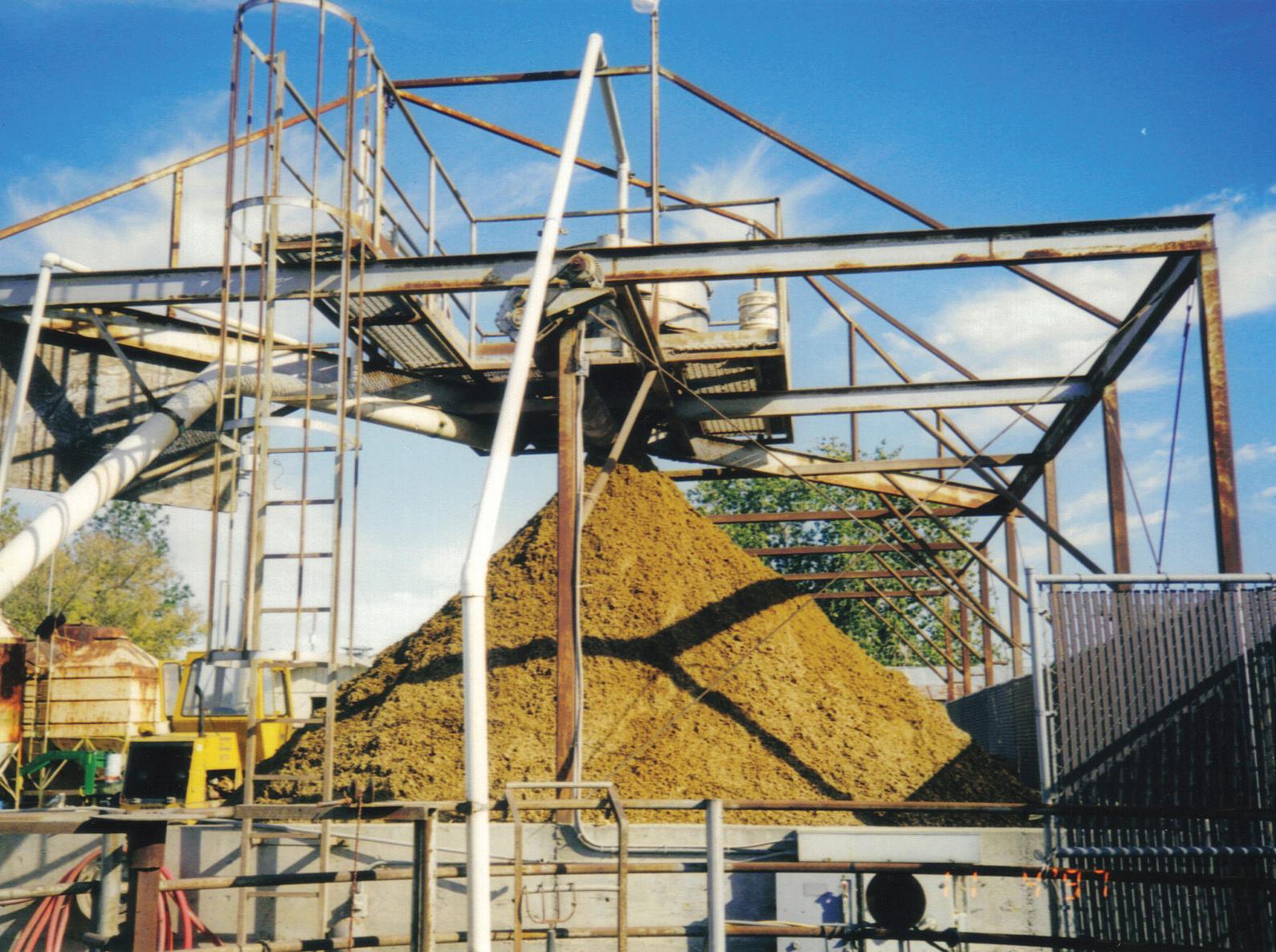
Solid compost by-product accumulates after processing through the Sweco Vibroscreen separator. Almost half is used as free-stall bedding, while the other half is sold to nurseries and landscapers. Submitted photos
125 feet long. of those early pioneers, the langerwerf digester is the only one still operating in California. the dairy uses between a quarter and a third of the power it generates for its own operations and the rest is sold under contract to power utility Pacific gas and electric (P g&e). A study conducted in 1998 by RC m digesters indicates that the farm saved $850 in one month alone from the electricity generated from burning the digester biogas.
the langerwerf milking parlors are all concrete and the raw manure is scraped with a tractor and scraper into a collection tank, where it is mixed with water to achieve the proper consistency of about 14 percent solids and then pumped into a preheat tank.
“You never see it once you get it scraped,” says leo.
the manure is warmed in the preheat tank with hot water coming off the methane-powered Cat 3306 engine. then the slurry is pumped into the RC m digesters plug flow digester where it is retained for 30 days at 97 degrees fahrenheit. the water used to heat the slurry in the preheat tank is re-circulated to cool the engine so that the radiator fan isn’t running all the time.
As the manure digests, the gas collects in a gas bag and the weedfree slurry by-product discharged from the digester is processed through a Sweco Vibroscreen separator. the solid stream is collected and used as free stall bedding or sold, while the nutrient-rich liquid stream is collected in a lagoon and diluted with fresh water before being used to irrigate 120 acres of cropland. langerwerf says he uses about 40 percent of the solid compost for bedding and sells the rest, usually without too much trouble.
during irrigation, the lagoon water is pumped at 200 gallons per minute and blended with irrigation water flowing at 5000 gallons per minute.
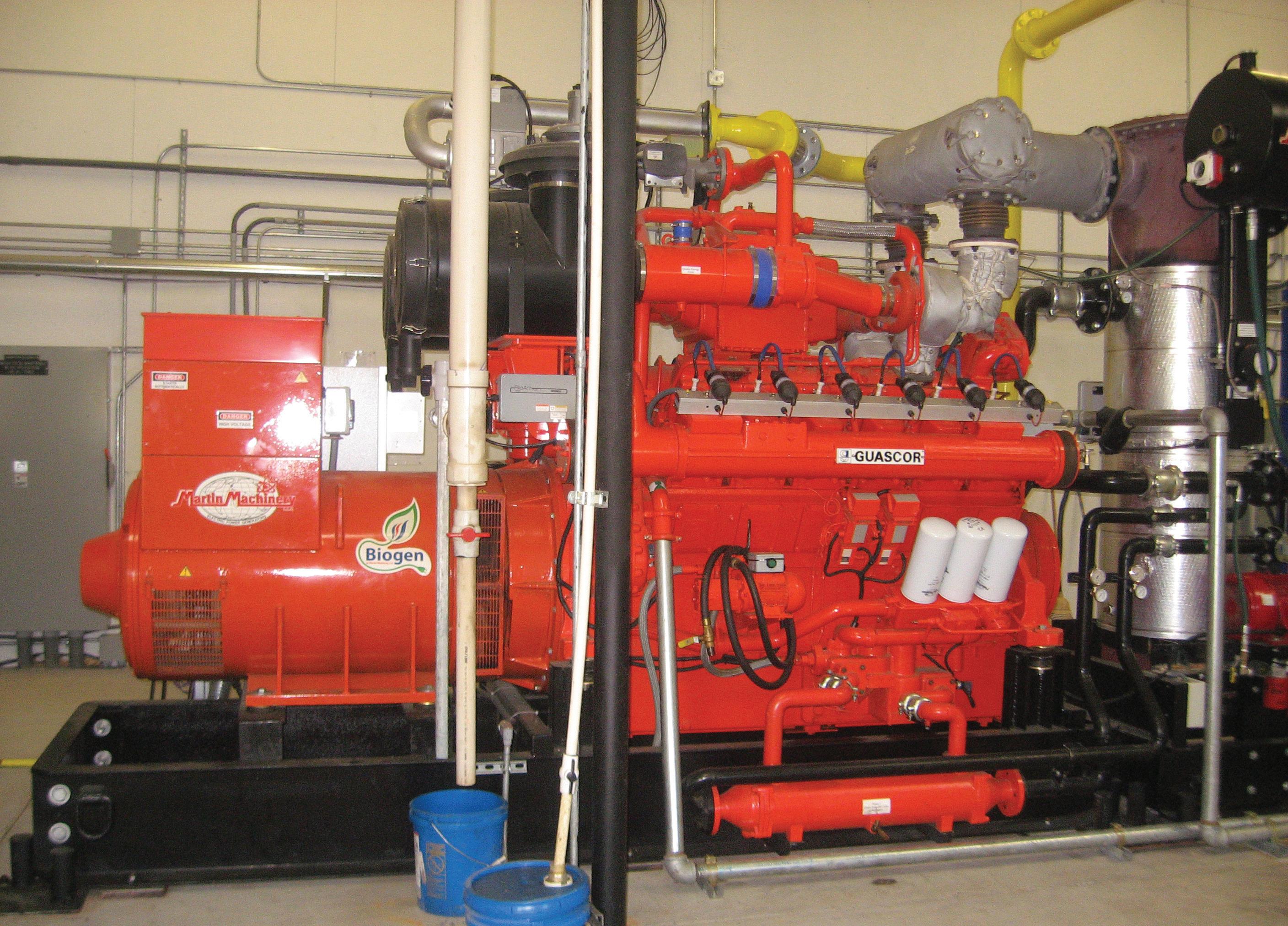
the biogas is suctioned through an underground pipeline from the gas bag to the 3306 Caterpillar engine. the engine generates about 40 kilowatts per day, and about 30,000 cubic feet per day of biogas is recovered.
langerwerf has high praise for RC m digesters as his anaerobic digester supplier.
“mark moser, the general manager at RC m, is a brilliant guy,” says langerwerf. “He can tell you just about anything about a digester, when it’s happening, before it happens and after it happens. He has a track record in the United States and
outside the United States. they are the only game in town, in my opinion, no matter where you are.”
RC m digesters was involved in a study and refurbishment project that essentially dissected and rehabilitated the langerwerf anaerobic digester in the late 1990s. it provided the company with an opportunity to determine what withstood the test of time over a 16-year period.
What they discovered is that while annual digester maintenance to that point had been estimated at about eight percent of capital cost, the annual
digester maintenance costs based on this study was less than one percent.
Another interesting discovery is that the plug flow digester appeared to accumulate only about one percent of the volume of solids that would be expected in an anaerobic lagoon. more specifically, over a 16-year period, about 740 cubic yards of material accumulated in the plug flow digester, versus 85,000 cubic yards that would typically accumulate in a lagoon. in tangible terms, it would take 74 loads of a 10-yard dump truck to remove the solids from a
digester versus between 5000 and 8000 truckloads from a lagoon.
“eventually, the farm with the lagoon will have to manage 5000 to 8000 dump truck loads of sludge that a digester does not accumulate,” says RC m in its project report posted on the U.S. environmental Protection Agency’s AgStAR website.
the hypalon gas bag attached to the langerwerf digester had degraded, largely through exposure to ultraviolet rays, but as a wear item that would need to be replaced over time, it is not a significant cost. there was only minor corrosion of concrete and steel.
langerwerf believes anaerobic digestion is a viable option for many intensive farm operations – although this is one area where California may not be a forerunner as far as environmental leadership is concerned.
in his view, the “environmentalism gone wild” attitude within California and red tape are actually working against dairy farms in the state from moving in the direction of installing more anaerobic digesters, and some have as many as 6000 cows.
“the small handful of actors and people that have nothing better to do with their time but screw with somebody else’s livelihood are the ones that are swaying
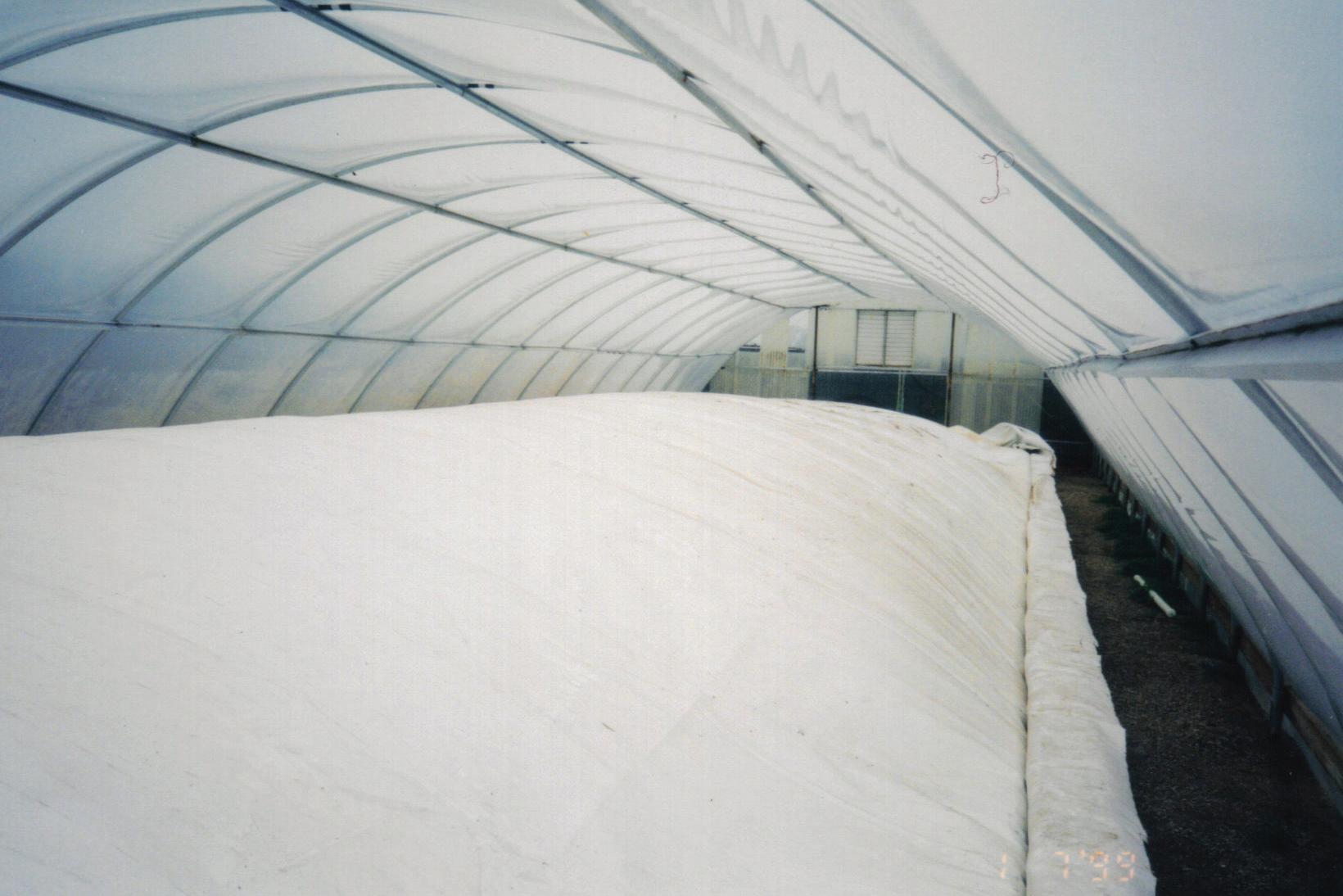
A new gas bag was installed over the Langerwerf dairy plug flow anaerobic digester in the late 1990s, and that in turn was covered by a greenhouse enclosure.
the vote because the squeaky wheel gets the grease,” leo says. “As farmers, we don’t have time to go to every meeting to try to influence people on what’s going on.”
one other legislative wrinkle that ticks langerwerf off is that he can not profit from marketing greenhouse gas emission credits from his anaerobic
This idea doesn’t stink: Technology cuts odors, pollutants
A North Carolina State University researcher has devised a new technology that really does not stink. in fact, it could be the key to eliminating foul odors and air pollutants emitted by industrial chicken rendering facilities and – ultimately – large-scale swine feedlots.
Praveen Kolar, assistant professor of biological and agricultural engineering at NC State, has developed an inexpensive treatment process that significantly mitigates odors from poultry rendering operations. Rendering facilities take animal byproducts (e.g., skin, bones, feathers) and process them into useful products such as fertilizer. However, the rendering process produces extremely foul odors.
While the emissions are not currently regulated by government, the smell can be extremely disruptive to a facility’s community. the industry currently uses chemical “scrubbers” to remove odor-causing agents, but this technique is not very effective,
Kolar says. furthermore, some of the odor-causing compounds are aldehydes, which can combine with other atmospheric compounds to form ozone – triggering asthma attacks and causing other adverse respiratory health effects.
Kolar, working with his co-author James Kastner at the University of georgia, has designed an effective filtration system that takes advantage of catalytic oxidation to remove these odor-causing pollutants. Specifically, the researchers use ozone and specially designed catalysts to break down the odor-causing compounds. this process takes place at room temperature, so there are no energy costs, and results in only two byproducts: carbon dioxide and pure water.
the researchers developed the catalysts by coating structures made of activated carbon with a nanoscale film made of cobalt or nickel oxides, Kolar says.
“We used activated carbon because its porous structure gives it
digester because it was built before 1999.
“this is BS,” he says, “because my green credits are worth just as much as anyone putting in an anaerobic digester tomorrow. i don’t need to be better than anybody else, but i sure as heck don’t need to be less than somebody else, and that is what they are doing to me.”
an extremely large surface area,” Kolar says, “meaning that there is more area that can be exposed to the odorous agents.” the cobalt and nickel oxide nanofilms make excellent catalysts, Kolar explains, “because they increase the rate of the chemical reaction between the odor-causing compounds and the ozone, making the process more efficient. they are also metals that are both readily available and relatively inexpensive.”
Kolar says his next goal is to apply this research to industrial hog farms. “this technology could be applied to swine operations to address odors and ammonia emissions,” Kolar says. “my next step is to try to pursue this research on a large scale.”
the research, “Roomtemperature o xidation of Propanal Using Catalysts Synthesized By e lectrochemical d eposition,” is published in the August 2009 issue of transactions of the American Society of Agricultural and Biological e ngineers (ASAB e ).
Methane gas is captured from the biodigester and used to run a generator that produces energy that is fed into the main grid. Submitted photos
Finding
common ground
By James Careless
Qualco Biogas Project brings together farmers, natives while helping the salmon
Historically, dairy farmers and members of the tulalip tribes in Washington’s tualco Valley have been at loggerheads. the farmers are pushing ahead with herd growth, thus increasing the risk of manure run-off into the Snohomish River. this run-off could seriously hurt the river’s ability to support salmon, an important resource for the tulalip tribes. Add local environmentalists, who are trying to preserve the Snohomish and the stage has been set for confrontation. So why are these groups now working together, when they used to be fighting? one word: Biogas.
in a creative solution to the potential
problem, local farmers belonging to the Sno/Sky Agricultural Alliance, Native Americans from the tulalip tribe and a representative from the Northwest Chinook Recovery environmental group have banded together to form Qualco energy. Qualco is a nonprofit group that runs a biogas electricity generator in the area. Currently, Qualco’s biodigester is handling manure from 1,100 local cows, with capacity for double that, and 450 kilowatt/hours of electricity is being generated by Qualco regularly since it began generating in december 2008. that’s enough to power 300 homes.
“Qualco energy shows what can be done when people come together to solve problems to everyone’s benefit,” says dale Reiner, Qualco’s president. “it is truly a win-win for everyone affected – including the fish.”
When he’s not running Qualco, Reiner is managing his dairy herd on his 300-acre farm. it’s been in the family for three generations, with frontage on the Snohomish River.
“eight years ago, my brother and i had finished doing some waterfront
restoration on our property, to help the local salmon population,” he tells manure manager. “the fact that the tulalip tribes were doing the same kind of work got us to thinking: What if we could find a way to work together to restore the salmon, and deal with the potential run-off problem at the same time?”
Reiner kicked the idea around with local dairy farmers. they liked it, and he decided to approach the tulalip tribes.
“We had to keep our meetings pretty hush-hush,” Reiner says. “in those days, neither side trusted each other.”
As people talked with each other, the distrust eased. eventually the Sno/Sky Agricultural Alliance, tulalip tribes, and Northwest Chinook Recovery agreed to establish a biodigester in the area. the suggested site was the former prison dairy known as the monroe Honor farm. operated by the State of Washington from 1929 until 2001, the 277 acre farm is located close to local dairy farms, yet far enough away from subdivisions and other forms of housing that running a bio-gas facility wouldn’t disturb anyone.
Working together, the three member groups of Qualco energy received $250,000 from the 2003 Agriculture Appropriations bill to fund a feasibility study into the biogas facility. once it was completed and their concept had been approved, Qualco had the basis to seek funding from the federal Biomass Research and development program. As a result, a US dA grant amounting to $500,000 was received and used along with more than $2.9 million in acquired loans to fund the biogas project. lobbying at the state level persuaded the legislature to give the farm to the Qualco energy group. from that point, work on the biodigester began until it started operation late last year.
“it took a lot of hard work on everybody’s part to get to this point, but we did it,” says Reiner.
The system the heart of Qualco energy’s biodigester is a large concrete digester tank. located at the monroe Honor farm, the concrete covered tank is 198-feet long, 80-feet wide, and 17-feet deep. it has enough capacity to process waste from 2,200 cows at a time. the tank is equipped
with heaters to ensure that the fluidized manure inside stays warm enough to support anaerobic bacteria; meaning that the temperature has to be maintained at 99 to 100 degrees fahrenheit at all times. “it took us a while to get up to that temperature when we started
the operation in winter,” Reiner says. “Sometimes you’ve got to expend some energy to create some.”
the anaerobic bacteria within the manure grow within this environment, digesting the most toxic elements of the manure, releasing methane gas as a
Methane gas is piped through to run the generator.
byproduct. this methane gas is captured from the tank, and then used to run a generator that produces electricity that is fed into the main grid. meanwhile, the remaining processed manure is nearly odorfree. it has become nutrient-rich compost that is perfect for gardens and farms (as is the grey water left from the process).
“this is truly advanced recycling,” Reiner says. “What used to be left in the fields to decompose – with a potential to overload the local water table with excess nutrients – is now creating clean electricity and natural fertilizer that lacks the pungent manure smell that people complain about. meanwhile, the river is protected from the possibility of receiving excess dairy nutrients. this helps protect not just salmon, but the entire eco-system.”
Challenges
Currently, Qualco energy’s biodigester is operating at half capacity, with manure only coming from the nearby Werkhoven dairy farm. “two farms have built pipelines to our site,” says Reiner. “the first, owned by Werkhoven dairy, is in operation. the second hasn’t started production yet.”
Why haven’t other farmers started hauling manure to Qualco, at the very least? “it is a problem of economics,” says dale Reiner. “they want to use our facility, but they are having trouble affording to. milk prices are down, while fuel prices are up. Combined, they make it expensive to haul manure to our site.”
even when the biodigester gets up to full capacity, other units will have to be built to make a real dent on local manure production. this will likely require more government assistance. However, given how completely biodigestion can reduce manure run-off, such funding should be politically popular with farmers, natives and environmentalists. dale Reiner is adamant that biodigestion is a much smarter way for dairy farms to handle manure, in contrast to other environmental methods. “All dairy farms are required to operate under a nutrient management plan designed with the help of the local conservation district approved by the State department of Agriculture with oversight by the federal environmental Protection Agency to assure that no contamination currently results from the farm’s waste disposal practices,” he explains. “the benefit of the biogas digester system that we have installed, is that it allows the dairy farmer to increase his herd size based on a business management and financial plan rather than a plan based on the number of cows per available acre. this
is accomplished by creating a system that allows excess nutrients not required by the dairy farmer for his farm fertilization to be transported to other farm or garden sources outside his local area; thereby, in affect increasing the size of his nutrient disposal area.”
Speaking in broader terms, Reiner cites biodigestion as a technological solution that can reconcile the needs of farmers, natives and environmentalists. “Qualco energy is about more than dealing with manure constructively, although it is a big step in that direction,” he says. “it is about bringing together conflicting interests in a positive way that really makes a difference. this is why the
members of our company – the Sno/Sky Agricultural Alliance, the tulalip tribes and Northwest Chinook Recovery – are so committed to this solution, and willing to keep at it until we have realized our collective dream. We all want farming to succeed here, because otherwise the land might end up being overtaken by condos. We all want the salmon to thrive, and we want to tackle the energy shortage in a clean, green manner.”
“Biogas and biodigestion does all of these things,” he concludes. “everyone truly does win with this approach.”
Qualco Energy can be found on the web at www.qualcoenergy.com.
The heart of Qualco Energy's biodigester is a large concrete digester tank large enough to process waste from 2,200 cows at one time.
The biodigester is currently receiving manure from one local dairy while another has constructed pipelines to the facility.
less liquid
By Tony Kryzanowski
B.C. compost designer focuses on water evaporation to better manage nutrients
Amajor challenge in manure management is often the sheer volume and health risks posed by raw manure, and the need to safely dispose of this resource as it accumulates.
excessive buildup of phosphorus-based nutrients in farmland where too much manure is applied over time is also a problem in some areas.
imagine what a stress relief it would be if the water content could be removed from hog or dairy manure, for example, and the remaining solids were converted to pathogen-free compost? Compost represents a valuable commodity to such industry sectors as landscapers, nurseries, and garden centers, and it is also a valuable commodity on the farm. Compost can play an important role in revitalizing farmland, according to dr. John Paul, a Phd in soil microbiology and biochemistry who also worked with Agriculture and Agri-food Canada for seven years. Canada has lost 30 to 50 percent of the organic matter in its soils already, he says, and this percentage is higher in other parts of the world. Applying compost is a good way to revitalize soil.
By heating the air above raw manure, including liquid manure, Transform Compost Systems is developing technology to evaporate the liquid and leave high value, pathogen-free compost behind. Submitted photos
the concept of composting has been around for a long time, typically on a smaller scale with individuals composting organic material in their backyards. given the trend toward more intensive agriculture operations, dr. Paul’s company, transform Compost Systems, sensed a trend in agriculture back in 1998 where there would be a strong need to economically recycle nutrients generated from farms in many parts of the world.
“many farms are net importers of nutrients like feed and other commodities,” says dr. Paul.
He describes his Abbotsford, B.C.-based company as a provider of design for composting systems, operator training courses for compost facilities, and retailer of composting
equipment. the company hasn’t limited its horizons. its list of projects includes installations throughout North America.
transform Compost Systems also provided the design, construction manuals, and equipment for a 200 ton per day organic waste composting facility in Qingdao, China, and the design and equipment for a biosolids and chicken manure composting facility in Australia.
of particular note, the company was involved in the safe composting of diseased chickens in B.C. during the avian flu outbreak in 2004. the company managed the composting of 1.3 million chickens at a central B.C. location, and implemented safe and cost-effective protocols for on-farm composting of poultry litter for 20 different farms.
Because compost can be generated from all organic material, the company caters to both agricultural and nonagricultural clients.
transform Compost Systems is working on a project using the heat energy that can be generated in the composting process to evaporate the water from liquid manure typically destined for storage lagoons, leaving behind a much smaller volume of pathogen-free compost. dr. Paul has been working to advance this research since 1994. He notes that every ton of manure has over two million BtUs of potential heat available. the company’s system has much wider potential application than just hog or dairy operations. it is already being applied successfully in a chicken manure composting system.
“We are working with some producers in North America to extract heat out of the composting process,” says dr. Paul. “Not necessarily to process liquid manure and recycle the heat that way, but in one particular case, to heat poultry barns in the winter months.”
Capturing excess heat from composting chicken manure has added benefits over composting liquid hog manure because – in the case of hog manure – all of the generated heat needs to be used to evaporate the water. With poultry manure, there is a lot less liquid, so the generated heat can be used in other ways, like saving on heating costs.
According to dr. Paul, when the issue of greenhouse gas emissions began to percolate about 1994, this fueled increased interest in anaerobic digestion of organic waste products. As part of the research involving anaerobic digestion of manure, microbiologists were able to calculate how much energy potential was in manure.
“the problem with anaerobic digestion is that we don’t solve any of our problems, which are too much liquid and too many nutrients,” says dr. Paul. With anaerobic digestion, even though capturing methane is a valuable commodity for use in power generation, there is still the liquid stream that must be economically disposed of in some way.
faced with these issues, he says researchers like him thought of turning that potential energy in manure to heat energy, using it to evaporate the water and leaving behind a composted, stable volume of solid nutrients, which can then be marketed or used on farmland as organic fertilizer.
transform Compost Systems has actually designed a system consisting of an aerated channel system, a stainless steel mixing system, a heat recovery and reuse system, and process optimization. the company is in the process of working with a commercial hog producer to put science into practice. it has built a composting installation, which includes a 30-foot-wide by 250-foot-long composting greenhouse to generate external heat. However, the project was sidelined recently by poor hog prices,
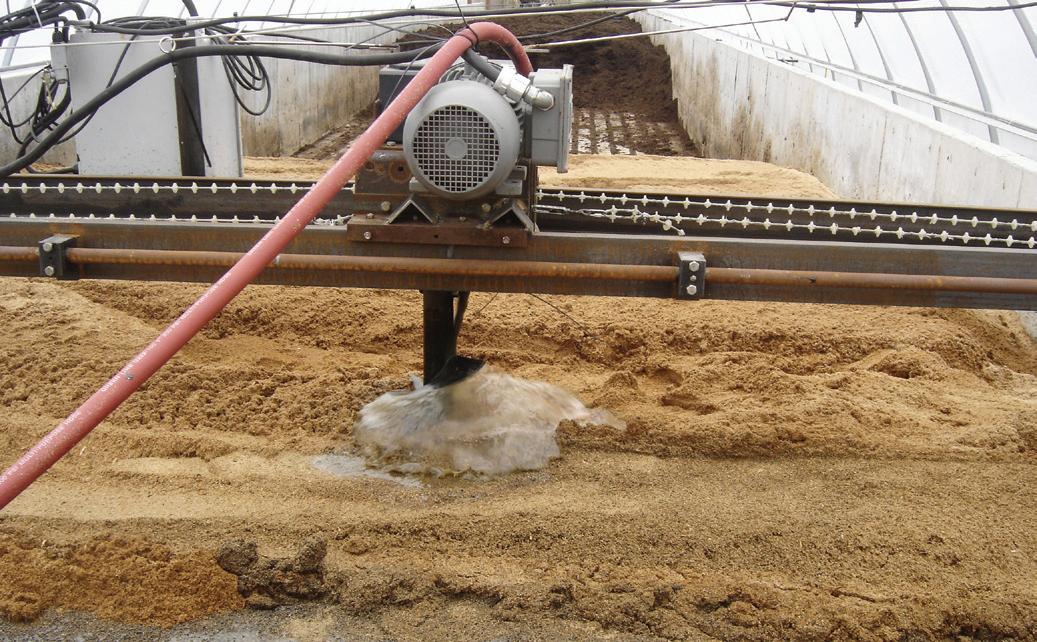
Liquid manure is added to the composting material as it mixes in a process that Transform Compost Systems has developed to evaporate the water from the raw liquid manure and leave a solid compost byproduct behind.
which forced the producer to sell his hogs. He is now raising hogs on contract, so transform Compost Systems intends to restart its project this summer and demonstrate its effectiveness in a commercial setting. this research has been funded in part by the Pork industry development fund, the greenhouse gas initiative and the B.C. Agricultural Council.
“the proposed treatment is to take that liquid manure as soon as possible when it is out of the barn,” says dr. Paul, “and blend it with a solid matrix to create the composting environment so that we can get the heat to evaporate the water.” grain straw works well as a solid matrix and it is plentiful in areas where
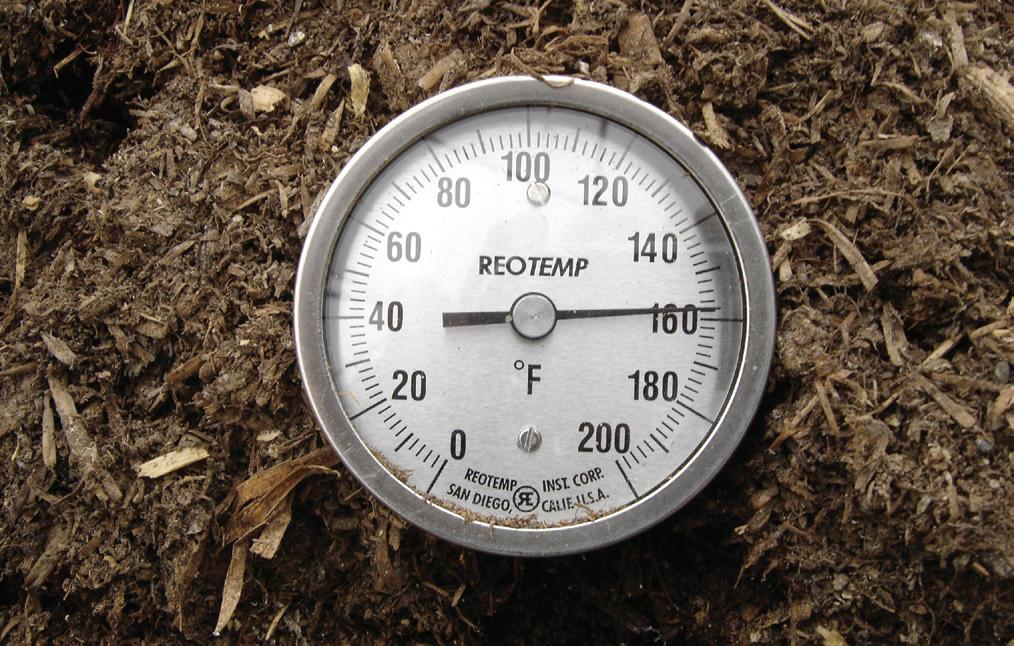
The higher the temperature in the compost pile, the higher the evaporation potential, according to B.C.-based Transform Compost Systems.
intensive livestock operations are abundant, but use of a variety of materials is possible.
By now, it’s obvious that a critical element for the composting process to work as designed is the ability to generate heat above the liquid manure to both evaporate the water and trigger composting of the remaining solids. Unfortunately, heat is in short supply through a lot of the year in colder climates where a lot of hog production takes place.
“the temperature of the air above the composting material is actually the most critical factor in the whole process,” says dr. Paul. “As you can imagine, if it is minus 40 (Celsius), getting that
Continued on page 32
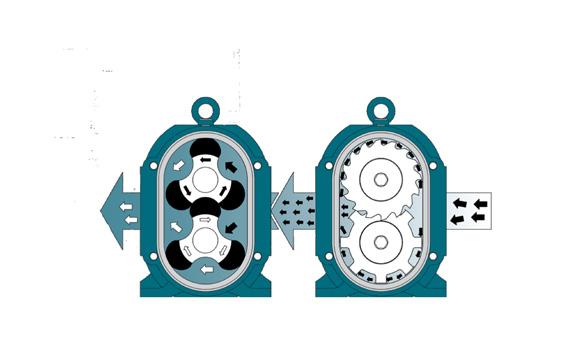
Lobe Pumps Macerating Technology
Manure Handling Solutions
Rotating Equipment for Anaerobic Digestion
Rotary Lobe Pumps
Multicrusher/Multichopper
Stainless Steel Tanks
Innovation
Rotary
A top 10 list on prepArinG for fall manure application
By Angela Rieck-Hinz
1
Review manure management plans. Prior to land application, review your manure, nutrient, or comprehensive nutrient management plan, make any necessary updates such as adding new fields. Review the plan, application methods and separation distances with employees and/or commercial manure applicators. Also consider evaluating fields for application. Because winter application of manure is prohibited for confinement feeding operations with liquid manure, plan ahead in the event you may have to apply manure under emergency situations in the winter. Save fields with the flattest slopes and P-index ratings of two or less for emergency application.
2
Know and follow land application separation distances. Confinement site operators are subject to land application separation distances to neighbors and public use areas, but all animal feeding operations, regardless of
size, are subject to separation distances from designated areas (water sources). get a copy of an aerial photograph of your fields and the neighbors’ field to which you apply manure. map out neighbors’ houses, churches, businesses, school, cemeteries and other public use areas as well as all designated areas such as sinkholes, wells, including abandoned wells, cisterns, designated wetland, water sources, high quality water resources, agriculture drainage wells, and tile inlets to agriculture drainage well. identify all other sources of concern for manure application. Sketch out separation distances. train your employees to read the maps and stay away from areas where manure application is not allowed. if needed, flag out the areas in the field. Share copies of the maps with your commercial applicator. make sure you understand the definitions for incorporated and injected manure. make sure you understand separation distances for designated areas (water sources) must have the manure injected or incorporated on the same date it was applied.
3
make sure your manure applicator certification is current. if you are required by law to be certified to handle, haul, transport or land-apply manure make sure you certification status is current.
4 develop an emergency action plan. manure spills happen, so plan accordingly. train employees in manure spill response. Ask your commercial manure applicator if they have a plan of action in the event of a spill. if they don’t have a plan, demand it. Keep important phone numbers and contact information for excavators, neighbors with pumps and tractors, and local officials and emergency response units up-to-date and posted where everyone knows where to find them. Be aware of safety issues regarding gases when pumping and agitating manure. N e V e R enter a building or manure storage when pumping or agitating manure.
5 take manure samples. taking manure samples prior to land application will give you nutrient analysis results
for planning application rates this fall. Sampling during land application or manure agitation may provide better results to use in future planning, but will not provide nutrient analysis results to use in planning application rates for this fall. it is important to build a history of nutrient analyses for manure sampling to help better manage the nutrients in manure for crop production.
6
Sample soil. Will you need to update an mm P in the next year or two where you need soil samples to re-do your P-index? if so, taking the required soil samples this fall will keep you from getting caught needing to update the mm P at a time you can’t get soil samples taken. Samples should be taken prior to manure application. for a mm P, one soil sample can’t represent more than 10 acres unless you are updating an existing P-index and have been applying manure at less than the P removal rate of the crop, then one soil sample can be taken for up to 20 acres.
7 Calibrate your application equipment. When the co-op applies fertilizer for crop production, do they know how much they are spreading? Yes! Why not do the same for your manure nutrient source? Calibrating manure application equipment takes a little time, but in the long run it will help you meet the correct application rate and make better use of your manure nutrients.
8 think timing, timing, and timing. A new law has been passed in i owa prohibiting the application of liquid manure from confinement facilities on snow-covered or frozen ground during certain times of the year. However, regardless of the source of manure, or the size of operation, application of manure under these conditions is not recommended due to the increased risk of nutrient loss and movement to surface waters.
9 Consider the neighbors. there is no doubt about it, the number one complaint about manure application is the odor. Right or wrong there is a perception of “if i can smell it, someone must be doing something wrong.” Work with your neighbors to let them know about your manure application plans. if possible, tell them how long it might take, how you plan to apply the manure, and how long they might expect to smell the manure. inquire about any outdoor events in the neighborhood such as weddings, friday
night football games, cookouts and such to avoid manure application prior to those events. good communication is the key.
Be safe. fall is a busy time of year for farmers and commercial manure applicators. many manure spills happen because people are in a hurry or are tired from long hours of application work. get plenty of rest, take breaks and slow down. take time to inspect equipment. this will help protect employees and reduce the chances of equipment malfunction. observe all laws
of the road and watch out for the “other driver”. they may not realize you are moving at a much slower rate of speed or how long your tractor and tank wagon are when they go to pass you on the road. Check “slow moving vehicle signs” and replace as needed. Check lights to make sure they are working and are visible. install additional lights as needed to improve your visibility and to help people see you.
Angela Rieck-Hinz is with the department of agronomy at Iowa State University.
new Holland adds two new box spreaders
New Holland has added two new high-capacity models to its box spreader line. featuring a heaped capacity of 524 cu. ft. (m2080 model) and 628 cu.ft. (m2090 model), the pair of box spreaders can spread huge amounts of manure, requiring fewer trips to the field. the New Holland box spreaders consist of a solid poly floor and poly-bonded plywood sides, front and end gate that will hold up under harsh conditions. these materials are corrosionresistant plus smooth and slippery so heavy loads can be moved to the back of the spreader with less torque. the double apron system uses heavy t-Bar chains to handle the heavy loads of dense, packed material. Steel alloy idler slides for the apron chains at the front of the spreader prevent the apron chain from jumping off the idler sprocket. the speed of the apron chains can be hydraulically adjusted independently of the Pto-driven beaters using the electronic control in the cab.
New Holland’s m2080 and m2090 spreaders use an upper and lower beater to ensure that large pieces are broken up for more even spreading. eighteen replaceable beater paddles, constructed of high-strength steel, are bolted to the beater shafts. their symmetrical, rooster-comb design delivers knife-like cutting and shredding action and creates a wide, fine spreading pattern. the hitch of the m2080 and m2090 spreaders is attached to the heavy-duty, channel-iron frame that extends under the box of the spreader. the high-strength tandem walking beam axles provide a smoother ride and feature generous axle pivots. www.newholland.com/na
EnviTec Biogas bearing fruit
eastern europe is beginning to discover the benefits of biogas as an environmentally compatible source of energy as envitec Biogas recently signed contracts with a combined volume of approx. e UR 10 million in Slovakia and latvia.
the latvian contract has been awarded to a swine farm operator, who has ordered two plants with a rated electrical output of 1 m W each. the biogas plants are to be erected on the farm near liepaja. the agricultural company will use liquid manure and renewable resources as input materials. the heat produced in the process will be used to heat the pigsties. envitec will also build two biogas plants in Slovakia. the plants, with an electric output of 1 m W each, have been ordered by an investor and will be erected near Vrbina and Novy dvor. Construction is scheduled to start before the end of August. liquid manure and energy maize will be used as input materials. A compensation of 15 euro cents per KWh makes biogas an attractive alternative also in Slovakia. www.envitec-biogas.de
Kuhn Knight launches new line of box spreaders
Kuhn North America, inc., of Brodhead, Wis., recently introduced the new PSC Series ProSpread Commercial apron box spreaders.
the truck and trailer models are designed for operators who need a high-capacity, heavy-duty machine to spread the toughest solid materials.
they provide consistent performance and long life with their sturdy all-welded construction, friction-resistant poly floor and innovative split-apron drive. A hydraulicallycontrolled, variable-speed apron allows even spreading of pen pack, feedlot and dairy manure, and many other solid materials.
the spreaders can accommodate horizontal and vertical beaters, and include three models with capacities of 610, 710 and 810 heaped cubic feet. operators can save on fertilizer costs by combining vertical beaters, with their wide, consistent 25 to 30 foot spread pattern, and an optional scale system to monitor application quantities and take maximum advantage of the nutrient value of manure.
www.kuhnnorthamerica.com
new Holland’s new Rustler™ utility vehicle
New Holland recently announced a new product for the hardworking rancher and farmer: the Rustler utility vehicle. the Rustler utility vehicle combines rugged performance with an ultra-smooth ride for “go-anywhere, doanything” confidence.
Whether hauling supplies, pulling trailers or transporting people and gear, Rustler UVs can be configured to meet the need: they are offered in two-passenger or four-passenger versions, with gas or diesel engines, 4x2 or 4x4 axles, and with a wide variety of options and accessories.
the frames of the 120 and 125 Rustler UV models are constructed of the same grade of rustproof, corrosion-resistant, lightweight aluminum used in jet fighters, while the 115 features rugged steel frame and box construction. the vehicles are backed by a two-year/2,000 hour warranty.
With total vehicle capacities of 900 to 1,600 pounds, Rustler utility vehicles can handle big loads. independent front and rear suspension (rear only on the 115) and a high ground clearance provide a smooth and stable ride.
New Holland offers Rustler UVs with 4x2 or 4x4 axles. for extra traction on the 14-hp, 4x4, 115 (gas) model, simply engage the shift-on-demand four-wheel drive, while the larger models
engage four-wheel drive automatically. the 20-hp 120 (diesel) and 23-hp 125 (gas) models feature an automatic, all-wheeldrive system.
Rustler UVs can be equipped with a choice of bench seats or high-back bucket seats with 13-position driver seat adjustment. (Bench seat only on the 115.) for safety, passengers are surrounded by certified rollover protection system (R o PS) and retractable safety belts for all seat positions.
A wide variety of factory and dealer-installed options and accessories – from an optional powered cargo dump box, to cab enclosures, special lighting packages, and attachments – are available to customize Rustler UVs. A hydraulic-powered, quick-change tool attachment system is built in. Attachments easily connect to a front mounting plate, and are controlled with a joystick from the driver’s seat. www.newholland.com/na
new crop residue tool released by Horsch Anderson
it’s called the Joker but there’s not much funny about this serious new tillage tool released recently by Horsch Anderson of South dakota.
Hailed as the “ultimate machine for residue management and seedbed preparation,” the Joker is advertised as an alternative to manure incorporation, vertical tillage, seedbed preparation, stubble cultivation, shallow tillage and furrow leveling. it features a short frame depth and smaller discs that are reported to achieve consistent depth at high speeds. the 18-inch notched blades turn faster for better soil mixing and are mounted in pairs on a single arm torsion bar for independent action in rocky and varying terrain.
the Joker does not have a single axle gang, instead relying on a rubber torsion bar system for movement and clearance. the system ensures clearance for rocks, ground following ability and maintains a consistent blade angle, ultimately creating a high residue throughput capacity.
the Roll flex system on the Joker combines the benefit of consolidation while leaving behind a smooth field. four evenly spaced ring packers with leveling tines in between provide performance in variable field conditions. the packers can “flex” for self-cleaning.
Spade discs are located on the outer ends of the disc section of the Joker, ensuring level conditions and eliminating soil ridging.
the Joker is available in both Ct and Rt models. www.horschanderson.com
geomembrane Technologies inc.
introduces new
biogas cover
geomembrane technologies inc. (gti) of fredericton, New Brunswick, recently announced it has developed a new, state-ofthe-art, structurally supported geomembrane cover system for use in capturing biogas for round tanks.
gti’s new innovation has just been implemented on a project in delaware County, near Columbus, ohio. the new design covers two 65-foot diameter round tanks, which can be easily retracted for access to the tank interior, simplifying inspection and maintenance.
the structurally supported cover system is part of an overall wastewater treatment system that effectively streamlines aeration gas (off-gases) collection and improves odor control. www.gticovers.com
inspecting
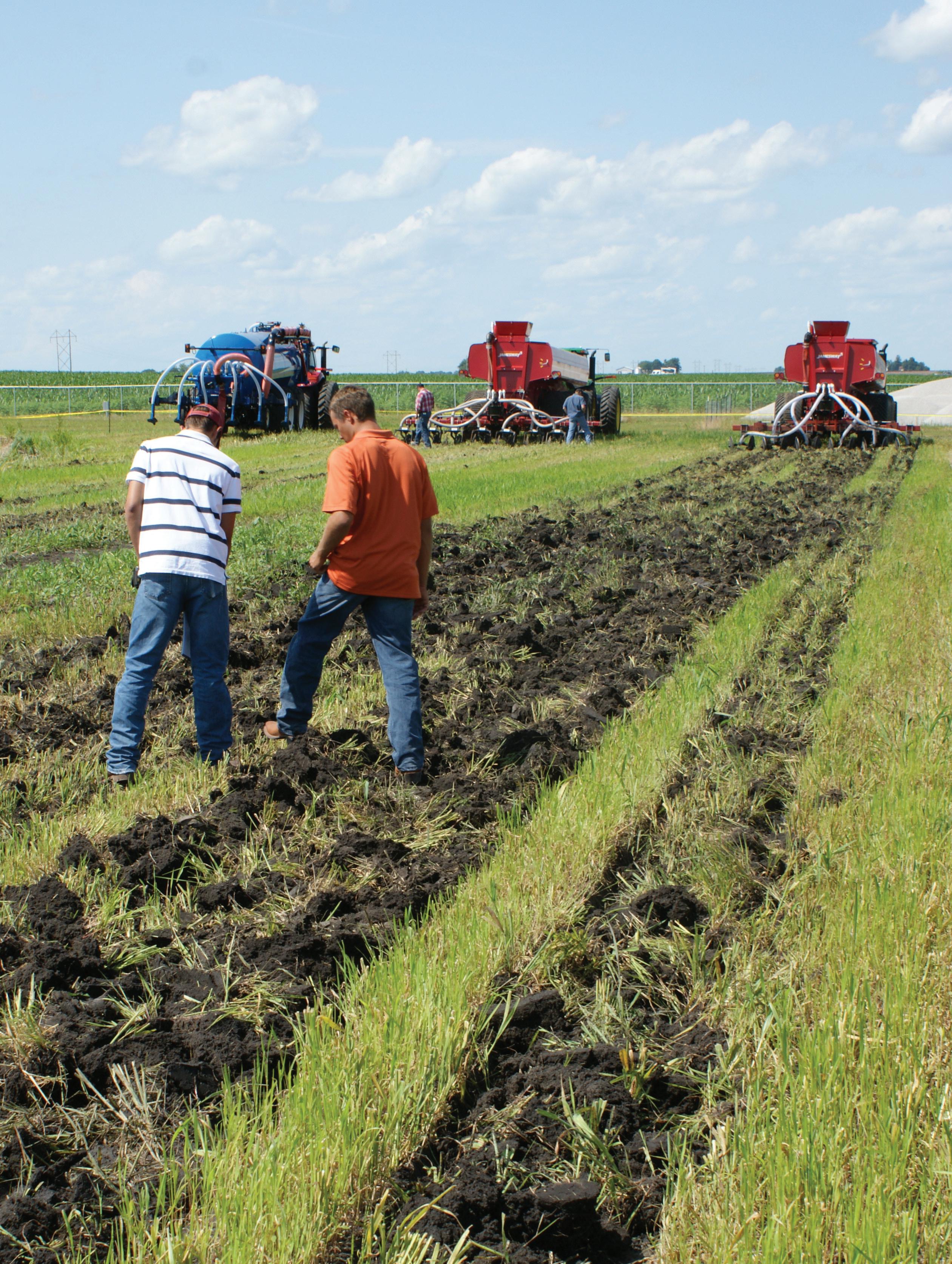
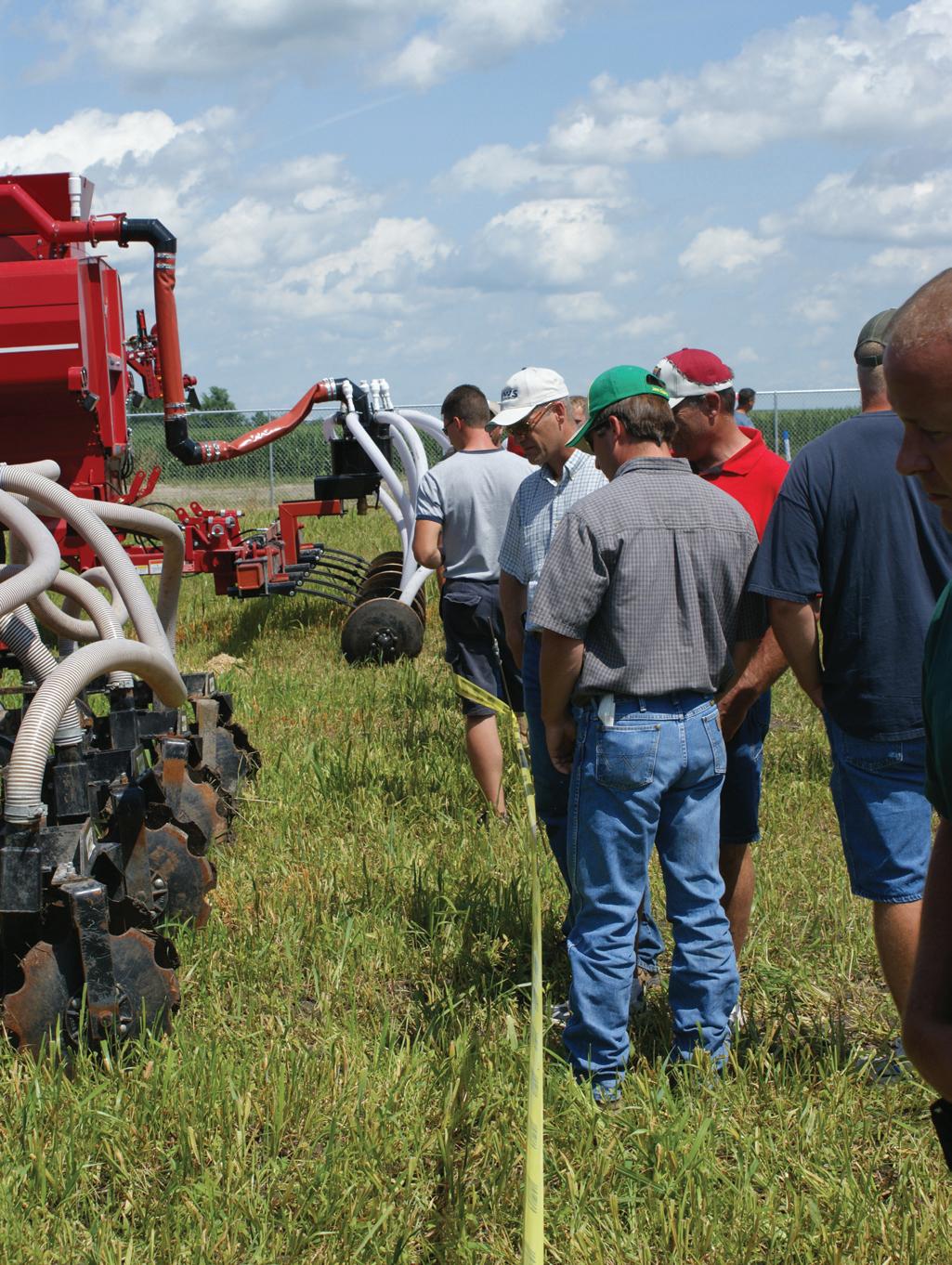
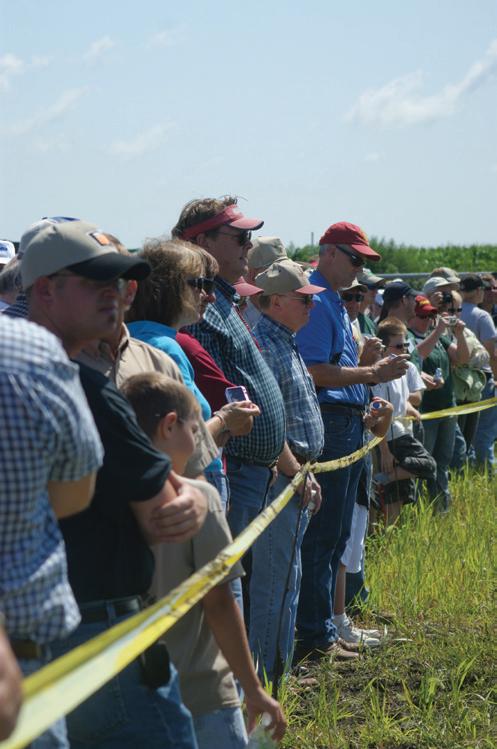
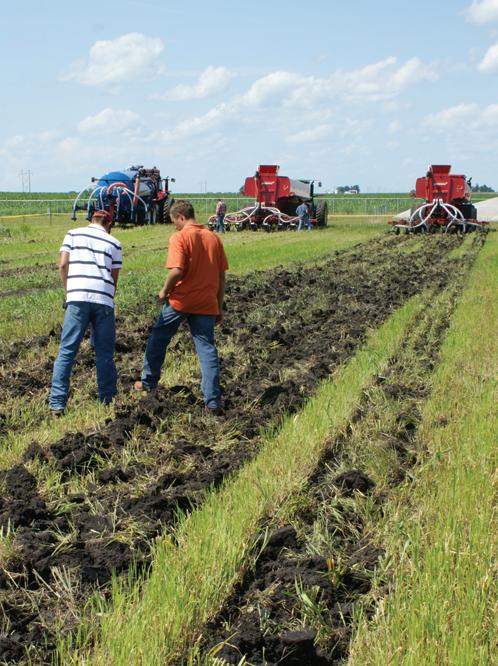
Participants had an opportunity to get up-close and personal with many of the liquid manure injection systems both before and after they were demonstrated.
By Margaret Land
m anure applicators and livestock producers take part in the Upper m idwest m anure Handling e xpo in Boone, i owa
They came, they saw, they learned more about spreading it around.
About 1000 custom manure applicators, livestock producers, equipment manufacturers and others involved in the nutrient application industry descended on Boone, iowa, this past August to take part in the 2009 Upper midwest manure Handling expo. Held at the Central iowa expo site, attendees from more than 14 states and six Canadian provinces took part in educational seminars, both liquid and solid manure field application demonstrations, ride and drive opportunities, and visited with the more than 55 equipment and service exhibitors on hand.
this is the first time that iowa has hosted the annual event, which rotates between various states in the Upper midwest and great lake regions of the U.S. And, according to event planners and managers, it was a great success.
“fourteen manufacturers demonstrated their equipment in front of a large crowd of interested expo attendees under field-like conditions,” said Ross muhlbauer, a member of the expo planning committee and the event’s field demo emcee. “the demonstrations generated good response from the crowd, resulting in more exhibitor-customer interaction.”
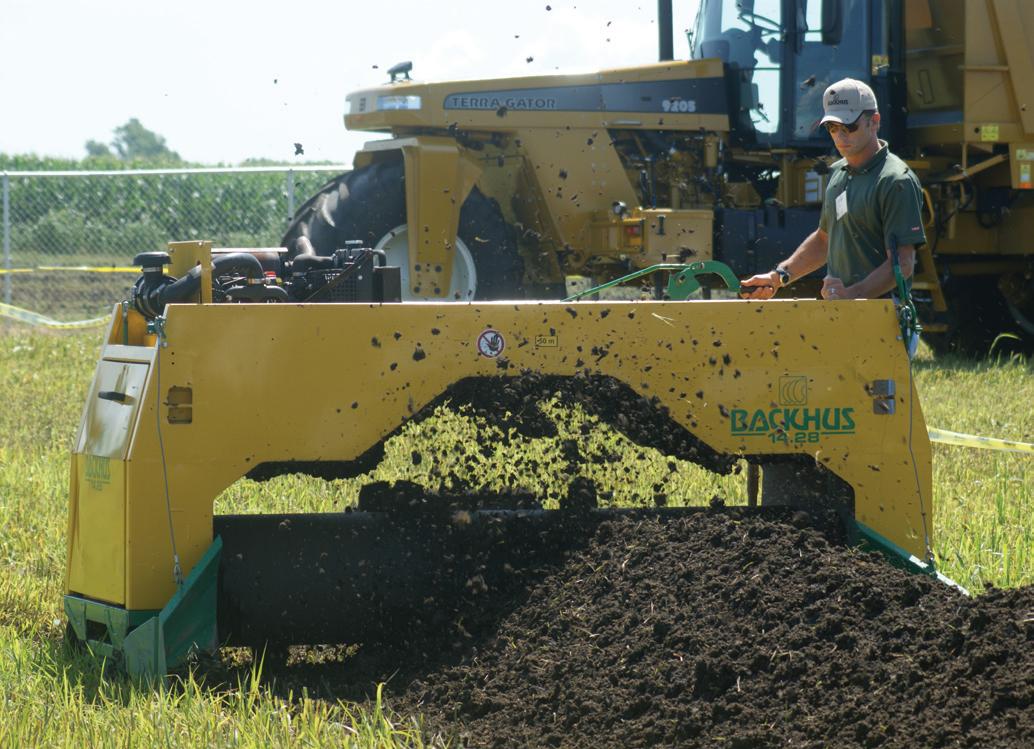
A Backhus compost turner shows what it can do during the field demonstrations.
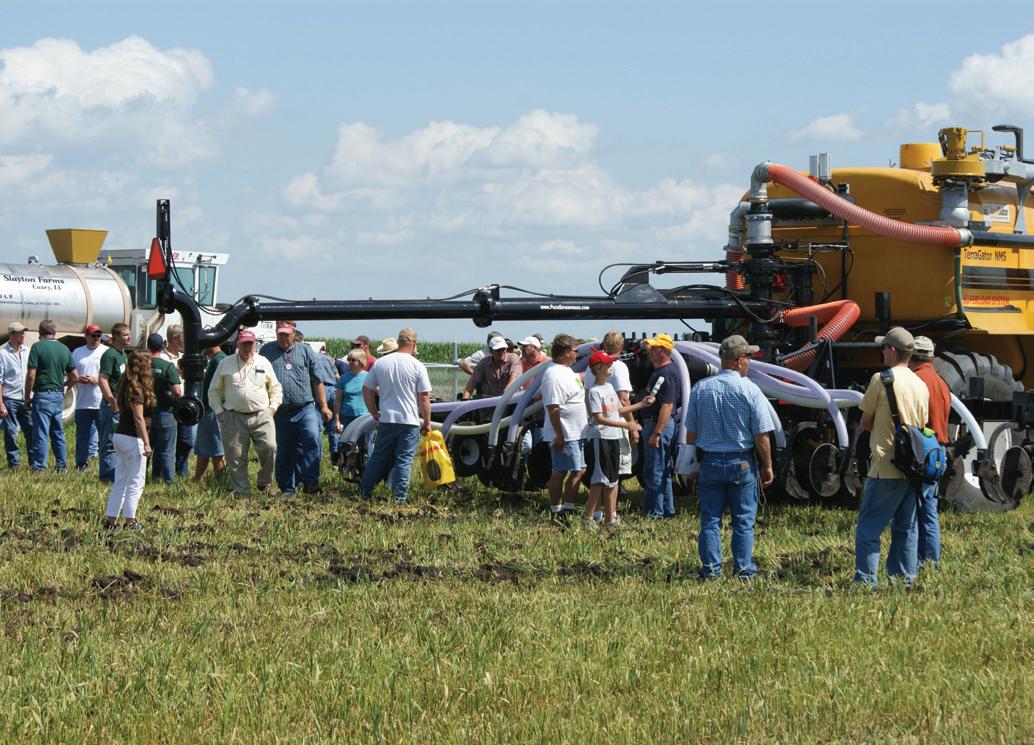
The crowd checks out the injection paths and depths following the liquid manure injection field demonstrations at the manure handling expo.
injecting
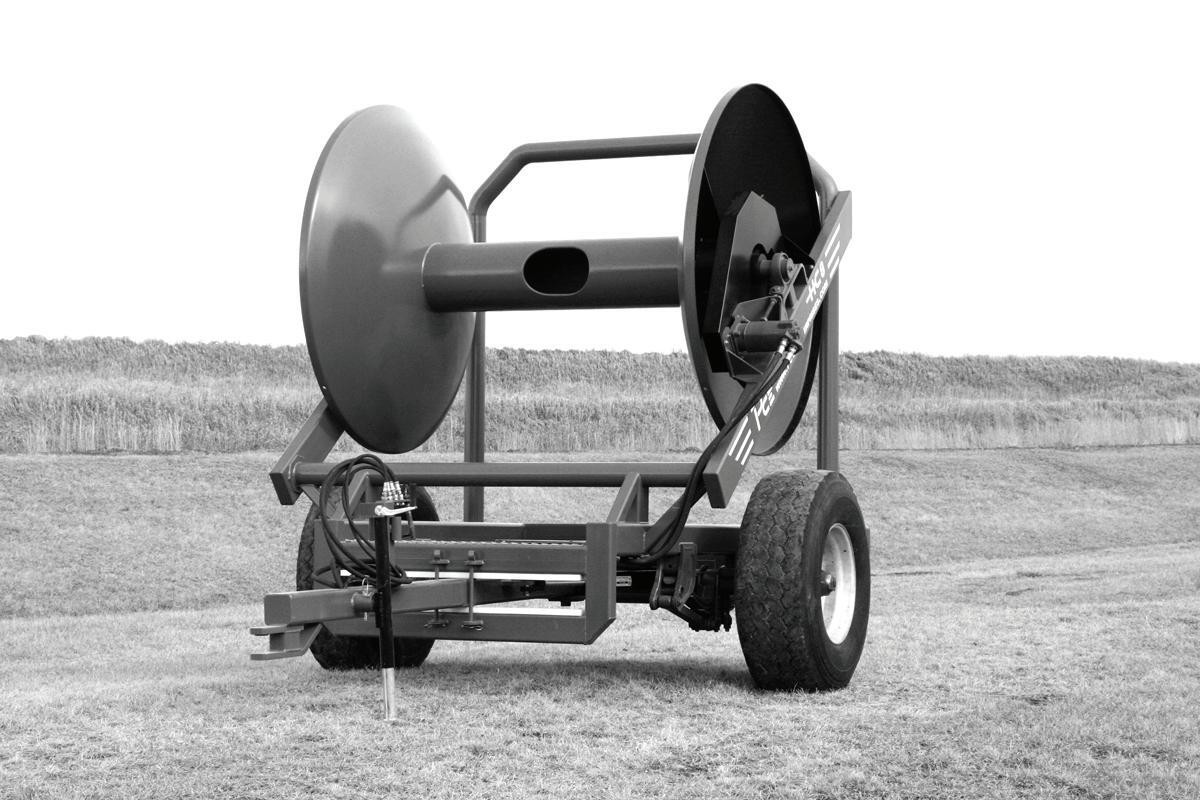
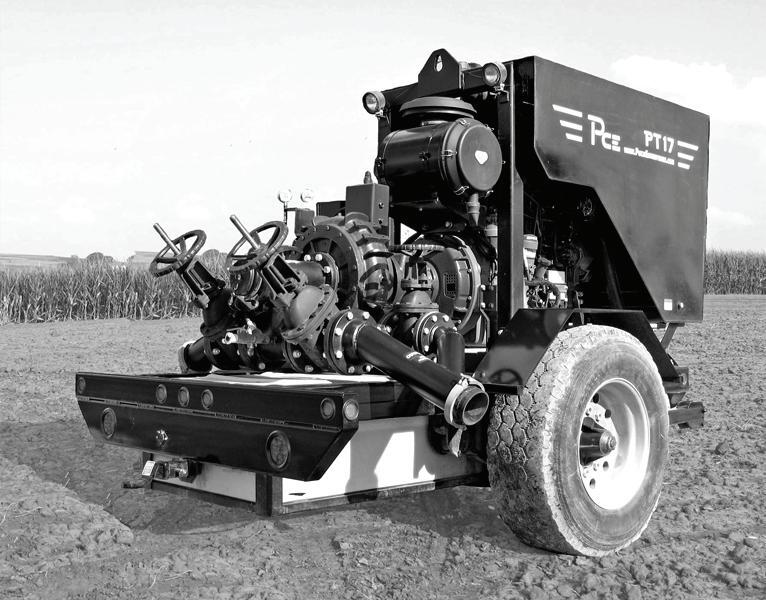
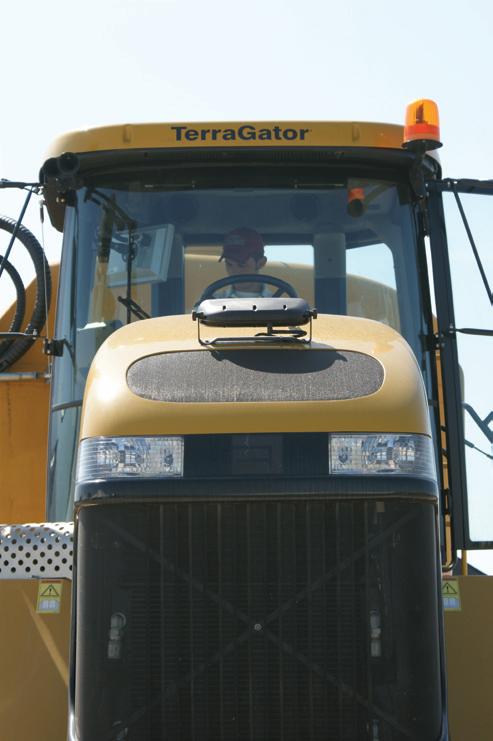
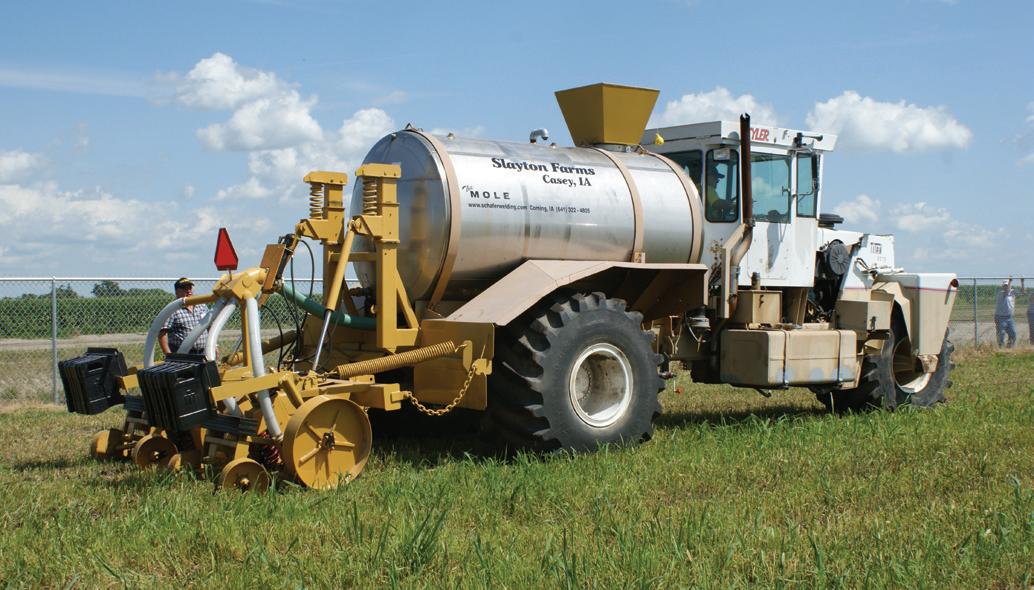
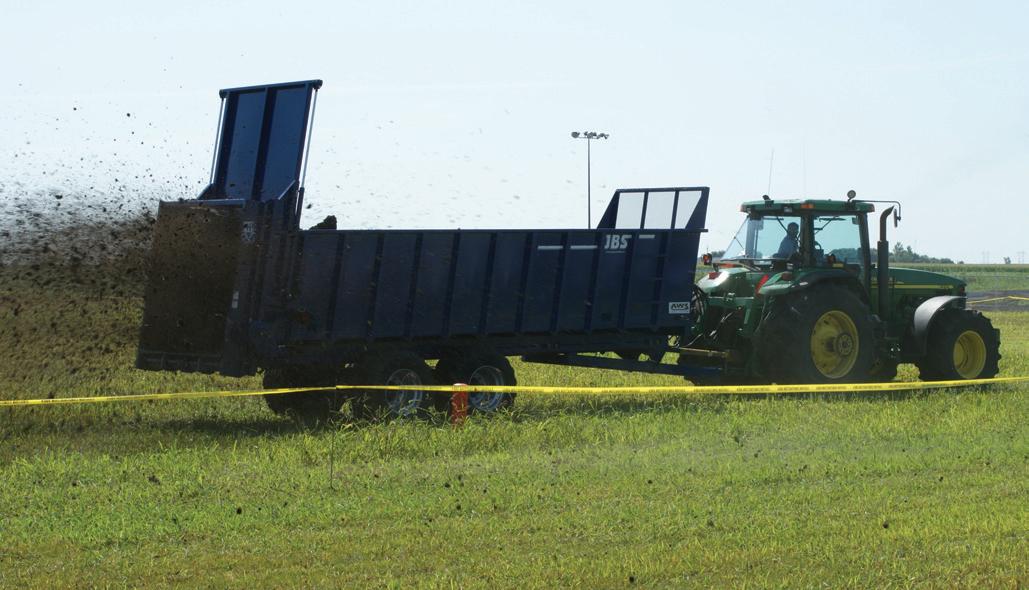
Solid manure spreaders from JBS, Kuhn, meyer, Roda, AgChem and Sioux Automation were showcased along with liquid manure systems by Houle, Jamesway, Hydro engineering, AgChem, Bazooka farmstar, Sioux Automation, Balzer, dietrich, Puck Custom enterprises (PC e), and mole incorporation. A proto-type subsurface poultry litter injector developed by the U.S. department of Agriculture researchers at Auburn, Alabama, was also demonstrated along with a Backhus compost turner.
A lot of interest was also expressed by expo participants in the equipment ride and drive opportunity, held at the end of the day’s events.
Attendees also took part in several educational sessions, which covered everything from iowa CA fo regulations to biosecurity during manure pump outs.
“the educational sessions were very well attended,” added event coordinator dr. Robert Burns, a professor at iowa State University. “they provided the most up-to-date information on several topics of interest to manure applicators and animal feeding operation owners and operators.”
the expo was co-hosted by iowa State University extension and the iowa Commercial Nutrient Applicators Association (i CNAA) with the planning committee consisting of i SU’s Agricultural Waste management team and board members from the i CNAA.
Next year’s manure expo – the 2010 great lakes manure Handling expo – is scheduled for July 15, 2010 at the 55acre Penn State Ag Progress days site near State College, Pennsylvania. the event, themed Balancing Production and Conservation, is being hosted by Pennsylvania State University and will feature commercial exhibits, educational seminars and equipment demonstrations. more information can be found at http://das.psu.edu/manure-expo.
About 1,000 people attended the one-day show and had opportunities to view equipment demonstrations and displays.
An opportunity to view and “kick the tires” of the manure handling and incorporation equipment was a draw for the show.
There was a lot of crowd interest in The Mole, a liquid manure injection system developed by Schafer Welding in Corning, Iowa.
A solid manure spreader from JBS was one of several systems showcased in the solid manure application field demonstration.
In the NEWS
Huckabay Ridge energy purchase announced environmental Power Corporation’s wholly owned subsidiary, microgy, inc. and Alcor energy Solutions recently announced they have entered into a long-term energy purchase agreement for electrical and thermal energy, for use at microgy’s Huckabay Ridge facility in Stephenville, texas.
microgy has entered into a multiyear, fixed price energy purchase agreement with Alcor for supplying the Huckabay Ridge facility’s electrical power and thermal energy needs utilizing a combined heat and power (CHP) process. the on-site system will be capable of providing all of the Huckabay Ridge facility’s electrical and thermal energy needs with the necessary backup systems on-site so as to ensure that power and thermal energy will be reliably delivered on a continuous basis. the CHP facility is expected to be in operation during the first quarter of 2010.
“this CHP solution allows us to eliminate parasitic consumption of our product, utilizing an efficient source of energy,” said Rich Kessel, president and Ceo of environmental Power Corporation. “the net effect will be an increase in operating margins, as we now anticipate producing sales of 782,000 mm Btus per year. Alcor’s solution will allow us to continue to utilize waste heat or renewable energy for plant processes, maintaining the energy efficient/renewable aspect of our Huckabay Ridge facility.”
for microgy, Alcor brings a new turnkey process for supplying both power and thermal energy. Alcor’s suite of automation packages, turn-key operation and experience will allow operation of the CHP process to track increasing or decreasing facility loads either on-site or remotely. All system operations and component status can be monitored and managed from anywhere in the world.
the Huckabay Ridge facility is the largest anaerobic digester operation in the world, producing a renewable natural gas
(RN g) product for pipeline sales. targeted production of 782,000 mmbtus per year translates into enough RN g to heat more than 13,500 midwest homes annually. Using animal waste from local dairy farms, as well as other organic waste products, the digestion process produces biogas, which is captured and further refined to pipeline quality Renewable Natural gas. Considered carbon neutral, RN g is purchased by any number of customers to address their various renewable energy portfolio requirements and assist in their efforts to reduce carbon emissions.
Carolina utilities seek extension on manure mandate
North Carolina’s electricity providers say poop-to-power isn't ready for prime time. Progress energy, duke energy and other providers have asked state regulators to delay and modify a 2007 state law that requires them to generate a minimum amount of energy from pig or chicken waste. the law, designed to promote renewable energy and efficiency, requires utilities to begin getting some energy from pig and chicken litter by 2012. the providers are seeking a one-year delay from the N.C. Utilities Commission. they’re also asking to cut the minimum energy requirement from poultry waste starting in 2014 by a third.
North Carolina is a leading producer of pork and poultry, but disposing of waste presents major environmental challenges. turning some of that waste into electricity holds promise, but also has raised worries about cost and pollution. the utilities have been seeking proposals for waste-to-energy projects, but say they’ve received only limited and expensive bids.
Progress hasn’t received “a single viable swine proposal” so far, and the only poultry project would be so expensive, it would reduce the amount of money the company is able to spend on solar and other green energy, Hughes said. that project is from fibrowatt, a
Pennsylvania company that wants to build three plants to turn chicken droppings into power in montgomery, Surry and Sampson counties. But those plants have run into opposition from critics who worry about lax pollution controls.
fibrowatt officials are reviewing the electric utilities’ petition, but want to move ahead on the proposed plants without delay, said spokesman terry Walmsley. the company has lined up chicken farmers eager to supply fuel.
“there is a great need for this important renewable resource,” he said. “We see a lot of opportunity in North Carolina.”
gE Energy helps dairy farmers reduce emissions
As lawmakers in Washington, d.C., debate new federal climate-change legislation, Wisconsin’s dairy industry is leading the way in demonstrating the benefits of using cow manure methane digester biogas. in the last several years, a growing number of dairy farms in Wisconsin have installed ge energy’s Jenbacher biogas engines to generate renewable electricity for onsite power and the local grid.
ge’s newly installed biogas engine technology is generating 633 kilowatts (kW) in renewable energy at the Crave Brothers farm, llC in Waterloo, Wis.
Crave Brothers is a 29-year-old, family run dairy farm and on-site cheese plant that is nationally known for its progressive use of technologies to reduce the environmental impacts of its operations. the 1,700-acre farm currently has nearly 1,000 milk cows and 700 heifers.
By converting the manure to methane biogas and using it to generate electricity in the Jenbacher unit, less greenhouse gas is able to escape into the atmosphere. the system is also helping Crave Brothers lower its operational costs, including through the sale of energy to the regional grid and more cost-effective manure management.
Crave Brothers originally had operated an older biogas system to support some
CAFO’s Solutions to Meet EPA Requirements
STORMWATER
November 18 & 19
Lancaster Host Resort, Lancaster,
Speakers:
Dr Nigel Cook, University of Wisconsin-Madison
Andrew Wedel, P E , McLanahan Corporation
Dr Michaela Kristula, University of Pennsylvania, New Bolton Center
Curt Gooch, P E , Pro Dair y, Cornell
Bernard Sheff, P E , Sheff & Sons Engineering
Dean Doornink, Jon De Farms
System Tours: University of Delaware, Newark, DE
Mercer Vu Farms, Mercersburg, PA
of the farm’s electricity requirements. However, the owners later installed the ge technology after deciding they could be generating even more electricity with a more powerful engine, Crave said.
Renewable energy developer Clear Horizons, which built and owns the digester biogas plant at the Crave Brothers site, is supplying the engine’s electricity to regional grid operator W e energies, the trade name of Wisconsin electric Power Co. and Wisconsin gas llC, the principal utility subsidiaries of Wisconsin energy Corporation.
Vermont PSB approves renewable spending plans the Vermont Public Service Board (PSB) has approved spending on a series of renewable energy projects and studies proposed by Central Vermont Public Service.
the CVPS proposals, filed with the PSB in July include seven renewable projects and studies at a total cost of about $350,000. the three studies are intended to help CVPS expand its popular Cow Power program, learn about the potential for algae as an energy source, and possibly expand production at an existing Rutland County hydroelectric facility.
A $10,000 essex Partnership study will evaluate a new Cow Power model of collecting methane gas from a group of smaller farms and using it to generate electricity at a central facility.
A second study is under way by Algepower inc., which has developed Algeponics™, a patented photo-bioreactor, an enclosed farm system for growing algae, which could be used as a fuel or food source. the first prototype has been linked to a CVPS Cow Power™ digester on the Blue Spruce farm in Bridport. CVPS’s $50,000 grant to Algepower, now approved by the PSB, will help fund development and operation of the pilot prototype. the third study, at a cost of $25,000, will examine the potential to increase generation at CVPS’s Carver falls hydroelectric station in Poultney. the plant has peak generation of 1.9 megawatts, and has produced an average of 7,340,000 kilowatt-hours of energy annually over the past decade.
“CVPS was the first utility in the world to put wind-generated power on the grid and the first to develop a customerdriven, manure-based energy product,” said CVPS spokesman Steve Costello. “these studies will help us remain on the cutting edge of new generation potential, and support ideas with tremendous potential to benefit Vermont.”
Study shows manure no worse for water in tiled fields
Applying manure to a tiled field doesn’t have a negative effect on nearby water – in terms of carbon – when compared to other fertilizer systems, according to a Purdue University study.
Using six years of drainage data, Ron turco and Sylvie Brouder, both professors of agronomy, found that the use of swine manure lagoon effluent in a tiled agricultural field did not increase carbon getting into nearby waterways. the results of their study were detailed in a recent issue of the Journal of environmental Quality.
“it was surprising in a way that carbon loads were relatively low at the discharge points,” Brouder said. “the assumption was that manure was adding significantly.”
tiles set below the surface of agricultural fields direct the excess water out of the soil and, eventually, into nearby streams. there has been concern that tiles flush manure, manure components such as dissolved carbon, or other soil nutrients into water systems faster, damaging water quality.
Carbon is a concern because bacteria, such as E. coli, consume carbon. Adding carbon to a stream could improve conditions for microbial growth, including
Continued from page 23
harmful bacteria. manure lagoon effluent, the liquid formed used as fertilizer after manure is stored in lagoons, contains a high amount of carbon.
“in general, we didn’t see more carbon in manure systems, but rainfall near an application event did promote some movement," turco said. "However, we didn’t see a huge fluctuation out of any of these agricultural systems, but we are still looking at the nitrogen data.”
turco and Brouder, along with former graduate student matt Ruark, measured the carbon emissions from 1999 to 2004 at the Purdue Water Quality field Station. the study included four blocks of 12 plots each with different crop rotations and varied fertilizer-application practices.
Carbon emission into the streams was the same in tiled fields fertilized with manure as in tiled fields using other sources of fertilizer. the amount of carbon reaching waterways increased in all fields during years with higher rainfall totals.
“We saw a few blips, things where there was a heavy rain after a manure application, but nothing that was statistically significant,” turco said. they said the next step is to evaluate how antibiotics and hormones from manure are transferred to streams through tiled fields.
air to plus 50 (Celsius) right above the compost is going to be the challenge.” in that case, he says the solution could be to store the liquid manure in winter, and operate the composting process on a seasonal basis, which would still result in having to dispose of a lot less waste material and creation of a valuable compost byproduct. transform Compost Systems not only designs systems, it also designs and provides the equipment according to the needs of individual clients.
“there are so many options and ways to skin the cat,” says dr. Paul. “it’s an ongoing, unfolding of expertise and equipment development and we’re fortunate enough to have some very practical farmers in our network who give us very quick and effective feedback on various pieces of equipment, and how they work or don’t work.” the company believes that in addition to regular turning, aeration is also critical to achieve high quality compost.
“forced aeration really does keep the pile composting properly,” he says, “because the aerobic bacteria need oxygen, and they will operate orders of magnitude more efficiently than anaerobic bacteria.” Anaerobic bacteria break down organic material to produce methane in anaerobic digesters, which is an oxygen-free environment.
dr. Paul says over the past decade, recognition of the value of compost has often depended on the agriculture sector and the basic philosophy of the growers themselves. in some cases, it is just more cost-effective to continue to use inorganic or chemical fertilizers, but there are also instances where growers recognize the value of compost beyond its nutrients.
“We sell some product to the organic sector,” says dr. Paul, “but there are some large, non-organic farmers that really realize the benefits of improving the soil’s organic matter and the potential disease suppression effects of the compost.”
At the same time, many farms continue to need to economically transport nutrients away from the farm. Composting offers that opportunity, while creating an additional income stream with the creation of a value-added product.
➤ Manure Pits,Channels & Covers
➤ Suspended Slabs - up to 40’ clearspan
➤ Hog & Cattle Slats - up to 25’ clearspan
➤ Weeping Walls - manure separation
➤ Milking Parlors
➤ Strainer Boxes
➤ Commodity Storage
➤ Bridges
➤ Bunker Silos (8 types)
➤ Syloguard Concrete repair
➤ Retaining Walls
➤ L & T Walls up to 16’ high
• Built to engineers’ specifications
• All sections are high strength, pre-stressed,reinforcedconcrete for longer life
• Quick & easy to build
• Air-tight seals and protectant using Syloguard products
INNO ATIONS
AnAEROBiC digESTERS
PUMPS
CST Wastewater Solutions
A new treatment system for organic residues has been launched by CSt Wastewater Solutions, promising to convert almost any organic residue or energy crop into biogas, valuable electricity or heat.
CSt Wastewater Solutions has partnered with global Water engineering (g W e) to supply the Rapid treatment of organic Residues (RAPto R) system, a powerful liquid-state anaerobic digestion process that consists of enhanced pre-treatment followed by multi-step biological fermentation.
A wide range of organic residue types can be processed, resulting in an efficient and rapid conversion of the material to agricultural fertilizer and biogas.
the diversity of the material to be processed means a range of different RAPto R pre-treatments are available, to allow the highest possible conversion efficiency.
in the RAPtoR process, the pre-treated and blended substrate slurry is transferred into a mixed digester that uses energy efficient and low maintenance mechanical mixing. the digester tank comes in sizes up to 12,000 m3. optional extras include a foam breaker fan, a scum buster system and a bottom grit trap.
the digester tank is fully insulated, heated by recycling the digester content through a special heat exchanger. www.cstwastewater.com
global Water Engineering Ltd.
global Water engineering limited (g W e) recently announced the creation of a North American joint venture with glV inc. to market its anaerobic digestion processes and its energy production technology using the biogas generated by the digestion of organic waste.
g W e is made up of a group of companies specializing in wastewater treatment, digestion of biomass, sludges and slurries, plus biogas production and reuse. it has more than 200 operating plants in more than 30 countries around the world.
glV inc. is a global provider of technological solutions used in water treatment, recycling and purification.
the new joint venture, named global Water & energy (g W&e) is 30 percent owned by g W e and 70 percent by glV inc.
g W&e will be based in Austin, texas.
L.J. Star
l.J. Star has introduced a new sight glass specifically designed for installation in digester tanks used for biogas production.
the R d300 sight window has an expanding gasket that conforms to irregularities in the cement walls and ports used in digester tank construction, creating a gas-tight seal. the tubular rubber gasket is sandwiched between high-grade stainless steel rings. As the mounting screws are tightened, the inner and outer rings draw together and force the gasket to expand.
the sight glass also includes three angled mounting brackets that are long enough to accommodate the depth of the container wall.
the R d300 window can be ordered with an optional motorized
wiper, a manual wiper and a washer assembly. By turning a valve, operators can direct water spray on the interior of the glass. other options, including a lumiglass light and video camera, are also available.
A growing interest in alternative energy is fueling the construction of biogas facilities. Sight glasses are required at tank work platforms where operators set mixing devices at optimum positions. A gas-tight seal is required to meet safety standards.
www.ljstar.com
Paradigm Environmental Technologies
Paradigm environmental technologies, the makers of the microSludge WAS pre-treatment technology, will launch a portable pilot version of their technology in 2010.
the pilot will consist of the microSludge pre-treatment unit and a batch of 400-gallon digesters. the system will be fully automated and require minimal operator time. the digesters are equipped with temperature control and gas measurement, and the system also features automatic daily collection of sludge feed and effluent samples for convenient testing. the digesters can also be configured to test different operating conditions, such as acid phase and thermophilic digestion.
www.paradigmenvironmental.com
PlanET Biogas Solutions
Planet (Planning and Application of energy technology) Biogas Solutions (PBS) is a joint venture between martin lensink and Planet Joint Venture, which also operates Planet Biogastechnik gmbH in Vreden, germany.
Planet specializes in the design, construction, and service of advanced biogas plants and currently has about 120 operating biogas plants around the world.
features of the Planet technology include:
A continuously mixed reactor. the bacterial action is constant with organic input being fed every two hours and mixing is continuously to release biogas from the liquid slurry.
A dry feeder. Planet started designing dry feeders 10 years ago, and has been at the forefront of dry feeder design in germany. they design and build a wide variety of dry feeders, not only for Planet systems, but also for other biogas suppliers in the european market.
modern control systems, allowing PBS and Planet in germany to provide outstanding on-line support via remote, internet-based monitoring.
mesophylic operation. the company’s heating systems ensure that the process occurs at 38°C +/- 5°C. Although Planet has some experience with thermophylic operation (56°C), mesophylic operation provides more flexibility on operating temperature and a variety of input menus.
PBS serves biogas customers throughout Canada and selected projects in the U.S.
Pasture management for Water Quality, an on-line webcast hosted by the livestock & Poultry environmental learning Center. Visit www.extension. org/pages/Live_Webcast_Information.
Air Quality Program, an on-line webcast hosted by the livestock & Poultry environmental learning Center. Visit www.extension. org/pages/Live_Webcast_Information.
December 9-10, 2009
Alberta Pork Annual general meeting, Radisson Hotel, edmonton, Alberta, Canada.
Visit www.albertapork.com.
January 7-8, 2010
South dakota Pork Congress, Ramkota exhibit Hall, Sioux falls, South dakota. Visit www.sdppc.org.
January 10-12, 2010
Agricultural equipment technology Conference, orlando, florida. Held in conjunction with 2010 Ag Connect. Visit www.asabe.org.meetings.
January 13-15, 2010
2010 Ag Connect expo, orange County Convention Center, orlando, florida. Visit www.agconnect.com.
January 19-22, 2010
Banff Pork Seminar, the Banff centre, Banff, Alberta, Canada. Visit www.banffpork.ca.
January 20-21, 2010
minnesota Pork Congress 2010, minneapolis Convention Center, minneapolis, minnesota. Visit www.mnpork.com/porkcongress.
iowa Pork Congress, Hy-Vee Hall, iowa events Center, des moines, iowa. Visit www.iowaporkcongress.org.
February 9-11, 2010
2010 World Ag e xpo, i nternational Agri-Center, tulare, California. Visit www.worldagexpo.com.
February 17-19, 2010
Canadian international farm Show, international Centre, toronto, ontario, Canada. Visit www.masterpromotions.ca/canadianfarm-show.asp.
February 18-19, 2010
US dA 2010 Agricultural outlook forum, Crystal gateway marriott, Arlington, Virginia. Visit www.usda.gov/oce/forum.
February 23, 2010
Keystone Pork expo, New Holland, Pennsylvania.
Composted dairy manure in foliage plant production
m anure being tested as environmental, economical alternative to peat
Peat has been a major component of substrates used in container plant production since the 1960s. Highly porous with the capacity to hold water, peat makes an ideal rooting and growing medium for potted plants.
Researchers show off dumb cane plants grown in cowpeat at the MREC shadehouse. Submitted photo
Owner/Partner/Farmer
Manager/Foreman
Government Official & Regulations
Consultant
Equipment & Machinery Manufacturer
Distributor & Dealer
Education & Extension
Laboratory/Analysis
Other (please specify)
Date:
But harvesting peat (and draining valuable peatlands in the process) releases the carbon stored in peat into the atmosphere as carbon dioxide. And because peat plays an important role in wetland ecosystems — peat bogs improve groundwater quality and are unique habitats for wild plants and animals — the use of peat has been challenged and peat mining is increasingly regulated.
Researchers have worked for years to find alternative organic materials that can be used as partial or complete substitutes for peat. Composted biosolids, municipal solid waste, and yard trimmings have all been investigated as possible components for use in bedding, landscape and foliage plant production. Now, composted dairy manure is being tested as an economical and environmentally sound alternative to peat.
Scientists Qiansheng li, Jianjun Chen, Russell d. Caldwell, and min deng from the department of environmental Horticulture and mid-florida Research and education Center (m R eC) at the University of florida’s institute of food and Agricultural Sciences, published a research report in Horttechnology that evaluated the potential for using cowpeat, a composted dairy manure, as a component of container substrates for foliage plant propagation. for the study, a commercial formulation (20 percent perlite and 20 percent vermiculite with 60 percent Canadian or florida peat based on volume) was used as control, and peat
was replaced by cowpeat at 10 percent increments up to 60 percent, which produced 14 substrates. the 14 substrates were used for rooting single-node cuttings of golden pothos (Epipremnum aureum) and heartleaf philodendron (Philodendron scandens ssp. Oxycardium) and three-node cuttings of florida Spire fig (Ficus benjamina) and germinating seeds of sprenger asparagus (Asparagus densiflorus) in a shaded greenhouse.
the research showed that container substrates formulated by incorporating 10 to 60 percent cowpeat had physical and chemical properties similar to the commercial Canadian and florida peatbased substrates. Biological testing also demonstrated that all tested cuttings rooted and seed germination rates of cowpeat substituted substrates were greater than or comparable to those of control substrates.
the researchers observed that the promising results of the study suggest that there is a potential for using cowpeat for foliage plant propagation and probably for foliage plant production.
“the use of cowpeat will provide the containerized plant industry with an alternative to peat, which in turn reduces peat mining and encourages composting of dairy manure, thus contributing to the well-being of our environment,” Chen concluded.
The complete study and abstract are available on the ASHS HortTechnology electronic journal website: http://horttech.ashspublications. org/cgi/content/abstract/19/2/340.
8500 gal. Balzer triaxle gear steer boom tanks, 30.5 x 32 Radials, impeller discharge, variable rate systems, as low as 3000 GPA, strongest injector systems on the market.
Hodel Inc.
• Decreases odor & gases, liquefies & reduces solids, aids in removing & preventing crusts, improves fertilizer value
• Use in all types of manure systems/applications
Authorized Distributor: Whalen Ag (712) 299-3389 www.shac.ca
SHAC Head Office Toll Free: (888) 533-4446
LLC 877.726.3743 www.boerger-pumps.com
Capitalizing on carbon credits
By Marcus Krembs and Ross Stegemoeller
Among the myriad of challenges livestock producers face on a day-to-day basis, there is at least one constant – the issue of manure management, including capturing its full value.
livestock operators and managers considering advanced manure management techniques, specifically the adoption of anaerobic bio-digester systems, frequently partner with carbon credit management firms to both evaluate project feasibility and commercialize the “carbon credits” on behalf of the farms. due to recent federal climate change legislation (see American Clean energy and Security Act of 2009, H.R. 2454, Waxmanmarkey Bill), attention is now focused more than ever on the agricultural sector in the United States to play a critical role in assisting regulated entities to achieve compliance with greenhouse gas (g Hg) emission reduction targets. Also, in advance of federal g Hg regulation, voluntary and pre-compliance markets have emerged facilitating demand for g Hg emission reductions from livestock operations. Specifically, farms that host advanced manure management systems may be eligible to generate carbon credits from the installation of anaerobic bio-digesters. Because U.S. bio-digester systems, including those planned or in construction, cover less than three percent of dairy operations and less than one percent of swine farms, opportunities to capitalize on carbon credits will exist for many years.
Carbon credits are a tradable environmental commodity that represents a reduction of one metric ton of carbon dioxide, or carbon dioxide equivalent. Carbon credits are also known by several other names, including carbon offsets, verified emission reductions (Ve Rs) and g Hg credits and are valued utilizing each carbon credits’ full set of attributes, including location, date of generation, emission reduction technology and verification standard. Carbon credits are used by both voluntary and compliance market participants to fulfill demand for environmental claims and regulatory compliance associated with g Hg emission reduction targets, respectively. in order for bio-digester projects to qualify to create carbon credits, and
therefore create a new revenue stream, each project is independently evaluated and must meet certain baseline emissions characteristics. the baseline manure management practice that has the most potential to reduce g Hg emissions is anaerobic lagoon manure waste treatment and storage. farms that manage their waste in this manor are eligible to earn carbon credits by installing biogas control systems that capture and destroy methane gas that would have otherwise been emitted into the atmosphere – provided that there are no state or federal regulations, or local agency ordinances or rulings requiring the installation of the system. if regulations or requirements to manage biogas do exist, although the project reduces g Hg emissions, it will not qualify for carbon credits do to voluntary and compliance market standards requiring each project to be regulatory surplus, or beyond businessas-usual. the digesters can range from simple covered systems that prevent oxygen from entering the system to complete digesters with circulation, heating, and manure monitoring systems. the digester is designed to mimic natural processes in which bacteria decomposes the organic material and emits methane gas in the process, a greenhouse gas 21 times more potent than carbon dioxide. the cover or more complex digester systems simply helps capture, concentrate, and increase the amount of methane captured. Application of the various technologies is dependent upon the use of the biogas or destruction process. in the lagoon retrofit, manure will continue to be scraped and/or flushed, but will now be diverted to an anaerobic digestion system. following the bio-digester, the manure will flow to uncovered lagoon systems for further waste management. following the entire process, the manure will continue to be spread on nearby fields for fertilizing needs. Some studies have actually found that the manure following digesters is actually more affective as a fertilizer than simply treated through open lagoons. this is based on the fact that the nutrients are more concentrated and, in the absence of organics, help make the nutrients more readily available.
Provided your operations currently manage manure aerobically and a biogas
control system would be regulatory surplus, additional characteristics should be considered in order to create ideal conditions for a project. first, farms in warmer climates typically have a higher g Hg emissions baseline, due to the fact that higher temperatures equal more bacterial activity, so there’s more potential for g Hg emissions reductions, and carbon credits. Second, ideal sizes for (a) dairy farm projects are greater than 2,000 head and (b) swine farm projects are greater than 20,000 head. When performing financial due diligence on a biogas project, carbon credit revenue is one of several factors that are considered to determine feasibility, usually representing between five to 50 percent of the expected financial return over the project lifetime.
methane utilization should also be evaluated as dairy farms typically consume more electricity than gas, therefore power production is usually more economic. However, combined heat and power (CHP) projects are also attractive and are often evaluated to offset onsite electricity and gas demand. Although farms that utilize the energy component of biogas projects typically make more economic sense, farms that only flare the methane typically need various types of financial assistance of various sorts (i.e., grants) or carbon credit revenue to support acceptable economic returns. Captured methane will primarily be used as a fuel for electricity generation and excess gas can be flared. electricity can also be sold under a longterm purchase contract to local utilities.
Bio-digester projects can serve an excellent function for farms seeking a combined sanitation and energy solution – and carbon credits can help play a significant role in financing. given the opportunities present to reduce g H g emissions at livestock operations, manure managers can play a key role in mitigating local environmental challenges and help fight global climate change.
for additional information, visit the U.S. e PA AgStAR Program (www.epa.gov/ agstar/index.html) and element markets (www.elementmarkets.com).
Marcus Krembs and Ross Stegemoeller are with Element Markets LLC.