Technology takes hog waste and converts it into a bio-oil that is paving the way to new waste revenues
10
Heading south
Low temperature digester technology developer secures American partner
16
Lemmenes Custom Farms LLC
Custom manure applicator presents customers with a menu of options
18
Farm odor focus of research work
ISU researcher develops system for using odor mitigation equipment only when it's needed
20
Texas GHG study under way
Texas AgriLife researchers launch new study of emissions from crop fertilization, tillage and feed yard operations
24
AgSTAR tour visits two WI dairy digesters
Annual conference starts with half-day tour of two Green Bay area dairy operations using two different styles of anaerobic digesters
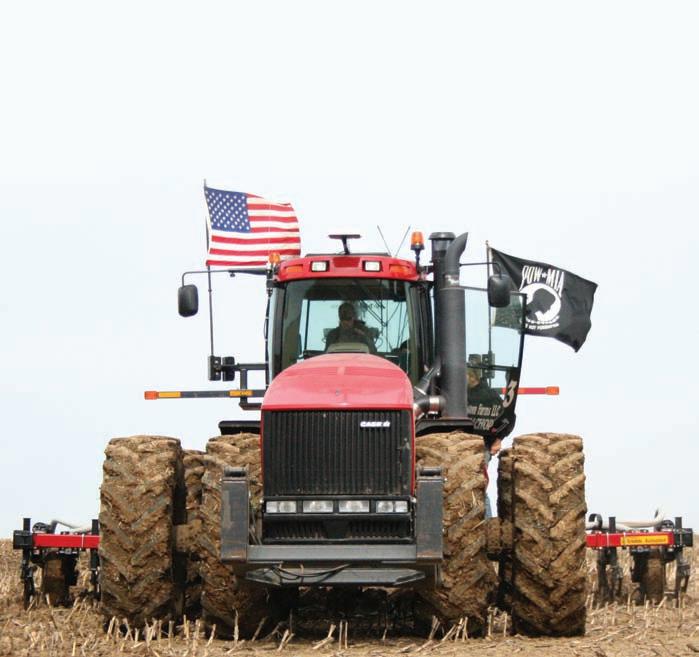
Cover: The road to the future just might end up being paved with the help of hog manure. A company in Missouri is creating a bio-oil from pig manure that acts as a binding agent in the production of pavement.
President Mike Fredericks mfredericks@annexweb.com
Publication Mail Agreement #40065710
RETURN UNDELIVERABLE CANADIAN ADDRESSES TO CIRCULATION DEPARTMENT, P.O. BOX 530, SIMCOE, ON N3Y 4N5
e-mail: mweiler@annexweb.com
Printed in Canada
Circulation
e-mail: mweiler@annexweb.com
Tel: 866-790-6070 ext. 211
Fax: 877-624-1940
Mail: P.O. Box 530 Simcoe, ON N3Y 4N5
Subscription Rates
Canadian Subscriptions (GST included) $37 Cdn, one year - $65 Cdn, two years
U.S. Subscriptions: $37 US, one year - $64 US, two years
International Subscriptions $70 US, one year
Occasionally, Manure Manager will mail information on behalf of industry-related groups whose products and services we believe may be of interest to you. If you prefer not to receive this information, please contact our circulation department in any of the four ways listed above.
All advertising is subject to the publisher's approval. Such approval does not imply any endorsement of the products or services advertisted. Publisher reserves the right to refuse advertising that does not meet the standards of the publication.
Website: www.manuremanager.com
Horse apples
TBy Margaret Land
he world is greening up outside my office window and I am loving every minute of it.
When the spring begins, I get happy. I also start examining the hay field out behind my house, anticipating the first cutting. Thanks to the numerous rains we’ve experienced so far this spring, the hay crop is looking very healthy; so healthy in fact that I have been contemplating purchasing a new hay burner to help “control” the volume.
Of course, with the anticipation of a new horse on the property comes the added labor of cleaning and managing the additional manure, or horse apples, as my father called it. After all, one horse can produce about 18,000 pounds of manure in a year.
In light of this, I have been contemplating the various ways large horse facilities deal with their manure issues. Manure Manager typically has not dealt with horse manure management, focusing instead on large-scale livestock operations in the dairy, beef, hog and poultry categories. But it would appear equine operations have their own share of manure problems as well.
Recently, the Philadelphia Park Racetrack in Pennsylvania was served with an order to “stop polluting” from the state’s Department of Environmental Protection. It would appear that storm water and wastewater from the Bucks County site is mixing with manure from the 1,200 horses housed there and running into a nearby creek.
According to the Pennsylvania DEP, the organization has been working with the racetrack for more than a decade to upgrade manure management but “the facility has failed to make sufficient improvements.”
The department is giving the racetrack about 120 days to make changes, which include halting the practice of washing manure into storm grates, implementing a water conservation plan, improving efforts to collect and manage wastewater, inspecting storm water and sanitary sewage systems weekly, stabilizing all bare earth throughout the site, replacing all existing manure storage systems with covered rolloff bins, applying for permits to build a covered manure storage facility, enclosing horse washing facilities, and submitting a revised nutrient management plan, just to name a few.
According to the Bucks County Courier Times, park management have been “blindsided” by the notice from the DEP, arguing they have been working with the department to make improvements and had no idea the park’s work to date had been unacceptable.
Philadelphia Park Racetrack management might want to look south for a new way of handling its manure issue. The Southeastern Livestock Pavilion near Ocala, Fla., is currently operating an anaerobic digester as part of a pilot project aimed at managing waste at the facility and producing electricity. Each week, about 10 cubic yards of horse manure is fed into the facility’s digester, which results in the creation of enough methane to produce 1,000 kilowatts of electricity every three weeks.
The project is currently small-scale, not large enough to properly handle the more than 1,500 cubic yards of horse apples produced annually by the facilities 120 weekly equine residents. It’s hoped that after the digester operates for a year, the company will evaluate its performance to determine whether it can be converted to a larger, commercial-sized operation.
Meanwhile, another digester company is busy marketing something they call the Muckbuster, a small, self-contained anaerobic digester that can be adapted to service various sized horse farms, anywhere from four horses to 35. The smaller digester, which can handle 200 liters of manure and bedding per day, is reported to be capable of producing around 7,148 kilowatts of electricity per year while the larger one can handle 2,000 liters of material and produce about 71,480 kilowatts annually.
With that kind of technology, I just might be able to buy two more horses.
PORK ISN’T PRODUCED IN A BUBBLE THAT’S WHY THERE IS MICROSOURCE® S
Now, more than ever, pork producers recognize the impact their operations can have on the world around them.
Proactive eco-management with MicroSource S can help reduce environmental burdens. The result:
• Reduction in noxious manure gases, like ammonia and VFAs, for less odor
• Increased nitrogen retention in manure for an improved N:P ratio
• Lower manure viscosity so less power is required for pump outs
• Decreased stickiness of manure for easier/less cleaning.
MicroSource S contains selected microbes that digest the solids in hog manure. It begins to work even before the manure hits the floor and continues to act on manure during handling and storage. MicroSource S can help you balance today’s environmental challenges with efficient pork production.
To learn more, contact your feed supplier or go to www.unlimitednutrition-na.dsm.com.
Pig pavement
Innoventor’s SME (Swine Manure to Bio-Oil) technology takes hog waste and converts it into a bio-oil that is paving the way to new waste revenues
By Diane Mettler
When Kent Schien, founder and CEO of Innoventor, got a call from his in-laws back in the late 1990s, he never imagined the conversation would eventually lead to pig waste being converted to enhanced bio-oil. But in the spring of 2010, the bio-oil was not only a reality, but also the first piece of asphalt road using bio-oil was laid in St. Louis, Mo.
Schien’s in-laws, Illinois pig farmers, were getting complaints from neighbors about odors. Schien had his engineers go to work on a solution and the engineers came up with an air scrubber. It attached to fans in the multiple buildings and scrubbed the confinement air of animal dander and feed dust — a major source of odors.
The air scrubber was a major success when it came to eliminating odors, but was a difficult sell to a farmer who saw it as just one more cost. What they needed was something that not only eliminated odors but would also generate revenue.
“We went on a search for a revenuegenerating technology for our hog farms
and in 2004 ran across a University of Illinois researcher that was turning hog manure into bio-oil,” says Rick Lux, applied technical manager for Innoventor.
“We liked the technology, and licensed it.”
Innoventor’s next step was to take the SME (Swine Manure to Bio-Oil) technology from lab to commercialization.
It took a few tries to get it right. “With our first generation, the hog hair chewed up our pumps, so we had to develop a pump that could handle not only the hog hair, but also handle the high pressure and the high temperatures,” explains Lux. “We tried quite a few commercial pumps and some could handle one or two of our needs, but not all three. So, we designed our own.”
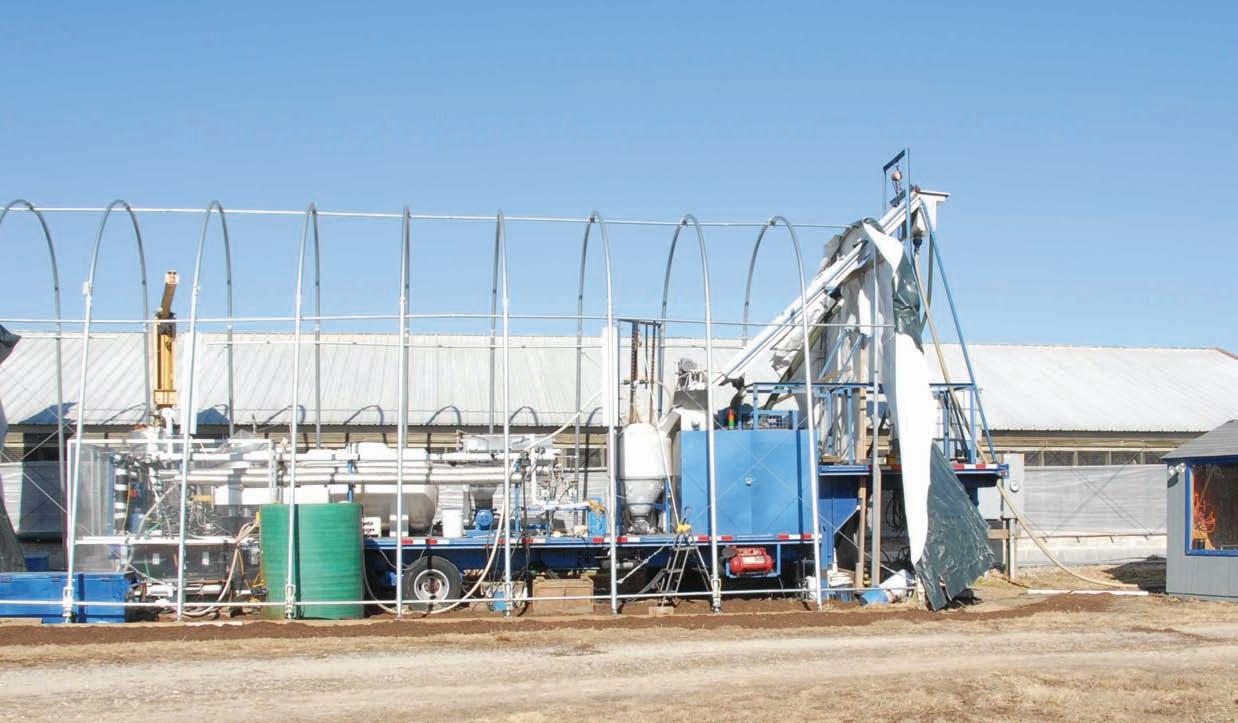
That scaled-up version, which is small enough to fit on a semi trailer, went into operation on a hog farm outside the St. Louis area.
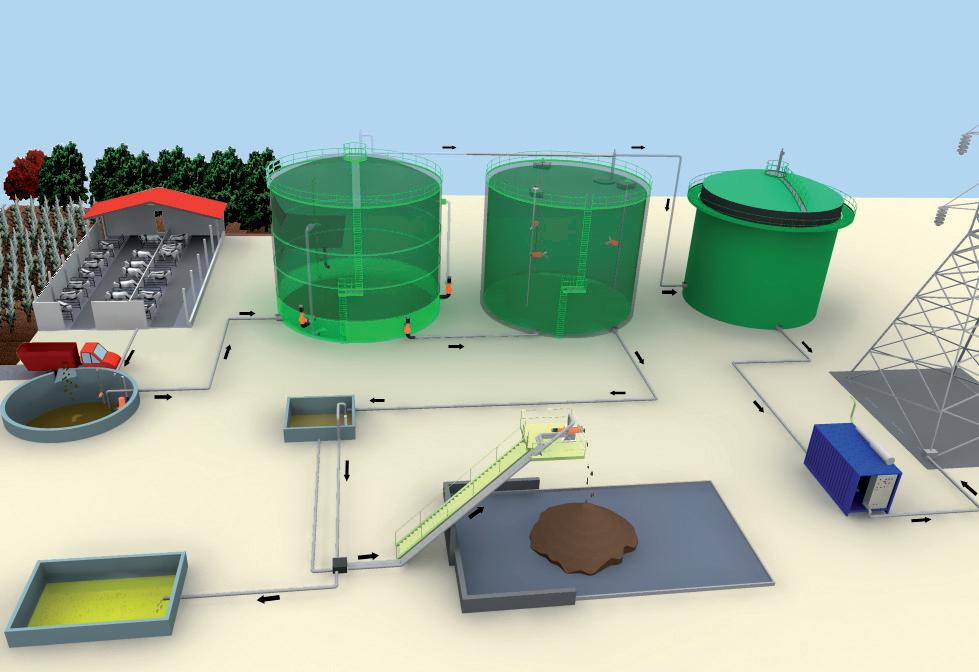
The technology is relatively straightforward:
• The hog waste is pumped from the pits under the barns.
• Next, the slurry is fed to the system where a boost pump elevates the pressure of the water slurry and heats it up.
• The slurry is then fed into a reactor where the waste is heated and pressurized to become bio-oil.
• As the bio-oil leaves the reactor, the water (also known as black water) is separated.
• Lastly, an oil dryer finishes drying the bio-oil.
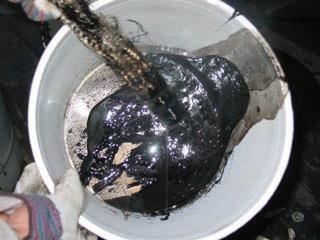
The final product has the consistency of molasses, Lux says. “When hot, it’s sticky and stringy like asphalt binder. And the black water stream resembles dark tea.”
One of the things that makes the system unique is that the entire process takes place in an hour. “And on a 10,000hog farm, you would get 10 to 15 barrels a day,” says Lux.
Finding a niche
The bio-oil, which initially was looked at as a potential energy source, turned out to be a great binder for asphalt. To put
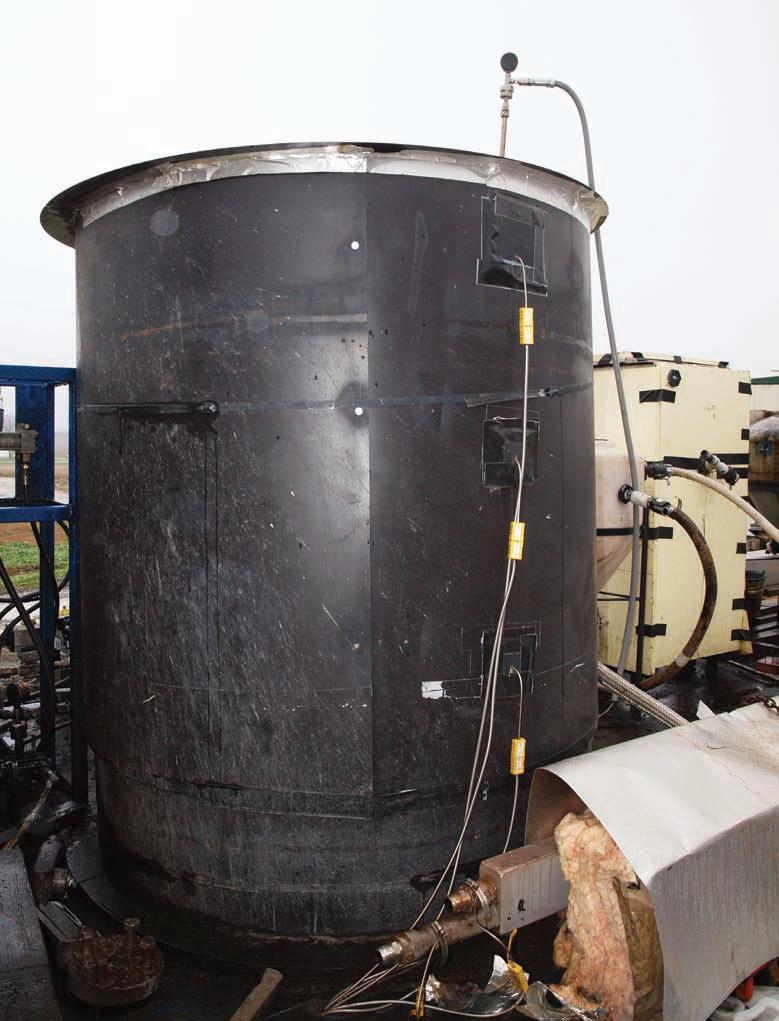
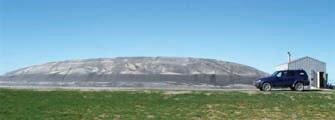
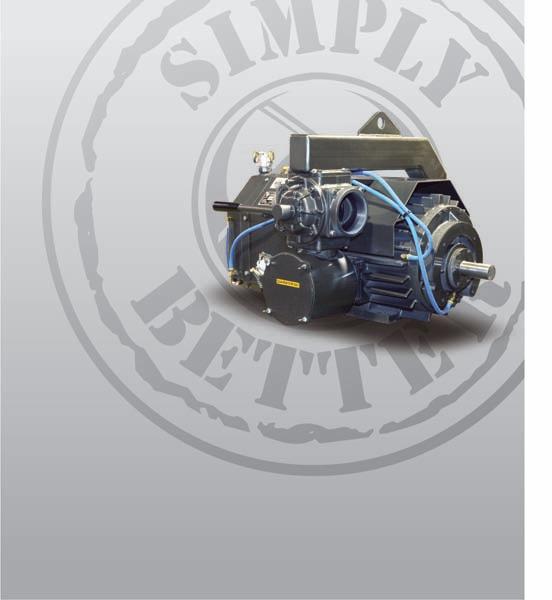
Innoventor took the SME (Swine Manure to Bio-Oil) technology from lab to commercialization, designing its own version, which is small enough to fit on a semi trailer. Submitted photo
it to the test, Pace Construction Co., a St. Louis County road contractor, joined forces with Innoventor through a Missouri Department of Agriculture grant. Pace added the bio-oil as a part of the binder and, in April, laid the first pig-derived asphalt to a 200-foot piece of roadway outside Six Flags, St. Louis, Mo.
If anyone were to compare the waste-derived binder, they might smell a difference. “It smells like burnt coffee,” says Lux.
For the next year, the Missouri Department of Transportation will monitor the heavily used piece of roadway — watching it through a full season of freezes and thaws. In the meantime, Innoventor will be doing its own monitoring.
“What we have proved so far is that the bio-oil is compatible with refinerybased asphalt binder — the only place you can currently get binder,” says Lux. “We also found that it fits into the present infrastructure of the paving and roofing industry at an asphalt plant.
Innoventor sees many benefits to the pig waste bio-oil besides just asphalt binder:
• Lagoons would no longer be needed and the risks associated with them would be eliminated
• Land formerly used for lagoons could be converted for other uses
• Odor would also be greatly reduced
• What some see as an environmental negative — spreading or storing animal waste — could be used to create a value-added product
• The possibility of energy tax credits
• Transportation of waste would no longer be shouldered by the pork producer
• It would provide a revenue stream for farmers
• The black water, a nutrient source, could be processed for flush water on the farm and the remaining concentrate could be used as a fertilizer.
By using the manure for bio-oil, there wouldn’t be any remaining to spread on fields. However, Innoventor doesn’t see this as a drawback for two reasons. First, the revenue that the farmer would receive from the bio-oil would surpass any costs for commercial fertilizer. Secondly, the black water remaining from the process contains nutrients and could be used to also offset the cost of commercial fertilizer.
“I would think a portion of the nutrients needed are going to be in that black water,” says Lux.
Going commercial
The reactor is currently processing one building on a 5,000 hog farm. Although it’s not a full-size unit capable of handling the entire farm, the company plans to build a commercial, full-sized version, which would also include air scrubbers to handle the odor.
Innoventor is currently looking for funding to make the system commercially available. Once that happens — they estimate within the year — the company envisions another year before it’s ready for the market.
The Innoventor business model has the bio-oil binder priced significantly less than the refinery-based. “So, there would be a cost advantage for pavers to use this asphalt binder,” says Lux.
In addition, the system would
cost farmers nothing. “We envision an agreement with the farmer to let us put the system out on the farm and use his manure. In exchange he’ll get a percentage of the revenue from that biooil,” says Lux. “Farmers would just walk by and see it run and get a piece of the revenue. We’d service it and have tanker trucks come pick it up.”
Lux adds, “We’re a couple of years away from that. We want to build one or two units this year, and then next year commercialize the technology by incorporating everything we have learned.”
In five to 10 years, they would foresee 600 to 1,000 units throughout the Midwest. “We’d like to see 10 to 20 percent of the amount of asphalt binder that is out there now — 31 million tons a year is used in the paving and roofing
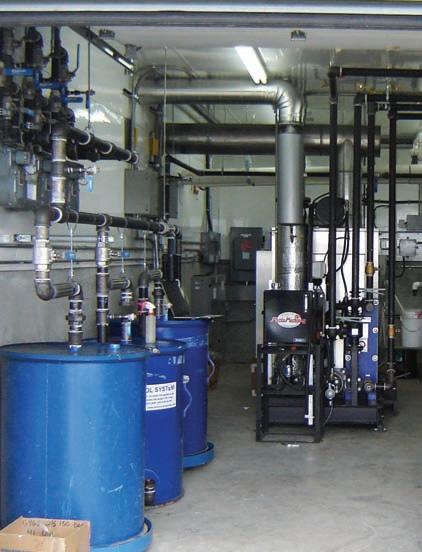
The slurry from the pig barns is fed into a reactor where the waste is heated and pressurized to become bio-oil. Submitted photo
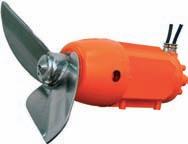
As the bio-oil leaves the reactor, the water (also known as black water) is separated from the oil. Submitted photo
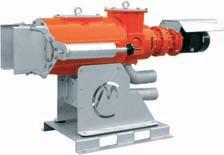
The final product has the consistency of molasses. Submitted photo
industry. That would equate to three to six million tons of bio-oil a year.”
Lux adds, “We also have visions of treating other manures. Swine is where it’s started, but we want to branch out into other manures as well. That’s one of the reasons the unit we have out there now is on wheels, so we can take it to other types of farms.”
Not just binder
Although the paving and roofing industry is a large industry to tap, Innoventor is also working with companies producing fertilizer coatings. “The volume isn’t huge, but the margins are very good,” says Lux.
Currently, coatings utilize polymers to cut down on fertilizer dust and clumping— better known as anti-dust and anti-caking agents. By using the bio-oil as a fertilizer coating, companies are discovering that they not only cut down the dust, but the bio-oil also has nutrients in it.
“Most of the coatings they use now are just benign coatings. Ours actually coats and includes nutrients, so you could use less fertilizer,” says Lux.
What started as a telephone call 10 years ago has now turned into a win/win situation for both Innoventor and farmers.
“The bio-oil helps clean up nuisance odors. There’s also no leaching of nutrients into the water system from lagoons and the farmer can make some income.”
Algae advances as alternative for improving water
Algae – already being eyed for biofuel production – could be put to use right away to remove nitrogen and phosphorus in livestock manure runoff, according to an Agricultural Research Service (ARS) scientist.
That could give resource managers a new eco-friendly option for reducing the level of agricultural pollutants that contaminate water quality in the Chesapeake Bay.
Microbiologist Walter Mulbry works at the ARS Environmental Management and Byproduct Utilization Research Unit in Beltsville, Md., which is located in the Chesapeake Bay watershed. In 2003, Mulbry set up four algal turf scrubber (ATS) raceways outside dairy barns in Beltsville. The shallow 100-foot raceways were covered with nylon netting that created a scaffold where the algae could grow.
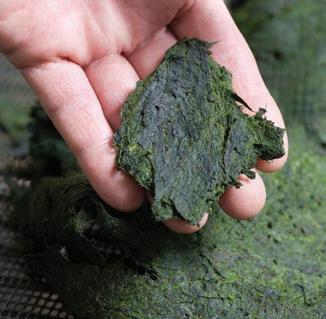
Analysis of air-dried algae from an algal turf scrubber shows that the algae captured most of the nitrogen and phosphorus in the manure. With additional processing, the dried algae could be sold as a slow-release organic fertilizer or as an animal-feed supplement. Photo by USDA-ARS
Close-up of algae growing on an algal turf scrubber. Although the types of algae that grow in algal turf scrubbers are dominated by only one or two species of filamentous green algae, the biomass contains dozens of native algal species. Photo by USDA-ARS
For the next three years, from April until December, a submerged water pump at one end of the raceways circulated a mix of fresh water and raw or anaerobically digested dairy manure effluent over the algae. Within two to three weeks after the ATS system was started up every spring, the raceways supported thriving colonies of green filamentous algae.
Algae productivity was highest in the spring and declined during the summer, in part because of higher water temperatures and also because the raceways provided snails and midge larvae ample opportunity to graze on the algae.
Mulbry and his partners harvested wet algae every four to 12 days, dried it, and then analyzed the dried biomass for nitrogen and phosphorus levels. His results indicate that the ATS system recovered 60 to 90 percent of the nitrogen and 70 to 100 percent of the phosphorus from the manure effluents. They also calculated that the cost for this capture was comparable to other manure management practices – around $5 to $6 for each pound of nitrogen that was recovered and around $25 for each pound of phosphorus that was recovered.
Results from this research were published in Bioresource Technology.
Read more about this research in the May/June 2010 issue of Agricultural Research magazine, available online at: http://www.ars.usda.gov/is/AR/archive/ may10/algae0510.htm.
Heading south
Low temperature digester technology developer secures American partner
By Tony Kryzanowski
Alow temperature anaerobic digestion process for manure management developed by researchers at Agriculture and Agri-Food Canada (AAFC) and commercialized by a Canadian company called Bio-Terre Systems Inc. is extending its market reach as a result of a partnership with an American company, Revolution Energy Solutions (RES), headquartered in Washington, DC.
According to Bio-Terre’s chief operating officer, Elise Villeneuve, the company is leveraging its knowledge and the performance of its technology on two hog farms in Quebec and one in Manitoba to present the agriculture industry with what it believes is a type of anaerobic digestion that is comparable in biogas production, more affordable, scaleable depending on the size of an operation, and generally easier to use compared to other higher temperature technologies
currently in the marketplace.
The Bio-Terre system operates in the 20 to 25 Celsius range versus other types of anaerobic digestion systems, specifically mesophilic and thermophilic processes that operate at about 35 Celsius and 55 Celsius respectively.
There is considerable brainpower behind Bio-Terre’s patented technology, originally developed in the mid-1990s by AAFC re search scientist Dr. Daniel Masse and the University of Ottawa. In 1998, three engineering firms – DGH Engineering, Groupe S.M. Inc. and Tecknika – recognized its potential. They incorporated Bio-Terre with the intent of commercializing Dr. Masse’s work. Over the past decade, they established three successful installations on hog farms.
“Each of the installations had something a little bit different that they (Bio-Terre engineers) were testing to verify the best approach,” says Villeneuve. “They are all working very well, so they are all good approaches. Being senior engineers, they were being very prudent
and wanted to make sure before they commercialized anything.”
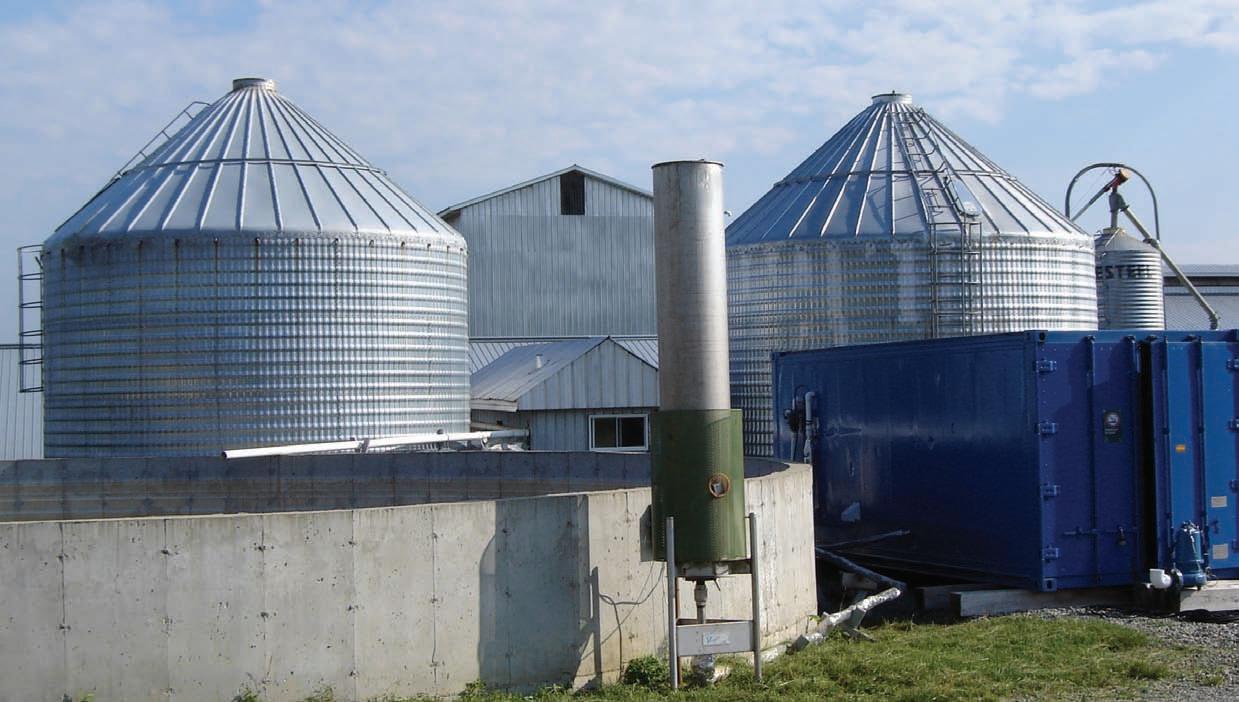
For example, while the digester vessels in Quebec are above ground silos, the digester in Manitoba is in the form of a below ground lagoon with a floating bag to capture the biogas.
Now, the company hopes that its partnership with RES will take commercialization to the next step.
“They have done a thorough due diligence on our system and have decided to choose our system to deploy their program on hog and dairy farms in the U.S.,” says Villeneuve. “It will be completely automated and monitored, and the program is to deploy many of these systems in the next couple of years.”
RES systems will be designed with power production from the biogas in mind, including negotiation of sales
The Bio-Terre Systems anaerobic digesters on two hog farms in Quebec are above ground installations. Submitted photo
contracts. The plan at present is for RES to own and operate the systems, with the farmer’s only responsibility being to supply the manure.
Dr. Masse continues to work with Bio-Terre to fine-tune the original technology developed in his lab that still represents the core of the system. Villeneuve herself is a civil engineer and an MBA who has worked in the wastewater industry for the past 15 years, most recently with the agriculture industry and manure treatment.
She says the Bio-Terre technology continues to be unique because she knows of no one else successfully offering an anaerobic digestion system in this very low temperature range.
Among the unique features of this technology is that it is essentially a scalable, two vessel, two-stage technology where the manure spends half the time digesting in stage one and half the time in stage two. As is typical with all anaerobic digestion systems, the by-products are biogas, a liquid stream and a solid stream, with the Bio-Terre system collecting a percentage of biogas from both vessels. The biogas can then be used as fuel to generate heat, produce electricity or both.
The main thrust behind developing the Bio-Terre technology initially was purely for better manure management on intensive farming operations like large hog and dairy farms, which were producing more manure with high concentrations of phosphorus than there was available land for spreading. Through anaerobic digestion, researchers found they were able to remove about 50 percent of the phosphorus quite easily, and odor from raw manure spread on farmland was no longer an issue. As research advanced further and alternative energy garnered greater public interest over the past decade, other benefits of the anaerobic digestion process, such as production of biogas and the use of byproducts as sources of organic fertilizer and bedding, rose to greater prominence.
“Something that we discovered later – and we have studies to prove this – is that after digestion, the manure that you spread is an enhanced fertilizer that has a much better effect on crop production,” says Villeneuve. “What is also becoming an important aspect is the biogas for energy. Being in cold climates, our farms need to be heated in winter as it is for the northern United States. By capturing the biogas and using it to heat boilers as a heating system for the farm, there is a huge amount of energy savings.”
The challenge facing researchers was to develop a very stable, lower temperature anaerobic digestion system without compromising biogas production.
Villeneuve says an anaerobic digester operating at a lower temperature is a more stable system because the bacteria are more robust and there is a larger diversity of microorganisms. Ammonia also acts as less of an inhibitor within lower temperature systems. She says that what Bio-Terre has set out to break is the paradigm that lower temperature equates to lower biogas production. How they have done is to combine lower temperature with what they call the, ‘batch sequential approach.’
Taking a seven-day cycle as an example, what happens with the Bio-Terre approach is that raw liquid manure is pumped into the first vessel for 3.5 days. After 3.5 days, the vessel will be full based on its design, and the raw liquid manure will then be pumped into a second vessel for the remaining 3.5 days. While the raw manure is being pumped into the second
The Bio-Terre Systems vessel at a Manitoba hog farm is below ground with a floating membrane to capture biogas. Submitted photo
Bio-Terre Systems chief operating officer and civil engineer Elise Villeneuve. Submitted photo
vessel, anaerobic digestion continues to occur and a high proportion of solids are settling in the first vessel. After seven days, the digested liquid manure from the first vessel is discharged and typically transferred to a lagoon, and the pumping of raw manure switches once again from the second to the first vessel. Now the solids in the second vessel are allowed to settle. By allowing the solids to settle in each vessel, bacteria work to digest that material over a longer period of time. Biogas is captured continuously from both vessels, and the vessels are equipped with an automated purge system so that the accumulated solids in each vessel can be removed from time to time as needed.
“By using this approach, this is how we are able to give all the time required for the bacteria to still work at lower temperature,” says Villeneuve. “This is how we are cheating. We are able to create a very long retention time without creating a very long hydraulic (liquid) retention time.”
Typically, lower temperature equates to longer retention time, which requires something like a large lagoon being treated all at once to capture a reasonable amount of biogas. Large lagoons are expensive to build.
2010 WORLD DAIRY EXPO IN MADISON
come and visit us at the Exhibition Hall, lot N° 6302, 6303
The nutrient-rich, liquid byproduct produced from Bio-Terre Systems’ anaerobic digesters makes excellent organic fertilizer. Submitted photo
“What we are doing is that instead of having a very large system, we create an environment where we can keep the untreated solids in and discharge what has already been treated,” says Villeneuve. “This is the sequential batch approach. We are creating an environment where the bacteria have a lot of time to do their work so that we can maximize the production of biogas.”
The system can be designed to reflect the volume and frequency that farms need to pump the raw manure from their receiving pits into the digester. Retention time will also vary according to the volume and concentration of manure being digested.
In terms of a minimum farm size when an installation of the Bio-Terre system would make sense, Villeneuve
CRI-MAN s.r.l.
email: info@cri-man.com www.cri-man.com
Bio-Terre’s engineering partners have spent more than a decade fine-tuning their low temperature anaerobic digestion technology to ensure it works as advertised. Submitted photo
THE EXTRA RELIABILITY OF A SINGLE-BRAND SYSTEM
Pumps, Mixer and Separators specifically designed and manufactured for the manure management.
LOOKING FOR DISTRIBUTORS IN US TERRITORY
says it would depend on whether or not a farm wishes to use all or a portion of the biogas to produce electricity. It’s possible to use the system as a manure management method and simply creating biogas that is used to produce heat. However, if a farm decides to use a portion or all of the biogas to produce electricity, then a minimum size is necessary to make
it worthwhile financially, considering the extra equipment required to process the biogas, installation of a power generator, electrical tie-in equipment, as well as negotiating supply agreements with local power purchasers.
In terms of the installation costs, Villeneuve says it really needs to be studied on a case-by-case basis, but the
smallest farm where Bio-Terre installed its system cost about $700,000 (Cdn) a few years ago with everything included. Costs will vary because the system is scaleable depending on the size of the farm.
Right now, given the company’s new partnership with RES, the marketing thrust is aimed at dairy farms in the 1,000head range as well as hog operations in the U.S., although the company would consider smaller installations. Bio-Terre Systems will still market the technology in Canada. Again, the cost and size of an installation will depend a lot on whether or not the farm intends to use the biogas to produce electricity, as well as the manure concentration and volume.
A market niche the company is targeting is intensive farm operations with highly diluted manure. Villenueve says with higher temperature systems, because there is so much liquid to heat on farms with highly diluted manure, there is more energy needed to actually make anaerobic digestion work than is being produced.
“I believe this is a place where only a lower temperature system will be able to achieve a positive energy balance and I think that is one of the other reasons why our system was chosen by RES for this program,” she says.
The accumulated treated solids produced from Bio-Terre Systems’ anaerobic digesters work well as organic fertilizer or animal bedding. Submitted photo
Lemmenes Custom Farms LLC
Custom manure applicator presents customers with a menu of options
By Tony Kryzanowski
As farms have grown larger over the past decade in an effort to stay competitive, so has the demand for custom services. Waupun, Wisconsinbased, Lemmenes Custom Farms LLC has been on the leading edge of that trend, offering an attractive package of both custom harvesting and a variety of manure management services.
Business has been growing steadily since the company purchased its first Claas silage chopper in the late-1990s to service the large, local dairy industry. Waupun is about 50 miles north of Madison, and the company services customers within about a 60-mile radius of home base.
“We had a client based with the harvesting side of the business that was expanding their manure storage,” says company co-owner Abe Lemmenes. “They were looking for somebody else to do it, so we got into it at that point and it just exploded.”
They purchased their first custom manure application tanker in 2000.
Abe, his father, Roy, and brothers, Luke and Isaac, own the company, and say they owe a lot of their success to very dedicated employees. The company has six permanent employees and about 20 workers during peak season. The combination of harvesting and manure management keeps permanent staff busy from April to December. All staff enroll in Level 1.0 certification training offered by the Professional Nutrient Applicators’ Association of Wisconsin, which makes them aware of safety protocol on the farm site, when transporting manure, and at the application site.
Lemmenes Custom Farms not only provides its customer base of about 95 percent dairy farms with custom manure
management. They also provide them with manure management options.
“We are a turnkey operation,” says Lemmenes. “We do everything from liquids and solids, and also injection or topspreading. We are also set up to transfer the manure from one location to another. I mean we have everything needed to apply manure, whatever way they would like it.”
That includes the use of either a drag hose system or a rubber-tired tanker system. The size of dairy farms within their customer base varies widely. Some farms have 50 cows while the largest is in the 1300 cow range. Therefore, their manure management needs are markedly different.
Lemmenes says there is no doubt that as dairies have gotten bigger, they often have found themselves limited by not having the time, equipment or employees to take care of aspects of the business like manure management, although it is a critical part of the overall operation. In other instances, dairy farms may have been doing it themselves and eventually face a decision once their equipment gets older, whether to buy new or hire a custom manure application service. In both these scenarios, hiring a custom manure applicator has its advantages.
Lemmenes Custom Farms has a good understanding of their customers’ needs because they come from a dairy background. Roy was a dairy farmer but sold out in the early-1990s. A few years
later, he invested in a custom chopping and corn picking business from someone retiring from the industry. That’s how the family got started on the harvesting side of the enterprise. They still keep their hand in the crop production, growing hay and corn silage on about 400 acres, which is sold to local dairy farms.
Starting in the late-1990s, farmers were confronted with much stricter guidelines on how they were allowed to dispose of their manure. Typically with its smaller customers operating without a detailed nutrient management plan, Lemmenes Custom Farms will set the application rate in consultation with the farmer essentially based on information derived from soil tests. With larger customers, the process is considerably more involved. One of its customers, Crave Brothers Dairy, manages an 1,100 head herd and generates about 60,000 gallons of manure per day. They are a good example of how carefully controlled the process is now with larger farms and how important it is to develop a trusting relationship with a quality manure applicator. In addition to stricter management guidelines, manure has also evolved into a highly valued supplement or alternative to commercial fertilizer.
“We have a nutrient management plan, which is part of our permit for large farms,” says project manager for the Crave Brothers Dairy anaerobic digester installation, Karl Crave. “Every field is identified and has a
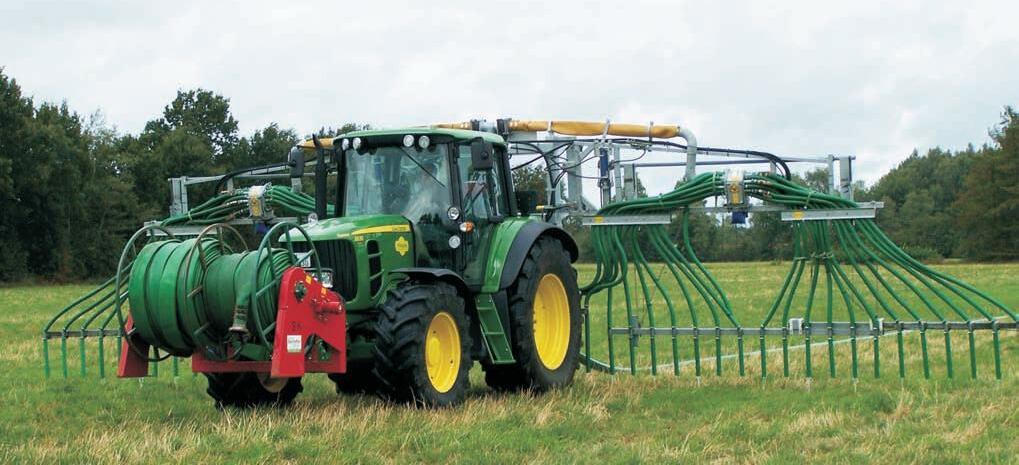
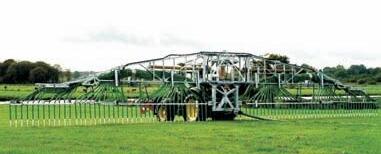
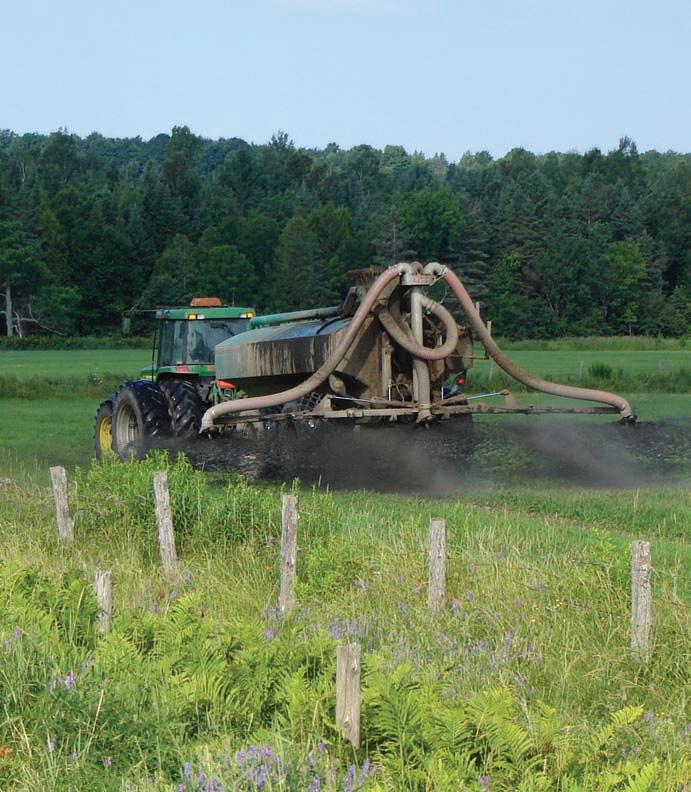
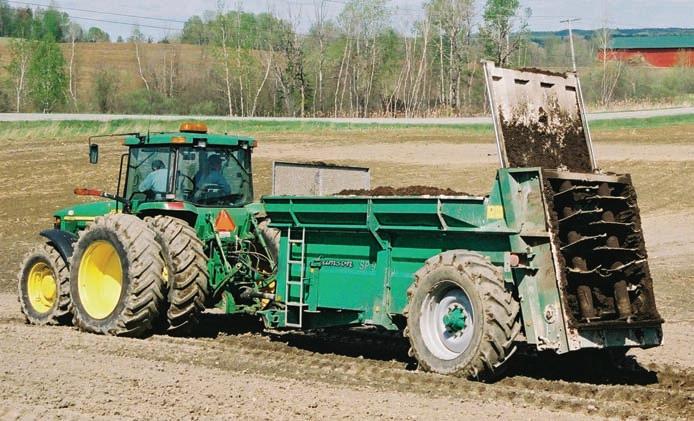
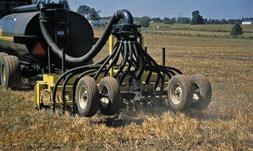
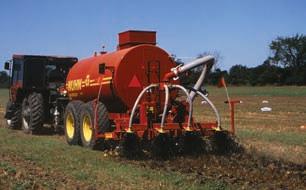
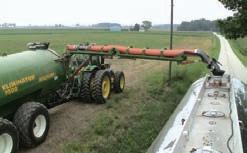
Lemmenes Custom Farms gives its customers a menu of manure application options, including both a drag hose and rubber-tired tanker option. Submitted photo
plan. In fact, it is a five-year plan as to what we are going to plant.”
Crave says key factors like what crops the dairy plans to grow, the slope of the land, and the time of year all factor into the discussion they have with Lemmenes Custom Farms as to the general manure application rate on each farm, and rate adjustments needed in certain areas of the farm to meet nutrient uptake goals. Field soil samples are taken every four years and compared to crop yields achieved between sampling intervals. Soil nutrient and crop yield data are used to calculate annual nutrient removal and helps to establish the manure application rate for the coming year. Crave Brothers Dairy grows alfalfa, corn for silage, corn for grain, and soybeans on 1,700 acres.
Lemmenes says they leave it up to customers like Crave Brothers Dairy to determine the application rate based on their nutrient management plan. As the service provider, they ensure that they arrive with the necessary equipment, technology, and know-how to put the nutrient management plan into action.
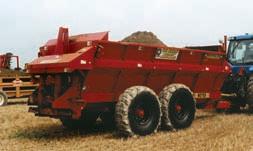
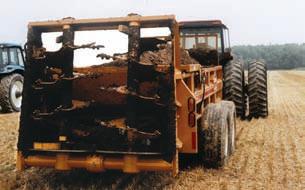
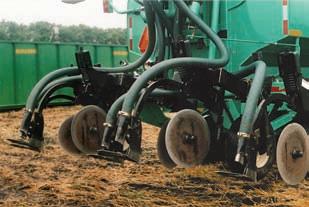
In terms of the company’s equipment fleet, they own 10 JCB 8250 tractors. Five pull Houle 7,300-gallon tanks equipped with Krause injectors installed on 12.5-foot, five shank, custom-built toolbars. Four pull 4,000-gallon Knight side slingers for surface application. They also have eight Mack 2000 trucks equipped with 6,500-gallon tanks, which are set up for top dressing fields and also for transferring manure from the farm to the application site. The liquid manure can be transferred either to tankers working in the field or unloading into a Balzer frac tank, which sits at roadside and typically works in tandem with the company’s drag hose system. By handling the transfer process this way, the company avoids traveling from fields to public roads, which means that less mud is put on the roads.
The company added a drag hose system to its fleet in 2009.
“Compaction is a huge issue,” says Lemmenes. “The tanks are heavy and they can pack a field, but with the drag hose system, it is just the tractor driving across the field. It really complements the business and gives our growers more options.” Laying drag hoses in ditches or across neighbors’ fields also helps the company avoid issues related to road degradation and traffic, if the road leading to the site is narrow or in poor shape. Also, it gives customers more options. For example, some like to use semi-tankers in the fall when its dry and the drag hose system in the spring when it is wet.
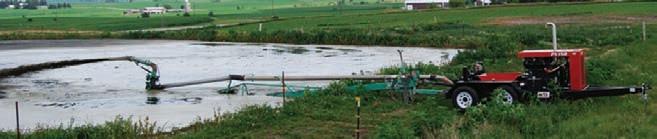
The drag hose system consists of a Case International 485 articulating tractor
equipped with GPS tracking, using a product called Ag Leader INSIGHT produced by Trimble Navigation Limited, and Krohne flow meters to control the flow rate. The tractor can be equipped with an Unverfurth 11-shank, injector tool bar or with a custom-built top-dress tool bar, depending on customer needs. To transfer the manure from the storage lagoon or from the frac tank to the tractor, they have three and three-quarter miles of hose.
“The pumping equipment – like the hose, all the booster pumps, the lead pump, hose reels, and swing arm on the tractor –were purchased from an outfit in Iowa called Puck Custom Enterprises,” says Lemmenes.
He says the company did shop around for its drag hose system and opted for the Puck Custom Enterprises (PCE) product because it could deliver more gallons per minute.
“The equipment was built heavier than any other manufacturer, and they give us more gallons per minute, which makes us get done faster,” says Lemmenes. “It’s more efficient for the customer and we burn a lot less fuel this way. We’re doing 2,000 to 2,400 gallons per minute whereas some of these other companies do 1,100 to 1,600, but it really varies depending on your set up and the land elevation.”
He says the hoses supplied with this drag hose system are able to take more pressure, meaning that they can use larger pumps and thus deliver more gallons per minute. They are also able to use larger diameter drag hose. The pumps are powered by 300- and 375-horsepower John Deere engines with Cornell pumps.
Whether it is the tanker trucks or the tractors, the application rate is essentially determined by speed, says Lemmenes. Operators have reference sheets within the cab to instruct them as to what speed they should be traveling for a particular application rate. Some customers have the ability to provide colored maps as to the required application rate in various areas of each field, and because the GPS display within the cab tells the operator exactly where he is in relation to that map, he can adjust the rate by adjusting his speed in those instances. After a service call, Lemmenes Custom Farms can generate a GPS map indicating where the manure was applied and at what rate.
As the size of farms have grown, Lemmenes Custom Farms is a good example of how the service industry has grown right along with them, as well as the level of sophistication required in such areas as custom manure application.
Odor-less manure
A cleaner, better smelling farm is no longer a myth – it’s a reality.
That’s because President of Bauer Energy Design, Inc., Walter Bauer, with degrees from University of Guelph and Wilfrid Laurier University, has designed a proprietary process that changes the molecular structure of your well water into a new water with highly beneficial and testable properties.
This dramatically improved water – which satisfied users have coined “Bauer Water” –uses a clinical process to remove and prevent biofilm buildup. This ultimately changes the microflora in an animal’s digestive system. Manure will no longer break down into the traditional methane and hydrogen sulphide compounds. No bad compounds; no bad smells.
“The Potent smell of our manure has significantly decreased since installing Walter’s design. Bauer Water has definitely taken the edge off the smell!”
Keith Wideman, Early Rise Jersey Farms, Elmira, Ontario
Odor reduction, is just one of the many benefits of Bauer Water. Contact Walter directly for more info about the patented Bauer Water system. Bauer Energy Design Inc.
1.519.634.9974 or acron@rogers.com www.bauerenergydesign.com
®
Farm odor focus of research work
ISU researcher develops system for using odor mitigation equipment only when it’s needed
In the summer months, few people can afford to run their air conditioning 24 hours a day. And even if you could afford it, there are times during the day when you just don’t need it.
Steven Hoff, an Iowa State University professor of agricultural and biosystems engineering, thinks the same logic should apply to odor mitigation for concentrated animal feeding operations.
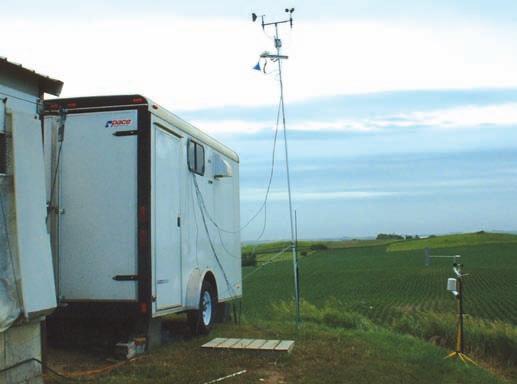
Hoff has developed a system for operating odor mitigation systems only when the weather is most likely to cause the odors to become a nuisance to neighbors.
Hoff’s odor mitigation prototype monitors several climate variables and operates only when neighbors may be affected.
The system is a miniature weather station that includes locations of neighbors as part of its programming.
“The idea is to keep track of atmospheric stability, which we know affects how far odors will travel, and whether a neighbor may be impacted because of the atmospheric conditions – the wind direction, and those types of things,” said Hoff.
“But if no one is going to be impacted by the odors emitting from a pig house, let’s say, or a poultry house, then save the farmer some money and don't mitigate,” he added.
Hoff said the system can be used with any odor-scrubbing system that can be controlled in an on/off mode.
“Whatever the method is, bio-filters, or any other mitigation technique, it will be turned on when the conditions dictate,” he said.
The most important weather aspect of the system is monitoring atmospheric stability, according to Hoff.
When the atmosphere is unstable, odors will not travel as far and will affect fewer neighbors.
When the atmosphere is more stable, odors will travel farther and can be a nuisance to more neighbors, according to Hoff.
“We call it ‘impact-based odor control’ because the idea is going to be to mitigate only when needed,” he said.
Atmospheric conditions that the system monitors most closely are humidity, wind speed, wind direction, temperature and solar impact – all of these are likely to affect stability.
Because two of the important inputs of the system are wind speed and direction, the system can also tell where the odor may be headed.
Hoff and Lun Tong, adjunct assistant professor in agricultural and biosystems engineering, currently can take into account the locations of five different neighbors. Within a year, the program will be able to expand to as many as 20 neighbors
Steve Hoff’s odor mitigation prototype monitors several climate variables and operates only when neighbors may be affected. Submitted photo
that might be affected.
Another benefit of the system is the effect on emissions that have environmental impact.
“This is not geared to gasemission reduction; however, one of the side benefits is that you are still mitigating some of the gases that have environmental concern,” said Hoff.
Through two summers of research, Hoff and Tong have developed a system that will provide “significant reduction in operation time while still maximizing the benefit to the neighbor” and also be affordable for the producer, according to Hoff.
Cost of operation is the greatest limiting factor for current odor mitigation systems, Hoff said. This system will allow producers to invest greater amounts in the mitigation system without having to worry as much about operating costs.
For anyone who lives outside the city, as Hoff does, there are tradeoffs.
“In my business, everybody has a sensor. And everyone’s is calibrated a little differently. We all have thresholds. My wife’s threshold is lower than mine,” he said. “With this system, we are trying to minimize the odor impact of animal production to become less of a nuisance to neighbors.”
Texas GHG study under way
Texas AgriLife researchers launch new study of emissions from crop fertilization, tillage and feed yard operations
By Kay Ledbetter
Texas AgriLife Research scientists in Amarillo, Texas, are embarking on a new study amid recent concerns over greenhouse gas emissions from crop fertilization, tillage and feed yard operations.
Dr. Ken Casey, AgriLife Research air quality engineer, and Al Caramanica, a research chemist, have added a few new laboratory tools to help measure three greenhouse gases: nitrous oxide, carbon dioxide and methane.
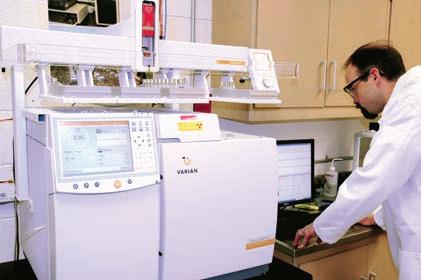
Casey recently purchased a Varian gas chromatograph with three detectors set up for automatic injection of gas samples from gas-tight vials that will allow simultaneous detection of all three gases from samples taken at feed yards.
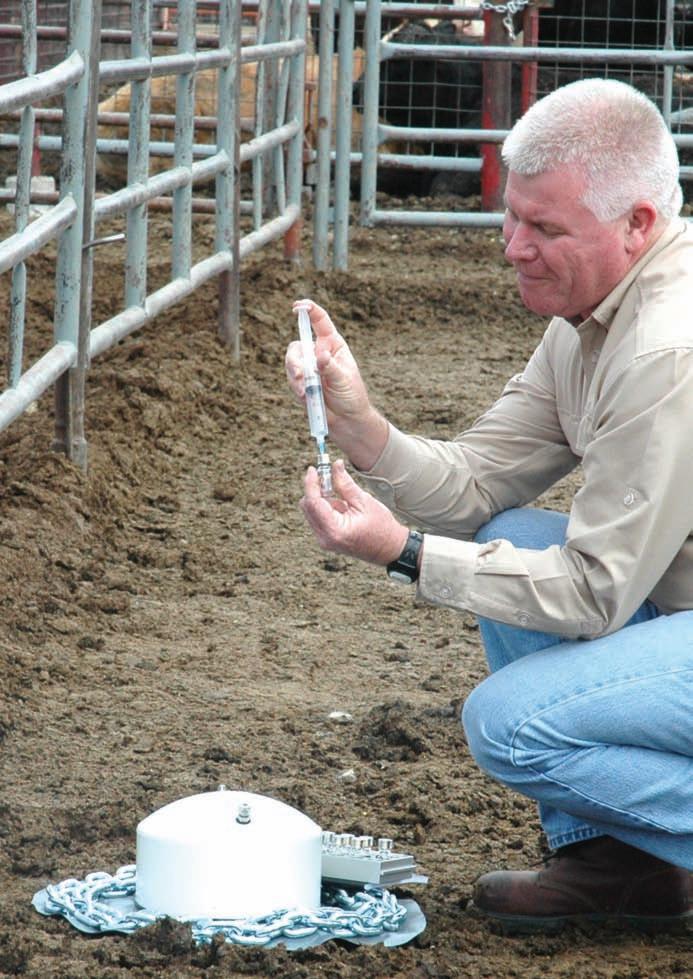
“We use a non-flow-through non-steady-state chamber that collects emissions off a surface, in this case manure in the pen, and we use a syringe to draw the gas sample from the air space in the chamber and then that is injected into vials for testing,” Dr. Casey said.
Before the vials are filled with samples from the field, each is flushed with helium twice then evacuated, Caramanica said. When returned to the lab, those vials are placed on the gas chromatograph in an auto-sampler and samples are run through three different detectors to determine the amount of nitrous oxide, carbon dioxide and methane.
He said each sample takes approximately five minutest to test. With the auto-sampler, they can collect 128 samples and load them in the trays for processing and then come back the next day and collate the data.
The researchers explained that samples are taken in 15-minute intervals from various locations throughout a pen: at time of chamber placement, at 15
After drawing an air sample from a non-flow-through non-steady-state chamber that was placed on the feedlot pen surface, Dr. Ken Casey, Texas AgriLife Research air quality engineer, injects the sample into a gas-tight vial for later testing. Photo by Kay Ledbetter
minutes and 30 minutes to determine the buildup of emissions.
“This work area will focus primarily on nitrous oxide,” Dr. Casey said.
Nitrous oxide has approximately 310 times the global warming potential of carbon dioxide, he said. It is produced as a part of the nitrogen cycle through the microbial processes of nitrification and denitrification, which are responsible for converting organic nitrogen in livestock manure and urine to inorganic forms that are absorbed and used by plants.
Dr. Casey said there are many other sources of nitrous oxide, but his study is only concerned with the feed yard. The three primary objectives of their study are:
Detect and quantify greenhouse gas emissions from beef cattle feedlot manure management systems, especially nitrous oxide, for its greater capacity to absorb the Earth’s radiative energy:
• Establish baseline flux rates of greenhouse gases produced by local feedlots;
• Help establish manuremanagement techniques that contribute to fewer emissions.
“We want to try to understand how much is being emitted,” Dr. Casey said. “But we also expect to see a substantial
variation across the feed yard and over time, so we want to understand the mechanisms that control the emissions.”
In addition to testing under wet and dry conditions, the study will be longterm to enable testing through different seasons, and then also a section of a feed yard pen pad will be lifted and taken to a greenhouse where conditions can be manipulated to determine mechanistically what is happening, Dr. Casey said.
“It may take us several years to get a reasonable handle on the mechanisms,” he said. “In three to six months we will have spatial variability within the pens measured, but then we need to have the seasonal variability figured also.”
Dr. Casey said their small-scale chamber work is being supplemented by collaborative work with Dr. Brock Faulkner, a Texas A&M University research assistant professor in College Station, who has an open-path Fourier transform infrared spectrometer unit.
In Dr. Faulkner’s work, the spectrometer is placed at one end of the downwind edge of the feed yard and an infrared light source is placed at the other end and it measures the target gas concentrations along the path between the two, Dr. Casey said. By running both
Al Caramanica, a Texas AgriLife Research chemist, works at the Varian gas chromatograph, a new piece of equipment that is set up with automatic injection of gas samples. The research team will use the equipment to test for greenhouse gases emitted from feedlot pen surfaces. Photo by Kay Ledbetter
tests in the same feed yard, they can get a feel for how the results compare.
“We are part of a larger effort to quantify what emissions of greenhouse gas are from feed yards,” he said. “We want to understand the variability and circumstances that create the greatest emissions and determine methodologies that identify the right numbers. Then we want to help identify management practices that can keep them at the lowest possible levels.”
{ Add Firestone Geomembrane, Add Innovation }
Innovative projects require innovative products, like Firestone Geomembranes. From anaerobic digesters, which convert animal waste into an alternative energy source, to constructed wetlands that provide environmentally sound water treatment – Firestone is proud to be a part of the solution. Our geomembrane products’ durability and elasticity even in exposed applications, combined with our expertise, help ensure the success of even the most demanding projects.
SUCCESSFUL APPLICATIONS INCLUDE:
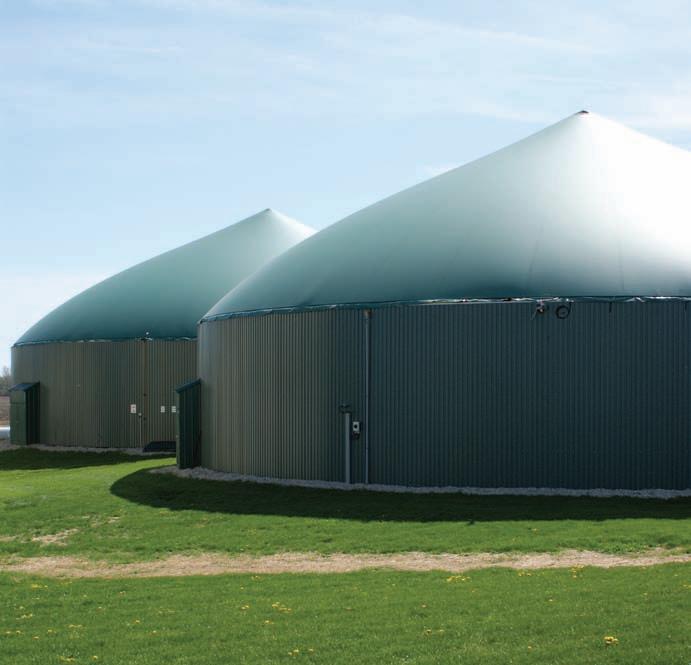
Anaerobic Digesters Alberta, Canada
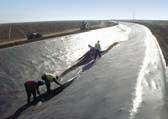
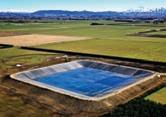
Irrigation Reservoir Canterbury, New Zealand
Agricultural Waste Pit Angola, Indiana
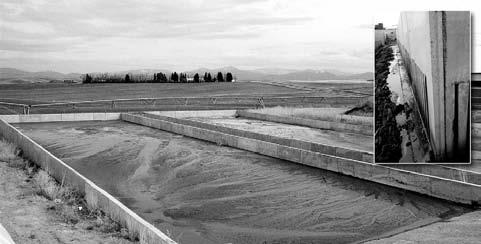
Constructed Wetlands Seymour, Indiana
Biodigesters Sao Paolo, Brazil
Irrigation Canal Lost Hills, California
AgSTAR tour visits two WI dairy digesters
Annual conference starts with half-day tour of two Green Bay area dairy operations using two different styles of anaerobic digesters
By Margaret Land
More than 200 scientists, researchers, government officials and farmers descended on Green Bay, Wis., in late April to take part in the 2010 AgSTAR national conference.
AgSTAR, which is jointly funded by the U.S. Environmental Protection Agency (EPA), the U.S. Department of Agriculture (USDA), and the U.S. Department of Energy (DOE), encourages the use of biogas technologies, such as anaerobic digesters, at confined animal feeding operations (CAFOs) to help reduce methane emissions and provide other environmental benefits.
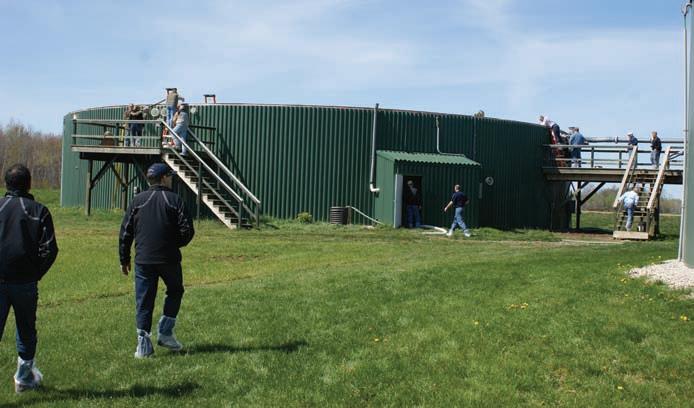
This year marketed the organization’s fifth conference, which started with a half-day tour of two Green Bay area dairy operations, both using two different styles of anaerobic digesters.
Green Valley Dairy
Green Valley Dairy is a 3,400 head (3,000 milking) dairy farm located near Krakow, Wis. Operated by a management partnership, the dairy operates three above ground, complete mix digesters, two supplied by Biogas Direct and the third designed by Northern Biogas LLC, a company created by the farm owners. Only two of the digesters were operating the day of the tour. One of the farm’s digesters was out of commission, its dual membrane cover deflated for repairs to its three propeller mixers.
The digesters are supplied with about 120,000 to 150,000 gallons of manure daily plus milk parlor wash water, resulting in about 8.5 percent solid matter. The mesophilic system has a retention time of about 22 to 23 days, operates at
104 Fahrenheit and is fed continuously. Before entering the digesters, the manure scraped from the multiple free-stall barns is pre-heated using a Columbia boiler.
“The first year we put our digester in … we found out it wouldn’t operate on the coldest days here in Wisconsin,” explained Guy Selsmeyer, one of the owners of Green Valley Dairy. “We were running out of heat. We kind of redid the heat balance that the original designers of the digester did and we found out the bulk of the BTUs are required to heat the manure.”
He added that it was a learning experience for all involved in the project and he recommended that anyone considering installing an anaerobic
Green Valley Dairy operates three above ground, complete mix digesters, two supplied by Biogas Direct in 2006 and the third, added in 2009, designed by Northern Biogas LLC. Photo by Margaret Land
digester complete a heat balance of their own operation.
“It isn’t rocket science,” he said. “It’s pretty easy to go through a heat balance and figure out where all your BTUs are.”
Biogas generated from the digesters is dehumidified through a condensate trap and chiller and is also scrubbed aerobically using an oxygen treatment process before it is used to generate electricity through the operation’s two
➤ Manure Pits,Channels & Covers
➤ Suspended Slabs - up to 40’ clearspan
➤ Hog & Cattle Slats - up to 25’ clearspan
➤ Weeping Walls - manure separation
➤ Milking Parlors
➤ Strainer Boxes
➤ Commodity Storage
➤ Bridges
➤ Bunker Silos (8 types)
➤ Syloguard Concrete repair
➤ Retaining Walls
➤ L & T Walls up to 16’ high
• Built to engineers’ specifications
• All sections are high strength, pre-stressed,reinforcedconcrete for longer life
• Quick & easy to build
• Air-tight seals and protectant using Syloguard products
Caterpillar 600 Kw gen-sets. All electricity generated on the farm is sold to We Energies under a “sell-all” contract.
All heat created by both engines in the generation process is also collected through water jackets. Recovered heat is used to heat the digesters, nearby calf barns plus the farm shop and other buildings. It also is used in the winter to pre-heat the manure before it enters the digesters.
“A digester is like a stomach,” explained Selsmeyer. “You want to keep things pretty steady. Keep the bugs happy. Keep the temperature real steady.
“After the first year, we put in a boiler line and the boiler line allowed us to do something I think every digester should have. If you have an engine down or you have to do an oil change, you start to lose temperature right away. The boiler allows you to keep those bugs happy, keep the temperature consistent. You really don’t miss a beat on the gas production and you’re able to have the gas available so that you can start the unit and run it at full right away.”
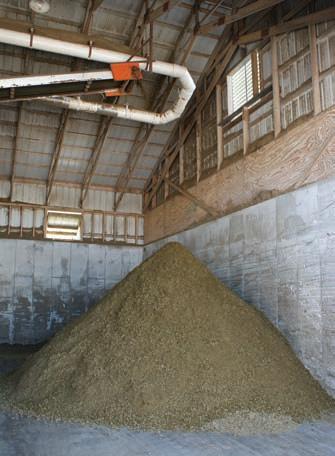
After the manure is processed in the digesters, it is pumped to three FAN screw press separators that are used to remove all solids, which are then recycled as bedding. Of the 120 tons of bedding produced each week, about half is used on farm while the other half is sold as bedding to neighboring dairies, earning Green Valley about $20 per ton.
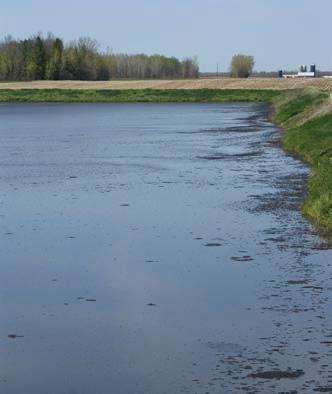
Liquid separated from the digestate stream is pumped into a nearby lagoon. Once any remaining solids settle out, the liquid is then pumped to a second lagoon where it is stored for land application.
Pagel’s Ponderosa Dairy
John Pagel grew up on his family’s Kewaunee, Wis., dairy operation, eventually taking over the operation in 1978. He has lived in the family home his entire life.
“Not many people can say that,” he admits.
It was his long relationship with the land and his concern for friendly neighbor relations (“I still want all my neighbors to wave at me with all their fingers.”) that eventually led Pagel to install two anaerobic digesters on his 4600-head dairy.
The two-stage mixed plug-flow digesters were designed and installed by GHD Inc. and became operational in December 2008. They are located below grade and are U-shaped, feeding about 160,000 gallons of manure daily through the continuous system. To help mix the eight to nine percent solids manure, methane collected on top of the digester is pumped to the bottom of the tank
On the day of the AgSTAR tour, one of Green Valley’s digesters was out of commission, its dual membrane cover deflated for repairs to its three propeller mixers. Photo by Margaret Land
Green Valley Dairy uses solids separated from the anaerobic digestate as bedding for its cows. Of the 120 tons of bedding produced each week, about half is used on farm while the other half is sold to neighboring dairies. Photo by Margaret Land
and bubbled back up. The system has a retention time of about 20 days and operates at about 100 Fahrenheit.
Like Green Valley’s operation, biogas generated from the Pagel digesters is treated with a condensate trap and a chiller before it is put through a hydrogen sulfate reduction system developed by GHD. The scrubbed biogas is then used to power an 800 Kw Caterpillar gen-set.
“We sell 100 percent of the power we make and we buy 100 percent of what we use,” said Pagel. “At 800 Kw, we’re making about 25 percent more than we’re actually using on the farm.
“We’re planning on buying a second engine and we’re hoping that it will
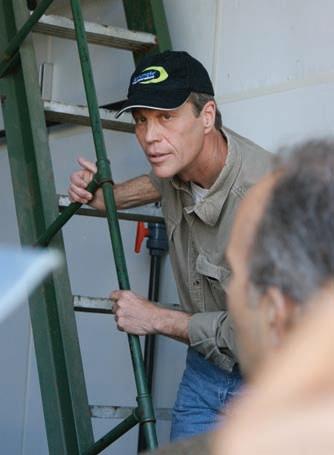
Green Valley Dairy part owner Guy Selsmeyer leans in to hear a question during the AgSTAR digester tour.
Photo by Margaret Land
Liquid separated from the digestate stream is pumped into nearby lagoons where it is stored for land application. Photo by Margaret Land
for odor control.
About 160,000 gallons of manure is fed daily through the Pagel’s U-shaped digesters, which are mixed by bubbling methane collected on top of the digester through the manure.
Photo by Margaret Land
provide another 500 to 600 Kw, if we have enough methane gas.”
Heat from the generators is recovered and used to heat the digester and some farm buildings. The farm also has a backup biogas boiler to help with digester heating.
Once the energy is removed from the manure, the digestate is pumped to a building adjacent to the digesters where the solids are separated using one Doda and two Bauer screw press separators. The farm produces about 15 tons of bedding a day.
“We really like the digester,” said Pagel. “We like the bedding it provides. It provides us with 40 percent more bedding than we can actually use on the farm.”
Extra bedding produced is sold to other farms in the area and neighbors also come by for trailer and pick-up loads for their gardens.
The liquid removed from the digestate is used to help fertilize the operation’s 7,500 crop acres.
While the anaerobic digester represented a big investment for the farm, the Pagels felt that it made sense from an environmental standpoint and
“At the time we put it in, it was a $3.2 million investment and we got about 10 percent (funding) with government grants for new technology,” explained Pagel. “Depending on how we do with purchase power agreements, it looks like it is a
seven- to 10-year payback.”
The Pagels have opened their farm to the public, inviting tourists and school tours to view the digester and the farm cows being milked on the rotary (carousel) milking parlor.
“I believe that it’s our responsibility to educate the people that are non-farm people about what’s going on at the farm,” said Pagel. “I don’t think we’ve done a good enough job of it in the past. We also believe that even though this is a large farm, it’s also a family farm. We have four children and all four are involved on the farm along with two of their spouses.”
Dealerinquirieswelcome.
Pagel’s Ponderosa Dairy’s two-stage mixed plug-flow digesters, designed and installed by GHD Inc., are located below grade. Photo by Margaret Land
In the NEWS
EPA, ag secretary team up to promote farm energy generation
U.S. Environmental Protection Agency administrator Lisa P. Jackson and U.S. Department of Agriculture secretary Tom Vilsack recently announced a new interagency agreement promoting renewable energy generation and slashing greenhouse gas emissions from livestock operations.
The agreement expands the work of the AgStar program, a joint EPA-USDA effort that helps livestock producers reduce methane emissions from their operations.
EPA and USDA’s enhanced collaboration will provide up to $3.9 million over the next five years to help farms overcome obstacles preventing them from recovering and using biogas. The collaboration will expand technical assistance efforts, improve technical standards and guidance for the construction and evaluation of biogas recovery systems, and expand outreach to livestock producers and assist them with pre-feasibility studies.
About 150 on-farm manure digesters are now operating at livestock facilities across the U.S. In addition, EPA estimates there are about 8,000 farms across the United States that are good candidates for capturing and using biogas. If all 8,000 farms implemented biogas systems, methane emissions would be reduced by more than 34 million metric tons of carbon dioxide equivalent a year, roughly equal to the annual emissions from 6.5 million passenger vehicles. In addition, these projects could generate more than 1,500 megawatts of renewable energy.
CAFO group wins Purdue award
A group of Purdue University specialists who collaborated on research and public information about concentrated animal feeding operations (CAFOs) has won the 2010 Purdue Agriculture Team Award.
The team, made up of 21 members representing five departments within Purdue’s College of Agriculture and
Purdue Extension, conducted an extensive study of Indiana CAFOs, hosted a public forum to discuss the results, launched an informational website and produced more than 20 CAFO-related Extension publications.
“This team’s work is a true multidisciplinary effort focused on an important issue facing both production agriculture and community decision-makers,” said Jay Akridge, Purdue’s Glenn W. Sample dean of agriculture. “The group approached the research in a novel way and developed important fact-based information to help stakeholders make more informed decisions about CAFOs in their communities.”
The CAFO team was formed in 2007 in response to public concerns about the growth of confined animal facilities in Indiana. There are more than 600 CAFOs operating in Indiana.
The CAFO team will receive a $10,000 cash prize to be used for further research and outreach projects.
Huge cow manure project being constructed in China
In a bid to help alleviate China’s energy shortage, construction is currently underway on a biogas plant at the new Liaoning Huishan Cow Farm.
The manure from the 250,000 cows housed at the Huishan farm, located in Shenyang, China, will be converted into biogas and is expected to produce 38,000 MWh a year.
Once completed, it will become the world’s largest biogas project based on cow manure.
One of the features of the project is the utilization of fuel circulation. In addition to the use of biogas for power generation, the liquid (residual from biogas production) will be used to nourish the grass in surrounding pastures, and the solid waste will be sold as organic fertilizer.
The new biogas plant will not only serve China’s national economic and environmental development goals, but it also is expected to reduce about 180,000 tons of carbon dioxide emissions per year.
The Huishan Cow Farm is scheduled to begin commercial operation in September 2010.
McLanahan Corporation is proud to celebrate 175 years in business and six generations of family management and ownership.
To commemorate its 175-year landmark, McLanahan will be holding an Open House on Sunday, August 29 at the company’s Hollidaysburg, Pa., facility. The Open House will be a celebration to thank employees, the local community, customers, and vendors. Tours will be given inside the office and shop areas, and a tent will be setup with refreshments and memorabilia from the past 175 years.
McLanahan Corporation started in 1835 as a modest foundry founded by James Craig McLanahan at Hollidaysburg, Pa. Currently, McLanahan enjoys the distinction of being one of the oldest family-owned businesses in the United States.
McLanahan Corporation manufactures equipment to process raw and synthetic materials through crushing, washing, classifying, screening, dewatering, sorting, and mixing. Today, operations fall under six primary divisions. While the base of operations remains in Hollidaysburg, Pa., there are additional locations in Gallatin, Tenn.; Lakeland, Fla.; and Newcastle, Australia.
For more information regarding the Open House, call 814-695-9807 or visit www. mclanahan.com.
New NM planner at AgSource Laboratories
Nick Guilette has joined AgSource Laboratories as a nutrient management planner.
In this position, Guilette will work with clients in northeastern Wisconsin, providing nutrient management and comprehensive nutrient management planning services.
Guilette has a Bachelor of Science in
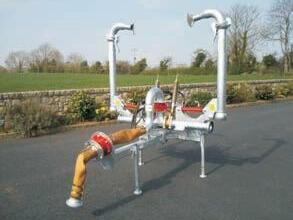
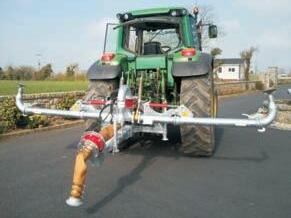
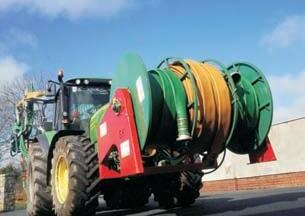
PCE Lead Pump Trailers:
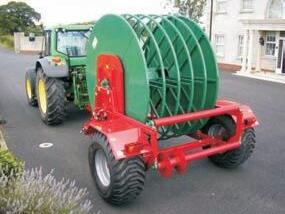
PCE Hose Carts
general resource management from the University of Wisconsin – Stevens Point. He brings eight years of experience to the position, having worked as an agronomist and environmental scientist. Guilette is a certified crop advisor with the American Society of Agronomy, has received the Wisconsin NRCS CNMP certification and is a member of the Wisconsin Association of Professional Agricultural Consultants.
“AgSource is excited to have Nick join our staff,” said Steve Peterson, vice president of the company’s North Central Division. “He brings valuable experience to the position.
“The addition of Nick allows us to better meet the needs of our clients in providing comprehensive nutrient management planning, in addition to the laboratory services we offer.
AgSource, headquartered in Verona, Wis., is a subsidiary of Cooperative Resources International and a memberowned cooperative that provides agricultural and environmental laboratory analysis and management information services to members and clients from North America and overseas from eight locations in the Midwest and Northwest.
ODA award honors years of work by OSU Extension
The Oregon State University Extension Service recently received the Environmental Stewardship Award from the Oregon Department of Agriculture (ODA) for its years of work helping dairy farmers protect ground and surface water.
One of the largest Extension programs worked cooperatively with the natural resources division of the ODA to design the Confined Animal Feeding Operations permit program.
“It was important to develop something a producer could easily read and understand,” said Mike Gamroth, OSU Extension dairy specialist.
As Environmental Protection Agency standards change, dairy and cattle producers sometimes find themselves suddenly out of compliance, officials say. Extension agents oversee the EPA rules but also provide technical assistance producers need to make required changes on their farms.
“As a fertilizer, manure is important, but when it gets into ground and surface water it can be an environmental hazard,” Gamroth said. “Several of us have been working on projects with producers and regulators to help keep water clean.”
As agriculture has become more specialized, dairy farmers have added cows but decreased their number of crops,
typically growing just feed for their cows. OSU Extension took on the challenge of more manure and fewer fields with a research program focused on selecting grasses that would take up more nutrients, and then determined how much manure could be safely applied.
Their results showed farmers could double the previous manure application standard of one and a half cows per acre. Therefore, a farmer with 100 cows would need just 33 acres to spread their manure, instead of 66.
“It made quite a change,” Gamroth said. “It was an economical advantage for farmers and it gave regulators a basis for their regulations.”
Dr. Powers to lead MSU Ag Institute
Michigan State University Extension (MSUE) has named Dr. Wendy Powers director of its new Institute for Enhancing Michigan’s First Green Industry: Agriculture and agribusiness.
Dr. Powers is a professor in the departments of animal science and biosystems and agricultural engineering at MSU and is MSU’s director of environmental stewardship for animal agriculture.
In her new role, Dr. Powers will be responsible for directing education efforts across all agriculture and agribusiness issues. She will lead a team of MSU Extension educators spread across all 83 Michigan counties and work closely with MSU faculty members to help define the hot-button issues for agriculture throughout the state.
Dr. Powers’ position is effective July 1. She will remain director of environmental stewardship for animal agriculture and will continue to develop collaborative multidisciplinary research and Extension programming to enhance environmental stewardship in animal agriculture.
“I’m looking forward to working with the many capable educators and researchers to help keep agriculture a thriving industry in Michigan,” Dr. Powers said. “I have a lot of respect for the farmers and agribusiness people in this state and I know that we, as a team, will do our best to serve them well.”
Dr. Powers joined MSU in 2006. She has a bachelor’s degree from Cornell University and a master’s and doctorate degree from the University of Florida.
Art’s Way Manufacturing promotes Dan Palmer
Art’s Way Manufacturing, Inc. – a manufacturer and distributor of niche
agricultural machinery, equipment and services – recently announced the promotion of Dan Palmer to president of Art’s Way Scientific – Buildings for Science. Previous, Palmer served as general manager. J. Ward McConnell, Jr., executive chairman of the board, said, “Dan Palmer’s leadership and experience has enabled Art’s Way Scientific to grow and serve the needs of the scientific community. Dana’s judgment, expertise and industry contacts are tremendous assets. He as proven to be a key member of the management team as we continue to focus on providing short term and long term solutions that help the scientific community deal with their laboratory needs and the Government's financial stimulus program. I am confident Dan’s vision, talent and dedication will continue to re-enforce our position as the industry leader in designing and manufacturing custom-design, modular science laboratories.”
www.buildingsforscience.com
New VP sales for Eastern region at JCB
Heavy equipment manufacturer JCB recently announced that Van Clarkson is joining the company as its vice president of sales for the Eastern region.
In his position with JCB, Clarkson will be responsible for all dealer sales in North America’s Eastern region, with eight district managers in the sales territory reporting directly to him. Clarkson will also be tasked with strengthening JCB’s distribution network and working with dealers in the Eastern region to increase both market share and overall revenues.
A resident of Winterville, N.C., Clarkson has held a number of positions in the equipment manufacturing and financing industries, including stints with Komatsu Finance America, Inc. and Associates Commercial Corporation. He comes to JCB from his current position as vice president of sales for Hyster Company, a global manufacturer of materials handling equipment. Prior to his tenure as Hyster’s vice president of sales, Clarkson also served as the company’s director of fleet management and as its regional finance manager. Clarkson holds a Bachelor of Arts degree in business management and an MBA in leadership and organizational change management, both from North Central College in Naperville, Ill.
www.jcbna.com
MagneGas presents plasma arc technology
MagneGas Corporation, a producer of fuel and natural gas alternatives made from
liquid waste, recently presented on the topic of waste management during the 18th session of the United Nations (UN) Commission on Sustainable Development (CSD).
During a presentation to the assembled CSD, the company introduced its MagneGas technology – a natural gas alternative made from liquid waste such as sewage, sludge, manure and certain industrial and oil based liquid wastes – as a liquid waste-to-fuel solution. Member states and major groups had an opportunity to address the CSD, and the session concluded with final thoughts and responses from the company’s executive vice president Ermanno Santilli and his fellow panelist.
While all representatives had set agendas, the candid response to the MagneGas technology was positive. In session, the representative from the international Farmers group publicly thanked MagneGas and congratulated the company on providing a very relevant solution for her constituents.
“We are both pleased by and proud of the response to the MagneGas technology at the UN,” stated MagneGas president Richard Connelly. “Many of the world’s foremost minds in sustainable waste management were on hand for our global debut.”
The company’s patented Plasma Arc Flow process gasifies liquid waste, creating a clean burning fuel that is essentially interchangeable with natural gas, but with lower green house gas emissions. MagneGas can be used for metal cutting, cooking, heating or powering bi fuel automobiles.
www.magnegas.com
EPA reaches settlement in Chesapeake Bay lawsuit
The U.S. Environmental Protection Agency recently announced it reached a settlement with the Chesapeake Bay Foundation, plus other organizations and individuals, resolving a lawsuit filed in January 2009.
The lawsuit, Fowler v. EPA, claimed that the EPA failed to take adequate measures to protect and restore the Chesapeake Bay.
The settlement agreement, negotiated with groups and individuals with a long history of advocating protection and restoration of the bay, tracks much of the suite of regulatory and other actions that the EPA has initiated or pledged to take under the Obama administration to restore water quality in the Chesapeake Bay and its tributaries. These actions include establishing the stringent Chesapeake Bay
total maximum daily load (TMDL), putting in place an effective implementation framework, expanding its review of Chesapeake Bay watershed permits, and initiating rulemaking for new regulations for concentrated animal feeding operations and urban and suburban storm water. The agreement also includes a commitment to establish a publicly accessible tracking and accounting system to monitor progress in reducing pollution through the TMDL and two-year milestones.
By December 31, 2010, the EPA will establish the Chesapeake Bay TMDL, a tool of the federal Clean Water Act, that
sets a strict “pollution diet” to restore the Chesapeake Bay and its tributaries. The Chesapeake TMDL is expected to be the largest and most complex ever developed in the nation, involving pollution sources throughout a 64,000-square-mile watershed that includes six states and the District of Columbia. Progress will be measured through milestones every two years, and the EPA may take action for inadequate plans or failure to meet the milestones.
More information about the TMDL is available at: http://www.epa.gov/ chesapeakebaytmdl/
BiOWiSH Technologies hopes to solve livestock odor problems
BiOWiSH Technologies has recently concluded commercial trials in the United States, Australia and Southeast Asia, testing its technology’s ability to solve odor problems in intensive animal production.
According to the company, the trials have shown that BiOWiSH™, a proprietary technology that accelerates enzymatic bio-chemical reactions, has the capability to reduce odor emissions on swine, poultry, dairy and beef operations by up to 75 percent.
Ian Smith, EVP of animal agriculture for BiOWiSH Technologies’, said the product has the potential to revolutionize odor control and waste management for intensive industries in the United States.
“We have extensive applications here (in the U.S.) and overseas in management of waste on-farm by reducing the strength of effluent, decreasing sludge, enhancing composting, reducing volatile organic compound (VOC) emissions and increasing biogas production.”
BiOWiSH Technologies has spent more than 18 years researching and developing BiOWiSH™, which it describes as 100 percent natural, biodegradable and safe for everyday use. The company believes the product has many applications, including managing wastewater, solid waste, soil and water remediation, industrial emissions, and in animal agriculture.
BiOWiSH Technologies recently moved its corporate headquarters from Sydney, Australia, to Chicago to help serve the needs of its two key geographic markets – North America and Europe. The company’s products are currently distributed throughout the U.S. www.biowishtechnologies.com
Blue Sphere enters U.S. methane reduction business
Blue Sphere Corporation recently announced it is entering the agricultural methane reduction business in the United States by establishing a new subsidiary, Blue Sphere U.S.A. Inc.
Blue Sphere has determined the most promising opportunity to generate carbon credits and energy in agriculture is to capture and convert the methane generated by animal manure.
Manure that is treated in a digester is broken down or digested by billions of naturally occurring bacteria known as methanogens. The bacteria convert the carbon in the manure to methane gas. Carbon credits from animal farms can be generated by capturing and flaring out the methane gas or by cleaning the methane and putting it through a pipeline, creating an alternate and renewable source of energy which prevents the methane from entering the atmosphere.
Blue Sphere sees an opportunity in this market based on a recent announcement by the Obama administration outlining the development of a cap-and-trade program for reducing emissions.
Blue Sphere has identified potential partners within the U.S. agriculture industry and is considering forming a partnership.
“This is a significant opportunity for Blue Sphere,” said Shlomi Palas, CEO of the company. “We have set up a U.S. subsidiary and we are considering potential partners at agricultural businesses to implement a methane reduction and energy producing project and possibly create a source of renewable energy.
“The Obama administration has set targets for carbon emission reduction and Blue Sphere is poised to provide the project management to assist in emission reductions. We have international clients and the ability to potentially trade carbon credits with our European customers means we are positioned to ensure our clients in the United States get the best price for their carbon credits.”
www.bluespherecorporate.com
Boldt Pre-Drain
Boldt Fabrication and Design recently released the Boldt Pre-Drain, sized to handle 200 to 100 gallons per minute. The Boldt screen is an in-tank screen designed to capture oversized solids from process and waste streams. The screen includes:
Receiving tank – featuring stainless steel construction and totally sealed for odor control
Bottom screen – drilled or wedgewire stainless steel screen section with mesh sizes of 0.01 to 0.25 inches
Shaftless screw conveyor – a screw made of hardened carbon or stainless steel used to convey solids out of the waste stream
Press zone – the final dewatering and compressing stage of the screenings designed to provide a volume reduction of up to 40 percent
Wash zones – optional spray bars that can be included to wash the screenings at the bottom screen, conveying section and press zone www.boldt-fab.com
Cambridge Environmental forms alliance with Rem Engineering
Cambridge Environmental Technologies, a subsidiary of Cambridge International, recently announced it had formed an alliance with rem Engineering to manufacture and market the Ecoremedy™ gasification system.
The relationship brings together Rem Engineering, which specializes in cogeneration and renewable power generation, and Cambridge Environmental Technologies, which produces conveyorized material handling systems. Together, the companies believe their system will meet current energy generation needs while creating jobs and economic stability.
The Ecoremedy™ system is a
conveyorized gasification system that gasifies various forms of biomass, turning it into usable energy. The system has successfully gasified composted dairy manure, processing sludge, spoiled feed, molded corn, peanut hulls, rice hulls, sawdust, fescue hulls, and poultry litter.
“Not only does Ecoremedy™ successfully and reliably generate usable energy from poultry litter and other byproduct materials, like offal and sludge, but our system recovers the highly valuable nutrients for sale to the fertilizer industry” says Dave Mooney, vice president of rem Engineering. www.remenergy.com www.cambridgeenvirotech.com
Dutch Industries new distributor of GT Bunning
Dutch Industries, in association with GT Bunning, recently announced that it has acquired the sole distribution (formally M&M Enviro Inc.) and manufacturing rights for Canada and the U.S. for GT Bunning manure spreaders and tipping trailers.
Industries is a Saskatchewan company with almost 60 years of experience manufacturing products for
the agricultural industry. According to company representatives, a key part to the success of the Dutch Industries has been through the service and support it extends to its customers. They plan to extend that support to the company’s Bunning range of products through its sales, engineering and support teams.
306-550-2617
306-541-4003
Farmers of North America selling AutoFarm systems in Canada
Farmers of North America has joined the AutoFarm reseller network to offer ParaDyme Integrated Precision Farming Systems to their customers coast-to-coast in Canada.
Farmers of North America will be offering the full ParaDyme line, including the AutoFarm ParaDyme Roof Module, AutoFarm EDGE, AutoFarm INTEGRA and AutoFarm Viper Pro controllers. They will also sell the AutoFarm OnTrac2 GPS Assisted Steering System, which offers entry-level precision farming plus is compatible with the ParaDyme Roof Module to take GPS hands-free steering from WAAS to RTK accuracy.
Farmers of North America is headquartered in Saskatoon, Sask. The company also operates an outlet in Wallaceburg, Ont. www.fna.ca
J&D Mfg Wide Guard HAF Panel Fans
J&D Manufacturing’s new Wide Guard HAF Panel Fans are available in two styles with a heavy-duty, 18 gauge galvanized housing and aluminum prop, or with a non-corrosive fiberglass housing with poly prop and stainless steel hardware.
Both models include front and rear heavy gauge powder coated fan guards. Fans are shipped fully assembled and ready to hang. Industrial loops are built
into the frame to allow you to attach a chain or cable to hang the fan straight up and down, or at an angle for greater control of the airflow.
HAF Panel Fans are available in 20and 24-inch sizes with a powerful 1/2 or 1/3 HP motor and BESS Lab certified circulation fan ratings. Fans are direct drive with totally enclosed, dual voltage, UL/CUL certified motors that carry a full two-year warranty. Motors are variable speed and can be operated with a separate variable speed control. www.jdmfg.com
JCB, Volvo sign agreement for skid steer, compact loaders
JCB and Volvo Construction Equipment recently entered into an agreement where they will cooperate on the engineering and manufacturing of skid steer loader and compact tracked loader products for distribution under their respective brands and through their respective global dealer networks.
The companies hope that the first mono boom Volvo branded machines will be in production at JCB’s Savannah, Ga., facility by the end of 2010. Volvo Construction Equipment will then transition skid steer loader models over time from its Pederneiras facility in Brazil.
“This agreement will allow us to combine forces in this key product area enabling both brands to compete more effectively, said John Patterson, deputy chairman of JCB.”
Dutch
“Volvo customers will benefit from a wider range of models,” added Olof Persson, president of Volvo Construction Equipment. www.jcb.com
www.volvo.com/constructionequipment
TRP LED lighting introduced
TRP Aftermarket Parts now offers a special line of LED lighting products manufactured for use in all Class 6, 7 and 8 trucks, tractors and trailers.
“TRP LED lights are brighter and much easier to see than incandescent lights, which enhances detection of the vehicle when it’s parked in a dark or dimly lit parking lot or on the side of a road,” said Everett Seymoure, global manager for TRP.
“TRP light emitting diode (LED) lighting products are tested for durability and long service life. The manufacturing process uses ultraviolet resistant polycarbonate lenses and a high diode count. This results in stop, turn and tail lamps that make vehicles easier to see.”
The circuitry on TRP LEDs is compact and uses 85 percent less electrical power than equivalent incandescent lamps, which means operators can add additional lights without overtaxing the electrical system, Seymoure added. Since the diodes are mechanically connected to the light’s foundation and not soldered on, LEDs don’t have issues associated with the intense heat generated during the soldering process.
TRP LEDs have no filament to break and the lens and housing are completely sealed, keeping dust and water out.
Durable polycarbonate makes the lenses resistant to impact damage.
TRP LED lights come in a variety of colors including clear — (white), red and amber and green, blue and purple for interior lighting and will not fade or change color over time. TRP LED Lights are provided with a 10-year limited warranty.
TRP LED lights are available through authorized Kenworth and Peterbilt parts and service distributors throughout North America for all make of trucks, tractors and trailers. www.TRPParts.comw
Manure Manager welcomes submissions from all manufacturers/ dealers of new manure management related products. All submissions will be considered for inclusion in On Track. For electronic submissions, please send digital photos as a TIFF file or maximum quality JPG file, along with product copy and contact information to: mland@ annexweb.com. If the material is being sent by mail, please send it to: On Track Editor, Manure Manager Magazine, PO Box 530, 105 Donly Drive South, Simcoe, Ontario, Canada N3Y 4N5
Screw Press Manure Separators
Hops help reduce cattle ammonia
By Chris Guy
An Agricultural Research Service (ARS ) scientist may have found a way to cut the amount of ammonia produced by cattle. To do it, he’s using a key ingredient of the brewer’s art: hops.
Cattle, deer, sheep, goats and other ruminant animals depend on a slew of naturally occurring bacteria to aid digestion of grass and other fibrous plants in the first of their four stomach chambers, known as the rumen.
The problem, according to ARS microbiologist Michael Flythe, comes from one group of bacteria, known as hyper-ammoniaproducing bacteria, or HAB. While other bacteria are helping their bovine hosts convert plant fibers to cud, HAB are breaking down amino acids, a chemical process that produces ammonia and robs the animals of the amino acids they need to build muscle tissue, according to Flythe, who works at the ARS Forage Animal Production Research Unit (FAPRU) in Lexington, Ky.
To make up for lost amino acids, cattle growers have to add expensive and inefficient high-protein supplements to their animals’ feed.
According to Flythe, hops can reduce HAB populations. Hops, a natural preservative, were originally added to beer to limit bacterial growth.
Flythe put either dried hops flowers or hops extracts in either cultures of pure HAB or a bacterial mix collected from a live cow’s rumen. Both the hops flowers and the extracts inhibited HAB growth and ammonia production.
Flythe and FAPRU plant physiologist Isabelle Kagan have completed a similar project with more typical forage. They recently identified a compound in red clover that inhibits
August 25-27, 2010
July 15, 2010
2010 Great Lakes Manure Handling Expo, Penn State’s Ag Progress Days Site, State College, Pennsylvania.
Visit: http://das.psu.edu/manure-expo
August 19, 2010
Manure Science Review 2010, Putnam County, Ohio.
Visit: www.oardc.osu.edu/ocamm
ARS microbiologist Michael Flythe has found that feeding hops to cattle can reduce the amount of ammonia they produce by inhibiting hyper-ammonia-producing bacteria (HABs). Here a hops flower is shown inhibiting HAB growth in an agar plate. ARS photo
HAB. Results of that study were published recently in Current Microbiology
Flythe also collaborated with FAPRU animal scientist Glen Aiken on a study in which hops had a positive effect on the rumen’s volatile fatty acid ratios, which are important to ruminant nutrition.
Farm Pilot Project Coordination Inc. Annual Summit, Don CeSar Beach Resort. St. Petersburg, Florida.
Visit: http://www.fppcinc.org
September 13-16, 2010
International Symposium on Air Quality and Manure Management for Agriculture, Doubtletree Hotel, Dallas, Texas.