President Mike Fredericks mfredericks@annexweb.com
Publication Mail Agreement #40065710
RETURN UNDELIVERABLE CANADIAN ADDRESSES TO CIRCULATION DEPARTMENT, P.O. BOX 530, SIMCOE, ON N3Y 4N5
e-mail: mweiler@annexweb.com
Printed in Canada
Circulation
e-mail: mweiler@annexweb.com
Tel: 866-790-6070 ext. 211 Fax: 877-624-1940
Mail: P.O. Box 530 Simcoe, ON N3Y 4N5 Subscription Rates
Canadian Subscriptions $35.24 Cdn, one year (with GST $37.00, with HST/QST $39.82)
U.S. Subscriptions: $47.00 USD, one year
Occasionally, Manure Manager will mail information on behalf of industry-related groups whose products and services we believe may be of interest to you. If you prefer not to receive this information, please contact our circulation department in any of the four ways listed above.
All advertising is subject to the publisher's approval. Such approval does not imply any endorsement of the products or services advertisted. Publisher reserves the right to refuse advertising that does not meet the standards of the publication.
Website: www.manuremanager.com
By Margaret Land
What’s happened to America’s Dairyland?
As editor of Manure Manager magazine, I keep myself abreast of happenings in the world of livestock and poultry production across North America and, sometimes, the world. I read about new manure co-operatives in Australia, new anaerobic digesters in Germany, new manure application rules in the United Kingdom and, of course, advances in manure technology and application innovation in North America. I also read about the not-so-good news, such as manure spills, runoff situations, split application hoses, farmer deaths due to hydrogen sulfide asphyxiation or drowning in manure pits. If it involves manure, I try to keep up-to-date on it.
Because of this, I’ve been watching a situation developing in Wisconsin’s Bradford Township, located within Rock County, a 720 square mile south-central county of the state bordering with Illinois. According to the county’s website, the area’s rural land base and rich soils are predominantly used for agriculture with milk cows being one of the top livestock animals living in the county. Makes sense given that Wisconsin is the U.S.’s “Dairy State.”
But it would appear Bradford Township residents and officials are growing tired of the dairy lifestyle. For several months now, area residents appear to have been looking for various ways to keep a Nebraska dairyman from locating his 5,200-cow expansion – Rock Prairie Dairy – within their community. Despite the fact the state’s Department of Natural Resources (DNR) has already issued a permit for the $35 million project to operate, it would appear that residents in the area are doing their best to keep the dairy from going into production. The latest ploy is a petition and referendum on a decision made by the township to allow the use of Midwest Area Disaster Bonds – part of a federal program to stimulate development in states affected by flooding in 2008 – to help lower interest rates on a loan to finance the project. The funny thing is Nebraska dairyman Todd Tuls hasn’t even applied for the bond program and has said he will be continuing the project even if the bonds aren’t available to him.
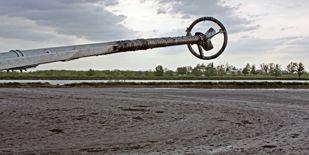
This isn’t the first time residents have moved to block the dairy. Earlier this year, an ordinance was put forward by the Bradford Town Board to ban the use of center pivot sprayers as a way of applying manure to fields, a practice commonly used in Nebraska and one Tuls had been considering using on his Wisconsin operation. But, after the Wisconsin Department of Health wrote a letter to the state’s DNR, he removed the 10 center pivots from his application.
Wisconsin’s Department of Agriculture and Department of Natural Resources “encouraged” the state’s towns and counties to avoid ordinances restricting agricultural technology, according to a recent report in the Janesville Gazette. In a letter addressed to the Wisconsin Towns Association and the Wisconsin Counties Association, agriculture and DNR officials stated “the agriculture industry is obligated to utilize innovative technological solutions in order to feed the world.”
But even with this advice, NIMBY-ism continues to thrive in Rock County.
“I’m looking forward to finally having an open house so we can show people the whole thing,” Tuls is quoted as saying in the Janesville Gazette. “They can see what it’s all about, and we can put some of these false rumors to rest.”
Good luck Tuls.
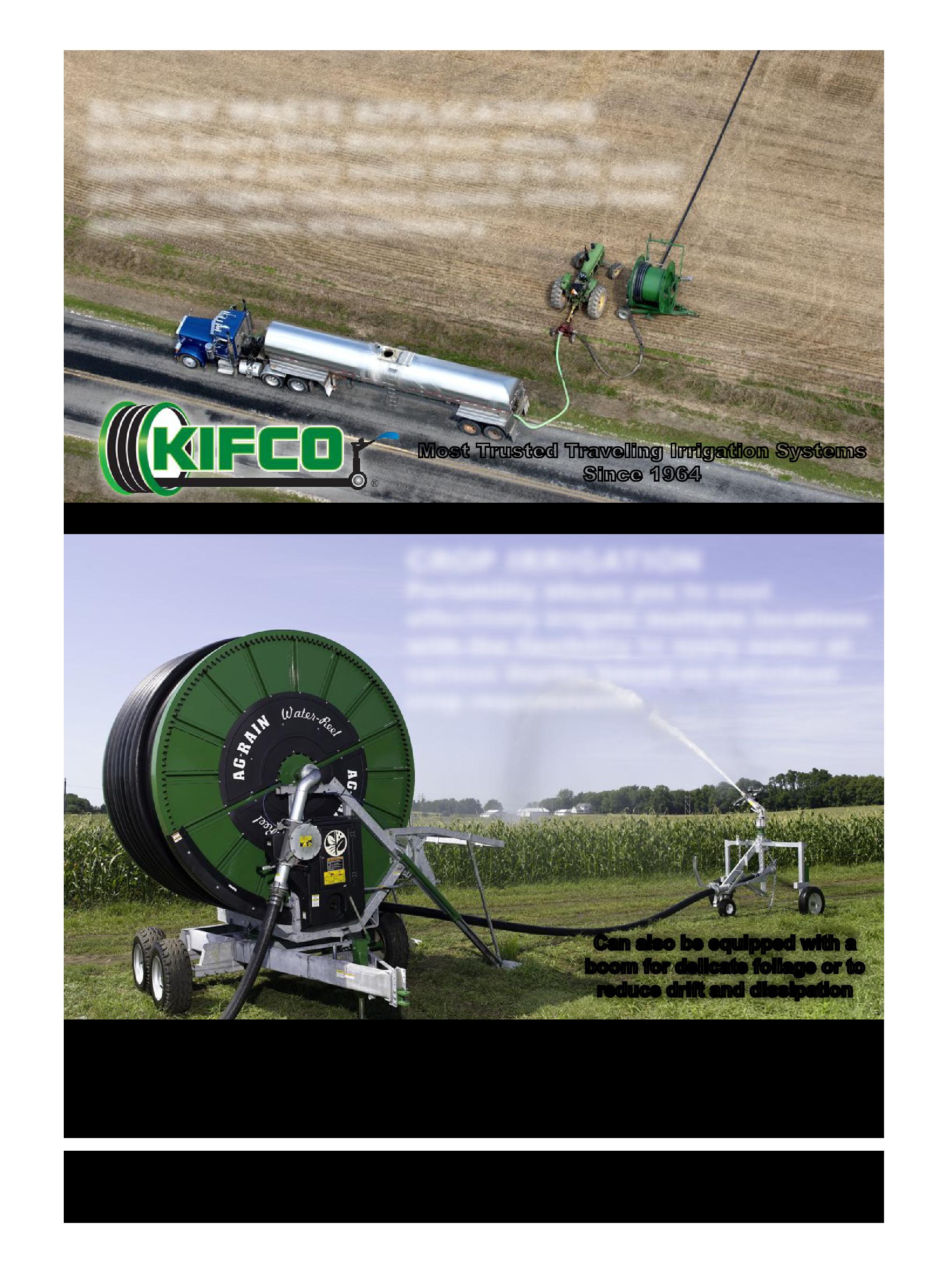
SLURRY WASTE APPLICATIONS
Kifco’s Engine Drive Water-Reels allow for application of slurry waste with up to 3% solids and offer higher retraction speeds where lower application rates are necessary.
CROP IRRIGATION
Portability allows you to cost effectively irrigate multiple locations with the flexibility to apply water at various depths based on individual crop requirements.
Manure turnover
By Tony Kryzanowski
Nebraska dairy taps all avenues to develop composting enterprise
Continued production of compost using their dairy manure was just too good of an opportunity to pass up for the operators of Nebraska’s Prairieland Dairy, even when they switched from organic compost to inorganic sand bedding. Their perseverance has really paid off, proving that either way, composting is still a worthwhile business opportunity for many large farms.
“When we originally started out marketing the compost in 2000, we were doing maybe 1,000 yards per year,” says dairy co-owner, Dan Rice. “Now we have grown to 10,000 yards per year and expect 25 percent growth in the next five years.”
The 1,600-head dairy is located 20 miles from Lincoln, Nebraska. In 2000, four family farms that were each milking between 100 and 200 cows created a partnership to establish a new dairy. A new milking barn was built in the community of Firth, and over time, it has expanded to 1,400 milking cows. In addition to milk products, the dairy began producing compost for bedding until 2004 when it switched to sand. Today, the Prairieland Gold branch of the partnership produces a variety of compost mixes primarily in bulk. It’s been an evolution since the dairy began composting in 2000. Not only is the dairy composting its own manure solids, but it is also being paid to accept organic waste from surrounding municipalities and businesses. That waste consists of grass and leaves from local municipalities, as well as waste from large industrial companies that manufacture products such as dog food and baking products. Prairieland Dairy also accepts organic waste from grocery stores, and restaurants. Growth in food waste recycling programs among businesses is driving growth in the dairy’s composting operations. At present, outside organic waste represents about 25 percent of the dairy’s raw material, but Rice expects that to increase to 75 percent within
three years.
“A lot of companies are implementing recycling of organics in our area and we are really excited about that,” he says.
The cows are bedded in deep sand beds. The dairy uses a flush system of recycled water from its lagoons to flush the sand/manure mixture daily from the beds into sand lanes in the barn where the sand settles out from the manure solids. Once a week, the sand is collected from the sand lanes and recycled into the stalls. The manure solids are collected and processed through an Ag-Pro static screen
separator, which separates the liquid and solid manure streams.
“What we like about the Ag-Pro static screen separator is that there are no moving parts,” says Rice. “It is just a screen where the solids go off the front and the liquids go out the back. It is a very maintenance-free type of setup.”
The dairy conscientiously designed the entire manure gathering and processing system to use only two pumps.
“We kind of take pride in that from the sustainability and maintenance standpoint,” says Rice. “It really eliminates a lot of maintenance.”
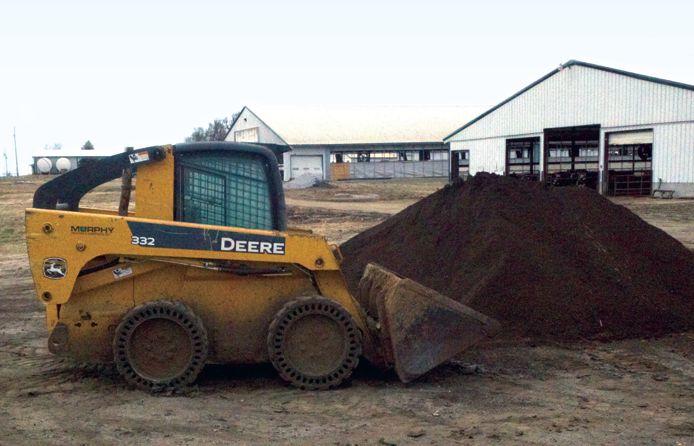
In 10 years, Prairieland Dairy has grown its composting enterprise from 1,000 to 10,000 yards per year, and expects 25 percent growth over the next five years. Contributed photo
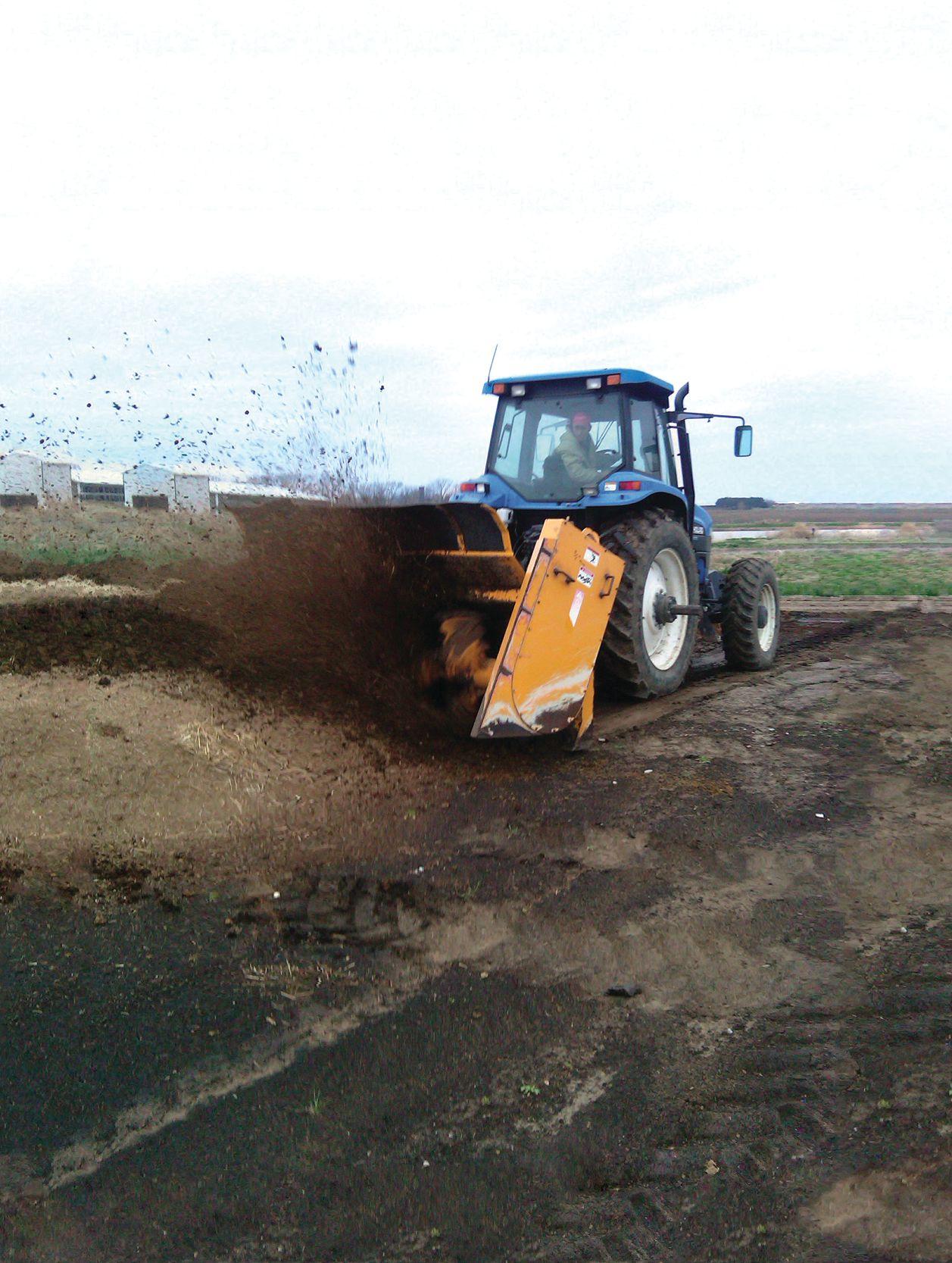
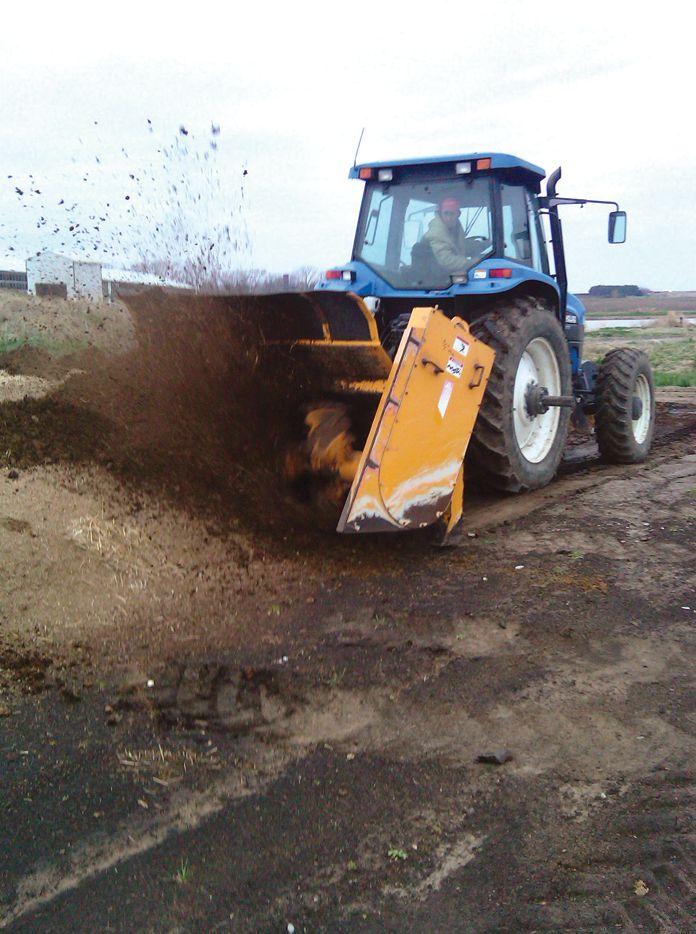
Prairieland Dairy uses a special attachment called a Brown Bear PTOPA 35C auger aerator to turn their compost windrows. Contributed photo
Once separated, the solid manure proceeds to the dairy’s dewatering pad. At this point, it has about 85 percent moisture content. For about two weeks, it is left on the dewatering pad, where the excess water drains off and the bacteria starts to grow. After two weeks, it has dried to between 75 and 80 percent moisture and it is transported and placed in windrows on the dairy’s compost pad. This is where the solid manure is mixed with the food and yard waste, or sometimes referred to as “carbon sources,” in specific recipes that the dairy has developed primarily through trial and error to develop the specific compost nutrient mixes required by its customers. The windrows are monitored on a daily basis for moisture, temperature and oxygen levels. They are turned as needed to advance the composting process.
“It varies, depending on the weather, how the bacteria is doing, how much oxygen they are using at that time and how much excess moisture we are getting from Mother Nature,” says Rice.
He adds that moisture, temperature, and oxygen levels are three key elements to manufacturing quality compost.
“The way I like to explain it is that our farm is all about bugs,” says Rice. “When we make up a ration for our cows, we don’t think about feeding that cow. We think about feeding the bugs in her rumen. We have to keep them happy and keep them working. Same goes for bugs in the compost pile. The compost bugs basically need feed, oxygen and water, so those are the three things we need to monitor.”
In terms of the mix, Rice says they start the windrow with the end user in mind. For example, greenhouse customers want a final product derived from 100 percent manure.
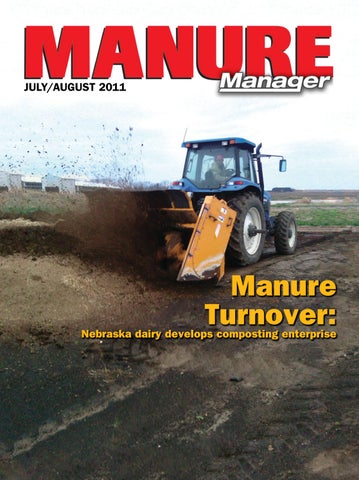
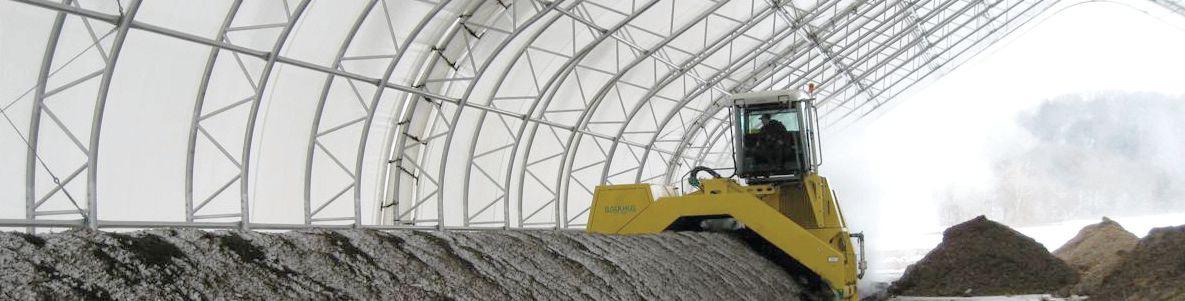
To turn the windrows, Prairieland Dairy uses a Brown Bear PTO-PA 35C auger aerator attached to a farm tractor. Turning the windrows eventually lowers the moisture content to about 30 percent. The compost ends up with about a 2:1:1 NPK rating and a 95 percent coliform kill rate.
Prairieland Dairy is considering a new compost turner system, driven primarily by the rising cost of fuel. One system being
By composting their solid manure, Prairieland Dairy ends up with about half the volume produced by their 1,600-head dairy. Contributed photo
considered is a forced air system.
Once the biological composting process is complete, the compost is screened and mixed with other ingredients to achieve the final product expected by their customers.
The dairy’s liquid waste stream is treated in a four-stage settling lagoon. The treated water is either recycled back to its flush tanks or is used to irrigate the company’s 600 acres. Some of the water is also used to irrigate and fertilize neighboring farmland. The dairy contracts the services of a custom manure drag hose contractor called Googles, headquartered in Columbus, Neb.
Rice says composting its manure has definitely influenced the growth and success of the dairy itself.
“We would need quite a large land base, if we didn’t have our composting operation, to grow our dairy herd to the 1,600 head that we have currently,” he says. “So it has helped us in that respect. Basically, if you compare what it would cost us to get rid of our manure from our 1,600 cows with the cost of our composting operations, yes, it has been a good thing for us to do and it is also the right thing to do environmentally.”
It also has helped the dairy, which generates about 20,000 yards of solid manure annually, to more easily manage its manure.
“We felt that composting was the best way for us to handle manure disposal because it cut our volume by
half,” Rice says. “So, if we are going to have to move it off the farm and move it long distances, there is a whole lot less to move after you compost it.” He adds that compost is also much more readily available to plants as a fertilizer than raw manure when land applying.
Prairieland Dairy switched from compost bedding to sand bedding in its barns primarily for business reasons, as staff market their own dairy products through another arm of the partnership called Prairieland Foods. Making the switch has delivered good results, as the somatic cell count in the dairy’s milk has dropped by half.
“When we started marketing our own brand of milk, we really felt it was very important to have the very highest quality possible,” Rice says. Although the somatic cell count wasn’t a major concern when the dairy used compost bedding and it was comfortable for the cows, it was simply a matter of choosing to deal either with an organic material that encouraged growth of bacteria or a non-organic material like sand, which is sterile when it goes into the beds and does not promote bacteria growth. Given the drop in the milk’s somatic cell count, sand has become the preferred option.
Although Prairieland Dairy made the switch to sand in 2004, recycling the sand bedding still generates a significant solid and liquid waste stream that requires management and disposal. So the dairy began developing
Will we be side-dressing manure in the future?
Natalie Rector, Amanda Meddles and Glen Arnold; Michigan State University Extension and Ohio State University
The 2011 spring is a reminder of how few days we may have to complete all our spring work; there may not be an opportunity for manure application. Ohio State University has been successfully testing a dragline system of manure application as a side-dress application on corn. This process can increase the application window of manure and apply nitrogen at a critical time for the corn plant, which can offset the cost of nitrogen fertilizer, replacing it with manure applications that were going to occur anyway.
Is this cost effective and does it produce equivalent corn yields to side-dressed fertilizer? Results at OSU say yes. A PDF report on the financial implications is available. (http://www.agcrops.osu.edu/on-farm-research/ archive/2009/research/2009/Manure Sidedress.pdf)
A project in Wood County, Ohio is comparing sidedress applications of manure to conventional 28 percent UAN and dairy manure. The manure side-dressing unit
compost and potting soil mixes to suit particular customer needs from the separated manure solids. One product is manufactured for a chain of nurseries in the Midwest called Earl May Nurseries.
“We have a lot of fun with it,” says Rice. “It’s called the ‘Poo-In-The-Pot’ program. We make a potting soil mix and put it into a compostable pot, which they use to grow the seedlings in the nurseries. Then those nurseries turn around and sell the plants in the Earl May Nurseries stores. It has been a very successful program for us.”
The dairy is preparing to travel further down the green path, having developed a business plan to install an anaerobic digester. Rice says the partners feel that an anaerobic digester would be a great addition to their operation because they could use an existing resource to generate electricity and/or methane gas or heat to use in other parts of their operation.
“Our business plan shows that we can power our dairy, our processing plant, and our town of Firth – which has about 600 people – through the use of our dairy manure and food waste,” says Rice. “So we think that it makes a whole lot of sense from a renewable energy standpoint and brings a great aspect to the dairy. It eliminates some of the odors and helps us be more sustainable.”
However, that plan is currently on hold because of cheap electricity rates currently available in Nebraska.
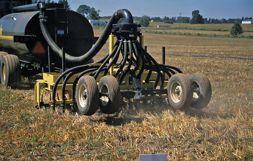
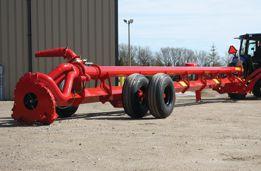
has a “spool” that lays the dragline down as the tractor moves one direction down the field, and then picks the dragline up on the next pass and so on. It reduces odors by injecting manure into the ground where it is less exposed to air and wind movement. It also allows producers to apply manure into the summer as one would with conventional side-dressing applications.
The research project will look at the viable corn plant population for silage as well as grain corn yield. Being able to side-dress manure with a dragline may be the answer to expanding the manure application window, reducing compaction and, anytime manure is injected, odors are reduced. This project should answer the question of whether the method provides more benefit to crop yields and silage mass than conventional 28 percent UAN. We are also slurry seeding fescue and rye grass into some of the plots during the manure side-dress application to see if it will provide a viable forage crop after silage harvest.
Watch a video (http://www.youtube.com/ watch?v=Q9zlpUP8j_k) of the dragline side-dress equipment in action.
Safe manure handling vital
Pathogens in manure can cause health problems if the manure isn’t managed properly.
Recent cases of people becoming ill in Europe from vegetables contaminated with human fecal matter remind producers that handling animal manure safely is important.
“Animal manures contain pathogens that can cause health issues in animals and humans if the manure isn’t managed properly,” says Chris Augustin, nutrient management specialist at North Dakota State University’s Carrington Research Extension Center. “However, the majority of manure management systems can reduce manure microbe concentrations in excess of 99 percent.”
Pathogens survive longer under wet conditions, and excess manure in a pen can dam water. Cleaning pens every few weeks improves pen drainage and reduces odor. Push-type blades can be used to clean pens; however, these blades can gouge a pen surface and reduce runoff efficiency. Pull-type scrapers seem to work the best and are less prone to damaging pen surfaces, Augustin says.
Pathogens in field-applied manure may run off into surface waters. Applying manure 100 feet or more away from surface water can prevent the spread of pathogens. Augustin recommends producers apply manure to fields used for vegetables and root crops in the fall to allow time for the pathogens to die before spring planting. Producers should use spring-applied manure on fields where they grow grains.
Composting manure is a speedy decomposition process. It not only reduces manure volume and odor, but
also the temperatures the manure pile reaches during the composting process (in excess of 130° F) kill pathogens and weed seeds.
The pile needs to be turned three to five times during composting. The pile’s heating cycles usually last a week or more. Each cycle must last at least three days to kill pathogens effectively.
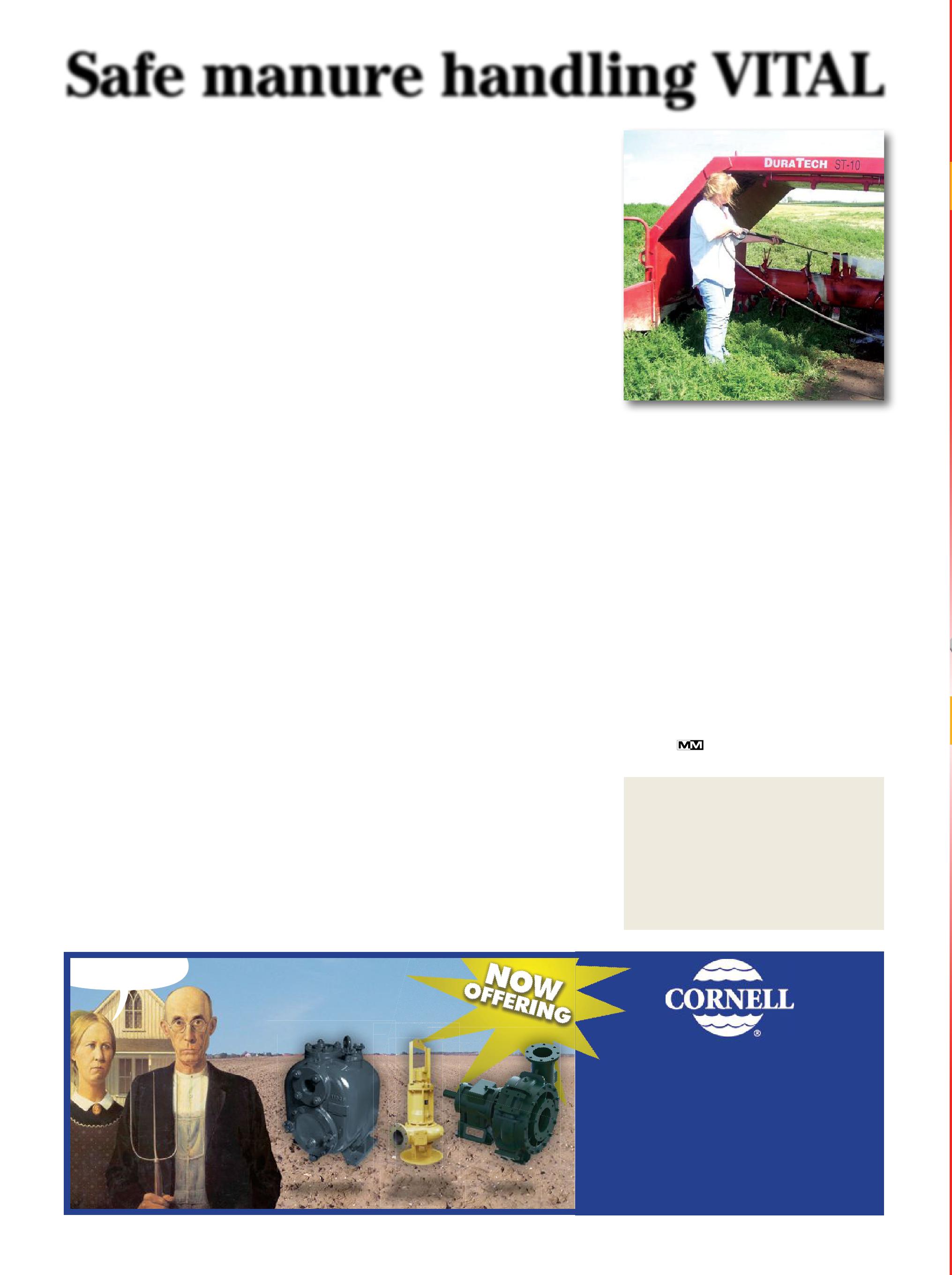
Manure spreaders, loaders and compost turners need to be cleaned and disinfected properly because they come in contact with livestock and manure, and they may harbor pathogens.
“Cleaning and removing material from the equipment is 90 percent of the job, while disinfecting is only 10 percent of the job,” Augustin says.
He recommends producers follow these steps:
• Clean the equipment in a designated area away from livestock.
• Remove organic matter because it can serve as an infection reservoir.
• Power wash the equipment with hot water and detergent. Scrub tight areas with a stiff, hard-bristled brush.
• Allow the equipment to dry before disinfecting it. Wet equipment can dilute the disinfectant.
• Follow the instructions on the product label when disinfecting the equipment.
• Properly wash clothing worn while handling animals because it can be contaminated with and transport pathogens. Washing clothes with detergent and drying them at 140° F will kill harmful pathogens.
Anne Ehni, Wells County Soil Conservation District manager, demonstrates how to power wash a compost turner. (Photo courtesy of Anne Ehni)
• Clean footwear with soap and water, and disinfect it. A mixture of five tablespoons of bleach per gallon of water works well for disinfecting footwear.
“Manure pathogens can cause health issues, but properly applying manure, cleaning equipment and cleaning pens greatly reduces these issues,” Augustin says. “These practices are all important to protect our food supply.”
If you have a coming event that would be of interest to manure management professionals and custom applicators, feel free to forward it to mland@annexweb.com.
FREESTALL BARN MANURE SYSTEMS
CROSS-GUTTER SYSTEM/S
GUTTER-CAT
B-15/16 CROSS CLEANER
FLUSH-FLUME SYSTEM SOLID-TRANS PISTON PUMP SEMI-TRANS PISTON PUMP
B-15/16 CHAIN SCRAPER
DURA-CHAIN SCRAPER
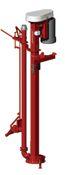
VERTICAL PUMPS
LIQUI-TRANS PISTON PUMP ELECTRIC PROP AGITATOR
MECHANICAL PISTON PUMP
ALLEY SCRAPER SY/STEMS TRANSFER PUMP SYSTEMS
XD-SERIES CABLE SCRAPERS
MANURE APPLICATION EQUIPMENT
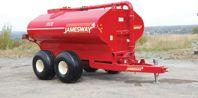
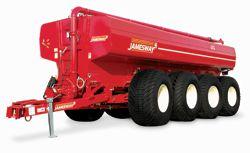
SPREADER TANKS
JAMESWAY FARM EQUIPMENT, INC.
FACTORY: St. Francois-Xavier (Quebec) USA WAREHOUSE: Tomah, WI PHONE: 819-845-7824
ULTRA-PUMP 3PH PUMPS & PROPS
PTO-DRIVEN PUMPS
PUMPS ULTRA-PUMP TRAILER LAGOON
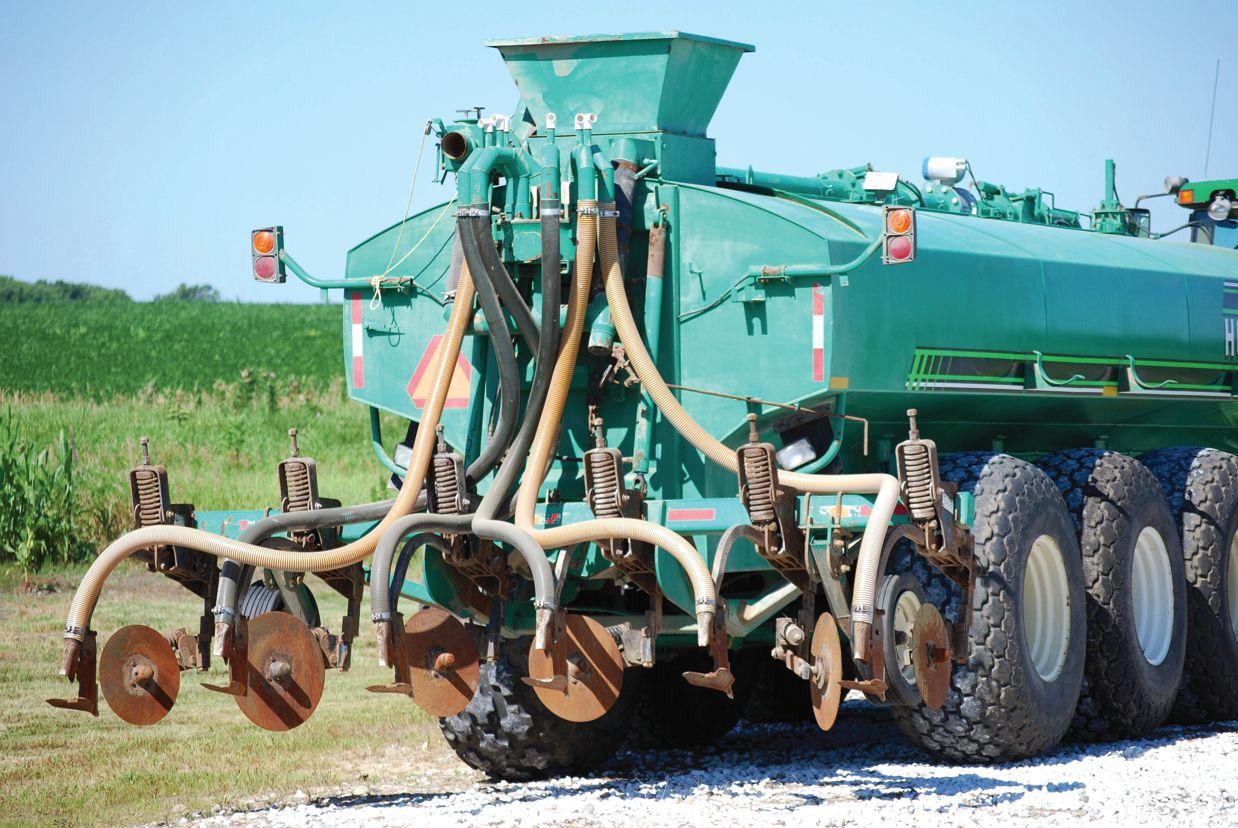
INJECTION SYSTEMS
TRUCK TANKERS
Ed and Tom Maljaars went into business together in 2004, buying a working, 80-acre dairy in Rosedale, B.C. Over the next seven years, they increased the cows they milked from 115 to 145, added substantially to the barn and liquid storage unit, incorporated a state-of-the-art composter and also built a new milk parlor. Contributed photo
Fine tuning an operation
By Diane Mettler
Ed and Tom Maljaars take their dairy to the next level with new barn, storage pit, large liquid storage tank, and composter
Brothers Ed and Tom Maljaars went into business together in 2004. They bought a working, 80-acre dairy in Rosedale, B.C., and moved their families out to homes on the property.
Since the two brothers had worked on dairies all their lives – Tom on the family dairy and Ed on other dairies as well – they had enough experience to know what they wanted to do, and they got right to work.
Over the next seven years, they increased the cows they milked from 115 to 145, added substantially to the barn and liquid storage unit, incorporated a
state-of-the-art composter and also built a new milk parlor.
The barn
The brothers began in 2006 by adding on an additional 215 feet to the barn. Under the addition, they built a manure pit 20 feet by 120 feet and 10 feet deep. They also put alley scrapers along all four alleys, so everything from the barn could be scraped into the pit.
Before buying the Bedding Master, they had to pump out of the pit into the Slurrystore once every three weeks, plus spend a lot of time agitating.
The liquids
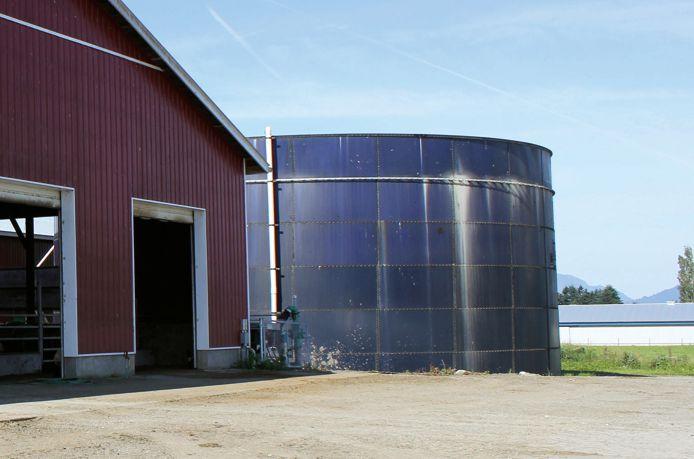
At around the same time, the Maljaars’ took their Slurrystore from 400,000 gallons to 600,000 gallons.
“There was already a Slurrystore on the site and we added two rings,” says Tom. “Each ring is 4.5 feet, so we raised it nine feet. We don’t spread during the winter and by early spring it’s pretty full.”
In the spring, the brothers hire Cascade Custom Pumping, who use a mile-long dragline to spread the material
on the farm’s grass and cornfields.
The difference between 2011 and 2006 is that the Slurrystore contains mostly liquid and the solids have been removed with the incorporation of a composter.
Bedding Master composter
In 2010, the Maljaars’ purchased a Bedding Master from Pacific Dairy Center – one of the first ones of its size in the valley. “They come in three sizes, and we got the smallest,” says Tom. “Between the heifers and cows, there are around 270 animals at the dairy and the system can handle that number easily.”
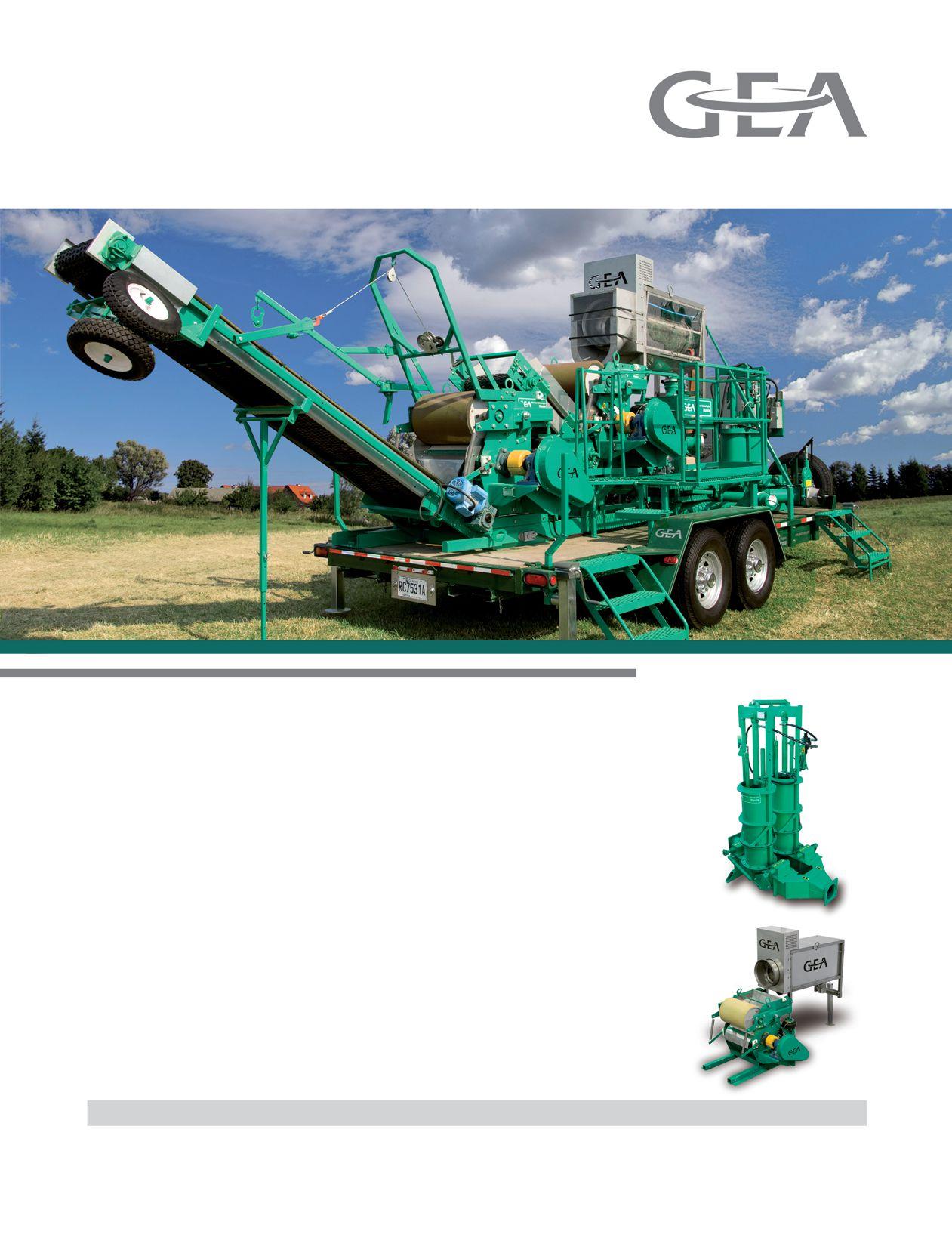
The process is fairly simple. PDC installed an Agi pump with two 10-horsepower motors in the manure pit by the barn. Manure is pumped from the barn to an EYS screw press separator at the same time the manure is agitated in the pit to keep it an even mix. The solids that come out of the separator are approximately 35 percent dry matter, which is required for effective composting. While the liquids move on to the Slurrystore, the solids feed into the
MicroSource® S...because pigs aren’t raised in a bubble.
Now, more than ever, pork producers recognize the impact their operations can have on the world around them. Proactive eco-management with MicroSource S can help reduce environmental burdens. By feeding MicroSource S, producers benefit from:
• Reduction in noxious manure gases, like ammonia and VFAs, for less odor – resulting in better community relationships
• Increased nitrogen retention in manure - resulting in improved N:P Ratio
• Lower manure viscosity - resulting in less power required for pump outs and the ability to pump out more manure
• Decreased stickiness of manure resulting in reduced labor requirements due to easier/less cleaning MicroSource S contains selected microbes that digest the solids in hog manure. It begins to work even before the manure hits the floor and continues to act on manure during handling and storage. Fed throughout the pig’s lifecycle, MicroSource S can help you better balance the challenges of efficient pork production with environmental stewardship.
To learn more, contact your feed supplier, go to www.unlimitednutrition-na.dsm.com, or call 1 800 526 0189.
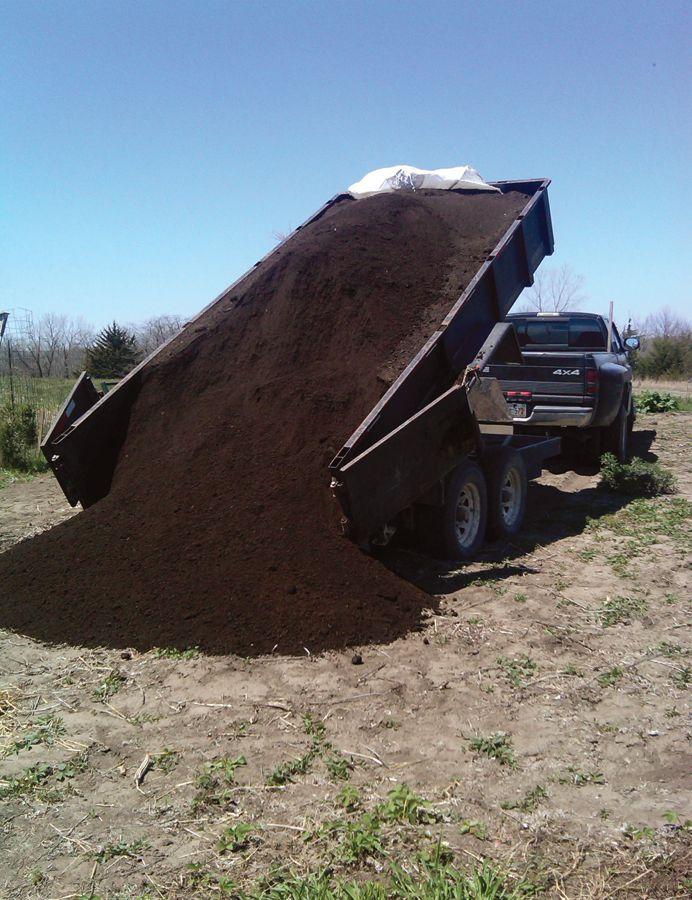
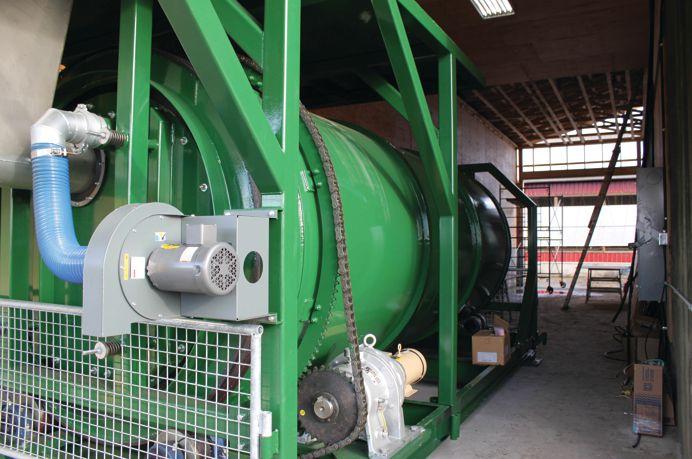
It takes about 24 hours for the composted solids to come out the other end of the Bedding Master. During the process, the solids have heated up to around 135 degrees, killing the pathogens and any bacteria. The material moves up a conveyer and onto a pile. The material is then scooped up and blown back into the stalls. Contributed photo
Bedding Master, a large drum that is six feet in diameter and 16 feet long.
The separator is programmed to be on for 10 minutes and off for 20 minutes. Tom says they can set any time they want, but at this setting, the level in the manure pit stays about the same, which is approximately four feet. “It is ideal to only have so much fed into the Bedding Master at a time,” says Tom.
The drum turns continually and it takes about 24 hours for the composted solids to come out the other end. During the process, the solids have heated up to around 135 degrees, killing the pathogens and any bacteria.
“That material moves up a conveyer and onto a pile,” says Tom. “From there, we have a tractor with a sawdust blower on the back. We scoop the material up and just blow it back into the stalls.”
Not only is it enough bedding for the farm says Tom, “but there’s another dairy farm in the valley that’s buying the product off of us too.
Dry, odor-free bedding
Whenever you’re working with cows, there are odors, but the compost is fairly odor-free. “It still has a smell, but it’s not like a manure smell any more,” says Tom. “And the final product looks a little bit
In 2010, the Maljaars purchased a Bedding Master. Manure is pumped from the barn to a screw press separator at the same time the manure is agitated in the pit to keep it an even mix. While the liquids move on to the Slurrystore, the solids feed into the Bedding Master, a large drum that is six feet in diameter and 16 feet long. Contributed photo
The Maljaars upgraded their Slurrystore from 40,000 gallons to 60,000 gallons by adding two rings. Contributed photo
like peat moss.”
Depending on the time of year and the outdoor temperature, the bedding material can range from a bit damp to bone dry. While normally the moisture content is around 35 percent, Tom says, “During the hot summer, once you blow it in the stall, it’s extremely dry. But when you get humid weather, it’s a little bit damp. Either way, it doesn’t really affect the cows at all.”
The Maljaars like the product as bedding in part because they don’t have
to worry about as much waste or having to purchase sawdust or shavings. “We like that we can just pile it up in the stall. You don’t have to worry about wasting it because it just floats right back into the system again and makes some more,” says Tom.
Healthier cows
One of the biggest reasons for getting the composter was to improve the health of their cows. Ed and Tom had read that farmers were experiencing
a lower somatic cell count (SCC). Ed also went and looked at a composter in Lynden, Wash. He was impressed since there were no bacteria in the compost being used as bedding in the stalls, so there are no more bacteria to transfer to the cows. And fewer sick cows meant improved production and lower treatment costs.
“We took their word for it that the numbers would go down, and now we can honestly say that, yeah, it did happen. It hasn’t been eliminated, we still get some cows that get mastitis, but it’s definitely better,” says Tom. “Our average count has basically cut in half since we started this new system, which is really important for a dairy.”
Quick setup
The entire system, which includes the Bedding Master, the building to house it, and pumps, came to about $250,000.
Tom says once they went forward, it didn’t take very long to get it up and running. The majority of the time was spent building the structure to hold the composter. The open 16-foot by 80-foot building had to be large enough not only to house the Bedding Master but also to store the product.
Once the building was complete, it only took about a week to bring in the composter, install it and fire it up.
The Bedding Master comes with a safety fence around it. This is a good safety measure as the drum continually turns, so you do not want to get too close to any moving parts. And since both their families live on the farm, safety was especially important.
Would they do anything different if they could do it again? Tom says, “We might raise the Bedding Master up another foot in the air. The actual drum is maybe a foot off the ground, and if you’d put it up about a foot more, you’d be able to clean up underneath it a little easier. But it’s not a big deal.”
Manure management plans
With the system in place, Ed and Tom can spread liquid from the Slurrystore on their land and the 35 acres they rent next door without worry. “We are within our limits now because all the solids have been taken out of there,” says Tom. “And it saves on fertilizer, especially in the summertime because all the nutrients are still in the water. You can put a good layer down and it’s almost like you’re irrigating at the same time.”
The system also gives them room to grow up to 160 cows, which the brothers
are considering doing over the next few years. “We don’t really plan to go any bigger than that though,” says Tom.
Partnership
After seven years of hard work and making smart investments, the brothers are pleased with how the farm has come together. In addition to the equipment, they have four men to help them milk, giving each of the brothers a day off each week.
“One day off a week is important,” says Tom. “You need to get away from the place for a bit. Even though you live
right on the farm, you can still focus on other things.”
The brothers have a great working relationship and have found a nice meld of duties. “There are a lot of things that we do together, like milking cows, feeding and field work,” says Tom. “But he kind of handles herd health and I take care of all the bill payments.”
It’s been a productive time and they don’t foresee any more big projects on the immediate horizon. “We’ve done most of our things we’ve wanted to do,” says Tom.
Twilight Services, a custom manure applicator owned by Aaron Juergens and Steve Huegerich, operates four tanker trucks capable of manure injection.
iowa pork producers seek manure solutions from pit to field
By Tony Kryzanowski
It caught many large hog producers off guard when a few years ago they were required to report the number of animals on their farms to estimate the volume of air emissions coming from their facilities as part of complying with the United States Clean Air Act. The question is whether this is a precursor to making emissions control mandatory, and how farmers will manage that if it happens.
“I think in future the Environmental Protection Agency (EPA) is not just going to require reporting of emissions, but is going to try to control it,” says Peter Juergens, owner of Ranch Creek Farm with his brother Aaron near Carroll, Iowa, an hour west of Ames. They own two, 2,400 head feeder hog and finishing barns. Each barn generates about 800,000 gallons of manure annually. They
are also partners in another 3,600 head feeder and finishing operation. They grew up in the industry, starting with helping their father, Ron Juergens, on the family farm, which originally had 20 sows raised from farrow to finish. At present, their father owns a 6,000-sow farm, while Peter and Aaron have struck out on their own. Carroll County is among the top five counties for hog production in Iowa, and Iowa is the largest hog producing state in the U.S.
In addition to raising hogs, Peter and Aaron are also employed by Juergens Produce and Feed Co., which was started by their grandfather, Vernis Juergens, in 1945. They also work to improve both ends of the manure management equation in their hog business. Aaron is a partner with Juergens Produce and Feed Co.’s general manager, Steve Huegerich, in a custom manure application business called
Twilight Services. Additionally, Juergens Produce and Feed Co. has partnered with researcher and inventor, Gary Rapp, to market a liquid manure emissions neutralizer system through a company called Juergens Environmental Control. Because of their dedication to the environment and management of hog manure, the Juergenses were recently presented with a Pork Industry Environmental Steward Award by the National Pork Board and National Hog Farmer magazine.
Peter believes that the odor neutralizer and ammonia harvester system invented by Rapp offers considerable potential for farms having issues with odor management and disposal of manure slurries, and could solve many problems for farmers should the EPA make emissions control mandatory. It is a two-part patented and environmentally friendly chemical
Aaron and Peter Juergens were recently presented with an Environmental Stewardship Award by the U.S. National Pork Board.
treatment progress that they have used in their own manure slurry pits with considerable success. One solution works like a sponge and soaks up or harvests the emissions. A second solution converts the ammonia into ammonium, which boosts the nutrient value of the manure slurry.
“We have been able to reduce our
ammonia, hydrogen sulfide and other volatile organic compounds coming off the manure slurry with our treatment process,” Peter says. What’s exciting about the treatment is that it not only controls odor, but also makes it possible to harvest the ammonia and put it back into the slurry, thus making it available as a fertilizer.
“We convert the ammonia into ammonium and put it back into the manure slurry, giving it higher nitrogen content,” says Juergens. “As far as a percentage, we have seen our ammonia emissions go down to zero.” In some product studies, researchers have captured 90 to 100 percent of emissions and successfully injected the nutrients back into the slurry. At present, Iowa State University is evaluating its system and it is delivering excellent results.
“Our nitrogen has increased probably 10 to 15 pounds per 1,000 gallons of manure pretty consistently over the past couple of years that we have been doing it,” Peter says.
So far, they have completed 10 installations throughout the U.S. Those most interested in the system are pork producers facing litigation because of odor problems, because Juergens says the company offers a guarantee that proper application of their solutions will solve the hog producer’s odor problem.
The entire application process is automated. The hardware used in a typical installation consists of a one-inch PVC mainline that distributes solution to stainless steel down pipes attached to the gating. The nozzles are positioned flush with the bottom of the slates to distribute uniform application above the pit where the manure slurry is stored. There are four zones in a typical hog finishing barn with nozzles at the end of each line to broadcast each treatment at set intervals. The actual application control system and solution storage containers are situated in a shed outside the barn, which allows for refilling without endangering the biosecurity of the barns.
“Everywhere we have gone to do an installation, people become our friends,” says Peter. “We’re pork producers ourselves.”
In terms of its custom manure application business, Twilight Services offers manure injection. The fleet consists of four 7,300-gallon Houle tanks equipped with six-row Dietrich injectors. Each tank is equipped with flow control to ensure that the proper gallons per
acre are being applied. Pulling the tanks are two John Deere 8420 tractors and two John Deere 8520 tractors, each equipped with GPS navigation systems. With GPS, the operator knows where he left off between loads to avoid skips or over-application.
Rounding out the fleet is a 10-foot trailer pump for pit agitation, as well as an eight-inch chopper pump, a six-inch chopper pump, and a lagoon agitation pump on a 52-foot boom.
“Our goal is to at least double, if not triple agitate a pit,” says Aaron. “That way you get all your nutrients in suspension.”
The busiest seasons for Twilight Services are spring and fall, where they will operate 18 to 24 hours a day with 10 full-time and part-time employees. Oct. 1 to Dec. 1 is prime time when most hog producers prefer to land apply their manure. Their business is conducted within a 120-mile radius of Carroll. Having four tanks allows them to complete a service call more quickly, and being hog producers themselves, they understand the importance of biosecurity.
“I wash, dry and disinfect each tanker before we go to the sow units, so I feel really good about our biosecurity program when we are going into these facilities,” says Aaron.
He adds that taking the manure injection versus top spreading approach is certainly more neighborfriendly in terms of minimizing odor, and it allows them to apply closer to waterways and houses.
There is also less nutrient loss to the atmosphere with injection versus surface applying. Over the last few years, area farmers have gained a greater appreciation for the nutrient value offered by the liquid hog manure.
“There have been a lot of farmers who have actually built hog confinement buildings just to receive the manure,” says Aaron. “That is their sole purpose, not to raise hogs, not to have a building, but just to receive and store the manure.”
The Juergenses have witnessed the value of liquid manure injection on their own 160 acres of cropland.
“We are seeing up to $132 an acre in nutrients that we didn’t have to get commercial fertilizer for,” Peter says. “That was back in 2008. The way that fertilizer prices are headed and considering the price of gas, it’s going to be a huge deal because fertilizer costs are just going up. That’s why farmers are building hog barns
because commercial fertilizers cost a lot more than that and when you can use organic, natural fertilizer from hog waste, you’re money ahead.”
Aaron says typically they will collect six core pit samples from each customer in August, mix them together and use the nutrient profile from sample testing to help the customer develop a nutrient management plan, which calculates how many gallons should be applied per acre to achieve the highest potential crop production based on the manure’s nutrient profile. When they
actually arrive to apply the manure, they take two more pit samples and compare them to the six core samples to ensure that the nutrient management plan is still on target based on the manure slurry’s nutrient content at the time of application. Typically, nutrient application is planned around a corn/ soybean crop rotation.
Aaron says when they first began their custom manure application business four years ago, they opted for a tank system versus a drag hose system because of the distances they
had to travel to apply the manure. However, they are in the process of adding a drag hose system to their fleet. By diversifying into a drag hose system, they will become a one-stop shop for custom manure application.
“With some customers, there are a lot of small bridges where I can’t go with my large tanks so somebody else will have to do the business on cropland across the bridge the following year,” says Aaron. “Now, I will be able to go back to back for the customer.” Also, many sow producers will apply their manure in both spring and fall and are becoming quite conscious of soil compaction in the spring. A drag hose system will minimize that issue and also will result in less wear and tear on local roads.
When natural ecosystems are replaced by roads, homes, and commercial structures, soil is negatively impacted. Studies have shown that, among other issues, distressed urban soils are often significantly compacted, may have alkaline pH, and may contain low amounts of essential organic matter and nutrients. This altered soil is typically not conducive to healthy plant root growth and establishment, leading to challenges for urban landscapes and home gardens.
“The management of urban soils often requires a different approach than is applied to natural or agricultural soils, but some management practices that are commonly used in agricultural systems have the potential to improve the quality of urban soils,” explained Amy L. Shober, corresponding author of a new report from the University of Florida’s Institute of Food and Agricultural Science.
Shober, along with graduate student Shawna Loper and their colleagues, designed a study to determine if the addition of compost – with or without the application of shallow tillage or aeration – improves soil properties and plant growth in simulated new residential landscapes.
According to the report published in HortScience, the researchers established 24 mixed landscape plots designed to simulate new residential landscapes. Each plot was constructed using 10 centimeters of subsoil fill material over a compacted field soil and planted with St. Augustine grass (Stenotaphrum secundatum) and mixed ornamental plant species.
The scientists applied composted dairy manure solids as an organic soil amendment at a depth of five centimeters in combination with two mechanical soil treatments (tillage to 15 centimeters and plug aeration), then assessed soil physical and chemical properties, plant growth and quality, and plant tissue nutrient concentrations, to determine the effects of the different treatments.
The data showed that applications of compost significantly reduced soil density and pH, and increased soil organic matter, electrical conductivity and concentrations of phosphorus and potassium. Growth was enhanced
in all of the ornamentals (except one) when the plants were cultivated in soil amended with composted dairy manure solids. In most instances, plant tissue nitrogen and phosphorus concentrations were higher for plants grown in soils receiving compost.
“We found that composted dairy manure solids can improve soil physical and chemical properties in residential landscapes when sandy fill soils are used,” Shober said. “Application of composted dairy manure solids can also enhance the establishment and improve the growth of selected ornamental landscape plants. However, topdressing with composted dairy manure solids enhanced plant growth and quality as much as incorporation of compost to a depth of 20 centimeters by tillage.”
The results also showed that shallow tillage and aeration had little effect on soil properties or plant growth.
The study showed the benefits of compost additions only during the first year after planting; the authors noted that the increased growth and the subsequent health of plants resulting from applications of compost may also prevent future plant failure. They recommended that future studies be done to evaluate the long-term effects of compost addition after the plant establishment period.
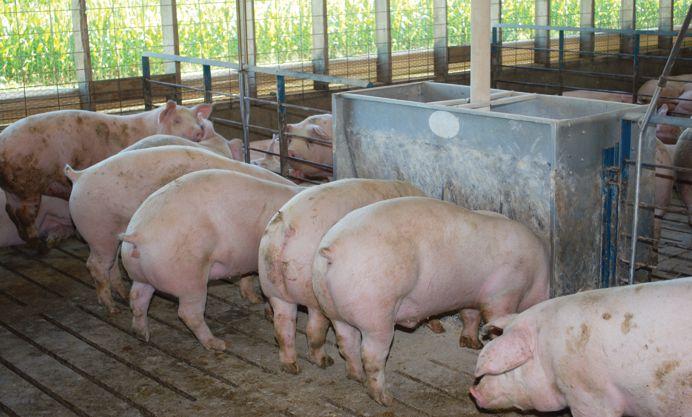
In addition to ham and pork chops, hogs are also good sources of organic manure.
Dairy manure goes urban
• Reduces surface & bottom solids
• Provides a consistent manure
• Enhances manure fertilizer value
• Reduces manure mixing
• Reduces barn odor, and odor on land applications
• Enhance manure value on application
• Stimulates root growth
• Fixes nitrogen • Improves crop yield
• Controls nutrient run off
• Poultry treatment reduces ammonia
In the NEWS
Farmers Edge named one of Canada’s fastestgrowing companies
Farmers Edge, an independent precision agriculture consulting firm, has been ranked 11th by PROFIT: Your Guide to Business Success in its annual ranking of Canada’s Top 200 Fastest-Growing Companies.
Ranking Canada’s fastest-growing companies by five-year revenue growth, the PROFIT 200 profiles the country’s most successful growth companies.
“We are extremely dedicated to the Canadian agriculture industry and we feel this designation will help demonstrate that to producers,” says Wade Barnes, president and CEO of Farmers Edge. “We will continue to provide growers and producers with the tools they need to operate a more profitable farm, with higher yields and higher returns.”
Farmers Edge received similar accolades in 2010, when it was recognized as the number one fastest-growing company in Manitoba. Co-founders Wade Barnes and Curtis MacKinnon were also named Business Development Canada’s Young Entrepreneurs of the Year for Manitoba in 2009.
Farmers Edge offers complete land management solutions, from project development and crop planning to operations and harvest management.
To learn more about Farmers Edge, visit www.farmersedge.ca.
JCB marks 65th anniversary
JCB officially marked its 65th anniversary by presenting thousands of employees around the world with gifts to mark the occasion.
Employees received a bottle of Château Léoube rosé wine, two glasses and a DVD highlighting the global footprint of a company, which started life in a lock-up garage in Uttoxeter, U.K. The celebration took place June 21 to coincide with the 95th anniversary of the birth of JCB’s founder, the late Joseph Cyril Bamford.
“In 65 years we’ve gone from
one man in a garage in Uttoxeter, Staffordshire, to a major global brand renowned for its pioneering spirit,” said JCB chairman Anthony Bamford. “All of this is down to our people. JCB is on the threshold of even greater success and it’s our employees who will help drive our future.
“2011 has also started well for the JCB Group but we are still mindful of economic concerns which could hold back the recovery. We continue to invest in … new products, with 13 new machines launched so far in 2011.”
Biogas plant equipment market growing
MarketResearch.com has announced the addition of a new report – Waste-Derived Biogas: Global Markets for Anaerobic Digestion Equipment with a Focus on North America – to its collection of alternative sources market reports.
According to the report, renewable, sustainable energy generation will be the fastest-growing energy sector over the next two decades. From 2010 to 2016, the market is projected to rise from $124 billion in 2010 to $217 billion in 2016, according to the data provided. According to the analysis, price volatility, supply concerns, and the environmental aspects of fossil fuels are expected to accelerate the pace of all non-fossil fuel development.
The BCC Research report provides an in-depth analysis of the world market for anaerobic digestion equipment used to transform waste materials into sustainable energy. Although energy crops are utilized widely in Germany and some other
countries for biogas production, the study only covers gas recovered from wastes. The study also examines the equipment needed to collect landfill gas (LFG), biogas formed naturally at landfill sites.
Four waste types are evaluated as feed materials for the waste-to-energy process in the study: sewage, industrial wastewater, agricultural wastes (crop residuals and manure), and landfill gas. Three different end uses for the gas are also examined: municipal electricity production, on-site electricity (and heat) production, and transportation fuel.
The biogas industry is better developed in other parts of the world than in North America. In addition to the U.S. and Canada, the report covers Europe, where the industry is best developed; Asia, where the largest number of plants are operating; Africa, where the anaerobic process is rapidly gaining popularity; and other world regions where biogas recovery is emerging.
Highlights of the report include:
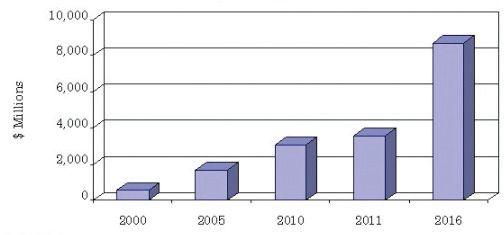
• The global market for biogas plant equipments was worth $3 billion in 2010. By 2016, it is estimated at nearly $8.6 billion and rising at a five-year compound annual growth rate (CAGR) of 19.4 percent.
• The North American market for biogas production equipment is valued at $510 million in 2011 and is forecast to reach nearly $1.2 billion by 2016, reflecting a CAGR of 17.7 percent.
• The U.S. market value for anaerobic digestion equipment used in biogas production and landfill gas-to-energy collection systems is estimated at $352 million in 2011 and growing at a CAGR of 19.1 percent to 2016. At that rate, the market will reach $845 million by 2016.
For more information about this report, visit http://www. marketresearch.com/product/display. asp?ProductID=6441689.
FISHER PUMPS
Fisher Pumps is a low maintenance, submersible centrifugal
All bearings above water level...No oilers to fill daily!
Constructed of 1/4" & 3/8" steel with heavy walled tubing
On site test pit to insure performance prior to shipment!
ChemiGreen announces agreement with Newalta ChemiGreen Inc. recently announced that Newalta will be distributing and using ChemiGreen’s spill containment systems in Canada and the U.S.
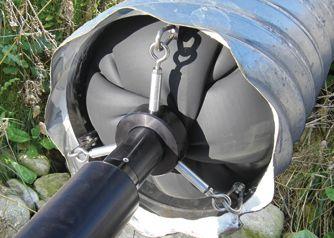
ChemiGreen Inc. has developed a patented, wireless-activated inflatable plug system. The system’s seal drains and outfalls within seconds of activation, preventing irreversible damage to the environment. ChemiGreen’s systems turn an emergency into a routine safe cleanup.
Operating a North America-wide 24/7 emergency and urgent response network, Newalta saw an opportunity to adopt ChemiGreen’s solutions for use with its clients.
“Our partnership with Newalta will let ChemiGreen focus on its strengths – the development and production of chemical spill containment solutions – while Newalta will focus on marketing, installation and maintenance of the systems,” says Shachar “Shak” Parran, CEO of ChemiGreen. “We strongly believe that with Newalta we will be able to increase the exposure of our systems in North America, which will become the standard of the environmental protection industry.” www.chemigreen.com
Alliance FarmPRO R1W radials
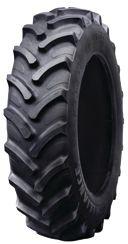
Alliance Tire Americas is introducing its new Alliance FarmPRO R1W radial tractor tire line in more than a dozen popular sizes to offer North American farmers a new choice – a deep-tread
radial that combines performance and value for utility tractors.
Alliance FarmPRO Radial R1W Tractor tires feature a stubble-resistant compound and an average tread depth 20 percent deeper than standard R1 tractor tires. In addition to improved traction, the Alliance FarmPRO radials deliver significantly better fuel economy than standard bias-ply R1s.
The Alliance FarmPRO line is priced lower than the company’s Alliance AgriTraction brand R1W radials, which remain a popular choice for high load/high speed applications.
“The Alliance FarmPRO line delivers the performance of R1W radial tires at a competitive price,” says James Tuschner, director of marketing for Alliance Tire Americas in Brentwood, Tenn. “It’s the perfect choice for utility tractors that can reap the benefits of radial technology.”
The Alliance FarmPRO line is currently available in the following sizes: 280/85R24, 340/85R24, 380/85R24, 320/85R28, 340/85R28, 380/85R28, 420/85R28, 420/85R30, 460/85R30, 420/85R34, 460/85R34, 420/85R38, 460/85R38 and 520/85R38. Additional sizes, including tires for 42- and 46-inch rims, will be released soon, says Tuschner. The Alliance FarmPRO line will be available throughout the U.S. and Canada through Alliance Tire dealers and distributors.
The recent merger of Nijhuis Water with Thecogas Biogastechniek has expanded the services of the Netherlands-based water specialist company, adding conversion of manure and organic waste streams into biogas and energy to a range of purifying and recycling services for treating industrial wastewater.
As of May 1, Thecogas Biogastechniek became a separate division of Nijhuis Water Technology, with the Thecogas team based in the Netherlands.
“Thanks to the knowledge and experience of Thecogas Biogastechniek,
we can now provide an even more complete service, with the accent very much on sustainability,” said Frank Tillman, director of Nijhuis Water Technology. “This is because it is no longer necessary to discharge untreated or treated flows of waste solids or wastewater. There are all kinds of ways of purifying water and of extracting valuable components that can then be recycled, such as ingredients for animal fodder, fuel and fertilizers.
“We are now in a position to build biogas installations, providing smart customized solutions for both the agricultural and industrial sectors. We believe that with our experience of the industry, we can extract valuable substances from manure, such as nitrogen and phosphate, which are highly suitable for recycling.”
Following the merger, every new biogas project involving Thecogas Biogastechniek will be launched and implemented under the Nijhuis Water Technology name.
Mustang RT Series Track Loaders
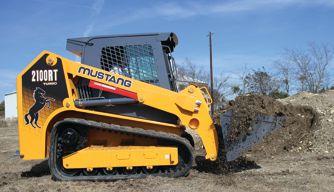
Mustang, a manufacturer of compact equipment for agriculture and construction markets, has released two new models, the 1750RT and 2100RT, of the new RT Series Track Loaders.
The Mustang RT Series Track Loaders feature HydraTrac™ Automatic Track Tensioning System, which eliminates the need for manually tensioning the tracks on the loader before operation. This saves valuable time on the jobsite and increases the life of the tracks and bearings by ensuring the proper tension immediately upon machine startup, maintaining tension during use, and then releasing tension when the machine is shut down.
Other key features of the new loaders include:
Other key features of the new loaders include:
application requirements.
application requirements.
• Yanmar Tier III naturally aspirated (1750RT) and turbocharged (2100RT) diesel engine with 179 ft. lbs. (242.3 Nm) and 206 ft. lbs. (279.3 Nm) torque, respectively, and AntiStall technology, provides the power to handle the largest jobs with ease.
• Yanmar Tier III naturally aspirated (1750RT) and turbocharged (2100RT) diesel engine with 179 ft. lbs. (242.3 Nm) and 206 ft. lbs. (279.3 Nm) torque, respectively, and AntiStall technology, provides the power to handle the largest jobs with ease.
• Optimized radial lift boom offers customers strength and forward reach at trailer loading and dumping heights. It can lift over 127.5 in. (3,239 mm) high.
• Optimized radial lift boom offers customers strength and forward reach at trailer loading and dumping heights. It can lift over 127.5 in. (3,239 mm) high.
• Operator’s cab features comfort and visibility. Adjustable seatmounted electro-hydraulic controls move with the operator, enhancing precise controllability and reducing operator fatigue.
• Operator’s cab features comfort and visibility. Adjustable seatmounted electro-hydraulic controls move with the operator, enhancing precise controllability and reducing operator fatigue.
• The standard “5x5” Drive Control System offers five settings that change five parameters to suit operator preference and
• The standard “5x5” Drive Control System offers five settings that change five parameters to suit operator preference and
• Welded, dedicated track system enhances grading and tractive effort, and provides a smoother ride.
• Welded, dedicated track system enhances grading and tractive effort, and provides a smoother ride.
• Tilt-out foot pod allows for best-inclass foot well cleanout and offers perfect access to the fuel tank and other components under the cab. www.mustangmfg.com/maketracks.aspx
• Tilt-out foot pod allows for best-inclass foot well cleanout and offers perfect access to the fuel tank and other components under the cab. www.mustangmfg.com/maketracks.aspx
with microbes that effectively break down malodorous components such as ammonia as well as butyric acid, propionic acid and other short-chain fatty acids –the sources of the offensive odor unique to swine manure – reducing them by up to 90 percent. The deodorizer can also break down organic materials such as plant fibers that are slow to degrade, thus hastening the composting process.
with microbes that effectively break down malodorous components such as ammonia as well as butyric acid, propionic acid and other short-chain fatty acids –the sources of the offensive odor unique to swine manure – reducing them by up to 90 percent. The deodorizer can also break down organic materials such as plant fibers that are slow to degrade, thus hastening the composting process.
Toyota launches swine manure compost deodorizer
Toyota launches swine manure compost deodorizer
Toyota Motor Corporation (TMC) has developed a deodorizer specifically for use in composting swine manure.
Toyota Motor Corporation (TMC) has developed a deodorizer specifically for use in composting swine manure.
Toyota Roof Garden Co., Ltd., a TMC subsidiary, is manufacturing and distributing the product for its resQ45 series of manure composting systems.
Toyota Roof Garden Co., Ltd., a TMC subsidiary, is manufacturing and distributing the product for its resQ45 series of manure composting systems.
In the development process, TMC collected compost samples from around Japan and carefully selected microbes with the strongest deodorizing effects, thereby creating a deodorizer
In the development process, TMC collected compost samples from around Japan and carefully selected microbes with the strongest deodorizing effects, thereby creating a deodorizer
In Japan, livestock generates about 90 million tons of manure annually, of which about 20 million tons is swine manure. Composting swine manure creates odors that can have a negative impact on residential areas, thus making the reduction of such odors unique to swine manure an important task.
In Japan, livestock generates about 90 million tons of manure annually, of which about 20 million tons is swine manure. Composting swine manure creates odors that can have a negative impact on residential areas, thus making the reduction of such odors unique to swine manure an important task.
In 2006, TMC and Menicon Co., Ltd. jointly developed and launched resQ45, which reduces the composting period from 90 days or more to about 45 days and reduces environmental impact.
In 2006, TMC and Menicon Co., Ltd. jointly developed and launched resQ45, which reduces the composting period from 90 days or more to about 45 days and reduces environmental impact.
The newly developed deodorizer will be sold in 9.5-kilogram bags.
The newly developed deodorizer will be sold in 9.5-kilogram bags.
INNO ATIONS
LagooN treatmeNtS
PUMPS
Nuhn Header Series lagoon pump
The Header Series lagoon pump is the latest innovation from Nuhn Industries.
It is an efficient and highvolume pump with a rating of 7,000 gallons per minute at 140 horsepower and 5,500 gallons per minute at 95 horsepower. The four-inch nozzle creates 45 pounds per square inch of pressure with high volumes.
The lagoon pump features triple ported and lofted housing, remote control, a heavy lift undercarriage, and heavy commercial outriggers.
www.nuhn.ca
MP-220
MP-220 helps break down the solids that build up in the manure pond both on the bottom and at the top and helps to reduce the offensive odor that comes from manure ponds.
Solids buildup in manure ponds is a major problem as it reduces pond capacity. When pond storage is inadequate, new ponds must be added at considerable cost to the producer. MP-220 helps to break down the solids that build up in manure ponds by changing the lagoon from anaerobic to aerobic conditions, which turns the solids into an easy-flowing solution that can be pumped on the fields. MP-220 can also help to increase manure lagoon capacity.
All manure pits or lagoons contain undigested feed that has passed through the digestive system of the cow. This magnifies
the problem of manure decomposition. As this manure breaks down, it radiates a strong odor created by ammonia gas buildup. This offensive smell creates environmental problems.
MP-220 helps to reduce the offensive odor that comes from manure lagoons by changing it from anaerobic conditions to aerobic conditions using a non-sulfur cycle. Generally, decomposition is accomplished through the sulfur cycle, which helps to create the offensive odors. Since MP-220 uses a nonsulfur cycle, offensive odors are reduced. Also, as the MP-220 breaks down the manure solids in the pond, both carbon dioxide and nitrogen are released into the air.
Director™ I Floating Baffles
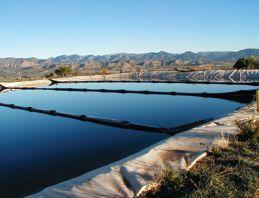
Director I Floating Baffles can improve wastewater treatment lagoon efficiency. Enhanced hydraulic flow patterns increase effective treatment area from less than 20 percent to more than 95 percent of the lagoon. The extending treatment time significantly reduces biological oxygen demand (BOD) and total suspended solids (TSS), improves aeration and allows contaminants and solids to settle.
The floating baffle is designed to improve flow diversion, increase retention time and provide improved bottom anchoring and prevent short-circuiting in treatment lagoons in wastewater applications.
www.environeticsinc.com
August 9-11, 2011 – 2011
Empire Farm Days, Seneca Falls, New York, Rodman Lott and Sons Farm. Visit: www.empirefarmdays.com
August 11-12, 2011 – 2011
North Carolina Poultry Federation Annual Meeting, Greensboro, North Carolina, Grandover resort & Conference Centre.
Visit: www.ncpoultry.org
August 16, 2011
Manure Science Review 2011, De Graff, ogio, Winner’s Dairy Farm.