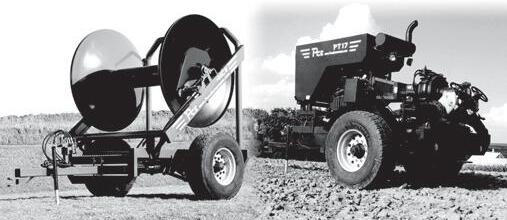
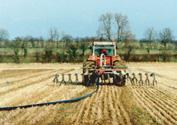
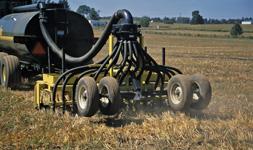
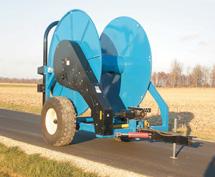
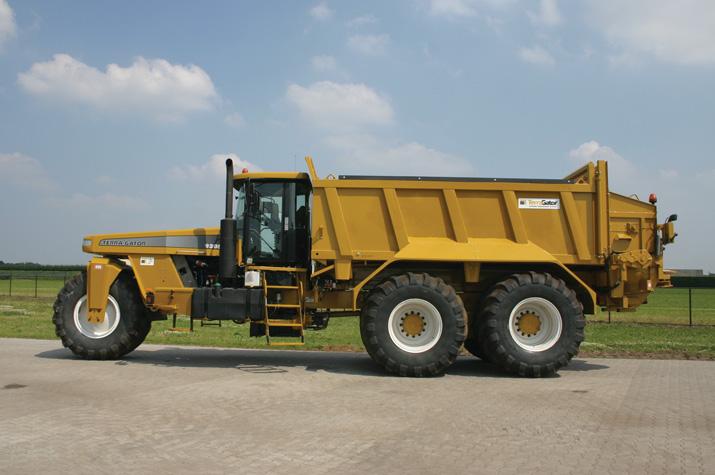
• Holds up to 1/25 miles of hose • 10 hoses 6in. x 660ft.
Beyond the Pond – A low-cost, low-tech way to manage manure
Agricultural engineers with the USDA are developing and testing an alternative method of runoff control. 8
Bio-oil and other valuable products from poultry manure and litter
Using a pyrolysis-gasification unit to dispose of manure and slaughter waste. 12
Doing a lot with a little
A flush system and lagoon design at a Georgia poultry farm is highly efficient.
Wisconsin applicator Russell Robaidek stays current with technology
Quality work and making an effort to apply manure when the customer wants.
Reducing levels of antibiotics and antibiotic resistance genes
Researchers at Colorado State University study whether animal waste contributes to the spread of antibiotics and antibiotic resistance genes and if manure management can help.
New South Dakota feedlot fine-tuning manure usage to gain maximum nutrient value
The Archibald brothers have put a lot of thought into manure management.
In the News
The latest news and information affecting the manure management industry.
On Track
What’s new and interesting in manure management products and services.
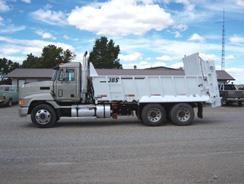
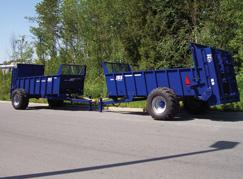
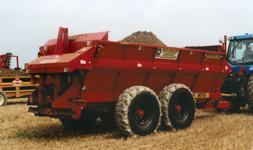
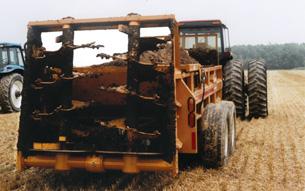
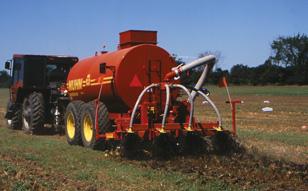
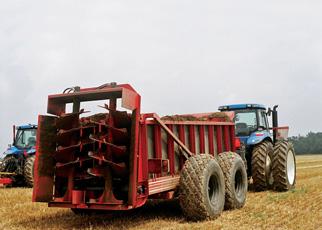
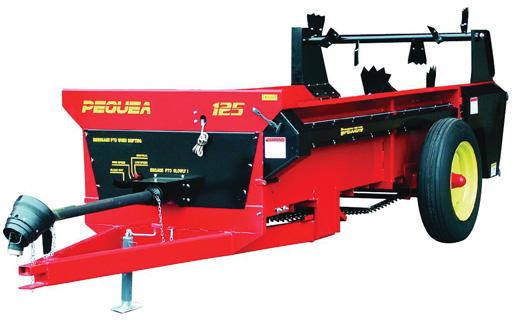
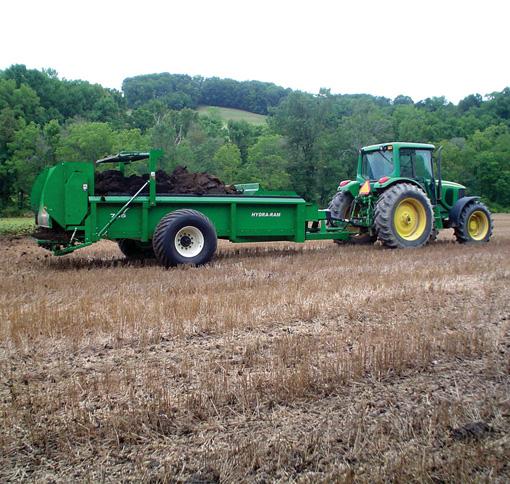
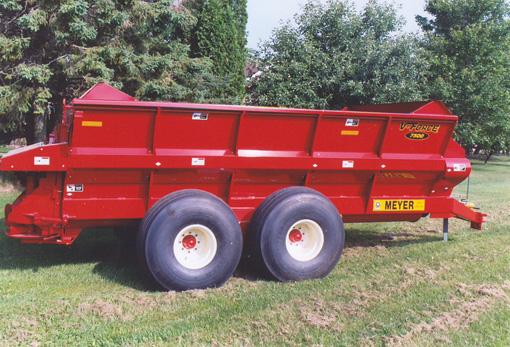
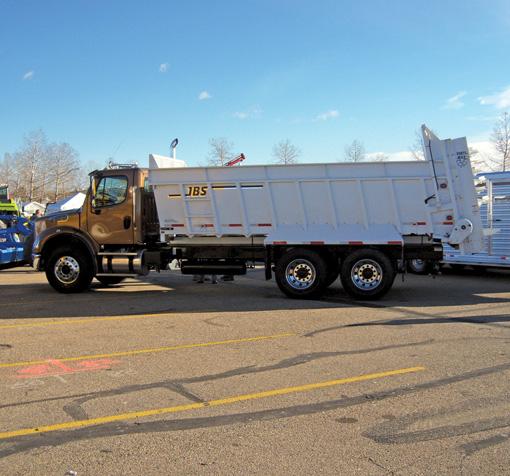
Manure Manager takes a look at what’s out there in the market for: Solid Manure Spreaders.
Guest column: Changing animal diets can help control odor
Odor is among the top complaints from neighbors of livestock and dairy farms.
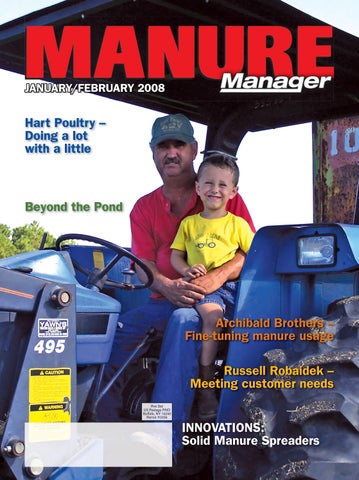
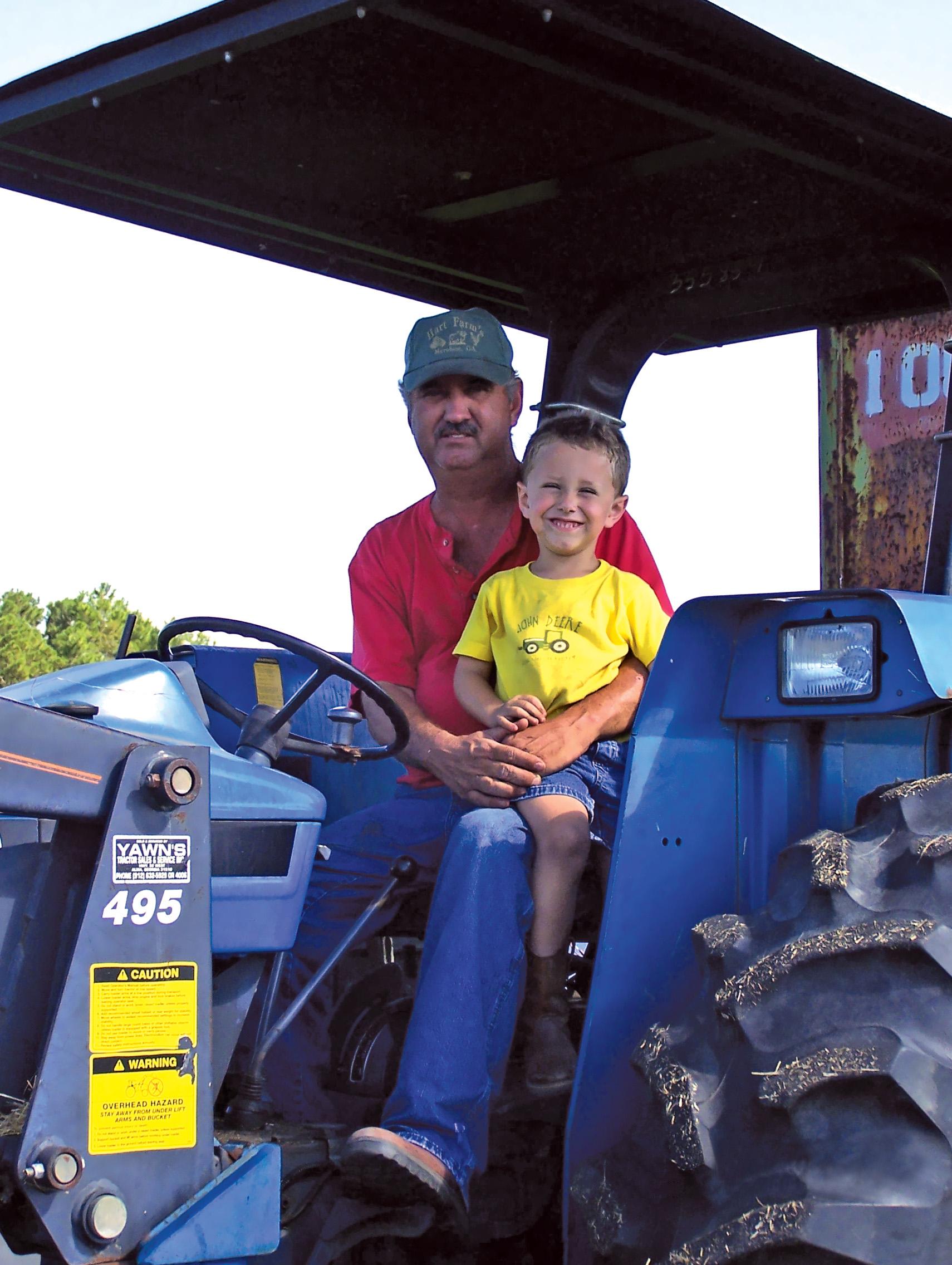
Cover: Georgia egg producer Bobby (Wayne) Hart, seen here with his four year old son Alex, uses a four piece lagoon system to better utilize the farm’s waste. By using the lagoons as settling ponds, Hart is able to recycle liquid to help flush his layer barns. Contributed photo.
Reproduction prohibited without permission of the publisher.
Printed in Canada
January/February 2008
Volume 6 • No. 1
By Margaret Land
The BUSINESS year awaits!
Welcome to 2008. A new, blank calendar awaits.
Well, in all honesty, the calendar isn’t really that blank – there are all those very important farm shows, expos, annual meetings and conferences marked down that need to be attended. Manure Manager will be making the rounds as well, taking part in the Iowa Pork Congress (January 23 and 24, Des Moines), the Canadian International Farm Equipment Show (February 5 to 7, Toronto), and the World Ag Expo (February 12 to 14, Tulare), to name a few.
Besides traveling, staff at Manure Manager are also busy planning a redesign and re-launch of the magazine’s web site. A preliminary site is now active in place of the magazine’s old static information site. Old favorites, including a list of all the upcoming shows and events, are still available along with some new features, including access to choice articles from the magazine, a recap of
each issues’ Innovations selections, and up-to-the minute news and information affecting manure handling and nutrient management. Readers are invited to visit the web site at www.manuremanager.com to enjoy all the site has to offer and vote in an on-line poll about what they want to see on the magazine’s new web site, expected to launch later in 2008.
Of course, Manure Manager continues to provide readers with the latest information on managing nutrients, whether in the barn and farmyard or on the field. In this issue, learn how Archibald Brothers Land And Cattle Co. of South Dakota manage manure resources at the operation’s 6000 head feedlot; read the latest update on research aimed at controlling manure runoff being conducted by the USDA; and learn how Wisconsin based custom manure applicator, Russell Robaidek Inc. uses technology to meet his customers’ needs.
BEYOND the Pond
By Laura McGinnis
A low-cost, low-tech way to manage manure.
A1000 pound cow can produce as much as 80 pounds of manure in one day. At that rate, a typical 1000 animal beef feed lot will produce up to 280 tons of manure in just one week. That is a lot of manure and for the roughly 1800 U. S. feed lots that have 1000 animals or more, it is an important management issue. Most of the manure is collected and used as an organic fertilizer, but some is lost due to runoff.
In the U.S., the main method for controlling runoff involves storing it in a large temporary pond or basin. Later, it is either distributed as nutrient-rich irrigation water or processed for safe disposal. Though approved by the U.S. Environmental Protection Agency (EPA), this method is far from perfect. Over time, the nutrients in the stored water can percolate through the soil, becoming a potential groundwater contaminant. Maintenance is expensive and difficult. The smell leaves much to be desired. And of course, as U.S. Department of Agriculture (USDA) Agriculture Research Service (ARS) research leader John Nienaber points out, “Nobody really wants to look at a manure storage pond.”
In the Environmental Management Research Unit at the U.S. Meat Animal Research Center (USMARC) at Clay
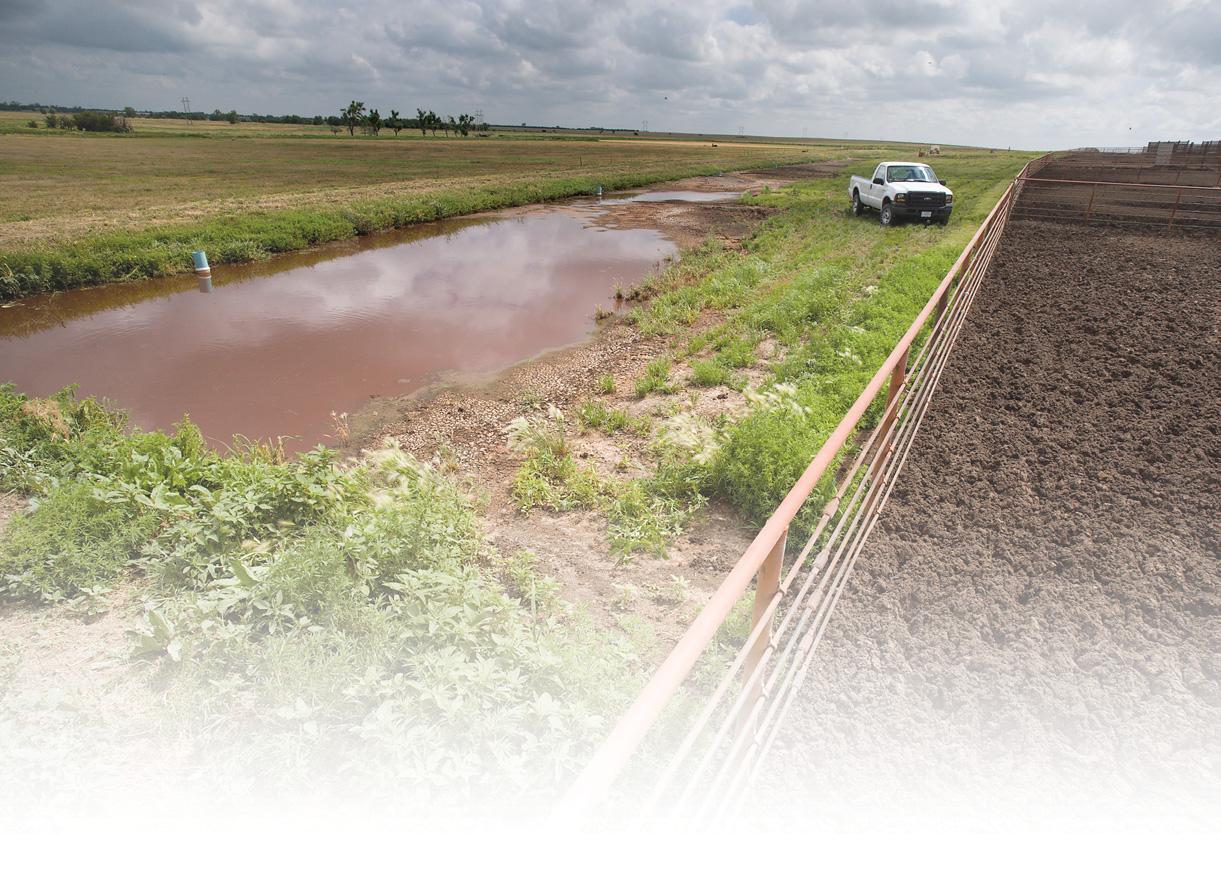
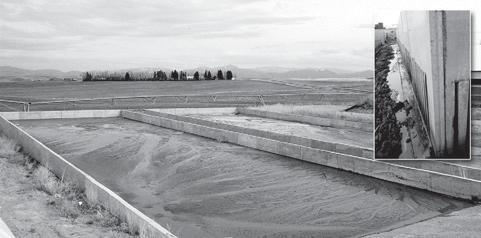
The water on the left collected in a solids-separation basin at the low end of the feed lot pen (on the right) after a rain. After the solids settle, the water in the basin will be distributed throughout the vegetative treatment area.
Center, Nebraska, agricultural engineers Roger Eigenberg and Bryan Woodbury have joined Nienaber in developing and testing an alternative method of runoff control that avoids many of the disadvantages of traditional runoff control systems.
Under the alternative system, runoff containing manure solids enters a small temporary storage basin at the base of the feed lot. The basin is large enough to hold runoff for several minutes to allow the solid waste to collect on the bottom. The remaining liquid is then drained through distribution tubes, providing even dispersal over a vegetative treatment area, or VTA, which is essentially a grassy field. Distribution of the liquid is controlled so that a full basin would empty in six to eight hours, though the process begins as soon as the liquid separates from the solids in the basin. In the fall, solids are removed from the basin and used as fertilizer on adjacent cropland.
The Clay Center VTAs are about twice as large as the surface area of the feed lot pens, a size that efficiently uses runoff water and manure nutrients. The technology could also be applied to other livestock – in fact, the team will soon begin collecting data from a sheep feed lot VTA – but managers would have to adjust basin and field sizes accordingly.
The VTA system, which has been conditionally approved by EPA, has many benefits. It requires minimal management, significantly reduces waste storage time and eliminates the need for costly pumping of runoff through distribution equipment. In addition, it removes standing water, which can promote the growth of bad-smelling compounds. This system should be less expensive to construct and maintain than the traditional system, the scientists say, though the cost and suitability would vary with geography, climate and animal type. “Our objective was to design runoff control systems that require minimal
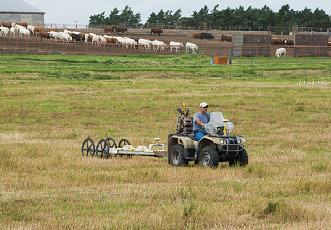
Technician, Todd Boman collects soil electrical conductivity readings as he drives through the field. These values are used to generate maps illustrating nutrient distribution in the vegetative treatment area.
PHOTO BY STEPHEN AUSMUS
PHOTO BY STEPHEN AUSMUS
operator input and use standard equipment to manage,” Woodbury says. “These systems can incorporate more sophistication, but each level adds costs and management time to ensure proper operation.”
For the VTA system to catch on, the scientists need to prove that their method is better than traditional containment. After eight years of operating tests, they are confident that the technology is environmentally sustainable. The scientists use the liquid discharge –which contains nitrogen – to grow hay in the VTA. They found that after harvest, the amount of nitrogen contained in the hay equaled or exceeded the amount they estimated would have entered the area through liquid runoff. Over a four year period, the scientists found no evidence of water leaching from the VTA, suggesting that the alternative system’s potential for contamination is lower than that of traditional management.
Eigenberg and Woodbury are making full use of technology to evaluate and compare the environmental impacts of the new and old runoff-control systems. They have been using electrical conductivity maps and soil samples to estimate the levels of nutrients and salts in the field. To improve this analysis, they are incorporating a salinity assessment package called ESAP - short for Electrical conductivity or salinity, Sampling, Assessment and Prediction – into their
mapping program. The program was developed by ARS scientists based at Riverside, California and helps determine the best places to take soil samples. It estimates the amount of nutrients, such as nitrogen and phosphorus, in the soil.
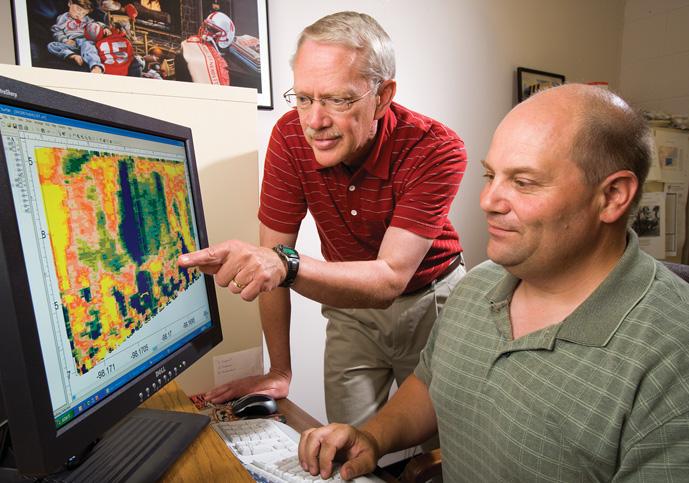
Eigenberg and Woodbury collect GPS co-ordinates and soil electrical conductivity measurements and use that information to develop two-dimensional maps. “When comparing the maps over
time, we can observe changes in soil salt concentrations by measuring the changes in soil electrical conductivity,” says Eigenberg. “Increases in salt concentrations tell us where the runoff is going. All this information provides us with a tool to better manage the runoff-control system.” For example, with their maps, the scientists have found areas in the VTA that were receiving too much runoff and have been able to direct the runoff to areas that were not receiving enough.
In January 2006, USMARC became the first site in Nebraska to receive EPA approval to construct a full-scale system using the new technology. The scientists have since built three new systems and redesigned the original test model. All four systems are similarly constructed, though two have larger solids-separation basins – designed to hold more runoff –and a different pipe arrangement for liquid distribution. In future studies, the researchers will compare the influence of basin size on a system’s ability to separate solids when runoff pressure is higher, for example, during a heavy storm.
“Everyone stands to benefit from this VTA technology,” says Nienaber. “There are lower maintenance costs for the producer and improved environmental protection for consumers and local residents. Plus, nobody has to look at the unsightly mess of a storage pond.”
Laura McGinnis is with the USDA’s Agricultural Research Service Information staff.
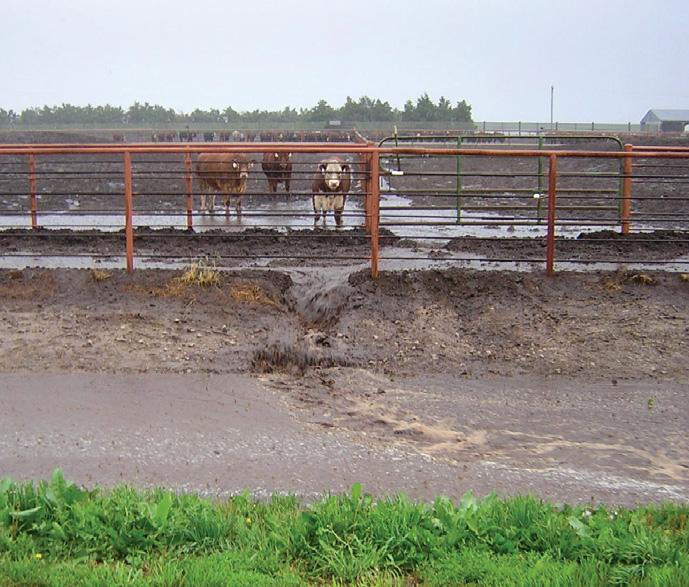
Runoff from a feed lot pen during a rain event. The water is heavily laden with sediment from the pen surface.
PHOTO COURTESY OF USMARC.
Agricultural engineers, Roger Eigenberg (left) and Bryan Woodbury evaluate a soil electrical conductivity map to estimate field nutrient levels and salinity in a vegetative treatment area.
PHOTO BY STEPHEN AUSMUS
Bio-oil and other valuable products from poultry manure and litter
By Treena Hein
Project in Nova Scotia prepares for start-up.
In order to better dispose of manure and slaughter waste, ACA Cooperative Ltd., a large egg and broiler producer/processor in Kentville Nova Scotia, has purchased a pyrolysis-gasification unit from Advanced BioRefinery Inc. of Ottawa. ACA markets 45 poultry products and 13 egg products, many under the Eden Valley Farms brand.
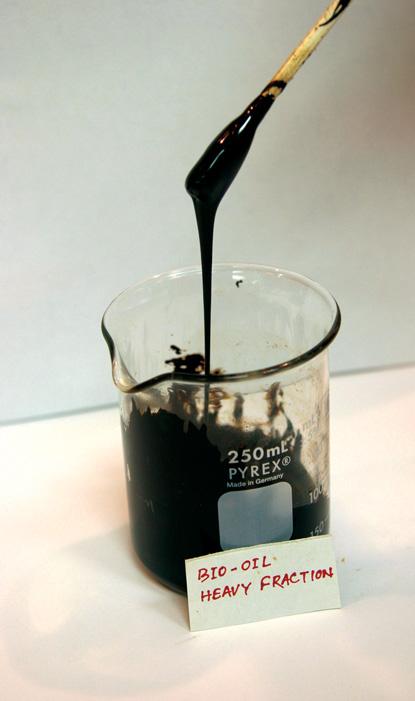
After the pyrolysis process, the bio-oil is gasified into mostly carbon monoxide (CO) and hydrogen (H) and burned in a diesel generator engine. About 50 percent of littermanure put into the pyrolysis system can be turned into bio-oil at 80 percent efficiency.
Gerry Kennie, ACA’s vice-president of agriculture, says the technology, which will be delivered at the end of the year, will address some long-standing environmental issues.
“We initially started looking at better ways to dispose of waste products such as poultry manure and plant offal,” he says. “It is getting more difficult to put manure on some of the soils in this area as they are becoming saturated from many years of animal manure being applied to them. Environmental Farm Plans are being completed for farming operations and these identify the need for sustainable methods of disposal of livestock manure.”
Advanced BioRefinery’s system attracted ACA because it is designed specifically for poultry operations, Kennie explains.
“This technology will reduce the amount of poultry manure being applied to agricultural lands, which is a positive from an environmental aspect. It will also provide a product, which can be burned in a modified furnace to provide heat for buildings,” says Kennie.
“Our goal is to work with this relatively new technology and further develop it to reduce our dependency on the practice of putting animal manures on farmland that cannot support it while, at the same time, provide a product that can be used in a commercial application of supplying heat.”
Peter Fransham, president of Advanced BioRefinery Inc., says nutrient management concerns and providing income from a perceived waste are the major reasons why his company has researched and developed this technology. It evolved from previous work with wood-based systems.
“There is increasing competition for Canadian farmers,” he says. “Energy prices are increasing, especially for the chicken broiler industry, because the barns must be ventilated as the chickens mature, they must be kept warm in the winter, day-old chicks must be kept warm, etc.”
In addition to the increasing cost of power, Fransham predicts that poultry
producers may face increased competition in the future through removal of Canadian marketing boards. This would force Canadian broiler farmers to compete internationally with very large companies. His company’s pyrolysisgasification technology could help poultry farmers remain competitive.
Fransham stresses there’s little use in new agricultural technology that requires a major on-going time and energy investment by producers. “The goal of the project is to turn a perceived waste into a revenue stream with cost return achieved in five years or less with minimal work and time investment for the farmer on a permanent basis,” he says. “Combined pyrolysis and gasifier systems are coming to economic feasibility for farmers.”
“Combined pyrolysis and gasifier systems are coming to economic feasibility for farmers.”
Peter Fransham, president Advanced BioRefinery Inc.
The pyrolysis/gasification system is currently being constructed in Ottawa. Cost of the 15 foot by 30 foot machine is expected to come in under $150,000. Fransham says this size of system is suitable for an average-sized operation of 70,000 to 100,000 birds. Partners in the research and development have included Agriculture and Agri-Food Canada (AAFC), Natural Resources Canada, the National Research Council, Laplante Farms and Verido Ltd. The Farm Pilot Project Corporation, based in Florida, provided the initial research funding.
How the technology works
The first step of the process involves placing the litter-manure into a hopper,
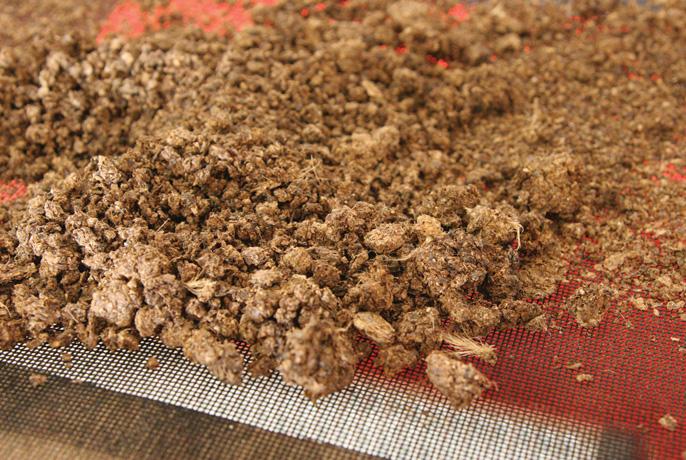
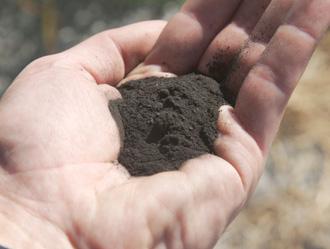
The char powder left after the pyrolysis process is completed is separated, stabilized and placed into barrels or bags. It is intended for use as fertilizer, boasting proportions of 4-4-5.
where its moisture content is brought down from about 25 to 10 percent. The material is then placed in the reactor, where it undergoes pyrolysis (rapid heating in an oxygen-depleted environment). The products are char, gas and bio-oil. Fransham says it is useful to think of the system as a distillation process. “We’re distilling all these chemicals that become a fuel.”
The three products are separated very quickly. “The bio-oil and gas come off together, and condense out of a pipe into a liquid,” explains Fransham. “What doesn’t condense is the gas (methane, carbon monoxide, carbon dioxide, and hydrogen), which is used to generate process heat in a small furnace.” This heat is also used for initial moisture removal.
The char powder left over is separated, stabilized and placed into
barrels or bags. It is intended for use as an income-generating fertilizer, boasting fertilizer proportions of 4-4-5.
In the second step, the bio-oil, which has a similar heating value to propane, is gasified into mostly carbon monoxide (CO) and hydrogen (H) and burned in a diesel generator engine.
“The combustion of this gas produces all the heat and power needed on the poultry farm,” says Fransham. He notes 50 percent of litter-manure put into the system can be turned into bio-oil at 80 percent efficiency.
Besides providing on-going nutrient management, the system provides income in a flexible manner. “The advantage of our process is that we can adjust the unit so that it produces the maximum amount of the maximum value product,” says Fransham. “If char is providing the best profit at the time, we can maximize char output. By tailoring these things within a certain range, we can provide the maximum return for the individual farmer.”
This tailoring is accomplished mostly through temperature control. “The higher the temperature, the more gas we produce,” says Fransham.
Advanced BioRefinery is also working on additional systems designed to maximize farmer income from agricultural waste. Fransham says his company is partnering with AAFC scientists to refine methods for extracting phosphorus and other high value chemicals from bio-oil prior to burning. “The world supply of phosphorus is limited,” he says. “There is also potential for pharmaceutical products to be derived.”
The company also recently received approval to build a 50 ton per day unit in Saskatchewan in partnership with Titan Clean Energy Projects and with government support. The unit will accept oat hulls, and the fuels generated will be sent to mining operations in the northern region of the province to offset fuel requirements there.
Advanced BioRefinery Inc. recently received approval to build a 50 tonne per day pyrolysis unit in Saskatchewan that will accept oat hulls. The fuels generated by the unit will be sent to mining operations to offset fuel requirements.
Before the pyrolysis process can begin, the poultry litter needs to be reduced from about 25 percent moisture content to 10 percent.
➤ Manure Pits,Channels & Covers
➤ Suspended Slabs - up to 40’ clearspan
➤ Hog & Cattle Slats - up to 25’ clearspan
➤ Weeping Walls - manure separation
➤ Milking Parlors
➤ Strainer Boxes
➤ Commodity Storage
➤ Bridges
➤ Bunker Silos (8 types)
➤ Syloguard Concrete repair
➤ Retaining Walls
➤ L & T Walls up to 16’ high
• Built to engineers’ specifications
• All sections are high strength, pre-stressed,reinforcedconcrete for longer life
• Quick & easy to build
• Air-tight seals and protectant using Syloguard products
Doing A LOT with a LITTLE
By Diane Mettler
A flush system and lagoon design at the Hart poultry farm allows them to operate efficiently and economically.
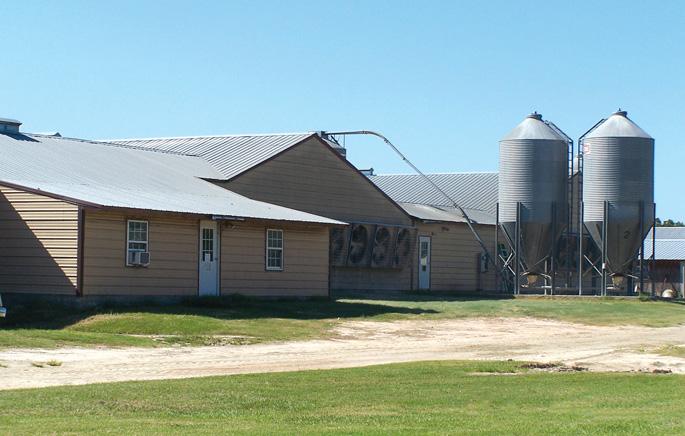
Bobby (Wayne) Hart will tell you right off that he does not have the money at his disposal that some larger farms have, but what he does have he uses effectively.
In 1992, Wayne went from part-time poultry farmer and road worker to fulltime farmer. To ensure his 245 acre farm, located in Meshon, Georgia, could support his family, it had to be significantly expanded. So, Wayne did just that. “We went from 40,000 birds to 175,000 birds,” he says.
He constructed two, 50 foot by 600 foot houses and at the same time installed a flush system to flush the houses twice a day.
Four-Piece Lagoon System
When creating the lagoons, Wayne avoided the more common, large one-pit system. Instead he went with a system designed and certified by the National
In 1992, Wayne Hart went from a part-time poultry farmer and road worker to a full-time farmer, building two new layer houses and installing a flush system to clean his 175,000 hens twice a day.
Conservation Resource Center (NCRS), which consisted of four smaller clay pits, each 90 feet by 90 feet, that better utilized the farm’s waste.
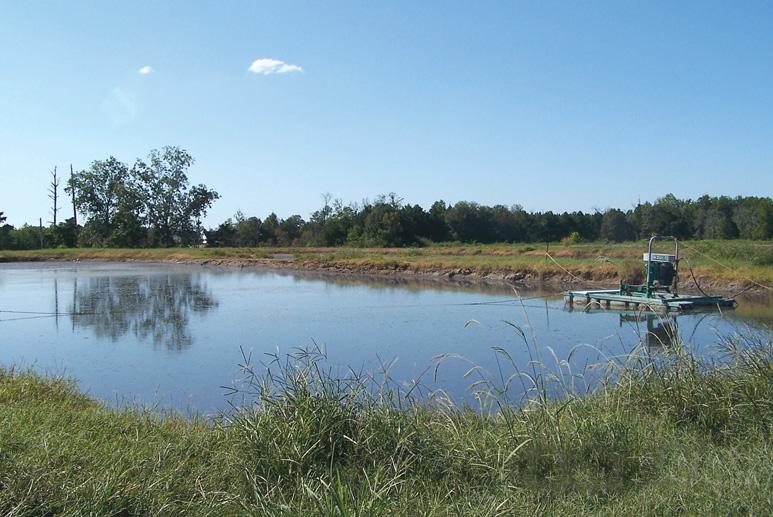
Three of the pits are tied together. The liquid coming from the houses is gravity fed from one pit to the next. “We have the water moving at a slow pace, so the sediments gradually fall out,” explains Wayne. At the first pit, feathers and heavier sediments fall away and by the time the liquid has made the circle to the third pit it can be recycled to flush the houses.
“A floating Houle pump takes the water off the top of the third lagoon and pushes it to the front of the house and runs it down the aisle,” explains Wayne. “We use the same water for three or four months, then we pump some of that water on the field and we refill the pit back up with fresh water.”
The first pit, where the heavier materials have settled, is cleaned out
using an excavator. “Because we use calcium in our feed for the eggshell quality, what we’re digging out is like white sand,” says Wayne. From the other two pits, he pumps the liquid out onto his fields.
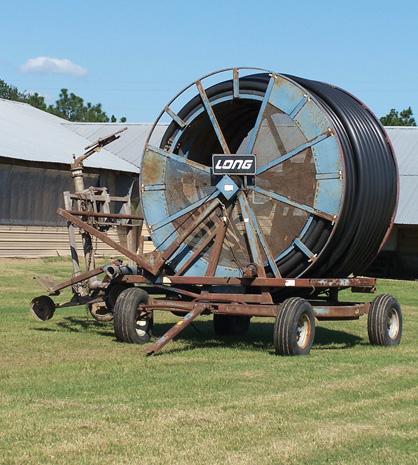
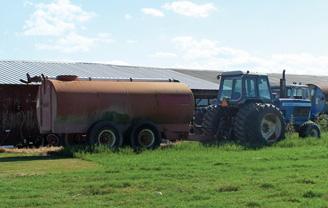
Wayne has 220 acres where he can spread. Before pumping he uses an Aerway aerator to condition the fields. Part of the land he applies the liquid by hooking up a hard hose irrigation gun – often referred to as a lane gun – to risers, attached to underground pipe. For the other portion, he uses a 4000 gallon tank and a 1100gal/min Houle pump that he pulls with a tractor.
Heavy Rains
One reason he likes his lagoon system is that it is ideal for that area of the country, which receives heavy rains. The Hart farm is located 70 miles from the Atlantic coast and although a hurricane has not hit lately, they can receive three
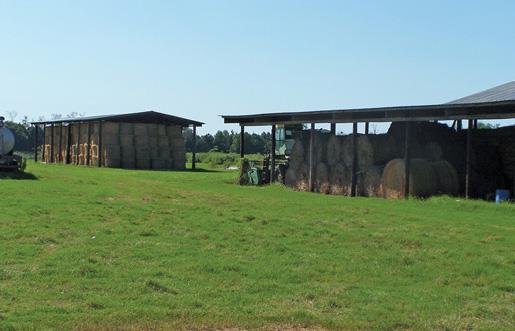
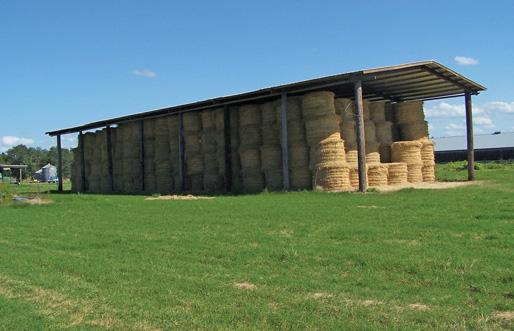
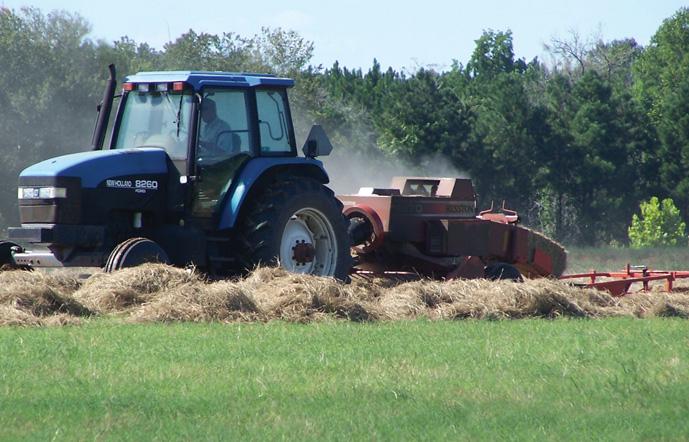
Wayne Hart had to make some serious investments to get into the hay business, including constructing two storage barns – one 120 feet by 120 feet and the other 60 feet by 100 feet.
to five inches of rain in a day when they come in close.
“I’ve never had my lagoons run over, but I’ve had them come close,” says Wayne. He credits his perfect record to a fourth pit in his lagoon system.
“If I get in trouble with rain, I can reach over and pump into the fourth pit, especially if I don’t want to pump into the field right then,” he explains. “Every spring when we start pumping on fields, we pump the fourth pit pretty well dry. That gives us all year, if we need it, to fill it back up, and that works great.”
Sometimes it can rain as much as five inches in a couple hours, and in those cases, Wayne has to be prepared to not only pump to the storage pit, but be prepared to pump onto the field as well to avoid an overflow. “I double insure myself. You have to,” he says.
Wayne Hart uses a hard hose irrigation gun and underground piping to apply manure to part of his family’s 220 acres. For the other portion, he uses a 4000 gallon tank and a 1100gal/min Houle pump that he pulls with a tractor.
Hay Allows Multiple Applications
Spreading large amounts of liquids has become less of an issue since Wayne changed his crop. In the early 1990s, he was growing primarily soybeans and corn. But that came to an end when he received a visit from the NCRS telling him that if he wanted to pump the liquid litter more than once a year, he had to get into a different business. They suggested hay.
“They actually had to force me into it,” says Wayne. “But today, I’m glad they did. Now all my fields around the chicken houses are hay.”
Hay was the ideal choice because every time it’s cut, it’s considered a crop. And Wayne is allowed to spread on each crop. “If I cut five times a year, I can pump five times a year. So now we’ve got somewhere we can go with the water.”
He has found benefits to growing hay besides the multiple applications. In addition to cutting on average three times a year, the hay season runs from March to the first frost in October or November. Wayne is also no longer paying for commercial fertilizer and he is able to take advantage of a ‘hot’ hay market.
“The last five years has been unbelievable,” adds Wayne. “The hay business in our area is the hottest commodity going on right now. It’s way better than the chicken business.”
And because Wayne removes the feathers and large sediment before spreading, his hay is idea for the horse market, which likes their hay clean.
Wayne had to make some serious investments getting into the hay business, including two hay barns – one 120 feet by 120 feet and the other 60 feet by 100 feet – as well as trailers. It’s been well worth it. “We’re doing about 120 percent better than we were growing row crops,” he says. And he’s had to trim his clientele
Bio security is an important issue on the Hart farm. Anyone coming onto the farm is monitored and all vehicles are sprayed. Anyone walking into the barns has to first dip their feet and anyone new has to wear a bio suit to go into the hen house.
down to two customers, who are buying more than he can grow.
Buffers
Part of the Hart farm’s manure management requires leaving 25 foot buffers around the fields. But Wayne hasn’t let those buffers go to waste. “I can’t pump on the 25 foot buffer, so I fenced them off and I have cows graze there,” he says. “It’s better than just wasting the dirt. And if I didn’t have cows, I’d just have to keep it mowed. It’s also worked out great because it keeps me from crossing that line and going in there.”
The Hart farm features a four-piece lagoon system designed and certified by the National Conservation Resource Center. The system consists of four clay pits, each 90 feet by 90 feet, with three tied together. At the first pit, feathers and heavier sediments fall away and by the time the liquid has made the circle to the third pit it can be recycled to flush the houses.
Wayne also grows trees — 10 to 20 foot fencerows — down the highway-side of his land to avoid cars being hit by the drift when he pumps. Here again, he’s found an economical solution. “We used just old scrub oaks; something that’s good for nothing in our area. But they make leaves so thick that nothing will go through them. And in three years they look like they’ve been there for 30.”
Monitoring
Part of a good manure management requires accurate monitoring. “We pull soil samples and manure samples from the lagoon twice a year. And we’ve got monitoring wheels on the farm to keep the nitrate in check,” says Wayne. “In addition, wherever we pump litter, we pull samples... to make sure we don’t have a chemical imbalance.”
The family also monitors anyone coming into the farm, using a strict bio security system. All vehicles that come in are sprayed and anyone walking into the barns has to first dip their feet into a solution. Also, anyone new has to wear a bio suit to go into the house. “It’s all about animal welfare,” says Wayne. “You can’t have any diseases.”
Although they take security seriously, it is not as big an issue on their small family farm as it is for larger operations. And the Hart farm is a true, family business. Wayne’s wife teaches school, and Cliff, 14, and his dad take care
of the hay side of the business. Breanna, 11, helps with the chickens, along with two female employees that handle the egg operation. (Alex, 4, is too young to get involved quite yet.)
Good Neighbor
The Harts know that to ensure their success in the commercial egg business, the family must, among other things, be a good neighbor. “I try to do what I can,” says Wayne. “If our neighbors need eggs,
The Harts also share their manure with their neighbors. For a time, they looked into selling the manure, but it turned out that giving it to the neighbors was a win/win situation. Currently, the family’s neighbors are spreading their operation’s manure on 150 acres.
I’ll bring some over. Or if they’re growing a garden and they want to put some litter on it, I bring if over.”
They also share their manure. For a time, the Harts looked into selling the manure, but it turned out that giving it to the neighbors was a win/win situation. “They want it and I need their land to put it on. They move it, so it doesn’t cost me move it. Sure, I could sell it. But sometimes you’ve got to give to take.” Currently, his neighbors are spreading his manure on 150 acres.
And there is also the other benefit of sharing with neighbors. “When they spread it on their land, they can’t complain about odor from my farm, because they’ve got it just as much as I do,” Wayne says with a laugh. “But I’m blessed. I’ve got great neighbors.”
The Hart family changed their main crop from corn and soybeans to hay in the mid 1990s after receiving a visit from government officials. They told him that if he wanted to pump the liquid litter more than once a year, he had to get into a different business. With hay, every time it’s cut counts as a new crop and the Harts are allowed to spread once on each crop.
Nutrient Water Management Systems
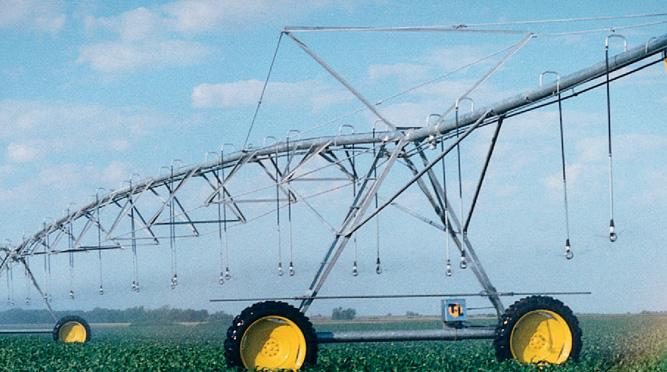
Convert livestock nutrient water into valuable crop fertilizer then deliver it where and when you want it, evenly and efficiently. T-L’s more than 50 years of irrigation excellence and family of performance-proven irrigation systems can combine to assist you in effective nutrient water management. T-L’s hydrostatic design moves continuously, resulting in even nutrient distribution. Plus you get the benefits of minimal maintenance and significantly extended gearbox life. T-L pivot irrigation systems are Easier on You.
Find out more from your local T-L dealer or call us at 800-330-4264 or e-mail us at sales@tlirr.com. Please visit our website at www.tlirr.com, you will be glad you did.
Wisconsin applicator stays current with technology
By Tony Kryzanowski
Wisconsin based custom manure applicator, Russell Robaidek runs a tight ship insofar as his business is concerned and he sleeps pretty well most nights. However, that confident calm has only come from long-term experience in a business that has seen its fair share of challenges along the way. He owns Russell Robaidek Inc. along with his wife, Kris. The business is headquartered at Pulaski, Wisconsin, about 15 miles west of Green Bay. At present, he injects or applies about 120 million gallons annually.
Close to 90 percent of his customers are dairy farms, intentionally in the 1000 cow herd or less category. He has learned from experience that it is much easier to build personal relationships and repeat business with smaller customers, although he would not turn away business from larger operations if the circumstances were right. If there is any sage advice he can pass on, it is to ensure there is an ironclad commitment from larger dairy farms to use your services for a defined period of time before making major purchases to meet their needs.
Russell Robaidek Inc. has managed to maintain and expand its client base not
only because of the quality work the company does, but also because management makes a supreme effort to apply the manure at a time that is convenient
to the customer. This is as opposed to some custom manure applicators that will insist on servicing all their customers in a particular area before moving on.
“If a customer calls me, I honestly ask them when they want it done,” Robaidek says. “I can usually accommodate them within two or three days, if not on the exact day they want me.” That type of service builds loyalty. His largest customer is also one of his first customers. That dairy started with 60 cows 15 years ago and now has grown to a herd of 1200.
Early on, Robaidek showed he was prepared to work hard to succeed in his business, helping his father build concrete silos by day while working nights and weekends to establish his custom application business. In 1994, he decided he wanted to make his living from this line of work and in 2000, he sold his 80 head dairy herd to focus entirely on his business. “At the time, milk prices were down in the dumps,” Robaidek says. “I’m the type of guy that if I am not going to make money, then I’m
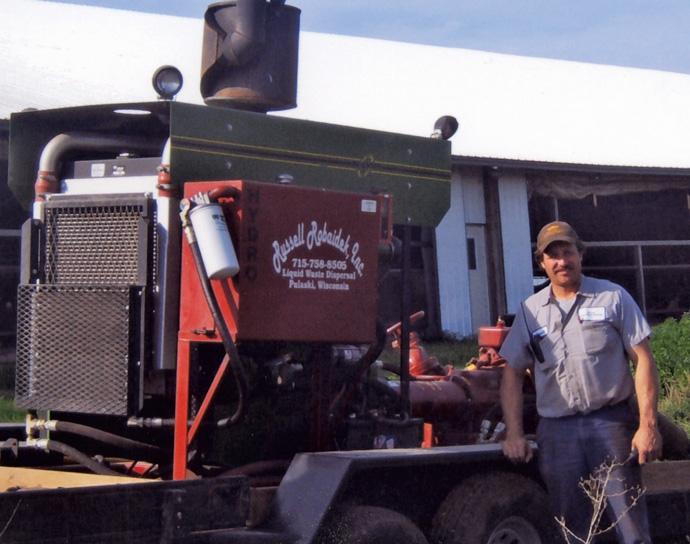
Wisconsin based custom manure applicator Russell Robaidek stays up-to-date on the latest application technology. His company owns three Hydro Engineering drag hose application systems.
Russell Robaidek has made a supreme effort to provide the most professional application services possible.
• ALL THE PERFORMANCE YOU NEED, NONE OF THE HASSLES.
• COMPLETELY 304 STAINLESS STEEL CONSTRUCTION.
• HEAVY DUTY PLANETARY DRIVE, NO GEAR BOX WOES.
• CAST AND HARDENED AUGER FOR PRECISION AND SUPERIOR PERFORMANCE.
• HEAVY DUTY SCREENS STANDARD, IN A VARIETY OF SIZES.
• CUTTER BLADES TO DESTROY FOREIGN MATERIAL.
• REVERSIBLE WEAR RINGS AND SPECIAL TUNGSTEN CARBIDE SEAL SYSTEM.
• SELF ADJUSTING VOLUME CONTROL ELIMINATES LOOSING SOLIDS PLUG AND PROVIDES EVEN HEAD PRESSURE.
• ADJUSTABLE MOISTURE CONTENT.
• SELF GREASING FEATURE.
• VERY LITTLE MAINTENANCE.
• TWO SIZES AVAILABLE.
• REALISTIC PRICING, NO HASSLE DEMOS FOR SERIOUS CONSUMERS.
INNOVATIVE, DEDICATED, & DRIVEN!!
DODA’S
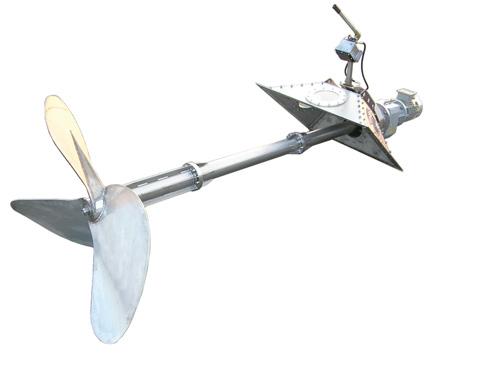
BIO GAS MIXERS
• CONSTRUCTED COMPLETELY OF 304 STAINLESS STEEL.
• DESIGNED FOR ROOF OR SIDE MOUNT.
• VERTICAL AND HORIZONTAL MIXING DIRECTION IS ADJUSTABLE FROM OUTSIDE OF TANK.
• MAINTENANCE FREE DESIGN UP TO 30,000 HOURS.
• VARIOUS PROPELLER AND MOTOR SIZES AVAILABLE.
• UNBELIEVABLE PERFORMANCE.
• OIL BATH DRIVELINE AND TUNGSTEN CARBIDE SEAL SYSTEM.
DODA has served the waste handling industry since 1960 providing the highest quality, innovative products available worldwide:
• Vertical and horizontal chopper pumps with “patented chopping system” PTO and electric models available, with a wide variety of executions to t every need.
• Vertical and horizontal agitators, PTO and electric models.
• Separators: two models available screw press and roller press designs.
• Aeration equipment.
• Bio gas equipment: agitators, pumps, and new “Back Flush and Diverter System”. DODA “DELIVERING TOMORROWS TECHNOLOGY TODAY!!”
not going to do it. We’re making a living at it (manure application). We do charge a premium price, but we feel if we are making money, we can update our equipment when we need to and be there for our customers next year.”
Over the years, Russell Robaidek Inc. has consistently invested in some of the best performing manure application equipment available, offering customers the option of injection or surface application, as well as transport of the organic material to the application site using tankers, a drag hose system, or a combination of both. Robaidek says he has noticed a significant change in attitude amongst his customers as to the importance they put on advanced planning and proper application.
“Years back when I first started out, people just emptied their pit and got rid of it,” he says. “Now, they all know that it is a fertilizer and we’re covering more acres than we ever did.” Many now guide their activities with detailed nutrient management plans to ensure the manure is disposed of safely and for maximum nutrient benefit.
While manure is now handled more safely under government supervision
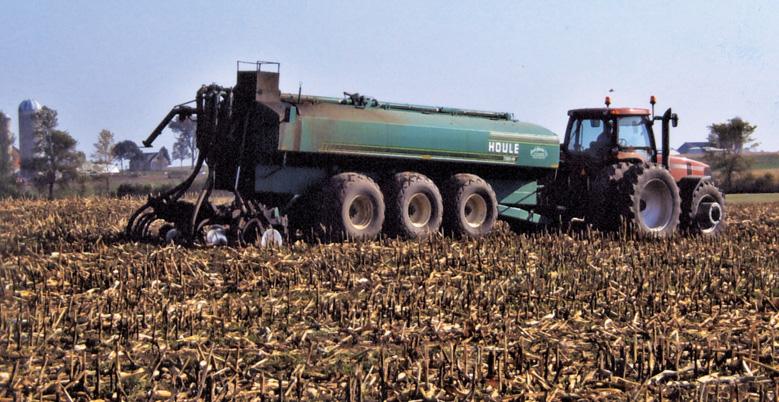
Using the Houle tank and injection system has made it possible for custom applicator, Russell Robaidek to do more business with dairy farms using sand bedding.
through a three year requirement to follow an approved nutrient management plan for any new manure storage pits, this trend has added to Robaidek’s costs by making the application process less efficient in some cases.
“At one time, we were putting 20,000 gallons per acre and now, sometimes they’ve got it down to 6000 gallons per acre,” he says. “We’re covering a lot more acres with the same amount of manure.”
It has particularly impacted on the management of his drag hose systems. It requires a lot more tearing down and setting up, and whereas he may have been able to apply the manure on two fields, now he is sometimes required to run his system to eight different fields in eight different directions.
Another trend is a major shift to injection over surface application, something Robaidek appreciates. At present, about 80 percent of the manure he handles is injected. “I feel better about injecting it into the ground,” he says. “I don’t have to worry about heavy rains or anything related to the runoff.” Because the area around Green Bay also has many residential subdivisions, injection is a superior application method because it drastically reduces odor. Finally, farmers benefit because injection helps to sequester nitrogen in the soil.
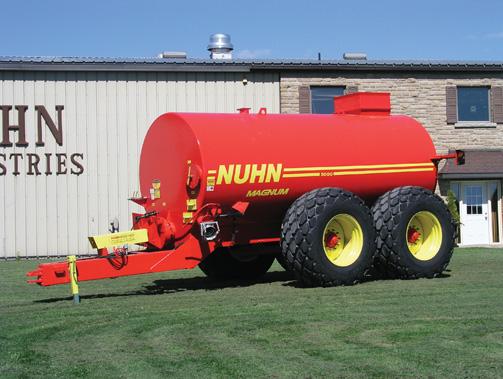
Robaidek’s equipment fleet has grown steadily along with advances in custom application. Today, he operates three 7300 gallon Houle tankers with injectors, which were purchased within the last three years. “The Houle tankers that the competition in the area were operating were holding up pretty well, and
Russell Robaidek believes there is a greater awareness among farmers of the importance of the nutrient value of manure as a hedge against the cost of expensive commercial fertilizers.
it just so happened that we have a strong and reputable local dealer,” says Robaidek “Price wise, they are a lot more money but it just seems for durability, they are by far better than anything else out there.”
Opting for Houle tankers and injectors also allowed the company to conduct more business with dairies that are using sand bedding, something Robaidek had avoided because of how sand can cause havoc with some equipment. This is a growing issue with many custom manure applicators doing business with dairies, as the use of sand bedding is definitely on the upswing. While some of the larger dairies have installed sand separators to separate the organic matter from the sand – thus allowing the dairy to reuse the sand – many still do not.
“Now with these Houle tankers, we are not afraid to tackle sand any more,” Robaidek says. The intake agitation with the pumps makes all the difference, he adds. “If there is a two stage pit, we’ll handle the water part of it with the drag hose,” he says, “but with the heavy laden sand, we’ve found the best way to get the pit clean is to mix it like a mud and take it out with the tankers. They can handle it.”
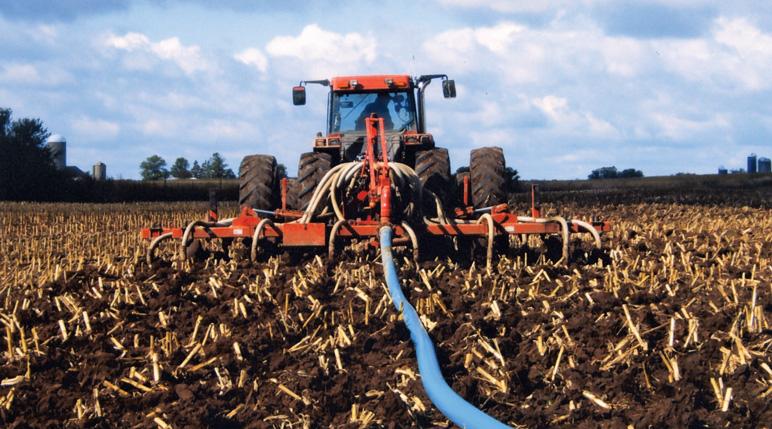
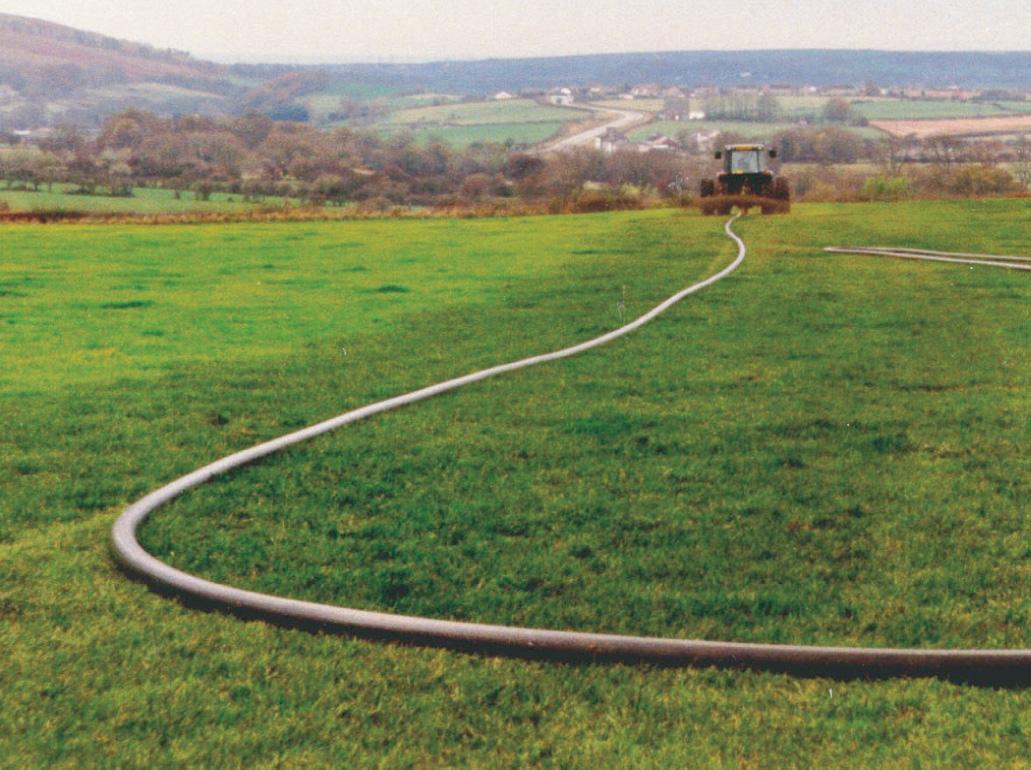
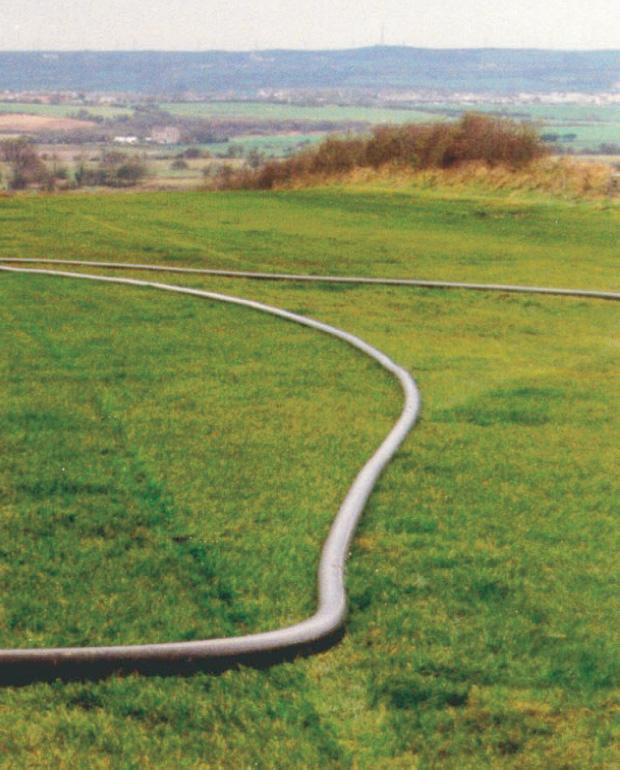
Russell Robaidek Inc. is also capable of operating three Hydro Engineering drag hose injection systems with pumps capable of transporting effluent up to four miles. Two of the drag hose systems can inject manure up to 20 feet wide in one pass, and the third can inject it up to 24 feet.
“When we purchase equipment, we like to have a dealer or a company that is reputable enough to have the support to help us if we need it,” says Robaidek. “That’s why we went with Hydro Engineering with our hose systems. It seems that Hydro Engineering is the most knowledgeable and the most helpful.” Because there were no drag hose dealers close by, being able to get quality advice over the phone was critical. “They weren’t the cheapest,” says Robaidek, “but they were the most helpful.” He adds that reliability is his top priority when making an equipment purchase.
Supplementing these systems are four Houle pumps, two capable of agitation and pumping; three N-Tech prop agitators; and a Vandale pump. To pull the tanks and drag hoses in the field, Russell Robaidek Inc. uses seven Case IH tractors. All have at least 200 horsepower. He adds that the company does occasionally operate four semi-trailer tanker trucks to transport the manure from the pit to the disposal site. They can be loaded from the bottom and are often unloaded from the road into an 18,000 gallon frac tank sitting closer to the
application site. “We stay out of the fields as much as possible with the semi trucks because it’s so hard on the ground and driveways,” says Robaidek.
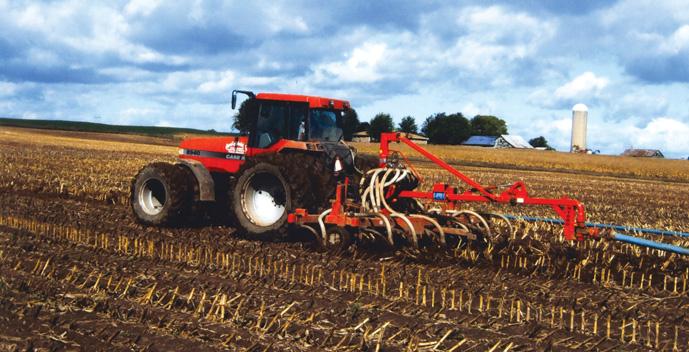
While the company does most of its business within a 120 miles radius of home, it has also gone as far as Virginia, where Robaidek says the company’s AerWay implement is particularly useful. The Aer-Way is helpful for applying manure because it has minimal impact on the grass vegetation but can still overcome the hardpan created by regular disposal of manure effluent using irrigation systems coupled with the large amount of rainfall that the area has experienced.
“They needed someone to visibly put it in the ground, to get as much of it out on the ground as possible, and they needed it to go into the ground,” Robaidek says. “We were actually picking up acreage for them because their pivots weren’t reaching the whole field.” He adds the Aer-Way also meets the needs of his zero-till customers who want minimal ground disturbance as well as manure application on hay meadows.
Robaidek concludes that he is satisfied with the size of his business right now. He credits his working partnership with wife Kris – who takes care of the office duties – for a great deal of the business’ success.
REDUCING LEVELS of antibiotics and antibiotic resistance genes
Antibiotic resistance is a growing human health concern. Researchers around the globe have found antibiotics and other pharmaceuticals to be present in surface waters and sediments, municipal wastewater, animal manure lagoons and underlying groundwater. In a recent article in the November/December 2007 issue of , researchers at Colorado State University (CSU) describe a study to find out if animal waste contributes to the spread of antibiotics and antibiotic resistance genes (ARG), and if they can be reduced by appropriate manure management practices.
In the study, funded by the U.S. Department of Agriculture’s Agricultural
SOUND INVESTMENT, SOLID RETURN
Experiment Station at CSU and the National Science Foundation (NSF), researchers investigated the effects of manure management on the levels of antibiotics and ARG in manures. The study was conducted at two scales. In the pilot scale experiment, horse manure was spiked with the antibiotics chlortetracycline, tylosin and monensin and compared to horse manure that was not spiked with antibiotics to determine the response of ARG in unacclimated manures. In the large scale experiment, dairy manure and beef feed lot manure, which were already acclimated to antibiotics, were monitored over time.
The manures were subjected to high intensity management (HIM: amending with leaves and alfalfa, watering and turning) and low intensity management
(LIM: no amending, watering and turning) for six months. During this time, the levels of antibiotics were monitored using high performance liquid chromatography (HPLC) and tandem mass spectrometry (MS/MS). In addition, two types of ARG that confer resistance to tetracycline –tet(W) and tet(O) – were monitored using quantitative polymerase chain reaction (QPCR).
In the pilot study, chlortetracycline, tylosin and monensin all dissipated more rapidly in the HIM manure than in the LIM manure. In the large scale study, feed lot manure initially had higher concentrations of the several tetracycline antibiotics than the dairy manure. After four months of treatment, tet(W) and tet(O) decreased significantly in dairy manure, but two more months of treatment were necessary for similar reductions of ARG in the feed lot manures.
The results showed that HIM was more effective than LIM at increasing the rate of antibiotic dissipation, but it was not a significant factor in reducing the levels of ARG. The length of treatment time was the main factor in reducing the levels of both antibiotics and ARG. For manures with initially high levels of antibiotics, treatment times of at least six months may be necessary for a significant reduction in levels of antibiotics and ARG. The results also provided evidence that ARG may be present for extended time periods even after antibiotics have fully dissipated.
Scientists at Colorado State University are continuing research in this area by examining full scale local on-farm waste management practices. Together, this research will lead to a better understanding of possible ARG mitigation strategies so that best management practices can be developed to reduce the effects that animal waste may have on the spread of ARG. An abstract of the report can be viewed at: http://jeq. scijournals.org/cgi/content/ abstract/36/6/1695.
AGRICULTURAL HOSE PRODUCTS Angus understands
your needs
For over 25 years Angus has been a pioneer in the manufacture of high performance agricultural hose products. You have come to trust the Angus name and reputation for quality products, dependable service, and honest warranties. Angus proudly manufactures right here in the United States in rural North Carolina where many of our employees live on farms or grew up on farms. So, when it comes to agricultural hose products, Angus understands your needs.
New Stocking Program
- Angus now pre-builds hose before each growing season to assure product availability when you need it.
The new products above join our existing family of agricultural hose products:
Armour Guard Supply Hose:
- Sizes: 1-½”, 2”, 2-½”, 3”, 4”, 6”
- Standard lengths: 100’, 330’, 660’
Premium 200 Irrigation Hose:
- Sizes: 2-½”, 3”, 3-½”, 4”, 4-½”, 5”
- Standard lengths: 660’
New SOUTH DAKOTA feedlot fine-tuning manure usage to gain MAXIMUM nutrient value
By Tony Kryzanowski
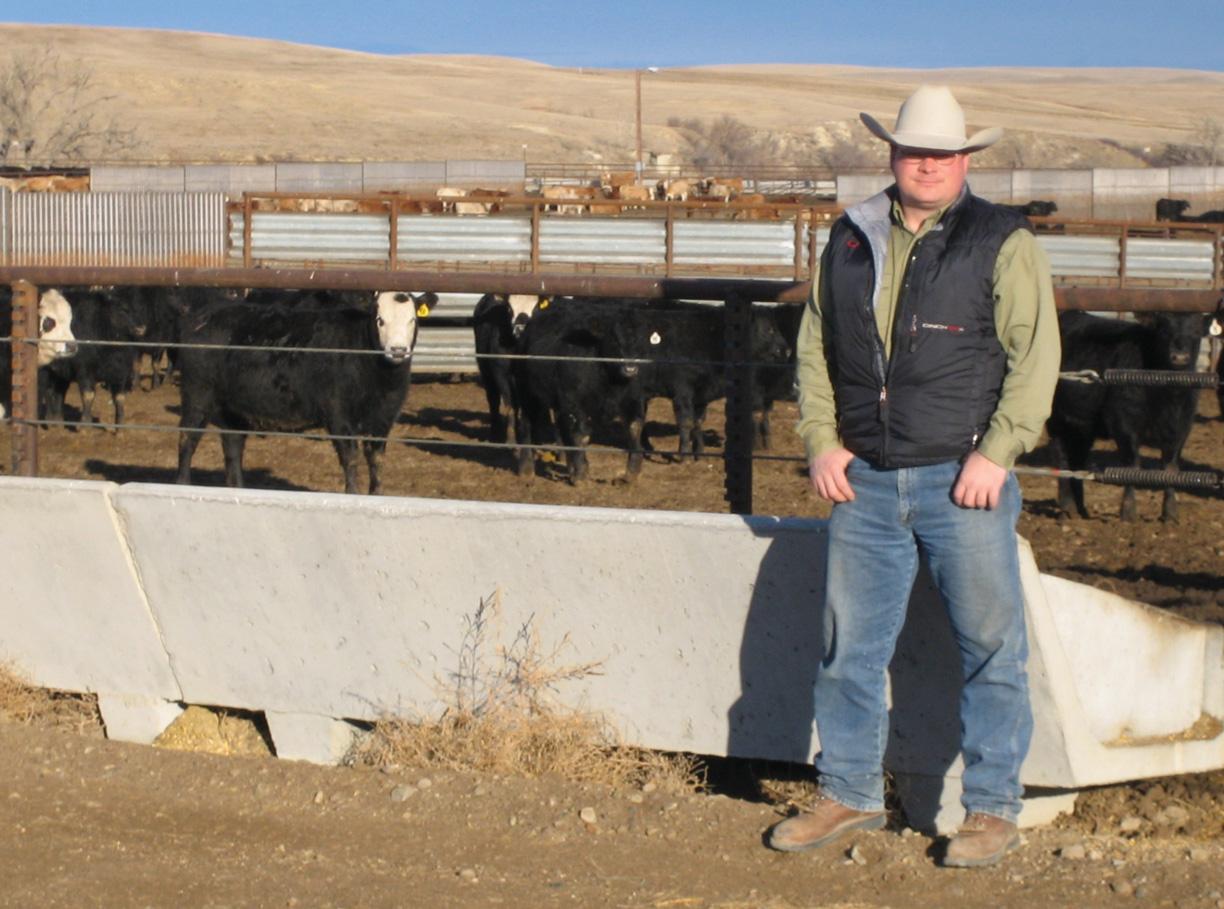
Mark Archibald is one of three South Dakota brothers who have formed a partnership to build and manage a 6000 head feedlot. Managing manure for environmental compliance and nutrient benefit on cropland were big priorities in the feedlot design.
“Manure is finally of great value now that the days of cheap fertilizer are done.”
That statement by South Dakota rancher, Mark Archibald, typifies the mentality of today’s new breed of cattleman. They are keenly aware that squandering a resource of any kind is simply poor business management. Given the high cost of commercial fertilizers, the vast quantity of manure generated in feedlots is gaining new interest as a valuable natural nutrient resource and hedge against the cost of fertilizer.
The owners of Archibald Brothers Land and Cattle Company, located near the North and South Dakota state boundary near the community of Hettinger, have put a lot of thought into manure management within their new feedlot to maintain better control of its handling, storage and disposal. The business, which includes raising cattle, designing and marketing feedlot equipment, and dealing in Roto-Mix feed
mixing and manure application equipment, is owned by three brothers, all of whom attended South Dakota State University with the intention of taking up a career in production agriculture. The brothers are Mark, Brad and Carter, with Mark being the oldest at 34.
They are all well aware of two issues that were a bit of a mystery to earlier generations engaged in the cattle business. These are the need for environmental compliance as well as the need for sound manure management practices for both environmental stewardship and profit.
“We realized that if we were going to be in this business, we would have to become compliant,” says Mark. “In doing so, we bit the bullet and built our feedlot so it is able to withstand a once-in-100year event, due to our proximity to the North Grand River.”
Then there is the financial benefit of applying manure as a supplement to commercial fertilizer. “At the cost of nitrogen today, people should look at manure as a wonderful cost cutting tool
in their farming operation, instead of a nuisance by-product as in the past,” says Mark. “Now, more than ever, with nitrogen costing upwards of $390 per ton, it should be seen as a necessity to clearly collect, utilize and get the most nutrient value out of every ton of manure that is produced in farm and ranch operations.”
The Archibalds know something about the cost of commercial fertilizer, given the 12,000 acres of deeded land they own, which includes 7000 acres seeded into crop.
Although the Archibald family has been ranching in the Dakotas since the Second World War, this latest generation entered a new phase of business development with the construction and expansion of cattle operations over the past four years. It started in 2003 when the brothers applied for and received a state permit to build a 6000 head feedlot. “We were always feeding cattle, but we weren’t permitted,” says Mark.
The partners started the engineering process and in 2005, they moved approximately 288,000 cubic yards of
material for the new feedlot site. There were government grants available to help ensure that the feedlot would be environmentally compliant. “With the Environmental Protection Agency regulations becoming more stringent,” explains Mark, “we decided to take advantage of some Environmental Quality Initiatives Program (EQUIP) funding for both engineering and some dirt work.”
Mark, in particular, emerged from this experience having gathered a lot of knowledge about what to expect when designing and building a modern feedlot. “My best advice for people planning these feedlots is when you are ready to get started, add 20 percent to the cost,” he says, “because things happen, such as Hurricane Katrina. Make sure you have your ducks in a row for everything from your water systems to your concrete costs, to wire costs.”
A great deal of detailed engineering design was focused on the drainage system to maintain control of water collection from all aspects of the operation. It starts with the manure gathering system in the feedlot pens. The pens are structured in a herring bone design, with a 90 foot manure alley between two drovers’ alleys. The Archibalds installed their own self-
standing panel products to create the drovers’ alleys. When it is time to clean the pens, the manure is scraped into the 90 foot manure alley between the drovers’ alleys, using a 14 foot wide and 42 inch tall box scraper purchased from Meyerink Farm Service located in Platte, South Dakota. It is pulled along the manure alley by using a 205 horsepower front wheel assist tractor.
“Our employees can clean our pens in a matter of three hours,” says Mark. A front-end loader stockpiles the manure and, because the pile is within the feedlot’s drainage field, the liquid leaches out, passes through a solid separator and then flows by gravity into an evaporation pond.
The ranch operates two evaporation ponds, lined with 18 inches of clay as an impermeable seal to prevent leaching into groundwater sources. One measures four acres and catches all the liquid from the cattle pens, while another measures 4.5 acres and catches water from other ranch operations and the feed storage area. Because that area of the Dakotas is so arid – receiving only about 15 inches of rain annually – the water is disposed of easily through evaporation.
The stockpiled solid manure is applied in early spring before the frost is out of the ground and with a light
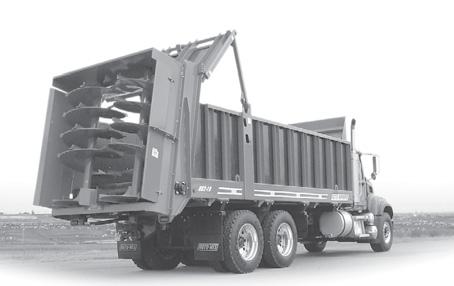
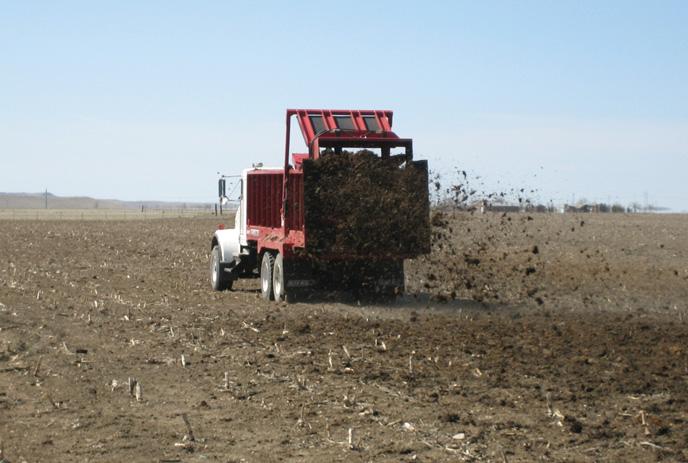
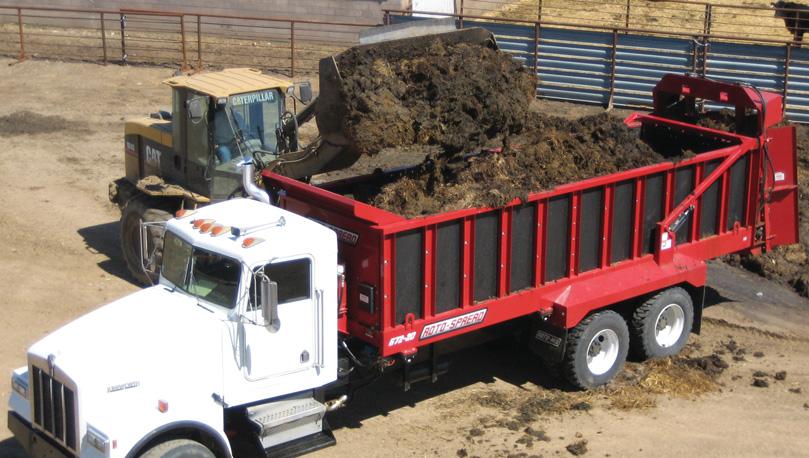
incorporation after the crop is removed. The ranch purchased its own 672-20 Roto-Mix vertical manure spreader so it is not reliant on custom applicators, thus giving it more flexibility on application intervals. The Archibalds purchased a properly sized used truck to transport the new spreader for a total cost of about $90,000.
Mark says there are a number of features on the Roto-Mix manure spreader that he appreciates. Firstly, the ranch was familiar with this equipment brand because they use a number RotoMix feed mixers in ranch operations. Secondly, he says the two vertical beaters on the back of the spreader gives him a 30 foot wide spread pattern. Also, the unloading system is belt driven and not chain driven. The result is a complete clean out during an application.
“As you are spreading in colder temperatures, sometimes sub-zero, it allows you to have a complete clean out,” says Mark. “That way, your machine won’t freeze up.”
The beaters are also hydraulically –not mechanically – driven, which means it has infinitely adjustable settings. It allows the Archibalds to custom tailor the spread pattern by either using the wing baffles at the out-feed or by adjusting the hydraulic system as they are spreading the manure.
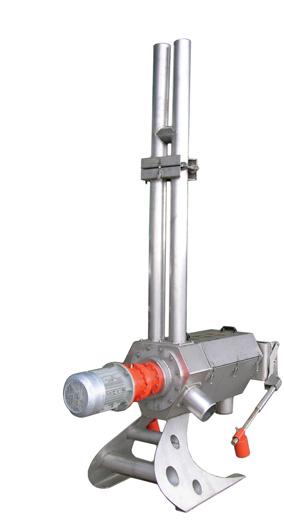
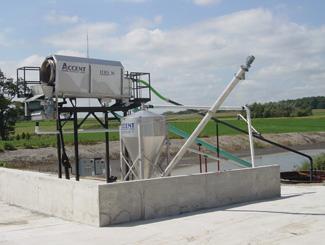
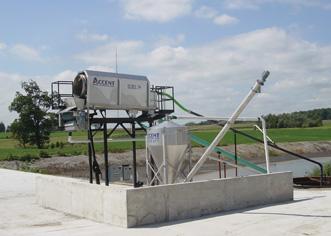
“We recently removed some separators that just weren’t working for us. We replaced them with the Accent Separator. This is a totally new and simpler approach. The results have been good – Significantly more solids removed with hardly any maintenance.
Because the manure spreader comes with a scale, Mark can also precisely calculate how much manure to apply per acre based on the nutrient quality of the manure and soil sampling.
The ranch did operate three manure spreaders mounted on Kenworth trucks previously, but they did not offer the same level of output measurement and control as with the Roto-Mix spreader.
“We can custom tailor our manure applications for our ground and it allows us to be better stewards of the land,” says Mark. The wider spread pattern also results in less soil compaction.
The Archibalds were also aware they had an opportunity to design a more attractive work environment when they built their new feedlot, and that is particularly obvious in the receiving and processing barn. The ranch is a major purchaser of cattle for finishing and intends to offer custom finishing services to other cattle owners.
“We built as nice a barn as we could because it allows us to recruit and retain great quality employees,” says Mark. Every feedlot is the same – you are going to be checking, feeding and processing cattle, he adds. Basically, that does not
change from one feedlot to another. However, a feedlot can separate itself from its competitors and attract high quality workers by having the most efficient and user-friendly facilities possible. For example, the floor in the 70 foot by 70 foot receiving and processing barn is heated.
“With that, we wanted to have the ability to wash out our working alleyway system and cattle staging area,” says Mark. The waste material gathers in an 80 inch wide settling area. The liquid from the settling area runs into a septic system that eventually drains into one of the evaporation ponds, while a ramp system has been designed so that a skidsteer can enter the settling area and remove the solids.
Given the experience he has acquired with the construction of the new feedlot, Mark is working with a partner to offer advice to other feedlot builders. His design suggestions are being used in a number of new feedlots, including one of the largest Angus cattle breeders in the U.S.
As far as the Archibald feedlot itself, Mark and his brothers are looking forward to the financial benefits from a more controlled application of manure on their cropland in the near future, given the soil samples they have taken, the investigation of the nutrient value in their cattle manure, and the Roto-Mix manure spreader that will do the job of ensuring that the right quantity is spread per acre for maximum value.
▲ Archibald Land and Cattle Company ensured they found a properly sized truck to transport their Roto-Mix fertilizer spreader. The feedlot applies fertilizer twice a year on some of its 12,000 acres of deeded land.
▲ Family members of Archibald Land and Cattle Company have been raising cattle in South Dakota since the end of the Second World War. Today, a second generation of family members is managing the operation and recently built a 6000 head feedlot.
The 30 foot wide spread pattern on the Archibald Land and Cattle Company’s Roto-Mix manure spreader results in less soil compaction.
In the NEWS
American Alternative Energy Systems signs licensing agreement with European agents
Officials with American Alternative Energy Systems Corporation (AAESC), a company focused on reducing greenhouse gas emissions and making a more sustainable environment through renewable energy, recently announced the company has signed license agreements with agents in Denmark and Norway. The licensing agreement includes a development plan for digesters to be implemented in the two countries. AAESC will produce the anaerobic digesters that will turn manure and other bio-waste into electricity and heat. The digester will solve the manure disposal problems and produce electricity, heat and income for the farms and related properties (the excess electricity can then be sold to the hydro grid).
AAESC has also voiced interest in entering the Canadian digester market which is small, with an estimated 10 digesters compared to roughly 100 in the U.S. and 2400 in Europe. AAESC’s goal is to become Canada’s market leader in digesters by offering farmers the digester at no cost, simplifying the purchase process.
American Alternative Energy Systems’ team has developed a digester at more than half the cost of the competitors and is working to increase the effectiveness of the digesters, by producing more electricity per ton of biomass. Visit: www.arenergysystems.com
Cargill to convert waste to energy on Indonesian feed lot
Cargill recently announced the start of construction of an anaerobic digester on PT Santosa Agrido’s Lampung Bekri 23,000 cattle feed lot operation in Lampung/Sumatera, Indonesia.
Every year, the digester will capture and convert cattle effluent from the feed lot into 992 tons of methane gas that will
be used to generate energy for the feed lot. The project will also reduce the greenhouse gas equivalent of 207,000 tons of carbon dioxide going into the atmosphere over 10 years. Co-products from the process and digested solids will be used as organic fertilizer for growing corn for their cattle feed.
The technology, which is being managed and funded by Cargill’s Environmental Finance group, will generate carbon credits that can be traded on global climate exchanges.
“We are excited to be working with Cargill to develop this innovative means of manure waste management,” says Samuel Wibisono, PT Santosa Agrindo’s president director of the beef division. “The digester will substantially reduce odors while creating a renewable energy source to help us reduce our overall operating costs. By entering into this agreement, Cargill has taken the responsibility to develop, fund and implement the project, including managing of all permitting and registration issues. That allows us to concentrate on what we’re here for, which is to reinforce our position as the largest cattle feed lot business in the region.”
This digester, a UNFCCC registered project, is currently under construction and was scheduled to be fully operational by February 2008.
DTE Energy signs agreement for GreenCurrents Program
DTE Energy has signed a long-term agreement with Michigan based renewable energy company North American Biofuels, LLC to provide power for the company’s GreenCurrents renewable energy program.
The five year agreement with DTE Energy will enable North American Biofuels-Green Meadow Farms, LLC to construct an anaerobic digester that turns cow manure into usable electricity. The
anaerobic digester will be located in Elsie (near Lansing) and became operational in November 2007.
“We are delighted to be partnering with DTE Energy to supply agricultural based renewable energy to its customers,” says Bob Evans, managing partner of North American Biofuels-Green Meadow Farms. “This project was built by the co-operative efforts of Michigan State University and North American BiofuelsGreen Meadow Farms, and we hope it will serve as a model for other farm based renewable energy operations in Michigan.”
Introduced in 2007, GreenCurrents provides DTE Energy’s 2.2 million electric customers the option of choosing environmentally-friendly renewable energy for their homes and businesses.
EPA to assist livestock operators
The U.S. Environmental Protection Agency (EPA) has awarded two grants totaling $8.0 million to provide direct technical assistance to livestock operators to prevent water pollution discharges and reduce air emissions.
RTI International of Research Triangle Park, North Carolina, will provide assistance to farm operators in the east and Environmental Resources Coalition (ERC) of Jefferson City, Missouri, in the west.
“Clean water and sound farming go hand-in-hand,” says assistant administrator for water, Benjamin H. Grumbles. “EPA’s co-operative conservation funds will help livestock operators assess and prevent potential air and water impacts, while maintaining our country’s agricultural and economic competitiveness.”
The two organizations will provide livestock operations with two types of technical assistance at no cost to the operator: comprehensive assessments of water and air quality environmental challenges and recommendations for strategies to mitigate these challenges; and development or review of the facility’s nutrient management plan which
specifies the amount of manure that can be applied to crops so the potential for runoff to water bodies is minimized.
The technical assistance will be available to any livestock operation in the U.S. beginning in the summer of 2008 through to October 2011. Nationally, there are an estimated 1.3 million farms holding livestock in the U.S. Approximately 238,000 of these farms are considered animal feeding operations. These animal feeding operations generate more than 500 million tons of animal waste annually and, as a consequence, continually face the challenge of how best to manage these wastes to minimize adverse impacts on the environment. The grants will assist livestock operations by ensuring that farmers are aware of the environmental impacts from their facilities and understand how best to address them. Visit: www.epa.gov/npdes/afo
Researchers find that feeding cattle ethanol by-product causes E. Coli 0157:H7 to spike
Ethanol plants and livestock producers have created a symbiotic relationship. Cattle producers feed their livestock distiller’s grains, a by-product of the
ethanol distilling process, giving ethanol producers an added source of income. But recent research at Kansas State University has found that cattle fed distiller’s grain have an increased prevalence of E. Coli 0157:H7 in the hindgut. This particular type of E. Coli is present in healthy cattle but poses a health risk to humans who can acquire it through undercooked meat, raw dairy products and produce contaminated with cattle manure.
“Distiller’s grain is a good animal feed,” says Dr. T.G. Nagaraja, a professor of diagnostic medicine and pathobiology at Kansas State’s College of Veterinary Medicine. “That’s why ethanol plants are often built next to feed lots.” The growth in ethanol plants means more cattle are likely to be fed distiller’s grain, therefore harboring 0157:H7 and potentially a source of health risk to humans, Dr. Nagaraja says. That is why he and Dr. Jim Drouillard, a Kansas State professor of animal sciences, have been collaborating on testing distiller’s grain-fed cattle for 0157:H7.
Through three rounds of testing, Dr. Nagaraja said the prevalence of 0157:H7 was about twice as high in cattle fed distiller’s grain compared with those cattle that were on a diet lacking the
ethanol by-product. “This is a very interesting observation and is likely to have profound implications in food safety,” Dr. Nagaraja says, adding that research in the next few years will focus on finding out why 0157:H7 is more prevalent in cattle fed a distiller’s grain diet. He says it could be something that changes in the animals’ hindgut as a result of feeding distiller’s grains, or maybe the by-product provides a nutrient for the bacteria.
“Feeding cattle distiller’s grain is a big economic advantage for ethanol plants,” Dr. Nagaraja says. “We realize we can’t tell cattle producers, ‘Don’t feed distiller’s grain’. What we want to do is not only understand the reasons why 0157:H7 increases, but also find a way to prevent that from happening.”
Microgy considering projects in Colorado, Idaho
Microgy Incorporated, a subsidiary of Environmental Power Corporation (EPC), recently okayed two project agreements to build, own and operate renewable natural gas (RNG) production facilities in Idaho and Colorado, as part of a joint effort with Cargill Incorporated.
The two facilities are expected to be operational by early 2009 and produce more than 800,000 MMbtu (million British thermal units) per year of RNG at full production. EPC and Cargill are also working on other projects that will produce an additional 1.2 million mmbtu per year. “We look forward to a long and mutually beneficial relationship with Cargill and our dairy partners in Colorado and Idaho,” says Rich Kessel, president and CEO of EPC.
“Cargill’s dairy customers in Colorado and Idaho recognize a unique opportunity by joining us in these projects,” says Mike Rohlfsen, director of Cargill’s Emission Reduction Services. “Their participation is a reflection of truly progressive dairy management, with an eye toward improving their bottom lines while benefiting the environment.”
Microgy holds an exclusive license in North America for the development and deployment of a proprietary anaerobic digestion technology for the extraction of methane gas from animal wastes for its use to generate energy. The company currently operates a bio-gas operation, Huckabay Ridge, in Texas using the manure of 10,000 cows.
California dairies face new wastewater rules
Nearly 1600 dairies in the Central Valley area of California are now required to obtain wastewater permits, submit reports on soil and pond conditions and will eventually need to dig wells to monitor for groundwater pollution under new regulations passed recently by the Central Valley Regional Water Quality Control Board.
Under California law, regional water boards are responsible for enforcing water quality standards and regulating wastewater discharge. Under the new regulations, groundwater monitoring will be phased in at a rate of 100 to 200 dairies per year, starting with dairies suspected of having the highest nitrate levels. According to a report in the , no one seems pleased with the new regulations. Dairy producers complain the new rules will drive many operators out of business while environmentalists believe the water board is moving too slowly and the rules do not go far enough.
EPA extends CAFO deadlines
The U.S. Environmental Protection Agency (EPA) has extended certain compliance deadlines for some concentrated animal
feeding operations (CAFOs). February 27, 2009 is the new date for newly defined CAFOs to seek National Pollutant Discharge Elimination System (NPDES) permit coverage and for permitted CAFOs to develop and implement nutrient management plans, as required by EPA’s 2003 CAFO rule. This is an extension from the previous deadline of July 31, 2007.
The EPA made the deadline extension to allow the agency time to respond adequately to an array of public comments on issues raised in a 2005 Second Circuit Court of Appeals decision. The extension will also provide additional time to allow states, the regulated agricultural community and other stakeholders to adjust to the new regulatory requirements.
Visit: epa.gov/npdes/caforulechanges
World Ag Expo planning underway
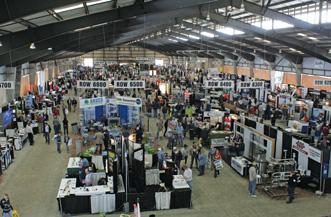
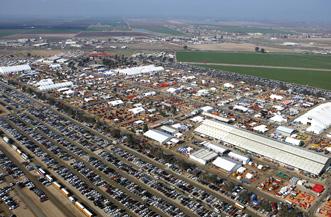
The 2008 World Ag Expo is scheduled for February 12 to 14, 2008 in Tulare, California, and planning is already well underway. The newest edition of the expo will feature an additional 100,000 square feet of dairy exhibits in the Dairy Technology Center.
The 2008 show will also be the first to feature a new electronic registration system that will allow attendees to preregister on-line before they arrive at the expo grounds. Registrants will be asked a short set of questions surveying their demographic background. After completing this brief questionnaire, a confirmation page can immediately be printed and an official admittance badge will be mailed directly to the attendee. This badge will act as a fast pass to the World Ag Expo as well as admittance to
the West Coast Nationals Power Pulling Series and entry into the 2008 Dodge truck giveaway. Those who pre-register will also receive a discounted ticket price. Expo attendees who have not preregistered on-line will simply complete their form at an on-site computer kiosk and an admittance badge will be printed at the gate.
Visit: www.worldagexpo.com
Canadian provincial government provides funding for community groups pursuing renewable energy
The provincial government of Ontario, Canada, recently announced a new $3.0 million fund to help support communityowned renewable energy projects in the province. The fund is the first of its kind in Canada.
Eligible renewable energy projects include those involving bio-gas technologies, wind, solar photovoltaic and solar thermal, small scale hydro and geothermal. Incorporated groups, including farmers, First Nations and community groups, can apply. The fund is operating two grant programs. The first is a Small Grant Program for feasibility studies and strategic opportunity exploration. Eligible applicants may receive up to $25,000 toward their projects. The second is a Large Grant Program to support project development, with the possibility of up to $300,000 in funding.
The intention of the fund is to attract additional capital in order to transition the fund into a long-term, sustainable financial organization that provides a combination of grants, loans and investment opportunities.
Visit: www.cpfund.ca
Research examines use of in-barn biofilter to reduce hog odors
Odor is a contentious issue in the hog industry and presents a challenge that is not easily overcome. Researchers with the University of Manitoba in Canada intend to address the issue of hog barn odor through a new study examining the use of an in-barn biofilter.
The team plans to construct the biofilter from scratch and will be designing it so it can be installed inside the barn, suspended above the floor, with
the loss of no floor space. Ease of handling and system management plus the economic feasibility of the system will also be concerns. The biofilter will be designed to have easily removable cartridges that can be replaced after each batch of pigs, thus avoiding the breach of strict biosecurity protocols. The design will also allow the biofilter to work in conjunction with room ventilation fans, pulling air through the filter medium prior to being exhausted to the barn exterior.
Once design of the biofilter is complete, it will be tested at the new University of Manitoba Glenlea Research Station hog facility, which is quite typical of modern hog facilities, incorporating slatted flooring over a manure storage pit, concrete walls (bottom half) and multiple sources of ventilation.
The researchers plan to measure how effectively the biofilter system removes odor, whether it changes airflow patterns and whether it affects the animals’ growth, performance, feed intake and behavior, over the period it takes for one batch of 130 pigs to mature. The team also intends to look at how the biofilter media changes during this same time period (i.e. temperature and moisture content).
Canadian study suggests drug seepage from hog farms not an environmental problem
New research from the University of Guelph in Ontario, Canada, is suggesting that environmental contamination from antibiotics does
not pose appreciable risks to soil and aquatic organisms.
Dr. Paul Sibley, from the university’s Department of Environmental Biology, and Dr. Keith Solomon, from the University of Guelph’s Centre for Toxicology, recently completed six years of research examining the use of pharmaceuticals in the Canadian hog and cattle industry. The pair determined that the pharmaceuticals represent negligible environmental risk if used as instructed.
During their research, Dr. Sibley and Dr. Solomon simulated real-life scenarios in the laboratory and field to study pharmaceutical toxicity. They applied pharmaceuticals directly to soil and water to simulate field exposure in a worst-case scenario. According to the researchers, in toxicity, safety (or risk) is often measured as the difference between what is found in the environment and what the pharmaceutical’s toxicity is known to be.
In most experiments, the researchers found that the toxicity effects of pharmaceuticals were in the milligram to gram per liter range, significantly higher than the nanogram to microgram per liter range typically detected in soil and water for pharmaceuticals. According to the researchers, the long duration of some of the studies helped to accurately assess changes in contamination levels and toxicity over time, ultimately leading to a stronger conclusion that supports environmental safety.
“It’s comforting to know that levels of antibiotics in the environment don’t seem to be posing a problem,” says Dr. Sibley. “We’ve tested aquatic, vertebrate, fish and soil communities, and the evidence clearly indicates little cause for concern.”
Convert Waste to Power and Heat!
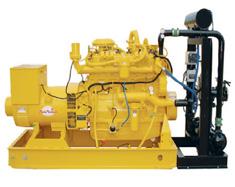
BIO-GAS FUELED GENERATOR SETS
Part of the solution for lower electricity costs and better pollution control.
Additional Products & Services
• We manufacture Exhaust Heat Recovery units
• New high efficiency or rebuilt engines
• Repair of engines, generators, controls
• Repairs on-site or in our shop
• Upgrade controls
• Remote telecommunications interfaces
• Real-time Data Logging Servers
Krieg & Fischer and Electrigaz launch bio-gas development program
Electrigaz Technologies Incorporated, based in Montreal, Quebec, and Krieg & Fischer Ingenieure GmbH of Denmark have developed a new service program to address the need for unbiased bio-gas development expertise in the Ontario, Canada, market.
The new program is in response to the recent launch of the Ontario Ministry of Agriculture, Food and Rural Affairs’ Ontario Biogas Systems Financial Assistance Program, a $9.0 million investment to help farmers and agri-food businesses develop and build bio-gas systems in the province. According to Electrigaz president, Eric Camirand, the program will provide a one-stop-shop service for producers interested in taking advantage of the OMAFRA funding program and help them negotiate the bio-gas development process. One way the companies can help is through Electrigaz’s Biogas Web Calculator software, which is able to evaluate a bio-gas project’s potential, he adds.
“Working with Electrigaz gives us the opportunity to offer our specialized bio-gas engineering services in the Ontario market,” says Torsten Fischer, president of Krieg & Fischer, adding it is important to have local partners to handle local matters, such as permitting and client communications. www.electrigaz.com/ontario
Accent Manufacturing product chosen one of 2008 World Ag Expo’s top new dairy products
New for 2008, the World Ag Expo is selecting the Top Five New Dairy Products being exhibited at the event and there is a manure handling item in the list.
The Sand Trap, manufactured by Accent Manufacturing of Abbotsford, British Columbia, Canada, removes bedding sand from sand laden manure that has been previously separated by the Accent IFRS 36 Separator. The product is
designed for herds of one to 500 cows and captures up to 95 percent of the sand in sand laden manure. Removing the sand reduces handling problems and produces reusable sand. First, the fiber is removed by Accent’s IFRS 36. The remaining sand-liquid mixture flows tangentially into the Sand Trap. Cyclonic action spins the sand out and causes the sand to separate from the effluent; these separated sand particles then fall to the bottom of the cone chamber. The sand, which is removed by an auger, passes through a skimmer, removing any remaining fiber and excess liquid. The end result is clean, low moisture sand.
The 2008 Top Five New Dairy Products – which also include the Bella Health System from Bella Health Systems, the HI 84429 from Hanna Instrument, Multimin cattle 70mg from Multimin USA, and the Shifttronic three speed gearbox from Trioliet Mullos BV – will be unveiled during the Expo’s Media Day on February 11.
The 2008 Top Five were chosen by a panel of industry professionals and dairymen as the newest, most innovative dairy products to be displayed at the expo. www.worldagexpo.com www.accentmanufacturing.com
Construction begins at Nebraska bio-gas facility
Environmental Power Corporation recently broke ground for a new bio-gas plant at the JBS Swift beef processing facility in Grand Island, Nebraska. The plant will convert animal waste and other byproducts generated by the meat processing facility into a methane-rich bio-gas to be used as fuel in the plant’s existing boilers.
Microgy, a subsidiary of Environmental Power, will construct, own and operate the renewable energy production facility and sell its gas to JBS Swift – the largest beef processing company in the world –pursuant to a 15 year purchase agreement.
The new bio-gas system will employ three skilled operators along with a facility manager. The gas production facility will consist of two 1.2 million gallon digesters, as well as a purification system that cleans the gas prior to its use. At capacity, the facility is expected to generate 235,000 MMBtu per year – the energy equivalent of 1.7 million gallons of oil – and will offset approximately 25 percent of JBS Swift’s annual purchase of natural gas. In addition, the meat processing plant will be able to reduce the land application of organic waste materials from its operations.
“The meat processing industry represents an important market for our co-digestion systems to produce renewable bio-gas,” says Rich Kessel, president and chief executive officer of Environmental Power. “The facility at Grand Island is our first inside-the-fence industrial project and demonstrates JBS Swift’s willingness to embrace emerging renewable energy technologies. We look forward to continuing our partnership with JBS Swift, including exploring the company’s network of processing plants to identify and develop additional facilities.”
The JBS beef processing plant in Grand Island processes about 6000 beef cattle per day and employs 2700 people. The plant is one of three facilities owned by JBS Swift in North America. The biogas plant is expected to be operational in late 2008.
Cedar Crest Equipment new distributor for Midwest Bio-Systems
Midwest Bio-Systems recently announced a distribution partnership with Cedar Crest Equipment, based in Cedar Crest, Pennsylvania. Through the partnership, Midwest’s Advanced Composting System and equipment will be available to growers throughout Pennsylvania.
Midwest Bio-Systems also delivers frequent workshops around the world to educate and assist composters and potential composters. Plans are in the works for Cedar Crest to host additional workshops in Pennsylvania.
“We see a high value in helping farmers create a compost product as a fertility boost,” says Anthony Good of Cedar Crest. “As one of the most respected names in the composting business, Midwest is a natural choice to join with us in coming to the aid of the producer.” www.midwestbiosystems.com
Kenworth extends PremierCare package to new medium duty trucks
Already available on its Class 8 on highway trucks, the Kenworth PremierCare Freedom Package is now available for new Kenworth medium-duty conventional trucks. The Kenworth PremierCare Freedom Package is a combination of an extended basic vehicle warranty and preventive maintenance program with a two to five year term that can be purchased with a new Kenworth
bringing LEARNING to YOU
ACC Agriculture Extension offers anywhere, anytime agricultural training opportunities for the off-campus student.
Excellent program offerings by distance include:
• Manure Management Planner
• Commercial Manure Application Certification
To register or for more information call 1-800-862-6307 Ext. 7116
Stay on top of the latest agricultural trends and enrol today.
medium-duty truck and wrapped into a finance package.
By selecting the care package, customers have all proper maintenance via S-level service (lube, oil/filter and 75 point safety inspection) and C-level service (comprehensive service with 147 point inspection), which qualifies for the annual DOT and one California quarterly inspection. A B-level service (comprehensive service with 120 point inspection) replaces the C-level service in years two through five.
As part of the package, new Kenworth medium-duty conventionals with the PACCAR PX-6 and PX-8 receive two services annually at 15,000 mile intervals. The program allows customers to schedule vehicle maintenance at any Kenworth dealership in the U.S. and Canada, plus U.S. customers receive Bridgestone’s tire discount program. www.kenworth.com
John Deere announces two new skidsteer models
Two new additions to the John Deere skidsteer family, the 313 and 315, feature the same unified design as the rest of the line and continue the 300 series advantages of stability, visibility and serviceability.
A key feature of the 313 and 315 is the radial lift boom, a design preferred by customers who work in enclosed areas. The bucket rests close to the machine when in the down position and swings forward for great reach in the four to five foot ‘work zone’ range. Cushioned bucket and lift cylinders provide smooth deceleration at the end of the boom lower position, also cushioning the bucket when curling and dumping a load.
The 60:40 weight distribution provides great balance of power and maneuverability, while the 360 degree visibility offers uninterrupted views to the sides, both above and below the lift arms, so the operator can see the tires and ground around the machine with the boom in the rest position. The operator station is designed with the operator in mind. A wide opening makes it easy to enter and exit. Standard features include a high back ergonomic and adjustable seat with armrests, a digital hour meter, glove-friendly rocker switches, cargo storage for a cell phone and other small items, an interior dome lighting, a 12 volt receptacle and a cup holder. The standard monitor includes an anti-theft
system and backlit gauges, switches and LED warning lights. For extra comfort, an optional heated cab is available.
Several design features keep costs low by ensuring fast and easy machine service. The oil cooler swings out with the hinged rear door for full, easy inspection or cleaning. Engine oil changes are simplified with extended, 500 hour oil change intervals. Both models are equipped with visual hydraulic fluid level checks, resulting in fast, easy and nomess daily checks.
www.deere.com
Panda Ethanol receives air permit for Muleshoe refinery
Panda Ethanol Incorporated recently received an air permit from the Texas Commission on Environmental Quality for the company’s planned 115 million gallon per year ethanol refinery in Muleshoe, Texas.
The facility will be engineered to gasify up to one billion pounds of cattle manure per year to generate the steam used to refine an annual estimate of 38 million bushels of feedstock grade corn into biofuel. By using bio-gas to fuel the plant, Panda is both conserving the energy equivalent of 1000 barrels of oil a day and helping to address a significant environmental problem for the Texas Panhandle.
Once built, the Muleshoe refinery should be equal in size to Panda’s Hereford, Texas, facility, which is considered the largest biomass fueled ethanol plant in the U.S. with one of the lowest carbon footprints of any similar sized ethanol facility in the nation.
The Muleshoe facility, to be located about eight miles northwest of the town, is the fourth 115 million gallon per year ethanol project announced by Panda to receive air permits. Construction is dependent upon financing, additional regulatory approvals and other conditions.
Pro-Act Microbial receives patent
A key component of Pro-Act Microbial’s biotech waste treatment system, the surface air diffuser, has been granted a U. S. patent. The newly patented diffuser adds oxygen to create a limited aerobic environment on the surface of a waste lagoon. This aeration supplies the required oxygen to the aerobic microorganisms to convert volatile fatty acids to odorless carbon dioxide and water, while leaving most of the waste lagoon anaerobic so anaerobic waste treatment can proceed undisturbed.
A healthy waste lagoon or wastewater storage tank will naturally stratify in layers, with the bottom layer remaining anaerobic (without oxygen).
According to Pro-Act Microbial, the company’s surface air diffuser is the only one on the market that can retain the stratified layers. By doing so, the system allows the anaerobic microbial waste treatment to proceed while adding an odor cap to minimize odors commonly associated with anaerobic treatment.
Pro-Act Microbial provides waste treatment systems for concentrated
animal feeding operations (CAFOs) and other high strength wastewater. www.proactmicrobial.com
Valley‚ Single Span Engine Drive meets needs for small fields
Valmont Irrigation introduces its Valley Single Span Engine Drive, a solution for small fields under 10 acres. This low pressure system needs no electricity, offering growers significant savings in infrastructure, pumping and energy costs. The Single Span Engine Drive from Valley can be operated on slopes of up to 10 percent. Mounted directly to the pivot’s base beam, the engine drive operates in forward and reverse modes for maximum flexibility in crop management No tools are needed because a simple over-center lever allows you to quickly switch the belt direction to run in reverse.
Equipped with a reliable Honda 5.5 horsepower engine, the unit is enclosed for weather protection and can use an auxiliary 19 gallon fuel tank option for extended operation between refills. With standard speed pulleys, the machine can complete
a circle in four to nine hours, depending on tire size and engine speed. The high speed pulley option can cover your acreage in half that time. The system can also be moved to different field locations using the optional skid two or four wheel EZ tow.
Send your product items to: Manure Manager welcomes submissions from all manufacturers/dealers of new manure management-related products. All submissions will be considered for inclusion in On Track. For electronic submissions, please send digital photos as a TIFF file or maximum quality JPG file, along with product copy and contact information to: mland@annexweb.com
If the material is being sent by mail, please send it to: On Track Editor
Pequea, a family owned manufacturer of U.S. made agricultural implements based in New Holland, Pennsylvania, has introduced its line of manure spreaders that ease pasture management by offering consistent spread patterns.
Pequea’s model 125 PTO and 175 PTO spreaders feature eight or 10 aggressive beaters that produce a faster manure output, wide spread pattern and are designed for
maximum application. Pequea’s manure spreaders are constructed with solid poly flooring that prevents the rotting floors associated with wood flooring, as well as freezing in cold temperatures. Each spreader is equipped with a poly coated T-Rod drive chain. By utilizing a T-Rod instead of traditional link chains, Pequea spreaders extend intervals for chain replacement and minimize customer downtime.
Model 125 PTO and 175 PTO spreaders use a fully enclosed oil bath gearbox for long life with trouble-free maintenance. Spreaders also feature heavy-duty pipe, bolt-on paddles and carrier bearings for improved beater durability. Beaters are detachable for easy replacement and are made from durable 0.5in steel.
www.pequea.com
Pik Rite
Pik Rite of Lewisburg, Pennsylvania, is the manufacturer of Hydra-Ram spreaders, including the model 795 Hydra-Ram Spinner Spreader. This spreader –with a volume capacity of 400 bushels and a load carrying capacity of 11.5 tons – |can apply ‘almost anything you put in it’, including pen packed manure, poultry manure, saturated poultry manure, fly ash and wet lime. It can also apply it in a spread pattern up to 30ft wide. The spreader offers superior quality plus additional features, including: a direct hydraulic drive, a self-contained hydraulic system, four horizontal spreading spinners, a single wheel system, a positive unloading controlled feed system, and a detachable spinner/beater panel. www.pikrite.com
Meyer Manufacturing
Meyer produces a full line of V-spreaders for hauling liquid, semi-solid, pen pack, sludge or litter. The spreaders feature a versatile, three auger design to equalize the load and eliminate bridging. Best of all, the rear unload design and vertical expellers provide the best spread pattern available while the mess stays behind.
Sizes range from 260 to 865 bushel or 1350 to 4,00 gallons. The V-Max series is a clear choice when low load height is a concern. Mid-sized operators will appreciate the V-Force models from 400 to 500 bushels. Large operations should look at the Industrial 8720 or 8865 units, which are constructed using heavier tanks, axles and drive train.
Spread widths vary from 15ft to 50ft, depending on application. Pull-type or truck-mounted styles are available in all models. Independent lower auger shear hubs protect the farmer’s investment on 500 bushel and larger models (optional on smaller units).
www.meyermfg.com
JBS Limited
British Columbia, Canada based JBS offers two types of spreaders: the pull-type and the truck-mounted Vertimax Manure Spreader.
The pull-type Vertimax manure spreader is built tough to handle the challenges of the modern farm. It comes with 650/55R 26.5 tires that allow for high speed use, heavy capacity and still offer great flotation. Chains in the spreader box feature an open barrel design, meaning less
binding. Each chain slides across a plastic floor for reduced friction, less noise and longer life. The spreader comes standard with a guillotine tailgate, ensuring applicators have control over how much manure gets to the beaters. For protection of the drive components, the spreader has both a shear bolt for operation protection and an over-running clutch for shut down protection.
The truck-mounted Vertimax manure spreader features a 110hp hydraulic motor capable of running the spreader beaters at the same speed as the Vertimax pull-type spreader. It is available in lengths up to 20ft and offers a 19 cubic yard heaped manure capacity. It can also spread square bales quickly and evenly to meet bedding and spreading needs.
www.jbscanada.ca
Kuhn North America
The 8100 series ProTwin Slinger manure spreader is simple and dependable, provides an even and controlled spread pattern, eliminates material bridging, spreads a wide variety of material and is versatile.
The spreader features a patented twin-auger design that provides even and consistent material flow to the discharge. The left auger moves the material forward to the hammer discharge while the raised right auger moves the material rearward while
CORNELL PUMP COMPANY
(3) 4000 gal. PV sys c/w load arm and injectors (3) 5350 gal. Huskey Manure Tanks (1) 26 cu Yd. Dry Manure Spreader
keeping the left auger charged. When the material enters the hammer discharge, each hammer swings down into the material, peeling it off, pulverizing it and slinging it underhand into an even and controlled spread pattern.
Universal hammers eliminate the need for separate left, right or center hammers and improve the spread pattern, especially when spreading pen pack manure.
The ProTwin Slinger can spread a wide variety of material, including gutter manure, slurry, pen pack, yard scrapings, sand-laden manure and bedding materials. It can also be used for applying side or top dressing materials in orchards or on turf grass, and can also be used to apply mulch or compost. The spreader is available as either a truck-mounted or pull-type wagon. www.kuhnnorthamerica.com
Frontier Equipment
Marketed through John Deere, Frontier Equipment offers two models of manure spreader, the MS1442H (holds 425 bushels when heaped) and the MS1455H (holds 550 bushels when heaped).
Both feature: 0.5in thick solid virgin poly floors and sides for less friction, structural floor supports 9.5in apart for maximum support; heavy-duty horizontal, PTO driven beaters with over-run clutch and shear bolt protection, a one piece beater panel for better support of the top beater; a hydraulic endgate, made with a heavy-duty steel frame and solid virgin poly, standard with dual lift cylinders; heavy-duty, one piece hitch that extends to the wheel axles; a front splash guard, heavy-duty swing away jack and optional rear pan.
Heavy-duty vertical beaters are also available. The spreaders’ beater assembly is easily removed for stockpiling manure and has a fast unloading time. www.deere.com
While Manure Manager editors make every effort to be objective when reporting on new products, they cannot be held responsible for claims made by companies. Readers are encouraged to contact the companies for more details.
GUEST COLUMN
Changing animal diets can help control odor
By Wendy Powers
Modifying animals’ diets can cut down on odor and complaints.
Odor is not new to dairy and livestock farming. Cows, pigs, and even sheep and chickens have always had special scents attached to them. But as farms get larger and non-farm neighbors move into the countryside, the smell of productive animals is no longer welcomed.
Odor complaints often occur when manure is spread on the land. But odor and gaseous emissions are a daily occurrence wherever animals are housed or manure and feed are stored. Ammonia, hydrogen sulfide and methane (odorless) are emitted from storage lagoons, barns and feed storage areas as well as land where manure is applied. Though all of those areas can be a problem, you get the most for your money by evaluating and controlling emissions in manure storage areas.
Efforts to control air emissions from manure can be divided into two categories: post-excretion strategies, which focus on reducing or changing emissions once manure has been excreted; and pre-excretion strategies, which focus on changing emissions prior to manure excretion.
Post-excretion strategies are largely an engineering issue: treat manure or design a cover to trap emissions. These strategies may also be chemical, such as using manure additives to change the chemical properties of manure and, hence, the resulting emissions.
Pre-excretion strategies are primarily dietary: change the composition of the diet (without changing animal performance) to change manure composition and, in turn, change air emissions. A pre-excretion approach can either reduce the nutrient precursors to emissions (source reduction) or change the form of the excretions.
Reducing the nutrient precursors means feeding nutrients as near to animal requirements as possible, thereby eliminating any extras. If an animal consumes only as much nitrogen as it
needs, for example, it does not have any surplus to excrete in manure that can ultimately be released as ammonia. Similar diet formulations could focus on sulfur, which can be released into the air as hydrogen sulfide. This approach is applicable to all species, but how the diet is formulated is species-specific and, should be discussed with a nutritionist.
Using the source reduction approach, we have demonstrated ammonia emission reductions in excess of 40 percent with swine, broiler chickens and beef cattle. Feed additives that improve nutrient utilization, such as prebiotics or pro-biotics, ionophores (Rumensin) or beta agonists (Ractopamine or Posilac) can be useful in reducing dietary nutrient content without compromising animal performance. Other management strategies – such as ventilation schemes to improve indoor air quality or lighting schedules to maximize feed intake – may allow producers to maintain growth and performance while reducing the nutrient content.
Nutrient form modification strategies change the form in which nutrients are excreted. For example, in a laying hen study, calcium sulfate (gypsum) and zeolite were included in the diet formulation to acidify the diet and the resulting excretion. Acidifying the excretion reduced ammonia emissions by 40 percent because nitrogen in the excreta was in a more acidified form and therefore less able to be released to the air. The trade off of feeding the gypsum was that hydrogen sulfide emissions increased significantly because the diets then contained more sulfur. Farmers should always be cautious when modifying diets to ensure there are no unintended consequences.
We do not know how diet strategies affect emissions once manure is moved into long-term storage. Theoretically, source reduction strategies should produce permanent results because they reduce the precursors to emissions, therefore, the maximum potential emission of a nutrient. On the other hand, form modification strategies may not produce a permanent result; ammonia that is not volatilized initially may be lost
to the atmosphere during long-term storage because of adaptation of microbes or environmental changes.
The effect of specific feedstuffs needs also to be considered when implementing an air emissions mitigation plan. Some feeds contribute more to excesses of specific nutrients than others. For example, co-product feeds, such as distiller’s grains, concentrate nutrients relative to the primary source of feed. This could be problematic if formulations do not include accurate nutrient composition data. In some cases, the nutrients may be less available in co-product feeds. However, in other cases, the opposite occurs and nutrients are more available and/or in a form that better meets animal needs. The effect may also be speciesspecific. While accurate nutrient information is important for all feedstuffs, special care should be paid when co-product feeds are included in the formulation.
Most research has focused primarily on reducing ammonia emissions. Unfortunately, reducing ammonia may not reduce odor. Furthermore, the most commonly studied strategy has been to reduce nitrogen intake as a means of reducing nitrogen excretion and, ultimately, nitrogen emissions. To significantly reduce odor and gases in addition to ammonia, a combination of pre-excretion (source reduction plus form modification) strategies may produce more desirable results than one of the options alone. Limited, if any, work is currently in the scientific literature to document the effectiveness of combining both types of dietary strategies.
Diet modification strategies have demonstrated 40 percent or better reductions in ammonia emissions, and further benefits may be realized by adding on post-excretion strategies. The decision is complicated. Consider all options and weigh the results against the desired outcomes.
Wendy
Powers,
PhD,
is director
of
environmental stewardship for animal agriculture at Michigan State University.
ag-chem equipment Leaders in Land Application Equipment
New Equipment Introduction
*9205 New high horsepower 5 wheeler, CAT C-13 425 hp, Power shift transmission, air ride cab, Michelin 1050/50R32 radial tires standard. Available with liquid or dry application systems.
*3244 New 364 hp CAT C-11 engine, redesigned articulated chassis, power shift transmission, air ride cab, Michelin 1050/50R32 radial tires standard. Available with liquid or dry application systems.
New Liquid And Dry Application Systems
Liquid Nutrient Management System
•Accuracy – Falcon VT Controller – GPS –
Site Specific
•Efficient – 40,000+ Gallons Per Hour Injected
•Loading Arm – Quick Reload In 1.5 Min From
Drivers Seat
Universal Nutrient Management System
•Accurate – Falcon VT Controller – On Board
Weigh Cells With Real Time Reading –
Uniform Applications Up To 80’ Wide – GPS
• Durable – Heavy Duty , Built For Years Of Use
•Efficient – Capable Of 130+ Tons Per Hour
•Universal – Can Handle Any Type Of Manure, Litter, Compost, Lime Or Bio-Solid –Application Range Of 1 To 30 Tons Per Acre In One Pass
AGCO - Ag-Chem Equipment • Jackson, Minnesota For more info please call 507-847-2690 for help in locating your nearest sales representative for the Nutrient Management Systems. www.terragator.agcocorp.com