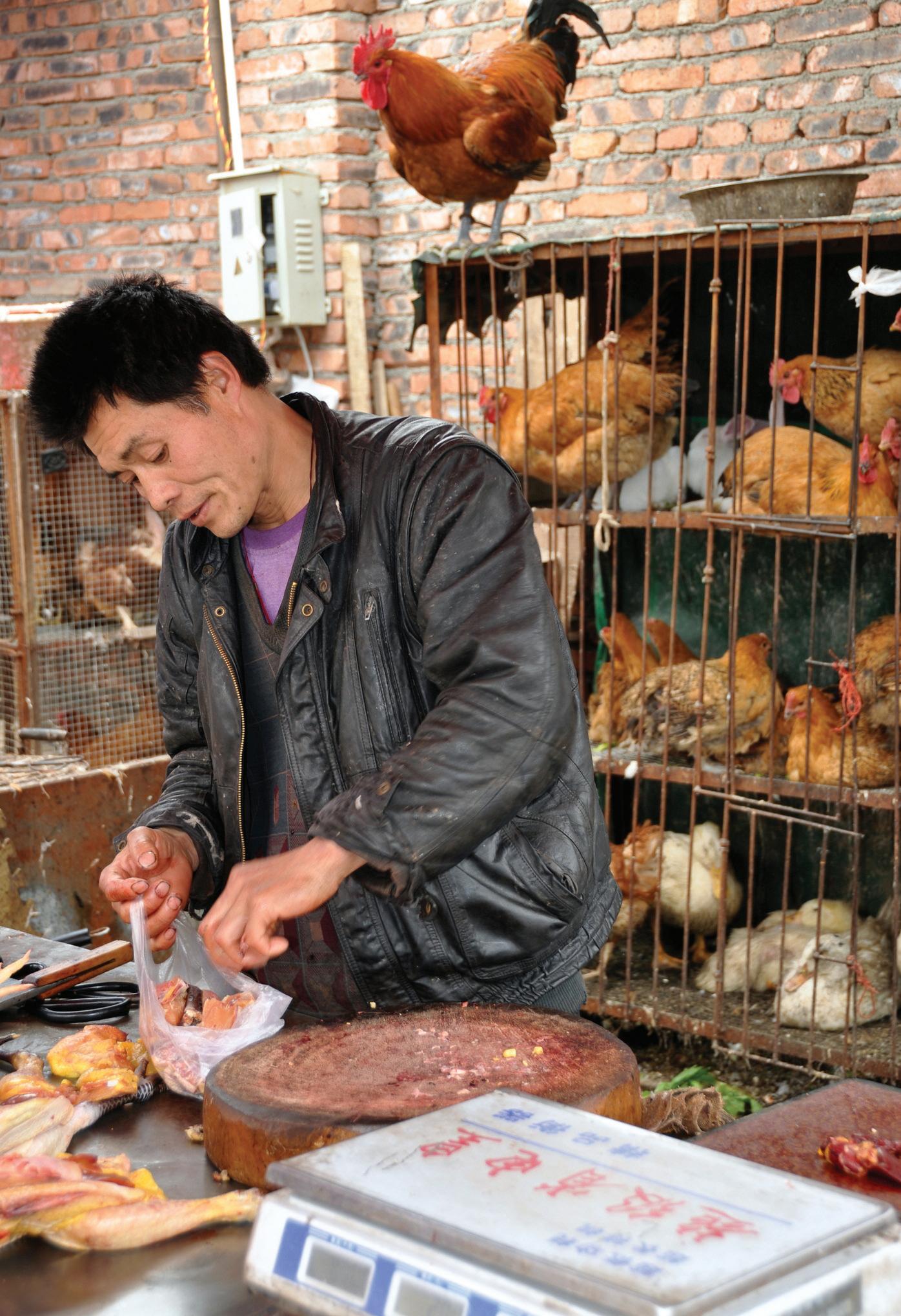
The Taylors have built a provincially licensed poultry plant to fill a shortage in processing capacity in southcentral nova scotia
By Dan Woolley
16
innovaTion: self-Made solution
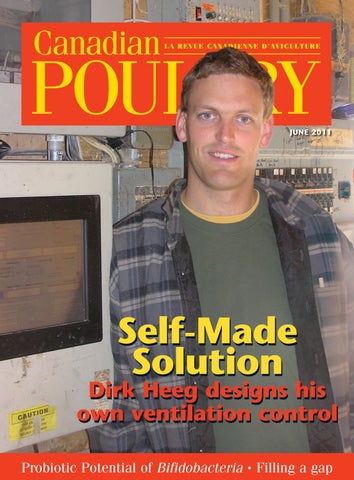
Dirk Heeg develops his own solution for controlling his naturally ventilated turkey barn
By Jim Knisley
20
TribuTe: one big Family
eFc’s “Father,” Past chairman Laurent souligny reflects on his tenure at egg Farmers of canada
By André Dumont
22
Pic uPDaTe: Probiotic Potential of Bifidobacteria
By Kimberly Sheppard, Research Co-ordinator
WaTer: Water and intestinal integrity
By the Technical Team, Ziggity Systems, Inc.
neW barn: Taking the next step in automation abbotsford’s Mountain view Farms is the first hatching egg operation to link all of its barns with an egg packer and sorter
David Schmidt
By Jim Knisley
FROM THE EDITOR
by KrISty nuDDS
learning From one another
After a very long winter and wondering if spring would ever come, it’s nice finally to be cresting the summer season!
Hopefully many of you were able to attend the annual meeting of your marketing board(s) this winter. of those i attended, it was great to see so many familiar faces, meet new people, and talk with producers and industry representatives. The mood and energy were very good, indicating that 2010 was a positive year for most people involved in the poultry industry. Canadian Poultry associate editor Jim Knisley tells us just how good the year has been – check out his column on page 42. in late april, the annual Poultry industry conference and exhibition (known as the London Poultry show) was held at the Western Fairgrounds. With the date change and a few hiccups regarding late mailing of exhibitor packages and lack of name badges, the show was a successful one. as Tim nelson of the Poultry industry council points out (page 24), the show did not appear all that different from last year, because advances in technology often take more than just one year to be really obvious.
However, comfort can be found in the fact that the show has the same “look” from year to year. companies involved in the industry continue to be prosperous, and as always the show provided an opportunity for producers locally and across the country to meet with these companies face to face. There was also ample opportunity for them to talk with fellow producers about important issues and about what’s happening in the industry.
Trends at the show were similar to last year’s – energy-saving technologies and new cage systems for layers. These trends
will continue for the next several years as energy prices continue to skyrocket and the uncertainty around conventional cage systems remains.
according to a report from the rabobank group (see page 8), poultry is set to overtake pork as the most popular meat in the world by 2030. This is great news for our industry and something we’ve been working toward for some time; however, with rising energy and feed costs, our industry and the poultry industries throughout the world must continue to strive to maintain efficient production using fewer resources. given these challenges, along with a late start for seeding across the country and a smaller than expected grain crop in north america last year, sustainability is the latest buzzword in agriculture. but it’s more than just a trend – competition for resources among livestock and energy industries is certain to be the biggest challenge we will face in the next five to 10 years. it requires creative solutions, and not necessarily big investments. often a “tweaking” of one’s own production system and a little ingenuity goes a long way. our cover story (page 16) is an example of such creativity. ontario turkey producer Dirk Heeg solved some of his natural ventilation control issues in a creative, yet relatively simple, way. He shares his story with us, and i thank him and other producers who let us know what they’ve been doing on their farms to increase efficiency. i encourage anyone else to do the same: let us know if you have implemented any changes on your farm that have increased your productivity or saved you time and money. We can all learn from one another, and this exchange of ideas will help us to meet the challenges we are facing as an industry. n
June 2011 Vol. 98, No. 6
Editor
Kristy Nudds – knudds@annexweb.com
888-599-2228 ext. 266
Associate Editor
Jim Knisley – jknisley@kwic.com
Publisher/Sales Manager
Marilyn White – mwhite@annexweb.com 519-429-5193
888-599-2228 ext 237 • fax: 888-404-1129
Sales Assistant
Mary Burnie – mburnie@annexweb.com 519-429-5175 • 888-599-2228 ext 234
Production Artist
Emily Sun
Group Publisher
Diane Kleer – dkleer@annexweb.com
President Mike Fredericks – mfredericks@annexweb.com
Mailing Address
P.O. Box 530, 105 Donly Dr. S., Simcoe, ON N3Y 4N5
Publication Mail Agreement #40065710
PAP Registration #9850
REtuRN uNDEliVERABlE CANADiAN ADDRESSES tO CiRCulAtiON DEPt., P.O. BOx 530, SiMCOE, ON N3Y 4N5.
Occasionally, Canadian Poultry Magazine will mail information on behalf of industry-related groups whose products and services we believe may be of interest to you. If you prefer not to receive this information, please contact our circulation department in any of the four ways listed above.
[ spek-tak-yuh-ler ] Of the nature of a spectacle; impressive or sensational.
Nothing says specktacular like OptiGROW!
Lubing’s all-new Opti GROW Nipple is designed to work in today’s challenging broiler environment. Because the nipple has been optimized for growth, you will be amazed by the first-week performance and explosive bird growth. OptiGROW offers:
Large body and pin
Acid resistant design
Easy triggering for day-old birds
Low mortality
Increased side-action flow
Larger flow range for jumbo birds
Increased weight gains
Improved feed conversions
To find out more about this specktacular new product, please contact your local Lubing Representative.
Glass-Pac Canada
St. Jacobs, Ontario
Tel: (519) 664.3811
Fax: (519) 664.3003
Carstairs, Alberta
Tel: (403) 337-3767
Fax: (403) 337-3590
J. Dean Williamson Ltd.
London, Ontario
Tel: (519) 657.5231
Fax: (519) 657.4092
Les Equipments Avipor
Cowansville, Quebec
Tel: (450) 263.6222
Fax: (450) 263.9021
Specht-Canada Inc.
Stony Plain, Alberta
Tel: (780) 963.4795
Fax: (780) 963.5034
HATCHING HATCHING
h5N1 Will Take 10 Years to Eliminate
The united nations Food and agriculture oraganization (Fao) recently released a report stating that there is little chance H5n1 avian influenza can be eliminated within the next 10 years from the six countries where it remains entrenched.
since 2006, more than 60 countries have reported H5n1, but most have not had any new reports of presence of the virus. However, the virus remains endemic in china, vietnam, indonesia, bangladesh, india, and egypt, notes the Fao report, titled “approaches to controlling, Preventing and eliminating H5n1 Highly Pathogenic avian influenza in endemic countries.”
The Fao says the elimination effort faces three major obstacles in these countries: the structure of the poultry industry, the quality of veterinary and animal production services, and the level of commitment by all sectors.
“although measures have been introduced in all endemi-
cally infected countries to address these three factors, all require further long-term commitments and investment if the virus is to be eliminated,” the report states. “it is now generally accepted that the H5n1 HPai [highly pathogenic avian influenza] virus is unlikely to be eliminated from poultry in these countries and regions for the next ten years at least.”
The report further states that “there is no guarantee that the current incremental approach will eliminate H5n1 HPai.” The goal may require innovative measures such as new, easily deliverable poultry vaccines and genetic manipulation of poultry to make them resistant to the virus.
The report also notes that as long as H5n1 outbreaks continue, so will the risk of the virus evolving into a human pandemic strain. several of the H5n1-endemic countries have had human H5n1 cases this year, with egypt leading the list with 22 confirmed cases so far.
The Fao says the areas that have succeeded the best in controlling H5n1 are those that have “intensive” poultry production methods with tight biosecurity measures and controls on the movement of poultry.
The report says the movement of poultry should generally be considered the source of new outbreaks in H5n1-endemic countries, but wild birds have introduced the virus in some places. it is now “generally accepted” that wild birds helped transfer H5n1 viruses from asia to europe and africa in 2005 and 2006, the report states. However, the Fao says it is “encouraging” that these viruses seem to have disappeared from migratory bird populations, as no new cases linked to that strain have been seen in europe in the past year, and no major poultry losses in europe or asian outside the endemically infected countries has occurred in recent years.
Ag Coalitions Seek to Amalgamate
aproposed amalgamation of two ontario agricultural coalitions took a significant step forward with a vote at the joint annual meeting of the ontario Farm animal council (oFac) and agricultural groups concerned about resources and the environment (agcare).
after a detailed presentation and discussion on sub-
Farm Workers
Denied Right to Unionize
by an 8-1 margin, the supreme court of canada ruled april 29 that a provincial ban on farm unions is constitutional.
in november 2008, the ontario court of appeal upheld a united Food and commercial Workers (uFcW) union charter challenge against the ban. The ontario government appealed the ruling to the high court, which heard arguments in December 2009.
The high court allowed the ontario government’s appeal, denying ontario agriculture workers the right to join unions and bargain collectively. The eight justices who allowed the appeal were divided on exactly how the workers should be allowed to bargain. The high court ultimately decided the existing law gives workers a meaningful process by which to bargain.
jects such as the proposed new organizational structure, membership levels and next steps, members of both groups voted unanimously to have the two boards of directors finalize a proposal to amalgamate and bring it to the membership for a vote no later than sept 1, 2011. both oFac and agcare were formed in 1987 and have worked together in a number of areas since their inceptions.
This relationship was strengthened when oFac and agcare moved into shared office space in 2005 and then began sharing staff and projects a year later. Discussions have evolved from working together to forming an operational alliance and then, most recently, to consider formally amalgamating.
a Memorandum of understanding was signed by the boards of both oFac and agcare in 2010 formalizing their commitments to amalgamate. The two groups now share all staff, including the executive director.
The case revolved around ontario’s agriculture employees Protection act. it allows farm workers to join associations, but does not force employers to enter into
collective bargaining. uFcW canada represents more than 250,000 canadian workers and has been advocating for farm workers’ rights for over two decades.
Olymel to Close Plant
Olymel’s chicken processing plant in iberville, Que., is being closed this summer, which will result in a loss of 120 jobs. The company says most of the work will be transferred to its plant in st-Jeansur-richelieu, Que.
Marc Lalonde has joined vetoquinol as its new Biosecurity technician for ontario and Quebec. lalonde will be meeting with clients that have issues with insects and rodents, as well as cleaning and disinfecting concerns, and to help with calibrating equipment. this is a new service being offered to this region by vetoquinol canada, and is free of charge. lalonde will also be able to hold training sessions for producers, companies and associated staff.
Laid-off employees from olymel’s iberville plant will have a chance to get one of the 30 jobs being added to the nearby st-Jean plant. olymel says the iberville plant will shut down in august but a nearby distribution centre in st-Hyacinthe will continue to employ 15 people.
janet breckman has joined Jefo as territory manager for the provinces of alberta, British columbia and the state of Washington. Breckman brings extensive experience to the industry, having worked several years in the field of animal health. she replaces angela lipka, who has joined Jefo’s market development team.
ray Carriere has joined Jefo as territory manager for manitoba and saskatchewan. he comes to Jefo with an extensive background in sales and customer service.
mArc lAloNdE
rAY cArrIErE
JANET brEckmAN
HATCHING HATCHING
Poultry to be meat leader
a new study has predicted that poultry will overtake pork as the biggest-selling meat by 2030. research by rabobank, a leading agricultural lender, has forecast that global demand for poultry will increase by 60 per cent on 2010 levels to 152 million tonnes.
over the same period, pork will rise 43 per cent, sheep meat will increase by 25 per
cent and beef will improve by 35 per cent.
“The global meat market is slowly recovering from the recession, but is hampered by trade restrictions,” said rabobank analyst nan-Dirk Mulder in an article on Meatinfo.co.uk. “by 2030, poultry will overtake pork as the world’s preferred animal protein.”
‘Yes’
Vote on Senate bill 5487
American Humane association officials are hailing a ground-breaking vote in the Washington state House of representatives approving senate bill 5487 – a historic piece of legislation that the organization says will significantly improve animal welfare in commercial egg-laying chicken operations.
Passage of this legislation will create the nation’s most rigorous program, based on guidelines developed by the scientific panel at american Humane association, creator of the oldest and largest farm animal welfare certification program – american Humane certified.
The legislation will phase out the use of “battery cage”
JUNE
June 12-14, 2011
CPEPC Convention, Delta Hotel, st. John’s, nL. For more information, visit: www.cpepc.ca or tel: (613) 724-6605
JULY
July 16-19, 2011
AAAP/PSA Joint Annual Meeting, america’s center, st. Louis, Missouri. For more information, visit: www. poultryscience.org/psa11
AUGUST
August 8-11, 2011
housing for egg-laying hens and instead mandate use of an approved american Humane association housing system, requiring more space and the use of what is known as the enriched colony model. enriched colony housing allows hens to exhibit natural behaviors such as spreading their wings and turning around, as well as offering elements such as nests, perches and scratching areas, which are necessary to ensuring a humane environment.
The april 11 vote in the House follows previous approval in the state senate, where the legislation will now return for concurrence, before moving to the desk of gov. chris gregoire for final approval.
5th International Workshop on the Assessment of Animal Welfare at Farm and Group Level (WAFL), university of guelph, guelph, ont. Hosted by the campbell centre for the study of animal Welfare and the ontario veterinary college. For more information, e-mail: ccsaW@uoguelph.ca or visit: http://www.uoguelph. ca/csaw/events
August 14-18, 2011
World Veterinary Poultry Association Congress, cancun, Mexico. For more information, visit: http:// www.wvpc2011cancun.org
We welcome additions to our Coming Events section. To ensure publication at least one month prior to the event, please send your event information at least eight to 12 weeks in advance to: Canadian Poultry, Annex Publishing, P.O. Box 530, 105 Donly Dr. S., Simcoe, Ont. N3Y 4N5; e-mail knudds@annexweb.com; or fax 519-429-3094.
WhAT’S
Beat beetles. Darkling beetles are evil little creatures. They wreak havoc on your fac ilities, spread bacteria and disease and irritate the most important part of your business. Your birds. So don’t hold back, hit them with Tempo®. A fast and powerful way to control darkling beetles. With rapid knockdown and prolonged residual activity, Tempo® boosts the comfort of your birds. And your bottom line. Learn more at BayerLivestock.ca.
® Bayer, Bayer Cross and Tempo are registered trademarks of Bayer AG, used under license by Bayer Inc.
Latest WTO Report on Agriculture Unacceptable
Canadian dairy, poultry and egg farmers have called on the federal government to remain strong and oppose any agreement that would jeopardize the future of supply management. This call is in reaction to the report a pril 25 in g eneva by David Walker, c hair of the a griculture n egotiations c ommittee at the World Trade o rganization (WT o ), which still does not reflect the c anadian g overnment position on agricultural trade.
David Fuller, c hair of c hicken Farmers of c anada, said, “ i t is imperative that the g overnment of c anada and all parties remain unwavering in their support for supply management and their determination that the g overnment will continue
to deliver on c anada’s trade position.”
“This report released by ambassador Walker still refers to provisions that are detrimental to supply management in canada,” said Jacques Laforge, President of Dairy Farmers of canada. “The draft provisions that we and the canadian government opposed back in 2008 have still not been addressed. canada’s opposition has not been acknowledged. The cost to canada’s dairy, poultry and egg sectors would be well over one billion dollars and this would negatively impact canada’s economy in both rural and urban areas.”
Peter c larke, c hair of e gg Farmers of c anada, observed that the recent report shows that nothing has changed
with regards to the damage this would cause supply management. He added, “We are looking forward to the g overnment ensuring there are no negative economic impacts to our farmers as a result of these negotiations.”
Dairy, poultry and egg farmers press the canadian government to continue to remain strong in opposing measures that would damage the stability and prosperity of its industries under supply management, compromising the jobs of 265,000 people. recent economic contribution studies by informetrica and ecoressources show that canadian dairy, egg and poultry sectors contribute over $3.6 billion in tax revenues to the three levels of government in canada.
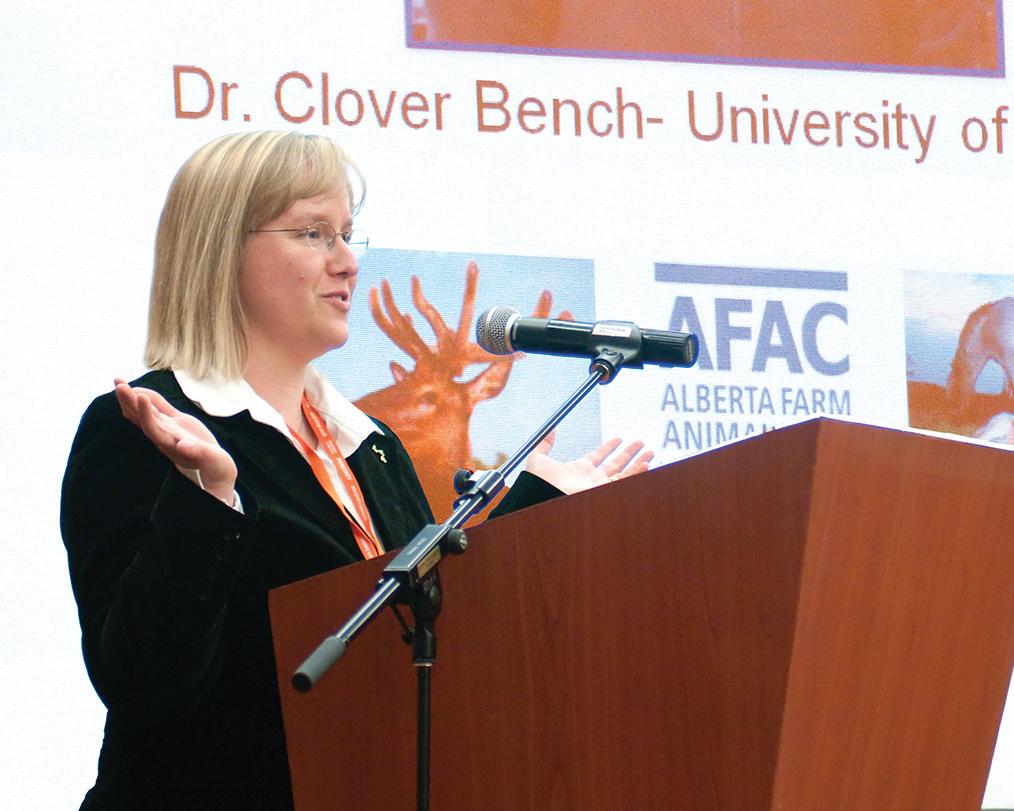
U of A’s Dr. Clover Bench Wins AFAC Award
Dr. clover bench has been awarded the alberta Farm animal care’s (aFac) 2011 award of Distinction for communication. bench is an instructor for
courses in animal welfare, food animal behaviour and companion animal behaviour at the university of alberta, where she serves as teacher, advisor and mentor to dozens of students.
as part of her courses, students have been involved with projects designing innovative solutions and products to support farm animal care. she has also built a strong partnership between student activities and provincial youth 4-H clubs in the province, encouraging knowledge transfer and interaction with almost 7,000 youth 4-Hers.
The award was presented to bench by Dr. craig Wilkinson, director of animal care at the university of alberta. “clover is making an outstanding contribution to communication about behav-
iour and care of farm animals. she is highly deserving of this award.”
bench emphasized that creating opportunities for people from all walks of life to consider agriculture as a career is important to develop the agriculture leaders of tomorrow. “a big part of that is to help bridge students, including both urban and rural students, into agriculture and animal science,” says bench.
The aFac award of Distinction for communication honours those that take an active role in effectively getting the message out about livestock issues, and informing the public and agri-food industry about farm animal care in a factual and honest way, to build trust and credibility.
Our Growth. Your Gain. Pfizer Animal Health Global Poultry’s recent acquisitions of Alpharma Animal Health and Synbiotics products mean more solutions for better results in your poultry operation. From devices to vaccines to feed additives to diagnostics—with comprehensive support behind it all—we are more prepared than ever to help you run a healthier, more productive operation. For more information, talk to your Pfizer Animal Health representative or visit pfizerglobalpoultry.com.
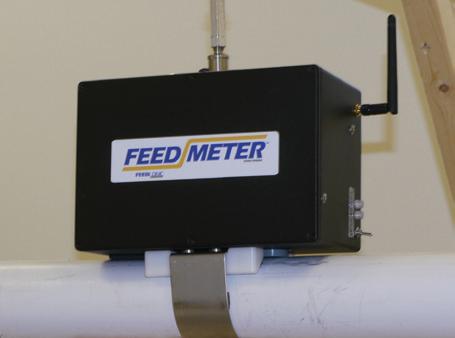
Feedlogic is introducing FeedMeter, a new system which allows real-time measurement of feed usage on-farm.
NEW
PRODUCTS
Feedlogic Launches FeedMeter Product Line PRODUCTS
FeedMeter’s core technology is an entirely new process to measure the mass flow of feed through a standard feed line. The patent-pending system uses a simple, low-maintenance device which attaches to a feed line and uses unique software to calculate mass flow and record the data. information generated by the FeedMeter can be used to
monitor feed disappearance, detect feed bridging and feed outages, and manage feed bin inventories. it will provide important diagnostic information to help producers spot feed wastage.
For more information, visit www.feedlogic.com.
John Deere Launches ‘Unlock’ Website
As part of its launch of large agricultural equipment for 2011, John Deere has created an innovative, interactive new website – www. johndeere.com/unlock – to give growers an early preview of the new John Deere 7r Tractor, combines and other new equipment for 2011.
The unlock website features regularly updated webisodes depicting key features of the new 7r Tractor and combines over the next several months. another highlight of the web-
Tuck in That Film Tail
Isite will be the augmented reality program that allows viewers to sync with a webcam to have the equipment come to life with animation and sound on their computer.
according to David Pauli, John Deere advertising manager for large ag equipment, the website is intended to help generate excitement for the new products in a way that gives viewers a highly informative experience. “We wanted to create a continually fresh, novel platform that is entertaining and gives growers unique insight into our new equipment over several months leading up to launch. every week they’ll get a chance to see something new and different about the products.”
The unlock website will host information on the new John Deere 7r series Tractors, combines and other equipment that will be introduced later this summer.
For an inside look at this new equipment, visit www. JohnDeere.com/unlock.
TW Muller introduces the Tail Tucker. The patented technology behind the Tail Tucker ensures that no loose film tails occur on stretch wrapped pallets. That means food manufacturers and suppliers can rest assured their pallets won’t come unravelled due to weather or handling. stretched wrapped loads are typically secured through a heat seal technology or are manually affixed. in both instances, the end or “tail” of the film has a tendency to come loose, especially if the load is in contact with wind or rain – unravelling the film entirely and degrading the load. also, excess waste and costs are associated with having to re-wrap the pallet.
The Tail Tucker is available as an enhancement to the iTW Muller octopus line of new stretch wrap equipment or as a retrofit to most existing machines. it works by literally tucking the film tail behind the last two full webs of film.
To see the application in action, watch the video at: http://www.itwmuller.com/ video_tailtucker.php4. For more information about iTW Muller, its products and services, visit: www. itwmuller.com, e-mail: sales@itwmuller.com or tel: 800-628-6787.
up and when ready installed the wiring. it all worked.
before he installed the new system there could be a five- to seven-degree change in temperature and the curtains wouldn’t move. “This wasn’t ideal for minimum ventilation. We had to go out and work manually.”
it was a lot of running back and forth, especially as the birds aged. There was also a range of other problems related to temperature and condition of the litter.
The thermocouple gives him 0.54 F accuracy for temperatures ranging from –58 to +212 F.
WEAThEr dATA
He even has the computer hooked up to the weather network through the internet, which provides constant reporting of temperature, wind direction and velocity. The computer has been
programmed to react to a combination of wind velocity and temperature that would compromise minimum ventilation. it can respond by automatically closing the curtains on the windy side
and opening them as much as is necessary on the lee side, thus ensuring minimum ventilation is maintained.
another problem was sunset and sunrise. With the sun low in the sky, the sunlight would stream into the barn if the curtains were open and scare the birds. The Weather network provides the times for sunset and sunrise and, to get around the problem, the computer is programmed to keep the curtains closed on the side blocking the sunlight until the sun is higher in the sky.
“This keeps the birds calmer,” he said.
He thought of setting up a weather station on his farm and hooking it up to the computer, but rocca suggested using readily available data from the internet instead of spending money and time with a local weather station.
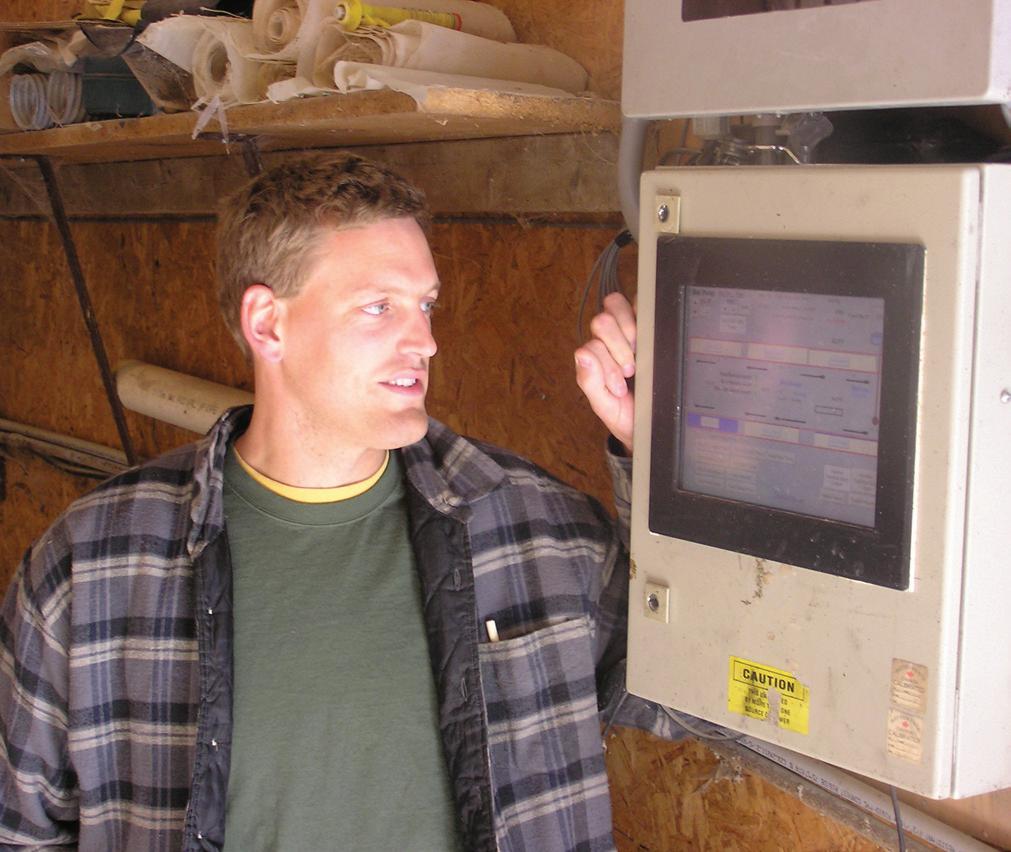
a t first he would take his laptop from the house into the barn, hook it up and proceed. b ut he needed something (a human machine interface) in the barn. He looked at a comparatively simple L c D system, but decided on a panel P c to which he added some software to control the curtains. The panel P c also provided the versatility to use any type of HM i software; and the ability to use remote P c control software. “ i am now able to control and view HM i from anywhere even using a smartphone, which is very useful when i ’m away from the barns or on vacation,” he said.
bEForE hEEG INSTAllEd ThE NEW SYSTEm, ThErE coUld bE A FIVE- To SEVEN-dEGrEE chANGE IN TEmPErATUrE ANd ThE cUrTAINS WoUldN’T moVE, WhIch WASN’T IdEAl For mINImUm VENTIlATIoN
adding excel software was a breakthrough. it allowed him to download publicly available computer code to interact with the PLcs.
To increase the capacity and capability of the system he added the spreadsheet program Windows excel. He designed the Human Machine interface for excel, which took some time, but he only had to do it once and it was easier than he expected.
The information he is receiving from sensors in the barn is easily converted to bar and line charts, making the information easy to absorb and record. it can also provide a detailed record of everything from feed and water consumption to growth rates, feed conversion, weather and barn conditions.
AddEd bENEFITS
currently he has feed and water alarms that call if there is a problem. also excel automatically sends an e-mail to the feed supplier when the feed tank gets low He has added a scanner and scans in the feed bills to have an easily accessible ongoing record on the computer. and there remains much more that can be done.
He can, for example, control the lights and fans, and, if he wants, hook up additional alarms to the computer. He expects soon to add a water line flush routine to disinfect between flocks (water line disinfecting) and during production, keeping water lines cleaner, and, on hot summer days, keeping the water cool.
He is also able to install a sprinkler system because he can easily set up a control system to monitor and manage it. even with this in place he will have barely tapped the capacity of the laptop computers.
Heeg has made the results of his efforts available on his website at http:// www.westsidefarms.ca/. at that site you can get a look at what the computer is up to. There is a main page offering an overview and tabs at the bottom that link to pages for feedtrend, temptrend, data, weather, feed, birdtrend, mortality and heattrend. n
Profilm
Tribute
One Big family
Past
Chairman Laurent Souligny reflects on his tenure at Egg Farmers of Canada
BY ANDRé DUMONT
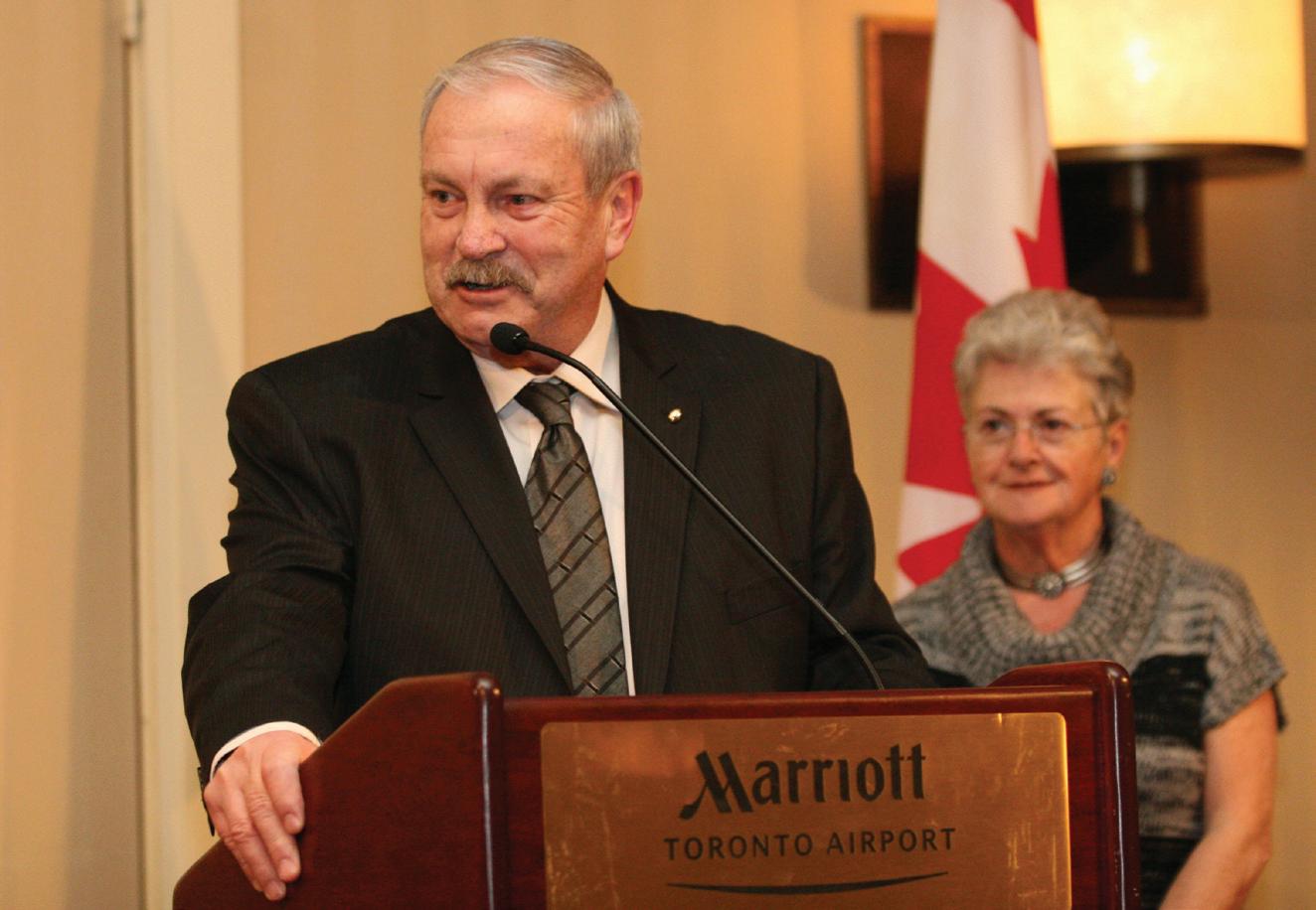
ihave always considered canadian egg farmers like one big family. i would tell myself: a family sticks together and works together,” says Laurent souligny. “i think i have been successful at making egg farmers from all provinces work together.”
now 67, the “father” of the egg Farmers of canada (eFc) family has just retired. souligny held the chair for 11 years. on March 23, members elected nova scotia’s Peter clarke as their new chairman.
souligny farms in st-isidore, in eastern ontario. He started egg production in 1983. by 1987, he was representing his region at the board of egg Farmers of ontario. it was only the beginning of an involvement with producer associations that has become an example of dedication and leadership.
in 2000, souligny became the chairman of the canadian egg Marketing agency (ceMa). This name made it sound like a government agency and it certainly didn’t reflect its members, souligny recalls. among his numerous accomplishments, he is proud to have presided over the name change for egg Farmers of canada.
When souligny became president, relations between provinces were tense. There were strong disagreements about new quota allocations.
after resolving the issue with Manitoba, saskatchewan also stepped forward for a bigger share of above-the-base quota. souligny was able to bring everyone to an agreement. “it used to be that talks for above-the-base allocations lasted two years. now, we get it done in two hours.”
efC’S “fAther”
Souligny recently stepped down after 11 years as chairman of EFC. He is
souligny also imposed his leadership style on the way eFc lobbies the government.
“We never went to beg. We would inform the government and explain what’s happening in our industry. and while we were at it, we would get key messages through, like the importance of supporting supply management.”
This tactic earned souligny his last great victory. Last March, federal agriculture minister gerry ritz announced that compensations for layers to be eliminated by government order in the case of a pandemic would be raised to a maximum of $30 per bird. “This was the icing on the cake!” souligny said in a phone interview with Canadian Poultry magazine. a mong other accomplishments, souligny notes the purchase of an office building in ottawa, together with Dairy Farmers of canada and canadian Hatching egg Producers. owning instead
of renting is generating substantial savings for all organizations.
souligny has only one regret: during his presidency, eFc wasn’t able to negotiate a new formula to determine the price paid by industrial users for transformation eggs. currently, negotiations must take place every year, whereas the ideal formula would be used for four or five years. This would bring added stability to the industry.
being away for meetings so often was made possible thanks to his son Jean’s involvement with the farm, and with help from wife Hélène and daughter guylaine. The farm has grown to 25,000 layers and 1,300 acres. Jean has recently built a pullet farm with two other partners.
Today, souligny is spending less time away in meetings and more time in st-isidore. “i want a retirement,” he says. “but if i get interesting offers and i feel i can make a difference, i might not say no.” n
Laurent
pictured here with his wife Hélène at the Egg Farmers of Ontario annual meeting.
Photo courtesy of e gg Farmers of o ntario
electrolytes-A/F
Primarily for rehydration
With vitamins, two possible doses, for animals with a slight loss of appetite and vitamin deficiencies
electrolytes plus stress-aid
For animals with a significant loss of appetite and important vitamin deficiencies
PIC Update
Probiotic Potential of Bifidobacteria
AAFC scientists are trying to determine the efficacy of bifidobacterium for Salmonella control
B Y K IMBERLY S HEPPARD , R ESEARCH C O - ORDINATOR
Antimicrobial resistance is an ongoing concern for the poultry industry, and judicious use of antibiotics is important for sustainability and future success. Therefore, we must continue to seek alternative methods for the control of animal- and food-borne pathogens.
one strategy toward mitigating antibiotic use is to build up the numbers of natural antagonists to pathogenic bacteria in the chicken gut. This can be accomplished by colonizing the gi tract with probiotic bacteria and/or adding nutritive factors that enhance colonization by these bacteria.
Probiotic bacteria are live microorganisms that confer a health benefit on the host, when administered in adequate amounts, by improving their intestinal microbial balance. in particular, species of Lactobacillus and Bifidobacterium have been studied to control pathogens in the gut. Maximum probiotic effect can be achieved by determining which organisms are most effective and what their mode of action is.
Dr. Jim chambers, with Dr. roger Wheatcroft of agriculture and agriFood canada, has been investigating mode of action for Bifidobacteria, which produce volatile fatty acids (vFas) that appear to diminish the growth of many enteric pathogens. The vFas are pro-
aaFc researchers have been studying the efficacy of the probiotic bacteria Bifidobacteria in reducing salmonella in broilers.
duced through a pathway known as the “bifid shunt,” a feature of Bifidobacteria. c hambers’ laboratory has created mutants of the Bifidibacteria B. pullorum that are deficient in the bifid shunt. These have been compared to wild-type B. pullorum and B. animalis for their ability to prevent gut colonization by Salmonella typhimurium. These trials will establish if vFa production is crucial for Salmonella suppression and if the bifid shunt has an effect on B. pullorum’s ability to colonize the gut.
Their findings? r esults indicated that acid production by Bifidobacteria is consistent with the absence of detect -
able Salmonella in at least the proximal gut (duodenum and jejunum) of the digestive tract of broiler chicks tested 14 days after inoculation. Further work is required to determine whether greater reductions in Salmonella populations due to probiotic effects of B. pullorum occur in chicks as they develop beyond 14 days. a lso, given the relatively weak probiotic effects of single organism probiotics, it appears that Bifidobacteria definitely warrant further investigation for Salmonella control in poultry in general. For more information on this project, please visit www.poultryindustrycouncil.ca.
ProbIoTIc PoTENTIAl
STOP FEEDING THE PROBLEM.
Vaccinate against coccidiosis.
Control coccidiosis and eliminate ionophore rotation hassles with Coccivac®-B vaccine.
Find out how Coccivac-B vaccine can be profitable for you. Consult your veterinarian or call our technical services team at 1 800 605-2584.
PIC Update
Early Indicators of metabolic and reproductive dysfunction
over the past 30 years, the 42-d body weight (BW) of broilers has been increasing at a rate of 30g/year. this is due to increased selection for faster growth, improved feed conversion, and a higher percentage of breast muscle. in comparing mature BW and carcass traits, genotype is an important determining factor in how birds develop. High degrees of genetic variation can be seen in BW of various lines of mature chickens and in breast muscle development.
One primary tool breeding companies use for selection is BW. It is well documented that there is an inverse relationship between growth and reproduction. Therefore, selection for increased BW and carcass size of broilers can potentially have a negative impact on the reproductive qualities of the broiler
Dbreeder. Increased feed restriction is the chief means of dealing with this negative relationship. thus it is important to be aware of the growth potential of modern broilers in order to properly manage the broiler breeder parents.
The basis for applying feed restriction in the pre-laying and laying periods for female broiler breeders is to control nutrient flow to the liver, which ultimately controls the yolk lipid that is deposited in the ovarian follicles. Excess follicle development has been associated with the laying of double-yolked eggs, eggs with poor shells, and in some instances, laying that occurs outside of the normal patterns of lay. Providing pullets with excessive nutrients during the period immediately preceding sexual maturity vastly increases the rate of yolk deposition on the ovary. Overfed birds
f eatured r esearcher
r. Jim chambers was raised on a farm in oxford county with dairy cattle, market hogs and layer chickens. he obtained his Bsc. and msc. in agriculture and animal breeding at the university of guelph, and continued on to complete a Phd in animal genetics and biometrics at the university of Wisconsin. his career has involved work in genetic development and improvement of commercial broiler breeding stocks; synthesis of broiler sire and dam lines of broilers; evaluation of feed efficiency and abdominal fatness selection in conjunction with growth rate in broiler chickens; evaluation of probiotics, pre-
biotics and maternal vaccination for control of salmonella in chickens; and evaluation of composting of poultry litter to reduce pathogens of poultry litter before field application. dr. chambers has authored or co-authored over 70 scientific publications and authored the chapter on “growth and meat Production” in the Poultry Breeding and Genetics text edited by r.d. crawford. he has served as a member of the scientific advisory committee of the canadian Poultry research council and is a member of the Poultry science association and the canada chapter of the World’s Poultry science association.
exhibit an increase in the number of large yellow follicles (LYF).
Drs. Frank Robinson, Robert Renema and their research team at the University of Alberta were able to show that breeder strains can allocate nutrients differently during sexual maturation. They have been studying whether short-term overfeeding results in a differential response in eight different strains – in essence, a “stress test.”
Their results? Overfeeding pullets did not result in significant increases in the number of large follicles in such a way that each strain could be rated as flocks were not uniform enough. However, it was found that using 20 per cent extra feed and observing the reproductive results is an excellent way to assess how well hens do. If breeder organizations used a standard test like this, they could better estimate how products may function at the producer level. To read more about this research project, please visit www.poultryindustrycouncil.ca.
PIc’S PIckS
BY TIM NELSON, ExECUTIvE DIRECTOR
t he 54th l ondon Poultry Show came and went and, despite such issues, as a lack of name tags, a date change and a few other minor problems, the two-day event went very well. The weather was kind to us (it rained) – less so to those hoping to get an early planting again this year – and exhibitor feedback to date once again has been positive.
I was asked by the press if there was anything new at the show and after listing off a few items – mainly energy-saving technology, new layer cage systems – i remarked on the fact that it would be an odd show if there were many new things to see because technology increases are
F RANK R OBINSON AND R OBERT R ENEMA , U NI v ERSITY OF A LBERTA
PIC Update
generally incremental.
However, someone visiting the show who had also been at the first show (54 years earlier) would have found it a very different show indeed. This made me reflect on the nature of research and the generally incremental rate at which research findings are commercialized and adopted, if indeed they ever are. A prime example of this was highlighted at our annual Research Day on May 10, where we heard the story of the Enviropig. Now here is a really stunning example of outside the box thinking to solve and environmental issue and it works. Here is a pig that through worldclass gene technology undertaken at the University of Guelph is capable of digesting more and excreting less phosphate into the environment. What a terrific solution to an environmental issue, not to mention the efficiency gains brought about by the better phosphate digestion. But its commercialization is mired in community concern over gene technology. No wonder farmers are left scratching their heads and wondering why they fund research.
However, we also heard that poultry leads the world hands down in reducing the environmental footprint of animal protein production. Now this is definitely something to brag about next time you’re in the pub, but spare a thought for why this is so, and make sure you give credit where it is due. the reason we tread so lightly on the surface of this fragile planet is because industry has bred and fed its way to spectacular feed conversion – a direct result of research, much of which was paid for by you and your predecessors. But we can’t rest easy on the fact that we’re so far out in front. We need to keep up to the emerging challenges (and there are plenty) heard about at the Research Day and keep supporting the brilliant minds who are addressing and tackling such problems as particulate emissions, ammonia emissions and flies transmitting antimicrobial resistance. By joining PIC, coming to our events and becoming engaged in some of our projects, you can play an active role in turbocharging progress. n
Water Water and Intestinal Integrity
managing the watering system will create a more hygienic environment, which can decrease the incidence of intestinal diseases
B Y THE T ECHNICAL T EAM , Z IGGITY S YSTEMS , I NC
Providing a healthier environment can decrease the incidence of intestinal diseases like necrotic enteritis and coccidiosis. b oth diseases are endemic to poultry operations, and experts estimate necrotic enteritis costs the world poultry industry $2 billion annually. When birds are healthy, they use the nutrients they ingest for growth. if they are suffering from infection, they must use those nutrients to fight the disease.
necrotic enteritis results from the proliferation of the bacterium Clostridium perfringens in the intestines. Most chickens have these bacteria in their guts, but they usually are in the lower intestines and caeca and do not pose a problem. a triggering factor, such as coccidiosis, is necessary for the bacteria to proliferate to the point where they migrate to the upper intestines and cause harm to the birds.
a poorly managed watering system can result in biofilm in the pipes and wet litter. both conditions can cause a poultry flock to become infected with necrotic enteritis or other intestinal diseases. biofilm results when bacteria in the water become attached to the walls of the pipe. regardless of how the water is sanitized, some bacteria will remain.
a poorly managed watering system can result in biofilm in the pipes and wet litter. Both conditions can cause a flock to become infected with necrotic enteritis or other intestinal diseases.
The bacteria begin to exude a sticky substance after attaching to the pipe walls, creating a biofilm. This attracts additional bacteria and within a matter of days, the watering system has an active colony of pathogens.
eventually, portions of the biofilm can break off and either clog the drinkers, causing them to leak, or supply bacteria to the birds in their drinking water. it is recommended to flush the lines in combination with a hydrogen peroxidebased cleaner. Properly formulated, hydrogen peroxide becomes a powerful oxidizing agent that scrubs the interior of the pipe and drinker clean of biofilm. While chlorine is very effective at kill-
ing certain bacteria, chlorine alone will not keep your water lines clean. research shows that bacteria entrenched in a biofilm are much more resilient to chlorine than free-floating bacteria.
Wet litter poses a very definite danger to poultry flocks. The first danger from wet litter is ammonia release. besides the unpleasant smell, the ammonia can harm the birds’ respiratory tracts and greatly reduces the immune response. This makes the birds more susceptible to other diseases. Wet litter also can promote the growth of pathogens that can harm the birds. This is especially true of coccidiosis, which so often is the trigger event for Clostridium perfringens proliferation.
WATEr mANAGEmENT
Biosecurity without compromise
…without exposing your animals, your employees or your family to disinfecting solutions containing harsh chemicals,** …or placing an added burden on our already-fragile environment?
Water
ideally, farmers should strive for friable litter — litter with a moisture content of about 20 to 25 per cent. a simple test to determine if litter is friable is to grab a handful and squeeze. if the litter clumps briefly and then crumbles apart,
it has the correct moisture content. if it won’t clump at all, it is too dry and will create dusty conditions in the poultry house. if it remains clumped together, it is too wet.
For optimal litter conditions, the following is recommended:
• Filter the water before it enters the poultry house. This removes sediment and impurities that might lodge in the drinker mechanism and cause it to leak. High pressure flushing to remove biofilm will also remove sediment in the watering lines.
• Walk the house on a regular basis, looking for leaks. you should repair any leaks immediately.
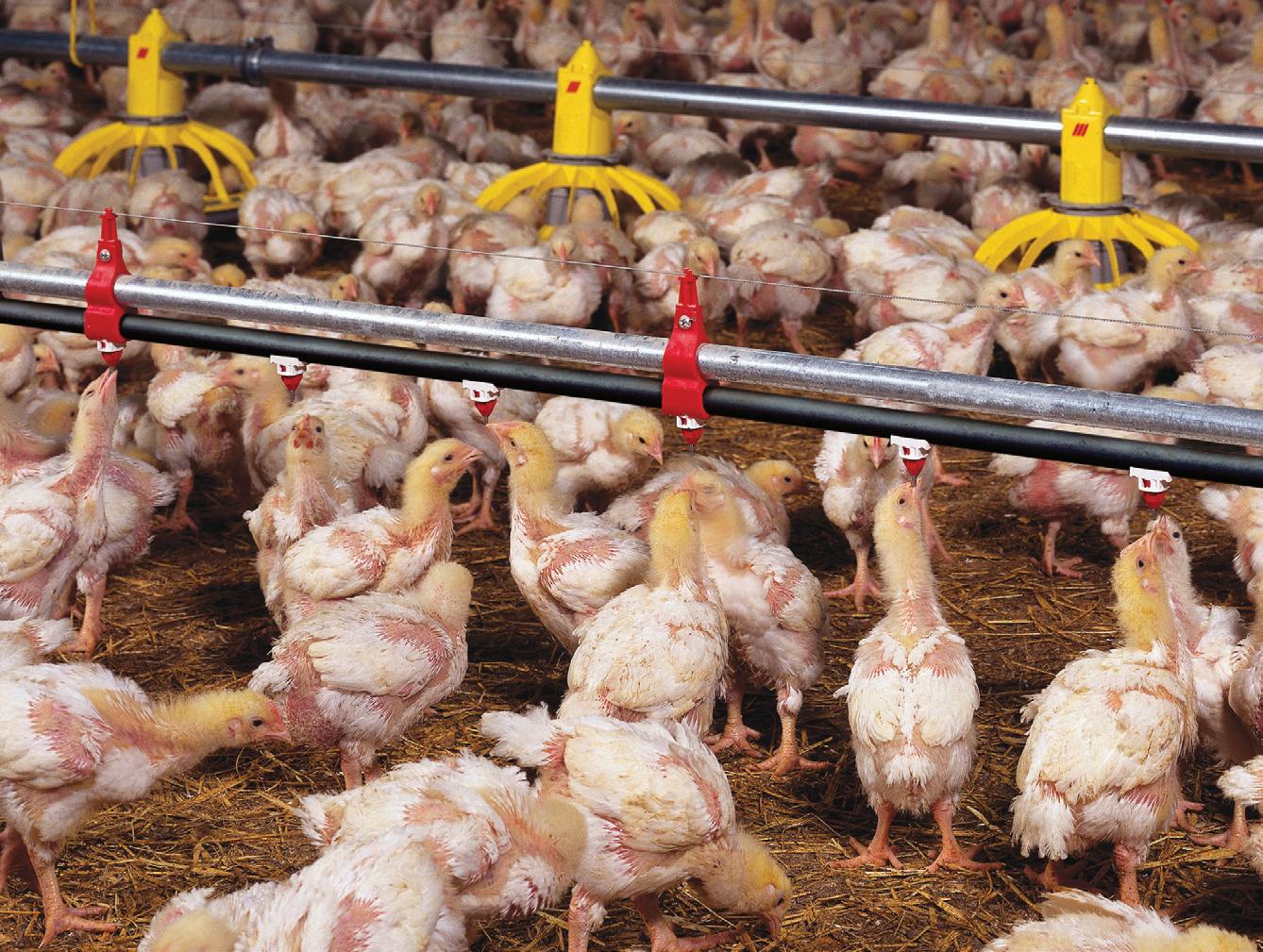
• set the water line height so that the birds are drinking at a 50- to 55-degree angle. (imagine a line drawn from the bird’s feet to its beak.) at this angle, almost
all of the water discharged by the drinkers as the birds peck at them goes into the birds and not onto the litter. The birds grow rapidly, so you must adjust the line height daily.
• adjust the water pressure regularly to maintain friable litter. Litter readings are the best method for determining water pressure. Pressure that is too high will wet the litter. Litter will dry out if the pressure is too low, and the birds will not get sufficient water.
researchers are seeking a variety of methods to replace the use of antibiotics in poultry flocks, including vaccines, anticoccidials and probiotics. However, keeping the poultry house environment as hygienic as possible through proper management of the watering system can help maintain intestinal integrity in your flocks with or without antibiotics. n
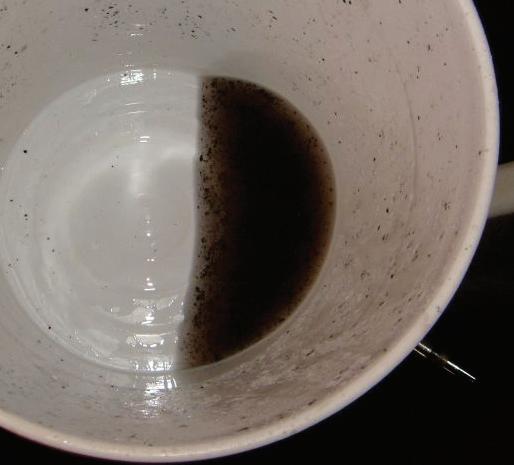
ThIS IS AN ExAmPlE oF WhAT comES oUT oF ThE WATEr lINES (bIoFIlm)
FlUShING WITh A hYdroGEN
clEANEr.
Photo by Kaitlin h amilton
New Barn
taking the next Step in Automation
Abbotsford’s Mountain View Farms is the first hatching egg operation to link all of its barns with an egg packer and sorter
B Y D Av ID S CHMIDT
Although egg-packing units are a common enough sight on canadian layer farms, many hatching egg producers still pack all their eggs by hand since hatcheries require producers to remove small and oversized eggs before shipping.
in recent years, however, hatching egg producers have been installing more automated packing equipment. Len and angela groothof of Mountain view Farms in abbotsford, b c., are the first hatching egg producers in north america to take the next step in automation.
ExPANSIoN
oPPorTUNITY
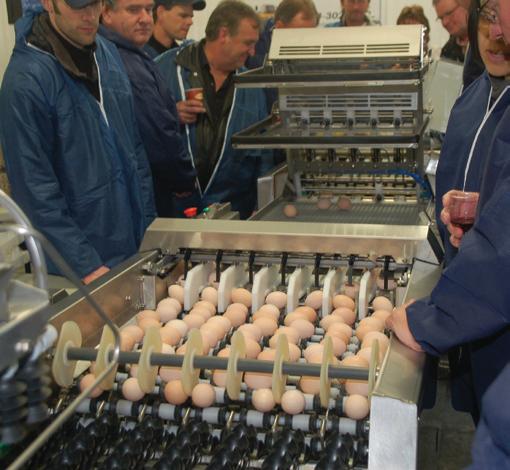
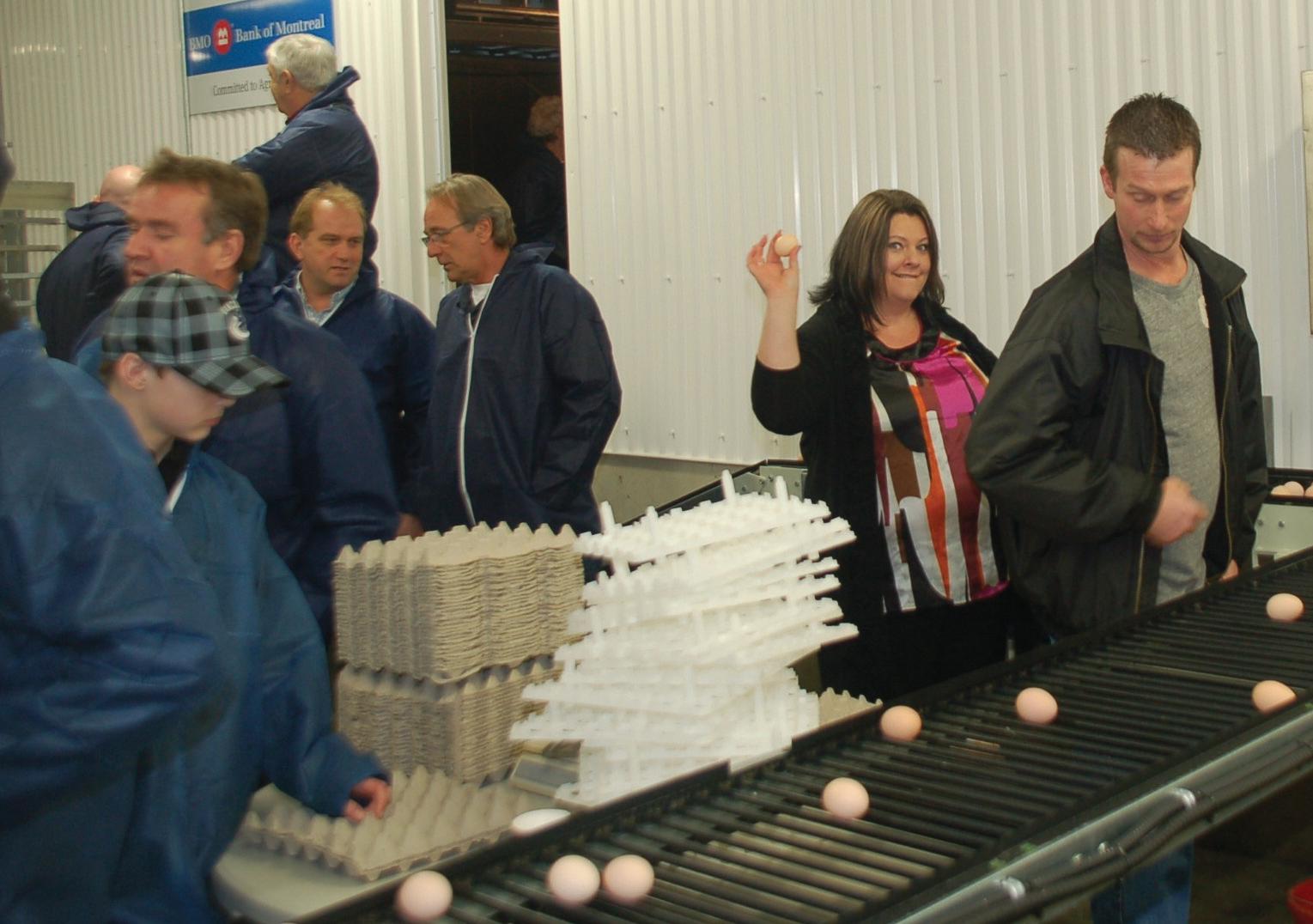
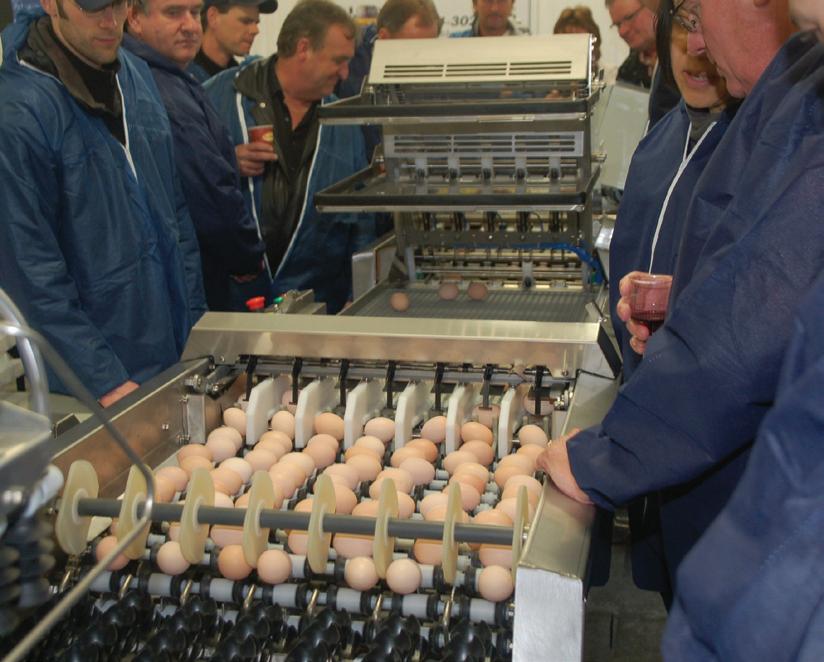
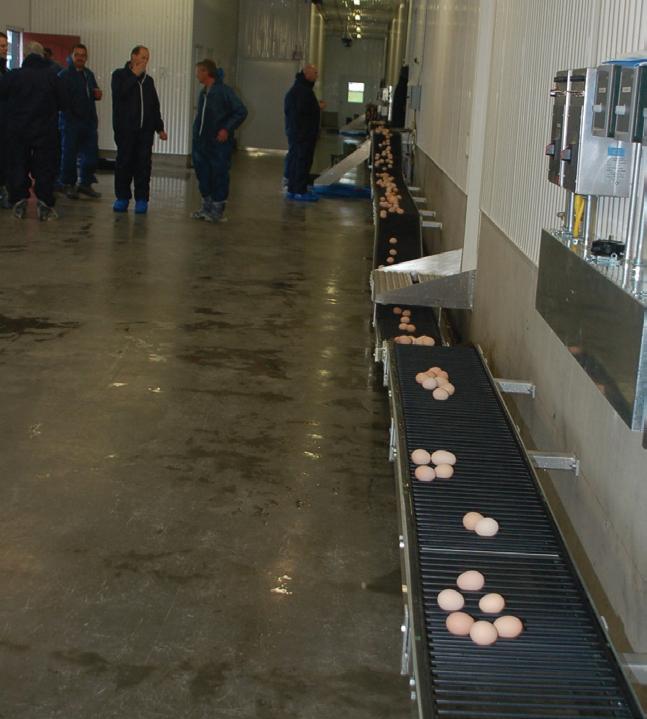
When the groothofs recently built their third layer barn to accommodate their 58,530-bird quota, they took the opportunity to link all three barns to a staalkat egg packer with a grading attachment that not only packs all the standard-sized eggs, but also automatically sorts out the small (below 52 grams) and jumbo eggs onto separate trays. in early March, they and their supplier, united agri systems (uas), invited local broiler hatching egg producers to see the new system.
They got a lot of curious visitors, anxious to see the operation and decide whether or not to adopt the system on their own farms. although
iMprOved ACCurACy
Angela and Len Groothof (above) decided to install a Staalkat egg collection conveyor and grading machine to save labour and improve accuracy.
suitably impressed, some suggested the payback was not enough to justify the additional costs.
Len groothof says payback was not the issue: saving himself and his wife labour and improving accuracy were the things he wanted to do, and he has achieved these goals.
“The system is much less work. i get much better accuracy than i would get from hand sorting and the eggs are packed in half the time.”
The new 42- by 450-foot barn is a virtual carbon copy of the existing two barns. uas’s Leo apperloo calls that the sign of “a happy customer.”
VENTIlATIoN
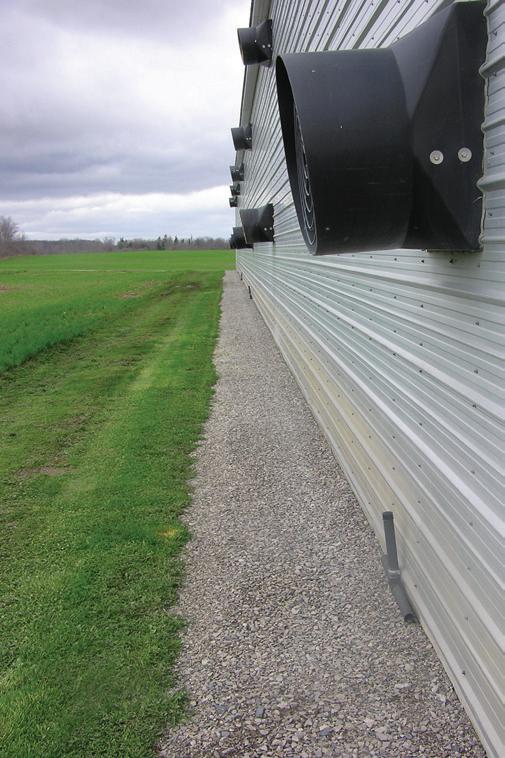
However, it does have the addition of a tunnel ventilation system: four endmounted 52-inch fans (30), each capable of moving 30,000 cubic feet of air per minute, linked to a bank of radiators
Photos by
d avid
s chmidt
New Barn
at the far end of the barn. The system is designed to automatically kick in when the temperature goes 5 c above a preset amount.
noting he has been guaranteed barn temperature will never exceed 25 c, groothof says that is better than misters can do on a hot day.
While those hot days do not occur often on the west coast, when they do, they can devastate poultry flocks. as a result, tunnel ventilation is being put in all the new poultry barns and being retrofitted into more existing barns.
ThE GrooThoFS AlSo AddEd A TUNNEl VENTIlATIoN SYSTEm IN ThE NEW bArN cAPAblE oF moVING 30,000 cUbIc FEET oF AIr/mINUTE
“i expect 40 to 50 per cent of Fraser valley poultry barns to have tunnel ventilation within five years,” apperloo says, noting uas alone has put the system into more than 20 barns in the past 18 months. n
Control Inputs
Ask us how controlling your inputs and mixing on-farm can improve performance and add to your net pro ts. Call us today at 1-877-625-4400 and speak to one of our Poultry
www.grandvalley.com
All ThrEE bArNS ArE lINkEd To ThE EGG PAckEr.
CPRC Update Safe food and healthy flocks
Canada has one of the safest poultry value chains in the world. World-class on-farm food safety programs, strategies that maintain flock health, pathogen detection methods and food handling procedures all contribute to the production of safe, high-quality poultry products. Maintaining this level of safety and quality throughout the poultry value chain, as it extends from the parent flock through production and processing to the consumer, presents ever-changing challenges for which the sector must always be ready. innovation is required to meet new challenges; research is the driver of that innovation.
The canadian Poultry research council (cPrc) includes food safety among its priority research areas. The program also includes a number of related disciplines, including poultry health and welfare. cPrc’s 2011 call for Letters of intent is asking the research community for proposals designed to build on past and ongoing work relating to “Food safety and Quality – impact of Poultry Health and Disease” and “Poultry Welfare and behaviour.” The call includes a range of current and emerging issues, identified by cPrc’s member organizations.
fOOd SAfety And pOultry heAlth
threat to poultry production. assuring the future health of our national flocks will depend on innovations in poultry medicine and production practices. everyone agrees: strategies to promote flock health must not have a negative impact on human health. The decision to use antibiotics in poultry farming is not taken lightly and is constantly being assessed. The canadian poultry industry supports the responsible use of veterinary health products that have been approved by the veterinary Drugs Directorate of Health canada in order to ensure food safety, animal health and animal welfare. consumers’ trust in the food they eat is integral to the success of our industry. as a result, antimicrobial use and resistance has been a critical priority for the poultry sector for many years. To date, over $5 million has been spent on this aspect of poultry research and
WelfAre And BehAviOur
To ensure that the canadian poultry sector is at the forefront of poultry welfare, ongoing research and innovation is required. a comprehensive poultry welfare program requires expertise not only in behaviour, but also in animal health, genetics, nutrition and management. This research must be based on sound science and examine all of the production factors that affect a bird’s well-being. research on production systems (such as housing, lighting, feed and water delivery) should be performed with the effect of genetics in mind. That is, the birds must be compatible with the production system in which they are placed. Poultry welfare must continue to be considered throughout the entire value chain, while taking into account the uniqueness of canadian climatic conditions and geography.
Innovation is required to meet new challenges; research is the driver of that innovation
as cPrc members know, the health of our national flocks is intimately connected to the quality of our products. a healthy national poultry flock is vital to the life of the industry and to ensure that canadians are provided with safe, quality products. Disease-causing organisms are always present and constantly evolving, which represents an ongoing
it will continue to be a high priority going forward. research into innovations that will provide the poultry sector with an array of alternative methods by which to combat disease and optimize flock performance is also a key priority. enhanced vaccines, bacteriophage, pre- and probiotics, diet manipulation and immunomodulators, are all being assessed as potential complements to the avian immune system. The effects of these tools on microbial populations in the gut and on avian immune function are also being studied to ensure their safe and effective use.
canadians expect and deserve a safe food system; an integrated approach to research that addresses issues throughout the value chain will ensure that they continue to enjoy one of the best.
For more details on any cPrc activities, please contact gord speksnijder at The canadian Poultry research council, 483 arkell road, r.r. #2, guelph, ontario, n1H 6H8, phone: 289251-2990, fax: 519-837-3584, e-mail: info@ cp-rc.ca, or visit us at www.cp-rc.ca. n
The membership of the CPRC consists of Chicken Farmers of Canada, the Canadian Hatching Egg Producers, the Turkey Farmers of Canada, the Egg Farmers of Canada and the Canadian Poultry and Egg Processors’ Council. CPRC’s mission is to address its members’ needs through dynamic leadership in the creation and implementation of programs for poultry research in Canada, which may also include societal concerns.
Manitoba & SaskatcFhewan | Ray CarrieFre 1.855.257.4211
Alberta & British FColumbia | Jan Breckman 1.866.791.3753 or visit jefo.com
by MILt Carr anD aSSOCIateS
Carr’s Capital time for a Plan
life has a tendency to race on without making any pit stops. it seems that the older we get, the faster the whirlwind pace of life can become. and the more complicated things become, the less time we seem to have to deal with these complications.
one of the areas where time seems to just buzz over is in business. often it seems that a family farm spends a lot of time just keeping up with “keeping up.” as the poultry industry changes, the farm business evolves as well. innovation seems to be the driving force for many farms and a lot of energy is devoted to keeping up with current changes and making improvements.
often, it seems that not much attention is given to areas of the family farm business that should be addressed. since we tend to focus on issues of immediate priority in life, we neglect areas that have greater consequences should they go unattended. according to the canadian government and accountants involved with farm business, 85 per cent of farming families have not taken advantage of completing a proper succession plan or farm business plan.
unfortunately, determining how the farming family will distribute the farm assets to the next generation is often not made a priority. What if Dad takes the family agricultural business and divides the shares equally among five children – one child is now a shareholder and full-time farming member of the family, while his brothers and sisters have become schoolteachers, firefighters, etc. They have moved on and have no interest in working the farm, but they have been willed a share in the farm. complicating matters is that they now have children of their own.
FUTUrE coNcErNS
me make a really good decision”? i am convinced that when clients develop a plan that includes the family farm business objective, legal agreements and discussions with accountants, asking the advice of a trusted business friend or family member who is looking after some of the farm’s business affairs, you can’t go too far wrong. it is unlikely you will have a great loss if you have asked this many people the right questions. The plan drives the questions and receives the answers from professional planners and certified farm advisors who can help steer you in the right direction.
ToUGh QUESTIoNS
in addition to keeping up with changes within their industry and keeping productivity levels high, farm families need to ask themselves some difficult questions and have a succession plan in place. expectations and reality are often on opposite ends of the succession plan spectrum. The greatest stumbling block to the whole succession planning process is that the subject of the family farm is a very emotional topic. it is hard to state one’s feelings when the emotion is great. To tell one family member their direction is not the one you are taking is very difficult to execute because of the fear of hurt feelings. When subjects are going to cause grief, we generally avoid them. Typically, when given the choice between sitting down with your family to address some difficult questions about succession – an areawhere there doesn’t seem to be an immediate need for discussion –and talking about acquiring the latest in chicken feeders, we will choose the chicken feeders. Thus the topic of succession planning is often neglected.
The greatest stumbling block to the whole succession planning process is that the subject of the family farm is a very emotional topic.
in 25 years, the sibling who remained on the farm has a desire to hand this farm operation down to his own children or grandchildren, but without a proper plan he may find that now his nieces and nephews and brothers and sisters are all shareholders. How does he satisfy their requests and meet the objective that he has worked his whole life for, to build a farm that he could hand to his children?
achieving family harmony is a challenge that requires careful consideration and handling. i am often asked, “How does planning actually protect me or give me direction to help
There are no easy solutions, and no quick fixes. When it comes to operating a family farm business there are a lot of issues that require consideration. but one area that should not be neglected, and often yields the greatest punch to the family farm, is succession planning. it is such a delicate topic, yet it is one of great importance. so, when is a good time for a plan? if you don’t set aside some time to work through developing a plan, time might just pass you by. n
If you would like more information about succession planning, feel free to drop us an e-mail at mcarr@carrassociates.ca, or if you would like us to address a specific topic or area of concern, please let us know.
Biosecurity Funding Enhances biosecurity
Producers in provinces where government funding exists are making changes to increase biosecurity
B Y J IM K NISLEY
more than 135 ontario poultry producers have picked up what many people would consider some pretty easy biosecurity money.
The producers were among 500 that took in a four-hour biosecurity refresher course, decided what they wanted to do, developed a plan and applied. so long as the project fit the criteria and they were willing to spend some of their own cash, they could get up to $10,000 from the federal/provincial growing Forward biosecurity program.
so far poultry producers have had the program all to themselves, as they are the only livestock sector with an approved national biosecurity plan. While there are national standards in place, the program differs from province to province. both alberta and ontario will help pay for on-farm projects that qualify, while nova scotia relies on education.
in ontario farmers must also attend a four-hour biosecurity course, held by the Poultry industry council (Pic) and the ontario Ministry of agriculture, Food and rural affairs (oMaFra), while in alberta there is no requirement to attend a course.
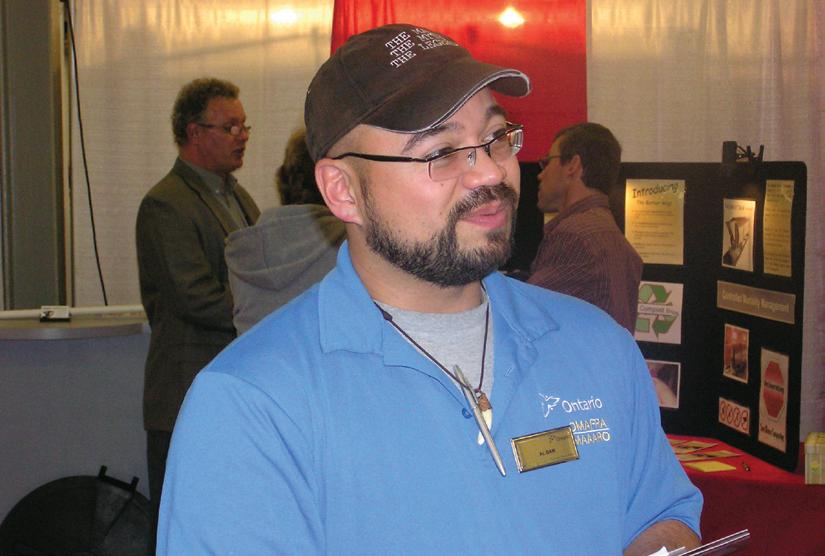
al Dam, poultry specialist with oMaFra, says qualifying is “relatively painless – all you have to do is spend
SImPlE SolUTIoNS
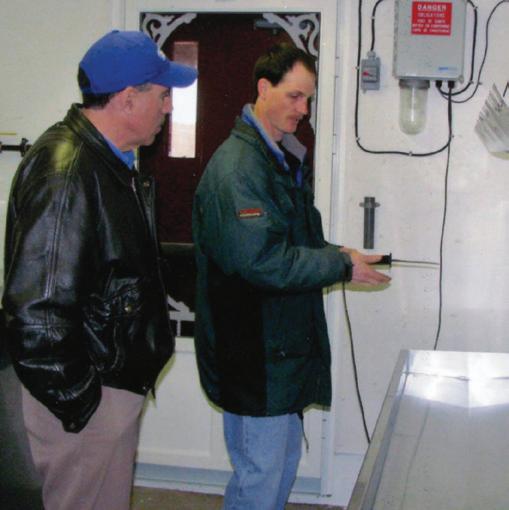
al dam (right), omaFra’s poultry specialist, says growing Forward biosecurity funding can be used to easily enhance such biosecurity measures as rodent control around barns.
four hours with me.”
“We give you (poultry producers) the tools and you do your own action plan.”
When the action plan is approved, the producer goes ahead with the project, which can range from gravelling the perimeter of a barn, to laying a concrete pad for manure storage, to water purification to a host of other options.
in ontario, the government will refund up to 50 per cent of the cost
to a maximum of $20,000. Dam says: “you spend $20,000 before you get the $10,000 back.”
ed McKinlay, of McKinlay Farms, said: “it’s a pretty good program.” it went over all the things we know we should do and should be doing. “There’s a lot of common sense in it,” he said. in addition to the refresher course, McKinlay also qualified for help to pay for a water treatment system. He said the
water in his area has high iron content and the treatment system deals with that.
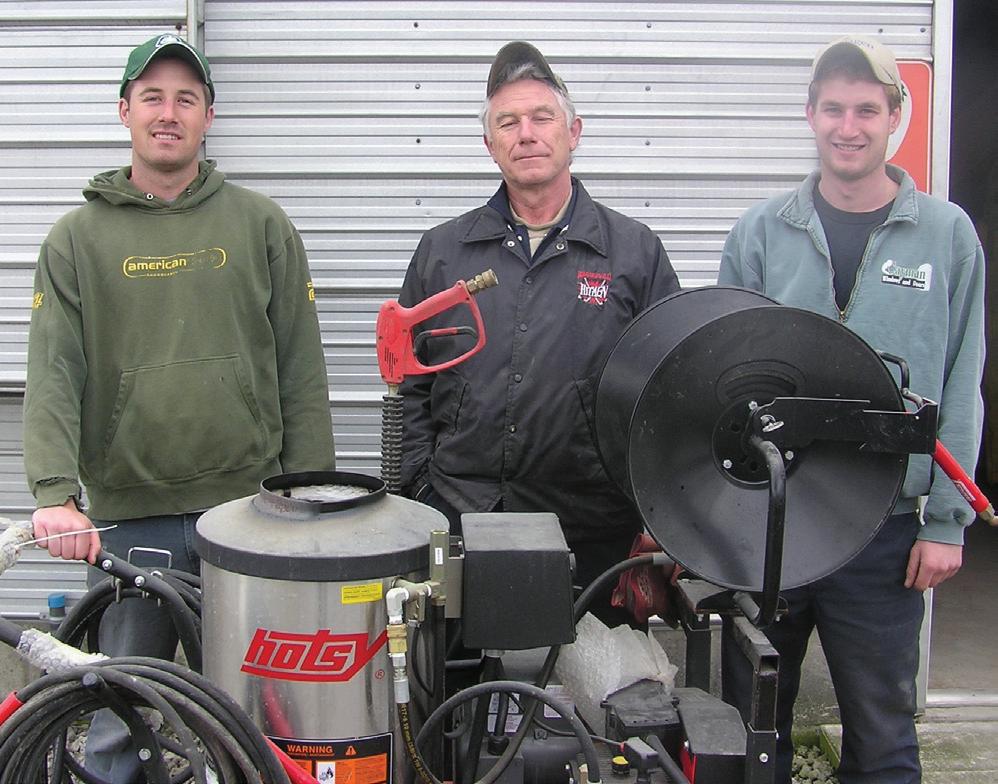
John Kraay, who farms with his sons Darren and chad near Jarvis, ont., said he took full advantage of the program, by installing a concrete composter, and buying a new pressure washer and feed bins.
He also said the program was useful and Dam did a good job presenting the information. The only hitches were delays in processing the receipts he sent in and authorizing the government rebate cheque.
He said he sent in bank statements on his purchases that said: “paid in full.”
“Paid in full should be good enough,” he said. but for some reason, the officials required more information and that delayed his payment by an additional month.
Dam said water treatment and manure composting are a couple of the more popular installations under the program.
Biosecurity
ontario has held 23 workshops across the province.
in alberta, the program is also proving popular, according to cara Dary, biosecurity and special projects co-coordinator with the provincial agriculture department.
The alberta program is richer than ontario’s. Producers can qualify for up to $20,000 in government rebates for a $40,000 project. in addition, there isn’t a requirement to attend a biosecurity course.
However, producers must clearly identify what they intend to do and it must fall into one of three areas related to biosecurity – access, health impact or operations management. under access, anterooms with change rooms and showers have proven popular, she said. under health, water quality and improved ventilation are popular. under operations management, dead stock incinerators, composters, concrete
flooring, pressure washers, and pest and rodent control are all popular.
To be eligible, producers must get a registration number and submit an application that describes their plan and how it improves biosecurity, she said. all sectors of alberta’s poultry industry are taking advantage of the program. “it is popular across the board,” she said. nova scotia is entering its third year of the growing Forward biosecurity implementation Program and is doing it differently than ontario and alberta.
The nova scotia Department of agriculture contracted agraPoint to oversee this program with funding going towards biosecurity training and provision of biosecurity tools for poultry and livestock producers to enhance biosecurity implementation.
Tools developed, like the nova scotia biosecurity booklet, are the foundation for the training and implementation
Biosecurity
efforts, said alex oderkirk of agrapoint. The nova scotia biosecurity booklet provides the Principles of biosecurity as well as a variety of standard biosecurity Protocols (sbP) and accompanying forms to help producers develop a proper biosecurity program for their farm operations. a variety of biosecurity signs have also been developed to complement the training effort and are readily available to poultry and livestock producers.
a number of workshops, seminars, presentations on biosecurity have been and will be held to provide producers with biosecurity information to increase their knowledge in this animal health and food safety area and help them develop proper biosecurity programs for their farming operations, he said.
another biosecurity tool being developed for nova scotia producers is a webpage, www.biosecuritynovascotia.com, which contains the biosecurity booklet and other biosecurity information. an added feature being worked on for this webpage is an interactive “virtual biosecure Farm” that will add to the training effort and give producers an interactive tool and another aspect in how to develop an effective farm biosecurity program.
The funding of the growing Forward biosecurity Program in nova scotia is much lower than in ontario, so the funding
is being used to train producers rather than producers having access to funds for biosecurity projects, oderkirk said. by using funds in this manner, producers are properly trained and given the proper tools to implement an effective biosecurity program on their farming operations, he said.
The national Farm biosecurity Program is designed to help producers achieve the target outcomes listed in the national avian on-Farm biosecurity standard. a target outcome is defined by the canadian Food inspection agency as: a goal that all keepers of poultry should aim for if they are to protect their flocks from the introduction and spread of avian diseases. examples of target outcomes and projects eligible under the national Farm biosecurity Program include:
• visual indicators (signs) to define the controlled access Zone (caZ) and restricted access Zone (raZ);
• Placing of signage, fencing, gates or other physical barriers to identify zones and access points;
• installation of locks or a security system at raZ entrance;
• installation of anteroom or sanitizing stations;
• More stringent additional biosecurity measures are implemented, either at the barn or premises level, where “all in/all out” scheduling and downtime is not practical.
other outcomes and projects eligible include sanitation equipment and modifications to barns to allow for segregation of birds. all cost-share funds are available on a first come, first served basis up to the available annual funds for each year of the program. applicants must meet the program eligibility criteria, and adhere to all program terms and conditions and project claim submission deadlines, to qualify for cost share.
The Farm biosecurity Program is part of the best Practices suite of programs under growing Forward, a federal-provincialterritorial initiative. n
BIOvatorTM in-vessel composter. Quality compost in as little as four days.
ThE krAAYS (lEFT To rIGhT: dArrEN, JohN ANd chAd) UTIlIzEd SomE oF ThEIr bIoSEcUrITY FUNdING oN A NEW PrESSUrE WAShEr.
BARN WASHING
REAL ESTATE
“NEW LISTING” LARGE POULTRY OPERATION: Presently set up for Turkey. 3 barn operation. 88,000 sq ft of growing area. Suitable for other poultry. Standby generator and all farm & barn equipment. Modern 3+1 bdrm home. All on 50 acres of land located near Acton, ON.
WINDHAM CENTRE – BROILER FARM: One barn operation. 40 x 352 x 2. Ziggity nipple drinkers. Chore-Time equipment. Sprinkler mist system. 55 kw generator and alarm system. Natural gas heaters. 12 acres on paved road.
LITTLE BRITAIN - BROILER BREEDER FARM WITH 14256 H.E.M.S. Split flock. 2 barn operation. Barn 1- 275 x 40 x 1, Barn 2- 305 x 40 x 1. Solar wall Vencomatic Nests, Roxell Feeders, Fancom Computer, Bird weighting. Box heaters. Lubing drinkers. Automatic generator, 105 kw. New well. Pullet quota of 8257 produced off site. Year round production. 50 Acres, 45 workable tiled loam soil. New 3+1 Bdrm brick home.
ALL THINGS CONSIDERED
bY
Jim
kNiSLEY
The Best of Times
the outlook for canadian poultry farmers really shouldn’t be this rosy. corn and soybean prices are way up and expected to stay there. Prices for alternatives to corn and soy are also up.
These surging prices and tight supplies are squeezing u.s. and european livestock farmers and slowing recovery for hog and cattle farmers. in theory, the high prices, tight supplies of feed, increased competition from ethanol as well as volatile weather should be pressuring poultry farmers. but that is far from the case. consumer demand for chicken continues to increase, egg consumption remains solid and turkey seems to be recovering along with the canadian economy.
The result is that, according to agriculture and agri-Food canada (aaFc), the average canadian poultry and egg farm is expected to earn $162,478 in net operating income in 2011. This is 36 per cent higher than the 2005-2009 average and about 10 per cent more than in 2010. egg production is expected to increase by two per cent, as the average rate of lay increases, according to aaFc.
in addition to setting canadian poultry producers apart from other canadian livestock farmers, this also distinguishes them from poultry producers elsewhere. For example the Irish Times recently ran a screaming headline and story on the decline, and perhaps impending demise, of the irish broiler industry in the face of low price imports.
in the united Kingdom, the inability to pass higher costs and prices through to consumers is straining the industry.
The market research firm Plimsoll recently reported:
“Whether it’s fuel, materials or wage demands, every company in the u.K. poultry industry is being squeezed. sixty per cent of companies have seen their gross margin fall in the latest year,” said report author, David Pattison. although the majority of poultry companies in the u.K. remain profitable, Pattison said that over the past two years the average profit margin in poultry had fallen to three per cent, with 216 companies losing money.
it seems there is a need in parts of the u s. to manage supply or impose supply management in a rather ad hoc way to ensure that prices can cover costs.
Meanwhile in canada, supply management blunts the impact of rapidly rising feed costs. These costs (largely corn) are expected to increase by 25 per cent in canada this year. That forecast is based on the prospects of an average harvest in canada and expected increases in corn production in the u.s. offsetting feed prices are a 10 to 15 per cent increase in chicken prices. The result is that market receipts for the average chicken farm are forecast to rise by 13 per cent this year from those in 2010.
The average poultry and egg farm earned about $147,000 in net operating income in 2010. This was 23 per cent higher than the 2005-2009 average.
These expectations for rising incomes for poultry and egg producers in 2011 sets them apart from canadian agriculture as a whole. after improved returns in 2010, forecasts indicate that farm income for sectors other than poultry and eggs will decline because of increased operating costs and reduced government program payments. rising costs and dropping government support more than offset expected increases in crop and livestock receipts.
Consumer demand for chicken continues to increase, egg consumption remains solid and turkey seems to be recovering
The breakdown is as follows. crop receipts are expected to be up slightly as the price increases in grains and oilseeds that occurred in the second half of 2010 continue in 2011. but crop production expenses are increasing in 2011. costs for fertilizer, seeds and pesticide are all expected to rise, and volumes purchased will increase as unseeded/ flooded acres on the Prairies are put back into production and farmers push to increase yields. Meanwhile, government program payments will decrease.
net cash income and average net operating income are forecast to drop by 13 per cent and 11 per cent, respectively.
in the u s., Paul Downes, president of Mountaire, a Delaware-based poultry company, said the industry faces a price-supply squeeze. “The only way to higher prices is less supply,” he said in a published report. “The only way to less supply is chicken companies will shut down or cut back. That’s not good for poultry growers or the economy. but i think that’s what we’re going to see.”
cattle and hog receipts are also forecast to be higher in 2011 as they continue to recover from 2009 lows. but those increased prices won’t offset the impact of higher feed costs, a higher dollar and country of origin labelling in the u.s. as a result, net incomes of red meat producers will go down.
net operating income for the average cattle farm is forecast at $11,608 in 2010 less than seven per cent of the forecast income of poultry farmers. net operating income for the average dairy farm is expected to be $111,322 in 2010, about 75 per cent of poultry income. These income forecasts and estimates indicate that for poultry producers these are among the best of times. n