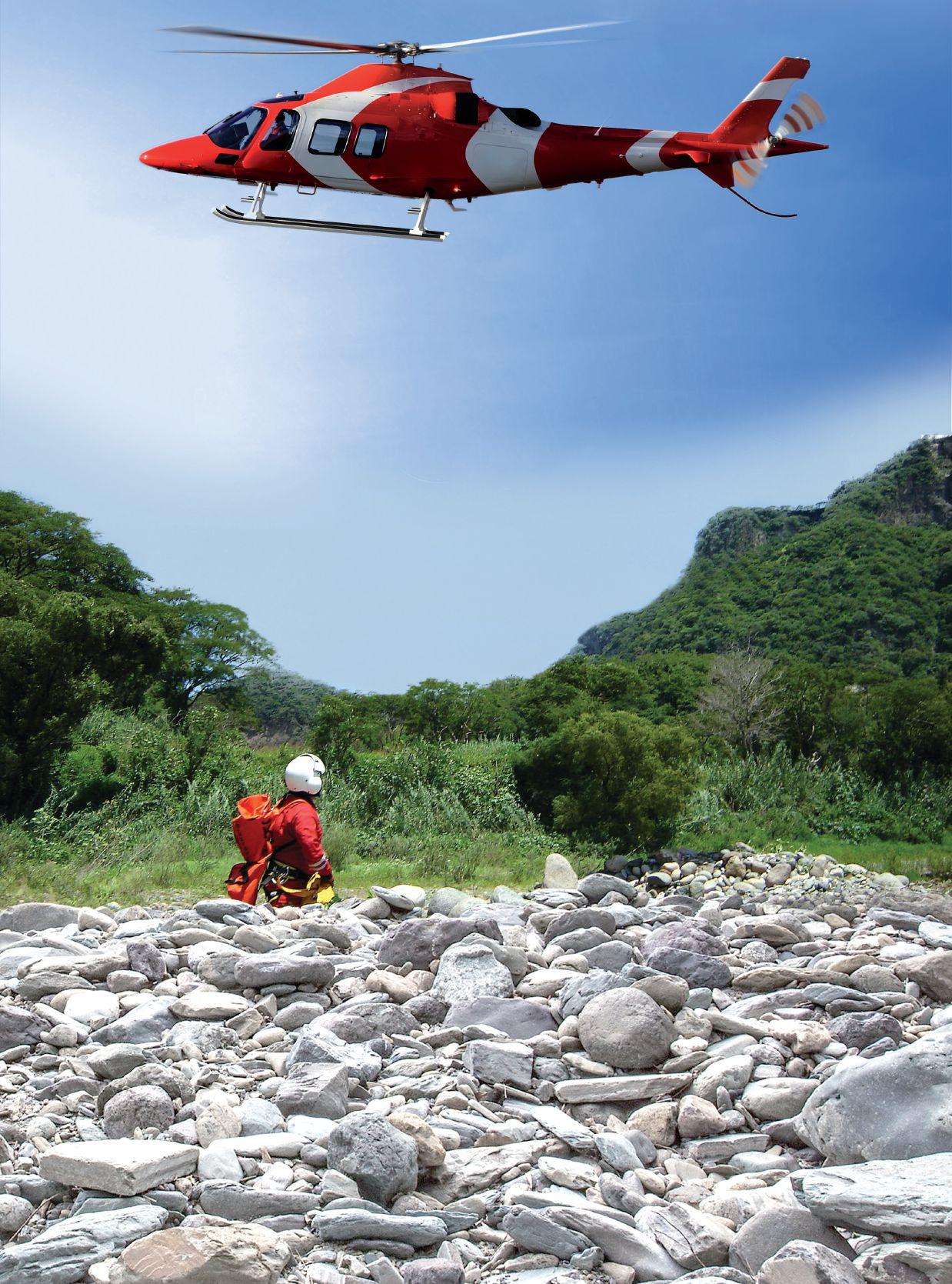
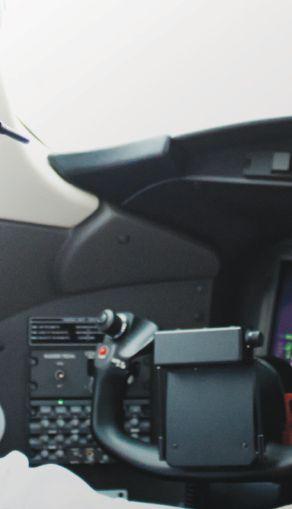
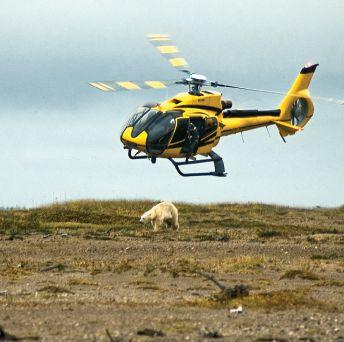
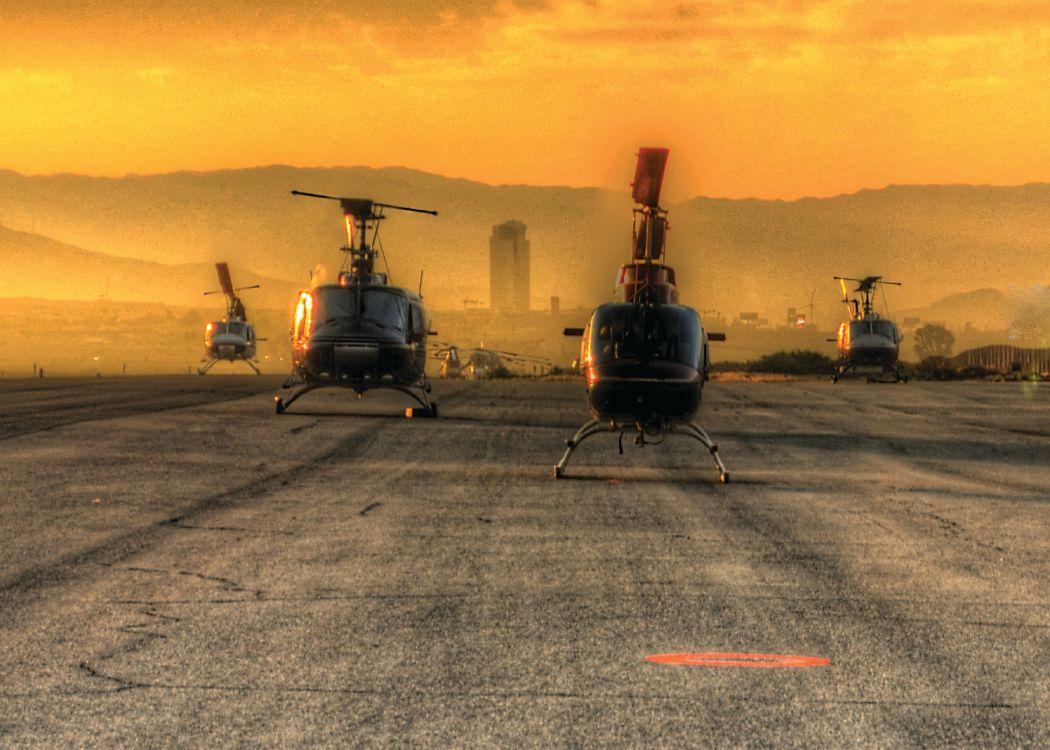
AW109 Trekker is the newest light twin-engine helicopter, equipped with robust skid landing gear; developed to provide the perfect platform for demanding utility and aerial work operations.
High productivity, excellent flying qualities, controllability, manoeuvrability and latest-generation glass cockpit and advanced avionics allows operational flexibility for a variety of roles.
LEADING THE FUTURE
TREKKER
HEDITORIAL
MATT NICHOLLS is editor of Helicopters
ow corporate leaders conduct their business and why their decisions, personal conduct and attitudes work to build a strong corporate culture or erode it to dust is something that has always fascinated me.
There are countless books on the topic of corporate leadership and many recount the undesirable follies of unscrupulous so-called leaders who have failed to lead, instead using their lofty positions for personal gain. It’s a sad commentary on how some leaders misuse power, but there are also countless examples of leaders of influence.
One of my favourite books is Authentic Leadership: Rediscovering the Secrets to Creating Lasting Value by Bill George, the former CEO and Chairman of medical technology firm Medtronic. It’s a compelling read in which George analyzes important components of authentic leadership: working with purpose, value, heart, relationships and self discipline.
Many of the concepts discussed in the book came to mind as I was putting together this issue of Helicopters. Our cover story on Airbus Helicopters Canada, for example, is a wonderful piece that illustrates just how influential and impactful an organization can be. For more than 30 years, the Fort Erie, Ont.-based firm has been marketing, manufacturing, selling and assembling some of the most technologi-
Seeking Authenticity
Highlighting Corporate Leaders in the Canadian Helicopter Industry
the community and Niagara region is impressive and I was very pleased to see that Trapp is taking an active role in not only enhancing his personal knowledge of the Canadian operating environment but also the facility’s nuances.
And while the tangible aspects of what the company has accomplished, in terms of its helicopter development and its role in enhancing the safety envelope, is impressive, I am even more taken with what I like to call the people principle: how employees view the company and how they are impacted by what the company accomplishes in the industry. Perhaps it’s as simple as this: how do they like their job and how much pride do they have in what they do?
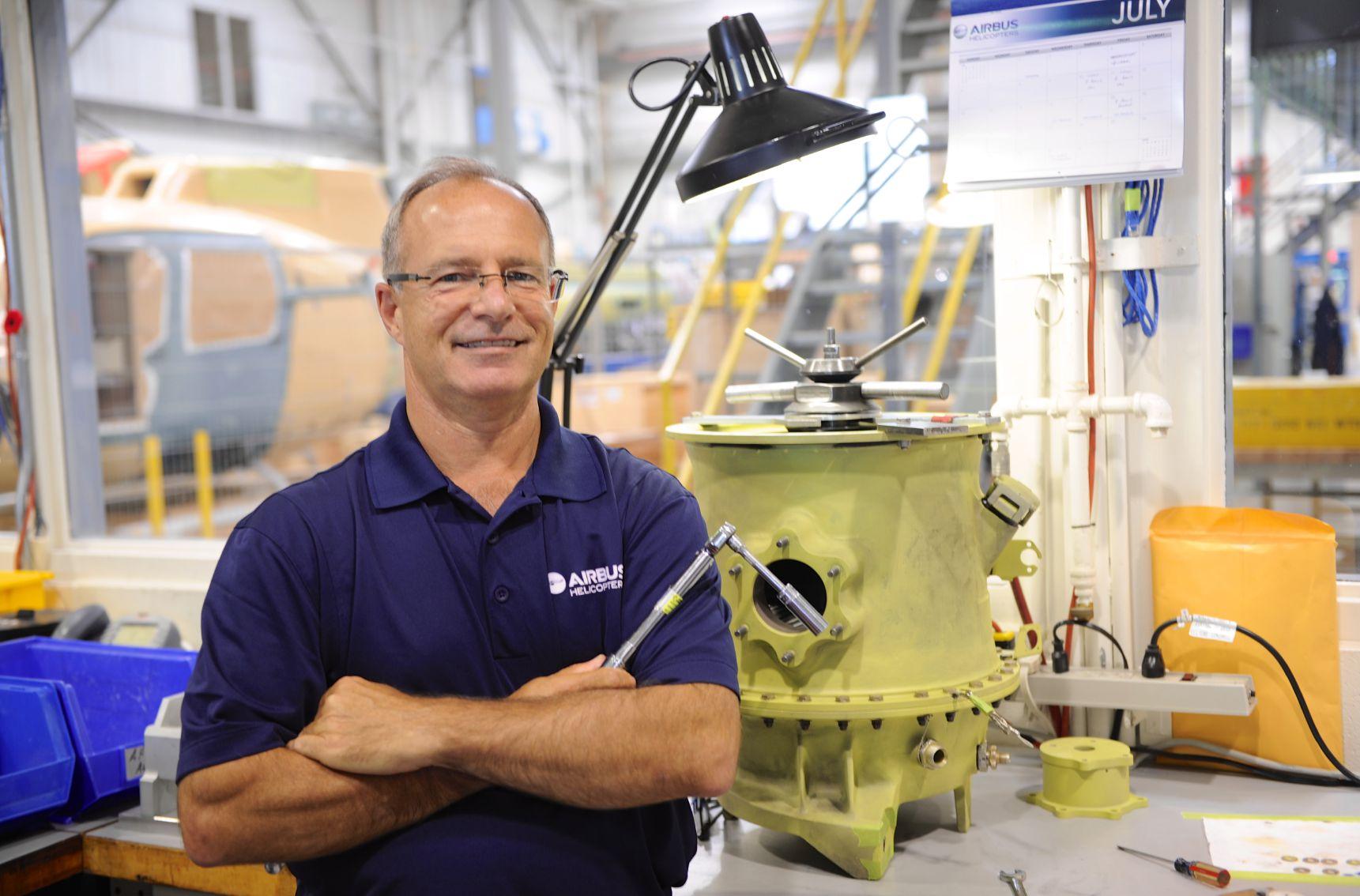
Tour the Airbus facility in Fort Erie and these points truly resonate. Every time I am present, the sense of pride and commitment to excellence holds true. The walls are adorned with various types of aircraft in action. Employees celebrate all aircraft deliveries and are always engaged and willing to share experiences. When they do, they always speak highly of the company’s role in the industry and the community. It’s a message that starts from the top, one that has been conveyed to me by Trapp himself. Leading with heart and purpose: George’s important authentic leadership premise is alive and well here.
Other pieces in this issue of Helicopters highlight such essential principles. Hydro One’s milestone 65th anniversary (see “Negotiating the Fly by Wire,” pg. 19) and “Exploits of Three Wise Men,” pg. 23 highlight how commitment and purpose have transformed the organizations led by key visionaries. Their exploits –hard work and dedication for change – have not only enhanced operational processes for the better but increased safety throughout the industry.
Perhaps it’s as simple as this: how do they like their job and how much pride do they have in doing what they do? ‘‘ ’’
cally advanced helicopters in the world. And with a large portion of Canadian operators using Airbus products – 190 operators with some 680 helicopters nationwide – its reach is certainly impressive. (For more on Airbus Helicopters Canada, see “Making Their Mark,” pg. 14.)
In preparing the piece, I had the opportunity to sit down with president and CEO Romain Trapp and Laura Senecal, Director of Public Relations and Corporate Affairs, to discuss the Airbus Helicopters Canada story in detail. I have also toured the Fort Erie facility on a number of occasions and it’s hard not to be impressed. Airbus’ commitment to the Canadian market and its dedication to
Our Q&A with Helicopter Association of Canada (HAC) president and CEO Fred Jones (see “Making a Difference,” pg. 29) also builds on this premise. His leadership and commitment continues to ensure the future holds promise for operators from coast to coast.
As George notes, the premise of authenticity comes down to character and commitment – a desire to stay true to a plan and realize the intrinsic value of leading with the heart, working with compassion. These are the overriding principles we should all live by –both on the job and in every aspect of our lives. It’s nice to see all are alive and well in the Canadian helicopter industry.
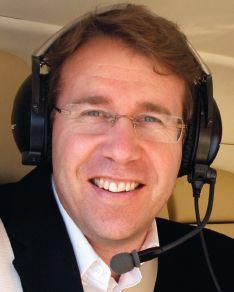
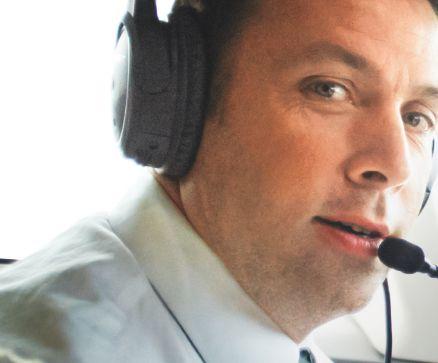
Flying is my passion. And my job. Many of the airports I fly my clients into are located in major international cities. That usually means congested airspace and sometimes hard-tounderstand controllers. So I need to be on my game. Hear other pilots. Gather my clearances accurately. Because when I’m in control, I’m completely relaxed. And so are my passengers. Only then can I
Better sound can make all the difference, especially where you go. Which is why, with 30% greater noise reduction than conventional noise reducing aviation headsets, the A20 headset lets you hear more of what you need to hear. While proprietary cushions and minimal clamping force let you fl y comfortably for hours. Meets or exceeds TSO standards.
CHC Ramping Up Operations in St. John’s
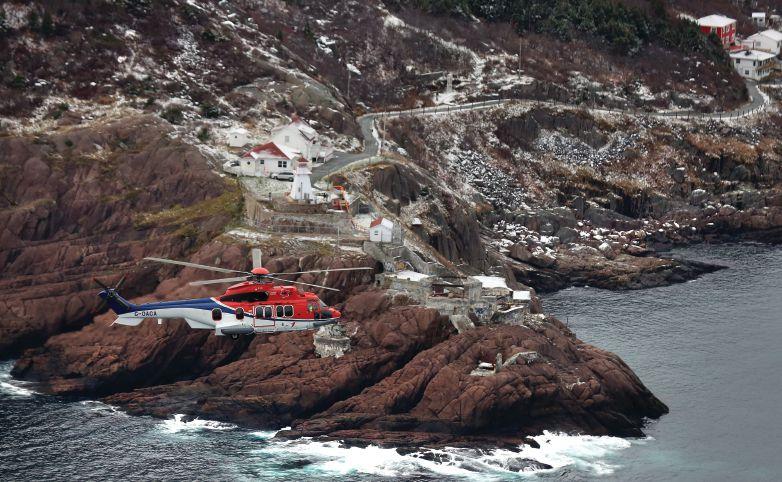
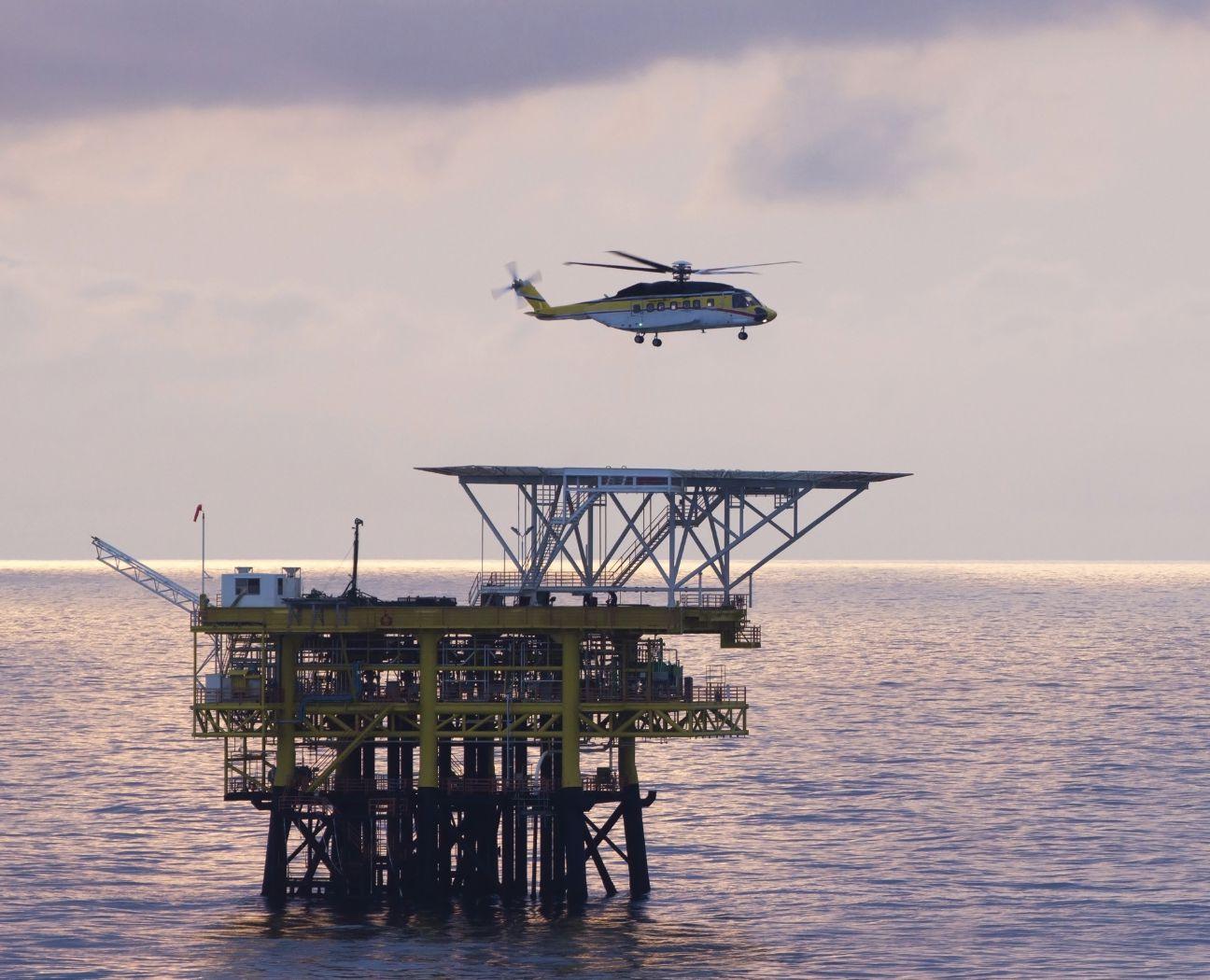
CHC Helicopters Canada has stepped up its construction activities at St. John’s International Airport in St. John’s, N.L., in preparation for transporting workers to and from the Newfoundland and Labrador’s offshore oil installations.
“CHC Canada is establishing a presence in St. John’s,” CHC’s T.R. Reid told the St. John’s Telegram in October. Earlier this year, the company received an 18-month contract with Statoil for flights to and from the exploration rig West Hercules.
CHC Helicopters Canada plans to use two Sikorsky S-92A helicopters to carry out the contract work, beginning
CHC Helicopter Canada is exploring the possibility of expanding oil and gas operations to Newfoundland and Labrador.
this fall, notes the Telegram The aircraft are being housed in Hangar Two at the airport in St. John’s, where there have been renovations as of late, tied to the increased presence for CHC Helicopters Canada.
Statoil and CHC Helicopter, a service provider to CHC Canada, have extensive
experience working together to ensure safe operations in the North Sea – knowledge that CHC Canada will apply as it meets Statoil’s requirements off Newfoundland, where weather and sea conditions are similar.
Reid added that the aviation company has an interest in the future of offshore oil
CEOS COME UP BIG FOR STARS
STARS’ annual CEO Rescue in the Rockies fundraiser was once again a huge success, raising just shy of $1 million in one day. Since the program commenced in 2010, the popular fundraiser has seen the Alberta community come together and raise close to $4 million for the medical transport service provider.
STARS partnered with influential business leaders for the event in late September, and dropped them off at a remote location in Kananaskis Country. While stranded in the deserted location, the CEOs faced a series of survival tasks, including building a survival shelter and completing timed medical challenges. Using only their cell phones to collect donations, the CEOs had no choice but to raise $100,000 each before they were “rescued” by STARS air ambulance.
“Spending a day with the STARS team on a remote mountain
and gas work in the region, according to The Telegram. He said CHC Helicopters Canada plans to chase more transport contracts for the province’s offshore in future.
CHC Helicopters Canada is a separate entity from CHC Helicopter, based in Halifax.
was a truly memorable experience,” said John Williams, president and COO of Trilogy Energy. “I would like to offer my sincere gratitude to all the gracious individuals and companies who supported us today and helped rescue us off the mountain. Thanks to their generosity we have been able to support STARS as they provide life-saving service for all Albertans.”
The four CEOs who tested their true strengths in the wilderness included Doug Suttles, president and CEO, Encana; John Williams, president and COO, Trilogy Energy; Scott Thon, president and CEO, AltaLink; and Mark Salkeld, president and CEO, Petroleum Services Association of Canada.
Funds raised through CEO Rescue in the Rockies will help STARS provide time, hope and life-saving transport to critically ill and injured patients.
Major First for SKYe SH09
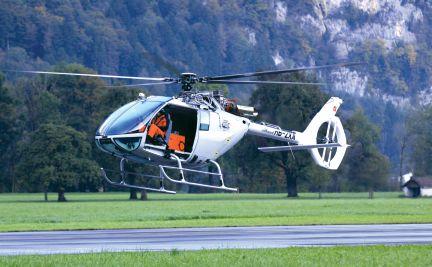
The team at Marenco Swisshelicopter AG celebrated the first flight of its SKYe SH09 in early October, a successful first step in the development of the aircraft.
The flight took place in the heart of Switzerland at Mollis airport. Chief pilot Dwayne William was at the controls of the light single-engine prototype, manoeuvring the aircraft in hover in five test flights that lasted approximately 20 minutes.
The new single-engine SKYe SH09 has officially taken to the skies.
Martin Stucki, designer, founder and chief executive officer of Marenco Swisshelicopter AG, was understandably pleased with the results. “This is a milestone in the development of our program and this success has followed the extensive component testing-phase and quantity of ground tests performed in the last weeks and months,” he said.
The SKYe SH09 sports a full composite airframe as well as all-composite main rotor and tail rotor blades. It is equipped with glass cockpit avionics systems and is powered by Honeywell’s HTS-900-2 engine. Mathias Senes, chief commercial officer, notes that among its features, the SKYe SH09 is being developed as a true vertical takeoff platform that will ensure, for clients and operators, the highest levels of usability and multi-mission capabilities.
The SKYe SH09 is scheduled to enter production within the next 12 to 16 months. Marenco Swisshelicopter AG already holds more than 50 orders and agreements on the aircraft.
The S-97 Raider
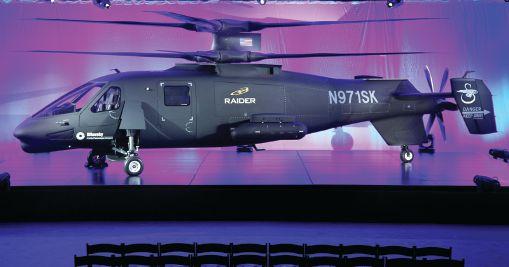
Sikorsky Aircraft unveiled the first of two S-97 Raider helicopter prototypes in October, signaling the start of activities in the program’s test flight phase and a major step toward demonstrating the new – and first – armed reconnaissance rotorcraft featuring X2 technology designed for military missions.
“Just four years ago, we announced plans to build the S-97 Raider and teamed with some of the best companies in the industry, understanding the need to ensure aircraft development would not falter as U.S. government defense budgets shrank in response to economic pressures,” Sikorsky president Mick Maurer said. “Sikorsky is proud of its leadership in this area, and of the leadership the S-97 Raider represents among the world’s military rotorcraft.”
Based on Sikorsky’s rigid X2 rotor coaxial design, the S-97 Raider helicopter features next-generation technologies
HELICOPTERS MAGAZINE
P.O. Box 530
105 Donly Drive South Simcoe ON N3Y 4N5
Tel.: 519-428-3471 Fax: 519-429-3094
Toll Free: 1-888-599-2228
Website: www.helicoptersmagazine.com
EDITOR MATT NICHOLLS email: mnicholls@annexweb.com 416-725-5637
MEDIA DESIGNER BROOKE SHAW
CONTRIBUTING WRITERS
MICHAEL BELLAMY, DAVID CARR, BRIAN DUNN, PAUL DIXON, WALTER HENEGHAN, FRED JONES, JAMES MARASA, CARROLL MCCORMICK,
NATIONAL ACCOUNT MANAGER MENA MIU email: mmiu@annexweb.com 905-713-4351
GROUP PUBLISHER SCOTT JAMIESON email: sjamieson@annexweb.com
PRESIDENT MIKE FREDERICKS email: mfredericks@annexweb.com
RETURN UNDELIVERABLE CANADIAN ADDRESSES TO ANNEX PUBLISHING & PRINTING INC., P.O. BOX 530, SIMCOE, ON N3Y 4N5 CANADA. email: subscribe@helicoptersmagazine.com
Unveiled
The single-engine Raider features a composite airframe and a maximum gross weight of slightly more than 11,000 lbs.
in a multi-mission configuration (armed aerial scout or light assault), capable of carrying six troops and external weapons. The coaxial counterrotating main rotors and pusher propeller provide cruise speeds up to 220 knots (253 mph), more than double the speed of conventional helicopters. Sikorsky will offer the Raider aircraft as a replacement for the U.S. Army’s OH-58D Kiowa Warrior helicopter fleet based on the Army’s future operational and financial pri-
orities, and for the special operations platform.
The single-engine Raider features a composite airframe and a maximum gross weight of slightly more than 11,000 lbs. The aircraft will be capable of carrying an array of weapons and sensors, necessary for the mission. The cockpit will fit two pilots, seated side-byside. The flexible cabin space will carry up to six combatequipped troops, or additional fuel and ammunition for extended missions.
Published five times a year by Annex Publishing & Printing Inc.
Risk. It’s the magic four letter work of safety management. How do we assess it? What do we do to control it? What is it exactly?
First, let’s be clear about what I mean when I speak of risks and hazards; words and concepts that are often used interchangeably and incorrectly. There is a distinction to be made between a hazard and a risk. From the CRSP Risk Management Guide, I found this: “A hazard is defined as the inherent property of a substance, process, or activity that predisposes it to the potential for causing harm to health, safety or human welfare. Risk is defined as the chance that someone or something will be adversely affected in a particular way by unintended exposure to the hazard. Risk therefore refers to the possibility of danger, rather than actual danger.” So, fundamentally, risk is the chance or likelihood of injury or loss. This injury or loss generally results from the presence of a hazard that manifests itself when the conditions are right.
So what happens when we do a risk assessment? In this process, we set out to identify the task at hand and break down the individual steps of an activity, identifying the various hazards associated with that activity and the consequences of that hazard being released if not controlled. We then apply controls, or barriers, or mitigation measures (whichever term you prefer) and reassess the risk with these controls in place. In most of these applications, there is a risk matrix of some sort applied to provide an “objective” measure of the inherent and residual risks.
A Pot of Gold?
Are Risk Matrices the Fortune at the End of the Rainbow?
completely subjective method to get there. Let me explain: Let’s say that I want to go flying at night to an uncontrolled helipad that has no lighting but is outfitted with retro-reflective cones. I may look at completing some form of black-hole approach into this landing site, so I want to risk assess this activity. I enter the risk matrix and consider the hazard: flight into terrain or CFIT. What is the likelihood of this happening?
Often, I am asked to consider the frequency of this happening previously? When I start this deliberation what dataset should I use? My own company’s experience (perhaps we have done this before with no accidents so the experience was positive and I consider the likelihood of an accident “remote”), or should I use the worldwide global experience where I know there have been multiple accidents with multiple fatalities resulting in a likelihood rating of “occasional”? What about the consequences of an accident from a black hole approach? In the helicopter, or even the general aviation context, we might consider that every accident could result in multiple fatalities and therefore should be rated as “significant” or “catastrophic” and consequently have a higher risk rating. Or we may consider just our own experience, where we have never had an accident on this type of operation and therefore the severity is low. As you can see from this simple example, the subjective nature of the exercise can lead to vastly different conclusions.
Furthermore, this exercise doesn’t consider another facet of risk assessment and risk management, which is exposure. If I am completing black hole approaches every day with all 12 helicopters in my fleet, multiple times per night, do I need to consider how often my operation is exposed to this hazard? Is risk a function strictly of probability X severity or do I need to include exposure? The answer is not so simple after all!
“ Risk matrices can be traps and can be misused to deliver a preordained result. ‘‘ ’’
I have been musing lately about the benefits and drawbacks of these risk assessment processes and more specifically of the issue surrounding the use of risk matrices. I am certain many of you have seen these images – matrices that address the probability or likelihood of something occurring against the severity of the event, often on a 1-5 scale. They are colour coded and allow us to pinpoint when additional risk management measures are called for. They are a measurement of severity versus probability and their use, in my view, is fraught with error.
The real issue with these matrices is this: they appear to provide an objective measure of the risk associated with a given activity by using a
Risk matrices can be traps and can be misused to deliver a preordained result but with the wrapping paper of a “robust” process. Beware. In the end, the strength of this risk assessment process is NOT the resulting number produced by the risk matrix. Rather, the real benefit derived from this exercise is the exercise itself; the brain storming by subject matter experts in identifying effective control measures and ensuring that they are incorporated into that company’s SOPs. That is the WIN with risk assessments.
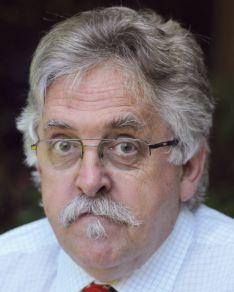
Walter Heneghan is the Vice President for Health, Safety and Environmental Protection with the Summit Air Group of Companies, Ledcor Resources and Transportation, based in Edmonton and throughout Western Canada.
EDC can help your business achieve its goals.
Reduce the risk and seize the opportunities – wherever your markets may be. EDC can help with finance, insurance and bonding services that help you achieve your trade goals. EDC has representatives across Canada and in 16 cities internationally.
Find out how we can help. Visit edc.ca/potential for details.
PAUL DIXON
n our world of instant and immediate communications technology, it seems that all too often the quantity outweighs the quality in terms of the actual message.
I was about to make a comment about “government,” but caught myself. What I meant to say is that the political animal has taken over the act of government at all levels and by doing so, has politicized the process. Whatever it may be that your local municipality, province or especially the federal government is announcing, you can be sure that the announcement will be aligned with the political agenda and there will most likely be a totally inverse relationship between the actual information released and the amount of communication.
The blueprint for government communications could be drawn from a Monty Python sketch. The Parrot Shop and the Cheese Shop are two that come to mind, but let’s not forget the Hungarian Phrase Book. You won’t find a federal or provincial minister speaking to more than two people unless they have their media handler with them. You know the type – that earnest young person lurking on the fringes, making sure to record every word, if only to make sure the minister stays with the party line. Communication has been reduced to a series of speaking points, or, in too many cases, one single point that serves as a life raft that the messenger can cling to when the audience has the temerity to ask questions that outside the narrow focus of “the word.”
I was at a major aerospace show last year when a federal minister started his remarks by saying he wasn’t going to be using his prepared
Talking the Talk
The concept of reality seems to be escaping our various elected officials
as a press release late on a Friday afternoon.
Last year, in response to a complaint, the federal Information Commissioner launched an investigation into government communications practices. Since the current government took office in 2006, the “information services” sector of government has swelled more than 15 per cent, to some 4,000 employees, according to a report by the Parliamentary Budget Office. This serves what purpose, as Canadian Press reported earlier this year.
A request for an interview with a scientist in the employ of the Canadian government, a man regarded as “the expert” in his field, generated 110 pages of emails involving 16 federal communications staffers in various offices across the country. The emails refer to “agreed answers” for the scientist as the communications boffins attempted to craft an “approved interview script.” They never did figure it out, there was no interview and while the story did run nationally and internationally, there was no direct input from the man who made it happen. You can talk about him, but you can’t talk to him.
This is the same government that has been reliving the War of 1812 as though there is some direct connection between Laura Secord’s cow and government actions today. Yet, when Lt. Gen. Stu Beare retires after 36 years of service, the government forbids him from speaking to the media. As the outgoing commander of Canada’s army with recent experience in Afghanistan, you would think he could offer a unique perspective on where we are and what we need to do to get to where we need to be in the future. Of course he does, he’s just not allowed to share it.
Look at the message that is delivered and it’s hard not to grow even more cynical. ‘‘ ’’
text. This got a big chuckle from the crowd, but I was about to perform the Heimlich manoeuvre on the fellow beside me before I realized he was the minister’s communications assistant and his life was flashing before his eyes.
Look at the message that is delivered and it’s hard not to grow even more cynical. If it’s good news, it comes from the mouth of the prime minister or provincial premier and the same for the primo photo ops. When it’s left to the minister to make the announcement, you know it’s likely not what you hoped to hear and if it’s really bad news, then it will almost certainly be doled out
The Maritime Helicopter Replacement program has almost reached the age of majority in most jurisdictions and has taken another twist, above and beyond the “yes they do – no they don’t” question over the H-92 gearbox question. It was announced this September that the RCN will be further diminished by the retirement of three destroyers and both supply ships, with replacements not on the horizon for at least five years. At the same time, we are told that this will not affect our navy’s operational capabilities, which is a real head-scratcher for me. Operationally, the destroyers carry two helicopters and the supply ships would embark three, so until these ships are replaced there are simply not as many places in the Canadian navy to fly helicopters to or from and that may relieve the pressure on the shrinking pool of Sea Kings and their erstwhile replacements. And this is a good thing? Who knows? We surely can’t talk about it.
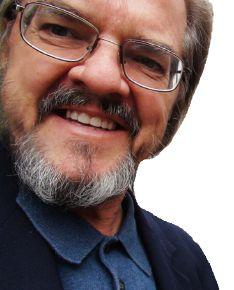
Paul Dixon is freelance writer and photojournalist living in Vancouver.
MICHAEL BELLAMY
The topic of foreign workers in the helicopter industry was discussed at coffee time during a weather day not so long ago. Although the assemblage was modest, both engineers and pilots were present and all held much the same conviction. If you are competent and have good work ethics, then you shouldn’t be worried about losing your job to a temporary foreign pilot or engineer.
This discourse encouraged speculation as to what defined good work ethics as it pertained to flying or maintaining a helicopter in a charter operation. Competency at the controls is of course a primary concern, but that can be negated by personal idiosyncrasies if the pilot or engineer is not suited or has differing expectations.
There are some pilots who look on any northern tour as a sentence necessary for a comfortable income and are already requesting days off on the way to the job site. This lack of commitment is readily identified by the chief pilot and, unfortunately, by the customer as well. If isolation and self reliance are not your cup of tea, then working in mine exploration type camps may not be for you. Our industry, however, has become so diverse, with time a satisfying niche can usually be found, but only if your past reputation of discontent has not preceded you.
We have all heard of a client who has a favourite crew and exerts pressure on the company to get them back. That’s not to say the relieving crew were unsatisfactory, just that a camaraderie was
Of Sound Mind, Body
Pilots and Engineers Must Work to Stay in Top Condition
Sometimes, however, we can try to please just a little too hard, like over stressing the machine, in which case the engineer is going to have a heart-to-heart chat with you
How about flying when we should be on the ground recovering from sickness? Helicopter pilots must be some of the healthiest people in the work force. When was the last time you heard of a pilot or engineer on tour at an isolated post or on fires call in sick for the day? We seem to be able to make adjustments in our flying to compensate for colds and the myriad of minor ailments that would send an office worker home for a week. Customers are usually very obliging and will acknowledge the pilots assessment on whether or not he or she is good to go.
Pressure is often self-induced, however, when the pilot, being aware of a tight timetable, wants to press on regardless. Several years ago, a pilot was killed long lining. He had been fighting a cold with over-the-counter medications. The drugs didn’t cause the accident, but for those of us who have persevered, fighting off the symptoms with antihistamines and aspirin, we have learned to be very cautious with their use. The simple distraction of a toothache can have far more implications than we think, robbing us of sleep and re-directing attention as any of us who have been in that situation can confirm.
Newer pilots are understandably more prone, wanting to prove themselves, hoping that a good review makes it back to the chief pilot. I know of several instances where incidents or accidents happened that were the direct result of the pilot compromising better judgement or ignoring an ailment, hoping for just such an account. Unfortunately, in those instances, the exact opposite happened and early in a career, such a blemish will be very hard to overcome.
For most pilots and engineers that I have worked with, the predominantly shared attribute is a love for the task. ‘‘
established early in the job and the manager wanted to maintain it. Good customer relations have long been recognized as an absolute necessity for the charter companies success and the crew that can establish that rapport will be recognized, and in time, throughout the industry. Want a challenge? Try following such a pilot when he/she is rotated home for days off. An experienced pilot will be comfortable with that circumstance, but what about the newer pilot? It’s more than a little intimidating.
For most pilots and engineers that I have worked with, the predominantly shared attribute is a love for the task. They gain immense personal satisfaction from doing a job well. That competence should not only include the helicopter but also the machine that is sitting behind the controls.
A native of Spruce Grove, Alta., Michael Bellamy has been flying fixed- and rotary-wing aircraft in a variety of capacities since 1971, and is an accomplished author of several books, including Crosswinds.
RICK ADAMS
ncouragingly, the helicopter accident rate is declining thus far in 2014. In Canada, through August, there were no fatal helicopter accidents, compared with four in 2013 and a 2009-2013 average of five. Overall, the safety trend is flat: 23 total accidents versus an average of 24 in prior years.
In the U.S., for the first seven months of 2014, there has been a dramatic decline – the accident rate is down more than 51 per cent compared to a 2001-2005 baseline established by the United States Helicopter Safety Team (USHST), the American branch of the International Helicopter Safety Team (IHST). From January to July the rate was 3.94 accidents (against the 7.97 baseline) and 0.53 fatal accidents (versus the 2003 high of 1.78) for every 100,000 helicopter flight hours. This is especially positive viewed against 2013, which experienced an upward spike in fatalities: 0.86 fatalities per 100,000 hours and 4.20 accidents overall.
The UHST noted, “A stronger safety culture seems to be growing in the civil helicopter community.”
Safety is improving for a range of reasons: improved aircraft technology, new-design flight simulators with amazing realism, and volunteer groups such as the IHST.
The IHST was born in Montreal in the watershed year of 2005. Long-term helicopter accident rates had remained stubbornly high, so in September of that year, the Helicopter Association International (HAI) and the American Helicopter Society (AHS) hosted a gathering
Positive Progress Volunteers Are Making a Difference in Helicopter Safety
To determine why helicopter accidents continued to happen, the IHST chartered a Joint Helicopter Safety Analysis Team (JHSAT) to initiate a data-driven, benefit-focused safety program evolved from a process for commercial airline accidents developed by the U.S. Commercial Aviation Safety Team (CAST) and Boeing. The IHST also set an ambitious goal of reducing the worldwide helicopter accident rate by 80 per cent by 2016.
A study by the Canadian JHSAT showed that for the period 200008, FAR 27 single piston helicopters represented 11.3 per cent of the flight hours flown by Canadian operators but disproportionally 24.9 per cent of the accidents. FAR 27 Single Turbines, the majority of the fleet (68.3 per cent of hours flown), accounted for a proportional 63.6 per cent of accidents. They found the top standard problems are pilot judgments, data issues, mission risks, pilot situational awareness, and safety management.
Today, nearly 40 regions and countries support the efforts of the IHST: in addition to the U.S. and Canada, safety teams have been established in Brazil, Europe, India, Japan, and the Middle East-North Africa. Corollary efforts continue in Australia, Mexico, New Zealand, Russia, and South America.
Over the past almost-decade, the IHST and its international partners have published safety toolkits, educational videos and leaflets, and specific safety recommendations, all aimed at promoting a safety culture among helicopter operators, large and small, worldwide.
This is especially positive viewed against 2013, which experienced an upward spike in fatalities.
of operators, manufacturers, maintenance organizations, regulators, accident investigators, and professional associations from 13 countries and five continents for the International Helicopter Safety Symposium (IHSS).
Before the IHST was formed, the average number of annual civil helicopter accidents worldwide was at 570 and trending upward at 2.5 per cent. Since 2006, when the IHST co-operative effort was formed, the average has been 515, trending downward at 2 per cent. It was still unacceptably high, but certainly improving rather than regressing.
In my opinion, the volunteers who contribute their expertise and time to the safety teams and various technical and policy working groups are the unsung heroes of the aviation community. Many of the volunteers serve on multiple committees (new volunteers are certainly welcome). Even though they work for business competitors or agencies with political masters, the subject experts do their utmost to set conflicting agendas aside in the interests of safety for the common good. Without the volunteers, aviation would be either less harmonized and more chaotic or over-regulated to the detriment of economic interests.
Thank you, helicopter safety volunteers. Your efforts are incalculable. Please keep up this important work.
Rick Adams is Chief Perspectives Officer of AeroPerspectives, an aviation communications consultancy based in the south of France. He has been writing about technology and training for 30 years.
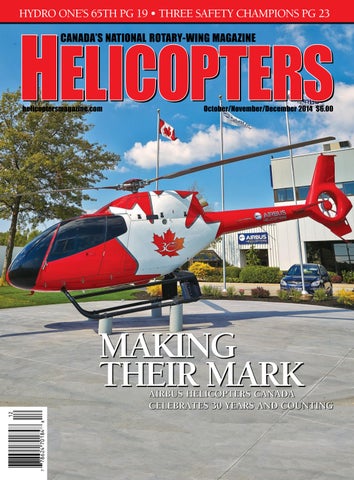
COVER STORY
Making Making
Their Mark
Airbus Helicopters Canada celebrates 30 Years and Counting
BY MATT NICHOLLS
Innovation, flexibility, creative management and a strong commitment to developing some of the safest, most reliable aircraft available has helped Airbus Helicopters Canada make an indelible mark on the Canadian helicopter landscape for more than three decades. It certainly doesn’t hurt there’s a passionate team of loyal employees and customers supporting the process, either.
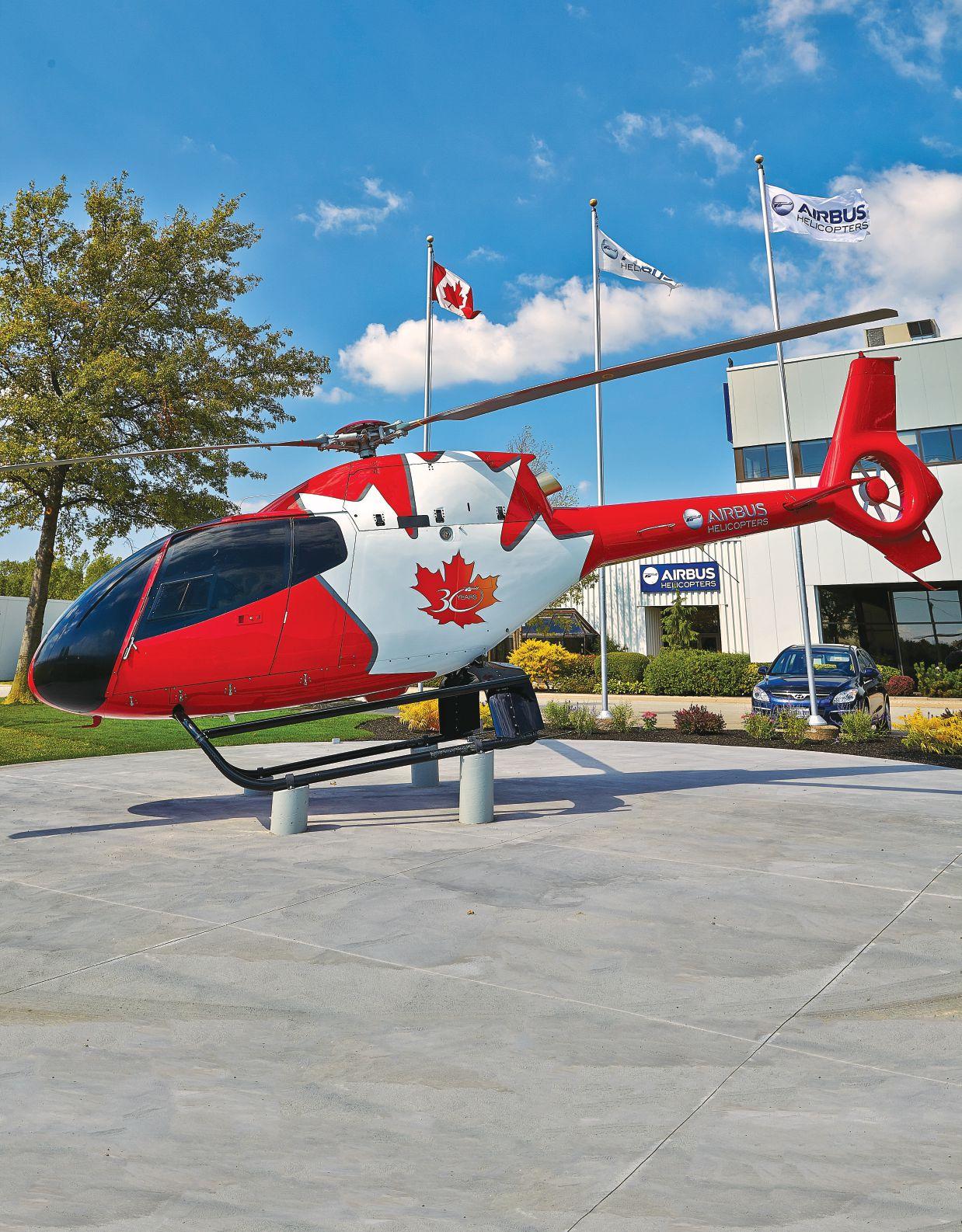
Rebranded Airbus Helicopters Canada earlier this year, the Fort Erie, Ont.-based company, with customer support centres in Richmond, B.C. and Montreal, manufactures, markets, sells and assembles some of the most reliable and technologically-advanced helicopters in the world.
Just how successful has it become? Airbus Helicopters Canada supports some 190 operators using more than 680 helicopters nationwide. It’s also one of 21 international subsidiaries, which are part of a worldwide network of service centres, training facilities, distributors and certified agents.
Airbus Helicopters Canada is a world leader in the development of composite components for the global Airbus Helicopters fleet and supply chain, including the EC130 engine cowlings and fairings, EC135 stabilizers and other components, EC145 engine cowlings and EC225 cowlings. Since opening its doors with only nine employees in its first year of operation, the company has grown to more than 250 employees and is one of the most important corporations in the Niagara region, contributing significantly to the local economy on both a financial and community support perspective.
“I am very proud to lead a company which is has had so many successes over the past 30 years – and these success come directly from our people,” Romain Trapp, president and CEO of Airbus
Helicopters Canada told Helicopters. Trapp is particularly proud to point out that several Fort Erie, Ont., employees have more than 15 year’s experience with the company, and two have been their from the inception. “Their dedication, engagement, talent . . . They are the wealth of the company and their talent has led to our achievements over the past 30 years.”
Trapp notes that based on the total Canadian helicopter fleet of aircraft less than 30 years old, 55 per cent of all turbine helicopters flying in Canada are Airbus Helicopters – a figure he says highlights Airbus’ success since the company commenced operations in Canada
in 1984. “Why is this the case? It’s because of the quality of the product, the performance of the product,” Trapp says. “Many of the helicopters in Canada fly in remote locations, harsh environments, so reliability is important.”
It’s an apt point, as some 90 per cent of the helicopters flying here are doing so for utility missions: forestry, mining, oil and gas. There are smaller market segments – six per cent for corporate, two per cent for EMS, and an additional two per cent for law enforcement – but the utility market dominates the marketplace. There is growth potential here, Trapp suggests, but focusing on providing safe, reliable, and technologically advanced utility helicopters remains paramount.
“In terms of number of aircraft that we deliver on an annual basis, Canada represents an average of five per cent,” Trapp says. “And only a few people know this, but Canada has the second largest fleet of civil helicopters, which is why it is such an important market for us. We know that if our product is successful in Canada, in a harsh operating environment, they are going to be successful all over the world.”
THE DURABILITY FACTOR
Customers who have populated their fleets with various models of Airbus helicopters can attest to their durability, performance, technological competence and reliability. The Ontario Ministry of Natural Resources and Forests is one such example. Tasked with the challenge of providing forestry, firefighting, search and rescue, and wildlife management services in hundreds of miles of rugged, remote locations, the ministry’s aviation division is reliant on helicopters to get the job done. With bases in Dryden, Thunder Bay, Timmins, Sudbury,
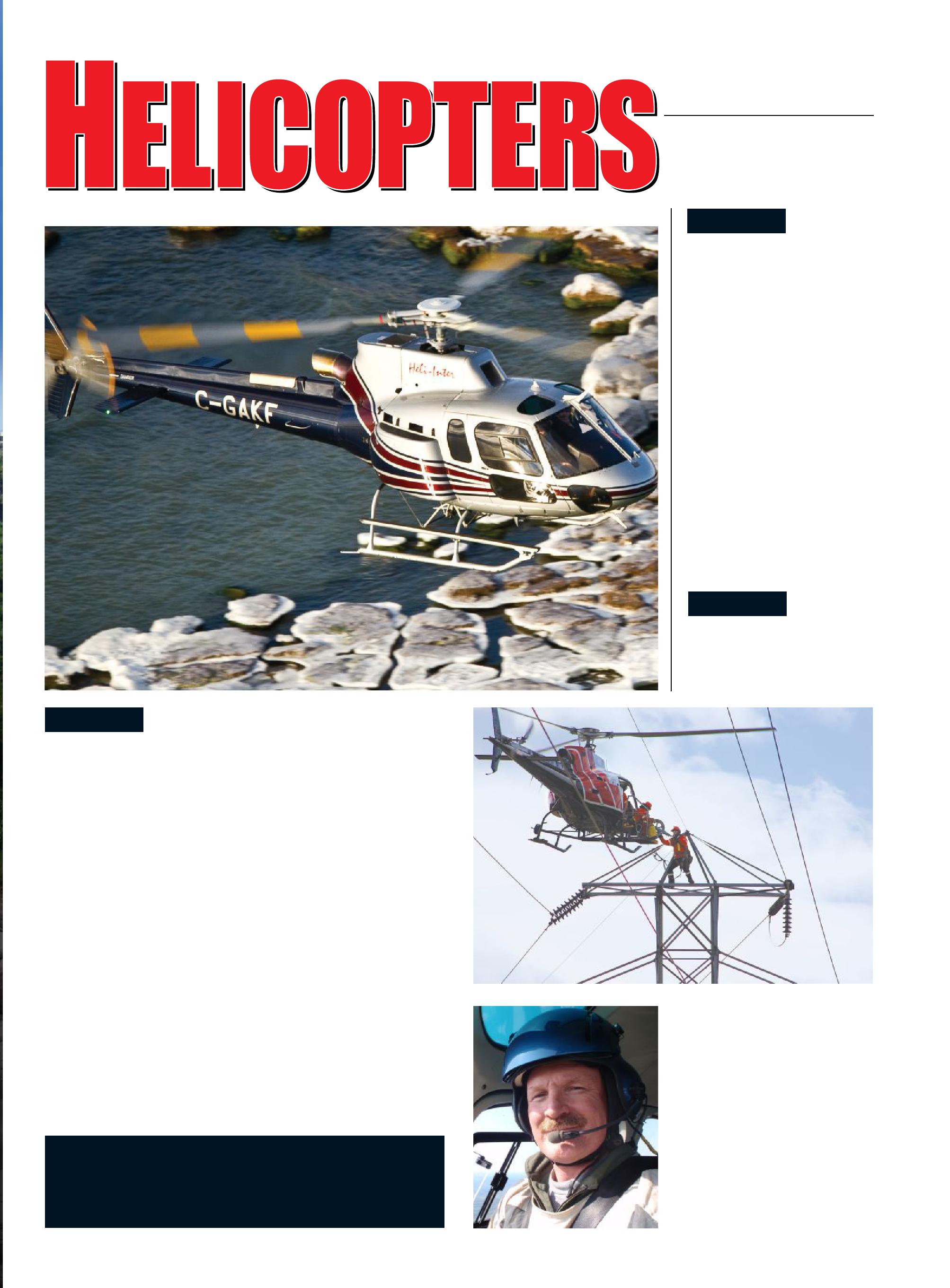
LEFT: The 600th Eurocopter helicopter for the Canadian market is delivered to Héli-Inter Inc. of St. Hubert, Que. (Photo courtesy of Airbus Helicopters Canada)
BELOW LEFT: OMNR pilots and clients are impressed with the EC130 airframe. (Photo courtesy of Airbus Helicopters Canada)
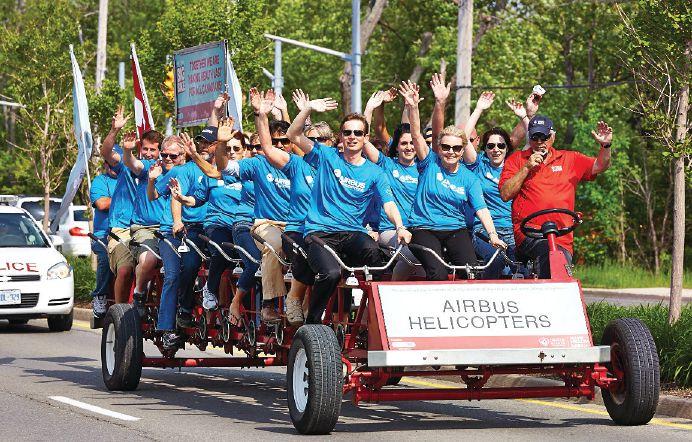
BELOW: Airbus employees try hard to promote the brand in local charities and community organizations. (Photo courtesy of Airbus Helicopters Canada)
and Muskoka, the OMNRF is the single largest Canadian operator of EC130 B4 helicopters and has had a long history with Airbus products since introducing a twin-engine MBB BK117 into its fleet in 1987. The ministry currently has seven EC130s and an AS350 B2.
The OMNRF fleet logs between 3,700 to 4,500 hours per year with 33 per cent of the flight hours devoted to firefighting, 66 per cent of the flight hours to resource management duties including wildlife surveys, fish stocking, reconnaissance, compliance monitoring, enforcement missions and more. Needless to say, reliability is critical.
“For more than 30 years, the MNRF services has owned and operated medium and intermediate helicopters,” says OMNR operations manager Bob Crowell. “MBB/Eurocopter and now, Airbus Helicopters have been successfully providing helicopter services to the MNRF for the past 30 years.”
Crowell notes that OMNR pilots and clients are particularly impressed with the EC130 airframe. It is quiet, offers enhanced safety features, extra seating capacity and great viewing opportunities from every seat, a real advantage for resource management, enforcement and aerial observation. “The speed, range, endurance, payload and cargo capacity are ideal for this multi-mission, multi-role helicopter,” Crowell says.
Versatility in design, payload capacity and more are also crucial for Ontario’s main electricity provider Hydro One, where helicopters are used to maintain a vast power grid that includes 30,000 kilometres of transmission lines and 12,000 km of distribution lines. Hydro One has four Airbus AStar A350 B2s and three AStar A350 B3s in its fleet manned by eight full-time and two part time-pilots who log about 4,200 flight hours a year. (For more on Hydro One, see, “Negotiating the Fly by Wire,” pg. 19).
Greg Lester, manager of helicopter services at Hydro One, says reliability, consistency and lifting capacity are definite advantages in the harsh environments crews often find themselves in. For forestry, generally, helicopters are transporting crews and their equipment using aerial taxi, slinging fuel to them, usually external loads to bring in compressors that help them set poles and parts of the towers.
“It’s a very big province, so there is a lot out there for this type of work,” Lester says. “The nice thing about the AStar platform, especially at the B2 and B3 level, is the available capability to lifting those external loads. The poles are fairly heavy, we have moved over on the transmission side to composite poles, which now we can lift up to a 95-footer. So, it’s a steady performer and the guys are out there for 450 to 500 hours per aircraft per year, so, they are very capable. The crews really like the power available for lift.”
Paul Spring, president/operations manager with Fort McMurray, Alta.-based Phoenix Heli-Flight appreciates the reliability and
Memory Makers
Key milestones in the development of Airbus Helicopters Canada
1984
Airbus Helicopters Canada Ltd. is formed in Fort Erie, Ont., under the name MBB Helicopter Canada Limited. It is wholly-owned by Messerschmitt-Bölkow-Blohm (MBB), a German aerospace company formed as the result of several mergers in the late 1960s.
1986 Toronto’s Ranger Helicopters commences a high frequency scheduled helicopter shuttle service using three Aerospatiale AStars and a TwinStar painted in Air Canada colours to fly between downtown Toronto and Lester B. Pearson International Airport. The service was designed to help Air Canada increase its market share of the high yield business travel market in Toronto and provide a downtown connecting service for passengers heading to Montreal and Ottawa.
1989 Canadian Helicopters inaugurates scheduled helicopter passenger service between Vancouver and the year-round resort of Whistler, B.C. with AS350B AStar helicopters.
1993 In mid-1993, the company is restructured as Eurocopter Canada Ltd. following the merger of the helicopter divisions of Aérospatiale of France and Daimler-Benz Aerospace AG (DASA), which incorporated MBB. In 1993, single-engine deliveries accounted for 77 per cent of the North American market. In the fall, Eurocopter Canada delivers French-designed aircraft directly from ECL to Canadian customers. German MBB helicopters for Canada had been shipped directly to Fort Erie since 1984.
1994 Eurocopter gains ground in North America, taking the lead in new turbine sales to commercial customers. The company’s six helicopter families and 11 turbine helicopter models captured 42.1 per cent of the market in 1992, based on figures from the U.S. National Transportation Research Board (NTRB). On Jan. 1, Eurocopter Canada Ltd. in Fort Erie gains full responsibility for the sales, service and support of the entire Eurocopter helicopter portfolio in Canada.
1996 A new chapter begins for Eurocopter Canada with the arrival of the prototype EC135 P1 in Fort Erie for flight test and certification work. The company also steps up its program for the refurbishing of AStar for resale.
1997 Super Pumas Serve Offshore Newfoundland. In 1995, Eurocopter achieves a major Canadian offshore milestone when the AS332L Super Puma is selected to support the development of the Hibernia oil field 200 miles (320 km) southeast of St. John’s, Nfld.
consistent excellence of his Airbus fleet. A strong advocate for the technology and its role in enhancing safety, Spring listens to his clients carefully, delivering what they want. It’s sound practice in the competitive Alberta oil patch, where discriminating oil and gas customers demand the most in a helicopter – and their clients. Spring’s fleet boasts 10 single- and twin-engine helicopters, including a new EC135 T2e for its Medevac operation.
“Airbus has machines available in their product offering for every size,” says Spring. They have single- and twin-engine AStars, such as the EC135s and EC145s. If you are trying to meet all (client) needs, you really don’t have to leave their product line – they have something for everyone.”
Spring also maintains that Airbus, like many OEMs, is taking steps to concentrate on safety enhancement and realizes that they too, have a major role in working to create an accident-free environment – it’s not just about moving product. “Turbomeca started things first and now Airbus has picked up on it,” Spring notes. “At first, I’m not sure if the OEMs had a role in safety because they didn’t really connect the dots. They have realized that the optics could be changed through some intervention on their side.”
A commitment to safety is indeed something Airbus Helicopters Canada takes very seriously, says Trapp, and he insists it remains the company’s number one focus in the immediate future and going forward. One way to accomplish this goal, he suggests, is to improve information and knowledge through training – not only at the plant level in Fort Erie, but with operators nationwide.
“We have a training department in Fort Erie where we ensure all the pilots and AMEs, have the correct knowledge level when they take delivery of the aircraft, including recurrent training after that, especially on the pilots’ side,” says Trapp. “Usually, we do the pilot training at the facility of our customers. It’s just one way to develop safe flying practices.”
Airbus has also taken a strong advocacy role in the industry with its Innovation & Safety Award. Designed to recognize the achievements of individuals and organizations developing safe practices and driving future change, Airbus is awarding $10,000 to the cause this year, up from $5,000 in previous years. The company also offers an annual safety symposium for all corporate customers. Trapp attended the event this May and was impressed with the value that came out of it.
“There were a lot of strategies and tips shared by all pilots . . . this is certainly one way to ensure a safer environment for all Canadian customers.
Trapp continues, noting that Airbus is working hard to ensure customers have the information they need to fly their new aircraft
safely and efficiently. “When you look at the accident rates, most are due to human factors. Training and OEM recurrent training can help in this regard.”
AN INNOVATIVE APPROACH
Staying committed to research and development and concentrating on innovation can also help in this regard and Airbus Helicopters Canada is certainly not resting on its laurels in these areas. Machines such as the EC145 T2, with its autopilot and latest standards for medium twins, along with the EC130 T2 and more, will help keep Airbus at the forefront of industry needs while exceeding safety standards.
“Our research and development and engineering teams are always seeking new innovations for this market,” Trapp says. “We are currently working on a new utility version of the EC130 T2 specific to our operators, and working on a new capability for the EC135. I feel these will have plenty of success with Canadian operators.” Trapp is also gaining valuable industry experience, touring operations nationwide, interacting with customers and gleaning information from key partners and customers.
FORWARD THINKING
For the past 30 years, the Airbus name has had an indelible mark on not only the helicopter landscape in Canada, but also the community of Fort Erie. The company is one of the stalwarts of the Niagara economy and as Trapp notes proudly, the employees try hard to promote the brand in a number of local charities and community organizations. Tour the facility and it is hard not to get a strong sense of community and camaraderie, one that is replicated in the industry as a whole. Quality breeds quality and the hard work of the past 30 years in Fort Erie is starting to pay supreme dividends.
And given the opportunities that present themselves with an aging Canadian fleet, the international MRO market, composite and cowling manufacturing, used helicopters sales – for example, the versatile BK 117 is gaining traction as a nice fleet replacement option – it won’t be surprising to see Airbus Helicopters Canada solidifying its mark in the Canadian market for years to come.
“The helicopter industry is a very competitive market both globally and in Canada and competition is good because it forces you to be better,” Trapp says. “I welcome competition and we have been doing very well over the last 30 years in competing in this market. In the years head, we will do even better. To be better, it’s about increasing the satisfaction of our customer, the quality, and the competitiveness of our products. And I know we can do it.”
1997
Nine months after its first flight, French regulatory authorities certified the AS350 B3 at the end of 1997. The RCMP becomes the first Canadian customer a year later.
1998
The first helicopter refurbished in Montreal by Eurocopter Canada Ltd. (ECL) rolls out of its Dorval airport facility in June. The now popular EC120B Colibri is certified by the FAA
1999
Fifteen years of success! The 15th anniversary celebrations are held in Fort Erie, celebrating ECL’s longestablished engineering, design and certification capabilities.
2003
The first Canadian EC155B is delivered to Hamilton’s Jetport Inc. for business missions
2004
The Ontario Ministry of Natural Resources (OMNR) takes delivery of the first EC 130 B4 in Canada
2006 Great Slave Helicopters takes delivery of the 400th Eurocopter helicopter in the Canadian market, an EC130 B4
2007
The first EC135 for the Canadian market is delivered to the VIH Aviation Group
2008
Eurocopter Canada holds an opening ceremony for its newly expanded customer service facility in Richmond, B.C. In May, the company celebrates the expansion of its headquarters in Fort Erie, growing to 135,625 square feet.
2009 Eurocopter Canada finalizes an agreement with Canadian Helicopters Limited (CHL) on Oct. 22 and fully endorses the CHL Advanced Mountain Flying Training Program. The company also celebrates its 25th anniversary
2010 The 600th Eurocopter helicopter for the Canadian market is delivered to Héli-Inter Inc. of St. Hubert, Que.
2011 Transport Canada certifies the AS350 B3e – the next generation aircraft in the proven Ecureuil family of helicopters.
2012 Eurocopter Canada Ltd. beccomes the first Eurocopter subsidiary to establish MRO capabilities to process level-D repairs on the Starflex bearingless main rotor hub for the Ecureuil/AStar AS350, AS355 and EC130 helicopter families
2012 Eurocopter Canada Ltd. (ECL) completes its 300th composite engine cowling for the EC145 twin-engine helicopter.
2014
Eurocopter Canada rebrands as Airbus Helicopters Canada
2014 Fox Aviation of Montreal takes delivery of the first EC130 T2 helicopter in Canada
Negotiating the Fly by Wire
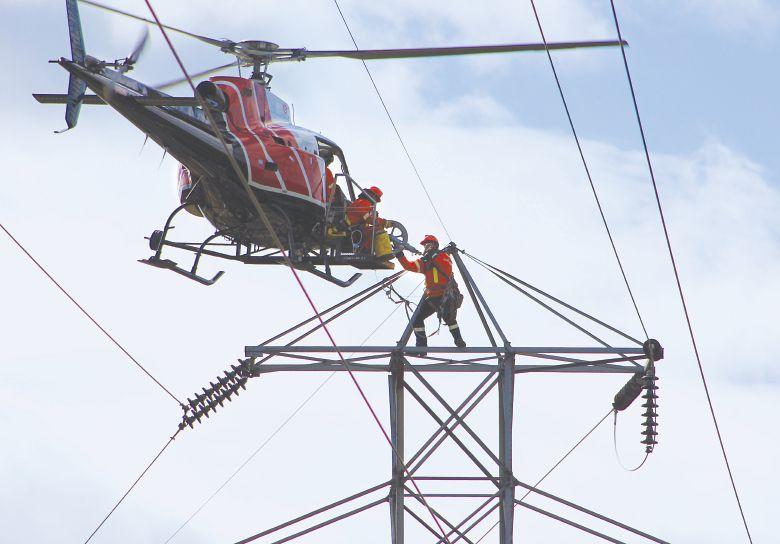
LEFT: Helicopters have enhanced the reliability of the grid and introduced efficiencies to work procedures in many ways. (Photo courtesy of Hydro One)
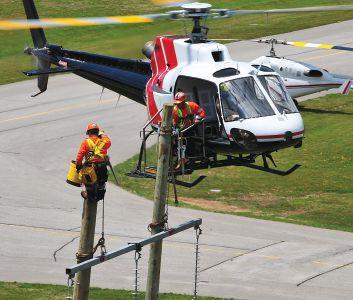
BELOW: To work at Hydro One, pilots need a variety of skills. (Photo courtesy of Airbus Helicopters Canada)
Hydro One’s Helicopters are Indeed Proven Workhorses
BY CARROLL MCCORMICK
High above the ground, bundles of glass insulators swing from decades-old U-bolts dangling from towers carrying 500,000-volt power lines. Hydro One, Ontario’s power utility, spent two months this summer replacing the U-bolts, using two crews of pilots and linesmen in two Airbus AStar B2s. This is just one of the latest of more than 65 years worth of assignments carried out by the power utility’s helicopters.
The AStars are among 42 helicopters that Hydro One and its previous incarnations have owned since it bought its first machine in June 1949: a Bell 47D1, registration CF-GMQ, for $30,000. Then known as the Ontario Hydro-Electric Power Commission, it was the first utility in North America to purchase a helicopter for power line work.
Over the decades, helicopters have enhanced the reliability of the grid and introduced efficiencies to work procedures in many ways – for example, replacing dog sleds, snowshoes and horseback with rapid aerial access to power lines for scheduled and emergency inspections.
The current fleet stands at eight machines: one Bell Long Ranger 206L, four Airbus AStar A350 B2s and three AStar A350
B3s. Eight full-time and two part time-pilots log about 4,200 flight hours a year working on a vast system that includes 30,000 kilometres of transmission lines and 12,000 km of distribution lines.
“Many of the lines are in the middle of nowhere. The safest and most economical way to service them is with helicopters. This is a very safe and efficient tool,” says John Bosomworth, Chief Pilot, Hydro One Helicopter Operations.
Accessing much of the system is “brutal,” as Bosomworth puts it, revealing one of the beauties of using helicopters. In the old days, just walking the rights of way to inspect lines was a lifestyle as much as it was a job. For instance, says Bosomworth, “On the power line between Ear Falls and Pickle Lake, which has 2,290 poles, it was so slow and so difficult there were full-time linemen who lived on the lines. They had four hydro houses on that line. They walked the line 12 months of the year and overnighted at remote huts.”
Airborne inspections, on the other hand, can proceed at 65-80 km/h for smaller structures up to 18m high, and as quickly as 95-115 km/h for the 31-m high, steel lattice towers that carry the 500 Kv circuits. Pilots can hover while an inspector studies every detail of a tower’s condition. High-visibility windows made by
Eight full-time and two part-time pilots log about 4,200 flight hours a year working on a vast system that includes 30,000 kilometres of transmission lines and 12,000 km of distribution lines.
Airbus Helicopters Canada can be fitted onto the Astars for lowlevel patrols.
Hydro One has adopted multiple technologies to enhance the effectiveness of its helicopter operations. For instance, custombuilt, gyro-stabilized infrared cameras can be fitted on the helicopters. They can see heat signatures that indicate potential failing joints and other trouble spots like clamps and insulation strings. “If we can find a fault before it fails, the savings are huge,” Bosomworth says. Capitalizing on the power of the GPS, Hydro One has collected the GPS coordinates of every single structure in the province, which are available in the helicopters on standard automotive GPS units. “We can fly directly from one location to another. It shows the structures on an overlay on a moving map,” Bosomworth notes.
The helicopters do a lot of heavy lifting. Trucks bring poles and other hardware to staging areas as close to a power line as possible
and helicopters take over from there. “We might fly poles a couple of kilometres or up to 60 kilometres, one way,” Bosomworth says.
The highly-skilled pilots can set poles with great accuracy, lower cross arms into place and string power lines. They also feed strings of insulators down between the wires. “It is like threading a needle,” says Bosomworth.
For jobs requiring lifting capacity in the 6,000-kilogram to 7,000-kilogram range, Hydro One hires Skycranes or Chinooks. The utility used to need outside help to lift the 31-m long wooden poles, which weigh in at 1,400 to 3,600 kg, but another in-house development, 1,100-kg composite poles, are within the capability of the B3.
The utility and its pilots have developed several techniques over the years to increase the versatility of the fleet. For example, if a tree has fallen across a power line, a helicopter can remove the tree with a tree hook attached to a 31-m long line. And remember that
Safety is paramount at Hydro One and managing flight safety includes many elements, such as intense training, regular safety meetings, a fatigue management program and more. (Photo courtesy of Airbus Helicopters Canada)
(Photo courtesy of Airbus Helicopters Canada)
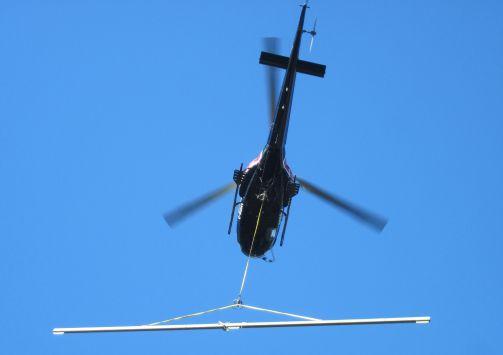
Hydro One has adopted multiple technologies to enhance the effectiveness of its helicopter operations. (Photo courtesy of Hydro One)
U-bolt replacement program? The trick there is to hook on to those bundles of insulators and lift them just enough take the weight off the U-bolts so linemen perched there can replace them.
And how do those linemen get way up there? By going down a set of stairs, as strange as that sounds. Hydro One’s slickest inhouse development, which it calls the AirStair, is a set of steps that can be attached to the side of a helicopter. The pilot sidles up to the end of the arm of a steel tower and hovers there while a lineman steps off the AirStair onto the structure. Later, the pilot comes back and the lineman climbs aboard the helicopter via the AirStair. For quick jobs linemen can work from a little platform at the base of the steps.
Bosomworth describes the AirStair, the training and the flying. “It took about six years to develop this process in house,” he says. “We have two AirStairs. It is the most documented process in Hydro One. The training we do is very complex. There is classroom work, exams, training, monitored rides and workplace inspections. The AirStair is the pinnacle of the flying we do. We have done about 40,000 on/off operations in the 12 years we have operated the AirStair.
“The close proximity to the wires is the most highly skilled part of this,” Bosomworth says. “The visual cues the pilots get from seeing
the structure less than one metre away are quite good. If you ask a pilot to hover near a stump, he can do it. The mindset with steel and live wire is different, however, but the skillset is the same. The attention required is 100 per cent. Transport Canada limits the wind speed to 30 knots for using the AirStair, but we rarely get up to that. We are also conscientious that we do this safely. We sometimes have the wind off our nose, sometimes off the side, sometimes a tailwind. Each pilot has his comfort zone as to when to stop
flying. We encourage them to err on the side of caution.”
Flying around wires as one’s bread and butter is highly specialized work. “I call it ‘sleeping with the enemy,’ ” Bosomworth says. Only high-hour pilots need apply to Hydro One. An applicant needs at least 3,000 hours of utility operation (not a power utility); e.g., bush work, significant Astar time, and excellent slinging skills.
Once on the payroll, pilots will spend four months getting
familiar with the power network before they are let loose around power lines in a helicopter. Hydro One teaches them the specialized skills they need, and certain maneuvers are restricted to the more seasoned pilots. “We do have some limitations of who does some tasks; for example, a pilot has to have been flying here two years full-time before he can do AirStair work,” Bosomworth says.
noon near the end of a long day of flying in hot weather. Linemen and technicians are taught to point out hazards to their pilots, that it is never wrong to do that, and not to assume that the pilot sees the hazard already.
The in-house training is demanding. For instance, says Bosomworth, “In slinging poles there are a variety of ways of doing it. Putting them in sono-tubes, lowering them between three wires that are two feet apart, lowering a 15-inch diameter pole through a 24-inch gap. We practise slinging, AirStair work, delivering cross arms and flying around in the wire environment. We do very complex slinging. It is one of our highest risks.”
Many of the lines are in the middle of nowhere. The safest and most economical way to service them is with helicopters. This is a very safe and efficient tool. ‘‘ ’’
Flying in a wires environment is unforgiving. In 2007, for instance, a pilot attempting a landing in an Aerospatiale AS350 B2 struck a guy wire 31 metres above the ground with his main rotor blades. “We work in close proximity to power lines. We land under them. They totally disappear in some situations. If you are flying along a transmission line, if an intersecting line runs under them, no problem. If it runs over the line, it would be a problem,” Bosomworth says.
The pilots are taught about high-risk times, such as late after-
Managing flight safety includes many elements, such as intense training, a company aviation safety officer, regular safety meetings, an in-house specific fatigue management program and an acute sense of safety in a work environment that is inherently dangerous for most front-line employees.
“One can’t forget our maintenance department under the direction of Rob Tapper. Our maintenance is second to none,” Bosomworth adds, “It plays a huge role in our safety program.
"[This] is the culture of a very progressive company. If people have safety issues, they bring them forward. There are a lot of rules we review before each flight. The element of complacency in your work environment will always pop up, but the last thing we say [before taking off] is ‘do not be complacent.’ ”
This year we are honoring our Canadian friends and their leadership in SMS.
• Keynote speaker at our welcome reception dinner, Director General of Transport Canada, Mr. Martin Eley.
• 2 days of certificate workshops
• Bring your family and mix business with pleasure
• A great way to meet and greet influential industry colleagues in an intimate atmosphere BOOK EARLY! Less than 100 seats are available
EARLY BIRD REGISTRATION
A special fee for our Canadian friends! (INCLUDES 3 nights lodging)
SPECIAL CERTIFICATE WORKSHOPS
Coming to a Canadian city near you!
• The latest methods and regulatory revisions
• Workshops offered in: Quality Assurance, Root Cause Analysis and Corrective Action Plans, Required Basic Auditing Skills, and Intro to Statistical Process Control for Aviation.
Thank you for your confidence over the years Canada. We are now a Canadian company and want to repay your trust with some very special educational events.
• We have worked with over 100 Canadian aviation enterprises and have held 3 major contracts with Transport Canada.
• No one knows Quality Assurance, SMS or Regulatory Compliance issues like us.
LEFT: Universal Helicopters’ Geoff Goodyear has won many honours for his commitment to safety.
(Photo courtesy of Universal Helicopters)
BELOW: Phoenix Heli-Flight's Paul Spring is a passionate safety innovator. (Photo courtesy of Phoenix Heli-Flight)
Exploits of Three Wise Men
Leading By Example and Pushing the Safety Envelope
BY MATT NICHOLLS
Creating a safety culture that strives to eliminate accidents and creates an open, proactive working environment is a goal shared by a strong majority of operators in the Canadian helicopter industry. In this issue of Helicopters magazine, we highlight three pioneers in the national landscape who have not only taken their own operations to higher levels of safety excellence, but have extended their reach to help transform the industry on a national and global scale.
THE UNIVERSAL APPROACH: GEOFF GOODYEAR
For Geoff Goodyear, working to create a strong safety culture is not only a sound business practice, but it’s an absolute necessity. As Goodyear is the leader of one of Newfoundland and Labrador’s most prominent helicopter operators and works in some of the harshest conditions in Canada, such a premise is paramount in ensuring his clients’ expectations are met.
It’s a commitment to excellence that has paid off in spades. Universal recently celebrated more than 50 years in operation and established its mark as one of the strongest operators on the East
coast. With its head office in Goose Bay, Labrador and bases in Pasadena, Gander and St. John’s, Newfoundland, Universal operates 20 aircraft throughout the high Arctic and Eastern Canada and specializes in wide variety of natural resource-based and government operations.
Universal’s comprehensive aviation safety management program is a shining example of the safety culture that governs all aspects of daily operations at the company’s four bases. The company’s Safety Management System (SMS) is based on the recording and analysis of all safety related events including incidents, accidents, occurrences and hazards. On the technology front, all Universal aircraft in the fleet are equipped with SKYTRAC low earth orbit and GPS flight following equipment, enabling effective tracking of aircraft in isolated, uninhabited areas. The fleet is also equipped with Digital Voice Interface (DVI), which provides satellite voice and limited data communications from all aircraft.
A dedicated pilot for more than three decades, Goodyear has also been recognized for his leadership in working to enhance global and national safety standards, winning prominent awards including the Canadian Aviation Safety Award from Transport Canada and the Innovation in Safety Award from Airbus Helicopters
Canada. So where did such a strong safety commitment come from and how does Goodyear feel about such impressive accolades?
“I’m human, like everyone else, and when someone pats someone on the back and gives an ‘Atta boy’ it makes you feel great,” Goodyear says in his self-effacing, humble way. “The fact that it is a rather noble pursuit and when the accolades come from people who are well versed and heeled in the industry, it makes it all that more poignant.”
that you want to keep the system as simple as possible to keep people interested,” Goodyear says. “You’ve got to be able to provide appropriate feedback not only statistically but also what actions have they taken, again to keep people interested but also to show positive affect.”
Goodyear has certainly experienced events that have helped shape his own safety envelope and refine his safety perspective. “Not a day goes by that I don’t think about some of the events that we have had over the years,” he says. “It is an indication that suggests that even with your absolute best efforts and intentions, that sometimes, unfortunate things happen to good people in an organization. It does underscore as well that ‘safety achievements’ are actually what I would call ‘safety challenges.’ ”
It does underscore as well that ‘safety achievements’ are actually what I would call ‘safety challenges.’ ‘‘ ’’
As Goodyear explains, the development of a strong safety culture at Universal was as much about intention as it was necessity. Working in very remote and austere environments, as many operators do, it necessitated a plan that was imperative as opposed to a convenience. Establishing a strong safety culture was also shaped on simplicity and accountability – a buy in from all employees was paramount and the commitment started from the top.
“If you put it in a crucible and condensed it down, you could say
Recognizing the attributes, skill sets, roles and personalities of all team members is paramount in achieving a sound safety culture, as is ensuring that your safety is built on open communication and the sharing of information, Goodyear stresses. Building strong communications channels, enhancing training efforts, tapping innovative new technologies, working closely with clients to establish top operating standards – it’s all helped Universal continue on the path of developing a safe corporate environment.
“Going along with the challenge theme – and it’s not just at Universal, I would respectfully suggest at any organization – the big-
ASPIRE TO GREATER HEIGHTS
Train to be an Aircraft Maintenance Engineer in Dawson Creek, BC!
Approved Basic ‘M’ training completed in 17 calendar months
gest challenge is not only making sure your safety management processes are being followed properly, but you’ve got their hearts and minds as well,” Goodyear says.
THE POWER OF INFORMATION: PAUL SPRING, PHOENIX HELI-FLIGHT
Like Goodyear, Phoenix Heli-Flight president/operations manager Paul Spring has taken the quest to develop the safest operating environment both on a national and international scale to a whole new level. With more than 40 years in the aviation industry and some 13,000 hours as a pilot on single- and twin-engine helicopters, Spring has a well-rounded perspective on all aspects of an operation – from the men and women who fly aircraft, to those that key the blades turning. He began his career as an aircraft maintenance engineer upon graduation from North Bay, Ont.’s Canadore College, before returning there to earn his commercial rotary-wing licence.
Helicopter Type training on B206, B205, and all associated engines
Over 20 years of Industry recognition for quality training
Modern student residences available on-campus
Large & newly renovated facilities with many aircraft Visit nlc.bc.ca for more information:
"Programs/Basic Training" for a video of facilities & aircraft and "Programs/Type Training" for Type Training schedules & tuition
Follow the AME Facebook page for more program information and see our video on YouTube •
• Affordable Student Residence Available
Apply online at nlc.bc.ca for February 2015 intake or contact Student Services for more information.
A strong advocate of technology and innovation, Spring has worked hard to instill a strong safety culture at his Fort McMurray, Alta.-based operation, one that has developed gradually since the operation’s inception in 1991. Phoenix Heli-Flight operates a fleet of 10 single- and twin-engine Airbus Helicopter Canada machines for a variety of missions, including oil exploration, wildlife management and surveys, forestry, construction, fire suppression and more. The company also provides dedicated Medevac service to the Wood Buffalo, Alta. region under its fledgling “HERO” brand with its new EC135 T2e aircraft, equipped with the latest flight tracking, night vision goggles (NVG) and helicopter flight data monitoring (HFDM) technology.
A passionate believer in the premise that you can never have enough information, Spring has taken his personal and professional interest in HFDM technology and transformed his operation. Coupled with a strong SMS policy, an open, proactive safety culture, and a commitment to ensuring the fleet is on the cutting edge of technological enhancements, it’s a valuable recipe for success. It has also garnered Spring a number of key industry award.
Spring was also a founding member of the Global Helicopter Flight Data Monitoring Steering Group, which was formed in 2010, and for the past four years has made presentations on the benefits of HFDM to hundreds of industry professionals across the globe.
When it comes to establishing a sound safety culture, he not only endorses technological tools such as HFDM, but stresses the importance of understanding that the process is not a quick fix – it takes a dedicated buy-in from both employees and clients. “It’s not any one thing really, it’s just a building process,” he says. “I was probably one of those hot dog pilots who didn’t take it (safety) seriously – a cowboy. I enjoy flying helicopters, it is a lot of fun, and doing crazy things with them, too, but I’ve changed along with the industry and the clients. In the old days you got a job as a 100-hour pilot and they threw you in the machine, you went away for the summer and you taught yourself.”
Spring says “evolution” is perhaps the best word to describe how a sound safety culture is established – that creating the right environment certainly doesn’t happen over night. It takes initiative, hard work, commitment and the proper perspective and attitude. There are also certain lightening rod events that are bound to shape you and help you drive change.
“After 16 years of operation, we had our first crash and out of the five people on board, four walked away – but one didn’t,” Spring says. “And in analyzing that wreck, it was completely preventable if we had of known how that pilot behaved. If we had some insight, we could have stopped that one. And I venture to guess that there are accidents everywhere that could have been prevented if the operator had known what was going on.”
With HFDM, Spring is now more equipped to understand opera-
tional aspects that will help enhance security, and he’s also in a better position to educate clients on the challenges and dangers of mission realities. He is also quite pleased with the commitment level developing within the industry from both clients and industry suppliers, but cautions more needs to be done on an individual basis in order for real change to occur.
“The biggest thing I have learned and I can tell people is self assessment – you need to look in the mirror,” Spring says. “If you can impart the skill to people to realistically assess performance, then you have a live safety culture . . . and it has to be live. It has to be working every day, it has to be people thinking. You have given them the thinking skills to prevent themselves from making errors or doing the wrong thing.”
ESTABLISHING BEST PRACTICES: GRANT LOUDEN, SKYLINE HELICOPTERS
Two of the main objectives HAC attempts to deliver to its Canadian members are promoting the continuing enhancement of flight safety and educating operators and clients about the issues most pertinent to the industry.
One of the industry leaders who spent countless hours working to achieve these goals in the advent of making the Canadian industry as safe as possible was the late Grant Louden, the former president of Skyline Helicopters. Established in 1996, Skyline has specialized in vertical reference longline mountain operations for more than 18 years, with a strong focus on the oil and gas, forestry and heli-skiing sectors. The company has two bases in Kelowna and Terrace, B.C. Louden, who passed away at 59 on January 26 of this year, was a driving force in establishing a safe working environment not only at Skyline, but throughout the industry. An accomplished pilot, Louden
was a mentor and industry leader in a true sense of the word – giving back to the industry he loved with dignity and professionalism. Among his many safety accomplishments over an exemplary career:
• Flying more than 15,000 accident free hours in a variety of missions including mountain time, heli-skiing, longlining and more
• Developing an integrated safety management system at Skyline that exceeded all industry standards for “live” safety management and processes
• Working with a variety of industry associations outside of the helicopter industry including the IHST, HeliCat Canada, the Canadian Aviation Executives’ Safety Network (CAESN), Canadian Council for Aviation and Aerospace (CCAA), the Canadian Association of Geophysical Contractors and the Oil and Gas Producers association to promote safety outside the helicopter industry
• Developing and enhancing virtually all of HAC’s Best Practices, the guiding force of its safety policies across various sectors of the industry.
It’s an impressive body of work, one Louden managed in addition to his piloting and management duties, making strong connections with clients and leading a successful operations of likeminded, dedicated professionals. His commitment to safety was beyond reproach, but to those who knew him best, his drive to create the most efficient, safest work environment possible was simply an extension of the person he was.
“It was just the nature of his character,” says Teri Northcott, president and operations manager at Resource Helicopters and Grant’s widow. Northcott and Louden spent hours working on the HAC Board to establish the highest safety standards possible. “He
was very thorough, very detailed, very pragmatic . . . extremely passionate about his work, his business, his technical flying skills. And he was kind of a big deal. He had 15,000 accident free hours and not everyone can say that.”
Rod Wood, president of Avialta Helicopters in Sturgeon County, Alta., was both a longtime colleague and friend of Louden’s. The two trained as fledgling pilots at Niagara Helicopters and were close friends while they traversed the helicopter landscape, moving through various stages of their careers. And while Wood was not directly involved in the safety battles his friend fought for the industry, he is well aware that Louden was passionate about making a difference at a very early age.
“I think Grant picked it (a commitment to safety) up early in his career,” Wood says. “He understood the necessity of mitigating risks, and I think as a skilled pilot, he was always on the leading edge of innovation and using a helicopter to solve a problem of the customers. He knew that in order to do a good job, you kind of have to evaluate your risks and figure out where you need to be in terms of maintaining a safe operation.
Wood suggests that Louden knew the intrinsic value of developing a sound safety culture from the top down, and how it could set Skyline Helicopters apart from other small operators in the industry. “Grant saw safety as a win-win for the client and Skyline,” Wood says. “It was a marketing objective, building a reputation that you can sell on. They were pushing a safety culture long before small operators saw the value in it.”
Louden was also aware of using the association to drive the safety message home to the masses. He knew this was a great way to work with members to promote the safety message and help them step forward and become conduits for change.
In assessing the future and what needs to be done to continue to develop the safest working environment possible, Wood is optimistic that the groundwork that Louden helped establish continues to flourish, especially for smaller operators.
“I am optimistic that we can continue to work at developing the safest environment possible and I believe Grant was optimistic that we were are getting there,” Wood said. “But the danger is that the competitiveness of our industry makes it difficult at times to achieve this. There is much more to be done.”
Much more to be done, indeed, but thanks to the work of safety leaders such as Goodyear, Spring and Louden, the Canadian helicopter industry is well on its way.
The late Grant Louden (middle) was instrumental in developing HAC’s Best Practices. (Photo courtesy of Skyline Helicopters)
Safety is about influencing the hearts and minds of your personnel, Geoff Goodyear says. (Photo courtesy of Universal Helicopters)
Paul Spring is a pioneer in implementing HFDM technology. (Photo courtesy of Phoenix Heli-Flight)
Making a Difference
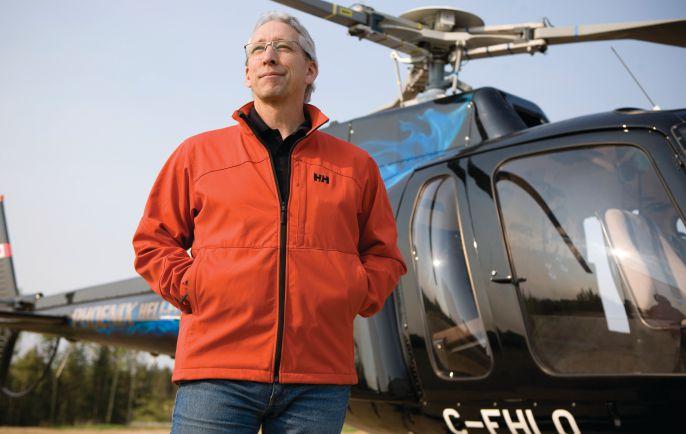
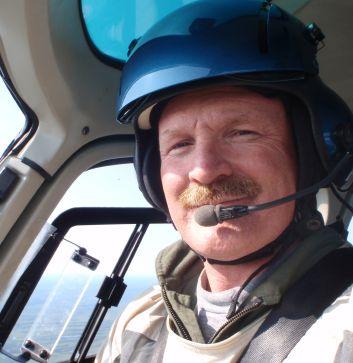
LEFT: HAC president/CEO Fred Jones is a strong participant in career development opportunities. (Photo by Jim Stubbington) BELOW: Fred Jones still relishes the chance to fly each season. (Photo courtesy of HAC)
HAC’s Fred Jones Opens Up on the State of the Industry
BY MATT NICHOLLS
When it comes to understanding the challenging, cyclical nature of the Canadian helicopter industry, few understand its delicate nuances like Helicopter Association of Canada (HAC) president/CEO Fred Jones.
Since joining the industry’s most prominent association in 2007, Jones has diligently led the advocacy charge on behalf of members, working hard to represent everything helicopter on a number of regulatory issues, the development of Best Practices, promoting the industry to various levels of government, working with the media and much more.
HAC (and the industry) has changed significantly over that time frame, with the evolution of the association’s Best Practices, an increased role amongst customers in setting and maintaining standards that exceed the regulatory requirements – which leaves existing regulatory requirements “in the dust,” Jones notes – and an increased commitment to safety on a number of important fronts.
There are plenty of positive stories to document, and many more challenges on the horizon for both HAC and the industry. So where do we go from here? Jones shared his thoughts with Helicopters Editor Matt Nicholls prior to the industry’s annual convention in Montreal.
Q. Things are winding down on the 2014 operating season for a number of operators. What was the general consensus on how the season went?
A. It has been a lackluster season for many operators for sure. There were a few late-season fires which are still burning, especially in B.C. and the Northwest Territories. This offered some respite for some operators, but for some, it was a dismal season. The mining sector was down pretty radically, and resources generally were down – not a stellar year at all.
Q. The Canadian helicopter industry is certainly cyclical in nature due to its resource base and utility missions, the seasonal aspects. Do you see this changing as companies seek ways to diversify and will it lead to further consolidation?
A. There has been a trend in the industry to consolidation of operators, but also there has been an effort on operators to diversify and develop niche area of operations so that they are doing something that 90 per cent of other companies are not doing. It could be pinecone harvesting, specialized aerial photography . . . there are a variety of niche operations that have the benefit of differentiating one operator from another. This also evens out the troughs and crests that we see in our industry year over year.
We are not seeing many new operators springing up – rather the trend has been toward consolidation in the industry. There is already such overcapacity out there that the rates are sadly very low across the industry and it has created a race to the bottom where operators are competing on the basis of price. There are operators who are pricing their equipment below cost and that makes it very difficult in an industry where customers discriminate on price only.
Q. What is the solution to this problem?
A. When you price machines that low, it’s an
act of desperation because you are just trying to generate cash flow, even if it is at the expense of the long-term viability of the company. This situation starts a chain of events that is not a happy one in the industry in terms of money that an operator may have to spend on enhancing safety, new products and discretionary spending. All of that is put off – a negative scenario all around. I know that some operators are trying to find niche areas of operation, where they have less competition and others are trying to distinguish a more costly product on the basis of quality.
Q. What would you say are the most pressing challenges operators are facing over of the next few years based on industry trends?
A. I put the issues into two categories. On a more micro level, I would have to say the flight and duty time issue is still the most important regulatory and advocacy issue facing the industry. It has been one-and-a-half years since the flight and duty time working group report was tabled and the association and its members are still primed for where this issue is going. Transport Canada (TC) just tabled some regulatory proposals. It has the potential to be catastrophic for our industry if TC moves in the direction of the working group’s recommendations. In spite of a number of dissents – and it has never happened in my 27 years of experience in Ottawa as a lobbyist – there were nine associations signed on to the same joint submission opposing to the flight and duty time working group recommendations. We are still waiting to find out where TC plans to go with this issue, and we are spinning-up our advocacy campaign if they continue to move down their current path.
Q. Why was the perspective of the Canadian helicopter industry not properly taken into account?
A. It’s partly a question of their ability to create regulations other than those, which are tailored to the airline industry. I think TC tried to create a one-size-fits-all scenario because it was just too much work to come up with something that was tailored to individual segments of the industry. Neither of the working group leaders had any experience in the helicopter industry whatsoever, so there was a lack of understanding.
Q. So, will the needs of the helicopter industry be met?
A. It’s funny, the Europeans and the Americans went through a very similar process to ours, and both jurisdictions put everyone in the same room and said let’s close the door and you guys figure out how we are going to make this work for the entire industry. Both the Europeans and the Americans came to the conclusion that “we can’t create a solution where one size fits all.”
Q. What is the timeline to have everything determined?
A. That is a question for TC. We are quite prepared to come back to the table if TC is prepared to hold a new working group which would examine a new flight and duty time regime that could work for the helicopter industry. We would do that next week if they indicated that they were open to that. However, we haven’t heard anything at all on this subject.
Q. What are some of the other issues that HAC is dealing with?
A. I refer to flight and duty times as the micro issue. The macro issue is TC itself. There are such significantly declining levels of service from TC that it is affecting the health of the industry, but it is also affecting safety. I can’t believe TC has yet to come to the conclusion that it needs to do business in a different way. Unfortunately, when they repatriated oversight for the business aviation community back to TC a few years ago, they threw the baby out with the bath water. There is some real merit to regulatory stewardship programs, there is real merit to delegation to industry. We have many years of experience in Canada with successful examples where industry can carry out tasks that were carried out by TC quite safely, quite successfully to the benefit of TC and the industry . . . Not only are they having difficulty keeping up with their core mandate, but there are a lot of initiatives that industry would like to see undertaken that would increase their efficiency, safety and more.
Every time we bring up delegation and increased responsibility to industry, TC responds by saying they are studying the issue, they are going through a reorganization and they want to see if they can make do with a different kind of inspector, they are working on implementing SMS . . . it has been years that we have been asking for this and TC has been unresponsive. This is the biggest issue, big picture – levels of service, a lack of accountability on the part of TC.
Q. Do you feel TC even understands the uniqueness and special needs of the helicopter industry in Canada?
A. There is so little helicopter expertise left inside TC and they have moved to a system where inspectors are generalists rather than specialists. Odds are you are probably getting an inspector that is not even involved in the helicopter industry and never has been. Historically, TC generally drafts regulations for the airline community, and then at some stage in the process they wake up and realize that the regulations will need to apply in a helicopter context as well – sometimes they simply don’t fit, and sometimes they don’t even “speak our language.”
There comes a point when TC will have to come to the realization that they need some help. The cutbacks they have experienced in terms of their budget are very real. In some regions, there are vacant regions because they just can’t afford to fill them and they are trying to staff them with different types of people. They are not staffing them with pilots and engineers; they are staffing them with SMS specialists who go
out and audit a company but may not have any background in the helicopter industry.
Q. HAC, through its Best Practices, continues to be a strong advocate for safety in this country. What more needs to be done in Canada in order for it to hit a higher safety envelope?
A. The objective ultimately and the mantra is similar to the goal of the International Helicopter Safety Team (IHST) in the U.S. –zero accidents. That’s the goal, and all we can do is work towards that goal. Best Practices are a step in the right direction I believe, particularly since the regulatory framework has
always been a blunt instrument for setting standards for the helicopter industry because they are so general, it is hard to apply standards to any given type of specialty.
One of the questions I have for operators in that context is: is there any place for audit standards built around our Best Practices? Is there any place for training employees, maintenance or flight crew around our Best Practices? I need to understand if there’s an appetite for either of those things from operator members because I am not about to force a system on operators that they don’t think themselves will
enhance safety, or it’s a role they don’t feel the association should be involved in.
We have always said that No. 1, TC has got to provide some real recognition that the Best Practice enhances safety and No. 2, that some recognition from a regulatory oversight perspective is necessary. It’s a big step and we will see in Montreal if operators are prepared to go down that road. But if we develop an audit standard around a Best Practice, it wouldn’t be mandatory. It could provide evidence for TC, evidence for customers, that there is an effort on the part of an operator to implement the Best Practice. I still don’t get the impression
TC is prepared to extend any advantage to operators who could demonstrate that they were in compliance with a Best Practice.
Q. Fred, you are very involved in promoting the industry at the grassroots level – getting youngsters hooked on a career in helicopters. Is enough being done as an industry to promote the many industries and services it supports?
A. We are not doing enough. There are some real obstacles to the transition between the low-time helicopter pilot and a higher-time pilot. It’s a challenging problem and some operators have done this on their own. They
have built a transition plan for low-time pilots. Some have forged relationships with flying schools to take some of their best graduates into their operation and have also built a phased system for bringing them up. The helicopter industry is very different from fixed wing in the experience-building process. Since we operate predominantly in a single-pilot environment, and in remote areas, it is much more difficult to learn under the direct supervision of a more experienced pilot.
There has to be a phased mechanism for transitioning low-time to experienced pilots and operators do it on an ad hoc basis – some do ferry flights for example. And we have made some efforts to try to bridge that gap, our Pilot Competencies document for wildfire operations, for example has been endorsed by most of the firefighting agencies across the country and this is a competencybased system rather than an hours based system. With a relatively low number of hours, if you have demonstrated competency in the different activities required for firefighting operations, you can conduct firefighting operations safely with less than 1,500 hours, for example.
Q. Are you happy with HAC’s progress heading over the past few years?
A. I am, but I came to realize that “Culture eats strategy for breakfast.” You can have great ideas, but in many cases, there needs to be a change in the culture of the industry to achieve that objective. A good example is Best Practices. The idea that you create a Best Practice and then transition to an audit standard over night, for example – these things don’t happen over night and it takes a number of things to fall into place. Members have got to appreciate that what you are trying to develop is not to promote one operator over another, or to favour one commercial interest over another. It’s a genuine effort to come up with what a reasonable and prudent operator is doing. If you can’t get that far, you can’t possibly reach an audit standard. And you can’t possibly get to a delegation phase, because the industry doesn’t trust what is under development. Even though it has taken years for the Best Practice initiatives to catch fire, it was an organic process that had to evolve that way. It can’t just happen quickly.
I’m really quite pleased at the number of different products we have been able to offer in recent history. And moving the conference to the fall was another change that took some time. We had a hung jury the first time we went out with a survey on the subject, so we hesitated with it and went out with another survey and it was a more persuasive response.
For the expanded interview with Fred Jones, please go to www.helicopters.com
Aircraft
Major
Approved
Component
Complete
Composite
Import
Manufacturing
markeTplace
The AStar (or “Squirrel”) light-utility, multi-purpose helicopter has deep work roots in civilian, law enforcement and military operations. Whether you are new to these types of Ecureuil machines or an experienced pilot who has flown them for years, you will appreciate this in-depth look at how they really work. The Eurocopter AS350/355 Book - the essential training aid, reference book and flightmanual companion - gives you that deeper knowledge.
Includes the real-life, hands-on, working knowledge you should know:
• Overview of the AS350, along with model and type variations
• Examination of the inner and interrelated workings of the machine’s airframe, engine, transmission and rotors
• Insight into the AStar’s all-important controls, hydraulic, electrical, fuel, heating and ventilation systems
• Observation of the helicopter’s limitations, performance, weight and balance data and the daily flight checklists
• Advice for handling non-autorotative and autorotative emergencies and other assorted in-flight “situations”
• Operating procedures and operating tips for control effects, power checks, noise abatement
• Question and Answer sections for measuring up your working knowledge of the AS350 and more!
Photo by Bill Campbell MAINTENANCE CENTER
COLUMN
FRED JONES
The flight and duty time issue continues to be a significant problem for the Canadian helicopter industry. The Flight Crew Fatigue Management Working Group met for 43 days over the course of 18 months, and the Helicopter Association of Canada (HAC) and its operator-members were represented at every meeting.
Two years later, the silence from Transport Canada (TC) was deafening – until the draft Notices of Proposed amendment (NPAs) were tabled in the absence of any post-working group dialogue with affected industry stakeholders. The proposed amendments to our current flight and duty time regulatory structure were tabled on September 15. There were very few changes from the working group’s report’s recommendations, which were opposed in a joint submission by virtually every segment of the commercial and business aviation communities. Interested stakeholders have been given five weeks to comment before the NPAs were slated for Gazette I – and two years later for CAR 702 and 703 operators, they would come in to force.
The preamble to the NPAs is aggressively misleading: “These changes are supported by today’s fatigue science and are harmonized with changes introduced by the Federal Aviation Administration (FAA) and the European Aviation Safety Agency (EASA).”
In fact, most of the proposed changes are not supported by the largely ambiguous fatigue-related science. Some of the changes to the current rules they are suggesting run contrary to accepted fatigue-
Proposed Flight & Duty Time Amendments Don’t Make Sense A Big Mistake
these changes. This is, as-they-say, a “Solution looking for a problem.”
The preamble has reduced the “significant” impact on CAR 702 and 703 operations to: “Adjustments to schedules may be required.” This is a grossly misleading and incomplete assessment of the catastrophic impact of the new regulations on our industry segment and its customers. The comment also reveals a complete disinterest on the part of TC for the impact of the proposals on CAR 702 and 703 operators.
Some of the proposal’s “highlights” include:
• New cumulative duty hour limitations of: 1,928 duty hours in 365 days; 190 duty hours in 28 days; 60 duty hours in 7 days
• New cumulative flight time limits: 112 flight hours in 28 days (down from 140 in 28 days currently); 300 flight hours in 90 days (down from 450 in 90 currently); 1,000 flight hours in 365 days (down from 1,200 hours currently)
• Time free from duty: 5 days off in 20 or 1 day off in 7
• Maximum duty day 13 hours (but reduced further for early or late starts)
Compliance with the proposed new regulations would need to be demonstrated within 24 months post-Gazette II publication, for CAR 702 and 703 operators.
Finally, we know that there will be very vocal and visible opposition to the proposed rules from affected segments of the industry including customers and operators, but particularly from those serving our resource based economy; northern and remote operators and the communities they serve; aboriginal groups; and from virtually all operators notwithstanding the CAR 705 airline operators represented by NACC, who we believe will see the regulations moving closer to the terms of their collective agreements.
Most of the proposed changes are not supported by the largely ambiguous fatigue-related science. ‘‘ ’’
related science. The removal of the “zeroing” provisions that exist in the current rules is only one example. Furthermore, the proposal is only harmonized with the FAA and European Aviation Safety Authority insofar as passenger-carrying airline operations are concerned. The Europeans and the Americans have not yet addressed this issue for other segments of their respective aviation communities.
The department has tried to connect the accident rate to fatiguerelated issues using quantum leaps of logic. The reality is, that there are virtually no accidents where the Canadian TSB has found a causal link between an accident and pilot fatigue. In short, there is no safety case for
One of the strengths of our industry is the fact that our members operate in the four corners of Canada and as individual businesses, we often have the ears of our local MPs. There are not many issues that are as important to operators as the flight and duty time issue, and this may well be an issue running in to next year’s federal election.
HAC and its allied associations are urging TC to move forward by resolving the issues in the NPA as they relate to CAR 705 operations and to “get back to the table” with other segments of the commercial aviation community to find new industry segment-specific regulatory proposals that are better suited to the helicopter industry and others. HAC will be engaging in a formal advocacy campaign if TC continues to promote the regulations in their current form.
allowing you 3 ways to market your organization to students: the guide, expos & website. choose any or all to suit your marketing objectives! Colleges and universities with aviation and aerospace
and
For more information on sponsorship and exhibitor opportunities, please contact:
Mena Miu I 905-713-4351 I mmiu@annexweb.com
Jarah Stefek I 519-429-5191 I jstefek@annexweb.com
YOU FLY. WE SUPPORT.
Customer satisfaction is a top priority of Airbus Helicopters.
With over 30 years’ of experience, supporting rotary wing aircraft Benoit Marcoux heads a dedicated team of licensed Technical Experts, Customer Service Representatives and MRO specialists all committed to guaranteeing you have the level of service you should expect from an Airbus Helicopters customer center.
Airbus Helicopters Canada is fully committed to ensuring the technical expertise, parts and full spectrum of services are in place to support all your missions.