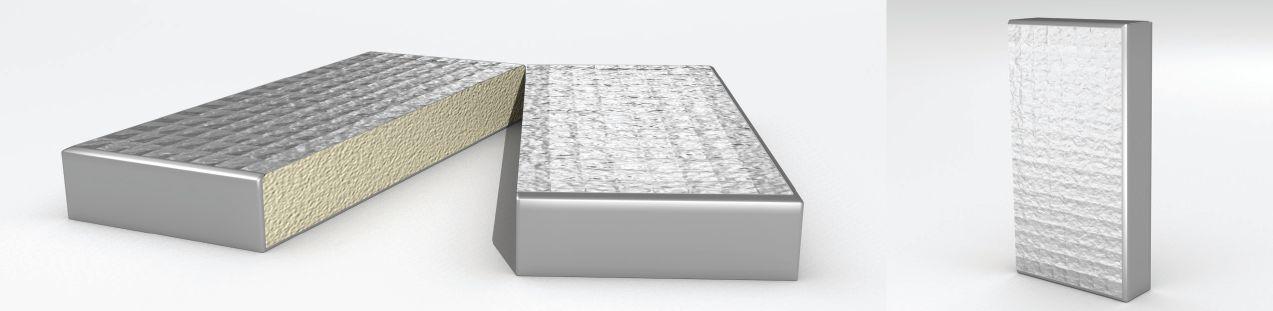
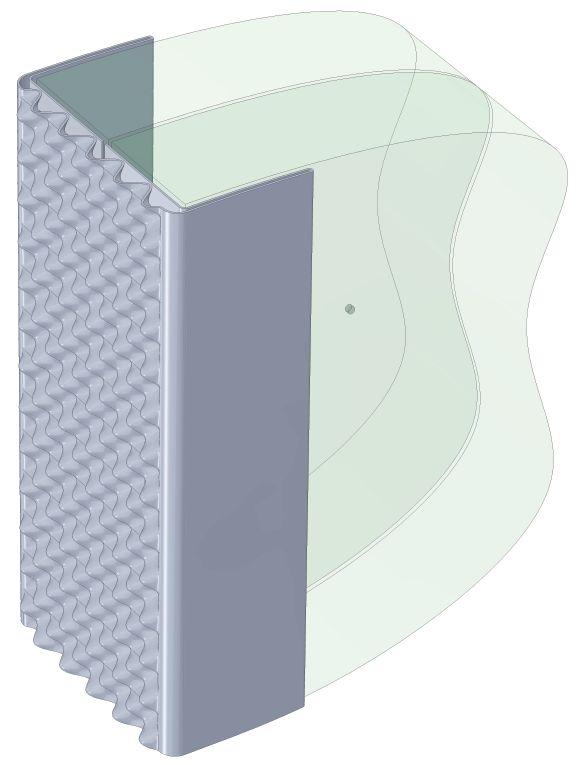
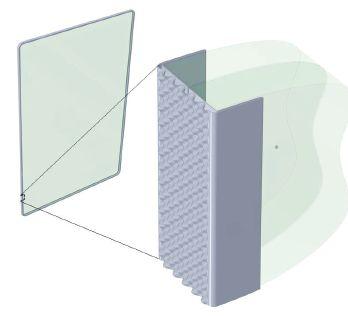
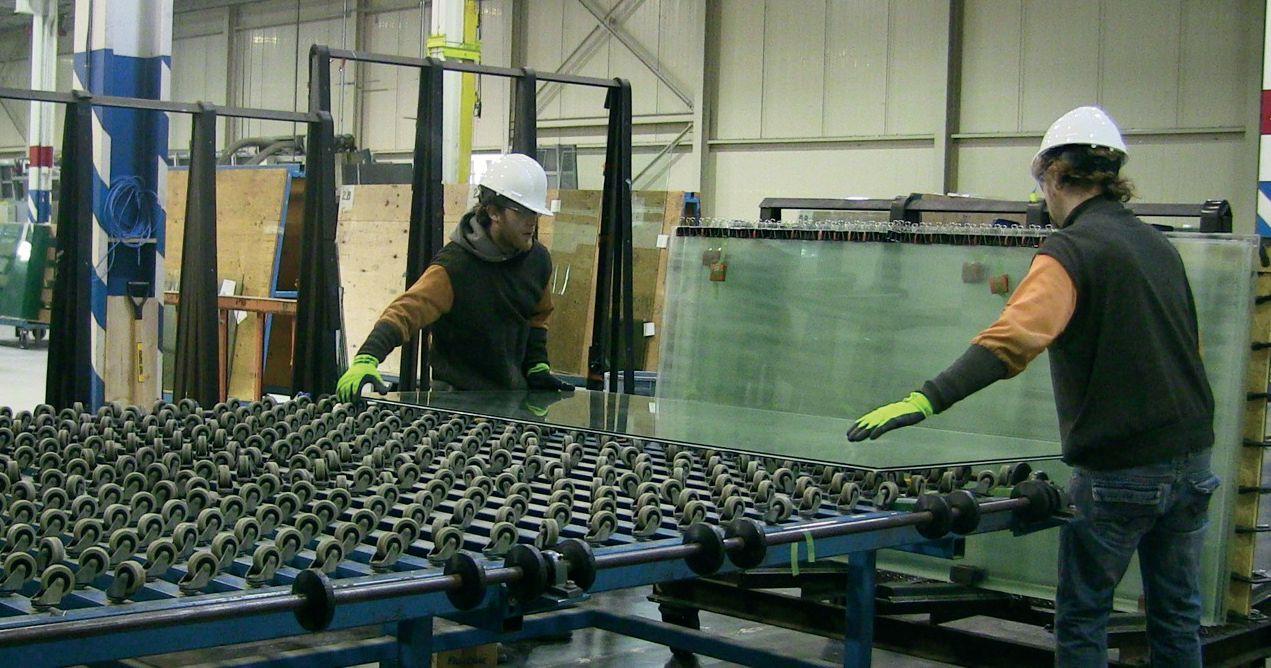
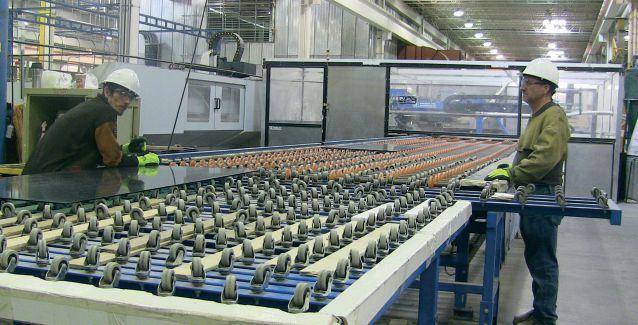
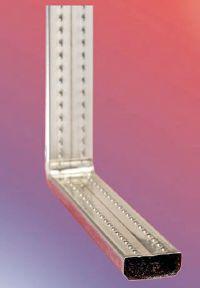
Automated efficiency takes insulated metal back pans and curtain-wall engineering to a new level. Refinements to traditional building envelope technology have put Lenmak Exterior Innovations’ EnvaTherm® back pans ahead of the competition.
Innovation in foam delivery technology yields soft, even, self-sealing insulation that provides a competitive R-value for consistent, reliable performance. The breathable foil backing maximizes insulative potential and protects against fire and UV damage.
EnvaTherm® insulated back pans have many clear advantages:
• Government acceptance of EnvaTherm® as a component of a non-combustible assembly up to 12 storeys (CAN/ULC-S134 Fire Test of Exterior Wall Assemblies)
• Automated production and lean manufacturing mean competitive lead times
• There is no loss of thermal performance due to air movement through panels
• Minimize the entry of drafts, humidity and allergens; does not support growth of mold
• The use of stick-pins is not required
• 80% lighter than panels that use traditional curtain-wall technology
• Each panel is totally self-contained for easy installation, handling and shipping
• Oversized panels maintain complete seal when properly installed
• Prevent noise transfer
EnvaTherm® insulated back pans are designed for use in curtain-wall systems in conjunction with a variety of architectural finishes, including opaque glass panels featuring UV-resistant finishes or metal panels for areas that do not require glass. Innovation in insulation technology ensures efficiency of production and proven real-world performance.
Flawless from Fabrication to Finish
it squeezes out of a tube, you will find it here. Check out these top products for sealing and structural work.
Vaughan, Ont., plant is seeing new investment and new life under general manager David McCallen.
A fantastic, modern era
Glass technology is advancing faster than are most other building materials’. It is an exciting time to be in the industry and fun to contemplate the near future.
We don’t do theme issues in Glass Canada where the magazine is all about some particular topic, but rather by accident this issue has turned out to have a lot of content about cutting edge technology. Our cover story takes a look at vacuum insulating glass and the new developments that may soon make it competitive with triple-glazed IGU. And Brian Burton hits a cautionary note in Fenestration Forum about our industry’s lack of investment in R&D and the possible long-term consequences of such neglect.
GROUP PUBLISHER | Martin MCANULTY mmcanulty@annexweb.com
Publication Mail Agreement #40065710. RETURN UNDELIVERABLE CANADIAN ADDRESS TO CIRCULATION DEPARTMENT, P.O. BOX 530, SIMCOE, ON N3Y 4N5 e-mail: subscribe@glasscanadamag.com
• bEC report
One of my favourite movies, Master and Commander: The Far Side of the World is about a 19th-century British naval captain (played by Russell Crowe) who is pursuing a French privateer off the coast of South America. The movie is remarkable in its realistic portrayal of life aboard a man-o’-war during the time of Napoleon, complete with scenes depicting young officers having broken arms amputated rather than set, weapons almost as likely to kill their wielders as the enemy and cages full of livestock to feed the crew in the absence of refrigeration. Yet at one point in the movie, Crowe contemplates the elegant lines of a model of the enemy ship and comments, “What a fantastic, modern era we live in.”
The irony of the line draws a chuckle from today’s audience. But the truth is, that era in history was one of amazing, magicalseeming advances in technology as western countries began to apply the scientific discoveries of the Enlightenment to technical problems in transportation, manufacturing, agriculture and warfare. Steam-powered machinery and ships, railroads, fertilizer, electric lights, the telegraph – all these were right on the horizon, with their attendant transformations to life and society.
It would be a stretch to say we live in such an era now. Computers aside, much of the technology we use today has changed little since the Second World War. The exciting thing about the glass industry is that it is bucking this trend. The last few decades have seen major, fundamental changes in the way we build windows and even whole buildings using glass. Glass itself is being infused with a number of remarkable new powers, including super strength and the ability to bounce or transmit specific levels and wavelengths of light and heat. We seem to be on the cusp of developing glass that will be as energy efficient as a solid wall, once solar heat gain effects are taken into account. Glass that can act as a computer display without visible electronics is not far off, nor is glass that can produce enough energy to power the building it encloses. It is, indeed, a fantastic, modern era we live in – at least for those of us in the glass industry. •
Printed in Canada, All rights reserved. Editorial material is copyrighted. Permission to reprint may be granted on request. ISSN 0843-7041
Occasionally, Glass Canada will mail information on behalf of industry-related groups whose products and services we believe may be of interest to you. If you prefer not to receive this information, please contact our circulation department in any of the four ways listed above.
www.glasscanadamag.com
NEWS
Students light up libraries
theAmerican Institute of Architecture students and Kawneer recently announced the winners of their national student design competition, Enlightening Libraries. Laura boykin, a graduate student from Clemson University, under the advisement of Ufuk Ersoy, was awarded first place and $3,000 for her design, “Mediascape: An Enlightened Library for Pendleton, s.C.” the competition, which is sponsored by Kawneer and administered by the AIAs, challenged students to investigate and design a public library while learning about building materials and sustainable design techniques. during the competition, participants were required to rework a dated public library and create a facility that is an effectively urbanized collaborative community space appealing to all generations and integrating the most recent technologies. Using Kawneer’s highperforming products – from curtain wall
and entrances to windows and storefront framing systems – students designed efficient and new-age libraries that embraced atmospheres of enlightenment and learning. the competition jury comprised four architectural professionals: Mark baker, of Lantzboggio Architects, E.J. Meade of Arch11, Andrew G. Nielsen of AndersonMasondale Architects and Melanie hennigan of Grimm Plus Parker. Jurors evaluated several hundred submissions on their ingenuity and originality as well as design clarity, appropriate use of materials and the ability to create an esthetic that complements the community and environment. Winning entries can be viewed at http://kawneer.aias.org/winners/ and will be displayed at the 2013 AIA National Convention and design Exposition in denver, Colo., June 20 to 22 and at the AIAs Forum convention in Chicago, Ill., dec. 29 through Jan. 1, 2014.
Bitsakakis to handle Royal window profiles
Royal building Products has announced that Chris bitsakakis has been appointed vice-president and general manager of its Window and door Profiles business. “We are excited to have a leader of Chris’ calibre join our business,” said Mark orcutt, executive vice-president of building products. “Chris brings a solid combination of sales, manufacturing and financial experience to this role, and we are counting on him to help position the window and door profiles business to take advantage of the emerging recovery of the North American housing market.”
bitsakakis comes to royal from durabody Industries, a Canadian-based manufacturer of truck bodies and trailers, where he was president and chief executive officer for the past two years. Prior to durabody, he spent more than 20 years in positions of increasing responsibility in the automotive manufacturing industry, first with Cooper standard Automotive and more recently with Magna International. bitsakakis holds a master’s degree in business administration from the University of Western ontario.
CGA Newsletter
PROFESSIONAL GlAzieRs ASSOCIATION Of AlBeRtA
thePGAA, in association with the southern Alberta Institute of technology, have created the framework for a Master Glazier’s Program. the MGP is a continuing education program for certified journeymen glaziers. We will be creating nine courses specifically designed for our industry. While the framework is in place, the courses are only just embarking on the development stage with subject matter experts.
the Master Glazier Program is an initiative of the PGAA that started about seven years ago. over the course of the first five years there were a handful of meetings and discussions about what we wanted to achieve. We arrived at the following consensus.
the Master Glazier Program will be a continuing education program designed for certified journeymen glaziers. We recognize that many journeymen may only excel in one or two areas of the trade, for instance, curtainwalls or glazing, and others were accredited decades ago when Mono was considered the building envelope. As a result, a committee was struck and met with sAIt to develop an outline for courses designed specifically for the glazier trade.
Upon completion, a certified journeyman glazier, would be better rounded in more aspects of the glazing trade, as well as trained in the latest techniques and standards of the trade. While the criteria has yet to be established, the idea is that sAIt will deliver the courses to any individual that wishes to enroll. A certified journeyman glazier would take the courses
and, after meeting a set criteria to be established by the PGAA, would make application to the PGAA to be recognized as a Master Glazier. In the future, the PGAA would like to approach specifiers to give consideration to making a bid requirement for projects that companies have Master Glaziers on staff. however, this would be something to consider in the future, right now we are concentrating on getting the courses and the MGP in place.
We are very close to seeing this idea come to fruition. We believe this type of program will be the first of it’s kind in North America and quite possibly the first in the world. this new program is going to cost a lot of money in start up costs, so the PGAA has organized a golf tournament where the proceeds from the tournament will go towards the MGP. the tournament will take place at the Alberta springs Golf resort in red deer on August 16th.to date, we have 144 golfers committed to play in the tournament, which is the largest tournament in the Alberta glazing industry’s history. We have six golfers on a waiting list. In addition, our sponsors have pledged $48,550 so far. We are very proud of the buy-in that we have had from industry in this worthwhile endeavor. Essentially we’ve sold 98 holes on an 18-hole golf course! don’t be left out. to become a sponsor, contact dwayne stolz, PGAA treasurer, at Leyden’s Glass at leyglass@ shaw.ca or 1-403-346-8611.
ONTARIO
GLASS AND MetAl ASSOCIATION
the oGMA is pleased to put
on an exciting and fun night of thoroughbred horse racing again this spring. Come out and join us for a great dinner and camaraderie and some time at the slots. race Nite will take place at the Woodbine racetrack’s Post Parade restaurant on Wednesday, May 1, at 6 p.m.
Mark May 30 on your calendar and plan to attend the renowned oGMA spring Golf tournament once again being held at the Glen Eagle Golf Club in bolton, ont.
oGMA Fall Golf tees off thursday, sept. 19, 2013, at the Carrying Place Golf Club in Caledon, ont.
ATLANTIC PROVINCES GLAzING ASSOCIATION
the december meeting of the APGAA went very well with nothing but positive comments all around, especially towards the guest speaker. It was great to see and hear from everyone.
Eric Ledrew from the law
firm McInnes Cooper certainly had a captive audience as he explained contract law. hopefully, he wasn’t too scary! talking law, specifically contracts, is certainly an eye opener. It lends to the idea of associations such as this one getting together to standardize a proper contract that is not so one-sided.
As we noted in our meeting, any comments or ideas members may have that would help progress this association and turn it into something of value for all of us in the industry would be welcomed and greatly appreciated.
We are planning our next meeting in April where a prominent halifax architect will be addressing our group with his desires and concerns for our industry. We will also have two government people from the trades come in and answer your questions about apprenticeship. It should be a very informative meeting.
to those of you who have joined, thank you very much. to those who have expressed an interest, please consider the benefits you can help create, and join now.
Eric LeDrew of McInnes Cooper certainly had the group’s attention with his eye-opening talk on contract law.
NEWS
Prelco to distribute Pleotint
Pleotint has announced a distribution agreement with Prelco in rivièredu-Loup, Que., enabling Prelco to incorporate Pleotint’s suntuitive interlayer technology into its proprietary Prel-shade thermochromic window offering.
suntuitive interlayer by Pleotint features an advanced, sun-sensing, adaptive-tinting technology. the agreement grants Prelco exclusive rights to market Prel-shade windows with suntuitive interlayer technology in eastern Canada, including Quebec, ontario and the Maritime provinces.
Paul ogburn, vice-president of Pleotint, said, “our agreement with
Prelco provides an opportunity to expand our distribution network while offering an ideal glazing solution for office buildings, schools, restaurants and residential applications throughout eastern Canada.”
suntuitive interlayer by Pleotint is North America’s first commercially available window interlayer for laminated glass that gradually darkens in response to rising temperatures caused by direct sunlight, then cools as the sun moves across the sky, returning to a clear, neutral state in cloudy or dark environmental conditions.
“the Canadian construction market has seen rising demand for heat and
glare control products,” says bill Marchitello, Canadian sales director for Prelco. “Prel-shade is an energyefficient, easy-to-install alternative to other glazing products. the thermochromic glass technology offers a clear, unobstructed view that you can’t achieve with blinds or dark tints.”
the suntuitive interlayer requires no mechanical intervention, which effectively eliminates the threat of failure caused by faulty wiring, poor electrical connections, broken circuits or temperamental computer systems. Installation of windows with suntuitive interlayer is the same as for other laminated IGUs.
Viracon shutters one plant, invests in another
Viracon, Inc. has announced it will temporarily close its st. George, Utah, facility, for approximately two years beginning in mid-April 2013. the plant closing will impact 222 employees. the temporary closure will better align overall capacity with the demand expected over the next two years, which can be served from Viracon’s two other U.s. locations, officials said in a release.
“this was a very difficult but necessary decision that we had hoped to avoid,” said Viracon president Kelly schuller in the release. “our st. George workforce has done a great job, but the prolonged construction downturn required us to act to improve our operating efficiencies and maintain our competitive position.”
relocation opportunities are being discussed with employees on a caseby-case basis. the 210,000-square-foot st. George manufacturing facility will be retained and improved by Viracon during the closure. In particular, the company plans to upgrade the coating capabilities at the plant before reopening when the market recovers, which is expected to be in approximately two years, according to the release.
Production schedules, deliveries and
lead times will be unaffected by the temporary closure. Production will be absorbed in one of the company’s other two U.s. manufacturing facilities located in owatonna, Minn., and statesboro, Ga., company officials report.
In other Viracon news, the company has announced that it will make an investment of more than $30 million at its owatonna, Minn., facility. the investment is for a new coater that will allow Viracon to strengthen its architectural glass offering and ensure its long-term competitiveness. Viracon decided to install the new coating technology in Minnesota because the owatonna facility contains Viracon’s most extensive product capabilities and deepest bench of technical talent, and it is centrally located for serving the company’s primary North American market. support from the city, county and state was also a pivotal factor in the location decision.
“Viracon is focused on commercial buildings with our own coating capabilities,” said Kelly schuller, Viracon president. he explained, “our coatings are a key underpinning of our competitive differentiation, and the new coater will have many new capabilities and features that will ensure Viracon remains
at the forefront of architectural coating technology.
“on behalf of our employees, I would like to thank the City of owatonna, steele County and the state of Minnesota for their help in making this investment in our largest location possible,” said schuller.
“Preserving the competitiveness of a key manufacturer, such as Viracon, whose high-performance architectural glass products are sold all over the globe, is a priority for the state of Minnesota,” said dEEd commissioner Katie Clark sieben. “We congratulate Viracon on their most recent expansion and thank them for making this key investment in Minnesota.”
“our state, city and county board leaders worked hard to be creative to ensure that the project was won in owatonna,” said owatonna mayor tom Kuntz. “Viracon is a great employer and very valuable to the community.”
schuller said the project is expected to get underway in April 2013, with the site work required to make way for a building addition to house the new coater. It is anticipated that the new coater will begin delivering product for distinctive commercial buildings by late summer 2014.
New chairman at Schott
the supervisory board of schott AG unanimously appointed dr. Frank heinricht to the new position of chairman of the board of management in its meeting on Feb. 27, 2013. heinricht, 50, is currently chairman of the board of management of heraeus holding Gmbh he completed a degree in physics and a doctorate in engineering at the technical University of berlin and began his professional career at tEMIC semiconductors. After holding positions as general manager and chairman of the Integrated Circuits division, he was appointed chief executive officer of tEMIC semiconductor Group in 1998. In 2003, heinricht joined heraeus holding Gmbh as a member of the board of management. he
was appointed chairman of the board and labor director in 2008.
Chairman of the supervisory board of schott AG dr. dieter Kurz commented after the meeting, “We are pleased that we were able to recruit dr. heinricht, an outstanding manager, as the new chairman of the board of management. his experience in managing a company with a complex portfolio makes him ideally suited to lead schott. he looks back on a proven track record in expanding the market presence of a global company, particularly in Asia. We are confident that the necessary reorientation at schott is in excellent hands with him.”
heinricht will take office on June 1, 2013.
farley completes restructuring
Farley Group Inc., formerly known as Farley Windoor Ltd., one of Canada’s largest fenestration manufacturers, has successfully exited CCAA proceedings. After an extensive restructuring that saw the consolidation of the company’s manufacturing facilities and its exit from the entry door market, Farley’s refinancing proposal was approved by the court on Feb. 27.
“In order to exploit our strengths and maximize economies of scale, we took a serious look at our production and transportation models, consolidated manufacturing activities, and eliminated redundancies,” said company president dominique Van Voorhis. “We received a number of strong refinancing proposals from various sources and are extremely pleased with the court’s decision.”
With its streamlined operations and new lease on life, Farley has committed to focusing on delivering superior-quality products within competitive lead times. Initially founded by Frank Farley in 1952, Farley Group Inc.
manufactures full lines of PVC and aluminum hybrid windows and patio doors under the Farley Windows and doors, GreenView Windows and doors, and bonneville solutions brands. Engineered for both the renovation and new construction markets, Farley Group brands offer a combination of superior quality, energy-efficiency and exceptional warranties. Farley’s manufacturing facilities continue to boast a fully automated Intercept Ultra stainless steel spacer line, state-of-the-art four-point corner welders, automated multifunction corner cleaners and computerized glass cutting tables.
the company added in a statement, “Most importantly, we at Farley would like to take the time to extend a sincere thank-you to our employees and customers for their support through Farley’s CCAA proceedings. their collective collaboration, patience, and outstanding commitments have been key factors in our success in exiting CCAA proceedings.”
Moynan a victim of foul play
Canadian
Press is reporting that remains found in a park in Panama are those of former Centennial Glass owner Ed Moynan, who has been missing since November. Moynan moved to Panama after retiring about two years ago. his wife, Louise, returned from a visit to ottawa to find their house in Coronado, Panama, ransacked and Moynan gone. he was 68. Centennial Glass is a full service residential and commercial fabricator and installer that has operated in ottawa since 1967.
Coming events
May 1
oGMA race Nite Vaughan, ont. www.ogma.ca
May 29 – June 2
Fenestration Canada
Annual General Meeting st. John’s, N.L. www.fenestrationcanada.ca
May 30
oGMA spring Golf bolton, ont. www.ogma.ca
June 9 – 12
AAMA National summer Conference rosemont, Ill. www.aamanet.org
AAMA National Fall Conference baltimore, Md. www.aamanet.org
See more events online at glasscanadamag.com
AlMOst tHeRe
New advances in VIG may yield market-ready products
by PaTrick Flannery
Nothing insulates like nothing. That is the simple principle behind vacuum insulating glass, an idea that has tantalized building engineers for a century. But VIG that realizes its potential to outperform conventional IG solutions has proved to be a thorny problem. Fortunately, a convergence of positive factors may be bringing high-performance VIG to the point of market feasibility for the first time.
Vacuum insulating glass presents a difficult engineering challenge because solutions to one problem tend to create headaches in another area. There have been four main technical hurdles to overcome:
• Creating and maintaining a superior hermetic seal.
• Preventing the glass lites from bowing inward under negative pressure and touching, creating a thermal short.
• Preventing the thermal growth and contraction of the lites from stressing the glass and seal materials to failure.
• Obtaining the necessary hard vacuum in a timely manner.
All these obstacles have been overcome some time ago – but not in a fashion that yields insulating levels significantly better than high-quality IG units, and not in a fashion that can be warranted for cold-weather climates. Existing VIG designs are also limited in size and to using annealed glass. For many years, VIG has been stuck in this rut of having niche application for mild-climate situations where double-glazing insulating levels were required with single-pane thickness. Nippon Sheet Glass has delivered its VIG Spacia product in Japan for years, but penetration into the North American market has been low. It delivers a very respectable 1.1 U-value in a sixmillimetre-thick product, but Pilkington’s product brochure describes it as a solution for heritage retrofits where standard double-glazed will not fit. Pilkington dropped offering its Spacia products in North America about a year ago.
As with most engineering challenges, these issues might have been resolved
products
soon.
years ago had external factors forced grant-giving bodies and industry manufacturers to invest in finding solutions. It looks like climate change may have finally delivered the political and economic conditions necessary for invention. Guardian’s David Cooper, past-president of IGMA and chair of its VIG task group, explains why we are seeing new progress on VIG technology. “Codes and Energy Star requirements,” he says. “What the industry is going to respond to are codes, and the codes are adapting to change. Energy Star is moving to higher thermal performance standards and the industry will naturally be looking for ways to incorporate new technology that does not cost an arm and a leg. You can do a lot of things – you can start making quad units – but VIG is a very compact package. Two pieces of glass that are roughly eight millimetres thick and you get the R-value performance of a superior triple-pane product. So the driver is there to get it at the same cost point as triple.”
To see how the industry is getting there, we will take a look at two groups in the U.S. – Guardian and EverSealed Windows – who are claiming to be close to bringing to market VIG that is warranted in all climate zones and delivers R-10 or better insulating values. Guardian is, of course, one of the largest glass suppliers in the world. ESW is based out of Evergreen, Colo., and is a research lab owned by a small group of co-founders led by David Stark, the president and chief technology officer. Stark is working with Pella and Cardinal with a goal to license his process to IG fabricators once it is certified. Guardian hopes to bring its VIG units to market itself. Each of these organizations
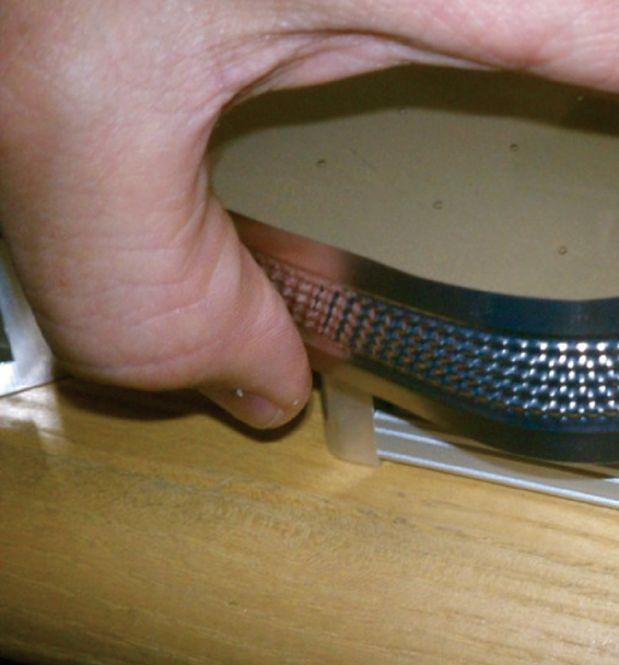
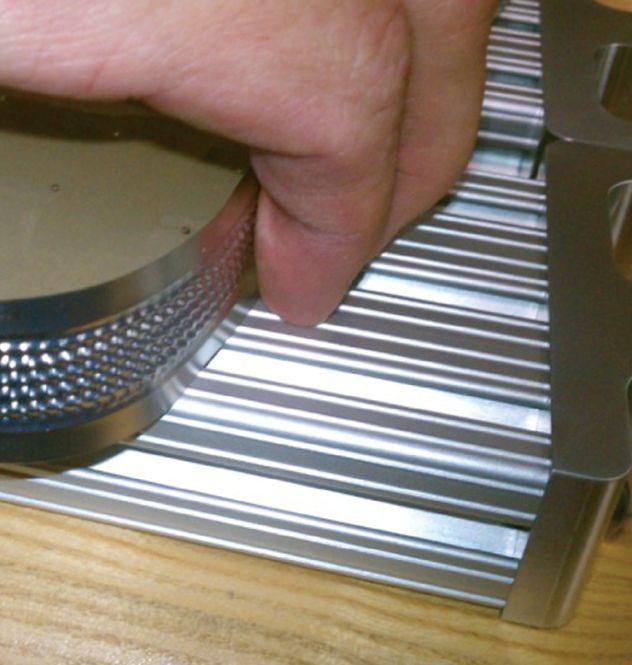
For a potentially ground-breaking innovation, it doesn’t look like much. The corrugations on this stainless-steel strip are the secret to EverSealed’s flexible mechanical seal that may make VIG practical in cold-weather climates.
have taken different approaches to solving the four problems of VIG.
The seal of approval
To create a vacuum between two lites of glass, you need a great seal. And to meet today’s expectations of IGU longevity, you need that seal to work for at least 25 years. EverSealed set a target life span for its seal of 40 years and figured it had to achieve a gas-transfer rate of no greater than 10-13 cubic centimetres per second in order to meet that target. This is a very difficult target to hit. The standard for hermeticity in the microelectrics industry is only 10-8 cc/sec..
Normal IGU edge-sealing methods are, of course, entirely useless for fabricating VIG. No butyl-based sealant is mechanically strong enough or impermeable enough to gas and water to maintain a seal against a strong vacuum. Some form of solid mechanical seal is required. NSG’s VIG uses glass solder between the lites to create a continuous glass seal. This creates an effective seal, but involves heating the solder glass to over 400 C. These high temperatures will de-temper tempered glass making the process only suitable for annealed glass.
Another approach is to use a strip of metal as an edge seal. But the metal must be adhered to the glass much more hermetically than is possible with standard glues or epoxies. One established method for fusing glass to metal comes out of the vacuum tube industry and involves a process known as diffusion bonding, where glass and metal surfaces are forced
together under temperature and pressure in a vacuum, causing the oxide layer on the metal to bond powerfully to the glass at the molecular level. Coming as he did out of the microelectronics industry (he used to build circuits for missiles, then moved to micro-windows for digital image processors), Stark was initially interested in this process as a possible way to create permanent glass/metal bonds for VIG seals. A German group called Pro-VIG initially and for years played with using ultrasonic bonding. This uses high-frequency vibration to abrade one material’s surface into/onto the adjacent surface. Eventually, the Pro-VIG group stated trying soldering with indium solders before it ceased operations. But after playing around with different alloys, Stark could not find a way to make the process work with tempered glass. The temperatures required were too high. Even with annealed glass, the cycle time was up around 10 or 15 minutes, which is prohibitive for any kind of mass manufacturing process.
So EverSealed turned to ultrasonic soldering. Unable to find a lead-free solder glass that would melt at a low enough temperature in a short enough time to not affect the fully-tempered strength of tempered low-e glass, EverSealed in 2010 attempted to develop its own lead-free solder glass with appropriate reflow properties. After almost eight months of concerted effort, EverSealed abandoned their solder-glass and reflow development efforts.
EverSealed designed, modeled and simulated several iterations of what it called its flexible asymmetrical bellows. The metal bellows, attached to the dual-lite VIG’s surfaces 1 and 4, acted as a hermetic flexible spring, allowing lite 1 to expand and contract with changes in its temperature without imparting or transferring significant stresses to lite 2. However, simulations performed in late 2010 showed that although the bellows provided more than sufficient compliance perpendicular to the edges of the two lites, all designs were too stiff in the direction parallel to the edges of the lites.
In a concurrent engineering brainstorming session in January 2011 in which team members from each collaboration industry as well as engineering discipline participated, twelve concepts were proposed for a replacement flexible hermetic metal seal system. EverSealed’s
mechanical engineers down-selected and to three possibilities and then designed, modeled and simulated the performance of each during extreme thermal cycling of lite 1 of the two-lite VIG.
The result is a one-piece continuous strip of very thin stainless-steel foil, rollformed or stamped to provide the flexible form in its center portion and provided by the former on large rolls or reels. Flat portions of the strip (which EverSealed calls the flanges) are bent 180 degrees inwards and hermetically soldered to the perimeters of lites 1 and 2 using a leadfree and flux-free solder and ultrasonic soldering equipment. Then the remaining flange materials perpendicular to surfaces 1 and 4 are bent 90 degrees onto pre-dispensed epoxy on surfaces 1 and 4 and the epoxy is cured. The epoxy bond of the glass to the metal seal is exposed to stresses caused by differential expansion of lites 1 and 2 before these the hermetic glass-to-metal solder bonds on the perimeter of the lites. So the hermetic seals experience stresses that are very small compared to the shear strength of the ultrasonically-soldered bonds.
The maximum temperatures used in ultrasonically soldering the flexible metal seal to the glass are well below the temperature at which tempered glass would begin to lose any of its fully tempered strength. EverSealed has been using Cardinal’s tempered glass with Cardinal’s Q-366 low-e coating, but Stark states that the EverSealed assembly process should work with any U.S. or foreign float glass supplier’s low-e coated tempered glass.
So EverSealed turned to ultrasonic welding, where a strip of metallic glass solder is placed between the glass and the metal edge seal foil and welded to both surfaces with powerful vibrations. In the past, lead was added to glass solder to bring its melting point down to the point where it could be used on tempered glass without deforming it.
But modern building materials cannot contain any appreciable level of lead, so Stark was challenged to find a lead-free solder and a process to go with it. His friend Edward Boulos, a veteran of the automotive glass industry, came up with both, but had to go as far afield as Russia to find it. The result is a stainless-steel foil seal, wrapped around the edges with flanges ultrasonically soldered to surfaces 1 and 4 and TIG-welded at the joint. The solder’s flow point is almost too hot for the glass, but EverSealed compensates by using a robot to apply the weld, which works faster than a human and therefore heats the glass up less.
Guardian’s Andy Russo, residential segment director, is unwilling to go into the same level of detail about his process, saying “Our developments have be focused on utilizing the same proven technology that has sealed CRT tubes and televisions for decades. This utilizes a ceramic frit paste that establishes a hermetic, molecular seal.”
Can you stand it?
When VIG was first thought of, it seems doubtful that early researchers would have realized what a major obstacle the stand-offs were going to become. Negative pressure between the lites causes the glass to bend inwards, causing major structural problems and a thermal bridge if it touches. Making the cavity larger makes the unit harder to seal and somewhat defeats one of the main purposes of VIG, which is to make a thinner alternative to triple-glazed units. The only solution anyone has been able to come up with is to place a series of tiny stand-offs between the panes to prevent them from touching. But this creates new challenges. The stand-offs themselves become thermal bridges, unless the materials are carefully chosen. Plus the spacing must be carefully calculated to prevent stress to the glass as it presses against the standoffs. Placing stand-offs could be timeconsuming in the manufacturing process, but automated, highly accurate pick-andplace machines, used in electronic circuit board manufacturing for more than three decades has eliminated this labor. Finally, the stand-offs must be miniscule so that they cannot be easily seen.
The importance of the stand-offs to the VIGU thermal properties is surprising. Seth Miller, a polymer chemist contracted by EverSealed, says the stand-off system is “the single largest contributor
Continued on page 23
by yVAN hoULE
Yvan Houle is president of Fenestration Canada. Fenestration Canada’s mission is to represent and support all aspects of the window and door manufacturing industry.
Helpful knowledge on offer
The Fenestration Canada Annual Meeting will have something for everyone. The 2013 AGM will be held in St. John’s, N.L., at the Sheraton Hotel Newfoundland and is set for May 30 to June 1. The program will feature topical speakers and presentations to help enlighten all who attend. The program committee has planned several activities and networking opportunities designed to encourage delegates and companions alike to take full advantage of the special surroundings and ambiance of the location.
Of particular note will be the Technical Panel and Issues session planned for Friday, May 31. Titled “Codes, Codes and More Codes,” this session will feature a panel update of the regulatory environment and policy framework for fenestration products pertaining to codes and standards across the country from both the national and provincial perspective. Jeff Baker, FC’s technical consultant, will lead the discussion, which will feature representatives from British Columbia, Quebec and the Maritimes.
Steve Hopwood of Natural Resources Canada will be on hand to provide an update on the Energy Star program. Also, the Energy Rating study conclusions and recommendations will be outlined to all delegates.
The chairman of our educational committee, J.F. Kogovsek of Maxam Marketing, will provide a marketing perspective on “How to get your entrance door NAFS-08 compliant without going
Everyone can enhance their businesses by being in the know on developing regulations and standards.
out of business – a market approach.”
Margaret Webb, executive director of IGMA, will outline some of the research work they have been doing on triple glazing and emerging technologies.
Meeting registration and program details are available on the Fenestration Canada website.
Fenestration Canada webinars are regularly offered on new developments within the building and energy code regulations across Canada. The webinars are well received by members, building code officials and government organizations across the country. More are planned in the year ahead. They are designed to be both informative and educational in providing assistance to companies preparing to conform to fenestration standards and regulations. Readers are encouraged to visit the FC website regularly to keep up with the latest schedule and offerings.
As always, we encourage members and potential members alike to visit our website regularly for important updates on activities and availability of information and resource materials. A special “members only” portal has been set up for this.
A recent membership survey has essentially validated the priorities that have been given to the development of products and services that meet the industry’s needs. As more companies join, everyone can enhance their businesses by being in the know on developing regulations and standards pertinent to fenestration products.
An effort is underway to develop an enhanced working relationship with our partner organizations by offering a value-added proposition designed to help and make accessible some of the products and services offered by Fenestration Canada to member companies of provincial and regional associations across Canada. As more companies become part of the network and get involved in coming up with solutions to challenges and issues facing everyone across the country, we can hopefully help make a difference to a company’s bottom line just by providing information. •
by MArGArEt WEbb
Margaret Webb is the executive director of the Insulating Glass Manufacturer’s Alliance.
Getting technical
The Insulating Glass Manufacturers Alliance has agreed to provide the majority of the funding required to develop the models for the development of an ASTM standard for the thermal stress for IGU’s. Total funding required to develop the standard is $75,000. This project has been on hold for the past three years. Previous solicitations to the industry for funding have been unsuccessful due to the economic hardships that the industry has endured. IGMA will be contacting other organizations to determine if there is interest in participating.
IGMA just met in New Orleans for the Winter Conference. There, the IGMA Technical Policy Committee finalized the IGMA glossary document, TB-1700-13 - Language of Sealed Insulating Glass Units. Members also heard from the Emerging Technology and Innovation Committee’s four active task groups: Gas Permeability, NREL Advanced Testing Fenestration, Vacuum Insulating Glass and Life Cycle Assessment.
Currently the Gas Permeability task group is reviewing the draft RFP for Phase 2.
NREL Advanced Testing Fenestration task group is seeking to develop a “big hammer” test, which would result in faster test times. The Vacuum Insulating Glazing task group is working on a white paper on VIG. The first draft was reviewed at the conference. The Life Cycle Assessment task group was provided an opportunity to review Draft 9 of the product category rule for fenestration products. The completion of the document has been delayed due to complications with the “use phase,“ specifically, thermal performance of the fenestration system.
During the conference four ballots were reviewed. The first was Design Considerations for Multiple Cavity IGU’s. All comments were reviewed and the document approved. The document will now proceed to the Technical Policy Committee for final technical review, legal review and final approval by the IGMA board of directors. Publication is expected this summer. This task group will now work on dimensional tolerances of multiple-cavity IGU.
The second ballot reviewed was Guidelines to Reduce Incidences of Thermal Stress. Again, comments were reviewed and the document approved. The document will now proceed to the Technical Policy Committee for final technical review, legal review and final approval by the IGMA board of directors. Publication is also expected in the summer of this year.
Design Considerations for Use of Capillary Tubes was a joint ballot between IGMA and the Glass Association of North America. All comments were reviewed and the document approved. The document will now proceed to the Technical Policy Committee for final technical review, legal review and final approval by the IGMA board of directors. This document will now be balloted to the GANA IG division. Once approved there, the document will proceed to the Technical Policy Committee for final technical review, legal review and final approval by the IGMA board.
The final ballot for the Setting Blocks Technical Bulletin was reviewed. This ballot is on the appropriate use of setting blocks in double and multiple-cavity IGU. This is a companion piece to TM3000-90(04): IGMA Glazing Guidelines for Insulating Glass Units for Commercial and Residential Use. It is intended to be distributed to window manufacturers to ensure the correct size, strength and placement of setting blocks particularly in multiple-cavity IGU. This document will be re-balloted.
On the certification side of business, the Insulating Glass Manufacturers Association of Canada Certification Program has adopted the IGCC-IGMA guidelines for testing materials such as grills and blinds between the lites of the insulating glass units. This requirement went into effect Jan. 1. Fabricators will need to comply to remain listed with the National Fenestration Rating Council IG agency programs. The Certification and Education Committee, specifically the Spacer and Integrated Spacer Systems Task Group are looking at alternate ways to determine component equivalency. Currently the task group is reviewing performance attributes as the determination for equivalency rather than the spacer bonding surface which is currently used.
The IGMA 2013 Summer Conference will be held August 7 to 10 at the Marriott Harbour Front hotel in Halifax, N.S. The 2014 Winter Conference will be held the last week of February 2014 in San Francisco. The Emerging Technology and Innovation Committee will be meeting at Lawrence Berkeley National Laboratory and will tour the FlexLab facilities. Should be a fascinating tour.•
IGMA
by brIAN bUrtoN
Brian Burton is a Business Development Consultant and is serving on the Personnel Committee for the CSA’s Certification Program for Fenestration Installation Technicians. His current interests include overcladding technologies, adaptive reuse of buildings, maintenance of the building envelope and the rapidly growing use of computers in construction. You can contact him at brianburton@live.ca or visit http://burtons-pen.com.
Neglect will lead to decline
Here is a news release from Oct. 29 of last year. “Almost 100 employees at the National Research Council in seven cities across Canada have received notice that their services may no longer be required. Kennedy Stewart, NDP member of Parliament and critic for government science and technology policy, commented that “when we look back in a few years we’ll see that these cutbacks were really part of a larger plan that will have a significant impact on our international standing.”
In our last issue we talked at length about the contributions of the NRC to our industry and I was dismayed, to say the least, to read a press release announcing that the government was contemplating cutting back on staff. This agency was responsible for creating our National Model Building Code and establishing the foundation for what we know about cold-weather building performance and building science. Unfortunately for the construction and fenestration industries, the Stewart is probably correct. Cutting back on research is definitely not a good idea. It is like deferring maintenance –eventually you wind up paying for it.
The impact of cutting back on research won’t be immediately apparent but the cutbacks will eventually have a significant impact on our international standing when it comes to cold-weather construction and building science, which as you know, is second to none. The total economic contribution by these industries last year was more than $100 billion. Yet the industry is remarkable for the regrettable fact that we spent less than 0.1 per cent of revenues on research and development. Aside from manufacturers of construction materials most of the research that we do undertake is fostered by the NRC. Many other large industrial sectors such as the aerospace ($1.5 billion in 2010) and pharmaceutical (1.3 per cent) invest much greater resources in R&D for the simple reason that ensuring continuous innovation produces substantive results and helps industries remain globally competitive.
Construction is our largest industry. It is an extremely valuable economic driver and is particularly important because it employs more than a million citizens. It’s also apparent over the last five years that, while many nations have struggled economically, Canada appears to have fared reasonably well. It appears that our continuing investment in renewal, renovation and construction is almost certainly one of the reasons we are holding our own. Because 80 per cent of Canadians now live in cities and spend most of their time indoors, buildings play an essential role in our well-being and contribute a great deal to what most people believe is our exceptional productivity. We also invest more money on construction per capita than just about any other country and the remarkable efficiency of the construction sector is fundamental to our continuing national and global success. The economic impact of the industry and its dedicated supply chain is much larger than described by traditional ecomomic statistics, which focus primarily on the activities of general contractors and specialty trades. In real terms, the value-added components of the construction sector also include the design of buildings, engineering, landscaping, manufacture of building products, maintenance and renewal. In addition, the operation and maintenance of machinery and equipment used in construction contributes considerable value. The industry as a whole almost certainly represents at least 20 per cent of Canada’s GDP when you consider its impact on all sectors of the economy.
Approximately eight per cent of our workforce earns a living in construction. That breaks down to 853,400 in direct construction, 182,000 in building products and136,200 in engineering and architecture. Most workers were located in Ontario (39 per cent), followed by Quebec (18 per cent), and British Columbia and Alberta (16 per cent). The sector leads industrial employment growth in Canada, having increased by 7.1 per cent since 2008. Building and infrastructure construction, repair and renovation contributes approximately $150 billion to the economy. However, the industry faces a number of specific challenges, one of which is the fact that there is very little representation at senior levels of government. One of the principal reasons for this is that most construction companies have fewer than 10 employees and operate primarily in local markets. There are several countries that do a better job of recognizing the importance of construction, including Britain, New Zealand, the Soviet Union and Israel. They all have a minister of construction in their cabinets. •
trulite at the end of the tunnel
A great name weathers change and gains the resources to offer a ‘one-stop shop.’
Gavan Durkin (left) and David McCallen say Trulite’s silk screening capabilities have brought a range of opportunities in the custom and decorative markets. This panel was part of the set for the popular theatre production, Jersey Boys. The plant can also apply and fire ceramic frit.
At A GLANCE | trulite toronto
Location: Vaughan, ont.
After tumultuous years that saw its U.S. parent, Arch Aluminum, battered by the U.S. recession then finally bought by an investment house, Trulite Glass and Aluminum Solutions’ Vaughan, Ont., glass and aluminum fabrication facility looks set to emerge not only as a survivor, but also as one of the jewels in the crown of a new North American glass construction giant. Headed now by a local boy, David McCallen of Kleinburg, Ont., the plant is massively expanding its capabilities and capacity with new lamination and IG lines arriving from former Arch, United and Vitro plants across the continent. The goal, McCallen says, is to turn Vaughan into a “glass supercentre” that will distribute IG units, spandrel, custom printed and laminated glass products all across central and eastern Canada and the eastern United States.
When Sun Capital bought Trulite, it bought not only a strong company but also its good name. According to McCallen, who came on board as general manager in January, Trulite, a brand name born in 1975, well known and
regarded in the market. In 2010, Trulite was purchased by Florida’s Arch Aluminum, which was subsequently bought by Sun Capital. When Sun Capital acquired the various businesses – Arch, Vitro, United and Trulite – it decided to adopt the Trulite name for the entire business across North America. “We had such a good name for quality and services in the market,” McCallen says.
Sun Capital took possession of Trulite’s Vaughan plant January 2012, continuing to operate the Courtney Park warehouse in Mississauga through to last summer. The company took the full year to begin the migration to start to produce out of the Vaughan plant, he says.
McCallen, whose strengths are in startups and turnarounds, came into his new position via his connection to Sun Capital through his work at Indalex Aluminum Solutions, an aluminum extrusion company and Sun Capital subsidiary.
“I have been in business turnarounds,” he says. “I wouldn’t call this a business turnaround but you look at a different dimension because those
Employees: 110
Shop floor:
153,000 ft2
Products: tempered, insulating and spandrel glass with silk screening available.
Founded: 1975
trulite is now the umbrella under which all the glass businesses owned by sun Capital operate, including the assets of the former Arch Aluminum, United Glass and Vitro Architectural Products. the group is a glass and aluminum fabricating giant, with 29 plants across North America. Paul schmitz is the CEo
businesses essentially doubled in size. Potential to double. That takes some different skill sets.”
That potential to double is no pie in the sky when you consider the massive consolidation Sun Capital has recently undertaken. All of the assets of Arch, Vitro and United are combined under
Trulite, and Trulite is owned by Sun Capital, which owns 29 facilities in North America. At least half a dozen plants contributed equipment to the Vaughan plant following the buyout. Some are glass-only plants and some are glass-aluminum plants that have the Trulite aluminum products. The Vaughan plant is a glass-only facility. “They classify this as one of their glass supercentres,” says McCallen. It’s one of three glass supercentres in North America, and, at 153,000 square feet, this is one of their largest plants in North America. The Courtney Park warehouse was 83,000 square feet. A distribution facility in Vaughan is 40,000 square feet.
The acquisitions have meant significant growth. “We’ve almost doubled the size of the footprint of this fabrication plant,” he says. “We’ve doubled the IG capacity. We’ve doubled the tempering capacity, doubled the cutting capacity and then we’ve added the laminated glass capability. We’ve added the heavy glass fabrication capability.”
McCallen came to Trulite from Sapa Extrusions, the largest aluminum extrusion company in the world. He has spent most of his career to date with Indalex. Indalex was purchased by Sapa in August 2009. “Sapa was the largest market share in North America and I was one of four VP general managers running the business, and I had the Northeast U.S. and Canada business,” he says. “I had plants in the U.S. and Canada.”
Born in Bolton, Ont., he grew up in nearby Mississauga’s Malton area and now lives in Kleinburg, just west of Vaughan.
McCallen’s trajectory has been gradual and steady. He worked as a planner/expediter for McDonnell Douglas for two years from 1979-81, and in 1981 joined Indalex as a planner/expediter. He graduated from plant manager to vice-president of manufacturing and operations to VP/general manager of the region.
He specialized in aluminum, working for two years in the building envelope side, running Oldcastle’s building envelope division, which used to be the old Fulton windows business.
Having been exposed to new manufacturing techniques, he draws on a background of operations.
“Indalex was a very entrepreneurial
business and that’s where Trulite wants their business operated as very entrepreneurial,” he says. “However, having worked for a larger company, I really learned some . . . world-class practices and certainly operational excellence. I’ve worked and travelled all over the world – Europe, South America, Asia.
“But it’s important that we keep that entrepreneurial spirit and really stay close to the customer.”
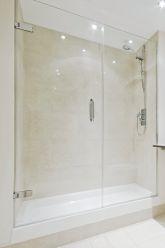
More and more, that customer is asking for both internal and external products and services. That’s where the new Trulite plant’s shift in market to encompass laminated glass comes in. Traditionally Trulite has been a largeproject-based business, McCallem says, but now the company wants to diversify and grow into that daily business as well. The idea is to support both external and internal needs. The plant produces IG units, spandrel silkscreen, laminated glass, gas-filled IG units and fabricated glass up to 20 millimetres. The company recently made a further investment in cutting tables to cut that heavier glass, anything that’s over 15 millimetres or half an inch. “We’re going to sell that capability as well,” he says. “We have a truck that’s making predetermined routes through all the GTA and southern Ontario. That’s really to grow that daily business where, you know, if someone needs three lites, three fabricated lites for shower doors. The shower door market. And then the guys who need one unit, two units, three units.”
Since January, Trulite has been marketing its new capabilities through product capability broadsheets, promoted by e-mail blasts. “We’ve identified not just current accounts but potential customers who buy the products we can now make and we’re getting the broadsheets out to people so they know what our capabilities are. We are making cold calls to more than 650 current and potential customers . . . We’ve been getting really positive response to that,” says McCallen.
Going into the laminated market should not require much of a change in strategy, he notes, because a lot of people who buy IG from Trulite now will also buy laminated. “Frankly, it’s been a pretty popular response with people” he adds. “They don’t want to have to go one place for external and one place for interior.”
Upon taking the reins, McCallen’s immediate focus has been not changing but stabilizing the business. “The key focus is safety, quality and service. We’ve got to deliver to our customers on-time, quality product, keep our people safe, get them engaged.”
Safety is a priority, and the company, which is unionized under the Steelworkers, wants to get ahead of incidents and fatalities. “You don’t want to get committed to this through something as awful as a fatality. So do it before something terrible happens.”
One of the company’s safety initiatives was to change some of the workers’ personal protective equipment and to drive home the need to wear it at all times. “The first thing we talk about at every single meeting is safety . . . we want you to go home at the end of the day, same condition that you came in. Your families deserve that. And it’s our obligation to keep you safe. And your obligation to keep yourself and your fellow employees safe. So a lot of it is behaviour.
“We’re not measuring – we’re not just keeping track of injuries or incidents or when someone gets hurt. We’re keeping track of incidents.” They pay attention when something happens that could have injured someone, do walks through the plant to identifiy hazards, and focus on
what they can improve.
McCallen and his management team use walk-throughs to monitor and maintain quality, a hands-on approach.
He explains: “The team does a daily walk through the plant. So we go by resell, look at what is our performance for prior day in terms of safety, in terms of quality, in terms of service, in terms of cost? We’ve got objectives in each of those areas. What do we actually achieve? If we didn’t achieve our objective, why? How do we support the people making the product to do a better job? How do we help them? What tools do we have to give them? What training? Support? What do they need?
“If we’re above target, what are we doing to make sure we chock the wheel and make sure we are sustainable?”
Beyond being sustainable, the goal for 2013 is to double the plant’s capacity and in doing so significantly increase sales, which is one reason they decided to grow the laminated side. Another is an earlier market study that found there was a need for someone to provide a diversity of products in the market.
“We’ve now got almost a one-stop shop capability. I think customers are interested in that,” he says. “The traditional plan was 75, 80 per cent IG spandrel. I mean, it’s still going to be a significant piece for our
business. We see that more in the 65 per cent range. And the growth comes from laminated and the fabricated heavy glass. Heat soak as well.”
McCallen’s experience in China taught him that the Asian industry can compete on quality and confirmed for him the importance of improving service.
“It was a wake-up call in terms of don’t assume they’re just a cost alternative. They can also provide a quality product,” he says. “We need to drive improvement harder in terms of service and quality in North America. We’ve got to raise our game.
“Frankly we have to drive our costs down too, be more competitive,” he adds, and the secret to driving costs down, he suggests, is not only automation but also “getting people engaged. We’ve got a lot of human capital we’ve got to tap into. We’ve got to get them to bring their brains into the business and help us improve the business.”
Trulite’s future includes the acquisition of a heat soak furnace by early April, which will give the company a wider range of offerings.
“Everybody’s aware of the falling glass we had in the Toronto market last year and a lot of the balcony railing systems went from just tempered glass to heat soak and laminated and, you know, it’s
Trulite has massively expanded its lamination capacity with a Bilco line and Melco clave brought up from the former Arch plant in Tamarac, Fla. Plant manager Gavan Durkin says the ability to do their own lamination will give Trulite access to new markets.
one of the condo balcony railing markets, one we’ve targeted.”
According to McCallen, the company sees an opportunity to fill a growing need that previously could only be filled internationally, through Asia or the United States.
“The architects are looking for larger spans,” says McCallen. “They’re looking for larger spans and I think the more glass and less metal so that plays into our strengths because we can do those larger pieces.”
McCallen anticipates growth also in the number of employees, currently at 110, as the company grows its share in the market.
As they need capacity, they will need to invest in additional cutting lines. He says, “That’s one thing that Sun Capital will do. They want to invest to grow the business. They did that when I was at Indalex and they’ll do that here.”
McCallen sees light at the end of the tunnel after what has been a challenging expansion. For him, accountability is the key: “I think the secret of this business is to do what you say you’re going to do. Make a commitment; fulfil your commitment. Take accountability. That’s what is going to make us successful.”
PRODUCTION CAPACITY
• Fully automatic and shape-capable cutting table – 130” X 204”
• schiatti polishing and mitering – lites from 6” X 6” to 110” 100”
• CNC-cut holes and notches – lites up to 90” X 159”, max. weight 350 lbs.
• Glass robots single bay 100” X 180” tempering furnance
• tamglass double bay 86” X 144” tempering furnace
• two 96” X 190” Lisec one-shape and triple-capable automatic IG lines
• 12” X 15” up to 96” X 144” laminating capacity
• Melco steel clave with vacuum bagging capability
• opticoat spandrel from 12” X 12” to 82” X 160”
• Ceramic frit from 12” X 12” to 82” X 160”
ADHESIVES AND SEALANTS SHOWcaSe
One-part hot-melt butyl
www.fenzi-na.com
Fenzi North America has added to its product base with the addition of Fenzi hotver 2000, a one-part hot-melt butyl specially formulated to give insulating glass units the best mechanical properties to last longer in the field. A mixture of butyl rubbers and synthetic polymers, the product runs on standard hot-melt pumping equipment. Fenzi hotver 2000 is one of the lowest moisture-vapourtransmission-rate sealants on the market and is formulated to help your IGU meet EN1279 and AstM 2190 testing. Fenzi’s hot-melt butyl will provide faster flow rates and reduced application temperatures compared to other hM materials. to meet many of our customers’ needs, we are now offering our Fenzi butylver PIb in the colour grey, as well as the traditional black. Combined with our Fenzi Molver 3A desiccant, Alu Pro aluminum spacer profiles, roll tech Chromatech Ultra and stainless steel warm edge along with Fenzi thermaledge spacer profiles, Fenzi is a single-source supplier for IG component needs.
is proud to work with bostik, one of the world’s largest and most trusted adhesive and sealant companies, to add to our Edgetherm product line,” said brian Kress, product sales specialist at Quanex building Products. “From butyl-based materials to desiccated matrix, we can now offer a high-performance edge-seal product to suit virtually any application or spacer system.” Edgetherm 3500 single-part butyl rubberbased sealant, Edgetherm 3400 hot-applied desiccant, and Edgetherm 3100 and 3000 one-component hot-melt butyl sealants will be available through Quanex starting the first quarter of 2013.
Rapid bonding
www.dymax.com
dymax Corporation has introduced Ultra Light-Weld 431, a versatile adhesive for glass-to-glass and glass-to-metal applications. this material has been formulated to be resistant to high-temperature and highmoisture environments while maintaining superior adhesion and flexibility. It was also designed with low shrinkage, which reduces stress on the bond line or on larger cured surfaces.
four new edge-seal products
www.quanex.com
Quanex building Products Corporation has entered into an agreement with bostik, a world-leading provider of insulating glass sealants, to distribute four new edge-seal products in the Americas. sold under Quanex’s Edgetherm brand name, the comprehensive product line was designed specifically to meet key requirements in IG production, including low moisture-vapour transmission rates, excellent movement accommodation, low temperature flexibility and low gas permeability. “Quanex
Ultra Light-Weld 431 bonds rapidly upon exposure to UV/visible light for immediate use in the assembly process. Ideal for assembly applications such as furniture, container glass, and lighting and appliance sub-assemblies, it’s designed for bonding glass and metal but can also be considered for bonding a wide variety of plastics as well as ceramic and Fr4.
Architectural possibilities
www.dowcorning.com
high transparency and strong adhesion performance are the key features of dow Corning’s new transparent silicone structural adhesive, tssA. With approximately four times higher strength than conventional structural silicones, tssA provides unique design possibilities for glass construction and glass attachment in applications such as point-fixed glazing and glass bridges. tssA offers many advantages for the applicator and the building owner. It is easy to apply
and cost effective, as using a highstrength adhesive removes the need to drill holes into the glass, which is particularly complex when units are to be gas filled. there is also no possibility of gas leakage through drilled holes and no inducement of thermal bridge/heat transfer possible between these specific elements. silicone fixation offers durability and longevity in use and the esthetics of the finished structure are improved, especially when viewed from the building interior.
smooth and textured options
www.crlaurence.com
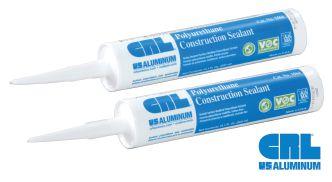
CrL M64 and M66 are one-part, moisturecuring, gun-grade modified polyurethane construction sealants. While M64 has a smooth surface, M66 offers a textured surface. both have excellent primerless adhesion on most common construction surfaces, are durable, are flexible and offer excellent performance in moving joints. CrL M64 and M66 are ideal for joints between framing (door and window) and building structures in both storefront and curtainwall applications to secure a watertight installation. their advanced
polymer formula offers excellent adhesion to fluoropolymer paint coatings for metal surfaces including Kynar, duranar and duranar sunstorm coatings, as well as standard metal, aluminum, steel, galvanized steel, plastics, vinyl, glass, wood, concrete, brass, and other common building substrates. they are specially formulated to outperform traditional VoC solvent polyurethanes for sealing moving joints in concrete, masonry, metal, and other basic perimeter joint applications. these eco-friendly sealants contain no solvents or isocyanates, and are VoC-compliant.
to the VIGU’s thermal performance. If the stand-off’s material and diameter remain constant, the thermal conductivity of the stand-off system is inversely proportional to the square of the spacing in a linear fashion – once the stand-offs get more than 50 millimetres apart, the benefits to increasing the space between the grid of stand-offs.”
Flexible seal solutions, such as EverSealed’s, allow the lites to move practically stress-free relative to each other with thermal expansion and contraction. This creates more challenges for the stand-off system, as glass and low-e coatings can be scratched or stand-offs dislodged by this constant rubbing. EverSealed’s solution is to plate its stand-offs with a proprietary metal alloy composition that is close to the coefficient of friction of graphite on glass and about 17 per cent of the friction of glass on glass. The stand-offs are applied to the clear or low-e surface of the tempered glass and the glass is heated to melt the stand-offs coating and solder it to the glass (or low-e coating). The rollerwave distortion of horizontally-tempered glass means that all the stand-offs do not touch both inner surfaces 2 and 3 at any time, thus requiring a calculated safety factor of extra stand-offs so that no one stand-off and glass interface exceeds the compressive strength and adjacent tensile strength of the glass.
Let it slide
Because VIG insulates so well, the two lites can experience radically different temperatures, especially in extreme climates. In one of EverSealed’s tests, surface 1 inside the test chamber was
nearly 125 C, while surface 4 remained at 25 C (only two degrees warmer than the room). In a traditional IGU, this would be a smaller problem because the flexible butyl seal would allow the edges of the lites to shift relative to each other without affecting the seal. However, as noted above, VIG requires a hermetic seal that is much stronger. This is why the warranty on NSG’s VIG product carries cautions for use in areas with wide temperature fluctuations.
Without going into detail, Guardian claims to have solved the issue. “The perception in the marketplace is that there may be issues with large delta-Ts across a ceramic-frit-sealed VIG unit,” Cooper says. “I am going to tell you right now that it is all perception.”
EverSealed has taken a different approach by creating a flexible mechanical seal. Stark explains it by asking you to hold a sheet of paper by its ends in both hands, then to bring your hands together so the paper is bent almost double, but not creased. Note how the paper easily opens and closes, but gives resistance to side-to-side motion of the edges past each other (the paper does not want to twist). Then Stark asks you to crumple up the paper, flatten it out and perform the same exercise. Now, the paper flexes just as easily side-to-side as it does open and closed. Stark and his team have applied this principle by rollforming an egg-carton pattern into strips of stainless steel foil. The strips are then wrapped about the edges of the VIGU and soldered into place. Now there is a hermetic, mechanical seal, but the lites can shift toward and away from each other, side to side and up and down, or grow and contract, creating offset edges. Finding the right combination of foil and solder
materials and the right process to fabricate it has taken years, but Stark says EverSealed is there and has the testing data to prove it. To demonstrate its capabilities, the company mounted a nineby-13-inch unit in a door of a thermal-cycle chamber and cycled the heat on surface 1 of the VIG up to 130 C and down to -60 C over 2.4 hours, including a 15-minute dwell at each temperature extreme. The chamber was cycled more than 230 times without causing a detectable leak. EverSealed says this statistically-valid accelerated test certifies a 40-year minimum expected life span in any climate for the design.
Vacuum sucks
There is a sweet spot approaching 10-3 and 10-4 torr beyond which there are diminishing benefits to creating a harder vacuum between the lites. This is not a particularly hard vacuum (thermos bottles are brought down to 10-6 torr) but it is difficult to create quickly by sucking the air out through a port using a pump. When evacuating the cavity, there is a point at which there are not enough air molecules left to create a so-called “viscous flow” of air through the port.
All the pump can do at this point is create a lower pressure zone on one side of the port and wait for the remaining molecules to pass through the port by chance as part of their regular, random motion. That means it can take as long as eight hours to achieve the vacuum needed in a VIG cavity.
Until this engineering challenge can be resolved, there is little prospect of mass-producing VIGU.
Stark thinks he has a way to perform final assembly of the seal in a vacuum chamber, but this has yet to be tested.
Here goes nothing
EverSealed Windows has recently come to the end of its government grant from the U.S. Department of Energy to research and develop a VIG that would enable a whole window to achieve R-10. EverSealed, demonstrated to its collaborators and the DOE a proof-of-concept prototype VIG with a center-of-glass U-factor of 0.07 (R-13). This VIGU’s edge-effect thermal conductivity is minimal due to the thinness and design of the flexible seal system, producing less than a two-degree C difference from the center of surface 4’s temperature to its edge temperature for any lite 1 temperature from -60 C to 130 C.
Pro-VIG’s German government funding was consumed by 2009 but this program continued process and equipment development until last year, when its program manager Wolfgang Friedl retired from the program’s primary equipment developer Grenzebach Maschinenbau. Guardian has been promising a commercially available product for some time now, but is apparently not quite there yet. VIG research has always proceeded in fits and starts, and right now it looks like the Great Recession has had its toll on research budgets and progress. However, as Cooper has noted, the “new normal” in energy standards will create an inexorable pressure on fabricators to find ways to become more energy efficient without sacrificing esthetic appeal.
The Insulating Glass Manufacturers Alliance is trying to help. Under Cooper’s chairmanship, the VIG task group is close to releasing a white paper that will give the industry guidance on the various VIG technologies available and some proposed best practices for constructing and applying this revolutionary style of IG.•
NOUVEAU / NEW
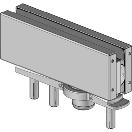
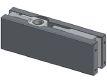
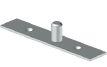
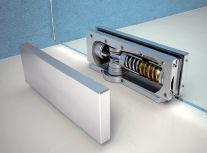
Plaque de suspension du bas avec système fermoir hydraulique intégré. Self closing bottom patch fitting with integrated hydraulic closer system
by FrANK FULtoN
Frank Fulton is president of Fultech Fenestration Consulting. He has been in the industry for 30 years and can be reached via e-mail at fultech.fc@gmail.com.
Goodbye to a Canadian standard
Imay have mentioned in past articles my involvement with the Canadian Standards Association. I have been a member of the A440 Windows standard technical committee since a few years after its inception in the mid-1980s. The A440 Windows standard was the primary set of rules governing the performance of windows in Canada and was referenced in our building codes, making compliance the law of the land.
Within the standard there are a number of performance criteria to be met for air, water, structural, condensation resistance, and forced entry as well as a number of prescriptive requirements. For each of these criteria, there are a number of grades or levels of performance achievable. When the A440 was first introduced, choosing the correct and necessary levels of window performance for a given building in a given location considering the climatic conditions factored by the building size and exposure, and without over-specifying, proved to be virtually impossible. Specifiers would often simply choose the highest performance levels available to ensure they were covered, at potentially considerable unnecessary expense to the building owner.
In order to assist the users of the standard, primarily architects and project specification writers, the technical committee created a User Selection Guide. This type of document was unique among standards. It provided the architect with all the climatic information for practically every location in Canada, along with the formulas and instructions needed to select window products with performance features suitable for the weather conditions they would be exposed to. The folks at Environment Canada were instrumental in the creation of the user guide, and assisted us in creating a totally new set of data referred to as the Driving Rain Wind Pressure.
I considered the A440 standard along with the User Selection Guide a truly useful, well-thought-out, user-friendly and well-presented set of guidelines. The user had a few discretionary selections to make for air performance, forced entry and insect screen strength, but for the important criteria items such as water infiltration resistance, strength and condensation resistance, all the information was there so the architect could select the correct levels of window performance for the location of the building.
From a manufacturer’s point of view, the A440 provided a level of insurance and confidence that the project for which you were manufacturing windows would not encounter problems in the future. In many cases, I as the manufacturer would be asked if our products would perform in a given location, and using the A440 user selection guide, I was able to advise what levels of performance were required and what products we could supply to fit the project needs.
I also felt as a manufacturer that the test specimen sizes we had to test to comply with the A440 standard were a reasonable representation of the sizes we would produce for actual projects. In the United States, however, the test specimen sizes to get an American Architectural Manufacturers Association commercial window rating were outrageously large – much larger than any windows we would actually produce. So, in order to achieve an AAMA rating, the windows would have to be significantly over-engineered and excessively heavy in order to pass a test. This has a significant impact on the design of products and their cost to produce.
Since the late 1990s, the CSA has been working hand in hand with the AAMA and the Window and Door Manufacturers Association to create NAFS, the North American Fenestration Standard/Specification for Windows, Doors, and Skylights AAMA/WDMA/CSA 101/I.S.2/A440. This one standard will apply to all windows produced in North America, meaning manufacturers no longer have to test to two sets of standards to sell their products across the border.
This new NAFS standard is now referenced in the National Building Code of Canada and the A440 no longer applies. It is like night and day when compared to the CSA A440 of the past and will require that all products manufactured in Canada be retested. Because of some major changes in test sizes and performance levels, a number of products currently manufactured will be rendered obsolete and in need of a total re-engineering. We’ll look at some of the issues you’ll be facing in the next edition. •