I once had a job I really hated and, not surprisingly, decided to get a new job. On the surface, that sounds like the logical thing to do, but I see many people who hate their jobs – yet they stay. They complain about the way things are done in their workplaces, yet fight tooth and nail to keep things the way they are. When I was young and new to the workforce, I remember telling a friend that if she ever heard me say “but we’ve always done it this way,” she should take me out behind the barn and have me shot.
What’s with that? Why is it so hard for people to change, and why do they resist it so much, especially in the workplace? I’m the first one to admit that the change process is not easy. When I decided to leave the place I’d worked for a few decades, I found another job and handed in my resignation. In those weeks before my last day, I had more second thoughts than I could count – and each one began with “what if” or “maybe.” What if I am making a terrible mistake? Maybe I am being hasty. Maybe this is a bad idea. What if the new place is worse? What if it does not work out?
This story does end with ‘happily ever after;’ once I changed jobs, I never looked back. It was clearly the right choice, but it sure
was an eye opener watching myself fight the change every inch of the way.
The fact is human beings are not really designed for change. We are creatures of habit, and there are actually some good reasons for this. For one thing, our brains are wired to do the same things over and over and over. In many ways this is an advantage – it saves a lot of thinking and mental energy. Imagine how difficult it would be if you had to get up each morning and think, “Gee, I wonder what I should do now? There are so many choices! I could bathe, eat, walk the dog, go shopping, build a fence…” Most of us don’t do that. We usually manage to get up, dressed, fed, watered and arrive at our workplace without having a single real thought. We are on automatic pilot.
The pathways in our brain are like the shortcuts through the park where the grass and shrubs are worn away. It is easier to stay on the beaten path than create a new one. Thoughts work the same way, like paths worn through the cells in our brain. If you don’t believe me, think about the last time you went into the bathroom for a reason other than using the toilet. I’ll bet you ended up at the toilet anyhow. Your brain associates the bathroom with toilet activities – so even if you really were looking for a band aid, you end up peeing. How many times have you gotten into your car and found yourself at the office when
that wasn’t really where you were going? Automatic pilot again.
That’s one of the reasons we find it hard to change – biology is working against us – but it’s not the only reason. When one is in the middle of a change, the past is perfectly clear but what lies ahead is not. Even my very awful job had its good points. I had a lot of good friends there, the cafeteria was great and some of the work was interesting. I had all sorts of theories about why the new job would be better, but I really had no facts. That made me a little uneasy. If you have never done something, you can’t know for sure how it’s going to work out. When you combine the comfort of familiar things with an inherent fear of the unknown, you get resistance to change.
Sometimes people resist change because they are not sure they have the skills for the new activity. Actually, sometimes people resist change because they really DON’T have the skills for the new activity. At least part of the reason many people get in trouble with the law or spend time in prison is because they lack the skills to do anything else. So, like the rest of us, they keep doing what they have always done. If something is familiar, you tend to like it – another odd human trait. We like music that we already know, friends we already have and the place where we grew up. The simplest way to make people like something is just to increase their exposure to it (I think this holds for everything except liver).
One thing that often aids us in change is knowing that we are moving toward something that will make us happy. We tend to think winning the lottery or getting a big promotion will make us happy – so those are changes we are willing to consider, but the bad news is people are very bad at actually anticipating the things that will make them happy. We get it wrong as often as we get it right.
Hmmm... maybe I should not have told you that. It provides another reason to resist change.
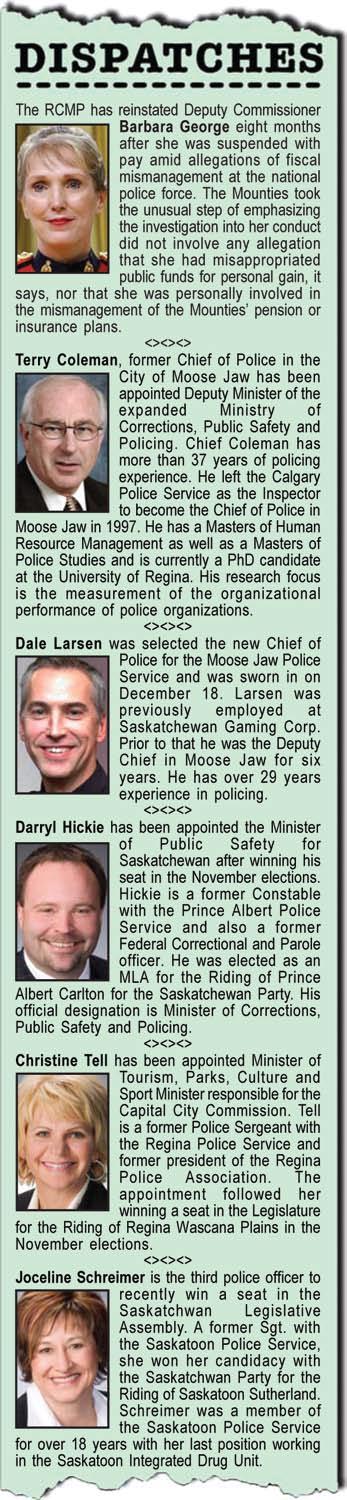
So why am I going on about change? Well, it is hard not to be surrounded by it these days. I have noted in particular that the chief of police jobs are turning over in a lot of places. Every time a new chief comes in, there is going to be change. This is probably a good thing over all, as personally, I have yet to see the perfect police service. Once we have one, we can stop changing.
Meanwhile, you might want to listen closely to your reaction the next time change is proposed. If you hear youself saying phrases like ‘we’ve always done it this way,’ ‘if it ain’t broke don’t fix it,’ ‘if we ignore it, it will pass,’ ‘it was good enough for (name any person older than yourself)’ and ‘leave well enough alone’… I’ll meet you out behind the barn.
For more information, check the commission’s website (www.mentalhealthcommission.ca). For more information about joint police/mental health systems ventures, visit www. pmhl.ca. Email your ideas about law and mental health issues to Dr. Dorothy Cotton (deepblue@blueline.ca).
I had an opportunity to read the November 2007 issue of Blue Line. Congratulations on your focus on the Toronto Police Service on its 50th anniversary.
I am especially pleased to see the reference to the leadership role of the Toronto Police Services Board in building a Service that relfects the needs and expectations of today’s Toronto.
This leadership extends beyond shaping the new Command team or the new human resources priorities of the Service. It extends to many of the areas that Matt Collison describes in his article, “Better policing with technology”.
The closed-circuit cameras program does not only comply with the guidelines of the Information and Privacy Commissioner, but also with a very precise policy regime which the Board put in place after an extensive community consultation.
Similarly, the pilot project related to cameras and digital video recorders in patrol cars results from a Board directive to install in-car cameras.
And finally, the pilot program to try out “greener” cars came out of the Board’s adoption of a policy on environmentally responsible practices.
I point these out in the interest of accuracy but, more importantly, in order to emphasize the point that civilian governance plays an important leadership role in Canadian policing. Sadly, this is often not given the attention, and much less the credit, that is its due.
Alok Mukherjee, Chair Toronto Police Services Board
I am writing to express my displeasure with any police memorial that would deny an Auxiliary Police Member a place among our fallen comrades.
I, like many of the members on the job today, put on my first uniform as an Auxiliary Constable with the RCMP. This volunteer position had little in the way of recognition, save the many thanks from the regular members for being there, the pride of wearing the uniform, and being able to give something back to the community. Quite frankly, the pay sucked.
I look back without regret on the many times that myself, and all of the other Auxiliary Members, risked our lives because we were part of the “team.”
However, when someone from our “team” makes the ultimate sacrafice on the job, should their rank or annual salary have an effect on how they are remembered?
When I did the job, the stripe on my pants was the same color as the people I worked with.
I would encourage all members, despite whether they have ever been a “volunteer cop” or not, to push for Auxiliary Members to be remembered with the same dignity as any other person wearing the blue. Period.
Chris Drosdoski,
President East St Paul Police Association
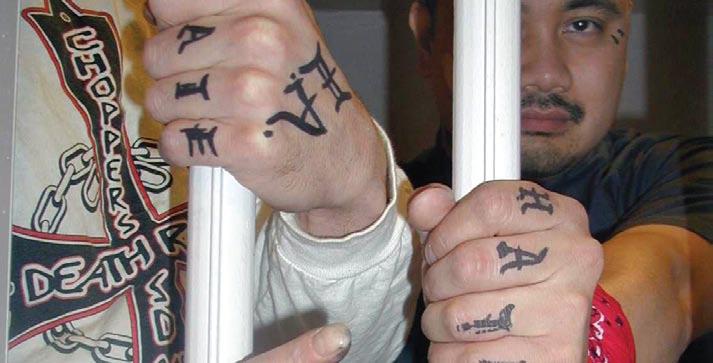
Police focus on internet gangster promotions
MONTREAL - Street gangs have opened a virtual front in their ongoing turf wars and now Canadian police want to turn the Internet into an ally in their quest to stem the rising tide of gang violence.
With the social networking phenomenon hitting full stride, gangs have joined the thousands who are using the Internet for self-promotion.
Searches on YouTube reveal several rudimentary videos of gun-totting “gangstas’’ in some of North America’s toughest neighbourhoods, Toronto’s Jane-Finch area among them.
The videos are essentially marketing the gang lifestyle to a young, impressionable audience. A recent Statistics Canada report indicated that more Canadian kids faced murder charges in 2006 than ever before - a spike that has been blamed on increased gang activity.
But gangs have not been immune to the double-edge nature of the web as police become increasingly adept at using the technology for their own ends.
Of course web-based detective work faces the same challenges that greets most Internet users searching for reliable information. While prowling the Internet can give police insight into the notoriously hermetic gang culture, it shouldn’t be the sole element of online policing.
No immunity to terrorism
by Marc Sand
Corporations today face a multitude of security challenges and are vulnerable to a variety of attacks, threats and antagonists, including workplace violence, threats from ex-employees, militant environmentalists, terrorism, money laundering, theft of proprietary information and acts of sabotage.
No one is immune from a terrorist act, no matter where in the world they may live. There are many types of terrorists – the major groups include nationalist, religious, state sponsored, narco, left and right wing – and they are constantly evolving, but all terrorists share one aim; to create havoc, generate publicity and change government decisions without losing the sympathy of their followers and supporters.
Every corporation who communicates by telephone, fax, e-mail, etc. is at risk from terrorism, especially if they operate globally and attract a lot of media attention. Most corporations’ policies and procedures to deal with an attack or even natural disaster are not up to date, implicated and refreshed. It is not enough to have money laundering policies in place for investments over $1,000 (not only $10,000); other vulnerabilities such as IT infrastructure must be protected.
It is vital to review security policies at least once per year and consult with an expert. We
have been focusing on reviewing current policies for large corporations around the world, assisting them in incorporating the necessary information or developing new policies, teaching them how to evaluate threats and identifying vulnerabilities.
The importance of preparing to be proactive towards terrorism is now more important then ever. With Canada’s involvement in Afghanistan, the threat is no longer just waiting across out border.
Marc Sand, PhD., CEPS, CAS, is a certified anti-terrorism specialist and CEO of V.I.P. Protection, which has offices in Canada, and internationally. Marc will teach a one-day course at the Blue Line Trade Show April 29th.
Witness protection program needs updating
Police planners have stated that Canada can have a national witness protection program that meets the needs of all police force across the country for a cost of roughly $24 million a year.
The price tag, set out in an internal document drawn up last year assumes the Mounties would set up joint units with other forces to make key decisions on individual cases.
The discussion paper insists the more limited witness protection system already run by the RCMP has worked well since its inception in the early 1980s. But it notes that the program “faces many challenges’’ in meeting current needs.
The study says, “there is a new reality within Canada which demands that services be expanded to those persons who aid law enforcement with national security-terrorism investigations.’’
The RCMP discussion paper, prepared in part to canvass the views of other police forces on witness protection, estimates a new national program would double the current number to about 140 protected people at any given time.
The cost of the federal program was listed as $1.9 million for 2005-06, but that covered only the actual expenses for relocating witnesses, not additional costs like RCMP salaries and administrative work.
The price of the proposed new program, including all salary and staffing costs, would be about $29 million in the first year, said the study. Of that figure, about $5 million would be startup costs that wouldn’t have to be paid in subsequent years, thus reducing the annual program budget to $24 million.
search warrants are becoming a necessity
by Wayne van der Laan
In this age of increased awareness of privacy issues, government agencies and private corporations are becoming much more careful about what they will disclose to police or other investigative agencies.
More often than not, information holders will seek some reassurance they will not be held accountable for releasing even the most innocuous of information. This reassurance often comes in the form of police seeking a warrant ordering them to release information, or using a summons to compel the information into court. This also shifts the burden of civil accountability away from the holder of the information and onto the shoulders of the receivers.
The natural consequence of all this is that investigators must be ready to face the expectation that they will be writing more and more warrants in the future. This is the trend –it has been coming for quite some time – yet police agencies are still reluctant to embrace the inevitable.
My sister-in-law was home alone one afternoon recently when a man called. He didn’t identify himself and his voice wasn’t familiar. He engaged her in conversation that was, at first, inconsequential. She played along, as her husband is a bit of a practical joker and she thought he might be disguising his voice, setting her up for something. She became alarmed when the caller started using sexual overtones, then became increasingly graphic and ended by threatening to slash her throat.
Alarmed and frightened but managing to keep her head, she dialled the numbers that would first trace and then “lock” the line so that the caller information would be available through Bell Canada, then called police. The attending officer took a report and called her back a few days later to advise that he had taken the report to his supervisor. They were not going to take the matter any further and would be treating it as an isolated incident or prank.
I wasn’t surprised when my sister-in-law told me the story, having seen similar circumstances handled the same way many times throughout my police career.
It was obvious to me that the investigation had been stalled by Bell Canada’s requirement for a search warrant to release information on “locked” calls. Had there been no such requirement, the investigation, I suspect, would have continued, possibly leading to the person who had made the call.
So why wasn’t that step taken? What stopped the investigation? I believe this to be another case where negative perceptions regarding the search warrant process led to a decision to not invest time and money into what
would otherwise be a viable investigation.
For someone familiar with warrants, a Bell warrant is fairly simple, ranking very low on the “reasonable expectation of privacy scale.”
For someone with little or no knowledge, any search warrant can be a very daunting task indeed. The perception exists that warrant writing is frustrating, time-consuming and filled with mind numbing detail when, in fact, the opposite is true. Warrants are tailored to suit the matter under investigation, with more simple matters requiring less input than complex investigations.
The key is to become comfortable with the structure and requirements of basic warrant writing and practice these skills as often as possible. Investigations such as above are tailor-made opportunities for someone who is starting to develop their warrant writing skills. All that is required is some basic understanding of the structure, format and content of a search warrant to set the groundwork upon which you will become successful in this new skill.
Accepting warrant requirements as a new reality in policing is the first step to building better officers, supervisors and police organizations. It might also help people sleep better.
My brother-in-law now has to get up at 3 a.m. to meet his wife in the driveway when she comes home late from work, as she is still frightened from her experience with the unknown caller.
Rather than waiting for your organization to offer an opportunity, take charge of your own development by signing up for the Search Warrant Course at the Blue Line Trade Show. We have put together an intensive, full-day presentation on April 30 covering all you need to know about the basics of obtaining search warrants. The course will serve as a base upon which officers can build their expertise in writing warrants and facing the challenges of tomorrow.
The instructor, Wayne van der Laan, has more than 20 years experience in policing with specific experience in CID, break and enter and auto squad. He has bachelor and masters degrees from the University of Guelph and lectures in the technique of investigative interviewing, with a specific focus on writing search warrant reports.
Police hunting sudbury murder suspect
by David Toffoli
The Greater Sudbury Police Service is asking police across Canada for help in finding the murderer of a 23 year old university student.
Renée Sweeney, a fourth-year Laurentian University student, was working at a Sudbury Adults Only Video (AOV) store when she was stabbed to death at 11:25 am on Jan. 27, 1998. Cash and other items were taken from the store.
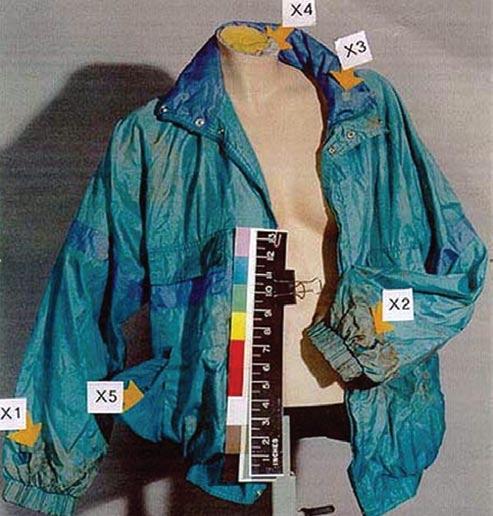
The suspect was described as a white male in his early 20s, between 5 feet 10 and 6 feet tall with a slim build, between 140 and 150 pounds, with short dark hair (dark brown, according to one witness). He was wearing glasses, jeans, running shoes and a grey-hooded top underneath a light weight teal coloured jacket.
The suspect abandoned his lightweight jacket and white cotton gloves a short distance from the scene. A large diaper pin was inside the left breast area of the jacket. A DNA profile was developed on both the gloves and jacket and matches the profile of a male located underneath the victim’s fingernails. These DNA profiles are suitable for comparison to suspects, and have been used to eliminate 1,407 suspects.
Victim’s background
Renee Sweeney:
Was born and raised in sudbury;
• Was a fourth year music student completing
• her thesis at Laurentian University; Was a member of the sudbury symphony
• orchestra;
dog lost the scent but the jacket and blood soaked cotton gloves were found tucked into some rocks at a construction site.
Post mortem
• employed or has an entry level job; Is a loner of normal intelligence;
Likely resides in sudbury and is either un-
• Experienced a stressful event in the weeks
• proceeding the murder;
Had a younger sister, kim, and her mother,
• carole goulard, has multiple sclerosis and currently resides in a sudbury nursing home;
Father danny sweeney committed suicide
• in june, 1990; Grandmother ceecilia goulard resides in
• sudbury;
Step father bill strachan of sudbury has
• generally acted as family spokesperson during the investigation;
• time of her death; and
Was not involved in a relationship at the
• relationship ended in late 1997.
Had been dating mike lilly since 1996. Their
Day of the murder
The victim arrived at 9 am, left to deposit
• the previous night’s receipts at the bank and opened the store at 10 am.
Phoned an employee at Sudbury’s other
• AOV store at about 11 am, talking for about 15 minutes before saying she had to go because a customer had entered.
Two customers entered the store at around
• 11:30 am and noticed a man crouched down in the cash counter area. He walked directly past them and out the door carrying a teal coloured jacket bundled underneath his arm. One customer noticed the victim laying bleeding on the floor and went to an adjacent store for help.
A doctor administered first aid but found
• the victim’s vital signs to be absent. The suspect’s trail was tracked by a police dog into backyards of a residential area. It was apparent from footwear impressions left in the snow that he paced about a number of locations, unsure of which way to flee. The
The victim was stabbed in excess of thirty
• times to her face, neck, abdomen, hands and upper back, which caused her death. There were defensive wounds on the inside of both her hands.
investigation
It is apparent that the victim was first at-
• tacked in front of the counter area, where she possibly came out to meet the customer.
A violent attack ensued there, knocking over video and movie racks. Blood pooling on the rug in this area indicates the victim lay wounded there.
A second attack occurred behind the counter
• area, where the victim was found laying on her back on the floor.
The suspect washed the blood off himself
• in the washroom at some point during the attack.
• the floor.
His shoe impressions were developed on
A small amount of cash was taken and a
• partial fingerprint in blood was found on the outside of the cash tray.
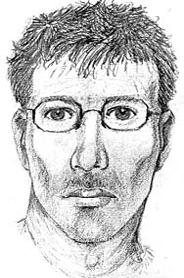
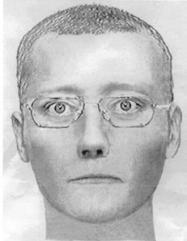
The witnesses met with an OPP sketch artist
• the night of the attack and the first composite of the suspect was hand drawn.
A second (computer generated) composite
• was created with another witness in March 1998.
Criminal profile
An OPP criminal profile concluded the suspect:
• level, not actual age);
Was between 25-30 years old (maturity
Most likely lives alone in rented accom-
• modations or is financially dependent on relatives or friends;
Is known for quickly changing moods
• and inappropriate or violent outbursts of temper;
Regularly drinks alcohol;
• Typically appears neat, orderly, groomed
• and casually dressed; Has solitary interests such as skiing, hunting
• or hiking and a history of risk taking; Wore gloves to conceal his fingerprints;
• Most likely fled to his residence or another
• safe place after the offence;
suspect’s jacket
• collar, solid blue stripe across the torso and solid blue stripes around the upper arms.
Bluish /teal coloured nylon jacket, blue
Make: High Sierra; Size: Large
• Jacket was distributed exclusively by
• Mervyn Department Stores and only in the United States; Sold sometime around 1992-1993;
•
suspect’s shoes
• ning shoes.
Black and white Brooks Cross Trainer run-
Size 8-10.
• An exclusive Sears line introduced in July/
• Aug 1997.
26 pairs of these shoes were sold at the Sud-
• bury Sears store. Each sale was investigated with negative results.
Visit www.reneesweeney.com for further information and a re-enactment. The case is also featured on the RCMP’s most wanted web site. Contact lead investigator Det/Sgt David Toffoli at david.toffoli@police.sudbury.on.ca or 705 675-9171 x2320 if you have information which could be helpful to this investigation.
Co-ordination required to combat gangs
by P.A. Sévigny
Police are only part of the answer to solving Canada’s street gang problem, attendees to the Canadian Association of Chiefs of Police (CACP) International Congress on Street Gangs in Montreal were told.
Effectively combatting gangs requires more than a simple ‘law and order’ approach, CACP President Steve Chabot noted at the conference, held in Montreal at the end of October.
“More arrests won’t solve the problem,” said Chabot. “While police will continue to do their job, we know we’re only part of the solution ... we’re not the whole solution.”
A comprehensive and integrated approach will do more to solve the problem than anything previously done, said Eugene Williams, the interim chief of the Chicago Police Department’s organized crime division.
Every police agency must adopt a proactive approach against gangs or face the same kind of problems experienced in Chicago or Los Angeles, Williams told the congress. Some LA gangs have more than a thousand full-time members, he noted, adding Chicago gangs are also turning into new and powerful regional criminal organizations with deep roots in their own and other communities.
The number of people killed in gangrelated violence over the past seven years in Chicago is as high as those killed in the previous 80 years, Williams said.
“We’ve got gangs that are now working crime syndicates,” he said. “These guys are armed and dangerous… very dangerous.”
Five points dominate the CACP’s integrated approach against urban street gangs. While police agree more arrests won’t solve the problem, they stress that a lot more work must be done to understand gangs as an integrated social unit.
Among the questions raised were how and why gangs manage to provide social and consumer identity to some (especially teenagers) and not others. While there was a lot of discussion about ‘gangsta rap’ and assorted ‘hip-hop’ venues, more than a few posed questions about the media’s role in defining ‘hip-hop’ culture and its subsequent stereotypical role models.
“Since when did pimps become acceptable role-models?” asked one frustrated police woman. “Since when did ‘bitch’ and ‘ho’ become an acceptable way to describe a women?”
Another point stress how an integrated approach must involve every government organization affected by the presence of street gangs.
“We’re talking about justice (the Crown), social services, parents, correctional facilities, schools and everybody else who cares,” said Chabot. “Everybody has to get involved or nothing will get done.”
Police chiefs from Europe and South America agreed the convention was a big step in the right direction. Oscar Bonilla, president of El Salvador’s Public Security Council, said both American and Canadian federal immigration departments should reconsider the long term effects of deporting criminal street
gang offenders back to their native countries in Latin America and elsewhere.
While immigration authorities may think they’re getting rid of a problem when they deport hard core gang members, they’re effectively exporting criminal expertise, along with their contacts, to established gangs in their home countries. Such policies have made gangs a priority issue in both Latin and South America and the Caribbean.
The CACP also committed its respective efforts to improve intelligence, research and a more comprehensive investigation of the Canadian street gang phenomena.
“This will require some investment,” said Chabot. “We’re going to need money, time and a lot of manpower.”
On a positive note, police throughout the country and around the world are paying a lot of attention to the Toronto model, which was developed after last year’s tragic Boxing Day shootings.
“We’re lucky,” said Toronto Police Chief William ‘Bill” Blair. “We’re very lucky.”
Far luckier than Jane Creba, the 15 year old teenager killed by a stray bullet on a street crowded with after Christmas shoppers. The incident prompted both the Ontario government and Toronto police to clamp down on the threat posed by the city’s emerging street gangs.
Within months, Toronto police managed to reduce street gang activity by more than 40 per cent using a simple formula. An integrated task force of 115 special investigators from city, provincial and federal police forces work out of a single building alongside 60 crown prosecutors on various anti-gang projects. To counter any kind of ongoing gang activity, the force also has four specialized police teams which can be mobilized at a moment’s notice.
“I’m envious,” said Montreal police Chief Yvan Delorme. He believes Montreal’s street gangs require serious and urgent attention before the situation spins out of control and becomes more difficult to deal with. Using the Toronto model as a working solution, Delorme is no longer willing to accept ‘Soon!’ as an acceptable answer from the province’s public security ministry.
Toronto police chief Bill Blair told The Suburban he believes Toronto’s integrated
approach, along with comprehensive communications between all parties, will eventually beat the gangs at their own game. Blair also believes police forces throughout the world must develop pro-active, integrated and multi-lateral action plans to neutralize gang resources if they are to be defeated and destroyed. He adds that Toronto gangs “were an emerging force.”
CACP president Chabot, who is also the deputy chief of Québec’s provincial police (Sureté du Québec), believes lateral and longterm intelligence initiatives will eventually win the battle against the nation’s street gangs. He is especially interested in formulating links with financial investigators working for the government, banks and other financial institutions.
“In the end, we’re still forced to follow the money,” he said. “That’s easy to do because they (the gangs) are still a local problem, but if nothing is done, they’re going to be a bigger problem… which will require more money, more time and more manpower.”
BELLEVILLE, Ont. - A would-be thief has returned a gold ring stolen from the Boretski Gallery in downtown Belleville.
The owners had noticed the gold ring, set with a large red sapphire, was missing from their display cabinet.
About six months later, a surprise slid through the mail slot: a Christmas card with a hand-scrawled note offering to return the ring.
A man later showed up with the ring and handed it back to the couple. He then asked if he could make a $20 deposit and make payments to buy it.
The Boretskis accepted his apology and honoured his offer.
“If it didn’t happen to us, I would never have believed it,’’ marvelled Tom Boretski, 48, who operates the shop with his wife, Marina, 45.
“I thought, at first, it was some kind of a joke,’’ Boretski said. “I mean, come on, who does this?’’
“It’s such a perfect Grinch story, isn’t it?’’ he said. “The guy has a sincere change of heart and does his best to right a wrong.’’
(Belleville Intelligencer)
JACKSON, Miss. - Donnie Register has a new reason to be thankful he’s married - police say his wedding band deflected a bullet and
probably saved his life.
Police Sgt. Jeffrey Scott says two men walked into Register’s shop and asked to see a coin collection, then pulled a gun and demanded money.
A shot was fired as Register threw up his left hand, and his wedding ring deflected the bullet, police said.
His wife Darlene Register says the bullet managed to go through two of his fingers without severing the bone.
A part of the bullet broke off and is in his middle finger - the other part is in his neck, lodged in the muscle tissue.
She said she gives God all the credit.
THORNTOWN, Ind. - Authorities used vegetable oil to free a man trapped in the vent shaft of an Indiana grocery store he planned to burglarize.
Nineteen-year-old Adam Cooper is being held on US$10,000 bail on charges that include burglary and criminal mischief.
Police in Thorntown, Ind. say Cooper was found in the shaft between the ceiling and the roof of the store after someone heard him screaming for help.
Emergency workers cut Cooper’s sweatshirt away, then poured vegetable oil taken from a store shelf down the shaft and handed him a rope.
Four men on the roof then pulled him out.
Thorntown Deputy Marshal Chad Clendening says Cooper had been trapped in the shaft for at least an hour before he was rescued.
“He’s really lucky someone heard him yelling,’’ Clendening said. “Otherwise, we probably would have been removing a corpse the next morning.’’
Earlier that day, Cooper had been on a team that cleaned the store’s vent, authorities said.
He reportedly told police he was able to move through the vent while he was working, so he figured he could use it to rob the store.
WINNIPEG - Talk about a cold case.
Police responding to an alarm at the inner-city Sherbrook Animal Hospital found a suspect hiding inside a small freezer used to store the remains of dead pets.
Police say when they entered the building, a small dog in a cage near the freezer wouldn’t stop barking, which tipped them to the fact something was wrong.
The Winnipeg police canine unit assisted in the arrest.
A 22-year-old man faces charges of break and enter.
(Winnipeg Sun, CTV Winnipeg)
KITCHENER, Ont. - Kitchener wants a bylaw making it illegal to urinate and defecate in public, to knock over garbage cans and smash mailboxes.
It hardly seems controversial, but representatives of social and legal agencies came out Monday to express deep concerns about the plan.
They’re afraid the homeless will be targeted and with a law that doesn’t really offer them the help they need.
Councillors voted to go ahead with the bylaw.
(Waterloo Region Record)
ROME - Tweety may get a chance to take the witness stand and sing like a canary.
An Italian court has ordered the animated bird, along with Mickey Mouse, Donald Duck and his girlfriend Daisy, to testify in a counterfeiting case.
In what lawyers believe was a clerical error worthy of a Looney Tunes cartoon, a court in Naples sent a summons to the characters ordering them to appear Friday in a trial.
Fiorenza Sorotto of Disney Company Italia says instead of naming only the companies, clerks also wrote in the witness list the names of the cartoon characters on the counterfeit toys.
(The Associated Press)
Officers take a peace mission to Israel
by Danette Dooley
RCMP Cst. Beverly Bryant packed two suitcases before heading to Israel in September. One contained personal items she’d need for the two-week trip and the other household items and clothing that would not be coming back.
Bryant and the other 30 people in her group – more than half from Newfoundland and Labrador – decided they would each leave a case filled with essentials at a Humanitarian Aid Distribution Centre known as Tents of Mercy in Haifa, Israel.
“Everything that we could pack into the second suitcase was to help refugee families coming out of another country back into Israel; and they’re coming with nothing,” Bryant says.
The mission was headed by Wanda Fost, a Newfoundlander and co-founder of the Christian support network Linking Hearts Ministry. Fost co-ordinated the trip with Ottawa-based Annie Elliott, who is with the Israel humanitarian aid organization For Zion’s Sake. Elliott is also the Canadian representative to the Israeli Knesset – the equivalent to Canada’s parliament.
“Getting to meet with the Knesset and hearing what’s happening in Israel from their point of view was definitely one of the highlights of our trip,” Bryant says.
September was a terrific time to visit Israel as that’s when many Jewish holidays are celebrated. After landing in Tel Aviv the group traveled to Jerusalem, soon discovering why it’s called ‘the Golden City.’
“All of the buildings that are constructed in the city are done with this white Jerusalem stone. When the sun sets on it, the whole city looks golden and it’s the most amazing site you could ever imagine,” she explains.
The group represented Canada at an All National Convention during their time there. After five days, they headed to the Dead Sea en route to the Sea of Galilee through the West Bank.
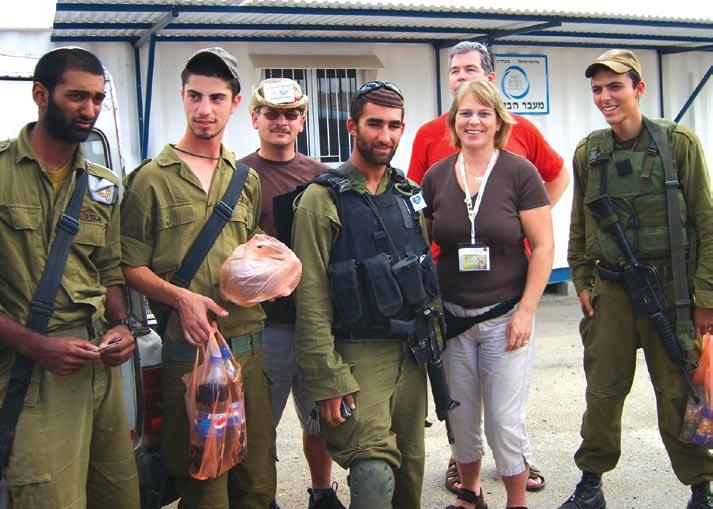
“Our group wanted to bless the Israeli Defence Force (IDF) soldiers on the checkpoint so we decided to buy drinks and fruit and some other goodies to leave with them as we went through the checkpoint.”
Bryant says they were unsure whether or not they’d be permitted to stop to talk to the soldiers. However, they soon learned that their tour guide had served with the IDF and is currently in the reserves. He asked permission to stop the bus, explaining in Hebrew that a contingent from Canada was onboard and would like to meet some of the soldiers.
“I was given the opportunity to meet the IDF soldiers and present them with gifts because of my position with the RCMP,” says Bryant, a 22-year Mountie veteran.
Jerry O’Grady, a retired Canadian Armed Forces officer, and Richard Lepp, a retired Saskatoon Police Service officer, were also chosen to present gifts to the soldiers, she says.
“It was a real honour to represent Canada
and thank and encourage the soldiers for protecting the land of Israel,” she says, pointing to a photograph of her giving the soldiers treats.
“When they’d see our names (and) that we were from Canada, the faces on these soldiers would light up and they’d say, ‘We love Canada,’” she adds.
Every Israeli who is able serves a minimum of two years in the IDF, “so most of the officers that you see are between 18 and 21,” Bryant says.
“These young people serve because it’s an honour to do so, not because it’s required. There are just as many women as men. Any time you saw a group of officers or soldiers together, it would be about half women.”
That’s not something Canadian police officers are used to seeing, she says.
“Although recruiting is more progressive in Canada these days, women here are still the minority in a dominated male career.”
Among the other highlights of the trip was
visiting the Garden of Gethsemane, meeting with Messianic Jews and visiting the Holocaust Museum.
In addition to hundreds of photographs, another treasured possession from the trip is a framed certificate that all members of the group received from a representative for the country’s minister of tourism.
“He presented us with these certificates of appreciation and thanked us all for visiting Israel,” Bryant says.
While Bryant expects that any trip to the country would be a memorable experience because of its magnificent architecture, making the trip with peace utmost in mind makes it all the more meaningful.
It’s a mission she hopes to one day repeat.
“Our trip was all about blessing the people of Israel and we had a real sense of that from the start.”
Danette Dooley can be reached at dooley@blueline.ca
insurance fraud cheats all of us
by Sue Collings
The 17 year old driver of vehicle 2 was traveling at 60 km/hr in the eastbound curb lane when he was struck by vehicle 1 (1996 Volkswagen), which was travelling northbound at 10 km/hr and failed to stop at the intersection. V1 lost control and struck a hydro pole. The driver was removed on a backboard and taken to hospital by ambulance. V2’s airbags deployed. Toronto Fire clean fluids off the roadway and and Hydro repaired the damaged pole – edited Toronto Police accident report.
Police listed no other occupants. Both submitted collision and injury claims, which their insurance companies investigated and ultimately denied. This was a staged accident.
Years ago staged Toronto accidents involved two parties deliberately damaging their vehicles, often with bats or tire irons, then reporting the ‘accident’ to one of the city’s three collision reporting centres at different times, ensuring no one saw the vehicles together.
Insurance companies began hiring reconstructionists to determine if the vehicles ever made contact. This was extremely successful, saving millions in phoney physical damage and injury claims; unfortunately insurers had to reveal each time how they concluded a claim was fraudulent, ultimately teaching criminals their investigative techniques. They quickly learned that reconstruction was an effective tool and altered their modus operandi.
The industry was soon introduced to the deliberate collision. With physical evidence supporting an impact, the claim had to be paid – or so they believed. They responded by digging deep and expanding investigative techniques. Although not always successful, the odd victory is extremely gratifying.
The Toronto accident above caught the attention of the collision adjuster, which referred it to its investigation unit because:
• earlier;
The policy had only been written three weeks
• tremely knowledgable about insurance;
The insured was only 17 but seemed ex-
• ported the drivers were the only occupants;
Two passengers claimed injuries, yet police re-
vehicle, it’s extremely rare that a shop or individual does so. The added expense cuts into profits and installation requires expertise many shops do not have.
An expert examined the airbags and SRS control module and determined they were factory installed.
A copy of the Ontario “rebuilt vehicle parts audit form,” which requires shops to list all parts used in repairing a rebuilt vehicle, attach receipts for all new parts purchased and the VIN for parts taken from donor cars, was ordered. Someone had written “no airbag replaced” on the form.
In his signed statement, the 17 year old insured advised he bought the car from his cousin only a few weeks prior to the accident, paying cash so there was only a receipt.
A history search on the cousin and his wife showed eight prior insurance claims involving theft, collisions and injuries between them. They currently owned three Volkswagens. The investigator recalled that Vehicle 1 was a VW and ran a VIN history, revealing the cousin as the previous owner.
The insured indicated in his signed statement that he’d also purchased the VW from a cousin; the histories showed both vehicles had been owned by the same individual only weeks earlier – both drivers had the same cousin. The claim was denied for fraud. The 17 year old insured did not challenge the decision and ultimately disappeared.
It’s hard to comprehend why anyone would take such extreme measures to commit insurance fraud. The two vehicles hit hard and the airbags in the Honda were hanging limp. There was obvious intent here, but accidents of this serious nature are admittedly rare. Most fraudsters are smart enough to realize someone may be hurt and instead simply create the illusion of a serious, legitimate accident.
Where fraudsters once preferred attending collision reporting centres, the latest trend is to call police. Perhaps they feel it will help legitimize the claim, deflecting suspicion. Many also call an ambulance.
ance company pays $55,000 for the BMW, which is again deemed a write-off, netting a tidy $37,000 profit for the shop – not including profit on the second involved vehicle. Such scams require help. Safety standard and (for salvage) structural integrity certificates are needed to register the vehicles – only an unscrupulous garage would participate in such a fraud. Tow operators take the vehicles to remote locations and set them into position; officers usually don’t question their attendance at accident scenes, assuming they simply heard the call over their scanner and arrived first. By taking a few extra minutes to look at an accident and asking a few simple questions, police can help catch these criminals and uncover staged accidents. Insurers don’t expect officers to take these steps on every accident –we know you simply don’t have the time – but a phone call to an insurance company would go a long way. Here are a few red flags that may warrant a call:
Ownership lists the vehicle as a “rebuilt”
• The insurance coverage is relatively new
• (three months or less)
• or industrial area with light traffic
The accident location is in a quiet residential
• The accident occurs late at night
No one from either vehicle lives in the area
• The engine or hood is cold even though you
• arrived within minutes of the call
• No skid or tire marks and no impact debris
Multiple occupants from different addresses
• Cut battery cables and/or no fluid in the radia-
• tor, or it’s on the ground
• (20 year old driving a $60,000 car)
Vehicle seems out of the insured’s price range
Unexplained cracked or broken glass
• Heavy dirt or dust on the hood, roof and trunk
• indicating the vehicle has been sitting
Screwdriver marks around the VIN plates
• Also, look for signs airbags deployed: Powder on the interior and passengers
• Clean bags with no dirt or grime
• Corresponding glass damage
• Facial marks or injuries on front seat passen-
The insured received more than $13,000 from
• another insurer just six weeks earlier after his Nissan Pathfinder was stolen.
An engineer hired by the insurance company reported the damages matched and fit the accident report description. He felt the impact was hard and believed the occupants could have been seriously injured. Sensing there was something wrong, a background search was conducted on the insured’s 2003 Honda Accord. A VIN history revealed it was writtenoff in a prior accident, with airbag deployment, seven months earlier with another insurance company. This became a key component in the investigation. The previous deployed airbags would have had to have been replaced. Since this is not mandatory in Ontario on a rebuilt
We’ve seen variations on the staged accident, including deliberate collisions with innocent, unsuspecting third parties. Criminals fill their vehicle with willing participants and simply rear end another to submit phoney injury claims, which are very difficult to investigate and troubling in nature.
The latest trend involves body shops buying high end write-offs at auction. The shop registers it in an accomplice’s name, who then buys insurance. The vehicle is involved in another ‘accident’ within a few days or weeks. The old damage is pawned off as new and the unsuspecting insurance company pays to fix what it assumes was an operational vehicle.
Imagine a shop buying a damaged 2004 BMW for $18,000, having it insured and staging a collision at a remote location with another damaged vehicle. The unwitting insur-
• gers (eye glasses usually leave clear marks) Officers seeing any of theese red flags shouldn’t hesitate to call the involved insurance companies. Most have retired or ex-police officers working in their special investigation units. If you’re unsure of who to contact, call me directly at 905 785-9096 and I will help direct you to the appropriate investigator. The Insurance Bureau of Canada Investigative Services Division (416 252-3441, 1 877 IBC-TIPS (after hours) or visit IBC.ca and click on IBC TIPS) can also help.
Insurance fraud is not just an industry problem. It ties up first responders, keeping them from legitimate incidents. We need to work together to stop this abuse.
Sue Collings is a former Toronto police officer who has worked as an insurance investigator for the past 12 years. Sue will teach a one-half day course at the Blue Line Trade Show April 29th.
Blue Line Trade Show & Courses
Covert assignment Training
April 29: 0900-1600 Fee: $225 + GST
This one-day course is a comprehensive examination of the essential skills pre-requisite to effective covert operations. The training regimen includes: Understanding undercover objectives; Identifying operational responsibilities and duties; Covert operations checklist; Counter surveillance techniques; Close quarters combat techniques.
Instructor: Detective Steve Walton (retired) was a member of the Calgary Police Service for twenty five years. For the last ten years of his career Steve was attached to the Drug Unit and was responsible for managing a drug undercover street team and high level drug investigations. Steve has supervised more than 120 undercover drug operations, 220 surveillances related to drug enforcement, and 780 undercover drug transactions. He is the author of the First Response Guide to Street Drugs books.
Terrorism vs Canada in the 21st Century
April 29: 0900:1600 Fee: $225 + GST
This one-day course is an examination of terrorism and the information an officer needs for effective policing in the midst of this threat. The course will include: An introduction to terrorism including types and infrastructure; How terrorism will change the way police officers do their jobs; Understanding the importance of intelligence and information; Evolution of terrorism.
Instructor: Marc Sand, CEO of V.I.P. Protection has a B.A. degree in Law and PhD. in Psychology. He has training in a wide array of commando, martial arts and other special operations disciplines. He is a guest lecturer on terrorism at St. Clair College in Chatham, Mohawk College campuses in Brantford and Hamilton. He has been a guest lecturer with several police services in Canada as well as the American Society of Industrial Security.
Detecting Deception by Verbal analysis
April 29: 0900-1600 Fee: $225 + GST
This one-day course will examine how you can detect a liar every time by analyzing their verbal responses. Liars are frequently caught through their own verbal mistakes. You will learn: Five key words that liars use in their speech; Three words that tell you a liar has left something out; One thing liars always do on paper or in person, and how to turn it around on them; How to look at a statement and know deception is taking place; Two key phrases that signal a liar is skipping over critical or sensitive information.
Instructor: S/Sgt Gord MacKinnon (retired) with thirty years in law enforcement, has experience in a multitude of areas including criminal investigation, underwater search and recovery, fraud investigation and, Intelligence. Gord is an acclaimed lecturer in the techniques of investigative interviewing and is author of the book Investigative Interviewing.
Ontario Gang Investigators Course
April 29: 0900-1600 Fee: $225 + GST
Course content pending.
Blue Line Trade Show & Courses
Search Warrant Preparation
April 30: 0900-1600 Fee: $225 + GST
This one-day course is an invaluable resource for any investigator. Participants will learn the proper way to draft a warrant while avoiding the various hurdles placed in the way. You will learn: Theory and case law; Types of warrants; How to write a “charter proof” warrant; Exceptions when you don’t need a warrant; Telewarrants, and more.
Instructor: A/Sgt Wayne van der Laan (retired) has 20 years experience in law enforcement that includes service in Criminal Investigation Unit, Public Order Unit, Break and Enter Unit and Auto Squad. Wayne holds a Bachelor of Commerce and a Masters Degree from the University of Guelph.
Crime Scene Management
April 30: 0900-1200 Fee: $125 + GST
This half-day course will look at crime scenes; Crime Scene management and, Handling of evidence for front line officers.
Dna: Evidentiary uses & Misuses
April 30: 1300-1500 Fee: $125 + GST
Both of Brian Ward courses may be combined for a fee of $225.
This half-day course will examine the history of DNA; A discussion of the national DNA databank and, The importance of Scene preservation for DNA management.
Instructor: Brian Ward retired from policing in 2006 in the rank of Staff Sergeant. His career included 20 years with the Toronto Police Forensic Identification Service. He is forensic technology editor for Blue Line Magazine, teaches at Humber College and Durham College and provides private forensic consulting services.
Managing the Pandemic
April 30: 0900-1600 Fee: $225 + GST
This one-day conference examines the latest facts used by the medical community to articulate its Pandemic Influenza Doctrine. Then will consider how these facts are analyzed by government ministries and businesses as they prepare for an outbreak; including considerations that police services must take as they develop their plans, and the challenges faced as the Ministry of Attorney General attempts to ensure the orderly performance of the courts. The conference closes with a presentation of the best practices and innovations being developed and applied by emergency management professional.
Moderator: Jay Hope, Ontario’s Commissioner of Emergency Management, is a distinguished police veteran with a career in public service and community safety spanning almost 30 years. Appointed as the OPP’s Deputy Commissioner, Strategic Services, in November 2004, he was responsible for developing the OPP’s strategic vision, including Aboriginal and First Nations policing, and media and corporate relations, policy, municipal policing contracts and training.
The In-depth World of Insurance Investigations
April 30: 0900-1200 Fee: $125 + GST
This one-half day course will include: Use of experts such as engineers, reconstructionists, ploygraph, DNA, forensic accountants, locksmiths; Use of such experts in arson, auto theft, break & enters and auto accidents; Summary of insurance legislation and how it aids in the investigative process; Police access to insurance investigation file.
Instructor: Sue Collings is a former Toronto Police Officer who has worked for the past 12 years as an insurance investigator. Sue is currently the president of the Canadian Association of Special Investigations Units.
Not all inducements render statement involuntary
by Mike Novakowski
Not every inducement to a detained suspect will render their statement to police involuntary.
In R. v. Spencer, 2007 SCC 11, the accused was arrested while driving a vehicle associated to three robberies. It was registered to his girlfriend, who was later arrested for one of the robberies. A handgun and property (watches and jewellery) from a robbery was found after police executed a search warrant at their shared residence.
Spencer asked a police officer what was going to happen to his girlfriend and was told they would both be charged with possession of the handgun and jewellery. Spencer offered to confess if police went easy on his girlfriend. The interrogating officer said he could not make such a deal but could hear his story and make recommendations. Spencer also asked to see his girlfriend. After confessing to some of the robberies, he was allowed to visit his girlfriend, confessed to more robberies and was subsequently charged with 18 counts of robbery.
During a voir dire in British Columbia Supreme Court, the trial judge ruled the statements were voluntary and therefore admissible. He found there were no threats or quid pro quo offers made in response to the accused’s repeated requests for his girlfriend’s leniency. Nor was he promised that she would not be charged. He merely appealed to Spencer’s common sense and knowledge of the criminal justice system. Allowing the visit with his girlfriend was a small inducement, but not strong enough to raise a reasonable doubt about whether Spencer’s free will was overborne. He was convicted.
Spencer appealed to the BC Court of Appeal, arguing his statements were inadmissible because they were not made voluntarily; he was induced to confess by hope of leniency for his girlfriend and promised a visit with her. In a 2:1 judgment, the appeal was allowed, the statements ruled inadmissible and the convictions overturned.
The majority found the trial judge applied the wrong test and considered irrelevant factors, such as who proposed the deal, Spencer’s attitude and demeanour and whether police and Spencer were on a level playing field. The lone dissent found the trial judge did the correct analysis, both legally and factually.
The Crown appealed to the Supreme Court of Canada, which in a 6:2 judgment reversed the appeal court decision. Justice Deschamps, writing the majority opinion, concluded the trial judge correctly applied the law and his finding that the confession was voluntary was entitled to deference.
statement voluntariness
Under the common law confessions rule, statements made by an accused to a person in authority are inadmissible as evidence unless the Crown proves beyond a reasonable doubt that they were voluntary. In deciding whether a statement is voluntary, a court must consider several factors, including inducements (threats or promises), oppression, the operating mind doctrine and police trickery (which is a distinct inquiry).
Promises
Promises considered in the voluntariness analysis need not be directed at the accused to have a coercive effect, as was the allegation in this case. A quid pro quo offer is the most important consideration when an inducement is alleged, however it does not occupy “centre stage” – voluntariness does.
Although important, quid pro quo is neither an exclusive factor in assessment nor one determinative of voluntariness. Rather, it will be contextual and the court must be sensitive to the particularities of the individual. Thus, to render a statement involuntary, a quid pro quo held must be strong enough to raise a reasonable doubt about whether the will of the individual has been overborne:
While a quid pro quo is an important factor in establishing the existence of a threat or promise, it is the strength of the inducement, having regard to that particular individual and his or her circumstances, that is to be considered in the overall contextual analysis into the voluntariness of the accused’s statement, said Justice Deschamps.
In this case, the trial judge considered all of the relevant circumstances and properly applied the law, Deschamps stated:
In my view, the trial judge made no error of law in concluding that no offer of leniency was made in respect of (the accused’s girlfriend) and that the withholding of a visit to her until at least a partial confession was made was an inducement that wasn’t strong enough to render the accused’s statements inadmissible.
It was a relevant factor that the accused had not “lost control of the interview to the point where he and (the officer were) no longer playing on a level field...
In Oickle, (Justice Iacobucci) explicitly recognized that “(t)he absence of oppression is important not only in its own right, but also because it affects the overall voluntariness analysis.”
It was also relevant to the particularities of the (accused) that, according to the trial judge, he was aggressive and a “mature and savvy participant” and that he unsuccessfully attempted many times to secure “deals” with the police. While none of these factors are determinative, it wasn’t an error for the trial judge to consider them in his contextual analysis (paras. 20-21).
Another view
The minority took a different position. In their view, the will of the individual need only be overborne in the sense that they would not otherwise have given a statement except to avoid pain or achieve promise gained. There is no need to lose any meaningful independent ability to choose to remain silent. It did agree that threats or promises (explicit or implicit) need not be aimed at the accused, but could be directed to someone closely related to them, such as telling a mother her daughter would not be charged with shoplifting if she confesses to a similar offence.
Justice Fish, writing the minority judgment, concluded police made a “compound quid pro quo – an implicit but unmistakable threat (to bring criminal charges against his girlfriend unless he confessed), accompanied by an implicit but unmistakable promise (recommend no charges against his girlfriend if he confessed).”
He then immediately admitted to the robberies. The minority would have affirmed the appeal court’s ruling, overturning Spencer’s conviction.
The Crown’s appeal was allowed and Spencer’s conviction restored.
by Mike Novakowski
Reasonable grounds includes officer experience
Reasonable grounds are to be assessed through the lens of the police officer, not a lay person, British Columbia’s top court has held.
In R. v. Tran, 2007 BCCA 491, police were conducting surveillance of a habitual drug-user. When not in jail, he was known to support his ongoing addiction through daily crimes of breaking and entering homes and stealing cars. Police received information from his relative that he had recently been released from jail and was engaging in drug use and property crimes.
They watched him and another person go from house to house in a residential neighbourhood, carrying a crowbar obtained that morning from a hardware store. Officers saw them attempt to break into a house but then, after apparently becoming aware of the surveillance, flee back to the drug-user’s relative’s residence from which they had come.
A few minutes later, police saw the drug user come into the lane behind the house. He got into a vehicle which pulled up and was observed kneeling in the front passenger seat. An officer could see that the user was in close proximity to the driver, Tran, and was able to see his upper body but not his hands. After about 15 seconds, the user got out of the car and it drove away.
Police followed, stopped the vehicle and arrested Tran for trafficking in a controlled substance. A search turned up a black pouch containing 11 flaps of cocaine (totalling 3.7 grams). 19 flaps of heroin (totalling 3.8 grams) and a can of dog repellent were located in a pocket or compartment on the driver’s side door.
A search of Tran revealed $136 cash and a cell phone which rang constantly (police didn’t answer it). Meanwhile, another surveillance team member chased two other men into the residence, where he found and arrested the user and recovered one package believed to contain drugs.
At trial in BC Supreme Court, Tran argued his right to be secure from unreasonable search and seizure under s.8 of the Charter was breached. In his view, the officer did not have objective reasonable grounds to make the arrest and therefore the search that followed was unreasonable.
The trial judge disagreed, holding that the officer’s observations, combined with their knowledge of the user, were sufficient to provide reasonable grounds that the driver had drugs. The officer testified that she had reasonable grounds, including the user’s background as a drug addict known to support his habit through property crime, his suspicious behaviour during the surveillance, his actions in kneeling down inside the vehicle in a very brief meeting and his body language while in the vehicle. Tran was convicted of possessing cocaine and heroin for the purpose of trafficking.
Tran appealed to the BC Court of Appeal, submitting his rights under s.8 and 9 were breached. He contended that police, although perhaps having sufficient grounds to detain, did not have objective reasonable grounds for the arrest and therefore the searches that followed were not valid as an incident to arrest. Further, he argued the officer’s experience wasn’t relevant to the assessment as to whether objective reasonable grounds existed. In his view, the test for reasonableness is what a reasonable lay person would conclude in the circumstances.
Justice Lavine, giving the court’s opinion, confirmed that a search incident to arrest will be valid if the arrest is valid. An arrest will be valid if the officer has reasonable grounds upon which to base it, including both a subjective and objective component. Subjectively, the officer must believe they have reasonable grounds and they must be objectively reasonable. As well, “the objective reasonableness of the arresting officer’s grounds must be assessed from the standpoint of the reasonable person ‘standing in the shoes of the police officer,’” not through the lens of a lay person. There was no dispute that the arresting officer subjectively had reasonable grounds. As for the objective grounds, the officer did not see an actual exchange between the user and
Tran. However, looking at the “entire picture,” objective grounds did exist. The officer had ten years of experience, including five years on the property crime surveillance team. She had seen in excess of 100 drug transactions and testified the encounter between the user and Tran fit the pattern of a “dial-a-dope” transaction. The trial judge properly considered the following factors to infer that the encounter in the vehicle was a drug transaction:
The knowledge of the user’s drug addiction • and his penchant for property crimes to support his habit;
The information from the user’s relative that • he had been released from jail and was using drugs and committing crimes;
The observations of the user “casing the • neighbourhood” and attempting to break and enter into a residence;
The encounter between the user and Tran • in the vehicle, which the officer believed, based on her experience, was consistent with a “dial-a-dope” transaction.
The test for determining reasonable grounds is not to view each item of evidence separately, but to view them cumulatively using the “totality of the circumstances” analysis.
Tran’s appeal was dismissed and his conviction upheld.
by Mike Novakowski
Incidental search lawful despite delay
A substantial delay in searching as an incident to arrest will not render the search unreasonable, as long as police have a reasonable explanation for the delay.
In R. v. Washington, 2007 BCCA 540, a Helijet employee suspected a package bound for Victoria from Vancouver contained drugs and opened it for inspection. After seeing a white powder he believed to be cocaine, he re-sealed it and called police, who re-opened it and took a sample. A test identified the powder as crystal methamphetamine.
Shortly thereafter, the package, addressed to “Nicole Washington,” was picked up at the Helijet terminal by Washington, accompanied by co-accused Shepherd. The two women were arrested as they got into a car to leave the terminal. The vehicle was towed to the police station and searched almost an hour later, rather than in front of the busy terminal, and police found more evidence, including meth, cash, small baggies, cell phones, scales and identification. Both women were jointly charged with possession of methamphetamine for the purpose of trafficking.
The women were convicted at trial in British Columbia Provincial Court. The judge concluded the Helijet employee wasn’t an agent of the state and therefore his actions did not amount to a search, thus the search wasn’t unreasonable and provided police with proper grounds for the arrest. Searching the vehicle was reasonable as it was incident to arrest, ensuring protection of police and preserving and discovering evidence. The Charter was not breached, he concluded, and, even if it was, he would not have excluded the evidence under s.24(2).
The accused appealed to the BC Court of Appeal arguing, among other things, that their s.8 rights were breached when police searched the package, they did not have reasonable grounds to make the arrest and the search of their car wasn’t incidental to arrest.
Package search
Washington and Shepherd argued they had a privacy interest in the package and retained that interest, despite the Helijet employee opening it. Hence, when police
searched it without a warrant, they breached s.8. The Crown, on the other hand, submitted the women lost any constitutionally protected privacy interest in the package once the employee opened and inspected it, thus the police actions did not violate the Charter.
Justice Ryan, authoring the majority decision, ruled the accused maintained a privacy interest in the package when the Helijet employee opened and then re-sealed it. By the time police arrived, the powder had been returned to the package; opening it to examine the contents without proper grounds and a warrant breached the accused’s rights to be secure against unreasonable search or seizure.
Ryan then considered whether the evidence was admissible as a result of the police search, finding the evidence was non-conscriptive and therefore would not affect the fairness of the trial. As for the seriousness of the breach, the expectation of privacy in the package wasn’t as high as that related to bodily integrity of a home or office. Although police did not have sufficient grounds to get a warrant (until they opened the package) and there were not exigent circumstances, they did not act flagrantly or in bad faith. The evidence was crucial to the Crown’s case and the charges were serious. The evidence was therefore admissible.
Reasonable grounds
The accused contended police did not have objective grounds to arrest them for possess-
ing the drugs because there wasn’t anything to indicate they knew the package contained drugs. Ryan disagreed. In her view, police had grounds to believe the package contained meth when they examined its contents. Washington appeared to pick it up shortly after it arrived and it was a reasonable inference that she likely knew it was being sent to her. At this point, police had reasonable grounds to arrest her.
Her co-accused, Shepherd, was with Washington. Rather than placing the package in the trunk or the back seat, Washington handed it to Shepherd, who was in physical possession when arrested. There were reasonable grounds to arrest both women.
Vehicle search
Since the women were lawfully arrested, their vehicle could be searched as an incident to arrest. They argued however, that because the search was conducted almost an hour after their arrests, it had become unlawful. A search incidental to arrest will usually occur within a reasonable time. However, a substantial delay will not automatically render a search unlawful if there is a reasonable explanation.
Police said they towed the vehicle to the station because there was traffic in front of the Helijet terminal. This was a sensible explanation, which the trial judge accepted. The search, therefore, remained proper an incident of a lawful arrest. The appeals were dismissed.
A minority view
Justice Rowles agreed with the majority that the accused maintained a reasonable expectation of privacy in the package, so police breached s.8 when they opened it. They did not have a warrant or reasonable grounds to obtain one, nor did security concerns prompt them opening it, but she disagreed that the evidence was admissible. Rowles argued that it should have been excluded, the appeals allowed and the convictions set aside.
Detention doesn’t always begin with arrest decision
by Mike Novakowski
A police officer’s decision to arrest an individual if they flee does not necessarily constitute a detention, Alberta’s highest court has held.
In R. v. Makhmudov and Marinov, 2007 ABCA 248, Makhmudov and Marinov were at a bus depot in Calgary, en route from Vancouver to Toronto. A police officer working with the Jetway program smelled the zipper area of two identical duffle bags and noted the odour of marijuana. One bag was labelled “MERINOV” and the other “KUD”.
The officer secured the bags in the back of a police vehicle. To identify their owners, undercover police told passengers there was a problem with some luggage and asked that it be re-tagged. The two suspicious bags were placed beside the bus and the tags removed or hidden. An officer dressed in a Greyhound bus sweater reviewed passenger’s bus tickets.
A police officer asked Marinov if any bags were his, noting that they needed to be tagged properly. Marinov identified one of the suspicious bags as his and said the other belonged to his friend. An officer went onto the bus and asked for “KUD.” Makhmudov identified himself and was told some bags had been improperly tagged. The officer handed him a tag and told him to fill it out and place it on his bag. At this point Makhmudov identified the second suspicious bag as belonging to him, filling out a tag and placing it on the bag. Immediately after the bags were identified, the men were arrested and the bags searched. Police found restricted guns, ammunition, cocaine and marijuana in each bag.
At trial in the Alberta Court of Queen’s Bench, the judge concluded the men were not detained, the arrests lawful and the interim seizure of the bags without a warrant (placing them in the police car) was done by a police officer acting in the execution of his duty to preserve evidence. None of the men’s rights under s.7, 8, 10(a), or 10(b) of the Charter were breached. Makhmudov and Marinov were convicted on weapons, cocaine and marijuana offences.
The men appealed to the Alberta Court of Appeal, arguing police controlled their movements and therefore detained them. Detention occurs the moment a police officer forms the state of mind that the suspect will be prevented from leaving, they submitted, even if the suspect has no knowledge of the officer’s intention. Police testified they would have arrested the men if they tried to flee.
The men also contended that they were denied their rights under s.10(a) and (b) of the Charter, and their s.7 right to silence. Furthermore, they argued the search of their bags wasn’t justified because there were no reasonable grounds; the smell did not meet the plain view doctrine because it wasn’t immediately apparent, thus the arrests were not lawful.
Finally, the initial temporary seizure of the bags wasn’t authorized because the officer could not point to a specific statute or common law rule authorizing the seizure.
The appeal court found there were no detentions and the searches were reasonable.
Detention
Section 9 of the Charter guarantees everyone the right not to be arbitrarily detained or imprisoned. However, without a finding of detention, there will be no s.9 breach. The court concluded there was no detention because the men were neither physically nor psychologically detained, stating:
The hypothetical possibility that the (accused) would have been detained if they tried to flee does not establish that they were detained. The (accused) were not in the coercive power of the state just because the officers had resolved to arrest them at some future point in time should they have attempted to flee…
We cannot accept the (accused) submission that the detention begins at the instance the police officer decides that a suspect will be arrested. We can postulate many scenarios where an application of that concept would lead to absurd results. To illustrate, one might consider a situation where the suspect admits to a killing while talking to a person he believes to be a new acquaintance – who is actually a police officer.
On the (accused) theory, once the admission of the killing is made and the undercover officer decides to arrest then, or at some future time, he must immediately, without further conversation, advise the suspect that he will be detained and of his Charter rights. He could not otherwise continue the conversation to inquire about the location of the body or a
murder weapon (paras. 15-16).
Since there was no detention, neither the right to counsel (s.10(b)) or right to silence (s.7) were engaged.
search
The initial temporary seizure of the bags was justified under s.489(2) of the Criminal Code, the court held:
The initial, temporary seizure of the bags wasn’t unlawful. After smelling marijuana, the police officer had reasonable grounds to believe the bags contained marijuana. The officer testified that the seizure was to preserve that evidence. The police officer’s lack of knowledge of and failure to cite the particular provision of the Criminal Code wasn’t fatal.
Section 489(2) permits a police officer in the execution of his duty to seize things that he believes, on reasonable grounds, have been used in the commission of an offence or will afford evidence in respect of an offence. Here, the section was satisfied and the seizure was lawful (para. 18.)
Makhmudov and Marinov’s rights under s.8 were not breached, the arrest was made on ample grounds and the search was lawfully conducted. The appeal was dismissed.
Visit www.blueline.ca/resources/caselaw for complete cases. You can email Mike Novakowski at caselaw@ blueline.ca
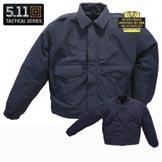
outerwear — six new jackets
Like 5.11’s existing outerwear, the new models feature the company’s patented Back-up Belt System™(BBS™) to stow extra gear, quality YKK® zippers and 5.11’s breathable, waterproof fabrics. The new Lined Duty Jacket is by far the best value in Law Enforcement. Stay warm, dry and comfortable in 5.11’s topof-the-line Specialist Jacket. A new and improved, updated style characterizes the ANSI III-rated High-Vis Reversible Jacket, which reverses to solid black. Delivering state-of-theart fabrics and construction, 5.11 introduces the sturdy Sabre Jacket. Stay comfortable on those blustery, cool days with the Tactical Fleece Jacket. For more information contact Bob Rodkin at productinfo@blueline.ca or 888-640-3048.
5.11 Tactical
Emergency eyewash
The Fendall 2000™is a portable, sealed-cartridge eyewash station. The unit was designed exclusively for the company’s new sterile saline emergency eyewash solution to form a 100 percent sterile delivery system. Easy to install and maintain and it features an alarm to signal that someone has activated the unit, and a self-contained waste-water containment system to capture waste water without the risk of spills. For more information contact Bob Rodkin at productinfo@blueline.ca or 888-640-3048.
Sperian
TAC-CAT
Protection Development designed the TACCAT for use by EOD, Narcotics and SWAT teams. Armor upgrade comes with removable rear platform and ‘bat’ BR shields which mount on rear left and right sides for sniper protection as unit advances. Roof mounted haz-mat container (or roof escape hatch). Using the ‘Claw’ you can go through walls, see and record action on the other side. Roof mounted PTZ (26x optical zoom) camera gives a full 360 degree view of the area around the TAC-CAT. For more information contact Bob Rodkin at productinfo@blueline.ca or 888-640-3048. Protection Development International
high security vehicle access control
This new surface mounted barricade provides a very easy to install high security vehicle access control system for banks, city and federal government offices, museums, corporate buildings, factories, oil refineries, railway, airport and other transportation hubs as well as other facilities threatened by truck bomb attack, errant drivers or car-crashing thieves. Installers can simply epoxy or bolt the new DSC 400 barricade to an already-existing concrete slab. Since there are no drainage or underground utilities issues, installation is fast. For more information contact Bob Rodkin at productinfo@blueline.ca or 888-640-3048.
Delta Scientific
With 20+ compartments, and made from water-resistant, 1,050-denier nylon — with quality YKK® zippers — this pack helps tactical operators quickly organize needed gear, even in low light. Also, the pack’s compression capability helps gear stay secure, with less load shifting. Innovations include compression straps, sternum straps, a hydration pocket and molle-compatible webbing. Backpack colors include black and flat dark earth. For more information contact Bob Rodkin at productinfo@blueline.ca or 888-640-3048.
5.11 Tactical
Forensic inspection kit
The Spectroline® TFK-100 Forensic Inspection Kit makes crime scene investigations quicker and easier by enabling forensic specialists to perform accurate field assessments of evidence such as semen, saliva, lipstick, urea, hair, fibers and grease. The heart of the kit is the TF-100A/12 TITAN® UV/Blue™ inspection lamp — a high-intensity, portable, flashlight-style lamp with an inspection range of up to 20 feet or more. It has a 12-volt battery pack that allows you to “power up” anytime, avoiding delays or inconvenience while gathering relevant samples. For more information contact Bob Rodkin at productinfo@blueline. ca or 888-640-3048.
Spectronics Corporation
Flashlight holder for AR15 rifles
The new ZFH1500 Flashlight Holder for AR15 rifles incorporates unique features for tactical situations. Flashlights with pushbutton tailcap switches, for example, are activated simply by sliding one’s hand forward to the front sling swivel which depresses the switch. Alternately, the flashlight may be adjusted forward so that the push-button switch is protected from the sling swivel while the skeletonized profile of the product allows easy access to the switch and rotating tailcap. Made of a high-performance glass-filled polymer, it is available in matte black, dark earth, and olive drab green. For more information contact Bob Rodkin at productinfo@blueline.ca or 888-640-3048.
Elzetta Design
Ultralite warning/directional bars
SoundOff Signal has taken their powerful little LED3 Mini Light and made it into a versatile line of interior directional/warning bars. Each version is available in 4, 8 or 12 LED3 module lengths. You can select from five safety colors with solid or split color combinations. The bars come with a universal dash/deck headliner mount. Vehicle specific mounting brackets are ordered separately for the 8 and 12 module lengths. These lights provide you with incredibly intense warning power providing a distinct safety advantage. For more information contact Bob Rodkin at productinfo@blueline.ca or 888-640-3048.
SoundOff Signal
instant barricade
Folding Quick-Deploy Cordonators™ with police graphics are available from Cogent Marketing. White cordonators with blue police graphics slow traffic at work zones and mark off areas at crime scenes. Control areas can be set up in seconds. They make crime scenes look more professional and authoritative. They eliminate the need for additional personnel and the practice of tying caution tape around trees and police vehicle antennas. For more information contact Bob Rodkin at productinfo@blueline. ca or 888-640-3048.
Cogent Marketing
New RUsh24 backpack
A tribute to Barry Shane
On October 25, 2007, Barry Shane passed away after a lengthy illness. For over 30 years Barry was best known by many in the Police, Fire and EMS community as a major supplier of emergency light and sound warning equipment.
As a young Montrealer, Barry was anxious to see the world. He had a strong sense of adventure and a desire to do something extraordinary which he felt would perhaps make the world a better place. For several years he traveled to many obscure areas of the globe as a soldier for hire carrying out assignments for his employer with a prestigious address in Washington, DC.
Ready to settle down to a normal life in Canada, Barry was attracted to the law enforcement community and the Code 3 company in particular. For the next 30 years he outfitted countless police and emergency vehicles with sirens and lighting systems.
Wade Smith, long time friend and associate of Barry’s stated that “Barry had a heart as big as a dance hall, and some people say that he gave away as many samples as orders he sold. Others said he was just like Santa Claus without ever asking for anything in return.”
Wade added that Barry was always the entrepreneur with a colorful personal style. “He
could captivate a room full of people with his easy grin and a wink of an eye.”
Barry’s love of horses became a secondary business of breeding and training world class quarter horses. Over the years Barry won numerous prizes and awards at rodeos in Canada and the USA. His horses were always in demand. Noted for his black cowboy hats, shiney belt buckles, custom made cowboy boots and shirts, Barry was even better known for his generosity bestowed on many who knew him or needed his assistance.
Brian Gregory remembers Barry with fondness. “Never shy to express opinions or his point of view, it’s not hard to imagine Barry arriving at the Pearly Gates on his favorite horse Mustang Sally. I can imagine him completely decked out with brilliant LED lights and blazing siren saying to St. Peter, ‘Pete, I have not been well for the last year, and I am a little tired, but I have sold all the lights and sirens I possibly could down there. They tell me you have a contract for me to adjust the luminance of the stars and tweak the trembling roar of the thunder. Let’s get started pardner because we have an eternity to get the job done.’”
Barry is survived by his wife Joan, his daughters, his brother Arthur and many, many friends.
Crime victims may take two years off work
The Quebec government has introduced legislation that will allow victims of violent crime to take as much as two years off work. Currently under Quebec law, crime victims can only take a maximum of 10 days off work with their job security guaranteed.
In late November Labour Minister David Whissell said the bill - which he described as unique in the world - aims to safeguard the jobs of those dealing with the effects of crime. The bill also grants relatives of suicide victims and parents of missing children the right to take up to a year off work.
Whissell said the unpaid leaves will give people the chance to heal from injuries or attend court proceedings. Victims-rights groups in the province have repeatedly urged the government to adopt such measures and welcomed the bill.
by Jamie Graham
Media excited delirium
After the RCMP Taser video became public, I corresponded with BC use of force coordinator and Vancouver police officer Joel Johnston with a view to sending a letter to the local media. Some of these thoughts are his but I thought many of the points are important in terms of balancing the kind of information that is ‘out there.’
The message that needs most to get out is that police officers are tasked with responding to problems that no one else is willing to deal with, and do so without the benefit of certainty of outcome and post-facto information.
All actions officers take are ‘frozen in time’ and based solely upon the knowledge they possess at that moment. Everything learned after-the-fact is not relevant to their decision-making process. Rightly so, it cannot be used against them.
All the events described by the media about Mr. Dziekanski’s background – his situation in Poland, language skills, prior dealings with authority, medical problems and so on – were not available or known to police when they decided on a course of action at the Canadian Border Service Agency area of the Vancouver Airport.
Of course, had these officers known what ALL of the circumstances were and what the outcome was about to become (as all of Canada seemed to know BEFORE they viewed the video images), they may have done things differently. Unfortunately, Dziekanski does not appear to be the usual suspect:
he was in a controlled and safe area of an
• international airport;
• blood-sugar levels;
he may have been dehydrated, with low
• hausted and highly adrenaline-induced; and
he may have been mentally and physically ex-
• what was going on around him.
he may have had a limited knowledge of
The responding officers were not responsible for his state or problems
• had no way of knowing his medical condi-
• tion (if there was one)
Those four officers were simply faced with a behavioural profile that required control. As Vancouver police officers do, they were probably looking for his verbal and non verbal pre assaultive cues as an insight into what might happen. They had the legal and moral right to stop him from continuing his actions.
I am prepared to bet that the last thing they wanted to do was to hurt Mr. Dziekanski. My heart goes out to his family and what they are going through. I’ll bet the police just wanted him to follow their directions, quickly gain control, restrain him and get him before a judge or doctor.
‘Use of force’ confrontations are never pleasant; someone almost always gets hurt.
Most of the time it is a sore wrist (from the handcuffs); other times it is a bruise from a baton strike, sore eyes from pepper spray or a small prick from a Taser dart. Suspects are taken to the ground for their and the officers safety. There is pain and sometimes blood when contact is made with the ground. Many times, it is the officers who get hurt. The day after a violent arrest, I was often faced with descriptions of badly injured officers (one guy tore his knee so badly he ended up retiring) requiring hospitalization and surgery.
The question I always ask is whether the officers used the appropriate level of force to gain control of a situation, and if more force would have avoided the police injuries. Remember that in a struggle with a person, police cannot – must not – lose. The result of a suspect gaining control over an officer could be catastrophic.
Even overwhelming numbers of police officers against a solitary suspect is not a guarantee of success. The officers do not know a person’s strength, how experienced they are at fighting, whether they are willing to risk everything to win, and so on.
I don’t know the outcome of the four investigations but I am sure the officers are not enjoying this. The best advice they are being given is not to talk, so it is left to people like you (this was originally sent to Rex Murphy of the CBC) to put forward balanced coverage so the public gets a fair picture of what happened and what might happen in the future.
The Taser is a ‘use of force’ option that has been endorsed nationally for police dealing with this kind of apparent behavioural profile, and the investigations underway will determine if the officer(s) utilized it in the way they are trained. I am sure the Taser’s computer read-out and investigation of Mr. Dziekanski’s past in Poland will shed some light on what happened.