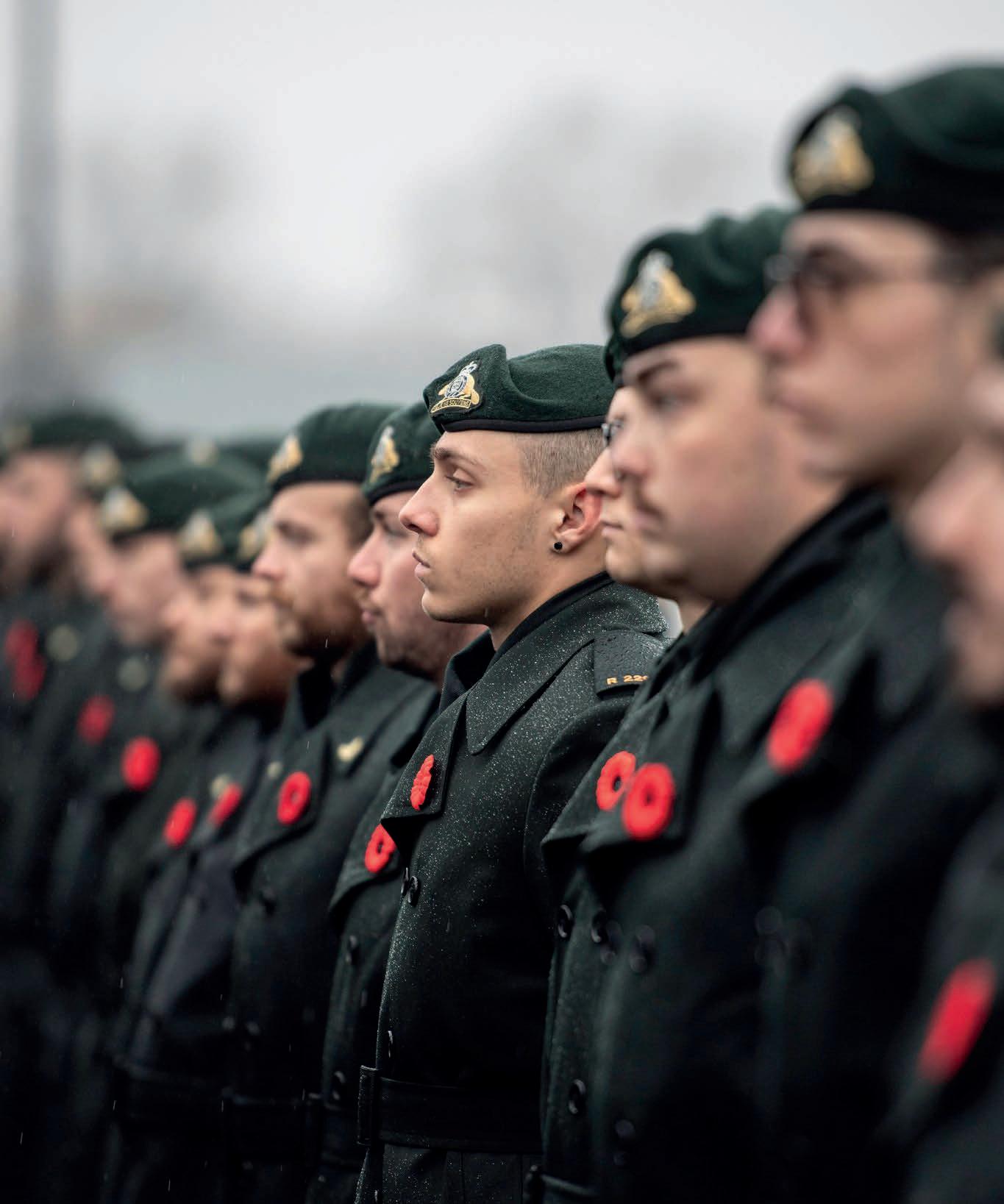
Des commémoration du jour du Souvenir entre traditions et hommage Commemorating
Remembrance Day with tradition and tribute
P. 6-7
Jour du Souvenir : Portraits de vétérans
Remembrance Day: Veterans' Portraits
P. 8
Une place en l'honneur de Joseph Kaeble, héros du 22e Bataillon pendant la Première Guerre mondiale
A place in honour of Joseph Kaeble, hero of the 22nd Battalion in the First World War
P. 10-11
Opération REASSURANCE : À la défense de l'Est de l'Europe
Operation REASSURANCE: In defense of Eastern Europe
P. 12
EX CASTOR CREUSE –Utiliser les atouts d'hier pour préparer demain
EX CASTOR CREUSE –Using yesterday's assets to prepare for tomorrow
P. 13
SAPEUR INVINCIBLE 24 –Exercice automnal pour le 5 RGC
SAPEUR INVINCIBLE 24 –Fall Exercise for 5 CER
P. 15
Participation de la Compagnie B du 2 R22eR à l’E X SABRE CAVALIER
2 R22eR Company B takes part in EX SABRE CAVALIER
P. 16
Le peloton de décontamination à l’œuvre The Decontamination Platoon at Work
P. 17
Les signaleurs du 5 GBMC brillent lors de l’Exercice NOBLE SKYWAVE 2024
5 CMBG signallers shine at Exercise NOBLE SKYWAVE 2024
P. 18-19
24 HEURES À … L'aréna Clément-Boulanger 24 HOURS TO Clément-Boulanger Arena
Suivez-nous sur nos médias sociaux
Follow us on our social media
journaladsum
journal_adsum_newspaper journaladsum.com
P. 20
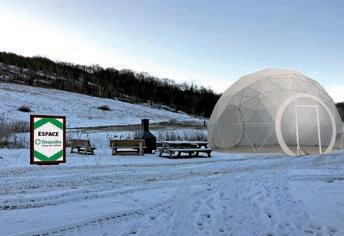
L'Espace Desjardins verra le jour au Centre Castor
Centre Castor to Open Desjardins Space
Le Centre Castor remporte un nouveau prix Centre Castor Wins a New Award
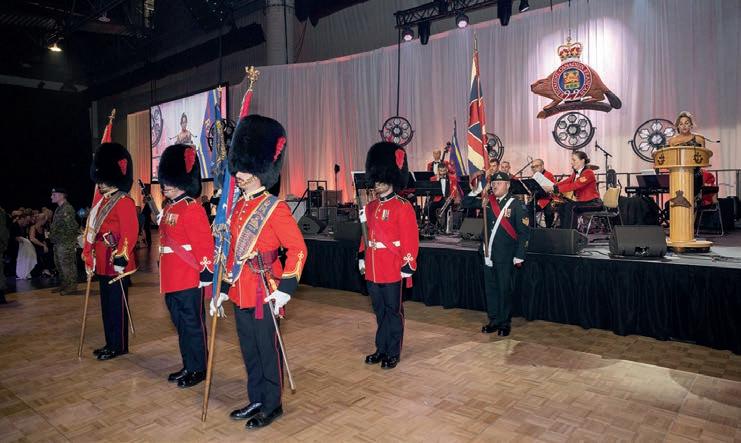
Grand succès pour les Festivités régimentaires du Royal 22e Régiment
Great success for the Royal 22e Régiment’s Regimental Festivities
P. 21
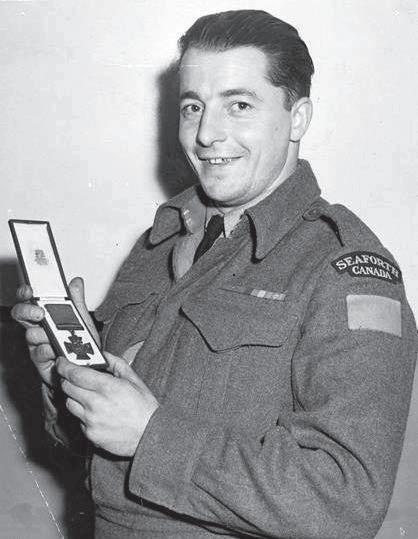
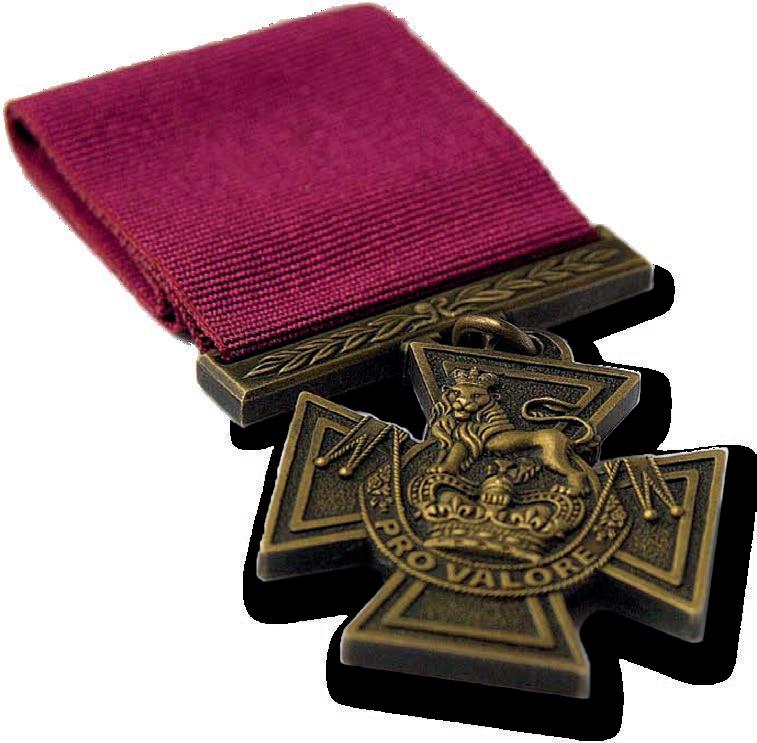
HISTOIRE : Croix de Victoria –La plus haute décoration militaire du Commonwealth
HISTORY: Victoria Cross –The Commonwealth's highest military decoration
P. 22
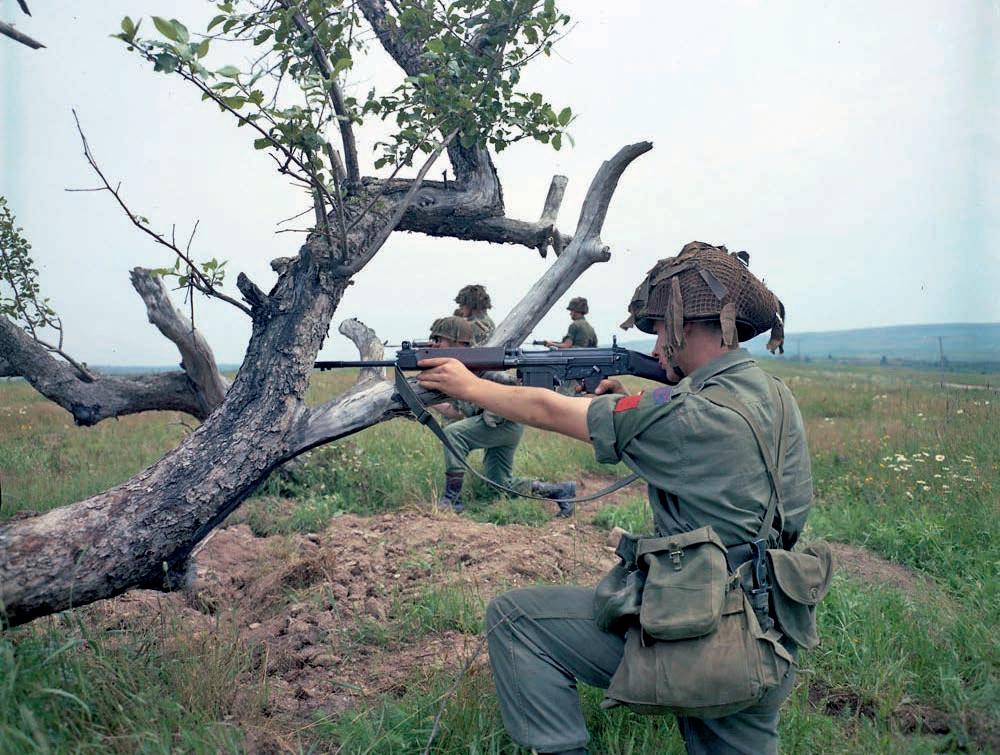
MATÉRIEL : Les Fusils FN C1 et FN C1A1, témoins d’une époque passée
MATERIAL: FN C1 and FN C1A1 rifles, witnesses to a bygone era
Pour certaines personnes qui ont servi dans les Forces armées canadiennes ou la GRC, la santé mentale peut prendre de nombreux visages. Si vous éprouvez des difficultés, il existe des services de soutien pour vous et votre famille.
Honorer le courage et la dévotion
Honoring courage and devotion
Every year on November 11th, we have the opportunity to unite in memory of the men and women who have served our country. This moment of recollection is not only a tribute to the sacrifices of the past, but also a reminder of our collective responsibility to those who continue to defend our Canadian and military values, as well as our national security.
Captain Chris Breault Public Affairs Officer, Base Valcartier
In the context of Remembrance Day events, we cannot ignore the importance of a strong, well-prepared military. At a time when Canada is in increasing demand, firstly in support of NATO, and secondly in support of increasingly frequent natural disasters,
the need for a strong military commitment has never been greater. The members of 5th Canadian Mechanized Brigade Group, currently deployed as part of Operation REASSURANCE in Latvia, confirm this vital need. Their presence abroad is living testimony to our nation's commitment to peace and stability.
The memory of our veterans, who served in many international conflicts, including the Second World War, must also be celebrated. Thanks to their sacrifices, we enjoy the freedoms that define our democracy. These include the right to speak freely, to live without fear, and to come together as a free community. By honoring these sacrifices, we reinforce the values of solidarity and mutual aid that lie at the heart of our national identity.
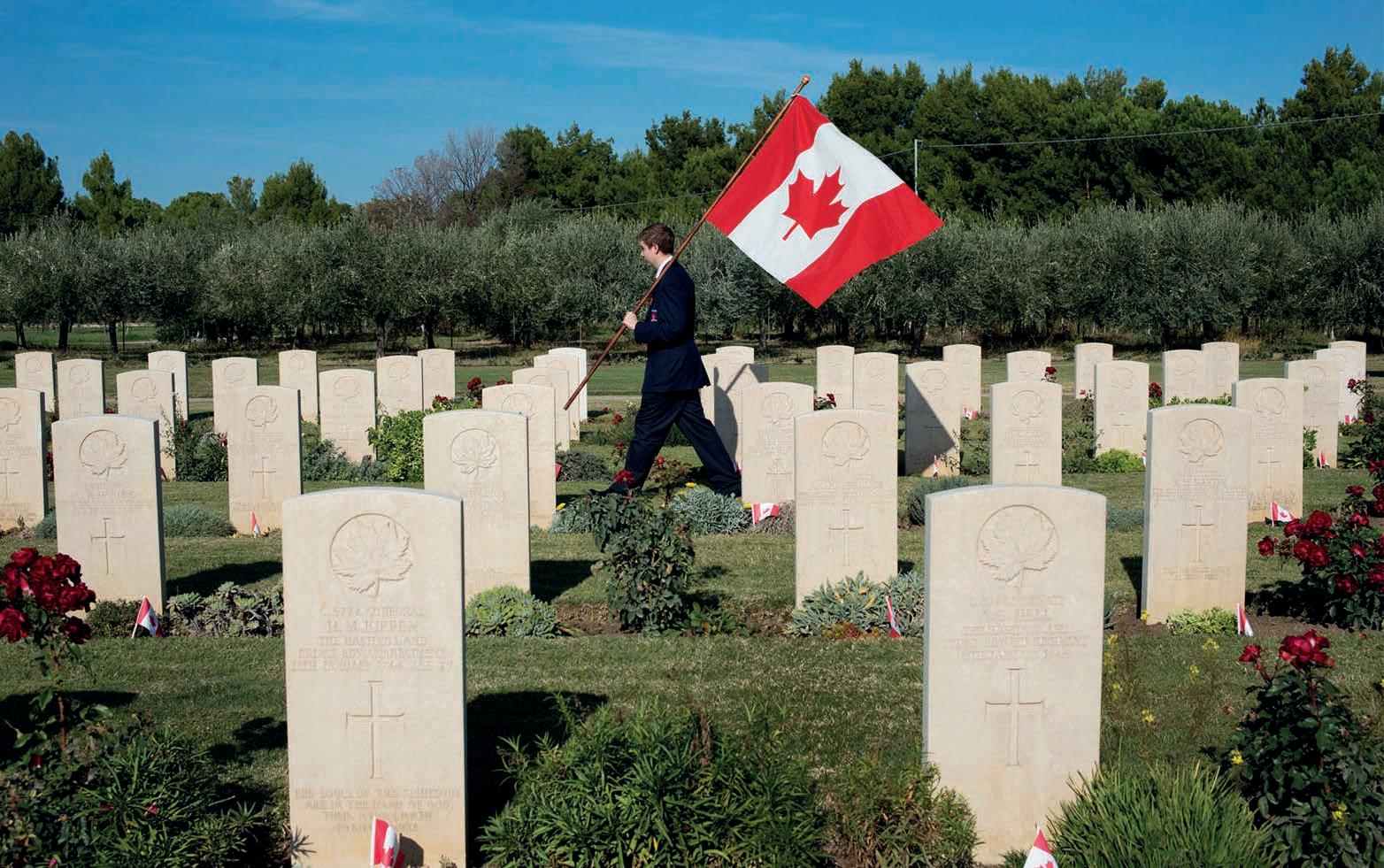
À l’occasion du jour du Souvenir, un jeune porte-drapeau passe dans les allées du cimetière militaire canadien de la rivière Moro, en Italie, le 11 novembre 2018.
On Remembrance Day, a young flag bearer walks through the aisles of the Moro River Canadian War Cemetery in Italy, November 11, 2018.
Le 11 novembre de chaque année, nous avons l'occasion de s’unir en mémoire des hommes et des femmes qui ont servi notre pays. Ce moment de recueillement n'est pas seulement un hommage aux sacrifices du passé, mais aussi un rappel de notre responsabilité collective envers ceux qui continuent de défendre nos valeurs canadiennes et militaires, ainsi que notre sécurité nationale.
Capitaine Chris Breault Officier des affaires publiques, Base Valcartier
Dans le cadre des événements entourant le jour du Souvenir, nous ne pouvons ignorer l'importance d'une armée solide et bien préparée. Alors que le Canada est en demande croissante, d’abord dans le soutien de l’OTAN, et qui plus est en soutien aux catastrophes naturelles de plus en plus fréquentes, le besoin d'un engagement militaire fort n'a jamais été aussi criant. Les membres du 5e Groupe-brigade mécanisé du Canada, actuellement déployés dans le cadre de l'opération REASSURANCE en Lettonie, confirme ce besoin de grande importance. Leur présence à l’étranger sont des témoignages vivants de l’engagement de notre nation envers la paix et la stabilité.
La mémoire de nos vétérans, qui a servi pendant de nombreux conflits internationaux, notamment celui de la Deuxième Guerre mondiale, doit aussi être célébrée. Grâce à leurs sacrifices, nous jouissons des libertés qui définissent notre démocratie. Celles-ci incluent le droit de s’exprimer librement, de vivre sans crainte et de nous rassembler en tant que communauté libre. En honorant ces sacrifices, nous renforçons les valeurs de solidarité et d'entraide qui sont au cœur de notre identité nationale.
At this time of commemoration, it's also an opportunity to reflect on our own commitment to our country. Many young people, fascinated by military service, dream of joining the Canadian Armed Forces. For them, it's not just a career choice, but a profound desire to contribute to a noble cause. By joining the Armed Forces, they hope not only to defend our nation, but also to feel they are making a strong and meaningful contribution to today's society. Together, let us honor the courage and devotion of our veterans, by committing ourselves to defending the values for which they risked their lives. Whether through remembrance, support for serving military personnel, or community involvement, we all have a role to play in this important time of commemoration.
En cette période de commémoration, c’est également l'occasion de réfléchir à notre propre engagement envers notre pays. De nombreux jeunes, fascinés par le service militaire, rêvent de rejoindre les rangs des Forces armées canadiennes. Pour eux, il ne s'agit pas seulement d'un choix de carrière, mais d'un profond désir de contribuer à une cause noble. En intégrant les Forces armées, ils souhaitent défendre non seulement notre nation, mais aussi d’avoir le sentiment d’apporter quelque chose de fort et de significatif à la société d’aujourd’hui.
Ensemble, honorons le courage et la dévotion de nos vétérans, en nous engageant à défendre les valeurs pour lesquelles ils ont risqué leur vie. Que ce soit par la mémoire, le soutien aux militaires en service, ou l’engagement communautaire, nous avons tous un rôle à jouer en cette période importante de commémoration.
Roodly Victor (514) 919-7863 rvictor@multi-prets.ca Martin Patenaude (514) 984-0853 mpatenaude@multi-prets.ca
CREDIT : CANADIANCOLLEGEITALY
Valcartier honore ses héros et ses disparus
Des commémoration du jour du Souvenir entre traditions et hommage
Comme chaque année, le 11 novembre est une journée à part, un moment gravé dans nos cœurs et dans nos âmes. À travers le pays, nous nous rassemblons pour honorer les sacrifices des hommes et des femmes qui ont servi et continuent de servir notre pays, en temps de guerre et de paix. Nous nous souvenons de ces femmes et ces hommes, sous l’uniforme, qui ont fait et qui font la fierté de notre nation. Nous avons notamment une pensée pour nos militaires déployés à l’étranger, en Lettonie.
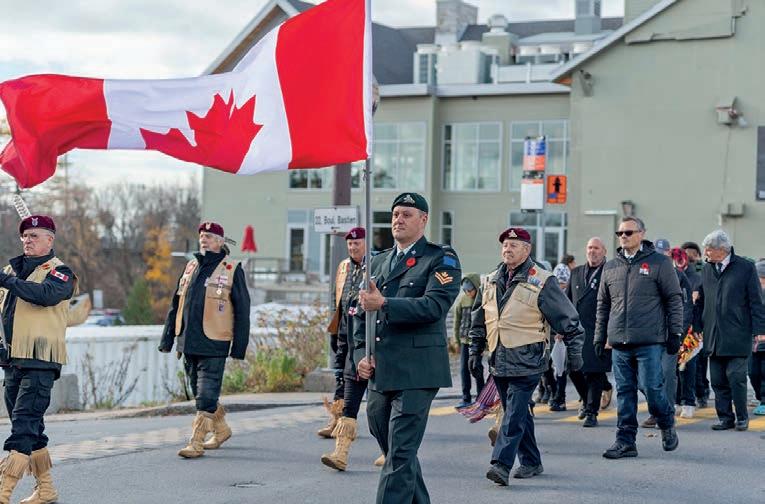
Cette année, quatre événements se sont tenus. Le premier est la Journée des vétérans autochtones, qui s’est déroulée le 8 novembre dernier. Après une parade militaire durant laquelle une trentaine de membres du 5e Groupe-brigade mécanisé du Canada (5 GBMC) ont défilé aux côtés de vétérans, une cérémonie s’est tenue, notamment avec l’allocution du Grand Chef de la Nation Wendat, Pierre Picard, le lieutenant-général à la retraite, Jocelyn Paul, ancien commandant de l’Armée canadienne, était présent à la cérémonie. Il est essentiel de se souvenir et de commémorer le sacrifice exceptionnel des vétérans autochtones.
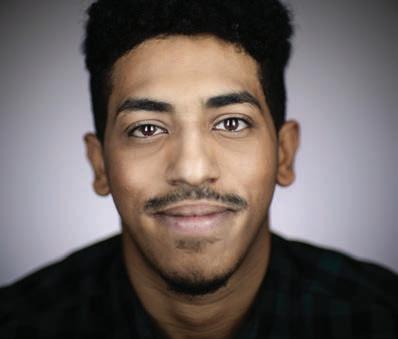
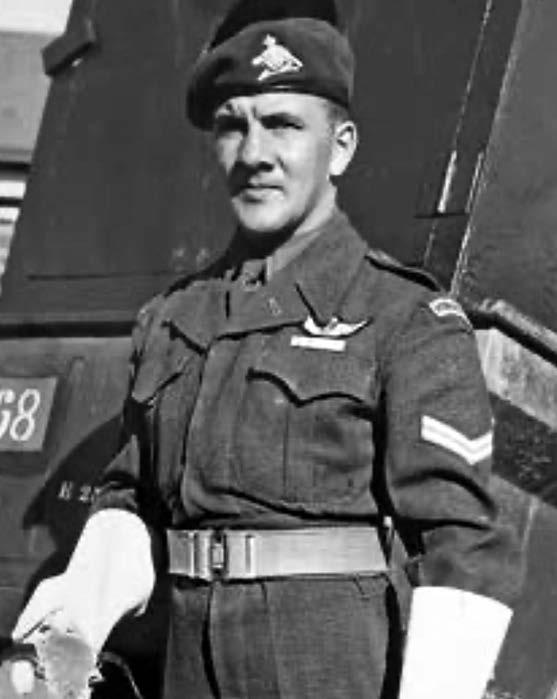
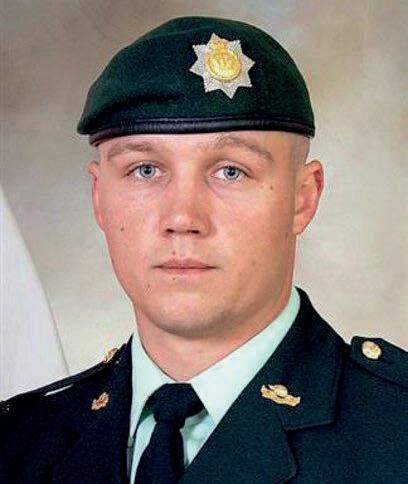
Ce caporal-chef du Royal 22e Régiment est photographié lors de la Journée des vétérans autochtones, qui s'est tenue comme chaque année à Wendake. This Master Corporal of the Royal 22e Régiment is photographed during the Aboriginal Veterans Day, which was held as every year in Wendake.
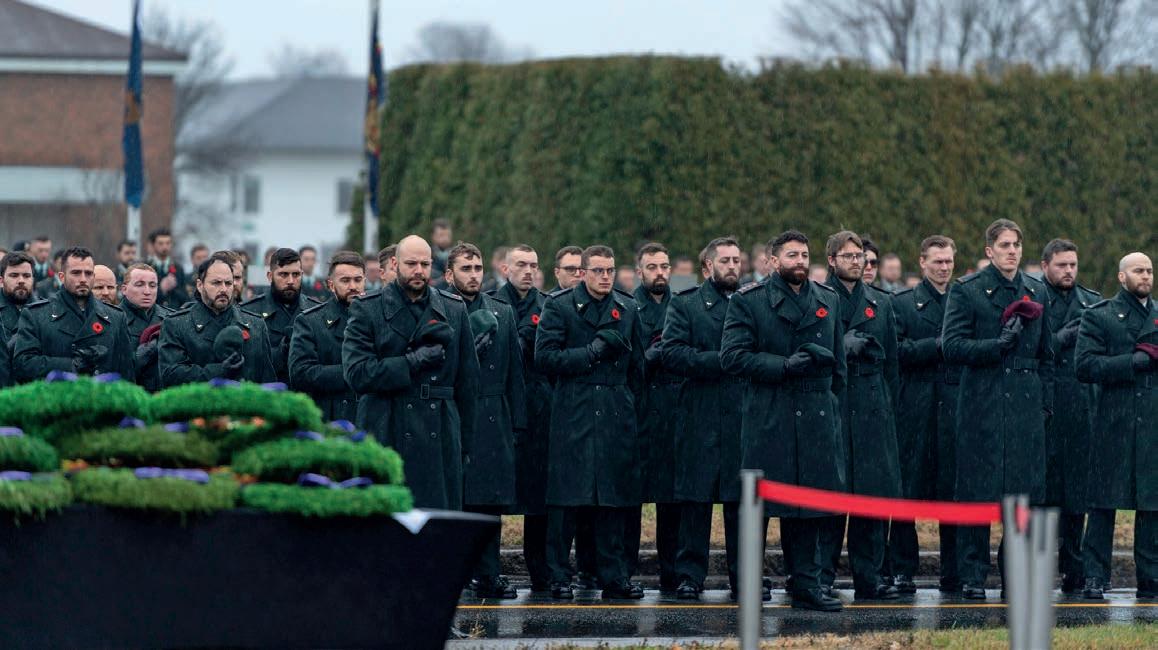
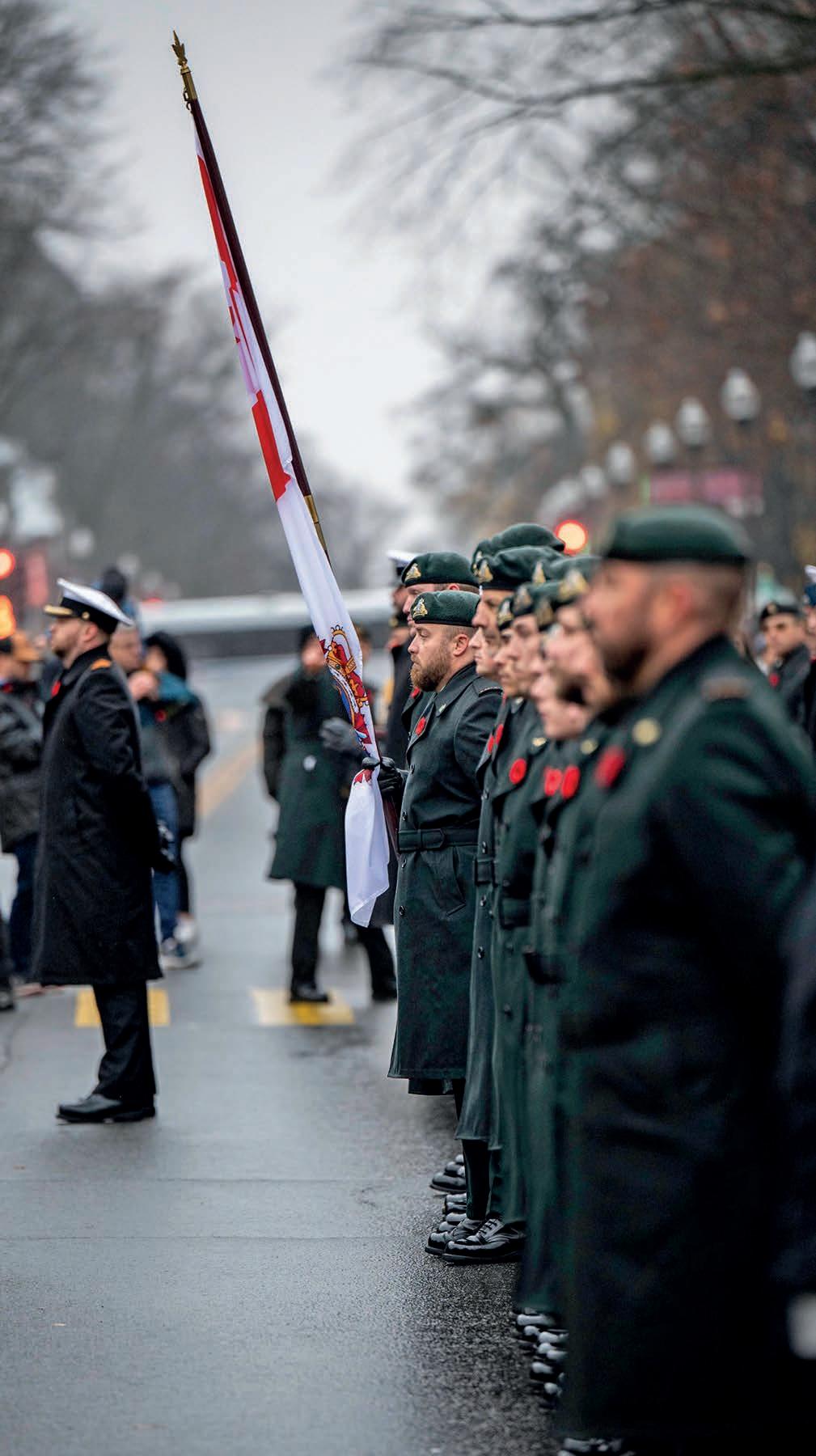
Le second événement a eu lieu en HauteVille de Québec devant le cénotaphe de la Croix du Sacrifice. Comme chaque année, une importante délégation venant de la Base Valcartier était présente, à savoir une centaine de militaires du 5 GBMC. La cérémonie du jour du Souvenir s’est déroulée
Les troupes formées en rangs sont photographiées devant le
de
en présence de membres de la Légion royale canadienne (filiale 265 Québec) ainsi que diverses structures associées.
Le troisième événement s’est déroulé à la Base Valcartier, ou des centaines de militaires, d’anciens combattants et de civils se sont rassemblés en mémoire de nos héros disparus. Comme à la cérémonie de la Croix du Sacrifice, plusieurs moments solennels se sont succédé, comme la lecture du poème «Au champ d'honneur», des prières, des salves de clairons, et le dépôt de couronnes de fleurs. Mais à Valcartier, un tambour autochtone a résonné, ajoutant une touche culturelle unique.
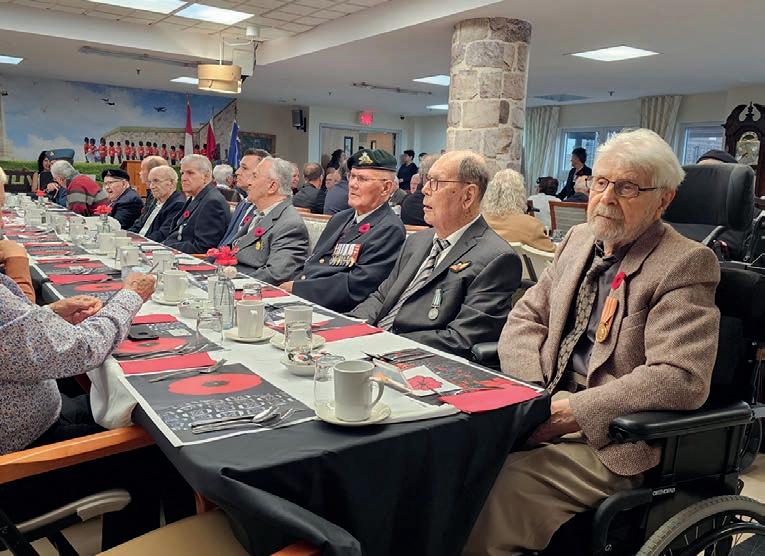
Enfin, le quatrième événement s’est déroulé à la Maison Paul Triquet, le centre d'hébergement dédié aux anciens combattants de la ville de Québec. Et le moins que l’on puisse dire, c’est qu’il y avait foule. Chaque vétéran était accompagné d’un membre de sa famille. Sous la houlette de Derek Belanger, technicien en loisirs à Paul Triquet (très apprécié des résidents), les vétérans ont assisté à plusieurs discours, dont un vibrant texte lu par Arthur Lortie, un ancien de la guerre de Corée. Une présence militaire était assurée par des membres du Royal 22e Régiment et de l’Aviation royale canadienne.
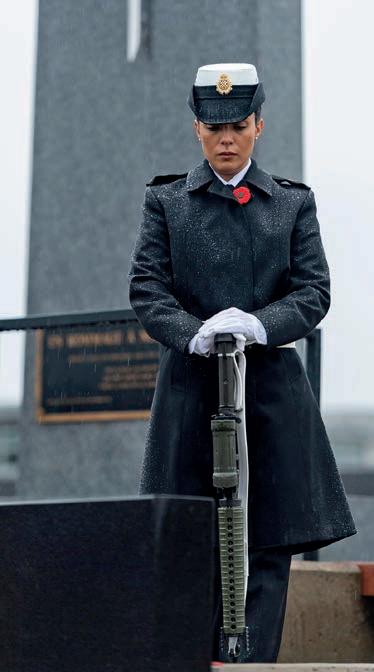
Une sentinelle de la Marine royale canadienne monte la
cénotaphe de la Base Valcartier le 11 novembre 2024. A Royal
at the
of
au
cénotaphe
la Base Valcartier, le 11 novembre 2024. The troops formed in ranks are photographed in front of the cenotaph of Base Valcartier, November 11, 2024. PHOTOS :
garde
pied du
Canadian Navy sentry stands guard
foot
the Base Valcartier cenotaph on November 11, 2024.
Valcartier Honours its Heroes and Fallen Commemorating Remembrance Day with tradition and tribute
À LA CROIX DU SACRIFICE AT THE CROSS OF SACRIFICE
Like every year, November 11th is a special day, a moment engraved in our hearts and souls. Across the country, we gather to honour the sacrifices of the men and women who have served and continue to serve our country, in times of war and peace. We remember the men and women in uniform who have made and continue to make our nation proud. In particular, we remember our servicemen and women deployed abroad, in Latvia.
Four events were held this year. The first was Aboriginal Veterans Day, held on November 8. After a military parade in which some 30 members of 5th Canadian Mechanized Brigade Group (5 CMBG) marched alongside veterans, a ceremony was held, including an address by the Grand Chief of the huronne-wendat Nation, Pierre Picard. Retired Lieutenant General Jocelyn Paul, former commander of the Canadian Army, was present at the ceremony. It is essential to remember and commemorate the exceptional sacrifice of Aboriginal veterans.
The second event took place in Quebec City's Upper Town, in front of the Cross of Sacrifice cenotaph. As in previous years, a large delegation from Base Valcartier was in attendance, including some 100 soldiers from 5 CMBG. The Remembrance Day ceremony took place in the presence of members of the Royal Canadian Legion (Branch 265 Québec) and various associated structures.
The third event took place at Base Valcartier, where hundreds of military personnel, veterans and civilians gathered in memory of our fallen heroes. As at the Cross of Sacrifice ceremony, several solemn moments followed, including the reading of the poem “In Flanders Fields”, prayers, bugle salutes and the laying of wreaths. But at Valcartier, a native drum sounded, adding a unique cultural touch.
Finally, the fourth event took place at Paul Triquet House, Quebec City's veterans' residence. And to say the least, it was well attended. Each veteran was accompanied by a family member. Under the guidance of Derek Belanger, recreation technician at Paul Triquet (much appreciated by the residents), the veterans were treated to a number of speeches, including a stirring text read by Korean War veteran Arthur Lortie. A military presence was provided by members of the Royal 22e Régiment and the Royal Canadian Air Force.
Ces vétérans de la Maison Paul Triquet ont participé, dans le cadre du jour du Souvenir, à une émouvante cérémonie, qui a été suivie par un grand dîner très apprécié. These veterans of the Paul Triquet House took part in a moving ceremony for Remembrance Day, which was followed by a very popular grand dinner.
À LA MAISON PAUL TRIQUET AT PAUL TRIQUET HOUSE
PHOTO : ADSUM
Moment solennel pour ces membres du 5 GBMC, lors de la traditionnelle parade militaire du jour du Souvenir, devant la Croix du Sacrifice.
A solemn moment for these members of the 5 CMBG, during the traditional Remembrance Day military parade, in front of the Cross of Sacrifice.
PHOTO : CPL WILLIAM LATREILLE, AFFAIRES PUBLIQUES 5 GBMC | PUBLIC AFFAIRS 5 CMBG
CLIQUEZ ICI
JOUR DU SOUVENIR 2024
PORTRAITS DE VÉTÉRANS
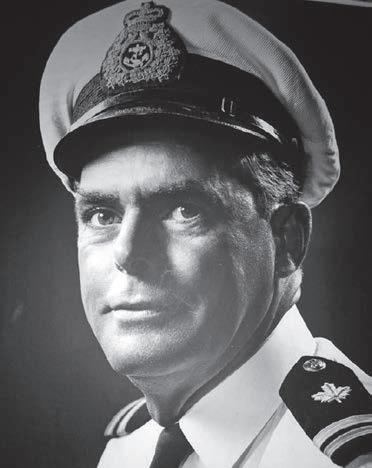
En ce jour du Souvenir, des centaines de vétérans de la Seconde Guerre mondiale et de la guerre de Corée sont toujours présents parmi nous, au Québec et dans le reste du Canada. L’Adsum vous amène à la rencontre de plusieurs d’entre eux, qui sont hébergés à la Maison Paul Triquet, une structure spécialisée dans l’hébergement et l’accompagnement des anciens combattants. Trois d’entre eux, Albert Morin, Gaston Pettigrew et Jean Cauchy, ont connu la Seconde Guerre mondiale. Aimé Mayer, Albert Gagnon, Arthur Lortie, Charles Lavoie et Charles-Eugène Laplante, ont eux été déployés pendant la guerre de Corée.
SECONDE GUERRE MONDIALE WORLD WAR II
Albert Morin
Albert Morin n’a que 16 ans lorsque la Seconde Guerre mondiale éclate en Europe en septembre 1939. Il rentre finalement dans l’Armée canadienne en 1942. D’abord assigné dans l’infanterie à la Base Valcartier, il doit patienter deux ans avant que ses supérieurs décident de l’envoyer dans la Garde côtière. En 1944, il est promu assistant-tireur de l’équipage d’un brise-glace, le N.B. McLean. À bord de ce navire, Albert va réaliser de nombreuses patrouilles en mer, sur la côte Atlantique, afin de protéger les côtes canadiennes d’une incursion des sous-marins allemands, une menace constante (certains sont même aperçus au large de l’île du Bic).
Albert survit à la guerre. mais est blessé : il a eu le tympan percé après qu’un tir «ait été déclenché trop près» de son oreille. Après la fin de la guerre, Albert ne quitte pas son uniforme : il va même faire carrière dans la Marine royale canadienne, finissant capitaine sur un brise-glace.
Albert Morin was just 16 when the Second World War broke out in Europe in September 1939. He finally joined the Canadian Army in 1942. Initially assigned to the infantry at Base Valcartier, he had to wait two years before his superiors decided to send him to the Coast Guard: in 1944, he was promoted to assistant crewmen on an icebreaker, the N.B. McLean. Aboard this ship, Albert carried out numerous patrols at sea, on the Atlantic coast, to protect Canadian coasts from the constant threat of German U-boats (some were even spotted off Bic Island). Albert survived the war but was wounded: his eardrum was pierced after a shot “was fired too close” to his ear. After the end of the war, Albert never took off his uniform: he even made a career for himself in the Royal Canadian Navy, ending up as captain on an icebreaker.
Gaston Pettigrew
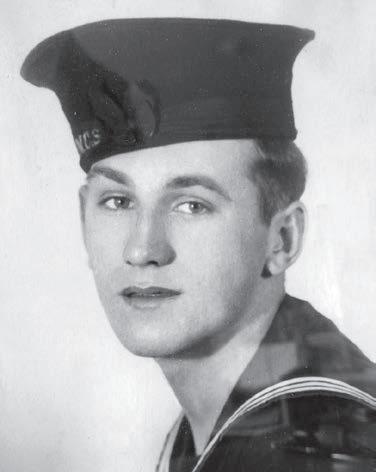
Gaston Pettigrew s’engage dès qu’il le peut, en avril 1943, dans la Marine royale canadienne. Il rejoint le NCSM Montcalm, au port de Québec. Après plusieurs mois de formation, le matelot Pettigrew est attaché à la base d’Halifax et envoyé sur un navire de guerre, le NCSM Ettrick. À son bord, Gaston va réaliser onze traversées de l’Atlantique, comme escorte aux navires marchands. Comme matelot, Gaston assure des quarts, entrecoupés d’alertes et «de repos dans des hamacs» installés dans les cales du navire. La peur, c’est le U-Boat, le sous-marin allemand. La tension est omniprésente. Gaston sert jusqu’à la victoire en Europe, le 8 mai 1945. Dès le 30 mai 1945, le NCSM Ettrick est restitué à la Royal Navy. Rapatrié en novembre 1945, Gaston s’engage dans la Marine marchande et participe au transport entre l’Europe et la Palestine des survivants juifs des camps de concentration, vers le nouvel État d’Israël.
Gaston Pettigrew joined the Royal Canadian Navy as soon as he could, in April 1943. He joined HMCS Montcalm, in the port of Québec. After several months' training, Seaman Pettigrew is attached to the Halifax base and sent to a warship, the HMS Ettrick. On board, Gaston made eleven Atlantic crossings as an escort to merchant ships. As a sailor, Gaston worked watches, interspersed with alerts and “rests in hammocks” set up in the ship's holds. The fear is the U-Boat, the German submarine. Tension is omnipresent. Gaston serves until victory in Europe on May 8, 1945. On May 30, 1945, HMS Ettrick is returned to the Royal Navy. Repatriated in November 1945, Gaston joins the Merchant Navy and takes part in the transport of Jewish concentration camp survivors between Europe and Palestine, to the new State of Israel.
Jean Cauchy
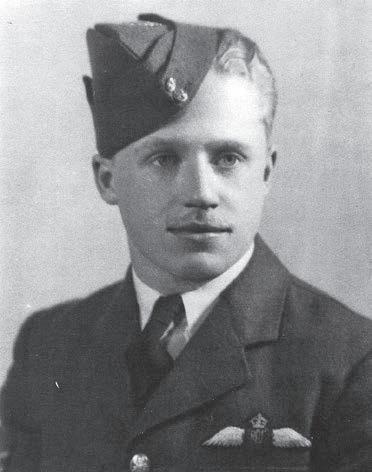
Jean Cauchy naît à Lévis, au Québec, en 1924. Il s’enrôle dans l’Aviation royale canadienne en 1942, à 18 ans. Il obtient son brevet de pilote et en janvier 1944, il est muté à la station du Royal Air Force Tholthorpe, en Angleterre, et rejoint le 425e Escadron, les «Alouettes». Il va accomplir six missions à bord d’un bombardier Halifax Mark III pendant la Seconde Guerre mondiale, avant que son avion soit abattu le 5 janvier 1945. Ce jour-là, il pilote un nouvel appareil, le sien ayant été trop abîmé à la mission précédente. Il va être abattu par un chasseur à réaction allemand. L’équipage n’a pas d’autre choix que de sauter en parachute, l’appareil étant en feu. Capturés (sauf deux, disparus), les membres d’équipage sont faits prisonniers et interrogés. Jean Cauchy va passer les derniers mois de la guerre au Stalag Luft I, un camp de prisonniers de guerre réservés aux aviateurs alliés. Il est libéré par les Soviétiques au début du mois de mai 1945. Jean Cauchy was born in Lévis, Quebec, in 1924. He joined the Royal Canadian Air Force in 1942, at the age of 18. He obtained his pilot's license, and in January 1944 was transferred to Royal Air Force Station Tholthorpe, England, where he joined 425 Squadron, the “Alouettes”. He flew six missions aboard a Halifax Mark III bomber during the Second World War, before being shot down on January 5, 1945. On that day, he flew a new aircraft, his having been too badly damaged on the previous mission. It was shot down by a German jet fighter. The crew had no choice but to parachute out, as the aircraft was on fire! Captured (except for two who disappeared), the crew is taken prisoner and interrogated. Jean Cauchy spent the last months of the war in Stalag Luft I, a prisonerof-war camp for allied airmen. He was liberated by the Soviets in early May 1945.
REMEMBRANCE DAY 2024
VETERANS' PORTRAITS
On Remembrance Day, hundreds of veterans of the Second World War and the Korean War are still with us, in Quebec and the rest of Canada. Adsum takes you to meet several of them, who are housed at the Paul Triquet House, a structure specializing in housing and accompanying veterans. Three of them, Albert Morin, Gaston Pettigrew and Jean Cauchy, fought in the Second World War. Aimé Mayer, Albert Gagnon, Arthur Lortie, Charles Lavoie and Charles-Eugène Laplante were deployed during Korean War.
GUERRE DE CORÉE
Albert Gagnon
Albert Gagnon s’engage en 1950 et rejoint le 2e Bataillon, Royal 22e Régiment. Il reste un an à Valcartier et est formé sur une mitrailleuse Vickers. Il est envoyé en Corée en 1951 après un passage par les États-Unis. Problème, les soldats canadiens ne sont pas formés aux armes de la British Army, devant normalement être équipés d’armes américaines. Albert doit donc former en urgence le reste de ses camarades. En novembre 1951, Albert combat lors de la terrible bataille de la colline 355, face aux troupes chinoises, dans ce qui est l’un des plus grands bombardements d’artillerie de toute la guerre. Albert et son unité tiennent bon, résistant alors que les Américains, tout proches, reculent. Albert va survivre à cette bataille et aux suivantes, avant de rentrer au Québec, en vie.
Albert Gagnon enlists in 1950 and joins the 2nd Battalion, Royal 22e Régiment. He stays a year at Valcartier and is trained on a Vickers machine gun. He was sent to Korea in 1951, after passing through the United States. The problem was that Canadian soldiers were not trained on British Army weapons, which were normally equipped with American weapons. Albert had to urgently train the rest of his comrades. In November 1951, Albert fought in the terrible battle of Hill 355 against Chinese troops, in what was one of the biggest artillery bombardments of the entire war. Albert and his unit hold out, resisting as the nearby Americans retreat. Albert survives this and subsequent battles, before returning to Quebec alive.
KOREAN WAR
Aimé Mayer
Engagé au sein du 1er Bataillon, Royal 22e Régiment, Aimé Mayer arrive en Corée avec les remplaçants, qui viennent au soutien des soldats disparus. Il est volontaire pour les patrouilles de nuit comme membre du groupe de reconnaissance. À ce titre, Aimé et ses camarades vont être très régulièrement au front, avant que le jeune homme ne soit transféré à la section d’intelligence (renseignement du Bataillon). Finalement renvoyé dans les tranchées, Aimé devient commandant de section et possède sa propre Jeep. Mais le 6 septembre 1952, deux de ses hommes se font tuer par un tir d’obus antichar ennemi. Un événement qui va le marquer à jamais, les noms de ces deux jeunes hommes étant gravés dans un monument sur la place George V, à Québec. Il se souviendra aussi longtemps des terribles bombardements d’artillerie de l’ennemi.
Enlisted with the 1st Battalion, Royal 22e Régiment, Aimé Mayer arrived in Korea with the replacements, who came to the support of missing soldiers. He volunteers for night patrols as a member of the reconnaissance group. In this capacity, Aimé and his comrades were regularly at the front, before he was transferred to the battalion's intelligence section. Eventually sent back to the trenches, Aimé became a section commander and owned his own Jeep. But on September 6, 1952, two of his men were killed by enemy anti-tank shellfire. It was an event that left a lasting impression on Aimé, whose names are engraved in a monument on Place George V in Quebec City. He will also long remember the terrible enemy artillery bombardments.
Arthur Lortie
Arthur Lortie s’enrôle en février 1951, en même temps que trois de ses frères. Devenu parachutiste, Arthur est déployé en Corée en novembre 1951 au sein du Royal 22e Régiment avec deux de ses frères, après un ultime entraînement au Japon. Il rejoint la région de Séoul, où il alterne positions défensives le jour et patrouille de combat la nuit. Pendant six mois, il va vivre dans les tranchées, dans un trou. Il va survivre au conflit et restera dans l’armée. Le fantassin Lortie finira sa carrière comme capitaine. En 2023, il a fait partie de la délégation du Gouvernement du Canada pour souligner le 70e anniversaire de l’armistice de la guerre de Corée.
Arthur Lortie enlisted in February 1951, along with three of his brothers. Now a paratrooper, Arthur was deployed to Korea in November 1951 with the Royal 22e Régiment, along with two of his brothers, after final training in Japan. He joined the Seoul region, where he alternated between defensive positions by day and combat patrols by night. For six months, he lived in the trenches, in a hole. He survived the conflict and remained in the army. Infantryman Lortie finished his career as a Captain. In 2023, he was part of the Government of Canada’s delegation to mark the 70th anniversary of the Korean War Armistice.
Nous avons également une pensée pour les autres vétérans de la guerre de Corée présents à la Maison Paul Triquet : Charles-Édouard Lavoie, Robert Bertrand, Lorenzo Couture et Réal Diotte. Soyez assurés que l’Adsum leur consacrera un article, à leur tour, dans les mois à venir. Enfin, nous dédions ces pages à notre ami Philippe Dufour, décédé le 13 juillet dernier. Ce vétéran de Corée s’était engagé en octobre 1952, et avait été envoyé sur place avec le 3e Bataillon, Royal 22e Régiment, en février 1953. Il avait combattu aux côtés des forces françaises et américaines, dans les tranchées, échappant de peu à la mort lors d’un bombardement d’artillerie puis lors d’une attaque d’un tireur d’élite nord-coréen.
Our thoughts are also with the other Korean War veterans present at Paul Triquet House: Charles-Édouard Lavoie, Robert Bertrand, Lorenzo Couture and Réal Diotte. Rest assured that ADSUM will be devoting an article to them, in turn, in the months to come. Finally, we dedicate these pages to our friend Philippe Dufour, who passed away on July 13. This Korean veteran enlisted in October 1952, and was sent to Korea with the 3rd Battalion, Royal 22e Régiment, in February 1953. He fought alongside French and American forces in the trenches, narrowly escaping death during an artillery bombardment and then a North Korean sniper attack.
Charles Lavoie
Charles Lavoie s’engage en 1949 à 19 ans, rejoignant le 2e Bataillon, Royal 22e Régiment. Après une année d’entraînement, il rejoint la Brigade spéciale, les troupes canadiennes qui partent en Corée. En 1952, il est stationné Pusan, dans le sud-est du pays, avant d’être envoyé sur la ligne de front. Il reste 11 mois sur place, sans la moindre blessure, malgré la participation à plusieurs combats. À son retour, Charles reste dans l’armée et y fait carrière.
Charles Lavoie enlisted in 1949 at the age of 19, joining the 2nd Battalion, Royal 22e Régiment. After a year's training, he joined the Special Brigade, the Canadian troops who went to Korea. In 1952, he was stationed in Pusan, in the south-east of the country, before being sent to the front line. He remained there for 11 months, without the slightest injury, despite taking part in several battles. On his return, Charles remained in the army and made a career of it.
Charles-Eugène
Laplante
Engagé en 1951 au sein du 3e Bataillon, Royal 22e Régiment, Charles-Eugène Laplante arrive en Corée en avril 1953. Il va y rester jusqu'à l’armistice, en juillet, comme mitrailleur sur un fusil-mitrailleur Bren. Le jeune homme va être déployé durant cette période sur la ligne de front au niveau de la colline 355. Les combats y sont sporadiques, mais le danger est réel, plus de militaires canadiens étant tués à cette période. Il se souvient ainsi d’un terrible affrontement en pleine nuit, lors d’une patrouille de combat, en pleine montagne, où il échappe à la mort.
Enlisted in 1951 with the 3rd Battalion, Royal 22e Régiment, Charles-Eugène Laplante arrived in Korea in April 1953. He remained there until the armistice in July, as a machine gunner on a Bren gun. During this period, the young man was deployed to the front line at Hill 355. Fighting was sporadic, but the danger was real, with more Canadian servicemen killed during this period. He recalls a terrible confrontation in the middle of the night, during a combat patrol in the mountains, when he escaped death.
Une place en l'honneur de Joseph Kaeble, héros du 22e Bataillon pendant la Première
Guerre mondiale
Une cagnotte a été levée en France par Michel Gravel, un historien-chercheur, afin de rendre hommage au caporal
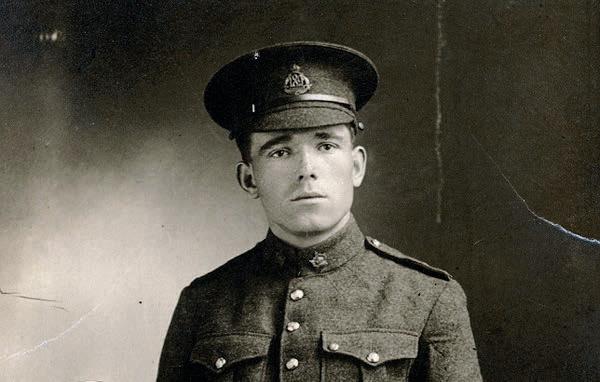
Joseph Kaeble, premier Canadien français à recevoir la Croix de Victoria, la plus haute distinction du Commonwealth pour sa ténacité et sa bravoure à NeuvilleVitasse, où il a perdu la vie le 9 juin 1918. L’objectif de 5000 dollars doit permettre la construction d’un monument dédié au caporal Kaeble, qui sera installé sur le parvis de l'Église de Neuville-Vitasse, dans le Pas-de-Calais, en France. Ainsi, en juin 2025, le parvis de l’église deviendra la place Joseph Kaeble.
Joseph Kaeble, enrôlé le 20 mars 1916, resta à Valcartier pendant six mois, le temps de son entraînement. Envoyé en Europe en septembre 1917, il est assigné le 13 novembre au 22e bataillon d'infanterie, alors en cours de réorganisation dans le nord de la France, après d’importantes pertes. Joseph prendra part aux terribles combats de 1917 et 1918, dont la célèbre bataille de la crête de Vimy et celle de Passchendaele.
Le soir du 8 juin, pris dans de terribles combats autour de Neuville-Vitasse, le caporal Kaeble offre une résistance héroïque face aux Allemands : une cinquantaine d’ennemis s’élancent vers son poste, face à la section de Joseph Kaeble, dont tous les hommes sont blessés. Kaeble sauta alors par-dessus le parapet et tenant sa Lewis à la hanche, tira char-
geur après chargeur en direction des rangs ennemis. Blessé à plusieurs reprises, il ne cessa de tirer et arrêta l’offensive allemande. Gravement blessé, il est transporté à l’hôpital et meurt de ses blessures le lendemain soir. Par cet acte de bravoure, il fut décoré de la Croix de Victoria et devint le premier militaire canadien de langue française à recevoir cet honneur. Aujourd’hui, pour conserver sa mémoire, le projet de monument est essentiel.
A place in honour of Joseph Kaeble, hero of the 22nd Battalion in the First World
A fund has been raised in France by the historian and researcher Michel Gravel to pay tribute to Corporal Joseph Kaeble, the first French Canadian to be awarded the Victoria Cross, the Commonwealth's highest distinction, for his tenacity and bravery at Neuville-Vitasse, where he lost his life on June 9, 1918.
The $5,000 target will enable the construction of a monument dedicated to Corporal Kaeble, to be installed in front of the church in Neuville-Vitasse, Pas-de-Calais, France. In June 2025, the church forecourt will become Place Joseph Kaeble.
Joseph Kaeble, who enlisted on March 20, 1916, stayed at Valcartier for six months, the time it took to complete his training. Sent to Europe in September 1917, he was assigned on November 13 to the 22nd Battalion, which was being reorganized in northern France after suffering heavy losses. Joseph took part in the terrible battles of 1917 and 1918, including the famous Battle of Vimy Ridge and Passchendaele.
On the evening of June 8, caught up in the terrible fighting around Neuville-Vitasse, Corporal Kaeble put up heroic resistance to the Germans: some 50 enemies rushed towards
War
his post, facing Joseph Kaeble's section, all of whose men were wounded! Kaeble leaped over the parapet and, holding his Lewis at the hip, fired magazine after magazine into the enemy ranks. Wounded several times, he kept firing, bringing the German offensive to a halt. Seriously wounded, he was taken to hospital and died of his wounds the following evening. He was awarded the Victoria Cross, Britain's highest honour, the first French-speaking Canadian serviceman to receive it. Today, to preserve his memory, the monument project is essential.
L’accompagnement, la clé pour planifier ma transition de carrière
Une transition de carrière, ça ne s’improvise pas. Il faut une préparation réfléchie et approfondie, sur plusieurs aspects. C’est un processus qui prend du temps et qui est unique à chaque membre des Forces.
La clé d’une transition de carrière efficace et réussie? L’accompagnement. C’est le plus qui transformera la transition en une expérience positive et enrichissante. Un bon accompagnement, c’est ce qui fait la différence entre une transition stressante et une transition sereine.
Un accompagnement centré sur votre bienêtre prend en considération l’évolution de la personne: ses finances, sa santé, son intégration sociale, son logement, son environnement culturel et social, etc.
Ces domaines sont les principaux éléments de planification à prendre en compte lorsque vous envisagez ou planifiez une transition de carrière. Ils influencent directement votre bonheur.
C’est ici que l’accompagnement prend tout son sens : il permet de clarifier les zones d’ombre, de répondre à vos questions et, surtout, de diminuer significativement le stress. L’incertitude
est souvent source d’angoisse. Avec les bonnes réponses, vous abordez chaque étape avec confiance.
Préparer une transition de carrière, c’est anticiper, ajuster et s’adapter au fil du processus. C’est réaliser des vérifications et obtenir des validations. Surtout, c’est savoir s’entourer de personnes qui possèdent l’expertise nécessaire pour vous guider. Chaque parcours est unique et un accompagnement personnalisé, centré sur le bienêtre, vous aidera à naviguer ces changements avec succès.
Ne laissez pas votre transition de carrière au hasard. Prenez le temps de bien vous entourer pour faire de ce changement une réussite.
PATRICE BERGERON Directeur général
› NOUVELLES MILITAIRES
À LA DÉFENSE DE L'EST DE L'EUROPE
La présence canadienne au sein de la Brigade multinationale de l’OTAN Lettonie s'est accentuée les derniers mois, avec l'envoi de forces de plus en plus important, incarnant l'engagement sans faille du Canada dans le renforcement de la sécurité et de la stabilité en Europe de l'Est.
En pleine période de guerre, tout proche entre l'Ukraine et la Russe, les soldats canadiens, aux côtés de leurs alliés internationaux, participent à des exercices de préparation opérationnelle, à des missions de formation et à des activités de soutien pour améliorer la capacité de défense de la région.
Comme chaque mois, votre journal Adsum vous propose une plongée dans le quotidien de nos soldats, déployés à plus de 6000 km de la Base Valcartier. Ces photos témoignent de la coopération étroite avec les partenaires de l'OTAN en Lettonie et mettent en lumière la grande compétence qui caractérise nos militaires.
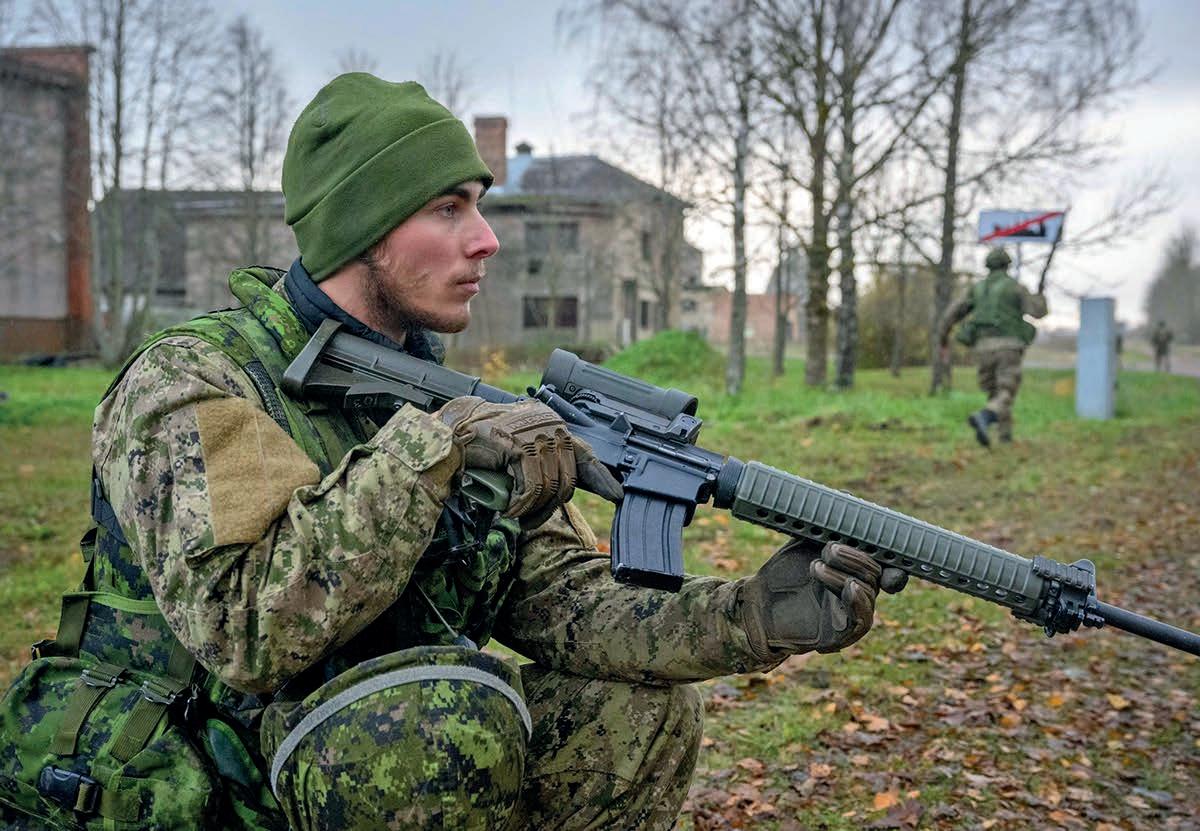
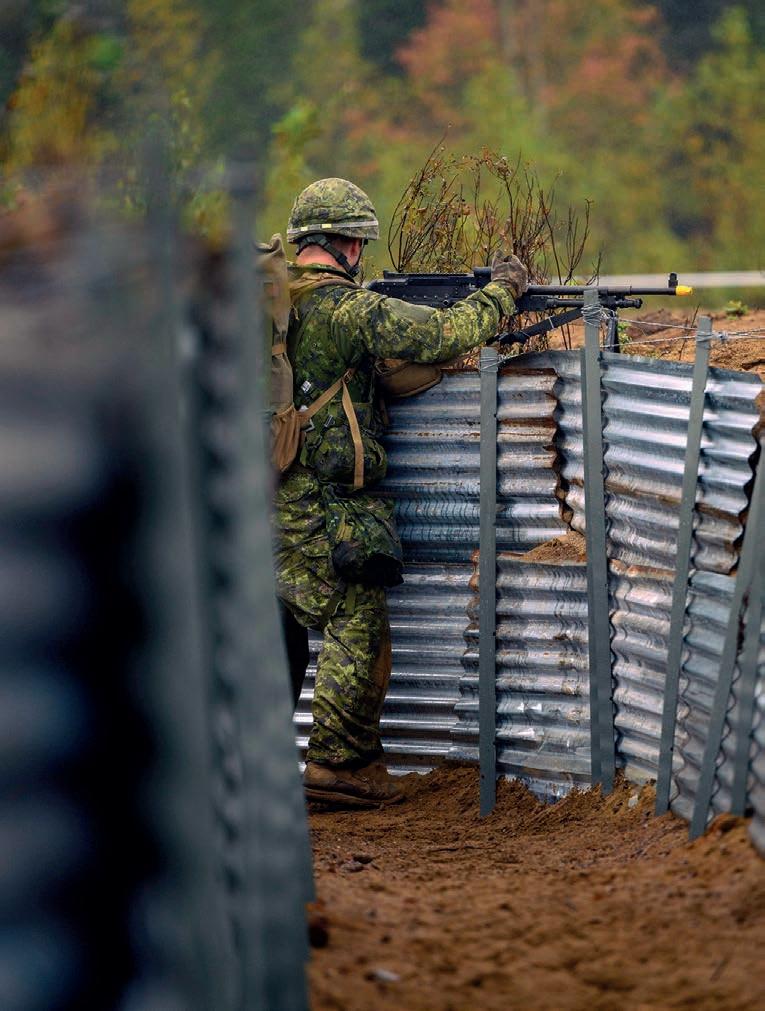
Ce militaire canadien est photographié lors de l'Exercice REWA, qui vise à démontrer les capacités de soutien et de défense de position, qui s'est déroulée début novembre.
This Canadian soldier is photographed during Exercise REWA, which aims to demonstrate support and position defence capabilities, which took place in early November.
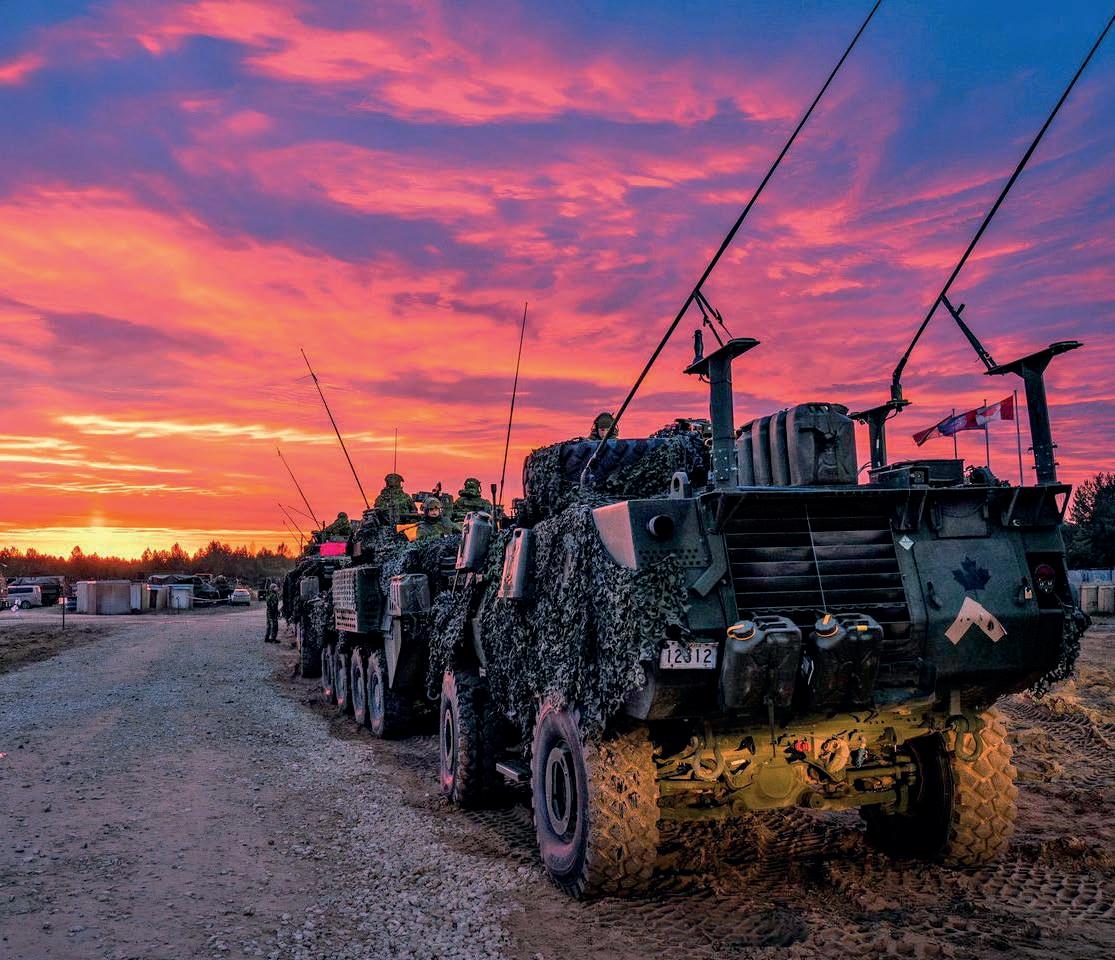
Ces VBL canadiens appartiennent à la Brigade de reconnaissance, qui a été déployée au 3e jour de l'Exercice REWA. Les blindés ont pu démontrer le savoir-faire des militaires de la Base Valcartier dans l'approche, l'observation et le signalement de cibles. These Canadian LAVs belong to the Reconnaissance Brigade, which was deployed on the 3rd day of Exercise REWA. The armoured vehicles were able to demonstrate the expertise of the soldiers from Base Valcartier in approaching, observing and reporting targets.
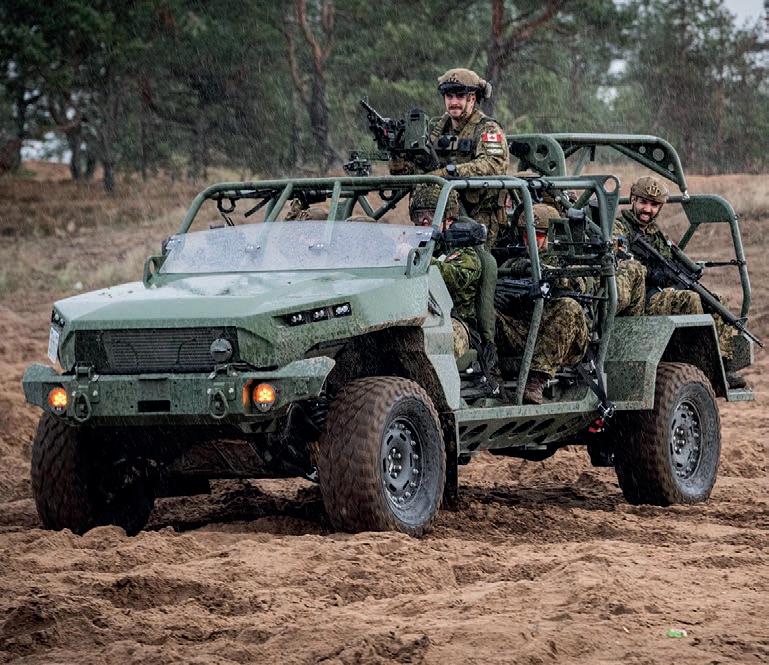
Ces soldats canadiens sont photographiés aux commandes d'un véhicule tactique léger, lors d'un entraînement fin octobre. Ce véhicule est très pertinent pour déplacer rapidement et efficacement du personnel et de l'équipement sur le champ de bataille. These Canadian soldiers are pictured at the controls of a Light Tactical Vehicle, during training in late October. This vehicle is very relevant for moving personnel and equipment quickly and efficiently on the battlefield.
PHOTOS : BRIGADE MULTINATIONALE DE L'OTAN EN LETTONIE | NATO MULTINATIONAL BRIGADE LATVIA
IN DEFENSE OF EASTERN EUROPE
The Canadian presence within the NATO Multinational Brigade Latvia has increased in recent months, with the sending of increasingly large forces, embodying Canada's unwavering commitment to strengthening security and stability in Eastern Europe.
In the midst of a war, very close between Ukraine and Russia, Canadian soldiers, alongside their international allies, are participating in operational readiness exercises, training missions and support activities to improve the region's defence capacity.
Ces
des
le
As every month, your Adsum newspaper offers you a look into the daily lives of our soldiers, deployed more than 6,000 km from Base Valcartier. These photos demonstrate the close cooperation with NATO partners in Latvia and highlight the great skill that characterizes our military.
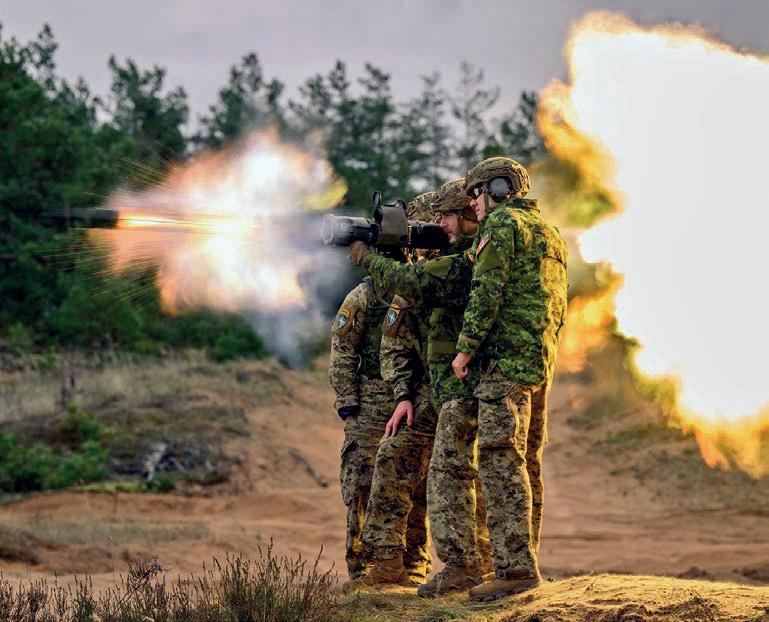
Fin octobre, un exercice a été organisé pour l'apprentissage de tirs avec un armement de type anti-blindé. Ces trois militaires canadiens sont photographiés lors d'un tir avec un M3 Carl Gustav. In late October, an exercise was held to learn how to fire anti-armour weapons. These three Canadian soldiers are pictured firing an M3 Carl Gustav.
M777 de 155 millimètres sont manoeuvrés par
militaires canadiens dans
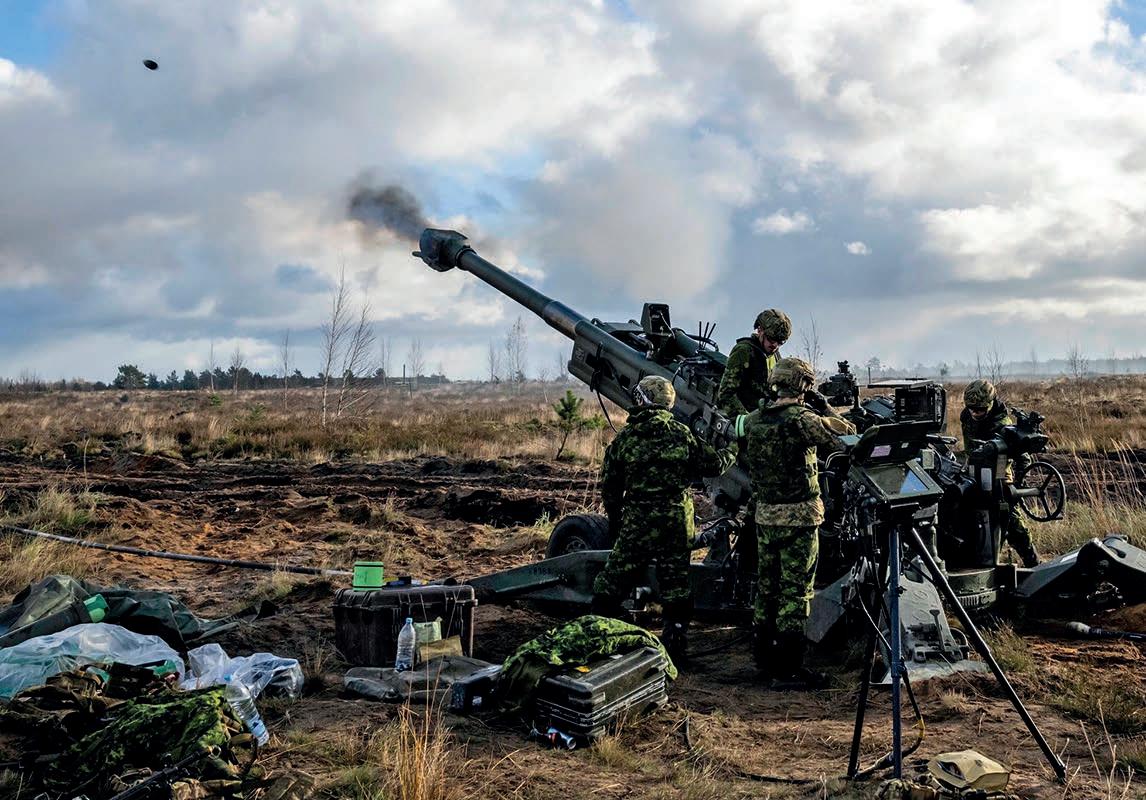
cadre d'un exercice de tirs. L'artillerie joue un rôle important dans le cadre du déploiement d'une puissance de feu accrue. These 155-millimetre M777s are manoeuvred by Canadian soldiers as part of a firing exercise. Artillery plays an important role in the deployment of increased firepower.
› NOUVELLES MILITAIRES
EX CASTOR CREUSE
Utiliser les atouts d'hier pour préparer demain
Les premières tranchées ont été construites en l’an 530 après J.-C., lorsque le général byzantin Bélisaire a ordonné à ses soldats d’en creuser une dans le cadre de la bataille de Dara. Elles se sont avérées si efficaces qu'elles constituent encore aujourd'hui un aspect central de la guerre moderne.
Cplc Alexandre De Marchi 1er Bataillon, Royal 22e Régiment
C'est en regardant des images de combats en Ukraine que le caporalchef MarcAndré Gilbert et moimême sommes arrivés à la conclusion suivante : la guerre de tranchées est actuelle, complexe et mortelle. Pour être efficace dans cet environnement, le fantassin a besoin d'une formation et d'un entraînement adéquats. Afin de surmonter ce défi, nous avons conçu un plan, appelé Exercice CASTOR CREUSE, basé sur la construction d'un système complet de tranchées russes pour faciliter l’entraînement. Nous avons entamé les discussions en janvier 2024 pour que la construction du système de tranchées puisse commencer en août 2024. Pour accomplir cela, nous avons présenté notre vision à notre chaîne de commandement au 1er Bataillon, Royal 22e Régiment (1 R22eR) et préparé tous les plans et la documentation requise. La construction du système de tranchées a nécessité l’appui du 5e Régiment du génie de combat (5 RGC).
Grâce à un budget dédié de 20 000 dollars, nous avons réussi à construire un système de tranchées de style russe de 200 mètres sur 150 mètres dans le secteur 5A de la Base de soutien de la 2e Division Valcartier, aussi connu sous le nom de Bullpen. En septembre 2024, le 1 R22eR a effectué quatre simulations d'attaques de force contre force dans le cadre de notre exercice d’unité de niveau 5. L'utilisation de l'infrastructure des tranchées s'est avérée cruciale pour améliorer nos instructions permanentes d’opération en vue de notre déploiement dans le cadre de l'Opération UNIFIER en 2025. Et le 1 R22eR n’est pas la seule unité à avoir profité de ce projet. En effet, ces installations se sont déjà avérées utiles pour l’entraînement de différentes unités, dont le 5 RGC, le 12e Régiment blindé du Canada, le 5e Régiment d’artillerie légère du Canada et les Voltigeurs de Québec.
Initialement, le projet était prévu pour une durée de trois ans : la première année avec une structure temporaire, la deuxième année, toujours avec une structure temporaire (avec relocalisation si nécessaire), et enfin la troisième année, avec la mise en place d'une infrastructure permanente. En novembre 2024, la décision a été prise de préserver le système de tranchées afin qu’il puisse être utilisé au printemps 2025. En fin de compte, l’Ex CASTOR CREUSE a montré que la guerre des tranchées est toujours un ensemble de compétences que l'infanterie canadienne doit maintenir et développer.
Des membres du 1 R22eR sont photographiés alors qu'ils s’entraînent dans un système de tranchée russe lors de l’Ex CASTOR ENDURCI, dans les secteurs d’entraînement de la Base Valcartier, le 26 septembre dernier. Members of the 1 R22eR are photographed training in a Russian trench system during Ex CASTOR ENDURCI, in the training areas of Base Valcartier, on September 26.
PHOTO : CPL WILLIAM LATREILLE, AFFAIRES PUBLIQUES 5 GBMC PUBLIC AFFAIRS 5 CMBG
EX CASTOR CREUSE
Using yesterday's assets to prepare for tomorrow
The first trenches were built in 530 AD, when the Byzantine general Belisarius ordered his soldiers to dig one as part of the Battle of Dara. They proved so effective that they are still a central aspect of modern warfare today.
MCpl Alexandre De Marchi 1st Battalion, Royal 22e Régiment
It was by watching images of combat in Ukraine that Master Corporal MarcAndré Gilbert and I came to the following conclusion: trench warfare is current, complex and deadly. To be effective in this environment, the infantry soldier needs adequate training and education. In order to overcome this challenge, we designed a plan, called Exercise CASTOR CREUSE, based on the construction of a complete system of Russian trenches to facilitate training. We began discussions in January 2024 so that the construction of the trench system could begin in August 2024. To accomplish this, we presented our vision to our chain of command at 1st Battalion, Royal 22e Régiment (1 R22eR) and prepared all the required plans and documentation. The construction of the trench system required the support of 5 Combat Engineer Regiment (5 CER).
With a dedicated budget of $20,000, we successfully built a 200 metres by 150 metres Russianstyle trench systems in Sector 5A of 2nd Division Support Base Valcartier, also known as the Bullpen. In September 2024, 1 R22eR conducted four simulated forceonforce attacks as part of our unit’s Level 5 exercise. Using the trench infrastructure proved crucial in improving our standard operating procedures for our deployment as part of Operation UNIFIER in 2025. And 1 R22eR is not the only unit to have benefited from this project. Indeed, these facilities have already proven useful for the training of various units, including 5 CER, 12e Régiment blindé du Canada, 5e Régiment d’artillerie légère du Canada and the Voltigeurs de Québec.
Initially, the project was planned to last three years: the first year with a temporary structure, the second year, still with a temporary structure (with relocation if necessary), and finally the third year, with the establishment of a permanent infrastructure. In November 2024, the decision was made to preserve the trench system so that it could be used in spring 2025. Ultimately, Ex CASTOR CREUSE showed that trench warfare is still a skill set that the Canadian infantry must maintain and develop.
SAPEUR INVINCIBLE 24 EXERCICE AUTOMNAL POUR LE 5 RGC
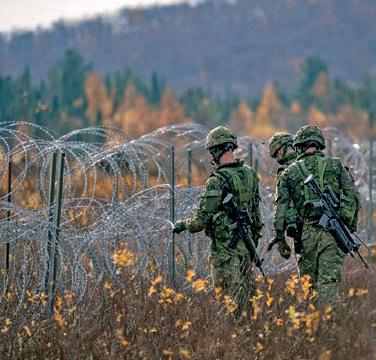
Durant les deux dernières semaines d’octobre, le 5e Régiment du génie de combat (5 RGC) a participé à son exercice régimentaire d’automne, l’Exercice SAPEUR INVINCIBLE. Les escadrons du 5 RGC ont collaboré pour accomplir diverses tâches assignées, telles que la réalisation d’une opération de franchissement, l’établissement d’une position défensive, l’ouverture de brèches explosives et mécaniques, ainsi que la fouille et le nettoyage de secteurs, et l’exécution d’opérations offensives.
Lieutenant Séguin Cmdt Troupe 2, 5e Régiment du génie de combat
La première journée de l’Exercice a été dédiée à l’établissement d’un site de franchissement sur la rivière Jacques-Cartier. Le 51e Escadron du génie de campagne, soutenu par le 55e Escadron d’appui, avait pour mission de construire un pont moyen flottant pour permettre la traversée des éléments de la force amie sur la rive nord de la rivière. Une fois le pont construit et les éléments traversés, le pont a été démantelé pour permettre l’exécution de la phase suivante de l’opération. Les jours suivants ont été consacrés à l’établissement d’une position défensive. Durant cette phase, le 51, toujours soutenu par le 55, avait pour mission de construire deux réseaux de tranchées et une ceinture d’obstacles pour canaliser l’avance de l’ennemi. Après trois jours de travail, le 51 était en position, prêt pour le premier contact ennemi. Le matin du 25 octobre, une compagnie du 1er Bataillon, Royal 22e Régiment a lancé un assaut sur la position défensive. Les deux unités ont ainsi eu l’occasion de perfectionner leurs compétences respectives.
La phase suivante de l’exercice était centrée sur des opérations offensives. Elle a débuté par l’ouverture de brèches mécaniques et explosives pour franchir divers types d’obstacles. Les troupes du 51 ont été confrontées à des obstacles tels que des barrières de type HESCO, des clôtures de concertina, des blocs de béton, un abatis et un champ de mines. Une fois les routes dégagées, permettant à la population locale de reprendre l’utilisation des voies de communication, le 51 a reçu la mission de prendre et tenir un objectif. Dans l’exécution de cette mission, le 51 devait également fouiller et nettoyer un bâtiment et sa zone environnante; une troupe était chargée de fouiller le bâtiment, tandis que l’autre s’occupait de la zone. Après plusieurs découvertes, d’autres ouvertures de brèches ont été effectuées. De nouveau, les routes ont été dégagées et les voies de communication réouvertes à la population civile.
La dernière phase de l’Exercice consistait en un assaut du 51 sur une position défensive ennemie. Les deux troupes de l’escadron devaient chacune ouvrir une brèche à travers une ceinture d’obstacles. Une fois les deux brèches réalisées et l’assaut mené avec rapidité et agressivité, l’ennemi fut détruit.
Les troupes du 5 RGC sortent de l’Exercice SAPEUR INVINCIBLE avec un niveau de compétence, de confiance et de camaraderie accru : mission accomplie!
CHIMO
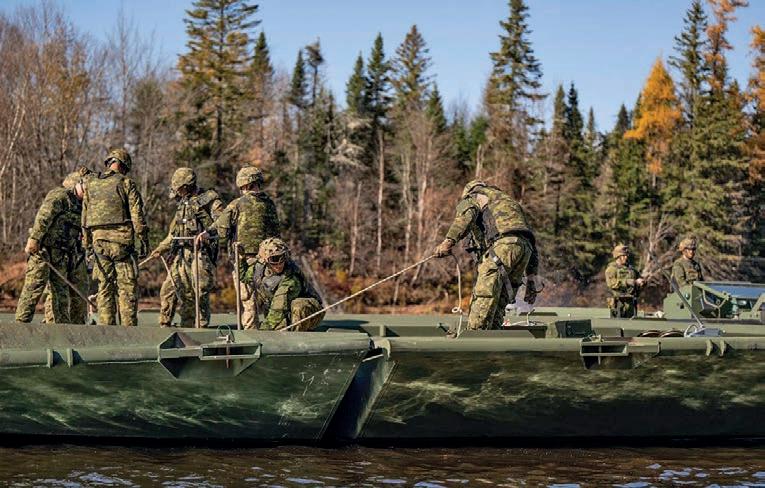
Des membres du 5 RGC construisent un obstacle de barbelé lors de l’Exercice SAPEUR INVINCIBLE, dans les secteurs d’entraînement de la Base Valcartier, le 23 octobre 2024. Members of the 5 CER build a barbed wire obstacle during Exercise SAPEUR INVINCIBLE, in the training areas of Base Valcartier, on October 23, 2024.
PHOTO : CPL WILLIAM LATREILLE, AFFAIRES PUBLIQUES 5 GBMC | PUBLIC AFFAIRS 5 CMBG
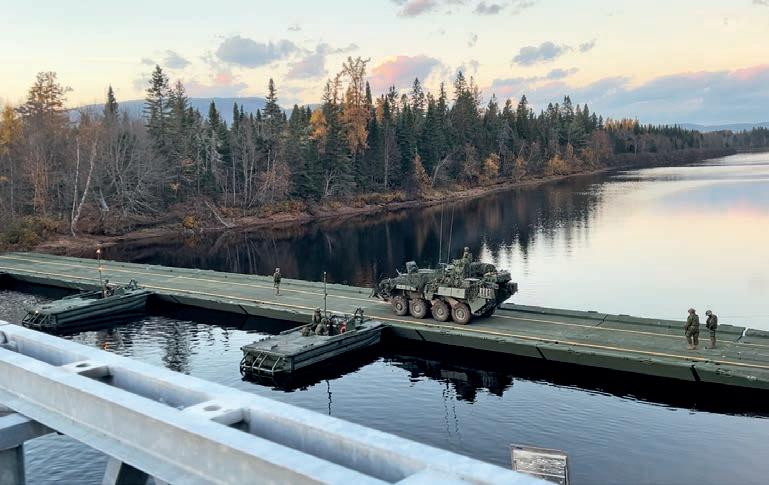
d’entraînement de la Base Valcartier, le 23 octobre 2024. A LAV from the unit is photographed on the floating bridge set up by the 5 CER in the training areas of Base Valcartier, on October 23, 2024.
PHOTO : 5 RGC | 5 CER
Ces ingénieurs de combat du 5 RGC mettent en pratique leur talent de spécialistes pour installer un pont flottant lors de l'Exercice SAPEUR INVINCIBLE sur la rivière Jacques-Cartier dans les secteurs d’entraînement de la Base Valcartier, le 21 octobre 2024. These combat engineers from the 5 CER put their specialist skills into practice to install a floating bridge during Exercise SAPEUR INVINCIBLE on the Jacques-Cartier River in the training areas of Base Valcartier, on October 21,
SAPEUR INVINCIBLE 24
FALL EXERCISE FOR 5 CER
During the last two weeks of October, 5th Combat Engineer Regiment (5 CER) took part in its fall regimental exercise, Exercise SAPEUR INVINCIBLE. Squadrons from 5 CER worked together to accomplish a variety of assigned tasks, such as carrying out a crossing operation, establishing a defensive position, opening explosive and mechanical breaches, searching and clearing sectors, and executing offensive operations.
Lieutenant Séguin
2 Troop Comd, 5th Combat Engineer Regiment
The first day of the exercise was dedicated to establishing a crossing site on the JacquesCartier River. The 51st Field Engineer Squadron, supported by the 55th Support Squadron, was tasked with building a medium floating bridge to enable friendly force elements to cross the river's north bank. Once the bridge had been built and the elements crossed, it was dismantled to enable the next phase of the operation to be carried out.
The following days were devoted to establishing a defensive position. During this phase, the 51, still supported by the 55, was tasked with building two networks of trenches and a belt of obstacles to channel the enemy's advance. After three days' work, the 51 was in position, ready for the first enemy contact. On the morning of October 25, a company from the 1st Battalion, Royal 22e Régiment launched an assault on the defensive position. Both units had the opportunity to perfect their respective skills.
The next phase of the exercise focused on offensive operations. It began with the opening of mechanical and explosive breaches to overcome various types of obstacles. The troops of the 51 were confronted with obstacles such as HESCO barriers, concertina fences, concrete blocks, an abatis and a minefield. Once the roads had been cleared, allowing the local population to resume using the communication routes, the 51 was given the mission of taking and holding an objective. In carrying out this mission, the 51 also had to search and clear a building and its surrounding area; one troop was responsible for searching the building, while the other looked after the area. After several discoveries, further breaches were made. Once again, roads were cleared and communication routes reopened to the civilian population.
The final phase of the exercise involved an assault by the 51 on an enemy defensive position. The squadron's two troops each had to breach a belt of obstacles. Once both breaches had been made, and the assault carried out quickly and aggressively, the enemy was destroyed.
The troops of 5 CER emerged from Exercise SAPEUR INVINCIBLE with a heightened level of competence, confidence and camaraderie: mission accomplished!
Un VBL de l'unité est photographié sur le pont flottant monté par le 5 RGC dans les secteurs
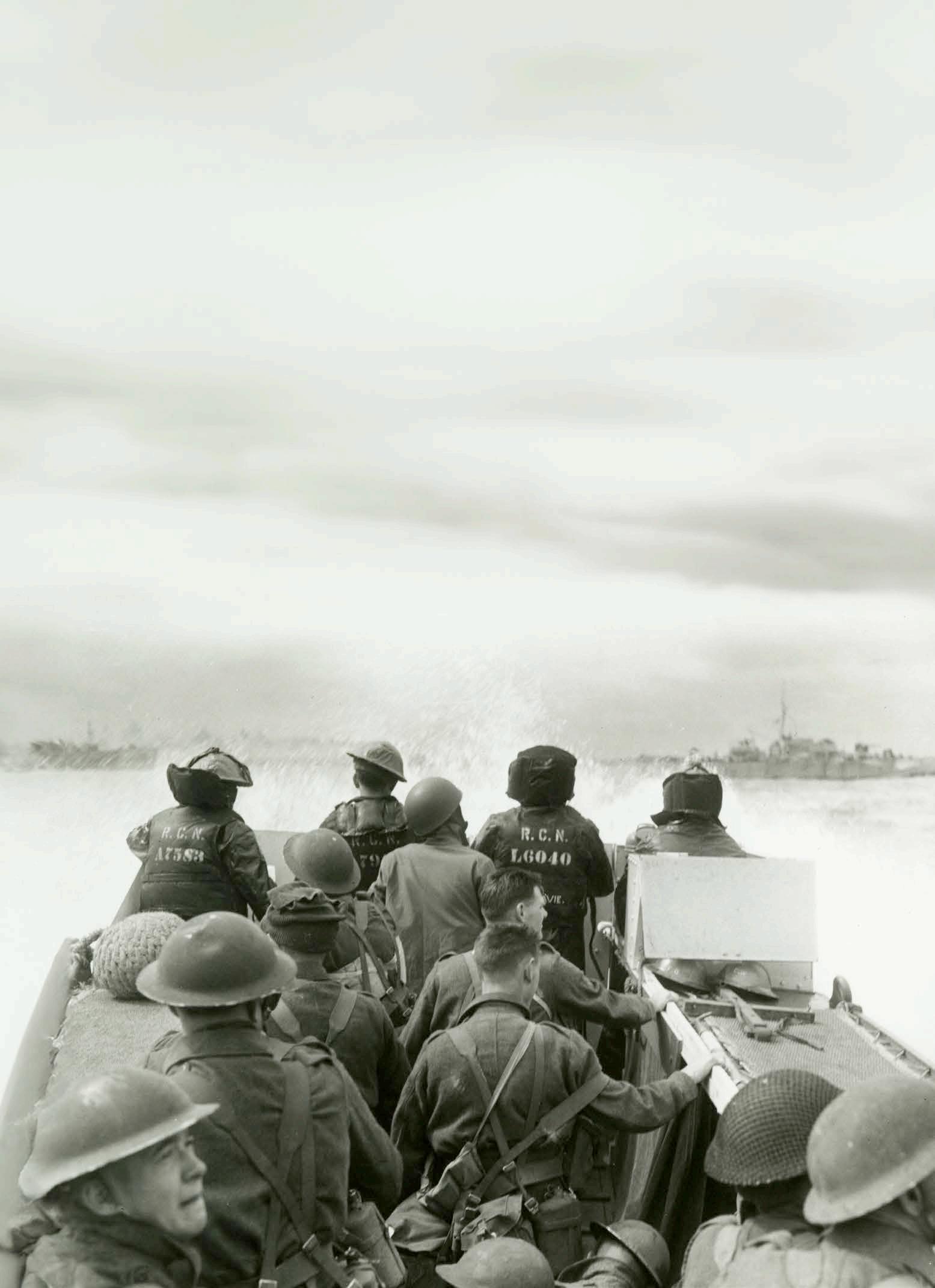
George Metcalf Archival Collection Canadian War Museum Collection d’archives George-Metcalf Musée canadien de la guerre 20020045-1906
Participation de la Compagnie B du 2 R22 eR à l’Ex SABRE CAVALIER
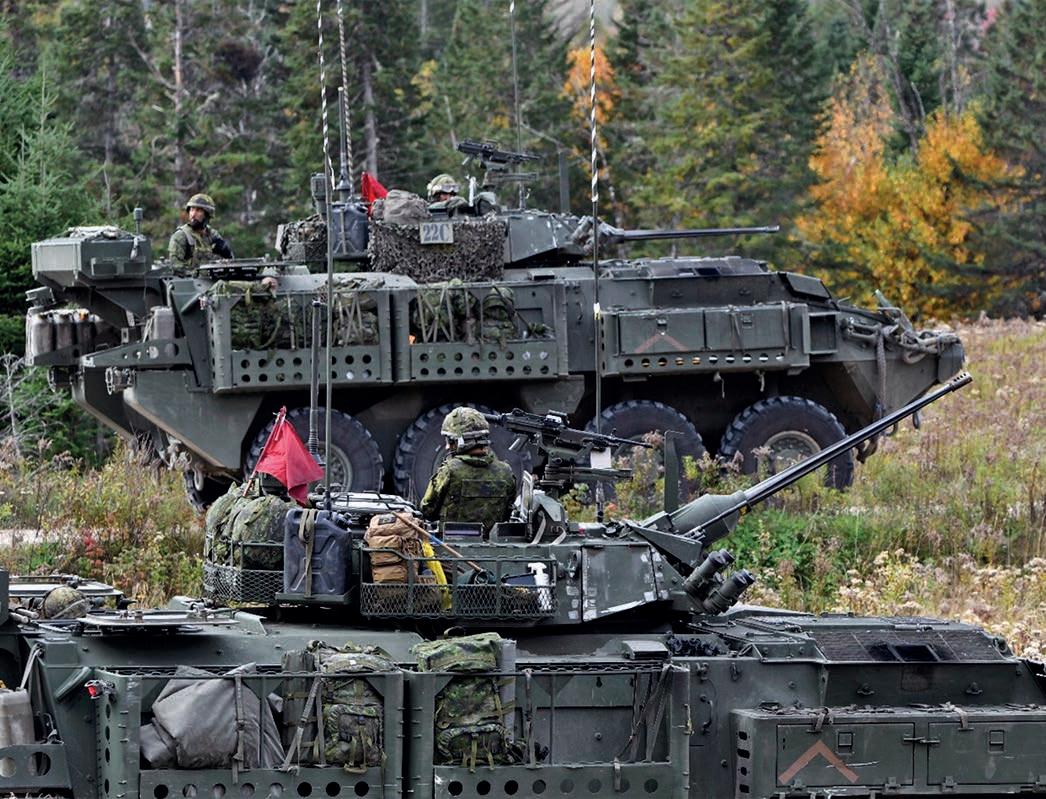
Ces deux véhicules blindés légers appartiennent au Groupement tactique du 12e Régiment blindé du Canada. Ces VBL ont été massivement déployés pour l’Exercice SABRE CAVALIER, aux côtés de plusieurs véhicules blindés tactiques de patrouille. These two Light Armoured Vehicles belong to the Battle Group of the 12e Régiment blindé du Canada. These LAVs were massively deployed for Exercise SABRE CAVALIER, alongside several Tactical Armoured Patrol Vehicles.
2 R22eR Company B takes part in Ex SABRE CAVALIER
B Company of the 2nd Battalion, Royal 22e Régiment (2 R22eR) recently participated in Exercise SABRE CAVALIER, a highlight in our training calendar. This exercise allowed us to simulate real combat situations, where our soldiers were able to demonstrate their preparedness and determination. By conducting livefire platoon attacks, our unit not only strengthened its tactical skills, but also strengthened the camaraderie that unites us.
The use of light armoured vehicles during this exercise was particularly crucial. These vehicles, although compact, offer essential protection while allowing rapid manoeuvre on the ground. The members of B Company had the opportunity to perfect their mastery of these vehicles, learning to combine speed and firepower to overcome obstacles encountered on the battlefield. The training scenarios were designed to simulate real-world conditions, allowing each soldier to become familiar with shooting procedures, team coordination, and making quick decisions under pressure.
In addition to our own activities, B Company also played a vital role in supporting the 12e Régiment blindé du Canada (12 RBC). This collaboration was instrumental in enriching their annual training in preparation for the upcoming deployment. Working alongside 12 RBC not only strengthened our interoperability, but also provided our soldiers with the opportunity to learn from each other. The exchange of skills and knowledge was beneficial to all, creating an environment of mutual support and solidarity.
This exercise also provided an opportunity for us to reflect on the challenges facing our armed forces today. In a world of rapidly evolving threats, it is imperative that we remain vigilant and prepared. The lessons learned from Ex SABRE CAVALIER remind us of the importance of rigorous training and continuous preparation.
We were privileged to welcome Colonel of the Regiment, LGen (retd) Marc Lessard during the exercise. In his speech, LGen (retd) Lessard shared his thoughts on the intensity of training required to meet the modern demands of the infantry profession. His words resonated deeply with us, reminding us that preparation is not only a requirement, but a duty to our country and our comrades. LGen (retd) Lessard also addressed the contemporary challenges we face. He emphasized the importance of adaptability, innovation and continuous learning in our training - all of which are essential to our operational success. Ex SABRE CAVALIER was much more than just training. It strengthened our cohesion as a team and strengthened our resolve to serve our country with honour and integrity. Each member of B Company demonstrated exceptional commitment, ready to meet challenges with courage and determination. We are proud of our contribution to 12 RBC and the lessons learned together. This type of exercise demonstrates the importance of collaboration between regiments, allowing us to expand our operational reach and improve our overall effectiveness.
La Compagnie B du 2e Bataillon, Royal 22e Régiment (2 R22eR) a récemment participé à l’exercice SABRE CAVALIER, un événement marquant dans notre calendrier d’entraînement. Cet exercice a permis de simuler des situations réelles de combat, où nos soldats ont pu démontrer leur préparation et leur détermination. En menant des attaques de peloton à tir réel, notre unité a non seulement renforcé ses compétences tactiques, mais a également consolidé l’esprit de camaraderie qui nous unit.
L’utilisation de véhicules blindés légers pendant cet exercice a été particulièrement cruciale. Ces véhicules, bien que compacts, offrent une protection essentielle tout en permettant une manœuvre rapide sur le terrain. Les membres de la Compagnie B ont eu l’opportunité de perfectionner leur maîtrise de ces véhicules, apprenant à combiner vitesse et puissance de feu pour surmonter les obstacles rencontrés sur le champ de bataille. Les scénarios d’entraînement ont été conçus pour simuler des conditions réelles, ce qui a permis à chaque soldat de se familiariser avec les procédures de tir, la coordination en équipe et la prise de décisions rapides sous pression. En plus de nos propres activités, la Compagnie B a également joué un rôle essentiel dans le soutien du 12e Régiment blindé du Canada (12 RBC). Cette collaboration a été déterminante pour enrichir leur entraînement annuel de préparation au déploiement à venir. Travailler aux côtés du 12 RBC a non seulement renforcé notre interopérabilité, mais a également offert à nos soldats l’occasion d’apprendre les uns des autres. Les échanges de compétences et de connaissances ont été bénéfiques pour tous, permettant de créer un environnement d’entraide et de solidarité.
Cet exercice a également été une occasion pour nous de réfléchir aux défis auxquels nos forces armées font face aujourd’hui. Dans un monde où les menaces évoluent rapidement, il est impératif que nous restions vigilants et préparés. Les enseignements tirés d’Ex SABRE CAVALIER nous rappellent l’importance d’un entraînement rigoureux et d’une préparation continue.
Nous avons eu le privilège d’accueillir le colonel du Régiment, le Lgén (ret) Marc Lessard pendant l’Exercice. Lors de son discours, le Lgén (ret) Lessard a partagé ses réflexions sur l’intensité nécessaire en entraînement pour répondre aux exigences modernes du métier de fantassins. Ses mots ont résonné profondément parmi nous, nous rappelant que la préparation n’est pas seulement une exigence, mais un devoir envers notre pays et nos camarades. Le Lgén (ret) Lessard a également abordé les enjeux contemporains auxquels nous devons faire face. Il a souligné l’importance de l’adaptabilité, de l’innovation et de l’apprentissage continu dans notre formation - aspects essentiels pour notre succès opérationnel.
L’Ex SABRE CAVALIER a été bien plus qu’un simple entraînement. Il a renforcé notre cohésion en tant qu’équipe et a raffermi notre détermination à servir notre pays avec honneur et intégrité. Chaque membre de la Compagnie B a démontré un engagement exceptionnel, prêt à relever les défis avec courage et détermination. Nous sommes fiers de notre contribution au 12 RBC et des leçons apprises ensemble. Ce type d’exercice démontre l’importance de la collaboration entre régiments, permettant d’élargir notre portée opérationnelle et d’améliorer notre efficacité globale.
PHOTO : 12 RBC
Le peloton de décontamination à l’œuvre
Du 7 au 25 octobre 2024, le peloton de décontamination de la compagnie Talon, 5e Bataillon des services (5 Bon Svc), a mené l'exercice de validation SOLDAT PROPRE 2401, simulant l'activation du plan d'opérations RUBICON en réponse à une menace nationale chimique, biologique, radiologique ou nucléaire (CBRN).
Capitaine Tyler Johnson Cmdt Pon DECON, 5e Bataillon des services
Le peloton de décontamination a été soutenu par des éléments du 5e Groupe-brigade mécanisé du Canada, composé du 5e Régiment d'artillerie légère du Canada, 5 Bon Svc, 1er Bataillon, Royal 22e Régiment, 2e Bataillon, Royal 22e Régiment, 12e Régiment blindé du Canada, et Quartier général et Escadron des transmissions, ont participé à l'Exercice. Traditionnellement, tous les participants à l'Exercice sont déjà des opérateurs de décontamination CBRN qualifiés (AIVA). Cependant, en raison des exigences opérationnelles, cela n'a pas été possible cette année et, par conséquent, la première semaine de l'exercice a été consacré à des répétitions et à des pratiques afin de s'assurer que tous les membres étaient à la hauteur et se familiarisait avec l'équipement.
Les participants reçoivent initialement un appel en dehors de leurs heures de travail traditionnelles afin de simuler le caractère aléatoire de l'activation et de mesurer leurs temps de réponse et de rassemblement. Une fois tous les participants rassemblés, un ordre d'avertissement est donné, transmettant toutes les informations préliminaires reçues des premiers intervenants (fictifs) et des témoins sur le lieu de l'accident/incident. Ensuite, dans le prochain 12 heures, nous pratiquons et simulons le départ de l'équipe de reconnaissance
pour confirmer le site de décontamination proposé, en communiquant au corps principal leurs conclusions et recommandations pour le site et les alternatives disponibles.
Une fois les derniers préparatifs effectués pour la garde avancée, celle-ci part et suit le groupe de reconnaissance dans les 24 heures suivant l'activation initiale. Des ordres de confirmation ont ensuite été donnés et des répétitions et des jeux de guerre ont été menés pour élaborer des réponses et des plans pour les éventualités probables, ce qui a conclu les événements de la première semaine.
Durant la deuxième semaine, nous avons simulé le déplacement du corps principal et le transport du matériel jusqu'à la zone de décontamination. L'emplacement choisi pour la salle de décontamination était le terrain de parade de la Base de soutien de la 2e Division du Canada Valcartier. Une fois les lignes de décontamination mises en place et prêtes à accueillir les blessés, nous commençons à réaliser des scénarios jour et nuit.
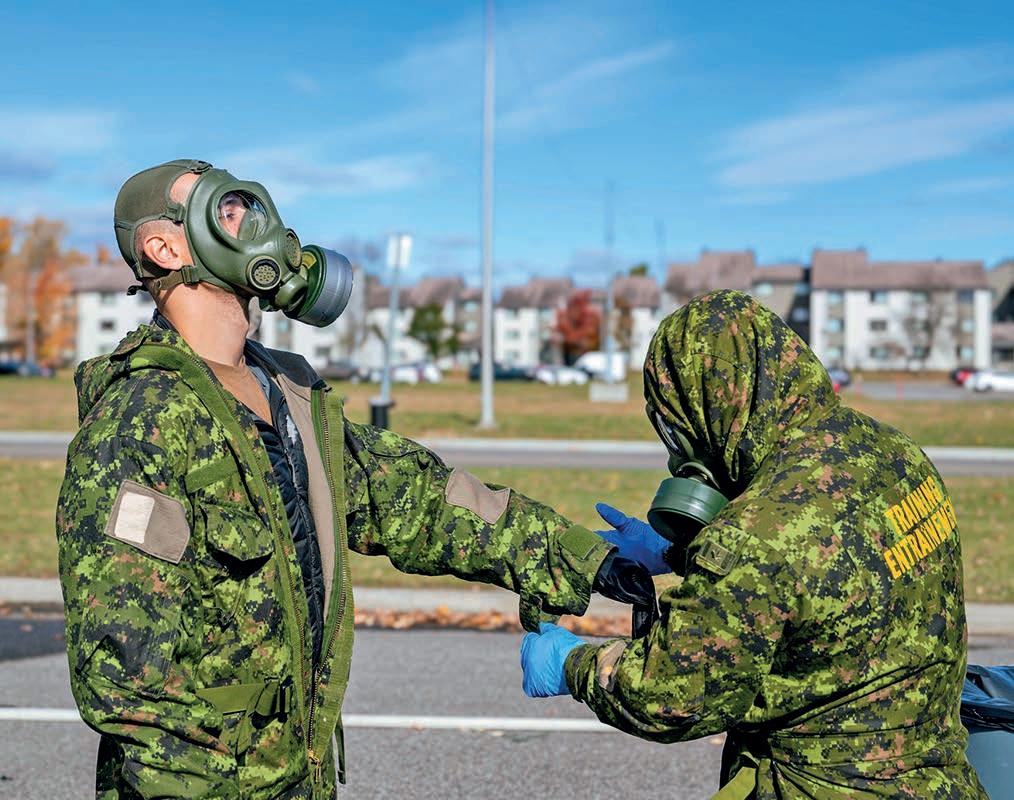
Nous pratiquons l'accueil et la décontamination des personnels, véhicules et équipements militaires. Recevoir progressivement de plus en plus jusqu'à ce que nous atteignions nos critères de validation et parvenions à les traiter avec des complications et des défis supplémentaires ajoutés pour repousser et tester nos limites et nos capacités. L’un de ces défis est de savoir comment gérer les patients peu coopératifs. Après avoir atteint nos objectifs de validation, nous avons expérimenté la gamme de véhicules et avons réussi à améliorer notre efficacité globale.
Une fois l'exercice terminé, le site est démonté et emballé et les participants sont ensuite retournés dans leurs unités d'origine avec les compétences et les connaissances acquises, prêts à recevoir l'appel pour soutenir la nation en cas de besoin.
The Decontamination
Platoon at Work
From October 7 to 25, 2024, the Decontamination Platoon of Talon Company, 5 Service Battalion (5 Svc Bn), conducted the validation exercise SOLDAT PROPRE 2401, simulating the activation of the RUBICON operations plan in response to a domestic chemical, biological, radiological or nuclear (CBRN) threat.
Captain Tyler Johnson Cmdt DECON Pon, 5th Service Battalion
The Decontamination Platoon was supported by elements of 5th Canadian Mechanized Brigade Group, comprised of 5e Régiment d’artillerie légère du Canada, 5 Svc Bn, 1st Battalion, Royal 22e Régiment, 2nd Battalion, Royal 22e Régiment, 12e Régiment blindé du Canada, and Headquarters and Signals Squadron, participated in the Exercise.
Traditionally, all exercise participants are already qualified CBRN Decontamination Operators (AIVA). However, due to operational requirements, this was not possible this year and therefore the first week of the exercise was spent rehearsing and practising ensuring all members were up to speed and familiarizing themselves with the equipment.
Participants initially received a call outside of their traditional working hours to simulate the randomness of the activation and to measure their response and assembly times. Once all participants were assembled, a warning order was issued, relaying all preliminary information received from (fictitious) first responders and witnesses at the accident/incident scene. Then, over the next 12 hours, we practised and simulated the departure of the reconnaissance team to confirm the proposed
decontamination site, communicating to the main body their findings and recommendations for the site and available alternatives.
Once final preparations had been made for the advance guard, they departed and followed the reconnaissance group within 24 hours of the initial activation. Confirmation orders were then given, and rehearsals and war games were conducted to develop responses and plans for likely contingencies, concluding the events of the first week.
During the second week, we simulated the movement of the main body and the transport of equipment to the decontamination area. The location chosen for the decontamination room was the parade ground at the 2nd Canadian Division Support Base Valcartier. Once the decontamination lines were set up and ready to receive the casualties, we began to run day and night scenarios.
We practised the reception and decontamination of military personnel, vehicles and equipment. Gradually receiving more and more until we reached our validation criteria and managed to treat them with additional complications and challenges added to push and test our limits and capabilities. One of these challenges was how to handle uncooperative patients. After reaching our validation targets, we experimented with the range of vehicles and managed to improve our overall efficiency.
Once the Exercise was over, the site is dismantled and packed and the participants were then returned to their home units with the skills and knowledge acquired, ready to receive the call to support the nation when needed.
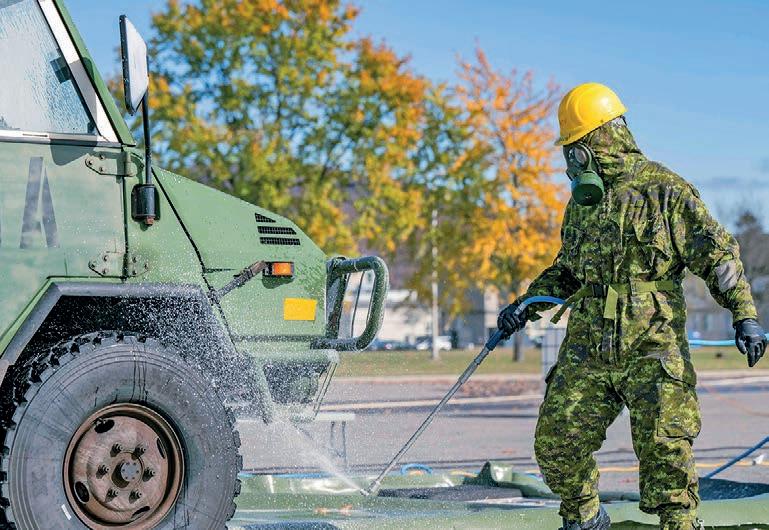
Le peloton de décontamination de la compagnie Talon du 5e Bataillon de services travaille sur plusieurs lignes de décontamination, et travaille aussi bien sur les véhicules que sur les individus.
5th Service Battalion's Talon Company Decontamination Platoon works on multiple decontamination lines, working on both vehicles and individuals.
Les militaires du peloton de décontamination de la compagnie Talon sont photographiés alors qu'ils décontaminent un véhicule léger. Talon Company Decontamination Platoon members are photographed decontaminating a light vehicle.
PHOTO : CPL WILLIAM LATREILLE, AFFAIRES
Les signaleurs du 5 GBMC brillent lors de l’exercice
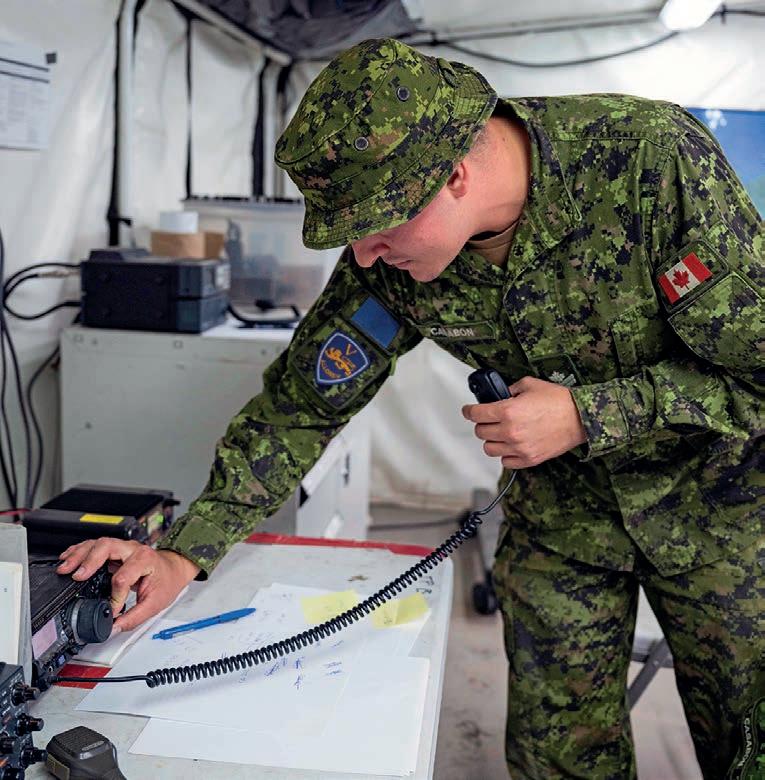
La branche des communications et de l’électronique participe annuellement à l’Exercice NOBLE SKYWAVE où les signaleurs de différentes radios mettent en pratique leurs capacités à communiquer au moyen de radios à haute fréquence (HF). Le 5e Groupe-brigade mécanisé du Canada (5 GBMC) participe à cette compétition durant la période de l’automne.
Cet événement est une opportunité pour les signaleurs du 5 GBMC de développer leur habileté à établir des liens de communications avec nos alliés via les ondes HF et de se
développer sur la scène internationale. C’est dans cet élan que cette année, l’exercice s’est déroulé du 21 au 25 octobre et la compé tion en ellemême du 23 au 25 octobre. 470 équipes étaient en compétition et celle for mée par le Quartier général et Escadron des transmissions, installées sur le site de la Cita delle de Québec, s’en est sortie 69e toutes ca tégories confondues sur le classement inter national. Ce fut une très belle expérience qui sera certainement à renouveler pour tous les participants à cet exercice lors des prochaines années.
Et c’est le moment de remercier tous ceux qui de près ou de loin ont contribué à l’organi sation de l’EX NOBLE SKYWAVE.
Le caporal-chef Martin Casabon, du Quartier général et Escadron des transmissions, participe à l’Exercice NOBLE SKYWAVE, qui s’est déroulé à la Citadelle de Québec le 24 octobre 2024. Master Corporal Martin Casabon of the Headquarters and Signals Squadron takes part in Exercise NOBLE SKYWAVE, held at the Quebec Citadel on October 24, 2024. PHOTO : CPL WILLIAM LATREILLE, AFFAIRES PUBLIQUES
The Communications and Electronics Branch participates annually in Exercise NOBLE SKYWAVE (EX NS), where signallers from different units practise their ability to communicate using high-frequency (HF) radios. The 5th Canadian Mechanized Brigade Group (5 CMBG) takes part in this competition during the autumn period.
This event provides an opportunity for the signallers of 5 CMBG to develop their skills in
Votre transition de carrière
Parcours et étapes de la transition
Les incontournables d'une transition de carrière :
Compléter sa trousse de transition de carrière
Analyser et ajuster les retenues d’impôt à la source pour les pensions (SISIP, militaire, ACC et salaires)
Mettre en place son plan financier
Faire analyser et traiter l’écart salarial
Vérifier son allocation de départ (si applicable)
Évaluer l’ensemble de sa couverture de protection
Valider les instructions de retenues d’impôt à la source après le premier dépôt
Mettre en place une stratégie de maximisation de ses revenus
Chaque
establishing communication links with our allies via HF waves and to grow on the international stage. This year, the exercise took place from October 21 to 25, with the competition itself held from October 23 to 25. A total of 470 teams competed, and the team formed by the Headquarters and Signals Squadron, based at the Citadel in Quebec City, ranked 69th overall in the international standing. It was a fantastic experience that will certainly be worth repeating for all participants in future years.
We would like to thank everyone who contributed, directly or indirectly, to the organization of EX NOBLE SKYWAVE.
Mettre en place une stratégie fiscale compatible avec son nouvel emploi
Se faire accompagner pour analyser ses options relatives à une valeur de transfert
Planifier la situation financière des deux membres du couple
Planifier à long terme pour sa retraite
Recourir à un accompagnement adapté lors d’une transition médicale
Recourir à un accompagnement pour une dernière installation via le programme BGRS si nécessaire
L'ARÉNA CLÉMENT-BOULANGER
En cette fin d’octobre, l’Adsum arpente les couloirs de l’aréna Clément-Boulanger de la Base Valcartier. Tout autour de nous, l’effervescence est palpable. Les militaires sont nombreux à venir s’entraîner au hockey sur les deux glaces de l’aréna, témoignage du grand succès de cette structure sportive.
En ce mardi, ils appartiennent au 430e Escadron tactique d'hélicoptères, au 5e Régiment du génie ou au 12e Régiment blindé du Canada. Ajoutez à cela les ligues militaires et les célèbres Lions et Lionnes de la Base, et vous obtenez un calendrier chargé d’activités pour les équipes de l’aréna. Notre journaliste s’est rendu à la rencontre de l’équipe qui rend tout cela possible.
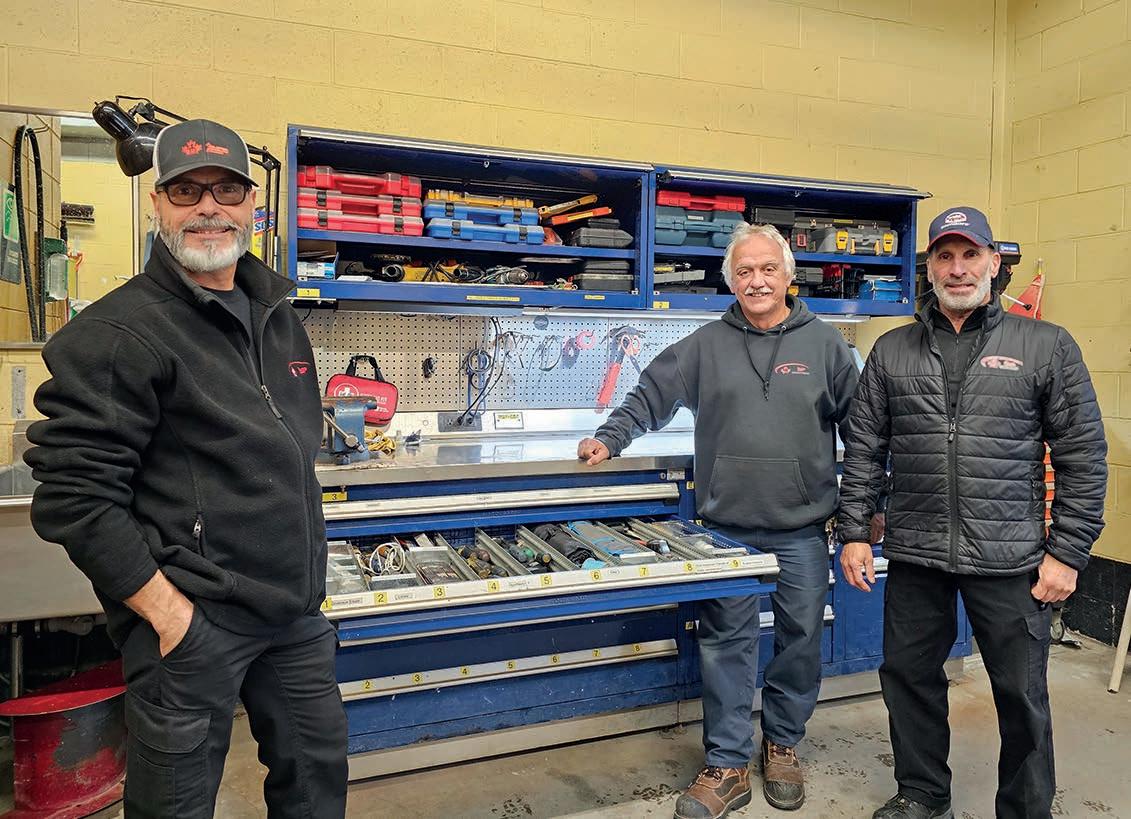
Dès la fin de l’automne, les journées à l’aréna sont denses et bien remplies. L’équipe, dirigée par Dave Querry, se compose de dix employés dévoués : Robert, Michel, Alex, Yvon, Luc, Robin, André, René, Ghislain et Claude. Ensemble, ils gèrent non seulement les séances d’entraînement, mais également l’entretien des glaces, du matériel, du bon déroulé des sessions et même des équipements extérieurs. Dire que les militaires sont choyés est une réalité! Toute l’équipe s’assure que chaque personne qui passe les portes de l’aréna puisse profiter d’une expérience optimale.
Alex et Robin sont les magasiniers de l’aréna, des personnels essentiels : ils aiguisent les patins, lavent les équipements, gèrent les prêts d’équipement et s’occupent de l’accès aux vestiaires. Ils ne tiennent pas en place : toujours en mouvement, ils veillent à ce que tout soit en ordre. Luc et Ghislain sont
eux responsable de l’entretien des terrains et infrastructures extérieures : si leurs tâches principales ont lieu l’été (avec l’entretien des parcs sportifs extérieurs, ainsi que l’installation des abris temporaires), l’hiver est également chargé, avec l’entretien de la patinoire extérieure, le soutien aux opérateurs de Zamboni, ou encore un soutien logistique au Centre des sports. Ce sont également eux qui distribuent votre journal Adsum!
Le reste de l’équipe doit accomplir une variété de tâches, ces dernières évoluant en fonction des saisons. Car l’équipe de l’aréna évolue entre les saisons hivernale (août à fin avril) et estivale (mai à septembre). Les employés d’entretien des terrains et les opérateurs de Zamboni, présents toute l’année, sont les piliers de cette structure. Car dès le début de septembre, la glace des deux patinoires est faite et entretenue en continu (elle est raclée, nettoyée et refaite en fonction des activités). Chaque jour, une partie de l’équipe débute sa journée très tôt, avec les premiers arrivants, dès 6 h du matin. Les derniers employés ne quittent jamais avant 0 h 30, après les dernières séances des équipes de la ligue militaire et l’entretien de la glace.
Une ambiance exceptionnelle
Lorsqu’on arpente les couloirs de l’aréna, il y a une chose qui ne nous quitte pas : la bonne humeur! Il faut dire que l’équipe de Dave Querry, composée d’anciens militaires, est parmi la plus soudée de toute la Base. Dave, luimême un ancien des Forces armées canadiennes, cultive une ambiance de camaraderie pour ce qu’il appelle un «job de retraite», où le travail bien fait et la joie d’être
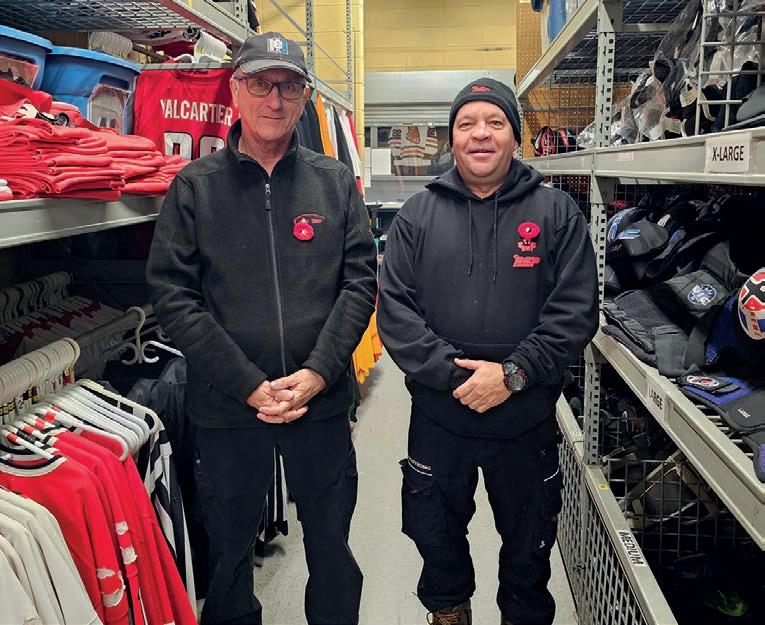
Luc et Ghislain (à droite), responsables de l’entretien des terrains et infrastructures extérieures, accompagnés de André (à gauche), préposé à la patinoire. Luc and Ghislain
maintenance and outdoor
présent se mêlent. Les gars ont du plaisir à venir au travail chaque matin, c’est certain : ce personnel de l’ombre, bien qu’invisible pour la plupart des personnes qui passent, offre pourtant un service remarquable et toujours avec le sourire.
Pour ceux qui souhaitent voir du hockey à l’aréna ClémentBoulanger, Valcartier accueillera le tournoi de hockey mineur entre le 22 et le 24 novembre prochain. Ce sera une belle occasion de venir encourager les jeunes joueurs. Et ne manquez pas les prochains tournois régionaux : chez les hommes du 27 au 30 janvier 2025 et chez les femmes du 10 au 14 février. Ces événements promettent d’être passionnants et relevés! Alors n’hésitez pas à venir encourager nos équipes, et à l’occasion, de venir saluer l’incroyable équipe de l’aréna.
(right), in charge of grounds
infrastructure, accompanied by André (left), rink attendant.
CLÉMENT-BOULANGER ARENA
At the end of October, the Adsum roams the halls of Base Valcartier's ClémentBoulanger arena. All around us, the excitement is palpable. Many soldiers come to practise ice hockey on the arena's two ice surfaces, a testament to the great success of this sports facility.
On this Tuesday, they belong to 430 Tactical Helicopter Squadron, 5th Combat Engineer Regiment or 12e Régiment blindé du Canada. Add to this the military leagues and the Base's famous Lions and Lionesses, and you have a packed calendar of activities for the arena's teams. Our reporter went to meet the team that makes it all possible.
From late autumn onwards, the days at the arena are busy and full. The team, headed by Dave Querry, is made up of ten dedicated employees: Robert, Michel, Alex, Yvon, Luc, Robin, André, René, Ghislain and Claude. Together, they manage not only the training sessions, but also the maintenance of the ice, the equipment, the smooth running of the sessions and even the outdoor equipment. It is true to say that military personnel are pampered! The entire team ensures that everyone who passes through the arena's doors has the best possible experience.
Alex and Robin are the arena's storekeepers, essential personnel: they sharpen skates, wash equipment, manage equipment loans and handle access to the locker rooms. They are always on the move, making sure everything is in order. Luc and Ghislain are in charge of ground maintenance and outdoor infrastructure: while their main tasks take place in summer (with maintenance of outdoor sports parks, as well as the installation of temporary shelters), winter is equally busy, with maintenance of the outdoor skating rink, support for Zamboni operators, and logistical support for the Sports Centre. They are also the ones who distribute your Adsum newspaper!
The rest of the team performs a variety of tasks, which change with the seasons. The arena team operates between the winter (August to the end of April) and summer (May to September) seasons. The grounds maintenance staff and Zamboni operators, present all year round, are the pillars of this structure.
From the beginning of September, the ice on both rinks is continuously made and maintained (scraped, cleaned and resurfaced according to the activities). Every day, part of the team starts its day very early, with the first arrivals as early as 6 a.m. The last employees never leave before 12:30 a.m., after the last sessions of the military league teams and ice maintenance.
An Exceptional Ambience
When you walk through the corridors of the arena, there is one thing that never leaves you: the good mood! It has to be said that Dave Querry's team, made up of exmilitary personnel, is among the tightestknit on the entire Base. Dave, an exCanadian Armed Forces man himself, cultivates an atmosphere of camaraderie for what he calls a “retirement job”, where a job well done and the joy of being present are intertwined! It is a pleasure for the guys to come to work every morning, that is for sure: this behindthescene staff, though invisible to most passersby, nevertheless offers remarkable service, and always with a smile.
For those who want to see some field hockey at the ClémentBoulanger arena, Valcartier will be hosting the minor field hockey tournament between November 22 and 24. It is a great opportunity to come and cheer on the young players. And do not miss the next regional tournaments: men from January 27 to 30, 2025, and women from February 10 to 14. These events promise to be exciting and challenging! So do not hesitate to come and cheer on our teams, and occasionally say hello to the incredible arena team.
Nos valeurs, nos libertés et la paix dans laquelle nous vivons aujourd’hui ont été rendues possibles grâce au courage, au sacrifice et à l’engagement inébranlable de ceux qui ont revêtu l’uniforme pour servir le Canada.
À travers l’histoire, plus de 118 000 de ces braves Canadiens ne sont pas rentrés chez eux et nous en avons perdu d’innombrables autres en raison de blessures liées au service.
Nous honorons la mémoire de chacun d’entre eux.
Alex et Robin, les magasiniers de l’aréna, sont en charge du magasin. Alex and Robin, the arena storekeepers, are in charge of the store.
L'Espace Desjardins verra le jour au Centre Castor
Le Centre Castor, vient d’annoncer un important partenariat avec la Caisse Desjardins des militaires, pour la création de l’Espace Desjardins, un projet visant à développer un site extérieur multifonctionnel. Ce projet inclura la construction d’un dôme qui servira de salle polyvalente, destinée à accueillir diverses activités, tant pour les militaires que pour leurs familles et les membres de la communauté. Ce lieu pourra être utilisé pour une multitude d’activités, comme les échauffements matinaux, les formations, les compétitions ou encore les événements communautaires. De plus, l’Espace Desjardins sera conçu pour favoriser les rassemblements et la convivialité au Centre Castor. Il intégrera des éléments
comme une aire de détente, un foyer extérieur, une musique d’ambiance, un espacebar et des éclairages chaleureux. Ce projet vise à créer un cadre propice à la cohésion, permettant aux militaires et à leurs proches de profiter d’un lieu qui favorise le bienêtre et les interactions sociales.
Ce partenariat ambitionne également de dynamiser l’Espace Desjardins en organisant régulièrement des événements festifs tels que des 5 à 7, des feux de camp et même des spectacles. Le Centre Castor et la Caisse Desjardins des militaires souhaitent ainsi créer un endroit qui inspire l’esprit communautaire, où les membres peuvent se réunir pour se divertir et renforcer leurs liens dans un cadre accueillant et chaleureux.
Centre Castor to Open Desjardins Space
Centre Castor, has just announced a major partnership with the Caisse Desjardins des militaires, for the creation of a Desjardins Space, a project aimed at developing a multifunctional outdoor site. This project will include the construction of a dome that will serve as a multi-purpose room, designed to host a variety of activities for military personnel, their families and members of the community.
It will be used for a multitude of activities, including morning warmups, training, competitions and community events. What's more, the Desjardins Space will be designed to encourage gatherings and conviviality at the Centre Castor. It will incorporate features such as a dining area, outdoor fireplace, background music, bar area and warm lighting. The aim of this project is to create a relaxing and cohesive environment, enabling military personnel and their families to enjoy a place that fosters wellbeing and social interaction.
Le Centre Castor remporte un nouveau prix Centre Castor Wins a New Award
Grand succès pour les Festivités régimentaires du Royal 22e Régiment
Great success for the Royal 22e Régiment’s Regimental Festivities
Les Festivités régimentaires du Royal 22e Régiment se sont tenues entre le 18 et le 19 octobre dernier. Elles ont marqué deux anniversaires d’importance : d’abord le 110e anniversaire de l’unité, mais également le 10e anniversaire de la fin de la mission militaire canadienne en Afghanistan. Ils étaient plusieurs dizaines d’anciens du Régiment à participer aux différents événements, dont le souper tous grades du samedi 19 octobre 2024.
The Royal 22e Régiment’s Regimental Festivities were held between October 18 and 19. They marked two important anniversaries: first, the unit’s 110th anniversary, but also the 10th anniversary of the end of the Canadian military mission in Afghanistan. Several dozen former members of the Regiment participated in the various events, including the allranks dinner on Saturday, October 19, 2024.
This partnership also aims to energize the Desjardins Space by regularly organizing festive events such as happy hours, campfires and even shows. The Centre Castor and the Caisse Desjardins des militaires want to create a space that inspires community spirit, where members can come together to have fun and strengthen their ties in a warm and welcoming setting.
Le colonel
2024. Colonel Mathieu Dallaire, Commander of the 2nd Canadian Division Support Group and Patrice Bergeron, General Manager of the Caisse Desjardins des militaires, at the signing of the partnership, on October 3, 2024.
À l’occasion du Gala des Prix de l’Excellence de Camping Québec, qui s'est déroulé le 26 octobre dernier à Saint-Hyacinthe, les lauréats des Prix de l’Excellence 2024 ont été dévoilés. Et parmi les vainqueurs, le Village de yourtes Valcartier du Centre Castor a reçu un prix pour sa grande nouveauté 2024, son réseau de vélo de montagne Enduro.
Chaque année, Camping Québec, la principale association des terrains de camping du Québec, remet ses Prix de l'Excellence. Parmi les catégories, le Centre Castor a été récipiendaire du Prix Bâtisseur d'aujourd'hui Lussier 2024. Cette reconnaissance vise à souligner les projets d’investissement réalisés par les terrains de camping du Québec dans le but d’améliorer leurs infrastructures et leurs aires de loisir, ou d’augmenter leur capacité d’accueil. Dans le cas du Centre Castor, il s'agit de récompenser le nouveau réseau de vélo de montagne Enduro et ses 10,3 km de piste, qui est rattaché au village des yourtes.
Bravo à toute l'équipe pour leur travail acharné qui a payé, une fois encore.
At the Camping Québec Awards of Excellence Gala, which took place on October 26 in Saint-Hyacinthe, the winners of the 2024 Awards of Excellence were revealed. And among the winners, the Valcartier yurts village of the Centre Castor received an award for its major new feature for 2024, its Enduro mountain bike network.
Every year, Camping Québec, the main association of campgrounds in Quebec, presents its Awards of Excellence. Among the categories, the Centre Castor was the recipient of the Prix Bâtisseur d’aujourd’hui Lussier 2024.
This recognition "aims to highlight the investment projects carried out by Quebec campgrounds in order to improve their infrastructure and recreational areas, or to increase their reception capacity". In the case of the Centre Castor, it is to reward the new Enduro mountain bike network and its 10.3 km of trails, which is attached to the yurts village.
Congratulations to the entire team for their hard work which paid off, once again.
Le 9 juin 2023, le colonel Serge Ménard, alors commandant du GS 2 Div CA, essaie les pistes lors de la journée d'inauguration des sentiers du vélo Enduro. On June 9, 2023, Colonel Serge Ménard, then commander of the 2 CDSG, tries out the trails at the Enduro Bike Trail Inauguration Day.
Mathieu Dallaire, commandant du Groupe de soutien de la 2e Division du Canada et Patrice Bergeron, Directeur général de la Caisse Desjardins des militaires, lors de la signature du partenariat, le 3 octobre
La plus haute décoration militaire du Commonwealth
Si les Américains ont la Medal of Honor et les Français la Légion d'honneur, les nations du Commonwealth possèdent leur propose décoration militaire suprême : la Croix de Victoria. Cette croix est, aujourd’hui encore, la plus prestigieuse à recevoir pour un militaire. Au total, 99 Canadiens ont reçu la Croix de Victoria. Et depuis 1993, le Canada possède sa propre Croix de Victoria.
Le 29 janvier 1856, un arrêt royal de la reine Victoria met en place une nouvelle décoration militaire, qui prend son nom : la Croix de Victoria. Il s’agit pour la souveraine de récompenser les actes de bravoure pendant la guerre de Crimée qui vient de s’achever. Ce conflit, qui a opposé l'Empire russe à une coalition formée de l'Empire ottoman, de l'Empire français, du RoyaumeUni et du royaume de Sardaigne, a été très difficile pour les armées britanniques. Ainsi, cette nouvelle décoration
La Croix de Victoria pour Jess Larochelle?
The Victoria Cross for Jess Larochelle?
Jess Larochelle est un militaire affecté en Afghanistan à partir de 2006 dans le cadre du Groupement tactique du 1er Royal Canadian Regiment : les principales missions sont des opérations de contre-insurrection et de combat dans Kandahar, la province au sud du pays. Le 14 octobre 2006, Jess, alors âgé de 23 ans, occupe le poste de mitrailleur du poste d’observation sur le flanc de sa compagnie, postée à Pashmul, à l’ouest de la ville de Kandahar.
Vers 15 h, les Canadiens sont violemment attaqués par une cinquantaine de talibans. Le poste d’observation est touché, Jess Larochelle perd conscience. À son réveil, deux soldats canadiens sont morts et trois autres gravement blessés. Luimême est lourdement touché (vertèbres cassées au cou et au dos, rétine détachée, tympan éclaté). Malgré tout, Jess Larochelle va défendre la position avec acharnement : il vide les munitions de la mitrailleuse avant d’utiliser des lanceroquettes M72. Grâce à ses actions, Jess Larochelle a sauvé la vie de ses camarades blessés, forçant les talibans à battre en retraite. Le 14 mars 2007, il reçoit l’Étoile de la vaillance militaire, la deuxième plus haute distinction pour bravoure militaire. Mais l’histoire ne s’arrête pas : pour de nom
breux militaires canadiens, Jess Larochelle, décédé en 2023 des suites de ses blessures physiques et psychologiques reçues en Afghanistan, mérite la Croix de Victoria, la première depuis la Seconde Guerre mondiale. Depuis septembre 2021, une campagne a été lancée pour lui faire décerner cette décoration, une initiative toujours en cours.
Jess Larochelle was deployed to Afghanistan in 2006 as part of the 1st Royal Canadian Regiment Battle Group. The main missions were counterinsurgency and combat operations in Kandahar, the southern province of Afghanistan.
On October 14, 2006, Jess, then aged 23, occupied the position of machine gunner at the observation post on the flank of his company, posted in Pashmul, west of Kandahar City.
At around 3p.m., the Canadians were violently attacked by some 50 Taliban.
The observation post was hit, and Jess Larochelle lost consciousness. When he wakes up, two Canadian soldiers are dead and three others seriously wounded. He himself was badly wounded (broken vertebrae in the neck and back, detached retina, burst eardrum). Despite all this, Jess Larochelle defends the position with determination: he empties the ammunition from the machine gun before using M72 rocket launchers. Thanks to his actions, Jess Larochelle saved the lives of his wounded comrades, forcing the Taliban to retreat! On March 14, 2007, he was awarded the Star of Military Valour, the secondhighest award for military bravery. But the story doesn't end there: for many Canadian servicemen and women, Jess Larochelle, who died in 2023 as a result of physical and psychological wounds received in Afghanistan, deserves the Victoria Cross, the first since the Second World War. Since September 2021, a campaign has been underway to have him awarded this decorationan initiative that is still ongoing.
Ernest Smith, récipiendaire de la Croix de Victoria après avoir combattu presque seul plusieurs chars et des dizaines de soldats allemands pendant la campagne d’Italie, dans la nuit du 21 au 22 octobre 1944, durant la Seconde Guerre mondiale.
Ernest Smith, recipient of the Victoria Cross after fighting almost single-handedly against several tanks and dozens of German soldiers during the Italian campaign, on the night of October 21-22, 1944, during the Second World War.
n’a qu’un objectif : récompenser les prouesses militaires accomplies face à l'ennemi en temps de guerre, sans prendre en compte le grade, la religion, l'origine ethnique ou la condition sociale du récipiendaire. Une attribution pour courage est également autorisée (mais rarement dans les faits). Tout membre d'une armée du Commonwealth peut ainsi être récompensé.
Les premiers récipiendaires de la Croix de Victoria sont donc des vétérans de la guerre de Crimée, dont le lieutenant Alexander Roberts Dunn, un Canadien récompensé pour héroïsme lors de la charge de la brigade légère à la bataille de Balaklava. Entre 1856 et 2024, ce sont 99 Canadiens qui ont reçu la Croix de Victoria, soit de leur vivant, soit à titre posthume. Dans les faits, aucune Croix de Victoria
n’a été décernée depuis la fin de la Seconde Guerre mondiale.
Cette décoration est en bronze, en forme de croix. Elle porte l'écusson royal et les mots «FOR VALOUR» (Pour la Valeur). Le ruban est rouge pourpre et les récipiendaires peuvent faire suivre leur nom des initiales «VC». Cette Croix de Victoria n’est pourtant plus la seule existante : au début des années 1990, la reine Elizabeth II approuve la création de trois croix de la vaillance militaire. Ainsi, la Croix de Victoria australienne est instituée en 1991, la Croix de Victoria canadienne en 1993 et la Croix de Victoria néozélandaise un peu plus tard (en 1999). La Croix de Victoria canadienne est ainsi identique à la croix originale, sauf pour l'inscription «PRO VALORE» en latin (à la place de l'inscription anglaise «FOR VALOUR»).
Victoria Cross
The Commonwealth's highest military decoration
While the Americans have the Medal of Honor and the French the Légion d'honneur, the Commonwealth nations have their own supreme military decoration: the Victoria Cross. Even today, this is the most prestigious award a soldier can receive. In all, 99 Canadians have been awarded the Victoria Cross. And since 1993, Canada has had its own Victoria Cross.
On January 29, 1856, a royal decree from Queen Victoria established a new military decoration, which took her name: the Victoria Cross. Queen Victoria's aim was to reward acts of bravery during the recently ended Crimean War. This conflict, which pitted the Russian Empire against a coalition comprising the Ottoman Empire, the French Empire, the United Kingdom and the Kingdom of Sardinia, was extremely difficult for the British armies. The new award has a single purpose: to reward military prowess in the face of the enemy in wartime, regardless of rank, religion, ethnic origin or social status. An award for courage is also authorized (but rarely in practice). Any member of a Commonwealth Army is eligible for the award.
The first recipients of the Victoria Cross were veterans of the Crimean War, including Lieutenant Alexander Roberts Dunn, a Canadian awarded for heroism during the charge of the Light Brigade at the Battle of Balaklava. Between 1856 and 2024, 99 Canadians were awarded the Victoria Cross, either during their lifetime or posthumously. In fact, no Victoria Crosses have been awarded since the end of the Second World War.
The decoration is made of bronze, in the shape of a cross. It bears the royal crest and the words “FOR VALOUR”. The ribbon is crimson red, and recipients can add the initials “VC” after their name. However, this Victoria Cross is no longer the only one in existence: in the early 1990s, Queen Elizabeth II approved the creation of three Crosses of Military Valour. Thus, the Australian Victoria Cross was instituted in 1991, the Canadian Victoria Cross in 1993 and the New Zealand Victoria Cross a little later (in 1999). The Canadian Victoria Cross is identical to the original, except for the Latin inscription “PRO VALORE” (in place of the English “FOR VALOUR”).
PHOTO : BIBLIOTHÈQUE ET ARCHIVES CANADA
LIBRARY AND ARCHIVES CANADA
Les Fusils FN C1 et FN C1A1, témoins d’une époque passée
Après la fin de la Seconde Guerre mondiale, les militaires canadiens se retrouvent avec des quantités astronomiques de fusils Lee-Enfield, qui seront de nouveau utilisés pendant la Guerre de Corée. Néanmoins, le début des années 1950 marque un tournant dans l’évolution de l’armement des Forces armées canadiennes : le fusil à verrou, totalement dépassé, est remplacé par un nouveau fusil semi-automatique, le FN C1 (et son évolution, le FN C1A1), une excellente arme produite par le fabricant d’armes belge Fabrique Nationale (FN) Herstal.
Le FN C1 est une variante spécialement développée à partir du célèbre FN FAL, également connu sous sa dénomination officielle de «Fusil Automatique Léger». Ce fusil est chambré pour le calibre 7,62 × 51 mm OTAN, avec des caractéristiques de rusticité, de précision, de puissance de feu et d’adaptabilité en fonction des théâtres d’opérations et des besoins des différentes forces armées. C’est, à l’aube des années 1950, le meilleur fusil produit depuis la fin de la dernière guerre.
Et s’il est à l’origine produit par les forces armées belges, le FN C1 va surtout répondre à un besoin essentiel de modernisation de l'armement des Forces armées canadiennes (FAC). Il faut dire que le FN C1 coche toutes les cases des besoins des FAC : une arme fiable, capable de résister aux rigueurs des environnements de combat (notamment les températures très basses). De plus, le FN C1 se distingue par son canon relativement long, optimisé pour les engagements à longue distance, et un poids équivalent au LeeEnfield (un peu plus de 4 kg). Surtout, le nouveau fusil a une portée maximale presque doublée (de 1100 à près de 2000 mètres) et une cadence de tir record (jusqu'à 600 coups par minute). Néanmoins, son gros défaut reste sa crosse en bois : si elle convient aux Canadiens, elle est plus fragile que des matériaux modernes. De plus, il est décidé, alors même que l’arme est 100 % automatique, de ne conserver qu’un mode semiautomatique, avec un chargeur de 20 munitions.
Pourtant, de nombreux pays vont se porter acquéreurs de cet armement, et notamment la Belgique, l’Allemagne, le Chili, la Syrie, l'Espagne, la Turquie, les PaysBas, ou encore Cuba et même l'Ouganda, pour ne citer qu’une partie des 90 pays utilisateurs du FN C1.
Modernisation
Au fur et à mesure de l’évolution des besoins tactiques des FAC, le FN C1A1 va être développé comme une version améliorée du FN C1. Introduit dès les années 1960, le FN C1A1 intègre plusieurs modifications d’importances, qui visent à améliorer l'ergonomie et la performance globale du fusil. L'une des principales améliorations est l’apparition d’une crosse en plastique dur, qui offre une meilleure résistance aux intempéries et une durabilité accrue par rapport à la crosse en bois. De plus, la FN C1A1 a été conçue pour être plus adaptable aux conditions de combat modernes, avec l’installation d’accessoires tels que des viseurs de dernière génération et des poignées ergonomiques (en plus de la baïonnette et du lancegrenades déjà existants).
Ces soldats du régiment d'infanterie Black Watch sont photographiés lors d'un entrainement avec un fusil C1 sur la Base Gagetown, au Nouveau-Brunswick. These soldiers from the Black Watch Infantry Regiment are photographed during training with a C1 rifle at Base Gagetown, New Brunswick.
Ces modifications ont non seulement facilité l'utilisation de l'arme, mais ont également renforcé la précision et la rapidité de tir, facteurs cruciaux sur le champ de bataille. Dès lors, ces deux armes vont devenir indissociables des opérations canadiennes entre les années 60 et 80. Durant les missions de maintien de la paix notamment, où les photographies montrent des soldats des FAC armés de ce fusil. Pendant toutes ces années, le FN C1 et son successeur n’auront que rarement été pris en défaut. C’est la firme Canadian Arsenals Limited, installée à Toronto, qui va produire durant toutes ces années les fusils (environ 90 000 armes fabriquées, des deux variantes confondues). En plus des FAC, la Gendarmerie royale du Canada et la Police provinciale de l’Ontario sont également utilisatrices des deux armes.
Finalement, les FN C1 / FN C1A1 sont remplacés en 1985 par la C7, avec ses munitions plus petites. Mais durant de nombreuses années, l’obus plus imposant utilisé par la FN C1 fera débat, certains militaires demandant même le retour du fusil semiautomatique.
FN C1 and FN C1A1 rifles, witnesses to a bygone era
After the end of the Second World War, the Canadian military found itself with astronomical quantities of Lee-Enfield rifles, which were used again during the Korean War. Nevertheless, the early 1950s marked a turning point in the evolution of the Canadian Armed Forces' (CAF) weaponry: the bolt-action rifle, completely outdated, was replaced by a new semi-automatic rifle, the FN C1 (and its evolution, the FN C1A1), an excellent weapon produced by Belgian armaments manufacturer Fabrique Nationale (FN) Herstal.
The FN C1 is a specially developed variant of the wellknown FN FAL, also known by its official name of “Fusil Automatique Léger”. This rifle is chambered for the 7.62 × 51 mm NATO calibre, with characteristics of ruggedness, precision, firepower and adaptability to theaters of operation and the needs of different armed forces. At the dawn of the 1950s, it was the best rifle produced since the end of the last war.
And although it was originally produced by the Belgian armed forces, the FN C1 above all met an essential need to modernize the armament of the CAF. It has to be said that the FN C1 ticks all the boxes in terms of the CAF's needs: a reliable weapon, capable of
withstanding the rigours of combat environments (notably very low temperatures). What's more, the FN C1 is distinguished by its relatively long barrel, optimized for longrange engagements, and a weight equivalent to the LeeEnfield (just over 4 kg). Above all, the new rifle's maximum range is almost doubled (from 1,100 to almost 2,000 metres), and its rate of fire is recordbreaking (up to 600 rounds per minute). Nevertheless, its major drawback was its wooden stock: while suitable for Canadians, it was more fragile than modern materials. What's more, even though the weapon was 100% automatic, it was decided to retain only a semiautomatic mode, with a 20round magazine.
Nevertheless, many countries went on to acquire this weapon, including Belgium, Germany, Chile, Syria, Spain, Turkey, the Netherlands, Cuba and even Uganda, to name but a few of the 90 countries using the FN C1.
Modernization
As the FAC's tactical requirements evolved, the FN C1A1 was developed as an improved version of the FN C1. Introduced in the 1960s, the FN C1A1 incorporates a number of significant modifications designed to improve the rifle's ergonomics and overall performance. One of the main improvements is the intro
duction of a hard plastic stock, which offers better weather resistance and durability than the wooden stock. In addition, the FN C1A1 has been designed to be more adaptable to modern combat conditions, with the installation of accessories such as latestgeneration sights and ergonomic grips (in addition to the existing bayonet and grenade launcher). These modifications not only made the weapon easier to use, but also enhanced precision and rapidity of fire, crucial factors on the battlefield. From then on, these two weapons became an integral part of Canadian operations from the 60s to the 80s. Particularly during peacekeeping missions, where photographs show FAC soldiers armed with this rifle. In all those years, the FN C1 and its successor were rarely caught out! Canadian Arsenals Limited, based in Toronto, produced the rifles for all these years (around 90,000 of both variants). In addition to the CAF, the Royal Canadian Mounted Police and the Ontario Provincial Police also used both guns.
Finally, the FN C1 / FN C1A1 was replaced in 1985 by the C7, with its smaller ammunition. But for many years, the larger shell used by the FN C1 was the subject of debate, with some soldiers even calling for the return of the semiautomatic rifle.
53e ANNÉE | 53st YEAR • N° 6
Novembre | November 2024
Le journal Adsum est une publication non officielle publiée avec la permission du commandant du Groupe de soutien de la 2e Division du Canada. Les opinions et les points de vue exprimés dans ce journal ne sont pas nécessairement ceux du MDN, des FAC et des SBMFC/ Personnel des FNP. | The Adsum is an unofficial publication published with the permission of the Commander of the 2nd Canadian Division Support Group. The opinions and views expressed in this newspaper are not necessarily those of DND, the CAF and CFPSA/NPF personnel.
PHOTO : BIBLIOTHÈQUE ET ARCHIVES CANADA | LIBRARY AND ARCHIVES CANADA
PHOTO : MUSÉE CANADIEN DE LA GUERRE | CANADIAN WAR MUSEUM
SHANNON
60, rue Maple
Plain-pied flambant neuf signé Mario Venne. Plus de 2800 pc d’espace habitable, 4x chambres donc 2 au sous-sol, 2 x salles de bains complètes, sous-sol entièrement aménagé, garage attaché et chauffé 16x30, patio couvert 16x16, magnifique terrain + 22 500 pc situé dans un des plus beau secteur de Shannon, 4 min de la Base Valcartier. Ne tardez pas, faites construire votre nouvelle maison dès maintenant.
SHANNON
20, rue Pouliot
NOUVEAU PROJET De Vallières construction! Dans Le Domaine des hauts Bois . Demander une visite et venez discuter de votre projet et des possibilités que nous vous offrons!
SAINT-AUGUSTIN-DE-DESMAURES 152, rue de la Filandière
Superbe maison à étage offrant un espace de vie unique et spacieux. Cette grande propriété dispose de 4 chambres, 2 salles de bain et d’un garage intégré, idéale pour une famille. Profitez du poêle à bois au salon, apportant chaleur et confort à vos soirées. Les grandes pièces et espaces de vie sont parfaits
des services essentiels, cette maison représente une opportunité à ne pas manquer.
Grand plain-pied avec garage attaché 28x25 pied, idéalement situé dans un secteur central de Québec, proche de tous les services. Cette spacieuse maison comprend 5 chambres et 2 salles de bain, parfait pour accueillir votre famille. Profitez d’un foyer au bois chaleureux pour des soirées conviviales, et d’un système air pulsé bi-énergie avec thermopompe centrale pour un confort optimal toute l’année. Située dans un secteur paisible, cette propriété allie tranquillité et accessibilité. Ne manquez pas cette opportunité unique! Futur rôle évaluation 345 000$
SHANNON
286, ch. de Wexford
Pour les plus exigeants. Magnifique plain-pied 2023 de luxe. Aires ouverts et très lumineux grâce à sa fenestration généreuse, cuisine moderne et conviviable pour recevoir vos invités, garde-manger walk-in, salon invitant avec son foyer au gaz, chambre des maître unique en son genre à faire rêver, doté d’une superbe salle de bain attenante, grand walk-in et boudoir à l’étage. Sous-sol entièrement aménager avec ses 2 X chambres à coucher, grande salle familiale, salle de bain avec plancher chauffant. Beaucoup de rangement, thermopompe centrale de grande qualité, immense terrain de plus de 115 000 p2. À voir absolument!
SHANNON 140, rue Miller
Maison disponible maintenant, Superbe grand plain-pied flambant neuf, signé Mario Venne. Plus de 2800 pc d’espace habitable, 4x chambres donc 2 au sous-sol, 2 x salles de bains complètes, sous-sol entièrement aménagé, garage détaché 28 X 28 pieds, isolé et chauffé, magnifique terrain + 23 000 pc qui sera gazonné, situé dans un secteur familliale à 5 min de la base de Valcartier. À voir absolument!
Opportunité rare sur le marché. Située dans un quartier recherché de CapRouge, cette propriété unique est une véritable occasion pour les acheteurs à la recherche d’une maison offrant un excellent rapport qualité-prix. Bien que la maison nécessite quelques rénovations, elle offre un beau potentiel et une opportunité idéale pour personnaliser l’intérieur à votre goût ou pour créer un projet à long terme, avec un prix d’achat très compétitif pour le secteur. Située dans un secteur calme et résidentiel, à proximité des écoles, des parcs, des transports en commun et accès rapide aux principaux axes routiers.
PONT-ROUGE
8, rue du Collège
Coup de cœur garantie pour cette magnifique maison ancestral, restauré en 2009 par un artisan, tout en respectant son magnifique cachet d’antan. Cuisine splendide qui nous fait remonter dans le temps, salle à manger pouvant accueillir une grande maisonnée, 3 X chambres à coucher, les planchers de bois sont à couper le souffle, on se croirait dans un musée, grand terrain super bien placer en plein centre-ville de Pont-Rouge, à quelques minutes à pieds des services, restaurants, boulangerie, aréna, écoles, etc... Ne chercher plus, elle est là pour vous, venez la visiter et vous tomberez sous le charme. À voir absolument!
SAINT-GERVAIS
39, rue de la Fabrique E.
À Saint-Gervais, charmante maison à étages sur un terrain de plus de 10 000 pi², offrant un excellent rapport qualité-prix. Récemment rénovée, elle présente un superbe revêtement extérieur en Maybec, une cuisine moderne, une salle de bain refaite et des planchers de qualité. Vous y trouverez 2 chambres et un bureau pouvant être transformé en walk-in. Garage intégré, Idéale pour une jeune famille en quête de confort et de tranquillité! Ne manquez pas cette belle opportunité. La référence en transferts militaires DEPUIS PLUS DE 15 ANS!
*Service bilingue | Bilingual services*
Participant au service de relogement BGRS des FAC Fiers de servir les membres de la communauté militaire