

In November 2025, the University of Hawaiʻi Community Design Center (UHCDC) and The Nature Conservancy (TNC) convened the third and final round of community engagement sessions. These meetings built directly on the priorities and insights gathered during the initial February events, as well as the May/June of co-design events. Structured as interactive, participatory co-design meetings, the third round of community and stakeholder engagement included both in-person and virtual formats, allowing participants to review and respond to new draft conceptual design ideas developed from site research, analysis mapping, and community on previous designs.
During the introductory presentation, the project team summarized overarching goals, and timeline considerations. The first phase addresses near-term conditions, using the 1.1-foot sea-level rise exposure area (SLR-XA), anticipated around 2045. The second design phase addresses longterm considerations based on a 3.2-foot SLR-XA scenario, approximately 2075.
During this round, each of the three events consisted of an overview presentation followed by a series of four interactive exercises:
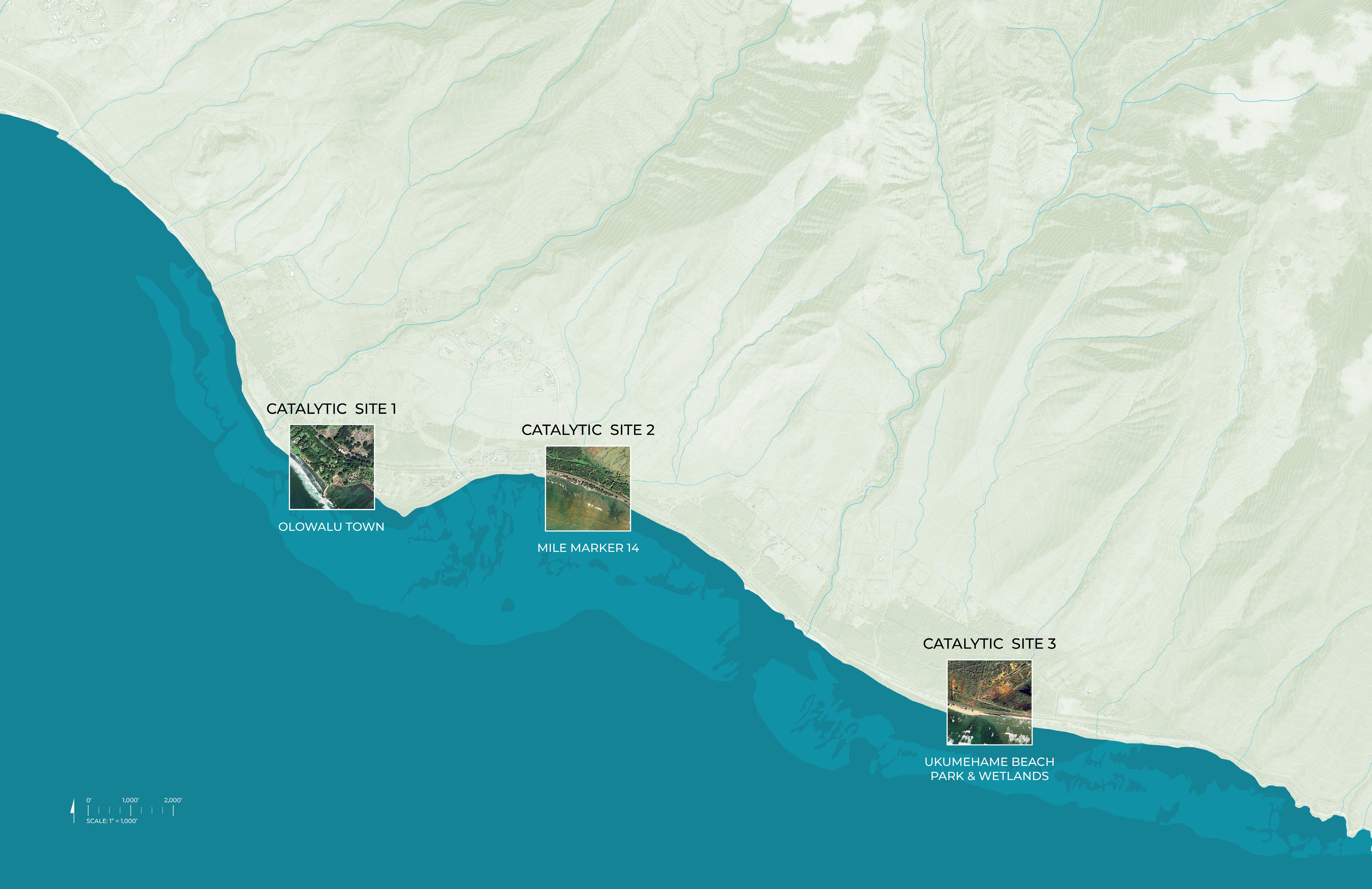
• Overall Project Area
• Catalytic Site 1: Olowalu Town
• Catalytic Site 2: Mile Marker 14
• Catalytic Site 3: Ukumehame Beach Park & Wetlands
The insights gathered from this concluding co-design phase will inform final, proof-of-concept design concepts (near-term and long-term scenarios) representing a collaboratively developed vision for the overall project area, and three catalytic sites.
Event dates and participant numbers:
November 18, 2025, 5:00 - 8:00 PM (Lahainaluna High School) - 31 participants
November 20, 2025, 4:30 - 6:00 PM (Zoom) - 20 participants
November 21, 2025, 12:00 - 1:30 PM (Zoom) - 33 participants
Engagement activities/materials included in this chapter:
Activity 1: Project Area Conceptual Design Sketch
Activity 2: Catalytic Site 1 - Olowalu Town
Activity 3: Catalytic Site 2 - Mile Marker 14
Activity 4: Catalytic Site 3 - Ukumehame Beach Park and Wetlands
The upcoming Honoapiʻilani Highway realignment provides a unique opportunity for your input on the future of the Olowalu and Ukumehame coastal corridor that reflects ʻike kupuna, nature-based solutions, and community priorities.
Tuesday November 18, 2025
5:00 - 8:00 PM LAHAINALUNA HIGH SCHOOL
980 Lahainaluna Rd, Lahaina, HI 96761
Thursday November 20, 2025 4:30 - 6:00 PM
ZOOM REGISTRATION

Friday November 21, 2025 12:00 - 1:30 PM
ZOOM REGISTRATION

Please join us to give your feedback on a new conceptual design draft based on prior community input and potential solutions addressing environmental threats and hazards. Light dinner and beverages will be provided.
https://tnc.zoom.us/meeting/register/ R20m8XrbQdKeOavKmK-cLg
https://tnc.zoom.us/meeting/register/ f5ZWPBriTFii2bmichOk6A
Each meeting will cover the same content: brief project overview, summary of previous community activities, participatory design, and talk story. At the in-person event, light dinner and beverages will be served. This is the final round of co-design meetings for this project.
LEARN MORE
Scan here for more information and to review previous event materials: QUESTIONS? https://arcg.is/9qzyn1

Contact: t.farnsworth@tnc.org xduarte@hawaii.edu
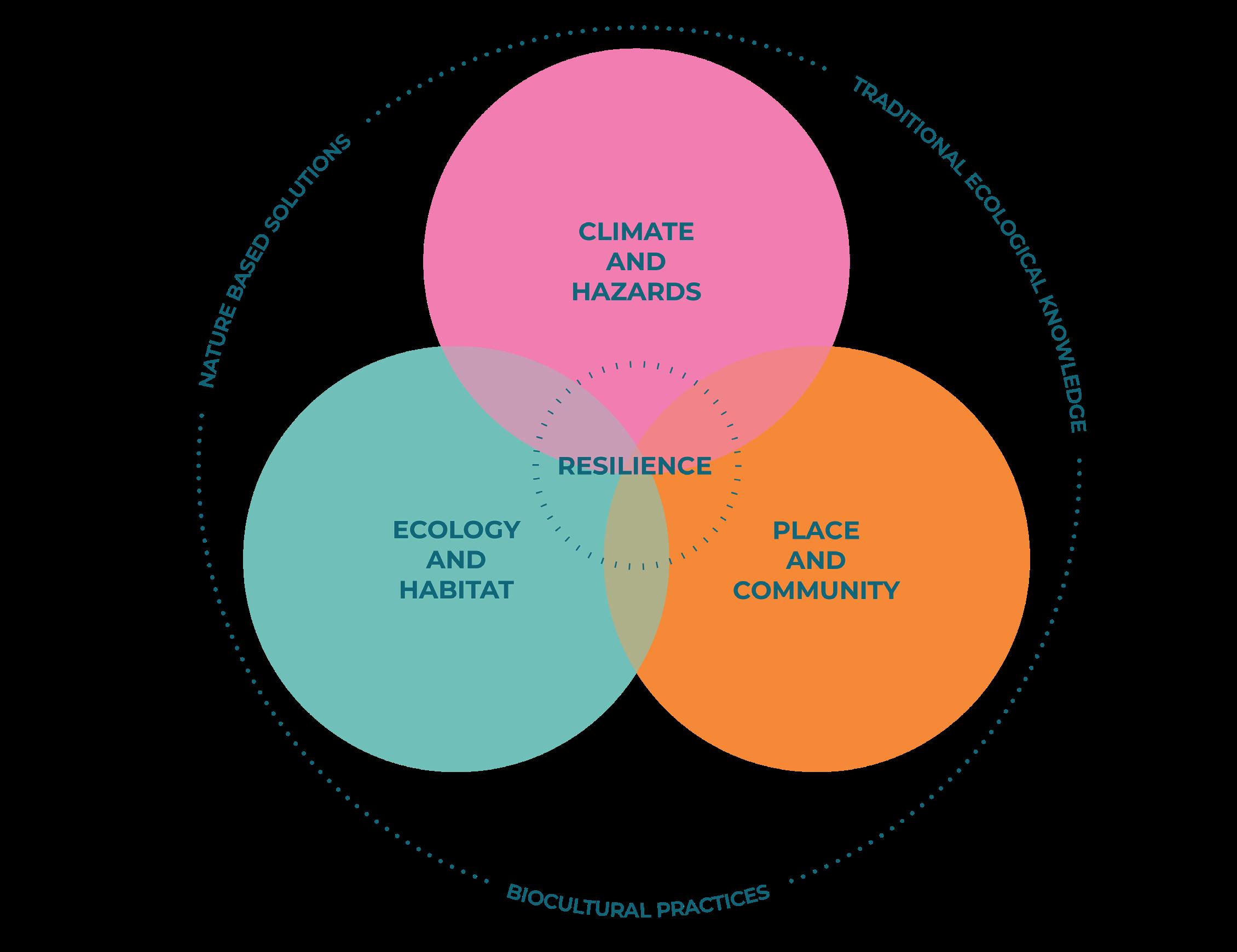
Project Goals Diagram
Project Goal Icons

PLACE & COMMUNITY

ECOLOGY & HABITAT



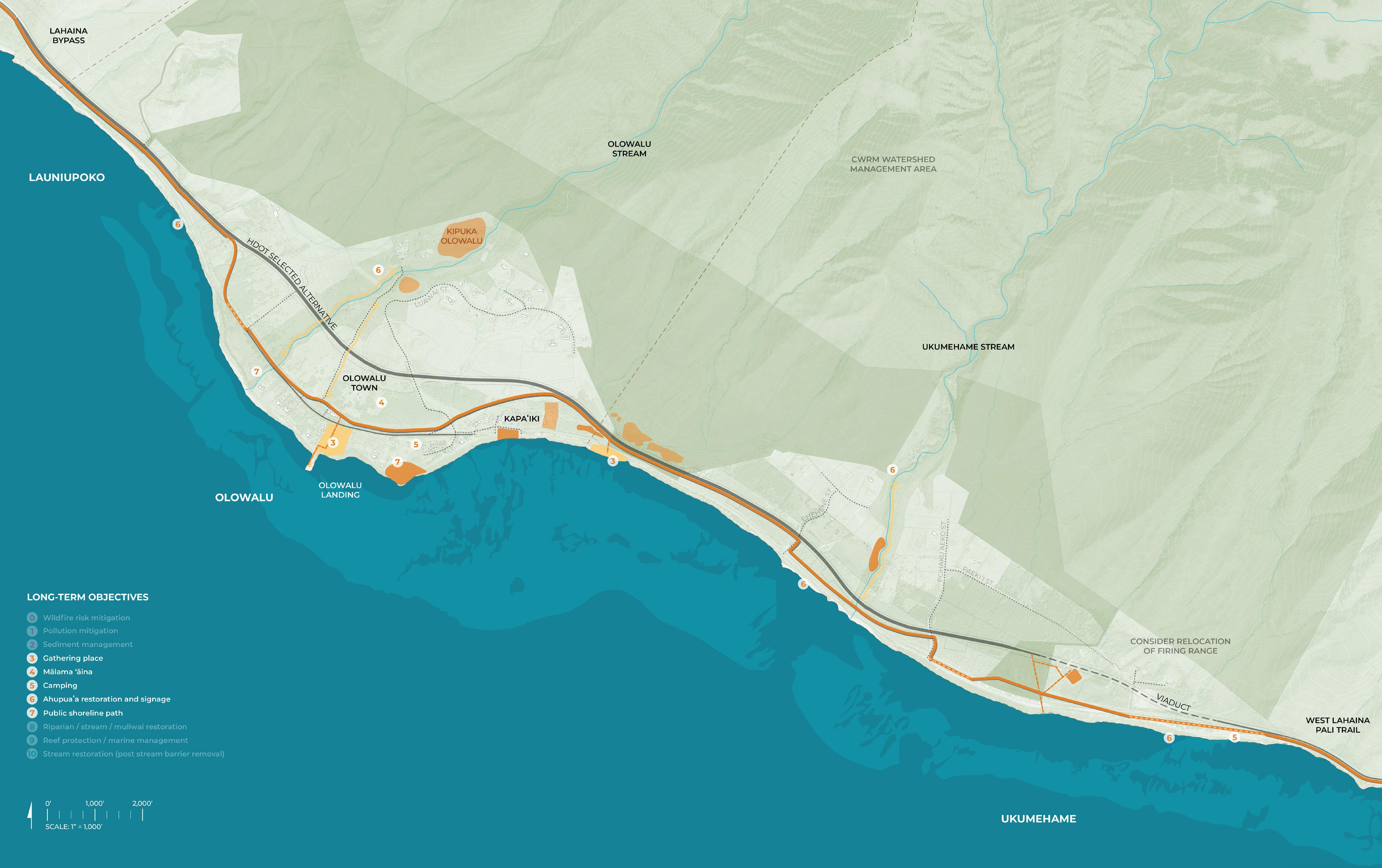
For this second iteration of co-design at the overall project area scale, which spans the Olowalu–Ukumehame coastal corridor, the project team invited participants to reflect on big-picture strategies and interventions for resilience across this dynamic landscape.
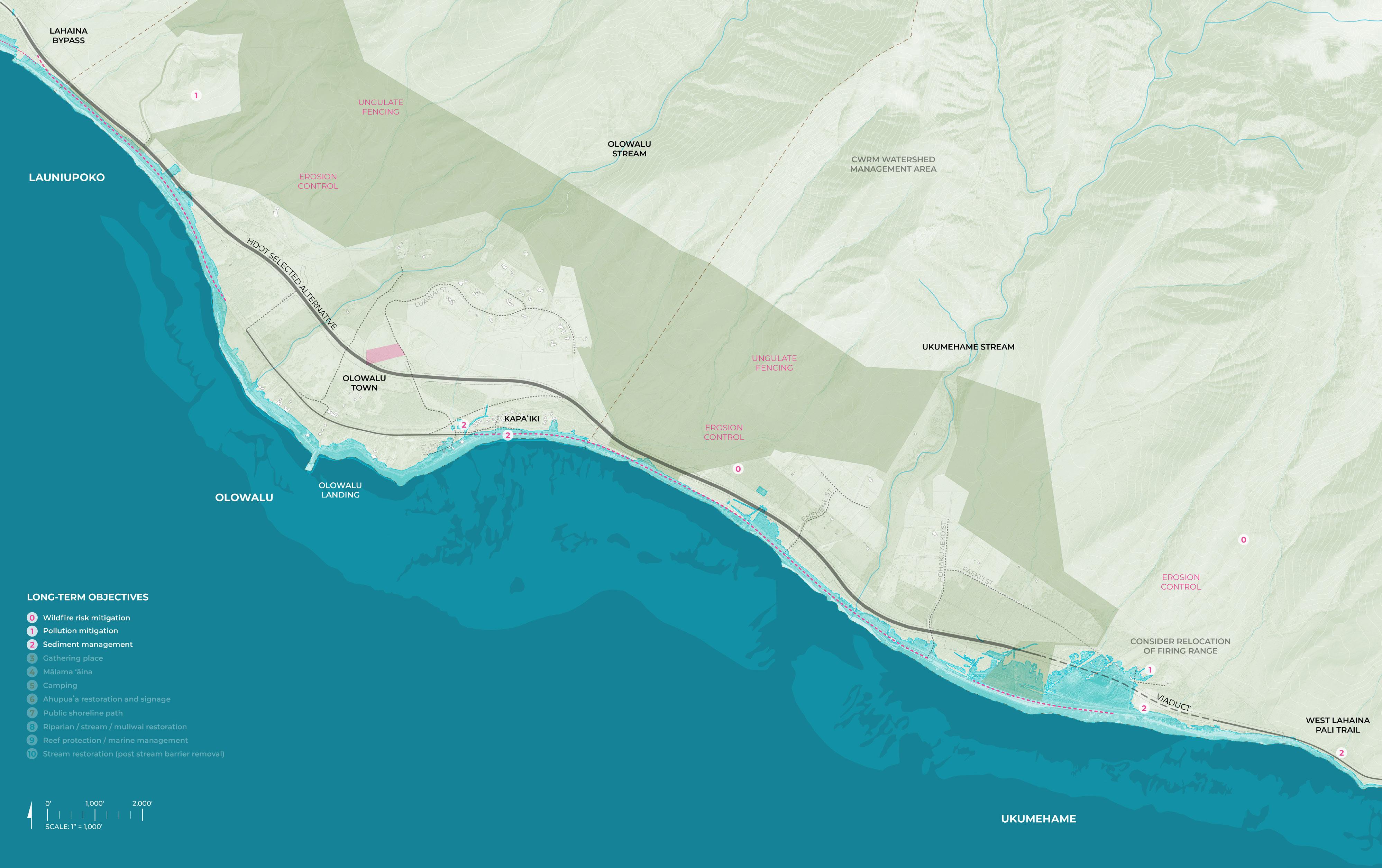
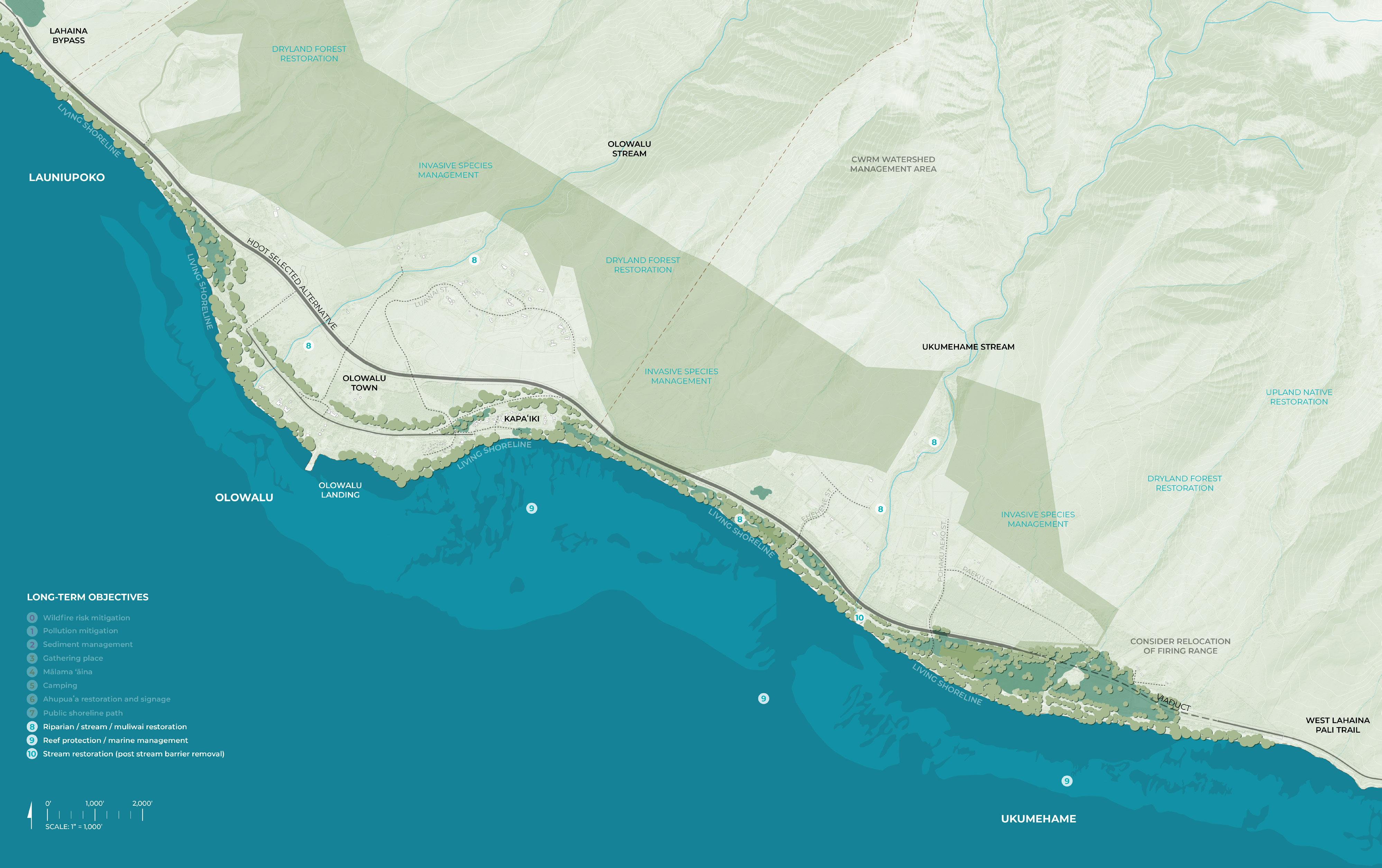
Refined draft sketches for near-term (1.1’ SLR-XA) and long-term (3.2’ SLR-XA) sea-level rise adaptation design scenarios presented concepts that re-imagine the existing Honoapiʻilani Highway and adjacent coastal areas. These visions for the near term and long term illustrated potential future circulation routes, programmatic opportunities, and areas for possible highway removal.
Participants reviewed proposals organized under the project’s three core goals: Place and Community Ecology and Habitat Climate and Hazards
The project team asked stakeholders and community members to provide input using sticky notes in response to the prompts: “Post-highway relocation, which interventions do you consider most urgent (next twenty years)?” and “In this 2075 vision, which plan elements do you consider most important for a resilient future?”
Community input and feedback received during the events has helped identify shared priorities and will guide a final proof-of-concept design vision for the overall project area that supports social-ecological resilience and long-term climate adaptation.
Materials included in this section:
Co-Design Event Activity Photos
Conceptual Design Sketch Boards - Near / Long Term (Materials Provided to Participants) Near / Long Term Results (In-Person and Virtual)
Summary and Analysis (Categorized by Project Goal)
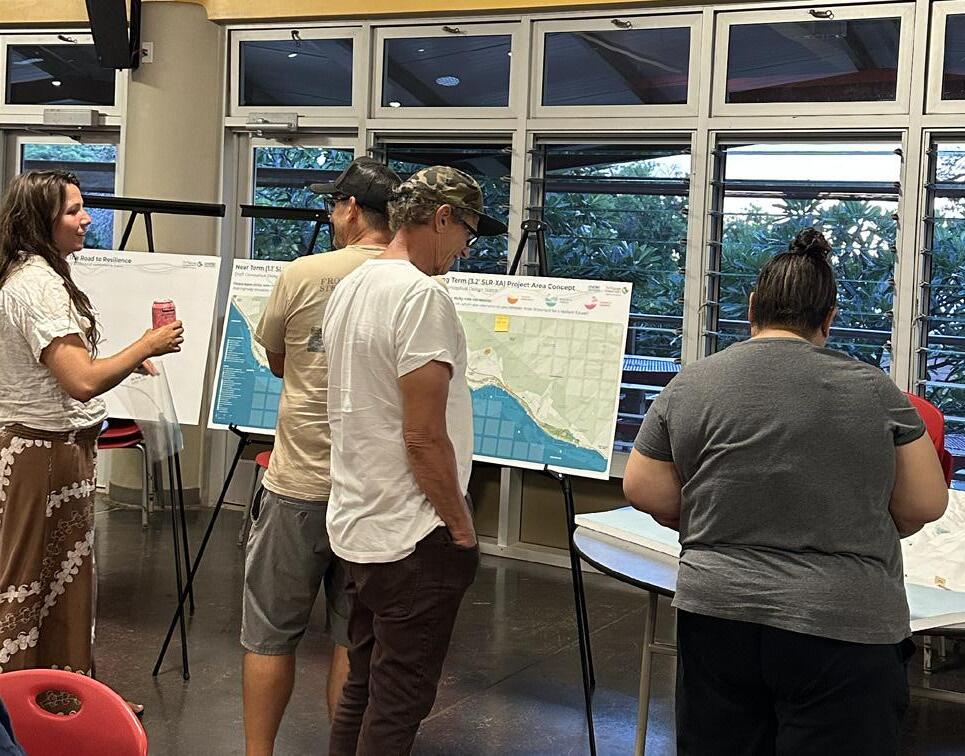
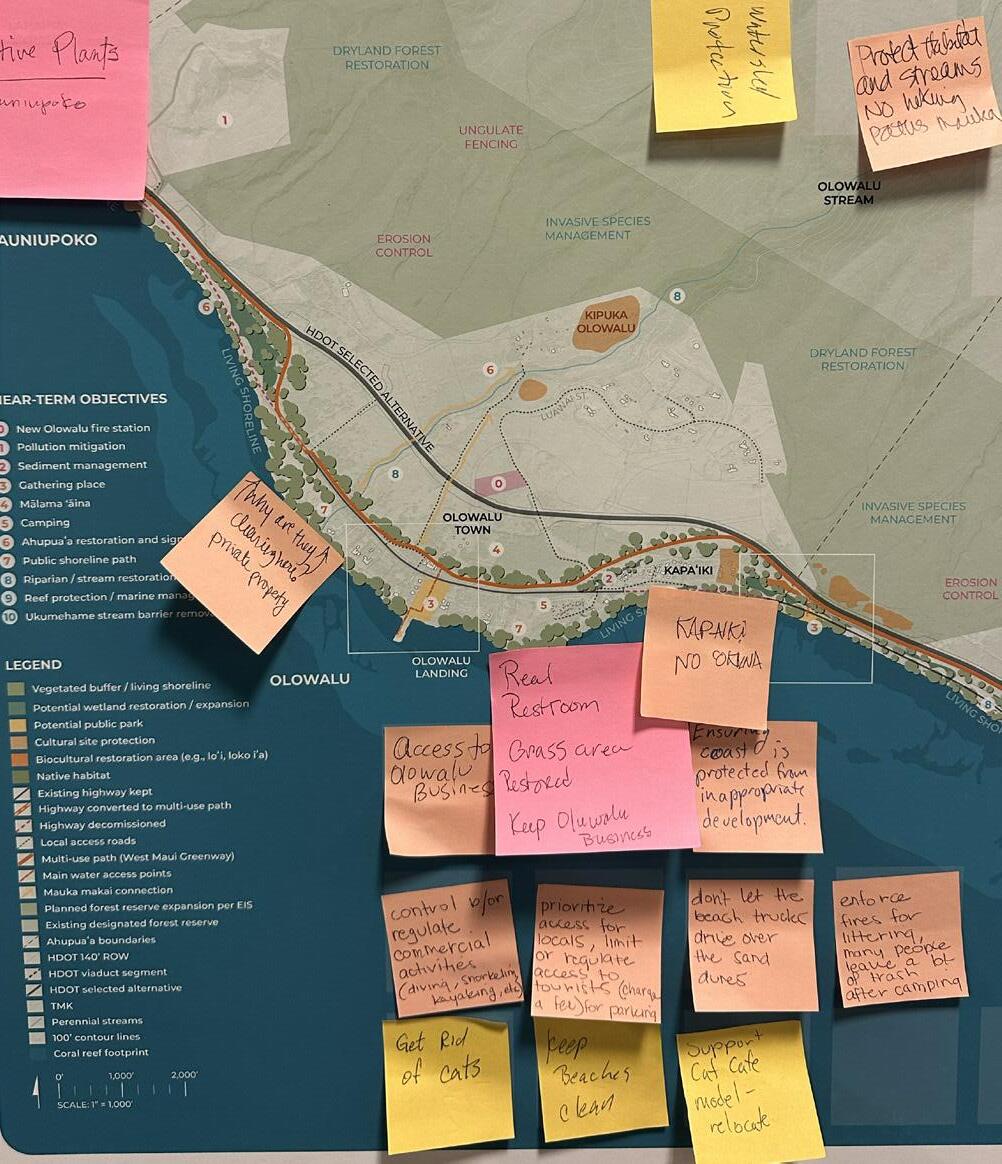
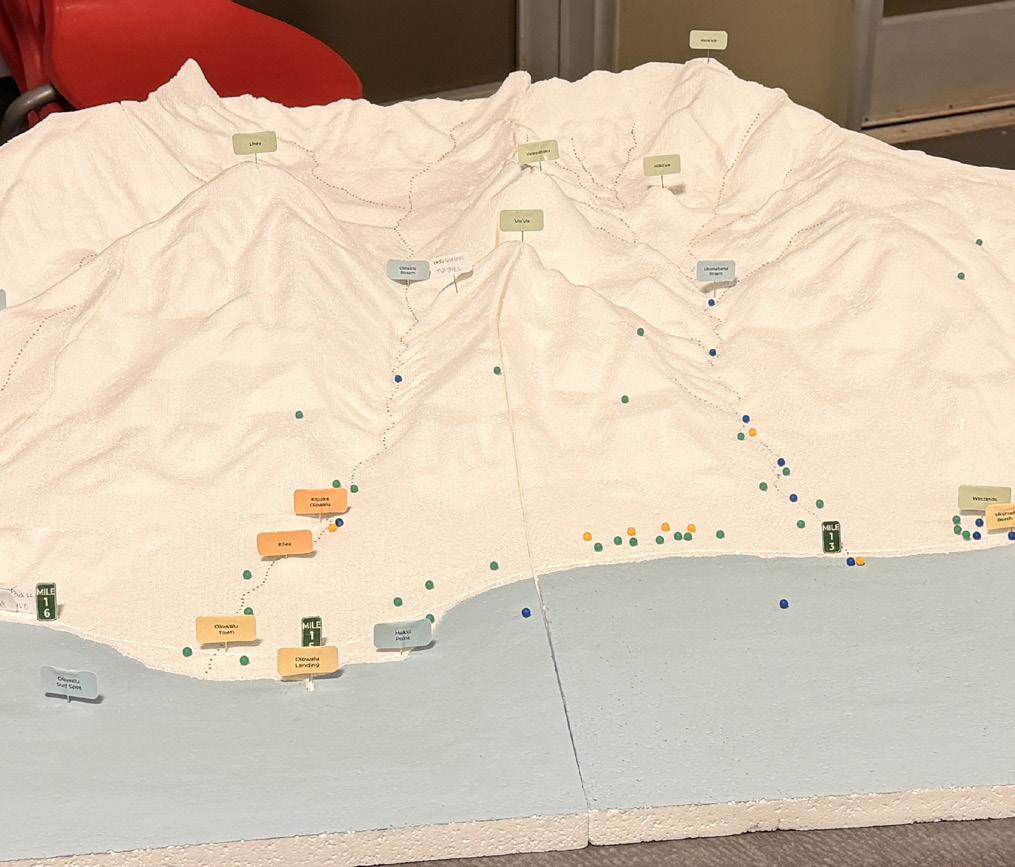
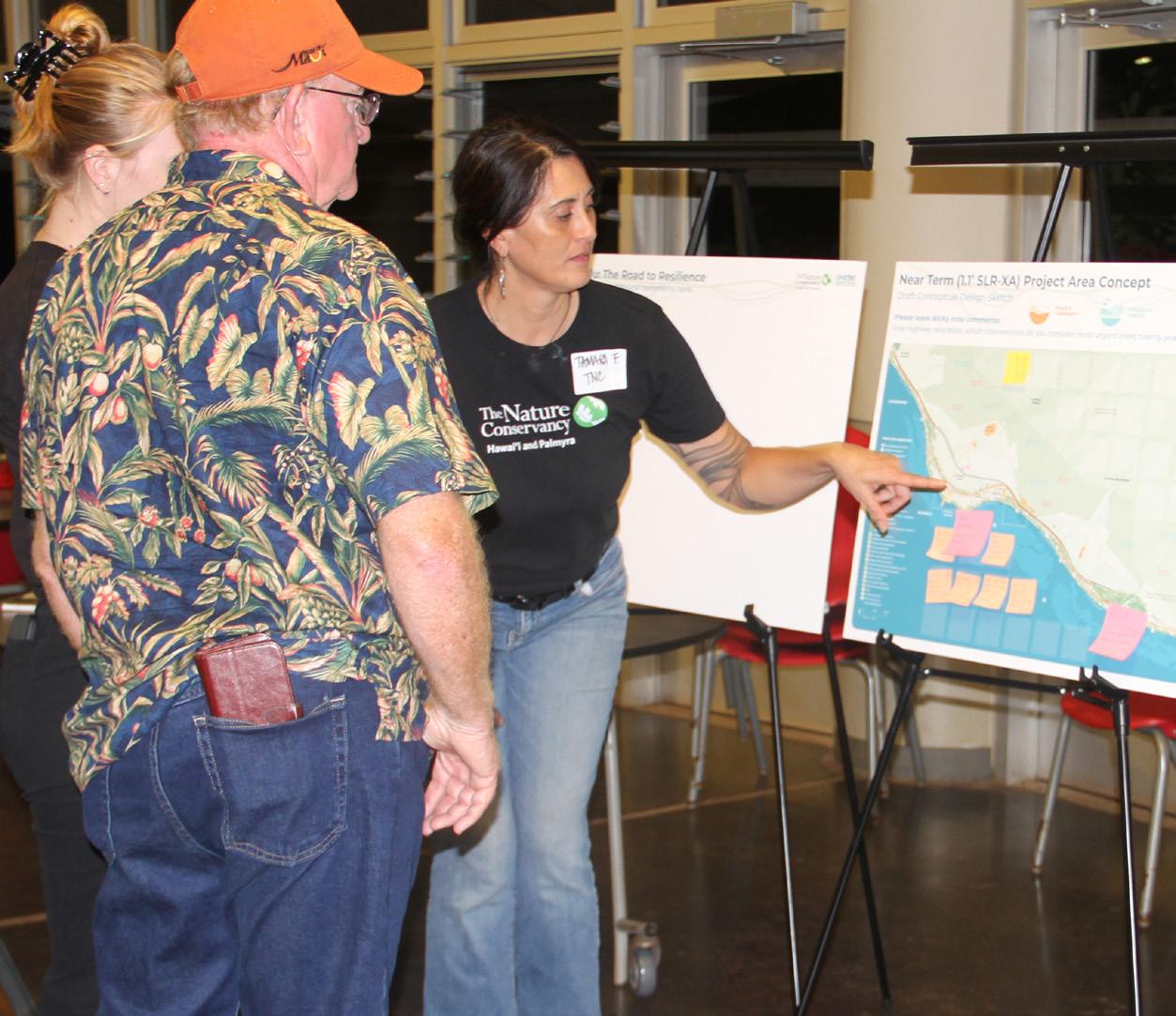
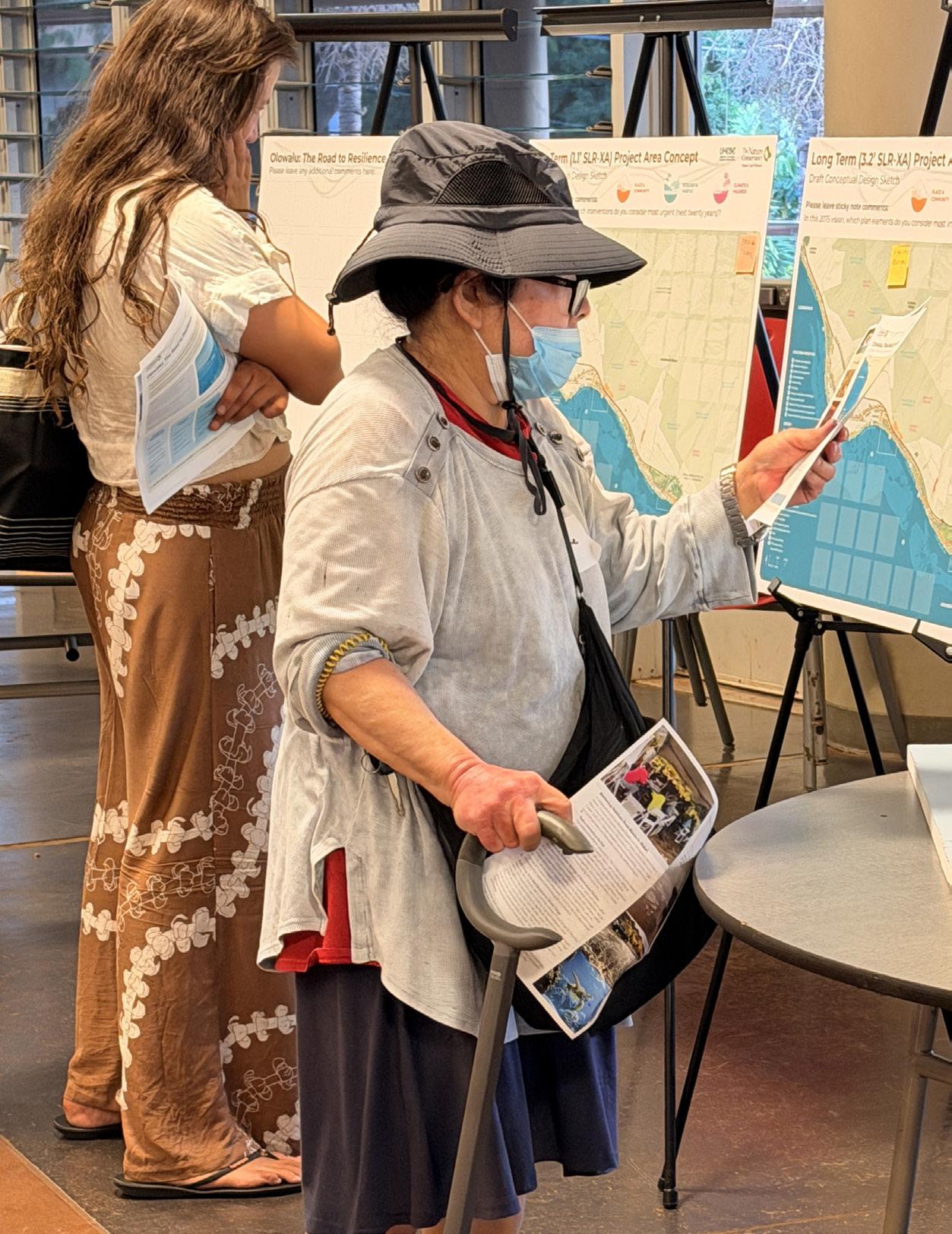
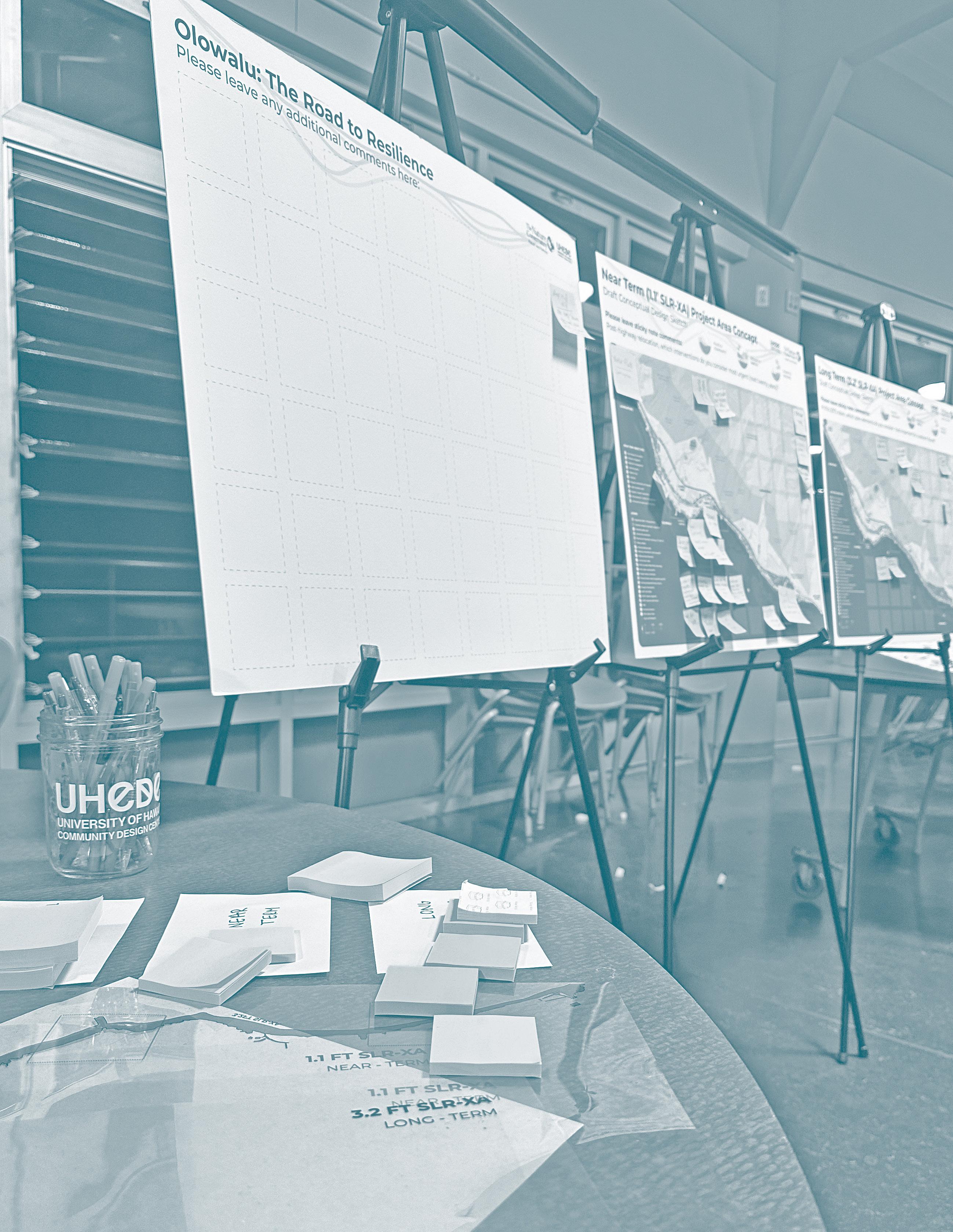
Workshop participants interacting with Project Area Scale boards (Images: UHCDC & TNC)
Materials
Draft Conceptual Design Sketch




Please leave sticky note comments: Post-highway relocation, which interventions do you consider most urgent (next twenty years)?

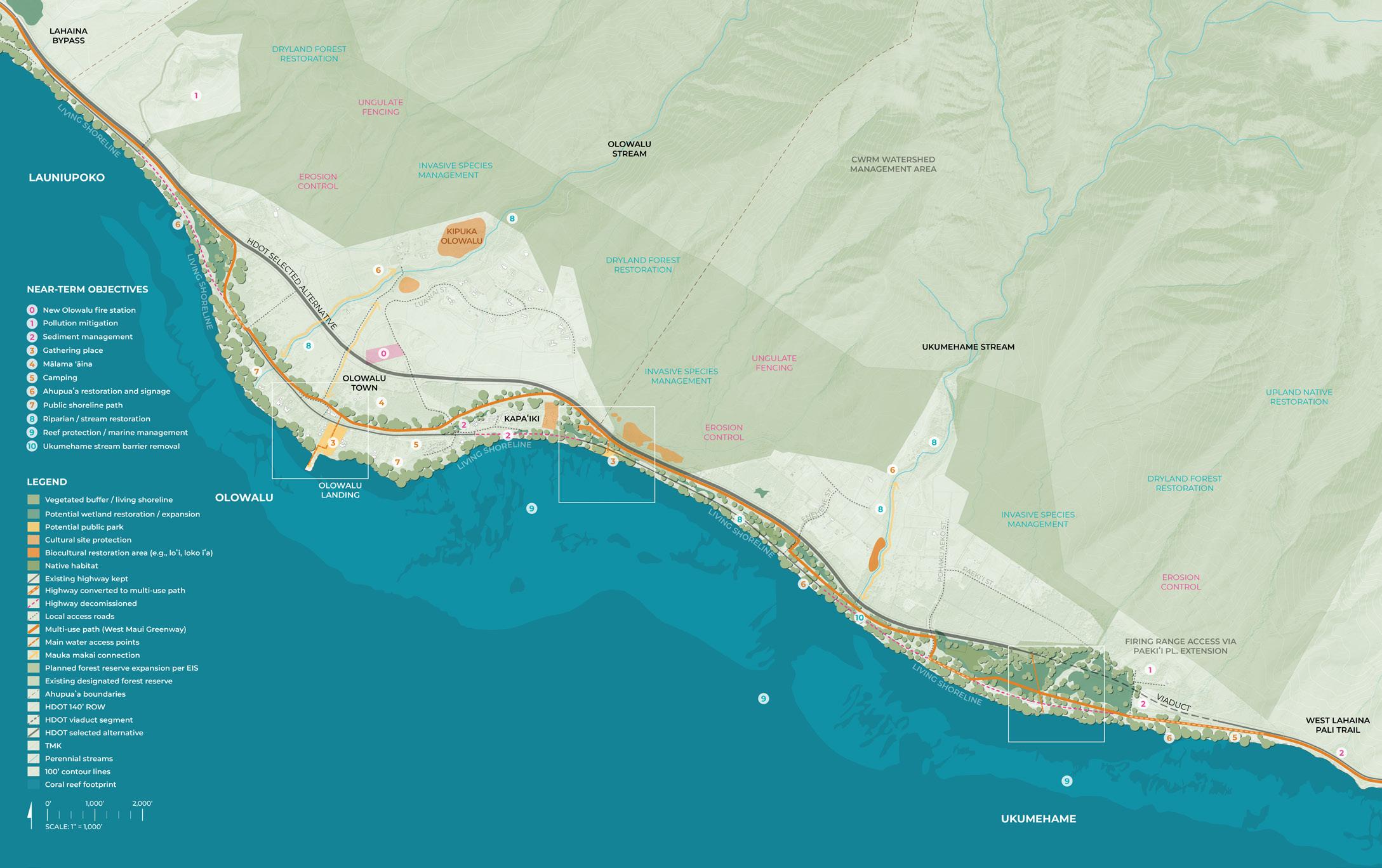
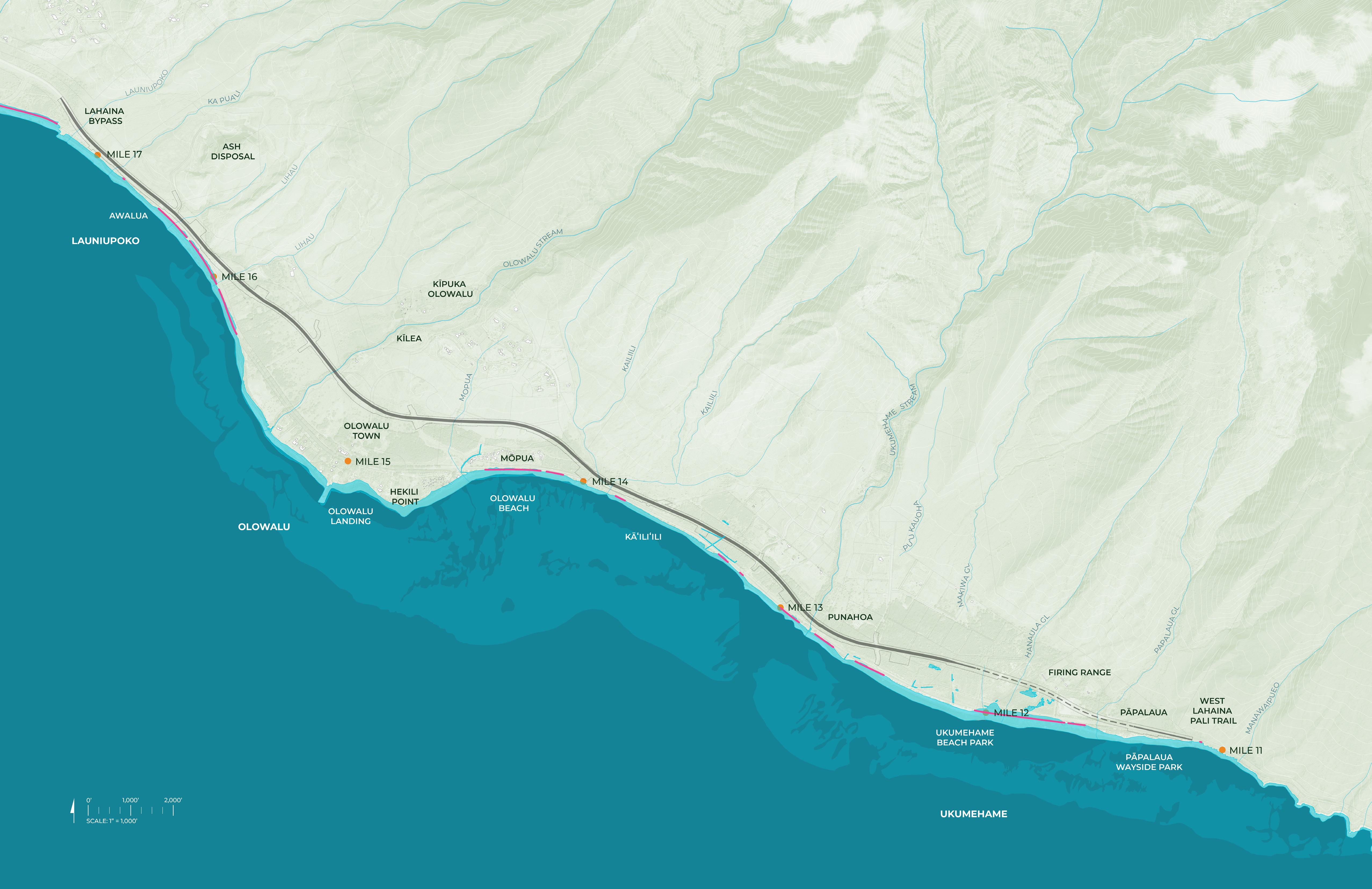
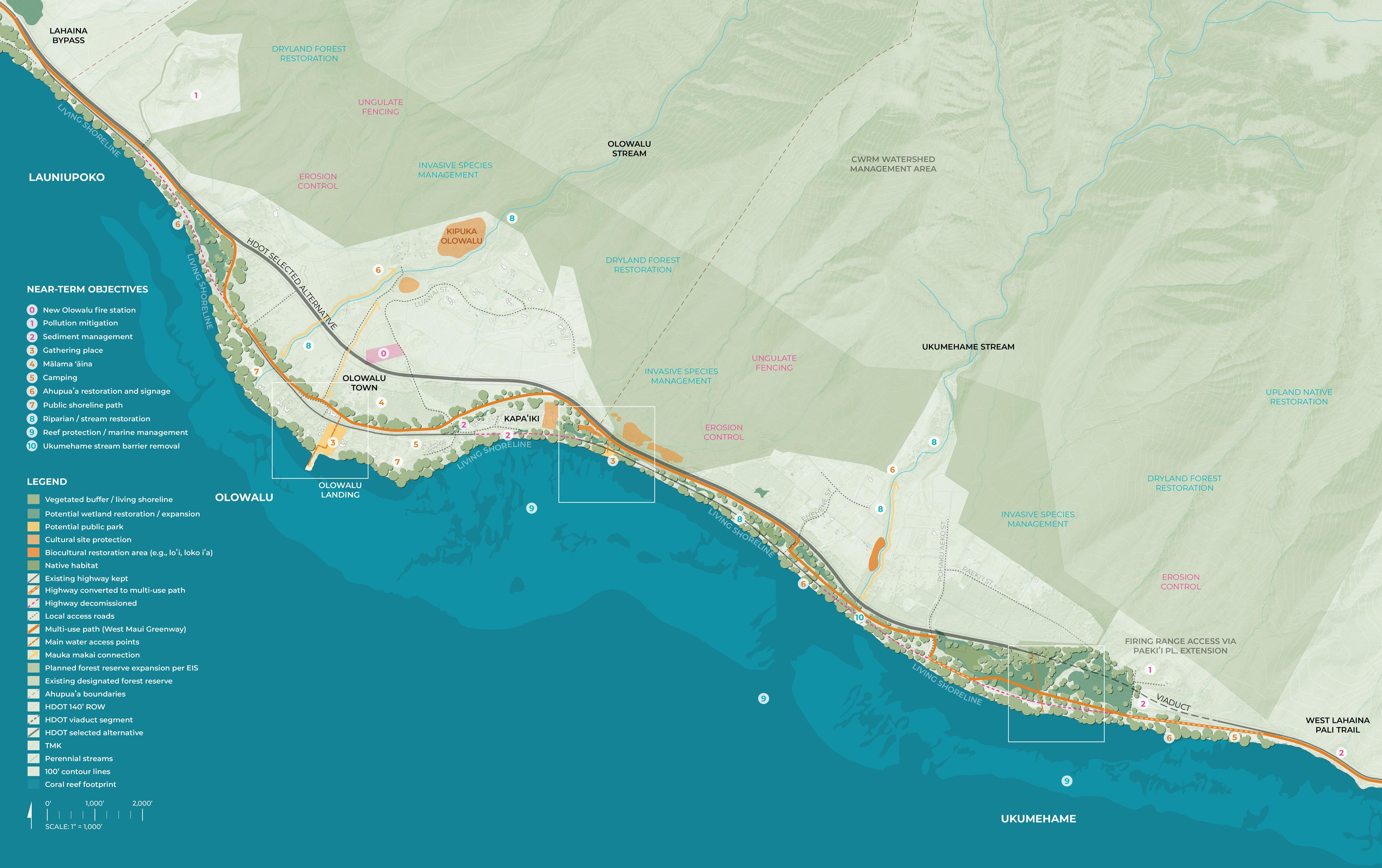
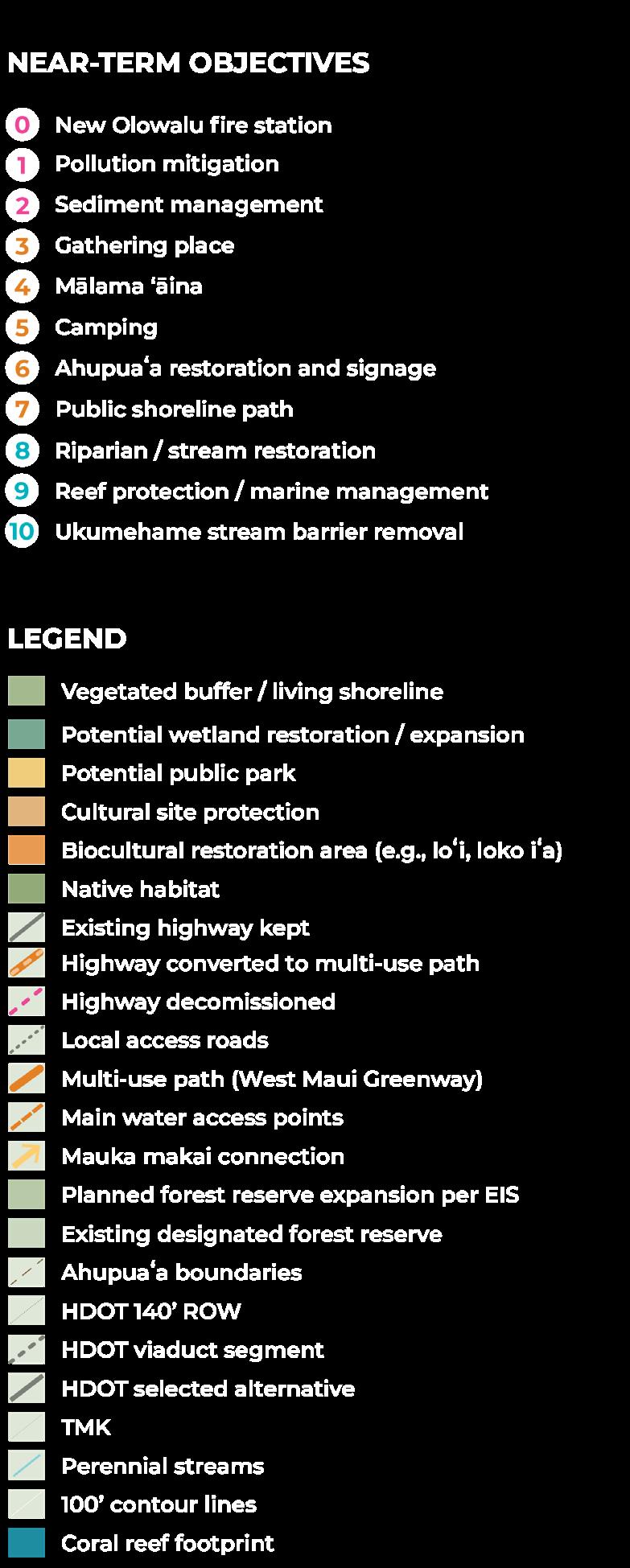
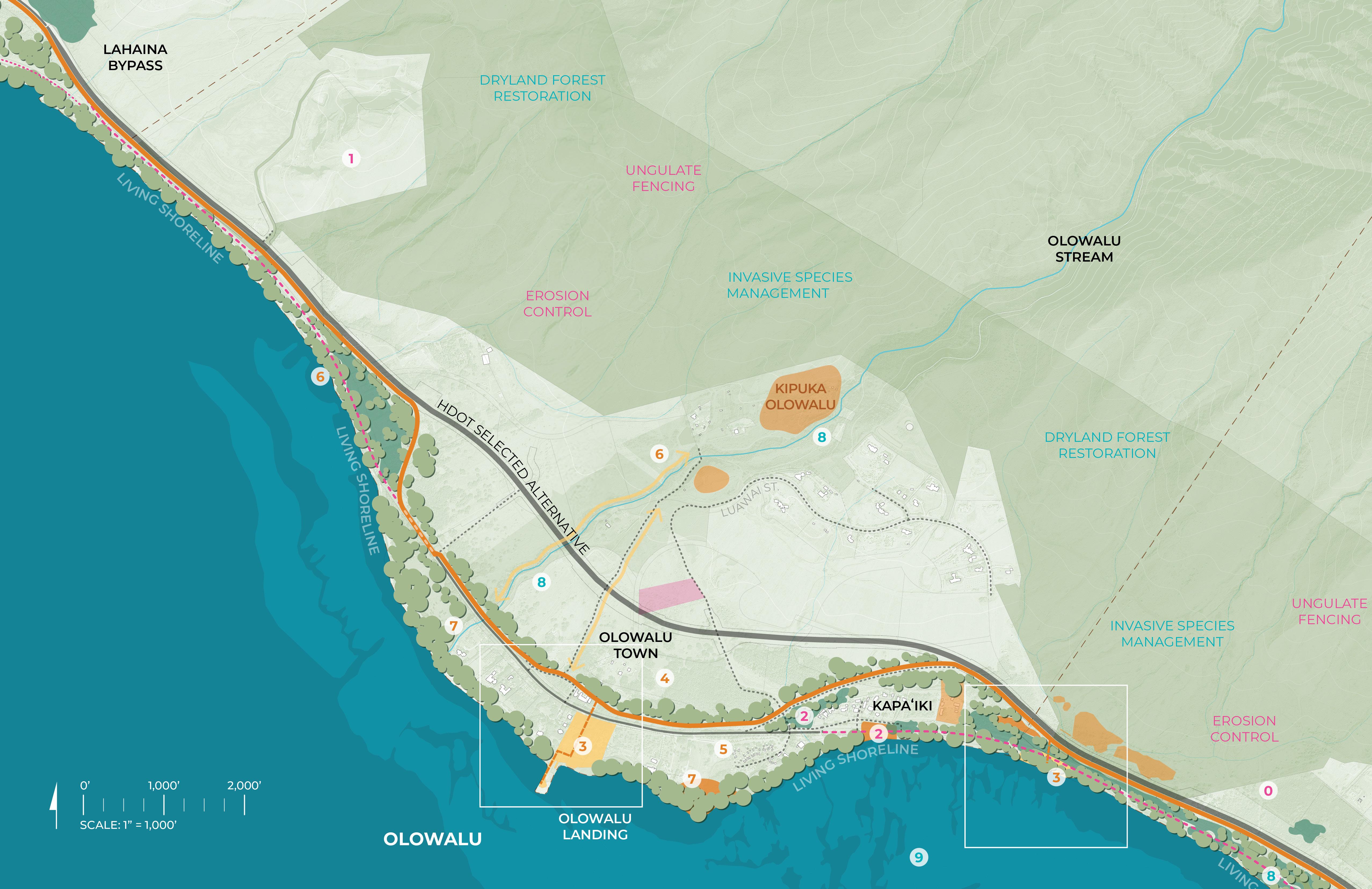
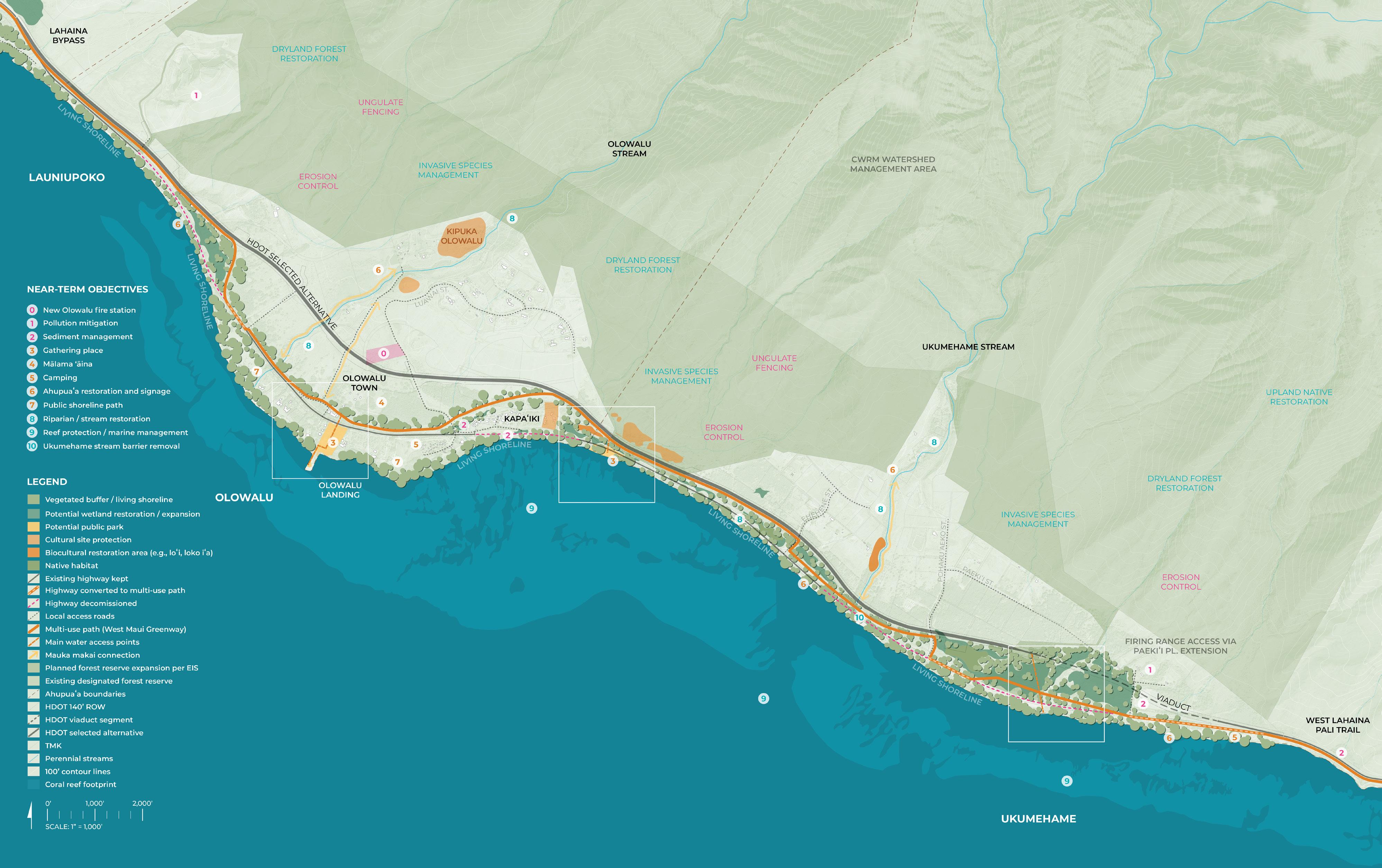
The draft conceptual sketch for the near-term (approx. 2045) highlights the following proposed design elements: Near Term Draft Conceptual Design Sketch (original presentation board size: 24” x 30”, reduced in scale for summary report)
• Hawaiʻi Department of Transportation (HDOT) adjusted preferred selected highway realignment alternative
• Vehicular local access roads
• Pedestrian and multi-modal paths
• Locations where the existing highway is suggested to be decommissioned due to anticipated sea level rise impacts and erosion
• Other proposed programming color coded by project goal
Draft Conceptual Design Sketch
Please leave sticky note comments:
In this 2075 vision, which plan elements do you consider most important for a resilient future?

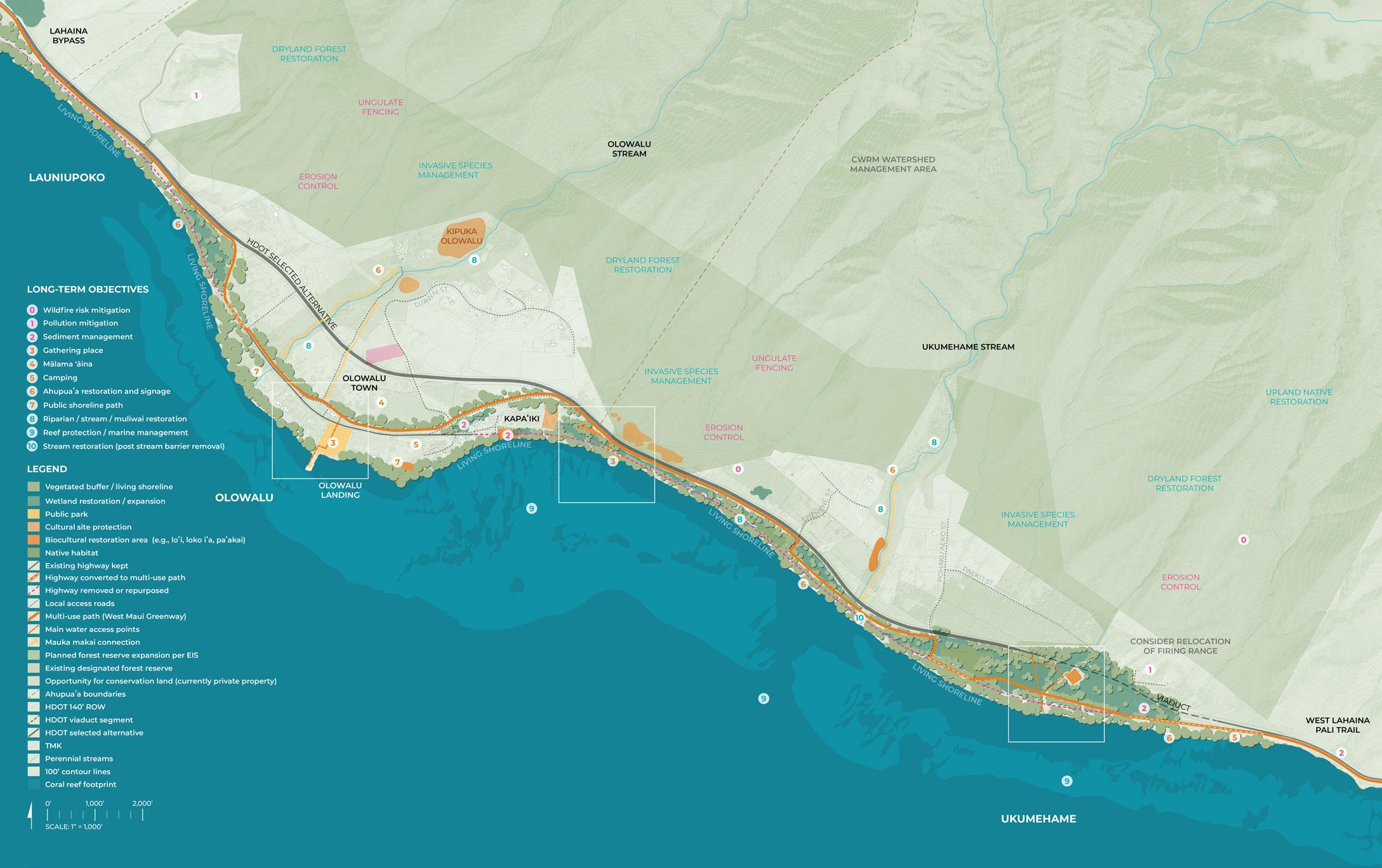
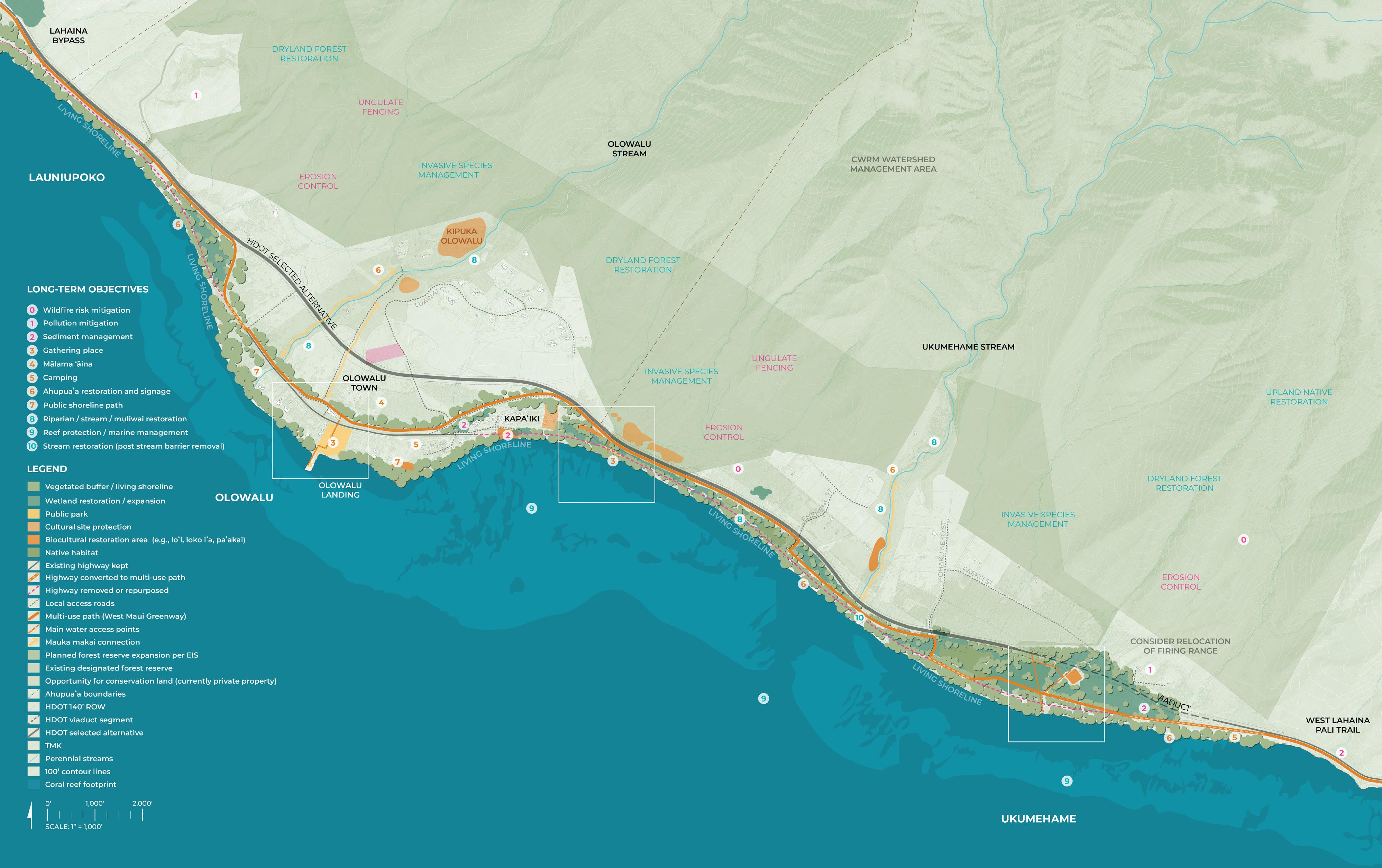
Long Term Draft Conceptual Design Sketch (original presentation board size: 24” x 30”, reduced in scale for summary report)
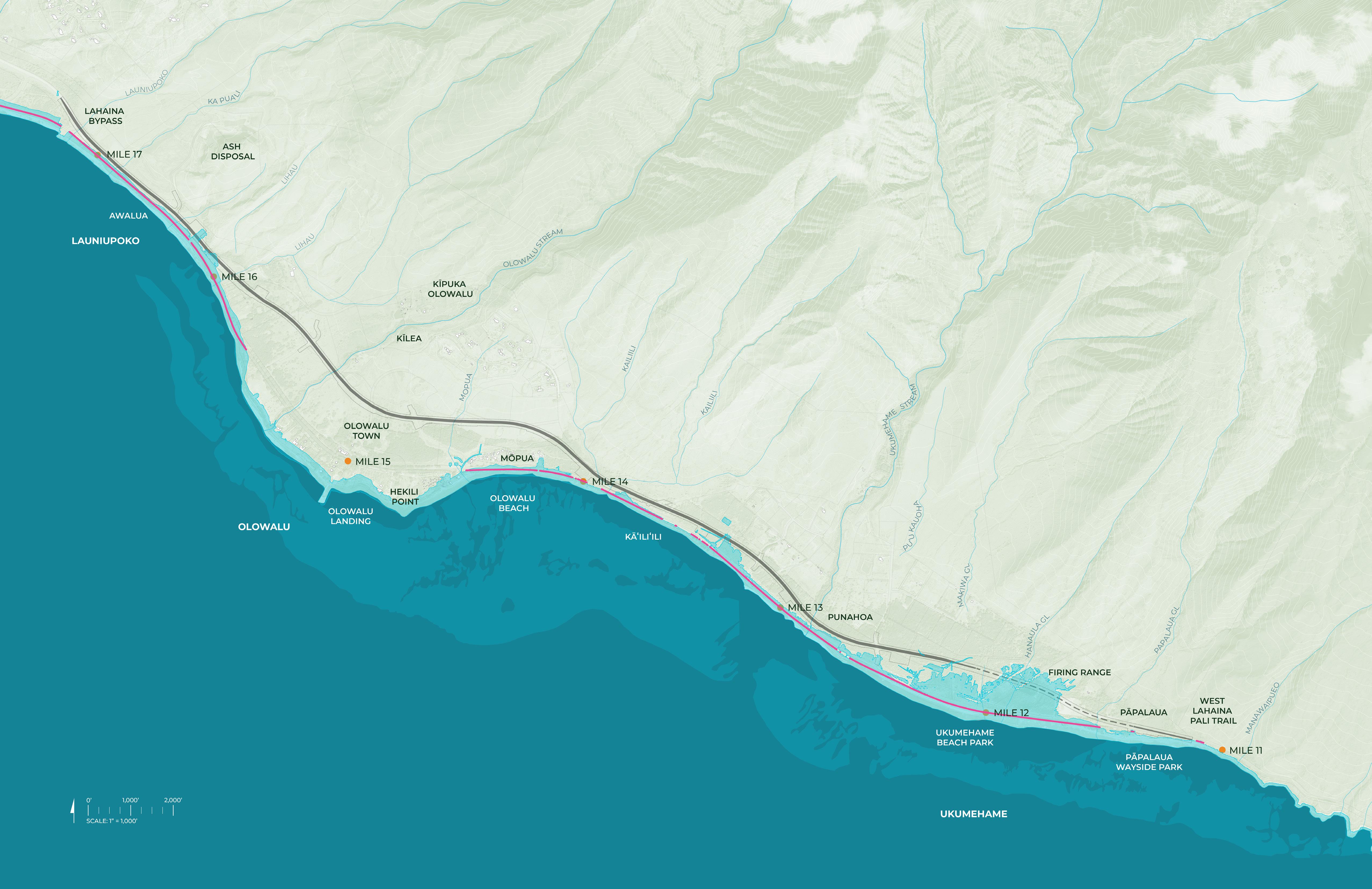
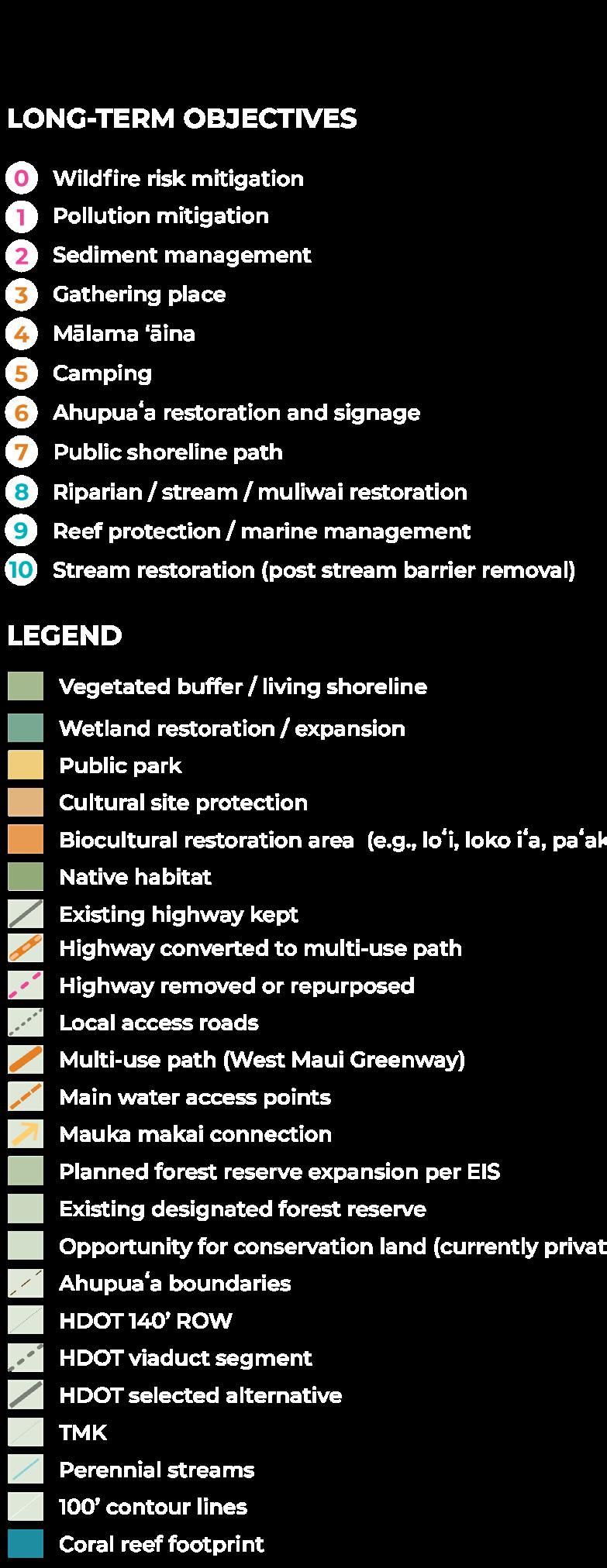
The draft conceptual sketch for the long-term (approx. 2075) highlights the following proposed design elements:
• Pedestrian and multi-modal paths
• Wetland/native habitat restoration
• Living shorelines
• Opportunities for conservation land
• Proposed public parks
• Locations where the existing highway is suggested to be removed or repurposed due to anticipated sea level rise impacts and erosion
Other proposed programming color coded by project goal
Please leave sticky note comments:
OVERALL PROJECT AREA SCALE
Post-highway relocation, which interventions do you consider
Provided Materials: Near-Term Sketch Design


consider most urgent (next twenty years)?
Near-Term Conceptual Design Sketch (original presentation board size: 24” x 30”, reduced in scale for summary report)
Please leave sticky note comments:
OVERALL PROJECT AREA SCALE
In this 2075 vision, which plan elements do you consider most
Provided Materials: Long-Term Sketch Design
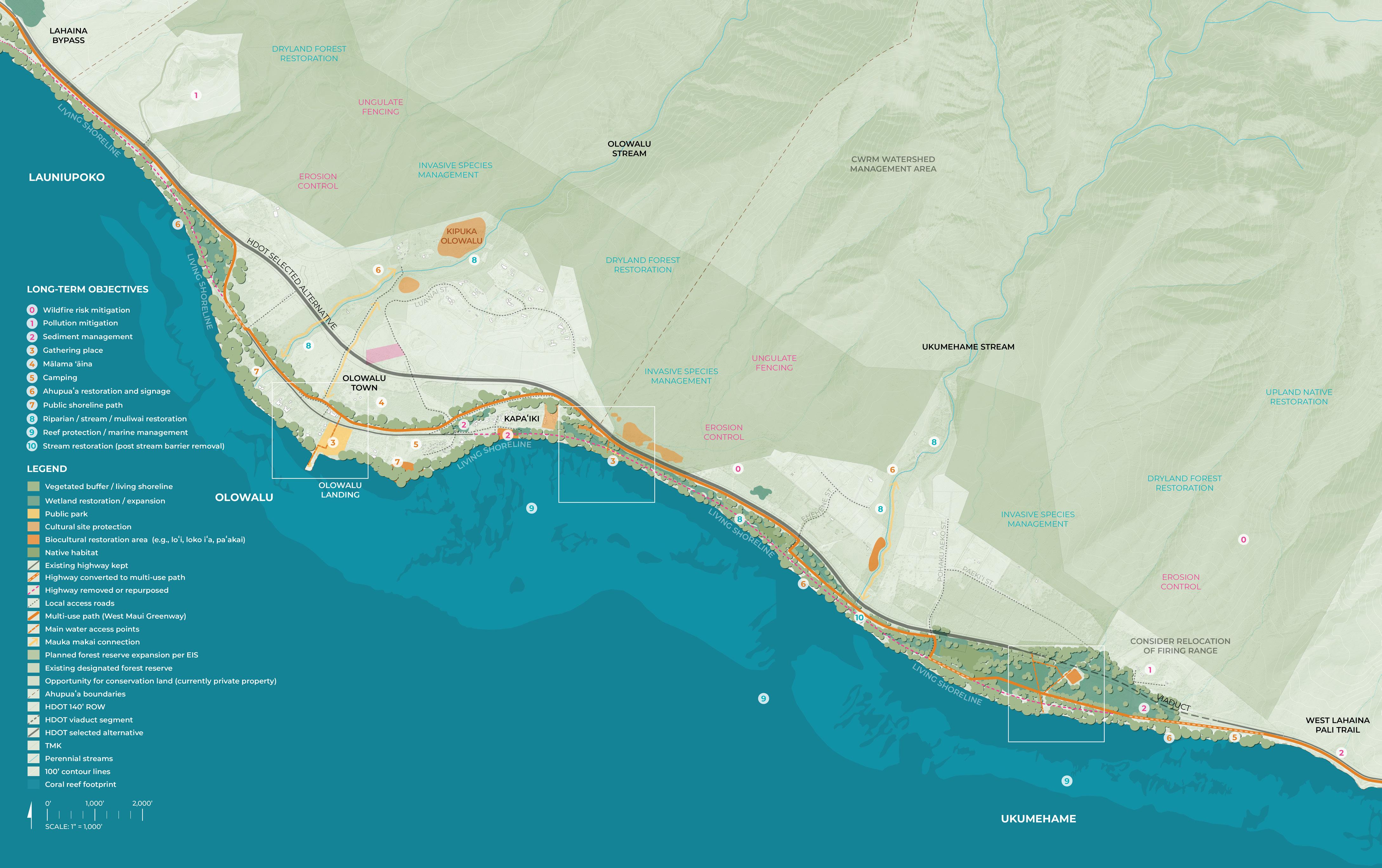
Long-Term Conceptual Design Sketch (original presentation board size: 24” x 30”, reduced in scale for summary report)
Provided Materials: Near-Term Sketch Design - Olowalu Portion (Zoom-In)
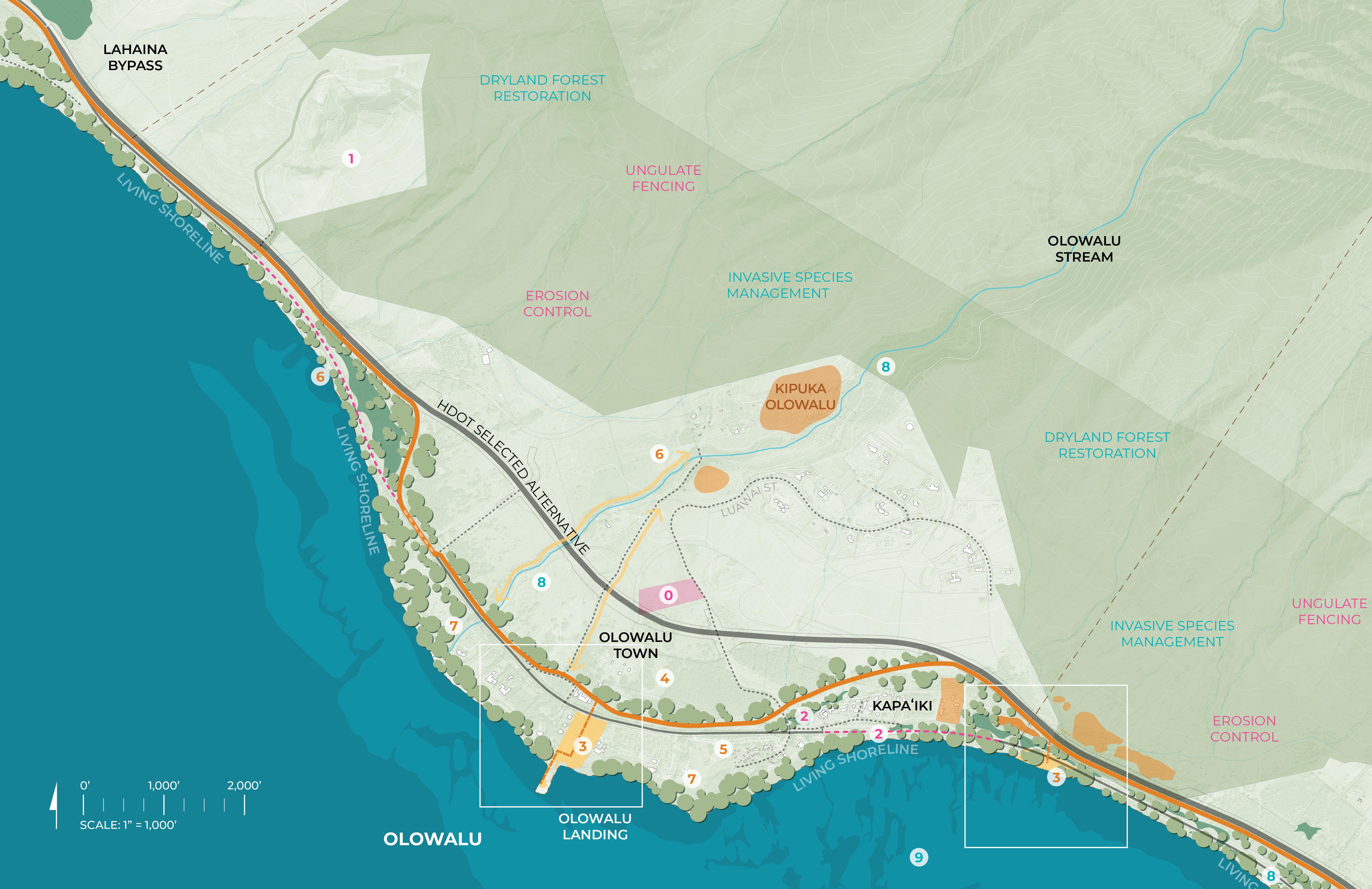
Near-Term Conceptual Design Sketch
Provided Materials: Long-Term Sketch Design - Olowalu Portion (Zoom-In)
Long-Term Conceptual Design Sketch
Provided Materials: Near-Term Sketch Design - Ukumehame Portion (Zoom-In)
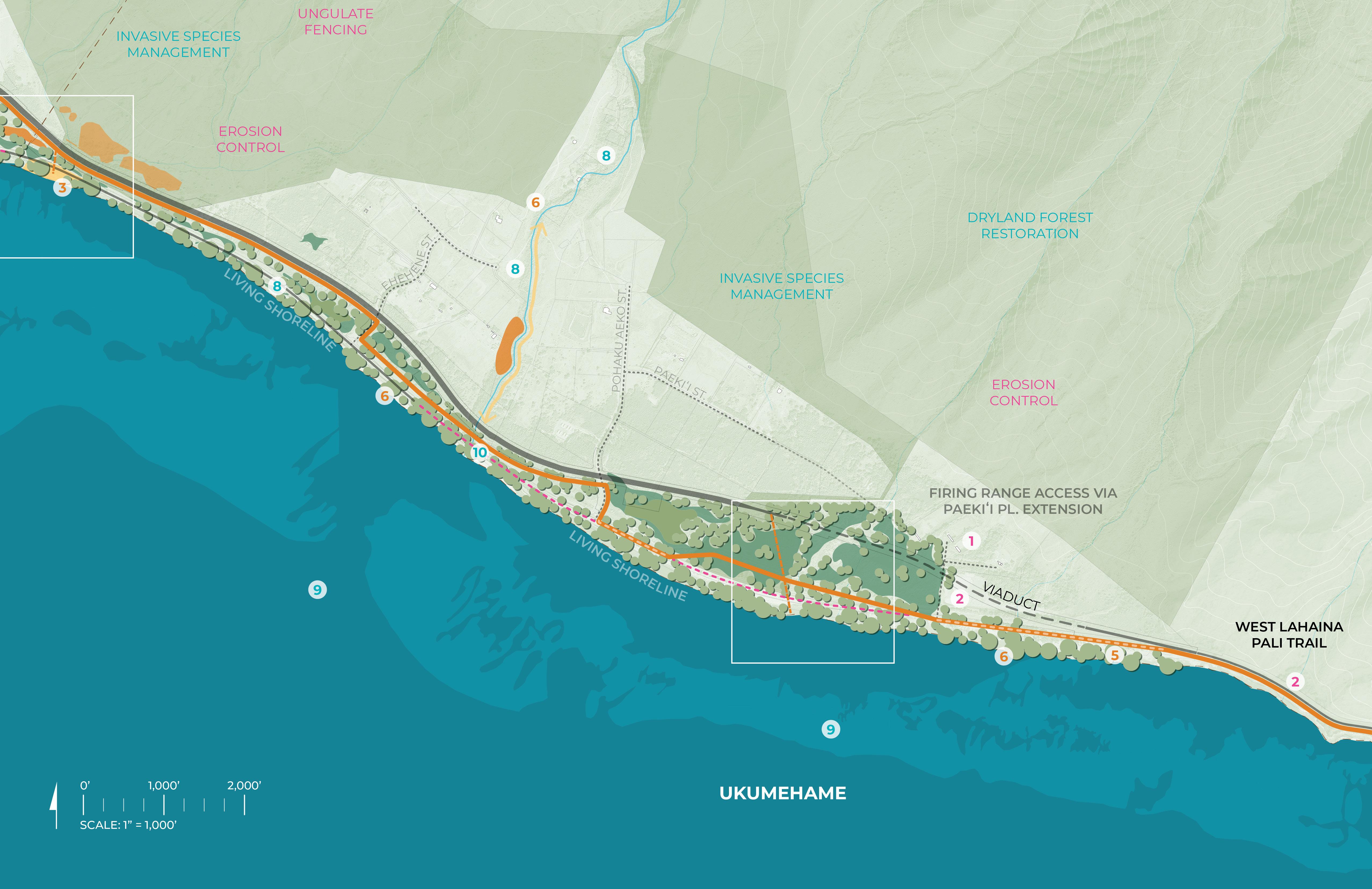
Near-Term Conceptual Design Sketch
Provided Materials: Long-Term Sketch Design - Ukumehame Portion (Zoom-In)
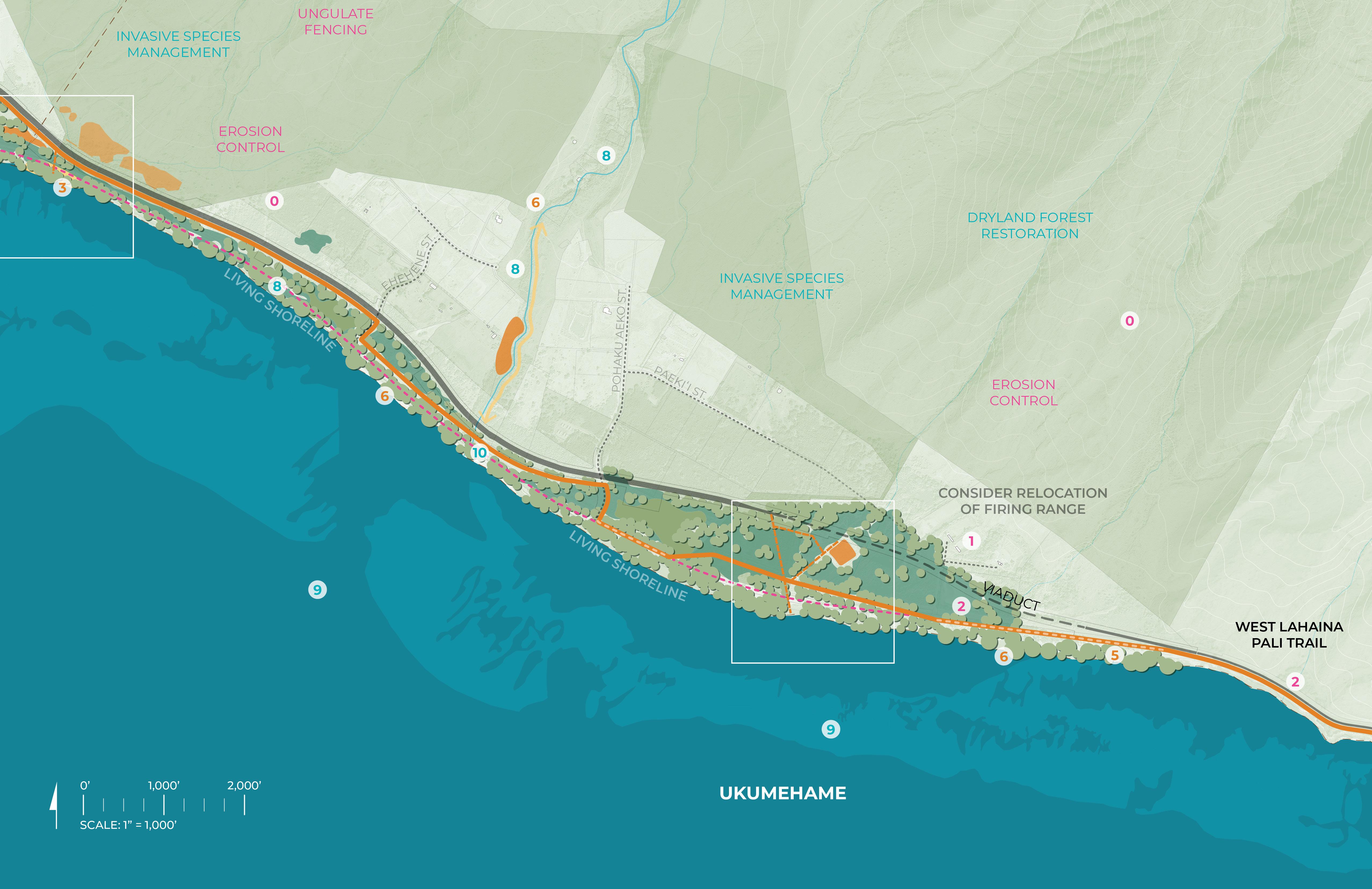
Long-Term Conceptual Design Sketch
Please leave sticky note comments: Post-highway relocation, which interventions
For transcribed post-it comments, refer to the end of this chapter.
At the in-person event, for the near-term project area scale prompt, 7 sticky note comments were left.
At the first virtual event, for the near-term project area scale prompt, 17 sticky note comments were left.
At the second virtual event, for the nearterm project area scale prompt, 17 sticky note comments were left.


Support
Ensuring
Restoring
Enforce fines for littering, many people leave a lot trash after camping
Results: Long-Term
Please leave sticky note comments: In this 2075 vision, which plan elements do
For transcribed post-it comments, refer to the end of this chapter.
In-Person Response
At the in-person event, for the long-term project area scale prompt, 7 sticky note comments were left.
Virtual Response
At the first virtual event, for the long-term project area scale prompt, 18 sticky note comments were left.
Virtual Response
At the second virtual event, for the longterm project area scale prompt, 19 sticky note comments were left.
Are there any measures proposed by HDOT with funding sources identified to mitigate future SLR and coastal erosion impacts to the realigned highway so that we are not in the same situation in 30yrs?
Certainly something that ensures that the whole hillside there for that matter along that whole corridor is protected in a way that is not gonna have any impact on the shoreline
Participant priorities are counted by number of sticky notes left per project goal category. Included is a compilation of all project area scale comments left at the in-person and two virtual events.
Overall theme of comments:
Near Term: Invasive plants, animals, water systems, cultural ecology, and ecosystem restoration.
Long Term: Managed retreat, adaptive / flexible design, and flooding and hydrology.
Overall theme of comments:
Near Term: Access, mobility, governance, and human use.
Long Term: Land use and planning, public access, cultural rights and values, mobility and public safety, and community stewardship.
Overall theme of comments:
Near Term: Risk reduction, erosion, sea level rise, flooding, and infrastructure removal.
Long Term: Invasive species management, protection of sensitive areas and cultural ecologies, and restoration of natural ecosystems.

Are there any measures proposed by HDOT with funding sources identified to mitigate future SLR and coastal erosion impacts to the realigned highway so that we are not in the same situation in 30yrs?

Protecting
Removal or relocation of obsolete or vulnerable hard infrastructure that impacts health and function of coastal habitats
Incorporating kilo and adaptive management Removing the road in areas likely to be impacted first by SLR-reastablish ecosystem functions of
Highway relocation as soon as possible
Flexible and adaptive design of features adn infrastructures
Remove exisiting highway in sustainable ways
Summary and Analysis - Place and Community
Participant priorities are counted by number of sticky notes left per project goal category. Included is a compilation of all project area scale comments left at the in-person and two virtual events.
and Hazards
Overall theme of comments:
Near Term: Invasive plants, animals, water systems, cultural ecology, and ecosystem restoration.
Long Term: Managed retreat, adaptive / flexible design, and flooding and hydrology.
Overall theme of comments:
Near Term: Access, mobility, governance, and human use.
Long Term: Land use and planning, public access, cultural rights and values, mobility and public safety, and community stewardship.
Overall theme of comments:
Near Term: Risk reduction, erosion, sea level rise, flooding, and infrastructure removal.
Long Term: Invasive species management, protection of sensitive areas and cultural ecologies, and restoration of natural ecosystems.


Summary and Analysis - Ecology and Habitat
Participant priorities are counted by number of sticky notes left per project goal category. Included is a compilation of all project area scale comments left at the in-person and two virtual events.
Overall theme of comments:
Near Term: Invasive plants, animals, water systems, cultural ecology, and ecosystem restoration.
Long Term: Managed retreat, adaptive / flexible design, and flooding and hydrology.
Overall theme of comments:
Near Term: Access, mobility, governance, and human use.
Long Term: Land use and planning, public access, cultural rights and values, mobility and public safety, and community stewardship.
Overall theme of comments:
Near Term: Risk reduction, erosion, sea level rise, flooding, and infrastructure removal.
Long Term: Invasive species management, protection of sensitive areas and cultural ecologies, and restoration of natural ecosystems.

The second activity focused on Catalytic Site 1: Olowalu Town, a location shaped by its commercial activity and layered cultural history. During the in-person event, the project team provided participants with large-format presentation boards (24”x30”) featuring maps and diagrams that outlined existing conditions, challenges, and opportunities for the area.
The site was introduced through a series of analysis maps highlighting:
• Existing conditions
• Land ownership
• Topography and hydrology
• Wetlands and habitat
• 1.1’ sea-level rise exposure area impacts
• 3.2’ sea-level rise exposure area impacts
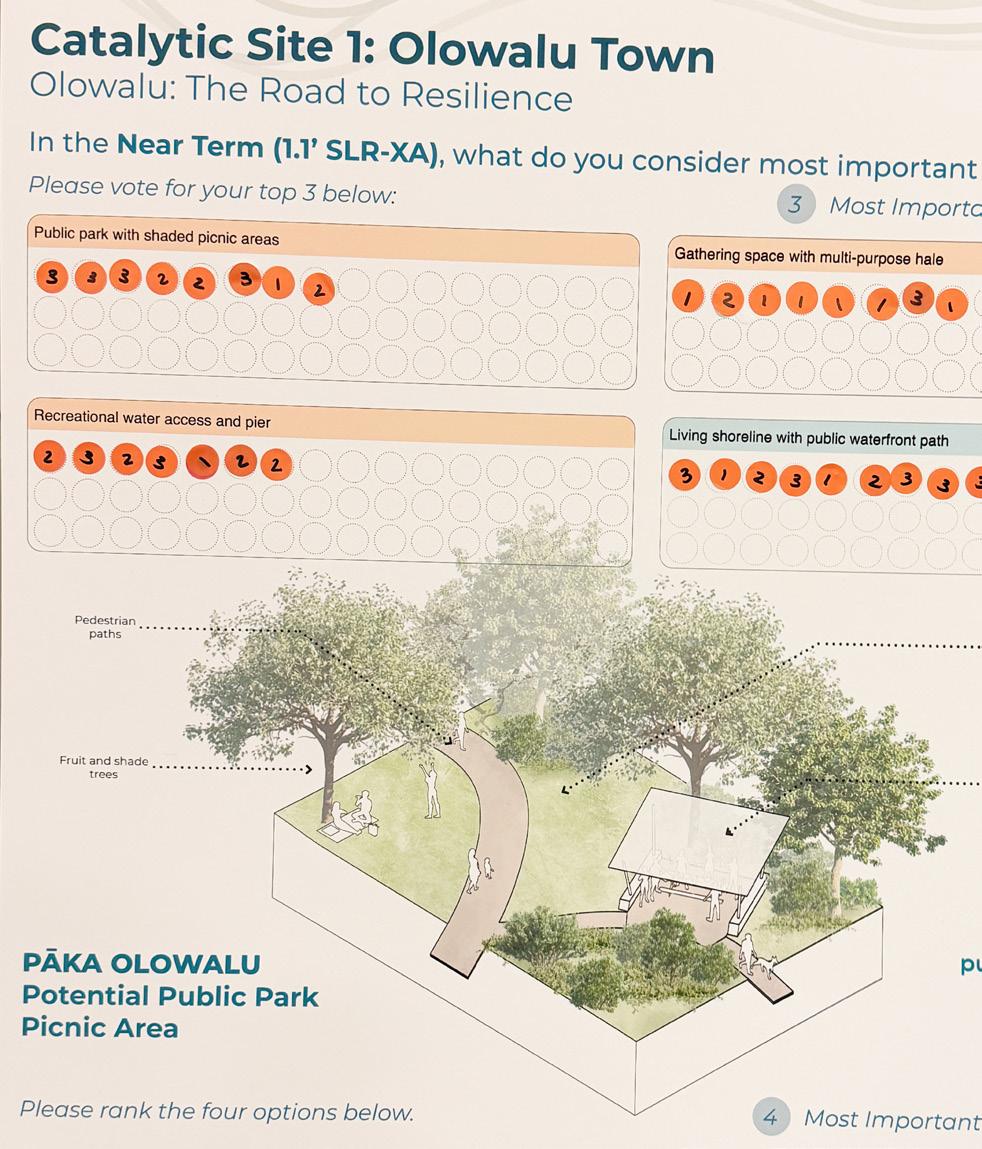
The project team encouraged community members to evaluate and respond to proposed final draft design interventions for long-term (3.2’ SLR-XA, approximately 2075) sea-level rise scenarios. Participants voted on their top 3 near-term priorities that they would like to see implemented first in this location. Additionally, participants were asked to rank their preferences for potential public park programs that would be implemented in the long term.
The results and feedback gathered during this activity helped identify shared priorities and will guide a final proof-of-concept design vision for the catalytic site.
Materials included in this section:
Engagement Event Activity Photos
Draft Conceptual Design Sketches - Long Term (Materials Provided to Participants)
Long Term Draft Conceptual Design Sketch (In-Person and Virtual Results)
Feedback Summary and Synthesis
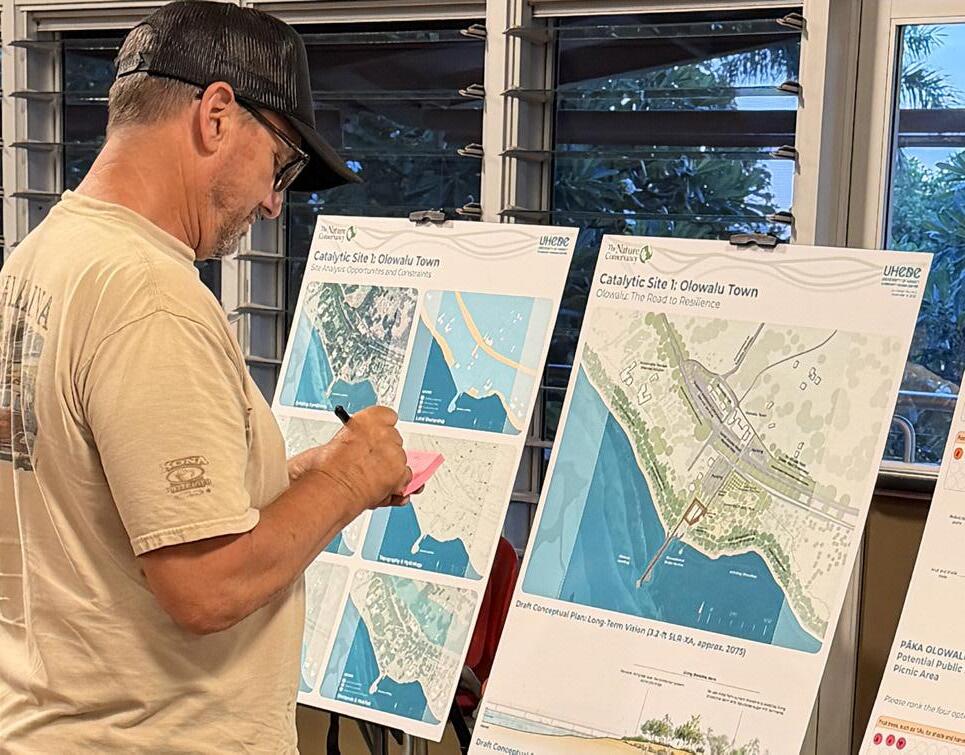
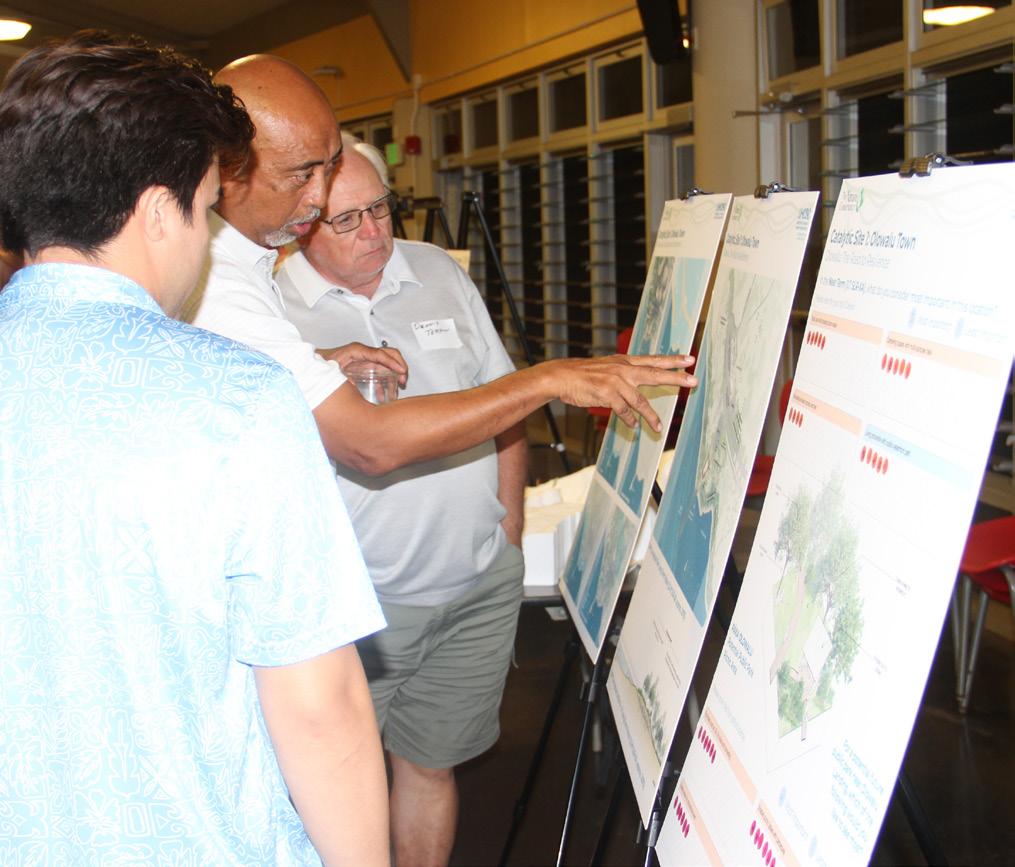
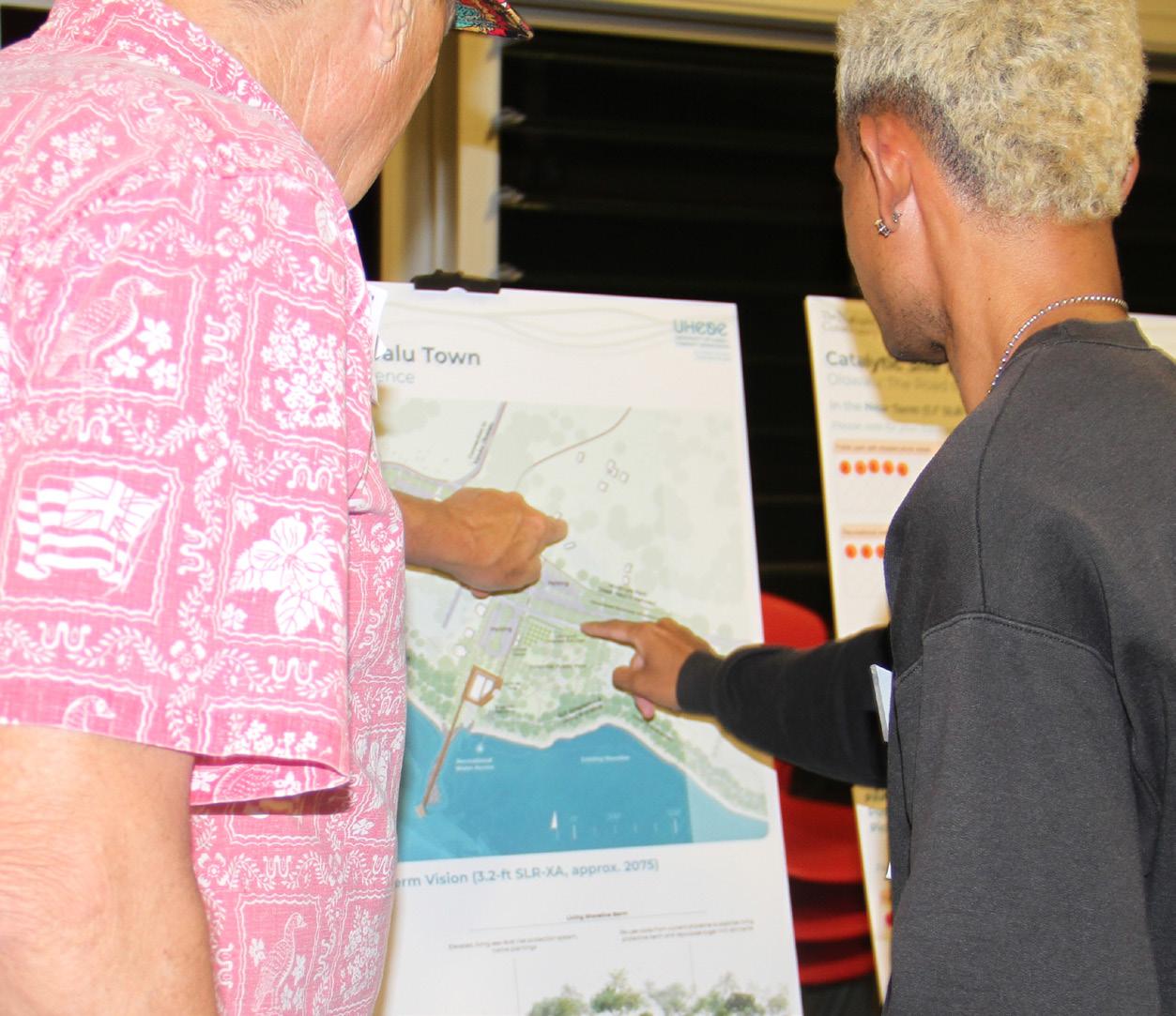
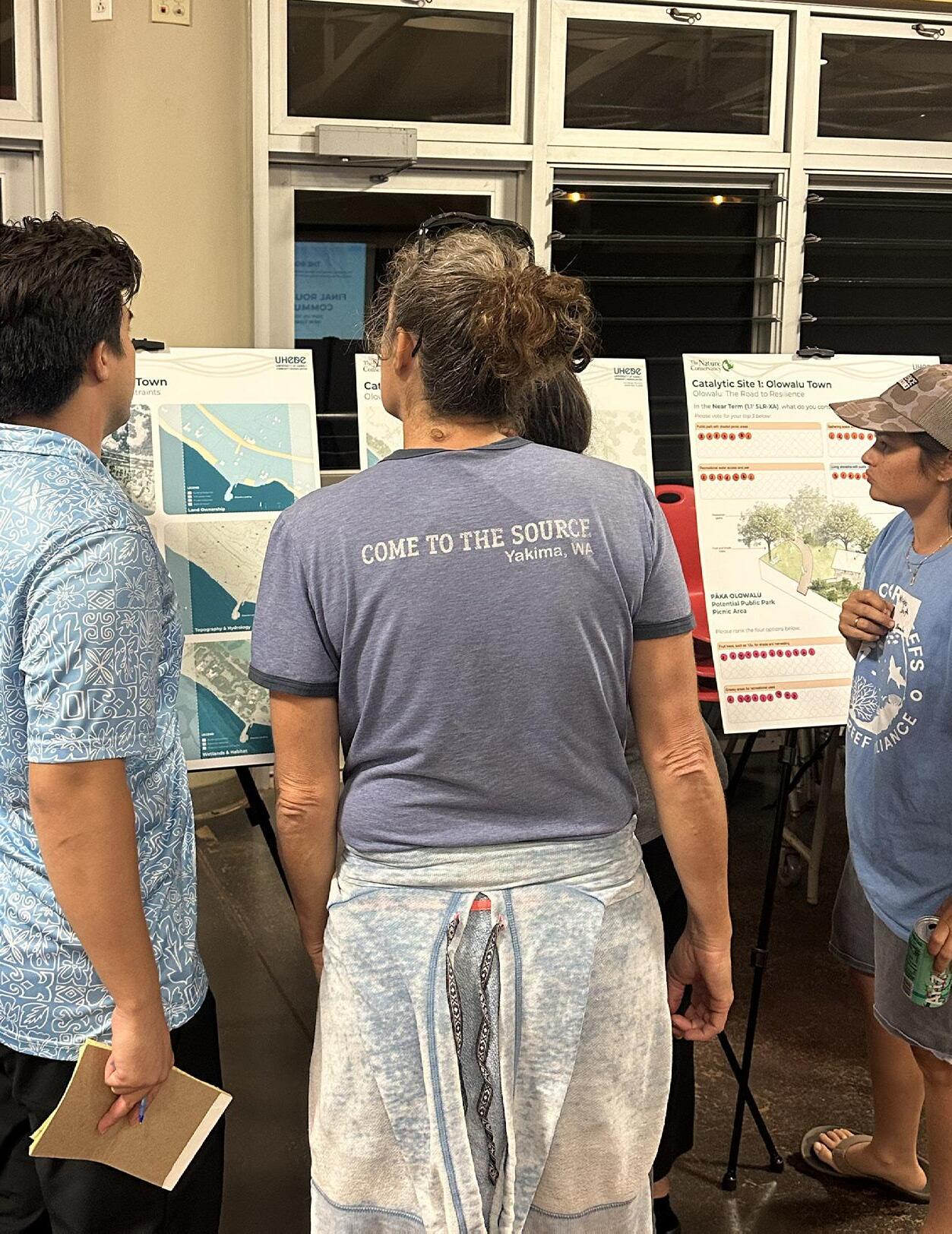
Workshop participants interacting with the Catalytic Site 1 boards (Images: UHCDC & TNC)
Provided Materials

Olowalu: The Road to Resilience

In the Near Term (1.1’ SLR-XA), what do you consider most important in this location?
Please vote for your top 3 below:
PĀKA OLOWALU
Potential Public Park Picnic Area
Please rank the four options below. Most Important Least Important 1 Most Important 3 Least Important 1
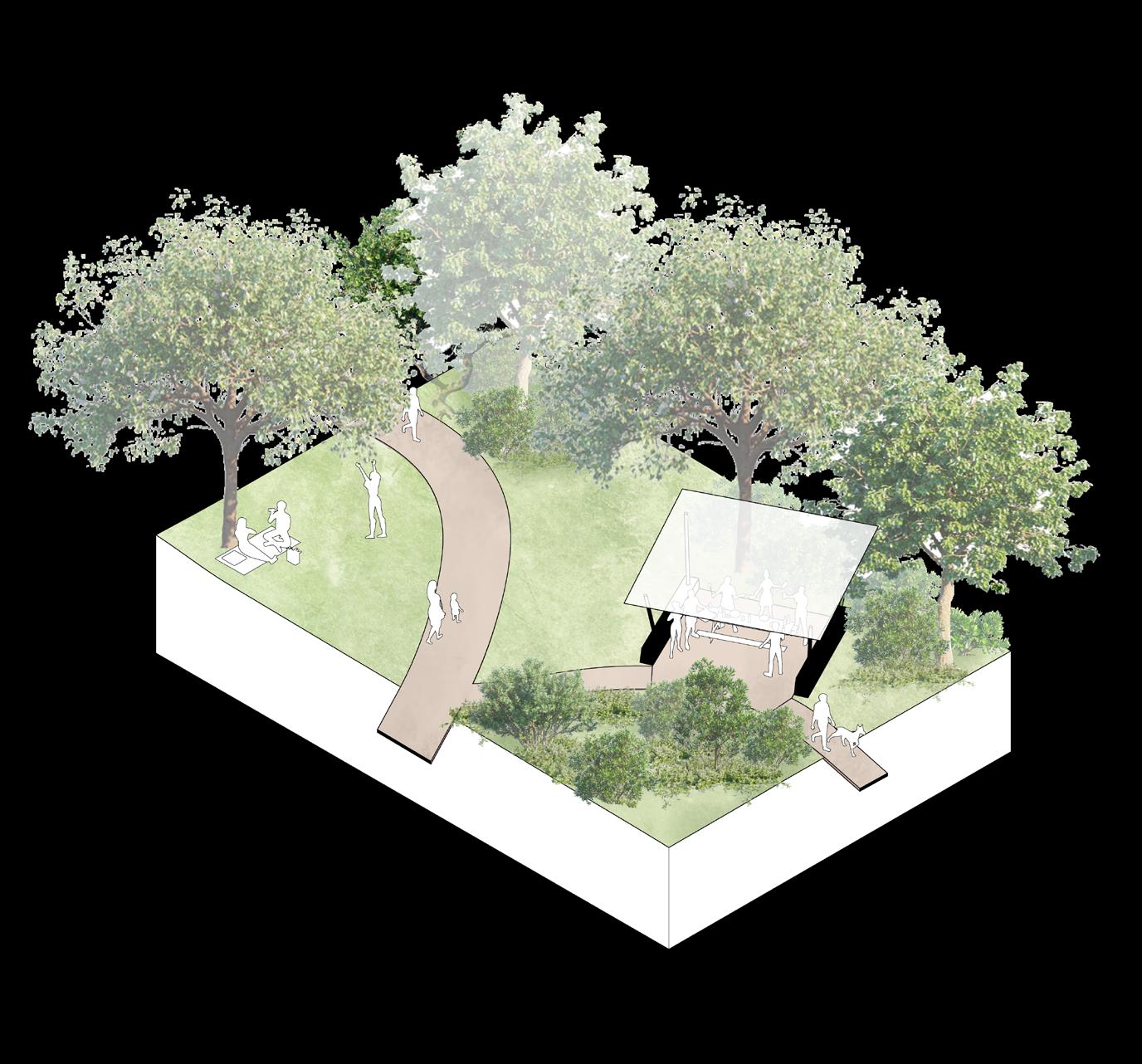
For a potential future public park near Olowalu Landing, which of the following would you like to see most?
Draft Conceptual Isometric Sketch (original presentation board size: 24” x 30”, reduced in scale for summary report)
Olowalu: The Road to Resilience
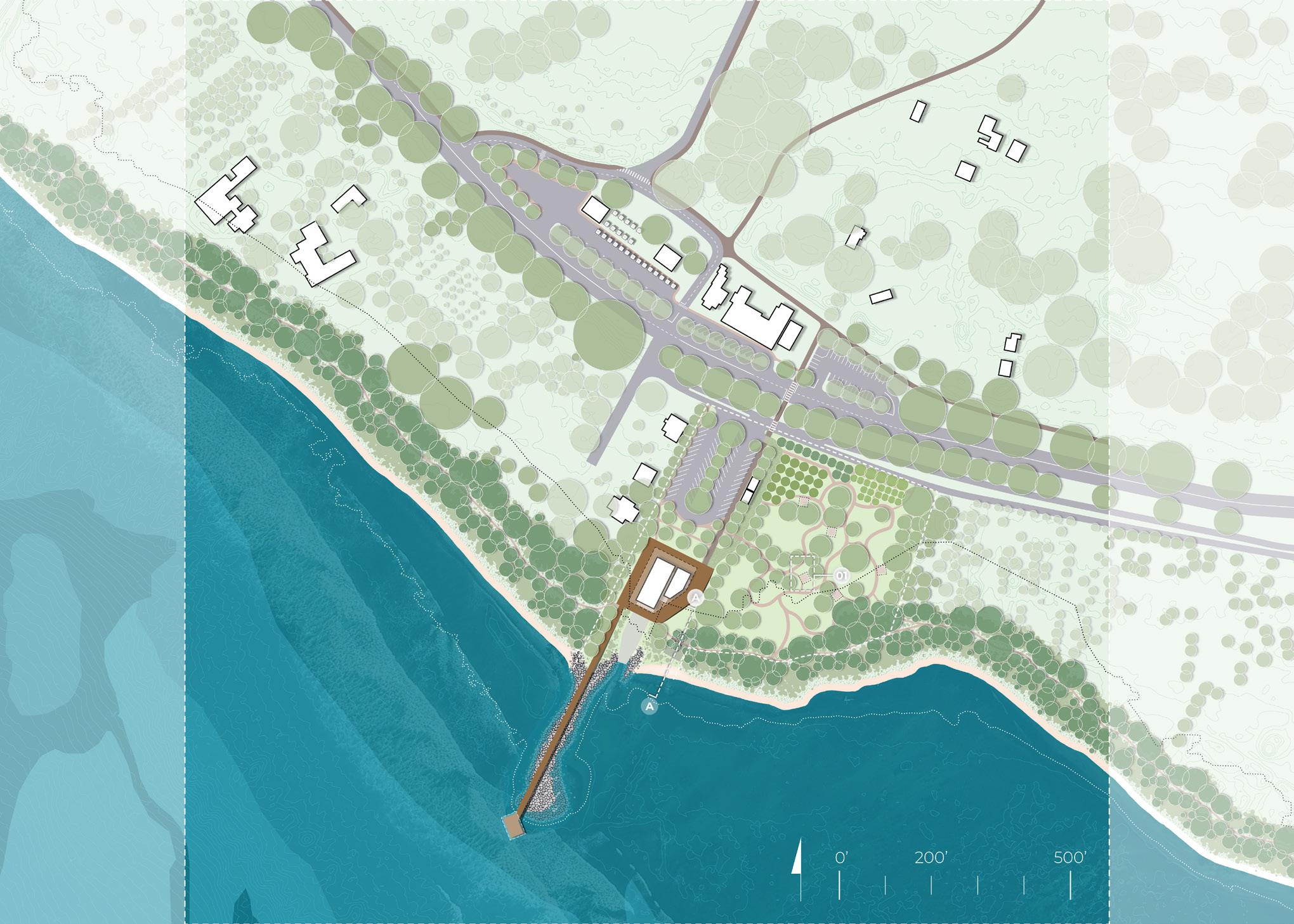
In-Person and Virtual Event Results (11/18/25, 11/20/25, 11/21/25)
The graphic below visually represents community and stakeholder feedback received during the in-person event. For transcribed additional comments, refer to the end of this chapter.
Olowalu: The Road to Resilience
In the Near Term (1.1’ SLR-XA), what do you consider most important in this location?
Please vote for your top 3 below:
3 Least Important 1
Potential Public Park
Picnic Area
For a potential future public park near Olowalu Landing, which of the following would you like to see most?
Please rank the four options below. Most Important Least Important 1
Dot Voting (original presentation board size: 24” x 30”, reduced in scale for summary report)
Attendees were asked to rank the options based on which they found most important at this location.
(11/20/25 , 11/21/25
# #
NEAR TERM (1.1’ SLR-XA) DOT VOTING:
3 = Most Important 1 = Least Important # # )
Public park with shaded picnic areas
Recreational water access and pier
Gathering space with multi-purpose hale Living shoreline with public waterfront park
POTENTIAL FUTURE PUBLIC PARK NEAR OLOWALU LANDING DOT VOTING:
4 = Most Important 1 = Least Important
Fruit trees, such as ‘Ulu, for shade and harvesting
Shaded picnic tables with barbecues
Grassy areas for recreational uses
paths for walking and exercise
CATALYTIC SITE 1
Catalytic Site 1 Feedback Summary and Synthesis
This summary includes all feedback acquired at both the in-person and virtual events. The information gathered is based on the provided draft conceptual plan, section and isometric drawings.
11/18/25 11/20/25 11/21/25
NEAR-TERM COMMUNITY PRIORITIES (1.1’ SLR-XA, APPROX. 2045) :
98
Living shoreline with public waterfront park
49
Recreational water access and pier
44
Gathering space with multi-purpose hale
43
Public park with shaded picnic areas
COMMUNITY PREFERENCES FOR POTENTIAL PUBLIC PARK PROGRAMS
Fruit trees, such as ‘Ulu, for shade and harvesting
Pedestrian paths for walking and exercise
Grassy areas for recreation uses
121
107
83
80
Shaded picnic tables with barbecues
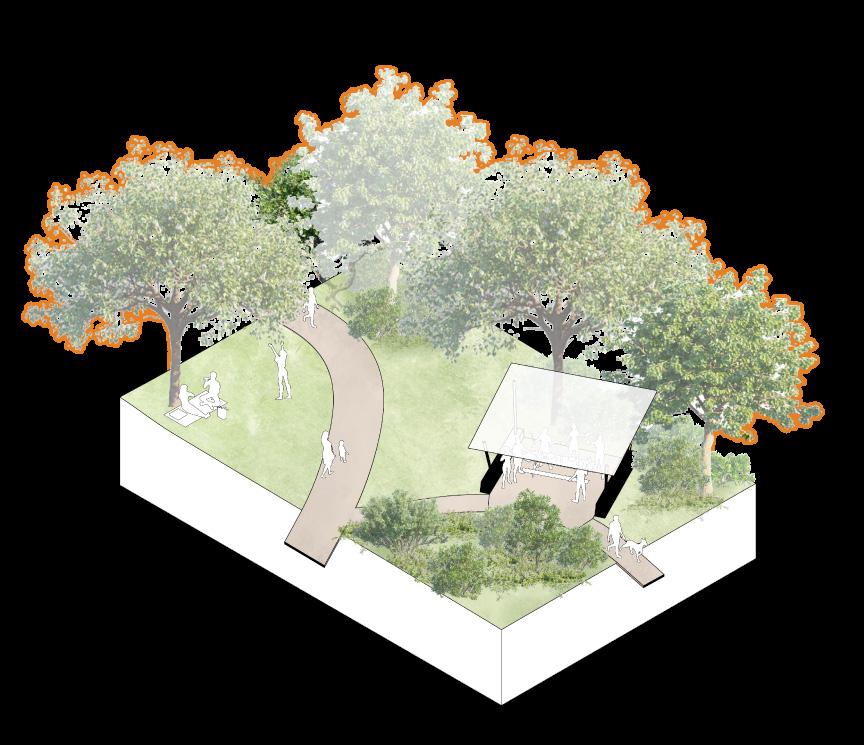
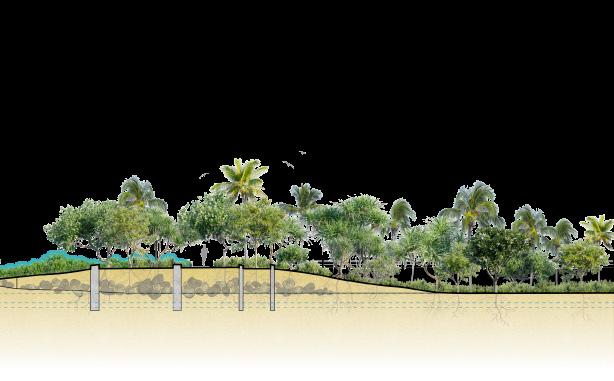
The third activity focused on Catalytic Site 2: Mile Marker 14, an area heavily used for snorkeling and coastal recreation. During the in-person event, the project team provided participants with large-format presentation boards (24”x30”) featuring maps and diagrams that outlined existing conditions, challenges, and opportunities for the area.
The site was introduced through a series of analysis maps highlighting:
• Existing conditions
• Land ownership
• Topography and hydrology
• Wetlands and habitat
• 1.1’ sea-level rise exposure area impacts
• 3.2’ sea-level rise exposure area impacts
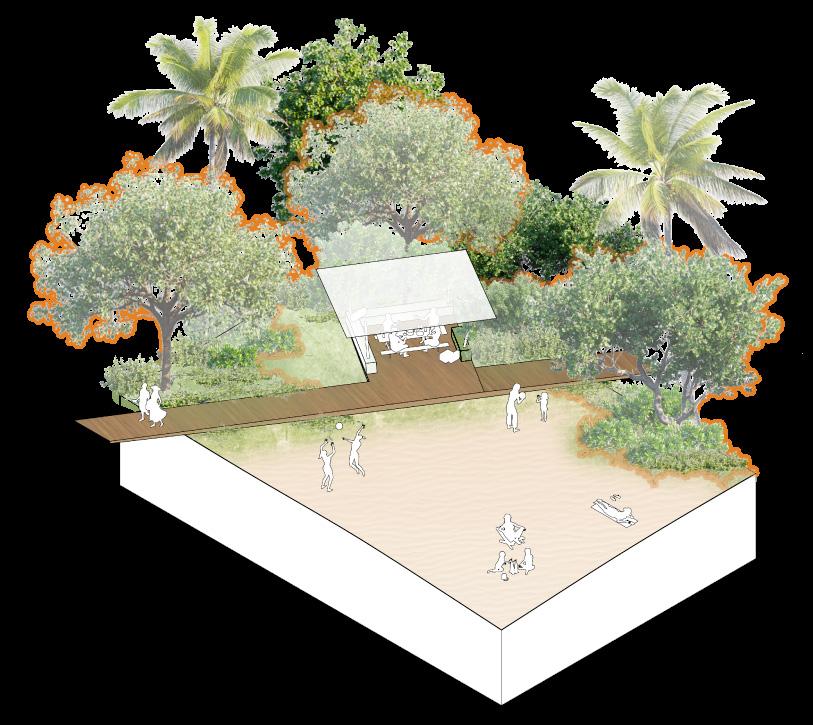
The project team encouraged community members to evaluate and respond to proposed final draft design interventions for long-term (3.2’ SLR-XA, approximately 2075) sea-level rise scenarios. Participants voted on their top 3 near-term priorities that they would like to see implemented first in this location. Additionally, participants were asked to rank their preferences for potential public beach park elements that would be implemented in the long term.
The results and feedback gathered during this activity helped identify shared priorities and will guide a final proof-of-concept vision for the catalytic site.
Materials included in this section:
Engagement Event Activity Photos
Draft Conceptual Design Sketches - Long Term (Materials Provided to Participants)
Long Term Draft Conceptual Design Sketch (In-Person and Virtual Results)
Feedback Summary and Synthesis
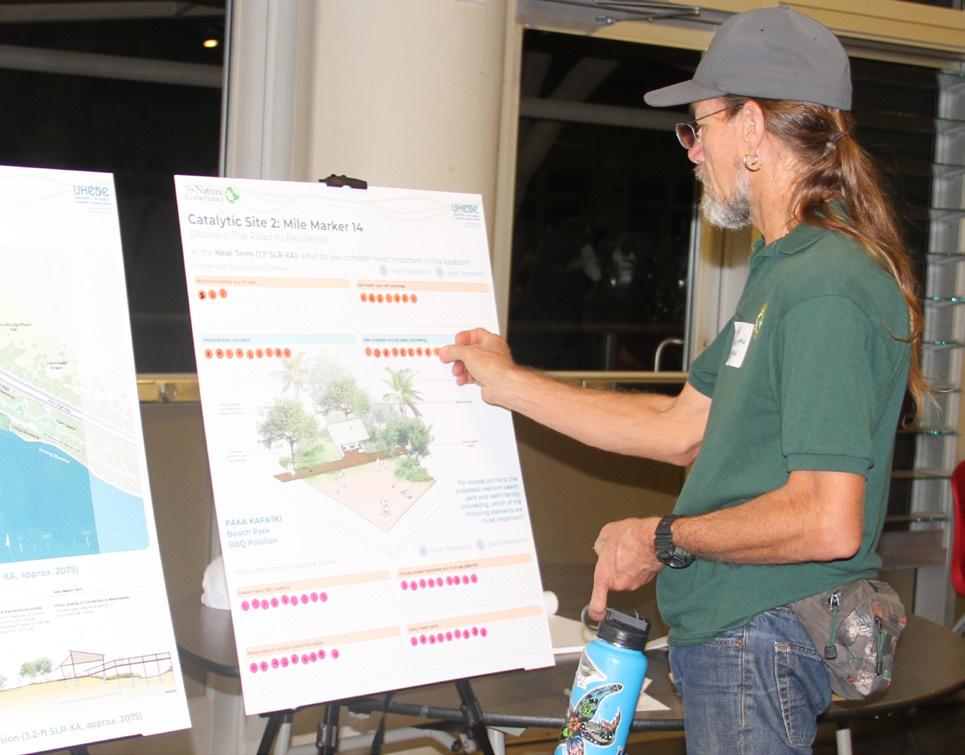
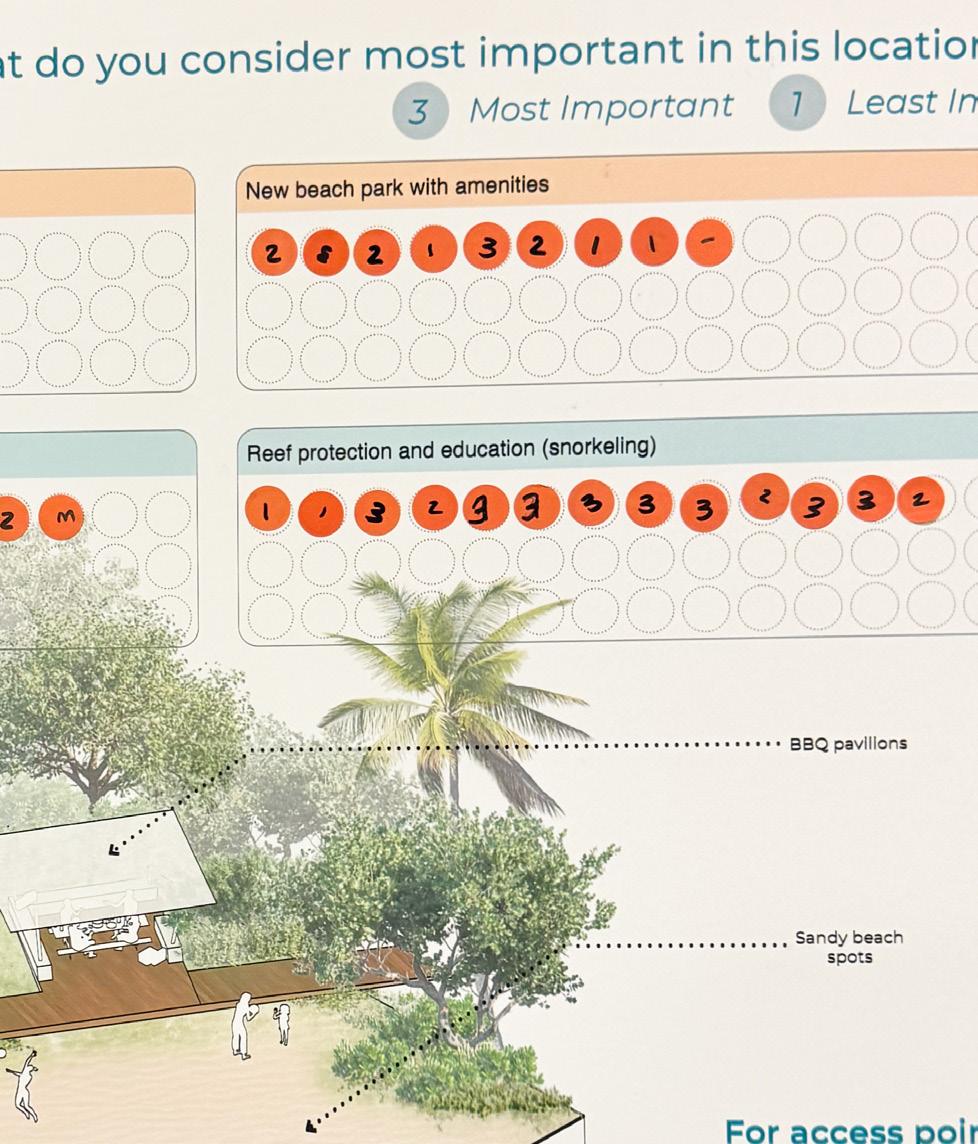
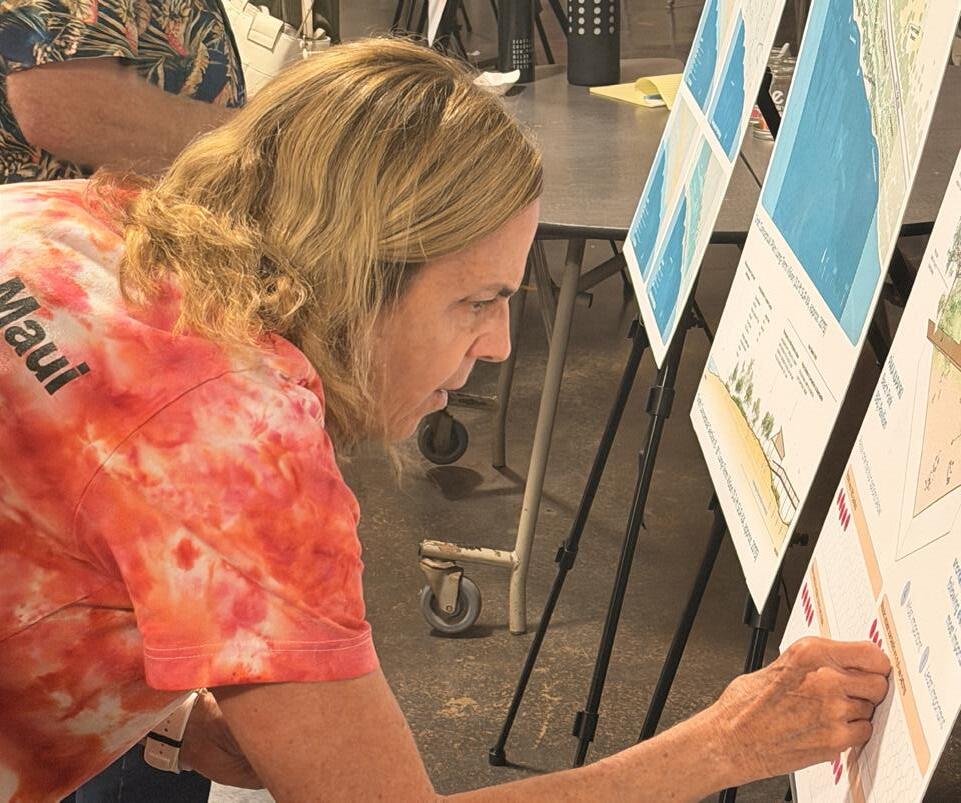
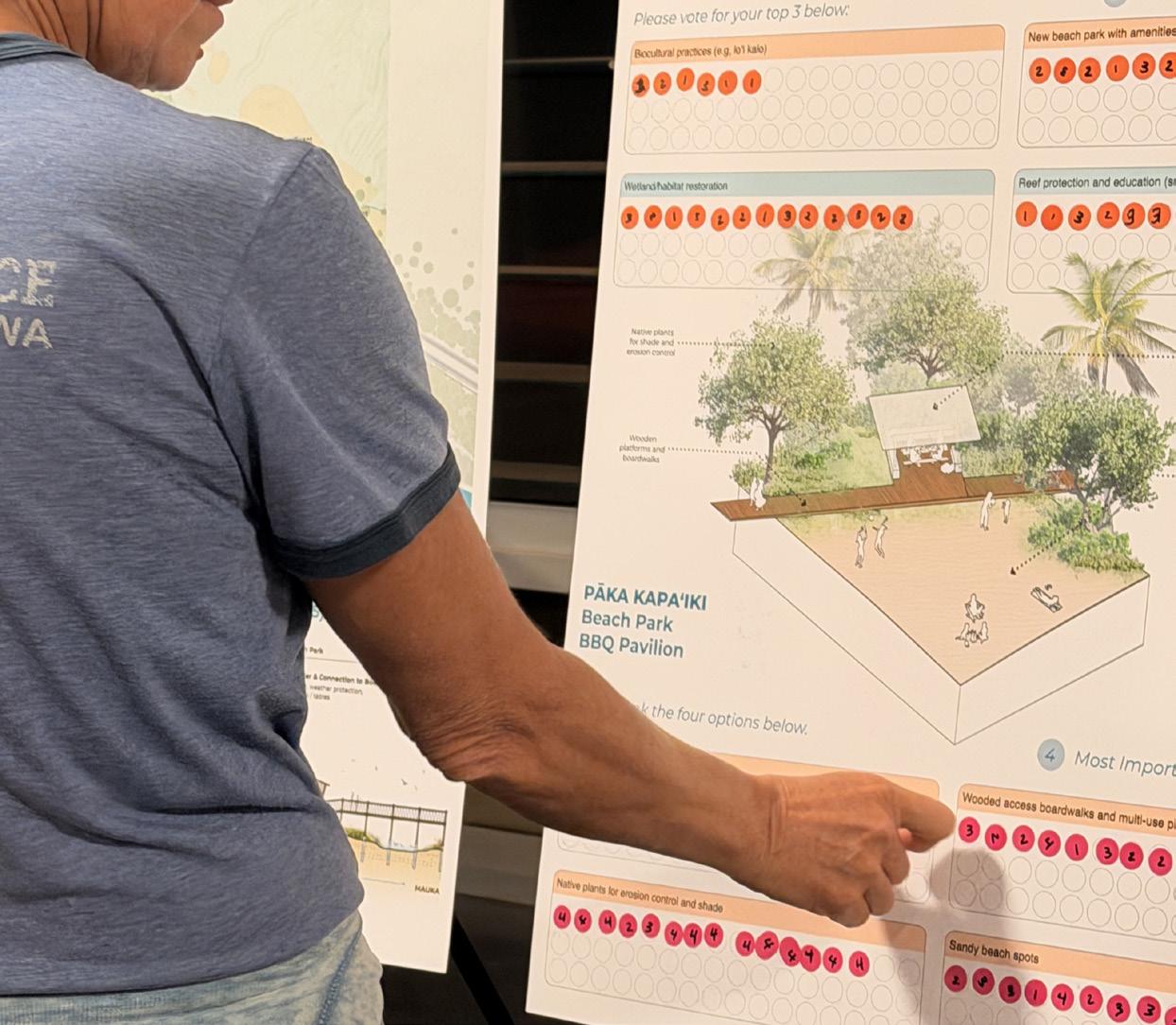
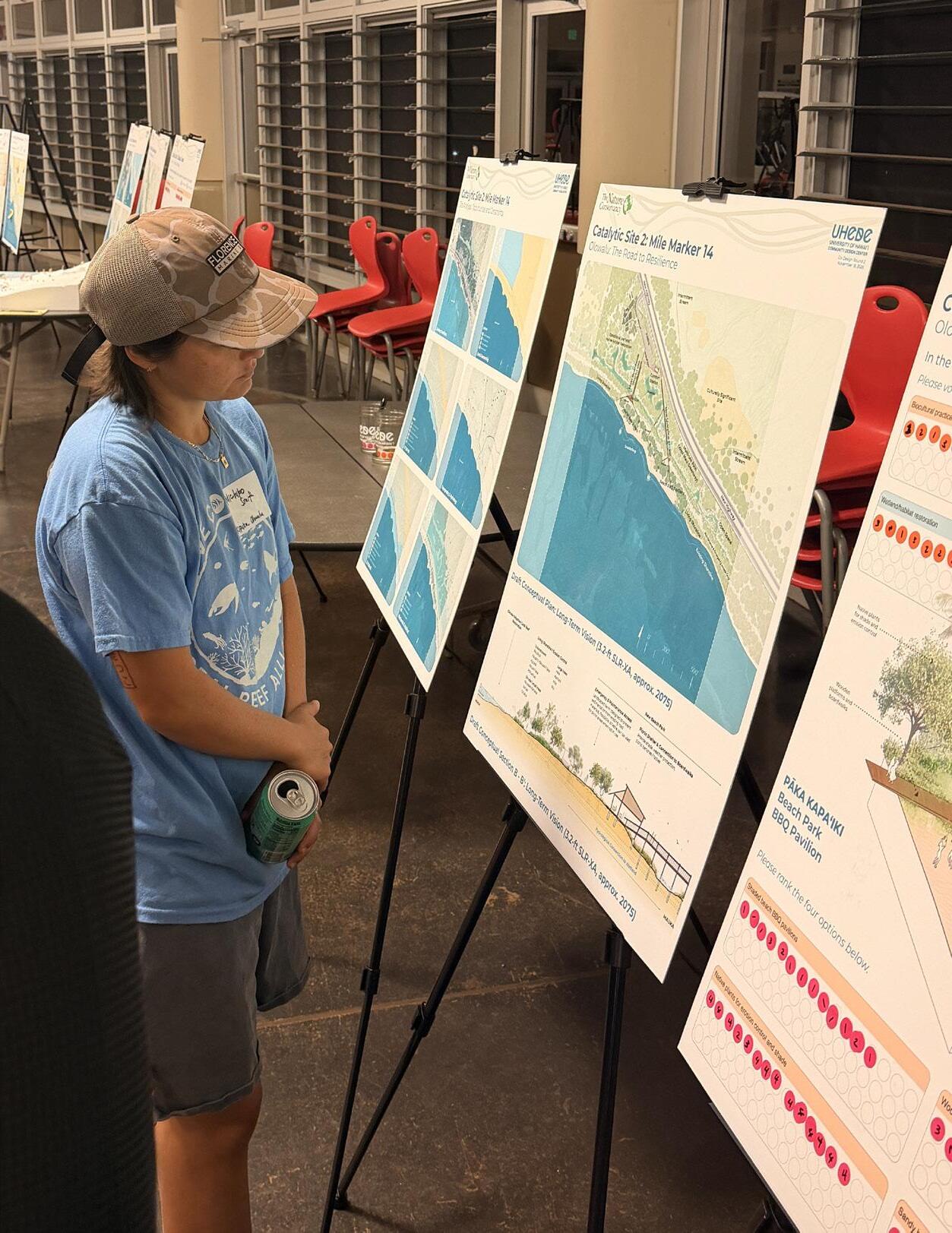
Workshop participants interacting with the Catalytic Site 2 boards (Images: UHCDC & TNC)
Provided Materials
In the Near Term (1.1’ SLR-XA), what do you consider most important in this location?
Please vote for your top 3 below:
1
Beach Park
BBQ Pavilion
Please rank the four options below.
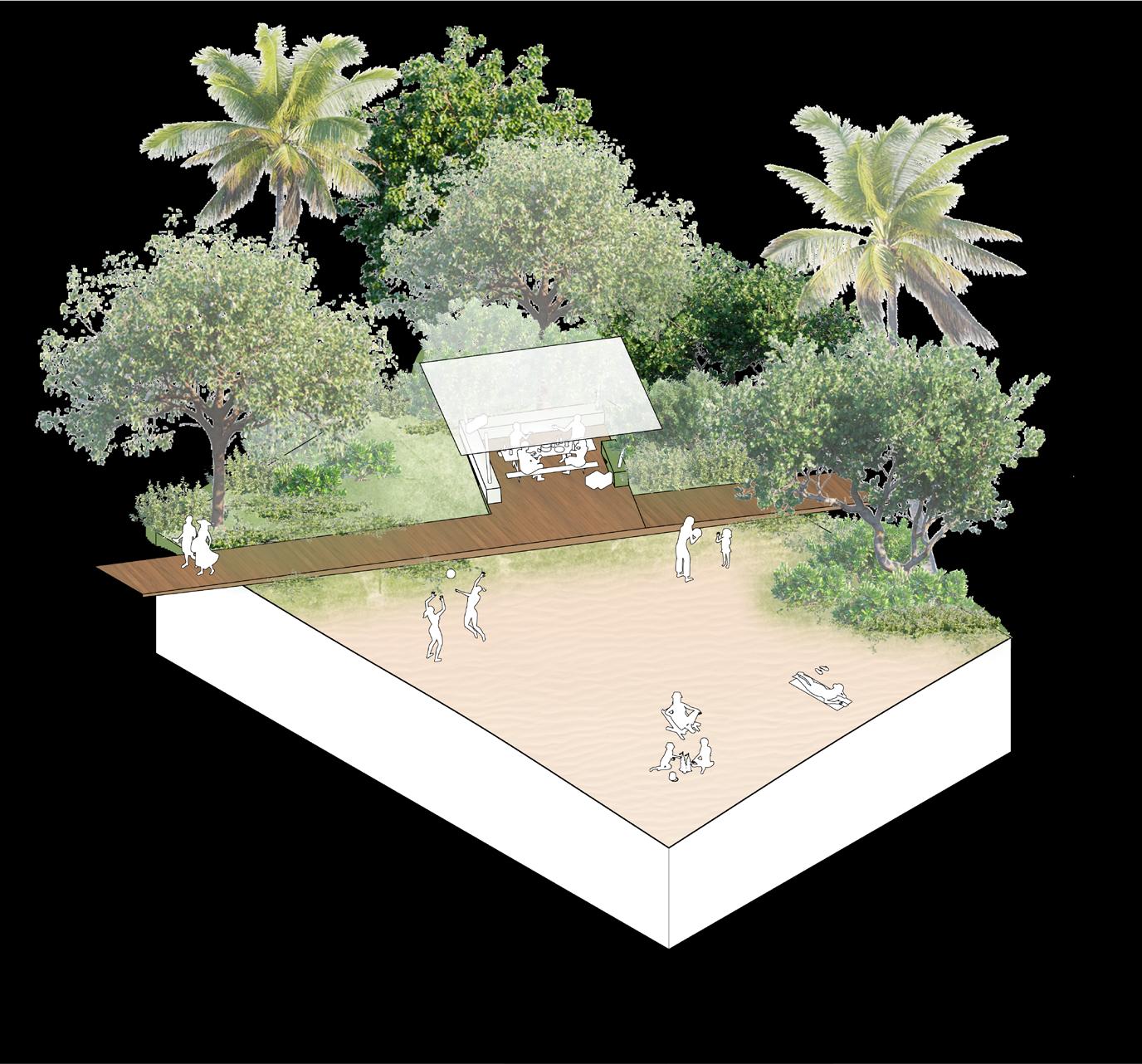
For access points to the proposed, resilient beach park and reef-friendly snorkeling, which of the following elements are most important?
1
Olowalu: The Road to Resilience
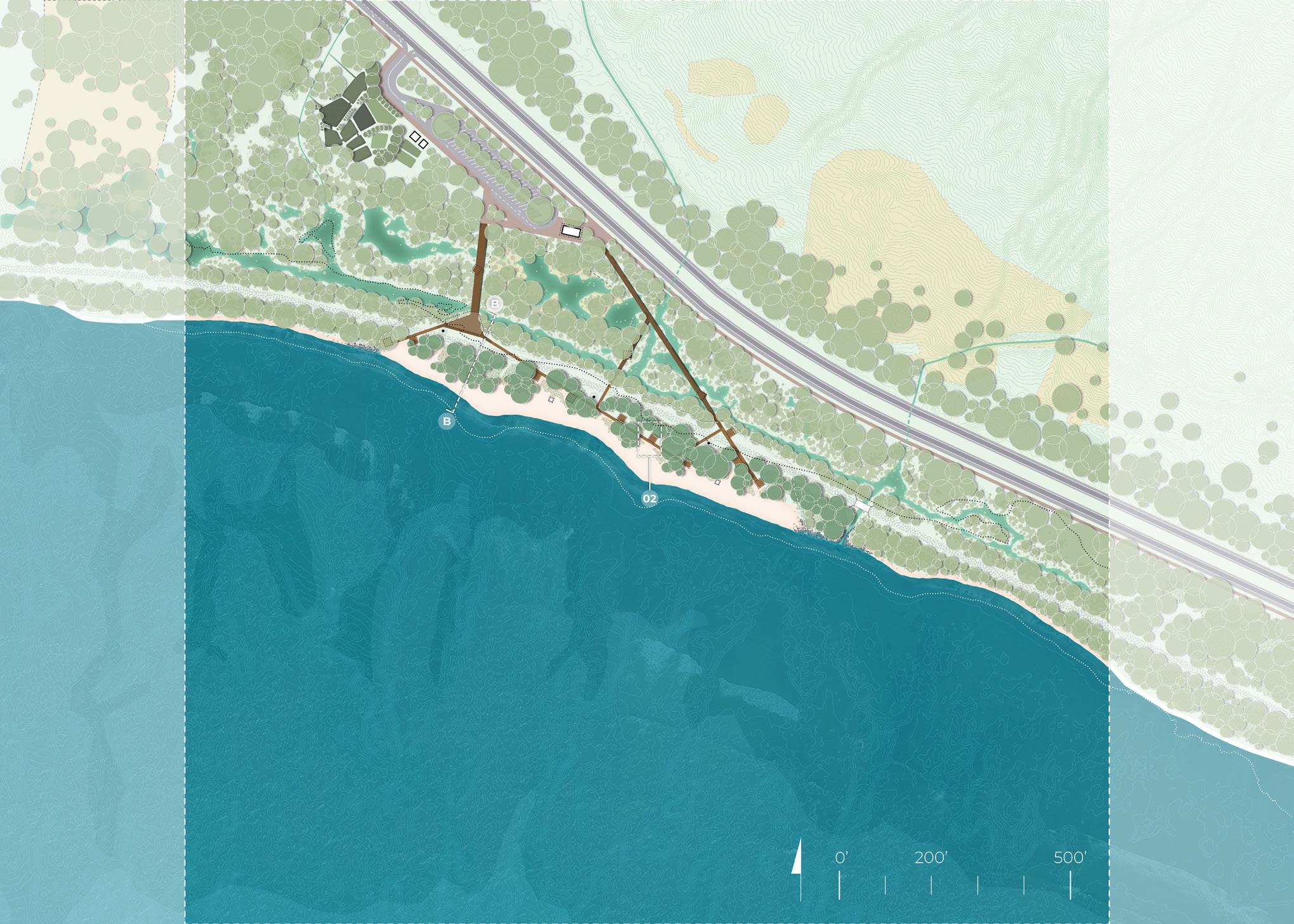
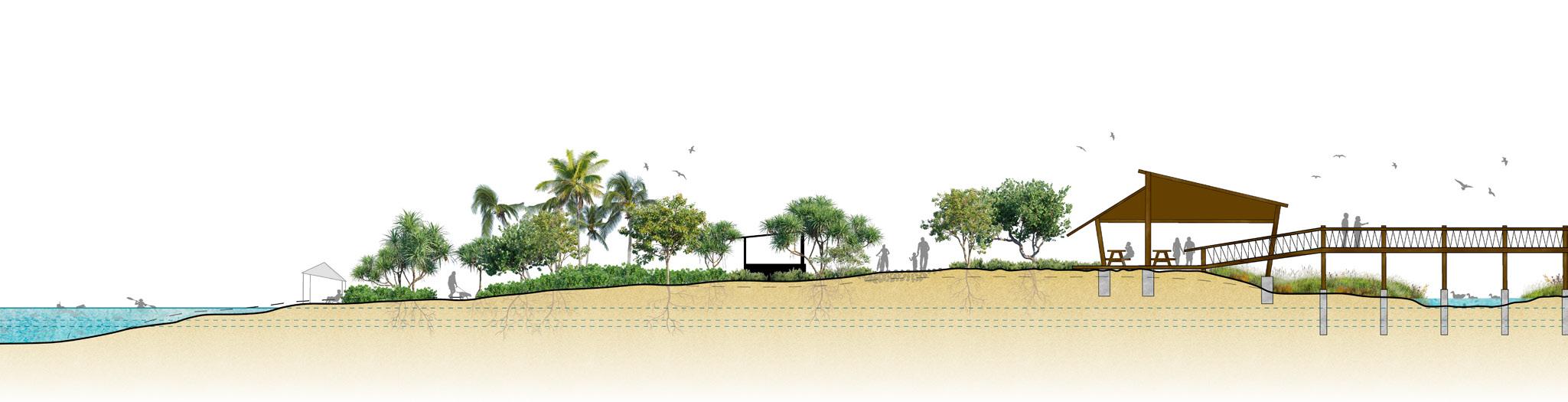
In-Person and Virtual Event Results (11/18/25, 11/20/25, 11/21/25)
The graphic below visually represents community and stakeholder feedback received during the in-person event. For transcribed additional comments, refer to the end of this chapter.
In the Near Term (1.1’ SLR-XA), what do you consider most important in this location?
Please vote for your top 3 below:
Please rank the four options below.
For access points to the proposed, resilient beach park and reef-friendly snorkeling, which of the following elements are most important?
Voting (original presentation board size: 24” x 30”, reduced in scale for summary report)
Attendees were asked to rank the options based on which they found most important at this location.
NEAR TERM (1.1’ SLR-XA) DOT VOTING:
3 = Most Important 1 = Least Important
Biocultural practices (e.g, loʻi kalo)
Wetland/habitat restoration
POTENTIAL
4 = Most Important 1 = Least Important (11/20/25 , 11/21/25 # # ) # #
Shaded beach BBQ pavilions
New beach park with amenities
Reef protection and education (snorkeling)
Native plants for erosion control and shade
Wooden access boardwalks and multi-use platforms
Catalytic Site 2 Feedback Summary and Synthesis
This summary includes all feedback acquired at both the in-person and virtual events. The information gathered is based on the provided draft conceptual plan, section and isometric drawings.
11/18/25 11/20/25 11/21/25
NEAR-TERM COMMUNITY PRIORITIES (1.1’ SLR-XA, APPROX. 2045) :
Wetland/habitat restoration
97
75
Reef protection and education (snorkeling)
44
Biocultural practices (e.g, loʻi kalo)
37
New beach park with amenities
COMMUNITY PREFERENCES FOR PROPOSED BEACH PARK
Native plants for erosion control and shade
Wooden access boardwalks and multi-use platforms
Sandy beach spots
98
98
61
Shaded beach BBQ pavilions
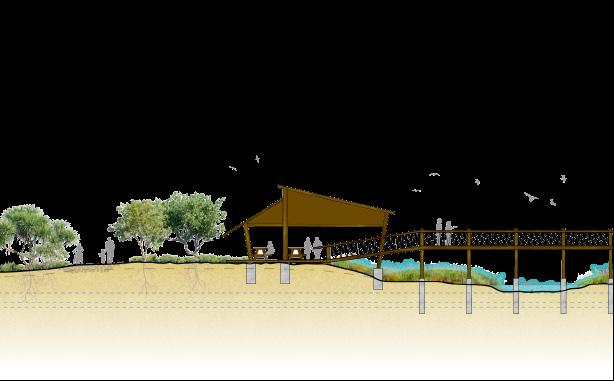
The fourth activity focused on Catalytic Site 3: Ukumehame Beach Park and Wetlands, an area that already experiences the impacts of sea-level rise. During the in-person event, the project team provided participants with large-format presentation boards (24”x30”) featuring maps and diagrams that outlined existing conditions, challenges, and opportunities for the area.
The site was introduced through a series of analysis maps highlighting:
• Existing conditions
• Land ownership
• Topography and hydrology
• Wetlands and habitat
• 1.1’ sea-level rise exposure area impacts
• 3.2’ sea-level rise exposure area impacts
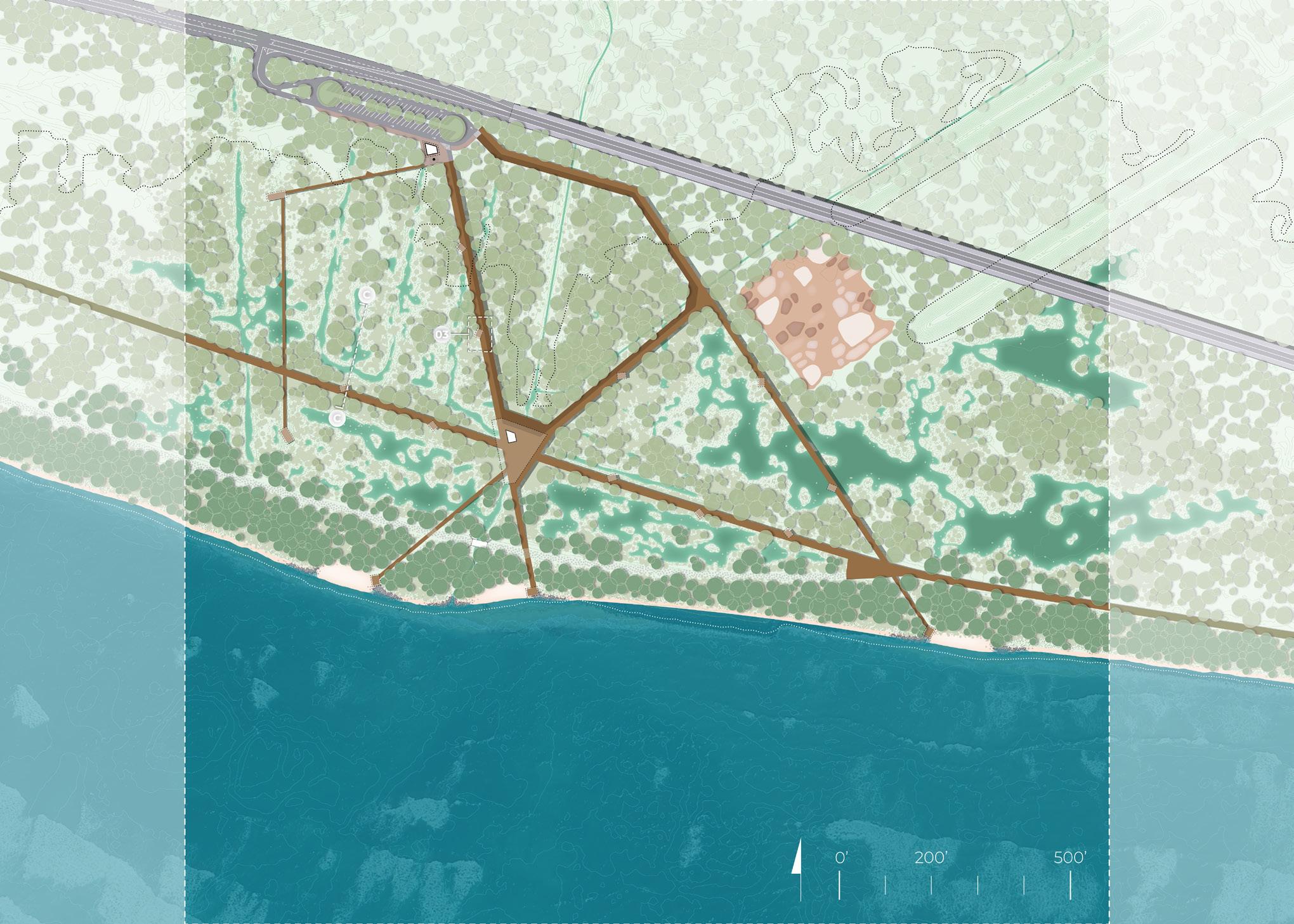
The project team encouraged community members to evaluate and respond to proposed final draft design interventions for long-term (3.2’ SLR-XA, approximately 2075) sea-level rise scenarios. Participants voted on their top 3 near-term priorities that they would like to see implemented first in this location. Additionally, participants were asked to rank their preferences for a shared drivable boardwalk.
The results and feedback gathered during this activity helped identify shared priorities and will guide a final proof-of-concept vision for the catalytic site.
Materials included in this section:
Engagement Event Activity Photos
Draft Conceptual Design Sketches - Long Term (Materials Provided to Participants)
Long Term Draft Conceptual Design Sketch (In-Person and Virtual Results)
Feedback Summary and Synthesis
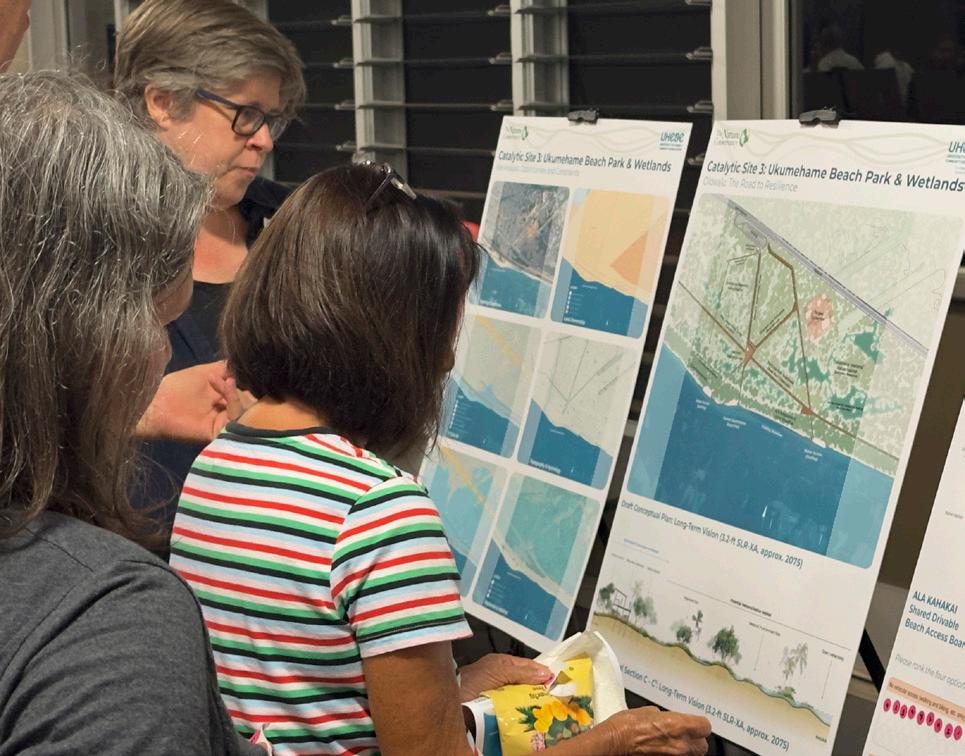
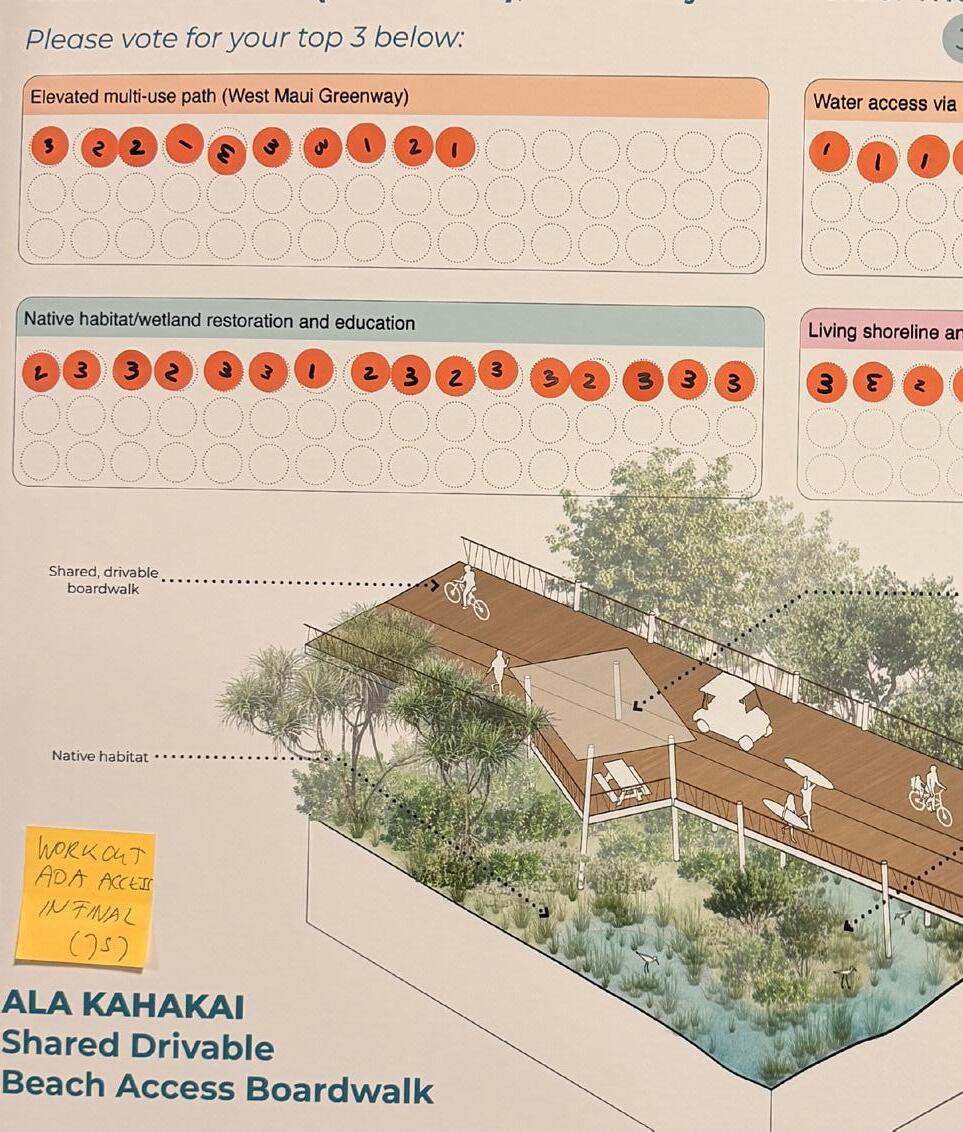
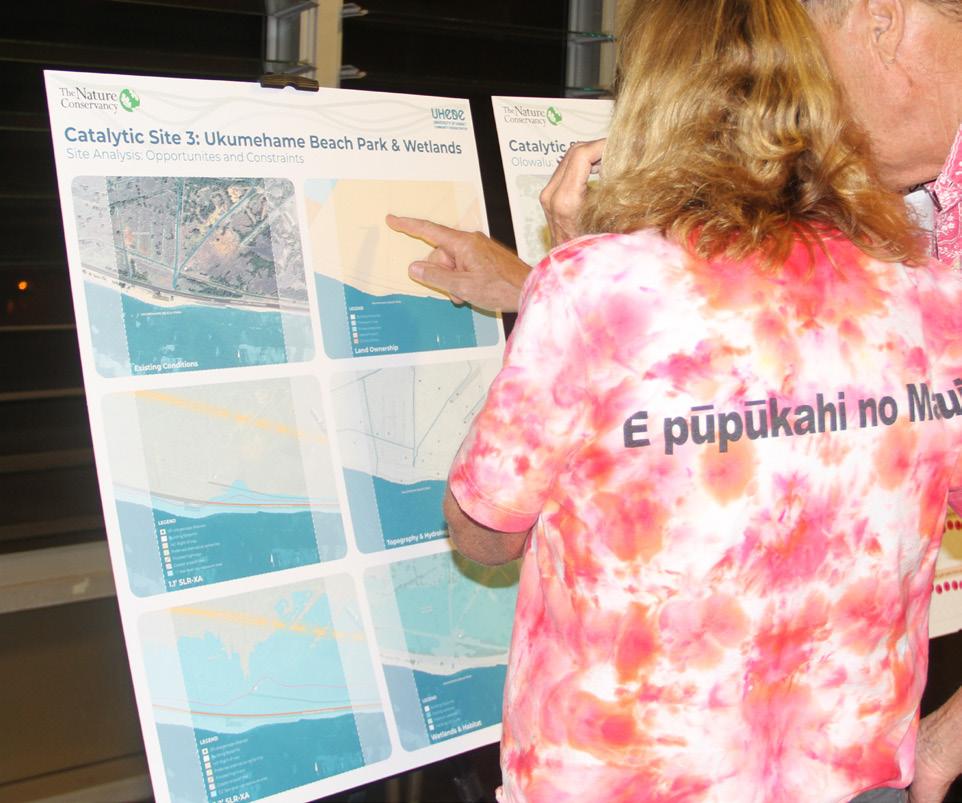
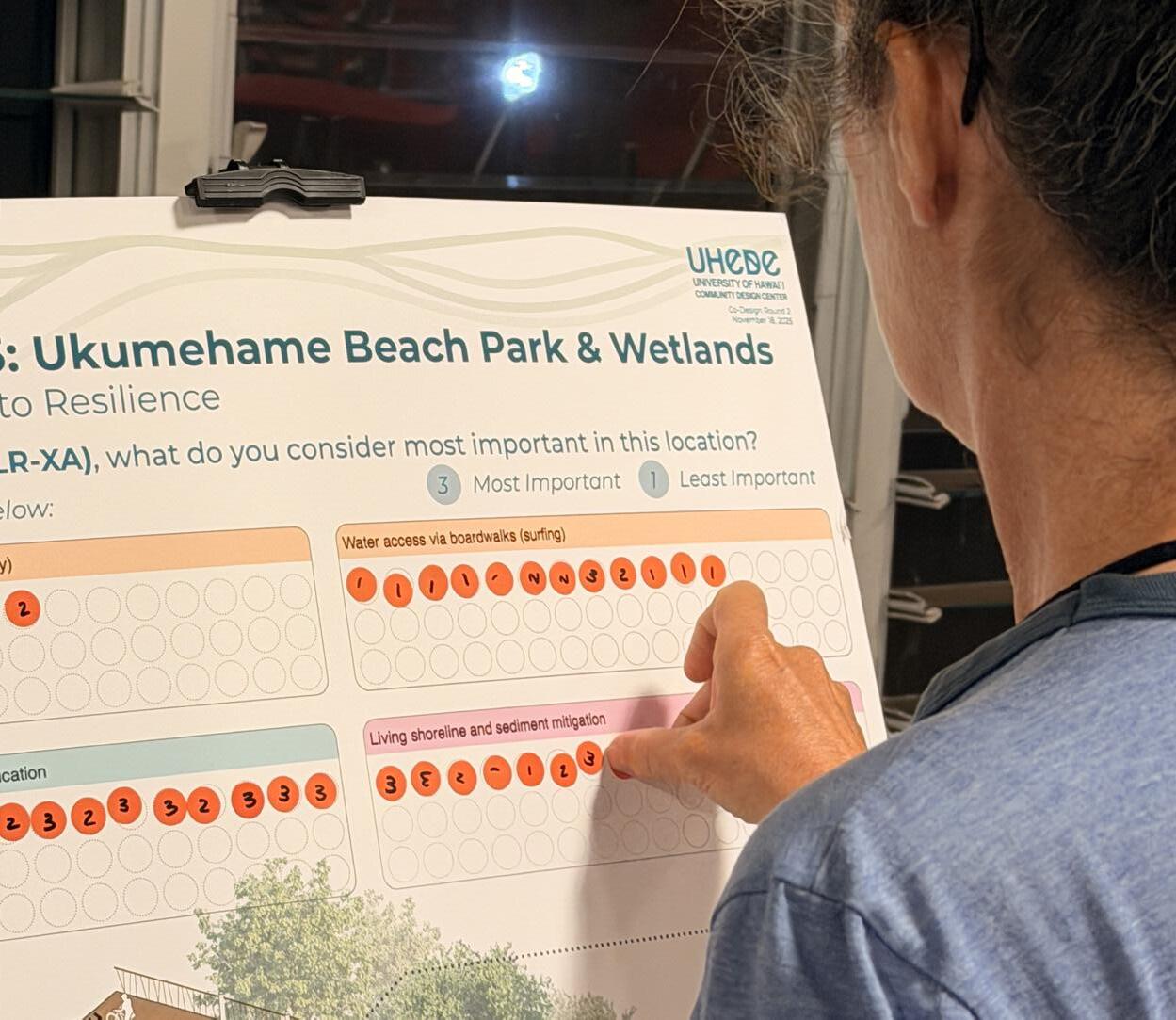
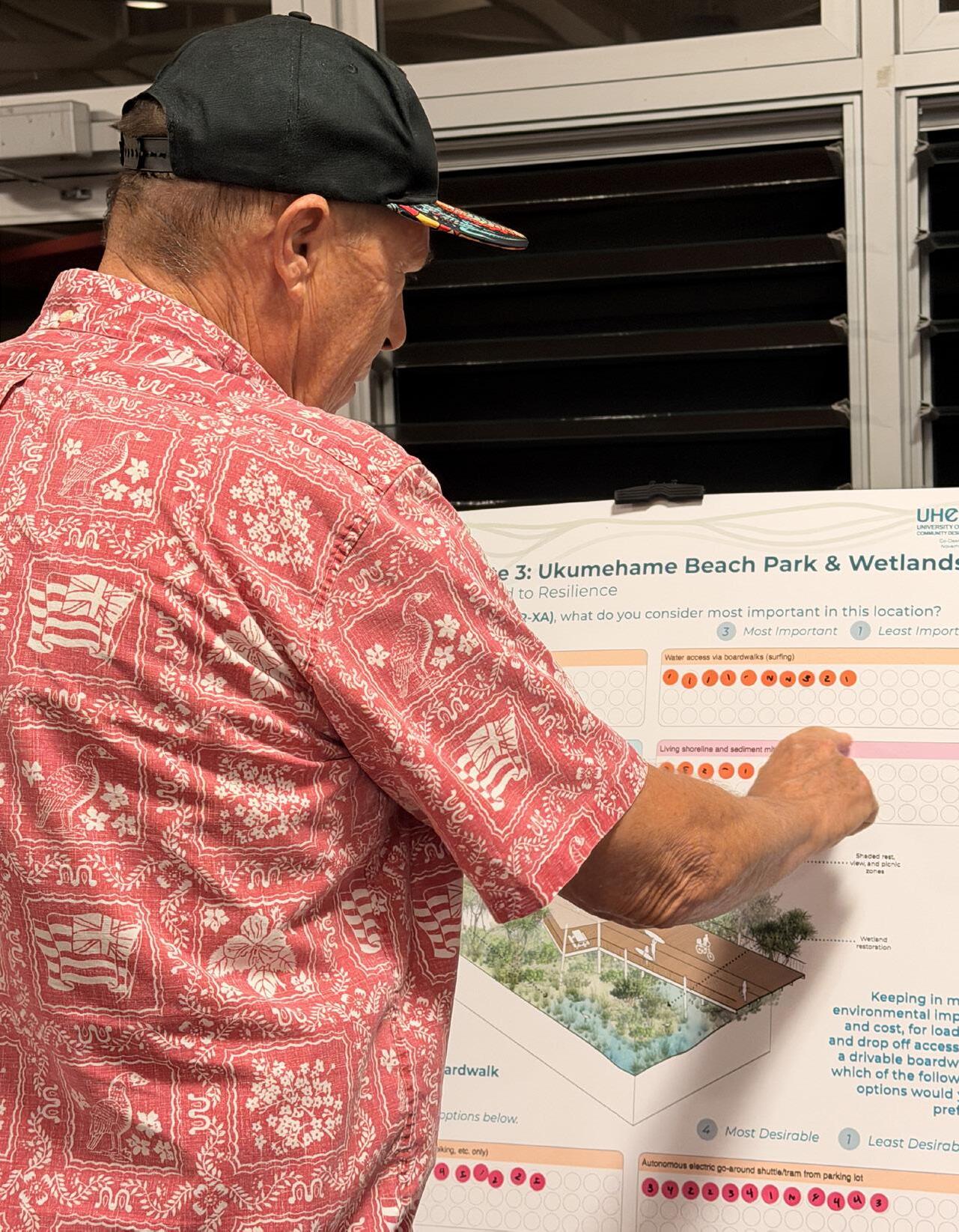
Workshop participants interacting with the Catalytic Site 3 boards (Images: UHCDC & TNC)
CATALYTIC SITE 3
Provided Materials
Olowalu: The Road to Resilience
In the Near Term (1.1’ SLR-XA), what do you consider most important in this location?
Please vote for your top 3 below:
Most Important 3 Least Important 1
Shared Drivable Beach Access Boardwalk
Please rank the four options below.
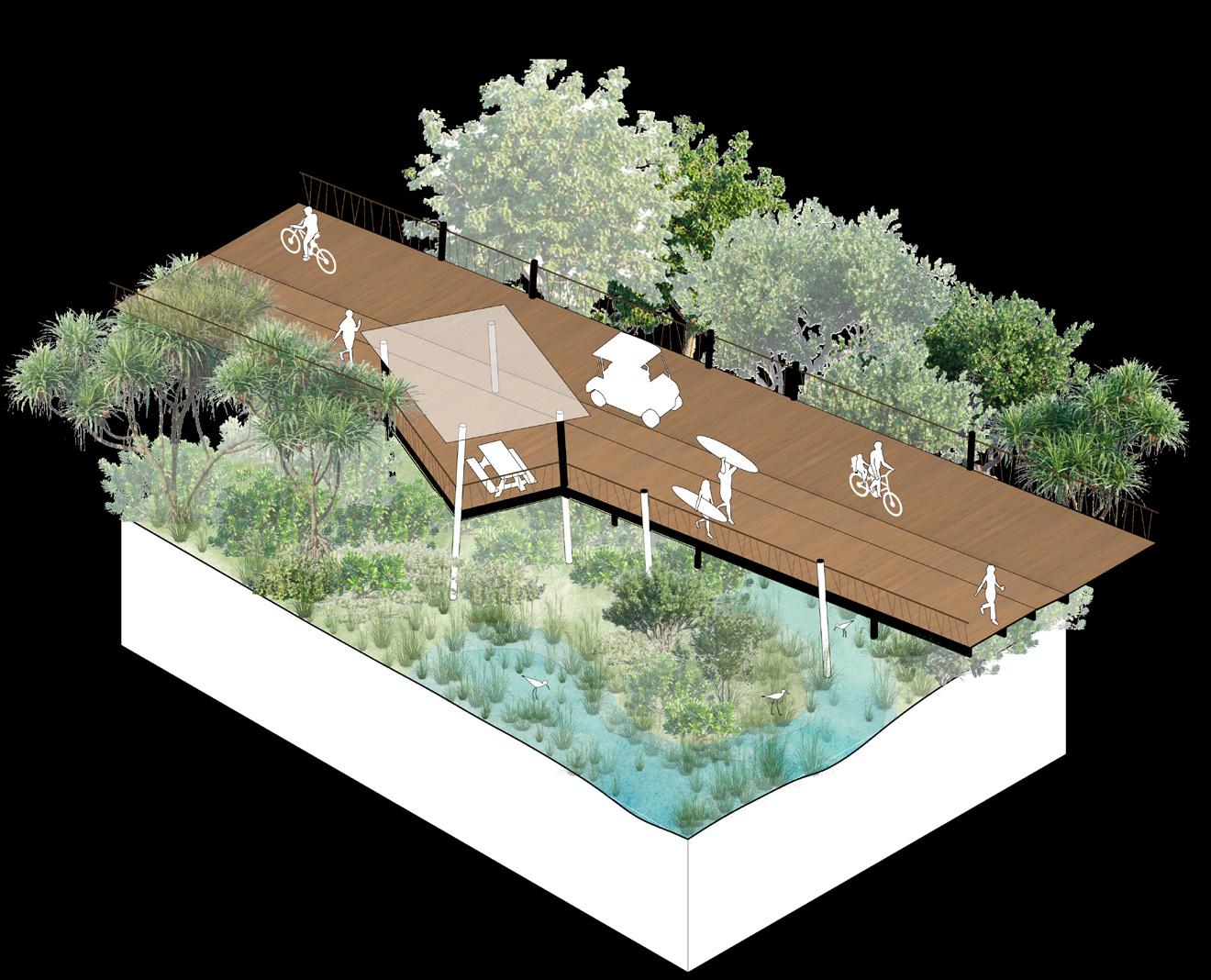
Keeping in mind environmental impact and cost, for loading and drop off access via a drivable boardwalk, which of the following options would you prefer?
Most Desirable 4 Least Desirable 1
Olowalu: The Road to Resilience
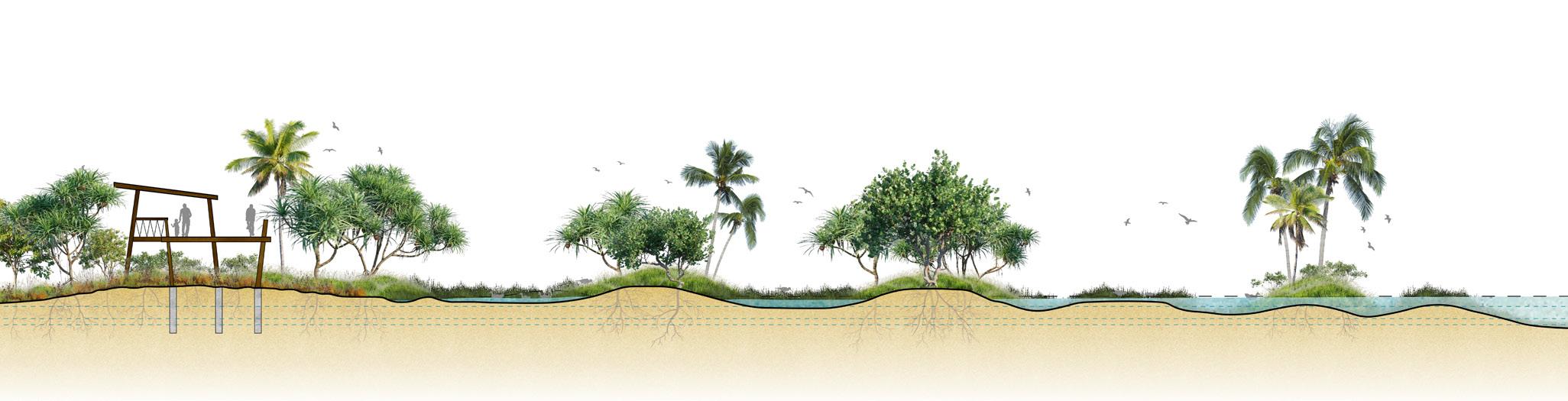
In-Person and Virtual Event Results (11/18/25, 11/20/25, 11/21/25)
The graphic below visually represents community and stakeholder feedback received during the in-person event. For transcribed additional comments, refer to the end of this chapter.
In the Near Term (1.1’ SLR-XA), what do you consider most important in this location?
Please vote for your top 3 below:
Please rank the four options below.
Keeping in mind environmental impact and cost, for loading and drop off access via a drivable boardwalk, which of the following options would you prefer?
Attendees were asked to rank the options based on which they found most important at this location.
(11/20/25 , 11/21/25 # # ) # #
NEAR TERM (1.1’ SLR-XA) DOT VOTING:
3 = Most Important 1 = Least Important
Elevated multi-use path (West Maui Greenway) Water access via boardwalks (surfing)
Native habitat/wetland restoration and education
Living shoreline and sediment mitigation
4 = Most Important 1 = Least Important
No vehicular access (walking and biking, etc. only)
Shared electric golf carts from parking lot Autonomous
POTENTIAL SHARED DRIVABLE BEACH ACCESS BOARDWALK DOT VOTING: Individual cars
Catalytic Site 3 Feedback Summary and Synthesis
This summary includes all feedback acquired at both the in-person and virtual events. The information gathered is based on the provided draft conceptual plan, section and isometric drawings.
11/18/25 11/20/25 11/21/25
NEAR-TERM COMMUNITY PRIORITIES (1.1’ SLR-XA, APPROX. 2045) :
Native habitat/wetland restoration and education 72
Living shoreline and sediment mitigation
Elevated multi-use path (West Maui Greenway)
38
Water access via boardwalks (surfing) 89
COMMUNITY PREFERENCES FOR SHARED DRIVABLE BOARDWALK
Autonomous electric go-around shuttle/tram from parking lot 125
No vehicular access (walking and biking, etc. only) 124
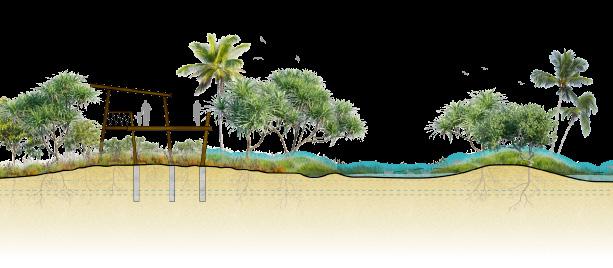
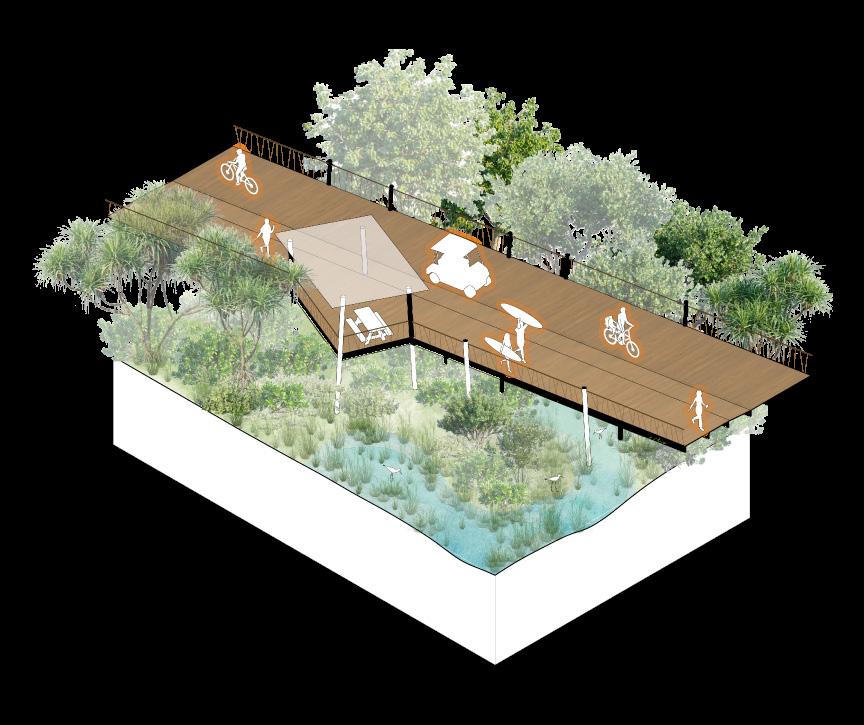
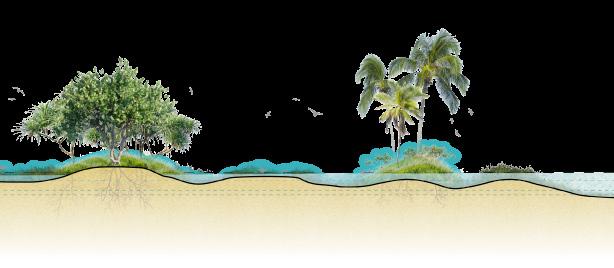
Shared electric golf carts from parking lot
Individual cars 112
The identification of top community priorities per catalytic site is based on combined results from all three round-two co-design events.
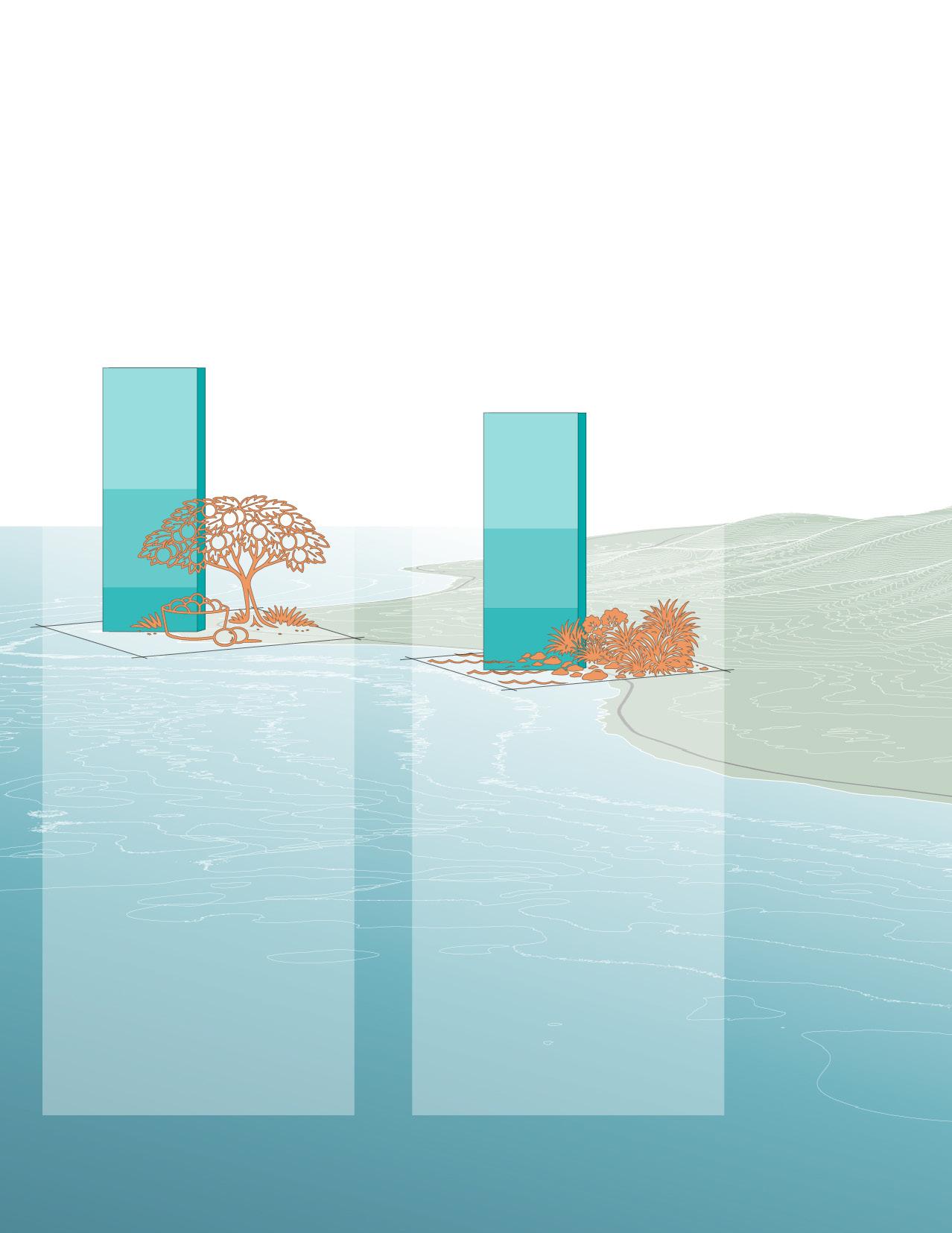
LIVING SHORELINE WITH PUBLIC WATERFRONT PARK
FRUIT TREES, SUCH AS ʻULU, FOR SHADE AND HARVESTING
Participant responses suggested that, over the next twenty years, the community would like to see a living shoreline with public waterfront access addressed first. Looking ahead to 2075, when shown what a potential future public park could look like near Olowalu Landing, the community was most supportive of incorporating fruit trees for shade and harvesting.
WETLAND + HABITAT RESTORATION
BEACH PARK
NATIVE PLANTS FOR EROSION CONTROL AND SHADE
Participant responses indicated that, through the next two decades, wetland and habitat restoration should be addressed first. Looking ahead to 2075, when shown a potential resilient beach park in the area currently commonly referred to as MM14, the community expressed a clear preference for native plants for erosion control and shade.
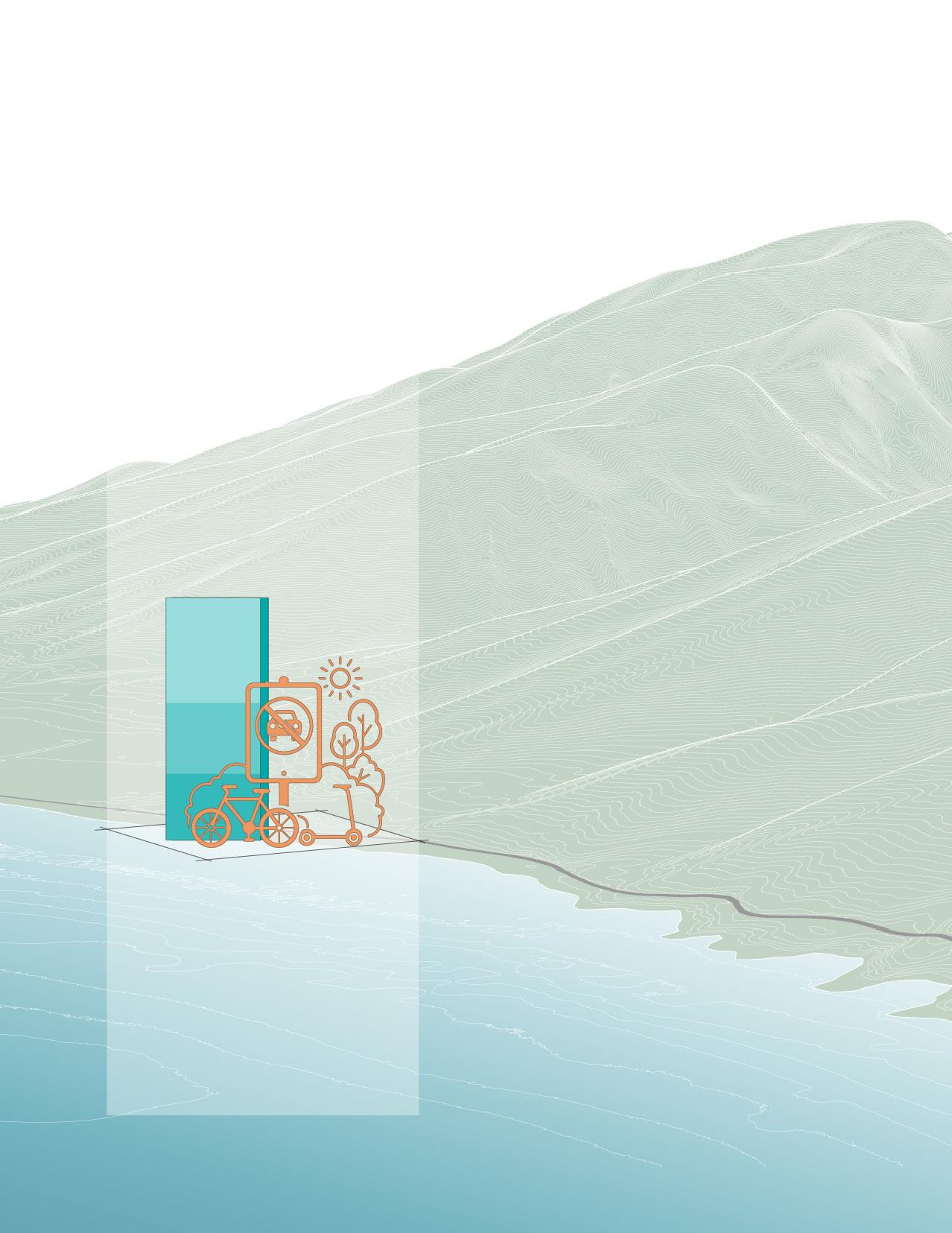
NATIVE HABITAT + WETLAND RESTORATION AND EDUCATION
Based on participant responses, within the next twenty years, native habitat and/or wetland restoration and education should be addressed first. Looking ahead to 2075, when shown a boardwalk for shared waterfront and surf access, the community expressed an interest in either no vehicular access or an autonomous go-around shuttle/ tram with an option of biking or walking.
All Overall Project Area Written Comments Transcribed and Combined
Comment Date
Native plants - Launiupoko 11/18
Why are they clearing this private property? 11/18
Watershed protection 11/18
Protect habitat and streams. No hiiking paths mauka 11/18
Access to Olowalu business 11/18
Real restroom. Grass area restored. Keep olowalu business 11/18
Control &/or regulate commercial activities (diving, snorkeling, kayaking, etc.) 11/18
Get rid of cats 11/18
Priorittize access for locals, limit or regulate access for tourists (charge a fee) for parking 11/18
Keep beaches clean 11/18
Ensuring the coast is protected from inappropriate development 11/18
Don't let the trucks drive over the sand dunes 11/18
Support cat cafe model - relocate 11/18
Enfore fines for littering, many people leave a lot trash after camping 11/18
Erosion control 11/18
Riparian stream restoration 11/18
Preservation and restoration of habitat connectivity 11/18
Prioritize natives in landscapes including parks 11/18
Comment
Kapaiki no okina 11/18
Wetland restoration 11/20
Restoration of cultural practices along the shoreline 11/20
At the least something that’s gonna accommodate proper highway access travel for both our residence and visitors that isn’t creating further congestion of traffic which is already an issue 11/20
Keep existing road viable until new highway finished 11/20
Multi use pathway / Emergency evacuation 11/20
Access, pathway, restoration of wetlands and addressing erosion/run off 11/20
Access to areas that are cut off by new highway. 11/20
Access to shoreline 11/20
Protecting shoreline with nature based and indigenous solutions 11/20
Beach access and parking and shoreline restoration is my first priority 11/20
Multi-use pathway Erosion control through native vegetation 11/20
Start restoration efforts early 11/20
Protecting and stabilizing the shoreline using natural systems 11/20
The West Maui Greenway for changing the way people move through the area and to help with erosion control 11/20
Time out of shoreline use to enable return of marine life 11/20
Multi use path / Greenway 11/20
Comment Date
Remove existing highway in sustainable ways 11/20
Removing the road in areas likley to be impacted first by SLR- reestablish ecosystem functions of these areas 11/21
Native planting 11/21
Coastal zone protection via nature based solutions to mitigate SLR and land based flooding 11/21
Restoring historic hydrologic connections 11/21
Multi modal use . Make it a shared use bike path for future generations to enjoy too 11/21
Anything that prevents sedimentation of the reef and protects water quality 11/21
Nature-based Solution Demonstrations that will inspire and build support and attract funding to expand to other reaches 11/21
Consideration of how to address unhoused in the area with compassion but also for public safety 11/21
Land management 11/21
Start the living shoreline plantings early where possible 11/21
Creating room for coastal habitat 11/21
Wetland restoration to improve water quality for community and provide habitat for migratory and native birds 11/21
Establishment of a useable coastal path along or a part of the existing road. 11/21
Start thinking about organizing community groups because a coordinated coalition will be essential. 11/21
Establishment of natural features: native plants, potential dune restoration, re-establish historic waterways 11/21
Comment Date
Complete multimodal path 11/21
Start conversation with county to determine their capacity to handle new management responsibilities. 11/21
All Overall Project Area Written Comments Transcribed and Combined
Comment Date
Habitat restoration 11/18
Protect habitat and streams mauka - no hiking trails 11/18
(Ukumehame) Think about development that is happening in this area right now 11/18
New habitat by firing range 11/18
Reef restoration 11/18
Bathrooms, showers 11/18
Natural (not overly manacured) public space 11/18
Restoration of the wetlands. 11/20
Wetland and habitat restoration 11/20
Native plant restoration and land management 11/20
Open space just as the plan indicates. 11/20
Certainly something that ensures that the whole hillside there for that matter along that whole corridor is protected in a way that is not gonna have any impact on the shoreline 11/20
Public shoreline access along the whole coastline - by walking or other not driving 11/20
Some kind of acknowledgement of gathering rights by native Hawaiians who still live there 11/20
Balance of land conservation, road access, room for commercial and residential growth and developing shoreline 11/20
A community driven managed retreat plan 11/20
Public access to the shore 11/20
Maui Greenway / emergency Evacuation
cultural sites
Open space for recreational and community activities
Land back!
Stewarding the aina and opportunity for cultural learning tied to stewardship and connecting mauka-makai. Access via wmg! 11/20
Functional hydrology 11/21
Flexible and adaptive design of features and infrastructure 11/21
Highway relocation as soon as possible. 11/21
Removal or relocation of obsolete or vulnerable hard infrastructure that impacts health and function of coastal habitats 11/21
Are there any measures proposed by HDOT with funding sources identified to mitigate future SLR and coastal erosion impacts to the realigned highway so that we are not in the same situation in 30yrs? 11/21
Allowing space for flooding while maintaining community access 11/21
Community stewardship 11/21
Early wins to inspire people 11/21
Comment Date
Incorporating kilo and adaptive management 11/21
Wetland 11/21
The land is returned to its most natural precontact state 11/21
Maintain or create public coastal access, 11/21
Keep or restore natural features 11/21
Maintain the mauka to makai vision for restoration 11/21
Returning the land to to it’s natural state 11/21
Wetland restoration, coastal ecosystem function (natural movement of sand etc.), removing all impacted hard infrastructure 11/21
Coordinated planning for the different parts of the plan- a multi agency approach. 11/21
Sustainable living practices supported, ie: stream restoration and kanawai water management system; eliminate invasive species that are not contributing to sustainabilit 11/21
Restoration and allowing coastal habitats space to migrate with sea level rise 11/21
Donʻt like development potential in these areas, but people will be upset - so access zones are "sacrificed zones". Out of the 4 critical zones identified, make 2 sacrifice
not
Who manages this? Wetlands are complex. 3
Protection of limu, fishing access, herbivore restriction. 3
Bigger concern is Papalaua / Grandmas hike area - it floods when there is heavy rains. 3
Where is the road actually moving to?
I really wonder if the "decision makers" are actually going to look at or listen to the feedback (all the work being done here)?
Why isnʻt HDOT here?
For us, the road going north is more important if it will save lives - safety is more of a concern. I feel like the priority is really skewed right now.
Really keeping open space unoccupied.
We need an access road by the Olowalu store. Right now where the road is planned, the traffic will bypass our store / the whole town completely - a lot of bussinesses may suffer.
FYI-Sugar mill is a historic property. The sugar mill area was designated as the Olowalu Sugar Mill Historic District, and the Architectural study done for the relocation of the Honoapiilani Highway suggested that a much larger area, incompassing much of Olowalu, including the mill site, be designated the Pioneer Mill Plantation Historic District.
Greenway should not abut the highway as they are separate projects, so the county cannot put its Greenway in the State ROW.
My understanding is the CDC is using the existing plans for the Greenway, which will change now that we have a preferred alternative.
Please use access points as they exist in the FEIS. Only Luawai will provide access (signalized) to the new Honoapiilani Highway in Olowalu.
Regarding the existing highway, if the work will impact or use the state highway system, please contact HDOT early in the process and obtain appropriate permits.
Please note that HDOT does not endorse any of conceptual plans.
All Written Comments Transcribed and Combined
Hinano Rodrigues representing the Ka'ahui/ Rodrigues 'ohana of Kapaiki (not Kapa'iki), lineal descendants of those who once lived and are still living in Olowalu and Ukumehame. 1
Kailiili is much further towards Ukumehame. 2 & 3
The selected route has a large square coming off the highway to acquire. This is in an archeological wetland.
I think that area is more Mopua than Kapaiki? 1
Mahalo. Also the W in Olowalu is a glided not a true alphabet, therefore you cannot use a V sound.
Ukumehame Park is Pako'a. 3
That’s correct – preliminary design is a 3100 to 3700 linear feet of elevated highway to cross over the wetlands, detention basin, firing range access 3
trying to stay in my lane because i'm not from this community but maybe bus/transit access could be something to consider..
Concern around us/the designs not taking into account how much the shoreline is used and that people will want vehicular access 2 & 3
From Council Chair Alice Leeʻs office and former County Planning Department Director – comments on finance/budget, permitting, on implementation on design elements… to be sure that these are considered as part of design and planning process
Pacific Birds – on wetlands and highway viaduct – advocating to plan for birds habitat in restoration planning, suggesting that fencing be installed around the viaduct to protect waterbirds; another comment on overall support for the project and ….?? 3
Former County Energy Commissioner and currently lead at Hā Sustainability consultants –importance of ensuring that park infrastructure is adapted so that it does not meet the same fate as (the pavilion) at Baldwin Beach 2
She commented that she does not support ANY vehicular access within Cat Site 3 and left it off her voting list. 3
Environmental scientist and Save the Wetlands Hui – comment on promoting restoration…. 3