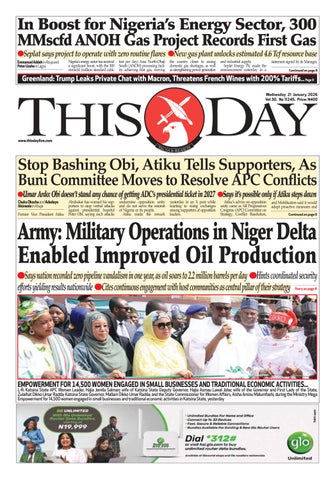
In Boost for Nigeria’s Energy Sector, 300 MMscfd ANOH Gas Project Records First
Seplat says project to operate with zero routine flares New gas plant unlocks estimated 4.6 Tcf resource base
www.thisdaylive.com
Bashing Obi, Atiku Tells Supporters, As Buni Committee Moves to Resolve APC Conflicts
Chuks Okocha and Adedayo Akinwale in Abuja
Former Vice President Atiku
Abubakar has warned his supporters to stop verbal attacks against presidential hopeful Peter Obi, saying such attacks
undermine opposition unity and do not serve the interest of Nigeria or its people. Atiku made the remark
yesterday in an X post while reacting to rising exchanges among supporters of opposition leaders.
Atiku’s advice on opposition unity came as All Progressives Congress (APC) Committee on Strategy, Conflict Resolution,
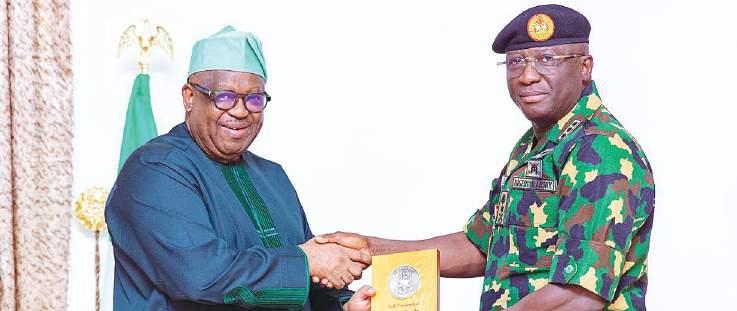
Army: Military Operations in Niger Delta Enabled Improved Oil Production
Says nation recorded zero pipeline vandalism in one year, as
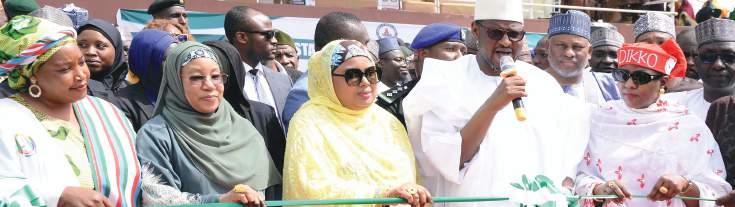
L-R:
Empowerment for 14,500 women engaged in small businesses and
and the State Commissioner for Women Affairs, Aisha Aminu Malumfashi,
Emmanuel Addeh in Abuja and Peter Uzoho in Lagos
Katsina State APC Women Leader, Hajia Jemila Salman; wife of Katsina State Deputy Governor, Hajia Asmau Lawal Jobe; wife of the Governor and First Lady of the State, Zulaihat Dikko Umar Radda; Katsina State Governor, Mallam Dikko Umar Radda;
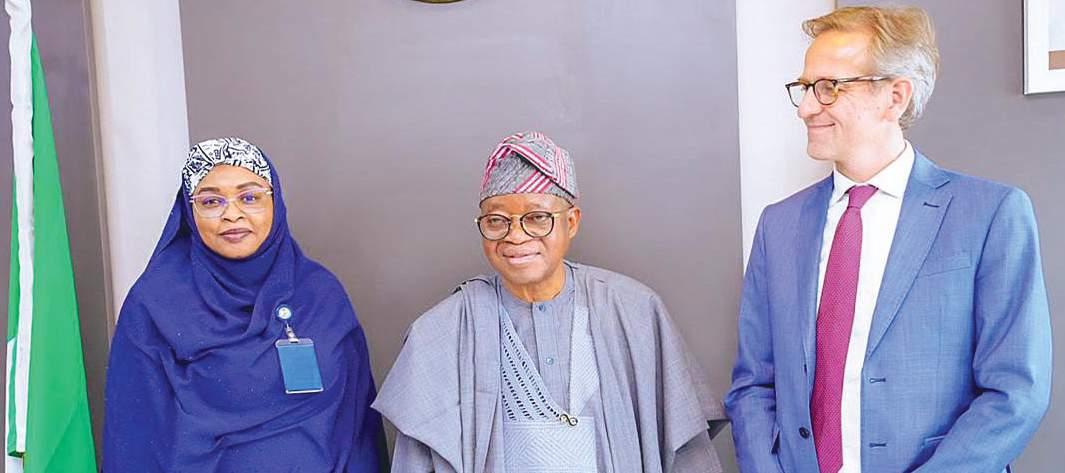
WHEN DANISH AMBASSADOR VISITED MINISTER OYETOLA...
L-R: Permanent Secretary, Federal Ministry of Marine and Blue Economy, Mrs. Fatima Sugra Mahmood; Honourable Minister of Marine and Blue Economy, His Excellency Dr. Adegboyega Oyetola, CON; and the Ambassador of Denmark to Nigeria, Mr. Jens Ole Bach Hansen, when the Danish Ambassador visited Minister Oyetola in his office in Abuja, yesterday
Senegal Revokes Arthur Eze’s Oil Licence over Unmet Operational, Financial Commitments
Peter Uzoho
Senegalese authorities have revoked offshore exploration rights held by Atlas Oranto Petroleum, a privately-owned upstream oil and gas firm founded by Nigerian energy entrepreneur, Arthur Eze, reinforcing a tougher regulatory approach toward long-stalled licences.
The decision aligns with Senegal’s commitment to enhance regulation in its energy sector and rapidly monetize hydrocarbon resources.
Business Insider Africa reported that Senegal revoked the offshore exploration rights due to unmet operational and financial commitments. This action represents a part of a broader trend in Africa to reclaim underutilised oil and gas licenses.
Atlas Oranto’s activities in other regions, like Liberia, have also attracted scrutiny over contract terms and transparency concerns.
The Senegalese government revoked the Cayar Offshore
Shallow exploration licence after determining that Atlas Oranto Petroleum, the holder, had failed to provide the required bank guarantees and carried out only minimal exploration work since the block was awarded in 2008, despite multiple extensions.
The block, covering approximately 3,600 square kilometres north of the Dakar peninsula, is considered oil-prone but underexplored, with several leads identified through seismic surveys but no wells drilled to date.
Under the supervision of Minister Birame Souleye Diop, the Ministry of Energy and Petroleum formally withdrew the licence in September 2025, citing the company’s repeated failure to meet financial and contractual obligations.
According to the report, industry accounts referenced in early 2026 confirm that the block saw little meaningful seismic or drilling activity during the licence period.
Senegal’s government has
reclaimed control of the acreage, framing the decision as part of a broader effort to enforce compliance and implement stricter screening of petroleum rights holders under President Bassirou Diomaye Faye’s administration.
By reclaiming the block, Senegal joins a growing number of African producers reassessing legacy oil and gas contracts signed during earlier
exploration cycles.
Governments across the continent are under increasing pressure to ensure that petroleum rights translate into investment, drilling and production rather than being held for speculative or financial optionality.
Senegal’s decision has drawn renewed attention to Atlas Oranto’s wider regional footprint, where its execution
record has faced scrutiny in several jurisdictions. In Liberia, developments in 2025 illustrate a contrasting regulatory posture.
In September, Business Insider Africa reported that the Liberia Petroleum Regulatory Authority signed four production-sharing contracts with Atlas Oranto Petroleum International Ltd. covering offshore Blocks LB-15, LB-16, LB-22 and LB-24 in the
Liberian Basin. The agreements included a signature bonus reported at between $12 million and $15 million, alongside proposed investments exceeding $200 million per block. Liberian authorities presented the deals as a bid to revive a petroleum sector that has seen little activity for more than a decade.
FG Seeks Climate-smart Livestock Feeding to Cut Emissions, Boost Productivity
Six states to pilot communal ranching initiative, says Maiha
Emejo
Minister of Livestock Development, Idi Mukhtar Maiha, yesterday reaffirmed the federal government’s commitment to climate-smart livestock production, with a strong focus on improved feed and fodder systems to reduce
NCC Upbeat about Improved Telecoms Service with More Spectrum 6GHz, 60Ghz
Oghenevwede Ohwovoriole
Emejo in Abuja
Nigerian Communications Commission (NCC) has assured that with the opening of more Spectrum “6GHz and 60Ghz”, telecoms consumers will soon begin to experience better quality service by operators.
Head, Spectrum Services Department of NCC, Atiku Lawal, gave the assurance on Tuesday at the ongoing spectrum roadmap stakeholders consultation forum in Abuja.
Lawal said the commission was not just opening more spectrum
for improved quality of service, but also to serve the underserved.
He stated, “The commission is opening two spectrum bands, six gigahertzes and the 60 gigahertz band.
“We are opening the band, not only to improve the quality of service, but also to allow for innovations as we see, because it’s not only the connection.
“All of us are making some bank transactions. We are doing some businesses other than just calling our relatives, I believe.
“You have a better experience,
a better quality of service, better experience, and that is what the objective of the commission is, to ensure that all Nigerians enjoy very good quality of telecommunication services.”
On how soon Nigerians should be expecting improved quality of services, Lawal said, “From experience, I can say before the end of this year.”
The representative of Dynamic Spectrum Alliance (DSA), Martha Suarez, who joined the forum virtually, stated that 6Ghz technology will boost Nigeria’s transformation.
greenhouse gas emissions and enhance productivity.
Maiha declared that six pilot states – Adamawa, Benue, Kaduna, Kano, Plateau, and the Federal Capital Territory (FCT) – had been identified for the establishment of national communal ranches, with land allocation expected ahead of the next rainy season.
The minister spoke during a meeting with the ILRI–GATES Livestock Feed and Nutrition Project team, where discussions centred on the link between ruminant feeding systems, methane emissions, and climate change.
He stated that emissions from ruminants were largely influenced by fermentation processes associated with high-fibre feeds, and stressed the need to transition to more protein-rich and climateresilient feed options.
In a statement by the ministry’s Head, Press and Public Relations, Oghenekevwe Uchechukwu, the minister said, “Feed and fodder are our number one priority. If animals are fed properly and kept healthy, even our indigenous
breeds can perform optimally.
“Nomadism today is not about culture; it is a survival mechanism driven by scarcity. If we provide abundance where people are, movement will reduce.”
Maiha also announced plans to activate large-scale fodder production across the country, supported by solar-powered irrigation, micro earth dams, and basic amenities within designated grazing reserves.
He said, “This is no longer about theory. It is time for boots on the ground. Nigeria has the land, political will, and partnerships to drive transformation in the livestock sector while addressing climate change, security challenges, and food systems disruption.”
Speaking on behalf of the ILRI–GATES Livestock Feed and Nutrition Project, Programme Leader, Dr. Anu Frank-Lawale, commended Maiha’s clarity of vision, and pledged full support.
Frank-Lawale said, “What you have outlined aligns directly with the core components of this project.”
He explained that the project
comprised four key components, including the use of crop residues, fermented protein feeds as alternatives to conventional protein sources, climate-resilient forages, and mycotoxin assessment in animal feeds across Nigeria, Kenya, and Ethiopia.
Frank-Lawale stated, “Our goal is to increase milk production, create jobs, improve profitability, and reduce greenhouse gas emissions.
“Ultimately, this will enhance food security, livelihoods, and climate efficiency.”
ILRI Country Representative, Dr. Tunde Amole, explained that the project prioritised deploying tested solutions rather than theoretical research, with plans to introduce proven forage cultivars suitable for the Sahel and scale them rapidly once validated.
According to him, “Methane emissions are not simply an animal issue, they are a feed issue.”
He added that the project will focus on practical solutions, climate-resilient forages, alternative protein sources, safe feeds, and reduced greenhouse gas emissions.
James
in Abuja
COAS’ VISIT TO MUTFWANG...
Plateau State Governor, Caleb Mutfwang, presents a plaque to COAS, Lt. Gen. Waidi Shaibu, who paid him a courtesy visit at the Government House in Jos, yesterday
Farmers Rake in N9.17bn Through OGSTEP Aquaculture Support
The Ogun State Government has disclosed that its aquaculture support programme under the Ogun State Economic Transformation Project (OGSTEP) has generated an estimated N9.17 billion in revenue for fish farmers across the State.
The revenue yield was sequel to the government’s sustained
investments in feed subsidies, infrastructure development, and capacity building.
The Commissioner for Agriculture and Food Security, Hon. Bolu Owotomo, made this known in Eriwe, Ijebu, while addressing stakeholders during an ongoing inspection of OGSTEP-funded agricultural projects across fish clusters and farm settlements in
Ogun State.
According to the Commissioner, a total of 4,256 aquaculture farmers have benefitted from the intervention programme, which was designed to boost fish production, reduce production costs and improve farmers’ incomes.
He revealed that the state government supplied 195,436 bags of fish feed to farmers at a
30 per cent subsidy, representing a direct government investment of N2,745,875,800 to cushion the impact of rising input costs.
Owotomo explained that the intervention has resulted in an estimated aquaculture output of 4,256 metric tons of fish, contributing significantly to food security and reducing dependence on imported fish.
Davos: Wale Tinubu Joins World Leaders, Set to Highlight Africa’s Energy Priorities
Wale Tinubu, the Group Chief Executive of Africa’s leading indigenous energy solutions provider, Oando Plc, is set to participate in the 2026 World Economic Forum (WEF) annual meeting in Davos, to champion Africa’s energy priorities.
Among his key engagements, Tinubu will focus on Africa’s energy security, the role of finance in catalysing growth within the energy sector, and the contribution of indigenous companies to delivering bankable projects in the context of a decarbonising global economy.
The discussions are also expected to explore how technology, including artificial intelligence, and South-South partnerships can unlock efficiencies, improve project economics, and attract long-term capital into Africa’s energy sector, a statement from the energy company said.
He will be speaking at the debut of Nigeria House at Davos, marking the first time the country is hosting a dedicated national platform at the World Economic Forum. Nigeria House represents a strategic shift in how the country presents itself at global investment forums, moving from fragmented representation to a coordinated national narrative that aligns policy direction with private sector execution.
According to the statement, Tinubu’s participation reinforces the role of credible local operators in bridging policy ambition and investor expectations.
In addition, Tinubu will join a panel of renowned business executives and top government officials at a high-level Africa Collective session focused on African multilateral financial institutions. This forum will bring together senior policymakers and leaders of development finance institutions to discuss capital mobilisation, risksharing, and financing structures required to support large-scale
infrastructure and energy investments across the continent.
Panellists at the session include: Dr George Elombi, President and Chairman of the Board of Directors of Afreximbank; Samaila Zubairu, President and CEO of Africa Finance Corporation; Thierno Habib Hann, Managing Director of Shelter Afrique and Marco Arcelli, CEO of ACWA Power.
Other speakers will include: Matteo Patrone, Vice President Banking and Executive Committee Member at the European Bank for Reconstruction and Development as well as Wale Edun, Nigeria’s
Minister of Finance and Coordinating Minister of the Economy.
Oando’s presence at Davos, according to the statement, highlights its role in advancing the continent’s energy agenda on the global stage, as African economies continue to call for sustained investment in critical development projects.
At a time of constrained global financing, Oando, it said, is emphasising the need for supportive policy environments, strong public–private partnerships, and targeted capital to deliver bankable energy solutions and strengthen the continent’s energy security.
He added that the state government has also extended support to the poultry subsector, with 1,272 broiler farmers benefitting from the programme and 77,703 bags of professional and commercial broiler feed distributed across the state, while some other broiler farmers were supported with the production of 500 birds each and linked to off-takers to prevent post-harvest losses.
During the inspection, the Commissioner visited the Ijebu Development Initiative for Poverty Reduction at the Eriwe Fish Farm Cluster, which comprises about 600 fish farmers and has been equipped with a modern fish processing facility.
The facility includes a five-ton solar-powered blast freezer, a 10-ton cold room, a 500/900-capacity chest freezer, four 50kg smoking kilns, three 100kg smoking kilns, a 500kg-capacity digital weighing scale, stainless steel work tables, 400-litre holding tanks, as well as rehabilitated fish processing buildings and market shops.
Owotomo also inspected ongoing fish processing facilities at the Ikangba Fish Farm Cluster, which has about 1,224 fish farmers, and the Ikenne Fish Farm Cluster, noting that similar processing
infrastructure is being deployed in Ibiade, Ado-Odo and Ilashe fish clusters.
He stressed that the OGSTEP intervention was statewide and inclusive, aimed at reducing postharvest losses, promoting value addition, and stabilising prices across the aquaculture value chain.
“This is a clear demonstration that when government support is well-targeted, agriculture becomes profitable for farmers and beneficial to the economy,” the commissioner said, adding that the programme has strengthened production capacity across clusters.
In separate remarks, the Special Adviser to the Governor on Agriculture and Food Security, Dr. Angel Adelaja; the Chairman of Ikenne Local Government, Hon. Jamiu Asimi; the Chairman of the Catfish Farmers Association in Ijebu, Mr. Lazarus Okole; and the CEO of the Ijebu Development Initiative for Poverty Reduction, Mr. Marcus Adeniyi, commended the initiative noting that the new facilities would reduce gluts, curb distress sales, improve incomes, expand production and strengthen local economic development, while reaffirming Governor Dapo Abiodun’s commitment to sustainable agricultural growth in Ogun State.
NSGF Chair Seeks End to Unequal Access to Education in North
The Chairman of the Northern States Governors’ Forum (NSGF) and Governor of Gombe State, Inuwa Yahaya, has called for collective action to address the deepening crisis of inequitable access to quality basic education in Northern Nigeria, warning that the future of the region is at stake if bold steps are not taken.
He made the call yesterday while delivering his address as Chairman of the occasion at the 12th Annual Sir Ahmadu Bello Memorial Lecture on Leadership
and Good Governance, held in Dutse, Jigawa State.
The lecture was themed: “Equitable Access to Quality Basic Education in Northern Nigeria - A Time for Real Action.”
Describing the theme as timely and reflective of the enduring legacy of the late Sardauna of Sokoto, Sir Ahmadu Bello, the governor said education remains the strongest pillar for unity, development and prosperity in the North and Nigeria at large.
He reminded participants that the lecture came barely days after the country marked the 60th anniversary of the January 15, 1966
coup, which claimed the lives of Sir Ahmadu Bello, Prime Minister Abubakar Tafawa Balewa and other national leaders.
According to him, the best way to honour their memory is not through lamentation, but through purposeful action anchored on good governance and inclusive development.
Yahaya expressed concern over alarming education statistics in the North, noting that Nigeria accounts for over 18 million out-of-school children, with about 70 per cent of them in Northern Nigeria.
He added that literacy rates
in some Northern states remain below 30 per cent, while girl-child school attendance and basic literacy and numeracy outcomes remain disturbingly low.
The governor stressed that education challenges must remain on the top of the agenda for Northern leaders, noting that this can be done through continued prioritisation of education , stronger collaboration with the Universal Basic Education Commission (UBEC), development partners and donor agencies to expand access, improve infrastructure and strengthen teacher capacity.
He also mentioned the establishment of the Northern Nigeria Security Trust Fund as a critical intervention to address insecurity, which he described as the greatest threat to education in the region.
He outlined far-reaching reforms undertaken by his administration, including the declaration of a state of emergency on education, the establishment of a high-level task force for basic education revitalisation, and the rollout of a N13.5 billion School Improvement Grant to upgrade facilities in 442 secondary schools.
Segun Awofadeji in Gombe
Emmanuel Addeh in Abuja
James Sowole in Abeokuta
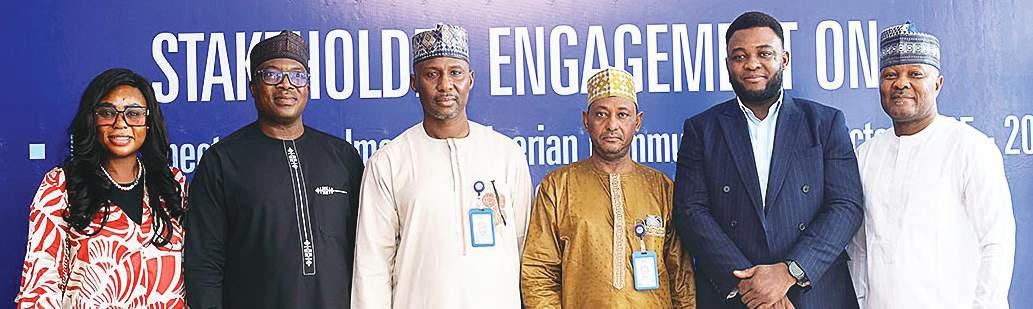
STAKEHOLDER
ENGAGEMENT ON SPECTRUM ROADMAP 2026 - 2030...
L-R: Deputy Director, Huawei Business Environment/Affairs Nigeria, Dr. Nihinlola Fafore; Head, Spectrum Administration Department, Nigerian Communications Commission (NCC), Engr. Atiku Lawal; Head, Fixed Networks and Converged Services (NCC), Engr. Gidado Maigana Ahmed; Head Spectrum Assignment (NCC), Mr. Abubakar Hammanyaji; Country Lead, Digital Access Program, Foreign, Commonwealth & Development Office (FCDO), Mr. Idongesit Udo; Head, Spectrum Planning, (NCC), Dr. Joseph Emeshili present at the Day1 of the Stakeholder Engagement on Spectrum Roadmap 2026 - 2030, Guidelines for the Use of the 60 GHz for Multi Gigabit Wireless Systems and the Guidelines for the Use of the Lower Part of the 6 GHz Band for Wifi-6 in Nigeria held at the Auditorium, Communications and Digital Economy Complex, NCC Annex Office, Mbora, FCT, Abuja
Information Minister: Nigeria’s Poor
Reputation Rating, Call to Action
Fashola urges ambassadors to sell Nigeria with facts, not slides
Olawale Ajimotokan and Sunday Aborisade in Abuja
Minister of Information and National Orientation, Alhaji Mohammed Idris, yesterday declared that Nigeria’s global reputation, though bruised by negative perceptions, was “not a verdict but a mirror”.
Idris demanded an urgent national action, insisting that the country must deliberately own and project its successes rather than surrender the narrative to critics.
Former Lagos State Governor and former Minister of Works, Housing and Power, Mr. Babatunde Fashola, SAN, called for systematic training of Nigeria’s ambassador-designates before their deployment abroad.
Idris and Fashola spoke at the Nigeria Reputation Summit 2026 in Abuja.
Idris was reacting to the newly unveiled National Reputation Perception Index, which placed Nigeria at 35.2 per cent in a low-trust band globally.
He said the report should spur reform, honest communication, and collective responsibility, not despair.
According to him, “Responsible nations must have the courage to look into that mirror and act swiftly.”
He stressed that reputation was
a strategic national asset that must be consciously built, protected, and managed.
Idris said while Nigeria continued to grapple with challenges, including insecurity and economic pressures, there were concrete positive developments that often got drowned by negative narratives.
He cited Nigeria’s recent delisting from the Financial Action Task Force (FATF) grey list, improving foreign reserves, easing inflation, stabilising growth, and renewed foreign investment confidence as major milestones that deserve global amplification.
The minister stated, “If reputation matters in attracting investment, then Nigeria’s exit from the FATF grey list was a huge signal. Yet we hardly celebrated it. The same countries that sometimes criticise Nigeria still engage it robustly for business.”
He recalled that the United States, which had previously raised concerns about religious freedom in Nigeria, committed its highest-ever healthcare investment to the country in December, describing this as evidence that Nigeria’s reality often contradicts its portrayal.
Idris warned Nigerians, including the media, against amplifying fear and criminality, stating that repeatedly showcasing images of terrorists
and criminals only strengthens false narratives.
He said, “Don’t celebrate criminals. Celebrate our gallant soldiers who are dying daily so we can live and gather like this. Protecting Nigeria’s image is a constitutional duty of every citizen.”
He commended the Nigerian Institute of Public Relations (NIPR) for producing the country’s first comprehensive Reputation Perception Index, describing it as the product of over seven years of research and
a foundation for evidence-based reputation management.
Idris also highlighted reforms under President Bola Tinubu, including fuel subsidy removal, foreign exchange unification, tax reforms, expansion of primary healthcare with new oncology centres, infrastructure development and education access through student loans and venture capital grants.
He said, “Ultimately, reputation is earned through action, not slogans. Policy must meet purpose, and communication must reflect truth,” he
said, noting that the government alone cannot rebuild Nigeria’s image without professionals, institutions, the private sector, and citizens working together.”
Earlier, Fashola warned that unprepared envoys weakened the country’s diplomatic and reputational standing.
He said ambassadors must be equipped with up-to-date practical knowledge about Nigeria’s economy, governance and investment climate, including basic facts, such as the time required to register a business.
He said, “They must have handy information to really represent us. Training should not be optional; it should be continuous.”
Fashola urged the information minister to liaise with Ministry of Foreign Affairs to institutionalise such preparation.
Drawing from his experience in public office, Fashola stated that Nigerian ambassadors should focus on attracting investors to visit Nigeria rather than asking ministers to travel abroad to market the country.
FG Mulls Review of Employers’ Contribution to Employees’ Compensation Scheme
Dike Onwuamaeze
The federal government has hinted that an upward review of employers’ contribution to the Employees’ Compensation Scheme (ECS) might be on the way.
The Employees’ Compensation Act (ECA 2010) mandates all employers of labour in Nigeria to ensure that all employees are covered under the ECS that makes provision for compensation of any
Asaba Residents Protest ‘Illegal’ Erection of Gas Plant in Neighbourhood
Omon-Julius Onabu in Asaba Residents of Imade Osazee Street in the Delta State Capital of Asaba have petitioned the Nigeria Midstream and Downstream Petroleum Regulatory Authority (NMDPRA) following the alleged illegal siting and erection of a Liquefied Petroleum Gas (LPG) within their area
The residents stressed that they were left with no option than to cry out to the world now that the construction of the gas has reached an advanced stage, especially in the light of the devastating experience of LPG explosion recently in Agbor, Ika South Local Government Area.
In the petition, whose receipt was formally acknowledged by the office of the Delta State Coordinator of NMDPRA in Warri, Solicitors to the aggrieved residents of the street, PJ Eleweke and Partners, noted that the gas plant sited behind/with A.A. RANO filling station violated the 5 metres distance in the relevant law.
The petitioners expressed fear that the legal guidelines and regulations for the siting of LPG in Nigeria might have been flouted in the instant case owing to the alleged influence of the owners of the gas plant and filling station within the same premises.
The residents, therefore, urged the NMDPRA State Coordinator to urgently intervene by investigating and taking appropriate actions to stop the current construction of the illegal LPG plant to forestall what they termed “the impending time bomb should any explosion occur in the operation of the illegal LPG plant”. A resident in the area, who did not want his name in print, said: “The petrol station and LPG plant, apart from being built in a densely populated residential area, is also directly in front of the Infant Jesus Schools that accommodates hundreds of students in the boarding facility.
death, injury, occupational disease or disability arising out of or in the course of employment.
The Minister of State for Labour and Employment, Hon. Nkeiruka Onyejeocha, dropped this hint yesterday in Lagos in her goodwill message during the Nigeria Social Insurance Trust Fund (NSITF) and Nigeria Employers’ Consultative Association (NECA) “Safe Workplace Intervention Project” (SWIP) and “2025 Interactive Enlightenment Forum and Awards Ceremony.”
Onyejeocha said: “A safe workplace is not optional, it is legal. I believe that moving forward, we should also be reviewing the legal system and see how it complies with the quantum of what happens when lives are lost.
“I am an advocate that compensation should be reviewed because many people who died were just getting peanuts. The narratives have changed.
“So, the safe workplace intervention is, therefore, both timely and strategic.
“By combining awareness, compliance, support, and recognition of excellence, the SWIP helps to shift the mindset of employers from treating safety as an expense to recognising it as an investment in people, productivity and long-term business sustainability.”
The minister of state said the
ECA is a strong statement that Nigerian workers mattered.
She said: “The ECA 2010 remains one of the most important pillars of our labour administration system. It guarantees fair compensation for workers who suffer injury, disease, disability, or death sometimes in the course of employment.
“Beyond compensation, however, the Act sends a clear signal that prevention is better than cure.”
Onyejeocha said that labor laws move beyond paper and begin to deliver real protection on the factory floor when government, employers and workers chose to work
“Astogether.Honorable Minister of State for Labor and Employment, I wish to reaffirm that this administration will not compromise on occupational safety and health.
“We are strengthening enforce- ment of the Act. We are also intensifying workplace inspections nationwide. We cannot speak of job creation while workers are exposed to preventable danger.
“No job is worth a human life. Our objective is simple but non-negotiable that every Nigerian worker must leave home for work and return safely at the end of the day.
“I, therefore urge employers to fully comply with the provisions of the ECA through prompt registra-
tion, remittance of contributions and continuous investment in safety systems.
“I also encourage workers to remain safety conscious and to exercise their rights responsibly under the law.
“In closing, let us reaffirm our collective responsibility to build Nigerian safe workplaces that should remain safe, healthy and productive,” she said.
In his welcome address, the President of NECA, Dr. Ifeanyi Okoye, said that beyond the SWIP is designed as learning and improvement platform that enables employers to understand their obligations under the law, appreciate the benefits of compliance and adapt proactive occupational safety and health practices that protect both workers and enterprises.
“Today’s interactive sessions and award ceremony are not just ceremonial but are deliberate interventions to recognise organisations that have demonstrated exemplary commitment to workplace safety while also providing a forum for open dialogue on practical challenges employers face in implementing the ECA 2010,” he said.
The Managing Director of NSITF, Mr. Oluwaseun Faleye, said that yesterday’s event should have been held in 2025 but was crowded out by other urgent matters.
Greenland: Trump Leaks Private Chat with Macron, Threatens French Wines with
United States President Donald Trump, yesterday, posted a private message from France’s leader, Emmanuel Macron, and threatened huge tariffs against French wine and champagne, taking aim at an ally who has championed a tough riposte to U.S. attempts to strong-arm European policy over Greenland.
Trump’s relationship with Europe as a whole had deeply soured over his push to wrest sovereignty over the Arctic island from fellow NATO member, Denmark, rattling European industry and sending shockwaves through financial markets.
Macron had taken a harder line than most EU leaders in his response to Trump’s Greenland threat, pushing the bloc to activate its most potent trade tools against the
U.S., and sending French troops to Greenland in support of Denmark.
Trump had also taken offence at France’s reluctance to join a proposed Board of Peace, a new organisation that he would lead. Paris voiced concern over its impact on the role of the United Nations, a Reuters report said.
When asked about Macron’s stance on the Board of Peace, Trump said, “Did he say that? Well, nobody wants him because he will be out of office very soon.
I’ll put a 200 per cent tariff on his wines and champagnes, and he’ll join, but he doesn’t have to join.”
A few hours later, early on Tuesday, Trump published on his Truth Social account a screenshot of an exchange with Macron. In the exchange, which a source close to Macron said was authentic,
Macron told Trump, “I do not understand what you are doing on Greenland,” and offered to host a G7 meeting inviting Russia and others.
Macron, addressing Trump as his “friend”, also said he was “totally in line” with Trump on Syria, and that they could do “great things on Iran”. Neither Trump nor the French source disclosed the date of the messages.
Macron was due in Davos to attend the World Economic Forum (WEF) before a scheduled return to Paris in the evening. Elysee aides said there were no plans to extend his stay to Wednesday, when Trump would arrive in the Swiss mountain resort town.
The dispute between Trump and European allies threatens to upend the NATO alliance that had
200% Tariffs
underpinned Western security for decades.
Trump vowed on Saturday to implement a wave of increasing tariffs on several European allies, including France, from February 1 until the U.S. was allowed to acquire Greenland, a step major EU states decried as blackmail.
In response, EU leaders decided over the weekend to convene in Brussels on Thursday evening for an emergency summit on Greenland.
People close to Macron said he was being singled out by Trump because he was standing up for democratic principles. “By leading the resistance, France becomes a target,” Pieyre-Alexandre Langlade, a lawmaker in Macron’s camp, told Reuters.
Langlade was taking off for Greenland as part of a parliamentary
delegation showing solidarity with Denmark.
Macron, who will leave office in mid-2027, has been France’s president since 2017. His relationship with Trump has had ups and downs since Trump’s first term, with Macron alternating between flattery and tough rhetoric.
French officials have long defended Macron’s efforts to engage directly with Trump, saying the men often have impromptu calls and exchange texts outside official diplomatic channels.
At the weekend, a source close to Macron said he was pushing for the activation of the Anti-Coercion Instrument, a strong EU trade power that could limit access to public tenders or restrict trade in services, a sector in which the U.S. has a surplus with the bloc.
Europeans are also weighing their own 93-billion-euro tariff riposte to retaliate against the U.S. threat of tariff hikes over Greenland.
Later, speaking in Davos, Macron warned of “a shift towards a world without rules”. Addressing world leaders in Davos, Macron called the “endless accumulation of new tariffs” from the US “fundamentally unacceptable”.
ARMY: MILITARY OPERATIONS IN NIGER DELTA ENABLED IMPROVED OIL PRODUCTION
Linus Aleke in Abuja
The Nigerian military, yesterday, boasted that its op-erations in the oil-rich Niger Delta had been responsi-ble for the current improvement in oil production in the hitherto volatile part of the country.
The military also stated, for the record, that it had recorded no incident of pipeline vandalism in the Niger Delta over the past year, a development it said contributed significantly to the steady rise in the country’s crude oil production.
The army expressed confidence that prevailing security challenges across the country would soon be substantially reduced, citing sustained operations, inter-agency
solutions to existing and potential threats within the ruling party in its conflict resolution approach.
collaboration, and community engagement.
Speaking during a Defence Correspondents’ visit to the Area of Responsibility of Operation Delta Safe, General Officer Commanding (GOC) 6 Division, Nigerian Army, and Land Component Commander of the Joint Task Force, South South, Operation Delta Safe, Major-General Emmanuel Emekah, said the improved security environment had enabled crude oil production to rebound to about 2.2 million barrels per day.
According to him, the military remains committed to supporting the federal government’s target of achieving daily production of three million barrels by 2027. Emekah stated that security
internal conflicts.
threats in the Niger Delta had declined drastically, allowing residents of riverine communities to resume fishing and other economic activities without fear.
“The Niger Delta remains the backbone of Nigeria’s economy, and the performance of the oil and gas sector is a critical indicator of our operational effectiveness,” he said.
He explained that since assuming command on January 24, 2025, Operation Delta Safe had not recorded any incident of violent pipeline vandalism within its area of responsibility.
Emekah stated, “Before this period, crude oil production hovered between 1.4 million and 1.5 million barrels per day. However, following a presidential directive to boost output, production rose steadily to about 2.2 million barrels per day by December 2025.
breaches caused by vandalism. Where leaks or failures occurred, he said, investigations showed they were largely due to aging infrastructure rather than deliberate human interference, and such cases were promptly reported to the affected operators for remedial action.
On the challenge of illegal refining, the GOC explained that military operations were focused on both environmental protection and security enforcement.
He observed that many illegal refining activities were linked to abandoned oil wells rather than active pipelines.
with community leaders and mediation between host communities and international oil companies had helped to address grievances and prevent disruptions to oil and gas operations.
“This approach has significantly improved security and restored economic activities, particularly fishing and other traditional livelihoods,” he said.
Looking ahead, Emekah stated that Operation Delta Safe’s projections aligned with the federal government’s goal of reaching three million barrels of oil output per day by the end of 2027.
Onoja, expressed optimism that insecurity across the country would soon be overcome.
Onoja commended the sacrifices of troops and other security agencies, particularly the Nigeria Police and sister services, stating that many personnel operated under extremely challenging conditions, often separated from their families for extended periods.
“Security is a collective responsibility,” Onoja said, adding, “We urge all stakeholders, including host communities and the media, to play their part in addressing Nigeria’s security challenges.
STOP BASHING OBI, ATIKU TELLS SUPPORTERS, AS BUNI COMMITTEE MOVES TO RESOLVE APC CONFLICTS IN BOOST FOR NIGERIA’S ENERGY
The committee, led by Governor of Yobe State, Mai Mala Buni, gave the assurance on Monday night in Abuja during its inaugural meeting.
Meanwhile, Convener of League of Northern Democrats, Umar Ardo, yesterday, said Obi did not stand any chance of getting the presidential ticket of the new opposition coalition, African Democratic Congress (ADC), ahead of the 2027 general election, unless Atiku stepped down.
However, Atiku stated in the post on X, “Anyone, who insults Obi or Atiku does not mean well for the leaders, the coalition ADC and for Nigeria and Nigerians.”
The former vice president added that such internal divisions within the opposition camp only benefited the ruling APC.
He stated, “The only persons who benefit from such a civil war are the APC urban bandits, who want to maintain the satanic status quo.”
Atiku stressed the need for unity among opposition figures and supporters, stating that cooperation remains critical to advancing national development and democratic progress.
Atiku reacted to accusations in some quarters that his supporters had been unfairly targeting Obi, potentially exacerbating rifts in the fragile coalition.
As parties ready for the 2027 contest, APC Committee on Strategy, Conflict Resolution, and Mobilisation said it was poised to resolve the party’s
Buni, in a statement yesterday by his Director-General, Press and Media Affairs, Mamman Mohammed, recalled that the committee was inaugurated last December.
The statement said, “The committee will adopt strategic engagements and wide consultations to develop an all-encompassing and productive results that will stand the test of time to give both the old and new members, especially aggrieved parties, a sense of belonging and inclusion, with a renewed hope.
“Similarly, the committee will consider proactive measures and solutions to potential threats in our conflict resolution approach.”
Buni urged members of the committee “not to allow personal interest and sentiments to override the general interest and purpose for which this committee is constituted”.
Other members of the committee were the governors of Kwara State, Abdulrahman AbduRazaq; Imo State, Hope Uzodimma; Benue State, Hyacinth Alia; Kaduna State, Uba Sani; Rivers State, Siminalayi Fubara; Jigawa State, Umar Namadi; Cross River State, Bassey Otu; Ekiti State, Abiodun Oyebanji, and Delta State, Sheriff Oborevwori.
Equally on the committee were Senator Adamu Aliero; Minister of Marine and Blue Economy, Adegboyega Oyetola; Minister of State for Defence, Bello Matawalle; former Governor of Kogi State, Yahaya Bello; Senior Special As-
“We are working assiduously to sustain and further improve on this figure,”
He stressed that from January 2025 to date, no oil company operating in the area had reported pipeline
Corporate Communications, External Affairs and Social Performance, Stanley Opara.
Opara disclosed that the facility would operate with zero routine gas flares. Seplat stated this following the completion of the 11-kilometre Indorama gas export pipeline and receipt of regulatory approval from Nigerian Upstream Petroleum Regulatory Commission (NUPRC).
According to the company, on Friday, January 16, 2026, ANOH Gas Processing Company (AGPC) commenced gas supply to Indorama, under a “firm and interruptible” offtake Gas Sales Agreements (GSAs).
It said to enable the flow of gas, the four upstream wells, which had been on standby since November 2025, were brought back to production.
The statement said, “Since first gas, wet gas production has been stabilising, delivering 40-52 MMscfd of processed gas directly from the ANOH gas plant to the Indorama Petrochemical Plant. Condensate production has reached 2.0-2.5 kboepd and is expected to increase with gas production as the plant ramps up to design capacity.
“In addition, preparations are underway to initiate sales of processed gas to the Nigeria LNG (NLNG) with an offtake agreement structured on an interruptible basis
Emekah stated, “To tackle this menace, we have intensified our operations, sustained follow-up actions, and disrupted the support networks that enable illegal refining, including markets and logistics supply chains.”
He added that continuous engagement with host communities had remained a central pillar of the military’s strategy in the region.
Emekah said regular dialogue
and will support the gas plant to further scale production towards full design capacity of 300MMscfd.”
Seplat stated that construction of the OB3 pipeline export route by Nigerian Gas Infrastructure Company (NGIC), originally designated as the primary channel for ANOH gas supply to the domestic market, had resumed and a revised completion date will be communicated in due course.
The ANOH gas plant was developed by AGPC, an incorporated Joint Venture (JV) between Seplat Energy and the NGIC.
The integrated plant consists of two 150 MMscfd gas processing units, Liquefied Petroleum Gas (LPG) recovery units, condensate stabilisation units, a 16MW power plant and other supporting facilities, and has been built to operate with zero routine flares.
Across the unitised field of OML 53 and OML 21, Seplat stated that ANOH gas plant unlocked an estimated 4.6 Tcf condensate rich gas resource base, explaining that its working interest 2P reserves in the unitised field, as booked at year end 2024, stands at 0.8 Tcf.
According to the statement, Seplat would derive value from two distinct income streams: wet gas sales from OML 53 to the ANOH gas plant, and dividends from its 50 per cent equity ownership in AGPC.
“We have fulfilled our security responsibilities. With sustained collaboration among all stakeholders, this target is achievable,” he said.
Emekah added that the military would continue to strengthen synergy with other security agencies, maintain a visible presence, and proactively engage communities to ensure lasting peace and stability in the Niger Delta.
Earlier, Director of Defence Media Operations, Major-General Michael
LPG produced from ANOH, combined with the LPG production at Sapele and the Bonny River Terminal (BRT), will make Seplat a leading supplier of clean cooking fuel to the domestic market, the statement said.
In addition, the ANOH gas plant would process the flared gas from the Ohaji field, enabling Seplat to achieve its onshore End of Routine Flaring programme, a key commercial and sustainability initiative for the company.
Besides, the company said ANOH gas plant was developed without a single recordable Lost Time Incident (LTI) across 17.5-million-man hours, a testament to the focus of the whole team on safe and secure operations.
Chief Executive Officer of Seplat Energy, Roger Brown, commenting on the feat said, “ANOH is the first of the seven critical gas development projects identified by the federal government of Nigeria to commence operations.
It is an important strategic project for Seplat, our partner NGIC, and Nigeria as a whole.
“It has taken a significant amount of commitment and hard work to complete the project in a part of the onshore Niger Delta with limited gas pipeline infrastructure, and we are extremely proud of this achievement.
“This is our third major gas
“With sustained effort, we are confident that insecurity will gradually become a thing of the past.” He emphasised the strategic importance of the Niger Delta to Nigeria’s economy, stressing that peace, stability and security in the region were non-negotiable.
“All personnel deployed here must fully appreciate their responsibility in safeguarding the nation’s critical economic assets,” Onoja stated.
processing facility onshore and increases our joint venture gross gas processing capacity onshore to over 850 MMscfd.
“ANOH will provide material income streams for Seplat, reduce our carbon intensity and contribute significantly to the 2030 production target of 200 kboepd, set at our recent CMD (Capital Markets Day).
“It will also increase energy access for Nigerians in terms of both power and clean cooking fuel for the local communities, while advancing delivery of our mission to support economic prosperity in Nigeria.”
Seplat Energy’s portfolio consists of 11 oil and gas blocks in onshore and shallow water locations in the prolific Niger Delta region of Nigeria, which it operates with partners including the Nigerian government and other oil producers.
It has an operated interest in three export terminals, including; the Qua Iboe export terminal and Yoho FSO, as well as an operated interest in the Bonny River Terminal (BRT), and operates two large offshore NGL recovery plants at Oso and EAP.
Besides, it operates three gas processing plants onshore, at Oben in OML 4 and Sapele in OML 41 and the 300 MMscfd ANOH Gas Processing Plant in OML 53, an integrated joint venture with NGIC.
Emmanuel Addeh in Abuja
Trump
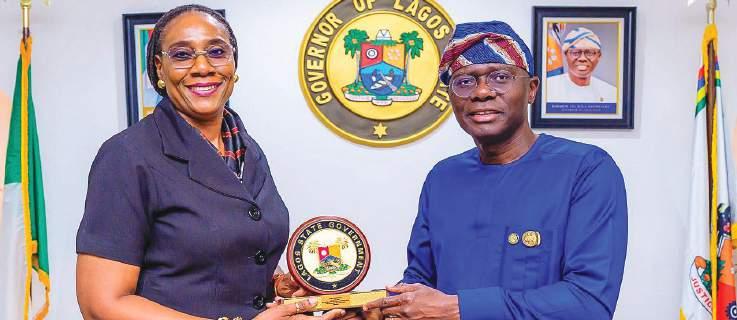
DG OF NIGERIAN LAW SCHOOL RECEIVING A PLAQUE FROM SANWO-OLU...
L-R: First female Director-General of the Nigerian Law School, Dr. Olugbemisola Odusote, receiving a Lagos State Government plaque from the Governor, Mr. Babajide Sanwo-Olu, during her courtesy visit to the governor at the Lagos House, Marina, yesterday
Abiodun Inaugurates Wole Soyinka Train Station Road, to Inaugurates 20 More Roads
Ogun State Governor, Prince Dapo Abiodun, on Tuesday commissioned the Laderin-Prof. Wole Soyinka Train Station Road in Abeokuta, announcing plans to inaugurate 20 additional roads across the state as part of activities marking Ogun State’s 50th anniversary.
Speaking at the commissioning ceremony, the governor said construction work was progressing steadily on the Sagamu Interchange-Papalanto-Opele Road, describing the 100-kilometre highway as a critical east-west connector within the state.
According to Abiodun, the road when completed will provide motorists with an alternative route, eliminating the need to pass through Abeokuta before accessing
other parts of the country, while also opening up the corridor for increased commercial activities.
“Let me share with you the biggest secret of our reconstruction efforts right now – the Ogun EastWest Connector. This road stretches from the Sagamu Interchange through Papalanto to Opele, covering about 100 kilometres,” the governor said.
“We have completely closed off the road for reconstruction.
As we speak, between Sagamu Interchange and Papalanto, which is about 40 kilometres, we have reconstructed approximately 25 kilometres using reinforced concrete.
“When completed, trucks and vehicles conveying goods and services from Ota, Ifo and
Ewekoro will no longer need to use the Abeokuta–Sagamu Expressway, as they can connect directly to Papalanto and access the expressway.”
Governor Abiodun described the Prof. Wole Soyinka Train Station as a major landmark linking Ogun State to Lagos, Oyo State and the northern parts of the country, noting the presence of five train stations in the state underscores Ogun’s strategic importance to Nigeria’s economic development.
He explained that although access roads were not originally provided when the rail line was constructed, his administration decided to rehabilitate the Laderin road in line with its multimodal transportation agenda.
He added that between 100,000
STOP BASHING OBI, ATIKU TELLS SUPPORTERS, AS BUNI COMMITTEE MOVES TO RESOLVE APC CONFLICTS
sistant (SSA) to the President on Political Affairs, Alhaji Ibrahim Masari; and Dr. Muiz Banire, SAN, who was made secretary of the committee.
In the meantime, Ardo said Atiku was poised to pick the ADC ticket for the 2027 presidential election ahead of Obi, who was presidential candidate of Labour Party (LP) in 2023.
He stated, “Well, the ADC, as it is currently constituted, if it goes for primaries a hundred times, Atiku will win a hundred times. There is absolutely no doubt about that. How Peter Obi and his supporters react is what will determine the election.”
Ardo, who on ARISE Television, added, “I am not saying that Peter Obi cannot be the candidate of the party. However, he can only be the candidate of the party if Atiku steps down.”
The former governorship aspirant of Peoples Democratic Party (PDP) in Adamawa said Obi’s influence had made him an asset to ADC.
He said because the ex-
Anambra state governor “controls more than six million votes”, ADC wanted “him there to make the party strong so that the party would win the election” in 2027.
Obi declared for ADC some weeks ago after months of talks with party leaders.
At the December 31 event in Enugu, Obi defended his decision to join ADC, describing it as the start of a new beginning in the bid to rescue Nigeria from the ruling APC.
He stated, “Today is an important day; today is the last day of 2025, so we are ending this year with the hope that, in 2026, we will begin a journey of the rescue of our country for proper socio-economic development that will be unifying and inclusive.
“We have all watched those who benefited from our democracy become accessories to destroying our democracy, either through coercion and gangsterism against the opposition. We cannot allow this to happen; we will resist it.”
Apart from Obi and Atiku,
other top shots in the opposition party include former Minister of Transportation, Chibuike Amaechi; ex-Kaduna State governor, Nasir El-Rufai; and former Senate President, David Mark, among others.
The politicians under the opposition coalition, last year, picked ADC as their platform for next year’s election.
and 150,000 passengers, including investors, commute daily between Ogun, Oyo and Lagos states.
The governor disclosed the train station road forms part of the over 1,600 kilometres of roads constructed across the state, adding that one lane of the Atan–Lusada–Agbara Road has been completed, while work has commenced on the second lane.
Earlier, the Commissioner for Works and Infrastructure, Engr. Ade Akinsanya, represented by the
Permanent Secretary, Engr. Lateef Yusuf, said the three-kilometre road would provide access to the MKO Abiola Trade Fair Complex, Laderin, Lukosi and other surrounding communities, noting that it would ease movement and boost commercial activities.
A former member of the House of Representatives and the Osi of Egbaland, Chief Bode Mustapha, recalled the deplorable state of the road in the past, saying its reconstruction, alongside other
projects, has significantly benefited Ogun Central Senatorial District and Abeokuta under the Abiodun administration. Also speaking, the Chairman of the Articulate Motorcycle Owners Association of Nigeria (AMORAN) in the state, Alhaji Taofeek Sokoya, said the road was previously a no-go area due to its poor condition, as transporters avoided it. He commended Governor Abiodun for rehabilitating the road.
First Tender Your Formal Resignation, You’re Free to Go, Kano NNPP Tells Yusuf
The New Nigeria People’s Party (NNPP) in Kano, has given Governor Abba Kabir Yusuf the green light to leave the party if he was not interested in continuing on its platform.
In a press conference in Kano, yesterday, the State Chairman of the party, Senator Elmasud Doguwa, urged the governor to tender his formal resignation if he felt he could no longer serve the people of Kano in the party.
Doguwa told the governor to ensure that he notified the legally recognised NNPP of his resignation
from the party before defecting to any other party.
The NNPP bold move came amidst speculation about Yusuf’s move to defect to the ruling All Progressives Congress (APC).
In his words: “Governor Abba Kabir Yusuf is still a bonafide member of the NNPP that has a basket with fruits as its logo. Lastly, I want to reaffirm that Abba Kabir Yusuf is still a member of the NNPP and we owe him respect.
“But if he wants to leave, he has the legal right to leave, but he has to formally tender his resignation to the party, which we are yet to
receive formally.
“We are still waiting for his formal resignation from our party. To be a member of any political party is an individual decision. If he decided to leave the party, it’s his choice but he has to do that according to the rules and regulations to the party.” Doguwa further explained that with the current judgements issued by three courts so far, if he decided to ignore tendering his resignation through the bonafide NNPP, it will not go without consequences for him in the furure as he joins another party and the final judgement from Supreme Court comes in their favour.
FG to Strengthen National Policy on Drought, Desertification
Michael Olugbode in Abuja
The federal government has reiterated its commitment to tackling drought, desertification, and land degradation through an updated and more responsive national policy framework.
The Minister of Environment, Malam Balarabe Lawal, stated this on Tuesday in Abuja while delivering a keynote address at a two-day validation workshop on the review of the National Drought and Desertification Policy.
The workshop, brought together
stakeholders from federal and state governments, development partners, civil society organisations, research institutions, and local communities.
Lawal described drought and desertification as serious environmental threats with far-reaching consequences for agriculture, water security, livelihoods, and national stability, particularly in Nigeria’s arid and semi-arid regions.
He noted that farmers and pastoralists are among the worst affected, as prolonged dry spells lead to crop failure, livestock loss, and increased poverty, while advancing
desert conditions continue to reduce land productivity and strain natural resources.
The minister explained the reviewed policy became necessary due to growing climate risks, population pressure, and changing land-use patterns.
He said the revision process began in July 2025 with an inception meeting involving representatives from all 36 states and the Federal Capital Territory.
According to him, the validation workshop is meant to ensure the revised document is practical, inclu-
sive, and implementable, with clear strategies, financing mechanisms, and monitoring systems.
Lawal assured participants the final policy would not be shelved after approval, stressing that government would lead its implementation while working closely with the private sector, civil society, academia, and local communities.
He called on stakeholders to actively contribute during technical sessions, share experiences, and propose workable solutions that reflect the realities of different ecological zones across the country.
Ahmad Sorondinki in Kano
NDLEA EXECUTIVE OFFICER AWARD AND COMMENDATIONS 2026...
Brigadier-General Mohamed Buba Marwa (Rtd); and Special Adviser to the Chairman, Colonel Yakubu Bako (Rtd), during the Chairman/Chief Executive Officer’s Commands Awards and Commendations ceremony in Abuja, yesterday
NDLEA Arrested 77,792 Suspects,
Secured 14,225 Convictions in Five Years
Michael Olugbode in Abuja
The National Drug Law Enforcement Agency (NDLEA) on Tuesday said it has arrested 77,792 suspected drug offenders and secured 14,225 convictions over the past five years, as part of its intensified campaign against illicit drug trafficking in Nigeria.
The Chairman and Chief Executive Officer of the agency, Brig. Gen. Buba Marwa (Rtd), disclosed this in Abuja during the 11th Chairman/ Chief Executive Officer (CCEO) Awards and Commendation Ceremony held at the NDLEA national headquarters.
Marwa also revealed the agency seized more than 14.8 million kilogrammes of illicit substances within the said period, describing the achievement as a major blow to
both local and international drug cartels operating in the country. According to him, 128 major drug barons were among those arrested, noting their capture had significantly weakened criminal trafficking networks.
He stated that beyond enforcement, the NDLEA had also prioritised rehabilitation and prevention, with over 32,000 drug users receiving professional treatment and counselling. Additionally, the agency conducted more than 13,700 sensitisation programmes under its War Against Drug Abuse (WADA) campaign across schools, markets, workplaces, religious centres, and communities nationwide.
Marwa praised President Bola Tinubu for renewing his mandate, describing it as a strong endorsement
Kebbi Intensifies Preparation for 2026 Argungu Fishing Festival
Onuminya Innocent
Kebbi State Government has intensified preparation for 2026 Argungu International Fishing and Cultural Festival.
In a statement by the special adviser to Governor Nasir Idris on strategy and communication, Abdullahi Zuru said the Kebbi State Investment Promotion Agency is working tirelessly to ensure the event is a grand success, with a focus on attracting foreign investors and promoting economic growth.
According the statement the director-general of the agency, Dr. Muhammad Kabir Kamba revealed that foreign investors from Europe and Asia have expressed interest in attending the festival, following Governor Nasir Idris’ overseas visits.
“We are expecting a large turnout of investors who are interested in exploring the state’s abundant natural resources and exploring possible partnerships with the government and people of Kebbi State,”
To accommodate the expected influx of visitors, the Agency
is sensitising hotel owners to upgrade their facilities. “We are working with hotel owners to ensure they upgrade their facilities to meet international standards,” Dr. Kamba added.
The festival, scheduled to hold from February 11-14, 2026, is expected to showcase the state’s rich cultural heritage, agricultural products, livestock, and solid minerals.
A consultative forum will also be organised to bring together investors, government institutions, and the indigenous business community to explore partnership opportunities.
The statement further added that Governor Nasir Idris has demonstrated strong commitment to improving the state’s socio-economic prospects, having assented to a law authorising the issuance of Certificates of Occupancy for residential, commercial, and industrial plots across the state.
The Festival Organising Committee chaired by Deputy Governor Senator Umar Abubakar Tafida is working tirelessly to ensure the success of the event.
of the agency’s work. He pledged to escalate the fight against drug trafficking during his second tenure, with more intelligence-driven and tactical operations.
He said: “We will not rest until
every drug baron is behind bars and every illicit substance is removed from our streets.”
At the ceremony, 166 NDLEA officers and 17 state commands were honoured for exceptional performance, bravery, and com-
mitment to duty.
Marwa commended the judiciary, security agencies, international partners, civil society groups, and the media for their support in the fight against drug abuse and trafficking in Nigeria.
urged officers to remain diligent, disciplined, and proactive, stressing that the agency would continue to strengthen its operations to protect Nigerian youths from the dangers of illicit drugs.
River Park Estate Dispute: Court Strikes out Criminal Charge against Ghanaian Investors, Lawyer
Blasts defendants for attempting to compromise proceedings
Alex Enumah in Abuja
Justice Modupe-Osho Adebiyi of the High Court of the Federal Capital Territory (FCT) in Gwarinpa, Abuja, yesterday, struck out the criminal charges brought against three Ghanaian investors - Sam Jonah, Kojo Ansah, Victor Quainoo, a company, Mobus Property Nigeria Ltd, and their Nigerian lawyer, Abu Arome.
The decision of the judge followed the formal request by the office of the Attorney General of the Federation (AGF) and Minister of Justice to discontinue the case.
But the judge took a swipe at the defendants for attempting to compromise her.
According to her, the defendants dared to reach her through one of her registrars, just as she wondered about the status of the matter.
The Nigerian Police had on June 25, last year, filed a 26-count criminal charge against the defendants before the FCT High Court in Gwarinpa.
The police had based its ac- tion on the outcome of its final investigation report of alleged forgery against the defendants in respect of a property dispute between the defendants and some Nigerian investors in the real estate sector.
According to the Police the defendants illegally increased share capital and used forged documents
for companies like Jonah Capital Nigeria Limited and Houses for Africa Nigeria Limited, to attempt to claim ownership of River Park Estate, the property in the center of the dispute.
However, while their arraignment was pending in court, the Attorney General of the Federation and Minister of Justice, Lateef Fagbemi (SAN) directed that the criminal charges filed against the Ghanaian investors and their Nigerian lawyer be put on hold and the case file handed over to his office.
At the end of its investigation, the Justice Ministry, through the then Director of Public Prosecution, Mohammed Abubakar on
December, faulted the findings of the police and exonerated the defendants from the fraud and forgery allegations.
Consequently, the AGF on January 2, officially announced the termination of the proceedings, citing insufficient evidence for fraud and forgery allegations, claiming they had no case to answer.
When the matter came up yesterday, an Assistant State Counsel from the office of the Attorney General of the Federation, Aishatu Kalthungo, informed the court that she was instructed to discontinue the matter relying on the powers in Section 174 of the Nigerian Constitution, 1999.
Alleged Bribery: Alison-Madueke’s
UK Trial Begins January 26
Alex Enumah in Abuja
The trial of former Petroleum Minister, Diezani AlisonMadueke, at a United Kingdom Crown Court, on alleged bribery, would begin full blast from January 26.
Alison-Madueke, could be jailed for a minimum of 10 years if convicted on the six-count charge bordering on bribery. Although, she pleaded not guilty to the charge preferred against her by the UK authorities.
She has been restricted to the UK since her arrest in 2015,
despite been released on bail.
The former petroleum minister on Monday, appeared before a London court as preliminary proceedings began in her corruption trial.
The initial hearing, which covered technical issues and jury selection, marked the start of court proceedings ahead of the full trial, scheduled to commence on Monday, January 26, THISDAY has learnt.
Meanwhile, the trial is expected to last between 10 and 12 weeks.
Alison-Madueke, who served as Nigeria’s Minister of Petroleum
Resources from 2010 to 2015, was the first woman to hold the position and also became the first female president of the Organisation of Petroleum Exporting Countries (OPEC).
In 2023, the UK’s National Crime Agency (NCA) formally charged Alison-Madueke with accepting bribes between 2011 and 2015.
According to the charge, Alison-Madueke had abused her position by receiving financial benefits in exchange for awarding multi-million-pound oil contracts.
The alleged benefits the UK
prosecutors disclosed included receiving at least £100,000 in cash, chauffeur-driven vehicles, private jet flights and the use of several London properties. Other alleged offences included receiving luxury items such as designer gifts, furniture, property renovations, payment of private school fees and staffing for the properties.
Besides the former minister, one Doye Agama and Olatimbo Ayinde are also standing trial in related bribery charges.
The case is being prosecuted by the UK’s National Crime Agency.
The NDLEA boss
L-R: Secretary, National Drug Law Enforcement Agency (NDLEA), Shedrack Haruna; Chairman, NDLEA,
PHOTO: ENOCK REUBEN
CELEBRATION OF GROWTH AND IMPACT
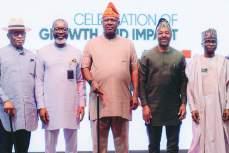
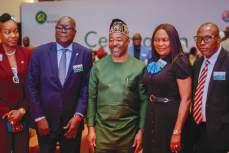
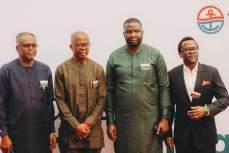
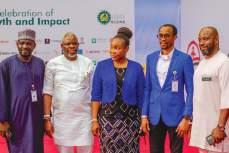
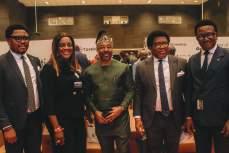
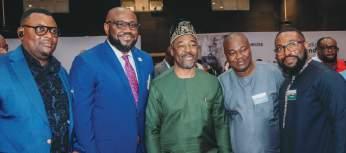
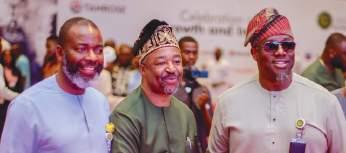
Tamrose Limited, an indigenous marine logistics and o�shore suppor t company, hosted a high-impact Ce lebrati on of Growth and Impact event in Yenagoa, in collaborati on with th e Nigerian Co ntent Development and Monitoring Board (NCDMB). The event spotlighted Tamrose’s full repayment of its $10 million Nigerian Content Intervention (NCI) Fund facility administered by the NCDMB, reinforcing the company’s strong financial governance. The event also underscored Tamrose’s astounding growth from 4 to 15 vessels in 6 years and measurable impact, including nearly 250 direct jobs created and over 100 cadets trained to international standards—a clear demonstration of how structured local content financing enables capacity building and sustainable growth in Nigeria’s maritime sector
Distinguished guests present included S en. Heineken Lokpobiri, Honourable Minister of State for Petroleum Resources Oil and Chairman, NCDMB; Esueme Dan-Kikile Esq., representing the Executive S ecretar y of NCDMB, Engr. Felix Omatsola Ogbe; Mr. Taiye Emagha, representing the Managing Director, Bank of Industr y, Dr. Olasupo Olusi; Mr. Jibril Abba, representing the Director General/CEO, Nigerian Maritime Administration and S afety Agency (NIMASA), Dr. Dayo Mobereola; and Rear Admiral Gboribiogha John Jonah (Rtd), former Deputy Governor of Bayelsa State
L-R: Rear Admiral Gboribiogha John-Jonah (Rtd.), Former Deputy Governor, Bayelsa State; Esueme Dan-Kikile Esq., General Manager, Human Capacity Development, NCDMB; Sen. Heineken Lokpobiri Ph.D, The Honourable Minister of State for Petroleum Resources Oil and Chairman, NCDMB; Mr Ambrose Ovbiebo Executive Chairman, Tamrose Limited and Mr Jibril Abba, Executive Director, Nigerian Maritime Labour & Cabotage Services (NIMASA).
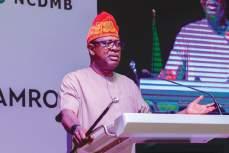
Sen. Heineken Lokpobiri Ph.D, The Honourable Minister of State for Petroleum Resources Oil and Chairman, Nigerian Content Development and Monitoring Board (NCDMB).
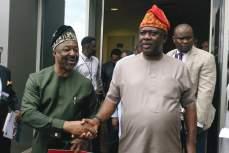
L-R: Mr Ambrose Ovbiebo, Executive Chairman, Tamrose Limited and Sen. Heineken Lokpobiri Ph.D, The Honourable Minister of State for Petroleum Resources Oil and Chairman, NCDMB
L-R:
Acting Group Politics Editor DEJI ELUMOYE
Email: deji.elumoye@thisdaylive.com
08033025611 sms only
2027: Of Coalitions and Politics of Resentment
Fidelis David , in this report, observes that Nigeria’s post-1999 democratic journey has repeatedly oscillated between moments of public hope and long cycles of elite recycling, where political failure is rarely punished, but rebranded.
From the hurried alliances that produced the 2015 transition to the transactional coalitions that dominate current opposition conversations, power has often changed hands without changing character.
Suffice to say it’s against this backdrop that the 2023 presidential candidate of the Social Democratic Party (SDP), Prince Adewole Adebayo, has deliberately chosen a more demanding political route: a refusal to allow anger to substitute for ideas, a rejection of elite rehabilitation without accountability, and a resistance to coalition politics built solely on convenience rather than conviction as the 2027 general election approaches.
Adebayo does not speak like a politician in a hurry. In a political climate increasingly defined by defections, tactical silences and rushed alliances, he insists on slowing the national conversation, asking Nigerians to interrogate not merely who seeks power in 2027, but why, and at what moral cost.
The SDP standard-bearer spoke with journalists in Ondo town on the sidelines of the 2025 Prince Adewole Adebayo Christmas Marathon and Queen Lilian Adebayo Health Walk. The civic event provided the setting for a wide-ranging interrogation of Nigeria’s politics, economy and democratic future, during which Adebayo issued a pointed warning against what he described as the growing temptation to “smuggle worse leaders into power” under the banner of opposition unity.
“I am not against coalition. But that common purpose must have meaning in the life of ordinary Nigerians. The fact that I do not like President Bola Tinubu does not mean I should accept the same bad governance tendencies from other people.”
For Adebayo, opposition politics built purely on resentment is a trap. To illustrate, he deployed a metaphor that has become emblematic of his critique. “What is the point for a chicken to vote among three people debating how best to kill it?. One says roast it, another says fry it, another says parboil it. How does the chicken vote for any of them?” he asked.
He cautioned that public anger over
hardship, insecurity and economic decline could be exploited by political actors whose records are worse than those they seek to replace.
“Many of those coming will be worse. They want to capitalise on the obvious bad performance of government to ride the wave of anger”, he warned.
That philosophy, he said, has guided the SDP’s internal screening process. According to him, several politicians seeking refuge in the party were turned away. “Some people came to our party and we told them to go away. You cannot say you want to rescue Nigeria when you are a fraud.”
Recalling one episode, he added: “You brought an aeroplane from Ethiopia, painted it, took pictures for one hour and the plane disappeared. How can you sit next to me and ruin my life with that useless photograph?”
Asked to assess the state of the nation in 2025, Adebayo delivered a scathing verdict. “For Nigerians, it was a wasted year. For people in government, it was a year of loot,” he said, accusing the political class of unseriousness and constitutional recklessness.
He questioned the Federal Government’s fiscal management, describing the operation of multiple budgets concurrently as both unconstitutional and absurd.
“How can you run three fiscal budgets at the same time, violating three appropriation acts? That fellow should have been impeached long ago.”
Adebayo also lamented Nigeria’s diplomatic vacuum, noting that the country has continued without substantive ambassadors while political loyalists are appointed as “New Hope ambassadors.” For him, it symbolised a state captured by patronage rather than competence.
On education, he described the student loan scheme as “the most dangerous youth enslavement programme ever conceived. Our constitution says education must be affordable. You cannot steal tuition money, shut schools down, and then loan the same money back to students with interest.”
With the Federal Government implementing a sweeping tax reform law, Adebayo offered one of his most detailed critiques, dismissing the policy as unjust, impractical and legally suspect. “It is a bad law. It is meaningless. It is a distraction,” he said, arguing that it fails the basic principles of taxation.
According to him, taxation must stimulate production, distribute resources fairly, generate sustainable revenue and remain simple enough for ordinary citizens to understand. “You cannot create a tax law that makes a woman selling akara think she needs to hire a lawyer,” he said, noting widespread fear among traders, mechanics and small business owners.
Beyond incompetence, Adebayo alleged a deeper motive: concentration of power. “What they want is fiscal singularity.
Adebayo does not speak like a politician in a hurry. In a political climate increasingly defined by defections, tactical silences and rushed alliances, he insists on slowing the national conversation, asking nigerians to interrogate not merely who seeks power in 2027, but why, and at what moral cost.
Political singularity has already been achieved. Now they want economic and administrative singularity.”
He criticised the outsourcing of revenue collection to private consultants, describing it as a violation of sovereignty. “Revenue collection is a sovereign duty. Using private consultants is like hiring mercenaries to do the work of the armed forces.”
More troubling, he noted allegations by lawmakers that the version of the law being circulated differs from what the National Assembly approved. “If provisions were inserted without parliamentary approval, then this is criminality,” he said.
According to him, the rush to implement the law is driven by electoral funding needs. “They need money for elections. They want to continue collecting your money even after they leave office,” he said. “That is how you permanently subjugate a people.”
Reflecting on the SDP’s 2023 performance, Adebayo admitted internal shortcomings. “We didn’t start on time. We had not competed seriously in previous elections.”
However, he insisted that systemic electoral failure was decisive. “It was not a proper election. It was a criminal enterprise, buying votes, stealing votes and falsifying results,” he said.
The SDP, he noted, refused to engage in such practices. “Since we don’t have that kind of talent and we don’t want it, we couldn’t do well in that kind of election.”
Looking ahead, he said the party is reforming internally while championing electoral reform nationally. “INEC must be credible. Technology must work. Results must reflect the votes cast.”
Despite ongoing talks with opposition figures, Adebayo rejected calls for forced regime change or coalitions built solely on opposition to Tinubu.
“I don’t support coups. I don’t sabotage governments. Governments are elected for fixed terms. When elections come, Nigerians should vote them out.”
NOTE: Interested readers should continue in the online
Adebayo
IN PRAISE OF FAIRNESS, EQUITY, AND JUSTICE
ALHASSAN DAYOK
ADAMU argues that Uba Sani’s inclusive leadership is the key to his political success
After 70 years of oil exploitation, many inhabitants of the oil bearing areas live in want and misery, contends INIRUO WILLS
NIGERIA, OIL AND THE NIGER DELTA
RUSSIAN HOUSES AND TRAFFICKING OF AFRICA’S YOUTH
Russia’s so-called cultural centres, branded as Russian Houses, have become recruitment centres for Moscow’s war in Ukraine, writes OUMAROU SANOU
See page 21 See page 21
Thursday 15th January 2026 marks 70 years since Colonial Nigeria and the Oil Industry began their continuing joint dating of the Niger Deita region. Over 40 years before that rendezvous, the search for petroleum oil in Nigeria had started, in about 1913, the year before the Southern and Northern parts of present day Nigeria were joined together to form a single country, by the then colonial authority. The German Bitumen Company was the first to start exploration. Some other companies, mostly British and European, also explored many areas in the country with the aim of mining petroleum. Early in the 20th Century, petroleum became a very important commodity and was in high demand across the world, especially with the emergence of motor cars and industrial, transportation (aviation, etc) or other activities that needed to be fueled from petroleum. In particular, oil was steadily replacing steam as the staple fuel for shipping, a trend propelled further by the massive naval fuel requisitions in the 20th Century’s World Wars.
Sometimes crude oil (petroleum) was found in parts of the country, but in quantities that were too little to be of commercial value, since huge financial capital was required to fund its production activities. Finally, after four decades of exploration, crude oil was discovered in commercial volumes on the 15th of January 1956 in Otuabagi Community in what was then the Oloibiri Province (like a county or borough in the UK and US), in the present day Bayelsa State within the Niger Delta region. The Province was named after the nearby Oloibiri Community, just five minutes drive away, which served as headquarters of the Province. So that historic first oil well to yield enough petroleum for export was named Oloibiri Well 1. The company that drilled that oil well and made the discovery was Shell D’Arcy Petroleum Limited, which later evolved into The Shell Petroleum Development Company of Nigeria Limited (SPDC), owned by the UK-based Shell PLC, and has now mutated to Renaissance Africa Energy Company. Shell commenced production and on 5th June 1958, two and a half years later, shipped its first consignment of petroleum abroad.
minerals in the lands and seas of Nigeria belong to the Government, and in practical terms therefore to the colonial British Government. This is unlike most other countries like the United States of America (US) or Canada where minerals belong to whoever owns the land in which they are found, whether individuals or families or communities. In those countries, companies can negotiate with land owners where minerals are found and buy the lands at substantial amounts or share some of the proceeds of the production of minerals with the land owners. So it is today that Alaska, an oil producing state in the US, has so far built up a savings fund (sovereign wealth fund) of approximately $80 billion from its oil revenues, besides what it has already invested in the welfare, preservation and development of its communities.
Since the opposite was the case in Nigeria, no monies from the proceeds of oil and gas went to the communities or families who owned the lands. When Nigeria gained political independence from Britain on 1st October 1960, the Nigerian Government inherited the laws and assets of the former colonial government and it continued to receive the majority share of proceeds from the sale of petroleum as “owner” and production partner, instead of the communities or families.
the people, like fishing and farming. As the lands and waters were polluted, the yields from fishing, farming and similar jobs for local people started reducing, therefore resulting in economic or livelihood displacement. This also caused many locals to leave their communities for urban areas to look for means of earning a living, with little assurance that they will find any. In addition, it led to worsening health conditions (such as respiratory/breathing diseases, cancers and birth complications) along with several social problems like frustration and conflicts that have never been fully measured.
There are thousands of oil spills in the Niger Delta region every year. They are usually due to negligent operations of the companies, including poor maintenance of the wells and pipelines which mostly continue to be used long after they should have been replaced. Added to oil spills is the improper disposal of harmful waste materials from oil production, into surrounding rivers or dug pits. Thirdly, there is gas being flared (burned) into the air at many oil production sites. This poisons the air inhaled by people. In most countries, gas flaring has been banned or reduced to the minimum.
With all these troubles brought upon them by oil companies, people of the host communities became very dissatisfied and angry. Some started protesting, and the government often used military force to crush the protests. Although most of the protests were peaceful, some of the youths eventually felt they too must apply force and arms to press home their grievances and disrupt oil production as much as they could, since government was not listening to the cries for justice and the voices of reason from social leaders, lawyers, environmental NGOs (non-governmental organizations) and activists. This gave rise to youth militancy in the region, which also affected the level of oil production.
There was great excitement at the time because the sale of crude oil would bring millions of dollars in profits never seen before to not only the company but also to the Nigerian Government that was declared the owner of the oil in the ground.
After the British Government colonized the various kingdoms and emirates making up the present Nigeria, it made series of laws, starting with the Minerals Ordinance of 1902, declaring that all
In the course of time, Shell and other foreign companies (e.g. Mobil, Total and ENI/Agip) struck commercial quantities of crude oil in other parts of the country also, like in the Ogoni ethnic area where it was discovered in 1958 in a community called Bomu. But instead of bringing joy and prosperity to the local dwellers, oil production gradually started to have several damaging effects on the people and their environment.
In addition to being denied a share of the fabulous profits from oil and gas, the operations of the industry were seriously polluting their communities’ lands, forests and waterways. Neither the companies (operators) nor the government cared much about restoring the damaged environment. This then started affecting the traditional economic occupations or livelihoods of
Unfortunately, some people took this situation as an excuse to organize themselves into groups and tap crude oil from the pipelines, either to sell directly (oil bunkering) or to “refine” the oil themselves through rudimentary means (artisanal refining) and sell the diesel fuel that comes out of it. This practice further pollutes the environment and exposes the people involved to safety risks like fire, health hazards, and to arrest by the security forces. Many oil companies then took this as an opportunity to claim that most of the spill incidents are caused by vandals and community dwellers, and that they will therefore not pay compensation for the damage caused.
Russia’s so-called cultural centres, branded as Russian Houses, have become recruitment centres for Moscow’s war in Ukraine, writes OUMAROU SANOU
RUSSIAN HOUSES AND TRAFFICKING OF AFRICA’S YOUTH
What is unfolding across parts of Africa under the banner of cultural exchange is not diplomacy. It is not education. And it is certainly not benign soft power. It is a calculated, morally bankrupt system that exploits African vulnerability and converts cultural trust into military manpower for a war Africans neither started nor consented to fight.
Russia’s so-called cultural centres, branded as Russian Houses, have become part of a shadow infrastructure feeding Moscow’s war in Ukraine. They operate not as neutral spaces for language, literature, or artistic exchange, but as recruitment-adjacent nodes in a broader ecosystem of deception, labour exploitation, and ideological manipulation. For Africa, this should ring alarm bells far louder than they currently do.
Cultural diplomacy, in its classical sense, seeks to persuade, not conscript. It aims to shape perception, not bodies. Yet what investigations now reveal is a disturbing mutation: culture repurposed as camouflage, education as bait, opportunity as a trap. Young Africans are not being won over by ideas alone; they are being funnelled—sometimes coerced— into a war zone through a system that thrives on deniability and desperation.
The tragedy is not only that Africans are dying on foreign battlefields. It is that many never knew they were enlisting in a war at all.
Across Nigeria, Uganda, Kenya and beyond, testimonies tell a consistent story. Men are promised jobs—mechanics, security guards, supermarket workers. Visas are arranged with suspicious ease. Travel is routed through familiar transit hubs. And once inside Russia, the script changes. Passports vanish. Military camps appear. Training begins. Protest becomes futile. Escape becomes a gamble with death.
This is not migration gone wrong. It is deception by design.
At the centre of this system sits Rossotrudnichestvo, the Russian state agency overseeing Russian Houses worldwide. Unlike the British Council or Goethe-Institut, its operations follow an opaque franchising model, allowing private actors—including those linked to Russia’s security and mercenary ecosystem—to run cultural centres under a unified brand. The result is plausible deniability for Moscow and zero accountability for victims.
This model matters. It allows the Russian state to benefit strategically while evading responsibility politically. When things go wrong—and they do—it is always someone else’s fault: a local agent, a private company, a misunderstanding. Meanwhile, African families bury sons who left home seeking work, not war. Even more troubling is how ideology and narrative conditioning are woven into this machinery. Russian Houses increasingly host militarised events, glorify Russia’s armed forces and normalise the Ukraine war as a civilisational struggle.
They amplify Kremlin-aligned media while silencing dissent. These are not cultural spaces; they are echo chambers preparing minds—and sometimes bodies—for mobilisation.
Religion, too, has not been spared. The expansion of the Russian Orthodox Church’s African Exarchate, particularly in countries where Russian security influence is already present, adds another layer of concern. Faith-based engagement, theological training and church-sponsored labour projects have, in documented cases, intersected with recruitment and war-related labour pipelines. When spirituality becomes a corridor to coercion, the ethical collapse is complete.
What makes this especially dangerous is Africa’s structural vulnerability. High youth unemployment, weak labour protections, porous oversight of migration, and limited intelligence coordination create fertile ground for such operations. When survival becomes the priority, scrutiny becomes a luxury many cannot afford.
But Africa cannot afford this silence.
This is not about geopolitics alone. It is about sovereignty. It is about the value of African lives in a global system that too often treats them as expendable. It is about whether African governments will continue to look away while foreign powers exploit desperation under the cover of culture.
Regulation must replace naivety. Cultural centres should not operate without transparency, oversight and clear legal boundaries. Labour recruitment pathways must be scrutinised, especially those linked to conflict zones. Intelligence and immigration services must treat these networks not as isolated incidents but as a pattern that demands a coordinated response.
Most importantly, Africans must reclaim the narrative. Engagement with global powers should be grounded in dignity and mutual respect, not deception and disposability. Cultural exchange must never be allowed to become a conveyor belt to war.
From Dostoevsky to drone strikes, something has gone profoundly wrong. If Africa does not confront it now, the continent risks losing not just its youth, but its moral authority to protect them.
Sanou is a social critic, Pan-African observer and researcher focusing on governance, security, and political transitions in the Sahel
ALHASSAN DAYOK ADAMU argues that Uba Sani’s inclusive leadership is the key to his political success
IN PRAISE OF FAIRNESS, EQUITY, AND JUSTICE
When Senator Uba Sani assumed office as Governor of Kaduna State on May 29, 2023, he inherited a political landscape fraught with challenges. The All Progressives Congress (APC), the party under which he had just secured a razor-thin victory in the gubernatorial elections, was far from the dominant force it once aspired to be. The general elections earlier that year had laid bare the party's vulnerabilities. In the presidential race, APC's candidate, Bola Ahmed Tinubu, failed to carry Kaduna, losing to Atiku Abubakar of the Peoples Democratic Party (PDP) with 399,293 votes against Atiku's 554,360. The gubernatorial contest was equally telling: Uba Sani eked out a win with 730,002 votes, edging out PDP's Isa Ashiru by a mere 10,806 votes in a state known for its polarized politics. These results underscored an uncomfortable truth—the APC in Kaduna had grown increasingly unpopular after eight years of his predecessor in office, plagued by internal divisions, perceptions of exclusion, and a lingering distrust among key demographics, particularly in the southern zones where ethnic and religious sensitivities run deep.
The party's fortunes had been on a downward trajectory since the controversial tenure of Governor Sani's predecessor, Nasir El-Rufai, whose policies often alienated segments of the population. El-Rufai's administration was marked by accusations of favoritism and heavyhandedness, which eroded the APC's base. By the time Uba Sani took the oath, the party was a shadow of its 2015 self, when it had swept into power on a wave of optimism. Opposition parties, especially the PDP, held significant sway in the state assembly and federal representations, controlling 12 out of 16 House of Representatives seats from Kaduna. The APC's grassroots structures were weakened, membership stagnant, and morale low. It was against this backdrop that Governor Uba Sani embarked on what can only be described as a masterful recreation of the APC in Kaduna—a revival rooted in inclusivity, strategic outreach, and a commitment to governance that transcends partisan lines.
Governor Sani's approach, often dubbed "The Uba Sani Way," emphasizes fairness, equity, and justice as cornerstones of his administration. Drawing from his background as a former senator and activist, Governor Uba Sani has prioritized bridging divides that have long fractured Kaduna's socio-political fabric. His administration has focused on even distribution of projects across the state's three senatorial zones, investing in infrastructure, education, healthcare, and security without regard to ethnic or religious affiliations. This inclusive governance model has not only stabilized the state but has also transformed the APC's image from an elitist outfit to a people-centered platform. As Uba Sani himself articulated in a recent stakeholders' meeting, unity remains the party's greatest asset, and his policies reflect a deliberate effort to foster it.
The most tangible evidence of this
revival is the unprecedented wave of defections from opposition ranks to the APC. What began as a trickle in late 2023 has swelled into a torrent, drawing political heavyweights who were once staunch critics of the party. These defections are not mere opportunistic shifts; they are testimonials to Governor Uba Sani's leadership style. Prominent figures have publicly attributed their decisions to the governor's commitment to inclusive development and his ability to rebuild public confidence.
One of the most high-profile defectors is Senator Shehu Sani, a former APC member who left the party in 2018 amid internal conflicts and later aligned with the PDP. In February 2025, Shehu Sani returned to the APC fold, welcomed personally by Governor Uba Sani. In a statement during his defection ceremony, Shehu Sani praised the governor's transformative agenda: "I am back in the APC because of Governor Uba Sani's inclusive approach. He has shown that governance can unite rather than divide, and his efforts in revitalizing key sectors have restored hope in Kaduna." This move sent shockwaves through the political establishment, signaling a mending of old rifts.
Another key figure is Senator Sunday Marshall Katung, representing Kaduna South (Southern Kaduna) Senatorial District. Senator Katung, a PDP stalwart, defected to the APC in November 2025 alongside three other lawmakers at a mega rally in Kafanchan. Senator Katung, known for his influence in the predominantly Christian southern zone, cited Uba Sani's equitable policies as the catalyst. "Governor Uba Sani's administration has demonstrated fairness and justice, addressing long-standing grievances in Southern Kaduna. This is why I and my supporters are joining the APC—to be part of this renewed vision for our state," Katung declared at the event.
The defections extend to the legislative arena. In October 2025, three federal representatives from the PDP switched to the APC during a House of Representatives plenary session: Aliyu Abdullahi (Ikara/ Kubau constituency), Abdulkareem Ahmed (Kaduna South), and Sadiq Abdullahi (Sabon Gari).
Adamu, a Political Scientist and Good Governance Advocate, writes from Kaduna, Kaduna State
Editor, Editorial Page PETER ISHAKA Email peter.ishaka@thisdaylive.com
POWER GENERATORS AND FATAL FUMES
There should be a sustained enlightenment campaign on generator usage
It is unfortunate that the list of Nigerians who die from inhaling generator fumes keeps growing. In some instances, entire families have been wiped out by this silent killer in several homes. Last week, a family of six, including both parents and children, were found dead in their home in Eleme local government area of Rivers State after inhaling fumes from a generator reportedly kept inside their living room overnight. “From available information, the generator was kept inside the living room because the family feared it could be stolen,” according to the spokesperson of the Rivers State Police Command, Grace Iringe-Koko.
In the same Rivers State last March, a couple who placed their generator inside the passageway of their apartment were found dead the next morning. But this is a familiar tragedy. Due to poor electricity supply in Nigeria, most offices, shops and homes are powered by generators. There is hardly any family, particularly in the urban areas, that does not depend on power generators. So bad is the situation that in some areas, as many as 10 generating sets could be found within a radius of five metres. Yet, as we have highlighted on this page on several occasions, the fumes emitted by generators are fatal, often without the victims, who are mostly asleep, knowing or realising the danger. They also have long-term hazards as a possible cause of lung cancer. Experts therefore advise people using the device to never run a generator indoors or in any area where ventilation is limited.
Awareness must be created that it is always safer to put the generator outside, and away from a window, and never in an enclosed situation
T H I S D AY
EDITOR SHAKA MOMODU
DEPUTY EDITOR WALE OLALEYE
MANAGING DIRECTOR ENIOLA BELLO
DEPUTY MANAGING DIRECTOR ISRAEL IWEGBU
CHAIRMAN EDITORIAL BOARD OLUSEGUN ADENIYI
EDITOR NATION’S CAPITAL IYOBOSA UWUGIAREN
THE OMBUDSMAN KAYODE KOMOLAFE
T H I S D AY N E W S PA
EDITOR-IN-CHIEF/CHAIRMAN NDUKA OBAIGBENA
GROUP EXECUTIVE DIRECTORS ENIOLA BELLO, KAYODE KOMOLAFE, ISRAEL IWEGBU
DIVISIONAL DIRECTORS SHAKA MOMODU, PETER IWEGBU, ANTHONY OGEDENGBE
DEPUTY DIVISIONAL DIRECTOR OJOGUN VICTOR DANBOYI
SNR. ASSOCIATE DIRECTOR ERIC OJEH
To be sure, generators provide power for light, fans, fridges, television to video games and such like. But aside from the noise and pollution they
emit, there are also health costs. As most health experts have warned, fumes from these generators could be deadly. The fumes contain carbon monoxide, a dangerous invisible and colourless gas. When inhaled, carbon monoxide replaces oxygen in the tissues and can easily lead to death. The signs on the victims are dizziness, nausea, headache, even confusion, symptoms mistakenly attributed to too much alcohol, or something else. That explains why the story of people who sleep at night with their generators on without waking up the next morning has now become rampant. Besides, exposure to moderate and high levels of carbon monoxide over a long period of time has been linked to an increased risk of heart disease. This could lead to a shorter life span. What is particularly worrisome about this development is that as pervasive as it is, there is still no public awareness campaign by the relevant authorities on the dangers posed by generators. Therefore, against the background that hardly a week passes without reports of fatalities resulting from generator fumes, users must be made aware of the necessary precautions to take. The National Orientation Agency (NOA) that is becoming increasingly vibrant under the leadership of Lanre Issa-Onilu should take it as part of its agenda. Awareness must be created that it is always safer to put the generator outside, and away from a window, and never in an enclosed situation. We feel the general public should be adequately enlightened on the danger posed by generators, and how they can be safely used, mostly at homes. This should be the responsibility of the health and environment authorities at both the federal and state levels. By so doing, we will be able to save our people from painful but cheap deaths.
Letters in response to specific publications in THISDAY should be brief (150-300 words) and straight to the point. Interested readers may send such letters along with their contact details to opinion@thisdaylive.com. We also welcome comments and opinions on topical local, national and international issues provided they are well-written and should also not be longer than (750- 1000 words). They should be sent to opinion@thisdaylive. com along with photograph, email address and phone numbers of the writer.
THE HERO OF AFCON 2025 IS PAPE THIAW
Africa’s unique foibles must be confronted by unusual solutions. If Patrice Motsepe of CAF and the central-officiating little Negroes believe they are inferior to the Arabs and they must skew the outcomes of games in favour of Morocco, then the “big” Negroes must duly protest such injustice even if the approach is not “politically correct.” Shaka the Zulu did not stick to political correctness at the expense of the interest of the wellbeing of his folks. Must Morocco as host be the champions of Africa? Brazil was knocked out of the 2014 Mundial before the final and that was alright. If Pape Thiaw of Senegal had not protested, the Teranga Lions would not be champions of Africa: one righteously indignant incidence cascaded and boiled over into the other and ultimately the Panenka failed Brahim Diaz (c’mon, is Mr. Diaz African?). CAF must understand we live in a world where racial awareness is now in the front burner. Don’t these bunch know history and the travails the black people suffered at the hands of Arab slavers? Millions of Negroes were taken away into slavery by the Arabs and this lot trekked through the Sahara on foot. There are no traces of them today except a few scattered descendants here and there who are given the
“dishonourable” task of beheading “criminals” in Mecca on Fridays. The El-Kaabis of Morocco are unskilled carpenters who are generally unschooled. Their forebears were forcibly snatched from Mali. And sold by King Mansa Musa, too. The Americas have explanations for the black people they took away: did not Michael Jackson give us pure joy? Even the presence of Arabs in the African continent is an anomaly. Surely, it was prophetic insight from me to suggest the split of AFCON into a “Negro AFCON” for Black Africa and a “North Africa Cup” for the Arab interlopers.
The Villains of AFCON. One, Sadio Mane: He was not the captain of the day and he was not supposed to hang around waiting for entreaties to be made to him when his coach and the true captains have walked out. Mane, being Saudi-based and Saudi-brainwashed was willing to give up the AFCON prize to Morocco. Edouard Mendy put him to shame.
Two, Claude LeRoy: The famed maned gaffer had no business pleading with Sadio Mane to convince the Teranga Lions to resume play. It was obvious Teranga Lions were gonna lose the AFCON prize. Happily, it did not turn out that way, by the quirkiest of circumstance.
That Panenka, uh?
Three, El-Hadji Diouf: That man lacking veritable Negro pigmentation had no business talking Sadio Mane to convince his riled teammates to resume play. In his day, Diouf would have raised bloody ruckus at the injustice meted out to the Teranga Lions. Four, Patrice Motsepe: Him the Big Fish who rigged it all for Morocco by skewed referee- selection process. To Mr. Motsepe, was AFCON 2025 about commerce and not scruples? Did not Morocco gain enough coverage and exposure to ensure a thriving tourism trade after AFCON? If Mr. Motsepe rigged it for Morocco, how’d it gonna be at AFCON 2027 with three countries as host? Mr. Motsepe has not read his history books thoroughly. Sports do start regional wars. In the face of this faux pas by a South African, the centre referee from South Africa did a great job in being fair and upright. Issa Sy of Senegal was the best of the lot. Mr. Motsepe must take pride in his Bantu roots and not kowtow to the Arabs. Sunday Adole Jonah, Department of Physics, Federal University of Technology, Minna, Niger State
Survey Reveals Rising Appetite for
Loans as Banks Rebuild Balance Sheets
Nigerian deposit money banks are showing renewed willingness to extend credit to households and businesses, supported by stronger capital buffers and improving macro-economic sentiment, even as borrowing costs remain elevated and credit risks continue to rise.
This is according to the Central Bank of Nigeria’s (CBN) Q4 2025 Credit Conditions Survey, which indicates that both the supply of, and demand for loans expanded across major lending segments in
Kayode Tokede
Despite the reduction of the Monetary Policy Rate (MPR) to 27 per cent, by the Central Bank of Nigeria (CBN), the banking sector’s average maximum lending rate increased to 29.69 per cent in November 2025 from 29.56 per cent in October 2025.
Maximum lending rate represents the average of the highest lending rates charged by deposit money banks in Nigeria and it is influenced by the CBN’s monetary policy adjustments.
Also, the average maximum lending rate at 30 per cent in
the final quarter of last year.
According to the survey, credit availability increased across all major loan segments in the final quarter of last year, reflecting a growing willingness by banks to support economic activity amid early signs of macro-economic stabilisation.
Household borrowers, the report said, increased demand for both consumer and secured loans, while corporates stepped up requests for working capital and longer-term investment finance.
The central bank report noted that lenders were
2025 was the effective ceiling rate in Nigeria’s banking system and it reflects credit risk, inflation uncertainty, weak contract enforcement and hike in operating costs.
In the period under review, inflation rate, according to National Bureau of Statistics (NBS) rebased Consumer Price Index (CPI) had dropped to 14.45per cent as of November 2025 from 15.44 per cent December 2024, while Naira at the Nigerian Foreign Exchange Market (NFEM) closed November 28, 2025 at N1,446.9 against the dollar from N1,5350 against the dollar December 31, 2024.
increasingly responsive to these dynamics. It stated, “Lenders indicated a rise in credit availability for secured, unsecured, and corporate lending in Q4 2025. The increase in credit availability was attributed to the changing economic outlooks and market share objectives for secured and corporate lending. For unsecured credit availability, the main factors affecting increase in credit were attributed to changing economic outlook and changing cost/availability of fund.”
THISDAY analysis of the
According to the CBN’s money market indicator, the reported 30.50 per cent and 29.31 average maximum lending in February and July 2025, were the highest and lowest rates, respectively. With interest rate at 27.00 per cent, commercial banks typically add a margin of +260 and -250 basis points above the interest rate to cover credit risk, inflation, and operational costs.
In the move to tackle inflation rate and stabilize Naira at the foreign exchange market, the CBN since August 2026 retained its rate at 27 per cent from 27.5per cent it
survey showed that secured lending to households rose by 12.8 per cent, while corporate lending jumped by 21.3 per cent points, signalling a stronger inclination by banks to underwrite credit as confidence improves.
Unsecured household credit also expanded by 10.0 per cent, though at a more moderate pace, reflecting lenders’ continued caution around consumer risk.
On the demand side, borrower appetite strengthened across the board. The net balance for demand for secured household credit climbed
was since 2024.
In December 2024, the maximum lending rate was 29.71 per cent, when the MPC voted to retain the MPR at 27.50 per cent
The steep increase in the interest rate has sparked concerns regarding the potential impact on the cost of credit for businesses already facing economic hardships due to foreign exchange unification and fuel subsidy removal by the Federal Government.
CBN data revealed that the average maximum lending rate rose to 29.79 per cent in January 2025 from 29.71 per cent in December 2024
to 14.8 per cent, while unsecured credit demand rose to 5.9 per cent. Corporate credit demand also increased, reaching 12.4 per cent, underscoring renewed interest in business expansion and operational financing.
However, the survey suggests that this renewed momentum in credit activity is unfolding against a backdrop of elevated pricing and rising default risk. Lending rate spreads continued to reflect tight monetary conditions, with household borrowers facing wider margins relative to the
when the Monetary Policy Committee (MPC) members voted to retain MPR to 27.50 per cent.
Early in 2024, the money market indicators of CBN showed a 27.07 per cent average maximum lending rate in January 2024 when MPR was at 18.75 per cent, while in March 2024, it closed at 29.38 per cent as MPR stood at 24.75 per cent in March 2024.
When the MPR increased from 26.75 per cent in August 2024 to 27.25 per cent, the average maximum lending rate also rose from 29.93 per cent in August 2024 to 30.21
Monetary Policy Rate (MPR). The report noted, “In Q4 2025, the spreads on secured and unsecured lending rates to households widened to -10.8 and -2.0, respectively, relative to the Monetary Policy Rate (MPR). For corporate lending, spreads narrowed for small businesses, large private non-financial corporations (PNFCs), and other financial corporations (OFCs) at 14.8, 2.9, and 4.3 index points, respectively, while medium PNFCs reported widening spread at 4.8 index points.”
per cent in September 2024. The banking sector lending rate in Nigeria averaged 14.17 per cent from 1961 until 2024, reaching an all-time high of 37.80 per cent in September of 1993 and a record low of six per cent in April of 1975. In 2020, the average maximum lending rate reached a peak of 30.73 per cent when the MPR rate stood at 13.5per cent According to the CBN data, the average prime lending rate stood flat at 18.89 per cent between November and October 2025.
Nume Ekeghe
FCMB Clears National Capital Threshold, Sets Sights on International Expansion
FCMB Group Plc has successfully secured a national banking licence for its flagship
subsidiary, following a major capital raise that ensures uninterrupted domestic operations. The move, it said in a statement, positions it
BII Provides $1bn for Allianz’s Blended Finance Fund
British International Investment (BII), yesterday announced it will be an anchor investor for the $1billion for Allianz Credit Emerging Markets fund (ACE).
The blended finance fund, which was launched at BII in London, brings together a number of public and private institutions.
Development finance institutions, such as BII and MDBs, will provide $150 million of concessionary capital for the junior tranche of
the fund. This will significantly reduce volatility and support the return expectations for private investors that will provide up to a further $850 million if the expected final close target of $1 billion is reached.
UK Minister for International Development and Africa, Baroness Chapman in a statement said: “BII’s participation in the ACE fund demonstrates how we are modernising our approach to international development, by working as partners and investors.
NIA Highlights Role of Insurance in National Devt
Stories by Ebere Nwoji
The Director General Nigeria Insurers Association (NIA), Mrs Bola Odukale has highlighted the critical role played by insurance in national development.
Group Business Editor
eromosele abiodun
Deputy Business Editor
Chinedu eze
Comms/e-Business Editor
emma Okonji
Asst. Editor, Energy
emmanuel addeh
Asst. Editor, Money Market
nume ekeghe
Correspondents
KayodeTokede(CapitalMarkets)
James emejo (Finance)
ebere nwoji (Insurance)
Reporter Peter uzoho (Energy)
Odukale gave the highlight at a two-day workshop on “Compulsory Container Insurance,” organised by the association in-line with Section 203 of the NIIRA 2025.
She noted that a wellregulated and legally backed insurance industry was vital to economic growth, investor confidence, and public protection.
She urged participants to actively engage in the sessions, noting that the knowledge gained would not only strengthen professional capacity but also enhance effective implementation of compulsory insurance provisions for the overall benefit of the economy.
Facilitators at the training were Mrs. Margaret Ogbonna, Director, Nigerian Shippers Council, Mr. Soji Oni, Controller 1 Technical at NIA and Mr. Owolabi Longe, CEO, Ironlink Communications, among others.
to pursue the higher capital requirements necessary for international status under Nigeria’s ongoing banking sector recapitalisation programme.
The development comes as the Central Bank of Nigeria’s (CBN) recapitalisation drive, launched in 2024, continues to highlight contrasting strategies among lenders ahead of the March 31, 2026 deadline.
Under the revised framework, banks seeking international licences must maintain a minimum paid-up capital of N500 billion, while national banks are required to hold at least N200 billion.
Regulatory filings show that FCMB crossed the national threshold after completing a N147.5 billion public offer in 2024, enabling it to secure the national licence for its banking operations.
A spokesperson for the group noted, “Securing the national licence places FCMB ahead of the minimum requirement for domestic operations and ensures continuity as the recapitalisation process progresses. The group is now preparing for the next phase, targeting the international licence through additional
capital-raising initiatives.”
These initiatives include a N160 billion offer launched in late 2025 and a broader shareholder-approved programme of up to N400 billion, subject to regulatory approvals. If completed, the additional capital would place FCMB above the N500 billion benchmark, expanding its operational reach beyond Nigeria’s borders.
Dalu Ajene Emerges Standard Chartered CEO Africa
Kayode Tokede
Standard Chartered has appointed Mr. Dalu Ajene as the Chief Executive Officer of the Bank’s operations in Africa with dual responsibilities as the head of Coverage for Africa.
Until this appointment, Dalu was the CEO of Standard
Chartered Nigeria; a role he assumed in April 2024.
Under his leadership, he is credited with leading the Bank to achieve strong year on year financial performance including meeting the Central Bank of Nigeria’s (CBN) recapitalisation requirement of N200 billion for national
commercial banks ahead of the March 2026 deadline.
Before joining Standard Chartered, he was the CEO of Rand Merchant Bank Nigeria.
Speaking on his appointment, Dalu in a statement said, “Having had the privilege of leading Standard Chartered Nigeria
over the past two years, I am deeply honoured to now take on broader responsibilities across Africa. This transition reflects the strength of our franchise, the resilience of our teams, and the impact we have delivered in a period of significant change and development.
Heirs Insurance to Reward University Students
Heirs Insurance Group (HIG), has called for applications for the maiden edition of the Heirs Insurance Hackathon, a technology-driven innovation programme designed to empower young students shape the future of insurance through Artificial Intelligence and digital solutions.
The company said the
Hackathon is open only to students in universities, polytechnics, and other tertiary institutions to build solutions for real-world challenges across the insurance value chain, from customer experience and claims processing to underwriting, distribution, data, and operational efficiency.
Speaking on the programme,
Chief Digital Officer, Heirs Insurance group, Peace Philips, said registration closes February 16, 2026, with winning teams to be announced at the Hackathon Grand Finale in April.
According to him, a total prize pool of N9 million will be awarded to the top three teams.
He said the initiative reflects Heirs Insurance Group’s commitment to youth empowerment, digital skills development, and inclusive innovation, providing a platform for young Nigerians to apply emerging technologies to critical financial services challenges while gaining exposure to industry.
Prudential Zenith Life Insurance Celebrates Performing Staff
Prudential Zenith Life Insurance Ltd, recently celebrated its exceptional performance and strategic growth.
The occasion which has the theme, “Driven” brought together staff, key partners, stakeholders, and distinguished guests for
an evening of celebration, recognition, and entertainment.
Speaking at the event, the Managing Director and Chief Executive Officer of Prudential Zenith Life, Funmi Omo, said the celebration was more than just our achievements; adding, “We celebrate the driving force
behind them our people. Our ‘Driven spirit is what turns challenges into opportunities and ambitions into realities.
Special congratulations to all our award winners, you exemplify the pinnacle of this drive. Your dedication not only sets a remarkable
standard but also earns you a well-deserved celebration on the global stage through our incentive travel scheme. I am immensely proud of what we have accomplished together as an organisation and even more excited about the journey ahead,” she added.
Staco Insurance Board Appoints New Managing Director
The board of Staco Insurance Plc, has appointed Nike Nihinlola as the acting Managing Director of the company.
By this appointment she has replaced Wale Bannore, the erstwhile Managing Director who passed on last December.
A statement from the company said NAICOM has given approval to the
appointment, disclosing that Nike Nihinlola is an Insurance professional with almost thirty years of cognate experience in the Industry.
She is a Fellow of the Chartered Insurance Institute of Nigeria (FIIN) and demonstrates unprecedented leadership capacity in multifaceted dimensions as administrator, strategist,
motivator and mentor.
Her cognate professional experience includes dedicated service in various Insurance firms such as Consolidated Hallmark Insurance, Great Nigeria Insurance among others. She is currently the Executive Director, (Technical and Operations) of STACO Insurance PLC.
Nike Nihinlola holds a
Bachelor of Arts (BA) degree from the prestigious University of Ibadan with a Master of Business Administration from Lagos State University. She is a member of the MCPD Committee of the CIIN from 2024 till date and served as the Chairperson, Accident Offices Committee of the Nigerian Insurers Association (NIA) between 2014 and 2016.
Nume Ekeghe
Kayode Tokede
What Tax Laws Offer Manufacturers
Following the implementation of the new tax laws since January 1, 2026, the Presidential Committee on Fiscal Policy and Tax Reform unbundled the gains the new tax regime offers the manufacturing sector, writes d ike Onwuamaeze
Over the decades, the issue of burdensome taxation has remained one of the top challenges militating against the competitiveness of the Nigerian manufacturing sector. During these decades the manufacturing sector has been encumbered by nearly innumerable number of taxes. When the Manufacturers Association of Nigeria (MAN) carried out a survey to determine the number of taxes its members were paying, it was discovered that the number ranged between 90 and 197 taxes depending on what part of the country the manufacturer is operating in.
Recently, the President of MAN, Mr. Francis Meshioye, said that Nigerian manufacturers are drowning in taxes, levies and charges from federal, state and local governments. He declared “the uncoordinated and punitive tax structure in Nigeria is unsustainable and a major deterrent to private investment.”
The manufacturing sector, he added, is also constrained with litany of charges and levies from regulatory agencies, which have made operating in the Nigerian industrial landscape akin to jogging in the jungle.
Meshioye said: “The outcome of inclement macroeconomic environment, policy failure, regulatory tyranny, inconsistent implementation, weak enforcement and inadequate protection of local industry” is that “our factories are not closing by accident; they are victims of a system that implicitly favours import over domestic production.”
With the dawning of a new tax regime that is birthed by the coming into effect of four brand new tax laws, the manufacturers’ association last week invited the Chairman of the Presidential Committee on Fiscal Policy and Tax Reform, Mr. Taiwo Oyedele, to a hybrid stakeholders’ engagement in Lagos with the theme: “From Legislative Assembly to Factory Floor: What the New Tax Laws Mean for Nigerian Manufacturers.”
Addressing inequiTy
Oyedele told the gathering of the cream of Nigerian industrial elites that the new tax regime would address inequity, promote shared prosperity and mend the country’s broken tax system. According to Oyedele, the old tax regime was fragmented, complex, unconducive for growth, regressive, and marred by high tax burden on Nigerians and businesses, especially the manufacturing sector.
He explained that the objectives of the tax reform included the attainment of fairness, harmonisation of the prevailing multiple taxations, and enthroning efficiency, ease of doing business, transparency, and economic development.
He assured that the new tax regime that has come into effect from January 1, 2026, means liberation for the manufacturing sector because it is designed to achieve equity, competitiveness and simplicity.
He defined manufacturing “as a process by which a commodity is finally produced, including assembling, bottling, mixing, blending, grinding, cutting, bending, twisting, joining or any other similar activity.”
Oyedele explained that the definition is necessary so that pretenders would not avail themselves the benefits the new tax regime is offering the manufacturing sector.
He said that some of the changes in the new tax system were introduced to to support manufacturing because “industrialisation is critical to job creation, economic development and self-sufficiency.”
Some of the exemptions in the new system covered locally manufactured sanitary towels,
pads or tampons and assistive devices and disability-related products. Its zerorated supplies (0%) include fertilizers, locally produced agricultural chemicals, veterinary medicine, and animal feeds.
In addition, input VAT on taxable supplies, including services and fixed assets, may be deducted from the output VAT payable. But the input tax must be incurred for making taxable supplies. However, the portion relating to nontaxable supplies is not deductible.
Similarly there is a deduction for research and development (R&D) expenditure, capped at 5.0 per cent of the turnover for that year.
Oyedele said: “As a manufacturer, you spend a lot of money on assets to buy equipment and vehicles because your sector is capital intensive. These assets that you buy, as well as paying for consultancy services and softwares, are yiur input. In the old tax system, you bore the VAT on them. Under the new tax laws those VATs are 100 per cent recoverable.”
He explained that the provision for tax refund in the new laws has been strengthened. Before, taxes were collected and shared by governments and when businesses have tax refund it will be difficult to get. But under the new laws, governments must set aside the money for paying refund to tax payers before they would share the balance.
“For VAT, the law says that refund must be paid within 30 days. What this will do for manufacturers is to help them manage their cash flow,“ he clarified
One of the biggest advantage the new system offered manufacturers is the input VAT claim on assets and services.
ecOnOMic deveLOpMenT incenTives
The new tax system also contains economic development incentive scheme for priority sectors like manufacturing and others. Under these scheme, sectors that are specifically listed are entitled to some incentives, including exemption from taxes between five to 10 years because their businesses require time to mature.
Therefore, “we have many of your products that are enjoying VAT exemptions. We have many that are zero-rated supply status. These are some of the things that form inputs into your products. In addition, VAT on diesel has been suspended,” Oyedele said.
Another incentive for manufacturers under the new tax regime is the allowance for a manufacturing firm to dedicate 5.0 per cent of its annual turnover to
research and development (R&D) without incurring taxes. This followed government’s realisation that manufacturers required R&D to develop products and improve their production process.
He said, “Before this time your ability to invest in R&D was constrained because you were made to pay tax. Under this new tax system the scope to invest in R&D has been expanded. You can spend up to 5.0 per cent of your turnover in R&D and get tax reduction because government recognises that the only way to grow tomorrow is to do research today.”
Oyedele stated that it would not make sense to implement a tax reform that could not make noticeable positive impacts on the manufacturing sector.
He explained that the reform is necessary because we had a system that is no longer working for us. The previous system was taxing capital, investment and made Nigeria to have one of the highest corporate taxes in the world.
“Ironically, the manufacturing sector bears even a proportionately higher tax burden than other sectors. When manufacturers move goods around either as inputs or outputs they have to deal with multiplicity of taxes whether legal or illegal everywhere they turn from state and non-state actors,” he said.
Oyedele told manufacturers that the tax reform would achieve fiscal equity by ensuring that firms in the same line of business pay the same taxes.
Secondly, the tax reform would rationalise wasteful incentives and remove discretionary powers to grant waivers.
It would also end the advantages manufacturers operating in Free Trade Zones (FTZs) by selling in Nigeria’s domestic market.
“The FTZ is meant to be an area to produce and export without paying corporate taxes so that manufacturers will be better placed to compete globally. Therefore, they should not sell in the Nigerian domestic market where they will compete with local manufacturers who are paying taxes. That is not a level playing ground,” he said.
crOss vALidATiOn Of expenses
Another challenge the new tax regime will addressed is the issue of tax evasion. It will curb evasion through cross validation of expenses, fiscalisation and e-invoicing, tax intelligence and Tax ID harmonisation. This is important because some manufacturers pay their taxes fully while others do because they could play around. This placed those
doing the right thing at a disadvantage when it comes to competition.
The current tax system is addressing multiple taxations by ensuring that manufacturer would less than 10 taxes. This would be achieved through harmonisation of taxes charged by federal, state and local governments. At least, multiple taxations are gone at the federal level while state governments are enacting what is known as “Harmonised Tax Laws” that is drafted by the fiscal committee and the Joint Tax Board (JTB).
Currently, states like Anambra, Ekiti, Kano, Zamfara and Kwara have enacted this law while other states are in different stages of doing so.
The harmonised tax laws would ensure that manufacturers, businesses and individual would pay their taxes in the state they are operating and this would be sufficient to clear them as they travel and move their goods in different parts of the country.
“We are very hopeful about the future and the particular implication it will have on manufacturing. These new laws are not introducing new taxes. Rather they are harmonizing them to reduce the burden of tax on businesses and manufacturers in particular,” he said.
The President of MAN, Francis Meshioye, had urged state governments to fully domesticate and enforce the new tax laws. “It will provide a new business environment in terms of tax reform and give more confidence in government policy. When businesses do more, governments will earn more from a larger volume of activity rather than higher rates,” he said.
Meshioye argued that a supportive tax environment would unlock multiple benefits, including employment generation, higher output and stronger value chains across manufacturing and services.
“It is a win-win. The more viable the business environment, the more revenue the government will generate from expanded economic activities,” he said.
MAnufAcTurers AppLAuds fg
In the same vein, the Director-General of MAN, Mr. Segun Ajayi-Kadir, stated that the members of the manufacturers’ association are happy state governments are aligning with the federal framework. This will help eliminate nuisance taxes and illegal collection practices that have long been the bane of manufacturers.
“Now that states are passing these laws on their own, it bodes well for manufacturers and for the sustainability of the tax reform agenda,” he said.
ICBA Condemns WHO’s 2025 Global Report on Sugar-sweetened Beverage Taxes
Oriarehu Bonny
The International Council of Beverages Associations (ICBA) has condemned the 2025 Global Report by the World Health Organization on Sugar-Sweetened Beverage (SSB) Taxes on governments to strengthen taxes on sugar-sweetened beverages and alcohol significantly.
According to the Executive Director, ICBA, Katherine Loatman, the association is disappointed in WHO’s approach of continuing to downplay proven sugar reduction measures such as reformulation and smaller portion sizes, in favour of making unproven claims about taxes, with more
than a decade of global evidence showing that beverage taxes have not reduced obesity or improved health outcomes.
Loatman stated that the association shares the goal of accelerating progress to reduce non-communicable diseases but believes that governments should focus on cost-effective actions backed by strong evidence.
“It is disappointing to see WHO continue to downplay proven sugar reduction measures such as reformulation and smaller portion sizes in favour of making unproven claims about taxes, which make daily life more expensive and do not help consumers achieve balanced diets.
More than a decade of global evidence shows that beverage taxes have not reduced obesity or improved health outcomes. The WHO itself has repeatedly concluded that such taxes are not “Best Buy” policies, meaning taxation is not among the most effective measures to address these complex issues,” she said.
She added that the beverage industry will continue to advance collaborative, innovative solutions, such as broadening access to lowand no-sugar beverage options, supporting transparent labelling, and upholding the highest standards for responsible marketing.
Parallex Bank Backs Future Africa Leaders Awards
Parallex Bank Plc has reaffirmed its commitment to nurturing African youth talent as it sponsored the 2025 edition of the Future Africa Leaders Awards (FALA), held recently. Organised by the Future Africa Leaders Foundation, the annual awards recognise young Africans driving exceptional impact across their communities.
Speaking during the public presentation of the winners, the Managing Director of Parallex Bank, Dr. Olufemi Bakre, said the bank’s sponsorship reflects its belief in the continent’s young population and its potential to redefine Africa’s developmental trajectory.
Bakre, who was represented by the Head Brands and Communication, Parallex
Bank, Mr. Ademola Adeshola noted that Nigeria stands at an extraordinary demographic moment, with its large and youthful population representing significant national potential.
Nearly 70 per cent of Nigerians are under the age of 30, a figure he believes illustrates both the nation’s vibrant energy and the opportunities embedded within this demographic advantage.
He added that Africa’s young population represents a dynamic force capable of driving innovation, accelerating economic growth, increasing social impact and reshaping leadership norms across the continent, provided they receive the right support, platforms and resources to thrive.
Bakre explained that Parallex Bank’s
involvement in the awards aligns with its long-term commitment to youth empowerment, stating that the bank sees young people as central to Africa’s future and remains dedicated to initiatives that expand leadership potential across the continent.
He expressed strong admiration to the 2025 FALA winners and ambassadors for their courage, ingenuity and resilience, describing their achievements as evidence of a new generation determined to turn challenges into opportunities and build meaningful change within their communities.
He encouraged the young leaders to remain committed to Africa’s development by leading with integrity, purpose and a deep sense of responsibility to uplift the continent.
HP Unveils New Devices Designed to Power Creativity
Olawale Ajimotokan
HP Inc. has announced a new lineup of innovative devices engineered to power creativity, deliver passion-ready experiences that help consumers work smarter, look sharper, and achieve more in today’s fast-evolving digital world.
The newly unveiled devices were OmniBook, OmniStudio and Chromebook, which the technology leader said were portfolios built to support modern lifestyles where work, creativity, and personal pursuits increasingly overlap.
“Today’s consumers use their PCs in more ways than ever – to
create content, stream entertainment, code, or game,” said HP Inc Division President, Consumer Personal Systems, Samuel Chang.
He added: “Regardless of the role they play – student by day, entrepreneur or freelancer by night – they need devices that can keep up.
Our newest OmniBook, OmniStudio, and Chromebook portfolios deliver our widest range of PCs yet, engineered to power demanding workloads while enabling people to do what they love.”
HP noted that the traditional boundaries between work and personal life have blurred significantly, stating online gig workers now make
up about 12.5 per cent of the global workforce, while PCs are increasingly used for side hustles, freelancing, and entrepreneurial ventures.
The company also highlighted a 39 per cent year-on-year increase in daily AI usage among knowledge workers, with nearly half expressing optimism that technology will continue to improve how they work.
OmniBook Ultra and OmniStudio X 27 deliver advanced Copilot+ experiences, including Click to Do and enhanced Windows Search, designed to support seamless multitasking and improve productivity—allowing users more time to focus on what matters most.
OPEC DAILY
PRICE As At 24 t H n OV e M be R , 2025
The price of OPEC basket of twelve crudes stood at $63.14 a barrel on Monday, according to OPEC Secretariat calculations.
The OPEC Reference Basket of
is
up of the
L-R; Chief Executive Officer, Bankfields ICL, Mr. Abi Banjo and Director, Bankfields ICL, Mr. Dipo Sofoworad during the company’s end-of-year event in Lagos…recently
Crudes (ORB)
made
following: Saharan Blend (Algeria), Djeno (Congo), Zafiro (Equatorial Guinea), Rabi Light (Gabon), Iran Heavy (Islamic Republic of Iran), Basrah Medium (Iraq), Kuwait Export (Kuwait), Es Sider (Libya), Bonny Light (Nigeria), Arab Light (Saudi Arabia), Murban (UAE) and Merey (Venezuela).
BASKET
Gains in Zenith Bank, 38 Others Lift Stock Market to Positive Territory
Kayode Tokede
The Nigerian stock market yesterday regained positive momentum amid demand for Zenith Bank Plc and 38 others that lifted market capitalization by N93 billion.
Following a 0.8 per cent increase in the stock price of Zenith Bank, the Nigerian Exchange Limited All Share Index (NGX ASI) gained by
144.33 basis points or 0.09 per cent to close at 166,256.83 basis points. Also, market capitalisation gained N93 billion to close at N106.436 trillion.
In another development, the NGX yesterday listed 1.1 billion ordinary shares of Zichis Agro Allied Industries at N1.81 per share.
NPF Microfinance Bank and Red Star Express recorded the highest price gain of 10 per cent each to close at N5.39, N4.73 and N15.95 respectively, per share.
Morison Industries and NCR Nigeria followed with a gain of 9.97 per cent each to close at N6.84 and N155.50 respectively, while Zichis Agro-Allied Industries up by 9.94 per cent to close at N1.99, per share.
On the other hand,
Aluminium Extrusion Industries led the losers’ chart by 9.95 per cent to close at N17.20, per share. Jaiz Bank followed with a decline of 9.88 per cent to close at N7.21, while FTN Cocoa Processors declined by 8.44 per cent to close at N7.05, per share.
UPDC depreciated by 8.06 per cent to close at N5.70, while Caverton Offshore Support Group declined by 5.59 per cent to close at N7.60, per share.
Also, the total volume traded rose by 26.34 per cent to 795.459 million units, valued at N19.976 billion, and exchanged in 45,410 deals. Transactions in the shares of Tantalizer topped the activity chart with 86.961 million shares valued at N300.924 million. Secure Electronic Technology followed with 74.154 million shares worth N87.559 million, while Zichis Agro-Allied Industries traded 69.600 million shares valued at N138.504 million.
Zenith Bank traded 49.102 million shares valued at N3.535 billion, while Guaranty Trust Holding Company (GTCO) sold 39.054 million shares worth N3.791 billion. On market outlook, Imperial Asset Managers Limited said, “near-term market sentiment is expected to remain cautiously positive, supported by early-year momentum and sustained interest in liquid, fundamentally strong stocks.
A Mutual fund (Unit Trust) is an investment vehicle managed by a SEC (Securities and Exchange Commission) registered Fund Manager. Investors with similar objectives buy units of the Fund so that the Fund Manager can buy securities that willl generate their desired return.
An ETF (Exchange Traded Fund) is a type of fund which owns the assets (shares of stock, bonds, oil futures, gold bars, foreign currency, etc.) and divides ownership of those assets into shares. Investors can buy these ‘shares’ on the
floor of the Nigerian Stock Exchange.
A REIT (Real Estate Investment Trust) is an investment vehicle that allows both small and large investors to part-own real estate ventures (eg. Offices, Houses, Hospitals) in proportion to their investments. The assets are divided into shares that are traded on the Nigerian Stock Exchange.
GUIDE TO DATA:
Date: All fund prices are quoted in Naira as at 16 January 2026, unless otherwise stated.
Offer
Between School and Survival: Why Many Girls in Oyo State Still Miss Classes
From market stalls to classrooms, many girls in Oyo State are forced to juggle schooling with survival. To understand this struggle, Funmi Ogundare draws on personal stories, data and expert insights, examining how poverty, hidden education costs, weak policy enforcement, menstrual health challenges and social norms continue to push girls out of school. She also explores the interventions struggling to keep them in
Rihanat Kolawole should have been in class. Instead, the 15-year-old was weaving through a dusty market in Olodo, an area in Oyo State, SouthWest Nigeria, clutching a small nylon bag of pepper her mother had sent her to deliver, right in the middle of school hours.
For Rihanat, an SS1 student at Community High School, Alakia Isebo, Olodo, this trade-off between education and survival is not unusual. She often juggles school with helping her parents. Her mother is a petty trader, her father a motor park messenger, and their combined income is barely enough to support the family, let alone cover school expenses.
“It has not been easy,” she said quietly. “My parents are trying, but sometimes things are hard. I have had to wait at home for a whole year before I could move to the next class because we didn’t have money.”
Across Ibadan, Ogbomoso, and Oyo town, many school-aged girls, like Rihanat, miss classes not because they lack interest in learning, but because poverty and household responsibilities repeatedly pull them out of the classroom.
For families struggling to make ends meet, sending a daughter to the market or to help at home often feels more urgent than keeping her in school. These interruptions over time accumulate as missed lessons turn into repeated classes, delayed promotions and, for many girls, eventual withdrawal from school.
More than a decade after Malala Yousafzai survived a Taliban attack for insisting that girls deserve an education, her message continues to resonate far beyond Pakistan. In Oyo State, the battle is quieter but no less real, fought with hunger, unpaid school costs, and the daily pressure to survive.
While her classmates advance each session, Rihanat’s progress depends on how well her parents can gather funds for fees, books, and basic school needs. The delays weigh heavily on her, but she holds on to hope.
She dreams of completing secondary school and becoming “somebody important”.
For now, she must balance her ambitions with the harsh reality of poverty, running errands to support her mother’s small pepper business, helping at home, missing lessons, and sometimes repeating classes. Yet, despite the setbacks, Rihanat shows remarkable determination.
“I just want to finish school. I don’t want to stop,” she stated.
Rokibat Ayoade, 12, is another girl whose life is shaped by struggles. The primary five pupil of Olodo Primary School, Ibadan, carries a quiet strength far beyond her years. The fourth child in a family of eight, Rokibat’s parents, a hair stylist mother and a commercial bus driver father, spend long days on the road to keep the family afloat.
Every evening, as the sun dips behind the rooftops of Olodo, Rokibat takes her place at a busy junction, selling pap to help support the household. For her, childhood is a delicate balance between schoolwork and survival. Because of the family’s financial pressure, she attends school one day on and one day off, a routine that often leaves her trailing behind her peers, but still determined to learn.
Despite the long hours she spends helping her parents make ends meet, Rokibat dreams of a future where she can focus on her studies without interruption.
“My mother makes every effort to keep me in school, but her resources are not sufficient,” she said.
Rihannat and Rokibat’s stories mirror those of many girls across Oyo whose education is continually disrupted by poverty, household responsibilities, and socio-economic barriers, challenges that threaten not only their future but the country’s development. Though Oyo State is one of the more educationally advanced in the
South-West, it hides silent inequalities that push girls out of classrooms.
What statistics say
According to UNICEF data, only 49 per cent of countries have achieved gender parity in primary education. At the secondary level, the gap widens: 42 per cent have achieved gender parity in lower secondary education, and 24 per cent in upper secondary education.
According to the Onelife Initiative report on State of Girl Child Education
(SoGE) in Oyo State, with support from the Malala Fund, many families still struggle to afford the cost of schooling, even in governmentdesignated ‘free education’ institutions. Some households reportedly spend up to N89,200 per term on supplies for a single girl, discouraging enrolment and retention. This implies that a girl needs about N267,600 per school session (N89,200 × 3 terms) to cover these hidden costs.
The study also cited entrenched socio-cultural barriers, including child marriage, with 13.2 per cent of girls married before 18 (based on the 2021 Multiple Indicator Cluster Survey),
as well as early pregnancy and the burden of domestic chores that limit girls’ access to consistent schooling.
In addition, the report flagged challenges related to infrastructure and safety, such as the closure of nomadic schools in parts of Ibarapaland, which continue to influence parents’ decisions on whether to send their daughters to school.
Bridging the gap
According to a UNICEF report, the fund and its partners assessed progress in Oyo State using indicators such as Net Attendance Rate (NAR), Gender Parity Index (GPI), and completion rates, as well as learning outcomes from standardised literacy and numeracy tests. These measures, the report said, help shape data-driven advocacy for improved education policy.
While Oyo and other south-western states generally fare better than their northern counterparts, the report notes persistent gaps in retention and quality of learning, often driven by poverty and harmful traditional practices. The document further highlighted the impact of poor Water, Sanitation and Hygiene (WASH) facilities on girls’ education, linking lack of clean and private toilets to absenteeism and dropout, particularly during menstruation.
NOTE:
Students of Yejide Grammar school
Toilet Project
Miss Rihanat Kolawole
Miss Rokibat Ayoade
Photo
L-R: Guest Speaker, Dr. Princess Shakirat Abidemi Dosumu; Ogun State Commissioner for Sport and Youth Development, Hon. Wasiu Isiaka; Rotary International District 9111 Governor, Rotarian Prince Henry Akinyele; District 9111 Governor-Nominee, Rotarian Samuel Ayetutu; and Chairman Vocational Service, Rotarian Kudirat Olaopoola, at the opening ceremony of a two-week Vocational Training and Empowerment programme for Ogun State residents held at the Women Development Centre in Oke- Ilewo, Abeokuta... recently
The Director of Corporate Services, ANAMMCO Motors and Parts Limited (AMPL), Mr. Uche Okeke (left), and Executive Secretary, Nigerian Police Trust Fund (NPTF), Mr. Mohammed Shaidu, during the official inauguration of the training of Nigerian Police Technical Officers by AMPL in Enugu…recently
L-R: Chief Executive Officer, Chartered Institute for Securities and Investment (CISI), United Kingdom, Tracy Vegro; Head of Media Relations, Lora Benson; Chief Executive Officer, Sofunix Investment and Communications, Sola Oni; Executive Director, Global Business, CISI, Kevin Moor; and Global Business Development Executive, CISI, Enesha Mahbubani, during a courtesy visit of Oni to CISI top officials in the UK…recently
Wife of the founder of Christ Healing Evangelical Church
Lady Evangelist
wife of the general overseer of CHEC,
Ogunfowokan; the General Overseer, Pastor Samuel Babatunde Ogunfowokan; a guest preacher, Pastor Chinedu George; and Ketu Resident Pastor, CHEC, Samuel Ayodele, at the annual Thanksgiving Service of the church in Ketu, Lagos...recently
L-R:
(CHEC),
Beatrice Ajibike Bamidele;
Lagos, Mrs. Cecelia Wunmi
Chief Mrs. Chiaka Ben-Obi (centre) flanked by her children during the conferment
ProPerty & environment
Flourish Estate: RevolutionPlus Property Sets July for Handover as Diaspora Investors Kick
Lekki, has assured investors that their apartments will be ready for allocation in July. This is as investors, both in the country and in the Diaspora,
continue to pressure the company to release their property, which they insist have been paid for in full.
The Managing Director
of RevolutionPlus Property, Bamidele Onalaja told THISDAY, “We are working. Work is going on. Inflation has met up with the project, but we are back to cycle now. We are working. Very soon, and when we are done, everybody will receive their allocation.”
When asked to give the investors a timeline for delivery of their homes, Onalaja said, “Maybe six months. This year. Six months, let’s say, like July? By God’s grace. Yes.”
Regardless of Onalaja’s assurance of a six-month delivery date, the subscribers are still skeptical. An investor, Thelma Egunjobi, who lives in Europe, said she invested over N40 million in 2020, in a three-bedroom terrace
that is yet to be delivered to her. Promises of delivery by the company have been unending, Egunjobi said.
“I paid for a 3-bedroom terrace. RevolutionPlus pleaded with me to add more money, and I had to change foreign currency to fund the purchase.
As of today, I am frustrated that the delivery is a pipe dream. RevolutionPlus has thoroughly messed me up. “We took the matter to the Lagos State Real Estate Regulatory Authority and the Anti-Land Grabbing Commission, without any success. We later reported to EFCC, and we are yet to receive our properties, which is really a shame and a huge disincentive to investment in our country, as
several investors have had their fingers burnt without any punitive or pragmatic intervention from the Government’s agencies regulating these developers.” Another subscriber, Prince Yellowe, who lives in the United States, is also distraught that the government has failed to hold RevolutionPlus accountable. He said, “I paid N65 million to RevolutionPlus as far back as 2022. Even at EFCC, I was made to pay additional money in May 2025, over N100 million was made available to Revolutionplus, with the promise that the house would be delivered in December 2025. Till now, nothing palpable has been invested of this fund on the completion of the project.”
EKOBA ‘76: We Lobby for Infrastructure to Modernise School
The President of EKOBA ‘76, Engr. Johnson Adegboyega Adeyoye, has said that the set of ‘76, a Service Club of Eko Boys High School, lobbies government regularly to provide infrastructure for the school.
Engr. Adeyoye stated this at their 50th anniversary at the weekend.
“And when we say ‘76, that actually signifies the fact that
we passed out from the school in 1976. So, between 1976 and now is 50 years and that’s what we are celebrating. He said although the government is still controlling the Eko Boys High School, “but we have an impact on it. For instance, the old boys, we call them EKOBA. The old boys are doing a lot of work in making sure that we modernise the school. We do
a lot of things for the school. We rebuild the school, refurbish the school, lobby for infrastructure for the school, and we do a lot to make sure that the current students are well positioned, even what we did not enjoy during our own time, they enjoy, because it is not a must that people must go to private schools. “We want to showcase the fact that if some
of us went to public schools then, and we got to where we are now, Public Schools can still be maintained and can still be within optimal position. The significance of this event is that we are alive. You can see us. We are there alive, in good health. There are people who came from all over the world that you might not know. Some came from the UK, from the
United States, from Canada. And we are here together celebrating. We’ve enjoyed the grace and mercy of God to be alive, some did not even make it to age 50.
He said the ’76 Set will donate a sick bay to the school, as soon as a building and space was made available by the school.
“For the school, we are going to donate a healing sick bay where first aid can be
administered to students. We have told them that once they give us a space, in fact, we’ve been buying the materials, we want to set up a healing space for them so that there will be a nurse that administers first aid to students before any other thing.” He said facilities in the school has improved because the old boys donate funds to acquire them.
Repton Group Wins 2025 Dangote Cement Largest Distributor Award in Nigeria, Sub-Saharan Africa
Bennett Oghifo
Repton Group, a Nigeria-based conglomerate has emerged as the winner of the 2025 Dangote Cement Award of the Largest Distributor in Nigeria and SubSaharan Africa. According to a very close associate, By Goke Ilesanmi, “This marks the third consecutive achievement of the rare feat, having earlier clinched the 2023 and 2024 editions of the annual award.”
Repton Group, with subsidiaries such as Kazab Heritage Limited (for distribution); Defrost Ventures Limited (for haulage and logistics); Kazab Oil and Gas; Heritage Engineering Services Limited and Kazab Homes and Properties, won the award through its cement distribution subsidiary, that is, Kazab Heritage Limited, at the 2026 Dangote Cement
Distributors’ Awards Night in Lagos recently. In his reaction, the elated Otunba Odeyeyiwa Kazeem Olayemi, MD/CEO of Repton Group expressed appreciation to Alhaji Aliko Dangote, President/Chief Executive, Dangote Industries Limited and the entire Board and Management of Dangote Cement Plc, for the award decided through an objective performance-assessment process.
Otunba Odeyeyiwa also thanked customers for making the achievement possible. As he put it in his appreciation message, “On behalf of our Board of Directors ably led by my wife, Yeye Erelu Adesola Mutiat Odeyeyiwa and me, I want to express special appreciation to you, our esteemed customers for your unwavering loyalty, consistent feedback and
exceptional commitment to our brands over the years.
“You remain our corporate catalysts. Our emergence as the Largest Distributor of Dangote Cement in Nigeria and Sub-Saharan Africa for three consecutive years would not have been possible without your sustained and massive support.”
He equally expressed gratitude to the entire staff for their indefatigability, overwhelming dedication, result-driven approach and operational ingenuity, which mostly account for the latest feat and have continued to drive outstanding achievements.
The CEO, who also thanked all associates and stakeholders, attributed the successive achievements of the Group to years of strategic corporate vision, operational innovation,
resilience, robust planning and effective team work.
Otunba Odeyeyiwa, who hinted at technological remodelling of operations at the Group, said the Group would continue to strengthen efforts
towards sustaining industry leadership and/or maintaining competitive edge.
According to him, “Rather than resting on our laurels, we view this latest achievement as both a challenge and motiva-
tion to further strengthen our performance and continuously re-model our operational strategies. We firmly believe that complacency has no place in sustaining excellence amid intense competition.”
Nigeria’s Infrastructure at Risk Without Local Engineers, Warns NSE President
Fadekemi Ajakaiye
Citing President Bola Tinubu’s Renewed Hope agenda and the push for a “Buy Nigeria First” policy, the Nigerian Society of Engineers has said no nation can build sustainably while sidelining its own professionals.
Engr. Ali Alimasuya Rabiu stated this during his inauguration NSE’s 35th President, promising fo position Nigerian engineers at the heart of national development.
Engr. Rabiu made it clear that “this is not a routine change of guard but a defining moment for the profession.” He said the Renewed Hope agenda offers a rare opportunity to reclaim engineering as the backbone of Nigeria’s industrial growth, stressing that no nation can build sustainably while sidelining its own professionals.
The new NSE President praised the immediate past President, Engr. Margaret Oguntala, for restoring visibility and professionalism to the Society, but warned that the next phase must go further, aligning engineering practice firmly with national priorities and public policy.
Drawing from his experience as a former President of COREN, Engr. Rabiu said his return to leadership was driven by concern that the Society had drifted from its founding ideals. He pledged to rebuild the NSE into a standards-driven, ideas-led institution capable of shaping policy, driving innovation and delivering real value to both members and the nation.
Central to his vision was strong backing for the Buy Nigeria First policy, which he described as a historic chance to reposition Nigeria
as Africa’s infrastructure and industrial hub.
While noting that laws such as the COREN Act and Executive Order 5 already support this direction, he expressed concern that many government projects running into trillions of naira still exclude Nigerian engineers, often with costly consequences.
“It may shock Mr. President to know that MDAs, especially infrastructure-related Ministries such as the Federal Ministries of Works, Power, Water Resources, and the Federal Capital Territory Administration, have largely
observed these laws in the breach”.
He warned that weak enforcement has led to poorquality delivery and inflated costs, and urged the President to ensure that Nigerian engineering consultants are compulsorily engaged in the design, supervision and certification of all major projects.
According to him, engineering deserves the same level of institutional respect accorded to law and accounting in national decision-making.
“Mr. President that engineering training and practice is
regulated by the COREN Act, and that the Council is under the supervision of the Honourable Minister responsible for Works. But Sir, this arrangement appears to have become an albatross: the Federal Ministry of Works has failed or neglected to discharge its responsibilities towards building a sustainable engineering practice.”
Beyond advocacy, the new NSE President outlined plans to strengthen professional capacity, support technical and vocational education and restore engineering’s influence in national planning and budgeting.
Bennett Oghifo
RevolutionPlus Property, developer of Flourish Apartment and Terraces, located on Orchid Road,
L-R: President/CE, Dangote Industries Limited, Alhaji Aliko Dangote; MD/CEO, Repton Group, Otunba Kazeem Olayemi Odeyeyiwa, FCA; his wife, Yeye Erelu Adesola Odeyeyiwa, a Director of the Group; and Board Chairman, Dangote Cement Plc, Mr Emmanuel Ikazoboh, during the presentation of the 2025 National Largest Distributor of Dangote Cement Award to Repton Group at the Dangote Cement Distributors’ Awards Night in Lagos… recently
Flourish Apartment and Terraces
FEaturEs
How CBN is Building Bigger, Resilient Banks Through Recapitalisation
The Central Bank of Nigeria (CBN) Governor Olayemi Cardoso has continued to drive his vision to uphold regulatory excellence and strengthen Nigeria’s financial system. The ongoing bank recapitalisation, with 20 banks meeting the minimum capital requirement, point to the regulator’s determination to entrench strong and resilient financial system. Analysts said that high regulatory standards are crucial in protecting Nigeria’s financial ecosystem and alignment with global best practices. Nume Ekeghe reports
The ongoing recapitalisation of banks through capital raising is geared towards achieving resilient and stronger financial system. The emergence of stronger and bigger banks is one of the crucial benefits expected from the recapitalisation exercise.
The CBN under the leadership of its Governor, Olayemi Cardoso believes that achieving sustainable economic growth requires strong support from the financial system. The financial sector regulator is, therefore, keen on aligning monetary and fiscal policies to achieve government’s vision of growth for businesses and $1 trillion economy size for the country.
For the apex bank chief, fostering a strong culture of compliance and strengthening risk management frameworks, the CBN’s leadership goal remains to protect Nigeria’s financial sector while ensuring its resilience and credibility locally and internationally.
To achieve these goals, the apex bank has reaffirmed its commitment to maintaining a transparent and resilient financial system by reinforcing regulatory compliance and risk management across Nigerian financial institutions.
Milestones assessment for recapitalisation
Ahead of the March 31 deadline, Cardoso, in his last public update on the recapitalisation programme, confirmed that 16 banks have met their new capital requirements. He also indicated that 27 other banks were raising funds.
Deputy Governor, Economic Policy, CBN, Dr. Muhammad Abdullahi, who spoke last week at Nigeria Economic Summit (NESG) forum said not less than 20 banks have met the new capital requirements.
Nigeria currently has 44 deposit-taking banks across various licence categories.
At least seven other banks are weighing the option of scaling down their license from national to regional bank, given the concentration of their operations and the almost equal ubiquitous advantage offered by Nigeria’s expansive digital banking.
Another bank, which currently holds an international banking license, indicated over the weekend that it could be scaling down to a national banking license in the immediate period before the deadline, while pursuing further recapitalisation to boost its capital base and regain its international banking authorisation.
The apex bank categorises banks into three broad categories – international, national, and regional – based on their financial strength.
Under the recapitalisation guidelines, beyond raising funds, banks are required to subject their new equity funds to capital verification before the clearance of the allotment proposal and release of the funds to the bank for onward completion of the offer process and addition of the new capital to its capital base.
The CBN is the final signatory in a tripartite capital verification committee that included the Securities and Exchange Commission (SEC) and the Nigeria Deposit Insurance Corporation (NDIC).
The committee is saddled with scrutinising new funds being raised by banks under the ongoing banking sector recapitalisation programme.
New capital to hit N4.14 trillion
With expected N4.14 trillion new capital being raised and 20 banks already met the minimum capital requirement, this year will turn out a significant milestone in the economy.
The CBN had, on March 28, 2024 announced a two-year bank recapitalisation exercise which commenced on April 1, 2024. The recapitalisation plan requires minimum capital of N500 billion, N200 billion and N50 billion
for commercial banks with international, national and regional licences respectively. The 24-month timeline for compliance ends on March 31, 2026.
Cardoso, said the apex bank will be enforcing stronger governance, greater transparency, and firmer accountability to protect raised funds.
He disclosed that several banks have already met the new capital thresholds, while others are advancing steadily and are well positioned to comfortably meet the March 31, 2026 deadline.
Banks meeting or exceeded the new requirements is a clear testament to the depth, resilience, and capacity of Nigeria’s banking sector,” Cardoso stated.
The CBN has equally established a dedicated Compliance Department, now fully operational, with mandates covering financial crime supervision, market conduct, enterprise security, corporate governance, and Environmental, social, and governance (ESG).
According to the CBN boss, the process enforcing stronger controls on raised funds is ongoing with the redesigning of the credit - risk framework expected to ensure that raised funds are well managed by financial institutions.
Previously, banks were awash with post recapitalisation funds, with analysts predicting that without proper risk management policies and regulatory controls, chances of misapplying such raised funds through risky loans remain high.
To guard against such occurrence, Cardoso stated: “As recapitalisation progresses, we are redesigning the credit-risk framework to enforce stronger governance, greater transparency, and firmer accountability across the sector. We are determined to break the boom - and - bust cycle that has accompanied past recapitalisation efforts”.
Already, the CBN Credit Risk Management System (CRMS) is webenabled, allowing banks and other stakeholders to dial directly into the CRMS database to render statutory returns or conduct status enquiry on borrowers. Also, the CBN is in the process of integrating the CRMS with other systems operating in the banks to make it more efficient.
In a report titled: “Nigeria’s macro headwinds trigger bank recapitalisation” Deloitte, a global accounting and audit firm, put the total funds to be raised in the recapitalisation exercise which ends on March 31, 2026 at N4.14 trillion.
It said the upward review of banks’
capital base from N50 billion to N500 billion depending on the type of licence held by the bank, remains an essential action required to boost capital adequacy needs of the Nigerian financial industry.
Nigeria banks’ capital adequacy, the report says, has been significantly impacted by macroeconomic challenges such as high inflation and interest rates, currency volatility and forex illiquidity.
“The upward revision will ensure that Nigerian banks have the capacity to take on bigger risks and stay afloat amid both domestic and external shocks. It also means increased liquidity position of banks, which will help broaden their loss-bearing capabilities,” the report said.
Continuing, Cardoso said Nigeria’s banking system remains fundamentally sound and resilient, a cornerstone of our financial stability.
“At the same time, we remain vigilant to emerging risks, including cyber threats, credit-concentration pressures, and operational vulnerabilities. These are being addressed through strengthened risk-based supervision and our ongoing transition to Basel III, which will further bolster resilience, improve capital quality, and strengthen liquidity monitoring,” he said.
The CBN boss disclosed that with just four months to the conclusion of the recapitalisation exercise, the recapitalisation process remains firmly on track.
“As we strengthen the capacity of our banks, stress-testing this year confirms that Nigeria’s banking sector remains fundamentally robust. Key financial soundness indicators overwhelmingly satisfied prudential benchmarks during the year,” Cardoso added.
He said the apex bank is reinforcing operational discipline to ensure the financial system serves all Nigerians reliably.
“Our starting point was a comprehensive, end-to-end review of the entire cash lifecycle: from production, to transportation, to distribution, and eventual access by consumers. This holistic assessment enabled us to address root causes rather than symptoms”.
“As a result, we recalibrated our cash-printing models, issued guidelines on the optimal ATM - to - card ratio, strengthened requirements for CBN approval before ATM or branch closures, enforced sanctions on banks whose ATMs fail to dispense cash, and intensified supervision of payment agents and POS operators nationwide,”
he said.
Speaking recently to bankers, Cardoso said the ethics and professionalism of bankers and treasurers are under constant scrutiny.
According to him, the apex bank introduced the FX Global Code for all authorized dealers and market participants to ensure full compliance with regulations.
He urged the Chartered Institute of Bankers of Nigeria (CIBN) to take the lead in upholding and demonstrating the highest standards in the industry.
“At the Central Bank, we have intensified surveillance of market activities to ensure compliance and eliminate bad actors who attempt to undermine the system. Together, we must build a market based on strong governance and transparency. As regulators, we will maintain a zero-tolerance approach to compliance violations,” he said.
The Group Managing Director of United Bank for Africa (UBA), Mr. Oliver Alawuba described the ongoing CBN bank recapitalisation policy as both timely and essential in positioning the financial system to meet the demands of a growing and globally competitive economy.
According to Alawuba, the initiative is expected to boost the resilience of the banking sector by strengthening its capacity to withstand economic shocks such as inflation, currency volatility and global geopolitical disruptions. He noted that the policy will also place Nigerian banks on a stronger footing to finance the country’s long-term economic transformation, including funding of large-scale infrastructure and industrial projects.
Alawuba further stressed that the recapitalisation policy goes beyond regulatory compliance. It is a forward-looking strategy aimed at equipping Nigerian banks to operate at the scale and sophistication required by a trillion-dollar economy. He said the move would enhance the sector’s ability to support traditional economic drivers such as oil and gas, agriculture and manufacturing, as well as emerging sectors such as fintech, green energy and infrastructure development.
“Nigerian banks need adequate capital buffers to meet the evolving demands of these sectors. Without this, the industry cannot effectively rise to the challenge,” he said.
Banking sector remains robust
Cardoso earlier explained that within the banking sector, the sector remains robust with key indicators reflecting a resilient system.
“The non-performing loan ratio remains within the prudential benchmark of five per cent, showcasing strong credit risk management. The banking sector liquidity ratio comfortably exceeds the regulatory floor of 30 per cent, a level which ensures banks are maintaining adequate cash flow to meet the needs of customers and their operations. The recent stress test conducted also reaffirmed the continued strength of our banking system,” he said.
To ensure that our banking system can effectively support the growth of our economy, efforts to strengthen banks’ capital buffers were announced in 2023 with a two-year implementation window.
“I am pleased to note that a significant number of banks have raised the required capital through right issues and public offerings well ahead of the 2026 deadline! I believe that the banking sector is in a strong position to support Nigeria’s economic recovery by enabling access to credit for MSMEs and supporting investment in critical sectors of our economy,” he said.
CBN Governor, Olayemi Cardoso
How Abimbola Onabanjo’s Entrepreneurial Journey Positions Him as a Catalyst for Ijebu’s Development
Ọmọba abimbola Onabanjo is an entrepreneur and builder whose nearly two-decade journey spans security, oil and gas, and service industries. Having built successful businesses from the ground up and earned a reputation for dependability, integrity, and execution, he blends private-sector discipline with public-sector experience. Rooted in Ijebu heritage and shaped by global business training, Precious Ugwuzor writes that he stands out as a credible catalyst for Ijebu land’s development
By the time he was 25, Ọm ba Abimbola Onabanjo had already done what many seasoned entrepreneurs spend decades attempting: he had built a thriving business from nothing.
It was 2007, and the young Banking and Finance graduate from Lagos State University saw an opportunity in a market that seemed impenetrable-integrated security services. Armed with little more than vision and determination, He founded Event Secure which later metamorphosed to Extol Security, entering what he describes as “a very closed market” dominated by established players with deep pockets and deeper connections.
Nineteen years later, Extol Security Services stands as one of Nigeria’s most respected security companies, serving government agencies, private corporations, and non-governmental organizations across Lagos and beyond. But this is only one chapter in Onabanjo’s story of building-a story that offers compelling insights into the kind of leadership Ijebu land needs for its next phase of development.
Building From the Ground Up
Unlike many of his contemporaries who inherited family businesses or leveraged political connections for contracts, Abimbola Onabanjo’s entrepreneurial journey is a masterclass in starting from scratch. Each of his ventures-Extol Security Services, KMF Oil & Gas Limited, Scent Arcade Limited, and most recently, Kleensteps Limited-began with identifying genuine market needs and developing solutions through meticulous planning and execution.
“When you build something from nothing, you understand value differently,” says a longtime associate who has watched Abimbola Onabanjo’s businesses grow. “You know what it means to make payroll when there’s uncertainty, to retain clients through service excellence rather than connections, to innovate when established players have every advantage.”
This builder’s mentality manifests in Abimbola Onabanjo’s approach to problem-solving. Where others see obstacles, he sees construction projects. The security sector was too closed? He positively disrupted it through service excellence. The oil and gas downstream sector presented opportunities? He established KMF Oil & Gas and pursued strategic initiatives that capitalized on emerging market trends. High-end hospitality needed luxury scent solutions? Scent Arcade Limited was born.
The Dependability Factor
In Nigerian business circles, particularly in Lagos where Abimbola Onabanjo has operated for nearly two decades, dependability is currency. It’s the difference between one-time transactions and longterm partnerships, between contracts that end and relationships that endure.
Those who have worked with Abimbola Onabanjo across his various ventures speak consistently of his reliability. Government agencies that engaged Extol Security Services found not just armed guards but integrated security solutions delivered with consistency. Private corporations discovered a partner who understood that security was about
prevention, not just reaction. This dependability extends beyond business transactions. During his tenure as Senior Special Assistant on Special Duties to the Governor of Lagos State from 2019 to 2020, Abimbola Onabanjo earned a reputation for seeing initiatives through to completion. In a political environment often characterized by abandoned projects and unfulfilled promises, he became known for data-driven advices and suggestions ensuring that policies were rooted in evidence and research.
“He doesn’t just start things; he finishes them,” notes a former colleague from his time in government. “And he doesn’t just finish them-he ensures they’re sustainable.”
Loyalty in Action
In an era where business relationships are often transactional and political allegiances shift with the wind, Abimbola Onabanjo’s loyalty stands out as both old-fashioned and refreshingly rare. But his loyalty isn’t blind adherence to individuals or institutions; it’s a deeper commitment to principles, people, and places.
This loyalty manifests in how he has maintained his business base in Lagos even as opportunities emerged elsewhere. It’s evident in his long-term relationships with employees, some of whom have been with his companies since their early days. It’s visible in how he approaches partnerships-not as stepping stones but as long-term commitments requiring mutual investment and trust.
For Ijebu land, this quality carries particular significance. Development isn’t about parachuting in with grand projects and disappearing when challenges arise. It requires sustained commitment, the ability to weather difficulties, and the persistence to see transformative initiatives through multiple phases.
Onabanjo’s trustworthiness more than the nature of his businesses. Security services, protection services, armoured vehicle rentals-these are sectors where trust isn’t optional; it’s existential. Clients literally trust Extol Security Services and Kleensteps Limited with their lives, their assets, their most vulnerable moments.
Building businesses in such trustintensive sectors requires more than competence; it demands absolute integrity. A single breach of trust, one compromised operation, one moment of unreliability, and the entire enterprise collapses. That Abimbola Onabanjo has not only survived but thrived in these sectors for 18 years speaks volumes.
His approach to financial management reflects this same trustworthy stewardship. In industries where cash flow can be unpredictable and temptations numerous, he has built sustainable business models, maintained regulatory compliance, and implemented effective risk management strategies.
Speaking the Language of Youth
At 45, Abimbola Onabanjo occupies a unique position-young enough to understand the aspirations, frustrations, and innovations of Nigeria’s youth bulge, yet experienced enough to translate those insights into actionable strategies.
This relatability to young people isn’t performative. He built his first company at 27, navigating the same challenges today’s young entrepreneurs face: limited access to capital, skepticism from established players, and the need to prove oneself repeatedly. He understands the hustle because he lived it.
More importantly, his continued engagement with cutting-edge business education-recent certifications from Harvard Business School, Wharton School, and Columbia Business School Executive Education-demonstrates a commitment to staying current.
He hasn’t allowed success to ossify his thinking; instead, he continuously updates his knowledge base, studying disruptive innovation, authentic leadership, and scaling businesses for profitable growth.
For a region like Ijebu land, where youth unemployment and underemployment represent both a challenge and an opportunity, this connection to younger generations could prove transformative. Onabanjo doesn’t just understand youth; he can translate their energy and innovation into structures that create lasting value.
The Problem-Solving Mindset
Across Abimbola Onabanjo’s career, a consistent pattern emerges: he enters sectors with entrenched problems and develops innovative solutions. The security sector needed modernization and professionalization-he built a company that set new standards. The downstream oil and gas sector presented complex regulatory and operational challenges-he navigated them through strategic partnerships and effective risk management.
During his time in government, this problem-solving approach translated into developing ideas for special projects that addressed critical issues facing Lagos State. As the Senior Special Assistant to the Governor, he provided strategic advisory support by assessing issues of concern, coordinated information flow, engaged relevant stakeholders, and offered informed recommendations in line with the Governor’s policy direction.”
This systematic approach to problemsolving represents exactly what traditional institutions need as they navigate modernity. Ijebu land faces challenges common to many Nigerian communities: infrastructure deficits, youth unemployment, brain drain, underdeveloped local economies, and the need to balance tradition with progress.
Abimbola Onabanjo’s track record suggests he possesses both the analytical framework to understand these challenges and the execution capability to address them. He doesn’t just talk about problems; he builds solutions.
Vision for Development
What emerges from Ọm ba Abimbola Onabanjo’s business portfolio is a leader who understands development as multifaceted. Economic development, yes-but also security, quality of life, access to services, and creating environments where businesses and communities can flourish.
His work spans sectors critical to modern development: security (the foundation of stability), energy (the enabler of economic activity), quality of life services (from luxury scents to protection services), and most recently, his focus on scaling businesses for profitable growth while maintaining operational excellence.
This holistic understanding of what communities need to thrive positions him uniquely to think comprehensively about Ijebu land’s development. Not just attracting businesses but creating secure environments where they can operate. Not just infrastructure but the services that make infrastructure valuable. Not just economic growth but the quality-of-life improvements that retain talented young people.
Ọmọba Abimbola Onabanjo
FOCUS
Destination Branding: How Sanwo-Olu Turned Lagos to Nigeria’s Festive Capital
With the influx of people into Lagos during the festive season in the past three years, which had been driven by social ambience, improved security and infrastructure, Governor Babajide Sanwo-Olu has reversed the popular trend of population shortfall in the state during the season. *Gboyega Akosile reports that the Governor has worked round the clock to make Lagos a preferred destination for the Christmas festive season
As the indisputable commercial and social hub of Nigeria, Lagos is long associated with movement and momentum. Regardless of the season, the city experiences a massive daily influx of people, with recent figures suggesting that around 6,000 people arrive daily, with about half staying. Despite this, one noticeable trend in the past was that the city usually experienced a mass departure of people during the Christmas season.
But in the last few years, especially under the current administration in the state, the story is being re-written, as a result of various initiatives of Governor Babajide Sanwo-Olu, which align perfectly with the spirit of ‘Detty December’. For instance, during the last two seasons, rather than witnessing an exodus of people, the city experienced the entry of large numbers of people who saw Lagos as an ideal destination during the season.
Globally, December is a special month, and the Christmas period is a season when people come together to celebrate life, achievements, and shared experiences with loved ones. In Nigeria, no city reflects this spirit more vibrantly than Lagos — a metropolis that, for more than five decades, has evolved into the cultural and celebratory heartbeat of the nation.
Year after year, Lagos dazzles with striking décor, colourful light installations, and festive attractions positioned across strategic locations. This past December was no different. In fact, it stood out even more. In the spirit of Detty December, the Sanwo-Olu administration led by example with improved infrastructure, security, and various social innovations, while many corporate brands partnered with the state to transform public spaces. As a result of this, parks were illuminated, city corridors were beautified, all to give a renewed excitement to the Lagos skyline.
These results were not accidental. They were made possible through the policy direction, institutional backing, and enabling environment provided by the government under Sanwo-Olu’s leadership. In the last five years, his administration has, deliberately positioned the commercial city as a festive-tourism destination, created structures that support creativity, hospitality and cultural expression, without missing out the need to deepen economic activities throughout the season.
With Sanwo-Olu on the driver’s seat, ‘Detty December’ in Lagos has therefore moved beyond a social trend and assumed a strategic economic period with urban vibrancy. Of course, it was also a peak period for social activities as players in the entertainment industry were kept busy throughout the season.
Perhaps the build-up to the Lagos’ 2025 ‘Detty December’ was the global statement made by the state with the ‘E1 Electric Boat Race’, held in October. By hosting the E1 Electric Powerboat Race — Africa’s first all-electric water sports championship, Sanwo-Olu thus projected Lagos onto the global tourism stage. The race, which had, previously been held in Europe, Saudi Arabia, and other places became a major international attraction, drawing sports enthusiasts, innovators, global dignitaries, and marine tourism stakeholders to the city. It showcased Lagos’ waterways, hospitality infrastructure, and organisational capacity, thereby reinforcing the administration’s ambition to align tourism, sustainability, and global sporting innovation.
One of the most remarkable gains recorded during the last Detty December season was in the area of security. Lagos experienced one of its most peaceful festive periods in recent years,
with criminal activities reduced to minimal levels compared with earlier eras marked by frequent incidents of theft, robbery, and violent disruptions.
Through enhanced surveillance, inter-agency collaboration, improved community policing and visible deployment across entertainment hubs, beaches, recreational centres, and transportation corridors, the administration strengthened public confidence. To this end, residents, returning diaspora visitors and tourists were able to move freely and participate in a number of activities without fear, which, all over the world, remains a critical foundation for tourism and festive mobility.
No wonder, the impact was evident in the fact that more events were held late into the night, more economic activities were sustained, and Lagos reinforced its reputation as a city that could host large-scale festive engagements in a secure and coordinated manner.
In the area of infrastructural development, the achievement of Sanwo-Olu’s administration was again measured during the season. Public recreational centres across both the Mainland and Island were well activated and maintained for the season, while several leisure corridors and public venues received enhancements that made them visitor-ready.
A major innovation was the introduction of a structured activity calendar, mapping events from December 1st to December 31st. Although several social activities began from October, they only entered the feverish stage in December. For the first time in the state’s history, activities were carefully coordinated across multiple districts, engaging residents, creatives, investors, and businesses throughout the festive window. Many of these events were organised with the
support and facilitation of government agencies.
Observers have described this as a testament to the administration’s collaborative approach. Beyond physical infrastructure, the season also provided ample opportunities for members of the public to appraise the effectiveness of various reforms introduced by the administration towards improving the ease of doing business during the festive period. It was easy to evaluate this through the activities of event promoters, hospitality operators and creative entrepreneurs, who all found Lagos a conducive environment for organizing concerts, beach carnivals, fashion shows, food festivals and lifestyle exhibitions.
In the hospitality industry, the administration’s policy direction also encouraged investor confidence and private-sector participation, expanding the Detty December value chain across sub sectors, such as hotels and short-let apartments, transport and ride-hailing services. Others are restaurants, lounges, fashion, arts, and lifestyle businesses. This alignment between policy support and private enterprise reaffirmed Lagos as a city where governance and commerce work hand-in-hand to drive seasonal economic growth.
Another unique achievement of the government during the season was traffic management and festive mobility. There is no gainsaying the fact that traffic remains one of Lagos’ most enduring challenges, particularly during high-movement periods like December. Yet the last festive season recorded noticeable improvements as multiple access routes were opened, traffic officers were deployed strategically, and routes around major event clusters received coordinated attention. These measures eased mobility between
venues, markets, leisure corridors, and hospitality centres, allowing businesses to remain active while residents and visitors navigated the city more conveniently. Of course, the credit has also been given to Sanwo-Olu because it’s believed that the seamless movement during the season reflected deliberate planning and operational management of his administration.
Meanwhile, the creative vibrancy of Lagos continues to define its December identity as concerts, art exhibitions, fashion events, comedy shows, beach festivals and cultural showcases dominated the entertainment calendar during the season, which, in all, strengthened Lagos’ reputation as Africa’s leading creative hub. The administration’s ongoing investment in art, culture, and tourism amplified this momentum, ensuring that Detty December was not merely about leisure but also about cultural expression, identity, and social cohesion.
Finally, the return of the iconic Eyo Festival sealed the deal. From any angle one chooses to look at it, the historic return of the Eyo Festival, staged in December 2025 after a long break, was a landmark activity that highlighted the season more than any activity. The cultural procession, which was rooted in royal heritage and Lagos tradition, added depth, symbolism, and prestige to the festive atmosphere.
Beyond spectacle, the Eyo Festival strengthened heritage tourism, attracting cultural enthusiasts, historians, visitors, and local observers. Markets surged with activity, hotels recorded increased patronage, and transport operators witnessed significant movement as thousands gathered to witness the colourful display.
The revival of this iconic festival under the enabling climate provided by the administration reaffirmed Lagos’ role as both a modern city and a proud custodian of tradition.
For the economy, Detty December generated widespread economic activities for hotels, transportation businesses, nightlife operators, and even informal vendors. The city recorded increased spending, visitors’ influx, and stronger tourism value chains.
In the final analysis, the season reaffirmed the power of coordinated governance, where policy reforms, infrastructural development, security, and private-sector support intersected to produce measurable social and economic value.
Little wonder that Lagos was listed among top seven art destinations in the world to visit in 2026, by Artsy, the leading global online Art Marketplace.
In a report released by artsy.net, just as I was putting this article together, the city was described as “a banner biennale in West Africa’s preeminent art capital.”
According to an article titled “7 Art Destinations to Visit in 2026” published in artsy.net by Maxwell Rabb on January 8, Lagos is one of the “seven spots—from marquee art events to rising scenes—that are worth adding to an art-inspired travel itinerary in 2026.”
The seven destinations picked by the leading global online Art Marketplace are Venice, Italy; Doha, Qatar; Sydney, Australia; Bangkok, Thailand; Lagos, Nigeria; Philadelphia, Pennsylvania and Malta.
In 2025 December, the Lagos governor and his team made a strong statement that Detty December has moved from being a mere cultural expression into a sustainable economic season, one that affirmed Lagos’ status as Nigeria’s commercial city, festive capital and Africa’s rising tourism powerhouse.
•Gboyega Akosile is the Special Adviser, Media and Publicity to Governor Babajide Sanwo-Olu
Lagos State Governor, Babajide Sanwo-Olu
WECARE INITIATIVE NIGERIA’S ENGAGEMENT AND TRAINING ON EMERGENCY...
L-R: Founder/CEO, Quantus Medical Foundation, Dr. Nnenna Ihekoromadu; Chief Medical Director, University of Nigeria Teaching Hospital (UNTH), Enugu, Prof. Obinna Onadugo; Programme Director, WeCare Nigeria Initiative, Chibogu Obinwa; Chairman, Medical Advisory Committee, UNTH, Dr. Charles Nonyelu; and Director, Administration, UNTH, Mrs. Uche Obi, during the WeCare Initiative Nigeria’s Engagement and Training on Emergency and Compassionate Care, organised by Quantus Medical Foundation, held at UNTH, Enugu… recently
Gambari Blames Nigeria’s Failures on Weak Leadership, Absence of Meritocracy
Former Chief of Staff to President Muhammadu Buhari, Prof. Ibrahim Gambari, yesterday attributed Nigeria’s persistent democratic and governance failures to weak political leadership, lack of national consensus on fairness, and the erosion of meritocracy.
Speaking in an interview on AriseTV, Gambari argued that
many Nigerian politicians are not genuinely committed to fairness, but rather seek advantage at all costs, a mindset he noted continues to undermine democratic norms.
He warned that the country is already behind schedule in laying the foundations for credible elections and sustainable democracy.
According to him, credible elections can only become the norm, rather than the exception,
if political leaders, starting from the president, are willing to accept electoral outcomes emerging from free and fair processes, even when they lose.
He lamented the absence of meaningful dialogue among political parties, noting that unlike in some other democracies, Nigerian political leaders rarely come together to collectively agree on strengthening democratic institutions.
“They usually sign documents around elections, but they don’t respect them,” he said, stressing that leadership commitment remains the missing link.
Drawing comparisons with Senegal, Gambari who is former UN Secretary General Special Envoy, commended the country’s strong national consensus against unconstitutional tenure extension, describing it as a product of shared
Soludo Congratulates former Commonwealth Secretary General, Emeka Anyaoku, on His 93rd Birthday
David-Chyddy Eleke in Awka
Governor Chukwuma Soludo of Anambra State has congratulated former Secretary General of Commonwealth, Chief Emeka Anyaoku, on his 93rd birthday.
Anyaoku, a world-renowned diplomat and revered national patriot, is an indigene of Anambra State, from Obosi, near Anambra’s commercial hub, Onitsha.
Soludo in his congratulatory message which was signed on his behalf by his Press Secretary,
Mr. Christian Aburime, described the elder states man as an asset.
He said: “His illustrious tenure as the third Commonwealth Secretary-General remains a masterclass in international leadership, conflict resolution, and the steadfast advocacy for democracy, human rights, and sustainable development.
“Chief Anyaoku continues to be an inspiration exemplar of intellectual rigour, principled guidance, and patriotic devotion. Across the world’s stage, he
embodied the finest values of our homeland: wisdom, integrity, and an uncompromising loyalty to the common good.
“Anyaoku as an eminent patriarch of diplomacy, a statesman of global reckoning, and a national treasure whose life’s work has brought immense pride to Nigeria and, in particular, to his beloved Anambra State.
“His counsel, borne of profound experience and deep love for selfless service, remains an invaluable asset in our collective quest for a
progressive Anambra and united Nigeria.
“The governor wishes Chief Anyaoku continued excellent health, enduring fulfilment, and profound peace in the years ahead.
“Governor Soludo heartily congratulates Chief Emeka Anyaoku on his 93rd birthday, celebrating not just his gift of aging gracefully, but the extraordinary impact and legacy he has bequeathed to Nigeria, Africa and the world,” the release stated.
commitment across society, including those who might benefit from incumbency.
He noted that Nigeria lacks such collective resolve despite having comparable resources and diversity.
The ex-diplomat also emphasised the central role of meritocracy in nation-building, citing Singapore as an example where talent is deliberately identified from secondary school, mentored, and prepared for leadership decades ahead.
He recalled that Nigeria practiced similar values in the 1960s, when leaders such as Tafawa Balewa deliberately recruited and mentored young talents into public service based on ability rather than ethnicity or background.
Gambari expressed disappointment with the way Nigeria has drifted away from that tradition, noting that he himself was a beneficiary of a system that prioritised merit and mentoring.
He recalled how young northerners were deliberately sent to institutions like King’s College, Lagos, to broaden their national outlook and demonstrate competence.
“Where are the giants in our institutions today?” he asked, lamenting the decline of a strong,
professional civil service.
Reflecting on his north-central roots, Gambari described the region as a microcosm of Nigeria, ethnically and religiously diverse, and warned that its growing political marginalisation poses risks to national unity. He stressed that the region’s commitment to Nigerian unity is existential, given its position at the country’s cultural and geographic crossroads.
On security and conflict, Gambari warned that Nigeria risks repeating the mistakes seen in countries such as Sudan and Rwanda if it fails to address the root causes of violence. He identified poor governance, lack of accountability, extreme centralisation of power, and exclusion as key drivers of instability.
“Either you share power, or you will ultimately lose power,” he said, adding that prolonged exclusion from power can also corrupt those who eventually gain access to it. He also emphasised inclusiveness, good governance, and a shared vision of the future as essential for Nigeria and Africa, noting that while citizens may have different pasts, they are bound by a common future that must be deliberately prepared for.
Intersociety: New York Times Riddled Umeagbalasi’s Interview with Falsehood
David-Chyddy Eleke in Awka
The International Society for Civil Liberties and Rule of Law (Intersociety) has accused US based newspaper, The New York Times and its West Africa Bureau Chief, Ruth Maclean, of misrepresentation and false attribution in an interview conducted with its boss in December 2025.
In a statement dated January 19, 2026, Intersociety, a human rights group based in Onitsha said claims attributed to it in the now trending report were never made during a more than three-hour interview held in his home in Onitsha, Anambra State.
The rights group said the interview focused on what it described
as systematic attacks on Christians and churches in Nigeria, pointing out most of the areas where it said the newspaper and it’s West Africa Bureau Chief, MaClean lied against it.
The group alleged that the newspaper framed its founder and board of trustee chairman’s comments, Criminologist Emeka Umeagbalasi in a manner that linked them to U.S. airstrikes in Sokoto State that occurred nine days after the interview.
The statement read in part: “We are shocked and totally disappointed by the perfidy of lies told against us in the said publication, lifethreatening risks to our leadership.
“We are placing The New York Times and Maclean on notice and would hold them “vicariously liable”
should any harm come to our leader, his family, or our offices in Onitsha, Enugu and Aguata.”
The organisation rejected claims attributed to it that its founder referred to Fulanis as animals, nor did he recommend that they be confined to one state, which the newspaper referred to as ethnic cleansing.
It also rejected claims that its data on killings in Nigeria were unverified or largely dependent on secondary sources.
“Umeagbalasi had explained a data-gathering methodology combining field investigations with corroborated third-party reports, consistent with international human rights documentation standards.
“At no point did our Board Chair
say he does not verify data,” the statement said. It added that Intersociety researchers had conducted fieldwork in areas including Southern Kaduna, Taraba, the South-East and South-South regions, as well as EhaAmufu and Ezeagu in Enugu State.
Intersociety also denied any links to U.S. partisan politics, stating that its documentation of killings since 2009 - estimated at about 125,000 Christians and 60,000 Muslims - was based strictly on religious freedom monitoring frameworks recognised by the United Nations and the African Union.
“Our reports have nothing to do with Republicans, Democrats or American domestic politics,” the organisation said, adding that religious freedom protections apply
equally to Christians and Muslims.
The group speaking on allegation that its leader described Fulani people as “animals,” which it categorically denied, said its actual position related to policy proposals on cattle ranching, including concentrating such projects in Niger State if government intentions were genuinely economic.
Intersociety also challenged the handling of Boko Haram casualty figures in the report, arguing that data from 2009 to 2017 showed Christians constituted a significant proportion of the victims.
It cited figures from the Church of the Brethren in Nigeria indicating that thousands of its members were killed and hundreds of church districts destroyed between 2014 and 2020.
On the abduction of schoolgirls in Kebbi State, the organisation said it was misquoted as claiming that “many” of the victims were Christians, clarifying that it had only raised concerns that Christian students may have been among those abducted.
The organisation said it stood by its estimate that about 19,100 churches had been attacked, burned or destroyed in Nigeria since 2009, rejecting suggestions that the figure was exaggerated.
“People are free to agree or disagree with our findings, but putting false words into our mouths and framing us in ways that expose us to danger is unacceptable” the statement by the group insisted.
Funmi Ogundare
SUZUKI TALENT QUEST PRIZE PRESENTATION...
L-R: Singer and Actress, Aituaje Vivian Iruobe (Waje); Winner, Music Category, Suzuki Talent Quest, Precious MacEbiama; General Manager, Suzuki by CFAO, Aissatou Diouf, during the official Suzuki Talent Quest prize presentation in Lagos… recently
Reports on Recent Abductions in Kaduna Churches Are Incontrovertible, CAN Insists
It’s time to stop insecurity, says Obi PDP tasks Tinubu, says govt must end pattern
Chuks Okocha in Abuja and John Shiklam in Kaduna
Chairman of the Kaduna State chapter of the Christian Association of Nigeria (CAN), Rev. Caleb Maji, has insisted that the abductions of worshippers in three churches in Kurmin Wali, Kajuru Local Government Area of the state, were incontrovertible.
Maji had reacted to statements by the Kaduna State Commissioner of Police, Mohammed Rabiu, and the Chairman of Kajuru Local Government, Dauda Madaki, who dismissed reports of the abductions as false. Rabiu and Madaki had declared at a press conference on Monday at the Government House, Kaduna, that reports on the abductions were “mere falsehood which is being peddled by conflict entrepreneurs, who want to cause chaos in Kaduna State.”
However, in a telephone interview, yesterday, Maji, said, “The abductions took place and there should be no controversy about it. For me, there is no controversy because the abduction took place on Sunday. That’s the report I received.”
Speaking further, the CAN chairman said, “I was not in town and I am still not in town, but the report that reached me, from the Kajuru Local Government CAN Chairman who is our anchor person and the
head of the church in that local government, informed me that there were abductions in three churches one ECWA Church and two C & S churches. That’s why I said there is no controversy. It is true.”
He said the Commissioner of Police and the council chairman might have spoken based on their own report, but insisted that information from the CAN chairman in Kajuru confirmed that there were attacks and abductions.
“If the police are saying no abduction took place, that is their own report, but the report that reached me said there were abductions,” he emphasised.
Maji, however, commended the Kaduna State Governor, Senator Uba Sani, for his relentless efforts towards security, peace and stability in the state.
He said, “Even though the abductions took place, but I want to put it on record that, we have a government and a governor that is working assiduously to ensure that peace is experienced in Kaduna; that everybody goes about with normal businesses without molestation or hinderance.
“The governor is sincerely working hard and we must support and encourage him,” he stressed, adding that the information given to
him indicated that 178 people were abducted, with six escaping, while 172 were currently in the hands of the abductors.
“We are praying for those that have been abducted that God will intervene and free them and God will bring an end to this challenge of insecurity.
“We pray that the government will continue to strive and work harder until these spades of kidnapping and insecurity become a thing of the past.
“We are always willing to cooperate and assist the government in whatever way by sharing information.
“If the commissioner of police said the abductions are not true, I know that the police have their own different means of getting information.
“Perhaps the information has not reach him, that’s why I wouldn’t want to go into any controversy with him. The police have been doing quite alot and we need to encourage
them to do more.”
Peter Obi: Time to Stop
Insecurity is Now
Presidential hopeful, Mr. Peter Obi, has raised the alarm over reports that about 172 worshippers were abducted from churches in Kaduna State at the weekend, describing the situation as unacceptable and called for urgent action to end insecurity in the country.
In a statement, Obi lamented what he described as the persistent and unchecked spread of insecurity across Nigeria, questioning how mass abductions have become frequent occurrences in the country.
“I have just been informed that yet again, at the weekend, about 172 worshippers were abducted from churches in Kaduna. This is another unfortunate consequence of a nation where insecurity has been
allowed to grow unchecked and unchallenged,” he said.
While noting that government and police authorities have reportedly denied knowledge of the incident, Obi stressed that the recurring nature of such reports, whether confirmed or disputed, points to a deeper national crisis.
“Even with official denials, we must ask ourselves hard questions. Can we continue waking up to news of mass abductions, disputed figures, and denials while citizens live in fear?” he queried.
The former Anambra State governor recalled recent incidents of insecurity in states including Benue, Zamfara, Kano, Niger, and Plateau, noting that Nigeria has continued to record alarming levels of violence despite not being at war.
“Nigeria is not at war, yet we are counting victims in numbers that rival conflict zones,” Obi said,
adding that a government that fails to prioritise the protection of lives has misplaced its focus. Obi expressed solidarity with the people of Kaduna and families affected by the reported abductions, assuring them of support and prayers.
“To the people of Kaduna, you are not alone. We stand with you, and to the families whose loved ones were taken, we share in your pain,” he said.
PDP Tasks Tinubu on Development, Says Government Must End the Tragic Pattern
The Peoples Democratic Party (PDP), has expressed heartfelt sympathy to the families of the 163 worshippers kidnapped in Kaduna, urging President Bola Tinubu to put an end to the pattern of attacks on worshippers.
Sambo Assures Turaki-led PDP of Support and Active Participation in Party’s Affairs
Former
INEC Begins Ward-level Distribution of 128,396 PVCs Across FCT
Adedayo Akinwale in Abuja
Ahead of the February 21 Area Council Elections in the Federal Capital Territory (FCT), the Independent National Electoral Commission (INEC) has commenced the distribution of 128,396 Permanent Voter Cards (PVCs) at the ward level across the nation’s capital. The Resident Electoral Commissioner (REC) for the FCT, Malam Aminu Idris, disclosed this, yesterday, during a media briefing in Abuja.
INEC Director of Voter Educa-
tion and Publicity, Mrs. Victoria Eta-Messi in a statement, said the collection would continue thereafter at the INEC Area Council offices.
He stated: “The PVC collection (in-person) exercise will run from Thursday, 22nd January to Monday, 26th January 2026, between 9:00am and 3:00pm daily, across all 62 Registration Areas (wards) in the six Area Councils of the FCT.” He stressed that the PVCs available for collection included cards for newly registered voters, voters who transferred their registration within or into the FCT, those who
requested replacement for lost or defaced PVCs, as well as cards from previous registration exercises yet to be collected.
Idris reiterated that the PVC remained the only valid document for voter accreditation, in line with Section 47(1) of the Electoral Act 2022 (as amended), stressing that PVCs would not be issued by proxy and must be collected in person by their rightful owners.
“Following the suspension of the Continuous Voter Registration (CVR) exercise in the FCT on 12th October 2025, a total of 106,855 persons registered as new voters.
of the Peoples Democratic Party (PDP) led by Taminu Kabiru Turaki of his active participation in the affairs of the party.
Speaking after meeting with Sambo, the Turaki led party told news men that, ‘’We came to introduce the newly elected members of the National Working Committee to him. Those that were elected in our last National Elective Convention that took place in Ibadan.
‘’Those who came with us also included members of the Board of Trustees and the chairman of the BOT himself. Founding fathers and mothers, members of the National Assembly, state chairmen, former ministers, former governors, former members of the National Assembly, and indeed other major party stakeholders across the country.’’
Turaki said the PDP team led by him had very useful discussion with Sambo, adding that, ‘’We
told him the prospects and the challenges we’ve been facing since our election in Ibadan.
‘’And His Excellency had generously proffered advice and guidance to us on the way to move forward as far as propelling this party to once again become a veritable winning platform for Nigerians.
‘’But the most important thing for us this evening is the assurance that His Excellency had given us that he is and will continue to remain a member of the PDP.
And His Excellency had assured us that very soon that he will become more active than he used to be.
‘’And he assured us that should there be anything at any time that requires attention, that we should not hesitate to run to him and he will be up and doing. And he will be there for us.
‘’So once again, we are happy that our leaders, those who are behind the successes that PDP had
achieved in this country, are with us and they are going to remain with us.
‘’So we will continue to tell Nigerians and indeed members of PDP out there that your party is the biggest and greatest party in Africa. Your party is on the move again. And very soon we shall come back to our winning days.
“And very soon we will position our party to win all elections that are going to be conducted in this country, beginning with the FCT area council elections, the Ekiti and Osun off-season elections. So I want to assure us that we are on course,’’ Turaki said.
On the dismissal of Samuel Anyanwu’s case, Turaki said, ‘’Yes. It is a vindication for us in the PDP family. We’ve said times and times again that the decision of the Supreme Court is sacrosanct. That our courts have no business meddling into matters that are purely political party matters.
Chuks Okocha in Abuja
Vice-President Namadi Sambo has assured the leadership
Mohammed: We’ll Not Undermine Federal Authority, But We Are Leading Opposition
Segun Awofadeji in Bauchi
Bauchi State Governor, Senator Bala Abdulkadir Mohammed, has declared that as a federalist and in spite of being a leading voice in
the opposition in the country, he will never undermine the federal government, in terms of providing security to residents of the state.
The governor made the declaration yesterday while chairing an
expanded Security meeting held at the Executive Chambers of the Governor’s Office.
“We are federalists. We believe in the authority of the federal government, irrespective of our position
as opposition. We cannot work without authority, and you should recognise that it is the symbol of that authority,” he said.
Addressing heads of security agencies operating in the state,
Mohammed stressed that, “Without you, there is no governance. So you must be able to ask yourself, whatever you do, you must assist our traditional leaders, you must coordinate with them, especially
PDP: Court Dismisses Anyanwu’s Suit Seeking Recognition as National Secretary
Orders INEC to publish David Mark’s list for FCT Area councils polls
Chuks Okocha and Alex Enumah in Abuja
Justice Mohammed Umar of a Federal High Court, Abuja, yesterday, dismissed the suit on the authentic National Secretary of the Peoples Democratic Party (PDP).
The judge dismissed the suit after it was withdrawn by the former National Secretary, Senator Samuel Anyanwu.
Anyanwu had last year instituted a suit at the Abuja division of the Federal High Court, seeking validation as the authentic National Secretary of the PDP. He had predicated his action on the decision of the party to recognise Mr Udeh Okoye, who had replaced him as national secretary.
Anyanwu had resigned his position as national secretary to contest the 2023 governorship election in Imo State.
After losing the poll, he attempted to return to his position but was greeted with stiff opposition.
A Federal High Court and the Court of Appeal in Enugu had in their respective judgments in 2024 sacked him as secretary and affirmed Udeh-Okoye.
But the apex court in its own decision set aside the judgment of the lower courts on the grounds that they ought not to have dabbled into the issue of secretaryship, which was an internal affairs of political parties.
Based on the judgment of the apex court, Anyanwu had brought an application before the Federal High Court, Abuja, seeking to amend the originating process to
correct the issue for determination.
In granting the application trial judge, Justice Inyang Ekwo, on May 19, slammed a fine of N150,000 against Anyanwu for stalling the court’s judgment.
But before Justice Ekwo could conclude the matter was transferred to Justice Mohammed Umar for determination.
At the last proceedings on November 5, 2025, Umar again granted Anyanwu’s request to amend his originating summons but not without a fine of N30, 000.
The award was in favour of all the respondents in the suit which included INEC, former National Chairman, Ambassador Iliya Damagum, PDP, Udeh-Okoye, former National Vice Chairman, PDP South-east, Ali Odela and former Deputy National Secretary of the party, Setonji Koshoedo.
He subsequently adjourned till January 20, for hearing.
When the matter came up yesterday, Anyanwu, through his lawyer, K. C. Njemanze, SAN, informed the court that he intended to withdraw the suit having been overtaken by event.
He explained that as of yesterday when the matter came up, Anyanwu was no longer the National Secretary as his tenured expired in November, last year.
While blaming the situation on the judicial process in the country, he urged the court to strike out the suit in order not to waste the precious time of the court.
Following submissions of lawyers representing the respondents, the judge dismissed the suit, adding that parties have already joined
issues.
Justice Umar however declined to award cost.
Court Orders INEC to
Publish David mark’s List for FCT Area Council Elections
Justice Mohammed Umar of a Federal High Court in Abuja, yesterday, ordered the Independent National Electoral Commission (INEC) to publish names of candidates forwarded to it by the Chairman of the African Democratic Congress (ADC), Senator David Mark, in respect of the February 21, Area Councils election in the Federal Capital Territory (FCT), Abuja.
Justice Umar made the order while delivering judgment in the suit filed by 17 candidates of the ADC, challenging the refusal of INEC to give them electronic access to enable them contest for elective positions in the forthcoming Area Councils election.
Delivering judgment in the suit marked: FHC/ABJ/CS/1907/25, Justice Umar held that the evidence provided by the plaintiffs were credible enough for him to attach a “more probate value” adding that the plaintiffs also proved their case beyond reasonable to earn the reliefs sought in their originating summons.
He subsequently made an order directing INEC to recognise and publish the names of the plaintiffs as candidates of the ADC for the various positions the plaintiffs contested for in the substitution primary election of the ADC preparatory to the 2026 FCT Area
Council elections.
Justice Umar further directed INEC to give the ADC electronic access to upload the names of the plaintiffs as her candidates for the various positions the plaintiffs contested for in the substitution primary election of the ADC preparatory to the 2026 FCT Area Council elections by virtue of Sections 29(1), 31, 33 and 84(1) (5)(6) of the 2022 Electoral Act and the Election Guidelines of INEC.
The names the judge ordered to be uploaded in INEC’s portal as candidates in the February 21
Area Council elections included Jafaru Shaibu, Ayenajeyi Yakubu, Dauda Awode, Ezra Zaki, Sunday Abraham, Ayuba Adam, Jamilu Kabiru, Nuhu Madaki, Ibrahim Ali you and Ogwuche Linus.
Others were Chibuike Anyika, Okechukwu Ironkwe, Godwin Adoga, Agada John, Onuoha Goodness, Mahrazu Bichi and Tobias Obechina.
They had dragged the electoral umpire to court for denying the ADC access to upload their names as ADC candidates in the forthcoming elections.
through our commanders in the various divisions.
“All the security agencies, we are very grateful for what you have been doing all these while. You have been hearing some rumours here and there about maybe some of us, but that is the issue of politics.
“And I want you to really refocus and work as seriously to ensure that you have zero tolerance on all this criminality. As for us, we are ready to give you the latest that we can provide that will be provided to ensure that you work.
“They are creation and deliverers. You can see their preponderance is around where they are. Our local authorities will have the provision of the local government who will not condone these misdemeanors within our local government.
“Certainly, they are causing a lot of problems. We thank you for coming. May Allah continue to guide us to navigate all these problems and challenges that are attendant with poverty, lack of good governance, and so on and so forth. Thank you very much for coming to this meeting with us,” he added.
NSCDC FCT Decorates 402 Officers, Pledges Stronger Security in Abuja
Michael Olugbode in Abuja
The Federal Capital Territory (FCT) Command of the Nigeria Security and Civil Defence Corps (NSCDC) has decorated 402 newly promoted officers in a colourful ceremony held at the Command Headquarters in Abuja.
The event which brought together senior officers, personnel, and invited guests, was described as a milestone in the careers of the promoted officers and a testament to their dedication to national service.
Speaking at the ceremony, the FCT Commandant, Dr. Olusola Odumosu, congratulated the beneficiaries on behalf of the Commandant General of NSCDC, Prof. Ahmed Audi.
He stressed that promotion is not a reward for longevity
but a recognition of hard work, professionalism, and commitment to duty.
Odumosu reminded the officers that their new ranks come with greater responsibility, urging them to demonstrate higher levels of discipline, integrity, and leadership in the discharge of their duties.
He highlighted the achievements recorded by the FCT Command, noting that since he assumed office, the Command has intensified intelligence-driven operations, proactive patrols, and rapid response to security threats within the nation’s capital.
The Commandant also underscored the Corps’ role in protecting critical national infrastructure, including government facilities, public utilities, and strategic installations across the FCT.
He commended the Agro-
Rangers Unit for its efforts in reducing farmer-herder conflicts and promoting peaceful coexistence in rural communities, thereby contributing to food security in the territory.
Odumosu revealed that in 2025, the Command arrested 112 suspected vandals and over 50 illegal miners involved in acts of economic sabotage. According to him, many of the suspects were involved in vandalizing armoured cables, fibre optic installations, streetlights, solar panels, road crash barriers, and telecommunication infrastructure.
He further disclosed the Command has invested in training and capacity building for its officers in areas such as intelligence gathering, disaster management, crowd control, election security, and human rights compliance.
30TH MEMORIAL SERVICE AND THE UNVEILING OF THE STATUE OF PA ADEYEMI ASHIRU...
L-R: Hon. Dare Alebiosu, Chairman, Ijebu Ode Local Government; Engr. Deji Ashiru, MD, Ogun-Osun River Basin Authority; Engr. Noimot Salako-Oyedele, Deputy Governor, Ogun State; Otunba Bimbo Ashiru, Chairman Odua investment Company and his wife, Mrs. Kemi Ashiru at the 30th Memorial Service and the unveiling of the Statue of Pa Simeon Adeyemi Ashiru in Ijebu Ode...weekend
FOUNdaTiON FOR iNdiGENT CHiLdREN aNd WidOWs…
L-R: Minister of State Petroleum Resources (Gas), Dr.
Technical
and
ADC Rejects Planned Release of 70 Bandits in Katsina
Inaugurates party’s leadership
Francis sardaunainKatsina
The Katsina State chapter of the African Democratic Congress (ADC) has condemned and rejected plans by the Governor Dikko Umaru Radda-led state government to release 70 suspected bandits.
The opposition party described the government’s move as dangerous, unjust and a betrayal of victims of banditry across the frontline local government areas of the state.
Briefing journalists on behalf of the party shortly after a meeting held behind closed doors in
Federal Fire Service Warns against Electrical Overloading
yinka Olatunbosun
The Federal Fire Service has expressed serious concern over a rising pattern of fire outbreaks linked to electrical surges and overloading, following three major incidents recorded within 32 hours in the Federal Capital Territory (FCT), resulting in estimated losses exceeding N650 million.
The latest incident occurred in the early hours of January 19 at Corner Shops, Chalyx Close, Abacha Road, Maraba, along the Abuja–Keffi axis, affecting
six retail outlets.
The emergency was reported at 02:51 hours by ASP Abdulmalik to the Federal Fire Service national headquarters, Garki Station. The Station Commander, SF Agbo, was said to have immediately mobilised response teams, with the FFS Nyanya Station providing backup support.
Despite a late emergency call, firefighters contained the fire and prevented further escalation, saving property estimated at approximately N100 million out of N400 million exposed to the blaze.
APC Chieftain Recounts Life Journey to Success
amby Uneze inOwerri
A chieftain of the All Progressives Congress (APC) in Imo State, Chief Success Obioma Akagburuonye, has taken time to recount his life experiences towards success at a thanksgiving service held at The Noah’s Ark of Assemblies of God Church, Ogbor Uvuru in Aboh Mbaise Local Government Area of Imo State last Sunday.
The successful estate developer announced a partnership with the Imo State Government to provide free medical services to Imo residents through his Foundation (Hope Rising) that covers every community in the state.
Akagburuonye said his
organisation would work with Imo State Health Insurance Agency to establish healthcare services for the community, with zonal and local government coordinators appointed to oversee the project. He emphasised that his organisation would not take over government projects but would complement them, taking healthcare to every nook and cranny of the state.
The initiative aims to cater to the welfare of women and indigent people in the community, especially in healthcare. Akagburuonye said his organisation has been working to address poverty of attitude, character, and mind, urging the people to be happy for those who have achieved success.
Katsina yesterday, Lawal Tukur Batagarawa, said the release of the hoodlums would undermine public confidence in the fight against insecurity.
In a leaked letter, dated January 2, 2026 and issued by
the Katsina State’s Ministry of Justice to the state Chief Judge, the state government instituted legal processes to secure the freedom of the 70 bandits.
Christened “Secret,” the letter was signed by the Director of
Public Prosecutions, AbdurRahman Umar, Esq, requesting the Administration of Criminal Justice Monitoring Committee (ACJMC) to facilitate the release of the detained criminals.
But Batagarawa explained that the release of the 70 bandits would demoralise security personnel who have sacrificed their lives in the line of duty and embolden criminal elements terrorising rural communities in the state.
Enugu APC Strives to Meet Mbah’s Two Million Membership Target
Stakeholders of the All Progressives Congress (APC) in Enugu State have intensified efforts towards realising the two million party membership target set by Governor Peter Mbah.
The mass mobilisation of
Peter Uzoho
Solad Integrated Power Solutions Limited has successfully inaugurated a major solar and battery storage system for Oil Mining Lease (OML)34.
The project marks a significant milestone as the oil and gas sector moves towards more
party members for registeration was evident yesterday at Udi/Agbudu Ward in Udi Local Government where the immediate past Chairman of Enugu APC, Hon Ugochukwu Agballah, revalidated his membership in the ongoing e-registration of members.
The registration exercise
sustainable energy practices, powering critical facilities for the NNPC E&P and ND Western Limited joint venture with clean, reliable energy.
Solad is an investor, developer and operator of distributed energy solutions that deliver clean, reliable, and affordable power to unconnected or underserved businesses,
was akin to a political rally as people turned up en masse to be captured in the ruling party’s membership data base either as old or new members.
Agballah told journalists after his registration that Governor Mbah’s two million membership target for Enugu APC as realistic as long as stakeholders and
services, and communities.
OML34 is a strategic oil and gas asset located in the Western Niger Delta and its lease comprises oil and gas producing fields in Utorogu, Ughelli East, and Ughelli West.
The groundbreaking initiative, according to the company, represents a
party leaders were able to sustain the ongoing mass mass mobilisation of people to become APC members.
He said that what is happening in his ward is a pointer to the resounding result that Enugu APC would achieve at the end of the e-registration exercise.
pivotal step in the oil sector’s transition to a lower emission production profile.
The newly-inaugurated systems demonstrate how traditional energy-intensive industries can embrace renewable energy solutions without compromising operational efficiency or reliability.
Nwajiuba Declares for 2027 Presidential Race on ADC’s Platform
A former Minister of State for Education and twotime member of the House of Representatives, Dr Chukwuemeka Nwajiuba, has formally declared his interest in contesting the 2027 presidential election on the platform of the African
Democratic Congress (ADC).
Nwajiuba contested for the same office on the platform of the All Progressives Congress (APC) in 2022 but pulled out blaming manipulation of the system.
Nwajiuba has joined former Vice President, Atiku Abubukar, Peter Obi, Chibuike Amaechi as those who are
said to be having interest in getting the ADC’s presidential ticket for the 2027 general election.
Speaking to this THISDAY, Nwajiuba said it won’t be business as usual as Nigerians should be looking at aspirants with proven integrity and requisite educational and work experience.
Nwajiuba, a seasoned lawyer called to the Nigerian Bar in1989 and a former Chairman of the Board of Trustees of the Tertiary Education Trust Fund (TETFund), is entering the race with a message anchored on what he describes as a “competence-first” approach to leadership.
WAPTVCHANNEL on YouTube has reached a major digital milestone recording over 300 million cumulative views. This has further solidified its position as one of Nigeria’s leading online entertainment platforms.
The management of the TV
channel disclosed that since its launch, WAPTV’S YouTube Channel has consistently delivered engaging, culturally relevant, and entertaining content to audiences both within Nigeria and across the Diaspora.
It added that the channel’s growing viewership reflects its strong connection with
its over 800, 000 subscribers, and its commitment to quality storytelling, hilarious comedies, and original content programming.
According to the Managing Director of WAP, Wale Adenuga, the Channel’s Content Creator, in a statement made available to THISDAY yesterday, “This
milestone is a testament to the loyalty of our audience and the hard work of our creative, production, and digital teams. Reaching 300 million cumulative views reinforces our vision of telling African stories in a relatable and entertaining way while leveraging digital platforms to expand our reach.”
Chuks Okocha in abuja
Ekperikpe Ekpo; Mrs. Iwuese Ekanem;
Assistant, NNPC Ltd, Mr. Odiong Ekanem,
wife of the Minister, Lady Esitmbom Ekpo, during the funeral of late Lawrence Okokon Ekanem and launch of Lawrence Okokon Ekanem Foundation for the indigent children and widows in Ikot Essien, Oku Iboku, Itu Local Government Area, Akwa Ibom State…recently
Emmanuel Ugwu-Nwogo in Enugu
Adeboye Calls on Nigerians to Emulate Moroccans on How to Support National Teams
Says Eric Chelle has done well to deserve contract renewal
Duro Ikhazuagbe
The Senior Special Assistant to President Bola Tinubu on Grassroots Sports, Hon. Adeyinka Anthony Adeboye (Zulu), has called on Nigerians to learn from the example of the Moroccans at the
just concluded 35th Africa Cup of Nations that the North African country hosted. Adeboye insisted that the patriotism showed by the Moroccans
in coming out en-mass, branded in the country’s red jerseys, was worth emulating.
“In all matches played by Morocco, their fans came out
in their numbers, decked in the country’s red-coloured jerseys.
“They danced and sang from the first whistle till the final kick of the 120 minutes during their semifinal clash with Nigeria. Over 75 percent of the stands were in red jerseys. This is called patriotism.
This is how to support a country’s national team.
“In our case back home, most times you see Nigerian fans wearing Arsenal, Chelsea, Barcelona or even Manchester United jerseys to stadium to support the Super Eagles. I think this must stop
Galatasaray Boosted by Osimhen’s Return Ahead Atletico Clash Tonight
With the return of Victor Osimhen from the 2025 Africa Cup of Nations in Morocco where Nigeria won the bronze match of the tournament, Turkish side, Galatasaray, will be boosted ahead of tonight’s UEFA Champions League clash with Atletico Madrid at the Rams Park in Istanbul.
Okan Buruk’s men will be returning to the Champions League action for the first time since their narrow 1-0 defeat to Monaco on December 9. The Lions sit 18th in the league-phase table, three points behind Atletico in the race for the final guaranteed round-of-16 spot.
Galatasaray are also just three points clear of Benfica in 25th, highlighting how much things could easily change depending on the outcome of Wednesday’s encounter.
Osimhen—whose six goals are the second-most in Europe’s premier club competition —Galatasaray will look to draw on their impressive home record, with just one defeat in 14 matches in front of their fans so far. However, their only home loss this season came in their last Champions League match at Rams Park, a 1-0 defeat to Union Saint-Gilloise.
Atletico on the other hand are in Istanbul in search of a third straight triumph to make it 12 points from the last 12 available on Champions League duty since losing 4-0 to Arsenal back in October.
Unbeaten in all seven previous meetings against Galatasaray across all competitions, Atletico have had the upper hand in this fixture.
Ohanaeze President Salutes Eric Chelle for the Turnaround
Super Eagles gaffer, Eric Chelle, got a resounding applause from the President General of Ohanaeze Ndigbo, Senator John Azuta - Mbata following the team’s performance at the Morocco 2025 Africa Cup of Nations which President Bola Tinubu dubbed ‘Golden Bronze’.
Azuta - Mbata said: “Chelle has rediscovered the Super Eagles. To beat three North African heavyweights - Tunisia, Algeria, Egypt - and not concede to Morocco in regulation and overtime is commendable. All these four are going to the World Cup.”
The Ohanaeze leader credited Chelle with a new record that saw the Eagles picking the bronze medal without dropping a game in full and extra time.
“Give it to Monsieur Chelle. This is the first time bronze came without a loss all through regulation and extra time. In 1976, the Eagles lost to Morocco twice. In 1978, they fell to Uganda. In 1992, Ghana beat them just like Senegal did in 2002. Morocco defeated Nigeria in 2004.
“Cote d’Ivoire beat Nigeria
of Eagles
in 2006, Egypt won in 2010 while Madagascar were lucky in 2019. Hosts Morocco could not score against Nigeria in 2026 until penalty shootout. This man has done well,” Azuta - Mbata emphasized.
He praised the NFF for listening to the voice of the people by also embracing Chelle’s contribution which was highlighted in different interviews by Skipper Wilfred Ndidi and new discovery, Akor Adams.
Galatasaray v Atletico
Qarabag v Frankfurt
Atalanta v Bilbao
B’Munich v Royal USG
Chelsea v Pafos
Juventus v Benfica
Marseille v Liverpool
Newcastle v PSV
Sl’Prague v Barcelona
henceforth. We must take pride in wearing our green and white jerseys to support our national teams. We should not love foreign clubs or teams more than our own national teams. Nowhere that is done,” observed the Presidential aide who was at the AFCON tournament to support the Super Eagles all through their campaigns. While praising the Super Eagles for putting up brilliant performance all through the tournament, Adeboye insisted that there was little that the Nigerian team could have done in the semifinal in the face of intimidation and support for the home team by the match officials
“I said it before that semifinal match that our boys should be prepared to play against 13 players instead of 11. The Moroccan team had the support of the match officials as well as having over 65,000 of their fans roaring from the stands inside the stadium. For Super Eagles to have stretched the match into extra time and even penalty shootouts, speaks volume of the quality in our team,” he noted. Instead of feeling bad that Nigeria missed the AFCON 2025 trophy and only settled for the third place bronze, Adeboye said Super Eagles and Coach Eric Chelle deserve praises.
“We need to appreciate our boys because they have done excellently well. This was the first time that we saw Super Eagles composed themselves and played like a team. We have not seen this team in this form in the last decade. They played like a world-class team.”
The SSA to the President urged the Nigeria Football Federation (NFF) and the National Sports Commission (NSC) to work towards renewing Eric Chelle’s contract when it expires next January.
“For a coach who has played 17 competitive matches without losing any in regulation time, it shows the pedigree of the Franco-Malian coach. We saw in this tournament how Super Eagles that was previously winning games by odd results graduated to beating teams by four goals. Eagles scored 14 goal in seven matches and only conceded four times. This shows that Chelle is a good coach that must be retain to continue the building of Super Eagles to a proper team capable of taking on any team in the world,” concludes the SSA on Grassroots Sports to the president.
Anthony Joshua: Driver’s Case Adjourned Till February 25
A chauffer who was driving Anthony Joshua when their car crashed killing two of the boxer’s friends has appeared again in court in Sagamu, Ogun State.
Adeniyi Kayode, 46, was previously charged with four crimes, including death by dangerous driving.
Joshua’s personal trainer, Latif Ayodele, and strength coach, Sina Ghami, died on 29 December after their vehicle collided with a station-
ary lorry near Lagos. Joshua was treated in hospital for his injuries.
Kayode arrived at Sagamu Magistrates Court in Ogun state on Tuesday, but the case was adjourned until the 25 February after the prosecutor was granted more time to gain legal advice.
Kayode faced the court wearing a black hoodie, black shoes and a pair of black trousers. He did not speak during the hearing.
He was previously released from
custody after being granted bail of N5million ($3,500; £2,600).
Joshua, a former heavyweight champion, was discharged from hospital two days after the Lexus SUV crashed on the busy LagosIbadan expressway, in south-west Nigeria.
Ghami and Ayodele were both pronounced dead at the scene, while 36-year-old Joshua was pictured being helped from the wreckage.
Following the crash, the boxer posted a tribute to Ghami and Ayodele on Instagram, writing: “I didn’t even realise how special they are.
“I’ll just be walking with them and cracking jokes with them, not even knowing God kept me in the presence of great men.
“100% it’s tough for me, but I know it’s even tougher for their parents.”
Joshua, who was born in
Watford, has family roots in Sagamu - a town in Ogun state, near the crash site. He was on his way to visit relatives for New Year celebrations in the town at the time of the crash, a family member told the BBC. Kayode has been charged with causing death by dangerous driving, reckless and negligent driving, driving without due care, and driving without a valid driver’s licence.
Victor Osimhen...back in Galatasaray training after helping Nigeria to win bronze at AFCON 2025 in Morocco. Will be in action against Atletico Madrid tonight in UEFA Champions League fixture in Istanbul.
THANKSGIVING SERVICE IN HONOUR OF LADY NKECHI MBONU...
L-R: Widow of late Chief Edwin Mbonu and Chairman of Okigwe Local Government Area, Lady Nkechi Mbonu; Catholic Bishop of Okigwe, Most Rev. Dr. Solomon Amatu; Governor Hope Uzodimma and others during the Thanksgiving Service in honour of Chief Mbonu held at St. Mary’s Catholic Church, Okigwe, on Sunday
KAYODE KOMOLAFE
Insecurity and Diversity Reporting
Terrorism is not a native crime of any ethnic group or religion in Nigeria.
Journalists are therefore not helping the cause of security when they, perhaps unwitting-ly, associate a religion or an ethnic nationality with terrorism, banditry, kidnapping, armed robbery or any other violent crime in their headlines. If anything, ethnic labels and stereotypes can only problematise the war against the criminals who have rendered parts of the country unsafe by their activities.
Criminals should be identified by their names. They could be associated with their cults, gangs or movements. But they should not be portrayed as representatives of the religion they claim to profess or the ethnic group to which they appear to belong by virtue of their names.
When you identify a terrorist by his ethnic group or nationality you risk politicising inse-curity. Emotions are stirred needlessly. Undue sympathies are generated for the crimi-nal. This could even cause an operational setback for the troops, police and operatives who are in the front fighting in the anti-terror war. It is often forgotten that the soldiers, policemen and other security operatives involved in combatting violent crimes belong to all ethnic and religious groups including the one some editors and broadcasters often as-sociate with the crime. Meanwhile, some of these gallant fighters sharing the same identi-ty with the criminals are killed or injured in the course of duty.
The trend of associating an ethnic group or religion with criminality is a symptom of the decline in diversity reporting. In the past, editors would be sensitive in their reportage to the fault lines of the Nigerian polity and society: religion and ethnicity. Hence the names of an ethnic group or religious body did not feature in the captions of crime stories. Edi-tors knew that you could not criminalise a whole ethnic group or religion because some of its members have committed crimes. The ethnicity or the religion of the criminal was, therefore, clinically avoided.
Instead of ethnic or religious label, you would likely read, view or listen to stories such as “the arrest of a 42-year-old armed robbery suspect, “a 33-year-old farmer charged with murder” or “the conviction of a 50-year-old businessman for fraud.” Rookie reporters were taught by their newsroom seniors about this mode of responsible journalism. Those were the days of journalism of restraint. Not anymore.
Today, the story of a terror suspect is not complete until it is written or broadcast as that of a “Fulani terrorist”. Pray, how does the adjective Fulani illuminate the story? The Fulani label would rather generate ethnic resentment. When a journalistic medium insists on qualifying every report of terrorism with adjective Fulani, it has veered from reporting to playing dangerous politics. This prejudice-laden reporting becomes more repugnant to rational minds when you also observe that the same medium does not report crimes with labels such as “Yoruba ritual murder suspect,” or “Igbo drug baron” or “Tiv bandit.” The Boko Haram insurgents originated
in Borno state and was endemic to the northeast for a long while, but they have not been described as “Kanuri terrorists.” In publishing or broadcasting the story of a drug offence suspect the age, address and occupation are suf-ficient data to give the idea about the person of the suspect. Why are the same criteria not applied to reporting the heinous crime of terrorism?
Meanwhile, the material reality of the diversity of the Nigerian society is conveniently ig-nored: the Fulani people live in every part of Nigeria just as Nigerians of other ethnic groups live in communities with dominant Fulani populations in the northern parts of the country. This reality is legitimised by the Nigerian constitution. In such a milieu ethnicisa-tion of crimes could set one ethnic group against another ethnic group. What is, there-fore, the sense of giving a crime an ethnic label?
The matter is even made worse now that American politicians are taking a cue from the Nigerian media (and international media) to talk of “Fulani terrorists “and “bandits of the Fulani tribe.”
As an aside, it is a big shame that in the second quarter of the 21st Century you still find the insulting use of the word tribe in the Nigerian media. It is a sociologically illiterate cat-egory to employ in identifying any group of people in this age. Tribe is a pejorative word used by colonial and racist anthropologists to categorise African ethnic groups, nationali-ties and even nations. It doesn’t occur to Nigerians that Europeans
and other westerners don’t call their ethnic groups and nationalities tribes. Have you ever heard of Scottish tribe or Quebec tribe?
To be sure, the contemporary recklessness in diversity reporting is not only a feature of the permissive social media, but it is also a trait observable on the pages of newspapers (including online publishing) as well as radio and television programmes.
It is astonishing that some editors and their reporters fail to see the dangers in reports replete with hate speech and crude stereotypes. When you tell some journalists that hate speech is a crime their retort is often that you are on the path of political correctness. Yet it is far from pandering to any group if one points out that it is utterly unscientific and ex-tremely irrational to cast a whole ethnic or religious group of millions of people in the mould of terrorists.
After all, no ethnic or religious group in Nigeria has ever held a plebiscite to endorse any form of crime committed by some members of the group. This is an indubitable truth.
So, the foregoing is certainly not a sermon in political correctness. It is simply a call for the application of a good dose of emotional intelligence in the way the media performs its du-ty. The real test is a straightforward one: a journalist should imagine how he or she would feel if his or her ethnic or religious group is demonised because some members of the same group (unknown to him or her) commit crimes.
The same 1999 Constitution, which assigns the media the professional duty of holding government accountable, also lists the promotion of national unity and integration as du-ties among the “fundamental objectives and directive principles of state policy.” Citizens are also expected to assist the state in maintaining “law and order.”
The fixation with ethnic and religious labels in reporting violent crimes is sometimes inex-plicable. Let us illustrate this point with a few instances. It is undeniable that a number those involved in terrorism are of Fulani origin. But when some pundits sum up their analyses of the security situation as “Fulani terrorism” they ignore the fact that not all the terror suspects currently standing trials in courts are of Fulani origin. The other day, Gov-ernor Charles Soludo of Anambra State said point-blank that those responsible for violent crimes in his state are fellow Igbo men. Virtually all those who have been tried for ritual murder in the southwest are Yoruba. There have been stories of even family members of the kidnap victims being implicated in
the perpetration of the crime.
Long ago, the Sultan of Sokoto and the president of the Supreme Council for Islamic Af-fairs, Alhaji Muhammad Sa’ad Abubakar, declared that Boko Haram and other terrorist organisations do not represent the Nigerian Muslim community. The same position has been maintained by Muslim leaders across the country. Yet this has not put paid to the vicious insinuation of support for terrorism by Muslim leaders in some malicious segments of the public sphere.
Criminals should be treated as criminals according to the law. They should not be report-ed as if they are representatives of any ethnic group or religion. This is the point elo-quently made recently by a colleague, Emmanuel Arunwa, in a highly perceptive essay. Arunwa was commissioner for internal security in Kaduna State. The piece entitled “Re-framing Nigeria’s Banditry Crisis: From Emotional Narratives to Strategic Clarity” is rec-ommended for reading for its profound insights and rigour.
Those who downplay the implicit danger posed in putting ethnic and religious labels on crimes should ponder the Rwandan genocide. The catastrophe was enabled by print and electronic media which spread hate. The role of the Rwandan media also came up for scrutiny at the International Criminal Tribunal. The international media also mispresent-ed the tragedy that unfolded on ground while the local media set neighbours against neighbours with their publications and broadcasts. The Tutsi ethnic group was demon-ised. Every crime had a Tutsi label put on it during the madness. For about 100 days that the orgy of killings lasted an estimated population of 800,000 of Tutsi and moderate Hutu were murdered. The media provided the fuel of hate speech and propaganda for the ex-tremist section of the Hutu population to bring about the fire of genocide.
Similarly, instead of playing the role of nation-building in the wake of the disintegration of Yugoslavia, the media opted for a spectacularly destructive role in the Bosnia ethnic cleansing. Media organisations became outlets of propaganda for extremists such as Slo-bodan Milosevic and Franjo Trudjman. Hate speech flowed freely. Enemies were demon-ised. Journalism turned into warmongering. Complex issues were oversimplified. Voices of sanity got drowned in the noise of the extremists. In retrospect now, media historians would, perhaps, judge the journalists in Bosnia of failing the test of fairness and accuracy in reporting the catastrophe. This is a lesson that is still relevant for the media more than three decades after the Bosnian ethnic cleansing. The point at issue is that Nigerian journalists should pay a close attention to the dynamics of identity politics. They should realise that their job is not done in a political and sociolog-ical vacuum. The interplay of forces in the realm of identity politics certainly has an impact on the way reporting is done in a diverse society. The constructive discussion of the ur-gent task of tackling insecurity should not be lost in the maze of identity politics.