With Increased Macroeconomic Stability, Total Value of Stocks, Other Instruments on NGX Hit
Kayode Tokede
The Nigerian Exchange Limited (NGX) closed 2025 on a strong note as the total
market value of listed equities, debt instruments, and Exchange Traded Funds (ETFs) soared to an unprecedented N149.7 trillion, buoyed by renewed
investor confidence, improved macroeconomic stability, and the federal government’s increased use of the capital market to raise funds.
The figure represents a sharp increase of N40.5 trillion, or 37.03 per cent, from the N109.27 trillion recorded in 2024, underscoring what market
operators described as one of the most resilient years for Nigeria’s capital market in recent times. Analysts attributed the
impressive expansion to a combination of foreign-exchange reforms that unlocked foreign
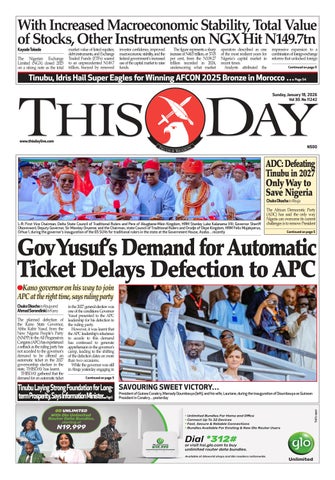
Tinubu, Idris Hail Super Eagles for Winning AFCON 2025 Bronze in Morocco
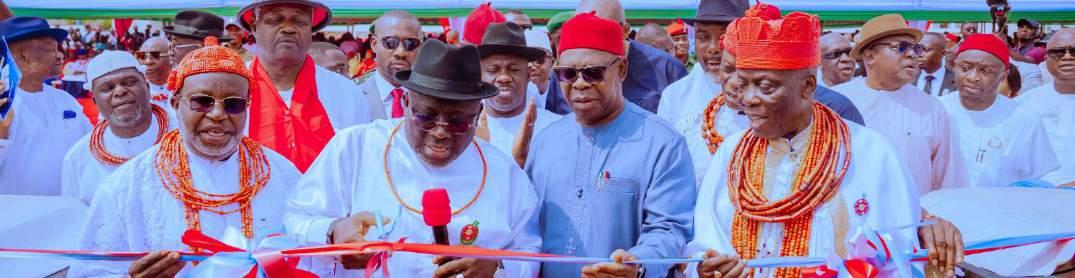
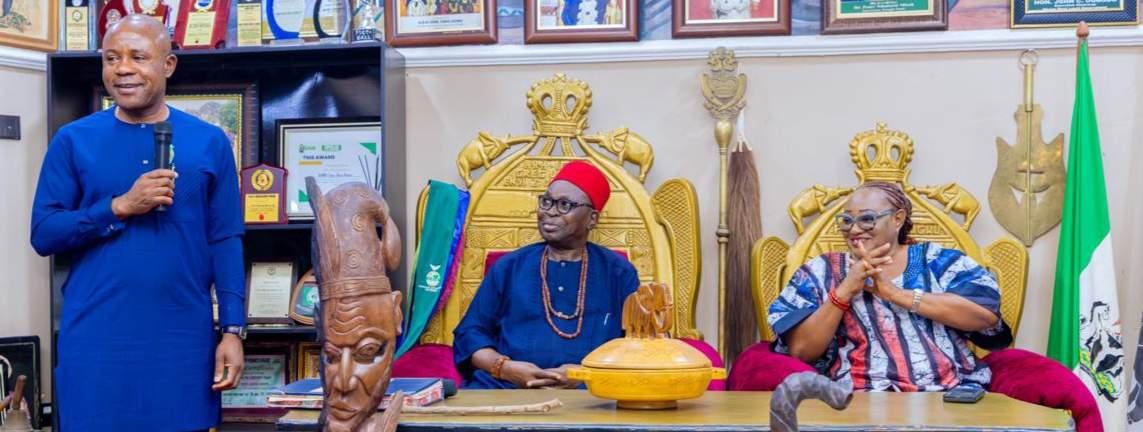
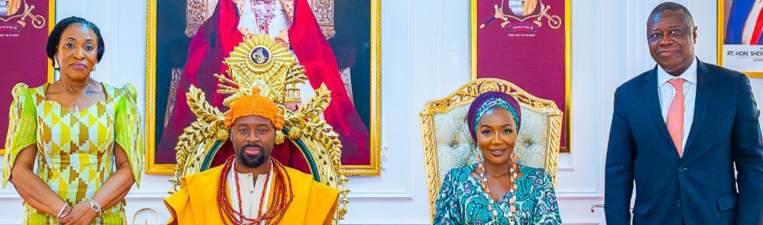
L-R: First Vice Chairman, Delta State Council of Traditional Rulers and Pere of Akugbene-Mein Kingdom, HRM Stanley Luke Kalanama VIII; Governor Sheriff Oborevwori; Deputy Governor, Sir Monday Onyeme; and the Chairman, state Council of Traditional Rulers and Orodje of Okpe Kingdom, HRM Felix Mujakperuo, Orhue 1, during the governor's inauguration of the 65 SUVs for traditional rulers in the state at the Government House, Asaba…recently
Gov Yusuf’s Demand for Automatic Ticket Delays Defection to APC
Kano governor on his way to join APC at the right time, says ruling party
The planned defection of the Kano State Governor, Abba Kabir Yusuf, from the New Nigeria People’s Party (NNPP) to the All Progressives Congress (APC) has experienced a setback as the ruling party has not acceded to the governor's demand to be offered an automatic ticket in the 2027 governorship election in the state, THISDAY has learnt. THISDAY gathered that the demand for an automatic ticket
in the 2027 general election was one of the conditions Governor Yusuf presented to the APC leadership for his defection to the ruling party.
However, it was learnt that the APC leadership's reluctance to accede to this demand has continued to generate apprehension in the governor's camp, leading to the shifting of the defection dates on more than two occasions.
While the governor was still in Abuja yesterday engaging in
on page 5
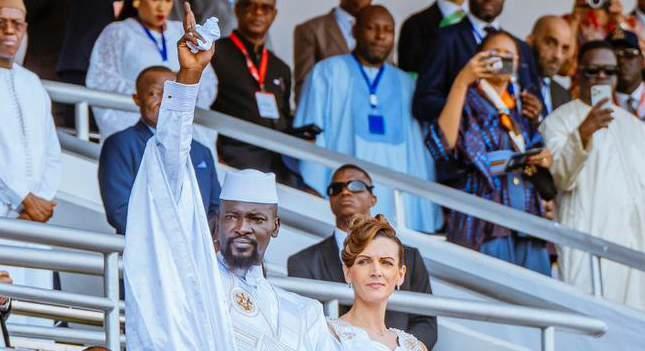
SWEET VICTORY…
President of Guinea Conakry,
Mamady Doumbouya (left); and his wife, Lauriane, during the inauguration of Doumbouya as Guinean President in Conakry…yesterday
Chuks Okocha in Abuja
The African Democratic Party (ADC) has said the only way Nigeria can overcome its current challenges is to remove President
Chuks Okocha in Abuja and Ahmad Sorondinki in Kano
Ojulari Highlights NNPC’s 2025 Milestones, Charts Pathway for 2026
Says deeper trust among employees and stakeholders will define the company’s future
Wale Igbintade
The Group Chief Executive Officer (GCEO) of NNPC Limited, Mr. Bashir Bayo Ojulari, has said that the company is entering 2026 with a collaborative and purpose-driven focus aimed at strengthening unity, accountability, and shared responsibility across the organisation.
Ojulari made this known in his New Year message to the staff of NNPC Limited, titled: “We Achieved: We Drive The
Future,” in which he reviewed the company’s performance in 2025 and outlined priorities for the year ahead.
Addressing employees across all the directorates, assets, and offices, the GCEO acknowledged the collective effort that defined NNPC’s achievements in 2025, describing the year as one marked by high expectations, operational challenges, and the need for resilience.
According to him, the company exceeded key performance targets and set
new operational benchmarks through teamwork and disciplined execution.
“Together, we exceeded our targets, pushed boundaries, and raised the bar as we set new benchmarks for our company,” Ojulari said.
He disclosed that the company achieved significant milestones across its operations, particularly in upstream, midstream, and downstream operations, as well as in corporate governance.
Ojulari revealed that exploration and production
activities achieved a record output of 355,000 barrels of oil per day in 2025, the highest level since 1989.
He said production was advanced through significant projects, including Madu First Oil, Soku Pipeline optimisation, the Akpo West Start-up, and the commissioning of the Gbaran Nodal Compression Train.
In infrastructure development, the GCEO noted that the company reached critical milestones with the commissioning of
GOV YUSUF’S DEMAND FOR AUTOMATIC TICKET DELAYS DEFECTION TO APC
high-stake consultations with the APC national leadership, the Kano State chapter of the party has assured that the governor was on his way to join the party at the right time and denied ever meeting with him to discuss the issue of automatic ticket.
The governor's planned defection has been in the news for weeks. Still, his demand for an automatic ticket is said to have clashed with the political ambition of many APC leaders in the state, including the Deputy Senate President, Senate Barau Jibrin, who is said
to be nursing a governorship ambition in 2027.
A source close to the former governor of the state and immediate past National Chairman of the APC, Dr. Abdullahi Ganduje, told THISDAY last night that the ruling party was not willing to sacrifice the ambition of its national leaders for the governor's defection.
"Apart from a documented assurance of an automatic ticket, the governor is also demanding the right to nominate a minister to represent Kano State in the Federal Executive Council, and
also nominate his loyalists for other federal appointments, including those positions currently occupied by APC members from the state.
"Some governors from other political parties have defected to the APC, but they did not give the type of conditions that the Kano State governor is demanding. However, the negotiation is still ongoing," the source explained.
The source confirmed that Senator Jibrin is a serious contender in the governorship race.
According to him, the
APC leadership is insisting that Governor Yusuf and other interested aspirants should go through the party's governorship primary.
THISDAY gathered that the Rivers State Governor, Siminalayi Fubara, and Plateau State Governor, Caleb Mutfwang, did not make similar demands.
Senator Jibrin and former Governor Ganduje command significant influence within the Kano APC structure.
Meanwhile, Yusuf's deputy, Comrade Aminu Abdussalam Gwarzo, has reportedly vowed
ADC: DEFEATING TINUBU IN 2027 ONLY WAY TO SAVE NIGERIA
Bola Tinubu in 2027.
It described its objective to remove the president from power as a necessary step towards rescuing Nigeria from an unprecedented governance crisis.
ADC's spokesman, Bolaji Abdullahi, who disclosed this during a television interview at the weekend, insisted that Nigeria has been hijacked.
Abdullahi accused state governors of failing to improve Nigerians' livelihoods despite receiving larger allocations from the federal government.
He added that the President Tinubu-led government did not care whether Nigerians were still dying or that people were still being killed; all it was interested in was holding on to power.
“It’s solely to get Tinubu out of power. That is the agenda,
portfolio inflows, the ongoing banking-sector recapitalisation exercise, a turnaround in corporate performance, and relative stability in the broader economy.
A breakdown of the data showed that equities remained the dominant driver of market capitalisation, accounting for about 66.2 per cent of the total value. The debt market followed with 33.7 per cent, while ETFs contributed a marginal 0.03 per cent.
Specifically, the equity market closed 2025 at N99.183 trillion, representing a gain of N36.4 trillion or 58 per cent from the N62.775 trillion recorded at the end of 2024. The debt market
not about Nigeria's interests.
“There is no scenario where he remains in power, and we can save this country. When people say you can smash it, grab it, and run with it, that is the language of banditry”.
He indicated that such attitudes reflected the mindset of President Tinubu’s administration.
Abdullahi, a former minister, also raised concerns about allegations of legislative manipulation, particularly regarding tax laws, describing recent events as unprecedented in Nigeria’s democratic history.
The ADC spokesman accused the government of forging a law that had already been duly passed by the National Assembly, questioning the implications of such an act.
“A government that can forge
grew modestly, rising to N50.509 trillion, an increase of N4.04 trillion, or 8.7 per cent, over the N46.466 trillion posted in the previous year. The ETF segment also recorded notable growth, with market value closing at N42.845 billion, up by about N13 billion or 46.8 per cent from N29.919 billion in 2024
Currently, 25 federal government bonds are listed on the NGX, alongside 4 state and local government bonds and 19 corporate bonds and debentures. The Exchange also lists 150 equities, over 10 ETFs, and seven Eurobonds issued by the Central Bank of Nigeria (CBN) and the federal government.
a duly passed law; what do you call that?” he asked.
Speaking on the federal government’s reported payment of $9 million to foreign lobbyists in the United States, allegedly to improve Nigeria’s image before American political leaders, including President Donald Trump, Abdullahi said he had reviewed documents and found no transparency model or legal basis for the process.
“Is it a bad thing to lobby? No, it’s not a bad thing. But what they are doing, number one, I don’t even want to go into all the processes.
“How was this contract awarded? How was the money paid? Who paid the money? What budget line was it taken from? How was the money transferred out of Nigeria? he asked.
Market analysts noted that strong corporate earnings and generous dividend declarations from 2024 full-year results, particularly from banks and cement manufacturers, played a key role in attracting investors seeking stable returns amid lingering macroeconomic uncertainties. They also observed that the federal government’s increased reliance on the capital market to bridge budget deficits helped deepen the debt segment and boost liquidity.
In recent months, several listed stocks recorded substantial month-to-date gains, reflecting renewed foreign investor interest driven by improving economic
the ANOH-OB3 pipeline and the successful River Niger crossing under the Ajaokuta–Kaduna–Kano (AKK) gas pipeline project.
The NNPC boss further highlighted the company’s retail expansion into the West African sub-region through the introduction of its lubricant brand, Oleum, describing the move as part of efforts to strengthen the company’s downstream presence beyond Nigeria.
He also pointed to improved transparency and corporate
to remain in the NNPP, a position that could lead to a major clash and threat of impeachment should Yusuf eventually leave the party.
Indications that Governor Yusuf's planned defection has not been finalised also emerged on Friday when the Governor convened the first State Executive Council meeting of 2026 in Abuja, and still appeared at the meeting wearing his trademark Kwankwasiyya red cap, and prominently displaying the NNPP's flag.
Kwankwasiyya is a political
He argued that the expenditure revealed misplaced priorities.
“If you invest nine million dollars in internal security, you will see results. You won’t have to convince the president of another country that your country is safe,” he added.
“Instead, he accused the government of caring more about appearances before foreign audiences than about the daily insecurity faced by Nigerians.”
“They don’t care whether Nigerians are still dying. They don’t care that people are still being killed. They want to look good before Americans,” Abdullahi said.
The ADC spokesperson also expressed alarm over a recently signed medical memorandum of understanding (MOU) between Nigeria and the United States.
indicators and robust earnings performance.
The Managing Director of Financial Derivatives Company, Bismarck Rewane, had projected that Nigeria’s capital market capitalisation could grow by as much as 190 per cent, from about N91 trillion to N262 trillion by 2026. He argued that potential listings such as the Dangote Refinery, valued at roughly $32 billion, and a possible listing of NNPC Limited could transform the market.
According to Rewane, such developments could expand the stock market from about 20 per cent of GDP to nearly 80 per cent in the medium term,
governance, noting that NNPC Limited successfully hosted its first-ever Group Earnings Call, during which it announced its audited 2024 financial results to stakeholders.
On workforce development, he said the company implemented a significantly improved compensation package to enhance employee well-being, while also recruiting 1,000 young professionals, referred to as “Tigers,” as part of a deliberate strategy to build the next generation of NNPC leaders.
movement led by the National Leader of NNPP and former governor of the state, Senator Rabiu Musa Kwankwaso, who has since described Governor Yusuf's planned defection as an act of betrayal.
Kwankwaso has, however, not ruled out defection from the NNPP to the APC but insisted that the ruling party should meet certain conditions.
In a video shared on Facebook by his aide, Saifullahi Hassan, Kwankwaso, speaking in Hausa last Wednesday,
Continued on page 10
According to him, the agreement, reportedly signed around December 19, grants the US significant control over how funds are spent, including determining the regions that would benefit, despite Nigeria contributing more financially.
“No Nigerians have seen the details of this MOU,” he said, describing the terms as “shocking” while raising questions about sovereignty and accountability.
Abdullahi accused state governors of failing to improve Nigerians' livelihoods despite receiving larger allocations from the federal government.
He noted that with the removal of fuel subsidy, Nigerian governors have more money in their coffers but have not done much with it.
“The governors, by their
repositioning it as a dominant engine of capital formation. “The stock market is becoming a bigger source of national savings and corporate financing. These listings will alter the structure of the market and significantly influence growth,” he said.
Under the leadership of CBN Governor, Dr. Olayemi Cardoso, the economy has witnessed a gradual clearance of foreign exchange backlogs and improved stability in the FX market, developments that have reassured both local and foreign investors.
Strong corporate fundamentals also supported the rally, with several listed companies posting impressive
own, by the president’s own declaration, he has given more money to the governors than maybe any president has ever given to governors in our history. And how has that reflected in the improved livelihood of the people in the states?” the ADC spokesman asked.
“I’m not saying all of them are bad, but what I’m saying is that they have received more money than any other generation of governors have received in the history of this country,” the former minister said on the current affairs show.
“You can say devaluation. The reason we have more money going to the states is that they removed subsidies, and that money is now going to them. In what way has that reflected a better life for the people in the states?” he queried.
earnings and others returning to profitability after prolonged losses.
The Vice President of Highcap Securities, David Adonri, noted that the 2025 rally was driven by renewed interest in fundamentally strong stocks such as Airtel Africa, Nestlé Nigeria Plc, Nigerian Breweries Plc, Cadbury Nigeria Plc, and MTN Nigeria Communications Plc.
“Having reacted, the market is expected to cool down until perhaps the third week in June, when half-year corporate expectations will start impacting prices positively or negatively, depending on the quality of information released,” he said.
Tinubu Laying Strong Foundation for Longterm Prosperity, Says Information Minister
Olawale Ajimotokan in
The Minister of Information and National Orientation, Alhaji Mohammed Idris, has said President Bola Tinubu was laying a strong foundation for long-term growth and shared prosperity.
Idris stated this when he
received members of the Grassroots Advocacy for Tinubu (GAT) 2027 on a courtesy visit.
This is contained in a statement issued in Abuja by the minister’s Special Assistant on Media, Malam Rabiu Ibrahim.
“The administration has taken bold and sometimes
Northern Govs, CAN Mourn Plateau Islamic Cleric Who Saved
over 200 Christians
Onyebuchi Ezigbo in Abuja
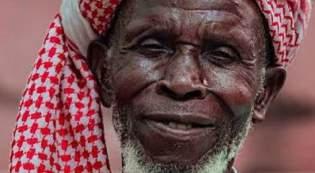
The Northern States’ Governors Forum (NSGF) has mourned the demise of Chief Imam of Nghar Village in Barkin Ladi Local Government Area (LGA) of Plateau State, Sheikh Abdullahi Abubakar, who died on Friday at the age of 92 after a brief illness.
The Christian Association of Nigeria (CAN) has also paid glowing tribute to the late Imam Abdullahi Abubakar, describing him as a symbol of courage and shared humanity for saving 262 Christians during a violent attack in 2018.
In a condolence message issued on behalf of the forum, NSGF Chairman and Governor of Gombe State, Muhammadu Inuwa Yahaya, described the late cleric as an embodiment of peace, courage, and selfless leadership whose life and
actions earned him global respect and admiration.
Governor Yahaya recalled that Abubakar rose to international prominence during the 2018 Barkin Ladi sectarian crisis, when he courageously sheltered more than 200 Christians in his mosque and personal residence, shielding them from attacks at significant personal risk.
In a statement by his Director-General on Press Affairs, Gombe Government House, Isma’ila Uba Misilli, the governor noted the Imam’s insistence on the protection of all human lives.
According to the NSGF chairman, the late Imam’s actions at a time of grave national distress transcended religious boundaries. They projected Northern Nigeria as a land of compassion, coexistence, and shared humanity.
difficult decisions to place Nigeria on a more sustainable path.
” Early signs of recovery are becoming evident across key sectors of the economy.
“These steps were taken to stabilise the economy and restore confidence.
“What we are seeing today is the foundation for long-term growth and shared prosperity.
“As a result, Nigeria’s improving economic outlook must be protected through unity, responsible communication, and collective support for national policies.
“I want to warn that distorted narratives about the country hurt investors’ confidence and slow
development.
“We must speak positively and truthfully about Nigeria.
“When we project stability and unity, we attract investments and create opportunities for our people,” Idris said.
The minister commended the GAT 2027 group for its civic engagement and acceptance of responsibility in supporting accurate public information.
He also welcomed the group’s proposal for a partnership with the Federal Ministry of Information and the National Orientation Agency in the areas of public enlightenment, youth engagement, and strategic communication.
According to him, advocacy groups play an essential role in helping government policies reach the grassroots.
He described effective communication as essential to national stability and development.
The minister also reaffirmed the president’s commitment to making Nigeria work for all citizens, regardless of religion or background.
Idris assured the delegation that the ministry would continue to work with credible groups to ensure accurate information is widely shared.
GAT 2027 National Coordinator, Prof. Ochugudu Ipuele, in his remarks, said the group came to brief the minister on its activities
formally.
He also said the visit was to show solidarity with his mandate to inform Nigerians and clarify government policies.
“We are here to solidarise with you on the mandate you have for Nigeria, which is to inform the country, clarify government policies, and take information to the grassroots.
“The group is committed to supporting President Bola Tinubu’s policies by countering distorted narratives, especially during election periods, and by engaging young people.
“This group is poised to respond in real time to false or misleading information in the public space and to engage the youth.”
Shettima Reaffirms Nigeria's Leadership Role in W'Africa, Attends Inauguration of Dambouya as Guinea-Conakry President
Deji Elumoye in Conakry, Guinea
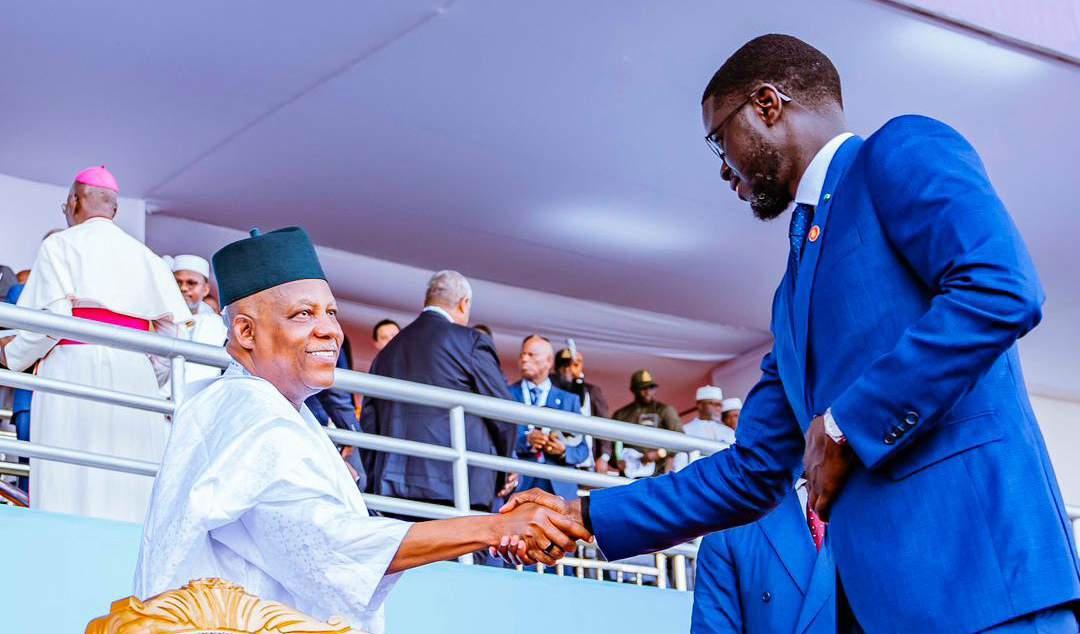
Vice President Kashim Shettima yesterday witnessed the inauguration of President Mamadi Doumbouya as the President of Guinea Conakry. Shettima represented President Bola Tinubu at the ceremony.
The vice president’s presence at the event has again underscored Nigeria’s leadership role within the ECOWAS and reaffirmed the country’s commitment to the restoration and sustenance
of democratic governance across the sub-region.
The inauguration of Doumbouya followed his victory in the December 2025 general election in the country, a democratic watershed which brought the formal end of a four-year military transition.
He will serve a single seven-year term, as stipulated under Guinea’s new constitution approved by a national referendum in September, 2025.
The revised constitution extended the presidential
tenure from five to seven years, renewable only once.
In his inaugural address after taking the oath of office before a capacity full stadium, Doumbouya pledged to uphold his country's constitution and the tenets of democracy, transparent governance, and the interest of all Guineans at all times.
He stressed that under his administration, the country's peace and national cohesion would not be compromised.
The inauguration, which took place at the GLC
Stadium in Nongo, Conakry, had several African leaders, especially from the West African sub region, including Ghana, Senegal, Gambia, Gabon, Equatorial Guinea, Rwanda, South Africa in attendance.
Other dignitaries at the inauguration included the President of the ECOWAS Commission, Dr. Omar Alieu Touray; Presidents of Rwanda, Gabon, GuineaBissau, and Mauritania, among several other African leaders and high-ranking officials.
Abuja
HEARTFELT CONDOLENCES…
PDP: We Don’t Attack Opposition Parties Because We Have Common Adversary
Mulls membership dues for funding
The Peoples Democratic Party (PDP) has said that one of the reasons why it does not attack or criticise other opposition political parties is because they are a common adversary ahead of the 2027 general election.
The PDP National Publicity Secretary, Ini Emembong, in an interview with journalists at the weekend, stated that though the time for merger with
other political parties “hasn’t matured,” the collaboration is in an “embryonic stage.”
Emembong said his party is working with other opposition political parties to forge a common front ahead of the 2027 general election.
According to him, there is “an understanding among the opposition (parties) because we face a common adversary – the ruling party – which won with
less than 40% of the vote.”
He added that PDP “refrains from attacking other opposition parties like the Labour Party or ADC because we are focused on the larger goal.”
Emembong expressed confidence that PDP will win the February 21 Area Council elections in Abuja, the Federal Capital Territory, because “the FCT is historically PDP territory at the local government level.”
He explained that the party
is reaching the people directly “rather than through one elite gatekeeper.”
According to him, PDP is witnessing a rebirth, which includes analysing its mistakes and successes, noting that the party started from zero in 1998 and went ahead to rule the country for 16 years.
“We have reached the bottom of the valley, and now we are heading back up. This is a rebirth process,
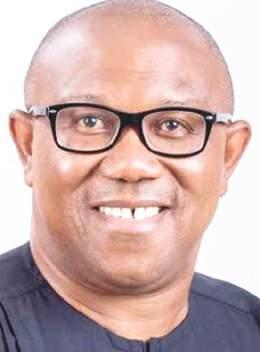
I Don’t Own Land, House in Abuja, Says Peter Obi
Chuks Okocha in Abuja
The presidential candidate of the Labour Party (LP) in the 2023 general election, Mr Peter Obi, has declared that he has no house or land in Abuja, the Federal Capital Territory (FCT).
The chieftain of the African Democratic Congress (ADC) explained that his decision to avoid unnecessary headaches led him not to own property in Abuja.
The former presidential candidate spoke at a coffee
hangout with KayhikersClub in Abuja.
Obi said, “I don’t have a house in Abuja; I don’t have land, and I’m not preparing to have one because I don’t need it.
“The more you have all these things, the more headaches you put on your head. For years, I have never been sick; why would I? Because it’s not necessary.
“I was the chairman of our regulatory body, Securities and Exchange Commission (SEC); the day
I was announced; I arrived and the DG showed me a jeep, a Prado and they told me how much allowance I have for accommodation and I told the DG, ‘I want to come for meetings here, I don’t need anything from you, any day you fix meeting, tell me I would come. I don’t want your sitting allowance, your car, and your house. He said it’s my entitlement, but I said whatever I’m entitled to, God has given me.’
“You can go and ask
whether, when Peter Obi was the chairman, he collected anything?
“I was Chairman of Fidelity Bank, and they told me that I’m entitled to a Mercedes 500 or a Range Rover. The bank is still there, go and ask them if I collected anything. I told them that I’m the chairman, and whatever I need in my house, I have, unless you want to bring a headache to yourself.
“I have enough, I don’t need to give away, but what I need I have.”
Presidential Tax Committee, Tax Ombud to Protect Taxpayers’ Rights
The Presidential Fiscal Policy and Tax Reforms Committee (PFPTRC) and the Office of the Tax Ombud have partnered to enhance taxpayers’ trust and compliance through transparent mediation and accountability. The collaboration was declared in Abuja following a meeting between the Tax
Ombud/CEO, Dr. John Nwabueze, and the Chairman of the PFPTRC, Mr. Taiwo Oyedele.
In a statement by Chukwudi Achife, Chief Press Secretary to the Tax Ombud/CEO, Dr. Nwabueze noted that the Office of the Tax Ombud serves as a mediation safety net for small
and medium enterprises as well as multinational companies, as the Office receives and resolves issues related to taxes, levies, charges, customs duties, and other related matters.
Describing the Office as a fair and efficient mediator between tax authorities and taxpayers, Dr. Nwabueze
stated: “Nigerian taxpayers can now save the cost of arbitration while still obtaining justice by resolving their tax complaints through the Office.”
Commenting on the partnership, Mr. Oyedele noted that the meeting was part of ongoing efforts to support the effective implementation of tax reforms.
which is always painful. We are analysing our mistakes and successes.
“We have both ‘qualitative’ and ‘quantitative’ voices in the party. While the qualitative voices (the elite) are essential, democracy is a game of numbers.
“We are balancing these while navigating the court process. Simultaneously, we are using a ‘poly-opportunity strategy’, fighting in court while conducting grassroots mobilisation and stakeholder engagement,” he added.
The PDP spokesperson
stated that the party leadership is taking the party back to the people, noting that “when people are with you voluntarily, they fund the cause.
“In 1998, people brought small contributions to fund the party, and that gave them a voice. When governors took over the funding, the people were pushed aside. Meanwhile, the party is planning to return to members at all levels to raise money as a way of stopping godfatherism that has crippled the party.
Bandits Killed 150 People, Kidnapped 300 Others in Kwara in 2025, Says Varsity Don
Hammed Shittu in Ilorin
The Coordinating Head of the Department of Social Justice and Security Studies, Kwara State University (KWASU), Malete, Dr. Waliyu Oladotun Akanni, has claimed that from January to December 2025, suspected bandits reportedly killed about 150 civilians, while 300 people were kidnapped in the state.
He called for the establishment of border community peace committees in the state as part of efforts to address insecurity in the state.
Akanni stated this in Ilorin, the state capital, yesterday while delivering a public lecture titled, ‘Preserving the State of Harmony: Reclaiming the Kwara Identity in the Era of Prevalent Insecurity in Nigeria’. The event was jointly organised by the Ma'Assalam Foundation and Mustapha
Akanbi Foundation (MAF).
According to him, "the ugly development has underscored a systemic security collapse and a critical security challenge that persisted throughout the year".
He stated that: "The multiplier effects of armed criminality in Kwara State extend far beyond immediate violence, manifesting in the systematic retreat of state and educational institutions and the collapse of local commerce".
He noted that "The NYSC orientation camp, a Kwara State University satellite campus, and a nursing school located at Oke-Ode in Ifelodun Local Government Area of the state were relocated to Ilorin, while over 50 primary and secondary schools across five LGAs were shut down.
"Cattle markets in seven LGAs have been shut, crippling a vital sector of the rural economy, while the official.
Chuks Okocha in Abuja
L-R: Governor of Enugu State, Dr. Peter Mbah; the traditional ruler of Attakwu Akegbe-Ugwu Ancient Kingdom, HRM Igwe Greg Ugwu; and his wife, Ugoeze Ngozi Ugwu, during the governor’s condolence visit to the traditional ruler during the funeral of his mother, the late Mrs. Mary Mgbeke Ugwu, at the Elephant Place, Attakwu…recently.
HONOURING LATE COLLEAGUE…
Edo Residents Raise N40m Ransom as Kidnappers Threaten to Kill Victims
Okpebholo boosts internal security with 10 patrol vehicles in Edo Central
The traditional ruler of Imoga community in Edo State, Patrick Abudu, has mobilised town criers and community spokespersons to solicit N40 million ransom for the release of eight abducted indigenes.
This comes as Governor Monday Okpebholo yesterday handed over 10 brand-new patrol vehicles to security agencies operating in Edo Central Senatorial District.
The kidnappers have threatened to kill the victims for failing to meet their demands.
They were abducted at Star
Boy Hotel along Ibillo Road on January 9.
The Coordinator of the Movement for the Advancement of Akoko Edo People, Bode Ekundayo, said the kidnappers initially demanded N100 million, and later reduced it to N80 million and then N40 million, an amount still beyond what families and the community could raise.
“The amount raked in is a far cry from the N40m the kidnappers are demanding. They are unwilling to climb down and are threatening
Lagos Orders Postmortem as Twins Die After Vaccination
Sunday Ehigiator
The Lagos State Government has ordered a postmortem on nine-month-old identical twins, Testimony and Timothy Alozie, who reportedly died about 24 hours after receiving routine immunisation at a primary health care centre, Ajangbadi, part of the state.
The incident came to public attention after the twins’ father, Samuel Alozie, popularly known as Promise Samuel on TikTok, shared videos showing the bodies of his sons in separate body bags while narrating how they died shortly after the vaccination.
Speaking in a follow-up viral video on Thursday, Alozie said he took the twins for routine immunisation on the morning of December 24, 2025, adding that they became extremely weak immediately after the injections.
“They could not eat, they could not play, they could not even disturb as they used to.
They were just weak,” he said.
According to him, a nurse at the health centre advised that the children be given paracetamol if their temperature rose. He said he and his wife administered the drug and also bathed the children in cold water, but their condition did not improve.
“It happened that the immunisation was conducted on the 24th of December in the morning, and on the morning of 25th December, they died. On the 24th, after the injection, they were very weak, and I gave them paracetamol because the nurse said that if the temperature continued, I should provide them with paracetamol.
My wife bathed them in cold water. They died on the 25th. The two of them died at the same time. The drug weakened them to the extent that they couldn’t talk, they couldn’t eat, they couldn’t play as usual,” he said.
to kill some of the victims to prove that they mean business,” Ekundayo said.
According to Ekundayo, two community members, Ojo and Abiodun Ekpo, narrowly escaped abduction while working on their farm, bolstering fears among residents.
The police spokesperson
in the state, Eno Ikoedem, demanded details of the incident but failed to respond after details were forwarded to her.
The Imoga incident adds to a spate of kidnappings in Edo this year.
Earlier in January, two brothers were abducted in Auchi, with one killed by
their captors amid ransom negotiations.
In recent months, residents in parts of the state such as Ekpoma protested escalating kidnap-for-ransom attacks, saying the menace has disrupted daily life and instilled fear across communities.
Kidnapping for ransom has become a lucrative criminal
enterprise across Nigeria. Last year Nigerians paid at least N2.57 billion in ransoms over a one-year period. In northern states, bandits abduct villagers and demand ransoms, while schoolchildren have been taken hostage in high-profile attacks, prompting calls for tougher national security action.
Awujale Stool: Again, KWAM1 Writes Gov Abiodun, Alleges Unlawful Exclusion from Nomination Process
Wale Igbintade
An aspirant to the revered stool of the Awujale of Ijebuland, and Fuji music legend, Alhaji Wasiu Ayinde Adesanya, popularly known as KWAM1, has again written to Ogun State Governor, Prince Dapo Abiodun, alleging unlawful exclusion from the nomination process.
In a petition dated January 14, 2026, and addressed to the Executive Council of Ogun State through the Ministry of Local Government and
Chieftaincy Affairs, Adesanya, through his solicitors, W.K. Shittu (SAN) & Co., accused leaders of the Fusengbuwa Ruling House of orchestrating a flawed, exclusionary, and unlawful nomination exercise.
The Fuji music legend claimed that the nomination process was in breach of statutory law, customary practice, and constitutional provisions.
The selection process followed the death of the late Awujale of Ijebuland, Oba
Sikiru Kayode Adetona, after which the Fusengbuwa Ruling House became constitutionally entitled to present candidates for the vacant stool.
According to Adesanya, the Secretary of the Ijebu-Ode Local Government Area, by a letter dated January 6, 2026, convened a statutory meeting of the ruling house for the nomination of candidates, in line with the Obas and Chiefs Law of Ogun State, 2021, and the Awujale of Ijebuland Chieftaincy Declaration.
However, he alleged that the process was compromised on the day of the meeting, held at the Bristol Hotel, Ijebu-Ode, when several legitimate members of the Fusengbuwa Ruling House were unlawfully prevented from participating. Adesanya claimed that he and other eligible family members were barred from accessing the venue by heavily armed security personnel, including operatives of the Nigeria Police Force and other agencies.
NiDCOM Condemns Killing of Nigerian in India over Romantic Dispute
The Nigerians in Diaspora Commission (NiDCOM) has condemned the killing of a Nigerian citizen, Mr. Emeka Christian, in Pune, India, describing the incident as tragic and senseless.
In a statement issued yesterday by the Director of Media, Public Relations and Protocols, Mr. Abdur-Rahman Balogun, the commission disclosed that the deceased was allegedly beaten to death following a romantic dispute involving two fellow
Nigerians, identified as Mr. Chukwudi Okafor, 31, and Mr. Samuel Eze.
NiDCOM expressed deep sadness over the incident and extended its condolences to the family and loved ones of the deceased, noting that no family should be made to endure such a painful loss.
The commission called on relevant Indian authorities to carry out a thorough and transparent investigation into the matter and ensure that justice is served without
delay.
It also urged Nigerians living abroad to be their brothers’ keepers, stressing the need for peaceful resolution of conflicts through dialogue rather than violence.
Chairman and Chief Executive Officer of NiDCOM, Hon. Abike Dabiri Erewa, reacting, said Nigerians must reject violence and uphold the law wherever they are.
The statement in full, “The Nigerians in Diaspora
Commission (NiDCOM) is saddened by the tragic and senseless death of Emeka Christian, a Nigerian national in Pune, India, was allegedly beaten to death by two of his brothers, Chukwudi Okafor, 31, and Samuel Eze, over a romantic dispute.
“We extend our deepest condolences to the bereaved family and loved ones during this painful time. No family should endure such heartbreak.
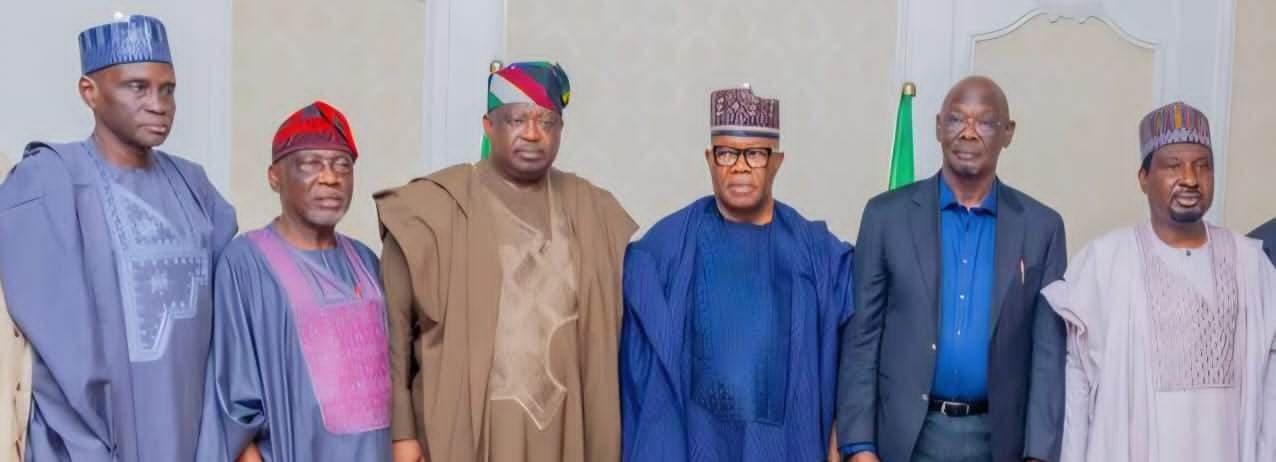
L-R: Senate Whip, Senator Tahir Munguno; Senate Minority Leader, Senator Abba Moro; Governor of Plateau State, Caleb Mutfwang; President of the Senate, Senator Godswill Akpabio; Governor of Nasarawa State, Abdullahi Sule; and Deputy Senate President, Jibrin Barau, during a condolence visit to Governor Sule over the death of Senator Godiya Akwashiki, who was buried in the state…yesterday
RESTORING SECURITY ON THEIR MINDS...
Trump Threatens Europe With Tariffs over Greenland as Protesters Rally
United States President, Donald Trump, yesterday escalated his quest to acquire Greenland, threatening multiple European nations with tariffs of up to 25 per cent until his purchase of the Danish territory is achieved.
Trump’s threats came as thousands of people protested in the capital of Greenland against his wish to acquire the mineral-rich island at the gateway to the Arctic.
Thousands more protested in Copenhagen and other Danish cities.
The US president aimed his ire at Denmark, a fellow NATO member, as well as several European countries that have deployed troops in recent days to the vast autonomous territory
with a population of 57,000. If realised, Trump’s threats against Washington’s NATO partners would create unprecedented tension within the alliance.
From February 1, Denmark, Norway, Sweden, France, Germany, the United Kingdom, the Netherlands, and Finland would be subject to a 10-per cent tariff on all goods sent to the United States, Trump said in a post on his Truth Social network.
“On June 1, 2026, the Tariff will be increased to 25%. This Tariff will be due and payable until such time as a Deal is reached for the Complete and Total purchase of Greenland,” he wrote.
“These countries, who are playing this very dangerous game, have put a level of risk in play that is not tenable or sustainable.
“Therefore, it is imperative that, in order to protect Global Peace and Security, strong measures be taken so that this potentially perilous situation ends quickly and without question,” Trump said.
Trump added that he was “immediately open to negotiation with Denmark and/or any of these Countries.”
In Nuuk, thousands of people, including the territory’s prime minister, Jens-Frederik Nielsen, waved Greenlandic flags, chanted slogans and sang traditional Inuit songs
under light rain.
Many wore caps with the words “Make America Go Away”, a riff on Trump’s “Make America Great Again” slogan.
“We don’t want Trump invading Greenland; that is the message,” 44-year-old nurse Paarniq Larsen Strum said at the Nuuk rally, calling the situation “nerve-wracking”.
“We demand respect for our country’s right to selfdetermination and for us as a people,” added protest organiser Avijaja Rosing-Olsen.
In Copenhagen, charity worker Kirsten Hjoernholm, 52, said it was important to show unity with Greenlanders.
“You cannot be bullied by an ally. It’s about international
GOV YUSUF’S DEMAND FOR AUTOMATIC TICKET DELAYS DEFECTION TO APC
reiterated that he would not defect to the APC without a “concrete agreement” regarding his role, the future of his supporters, and the interests of the Kano State Government.
“I have never been opposed to moving to the APC. However, I always set conditions before leaving where I am or joining a new platform. I cannot simply join them without a solid agreement on the ground,” he added.
However, Governor Yusuf's appearance at the State Executive Council (SEC) meeting in Abuja on Friday, wearing his trademark Kwankwasiyya red cap and prominently displaying the NNPP's flag, dashed the hope of those expecting a public declaration of defection.
The meeting, which included the deputy governor and all the commissioners, was the council's 37th since the administration's inception and was held at the Governor's Lodge in Abuja.
At the SEC meeting, the
governor reaffirmed his administration’s commitment to good governance.
Kwankwaso had earlier stated that he would only defect to a political party that was ready to offer him the presidential or vice presidential ticket in the 2027 elections.
Kano Governor on His Way to Join APC at the Right Time, Says Ruling Party Meanwhile, the Kano State chapter of the APC has confirmed that Governor Yusuf was on his way to join the party, and denied ever meeting with the governor over an automatic governorship ticket ahead of the 2027 general election.
In a telephone interview with THISDAY in Kano, the party's secretary, Alhaji Zakari Sarina, made it clear that the rumours circulating about the purported meeting were baseless and should be ignored.
He attributed the rumours to "enemies of Kano" who are out to destabilise the party's
relationship with the state governor, who he confirmed was on his way to join the APC at the right time.
"Our party expresses disappointment at the spread of false information, which doesn't hold water. There was never a time the party in Kano held any discussion with the state governor, let alone denying him our ticket," Sarina said.
"We are welcoming the governor at any given time, sooner rather than later. Our doors are always open, and it's just a matter of a few days; so, why are people rushing and speculating?" Sarina queried.
The APC secretary maintained that the party would not be swayed by malicious attempts to create acrimonious situation with the state governor, especially at a time when the state was looking forward to fundamental transformation and development.
Sarina urged the public to disregard the rumours and focus on the real issues
affecting the state.
The APC Secretary has assured party supporters that the party is working hard to ensure a smooth process and has urged everyone to remain calm and patient.
The denial comes amid speculation that the APC held a series of meetings with the governor, in which he allegedly requested a written assurance that he would automatically secure the party's governorship ticket for the 2027 election.
According to sources familiar with the matter who did not want to be named, Governor Yusuf also held a closed-door meeting yesterday in Abuja with the leader of the APC, the former Governor Ganduje, and the Deputy President of the Senate, Senator Jibrin, about his possible defection to the party next week.
The source further revealed that Vice President Kashim Shettima was closely monitoring the situation, and President Bola Tinubu was slated to receive a final briefing on the matter.
law,” she said.
Around her, demonstrators waved the flags of Denmark and Greenland while chanting “Kalaallit Nunaat!” — the vast Arctic island’s name in Greenlandic.
Some also held placards saying “USA already has too much ICE,” referring to Trump’s deployment of federal immigration officers in US cities, while others chanted “Greenland is not for sale.”
Trump has repeatedly claimed that the United States needs Greenland for US “national security.” He also claims that Denmark is incapable of ensuring the territory’s security,
notably from China and Russia. France said the military exercise in Greenland was designed to show the world that they will defend the territory. Denmark said the US had been invited to join the drill. It was not immediately clear what authority the US president would invoke to impose the threatened tariffs of up to 25 per cent.
Since returning to the presidency, Trump has unleashed sweeping tariffs on goods from virtually all trading partners to address what Washington says are unfair trade practices and as a tool to press governments on US concerns.
Court to Deliver Judgment in Fresh Suit Challenging President’s Emergency Power
Alex Enumah in Abuja
The Federal High Court in Abuja has fixed March 9 for judgment in a fresh suit challenging the legal authority of President Bola Tinubu to remove elected state officials during a state of emergency in Rivers State last year.
Justice James Omotosho fixed the date after counsel for the plaintiff, Nnamdi Nwokocha-Ahaaiwe, and the defence lawyer adopted their processes and presented their arguments for and against the suit.
The case, filed by the plaintiff, the Civil Society Observatory for Constitutional and Legal Compliance (CSOCLC), challenges explicitly the president’s actions following the declaration of a state of emergency in Rivers State.
The CSO argued that, while the president may declare an emergency under Section 305
of the Constitution, he lacked the power to suspend or remove elected executive and legislative officers, or to install an interim administrator.
Adopting their originating summons and reply briefs, plaintiffs’ counsel, Nnamdi Ahaaiwe, argued that the 1999 Constitution fully “covers the field” on emergency powers. He contended that older laws, including the Emergency Powers (Jurisdiction) Act of 1962, cited in prior court rulings to limit jurisdiction to the Supreme Court, had expired before 1999, and were deliberately omitted from the Laws of the Federation as “spent,” and could not be revived or modified by executive order in 2025.
Ahaaiwe further submitted that no statute enlarges presidential powers beyond the Constitution’s explicit provisions, which omit authority to suspend elected officials.
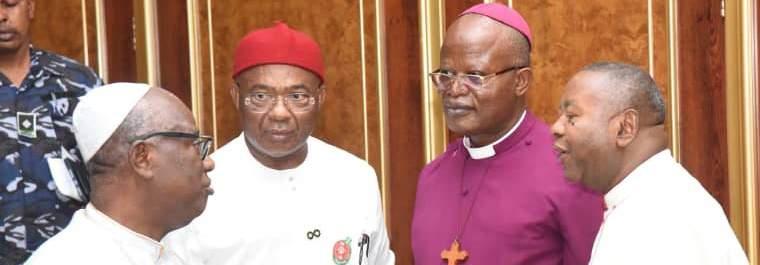
L-R: Prelate Emeritus of the Methodist Church of Nigeria, Most Rev Samuel Uche; Imo State Governor, Senator Hope Uzodimma; Anglican Archbishop of Owerri Ecclesiastical Province, Most Rev David Onuoha; and Monsignor John Iwe, after the governor inaugurated the committee on insecurity and rehabilitation of Okigwe at Government House, Owerri...weekend
SHAPING LEADERS , BUILDING LEGACIES
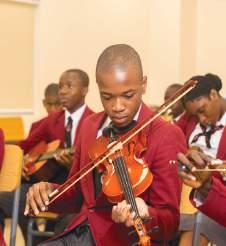
Dedicated educators who ignite curiosity, character, and confidence in every learner
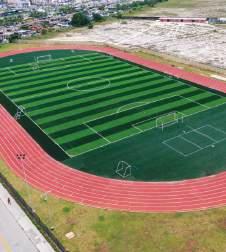
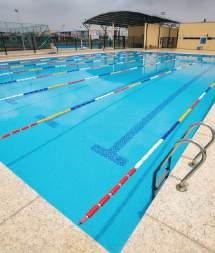
Proud winners of prestigious international and national academic awards Beautiful, serene and secure world-class campus State of the art classrooms, laboratories and sports facilities
Admission into year 7 (JSS1) is scheduled to take place as follows:
Dates: Saturday 31st January, 2026 and Saturday 7th February, 2026
Locations: LAGOS: James Hope College, Twin Lakes Estate, Lekki, Lagos
Application forms can be downloaded from www.jameshopecollege.edu.ng under the “admission” tab or can be collected from James Hope College, Twin Lakes Estate, Lekki, Lagos.
OPEN DAY SATURDAY 17TH JANUARY, 2026
Follows us on all our
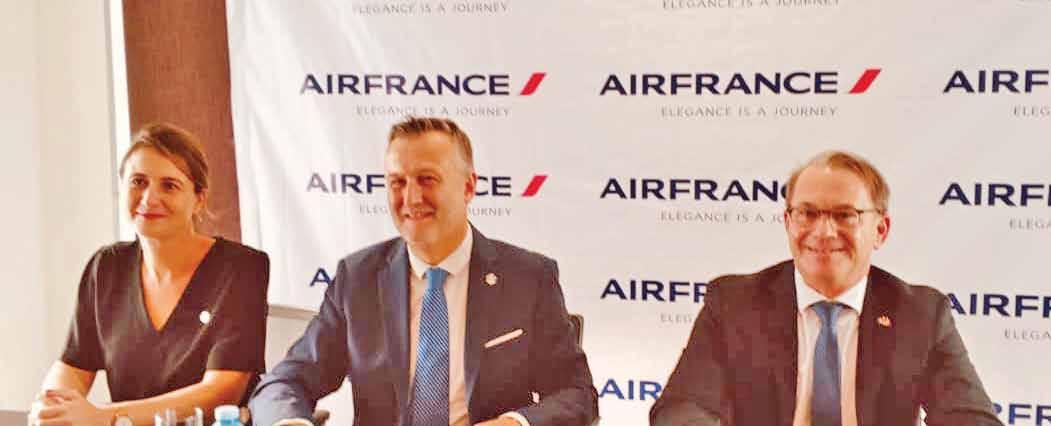
AIR FRANCE AT 80…
Uganda: After 40 Years in Power, 81-year-old Museveni Wins Seventh Term
Ugandan President Yoweri Museveni won a seventh term in office yesterday after an election marred by violence and an internet shutdown, with African observers saying arrests and abductions had “instilled fear”.
Museveni, 81, won 71.65 per cent of the votes in Thursday’s election, the Electoral Commission said, amid reports of at least 10 deaths and intimidation of the opposition and civil society.
His victory allowed him to extend his 40-year rule of the East African country.
He defeated Bobi Wine, 43, a former singer-turned-politician who won 24.72 per cent and said he was in hiding yesterday after a raid by security forces on his home.
Wine has faced relentless pressure since entering politics, including multiple arrests before his first run for the presidency in 2021.
He stated his “complete rejection of the fake results” and said he was on the run
after the raid on his home on Friday night.
“I want to confirm that I managed to escape from them,” Wine posted on X on Saturday. Currently, I am not at home, although my wife and other family members remain under house arrest.
“I know that these criminals are looking for me everywhere, and I am trying my best to keep safe,” he added.
There was a heavy police presence around the capital, Kampala, as security forces sought to prevent the sort of protests that hit neighbouring Kenya and Tanzania in recent months.
Police denied they had raided Wine’s home but said they had “controlled access in areas we feel are security hotspots”, adding they believed the opposition leader was still at home. “We have not necessarily denied people accessing him, but we cannot tolerate instances where people use his residence to gather and… incite violence,”
Kano Police Launch Manhunt as Unknown Assailants Kill Family of Seven in Brutal Attack
Ahmad Sorondinki in Kano
The Kano State Police Command has launched a manhunt for unknown assailants who killed a family of six, including a housewife, Fatima Abubakar (35), and her five children, after they were attacked by hoodlums who broke into their house.
A statement by the Police Public Relations Officer, CSP Abdullahi Haruna Kiyawa, explained that the assailants carried out a brutal attack with dangerous weapons, resulting in fatal injuries.
“The Kano State Police Command received a distress call at approximately 12:10pm on January 17, 2025, reporting a brutal attack on the household of Haruna Bashir at Dorayi Charanchi Quarters. The victims, Fatima Abubakar (35) and her six children, were attacked by
unknown hoodlums who broke into their house.”
“The report indicated that the victims were attacked with dangerous weapons, resulting in fatal injuries. The Commissioner of Police, CP Ibrahim Adamu Bakori, PhD, immediately mobilized a police team led by Deputy Commissioner of Police in Charge of Operations, DCP Lawal Isah Mani to the scene.”
According to the statement the bodies were evacuated and rushed to Murtala Mohammed Specialist Hospital Kano, where they were pronounced dead.
“A team led by ACP Wada Jarma, Assistant Commissioner of Police, Criminal Investigation Department (CID) was instructed to conduct a thorough investigation to bring the perpetrators to justice,” the statement said.
police spokesman Kituuma Rusoke told reporters.
A stall-owner near Wine’s home, 29-year-old Prince Jerard, told AFP he had heard a drone and a helicopter at the residence the previous night and had seen numerous security officials.
“Many people have left (the area),” he said. “We have a lot of fear.”
Wine, whose real name is Robert Kyagulanyi, has emerged as the primary challenger to Museveni in recent years, styling himself the “ghetto president” after the Kampala slum areas
where he grew up.
He has accused the government of “massive ballot stuffing” and attacking several of his party officials under the cover of the internet blackout, which was imposed ahead of the polls and remained in place on Saturday.
African election observers said on Saturday they saw no evidence of ballot stuffing but denounced “reports of intimidation, arrest and abductions” targeting the opposition and civil society.
This “instilled fear and eroded public trust in the electoral process”, former Nigerian presi-
dent Goodluck Jonathan told reporters in Kampala.
He was representing election observers from the African Union, as well as regional bodies COMESA and IGAD for East and Southern Africa.
Jonathan said the shutdown of the internet “disrupted effective observation” and “increased suspicion” but that the overall conduct of the polls on election day was “peaceful”.
Museveni’s ruling party, the National Resistance Movement, also had a commanding lead in parliamentary seats, according
to provisional results. Ballots were still being counted. Analysts have long viewed the election as a formality. Museveni, a former guerrilla fighter who seized power in 1986, has total control over the state and security apparatus and has ruthlessly crushed any challenger during his rule.
The other central opposition figure, Kizza Besigye, who ran four times against Museveni, was abducted in Kenya in 2024 and brought back to a military court in Uganda for an ongoing treason trial.
Air France Marks 80 Years in Nigeria With Historic Exhibition in Lagos
Yinka Olatunbosun
Air France, in partnership with Alliance Française, has unveiled a special exhibition in Lagos to celebrate its 80 years of continuous operations in Nigeria, marking one of the airline’s longest-standing relationships in Africa.
The exhibition, which was officially opened on Friday, January 16, 2026, is being held at the Alliance Française Lagos, Mike Adenuga Centre, Ikoyi, and will run until February 7, 2026. Titled “Bridging Cultures – The NigerianFrench Connection,” the exhibition chronicles eight decades of aviation history, cultural exchange, and economic partnership between France and Nigeria.
Featuring rare iconographic materials and memorabilia dating back to 1933, when Air France was founded, the exhibition traces the airline’s evolution from its early years to the present day. Visitors are taken through the transformation of Air France crew uniforms, from the Barman white uniform of 1938 to today’s modern designs, as well as the technological progress of aircraft, from the DC-4s to the state-of-the-art Airbus A350.
Air France began operations in Nigeria on July 20, 1946, with its historic Paris–Lagos inaugural flight, a milestone that laid the foundation for decades of sustained engagement between the two countries.
The event attracted captains of industry, aviation stakeholders, diplomats, and government
officials, including Captain Chris Najomo, Chief Executive Officer of the Nigerian Civil Aviation Authority (NCAA), and Comptroller Chidi Nwokorie.
Speaking at the opening, Mr. Laurent Favier, Consul General of France in Lagos, described the Air France–Nigeria relationship as an “oak wedding,” symbolising strength, resilience, and longevity.
“Like any married couple, Air France and Nigeria are celebrating an oak wedding. The oak represents resistance and stability. Despite challenges over the years, this union has continued to shine,” he said, while applauding Air France’s long-standing contribution to Nigeria’s economy, infrastructure, innovation, and people.
Favier noted that Air France has
remained a reliable partner even in difficult times, adding that the airline’s history is deeply linked with civilisation, technical innovation, and cultural diplomacy.
“Air France delivers the best of France to the world; elegance, haute couture, gastronomy, renowned designers, and hospitality. It has been spreading French excellence across the globe since 1933 and continues to act as an ambassador of French culture,” he said.
Explaining the choice of venue, the Consul General said Alliance Française represents a strong symbol of Franco-Nigerian cultural relations, making it an ideal location for the exhibition. He also highlighted Air France’s role in employment generation, increased flight operations, and economic growth in Nigeria.
2027: Orji Kalu No Longer Politically Relevant in Abia, Group Tells Tinubu
Wale Igbintade
A socio-political group, the Real Mandate Initiative (RMI), has urged traditional media organisations and social media practitioners to stop giving what it described as “undue publicity” to former Abia State Governor and Senator representing Abia North, Orji Uzor Kalu.
The group alleged that Kalu has lost significant political relevance in Abia North Senatorial District and in Abia State generally, insisting that he no longer has the capacity to win elections or help any candidate secure victory against the preference
of the current governor, Alex Otti.
In a statement signed by its Chairman, Chief Obasi Nnabuike, the group said “This current noise amounts to undue publicity because Senator Orji Uzor Kalu no longer deserves such media and political attention. He has lost grassroots support and political relevance.”
Reacting to what it described as Kalu’s “boasting and threats” to unseat Governor Otti in the 2027 general election, RMI said continued media coverage of the former governor’s statements amounted to unnecessary attention for a politician who no longer commands grassroots support.
According to the group, reports of Kalu’s “reckless utterances” against the Abia State Government and his claims of political dominance ahead of the 2027 elections in Abia State and the South-East zone merely amplify the voice of a man whose influence has waned.
RMI further alleged that, contrary to his public posture, Kalu is not genuinely committed to delivering President Bola Ahmed Tinubu in the 2027 presidential election. Rather, it claimed he is scheming to deceive both the President and the All Progressives Congress (APC) in order to advance the
governorship ambition of his younger brother, as well as secure his own senatorial ticket.
The group alleged that Kalu’s plan is to use the influence of the APC’s national leadership to manipulate the party’s governorship primary in favour of his brother, whom it said lacks the capacity to win a free and fair primary election.
“APC members in Abia State are tired of Senator Kalu’s selfish politics and are determined to disgrace him during the primaries and the general election,” the group claimed.
L-R: Stéphanie Spelle; Mr. Jean-Luc Mevellec; and Mr. Laurent Favier, at the opening ceremony for Air France at 80 in Lagos…recently
Editor: Festus Akanbi
08038588469
Email:festus.akanbi@thisdaylive.com
Nigeria’s Electricity Paradox and the Unanswered Question of 2026
Electricity is nigeria’s most expensive public failure, draining trillions from the economy each year while dimming productivity, trust, and growth. against the backdrop of the government’s promise to deliver adequate power in 2026, the critical issue is no longer the promise of stable power but the unanswered question of how it will be offered, writes Festus Akanbi
Electricity is the most basic infrastructure of modern life. It is scarcely noticed when it works and impossible to ignore when it fails. In nigeria, failure has become so routine that darkness itself has been normalised. This normalisation now collides with repeated political assurances that a stable power supply is imminent. The gap between promise and performance is no longer rhetorical; it is visible in lost output, fiscal leakages, and daily hardship.
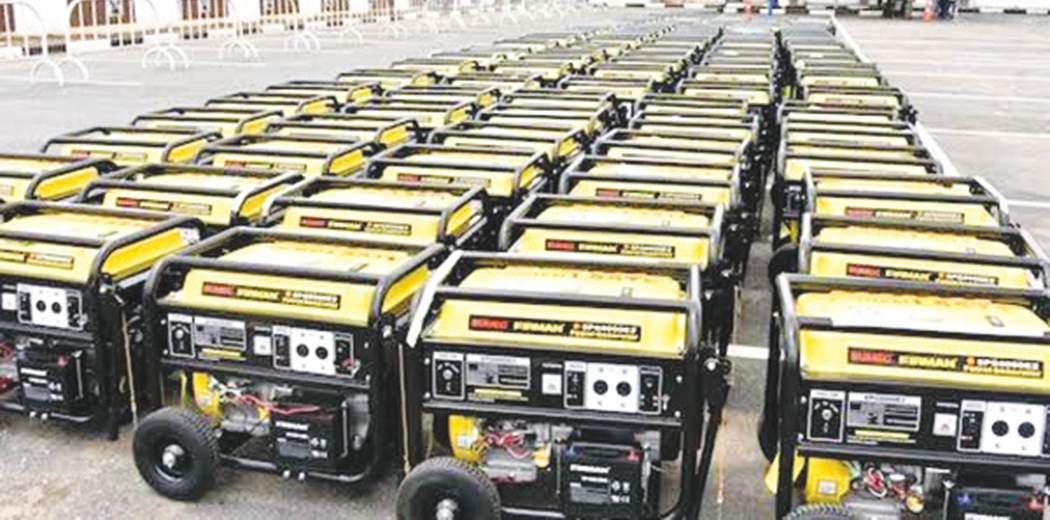
a night flight into Lagos offers a stark summary. Instead of the continuous glow typical of coastal megacities, the city appears as a scatter of dim orange lights, each powered by a private generator. What appears to be illumination is actually fragmentation. Every generator is a substitute for failed public infrastructure, and together they form one of the most expensive electricity systems in the world.
Financial Cost
The financial burden is staggering. In 2023 alone, nigerians spent an estimated n16 trillion on petrol and diesel for self-generation. This covers only fuel and excludes generator purchases, maintenance, inverters, and opportunity costs. The World Bank estimates that unreliable electricity costs nigeria about $29 billion annually, roughly 2 per cent of GDP. These losses exceed federal spending on health and education combined. Electricity, which should quietly enable growth, instead constrains it.
Behind the aggregates lies widespread microeconomic damage. Factories halt production mid-shift when power fails, raising unit costs and disrupting supply chains. Hospitals rely on diesel to keep equipment running. Cold storage failures compromise food and pharmaceuticals. Students study under torchlight. Small businesses divert capital from growth to fuel. These daily disruptions accumulate into structural economic underperformance.
The Paradox of Plenty nigeria’s crisis is not rooted in a lack of energy resources. Installed generation capacity stands at about 13,000 megawatts. yet peak delivery to the grid in 2025 rarely exceeded 5,500 megawatts, with average daily supply closer to 4,000 megawatts, roughly what a single large global city consumes off-peak. The gap reflects overlapping failures: inadequate gas supply, weak transmission, poor plant availability, and chronic grid instability. The grid itself remains fragile. repeated system collapses in 2024 and 2025 triggered nationwide blackouts. These events erode investor confidence and push consumers toward self-generation. as more users exit the grid in practice, revenues decline, leaving the system short of funds for maintenance and expansion. a vicious cycle takes hold.
Losses within the value chain deepen the problem. a significant share of generated power never becomes revenue. Transmission losses are substantial, but distribution losses—technical and commercial—are worse. Fewer than 55 per cent of customers are metered, leaving most on estimated billing. In such conditions, payment discipline weakens. For every n10 worth of electricity delivered, only a fraction is fully recovered; the rest is lost to losses, theft, disputes, and political interference.
Rising Revenue, Failing Service Paradoxically, revenues continue to rise. Distri-
bution companies collected about n570 billion in the third quarter of 2025, largely due to tariff increases rather than better supply. The disconnect between higher bills and persistent outages has intensified public frustration. Price adjustments without reliability gains erode trust and undermine reform credibility. nigeria’s power challenges are longstanding. Since 1999, successive governments have announced emergency plans and megawatt targets. The most significant reform was the 2013 privatisation of generation and distribution assets, meant to inject private capital and efficiency. But the reform was incomplete. Distribution assets were allocated to un-
dercapitalised operators, transmission remained state-controlled and underfunded, gas pricing remained misaligned, and metering obligations were weakly enforced. Fragmentation replaced coordination.
The consequences are clear. Generation companies face liquidity crises from delayed payments. Gas suppliers demand cash or divert supply to export markets. Banks hold non-performing power-sector loans. Government interventions plug gaps but do not fix cash-flow weaknesses. Circular debt becomes the system’s defining feature.
Lessons from Elsewhere
nigeria’s predicament is not inevitable. Morocco built the noor Ouarzazate solar complex, supplying power to over 1 million households. Egypt added about 14,000 megawatts of gas-fired capacity in six years by aligning fuel pricing with incentives and honouring guarantees. Ghana, after its 2012–2016 crisis, restored stability through transparent procurement, contract discipline, and insulation of technical decisions from politics. Today, Ghana enjoys a largely uninterrupted supply and exports surplus power.
The common thread is governance consistency, not technological superiority. nigeria’s challenge lies less in diagnosis than in execution across political cycles.
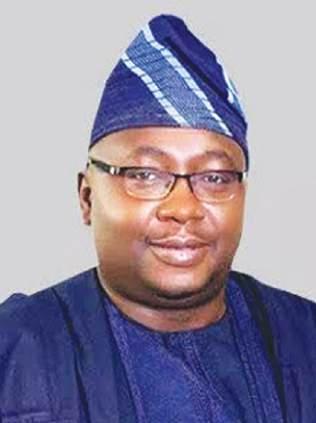
The 2026 Promise against this backdrop, the assurance by Power Ministeradebayoadelabu that nigeria will achieve stable electricity by 2026 carries weight. It raises a critical question: what institutional, financial, and operational mechanisms will deliver stability within this timeframe? Stable systems emerge from cumulative gains in generation, fuel supply, transmission reliability, distribution efficiency, and payment discipline, all of which remain weak.
The absence of a publicly articulated, time-bound roadmap detailing how these constraints will be addressed simultaneously fuels concern. Gas
pricing disputes persist. Transmission bottlenecks remain. Distribution companies are undercapitalised. Metering gaps are wide. Grid collapses continue. Without clarity on sequencing, financing, and enforcement, the promise risks joining a long list of unmet targets.
This question is sharpened by President Bola ahmed Tinubu’s 2023 pledge that nigerians should not vote for him again if he failed to stabilise power supply. Framed as a performance benchmark, it set a clear expectation. Two weeks into 2026, the indicators of “stability”, reduced outages, sustained megawatt delivery, improved payment recovery, and declining generator use, remain largely absent. Scrutiny intensified after President Tinubu attended the 2026 abu Dhabi Sustainability Week, a major energy forum. The absence of nigeria’s Power Minister from the delegation drew attention not as protocol, but because energy diplomacy and domestic reform are intertwined. In a sector driven by investor confidence, perception matters as much as policy.
From Promise to Performance
Electricity reform is ultimately a test of governance credibility. The costs of failure are already quantified: trillions of naira in annual losses, weakened competitiveness, constrained industrialisation, and lower living standards. What remains unclear is how political commitments will translate into measurable outcomes within a defined period.
n igeria does not need a miracle to fix its power sector. It needs disciplined execution of known reforms, credible contract enforcement, and the courage to endure short-term political discomfort for long-term survival. until the path from promise to performance is clearly mapped and consistently followed, nigerians will continue to rely on private generators as substitutes for public power, and the question of how to achieve stable electricity by 2026 will remain unanswered.
•Generating sets
• Adelabu
www.thisdaylive.com
opinion@thisdaylive.com
SIM FUBARA AND THE DEMOCRATIC IMPERATIVE
The Rivers State House Of Assembly at long last commenced impeachment proceedings against Governor Siminalayi Fubara last week, after threatening to do so since December 2023. To the undiscerning, the battle is between Governor Fubara and Nyesom Wike, his predecessor in office and who is currently Minister of the Federal Capital Territory. But that is a wrong reading of current political events in Rivers State. The confrontation is actually between the forces of democracy, anxious to press forward, and dark forces intent on imposing dictatorship on the state. I will explain.
When it became clear to Governor Fubara, six months into his first term, that Nyesom Wike was intent on a third term agenda for himself, telling Fubara exactly what to do and who to appoint to assist him in governing the state, the former told him a firm no, that he was elected to deliver the dividends of democracy to the people of Rivers State who elected him and not to be teleguided by man who had had his turn as governor, Wike immediately took offence and resolved on removing Fubara from office as governor.
And Nyesom Wike went about this project in a devious way. He had facilitated the election of the majority of the members of the Rivers State House of Assembly and he knew they would be willing to do his bidding. The arrowhead was Martin Amaewhule, speaker of the house. Amaewhule immediately announced to the people of the state that Governor Fubara was in breach of certain provisions of the constitution with regard to financial and administrative matters as they pertain to his relationship with the House of Assembly,
IKE OKONTA urges that wishes expressed by the ordinary people of Rivers State during the 2023 election be respected
and that members of the house would convene to determine how to respond to this ‘’infraction.’’
The subsequent melee in the house premises, the fire incident, and the demolition of the building itself were all part of an orchestrated narrative designed to deliberately portray Governor Fubara in a bad light and prepare the minds of the citizens of Rivers State for the move of the house members against him. It was a beleaguered Fubara that had no alternative but to rely on a minority of House of Assembly members to carry on the business of government. It was either that or he would have had to throw up his hands in despair and watch the state pass into the hands of desperados intent on crippling social and economic life in Rivers State.
The interesting thing in all this is that the people of the state who had overwhelmingly voted for Siminalayi Fubara in 2023 were not consulted by Martin Amaewhule and his group about the justness or otherwise of their action. As far as Amaewhule was concerned, what mattered was what Nyesom Wike, his mentor wanted, and Wike wanted Fubara removed as governor so he could put in his place a more pliable placeholder. This is antithetical to the imperative of democracy, which stipulates that the governed must be consulted whenever a leader, no matter how mighty, decides on a policy or programme.
The ordinary people of Rivers State paid a very high price for the democratic regime currently in place in Nigeria. In February 1999, when the general elections
were held in the country, Rivers State and the Niger Delta generally were in the grip of profound tension as youth battled the Western oil companies over such pressing matters as environmental devastation and poor renumeration for the oil derived from their land. As a matter of fact battle ships of the Nigerian Navy were deployed in the Niger Delta all through that period as Rivers State youth struggled to make their voices heard against the cynical megaphones of the Nigerian government which was in alliance with the oil companies.
It is not on record that Nyesom Wike gave aid and comfort to these intrepid youth during this trying period in the life of Rivers State. They battled on alone and unassisted, and in fact their struggle was one of the major reasons General Abdulsalaam Abubakar, military head of state during this turbulent period, was anxious to hand over to a democratically-elected government. General Abubakar’s hope was that with a democratic government in place nationwide, real dialogue would commence with the irate youth of the Niger Delta. The subsequent rise of such political personages as Wike and Goodluck Jonathan is due, in large measure, to the work of pro-democracy activists in Rivers State and the wider Niger Delta.
One would have therefore expected a little dose of humility from Nyesom Wike as he battles Siminalayi Fubara over the governorship of Rivers State. There is an African proverb that says that a chicken does not forget the person who plucked its feathers during the rainy season. The ordinary people
of Rivers State who played a powerful role in emplacing democracy should be given their just due by Wike, and the best way to do this is to respect their wishes which they expressed in 2023 by voting overwhelmingly for Siminalayi Fubara. To do otherwise is to resort to blatant dictatorship.
Governor Fubara has not openly expressed his desire to run for a second term. But if he does so it is perfectly his right to do so. Nyesom Wike embarked on a ‘’thank you’’ tour of certain local government areas of the state last week, and in each town he went he repeated the mantra that ‘’agreement is agreement’’, ostensibly meaning that there was an agreement with Governor Fubara not to contest for a second term. This is profoundly anti-democratic. No law in the land bars Fubara from presenting himself for a second term. It is for the citizens of Rivers State to reject or endorse him in the polls. Eminent voices like the Pan-Niger Delta Forum (PANDEF) are now mediating between the two parties. Gabriel Toby, a former deputy governor and a respected elder statesman in his own right has also called for calm and reason to prevail, pointing out that the move to impeach Governor Fubara would only set the political and economic calendar of Rivers State back. I agree. Like Gabriel Toby, I urge that the democratic imperative be given its head in the beleaguered state.
Dr Okonta is Coordinating Fellow of New Centre For Social Research, an Abuja-based policy
Editor, Editorial Page PETER ISHAKA
Email peter.ishaka@thisdaylive.com
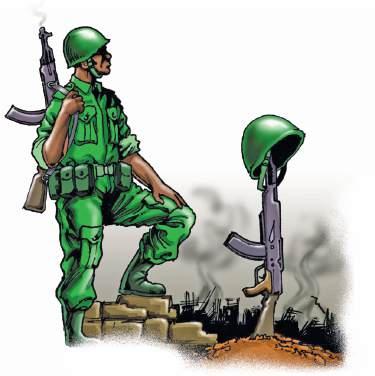
REMEMBERING OUR FALLEN HEROES
The families they left behind should be taken care of
In a statement to commemorate the 2026 Armed Forces Remembrance and Celebration Day on Friday, President Bola Tinubu said a secure nation would always stand behind the men and women who defend its territorial integrity and the families of fallen heroes. “Their names might not always be remembered, but their courage sustains our freedom and peace. A nation that forgets its fallen heroes loses its direction; Nigeria, however, remembers,” the president said while also paying tributes to their widows, children, and loved ones. “Your loss is profound, and no words can replace the sacrifices of your loved ones. They served Nigeria with honour, and our people will never forget their sacrifices.”
While this year’s commemoration may have coincided with the 60th anniversary of the first military coup in Nigeria that toppled the First Republic, the choice of January 15 was based on the day in 1970 when then Head of State, General Yakubu Gowon, officially received the instrument of surrender from ‘Biafra’ to mark the end of the Nigerian civil war. We therefore join in saluting the courage and sacrifices of members of our armed forces. However, presidential rhetoric is not always matched by concrete action. For years, there have been pathetic reports on the plight of military widows and the children left behind by soldiers who died in active service. Apart from the statutory entitlements paid within the Services, the insurance benefits due to their families through the Group Life Assurance (GLA) have for years remained an issue of concern. As we have learnt in recent years, promises made in public on the payment of GLA ends without due implementation, leaving the families and dependents to the vagaries of the harsh social and economic situations. We call on the federal government to as a matter of urgency take a holistic review of the administrative process of the GLA to ameliorate the plight of the families of deceased personnel. Beyond this, there is also the lukewarm attitude of many Nigerians, especially to military pensioners. As it happens in
other climes, the care for our servicemen must not depend solely on government.
There is a strategic relationship between the well-being of the personnel of our armed services and the safety of the nation and the citizens
SUNDAY NEWSPAPER
editor DAviDSoN iriekpeN
deputy editors FeSTUS AkANBi ejioFor ALike
Managing director eNioLA BeLLo
deputy Managing director iSrAeL iwegBU
chairMan editorial Board oLUSegUN ADeNiYi
editor nation s capital iYoBoSA UwUgiAreN the oMBudsMan kAYoDe koMoLAFe
THISDAY NEWSPAPERS LIMITED
editor-in-chief/chairMan NDUkA oBAigBeNA
group executive directors eNioLA BeLLo, kAYoDe koMoLAFe, iSrAeL iwegBU divisional directors SHAkA MoMoDU, peTer iwegBU ANTHoNY ogeDeNgBe deputy divisional director ojogUN viCTor DANBoYi snr. associate director eriC ojeH associate director pATriCk eiMiUHi controllers ABiMBoLA TAiwo UCHeNNA DiBiAgwU, NDUkA MoSeri director, printing production CHUkS oNwUDiNjo to send eMail: first name.surname@thisdaylive.com
The federal government’s decision to change the Armed Forces Remembrance Day to Armed Forces Celebration and Remembrance Day is commendable. But this only makes meaning when members of the public can also show appreciation by encouraging discount offers and recognition to military veterans at major shopping outlets, airports, stadia and other public places. It is also important that those still in service be taken good care of. Last Sunday, the General Officer Commanding 8 Division of the Nigerian Army, Major General Ibikunle Ajose harped on how troop welfare is central to sustaining morale across operational fronts. “Welfare is key to operational effectiveness. Many of our personnel are deployed far from home, confronting difficult challenges,” Ajose said. “Their ability to serve depends heavily on the emotional and social support provided by their families.” In the past 15 years, the sheer number of families faced with colossal tragedy has become quite alarming. In the armed forces, deaths have become a routine. From a never-ending Boko Haram insurgency in the Northeast to general banditry in the Northwest, to herder-farmer crisis in the North Central, and sundry other criminalities in other parts of the country, many of our military personnel are constantly paying the supreme price. How can we expect the best from those whom society literally denies justice by the shabby handling of their dependents?
We must recognise that there is a strategic relationship between the well-being of the personnel of our armed services and the safety of the nation and the citizens. It is only when we take due care of these officers as well as the rank and file that we can legitimately demand that they perform their duties with optimum zeal. The tears of these widows and left-behind children are all a reminder of the debt owed to our fallen heroes. As the president rightly said, we must never forget their sacrifices.
Letters in response to specific publications in THiSDAY should be brief(150-200 words) and straight to the point. interested readers may send such letters along with their contact details to opinion@thisdaylive.com. we also welcome comments and opinions on topical local, national and international issues provided they are well-written and should also not be longer than (950- 1000 words). They should be sent to opinion@thisdaylive. com along with the email address and phone numbers of the writer
During President Bola Ahmed Tinubu’s official visit to the United Arab Emirates to participate in the 2026 edition of Abu Dhabi Sustainability Week (ADSW), Nigeria announced that it will co-host Investopia with the UAE in Lagos in February. The initiative is aimed at attracting global investors and accelerating sustainable investment inflows into Nigeria. Nigeria has also concluded a Comprehensive Economic Partnership Agreement (CEPA) with the UAE to deepen cooperation in key sectors such as renewable energy, infrastructure, logistics, and digital trade. The agreement is expected to significantly strengthen trade relations and deliver tangible benefits for Nigerian businesses, professionals, and workers.
Overall, this expanding trade and economic relationship between Nigeria and the UAE represents a welcome development for both countries, with the potential to drive growth, job creation, and long-term economic collaboration.
However, on the international security front, the
UAE is increasingly viewed through a more complex lens. Over the past decade, the country has pursued a more assertive foreign policy, particularly in parts of the Middle East and Africa.
The UAE has faced allegations and scrutiny from some governments, international organizations, media outlets, human rights groups, and analysts regarding its involvement in conflict-affected and politically fragile environments. These debates often centre on whether UAE actions have influenced or intensified existing crises, especially in several Muslim-majority countries.
In Sudan, various reports have alleged that the UAE was involved in the supply of weapons, including drones, to actors in the ongoing conflict. Some accounts claim that arms transfers were routed through neighbouring countries such as Chad, Libya, and Uganda, and that humanitarian operations served as logistical cover. Emirati authorities have denied these allegations, maintaining that the UAE supports humanitarian relief efforts and political solutions to the crisis.
In Yemen, the UAE was a key member of the Saudi-led coalition opposing the Iran-aligned Houthi movement. At the same time, analysts have pointed to UAE support for the Southern Transitional Council (STC), which seeks greater autonomy or independence for southern Yemen. Critics argue that this support contributed to political fragmentation, while others describe it as a pragmatic response to local security challenges and counter-terrorism objectives.
In Libya, the UAE has frequently been cited in international reports as a major external supporter of forces led by Khalifa Haftar and the Libyan National Army. Allegations include the provision of military assistance during operations against Tripoli-based authorities. UAE officials have consistently rejected claims of direct military involvement, emphasizing their support for stability and counter-extremism.
In Somalia and the wider Horn of Africa, some observers have raised concerns about UAE engagement with regional authorities and security actors, particularly in Puntland and Somaliland,
suggesting that such involvement may have influenced internal political and security dynamics. More recently, the federal government of Somalia announced the cancellation of all agreements with the UAE, including deals covering port operations, security cooperation, and defence. Somali authorities cited alleged violations of national sovereignty as the reason for the decision. The UAE, however, maintains that its activities in Somalia and the region are conducted within frameworks of cooperation, development assistance, and mutual security interests.
In 2022, the United States Treasury sanctioned six Nigerian individuals for allegedly raising funds in the UAE to support Boko Haram. This followed earlier actions by UAE authorities in 2021, when individuals were arrested and prosecuted for operating a fundraising network linked to the group. Despite these incidents, Nigeria–UAE relations remain largely focused on investment, trade, and broader economic cooperation.
Zayyad I. Muhammad, Abuja
Olaseinde and Oreoluwa Olusola:
A Whiff of Perfumery
Legacies can be deliberate or accidental. For Olaseinde Olusola, founder of Seinde Signature, it has unfolded gradually, through patience, passion and a shared curiosity that has drawn his daughter, Oreoluwa, into the intricate world of perfumery, transforming what began as a personal obsession into a growing family enterprise, writes Vanessa Obioha EDITED BY: VAN e SSA o BI o HA/vanessa.obioha@thisdaylive.com.
If you have ever attended any of Seinde Signature’s immersive events, chances are you have encountered Oreoluwa Olusola. Often taking centre stage, she welcomes guests, guides them through fragrance journeys, answers questions and ensures the experience runs seamlessly. Her father, Olaseinde Olusola, the founder of the luxury niche retail perfumery, occasionally steps in, but more often than not, the spotlight is hers.
At the store, she carries the same authority, overseeing stock, coordinating staff and brainstorming new experiences for a growing customer base. Last April, when renowned perfumer Christian Provenzano visited Nigeria for the first time, Oreoluwa was at the centre of operations, managing everything from airport pickups to the main event. She was rarely caught resting.
Ore, as she is fondly called, has gradually settled into the General Manager’s role, taking the reins even as her father guides her steps in what is becoming a family perfume empire.
But it has not always been this way. At 28, Ore admits she was once indifferent to her father’s extensive fragrance collection, let alone the idea of running a perfumery business.
“Honestly, fragrances were ordinary to me,” she said during a recent interview at Seinde Signature’s office in Victoria Island, Lagos. “I didn’t understand why he liked it so much or had so many collections. I got used to it so I never really asked any questions.”
For Olusola, the journey into perfumery began in 1982, when he started collecting fragrances simply because he enjoyed smelling good. Running a perfume business was never part of the plan.
Things, however, changed during the coronavirus pandemic in 2020. Encouraged by social media posts from fellow fragrance enthusiasts sharing their collections, Olusola began inviting guests into his home to experience his own. Ore, who was then focused on promoting her food business, attended these gatherings and gradually became curious about the world of perfume.
“I started seeing people sit for hours talking about perfume,” she recalled. “At first, I didn’t understand what there was to discuss. But as I listened, I realised how complex it was. Notes, concentration, brands, the whole structure of perfumery.”
While Ore returned to school to complete her final year in Mass Communication, Olusola, responding to growing interest and the need for a larger space, opened a perfume studio at the Oriental Hotel. At the time, it was still not considered a full-fledged business.
“That was the only time Ore was missing in the business,” he said.
The plan then was to incorporate her food business into the brand but the more she heard her father and friends talk about perfumes, the more her curiosity. It was only natural that she would deploy her communication skills to help her father draft business proposals to luxury niche perfumes and naturally become involved in the business.
The turning point came when a perfumer visited the store and, while testing fragrances, broke down their notes with striking precision. Ore was fascinated. In that moment, she realised that perfume was not just a product but an art form and an experience. She began researching independently, and just last year earned her certification as
A Whiff of Perfumery
a fragrance specialist from the UK Fragrance Foundation.
As the business grew, other family members, including her brothers and mother started showing interest. Still, Ore, like her father, remains the face best associated with the brand.
“I’ve been more focused on the business part of the journey,” said Olusola, “while she’s more about the technical part of the journey. And that’s what I’m trying to do, to make sure that all of them — she, and her brothers — are focused on what goes on in the fragrance community and how things are done properly. So I can step back gradually once the business side is settled and just enjoy what is happening.”
Working with her father, Ore admitted, has largely been rewarding, though not without tension. They occasionally clash over customer engagement, branding and growth strategies.
“There was a time she said she was not working again,” Olusola said, laughing. “The thing is, I’m a very meticulous person and very demanding, and I know precisely what I want. So regardless of whether she’s my daughter or not, if there are shortfalls or certain things she needs to do, I’ll put my feet down. That, she doesn’t like. She expects me to be lenient but I can’t do that.”
He added that learning through mistakes is essential.
“I keep making that clear to her. Sometimes she would cry and tell me she wants to resign but those
days are over now.”
Their close working relationship has also led to amusing misunderstandings. When they travel for business, they are sometimes mistaken for a couple.
“I’m always correcting people— ‘That’s my dad,’” Ore said.
In just over four years, Seinde Signature has expanded from a single outlet carrying one luxury niche brand, Electimuss, to multiple outlets across Lagos, Port Harcourt and Abuja, housing various niche perfumes. Just before 2025 wrapped up, the brand opened a Sensory Bar in Jabi Lake Mall in Abuja where cocktails are crafted around fragrance notes.
“We discovered that our best selling store has nothing to do
with people coming in and making purchases. No, it’s more about the experiences. That’s why we created the perfume bar where people can have cocktails inspired by the notes on the perfume.”
“Moreover, most of the things used in making perfume are what we use in making cocktails. So, people are not coming just to buy perfumes but to have an experience. Each drink you take is telling a story of the perfume,” Olusola explained.
Building on that success, Olusola is expanding into the health and fitness sector, with plans to open outlets in selected i-Fitness locations in Ikoyi, Port Harcourt and Abuja. There are also plans to partner with a designer brand to retail exclusive private labels aligned with Seinde Signature’s niche positioning.
Olusola is also considering launching a signature perfume brand but as the shrewd businessman that he is, he is not rushing into it because he wants the best.
“We’re in the place of educating ourselves about the process of making a perfume. A lot of people just think because they have access to certain things, they can do it, or are masters of it. No. We’re not trying to deceive the consumer. We’re trying to bring in something to the market that can be regarded as a top product anywhere in the world.”
Over the past few years, Olusola has travelled to Spain, Turkey and other countries to deepen his understanding of perfumery. The process, he explained, is layered and demanding. From selecting the perfumer, known as the nose, to sourcing oil producers, bottling companies, pump manufacturers and labelling firms.
“People don’t know that the kind of spray you use in your perfume can affect the smell,” Olusola said.
“There are different concentrations as well,” added Ore. “Some pumps may not work for something that’s very oil heavy, such as Extrait de Parfum which is almost 50% oil concentration. So if you use a pump that is used for Eau de Toilette for such heavy oil concentrations, it won’t come out.”
The most difficult part, Ore pointed out, is choosing the right perfume profile.
“You also have to choose the scent that will resonate with your customers. That’s the most difficult part. We have been on it for two years.”
“To be honest,” Olusola said. “Perfume is the least understood subject in the world because it is very subjective. No matter how rich you are, you’ll keep learning about it. But the truth is that perfume is all about emotions.”
It is that emotional journey— layered, intimate and evolving—that Olusola and his daughter hope to offer through every bottle and every experience at Seinde Signature.
Olaseinde and Oreoluwa
with KAYoDe ALFreD 08116759807, E-mail: kayflex2@yahoo.com
...Amazing lifestyles of Nigeria’s rich and famous
How Tayo Ayeni’s 63rd SoiréeBirthdayDazzled
Banana Island
On Sunday, December 28, 2025, Tayo Ayeni marked his 63rd birthday at his Ikoyi residence. With the setting being Lagos’ most patrician neighbourhood, the mood leaned festive, confident, and carefully staged. After all, the evening was to double as a celebration of Ayeni’s recent honorary doctorate.
The guest list read like a panoply of wealth and power. Aliko Dangote was there. Ogun State governor, Prince Dapo Abiodun proposed the toast. Senior politicians, financiers, and social fixtures filled the compound with a punctilious sense of arrival.
The dress code was Black and Bling. It worked. Diamonds caught the light. Allblack tailoring gave the night a sybaritic restraint. Afrobeats carried across the water. Premium champagne flowed with a confidence that suggested it would not run out.
This follows a familiar pattern. Ayeni’s milestone birthdays have become social markers. His 50th and 60th set similar standards. Family celebrations have drawn comparable attention. In Lagos society, consistency of spectacle counts as its own currency.
Ayeni is best known as the chairman of Skymit Motors, a luxury automobile dealership he founded in his late 20s with N500,000. Today, the company posts annual turnover in the billions, serving high-net-worth clients and corporate fleets. His rise tracks Nigeria’s taste for imported prestige.
Beyond the spectacle sits a more mercantile story. His Italian education shaped his taste for luxury vehicles. His business instincts kept the operation tightly held and quietly expansive.
According to associates, philanthropy runs alongside indulgence. Ayeni mentors young entrepreneurs and speaks frequently about focus and discipline. The raffish exterior masks a methodical view of success, one shaped by patience rather than impulse.
The cake-cutting closed the night. Guests counted from one to 63. His wife, Adetutu, stood beside him. The moment felt convivial, almost modest, given the scale around it.
By morning, Banana Island returned to calm. What lingered was less the bling than the pattern it confirmed: in Lagos, influence first announces itself softly, then fills the room until no one doubts who convened it.
Fubara, Odili, Other Leaders Intensify Efforts to Restore Peace in Rivers
This January, the tone in Rivers State politics feels different, less explosive, more crepuscular. Even though politics in that region is rarely quiet, something is different, as seen by how familiar power brokers are stepping forward to calm a conflict that refuses to burn out quietly.
At the centre is Governor Siminalayi Fubara, locked in a grinding struggle with his predecessor, Nyesom Wike.
Starting January 2026, the House of Assembly served impeachment notices on Fubara and his deputy, citing alleged financial breaches and procedural lapses.
According to lawmakers led by Speaker Martin Amaewhule, the governor authorised spending outside approved budgets and delayed funds meant for legislative operations. Fubara’s camp has turned to the courts, seeking injunctions to freeze proceedings already charged with political exigency.
Meanwhile, alliances have shifted. In December 2025, Fubara defected from the PDP to the APC, describing it as a federal-backed reset. 17 lawmakers followed. Others stayed loyal to Wike. A Supreme Court ruling earlier confirmed Amaewhule’s leadership, closing one lacuna while opening another.
Federal power has hovered close. President Bola Tinubu previously imposed a state of emergency after governance stalled in 2025. Recently, he urged the Assembly to pause impeachment. The intervention framed stability as an ineluctable priority for a
state central to oil output.
This follows renewed elder mediation.
Former governor Peter Odili moved from quiet broker to public anchor. Early this month, he named Fubara Rivers’ political leader, defended his party switch, and recalled the 2023 peace accord he once witnessed under Tinubu’s watch.
Fubara has made concessions. Commissioners aligned with Wike returned to cabinet. Withheld Assembly allowances were released. In speeches, the governor struck a demotic tone, urging forgiveness as a condition for development and outside investment.
The Pan-Niger Delta Forum added
weight. A committee led by former Attorney-General Kanu Agabi now pursues a longer settlement, driven by concern that prolonged tension could again threaten pipelines and regional security. Projects continue amid the standoff, with roads and bridges still being commissioned. Yet the real test sits elsewhere. As analysts have made clear, if peace holds, it will be less because tempers softened. Rather it will be because every major actor now seems sanguine about the same risk: another collapse would cost them all far more than compromise ever could.
The Metrics and the Muscle of Hadiza Bala Usman
Usman serves as Special Adviser to President Bola Tinubu on Policy and Coordination. She heads the Central Delivery Coordination Unit, the office tasked with measuring ministerial performance. In January 2026, her 50th birthday was marked not just with a celebration, but with a high-level government colloquium.
Her role grants her a unique purview. She establishes the key performance indicators for federal ministers. Her reports can recommend cabinet reshuffles, a fact that underpins her unofficial title: the “headmistress of the Presidency.”
Vice President Kashim Shettima led the tributes at her birthday event. He praised her “grace and grit,” by word for the quiet authority she wields. Her influence, he noted, is built on structure and results, not noise.
This current authority is shadowed by a very public past. Her tenure as Managing Director of the Nigerian Ports Authority (NPA) ended in a controversial suspension in 2021. She detailed the experience in a memoir pointedly titled ‘Stepping on Toes,’ which ignited ongoing disputes with
major business interests.
Usman’s public life has a consistent throughline: a focus on institutional accountability. It connects her early activism as a #BringBackOurGirls co-founder to her current role enforcing policy coherence across government.
Observers note a certain resonance in her journey. The daughter of a radical historian, she now operates at the heart of state power, using data as her tool for reform. It is a blend of inherited principles and applied rigour.
For the ministers she evaluates, Usman represents a new calculus in Nigerian governance. Performance is no longer just about political loyalty; it is increasingly about deliverables tracked on a dashboard she helps design.
Whereas the system is usually criticised for opacity, Usman’s power lies in her insistence on measurable light. The most influential woman in the administration may be the one who ensures everyone else’s work is no longer done in the dark.
Strategic Shift at MultiChoice Nigeria as Kemi Omotosho Assumes CEO Role
Inside MultiChoice Nigeria, the conversation has shifted for the better, framing Kemi Omotosho’s arrival. This all comes after January 13, 2026, when MultiChoice announced Omotosho as its new Chief Executive Officer, authorising her to succeed John Ugbe, who retires after nearly 15 years steering the Nigerian business.
This is a planned succession, not a scramble. The board describes a structured handover, designed to protect operations while the market tightens. With how inflation is biting and consumer spending is thinning, pay television faces a clear inflexion point. Omotosho steps in with deep internal knowledge. She last served as Regional Director for Southern Africa, managing a seven-country portfolio with full profit and loss responsibility. That role demanded granular control of costs, pricing, and local nuance. Meanwhile, her earlier work shaped how MultiChoice understands customers. As Executive Head of Customer Value Management in Nigeria, and later across the rest of Africa, she dealt with more than 50
According to company insiders, this history
more than flair. MultiChoice needs ballast now. Subscriber loyalty is frictive. Currency
pressure creates asymmetry between costs and revenue, so the next phase is meant to reward operational discipline over bravado.
This follows a career built across media, telecoms, and digital services. Before joining MultiChoice in 2014, Omotosho worked at Airtel Nigeria in enterprise roles focused on revenue optimisation.
The tough lady’s public remarks lean practical. She speaks of local storytelling and the creative economy, yet pairs that with digital adoption and long-term resilience. The vision is curatorial, not expansive. Content matters, but structure decides scale.
There is also a leadership contrast. Ugbe’s tenure was peripatetic in ambition, expanding reach and presence. Omotosho’s mandate feels contrapuntal: tighten here, invest there, listen harder. Different tempo, same company. The significance lies beyond gender or symbolism. MultiChoice has chosen a CEO fluent in its internal mechanics at a moment of constraint. When markets narrow, familiarity can outperform novelty. That choice may prove decisive sooner than expected.
Usman
Fubara
odili
Ayeni
In Abuja, the most quietly powerful person in a room is usually the one with the spreadsheet. For Hadiza Bala Usman, the spreadsheet is her mandate.
omotosho markets. Few executives carry that breadth without abstraction.
mattered
here’s o ur Health m inister, Ali p ate?
This is the Minister of Education. Before now, I used to just see his pictures on top of reports pertaining to his ministry and sector. I wasn’t moved by him. Then Dakuku Peterside nominated him for the Maddtimes Power list of Most Powerful Nigerians. In writing his profile for the book, I called Dakuku again and said, “Oga, abeg why you nominate this person?” He went into a passionate defence. “Edgar, this is the most reformed-minded minister ever,” he said. You don’t mean it? I said. And he went on to start talking about the man’s novel skill acquisition initiative – TVET that plans to train at least five million Nigerians in five years.
He continued, “100,000 have commenced and he pays the students, pays those who are training them using their workshops and businesses. Edgar, you can imagine the impact of these on entrepreneurship, job creation and the rest.”
He also talked about the school management scheme which throws school maintenance back at the schools, and also Minister Alausa’s push towards cascading all these initiatives down to the states.
By the time Dakuku finished with me, I rushed to go and check out the man’s profile and saw that he won Best Physician in the US twice and that he is a brilliant nephrologist. Why he did not succeed at the Health Ministry where he was first posted beats me.
Now there is small k-leg in this matter. As I dropped his profile on the WhatsApp group, someone mentioned that this is the next Governor of Lagos State and I screamed “lai, lai.”
We all know my candidate o, where is this one coming from to come and scatter things? Before I could say Jack Robinson, another person re-echoed it. I have gone into prayers because we all know my man and this Baba should just remain where he is because there is so much work to be done in the education sector. Nigeria needs him more there than in Lagos. Ejo, na beg ooo.
I am sure if I ask Nigerians who is Ali Pate, many will not know him. He is the Minister of Health, the one superintending a system that has provided Nigerians with only 43,000 hospitals, 192,700 beds, less than 20 aestheticians nationwide and a doctor to patient ratio that is too shameful to mention.
I have read that about 50,000 Nigerians lose their lives to medical negligence monthly. At this pace, one out of every 100,000 Nigerian families will have a victim.
I have been a victim with the loss of my dear wife, Mena Joseph Edgar. Last week, our dear Chimamanda screamed after the loss of her dear son.
In the wake of this tragedy, I wrote an article titled: ‘Chimamanda, I Will Not Cry For You.’ People, as usual, started abusing me. I have come to the conclusion very early that like Prof. Soyinka, I do not write for all. Those that understand me, will, and those that do not, I blame the educational system that has thrown half-baked
Michael is the Group Managing Director of Cardinal Stone, the frontline investment banking outfit that is moving mountains. I have just seen reports that this firm has crossed the N2 trillion mark in brokerage deals, making them top the ratings. Mad, abi? They are now officially the Funke Akindele of the market. I am sure you have also heard that Funke too has crossed the N2 billion mark, making her the biggest selling movie person in West Africa.
Funnily enough, I have never met Michael even though I would love to meet with him. It is Mohammed Garuba who I really know and have been dealing with.
One other thing about Cardinal Stone is that, when Nicholas sacked me, Cardinal Stone was one of the firms that called me for an interview. I went there and met with the partners and they asked me many questions I could not answer. I just stood up and said, this one pass me and walked away, but with huge respect for what these young men were trying to do in the market.
Today, they have emerged with this huge achievement which I dare say is the icing on the cake, since they are also a very powerful force in the investment banking and corporate finance part of their business.
Well done guys, the sky is not your limit, na Mars una dey go. Kai.
IfeANYI UBAH: A legACYIN QUeSTIoN
There is clip of a man dressed like a British Colonial soldier walking out in anger from a huge catholic church and saying that “today is the last day of me being a Christian”.
His anger was that the late Ifeanyi Ubah was not mentioned or recognised at the mass celebrated for the new cathedral. According to him the late Ubah did so much during the building of the church and they ignoring him was a pain too much for this young man. He was so bitter that his voice shook in pain.
illiterates on us.
My not crying for Chimamanda at this horrendous occurrence is because I refuse to be pulled into her singular sorrow but rather, decided to rise above it all and look at the collective sorrow of Nigerians who stand a 40% chance of coming out alive once they walk into a Nigerian medical facility.
Everybody is complaining – the medical personnel, Nigerians, everybody. The whole sector at all levels is a complete disaster and we have a health minister and state health commissioners who are sitting in air-conditioned offices and looking at starting a gubernatorial campaign, like I have heard of our minister, instead of rolling their sleeves and seeking solutions to the medical crisis.
The health sector is dead and sadly, we do not have a responsive government that will lead a surgical mission to resuscitate it.
When something like Chimamanda’s tragic story happens, we wail and
Now let me tell you guys what I found out.
The people wanted to build a new cathedral and started contributing. The late Ifeanyi Ubah asked them to stop that he will do it all alone. After spending like N80million, he ran into turbulence and could not complete the work. The project stalled for a bit. Then one other rich man, Ibeto or so took it up and spent another N200million and completed the work.
What I have heard is that his name was mentioned because of the controversies surrounding his relations with some big men in the town which cast a shadow on his image while alive and now his legacy after he has gone.
Funny enough, the young man was not patient enough to wait to hear Ifeanyi Ubah’s name being mentioned. He had stormed off, made his declaration just before the bishop mentioned Ubah’s name.
At least we now know that Ubah has left us with a “one man Army” who will adorn his colonial uniform and fight to the last drop to protect his legacy no matter how we see that legacy. Nice one.
AkoN eYAkeNYI: A BrIef NoTorIeTY
Nma Akon is the Deputy Governor of my state, Akwa Ibom. Usually, she is very silent and just goes about her business without looking for trouble. Anyway, that was how last week, one prankster decided to throw her out of her slumber.
All of a sudden, Nigerians were shocked to see a news report that Nma Akon had triggered a law banning single ladies from sleeping with married men. The law will put a fine of N10 million on the girls and N3 million on the men. This thing spread like wild fire and for five minutes Nma Akon was the most googled Nigerian.
Feminists, mischievous married men, single ladies, in fact, the whole community of adulterers and adulteresses went after her and if you know, that community has members running into millions with membership inside that House of
cry and then move to the next issue, leaving the main matter for Angel Gabriel to come down and solve. We are just not a serious people, because if we are, this Ali person should by now be held accountable.
As for this Chimamanda matter, I plead with Nigerians to allow due process to run its full course. A legal and administrative inquiry is on course, an internal audit by the hospital has been triggered, so we should all just calm down with the emotional tirade everywhere and wait for the conclusion of the process.
Let us even ask for a coroner report sef so that we can at least get some clarity before we start asking for the heads of whoever.
If we are not careful with our health system, no family will achieve the Passover – that thing that the Israelites did in Egypt that made death pass over their doors – every family will feel the pain of the desolation that is our health system. Mark my words, we will all cry.
Assembly that was expected to pass the law. They said she pushed the law because her husband had a side chic and she wanted to get back at him. Thankfully, her people came out to deny the whole bill and put a blanket on the fire, and everyone breathed a sigh of relief.
If this were true, that bill would have kicked out Tinubu’s tax law as the most hated law in modern day Nigeria and Nma Akon would have toppled Wike as the most disliked politician of the century. Thankfully, this was not true and we all remain free to continue to indulge. Kai, that was scary.
wolA JoSepH CoNDoTTI:welComeTo power
Let me quickly send my congratulations to this very brilliant young lady. Wola has just been announced the acting Managing Director of Nigeria’s biggest distribution company, Eko Disco. The company had just achieved a wonderful change of ownership late last year which saw the coming in of new ownership and the very profitable exit of the Dere Otubu team. To better position the entity, the new owners have made this appointment. Wola comes with tremendous experience being the GMD of the former holding company of the firm. Furthermore, I have heard that she was also very instrumental to the seamless change of baton which puts her effectively as a veritable bridge between the past and present.
Wola is married to the brilliant Hakeem who used to own the “Who Wants to be a Millionaire” franchise. A power couple if you ask me. Well done, my sister.
STreeTpHIlANTHropY: mYTeArS, mY prAYerS
I have been watching these videos on IG and have been crying throughout. Young boys will just walk up to a disenfranchised persona and drop wads of naira on their laps and change their lives just like that.
One of the ones that made me cry to the hilt was one of the boys who walked up to an Okada man.
The Okada man was sitting on the okada and thinking about his life. The boy walked up to him to ask what was the issue and he said he was just wondering what to do because the bike had died and he had no money to repair it. He also was still making installment payments on the bike. He now asked the okada man about his parents and that one said they were dead.
Then he said, “Look, I have no money to give you to buy a new bike, but take this.” He dropped a huge amount of money on the guy and the guy immediately went mad. Oh my God, I burst into tears, the joy in the recipient’s eyes, the joy of the bystanders, the miracle of the moment and I did not stop crying.
TUNJI AlAUSA: A SUrprISINgTUrN
mICHAel NzewI: ATrIllIoN NAIrA Broker
Alausa Alausa
late Ubah
Debola Ibiyode: Beyond AI Buzz to Real Impact
With artificial intelligence
dominating global tech conversations, the CEO of CarbonAI, Debola Ibiyode, is pushing beyond the hype, with a focus on productivity and building a sustainable AI industry in Nigeria, Vanessa Obioha writes
The hype around artificial intelligence (AI) has grown steadily since OpenAI launched ChatGPT in 2022, quickly becoming the new watchword in global tech circles as companies pivoted from once-celebrated futures, such as the metaverse, to AI-driven solutions. In Nigeria, the pace of adoption has been slower, shaped by structural and infrastructural challenges, yet the excitement around AI has remained loud. What concerns Debola Ibiyode, CEO of CarbonAI, is what comes after the buzz: how the technology can translate into real productivity and a sustainable AI industry on the continent.
One of the few female engineers driving practical AI adoption in Nigeria and the UK, Ibiyode is taking that conversation to the public through AI in Action, a conference scheduled for Thursday, January 22, 2026, at the Oriental Hotel, Victoria Island, Lagos. The event is an attempt to move artificial intelligence in Nigeria beyond hype and into practical use, bringing together investors, data scientists, founders, students and policy leaders to discuss how to build, deploy and scale AI in real-world situations. About 16 speakers will be tackling the theme ‘Driving Productivity, Innovation, and Sustainability— Building the Future in AI Together.’
At first meeting, Ibiyode does not quite fit the stereotype of the hard-edged tech executive. A software engineer with a disarming sense of humour, she speaks easily about her career journey and personal evolution, her playfulness often softening conversations around complex systems and data. But beneath that ease is a clear-eyed focus on impact. That focus on impact is evident in the range of roles she has played across the tech ecosystem, including at her own companies. For instance, through Optisource Technology Solutions, which she co-founded with her husband, Ibiyode helped connect Nigerian engineers to global companies. She was also part of the team that spearheaded the online checking of JAMB results.
With AI in Action, she hopes to do more, including launching the AI Foundry Africa, an initiative designed to train and mentor young founders while giving them access to investors who can fund and scale their ideas.
Ibiyode’s foray into science and engineering was inspired early on by an uncle who gifted her a Pascal Book of Programming, a gesture she says opened her eyes to a new world of possibilities
“Pascal was my first love for coding,” she told me at a recent meeting. “I can never not like Pascal, because it made me see that I could do something.”
This was at a time when many parents hoped their children would become doctors or pursue a handful of prestigious careers, while the idea of building a future in computer science was often dismissed. As Ibiyode recalled, her late father— who was the head of town planning and worked on Lagos’ development during Lateef Jakande’s tenure—initially imagined she would end up working in a cybercafé. She eventually convinced her parents otherwise after earning a Microsoft certification and going on to study Computer Science at Ladoke Akintola University of Technology (LAUTECH). Her academic journey has since expanded to include a certificate in Artificial Intelligence from the University of Oxford and a master’s degree in Computer Engineering from Syracuse
University’s College of Engineering and Computer Science.
Keen on breaking stereotypes around AI, Ibiyode launched a YouTube channel where she focuses on demystifying and democratising the technology. The channel now has over 21,000 subscribers from across the continent.
“I realised that with every technology that has come in the last 100 years, other races have a leg up, and that’s because they push and empower themselves to be at the forefront, and then our race is always playing catch-up. I’m in a unique advantage that at the start of the technology, I’m a leader in it. It is my duty, I felt, and still feel, to ensure that I’m doing the same thing I’m seeing them do to empower my type of people.”
One of the gaps she identified early on was how cultural nuances embedded in AI models often hinder understanding and adoption.
“Those nuances are what separate us and so demystifying artificial intelligence is to let us understand it from our own perspective, how best we should be consuming it, and what it actually means for us.”
Debunking some of the misperceptions about AI in Nigeria, including the fear that it will replace humans in workplaces, Ibiyode pointed out that AI is not omniscient.
“AI, in itself, is just a science. ChatGPT is not AI,” she emphasised. “But it is running artificial intelligence functions in it. If you take that function out of ChatGPT, it’s just a tool. So the misunderstanding is people don’t see AI as a tool.”
She added that AI is far from a solution to every problem. “And it doesn’t solve all our problems. I always tell people, there are things AI cannot do. What God cannot do does not exist but what AI cannot do exist. Just find out what it can do and what it can’t do, and see where you can use it to your benefit. If people see it that way, the adoption will be better. The hype would be more productive. And that’s what the conference is about: having a productive hype about what artificial intelligence is. It’s not going to replace anybody, because AI cannot think for itself.”
For Ibiyode, Nigeria does not yet have an AI industry, largely because consumption of the technology has been shaped by foreign narratives. “As a country, we let the rest of the world think for us,” she said. “We are used to taking other people’s thoughts rather than developing our own. Because of that, we are still viewing AI through the lens of the rest of the world.”
To scale, she believes Nigerian developers must collaborate, empower one another and start building solutions around AI despite existing limitations. “If from this conference, four founders come together and build four unicorn AI products, the job is done. That’s how industries are built.”
“And when we can show that antifragility of things, then we get enough investment to then build the infrastructure that we actually need. If we’re waiting for the infrastructure, we will be behind,” she added.
Ibiyode is also advocating for the introduction of artificial intelligence into educational curricula, arguing that early exposure is critical. She hopes the government will take a more active role in regulating AI use and protecting young people.
“I do hope the government will start to look into securing the youths or the users of AI, and protecting us from the big farms taking advantage of our data, our own labour, by putting regulations on how people use AI,” she said.
If all of these happen, the buzz around artificial intelligence may finally give way to something more enduring.
A publicAtion
The Queens and the Ghost of Kalakuta
In its latest Lagos run at Terra kulture, the Broadwaystyle musical Fela and the kalakuta Queens flares to life as a ritual of sound and movement, where the city stands before the ghost of its most defiant prophet. okechukwu Uwaezuoke writes
At last, the boisterous bombast of the play’s voice-over—stretched almost to the point of excess—runs its course. Now, the real business begins. From somewhere high up on stage right, mostly swallowed by darkness, hard-core Afrobeat throbs: raw, insistent, unapologetic. It spills into the theatre, gathering momentum, until it seizes the stage as the first figures emerge onto a floor drenched in purple light, sharply sculpted by overhead spotlights. Movements flare, collide and, before the audience can even catch its breath, resolve themselves into a tableau vivant charged with tension, rhythm and barely contained energy.
This, by the way, is the Saturday, January 10 matinée of Fela and the Kalakuta Queens, part of its latest festive-season run, which concludes the following day, Sunday, January 11, at Terra Kulture’s sleek, purpose-built theatre in the upmarket Victoria Island neighbourhood.
Stage right, a figure in ghostly white stands on an elevated platform, facing the audience with an unnerving stillness, as though frozen between invocation and judgement. Stage left, another figure—similarly clad, crowned with an exaggerated, fluffy headpiece—holds position atop a raised staircase, no less arresting. They do not move, yet they dominate the space, presiding over the action like sentinels. Between them, at centre foreground, dancers in dark hues crouch in a tight, forward-leaning circular formation, arms thrust outward, bodies coiled into a tense, kinetic sculpture that seems to inhale and exhale with the music.
The overall ambience of the roughly twohour musical carries something of the spooky, almost fantastical. And this is one production Lagos theatre-goers never seem to see enough of—not because the city is short of spectacle (Lagos, after all, is a place where revelry, or at least an excuse for it, is never in short supply), but because this particular musical has mastered the art of returning without sliding into numbing predictability. Each revival feels less like a rerun and more like a fresh provocation, a subtle nudge at the city’s collective conscience.
Lagos recognises the story, recognises itself in it, and keeps turning up—some to witness the spectacle, others to revisit the heady years of the Kalakuta Republic and the Afrika Shrine. That is precisely why, performance after performance, the city’s theatre buffs find their way to Terra Kulture. Between December 26 and 30 last year; January 1 to 4; and January 10 to 11, Bolanle Austen-Peters Productions mounted a formidable run. Across 22 performances, virtually every seat was filled. More than 10,000 people filed through the doors, and in a city famously impatient with repetition, that level
of turnout feels less like an achievement than a verdict.
What keeps drawing people back is not simply Fela Anikulapo-Kuti as icon, but Fela as unresolved question. Yes, the longrunning, Broadway-styled production carries the relaxed authority of a show secure in its grip on the public imagination. Yet there is no air of cautious revivalism here, no sense of a legacy work wheeled out on the strength of nostalgia alone.
The production does not freeze Fela in reverence or reduce him to a catalogue of greatest hits. Instead, it opens with sound— unapologetic, sinewy, insistently live. Under the musical direction of Kehinde Oretimehin, the band functions as a character in its own right. Afrobeat here is not atmospheric garnish; it is the propulsive core of the evening, the argument itself, a force that refuses to be domesticated.
At the centre of this turbulence stands Laitan Adeniji as Fela. His is a performance that sidesteps both sainthood and caricature. Adeniji captures the swagger, the volatility, the almost dangerous charisma of a man capable of inspiring devotion simply by occupying space. This Fela is witty and cruel, generous and exhausting, visionary and petulant—sometimes within the same breath. He is less hero than weather system, and the production is wise enough to let the consequences of that intensity ripple outward rather than corralling them into tidy moral judgements.
But Fela does not exist in isolation. Around him, the women of the Kalakuta Republic—the Queens—claim the stage with equal authority. Osas Ighodaro, Yewande Osamein, Bunmi Olunloyo, Sharon Adaeze, Inna Erinze and Linda Nwanneka, among others, form a constellation of presence, each figure oscillating between individual magnetism and collective force. Under Justin Ezirim’s choreography, their movements are sharp, precise and at times violently fluid—a language of resistance and devotion written in muscle and gesture. They circle, sway and pivot; their torsos coil and snap in rhythmic sympathy with the band. Every glance, every tilt of the head carries the weight of history: loyalty and rebellion braided together beneath the myth of Fela the singular genius.
Costume designer Ituen Bassi, assisted by Juliana Dede, dresses the Queens in layered fabrics that speak simultaneously of Africa’s sartorial richness and the theatrical exaggeration required to hold their own against Adeniji’s formidable presence. White tunics, patterned skirts, bold headpieces and metallic accents evoke a Kalakuta that hovers between ritual and performance, lived reality and
myth. Makeup by Adedayo Adesola and hair by Adeola Omomo sharpen these impressions further, giving each Queen a visual authority that cuts cleanly through the purple haze and overhead glare.
In the foreground, dancers coil and snap through formations that echo the pulsing Afrobeat beneath them. A red, mask-like projection throbs on the backdrop, an ominous witness and accomplice. With Moses Onyeama’s lighting and Daniel Aganoke’s projections, the stage feels less like a platform than a living organism—breathing, listening, demanding attention.
The Kalakuta Queens are not mere support for Fela; they are interlocutors, challengers and co-conspirators. Their dirge-like prayers rise like incantations, summoning him back into earth-life and delaying what feels like an already-scripted departure.
Bolanle Austen-Peters’ direction reveals a steady confidence in managing scale. She knows when to let the production swell— ensemble numbers bursting with sound and movement—and when to narrow the frame, allowing moments of intimacy or tension to register. Kalakuta emerges as a space of contradiction: sanctuary and pressure cooker, utopia and hierarchy, refuge and trap. Gender and
power are negotiated nightly on stage, never fully resolved, never comfortably explained. The political bite remains sharp. Fela’s “Yabis”—those improvised verbal assaults on authority—slice through the production with a satirical edge that provokes laughter and winces in equal measure. Corruption, military repression and the farce of post-independence governance are named without ceremony. The unsettling truth is how little translation these critiques require for a contemporary audience.
The supporting cast deepens this world with texture and irony. Performances oscillate between menace and absurdity, reminding us of the bureaucratic and coercive forces pressing against Kalakuta’s walls.
Technically, the production is assured without being ostentatious. Sound, lighting and projection work in concert, serving the story rather than competing with it. By the time of the well-orchestrated curtain call, the sense is not merely of having witnessed a polished musical, but of having participated in a civic ritual. In an era when live theatre is often described as fragile, Fela and the Kalakuta Queens asserts itself as both culturally urgent and commercially viable. The sold-out houses are not accidents; they are evidence of a hunger that has not been fed elsewhere.
Laitan Adeniji (as Fela) in the foreground cradling a saxophone in one of the scenes
A scene of a police raid at the Kalakuta Republic
January 15, 1966 and January 15, 2026 in Africa: Dynamics of 60 Years of Recidivist Political Instability
Africa is like a beautiful damsel any good gentleman can seek to court by all means becauseAfrica is beautiful in various ramifications. It is a region in the eyes of the United Nations, but a continent of five regions in the eyes of the Organisation ofAfrican Unity and the African Union. President Donald Trump not only sees Africa as ‘disgusting and crime ridden,’ but also as a continent of ‘shitholes countries.’ For many European countries, Africa is a terra cognita for mineral resources that should be exploited for the development of Europe but to which Nigeria, under General Yakubu Gowon as Head of State and Dr Okoi Arikpo as Commissioner for External Affairs, was vehemently opposed. Dr Arikpo made it clear that, under no circumstance, would Nigeria accept the exploitation of African mineral resources for the exclusive development of Europe and to the detriment of Africa’s development. Europe also sees Africa as its former colony where its influence should be preponderant and not allowed to be challenged. Consequently, when African leaders are perceived to be acting contrarily to their interests they are removed by foreign-aided coups d’état, poisoning, or political destabilisation.
Like the Europeans, the Chinese see Africa as a big strategic market, a major ally within the framework of the Global South and with which a relationship of solidarity should be defined. Emphasis is placed on a win-win narrative, and self-presentation as another Third World country. As such, while Africa-European ties are seen as exploitative, relationship with China is seen as mutually beneficial, especially in light of strings not being attached to Chinese development loans. In short, China sees relationship with Africa as an economic opportunity.
Besides, the late President of Zimbabwe, Dr Robert Mugabe, once said Africa without Nigeria was a pothole, a vacuum. And true enough, Nigeria has the biggest population and arable land in Africa. It is the land of ‘fantastic’ corruption where nothing is impossible. Without any jot of doubt, Nigeria is also a place where the more you look is the less you see. This is the background of today’s narrative on January 15 in 1966 and 2026, and dynamics of the recidivist political instability in Africa.
January 15, 1966 and January 15, 2026
January 15, 1966 was an important date in international relations because of its impact on the nascent democracy in Nigeria that had just acceded to national and international sovereignty on October 1 and 7, 1960 respectively. January 15, 1966 not only marked the first military intervention in political governance, but also put an end to the pioneering experimentation of parliamentary democracy in Nigeria. It also not only laid the foundation for ethnic animosity and intra-regional rivalry, suspicion, and national disunity, but also served as the beginning of a recidivist political instability and chicanery in Nigeria.
In spite of these considerations, January 15, 1966 was set aside not simply to recall the time of military intervention that led to civil war, but also to remember, and remind of, the victory of the Armed Forces of Nigeria (AFN), following the end of military hostilities on January 12 and handing over by a Biafran military General, Phillip Effiong, of the instrument of surrender to Olusegun Obasanjo. Put differently, January 15, 1970 witnessed the change of date of the Armed Forces Remembrance Day from November 11, internationally referred to as ‘Poppy Day’ by the Commonwealth or Armistice Day to commemorate the end of World War I. Additionally, November 11 can refer to many historical and diplomatic events in international relations: the November 11, 2025 G-7 Foreign Ministers’ Meeting held in Japan; the November 11, 2025 Japan-France Security Cooperation; the November 11, 2024 bilateral diplomatic meetings between South Africa Minister, Roland Lamola and German Minister, Johann Wadephul; the November 11, 2025 defence and security discussions on European defence. In fact, November 11 is generally reserved in military diplomacy for various security-related ceremonies as it is the case with the 2024 homecoming ceremony organised for the Japan Maritime Self-Defence Force’s overseas training cruise and the
: 0807-688-2846 e-mail: bolyttag@yahoo.com
Wesson Lecture at Stanford on International Relations in practice.
In this regard, Nigeria, being a Member State of the Commonwealth organisation, has been observing November 11 as an International Armistice Day. However, in Nigeria, November 11 was removed as a holiday from the calendar of the Commonwealth in favour of January 15 in commemoration and honour of the Armed Forces of Nigeria for their sacrifices and preventing national disintegration.
Even though General Gowon declared that there was no victor and no vanquished, there is no disputing the fact that Armed Forces Remembrance Day is an expression of victory in the Biafran War. For Biafra, it was a war of secession. For Nigeria, it was a war national unity by manu militari. After all, the war slogan was ‘to keep Nigeria one is a task that must be done.’ Since there was no secession at the end of the military hostilities, there cannot but be victory. More important, many countries recognised the new military government led by Major General Johnson Aguiyi-Ironsi. The recognition was largely predicated by the promise of the regime to honour Nigeria’s existing treaty obligations. It is therefore not at all surprising that Nigeria’s Constitution subsequently provided for the respect of international and treaty obligations as one of Nigeria’s foreign policy objectives.
Put interrogatively, is the act of respecting international law and treaty obligations sufficient a reason to make it a foreign policy objective? By seeking to respect international law and treaty obligations, can that sustain the recognition of every government of Nigeria in international relations on a permanent basis? Whatever is the case, there is no disputing the fact that January 15, 1966 putsch laid the foundation for the eventual restructuring of Nigeria and the AFN Remembrance Day as explicated above.
In this regard, to what extent is the AFN Remembrance Day not a major dynamic of the successive coups d’état in Nigeria and Africa? In Nigeria, after the January 15, 1966 coup, there were the
The same was true under President Joe Biden who threatened African countries that did not vote for the UN resolution condemning Russian invasion of Ukraine. In fact, he put it more pungently that any country that votes against US foreign policy interests at the UN would be sanctioned. This is the situational reality of global politics as of today. If this is so in global politics, should African countries, for fear of being sanctioned by the United States, accept to always dance to the whimsical and capricious tunes of the United States? When African leaders accept to be used as instruments for the promotion of extra-African development to the detriment of the interests of their own countries, there is no way coup-making would not be contemplated. Coup-making cannot but be recidivist with this type of situation, especially when African governments are, at best, irresponsible to their people. In Nigeria, for example, the Federal Government placed an advert to build houses in April 1994 and collected deposits from the public for buildings to be allocated by December 1994. In January 2026, otherwise 32 years ago, no building of house, no refund of deposits, no information on the building project, yet, Nigerians are being told to be patriotic and to condone political chicanery in Nigeria. What about government houses in the FCT? Why are Certificates of Occupancy (CofO) not easily given to their owners after full payment to Government? I made a full payment in 2004 for a 4-bedroom flat in Wuse Zone 1 but no C of O has been given. Why should I lobby or give bribe in order to get my C of O? Why should people keep quiet when the system is fantastically corrupt to borrow the words of David Cameron?
1966 counter-coup of July 1966; the 1975 coup that ousted General Gowon; the December 31, 1983 that brought the Muhammadu Buhari regime to an end; the August 27, 1985 palace coup that brought in Ibrahim Badamasi Babangida to power; and the November 17 1993 palace coup that brought General Sani Abacha to power. These coups are different from the attempted and failed coups: the February 13, 1976 coup that led to the killing of General Murtala Muhammed, the April 22, 1990 Gideon Orka coup, which could have easily succeeded if the intention of ostracising the northernmost states of the North from Nigeria had not been announced during the making of the coup, the December 1985 alleged General Mamman Vatsa coup and the alleged 1997 General Oladipo Diya coup plot. In 2025, there were media reports of coup attempt in Nigeria which the Bola Ahmed Tinubu administration openly denied but which has continued to generate more questions than answers. Questions are always raised bearing in mind that 16 officers were arrested allegedly for salary and welfare reasons purportedly raised by some soldiers. The troubling question is that the media first reported that there was a coup and not that some soldiers complained. It was the Government that came up with the argument of soldiers’ complaints. Many public commentators do not buy the idea of the argument, especially in light of the toughening situation of economic life which already pointed to the possibility of a coup in the making. Public thinking is that Government’s eagle eye surveillance cut up with the coupists before they could act. Whatever is the case, to what extent is the AFN Remembrance Day not taken advantage of by Russia in deepening its ties with Africa, in general, and Nigeria, in particular? It is useful to recall here that Russia considers Africa as a special region for the projection of its global power and not only to contain Western influence, but also to secure strategic raw materials for its own development. It should not be forgotten here that General Yakubu Gowon sought the support of the former Soviet Union when the United Kingdom and the United States initially refused to sell arms and weapons to prosecute Nigeria’s war of national unity. Russia, as a successor state to the Soviet Union, following the policies of glasnost and perestroika, began to enhance its international standing by also providing security assistance, energy, and diplomatic support to several African countries, all in an attempt to counter western influence, especially that of France and the United States. Without doubt, glasnost, as openness, is about public accountability, enabling freedom of thought. It is about transparency. Glasnost is about reforming the politico-economic systems. It is about restructuring and well meant by the initiator, Mikhail Gorbachev, in the 1980s. It was meant to strengthen socialism, but the reforms mistakenly exposed some systemic failures that prompted the demands for greater freedom, quest for nationalism, and eventually the collapse of the Soviet Union. Thus, the opportunity of being invited by General Gowon to come and support Nigeria’s quest for national unity partly encouraged the Soviets to seek the use of Nigeria and Africa as a theatre for anti-West war, to promote a Russian new world order in which Russia, along with China and other non-Western powers, would become major players in the conduct and management of global questions. In this strategic calculation, Africa’s support is considered indispensable. While China presents itself as another Third World country, Russia is presenting itself as a major reliable supporter of African liberation and sovereignty. How does this situation help Nigeria as of January 15, 2026?
Dynamics of 60 Years of Recidivist Political Instability
January 15, 2026 made it sixty years after the first military intervention in January 1966 in Nigeria. The reasons given for the military intervention include poor governance: political instability and corruption in which there were contract disappearances, public embezzlement and treatment of public offices as private property; conscious electoral fraud, especially the 1965 election crisis, also referred to as ‘Operation Wetie,’ which the central government could not handle; unhealthy ethnic rivalry, largely predicated and characterised by claims by Colonel Odumegwu Ojukwu of military superiority to Lt-Col. Yakubu Gowon and that Brigadier Babafemi Olatunde Ogundipe ought to have been the successor to Major General Aguiyi Ironsi.
And true enough, When Brigadier Ogundipe reportedly gave military order to the presidential guards, first and second time but there was no compliance. He never bothered to try the third time. He ran away immediately for his safety. He reportedly ran to Dahomey, now Republic of Benin, from where he flew out to the United Kingdom. In September 1966, Brigadier Ogundipe was appointed by Lt. Colonel Gowon as Nigeria’s High Commissioner to the United Kingdom. In spite of this, Colonel Ojukwu still believed that Yakubu Gowon was militarily a junior person to be given the status of First Citizen of Nigeria.
All these factors, coupled with the looting by the corrupt political elite led to the coup-making by Major Chukwuma Kaduna Nzeogwu in January and Yakubu Gowon in July 1966. Not less than 22 people were killed, mostly norther political leaders. This partly and probably explains why the coup is described by some observers as an Ibo coup and the counter-coup of July 1966 as a northern or Hausa-Fulani coup. The coup apparently became an expression of ethnic rivalry.
Read full article online - www.thisdaylive.com
•Tinubu
IN THE ARENA
Deepening Poverty Report Nigeria Must Confront
The recent report by PricewaterhouseCoopers, warning that poverty levels in Nigeria are set to worsen sharply in 2026, alongside the World Bank’s, presents an opportunity to the federal and state governments to take urgent and coordinated action to address the crisis, Davidson Iriekpen writes
The new report by PricewaterhouseCoopers, which projects that no fewer than 141 million Nigerians will live in poverty in 2026, should jolt the federal and state governments into action.
The report, published in PwC’s Nigeria economic Outlook 2026, and titled: ‘Turning Macroeconomic Stability into Sustainable Growth,’ stated that recent policy adjustments aimed at stabilising the economy have yet to translate into tangible welfare gains for households.
PwC warned that weak real income growth, combined with persistently high living costs, will push millions of Nigerians deeper into poverty for the next two years, even as headline inflation is expected to moderate. energy costs, logistics expenses, and exchange-rate pass-through will continue to keep food and essential goods prices high, the report said.
The firm estimates that the poverty rate will climb to 62 per cent this year, a stark indicator that easing inflation alone will not translate into improved living standards.
As a result, the report noted that most Nigerians are unlikely to see wage or income increases that meaningfully keep pace with rising costs, leaving low-income households especially exposed to economic shocks.
without strong job creation, productivity improvements, and adequate social protection, it added, efforts to reduce poverty may remain out of reach. The firm also highlighted insecurity in food-producing regions and climate-related shocks as additional factors sustaining high food prices.
Food accounts for up to 70 per cent of total consumption among poorer Nigerians, leaving them highly exposed to food price increases. with food inflation remaining elevated, these households are disproportionately affected by price shocks.
According to experts, rising poverty levels pose significant risks to Nigeria’s economic stability and growth prospects. A larger share of the population struggling to meet basic needs could weaken domestic consumption, limit productivity gains, and strain public finances.
The world Bank’s Nigeria Development Update had also shared a similar view. The lender noted that the absolute number of people living in poverty has increased sharply, from about 81 million in 2019 to roughly 139 million in 2025, meaning nearly 62 per cent of the population now lives below the poverty line.
earlier estimates showed about 115 million
Nigerians in poverty in 2023, rising to around 129 million in 2024, indicating that about 14 million people fell into poverty in just one year.
The multilateral lender projected that the poverty rate will peak at 62 per cent in 2026, equivalent to about 141 million people, before dipping to 61% in 2027, or roughly 140 million Nigerians, the first predicted reversal in nearly a decade.
For millions, especially in rural and northern regions, prospects of relief remain distant, as food inflation, structural inequality, and weak social protection systems continue to deepen hardship.
In 2018/19, the Nigeria Living Standards Survey estimated poverty at 40 per cent, or 81 million people. By 2022/23, that figure had surged to 56 per cent, about 113 million Nigerians. This escalation coincided with falling consumption, weak growth, and soaring inflation. Between 2019 and 2023, average consumption per person fell by nearly seven per cent, with urban households hit hardest.
“Between 2019 and 2023, average consumption fell by 6.7%, especially in urban areas, while poverty rose from 40% (81 million people) to a projected 61% (139 million people) by 2025, with three-quarters of the increase occurring before 2023,” the world Bank said.
The Presidency, however, had disputed the figures. The Special Adviser on Media and Public
Communication, Sunday Dare, said on X (formerly Twitter) that the statistics were “unrealistic” and should be “properly contextualised” within global poverty measurement frameworks.
Poverty in Nigeria comes in various forms: a lack of income and productive resources to sustain livelihoods; hunger and malnutrition; illness and death; and limited access to education and other basic services. It includes inadequate housing and unsafe environments. It is also seen in a lack of participation in decision-making and civil, social, and cultural life.
Nigeria currently has a population of 237 million people, and over 133 million Nigerians are living in poverty. It is higher in rural areas, where 72 per cent of people are poor, compared with 42 per cent in urban areas.
Nigeria has endured decades of violent insurgencies and ranks sixth on the 2025 Global Terrorism Index. Numerous people have been killed, and millions displaced. The number of casualties from terrorist attacks in 2025 is alarming. Most of the casualties are in places with high poverty levels.
The President Bola Tinubu-led administration had embarked on a sweeping market-oriented reform programme nearly three years ago, aimed at restoring stability and predictability to an economy long characterised by volatility. Measures such as the removal of petrol subsidies,
POLITICAL NOT e S
electricity tariff adjustments, and the liberalisation of the foreign exchange market have helped correct deep-seated distortions and strengthen public finances. Still, they have triggered sharp increases in the cost of living, eroded household purchasing power, and pushed more Nigerians into poverty.
Nominal household spending rose by 19.6 per cent from N116.5 trillion in 2024 to an estimated N139.3 trillion in 2025, reflecting rising prices rather than improved welfare. In real terms, however, household consumption contracted by 2.5 per cent from N12.2 trillion to N11.9 trillion over the same period, underscoring the depth of the squeeze on living standards and suggesting that poverty pressures are unlikely to ease quickly. Food inflation, although easing towards the end of 2025 due to improved harvests and exchange rate stability, has remained a significant drag on household welfare, particularly in urban centres and conflict-affected rural areas.
rising insecurity continues to disrupt agricultural production and supply chains. At the same time, geopolitical tensions and softer global growth could weaken external demand and oil revenues, limiting the government’s capacity to scale up social spending.
Addressing Nigeria’s deepening poverty challenge will require more than macroeconomic stabilisation. Sustained progress will depend on accelerating job-creating growth, improving productivity across key sectors, strengthening social safety nets, and ensuring that reform gains are transmitted more effectively to households.
Also, the federal and state governments must do everything possible to improve the country’s infrastructure, such as power and roads.
That Nigeria is grappling with epileptic power supply – a key boost to startups and industrialisation – is unacceptable. roads for evacuating goods and farm produce are mostly in deplorable condition. without such measures, headline improvements in growth and inflation may coexist with worsening social outcomes, leaving millions of Nigerians struggling under the weight of high living costs and fragile incomes even as the economy shows signs of recovery.
with political activity set to peak this year, it is unclear when both the federal and state governments will allocate time to address poverty. while insecurity is still not abating, there are no concrete poverty alleviation mechanisms in place to address the problem.
This is why governments at all levels must de-emphasise politics and concentrate on tackling the menace.
Is Peter Obi Unsettling the Presidency
Since the presidential candidate of the Labour Party (LP) in the 2023 general election, Peter Obi, officially announced his defection to the African Democratic Congress (ADC), the Presidency has been jittery. ThatObiannouncedthathewouldcontestthe2027 presidential election even made it worse. This is why at every opportunity, a barrage of attacks would be launched at him.
Last week, Special Adviser to President BolaTinubu onPolicyCommunication,DanielBwala,insteadoftelling Nigerians how his boss plans to tackle the myriad of problems confronting the country in 2026, dismissed Obi’s presidential ambition, adding that he would be denied both the presidential and vice-presidential tickets of the ADC.
Speaking during an interview on The Clarity Zone Podcast, Bwala claimed that Obi lacks the capacity to
serve as director-general of any coalition movement.
The presidential aide also added that the former Anambra governor would eventually contest the next election on a different platform. He also accused Obi of hypocrisyoverpartyloyalty,sayingtheformerAnambra governor has switched political platforms repeatedly.
Also, following Obi’s criticism of the federal government and the Nigeria Football Federation (NFF) over reports of unpaid match bonuses to the Super Eagles, the Special Adviser to the President on Media and Publicity, Bayo Onanuga, took a swipe at former Anambra State governor Onanuga described Obi as “Mr. Bitter Peter”, who politicised and weaponised every issue.
With the kind of interest the presidency has shown onObi,itisveryobviousthathisdefectionandambition are unsettling them.
Thistomany,isnotsurprising.Recallthatinthe2023 election,whileTinubuscoredatotalof8,794,726votes, AtikuAbubakarofthePeoplesDemocraticParty(PDP) polled a total of 6,984,520 votes, Obi came third with a total of 6,101,533 votes and Rabiu Kwankwaso of the NNPP came fourth with 1,496,687 votes. ManyhadquestionedwhyAtikuandObididnotcome together to form an alliance. They believe that if that had happened, the duo could have defeated Tinubu in the election
However, despite Obi’s third position, the APC-led government has remained jittery of his every political step. The launching of attacks on Obi is a calculated effort to diminish his political fortunes ahead of the 2027 elections.
What these aides should better do, is to tell their principal to govern Nigeria well.
edun
BRIEFING NOTES
Bala Mohammed’s Burden of Terrorism Financing Allegation
Is the allegation of terrorism financing purportedly levelled against Governor Bala Mohammed of Bauchi State linked to his previous position on the influx of foreign herdsmen accused of perpetrating insecurity in the country? e jiofor Alike asks
At the peak of the invasions of Nigerian communities by foreign herdsmen in 2019, the Bauchi State Governor, Bala Mohammed, had stirred the hornet’s nest when he insisted that Nigeria should not close her borders against these foreign invaders because they do not have a single nationality.
As the dust raised by his comment settled two years later, the governor justified the wielding of AK-47 rifles by herders, claiming the weapons were for self-defence.
Speaking in February 2021 at the closing ceremony of the Press Week of the Correspondents’ Chapel of the Nigeria Union of Journalists (NUJ), Bauchi State Council, Governor Mohammed had faulted the steps taken by the then Governor Samuel Ortom of Benue State and the late Governor Rotimi Akeredolu of Ondo State, to curb the menace of the herders who had already turned Benue State into a killing field.
Mohammed reportedly said: “And now, the Fulani man is practising the tradition of transhuman, pastoralism; he has been exposed to the dangers of the forests, the animals, and now, the cattle rustlers, who carry guns, kill him and take away his commonwealth, his cows; he had no option than to carry AK-47 and defend himself because the society and the government are not protecting him.
“It is not his fault; it is the fault of the government and the people; you don’t criminalise all of them because in every tribe there are criminals. You should be very sensitive.”
For many Nigerians, including Ortom and Akeredolu, the Bauchi State governor was dancing on the graves of the thousands of victims of foreign herdsmen.
Speaking later on a television programme, Governor Mohammed had stated that the use of “AK-47 is a figure of speech for protection.”
“It is a figure of speech to show you the despondence, the desperation and frustration and the agony that this particular person is exposed to by his own people, by his own tribe and by other tribes who have all seen him as a criminal and therefore, he has the inalienable right to protect himself,” he added.
Following the widespread criticisms from many Nigerians, who accused the governor of supporting criminality, his spokesman, Mukhtar Gidado, issued a statement, saying his principal’s comment was taken out of context.
Earlier in September 2019 when Nigerians were lamenting the influx of foreign herders who
were sacking indigenous Nigerians and displacing them from their ancestral homes, the governor had insisted that the Nigerian borders should not be closed against the foreign herders.
According to him, a herder from Chad, Niger and other neighbouring countries is “a global or African person”.
He also insisted that these foreign herders would benefit from the National Livestock Transformation Plan (NLTP) being championed by the federal government to accommodate the herdsmen and their livestock in designated colonies.
In his strange argument, the governor stated that it would be inappropriate to deprive the “transnational Fulani” of the benefits of the federal government’s livestock plan simply because they were not Nigerians.
Mohammed said: “I think there is a lot of mistrust and misconception as regards the Fulani man. The Fulani man is a global or African person. He moved from The Gambia to Senegal and his nationality is Fulani. As a person, I may have my relations in Cameroon but they are also Fulani. I am a Fulani man from my
maternal side; we will just have to take this as our own heritage - something that is African. So, we cannot just close our borders and say the Fulani man is not a Nigerian.”
The governor’s position that foreigners should benefit from Nigerian taxpayers’ money was viewed by many as a serious risk to Nigeria’s sovereignty.
The question is: What is the essence of nationhood if foreign herders are accommodated in Nigeria because of the frivolous claim that they do not have a single nationality?
In his words: “We are already accommodating them. Do you delineate and really know who is not a Nigerian Fulani man? They are all Nigerians because their identity, their citizenship is Nigerian even though they have relatives from all over the world. So, presumably, they are Nigerians because they move all over and have relations all over.
That is why our population in Nigeria is fluid.”
Security analysts who were shocked that a governor could claim that the country’s population is fluid, described his position as a threat to Nigerian security, citizenship and nationhood. According to these analysts, no serious nation has a fluid population.
They cited the case of Yoruba who are found in the Republic of Benin, Togo, Ghana, and several
Notes for file
Is Okpebholo Overwhelmed by Insecurity?
Governor Monday Okpebholo of Edo State seems to have been overwhelmed by the security challenges confronting the state since he assumed office.
Almost on a daily basis, people are being kidnapped and killed particularly in Edo Central and Edo North senatorial districts respectively.
In Auchi, the two brothers, identified as Abu Ibrahim Babatunde and Abu Tahir Emhoye, were abducted by some gunmen.
The brothers, both medical doctors, were ambushed and kidnapped at the gate of their home.
First, the kidnappers demanded a N200 million ransom. They later reduced the amount to N100 million. But before anything meaningful could be raised, the unthinkable happened. Emhoye was killed. His body dumped by a riverside.
A joint search team, police, army, vigilantes, hunters later found the body at the river. The elder brother, Babatunde, is still with the kidnappers while the family is struggling to raise the ransom.
Last week, students of the Ambrose Alli University in Ekpoma embarked on a demonstration to express their frustration with the activities of kidnappers in the area.
For the students, the plea for help had been ignored, while incidents of kidnapping continue with reckless impunity.
As soon as they jumped into the streets to legitimately draw the government’s attention to their plight, the governor deployed the same security agents that couldn’t combat the kidnappers to assault and arrest them.
In fact, one of the unarmed protesters was shot
other countries but the foreign Yoruba do not have the same status in Nigeria as the Yoruba in South-west.
Rather than prosecuting these foreign invaders and their sponsors, the late President Muhammadu Buhari, whose actions and decisions were beclouded by ethnic and religious affiliations, attempted to use the failed Water Resources Bill 2020, and the RUGA Settlement scheme to dispossess indigenous communities of their ancestral lands for the permanent settlement of these foreigners in the country.
Is the current allegation against the Bauchi State governor linked to his previous utterances on these sensitive issues?
Is the governor being suspected of procuring arms for these violent herders for their self-defence?
Or is the allegation just a political weapon deployed against him for refusing to join the All Progressives Congress (APC) as he alleged?
These are some of the questions awaiting answers when the prosecution opens its case in the trial of the state Commissioner for Finance, Yakubu Adamu and his co-defendants at the Federal High Court in Abuja.
Governor Mohammed recently accused the federal government of hanging an allegation of financing terrorism on his neck and using the Economic and Financial Crimes Commission (EFCC) to persecute him and others who refused to defect to the APC.
The governor, who denied the allegation of financing terrorism, vowed that if the APC-led government fails to stop the persecution, “we are going to declare war.”
His finance commissioner, Adamu, was arraigned by the EFCC, alongside Balarabe Abdullahi Ilelah, Aminu Mohammed Bose and Kabiru Yahaya Mohammed on December 31, 2025 on a 10-count charge bordering on alleged terrorism financing to the tune of $9.7million.
Justice Emeka Nwite of the Federal High Court in Abuja had denied the bail application filed by the commissioner, and his co-defendants, noting that while the Constitution presumes every accused person innocent until proven guilty, that principle is not absolute when national security is at stake.
The judge ordered their remand in Kuje Correctional Centre, pending their trial.
Nigerians are eagerly waiting for the prosecution to open its case for them to know if a prima facie case will be established against the commissioner or if the allegation is mere political witch-hunts to punish the governor for not defecting to APC as he claimed.
and killed by the military that could not confront the armed kidnappers that held the area hostage.
Rather than tackle the insecurity that has made the state no-go areas, Okpebholo is obsessed with the campaign for the All Progressives Congress (APC) in 2027 and how he would deliver 2.5million votes for President Bola Tinubu.
It was not surprising that the protesters destroyed the campaign billboards of the governor and the president during the protest, which turned violent.
In order to spite his predecessor, Godwin Obaseki, Okpebholo had dismantled the security architecture he inherited and came up with his own which has remained ineffective.
The governor should stop his obsession with the 2027 elections and tackle the insecurity in the state.
Mohammed
Okpebholo
Unending Cases of Medical Negligence in Nigeria
the death of Chimamanda Ngozi adichie’s 21-month-old son at a Lagos hospital has reignited concerns about accountability in Nigeria’s private healthcare sector, where allegations of medical negligence and impropriety often fade without resolution, Davidson Iriekpen writes
as Nigerians were still grappling with the circumstances surrounding the unfortunate death of Nnamdi, son of the renowned writer, Chimamanda Ngozi adichie in Lagos, another troubling case emerged in Kano. aishatu umar, a mother of five, reportedly died on January 11, 2026, during a corrective surgery after a pair of surgical scissors was allegedly forgotten inside her abdomen during an earlier procedure at the abubakar Imam urology Centre in the ancient city.
according to a relative, abubakar Mohammed, the woman had endured months of severe abdominal pain following surgery carried out in september 2025, returning repeatedly to the hospital only to be given pain relief without further investigation.
the Kano state Hospitals Management Board later confirmed umar’s death, describing it as distressing. Its spokesperson, samira suleiman, said preliminary findings revealed clear medical negligence and that disciplinary action had been taken against those involved, with the matter referred to the state’s Medical Ethics Committee for further investigation.
In adichie’s case, her son was taken to Euracare Hospital in Lagos for an MRI scan and the insertion of a central line. During the procedure, he was sedated with propofol.
However, the medical personnel were alleged not to have adequately monitored him afterwards, leading to complications including seizures and cardiac arrest.
the family, who had been in Lagos for the Christmas holidays, said the child had developed what initially appeared to be a cold which later became a serious infection.
according to the family, atlantis Hospital reportedly referred the patient to Euracare Hospital, described as the best facility for the procedures. unfortunately, Nnamdi died on January 6.
the renowned author has since alleged criminal negligence on the part of the anaesthesiologist, stating that her son, who was “unwell but stable” and scheduled to travel the next day, was brought in for what she described as basic procedures.
“and suddenly, our beautiful little boy was gone forever,” she said. “It is like living your worst nightmare. I will never survive the loss of my child.”
she further alleged that the family later learned of previous incidents involving the same anaesthesiologist.
“We have now heard about two previous cases of this same anesthesiologist overdosing on children. Why did Euracare allow him to keep working?” she asked, adding, “this must never happen to another child.”
In a swift reaction, the hospital has since described the reports surrounding the incident as inaccurate and launched an investigation.
the cases of Nnamdi and umar are part of the many cases of the unfortunate and unprecedented acts of medical negligence and impropriety that Nigerians are inundated with regularly.
Last week, a Lagos father, samuel alozie, cried out after his nine-month-old identical twin sons,testimony and timothy, allegedly died 24 hours after receiving routine immunisation at a primary health care centre in Lagos.
alozie, who shared a heartbreaking video on tiktok showing the twins’ remains in body bags, has sparked widespread outrage.
according to him, the twins who died on Christmas Day, December 25, 2025, were healthy and had no prior illnesses before taking them to the centre and therefore suspected foul play. the grieving father denied claims from the primary health care centre alleging that the deaths were caused by food-related bacteria. He added that the twins became weak and lethargic after receiving the injection.
Expressing concern about the investigation into the issue, he said he was afraid the outcome may be manipulated, since the health care centre is a government facility.
He appealed for legal and public support, saying, “I cannot afford to pursue justice alone, and I am also
scared I may not get justice. I need justice for them.”
Recently, there was a case of the death of Lagosbased Founder and CEO of I Luv Desserts, a pastry confectionery, Mrs. Peju ugboma. after her death, the bereaved family accused Premier specialist Medical Centre, Victoria Island, Lagos, of alleged medical negligence in handling her surgery. according to the family, the award-winning pastry chef died due to alleged gross negligence on the part of the hospital.
In a statement issued by Mr. Nwabeze ugboma for the family, he said “an independent autopsy carried out
by pathologists at LasutH with credible observers and Premier Hospital in attendance revealed that Peju suffered internal bleeding. It was discovered that she had about two litres of blood in her abdomen and pelvic area.”
Giving a rundown of the events that led to her admission in the hospital, the subsequent surgery and death, he said the deceased went for elective surgery for a fibroid issue.
Mr. ugboma said that immediately she arrived there, she was met by their medical team and taken to the ICu. Her husband was asked to pay another N1 million
at Evercare, and he made the payment immediately. the head of the ICu detected that Peju did not have a pulse and emergency CPR commenced immediately. this failed and she was pronounced dead. Medical negligence, broadly defined, occurs when a healthcare professional fails to exercise the standard of care and skill expected under similar circumstances, resulting in harm, injury, or loss of life. this may arise from errors in diagnosis, treatment, aftercare, or overall patient management. When hospitals and practitioners fall short of these standards, patients bear the consequences.
In adichie’s case, the family has written formal letters to Euracare Hospital demanding a detailed explanation of the treatment administered and the decisions taken during care. Copies were also sent to regulatory bodies, requesting an independent and transparent investigation.
since the case became public, more Nigerians have come forward with disturbing accounts of alleged medical negligence, deepening public anxiety over patient safety.
some of these testimonies include allegations by a Nigerian woman who claimed a hospital left a medical pad inside her body after stitching a cervical tear sustained during childbirth, an error reportedly discovered days later after pain and infection set in.
Last week, former President of the Nigerian Bar association (NBa), Dr. Olisa agbakoba (saN), added his voice to the growing concern, recounting how he was once misdiagnosed for an ailment that could have had serious consequences.
He also revealed that his brother nearly died after undergoing surgery performed by a physician who falsely presented himself as a surgeon. according to agbakoba, such cases are not isolated failures but symptoms of a systemic crisis fuelled by weak regulation, poor oversight and a lack of accountability. Calling for urgent reforms, agbakoba advocated the creation of an independent Health Regulatory authority, the reinstatement of the Office of the Chief Medical Officer at federal and state levels, mandatory registration and inspection of health facilities, and comprehensive legislative reform.
In fact, some reports have claimed that about 70,000 Nigerians lose their lives to medical negligence yearly. the reports added that one out of every 100,000 Nigerian families have a victim.
Regulatory bodies, including the Lagos state Government, Medical and Dental Council of Nigeria (MDCN), Nigeria Medical association (NMa), and Nigerian society of anaesthetists (Nsa), have all pledged to investigate the circumstances surrounding Nnamdi’s death.
Governor Babajide sanwo-Olu has also ordered a full investigation, assuring the public that anyone found guilty of negligence or professional misconduct will face sanctions in line with the law. the Lagos state Health Facility Monitoring and accreditation agency (HEFaMMa) has also conducted an inspection visit to Euracare Hospital.
stakeholders who spoke to tHIsDaY under anonymity, said the Euracare Hospital’s case has once again thrown the spotlight on accountability in Nigeria’s private healthcare sector, where allegations of medical negligence have often ended without clear and transparent resolutions. they believe the outcome of the Euracare Hospital’s investigation may mark a turning point in how medical accountability is handled in the country. therefore, this matter must not be allowed to be swept under the carpet.
What these cases collectively reveal is a system where accountability is weak and consequences are often insufficient to deter future misconduct. until investigations consistently lead to clear sanctionsprofessional, institutional and legal - public confidence in Nigeria’s healthcare system will continue to erode.
For many Nigerians, medical negligence is no longer an abstract concern, it has become a matter of life and death. therefore, anyone found culpable should not only be made to lose his or her licence, but should also be prosecuted to serve as a deterrent to others.
Health Minister, Ali Pate
registrar, MDCN, Fatima Kyari
Olukoyede’s Passion and EFCC’s Transformation
It was Rigoberta Menchú, the Guatemalan Indian-rights ac- tivist and Nobel Peace Prize laureate who said “Without strong watchdog institutions, impunity becomes the very foundation upon which systems of corruption are built. And if impunity is not demolished, all efforts to bring an end to corruption are in vain. “
Thus, overcoming impunity, through policy and operations, is the challenge of all anti-corruption institutions, especially in a third world country like Nigeria. Without anti-corruption institutional checks and measures, Nigeria had long suffered pillage by greedy politicians, public office holders and their private sector accomplices.
In late 2001 Nigeria found itself on an international blacklist of countries that enable money laundering, a list maintained by the independent Financial Action (FATF). FATF is the leading global organisation tasked with tackling money laundering, as well as terrorist and proliferation financing. It promotes global standards to prevent these crimes and assesses whether countries are taking effective action. It was in response to this that Nigeria created the EFCC in December 2002 to crack down on money laundering and other illicit financial flows. It was a watershed moment in Nigeria’s fight against the bull called corruption and the laundering of public funds.
There were no effective anti-corruption measures and institutions before the EFCC was established. But 24 years down the line, the agency has become a bulwark against money laundering and illicit financial flows, sending high profile public officials to jail for corrupt financial dealings.
Ola Olukoyede, the current chairman of the EFCC, has elevated the anti-corruption battle and brought professionalism into its operations. A man that seems born with the passion for transparency, has been valiant and dauntless in the pursuit of his mandate since coming to office in October 2023.
He has been a thorn in the flesh of politically exposed villains while also turning the heat on cyber criminals. Under Olukoyede, the EFCC has transformed into a 21st century intelligence organisation, gathering and sharing vital intelligence with local and international partners on illicit financial flows and cybercrimes. Under Olukoyede, the EFCC has se- cured 7,503 convictions and recovered ₦566,319,820,343.40, $411,566,192.32, £71,306.25, €182,877.10, and other foreign currencies from proceeds of financial and economic crimes by October 2025 against all odds.
He has secured more than half of the over 13,000 total convictions across the agency’s 22-year history, highlighting increased efficiency and focus on due process. The sustained operations against illicit financial flows under Olukoyede, in partnership with other MDAs, private sectors international partners have led to the exit of Nigeria from the black list of the Financial Action Task Force (FATF) in October last year.
Among the notable landmark assets he recovered are: the final forfeiture of 753 units of duplexes in Lokogoma, Abuja, and the forfeiture of Nok University, now the Federal University of Applied Sciences, Kachia, Kaduna State.
Olukoyede seemed ready for the
job from day one and was uniquely placed to hit the ground running without hav- ing to learn the ropes. He has been part of the operations of EFCC years, operating at topHelevels. was Chief of Staff to the former Acting Chairman, Ibrahim Magu, where his job involved coordinating and analysing reports from all the directorates in EFCC, supervising investigations involving all suspects, politi- cally exposed persons and other high-profile cases, and analysing updates on the prosecution of all cases handled by the Commission.
While serving as Secretary to the agency from 2018 to 2023, he headed its secretariat and was in charge of developing, implementing and coordinating compliance with Strategic Policy documents for operations, legal and administrative sections of the Commission.
Thus, knowing how anticorruption operatives can easily be compromised when the system is weak and opaque, he first declared his full assets and demanded same from his staff. He then went on to restructure the agency, strengthening exist- ing units and creating new ones to improve transparency and efficiency. In a bid to strengthen its operations, equally upgraded all the zonal commands of the commission to the status of Departments, with each of them headed by a Director. To this effect, 14 new Directors have been appointed to head each of the zonal commands.
In the world of Olukoyede, an anti-corruption operative must be conscientious and unbribable to be efficient and
effective. Unscrupulous operatives no longer have a hiding place in the agency. In 2024, he dismissed 27 staff for misconduct and sanctioned investigations into internal fraud, including a $400,000 scandal involving a unit head. Such transparency is rare in Nigeria’s public institutions and has set a new benchmark for accountability.
As expected, corruption, as Nuhu Ribadu famously stated during his time at EFCC, will always fight the people who expose it. Corruption now seems to be baring its fangs at Olukoyede after just two years of giving bloody noses to some amoral, corrupt political office holders.
The forces of corruption are up in arms, weaponizing half truths and lies to weaken Olukoyede and the institution he leads. He has been accused, without any evidence, of taking brides and amassing wealth as the anti-graft boss.
Last Sunday, while speaking on a Channels Television programme, Olukoyede dared his faceless accusers to come up with evidence of their claims. In a rare show of transparency and diligence, he challenged anyone who has any dirt on him since he joined public service to bring it on!
“I’d like to tell Nigerians here, with every sense of responsibility, all through my service in the public sector, as Chief of Staff, in the EFCC, as Secretary in the EFCC, and I make bold to say that I’ve never been involved in any fraudulent activity,” he said.
The EFCC chairman further stated, “I’ve never been involved in any fraudulent activities. I serve as Chief of Staff, no Nigerian, and I challenge anybody to say, ‘Oh, this man has ever collected one bottle of coke or one naira to influence my sense of judgement in carrying out my responsibility.’”
He also addressed allegations that he acquired assets corruptly when he was the EFCC Secretary under Ibrahim Magu. He said, “As Secretary, I’ve got to manage assets here and to dispose assets. I never—you can’t trace any asset to me, nor any member of my
family, as a matter of principle. And no Nigerian can say I collected one dime because of carrying out my activities.”
Olukoyede seemed to have been inspired by Peter Eigen, founder of Transparency International, who said in 2011 that it’s possible to fight corruption when you’re conscious of it. Asked if he considered himself incorruptible, Olukoyede said, “To the best of my knowledge. I do my work with every sense of diligence, and I do my work with every sense of commitment and loyalty to the mandate.”
If the EFCC continues the positive trend which finally caused the delisting of Nigeria from the FATF’s blacklist, it would a win for the country’s economy. It would boost investor confidence, enhance the nation’s reputation in international markets, and attract foreign investment. It also signals that Nigeria is taking meaningful steps toward creating a more stable and trustworthy financial system. And for businesses, it would mean easier access to foreign capital, smooth- er international transactions, and better opportunities to secure partnerships and lenders who previously viewed the country as high-risk.
President Bola Tinubu described the delisting as “a major milestone in Nigeria’s journey towards economic reform, institutional integrity, and global credibility.” This is no doubt an indication that the anti-corruption institutions in the country have come of age, and are impacting governance. Olukoyede’s single-minded determination to turn the tide in anti-corruption must be encouraged and supported. Hardly do public officers put their heads in the game to deliver on their mandates the way Olukoyede is doing. He’s locked on to the task, and he constantly reminds me of the words of Padmé Amidala in the television series Star Wars : “There are still those of us who work to overcome corruption and believe it to be possible.”
Tajudeen Suleiman is an Abuja based journalist. He can be reached
Tajudeen Suleimans
Olukoyede
IN MEMORY OF IMAM ABDULLAHI ABUBAKAR
including those of Muslims who were also running away from counterattacks. In the end, it is defenceless Nigerians that are always the victims. For background, the Fulani are mostly herders and Muslims, while the Berom are mainly farmers and Christians. They have a history of deadly conflicts. I think the turning point was in September 2001 when a federal political appointment tore them apart, leading to 1,000 deaths and mass displacement. The enmity is rooted in land disputes, with the classification of people as “indigenes” and “settlers”. Thousands have been killed in subsequent attacks and reprisals.
The peace in Plateau state is so fragile that violence frequently breaks out. It could be over anything and nothing, including flimsy rumours. It is a permanent state of bitterness. That is what happens when rancour overcomes reason. This should put into context the uncommon heroism of the imam, who drew his last breath on the morning of Friday, January 16, two weeks after his 92nd birthday. Abdullahi was 86 at the time of his gallantry. He was honoured by the US with the 2019 International Religious Freedom Award given to advocates of religious freedom. The late President Muhammadu Buhari also conferred on him the national honour of Member of the Order of the Niger (MON). Abdullahi was not a clout chaser or a rabble rouser. He had no social media account. He was just a genuine human being with a genuine human heart doing what God expects of everyone who claims to be a believer. “Thou shalt not murder” is a core commandment of God preached by Christianity, Islam and Judaism, even though people have found a way around it by quoting a million scriptures as justification. That is how religious hate
RIP, YAKUBU MOHAMMED
OMr Yakubu Mohammed, journalism legend and co-founder of the iconic Newswatch, died on Wednesday. He was 75. Coming shortly after the death of Mr Dan Agbese, also a co-founder of Newswatch, Mohammed’s passing shocked me. In the past year, we interacted regularly around the publication of his memoir, ‘Beyond Expectations’, and there was no hint of illness. I first met him in 1990 when I was at the University of Lagos and we were setting up a magazine called Campus News. Lanre Issa-Onilu and I met with him at the publisher’s house, where he gave us a pep talk. Newswatch helped with the typesetting of the first edition. He was a pureblood professional. Adieu.
TWO SIDES
House of Representatives.
On account of the number of states under its belt, APC is not just the party with the most national spread today, it is also the majority party in all the six geo-political zones of the country. It has total control of the six states apiece in the South South and the North Central zones, and it is at the helm in five out of the seven states in the North West, four out of the six states in the North East, four out of the six states in the South West and three out of the five states in the South East. Since this surge came about largely through defections, it is not organic, is not indicative of popular acceptance and does not guarantee a commensurate performance in the next presidential poll. APC leaders know that their party is unlikely to win , and may even struggle to get 25%, in some of the states where their party has governors and a majority of federal legislators. Nevertheless, APC has secured an overwhelming headstart. All things being equal, the governors and the legislators will be expected to put
works: ignore the passages that preach love and play up the ones that tend to suggest retribution within certain contexts and situations. The scriptures set before us life and death, so we choose life for ourselves and death for those we hate. That is how it goes.
In a society where you are automatically expected to hate those hated by your kinsmen and brethren, it is very dangerous to buck the trend. You are putting yourself in the line of fire. The conventional wisdom is that as a Christian, you must take sides with Christians on all matters and at all times, regardless of the facts on the ground and the logic therein. As a Muslim, you must take sides with Muslims on all matters and at all times, regardless of the facts on the ground and the logic therein. Christians and Muslims who refuse to toe the lines of other Christians and Muslims are labelled as betrayers and traitors, or even slaves. Same applies to ethnic and sectional sentiments.
And that is why Abdullahi should be eternally etched in our national memory. As a Muslim — an imam for that matter — he was expected to support the militias since they were “fighting” for fellow Muslims. He was not expected to protect Christians. But hear him: “Prophet Muhammad (SAW) preached to Christians, pagans and idol worshippers. He had a cordial and peaceful relationship with everybody regardless of their religion.” He could cite several verses in the Quran to justify handing over the Christians to the militias — as some people in his position would do — but he chose the glorious verses that call God “Al-Rahman” (Most Gracious) and “Al-Raheem” (Most Merciful). If Abdullahi had chosen to protect only Muslims, who were also running away from
reprisals, it would have been considered acceptable. (By the way, Plateau killings are not as one-sided as media reports suggest, but it is what it is). Nobody would have blamed the chief imam for protecting his “own”. However, the cleric decided to open his doors to both Muslim and Christian refugees. For once, Muslims and Christians found comfort and protection under the same roof, something the political leaders could not do. Wow! You cannot make that up. This incident taught me a lot of lessons about humanity and challenged some of my notions about religious discord in Nigeria.
One lesson for me is that despite indications to the contrary, we still have good Nigerians who are ready to risk their lives for the good of others. My wife told me something two years ago that I have continued to observe: we tend to judge human beings by the misconduct of a few, but there are many, many good men and women out there. That was what the imam demonstrated. He took a big risk that could have ended his life but he considered it worthwhile because he was doing good. “I was threatened, and my life was in danger. I even fell down because of the confusion. But because they saw that I am an old man, they left me and went elsewhere,” he later said in an interview.
The second lesson, which remains a mystery to me, is: how on earth did the Christians trust the imam to keep them safe in his mosque and home? In a society where mutual suspicion and mutual hate are the order of the day, how did hundreds of Christians trust a Muslim cleric to keep them from harm? That is baffling. That is not the regular story we hear about violent conflicts, much less a religious
And Four Other Things…
BEAUTIFUL BRIDE
Dr Rabiu Musa Kwankwaso, the strongman of Kano politics, is leaving us endlessly guessing on his immediate future. Will he remain in the New Nigeria Peoples Party (NNPP) and run for president in 2027? Will he defect to the African Democratic Congress (ADC) and gun for the presidential ticket or agree to be a running mate? Or will he defect to the ruling All Progressives Congress (APC)? What will the APC give him, since there is already a vicepresident in place who will likely be retained by President Bola Tinubu? I suspect that even Kwankwaso himself does not know what option to pick yet. My sense is that he wants to be president someday and he is still doing his maths. Relevance.
their individual structures at the service of the party so as not to be swept off in an opposition wave. This multiplies the structural advantage of APC.
The largely unidirectional movement in the political transfer market has prompted postulations and concerns about Nigeria becoming a one-party state. This is a mischaracterisation. Nigeria has never been a one-party state and it is unlikely to become such. Apart from a brief period of experimentation with a decreed two-party system under General Ibrahim Babaginda, we have always run a multi-party system, often fragmented along ethnic and regional (and sometimes ideological) lines. The fragmentations made cross-party alliances necessary both to form governments and to pose credible challenge to incumbents. We saw versions of this in the first and second republics. A dominant party in a multiparty system is a recent development in Nigeria. As stated earlier, it is one of the prominent features of the 4th Republic and it partly emerged from
GO AHEAD, EAGLES!
With a surprise run in the Africa Cup of Nations, the Super Eagles raised the hopes of millions of Nigerians that a fourth title was on its way. I had never enjoyed watching the Super Eagles so much since the days of Clemens Westerhof in the 1990s. But our hopes evaporated in the semi-final against Morocco, the host nation, who managed to neutralise our deadly attack. A lot has been said about the quality of officiating — which, in my opinion, was suspicious — but the truth also is that we met a very good and well-organised team. We still managed to take the game to penalties, which are a lottery. I hope we will build on this credible outing and not start all over again. Encouraging.
the consensus among the political class of the need to have a party strong enough to withstand military adventurists who used to truncate our democracy at the slightest excuse. So, at the birth of this republic when we had only three political parties, one of them was so dominant that the two others had to combine to confront it, and without success. The Peoples Democratic Party (PDP) was seen as both the big tent and the anointed party. Besides, it had the national spread that the Alliance for Democracy (AD) and the All People’s Party (APP) could not muster. In the 1999 gubernatorial elections, PDP won in 21 of 36 states while APP and AD won in nine and six states respectively. AD and APP presented a joint ticket to take on the dominant PDP in the presidential election. But PDP’s Chief Olusegun Obasanjo and Alhaji Atiku Abubakar handsomely defeated the AD/APP duo of Chief Olu Falae and Alhaji Umaru Shinkafi by securing 63% of the valid votes and getting a majority of the votes in 27 states plus FCT. Obasanjo’s first term was anything but
one. It is not impossible that they had heard good things about Abdullahi long before the crisis. Your good deeds will always advertise you to the world. You cannot hide your light. I am convinced that people knew him to be a good man. That should be why they felt safe with him.
Despite the religious animosity in the world, I have never heard one person argue that it is not the same God that created Christians, Muslims and everyone else. That same God said: “Thou shall not murder.” Regardless of how we choose to practise our religions, Imam Abubakar Abdullahi remains a shining example that must be immortalised. He chose love above hate. He should be well celebrated as a role model to people of all faiths. “If you value human life, you won’t have the mind to kill somebody,” he said. The good news is that there are many Abdullahis out there — people who eschew bigotry and see every human life as precious before God. We need to celebrate them.
I, therefore, propose that an award for religious tolerance should be instituted in honour of Imam Abubakar Abdullahi to promote peace, tolerance and harmony in our troubled communities. We spend so much time and energy giving awards to buccaneers who are trampling on Nigeria’s progress. Maybe we should also create a small space for those who are putting in a decent shift in their own corners to save lives and heal wounds. The quest for peace and harmony is the duty of every Nigerian, but some are working hard day and night to set Nigeria on fire. That is why the peacemakers must be celebrated. Love must trump hate and reason must defeat rancour.
NO COMMENT
Those who lobbied US President Donald Trump to “take action” on Nigeria must be wondering if their dollars and energy are going to waste. What I was reading on social media before now was that Trump would bomb Nigeria, free Christians from “genocide”, seize President Bola Tinubu and install their idol or break up the country. So far, the signs are not that extravagant. The US threw a few bombs into Sokoto villages and that was it. Tinubu is still president. The US Africa Command has just delivered critical military supplies to Nigeria in support of the country’s ongoing security operations. Is this what the campaigners wanted? Or should we say Trump did not get the memo? Hahahaha.
stellar. But by the 2003 elections, his PDP had become more prominent, even when the number of political parties had multiplied to 30. In 2003, PDP increased its share of seats in the Senate from 59 to 76 and in the House of Representatives from 206 to 223; while its tally of states rose from 21 to 28. To get to these dizzying heights, PDP took five of the six South West states from the AD (leaving it with only Lagos), flipped three states from ANPP (Gombe, Kogi and Kwara) and lost Kano to ANPP. This reduced the tally of states governed by the AD to one from six and by ANPP to seven from nine; while PDP’s fortunes soared by a net gain of seven states, a 33% lift of its initial 21 states. The states controlled by PDP dropped marginally to 27 in 2006 after the courts affirmed Mr. Peter Obi of the All Progressives Grand Alliance (APGA) as the rightful winner of the 2003 elections in Anambra State. Nevertheless, PDP powered on in subsequent elections,
Tinubu, Idris Hail Super Eagles for Winning AFCON 2025 Bronze in Morocco
Presidency says bronze medal comparable to gold
Deji Elumoye and Olawale Ajimotokan in Abuja and Duro Ikhazuagbe in Casablanca
President Bola Tinubu and the Minister of Information and National Orientation, Mohammed Idris, yesterday congratulated the Nigerian senior men’s national team, Super Eagles, on their bronze medal victory at the 2025 Africa Cup of Nations in Morocco.
The Super Eagles defeated seven-time AFCON winner Egypt 4-2, in penalty shootouts after regulation time deadlocked goalless.
The president, in a statement issued by his Special Adviser on Information and Strategy, Bayo Onanuga, commended the Super Eagles for putting behind them the disappointment of the semi-final loss to host nation, Morocco last Wednesday.
Tinubu stated that the
Super Eagles players, through their victory, have once again demonstrated the determination, persistence, and can-do spirit associated with our country.
According to the president, “Despite their good run during the tournament, the Eagles lost the semi-final match to Morocco during the penalty shootouts last Wednesday, and our people’s hopes of winning the championship were dashed.
APC AND THE TWO SIDES OF DOMINANCE
losing states either at the polls or through litigations, and gaining others through the polls or defections, maintaining a dominance of more than 20 states until the 2015 elections when the tide shifted.
But through it all, the opposition kept organising, trying and failing, until they were able to assemble a formidable coalition and rally the country to their cause. They were not going about screaming every second about the need to stop Nigeria from becoming a one-party state or blaming the crises in their parties on the ruling party. They got to work, providing a manual that the current opposition will do well to revisit. They did not indulge in lazy assumptions and vacuous scaremongering or bounce about with a sense of entitlement. PDP got so big and secure that it kept boasting that it was the biggest party in Africa and that it would be in power for at least 60 years. It even got cocky enough that it was expelling or deregistering members. The end was long in coming, but it eventually arrived in 2015. On account of our plurality, domination will eventually unravel either by itself or when the others put in the serious work needed to displace it. Every party comes to an end, and the revellers would have to go home or go to another happening place.
The loss of power at the centre in 2015 bumped PDP into a strange territory. It has not recovered from the loss. PDP was never wired to be an opposition party. Its hold on
the states also slipped, succumbing to the bandwagon effect of politics. As at today, PDP is still Nigeria’s leading opposition party but it is a grave shadow of the behemoth that previously towered over the landscape, left with only four states, and likely to still lose some or all of them. PDP’s colourful odyssey is both a comfort and a lesson: comfort for those with genuine apprehension about limited options and competition, and lesson for today’s dominant party. Nothing lasts for ever.
Dominance generates a disproportionate electoral advantage in many ways in a developing country such as ours. The control over critical state institutions at scale, the access to state resources and the avenues for patronage further magnify the attraction and the strength of the dominant party. Politicians, business oligarchs and campaign donors flock to the party that promises certainty for whatever excites them, be it getting elected or appointed to prominent positions, or getting favourable policies, access to the corridors of power or opportunities for jobs, contracts etc. While some might stand opposed on principle to the dominant party or invest time in building alternative political structures, most will jump on the ready bandwagon because they want to be on the winning side or they do not have the means or the temperament to be out for long in the political and economic wilderness. The big thus becomes bigger
“However, our players remained undaunted, and exhibiting the resilience of the Nigerian spirit, their efforts have now paid off.
“We will all be proud of them as they receive their hard-earned bronze medal on Sunday in Rabat, Morocco.
“Thank you, our gallant Super Eagles. Thank you, our national team players. This bronze medal surely feels good like gold,” concludes the state from the Presidency.
Also, the Minister of Information and National Orientation, Mohammed Idris, congratulated the national team, noting that their performance throughout the tournament was a source of pride and joy for the nation.
“You have upheld Nigeria’s rich football tradition with heart, skill, and resilience. From the group stages to the final whistle in Casablanca, you showed courage, unity,
and the small, smaller because size comes with a natural advantage, which is usually further leveraged into building imposing political structures that disadvantage the rest.
But as we have seen with PDP, the permanence of dominance is never guaranteed. Dominance also has downsides. A big party becomes haughty and begins to lose its political reflexes. It starts prioritising power over performance, which opens it up to consistent and credible attacks from those seeking to upstage it. The big tent also stops being cohesive. Precisely because it is all-welcoming to gain electoral market power, it becomes unwieldy and is populated by strange bedfellows and divergent camps who start picking on themselves. The big tent starts looking like a house divided against itself as the competition for its down-ballot tickets becomes intense and rancorous and party discipline begins to fray. Emerging as the candidate of a dominant party is almost as good as getting elected. The competition within could be stiffer than even for the general election. But not everyone who aspires to the party ticket will get one, and not all will be patient to wait for another time. So, some members will do anti-party or try their luck elsewhere. After living with the same party for a while, citizens and voters pine for change and begin to see the dominant party as the embodiment of everything that is not working for them. When all these come together and there is
and belief in one another. You didn’t just play; you inspired millions of Nigerians at home and in the diaspora.
“Securing a bronze medal adds to Nigeria’s remarkable record in AFCON history, where the Super Eagles have now continued their strong legacy at this level. The way you competed, especially against strong teams, showed discipline and an unbroken fighting spirit,” Idris said.
an organised and formidable opposition in the wings, the end of dominance is nigh. Such a broad-based and widely appealing opposition was not in place in 2003, when PDP showed obvious sign of vulnerability. PDP not only survived that first scare, it soared. It successfully masked its vulnerability and sustained its dominance over two election cycles. Then, 2015 happened, but by then it had ruled at the centre and dominated the political firmament for 16 uninterrupted years. On its part, APC became vulnerable as early as 2019, but it survived. It had its biggest scare so far in the 2023 presidential election, an open election and the most competitive presidential poll since 1999. However, APC is approaching the 2027 election with an intimidating structural advantage. The current behemoth is threatening to surpass the record set by PDP, its domineering predecessor. This doesn’t mean that the next election will be a cakewalk for APC. There are many tests ahead, the most critical being whether APC will stay formidable or implode after its primaries. If the latter happens, the opposition coalition, if it survives its own primaries as a unit, will likely be the beneficiary. This may be enough to cause an upset. It may not. Irrespective of what happens at the polls next year, it is certain that APC will one day yield dominance to another party, the same way it displaced PDP. It is only a matter of time.
AI IS SUPERCHARGING A GLOBAL CYBER FRAUD CRISIS – BUT IT COULD ALSO SOLVE IT
falling victim to these crimes, how worried should smaller businesses be about issues such as email fraud, fake invoices and identity theft? What about the risks for everyday citizens, particularly vulnerable groups such as the elderly?
Fraud has become the connective tissue of cyber risk, affecting households, corporations, and national economies simultaneously. One scam email can lead to data breaches that cause a breakdown in a company’s operations, setting off a chain reaction that can ripple through supply chains and across borders, denting not just bottom lines, but trust in digital and international systems.
Using AI Against Itself
AI’s potential to automate cybercrime may only be matched by its capacity to prevent it. Machine learning algorithms can detect fraud, for example, in banking, but they address the act, not the intent, especially as AI has lowered the cost of deception while increasing its credibility.
Recent headline-grabbing cases illustrate the stakes. A deepfake video showed an Irish presidential candidate falsely announcing her withdrawal from the election campaign,
while Indonesian citizens were scammed by an Instagram video appearing to show the country’s president directing people to a WhatsApp number to receive aid.
Yet fraud does not only strike through high-profile incidents. smaller-scale scams occur constantly, and their prevalence is rising across all economies. The Forum’s research show that 82% of people in sub-Saharan Africa and 79% in North America have been impacted or know someone who has, illustrating how fraud has become a daily background risk of digital life.
AI is enabling rapid, tailored content creation, allowing criminals to scale and personalize scams with unprecedented efficiency. This should serve as both a warning and a wake-up call, highlighting the need for equally advanced AI-enabled detection, authentication, and monitoring tools.
Societal Norms Under Threat
What happens when people can no longer trust not just the text messages and emails, but the voices they hear and the faces they see on their screens? As cybercrime scales, this risk becomes real – threatening not only
people’s finances, reputations, and businesses, but the trust that underpins the foundations of modern society.
Fraud existed long before AI, but the risks are now intensifying. Economic stability is under threat, with entire sectors being put at risk by financial losses. A string of cyberattacks on UK food retailers in 2025 left one saying its profits had been almost completely eradicated, while a cyberattack on Jaguar Land Rover was the most costly in British history, knocking $2.6 billion off the UK economy.
Democratic processes are vulnerable too. As the Irish deepfake incident shows, if public discourse can be manipulated so easily and at scale, the legitimacy of election campaigns – and of the votes themselves – comes into question. Once trust erodes, public engagement will evaporate.
Systemic Defences for Systemic Risks
Today’s cyber defences are not keeping pace with the accelerating speed and sophistication of cyberattacks, but that does not have to remain the case. The Global Cybersecurity Outlook identifies three main obstacles to better cyber defences: fragmented regulation
across borders, insufficient intelligence sharing, and a lack of cybersecurity capacity among small and medium-sized enterprises, with 46% reporting critical skills shortages.
Recognition of the urgency is beginning to take shape. Initiatives such as the upcoming UN and INTERPOL’s Global Fraud Summit in March sign a shift towards more coordinated international action to prevent cybercrime.
Protecting individuals also requires action at the human, infrastructural and technological levels – from digital safety education and stronger identity verification and domain oversight to AI-enabled screening that flags fraud before harm occurs.
Isolated actions will not be enough. As fraud becomes systemic, the response must be systemic too. This will require coordinated collaboration on a global scale, bringing governments, industry leaders and civil society together to act across borders rather than just within them. Only in this way can they strengthen their collective capacity to prevent, protect against, and mitigate cyber-enabled fraud across the digital ecosystem.
•Jurgens is Managing Director, World Economic Forum
ENGAGEMENTS
Abia: Governance Versus Political Witchcraft
Thoseintentonaheadoncollisionwith amovingtrainmustmindtheirlimbs. In Abia State, the 2027 contest for the governorship has mostly been decided. All that is left is the ritual of voting and the ceremony of anointment on 29th May, 2027. If public opinionandthewaveofpopularacclaimisanything to go by, the 2027 governorship election in Abia state will be more of a referendum. It is a simple choice between the incumbent and the political witchcraftofhisthreepredecessors.Thepeopleof Abia are unanimous on one thing: they will re-elect the present good governance against returning to the feudal Babylonian captivity of the politics of darkness and witchcraft.
For the avoidance of doubt, the vast majority of Abia people have said goodbye to the blighted oligarchy that held the state hostage for 24 years prior to 2023. But the remnants of the old order insist on testing the will of the people. They are paradingthemascotsoftheoldorderwhoselegacy is 24 years of unbroken darkness and exploitation in the history of the state. But the authors of the impending anarchy had better think again.
This early assertion of what I call ‘the Abia consensus’ is occasioned by the reported recent conclave of the three immediate past governors of the state. Their meeting should pass more as an assembly of ancient witches than a political meeting of honest citizens committed to the welfare of the people. Their utterances and resolutions speak more of the envy of a triumvirate of evil. They are weeping over their loss of relevance, revenue and unearned privileges. It is the lament of a triumvirate who together wasted 24 years of the state’s resources and time.They are unhappy that in less than three years, Governor Otti has achievedamentalreconversionofAbiapeoplefrom being helpless feudal subjects to proud citizens of a state where government is working for the people. Abia people are no longer weeping and mourning. They have regained their smile and bright hopeful countenance.
The former governors are unhappy. Their vicious stranglehold on the resources of the state is gradually being ended. These are three persons who wielded absolute hegemony and monopoly over the resources of Abia state for 24 years. When their reign of error ended, they approved humongous pensions and allowances for themselves for a lifetime.This is in spite of their unlimitedaccesstoresourcesandpatronagewhile in office, thus making them some of the richest citizens of that impoverished state.
In a drastic and courageous policy reversal, Governor Otti has just signed a bill ending the barrage of lavish pensions and allowances for former governors. In its place, the governor has approved a life -long subsistence allowance for Abia citizens aged above 60.
The ex- governors have quickly transformed themselves into a trade union of infamous and disgruntled political witches.They have elevated their envious animosity against the incumbent governor into an incoherent opposition platform. They are threatening the governor with electoral defeat in 2027 for the simple reason that he has achieved in less than three years what together they could not do in 24 years. To replace him in 2027, they are hinting at some unknown and inconsequential fellow from the National Assembly whose only qualification is an oversize portfolio in Abuja.
In a democracy, divergent voices are a healthy sign. Voices of opposition expressed by citizens including outright villains and even glorified exconvicts should enrich political discourse.To that extent, the recent resolution of the three past governors can pass as freedom of expression if ittheyhavenocommonpartisanplatform.Theyare only united by a common eye on the Abia treasury.
Mr. Orji Kalu is a senator of the ruling APC and a trumpeter of the Tinubu hegemony. Mr. Theodore Orji used to be a senator of the PDP before his microwave defection to the national “food is ready” party, the APC. Mr. Ikpeazu is a more pathetic specimen. He is still hopefully in Nyesom Wike’s faction of the dying PDP but has been nominated for an ambassadorship by Tinubu’s APC wagon. The three reportedly met over the year end holidays to jointly express their opposition to a second term for Governor Alex Otti. Abia people heard them loud and clear and have been responding in divergent voices. Interestingly, their incoherent statement ac-
knowledges the giant strides of Governor Otti in the governance of the state. But they insist they could have done more and better only if they had the quantum of funds available to the incumbent. Of course, the logic of the three blind witches is too narrow to consider the present exchange rate and inflation rate. They also narrow gubernatorial performance and democracy dividends to landscape decorations- list of roads, flyovers, water boreholes etc.
The governance train in Abia has since left that ancient station. The crucial element in the national accolades being heaped on Governor Otti is not about roads, bridges and culverts. It is about the real essence of governance and democracy. What Otti has achieved is to return the governance and power of Abia state to the people.
Hehasreachedoutandtouchedthevery heart and soul of the people in the places where they have felt the excruciating pain of the misrule and feudal oligarchy of the three witchcraft governors for 24 years. Where pensioners died queuing up for pensions that were never paid for years on end, Otti has heard the cries of our senior citizens and paid them promptly. Where workers in state institutions went without salaries for months and years, the incumbent governor has heard the cries of Abia workers and restored salaries and benefits to ‘as and when due’ obligations.
Of course, we cannot totally write off infrastructure rehabilitation in the assessment of good governance. Where previously darkness ruled, power has beenrestoredtoAbaanditsenvironments through the activation of the Aba Power station of Geometrics Power. Markets, homes and Streets have been lit up in place of the darkness of the regime of the three witches.
The essence of democracy is the emplacing of power in the hands of the peopleinastyleofgovernancethatabhors a personality cult. Governor Otti has not namedanyroadsandbridgesafterhimself or his parents.
Prioritizing the welfare of the people is the easiest route to popular empowerment. Once empowered by a government that places their interest in the forefront, the power of the people becomes the repository of political power. To wrest power from an empowered people by force,ruseorpoliticalwitchcraftistoinvite
anarchy and popular revolt. Those dreaming of the power grab of old times in Abia come 2027 had better beware.
It is futile for the ex- governors to mount a campaignofblackmailagainsttheincumbent.They governed Abia on a different political template. Under them for 24 years, Abia was essentially a feudal enclave for 24 years (1999 to 2023).The state has only been struggling to free itself from feudalcaptivitysinceafterthe2023governorship election.Before2023,politicsandthedemocratic process were only deployed as instruments for state capture and vicious power grab by different factions of the Abia political elite.
Once captured, the state under each of these three Babylonian emperors was run more like either a private feudal enclave or an unregulated extractive colony. Citizenship rights were in abeyance. Citizens’ expectations of the good life were limited by the extent of the interests of the feudal overlords.The entitlement of the people to good government in terms of healthcare, education, security , infrastructure and workers emoluments was recklessly abridged for two and half decades.
Eachofthesegovernorswasmoreofanemperor, ruling above criticism and reproach. In 24 years, no Abia governor was taken to court by a citizen on account of rights infringement or acts of bad governance. It was all “carry go” all the way.
The machinery of state was ‘privatized’ as the separation of powers was observed mostly in defiance. The legislature ran the errands of the executive and seemed to have a duty to pass legislations ‘for’ the governor for a fee. The legislations that rolled out of the State House of Assembly were more of feudal decrees and imperialedicts thandebatedlawsofademocratic assembly.
In the public service, corrupt officials kept their jobs for as long as they knew on whose behalf they wereerodingthestate.Anotherwayofputtingthis is to say that state officials were agents licensed to commit acts of criminal malfeasance on behalf of the presiding emperor governor.
Quite routinely, the imperial governor set up and empowered an assortment of task forces and mobile courts to collect sundry revenues and levies in the name of the state but account to no institution of public accountability. Public accountability was mistaken for creative accountancy supervised and administered from the Government House.
From available records, between 1999 and 2007, the Governor’s Office issued and signed off on newspaper full page advertisements of the state’sfinancialstatementcompiledand“audited” by the same Governor’s Office. In other words, the governor authorized expenditure, spent the money, ‘accounted’ for it, audited his expenses
and informed the public accordingly that the audit had been certified!
In Abia state in the years under feudal capture, the governments failed as both a badly run feudal enclave and as a dysfunctional extractive colony. The state failed as a government. It failed as an organized criminal cartel. It failed its people, failed itself as an organized syndicate of enlightened criminals and thieves (“there is honour even among thieves”); it failed the nation and failed the concept of democratic sovereignty.
Therefore, the question that Abia needed to answerwiththeoutcomeofthe2023governorship electionwassimple:wouldthestatecorrectcourse and return to the path of responsible democratic governance or continue as a feudal enclave under the captivity of political gangsters? Governor Otti has responded through nearly three years of unbroken good people oriented good governance. Hopehasreplaceddespondencyandfrustration. Good roads now connect previously unreachable places. Street lights and power for homes and industries has replaced years of unbroken darkness. Dead and moribund industries are coming back alive.ConfidenceintheAbiabusinessenvironment is returning as investors have begun to return to the state because the governor understands the needs of the private sector.
In a corrupt country where election results are known even before voting takes place, the dark politicsoftheformergovernorswouldmakesense. But even in our untidy electoral system, two factors are required to win re-election: the power of incumbency and the overwhelming support and consensus of the people. In the current Abia situation, Governor Otti is on solid ground. Dubious politicians can only rig an election when popular support is doubtful or subject to guesswork. Not in today’s Abia state where the popular masses haveembracedthegovernmentandmadeittheirs. Unlike in previous years, the succession election in Abia State this time will be an unusual one. It is goingtobeacontestbetweengoodgovernanceand politicsasusual,betweenINEC’susualabracadabra fictitious results and the mandate of the people given through transparent votes that reflect a popularconsensusonwhattruedemocracymeans. At this moment, there is a popular consensus in Abia state. It is simple: Governor Alex Otti has conducted the affairs of Abia State in a manner that has pleased the hearts of the majority of Abia citizens. The people have chosen democracy as good governance over and above the old politics of “anythinggoes”whichsquanderedthewealthofthe state and fed the political and financial oligarchy of a few brigands for 24 years.
The Abia renewal process is like a moving train drivenbyanempoweredpeople.Anyonewhostands on its path will be crushed by people power.
Otti
PAYING HOMAGE TO HIS MAJESTY...
SIMO N KOLAWOLE
In Memory of Imam Abdullahi Abubakar
If you don’t know Imam Abubakar Abdullahi, it is not your fault. In Nigeria, it is rabble rousers, bigots, impostors, clout chasers and merchants of malice that usually dominate the airwaves. If you want to become a social media sensation, the pathway is so smooth: just post something silly, inciting, acidic or ignorant. In no time, you will get a million views, hundreds of thousands of reposts, and thousands of comments. That is the new world disorder. Say or do something sensible
you would be lucky to escape lynching, electronically speaking. Those who seek to bring sanity to our troubled world are often repelled.
Berom communities midday. Abdullahi, the chief imam of Akwatti Mosque in Nghar, a community in Barkin Ladi, was just rounding off prayers when he heard gunshots and saw the pandemonium as Christian villagers ran helter-skelter for dear lives. The chief imam did the unthinkable: he opened his mosque and home to the 262 fleeing Christians. Sadly, over 80 villagers were still killed but the imam saved hundreds of lives, that seeks to build peace and tolerance or promote knowledge and insight — and
That is why the name Imam Abubakar Abdullahi may not ring a bell. On June 23, 2018, the endless Berom/Fulani communal crisis in Plateau state — a tragic story of attacks and reprisals dating back decades — erupted again. This time, it was across 10 Berom villages in Barkin Ladi LGA. Suspected Fulani militias launched co-ordinated attacks on the
Continued on page 53
APC and the Two Sides of Dominance WAZIRI ADIO
The All Progressives Congress (APC) is Nigeria’s latest dominant political party. It is not the first and it, clearly, will not be the last. Since 1999, Nigeria has operated a strain of multiparty system with a dominant party. The number of registered political parties in the 4th Republic has ranged from as few as three to as many as 91. Irrespective of how sparse or crowded the political field
is, one party has always towered above the rest. Such intimidating presence confers incredible electoral advantage, which further cements the supremacy of the leading party. But what confers advantage also produces vulnerability. And the vulnerability eventually becomes fatal, though the exact point of fatality is always difficult to predict. Political dominance is thus not eternal.
At the moment, APC looms over the terrain. It is in power in 28 states, with another one,
Ask most people to name AI’s defining moment and they will likely point to ChatGPT’s public launch in November 2022. Yet, a different development involving the technology could have a bigger impact on people’s everyday lives – the use of AI to carry out cyberattacks. AI is now widely seen as the biggest
threat to online security in the year ahead. Reports of hackers bypassing guardrails to launch cyberattacks on major companies cannot be ignored, prompting governments to brace for a surge in the scale and severity of AI-enabled cyberattacks. Cyber-enabled fraud is already widespread: 73% of respondents to the World Economic Forum’s latest Global Cybersecurity Outlook say they or someone in their network was personally affected in 2025. Many CEOs
the vote-rich Kano State, only a matter of when not if. There are whispers that three other opposition governors might also be on their way to APC and that a few others would have since migrated there if not that they were blocked by some powerful forces within. It is also an open secret that two other opposition governors are sympathetic to the incumbent president produced by the ruling party. APC now has absolute majority in the National Assembly. The party had
some slight advantage at the conclusion of the 2023 general election. That advantage has been consolidated in the last two and a half years, not through fresh electoral victories or widespread affection, but through a gale of defections. APC’s gubernatorial tally has risen from 20 in 2023 to at least 28 now while it has moved from 59 to 75 seats in the Senate and from 176 to 242 seats in the
Continued on page 53
now rank it as the top cybersecurity threat – overtaking ransomware – with 77% of respondents reporting an increase in incidents over the past year. What is happening is no longer a niche threat. It is a societal crisis.
Increasing Fear of Fraud
Already the world’s most pervasive cyber threat, fraud now puts everyone at
a daily risk – from politicians to pensioners, employers to employees. AI models are capable of creating synthetic voices that are being used in phishing attacks via phone. One UK engineering company was scammed out of $25 million when this tactic was deployed on a video call. If the bosses of some of the world’s most sophisticated and resilient enterprises are
Imam Abubakar
L-R: Secretary-General of the Commonwealth, Hon. Shirley Ayorkor Botchwey; Olu of Warri, His Majesty Ogiame Atuwatse III; Queen Consort, Her Majesty Olori Atuwatse III; and United Nations Ambassador, Mr. Kwabena Osei-Danquah, during Botchwey’s visit to monarch’s palace in Warri…recently