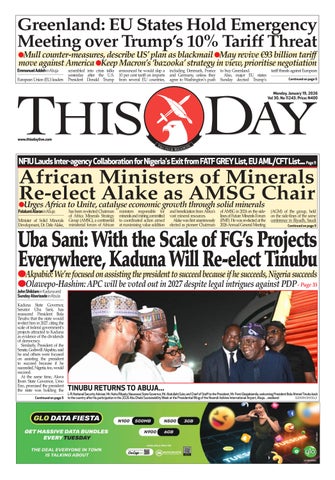
Greenland: EU States Hold Emergency Meeting over Trump’s 10% Tariff Threat
Mull counter-measures, describe US’ plan as blackmail May revive €93 billion tariff move against America Keep Macron’s ‘bazooka’ strategy in view, prioritise negotiation
Emmanuel Addeh in Abuja European Union (EU) leaders scrambled into crisis talks yesterday after the U.S. President Donald Trump
announced he would slap a 10 per cent tariff on imports from several EU countries, including Denmark, France and Germany, unless they agree to Washington’s push
African Ministers of Minerals Re-elect Alake as AMSG Chair
Folalumi Alaran in Abuja Minister of Solid Minerals Development, Dr. Dele Alake, has been re-elected Chairman of Africa Minerals Strategy Group (AMSG), a continental ministerial forum of African
ministers responsible for minerals and mining committed to coordinated action aimed at maximising value addition
and beneficiation from Africa’s vast mineral resources.
Alake was first unanimously elected as pioneer Chairman
of AMSG in 2024 on the sidelines of Future Minerals Forum (FMF). He was re-elected at the 2026 Annual General Meeting
Uba Sani: With the Scale of FG’s
Projects
Everywhere, Kaduna Will Re-elect Tinubu
John Shiklam in Kaduna and Sunday Aborisade in Abula
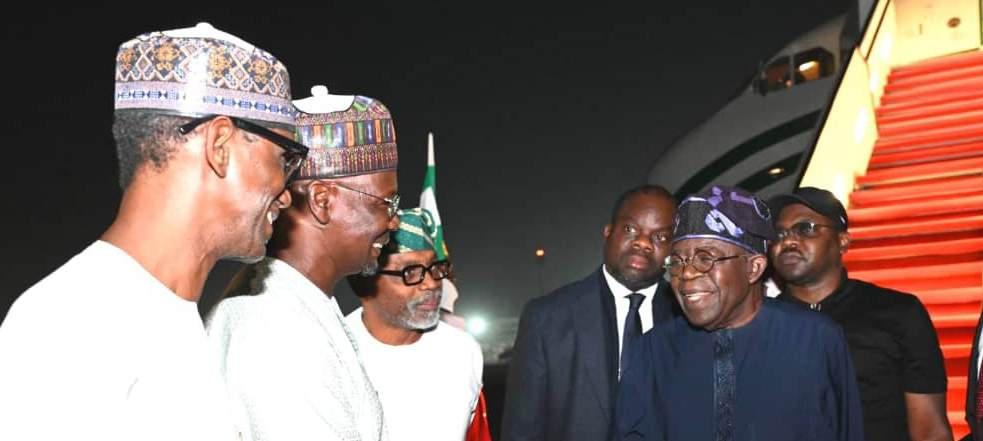
Kaduna State Governor, Senator Uba Sani, has reassured President Bola Tinubu that the state would re-elect him in 2027, citing the scale of federal government’s projects attracted to Kaduna as evidence of the dividends of democracy.
Similarly, President of the Senate, Godswill Akpabio, said he and others were focused on assisting the president to succeed because if he succeeded, Nigeria, too, would succeed.
At the same time, Akwa Ibom State Governor, Umo Eno, promised the president the state was holding the
The lead counsel to Nestoil Limited, Dr. Muiz Banire, SAN, has demanded the immediate retraction of a publication by online platform PointBlank News, which accused him and other lawyers of collecting millions of dollars in bribes to influence court judgments, warning that failure to do so would result in a defamation lawsuit.
Banire, through his counsel, Adeyinka Olumide-Fusika, SAN, described the report—titled “$2 Billion Bank Debt: Nestoil, Neconde Demand $40 Million Refund from Lawyers After Supreme Court Defeat”, as false, malicious, and gravely defamatory.
In a pre-action demand letter addressed to PointBlank News publisher Jackson Ude, Senior Editor (Africa) Ben Young, and Nigeria Editor Uduma Mba,
Banire denied allegations that he received part of an alleged $40 million paid to lawyers to secure a favourable judgment at the Supreme Court in a debt dispute involving Nestoil Limited and Neconde Energy Limited.
The publication further alleged that Banire was involved in a separate scheme at the Federal High Court, claiming that $5 million was paid to influence an order vacating asset-freezing directives in respect of a $1
billion debt.
According to the letter, the allegations conveyed imputations of conspiracy, bribery, fraud, and attempts to pervert the course of justice—offences punishable under Nigerian criminal law.
Olumide-Fusika said Banire, widely known for his anti-corruption advocacy and reforms aimed at restoring public confidence in the administration of justice and the legal profession, was deeply
distressed to be linked with what he described as nefarious activities and serious crimes alleged in the publication.
The senior lawyer faulted the report for relying on an unnamed “reporter” and an unnamed “insider,” noting that no evidence was presented to substantiate the grave allegations.
He challenged the platform to publish verifiable proof of the alleged payments if such transactions truly occurred,
insisting that even if bribery was not conducted in the presence of witnesses, the purported source must possess evidence of the alleged $40 million paid to lawyers and the alleged $5 million collected to influence a court order.
UBA SANI: WITH THE SCALE OF FG’S PROJECTS EVERYWHERE, KADUNA WILL RE-ELECT TINUBU
ground for him and would back his re-election.
Sani spoke yesterday during a stakeholders’ engagement on the ongoing e-registration of members of All Progressives Congress (APC) in the state.
He said Kaduna State was targeting 2.5 million registered members in the exercise.
Addressing stakeholders from Zone 2, Sani said APC had become the dominant political party in the state due to his administration’s inclusive development model and the impact of Tinubu’s interventions, which he said had continued to attract defections from opposition parties.
Arabia.
As part of efforts to strengthen its institutional framework, AMSG approved the creation of additional leadership positions, including Vice Chairman, Deputy Secretary-General, and Financial Secretary.
The forum further resolved that those positions be equitably distributed across Africa’s subregions to promote inclusion and regional balance.
While the positions of Chairman and Vice Chairman are elective and reserved for serving ministers, other positions are appointed by member states to which they are zoned.
Under the new leadership structure, Nigeria’s Alake continued as Chairman of the 24-member forum, representing West Africa. The Minister of Mines of the Democratic Republic of Congo (DRC),
allies over Greenland as blackmail, as France proposed responding with a range of previously untested economic countermeasures.
Trump vowed on Saturday to implement a wave of increasing tariffs on EU members Denmark, Sweden, France, Germany, the Netherlands and Finland, along with Britain and Norway, until the U.S. is allowed to buy Greenland. Cyprus, holder of the rotating six-month EU presidency, summoned ambassadors to an emergency meeting in Brussels, which started at 5 p.m. (1600 GMT) yesterday, as EU leaders stepped up contacts.
In the same vein, a source close to French President
The governor disclosed that Tinubu approved N1 billion in support of the state’s light rail project, describing the intervention as unprecedented in northern Nigeria.
He said no other subnational government, apart from Lagos State, had received similar federal backing for a light rail project.
Sani said, “Only three weeks ago, I was in China, in the company of the DirectorGeneral of Nigeria China Strategic Partnership, at the instance of President Bola Tinubu, who has also decided that Kaduna would be the pilot
Hon. Louis Watum Kabamba, was elected Vice Chairman, representing Central Africa.
The position of SecretaryGeneral remained with Uganda (East Africa), Mauritania was appointed Deputy SecretaryGeneral (North Africa), while South Africa was zoned the position of Financial Secretary.
The AGM also ratified a twoyear tenure for the newly elected executive committee and agreed that zoned positions belong to member countries, such that where a serving minister is replaced, the successor automatically assumes the role.
In his acceptance speech, Alake expressed gratitude to his colleagues for the renewed confidence reposed in him, stressing the urgent need for African nations to work collaboratively to unlock the continent’s economic
Emmanuel Macron said he was pushing for activation of the "Anti-Coercion Instrument", known as the ‘bazooka’ which could limit access to public tenders, investments or banking activity or restrict trade in services, in which the U.S. has a surplus with the bloc, including digital services. Although an update on the outcome of the meeting is expected later today, it was learnt that EU countries will not yet deploy the anti-coercion instrument in response to Trump’s Greenland tariff threats. The EU will prioritise a 'diplomatic solution', sources said.
The EU members were said to have backed off from
state to embark on a major poultry project.
“The project will generate at least 350,000 jobs. Already, the federal government has approved $200 million for it and Kaduna State will have the biggest poultry project in Sub-Saharan Africa and the ground breaking will be done in the next three weeks."
The governor added that the project would support about 10,000 direct and indirect small businesses, particularly small and medium enterprises allied to poultry farming.
He also commended the president for approving the construction of the Mando-
potentials through solid minerals development.
He called on member states to agree on minimum financial contributions and to refine the group’s budgeting framework to strengthen its operational effectiveness.
“Once member states contribute, accountability will naturally follow. This will enhance transparency and strengthen the credibility of the AMSG before the global community,” Alake stated.
The AGM further resolved to hold quarterly ministerial meetings and ratified the establishment of standing committees, including those for Legal, Institutional Affairs and Human Resources; Sustainability and Responsible Mining; Finance, Budget and Resource Mobilisation, among others.
triggering the trade ‘bazooka’ in retaliation for US President Donald Trump’s tariff threats over Greenland during the urgent meeting in Brussels.
EU member states wanted to first prioritise dialogue and diplomacy with the US, and will in the meantime hold off from triggering any retaliatory measures, the sources said. However, they could revive a €93 billion retaliation package targeting US products if Trump follows through on his threat to slap an additional 10 per cent tariff on eight European countries on February 1.
A decision on whether to reinstate the tariffs, suspended last year, will be taken after that deadline. The €93 billion
Birnin Gwari road and the reconstruction of the KwoiJama’a road, describing them as critical infrastructure for the state.
The governor further disclosed that several projects had been approved for Zone 1 in the current budget through collaboration between the state government and Speaker of the House of Representatives, Tajudeen Abbas, stating that the zone has benefited significantly.
Sani also praised Minister of Environment, Malam Balarabe Lawal, for his role in climate related projects under the ACRESal programme.
He stated, “In the next
It was also agreed that steps be taken towards hosting a global minerals conference in Africa, similar to FMF.
Speaking earlier at a Leadership Roundtable, Alake emphasised that mineral production alone could not deliver lasting economic transformation without reliable infrastructure, coordinated policies, and deliberate valueaddition strategies.
Themed, “Africa: Unlocking Infrastructure Funding for Copper-Belt Production,” the roundtable, held outside FMF, was attended by African ministers of minerals, development partners, and private-sector stakeholders.
Alake cited the Lobito Corridor as a model of what was achievable when rail, ports, energy systems and policy alignment worked in
package was prepared amid uncertainty last year over whether Trump would agree to a EU-US trade deal, and foresees retaliatory EU tariffs of up to 30 per cent on a range of US products from cars to poultry.
All eight countries, already subject to U.S. tariffs of 10 per cent and 15 per cent, have sent small numbers of military personnel to Greenland, as a row with the United States over the future of Denmark's vast Arctic island escalates, Reuters reported.
"Tariff threats undermine transatlantic relations and risk a dangerous downward spiral," the eight-nations said in a joint statement published
one or two months, we will be doing ground breaking for one of the major projects in Zaria and Rigasa, totaling about N53 billion, courtesy of the support and effort of the Minister of Environment, Mallam Balarabe Abbas.”
Sani expressed confidence that Kaduna State would emerge one of the leading states in the APC e-registration exercise.
Speaking when he was paid a new year homage by Eno, Akpabio praised the governor for uniting Akwa Ibom State behind Tinubu, stressing that the president’s success would translate into national progress.
synergy. He stated that similar opportunities existed across the continent, including the Lagos–Abidjan Corridor linking Nigeria, Benin, Togo, Ghana and Côte d’Ivoire; Walvis Bay Corridor connecting Southern Africa’s mining regions to global markets; Dar es Salaam and Central Corridors serving East and Central Africa, among others.
According to the minister, “The real question is not whether Africa has corridors, but whether these corridors are being financed, governed and structured to support industrial growth, regional integration and long-term stability.
He acknowledged that ongoing reforms were difficult, but insisted they were yielding results.
“We are focused on assisting the president to succeed because if the president succeeds, Nigeria succeeds,” Akpabio said, thanking the governor for his steadfast support and the prevailing peace in the state.
Quoting novelist Chinua Achebe, Akpabio described the New Year visit as a reaffirmation of kinship and unity, even as he commended Eno’s
Continued on page 36
“What matters is how financing is designed to reduce risk, attract private capital and sustain commercial viability while advancing national and regional development objectives.”
on Sunday. They said the Danish exercise was designed to strengthen Arctic security and posed no threat to anyone. They said they were ready to engage in dialogue, based on principles of sovereignty and territorial integrity.
Danish Prime Minister Mette Frederiksen said in a written statement that she was pleased with the consistent messages from the rest of the continent, adding: "Europe will not be blackmailed", a view echoed by Germany's finance minister and Sweden's prime minister.
"It's blackmail what he's doing," Dutch Foreign Minister David van Weel said on Dutch television of Trump's threat.
Alake emphasised that unlocking capital required addressing issues, such as bankable and enforceable offtake arrangements; predictable and harmonised cross-border regulatory frameworks; alignment of rail, port, power and industrial planning; and clear pathways for processing, smelting, logistics services and industrial clusters along the corridors.
He added that the broader vision of AMSG was to ensure that Africa’s mineral infrastructure was strategically designed, responsibly financed, and efficiently managed in a rapidly evolving global environment, not to discourage investment, but to ensure it aligned with long-term stability, transparency, and shared economic prosperity.
Meanwhile, European Council President António Costa has convened an extraordinary summit of EU leaders in the "coming days." A source familiar with the matter suggested the summit will take place on Thursday, January 22. Bernd Lange, the German Social Democrat who chairs the European Parliament's trade committee, and Valerie Hayer, head of the centrist Renew Europe group, echoed Macron's call, as did Germany's engineering association. Meanwhile, Irish Prime Minister Micheal Martin said that while there should be no doubt that the EU
Continued on page 35
Banire
2ND ANNUAL GENERAL MEETING (AGM) OF THE AFRICA MINERALS STRATEGY GROUP...
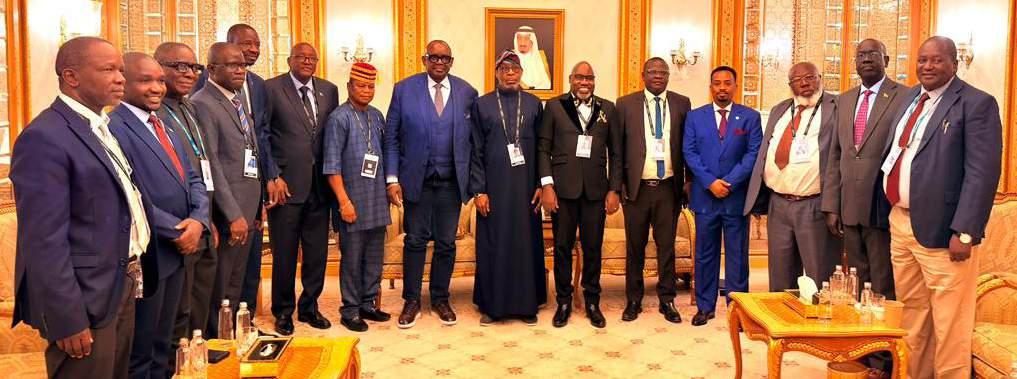
Minister of Solid Minerals Development and Chairman, Africa Minerals Strategy Group (AMSG), Dr. Dele Alake (middle). On his immediate left is the Vice-Chairman, AMSG and Minister of Mines, Democratic Republic of Congo (DRC), HE Louis Watum Kabamba; to his immediate right is Moses Engadu, Secretary- General, AMSG; Mr. Vincent Kedi, Commissioner for Licensing Administration, representing the Minister of Energy and Mineral Development of the Republic of Uganda (2nd right); and a cross-section of other African ministers of minerals/mining from Tanzania, Liberia, Mauritania, South Sudan, Eswatini, Sierra Leone, The Gambia, Burundi, Ghana, Somalia, Malawi at the 2nd Annual General Meeting (AGM) of the Africa Minerals Strategy Group (AMSG) held on the sidelines of the just concluded Future Minerals Forum (FMF), Riyadh, Saudi Arabia, yesterday
Seplat: All Projects to End Routine Gas Flaring in Nigeria Completed in 2025
Reaffirms commitment to responsible operations
Seplat Energy Plc has stressed the need for oil industry operators to conduct their activities responsibly, efficiently, and sustainably, disclosing that all its projects to end routine gas flaring were completed in 2025.
Routine gas flaring is the deliberate and continuous burning of associated natural gas that is produced alongside crude oil during normal oil production operations, rather than being captured, processed, or reinjected.
The company’s Chief Executive Officer, Mr. Roger Brown, spoke at a high-level climate roundtable organised by the Nigerian Exchange Group (NGX Group) in partnership with DEG,
Germany’s development finance institution, and Africa Foresight Group (AFG) in Lagos.
According to a statement yesterday by Stanley Opara, Seplat’s Manager, Corporate Communications, External Affairs & Social Performance, Brown who was represented by Mr. Okechukwu Mba, Director, Gas & New Energy of the company, reiterated that oil and gas will continue to play a critical role in Nigeria’s energy mix.
He further highlighted Seplat Energy’s deployment of technology to enhance operational efficiency, including real-time monitoring of emissions across pipelines, valves, plants, and other critical infrastructure, supported by a robust asset
integrity programme designed to identify and eliminate emissions.
At the event, the Seplat chief executive noted that the real issue facing Nigeria’s energy sector is not whether oil and gas should exist, but how operators manage their responsibilities to the environment, society, and the economy.
“Oil and gas will remain an important part of Nigeria’s energy mix for some time to come. The right conversation is not whether oil and gas should exist, but how operators conduct themselves responsibly,” he said.
He emphasised that responsible operations must be driven by concrete actions, including improved efficiency, reduced emissions, and credible
offsetting strategies.
At Seplat Energy, Brown explained that this commitment is already being translated into measurable outcomes. He disclosed that the company had launched a comprehensive programme several years ago to end routine gas flaring across all its onshore operations, adding that by the end of last year, all the projects required to achieve this milestone had been delivered and were currently at the commissioning stage.
“Very soon, we will be able to clearly state that routine flaring has ended in our onshore operations. This is an important milestone that speaks to our stewardship of the environment, while remaining focused on delivering energy to the nation,” he said.
Beyond operational
Funding Constraint Forces WFP to Scale Down Hunger Programme in Nigeria from 1.3m People in 2025 to 72, 000
UN agency warns 55 million people in West, Central Africa to face hunger crisis
Ndubuisi Francis in Abuja
The United Nations World Food Programme (WFP) is to drastically scale down its hunger interventipn programme in Nigeria due to funding constraints, targeting to reach 72,000 people in February, a sharp reduction from the 1.3 million assisted during the 2025 lean season.
A staggering 55 million people in the West and Central Africa region are also expected to endure crisis levels of hunger, or worse, between June and August 2026 lean
season.
Over 13 million children are equally expected to suffer from malnutrition in 2026, according to the latest analysis from the Cadre Harmonisé – the equivalent of the Integrated Food Security Phase Classification (IPC) for West and Central Africa.
It stressed that without urgent resources and action, the most vulnerable people in West and Central Africa are headed for yet another dire year.
It also projected that over three million people will face emergency levels of
food insecurity (Phase 4) this year - more than double the 1.5 million in 2020.
Nigeria, Chad, Cameroon, and Niger- account for 77 per cent of the food insecurity figures, including 15,000 people in Nigeria’s Borno State at risk of catastrophic hunger (IPC-5) for the first time in nearly a decade.
“Vital humanitarian aid is a transformative and stabilizing force in volatile contexts,” said Sarah Longford, Deputy Regional Director for West and Central Africa.
“The reduced funding we saw in 2025 has deepened
hunger and malnutrition across the region. As needs outpace funding, so too does the risk of young people falling into desperation.
"It’s critical that we support communities in crisis, so that rampant hunger doesn’t drive further unrest, displacement and conflict across the region,” the report said.
A toxic combination of surging conflict, displacement, and economic turmoil has been driving hunger in the region, but reductions in humanitarian assistance are now pushing communities beyond their ability to cope.
measures, Brown said the company is also implementing nature-based solutions to offset emissions. In one of its host communities in Edo State, Seplat Energy, he said, has launched an afforestation programme committing to plant millions of trees over a five-year period, with the first phase already completed.
He also pointed to the company’s investments in gas and LPG infrastructure as part of efforts to reduce emissions
beyond its direct operations. According to him, expanding access to LPG helps reduce reliance on firewood, charcoal, and other biomass fuels, particularly in communities outside major cities.
Following Seplat Energy’s offshore acquisition, he noted that LPG that was previously exported has now been redirected to the domestic market, significantly improving availability, affordability, and overall market quality.
New NSE President Takes Office, Urges Govt to Implement ‘Buy Nigeria First’ Policy
Says MDAs observing initiative in breach
Emmanuel Addeh in Abuja
The 35th President of the Nigerian Society of Engineers (NSE) Ali Rabiu, was at the weekend inaugurated at the Banquet Hall of the Presidential Villa in Abuja, with a call on the federal government to take the implementation of the ‘Buy Nigeria First’ policy seriously.
In his inaugural address, Rabiu applauded President Bola Tinubu for the initiative, describing it as a transformative move capable of positioning Nigeria as a true giant of Africa, but expressed concern over poor compliance by Ministries, Departments and Agencies (MDAs).
He disclosed that major infrastructure projects worth trillions of naira were being executed without adequate involvement of Nigerian engineers, contrary to existing laws, and emphasised the requirement for MDAs to
engage Nigerian engineering professionals from project conception through completion. Rabiu stated that his administration would focus on resetting the NSE, strengthening its institutional foundations, and restoring its role as a critical driver of engineering excellence and national progress.
“We are particularly pleased with the “Buy Nigeria First” policy recently introduced by Mr. President through the Bureau of Public Procurement (BPP). This initiative, if well implemented, will catapult Nigeria into becoming a true giant of Africa.
“However, it may shock Mr. President to know that MDAs, especially infrastructurerelated ministries such as the Federal Ministries of Works, Power, Water Resources, and the Federal Capital Territory Administration, have largely observed these laws in the breach.
Emmanuel Addeh in Abuja
WHEN LEEMON IKPEA HOSTED THE GLOBAL PRESIDENT OF SOLAR TURBINES...
Coronation Group Predicts 1.8m Bpd Oil Output Despite FG’s Optimistic
2.5m Bpd Projection
Says fiscal, regulatory environment to play central role in shaping performance
Coronation Group has projected that Nigeria’s crude oil production will stabilise at between 1.7 million barrels per day and 1.8 million bpd in 2026, falling significantly short of the federal government’s generally optimistic 2.5 million bpd target.
Coronation Group is a Nigerian financial services company that manages investments, provides wealth and asset management, offers insurance, and delivers capital market and financial advisory services to individuals and institutions.
In its review of 2025 and outlook for 2026, the Group said the oil and gas industry remained a key contributor to
the economy in 2025, despite a challenging pricing environment and declining output.
According to Coronation Group, crude petroleum and natural gas accounted for about 0.81 per cent of nominal GDP in the first nine months of 2025, although sectoral output fell sharply by 20.13 per cent year-on-year to N6.49 trillion, largely driven by weaker crude oil prices.
The firm noted that crude oil exports also contracted by 11.30 per cent to N24.92 trillion over the same period, reflecting both lower global prices and the early impact of emerging local refinery capacity, which may have diverted some crude away from export markets. These pressures, it said, combined with
AEDC Restores Power Supply to FCT Water Board, Gives Two-week Ultimatum
The Abuja Electricity Distribution Company (AEDC) at the weekend directed the restoration of power supply to the Federal Capital Territory (FCT) Water Board, following the growing outcry by Abuja residents deprived of public water supply.
The electricity distributor, in a statement signed by its Head of Brand Marketing & Corporate Communications, Omede Odekina, noted that it is currently owed over a year by the water board.
It noted that it decided to restore supply, having considered the dire implications of shortage of water in Abuja, but explained that it was giving the management of the board
two weeks to pay the debt or put in place a negotiated settlement plan.
“The Abuja Electricity Distribution Plc. (AEDC) acknowledges the concerns and spirited appeals from residents of the Federal Capital Territory following the disruption to water supply arising from the recent disconnection of electricity to the FCT Water Board over unpaid electricity bills.
“AEDC wishes to clarify that the disconnection followed the accumulation of over one year of outstanding electricity debt by the FCT Water Board, despite several notices, engagements and opportunities provided to regularise the account, in line with applicable regulatory provisions.
persistent production challenges to weigh on headline sector performance.
Although modest month-onmonth gains were recorded in April, June, July and October, the Group said these intermittent improvements were insufficient to restore production to levels seen at the beginning of the year. As a result, output remained well below both the 2025 budget benchmark of 2.06 million bpd and Nigeria’s OPEC quota of 1.5 million bpd.
Against this backdrop, the firm’s 2026 forecast of 1.7–1.8 million bpd stands in contrast to the more optimistic projections from regulators and stateowned entities. The Nigerian Upstream Petroleum Regulatory Commission (NUPRC) had set a target of 2.5 million bpd, while
the Nigerian National Petroleum Company Limited is aiming for 2.0 million bpd in the medium term.
But Coronation Group said its more conservative outlook reflects a realistic assessment of incremental capacity additions rather than a sudden structural turnaround.
“Looking ahead, we expect oil production to stabilise between 1.7-1.8 mbpd in 2026, lower than the NUPRC’s 2.5 mbpd and the NNPC’s 2.0 mbpd medium-term targets (2027),” the report added.
The forecast factored in expected production increases from key private operators.
Seplat Energy, for instance, is targeting a ramp-up to 200,000 bpd over the next five years, from about 135,000 bpd in the first half of 2025.
Renaissance Energy is also expected to play a role, with plans to raise output to 300,000 bpd by early 2026, up from around 230,000 bpd as of August 2025. While these additions are meaningful, Coronation Group said they are unlikely, on their own, to bridge the gap between current output and the federal government’s ambitious production targets.
Beyond operational issues, the firm highlighted proposed amendments to the Petroleum Industry Act (PIA) as one of the most consequential developments in the upstream sector during the year.
The proposed changes are aimed at curbing what the government describes as statutory leakages and improving direct oil inflows into the Federation
Account. Central to the proposal is a reallocation of ownership interests, including vesting some stakes in the Ministry of Finance Incorporated and redefining the role of the NUPRC.
While the restructuring is intended to strengthen fiscal flows, Coronation Group warned that it raises governance concerns. These include the concentration of regulatory and commercial powers within the NUPRC, blurred accountability lines and a heightened risk of conflicts of interest.
Besides, the firm pointed to the rationale for transferring some ownership to MOFI, noting concerns that the Ministry of Petroleum Incorporated may be too closely aligned with NNPC to provide truly independent oversight.
PENGASSAN Suggests Ways of Resolving Wage Crisis
Onyebuchi Ezigbo in Abuja
Petroleum and Natural Gas Senior Staff Association of Nigeria (PENGASSAN) has advised the federal government and workers unions in the country to seek amicable resolution of the current inadequacies in the wage system through collective bargaining agreement.
The union, which is an affiliate of Trade Union Congress (TUC), said it was making a strong push for the leadership of the labour centre to adopt the strategy of Collective Bargaining Agreement (CBA) to negotiate
improved wage conditions for workers beyond the existing minimum wage.
The leadership of the senior oil worker's association also admonished Nigerian political leaders to always pursue enduring legacies that will outlive them and better the lives of the people.
PENGASSAN made the suggestions at the Special Night of Tribute held in Abuja at the weekend for its former president, Comrade Uche Marcus Okoro, who died in the Sosoliso plane crash, 20 years ago, on December 10, 2005.
Both TUC and Nigeria
Labour Congress (NLC) had pledged in their New Year messages to seek wage increase for workers in view of the rising cost of living in the country.
Speaking to journalists at the occasion, PENGASSAN president, Comrade Festus Osifo, said concerns over dwindling income of workers caused by inflation could be addressed through a wellstructured collective bargaining agreement, instead of waiting for another minimum wage negotiation.
Osifo urged other unions to emulate the example of PENGASSAN in actualising wage adjustments through
CBA. He added that the idea also came up recently during mediation talks by TUC and Federal Ministry of Health and Social Welfare to resolve ongoing industrial action by health workers under the auspices of Joint Health Sector Union (JOHESU) in Abuja Osifo said, "We had a meeting two days ago with the Federal Ministry of Health and Social Welfare, with the Minister of Health, and the Minister of State for Health regarding the issue of JOHESU and we are pushing and driving that what should be done immediately is a comprehensive CBA.
Emmanuel Addeh in Abuja
Emmanuel Addeh in Abuja
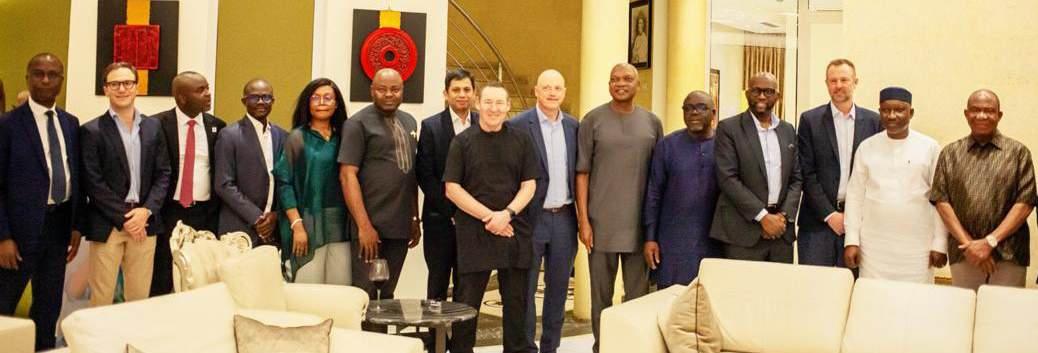
L-R: Company Secretary, Lee Engineering Group and Allied Company Limited, Mathew Egbadon; Regional Sales Manager, Solar Turbines, Europe, Edouard Bahous; Business Development Manager, Lee Engineering, Onosetale Ozah; Area Sales Manager, Solar Turbines Lagos, Lanre Oladipu: Manager, Chairman’s office, Lee Engineering Group, Roseline Itam; Country Manager, Nigeria, Solar Turbines, Michael Egharevba; Regional Service Manager, Europe/Africa, Ravindra Kotwal; Managing Director, Solar Turbines, Nigeria, Jonathan Williams; Managing Director/EAME South, Henrik Scherer; Former Country Chairman of Shell Petroleum Development Company, Osagie Okunbor; Chairman, Waltersmith, Abdulrazaq Isa: Managing Director/CEO of Renaissance Africa Energy Company, Engr Tony Attah; President, Solar Turbines, Derrick York; Minister of state for Petroleum Resources (Gas), Ekperikpe Ekpo; and Founder/Chairman, Lee Engineering Group and Allied Company Limited, Chief Dr. Leemon Ikpea, when Dr. Ikpea hosted the global President of Solar Turbines and some members of his team in Lagos ... recently
IT’S A NEW BEGINNING...
Nigeria-U.S. Health MoU: ADC Demands Clarification Over Conflicting Framings, Constitutional Breach Concerns
African Democratic Congress, ADC has called on the federal government to clarify the contents of the recently signed health cooperation Memorandum of Understanding (MoU) between Nigeria and the United States, citing sharply conflicting public descriptions of the agreement by both governments.
While Abuja presented the MoU as a technical, inclusive framework to strengthen health security and expand primary healthcare, ADC stated that official statements from the United States introduced identitybased framing that might be in breach of Nigeria’s
constitutional provisions on non-discrimination, as well as discretionary termination powers that subordinated Nigeria’s interests and raised serious questions about national sovereignty.
In a statement by National Publicity Secretary of ADC, Mallam Bolaji Abdullahi, the party called on the federal government to urgently clarify the contents and implications of the MoU.
While the federal government presented the MoU as a technical and inclusive framework aimed at strengthening health security, expanding primary healthcare, and increasing domestic health financing, official statements released by the United States Embassy described the same
Niger Govt to Strengthen Health Sector, Holds Collaborative Meeting with Stakeholders
The Niger State Government has made moves to further strengthen its health sector performance by holding collaborative meeting with major stakeholders including UNICEF.
Governor Mohammed Umaru Bago told the stakeholders that his government is determined to make health care delivery services closer to the people and at affordable rates.
Represented by the Head of Service Alhaji Abubakar Sadiq, Governor Bago reaffirmed his government’s commitment to implementing its health sector agenda through stronger systems, improved coordination, and sustainable financing.
Bago also assured the partners of the government’s resolve to meet its financial,
political, and institutional obligations, before disclosing that the administration has now begun reforms to align the Ministry of Primary Health Care with that of planning, budgeting, and other fiscal institutions to improve efficiency and integration.
In the same vein, the governor revealed plans to review and modernize the state health laws, by introducing innovative approaches that will address human resources gaps including structured engagement of retired professionals and improved welfare for health workers.
The governor announced the establishment of the Niger State Registration and Regulatory Agency for Private Health Care Facilities to strengthen oversight and quality assurance across the public and private sectors.
agreement in materially different terms.
The U.S. characterisation introduced religious, identity-based framing, indicating that spending under the MoU should be targeted at health institutions backed by a particular religion only.
According to Abdullahi, ''It is the ADC’s considered view that the Nigerian government should not enter into any agreement that is sectional or potentially inimical to Nigeria’s constitutional commitment to inclusion and national unity.
''We find it particularly curious that these troubling conditionalities, including those that grant the United States unilateral powers of termination, are conspicuously missing from the federal government’s public rendering of the agreement.
''The ADC believes that this divergence is not a mere communications issue. Instead, it appears calculated to avoid public scrutiny, thereby raising fundamental questions about transparency, constitutional
compliance, and Nigeria’s sovereignty.
''Nigerians are entitled to know which version of this agreement reflects the actual terms that were signed, and why such consequential differences exist between Abuja’s account and Washington’s.''
ADC affirmed its support for foreign assistance and bilateral cooperation to strengthen Nigeria’s healthcare system, but insisted that such partnerships must respect Nigeria’s diversity and comply with constitutional provisions prohibiting discrimination on the basis of religion or ethnicity.
Abdullahi stressed, ''For the avoidance of doubt, Section 42(1) states: ‘No citizen of Nigeria shall be discriminated against on the grounds of place of origin, sex, religion, or political opinion.’
“Similarly, Sections 15 and 17 impose a duty on the state to promote national integration, eliminate discrimination, and guarantee equality of rights and opportunities for all citizens.
''Therefore, any international agreement, or public framing of such an agreement, that appears to introduce identitybased distinctions into the provision of public services raises serious constitutional and national cohesion concerns.”
ADC stated, ''We are particularly at a loss as to why the Nigerian government would enter into such an agreement, especially considering that Nigeria is reportedly committing more resources under the arrangement.
''The MoU stated the United States is expected to provide approximately two billion dollars in grant support over five years, while Nigeria has reportedly committed close to three billion dollars in domestic health financing over the same period.
''It is difficult to justify an arrangement in which Nigeria bears the larger financial burden, yet decisions regarding target beneficiaries and the discretion to pause or terminate cooperation appear to rest outside the country.”
The party said, ''Healthcare is a core public good that must remain neutral, inclusive, and universally accessible. The injection of identity considerations into health financing or security-linked performance assessments risks politicising care delivery, undermining public trust, and exposing already vulnerable institutions and workers to avoidable tension and danger.'' ADC called on the federal government to come clean by publishing the full text of the signed MoU, including any annexes or accompanying instruments. It also told the government to clearly explain whether the identity-based and security-linked elements referenced by the United States formed part of the agreement Nigeria actually signed, or existed solely within foreign policy interpretations. The party stated that Nigerians also deserved a clear explanation of how the agreement aligned with the country’s constitution and preserved Nigeria’s sovereign authority over its public policy choices.
Agbeyewa Acquires Matna Foods to Strengthen
Cassava
Raheem Akingbolu
Value Chain, Food Security
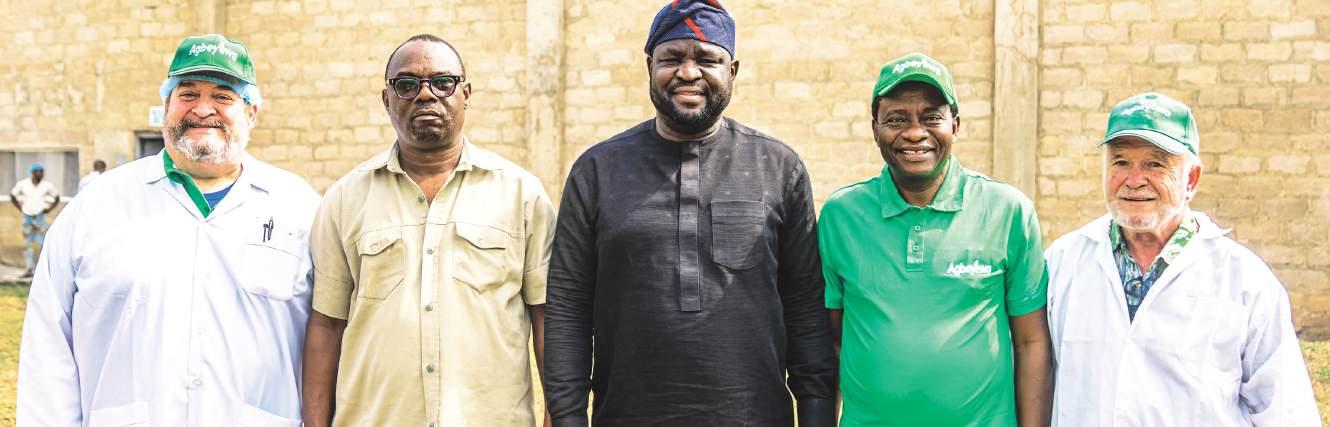
Agbeyewa Industries Limited, a leading agribusiness company and subsidiary of Cavista Holdings, has announced the acquisition of Matna Foods Company Limited, one of the oldest cassava starch processing companies in Nigeria.
The acquisition marks a significant strategic milestone for Agbeyewa as part of its broader vision to integrate agricultural production, processing and industrial utilisation within Nigeria’s cassava value chain, linking large-scale cassava
cultivation in Ekiti State with industrial processing capacity in Ondo State.
According to the new owner, the regional synergy is expected to unlock new efficiencies, expand local sourcing, and stimulate economic activity for all players in the cassava value chain.
It was also stated that the acquisition aligned strongly with the federal government’s drive to strengthen food security, reduce imports, and deepen agro-industrial value chains, particularly within the cassava ecosystem, one of Nigeria’s most
strategic crops.
Agbeyewa, located in Ekiti State, has grown into a transformational agriculture business, and operates the largest cassava farm in Nigeria.
Guided by its four pillars of large-scale cultivation, aggregation, processing and agro-allied investment, the company has implemented an innovative ingrower/out-grower model and forged high-impact partnerships, including a Memorandum of Understanding with the government of Ekiti State to cultivate 100,000 hectares of
farmland over the next decade. Chairman of Agbeyewa and Cavista Holdings, Niyi Olajide, described the acquisition as a strategic investment in Nigeria’s economic future: Olajide stated, “This is about building a resilient agricultural value chain that creates real impact. From increased cassava offtake to expanded processing and industrial supply, this acquisition supports food security, import substitution, and—most importantly—creates jobs, jobs, and more jobs for Nigerians.
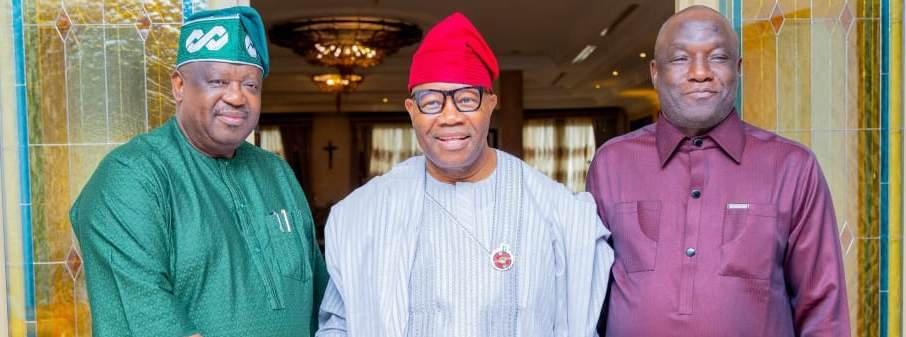
L-R: Plateau State Governor, Mr. Caleb Mutfwang; President of the Senate, Senator Godswill Akpabio; and Chairman, Senate Committee on Labour and Productivity, Senator Diket Plang, when Governor Mutfwang paid a courtesy visit to Senator Akpabio at his residence in Abuja, yesterday
Laleye Dipo in Minna
Chuks Okocha in Abuja
NFIU Lauds Inter-agency Collaboration for Nigeria's
Exit from FATF GREY List, EU AML/CFT List
Alex Enumah in Abuja
Nigerian Financial Intelligence Unit (NFIU) commended agencies of government for their contributions towards the country's successful exit from the Financial Action Task Force (FATF) Grey List in October last year and the intention of the European Union (EU) to remove Nigeria from the list of high-risk third countries at the end of January 2026. Nigeria's exit was made
possible by a number of decisions made by global anti-money laundering and counter-terrorism financing bodies over the last few months, which NFIU said validated the extensive reforms Nigeria had implemented since 2023.
While NFIU had been at the forefront of efforts to ensure the country was fully compliant with international AML/CFT/CPF standards, the achievements reflected
a whole-of-government and whole-of-society approach to building strong barriers to illicit finance, the agency said.
NFIU, in a statement issued on Sunday, extended its profound appreciation to all Ministries, Departments and Agencies (MDAs), the legislature, judiciary, the private sector, and nonprofit organisations whose coordinated actions and commitment made the outcome possible.
Chief Executive Officer of NFIU, Hafsat Abubakar Bakari, described the decisions of FATF and EU as proof of the credibility of Nigeria’s reforms. Bakari said, “Nigeria’s exit from the FATF Grey List and the European Union’s highrisk third country list reflects the strength of our collective resolve and the effectiveness of sustained, coordinated reforms. This milestone underscores our commitment to upholding global standards
Ogun Group Writes Umahi Seeking Completion of Road Project
A socio-economic and nonpartisan movement, Egba Economic Summit Group, has written the Minister of Works, Dr. David Umahi, expressing worries over the delay by the federal government to in completing the Abeokuta - Ajebo Road Project.
The road which started from Idi Aba area of Abeokuta, traverses three local governments areas of Ogun State to link the Lagos Ibadan Expressway.
The group said the delay in completing the road poses dangers to economic
development and security of the area and Ogun State in view of its importance as alternative to many routes.
The concern of the group, was expressed in a letter dated 16th January 2026 signed by the President of the Summit, Dr. Gbenga Adeoye, raising eight issues that that necessitated worries of the body.
Driving home the group's concerns, the Summit copied the Alake and Paramount Ruler of Egbaland, Oba Adedotun Gbadebo, the Osinle of Okeona, Oba Adedapo Tejuoso, the Olowu, Oba Saka
Matemilola, former Governor Olusegun Osoba the Akinrogun of Egbaland and Babalaje of Egbaland; Chief Olusegun Osunkeye.
The summit in the letter addressed to the Minister of Works, David Umahi, commended the federal government for various Renewed Hope Projects going on across the country and particularly, the Lagos Calabar Coastal Highway which also passed through Ijebu Water Side in Ogun State as well as the award of Badagry Sokoto Road which passed through Soyoye Rounder area
in Abeokuta.
The group also described the minister's directive for night repairs of Sango-Abeokuta Road as also worthy of note and commendable.
The letter read in part: "While we have a duty to commend the government when we see performance, we also have a collective duty imposed on us as Egba people to call the attention of government to any project(s) that is of economic importance especially where execution of such project (s) is slow, stagnant and sometimes, not even conceived.
on anti-money laundering, counter-terrorism financing and counter-proliferation financing, while reinforcing international confidence in Nigeria’s financial system.”
She added, “The success we have enjoyed would not have been possible without the guidance of His Excellency President Bola Ahmed Tinubu, GCFR, and his commitment to building a safe and prosperous Nigeria.”
Further highlighting the importance of sustained collaboration, the NFIU CEO stated, “The successful delisting of Nigeria from the FATF Grey List and the EU AML/CFT list is a clear signal that our reforms are deep, credible and sustainable. It reflects years of disciplined implementation across government, law enforcement, the judiciary and the private sector.”
She disclosed that strong prosecutorial outcomes and international cooperation were achieved through the leadership of the Federal Ministry of Justice, particularly in securing convictions, facilitating mutual legal assistance and enabling the recovery and repatriation of illicit assets.
Bakari stated, "The judiciary, especially the Chief Judge and Justices of the Federal High
Court, is commended for timely adjudication and the imposition of proportionate and dissuasive sanctions which serve as an effective deterrent.
"Legislative backing from the President of the Senate, Speaker of the House of Representatives, Principal Officers of the Senate and House, Chairmen, Senate Committees on Anti-Corruption and Financial Crimes, and Judiciary, Human Rights and Legal Matters and, the Chairman, House Committee on Financial Crimes, provided the effective legal foundation required to sustain reforms.
"The contribution of the private sector and non-profit organisations, particularly compliance officers across financial institutions, designated non-financial businesses and professions, and virtual asset service providers, remains central to the effectiveness of Nigeria’s AML/CFT/CPF framework."
Reaffirming Nigeria’s forward-looking posture, the NFIU CEO added, “This achievement belongs to Nigeria and its partners. The NFIU remains steadfast in its resolve to deepen cooperation, enhance intelligence-led supervision and ensure that Nigeria continues to meet and exceed global AML/ CFT/CPF expectations.”
In Meeting With EU Officials, FG Reaffirms Commitment to Green Technologies to Build Competitive Economy
The federal government has restated its determination to embrace cleaner technologies, renewable energy, and circular economy principles to build competitive industries that are futureproof, export-oriented, and environmentally responsible. Director, Trade, Federal
Ministry of Industry, Trade and Investment, Dr. Rachel Mandi George, stated this at the opening of a policy workshop on Trade, Investment and Green Industrialisation in Nigeria: Strengthening Relationship with the European Union, in Abuja over the weekend. She said green industrialisation offers the
country a transformative pathway that “enables us to diversify our economy away from over-dependence on extractive resources, expand our manufacturing base, and integrate sustainability into production, consumption, and trade”.
George stressed that the country stands at a pivotal moment in its development
journey, noting that as Africa’s largest economy and most populous nation, the “choices we make today regarding industrial growth, trade, and investment will determine not only our economic prosperity but also our environmental sustainability and social well-being”.
The director further noted
that green industrialisation was no longer a choice but an economic necessity and a strategic imperative.
She said, “Through stronger Nigeria–EU cooperation, aligned policies, and targeted investments, we can build industries that create jobs, generate wealth, protect our environment, and secure Nigeria’s place
in the emerging global green economy.”
“The Federal Ministry of Industry, Trade and Investment, working closely with its policy and research think tank, stands ready to support the outcomes of this engagement— translating ideas into reforms, partnerships, and implementable programmes.”
James Sowole in Abeokuta
GLOBAL TOUR...
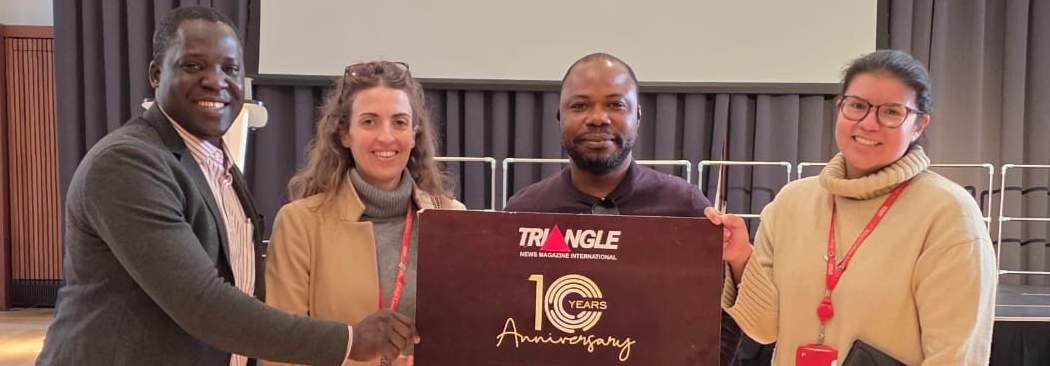
L-R: Timileyin Ayenuro, Claudia Vega, Otunba Femi Salako, Publisher Triangle Magazine International,Vein Lag,Management Staff of King's College in London on inspection of the institution's facilities ahead of the 10th Anniversary of Triangle News Magazine Award that is scheduled for April 2, 2026
James Emejo in Abuja
COURTESY VISIT...
NSITF, NECA Unveil Workplace Safety, Health Audit Report
200 companies get pass mark
Onyebuchi Ezigbo in Abuja
Nigeria Social Insurance Trust Fund (NSITF) and the Nigeria Employers Consultative Association on Friday presented a report of 2025 workplace safety and health audit conducted as part of the 2025 Safe Workplace Intervention Project (SWIP).
About 200 companies and organisations secured over 50 percent in the 2025 edition of the audit conducted nationwide by a team independent auditors commissioned by NSITF and NECA
Speaking at the presentation of the report at the NSITF's headquarters in Abuja, Director-General of NECA, Mr.
Global
Adewale-Smatt Oyerinde, said that workplace health and safety convention have become one of the core conventions of the International Labour Organization
Speaking on the importance of workplace safety and health from the perspective of private sector entities, Oyerinde said it is quite imperative that every organisation aligns with the principles and the letters of those conventions
According to NECA DG, "from the private sector level, health and safety is not just a necessity, it's also becoming a human rights issue. Because as the ILO said, labor is not a commodity "It's humans that are behind
the masquerade. So, whatever happens to them has a coloration of human rights. So that's to show that disposition of private sector to the issue of health and safety is changing away from what people used to think.
"And our commitment, the commitment of both organizations, led to the commencement of the Civil Workplace Intervention Project many years ago".
Oyerinde said that among the biggest gaps that exist in compliance is knowledge and awareness.
He also said that gaps in infrastructure also constitute another key challenge to effort to institute a sustainable culture
of health and safety practices in the country’s workplace.
Earlier in his address, the Managing Director of NSITF, Barrister Oluwaseun Faleye said that both NSITF and NECA have decided to collaboratively implement the SWIP initiative in order to further promote compliance to workplace safety and health standards.
He said “SWIP was conceived as a practical response to a persistent national challenge: the reality that too many Nigerian workers remain exposed to avoidable workplace risks, and too many employers still do not fully understand, or comply with, the protections provided under the Employees’ Compensation
Global Peace Development (GPD) has unveiled its FiveYear Strategic Plan (2026–2030), outlining an expanded vision to strengthen peacebuilding, inclusive governance, and sustainable development across Nigeria and beyond.
The plan was officially launched in Abuja at a well-attended event that brought together civil society leaders, development partners,
and government representatives, including the Institute for Peace and Conflict Resolution (IPCR).
Delivering a goodwill message on behalf of the Director-General of IPCR, Dr. Joseph Ochogwu, the institute commended GPD for its long-standing contributions to peacebuilding, gender equality, child protection, and inclusive governance.
Ochogwu, who was represented by Dr. Mang Chaimang, a director in the Institute, described the
strategic plan as a timely and well-articulated roadmap that reflects over two decades of practical experience in addressing peace and development challenges in Nigeria.
Ochogwu noted that civil society organisations such as GPD play a critical role in complementing government efforts, particularly in fragile and conflict-affected regions.
He added the new strategic plan provides a strong
framework for collaboration among government institutions, development partners, and civil society actors working towards sustainable peace.
Speaking in an interview after the launch, the Board Chairman of GPD, Chief Ejiro Oghenebrume, said the five-year plan represents more than a policy document, describing it as a renewed commitment to justice, good governance, and sustainable peace.
Act, 2010."
Faleye disclosed there will be series of events to recognize and reward organisations that made their mark in the nationwide audit across the six geographical zones.
"We are hoping that this recognition, this award, this for excellence and good behavior, and of course, compliance with the Act will further support others to embrace compliance in a way that we want it to be.
NDLEA Nabs Notorious Drug Kingpin ‘Kanmo-Kanmo’ After 12-Year Manhunt
Michael Olugbode in Abuja
notorious drug kingpin and mastermind of the killing of three anti-drug agents, Lekan Jimoh, popularly known as “Kanmo-Kanmo,” has been arrested by The National Drug Law Enforcement Agency (NDLEA).
According to a statement on Sunday by the spokesman of the anti-narcotics agency, Femi Babafemi, the drug kingpin was arrested at his hideout twelve years after he allegedly masterminded the killing of the officers in Ogun State.
Babafemi said Jimoh was apprehended last Friday, in his hideout at Owode town, Ogun State, following a wellcoordinated intelligence-led operation by NDLEA tactical teams, adding that at the point of his arrest, operatives recovered 69 kilogrammes of cannabis
(commonly known as skunk) from him.
He noted that the suspect had been on the agency’s most-wanted list since 15 June 2014, when he reportedly led an armed mob that attacked NDLEA officers who had gone to arrest him.
The assault resulted in the death of three officers, including Rabiu Kazaure, stating that Jimoh escaped arrest at the time, prompting a prolonged manhunt.
Babafemi also noted that in August 2023, NDLEA operatives again raided Jimoh’s residence in Ado-Odo, Ogun State, but he fled before they arrived.
The agency however seized 1,922 kilogrammes of cannabis stored in 139 sacks at the property. The house was later forfeited to the federal government through court proceedings.
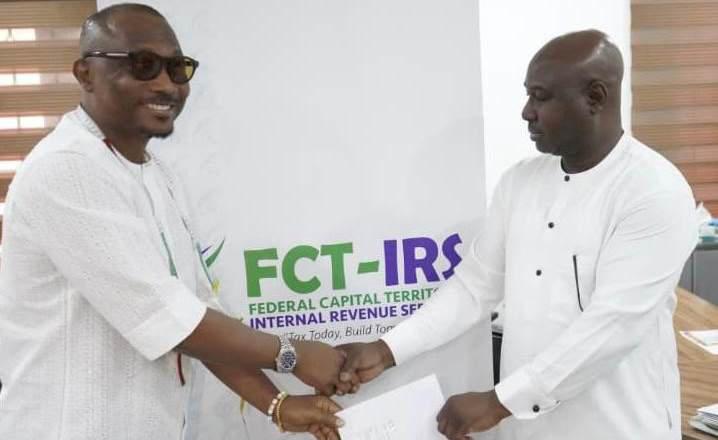
L-R: Popular fashion designer, Mr. Seyi Vodi, and acting Chairman, Federal Capital Territory Internal Revenue Service (FCT-IRS), Mr. Michael Ango, during a courtesy visit to the Corporate Headquarters of the FCT-IRS in Abuja…recently
Politics MONDAY DISCOURSE
As Rivers Assembly Intenfies Move to Impeach Fubara...
The fate of Governor Siminalayi Fubara and the deputy governor, Prof Ngozi Odu hangs in the balance as 27 members of Rivers State House of assembly led by Speaker Martins amaewhule are going ahead with the impeachment move as they await the State Chief Judge to comply with their directive to constitute a panel to probe both the governor and his deputy. Blessing Ibunge reports.
In the past few weeks, a once calm, business thriving State has become tensed, where the fighting political heavyweights have refused to sheathe their sword. Rivers State has suffered serious economic setback in the last two years.
When it seems life is returning to the State, residents of the state started hearing a fresh war song from both the Executive and Legislative arms of government.
One may want to ask what could be the reason for these irreconcilable disputes between the warring parties. While the lawmakers are fighting hard to oust the Siminalayi Fubara-led government from office, the governor on his part is struggling to complete his tenure by May, 2027.
On Thursday, January 8, 2026, the 27 lawmakers led by Speaker Amaewhule, announced the impeachment process against Governor Fubara and his deputy, just as they stopped the governor from presenting yo the Assembly the 2026 Appropriation Bill and the state’s Mid-Term Expenditure Framework (MTEF).
The motion sponsored by the Deputy Speaker, Dumle Maol, and Minority Leader, Sylvanus Nwankwo, representing Omuma State Constituency, accused Fubara and his deputy of gross misconduct, and called for an investigation into the governor’s financial and administrative actions. The motion was adopted by Amaehwule, after which he sent an impeachment notice to the governor and deputy.
Ensuing Drama
During plenary on January 8, 2026, the 27 lawmakers loyal to the Minister of the Federal Capital Territory (FCT), Nyesom Wike commenced the impeachment proceedings televised live on national televisions, and accused the governor of “recalcitrant disobedience” to President Bola Tinubu. Amaewhule cited a Supreme Court judgment insisting that the unfolding crisis should not be framed as a personal conflict between Governor Fubara and Wike, saying “this is not about personalities, the governor is not fighting any individual; he is fighting against the Constitution”.
Amaewhule who vowed that the impeachment proceedings would be pursued to a logical conclusion, said “we will follow due process to the letter, the law must take its full course”.
The lawmakers in a statement signed by Chairman, House Committee on Information, Petitions and Complaints, Dr Enemi George alleged plot by some persons to procure a court order stopping it from performing its functions, alleging that the plot was to get the exparte order from the state High Court operating outside Port Harcourt, the state capital to stop the impeachment process.
George insisted that instead of running from pillar to post, the office holders that had been served notice of allegations of gross misconduct by the House of Assembly should do the needful by responding to them. According to George: “The Rivers State House of Assembly has received information of plots by certain persons to utilize some Rivers State High Courts especially outside the Port Harcourt Judicial division to issue exparte orders to illegally stop the Rivers State House of Assembly from performing her constitutional duties.
“These persons are fully aware of the provisions of section 272(3) of the Constitution which states that ‘subject to the provisions of section 251 and other provisions of the constitution, the Federal High Court shall have jurisdiction to hear and determine the question as to whether the term of office of
a member of the House of Assembly of a state, Governor or Deputy Governor has ceased or become vacant’. Also, section 188(10) states that ‘no proceedings or determination of the panel or of the House of Assembly or any matter relating to such proceedings or determination shall be entertained or questioned in any court.
“All that is required is for the office holders who have already been duly served with the Notice of Allegations of Gross Misconduct to respond to them item by item rather than deploy subterranean moves to subvert the law or use proxies to malign members and the Rivers State House of Assembly in the media. We remain committed to the Constitution and the rule of law and may God bless our dear Rivers State and Nigeria”.
Barely four days after the impeachment announcement, one of the sponsors of the motion, Sylvanus Nwankwo alongside Peter Abbey, representing Degema constituency rescinded their position on the impeachment process and appealed to their colleagues to exercise restraint and seek an amicable resolution to the ongoing impeachment
proceedings against the governor. The lawmakers said the development had necessitated deep reflection and wide consultations.
Nwankwo said: “We are appealing to the conscience of our colleagues. Having listened to so many pleas and calls from our elders and leaders, both within and outside the state, begging for leniency, we too are calling on our colleagues to reconsider their steps and see how this matter can be resolved amicably. Even though the governor and the deputy governor may have infringed on the Constitution, we are appealing to our colleagues to reconsider our stand”.
He stressed that dialogue and political wisdom should prevail over confrontation.
Abbey who toed the line of Nwankwo said the appeal was guided by a desire to prevent further political tension in the state.
“The Minority Leader has said it all. Yes, the governor has infringed on parts of the Constitution, but we are human beings. As members of the 10th Assembly, we want to plead with our colleagues to please reconsider.
“We have received calls from leaders and people in and out of the state, and we believe that once you raise the axe, you should not swing it immediately.”
He noted that any amicable settlement would require cooperation from the executive arm
One may want to ask whether the State Chief Judge will heed the Assembly’s directive for him to set up a panel to probe impeachment allegations against Governor Fubara and the deputy governor or comply with an exparte motion granted by an High Court halting further proceedings on the impeachment move against both the governor and the deputy.
of government, particularly the governor.
“We plead with our colleagues to reconsider, provided the governor too has a role to play. He must ensure that he does not further infringe on the Constitution so that there can be an amicable settlement.”
About 24 hours after two members changed their positions on the impeachment process, two other lawmakers followed their steps, appealing to their colleagues to withdraw the process.
The two female lawmakers vis Barile Nwakoh, Khana Constituency I, and Emilia Amadi of Obio/Akpor Constituency II, who publicly made their position on the impeachment saga, also appealed to their colleagues to withdraw the process. They called for caution and dialogue and advised that pursuing impeachment could further heighten political tension in the state and cause distract from governance and legislative responsibilities.
Nwakoh reportedly stressed that the stability of Rivers State should remain paramount, noting that impeachment is a grave constitutional step that should only be considered as a last resort and not as a tool for deepening political divisions. She also called on her colleagues to reflect on the broader implications of their actions on governance, security and public confidence in democratic institutions.
Similarly, Amadi appealed for calm and unity within the House, arguing that the interests of Rivers people would be better served through cooperation between the executive and legislative arms of government. She stressed the need for lawmakers to prioritise peace and development over prolonged political confrontation.
While residents of the State were cheering the lawmakers for the steps aimed at restoring peace and sanity to the state through their acclaimed position in the development, the generality of the 27 members of the House including the four that had a rethink made a U-turn insisting that the governor and his deputy must be subjected to investigation on the allegations. The lawmakers thereby asked the Chief Judge of the State, Justice Simeon Amadi to set up a seven-man panel to commence the investigation process.
The letter addressed to the Chief Judge and signed by Speaker Amaewhule stated “I write to request that you (CJ) appoint a panel of seven persons to investigate the allegations of gross misconduct against His Excellency, Sir Siminalaye Fubara, the Governor of Rivers State pursuant to section 188(5) of the Constitution of the Federal Republic of Nigeria, 1999 (as amended). At the 60th Legislative day of the Third Session of the 10th Assembly, the House resolved in compliance with section 188(4) of the Constitution that these allegations be investigated.
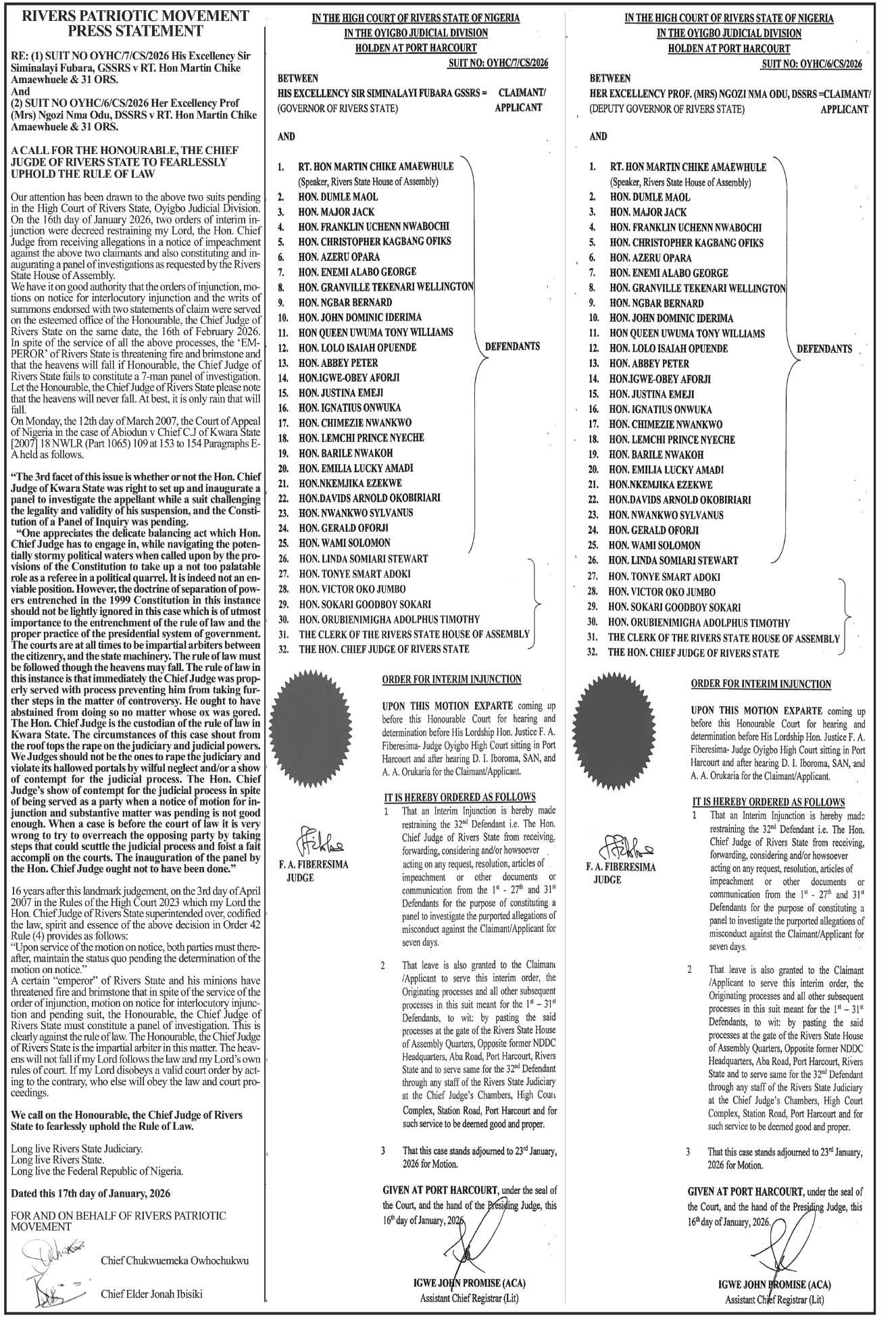
“In this regard, the acknowledged copy of the forwarding letter of the Notice of Allegations of Gross Misconduct; the acknowledged copy of the Notice of Allegations of Gross Misconduct; copies of the Rivers State Impeachment Panel (Conduct of Investigations) Procedure, 2025; photocopies of newspaper publications of Guardian, Saturday Sun, Nation and other relevant documents are hereby attached for the use of the Panel”, Amaewule added. However, in a quick response to the development, Governor Fubara and his deputy approached a State High Court in Oyigbo Judiciary Division holding in Port Harcourt, praying the court to restrain the Speaker and other lawmakers including the Clerk of the house and Chief Judge of Rivers State from going on with the process.
NOTE: Interested readers should continue in the online edition on www.thisdaylive.com
Fubara
Anthony Chiejina: Africa’s Quiet Architect of Global Corporate Reputation TRIBUTE
Abiodun Alade
In a year shaped by geopolitical tension, technological disruption and intensifying scrutiny of corporate conduct, Anthony Chiejina has once again secured a place among the world’s most influential communications leaders.
In the orchestration of influence, some leaders make themselves heard; others, like Chiejina, make themselves felt. As Group Chief, Branding & Corporate Communications, Dangote Industries Limited, Africa’s largest industrial conglomerate, he operates not in the glare of the spotlight, but in the rarified space where strategy, trust and perception converge. Influence, in Chiejina’s world, is not performative. It is deliberate, calibrated and sustained.
His inclusion on the 2025 Influence 100 for the fifth consecutive year confirms his standing as one of the most consequential in-house communicators globally—and the only Nigerian on this year’s list.
Now in its 13th year, the Influence 100 has become a benchmark for leadership at the intersection of reputation, strategy and power. Compiled annually by PRovoke Media’s senior editorial team, the list recognises communications, corporate affairs and marketing executives whose judgement shapes organisational credibility, agency relationships and public trust. Selection is based on organisational influence, strategic remit, thought leadership and the capacity to lead through complexity.
Chiejina’s sustained presence on the list signals something deeper than recognition. It reflects a style of leadership defined not by volume, but by judgement.
Leadership Beyond Messaging
In today’s corporate environment, communications is no longer a support function. It is a leadership discipline. For Chiejina, that evolution has long been reality. His remit extends from strategic counsel at the highest level to internal alignment across a vast workforce, crisis navigation, regulatory engagement and longterm brand stewardship across sectors.
Dangote Group’s footprint spans cement, energy, agriculture, manufacturing and infrastructure—
sectors that sit at the heart of national economies and global supply chains. Every decision, every word, carries weight beyond the corporation itself.
That responsibility has intensified as Dangote Group has undertaken some of the most ambitious industrial projects in Africa, drawing global attention and regulatory scrutiny. Managing reputation at this scale demands more than messaging. It requires institutional memory, political literacy and an acute understanding of how public legitimacy is earned and sustained.
Under his stewardship, Dangote Group has maintained its position as Africa’s most admired company while navigating periods of heightened public debate and international visibility. His work consistently connects corporate ambition with public confidence, ensuring that growth is matched by credibility.
Institutional Memory and Strategic Calm
More than 15 years within the Dangote Group have given Chiejina a rare asset: deep institutional memory. That continuity has proven invaluable during periods of expansion, regulatory change and market volatility. While others respond to headlines, he focuses on coherence, consistency and long-term trust.
Those who work with him describe a leader who privileges preparation over performance and clarity over drama. His approach is measured and analytical, grounded in the belief that reputation is not built in moments, but through years of disciplined engagement.
Chiejina’s fifth consecutive appearance on the Influence 100 places him among a peer group that includes communications chiefs from Apple, Google, Coca-Cola, Nike, Ford, Emirates, Reliance and other global giants. Yet he remains the only Nigerian
on the 2025 list and one of the few Africa-based executives consistently recognised. That distinction reflects both the scale of his responsibility and the growing global relevance of African corporate leadership. As Africa’s industrial champions assume a larger role in global supply chains and energy markets, the standards by which they are judged have become unmistakably international. Chiejina has helped ensure that Dangote Group meets those standards not through imitation, but through coherence, transparency and confidence in its own narrative.
Before joining Dangote Group, Chiejina built a career across banking, manufacturing and journalism, with senior roles at Zenith Bank, Oceanic Bank, Seven Up Bottling Company, African Economic Digest and African Concord—publications from the famed Concord Group that shaped a generation of African journalists. That breadth of experience continues to inform his leadership: commercially grounded, media-literate and alert to the political and economic realities that frame corporate action in emerging markets.
Quiet Authority
Anthony Chiejina’s leadership is marked by restraint. He is not a public-facing executive in the conventional sense, yet his counsel influences decisions at the highest level. In an era where reputations can be destabilised overnight, his value lies in foresight, discretion and strategic calm.
As global business becomes more exposed, more questioned and more accountable, leaders like Chiejina represent a new model of executive authority—one rooted in trust, institutional credibility and long-term thinking.
In that sense, his continued presence on the Influence 100 is not merely a personal milestone. It is a signal: that African enterprise, guided with discipline and clarity, belongs confidently at the centre of global leadership.
And in a world that increasingly confuses noise for power, Chiejina’s career offers a reminder: the most enduring influence is rarely the loudest.
*Abiodun, a communications specialist writes from Lagos
Chiejina
A FORMIDABLE FORTRESS
The Nentawe/Mutfwang alliance augurs well for the APC, argues YAKUBU DATI
60 YEARS AFTER THE FIRST MILITARY COUP
Military rule bred a culture of fear, opportunity and sycophancy in Nigerian society, argues JEFF GODWIN DOKI
Unmotivated employees cost businesses far more than inefficient processes, argues LINUS OKORIE
WHY TEAM MOTIVATION MATTERS
Every business leader wants growth. So, they chase market share, optimize processes, and invest in technology. We attend conferences, hire consultants, and study what successful companies are doing. Yet many organizations with brilliant strategies, adequate capital, and capable teams still struggle to break through their performance ceiling. The missing ingredient is usually found in the hearts and minds of the people doing the work.
The hard truth is this: unmotivated employees cost businesses far more than inefficient processes ever could. Gallup's research reveals that only 23% of employees worldwide are genuinely engaged at work. This means three out of four people in your organization might be showing up, completing tasks, and collecting paychecks while contributing far less than their actual potential. This is a profitability crisis hiding in plain sight.
When we talk about business growth and profitability, we typically focus on revenue generation and cost reduction. We analyze profit margins, customer acquisition costs, and operational efficiency. These matter tremendously, but they rest on the team’s discretionary effort. This is what most leaders overlook. Discretionary effort is the difference between doing just enough to keep your job and choosing to go the extra mile. It is the gap between a customer service representative following a script and one who genuinely cares about making someone's day better OR between a project manager who delivers on time and one who anticipates roadblocks before they become crises.
This discretionary effort cannot be purchased with salary or mandated through policy. It can only be unlocked through genuine motivation, and this is where most organizations are leaving massive value on the table. Think about it in purely financial terms. If you have a team of fifty people, and they are operating at 60% of their potential capacity because they are disengaged, you are essentially paying for fifty people while getting the output of thirty. No amount of process optimization can compensate for that kind of waste. Yet unlike a broken machine, unmotivated teams don't show up in your financial reports as a line item. They just quietly drain resources, miss opportunities, and allow your competitors to outpace you.
The connection between team motivation and business performance becomes even clearer when you examine what happens in high-performing organizations. Companies with
highly engaged teams see 21% greater profitability according to Gallup's research. They experience 41% lower absenteeism and 59% less turnover. These represent fundamental differences in how organizations function and compete. Lower turnover alone saves enormous costs in recruitment, training, and lost productivity. Higher engagement means faster problem-solving, better customer experiences, and more innovation. These advantages compound over time, creating a widening gap between organizations that understand motivation and those that don't.
But here is where many leaders make a critical mistake. They confuse compliance with commitment, and they wonder why their teams underperform despite seemingly doing everything right. Compliance is what you get when people follow rules to avoid punishment or meet minimum expectations. It is the employee who arrives exactly on time, does exactly as required, and leaves exactly when permitted. There is nothing technically wrong with this behavior; it only breeds mediocrity because it lacks the spark of genuine investment. Commitment, on the other hand, emerges when people connect their work to something meaningful, and see how their effort contributes to outcomes that matter.
Understanding this distinction transforms how you think about leadership. You cannot fine, pressure, or incentivize your way to commitment. You can certainly use those tools to achieve compliance, and sometimes that is necessary. A committed team will spot opportunities, take initiative, and solve problems before they escalate.
So, what really motivates people? The answer surprises many leaders because it contradicts common management practices. Money matters, obviously. People need fair compensation and financial security. Research by Teresa Amabile at Harvard Business School consistently shows that purpose, autonomy, and mastery are the primary drivers of high performance. People want to know that their work matters, that they
are trusted to do it well, and that they are growing in capability and contribution.
This is why the most successful organizations don't just pay competitively; they create cultures where people can see the meaning in their daily work. They help the warehouse worker understand how his attention to detail ensures customer satisfaction. They enable the junior analyst to see how her research influences major decisions. When people understand the "why" behind their work, their motivation shifts from external to internal.
Trust plays an equally vital role in motivation. Micromanagement, secondguessing, and excessive oversight kills motivation faster than almost anything else. Leaders who genuinely trust their teams create environments where motivation flourishes. They set clear outcomes, provide necessary resources, and then step back and let people work. They recognize that adults don't need to be managed like children; they need to be equipped, supported, and held accountable for results.
The role of leadership behavior in sustaining team motivation cannot be overstated. Your team is always watching how you respond under pressure, whether you keep your commitments, how you treat people, and whether you share credit or hoard it. These observations shape their perception of you and their willingness to invest discretionary effort in your shared goals. According to research from Harvard Business Review, 70% of team variance in engagement is determined by the manager. As a leader, you have more influence over your team's motivation than company culture, compensation systems, or working conditions.
This creates both tremendous responsibility and tremendous opportunity. If your team is unmotivated, looking in the mirror is uncomfortable but necessary. Are you providing clarity about what success looks like? Are you consistent in your expectations and behavior? Have you built credibility through alignment between your words and actions? These questions matter because motivation emerges in environments where people feel psychologically safe, clearly directed, and confident in their leader's integrity.
Okorie MFR is a leadership development expert spanning 30 years in the research, teaching and coaching of leadership in Africa and across the world. He is the CEO of the GOTNI Leadership Centre.
The Nentawe/Mutfwang alliance augurs well for the APC, argues YAKUBU DATI
A FORMIDABLE FORTRESS
With the kind of alliance that has been formed in the six North Central states of Kwara, Niger, Benue, Kogi, Plateau and Nasarawa by All Progressives Congress (APC) stalwarts, it would be difficult for any other party to penetrate the region ahead 2027.
By sheer strategic planning and execution, the National Chairman of the party and all the six governors, majority of State and National Assembly members and ministers are all of the APC.
This has enabled the party to carve the zone into a formidable fortress for the ruling party ahead the 2027 elections.
For Plateau State the scenario is even more interesting as the political landscape has recently undergone a strategic realignment as the APC national chairman, Prof Nentawe Yilwatda and Governor Caleb Mutfwang have merged forces.
Their alliance has bridged the former divides that make for vote loss, and has signalled a coordinated effort to deliver a decisive bloc vote for President Bola Ahmed Tinubu across the geopolitical region.
The political marriage between Nentawe and Mutfwang goes beyond elite consensus as some would want to perceive it, but speaks to a convergence that reflects a deeper understanding of politics and how to win.
This is against the backdrop of the realization that fragmented politics is injurious to party interest as it has long weakened the region’s bargaining power at the national level and deprived it of a strong voice.
With the current trend, the much needed unity is now critical to garner influence for the geopolitical zone, inclusion in national decision-making processes; attract vital infrastructure as well as create job opportunities for the teeming masses.
Guiding this realignment is General TY Danjuma, the strong pillar whose enduring influence across Taraba and the Middle Belt continues to shape voters decisions.
Known for his advocacy on good governance, security, and regional protection, Danjuma ensures political leaders are held accountable to the electorate.
This complements the moral authority of the mother of the nation, Remi Tinubu, whose philanthropic footprint generates goodwill in key communities in the zone, while creating a soft-power advantage that reinforces the Tinubu brand in the region.
On the operational side, there are two key personalities that cannot be ignored: former deputy speaker of the House of Representatives, Ahmed Idris Wase and House of Representatives chairman committee on finance, James Faleke.
Wase has a deep penetration of the critical factors for translating goodwill
into votes while Faleke is known for his grassroots mobilisation acumen with network spread across several states in the geopolitical zone.
In a nutshell, Wase’s influence in strategic constituencies and Faleke’s organisational experience provides the APC with the machinery to convert this otherwise elite alignment into tangible electoral outcomes.
Despite all these advantages, the path to winning bulk votes across the zone remains narrow unless these human resources are tapped.
Plateau and the wider Middle Belt electorate have repeatedly rejected candidates perceived as detached, entitled, or ineffective which the APC is trying to move away from.
For APC to win, there's the need to consolidate on the Nentawe–Mutfwang alliance and the advantages that go with it.
The two leaders so far are doing well, but require the support of all party members irrespective of whether they are aspiring for office or not.
While the party is working towards achieving victory at the polls, it is instructive for their supporters to realise that they are now fighting for a common goal and unite.
Again public perception will be decisive so the alliance must retain its framework as a mission to restore Plateau and Middle Belt relevance, not as a refuge for entrenched politicians.
This would be achieved through transparent primaries, voter-driven selection, and a clear link between political support and tangible regional benefits.
As one philosopher said, “Not every path is crowded; some roads are lonely because they lead higher," so Nentawe and Mutfwang must take those courageous, solitary paths to take APC higher.
If executed with discipline, focus, and political courage, the Nentawe/Mutfwang convergence could energise voters, strengthen the region’s federal bargaining power, and convert past political sacrifices into lasting electoral and national impact.
Yakubudati@gmail.com
Military rule bred a culture of fear, opportunity and sycophancy in Nigerian society, argues JEFF GODWIN DOKI
60 YEARS AFTER THE FIRST MILITARY COUP
As a country, Nigeria shall be 66 years old come October this year. On January 15, 1966, six years after political independence, the military led by Major Chukwuma Kaduna Nzeogu seized power from the democratically elected government of Alhaji Tafawa Balewa. The reasons the soldiers advanced for the coup were many and varied. Among other things they include: the need to arrest the drifting of the politicians into political violence; to end the corruption which had become pervasive in the country; to end the insecurity consequent upon the clash between Chief Obafemi Awolowo (Action Group) and Chief Akintola (Nigerian National Democratic Party) which eventually led to the declaration of a state of emergency in the Western Region; the disagreement that arose from the result of the National Census of 1962/3; the resort to the use of thugs and election-rigging by the National Council of Nigerian Citizens (NCNC) during the 1965 Federal elections in Western Nigeria and also Tiv area in present day Benue state. It was all these reasons that prompted the first military intervention on January 15, 1966.
For 13 years the military held sway.
Again, in 1983 the military led by MajorGeneral Muhammadu Buhari seized power from the democratically elected government of Alhaji Shehu Shagari citing socio-economic anomie, corruption, bankruptcy, growing external debt and the collapse of social services as reasons. One may state with considerable justification that since independence in 1960, Nigeria has witnessed only two successful coups that dethroned elected governments namely that of Major Nzeogu in 1966 and that of Major Buhari in 1983. While some commentators argue that out of these two coups that of 1966 was more popular because it aimed at arresting the drift into political insecurity at the time, others hold that the Buhari coup of 1983 aimed at sustaining the Hausa control of the government and the country. But let’s reserve that discussion for another time and place.
All students of Nigerian history know that military rule is an aberration because the military has no business in politics and they can only be involved in nonconstitutional ways. Lamentably, the military since 1966 has used the gun forcefully to seize power from elected governments. But take note of this: there have been three military coups against military governments. The first was that of July 29, 1966 which led to the death of General Aguiyi Ironsi (an Ibo man) and the emergence of General Yakubu Gowon; the second was that of Gen Murtala Mohammed which overthrew Gen Yakubu Gowon on July 29, 1975. Murtala Mohammed was assassinated by Lt. Col. Bukar Suka Dimka on February, 13, 1976. The third led to the emergence of Gen. Ibrahim Babangida after the overthrow of Gen Buhari in August 1985. But apart from these three coups against military regimes,
there have been many unsuccessful ones especially the failed one led by Major Gideon Orkar on April, 22, 1990.
The obvious implication is that the several coups of the military against the military points to only one direction: the desire of the military to wield political power in order to advance their interest as individuals and as a group. The sum of it all is that since independence the military has ruled Nigeria longer than the civilians and this is evident in the coups and counter coups. Needless to state that it is this factor more than anything else which has led to the politicization of the armed forces. It could be perceived that the entire Nigerian nation is trapped not just in a vicious cycle of human stupidity but also in an inescapable web: the politicians used their ill-gotten money to debase the electoral process and wield political power, the soldiers use their guns to seize power from our unconscionable breed of unscrupulous politicians.
More damaging and destructive is the fact that military rule which is anchored on the instruments of coercion and force in the control of states, agencies and resources has caused irremediable harm on the psyche of the entire nation. This has bred a culture of fear, opportunity and sycophancy in Nigerian society. The most critical implication of this forceful control and dominance is the entrenchment of dictatorship in the administration of the country. It was the military regime that introduced the militarization and mismanagement of the economy. It was the first military coup that introduced ethnic inequality in Nigeria. During coups and counter coups, the military group that had more people in the Army wielded uncontrolled powers that give them a sense of superiority over others. The obvious and tragic consequence is that this has given rise to the politicization of governance in Nigeria. Nigeria is a pluralistic society and in such a society when rights are not distributed on the principles of justice, hard work, merit, fair play and excellence, the door is automatically open for ethnic and religious strife which also has the potential of opening a wider door for banditry and terrorism.
Doki is a Professor of Comparative Literature at the University of Jos
Editor, Editorial Page PETER ISHAKA
Email peter.ishaka@thisdaylive.com
BEYOND BANNING WOODEN CANOES
Authorities should enforce minimum safety standards
To reduce the growing number of accidents on our waterways, the Minister of Marine and Blue Economy, Adegboyega Oyetola, has urged state governments across the federation to invest in safer, modern fibre and aluminium boats. “Fibre and aluminium boats are more durable, stable, and resistant to corrosion, making them better suited for commercial operations,” Oyetola stated while also warning against night travel, which often comes with poor visibility. “These modern boats are stronger, more reliable, and easier to maintain. They offer better balance and buoyancy, reduce the risk of sudden breakage, and can be fitted with essential safety equipment.”
We agree with Oyetola that continued reliance on rickety boats in many riverine states and non-adherence to safety standards remain major contributors to accidents on Nigeria’s inland waterways. But they are not the only cause of accidents in the creeks and coastlines where most of the people have no alternative means of transportation. According to estimates from the United Nations (UN), there are more than three million shipwrecks in the ocean floor worldwide and Nigeria is one of the countries where such wrecks are said to be lying under the waterbed.
existence of any mandatory operational guidelines for ownership of ferries and boats and the minimum standards that must be met to be in the business of ferrying people through the waters. While we agree with Oyetola that phasing out wooden boats in favour of fibre-reinforced plastic and aluminium boats would significantly improve safety on the waterways, it would not resolve the problem of regulatory failure that has for decades dogged the sector.
Provision of emergency services along the waterways is also worthy of consideration
T H I S D AY
EDITOR SHAKA MOMODU
DEPUTY EDITOR WALE OLALEYE
MANAGING DIRECTOR ENIOLA BELLO
DEPUTY MANAGING DIRECTOR ISRAEL IWEGBU
CHAIRMAN EDITORIAL BOARD OLUSEGUN ADENIYI
EDITOR NATION’S CAPITAL IYOBOSA UWUGIAREN THE OMBUDSMAN KAYODE KOMOLAFE
Indeed, available reports also indicate that several hard objects clog the country’s territorial waters, posing the risk of undermining maritime development. A former Managing Director of the National Inland Waterways Authority (NIWA), Olorunibe Mamora, once escaped death when a floating log of wood hit the boat carrying him and entourage while on inspection at their Lagos facilities. That incident underscores the fact that one of the major causes of accidents on our waterways is collision with submerged hard objects.
Perhaps more important is the obvious lack of safety standards. In fact, not much is known about the
EDITOR-IN-CHIEF/CHAIRMAN NDUKA OBAIGBENA
GROUP EXECUTIVE DIRECTORS ENIOLA BELLO, KAYODE KOMOLAFE, ISRAEL IWEGBU
DIVISIONAL DIRECTORS SHAKA MOMODU, PETER IWEGBU, ANTHONY OGEDENGBE
DIRECTOR, PRINTING PRODUCTION CHUKS ONWUDINJO TO SEND EMAIL: first name.surname@thisdaylive.com
Letters to the Editor
It is unfortunate that almost everything worthwhile and ordinarily should be easily achieved always looks like a mountain in Nigeria. With the existence of waterfronts in various parts of the country and the increasingly devastating state of our roads, innovative leaders would have explored the options of water transportation by heavily investing in our waterways with a view to making them safe. That sadly is not the case despite the fact that water transportation is one clear source of de-congesting the roads in places where road travel could result in frustrating hours on the traffic. We urge NIWA to be alive to its responsibility by enforcing a universal safety standard. For instance, the absence of any search and rescue agencies often contributes to the high casualty figures recorded since the operators have little or no knowledge about what to do when faced with emergency situations.
Going forward, we reiterate our call that operational standard be enforced nationally for those in the business of ferry and canoe transportation. Provision of emergency services along the waterways is also worthy of consideration. It is even more disturbing that we have marine police in the country who always seem to be nowhere to be found in environs where water tragedies occur. If they are marine police, shouldn't they be permanently stationed around waterways and swiftly swing to action when tragedies occur on the waters by promptly rescuing victims?
The authorities must put the necessary safety measures in place. Travelling by water should not be a suicide mission.
Letters in response to specific publications in THISDAY should be brief (150-300 words) and straight to the point. Interested readers may send such letters along with their contact details to opinion@thisdaylive.com. We also welcome comments and opinions on topical local, national and international issues provided they are well-written and should also not be longer than (750- 1000 words). They should be sent to opinion@thisdaylive. com along with photograph, email address and phone numbers of the writer.
ONE PARTY SYSTEM AND SIGNS OF OUR TIME
Nigeria, a nation blessed with abundant resources and a vibrant people, stands at a crossroads. As the world watches, the country's trajectory seems increasingly uncertain. The recent flirtation with a one-party system under the guise of APC's dominance raises questions about the state of democracy and the future of Nigeria. But is this a new phenomenon, or a symptom of a deeper malaise?
History teaches us that Nigeria has long struggled with self-inflicted wounds. The trans-Saharan slave trade, a painful chapter in our past, was as much a product of our own complicity as it was of external forces. The era of regional politics, marked by the likes of Jeremiah Awolowo's Action Group and Dr. Nnamdi Azikiwe's NCNC, showed promise, but was ultimately marred by ethnic and regional rivalries. The Yoruba and Hausa/Fulani blocs undermined the Igbo-led NCNC, illustrating the destructive power of tribalism.
Fast forward to today, and the signs are ominous. A one-party system, an anathema to democracy, is being peddled as the solution to Nigeria's problems. But as the
saying goes, "those who forget history are bound to repeat it." One-party systems are relics of the past, incompatible with modern democracy. Yet, in Nigeria, dissenting voices are silenced, and criticism is seen as treason. The concentration of power in the hands of a few, coupled with the suppression of opposition, is a recipe for disaster. Today, the push toward a one-party structure under the APC reflects a desire to extinguish dissent. In a healthy democracy, opposition is the crucible in which policy is refined. However, when criticism is treated as treason and influential voices are reduced to "insignificant tweets," the democratic fabric begins to tear.
The current administration operates in a landscape where the opposition feels less like a counter-force and more like a shadow. This move toward singularity is not a sign of strength, but a sign of vanity. We look at global powers like the United States or the nations of Europe; they understand that a monopoly on power leads to stagnation. Yet, in Nigeria, the "conspiracy of the elite" remains strong, fueled by a collective betrayal—a "kiss" of greed
that prioritizes personal riches over the common wealth. The problem is not the mini-skirt on a curvy hip, nor is it security from riches and love. It is a crisis of character, a malaise of the soul. Over 50% of Nigerians are educated, with many holding advanced degrees. Yet, we are addicted to evil, blinded by greed, envy, and deceit. Contracts are awarded based on patronage, not merit. We maim and kill our own for power, wealth, and influence. The pursuit of sex, drugs, and pleasure has become an opiate, numbing our collective conscience.
The world is full of destructive forces – atomic bombs, nuclear bombs, biological weapons – but none as potent as a heart surrendered to wickedness. Nigeria's problem is not external; it is internal. We betray each other with a kiss, as greed and envy eat away at our fabric. Leadership reflects the character of the masses, and our leaders are a mirror of our own moral decay.
Obiotika Wilfred Toochukwu, Living Grace Restoration Assembly Inc. Nkono-Ekwuobia, Anambra State
Amid Sector Reforms, 20 Insurance Companies’ Market Cap Rise to N944.67bn
Kayode tokede
Amid major reforms in the insurance sector, the market capitalisation of AIICO Insurance Plc and 19 others listed on the Nigerian Exchange Limited (NGX) recorded a significant spike in 2025 to N944.67 billion, about 79.4 per cent increase over N526.59 billion in 2024.
The major insurance companies on NGX saw significant increase in stock price as the sector underwent significant reforms to modernize and enhance its operations.
Part of these reforms
include: the Nigeria Insurance Industry Reform Bill, 2024 aimed to consolidate outdated laws to provide a more robust regulatory environment, increased capital requirements, focus on deepening penetration, and claims management and consumer protection.
The reforms represent a significant shift, aiming to modernise the industry and increase its contribution to Nigeria’s economic growth. However, the proposed changes require careful implementation to balance industry development with inclusivity and fairness.
With a strong Year-to-Date (YtD) performance above 65.6 per cent in 2025, the NGX insurance Index outperformed the overall NGX All-Share Index performance of 51.2 per cent in 2025.
THISDAY learnt that the N944.67 billion market capitalisation in 2025 was driven by four standout stocks: AIICO Insurance Plc, Axamansard Insurance Plc, Cornerstone Insurance Plc, and NEM Insurance Plc.
The four firms contributed about N504.75 billion or 53.44 per cent out of the N944.67billion overall
insurance sector market capitalisation amid significant increase in stock price in 2025.
Specifically, AIICO Insurance saw its market capitalisation move from N52.35billion in 2024 to N138.73billion in 2025, on the backdrop of 165per cent increase in stock price to N3.79 per share in 2025 from N1.43 per share in 2024.
For NEM Insurance, its market capitalisation closed 2025 at N134.44billion from N54.93 billion, following a 145per cent growth in stock price to N26.8 per share on NGX.
The market capitalization
of AXA Mansard Insurance moved from N73.8billion to N123.3billion in 2025 as its stock price appreciated by 67.07 per cent to N13.70 per share from N8.20 per share it closed for trading in 2024.
In addition, the market capitalisation of Cornerstone Insurance jumped to N108.27billion in 2025 from N65.4billion in 2024.
Cornerstone Insurance, according to THISDAY findings, saw a 66 per cent growth in stock price to N5.96 per share from 3.60 per cent it opened for trading in 2025.
As the July 2026 deadline approaches, further capital
market activity is expected, with mergers, acquisitions, and strategic partnerships likely to feature prominently among smaller and mid-tier operators. Currently, LASACO Assurance had announced that its shareholders have overwhelmingly approved a plan to increase the company’s minimum share capital from about N11.08billion to N36.08billion. This will be executed through a combination of a rights issue and a private placement.
Alternative Bank Signals Strong 2026 Growth Push
The Alternative Bank, has unveiled a growth and impact agenda for 2026, positioning non-interest banking as key driver of financial inclusion, ethical finance and sectorfocused development in Nigeria.
Speaking during an interview on islamic finance, Executive Director for South, Korede Demola-Adeniyi, said the non-interest banking sector
remains significantly underpenetrated, accounting for just 1.7 per cent of Nigeria’s total banking assets as at 2024, despite growing demand for ethical and value-based financial services.
She noted that while the industry recorded modest growth in 2025, deeper advocacy, public education and product innovation are required to unlock its full potential.
“Non-interest banking
is not niche banking. It is ethical banking designed for inclusion. We are not selling to Muslims alone. We are offering a value proposition that works for everyone,” Demola-Adeniyi said.
With increased capital and clearer regulation expected to shape the sector in the new year, she expressed confidence that non-interest banks would assume a more prominent role in Nigeria’s economic transformation.
According to her, AltBank’s growth strategy for 2026 will prioritise sectors with strong developmental impact, including healthcare, education, agriculture, renewable energy and transportation.
She added that the Bank is also exploring structured participation in the creative economy through partnerships, while remaining fully compliant with noninterest banking principles.
“These are sectors that shape lives and livelihoods. Our responsibility is to design financing structures that solve real problems, not just disburse funds,” she said. Addressing concerns over perceived over-collateralisation in non-interest banking, Demola-Adeniyi explained that the NIB model is partnership-driven rather than interest-based, requiring transparency and shared risk between banks and customers.
She stressed the importance of sustained public education to improve understanding of how non-interest banking structures work and the benefits they offer.
“The NIB model demands honesty and collaboration. When customers understand that the Bank is a partner, not just a lender, trust deepens and outcomes improve,” she said.
Kuni tyessi in Abuja
ASHON Chairman: Inconsistent Policy Pose Biggest Challenges to Nigerian Capital Market
In this definitive interview, the Chairman of the Association of Securities Dealing Houses of Nigeria, Sehinde Adenagbe, speaks on challenges facing Nigerian capital market and offers in-depth assessment of the market’s current state, the drivers behind the NGX’s historic gains, and the reforms shaping its future. Kayode Tokede presents the extracts
Congratulations on your election as the Chairman of Association of Securities Dealing Houses of Nigeria (ASHON). What is your general assessment of the current capital market environment?
Thank you. My election represents a call to service. Despite short-term volatility, the market has remained resilient, with improving liquidity, modest growth in listedcompany earnings, and steady participation from domestic and foreign investors.
What are the biggest challenges confronting the Nigerian market today?
Key challenges include inconsistent policy signals, macroeconomic instability, low financial literacy, and gaps in technology infrastructure. Together, these factors dampen investor confidence and limit the market’s ability to attract long-term capital.
How did the Nigerian Exchange Limited (NGX) perform in 2025? In 2025, the Nigerian Exchange (NGX) delivered exceptionally strong performance, ending the year among the world’s best-performing emerging and frontier markets. The NGX AllShare Index (ASI) surged 51.19per cent year-to-date, closing at an all-time high of 155,613.03 basis points, its strongest annual return in nearly two decades. This rally was driven by broad investor confidence, macroeconomic stability and structural market reforms that boosted liquidity and valuations. Total market capitalisation expanded to roughly N99.38 trillion, up sharply from the start of the year, underlining robust capital gains for investors. Throughout the year, key sectors such as consumer goods, insurance, industrials and banking delivered significant returns, contributing to the overall bullish sentiment and strong index performance.
How does your association plan to address low investor confidence?
We will strengthen ethical standards, improve disclosure practices, and collaborate with regulators on investorprotection initiatives. A nationwide investor-education programme is also planned to rebuild trust and deepen participation.
What reforms are you advocating to enhance market development?
Reforms will enhance more transparency. We need more clarity on the issue of capital gain tax (CGT) which dragged the market down by about N4.8 trillion in a single market day. We support stricter compliance reviews, faster reporting timelines, and unified digital reporting platforms to reduce information gaps. The Investment and Securities Act (ISA) 2025 is a
landmark reform. It expands the definition of securities, strengthens investor protection, and brings new products, including digital assets, under regulation. ISA 2025 also enhances the SEC’s oversight powers and has contributed to Nigeria’s removal from the FATF grey list in October 2025, supporting smoother international transactions. Stable FX reforms and exchange-rate unification have improved pricing predictability for foreign investors, supporting increased capital inflows. Going forward, policies are needed to encourage new listings, long-term institutional investment, market infrastructure improvements, and security measures to create a safe investment environment.
How will technology and innovation feature in your agenda?
Technology is central to our agenda. We will champion modernised trading infrastructure, support fintech partnerships, and promote the responsible use of AI in risk management and market surveillance. These measures will improve efficiency, reduce errors, and enhance the trading experience.
Many investors complain about slow dispute resolution. What is your plan?
We will work with regulators to strengthen the dispute-resolution framework, establish faster
mediation channels, clarify escalation procedures, and ensure investors receive prompt and fair hearings.
How do you plan to deepen retail investor participation?
We will launch targeted financialliteracy campaigns, simplify investment products, and use digital platforms to make investing more accessible to younger demographics. Partnerships with schools and universities will introduce capital-market education early. We shall make the market more investor-friendly by simplifying our onboarding process. Also to work with the CSCS in order to reduce time taken for new accounts to be active. We shall work with the press to ensure professional reportage of the market,
What is your stance on the current regulatory environment?
Regulation is essential for market stability, and we acknowledge progress made by regulators. We advocate for more collaborative policy making, especially regarding broker operations, cross-boarder transactions and incentives for capital.
How will you support member firms during this period of change?
We will provide capacity-building programmes, professional training, compliance support, and access to
modern trading tools. We will also engage government authorities to help firms access incentives and funding to strengthen their capital base.
What role will foreign investors play in the near term?
Foreign investors remain crucial for liquidity and market depth. We are working to ensure Nigeria’s investment climate aligns with global best practices, particularly in governance, transparency, macroeconomic stability, and ease of capital repatriation. The introduction of T+2 settlement cycle will further endear the market to investors.
How will you ensure stronger collaboration across the capitalmarket ecosystem?
We will create a structured engagement framework involving regulators, listed companies, investment banks, registrars, and custodians. Coordination will accelerate reforms, improve investor experience, and strengthen market efficiency.
How can the SEC handle recapitalisation of stockbroking firms effectively?
Recapitalisation is essential but must be practical. A phased or tiered approach allows firms of different sizes to meet new capital requirements gradually. The Securities and Exchange Commission (SEC) to give a considerable cool- off period for the exercise to go through. Clear timelines, transparent guidelines, flexible compliance windows, and incentives such as reduced fees, low-interest financing, and support for mergers can ease the process. Continuous stakeholder engagement is vital to ensure recapitalisation strengthens the industry without stifling growth.
What message would you like to leave with investors at the start of your tenure?
Investors should be confident in Nigeria’s capital market. Since May 2023, the NGX All-Share Index has risen about 136%, and market capitalisation has expanded significantly, reflecting renewed confidence. Reforms such as ISA 2025, FX market improvements, and exchange-rate unification have strengthened market integrity, broadened product offerings, and improved investor protection. Removal from the FATF grey list supports smoother international transactions. While progress is evident, more work lies ahead. Policies encouraging new listings, long-term institutional investment, improved infrastructure, and enhanced security will be critical. Our association is committed to safeguarding investor interests, enhancing transparency, and driving reforms to make the capital market more competitive, inclusive, and resilient.
Adenagbe
2027: Abia State Must not Slide Back to Socio-economic Malaise
Okey Nwachukwu
Former governors, Orji Uzor Kalu and Theodore Orji, with the 2027 general elections priming in mind, made a joint appearance on January 9 in Umuahia, to make a case for change of leadership in Abia State. Apart from endorsing President Bola Tinubu’s re-election, they vowed to oust Governor Alex Otti from office, and ensure the ruling party captures the state.
Kalu and Orji are currently serving as Senators, while Dr. Okezie Ikpeazu, the other former governor of the state, is an ambassadorial nominee. The trio governed Abia State for 24 years, serving eight years apiece; Kalu served from 1999 to 2007, Orji from 2007 to 2015, and Ikpeazu, 2015 to 2023. Ordinarily, their outing should have denoted a distinguished gathering of eminent personalities of Abia State origin with a mission to steer a better future for the state. Instead, photoops and sound bites from the event unconsciously created the impression of an induction into a Hall of Shame. It was like a summit of ramblers and looters. Their stewardship, to most Abians, epitomized a colossal failure of purposeful governance. Contrary to their audacity, they are actually deficient of the influence and respect which the Igbo culture bestows on anyone adjudged to have exemplary accomplishment and integrity.
Kalu, in his trademark loquacity said, “Leadership is a relay race. I finished and handed over to Senator T. A. Orji, and he finished and handed over to Okezie Ikpeazu. So one person cannot come and say we did nothing and that we are not relevant. If we did nothing, where would our people be living now? Our meeting is not to discuss what cannot be said outside. Our main purpose is that one person must go down in 2027.”
He could not outline the specifics of what he and his successors achieved while in office. Excellent leadership is characterized by such yardsticks as rule of law, transparency, responsibility, accountability, participation and responsiveness, amongst others. Which can be attributed to Kalu and his gang? Is it in the area of project development or infrastructure? Zero! Kalu, always boasting of becoming a millionaire at a young age, brought absolutely nothing to the table. No strategic goals, no signature projects. Claiming that Otti is only whitewashing his projects simply amplifies his tradition of belittling Abians as blind fools, inconsequential and toothless.
Four years ago, I had published an article titled, Abia State and the Cycle of Underdevelopment, which was also published by THISDAY (https://www. thisdaylive.com/2022/06/17/abia-stateand-the-cycle-of-underdevelopment/).
Part of it read: “Kalu parades himself as a successful businessman who became rich at a young age. Nobody faults
the claim, afterall his parents were successful merchants. Nonetheless, a closer scrutiny of his antecedents reveals a rather opportunistic instinct to exploit the system for self-interest. Traces of this predatory tendency define his whole life. Overall, he never offered strategic or transformative leadership as governor. Instead, he arguably created the retrogressive model that has become the albatross of Abia State.”
Kalu installed Orji as his successor while the latter was in detention over allegations of treasury looting and money laundering. What remarkable legacy did Orji bequeath to Abia State; none. Since both of them have been Senators, can they mention any bill or motion they have sponsored or raised to benefit their constituents or Abians in general? Zero!
On his part, Ikpeazu’s case was made shoddier by the prefix of Dr attached to his name. The revered preface is symbolic of someone who must have had some education and enlightenment. But how did it reflect on his governance of the state? On a live programme, he was asked about the deplorable condition of roads in the state, and his response was illustrative: residents were destroying the roads by pouring hot water from the skinning of fowls during yuletide. Does this response indicate someone with any idea of governance or leadership?
Citing bigger budgets today than when they were in office is a no-brainer. The economy was much robust then and the currency considerably stronger. As they lacked strategic ideas to drive meaningful development, whatever amount of money given to them would still have been plundered.
Otti wasn’t ‘just a banker’, as Kalu put it; he was a renowned economist and financial expert who rose through the ranks in several reputable banks before being appointed CEO of Diamond Bank Plc, which he nurtured to become one of Nigeria’s most innovative and digital financial institutions. Otti reminds one of the glorious past when Dr. Michael Okpara made transformational development as premier and the eastern region emerged one of the world’s fastest growing economies.
Since the creation of the Abia State in August 1991, the people are for once experiencing focused leadership under the administration of Governor
Alex Otti. The military and late Dr. Ogbonnaya Onu, who was the first civilian governor, may be excused for not having much time to make considerable impact. But since the restoration of democratic governance in 1999, Abia State has had the misfortune of being led by visionless and rudderless fellows until Otti came on board in 2023. His government has in two years of being elected delivered evident improvements in areas as power grids and electrification, transportation and interchanges, airport, roads and bridges, agriculture, schools, markets, hospitals, deep seaport, railway, industrial park and urban renewal, among others. This is not empty puff, it is self-evident everywhere, including in my village in Ikwuano LGA where a weekly market I met as a kid is being transformed into a sprawling modern marketplace. A befitting government house is currently under construction in Umuahia as Otti operates from his personal residence at no cost to the state.
In the opinion piece earlier referenced, I had appealed to
Abians to awaken from their slumber and ask God to instill in them the spirit to fight and ask for accountability and performance from their leaders. They responded and Alex Otti was elected. Now is the time to gear up for another battle for the reelection of Otti. They must not cave in to another season of hollow gimmickry, they deserve a break from the Kalus, including the one in the House of Representatives.
With people like Orji Uzor Kalu, Theodore Orji and Okezie Ikpeazu as power brokers, Abia would revert to socio-economic strangulation and multidimensional pauperisation of the people. Having them in the national assembly is already a huge drain on resources and value. Have you seen anyone invite these fellows to any enlightened forum where leadership and effective governance are discussed? No! Governor Alex Chioma Otti must not be distracted by these people.
• Nwachukwu is a Lagosbased communications consultant, (informokeynow@ yahoo.com)
AlertTargets N130bn Loan Disbursement, Branches Expansion in 2026
Kayode Tokede
The Alert Group has unveiled plans to disburse N130 billion in loans in 2026, as it continues to expand its financial services across Nigeria and drive Micro, Small and Medium Enterprises (MSMEs).
The Group Chief Executive Officer of Alert Group, Olanrewaju Kazeem, disclosed this during a media chat in Lagos, where he outlined achievements, growth strategy, and future plans.
He noted that the company commenced operations in 2013, and in 2023, it expanded and became Alert Group with subsidiaries that include: Auto Bucks Lenders, Alert Microfinance Bank, Green Bucks Limited, and Bucksfield Asset Management.
He noted that, though the company is planning to expand its loan disbursement from N55 billion to N130 billion in 2026, it intended to lend to businesses that are viable.
He revealed that the group has recorded growth over the past three years. Its
total assets, he said, have increased from N2.9billion in 2023 to N63 billion at the end of 2025, while the customer base has grown to over 60,000.
Kazeem stated that, “The public has shown strong support, and we are grateful for that.”
He noted that the Group in 2025 made a total loan disbursement of about N55 billion amid meeting the need of customers through the Auto Bucks Lenders and Alert Microfinance Bank.
He revealed the expansion of Alert Microfinance Bank, which now operates 10 branches and is awaiting a national licence that will allow it to extend operations across the country. “We intend to open additional eight branches in regions where we are not currently present to support more MSMEs,” he added.
“For Lagos branches, we provide loans from N5million and above, while branches outside Lagos issue loans of N2million and above. We maintain a robust credit assessment and risk management framework to ensure funds are deployed
responsibly,” he said.
He added that less than five per cent of the loans will go to consumer financing.
Additionally, Kazeem announced the launch of the GoldBucks investment app in February 2026, which will allow customers to access money market, capital market, and treasury instruments seamlessly.
“The GoldBucks app is designed to be a financial supermarket. It will allow both urban and rural Nigerians to save, invest, and grow their assets efficiently,” he said.
“We provide renewable energy solutions without immediate capital outlay. Businesses can pay over a year or two, helping them grow while we scale up power access,” the CEO said.
The firm, he added, has also intensified its corporate social responsibility programmes, including scholarships, free eye tests, and clean water initiatives.
“In 2025, we gave free eye tests to over 400 people and provided N2billion towards clean water projects. In 2026, we plan to distribute at least 1,000 eyeglasses and expand our impact in education, water, and healthcare,” he added.
Pinnacle Launches Fully Synthetic Lubricant
Leading downstream oil and gas company, Pinnacle Oil and Gas Limited, has announced the launch of its flagship fully synthetic lubricant product, PIBREUM SN9000 5W-30, designed to deliver superior engine performance and protection.
Officially introduced to the market in early January, PIBREUM SN-9000 5W-30 is an advanced fully synthetic formulation engineered to perform optimally across diverse driving conditions and terrains in Nigeria. The product offers enhanced engine cleanliness, improved fuel efficiency, and superior protection against wear, even under extreme temperatures and heavy-duty use.
Formulated with high-performance synthetic base oils and advanced additive technology, PIBREUM SN-9000 5W-30 is endorsed by the Nigerian Midstream and Downstream Petroleum Regulatory Authority (NMDPRA) and the Standards Organisation of Nigeria (SON) for use nationwide.
Speaking about the product, Head of Sales and Marketing at Pinnacle Oil and Gas Limited, Mrs. Nnenna Mbaoma, said the product was developed with quality, affordability, and accessibility in mind.
“As a company, we had two clear objectives while developing this product: to deliver a high-quality, fully synthetic lubricant that meets global standards, and to ensure it remains
cost-effective and accessible to Nigerians regardless of location.
With PIBREUM SN-9000 5W-30, we are confident we have introduced a true game-changer to the automotive industry in Nigeria.”
The product joins Pinnacle Oil and Gas Limited’s growing portfolio of specialised lubricant products, including PIBREUM 5000 20W50, PIBREUM 3000 20W50, PIBREUM SUPER API SF/CF and PIBREUM ULTRA SYN 5W-30 Full Synthetic, which cater to various classes of petrol engines.
Mbaoma assured users that all Pinnacle lubricant products undergo rigorous quality testing by engineers and are tested on engines under real operating conditions, delivering consistently positive performance results.
Mutual Benefit Pays N35.3 Billion Claims
Ebere Nwoji
Mutual Benefit Plc has announced that it paid a total of N35.3 billion claims in Q3 2025.
The underwriting firm said Q3 figures represent cumulative claims paid from the beginning of the year through the end of the third quarter (January to September 2025).It further said the claims were paid across Mutual Benefits Assurance Plc and its subsidiary,
Ogunsola,
Esther Oluku
Mutual Benefits Life Assurance Limited, thus providing financial relief to individuals, families, and businesses at critical moments.
Speaking on the Life business, Managing Director/CEO, Mutual Benefit Life, Biyi AshiruMobolaji, said the figures reflected more than just numbers. He added that during the period under review, the NonLife business paid total claims of N18.56 billion,
while the Life subsidiary settled claims totalling N16.79 billion, covering both insurance protection and investment-related obligations.
He said the claims were paid at a time when many households and businesses are under pressure, insisting that claims payment remained the clearest proof that insurance works.
Managing Director Mutual Benefits Assurance, Femi Asenuga, said the Q3 claims performance reflected
a deliberate focus on standing by customers, regardless of the wider economic climate. He revealed that the total claims paid in Q3 2025 were higher than the claims paid in any single year in the company’s history.
“When people buy insurance, what they are really buying is confidence that someone will show up when things go wrong. Paying N35.3 billion in claims by Q3 is our way of showing that we take that responsibility seriously,” he said.
According to him, across the Non-Life business, claims paid by Mutual Benefits Assurance by the end of the third quarter reflected the everyday realities and risks faced by policyholders across the country.
He said aviation-related incidents led to claims payments of N2.24 billion, while Engineering claims linked to ongoing construction and infrastructure projects stood at N1.23 billion. Fire losses accounted for N2.30 billion, with General Accident
claims amounting to N2.60 billion. Marine claims of N1.34 billion supported trade and logistics activities, while Motor claims totalling N3.79 billion helped individuals and businesses manage accidentrelated losses at a time when vehicle repair and replacement costs have risen sharply. He said the company also paid Oil and Gas claims of N5.02 billion, Bond claims of N2.46 million, and Agriculturerelated claims of N712,500, reinforcing support for key sectors of the economy.
Adebamowo Charges Graduands to Innovate, Build Global Solutions
The Vice Chancellor, University of Lagos, Prof. Folasade Ogunsola, has charged graduands of the University of Lagos Business School (ULBS) to champion innovation and build real world solutions for Nigeria and the global community.
Ogunsola made this remark over the weekend
at the 5th Graduation Reception of the University of Lagos Business School ahead of the University of Lagos’ 56th convocation ceremonies billed to run from Wednesday, January 14 to Sunday, January 25, 2026.
She observed that in a rapidly changing world, there is an urgent need for solution providers equipped with practical
knowledge and strategic innovation to address pressing challenges that a shifting global landscape may bring.
“With this changing world order, there will be many things that we did not know before, many things that will surprise us, but what really matters is how we adapt, how we bring what we know to deal and conquer what
we don’t.
“What are we expecting from our graduands? We are expecting from your knowledge of business and from working in academia, that we will have some frameworks that are unique to Nigeria, that we can share with the world.
“I am sure that as you come out of here (ULBS) you will also be looking
at what you do with a different eye to make things better, to develop the frameworks that we can share and pass to the next generation... which I am almost sure will work for many African nations and the global south and maybe the global north, to bring perspective and innovation, package them and make them things that others can follow,”
she said.
On his part, the Executive Director ULBS, Prof. Mike Adebamowo, urged participants of the programme to strengthen leadership across their various professional circles, cultivate ethical values, deepen strategic thinking and foster character that define impact and provide solution to societal problems.
Nigeria, Abu Dhabi Port to Explore Strategic Collaboration, Sign MoU
Orarehu Bonny
Abu Dhabi Ports Group and Nigeria’s Federal Ministry of Marine and Blue Economy have signed a landmark Memorandum of Understanding (MoU) to explore strategic collaboration in ports development, maritime logistics, and digital solutions.
The MoU was signed on the sidelines of the recently concluded Abu Dhabi Sustainability Week, marking a significant milestone in
Nigeria–UAE economic relations.
The Minister of Marine and Blue Economy, Adegboyega Oyetola led the Nigerian delegation, while the Chairman of AD Ports Group, Mohamed Hassan, led the group’s management team. Also present was the Director General/Chief Executive Officer of the Nigerian Maritime Administration and Safety Agency NIMASA Dr Dayo Mobereola.
The delegation subsequently briefed
President Bola Ahmed Tinubu, on the details and strategic importance of the MoU.
The agreement, which had been under consideration for over two decades, forms part of the broader trade and investment engagements between the Federal Republic of Nigeria and the United Arab Emirates. Its signing represents a renewed commitment by both countries to deepen cooperation in the maritime and blue economy sectors.
International Breweries Announces Changes in Executive Management
International Breweries
Plc, has announced the transition of its current Managing Director, Mr. Carlos Coutino to another leadership position in its parent company, Anheuser-Busch InBev (AB InBev), as the company announces the appointment of Mr. Nicholas Kade as the new MD. The leadership change will take effect from March 01, 2026.
IBPLC, a part AB InBev, the world’s largest brewer, in a media statement informed that Carlos Coutino has had an impactful eight-year journey in Nigeria having “joined the Company in 2018 as the National Sales/Trade Marketing Director and played a critical role in guiding the organization through some of its most pivotal periods. Rising rapidly through the commercial function, he was appointed as the Managing Director and Business Unit President on January 1, 2023, a role in which his
impact became especially profound. Under his leadership, the Company recorded its highest ever sales volume and market share and achieved profitability after about six years of the business’ restructuring. He also became the Business Unit President to attain the highest employee engagement score in the country, underscoring a leadership style rooted in inclusion, trust, and performance. Beyond commercial achievements, Mr. Coutino led the reshaping of AB InBev’s digital landscape in Nigeria by championing a best-in-class digital product developed with exceptional local talent, an innovation that has since been successfully scaled across six countries and stands as a lasting testament to his vision and influence”.
The Board and Management of IBPLC expressed its appreciation to Coutino for his outstanding performance in Nigeria and wishes
him the best in his future endeavors as he transits to a new role as the Managing Director for Honduras and El Salvador in the AB InBev group.
IBPLC’s new Managing Director, Mr. Nicholas Kade is a senior commercial leader with over 15 years’ experience driving growth and transformation across Africa. Prior to his appointment, Mr. Kade served as the Sales Director of International Breweries Plc, responsible for national sales strategy, commercial execution, and performance delivery in a high-growth, complex market.
He possesses a bachelor’s degree in business management, an honors degree in business management, and a Masters of Commerce (with Distinction), all from Stellenbosch University; complemented by a Postgraduate Programme in Business from GIBS Business School, University of Pretoria.
Showmax Unlocks Easier Payments for Nigerian Subscribers
Showmax, Africa’s leading streaming service, has expanded its payment options in Nigeria through a partnership with Baxi by Onafriq, giving customers an easier and more convenient way to subscribe and stay connected to world-class streaming entertainment. According to a statement from Showmax, existing customers can log into the Baxi by Onafriq app, select and pay for any of Showmax plans including: Showmax Entertainment Mobile, Showmax Entertainment (All Devices), Showmax Premier League Mobile, Showmax Entertainment (All Devices) + Premier League Mobile, Showmax
Entertainment Mobile + Premier League Mobile.
The update allows customers to complete their entire subscription process within the Baxi app, delivering a more efficient payment experience. Alternatively, existing customers with verified mobile numbers can top up their Baxi by Onafriq app or through its Baxi POS agent device to load funds directly into their Showmax account. These funds can then be used to pay for a Showmax plan.
Executive Head of Marketing, West Africa, MultiChoice, Tope Oshunkeye, said: “With these new payment options from Baxi by Onafriq, we
are making streaming on Showmax more accessible, allowing our customers to pay quickly and securely through a trusted financial service provider. This is a significant step forward in our mission to deliver world-class streaming experiences for our customers.”
Managing Director, Anglophone West Africa, Onafriq, Mxolisi Msutwana, said: “This launch is about making entertainment access seamless. By automating the renewal process, we are not only providing greater convenience for customers but also helping to drive the adoption of digital payments across Nigeria.”
The price of OPEC basket of twelve crudes stood at $63.14 a barrel on Monday, according to OPEC Secretariat calculations.
The OPEC Reference Basket of Crudes (ORB) is made up of the following: Saharan Blend (Algeria), Djeno (Congo), Zafiro (Equatorial Guinea), Rabi Light (Gabon), Iran Heavy (Islamic Republic of Iran), Basrah Medium (Iraq), Kuwait Export (Kuwait), Es Sider (Libya), Bonny Light (Nigeria), Arab Light (Saudi Arabia), Murban (UAE) and Merey (Venezuela).
OPEC DAILY BASKET PRICE As At 24 t H n OV e M be R , 2025
Stock Market Gains N2.6trn to Maintain Positive Momentum for Second Trading Week
Kayode Tokede
The stock market section of the Nigerian Exchange Limited (NGX) maintained its positive momentum for the second week in 2026, adding N2.6 trillion to the market capitalisation as investors sentiment strengthened markedly from the start of the year.
The NGX All-Share Index (ASI) advanced 2.36 per cent
week-on-week (W-o-W) to close at 166,129.50 basis points. Similarly, the market capitalisation sold by N2.6 trillion to close the week at N106.354 trillion. Market breadth remained firmly positive, as 80 advancing stocks significantly outweighed 17 decliners. NCR Nigeria led the gainers table by 60.79 per cent to close at N128.55, per share. SCOA Nigeria followed with a gain of 59.36 per cent to close at N14.90, while DEAP Capital
Management & Trust went up by 48.67 per cent to close to N4.46, per share.
On the other side, Ikeja Hotel led the decliners table by 12.38 per cent to close at N35.05, per share. Austin Laz & Company followed with a loss of 9.20 per cent to close at N3.75, while Eterna declined by 7.71 per cent to close at N32.30, per share.
Overall, a total turnover of 4.607 billion shares worth N130.636 billion in 263,439 deals was traded last week
by investors on the floor of the Exchange, in contrast to a total of 4.164 billion shares valued at N94.026 billion that exchanged hands last week in 248,254 deals.
The Financial Services Industry led the activity chart with 3.126 billion shares valued at N47.225 billion traded in 94,186 deals; contributing 67.84 per cent and 36.15 per cent to the total equity turnover volume and value respectively.
The Services Industry followed with 353.436 million
shares worth N5.096 billion in 17,764 deals, while the ICT Industry traded a turnover of 277.263 million shares worth 18.009 billion in 28,525 deals.
Trading in the top equities, namely Sovereign Trust Insurance, Access Holdings and Linkage Assurance, accounted for 1.406 billion shares worth N9.735 billion in 11,732 deals, contributing 30.52 per cent and 7.45 per cent to the total equity turnover volume and value respectively.
The Nigerian stock market
is poised for further growth, driven by strategic portfolio positioning and the upcoming listing of Zichis Agro Allied Industries Plc on the NGX Growth Board.
Zichis Agro Allied Industries is set to list 1.1 billion units of ordinary shares, with the listing expected to increase NGX market capitalization by N1.96 billion. The company’s diversified portfolio, including livestock, poultry, and palm oil production, positions it for significant growth.
A Mutual fund (Unit Trust) is an investment vehicle managed by a SEC (Securities and Exchange Commission) registered Fund Manager. Investors with similar objectives buy units of the Fund so that the Fund Manager can buy securities that willl generate their desired return.
An ETF (Exchange Traded Fund) is a type of fund which owns the assets (shares of stock, bonds, oil futures, gold bars, foreign currency, etc.) and divides ownership of those assets into shares. Investors can buy these ‘shares’ on the
floor of the Nigerian Stock Exchange.
A REIT (Real Estate Investment Trust) is an investment vehicle that allows both small and large investors to part-own real estate ventures (eg. Offices, Houses, Hospitals) in proportion to their investments. The assets are divided into shares that are traded on the Nigerian Stock Exchange.
GUIDE TO DATA:
Date: All fund prices are quoted in Naira as at 15 January 2026, unless otherwise stated.
Offer
MATNA FOODS NEW MANAGEMENT…
L-r: Board member, Cavista Holdings, thomas Codd; Vice President, operations, matna Foods Processing Limited, Femi omotuyi; Chairman, Cavista Holdings, john olajide; Chief Executive officer, matna, oSKa Seyi ayeleso, and Board member, agbeyewa Farms, dr. mima nedelcovych, during the visit of the new management of matna Foods to the company in akure, ondo State...recently
Corruption: Varsity Don Advocates Constitution Review to Include Death Penalty as Deterrence
Ibrahim Oyewale in Lokoja
A university Professor of Political Science, Salisu Usman, has tasked the federal government and National Assembly to initiate and review the constitution as part of efforts to curb hydraheaded corruption across the country. He recommended a
stiffer penalty, such as a death sentence taking traditional oaths and ther strict measures against the perpetrators. Professor Usman made this recommendation while speaking as the guest lecturer at the 37th inaugural lecture of the Federal University, Lokoja, in Adankolo campus yesterday.
Access ARM Pensions Exceeds N4tn AUM
Nume Ekeghe
Access ARM Pensions has exceeded the N4 trillion mark in assets under management (AUM), marking a major milestone and underscoring the strong momentum following the merger of Access Pensions and ARM Pensions.
The achievement represents a significant increase from less than N3 trillion AUM recorded at the completion of the merger in October 2024. Since then, the combined entity has accelerated growth, supported by stronger governance structures, enhanced investment capabilities, and an expanded nationwide presence.
The rapid increase of over N1 trillion in AUM in less than 14 months reflects growing
confidence among contributors, increased contribution flows, and improved customer engagement enabled by more robust digital platforms and service channels.
Commenting on the milestone, acting Managing Director, Abimbola Sulaiman, described the achievement as a clear indication of the trust placed in the institution and the strength of its operating model.
“Crossing the N4 trillion threshold is not just a milestone; it is a strong affirmation of the confidence our clients place in Access ARM Pensions. Since the merger, we have deliberately built an institution with stronger governance, deeper investment expertise, and the scale required to deliver long-term value across economic cycles.”
Ipee Indigenes in US Install 50 Solar Streetlights
Yinka Kolawole in
The Ipee Indigenes in the United States of America have donated 50 units of solar streetlights worth millions of naira to community.
Ipee community is a city in Oyun local government area of Kwara State. The gesture was handed over to Ipee community in December 2025 and executed this month of January.
Onipe of Ipee, Oba (Dr) Mufutau Adebayo Lawal, Titiloye III, described the donation as a great gesture that deserves accolades.
He lamented the lopsidedness of the manner in which the established anti-corruption agencies are handling the high-level cases of corruption in recent times.
According to him, “There is an urgent need to mobilise the civil society at all levels to exert sustained pressure on the political class, particularly within the legislative and
executive arm and to pursue constitutional review and amendments that introduce capital punishment, including the death penalty, as a deterrent against corruption
and corrupt practices, notably, many countries with low corruption perception indices retain capital punishment within their criminal justice systems.
Electronic Result Transmission Critical to Credible 2027 Elections, Says Ubani
Wale Igbintade
Human rights lawyer, Dr. Monday Ubani (SAN), has said the electronic transmission of election results directly from polling units remains the most critical reform needed to guarantee credible elections in Nigeria, stressing that it would eliminate manipulation at
Wole Ayodele in jalingo
The Managing Director of National Hydroelectric Power Producing Areas Development Commission (N-HYPPADEC), Alhaji Sadiq Abubakar Yelwa, has restated the commitment of the commission to the sustainable development of its member states.
collation centres.
Speaking during an interactive session with journalists, Ubani said once results are transmitted in real time from polling units, the integrity of the electoral process would be largely secured.
“The most important thing is the transmission of results. Once results are transmitted directly
Alhaji Yelwa made the commitment during a courtesy visit to the Governor of Taraba State, Dr Agbu Kefas and the Chairman of Taraba State Traditional Council, Aku Uka, as part of his visit to the four states that joined the commission in 2023.
Kaduna, Nassarawa, Gombe and Taraba States
from the polling unit, there will be no room for manipulation at collation centres,” he said.
Ubani added that real-time transmission would also strengthen election litigation, noting that courts would be able to rely on verifiable electronic records of what transpired at polling units.
According to him, the ongoing amendment of the Electoral Act is expected to address gaps identified during the implementation of the 2022 Act, particularly in election petitions.
were included as members of the commission in June, 2023 by President Bola Tinubu to join Kebbi, Niger, Kogi, Kwara, Benue and Plateau States who had been members since inception.
He criticised legal provisions that compel petitioners to call witnesses from numerous polling units despite the availability of documentary evidence.
The MD called for stronger collaboration between the commission and the state governments to enable the commission to discharge its mandate effectively particularly environmental and socio-economic challenges in the member states. He noted that the expansion of the commission from six to 10 states by President Tinubu was aimed at addressing the long standing environmental and social burdens borne communities hosting hydroelectric facilities.
Robust Investment Key to Urban Governance, Others
“Urban Governance and the Knowledge Economy: Strengthening Institutions for a 21st Century Lagos.
Onipe specifically thanked elder statesman, Prof. Yisa Fakunle and Chief Coordinator, Prof. Joshua Dara, for projecting and guiding their sons and daughters in the US.
IPU President, Mr. Simeon Ogunshola, praised the quality of the job done and the selfless posture of our people in the US.
He recalled that IPU had, at its Annual General Meeting(AGM) in December 2025, commended the great efforts their indigenes in the US, stressing that to ensure the message of commendation reached them, the union streamed its AGM live online.
He enjoined other indigenes in the Diaspora to emulate those in the US who are setting the pace for development. He prayed to Almighty God to provide for their needs.
The Oniru of Iru, Oba Abdulwasiu Omogbolahan Lawal, has called for robust investment in knowledgedriven institutions to enhance urban governance and economic resilience.
The monarch delivered the 2026 Distinguished Personality Lecture Series of Lagos State University (LASU) at the school on Lagos-Badagry Expressway, Ojo, Lagos.
The lecture, titled:
Lawal explained that discussions on urban governance in Africa often focus on failure and institutional weakness, noting that Lagos presents a contrasting experience.
According to him, despite rapid population growth, overstretched infrastructure,
congestion, and regulatory challenges, the city has continued to function by adapting its institutions rather than relying on rigid or static systems.
He said governing a megacity like Lagos in the 21st century is not about perfect systems or fixed models, but about the capacity of institutions to learn, reform, and respond continuously under pressure. He stressed
that population growth, technological change, climate risks, public health shocks, and inequality make it impossible for policies to remain permanent.
The monarch described urban governance in the knowledge economy as an exercise in institutional learning, where governance structures must remain flexible enough to evolve while retaining public trust, legitimacy, and stability.
Abuja Property Demolition: Court Orders FHA, Others to Maintain Status
Alex Enumah in abuja
A Federal Capital Territory High Court siting in Bwari, Abuja has ordered parties claiming ownership of an Abuja property to maintain the status quo pending the hearing and determination of the suit before the court. Tulwu Integrated Properties
Ltd is currently locked in legal battle against the Federal Housing Authority (FHA) and AIBEN Properties Ltd over a property located along 5th Avenue, 52 Road, Gwarinpa Il Estate, Abuja. Tulwu Integrated Properties Ltd had approached the court in a Suit No: FCT/HC/BW/ CV/227/25, and
Motion No: M/16887/25, seeking an order restraining FHA and a private developer AIBEN from encroaching into the land until the determination of a pending case before the court.
Ruling in the ex parte application on January 6, 2026, Justice M. A. Madugu,
however ordered parties to maintain the status quo pending the determination of the main suit.
“Upon reading the Motion Ex parte along with accompanying affidavit of Benjamin Silas, including the exhibits and the written address filed with the application.
osogbo
FEaturEs
Valour, Sacrifice, and Unity: Honouring Our Heroes at Armed Forces Remembrance Week
On January 15, 2026, Nigeria observed its annual Armed Forces Remembrance Celebration, a solemn occasion dedicated to honouring the courage, sacrifice, and professionalism of its military personnel. Guided by the theme “Valour, Sacrifice, and Unity: Honouring Our Heroes,” Chiemelie Ezeobi writes that the celebration not only paid tribute to those who gave their lives in service to the nation but also reaffirmed the country’s collective responsibility to support serving personnel, veterans, and their families
On January 15, 2026, Nigeria observed its annual Armed Forces Remembrance Celebration, a solemn national occasion dedicated to honouring the gallant men and women who have served and sacrificed in the defence of the nation.
The commemoration was held nationwide, with the central ceremony taking place at the Cenotaph of the Unknown Soldier at Eagle Square in Abuja, drawing together political leaders, senior military officers, veterans, diplomats and citizens in a shared moment of reflection.
The observance honoured Nigerian military personnel who lost their lives during the First and Second World Wars, the Nigerian Civil War, peacekeeping missions and various internal security operations.
Beyond remembering the fallen, the day also served as a call to unity and a reminder of Nigeria’s collective responsibility to support its Armed Forces and the families of those who paid the ultimate price.
The 2026 commemoration was guided by the theme “Valour, Sacrifice, and Unity: Honouring Our Heroes,” chosen to highlight the role, professionalism and sacrifice of the Nigerian Armed Forces in the present dispensation. It reflected not only past heroism, but also the ongoing commitment of service personnel confronting contemporary security challenges across the country.
Significance of Armed Forces
Remembrance Celebration
Armed Forces Remembrance Day holds profound significance in Nigeria’s national consciousness. While many Commonwealth countries observe Remembrance Day on 11 November to mark the end of the First World War, Nigeria shifted its observance to 15 January to commemorate the end of the Nigerian Civil War in 1970. This decision firmly anchored the remembrance within Nigeria’s own historical experience and underscored the importance of unity, reconciliation and national cohesion.
The day honours veterans of the World Wars, the Nigerian Civil War and other military engagements, including peacekeeping missions and internal security operations. It provides an opportunity for Nigerians to reflect on the cost of peace, acknowledge the bravery and dedication of the Armed Forces, and renew commitments to the welfare of serving personnel, veterans, widows and families of fallen heroes.
Organised annually by the Ministry of Defence, the Armed Forces Remembrance and Celebration serves both commemorative and practical purposes. Beyond paying tribute to fallen heroes, it celebrates living veterans and creates a platform for mobilising financial and moral support for their welfare. The evolution of the event reflects Nigeria’s recognition that remembrance must go hand in hand with sustained care and appreciation.
As a former member of the Commonwealth tradition, Nigeria once marked Remembrance Day on 11 November alongside other member states. The shift to 15 January, however, underscores the country’s unique historical journey and reinforces the
message that national unity has been forged through sacrifice.
In the lead-up to the Remembrance Day, the Nigerian Legion traditionally conducts the Emblem Appeal Fund, encouraging citizens to purchase and wear the Armed Forces Remembrance emblem as a symbol of solidarity. The initiative fosters collective responsibility and reinforces the bond between civilians and the military. Christian and Muslim clerics also offer prayers, reflecting Nigeria’s religious diversity and shared commitment to honouring those who served.
Line up of Events
The 2026 Nigerian Armed Forces Remembrance and Celebration Week commenced on Friday, 9 January 2026, with special Juma’at prayers at the National Mosque in Abuja, central mosques across the 36 states and military formations nationwide.
The prayers focused on fallen heroes, serving personnel and national peace, with sermons emphasising sacrifice, unity and patriotism.
On Saturday, 10 January, humanitarian outreach activities and a family and community day were held at major military barracks nationwide, including Mogadishu Cantonment in Abuja, as well as at the Nigerian Legion Headquarters. These activities highlighted the human face of military service and strengthened ties between the Armed Forces and their host communities.
Sunday, 11 January featured special thanksgiving and interdenominational church services at the National Christian Centre in Abuja and designated churches across the states. On Monday, 12 January, a national symposium was held at the National Defence College, Abuja, under the theme “Securing Nigeria’s Future: The Armed Forces and National Development.”
The celebrations continued on Tuesday, 13 January, with a gala and award night at the Presidential Villa, Abuja, recognising excellence, dedication and service within the Armed Forces community.
The week culminated on Thursday, 15 January with the Armed Forces Remembrance Day proper, marked by a national wreath-laying ceremony
at the National Arcade in Abuja and simultaneously in state capitals. Highlights included wreath-laying by the President, Vice President, Service Chiefs and the Diplomatic Corps, a 21-gun salute, the sounding of the Last Post, a national minute of silence and a parade by the Nigerian Army, Navy, Air Force and Legionnaires.
Commitment to the Armed Forces
The central ceremony in Abuja was led by Vice President Kashim Shettima, representing President Bola Tinubu. He was joined by Senate President Godswill Akpabio; Deputy Speaker, Benjamin Kalu; Chief Justice of Nigeria Justice Kudirat Kekere-Ekun; Minister of Defence, General Christopher Musa (Rtd); Chief of Defence Staff, General Olufemi Oluyede; Chief of Army Staff, Lieutenant General Waheedi Shaibu; Chief of Air Staff, Air Marshal Sunday Aneke; Chief of Naval Staff, Vice Admiral Ibas Abbas; Inspector-General of Police Kayode Egbetokun; Commander Guards Brigade, Brigadier Adebisi Onasanya; Secretary to the Government of the Federation George Akume; National Security Adviser Nuhu Ribadu; Chairman of the National Planning Committee, Mrs. Bosede Olaniyi and several others.
Traditional military honours marked the ceremony, including the Last Post, a minute of silence and the release of white pigeons symbolising peace and the nation’s hope for a future free from conflict. Similar ceremonies took place across state capitals, with governors and local officials paying respects at cenotaphs and memorials, ensuring nationwide participation.
In a message to mark the occasion, President Bola Tinubu reaffirmed his administration’s unwavering commitment to the welfare and dignity of serving personnel. He paid tribute to fallen heroes whose courage, he said, sustains Nigeria’s freedom and peace, and assured their families that their sacrifices would never be forgotten.
In his message centred on national gratitude and collective memory, he emphasised that Nigeria must always pause to honour the men and women of the Armed Forces who
made the ultimate sacrifice in defence of the nation, stressing that their courage continues to sustain the country’s freedom, peace and sovereignty. According to him, remembrance is not optional for a nation that values its future.
The President paid special tribute to fallen heroes whose names may not be widely known but whose impact remains enduring. He warned that a nation that forgets its fallen defenders risks losing its sense of direction, adding that Nigeria remains firmly committed to remembering its heroes and preserving their legacy as part of the country’s national identity.
Addressing the families of the fallen, President Tinubu acknowledged the depth of their loss and the pain borne by widows, children and loved ones. He noted that no words could replace what they had lost, but assured them that their sacrifices were recognised and honoured by the Nigerian people, and that the service rendered by their loved ones would never be forgotten.
The President also commended serving personnel across the Nigerian Army, Navy and Air Force, recognising their discipline, professionalism and courage in protecting the nation, often under difficult conditions and far from home. As Commander-in-Chief, he reaffirmed his administration’s commitment to the welfare and dignity of the Armed Forces, pledging continued support as they confront security challenges in defence of Nigeria.
Speaking afterwards, the Minister of Defence, General Christopher Musa (Rtd) emphasised the importance of honouring fallen soldiers, wounded personnel, serving officers and their families, just as he noted that the expansion of the observance into a week-long programme reflects a more comprehensive national approach to remembrance and celebration.
By remembering those who have fallen and celebrating those who continue to serve, the Armed Forces Remembrance and Celebration reinforces national unity and affirms Nigeria’s enduring respect for valour and sacrifice.
As the ceremonies concluded across the federation, the 2026 observance stood as a reminder that a nation which honours its heroes strengthens its future.
Vice President Kashim Shettima leading the political class, CJN, CDS, service chiefs, the IGP and others to commemorate the 2026 Armed Forces Remembrance Celebration at the Cenotaph of the Unknown Soldier at Eagle Square in Abuja
Governance by Optics, Not Impacts: Kwara’s Health Sector Reality
adeniyi Ishola
Over the past six years, the current administration in Kwara State has repeatedly boasted of its purpoted massive investments in the state’s health sector. Speeches, press statements, political talking points, articles and social media comments by the government’s media handlers and data boys are often laced with figures running into billions of naira that the government has purportedly spent on the health sector.
Yet, beneath the rhetoric lies a painful and dangerous contradiction: as of today, no public or private hospital in Kwara State has a functional Magnetic Resonance Imaging (MRI) machine.
This revelation is not just shocking; it is really heartbreaking. When a grieving woman took to X (formerly Twitter) a few days ago to share this exposure and lament the death of her uncle, it left me distraught as a Kwaran. I remember saying to myself, why must my state constantly appear in the news for the worst possible reasons?
This pain is compounded by the grim reality that nearly everything we read in the news about Kwara these days revolves around tragedy: banditry, kidnap for ransom, and loss of innocent lives. In the midst of this, it is almost unbelievable that despite the billions of naira the administration of Governor Abdulrahman Abdulrazaq claims to have invested in the health sector, not a single state-owned hospital can boast of a critical medical facility like an MRI machine.
MRI is not a luxury medical tool. It is a basic diagnostic requirement in modern healthcare, critical for detecting strokes, brain injuries, spinal conditions, cancers, and internal organ damage. In emergency situations, time lost is often life lost. But in Kwara, patients requiring MRI scans are forced to travel to Lagos or other distant cities if they can afford it and if they are strong enough to survive the tortuous journey to Lagos.
One must ask: what happens in emergency situations where time is the difference between life and death? What happens to the elderly, the poor, or accident victims who cannot afford the cost or risk of longdistance travel?
For a state with millions of residents, a state that has received hundreds of billions of naira in federal allocations, grants and internally generated revenue over the last six years, the absence of a single MRI machine in any of its health centres raises questions about governance priorities. This reality is indefensible.
Certainly, this is not about lack of funding; it is about lack of priority. To put it plainly, an MRI machine does not cost billions of naira. Depending on the specifications, even a brand-new, high-end MRI system costs only a fraction of what the state government has spent on white-elephant projects or on financing the expensive lifestyle of Governor Abdulrahman that is characterised by frequent hiring of private jets and endless foreign junkets.
It is, therefore, not surprising that he's currently in Dubai where he has been flexing for the past few days while communities in his state continue to grapple with kidnappings and insecurity.
Furthermore, the cost of procuring an MRI machine is far less than the amount this administration has spent on renovating the governor’s official office and lodge, facilities he has refused to use for the past six years. When a government can commit tens of billions to finance an expensive lifestyle of a governor and on projects of questionable public value but cannot equip its hospitals with life-saving diagnostic tools, it sends a troubling message about misplaced priorities, administrative irresponsibility, and how cheaply it values the lives of ordinary citizens. Ironically, the present reality contrasts sharply with the immediate past. The Harmony Advanced Diagnostic Centre (HADC), Ilorin, which was established by the previous administration of Dr. Bukola
Saraki, once had a functional MRI machine that served not just Kwarans but patients from different parts of the country.
That facility was a point of pride and proof that advanced healthcare was possible in the state. Today, HADC has become a shadow of what it once was. The MRI is gone, the centre has deteriorated, and its relevance has faded.
The question begging for answers: what happened to the MRI machine at the HADC? Why was it not maintained, replaced, or upgraded? And why has the current administration allowed such a critical health asset (HADC) to rot away? Is this neglect rooted in policy failure or political bitterness toward projects initiated by previous administrations? Healthcare infrastructure should never be a casualty of partisan rivalry. Lives do not belong to any political party.
While government-owned hospitals struggle without essential diagnostic equipment, the state government continues to spend billions of our resources on white elephant projects whose value or
impact to the average Kwaran remains questionable. Governor Abdulrahman has spent nearly N30billion or even more on renovation of Kwara Hotel, yet there is hardly any visible structural changes to the facility.
Billions more have gone into the construction of the KWIRS new building, International Conference Centre, Tallest Flag Pole in West Africa, as well as the Ilorin Visual Arts Centre and the Garment Factory, both of which have remained shut for months after their completion. These are classic examples of white elephant projects: capital-intensive, politically attractive, but socially unproductive.
It's even ridiculous and baffling to think that Governor Abdulrahman converted a Cargo airport built by the visionary administration of Dr. Bukola Sakari into a Garment Factory that's now abandoned and left to rot. Today, some governors across the South-West are investing heavily in cargo airports to position their states as logistics and export hubs. Regrettably, Kwara has moved in the
opposite direction, dismantling strategic infrastructure instead of leveraging it for economic growth.
How can a serious government keep lavishing billions of taxpayers’ funds on projects that deliver little or no economic value and impact for the state and its people?
The irony is painful. Funds that could have been used to procure MRI machine(s), equip general hospitals across the state, upgrade the state-owned diagnostic centre, train specialists, and save countless lives have instead been sunk into projects that neither generate jobs at scale nor improve the wellbeing of ordinary Kwarans.
To the lady who went to social media to lament the loss of her uncle, blaming delays linked to the unavailability of MRI services in the state, on behalf of our State, I say sorry for your loss. Your pain echoes that of many families who suffer in silence, unseen and unheard, because the healthcare system failed them when it mattered most.
This is not about politics; it is about people. It is about whether governance is truly people-centred or merely project-centred.
A government that genuinely prioritises the health and welfare of its citizens would not allow an entire state to exist without access to such a fundamental diagnostic service. It should be known to the government that true investment in healthcare goes beyond erecting new wards, renovating hospital buildings, or repainting old structures for media optics. Healthcare investment is measured by functionality, not façade.
It is about equipping hospitals with life-saving diagnostic tools, ensuring the availability of modern medical technology, training and retaining of skilled health professionals, maintaining existing equipment, and building systems that respond effectively in emergencies. A freshly painted hospital without essential equipment is nothing more than a decorated shell. When patients must still travel hundreds of kilometres for basic diagnostic services, it becomes clear that what has been prioritised is appearance, not impact; propaganda, not people. Lives are saved not by buildings, but by what happens inside them.
•Ishola, a political analyst, wrote from Ilorin, Kwara State.
Why Technology-enabled Banking is a Multiplier for Nigeria’s 2036 Goal
Henry Obiekea
Nigeria is at a defining moment in 2026. After several years of bold macroeconomic adjustments, including foreign exchange unification and structural reforms, the country is moving from stabilization into expansion. With the Central Bank of Nigeria restoring confidence in the Naira and foreign reserves reaching a five-year high of over 45 billion dollars, the next phase of growth will be shaped by how effectively Nigerians can participate in the formal financial system.
Technology-enabled banking is playing a critical role in this transition. Commercial banks remain the backbone of the system, providing balance sheet strength, regulatory depth, and long-term capital essential for national development. Yet in a country of over 220 million people, physical access alone cannot deliver financial inclusion at scale.
Mobile-first and digitally delivered financial services are bridging this gap. By extending regulated banking beyond physical locations into everyday devices, licensed microfinance banks and other regulated institutions are bringing millions of Nigerians into the formal economy. This approach helped push formal financial inclusion to over 64 percent in 2025, ensuring the last mile is no longer excluded.
Achieving the Federal Government’s target of a one trillion dollar GDP by 2036 requires efficient capital flow. In the first
quarter of 2025 alone, Nigeria recorded over 295 trillion naira in electronic payment transactions. Faster, secure financial infrastructure supports modern commerce, strengthens trade, and improves overall economic productivity. Micro, small, and medium-scale enterprises, which contribute nearly 48 percent of GDP, are central to this growth. Technology-driven banking models are helping to close longstanding credit gaps. By responsibly using alternative data to assess risk, small-ticket working capital loans provide the “pocket capital” businesses need to grow. This builds a pipeline of enterprises that can mature into
larger corporate clients within the broader banking ecosystem.
Digitally delivered financial services also strengthen public revenue mobilisation. Increased transaction transparency supports a broader tax net and contributes directly to government revenues through stamp duty, reinforcing fiscal sustainability. This evolution is supported by a maturing regulatory environment. The Central Bank of Nigeria’s Open Banking framework, rolling out in phases from early 2026, ensures that all regulated institutions operate under consistent oversight. Secure data sharing standards mean customers’ financial histories can move with them across institutions, strengthening trust and accountability.
At FairMoney Microfinance Bank, we see this framework as a social contract. Knowing that deposits are protected by NDIC insurance and supported by clear dispute resolution mechanisms gives customers the confidence to participate actively in the economy.
The future of Nigerian banking is defined by structural harmony. Traditional banks provide depth and stability, while technology-enabled institutions provide reach, speed, and accessibility. Together, they turn financial access into economic resilience.
By working in alignment, we can ensure every Nigerian, from the Lagos professional to the rural trader, is equipped to contribute meaningfully to our shared one trillion dollar future.
•Obiekea is the Managing Director, FairMoney Microfinance Bank
Kwara s tate Governor, a bdul r ahman a bdul r azaq
Henry Obiekea, Managing Director, f airMoney Microfinance Bank Nigeria
UNVEILING OF BEYOND LEATHER CULTURE...
Shettima Arrives Switzerland from Guinea for This Year’s 56th World Economic Forum
To inaugurate Nigerian House in Davos today Billed to hold bilateral talks with heads of state, top
Deji Elumoye in Conakry, Guinea
Vice-President Kashim Shettima, yesterday, arrived in the alpine town of Davos, Switzerland, to lead the Nigerian delegation to the 56th annual meeting of the World Economic Forum (WEF), scheduled to be held from January 19 to 23, 2026. The vice-president arrived from Conakry, Guinea, where he represented President Bola Tinubu at the presidential inauguration of President Mamadi Doumbouya on
Saturday.
Shettima whose plane departed the presidential wing of the Conakry international airport at about 1.15pm was received on arrival by the Ministers of Foreign Affairs, Amb. Yussuf Tuggar, and Trade and Investment, Dr Jumoke Oduwole, and officials of the Nigerian mission in Switzerland.
The 2026 WEF marks a milestone in Nigeria’s global economic diplomacy with the official debut of "Nigeria House Davos."
For the first time, the federal government has established a dedicated sovereign pavilion on the Davos Promenade.
This facility, a product of Public-Private Partnership (PPP), will serve as a permanent hub for high-level ministerial engagements, investment roundtables, and cultural diplomacy throughout the week.
Shettima will present Nigeria’s 2026 economic outlook to the world’s most influential political and business leaders, as he participates in
AbdulRazaq: FG’s Special
Will Ensure $1trn Dollar
key plenary sessions focusing on the responsible deployment of Artificial Intelligence (AI), quantum computing, and biotechnology.
Throughout the week, the vice-president will hold bilateral meetings with heads of state, top executives from multinational corporations, and leaders of international development finance institutions to deepen partnerships that align with the Renewed Hope Agenda of the administration of President Bola Tinubu.
Intervention
Economy by 2030
Says it’ll lift Nigerians out of poverty Launches Kwara’s Renewed Hope Initiative
Hammed Shittu in Ilorin
Kwara State Governor, Alhaji AbdulRahman AbdulRazaq, at the weekend, said the federal government’s special intervention programme attested to its commitment to a $1 trillion-dollar economy by 2030.
AbdulRazaq spoke in Ilorin during the launch of Renewed Hope Ward Development Programme (RHWDP) in the state, billed to benefit over 193,000 grassroots residents.
He said the programme, a non-partisan socio-economic initiative of President Bola Tinubu, would also lift millions of Nigerians out of poverty.
AbdulRazaq said, "The programme, which will touch all the 193 wards in the state, attests to the president’s love for the less privileged and his government’s dedication to achieve the $1 trillion-dollar economy by 2030.
“This is the most innovative grassroots social programme rolled out to address poverty irrespective of religious difference, political persuasion, tribal or gender difference or place of birth.”
The governor, who was represented at the event by his Senior Adviser and Counsellor, Alhaji Sa'adu Salau, stated, “This is a practical demonstration of President Bola Ahmed Tinubu's love for the grassroots and the poorest of the poor.
"This is the most data-driven FG’s special intervention towards ensuring a $1 trilliondollar economy by 2030.”
AbdulRazaq commended Tinubu’s administration for its economic recovery programmes that supported the poor.
He stated that the initiative aligned with the state's social investment programme that his government introduced
to empower the aged, downtrodden, and small-scale businesses.
He thanked the president for his support to Kwara and how he entrusted him with the task of chairing the National Steering Committee for RHWDP.
“I call on all people of the state to support this innovative programme rolled out by the president to lift millions of Nigerians out of poverty,” the governor stated.
The event was attended by top government officials, local government chairmen, party executives, led by the state chairman, Prince Sunday Fagbemi, leaders of artisans' congresses and market women associations, and representatives of communitybased organisations in the state.
AbdulRazaq added: “I want to congratulate us for choosing APC because since APC has been in power, Nigeria has
never remained the same again.
"There is no need for us to entertain fear because it is APC and others, and APC will capture more than 75 per cent of Nigerians' votes.
“This is because of the work we are doing, we are not propagandists, our works will introduce us to the people, our works will speak for us.”
Fagbemi said APC would get more than 75 per cent votes in the 2027 general election. He stressed that the party had delivered its mandate to citizens, while also working harder to strengthen public safety.
He commended the APC family on its purposeful leadership across the federation and how it had continued to wax stronger.
Fagbemi stated, “There have been several programmes tailored towards the betterment of Nigerians. This is the latest child of the government.
executives from multinational agencies
In an interview with newsmen shortly after the Vice President’s arrival, Minister Oduwole said Nigeria would make a robust presentation of investment opportunities in the country at the launch of the Nigeria House in Davos which will focus on Tinubu's efforts in revamping the economy.
"We will be showcasing four playbooks on President Tinubu's efforts in reengineering the Nigerian economy. We will present our solid minerals sector, climate sustainability agriculture, creative and digital sectors to investors from all over the world," she said.
Mental Health Community Initiative Campaigner Wins Global Kectil Programme Grant
Felix Omoh-Asun in Benin
Favour Osaretin Evbuomwan, mental health community initiative campaigner has won a $1,000 grant from the Kectil Programme.
He emerged top among over 1,000 global participants, after presenting his youthled mental health project, "Beyond Stigma: Fostering Mental Well-being and Inclusive Communities."
Addressing journalists in Benin, he said the project gained international recognition for establishing Edo State’s first public high school mental health club, now integrated into the school system and positioned to serve over 700 students of Edokpolor Grammar School (Junior), Benin City.
He described the global recognition as “a win for every young person committed to creating impact.”
The grant will support the project’s next phase, including expanding mental health clubs, strengthening youth engagement, and scaling mental health awareness.
Evbuomwan said the initiative has strengthened
mental health awareness, encouraged peer support, and created safe spaces for expression among young people.
He added the "Beyond Stigma" project featured a combination of school sensitizations, a virtual awareness event with speakers across Nigeria and beyond, and an online mental health community.
He pointed out that through partnerships, collaborations with bodies and community figures, the project has provided students with practical knowledge, helplines, resources, and ongoing peer support.
He posited that his dedication to youth development is rooted in years of leadership and community service.
Explaining how he joined the scheme, the Electrical/ Electronics Engineering graduate from Ambrose Alli University, Ekpoma, Edo State, said he joined the Kectil as a colleague in 2025 and completed the one-year youth development programme which makes him an alumnus of the Kectil.
L-R: Managing Partner, Gravel2Pearls, Mrs. Oluwayemisi Abimbola Israel; Visionaire, Beyond Leather Culture (BLC), Mrs. Olufunke Isichei; Deputy Director, Physiotherapy Services, National Orthopaedic Hospital, Igbobi, Mrs. Kelechi Obika; and Managing Consultant, Brandfield Consulting Ltd., Mrs. Olamide Awosika, at the official unveiling of Beyond Leather Culture held at Grey Mall, Lekki Phase 1, Lagos…weekend
Olawepo-Hashim: APC Will Be Voted Out in 2027 Despite Legal Intrigues Against PDP
Says ruling party using institutions to weaken opposition
Chuks Okocha in Abuja and John Shiklam in Kaduna
Peoples Democratic Party (PDP) presidential hopeful, Dr. Gbenga Olawepo-Hashim, has declared that All Progressives Congress (APC) would be removed from power in the 2027 general elections, insisting that no legal or administrative manoeuvres can derail Nigeria’s multiparty democracy.
Olawepo-Hashim alleged that the ruling APC was engaging in legal and institutional actions aimed at weakening opposition participation ahead of the next election.
He described the situation as part of a broader pattern that raised serious concerns about the future of democratic competition in the country.
Olawepo-Hashim said such developments mirrored past
attempts to undermine political pluralism in Nigeria, efforts, he said were ultimately defeated by the collective will of the people.
“We have travelled this road before under Abacha’s dictatorship, and it ended in victory for the forces of genuine democracy, while the plotters of one-man rule were disgraced,” he stated.
The PDP chieftain reaffirmed
Nigeria’s commitment to multiparty democracy, stating that the country's founding fathers deliberately chose political pluralism at independence and embedded it in the country’s constitutional framework.
He stated, “Our founding fathers opted for multiparty democracy, and by the grace of God, that legacy will be preserved.
Borno: NAF Airstrikes Foil Planned Attack, GOC Vows to Crush Bandits in Sokoto State
Onuminya Innocent in Sokoto and Linus Aleke in Abuja
Nigerian Air Force (NAF) has successfully thwarted planned terrorists’ attacks in the Azir and Musarram areas of Borno State through a series of coordinated air and ground operations, which eliminated several terrorist fighters.
The operations, carried out on January 15 and 16, were executed with close support of ground troops, and formed part of ongoing efforts to deny terrorists freedom of movement and protect both military personnel and civilians.
That was General Officer Commanding (GOC) 8 Division, Major-General Bemgba Koughna, reaffirmed Nigerian Army's commitment to protecting communities and restoring
peace in Sokoto State.
In a statement, Director of Public Relations and Information of the Nigerian Air Force, Air Commodore Ehimen Ejodame, said the missions underscored NAF’s sustained commitment to intelligence-led operations and seamless coordination with ground forces.
According to him, in the early hours of 16 January 2026, NAF aircraft operating under the Air Component of Operation Hadin Kai swiftly responded to reports of hostile terrorist activity in Azir.
Acting on a real-time situation report, the aircrew arrived overhead to find friendly forces already engaged with terrorists withdrawing from the area.
Further aerial surveillance revealed additional terrorist elements attempting to regroup and take cover beneath nearby
trees.
The NAF aircraft promptly acquired the targets and carried out successive, well-coordinated attack passes, resulting in the neutralisation of several terrorists.
A post-strike assessment confirmed that no further threats remained in the area.
Subsequent feedback from ground troops, supported by local authorities and community sources, attested to the significant impact of the airstrikes and the restoration of relative calm in Azir.
A day earlier, on January 15, NAF air assets had conducted another successful air interdiction mission at Musarram, within the Tumbuns general area.
The operation followed credible intelligence, indicating that terrorists were assembling on canoes in preparation for attacks
along the Baga and Fish Dam axis.
Upon arrival, the aircrew identified approximately 10 canoes and more than 40 suspected terrorists at the location.
The targets were engaged in three successive attack passes, throwing the terrorists into disarray.
Fleeing elements were pursued to nearby tree cover and neutralised, while others who attempted to regroup at an assembly point were subsequently acquired and engaged using available mission stores.
Reports from ground forces and local communities later confirmed that the operation effectively dismantled the terrorist concentration and disrupted their planned attacks.
“No group, no matter how clever or determined, will succeed in destroying Nigeria’s democratic system, by the Grace of God.”
Olawepo-Hashim warned against any drift towards authoritarianism, drawing parallels with the political history of Zaire under the late Mobutu Sese Seko, where prolonged one-man rule eroded democratic institutions.
He said, “One-man rule or one-party rule will not happen here. This is Nigeria. We will not allow anyone to reduce our democracy to a tragic parody, as was the case with Zaire under
Mobutu Sese Seko.”
He also expressed concern over what he described as selective administrative decisions in the political party registration process. The PDP chief alleged that while some qualified political associations had reportedly been stalled in the process, others perceived to be aligned with the ruling party had received interim recognition.
Describing the trends as warning signs of democratic backsliding, he called on Nigerians and the international community to remain vigilant in defending democratic norms.
CUPP Alleges Rivers Under Permanent Siege, Frowns on FG’s Overreach
Chuks Okocha in Abuja
Coalition of United Political Parties (CUPP) has alleged that Rivers State is under a permanent siege, describing President Bola Tinubu as a major player in the protracted political battle between Minister of the Federal Capital Territory (FCT), Nyesom Wike, and state governor, Siminalayi Fubara.
In a statement by the secretary of CUPP, Peter Ameh, the group said Rivers State was not falling apart by happenstance, rather, it was being consciously immolated as a political offering to Tinubu.
CUPP said two prominent figures, tormented by the shadow
GREENLAND: EU STATES HOLD EMERGENCY MEETING OVER TRUMP’S 10% TARIFF THREAT
would retaliate, it was "a bit premature" to activate the anti-coercion instrument.
And Italian Prime Minister Giorgia Meloni, who is closer to the U.S. President than some other EU leaders, described the tariff threat on Sunday as "a mistake", adding she had spoken to Trump a few
hours earlier and told him what she thought.
"He seemed interested in listening," she told a briefing with reporters during a trip to Korea, adding she planned to call other European leaders later on Sunday. Italy has not sent troops to Greenland. Asked how Britain would
respond to new tariffs, Culture Secretary Lisa Nandy said allies needed to work with the United States to resolve the dispute.
"Our position on Greenland is non-negotiable ... It is in our collective interest to work together and not to start a war of words," she told Sky News on Sunday.
The tariff threats call into question trade deals the U.S. struck with Britain in May and the EU in July. The limited agreements have already faced criticism about their lopsided nature, with the U.S. maintaining broad tariffs, while their partners are required to remove import duties.
The European Parliament looks likely now to suspend its work on the EU-U.S. trade deal. It had been due to vote on removing many EU import duties on January 26-27, but Manfred Weber, head of the European People's Party, the largest group in parliament, said late on Saturday that approval
of irrelevance and consumed by the need for powerful patronage, had traded the mantle of responsible leadership for grand gestures of submission, willingly torching the collective destiny of millions in a shameful rivalry over who could bow lowest before the throne of Tinubu’s authority. Ameh said in the statement, “In this orchestrated tragedy, the genuine sufferers remain the ordinary citizens of Rivers State, whose peace, prosperity, and democratic rights are being coldly exchanged for the fleeting security and to secure the personal survival of their leaders and preservation of individual relevance.”
was not possible for now. German Christian Democrat lawmaker Juergen Hardt also mooted what he told Bild newspaper could be a last resort "to bring President Trump to his senses on the Greenland issue", a boycott of the soccer World Cup that the U.S. is hosting this year.
AFCON Bronze: Akpabio, Mark Hail Super
Eagles’ Victory, State Feat Inspires Nation
Chuks Okocha and Sunday Aborisade in Abuja
President of the Senate, Senator Godswill Akpabio, and one of his predecessors, David Mark, have congratulated the Super Eagles for clinching the bronze medal at the 2025 Africa Cup of Nations (AFCON) in Morocco, describing the achievement as a source of pride and inspiration for Nigerians at home and abroad.
In a congratulatory message by his Special Adviser on Media and Publicity, Hon. Eseme Eyiboh, Akpabio praised the national team’s resilience and fighting spirit, particularly in their victory over Egypt in the
third place match.
According to the senate president, the Super Eagles’ performance at the continental tournament underscores Nigeria’s rich football heritage and the indomitable spirit for which the country is known.
He stated, “On behalf of my family, my constituents and the Senate of the Federal Republic of Nigeria, I extend my warmest congratulations to the Super Eagles on their outstanding achievement in securing the bronze medal at the 2025 Africa Cup of Nations.”
Akpabio said the encounter against the Pharaohs of Egypt was a clear demonstration of
the team’s skill, discipline and determination. He added that the players rose to the occasion when it mattered most.
“The match was a testament to your skills and determination. Your victory reflects the talent and resilience that Nigeria is known for, and we are proud to have you represent our country on the international stage,” he stated.
Akpabio urged the players and technical crew to see the achievement not as an end in itself, but as a stepping stone to greater success in future competitions.
Mark also hailed the team for their resilience, discipline,
and patriotic spirit, which he said reflected the true Nigerian character on the continental stage.
He said, “The Super Eagles have once again lifted the spirit of our nation and reminded the world of Nigeria’s football heritage. Their performance throughout the tournament was inspiring, courageous and demonstrated spirit of champions.”
The former senate president commended the players, technical crew, and the Nigeria Football Federation for their dedication and professionalism, stating that the victory has united Nigerians across all divides in celebration.
After Joining APC, Mutfwang Courts Muslims for Broader Political Harmony
Yemi Kosoko in Jos
Plateau State Governor, Caleb Mutfwang, on Saturday, held a strategic engagement with Muslim leaders in the state, calling for deeper cooperation to strengthen peaceful coexistence, enhance development, and consolidate political stability.
The meeting, held at Crispan Suites and Event Centre in Jos, brought together prominent Islamic scholars, traditional rulers, and political figures.
It served as a platform for
achievements in infrastructure, human empowerment, and governance.
He said the peace and unity fostered under the current administration would endure beyond the present generation.
“I have seen joy on the faces of Akwa Ibom people. That joy and unity will outlive you,” Akpabio added.
Speaking earlier, Eno
candid discussions on unity, mutual respect, and the collective responsibility of all communities in sustaining peace across the state.
Mutfwang reiterated his administration’s commitment to inclusive governance, stating that religious and traditional institutions remain central to efforts aimed at rebuilding trust and fostering long‑term stability.
He emphasised that collaboration with all stakeholders was essential to achieving sustainable
declared that the state was united across party lines in its resolve to support Tinubu and his Renewed Hope Agenda, describing the backing as firm and unwavering ahead of 2027.
Eno made the declaration on Friday in Uyo while paying a New Year homage to Akpabio, at his residence.
The visit, according to a statement by Media Office of
development.
The governor also briefed the leaders on his recent decision to join All Progressives Congress (APC), explaining that the move followed extensive consultations and was intended to promote political harmony ahead of the 2027 elections.
He described the development as the beginning of a new political alignment driven by the aspirations of Plateau citizens within APC, and appealed for broad support to enable the
the Senate President, yesterday, underscored a renewed show of political unity in the state and a shared commitment to the success of the Tinubu administration.
The governor explained that the visit was both traditional and symbolic.
He stated, “I came to pay my New Year homage and to thank you for your leadership
state benefit more from the federal government.
Chairman of Jama’atu Nasril Islam (JNI) in Plateau State and Emir of Wase, Alhaji Muhammad Sambo Haruna, commended the governor for initiating the dialogue.
He described it as a significant step toward strengthening unity and religious harmony. He also praised the administration’s efforts in promoting peace and executing developmental projects across the state.
and for making Akwa Ibom proud at the national level.
"I am assuring the senate president of solid support at home. We are holding the ground for you. Akwa Ibom is united for President Bola Ahmed Tinubu, and Akwa Ibom is united for you.”
The governor disclosed that only days earlier, youths in the state had staged a massive rally
The African Democratic Congress (ADC) national chairman said the Super Eagles’ success was a powerful reminder of what Nigeria could achieve when unity, commitment, and excellence were placed above all else.
Mark urged the team to sustain the winning momentum and
assured them of the continued support of Nigerians at home and in the diaspora.
“On behalf of the leadership and members of the African Democratic Congress, I congratulate our gallant Super Eagles and wish them greater successes in future international competitions,” he added
Governors’ Forum, Law Firm Partnership Deepens as They Push People-Centered Plan
Chuks Okocha in Abuja
Nigeria’s justice reform drive has started to gain renewed institutional backing as the Nigeria Governors’ Forum (NGF) and the Hague Institute for Innovation of Law (HiiL) formally sealed a partnership aimed at embedding people centred justice across the states of the federation.
In a statement by the Director, Media and Strategic Communications of the Nigeria Governors forum, Yunusa Tanko Abdullahi, at the signing of the Memorandum of Understanding (MoU), the NGF Director General (DG), Dr. Abdulateef Shittu, said the agreement marked a transition from years of engagement to a more structured, long term collaboration focused on measurable outcomes for citizens.
to endorse Tinubu, Akpabio, and his own administration.
While acknowledging minor political disagreements, Eno insisted they were insignificant in the broader picture.
“There may be storms in a teacup, but when you look at the general outlook, you will know the state is very united, especially as far as 2027 is concerned,” Eno said.
According to Shittu, the relationship between both institutions predated the signing, having evolved through sustained, evidence based engagement around justice reform. He pointed to the launch of the Justice Needs and Satisfaction in Nigeria 2023 Report as a defining milestone.
He described it as a critical resource for understanding how Nigerians experienced justice, where gaps persisted, and how reforms could be better targeted.
The report, he said, has provided policymakers, practitioners, and justice sector stakeholders with credible data to move beyond assumptions and design interventions that responded more directly to citizens’ needs.
The governor also commended Akpabio for his New Year decision to withdraw all legal cases against individuals, who had defamed him, describing the move as a rare demonstration of strength and leadership.
Quoting Mahatma Gandhi, Eno said forgiveness was a virtue of the strong and an example worthy of emulation.
Omojafor; Chairman, Fish Valley, Mr. Muyiwa Osho; and Accountant and former Board Member, Stanbic IBTC, Mr. Sam Unuigbe, at the 30th anniversary remembrance of Pa Simeon Adeyemi Ashiru held in Ijebu Ode, Ogun State…recently
REWARDING HARD WORK…
minister of defence, General Christopher Gwabin musa (rtd) (left), Presenting the Prestigious Sentinel of Freedom Service award to the former director, army Public relations, Brigadier General Sani usman Kukasheka usman (rtd) during Gala and award nite organised as part of the 2026 armed Forces Celebration and remembrance day in abuja... recently
APC Chieftain, Oyintiloye, Demands More Sensitisation on New Tax Laws
Yinka Kolawole in osogbo
A chieftain of the All Progressives Congress (APC), Hon. Olatunbosun Oyintiloye , has said that many Nigerians still do not have adequate knowledge about the new tax reform laws, and are misrepresenting it. Oyintiloye, a former
lawmaker, stated this while speaking with journalists yesterday in Osogbo. He said lack of proper understanding of the new tax laws has led to misconceptions, misrepresentation, and suspicion of the government’s intentions, calling for massive and sustained enlightenment about the new law.
Amotekun Nabs 17 Suspected Kidnappers in Ondo
No fewer than 17 suspected kidnappers have been arrested by the Ondo State Security Network Agency, codenamed Amotekun Corps, following sustained intelligence-driven operations across the state.
The Commander of the Amotekun Corps in Ondo State, Chief Adetunji Adeleye, disclosed this at the weekend while parading the suspects and 15 others arrested for various criminal offences at the corps headquarters in Akure
Adeleye said the number of kidnap suspects recorded during the period represents a disturbing rise in kidnappingrelated activities, stressing that the corps has intensified its operations to curb the trend.
“Out of the 32 suspects paraded today (yesterday), 17 are linked to kidnappingrelated offences. This is
actually an increase in the number of kidnap suspects we have recorded in the state. 12 were apprehended for contravening law and order, while three others were arrested for violating the state’s anti-grazing law.”
According to the Amotekun commander, the arrests were part of coordinated security efforts following a recent upsurge in the influx of young, unemployed men from the northern part of the country into Ondo State.
“In recent times, we observed another upsurge in the influx of young unemployed men from the upper part of the country. In collaboration with other security agencies, we have been doing everything possible to return those who do not have genuine reasons for coming into the state back to their states of origin,” Adeleye explained.
According to him, widespread misinformation about the tax law has left many Nigerians, including the educated ones, confused about what, when, and how
their earnings will be taxed. He added that the alleged discrepancies between the bill passed by the National Assembly and the versions published in the official gazette
have further contributed to the confusion.
Oyintiloye also noted that the government’s intention regarding the tax law towards low earners in the country
remains very good, noting that widespread misinformation and confusion surrounding the implementation are casting a shadow on the real objectives of the law.
Police Arrest Enugu Native Doctor’s Ally over Abduction, Murder of Minor
David-Chyddy Eleke in awka Police in Anambra State have arrested an ally of a popular embattled native doctor in Enugu, Obieze Ezeani, also known as ‘E Dey Play E Dey Show’.
The native doctor was in May last year arrested while trying to escape from
the country, after his home in Enugu was busted and decomposing bodies found in his compound, including that of a pregnant woman.
In Anambra State police operatives attached to Rapid Response Squad (RRS), Awkuzu, arrested one Friday Akonobi, a 28 years old male suspect, citing complicity in the
murder of one Miss Ozioma Nwankwo, a six-year-old girl, who was abducted on May 10, 2025.In a statement made available to THISDAY, the Police Public Relations Officer (PPRO) of Anambra State Police Command, SP Tochukwu Ikenga, said Akonobi and four others who are at large acted as agents
to provide virgin girls to the native doctor for N1million reward.
The statement read: “Acting on credible information in the early hours of January 17, 2026, the police arrested one Friday Akonobi over the murder of Miss Ozioma Nwankwo, a six-year-old girl who was abducted on May 10, 2025.
A’Ibom NUJ Tasks Security Agencies to Secure Waterways
Okon Bassey in uyo
The Nigeria Union of Journalists (NUJ), Akwa Ibom State Council, has tasked the state Ministry of Internal Security and Waterways to intensify efforts to secure the waterways and protect the lives and livelihoods of the citizens.
The call by the council was contained in a communique issued at the weekend at the end of its monthly Congress, which was signed by Nsikak Esenowo, the state secretary; Nsibiet John, the state chairman, and three others.
The council condemned in strong terms the activities of pirates who extort money and terrorise fishermen
along the waterways in Mbo Local Government Area and other parts of the state.
The Congress appealed to the Akwa Ibom State Government to expedite action on the construction of the Ibaka Road in Mbo Local Government Area to alleviate the hardship faced by residents and other road
users in the area. It noted the activities of Sumedha Energy Limited and Sterling Oil Venture in partnership with NNPC Exploration and Production Limited, resulting in gas flaring and pollution of sources of drinking water in Ikot Akpaden, Mkpat Enin Local Government Area.
Bauchi Police Officer Pays N310,000 to Aggrieved Truck Driver
Segun Awofadeji in Bauchi
In order to avert what would have been a disturbance of public peace, which may have led to destruction of property, a Police Officer in the Bauchi State Police Command has paid the sum of N310,000 to a truck driver. This was disclosed by the state Police Command through the state Police
Public Relations Officer (PPRO), SP Nafiu Habib, in a statement he issued to journalists at the weekend.
According to him, “On January 16, 2026, at about 0845hrs, information at the Command’s disposal from the chairman NUJ, Bauchi State chapter, revealed a road blockage by truck drivers around the Miri area on the Bauchi-Jos road.
“Upon receipt of the report, a team of detectives led by CSP Holman Simon, the DPO ‘B’ Division, in collaboration with CSP Abdulrazak Padah, Officer in Charge of Operation Restore Peace (ORP), swiftly swung into action, visited the scene, and took diplomatic and professional action to solve the problem.”
The PPRO added that: “A
preliminary investigation revealed that a truck driver was heading to Bauchi from Jos when a revenue agent of the federal government haulage stopped him and demanded the stipulated revenue.
“The truck driver did not stop at the moment, however, the revenue collectors decided to insert a blocking tool in front of the truck.”
Council Chair Condemns Abduction of APC Stalwart in Ondo
Fidelis David in akure
The Ilaje Local Government Council in Ondo State has condemned the abduction of Emorioloye Owoloemi, the state director-general of the Asiwaju Media Team, describing the incident as a brazen assault on public safety and communal peace.
THISDAY gathered yesterday that the All Progressives Congress (APC) stalwart was kidnapped at about 9 a.m. on January 15, along the busy Okonga/ Olodo Junction in Igbokoda. According to eyewitnesses, the assailants, who were said to be armed, stormed Owoloemi’s office in two
Hilux vehicles and forcefully whisked him away to an unknown destination while his whereabouts remain unknown as of the time of filing this report.
Reacting to the development, the Chairman of Ilaje Local Government Area, Maurice Oripenaye, said the council received the
news with profound shock and grave concern, noting that the incident represented a flagrant violation of public safety.
“This act of criminality, carried out in broad daylight in a bustling commercial area, is utterly condemnable and unacceptable,” Oripenaye said.
Fidelis David in akure
MONDAYSPORTS
Duro Ikhazuagbe in Rabat
Pape Gueye’s stunning goal in extra time was all Senegal needed to win the 35th Africa Cup of Nations final against hosts Morocco in Rabat last night. Before that goal came, Brahim Diaz had missed the opportunity to win the trophy for the Atlas Lions when he played the resultant penalty from a controversial call into the waiting hands of Edouard
Mendy.
Senegal temporarily refused to finish the AFCON final after hosts Morocco were awarded the controversial stoppage-time penalty with the game level at 0-0.
Senegal head coach, Pape Thiaw, tried to usher his team off the field in the 98th-minute when the hosts were awarded a spot-kick when defender El Hadji Malick Diouf brought down Brahim Diaz.
Goldberg Hosts Final AFCON Celebration for Bronze Winning Eagles
Goldberg Lager Beer on Saturday rounded off its AFCON 2025 soccer fans’ engagement series on a high note as Nigeria defeated Egypt 4–2 on penalties to claim the bronze medal at the tournament.
The third-place match viewing, held at the Lion Wonder Arena in Egbeda, Lagos, doubled as another edition of Goldberg’s Festival of Drums and Light, bringing together football, music and culture in a calm but celebratory atmosphere.
raised their drinks, many holding ice-cold bottles of Goldberg Lager Beer, marking the end of an emotional AFCON campaign.
The event followed the same fan-first approach that has defined Goldberg’s activations throughout the tournament.
Branded spaces, music, light entertainment and comfortable viewing areas created a relaxed environment where supporters could enjoy the game together.
The Real Madrid forward stepped up to take the penalty when the players returned to the field, but had his attempted panenka penalty saved.
Thiaw, 44, was irritated with referee Jean Jacques Ndala - who
awarded the penalty after reviewing the incident on the VAR monitor - for ruling out a goal for his side moments earlier.
Crystal Palace forward Ismaila Sarr had bundled home from close-range, but his effort was
chalked off after a foul from Abdoulaye Seck on Achraf Hakimi.
Senegal goalkeeper Edouard Mendy went to the dressing room, but returned to the field with Sadio Mane trying
to encourage his players to finish the game.
Ndala blew the full-time whistle immediately after and Senegal opened the scoring through Pape Gueye four minutes into extra time.
LION KING…
Morocco 1-0 in the final in Rabat...last night
DR Congo: FIFA to Decide on Nigeria’s Petition February Senegal Survive Controversial Penalty to Lift AFCON 2025
The Super Eagles and the Pharaohs played out a tense contest that ended goalless after regulation time.
In the shootout, Nigeria kept her nerve, converting four penalties to secure third place and end the tournament on a positive note.
As the final kick was converted by Ademola Lookman and Nigeria confirmed as bronze medallists, cheers rang out across the venue.
Fans hugged, clapped and
Live performances added colour to the evening. Small Doctor and Shoday-led the entertainment lineup, with DJ Neptune also taking turn on the stage dishing hit songs to the delight of the fans and loyal consumers.
Drums, chants and coordinated cheers echoed across the arena, reinforcing the shared rhythm that has become central to Goldberg’s Our Beat, Our Gold campaign. Even during the tension of the penalty shootout, fans stayed united, urging the team on with belief.
A verdict by world football governing body FIFA on Nigeria’s petition against DR Congo following a 2026 World Cup Playoffs is expected to be announced next month, top officials have informed only SCORENigeria
This past week, various reports suggested “positive
vibes” on a petition by Nigeria against DR Congo.
The NFF have alleged that DRC paraded several players who are not eligible for a World Cup Playoffs clash in Rabat, Morocco, in November.
They therefore demanded that DRC be thrown out of the World Cup qualifiers as
a result.
DRC advanced to the Intercontinental Playoffs after they beat Nigeria 4-3 on penalties after scores stood at 1-1 even after extra time.
In March in Mexico, they are scheduled to clash with the winners of the Playoffs tie between Jamaica and New Caledonia.
Super Eagles in Good Hands Under Chelle, Says NFF President
for Akwa Ibom
NDG: Bassey Seeks Future Champions
Akwa Ibom would be focusing more on athletes discovery and future grooming at the 2nd Niger Delta Games coming up in Benin, Edo State from February 20-27.
Elder Paul Bassey, the state’s Commissioner for Sports revealed this policy thrust on Saturday while speaking on preparations for the regional games sponsored by the Niger Delta Games.
He also disclosed that 476 athletes and 64 coaches have been registered by the State on the registration portal for the competition that will have contingents from eight other states. Registration of participants closed on Friday
and the states are now to conduct trials to select the final list of athletes that will be travelling to Benin for the Games.
Mrs. Cathrine Ewa, the Akwa Ibom State Director of Coaching, announced that profiles of 250 male and 226 female athletes were successfully uploaded on the Niger Delta Games central registration portals alongside 44 men and 20 women coaches. While expressing optimism on the prospects of the state’s performance in the games, Bassey insisted that the state will be prioritizing finding athletes for the future.
Duro Ikhazuagbe
Nigeria’s Super Eagles are close to running on auto-pilot and will definitely achieve a lot of success under the present technical crew headed by Franco-Malian tactician Éric Chelle, says President of Nigeria Football Federation, Ibrahim Musa Gusau.
Gusau, also President of the sub-regional bloc WAFU B, opined that with what the Super Eagles have shown at the 35th Africa Cup of Nations, in which they finished in third place, the three-time African champions have turned the corner from the huge disappointment of consecutive FIFA World Cup misses, and now set to rise to
new heights.
“Actually, when we landed in Morocco towards the end of last year, our objective was to win the AFCON trophy and be the champions of Africa. Today, we finished in third place and won
the bronze medals instead. We missed our target but my joy is in the way our team played. They have played with zest and patriotic fervour, and showed resilience and character.
“Big kudos to the huge
support and motivation that we continue to receive from the Federal Government, through the National Sports Commission. Without the support of His Excellency, President Bola Ahmed Tinubu, GCFR and the Government as a whole, we would not have been able to do anything.
“The NFF is proud of the team’s campaign and will continue to do its best to encourage, support and motivate the team as we go forward. As the head of a hard-working technical crew, Mr. Chelle has done exceedingly well within the one year he has been with us. He has shown enormous capacity and we will continue to work with him.”
Sadio Mane lifted high by his Senegal teammates shortly after he was
Eric Chelle... gets plaudits for good job on Super Eagles
Yilwatda: Our Strategic Renewed Hope Impacted on Super Eagles in Morocco
The 35th Africa Cup of Nations ended last night in Rabat, Morocco with Senegal emerging champions of the 2025 edition after 1-0 defeat of hosts Atlas Lions. The continental football showpiece saw Nigeria’s Super Eagles go all the way to the semifinal unbeaten. The three-time African champions however lost out in the race to the final in penalty shootouts against the host country and their 65,458 fans baying for blood inside the impossing Prince Moulay Abdellah Stadium. 120 minutes of grueling actions on both sides failed to produce result to break the deadlock until Samuel Chukwueze and Bruno Onyemaechi missed their spot kicks in the shootouts for Morocco to snatch the ticket to the final played last night.
Amongst some of the eminent Nigerians that watched Super Eagles go all the way to win the bronze medal in the third placed match in Casablanca on Saturday evening included the National Chairman of the All Progressives Congress (APC), Engr Nentawe Goshwe Yilwatda. After watching Stanley Nwabali and his Super Eagles teammates end Salah’s dream of winning the only medal missing from his impressive resume, the APC top man spoke with DURO IKHAZUAGBE of THISDAY and AriseNews Sports Anchor, AARON AKEREJOLA. Excerpts...
New Improved Super Eagles...
It is not all the times that you find a politician that loves sports. Engineer
Nentawe Goshwe Yilwatda, a Nigerian politician, engineer and academic who previously served as the Minister of Humanitarian Affairs, Disaster Management and Social Development from October 2024 to July 2025, proves a difference. Fielding questions from the AriseNews/THISDAY reporters, the APC chairman proved that he’s at home in the sector and not someone that does not know how many players make up a football team. He expressed excitements with the transformation that has taken place in the Super Eagles in the one year that Franco-Malian coach, Eric Sekou Chelle, has been in charge.
“The improvement in the Super Eagles is quite impressive compared to when they started their campaign for the Africa Cup of Nations to the 2026 World Cup qualifiers. From that extent, most Nigerians were not too impressed with them at the beginning when they were trying to qualify for the Africa Cup of Nations and the World Cup. But in between these tournaments, towards the end of the campaign for the World Cup qualifiers, as soon as this coach (Chelle) came in, we have seen progress and improvement. We have also seen some brand of football we’ve never expected from this squad of Super Eagles. These boys are now reminding me of the 1994 generation brand of football played by the Super Eagles. It reminds me of the coach that we had then in Clemens Westerhof. We’re seeing that brand of football that Nigerians are familiar with in their Super Eagles. To me, it’s among the best brands of football that you can see in Africa. I’m very impressed with what I’ve seen amongst these players. I think we need to keep this team, keep the coach, keep the team and work on the team improving on this new found form.”
The renewed hope and sports bonding Nigerians...
Yilwatda insisted that what Nigerians and the rest of the world saw of the Super Eagles in Morocco “is the renewed hope that the APC government has been very strategic about in sport in terms of funding, in terms of reorganisation and we are beginning to see it bear fruit.”
Asked if Nigerians should be expecting more from across the sports sector because sports unites the nation, as seen happened during Super Eagles matches at AFCON 2025, the APC Chairman agreed that it is the new direction that the party was directing the country’s sports to. “If you go to social media, I respond to young people, especially. I listen to them on social media. I read, I read, I read them. I hear their voices and their feelings. I normally feel the tempo, the pulse of the young in the social media. And you could hear how they’re responding to what sports can do. The whole country was united during the period of the Eagles play at AFCON 2025. Any day the Eagles are playing, the whole country is united. No division, no political discussion, no religious sentiments, no tribal sentiments. The whole country becomes one. Nobody discusses other matters. On that last day they were playing, I didn’t even know which party anybody on social media belongs to. All of them were not discussing national issues. They were all united
in praying for Super Eagles to win. Nigeria, here we go. You could hear people speaking with one voice as a united country, united people. And to me, this is what we need to keep this country as one. Our sport is a veritable tool that we can use to drive the unity of this country. But beyond that, when I came into Morocco, to me, I didn’t come just to watch football. I also want to have a look at why Morocco has done so well in the last 10 years in improving in terms of sports. Why are they hosting most of the major tournaments in the last 10 years? Why is it that their team has become the best in Africa within the last 10 years? I mean, before the last 10 years, Morocco that could not compete among the top 10 in Africa, has become the major force in football . So we are studying what happened in the last 10 years that they are now among the best in Africa? So what happened? What happened that they are hosting most of the major tournaments in sports in Africa? What happened that most Moroccans who are playing overseas, they are making Morocco their first destination of choice? So these are the questions that when I came into town here, I was curious
to ask, because I’m not only here to watch football alone. Being somebody that I am and the chairman of the party in government, I need to also go back with a message for the local government chairmen, for my party, for the state governors in my party, National Assembly members in my party and the Ministry of Sports of states in my party. So, it was critical for me to have a look at all these components so that I’m not just coming here to watch sports, but I’m using the opportunity to also study why Morocco has improved. This is necessary so that I can go back and improve the governance of sports back home and also support governance back home. I think to me, these were critical factors that need for us to also do a little study on.”
Revamped Reward System for Sportsmen and Women...
The Bola Tinubu administration has taken the process of rewarding sportsmen and women to another level. Nigerians saw how the Super Falcons who won the 10th Women’s Africa Cup of Nations were fabulously rewarded with $100,000, a flat in Abuja and National honours. Other winners in other sports have been similarly rewarded. According to the National APC chairman, “another thing that this government has done is in terms of redemption of its pledges to players/ and sportsmen and women. Unlike what we’ve seen in the past, players or rather athletes and all that do so well and then they are promised rewards that are not redeemed. But what this government has done, especially with this particular set of athletes, whether it’s basketball players or footballers is that they are rewarded. This is part of the new, you know, vista, in terms of approach to the reward system.
What we need to do to turn around the sports ecosystem in Nigeria...
“I came to Morocco and discovered that on the average, every five kilometers, you
see football pitches, you see young people playing, you see a coach by the side talking to the boys while they play. Do we have that back in Nigeria? Maybe the answer should be no. Can we do that very soon? The answer is yes. And to me, it’s one of the things that we should do as a government. Secondly, I also discovered that most Moroccans who are playing in the national team, they were not even born in Morocco. Most of them stay overseas, in France and different other countries. But today, they make Morocco their first choice of destination to play for the country. So what can we do back home to improve the sports sector, maybe the motivation that we give these players that can make Nigeria attractive to our young Nigerians who are born overseas, who have lived overseas, or who have gone overseas and they have a choice of playing for other countries, to prefer to play for Nigeria. To me, that’s key and it’s a good thing for us and a low-hanging fruit for Nigeria to undertake to improve the Super Eagles. And then three, do we have competitive means of recruiting sportsmen in Nigeria? Like, it was in the 1980s, why is it that most of the teams, most especially of the Super Eagles could not get good players from the local league? People like Thompson Oliha, Daniel Amokachi, Sunday Oliseh and the likes were playing for teams in the domestic league before they made the national team and moved abroad. Some of these players were benching guys coming from Europe even as local players. Secondly, we need to strengthen our domestic clubs and leagues. We must begin to look at ownership of clubs. Clubs should be owned by individuals and entities. The Leventis United, Stationery Stores, Abiola Babes, Ranchers Bees, JIB Rocks, Iwuanyanwu Nationale, BCC Lions were not government clubs yet flourished in the 1980s to 1990s. They were either owned by private entities or owned by individuals. People must begin to have shares in clubs. States must begin to think about how to divest from club ownership. Government can own say 30 per cent equity in clubs and sell off the 70 per cent to the citizens of their states.
National Chairman, APC , Prof Nentawe Goshwe Yilwatda
Super Eagles players celebrating Nigeria’s beautiful run in the 2025 Africa Cup of Nations concluded in Morocco last night
2026 ARMED FORCES REMEMBRANCE DAY...
MAHMUDJEGA
VIEW FROM THE GALLERY
A Seventh Term for Museveni
Yoweri Museveni, which sorry record remains for you to break in Africa and in the whole world with the sham election that you held in your country on Thursday last week? Just because sham elections were held last year in several African countries, you feel that you must add to them with a sham election of your own in Uganda? Africa is still reeling from the “elections” held in Cameroon [October 12, last year], in Cote D’Ivoire [on October 25, last year], in your neighbour Tanzania [October 29, last year] and in Guinea Bissau on November 23, last year.
You are trying to beat Alassane Ouattara because he just “won” a fourth term in office, even though his country’s constitution originally spelt out two terms but he added another term, and then another. You, Museveni, you beat him hands down because you have already done six terms in office and this one you are about to embark on is your seventh.
What kind of sit-tightism is that? In a country of 49 million, you alone have ruled it for 40 years. Eighty percent of the people of Uganda have never known any other ruler apart from you. Is that not shameful? You have been in power for 40 years but you are in a hot race to overtake President Paul Biya, who came to power in Cameroon four years before you. You are hoping that by the time you finish this your seventh term, you will overtake Paul Biya, but that is if his rule ends before then.
You are banking on claims that Biya is senile, does not even know that he is living in France, does not know how to find his way back to Yaoundé, and probably did not even know that he has just “won” an election to extend his 44-year rule. You, Museveni, who is still somehow alert, do you want to reach that stage? Even you, it is said that you fall asleep at meetings, your background as an agile guerilla leader notwithstanding. Age does not spare anybody, even Five-Star Army Generals and commanders of nuclear forces, not to mention a bush guerilla fighter who slept at the riverside for years and had to contend with mosquitoes and scorpions.
You have been in power for 40 years already. Are you trying to overtake Muammar Gaddafi, who ruled Libya for 42 years? You are fond of cracking jokes; I remember hearing you crack some jokes during the Organisation of African Unity [OAU] summit in Abuja in June 1991, when you said you were not calling for racial desegregation because you were not eager to sit with white folks in the same toilet. Only that, that your joke was plagiarism, because it was Malcolm
X who first said something like that in the early 1960s, and you did not attribute the quote to him. Nigeria Press Council should have charged you for plagiarism that day if not because you were sitting close to IBB.
This your falling asleep during meetings when you are only 81 years old, what will happen by the time you add another five years on that seat? You want to match Habib Bourguiba, who as President of Tunisia in the late 1980s, used to sleep for 15 hours a day? What kind of rule is that; when do you have time to hold meetings, read files and newspapers, speak on the phone to other world leaders, or even inspect projects in the only nine hours that you are awake?
I am sure your aim, Museveni, is to catch up with Dr. Hastings Kamuzu Banda, who once ruled Malawi, not very far away from Uganda, for only 30 years, 1964-1994. When he was voted out of power in 1994, Banda was 96 years old and it was said that he didn’t even know. Is that what you are trying to achieve? Kamuzu Banda had no wife but at least he had an Official Hostess, Cecilia Kadzamira, who was a wife, mistress, protocol officer, cabinet minister and think tank rolled into one. You, Museveni, do you have anyone like that? Your wife, Janet Kainembabazi Museveni, who is also your Minister of Education and Sports, is not as powerful as Cecilia Kadzamira, so how will you cope by the time you are ninety years old and she is only three years younger than you?
A seventh term in office; Museveni, are you the African answer to General Alfredo Stroessner
of Paraguay, the all-time father of sit-tightism? Stroessner served seven consecutive five-year terms as President of Paraguay from 1954 to 1989. You, are you an Army General like him, or just a bush guerilla fighter? Stroessner’s Colorado Party was powerful and well organized; can you compare that to your rag-tag National Resistance Movement [NRM] party? What has NRM achieved, apart from driving out General Tito Okello in 1986, with a lot of help from the Tanzanian army?
You, Museveni, you easily forgot your country’s solid tradition of revolving door leadership. Your country’s first prime minister and later president, Milton Obote, ruled for only eight years [1964-71] before he was overthrown by his Army Commander, the former British East Africa Army Boxing Champion Idi Amin Dada. Even when Obote returned to power in 1980, he was there for only five years before he was deposed again. Field Marshal Idi Amin Dada, Conqueror of the British Empire, raised so much dust across African and world scene but he ruled for only eight years, before he was overthrown in 1979 and he fled to Jeddah.
What happened after Idi Amin? Was there not a revolving-door leadership in Uganda? When we heard that Professor Yusuf Lule took over from Idi Amin, we thought that was very good, since Idi Amin attended only primary school but here is a full professor in charge. Yet, you guys in Uganda deposed Yusuf Lule after only three months in power and installed Godfrey Binaisa, who ruled for only a year before you brought Paulo Mwanga, who ruled for only two weeks. You then brought back Milton Obote, who in turn was deposed by Bazilio Olara-Okello, who ruled for only two days before General Tito Okello deposed him in 1985. Six months later, you, Museveni, sneaked in at the head of a guerrilla army and deposed Okello. Instead of upholding your country’s very good tradition of revolving-door leadership, you have been sitting tight for 40 years.
Are you Kim Il-Sung, who ruled North Korea for 46 years [1948-94], was succeeded by his son, Kim Jong-Il [1994-2011] and then his grandson, Kim Jong-Un [since 2011]? At least the Kims are known for the Juche idea of national self-reliance, and they built a huge stockpile of nukes, which has prevented the United States for taking over their country and merging it with South Korea. You Museveni, apart from the support you lent to Paul Kagame and his Rwandan Patriotic Front to take over Rwanda in 1994 and the help you are extending to rebels in eastern Democratic
of Congo, and the one you once extended to Southern Sudan rebels, which formidable army did you build? Even the help you extended to Kagame, was it not because your mum is a Rwandan Tutsi?
You were said to have won this election with 75% of the vote. What kind of one sided election result is that? Are you trying to match the over 90% of the vote that Saddam Hussein used to get in Iraq, that Bashar Al-Assad used to get in Syria, that Hosni Mubarak used to get in Egypt, and that Enver Hoxha and his Party of Labour used to get in Albania? You Museveni, you mean you are more popular than Jawaharlal Nehru, Indira Gandhi, Josif Broz Tito, Mahathir Mohammed, Suharto, Juan Domingo Peron, Kwame Nkrumah, Julius Nyerere and even Nelson Mandela, whose ANC got less than that in elections?
If it is true you have such overwhelming support, then why did you lock up your country’s main opposition leader Kizza Besigye; why did you shut down the internet; why were your security forces harassing your election opponent, the singer Bob Wine; why did you flood Kampala streets with armed policemen and soldiers; why were they firing teargas and live bullets at people? The lead African Union election observer Dr. Goodluck Jonathan said even though he observed no ballot box stuffing, there was a “climate of fear” due to intimidation. Jonathan is a serially unlucky election observer; only two months ago, he was stranded in Guinea Bissau when the election he went to observe ended in a military coup, and he was brought out with great difficulty.
Who is your role model in African sit-tightism? Is it Felix Houphouet-Boigny, Jafar el-Numeiry, Gnassingbe Eyadema, Dauda Jawara, Robert Mugabe, Hosni Mubarak or Mobutu Sese Seko? If it is vanity, can you match CAR’s Jean Bedel Bokassa, who styled himself after the 19th Century French Emperor Napoleon Bonaparte? If it is violence, can you match Ethiopia’s Mengistu Haile Mariam, who opened fire with a revolver during a Dergue meeting? Can you match Samuel Kanyon Doe, who lined up and executed thirteen ministers at the Monrovia beach in 1980? Can you match Ghana’s Flight Lt. Jerry Rawlings, who in 1979 lined up and shot three former Heads of State, General Akwasi Afrifa, General Ignatius Acheampong and General Fred Akuffo?
My only regret is that you, Museveni, was once a darling of African youths and anti-imperialists but like Robert Mugabe, you ended up disappointing us with your visionless sit-tightism and election rigging.
Republic
Museveni
L-R: Osun State Governor Senator Ademola Adeleke; Chairman, Osun State Nigerian Legion, Comrade Julius Oyarekun Abidoye; Former Osun State Governor Prince Olagunsoye Oyinlola; and Osun State Speaker of the House of Assembly, Rt.Hon Adewale Egbedun, at the 2026 Armed Forces Remembrance Day held at the new Military Cenotaph, Osun State House of Assembly, Osogbo, last weekend