Shettima: Nigeria House, Davos, Reflects Nation’s Renewed Resolve to Contribute to Global Economic
Inaugurates first ever Nigerian pavilion in Davos
of Nigeria House in Davos reflected the
Minister of Defence, General Christopher Musa (retd.),
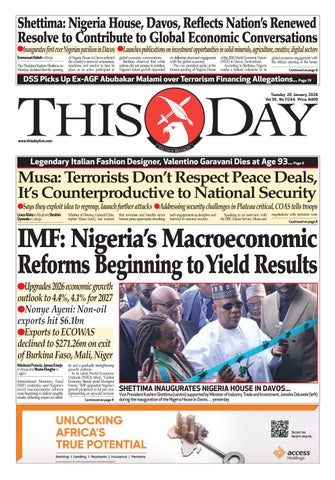
Inaugurates first ever Nigerian pavilion in Davos
of Nigeria House in Davos reflected the
Minister of Defence, General Christopher Musa (retd.),
Upgrades 2026 economic growth outlook to 4.4%, 4.1% for 2027
Nonye Ayeni: Non-oil exports hit $6.1bn
Exports to ECOWAS declined to $271.26m on exit of Burkina Faso, Mali, Niger www.thisdaylive.com
International Monetary Fund (IMF) yesterday said Nigeria’s recent macroeconomic reforms were beginning to deliver tangible results, reflecting improved stabil-
ity and a gradually strengthening growth outlook. In its latest World Economic Outlook (WEO), titled, “Global Economy: Steady amid Divergent Forces,” IMF upgraded Nigeria’s growth projection to 4.4 per cent, representing an upward revision
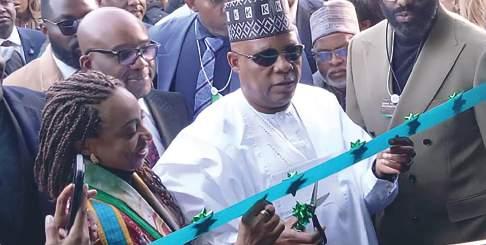




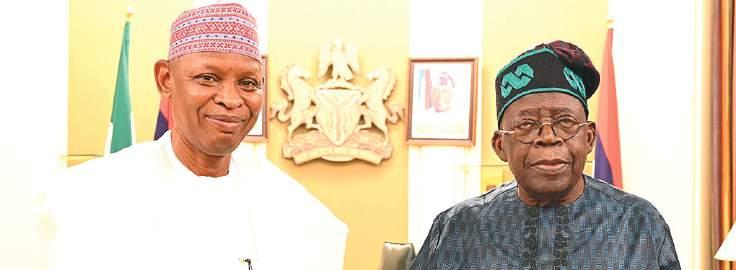
Kano State Governor, Abba Kabir Yusuf (L) with President Bola Ahmed Tinubu during the governor’s courtesy visit to the President at the
yesterday
Dike Onwuamaeze
The Centre for the Promotion of Private Enterprise (CPPE) pointed out that recent changes in the methodology for computing the Consumer Price Index (CPI) have raised concerns about the credibility of the latest inflation data.
It made this observation yesterday in its “Policy Brief on Nigeria’s December 2025 Inflation” figures.
The Chief Executive Officer of CPPE, Dr. Muda Yusuf, noted that “inflation is moderating, but data credibility is weakening.”
Yusuf added: “The decline in inflation suggests that macroeconomic stabilisation efforts are beginning to take effect.
“However, adjustments to CPI computation parameters have created credibility gaps, undermining the confidence of investors, analysts, businesses, and policymakers.”
He, therefore, advised that the policy focus should be on strengthening the technical capacity and analytical rigour to rebuild trust in statistical outcomes.
He said: “Review and improve CPI methodology to ensure alignment with economic realities.”
Yusuf advised the National Bureau of Statistics (NBS) to
strengthen its, “institutional capacity for data accuracy and quality assurance and improve technical and analytical rigour in CPI computation” to “rebuild public and investor confidence in statistical outcomes.”
According to him, the December 2025 inflation data confirmed that Nigeria’s inflation was moderating, driven largely by a decline in food prices, which is a positive development for households and economic stability.
“However, sustaining this progress requires urgent action to address structural cost pressures, support agricultural producers, and restore confidence in inflation data.
“Without these measures, the gains in affordability and price stability may not endure,” Yusuf said.
He pointed out that Nigeria’s inflation declined to 15.15 per cent in December 2025, which extended the disinflation trend recorded over the past 12 months.
He noted that the moderation was driven largely by falling food prices, which have provided some relief to households.
“Food inflation fell sharply to 10.84 per cent, and month-on-month food prices contracted. This has been the single biggest contributor
to easing the cost-of-living pressures on Nigerian households.
“Despite exchange-rate stability, core inflation increased to 18.63 per cent.
“This is inconsistent with macroeconomic fundamentals and suggests deeper structural pressures or possible statistical inconsistencies,” Yusuf said.
He pointed out that the sharp decline in food prices has created serious concerns about the sustain-
ability of farmers’ investments, as their returns are being eroded.
He said addressing affordability for consumers and investment viability for producers was now an urgent policy priority.
“The good news is that the Coordinating Minister for the Economy, Mr. Wale Edun, has indicated that the government is addressing this challenge,” he said.
According to the CPPE, while consumers benefit from lower
food prices, farmers face declining incomes amid rising input costs, which could risk discouraging agricultural investment and threatening long-term food security.
Yusuf advised the government to reduce the cost of fertilizers, agrochemicals, and machinery, as well as expand irrigation and mechanisation support.
The CPPE identified the following drivers of inflation as high energy and fuel costs, rising transportation
and logistics expenses, insecurity affecting agricultural output, high interest rates and credit costs, and import duties on key production inputs.
It stated further that sustaining the inflation decline would require closer alignment between fiscal and monetary authorities.
“Structural interventions must complement monetary tightening to reduce inflation without weakening production,” CPPE added.
Elumoye in Abuja
President Bola Tinubu, yesterday evening, met the Governor of Kano State, Abba Kabir Yusuf, at the State House, Abuja, amid rumour the governor was joining the All Progressives Congress (APC) from the New Nigeria People’s Party (NNPP).
Yusuf, upon arrival at the State House was led to the president’s first floor office by the Chief of Staff to the President, Hon. Femi Gbajabiamila.
The closed-door meeting came amid speculation over
a possible defection by Yusuf, who was elected in 2023 on the platform of NNPP to the APC. Therefore, the meeting with the resident might not be unconnected to Yusuf’s planned defection.
National leader of the NNPP, Senator Rabiu Kwankwaso, had earlier dismissed reports suggesting that he approved or endorsed any planned defection by the Kano governor, insisting that no such consent was given.
Political watchers say talks around the reported defection have been ongoing for weeks,
David-Chyddy Eleke in Awka Indigenes of Ogwu Ikpele in Ogbaru Local Government Area of Anambra State have protested the activities of an oil exploration company, Sterling Petroleum Energy Exploration Company (SPEECO), in their community.
The indigenes chose the 10th anniversary of SPEECO in their community to stage a protest, calling for government attention over their plight, which mostly centers on a lack of corporate social responsibility by the company and of basic amenities.
In a two-day protest held on Friday and Saturday, members of
the community who trooped out with placards lamented the lack of tarred roads, hospitals, electricity, pipe-borne water, and others. Youths, women, children, and elderly people marched through the community in protest, saying SPEECO’s 10 years of oil exploration on their community has put them in agony, denial, rejection, andThedegradation. President General of the community, its traditional prime minister, and other important personalities who spoke to journalists during the protest stated in one voice that they will no longer accept the activities of the oil exploration company.
The President General of the
community, Mr. Esumai Patrick Chukwudi, told journalists that a day before the commencement of the protest, the community had stopped all exploration activities, prompting the management of SPEECO to approach them for a meeting.
Esumai said: “The reason for the gathering and protest is to celebrate 10 years of rejection, humiliation, and insult from SPEECO exploration company, who have been mining oil in our land with nothing to show for it.
“No employment, no road, no water, no hospital, nothing that is coming from them, and we have been begging them since they started
operations. There is no metering that will ensure the quantity of oil being moved out of our land, which affects the PIA (Petroleum Industry Act).
“No single person from Anambra is employed. We have a consensus 60/40 agreement on employment for our youths, yet they renewed.
“Yesterday, we shut down all the Wells. We have about 12 wells in Umuokike, seven in Umuayas, seven in Umuugbeleke, Umuogbulishi, and Umuogbu, 12 wells. We shut it down, and that is why they came today for us to dialogue, and we have told them our grievances. They said they are going to fix another meeting.
though sources suggested negotiations might have stalled over disagreements, including whether the governor would be granted an automatic ticket ahead of the
2027 general election.
The speculation has also reportedly deepened tensions between some of Yusuf’s supporters and loyalists to Kwankwaso.
NiMet Predicts Three Days Dust Haze, Thunderstorms Across Nigeria
Nigeria Meteorological Agency (NiMet), yesterday, predicted dust haze and thunderstorms across Nigeria from January 19 to 21.
This was contained in the Weather Outlook issued by NiMet’s Central Forecast Office on January 18.
It stated that yesterday in the northern region, moderate dust haze was anticipated over parts of Kebbi and Kano states, with horizontal visibility of 2-5km, while the rest of the northern states would be under sunny and hazy skies throughout the forecast period.
In the central region, the agency stated that there would be moderate dust haze with horizontal visibility of 2–5km, anticipated over parts of the Federal Capital Territory (FCT) and Niger State, while the rest of the states in the region would be under sunny and hazy skies throughout the forecast period.
According to NiMet, in the southern region, there would be sunny skies with a few patches of cloud anticipated over the region, with prospects of afternoon/
evening thunderstorms with light rains over parts of, Bayelsa, Lagos, Cross River and Akwa Ibom states.
NiMet said today, in the northern region, a slight dust haze was anticipated over parts of Kano and Kebbi states, while the remaining states in the re-gion was expected to be under sunny and hazy skies throughout the forecast period.
In the central region, it said there would be sunny and hazy skies throughout the forecast period, with chances of isolated thundery activity over parts of Plateau State during the afternoon and evening hour.
In the southern region, NiMet said there would be sunny skies with patches of cloud anticipated over the region, with prospects of afternoon/evening thunderstorms with light rains over parts of Ogun, Ondo, Edo, Bayelsa, Rivers, Lagos, Cross River and Akwa Ibom states.
According to NiMet, on Wednesday, January 21, 2026, in the northern region, sunny and hazy skies are anticipated over the region throughout the forecast period.
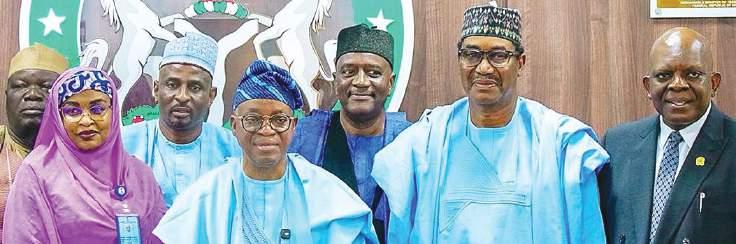
L-R: Permanent Secretary, Federal Ministry of Marine and Blue Economy, Mrs. Fatima Sugra Mahmood; Honourable Minister of Marine and Blue Economy, His Excellency Dr. Adegboyega Oyetola, CON; Chairman, Nigerian Shippers’ Council Governing Board, Dr. Ibrahim Shehu Shema; and the Executive Secretary/CEO of Nigerian Shippers’ Council, Dr. Pius Akutah, at the inauguration of the NSC Governing Board in Abuja, yesterday
Valentino Garavani, the Italian fashion designer whose name became synonymous with mastery of colour, elegance and haute couture, has died at the age of 93. His foundation announced yesterday that he passed away peacefully at his Roman residence,
surrounded by loved ones.
After the foundation’s announcement, formal condolence messages and public tributes came in broadly from across fashion, culture and public life.
According to his foundation, Valentino will lie in state on Wednesday and Thursday, ahead of his funeral in Rome on Friday,
allowing admirers, industry figures and the public to pay their final respects.
Known simply as Valentino, the deceased was more than a designer and was a cultural force who shaped how elegance looked, felt and moved for more than half a century.
From the glamour of post-war Rome to the grand salons of Paris,
Valentino built a fashion empire rooted in craftsmanship, colour and an unwavering devotion to beauty.
Born Valentino Clemente Ludovico Garavani on May 11, 1932 in Voghera, Lombardy, he developed an interest in fashion while still in primary school.
Encouraged by his parents, he apprenticed locally before moving
Deji Elumoye in Abuja
President Bola Tinubu has rejoiced with the Minister of Solid Minerals Development, Dr. Dele Alake, on his re-election as Chairman of the Africa Minerals Strategic Group (AMSG), a forum of ministers in charge of mining and solid minerals on the continent.
AMSG aims to maximise the benefits for Africans from Africa’s vast mineral resources.
Alake was first elected in 2024 on the sidelines of the Future Minerals Forum (FMF) and later re-elected at the 2026 Annual General Meeting (AGM) of the group, which was held on the sidelines of the same conference in Riyadh, Saudi Arabia.
The President, in a statement issued on Monday by his Adviser on Information and Strategy, Bayo Onanuga, described Al- ake’s re-election as a clear vote of confidence in his visionary leadership, steadfast commitment, and strategic advocacy for Africa’s minerals sector.
Tinubu noted that under Alake’s chairmanship, the AMSG has continued to provide a strong, united voice for African countries in advancing collaboration, safeguarding mineral resources, and positioning Africa as a key player in the global energy transition and the critical minerals value chain.
He commended the minister for aligning the objectives of the AMSG with Nigeria’s Renewed
Hope Agenda, particularly the drive to unlock the nation’s vast solid minerals potential, attract sustainable investment, create jobs, and ensure that mineral wealth translates into tangible socio- economic benefits for Africans.
“I congratulate Dele Alake for sustaining the confidence and trust of his colleagues across Africa, who have renewed his leadership of their forum. His commitment and pan-African vision to ensure our continent derives the greatest benefits from our mineral resources are commendable.
“As Nigeria’s Minister of Solid Minerals, he had led a reform agenda that is transforming the sector into a major contributor to our national economy,” the
In a solemn atmosphere of gratitude and reflection, members of the Nigerian Society of Engineers (NSE) gathered on Sunday for a special thanksgiving service, marking the conclusion of activities surrounding the inauguration of the Society’s 35th President, Ali Rabiu.
The service, held at the All Christian Fellowship Centre, Maitama, Abuja, attracted members of the NSE executive committee, distinguished fellows and engineers from various branches of the Society.
The team was led by the Deputy
President, Valerie Ifueko Agberagba, a statement by the engineering body said yesterday.
Addressing the congregation, Agberagba said the Society considered it important to return all glory to God in appreciation of His grace and mercies, which ensured a smooth and peaceful transition to a new leadership. She explained that the gathering was not only an expression of thanksgiving but also an opportunity for collective prayer and reflection. According to her, the leadership of the NSE also used the occasion to seek divine wisdom, guidance, and the capacity required to effectively
discharge the responsibility entrusted to it by over 81,000 members drawn from 93 branches across Nigeria and the diaspora.
Agberagba expressed gratitude to the leadership of the church for the warm reception accorded members of the Society.
In his prayers, the Founder and General Overseer of the Church, Dr. William Okoye, committed the leadership of the NSE to God, asking for strength, mercy, and guidance to enable the Society to scale greater heights. He also offered prayers for the continued growth of the NSE and for national progress.
President said.
Tinubu assured Alake of the federal government’s continued support as he leads the AMSG to deepen cooperation among African nations, strengthen institutional frameworks, and promote transparency, sustainability, and inclusiveness in the minerals sector.
to Paris at the age of 18, where he studied at the École des Beaux-Arts and the Chambre Syndicale de la Couture. Those formative years in Paris shaped his technical discipline and refined his aesthetic sensibility.
According to Wikipedi, Valentino’s early professional experience included working under Jean Dessès and Guy Laroche, before he returned to Italy to learn from Emilio Schuberth and Vincenzo Ferdinandi.
In 1960, he opened his own fashion house on Via Condotti in Rome, a city then alive with cinematic glamour, fuelled by the golden age of Cinecittà and its Hollywood stars.
His international breakthrough came in the mid-1960s, and by the 1970s and 1980s, the Valentino name had become firmly established at the summit of high fashion.
Central to his legacy was his mastery of colour, particularly the now-iconic “Valentino Red”, a vivid, sensual shade that became both his signature and a permanent addition to the fashion lexicon.
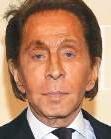
Valentino was not alone in building his empire. His longtime partner, Giancarlo Giammetti, brought business acumen and strategic vision, helping transform a couture house into a global luxury brand. Together, they navigated decades of growth, expansion and change, ultimately selling the company to the HdP Group in 1998 for US$300 million.
The Nigerian Communications Commission (NCC) has commenced consultations on the National Spectrum Roadmap 2026-2030, a critical initiative for Nigeria’s digital future.
NCC’s Executive Vice Chairman (EVC), Dr. Aminu Maida, who spoke at a stakeholders’ consultation forum in Abuja yesterday, hinted at the move to improve the quality of service.
Maida, who was represented at the event by the Head, Spectrum Administration NCC, Atiku Lawal, said: “Our national ambitions are growing; we want faster speeds, wider coverage, better service quality, stronger innovation and greater inclusion.
“This is the context in which the Spectrum Roadmap 2026–2030 has been developed.
“This roadmap is about creating
a transparent, predictable, and enabling regulatory environment that supports investment, encourages innovation, expands access, and improves service quality for all Nigerians.”
Earlier, Maida had stated:
“Today, we gather to deliberate on critical initiatives that will shape Nigeria’s digital future. These include: The development of the Spectrum Roadmap 2026–2030, guidelines for opening the lower 6 GHz band for Wi-Fi 6 and guidelines for opening the 60 GHz license-exempt band for multi-gigabit wireless systems.”
According to him, “together, these frameworks reflect our commitment to building a communications ecosystem that is inclusive, innovative, resilient, and future-ready. At the heart of our sector lies an essential national resource: spectrum.”
He stressed that the objective was to set out a clear and forward
-looking framework for the future use of spectrum, which will, in turn, give the industry the confidence to invest, the flexibility to innovate, and the assurance that Nigeria’s digital growth would be inclusive, sustainable, and aligned with national development priorities.
Alongside the roadmap, he noted that the guidelines for the lower 6 GHz and 60 GHz bands represent a bold step toward unlocking new capacity for high-speed, affordable and reliable connectivity.
He noted that the spectrum was behind everything digital, and may be invisible, yet indispensable.
“It powers the connectivity behind our mobile phones, our broadband connections, our satellite services, emergency communications, financial platforms, and smart technologies, behind every video call, every digital transaction, every online classroom, and every connected device in Nigeria, there is spectrum at work,” he said.
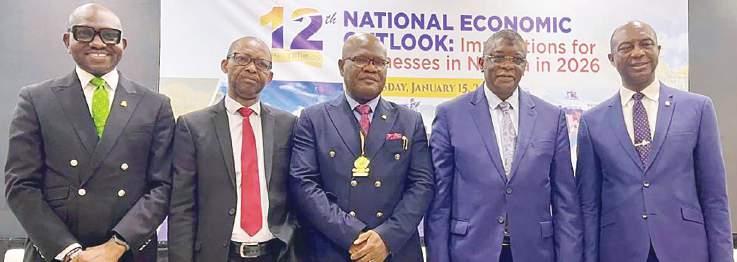
L-R: Registrar/Chief Executive Officer, CIBN, Akin Morakinyo, ACIB; Director, Monetary Policy, CBN, Dr. Victor Oboh; President/Chairman of Council of The Chartered Institute of Bankers of Nigeria, Prof. Pius Deji Olanrewaju, Ph.D, FCIB; Director General, West African Institute for Functional and Economic Management (WAIFEM), Dr. Baba Yusuf Musa; and Founder/Chief Consultant, B. Adedipe Associate Ltd, Prof. Biodun Adedipe, FCIB at the CIBN 2026 Economic Outlook held in Lagos …weekend
Mary Nnah
Future Union Qatar has taken a significant step towards strengthening Nigeria’s energy sector with the signing of a landmark Memorandum of Understanding (MOU) for investment in a Liquefied Natural Gas (LNG) project being developed by International Energy Services Limited (IESL).
A press release made available to THISDAY on Monday noted the historic agreement was formally signed in Qatar by Dr. Diran Fawibe, Chairman of IESL and former representative of Nigeria at the Organisation of the Petroleum Exporting Countries (OPEC), alongside members of IESL’s leadership team, including the Group Managing Director, Engr Adebayo Ige.
The Future Union delegation was led by its Chairman, Sheikh Abdulrahman Al-Thani.
The MOU was officially endorsed by Dr. Abdelgalil Sharaf, Chief Executive Officer of Future Union, together with Dr. Diran Fawibe, marking the commencement of a major long-term
investment partnership between both organisations.
The LNG project is expected to play a transformative role in Nigeria’s energy landscape by expanding gas production capacity, supporting gas exports, and creating substantial
employment opportunities for Nigerians across the energy value chain.
Speaking at the event, Princess Adebowale Odutola, Chairman of Elan Vert Nigeria Limited, who was present at the signing, described
the agreement as a milestone moment for Nigeria–Qatar economic collaboration.
She confirmed the MOU represents the beginning of Future Union’s promised investment drive in Nigeria, with implementation
planned progressively over the next ten years.
“This agreement reinforces investor confidence in Nigeria’s energy sector and demonstrates Future Union’s commitment to long-term, sustainable development
in the country,” she stated. The partnership underscores a shared vision to promote energy security, economic growth, and international cooperation, positioning Nigeria as a strategic hub for LNG development and export in Africa.
Kasim Sumaina in Abuja
Ex-Katsina State Governor, Ibrahim Shehu Shema and 10 others were on Monday in Abuja, Inaugurated into the Board of Nigerian Shippers’ Council (NSC) by the Minister of Marine and Blue Economy, Adegboyega Oyetola.
Inaugurating the board, Oyetola stated the event is more than a ceremonial rite; as it represents the activation of institutional governance, the entrenchment of accountability, and the com-
mencement of a renewed phase of purposeful oversight within our Marine and Blue Economy sector.
The minister in his speech said: “It gives me great pleasure to welcome you all to this significant occasion marking the formal inauguration of the Board of the Nigerian Shippers’ Council. His Excellency President Bola Ahmed Tinubu, GCFR, in furtherance of the Renewed Hope Agenda, has graciously approved the constitution of this Board in accordance with relevant statutory provisions.
In continuation of last year’s demonstrations over unpaid contractual fees, local contractors again besieged the Federal Ministry of Finance headquarters in Abuja, yesterday where they attempted to obstruct the Minister of State for Finance, Dr. Doris Uzoka-Anite, from gaining access to the ministry.
Under the umbrella of All Indigenous Contractors Association of Nigeria (AICAN), the protesters, who had first assembled close to the Ministry of Foreign Affairs from where they matched to the finance ministry’s central gate around 10am.
On getting to the ministry, they blocked the gate, demanding the payment of contract fees owed them by the federal government.
In December last year, the same contractors had for many days effectively blocked the ministry’s
gate and stopped anyone from gaining access into it or exit therefrom.
However, unlike the December episodes where neither the Minister of Finance and Coordinating Minister of the Economy. Mr. Wale Edun nor the Minister of State for Finance, Dr. Doris Uzoka-Anite avoided the ministry while the protests lasted for days, yesterday’s protest was different.
On arriving the entrance of the ministry yesterday, Uzoka-Anite’s security details made efforts to pave the way for her into the building, but the protesting contractors would have none of that.
Instead, they erupted in chants, “How many people government go kill. How many people government go kill.”
It was a hectic time trying to persuade the protesters to make way for the minister to gain access
into the Gunshotsministry. were fired into the air by security personnel to disperse the protesters.
Since last year, the contractors are demanding payment for most of the executed and commissioned projects.
In December 2025, President Bola Tinubu set up a multi-ministerial committee to resolve the debt owed to federal contractors, with outstanding payments standing at about N1.5 trillion.
The committee members comprised Wale Edun; Minister of Budget and Economic Planning, Atiku Bagudu; Director-General, Budget Office of the Federation, Tanimu Yakubu; Minister of Works, Dave Umahi; Minister of Housing and urban Development; Chairman of the Nigerian Revenue (NRS) formerly known as Federal Inland Revenue Service (FIRS).
“This decisive action underscores the administration’s commitment to good governance, institutional effectiveness, and the strategic repositioning of the Marine and Blue Economy as a driver of national transformation.”
Oyetola disclosed the Ministry is undertaking comprehensive reforms to reposition the sector as a vital pillar of economic growth and national development.
“Our focus includes improving port efficiency and competitiveness, strengthening trade facilitation, enhancing marine transportation, deepening fisheries and aquaculture development, expanding coastal and maritime opportunities, and safeguarding environmental sustainability,” he said.
According to him, “The Board of the Nigerian Shippers’ Council is expected to align fully with these
priorities and provide the strategic oversight required to translate policy into measurable outcomes.
“The Nigerian Shippers’ Council occupies a critical position as the designated Port Economic Regulator, entrusted with promoting efficiency, fairness, and transparency in port pricing, charges, and service delivery.
“The effective discharge of this mandate is essential to reducing the cost of doing business at our ports, facilitating trade, protecting the interests of shippers, and strengthening Nigeria’s competitiveness in regional and global commerce.
“As members of this Board, you bear a solemn public trust. You are charged with providing policy guidance, strategic direction, and vigilant oversight in accordance with the law.
“Let me emphasize that while Management is responsible for day-to-day operations, the Board’s duty is to ensure that the Council remains faithful to its mandate, complies with government policies, and consistently delivers value to Nigerian shippers and to the national economy.”
Speaking further, Oyetola asserted the Board must never become a routine forum, stating: “Every meeting must be purposeful, every deliberation must lead to clear and actionable decisions, and every decision must advance efficiency, fairness, and competitiveness in the maritime sector.
“Your effectiveness will be measured not by the frequency of meetings held, but by the tangible impact of your decisions on trade facilitation, cost reduction, and national competitiveness.
Michael Olugbode in Abuja
The National Agency for the Prohibition of Trafficking in Persons (NAPTIP) has warned that 2026 will be an extremely difficult year for human traffickers operating in the country, as the agency intensifies its crackdown on trafficking networks across Nigeria.
The Director-General of NAPTIP, Hajiya Binta Bello made this known in Abuja while reviewing the agency’s activities in 2025 and outlining its operational plans for
2026.
Bello disclosed that in 2025, NAPTIP secured the conviction of 93 human traffickers, describing the achievement as significant given the complexity of prosecuting trafficking cases.
She also stated the agency intercepted over 2,500 potential victims who had been deceived and recruited for various forms of exploitation within and outside Nigeria, adding that many of them were rehabilitated and reintegrated into society.
According to her, the agency’s
increased surveillance and coordination among its commands led to a rise in rescues, arrests, and successful prosecutions during the year.
She noted that traffickers were effectively disrupted, with several high-profile suspects arrested and convicted.
Among those apprehended were operators of some orphanages and care homes allegedly involved in trafficking and exploitation of children. Bello said over 120 suspected trafficked children were rescued from such facilities.
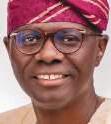
Governor Babajide Sanwo-Olu of Lagos State yesterday signed the state’s 2026 budget into law during a ceremony held at Lagos House, Alausa, Ikeja.
The ceremony was witnessed by Deputy Governor, Dr Obafemi Hamzat, members of the State Excutive Council, and members of the House of Assembly.
Sanwo-Olu had last December presented a budget of N4.2 trillion to the Assembly, tagged, “Budget of shared prosperity.”
However, the House of Assembly on January 8 approved a total of N4.4 trillion as the budget of the state for 2026, with an increase of about N2 billion.
The Assembly presided by Speaker Mudashiru Obasa, during a plenary, authorised the passage of the bill for a law to authorise the issuance and appropriation of N4,444,509,776,438.
Presenting the report on the floor
of the Assembly, Chairman of the Committee on Economic Planning and Budget, Sa’ad Olumoh, stated that the total budget for the 2026 fiscal year was N4,444,509,776,438, with N2,106,704,566,113 earmarked for recurrent expenditure, and N2,337,805,210,325 for capital expenditure for the year ending December 31, 2026.
Speaking shortly after signing the budget, Sanwo-Olu stated that the budget will be responsibly implemented in the interest of Lagosians.
While acknowledging an increase in the budget passed by the Assembly, Sanwo-Olu expressed satisfaction, saying it showed members of the Assembly believed Lagos residents deserved more.
Sanwo-Olu said, “On behalf of the people and the government of Lagos State, let me thank the House of Assembly. This is a budget that you have had your full input into, you have scrutinized, you have dissected, and you have taken your time to do the very constitutional
provision, which is enshrined in our constitution. I want to thank you for the work you have done.
“You will notice that there is a slight increase from what we put forward, but that goes to show that the independence that you have, and the fact that you believe that Lagosians actually also deserve more, and the fact that you believe that we also can do more. So, we’re excited and we’re happy with the way that you have brought it forward here to us.”
The governor added, “For us in the executive, it is another opportunity for us to be able to work together. It is a budget of shared prosperity that has been properly christened, and sharing prosperity means that it’s an inclusive government, it’s a budget that must carry everybody along irrespective of what part of the state, what division in the state, what sector you are from you must feel governance, you must feel the essence of why we’re in government in one form
or the other.
“If it’s on the road, that will be on the road. If it’s on the schools that we’re going to build, if it’s on the health facility we’re going to build, if it’s on the various industries and engagement we’re going to have, if it is on the various interventions that we will do to enhance and to improve the quality of lives.”
He said, “If it is for the security that we will provide to ensure that security of life and property is enshrined. These are ways in which the prosperity of every Lagosians will be felt in this budget in one form or the other.
“I want to assure you that this budget will be implemented responsibly so that Lagosians will feel the benefits.”
Majority Leader, Hon. Adams Nojeem, who represented Obasa, said, “I recall that Mr. Speaker has directed all committees in the Lagos State House of Assembly to scrutinise this project properly so that it can reflect the reality of today’s Lagos.
“And I’m happy to announce today that members of the committees, most especially the Chairman Committee on Budget has well scrutinized the budget.
“And I can say here today that the budget has been approved by the Lagos State House of Assembly and we have approved 4,444,509 million Naira. And we are sure that the budget will reflect the reality of today’s Lagos.”
Commissioner for Economic Planning and Budget, Opeyemi George, said, “The budget assent provides us the opportunity to clearly articulate the intent, direction, and delivery framework for the year 2026 budget of Lagos State, aptly themed the Budget of Shared Prosperity.
“This budget reflects deliberate planning and it strengthens the foundations for a more resilient, competitive, and people-centred Lagos, one that is equipped to address present challenges while positioning for future growth.”
George said, “With a total
IMF: NIGERIA’S MACROECONOMIC REFORMS BEGINNING TO YIELD RESULTS of 0.2 percentage points from its October WEO.
Economic growth was projected to moderate slightly to 4.1 per cent in both 2026 and 2027, also marginally higher than earlier estimates, underscoring growing confidence in the reform trajectory.
The latest projections emerged on the same day Executive Director/Chief Executive, Nigerian Export Promotion Council (NEPC), Nonye Ayeni, disclosed that the country’s non-oil export reached an all-time high of about $6.1 billion in 2025.
Ayeni said the performance
represented a year-on-year increase of about 11.5 per cent, compared to the over $5.46 billion recorded in 2024.
IMF stated that the improved outlook came amid a broader reassessment of economic prospects across Sub-Saharan Africa, where the fund also raised growth expectations.
The region was now projected to expand by 4.6 per cent in 2026 and 2027, reflecting upward revisions of 0.2 and 0.1 percentage points, respectively, from the fund’s previous forecasts.
Speaking at a hybrid press
briefing in Washington yesterday, Division Chief in IMF’s Research Department, Deniz Igan, said the upgrades reflected a combination of domestic policy adjustments and supportive external conditions.
According to Igan, commodityexporting economies across the region have benefited from firmer global prices, particularly for gold, copper and coffee, providing an important boost to export earnings and fiscal revenues.
She stated that several African countries were key exporters of the commodities, amplifying
the impact of favourable price movements.
More critically for Nigeria, IMF highlighted that macroeconomic stabilisation efforts were beginning to take hold in some of the region’s largest economies.
Igan cited Nigeria and Ethiopia as examples where policy reforms aimed at restoring balance through tighter monetary conditions, exchange rate adjustments, and broader fiscal measures were starting to improve economic predictability.
She stated, “Sub-Saharan Africa is another region where
MUSA: TERRORISTS DON’T RESPECT PEACE DEALS, IT’S COUNTERPRODUCTIVE TO NATIONAL SECURITY
never part of the federal government’s non-kinetic strategies. He stressed that experience had shown that armed groups exploited peace deals to regroup and launch further attacks.
He stated, “Peace deals with terrorists are not one of our nonkinetic approaches. Terrorists do not respect peace agreements. It is often a camouflage. When they are seeking advantage, they pretend to accept peace, but once trust is established, they renege and return to violence.”
Musa expressed concern that some state and local governments, as well as local communities had continued to enter into negotiations with bandits, despite repeated warnings from the federal government.
According to him, such actions undermine coordinated efforts to end insecurity across the country.
The minister cited Katsina State as an example, stating that the authorities have been advised against pursuing peace deals with bandits.
“We told them not to go into peace agreements with bandits. They do not believe in peace deals; they lie and do not keep their word,” he said.
Musa urged state and local governments to immediately discontinue negotiations with terrorist groups, insisting that bandits lack the moral restraint to honour agreements.
He stated, “There is no truth in peace deals with bandits because they will not respect them. These are people who continue to kill innocent citizens even while claiming to be at peace.”
He lamented that such local arrangements complicat-ed federal operations, as security forces were sometimes restrained from acting against armed groups under the pretext that peace agreements were in place, even as attacks persisted.
Musa said, “The peace deals entered into by some communities and state governments are frustrating our efforts at the federal level. On one hand, we are told not to engage the bandits because of an agreement, yet they continue to terrorise and kill people.”
While acknowledging the limitations of federal authority in a democratic system, Musa said the government would continue to engage with state and local authorities to discourage negotiations with terrorists.
He stated, “This is a democracy, not a military regime where unilateral decisions can be imposed. However, we will continue to dialogue with state and local governments to ensure a unified and effective approach to tackling terrorism and banditry.”
He reaffirmed the federal government’s commitment to restoring peace and security across the country through coordinated and sustained efforts.
COAS Reminds Troops
Chief of Army Staff (COAS), Lieutenant-General Waidi Shaibu, underscored the strategic importance of addressing the security situation in Plateau State, describing the role of troops in the area as vital to Nigeria’s
overall stability.
Shaibu made the remarks during an operational visit to Headquarters of 3 Division, Nigerian Army, Jos, where he addressed officers and soldiers deployed in the state.
Shaibu charged the troops to remain disciplined, committed and professional in the discharge of their constitutional responsibilities, stressing that discipline remains the foundation of military professionalism.
He reminded them that service in the Nigerian Ar-my was voluntary and driven by the noble responsibility of defending the nation’s territorial integrity and safeguarding its citizens.
In a statement by Acting Director of Army Public Relations, Colonel Apollonia Anele, it was disclosed that the COAS received a comprehensive briefing from the General Officer Commanding (GOC), 3 Division, on the operational and welfare challenges facing the troops.
The statement said many of the critical issues raised had already been addressed.
Shaibu assured the troops that the army headquar-ters was providing the necessary combat enablers to ensure they were adequately equipped to carry out their duties effectively.
He reiterated that troop welfare remained a top priority.
“The welfare of our personnel is paramount. We will continue to create the enabling environment required for you to perform your duties efficiently,” the COAS said.
He urged younger soldiers to respect the chain of command and
seek guidance from their superiors, stating that officers are entrusted with the responsibility of mentoring subordinates towards professional growth and successful military careers.
The COAS also emphasised the need for sustained physical fitness and mental alertness, explaining that deliberate measures have been put in place to adequately prepare troops for the demands of military operations.
Highlighting the role of leadership
Continued on page 22
we recorded upgrades to our growth forecasts for 2025. Growth is now projected at 4.4 per cent, which is 0.2 percentage points higher than our earlier estimate.
“For 2026 and 2027, we expect growth of 4.6 per cent, representing a cumulative upward revision of 0.3 percentage points compared with our October projections.
“These upgrades are driven by three main factors. First is the strength in commodity prices, particularly for gold, copper and coffee, commodities for which several countries in the region are major exporters.”
Igan added, “Second, macroeconomic stabilisation efforts are beginning to yield results in key economies, notably Ethiopia and Nigeria. Third, ongoing structural reforms in another major regional economy, South Africa, are also supporting the improved outlook.
“Together, this combination of favourable commodity price movements and a more predictable and stable macroeconomic environment has strengthened the region’s growth prospects.”
She said, “In addition, global financial conditions have been more supportive than expected.
External borrowing costs have declined and, overall, condi-
proposed size of N4.2 trillion, which was reviewed upwards likely to N4.444 trillion by the Lagos State House of Assembly after legislative scrutiny and committee engagements with ministries, departments, and agencies, the year 2026 budget represents a bold yet disciplined fiscal response to prevailing economic realities.
“The administration is prioritizing economic affairs with deliberate emphasis on infrastructure renewal, transportation expansion, agricultural development, and other growth-enhancing activities that stimulate business and economic development.”
tions have improved relative to October, contributing to the upward revisions.”
Beyond domestic reforms, IMF said global financial conditions had been more supportive than previously expected. It said external borrowing costs had eased, improving access to financing and reducing pressure on highly indebted economies.
Compared with conditions in October, the fund said the external environment had become marginally more favourable, contributing to the upward revisions in growth projections.
However, the fund cautioned that downside risks remained significant, particularly for lowincome and fragile economies.
Igan warned that anticipated cuts in international development assistance could weigh on growth and social spending in vulnerable countries. In addition, any sudden tightening or correction in global financial conditions could reverse recent gains, especially for economies still adjusting to reform-induced pressures.
She added, “That said, risks remain elevated. These include anticipated cuts in international
Continued on page 22
SHETTIMA: NIGERIA HOUSE, DAVOS, REFLECTS NATION’S RENEWED RESOLVE TO CONTRIBUTE TO GLOBAL ECONOMIC CONVERSATIONS
at WEF 2026.
He stated, “This day is extraordinary in the history of our engagements at this beautiful meeting point of global political leadership, policy thinkers, and corporate enterprise. For the first time in our nation’s history, Nigeria stands at Davos with a sovereign pavilion of its own.
“Nigeria House is a response to the lapses of the past. It reflects our intention. It reflects our seriousness. Above all, it advertises both our readiness and our resolve to take a front-line seat in the discourse of the global economy, not as observers, but as participants with a clear sense of purpose and place.”
Shettima pointed out that even though “Nigeria House may have been conceived as a whole-ofgovernment platform, led by the Honourable Minister of Industry, Trade and Investment, with senior leadership across investment, foreign
affairs, energy, infrastructure, technology, climate, and culture gathered under one roof,” the true essence of the house must come from the private sector.
He maintained, “Government can open doors, create frameworks, and de-risk environments; only enterprise can animate growth, scale opportunity, and translate policy into productivity. This House will thrive to the extent that it draws life from private capital, private innovation, and private confidence.”
The vice president explained that the dividends of the Tinubu administration’s reforms were beginning to materialise, stressing, “Our decision to open up to the world more deliberately comes at a turning point in our economic journey.”
He said, “The dividends of the difficult but inevitable reforms of recent years are beginning to show.”
Shettima recalled that in 2025,
the Nigerian economy expanded by about 3.9 per cent, the fastest pace recorded in over a decade, driven largely by a resilient non-oil economy that now accounted for roughly 96 per cent of GDP. He explained, “Services, agriculture, finance, and technology are expanding, while non-oil revenues now make up nearly three-quarters of government collections, marking a structural shift away from oil dependence.
“Inflation, which stood above 30 per cent in late 2024, eased significantly by the end of 2025, and external buffers have improved, with foreign reserves rising above 45 billion dollars and greater stability in the foreign exchange market.” He invited the international business community to leverage the platform created through the Nigeria House project, saying,
Continued on page 21
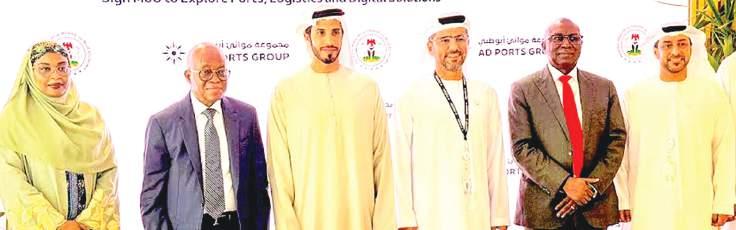
L-R: Permanent Secretary, Federal Ministry of Marine and Blue Economy, Fatima Sugra Mahmood; Minister of Marine and Blue Economy, Adegboyega Oyetola; Chief Executive Officer, Maritime and Shipping Cluster and Noatum Maritime, Captain Ammar Al Shaiba; Chairman, Board of Directors of the Abu Dhabi Ports Group, Mohamed Hassana; Director General/CEO NIMASA, Dr. Dayo Mobereola; and CEO, Ports Cluster, Saif Al Mazrouei, shortly after Abu Dhabi Ports Group and Nigeria’s Federal Ministry of Marine and Blue Economy have signed a landmark Memorandum of Understanding (MoU) to explore strategic collaboration in ports development, maritime logistics, and digital solutions held in Dubai…recently
U.S. President Donald Trump has linked his drive to take control of Greenland to his failure to win the Nobel Peace Prize, saying he no longer thought “purely of peace” as the row over the island yesterday threatened to reignite a trade war with Europe.
Trump has intensified his push to wrest sovereignty over Greenland from fellow North Atlantic Treaty
Organisation (NATO) member Denmark, threatening punitive tariffs on countries which stand in his way and prompting the European Union to weigh hitting back with its own measures.
The dispute is threatening to upend the NATO alliance that has underpinned Western security for decades and which was already under strain over the war in Ukraine and Trump’s refusal to protect allies which do not spend enough on defence.
It has also plunged trade relations between the EU and the U.S., the bloc’s biggest export market, into renewed uncertainty after the two sides painstakingly reached a trade deal last year in response to Trump’s swingeing tariffs, a Reuters report said.
In a written message to Norway’s Prime Minister Jonas Gahr Stoere that was seen by Reuters, Trump said: “Considering your country decided not to give me the Nobel Peace Prize for having stopped 8 wars
plus, I no longer feel an obligation to think purely of peace, although it will always be predominant, but can now think about what is good and proper for the United States of America.”
The Norwegian Nobel Committee annoyed Trump by awarding the 2025 Nobel Peace Prize not to him but to Venezuelan opposition leader Maria Corina Machado. She gave her medal last week to Trump during a White House meeting, though the Nobel
Hammed Shittu in
The federal government yesterday said it has rolled out a new national housing strategy anchored on land reform, urban renewal and public private partnerships capable of addressing Nigeria’s widening housing deficit.
Minister of Housing and Urban Development, Arc. Ahmed Musa Dangiwa, stated this in Ilorin on Monday during the 14th National Council on Lands, Housing and Urban Development meeting.
The theme of this year’s Council Meeting is titled, “Achieving Housing Delivery and Sustainable Cities through Effective Land Management, Urban Renewal,
Promotion of Local Building Materials, and Public-Private Partnerships in Nigeria”.
He stated that, “Nigeria’s housing deficit, estimated in the tens of millions, remains one of the country’s most pressing social and economic challenges, driven by rapid urbanisation, population growth and rising construction costs”.
He however said that, the new policy direction would place effective land administration at the centre of housing delivery and adopts urban renewal as a tool for rebuilding Nigerian cities.
According to him, this would position private sector investment as the main driver of mass housing
development nationwide.
The minister, represented at the event by Director of Planning, Research and Statistics, Alhaji Mukhtar Ilyasu, added that, “the new policy framework is expected to shape housing delivery, land administration and urban development planning across the federation in the coming years”.
The minister said the federal government has placed effective land management at the centre of its housing delivery strategy.
He described land administration as the foundation for expanding access to affordable housing nationwide.
According to him, urban renewal and regeneration have now
Omon-Julius Onabu in Asaba
As activities towards the 2007 general election intensify across the state, youths of Ndokwa ethnic extraction, under the aegis of Ndokwa Youth Leaders Assembly (NYLA), have asked former Governor Ifeanyi Okowa to heed the call from different quarters to run in the 2027 Delta North Senate race.
Describing Sen. (Dr.) Okowa as “the most credible, unifying and development-rooted figure”
capable of giving Delta North Senatorial District the strategic and high-impact representation in the National Assembly, the group expressed its readiness to purchase the application forms for Okowa when he declares his interest to contest.
In a press statement at the end of its meeting at Ogume in Ndokwa West Local Government Area, the NYLA said the appeal was advised by what it described as Okowa’s “tested competence, administrative
maturity, bridge-building capacity, and visible investment in human and infrastructural development across Delta North during the period he served as Governor of Delta State.”
More than ever before, Delta North today requires a senator with “both national leverage and local content”, stressing that Okowa clearly embodies that mix, the statement from the meeting presided over by the National President of the group, Comrade Enebeli Ernest Brown, stated.
been adopted as national policy tools for modernising Nigerian cities, addressing uncontrolled urban growth and responding to population pressure and climate challenges.
He said the government is also prioritising the large-scale adoption of locally sourced building materials and technologies as a cost reduction strategy aimed at making housing more affordable while strengthening domestic construction industries.
Committee said the prize cannot be transferred, shared or revoked.
In his message, Trump also repeated his accusation that Denmark cannot protect Greenland from Russia or China. “... and why do they have a ‘right of ownership’ anyway?” he wrote, adding: “The World is not secure unless we have complete and total control of Greenland.”
Trump vowed on Saturday to implement a wave of increasing tariffs from February 1 on EU members Denmark, Sweden, France, Germany, the Netherlands and Finland, along with Britain and Norway, until the U.S. is allowed to buy Greenland, home to only 57,000 people.
In a post on Facebook, Greenland’s Prime Minister Jens-Frederik Nielsen said the territory should be allowed to decide its own fate. “We will not let ourselves be pressured. We stand firm on dialogue, on respect and on international law,” he said.
Norway’s Stoere amended his schedule, announcing that he would attend the World Economic Forum in Davos on Wednesday and Thursday, overlapping with Trump’s planned appearance at the annual gathering of the global political and business elite.
Stoere had not been scheduled to attend this year’s conference at the Swiss Alpine resort, where Trump is
expected to deliver a keynote address on Wednesday in his first appearance at the event in six years.
German Chancellor Friedrich Merz said he too would try to meet Trump on Wednesday, adding that a trade dispute was not wanted. “But if we are confronted with tariffs that we consider unreasonable, then we are capable of responding,” Merz said.
EU leaders will discuss their options at an emergency summit in Brussels on Thursday. One option is a package of tariffs on 93 billion euros ($108 billion) of U.S. imports that could automatically kick in on February 6 after a six-month suspension.
Another option is the “AntiCoercion Instrument” (ACI), which has never yet been used and which could limit access to public tenders, investments or banking activity or restrict trade in services, in which the U.S. has a surplus with the bloc, including in digital services.
The EU said it was continuing to engage “at all levels” with the U.S. but said the use of its ACI was not off the table.
British Prime Minister Keir Starmer called for calm discussion between the allies, adding that he did not believe Trump was considering military action to seize Greenland.
The Chairman of the Southern Governors’ Forum and Governor of Ogun State, Prince Dapo Abiodun, has poured glowing tributes on the Super Eagles of Nigeria for their heroic outing and bronze medal triumph at the 2025 Africa Cup of Nations (AFCON), describing their performance as a victory of spirit, courage, and national pride.
Governor Abiodun saluted the Eagles for playing what many adjudged as the most exhilarating and dominant football at the tournament, noting that the team went unbeaten in regulation time throughout the competition, winning all their matches except the semi-final, which was decided
by the lottery of penalties.
He noted that Nigeria’s outstanding record - scoring the highest number of goals in the group stage and conceding none in the knockout rounds before the semi-final - was a testament to the team’s quality, discipline, and the enduring excellence of Nigerian football.
The Ogun State governor further praised the Eagles for their resilience and mental strength, particularly their emphatic victory over the Pharaohs of Egypt in the third-place match, despite what he described as unfair officiating in the semifinal clash against Morocco, the controversial seizure of goalkeeper
Stanley Nwabali’s towel, and the intense hostility of the home crowd. According to him, the performance of the Super Eagles rekindled national pride and reminded the world of Nigeria’s rich footballing heritage.
“Members of the Southern Governors’ Forum and Nigerians from every corner of our great nation are immensely proud of these brave Eagles,” Abiodun said. “They were not defeated in regulation time by any team. But for officiating decisions that dampened morale, they would have stood tall in the final. Yet, they rose above adversity and finished strong, with dignity and honour.”

Acting Group Politics Editor DEJI ELUMOYE
Email: deji.elumoye@thisdaylive.com
08033025611 sms only
Nigeria is visible everywhere - in culture, commerce and conversation. Yet, trusted nowhere enough. The recent unveiling of the Nigeria Reputation Perception Index 2025 at the National assembly in abuja, exposes a troubling paradox of a nation bursting with influence and promise, but constrained by credibility deficits that continue to weaken its political authority and global standing. sunday Aborisade reports.
Nigeria today stands at a critical crossroads in its relationship with the world. Loud, visible, culturally magnetic and impossible to ignore, Africa’s most populous nation nevertheless struggles with a credibility deficit that continues to undermine its vast potential. This contradiction, a country rich in talent, influence and opportunity, yet constrained by low global trust, sits at the heart of the inaugural Nigeria Reputation Perception Index (NRPI) 2025, a landmark report that has injected fresh data, urgency and clarity into the long-running debate about Nigeria’s global standing.
Unveiled in Abuja at a well attended ceremony under the chairmanship of the Deputy Senate President, Senator Jibrin Barau, by the Nigerian Institute of Public Relations (NIPR) in collaboration with Reputation Perception Services (RPS), the NRPI 2025 is the first systematic, evidence-based attempt to measure how Nigeria is perceived by both its citizens and international stakeholders.
Seven years in the making, the index moves the conversation on national reputation away from anecdote, emotion and propaganda into the realm of data, structure and accountability.
Its headline finding is sobering: Nigeria scored 35.2 per cent, placing the country firmly in a low-trust reputation band. For a nation of Nigeria’s scale, resources and cultural reach, the score exposes a profound disconnect between potential and credibility, a paradox that policymakers, investors and diplomats can no longer afford to ignore.
Crucially, the NRPI is not a verdict on any single administration or reform programme. Rather, it is a broader assessment of Nigeria as a country, its institutions, leadership signals, delivery capacity and social contract, as experienced and interpreted by people at home and abroad.
The index evaluates perceptions across seven pillars: Leadership, Performance, Credibility, Communication, Innovation, Social Equity and Culture. Together, they form a composite picture of how trust is built, sustained or eroded over time.
While the report acknowledges policy initiatives and reform efforts undertaken in recent years, particularly in economic
management, digital innovation and institutional restructuring, it notes that reputation operates on a longer time horizon.
Unlike perception, which can shift quickly, reputation is cumulative, requiring consistency, delivery and credibility across years, not months.
In effect, Nigeria’s challenge is not visibility. It is trust execution.
Perhaps the most striking insight from the NRPI 2025 is the uneven performance across the seven pillars. Culture emerged as Nigeria’s strongest asset, with a score of 48.7 per cent, underscoring the country’s immense soft power. From music and film to fashion, sports and literature, Nigeria continues to shape global conversations, particularly among younger audiences.
Nollywood, the report stated, remains one of the world’s largest film industries. Nigerian creatives, professionals and entrepreneurs are visible across continents. In terms of cultural influence, Nigeria punches far above its weight.
Yet this visibility has not translated into trust.
Credibility, the pillar most closely associated with confidence in governance and institutions, recorded a troubling 28.1 per cent, the lowest score in the index. Performance, innovation and communication also remained under pressure, reinforcing scepticism among both domestic and
international audiences.
The implication is clear: while Nigeria’s story is widely heard, it is not consistently believed.
The report indicates that persistent global media narratives focused on insecurity, corruption, policy inconsistency and systemic weaknesses which continue to overshadow gains in entrepreneurship, technology and cultural diplomacy. Even when positive developments occur, it added, fragmented communication and weak institutional followthrough blunt their reputational impact.
The NRPI also exposes a notable 9.6-point gap between domestic and international perceptions, suggesting that global audiences judge Nigeria more harshly than its own citizens do. This gap matters.
In a world where capital, tourism, partnerships and diplomatic influence are increasingly shaped by perception-driven decisions, external trust deficits carry tangible costs. Poor reputation raises borrowing costs, deters long-term investment, complicates visa regimes and weakens a country’s negotiating leverage, even when its policy positions are sound.
As a former ambassador and President of the Association of Retired Career Ambassadors of Nigeria, Joe Keshi, warned at the unveiling, “In today’s world, capital follows confidence and credibility, not noise.”
That message was echoed by the Deputy President of the Senate, Senator Jibrin Barau, who described the NRPI unveiling as a watershed moment in Nigeria’s governance journey.
He argued that reputation is no longer about sentiment or image laundering but a
For Barau, the index offers more than a diagnosis, it provides a compass for policy reform, institutional accountability and national reorientation. leadership quality, policy consistency, institutional integrity and citizens’ daily experiences all feed into the reputational ecosystem.
strategic national asset with direct implications for economic opportunity, diplomacy and social cohesion.
The ranking Senator said, “Reputation is evidence, experience and trust. Countries that deliberately manage their reputation are better positioned to compete globally,”
For Barau, “the index offers more than a diagnosis, it provides a compass for policy reform, institutional accountability and national reorientation.
“Leadership quality, policy consistency, institutional integrity and citizens’ daily experiences all feed into the reputational ecosystem”.
In this sense, reputation management is not the job of public relations professionals alone. It is a whole-of-government and whole-of-society project.
For the President of NIPR, Dr Ike Neliaku, the Institute’s greatest contribution lies in shifting the reputation conversation from assumption to measurement.
Drawing on global benchmarks such as the Edelman Trust Barometer, Canada’s RepTrak system and South Africa’s reputation framework, the index establishes a credible baseline against which progress, or regression, can be tracked.
Neliaku said, “This is not just a report; it is a national capability. Reputation is an economic instrument. It takes decades to build and can be destroyed in seconds. That is why it must be governed like revenue.”
His observation that Nigerians themselves remain widely admired abroad, for professionalism, resilience and warmth, underscores another dimension of the paradox. Nigeria’s people often enjoy goodwill that the state has failed to convert into structured economic and diplomatic capital.
Technically, the NRPI is anchored on the Reputation Perception Index (ROPI) Framework, which identifies leadership as the most heavily weighted pillar, accounting for 17 per cent of the overall score. Leadership signals direction, stability and intent. But intent alone is insufficient.
NOTE:
‘Bandits, criminals, insurgents, terrorists should stop, because they say, a friend of a thief is a thief….If we get to the battlefield and you are among them, then whatever happens to them happens to you.’ - Rtd General Christopher Gwabin Musa, Minister of Defence, Federal Republic of Nigeria
Condolences
First, I must express my heartfelt condolences to Chimamanda Adichie, her Husband, Dr Ivara Esege, and their whole family, on the very sad death of their beloved son, Nkanu Nnamdi. The loss of a child is the greatest nightmare of a parent, and I’m sure I speak for all Nigerians when I say, we deeply sympathise with them, and pray for God’s comfort and strength for them during this most difficult time. Amen.
Cases of Alleged Medical Negligence Reported by Me
In my career as the Editor of This Day Lawyer, this is the third time I have written on issues bordering on deaths in hospitals, in which families of the deceased have cried ‘unnatural death/medical negligence’. Nkanu’s case is the third.
The first time was very early in my career as Editor, in December 2016, in my article, “Doctors in Nigeria: Healers or Killers”, when Child X died in a children’s hospital in Victoria Island. The second time was in March 2024, “In Defence of Citizen Rebecca”, when Miss Rebecca Sekidika, who went for a simple Hysteroscopy at Paragon Clinic and Imaging Centre, Port Harcourt, instead of being given an injection to numb her cervix, was given a spinal epidural which is used for an operative Hysteroscopy, and that led to her death under questionable circumstances. In the case of Child X, I was given the opportunity to interview Child X’s Parents and the Hospital, and I was able to lay out a detailed account of the versions of events on both sides, from the day Child X took ill until Child X died. In the case of Rebecca, it wasn’t necessary, as her case wasn’t a long drawn out one - she went into Paragon on her two feet, hale and hearty, for a minor investigative procedure to check the cause of the irregularity of her menstrual period, and as a result of what transpired during the procedure, a more or less healthy person didn’t come out alive. It was so heartbreaking.
Nkanu Nnamdi Adichie-Esege’s Case Nkanu’s case appears to be similar to that of Child X, not necessarily in whatever ailments they were both suffering from, but, in the fact that the events that culminated in their deaths, spanned a number of days. I watched an interview of Professor Alero Roberts on Arise TV’s Morning Show last week, and she made the point that, in such cases, everything that occurs from the time a child takes ill until death, is very important. But, instead, the popular narrative that has made the rounds about Nkanu, excludes what occurred on his journey from when he took ill and was said to have initially received home care, to when he was first admitted at Atlantis Hospital for a few days, and the blame for his death has been placed solely at the feet of Euracare Hospital, where he was taken for specific diagnostic tests requested for by Johns Hopkins Hospital, Baltimore, Maryland, USA (JH) a world renowned Teaching Hospital and Research Centre, in anticipation of his evacuation there. It was reported that, Nkanu was at Euracare for less than 24 hours - January 6-7, 2026.
Allegations
Ms Adichie has alleged principally that Nkanu was given an overdose of the sedative, Propofol, and this caused his death. She claimed in a statement, that one Dr M at Euracare, informed her that Nkanu was given an overdose of Propofol. She also stated that JH had requested for a Lumbar Puncture (LP) and an MRI. It was as a result of this request made while Nkanu was at Atlantis, that he was taken to Euracare for these procedures to be carried out. The request shows that Nkanu was in a serious condition, and JH suspected that he may have had Meningitis or some neurological symptoms, which is what LP diagnoses, with the MRI to provide detailed images of the brain and spinal cord to check a possible spread, if indeed, that is the case. Meningitis is an extremely serious condition, that can kill a patient within 24 hours. Is it then possible, to completely ignore such a serious condition which may have remained untreated, and blame the death of such a patient, solely on a sedation overdose? This is a question, that was begging to be answered.
Autopsy
And, to determine whether a Propofol overdose was indeed, the cause of Nkanu’s death, or what the cause of his death is, an Autopsy, that is, a postmortem examination upon his death would be required. One doesn’t need to be a Doctor, to know that. It is therefore, stunning and bizarre that investigative journalism appears to point to the fact that Nkanu’s remains may have already been cremated by his Parents, without any duly authorised autopsy having been carried out on him. In such circumstances, medical representatives of all the parties concerned, should be present during the autopsy carried out by the Medical Examiner.
Section 48(1) of the Coroners’ System Law of Lagos State 2007 (CSL) provides that the chemical preservation, dismemberment or disposal of a body of a person who died in circumstances that require a Coroner’s Inquest, without the approval of the Coroner, is an offence and upon conviction, attracts 15 years imprisonment without an option of fine. In the circumstances of Nkanu’s death, where a specific allegation has been made as to the cause of his death, that he was given an overdose of Propofol, no sensible Coroner would approve the disposal of the
onikepo braithwaite
oNIkepo BraIThwaITe
onikepo.braithwaite@thisdaylive. com onikepob@yahoo.com
“The request shows that Nkanu was in a serious condition, and JH suspected that he may have had Meningitis or some neurological symptoms, which is what LP diagnoses…..to determine whether a Propofol overdose was indeed, the cause of Nkanu’s death…an Autopsy… upon his death would be required. ….It is therefore, stunning and bizarre that investigative journalism appears to point to the fact that Nkanu’s remains may have already been cremated by his Parents, without any duly authorised autopsy having been carried out on him….. disposal of a body of a person who died in circumstances that require a Coroner’s Inquest, without the approval of the Coroner, is an offence…attracts 15 years imprisonment….”
body that is required to prove or disprove such allegation. It makes no sense. It appears that the evidence required to prove this particular allegation, or determine the cause of Nkanu’s death, may have been deliberately destroyed. Any Lawyer would have reservations, if indeed, he was cremated. A reasonable observation would be that, if there is certainty about something, why destroy the evidence that would prove it? I use the word ‘deliberately’ because, it is obvious that once a corpse is cremated, it will no longer be available for a physical autopsy, which is the best way to determine the cause of death. Even with technology, a virtual autopsy for example, still requires imaging of the corpse, and while analysing medical images and medical history may be useful, they cannot take the place of a traditional physical autopsy. Whatever samples that were taken from Nkanu at Atlantis Hospital or even Euracare on his arrival there, may only testify to the condition of his health as of that time.
In Abelegah v State (2015) LPELR-24793 (CA) per Obande Festus Ogbuinya, JCA (now JSC), the Court of Appeal held thus: “In the clinical field, autopsy means "dissection of a body after death, to determine the cause of death; a postmortem examination of a body". In Okolie v State (2014) LPELR-23256 (CA) per Uwani Musa Abba Aji, JCA (now JSC), the Court of Appeal held thus: “The main purpose of autopsy is not for identification of the corpse or the body of the deceased, but for ascertainment of the cause of death, though identification may be integral”. Also see Lawal v State (2025) LPELR-80000(CA) per Muslim Sule Hassan, JCA. The cause of death of a patient in circumstances of sickness, cannot be determined simply by the say so of anybody, social media, or the court of public opinion.
In Aderinkomi v State (2021) LPELR-56340 (CA) per Mistura Omedere Bolaji-Yusuf, JCA, the
Court of Appeal held inter alia that a postmortem report may not be a legal necessity, “where there is cogent, credible and compelling evidence….. which unequivocally established the cause and circumstances of ……death”. Let me give an example. If three friends are walking down the street and an armed robber attacks them, steals their phones and cash and then shoots one of them dead, it is clear that the man was killed by the bullets. With the eyewitness accounts and the bullet ridden corpse, there is cogent and compelling evidence regarding the deceased’s cause of death.
But, a case in which a very sick patient dies in blurry, unnatural circumstances, having been moved from one hospital to another, with a plan to be evacuated to a third foreign hospital that also made diagnostic requests - this wouldn’t qualify as one that a postmortem examination isn’t required. In fact, it qualifies as one that the Hospital is expected to report to the Coroner, about being a death in unnatural circumstances, so that an Inquest follows.
It is trite that, he who alleges must prove. Where a specific cause of death is alleged, the person making that allegation must prove it, beyond reasonable doubt. See State v Chukwu (2021) LPELR-56610(SC) per Mohammed Lawal Garba, JSC. Therefore, determining if Nkanu died from a Propofol overdose, requires proof from an autopsy - see Abelegah v State (Supra). I watch a lot of real life US Crime Channel Programmes, and the Pathologists say that a deceased tells the story of the cause of their death themselves, through the postmortem examination.
The Procedure
A Coroner’s Inquest is a judicial public inquiry, held to determine the cause of death. Sections 14 & 15

of the CSL provide inter alia that, a report of death shall be made to the Coroner’s Office when there’s reasonable cause to believe that the cause of a death is unknown, unnatural, suspicious, violent, sudden, unexpected or by the negligence of others; and the Coroner shall hold an inquest when he/she is informed of the death of a deceased person lying in his/her Coroner District who has died in any of the aforementioned circumstances, amongst others. In such a case as Nkanu’s, by virtue of Section 26 of the CSL, the Coroner should direct a postmortem examination (see Section 54 of the CSL) on the completion of which the Medical Examiner will issue a Report to the Coroner who requested for the autopsy and the Chief Coroner of the State.
In a case such as this, a forensic autopsy would be ordered, as is the case when there may be a likelihood of a court trial. Additionally, being a child, Nkanu’s autopsy should involve at least two types of Pathologists - Forensic and Paediatric.
During the Inquest, the Coroner, inter alia, summons witnesses, takes evidence on oath and even documents (Section 39 of the CSL). On conclusion of the Inquest, the Coroner shall give a written verdict as to how and when the deceased met their death, and forward it to certain officials including the Divisional Police Officer (DPO) in the District which the Inquest was held (Section 41 of the CSL). On the conclusion of a Coroner’s Inquest, the death may be ruled natural, thereby more or less resting the case (aside from the necessary administrative actions required to be completed on its conclusion), or an arrest may be ordered, or an order for further investigation by the Police which is expected to lead to the arrest of other unknown suspects.
It is true that, too regularly for comfort, Nigerians hear of cases of medical negligence. Patients are certainly, owed a duty of care. There are numerous reasons for medical negligence, including the Medical and Dental Council of Nigeria, not being particularly up and doing, and the punishments prescribed for medical malpractice in the Code of Medical Ethics 2008 (CME) which governs the activities of Medical and Dental Professionals, being too lenient. The level of monitoring of professionals, also appears to be extremely low; there must be a review of the CME and better monitoring processes of Medical and Dental Professionals by the Health Facility Monitoring Agency at the Federal Ministry of Health.
Section 30 of the CME provides that where a professional’s negligence results in the permanent disability or death of a patient, the professional is guilty of gross negligence, and is liable to six months suspension, or having his/her name struck off the Medical or Dental Register. Of course, this gross negligence may amount to manslaughter which is a grave criminal offence. In Popoola v State (2018) LPELR-43853(SC) per Olabode Rhodes-Vivour, JSC, the Supreme Court defined Manslaughter thus: “….the unintentional killing of a human being. Such a killing is not premeditated but accidental, in the sense that it was not intentional”. Sections 224(b) & 229 of the Criminal Law of Lagos State 2015 (CLLS) provide for the offence of Involuntary Manslaughter as a result of gross negligence or reckless disregard for human life, and prescribes a punishment of life imprisonment upon conviction. However, in Ojo v Gharoro (2006) LPELR-2383(SC) per Niki Tobi, JSC, His Lordship cited a chapter ‘Doctors at Law’ in Lord Denning’s book, ‘The Discipline of Law’, where it was stated thus: “A medical man for instance, should not be found guilty of negligence unless he has done something of which his colleagues would say “He really did make a mistake there. He ought not to have done it”….”. While it is normal to administer a numbing substance on the area that the fluid will be taken from to do a LP, it is common practice to sedate a child (even adults, in some cases) while undergoing an MRI, to keep the patient completely still. How do we determine, if Nkanu was given too much sedative? An autopsy.
Conclusion
Allegations of medical negligence, must be made following due process, and dealt with on a case by case basis. What I said in the past, I still say today: “As a Lawyer, I will never be a party to determining liability based on the judgement of the court of public opinion without proper evidence being taken in a court of competent jurisdiction, or without the due process of the law being followed; and I will not join a crowd to shout ‘crucify him, crucify him’, if the rule of law has been ignored. I also will not join those who have decided to usurp the role of others to hand down a premature verdict, which the law does not give them the right to give….”. What was the result of Nkanu’s LP? If it was positive for Meningitis, in the reports making the rounds there’s no mention of Meningitis, nor has any emphasis whatsoever been placed on Meningitis at all. There are three types of Meningitis - bacterial, viral and fungal. Bacterial meningitis appears to be the most severe, and has a high mortality rate, if treatment is delayed. These are the questions we should be asking, and discussions we should be having first, not a blanket, international condemnation of the Nigerian medical system without the complete facts. Of course, the incessant penchant for medical tourism by Nigerian leaders and elite, also fuels this negative narrative.
Facts
The Appellant filed an action against the Respondent, seeking a declaration that the uncountable deductions of N50.00 in his airtime by the Respondent as service charge without him subscribing to the service, breached his quiet enjoyment of the airtime he paid for, an order restraining the Respondent from further deduction from his airtime, and an order directing the Respondent to refund all such deductions made by the Respondent so far. The Appellant also prayed for damages in the sum of N50 million for the hardship and discomfort he suffered, as a result of the deductions.
After the conclusion of trial, the trial court delivered judgement in favour of the Appellant, and awarded him general damages in the sum of N5 million for the disruption of the quiet enjoyment of his airtime, and the consequent hardship and discomfort he suffered as a result of the same. The trial court also awarded him costs, in the sum of N500,000.00. Aggrieved, the Respondent appealed to the Court of Appeal which reduced the sum awarded against the Respondent in favour of the Appellant by the trial court as general damages to N400,000.00 and reduced the costs to N100,000.00. Dissatisfied with these reductions, the Appellant appealed to the Supreme Court. The Respondent also dissatisfied with the part of the judgement delivered in favour of the Appellant, filed a cross-appeal. The parties filed and exchanged their respective briefs of argument, in respect of the main appeal and the cross-appeal. The Appellant as Cross-Respondent in the cross-appeal also filed a Notice of Preliminary Objection, which was argued in his Cross-Respondent’s brief of argument.
Issues for Determination in Main Appeal
The Supreme Court adopted the issues distilled by the Appellant in its resolution of the appeal:
1. Whether from the evidence before the courts as well as the concurrent findings of facts of both courts, the court below was justified in interfering the award of N5,000,000.00 as general damages in the circumstances.
2. Whether the reduction of the N5,000,000 general damages to N400,000.00 was not so ridiculous as to have defeated the very essence of damages in the case and amount thereby to an unjustified substitution of the trial court’s award in view of the evidence before the lower court.
3. Whether the lower court was not wrong to have interfered with the N500,00.00 cost of action by reducing and pegging same to N100,000.00 without any reason therefore.
Arguments
In the arguments of Counsel for the Appellants on the 1st and 2nd issues, Counsel submitted that the award of general damages made by the trial court was justified and not excessive, taking into account all relevant factors in the peculiar circumstances of the case. Counsel argued that the Court of Appeal’s interference in the quantum of general damages awarded to the Appellant, was wrong.
On the 3rd issue, Counsel for the Appellant submitted that the Court of Appeal wrongly interfered with the cost of the action awarded by the trial court without finding the cost excessive, unreasonable or contrary to law. Counsel argued that the High Court of the Federal Capital Territory (Civil Procedure) Rules 2004 under which the matter was tried permits the quantum awarded as cost in the circumstance, and that the Court of Appeal was wrong to have reduced and pegged the award to only N100,000.00 without any reasons known to law. Responding on the 1st issue, Counsel for the Respondent submitted that the essence of damages is restitution, whilst the measure of damages is the sum of money that would restore the injured (to the extent money can) to the position he should have been, had the injury not occurred. Counsel argued that the general damages awarded in favour of the Appellant by the trial court was excessive and in breach of the law on restitution and measure of damages, and the Court of Appeal is under the obligation to interfere with the award as it did, as the award exceeded the greatest possible loss that could have possibly resulted from the injury to the Appellant.
Arguing further, Counsel to the Respondent submitted that issue 2 in the Appellant’s brief of argument was
Honourable Mohammed Baba Idris, JSC
In the Supreme Court of Nigeria Holden at abuja
On Wednesday, the 4th day of June, 2025
Before their lordships
John Inyang Okoro
Helen Moronkeji Ogunwumiju Tijjani abubakar
Haruna Simon Tsammani
Mohammed Baba Idris Justices, Supreme Court SC/374/2018
Between
eZuGWu eMMaNueL aNeNe aPPeLLaNT And
MTN NIGeRIa COMMuNICaTIONS PLC
(Lead Judgement delivered by Honourable Mohammed Baba Idris, JSC)
competent, because the grounds forming it are also part of the grounds upon which issue 1 is based. On the 3rd issue, Counsel for the Respondent argued that costs are awarded only for genuine and reasonable out-of-pocket expenses, and not to punish the unsuccessful litigants. Counsel submitted that the cost awarded by the trial court in favour of the Appellant was excessive, and amounted to double compensation and a transfer of the incidence of prosecuting the suit to the Respondent, and the Court of Appeal righty interfered with the same.
Court’s Judgement and Rationale
Deciding the 1st and 2nd issues in the main appeal together, the Supreme Court held that the award of general damages is purely within the discretion of the trial court, relying on ELF PETROLEUM v UMAH & ORS (2018) LPELR – 43600
“…. general damages….unlike special damages, it is generally incapable of substantially exact calculation….. upon a general appraisal of a matter, the trial court may in its discretion, award as general damages what it determines to be just and appropriate, as the power to award damages by the trial court is exercised in the circumstances of a judicious estimation of the loss to a victim, once a breach has been established”
Judge. The Court referred to Order 52(3) of the High Court of the Federal Capital Territory (Civil Procedure) Rules. The Court held further that the discretion in awarding costs is guided by considerations such as the conduct of the parties, the complexity of the case and the time expended in litigation, and when costs are awarded by a trial court judicially and reasonably as it deems fit to compensate a successful party, the appellate court should be wary of interfering with the discretion of the trial court as to the amount of costs. The Apex Court relied on its decision in LAYINKA & ANOR v MAKINDE & ORS (2002) LPELR – 1770 (SC).
The Apex Court found that the trial court exercised its discretion judicially in awarding the sum of N500,000.00 as cost of litigation, instead of the N1,000,000.00 sought for by the Appellant, and the Court of Appeal had no business interfering with the same.
Thereafter, the Supreme Court proceeded to the Respondent’s (Cross-Appellant) cross-appeal, first considering the Appellant’s (Cross-Respondent) preliminary objection challenging the competence of the cross-appeal.
Issues for Determination in Cross-Respondent’s Notice of Preliminary Objection
1. Whether the failure to serve the Notice of CrossAppeal on the Cross-Respondent, robs the Court of the jurisdiction to hear the cross-appeal.
2. Whether the unilateral modification of the title of the Cross-Appellant robs the Court of the jurisdiction to entertain the cross-appeal.
Arguments
On issue 1, the Cross-Respondent argued that he was not served with the Notice of Cross-Appeal, hence, the cross-appeal was incompetent, and the Supreme Court lacked the jurisdiction to entertain the same. On issue 2, the Cross-Respondent contended that the Cross-Appellant at the trial Court is “MTN NIGERIA COMMUNICATIONS LTD”, but while lodging the Notice of Cross-Appeal, the Cross-Appellant unilaterally changed the title of the Cross-Appellant to “MTN NIGERIA COMMUNICATIONS PLC”, and this robbed the Court of jurisdiction. In response, Counsel for the Cross-Appellant argued that the name of the Cross-Appellant given as it is before the Court is a misnomer, and thus, incapable of robbing the Apex Court of jurisdiction to entertain the appeal.
Court’s Decision and Rationale
ReSPONdeNT
(SC). The Court held that general damages are presumed by law to be the direct and probable consequence of an act, and once generally averred in the pleadings, it need not be specifically pleaded or proved by evidence, and unlike special damages, it is generally incapable of substantially exact calculation. The Court held further that upon a general appraisal of a matter, the trial court may in its discretion, award as general damages what it determines to be just and appropriate, as the power to award damages by the trial court is exercised in the circumstances of a judicious estimation of the loss to a victim once a breach has been established.
The Apex Court further held that for any party to succeed in showing that the court exercised its discretion wrongly, the party has the onus to establish that the court’s discretion was not exercised judicially and judiciously, but exercised in an arbitrary manner and without due regard for all relevant considerations. The Court held that the evidence led by the Appellant showed the several inconveniences suffered by the Appellant as a result of the arbitrary deductions by the Respondent, and the trial court after giving due consideration to these factors alongside the arbitrary deductions, exercised its discretion judicially and judiciously by awarding the sum of N5 million as general damages in favour of the Appellant instead of the N50 million claimed by the Appellant. The Apex Court found that the Court of Appeal should not have disturbed this exercise of discretion, by reducing the general damages to N400,000.00.
On the 3rd issue, the Apex Court held that the award of costs is at the discretion of the trial
On the 1st issue, the Apex Court found that it was on record and as contained in the affidavit of service deposed to by the Bailiff of the Supreme Court on 16th December, 2020, that the Notice of Cross-Appeal filed by the Cross-Appellant after the Supreme Court granted an earlier application filed by the Cross Appellant for extension of time to seek leave to cross-appeal, leave to cross-appeal and extension of time to cross-appeal, was served on the Cross-Respondent through his Counsel on 15th December, 2020 which by a combined reading of Order 2 Rule 2 and 3 of the Supreme Court Rules is good service.
On the 2nd issue, the Supreme Court held that a misnomer can only be said to occur when a correct party is brought to court under a wrong name. The Apex Court held further that there is a difference between a juristic personality suing under a mistaken name and when there is a total misrepresentation in the juristic personality of a party, especially when it has to do with the filing of a Notice of Cross-Appeal, which is an originating process before the Supreme Court. The Court held that it is a fundamental mistake to replace a private company with a public limited company, as they have two different status, and the mistake in replacing a private company with a public company could have easily been forgiven if it was made in the process of filing other processes in the course of the appeal, and not when filing the originating processes in the appeal.
The Court held that the modification by the CrossAppellant of its name, and to a different personality from the one known at the trial court and even at the Court of Appeal and the main appeal filed by the Cross-Respondent, rendered the cross-appeal incompetent and liable to be struck out. The CrossRespondent’s notice of preliminary objection was thus, upheld.
Appeal Allowed, Cross-Appeal Struck Out.
Representation J. Ugwuanyi with M. Nwangwu for the Appellant. O. Ogbonna, SAN with O. Aju and others for the Respondent.
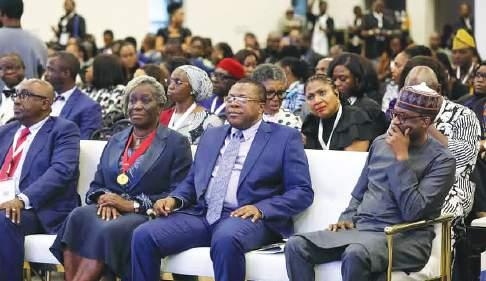
Stories by Steve Aya
In a bid to ease overcrowding in correctional facilities across Lagos State, the Chief Judge, Hon. Justice Kazeem Alogba, presided over a special court session recently at the Ogba Magistrates’ Court, where 18 inmates were released as part of the ongoing decongestion exercise.
The exercise, organised by the Lagos State Judiciary in collaboration with the Nigeria Correctional Service (NCoS), saw eligible beneficiaries drawn from custodial centres including the Borstal Home, Adigbe, female correctional centres, and medium and maximum security facilities Statewide.
Justice Alogba urged those released to embrace the opportunity for rehabilitation and lawful living, warning that “this is an opportunity for you to change, because you will not be this lucky next time if
you commit another offence”.
Among the 18 freed were four women and 14 men, many of whom had been held for extended periods. Some told the court of the mistakes they had made, including misuse of entrusted funds, theft, and other offences,
and pleaded for leniency and a second chance.
In addition to the release of inmates, Justice Alogba ordered the deportation of two Chadian nationals, Musa Abubakar and Yusuf Aliu, directing that they be handed over to the Lagos State Controller of the Nigeria
Immigration Service (NIS) for immediate repatriation, citing the nature of their offences.
Abubakar, one of the two, admitted to being in custody since 2018 without trial, and acknowledged robbing his victim with a knife. Despite stating that he had relatives in
Lagos, the Chief Judge insisted on his deportation order.
The release comes amid concerns over severe overcrowding in the State’s facilities, where more than 8,000 inmates are housed despite a capacity of under 4,000, according to the Lagos
State NCoS Controller. Justice Alogba’s latest move underscores ongoing efforts by the Judiciary to address systemic congestion in detention centres, a challenge that has persisted in the nation’s judicial and correctional system.
The Serving Overseer of Citadel Global Community Church, Pastor Tunde Bakare, has called for urgent personal and institutional reforms, to address what he described as deep-rooted corruption within Nigeria’s justice sector.
Speaking at the 22nd Chief Gani Fawehinmi Annual Lecture, organised by the Nigerian Bar Association (NBA), Ikeja Branch, Pastor Bakare warned that without integrity-driven reforms by both Lawyers and Judges,
the country risks remaining trapped in what he termed continued national “bondage”.
Delivering the Keynote Address on the theme “Integrity Deficiency in the Justice Sector: Whither the Legal Profession”, the Lawyer-turned-Cleric described the justice system as a haven of corruption, blaming political interference in judicial appointments and conflicting court judgements for eroding public trust.
He lamented that some
Delegates at the Chartered Institute of Arbitrators (CIArb), Nigeria Branch Annual Conference, have called on Nigerian courts to adopt a balanced approach to the enforcement of arbitral awards to strengthen confidence in arbitration.
In a Communiqué issued at the end of the Conference, held at The Jewel Aeida, Lekki, Lagos, the delegates stressed that enforcement is central to the credibility of arbitration. They urged courts to strike a balance between an interventionist approach, which permits close judicial scrutiny, and a cautionary or hands-off approach that prioritises party autonomy.
The Conference, which was declared open by the Lagos State Governor, Mr Babajide Sanwo-Olu, highlighted the urgent need to improve judicial competence in arbitration matters. Delegates called on the National Judicial Institute, to integrate comprehensive arbitration modules into its training programmes for Judges.
They also recommended an expansion of the Court of Appeal’s fast-track rules, currently
applied to commercial disputes and election petitions, to cover arbitration matters, noting that this would reduce delays and reinforce judicial support for arbitration.
On the National Arbitration Policy, the delegates warned that a weak enforcement framework could undermine Nigeria’s appeal as an arbitration seat. They identified judicial delays, inconsistent rulings and procedural bottlenecks, as key challenges to an arbitrationfriendly environment.
The Conference further urged organisations to conduct postarbitration reviews, regardless of outcomes, to improve processes and future performance. While commending the introduction of third-party funding, delegates emphasised the need for regulatory oversight to prevent abuse and protect arbitral independence.
Delegates also cautioned against over- reliance on artificial intelligence in arbitration, noting that while AI enhances efficiency in areas such as research and document review, it cannot replace human legal judgement. They further advised Nigerian courts against setting aside foreign
arbitral awards, stressing that courts are limited to enforcement or refusal of recognition.
The event featured addresses by CIArb Nigeria Branch Chair, Mrs Sola Adegbonmire, and Conference co-chairs, Mr Seyilayo Ojo, SAN, and Mrs Laura Alakija, alongside goodwill messages from international CIArb leaders. The Keynote Address was delivered by Mr Farouk Gumel, Vice Chairman of Tropical General Investment Group.
Judges now treat the Bench as a “work-chop”, stressing that such attitude undermines the sanctity of the Judiciary, and weakens its role as an impartial arbiter in society.
Pastor Bakare urged legal practitioners to embrace what he called “ethical lawyering”, anchored on satisfaction, patience and diligence, noting that Lawyers and Judges are custodians of the law and
defenders of the common good. He argued that meaningful reform must begin with value reorientation, starting from law students, universities and the Nigerian Law School, with stronger emphasis on ethics in legal education and the promotion of role models known for honesty and professional discipline.
Pastor Bakare further recommended collaboration
between the Independent Corrupt Practices and Other Related Offences Commission (ICPC), the NBA and the National Judicial Council to conduct annual, data-driven audits of the justice sector, while also calling for true judicial autonomy through direct funding from the Consolidated Revenue Fund to safeguard independence and accountability.
The National Judicial Council (NJC) has approved the appointment of 35 Judges for courts across Nigeria, and recommended the elevation of Hon. Justice Joseph Oyewole of the Court of Appeal to the Supreme Court.
The decisions were taken at the NJC’s 110th meeting held on January 13, 2026, under the chairmanship of the Chief Justice of Nigeria, Hon. Justice Kudirat Kekere-Ekun, GCON.
In a statement issued by the Council’s Deputy Director of Information, Kemi Babalola-Ogedengbe, the NJC said Justice Oyewole, who
currently heads the Enugu Division of the Court of Appeal, was found suitable for elevation to the Apex Court.
The Council also approved 27 candidates for appointment as Judges of various State High Courts, covering Borno, Plateau, Ekiti, Niger, Delta, Benue and Taraba State, as part of efforts to strengthen judicial capacity nationwide.
According to the statement, six judges were recommended for Borno State, six for Plateau, five for Ekiti, four for Delta, four for Niger, and one each for Benue and Taraba State High Courts. The NJC further recommended the appointment of six Kadis to Sharia Courts of Appeal in Niger, Taraba and Katsina State, as well as two Judges to the Delta State Customary Court of Appeal. It said all recommendations followed a rigorous screening process that included public complaints, interviews by a seven-member Committee, and strict compliance with the 2023 Revised NJC Guidelines and Procedural Rules for the Appointment of Judicial Officers.
Former Lagos Governor and ex-Minister of Power, Works and Housing, Babatunde Raji Fashola, CON, SAN, has written the foreword for Renewable Energy: Law and Policy in Nigeria – A Crosscutting Perspective by Dr Bitrus Joseph Bulama.
Dated May 1, 2025, the foreword hails the 12-chapter, 900-page book as a timely, seminal work on Nigeria's renewable energy framework, published by Bar and Bench Publishers, Abuja. It launches publicly on February 11, 2026.
Fashola, SAN, traced Nigeria's power sector evolution from the 1999 Constitution and 2005
Electric Power Sector Reform Act, which ended Government monopoly post-2013 privatisation under President Goodluck Jonathan. Assuming office in 2015 under President Muhammadu Buhari, he led a lean Ministry shifted to policy enablers, releasing generation/distribution assets and 5,000 staff.
Key initiatives under his watch included Nigeria's first Energy Mix Document targeting 30% renewables in a 30GW capacity by 2030, the 2015 Renewable Energy and Energy Efficiency Policy, 2016 Mini-Grid Regulations, and 2017 Building Energy Efficiency Code. He praises the book's historical
overview from Lagos's 1896 60kW power station, Chapter Four's legal/policy analysis, and Chapter Five's core discussion of development challenges - many addressed via his Power Sector Recovery Programme.
Fashola spotlights institutions like the Rural Electrification Agency, Nigerian Bulk Electricity Trading Plc, Transmission Company of Nigeria, Energy Commission, and National Council on Climate Change, plus 2025 solar panel budgeting at the Presidency, as proof of commitment. He suggests undocumented household/ business investments may exceed
30% national energy use. Chapters Six and Seven cover law's role in investment and electricity access.
Commending Dr Bulama's clear exposition of complex concepts, Fashola recommends the book for policymakers, Lawyers, energy experts, researchers, and advocates navigating Nigeria's renewable regulatory landscape. Dr Bulama, PhD in Energy/ Natural Resources Law (University of Dundee. Master’s’; University of Jos LLB), called to the Bar in 2003, is an Assistant Professor at American University Nigeria, Yola, and convener of Initiative for Climate Action and Advocacy.
enacted in 1962 and codified in 2014, the existing Legal Practitioners act (LPa) is set to be repealed by a new law, as President Bola ahmed Tinubu, GCFR has sent a new Legal Practitioners Bill 2025 (LPB) to the Senate for enactment. despite its far reaching and innovative provisions to reform legal practice and profession in Nigeria, a few have expressed misgivings that the LPB seeks to surreptitiously capture and hijack the profession by the executive. The President of the Nigerian Bar Association, Mazi Afam osigwe, SAN; Jonathan Gunu Taidi, SAN; onwudinjo Lucky Eloka and Kaine Ananwune examine in detail, some of the salient provisions of the LPB and what it seeks to do. Besides the NBa President, the other Contributors appear to conclude that the LPB requires reconsideration and fine tuning in several areas, including that of the proposal for a mandatory two-year pupillage for new wigs, increase in the post-call threshold for the application for elevation to rank of Senior advocate of Nigeria from 10 to 15 years, and the inclusion of politically exposed persons such as the Senate President, Speaker of the House of Representatives and other National assembly Committee Chairpersons as members of the Body of Benchers
Legal Practitioners Bill: Not an Attempt to Highjack the Legal Profession
Mazi Afam Osigwe, SAN
We note that recent discussions and commentaries, which claim that the proposed amendments to the Legal Practitioners Act (LPA) want to surreptitiously hijack the legal profession through the office of the Attorney-General of the Federation (AGF), and seek to divest the Nigerian Bar Association (NBA) of its regulatory autonomy and transfer same to the Body
of Benchers are unfounded. Firstly, it should be noted that the NBA collaborated with the office AGF and the Body of Benchers to draft the LPB.
In making its inputs into the LPB, the NBA
“…..it should be noted that the NBA collaborated with the office AGF and the Body of Benchers, to draft the LPB….There is therefore, no attempt whatsoever to hijack the legal profession by the office of the AGF, or any other officer or person whatsoever”
leadership was guided by reports of previous Committees like the Tony Idigbe, SAN Committee, NBA NEC resolutions, NBA positions and recommendations from past Annual General Conferences.
It would be recalled that, previous attempts by the NBA to propose amendments to the LPA, met with stiff opposition from the Body of Benchers and some other interest groups within the legal profession. The NBA could not pursue a successful amendment of the LPA, which everyone agrees is long overdue, despite producing same after a series of Townhall meetings in many parts of Nigeria. The AGF therefore, provided a platform for the different interest groups in the profession to work together to produce the draft document that was presented as an executive Bill.
The LPB which the office of the AGF provided the platform for its preparation, proposes harmonised reforms which we believe will be very wide and far-reaching. In preparing the LPB, all stakeholders agreed on the imperativeness of not only reforming
the legal profession in Nigeria, but also to put in place regulatory and enhanced disciplinary structures, aiming to boost ethics and accountability and modernising the profession. There is therefore, no attempt whatsoever to hijack the legal profession by the office of the AGF, or any other officer or person whatsoever. In fact, the regulatory powers and involvement of the NBA have been better defined. Of particular interest, are the following facts:-
1. The number of NBA’s representatives in the Body of Benchers, is proposed to be increased,
2. The LPB has cleared any doubt about the role and power of the NBA in the investigation of complaints and presentation petitions of professional misconduct against legal practitioners, by proposing the establishment of a Committee of the Association known as Ethics, Adherence and Enforcement Committee to: (a) investigate the conduct of legal practitioners; (b) receive and investigate complaints against legal practitioners; (c) inspect documents, facilities, files, materials, offices, premises and records of legal practitioners, to ascertain their
statutory compliance status and profile; (d) report, present, and prosecute instances of professional misconduct to or before the Legal Practitioners Disciplinary Committee; (e) enforce decisions, directions and orders of the Legal Practitioners Disciplinary Committee; (f) deploy or encouraging ADR for minor complaints against legal practitioners; and (g) advising and educating legal practitioners on proper professional conduct and statutory compliance.
3. Statutorily stipulate the objects of the Ethics, Adherence and Enforcement Committee to (a) give consumers and users of legal services an independent, timely, fair and reasonable means of redress for complaints; (b) promote, monitor and enforce high standards of conduct in the provision of legal services and advance integrity in the legal profession; (c) protect and promote public confidence in the legal system, the legal profession, the administration of justice and the rule of law; (d) increase public understanding of the client's rights and duties; and (e) promote and maintain adherence to the professional principles.
4. The President of NBA has now been made a statutory member of Legal Practitioners Privileges Committee (LPPC).
5. The LPB adopted the NBA position that the Legal Practitioners Disciplinary Committee (LPDC) should sit in panels in the geo-political regions or even States, as the LPDC which is a committee of the Body of Benchers may determine by empowering the Body of Benchers to create multiple disciplinary committees to tackle case backlogs and improve sanctions.
6. Has made it mandatory for Lawyers to participate in the Continuous Professional Development (CPD)programme approved by the NBA, so as to remain in practice.
7. A compulsory two-year training period for newly qualified Lawyers before they can set up practice, either alone or in partnership with other Lawyers.
8. Strengthening the NBA's role in issuing annual practicing licenses to Lawyers who have paid their practicing fee and met the CPD requirements as approved by the NBA.
9. Mandatory Seals/Stamps for authenticating legal documents.
A careful reading of the LPB will show that, many regulatory controls flow from regulations made by the NBA, reinforcing professional self-governance. Also compliance monitoring, enforcement, character assessment, CPD accreditation, and fee administration are all responsibilities clearly assigned to the NBA under the LPB. Indeed, there is no provision that confers licensing authority on the Body of Benchers or AGF, nor does any section remove, dilute, or transfer any existing regulatory powers of the NBA. As noted earlier, the LPB does not assign practising licence functions to the Body of Benchers or AGF, nor does it undermine the NBA’s statutory role. Any interpretation suggesting otherwise, is not supported by the text of the proposed legislation.
Rather than eroding the autonomy of the NBA, the proposed amendment codifies and strengthens NBA’s central role in regulating legal practice, aligns Nigeria’s legal profession with global best practices, and promotes accountability through structured licensing, disc and continuing professional development.

Robust debate and stakeholder engagement are vital components of any law reform process. However, such engagement must be grounded in accurate reading and faithful interpretation of legislative provisions, particularly where the independence of the Bar and the confidence of legal practitioners are concerned.
Members of the profession are therefore, encouraged to carefully examine the Bill as proposed, participate constructively in public hearings, and contribute to the reform process with clarity, precision, and fidelity to the law. The initial fears that the LPB might dilute the NBA’s regulatory power, are unfounded. The LPB reinforces the NBA’s authority. We have also noted some concerns raised by some Lawyers, and are working with the office of AGF to address such concerns, so that the version of the LPB that may be ultimately passed is one that will not only reform the legal profession in Nigeria, create a modern framework to promote public interest, rule of law, and access to justice through better-regulated, more ethical legal professionals.
Mazi Afam Osigwe, SAN, President, Nigerian Bar Association
A Critical Examination of the Legal Practitioners Bill 2025: Reform or Regression?
“If Nigeria truly wishes to adopt a pupillage model, it must be part of holistic reform. That would require shortening the LL.B programme, redefining the Law School’s role, integrating pupillage into a streamlined pathway, and standardising post training assessment”
Jonathan Gunu Taidi, SAN Introduction
Law reform is not an exercise in legislative bravado. It is a deliberate, evidence driven process, aimed at strengthening institutions, improving access, and aligning regulation with social and economic realities. Where reform disconnects from context, ignores comparative experience, or undermines constitutional logic, it ceases to be reform and becomes regression.
The Legal Practitioners Bill, 2025 (LPB) represents a bold attempt to restructure key aspects of legal education, professional advancement, and discipline in Nigeria. Boldness, however, is not synonymous with soundness. Certain provisions of the LPB raise profound concerns of principle, practicality, and constitutionality. Chief among these are the introduction of a mandatory two-year pupillage before qualification as a legal practitioner, and the proposal to raise eligibility for the rank of Senior Advocate of Nigeria from ten to fifteen years post call.
This work interrogates these provisions, not from a position of resistance to reform, but from a commitment to rational, proportionate, and progressive regulation of the legal profession.
Section 25 of the LPB proposes a compulsory two-year pupillage period, as a precondition to full qualification as a legal practitioner. This proposal fundamentally alters the architecture of legal education in Nigeria, yet offers no coherent justification for doing so.
At present, the Nigerian legal training pathway is already one of the longest
globally. Five years of undergraduate legal education, one year at the Nigerian Law School, and one year of compulsory National Service, already amount to seven years of post-secondary engagement before full professional integration. The LPB extends this to nine years, without empirical evidence of any systemic failure, or derivable benefits, warranting such elongation.
There is no jurisdiction in the world that requires nine years of post-secondary training, as a statutory minimum for legal qualification. This alone should give policymakers pause. More critically, the proposal misunderstands and duplicates the role of the Nigerian Law School. The Law School was deliberately designed, as a vocational institution. Its curriculum covers civil and criminal procedure, advocacy, ethics, property and corporate law practice, and professional skills. It includes mandatory court attachment, and law office attachment. Pupillage, by definition, is also vocational training. Introducing a further two-year vocational requirement without restructuring the existing framework, is regulatory redundancy masquerading as reform.
Proponents of the pupillage proposal, often cite the United Kingdom as a model. This comparison, does not survive scrutiny. In England and Wales, pupillage applies only to those who choose the Barrister’s route. It lasts one year, not two. There is no NYSC equivalent. A law degree, is not mandatory. The entire qualification process is shorter, not longer, than Nigeria’s. More importantly, pupils in the UK are permitted, after six months, to accept briefs directly and retain their fees. Pupillage is a bridge to independence, not a holding pattern of dependency.
The Nigerian LPB, proposes none of these safeguards. It creates a two-year limbo in which young Lawyers are neither fully qualified, nor economically empowered. The financial implications, are severe. If law firms are required to pay even a modest pupillage stipend, many firms, particularly small and medium sized
practices outside major urban centres, will simply opt out. The inevitable result will be scarcity of pupillage slots, not because of lack of merit, but because of lack of capacity.
A qualification regime that excludes competent candidates due to structural bottlenecks, is indefensible. It risks creating a profession accessible only to those with financial privilege, or elite networks.
If Nigeria truly wishes to adopt a pupillage model, it must be part of holistic reform. That would require shortening the LL.B programme, redefining the Law School’s role, integrating pupillage into a streamlined pathway, and standardising post training assessment. The LPB does none of this. It merely adds weight, to an already overloaded system.
The Fifteen Year SAN Threshold: Longevity Isn’t Distinction
The proposal in Section 33 of the LPB to raise eligibility for the rank of Senior Advocate of Nigeria from ten to fifteen years post call, is equally problematic. It rests on an unspoken but deeply flawed assumption, that professional excellence is primarily a function of time. Distinction at the Bar, has never been measured by years alone. It is measured by quality of advocacy, intellectual leadership, contribution to jurisprudence, professional integrity, and service to the legal system. Time is relevant, but it is not determinative.
Nigeria’s legal history is replete with examples of advocates who attained the highest levels of professional distinction shortly after crossing the ten-year threshold, including the current AttorneyGeneral of the Federation, Prince Lateef Fagbemi, SAN, who was conferred with the rank after ten years at the Bar. This trajectory is not an anomaly. It is evidence that, excellence does not wait for arbitrary timelines.
The proposed fifteen-year requirement, also sits uncomfortably with the Constitution. A legal practitioner with ten years post call experience may be appointed a High Court Judge or an Attorney-General of a State. With twelve years, such a person may be elevated to the Court of Appeal. These are constitutional offices involving the interpretation of the Constitution, and the exercise of sovereign judicial authority.
It is logically incoherent to suggest that a Lawyer is fit to adjudicate constitutional disputes affecting millions of citizens after ten or twelve years, yet unfit to be considered for a professional honour recognising advocacy excellence until fifteen years have elapsed. Comparative practice, further exposes the arbitrariness of the proposal. In England and Wales, eligibility for King’s Counsel typically arises after about ten years of practice rights, with the decisive factor being demonstrated being excellence in complex advocacy. If the goal is to raise standards, the focus should be on strengthening qualitative assessment, not stretching timelines.
Closing Words
The LPB presents itself, as a reform instrument. In its current form, however, key provisions reflect a disconnect from educational realities, constitutional logic, and comparative best practice.
Mandatory two-year pupillage, imposed without structural reform, risks turning legal qualification into an endurance test, rather than a merit based process. The fifteen-year SAN threshold, substitutes arbitrary longevity for demonstrable excellence. Both measures, taken together, suggest a regulatory philosophy that equates delay with quality. That philosophy is flawed.
The Nigerian legal profession, does not need higher walls. It needs smarter gates. Reform must be evidence based, inclusive, and future oriented. Reform must be principled, not punitive. It must protect standards, without strangling opportunities. Above all, it must recognise that a profession that ignores the realities of its next generation, cannot sustainably regulate itself.
Jonathan Gunu Taidi, SAN; Bencher; former NBA General Secretary
Appraisal of the Legal Practitioners Bill, 2025
Onwudinjo Lucky Eloka
Introduction
Why the New Bill?
A Deliberate Attempt to Hijack the Profession from the NBA?
The Legal Practitioners Bill, 2025/2026 is an attempt by the National Assembly to modify the existing Legal Practitioners Act (Cap L11, Laws of the Federation of Nigeria, 2004) which is the extant law governing legal practice in Nigeria, for the purpose of introducing a substantive
“A legal practitioner with ten years post call experience may be appointed a High Court Judge or an Attorney-General of a State. With twelve years, such a person may be elevated to the Court of Appeal….It is logically incoherent to suggest that a Lawyer is fit to adjudicate constitutional disputes affecting millions of citizens after ten or twelve years, yet unfit to be considered for a professional honour recognising advocacy excellence until fifteen years have elapsed”
transformation of the legal regulatory environment, emphasising enhanced accountability, mandatory professional standards, structured licensing, and modern disciplinary mechanisms to address contemporary legal practice challenges.
Major Introductions to the New Bill and how they Benefit the General Public
i. Legal Framework and Purpose: While the Legal Practitioners Act (LPA) primarily regulates who may practice law, the discipline of practitioners, and basic structures governing the profession (e.g., Body of Benchers, LPDC) with focus on entitlement to practice, enrolment, disciplinary procedures, and certain client protections without clearly codified modern professional standards, the Legal Practitioners Bill, 2025 (LPB) seeks to respond directly to public interest objectives, professional ethics, and stringent accountability structures, to restore public confidence in the profession.
ii. Regulatory Bodies and Institutional Structure: While the Body of Benchers and the General Council of the Bar (GCB) are core statutory bodies under the LPA, with the Body of Benchers controlling admission (call to the Bar), discipline through the Legal Practitioners Disciplinary Committee (LPDC), and other regulatory functions, the LPB retains the Body of Benchers’ role in admission and introduces the Ethics, Adherence and Enforcement Committee (EAEC) tasked with investigating misconduct as a statutory organ. There is a clear separation of powers between this Ethics, Adherence and Enforcement Committee and the Legal Practitioners Disciplinary Committee, in that one of the functions of the EAEC is to enforce the orders of the LPDC. And, a welcome development to the public is the fact that Section 21(7)(f) and (g) empowers the EAEC
to deploy or encourage ADR for minor complaints against legal practitioners; and advise and educate legal practitioners on proper professional conduct and statutory compliance. While this provision would significantly reduce cases of petitions against Lawyers to the LPDC, if implemented well will boost public confidence in the powers of the system to call erring Lawyers to order in speed time.
iii. Disciplinary Mechanisms and Accountability: While the LPA establishes the Legal Practitioners Disciplinary Committee (LPDC) to handle misconduct, subject to Appeals Committee and supervisory powers of the Supreme Court, with penalties such as suspension or removal from the roll for unethical conduct; process and sanctions, the LPB enhances disciplinary system with multiple LPDC panels nationwide, for efficient case handling. Sanctions have also been broadened to include restitution, compensation to aggrieved clients, and mandated publication of outcomes. One important addition of the LPB is the separation of the powers of the Legal Practitioners Disciplinary Committee from the Ethics, Adherence and Enforcement Committee. The EAEC is to investigate and prosecute misconduct before LPDC, separating powers and improving procedural fairness.
Major Introductions to the New Bill and How they Benefit the Average Lawyer and the NBA
i. Admission, Training and Competence: While under the Current LPA, admission to legal practice is through the Body of Benchers after Law School and Call to the Bar, the LPB introduces a mandatory 2 years pupillage requirement for new wigs before independent practice, and the Mandatory Continuing Professional Development (CPD) as a statutory requirement for licence renewal. While the Mandatory requirement for CPD is widely seen as a welcome development, in that Lawyers will now intentionally hone their skills through intentional legal trainings, the mandatory 2 years pupillage requirement for New Wigs is both irrational and unnecessary. Firstly, while the intention of the draftsman may be to ensure that Lawyers who are licensed to practice have experience and quality training, this proposition is less advantageous to the legal profession. The
LPB did not make specific provisions, for where and how the New Wigs are to be adequately remunerated at the material time. It just scratches the surface when it provides in Section 25(3) that the “Body of Benchers shall develop and maintain rules and guidelines which shall provide for –
(a) the structure, duration of the pupillage programme and allowances of pupils;
(b) fair treatment and selection of pupils;
(c) duties, training and responsibilities of pupil supervisors;
(d) support and advise for pupils; and
(e) complaints procedures and remuneration of the pupil.”
It remains evasive as to the exactitude of the plans the Bill has for New Wigs that do not get the opportunity to be accommodated for pupillage, how they are to be assigned, and the incentives that will propel Law Offices and institutions to admit more New Wigs for the mandatory pupillage. It is a grave concern that many New Wigs will not have placement opportunities to undergo this mandatory pupilage, or will have recourse to look outside the profession as a result of meagre or no remuneration within the mandatory period. Holistically put, this provision will also encourage backlog which the draftsman may have intended to curb. This section of the LPB, should be expunged in its entirety.
ii. Foreign Lawyers and Practice Restrictions: While the current LPA contains provisions for special authorisation to permit foreign Lawyers to appear in defined circumstances and lacks comprehensive modern rules on international practice, the LPB imposes clearer conditions on foreign Lawyers’ engagement in Nigerian legal services, including licensing requirements and partnerships with Nigerian practitioners. Section 30(3) of the LPB further provides that where the foreign practitioner has been granted special facility to practice, he shall only do so if he enters into a partnership or collaboration agreement with a legal practitioner duly authorised to practice law in Nigeria. While this inclusion should be retained as it makes clear geographical distinctions between Nigerian legal practitioners and foreign Lawyers, it is also economically advantageous for Nigerian Legal Practitioners as an opportunity to partner for briefs.
iii. Definition of Legal Practice and Public Protection: While the LPA merely defines entitlement to practice and illegal practice (e.g., unauthorised individuals engaging in legal practice) with penalties, largely preserved from earlier statutory language which have little or no bearing on modern realities, the LPB details what constitutes practice, including documentation, advice, and representation and goes further in Section 31 to criminalise unauthorised legal practice with sharper clarity for enforcement.
The Way Forward
It is important to take a holistic introspection of the LPB and expunge some inclusions which are detrimental to the practice of law, while improving and amending the LPA with the advantageous modifications the LPB provides.
In summary, the LPA provides a foundational but outdated regulatory framework, while the Legal Practitioners
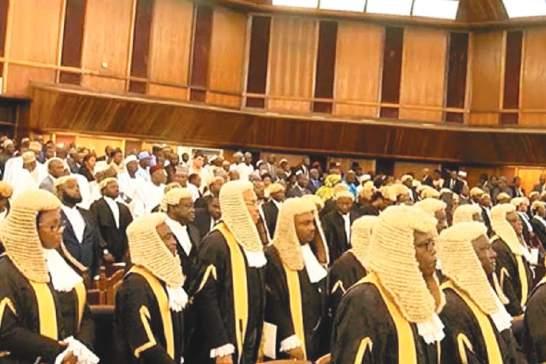
Bill represents a paradigm shift toward stricter regulation, structured licensing, enhanced discipline, and greater public accountability. The LPB, subject to modifications, significantly expands statutory oversight of competence, ethics, and professional conduct beyond what is contained in the Act.
Onwudinjo Lucky Eloka, Abuja
Brief Overview of the Salient Innovations in the LPB
Kaine Ananwune
What does the New Legal Practitioners Bill (LPB) Provide For?
profession;
VI. increase public understanding of citizens' legal rights and duties;
VII. encourage an independent, strong, diverse and effective legal profession;
VIII. promote transparency, proportionality and efficiency in the regulation of the legal profession.
The Major Radical Features of the LPB
The introduction of the Continuing Professional Development (CPD), Annual Practice Licence (APL), usage of Stamp and Seal by legal practitioners
in the Act/LPB. The major function of this Ethics Adherence and Compliance Committee (EACC) is to investigate allegations of professional misconduct levelled against legal practitioners, and to prosecute same where they deem it apposite, and also to enforce decisions of the LPDC.
The Two-Year Mandatory Pupillage for New Wigs
“As
The LPB seeks to repeal the existing Legal Practitioners Act (LPA) which was originally enacted in the year 1962, with over 7 amendments in the course of 63 years. The LPB introduces certain radical changes with the main objective being as contained in Clause 1 of the LPB as follows; to:
I. maintain public confidence in the provision of legal services;
II. promote and protect public interest;
III. promote the rule of law and improve access to justice;
IV. recognise and preserve the status of the legal profession;
V. ensure the independence, integrity and honour of members of the legal
of date, there is no legal barrier preventing a freshly minted Lawyer from setting up his own law firm, or from going into partnership with a more senior Lawyer. This regime is however, about to change, as the LPB seeks to curtail the unbridled setting up of law firms by new wigs”
Although the concept of CPD, APL, Stamp and Seal are not strange to the Nigerian Lawyers, as they previously existed in the Rules of Professional Conduct 2007 and 2023; these concepts are about to receive statutory imprimatur having sought to be introduced for the first time into the main statute via the proposed enactment.
Ethics, Professional Discipline for Lawyers
Towards ensuring greater professional accountability and higher professional discipline for Lawyers, the LPB not only approved and retained the existence of the Legal Practitioners Disciplinary Committee (LPDC) under the auspices of the Body of Benchers (BOB); the Bill went further empower the LPDC to sit in diverse territorial jurisdictions within Nigeria.
Again, the LPB seeks to water down legal technicalities that can impugn the decisions of the LPDC.
For example, the decision of the LPDC cannot be rendered invalid, impugned nor successfully challenged on the grounds of any irregularity in the appointment of its members; by reason of the fact that any person who was not entitled to do so, took part in the proceedings; or by virtue of any variation in the composition of the membership of the panel in the course of proceedings.
Furthermore, the LPB also seeks to establish the Ethics Adherence and Compliance Committee which is to be appointed by the National Executive Committee of the Nigerian Bar Association (NBA), subject to the qualifying conditions contained
As of date, there is no legal barrier preventing a freshly minted Lawyer from setting up his own law firm, or from going into partnership with a more senior Lawyer. This regime is however, about to change, as the LPB seeks to curtail the unbridled setting up of law firms by new wigs.
According to the proposed LPB, new wigs are mandatorily required to undergo a 2 year pupilage before they can set up a law firm, or go into partnership with an older Lawyer. The Body of Benchers is also under a statutory obligation to determine the structure, duration of the pupilage programme and allowances of pupils, supervision and selection process for the pupilage.
The LPB seeks to empower the General Council of the Bar, to set standards for the accreditation of law firms.
The concept of “practice of law” and “provision of legal services” in Nigeria
If and when fully implemented, the benefits that would accrue from the proposed Act are very certain and substantial. Firstly, the LPB not only provided a clear cut definition, but also expanded and gave a broader interpretation and meaning to the concept of “practice of law” and “provision of legal services” in Nigeria. The ripple effect of this singular provision is that, it significantly increased the exclusive and specialised jobs/services that can only be rendered by qualified legal practitioners in Nigeria. It is common sense that rendering of specialised services by way of “practice of law” and “provision of legal services” in the base sense, simply translates to money. Under the proposed LPB, the “practice
of law” and the “provision of legal service” is deemed to include: rendering of advice or counsel to any person on their legal rights or responsibilities; selection, drafting, or completion of legal document or agreement that affect the legal right of a person; representation of a person before an adjudicative body, including to prepare or file documents or conduct discovery; or negotiation of any legal right or responsibility on behalf of a person.
Again, under the LPB; For the purpose of “practice of law” and “provision of legal services”, the legal representation of parties before an “adjudicative body” also includes: a court, a mediator, an arbitrator, a legislative body, administrative agency or any other body acting in an adjudicative capacity; and a legislative body, administrative agency or any other body acts in an adjudicative capacity when a neutral official, after the presentation of evidence or legal argument by a party, renders a binding legal judgement directly affecting a party's interests in a particular matter.
The larger benefits accruable from this legal interpretation of the concept of “practice of law” and “provision of legal services”, are almost infinite.
To ensure greater safeguard for the professional turf of the Nigerian Lawyer, the LPB not only criminalises illicit practice of law by unqualified persons with a penalty of N5,000,000 and/or 3 years imprisonment, it also invalidates and renders a nullity any service rendered as a result of illicit practice of law by unqualified persons.
Since the advent of the 21st century, Nigerian Lawyers have always lamented the unfair encroachment of their professional turf by foreign Lawyers, who besiege Nigeria to take over a large an juicy chunk of legal briefs (“practice of law” and “provision of legal services”) that ought to go to the Nigerian Lawyers. The computer globalisation and the internet boom in last 10 years, seem to have also worsened the predicament of the Nigerian Lawyer.
Also worthy of note is the fact that the old LPA that is sought to be repealed, did not make precise and sufficient legal provision as to what “practice of law” and “provision of legal services” in Nigeria entails. The Old enactment merely provided for “right of audience” in Court. The new world order has come to show that “practice of law” and “provision of legal services”, transcends far beyond court room advocacy. In today’s “practice of law” and “provision of legal services”, “audience in court” and “courtroom advocacy” seem to be only one-tenth of the whole business of lawyering.
By the LPB, the Body of Benchers may, subject to terms and conditions as it may prescribe, grant a licence for a specific cause or matter to a foreign Lawyer where, in the opinion of the Body of Benchers, such person is afforded special facility to carry out the specific cause or matter; Provided that where a foreign legal practitioner has been afforded special facility to
“The
practice as a member of the legal profession in Nigeria, he can only provide legal services or represent a client in Nigeria, if he first enters into a partnership or collaboration agreement with a legal practitioner duly authorised to practice law in Nigeria.
Higher Professional Standard, Ethics and Accountability in the Legal Profession
The LPB seeks to hold Nigerian Lawyers, to a greater level of standards and ethics. With the introduction of the Ethics Adherence and Compliance Committee (EACC) and the reinforcement of the LPDC, both Committees have a statutory mandate to operate in any territorial jurisdiction within Nigeria, it goes without saying that Lawyers in Nigeria must brace up to higher ethical standards. This is simply because, the EACC will be on ground to investigate and prosecute Lawyers who fall short of the ethical standards.
Before now, there is no one statutorily charged with the enforcement of the decisions of the LPDC. It is commonplace to see Lawyers who are on suspension or already disbarred, still practising law and rendering legal services. With the introduction of the EACC, the automatic and prompt enforcement of the decisions of the LPDC is assured.
It is also worthy of note, that the EACC is empowered by the LPB to employ staff and engage Lawyers as investigators and prosecutors. What this means is that, every State of the Federation and indeed, every Branch of the NBA may have resident staff, investigators and prosecutors of the EACC. With this arrangement, it becomes almost impossible for an
Senate President, Speaker of House of Representatives, Chair Senate/House Committee on Judiciary, are all politicians and politically exposed persons. The inclusion of these political office holders as automatic members of Body of Benchers will in effect, afford them unnecessary political leverage, which must be discouraged”
errant Lawyer to get away with an iota of unethical practice.
Further, where the GCB lives up to its statutory mandate by setting minimum standards and criteria for the establishment of law firms and chambers, the era of setting up law firms in the market square and in mechanic workshops and other similar undignified places, will be a thing of the past.
Legislative Consultations With the Stakeholders in the Process of Drafting of the Bill
The NBA is one of the principal stakeholders, that will ordinarily be affected by the proposed legislation. In the regular course of legislative drafting process, memoranda are called for, public hearings convened and stakeholders consulted.
I know as a fact that, Notices for public hearing were widely publicised as a prelude to the enactment of a new LPA. Official request for memoranda was extended to the NBA, which was duly circulated to members via the usual email channel. Recommendations and inputs were made by the NBA to the National Assembly, with respect to the proposed enactment. Hence, it can be safely concluded that NBA was consulted in the legislative process. It remains only to be seen if, and whether the recommendations of the NBA will be adopted in the final draft/enactment.
Shortfalls Inherent in the LPB and Recommendations:
Politicisation of the Body of Benchers (BOB) by the inclusion of the Senate President, Speaker of House of Representatives, Chair, Senate/ House Committee on Judiciary Heads of courts are the epitome of the Judiciary throughout Nigeria. The Body of Benchers is the only melting pot where the various heads of all the constitutional courts of Nigeria, in conjunction with some eminently selected legal practitioners, meet to deliberate on issues affecting the legal profession. They should be insulated from politics. The Senate President, Speaker of House of Representatives, Chair Senate/House Committee on Judiciary, are all politicians and politically exposed persons. The inclusion of these political office holders as automatic members of
Body of Benchers will in effect, afford them unnecessary political leverage, which must be discouraged. The inclusion of these Politically exposed persons as automatic members of Body if Benchers, does not and would not in any way improve the functions or efficiency of the BOB.
Recommendation: the paragraphs of the LPB which suggest the inclusion of The Senate President, Speaker of House of Representatives, Chair Senate/House Committee on Judiciary as automatic members of the BOB, should be expunged as a matter of expediency.
Discipline of Lawyers
By the proposed enactment, the decisions of the LPDC take automatic effect on the legal practitioner indicted for professional misconduct, regardless of the filing or lodgement of any appeal at the Supreme Court, unless the Supreme Court orders a stay. It is common knowledge that due to docket congestion, appeals at the Supreme Court take a while before they can be heard and determined. The danger here is that, an innocent legal practitioner may have served a punishment he does not deserve before the Supreme Court hears and determines his appeal.
In the LPA sought to be repealed, an appeal against the decision of the LPDC operates as a stay, pending the hearing and determination of the said appeal.
Recommendation: This old order should be retained and preserved in the LPB, with a proviso that the appeals from the LPDC to the Supreme Court must be determined within a certain period- like 12 months.
NBA Representatives at the GCB
The NBA Constitution in the spirit of liberalism introduced universal suffrage, for the purpose of electing its own representatives to the GCB. However, the LPB seems to deviate from this traditional norm obtainable at the Bar. By the provisions of the LPB, NBA representatives to the GCB are appointed by the National Executive Committee of the NBA, rather than the usual election.
Recommendation: The new statute should simply allow the NBA to determine the mode for recommendation of its representatives to the GCB.
Kaine Ananwune, former Chairman, NBA, Anaocha Branch, Anambra State
Linus aleke in abuja
Troops of the Joint Task Force, North East, Operation Hadin Kai (OPHK), have foiled planned terrorist attacks, dismantled several insurgent hideouts and recovered a cache of arms and logistics during coordinated operations in the Timbuktu Triangle.
a statement, noting that the operations were carried out on Sunday, January 18, 2026.
The Media Information Officer of the Joint Task Force, North East, Operation Hadin Kai, Lieutenant Colonel Sani Uba, disclosed this in
According to him, troops advanced from their harbour locations and conducted deliberate, intelligence-driven
Kemi Olaitan in Ibadan
A mining company, K.M. Done Mining Limited, has petitioned the Federal Ministry of Solid Minerals Development over what it described as forceful invasion of its licensed mining site in Saki, Oyo State, and theft of 12 truckloads of lithium ore by West Africa New Energy Material Company Limited. In the petitions addressed to the Zonal Mines Officer, Ministry of Solid Minerals Development, South-West Zonal Office, Ibadan, the company accused the
company of deploying security operatives to carry out acts of forceful entry, assault, unlawful arrest, and ejection of its workers from the site.
The petitions, dated January 12 and 15, 2026, written by the firm’s counsel, Y.A. Azeez (Esq.), it alleged that officials of West Africa New Energy Material Company, “in connivance with men of the Nigeria Police Force, the Nigerian Army and mining marshals,” invaded the site and carted away large quantities of lithium ore.
Blessing ibunge in Port Harcourt
A socio-cultural organisation of Ogoni people comprising Khana, Gokana, Tai and Eleme local government areas of Rivers state (KAGOTE), has reiterated commitment to reposition the educational sector in Ogoniland, thereby ensuring quality education to all the indigenes of the area. Consequently, the group has set up a committee to immediately create a standard by taking inventory of all the primary schools in Ogoniland and the population of students for proper documentation and accountability.
The move was disclosed by the new President-
General of KAGOTE, and Chief Executive Officer of Giolee Global Resources Limited, Chief Lesi Maol, shortly after a keenly contested election of the organisation at the weekend.
The election took place during the organisation’s congress held in Gwara in Khana LGA, after the expiration of the tenure of the former President, Hon Emmah Deeyah-led executive council who is now the BoT chairman of HYPREP.
Other elected members of the organisation are: Mr Baride Gwezia, 1st Vice President (Tai), Rear Admiral Nicolas Bakpo, 2nd Vice President (Khana) and Osaroepie Nana, 3rd Vice President (Eleme).

offensives across identified terrorist enclaves, including Chilaria, Garin Faruk and Abirma.
He explained that the ground assault was effectively supported by the
Omon-Julius Onabu in asaba
Governor Sheriff Oborevwori, yesterday flagged off the construction of the N59.7 billion AgborUromi Junction Flyover in Agbor, administrative headquarters of Ika South Local Government Area.
Air Component of OPHK, which provided sustained Intelligence, Surveillance and Reconnaissance (ISR) coverage throughout the operation.
Uba said the close air–ground coordination
enabled real-time monitoring of terrorist movements, prevented reinforcement by insurgents and significantly enhanced the precision and confidence of the advancing troops.
At the event of groundbreaking for the project, he described the project as a critical intervention aimed at improving road safety, preserving lives, and boosting economic activities across the state and beyond.
Governor Oborevwori said the flyover was conceived
out of the urgent need to address persistent traffic congestion and frequent accidents at the busy AgborUromi Junction, which he noted had, over the years, claimed lives and destroyed property.
According to him, the dangerous intersection among vehicles, motorcycles, and
pedestrians on the federal highway, coupled with poor traffic management, made a lasting solution inevitable. He disclosed that the contract for the design and construction of the flyover had been awarded to Julius Berger Nigeria Plc, with a completion timeline of 14 months.
Oghenevwede Ohwovoriole in abuja
The Managing Director a tech hub, New Horizons Nigeria (NHN), Tim Akano, has warned on the imminent danger of not addressing the menace of street beggars, popularly known as almajiris, unveiling an initiative aimed at equipping them with technical skills.
Akano hinted that an estimated 15 million almajiris in
the country, with a population growth rate of around three per cent annually, constituted a potent challenge, adding that “if we do not solve this problem as a country, we are sitting on a time bomb.”
He disclosed that his firm had begun the process of removing them from the streets with an initiative aimed at equipping them with technical skills.
Akano said it was one problem he seeks to help
society solve.
Speaking yesterday in Abuja at the launch of a N50 million initiative aimed at transforming 20 almajiri children into technically skilled computer technicians in the next 90 days, he said the “Almajiri-to-Tech programme,” will provide beneficiaries with full training, with meals, clothing, tools, and logistics inclusive support, making it fully funded by the firm.
According to him, the programme represents a new journey in the history of Nigeria by retaining the original purpose of the almajiri education system, which he described as “children sent out to seek knowledge.” He said: “The word almajiri comes from an Arabic term meaning emigrant and seeker of knowledge. Historically, children were sent to learn morals, responsibility, and skills to add value to society.”
ibrahim Oyewale in Lokoja
The Peoples Democratic Party (PDP), Kogi State chapter, disclosed that it has embarked on serious grassroots mobilisation and stakeholders engagement, expressed optimism that feelers prove that PDP will return to Lugard House in 2027.
The state Chairman of the party, Mohammed Gambo, who made this known in a chat with journalists in Lokoja yesterday, said that his strategy is going back to the people.
“Our party abhors godfatherism that has long undermined the party’s operations. We want the people to take charge of their
own lives. Internal democracy has returned to the party. We will no longer do things as we did in the past.
“We are already seeing a mass movement to our party. We have met with several members who left for the APC and ADC. In the coming days, we will be receiving over 200 returning and new members.
“Let me repeat it. Time is up for the APC. They should write their handover notes. Kogi people want the PDP back.”
“They said our years in government were rewarding, and that they can’t wait any longer. Enough is enough. 2027 is the PDP’s turn. Let Kogi APC pack and go,” he stated.
In a passionate plea for peace and unity in Rivers State, the Prelate of the Methodist Church Nigeria, His Eminence, (Dr.) Oliver Ali Aba, has called on Minister of the Federal Capital Territory(FCT), Nyesom Wike, and the Governor of the state, Siminalayi Fubara, to put aside their differences and work together for the benefits of the people.
50th Anniversary Celebrations of Episcopacy in the Methodist Church Nigeria, held yesterday in Lagos.
The cleric appealed during a media briefing to mark the

He emphasised that the current governor has a mandate and should be allowed to govern without interference.
“My counsel for Rivers State is for them all to drop their weapons and form a brotherly relationship, so that their unity can bring about the growth of that state called Rivers State. If they are fighting one another, there will be no rapid growth. So I’m asking them, those with bitterness, throw away the bitterness,” Aba said.
The cleric’s words came as a timely intervention in the escalating tensions in Rivers State, where Governor Fubara and his deputy, Prof Ngozi Odu, are facing an impeachment threat over alleged gross misconduct.
The crisis has sparked concerns about the stability and progress of the state, with many calling for calm and restraint.
The Prelate’s remarks were laced with wisdom and conviction, as he urged Wike
to prioritise the state’s interests over personal ambitions.
“The current Governor of Rivers State is the one who has a mandate,” he said. “Let everybody join hands with him and govern that place successfully. Everybody has their own season. If we are talking about Wike coming to pollute the land, let Wike make a choice. Either to be at the federal or to come to Rivers State, so that in turn, maybe Fubara can go to the federal. If that is what Wike wants, so be it. He can’t be here and there. Enough is enough,” Aba stressed further His words of caution were not limited to the Rivers State crisis. He also took a swipe at politicians who seek to derail the progress of their colleagues for personal interests.
“Let all those politicians who are trying to derail this transition, let them go to their beds and sleep with their wives and leave Nigerians to enjoy the expected dividend of democracy. If they persist in their evil deeds, they will face divine judgment - neither the gods of the land nor God himself will forgive them,” the cleric added.
Omolabake Fasogbon
A partnership between CRC Credit Bureau Limited and Kwara State University (KWASU) has been sealed to address a mistmatch between job market demands and skills youth possess said to have been largely contributed to unemployment crisis in the country.
With the ‘State of the Nigerian Youth Report 2025’ estimating nearly 80 million unemployed youths, the collaboration aims to reverse the trend by equipping students with industry-relevant skills and practical exposure.
Speaking at the signing of Memorandum of Understanding (MoU) at CRC’s office in Lagos, Managing Director/ Chief Executive Officer of CRC Credit Bureau,
Dr. Tunde Popoola said the partnership would empower the academic institution with access to credible information, research opportunities, and practical exposure that support informed decision-making and economic participation.
He noted that CRC, which operates one of the largest credit databases in Africa, currently holds records on over 60 million Nigerians, adding that the company’s data infrastructure positions it strongly to drive financial inclusion, access to credit, and broader economic development.
Popoola said the collaboration also responds to the longadvocated need for closer synergy between universities and industry, stressing its overarching goals aligned with national prosperity and economic growth.
“This partnership will
drive opportunities for collaborative research with KWASU. Students will be able to leverage our data repository to strengthen their research work through access to real-world financial and credit data. They will also have opportunities to intern with us, gaining exposure to data science, artificial intelligence and machine learning and other areas that now form the cornerstone of global business advancement. In addition, we will offer mentorship by engaging students regularly on employability initiatives,” he stated.
In his address, ViceChancellor of Kwara State University, Prof. Shaykh-Luqman Jimoh said the collaboration aligned with KWASU’s founding mandate of entrepreneurship, community development and global competitiveness.
The Managing Director and Chief Executive Officer of Goddie Chemicals International Limited, Godwin Etim has been appointed by the Nigerian Association of Chambers of Commerce, Industry, Mines, and Agriculture (NACCIMA) as a National Officer and Vice Chairman of the Upstream Oil and Gas Trade Group.
The role, announced amid Nigeria’s push for energy sector reforms, places him at the vanguard of shaping policies that will drive upstream exploration, production, and trade.
“It’s a fitting crown for a man who has spent decades immersed in the very heart of the industry,” NACCIMA said.
Etim, an accomplished engineer and entrepreneur, serves as the Chief Executive Officer of Goddie Chemicals, a powerhouse in the oil
and gas sector specialising in chemical solutions for upstream operations, including drilling fluids and baryte processing. His company, headquartered in Port Harcourt, has not only navigated the turbulent waters of Nigeria’s energy industry but has also expanded its footprint internationally, with affiliates in the UK.
Yet, Godwin’s influence extends far beyond corporate ledgers. He holds the esteemed position of 2nd Deputy President of the Port Harcourt Chamber of Commerce, Industry, Mines, and Agriculture (PHCCIMA), where he has championed local business growth and economic empowerment in the region.
“In this new assignment, Etim is poised to bring his wealth of experience to bear with transformative impact. Drawing from his hands-on expertise in oilfield chemicals and
drilling technologies, he will advocate for innovative practices that enhance efficiency, reduce environmental footprints, and attract foreign investment. His philanthropic lens will ensure that policies prioritize community development, job creation, and equitable resource distribution—ensuring the Delta’s riches benefit all Nigerians, not just a few.
“As a trailblazer, he will push for collaborations between government, private sectors, and international partners, embedding sustainability and technological advancement into the upstream agenda. Under his vice chairmanship, the trade group could pioneer initiatives like local content enhancement programs, mirroring his foundation’s ethos of empowerment,” it said.
Bankfields ICL consulting and management Services hosted its end-of-year innovation and networking event titled: “Bankfields 5–9: Unwrapping Innovation,” a Christmas soirée held in Lagos.
In a statement, it noted that the event brought together clients, partners, creatives, and industry stakeholders to celebrate the year’s achievements and spotlight Bankfields’ growing innovation portfolio.
The statement also noted that a major highlight of the soirée was the reintroduction of Bankfields’ three digital products—MySirigu, Tra-Vu, and Rambini—presented through live walkthroughs and interactive sessions.
The event created a relaxed yet purposeful environment where guests gained firsthand insight into the vision, functionality, and impact of each platform.
MySirigu was showcased as a family-centric community interaction app designed to strengthen connections through shared memories, wishlists, photo sharing, and group gifting or donations.
The presentation emphasised its role in simplifying celebrations and collective support within families and communities.
Tra-Vu, Bankfields’ travel and mobility solution, was introduced as a platform

event in Lagos… recently
focused on enhancing trip discovery and travel planning.
Rambini was presented as a commerce and servicefocused food platform aimed at connecting vendors, service providers, and consumers, while offering businesses improved visibility and engagement in the digital marketplace.
During the business development session, Bankfields also highlighted its ongoing partnership with the Bank of Industry (BOI) as a Business Development Service Provider (BDSP), emphasizing its role in supporting entrepreneurship, access to funding, and sustainable business growth.
The price of OPEC basket of twelve crudes stood at $63.14 a barrel on Monday, according to OPEC Secretariat calculations.
The OPEC Reference Basket of
up
Kayode Tokede
The Nigerian stock market, yesterday kicked off the new week on a negative note, with the major market bench mark dropping by 0.01 per cent on investors profit-taking in Guaranty Trust Holding Company Plc (GTCO), and others.
As GTCO dropped by 1.6 per cent, the Nigerian Exchange Limited All-Share
Index (NGX ASI) lost 17.00 basis points, or 0.01 per cent to close at 166,112.50 basis points, with Month-to-Date and Year-to-Date returns settled at +6.8per cent..
Also, the market capitalisation of all listed stocks shed N11 billion to close at N106.343 trillion.
Sectoral performance was mixed as the NGX Consumer Goods Index dipped by 0.3per cent, NGX Industrial Goods Index dropped by 0.3per cent, and NGX Oil &
Gas Index declined by 0.1per cent, while the NGX Banking Index advanced by 0.7 per cent and NGX Insurance index gained 0.3per cent.
However, market sentiment remained bullish, as 44 stocks gained ground compared to 24 that declined.
Champion Breweries, Learn Africa and NCR Nigeria emerged the highest price gainer of 10 per cent each to close at N19.25, N7.15 and N141.40 respectively, per share.
Tripple Gee & Company
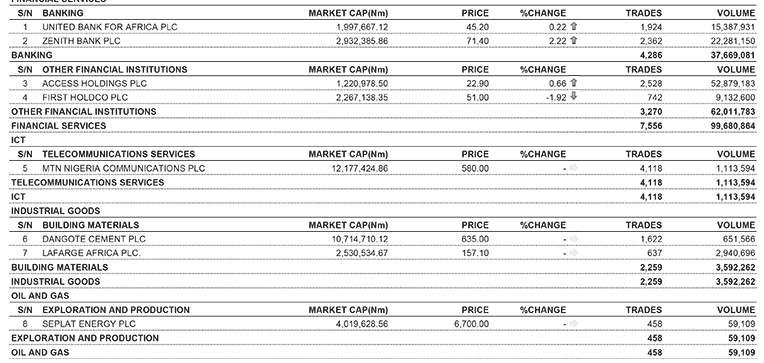
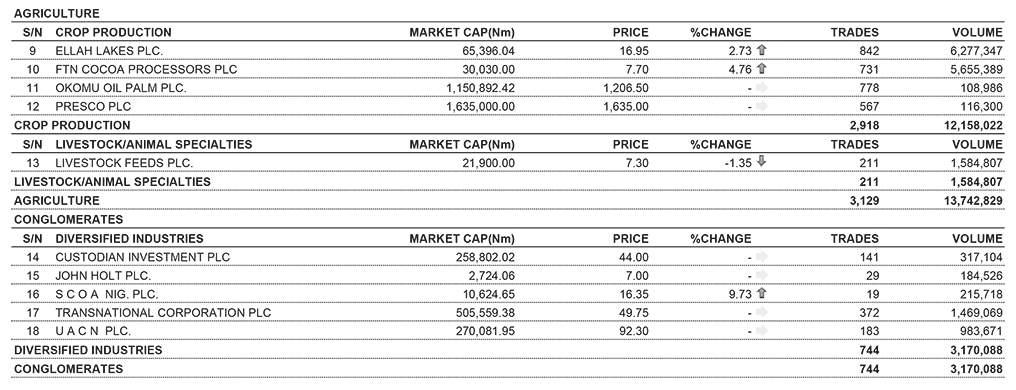
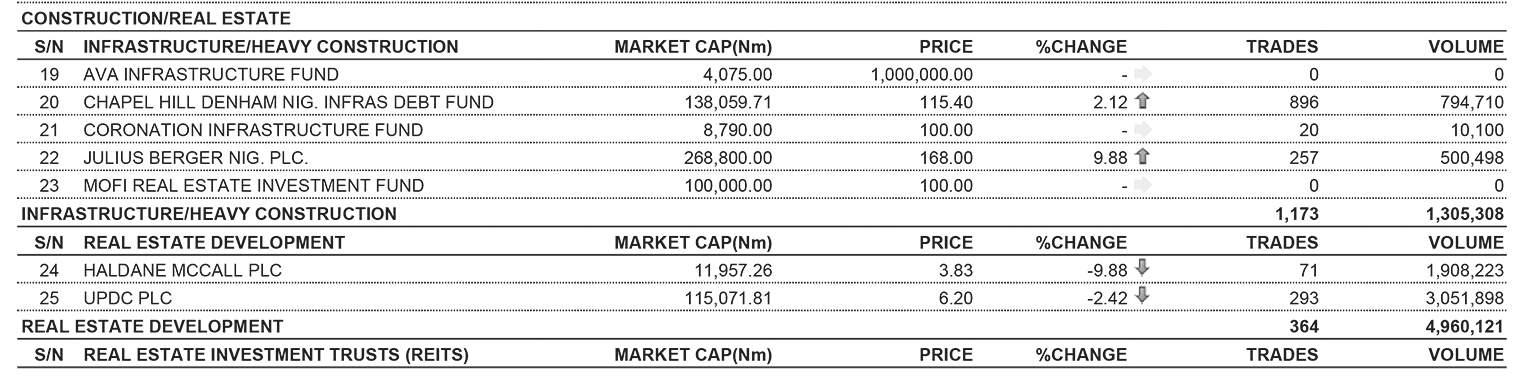
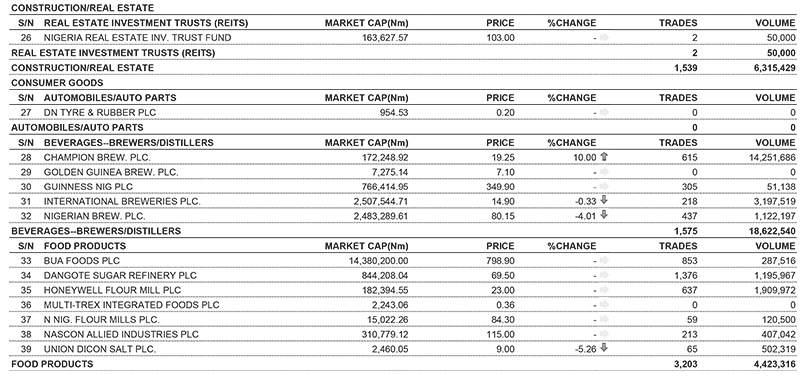
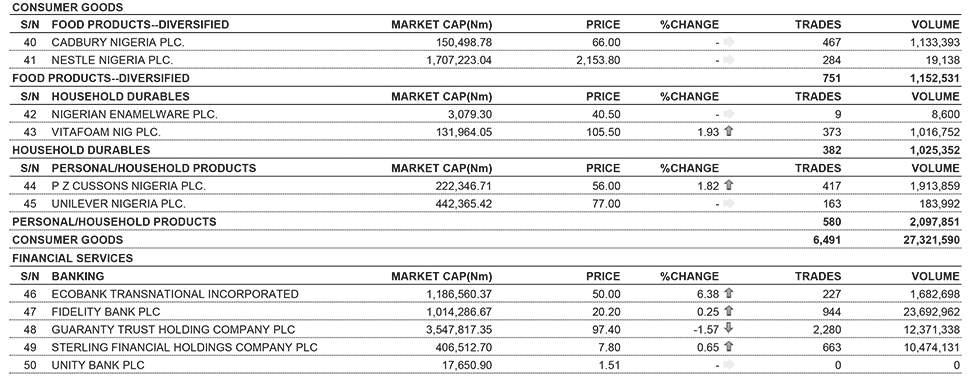
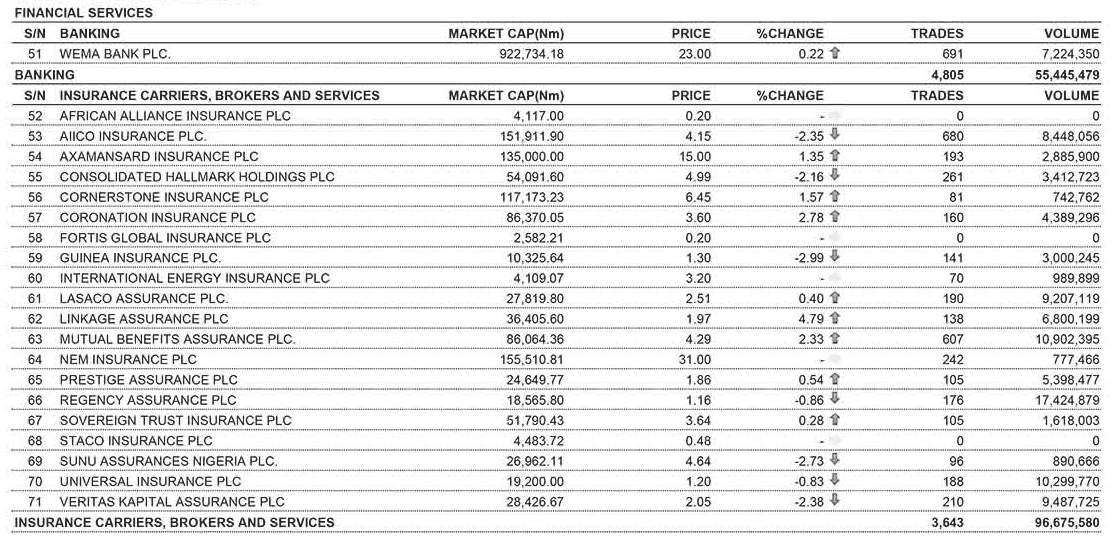
followed with a gain of 9.94 per cent to close at N5.86, while Neimeth International Pharmaceuticals rose by 9.90 per cent to close at N11.10, per share.
On the other side, Industrial & Medical Gases led others on the losers’ chart with 9.95 per cent to close at N34.85, per share.
Haldane McCall followed with a decline of 9.88 per cent to close at N3.83, while LivingTrust Mortgage Bank shed 9.57 per cent to close at N4.44, per share.
Ikeja Hotel lost 7.28 per cent
to close at N32.50, while Union Dicon Salt depreciated by 5.26 per cent to close at N9.00, per share.
Also, the total volume traded rose by 16.62 per cent to 629.600 million units, valued at N14.754 billion, and exchanged in 57,858 deals. Transactions in the shares of Secure Electronic Technology led the activity with 83.307 million shares worth N98.202 million.
Access Holdings followed with account of 52.879 million shares valued at N1.214
billion, while Jaiz Bank traded 39.730 million shares valued at N339.106 million.
Tantalizer traded 34.242 million shares worth N103.110 million, while Fidelity Bank traded 23.693 million shares worth N473.450 million.
Looking ahead, Imperial Asset Managers Limited said, “we expect the market to trade on a mixed-to-bullish note, with selective accumulation in financially sound and income-oriented stocks likely to support continued gains.”

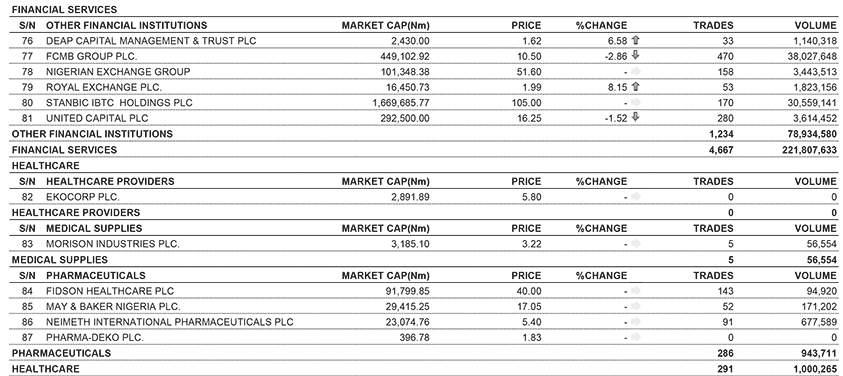
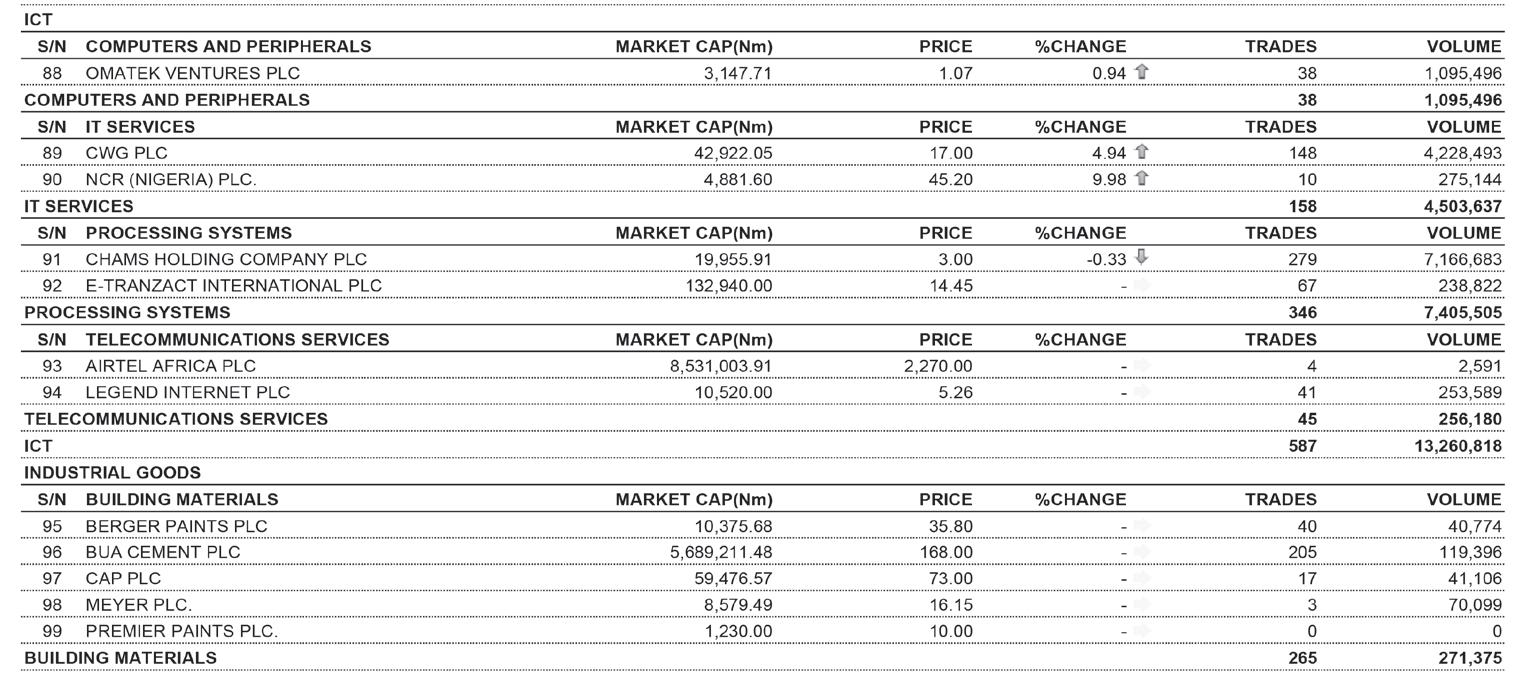
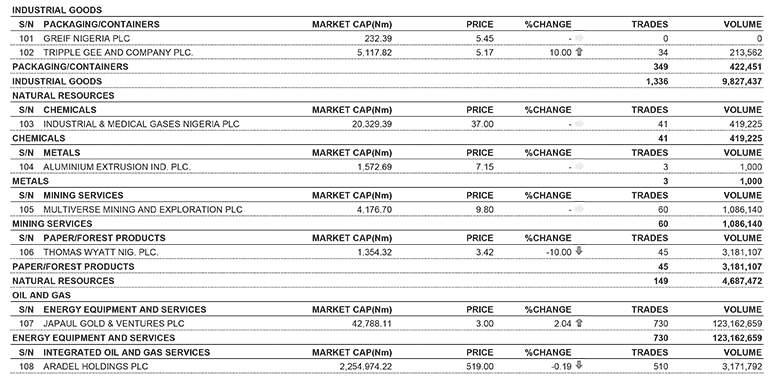
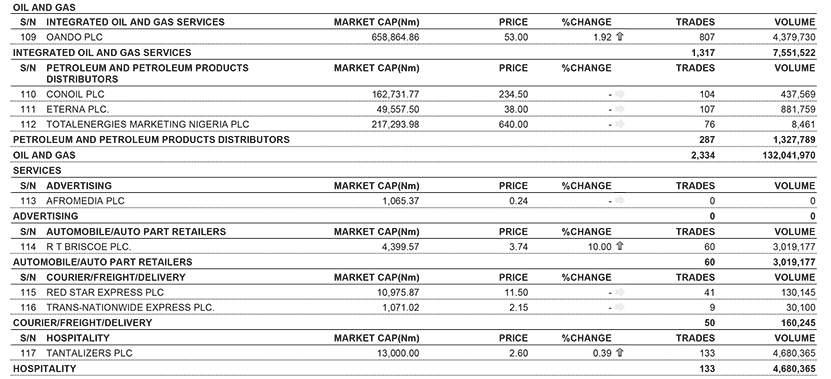
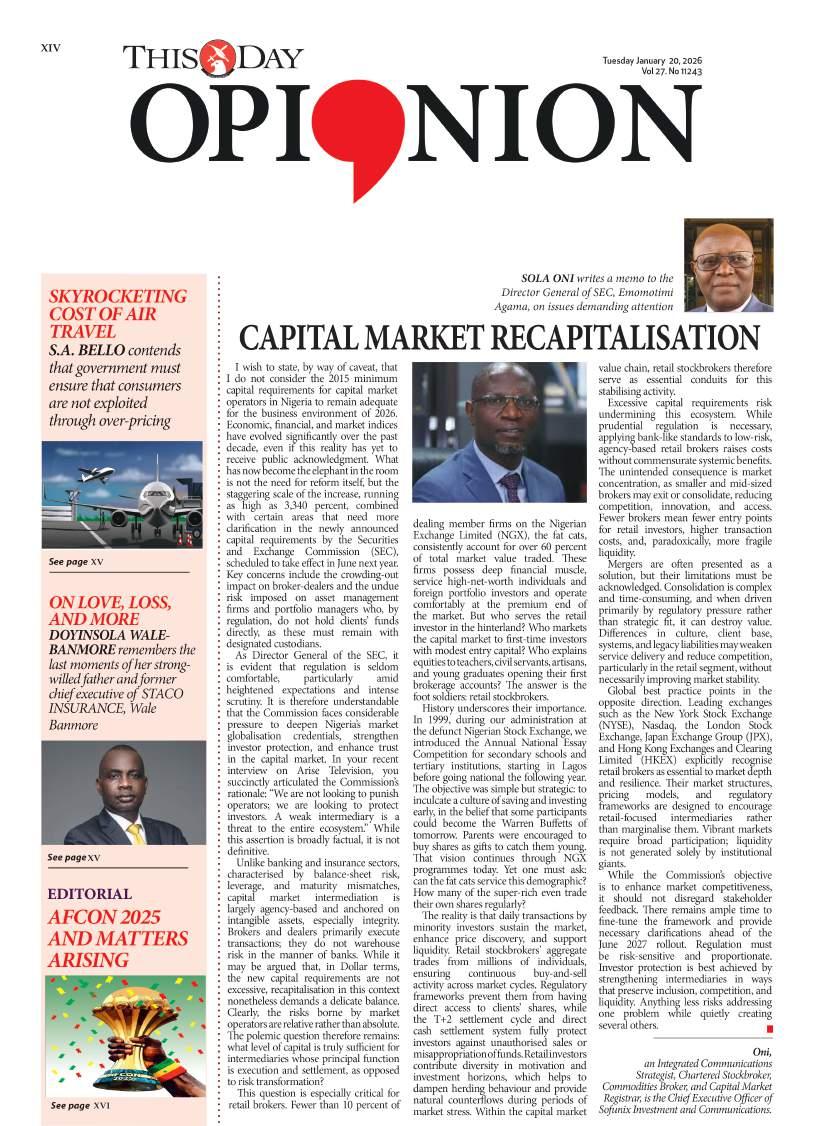
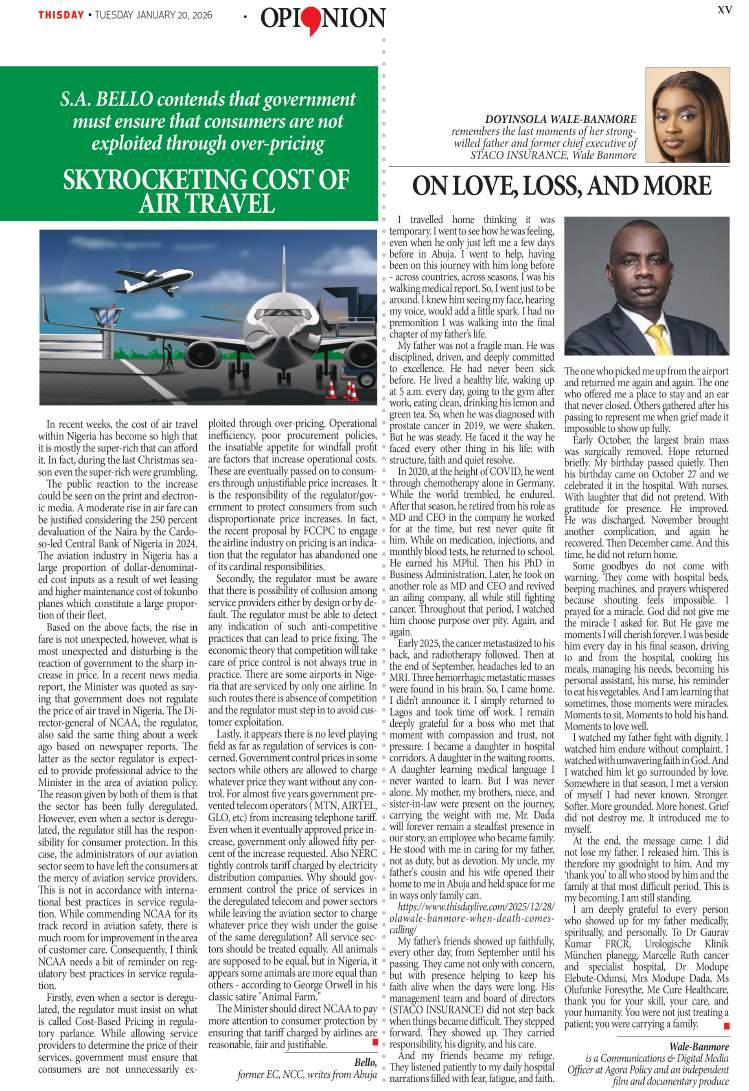
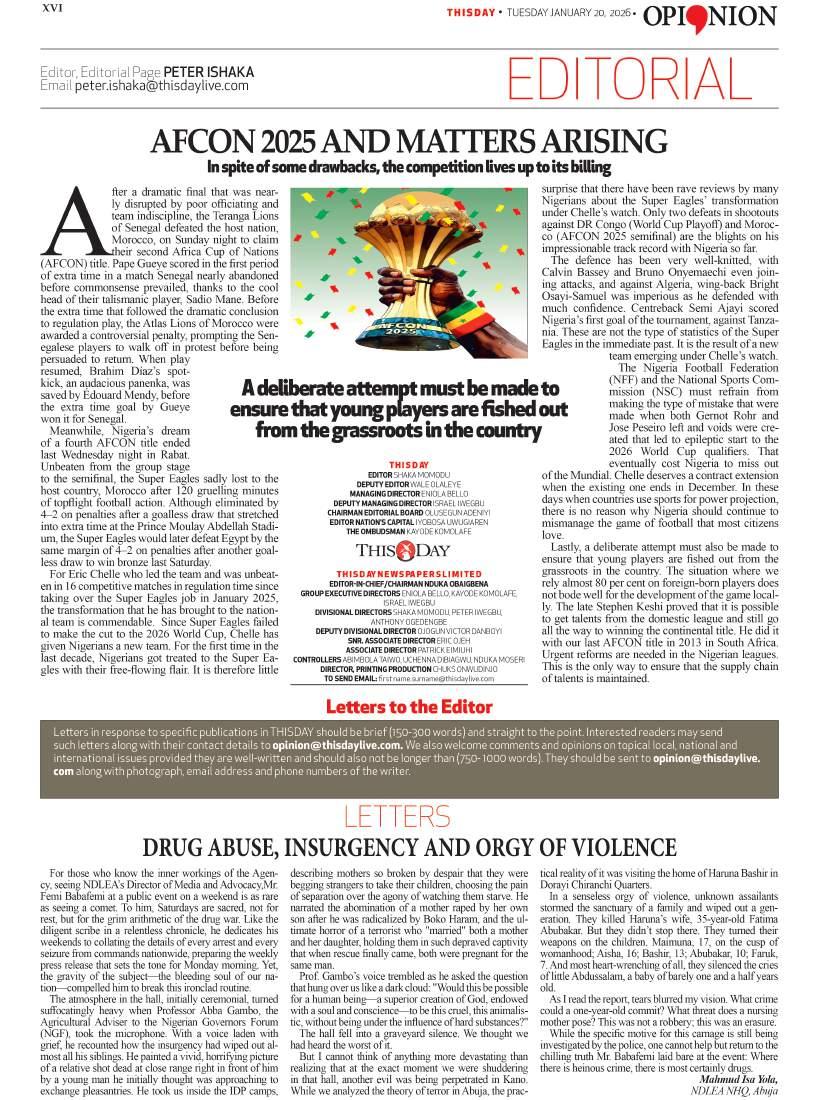
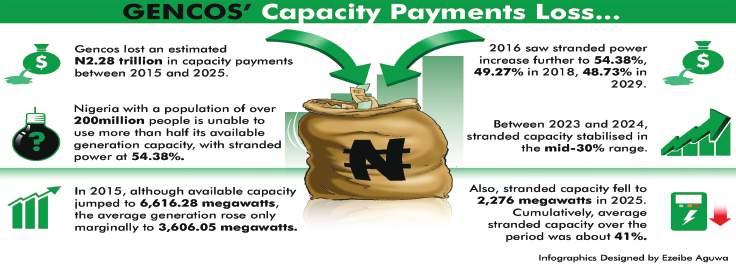
Emmanuel Addeh in Abuja
Nigeria’s electricity Generation Companies (Gencos) lost an estimated N2.28 trillion in capacity payments between 2015 and 2025 as a large share of installed power capacity remained stranded, highlighting deep and persistent inefficiencies across the power value chain in the country.
Essentially, capacity loss to Gencos refers to the portion of electricity capacity that is available or installed but cannot be utilised or monetised because the power system is unable to take it. Although many Gencos are technically capable
of producing far more electricity, a significant share of this capacity is stranded due to constraints outside their control.
Data covering the period made public by the Association of Power Generation Companies (APGC) showed that at its peak, more than half of the country’s available generation capacity could not be utilised, with stranded power reaching 54.38 per cent at a point.
THISDAY analysis of the figures indicated that although Nigeria steadily expanded its installed and available generation capacity over the past decade, the ability of the system to
evacuate and distribute the power failed to keep pace.
As a result, generation companies had plants that were available but could not generate at full potential, mostly due to transmission constraints, grid instability, and weak demand absorption downstream.
The data showed that in 2015, although available capacity jumped to 6,616.28 megawatts, the average generation rose only marginally to 3,606.05 megawatts. This left 3,010.24 megawatts unused, equivalent to 45.50 per cent stranded capacity.
Capacity payment losses for that year stood at N214.93 billion. The following year,
2016, saw stranded power increase further to 54.38 per cent, or 3,827.98 megawatts out of 7,039.96 megawatts available, translating into capacity payment losses of N273.32 billion.
The worst performance was recorded that year. In effect, more than one out of every two megawatts that could have been generated in that year 2016 remained idle.
Capacity payment losses in 2017 were N236.47 billion, underscoring the financial burden imposed by structural bottlenecks rather than lack of generation assets in the country. In that year, In 2017, 48.20 per cent of available capacity was stranded out of 6,871.26 megawatts generated
that year, while 3,311.92 megawatts were stranded.
The massive capacity losses by Gencos continued in 2018 when it was 49.27 per cent. In that year, 7,506.23 megawatts were generated; average generation capacity was 3,807.72 megawatts and stranded generation capacity was 3,698.51 megawatts. Total annual capacity loss for that year was N264.08 billion.
The story was the same in 2019 when average stranded power was 48.73 per cent; annual capacity loss was N256.85 billion; availability generation was 7,381.67 megawatts; average generation capacity was pegged at 3,784.42 megawatts and stranded generation was
3,597.25 megawatts. Even in 2020, despite a rise in average generation capacity to just over 4,050 megawatts, 48.03 per cent of available capacity still could not be utilised out of the 7,792.51 megawatts. Monetary loss for that year was N266.10 billion. However, a noticeable decline in stranded capacity emerged from 2021, coinciding with modest improvements in grid management and slightly better utilisation of existing assets. In 2021, stranded capacity fell to 35.48 per cent, with average generation of 4,118.98 megawatts against available capacity of 6,337 megawatts.
The story continues online on www.thisdaylive.com
The Transmission Company of Nigeria (TCN) has called for closer collaboration with the Lagos state government to safeguard its critical infrastructure across the state.
Speaking during a courtesy visit by the management of

TCN’s Lagos region to the Lagos State Planning and Environmental Monitoring Authority (LASPEMA), the General Manager (Transmission), Mojeed Akintola, stressed the importance of inter-agency cooperation in protecting transmission assets.
Akintola, according to a statement by the General Manager, Public Affairs of the TCN, Ndidi Mbah, explained that the purpose of the visit was to strengthen ties between TCN and LASPEMA, promote orderly urban development, and prevent

encroachment on the rightsof-way of transmission assets throughout the state.
On his part, the Commissioner for Physical Planning and Urban Development, Lagos State, Dr. Oluyinka Olumide, who supervises the agency, reaffirmed
the state government’s commitment to effective land-use management, stakeholder engagement, and enforcement.
He assured TCN of LASPEMA’s readiness to collaborate with relevant stakeholders to preserve designated open spaces

and advance sustainable urban development in Lagos state.
Earlier, the General Manager of LASPEMA, Daisi Oso, pledged the agency’s full commitment to preventing encroachers from using high-tension corridors.




projects in the UK, Oman and Australia, the Guardian UK reported.
British Petroleum, one of the world’s largest integrated oil and gas companies, has said it expects to write down the value of its struggling green energy business by as much as $5 billion (£3.7 billion), as it refocuses on fossil fuels under its new chair, Albert Manifold.
The oil company said the writedowns were mostly related to its gas and low-carbon energy divisions in its “transition businesses”, but added that wiping between $4 billion and $5 billion off their value would not affect its underlying profits when it reports its full-year results in February.
The company has been trying to sell a stake in its solar business, Lightsource, and cancelled hydrogen
BP’s shares fell by as much as 1.4 per cent during the week before recouping some of their losses, as the company also said oil trading had been weaker during its final quarter of the year.
It comes only days after its FTSE 100 rival Shell warned of a weaker performance from trading, amid a drop in the oil price. BP said the average price of Brent crude was $63.73 a barrel in the fourth quarter of last year, compared with $69.13 a barrel in the prior quarter.
Oil prices last year recorded their steepest annual fall since the Covid pandemic, slumping by almost 20 per cent in 2025, while further declines are expected as producers continue to pump more
crude than is required by the global economy.
In recent weeks, prices have come under further pressure after Donald
stands in solidarity with the Petroleum and Natural Gas Senior Staff Association of Nigeria (PENGASSAN) on the commemoration of
the 20th anniversary of the passing of its former President, Uche Marcus, who died in a Sosoliso plane crash on December 10, 2005.
The NUPRC noted that Okoro remains the only person to have been president of both PENGASSAN and the Nigeria Union of Petroleum and Natural Gas Workers (NUPENG), a testament to his sterling leadership qualities.
Comms/e-Business
Asst.
Asst.
Correspondents
KayodeTokede
Ebere
The commission praised the late unionist for his doggedness and dedication to the plight of Nigerian oil workers so much so that PENGASSAN christened its national headquarters U.M Okoro House.
The NUPRC, in honour of the deceased, seized the opportunity to restate its commitment to staff welfare and development.
While commiserating with the family of the deceased unionist, the NUPRC prayed that God Almighty continues to strengthen the wife and children he left behind.
Trump’s capture of Venezuela’s then leader, Nicolás Maduro, and his claim that US oil companies stand poised to rebuild the
South American country’s oil industry, adding to fears of a glut.
However, oil prices have risen in fears of Iranian supply disruptions because of a potential US attack and possible retaliation. Brent futures rose 1.4 per cent to $66.39.
Emmanuel Addeh in Abuja
The Nigerian Independent System Operator (NISO) has dissociated itself from some social media accounts purporting to be disseminating electricity grid information to Nigerians.
Stressing that it is has no link to the handles, ‘Nigeria National Grid’ on social media, it informed Nigerian that its official communications are issued
exclusively through its verified channels and authorised platforms.
“The Nigerian Independent System Operator (NISO) wishes to inform the general public, stakeholders, and members of the media that it does not own, manage, or operate the social media handle on X (formerly Twitter) identified as ‘Nigeria National Grid.’ “NISO is not associated in any way with the
said handle, and the individuals or entities managing it are unknown to the organisation and have no affiliation with NISO.
“Accordingly, the public and media organisations are advised not to quote, reference, or attribute any information, statements, or opinions published on the said handle to NISO, as such content does not reflect the position, operations, or activities
of the organisation,” it added in a statement.
NISO said it legally mandated to manage the national grid, and all its official communications are issued exclusively through its verified channels and authorised platforms.
“NISO appreciates the cooperation of stakeholders and the media in ensuring accurate and responsible information sharing,” the statement noted.
The Department of Building, Faculty of Environmental Sciences, Niger Delta University (NDU), in Bayelsa, at weekend inducted its pioneer set into the Nigerian Institute of Building (NIOB).
The ceremony which took place in the institution was themed: “Building the Future; Innovating, Integrating and Inspiring
in the Construction Era”.
In his address, Acting Head of Department (HOD) Building, Dr Christopher Belonwu, described the occasion as a day of fulfilment, noting that the university was committed to raising competent ethical and industry-ready building professionals, who would contribute meaningfully to national development and global best practices in the built environment.
“As head of department, witnessing the induction of our graduates into the graduate cadre of the Nigerian Institute of Building, gives me joy. The department of building was officially kicked off in the 2019/2020 academic session with a clear vision.
“Like every worthwhile venture, the journey was not without challenges. We started with modest facilities, high expectations and an
unshakable belief in what the department could become. Today, that belief has been validated.
“This induction ceremony marks the fruition of years of hard work, resilience and determination by our students who dared to dream, our lecturers who laboured tirelessly to impart knowledge and character, and the university management, whose support made this dream sustainable,” he stated.
Chairman of SIFAX Group, Dr. Taiwo Afolabi, has extended warm birthday felicitations to the Comptroller-General of the Nigeria Customs Service (NCS), Bashir Adewale Adeniyi, commending his exemplary leadership and far-reaching contributions to Nigeria’s economic growth and global trade standing.
In a goodwill message issued on behalf of the Board, Management and Staff of SIFAX Group, Afolabi described Adeniyi as a transformational leader
whose tenure has brought renewed professionalism, efficiency and credibility to the Nigeria Customs Service.
According to him, Adeniyi’s leadership has been instrumental in driving significant reforms across customs operations, leading to sustained revenue growth, improved trade facilitation, enhanced border security and accelerated digital transformation within the Service.
“Your tenure as Comptroller-General has
been defined by strategic foresight, institutional discipline and an unwavering commitment to national service,” Dr. Afolabi stated. “These achievements have not only strengthened Nigeria’s trade ecosystem but have also positively impacted the ease of doing business for stakeholders across the maritime, aviation and logistics sectors.”
He noted that the milestone reflects Adeniyi’s competence, integrity and global outlook, adding that
it is a source of pride for Nigeria and inspiration for public service leadership across Africa.
As the Chairman of a leading pan-African conglomerate with interests in maritime, aviation, logistics, oil and gas and hospitality, Afolabi affirmed that SIFAX Group deeply appreciates the Comptroller-General’s stakeholder-focused approach and his commitment to collaboration in building a more efficient, transparent and globally competitive customs system.
In a deliberate move to reinforce maritime security and strengthen strategic partnerships across government and the private sector, the Flag Officer Commanding Western Naval Command, Rear Admiral Abubakar Mustapha embarked on a series of high-level courtesy visits in Lagos State. Chiemelie Ezeobi writes that these engagements underscore the Nigerian Navy’s commitment to safeguarding Nigeria’s waterways as critical corridors for security, economic growth, and national development
In a renewed push to consolidate maritime security and strengthen partnerships critical to Nigeria’s economic and national security architecture, the Flag Officer Commanding Western Naval Command, Rear Admiral Abubakar Abdullahi Mustapha on Monday embarked on a series of highlevel courtesy visits in Lagos State.
The engagements, which took him to the Lagos State Government Secretariat in Alausa and to the corporate headquarters of the Dangote Group, underscored the Nigerian Navy’s evolving strategy of collaboration with both government and the private sector to secure Nigeria’s waterways.
Reinforcing State and Navy Collaboration in Lagos
Rear Admiral Mustapha’s engagement included a courtesy visit to the Executive Governor of Lagos State, Mr. Babajide Sanwo-Olu, at the Governor’s Office in Alausa.
The visit marked his formal introduction to the Governor following his assumption of office as the 46th Flag Officer Commanding of the Western Naval Command in October 2025.
During the meeting, the FOC West expressed appreciation to the Lagos State government for its consistent support to the security sector, particularly in maritime security.
He noted that the sustained cooperation between the state government and security agencies has played a critical role in maintaining peace and stability across Lagos, Nigeria’s foremost commercial hub and one of the busiest maritime environments in West Africa.
Rear Admiral Mustapha reaffirmed the Nigerian Navy’s commitment to maintaining a strong presence across both coastal and inland waterways within the Command’s Area of Responsibility.
He explained that the Western Naval Command remains focused on proactive patrols and intelligence-led operations to deter criminal elements and ensure the safety of maritime routes vital to commerce and daily livelihood activities.
A Technology-driven Maritime Security Vision
Elaborating on his operational philosophy, the FOC West stated that the Command’s approach to maritime security is increasingly technology-driven. He outlined a strategic focus on the principles of detect, deter, disrupt, and prevent, noting that the effective use of surveillance systems and other high-tech solutions is essential in addressing evolving maritime threats.
He further disclosed that the Western Naval Command is ready to deepen collaboration with the Lagos State Government in securing state waterways, particularly at established choke points. According to him, enhanced cooperation
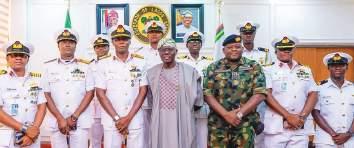
50th anniversary of the assassination of the late head of state
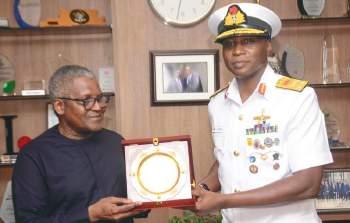
in this area aligns directly with the Blue Economy agenda being pursued by both the Federal Government and Lagos State.
He noted that improved security along waterways would not only curb criminal activities but also facilitate safer movement for economic operations, trade, and investment, thereby supporting broader development goals. Rear Admiral Mustapha also conveyed the goodwill and greetings of the Chief of the Naval Staff, Vice Admiral I. Abbas, AM, to Governor Sanwo-Olu.
The Governor’s Commendation
In his response, Governor Sanwo-Olu commended the Nigerian Navy for its professionalism and continued efforts in safeguarding Lagos State’s maritime environment.
He specifically acknowledged the role of the Western Naval Command
and NNS BEECROFT, as well as the effective teamwork among security agencies operating within the state.
The Governor assured the FOC West of the Lagos State government’s unwavering commitment to sustaining collaboration with the Nigerian Navy in all areas aimed at enhancing maritime security.
Engaging the Private Sector for Maritime Safety
In engaging the private sector, Rear Admiral Mustapha also went to the corporate headquarters of the Dangote Group in Lagos, where he paid a courtesy visit to the President and Chief Executive, Alhaji Aliko Dangote.
The visit formed part of the Nigerian Navy’s broader efforts to engage strategic private sector stakeholders whose operations are deeply intertwined with Nigeria’s maritime domain.
Uzoma Mba
Alpha and Jam Africa has unveiled Olympia, described as the largest mixed-format advertising board in Lagos, located beside the National Theatre and the Wole Soyinka Centre for Art and Culture.
The media group said the project marks the first phase of its three-year programme to develop ultra-large
billboard infrastructure across 10 cities globally.
Speaking on the significance of the installation, the firm said Olympia was conceived not merely as an advertising structure but as a landmark development within Nigeria’s evolving outdoor advertising space. Strategically positioned along the Eko Bridge corridor, the site sits on one of Lagos’ busiest transport
routes. Alpha and Jam Africa estimates that over 11,000 vehicles pass through the axis hourly, while the Lagos Blue Line rail system conveys more than 250,000 passengers daily between Marina and Mile 2. The structure is also visible from the Alaka Interchange and Third Mainland Bridge. Olympia features a hybrid design combining largeformat static and digital advertising. It consists of two landscape static panels
measuring 100 by 30 metres each, alongside a 30 by 4-metre portrait LED digital screen. According to the company, the configuration allows brands to deploy both long-term static messaging and dynamic digital content simultaneously.
Beyond media display, the structure was designed to support experiential marketing. Built with container architecture, it includes ground and first-
Addressing the Dangote Group leadership, the FOC West emphasised that the Nigerian Navy recognises the vital role of the private sector in maritime security, industrial expansion, and national economic development. He described the Dangote Group as one of Nigeria’s most significant conglomerates, with extensive interests in refinery operations, shipping, and maritime logistics.
Rear Admiral Mustapha highlighted that the Dangote Refinery, located within the Western Naval Command’s Area of Responsibility, represents a critical national strategic asset.
He stressed that the protection of such infrastructure requires collective effort and sustained collaboration between the Navy and private sector operators.
The FOC West reiterated the Nigerian Navy’s commitment, under the leadership of Vice Admiral Idi Abbas, AM, to strengthening cooperation, intelligence sharing, and operational support to ensure the secure movement of goods, personnel, and assets across Nigeria’s waterways. He also reaffirmed the Navy’s determination to combat piracy, crude oil theft, smuggling, and other maritime crimes that undermine national security and economic stability. He conveyed the Chief of the Naval Staff’s greetings to Alhaji Dangote.
In his remarks, Alhaji Aliko Dangote commended the Nigerian Navy for its steadfast efforts in enhancing maritime safety along Nigeria’s coastal and offshore corridors.
He noted that maritime security is fundamental to industrial growth, particularly for organisations that rely heavily on efficient port operations and secure waterways for the movement of raw materials and finished products.
Dangote expressed the Group’s readiness to support mutually beneficial initiatives that promote maritime safety, economic growth, and national development, while appreciating the Western Naval Command’s collaborative approach.
The twin engagements reflected the Western Naval Command’s strategic focus on building strong partnerships with government and the private sector as a foundation for sustaining a secure maritime environment.
Through continued collaboration, the Command aims to ensure that Nigeria’s waterways remain safe, efficient, and supportive of national prosperity and long-term economic growth.
floor spaces intended for brand activations, events, and audience engagement.
Mr Ajiboye, Global Growth Director for A&J Africa and Europe, described the project as symbolic in both scale and placement.
“Olympia is more than an advertising board; it is a landmark. By placing it beside the National Theatre, we anchored it to a symbol of national aspiration and gathering. It sits at the
crossroads of daily commute and monumental events, capturing the relentless energy of Lagos,” he said.
The company said the development reflects its belief that Nigeria’s advertising infrastructure must evolve in line with the sophistication of its audiences and markets, adding that more iconic installations are planned within and outside the country.

A Mutual fund (Unit Trust) is an investment vehicle managed by a SEC (Securities and Exchange Commission) registered Fund Manager. Investors with similar objectives buy units of the Fund so that the Fund Manager can buy securities that willl generate their desired return.
An ETF (Exchange Traded Fund) is a type of fund which owns the assets (shares of stock, bonds, oil futures, gold bars, foreign currency, etc.) and divides ownership of those assets into shares. Investors can buy these ‘shares’ on the
floor of the Nigerian Stock Exchange.
A REIT (Real Estate Investment Trust) is an investment vehicle that allows both small and large investors to part-own real estate ventures (eg. Offices, Houses, Hospitals) in proportion to their investments. The assets are divided into shares that are traded on the Nigerian Stock Exchange.
GUIDE TO DATA:
Date: All fund prices are quoted in Naira as at 16 January 2026, unless otherwise stated.
Offer
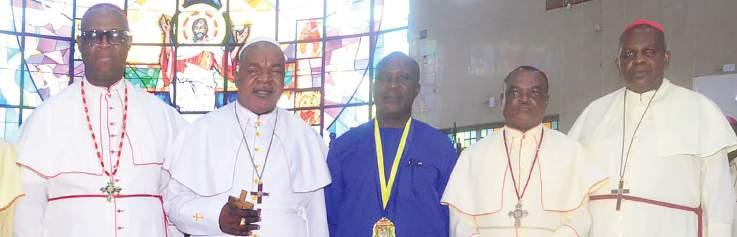
L-R: Secretary of Conference, Methodist Church Nigeria, Bishop Abiodun Taiwo; Prelate, Methodist Church Nigeria, His Eminence, Dr. Oliver Ali Aba; Lay President, Methodist Church Nigeria, Sir Ide Okechukwu; Planning Committee Chairman, Archbishop Christopher Ede; and Archbishop of Lagos Mainland, Most Rev. Obafemi Adeleye during a media briefing organised to mark the 50th Anniversary Celebrations of Episcopacy in Methodist Church Nigeria, held at Hoares Memorial Methodist Cathedral, Yaba, Lagos, yesterday
Former Attorney-General of the Federation (AGF) and Minister of Justice Abubakar Malami, SAN, has been rearrested and taken into custody, this time by operatives of the Department of State Services (DSS).
His arrest, yesterday, THISDAY learnt was in connection with alleged terrorism financing.
Malami, his son, Abdulaziz, and wife, Hajia Asabe Bashir, were on January 7, remanded at the Kuje Correctional Center pending the perfection of their separate bail granted them by a Federal High Court, Abuja.
They were arraigned by the Economic and Financial Crimes Commission (EFCC), on a 16 count criminal charge bordering on fraud and money laundering to the tune of N9 billion.
Following their not guilty plea, Justice Emeka Nwite, admitted them to bail in the sum of N500 million naira each.
Report, however, had it that
Malami has again been arrested and was being detained for investigation on alleged terrorism financing.
His arrest and subsequent detention was based on the alleged discovery of arms and ammunition at his country home in Birnin Kebbi, Kebbi State.
The arms were discovered by the anti-graft agency when they searched his residence for evidence in relation to his fraud and money laundering investigation.
Since the alleged illegal possession of firearms fell outside the EFCC mandate, the agency handed the matter over to the DSS for comprehensive investigation.
Confirming the arrest, a source within the security network, disclosed that the former minister was being investigated over his alleged links with terrorism.
“Yes, it is true that DSS operatives arrested Abubakar Malami, SAN. There are several petitions against him bordering on alleged terrorism financing,” the source
said.
He stressed that, terrorism and terrorism financing were serious offences globally, which could not be taken lightly.
“You’ll recall that when Abubakar Malami, SAN, was the Attorney General of the
Federation and Minister of Justice, he vowed that the government of the day would not shield any person or persons linked to terrorism or terrorism financing.
“No responsible government would, in the same vein, fold its hands or turn a blind eye to
weighty allegations of terrorism financing leveled against any individual, no matter how highly placed. In this case, Malami, SAN.
“In the course of investigations, we have what is called inter-agency cooperation. It is not uncommon for one security agency to hand over a person under investigation to another sister security agency.
“In Nigeria, the DSS is the sole security agency tasked with the responsibility of investigating such allegations. It’ll be best to allow them do their job,” the source
Deploys 40 Justices, 16 panels to tackle backlog
The President of the Court of Appeal, Justice Monica DongbanMensem, yesterday presided over a special sitting in Lagos, during which she announced that 360 appeals have been scheduled for hearing before 16 panels comprising 40 Justices, in a concerted effort to reduce the
Michael Olugbode in Abuja
The North East Development Commission (NEDC) has commenced a two-week Ophthalmology Equipment Set-Up and Training Programme at the Maiduguri Eye Hospital in Borno State, following the deployment of advanced eyecare equipment valued at over N3 billion.
The programme, which began on Monday, marks a major step in the Commission’s efforts to improve specialist healthcare delivery and address preventable blindness across the North-East region.
Activities on the first day included the installation, calibration, and coupling of cutting-edge ophthalmic equipment, alongside the start of hands-on technical and clinical training sessions.
The exercise is aimed at ensuring the newly supplied equipment is
fully operational and optimally configured for effective eye-care services.
The training is being led by Prof. Abdull Mohammed Mahdi, a Chief Consultant in Ophthalmology, with support from Dr. Abuh Sunday, also a Chief Consultant, and a multidisciplinary team of experts in ophthalmology and biomedical engineering.
Participants include consultant ophthalmologists, resident doctors, ophthalmic nurses, optometrists, and biomedical engineers from the Maiduguri Eye Hospital and the University of Maiduguri Teaching Hospital (UMTH).
They will receive intensive practical training on the operation, maintenance, and efficient use of the equipment.
According to the NEDC, the initiative is expected to significantly enhance the hospital’s diagnostic and surgical capacity, particularly
in the management of cataract and glaucoma cases.
The Commission noted the intervention aligns with its longterm objective of transforming Maiduguri Eye Hospital into a regional centre of excellence for ophthalmic care.
In addition to the equipment deployment and training, the Commission is undertaking extensive renovation and infrastructure upgrades at the hospital to support modern clinical operations and improve patient experience.
The NEDC is also extending similar ophthalmic interventions across other states in the NorthEast. Of note is the ongoing construction of an ultra-modern Eye Institute at the Abubakar Tafawa Balewa University Teaching Hospital (ATBUTH) in Bauchi, which commenced last year and is scheduled for accelerated implementation this year.
court’s growing backlog of cases.
The special sitting, held in Lagos, the city where the Court of Appeal was originally established, forms part of activities marking the court’s golden jubilee, its 50th anniversary.
Justice Dongban-Mensem said the exercise reflects the court’s sustained commitment to improving efficiency in the administration of justice by directly addressing the rising volume of appeals across its divisions.
She noted that Lagos, as Nigeria’s commercial hub, naturally bears a disproportionate appellate workload, making deliberate intervention unavoidable.
“It has become timely and necessary for the court to take conscious and deliberate measures to address the increasing docket of appeals,” she said.
According to her, 16 panels made up of 40 Justices drawn from various divisions of the Court of Appeal nationwide have been constituted to sit throughout the week in Lagos and at the National Industrial Court.
The Court of Appeal President expressed gratitude to the Lagos State Government, particularly the Office of the Attorney-General, as well as the National Industrial Court, for their logistical and institutional support.
“I wish to express our profound appreciation to the Office of the Attorney-General of Lagos for collaborating with the court to ensure this exercise holds. Without this support, our limited resources
would not have been sufficient to accommodate the number of Justices present,” she said.
She also acknowledged the consistent support of the National Industrial Court in providing courtrooms and residential accommodation for the visiting Justices.
Justice Dongban-Mensem urged lawyers and litigants to ensure that their appeals were ripe for hearing and cautioned against avoidable delays.
She recalled a previous special sitting where several appeals could not be heard due to lack of preparation by counsel.
“It was very painful for me because our limited resources had already been expended on air tickets, accommodation and logistics, yet many appeals could not be taken because counsel were not ready,” she said.
While noting Lagos’s appeal as a destination, she emphasised that the special sitting was strictly for judicial work.
“When we set out time to work, we want to work. This is not a vacation,” she said. She further disclosed that several divisions of the Court of Appeal were temporarily left with fewer Justices due to the deployment to Lagos and appealed to members of the Bar to take the exercise seriously in recognition of that sacrifice.
Justice Dongban-Mensem also called on lawyers, litigants and the media to help safeguard public confidence in the judiciary, warning that erosion of trust in
the justice system could foster lawlessness.
She stressed that justice depends on credible evidence and active participation by all stakeholders, noting that judges and law enforcement agencies rely on accurate information to function effectively.
She urged journalists to prioritise accuracy in reporting judicial proceedings and to seek clarification where necessary to avoid misinformation.
In her closing remarks, the Court of Appeal President called on all stakeholders to uphold integrity and professionalism as the court marks its golden jubilee, stressing that justice must not only be done but must be seen to be done.
Speaking on behalf of the Bar, Senior Advocate of Nigeria, Mr. Ebun-Olu Adegboruwa, described the special sitting as historic and commended Justice DongbanMensem for the initiative.
He assured the court of the Bar’s cooperation in ensuring speedy and expeditious hearings, noting that this was in the interest of both lawyers and their clients.
Adegboruwa also congratulated the Court of Appeal on its 50th anniversary, praising its contributions to the administration of justice over the years.
However, he drew attention to persistent funding and infrastructure challenges facing the judiciary and expressed hope that ongoing efforts to improve facilities at the Lagos Division would soon be realised.
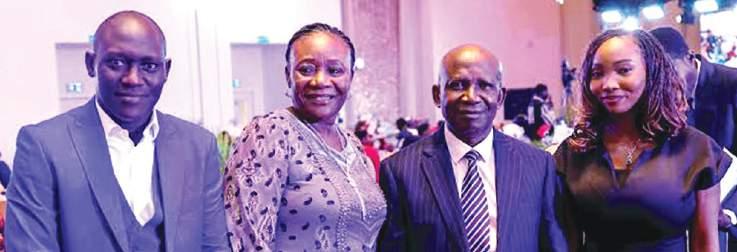
L-R: Corporate Communications Manager, Pinnacle Oil and Gas Limited, Mr. Obodo Ejiro; Wife of the Chief Financial Officer, Pinnacle Oil and Gas Limited, Mrs. Chinyere Anyaogu; Chief Financial Officer/Graduand, Dr. Sunday Anyaogu; and Customer Service Associate, Pinnacle Oil and Gas Limited, Chidinma Okolie, at the University of Lagos Business School 5th Graduation Reception in honour of Dr. Sunday Anyaogu and other graduands who completed their PhD programmes in Akoka , Lagos... recently
describes him
Others
Deji Elumoye in Abuja, Segun Awofadeji in Gombe and Hammed Shittu in Ilorin
President Bola Tinubu, yesterday, joined other promi-nent Nigerians to mourn the passing of a revered Islamic scholar and Chief Imam of Ilorin, Sheikh Muhammad Bashir Saliu. He was aged 75.
The president, in a condolence message by his Adviser on Information and Strategy, Bayo Onanuga, extended his heartfelt condolences to the family of the late Imam, Emir of Ilorin, Alhaji (Dr.) Ibrahim Sulu-Gambari, Ilorin Emirate Council, and Muslim Ummah in Kwara
he’s
State over the profound loss. Tinubu stated, “Sheikh Muhammad Bashir Saliu was a devoted servant of Allah, a bridge-builder, and a voice of moderation whose wisdom, humility, and commitment to unity endeared him to people of all “Thebackgrounds. Muslim Ummah will never forget the Sheikh’s invaluable contributions to religious harmony, community development, and the nurturing of future generations through learning and exemplary leadership.
“I pray that Almighty Allah (SWT) will grant the departed Al-Jannah Firdaus and comfort his family and followers at this
time of grief.”
Former President of the Senate, Dr. Bukola Saraki, described the death of the cleric as a great loss to the Ilorin emirate and Nigeria, as a whole.
Saraki, in a statement by his Press Officer on Local Matters, Abdulganiyu Abdulqadir, further described the late Chief Imam as an institution whose life was defined by scholarship, devotion to Allah, and selfless service to the Ummah.
He stated that Sheikh Muhammad Bashir Salihu’s over four decades of continuous leadership on the mimbar transformed him into a moral compass and spiritual authority whose
influence transcended the Ilorin Emirate and Kwara State.
On behalf of his family, Saraki extended his heartfelt condolences to Emir of Ilorin, Alhaji Ibrahim Sulu-Gambari; the immediate family of the late Chief Imam; Council of Ulama, Alfas, and Imams in Kwara State and beyond; and the entire people of the Ilorin Emirate.
He prayed Almighty Allah (SWT) to forgive the shortcomings of the departed scholar, accept his decades of service as acts of 1qibadah, grant him Al-Jani1Firdaus, and comfort the Ilorin Emirate, his family, and the entire Muslim Ummah.
The Lagos State Traffic Management Authority (LASTMA), in collaboration with the Lagos State Fire and Rescue Service, yesterday averted a major fire outbreak following a diesel tanker accident on the Liverpool Bridge inward Mile 2, along the Apapa corridor.
In a statement signed by the Director, Public Affairs and Enlightenment Department of LASTMA, Adebayo Taofiq, the agency said it acted swiftly to prevent what could have turned into a catastrophic inferno.
The statement read: “The Lagos State Traffic Management Authority (LASTMA) in exemplary synergy with the Lagos State Fire and Rescue Service has once again underscored its operational acuity and institutional readiness by decisively forestalling a potentially calamitous fire outbreak on the Liverpool Bridge inward Mile 2, occasioned by a tanker-related incident.”
According to the statement, preliminary security findings
revealed that “an articulated Iveco tanker (RBC 98 XX), heavily laden with diesel lost vehicular control and toppled onto the bridge, resulting in significant structural impairment to the tanker and the uncontrolled discharge of large volumes of diesel across the carriageway.”
It added that the situation became more dangerous as the diesel spilled from the elevated bridge to the area beneath, noting that “of grave concern was the spillage of the highly combustible petroleum product from the elevated bridge to the area beneath; an occurrence that regrettably drew the attention of some unscrupulous individuals who attempted to scoop the diesel, thereby compounding the volatility and danger inherent in the situation.”
The statement explained that LASTMA operatives immediately swung into action. “Upon receipt of the emergency alert, LASTMA operatives immediately mobilised to the scene, exhibiting remarkable professionalism, vigilance and composure.
“The Agency’s personnel
promptly dispersed the crowd engaged in the hazardous act of scooping diesel, decisively cordoned off the affected area and swiftly activated established inter-agency emergency response mechanisms,” it said.
It noted that the timely response prevented disaster, stressing that “this resolute and timely intervention effectively neutralised the imminent threat of combustion and prevented what could have escalated into a devastating inferno with dire human, environmental and infrastructural ramifications.”
The statement further disclosed that “the driver of the distressed tanker, who sustained severe injuries in the course of the accident, was courageously rescued by LASTMA officials and urgently conveyed to the General Hospital, Apapa, where he is currently receiving comprehensive medical attention.”
On security and traffic management, LASTMA stated that “officers of the Nigeria Police Force from Area ‘B’ Police Division, Apapa provided robust security reinforcement, work-
ing in close collaboration with other emergency responders to maintain crowd control, regulate traffic flow and stabilise the environment.”
Kwara State Governor, Alhaji AbdulRahman AbdulRazaq, expressed sadness over the death of the chief imam.
In a statement, AbdulRazaq said Sheikh Bashir represented the finest breed of Muslim scholarship in the history of Ilorin, describing his passing as shocking, depressing, and saddening, but yet a reminder that “even great men die”.
The governor stated, “I am saddened by the unfortunate death of the Chief Imam of Ilorin Sheikh Muhammad Bashir Imam Solih (OON).
“Sheikh Muhammad Bashir represented the finest breed of Muslim scholarship in the history of Ilorin, and his passing — shocking, depressing, and saddening as it is — again reminds us that even great men die.
“He will be missed for his uniquely outstanding scholarship, his patience and good nature, and his fine qualities as the leading Imam in our state.
“I extend my deepest condolences to the Mai Martaba
Emir of Ilorin Dr. Ibrahim SuluGambari, OFR, the entire Ilorin Emirate, Kwara State Council of Ulamah, and the immediate family of the Chief Imam.
“I ask Allaah to accept Imam Muhammad Bashir as his dutiful servant, forgive his imperfections, ease his accounts, elevate his rank in Al-jannah Firdaus, and uphold his family and the community upon goodness. Aamin.” Speaker of the state House of Assembly, Hon. Yakubu Danladi-Salihu, in his condolence statement, described the death of the chief imam as heart-breaking. Danladi-Salihu, in a statement on Monday, said, “We have lost a rare gem, it is indeed the end of an era!”
He added, “For over four decades, Sheikh Muhammad Bashir Imam Solih OON paraded erudition, religious and community leadership as the 12th Chief Imam of Ilorin Emirate where he led the Muslim community for over four decades nurturing its spiritual development, he would be sorely missed by all”
The Ogun State Government has confirmed that a medical doctor has been remanded in prison for allegedly issuing a fake medical report to help a popular blogger, Adetoun Onajobi, also known as @justadetoun, evade police arrest.
The government also disclosed that the Ogun State Police Command has filed a six-count charge against the blogger, who is currently on the run, following a complaint lodged against her by the state.
This was contained in a statement issued on Monday by the Attorney General and Commissioner for Justice, Mr. Oluwasina Ogungbade, SAN.
According to the statement,
Adetoun, an internet personality, has for years been accused of bullying, harassment, and using offensive language against individuals online.
The controversy escalated after boxing champion Anthony Joshua was involved in an accident in Ogun State.
Adetoun allegedly posted videos claiming that there was no ambulance service anywhere in the state and further accused Governor Dapo Abiodun of being in Ghana partying and impregnating women instead of attending to the boxer’s welfare.
Ogungbade described the claims as false, malicious, and misleading, stressing that Ogun
State has multiple state-owned and state-supported ambulance services.
He added that the allegations posed a public safety risk by misinforming residents about available healthcare resources.
As a result, the state reported Adetoun to the police for alleged violations of the Cybercrimes Act, 2015.
The police reportedly invited her for questioning on January 5, 2026, after issuing a notice on January 2. However, she failed to appear and allegedly went into hiding, despite earlier boasting that she had evidence to substantiate her claims.
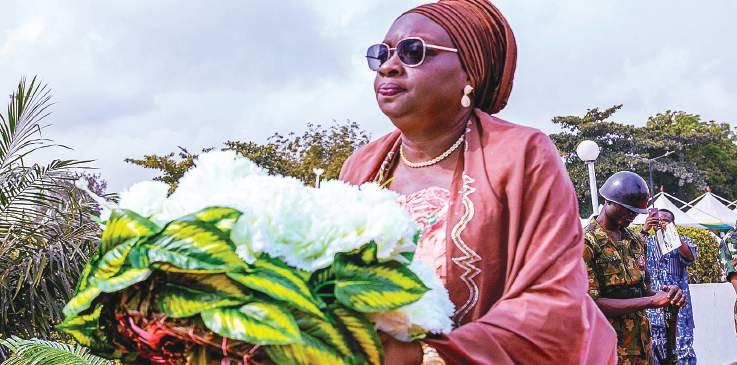
ARMED FORCES REMEMBRANCE DAY: OGUN STATE CEREMONY...
Ogun State Deputy Governor, Engr. Noimot Salako-Oyedele, laying a wreath at the Memorial Cenotaph of Fallen Heroes during the Special Parade and Laying of Wreath Ceremony to mark the year 2026 Armed Forces Remembrance Day celebration held at the Arcade
Office, Oke-Mosan, Abeokuta
Felix Omoh-Asun in Benin City
Dr. Pedro Obaseki has offered reasons why he decided to seek justice through the courts following what he described as his brutal public abduction, violent assault, and extra-judicial humiliation in Benin City on December 28, 2025. Obaseki said the drive for justice was not for revenge or political motives, but the need for accountability, deterrence, and protection of human dignity. Obaseki, cousin to former Edo State Governor, Godwin Obaseki, was seized by a horde of youths, who accused him of insulting the Oba of Benin, thereafter stripped him to his pants, and marched him through the streets to the Oba’s Palace on Ring Road, Benin City. Obaseki, former Managing Director of DAAR Communications
and Chief Executive Officer (CEO) of Hosamudia Farm, narrating how he was “abducted and assaulted” by suspected thugs, said the “assailants” invaded the football field and forcibly took him away to the palace.
In a strongly worded press statement in Benin City, Obaseki stated that his action was not only to restore his personal dignity and protect his family, but also to send a clear message that no individual or group had the right to abduct, brutalise or publicly dehumanise any citizen outside the law.
He said the decision was taken after extensive consultation with his wife and children, members of the Obaseki family and clan, senior legal advisers, and respected elders.
Obaseki described the incident
as a grave violation of his fundamental rights and said the acts amounted to terrorism-related violence under Nigerian law, citing the use of armed force, explicit threats to life, public intimidation, and deliberate creation of fear beyond the immediate victim.
He disclosed that during the
incident, his abductors claimed they were acting on the instructions of the Oba of Benin or the Oba’s Palace.
However, Obaseki confirmed that the claim had been formally and expressly refuted by the Benin Traditional Council, which issued a widely publicised letter categori-
cally denying any involvement, authorisation or prior knowledge of the acts.
Obaseki said he welcomed and accepted the clarification as the official position of the palace and noted it as part of the public record. He emphasised that the legal actions now under-way were directed strictly at the individual perpetrators and any persons who might be found, through due process, to have aided, facilitated or enabled the offences, whether through direct action, impersonation of authority, abuse of office or omission.
Former Vice President Atiku Abubakar declared that he was committed to working with leaders of African Democratic Congress (ADC) at all levels to build a strong and effective opposition
SHETTIMA: NIGERIA HOUSE, DAVOS, REFLECTS NATION’S RENEWED RESOLVE TO CONTRIBUTE TO GLOBAL ECONOMIC CONVERSATIONS
“Nigeria is open for business, but more importantly, Nigeria is open for collaboration.”
Shettima assured that Nigeria House would host conversations to move the country and the global community forward.
“We are here to learn from you just as much as we are here to inform you of the opportunities that await you in Nigeria. Progress is not a monologue; it is a dialogue,” he stated.
Earlier, Minister of Industry, Trade and Investment, Dr Jumoke Oduwole, applauded the support of Shettima in the realisation of the historic vision of Nigeria House, Davos, acknowledging his disposition and encouragement in the project.
Oduwole said the project demonstrated a strong Public Private Partnership and reflected the rejuvenation of the Nigerian
economy. She said it showcased a unique sense of national pride and a shift in how Nigeria engaged with the rest of the world, especially, the international business community.
Highlighting the gains of President Bola Tinubu’s economic reforms as incentives for private sector investment, Oduwole said Nigeria, under the current dispensation, was rebuilding trust, restoring credibility, and positioning itself as the global centre for wealth creation and strategic partnership.
She stated that the playbooks being launched at the event were part of a broad strategy to leverage Nigeria’s potential in the solid minerals, climate sustainable agriculture, creative, digital sectors.
Permanent Secretary, Ministry of Solid Minerals Development, Engr Faruk Yano, outlined major interventions and initiatives undertaken by the Tinubu administration in the
solid minerals and related sectors, aimed at diversifying and reforming the Nigerian economy.
Yano said Nigeria House, Davos, represented a deliberate action to consolidate the gains of Tinubu’s economic transformation efforts through high level engagements targeted at attracting investments in Nigeria’s non-oil sector.
He advocated fair treatment for emerging markets in the areas of access to finance and secured global supply chain network.
Lead Execution Partner, Nigeria House, Davos, Omowunmi Imoukhuede, emphasised that Nigeria House was a rare opportunity to tell stories about Nigeria’s unique investment potential.
Preceding the formal opening of Nigeria House, Davos, was a Global Business Roundtable focused on building a resilient supply chain network for the energy transition.
in Bauchi State.
Atiku spoke after meeting a delegation of critical ADC stakeholders from Bauchi State, led by Alhaji Aminu Yapeco, Sarkin Yakin Katagum, who spoke on behalf of the delegation after the meeting.
“This afternoon, I hosted a delegation of Bauchi State’s critical stakeholders in our party, the African Democratic Congress (ADC), led by Alhaji Aminu
Ahmed Yapeco, Sarkin Yakin Katagum,” Atiku said.
He said discussions at the meeting centred on strengthening the party’s internal structures in the state, with a focus on identifying areas that required attention to improve performance and cohesion.
Atiku stated that the engagement was part of a broader effort to reposition ADC as a credible opposition platform capable of advancing the interests of the
people of Bauchi. He said, “We have examined the gaps, and I am committed to working with the party’s leaders at all levels until we achieve a virile opposition that will best serve the interests of the people of Bauchi.” The meeting highlighted ongoing consultations among opposition figures as parties sought to deepen their presence at the grassroots and reinforce their structures ahead of the 2027 elections.
Chuks Okocha in Abuja
A political group working for former Vice President Atiku Abubakar, Atiku Haske Organisation, has expelled his son, Abba Abubakar, following his recent defection to All Progressives Congress (APC).
The group’s convener, Mai Bakari, announced the decision in a statement issued on Sunday, days after Abba defected to the ruling party and, reportedly, directed members of his political structure to join APC and mobilise support for President Bola Tinubu’s re-election.
Bakari said Abba lacked
the authority to speak or take decisions on behalf of the Atiku Haske Organisation, stressing that he was neither its founder nor a principal stakeholder.
“Abba Abubakar is not the originator or owner of the Atiku Haske Organisation. We merely invited him to be part of the group,” Bakari said.
Bakari said Abba neither contributed financially to the organisation nor held its registration documents, adding that the group is under no obligation to follow any directive issued by him.
He stated, “On the contrary, he is subject to our rules and
regulations. Having fallen short of our expectations, he has been expressly dismissed as a member of this Bakariorganisation.” further clarified that the group had no intention of defecting to APC, insisting that its members have collectively resolved to align with African Democratic Congress (ADC).
The statement said, “The Atiku Haske Organisation is not a party to, nor interested in, defecting alongside Abba to any political party other than the ADC. We were formerly in the Peoples Democratic Party and moved en masse to the ADC as an organisation.”
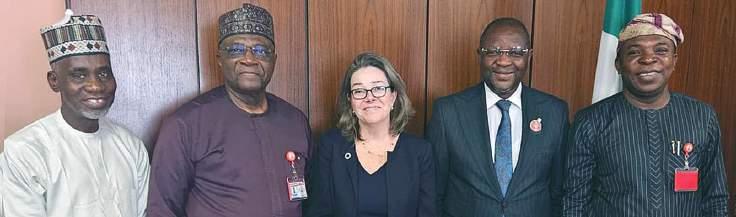
L-R: Information Officer, Embassy of the United States, Musa ibn Mohammed; Special Adviser to the President on Information and Strategy, Mr. Bayo Onanuga; Political Officer, Embassy of the United States, Cassandra Carraway; Special Adviser to the President on Media and Public Communication, Sunday Dare; and Senior Special Assistant to the President on Media and Publicity, Temitope Ajayi, during a meeting at the State House, yesterday
The National President of the Nigerian Association of Resident Doctors (NARD), Dr. Mohammad Suleiman, has warned that Nigeria’s health sector is approaching a critical breaking point, revealing that more than 15,000 doctors have left the country since 2014, with 4,700 exiting in 2024 alone.
Speaking yesterday at the opening of a five day training on effective policy-making and strategic leadership for NARD leaders at the National Institute for Policy and Strategic Studies (NIPSS), Kuru, Suleiman said the trend, if unchecked, could see Nigeria lose another 15,000 doctors within the next decade.
“Facts don’t lie. Figures don’t lie. In 2024, 4,700 doctors left the shores of Nigeria. Every year we produce 2,000 to 3,000 doctors, yet we lost far more than we produced.
If this continues, Nigeria cannot survive it,” he argued.
Suleiman painted a stark picture of the country’s doctor to patient ratio, noting that Nigeria currently has fewer than 30,000 doctors
at all levels, Shaibu described Senior Non-Commissioned Officers as a critical link between officers and soldiers, and tasked them with providing effective middle-level leadership and guidance.
On ongoing operations in Plateau State, he acknowledged the peculiar nature of the security situation and assured troops that Operation ENDURING PEACE (OPEP) was being appropriately guided and supported to achieve its mandate.
He further encouraged personnel to channel concerns and grievances through the established chain of
serving an estimated 240 million people, a ratio of roughly one doctor to over 10,000 citizens.
“This is not sustainable,” he warned. “In 10 to 15 years, Nigerians will walk into hospitals
and find no doctors to attend to them,” he said.
He added that the association’s recent engagements with the federal government were driven by the urgency of preventing a total col-
lapse of the health system. “These decisions are not easy. They are tough. But we take them because we know what lies ahead if nothing changes,” he stressed. Suleiman emphasised that
NARD is not presenting new demands to the government, but simply asking for the implementation of previously agreed policies that require no additional financial burden.
command, assuring them that such matters would receive prompt attention.
Army Commits to Troops’ Welfare, Dismisses Alleged Mutiny as False Alarm
Nigerian Army dismissed a viral publication alleging that soldiers were threatening mutiny over issues related to salaries and allowances, describing the report as entirely false and misleading.
According to the army hierarchy, the publication is deliberately sensational and aimed at undermining
public confidence in the military as well as threatening national security. Reacting to the claims, Acting Director of Army Public Relations, Colonel Apollonia Anele, stated that there had been no instance or threat of mutiny within the Nigerian Army. Anele emphasised that such allegations ran contrary to the core values of the institution.
She said, “Mutiny is a grave offence under military law and is alien to the ethos, discipline and professionalism of Nigerian Army personnel. Our troops remain loyal to the constitution of the Federal Republic of Nigeria and to the
IMF: NIGERIA’S MACROECONOMIC REFORMS BEGINNING TO YIELD RESULTS development assistance, which could disproportionately affect low-income and fragile economies, particularly within the region.
“A potential tightening or correction in global financial conditions, as previously mentioned, would also pose significant downside risks.”
Executive Director/Chief Executive, Nigerian Export Promotion Council (NEPC), Nonye Ayeni, yesterday, disclosed that the country’s non-oil export reached an all-time high of about $6.1 billion in 2025.
Ayeni said the performance represented a year-on-year increase of about 11.5 per cent compared to the over $5.46 billion recorded in 2024.
Addressing journalists in Abuja on the performance of non-oil export for 2025 and 2026 outlook, the NEPC chief executive said the figure represented the highest non-oil export value achieved in the country for formally documented trade since the inception of the council.
She said the performance beat “our own record”, and underscored the growing resilience and relevance of the non-oil export sector to the economy.
However, exports to the 11 ECOWAS member countries totalled 1.23 million metric tons, valued at $271.26 million, constituting 4.46 per cent of total export value. This represented a 13.08 per cent decrease compared to $312.080 million in 2024, attributable to the exit of Burkina Faso, Mali, and Niger from the ECOWAS community, according to the NEPC boss.
Ayeni said, “This outstanding performance is not the total story, as a lot of exports still go out informally through our various borders. NEPC, in partnership with the National Bureau of Statistics, the Central Bank of Nigeria, and other stakeholders, is working hard to mainstream informal trade.”
She said under her watch, the council contributed immensely to the current performance, as the federal government agency with the mandate to promote the development of non-oil exports and help diversify the economy away from oil.
Ayeni also attributed the success to various initiatives and programmes by the council, working with exporters and other stakeholders, and building their capacity and equipping them with the tools and skills required to compete effectively in the global market from farm gate
to market.
She hailed the doggedness and determination of exporters who, despite different headwinds and challenges, contributed significantly to the growth of the sector.
The NEPC chief said non-oil exports reached markets across 120 countries, with the Netherlands accounting for 17.53 per cent, Brazil 10.35 per cent, and India 7.63 per cent of non-oil exports.
The three countries emerged as the top three destinations by value in the year under review.
In addition, export to the Netherlands increased by 32.46 per cent, with products including cocoa beans, cocoa butter, sesame seeds, and others, while export to Brazil increased by 19.07 per cent.
In volume terms, total non-oil exports stood at 8.02 million metric tonnes, reflecting a 10 per cent increase compared to the 7.29 million metric tonnes recorded in the previous year.
The growth in both value and volume demonstrated improved export activity across multiple value chains and market destinations, Ayeni said. She said the country exported a total of 281 non-oil products, cutting across agricultural commodities, processed and semi-processed goods, industrial
inputs, and solid minerals—reflecting gradual progress toward value addition and broader product representation in global markets.
She said Nigeria also exported 967,397.94 metric tons valued at $206.941 million, representing 3.40 per cent of total non-oil export to 25 other African countries outside ECOWAS, bringing total African export destinations to 36 countries.
The figures demonstrated increasing non-oil export activities and affirmed that AfCFTA held the key to intra-African trade, connecting 54 countries with over 1.3 billion people, she added.
In terms of products, cocoa and its derivatives, urea, cashew, sesame seed, gold dore, aluminium ingots, copper ingots, soya beans and meal, and rubber emerged top-performing non-oil export products.
On the outlook for 2026, Ayeni said, “Indeed, 2026 promises to be a great year for non-oil exports. At NEPC, we remain resolute and committed to driving up the volume and value of non-oil exports and expanding market access for sustainable and inclusive economic growth and to continue to align with the Renewed Hope Agenda of Mr. President for job creation and poverty alleviation.”
Commander-in-Chief of the Armed Forces.”
Anele stated that the report was based solely on anonymous and unverifiable claims circulated through unofficial channels.
She stressed that such narratives did not reflect the views, conduct or disposition of officers and soldiers trained to address grievances through established military procedures rather than public platforms.
Clarifying misconceptions about military remuneration, the army explained that promotion increments constituted only one aspect of soldiers’ earnings.
Military pay, she said, comprised consolidated salaries, rank-based allowances, operational allowances, field and hardship allowances, as well as other entitlements that vary according to deployment, qualifications and responsibilities.
Ododo, COAS Unveil Two Drones in Kogi
Kogi State Government again stated its commitment to protecting life and property, as it unveiled security drones procured by the present administration to strengthen the security apparatus in the state.
Governor Usman Ododo disclosed this at the unveiling of two drones at 12th Brigade, Nigerian Army, Maigumeri Barracks, in Lokoja, yesterday.
Ododo explained that the gathering was strategic, deliberate, and deeply connected to his governing philosophy of firm leadership, territorial control, and zero tolerance for criminality. He pointed out that unveiling of the drones was a clear statement of the administration’s resolve that the safety of every Kogite remained a top priority.
The governor stated, “These drones have advanced surveillance, monitoring, and response capabilities. They can operate in difficult terrains, penetrate forested hideouts, support real-time intelligence gathering, and, where necessary, enable precision-led operations against terrorists and bandits.
“They provide early detection of suspicious movements, improve coordination between security agencies, and allow faster, intelligence-driven deployment of forces. This investment marks a major step forward in strengthening our security architecture and ensuring that criminals have no hiding place in Kogi State.
“Let me be very clear here: this administration will not submit to criminality. We have said it before, and we will say it again today, Kogi State will not negotiate with criminals. We will not surrender our communi-ties.”
Chief of Army Staff (COAS), General Waheed Shaibu, in his remarks, stated that the procurement of the drones by the Kogi State government was an effort to assist the military to fight insecurity in the state.
Shaibu commended the governor for his warm reception and confidence reposed in the Nigeria Army and other security agencies across the state. He said this demonstrated the renewed commitment of the federal government to addressing the issue of security and protecting the lives and property of the people of Kogi State.
The COAS, who was represented by Chief of Transformation and Innovation, Army Headquarters, Major-General S.O. Abai, added that the occasion demonstrated the state’s readiness to support professionalism in boosting capability of Nigerian Army.
Meanwhile, Commander, 12 Brigade, Brigadier-General Kasim Sidi, disclosed that personnel of the brigade had continued to uphold the core values of the Nigerian Army while ensuring the safety and stability of Kogi State and other places in its area of responsibility.
Sidi lauded gallant troops of the 12 Bri-gade, Lokoja, who had shown resilience while con-ducting several daring military operations against bandits, kidnappers, and other criminal elements hi-bernating in Kogi State.
Duro Ikhazuagbe in Casablanca
Nigeria’s brilliant campaign at the just-concluded 35th Africa Cup of Nations in Morocco has resulted in the Super Eagles climbing 12 places to be ranked 26th in the global rankings released by FIFA yesterday.
The three-time Africa champions were ranked 38th before the commencement of the 2025 AFCON
in Morocco last December.
Super Eagles who were unbeaten from the group stage till losing to hosts Morocco after grueling 120 minutes in the semifinal penalty shootouts, also made a big splash in the continent, now ranked third behind winners Senegal (12th) and runners up Morocco (8th).
Algeria and Egypt, who the Super Eagles stopped at the AFCON, are the fourth and fifth top teams in Africa, respectively.
Coach Eric Chelle and his wards took the continent by surprise, coming from the ashes of not qualifying for the 2026 World Cup to becoming the team that all opponents dread to face in Morocco.
Nigeria’s sharp forward of Victor Osimhen, Ademola Lookman and Jerome Akor Adams tormented opponents to submission while Alex Iwobi, Frank Onyeka and Wilfred Ndidi held sway in the
midfield. Eagles back four of Bright Osayi-Samuel, Semi Ajayi, Calvin Bassey and Bruno Onyemaechi was the fortress that kept away all unwanted opponents. This squad scored 14 goals in seven matches in regulation time and only conceded four times.
After losing to hosts Morocco in the semifinal, dragging seven-time champions Egypt to shootouts was another experience that many African teams dreaded. But Stanley
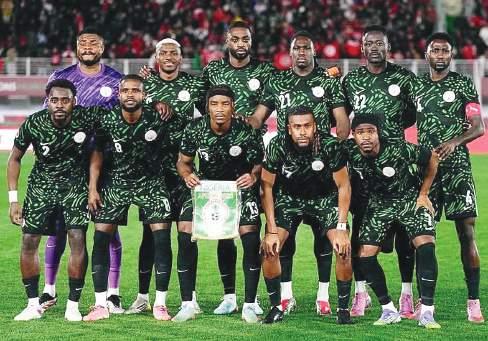
Rivers State Governor, Sir Siminalayi Fubara, has reaffirmed the safety and investment viability of the state, while dismissing negative narratives on social media over security concerns.
The Governor stated this at the grand finale of the 2026 Port Harcourt International Polo Tournament, where he pointed to the successful, incidentfree hosting of the week-long event as clear evidence of the prevailing peace and security in the state.
He noted that the absence of any security breach throughout the tournament underscores his administration’s unwavering commitment to safeguarding lives and property across Rivers State.
Explaining his presence at the event, Fubara said it was driven by a personal obligation to honour the memory of his late brother, Architect Roland Cookey-Gam, whose wife and son were in attendance, as well as a strategic encouragement from the leadership of the Port Harcourt Polo Club.
He assured stakeholders of the state government’s readiness to provide sustained support aimed at elevating the Port Harcourt Polo Club and positioning it more prominently on the global sporting and tourism map.
Governor Fubara further urged visiting players, officials, and guests to take home positive impressions of Rivers State, reiterating that the protection of lives and property remains the foremost obligation of his administration.
In his remarks, the President of the Port Harcourt Polo Club, Mr. Henry Prince Agbodjan, commended Governor Fubara for gracing the grand
finale of the tournament, noting that the seamless and incident-free conduct of the event further attests to the security of Rivers State.
Agbodjan also disclosed that the tournament coincided with the 20th remembrance of Architect Roland Cookey-Gam, who tragically lost his life in a plane crash, adding that the event served both sporting and commemorative purposes.
Winners at the polo tournament include Lagos Ibah that triumped in the TJT Princewill Cup, while Winners Gilasoismanaf won the T.Y Danjuma Cup.
In the Governor’s Cup, Elshcon defeated Risevest, while Malcomines emerged tops in the King Alfred Diette Spiff Cup, just as Gilasoismanaf topped IbadanLCU Risevest to win the OB Lulu Briggs Cup.
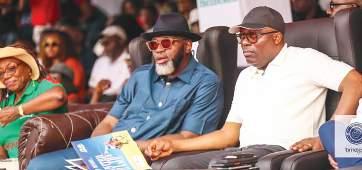
Nwabali turned out the hero of the shootouts, stopping the kicks of Egypt’s top men: Mohamed Salah and Omar Marmoush to earn Nigeria the third place bronze, the ninth in Nigeria’s rich AFCON chest of honour.
The Africa football showpiece also threw up more teams in the continent moving up in the latest FIFA ranking. They include notable rises for Algeria (28th, up 6), semi-finalists Egypt (31st, up 4),
dethroned holders Côte d’Ivoire (37th, up 5) and Congo DR (48th, up 8). In the global standing, Spain, Argentina, France, England, Brazil, Portugal and the Netherlands retained their top seven positions with Morocco climbing up to the eighth spot. Both Belgium and Germany that lost ground in the rankings completed the Top 10 of world football order for the month of January.
CAF Warns their
be
The Confédération Africaine de Football (“CAF”) has condemned the unacceptable behaviour of some players and officials during the TotalEnergies CAF Africa Cup of Nations Final between Morocco and Senegal in Rabat on Sunday night.
CAF in a statement last night said that it “strongly condemns any inappropriate behaviour which occurred during the matches, especially those targeting the refereeing team or match organisers.
“CAF is reviewing all footage and will refer the matter to competent bodies for appropriate action to be taken against those found guilty,” observed the statement.
Pape Gueye’s extra-time goal was enough to seal a second Africa Cup of Nations (AFCON) title for Senegal, after chaotic scenes at the end of normal time saw the West Africans
walked off the pitchand Brahim Diaz missed a penalty for Morocco in the 24th minute of injury time.
The lengthy delay came after the spot kick was awarded via the intervention of the video assistant referee (VAR), sparking angry scenes on the touchline and in the crowd, with Senegal fans clashing with security after attempting to break on to the pitch.
After waiting so long to take his penalty, Diaz was under immense pressure, having been handed the chance to end his country’s 50-year wait to lift the AFCON trophy with essentially the final kick of the game, but his decision to chip the ball down the middle backfired horrendously as Edouard Mendy was able to stand his ground and collect in embarrassingly simple fashion.
Former Super Eagles captain William Ekong is set to complete a transfer to Al Ahli of Qatar.
Top Transfer Expert, Fabrizio Romano, reported that Ekong will sign a contract with the top Qatari side until June 2028.
He has been playing for Saudi Arabian club Al Khalood with a contract that allows for the option of an additional year.
The former Watford defender called time on his international career with Nigeria just before the 2025 AFCON so as focus on his club career.
After a week-long competition among 15 companies at the Renaissance pitch in Port Harcourt, finalists have emerged in the football event of the Nigeria Oil and Gas Industry Games (NOGIG 2026) due for Abuja next month.
To do battle for the gold medal are NLNG and NMDPRA.
To get to the final, NLNG defeated NNPC 5-4 on penalties as their encounter ended goalless after regulation time in the first semi-final.
Similarly, NMDPRA defeated OANDO 5-3 also on penalties after they ended their tie in a 1-1 stalemate.
The losers will also feature in the third place match to be held at the national finals in Abuja.
In a post event remark, Chairman of the Local Organising Committee NOGIG 2026, Dr Sulaiman Sulaiman, said he was fulfilled after six days
of electrifying and entertaining preliminary football at the Renaissance football pitch, Shell RA, Port Harcourt.
Dr Sulaiman suleiman commended the Local Organizing Committee LOC and host RENAISSANCE for ensuring a hitch-free competition.
Dr Sulaiman Sulaiman also said the success of the preliminaries held in Port Harcourt is a dress rehearsal ahead of the main event in Abuja, adding that all hands must be on deck to deliver a memorable NOGIG games starting from February 8, 2026 in Abuja.
Babatunde Atolabi from NLNG said their game plan was for them to win but when it zeroed down to penalty shootout, they had their plan B. “When it got to penalties. The plan was for me to stop their penalties, and that was exactly what I did, and we won.”
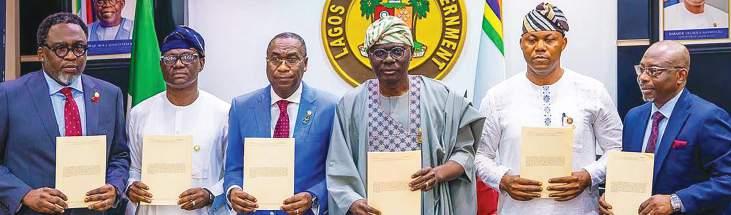
L-R: Commissioner for Economic Planning & Budget, Mr. Ope George; Chairman, House Committee on Appropriation, Hon. Saad Olumoh; Deputy Governor, Lagos State, Dr. Obafemi Hamzat; Governor Babajide Sanwo-Olu; Majority Leader of the Lagos State House of Assembly, Hon. Noheem Adams and Attorney General/Commissioner for Justice, Mr. Lawal Pedro (SAN) during the signing of the Y2026 Appropriation bill into law at the Conference room of Lagos House, Alausa, Ikeja, yesterday (See story on page 8)

There is a potentially disruptive speculation, a kite being flown in political conversations, which could affect the fortunes of the ruling party – the All Progressives Congress (APC) and the relationship between President Bola Ahmed Tinubu and the Vice President, Senator Kashim Shettima as Nigerians begin the dress rehearsal towards the 2027 general elections. It is the whisper, in quiet and low tones, that there is a plan afoot to drop Senator Shettima as Tinubu’s running mate in 2027. It will be recalled that in June 2025, at a meeting of the APC North East stakeholders, party leaders including the National Vice Chairman (North East), Mustapha Salihu, and the then APC National Chairman, Dr. Abdullahi Danguje while endorsing President Tinubu for a second term had notably failed to mention the name of his Deputy, Senator Kashim Shettima. This prompted instant riotous behaviour on the part of the delegates from Borno State who reacted by bringing the meeting to an abrupt end. They threw chairs and threatened physical assault on perceived enemies of Shettima. They chanted: “No Shettima, No APC in the North East.” Whereas the party at the national level tried to offer an explanation, Shettima’s supporters took the development as a deliberate sign of disrespect to the man who is the highest-ranking politician from the region. They could not be pacified by the excuse that it is the prerogative of the President to announce his own running mate.
The truth is that the office of the Vice President is a creation of Section 141 of the 1999 Constitution. It is further true that he or she is nominated by the President and the validity of the President’s own nomination rests on his choice of a Vice President, making the Presidency a joint ticket. The Constitution however does not specify the identity of such a person except the general provisions which apply to the President in Sections 137 – 140. For persons who have taken politics as a vocation in Nigeria, most of them have no second address by the way, every gesture, every word is taken as a signal. Before the Gombe incident, Shettima’s name was also omitted during the APC National Summit at the Presidential Villa in May 2025. Those who printed campaign posters at the time to promote President Tinubu’s candidacy omitted Shettima’s name and picture. The permutations and speculations rather than disappear, have intensified. Only yesterday, the Speaker of the Borno State House of Assembly, Abdulkarim Lawan, raised an alarm over the exclusion of Vice President Kashim Shettima’s picture on the banner portraying party leaders in the region. North East Governors and APC stakeholders are currently in Maiduguri, Borno State Capital, for the North East public hearing on Constitutional amendment. Maiduguri is the Vice President’s main base. He was Governor of Borno State for eight years (2011 – 2019). Yet someone has the effrontery to put up banners which have the images of the President, the five APC Governors of the North East, and the
National Legal Adviser, deliberately leaving out the Vice President. Meanwhile, the Concerned Northern APC Youth Forum has cautioned President Tinubu against tampering with the current APC presidential ticket.
“We started this journey together, and we intend to finish it together…”, the Forum declared in a statement issued in Kano. Similarly, the President of the APC Youth Parliament, Kabiru Garba Kobi, speaking to journalists in Bauchi yesterday, said “Any attempt to replace Senator Kashim Shettima would amount to a grave political miscalculation that could cost President Tinubu massive support in the North, especially the North East.”
Those flying the kite, in an auto-suggestive fashion since last year, have even suggested possible replacements. The initial list comprised Hon. Yakubu Dogara, former Speaker of the House of Representa- tives, whose choice it was said would address the backlash over the APC Muslim-Muslim ticket, Dr. Rabiu Kwankwaso, the NNPP 2023 Presidential candidate and a chieftain of Kano politics, a major vote bloc, Professor Baba Gana Zulum, Governor of Borno State - on the basis of his popularity and the fact that he is from exactly the same state as Shettima. The scramble for Shettima’s job has since reached high fever pitch with the involvement of the United States in the politics of religion in Nigeria. Trump the self-appointed defender of Christians in Nigeria threatened on October 31, 2025, that he would storm Nigeria “guns a-blazing” to rescue Nigerian Christians from reported genocide and persecution. On December 25, 2025, President Trump sent Nigerians a Christmas gift by firing Tomahawk missiles into Sokoto state, on the basis of intelligence, per New York Times, purportedly provided by an Igbo screwdriver merchant in Onitsha market, determined to screw down Nigeria. This attribution of the source of intelligence for the assault on Sokoto, the original base of the Caliphate, the
home of the leader of the Muslim faithful in Nigeria is enough to screw up Nigeria.
The triumphalism of a section of the Nigerian Christian elite has only deepened tensions birthing the renewed impression and agitation that the only way forward for Nigeria is for the country to show that it is not against Christians in the country in order to pacify Trump - the self-styled commander-in-chief of the world. When President Tinubu tinkered with the Muslim-Muslim arrangement in the leadership of the Ministry of Defence, with the replacement of the former Minister of Defence, Alhaji Badaru Abubakar with General Christopher Musa, the political fortune watchers of Nigeria concluded that the President would do the same with the Presidential ticket towards 2027. Their main reason is that Trump will not accept a Muslim-Muslim ticket. But why should Trump dictate to Nigeria? Where are the people who voted for a Muslim-Muslim ticket in 2023? Where is the sovereignty of Nigeria? The very suggestion that it is President Trump, not Nigerians who will determine the political process in Nigeria in 2027 is a defeatist, slavish expression.
It is worse that, in a robotic fashion, the people flying kites in the village square like children have now revised their list of possible Shettima replacements to include only Christians, namely: Hon. Yakubu Dogara (his name is still on their list), Minister of Defence, General Christopher Musa, Plateau State Governor Caleb Mutfwang, and the Catholic Bishop of Sokoto, Most Rev. Matthew Hassan Kukah. They insist that nobody should be surprised if President Tinubu decides to drop Shettima given his own antecedents. As Governor of Lagos State, President Tinubu had three Deputy Governors in eight years: Mrs Kofoworola Bucknor-Akerele, who resigned in protest, Mr. Femi Pedro, who has now been recently rehabilitated with a marginal ambassadorial nomination, and Chief Abiodun Ogunleye who quietly completed the remainder of Pedro’s tenure in 2007. It is not certain that President Tinubu will adopt the same tactics in Abuja. Nigerian politics is far more complex, and different from the containerized, localized politics of Lagos state. It is for this reason that I share the view of former Presidential adviser and elder statesman, Dr. Hakeem Baba-Ahmed when he said in July 2025 that President Tinubu should have personally debunked the stories about his plans to drop the Vice President for someone else. Mr. Bayo Onanuga, the Presidential spokesperson dismissed the subject as “a non-issue”. Baba-Ahmed argued that the President’s silence can only fuel uncertainty and political tension. He cannot be more correct. It would indeed be a big miscalculation to attempt to displace Vice President Kashim Shettima. He has been a very loyal, humble and hardworking Deputy. If he were some other persons, he would have been noisy and loud about whatever he may consider as unfair treatment. He has however, been quiet, and dutiful and not made any attempt to upstage his boss. Besides, he is a competent powerhouse
with strong intellectual abilities. He has strong credentials: a former Governor and a former Senator. President Tinubu already has about 28 Governors in his pocket, along with the structures in the states, if this is so certain as it seems, then changing his running mate ahead of 2027 would amount to a distraction, that could upset current calculations for the APC. It is not just that the entire North East would turn against the President, the emergence of a Christian in place of Shettima will turn the tables and the Muslim North, already agitated by the narrative of being anti-Christian, against the President. There is no point changing a winning ticket. Vice President Shettima is of greater political value than all the persons being proposed as likely replacements. Dogara, Mutfwang, Christopher Musa and Bishop Kukah are from minority groups in the North. How many votes can they bring to the table? Politics is not about sentiments. It is a hard-nose exercise in pragmatism. President Tinubu cannot afford to gamble with Northern votes. Sustaining the Tinubu-Shettima ticket conveys an image of stability, continuity and confidence.
And it is not true that President Trump is in a position to dictate the religious outlook of the Nigerian Presidency. The well-worn story about protection of Nigerian Christians is at best a cover story for America’s strategic interest. What does the United States stand to gain from having a Christian Vice President or President in Nigeria. The fact that the Christian community is represented in Aso Villa does not translate into any special advantage for a Christian. The politics of proximity has its limits. It is not proven that having a kinsman or a person of the same religious persuasion or gender in power confers any special privileges. The long-term objective in Nigeria should be to have in power and office at all levels persons who believe in the country, who are competent and patriotic, not ethnic or religious gladiators. In 2027, there should be alternative tickets: Christian-Muslim, Muslim-Christian, Christian- Animist, Atheist-Freethinker and the people’s right to choose should be respected. But President Tinubu does not need to set his own house on fire. The hidden campaigners for an APC Christian Vice President cannot offer a causal link between having a Muslim as Vice President and the alleged persecution of Christians. Vice President Shettima is a liberal, anti-tribal political leader. Why punish him for his chosen faith when he has done nothing wrong. He is protected under Section 42: the right to freedom from discrimination. Even if his faith is not the issue, those Muslims who are eyeing his seat and seeking to unseat him are only being mischievously ambitious, not that they have anything special to offer. President Tinubu should rescue his Vice President from the harassment and mental torture of having to hear every day that other persons want his job. His contributions and loyalty should not be discounted.