



the staff
editor-in-chief vacant editor@carillonregina.com
executive director ziyang li business@carillonregina.com
production coordinator annika hadden production@carillonregina.com
web technician jebrael muhammad web@carillonregina.com
news editor zinia jaswal news@carillonregina.com
community editor emma mcgill community@carillonregina.com
op-ed editor shivangi sharma op-ed@carillonregina.com
staff writer amina salah
staff writer hana grace news writer nazeemah noorally
news writer jackson rennebohm community writer pall agarwal
contributors lauren block, holly funk, william bessai-saul
board of directors muhammad zuhruf muhammad zarooq, mohammad akib hossain, tayef ahmed, austin stadnyk, jeremy beam
the paper
227 Riddell Centre @ the University of Regina 3737 Wascana Parkway, Regina, SK, Canada S4S 0A2 www.carillonregina.com | (306) 586 8867
Printed by Star Press Inc, Wainwright, AB
The Carillon welcomes contributions.
Opinions expressed in the pages of the Carillon are entirely those of the author, and do not necessarily reflect those of The Carillon Newspaper Inc. Opinions expressed in advertisements appearing in the Carillon are those of the advertisers, and not necessarily of The Carillon Newspaper Inc. or its staff.
The Carillon is published no less than 11 times each semester during the fall and winter semesters and periodically throughout the summer. The Carillon is published by the Carillon Newspaper Inc., a non-profit organization.
land acknowledgement
The Carillon is written on Treaty 4 territory. As such, staff recognize that we are living, working, and telling stories on and of Indigenous lands. We recognize that we are on the traditional homelands of the Cree, Saulteaux, Nakota, Lakota, and Dakota peoples, along with the homeland of the Métis nation. The Carillon understands that it is pointless to acknowledge the land on which we work without demonstrating our commitment to telling stories and prioritizing voices that further the return of this land to its sacred place. the manifesto
In keeping with our reckless, devil-may-care image, our office has absolutely no concrete information on the Carillon’s formative years readily available. What follows is the story that’s been passed down from editor to editor for over sixty years.
In the late 1950s, the University of Regina planned the construction of several new buildings on the campus grounds. One of these proposed buildlings was a belltower on the academic green. If you look out on the academic green today, the first thing you’ll notice is that it has absolutely nothing resembling a belltower.
The University never got a belltower, but what it did get was the Carillon, a newspaper that serves as a symbolic bell tower on campus, a loud and clear voice belonging to each and every student. the people’s friend; the tyrant’s foe


Post-Trudeau era begins






pall agarwal community writer
Welcome to The Carillon’s new finance column! Pall Agarwal covers important economic and financial news from Canada and around the world, explaining what it means for students. From tuition costs to job markets, Pall breaks down how these changes affect you, making finance easy to understand and relevant to your life. If you have any request for a topic or want Pall to highlight a stock price – send an email to pall@carillonregina.com. Let’s make finance fun for all!
Disclaimer: The information in this column is intended for educational purposes only and is not financial advice. For personalized financial guidance, please consult a licensed professional.
This week I had a chance to interview Julia Graham, an alumna from the Hill School of Business at the University of Regina. Graham is currently an accountant in assurance at MNP, and pursuing her CPA designation and master’s in professional accounting.
As a dedicated advocate for financial literacy and student empowerment, during the 2023-2024 academic year Graham served as a project manager with Enactus Regina, where she launched Dollars and Sense, an initiative aimed at educating university students on personal finance. This program equipped students with the knowledge and tools necessary to make informed financial decisions, setting them up for long-term success. She also served as a mental health ambassador, demonstrating her commitment to holistic student well-being.
My goal with the interview was to hear her
insights from the program and learn the status of financial literacy awareness at University of Regina.
How did you conduct this Dollars and Sense ? How was the overall experience for you?
We did six sessions of different topics such as budgeting, psychology and the overall idea behind financial literacy, investing, taxes and different types of investment mediums. So that was really good. It was a really good experience for me to be able to understand as someone who comes from a very financially privileged background. I was always talking about financial literacy with my parents when I was younger. I remember asking my dad about the stock market at 16 trying to get an understanding…so I don’t always understand or remember what students, who maybe never talked about money, haven’t come across and what they learned or didn’t learn from their parents. This project was a real eye opener for me.
What was eye-opening for you?
I saw that increase of basic financial literacy knowledge, such as different investing accounts, different budgeting types, different types of debt. There were students come from different faculties, different backgrounds, which provided me with knowledge on what they are learning in school and talking about with their friends.
I remember one student asking me questions afterwards, like ‘Where do I start?’ If you don’t even know where to start for financial literacy, it’s very hard because it’s such a vast area of knowledge that it can be overwhelming. Beginning your own financial literacy can be overwhelming, so I spoke about the the basics. I also provided some thought-provoking questions af-

terwards and optional homework for students, which was to audit their own bank statements, to see they felt they received value from each of their transactions. And then they looked at what their overall expenses are compared to their income. So it was about having students think about their own financial state.
How did you manage your money as a student and what advice would you give your peers?
University is really hard. It is really expensive and on top of tuition and living costs, there’s all these other costs if you want to go to networking events or buy clothes for interviews or galas. I think the most important thing as a
student that [is] likely not earning a full-time wage, but earning money on the side, is to give yourself some grace. It was really important for me to understand that I didn’t need to be saving 30 to 40 per cent of my income during that time because my income from teaching assistance and working summer jobs was going to pay for tuition books and gas. You don’t have to make progress on your financial goals while you’re a student. You just have to stay afloat because your goal right now is getting that education so you can make those financial progressions once you graduate.
This interview has been edited and condensed.
As Justin Trudeau’s decade-long leadership ends, University of Regina students share their thoughts.
jackson rennebohm news writer
On March 9, the Liberal Party chose a new leader to replace outgoing Prime Minister Justin Trudeau, ending a near decade-long era of his leadership in Canadian politics. After a landslide win, former governor of the Bank of Canada Mark Carney is now prime minister-designate.
For Canadians in their early twenties or younger, Trudeau and the Liberals are the only government they have known since childhood. With an imminent federal election,
The Carillon asked University of Regina students about the country’s future and
Trudeau’s resignation.
“It actually excites me a lot,” said Noah, a business student, who was fundraising on campus for local charity Carmichael Outreach. “[Trudeau has] been in office for a while, obviously, and I think having a new perspective and a new leader is actually a really good thing.”
“The world has changed. Canada’s changed a lot,” they continued. “I think having a new face can help to lead Canada forward and, hopefully, to continue to get better.”
“I found [Trudeau’s] policies and general choices as Prime Minister to be a bit of a mixed bag,” expressed Ethan, who studies environmental engineering. “So, I’m not super against his resignation.”
Other students expressed ambivalence toward the coming change in leadership.
“To be totally honest, I don’t really care that much who’s in charge,” stated Bernice, a student in the education program. “I feel like the problem with politics and voting is that there’s usually a list of bad options, and you’re forced to choose the least-worst option, instead of actually having a good hope for the future.”
“I think that lots of candidates are addressing lots of the issues,” she continued. “But none of them are really addressing them all from a perspective where I would feel comfortable voting for somebody and saying that is the best option.”
Bernice is far from being the only young Canadian feeling discouraged about

politics. According to Elections Canada, the 18- to 24-year-old voter group had the lowest turnout percentage of all age groups in the 2019 general election, at only 53.9 per cent.
Unanimously, students agreed that the largest issue the next federal government needs to address is the inflated cost of living.
“I think our economy and state of business in Canada is worse, and the state of Canadian pocketbooks are worse [after Trudeau]. Hopefully that can change in the next election, when we have a new government,” stated Noah.
Now that Justin Trudeau’s nine years of governance are behind us, many are left wondering how his legacy as prime minister will be remembered by current and future generations of Canadian youth.
“I think people generally view him as sort of a silly guy who didn’t really know what he was doing, and made lots of mistakes,” said Bernice. “And so, I think people might almost look back mockingly. Like, oh, this guy was silly, and he did not know what he was talking about, and he did not know what he was doing — those kinds of thoughts.”
“Personally, I don’t have the highest regard for Justin Trudeau’s prime ministership,” Noah told The Carillon. “I think Canada could be in a great position on the global scale, and Canadians could be a lot better off than we are right now.”
“I have seen people like him, I have seen people hate him, ” stated Ethan. “So I would imagine his legacy, moving forward, will be mixed opinion-wise. But how will that affect politics going forward, and the Liberal Party going forward? We can only guess.”
nazeemah noorally news writer
The Study Abroad and Mobility office at U of R offers programs like the Outbound Exchange, Inbound Exchange and Global Exchange. Study Abroad is an experiential learning program for students in the spring/ summer semesters, which allows them l gain exposure to other countries’ cultures, diversity and academic lifestyle.
The Study Abroad and Mobility office is located at College West 109. Sessions can be booked with a Study Abroad advisor to speak about exchange semesters, study tours, international practicums and other short-term opportunites with partner schools . The Carillon spoke with Jennifer Matheson, manager of Study Abroad and Global Mobility from the UR International Office.
What programs do you offer and how do they benefit students?
The Study Abroad and Global Mobility Office facilitates many options for undergraduate students to add an international-travel component into their U of R program, including semester-long exchanges, faculty-led study tours, summer programs and internships. The benefits of global learning are vast and are known to include increased employability and various career skills, an in-depth intercultural understanding, language acquisition, increased self-esteem, adaptability and problem-solving skills that help our alumni thrive in today’s global workforce.
What are some of the most popular destinations for U of R students participating in outbound exchange programs?
Our traditional destinations have historically included the United States, France and Australia, but truly, we have options available in hundreds of institutions around the globe. What kind of support does the Study Abroad office provide to students before, during and after their exchange
experience?
Our team is here for students throughout the entire experience. Our Global Education Advisors help navigate options and answer any questions students have prior to submitting their application. We regularly meet with students before they leave to ensure they are well prepared for their upcoming journey abroad and check in regularly throughout their program. Of course, we also work closely with the students’ home faculty to ensure that transfer credits are awarded following the experience. Beyond this, UR International facilitates a few scholarship programs with an aim to reduce financial barriers to participation. Eligible students can receive up to $2,000 per opportunity.
How does the Study Abroad program work in terms of logistics? What are the steps that students take to apply and prepare for their exchange?
Each program and each destination have different requirements, so this is a difficult question to answer. The requirements to participate in our programs are outlined on our website at uregina.ca/ur-international/studyabroad. Following application, our advisors and partner institutions work closely to ensure students have access to all of the information they require to ensure a seamless experience.
What are the different durations available for study abroad?
Study Abroad programs range in duration from one week to one year.
What advice would you give to students who are thinking about studying abroad but unsure about taking the leap?
Please come and meet with us! Give some thought about your dream study-abroad opportunity. You might already have a destination, duration or budget in mind, and we will do our best to match you with an opportunity that will change your life!

nazeemah noorally news writer
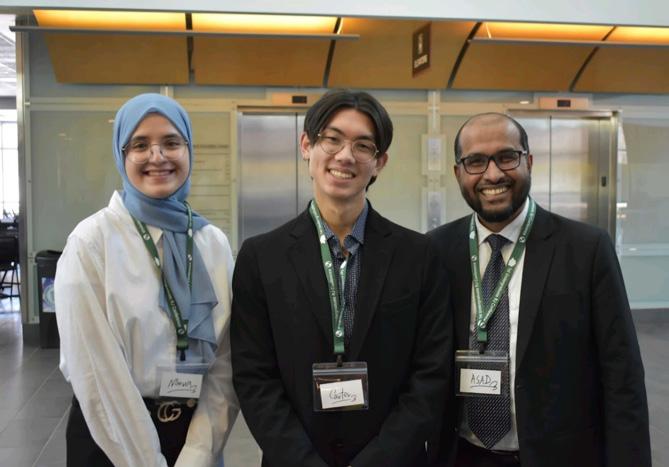
On Feb. 19, the Faculty of Justice Studies and the UR Restorative Justice Club hosted the first-ever undergraduate restorative justice conference in Canada.
The conference drew hundreds of attendees with prominent guest speakers, including the award-winning criminologist and best-selling author Dr. Lisa Monchalin. The event also commemorated the 50th anniversary of the University of Regina.
There were interactive breakout-room sessions on restorative justice and its role in court, prison, policing and Indigenous justice. Networking sessions also allowed the U of R campus community to connect with the guest speakers and the rest of the attendees.
Thirty volunteers were on scene to help with registration , catering, photography and videography and the justice studies exhibition held at the Research and Innovation Centre.
When asked about the vision for the RJ conference, Dr. Muhammad Asadullah, associate professor in the department of justice studies, one of the pioneers of the U of R Restorative Justice Club and the leading organizer of the conference stated: “The inaugural Undergraduate Restorative Justice Conference was a great success, bringing together key justice stakeholders, non-profit organizations, students, community members, and academics. Tickets sold out several days before the event.”
Asadullah sees the application of restorative justice in academic settings as crucial. “Universities worldwide, including in Canada, have found that using restorative justice not only supports students but also fosters a stronger culture of academic integrity and accountability. This approach should never be seen as an ‘easy way out.’ In fact, research has shown that students often find it more challenging to take
responsibility and engage in the restorative process than to simply accept a suspension.”
One of Asadullah’s takeaways from the networking sessions during the conference was that “restorative justice is rooted in a relational worldview. The inclusion of a lunch buffet for socialization and networking was intentional, fostering deeper connections among participants. Feedback from conference attendees strongly reflects the success of this approach.”
Nimra Burki, who emceed the conference, is president of the U of R Restorative Justice Club and a third-year student in human justice.
“The event unfolded better than I expected!” she said. ““According to our volunteers, we had over 100 attendees at the conference. It was lovely to also see representatives from other clubs, such as RPIRG, as well as professionals in diverse fields, [such as] MLAs, officers from Regina Police Services and Saskatoon Police Services and Pro Bono Law Saskatchewan Staff, attend our event in support of our club’s mission statement.”
When asked about her personal response to the RJ conference, Burki said, “If I had to choose one aspect of the conference that really stood out to me, I would say it was the networking lunch period. People from various educational and professional backgrounds were seated together discussing restorative justice through various, fascinating lenses. It was beautiful to see the diversity reflected in the conversations and for people to realize how relevant restorative justice is in different fields.”
“I was beyond happy to know that, as a club, the conference we hosted played a major role in advocating for restorative justice on campus and in the wider public community,” she added.
However, the preparation and planning of the event was not all rosy for the URRJC team.
Nimra stated that the club struggled to recruit students to take part in the workshops. They relied on the professors to promote the
event in their classrooms and it helped.
The keynote speaker was Dr. Lisa Monchalin, who, Nimra said, “gave incredible insights on the reflections of Indigenous history and its impacts on restorative justice.” Kokum Brenda, from Muscowpetung First Nation, who has had major impacts in human justice and is a significant part of the Ta-tawaw Student Centre, also spoke at the conference, Nimra added.
“The goal [...] was to create a conference that is accessible to any undergraduate student, to connect restorative justice practitioners from around the country and to spread the message of restorative justice to a wider audience. I would like to say that we achieved all three key objectives,” said Carter Jessop, URRJC secretary and fourth-year human resources major.
Jessop explained how the preparation for this conference started from scratch. . “We
began in September of 2024 by determining how we would like to lay out the conference, who we were connected to that we would like to attend and speak at the conference and who else could support the process. As we prepared for weekly meetings, we incorporated ideas for a documentary, food, ticket prices and sales, student and guest presenters, abstract submissions and selections and venue ideas.
“We aim to host this conference on a biannual basis, with the next one planned for 2027,” said Asadullah. “Additionally, we hope to launch an undergraduate journal of restorative justice later this year. The inaugural issue will feature papers presented by both students and academics.”
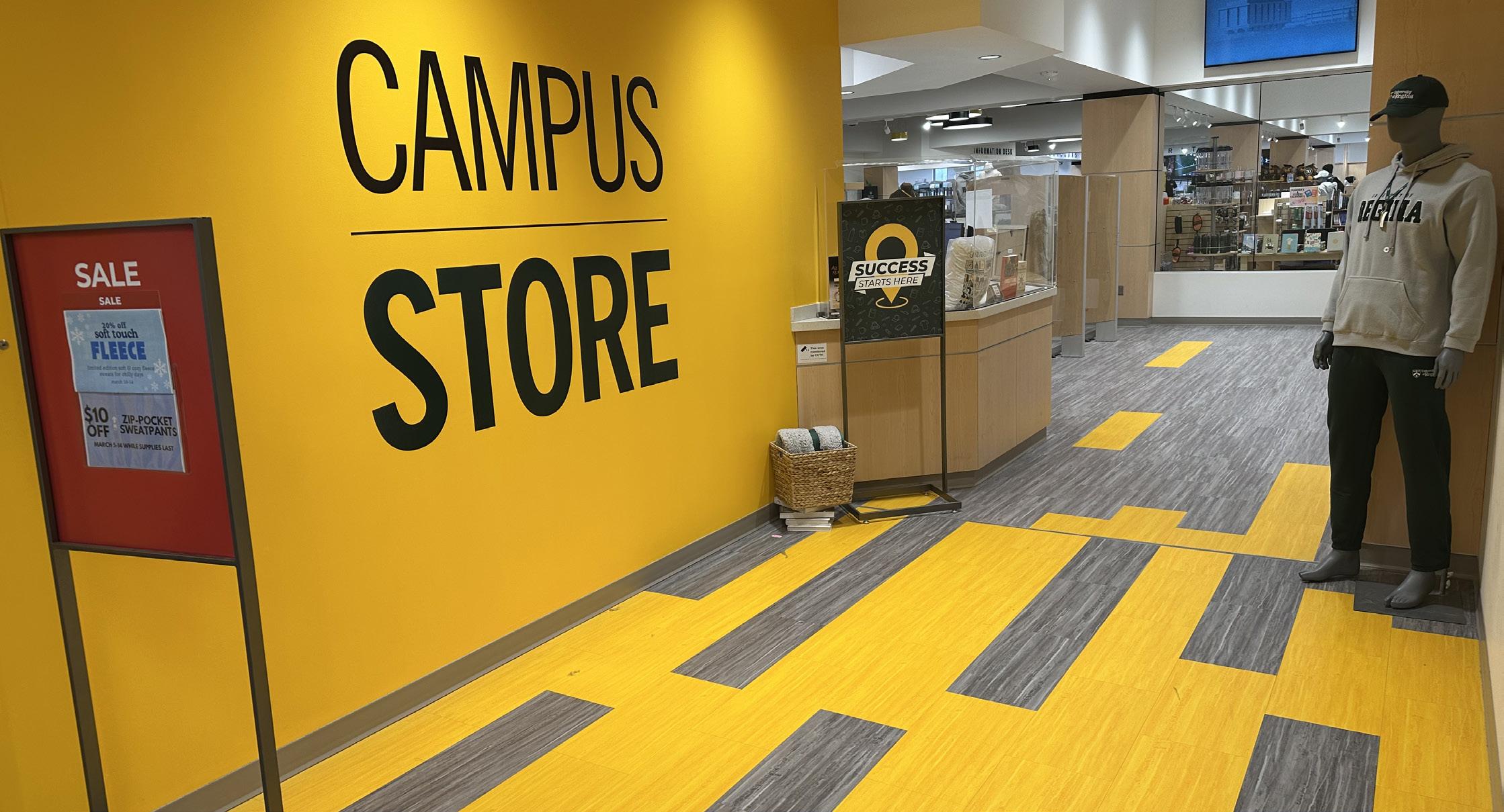
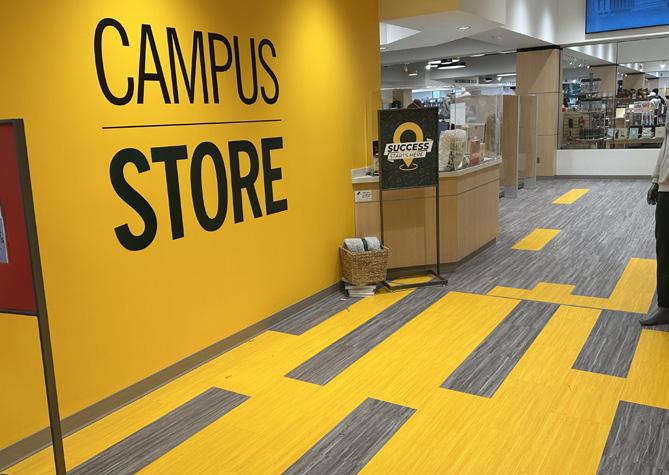
Tucked into College West , the University of Regina campus bookstore is more than just a place to grab textbooks and supplies—it’s a hub of student life. I’s a one-stop solution for student needs, from merchandise to last-minute sticky notes for exam preparation. It’s a space where academic needs meet campus culture.
The Carillon spoke with students to get a sense of how they feel about their own experiences with the campus bookstore, The Carillon
Julcit Wuyep, a student pursuing a combined major in economics and business administration in the Faculty of Arts, last visited the bookstore in 2024. “I went for an economics and probably an international studies textbook.”
Wuyep continued, “They really don’t have enough staff. So, I go through every stall to find what I’m looking for, which is hard and takes time.”
Wuyep suggests that there isn’t enough support available to immediately address student needs and concerns.
After finding the books she needed, Wuyep said that the line in front of the cashier was slow and “ also the books are expensive.”
She shared that, while inflation is high, textbooks are often necessary for students. They have to prioritize them over other things. “The price is definitely not justified because I mean, I’m an international student too.”
There certainly seems to be distress amongst students when it comes to affording
the materials needed for getting an education these days: books, tuition, transit and more.
Emma Kingdon, a human resources major at the Hill School of Business. Kingdon mentioned that “the textbooks are definitely expensive, but that’s just the going rate of textbooks. And I think that a lot of the school supplies and merchandising things [are] marked up a fair bit, and that’s maybe not great when your focused market is students. People are already drowning in student debt.”
With concerns surrounding cost, students do look for alternative options. . “We can’t really find a lot of them on Amazon, so we only have the bookstore,” said Wuyep. “[But] you can get any book from Facebook Marketplace. Make sure you ask your friends before you go to the bookstore because the price is so expen-
sive.”
Beyond overpriced textbooks, the bookstore also offers products like hoodies and various study supplies. “I’ve gotten a couple hoodies over the years, and [the bookstore] saved me one day this semester studying for midterms. When I needed more sticky notes, I was able to go get some,” said Kingdon. “They were well stocked in school supplies .... I wish I could buy [another] hoodie, but it’s not in the budget right now.”
When asked what could be improved, Kingdon suggested pop-up stands around campus “to kind of advertise more of the merch that they have. I know I unsubscribed from their marketing emails like two years ago.”
I think they need to do a survey to ask peopleif textbooks [are worth the price] because some people could get the textbook in PDF format. Not a lot of people need like, actual textbooks,” Kingdon went on. “Not only textbooks but also the other stuff that they sell, like the University of Regina hoodies and sweatpants. It needs to be more affordable because we’re supposed to wear them to showcase and represent the school, but then how can we do that?”
The bookstore reflects student life: it’s where first-year students pick up their very first textbooks and where graduates pick up their keepsakes to remember their time at university. But concerns with high prices seem to be across the board.

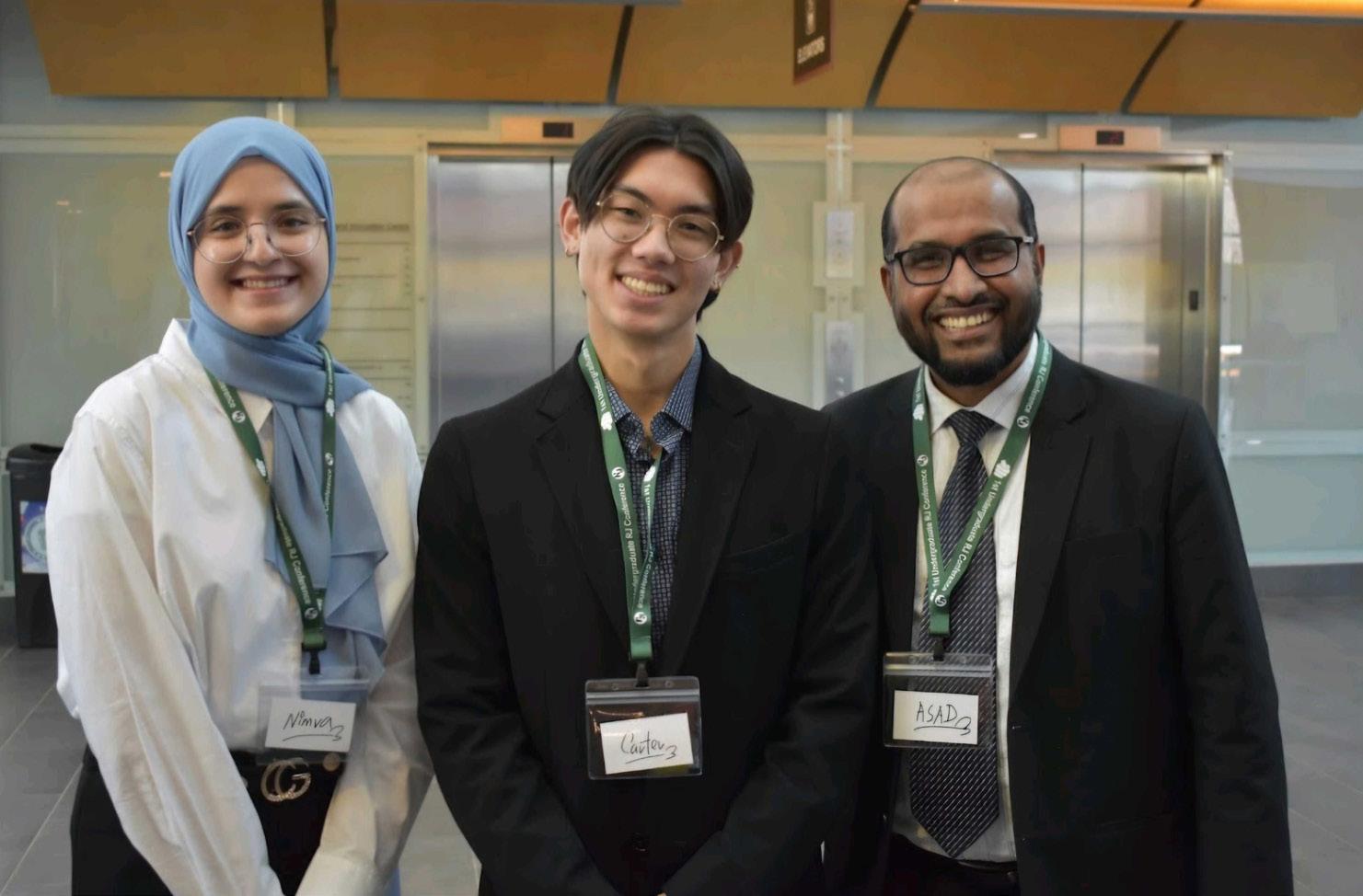
On Feb. 19, the Faculty of Justice Studies and the UR Restorative Justice Club hosted the first-ever undergraduate restorative justice conference in Canada.
The conference drew hundreds of attendees with prominent guest speakers, including the award-winning criminologist and best-selling author Dr. Lisa Monchalin. The event also commemorated the 50th anniversary of the University of Regina.
There were interactive breakout-room sessions on restorative justice and its role in court, prison, policing and Indigenous justice. Networking sessions also allowed the U of R campus community to connect with the guest speakers and the rest of the attendees.
Thirty volunteers were on scene to help with registration , catering, photography and videography and the justice studies exhibition held at the Research and Innovation Centre.
When asked about the vision for the RJ conference, Dr. Muhammad Asadullah, as-
sociate professor in the department of justice studies, one of the pioneers of the U of R Restorative Justice Club and the leading organizer of the conference stated: “The inaugural Undergraduate Restorative Justice Conference was a great success, bringing together key justice stakeholders, non-profit organizations, students, community members, and academics. Tickets sold out several days before the event.”
Asadullah sees the application of restorative justice in academic settings as crucial.
“Universities worldwide, including in Canada, have found that using restorative justice not only supports students but also fosters a stronger culture of academic integrity and accountability. This approach should never be seen as an ‘easy way out.’ In fact, research has shown that students often find it more challenging to take responsibility and engage in the restorative process than to simply accept a suspension.”
One of Asadullah’s takeaways from the networking sessions during the conference was
Get out and about in
that “restorative justice is rooted in a relational worldview. The inclusion of a lunch buffet for socialization and networking was intentional, fostering deeper connections among participants. Feedback from conference attendees strongly reflects the success of this approach.”
Nimra Burki, who emceed the conference, is president of the U of R Restorative Justice Club and a third-year student in human justice. “The event unfolded better than I expected!” she said. ““According to our volunteers, we had over 100 attendees at the conference. It was lovely to also see representatives from other clubs, such as RPIRG, as well as professionals in diverse fields, [such as] MLAs, officers from Regina Police Services and Saskatoon Police Services and Pro Bono Law Saskatchewan Staff, attend our event in support of our club’s mission statement.”
When asked about her personal response to the RJ conference, Burki said, “If I had to choose one aspect of the conference that really stood out to me, I would say it was the networking lunch period. People from various educational and professional backgrounds were seated together discussing restorative justice through various, fascinating lenses. It was beautiful to see the diversity reflected in the conversations and for people to realize how relevant restorative justice is in different fields.”
“I was beyond happy to know that, as a club, the conference we hosted played a major role in advocating for restorative justice on campus and in the wider public community,” she added.
However, the preparation and planning of the event was not all rosy for the URRJC team.
Nimra stated that the club struggled to recruit students to take part in the workshops. They relied on the professors to promote the event in their classrooms and it helped.
The keynote speaker was Dr. Lisa Monchalin, who, Nimra said, “gave incredible insights on the reflections of Indigenous history and its impacts on restorative justice.” Kokum Brenda, from Muscowpetung First Nation, who
has had major impacts in human justice and is a significant part of the Ta-tawaw Student Centre, also spoke at the conference, Nimra added.
“The goal [...] was to create a conference that is accessible to any undergraduate student, to connect restorative justice practitioners from around the country and to spread the message of restorative justice to a wider audience. I would like to say that we achieved all three key objectives,” said Carter Jessop, URRJC secretary and fourth-year human resources major.
Jessop explained how the preparation for this conference started from scratch. . “We began in September of 2024 by determining how we would like to lay out the conference, who we were connected to that we would like to attend and speak at the conference and who else could support the process. As we prepared for weekly meetings, we incorporated ideas for a documentary, food, ticket prices and sales, student and guest presenters, abstract submissions and selections and venue ideas.
“We aim to host this conference on a biannual basis, with the next one planned for 2027,” said Asadullah. “Additionally, we hope to launch an undergraduate journal of restorative justice later this year. The inaugural issue will feature papers presented by both students and academics.”
How to make the most of the melting snow
lauren block contributor
Ella Forrest & The Great Pines release show
One of the grooviest nights in Regina this month will be happening at The Artesian on March 14. Ella Forrest & The Great Pines, an R&B band from Regina, are putting on a release show for their upcoming single, “Lights Out.” Their debut EP, “Butterflies,” recently won Album of the Year at the 2025 SaskMusic Awards, and there is a lot of anticipation surrounding their new project. Opening for the Great Pines is the hip-hop artist MONK.
This is an all-ages show with doors opening at 7 p.m. and music at 8 p.m. Advance tickets are available until 5 p.m. the day of the show at Paper Umbrella or online at artesianon13th. ca for $20. Remaining tickets will be available at the door.
Pile O’ Bones Tattoo Convention
Do you have tattoos? Are you thinking about getting one, or another? To get inked, or just for a fun and exciting time, check out the Pile O’ Bones Tattoo Convention from March 14 to 16 in the Turvey Convention Centre. There will be tattoo artists from all across Canada as well as vendors, awards, food, beer and live music to check out. Attend and explore tattoo history and culture!
The convention is open from 1 p.m.to 10 p.m. on Friday, 10 a.m. to 10:00 p.m. on Saturday and 10 a.m. to 6 p.m. on Sunday. Admission is $20 per day or $40 for the whole weekend.
Heritage Regina Lecture Series: Stories of Immigration
The fourth lecture in Heritage Regina’s spring lecture series, “Chasing the Gold Mountain,” highlights immigration to Saskatchewan and features the story of a Chinese immigrant coming to Canada with hopes for a new future. Florence Hwang, a journalist with a background in history and archives, will present at the free
event and take participants on a journey through the past.
The last lecture in this series is on April 3.
High Tea at The Hotel Saskatchewan
For a slightly fancier experience, consider High Tea at the Hotel Saskatchewan. Get dressed up and participate in the elegance and tradition of little sandwiches, pastries and, of course, tea.
The next High Tea is on March 23 with seating in The Burrow from 1 p.m.to 4:00 p.m. Reservations are required and can be made through opentable.ca. The cost is $45 per person or $32 for those under 12 years old. If you can’t make it to this one, there are more High Tea events scheduled for April, May and June.
Antique and Vintage Heritage Market
The Heritage Community Association is putting on their second annual Antique and Vintage Market on March 29 from 10a.m. until 4:00 p.m. Along with antique vendors, there is a vintage concession, live music and board games, as well as a “repair cafe,” where you can bring small household items to be fixed up .
There is no admission fee but the concession is cash only. and it is up to individual vendors to decide whether they’ll accept cash, card or both. Located at the Mitakuyé Owȃs’ā Centre, this event is sure to be fun for the whole family!
MAP Big Band Dance
The Music Students’ Association and the Faculty of Media, Art, and Performance at the University of Regina are putting on a Big Band Dance on the evening of March 29. The Regina Jazz Orchestra and both University Jazz Ensembles will be playing sets and the Regina Ballroom Dancers will provide swing dance lessons.
The dance takes place in the Convention Hall at the Conexus Arts Centre with doors opening at 6:30 p.m., dance instruction at 7 p.m., and music beginning at 7:30 p.m. Tickets are available on showpass.com and priced at $15 for students, $25 for general admission in advance and $30 at the door.

hana grace staff writer
Originally from a farm outside of Punnichy, Sask., Jeffery Straker is the textbook definition of a proud Saskatchewan artist. He has been releasing music and performing full time for seventeen years, and his career has taken him all over the world.
It all began at the piano in the living room of his family’s farmhouse. His mother was a talented pianist and the house was often filled with music. All the Straker kids were put in piano lessons with the local music teacher, Mrs. Young, around the age of seven. Jeffery was the only one of the kids who stuck with it.
Straker loved to practice. He eventually moved on to another piano teacher, one in Raymore, who helped to further develop his skills until he was enrolled in the University of Regina’s Conservatory of Performing Arts.
Straker’s career took off when he was living in Toronto. He started writing music that reflected what it was like to live in the Saskatchewan prairies and released an album lovingly titled Highway 15, after the road that runs in front of his family’s farm.
Straker felt the best way to perform his music was in front of the people who would really understand it, so he moved back home to Regina. He describes his music as grassroots and folky, and now has nine albums to his name, including some Christmas albums.
For almost ten years Straker has put on his “A Very Prairie Christmas” show, touring small towns in Saskatchewan with songs that remind him of growing up during the holidays. “For some reason, our house was the place for music, where neighbors would gather with their instruments. We had a lot of musical neighbors, and these kinds of epic jam sessions would take place,” shared Straker.
“[It was] a lot of old-time country and folk music, and they were such a pivotal part of my Christmases,” he continued. “Both of my parents have since passed away, but when I started doing these shows, they were both alive. Now, it’s almost like a tribute to those Christmases, and a tribute to my parents in a way because the memories are so fond.”
Through these Christmas shows a tradition developed. Straker often discusses his love of dainties and Christmas baking, and when he went over to the United Kingdom for a tour, fans brought some for him.
“It was so funny because people just saw others doing it on Facebook. I remember this one show, this lady brought me two pies: a rhubarb pie, and another one that’s like this English kind of pie. She came to me with these two pies, and she said, ‘I understand I’m supposed to give these to you.’ She didn’t even really know why.”
Straker’s shows, as well as his music, involve a lot of heart. Telling funny stories between his songs and sets gives concertgoers a glimpse into what his life is like. What that looks like has changed over the last decade and a half. Straker is openly gay and has been in a loving relationship with his partner, Micheal, for the last five years. In the beginning, Straker was quiet about

who he was.
“People are at a show to feel something. I think when people buy a ticket to a show, they are buying a ticket to a feeling and I sort of started to sense that if I was not being my full, true self on stage, I don’t think the whole me would be getting across. So, at a certain point, I was just like, ‘I’m just going to start being out about this,’” he said .
In 2008, Straker released a song called “Tykie’s Coming Out,” about a fellow classmate who was openly queer. Soon, people started putting the pieces together that Straker was also queer, though the song was not directly about himself. Of course, Straker knew that not everyone would be supportive.
“I did receive some nasty emails—I won’t lie about that. I got emails from some people saying, like, ‘Oh, you know, doing your gay agenda, trying to push your gayness on the road.’ It was expected, but still bizarre. I realized, if you go into music to try to please everyone, stop being in music,” he said.
While on tour, recording and pursuing music full time, Straker always remembers his roots.
The 49th annual Telemiracle telethon put on by the Kinsmen Foundation took place on March 1 and 2 and this was the 14th year that Straker has been a part of the show. Like many people in the province, Straker remembers watching the Telethon throughout his life and, when he was on the show for the first time, he shared a dressing room with legend Bob McGrath: “I walked in, you know, and there’s this guy who I grew up watching on Sesame Street. It was just not lost on me that those phones ringing were people calling in their hard-earned cash just because this opportunity was there to help someone, and it’s just the most beautiful, selfless, wonderful thing. This has now happened for 49 years! What an honor, you know? I just love it!”
Another way Straker stays in touch with his roots is through his merchandise partnership with the Outlook, Sask.-based company, Prairie Bean Roastery. Straker’s recent album, Just Before Sunrise, shares a name with his own personal coffee roast. He’s sold over 1500 pounds of coffee in the last four or five years.
“People really like it. After people buy it, they message me and they’re like, how do I get
more coffee? It’s so expensive, the postage is so expensive, I just can’t do it, but it’s a good problem to have.”
Straker’s newest album, Great Big Sky, recently received a Canadian Folk Music Award nomination. He’ll head to the ceremony in April. Great Big Sky also received a letter of acknowledgement from King Charles in 2023.
“Telling funny stories between his songs and sets gives concertgoers a glimpse into what his life is like.”
Hana Grace
The
How did the protective Krampus figure become a punishing devil?
holly funk contributor
After having written a paper in 2021 on the monster Krampus which earned me 95 per cent (and, later, an essay prize in religious studies), I decided to have the face of the figure tattooed on one of my knees to memorialize what his full story signifies.
C. J. Pannell at True Dark Tattoo did incredible work on a difficult area to tattoo, and through four sessions roughly a year ago she blessed me with both lovely conversation and incredibly skilled artwork.
A few months after the final tattoo session I was sitting down with my parents and siblings—all staunch evangelical Christians—for dinner, and my brother expressed a desire that I keep my Krampus tattoo covered around our niece to make sure she wasn’t frightened by it.
Rather than get offended I recognized that he was really saying that the image disturbed him, since our niece—hardly a year old at the time—didn’t yet have the cultural context or social conditioning to see an image like the one I have tattooed as frightening. I pointed this out and, to my
surprise, my dad backed me up.
I was surprised because roughly two decades ago my dad didn’t allow one of my cousins into our home because he was wearing a Pokémon shirt. My parents raised us believing that Pokémon were inspired by demons, who they didn’t want to invite into their home. As an atheist I have drastically different views than I was raised with, and as someone who’s done research in both psychology and religious studies, I find it fascinating which images and figures people make monstrous.
Stephen T. Asma in the book On Monsters outlines how the psychological understanding of monstrosity has flipped from being embodiment-minded to environment-oriented. “Formerly we were interested in what makes a person be a monster; now we are more concerned with what makes a person seem a monster,” writes Asma.
Rather than a focus on which predispositions correlate with beings capable of unimaginable horrors, the contemporary focus is on nurture more than nature. This humanistic approach looks at how the context one is raised in can bring one into alignment with wholesome or tragic tra-
jectories, and what can be done to redeem those who’ve come to see horrific acts as the only option for survival.
But what in the hell does this have to do with mythology, or the figure Krampus?
Simply put, Krampus is a figure who—through environmental changes— altered forms from being a beloved Alpine folk figure to a kidnapping, child-torturing, child-devouring devil. These changes weren’t due to Krampus himself or the folks who held him dear as a figure, but the Catholic church who required a foil (and lackey/goon) for Saint Nicholas.
Krampus was originally an apotropaic (protective) figure, and throughout Europe there were multiple versions of the figure ranging between Austria, the Bavarian Alps, Sardinia, Slovenia, Hungry, Germany and Switzerland among other regions. Krampus-like figures were celebrated through events like Krampusnacht and Krampuslaufe, where young men would dress up in their best Krampus-like garb, get roaringly drunk (typically on bourbon) and run about the streets letting out their pent up emotions.
For 364 days of the year these men were expected to abide by appropriate so-

“Meaning is made by those who hold it. As long as we have had heroes, we have had monsters, and have been developing theories in attempts to justify the qualities we posture as monstrous. Holly Funk
cietal standards, protecting those around them and contributing to society, but on one evening (often Dec. 5, or sometime between Dec. 21 and Jan. 6) they could forego societal expectations and indulge in their impulses before again becoming upstanding citizens the following day.
In myth, after the Catholic church appropriated Krampus-like figures, there could be as many as six different Krampuses who accompanied Saint Nicholas doorto-door in a community. St. Nick would be charged with assessing whether children had been contributing to their households through doing chores and whether they had learned their prayers, and if they had he would reward them with candies, baking and dried fruit. If not, he would give the Krampuses permission to terrorize the children and the home, at the very least beating the children with switches and at most kidnapping them to drown or eat in the underworld.
Later, when the Catholic church summed all European versions of Krampus into one mythic monster and continued the conversion of him as subjected to St. Nicholas, they ironically co-opted the apotropaic feature while perverting it to their own ends. Rather than one night of debauchery a year for the men in a community to release pent-up aggression and then return as protectors of the community, there was one night a year where the St. Nick used Krampus as a goon to punish any children who did not please him.
Before I wrote my 2021 paper I had never thought about Santa as a mob boss, but the more one researches the morphology of Krampus mythology, the more that good-cop/bad-cop routine of boss and goon appears to be relevant.
Originally the idea of the Krampus figure had been an outlet for pent-up emotions, and people who grew up with the Krampusnacht and Krampuslaufe traditions weren’t taught to be afraid of Krampus until he was weaponized by the Catholic church as the punishing enforcer who makes Saint Nicholas appear the “good guy.” Similarly, my Krampus tattoo wouldn’t frighten my then-one-year-old niece who had no clue what would socially be considered monstrous, but in time she may be taught that the imagery I’ve commissioned into my skin is demonic by those who believe Krampus to be.
Krampus was predisposed to be a protective outlet, not a punishing figure, and it is only through environmental exposure and conversion to an oppressive, colonizing ideology that he came to be understood as a threat.
My Krampus tattoo signifies to me that while beauty may be in the eye of the beholder, so is monstrosity. Meaning is made by those who hold it. As long as we have had heroes we have had monsters and have been developing theories in attempts to justify the qualities we posture as monstrous. If groups with myths interact, those myths will morph to reflect the political interactions of the groups which hold them.
Why is the popularity of award shows declining?
amina salah staff writer
There once was a time when award shows used to be the events of the year.
Awards were the one thing many looked forward to. Whether it be the Oscars or Grammys, award shows united fans from all over the world. People would marvel at the styles of their favourite stars and enjoy the drama, entertainment and juicy gossip.
To many, award shows were bigger than the Super Bowl. They were a status a symbol. They were known as the place where legends made their mark. But somewhere along the way, the culture shifted. Intrigue is fading. The spark is dying. What is left behind? Are red carpets for an audience of crickets?
Sometimes I wonder, is it because I grew up? Am I no longer obsessed with the same things? Or am I just too busy? I think it is a mix of all those elements. However, it is also because celebrity worship is dead and has been for a long time now. Obsessing over people who do not care about my well-being is overrated. The new social currency is no longer being on the internet or keeping up with celebrities. It is about being detached from the digital world completely.
People are busy with their lives. People are busy trying to make ends meet. Inflation won’t even let us catch a breath. People have stopped caring. I also believe that this is due to the internet and the fact that peoples’ priorities shift within hours.
Another important point is that today, celebrities are shoved into our faces every waking second. We get no break from them. Naturally after some time, it just gets boring and too repetitive. You can see your favourites on every single platform any time, all the time.
Furthermore, people have realized that award shows are not a measure of talent. Politics, industry connections and bad voting decisions play a huge role in who wins an award, and who goes home empty-handed.
Not to mention, nobody watches cable anymore because everyone is streaming . Unless the Grammys are streaming on Netflix, I most likely won’t watch them. I would much rather spend three hours crocheting or colouring or taking part in my other hobbies. I would even watch trashy reality TV rather than wasting time on an award show.
The reality is that award shows are just completely out of touch with reality. They used to set cultural trends, but in an age of TikTok and other social media apps, they struggle to keep up. Death of award shows is due to how media consumption has changed over the years, and the fact that people would much rather spend their time on other things that bring them joy. Celebrity culture has been on a decline for ages. Stan culture is dying out. It’s not because we are getting older, it’s because we are finally realizing how unimportant celebrities are.

“Celebrity culture has been on a decline for ages. Stan culture is dying out. It’s not because we are getting older, it’s because we are finally realizing how unimportant celebrities are.”
Amina Salah
America’s
amina salah staff writer
The United States continues its longtime tradition of ignoring the serious struggles its people are facing. Forget inflation, forget healthcare. The issue is TikTok.
Yes, TikTok, the incredibly popular app where people dance, bake and gossip. That is the app that was banned for less than a day. The reason, you may ask? National security. Or at least that’s what the men in suits in Washington keep telling us.
Just like you, I enjoy a good spy thriller. But do we really believe that the Chinese Communist Party is sitting around in a blacked-out boardroom, analyzing Tim’s latest “day in the life” vlog? And if they are, how is that any different from the U.S. government spying on its people through Meta?
TikTok is owned by Chinese company ByteDance. The U.S. government claims that China can access American user data through the app. Of course, invasion of privacy is awful. But if consumers are genuinely concerned about privacy, TikTok is not the only app that they should be side-eyeing. Facebook knows what you ate for lunch. Instagram knows you just ended a relationship. The ads for online counseling services that you keep seeing are a direct result.
Google also knows your deepest, darkest secrets. Even through Incognito mode. And let’s not forget Amazon’s Alexa, which is definitely eavesdropping but somehow still cannot comprehend when you ask her to play a specific song.
Folks, maybe this is pessimistic of me, but we are already doomed. Everything is spying on us. There is no saving us. This is why it boggles my mind when Western leaders accuse other countries of doing the same thing that they already do. The same lies. The same crimes. It’s okay if we do it, but it’s not okay if other countries do it. That totally sounds fair.
Why is TikTok being singled out? Is it truly about keeping Americans safe? Some believe that it is about politics. Facebook and Instagram, which are both owned by Meta, have been deeply concerned about TikTok. Meta is also heavily involved in lobbying Congress.
Banning a social media platform is not as simple as deleting it. It is a legal nightmare. The First Amendment protects free speech, and by that logic TikTok is speech. It is memes, rants, political commentary. If the U.S. government suddenly decided that one platform should be wiped off the face of the internet, what is stopping them from going after the others? Probably the fact that the other platforms are owned by American organizations.
Let’s not pretend that this isn’t political. The U.S. and China have been in a passive-aggressive Cold War for decades. TikTok is just another chess piece in that game. Washington wants ByteDance to sell TikTok to an American company. That is pretty much like saying, “we don’t trust you, but if you give us your lunch money, we will try to reconsider.” China, of course, is not thrilled by this idea.
The second TikTok was banned, millions of users flocked to RedNote, another Chinese-owned social media platform that is a mix of Instagram, TikTok and Pinterest. As it turns out, if you remove TikTok, people will just try to find a replacement. Who could’ve seen that coming? Not everyone (I write with sarcasm).
Whilst lawmakers celebrated their big move over TikTok, Americans had already moved on to RedNote, continuing their doomscrolling habits like nothing had

“Do we really believe that the Chinese Communist Party is sitting around in a black-out boardroom, analyzing Tim’s latest ‘day in the life’ vlog?” Amina Salah
changed. The irony is beautiful. It’s almost as if the U.S. government believed that they could get rid of fries by attempting to ban McDonalds, only to find that people were lining up at Dairy Queen the next day.
The interesting thing is that some American consumers do not care if the Chinese government is spying on them. They believe that the American government has already been doing that job. Social media companies are known to sell data to advertisers. If you are having a conversation with your friend about a particular topic, you will soon open your phone to see advertisements of the thing you were talking about moments ago. I have accepted that the beautiful phenomena that we know of as privacy is sadly a myth. In a way, this is freeing, but it is also deeply unsettling.
Nobody could have predicted what happened hours after TikTok had been banned. It was back up. Yes, you read that
correctly. My suspicion is that the entire thing was faked, so that Donald Trump could be seen as a hero, and so that the market could go up. This was just another ploy for billionaires and oligarchs to line their already wealthy pockets and make more money.
Today, TikTok is still here. RedNote is partially thriving, although many people who initially signed up for it have abandoned the platform and have decided to go back to TikTok. No matter what happens, you would have to pry TikTok off the cold, dead hands of consumers. It has gotten to the point where many people use the platform as a search engine. It has replaced Google in some ways. And the amazing thing is that you can see real reviews of whatever you are looking for.
TikTok is not just a goofy distraction for people. It is a cultural revolution. It is a news source, a major source for entertainment and a platform that connects people
from all backgrounds and walks of life. America has bigger problems than whether or not China knows how much time American TikTok users spend watching cat videos. Maybe, just maybe, the leaders who govern the U.S. should spend more time on more pressing problems in their country. Until then, keep scrolling! Download your favourite TikTok reels and videos, just in case the government decides to ban TikTok again and it doesn’t come back within hours.