


the staff
editor-in-chief holly funk editor@carillonregina.com
executive director vacant business@carillonregina.com
production manager shae sackman production@carillonregina.com
communications amin malakootikhah comms@carillonregina.com
web + advertising manager jaedyn whittal web@carillonregina.com
graphics editor lee lim graphics@carillonregina.com
copy editor emilie wren copyeditor@carillonregina.com
news editor mindy gregory news@carillonregina.com
a&c editor mikayla tallon arts@carillonregina.com
s&h editor vacant sports@carillonregina.com
op-ed editor hammad ali op-ed@carillonregina.com
distribution manager vacant distribution@carillonregina.com
staff writer victoria baht
staff writer nazeemah noorally
staff writer maren savarese knopf
news writer shivangi sharma
a&c writer will bright
s&h writer pall agarwal
contributors william bessai-saul, will simon, allister white
board of directors holly funk, tayef ahmed, harnisha bhatt, diya patel, mishree patel and mikayla tallon.
the paper
227 Riddell Centre @ the University of Regina 3737 Wascana Parkway, Regina, SK, Canada S4S 0A2 www.carillonregina.com | (306) 586 8867 Printed by Star Press Inc, Wainwright, AB
The Carillon welcomes contributions.
Opinions expressed in the pages of the Carillon are entirely those of the author, and do not necessarily reflect those of The Carillon Newspaper Inc. Opinions expressed in advertisements appearing in the Carillon are those of the advertisers, and not necessarily of The Carillon Newspaper Inc. or its staff.
The Carillon is published no less than 11 times each semester during the fall and winter semesters and periodically throughout the summer. The Carillon is published by the Carillon Newspaper Inc., a non-profit organization.
land acknowledgement
The Carillon is written on Treaty 4 territory. As such, staff recognize that we are living, working, and telling stories on and of Indigenous lands. We recognize that we are on the traditional homelands of the Cree, Saulteaux, Nakota, Lakota, and Dakota peoples, along with the homeland of the Métis nation. The Carillon understands that it is pointless to acknowledge the land on which we work without demonstrating our commitment to telling stories and prioritizing voices that further the return of this land to its sacred place. the manifesto
In keeping with our reckless, devil-may-care image, our office has absolutely no concrete information on the Carillon’s formative years readily available. What follows is the story that’s been passed down from editor to editor for over sixty years.
In the late 1950s, the University of Regina planned the construction of several new buildings on the campus grounds. One of these proposed buildlings was a belltower on the academic green. If you look out on the academic green today, the first thing you’ll notice is that it has absolutely nothing resembling a belltower.
The University never got a belltower, but what it did get was the Carillon, a newspaper that serves as a symbolic bell tower on campus, a loud and clear voice belonging to each and every student. the people’s friend; the tyrant’s foe
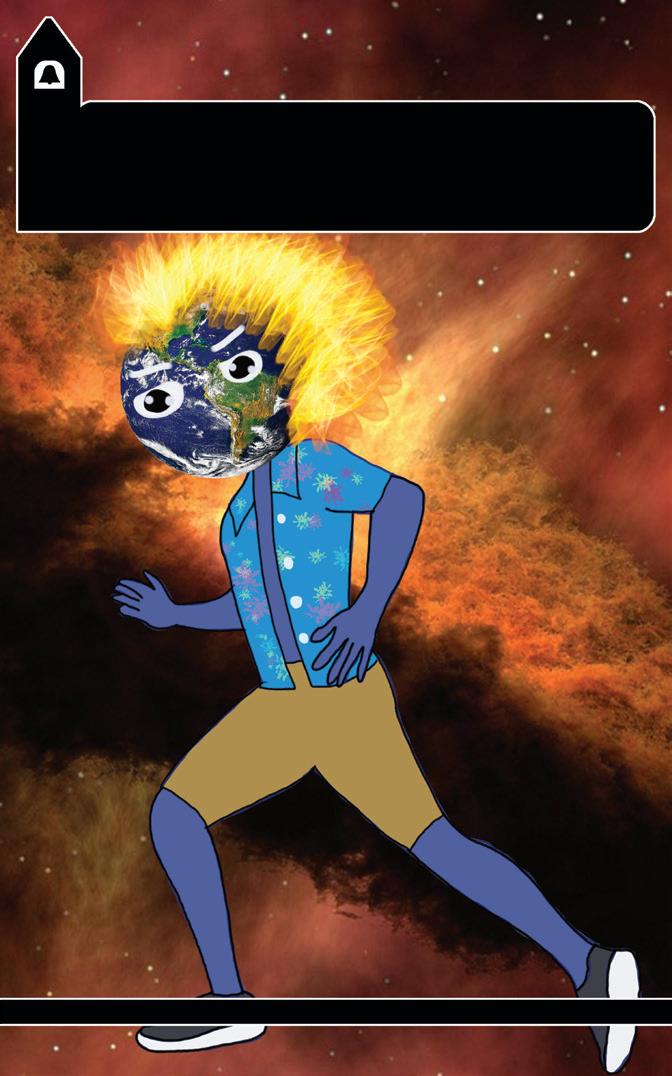

We’re officially halfway through the fall semester and, oh boy, has it ever been an eventful period. Saskatchewan is looking (and legislating) more and more closely to the southern states every day, there’s a cult harassing residents of Richmound after being ousted from Kamsack, last issue covered the U of R’s previous track and field coach Wade Huber accused of multiple accounts of grooming, all while the world as we know it shatters around us.
Thankfully those aren’t the only things occurring. Non-profit organization and governance is being championed throughout the province, mental health supports are surging in the face of eco-anxiety, many organizations are prioritizing creative artistic outlets for those involved, and accessibility in language is once again becoming a focus. Hope is out there, and staff and contributors of the Carillon are hard at work finding it for you. Enjoy these pages, and consider contributing to our paper if you have harm or hope to draw focus to.
Illegitimi non carborundum


self-proclaimed Queen of Canada has now set up camp





Romana Didulo is the self-declared queen of what she and her followers call the “Kingdom of Canada.” On the Kingdom of Canada website, she states that she is Head of State, Commander-in-Chief, Head of Government, National Indigenous Chief, and President. All of the aforementioned claims are blatantly untrue.
The followers of the cult are very active, threatening journalists, townspeople, and children in Richmound, SK. “This town is being controlled by a group of people so right-wing and gullible… it’s shameful, it’s horrible,” one resident of the village said in an open forum with local Royal Canadian Mounted Police (RCMP).
The cult has been present in Richmound since mid-September and has been staying in the village’s former school, now privately owned by Rick Manz. Christine Sarteschi, an associate professor at Chatham University, spoke to CBC News on October 6, estimating that up to 12 followers are with Didulo in the village of Richmound.
In the ex-schoolyard where owner Rick Manz is hosting the cult, the Carillon took note of two RVs and multiple SUVs at the school on Tuesday, October 10. The so-called ‘Kingdom of Canada’ were invited by the property owner and have since blocked the building off with ‘No Trespassing’ signs, twine, and tape.
When the Carillon drove past the building formerly known as Oasis School, our vehicle was filmed and was met with hostile glares from a male in his late 40s standing in front of an SUV bearing the ‘Kingdom of Canada’ logo. These anti-media attitudes and behaviours are mirrored in the cult’s decrees and policies. They believe that CBC and other news outlets receiving government funding should be defunded, accusing these outlets along with local media of “misinform[ing] the people to cover-up their involvement” in what the group calls a “COVID scamdemic.”
Numerous calls for service after the cult moved into Richmound’s former school led to the RCMP’s creation of a mobile detachment in the village. This detachment is staffed 24/7 and has been in Richmound in its current posture since October 6. The creation of a mobile detachment has allowed the RCMP to provide enhanced patrols which include license and registration checks on vehicles moving in and out of Didulo’s compound.
In addition to enhanced patrols, there are ongoing investigations by RCMP into the Kingdom of Canada’s presence in Richmound as well as conduct by members of the cult. In an open forum on October 10, citizens voiced concerns.
They claimed that members of the cult were walking through
alleyways at night, looking into windows, and filming residents. Many felt that their safety and freedoms are being infringed upon by the behaviour of the cult, while many more expressed concerns about a ‘meet-andgreet’ taking place on October 14. RCMP district commander Tyler Bates explained that inves-
property owner Manz was arrested after a report was received by the RCMP of an assault on another man. The assault was reported to the Leader RCMP detachment on October 7, and an official investigation determined that an altercation took place and that there were no reported injuries. Manz will appear in court in
lage. The bylaw defines nuisances as “property, activities, or things that adversely affect the safety, health, or welfare of people in the neighbourhood, people’s use and enjoyment of their property, or the amenity of a neighbourhood.”
Aside from behaviour that Bates explains may constitute
“The protest had remarkable support, with over 40 vehicles joining in to drive circles around the school.”
Allister White

tigations into reports are ongoing, and that residents should document what they can but not engage with members of the cult. On Wednesday, October 12,
Leader, SK on November 16. In 2018, the Village of Richmound enacted its second bylaw to provide for the abatement of nuisances within the vil-
the bylaw can lead to fines of up to $25,000 and, for continuing offences, a daily fine of up to $2,500. The village office would not comment on the cult’s potential violation of the bylaw.
The Kingdom of Canada’s presence has had adverse effects on many of the people who call the village of Richmound their home. For one, the village has blocked off a public playground in proximity to the former Oasis School due to fears that children may be confronted by cultists. A local independent journalist, Thomas Fougere, reported to CBC that “a man connected to the cult recently took down the tape.”
During an RCMP open forum with citizens of Richmound, Jennifer Smith – a resident of the village – shared words from her daughter, who “just want[ed] to go to the playground, but that crazy lady is there.” Other citizens echoed concerns about the cult’s presence affecting their children’s lives, with many upset that their children cannot play at the park, and many others concerned about their safety at the Fox Valley School in a nearby community east of Richmound where many children attend classes.
Another resident, Jody Smith, voiced his intention to go about his life. “I will remain vigilant – not vigilante,” he explained to the crowd at the forum, going on to say that he will take his granddaughter trick-or-treating on Halloween despite the cult’s presence. Bates has repeatedly asserted that there is “no imminent threat” to the people of Richmound.
Prior to their stay in Richmound, the Kingdom of Canada cult was staying on private property, without permission, in Kamsack, Saskatchewan. Over a six-hour period in mid-September, townspeople protested the presence of the cult and the RCMP escorted a plethora of RVs and SUVs out of the town.
Kamsack mayor Nancy Brunt explained that the people of Kamsack, like the citizens of Richmound, have “immense” pride in their town. The village of Richmound conducted one peaceful protest concerning the cult’s residency in the town, with little to no avail. Brad Miller, the mayor of the village, organized a second peaceful protest from noon to 7 p.m. on Saturday, October 13, and noon to 5 p.m. on Sunday the 14.
The protest had remarkable support, with over 40 vehicles joining in to drive circles around the school while chanting, honking, and revving motors. Other protesters held signs, some declaring that “royal decrees are lying disease,” with others pleading for the cult to “Leave Now” and “get OUT!!”
criminal harassment, the cult likely violates this village bylaw. If a notice of violation is served, the fine is $250 to be paid to the village. Failure to comply with
From the revved motors to Richmound mayor Brad Miller’s press conference, the message throughout the weekend remained consistent. ‘The Kingdom of Canada’ is not welcome in Richmound; or possibly anywhere in Saskatchewan.
shivangi sharma news writer
On October 7, the Hamas – a Palestinian government and militant organization – launched an air raid into Israel across the Gaza Strip borders, the likes of which has been termed “unprecedented” by many mainstream media outlets. Next came Israel’s response, in the form of bombing and air strikes as the government ordered a complete siege of the Gaza Strip. Thus began another bloody chapter in the history of the long running Israel-Palestine conflict.
Governments and their officials from across the world poured in with their condolences and solidarity: some for Israel, some for Palestine, and some for general world peace. As is the nature of information obtained from commonly consumed media
long as doing so did not prejudice the civil and religious rights of non-Jewish communities there.
Jewish immigration into Palestine continued over the next years, but the influx saw a significant spike during and after the end of the Second World War in 1945. The Jewish population from in and around Germany that had survived years of barbaric genocide and persecution sought a haven for themselves in Palestine.
In 1947, Britain was still governing Palestine, but was intent on withdrawing from the Middle East region, exhausted in the aftermath of the Second World War. Not being able to come up with a solution for the mandate issue in Palestine, Britain turned to the United Nations (UN).
The UN formed the United Nations Special Committee of Palestine (UNSCOP) to investigate and come up with a suitable
Jewish Agency, proclaimed the establishment of the State of Israel. Harry S. Truman, President of the United States at the time, recognized the new nation on the same day.
The creation of the State of Israel sparked the first Arab-Israeli War. The war ended in 1949 with Israel’s victory, but 750,000 Palestinians were displaced, and the territory was divided into 3 parts: the State of Israel, the West Bank (of the Jordan River), and the Gaza Strip.
Multiple incidents of war, occupation, and siege have followed the first Arab-Israeli war, and the borders of what is known as the State of Israel have been constantly changing. One of Israel’s land borders was formalized for the first time in 1979 when Egypt became the first Arab country to recognize the state. In 1994, Jordan became the second Arab state to recognize Israel, formaliz-

these days, opinions of all kinds are making rounds. Truth and the history of the conflict has once again taken the backstage.
The Israeli-Palestinian conflict dates to the end of the First World War. The territory of Palestine, which was a part of the Turkish-ruled Ottoman Empire, fell to the governance of Great Britain after the Empire’s fall in the war. The terms of the mandate entrusted Britain with establishing in Palestine “a national home for the Jewish people,” so
course of action for the issue. After much deliberation over the issue, UNSCOP developed Resolution 181. Known as the Partition Plan, they sought to divide the British Mandate of Palestine into Arab and Jewish states, with the city of Jerusalem to be governed by a special international regime. The resolution was passed by the United Nations General Assembly in 1947.
On May 14, 1948, following the end of the British colonial mandate in Palestine, David Ben-Gurion, the head of the
The recent incidents of violence in the region therefore did not come suddenly, but are a result of a long-running history of dissent and discontent amongst the major groups inhabiting the war-torn territories. The ‘surprise’ attack on October 7 killed and injured hundreds of Israelis. Children have been orphaned and thousands of people are missing. In one of its retaliations against the Hamas’s attack, Israel ordered the entire population of northern Gaza to evacuate south. The United Nations said it was, “impossible for such a movement to take place without devastating humanitarian consequence.” The order left more than one million people to decide whether to abandon their homes or face a certain doom. Following the order, over 70 people were killed after Israeli airstrikes hit convoys of Palestinian evacuees heading south in Gaza along the path they were
bodies strewn over streets continue to strike horror in the people watching from all over the world. The plight of those who must live through this terrible reality is unimaginable.
Considering the history of the conflict, it is important to be mindful and cautious of consuming information which may be propaganda. Misinformation and disinformation in situations like this has been known to have devastating consequences. It is easy to criticize and form opinions when multiple mainstream media outlets attempt to sway mass opinions in one direction or the other, but the truth in most cases is a lot different to that which is presented.
As the situation continues to develop in the war-torn region, thousands of civilians are killed, displaced, and taken hostage each day. Such is the horror of present day, that unthinkable war crimes have become normal. We hope
“ It is easy to criticize and form opinions when multiple mainstream media outlets attempt to sway mass opinions in one direction or the other, but the truth in most cases is a lot different to that which is presented.”
Shivangi Sharma
ing its long border with the Jewish state in the process. While there has not yet been a peace treaty between Israel and Lebanon, the two countries’ 1949 armistice line serves as Israel’s northern border, while Israel’s border with Syria remains unsettled.
The final status and contours of the West Bank, Gaza, and East Jerusalem are meant to be decided in negotiations between the Israeli and Palestinians living there under Israeli occupation, but decades of on-off talks have so far proved fruitless.
told would be safe to evacuate through.
As per the latest reports, at least 1,300 people, including 258 soldiers, have been killed in Israel and more than 3,300 have been injured. In Gaza, at least 1,900 people have been killed and more than 7,600 have been injured, and the displacement of thousands continues in both the regions.
Those who have survived relay stories of unfathomable atrocities and unthinkable circumstances. Scenes of decimated buildings, torn down homes, and
that peace in some form is restored for civilians on both sides.
For University of Regina students affected by the terrible suffering that we are witnessing, the Carillon encourages you to follow advice from Student Affairs and reach out to uregina.ca/student/ counselling/contact, or contact the staff at UR International who have a toll-free emergency help line at 1-(855)-874-1700.
nazeemah noorally staff writer
Bill Clinton, the 42nd President of the United States, once described non-profits as “the unsung heroes of our society, tirelessly working to tackle some of the world’s most pressing issues with passion, purpose, and unwavering commitment.” In our society where community impact is more important than ever, this sentiment cannot be understated.
The Government of Canada defines a non-profit organization as an association organized and operated exclusively for so-
“ners behind this groundbreaking event. Her insights offer a deeper understanding of the conference’s origins and purpose, setting the stage for a closer look at the transformative impact of the Reimagining Non-Profits conference.
The backstory to this conference is a simple but important one: “A monthly virtual Executive Director Networking session was initiated by Ivy + Dean Consulting for individuals across the province to connect, share their accomplishments, tackle challenges, and establish relationships,” noted Emily Lints.
The realization then emerged that a substantial capac-
values, concerns, and successes to share based on their position or identity, so it was important for us to create both physical and scheduled space for these conversations to happen.”
This first annual event, which unfolded over two days, echoes the essence of what non-profits represent: community impact, purpose, and commitment. Reimagining Non-Profits is made possible through a collaborative partnership with Ivy + Dean Consulting, the Nonprofit Voluntary Sector Studies Network at Luther College, and the Saskatchewan Nonprofit Partnership. It is within this collaboration that Lints conveys the role that the
in the conference was two-fold. She delivered a presentation titled “Navigating the Shifting Sands of Leadership” and led a workshop titled “Building Sustainable and Resilient Collaborations.”
General registration for the conference was priced at $125 and it is noteworthy that the conference’s impact went beyond its impressive array of sessions and the keynote presentation. The organizers extended a generous offer by providing sponsored tickets as well to ensure that a broader audience could participate. Notably, this inclusive approach was also extended to students at U of R who are enrolled in the Nonprofit Sector Leadership and
turnover, and the larger importance of economic and climate action, ‘sustainability’ became a word that encompassed all these concerns. We take that word to not only include environmental sustainability and other UN Sustainable Development Goals, but also the sustainability of our own mental health and organization goals.”
The event wrapped up with a networking evening at the Hotel Saskatchewan, facilitating larger conversations with all the attendees from across Saskatchewan and sharing of thoughts through a fireside chat of organization leaders. It was an evening of networking with a cash bar
By offering a space for nonprofit professionals from across Saskatchewan to gather, […] our conference will incite change and innovation.”
Emily Lints

cial welfare, civic improvement, pleasure, recreation, or any other purpose except profit. Non-profit organizations contribute in different ways to the larger community whilst championing causes, identifying and addressing gaps, and creating value. The inaugural “Reimagining Non-Profits” conference, hosted at Luther College at the University of Regina (U of R), serves as a stellar example of this statement.
This first-ever conference took place from October 13-14, where it was set to explore leadership for a sustainable future thus emphasizing the importance of sustainable economies, leadership models, and lives within the non-profit landscape.
This week, the Carillon got the opportunity to connect with Emily Lints, the project coordinator of Ivy + Dean Consulting, and one of the co-plan-
ity-building opportunity for organizations across Saskatchewan did not exist. In the post-COVID era, a shift within the sector appeared, bringing forth the crucial need for in-person interactions to reassess approaches to non-profit leadership. As such, the conference set to offer training sessions on topics like governance, recruitment and retention, collaborative leadership, fund development, and more.
Beyond the formal sessions, the conference was designed to create spaces for meaningful conversations. These ranged from Indigenous staff networking to Executive Director networking and non-profit staff networking, thereby acknowledging that each group brings unique perspectives, concerns, and successes to the table. According to Lints, “We recognized that each of these groups have different
conference plays in nurturing a new generation of leaders.
As the very name of the conference suggests, the event is a call to reimagine, revamp, and reinvent the non-profit landscape. It is an opportunity for leaders and professionals in the non-profit sector to envision new possibilities and pioneer innovative approaches. Lints reasserts: ‘’Simply by offering a space for non-profit professionals from across Saskatchewan to gather, we believe our conference will incite change and innovation.”
The conference featured keynote speaker Liz Weaver, who holds the position of Co-CEO at the Tamarack Institute. Weaver is widely recognized for her thought leadership on collective impact and community leadership, with a body of work encompassing both popular and academic papers on these subjects. Her involvement
Innovation Certificate Program, whether as part of the concurrent program or as a standalone certificate.
Attendees – who included non-profit professionals, volunteers, and students across Saskatchewan – were poised to gain hard and soft skills, covering a diverse array of topics from employment law to integrating trauma practices into their work. Notably, the selection of sessions was a conscious one, designed to provide all the attendees with training that often eludes them in more localized or regional capacity-building workshops. The choice of the conference theme, “Leadership for a Sustainable Sector,” is a testament to the event’s commitment to addressing contemporary challenges. Lints highlighted that, “With the rise of burnout, increased employee and volunteer
and appetizers along with entertainment and a fireside chat with Risa Payant of Ivy + Dean Consulting and Donna Ziegler of the South Saskatchewan Community Foundation.
This evening encouraged the sharing of valuable insights, fostering connections and strengthening bonds within the non-profit community. The Reimagining Non-Profits Conference can be seen as that catalyst providing non-profits the pro-tip to be successful. This conference served to exemplify the commitment of non-profits to creating a positive change in Canada. To access the different resources presented during the conference, you can navigate to the conference’s official website Reimagining Nonprofits (reimaginingsask.ca).
victoria baht staff writer
Like it or not, all students at the University of Regina (U of R) must pay a “Student Services, Health, and Wellness Fee.” This includes a fitness membership, some student services, extracurricular activities, and resources.
This fee works a bit differently from other fees, such as the optional U-Pass and Health and Dental Fees. Still, it has its benefits, offering remote and inperson resources to students. For those who are living in remote communities without a fitness centre or who do not otherwise go to campus very often, the remote offering can be extra helpful.
The URFit on Demand program offers classes that can be taken in-person such as spin, yoga, zumba and more. But for those off-campus, they have a huge library of videos that you can choose from. It may take some practice to work through but there are some great options. More information can be found at uregina.ca/recservices/urfit/.
Another valuable tool available to students is the U of R Mental Wellness Hub. University students may be guilty
of pushing mental wellness to the side occasionally and it is good to recognize that your mental wellness is important.
The hub website at uregina. ca/mental-wellness/index.html explains how mental wellness can involve your mental, emotional, social, and psychological feelings. Taking a moment to think about your wellbeing, some of these key feelings may pop into your mind. You may be confused about what you just learned in class which is part of your mental feelings, or you may be emotionally tired and stressed. Your social life might leave you feeling lonely.
Bringing these sorts of feelings to the forefront can help you assess how you’re feeling overall, something that can be hard for anyone, but especially university students who can be under immense amounts of pressure and stress. The Mental Wellness Hub is here to help students evaluate these feelings while providing strategies to combat some of these negative feelings.
The last thing to mention here is the Fitness Centre and Aquatics Centre on the main campus in the Centre for Kinesiology, Health & Sport. The Fitness Centre provides students with

This could be you!
access to a track, many different types of exercise machines, a core strength and stretching area, as well as other exercise equipment. As for the Aquatics Centre area, students can access a 25-metre
swimming pool, a diving area, and different types of lessons and aquatic activities.
This is just some of the information about URFit that is available to you. Take the
discussion on donations stirred up differences
URSU’s team of board members and the executive committee might need to look into seeking some personal reconciliation amongst themselves, or at least that’s how it looked during its last board meeting.
University of Regina Students’ Union held one of its board meetings on Tuesday, October 10. The meeting, which was held virtually, was called to order at 4:15 p.m. and concluded just before 7 p.m. with 22 participants in attendance. The participants included the board members, members
of the executive committee, the Chairperson, and representatives for Royal Bengal Sports Association and Hill ICBC who were present in the meeting to request funds for their respective events and projects.
Student presentations proceeded after the Territorial Acknowledgement was presented by the president Tejas Patel. Both the presentations lasted for about thirty minutes in total. Representatives were given a fair chance to present their respective cases in attempt to convince the board
that their initiatives deserve funding within the boundaries of URSU’s bylaws. It is worth bringing to attention that the representatives for both groups were heard and asked important questions, which aided them in better presenting their cases.
The board proceeded on its agenda to go over and finalize the members of different URSU committees from amongst the people who had shown their interest. The discussion on members of the Human Resources Committee was of particular in-
terest, as many people both from the board of directors and the executive committee wanted in. As a result, two applicants had to be voted out using polls.
The meeting then discussed sending a delegation to Luther College’s Reimagining Non-Profits conference which was held on October 13 and 14, and the motion was carried without any dissent.
Next on the agenda was the final decisions on the funding requests made earlier by the students to determine the amount

opportunity to use these resources that are available to you, especially since you’re already paying for them.
that would be provided. These decisions were carried out smoothly and by the consent of most of the participants.
It was the following discussion on donations which brought to surface what seemed to be a lot of personal differences amongst the participants. A request was made by the Gujarati Samaj of Southern Saskatchewan for donations for the upcoming celebrations of Navratri. The discussion that followed included a lot of dissent and disagreements.
Amendments were made to donate less than the requested amount which was retaliated upon by a request for another amendment, which requested a donation amount more than the requested amount. Although both these amendments were defeated and the original motion was carried eventually, the discussion preceding the decision was rather interesting.
Members spoke over and against one another quite openly, if not outrightly addressing what seemed more like personal vendettas than genuine concerns. While some genuine concerns and valid points were brought up by other members, these were far and few in comparison.
Witnessing the discussion on donations, it would be safe to say that while the members in general did a lot of things right, there are certain members who need to remember that they belong to one unit that represents all the students at the university, and not multiple units that cannot see above the pettiness of personal vendettas within the same union.
shivangi sharma news writer
Catch up on the centre’s programming, facilitators, and the history of Stringy Jack
maren savarese knopf staff writer
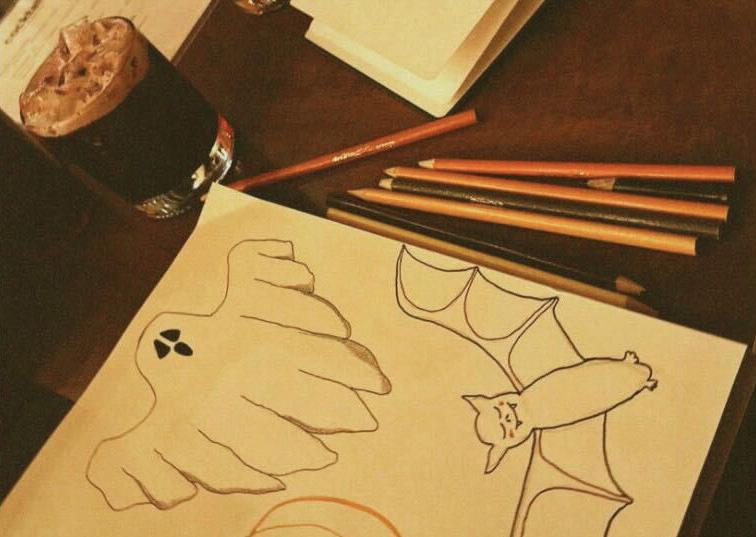
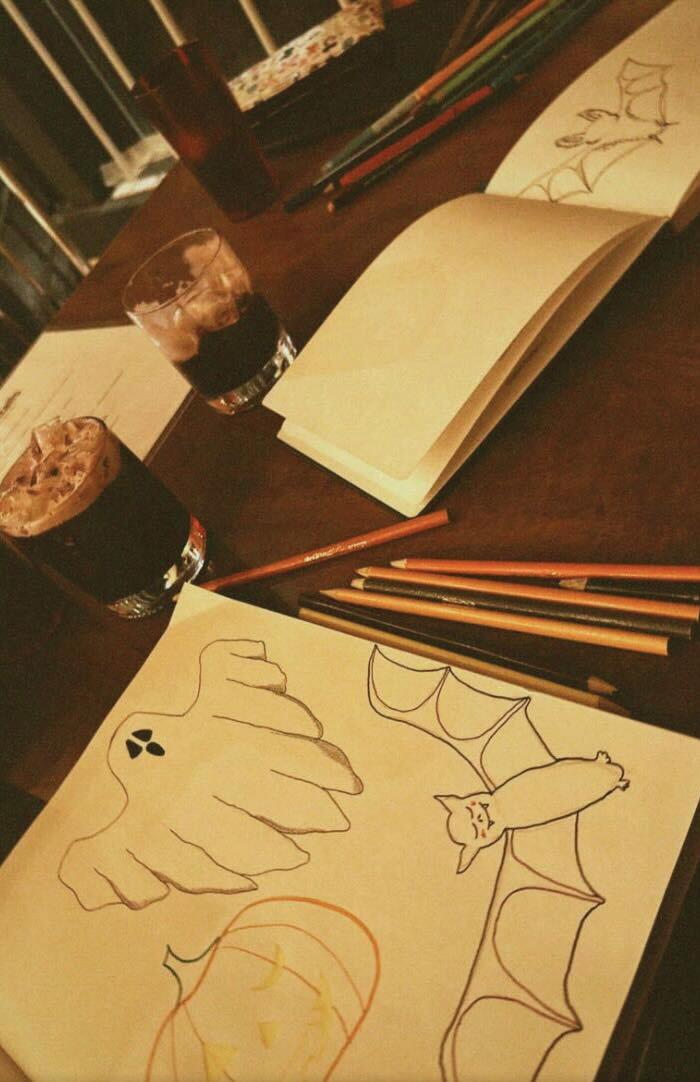
On October 12, the Creative City Centre hosted a Halloween Drink and Draw at the Hampton Hub, facilitated by hosts Geanna Dunbar and Joel Hustak.
Dunbar is a freelance Cree and Métis artist who uses mixed mediums in addition to doing body piercings and tattoos. Dunbar’s portfolio includes notable collaborations with the Creative City Centre, one of which is Liquid Art where Dunbar was mentored by sculptor Lionel Peyachew and graffiti artist Josh Goff. She then worked with high school students in Regina to share the knowledge she had gained.
Dunbar has also worked on projects such as the Frost Festival in 2022 and 2023, which included snow sculptures by Indigenous artists.
Joel Hustak is a Reginabased fantasy and science-fiction illustrator. In recent years, Hustak’s work has garnered notable acclaim for his artistic work on Star Wars games and an illustrated encyclopedia for droids in the Star Wars universe.
Spooky Halloween prompts were provided and an assortment of gothic animal skulls were staged for still life drawings.
The first half of the evening consisted of happy laugh-filled chatter, still life portraiture, and gentle engagement. Artists and participants were encouraged to take a hand at skeletal portraiture or venture off in their own direction of a distinctly spooky drawing.
The Creative City Center hosted the event off-site at the Hampton Hub and a range of intriguingly named drinks were offered, such as the corpse reviver, the bitter motherfucker, and the hotel nacional. Corpse reviver in particular felt fitting for the Halloween themed evening. In addition to a comical and delicious drink menu, the hub served vegan nachos for the event.
During the latter half of the evening, facilitators Dunbar and Hustak prompted participants and artists to draw their version of a reaper, either seriously or comically. Reapers were then judged by the staff of the Hampton Hub. What is it with some of the quintessential Halloween imagery? Where did it come from and why have we continued to draw things such as reapers and pumpkins year after year?
Well, pumpkins or squash have been described as a distinctly North American fruit. However, the jack-o’-lantern imagery that
we have come to know and love is connected to a wave of settler immigration. The practices date back to a century old Irish folklore of “Stringy Jack.” In Ireland and Scotland, people began to make their own versions of jacko’-lanterns, by carving faces into turnips and placing them into windows to scare away the ominous spirit of Stringy Jack, a man thought to have shared a drink with the devil.
The Creative City Centre was incorporated in 2008 by founder Marian Donelly. The story begins with an empty leased space in Regina’s downtown and Donnelly’s vision to turn it into a community-based arts centre.
On May 8, 2011 – some 3 years later – the Creative City Centre officially opened their doors with a media event and performance.
Since opening, there have been an average of 150-200 events hosted every year that include concerts, visual art exhibitions, spoken word, poetry slams, comedy nights, live drawing sessions, film screenings, and a range of community workshops. For those interested, the Creative City Centre will host only a few more events before shutting down for winter. Upcoming programming can be accessed via the Creative City Centre website at creativecitycentre.ca.
More stuff about Baldur’s Gate 3 What I didn’t say last time, I’m saying now
I love Baldur’s Gate 3 (BG3). And following the article I wrote last issue about it, I still have more to say. Without spoiling anything, if there’s one thing you need to know about getting into Act Two, it’s that Shadowheart is your friend. I don’t care whether or not you like her as a character, she is going to be your best friend if you want to succeed in combat quickly. I can confirm this, because I’m in the same area of the game as my dad, who I previously mentioned does not keep Shadowheart in his party, and I am whizzing through the combat in comparison to him. She is going to be your friend because of two great things: the spell Spirit Guardians, and Channel Divinity: Turn Undead. Spirit Guardians is one of the best third level spells in the game, if not in Dungeons and Dragons (D&D) altogether. Anything that gets even close to you is going to take damage. I will run around with Spirit Guardians up, not even doing any actions other than Dash, and just kill everything in seconds. Once again, without spoilers, it’s your best friend for Halsin’s mission at the beginning of Act Two.
Last time I talked about what your highest ability score should be based on your class, but I
didn’t really talk about the classes which can be picked during character creation. So, here I am to remedy that.
Barbarians hit hard and fast. Their unique thing is the ability to rage. When you’re raging, you do extra damage and you take less damage from your enemies.
Bards are music maestros, typically. They’re masters of the arts. Their bonus is inspiration, which is a godsend if you like to talk your way out of things, versus barbarians who might fight
their way out of things. Inspiration starts at giving an ally a 1d6 die for attack rolls, ability checks, and saving throws. If they’re just so close to reaching the die roll they need, inspiration can get them there. It starts as a d6, but that die will grow as you level up.
Clerics are my bread and butter. I’ve been playing D&D for five years, I’ve played six longterm clerics, and it’s not a surprise that my first BG3 character was indeed a cleric. Clerics are super customizable based on their sub-

class and they don’t need to be healers. If you want to heal, go with the life domain. If you want to destroy everything the sun touches, go with tempest.
Druids are nature’s best friend. Their big thing is that they can wild shape AKA transform into animals. The best part about that is the pile of extra hit points you get with it. There’s also the Circle of Spores subclass in BG3, which makes you a giant mushroom monster, and I don’t understand why anyone wouldn’t want to be a giant mushroom monster.
Fighters are your best starting class if you don’t want anything complicated. They hit stuff and they hit it really well.
Monks are sick as fuck. They’re real life karate kids. When you’re a monk, you get Ki Points, which you can use on things like extra attacks. You just punch things to death, and they’re my second favorite class after cleric.
Paladins are the jocks of the D&D classes. They’re like clerics, having an oath to uphold as they go about their lives. Personally, I think they’re more healer-based than clerics. You get a big sword, heavy armor, and you’ll feel a little like a frat bro.
Rangers are nature fiends, but not as much as druids. They
have a more limited spell list and they’re more about hunting than they are preservation. They get favoured enemies, which can change your cantrips and get you bonuses against fighting those enemies later in the game.
Rogues are sneaky and agile. They have sneak attack damage. If you have advantage against a target, you’ll do extra damage to them, and that damage gets higher as you level up.
Sorcerers are spellcasters, but they get their magic through their blood, and you can be half-dragon.
Warlocks get their magic by making a deal with an otherworldly being. But, warlocks only get two spell slots and that’s it, though they reset with a short rest.
Wizards are nerds. They get their magic from books and they are easy to hit. High risk, high reward type characters. Expect to hang in the backline, hit hard, and avoid getting hit yourself with your armour class of 10. This should wrap things up for now, so get into the game and get playing!
will bright a&c writer
Siwa still defends her.
I first heard of JoJo Siwa all the way back in 2013 when she made her way into the public eye, bow in full view, on Abby’s Ultimate Dance Competition. I was a huge Dance Moms kid and I was excited when she joined the show in 2015. I watched the “Boomerang” music video the day it came out. I was excited for her when she came out as queer in 2021. As someone who has followed JoJo for a long time, all I can say right now is: what the fuck JoJo?
Siwa has always had strange relationships with adults. Her mother, Jessalyn, always said that she knew Siwa was going to be a
Siwa was 12 when she became friends with Colleen Ballinger, who was recently canceled for grooming minors and inappropriate group-chats with minors in which she asked kids about their virginity, and more. I recently wrote an article delving deeper into Ballinger’s cancellation if you want more specifics.
Ballinger was 27 when she became friends with the 12 year old Siwa. When Siwa was 13, Ballinger called Siwa ‘porn’ in a YouTube video for clothes Siwa wore while dancing , stating that “she doesn’t know what she’s doing, she’s a child” when Siwa danced, showing that Ballinger knew she was a child.
Ballinger then showed her-
leave her daughter alone at Hall’s house for hours. Jessalyn didn’t even get out of the car, just let her daughter out of the vehicle and into the home of Hall, and presumably did the same with other creators. The young Siwa was left alone at the homes of adults to film content.
Siwa also made content with Shane Dawson. Dawson was canceled in 2020 for sexualizing children, including pretending to masturbate to a poster of an 11-year-old Willow Smith, as well as racist actions including blackface and saying racial slurs. He’s talked about finding children “sexy” on podcasts. Siwa was collaborating with Dawson when she was 15.
Siwa also collaborated with
types of people she’s been hanging around with, right?
Wrong.
Siwa made a video with Charles just three months ago. A 20-minute video about swapping credit cards and going out to buy things. She is still spending time with Charles.
Siwa made a video with Dawson four months ago. A 30-minute video about Dawson spending the day with Siwa and influencer brands, like Siwa’s.
Last month, Siwa spoke up about Ballinger. No other person in Ballinger’s life has spoken out, with the exception of her ex-husband who did an exclusive interview with the YouTube channel SWOOP. Siwa went on Howie Mandel’s podcast and Mandel
predators, why she is continuing to make content with them and defend them. But, there are two very important things to remember in this situation.
One: Siwa’s audience is primarily children. Her merchandise is sold in the children’s section of stores. Her music is aimed towards children.
Two: She is now the adult in a situation where she is working with children.
Siwa and her mother have a tween girl group called XOMG POP! They even had a show about it called Siwa’s Dance Pop Revolution. The cycle of pushing children into contracts, just like Siwa was, is continuing with this girl group. Out of the original seven members, only three are

“...what we’re seeing is that Siwa was the child making content with adults on the internet and now she’s the adult making content with children on the internet. It’s a repeating cycle.”
star. Siwa isn’t even a real blonde, her mother has been bleaching her hair since she was two years old. To this day, Siwa defends Abby Lee Miller, who was her coach on Dance Moms
I have previously written articles on Miller and how she portrayed herself on Dance Moms, including decisions she made. Many dances on the show were racist and Miller has been called out for racism several times. Miller was sued by a child because of how emotionally abusive she is to children, yet Siwa continues to defend Miller. Miller went to prison for money-related charges and
self birthing a baby, all the details included in raw footage, to a 15-year old Siwa. Siwa was also friends with Ballinger’s sister Rachel. They became friends because Rachel sent a DM to Siwa asking to be friends. In 2019, she said that she would be able to cuddle with Siwa once Siwa turned 18.
Siwa met the Ballingers through Todrick Hall, a man accused of not paying employees and allegedly involved in a sexual harassment lawsuit. That information was revealed by a former assistant of Hall, who also alleged that Jessalyn Siwa used to
James Charles. Charles, who wants to be ‘uncancelled,’ admitted to grooming and contacting young men under the age of 18. He claims that he is desperate for a relationship, so he was sending sexually explicit messages to anyone who seemed interested, whether or not he had confirmed they were over 18. Siwa was 17 when she was making videos with Charles.
What does all of this have in common? Siwa being friends with sexual predators, starting when she was a minor.
But, she’s an adult now, she’s 20, she must have realized what
Will Bright
asked Siwa about Colleen Ballinger. Siwa stated, “The internet can take a lie and run so far with it, so far that it’s to the point you just can’t do anything about it.”
Siwa stated that she’s still friends with Ballinger. She’s still on Ballinger’s side and she thinks people are lying about Ballinger. When Mandel asked Siwa about what the victims of Ballinger have shown as receipts, Siwa said it was sensitive, especially with “real” grooming, as if Ballinger’s victims were not truly groomed.
There is no real reason that is known about why Siwa is standing beside so many groomers and
left, though for unknown reasons. That’s not to say that either of the Siwas are grooming the members of their girl group. There’s no proof of anything like that. But, what we’re seeing is that Siwa was the child making content with adults on the internet and now she’s the adult making content with children on the internet. It’s a repeating cycle.
We may never know or understand why Siwa is choosing to spend time with and defend predators that she’s known since she was a child, but she is. What the fuck JoJo?
mikayla tallon a&c editor
Culture, according to the Merriam-Webster dictionary, is “the customary beliefs, social forms, and material traits of a racial, religious, or social group.” According to notes from an Anthropology 100 course, culture is all of the “taken-for-granted notions, rules, moralities, & behaviours within a social group.”
Symbols have dynamic cultural meanings, changing over time as individual and societal values, moralities, and behaviours grow. Culture influences the way humans interact with their environment as humans change, and humans bring growth to culture in turn.
A good case study for cultur-
Ebers Papyrus. According to Wilson-Kastner, P, and B Blair “Biblical views on abortion: an Episcopal perspective” abstract, Exodus is where the first and most obvious mention of abortion occurs in the Bible. As Christianity is a historically dominant religion, its preachers’ interpretations of the Bible’s words highly influenced a large number of cultures, and has continued to do so.
In the early 1800s, medical practitioners began campaigning for the criminalization of abortion. In the latter half of the 1960s, calls to decriminalize and liberalize access to abortions gained traction in conjunction with a movement for more freedom of choice for individuals.
An individual’s opinion has a higher chance of increasing in reach if it is part of their personal
“
Introducing an opinion into the political sphere increases the reach of that opinion, as now other voters need to consider whether they believe that opinion is one they would agree with enough to vote for that person.”
Mikayla Tallon
cial conservatives and Catholics by promising to re-criminalize “abortions on demand” to ensure he gained their votes. According to many sectors of the Catholic church and Eternal World Television Network (EWTN), a Catholic-led media organization, having an abortion is amoral. Therefore, Nixon’s position of criminalizing abortions appealed to this voter demographic and potentially helped him win the presidency.
Nixon’s actions then opened the door for religion to enter the political sphere and gain dominance in the culture of the nation. Introducing any opinion into the political sphere increases the reach of that opinion, as now other voters need to consider whether they agree with the opinion enough to vote for that person.
easy access to abortions continue to exist today. Everyone always has things they can learn about; we’re not infallible, so it is my personal opinion that we should keep open minds or do more research before speaking on certain topics.
Other ways in which culture is formed includes through oral accounts of history and storytelling. Creation stories, fables, and regional spiritual practices are important facets of culture that can influence daily interactions with the natural world. Stories and fables are used to impart teachings upon children and explain the world in ways children can understand and remember.
From explaining how stealing and greed are bad, to how wandering away from your parents and trusting strangers is dangerous,
er, fan, and glove languages that were used between the 18th and 20th centuries. While out of use for the most part in our current era, these languages still served a purpose as communication tools and foundations of culture using tools and body language as communication.
History influences culture as people learn from the past and try to build a better future. Most people want to live well and have future generations do the same, so culture adapts as people adapt to not repeat historical failures. The law and legal system can influence cultures as people avoid public scrutiny and the law’s sight of things to do what’s illegal where they are.
Examples of this could be practicing the ‘wrong’ religion,
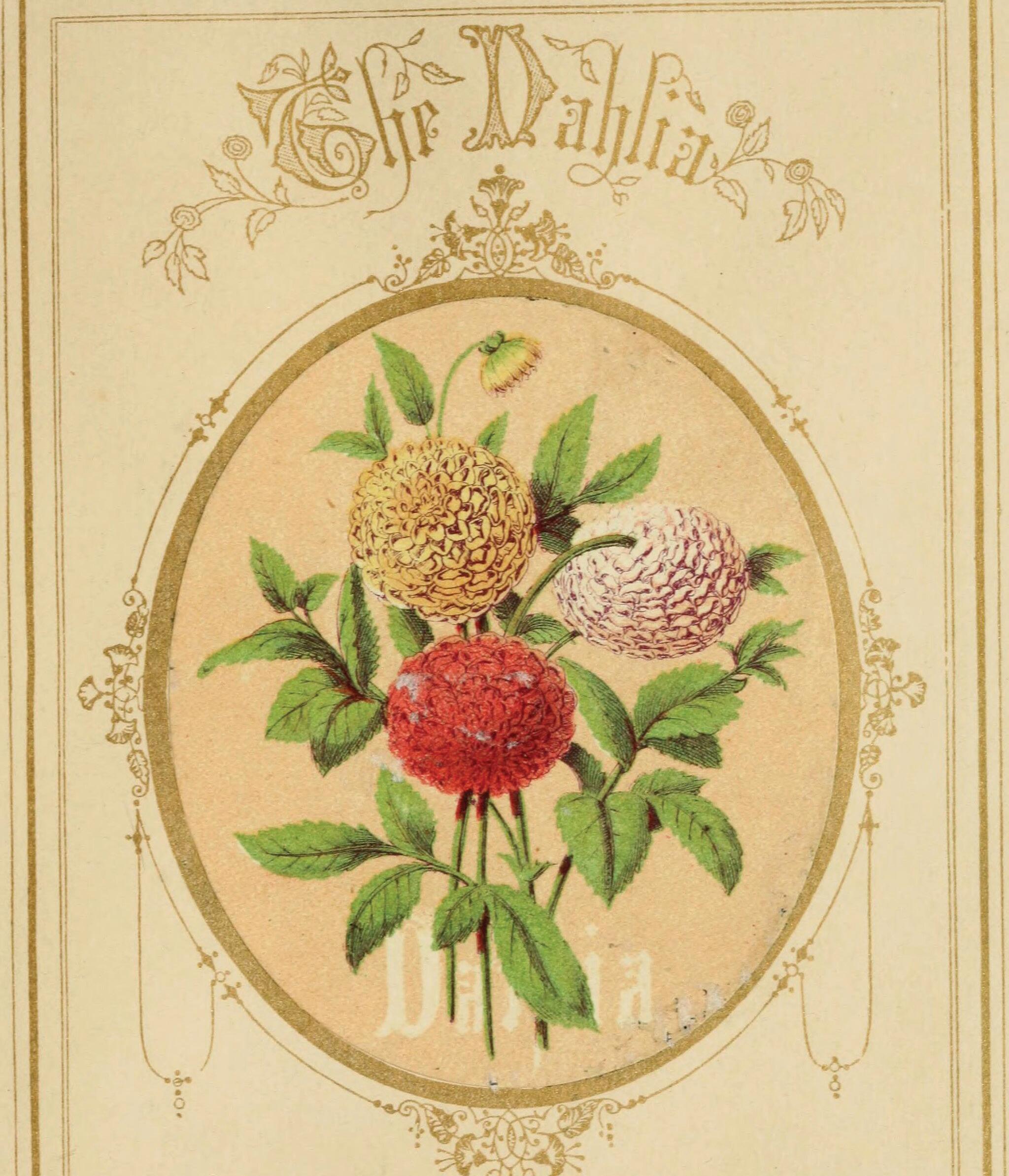
al evolution is that of the dominant population’s views on abortion. An article by CNN entitled “Abortion is ancient history: Long before Roe, women terminated pregnancies” details the long history of abortions across the world. There are references to abortion dating as far back as 1550 before common era (BCE), with the first written reference currently being found in the Ebers Papyrus, which was a medical text at the time it was written.
According to Oxford Reference, Exodus is believed to have been written between the ninth and fifth centuries BCE, after the
practice of religion and they introduce that aspect to others in the same or a similar religion. It is the movement of an individual’s opinion to politics which can highly increase the reach of an individual’s moral opinion. Following the 1960s calls for decriminalization of abortion, Richard Nixon’s presidential campaign in the 1970s featured talking points on what he would do about abortion were he to become president.
According to Greenhouse and Siegel’s article “Before (and After) Roe v. Wade: New Questions and Backlash” in The Yale Law Journal, Nixon appealed to so-
This encourages partisan debate and increases the likelihood of disagreements.
However, as people tend to be defensive of their beliefs and opinions, these disagreements can very easily turn to hateful comments and an unwillingness to listen or consider, to closed-mindedness. Keep in mind that Canadian and American politics are closely tied due to the countries’ proximity, leaving many political stances to overlap. Access to abortions in Canada has been a highly controversial topic for decades, similar to our neighbours to the south, and many barriers for safe and
or even that adventuring alone at night is dangerous, stories serve as valuable tools to teach.
These stories help to keep children safe and teach them of how the world works without simply saying “Because I said so,” since any parent can tell you how often that works on its own.
Even as a simple tool to share language, stories are invaluable parts of culture. Language is an equally important aspect of culture, as parents and teachers explain the culture to children who will live it while they are growing up.
This can go even further to include things such as the flow-
expressing a gender different to the one assigned the person at birth, expressing a sexuality other than heterosexuality, or being houseless in a specific part of town. There are many things which can influence culture and many things that form cultures, but the human need to fit in and be part of a social group is the foundation.
Culture is shared and makes people feel their values, beliefs, behaviours, and morals are correct and natural, so long as they align with the majority.
While hustle culture reigns supreme, burning out won’t do anyone any favours
pall agarwall s&hwriter
Coming so far as a society, we have glorified overwork and stressing ourselves out. Humans tend to burn themselves out faster these days compared to the lifestyle back in 90s. This arose in part due to lack of a ‘recess’ at work or business.
As employees and entrepreneurs have normalized this hustle culture, there has been a significant rise in poor mental health conditions that affect not only the person but also other people in their families, social circles, and workplaces. This situation could be prevented if workplaces encourage work breaks and motivate their employees to take their breaks to increase productivity and not just expand work to fill the time for completion, according to Parkinson’s Law.
Work breaks are an integral part of one’s professional life. Just like one goes to someplace they desire for a vacation to sprint back to their normal life with more enthusiasm, taking breaks during work is similarly crucial
to increase one’s efficiency. There are a lot of benefits to taking breaks during work.
Increases focus. People get back with refined focus and more enthusiasm to fulfill a task.
Increases creativity. Taking a short break at work could also refuel their mind and help them think on things differently, benefitting the organization.
Increases job satisfaction. Employees tend to feel more welcomed, respected, and valued in the workplace when the employer encourages short breaks.
Taking breaks has always been a taboo at work and people may look at you with a side-eye when someone gives breaks importance. So, it can be difficult to come out of that space and give oneself the downtime they deserve and need so they can sprint back with greater force.
According to Sahil Bloom, entrepreneur and owner of SRB Holdings, “The human mind is not designed to be on at all times. It needs rest.” Bloom also suggests working in short blocks which he refers to as “deep work,” inviting no distractions during that time. This could motivate an individual to see those breaks as rewards for
doing something productive in a short span of time.
Breaks can include taking a short walk to activate the muscles, or sitting quietly, or just closing one’s eyes and concentrating on their breathing to fully connect with themselves. Meditation can be a very helpful way to fill those breaks as it is relaxing after a stressful workload or completion of a time-sensitive deadline which required one to be on their toes.
There has been a lot of research on the effects of taking breaks during work. Research by Michigan State University suggests that supervisors taking breaks reflects positive workplace behavior and, in return, also encourages other employees to give themselves breaks during work hours. As it can be hard to do so by oneself, leadership in an organization should set themselves as an example.
It helps the overall organization to recover from stress and outperform themselves. Extending these short breaks to longer breaks like going for a staycation should be encouraged so that employees continue to maintain a healthy work-life balance. This extension comes with a lot of

tradeoffs to the company but, from a long-term perspective, it brings back the employee with more agility, focus, and energy to contribute their best.
As the world continues to navigate the journey of breaks and taking some time off, it is imperative to look after each other like this.

EcoStress Saskatchewan asked about eco-grief and the impacts of catastrophe
maren savarese knopf staff writer
This year Canada has faced record breaking wildfires across the country. On June 25, the Canadian Interagency Forest Fire centre officially declared the 2023 wildfire season the worst in the country’s recorded history. As of September 29, there have been upwards of 6,496 fires recorded which had burned approximately 17.9 million hectares of land.
According to the government of Canada, that is equivalent of an area larger than Greece. Although Canada is no stranger to fire season, with its 10-year average of 2.7 million hectares con-
Arbuthnott, a retired professor Emeritus of Psychology, received a call from Amy Snider and Russell Charlton asking if she would join them in beginning a group to support people experiencing intense anxieties around climate crisis. The idea for the group was spurred by the summer of 2021 which was a particularly bad one for the climate. “That’s when I thought, well, there […] isn’t a support group, or anything like that for this type of problem […] in town that I know of, I couldn’t find any,” said Snider. As a result, the three began to plan what is now EcoStress.
Both Snider and Arbuthnott explained the intentionality behind the name EcoStress, “We
buthnott, this may have been due partly to the pandemic: “The pandemic has links to climate change as well. […] and, you know, [during] COVID people couldn’t gather so they were looking for ways to not be so isolated with all of their feelings about that.”
Both Snider and Arbuthnott touched on larger social environments within Saskatchewan that perhaps make it difficult to talk about eco-stress within the province. “At the end of [the sessions], we asked people if they could share their reasons for being interested in the group and a few broke down in tears, sharing relief and gratitude to have a place where they could talk about their
and plants that we used to have just abundantly, it’s like a big deal if you find one these days.”
“There is a connection between the loss of native grasslands and climate change,” said Snider. “We’re destroying, we have destroyed the land, especially by our current agricultural practices and our urban sprawl.” Likewise, Arbuthnott has had extensive conversations with agricultural producers as part of her work with Public Pastures Public Interest (PPPI) and said, “They care passionately about the land, but they feel blamed. They’re scared about how they can run their operations in a less carbon-intense way.”
For Snider, who is not a scientist, drought is the most press-
literally vanishing into the air,” said Snider.
“The other thing about Saskatchewan,” said Arbuthnott, “[is that] we are all really attached to our land, our province and part of that may be just because it’s kind of an underappreciated one. But we see how wonderful it is, you’re really attached to it.” For the most part, Arbuthnott explains that the people of Saskatchewan are a “salt-of-the-earth type” and very pragmatic. “We have our flaws definitely, but we [are] just good people mostly. So, it’s particularly painful when these good people, you see, are not paying attention to it [climate crisis].”
Snider says there are two important things you can do to
“ We chose the word eco-stress to encompass a few different emotional responses to ecological devastation.
Amy Snider
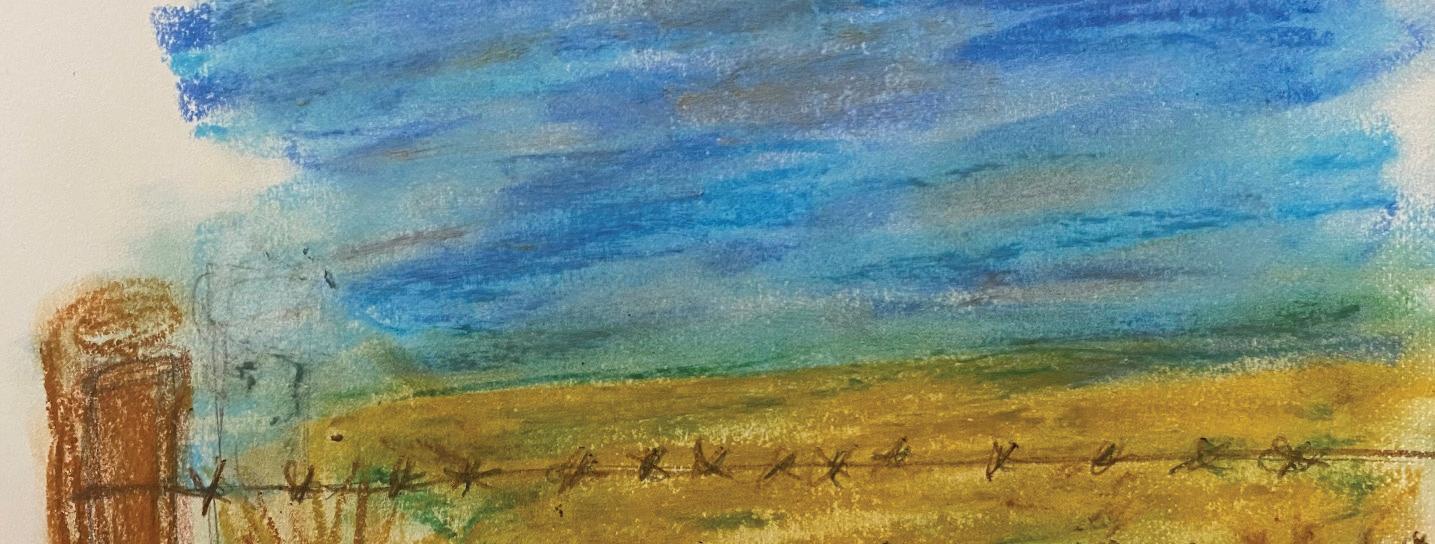
sumed by forest fires every year, 2023 was incomparable. Unlike previous fire seasons, 2023 saw widespread fires from the west coast to the east and spreading into the north.
In Saskatchewan, there have been a total of at least 495 fires, surpassing the five-year average of 385. Moreover, this year was marked by a season of severe drought. On July 31, the Water Security Agency announced a “well-below normal amount of moisture in many areas across Saskatchewan.”
Experts say feelings of anxiety or stress during the current global climate crisis is normal. However, dealing with eco-anxiety can be overwhelming, troubling to navigate, and, at times, isolating. EcoStress Saskatchewan is an organization dealing with a wide range of emotional responses to climate catastrophe and change.
The organization was started in 2022 when Katherine
had this big debate – Amy, Russel, and I – on what to call this group. […] We wanted it to be clear we weren’t just going to talk about one emotion,” said Arbuthnott.
As Snider explained, “We chose the word eco-stress to encompass a few different emotional responses to ecological devastation. […] There’s despair, there’s fear, there’s anger, frustration, there can be a sense of abandonment by society and the people in charge,” adds Snider.
EcoStress organizes member-driven focus groups to “talk about what is on people’s minds, what they are experiencing,” explained Arbuthnott, who acts as the group facilitator. Groups meets virtually for two hours once a week for eight weeks and although Arbuthnott facilitates the meetings, conversations focus on themes or topics that emerge naturally. When the groups first began in 2022, there was so much interest that Arbuthnott ran two groups simultaneously. For Ar-
feeling. They said that it seems especially hard here in Saskatchewan,” said Snider.
“It’s hard to talk about in Saskatchewan because the social norms here are really against us even acknowledging that it’s happening,” added Arbuthnott.
For Snider, it is important to understand that, “Someone can experience eco-stress without necessarily living in a place that has noticeable effects of climate change taking place currently or happening currently, it’s enough just to be up to date with the news to be terrified. […] And so many people in Regina only see the digital effects of the climate crisis.” However, unknown to many Canadians, native grasslands are among the world’s most endangered ecosystems.
“And that’s actually a pretty strong characteristic that people think it’s worse everywhere else,” said Arbuthnott. “But it’s when I’m out with my grandkids and I really notice that the wild flowers
ing concern for Saskatchewan. “The water we drink that fills our reservoir at Buffalo Pound comes to us from the South Saskatchewan River. The South Saskatchewan River is fed by the Rocky Mountains, […] there is actually a glacier in the Rocky Mountains called Saskatchewan Glacier.”
This glacier is part of the Columbia Icefield in Banff National Park, a popular touristic attraction. “And when that water melts from the glaciers, small amounts of it make it all the way to Regina. I find it quite mortifying that when you turn on your tap a small amount of the water you’re drinking is what climatologists and climate scientist call glacial wastage.”
However, increased air temperatures are not only responsible for glacial melting and subsequent drought.“ Wetlands in the south are drying up. And it’s that extra heat that we’ve had makes the water evaporate more quickly. So more of the wetlands are quite
help. “One is to build community, and the other is to take action. To feel as though you’re contributing something to help the problem get better. I think that taking care of yourself by finding community is taking an action.” For Arbuthnott, conversation is “especially [needed] in tough times.” For folks interested in connecting with EcoStress, they can visit ecostresssk.ca to learn more or to connect with Arbuthnott or Snider.
Co-founder Amy Snider, in addition to her work at EcoStress, teaches English as a second-language and is completing a Masters of Fine Arts at the University of Regina. Sniders’ forthcoming exhibition will weave together interactive ceramics made from Regina-dug clay with themes of climate emergency and stress to pose questions about what gallery visitors will leave behind.
The cultivation of gratitude and joy It takes intention and practice, which Sacha Wolfson seems to have no lack of
pall agarwal s&h writer
Yoga, a practice predominantly deep-rooted in India, has spread its branches worldwide. It helps one navigate their inner balance and be with themselves as they search for peace and tranquility.
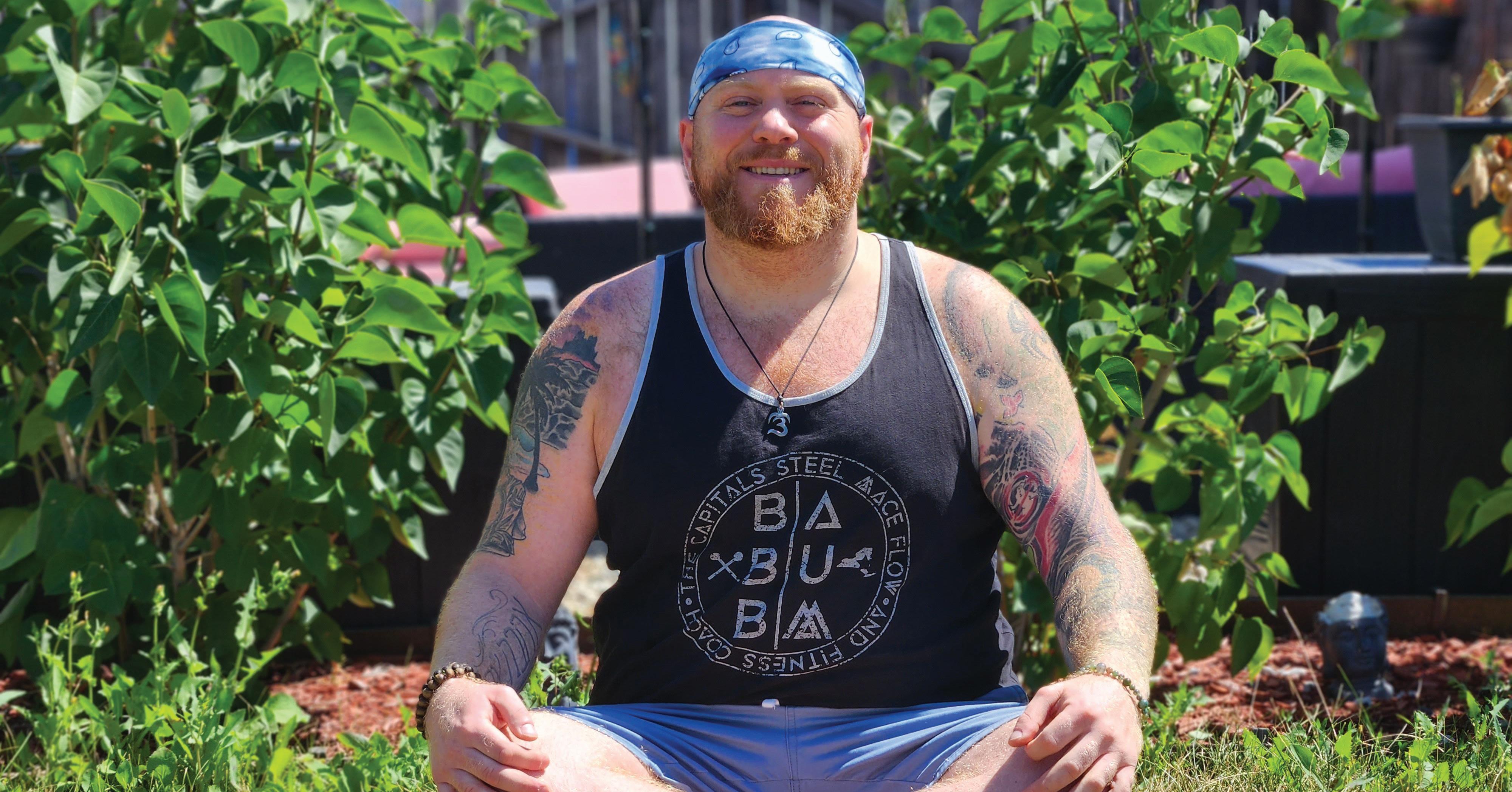
Sacha Wolfson, owner of Wolf Sun Wellness, believes the same
regular at yoga.
He observed that most people, especially athletes, were used to practicing yoga to counterbalance the effect of the strenuous training and weightlifting at the gym to increase agility. This got him to realize the need of yoga and how people struggle to incorporate this as a part of their lives to make it better, despite wanting to do it being incapable of figur-
long learner. He believes that to be able to be a good teacher, it is very important to learn too so that he can be of better service and help more people.
Going through a period of a 50-hour workweek, along with a 100 hours of teacher training for yoga per month, along with teaching people for about 4 days a week, Wolfson realized eventually that yoga was his desired
made up his mind that he was going to teach yoga full-time. Around November, Wolfson went to Peru for his 20-day intense training of different types of yoga like Ashtanga and Sivananda yoga, and found it to be “such a great environment.” He found the facilitators and people running the training well-experienced, and they provided an engaging environment to immerse
alarms is an important habit to develop for maintaining a healthy, sustainable sleep schedule.
Don’t overcomplicate things
“Mindfulness doesn’t have to be that hard,” Wolfson noted. “You just have to find moments of presence and breathe throughout the day and when you’re feeling stressed or worked up, just
“ I am still learning and still working to get there, but it’s really just enjoying that journey and creating and cultivating that life of gratitude and joy.”
Sacha Wolfson
this.
and has had an incredible journey figuring out his definition of inner balance and peace.
Introduced to yoga by his sister, who is also an instructor, 20 years ago Wolfson found this “weird” and wished to never do it again. Life had its own plans to bring him back to where he had started, and today he is here to impact lives with his expertise in this field.
“In 2016, I hurt my knee and I was doing a lot of other trainings when I decided that I wanted to incorporate more stretching, so I started doing five to 10 minutes of yoga a day. Then turned it to 40 minutes to an hour a day, and then just escalated from there,” said Wolfson. In order to balance things out with the other hard trainings that he was undergoing, Wolfson found it imperative to get
ing out a time to practice it.
Wolfson continued to practice daily for about three years before he decided to do his first training to move onto the next chapter. Before his deep inclination towards yoga, Wolfson was in sales and service for about 20 years when he finally realised that his real calling was teaching yoga. “There is a lot of philosophy associated with it. The more I delved into the philosophy, I really wanted to find something to give back, and actually doing a service to the world, […] cultivate a life that allowed me to focus more into teaching and more on giving back and doing more community things,” he said.
As he wishes to give back to the community and be of service to society, he continues to upskill himself and commit to be a life-
sanctuary. It was a very intense period for him as he struggled with multiple responsibilities and tasks that, to be fulfilled, required his full attention.
“The more I did the teacher training at Quants, the more I realized how much I love absorbing that and how much that stuff just energizes me. And that was something I was excited about and wanted to share. I kind of just came to a breaking point last October where I just realized that I wanted to jump in and go on a different path,” said Wolfson. He reflected that he is way more passionate about this and that makes him feel more fulfilled. On his last day of teacher training, he made up his mind to quit work and just go all in with yoga.
Wolfson booked the tickets right away to Peru when he had
himself to the world of yoga.
Asking him three tips for people to incorporate yoga and mindfulness in their daily lives, this is what Wolfson had as his two cents.
Incorporate a practice of just five minutes every day.
It is understandable to take out a dedicated hour to practice, but starting with just five minutes a day can be a stepping stone to doing so regularly.
Keep away from your phone during rest.
He advised to get an alarm clock and keep the phone away before sleeping. He mentioned that it is imperative to find that time to reset and have a sound sleep. He also mentioned how having an alarm clock and not having to depend on mobile phones for
stop for a couple seconds, maybe close your eyes, breathe, and stay in the moment.”
Wolfson believes in practicing gratitude and continues to preach the same as he does so when he wakes up in the morning. Having said so, he continues to inspire and impact several lives through his mindfulness coaching at Wolf Sun Wellness. His dedication towards the community and serving the people though his expertise and learning will be continuing. “I am still learning and still working to get there, but it’s really just enjoying that journey and creating and cultivating that life of gratitude and joy.”
If you’ve been curious but potentially also a bit clueless, here’s a step one
victoria baht staff writer
Regina is home to its very own roller derby club, by the name of Pile O’ Bones Derby Club. For those of you who may not know what roller derby is or if this is your first-time hearing about it, I’ll explain.
Pile O’ Bones’ club is a great place to learn what roller derby is all about. Their website has some great information on what the sport is, information on free skate and learning how to skate, information on games, information on the league, and so much more, making it a great place to start.
To be able to talk about the roller derby club, it’s probably best to start with the basics. How does the game work? Personally, I have never played or watched
derby, leaving me to learn directly from the experts at Pile O’ Bones. Roller derby is a full-contact sport where players skate around on rollerblades to gain the greatest number of points. The main components of most sports games, quite honestly.
In roller derby, the points are gained by an important player called the jammer. The jammer is the only player on that team who can gain points. The jammer’s job is to start behind the pack made up of the rest of the players skating known as blockers. The blockers work together to slow down or to stop the other team’s jammer from getting through the pack.
If the jammer gets through the pack, that is when the jam starts, and the team can start accumulating points. This is done by the jammer running around
the track as fast as possible and passing as many opponents as possible with their hips. This can run as long as two minutes which is called a jam, but the first jammer that makes it through the pack can also choose when to end the jam which means the process can start all over again.
This process continues for two 30-minute halves, making up a full game of an hour. More specifics on how the game works and is run can be found on the Pile O’ Bones Derby Club website. If this description was not enough, try to catch a game and go watch in real life at the club. If this is something you are interested in, it is $10 for adults to watch and $5 for kids between 11-17 years old to watch. This might be a great way to see if the kids would be interested in playing the game. Plus, this may even help you feel
the game’s adrenaline and get to know it better!
Once you have a hold of the game and how it works, you may want to try and give it a shot. Well, the Pile O’ Bones club has the perfect opportunity. They call it “Free Skate” where you get the chance to practice your skills on your own. It appears like a great night for beginners to learn how to start rollerblading. Plus, if you go to a free skate night, it does not always mean that it is for beginners. It looks like this is a night for all roller blading lovers to come together and to work on their skills, and maybe you can get someone to help you out!
Looking at the club’s Instagram @reginarollerderby, you can see plenty of pictures of the community. Team photos and videos of games and fun fill the page. They have activity nights
posted which may be worth the checkout. One that I saw was the Roller Skate Disco Night. It makes me wonder honestly if this night is almost like you see in the movies. You know the ones, with the blasting music, the cool 80’s-90’s outfits, the cool lights. I wonder if an event like this is in Regina! There is not one scheduled right now, but this may be something to watch out for. I know I am already intrigued. They also have derby information nights and so much more.
The community, knowing where to start, and the game itself all really seems like a great time! If you are looking for a new sport to join or a new way to move your body or to bring out the old blades from the garage, this may be for you. Ensure you check out the Regina Roller Derby Pile O’ Bones club for a rollin’ time.
“Once you have a hold of the game and how it works you may want to try and give it a shot. Well, the Pile O’ Bones club has the perfect opportunity.”
Victoria Baht

hammad ali op-ed editor
I don’t think it will surprise anyone, but I love travel. Air travel in particular. Humanity always wanted to fly into the heavens, and today – as long as you do not mind spending an obscene amount of money to sit squeezed in between two people who somehow are the exact types you find most annoying – you can!
I am actually convinced that all airlines have access to immensely personal data about me that tells them all my pet peeves. In addition, they have the technology to look at their entire list of customers and picking out the ones who fit those specifications.
Still, air travel is truly impressive if you think about it. No matter where you live in the world, you can get to the other end of the world in less than a day. Unless you are poor, but then you should not have such dreams anyway. Work at your job, do not buy that Starbucks coffee, pull yourself by your bootstraps and maybe someday you can take a trip to the backyard. Hail capitalism!
But I digress. What is probably the most impressive thing about modern day airlines is the level of multitasking they can do. While you are on a plane going from Canada to say, Germany, your checked
Emojis and
bags could be headed to Australia!
Now, I know you are thinking that this is awful. But that is because you have gone soft and become boring. Your ancestors rode into battle on horseback. Are you really going to whine about how your toothbrush and PJs are not there when you land in a foreign land where you know nothing and probably do not even speak the language?
Improvise! Adapt! Overcome!
Or maybe you are one of the smart ones. You have decided that the possibility of your bags getting a tour of the Sydney Opera House is not for you, and will just be taking carry-on. I can see the college education is paying off. I just hope you do not need any fluids, at all. That includes your toothpaste, shaving supplies, any skincare products. As we know, terrorists can use any of those things to take over the plane, and then eventually, the world. Oh, and your laptop, phone, and anything else that looks the slightest bit like it uses technology will be checked with a scrutiny that was clearly not applied when checking Donald Trump’s tax returns.
Once you have made through all those checks, you can do two things. First, immediately buy the biggest pack of toothpaste known to man, at the highest profit margins known to any life form, from one of those stores right past security. It’s almost like they just did not want you to save some
money… Anyhow.
The other thing you can do is board and try to find space for your bags. If you were not one of the first three people to board, this will mean a lot of schlepping around, and then stressing the entire flight that you do not forget which overhead bin your bags were in.
Again, don’t complain. Your ancestors fought the Nazis. At least, with things how they are these days, I hope they did? Who knows anymore. Clearly not Anthony Rota.
So anyway, maybe you got through all your flights with minimal hassles. Maybe you were not ‘randomly chosen for extra security checking.’ I can verify that their selection process is truly random, because it always picks me and all my South Asian friends! Surely that cannot be planned? That would imply terrible things! So, it must be random. Simple and logical.
But like I was saying: you’ve reached your destination, your bags are with you, and you are about to embark on an adventure. I just hope that up in the skies, in that huge metal cabin shared with an assortment of the strangest humans to ever live, you did not catch some novel virus which you then spread to all of Europe and shut down the world for years.
I know, I know! Flights of fancy, right? Like that could ever…
Expressions mean more than meets the eye
This past summer I was surprised to hear that a Canadian farmer has been court ordered to pay a substantial amount in damages after a court ruling that a thumbs up emoji was sufficient to accept contractual terms. Justice Timonthy Keene, the presiding judge, argued that emojis have become a common facet of our modern communication and therefore will necessitate legal systems to confront emojis in the future.
As someone who has been using the email signature “I use emojis as part of accessible language” for the past several years, learning of this case provided an entry point to explore more widely what constitutes accessible language in ‘digital speak.’
Plain language, also referred to as plain writing, is a form of communication that is straightforward and uses only as many words as necessary to communicate a message. It avoids obscurity, overly academic or complicated jargon, convoluted sentence structure, and is a part of accessible language. However, plain language is not a simplified version of the English language and possesses the ability to communicate complex and complicated themes.
Writing in accessible language ensures that our communication includes everyone. This is built on the intention to be intelligible across literacy levels, ages, and abilities, including people who are neurodivergent. Neurodiversity refers to the unique ways peoples’ brains and cognition work. Rather than being seen as deficit, neurodiversity holds that there is no right way to think, process information, communicate, behave, or learn.
An emoticon like “ >;-) “ is a shorthand form of a facial expression, and a precursor to emojis. Emojis have been further developed with modern communica-
tion technologies to develop graphics such as the following: ��, ☹. Emojis on smartphones, chat platforms and email applications have become highly popularized and perhaps a daily practice.
For some, emojis might represent our disjuncture with literacy and perhaps the assumption that they make us poorer com-
Seargeant and author of the book The Emoji Revolution which attempts to answer how technology is shaping the future of communication. According to his research the emergence of emoticons, the most basic representations of facial expressions, can enhance digital communication. Similarly, emojis help to add nuance and compensate

What’s not to like about additional ways to communicate that many people find to be effective?
Image: Maren Savarese Knopf
municators in the process. However, this deeply misunderstands the way communication works.
A study published by the American Psychological Association indicates that emojis, like facial expressions, help to provide non-verbal cues and work to translate emotive elements, tone, and reduce ambiguity in our digital speak. Some useful context comes from applied linguist Dr. Philip

three hours
for the lack of nonverbal modalities available in digital communication.
Research and the lived experience of neurodivergent people tells us that there are significantly different communications styles from those coded as ‘neurotypical.’ These include difficultly in ‘picking up’ emotive and tonal elements of communication. In digital speak these emotive and tonal elements are further alienated be-
cause of the digitized medium. So perhaps emojis offer us a critical intervention in making digital speak more accessible.
In a 2022 webinar titled Don’t Disable Me: how you can avoid creating barriers for disabled people, Rina Wharton, a consultant at AbilityNet who identified herself as autistic and dyslexic, shared how she sometimes struggles with facial expressions and body language. Wharton further explained that, “While writing, I know I can be very direct, because of my autism. I tend to use emojis to indicate I’m joking. Or this is a funny thing.” According to AbilityNet, a UK company concerned with digital accessibility, emojis have become a useful modality of communication within neurodiverse communities.
Since the emergence of emojis, which originated in Japan and directly translated as ‘picture,’ there has been an uptake of research around the usage of emojis in digital communications styles. Overlooked within these studies has been how neurodivergent people receive, interpret, and use emojis as part of accessible language.
According to the American linguist Johanna Nichols, the gold standard criterion in communication is mutual intelligibility. Because emojis present such potential in making our digital communications more understood (especially in regard to tone and emotion), we should broaden our understanding and include them in conversations of accessible language.
maren savarese knopf staff writer