distribution manager sun sidhu distribution@carillonregina.com
staff writer victoria baht
staff writer nazeemah noorally
staff writer maren savarese knopf
news writer shivangi sharma
a&c writer will bright
s&h writer pall agarwal
contributors allister white
board of directors
thomas czinkota, holly funk, tayef ahmed, harnisha bhatt, diya patel, mishree patel, ghanshyam pravinbhai savaliya, rishi thakkar, mikayla tallon, and sun sidhu
the paper
227 Riddell Centre @ the University of Regina 3737 Wascana Parkway, Regina, SK, Canada S4S 0A2 www.carillonregina.com | (306) 586 8867
Printed by Star Press Inc, Wainwright, AB
The Carillon welcomes contributions.
Opinions expressed in the pages of the Carillon are entirely those of the author, and do not necessarily reflect those of The Carillon Newspaper Inc. Opinions expressed in advertisements appearing in the Carillon are those of the advertisers, and not necessarily of The Carillon Newspaper Inc. or its staff.
The Carillon is published no less than 11 times each semester during the fall and winter semesters and periodically throughout the summer. The Carillon is published by the Carillon Newspaper Inc., a non-profit organization.
land acknowledgement
The Carillon is written on Treaty 4 territory. As such, staff recognize that we are living, working, and telling stories on and of Indigenous lands. We recognize that we are on the traditional homelands of the Cree, Saulteaux, Nakota, Lakota, and Dakota peoples, along with the homeland of the Métis nation. The Carillon understands that it is pointless to acknowledge the land on which we work without demonstrating our commitment to telling stories and prioritizing voices that further the return of this land to its sacred place. the manifesto
In keeping with our reckless, devil-may-care image, our office has absolutely no concrete information on the Carillon’s formative years readily available. What follows is the story that’s been passed down from editor to editor for over sixty years.
In the late 1950s, the University of Regina planned the construction of several new buildings on the campus grounds. One of these proposed buildlings was a belltower on the academic green. If you look out on the academic green today, the first thing you’ll notice is that it has absolutely nothing resembling a belltower.
The University never got a belltower, but what it did get was the Carillon, a newspaper that serves as a symbolic bell tower on campus, a loud and clear voice belonging to each and every student. the people’s friend; the tyrant’s foe
Agarwal talks with Executive Director Megz Renyolds about her organization AgTalk:
support resource connecting farmers.
Career opportunities with Career Education at CESL
nazeemah noorally staff writer
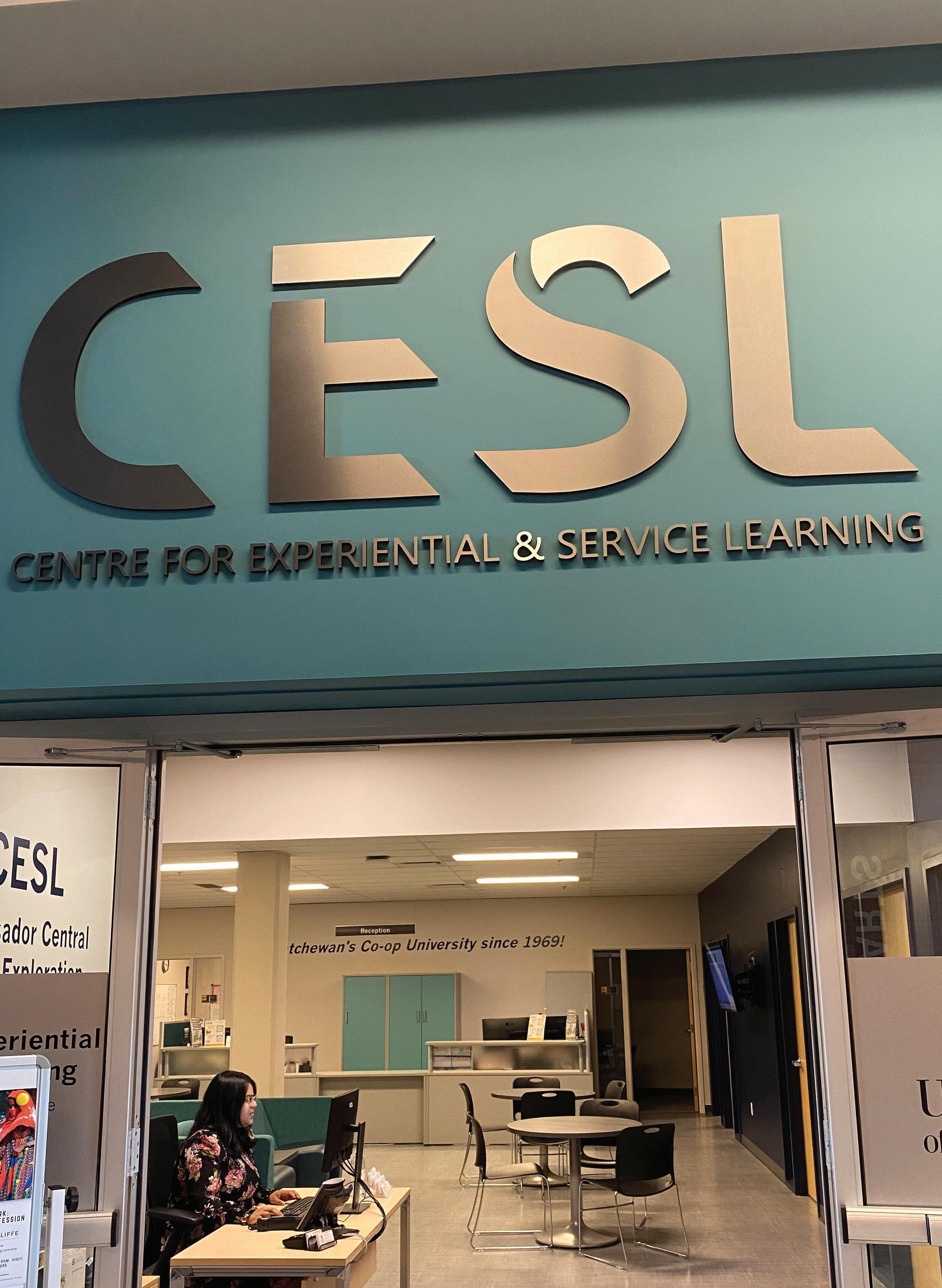
Navigating the wild world of job searching, resume building, and interview preparation can certainly be daunting for any student. But, at the University of Regina (UofR), the Career Education department at the Centre for Experiential and Service Learning (CESL) is set to empower students to serve and lead with purpose.
Offering a range of services from career development sessions and job boards to specialized employer events and co-op opportunities, the department aims to support students and alumni alike. Free for all UofR students, Career Education is your one-
their commitment to equipping students with essential skills for the job market. “We offer interview workshops, focusing on developing great interviewing skills and we also offer one-on-one career counseling and mock interviews.” Simply type in uregina. ca/careercentre and you will be able to browse CESL’s main website portal to familiarize yourself with what it means to be a “Career-ready Global Citizen.”
Building on this ethos, their services are designed to be as practical as they are informative. From specialized interview workshops to one-on-one career counseling, CESL aims to provide students with real-world skills. The university’s inclusive and diverse campus environment, in fact, further complements the Career Edu-
per cent of the total student body and 14.7 per cent of that body have declared themselves Indigenous.
CESL’s commitment to career development extends far beyond the classroom and the campus. Kevin Fiessel elaborated on their outreach strategy, stating “All University of Regina students should be aware of UR Path! A strong web presence makes sure students know about what we offer.” Beyond the digital realm, CESL employs a proactive approach by sending out emails and deploying volunteer ambassadors to meet and greet with new students, friendly faces to help the latter navigate their way to their classes on the day of orientation. This ensures that even students who may not initially be aware of
stop shop for turning aspirations into achievements.
The Carillon had the opportunity to speak with the Manager of Career Education, Kevin Fiessel, to gain insights into CESL’s holistic approach to career development. Fiessel emphasized
cation’s offerings. This Fall 2023 semester has seen a record-breaking enrollment surge for the university, totaling 16,860 domestic and international students. This impressively adds to the campus’ existing diversity, where international students make up 17.7
to take advantage of the comprehensive career development services at your disposal.
The workshops offered are categorized into two main types: career workshops and skills workshops. Under career workshops, students can attend sessions on customizing resumes, honing interview skills, finding career direction, and effective job searching. These workshops are tailored to help students not only land interviews but also perform exceptionally during them. The skills workshops, on the other hand, focus on soft skills that are essential in the professional world. These include networking etiquette, leveraging social media for career connections, and developing presentation and leadership skills. There is even a workshop on basic computer skills, ensuring that students are digitally literate, a necessity in today’s job market.
Moreover, one of the most anticipated sold-out events hosted by the CESL is the annual
“
the services have multiple touchpoints to learn about what CESL can offer them. This multi-channel approach ensures that whether you’re a freshman just starting or a senior preparing for the job market, you have ample opportunities to engage with CESL and
Fiessel stated, “Last year, we held the most successful Careers Day ever! We are going to duplicate that success this year.” With exhibitors set to be on campus, students have a golden chance to network and potentially secure a job. To prepare for this significant event, Fiessel recommends that students sign up for the Careers Fair preparation sessions offered by the Career Services Coordinator. Be sure to send an email to experiential.learning@uregina.ca to get signed up for one of these sessions.
What sets the CESL apart is its commitment to students even after they have graduated. Fiessel notes, “Every one of our services we offer to current students are also provided to alumni, free of charge.” This means that alumni can continue to benefit from career counseling and other resources by simply reaching out to CESL. It continues to be a resource that students can turn to at any stage of their career journey.
Every one of our services we offer to current students are also provided to alumni, free of charge.”
Kevin Fiessel
Career Fair day. This year, the Career Fair is scheduled for next week – September 25 from 10 a.m.-3 p.m. in the CKHS Gym 3 (Main Gym). Each year, a wide variety of local, national, and international employers come to the University of Regina to share information about their organizations and to discuss future employment opportunities with the students and alumni. It is UofR’s biggest recruitment event, connecting Canada’s top employers with students from all Faculties.
Enthusiastic about this event,
Recognizing that each student’s career path is unique, CESL leverages flexible resources to meet individual needs. As Kevin Fiessel aptly puts it, “We encourage all University of Regina alumni to reach out to us if they are in need of career counselling.” So, whether you are navigating the challenges of your first job, considering a career change, or seeking to advance in your current field, Career Education at CESL is your steadfast partner.
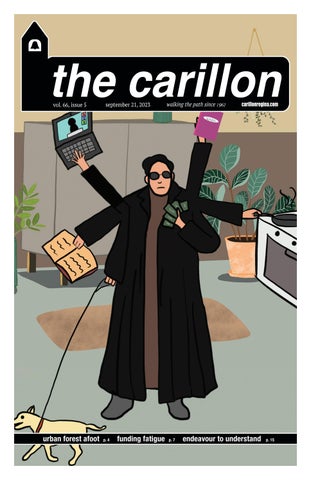
Equipping students with essential skills for the job market makes this office the Clark Kent on campus.
Photo: lee lim
Urban forestry in Regina: Cathedral Village Forest Project
Organizers and volunteers hope to plant 7,311 seedling trees in Les Sherman Park
maren savarese knopf staff writer
Regina is getting its very own urban forest. Organizers in Regina’s Cathedral Village neighborhood have been actively planning a Cathedral Village Forest Project. The project has been approved by the City of Regina who have provided a large area of land for the planting of trees. The forest will find its home in Les Sherman Park, a beloved neighbourhood park.
The project is largely being overseen and guided by Chris Sale, a landscape architect with the city and member of the Cathedral Village Association. In an interview with CBC, Sale says that the inspiration for the park came from the pandemic, when he spent a lot of time walking in his neighbourhood and that got him thinking about trees.
Trees are a major facet of the Cathedral neighbourhood,
which refers to the establishment of forest and trees in an area with no recent tree cover. The completion of the Transcontinental Railway in Canada in 1885 combined with the homestead provisions of the Dominion Lands Act to encourage agriculture in the area.
The government felt it was critical to plant trees in the prairies to encourage ongoing settlement.
In doing so, large scale prairie forestry was promoted between 1870-1886 to attract settlers and address forestry concerns in Eastern Canada. Over the past 100 years, tree plantations across the Saskatchewan plain have flourished, and afforestation methods, such as shelter belting, have been particularly successful. The City of Regina is a clear example of afforestation which describes the process of tree planting where there have previously been none.
The city was established on a treeless native grass prairie and today has over 500,000 hand planted trees maintained by the
grouping in Les Sherman Park. Although the number seems odd, it’s reflective of the number of residents in the area as of the 2021 Canadian Census. Project members will plant seedlings as they are easiest for volunteers to plant and maintain with the existing irrigation systems. The existing sprinkler system that draws water from Wascana Creek will be used to irrigate and water newly planted seedlings.
Seedlings will include a wide range of trees sourced from prairie nurseries: oak, elm, maple, pine, spruce, larch, and poplar. A variety of shrub material will fill the middle layer of the forest bed. The emphasis on a wide variety of trees makes this project a great example of mixed-species polyculture forestation.
Urban wild is a concept that captures the co-existence of nature and urban living in unexpected places within cities. These urban wild spaces show the sometimes unimaginable connections
Reimagining a city as urban wild means rethinking how we define nature.
where. Prairie cities are already home to a host of wildlife that include white tail jackrabbits, foxes, pelicans, sharp tailed hawk, and even passing deer or moose.
Unbeknownst to many residents, the City of Regina is one of nine Canadian cities to be recognized with the Tree Cities of the World designation from the Food and Agriculture Organization of the United Nations and the Arbor Day Foundation. To be recognized, cities must meet five core standards that include establishing responsibility, setting the rules, knowing what you have, resource allocation, and the celebration of achievements.
In addition to providing shelter and ecosystems for wildlife, urban forestry has a range of positive impacts on human residents. Tree Cities of the World states that “urban forests help define a sense of place and well-being where people live, work, play and learn.” Spending even a short amount of time in the company
table access to trees and nature, providing shade and reducing the effects of climate change. As climate change continues to be a pressing issue with global temperatures increasing, cities are among the first to be impacted. This is because cities already tend to be hotter than nonurban counterparts, a phenomenon called “urban heat island.”
Trees, when planted effectively, offer the potential to cool down these cityscapes and offer short-, mid- and long-term solutions. Recently, Dr. Vivek Shandas, a researcher from Portland State University, conducted a study during the June 2021 heat dome in the City of Portland to record how hot it gets in urban areas. He discovered that there was a 20-degree difference between areas with tree canopies and neighbourhoods surrounded by industrial buildings.
The Cathedral Village Forest Project offers a hopeful opportunity for the greening of urban
“Urban forests help define a sense of place and well-being where people live, work, play and learn.”
Tree Cities of the World
and the city. Sale points to the history of the trees which he says were planted during other major world events like world wars, depressions, and pandemics, but in good times as well. Regardless, these trees were planted with an optimism for a hopeful future, said Sale.
In Saskatchewan, there is a long history of afforestation,
city and residents.
The project is looking to ‘wild’ the city with a space that fills the gap between formal spaces such as lawns, soccer fields, and traditional urban spaces with natural and informal spaces.
Organizers and project planners have secured thousands of seedlings. As it stands, the plan is to plant 7,311 trees in a dense
between humans and the natural world, even in spaces that, at first glance, do not seem wild at all. Part of reimagining urban spaces as wild requires us to rethink how we define nature and what we see nature as being. Instead of imagining nature as somewhere beyond the city line, we must reshape our thinking in favour of the idea that nature exists every-
of trees has been shown to lower stress levels, boost feelings of happiness, improve mood, and even alter brain chemistry. Make no mistake, the benevolence of trees far surpasses even these benefits as they also actively combat global climate change.
Elsewhere across North America, cities have been actively planting trees to increase equi-
spaces in Regina and combatting global climate change right here at home. This is a story that continues to evolve, and the project members are hosting a round table on September 28. Regina residents are invited to attend the event hosted in the upstairs of the Cathedral Neighbourhood Centre at 7 p.m.
Illustration: geralt via Pixabay
Dis-Orientation Week: UR POLIS hosts a political panel
A baby, shoes, politicians, constituents with questions, and pizza
mindy gregory news editor
Dis-Orientation Week is an alternative orientation that offers students opportunities to learn about topics and issues relevant to them. Organizing the event is a long-standing tradition of universities with a Public Interest and Research Group. Regina Public Interest and Research Group (RPIRG) sent out a call in July inviting campus students and groups to collaborate on the series of events and workshops.
Tayef Ahmed, RPIRG Executive Director, described the week as an important opportunity to explore university outside of the classroom. “It allows you [students] to be educated on issues that matter to students.”
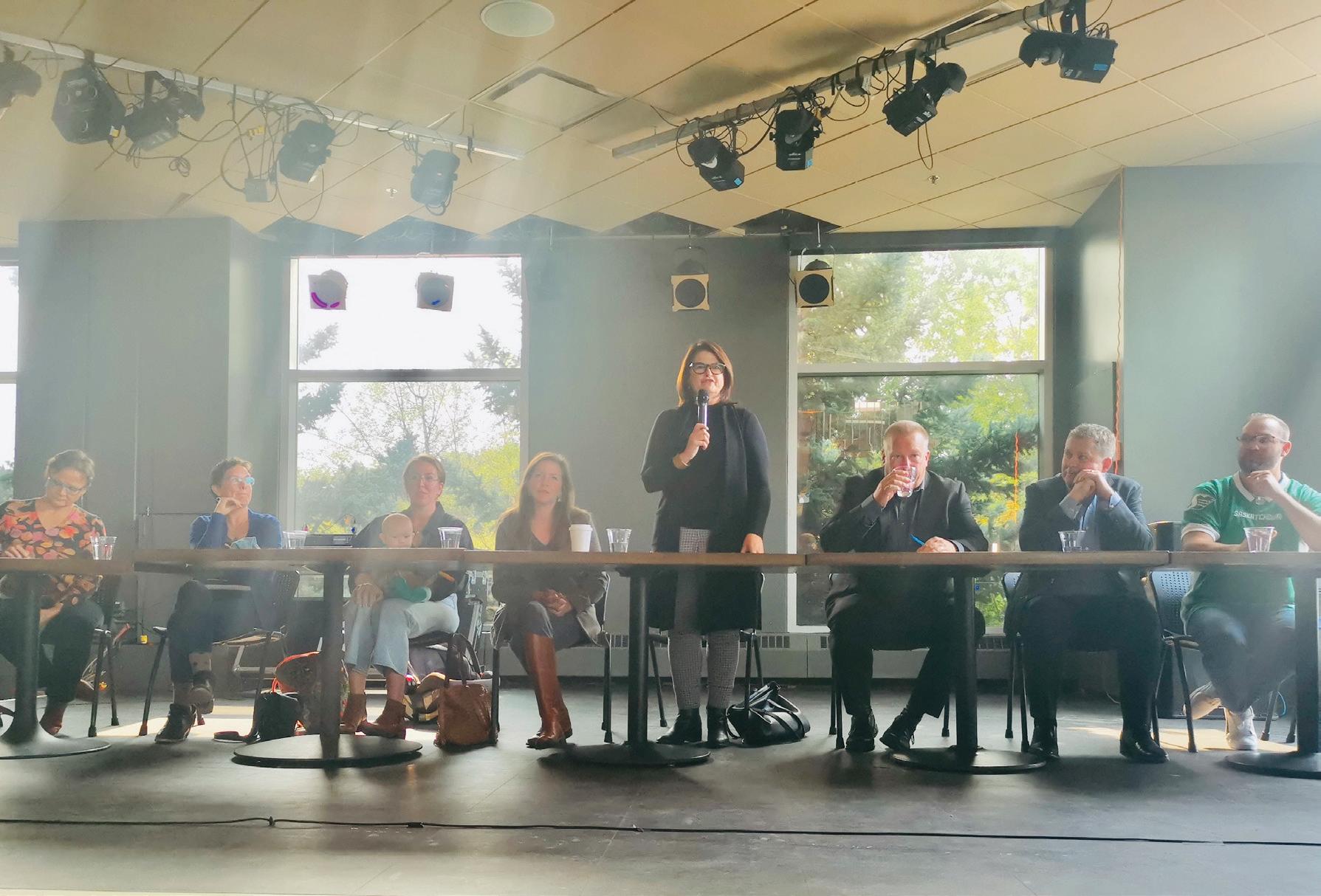
As part of Dis-Orientation Week, the University of Regina Politics and International Studies Student Association (UR POLIS) organized a “Meet Your Political Representatives” noon hour panel event in The Lazy Owl Bar on Friday, September 15. UR POLIS serves as the representative body of all students within the Department of Politics and International Studies, and their events seek to spread engaged citizenship across the university campus.
It was evident from their well-attended panel, both in political representation and audience, that the group worked hard to create an event to forward their mission. The Lazy Owl provided a relaxed but professional-feeling venue. The seating area was already organized when the Carillon arrived twenty minutes early, and
an UR POLIS member showed me a seat. Two of the panelists had already arrived: Meara Conway, MLA for Regina Elphinstone and Aleana Young, MLA for Regina University were chatting and rocking Aleana’s baby in a car seat. The panelists were seated onstage at tables facing the
of Social Services and MLA for Regina Gardiner Park; Shanon Zachidniak, City of Regina Councillor for Ward 8; and last, Cheryl Stadnichuk, City of Regina Councillor for Ward 1. All representatives were wearing leather, or leather-look footwear except for one white pair of sneakers.
question, “How does your level of government affect the lives of students and what advice would you give a young person getting involved in politics?” was answered by each panelist in approximately four-minute responses. Based on listening from the audience, the representative responses were in-
audience. Seated in the front row of the audience, the Carillon had a good view of panelist footwear.
As Warren Steinley, MP for Regina Lewvan; Andrew Scheer, MP for Regina Qu’Appelle; and Carla Beck, Leader of Saskatchewan NDP and MLA for Regina Lakeview arrived, a footwear theme was noticed. The theme was confirmed upon the arrival of Gene Makowsky, Minister
Flooding in Libya
The baby was not wearing shoes. Also wearing leather shoes, Eric Horbal, UR POLIS President, opened the event at 12:16 pm with a land acknowledgement. After the introductions were made, UR POLIS member, Matthew Merifield (yes, more leather, couldn’t stop noticing at this point) asked panelists to answer a question that had been sent to them beforehand. The
formed and outlined general ways that each level of government – whether federal, provincial, or municipal – plays a role in your day-to-day life. However, when transcribing the recorded audio afterward, it seemed that there was a lot more going on beneath the surface. For example, Andrew Scheer’s response benefited the image of both federal and provincial Conservatives by focusing
on how Conservative politicians at both levels are impacted by the federal social transfers allocated to the provinces for things like education.
Scheer said, “So, obviously, that does have a direct impact on the lives of students when provinces have different levels of funding, it might affect the level of service or the tuition that has to be charged directly to students.” Later, Carla Beck, leader of a party in opposition, pointed out that levels of funding are not the only factors affecting students. Highlighting issues around minimum wage, mental health support, and access to health care, Beck emphasized that these decisions are at the provincial level.
“Factors that very much impact the lives of students, your quality of life. And the role of leaders at the provincial level is to make decisions that improve the lives of the people we serve.” After which Beck cautioned, “Do not accept from any leader, when they say it’s someone else’s fault, someone else’s responsibility, because pointing fingers is not taking responsibility.”
After all panelists had an opportunity to answer the prepared question, questions were taken from the audience. Students asked thoughtful, researched questions on topics such as how constituents’ values are handled when in conflict with party values, what socio-economic obstacles apply to redressing truth and reconciliation objectives with First Nations, and what type of consultation was done for the provincial governments new pronoun policy. Pizza and one-on-one conversations closed the event.
Storm Daniel, aging infrastructure, and internal conflict are all linked to the devastating proportions of flooding
Libya is experiencing one of the deadliest, most catastrophic floods in recent years and the pictures from the disaster are not even close to showing how grim things are.
These floods were brought about by Storm Daniel, also called Cyclone Daniel, which swept its way through the Mediterranean Sea hitting Greece, Turkey, and Bulgaria before reaching Libya.
The storm brought torrential rain upon eastern Libya. On the night of September 10, two old and poorly maintained dams collapsed in the aftermath. The water swept through Derna which is the epicentre of the disaster and its neighbouring cities. Buildings, homes, and infrastructure were wiped out as the water swept through the cities killing thousands and displacing many thousands more.
As per the latest reports, around 11,000 people are dead, 10,000 are missing, 34,000 have been displaced, and the numbers continue to rise as bodies keep washing up the shore. Assistance from the European Union and the United Nations (UN) mobilized soon after the disaster. The
access to these areas, however, has been difficult due to the flood. Rescue missions continue despite difficulties and one can only hope that more people are saved.
People have been made houseless and isolated with limited to no amenities. Rescuers fear that many survivors might not be found until it’s too late. With their families displaced,
areas are going through. Various funds have also been set up where donations can be made to help the people in Libya.
Libya’s geographical location near the Mediterranean Sea makes it more prone to flooding. Such being the case, Libya has experienced at least five disastrous floods since 1942, the latest being the one in 2011. The increasing
however, cannot be blamed solely on climate change. Aging dams, missed warnings, and poor infrastructure contributed significantly to the deadliness of the calamity.
According to reports by Al Jazeera, the dams that collapsed had not undergone maintenance since 2002, despite warnings in a paper from Libya’s Sebha University that the dams had a high
homes wrecked, and no means of contact, one can barely imagine the fear, uncertainty, and misery that the people in the flood-hit
frequency and intensity of these floods can be attributed to the effects of climate change. The magnitude of the current disaster,
potential for flood risk and needed regular maintenance to avoid catastrophic flooding. No efforts were made toward ensuring prop-
er maintenance of these dams, even following the release of that paper, and the consequences are unmistakably apparent.
The UN believes that many human casualties could have been avoided and that poor management and unpreparedness for the coming disaster made things worse. With better functioning coordination in the crisis-wracked country, “they could have issued the warnings and the emergency management forces would have been able to carry out the evacuation of the people, and we could have avoided most of the human casualties,” said Petteri Taalas, head of the UN’s World Meteorological Organization.
As the country battles through one of the worst incidents of natural calamity, it is essential that the people in authority take culpability and responsibility of the actions that could have been taken to avoid such unimaginable outcomes. Our hearts, hopes, and prayers go to the people of Libya.
shivangi sharma news writer
Okay everyone, play nice for the kids. Oh, and you kids in the audience, play nice too.
Photo: Mindy Gregory
No shame, only gain: using supports for student academic success
Using the University of Regina Student Success Centre services now may reduce your exam sweat later
victoria baht staff writer
The school year is picking up speed and already we are a few weeks into the 2023 fall semester. Are you ready for classes to continue to pick up the pace, or do they have you a bit worried? Well, I am here to share with you a bit about a resource that the University of Regina offers students to
as simple as rethinking your study habits.
The SCC offers writing, math, and statistics tutoring. The tutoring sessions help each student individually build on their learning skills while respecting their own styles and needs. This is a great resource to support students in forming educational goals and reaching them.
As an example of how they might help you out individually,
sure to check out the SSC website for more details and to book an appointment. Don’t wait until you are desperate to access these supports! The calendars for tutoring show that help is available early on and that learning builds on regular sessions. There will be less assistance available to you if you wait until your final exam or assignment is due. Get the help beforehand to make your skills the best that they can be before the final.
do you know if tutoring is really what you need to help your classes get better or if tutoring will be beneficial to you? Sometimes you simply must try and see, but I also conducted some research on tutoring so that you can consider the evidence base for the service.
The website oxfordlearning. com states that, “tutoring can help strengthen subject comprehension, boost confidence and build important learning skills.”
make classes a little easier to succeed in.
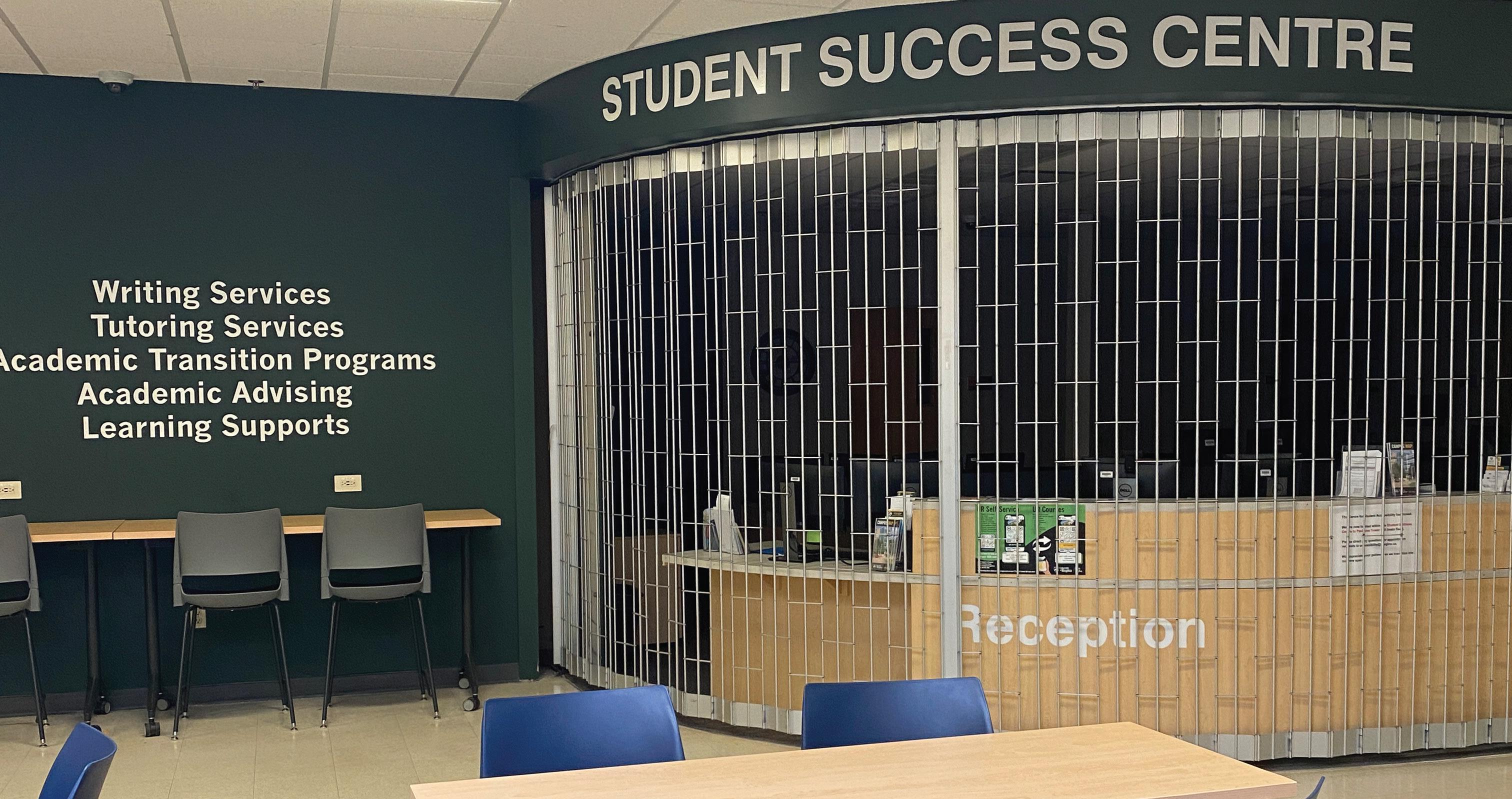
Did you know that the university has a Student Success Centre (SSC)? The SSC is a centre at the university that students can use to improve learning skills; access writing-, math-, and statistics-specific tutoring; as well as other unique programs.
The SSC website states that the programs and free services
the writing tutoring program offers the resource to students at all different skill levels. They meet you where you are at and understand that there is always room for improvement. Additionally, the writing tutors work with you to ensure that not just your current assignment is improving, but your overall skills and capacity as a student are improving as well. If you are ready to personally ex-
Writing, math, and statistics classes develop skills that are typically essential to obtaining any type of degree. It is beneficial for you as a student to take advantage of a university that offers these skill developing services that focus on building strong student capacity. The SSC website outlines that the success centre also offers additional resources such as an ac-
Not only does it further explain what tutoring can do for you, the site lists fifteen different ways it can benefit you. A specific point that drew my attention is that tutoring is typically one-on-one. Is your stats class filled with people that make you a tad overwhelmed and scared to ask a question or follow along? Tutoring can offer an alternative by sitting down with a tutor, with your lecture notes in
class. Getting a tutor is a great way to stay committed, double up on learning, and enhance those skills. Another standout benefit tutoring offers is gaining confidence in your skills and what you are learning. Are you one who cracks under pressure, and starts to sweat a little during exams? You are not alone. Be the one who asks for better by getting a tutor to help you gain confidence and be more comfortable in doing the work. It is also nice to feel someone has your back from time-totime and that can help you relax. Being prepared relieves the pressure when it really is exam time. Now you know that the University of Regina offers challenging classes, but they also offer strategies and services to help you be a successful student. Check out the SSC for these resources and do not let them go to waste. Re-
“Are you ready for classes to continue to pick up the pace, or have they got you a bit worried?”
Victoria Baht
offered at the centre are there to help university students become more effective and efficient in how they engage with learning. They work by giving students a chance to adapt to what it is like to be at university while encouraging you to connect with all the university has to offer. This is also the place to go for tutoring and services to help improve your standing in your classes. It may be
cel, try booking an in-person or Zoom appointment and give it a try. The writing tutor sessions this semester run from September 11 to December 5.
Next, the math and statistics tutoring sessions offer tutors that support you in working out solutions one by one and getting results. The math and statistics tutoring sessions this fall run from September 7 to December 14. Be
ademic recovery program which helps students strengthen their skills and education. A U-Turn program is available to help students who have been placed on academic probation.
Now that you know about some services offered by the SSC, I hope you may be more comfortable trying them and benefiting your classes and your brain. Although it occurs to me, how
hand, to ask questions in front of a single person who wants to help. It may be just what you need to get ahead of the jitters, increasing your confidence in the material and helping you pass the class.
Or, perhaps you have not had the opportunity to form positive study habits, and you sense that you just do not spend the time needed studying or understanding how to study for the
call that tutoring sessions are free of charge and open to all students at any level. The Student Success Centre (SSC) is located in room 230 on the second floor of the Riddell Centre, or you can access it online via the University of Regina website.
Next level unlocked! Power up your grade point average.
Photo: lee lim
URSU’s message to the provincial government: Fund the future
Per-student funding in Saskatchewan has decreased over the decade, and student tuition fees have increased
shivangi sharma news writer
The University of Regina (UofR) has witnessed a rise in tuition for the last two consecutive years. The rise has affected both domestic and international students who must work multiple jobs to support themselves financially.
In an e-mail that was sent out to the students earlier this year from University of Regina, President and Vice-Chancellor, Dr. Jeff Keshen’s office, it was mentioned that all possible deliberations were made before deciding that raising the tuition is the only possible option to address the financial deficit that the university is going through.
The university’s financial deficit has had adverse effects on all aspects across the university. Staff members have been laid off, classes offered per semester have been reduced, even the Lifelong Learning Centre that offered classes for senior citizens had to shut down paid programming. As is the case, students are not left untouched by the ongoing financial crisis. The continuous rise in tuition in the last two years has left many students with no other option but to work multiple jobs to be able to support their education.
The situation is particularly bad for the international students who already pay a higher tuition than domestic students. “I work two retail jobs even during the semester. It is hard to keep with assignments and grades but if I don’t work my jobs I will not be able to attend school altogether,” said an international student who would like to remain unnamed.
A lot lies at the heart of the financial crisis that the university is going through. Reduced enrolment and loss incurred during the pandemic years followed by global inflation and subsequent recession are a few to name. Yet, a major reason that contributes to this deficit is a decline in per-student post-graduate funding by the provincial government.
University of Regina Students’ Union (URSU) which represents more than 12,000 students at the University of Regina thus being the voice of the university students, has undertaken the initiative to draw attention to the above-mentioned decline. “We act as a voice between the university and the government,” said Tejas Patel, URSU president. Their endeavour is to urge the provincial government to release more funds towards post graduate institutions so that some financial burden is lifted from the students’ shoulders.
“Funding should increase as enrolment increases. But because funding does not increase as the enrolment increases, the funding provided is not adequate… the money per student is declining and that comes across as budget cut,” said Oghenerukevwe Erifeta, URSU Vice-President of External Affairs.
In their initiative called Fund the Future, URSU’s advocacy team worked with Canadian Centre for Policy Alternatives (CCPA) and published a detailed report about how the post-secondary education funding is declining in Saskatchewan. The report gives a detailed analysis of various aspects that determine post-graduate funding and com-
pares the trend in funding over Canada in the last decade. The report concludes that the state of post-secondary education in all over Canada is declining and that reduced support from the government has resulted in universities across the country increasing domestic tuition and becoming increasingly reliant on international enrolment.
Within this climate of decline, per-student funding in Saskatchewan has also decreased over the decade and its domestic student tuition student fees which is already higher that national average has also increased over time. In addition, spending on academic salaries as a proportion of operating expenditure also saw a decline. As of 2019/20 and
“With the provincial election coming up we do believe it will be the best time to get the provincial government’s attention upon the cause and get some really effective change happening.”
Oghenerukevwe Erifeta
2020/21, Saskatchewan spent more on non-academic salaries and wages than academic salaries and wages while the reverse was true in the rest of Canada.
The published report is accessible to everyone on URSU’s website and a hardcopy is also available at URSU’s front desk at the Riddell Centre.
Patel also mentioned that URSU is working with other unions across the province including the University of Saskatchewan to get an idea of what their financial situation looks like to understand how post-graduate funding has been working across the province and to determine if they would like to join the cause. Erifeta concurred, “We’re also trying to understand their initiatives and how far they are going to lobby the government and how that would correspond with URSU’s initiatives, […] with the provincial election coming up we do believe it will be the best time to get the provincial government’s attention upon the cause and get some really effective change happening.”
Their initiative has gathered immense support from faculty and staff alike which has been a great source of encouragement. “We are also really happy that we are not alone in this fight, that it is not just students that are trying to fight for more funding for the post-secondary education sector. We are happy that the university and faculty associations are also supporting us. We are happy that we have the support of community association and other unions. The more people we have in this fight, the more peaceful it can be, the more effective it can be, and the more the future of this province can be sustained. I think that is the primary call that 20 years from now we actually have medical health professionals who has the opportunity to go to school, we have businessmen that had the opportunity to go to school to build this province so that it becomes the Saskatchewan we want it to be,” said Erifeta in conclusion.
To make their voices heard and gain government’s attention, URSU is planning to organize a cross-Canada day of action for students on Wednesday, November 8 with hopes that the Fund the Future rallies will take place not only in Regina but also in Prince Albert, Moose Jaw, and Saskatoon. To amplify their voice and to make the movement a success, they would need all the support that they can get especially from the students. It is a movement for the students and by the students, and if successful will add security to the academic careers of both the present and future students. The details of the event are available on URSU’s website and participation is not just encouraged but also requested.
This is where it happens, folks! The decision makers that put the province at #2 in Canada: second highest tuition, that is. Photo: daryl mitchell via Flickr
arts & culture
Reviewing Burger Week
Delicious bites and where to find them
victoria baht staff writer
Have you ever heard of Burger Week? Burger Week is an event that takes place in Regina Downtown in the Warehouse District. It is where a great majority of restaurants create special burgers just for this week for you to try.
This event runs from September 11 to September 24. A few restaurants that are running in this event are Fresh Carnival, which made a Chipotle Bacon Burger; The DoubleTree, which made a Saskatoon Smokehouse Burger; Circa 27, which made a Surf and Turf Burger; The Cure Kitchen + Bar which made a ground chuck beef patty with aged white cheddar maple and peppercorn pork belly; and Lancaster which made a Mushroom Swiss Burger with double smoked bacon on top.
I stopped in at The Cure Kitchen + Bar and Lancaster Taphouse to try out their burgers and do a review and interview with each location.
At The Cure Kitchen + Bar, I spoke with Tyrone Doucette who is the chef who made my burger. He said the inspiration for the burger this week was, “a burger [we did] like this in the past with a bison patty compared to the beef patty with the pork belly on top.” Based on personal reflection, bison burgers are a hit and
have a unique taste so it is good to see this alternative for those who do not like the unique taste. However, if you miss the chance to come down to Burger Week, I talked to Doucette and his recommendations from the restaurant on a regular basis based on ordering frequency are the Tacos De Birria and Cubano Burger.
Plus, “if the customers miss out on Burger Week, they can come in and order our regular beef burger with an appetizer of the pork belly and do a ‘make their own’ of the special burger.”
It sounds like The Cure Kitchen + Bar has some great options for customers to try and I would absolutely come down for an appetizer of the pork belly, as it was super good on the burger.
Now that we know a bit about The Cure Kitchen + Bar and the menu, let’s talk about the burger itself in a personal review. So, The Cure’s special burger is a ground chuck beef patty with aged white cheddar, maple and peppercorn pork belly, with toppings of tomato, pickle, and a house-made brioche bun. I found the burger to be really juicy and moist but also tender at the same time. As you bite into the bun, you start with a nice and soft housemade bun then you can taste the tender burger, with the melted cheese on top which is honestly my favourite part. Now, the toppings of the burger are a good mixture of the sweetness of the
maple peppercorn pork belly but also the tanginess of the pickle.
To me, what is a burger without cheese and a pickle? It is simply not a burger. But this is ab-
solutely a delicious burger. If you get the chance to stop downtown for Burger Week, I would definitely check out this one at The Cure Kitchen + Bar if you are in for a western style burger.
The second location that I checked out for Burger Week is Lancaster Taphouse. I stopped in to chat with Matt Gaillard, an executive chef at the downtown location. The burger that was created for this week is a Mushroom Swiss Burger. He drew his inspiration from Burger Baron, a former mainstay in the Regina burger scene. “It is a grass-fed patty from a local farm in Saskatchewan. The beef comes into the house and we grind it, pressed it in-house, and seasoned it as well. The burger is seasoned with a homemade mushroom sauce and a brioche bun, toasted with garlic butter, and topped with double-smoked bacon. This burger will be made available full-time come October.”
Well, that sounds delicious already! I also asked Gaillard what some top items that are highly ordered here at Lancaster, and he said the top orders are the pretzels and burgers themselves.
After I talked to Gaillard, it was time to give the burger a try for myself. The first thing that hit me was the creaminess, giving me a flashback to childhood comfy vibes of eating creamy mushroom soup. As you bite down, you taste a very doughy and soft bun but a very tender, well-seasoned burger. The burger is delicious. You get a good taste with the mushrooms and swiss cheese. I know mush-
rooms are not everyone’s go-to vegetable but to be quite honestly, I would say that this type of burger and mushrooms mixed with the cheese and the meat is one to try! Plus, I almost forgot to mention the double-smoked bacon. It sort of sneaks up on you with all the other flavours. This burger is a go-to to try if you are more on the creamy side compared to the western side of burger vibes at The Cure.
After talking with both the chefs at the restaurants, my closing thoughts are: both these burgers are very delicious! Would I try them both again? Yes! Would I come down to the restaurant again and try some other options on the menu? For sure!
What do I like about both these restaurants? I like the vibes of both locations. Each of them is a local restaurant but both have a bar and social vibes, as well as the opportunity to listen to live music and socialize with your friends and family. I am absolutely impressed with my first time being involved with Burger Week. By the two burgers that I have tried and the list of burgers that you can see on the Regina Downtown Facebook page, this is a cool opportunity and moment to motivate the chefs to try something new, and an opportunity for you as a guest to try something new. All the burger options are delicious and unique, so ensure you go and try out some burgers this week to finish off Burger Week by September 24.
Looking at these is making me jealous that I’m not eating them right now. Photo: Victoria Baht
Fibre Crafts and the Queen City
As Queen City Fibre Festival nears, what’s the importance of fibre crafts?
maren savarese knopf staff writer
Brianna Redlich, owner of Yarn Over, Regina’s fibre and crafting store, has organized the first ever Queen City Fibre Festival. Redlich wrote that, “there seems to be a lack of fibre festivals in Saskatchewan,” and hopes to fill that gap in order to develop a larger fibre community across the province.
The festival will take place on September 30 at the East View Community Centre from 10 a.m. to 4:30 p.m. There are upwards of 20 vendors scheduled to attend the festival with names that include Forest and Fringe Yarn and Knitting, Prairie Fibre Shed, Olive Park Yarns, and Knotty Girl Fibre Art. Admissions to the festival will be by donation; this includes cash donations to Carmicheal Outreach or a yarn donation to Angels 4 Warmth, a local charitable organization that provides winter gloves, toques, and other essentials to those who need them during the harsh prairie winters. More information about the festival can be found on Yarn Over’s website at yarnover. ca.
There has been an ongoing movement of artists, fibre craftspeople, and passionate crafters reclaiming the fibre arts. While stay-at-home orders were in
place, people had to develop new and creative ways to keep themselves busy and entertained. Naturally, learning new crafts was one of the ways this was done. According to Dr. Tonie Kim, there are mental health benefits from knitting and crocheting and “the repetitive motion of knitting induces your body’s relaxation response, lowering your heart rate,
blood pressure, and muscle tension.”
Moreover, because knitting is repetitive and takes a certain level of concentration, it might enable “a person to distract themselves from and restructure patterns of thinking that may contribute to anxiety,” said Kim. This, perhaps, was especially helpful during the pandemic which was a period
Flanagan: horror movie expert
marked by the exacerbation of mental health impacts.
Knitting and fibre arts can be traced back in connection with past social crises. In an article for the Canadian Red Cross, Anna Teehan points to the way their “chosen hobby played a part during history.” During the World Wars it was common in Canada for small booklets containing knitting patterns to be distributed. An uptick in home knitting was used to manufacture necessary items during the wars. This was no small undertaking; the Halifax women’s History Society estimates approximately 750,000 volunteers knit 50 million items during WWII alone.
Earlier this year, media coverage reported that young people in Toronto have taken to crocheting for mental health in a downtown bar. Nigel John, also known as Legin, came up with the idea to blend crochet and jazz music to engage a whole new demographic with fibre arts. His company, Legin Knits, is working to close the generational gap observed within fibre arts and artists by teaching young people to crochet. In addition to crochet, his teachings focus on mindfulness: “So aside from just the art and the creativity, you know [I’m] talking about health and mindset and just different things that I embrace in my everyday life as well.”
The uptick in young fibre art-
As spooky season approaches, horror movie marathon time is here
Have you ever heard of Mike Flanagan? He’s one of the greats in current horror media. Somehow, he has the Guiness World Record for most jumpscares in a single episode of television, yet his work doesn’t need jumpscares to be terrifying.
You more than likely know him from The Haunting of Hill House on Netflix which he created, directed, wrote, produced, and was on the editing team for. His first feature length film was called Absentia, which was released in 2011 and funded by
Kickstarter. It was rated well and won tons of horror awards. His next movie was Oculus in 2013, which wasn’t rated as well as Absentia, but was still considered a good movie, and was the first of his projects to star his now-wife and Scream Queen, Kate Siegel.
2013 was a massive year for Flanagan, releasing three movies, including one of his biggest hits, Hush
In my opinion, Hush is one of the best horror movies out there, up in the ranks with You’re Next and Midsommar. Kate Siegel plays Maddie, a deaf and mute author. It’s brilliant watching Siegel play this horror character who’s missing the overly important sense of hearing. She has to use her other senses to kill the intruder coming into her house and save her own life. As someone who’s obsessed with audio in horror movies, Hush is top-tier. Personally, even better than A Quiet Place
He had projects in between Hush and The Haunting of Hill House, but The Haunting of Hill House was his next biggest hit. It was released on Netflix in 2018 to huge reviews. The story is based on the novel of the same name by Shirley Jackson, but has enough differences to stand out on its own. The story follows the Crain family, home renovators who are working on ‘the Hill House,’ a house which the family, including the five children, slowly learn
ists seems to be shared globally. The online community hub LoveCrafts reports a rise in young men crafting, with over a third taking up needle crafting. In a 2021 Guardian article, Ola Ogunlolu from Lagos, Nigeria explained how he became a knitter. “Nigeria tends to be quite hot most of the time, so who is going to be making a chunky blanket or sweater?” What Ogunlolu found was a thriving community of crafters with similar interest. For Ogunlolu “the process is…therapeutic. A lot of things I make don’t have utilitarian value, but the fact that I made them gives me joy.”
In a similar trend, young people have been adopting practices of “craftivism” as a method to mix fibre crafts and political and social activism. For Ogunlolu, this meant knitting as a means of contributing to the larger discourse of Black Lives Matter. “I had to say something. Some people said we should keep crafting separate, but I felt it wasn’t enough to retreat into this sunshine world and pretend the real world wasn’t happening.”
This age-old tradition of fibre crafts traditionally marketed as “an elderly White lady thing to do,” said Vincent Williams, a Black needlework artist who was frustrated with the lack of representation, is being reclaimed and diversified by young people and craftivists.
is haunted. The time is split between the incredible child actors, who do such a great job at being kids and at being terrified, and the adult versions of the kids, living with the aftereffects of Hill House. The casting of the younger versions of the adults is insane and some of the best casting I’ve ever seen. It’s effortlessly terrifying, with blink-and-you’ll-miss-it moments that make rewatches even more exciting than the first time around.
It’s not a surprise that Stephen King didn’t like Stanley Kubrick’s 1980 adaptation of his book The Shining, but he did love Flangan’s 2019 movie Doctor Sleep, which acts as a successor to Kubrick’s original film. Flanagan takes the element of children being affected by what happened to them in the past from Hill House and nails it again in Doctor Sleep. It makes Kubrick’s film feel nostalgic and almost an opposite to the story of a destructive father.
My personal Flanagan favorite is his next Netflix show The Haunting of Bly Manor. It released to lower reviews than Hill House, but there’s no show I’d rather forget watching so I could watch it all over again than Bly Manor. I spent the entire show theorizing and being really engaged when usually I need extra stimuli to help me focus on a show. You’re constantly questioning, and the kids are terrifying in their little
mannerisms. The actress who plays the little girl, Flora, also plays Peppa Pig, and I couldn’t stop thinking about it.
Flanagan released the perfect show for the religiously traumatized in 2021, Midnight Mass Midnight Mass is an original story, and one of the most terrifying things I’ve ever seen. Not because of jumpscares, but because of the little moments in the background. The small sounds, the small bits of movement that send shivers down the spine. It’s also a beautiful story about family that left me sobbing in the end.
In 2022, he released The Midnight Club on Netflix. If I’m honest, avoid this one. I didn’t enjoy it. It’s nowhere near as scary as his other works, and the story feels like it drags on. It has high ratings, but I wouldn’t agree. If you liked the original Christopher Pike books, check it out; otherwise, skip them.
His next project is called The Fall of the House of Usher, releasing early October, which is loosely based on works by Edgar Allan Poe. Judging by previous Flanagan works, you won’t want to miss this one, and I’ll be unavailable the day it releases.
will bright a&c writer
Fibre crafts are an age-old tradition, but younger audiences are becoming interested again.
Image: Pxhere and Shisma via Wikimedia Commons, manipulated by lee lim
For home buyers, it sure would be handy if all haunted houses looked like this. Image: Hansuan_Fabregas via Pixabay
Are you ready for FNAF?
The movie is almost here, so what do you need to know?
will bright a&c writer
Blumhouse’s Five Nights at Freddy’s (FNAF) movie is coming out this October and the hype is alive for it. One of the biggest questions though is: what is it about? Unless you’ve been keeping up with the franchise for the last nine years since the first game came out, you might have no idea what’s going on at Freddy Fazbear’s Pizzeria.
Have no fear, friends! Well, maybe just a bit of fear of these giant robot animals that want to murder you. But, I’m here to fill you in on the lore behind the big brown bear and his band.
The story at its core revolves around one man: William Afton. Father, engineer, inventor, businessman, and child murderer. A British man who moved to Utah with his family, his wife, his two sons, and his daughter. His wife doesn’t have a canon name, but her fanon name is Clara, so let’s go with that because she deserves it. The oldest child was named Michael, the middle child was
Mr. Freddy Fazbear himself. A lot else happened in 1983. Henry’s only child, Charlotte Emily, gets murdered by William Afton in the back alley of the restaurant, which is the first reported murder by Afton. That same year presented the death of another child: “Crying Child” Evan Afton. At his birthday party, his older brother Michael and his friends pick up Evan and put his head into the springlock suit and his head gets chomped. Evan is dead.
Fredbear’s Family Diner closed shortly after and we jump all the way to June of 1985. This event is called ‘The Missing Children Incident’ in which five kidsSusie, Fritz, Gabriel, Cassidy, and Jeremy - all go missing. At least, the public thinks they’re missing; in actuality they’re all dead.
William Afton, dressed up in one of the springlock suits, specifically Bonnie the Bunny, also known as Springlock Bonnie or Golden Bonnie, lures the five kids to the safe room in the back, murders them, and stuffs them into the four main Freddy Fazbear suits. Gabriel possesses Freddy Fazbear; Fritz possesses Foxy the
the Puppet. Charlotte takes the souls of the dead children and ‘gives life’ to them through the animatronics.
Eventually, that Freddy Fazbear’s location closed down because of complaints of blood and mucus oozing from the suits and that they smelled horrible.
Shortly after that restaurant closes down, William Afton opens Circus Baby’s Pizza World. With this, we get the Funtime animatronics. In the game Sister Location
and they just say it was a gas leak that caused the restaurant to close and a child to die.
Elizabeth Afton is now possessing Circus Baby.
William decides to open another business: Circus Baby’s Entertainment and Rental. He’s renting out the murder robots.
Then, a group called Fazbear Entertainment buys out the Freddy Fazbear franchise.
Time-jump to 1987. It’s what you’ve been waiting for, the Bite
bad day. He goes into the scooping room, in the Sister Location location, and he gets scooped. An animatronic called Ennard, which was an amalgamation of all the Sister Location animatronics in one exoskeleton, hops their way into Michael Afton’s body. Michael’s just hanging out as a decomposing body for a little bit, until Ennard decides to hippity-hop back out of Michael’s now decaying body.
William Afton also has a very,
“The story at its core is about one man: William Afton. Father, engineer, inventor, businessman, and child murderer.”
Will Bright
Elizabeth, and the youngest child is not named in canon, they just call him ‘crying child’. Allegedly, his name is Evan; so we’re calling him Evan, because it’s less sad.
The first restaurant, Fredbear’s Family Diner, opened in 1982. Somewhere along the way, a man named Henry Emily comes into the picture. Some say that Henry comes into the story about Fredbear’s Family Diner and that he’s not involved with the opening of Fredbear’s, but he’s here now, in some capacity.
Another restaurant opened in 1983, called Freddy Fazbear’s Pizza, starring our main robot,
Pirate Fox; Susie possesses Chica the Chicken, and was the first child murdered; Jeremy possesses Bonnie the Bunny; and Cassidy possesses Golden Freddy. Golden Freddy is different from the other four animatronics, it’s the counterpart to the Golden Bonnie suit that William Afton uses. Golden Freddy lacks the mobility that the four main animatronic suits have. Golden Freddy is also the most aggressive of the possessed robots and the most angry.
Charlotte Emily, William’s first victim, is also possessing a robot. She possesses the Marionette, more commonly known as
we see Funtime Freddy; Funtime Foxy; Circus Baby, which is like a baby doll clown; and Ballora the Ballerina. Except, these new animatronics are specifically murder animatronics. Good ol’ Willy Afton is after “remnant,” which puts a soul into an animatronic, and these robots are doing murder for the remnant. William tells his daughter Elizabeth not to go near Circus Baby, even though it looks just like her. She doesn’t listen, she gets close to it by herself and gets sucked inside Circus Baby. Unfortunately, Circus Baby’s Pizza World gets closed down before opening because of this
of ‘87. But, also other stuff. William is working at a Freddy Fazbear location as a security guard. William killed at least four more kids, but these ones don’t have names. These four kids possess the toy animatronics: Toy Freddy, Toy Bonnie, Toy Chica, and Toy Foxy (AKA Mangle). We don’t know much about the Bite of ‘87, except that someone’s frontal lobe was bit off by an animatronic. Most presume that the victim was Jeremy Fitzgerald, the security guard who was moved to the dayshift during FNAF 2
Michael Afton, at some point in this timeline, has a very, very
very bad day. He decided to try and dismantle the OG five animatronics. But, that makes the ghosts wake up and they are upset. He panics and hippity-hops back into his Spring Bonnie suit, which was a bad idea. The springlock suit malfunctions, and he dies.
But, uh oh, he’s not entirely dead. He lives in or possesses (it’s unclear) the Spring Bonnie suit and he’s now called Springtrap. It takes place in our current year 2023 at a horror attraction called “Fazbear Frights” which is about the many crimes at Freddy Fazbear’s Pizzeria. At the end of FNAF 3, it burns down, and you would assume Springtrap dies, but he doesn’t.
Then, we get to Freddy Fazbear’s Pizzeria Simulator. You play as a franchisee owner of a Freddy Fazbear’s Pizza. You run the restaurant yourself and you can salvage animatronics from the back alley. This game ends with an old friend, Henry Emily, burning down the restaurant so all the spirits can rest. Charlotte as the Puppet is also here, her dad made Lefte, a bear-adjacent animatronic that stands for Lure. Encapsulate. Fuse. Transport. Extract., so that his daughter’s soul could rest.
The lore of the main Scott Cawthon games (before Security Breach, which is made by Steel Wool), ends in Ultimate Custom Night, where you play as William Afton’s soul trapped in hell by Cassidy, AKA Golden Freddy, AKA ‘The One He Should Not Have Killed’.
Most of the lore is theories and this is mine. If you want more detailed lore, it’s out there for you to find. But, these are the basics, and hopefully all you need to know to watch the new movie.
Friendly singing animals by day, terrifying killers by night; now with a sad backstory!
Illustration: lee lim
8
Passengers? More like six charges of child abuse...
The YouTube family vlogging to court case pipeline grows ever stronger
YouTube family vlogging channels are scummy, they just are. They make millions off exploiting their children while simultaneously putting their children in danger online, and there are rarely any repercussions for their actions. But, one mommy vlogger is facing legal charges for her actions.
Ruby Franke, born Ruby Griffiths, was born to Chad and Jennifer Griffiths on January 18, 1982 in Utah. She has four siblings, Beau Griffiths, Bonnie Hoellein, Ellie Mecham, and Julie Deru, and all have their own YouTube channels they run. Franke was a stay-at-home Mom and family vlogger under her YouTube channel 8 Passengers that she ran with her husband Kevin Franke, a former professor of civil engineering at Brigham Young University.
Ruby and Kevin share six children; the only two who will be named are the eldest two, Shari and Chad, who are 20 and 18 respectively. The other four, who are still minors, will only be referred to as their initials out of respect for their privacy in these matters. A is 16, J is 14, R is 12, and E is 10.
Even before Franke was arrested, she had made several videos online that led people to question her parenting decisions.
Franke frequently makes a point to say that the home the children live in is her home, not theirs, and she only allows them to live in it. Resulting from that, everything within the home belongs to Franke, and she decides if and when her children get to use things.
She stated that punishments in which items were taken away from her children usually lasted a minimum of six months. The children could not use items such as phones, even as teenagers, if they did something that Franke saw as misbehaving. Her eldest son, Chad, had his bedroom taken away for seven months and he slept on a beanbag in the living room for that duration.
In the video where this was revealed, Chad said it was because he woke up his little brother R at 2 a.m., telling the young boy that their family was going to Dis-
cause his mother decided that he was not well-behaved enough.
Franke’s children stated in multiple videos that they did not have any friends.
When one of her daughters, who visually appears under the age of six, had been cutting items in Franke’s home, Franke held up
on from the 8 Passengers YouTube channel to a new endeavor, a parenting advice page called ConneXions that she ran with a woman named Jodi Hildebrant. Hildebrant was originally a porn addiction therapist under The Church of Jesus Christ of Latter-day Saints.
tion: impeccable honesty, rigorous personal responsibility, and humility.
police later found another one of Franke’s children, also malnourished.
a stuffed animal to the child and told her that if anything else got cut, she would cut the head off the stuffed animal, which caused her young daughter to start crying.
One of the more famous clips of Franke’s questionable parenting was when E was in Kindergarten, she was expected to prepare and bring her own lunch for school. E forgot her
ConneXions, also called Moms of Truth, had one core teaching: “distortion.” Distortion is a state that you can be in and that everyone is always in distortion, but Hildebrant knows how to take you out of distortion, and so does Franke, once Franke joined ConneXions and Moms of Truth. You can be in distortion if you’re addicted to anything, this includes drugs or
In ConneXions videos, Ruby stated that she bolted the door of her then-three and five year olds’ rooms and expected that they were old enough to take care of themselves. She laughed about her then-six year old daughter praying for God to help her survive. Hildebrant stated that if a child doesn’t get out of bed, even if they state they are sick, that they should be kicked out onto the street.
On August 30 in Ivins, Utah, a neighbour called the police after a child knocked on his door and asked for food and water. This child was Franke’s youngest son,
“[Franke] laughed about her then-six year old daughter praying for God to help her survive.”
neyland and he needed to pack for the trip. When Chad laughed about it, seven months after the incident, Franke said that if it was humorous, then the bedroom might need to be revoked again. Chad also spent several months living in a wilderness survival camp in the Arizona desert be-
lunch one day, her teacher texted Franke and asked for her to bring lunch which Franke refused. Franke said that her daughter would have to go without lunch for the day and she hoped that no other child would give her daughter food.
Eventually, Franke moved
Will Bright
even your spouse, if you live in denial or shame, if you believe that you are “not enough,” if you act as a co-dependent in your relationships with others, if you are sexually attracted to your spouse, or if you control and manipulate those around you. You need three things to stay away from distor-
There was evidence that Franke had recently been in the home through a ConneXions YouTube video. Hildebrant and Franke were initially charged with the second degree felony aggravated child abuse – intentionally or knowingly under statute 76-5-109.2(2)+(3A) of the Utah Criminal Code. They were later charged with six counts of aggravated child abuse. Each count holds from 1-15 years in prison and a fine of up to $10,000.
After the news came out, Shari Franke, the eldest Franke child, shared online a post saying “Finally” and that “justice is being served.” She stated that there had been attempts to get police and CPS involved for years, and asked for her siblings’ privacy to be respected. It is also alleged that Shari cut off her mother and other family members because of ConneXions.
When the audio of the 911 call was revealed to the public, R stated that it was his own fault that he had been tied up.
R. According to the neighbor, R had duct tape on his ankles and wrists and he was later taken to the hospital. Arrest records state that the hospital found deep lacerations as a result of being tied up and that he was malnourished.
R went to the neighbour’s house from Hildebrant’s home, where
After a court hearing on September 8, 2023, both Franke and Hildebrant are being held in prison without bail and their next hearings are scheduled for September 21, 2023.
Children deserve many things, but abuse is not one of them.
Illustration: MiluCernochova via Pixabay, manipulated by lee lim
sports & health
Making AgTalk happen
Farming communities need support amidst unique challenges
pall agarwal s&h writer
“With AgTalk, we are looking to connect those in agriculture who are either in a place to support or looking for support with people that have some similar life experience,” said Megz Reynolds, Executive Director for the Do More Agriculture Foundation.
In a recent interview with Reynolds, the stigma around mental health was heavily discussed, emphasizing the need for mental health support in indus-
Canada prior to the initial study done by the University of Guelph which was done in 2016-2017 and released in 2018. That was the first time we had a real quantitative understanding of where farmer mental health was in Canada and that triggered a series of events. One being that the Agriculture Agri-Foods Standing Committee looked into mental health and so in 2018, I testified to them as a farmer. Thanks to challenging weather for the past three years and really low quantity prices, [it] felt like I have failed as a farmer,” said Reynolds. The
said Reynolds. As there was no other resource prior to AgTalk for folks in the agricultural industry, Reynolds found that the professionals associated showing emotions as a weak aspect which leads to chronic stress; “You can see someone that looks like they are fine... and then it’s one little thing... [is] the last straw”
Owing to the nature of the industry, the need to take a break was a common suggestion when dealing with stress and mental health problems. But such a thing is not possible for year-round farmers and professionals in the
tries like agriculture. Discussions around similar trends observed in different countries like India, where such a support system hasn’t been built for daily use, were discussed. Her grain farming experience lends to her discovering this problem in Canada which led to launching AgTalk; “I wanted to have a conversation with the person that I was before I became a farmer, as I came to the industry with some mistrusts and misconceptions about what and why we’re doing things on the farm and that was the catalyst of having a platform.”
“We didn’t have Statistics in
feeling of failure projected onto different roles in her life as a farmer, spouse, parent, and person.
Since the inception of the foundation, the goal has been to “do more for mental health and agriculture. To bring awareness to it, break the stigma, connect people with resources and create resources [for them].” As people continued to reach out to them mentioning how the rate of suicide in farmers were going up and nothing was being done to support, the need for AgTalk was all the more apparent.
“Agriculture is a very stoic industry. You push things down,”
wheel and that’s when I found and connected with Togetherall. So, AgTalk is hosted on Togetherall’s platform. They have been doing peer-to-peer support for over 16 years now… to try and support the demographic that can benefit from mental health support,” continued Reynolds.
“I found them and what I loved was one, that it’s anonymous and two, that it was monitored 24/7 by mental health clinicians.”
Reynolds shared the working of the platform where the clinicians monitored the platform, backend developers flagging some words that were observed
functioning and working outside Canada. The agricultural industry all over the world could benefit from such a platform. Reynolds is connected to farmers all over the world through the Global Farmer Network and with this growing network, she wishes to see AgTalk pop up in different countries too. Their new campaign – Walk With Me in October during the World Mental Health Day – is set to be a way to bring all farmers and people in the agricultural industry together, giving them access and a platform to seek support. It would be a reminder that strength doesn’t always come
“ It would be a reminder that strength doesn’t always come from being out there in the barns but also comes through the courage to ask for help and support in times of need.”
Pall Agarwal
industry who needed to be always on ground. Thus, the compassion from people who do not understand where these professionals came from was not helping at all. They were better off sharing those experiences and problems with someone in the same shoes as them. “But I do not want to connect with another farmer in Nova Scotia because they might know who I am and they might think I can’t handle it because I am seeking support,” said Reynolds on behalf of the farmers and professionals in the industry during the course of her research for this project.
“I didn’t want to reinvent the
on a regular basis and the overall functionality that gave a sense of ease in its usage. With such a platform, Reynolds aims to make it safe and easy to access for all.
“When it comes to mental health, because of the risk involved in just the safety that needs to be there to support anyone engaging with it, I wanted to make sure we’re finding someone who has created something that was really robust versus trying to do it ourselves,” said Reynolds about choosing to collaborate with Togetherall.
As the stigma of mental health is a global phenomenon, Reynolds aims to picture AgTalk globally and wishes to expand its
from being out there in the barns but also comes through the courage to ask for help and support in times of need.
Initiatives like AgTalk would be a source to break down the barriers of stigma that have kept farmers in the shadows for a long time now. As we continue to navigate this world of chaos and noise, we must also tend to the well-being of those who feed the world. AgTalk, a beacon of hope for farmers and such professionals in the agricultural industry, is just another step to a more equitable and sustainable future.
Megz Reynolds standing on a farm smiling.
Photo: Megz Reynolds
Food for all?
Food insecurity continues to be a looming threat
pall agarwal s&h writer
Food insecurity is a crisis that has its arms across the world as it branches out, starting in our homes, neighbourhoods, and communities.
Food insecurity refers to the inability of individuals or households to access sufficient, safe, and nutritious food for an active and healthy life. On similar discussions, food insecurity stems from a lot of factors. “The issue isn’t that we do not have enough food, the issue is the price of foods, how we share the foods, along with all the reason why people come to a food bank,” said David Froh, Vice President of Community at Regina Food Bank.
Addressing the problem of food insecurity, food banks like Regina Food Bank have come to the rescue. In a latest interview with Froh, discussions around scarcity and health impacts of food insecurity were discussed. “We have more than enough food in this world to feed the people that need it. The issue is how we share that food and the cost of that food,” he said. “People do not come to a food bank because they are hungry. They come because they can’t make a living wage, they can’t afford rent. Food banks treat the symptom, not the
Trying to solve the food insecurity problem via small donations to a community fridge is like trying to empty the ocean one teaspoon at a time.
Illustration: OpenClipart-Vectors via Pixabay, manipulated by lee lim
cause, of challenges in our economy and community.”
Food insecurity is not uniform across Saskatchewan, with some regions and communities experiencing higher rates than others. Support systems like Regina Food Bank help fight this problem and bring people together to support each other. Their website states, “[They] are a charitable community-based organization working to fight food insecurity through nutritious food distribution, education, and support programs.”
“We have increased 42 per cent working over 15,000 people this month. The challenge is one in five children, and one in five households are food insecure in our province. That means many thousands of people can’t access food bank services because we are simply at capacity,” said Froh. He mentioned about the community collaboration to address the problem; “Food bank can’t address food insecurity by ourselves. It takes university students, activists, governments, and businesses.”
“For one, adults in governments are good at finding reasons to say no. And students are, in my view, good at finding solutions. So, identifying policies and great
Relaxation as exercise Add some stretching and breath work to your healthcare routine
As someone who hardly ever sees the inside of a gym, this photo was very confusing initially.
I am someone who has been an athlete all my life. I started out with being a young dancer when I was a kid. As I grew older, I started to become a fan of sports. I played basketball, soccer, rugby, wrestling, aquatic sports, lifting weights in the gym, and plenty more.
Although I had partaken in all these sports, one main important theme of being an athlete was never my strong suit. That was stretching. As I have grown older and taken time to reflect and focus on some main practices, I have become a great fan of endurance training, lifting weights, and yoga. For the past couple of years now I have been going to a gym known as Oxygen Yoga and Fitness. They have motivated me to bring stretching into my weekly practice sessions and as part of a personal routine.
Over the past four months, I challenged myself to take a deep stretch and relaxation class once a week or run through a stretching practice at home once a week. Over these past couple of months, my body has adapted, changed, and felt different and quite honestly changed my mind about stretching. That is what I would like to share with you. Some personal feelings, and thoughts, about how I started to enjoy, relax, and look forward to
my stretching practice.
Before I started to partake in a regular stretching routine my legs, hips, and lower back were quite tight, quite often. Now that I have started to stretch on a regular basis, I have noticed a great deal of difference in those areas of my body, which have been the focus of my stretching routine. Whether I stretch at home or at the gym, my practice normally consists of the same routine. This routine consists of grabbing some props, typically a stretching strap, a light ball, and a block. At home I might also grab a pillow and a massage gun. With all of my supplies gathered I tend to dim lights and use a candle to set the mood. Once I am all set up my practices always look different. However, over the last four months of stretching, I have spent a great deal of time experimenting and trying out different stretching positions and I have a few favourites on my list. I would have to say my top five stretches are the Pigeon, Frog, Folded Forward Deer, Happy Baby, and Eye of the Needle. Each pose has helped me focus on dialling in and focusing on certain parts of the body, my breathing, and how to support my body in that moment.
As I stretch there are a few key things that I try to focus on to allow my body to feel the sensa-
ideas that have worked around the world and advocating it here at home… using your voice… students have a strong voice” says Froh. It will take everyone working together to help mitigate the growing number of households as victims of food insecurity. In the face of adversity, it is the community that comes to rescue for the betterment of the society.
“Food insecurity creates higher risks of anxiety, higher rates of diabetes, blood pressure, heart diseases, and premature deaths. It makes us sick. It costs our community money,” said Froh. Health impacts on all citizens affect the growth of the community, reflecting poor resource availability and lack of intervention for growth. Initiatives and community support such as Regina Food Bank continue to treat hunger and build a world where no one goes to bed hungry. With the staggering growth of people turning to food banks, it is important to focus on addressing the root causes of this problem and give the citizens a path to a better future in Saskatchewan – a place to be.
tion. I tend to let my body take a light sway back and forth whether that be of my head and neck, or my upper body, I take deep breaths for five to six seconds, or I apply light pressure on certain parts of my body to help dial in. As I move from pose to pose, I ensure that I move nice and slow to ensure that I am not hurting myself or making any sudden body movements. I am no expert in
physical activity, but one key point I have learned from Oxygen Yoga and Fitness is to take your time getting in and out of postures. Sometimes getting out is just as intense as holding the pose.
Now that I have spent some time adapting to incorporate stretching into a routine, reflected on the feelings and the changes it has done for my body, I hope this motivates you to add something
to your weekly routine whether it be fitness related or not. I think each of us could spend time focusing on ourselves individually just to make our weeks run a little smoother.
victoria baht staff writer
Photo: Victoria Baht
op-ed
Saskatchewan needs to do better
No good news these days in the province
Red hats. Bold white text. Some of us have seen them, and even more of us have read their slogan: “Make America Great Again,” reading like an order, not a request.
“Make America Great Again” didn’t begin as an order, and it didn’t even truly begin with Trump, but the phrase reemerged with his presidential campaign. Since then, we’ve watched in horror as politicians promising to “Make America
al health education to parents, even teachers, some of whom may not have received accurate or comprehensive education themselves, puts children at higher risk of STIs, adolescent pregnancy, and intimate partner violence.
This isn’t making Saskatchewan “great again.” In fact, “great again” seems too generous a phrase. In an article for Global News, Brody Langager points out that Saskatchewan’s STI rates are among the highest in the country. In fact, according to CATIE, 2020 HIV statistics showed a steep increase in the rate of HIV infections, plac-
dent. The hands of the SaskParty are red, yet they refuse to face the grim reality of the consequences to their actions.
Furthermore, Jeremy Cockrill’s office declined to provide substantiation for the claim that “concerns were raised by Saskatchewan parents about needing to be notified and included in their children’s education in these important areas.” Their basis for refusal? The matter is currently before the courts. The government’s unwillingness to provide evidence for their claims demonstrates a longstanding aversion to accountability and makes the in-
Great Again” have advocated for horrific policies targeting minorities under the guise of their battle call – the promise of greatness. Now, a policy mirroring the ones that we witnessed in America has come to Saskatchewan.
Former Education Minister Duncan’s policy on “Parental Inclusion and Consent…for Saskatchewan Schools” forcibly outs transgender students under the age of 16 to their parents and requires permission if they wish to be referred to by their preferred name and pronouns at school.
Outing has been proven to increase rates of suicide amongst 2SLGBTQIA+ people of all ages.
The policy also gives parents the option to opt their children out of participation in the sexual health education curriculum and subsequently bars any third-party involvement. Planned Parenthood has, in the past, provided evidence-based sexual health information in partnership with educators in schools. Planned Parenthood Regina’s executive director says that, as a result of the policy, “[Planned Parenthood Regina is] routinely hearing from educators that they… don’t have the training, the tools, or the comfort level with the material to be able to [provide the information Planned Parenthood does].” Leaving sexu-
ing our province among the top three rate increases in HIV infections in the country. In addition to shockingly high STI rates, Saskatchewan also has one of the highest rates of live births from adolescent mothers in the country.
In this case, at least, Saskatchewan was never that great. Comprehensive and evidence-based sexual health education can even serve to make our province a healthier, safer place to live, but Duncan and Cockrill do not seem to care.
When questioned at a URPolis event about the risk of abuse that transgender students face should they be outed by this policy, Gene Makowsky, the only SaskParty MLA who did not leave early, refused to mention the word “abuse.” He refused to admit, even to himself, that child abuse will take place as a direct result of this policy.
Makowsky opted instead to call the abuse a “situation.” When pressed, he stated that “anytime in, in a school, uh, that there -- someone is, is at risk of something, uh, there’s processes in place… that would help that student if there’s any sorts of, uh, those situations taking place.” Makowsky was shaky, his answers on the topic were differing and uncertain, and his wish to follow after Andrew Scheer and Warren Steinley in their rush out the door was evi-
volvement of private, unelected groups in the creation of the policy more concerning.
It’s worth noting that both Duncan and Cockrill lack relevant qualifications. Duncan received his Bachelor’s degree in History at the University of Regina. He went on to be employed as a researcher for the Saskatchewan Party and has never been employed in a school. Jeremy Cockrill, our current Education Minister also lacks background in education.
At the URPolis event, Carla Beck, leader of the opposition, questioned Makowsky’s suggestion that the default position of school boards and schools was to not involve parents in major decisions about their children’s lives. She asserted that the suggestion is “patently untrue,” and went on to say that the government ought to have consulted the Saskatchewan School Boards Association and Saskatchewan educators. “That’s not what happened here,” she said. It’s true, and the issue lies with the fact that Duncan and Cockrill, lacking relevant experience of their own, did not consult those with relevant qualifications.
Our saving grace is that, as Beck noted, Makowsky’s suggestion is untrue. Small towns, for example, are a model for parent and community involvement in schools.
They’re not perfect, I grew up in one and I’ll be the first to admit it. However, despite its pitfalls, I’m proud of my town.
Our schools did not have a single event that lacked parental support and community involvement. Small businesses helped our SRC manage unique fundraisers in support of schoolwide activities, clubs, and events. Saskatchewan educators have always been important threads in the fabric of our towns. They are involved in their communities outside of schools – they act as coaches, friends, volunteers, and citizens. In turn, high levels of trust are granted by small-town communities to the educators
“ The hands of the SaskParty are red, yet they refuse to face the grim reality of the consequences to their actions.”
Allister White
within them. The relationship between good educators and their communities further proves Beck’s point – if anyone was to be consulted by Duncan it ought to have been teachers.
Beck’s final declaration was that governmental decisions should be about improving people’s lives, and that while that can be “difficult” she notes that “at the very least it should be [about] do[ing] no harm.” Beck goes on to say that “it should never be the case that decisions are made full well knowing they are going to harm and divide people… in political self-interest.” Focusing on exclusion, persecution, and the interests of religious groups is not what the people of Saskatchewan truly value. We are better than that. We are more than that, and while we have lots of work to do. greatness exists in our province already. We cannot allow this policy to divert our attention from the fact that the SaskParty is doing damage to our province in more ways than just this one. After the Q and A session came to a close, Beck mentioned that “they (Moe’s government) want us to be talking about nothing but this right now – and that makes me mad.” We should all be angry. What’s more, we should all be involved
When part of your job is to be accountable to people, maybe do not look this annoyed by people.
Photo: Allister White
Using Degree Audit to plan your academic experience
Making the most out of electives
University is not just about ticking off boxes and fulfilling degree requirements. It’s also about the journey of self-discovery, intellectual growth, and perhaps, finding a new passion.
That’s exactly where electives come in. Those often-underestimated courses can add to your GPA, or, if not chosen wisely, bring it down. But do you find it hard to choose which electives to take? Are you overwhelmed by the options and unsure how they fit into your degree? Well, meet Degree Audit, your virtual academic advisor accessible at the tips of your fingers through UR Self Service. This invaluable tool provides a comprehensive roadmap for your academic journey, whether you’re pursuing a diploma, a bachelor’s degree, or even a concurrent program.
Degree Audit enables you to make informed decisions about your electives, ensuring they not only align with your interests but also strategically fit into your degree plan. Logging into UR self-service and accessing Degree Audit is straightforward. Once you’re in, you can start from scratch to hypothetically plan a change in your major or if not, add a concurrent program to your current major. Whether you’re in your first year or your last, this helps you register for courses by showing your prerequisites and electives available to you. Personally, I’ve been using Degree Audit since my first year and this tool helped me plan my courses ahead of my time ticket opening. After navigating this online platform, I even added a concurrent program in the Non-Profit Sector Leadership and Innovation (NSLI) to my Human Resources Degree. I believe that this certificate in NSLI will give breadth to my HR degree as it will focus on the transferable
skills that are valuable in settings not solely driven by profit but also motivated by a cause or community.
Now, everyone is different and has unique passions and interests. What works for one person may not work for another. This is why the UR Degree Audit allows
history, culture, and contemporary issues facing Indigenous communities. If you’re bilingual and interested in expanding your linguistic and cultural horizons, La Cité’s French language electives could be a perfect fit. These courses offer a deep dive into various aspects of
While it is always a good idea to think and dream, maybe in this case care about chemicals is a better idea.
Illustration: Mohamed_hassan via Pixabay, manipulated by lee Llm
you to tailor your chosen courses according to your individual needs. Let’s say you are a science major with a keen interest in psychology. You can explore this interest by opting for psychology electives. Another enriching avenue worthwhile of considering is taking electives focused on Indigenous studies which offer insights into the
the language and Francophone culture. The best part is that if it is approved by your faculty, you can even declare a minor or certificate in French and Francophone Studies, thus adding a valuable credential to your resume.
A recent graduate who chose to remain anonymous shared, “I learned about
the Degree Audit tool in my third year, and it’s the best academic planning tool I’ve ever come across.” They continued, “It’s a bit disappointing that it’s not advertised as much as it should be. It’s a game changer for long-term course planning. Students can experiment with different electives, concurrent programs, and certificates to see how they fit their academic plan. For students, it’s a hidden gem.”
The UR Degree Audit potentially directs you to how these seemingly disparate courses can complement your major, potentially leading to dual degrees, minors, or certificates, all within the set target graduation deadline. Sometimes it’s worth getting out of your comfort zone and exploring subjects you might not have considered otherwise. For instance, a STEM major can very well choose courses in humanities to enhance their ethical reasoning skills.
In light of the above, electives are more than just filler courses; they are an opportunity to explore diverse interests and skills. And the Degree Audit is your virtual guide, helping students make informed choices about making the right use of their electives. This tool demystifies the often-overwhelming process of course selection, allowing students to experiment with different fields. Electives are not just courses; they are your academic wild card, offering you a chance to diversify your skills, deepen your knowledge, and defy expectations.
nazeemah noorally staff writer
Always on the outside, always strangers somewhere
The complexities of identity leave many of us reeling
Identities are complicated, nuanced, and multi-dimensional. As if that was already not a lot to contend with, identities, at least to me, are never constant and ever in flux.
If we meet a person twice, ten years apart, we are often looking at a completely different person. This is perhaps for the best. I often think of things I have done and said when I was a teenager, and while I do not judge myself for those things, I do feel that I lacked many an admirable trait in order to have done or said some of those things. To me this means I have grown and can recognize my past shortcomings. I can only hope there is something I am doing today about which I will feel similarly in ten years.
If I do not, it could mean I have attained perfection. More likely though, it will mean that over 10 years I did not challenge any of my opinions and beliefs. That is hardly ever a good thing. A mind is not a guest bedroom, to have all made up and seldom used.
But back to identity. I was born in a small country in South Asia, in a family that lived as well as they could by the dominant faith of the region. To be more precise, the dominant interpretation of the dominant faith of the region. Today, I find myself drawn neither to that, or any other interpretation, of nearly any faith. I find myself more and more convinced that Spinoza had a point, but I am not yet clever enough to understand his point fully. But there you go. From someone who
had never heard of Spinoza and could find comfort in the rituals of his community, I am now someone who is trying to under-
read about the history of my nation. Not the sanitized history of textbooks, but the raw ones from journals, autobiographies, and conversations. I was proud to say I was a Secular Bengali Nationalist, standing at the point in the political spectrum of my nation that even made it possible for my people to have a nation.
I have been out of high school for a while and I am not longer able to call myself a nationalist of any sort. Not after seeing what my people did to each other, over the flimsiest pretext, in the name of Secular Bengali Nationalism.
Today I live in Canada, immensely and eternally grateful for the opportunities this nation has given me. Yet I am conflicted, because there is so much harm this nation has done. Not always to my people. Except, are they not all my people? As long as anyone, anywhere, is vulnerable to harm due to the colour of their skin, their faith, their name, or simply the fact that they do not have disposable income, I am vulnerable to harm. The bell tolls for me.
And these days, that is what I think of my purpose as a being. I am the eternal outsider, never at home, never feeling like I belong. In every congregation of people, I can always find one thing that sets me apart, makes me stand out like a sore thumb. And that is my contribution to the world. Because you see, the day I feel accepted, loved, and like I belong, we will know the world has been perfected. Me, and others like me, are the litmus test of how much we can love the stranger. For we are all strangers somewhere.
I had
stand how to function in a world where no ritual conveys any comfort. By the time I was in high school,