



Illegitimi non carborundum
holly funk
the staff
editor-in-chief holly funk editor@carillonregina.com
executive director vacant business@carillonregina.com
production manager shae sackman production@carillonregina.com
communications amin malakootikhah comms@carillonregina.com
web + advertising manager jaedyn whittal web@carillonregina.com
graphics editor lee lim graphics@carillonregina.com
copy editor emilie wren copyeditor@carillonregina.com
news editor allister white news@carillonregina.com
a&c editor mikayla tallon arts@carillonregina.com
s&h editor kimberley kaufman sports@carillonregina.com
op-ed editor hammad ali op-ed@carillonregina.com
distribution manager amin malakootikhah distribution@carillonregina.com
staff writer victoria baht
staff writer nazeemah noorally
staff writer maren savarese knopf
news writer shivangi sharma
a&c writer will bright s&h writer pall agarwal
contributors william bessai-saul, zinia jaswal, emma mcgill, sepehr rahmati, william simon
board of directors holly funk, tayef ahmed, muhammad zuhruf muhammad zarooq, mohammad akib hossain, and mikayla tallon


the paper
227 Riddell Centre @ the University of Regina 3737 Wascana Parkway, Regina, SK, Canada S4S 0A2 www.carillonregina.com | (306) 586 8867
Printed by Star Press Inc, Wainwright, AB
The Carillon welcomes contributions.
Opinions expressed in the pages of the Carillon are entirely those of the author, and do not necessarily reflect those of The Carillon Newspaper Inc. Opinions expressed in advertisements appearing in the Carillon are those of the advertisers, and not necessarily of The Carillon Newspaper Inc. or its staff.
The Carillon is published no less than 11 times each semester during the fall and winter semesters and periodically throughout the summer. The Carillon is published by the Carillon Newspaper Inc., a non-profit organization.
land acknowledgement
The Carillon is written on Treaty 4 territory. As such, staff recognize that we are living, working, and telling stories on and of Indigenous lands. We recognize that we are on the traditional homelands of the Cree, Saulteaux, Nakota, Lakota, and Dakota peoples, along with the homeland of the Métis nation. The Carillon understands that it is pointless to acknowledge the land on which we work without demonstrating our commitment to telling stories and prioritizing voices that further the return of this land to its sacred place. the manifesto
In keeping with our reckless, devil-may-care image, our office has absolutely no concrete information on the Carillon’s formative years readily available. What follows is the story that’s been passed down from editor to editor for over sixty years.
In the late 1950s, the University of Regina planned the construction of several new buildings on the campus grounds. One of these proposed buildlings was a belltower on the academic green. If you look out on the academic green today, the first thing you’ll notice is that it has absolutely nothing resembling a belltower.
The University never got a belltower, but what it did get was the Carillon, a newspaper that serves as a symbolic bell tower on campus, a loud and clear voice belonging to each and every student. the people’s friend; the tyrant’s foe








I would create the International Transgender Day of Visibility.”
From March 22 to March 29, readers, book lovers, and those looking to expand the scope of their knowledge have been called to support the trans rights readathon. The readathon leads up to the International Trans Day of Visibility (TDOV) on March 31.
Every year on March 31 the world observes TDOV to raise awareness about trans visibility, identities, and queer social justice. The International TDOV was established in 2010 by trans advocate Rachel Crandall.
Crandall created TDOV after recognizing that an overwhelming number of media stories featuring or about transgender people are focused on violence. Crandall noted that other than the Trans Day of Remembrance, there was no existing day to celebrate the lives of trans people.
Reflecting on the creation of TDOV Crandall stated that “visibility is a double-edged sword. Any kind of visibility can bring attacks. Honestly, if I had to do it again, knowing what I know now, I’m not 100 [per cent] convinced
Part of the ”sword” that Crandall and other queer activists have discussed is that visibility does not necessarily translate to safety. Often, without any structural or social protections, visibility can lead to increased rates of targeted violence. Part of what makes the readathon so critical is that it pairs visibility with education and an exploration of trans voices and identities.
The readathon was founded by queer author Sim Kern. In addition to writing, Kern is an environmental journalist who deals with topics like climate change, queer identity, and social justice. Their debut horror novel Depart, Depart! follows the queer protagonists life after being displaced from an unprecedented environmental disaster. The novel explores the intersections of social justice and climate change by asking readers to contemplate how they will respond to looming social and environmental changes.
The readathon originally started as a small movement, but in 2023 raised over $234,000 for trans supporting organizations with upwards of 2,500 participants reading a total of 7,800
books from 43 countries.
Participants in the readathon support and uplift trans voices by reading books written by trans authors or that feature trans characters. Readers are also encouraged to read books by genderqueer, nonbinary, gender-nonconforming, and Two Spirit authors.
To participate and register as a reader, visit transrightsreadathon.carrd.co. Participants are asked to donate to trans supporting organizations. However, the way you choose to participate is your choice. There is no minimum number of books that must be read nor is there a limit to what you can read or donate. Donations can vary from established non-profits to direct mutual aid, such as GoFundMe online fundraisers.
Organizers encourage readers to share their booklist or titles they recommend on social media by tagging the new official @ transrightsreadathon accounts on Instagram and Tiktok and @trreadathon on twitter. The Trans Rights Readathon website includes access to a wide variety of resources that include the Storygraph Challenge, the Trans Book Master List, and the Indie Books Master List.


If you’re hoping to have some books on your list written by queer Canadian authors, titles of interest may include: Angry Queer Somali Boy by Mohamed Abdulkarim Ali, A History of My Brief
$915,000 in additional funding for
On March 7, Indigenous Communication Arts (INCA), a program at the First Nations University (FNUniv) of Canada, launched the first four-year Indigenous Journalism and Communication Arts degree in North America.
Dr. Jacqueline Ottmann, FNUniv’s president and an Anishinaabe academic from Fishing Lake First Nation in Saskatchewan, stated that “beginning this September FNUniv will accept students into a four-year degree in Indigenous journalism and communication and a two-year after degree program. This will add to our existing one-year certificate and two-year diploma programs, and give students the opportunity to complete a full bachelor of arts degree in Indigenous journalism and communication.”
For nearly 40 years, INCA has provided a two-year diploma program. More recently, a oneyear certificate program concentrating on community radio and community relations was introduced.
According to Ottmann, “The degree is unique and long overdue. […] we need Indigenous voices and perspectives to tell our stories accurately and respectfully.”
According to a study conducted by INCA, 80 per cent of media managers plan to increase
“long overdue” program expected over five years
Indigenous-based hiring in the coming five years. Offering a degree that equips students with the skills and knowledge imperative for such job opportunities will be
at FNUniv. “We get calls every day from organizations seeking interns and graduates.”
Furthermore, Ottmann announced additional funding to
the Google News Initiative during the program’s first year.
Ottmann also emphasized the importance of journalism done by Indigenous people in In-
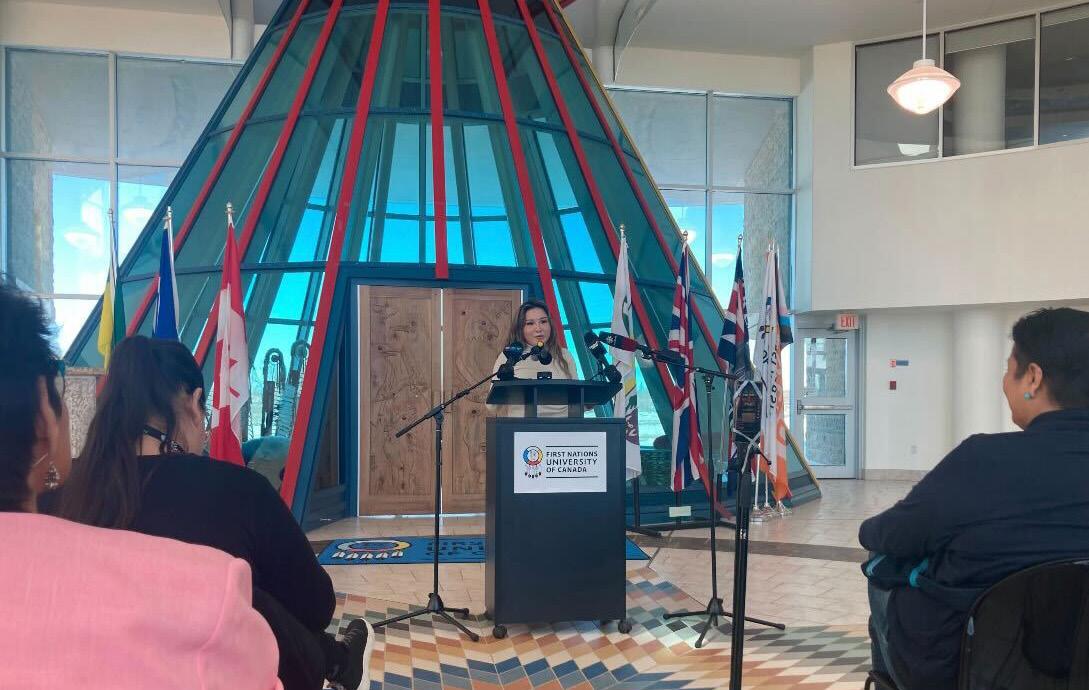

Students now have a wider range of choice and agency to make decisions regarding the studies that are right for them thanks to INCA and FNUniv.
tremendously helpful for those who wish to pursue a career in INCA related fields.
“The demand for Indigenous journalists and communication professionals has never been greater,” said Shannon Avison, an associate professor of INCA
support the program, including $121,000 annually from the Mastercard Foundation for five years, $100,000 annually from the Inspirit Foundation over three years, and an expected $10,000 in internship support from J-Schools Canada/Écoles-J Canada and
digenous languages. “It’s different when it’s translated into English and we all know that there is a lot that is lost in translation. […] there are so many contributions that Indigenous peoples have made to the society. […] there are people that are pushing boundar-
ies in society and that is what we would like to inspire here, that we encourage our students and our faculties and our staff to push boundaries in good ways.”
She continued: “No matter the platform, it is vital that our stories are told from our own perspectives, our own languages, and through our own voices.”
Avison believes that the time is right to expand our offerings with a full four-year bachelor of arts. “The Truth and Reconciliation Commission calls on us to ensure that Indigenous and non-Indigenous journalists have a strong foundation in Indigenous issues in Canada. FNUniv is the right post-secondary institution to do that,” she said.
Student accounts suggest that they are happy with the introduction of the program. “All students can benefit from Indigenous-focused learning,” said Hannah Scott, a third-year Faculty of Arts student at the University of Regina. “Reconciliation is a team effort. At INCA, everyone is really kind and excited to work with one another no matter their background.”
Registration for the program is now open and further information can also be found at incaonline.ca
shivangi sharma news writer

allister white news editor
The faces of food service at the University of Regina (U of R) along with the landscape they have been a part of for decades will soon disappear due to changes for food services on campus. Many vibrant people, constant staples in the lives of students and faculty, will find themselves out of jobs on April 30, 2024.
Earlier this year, all current Chartwells employees were served termination letters. This came as Student Affairs opened the new year with an announcement that the U of R’s contract with Chartwells, the current food services provider, will be discontinued as of April 30. In an email, the university explained that they
as to whether or not the university is planning to take on Chartwells’ role. Dorma, on behalf of Paul Dederick, did explain that the new food services model “may look different,” but claims that it “will provide a greater variety of healthy nutritious and competitively priced food options on-campus.” Dorma also stressed that this new model is “being developed” with more details to come – when asked, Dorma did not clarify by whom the model is being developed.
For Chartwells employees, the university’s silence spells bad news. When asked what happens for food service on campus after April 30, Rakibul Alam, a supervisor at Subway, stated “We don’t know, actually. It’s futureless. They [Chartwells] just gave us termination letters, that’s all.” Alam explained that the universi-
Gates also reported that around 60 [per cent] of Chartwells staff will be done working on the last day of classes before exams. “For those last two weeks of April it’ll just be Riddell Centre,” Gates told the Carillon
Gates also expressed her belief that the university has ulterior motivations for the change and that the shift is not simply about “enhancing the campus food experience,” but also reducing expenses. “As it stands right now, the university is responsible for basically everything, like all the machinery and any repairs, that kind of thing. And they kind of want to step back from that because it’s a huge, huge expense for them,” Gates claimed.
Gates also suggested that the university anticipated this change in advance, but did not inform employees until recently.
“ We all felt like this was coming, […] only we didn’t know that we were going to go as well.”
Cindy Gates
businesses, but anyone can bid for a space on campus. Gates is skeptical, stressing that “not only do they have to pay rent, they have to bring in all their own equipment. They’re responsible for maintaining all their own equipment.” According to Gates, “The tricky part is going to be how many people are going to want to go that far to get into a spot here.”
Elizabeth Craddock, a Film Studies student, was disappointed to hear about the closure of the Riddell Centre Tim Hortons and worried about the future of food
tions with flying colours. This is not to say that Chartwells food service is without issue. For one, staff and students alike have complaints about the quality of food and the price.
While privatization came as a shock to many, some signs were present prior to the announcement, Gates believes. “The two espresso machines that are down at the Common Ground have been broken for some time,” Gates began, going on to stress that it’s incredibly costly for the university to replace the machines
have been “listening to feedback from students, faculty, and staff, and [are] committed to enhancing the campus food experience.”
The only establishments in the main U of R campus not impacted will include The Lazy Owl, Extreme Pita, Gong Cha, and the Momentum Café. Robins in Campion College as well as the Luther Cafeteria will also remain unimpacted by the Chartwells closure.
Everett Dorma, a public affairs strategist with the U of R, would not give the Carillon clarity
ty is involved in discussions with the company and union.
On the question of whether or not the university was assisting employees, many of whom are also students, or have had their contracts grandfathered into a Chartwells contract thanks to the university’s decisions, Alam said “As far as I know they’re not helping us [with] anything.”
Cindy Gates, a Chartwells employee, explained that all Chartwells employees were given termination letters. “We are fired. We are done… everyone, all of us. Everybody,” Gates explained.
Gates says she and other employees knew that Chartwells “was on their way out,” because of the mistakes they’ve made. “We all felt like this was coming, […] only we didn’t know that we were going to go as well,” stated Gates, shocked at the university’s plans.
In 2019, Chartwells had a legacy of mislabelling Halal meats and consistent reports of pest infestations.
According to Gates, privatization will include renovations to kitchen and storage spaces after April 30. The university will reportedly be prioritizing local

service at the university. “I’d rather bus for Tim’s than eat some crap food,” Craddock explained, in shock at the news of the Chartwells closure. The Tim Hortons in Riddell Centre has consistently long lines at peak hours and, unlike other food vendors, has passed recent SHA health inspec-
– a cost that is likely upwards of $30,000 per machine. She says that the university “just never bothered because they knew they were going to give this [privatization] a try,” and hoped to reduce costs, even before the Chartwells contract ended.

“I [have been] working here 15 years, and some [have been working] 25 years, 30 years; they are getting almost close to retirement, they cannot find a job.”
Still, privatization comes, in many ways, at the cost of current Chartwells employees and students at the U of R. “Once they privatize, the only thing the university has as far as involvement goes is collecting the rent,” Gates stated.
A handful of Chartwells employees have been at the university long enough they could have earned five degrees – totalling upwards of 20 years working on campus, according to Alam. “I [have been] working here 15 years, and some [have been working] 25 years, 30 years; they are getting almost close to retirement, they cannot find a job,” Alam added.
Gates also spoke about the U of R’s decision and the impact it has on employees: “If they were bringing in another food service company, say Aramark, or Versa, then we would all stay because that’s actually in our contract we’re grandfathered through. We get to stay as the staff, but because they’re privatizing it’s up to each individual… [and] who they want for staff.”
There is no guarantee that jobs, if they are created by the new model, will be union jobs –yet another price to pay to privatize.
It’s likely, due to the number of students who are employed by Chartwells on campus, that the privatization will adversely impact international students who can only work limited hours off-campus. During regular school terms, international students typically can only legally work up to 20 hours per week off-campus.
International students don’t have any restrictions on the hours they are allowed to work on campus. While they can work for a
private business on campus, it’s unclear if those businesses will be hiring. A lack of transparency on the part of the university makes planning for employees with complex circumstances, such as those faced by international students, nearly impossible.
Students may also be adversely affected by the university’s lack of transparency. There are conflicting accounts on the future of funds on Chartwells meal cards. Gates is certain that after April 30, “there’ll be no way to recover or retrieve [funds on meal cards].” When Chartwells is
gone, Gates says “Whatever’s left on your card is gone.” Her advice to anyone with a meal card? “Spend. It. Up.”
Gates has repeated this sentiment to students who come into the Lab Café with meal cards. She says she’s been urging them to empty out the shelves and fridges, offering boxes and carts to help move the food around in hopes of limiting funds lost by students as a result of the change.
In RPIRG’s town hall on March 5, 2024 with university executives, John Smith claimed that Chartwells will turn meal
Rakibul Alam
card funds over to the university. Then, potentially, the university will be turning the funds “to another food provider on campus.”
Smith assured students that “no pennies will be lost.”
Despite this public assurance, the U of R has publicly posted signs stating that “anyone with funds on meal plans is encouraged to use them by April 30th.”
In February 2019, the U of R made an announcement similar to the one it made earlier this year – that it would not be renewing its contract with Chartwells.
Dorma explained on behalf

of Paul Dederick that in 2019, when the U of R’s contract with Chartwells expired, “the University undertook a comprehensive review process to procure a new food services vendor.” After this review process, the U of R considered other vendors but planned to keep the model of food delivery on campus the same. As a result of this decision, the U of R chose to renew its partnership with Chartwells despite the corporation’s reputation among students, staff, and faculty.
Now the university is involved in what they call “confidential” business negotiations, marking the future of Chartwells on campus as much more grim than it was in 2019.
What is the future of food service at the U of R? Likely, privatization. And, as Gates says, that privatization ”depends on who wants to bid in, who can make the space work for them.”
The future of Chartwells employees is equally murky apart from a few facts – that Gates is “sure there are lots of folks that would prefer to stay,” and that employees have been looking for answers and hoping to plan ahead for some time now while the U of R and Chartwells remain tightlipped.
Chartwells staff will be receiving severance pay, but it is currently unclear how the pay is calculated. Allegedly, the three parties involved — Chartwells, CUPE, and the U of R – are currently in discussions together to determine this.
The Carillon requested an interview with involved members on the U of R board of directors. The university’s spokespeople declined requests for comment on behalf of involved members.
victoria baht staff writer
size and complexity still pressing concerns for teachers and students in
The Saskatchewan Legislature saw a massive gathering of teachers, students, and supporters of the Saskatchewan Teachers’ Federation (STF) during a one-day province-wide strike on Wednesday, March 20.
A two-day withdrawal of extracurricular activities took place on Thursday, March 21 and Friday, March 22. The withdrawal of extracurricular activities has since been extended to March 28.
The STF gave two days’ notice for the strike, announcing it on March 18, and chose budget day – March 20 – to make clear the need for additional funding.
Picketing took place across the province, however, when people gathered outside of the legislature in Regina where the opportunity for discussion was rife. Meara Conway and other members of the opposition spoke with striking teachers outside the legislature. Others were happy to share opinions about the strike, its impacts, and their outlook on the STF’s choices.
Wednesday morning, large crowds gathered on the legislative grounds, walking laps around the building, carrying signs, encouraging drivers to honk their horns while driving past to show their support, dancing around, and so much more. According to the STF, the gathering ultimately called for governmental action in support of the current strike.
The STF stated in a news release that “supporters are encouraged to join the demonstrations to show that proper funding for education is a concern for more than just the teachers. […] The Premier and Education Minister are not listening to teachers, and they are not listening to the thousands of parents, caregivers, and students who are calling on the government to respond to the needs of education.”
The Carillon attended portions of Wednesday’s strike, collecting
I see them being overwhelmed quite frequently. Because they are not given the resources to succeed,” Wszolek explained.
During the strike, Wszolek held a sign that stated “Students only succeed when teachers succeed.” Wszolek stressed that the sign “is the truth,” continuing to stress that education in Saskatchewan “is not being the best it can be because our teachers aren’t given
Kira Durealt stood beside Wszolek. ”Teachers are not feeling the support from the government,” said Durealt. “We are constantly being lied to about what they are going to do for us. They refuse to put in a contract because they are not keeping their word. It is sad to see.”
Durealt added, “Teachers are working after hours to support [students]. Before school, after
few of them left.”
Todd Malagride works in a class to help students who have disabilities such as cerebral palsy and autism. He discussed burnout and underfunding in his classroom, where students need additional assistance with eating and hygiene. “During our lunch routine, I often get lunch supervision paid as me and my [Educational Assistants] are working the entire
taught less in time.”
“What comes as well with less staffing comes more behaviours or, for instance, with seizures occurring and attending to them, kids get left behind and that is a safety concern,” he added.
It’s not only classrooms like Malagride’s that require support they’re not receiving, but other teachers as well.
Kelsie Yates commented fur-

the tools to make it the best it can be.” This, Wszolek explains, is far from fair to the teachers, causing stress and burnout.
The effects are also not exclusive to current teachers. Wszolek says it’s hurting future teachers,
school, and during their breaks, they do not even take lunch because they are supporting students.” This labour extends far past lunch breaks, with many teachers coaching both before and after school, supporting stu-
day. But this year we felt the cut,” explained Malagride.
Malagride’s classroom size increased by 50 per cent, but the group received a 50 per cent cut in lunchtime supervision pay. Now, Malagride says, half of the
“Teachers are working after hours to support [students]. Before school, after school, and during their breaks, they do not even take lunch because they are supporting students.”
Kira Durealt
ther on the diverse needs present in schools. “The biggest thing we need is classroom support for the diversity of needs in our schools,” said Yates. She went on to explain that teachers having to spend time dealing with behavioural issues means that the work for other students simply becomes practice. “You need them to be able to progress as well… other students are suffering. […] This could be helped by an extra education assistant or even another teacher.”
Teachers are primarily seeking more resources and supports. These include smaller class sizes, more teacher support such as psychologists, social workers, speech pathologists, and educational assistants. More physical teaching space is being called for, as well as more jobs to mitigate burnout from overwork.
photographs and perspectives on it. A student, Sydney Wszolek, opened the discussion by expressing concern for her teachers.
“When I see my teachers in class,
like herself, who are planning to study education in university.
Wszolek says she will be attending the University of Regina next year, studying French Education.
dents for free. According to Durealt, “[Teachers] are extraordinary humans who just want to see us succeed and it is sad that they are burning out and there are very
team no longer works at lunch.
The result, according to Malagride, is “jobs take longer to do, which means less time to do it in or [it] takes longer and kids get
The government did not create an action plan following the one-day strike. As a result, teachers will still be withdrawing extracurricular support from March 25 to March 28. STF President Samantha Becotte told CBC on March 22 that teachers need to be involved in processes and frameworks that the government may develop.
ideas on what’s happening this April? Enjoy!
will bright a&c writer
April is on the horizon. End of classes, finals season, heading back home for the summer, graduating... So many things begin to happen in April. Why not take a break and check out an April event right here in Regina?
Living Skies Student Film Festival
From April 4 to April 6, the 35th Living Skies Student Film Festival will be hosted by the Department of Film right here at the University of Regina. It’s an international film festival, celebrating and showcasing student films from across the globe.
The event will have screenings of short films, some workshops, and an awards ceremony for the films presented. If you’re a fan of movies and you want to check out some incredible student work, head to the Artesian on the 4 and La Cité on the 5 and 6.
Tickets will be sold at the Riddell Center from March 25 to April 5, or at the door for each event. You can learn more at livingskiesstudentfilmfest.com.
Jake and the Kid, The Moon Runners, and ka lok
We talk a lot about supporting local and a big piece of that is supporting local arts, which is exactly what this next event will have you doing. On April 5, there will be three local music groups performing at the Artesian for the low price of $25 online and $30 at the door.
At its heart, this event is to celebrate local Regina band Jake and the Kid and their Saskatchewan Music Award. In 2023, they received the Album of the Year award. Their music combines indie-folk and jazz with some lo-fi vibes.
The next group is the Moon Runners, an emo band that occasionally has some cowboy energy. They were also nominated for a Saskatchewan Music Award back in 2019.
Finally, ka lok is a Saskatchewan artist who makes alternative pop music known for their angsty rhythmic sound.
To buy tickets, or learn more about the musicians, head to artesianon13th.ca/event-calendar/ post/jake-and-the-kid-the-moonrunners-ka-lok
Shary Boyle’s Outside the Palace of Me Opening Reception
Are you an art fan who likes talking about art with other art fans? You should go to the opening reception for Shary Boyle’s Outside the Palace of Me at the MacKenzie Art Gallery on April
5. It’s going to feel less like an art gallery and more like an adventure. The exhibition has music, drawings, ceramics, and entire automatons.
An amusement park innovator helped work on it and if that doesn’t convince you, I’m not sure what will.
The exhibition explores themes of identity, our self-image, our self-concept, and the way oth-
Do you enjoy stand-up comedy? Yes? Then The Lazy Owl is the place for you to be at 7 p.m. on April 12. THTR203-991 Comedy Gold students at the University of Regina are holding a live stand-up comedy show that night, and you’re sure to laugh at least a few times – surely at least one of the 20 students will have one good joke.
Seeing as it’s their last show
las, you should check out the Education Students’ Society Gala on April 12 at the Atlas Hotel. Meet other education students, connect with professors, enjoy the delicious food of the Atlas, dance to the music played by both a local band and a local DJ, plus there’s a door prize.
It’ll be a night you won’t forget. Also! You don’t have to be an education student to go.
“ There is so much to do and see in Regina this April, so why not check it out?”

er people see us. At 7 p.m. there’s a conversation with the creator, Shary Boyle, and the exhibition will be open to see at 8 p.m.. The event will also have American Sign Language interpretation.
For more information, head to mackenzie.art/event/openingreception-for-shary-boyle-outside-the-palace-of-me
University of Regina Theatre Class Production
of the semester, and last assignment that they’ve been preparing for all semester, it’s pretty much guaranteed that laughter is what is awaiting anyone who attends this show. So, if you’re interested in comedy, be sure to head to The Lazy Owl to check it out!
University of Regina Education Students’ Society Gala
If you’re an education student like me, or you just like ga-
Bingo. Do you love drag? I love Drag. Wow, we’re so similar, which is probably why you’ll be interested in this event too!
On Saturday, April 13, head down to Lakeview United Church for Auntie Anne’s Country Hoedown Drag Queen Bingo. Admission will cost you a little over $30 with tax, but that comes with three Bingo cards and hot appetizers.
There’ll also be a cash bar, so this event is 19+ only. You can buy yourself a Bingo dabber there for $3 and extra Bingo cards are $2.50 each. It’ll be a great night and you can find out more and buy tickets at eventbrite. ca/e/auntie-annes-country-hoedown-drag-queen-bingo-tickets847274439657?aff=ebdssbdestsearch
Isidore String Quartet at Darke Hall
I love string music, specifically string quartets. The combination of different instruments make beautiful melodies. That’s why I recommend you check out the Isidore String Quartet at Darke Hall on April 14.
The quartet recently won the Banff International String Quartet Competition back in 2022. Their music often leans classical, but that doesn’t make it boring; in fact, their ability to feel the music only makes it more exciting. Come listen to them play Beethoven, Haydn, Childs, and more for only $25 if you’re a student. For more information, head to cecilianchamberseries.ca/ isidorestringquartet
Whether or not you agree that crystals have spiritual function, we can probably all agree that there are some very pretty rocks. And for only $2, you could see some very pretty rocks at the Regina Rock N’ Gem Show from April 18 to 21.
Crystals, rocks, gems, jewelry, fossils; they have anything that you could want and there’s no doubt in my mind that you’ll manage to find something you love.
If you buy your tickets before April 1, you can grab the early bird price of $25, but if you miss that deadline, tickets will cost $35. To get your tickets now, head to eventbrite.ca/e/education-students-society-gala-tickets-866779369427?aff=ebdssbdestsearch&keep_tld=1
Auntie Anne’s Country Hoedown Drag Queen Bingo
Do you love Bingo? I love
Tickets are at the door for just $2 for a single ticket and $5 for a family ticket. If you’re interested, go to facebook.com/ events/708430851336861 for more information.
This is only scratching the surface of April events here in Regina – there are so many more. From comedy shows, to theatre workshops, all the way back to even more live music. Why not check it out?
A taste of folk, rock, and jazz for your listening pleasure
emma mcgill contributor
I grew up in rural Manitoba with parents who helped me craft my great love for local music and taught me to recognize the joy in supporting small, blooming artists, listening closely to the sounds emerging right around me. We would attend the Winnipeg Folk Festival, house concerts, and local showcases as much as possible. Intimate venues were valued over booming arenas.
When I moved to Regina for my first year of university in the late summer of 2022, by luck, I became immersed in the local music scene very quickly, and I am very grateful to say that I have had a hearty taste of the city’s
walked into the warming tent, patiently waiting for the musicians to step up onto the little stage at the front.
First to grace that stage was the ever-charming Marissa Burwell, a Regina local and proud master of all the work she’s put out over the past couple of years, including both a full-length album and an EP. Though her writing reflects so many universal woes, there is a deep foundation of life growing up in the prairies to be found in her music.
Burwell was a lone star on the stage this evening, though just a few weeks prior she had filled The Exchange with the glorious sounds of herself accompanied by a full band. Alone, her musicianship is just as touching. Her ability to chuckle at her own crowdwork between songs only
and musician by night, was the sole member of the four-piece band who could make it to play the show. Graciously stepping in were Sam Stawarz on bass guitar, Tom Duffy on guitar, and Ross Bart on drums.
Contrasting the previous set, Carmela filled the tent with billowing rock, showcasing songs including “Cut My Hair” and “Call Me By Her Name,” both songs which debuted in August.
Ending with the longest set was Blu Beach Band, hailing from Langenburg and establishing themselves well in Regina. As always, the boys of Blu Beach bring a refreshing, welcoming energy to any venue they perform at and do so looking like they’re having the most fun out of anyone.
This evening, they put that energy into performances of
for attending, the setting changed but did not move far across the city. O’Hanlon’s Irish Pub is well known for its festive atmosphere as both a place to get together for drinks and appetizers with friends as well as a venue for live music.
On this particular night, the whole place was drawn in by the electric jazz fusion flowing from the stage: the Regina Transit Authority (RTA), made up of Erik Mehlsen on guitar, Rob Lane on bass, Ethan Reoch on keys, and Cyprian Henry on the drums. The band released an EP, Standards, in 2020, and have put out collaborative works with the Saskatchewan collective People of the Sun.
For part of the set, they brought out guests to shake things up: Kristian Vogel on saxophone, Joshua Stewart on trumpet,
Pines become more comfortable and more improved with every performance they do.
Becoming classics to their regular audience, the set includes tight, jazz-packed songs such as “Meet Cute,” “Butterflies,” and “Sunday Afternoon in May” which features vocals by drummer Theo Deiana. The remainder of the band is made up of Joe Roussell on guitar, Jakob Bjornson on bass, and Sam Stawarz on saxophone.
“That show was so incredible. Afterwards the whole band was talking and we think it might have been our best show to date,” shared Forrest. “There was something about the energy that night, and how we all were purely just having a great time up there enjoying the music. Sometimes I think it pays off to not overthink


sound.
On February 2, Regina was right in the middle of its annual Frost Festival; a large series of pop-ups all over the city with opportunities for wintery fun. An experience that people fly in from all over for. That night’s music showcase in Victoria Square Park was my very first glimpse into the festival, and it was the perfect way to start.
The city park’s atmosphere was given a pleasant small-town feel that we felt as soon as we
enhanced the endearment behind hits such as “Take a Load Off” and “You’re Not Trying Very Hard.”
Accompanying the free hot chocolate being served, she warmed festival-goers with emotive lines like “Roles reversed that could’ve hurt” and “I’ll wait for the sun or the rain, either way.”
Following Burwell was more Regina talent found in the version of the band Carmela, brought together for Frost. Lead vocalist Sydney Wright, dietitian by day
songs off their new album, No Guff, including “I Leave the Door Unlocked” and “City Love,” as well as songs from their previous album. The band is usually made up of members Carter Vosper, Eric Vosper, Remi Berthelet, and Riley Buchberger. With Eric Vosper journeying abroad at the time, Riley McLennan – more widely known as Lova Lamp in Regina’s music scene – stepped up to the plate.
About an hour after the organizers of Frost thanked us all
and Chané Boisvert on trombone. The true spirit of jazz was brought into the pub that night with the experimental nature of the band’s performance.
Following the RTA, carrying their energy and more, came Ella Forrest and the Great Pines. Forrest released her debut EP in October of 2023, in the midst of having splashed elegantly onto the scene. Sharing members with local indie rock band Jake and the Kid, recipients of Sask Music’s album of the year award, the Great
and just feel the moment like that.”
All in all, this series of performances represented well the talent here in this city, and the community that supports these musicians as they bring their creations to life and work to share those creations. If you are interested in seeing live music like this, I highly recommend following these bands and local venues on social media to stay up to date on upcoming shows and events.
“There was something about the energy that night, and how we all were purely just having a great time up there enjoying the music. Sometimes I think it pays off to not overthink and just feel the moment like that.”
Ella Forrest
Mona Lisa Smile is a film addressing the idea of women’s role in society. In the 1950s, many people believed that women’s position was as mothers and wives. Society at that time was extremely patriarchal and most women were expected to put marriage and family above the pursuit of their own careers.
“A few years from now,” the Wellesley students in the film are solemnly informed, “your sole responsibility will be taking care of your husband and children.”
The main character, Katherine Watson, finds it hard to believe that women could so readily accept leaving behind their ambitions in favor of getting married.
Mona Lisa Smile criticizes the traditional views about women’s role in the world and concludes that women have the right to make their own choices.
Abandoning her future career in favour of building a family is not a priority Watson can agree with. She tells the school president, “I thought I was headed to a place that would turn out tomorrow’s leaders, not their wives.”
In the spirit of International Women’s Day, it’s important to reflect on the journey of women in higher education. The pursuit of knowledge extends beyond personal ambition; it carries the torch of progress for future generations.
Each lecture, assignment, and discussion is a testament to the resilience and determination of women throughout history who fought for an equal right to education. As we navigate our academic endeavors, let us draw inspiration from their stories, recognizing that our education is not just for ourselves but for the em-
“
while they are in primary and secondary school.
While boys are encouraged to study topics such as engineering, medicine, law, and journalism, girls are more likely to be encouraged to pursue positions that require emotional labour and which would leave time to be a homemaker.
Women are also more likely to end up in precarious work. According to Anna Paraskevopoulou in Gender and Precarious Work, this is “nonstandard or atypical employment, insecure, or casual employment.”
Despite the legal requirement in Canada and other countries for people to be paid equally for equal levels of work, there is a long way to go. White men are paid the most for the same work that other sectors of people could do but would be paid less for.
In Canada, according to the Canadian Women’s Foundation, the general pay gap is considered to be 89 cents per the White man’s dollar and it drops to 59 cents for racialized people who present as women.
Young White men are also more likely to assume they are qualified for a position and apply to positions that their equally qualified peers may consider themselves unqualified for due to impostor syndrome and lesser self-confidence in their place within the world. This results in a gender disparity in higher ranking positions across all sectors of work.
It is crucial to recognize that education should not be confined to gender norms. Education frees women from dependence and empowers them to maintain independence. Individuals, communi-


Despite historical barriers, numerous women have defied the odds and achieved remarkable feats in their lives, garnering Nobel Prizes for their groundbreaking contributions. Among these luminaries are:
Marie Curie (1867-1934):
A pioneer in physics and chemistry, Marie Curie remains one of the most celebrated scientists in history. She was the first woman to win a Nobel Prize and the only
and inspiring adaptations and interpretations that resonate with audiences.
Nellie Bly (1864-1922):
The investigative journalism standard was basically set by her. Bly addressed more serious topics like mental health, poverty, and political corruption at a time when women writers were confined to society pages.
Her most famous undercover operation was at Blackwell’s Is-
By embracing our roles as scholars and trailblazers, we pave the way for a brighter, more inclusive future where every person can pursue their dreams and aspirations, regardless of gender norms.”
Zinia Jaswal
to be an integral part of wireless communication today.
Katherine G. Johnson (1918-2020): a mathematician who was one of the brains behind the complex calculations that helped to successfully send the first man to the moon.
These extraordinary women serve as shining examples of what can be achieved when talent, perseverance, and determination converge in a woman’s world.
The struggles faced by women in education and careers are undeniable, yet the resilience and brilliance of women in these fields continue to inspire. It makes me so proud when I see young women in university working in labs and studying in lectures.
These young women are not only shaping their own destinies but also breaking barriers and paving the way for generations to come. Their presence in academic settings is not symbolic; it is transformative, showing a shift towards a more inclusive and equitable society, reminding us of the limitless potential that lies within every individual, regardless of gender.
powerment and advancement of people worldwide.
By embracing our roles as scholars and trailblazers, we pave the way for a brighter, more inclusive future where every person can pursue their dreams and aspirations, regardless of gender norms.
In general, young people seem to be living more equal lives. Unfortunately, there is a predetermined path each person is being placed on by the encouragement they receive from their elders
ties, countries, and the globe may all benefit from universal access to high-quality education.
Although all states have pledged to realize the right to education for everyone, less than half of the world’s countries have achieved gender balance in education. Denying women the fundamental right to education is the most devastating kind of discrimination. It robs our planet of the creativity, innovation, and accomplishments of more than half of mankind.
person to win Nobel Prizes in two different scientific fields: physics and chemistry.
Rita Levi-Montalcini (1909-2012): An Italian neurobiologist, Levi-Montalcini won the Nobel Prize in Physiology in 1986 for her discovery of nerve growth factor, a crucial protein involved in the growth and maintenance of nerve cells.
Jane Austen (1775–1817): Her literature legacy is essentially the birthplace of the rom–com genre, transcending generations
land (now Roosevelt Island). As a result of her exposé of the horrific conditions, changes in patient care were made that were much needed. Her circumnavigation of the globe also set a world record. She completed the investigation in 72 days.
Hedy Lamarr (19142000): She co-invented the “Secret Communications System” radio signaling device. During World War II, the system changed radio frequencies to confuse and hinder enemies, and it continues
It is imperative to challenge stereotypes, promote inclusivity, and provide equal opportunities for all individuals to succeed in education. By recognizing and celebrating the achievements of women, we not only honor their contributions but also advocate for a more equitable and diverse future in science and technology. zinia jaswal contributor
The evolution of the Keffiyeh
lee lim graphics editor
Believe it or not, fashion is not just about looking stylish or being practical. It can also be at the centre of a socio-political movement.
Advocacy can be signalled by a single article of clothing, worn to aid in the expression of resistance against the oppression of a group. Take the Keffiyeh as an example; there is a rich history behind this scarf that continues to be upheld and revolutionized by its wearers.
It varies from culture to culture, but in some, the scarf started as a symbol for classifying one’s prestigious status, such as for priests, and then trickled to the general public. The Keffiyeh, also known as shemagh or hatta, has been a staple in Arab countries for practical reasons, especially for people who work outdoors like farmers and fishermen.
The scarf was used as a head covering to protect them from the sun, rain, and sand. Anzal Omar, a student in Social Work said, “It is mostly worn by Middle Eastern men.” Omar added, “Where I come from, men in my family wore it especially for prayers.”
Apart from being known as a headdress, there are different ways of wearing the scarf. One can fold it into a triangle and don it on the shoulders or wrap it around the forehead. It can also simply be worn as a neck scarf with the tassels hanging on two sides, or you can have the scarf wrap both the neck and the face. For Omar, she said, “I usually wrap it twice on my head or sometimes just drape it on my shoulder on normal occasions.”
A high quality Keffiyeh is made out of cotton fabric that is fed through an embroidery machine, then cut into the standard square metre that tassels can be
wear it because their identities are being taken away from them. They cannot even fish, nothing is coming in from the trade lines, and they are starving. We are holding on to their last piece of identity.”
To understand the Keffi-
started wearing the scarf to make it harder for the authorities to identify the rebels. The Keffiyeh’s usage continues to evolve and, these days, wearing the Keffiyeh has been an unspoken symbol for solidarity with the Palestinian people.
etize the scarf.
Topshop was under fire for categorizing the Keffiyeh as “festival-wear,” while transforming the scarf by taking its pattern and making it into a romper. Louis Vuitton received similar heat when they decided to put their

And how do you properly treat it?
“I wouldn’t say there’s any restrictions, whoever wants to wear it can wear it. It depends on what they’re using it for and what their intention behind wearing it is. If someone is stepping on it, writing something weird on it or treating it in a way that shows they’re not standing up for Palestine, then that would be some kind of restriction. Otherwise, it’s open to anyone,” said Omar.
As the situation in Palestine remains increasingly harrowing, there has been an increase of Palestinian and non-Palestinian activists choosing to wear the scarf.
“Since October 7,” Omar said, “even before, but recently I have been actively wearing it.”
She continued by stating that, “I just wanted to show resistance and liberation, to show that I support Palestine and that I’m always there with them. Especially on October 7. It was harsh, but afterwards, I decided that I am a supporter of Palestinian people. What are you gonna say about it?”
It is evident that throughout history, the scarf has been of great importance for its wearer. But its impact crescendos as both Palestinians and other advocates flaunt their Keffiyeh; they show the same resistance to colonial powers and injustice as seen over the course of the scarf’s existence. Because of the rise in people wearing the Keffiyeh, this allows those who are unaware to inquire about the importance of the scarf. This further strengthens the movement, because it makes Palestinians more visible and it reveals what they have been fighting for.
“I just wanted to show resistance and liberation, to show that I support Palestine and that I’m always there with them… What are you gonna say about it?”
Anzal Omar
sewn onto. Its patterns are significant to Palestinian cultural identity and a reminder of their way of life. The net-like pattern symbolizes the Mediterranean sea, the curvy design represents the olive trees, and the bold stripes are the trade routes.
Omar elaborated, “It says much about their identities, like how they fish and trade. Now, we
yeh’s importance to Palestine, we should know its political history and why it is strongly tied to the representation of Palestinian resistance to colonial powers. During the time of the Arab revolt against the British mandate, Palestinian rebels used the Keffiyeh to hide their identities.
This resulted in the banning of the Keffiyeh. However, Palestinians showed their support and
According to Omar, “Right now, the whole meaning of it has changed, it is more about showing strength and showing what you believe in. Showing up for Palestine. For me, if I see someone wearing the Keffiyeh, it shows which side they stand in. Whereas before, it was a part of the fashion in different cultures.”
Of course, fashion houses did not miss their chance to mon-
own $705 Keffiyeh-inspired scarf into the market.
Marketing and profiting off the suffering of Palestinian people has led to criticism of popular clothing brands for their appropriation of the Keffiyeh and silence over the years of oppression that the Palestinian people continue to face.
This raises the question of who gets to wear the Keffiyeh?
However, let it be a reminder that advocacy shouldn’t just stop at wearing a Keffiyeh. Use your voice by calling for a permanent ceasefire through contacting your representatives, signing petitions, donating, following the BDS movement, and going to your local pro-Palestine rallies.
If you live in Regina and you’re looking for a great alternative to the ridiculously priced scarf from Louis Vuitton, check out stores like Reyana Fashion & Home Decor.
From the river to the sea, Palestine will be free.
Have you been thinking about finding a new source for news?
maren savarese knopf staff writer
“I am the Penal Press. I attempt to speak to the masses on behalf of the man and the youth locked up in prison. I am their appointed agent. I am their messenger… I am the Penal Press, and it is my duty to percolate, to infiltrate, to exhort, to improve, to impart and to deprecate. I am the servant of the prisoner. I am his mouthpiece.” (Excerpt from “The Sharp and Bright Sword” in Collins Bay Diamond, July 1955)
The Centre of Criminology Library at the Okanagan College has been acting as stewards of a collection of Canada’s penal press. The collection includes over 500 individual issues published across 8 provinces and 29 institutions.
Canada underwent a period of prison reform between 1935 and 1960 that shifted focus within the penal system from punishment to rehabilitation. This change was largely attributed to the influence by the 1938 Royal Commission Report on Penal Reform in Canada, also known as the Archambault Report.
The report proposed changes to the criminal justice system that included changes to crime prevention, sentencing, prison labour, education, and recreational conditions for prisoners. Amid these changes, the first Canadian penal press publication was proposed in 1948.
The penal press was intended to improve prisoner morale while offering the potential to act as a tool to reach the larger prisoner population. Two years later, in 1950, the first Canadian penal publication titled Tele-scope was established in Kingston Penitentiary.
Following the establishment of Tele-scope, eight more publications were launched across Canada within a year. Despite the original intent of providing entertainment and communication within penal institutions, subscriptions opened to the public and between institutions.
The publication of penal press quickly became a tool for prisoner activism, advocacy, and communication with the general public. Since the first publica-
on prison publications, like prison newspapers, is limited, and radical prison newspapers and their connection to social movements is an understudied area.
“Prisons are often imagined as spaces that are completely removed from the rest of society, but they are in fact porous,” wrote Quinn. “Similarly, prisoners are often imagined as confined, separated, and politically immobilized. In some regards, these are accurate reflections of the condi-
municate, still circumvent restrictions, and still find ways to resist incarceration and participate in public discourse,” wrote Quinn.
Entries in the collection include prisoner reporting, poetry, personal writing, and reflections. The entries provide a critical look into the lived experiences of Canada’s prisoner population. The collection is accessible online at penalpress.com and easy to navigate by date, topic, and theme. Entries have been further
According to McQueen, one of the drivers of prison publications has been people’s need for information in order to “live successful lives.” She said, “That’s true no matter where you live. So, you know, misinformation, disinformation are problems inside prison as well as outside prison.”
“I think for prison newspapers, their first audience is there - the people in the facility with them – but prison newspapers
“ The first true prisoner-run newspaper came out of Minnesota Correctional Facility in Stillwater, Minn. It was called the Prison Mirror, and that was in 1887.

tions, there have been upwards of 100 separate penal publications produced by Canadian prisoners in federal institutions.
The Gaucher/Munn Penal Press Collection is a website run by Dr. Melissa Munn (PhD) and Bob Gaucher. The purpose of the website is to provide an open access archive of newsletters and publications written and produced by incarcerated people in Canada. Although the collection emphasizes Canadian materials, it also archives materials from international newsletters.
According to Dr. Adam Quinn, scholarship and research
tions that incarceration imposes.”
Gaucher and Munn have identified three central functions of the penal press which refute the notion that prisoners are politically immobilized.
These include providing an outlet for inmates to document and share their lived experiences within carceral systems; facilitating communication between prisoner populations, administration, and the general public; and the ability to advocate for institutional change while emphasizing issues of concern for prisoner rights.
As such, “Prisoners still com-
organized into topics like women’s facilities, Indigenous activism, secure psychiatric facilities, and external publications. According to Kate McQueen, who previously worked with the Prison Journalism Project, prison newspapers have been documented in North America since the early 1800s. “The first true prisoner-run newspaper came out of Minnesota Correctional Facility in Stillwater, Minn.. It was called the Prison Mirror, and that was in 1887. So ever since then, newspapers have flourished, sometimes with outside support, sometimes without it,” said McQueen.

Kate McQueen
also want to reach out to an outside audience. They want to, you know, poke holes in the wall, so to speak, and having a publication is a great way to do that.”
Although not formally considered a penal press, Cory Cardinal, a formerly incarcerated advocate, poet, founder of Inmates for Humane Conditions, and member of Sturgeon Lake First Nations, documented his experience living in Saskatchewan’s carceral institutions. In 2011, he shared his 100-page manuscript with Dorian Geiger, a then-student with the Saskatchewan Aboriginal Literacy Network.
“I know in my mind I can write a novel — I’ve got the tools to do it,” he told Geiger, “It’s just about sitting down and having the stability to do it. It’s going to be a totally different perspective than anyone’s ever seen. It’s coming from an inmate, it’s coming from a guy that’s lived on the streets, it’s coming straight from the cell.”
Years later during the COVID-19 pandemic, Cardinal became a prisoner activist, raising awareness for the conditions in which prisoners were forced to endure during the pandemic in Saskatchewan. Shortly after release, Cardinal passed at the age of 38.
He was praised by Sherri Maier, the founder of Beyond Prison Walls Canada, for his “… really influential [way] in doing things, getting those Skype visits for inmates, especially in Saskatoon.”
Maier continues, “You look at any of his poetry and stuff, he is published in a lot of places, and I think that’s what he will be remembered by. It’s a huge loss for all the advocates.”
kimberley kaufman s&h editor
Staying safe online when so much of our personal and work-related information is available on the internet can be challenging. Social media can be a fantastic outlet to share exciting, alarming, and otherwise important information with friends, distant family, and community members.
However, because of the different ways a person can share news and the fact that anything posted has the potential to forever be on the web, it is doubly important to be cautious of the content you post and consume.
Consent goes beyond sex talks and non-disclosure agreements, and is often an invisible part of everyday life. For instance, asking a friend if they are okay with being in a photo you are taking is asking for consent. Getting someone’s consent can be as simple as hearing them say, “Yes,” but remember that consent is contextual, and the person giving it has to understand what they are agreeing to.
So, if someone says yes to having their photo taken but you intend to post it, make sure they know that. Ensure their “Yes” is followed by, “I am okay with this being posted and available to anyone online.” Depending on how well you know a person, judge whether they understand what you are asking. Also, consider whether you know them well enough to take any nonverbal consent seriously.
Online safety is not guaranteed by consent, but part of being safe is being responsible in what you post online. As for how old someone has to be to consent, consider this: generally, to make an account with a social media platform, you must be 13 or older.
On another note, anyone under the age of majority cannot give consent on legal documents and must have the consent of their parent or guardian instead. Think of how a school sends home consent forms to include a student in any post where they would be identifiable.
Of course, the content being posted should be considered as well. What might seem harmless to you could be something that others will misuse, with or without your knowledge or consent.
“
Putting something online for others to see will most often get you the response you are looking for, but unless you set your account and posts to private, what is uploaded to social media is up for public interpretation.
People of all sorts use social media and the internet, and no one wants to feel exploited or used inappropriately. Online exposure can be a way to “get yourself out there” by showing off hard-earned skills, but too much exposure can be dangerous. Like in real life, some things can be kept offline and out of the public eye, if only for the poster’s personal safety and peace of mind.
It is always recommended to keep personal information off public profiles. If you need to post your location when going on a trip or vacation so your followers know just where that awesome view is located, do so after the fact. Although the perceived risk may be low, it will never be zero. So, think before you post.
Nemours Teens Health recommends keeping your full name, current location, home or school addresses, phone numbers, Social Security Number, passwords, family members’ names, and credit card information private. It also recommends keeping photos private, including those of pets.
Although this information is aimed at identifying suspicious websites, it is not a bad idea to apply it to social media. However, if you want to have public social media accounts, do your best to keep identifying information and sensitive information offline.
Another part of being safe is controlling what you expose yourself to online. Children are becoming increasingly exposed to the internet, and while we cannot control what others post, we can control – to some extent – what we see.
Parental controls and locks can limit a child’s access to websites and applications. Doing so can prevent children from being exposed to unwanted content through search engine filters and media blocks within apps that have been reviewed and flagged for certain ages.
Depending on what use you want out of your electronics and your budget, investing in specialized electronics could be worth the price. For instance, e-readers like the Kindle do not have messaging online capabilities outside
their intended purpose: reading. Kindles come in two sizes, one for adults and another for children, and the children’s version does not have advertisements.
So, investing in a device like this might be worth the peace of mind. Children can read on the
conform, as humans are social beings. This is part of why the online behaviour we see can impact us. It can have disturbing impacts on our mental health and influence our behaviour depending on how much violent media
what we entertain ourselves with.
Although high-risk behaviours we see online might be exciting and tempting to try to recreate ourselves, understand that what we see influences how we act. See risky behaviour, and you might find yourself engaging in risky be-

Your safety is not worth the likes. Image: OpenClipart-Vectors via Pixabay and Mohamed_hassan via Pixabay, manipulated by lee lim
go, and advertisements or questionable websites won’t tempt them if they stumble across them.
For those who are children only at heart, protecting your peace might mean regulating what you search for within search engines like Google and social media applications. Algorithms are responsible for what you see when scrolling. What you search helps specialize the ads you see on social media.
Besides this, the media we consume has a real impact on our overall well-being. Most people have a natural urge to fit in and
we consume and in what emotional state we consume it. When you are in a poor mood, you react differently to upsetting material.
Albert Bandura’s Bobo Doll experiment evaluated observational learning in children. In this experiment, groups of children would be exposed to an adult modelling violent or non-violent behaviour toward the Bobo Doll. The children exposed to violent behaviour recreated what they saw when interacting with the doll.
This experiment might be a lesson in limiting and regulating
“... asking a friend if they are okay with being in a photo you are taking is asking for consent.”
Kimberley Kaufman
haviour… or harming your mental health.
Justin Thomas, a chartered health psychologist with the British Psychological Society, wrote an opinion piece for The National on how media we consume can cause “lasting, real-life trauma.” He wrote, “We can develop PTSD symptoms after observing a traumatic event happening to someone else,” known as vicarious trauma.
Vicarious trauma occurs when someone is repeatedly exposed to violent or distressing images, videos, and content, online or from someone else in real life. This is how therapists, first responders, healthcare workers, and social service workers can become traumatized from working closely with survivors of traumatic events. Self-care is an important part of these jobs, but everyone can use self-care to stay healthy online. Take the time to decide what content you can handle, and avoid what you feel you cannot.
pall agarwal s&h writer
In healthcare, early detection has always been an important part of effective disease management. Early detection means more time and better chances to treat and cure the disease and may allow researchers to better understand and develop ways to prevent them in future cases. As the sayings go, “It’s better to be safe than sorry,” and “Precaution is better than cure.” This stands true when it comes to health.
Cervical cancer is the fourth most common cancer in women globally. According to BC Cancer, “Rates of cervical cancer are among the fastest increasing among females in Canada but it is preventable through immunization and screening programs. Ninety-nine per cent of cervical cancers are caused by high-risk HPV [human papillomavirus].”
To address this, a ground-breaking self-screening program is here to revolutionize this fight against cervical cancer.
Innovations like self-screening help remove obstacles, increasing access to resources. According to BC Cancer, “Self-screening removes obstacles such as cultural barriers, history of trauma, the need for transportation, child care and booking time off from
work for traditional testing.”
This makes it easier for people to take the highest advantage of this revolution in healthcare. Given the healthcare issues in Canada including uninsured costs and inaccessibility, this self-screening test kit may help women get their diagnosis sooner than expected.
BC Cancer’s website has resources for women to understand how to use the kit and learn about the HPV vaccine and the advantages of getting it early. It has many videos and step-by step explanations of the kit. The kits allow cervical cancer testing to be done at home without a professional pelvic exam, while also being an easy and reportedly painless process.
Moreover, the kit is free of charge. Its HPV testing is supposed to be highly sensitive, making it a very accurate test. Since it is highly sensitive, if no HPV is found in the test, it is estimated that a person is covered for screening for five years.
This program launched on Jan 29, 2024, and now individuals in BC aged 25 to 69 with cervixes can choose to order a kit to self-screen for HPV. British Columbia has been the world leader in cervical cancer for almost 70 years, and is the first Canadian province to offer at-home cervix self-screening province-wide.
Hopefully other provinces will follow suit to improve access and ease for cervical cancer testing.
People receive a letter when they are due for screening. The kit can be requested directly from the cervix screening program by phone at 1-877-702-6566 or online at their website. Once the sample is collected, the completed kit can be mailed for analysis for free. The results are sent by mail or online to both the patient and health care provider.
According to the Canadian Cancer Society, “An estimated 1550 Canadian women will be diagnosed with cervical cancer in 2023. An estimated 400 will die from it.” Improving access to screening methods will help decrease these numbers. In Saskatchewan, 15 out of 60 cases resulted in death due to cervical cancer in 2023.
Moving forward, it is important to embrace the promise of this self-screening program, recognizing its potential to not only detect cervical cancer sooner but also inspire a shift in health advocacy and importance. Things will only change when we step out to spread awareness about cervical cancer and how important vaccines are in preventing HPV.


It’s never too late to play some ball
Basketball is a team-based sport where two teams of five players compete to score the most points. This game is commonly taught to middle and high school students in their gym classes, and is one of few games that requires minimal equipment. Unlike hockey, baseball, or volleyball, basketball requires only players, a ball, and at least one net.
Professional-level basketball is commonly broadcast on TV for those who have never seen or played a game. Game clips can be found online or streamed live. Basketball is a publicly loved sport in the United States, and the National Basketball Association (NBA) has its own dedicated streaming service, NBA League Pass.
Canadians can watch NBA teams on The Sports Network (TSN), or Réseaux des sports for coverage in French, as well as SportsNet channels from October to April during the basketball season. TSN and Sportsnet NOW are the app versions of the channels, which can be used to stream basketball leagues that they are contracted with. Canada’s basketball league, the Canadian Elite Basketball League (CEBL), also offers a streaming service called CEBL+ that offers clips of game highlights.
With the basketball season in full-swing, however, seeing in-person games might be more
exciting. While middle and high school basketball games might not be as tension-packed as a professional team, attending games close to home to cheer on your lo-
the best yet, but the teams of now have the chance to be the best in the future.
When getting into basketball and keeping your skills up
into tournament season.”
The RYCBL runs organized basketball games for club basketball teams and is currently running for players in Grades 3-8

cal teams can be twice the fun. If you know a player, show up and support with cheers.
Even if you are not closely acquainted with a team, showing up to watch a local game and support the team is a great experience. Teenagers might not be
between seasons, finding a place to play can be tough. The Regina Youth Club Basketball League (RYCBL) offers a place for club basketball players, that is, players who play with a recreational sports team, to build their skills and “enhance their team leading
and in the High School division. League play is split into Winter 5v5 matches from November to March, and Spring 3x3 from May to June. Registration for this year is done, however, as the cutoff date is in November.
If you know anyone or any
teams interested, check out their website. They offer team registration and free agent registration, which is a player who is interested in playing club basketball but is not on a team.
If you are not a teenager in high school, no worries. Basketball Saskatchewan offers periodic camps, clinics, and tournaments for those aged 10–45+. Check their website every now and then for upcoming events.
Tuxedo Courts is a local group that created a shared-use sports space. It is located at 1575 Elliot Street, Regina, and offers two high school basketball courts, two full-sized ones, four junior volleyball courts, and five pickleball courts. The facility is open between 7 a.m. and 11 p.m., and you can book online using their booking system.
The City of Regina also operates and manages outdoor courts and facilities. These include courts for outdoor basketball, tennis, pickleball, tobogganing hills, skateboard parks, and lawn bowling greens. For more information, visit their website under the “Parks, Recreation & Culture” > “Recreation Facilities” > “Courts & Outdoor Facilities” tab.
Stay active this spring season, and play some basketball!
kimberley kaufman s&h editor
pall agarwal s&h writer
For generations, men’s mental health has been in the shadows. Discussions of men’s health are usually focused on physical health, often focusing on prostate or testicular cancer. There isn’t enough discussion or conversation around their mental health, which leads to many men finding themselves navigating a silent battlefield of mental health challenges.
Traditional gender norms have shaped our societal expectations surrounding masculinity by emphasizing traits like stoicism, strength, and self-esteem, pushing for men to “tough it out.” These beliefs also encourage men’s general lack of interest in health issues. Many men do not even believe that they are susceptible to conditions like depression.
This uncharted territory may be the reason why men are less likely to be diagnosed with depression, but more likely to die by suicide. According to the National Institute of Mental Health, researchers are only now beginning to tease apart the various biological and psychosocial factors that may impact mental health. This means there is a long way to go with a lot to discuss and improve.
In Canada, the progress on mental health is something people are still getting comfortable with. Many clubs and gatherings are being organized to address this topic, such as the DUDES Club in British Columbia which was established in 2010.
According to their website, “The hierarchy of the western medical model is flattened, and the healthcare providers who are involved prioritize cultural competence and safety, genuine connections, and support to help men navigate the healthcare system. Men who often carry with them
intergenerational trauma related to the loss of or damage to their land, culture, family, language, and identity, are able to begin to drop some of their armour.”
The DUDES Club organizes various workshops, sessions, retreats, and creative outlets for men to spend time together and get support outside their places
Hub started the Men’s Mental Health Group on Sunday, Mar 10, at 7 p.m. and will continue “every other Sunday at 7 pm at the Hampton Hub,” according to their latest Instagram post.
Starting initiatives like this in their communities means recognition of the need to talk about mental health, and that what af-
Men and others have applauded this initiative, and the comment section of the post was filled with love and praise for the community to take such a step and bring this issue forward.
The statistics of men’s mental health in Canada are alarming. According to statistics found on the Homewood Health web-
ant as friends, family, colleagues, and partners.
Homewood Health’s blog writes, “Whatever the stigmas remain in the society, people need to stop shaming men into thinking that they are inadequate if they express a need to address mental health challenges or concerns. Without support and em-

of work and home. Initiatives like the Men’s Talking Circle by the DUDES Club are a phenomenal step to resolving the gap in help and support of men having comfortable conversations around trauma and mental health.
In Regina, the Hampton
fects men on a daily basis needs intentional discussion and attention.
According to their Instagram post, “We recognize the need for us men to talk about depression, addiction, suicidal ideation as well as love up on each other.”
“ This uncharted territory may be the reason why men are less likely to be diagnosed with depression, but more likely to die by suicide.”

site, “Approximately one million Canadian men suffer from major depression each year. On average, 4,000 Canadians take their own life each year; of those suicides, 75 per cent are men. Canadian Indigenous men have a suicide rate that is double that of the Canadian national average.”
National strategies to help with problems surrounding men’s mental health need to be created and used across the country. Seeing initiatives like the Men’s Mental Health Group by Hampton Hub and the Men’s Talking Circle from the DUDES Club in British Columbia is a progressive way to think about moving ahead. But providing them with more resources and help is equally important, and a guide to navigating such situations is also essential.
Understanding that men are socialized and raised with different expectations than women is the first step to clarifying differences. They have always been taught to keep their emotions to themselves and not express them openly. Thus, the first step or the way to go for this gap would be to welcome men to express their feelings or emotions openly and confidently.
Allowing men to be open and comfortable with their feelings must be normalized. Reassuring men that they are not alone in this situation also helps. Encouraging them to reach for help is import-
pathy, men will continue to suffer in silence and experience worsening or more acute challenges with mental health disorders. Men aren’t unique to the stigmas associated with mental health; they may be less likely to discuss or address their concerns due to specific conditioning. As a society, we can work together to address stigmas about mental health, and encourage more people to discuss their challenges openly.”
To navigate the complicated landscape of men’s mental health, there is hope with initiatives around the nation that encourage men to talk about real things. According to the Canadian Mental Health Association in Toronto, “More funding and more specialists in this area will encourage ongoing research into male mental health.”
Moving forward, envisioning a world where every man feels empowered to prioritize his mental well-being without fear or judgement should be the basic for every person living on this planet. There is a future where mental health is celebrated, supported, and talked about, no matter a person’s gender.
By challenging stigma, improving access to care, and promoting inclusive support systems, it will be possible to create a more supportive environment in which men can prioritize their mental well-being.
Adequately done is better than perfectly never done
Starting small and failing is how we succeed in big things
As the cliché goes, the perfect is the enemy of the good.
What this is supposed to mean is that perfection, even if attainable, often gets in the way of meaningful progress. Waiting to do something until we can do it perfectly often means never getting to do the thing at all.
For every skill we’ve mastered, we barely had any control over the first few tries. The violin player who sounds divine today likely made awful screeching noises the first time they tried, and for months after they left much to be desired.
Imagine a world, though, where stu-
This is how we become good at math, not giving in to early thoughts about how we are just not cut out for it. Not every one of us is going to change the landscape of mathematics like a John von Neumann or Isaac Newton. But, every single one of us can be better than we were yesterday.
I believe this focus on doing a little better and not waiting for perfection is a life skill in every sense. It is a mindset that helps us in building and maintaining relationships. It helps us take better care of ourselves, and of those around us. And in every walk of life, it helps us get out of a rut just by doing something, no matter how small or inadequate.
The first time we choose the fresh salad over the glazed donut. The first time we forgive a friend for a slight and reach
water bottle.
We find it far easier to make room for grace and allowance for others than toward ourselves. We get mad at ourselves for falling short of standards we would never hold others too. There are those who try to defend this discrepancy by saying we should always hold ourselves to higher standards, which on the surface is good advice.
I guess the trick is to remember to aim for higher, not highest. It is very important to acknowledge where we are now and to then give ourselves two things: higher standards to work toward, and the permission to fail those standards over and over. It does not matter how many times we fail, as long as we do not give up completely.
I work on these issues every day and fail at them rather consistently. Yet, as I
Today it means I was not good at checking in for a few weeks, which is something I can easily fix.
Famous comedian Jerry Seinfeld is known for his endorsement of something he calls “building the chain.” When asked how he writes such good content, Seinfeld once replied that the trick is to write every day, write bad content, write “all the trash out of you,” and eventually you will begin to write the good stuff.
In addition, he recommends getting a big wall calendar and drawing a large X on every day when you wrote something. To quote him, “after a while, you have a chain of Xs. Now your only task is to keep that chain going.”
I have taken this approach for many things in life, from learning a foreign lan-


dents of the violin stopped because they did not immediately sound exquisite. Taking small, imperfect actions day after day eventually makes room for stunning displays of human ability.
Where we struggle, it seems, is in accepting that this same principle works for things less grand than arts and sports. Doing an awful job day after day and trying to get a little better is far superior to not doing something because you aren’t a master. This is how we become good writers, by writing absolute drivel a few times and being open to feedback about how we can do better.
out for a hug. The first time we turn the television off and reach for the book that is coated in a layer of dust. There is a lot of power in those first times, and even more in each subsequent time.
As we do the things that leave us a little scared, a little uncomfortable, and a little drained, it gets easier each time until one day, we realize we did not turn on the television all weekend. That we did not lash out in anger at a perceived slight and, instead, tried to imagine what the other person may have been thinking. That we did not drink half a dozen bottles of pop, and instead are in the process of filling up our
look back at the last six years, I have to admit that there have been substantial and meaningful changes in my life thanks to these efforts. For one, my definition of failure has changed significantly.
There was a time when failing at healthy eating used to mean I had a gallon of ice cream for dinner, or a bottle of pop for breakfast. Now it means I did not eat enough vegetables the last two days. There was a time when failing as a friend meant I lashed out and said truly hurtful things, knowing how much they will hurt the other person precisely because I am a friend they have shown their most vulnerable sides to.
guage to reading more challenging books. For some of these goals, I spend as little as 10 minutes a day. But, looking back, 10 minutes a day for over 30 months is why I can now read German. 10 minutes a day for years and I am almost done reading a collection of classics on stoic philosophy. 10 minutes a day, starting today, might be how I someday run a marathon.
10 minutes a day, or 5, or 1 are all better than 0 minutes. Take some action today toward a tomorrow you would like. It does not need to be grand or move the earth. It just needs to be done enough times.
“It is very important to acknowledge where we are now and to then give ourselves two things: higher standards to work toward, and the permission to fail those standards over and over.”
victoria baht staff writer
As I am approaching the last few weeks of my bachelor’s degree, there is one particular thing that I am going to miss about attending university. One aspect of university life that I have enjoyed the most over the last couple of years has been exploring different coffee, tea, and drink shops in and around Regina. For a variety of reasons, these locations were always my go-to study spots.
Picture this. It is the weekend. You have just finished a full day of work. You want to go home and get some work done. But you know if you were to do that you would just end up crawling up on your sofa and binge-watching your favourite Netflix series, instead of getting any actual work done.
To prevent myself from doing that, I always headed out away from home, typically to a coffee shop where I can enjoy a drink, a bite to eat, relish in the comfy chairs, visit with friends, or just put my headphones on and get in the zone. This always motivated me as a student to stay for a couple of hours, and get the work done that needed to be done. It motivated me as I got to enjoy the setting and the music that was being played.
I wish the University of Regina campus had more settings like this. At the university we do have some coffee and tea shops, but these are not the ideal spots for you to enjoy a drink, sit back, and do your homework. I find most shops on campus to be centred around a grab-and-go style and a cafeteria set-up. Now I know most of us
university students are constantly on the go, which is where this is a good thing.
But, having the option to sit somewhere with comfy chairs, music, windows with a view, and a place to work would be
a struggle, and it should not be.
If I could have the choice to design one location on campus for an ideal study location it would look something like this. This location would be placed in a


nice to have as well! Additionally, having extended hours in the evenings and weekends would be amazing. It seems that at the university finding a place to support studying hours on weekends and late evenings is
TUESDAY
WEDNESDAY
building with lots of windows. Maybe the second or third floor of the Research and Innovation Centre (RIC). There would be a decently sized café that could seat about 30 people – enough to serve a decent num-
THURSDAY
FRIDAY
ber of students, but not have too much foot traffic. They would serve both caffeinated and non-caffeinated drinks, along with some healthy food options such as grilled cheese, a build-your-own salad bar, soups, sandwiches, and baked goods.
Once you grab yourself a drink and/ or food, you could choose a place to sit. The options could be endless. You could sit at a desk, on the couch with your feet up, on a rocking chair, bar stool set up, or even on some yoga mats on the floor would be awesome. You could choose to study by yourself, with friends, or book a break-out room for study sessions. Once you get all comfy you can stay there for hours. The location would be open every weekday from noon to midnight, and weekends noon to 2 a.m. the following day.
The café would also have bright windows to allow some vitamin D from the sun filtering through. While you are sitting there for hours typing away, you could listen to certain types of music. Maybe every day of the week would have a different music theme. Mondays would be for therapeutic music, Tuesdays for country music, Wednesdays for random hump-day jams, throwbacks on Thursdays, Fridays for flashy/one-time bangers, Saturdays for boy band music, and Sundays for rock music.
Another key draw of the café would be that it is not just a study spot. It would be a place to hang out with friends and meet other students to socialize. It would create a common gathering place for all the students from all different walks of life to meet and make the most of their time as university students.
To
be completely honest, yeah they are, just like you
will bright a&c writer
Kate Middleton.
The Princess of Wales. Wife to William, the heir to the British monarchy. Mother of three. Former Duchess of Cambridge and Cornwall. And these are only a handful of her titles.
Recently, she’s been in the news a lot for a variety of things. But all that it proved is society’s strange incessant need for private details about public figures. Let’s break it all down.
January 17 was a big day for medicine in the Royal Family. Both Kate and King Charles have treatments announced. King Charles has an enlarged prostate that needs to be treated, and Kate had gone through a successful planned abdominal surgery. The announcement said that she wouldn’t be seen publicly until Easter.
Here’s where it gets a little messy.
Even though Kate is discharged, there aren’t any pictures. As Kate was previously photographed just hours after giving birth, the lack of photos led to public questioning.
With a sudden lack of access to information about a very picture figure, many rumors began to swirl. Jokes first started with the idea that she had some sort of plastic surgery, most claiming a Brazilian Butt Lift, and that’s why her recovery time was longer.
Which turned into jokes that she was actually part of the Willy Wonka Experience in Glasgow that went viral for how much of a disaster it was. Others were claiming that she was on the television show the Masked Singer and that’s why she was out of the public eye.
Once an official photo was released of Kate and her children with obvious editing mistakes, the theories took a different path.
Some were claiming that she was missing because her husband was physically abusive with her and she was severely in-
jured. Others were claiming that she was in a coma and abdominal surgery was just a cover-up. Still others started claiming that she was in recovery for an eating disorder. Many people thought that she was getting a divorce from William. A few claimed that William had a mistress who he got pregnant.
Some theories were incredibly outlandish, like saying she was kidnapped by Russians. Or the theory that she was somehow dating Pete Davidson because he also hadn’t been photographed since December, just like Kate.
In truth, after her surgery, her doctors found that there were cancerous cells in whatever had been in her abdomen. The details of her surgery haven’t been shared. She’s been out of the public eye because she’s been taking preventative chemotherapy. What’s taken the most time is recovery, starting the treatment, and telling her three kids about what’s going on.
People feel entitled to personal information about the lives of public figures whether they be celebrities or members of the Royal Family. When, in reality, there is no reason they should be receiving this information. For the most part, society as a whole does not need or deserve to know every detail of someone’s life simply because they’re a public figure.
When Kate finally revealed what was going on, she asked for privacy and space; two things she wasn’t given. As soon as people realized that something was happening and they didn’t know what, they started trying to theorize which led to very hurtful and misleading things that many people may now wrongly see as fact.
Kate, who is trying to explain to her children that she’s going through chemotherapy, also now has to be aware that a large portion of the internet was claiming that her husband got his mistress pregnant. People who were telling jokes are now scrambling to apologize.
The public were demanding answers

from a woman who just had surgery and was going through chemotherapy. Answers that they didn’t actually need or deserve. Public figures do not owe us anything of the sort. Kate didn’t owe anyone anything about what was going on with her private medical information. She had to publicly share a video explaining what happened and even then, people online are trying to tear that video apart to find glitches and details that might say the video is fake. If you deserve privacy during your worst moments, so does Kate Middleton.
Not saying it’s certain to, but also not saying it can’t
Someone once said the United States (US) and the United Kingdom (UK) are two countries divided by a common language. At one level, this is about the minor differences in the syntax, semantics, and grammar of the English language as used by the two nations.
But there are other levels to this statement, those that would interpret language to mean all forms of expression: cultural, political, and social. In this other sense, the statement is likely also true for the US and Canada. At least, it used to be.
Both the US and Canada used to be colonies of the British Empire, and, as such, have the same pattern of early settlement.
Where their paths diverged is on the way to independence. The US, starting as the 13 American colonies, felt the taxation policies of the Empire were too oppressive. Perhaps more relevant, they felt there was little representation for them in the decision process.
This led to the American Revolution. It is not an exaggeration to say that this narrative of the struggle for their independence means that, to this day, Americans are often staunchly against taxation, “big government,” and almost obsessive about the rights of the individual.
Canada, on the other hand, remained


loyal during the revolution, and subsequently acted as a strategic zone and eventually an ally for the UK, after finally attaining Confederation in 1867.
In some ways, this meant Canada has
had a more pleasant relationship with the UK, evidenced by the sovereign state of Canada choosing to have the monarchy of the UK as its own head of state. It can be added here that this fact seems to gravely bother many Americans, who do not seem to understand the concept of “consent of the governed.”
Despite the different “origin stories” and ongoing differences in attitude towards governance, social policies, and accepted opinions, it is hard to miss the potential for overlap in our political landscapes.
Both nations are seeing a rise in populism and increased social divisions, leading to groups of individuals with strong opinions who are closed-minded and unwilling to listen to ideas that challenge their own understanding of a situation.
This was probably most visible during the pandemic years, with the anti-lockdown and anti-vaccine rhetoric starting from the US and being imported to Canada via American news and social media. While other parts of the world also succumbed to those attitudes, an argument can be made that they were first, and most successfully, imported to Canada.
Since the pandemic years, these overlaps have progressed steadily and are today most visible in how national attitudes about issues like immigration, gun control,
reproductive rights, and the environment are shifting.
The potential causes, and effects, of this convergence are worthy of extensive research. It makes sense that two nations that are close physically, with a lot of the same challenges, have begun to form very similar attitudes about them.
There is hope in the Westminster-style government of Canada that makes it almost impossible for a rabble-rouser to rise to the position of top executive out of the blue. There are also substantial differences in the Overton window between the two nation s. A wider spectrum of opinions leaves room for legal means of expression, which is always desired.
However, it is important to notice, and accept, that social and political belief systems are colliding. Social inequity, problems from their lack of adequate gun control, and a general undercurrent of farright perspectives have been on the rise in the US for decades now, and Canada needs to avoid a political contagion that will lead to an authoritarian race (otherwise known as a dictatorship).
A review of the event’s importance and opportunities
sepehr rahmati contributor
It’s a great time to be a film student at the University of Regina (U of R) and an international filmmaker in Canada.
As an Iranian international student and filmmaker, I am always looking for opportunities to further dive into Canadian culture and make connections in the local film industry.
The U of R is an amazing resource for film and filmmaking. I have met many talented local artists in the
My projects were mainly produced in countries outside Canada but I have worked on productions here in Regina, as well as other areas in Canada such as Alberta and the Yukon. I was not expecting my international projects to make such an impact with a Canadian audience, and being invited to attend such a festival as a filmmaker and speaker really did feel special.
The event that I got to speak at was the Global Citizen film screening event at last year’s festival, the first of its kind to be held at the festival. Said organized the event last
cause he wanted to put international issues in front of Canadian audiences.
“I’m a relative newcomer to Canada myself, I came to Regina in 2018. I’ve done so much research into Canada’s issues, like its municipal problems, provincial problems, and federal problems, and the world’s problems as seen in many countries and states overseas.”
Said continued, saying, “I’ve traveled the world, bearing witness to the world’s issues firsthand in places like impoverished Europe, the Middle East, even the poor conditions in some First Nations communities right here
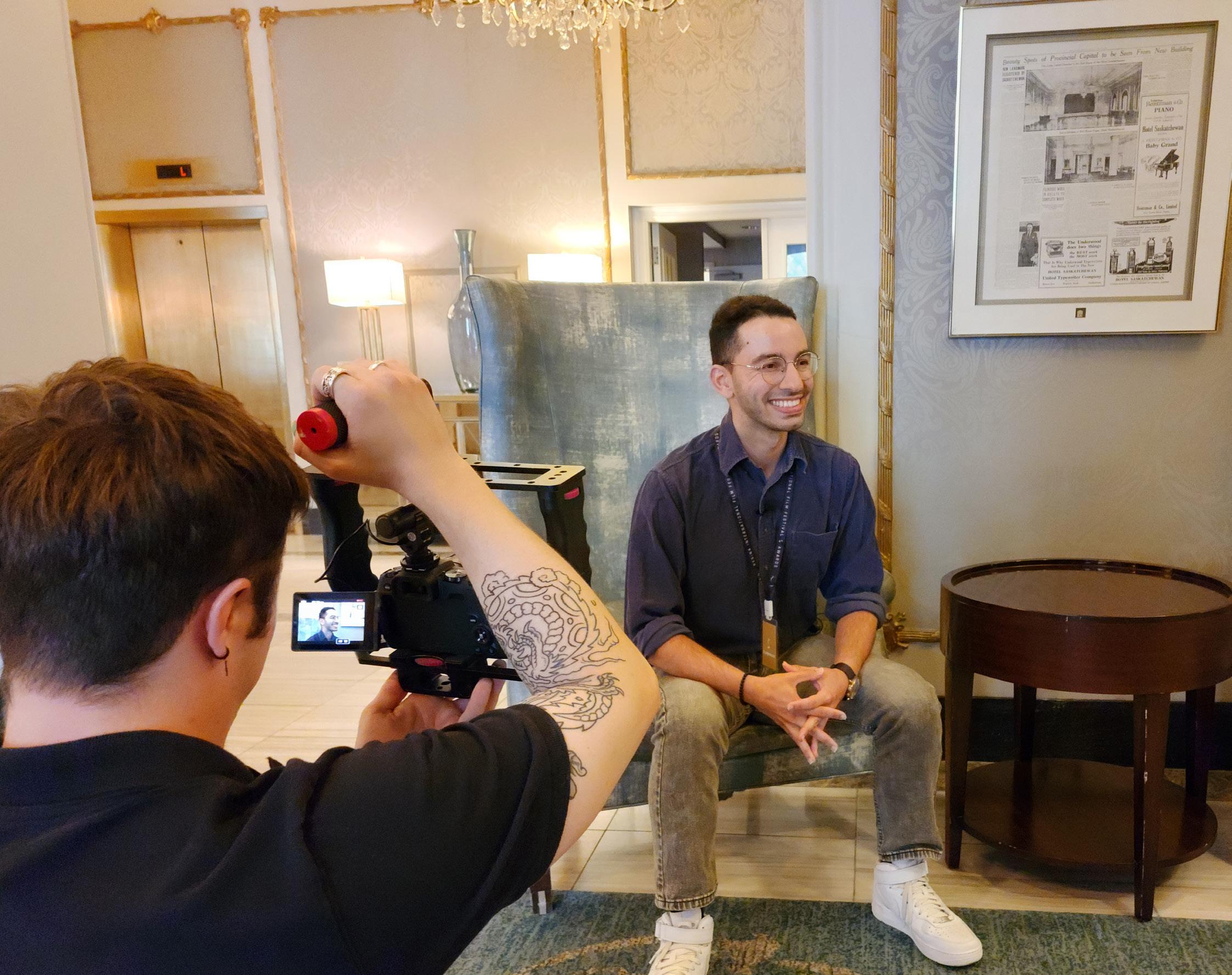
film production program I am enrolled in, but what I really want to talk about is the great opportunities provided by the Regina International Film Festival and Awards (RIFFA).
Every year, filmmakers across Canada – top film directors, actors, producers, and other industry leaders – come to Regina, Saskatchewan for the major event. It’s the place to be for any filmmaker.
After all I had heard about RIFFA, I really wanted to be involved with this festival. Ever since I came to Regina in 2021, I wished to attend a Canadian film festival as a filmmaker. Then, last year, I was invited to speak at the event by RIFFA Media Relations Manager, Amir Said.
Said has a large network of people in Regina to invite when it comes to film and arts. That’s why when he reached out to ask me to speak at one of the film screenings he organized, it was an honour. I felt honoured to have my work recognized by an international festival here in Canada, as I have been an artist and a filmmaker for my entire life.
year for RIFFA to raise awareness on serious international issues.
“Thanks to the Global Citizen film series, we put the international in Regina International Film Festival and Awards,” said Said.
Said had wanted to organize this first ever Global Citizen film series be-
in this country. I think many Canadian audiences take for granted a lot of issues they deal with because, believe me, there are some serious issues going on in the world. War. Famine. Disease outbreaks. The list goes on, and that’s what I wanted to showcase with my Global Citizen film series last
year.”
It was heartwarming to see that fellow immigrants like Said and the other organizers of the festival were also newcomers to Canada. As a first generation immigrant, I am always reassured when I learn the success stories of other immigrants such as myself. I am proud of my Persian blood, and I am proud to be a new Canadian as well.
“It’s just so important that new Canadians like us celebrate this country and our place here while keeping in touch with our ethnic backgrounds and heritage. I really do think Canada is the best country in the world, but I’ll never forget my roots,” said Said.
Said wanted me to speak at the event because he was familiar with my work and because he knew some of my life story. He knew that I had been a witness to many international issues all over the world such as war, censorship, and many other things. He had also seen me perform in Regina and was impressed with my performance and love for local arts.
I always had a vision as an international filmmaker trying to make an impact in Canada. To be invited to speak at a prestigious film festival like RIFFA was a great opportunity for me to make an impact. I had a vision, but it was truly mind blowing how fast I was able to achieve success in Canada. It shows hope for Canada and the international students like me.
RIFFA is giving international students a platform to speak about serious issues. I am honored that I was able to speak at the festival’s first Global Citizen event. I hope that more students will attend the festival this year to meet industry experts and leaders in filmmaking.
For me as a filmmaker and a student, I think that any student looking for more experience in film should look into the Regina International Film Festival & Awards as it is an amazing way to get some hands-on experience with film, and showcasing a film for a professional audience.
The 2024 film festival is happening August 20-24 in Regina, and anybody interested in film or looking for ways to get more involved can find more information at riffa.ca
“ RIFFA is giving international students a platform to speak about serious issues. I am honored that I was able to speak at the festival’s first Global Citizen event.”
Sepehr Rahmati