


to anarchist knitting, Sask. healthcare developments to a response op-ed, this issue is one of the most broad topics-wise that we’ve had the pleasure to publish this year. In no way are we finished with the unprecedented times that 2020 jumped humanity with, it’s obvious to most that we’re well into a longer period of needed social change, and the Carillon will continue to be committed to sharing its independent journalism as the pulse of the university.
If you’re a part of the University of Regina community and have been hoping to contribute written or visual content to our pages, please get in contact with one of our editors sooner than later!
Illegitimi non carborundum
holly funk editor-in-chief
the staff
editor-in-chief holly funk editor@carillonregina.com
executive director vacant business@carillonregina.com
production manager shae sackman production@carillonregina.com
communications amin malakootikhah comms@carillonregina.com
web + advertising manager jaedyn whittal web@carillonregina.com
graphics editor lee lim graphics@carillonregina.com
copy editor emilie wren copyeditor@carillonregina.com
news editor allister white news@carillonregina.com
a&c editor mikayla tallon arts@carillonregina.com
s&h editor kimberley kaufman sports@carillonregina.com
op-ed editor hammad ali op-ed@carillonregina.com
distribution manager amin malakootikhah distribution@carillonregina.com
staff writer victoria baht
staff writer nazeemah noorally
staff writer maren savarese knopf
news writer shivangi sharma
a&c writer will bright s&h writer pall agarwal
contributors william bessai-saul, jack j. nestor, uregina.sjp
board of directors holly funk, tayef ahmed, muhammad zuhruf muhammad zarooq, mohammad akib hossain, and mikayla tallon


the paper
227 Riddell Centre @ the University of Regina 3737 Wascana Parkway, Regina, SK, Canada S4S 0A2 www.carillonregina.com | (306) 586 8867
Printed by Star Press Inc, Wainwright, AB
The Carillon welcomes contributions.
Opinions expressed in the pages of the Carillon are entirely those of the author, and do not necessarily reflect those of The Carillon Newspaper Inc. Opinions expressed in advertisements appearing in the Carillon are those of the advertisers, and not necessarily of The Carillon Newspaper Inc. or its staff.
The Carillon is published no less than 11 times each semester during the fall and winter semesters and periodically throughout the summer. The Carillon is published by the Carillon Newspaper Inc., a non-profit organization.
land acknowledgement
The Carillon is written on Treaty 4 territory. As such, staff recognize that we are living, working, and telling stories on and of Indigenous lands. We recognize that we are on the traditional homelands of the Cree, Saulteaux, Nakota, Lakota, and Dakota peoples, along with the homeland of the Métis nation. The Carillon understands that it is pointless to acknowledge the land on which we work without demonstrating our commitment to telling stories and prioritizing voices that further the return of this land to its sacred place. the manifesto
In keeping with our reckless, devil-may-care image, our office has absolutely no concrete information on the Carillon’s formative years readily available. What follows is the story that’s been passed down from editor to editor for over sixty years.
In the late 1950s, the University of Regina planned the construction of several new buildings on the campus grounds. One of these proposed buildlings was a belltower on the academic green. If you look out on the academic green today, the first thing you’ll notice is that it has absolutely nothing resembling a belltower.
The University never got a belltower, but what it did get was the Carillon, a newspaper that serves as a symbolic bell tower on campus, a loud and clear voice belonging to each and every student. the people’s friend; the tyrant’s foe







shivangi sharma news writer
In a letter released by the Saskatchewan Green Party, the Conservative Party, and the Saskatchewan Progress Party on February 12, the three parties called on the provincial auditor to conduct an investigation into the performance of Communities of Tomorrow.
Communities of Tomorrow was, at one point, a gov-
emerging technologies and applications to sustainable community development as a “community environmental laboratory.”
Approximately $30 million were invested in the venture.
The initial focus of Communities of Tomorrow was to coordinate with the City of Regina and researchers at the U of R while focusing on innovative practices in municipal water management.
Communities of Tomorrow was supposed to also investigate and promote further municipal
chives, there was activity in July 2023 even though the organization ceased operations a decade earlier.
This activity prompted demands by the coalition for an audit into the operation in order to account for taxpayer funds that it received.
“What exactly was this entity?” asked Saskatchewan Progress Party official agent Michael Medby. “At least [$34 million] of taxpayers’ money was funnelled through Communities of
munities of Tomorrow was created to help fund the study of asbestos cement water pipes. Those studies referred to asbestos fibres in the water as a health concern. Communities of Tomorrow is gone. The Research Centre at the [U of R] is gone. The only thing left is a lot of old asbestos cement water pipes,” stated Hunter.
The coalition hoped that the provincial auditor would look into the use of taxpayer funds, particularly as taxpayers ought to know how public money was uti-
the provincial auditor announced that it would not perform an audit on the public-private organization.
The auditor’s office claimed that their mandate “does not include assessing the appropriateness of government’s policy decisions,” but that rather, they “focus on the government’s administration of public policy.”
The claim that the auditor’s office makes with this is that they “do not see significant risks around public money being pro-

“We have seen some money-losing fiascos in this province. This could turn out to be the topper.”

Rose Buscholl
ernment-industry research incubator. It ceased operations in 2013. The coalition of unelected parties asked for transparency and accountability regarding the funding that Communities of Tomorrow received while it was still active.
Communities of Tomorrow was a public-private partnership incepted in 2003 with the aim of becoming the new National Research Council of Canada (NRC) centre in Regina.
In a press release in May of 2003, Public Works and Government Services Minister Ralph Goodale – on behalf of Industry
Minister Allan Rock, Saskatchewan Premier Lorne Calvert, Regina Mayor Pat Fiacco, NRC
President Arthur Carty and the University of Regina (U of R) President David Barnard – announced that the venture would focus on testing and assessing the applicability of existing, new, and
sustainability initiatives that the City of Regina had emphasized, including waste management, energy conservation, and affordable housing.
“The establishment of this research centre in Regina will position our city as a recognized world leader in the area of sustainable municipal development,” former mayor Pat Fiacco said.
The organization published ten papers on asbestos cement water pipes during its operating period. It eventually formed a partnership with the Saskatchewan Urban Municipalities Association (SUMA) in January 2013.
Communities of Tomorrow shut down only five months after entering into its partnership with SUMA.
In the statement released by the coalition it was highlighted that, according to the Communities of Tomorrow website ar-
Tomorrow. What benefit did we receive?” he pressed. Progressive Conservative Party Leader Rose Buscholl agreed, adding that “We have seen some money-losing fiascos in this province. This could turn out to be the topper.”
“The plan was to have a permanent [NRC] presence in Regina. The research centre is long gone. Communities of Tomorrow is gone. This feels like the old shell game, and Saskatchewan taxpayers are the big losers,” said Saskatchewan Green Party Leader, Naomi Hunter.
A June 2013 SUMA news release claimed that the organization would house a variety of important documents created by Communities of Tomorrow. There is no mention on the SUMA website of studies undertaken by Communities of Tomorrow related to asbestos cement water pipes.
“Let me be very clear. Com-
lized. Taxpayers also deserve to know what benefit they received in exchange for the investment of millions of dollars into a venture such as Communities of Tomorrow.
Progressive Conservative Party Leader Rose Buscholl also claimed that both the Saskatchewan Party and the New Democratic Party (NDP) have been aware of this issue for decades and have done nothing about it.
“It’s time to get to the bottom of this issue, and solve it so it never happens again,” she said.
“It’s time Saskatchewan taxpayers got some answers about Communities of Tomorrow, what appears to be a failed plan to turn the province into an innovative infrastructure powerhouse,” the demand read.
The coalition’s demand for an audit was denied by the provincial auditor. On February 18,
vided by the provincial government as a portion of the partnership back in 2003 and not being used for the purposes intended.”
The coalition was “bitterly disappointed” by the auditor’s decision to not investigate the Communities of Tomorrow.
The decision not to look into Communities of Tomorrow “means Saskatchewan taxpayers may never know how $34 million in public money was spent, and why nothing was ever done about old asbestos cement water pipes.”
“What could possibly be more important than reports saying the water pipes that people are using might cause cancer?” questioned Naomi Hunter.
The decision is “an issue of transparency and accountability,” according to Rose Buscholl. “Taxpayers shelled out at least $34 million to find solutions, and all we got was a word salad.”
allister white news editor
In December 2022, amidst a whirlwind of concern about toxic culture and harassment which the Carillon covered previously, the University of Regina (U of R)’s School of Journalism (J-School) suspended admissions citing a reduction of core faculty and the need for an undated curriculum as reasons for the closure.
In January 2023, shortly after the suspension of admissions, Gennadiy Chernov, the Department Head of the Journalism School spoke to the Carillon, stressing that “the reason for the suspension is based on academic grounds.”
Chernov’s claim is contradictory to previous correspondence that the Carillon had in early 2023 with Shannon Dea, the Dean of Arts, who explained that one of the factors leading to the closure was to “provide an opportunity to evaluate the School’s climate in order to ensure that the J-School is a safe and supportive place to learn and to work.”
Currently admitted students continued their studies. However, course options for those students were limited. The J-school also cancelled two courses after it was unable to find what it called “suitable applicants” to teach them. According to CBC, a spokesperson from the University of Regina Students’ Union expressed disappointment at the news.
CBC also reported that a
2018-19 review of the J-School found that it needed an updated curriculum in order to maintain relevancy with increases in digital journalism. A 2020 business plan, implemented after the 2018-19 review of the school, listed five priorities including increasing enrolment, improving the curriculum, expanding into communications, and implementing a core Indigenous curriculum.
Now, the Faculty of Arts has announced that “Journalism at the U of R is back, better than ever.” The announcement, in light of previous concerns about school culture, begs the question – is Journalism back, better than ever?
In a classroom discussion in a JRN 100 class, Chernov claimed that the school’s response to what he calls “rumours” and “discussions” that took place when the program closed, is action – that the J-School will prove them correct or incorrect with time. When questioned about concerns of toxic culture, Chernov claimed that “some of the students… wrote to the Carillon…I understand their feelings at that point, that was a very shocking period,” and went on to explain that it was a period of high-stress for everyone.
Now, Chernov claims the students are focused on their studies and the completion of their degrees, and that “they get what they want from the program.” Current students have reached out to the Carillon to express disagreement with Chernov’s insis-


tence to potential students that all students currently studying in the J-School are satisfied.
In what might be an attempt to increase enrolment, the program no longer requires two years of study in pre-journalism or an application into the J-School. There will no longer be a portfolio required to gain admission to the J-School. According to arts student services, “the Pre-Journalism program will be phased out effective May 1, 2024.” Direct student transfers for those in Pre-Journalism will be facilitated into the J-School’s new program–Bachelor of Arts in Journalism, News Media, and Communication on May 1, 2024.
Chernov also spoke of an upward trend in communications job numbers as motivators for the curriculum update. Despite there still being jobs in journal-
ism, there are far more prospects within communications and public relations. Discussing this trend, Chernov stressed that as a school, “we have to acknowledge it.”
The program now offers more flexibility— students can specialize in journalism or they can choose to specialize in communications. Regardless, Students in the program “will need to take at least two communications classes.”
The J-School also claims it is attempting to expand paid internship opportunities to include paid 13-week internships in communications. Prior to the shift, many of the Bachelor’s of Journalism internships were in communications regardless. This came before the new program’s offer for students to specialize in communications.
Pre-Journalism student Jor-
Domotor removed from Sask. party caucus, stripped of appointments
MLA Ryan Domotor, previously a member of the Saskatchewan Party, was arrested on Nov 16, 2023 for sex solicitation.
His arrest came following an investigation conducted by the Regina Police Service between November 14 and November 16. The investigation targeted sexual exploitation and human traffick-
ing in the city. All in all, 16 individuals were arrested including Domotor.
The Saskatchewan Party was swift in their response to the situation. According to an email released by the province’s current government, Domotor was removed from the Saskatchewan Party caucus. By Nov 17, the day

following his arrest, Domotor was stripped of all government appointments and responsibilities including his appointment to the cabinet economy committee.
At the time of Domotor’s arrest, Premier Scott Moe stressed that there is “ absolutely no place in our government, nor frankly in the assembly, for someone who has been charged with such a crime.”
The first court hearing in the Domotor case took place on Jan 4, 2024. Domotor was absent during the first hearing of the case. He was represented in court by Darren Kraushaar, a lawyer from McDougall Gauley LLP. Kraushaar claimed that he and his client were seeking referral to an alternative measure program to settle the matter and hoped to avoid a criminal court process.
Alternative measures are available for non-violent criminals in Saskatchewan and are essentially out-of-court methods of settlement via mediation.
The next, and final, hearing of the case was scheduled for Feb 1, 2024. Domotor, who was once again not present during the hearing, was represented by Lawyer Darren Kraushaar. Following
the hearing, the criminal charges against the MLA were stayed without a resolution of guilt or innocence.
A stayed charge can be reactivated within a year. After a year, the Criminal Code of Canada deems that proceedings never commenced.
Crown prosecutor Carmody Hallamore said that given the non-violent nature of the charges, Domotor was referred to the program through Regina Family Services.
Prosecutor Hallamore also made clear that there are a variety of considerations made to determine eligibility for alternative measures. There are also many factors that contribute to the final decision. These include the severity of the charges, past criminal record, or history of similar offences.
In his comment about the case Kraushaar claimed that this “is a common result involving an accused facing this type of allegation for the first time.”
Situations such as Domotor’s sex-solicitation charge are sensitive and should ideally be handled with great caution, especially in cases where public representa-
dan Sargeant explained her thoughts on the changes, particularly on the removal of portfolio requirements. “I feel that a portfolio being required would force students into putting themselves out there. […] Without it there is less of an incentive to go and try new things,” Sergeant stated. Sergeant also took a critical look at the changes. Despite being glad that there was more freedom in the pre-requisites, Sergeant says she’s curious as to why some of the choices were made.
The U of R’s new Bachelor of Arts in Journalism, News Media, and Communication is being launched at the same time as First Nations University of Canada launches degrees and post-degree programs in Indigenous Journalism and Indigenous Communication Arts.
tives are accused. Any action that could lead to or encourage sexual exploitation and human trafficking should be condemned with the appropriate amount of severity. Whether the crown’s verdict is stringent enough is a subject of much contemplation.
Domotor was elected to the Legislative Assembly of Saskatchewan in the October 2020 provincial election as a representative of Cut Knife-Turtleford. According to the Legislative Assembly of Saskatchewan, he served 12 years on the town of Turtleford Council and 17 years as the area coroner. It is also interesting to note that the MLA received a certificate in Local Government Legislation in 1993 from the University of Regina, making him a U of R alumnus.
He continues to represent the electoral district of Cut Knife-Turtleford as an independent, and currently resides with his wife and two sons in Turtleford where he has lived for 29 years.
victoria baht staff writer
The City of Regina has been working towards making recreation facilities and programs more accessible in Regina. The Carillon recently spoke with Courtney Domoney who works in inclusion programs through the City of Regina.
Over the last couple of years, accessible programs and areas have grown in Regina. “We have an adaptive recreation plan that the city is working towards completing. […] This plan is specific to [ensure] there are recreation opportunities for people who may experience a disability,” explained Domoney. “We also have a general recreation plan that speaks to focusing on recreational activities for all City of Regina residents regardless of their abilities. These two documents guide our decision-making to ensure there are opportunities for everyone.”
The City of Regina plans activities all year round. “We try to respond to a wide variety of ages and interest levels,” Domoney said. While the city ensures these programs are an option, they also try to ensure that they are accessible, looking at things such as cost, staff training, and on-site equipment.
One example of programming that the City of Regina provides is a sensory-friendly pro-
gram, Domoney explains. “We try and run this program when not as many things are running in the facility so there are no extra loud noises. We also try and have a room where we can control the lighting. We try and think of the barriers ahead of time and try to eliminate as many as possible for the specific population we are trying to target our program for,” Domoney stressed.
Much of a successful and accessible program comes from planning and design. As Domoney explained, the City of Regina tries to “design programs to be as accessible as possible, right off the bat.”
The City of Regina also tries to help the programs run smoothly and ensures they have the assistance they need by offering annual training to staff, providing specific education for all abilities. The city has also worked with community organizations such as Creative Options Regina and Regina Pride to help with accessibility and community awareness.
Domoney, when speaking with the Carillon, explained that the primary goal is “to create places and spaces where people can feel welcomed to participate in a meaningful way. If that means you want to play by yourself, play with others and make friends, or participate as families, we have options that are open for everyone.”
These programs, places, and
TUESDAY


spaces created by the City of Regina included February’s Family Week pop-up events and plan to have more events take place in the summer, involved in city parks and being active in outdoor spaces. If you are looking for additional information on where to find programs, spaces, areas, and classes that the City of Regina hosts, you can find answers at re-
WEDNESDAY
am Living Planet 9 – 9:30 am (spoken-word) Environmental stories from around the globe
Science Unscripted 9:30 – 10 am (spoken-word) Chinese Connection 10 – 11 am (spoken-word) Get Chatty With Kathy
11 – 11:30 am (spoken-word)
A mixed bag of topics
Muzyka Ukraine 11:30 am – 12:30 pm
WINGS
12:30 – 1 pm (spoken-word)
Raising women’s voices through radio
Scotland Calling 1 – 3 pm
Mists of Thyme (repeat)
THURSDAY
Daebak! (repeat) 5 – 7 am
gina.ca/recreations, where an online version of their leisure guide exists.
The City of Regina Leisure Guide lists some programs with a red “AP,” the Adapted Program logo. These programs are, according to the City of Regina, “intended to be used as stepping stones to inclusion and focus on individuals’ unique needs.” Adapted programs in the city
FRIDAY
include an adapted leisure swim, as well as swimming lessons, art programs, sport and fitness programs such as soccer, and even social programs which include community outings. More information can be found on pages 31-32 of the Winter/Spring 2024 leisure guide.
8 – 9 pm Chillwave, indie rock and more Synesthesia
10 – 11 pm
Manatee
pm – 12 am Phil’s Overnight Jam 12 – 5 am
Navaye Ashena (repeat) 5 – 6 am (spoken-word)
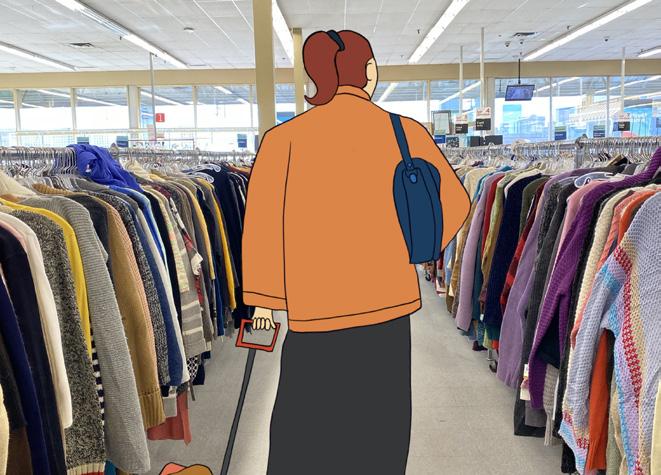
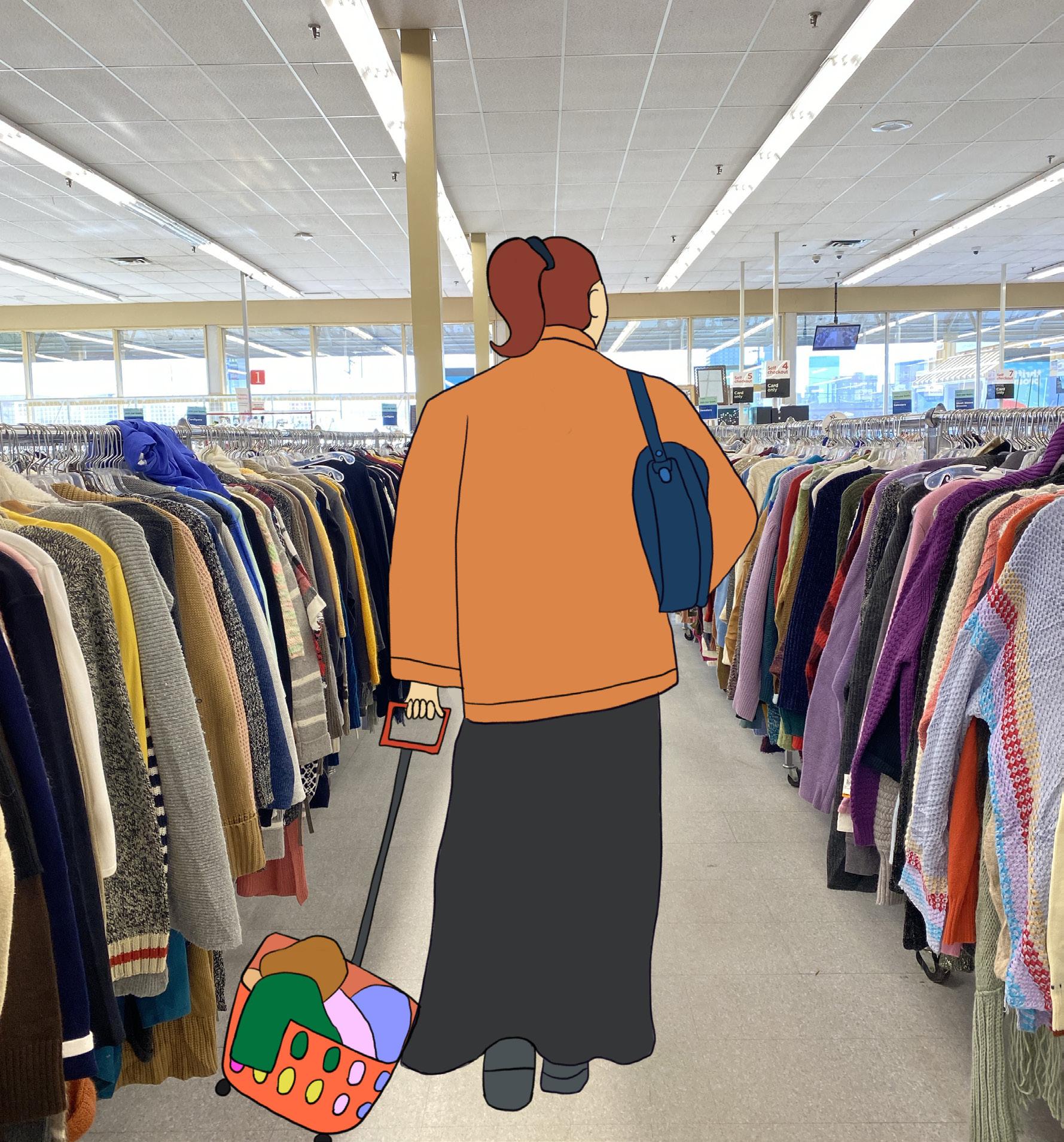
This might come as a shocker, but thrift shopping as frequently as you get groceries isn’t practicing sustainability.
With the rise of microtrends and the recent surge of thrifting, one might wonder how sustainable this is at the end of the day. Before you boo and throw tomatoes, allow me to take you on a rollercoaster ride and explore the exploitative cycle of capitalism.
If you think trends usually
biecore, Mob Wife, Tomato Girl, and more have popped up on our For You pages. Let’s look at the Coquette aesthetic that Pinterest reports to have risen in search popularity back in 2021. Its mood board consists of ribbons, mini skirts, lace blouses and knitted stockings, which in 2024 is currently being replaced by the Mob Wife aesthetic of smokey eye makeup, fur coats, chunky gold jewelry, and big hair.
It is best to note that a majority of fashion trends are usually a result of retaliation against the era’s norms or as a political move-
“ Microtrends are preyed on by companies that are able to keep up with consumer demands and, in return, propagate what they want people to demand.”

lee lim
come and go fast, meet its cousin: microtrends. Microtrends differ from trends because of their quick progression, short life, and inability to last a full season.
An example of this dichotomy can be seen with how trends circulate and follow a pattern like jeans and the comeback of bell bottoms, or how low-rise jeans can be traced back to past eras in fashion like the 70s disco scene and the early 2000s. Microtrends are able to take certain elements from trends, but the hallmark feature is that they lose momentum quickly. As we’ve seen on TikTok, which is a hotbed for certain “cores” or aesthetics one can align their identity, lifestyle, and clothing to.
Recently, microtrends such as Y2K aesthetic, Quiet Luxury, Clean Girl, Gorpcore, Bar-
sume in large quantities that most likely end up outside the global West and dumped into their thrift stores or landfills.
Microtrends are preyed on by companies that are able to keep up with consumer demands and, in return, propagate what they want people to demand. They are able to contribute to the rise of microtrends because of partnerships with influencers that push content to us without it coming off as your usual brand advertisement.
Consumers can relate to content creators that might look like
just vintage pieces anymore, but a fusion consisting of fast fashion and curated style identities. It means acknowledging that our fast-paced consumerism is not just a result, but a contributor to the fast-paced production of trends and clothes.
While thrifting might be the more sustainable and ethical option, let’s explore how this can be falsified. Thrift stores did not only exist to resell discounted items for low-income communities to have access to, but were also the solution to the growing overproduction of textile waste due to
derstood is that overconsumption needs to be nipped in the bud. Simply thrifting doesn’t solve the growing overproduction of clothes, nor does it stop big corporations from making profit off of people’s suffering.
We should be challenging the purpose of our thrifting to begin to curb our overconsumption. We should ask ourselves if we are thrifting to curate a whole new trendy wardrobe or because we truly need new clothes?
ment. While microtrends can be argued to do the same, it begins to lack authenticity once brands are able to exploit and sell the “lifestyle” that supposedly comes with buying an article of clothing.
Let me give you a simple equation. “Bayonetta” glasses + pencil skirt + sharp eyeliner = Office Siren. In an interview with Who What Wear, TikToker Beauville says, “The woman who represents [this office siren] has ambition, likes to assume her sensuality and femininity, and doesn’t care about judgment. She proves herself through her actions.”
Meaning not only can we buy a specific combination of clothes to portray personal style, we can also buy it to signal virtues.
If you’re unfamiliar with what capitalism breeds in fashion, it produces more things to con-

them – otherwise known as micro-influencers – and not a wellknown celebrity. Not only do we feel like we are watching someone deserving of our trust, but they open a whole new community for us to be a part of and eventually adapt the marketed style identity into being part of the community.
However, it becomes an exploitative relationship since big companies can gain profit by looking at what is on the rise through social media and open new markets while paying less to advertise with content creators. This causes mass production of clothing that is often done cheaply and unethically, exploiting both workers and consumers.
What does this mean for avid thrifters? It means recognizing what is being sold on the local aisles of our thrift stores aren’t
the rise of consumerism lifestyle during the industrial revolution.
With the introduction of fast fashion, which is further exacerbated by microtrends, we are seeing it make its way in thrift stores, being rebranded as slow fashion. In recent years, thrift stores are being commodified to cater to wealthier groups and their message of frugality or saving the planet disappears.
The rise of thrifting has changed the buyer’s attitude from thrifting for necessity to thrifting for paying less and getting more. It has also introduced the idea that we can change our entire wardrobe by donating last season’s and purchasing what’s new.
If we really are looking for a solution within ourselves to combat global warming or to simply save money, what needs to be un-
Another antidote to overconsumption comes from building your personal style and knowing your likes or dislikes. It’s normal to fall into trends, but start asking yourself: do I see myself wearing this after the trend has died down? Am I able to pair this with the existing clothes in my closet? What stands out to me about this piece?
Another tip is to thrift with the intent of finding a specific item. Not only does this decrease your time sifting through racks, but you also don’t end up buying more than what you came for. Lastly, perhaps the most no-brainer tip is to exercise the three R’s (reduce, reuse, recycle) and enjoy what you already have! A major point of thrifting is to practice sustainability, and it will be a disservice to the movement if it is overshadowed by our need to have everything and more.
Not revealing that you’re advertising something is illegal
will bright a&c writer
Have you ever heard of Bloom Nutrition?
Maybe you don’t know the name, but you know what it looks like.
Picture this: a woman standing at a counter wearing athleisure, Lululemon probably. There’s a song playing in the background while she dumps a green powder the color of algae into a glass of water before mixing it together with a milk frother.
Her caption reads #bloompartner.
Had you been scrolling through social media, you would have just been shown an adver-
many words and b) it’s a text-only platform.
With TikTok’s recent upgrade to 2,200 character limits in captions, it’s no longer space-limited. If an ad is in a video, like on TikTok, the disclosure has to be on-screen long enough for people to see and read it.
One more time for a really important detail in there: if given a product for free, they must disclose that.
What about those paid partnership tags you can add on TikTok or Instagram? Do those count as proper disclosure? Nope! It still needs to be in your TikTok post either audibly, visibly, or both, or clearly in your Instagram caption.
Disclosure is also required
they would pay her for it. Another influencer, @judyhoppsl0vr69, shared a video in which he posted a screenshot of an email he got from Bloom saying that if he “incorporate[d] [their] superfood greens powder into [his] daily videos” he would get free product and a paid commission.
A lot of popular creators are not disclosing their Bloom advertisements, including popular chef Tini, Spencer Barbosa, Grandma Droniak, Alix Earle, Sarah Klait, Hailee and Kendra, among many others. If you see a rogue container of Bloom in a video, odds are the creator was paid to have Bloom there and isn’t telling you that.
Bloom partners aren’t the only TikTokers failing to disclose.


tisement without being told it was an advertisement.
This is called failure to disclose an advertisement and it is illegal.
In the United States, the group in charge of setting laws for advertising is the Federal Trade Commission (FTC). According to the FTC, “Required disclosures must be clear and conspicuous.”
Disclosure means explaining a situation that people may be unaware of.
Within that, if a creator or influencer has any financial relationship with a company, they must disclose that. Even if they were given the product for free, they must disclose.
This has to be done in the video, not just in the caption. People can only disclose solely using a partner hashtag in the caption if a) it is a space-limited platform like X where you only have so
here in Canada, according to Ad Standards. The Canadian Code of Advertising Standards states as much: “No advertisement shall be presented in a format or style that conceals the fact that it is an advertisement.” What does that mean for TikTok influencers who use #bloompartner in their captions? It means they aren’t properly disclosing advertisements and it’s a big problem on the platform.
If you don’t believe me, the FTC even sent out letters in November of 2023 to TikTok dieticians, many of whom promoted Bloom Nutrition using #bloompartner, telling them to start properly disclosing paid ads.
Influencer @michellebellexo stated in a video back in May of 2023 that Bloom asked her to just have the product somewhere in her video, telling her she didn’t have to talk about it at all, and
Awards. Within a few hours, the official TikTok account of Sydney posted an itinerary for Olsen since he was going to Sydney for “no reason” and had “nothing to do.”
Alice, who works in marketing, noted that it takes a lot longer than a few hours for a company like City of Sydney to make a social media post. The only way they would have had that time is if they knew Olsen was coming.
WAToday, an Australian news site, confirmed that Tourism Australia spent $90,000 to fly out three TikTokers for a trip.
Olsen was paid at least $30,000 for a video viewed over 34 million times. Tourism Australia stated they told the influencers to disclose the advertisement, yet none of them did.
ple. She does it for money. All the items she uses can be found in the link in her bio linking to her Amazon storefront. She gets paid simply for clicking the link. She gets paid when things from her storefront are bought to try and match her lifestyle. But, Venkov doesn’t tell you that.
According to both Amazon and the FTC, anyone sharing Amazon Affiliate links needs to say, somewhere easily viewable, that they are paid when anyone clicks their links or buys something on their storefront.
But, when you watch Venkov’s video with 10 million views, she has a whooping 23 hashtags in her caption along with the phrase, “Will link containers on my amazon [sic].” Not one of her
“ TikTok influencers actively go against FTC guidelines in their advertisements and make money by deceiving their audience about their intentions.”
Will Bright
Chris Olsen is huge on TikTok. With 12 million followers, he’s everywhere. Every red carpet, every Megan Trainor TikTok, everywhere
He doesn’t disclose ads.
On November 30, he posted a TikTok saying, “GOING WHEREVER THIS FILTER LANDS ON:” and the filter popped up as Sydney, Australia. He freaked out about going to Sydney so spontaneously. Throughout the entire one minute and 20 second video, he panics about going to Sydney, saying he’s questioning his life choices and banging his head against a wall.
TikTokker @aliceisgratified noticed a few things that seemed off about Olsen suddenly going to Australia and it not seeming so sudden.
Within a few days of Olsen’s post was the Australian TikTok
Olsen was told to disclose and didn’t. He led his audience to believe he took an impromptu trip across the world for no good reason when he was paid for it.
Moving on, have you ever seen those ‘aesthetic’ restocking videos where people remove grocery items from original containers into new, carefully curated containers? Or when they create tens of different kinds of ice specifically for the ice drawer in their freezer?
Some make money off that and don’t tell you.
For example, Kelsey Venkov has a video on her channel with 12 million views where she reorganizes her completely empty fridge. For starters, why is her fridge completely empty with nothing in it? She’s trying to sell you a lifestyle of perfection, aesthetics, and organization. One that is unreasonable for most peo-
hashtags is an affiliate disclosure, and, even if it was, it still wouldn’t comply with FTC guidelines from being so hidden in other hashtags.
Only when you click on her Amazon Storefront does it say, “Earns Commissions,” but Venkov didn’t put that there, Amazon did.
TikTok influencers actively go against FTC guidelines in their advertisements and make money by deceiving their audience about their intentions.
Beware of Bloom Nutrition, it’s probably an ad. Beware of restocking and organization videos, they try to get you to buy what they use so they can earn money. Beware videos from big TikTokers that seem like strange decisions, they probably got paid for it.
If you want to be an influencer, remember to disclose your ads.
maren savarese knopf staff writer
Have you heard the statement “you probably work more than a medieval peasant” muttered recently? Or perhaps the claim that medieval peasants worked only about 150 days in a year?
Well, in 1991, the book The Overworked American: The Unexpected Decline of Leisure was published by economist Juliet Schor and attempted to explore similar statements. The book explores and provides an overview of the changing labour standards from
urally assume that the average medieval person living under kingship and feudalism were financially worse off than the average North American today. However, evidence might suggest that the average medieval peasant lived with significantly less debt and expenses than we do today.
In modern day times the largest expense that any of us incur is likely to be related to housing. Recent data shows that the average Canadian is spending up to 45.9 per cent of their income to meet housing costs. This number, of course, fluctuates depending on locality.
provided with housing, though the option for home ownership was rendered impossible. To be fair, medieval life was short and well-documented in its difficulties.
Around 85 per cent of medieval people belonged to the peasant class which included serfs (those legally tied to land they worked) and freemen. However, because of the medieval system there is evidence to suggest that the average medieval citizen was less likely to experience or be at risk of experiencing houselessness. This, of course, must be taken with a grain of salt.
Moreover, debt was also
ed in the Code of Hammurabi. The Code was engraved almost 4,000 years ago and is now located in the Louvre Museum. It states, “the creditor may not take barley from the debtors house without his consent.”
Within Graeber’s work he details how debt has become a staple and underpinning truth to our modern-day society. In that, debt exists, and it serves in the continuation of daily life. However, debt didn’t always function this way.
In fact, there are many cases in which debt did not exist. Famously quoted Benjamin Frank-

peasantry to modern day America.
Within Schor’s text it is suggested that the average 13th-century English peasant worked approximately 1,620 hours per year, or 67.5 days. The estimates on medieval work hours range based on position and time period. The lowest is estimated to be 1,440 hours for the equivalency of a 14th-century “casual labourer” to a high of 2,309 hours for an “English worker, Medieval period.”
Medieval labour and life largely revolved around agrarianism and the agrarian calendar, one that follows the sun. This means work activity in their main ‘jobs,’ as we would understand it in modern day terms, is suggested to have slowed during the winter months though it’s claimed that peasants weren’t simply sitting around doing nothing during the off season.
In fact, contemporary artwork depicts peasants performing a variety of tasks during the winter. Moreover, the presence of ‘folk arts’ suggests that the average person or household might have spent a significant amount of time invested in creative practices.
Now, most of us might nat-
In city centers such as Vancouver or the Greater Toronto Area, this number might be anywhere between 72-79.7 per cent of household income. Similar data from 2022 shows that the
“
handled differently. In his book
The First 5,000 Years of Debt, Anthropologist David Graeber seeks to explore the ways in which the idea of debt has taken over people’s imagination and morality in
lin states, “there is nothing certain in life but death and taxes,” which Graeber believes is not true.
According to Graeber, it’s only death that’s certain since not all societies taxed themselves
our morality because of its usefulness as a concept to control social relations. “Debt is the most effective way to take a relation of violent subordination and make the victims feel that it’s their fault.”
The example of medieval peasant revolts was used and rather than the revolts being concerned with issues that you might have guessed – serfdom, etc. –Graeber claims that they were always about debt.
Moses Finley, a classist, explains that there was basically one revolutionary program throughout antiquity: dissolve debt and redistribute land. A truth that Graeber claims remains true throughout history.
Today debt is a normalized facet of life. It is almost a naturalized assumption that you will, at some point, accrue some measure of debt. There are ‘good debts,’ like a mortgage or student loans, while some debts are ‘bad,’ like credit card debt.
The good and bad debt in itself is a type of moralizing. While bad debt might indicate someone reckless and immoral in their spending, good debt signifies a level of success. Ultimately, it is the goal to achieve ‘good debt,’ but the expectation remains the same – in one way or another you will have debt.
In 2023, Canada made international news when its debt load became the highest of all G7 countries. In fact, the average Canadian at the end of 2020 owed approximately $72,950 in debt –a number that excluded mortgages. This number surpasses the average income of full-time salaried Canadians, who make approximately $54,630 per year. Moreover, the average student loan debt is estimated to be $28,000. Today we work more and we owe more. To reflect on this, I suggest we return to the words of Graeber, who claims: “If history shows anything, it is that there’s no better way to justify relations founded on violence, to make
If history shows anything, it is that there’s no better way to justify relations founded on violence, to make such relations seem moral, than by reframing them in the language of debt – above all, because it immediately makes it seem that it’s the victim who’s doing something wrong.”
average American household spends one third of their income on housing. However, this number increased for younger generations, like millennials and Gen Z.
Unlike the modern-day citizen most medieval workers were
such a way that morality itself becomes a matter of “paying one’s debts.” Wherein a stand-up person “always pays their debts.”
The concept of debt is ageold. In fact, the oldest known legal text that mentions debt is cit-
or accrued social debt. Rather, in some cases where debt was accrued, kings could and would wipe clean the debt of society in certain instances.
According to Graeber, debt has held a prominent position in
David Graeber
such relations seem moral, than by reframing them in the language of debt – above all, because it immediately makes it seem that it’s the victim who’s doing something wrong.”
will bright a&c writer
Last time we chatted about Ruby Franke, Jodi Hildebrant, and ConneXions was in late September of 2023. Since then, a lot has happened, including for Franke and Hildebrandt.
To recap, Ruby Franke is a 42-year-old woman who used to run a family vlog channel called 8 Passengers with her husband Kevin. The channel ran from 2015 to 2022.
Ruby and Kevin Franke share six children together. Two adult children: 20-year-old Shari and 19-year-old Chad, as well as four minor children who will only be referred to as their initials in this article, 16-year-old AF, 15-year-old JF, 12-year-old RF, and 10-year-old EF. Ruby and Kevin are 42- and 45-years-old respectively.
During the end of the channel’s life and following its death, Franke ran an online parenting advice group called ConneXions with a woman named Jodi Hildebrandt. Hildebrandt started her career as a porn addiction therapist working under the Mormon Church before she started ConneXions.
In mid-December of 2023, Franke and Hildebrandt pled guilty as part of a plea deal with the State of Utah. Franke pled guilty to four counts of aggravated child abuse, a second degree felony that comes with 1-15 years
in a Utah State Prison and a series of fines including $10,000, a 90 per cent surcharge, and court security fees costing $53.
Aggravated child abuse in the second degree states that the perpetrator “intentionally or knowingly, inflicted upon a child serious physical injury or, having the care or custody of such child,
boxes up and down stairs.
While working outside, he had to stand in direct sunlight with no heat protection, causing his skin to blister. While he worked he was not allowed water and, if he secretly had water, he was punished.
He rarely got sufficient food and the food he did get was things
were covered in duct tape and the bindings put back on. During this period, RF was 11-12 years old. He was waterboarded by Franke as well as kicked, and had his oxygen cut off.
While RF was experiencing all of that abuse, he was told he was evil and possessed. That what was happening to him was

caused or permitted another to inflict serious physical injury upon said child.”
It was in this plea deal that a large amount of information regarding Franke’s actions toward her children were revealed. RF had to do physical labor for days on end including wall-sits, working outdoors in the Utah summer heat with no shoes, and carrying
like rice and chicken when everyone else in the house got proper meals. He had no access to other people or any sort of entertainment.
Prior to RF’s successful escape in August after trying to escape in July, he was often bound hand and foot with handcuffs and rope. When the bindings cut through the skin, the injuries
because it was needed for him to be able to repent and if he only obeyed, he wouldn’t be punished.
EF suffered similarly to her older brother RF. She wasn’t waterboarded or kicked, didn’t have her oxygen cut off, nor was she bound, but she suffered the same exhaustive physical labor and inability to access food and water. EF was nine-years-old during this period.
What is anarchist knitting, why is it important?
Last year I wrote a list of resolutions for the new year. On that list was “knit a sweater.” At the time I knew nothing about knitting other than the words “knit” and “pearl.”
Every year I like to write myself a list of resolutions – very original, I know. However, what’s different about my resolutions is that they are never goals meant to measure my success over the year but rather they are creative acts that I’d like to try.
Since writing my resolution to knit a sweater, I have accomplished this feat. In fact, I’ve knit over 10 sweaters in a style and methodology that I have coined “anarchist knitting.”
In principle, anarchism refers to a social and political theory that calls for a replacement of government rule and/or existing social systems with a system of self government and social systems of self definition. So, what’s the connection with knitting, you may be asking yourself.
Well, I stumbled across the answer through my own stubbornness and I have decided I am willing to share. You see, I have never been one for rules. In fact, where I can, I like to reject them in favour of doing my own thing.
This is kind of the basis for
anarchist knitting. Instead of following patterns, guidelines and ‘rules’ about how to use yarn, what type, with what needles, etc., anarchist knitting reimagines the possibilities.
I’ve never read a pattern. I likely never will. That’s not to say patterns aren’t useful and knitters who make and use patterns are knitting the wrong way. On the contrary, anarchist knitting suggests that there is no right or
Hildebrandt’s plea deal had no notable differences.
On February 20, Franke was sentenced. She was given four 1-15 year sentences that would be served consecutively, meaning she would serve 4-60 years in prison for her child abuse.
But, because of a law specific to Utah, consecutive sentences cannot extend more than 30 years, so Franke will spend 4-30 years in a Utah State Prison. Hildebrandt received the same sentence.
During the sentencing hearing, Franke stated, “For the past four years, I’ve chosen to follow counsel and guidance that has led me into a dark delusion. My distorted version of reality went largely unchecked as I would isolate from anyone who challenged me.”
For those who knew of ConneXions before the arrest, you would know that the main principle of ConneXions was that everyone lived in distortion and had to be removed from it, but in Franke’s own words, she was the one living in distortion.
It is unclear where the minor children are now, though one of Franke’s sisters has stated that they are safe. Kevin Franke is reportedly attempting to regain custody of all four children and has officially filed for guardianship of AF.
wrong way to knit.
When I pick up a size US12 needle and use an ultra thin yarn – that’s anarchist knitting. I have chosen not to use the needle that patterns and guidelines would tell me I should in favour of reimagining how to make a sweater and what constitutes a sweater.
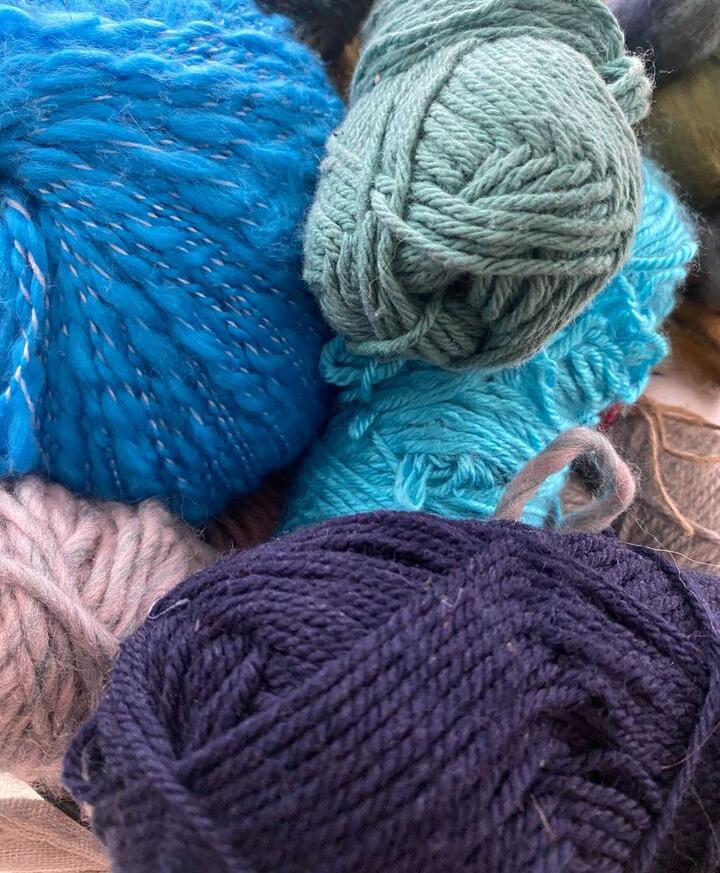
One of my favourite things to do is shop at thrift stores for random balls of yarn. These are usually the left-over bits from your granny’s project. I collect all those small bits and knit whatever I can stitch together from them. The result is often fabulously wonky and unique sweaters that are one of a kind, straight from my mind.
Although fashion is marked by trends and mainstream status quo, it also possesses the ability to reject social norms. And therein comes anarchist knitting. Wondrously nonconformist!
Recently, I joined a local knitting circle. Most of the people there are older than me and of course they are following patterns; they know what each stitch is called and are generally well-seasoned knitters.
So, when I showed up with my balls of random yarn, my lack of ‘formal knowledge,’ and my anarchist knitting philosophy I did feel a bit out of place. Anyone
who’s ever been a part of a knitting group knows the question, “what are you making,” is bound to come up.
However, I love this question because I love the one that follows when I answer just as much. I usually say something like, “Oh, I’m an anarchist knitter and I’m making a nonconformist sweater.” This answer is unexpected, so the next question is usually “Oh, what does that mean?” and then we get to have this great discussion about social norms regarding knitting and many other things beyond knitting.
What tends to end up happening once we start having these discussions about social norms within our circle of power is that we then start to have discussions about other issues. Most recently, we discussed harm reduction in our community.
So, I guess what I am saying here is that the things we do or want to try are open to re-imagination. And by reimagining them we might also begin to re-imagine elsewhere.
maren savarese knopf staff writer
Have you ever wanted to run on ice without falling?
pall agarwal s&h writer
Regina is known for its cold weather, but there’s so much more to it in the winter. There are activities like ice hockey, figure skating, and much more that residents can engage in with their community. As the winter wind sweeps across a city covered in snow, residents seek exhilarating activities to make the most of living in Regina.
One such activity, among the array of others, is broomball. Broomball is a winter sport on indoor and outdoor ice rinks and, unlike traditional ice hockey, played without skates. Broomball can be recreational or competitive, but both offer fun for everyone involved. Like all sports, broomball requires players to wear equipment so the game can be played safely. This equipment includes a broomball stick, shoes, balls, goal nets, and goaltender equipment. Much of the equipment is specifically designed or adapted for broomball.
Like ice hockey, broomball
is played on ice and is a teambased sport. Unlike ice hockey, however, broomball players wear specialized rubber-soled shoes for better traction on the ice, and use a broom-like stick instead of an L-shaped, traditional hockey stick.
The absence of skates makes broomball more approachable for beginners. Beginners might feel more comfortable exploring their limits and getting more competitive faster than other winter-based sports like ice hockey.
There are usually two teams, making it an ideal sport and experience for people of all ages and skill levels. Each team competes to score goals by shooting the ball into the opposing team’s net. To win, teams will use precise passing, quick footwork, and teamwork. These strategies can be found in other team-based games, like soccer or football. There are also other elements to playing the game, like learning how to stay in control of the ball and balance while playing on the ice. It begins with a face-off, and a typical game is usually broken into two or three periods.

The Saskatchewan Broomball Association (SBA), “is a Provincial Sport Organization that provides leadership and guidance to develop and promote
the sport of Broomball at all skill levels,” according to their mission statement on their website. They recently held a Broomball game on Feb 23, 2024 in Aberdeen. Up-
Who’s exploiting social services again?
No wonder it costs so much to help those in need...
Earlier this month, the Official Opposition released documents listing hotels that had received over $50,000 or more from the Ministry of Social Services during the 2022-2023 fiscal year. Social Services covers the costs of hotels in select cases and during times of housing crisis when individuals would otherwise have nowhere to go.
Among the hotels listed on documents released by the Saskatchewan New Democrat Party (NDP) were the Thriftlodge by Wyndham (Thriftlodge) and Sunrise Motel in Regina. The Thriftlodge and the Sunrise Motel are financially connected to Gary Grewal, an active MLA with the Saskatchewan Party, either by investment or ownership.
Documents from the NDP show that the establishments received $384,178 from the Ministry of Social Services. This sum is broken down to $220,474 at the Sunrise Motel and $163,704 at the Thriftlodge. According to the NDP, the two establishments notably raised their prices on rooms when social services covered the bill to house clients in either location.
Despite allegations, Social Services Minister Gene Makowsky has defended social services’ actions and the use of both establishments for the immediate support of individuals or families in emergency situations.
According to Makowsky,

“Since some hotels won’t accept people on income assistance because of past issues, the province’s options are limited.”
The issue has been ongoing.
In November of 2023, the NDP alleged that the Sunrise Motel increased prices for a woman staying there once it became known social services were paying for her room. Despite an online rate of $99 per night, the price in-
creased to $162 per night. Even more concerning was the increase at the Thriftlodge. The hotel is listed as $90 per night, and the ministry paid an average of $185 per night. This is a steep increase at just over double the listed cost. The opposition claimed those rates were based on a one-night booking for February 13, 2024.
Provincial data shows that hotel-related costs for social ser-
coming game events can be found on their website. Their calendar lists tournaments and broomball deadlines, such as the Senior Provincials on March 1-3 and March 8-10, and the deadline for mixed provincial teams’ fees and rosters is March 1.
Broomball can be played at various venues like the Cooperators Centre, Mosaic Stadium’s outdoor rinks, and the Jack Staples Arena. All of these provide the perfect settings for friendly matches and organized leagues. Spectators can cheer on their favourite teams while aspiring enthusiasts can find opportunities to join recreational leagues and hone their playing skills. This is a fun, seasonal sport that can be explored and played during the icy cold winter season.
Regina’s cold season is a great time to explore broomball, attend the games, and participate in recreational and competitive broomball leagues. Broomball provides a refreshing way to stay fit during the winter season in Regina. What more can one ask for?
vices have doubled by more than half since 2018; associated expenditures rose from $1.17 million to $3.08 million from 2018 to 2022. This is speculated to be for a number of reasons, including exacerbated circumstances post-pandemic in an increasingly worsening housing climate.
In response to the controversy with hotel costs, the Ministry of Social Services has announced
its commitment to changing how it handles hotel bookings for individuals and families supported by social assistance. In a letter dated February 8, 2024, to the NDP, the Ministry detailed a new formal process in which they will obtain quotes from three hotels and direct people to use the cheapest available option while maintaining safety.
In the wake of this news, Saskatchewan Party MLA Gary Grewal has announced he will not run for re-election. “It has been an honour to serve the people of Regina Northeast for these past four years,” Grewel posted to social media on the matter. Grewal is among 10 other Saskatchewan Party MLAs who have announced they will not seek re-election in the upcoming election.
The investigation into the practice of acquiring bookings by the ministry will continue as the office of Saskatchewan’s auditor has announced it will investigate the matter. The auditor report is currently scheduled to be released in December 2024, following the 2024 provincial election. As such, while the people of Saskatchewan prepare to head to the polls, this information will be unavailable.
maren savarese knopf staff writer
What is a self-defence class? Is it more than just learning how to dodge a punch?
victoria baht staff writer
Regina Self-Defence Fitness (RSDF) is an academy that focuses on teaching Regina residents about self-defence and how to remain safe in stressful moments. They started their five-week self-defence course last week on February 21, 2024.
Troy Ostapiw is the lead trainer focusing on defence tactics for the Saskatchewan Police and the Royal Canadian Mountain Police (RCMP). Ostapiw has a strong background in self-defence, and has a certification as a Close Protection Officer (C.P.O.) for Hostile Environments.
Ostapiw has travelled the world to work and focus on his knowledge and training in self-defence. He is currently working and contracted in Saskatchewan by the Justice Teaching Defence Officer for Safety and Leadership, as stated on the RSDF academy website.
The Regina Self-Defence Fitness Academy has trained many people. According to their website, trained groups include Canadian Arms Forces Instructors, Special Weapons & Tactics Unit (SWAT), civilians, peace keepers, Emergency Medical Personnel (EMS) and more.
Over the last few years, Ostapiw has expanded beyond instructing businesses and professionals. The RSDF has begun training and teaching the general public about self-defence mechanisms. This increase may very well serve to help people worried about their safety by teaching them how to avoid dangerous situations and help themselves if they cannot avoid them.
The self-defence classes have a unique style that comes from Ostapiw’s experience. Ostapiw explained, “I have a unique approach as I am a trainer for police officers and the Canadian De-

said, “There is no weight class, there is no time limit and no tap out. […] In reality we are focusing on education on self-defence, for families, for citizens, all types of people.”
“We educate people. That is the first [and] most important thing. We can educate them on situational awareness and teach them about certain circumstances that they should not put themselves in, situations that they can learn to prepare themselves for from a psychological perspective,” Ostapiw explained. A self-defence mindset is what the academy strives for. To get into that mind-
health recognition and understanding, how to be smarter in the moment, and situational awareness. As Ostapiw spends time educating, he pushes the idea that “Education is the most important aspect of self-defence.”
“Each class we educate more and more. We talk about things that happen in the community and focus on how we could have done something and prevent it from occurring. We try and empower people, not just teach self-defence mechanisms,” Ostapiw said.
Self-defence is not all about thinking, but it is highly import-
class talked about stances, minimizing yourself as a target, how to protect yourself, roleplaying self-defence scenarios, bringing your hands up to protect your head, and more.
As you get comfortable with your body and the mechanisms that are involved in self-defence, then students will move further into their training. “We start one-on-one, but we also get into a mass attack, which is multiple attackers. I also educate people on [how to tell] if somebody has a weapon. Are there indications that you can look at before that? […] I educate them on those as-
“ Each class we educate more and more. We talk about things that happen in the community and focus on how we could have done something and prevent it from occurring. We try and empower people, not just teach self-defence mechanisms.”
Troy Ostapiw
partment of Self-Defence. I have trained a lot of men and women.”
Another unique part of Ostapiw’s classes is how he treats the classes like real-life scenarios instead of treating it more similarly to teaching or learning the rules and skills of a sport. He
set, they say a person needs to understand what a “predator and prey” mindset looks like and be able to recognize it. During the class, students learn about topics like verbal de-escalation concepts, mental
ant. Once you understand the situation and learn how to prevent it from happening, then you move towards the more physical parts of the class.
Ostapiw focuses on teaching the class about prevention. The
pects so they can understand if they are in a bad situation.”
You might be wondering who this class is intended for. Well, this class is designed to be for everyday people. Ostapiw wants this class to be used in a variety of
different ways so you can use it to protect yourself now, when you are travelling overseas, minimize risk generally for yourself, and give people a feeling of safety.
If you are interested in joining this class they train all genders, but they prefer their students to be 12 years of age and older. If there is a family that wants to get their child involved too, Ostapiw encouraged families to contact the RSDF Academy to make sure their program will work for the family’s needs.
This self-defence five-week program happens twice a year. If you are interested in getting more training and specific details, contact Ostapiw for that information. Contact information for the RSDF Academy can be found on their website and Facebook page.
Ostapiw offers more than self-defence training through RSDF. He trains on violence and prevention, violence prevention in the workspace, self-defence for businesses, organizations, and even hockey players. Ostapiw also said he offers private seminars and training by request. From the request he will design the appropriate type of class or seminar to fit the person’s needs.
Now that we have learned all the components of what a self-defence class can look like, you can make a more informed decision if you want to try a self-defence course. You can learn some useful tricks, learn how to defend yourself, and keep yourself safe.
In spring 2024, construction on Prince Albert Victoria Hospital begins
pall agarwal s&h writer
In the heart of Saskatchewan, a ground-breaking healthcare initiative is about to change the landscape of medical services and patient care. On July 24, 2023, the Government of Saskatchewan announced the Prince Albert Victoria Hospital project.
This project has been conceptualized with the vision of addressing the growing healthcare needs of the people in the com-
needed. The project will include a larger emergency department and enhanced medical imaging services, including an MRI.”
The project will take a comprehensive approach by constructing a modern and fully equipped hospital facility that integrates the latest technological advancements in healthcare.
“The new tower features a heliport on the roof, an expanded emergency department, larger operating rooms, pediatrics, maternity, NICU, new medical imaging, and a First Nations and
katchewan and the Saskatchewan Health Authority on this project. […] PAGC is providing feedback on the design of the facility. During the construction phase, [PCL Construction Management (PCL)] will engage with local and Indigenous businesses and trades to deliver services for the project.”
This project expansion is only going to help Prince Albert residents to access health care available closer to home. The project is expected to begin spring 2024 with anticipated completion in 2028.
Mayor Greg Dionne is summarized referencing the impact of the construction: “a development Mayor Greg Dionne says solidifies the hospital’s role in serving not just the city, but the north. […] Dionne said he’s excited for residents to receive treatment close to home.” It then went on to quote Dionne, saying, “Part of your healing is being around your family and friends.”
“I am proud that our government is getting this project done and that it is the largest single investment, private or government,
This is important for the residents’ accessibility to the bare minimum of healthcare that is easily available in other provinces and communities. This collaborative approach will not only meet the standards of modern healthcare but also reflect the unique needs and values of the local community.
The economic impact of this project cannot be overlooked. The construction of the hospital will generate employment for people serving in healthcare and decrease both the number of


munity and region. The Prince Albert Victoria Hospital project includes the construction of a new acute tower connected to and directly north of the existing facility.
The province also announced an $898 million contract, which included the design and construction of a new acute care tower according to coverage by CTV News. The community is growing, and the facility requires more investments for beds and expansion. According to the July 24, 2023 press release, “The number of beds in Victoria Hospital will have an increase of up to 40 [per cent], from the current 173 beds to 242 beds on opening day, with a plan to expand further as
Metis Cultural space, among other key services,” according to a February 1 Saskatchewan Government press release.
It is important to note that this project is a significant investment and would cover the scope of accommodating the growing needs of the northern communities. Larger operating rooms attend to a demand in healthcare for more space to handle more patients. This project has the potential to support current and future healthcare needs in Prince Albert and its neighbouring communities for years to come.
According to the Feb 1 press release, the “Prince Albert Grand Council (PAGC) has partnered with the Government of Sas-
“As work moves forward on the Victoria Hospital in Prince Albert, staff, patients and families will begin to notice changes at the hospital site,” Saskatchewan Health Authority Chief Operating Officer Derek Miller said. “These changes signify the progress of the project, which will expand services for Prince Albert and the surrounding area, and our commitment to the public to deliver quality care close to home.”
The new tower being built at the Victoria Hospital in Prince Albert is a project that was awarded by the Saskatchewan government to PCL with a nearly $1 billion contract according to CTV News
In another CTV News article,
in the history of Prince Albert,” SaskBuilds and Procurement Minister and MLA for Prince Albert Carleton Joe Hargrave said. “This hospital will bring expanded and state of the art service to Prince Albert and the North and will benefit all of Saskatchewan upon completion.”
“Boreal Healthcare Foundation’s valuable philanthropic partnership on this project will have a lasting impact on the wellbeing of the community. Their significant contribution toward the furniture, fixtures and equipment needs for the hospital will elevate the care provided by staff and physicians, resulting in better patient outcomes,” as stated in the February 1 press release.
people and distance needed to travel for healthcare access. This may solidify Prince Albert’s position as a regional healthcare hub. This ripple effect of job creation will also be seen during the construction phase, boosting the local economy.
The emphasis is on ensuring that quality and top-tier professionals will be taking over the project so that the quality is not tampered with and that standards are met accurately. The project is a testament to a collaborative partnership that aims to uphold the values of Indigenous communities and integrate them into the healthcare system.
“This hospital will bring expanded and state of the art service to Prince Albert and the North and will benefit all of Saskatchewan upon completion.”
Joe Hargrave
A response to a January 18, 2024 article “It is time to talk about this” in the Carillon
jack j. nestor contributor
The fruit which comparative history may bear is tremendous. Perhaps no subject has been more vulnerable to the allure of comparative history than the growing field of settler-colonial studies. However, the pitfalls of such a historiographical approach may impair an accurate rendering and interpretation of the historical record.
The increasingly common tendency to compare settler colonialism in Canada to settler colonialism in Israel is demonstrative of the errors of such an approach. While some historians have compared the Canadian and American settler-colonial structures to vindicate the former, others have referred to British colonial policy across the empire to illuminate the Canadian experience. In total, these comparative histories have revealed much about the nature of Canadian policy on Indigenous peoples.
As my critical reading of Mikayla Tallon’s article in the Carillon from Jan 18, 2024 illustrates, the common fact of settler colonialism does not warrant the disregarding of countless differences between the Canadian and Israeli manifestations of settler colonialism.
The first – and arguably most harmful – error concerns the idea that “treaties or agreements” were at the behest of settlers or the Crown. In the context of Israel and Palestine, the agreement made between Britain and Sharif Husayn in 1915, which included granting control over Palestine to the latter, aligns with this thought given Britain’s initiation of the treaty.
mously) proves that Treaties 1-7 were negotiated out of the insistence of First Nations rather than the foresight of the Dominion or the Crown.
There is also the notion put forward by Tallon that if Canada were to condemn Israel, it “could embolden the Indigenous peoples” (presumably to resist settler colonialism). There are at least two flaws with this reasoning. First, historically and contemporarily Canada has not hesitated to condemn colonialism (and genocide) when the conditions existing in the United States they criticized closely resembled its own.
Consider Brian Mulroney’s criticism of apartheid South Africa in the 1990s and Justin Trudeau’s castigation of China over the genocide of Uyghurs in Xinjiang. Thus, while Canada’s attempted obstruction (and its dubious adoption) of the United Nations Declaration on the Rights of Indigenous Peoples can be cited as an example of Canada’s distaste towards decolonization, Canada’s support for Israel appears to be motivated more by geopolitics and ambitions than a strategic opposition to decolonization.
Second, although pan-Indigenism has ebbed and flowed, Indigenous peoples have remained relatively localized (particularly in Western Canada). That is to say that while Harold Cardinal saw the utility of the Indian Association of Alberta, he rejected the “intrusion of left-wing politics” into Indigenous resistance and refused to meet with Fred Hampton when the Black Panther travelled Saskatchewan and Alberta in 1969.
While Indigenous peoples have exhibited solidarity with each other, they
Indeed, both the French and British merely inserted themselves into pre-existing alliances led by the Wendat (Huron) and Haudenosaunee (Iroquois) Confederacies, respectively. On the west coast, as in northeastern Turtle Island, warfare and the


“ It matters little how many individuals died in determining whether a genocide has occurred. Instead, what is pertinent is whether there was a deliberate attempt to eliminate a given people.”
Jack J. Nestor
The other inaccuracy concerns Tallon’s citation of Suzanne Methot’s Legacy: Trauma, Story and Indigenous Healing. I have read Legacy twice; once in Grade 12 out of personal interest, and again when it was assigned in my first year of university. In neither occasion was I persuaded by its arguments.
While the reasons to doubt the text’s merits are numerous, I will confine my analysis to the claim that 100 million people inhabited present-day North America prior to contact. I have seen this estimate once before and (like Methot) the author neglected to provide a source in support of such a claim. In the same vein, while Legacy did not undergo the rigours of the peer-review process (and has not been the subject of a book review in any credible academic journal to my knowledge), even the highest credible estimate (made by Henry F. Dobyns in 1966) places the population at 10 million less than Methot’s figure.
However, this statement imposes a level of passivity upon First Nations groups and agency upon the Dominion and the Crown which did not exist in Western Canada in the 1870s. Rather than having treaties imposed upon them “at the request of European immigrants or the Crown,” First Nations in the North-West physically obstructed the westward penetration of Canadian settlers and surveyors.
Consider, for example, the Saulteaux’s resistance under Yellow Quill near Portage la Prairie, threats of violence from First Nations in the Riding Mountain area, and the refusal of the Blackfoot and Plains Cree to permit the work of survey and telegraph line crews. The scholarship that has accumulated since John L. Tobias’ “Canada’s Subjugation of the Plains Cree, 18791885” unequivocally (though not unani-
have proven capable of and willing to act in their own interests and of their own accords just as much as any other. If Indigenous peoples in Canada pursue justice with enhanced vigour it will be because it is in their interests to do so – not because Palestinians have done so.
At least two major deviations of the historical record exist in Tallon’s article. First, the idea that peace prevailed in North America until “people got greedy, they got angry, and they needed someone to take it out on” is plainly false. While instances of acculturation and cultural borrowing did occur – in the French-Indigenous “middle ground” as in the borrowing of Indigenous Palestinian agricultural techniques by early Jewish settlers – parts of North America experienced prolonged warfare prior to, and after, first contacts.
capturing of slaves were the reality of nations in these regions. Similarly, as nations competed for land and control of commerce in the North-West, alliances formed and collapsed in response to the rise and decline of threats (consider the tumultuous relationship between the Blackfoot Confederacy and the Plains Cree, for example).
The increased presence of European traders certainly brought about greater violence (the scholarship of John Philip Reid refers to homicide and retribution perpetrated by and against Indigenous Peoples in the fur trade era specifically) but violence was irrefutably a characteristic of North America from the rhetorical “first pages” of the historical record – including archaeological evidence of massacres perpetrated against Indigenous groups by other Indigenous groups.
In any event, the economic history referenced by Methot and echoed by Tallon are irrelevant. It matters little how many individuals died in determining whether a genocide has occurred. Instead, what is important is whether there was a deliberate attempt to eliminate a given people. I am inclined to believe that during certain moments (though I believe ‘debilitation’ is a more accurate descriptor at other points), Canadian Indian policy was oriented toward genocide.
I do not feel that my limited knowledge of the history of Israel and Palestine entitles me to form similar opinions in that context. However, I hope that in spite of my ignorance of the history of Israel and Palestine I have respectfully and successfully argued that the differences between settler colonialism in Canada and
colonialism in Israel are more pronounced than the similarities.
holly funk editor-in-chief
What do you do in this, the year of our Lord 2024, when your mother starts dating a fascist?
You know she hasn’t had it easy the past few years and on one hand obviously you’re happy that she’s happy, but if you want her around you also live with this choice.
Maybe he doesn’t explicitly use Social Darwinism in attempts to justify his white supremacist views, but you’ve never seen him speak to a person of colour with the same warmth he uses to speak with those he considers his peers. Maybe he hasn’t exactly fallen prey to a cult of personality, but his crescendo of YouTube videos shared in the family group chat features takes much more extreme than what you’d see on Fox News. Maybe he didn’t invite a known wife-murderer to a tough-on-crime throne speech, but he has no problem using his
some coping skills to survive for however long her fascist flame kicks around.
Your first big obvious move if you’re hoping to maintain your relationship with Mom is going to be identifying friends you can spend time with before and after you’re forced to engage with said fascist flame. Beforehand, this will be helpful in making sure that you’re grounded going in, and after these chats will be endlessly valuable to recentre you in your values as you debrief.
I have bad news: you will need to learn to pick your battles. If Mom really has her heart set on this particular partisan, then there’s a good chance he’ll be around for a while and that you’ll wind up being the one demonized if you’re pointing out every single context in which he’s decided to act like a literal demon. If you’re trying to maintain the relationship then know you won’t be able to call out every disgusting statement, but you won’t have to sidestep every potential avenue for dialogue either.
For the not-right-now moments, make sure you have some topic-changing state-
try anyway and use it as a way to refocus attention on a shared activity. Maybe the neglectful Nazi only has an interest in chatting about his gym gains – prepare questions about workout routines, which times are the best and worst to gym during, or what sorts of out-of-gym activity can result in the same physical health benefits.
It won’t always be appropriate or possible though to simply change the subject, you will have to pick some battles, and the best ways to do this are incredibly subtle. All you need to do is to continue (or start to; it’s never too late to) treat your mom like a person.
The particular partisan is sitting on his ass while dear Mumsie has been busting hers all day? Choose to help her out. You don’t have to voice the difference between how you treat her and how he does; the dissonance will get louder the more frequently you pitch in to lighten her load while he freeloads. This will have more of an impact if you’re somebody who presents masculine.
rupting Mom’s stories and comments, constantly drawing conversation back to his views and interests while downplaying things that make her excited about life like they’re just meaningless sidequests? Stop looking at him when he interrupts. Stop laughing (people-pleasing) when his jokes aren’t funny. Hold your eyes on Mom and wait until he’s done speaking, then pick up the conversation with Mom from where he cut her off.
The dissonance will do a lot. And, if you’re someone who isn’t confident in their confrontation abilities, it’s a great subtle way to set a standard of care without having to outline it outright. I do believe you should make an effort to state your standards outright to people who you trust can uphold them, but chances are that Mr. Step-Fascist isn’t the one to bare your soul to like that.
The gist here is to solidify yourself. To connect with people you trust who will kindly ground you in your standards. To decide which battles you will – if only tem-

“If you’re trying to maintain the relationship then know you won’t be able to call out every disgusting statement, but you won’t have to sidestep every potential avenue for dialogue either.”
Holly Funk
size and strength to intimidate your mother into acting more like an accessory than a person.
So… what do you do?
You may have a hell of a lot of love for dear old Mumsie. Maybe she’s been a great listener through your time with her, maybe she’s always had a joke or quip when you needed a pick-me-up, maybe she’s someone who humanizes every living thing she greets. Whatever the case, you adore her quite a bit too much to willingly want her out of your life, and you’re going to need
ments at the ready each time you go to visit (pre-visit friend hangs can help here). No matter how different two people are they can always connect over at least a handful of things, so put in the work to find out what those things are; don’t sink to their level and dehumanize.
Maybe fascist flame loves craft beer –bring over a four-pack from Malty National next time you head over so you can draw conversation back to brews. Maybe this particular partisan prefers board games – grab a new one you’ve been hoping to
The neglectful Nazi has decided to fill dinner conversation with his thoughts on how social supports everyone can access are the literal worst thing to exist? Pop in with a few quips about how many lives groups like Prairie Harm Reduction, Good Trouble YQR, and Newo Yotina Friendship Centre have changed and/or saved. Then note how much more that number could be if the provincial government would make saving lives their priority instead of mostly a community effort.
The fascist flame won’t stop inter-
porarily – disengage from, and which you’ll step up to head-on. To become so firm in how you treat Mom (and other people, all of this generalizes) that someone else’s mistreatment of them won’t shock you into silence. Instead, you’ll have your wits about you, and you’ll be setting the standard for Mom that she’s more than just a resource to have.