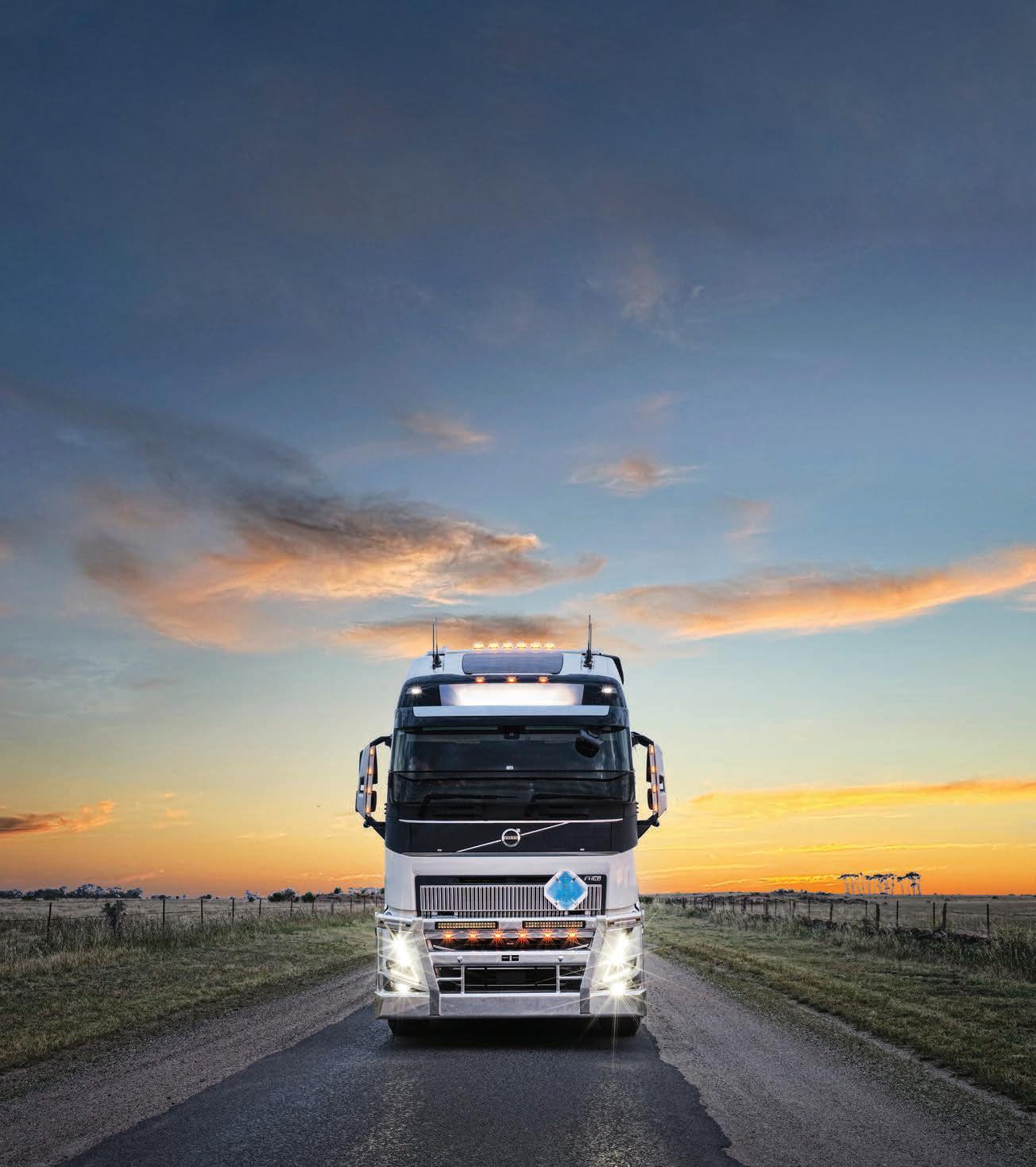
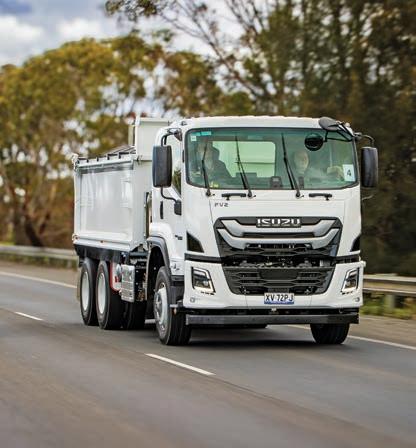
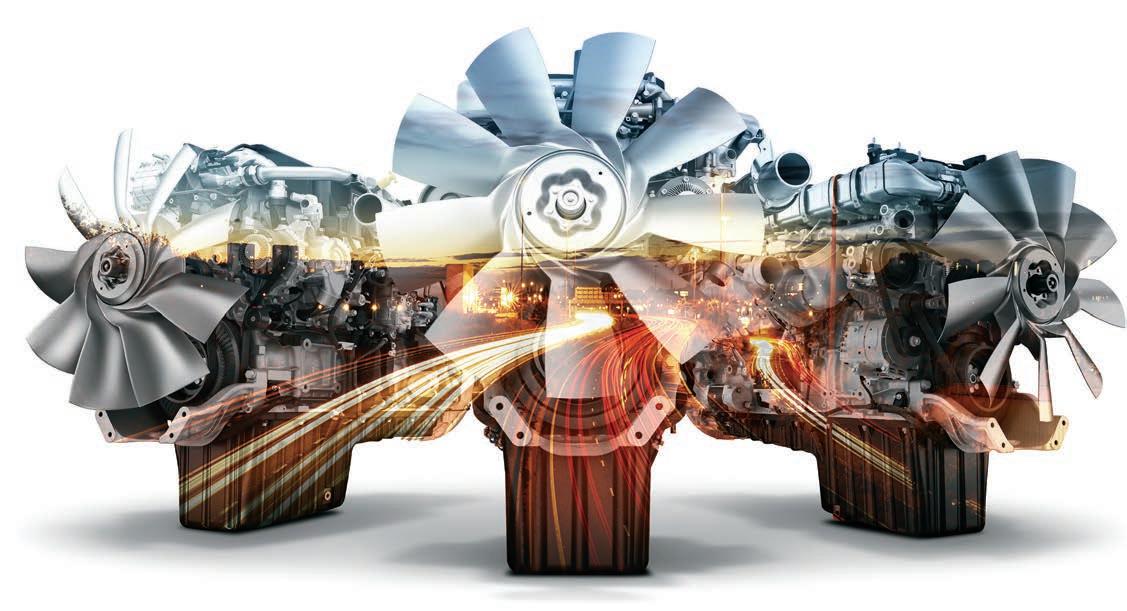
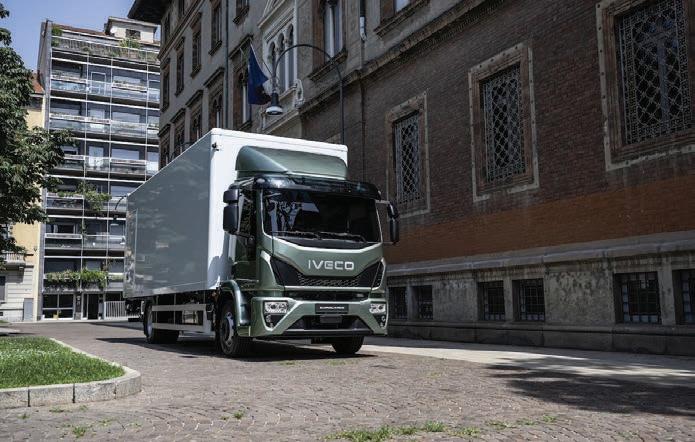
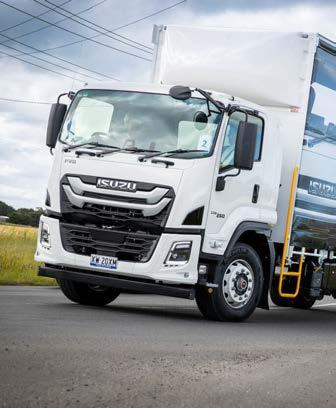
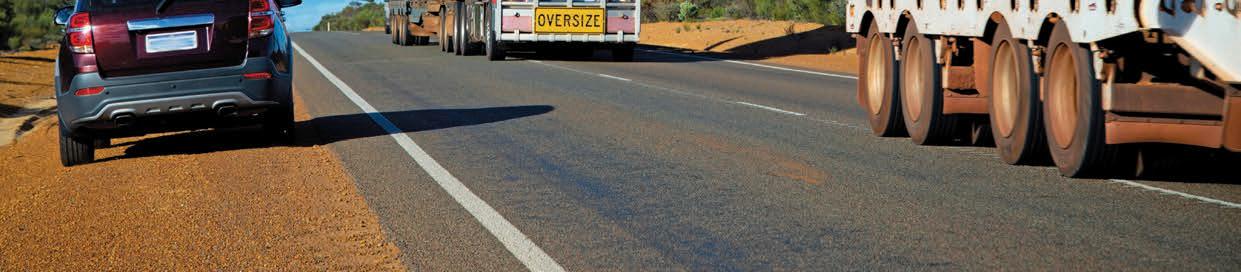
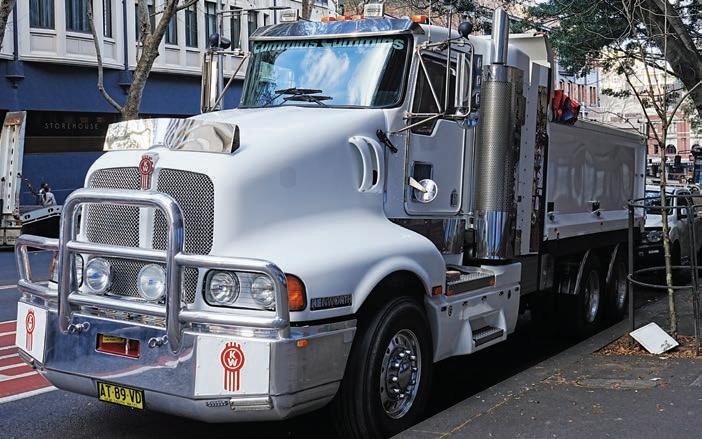
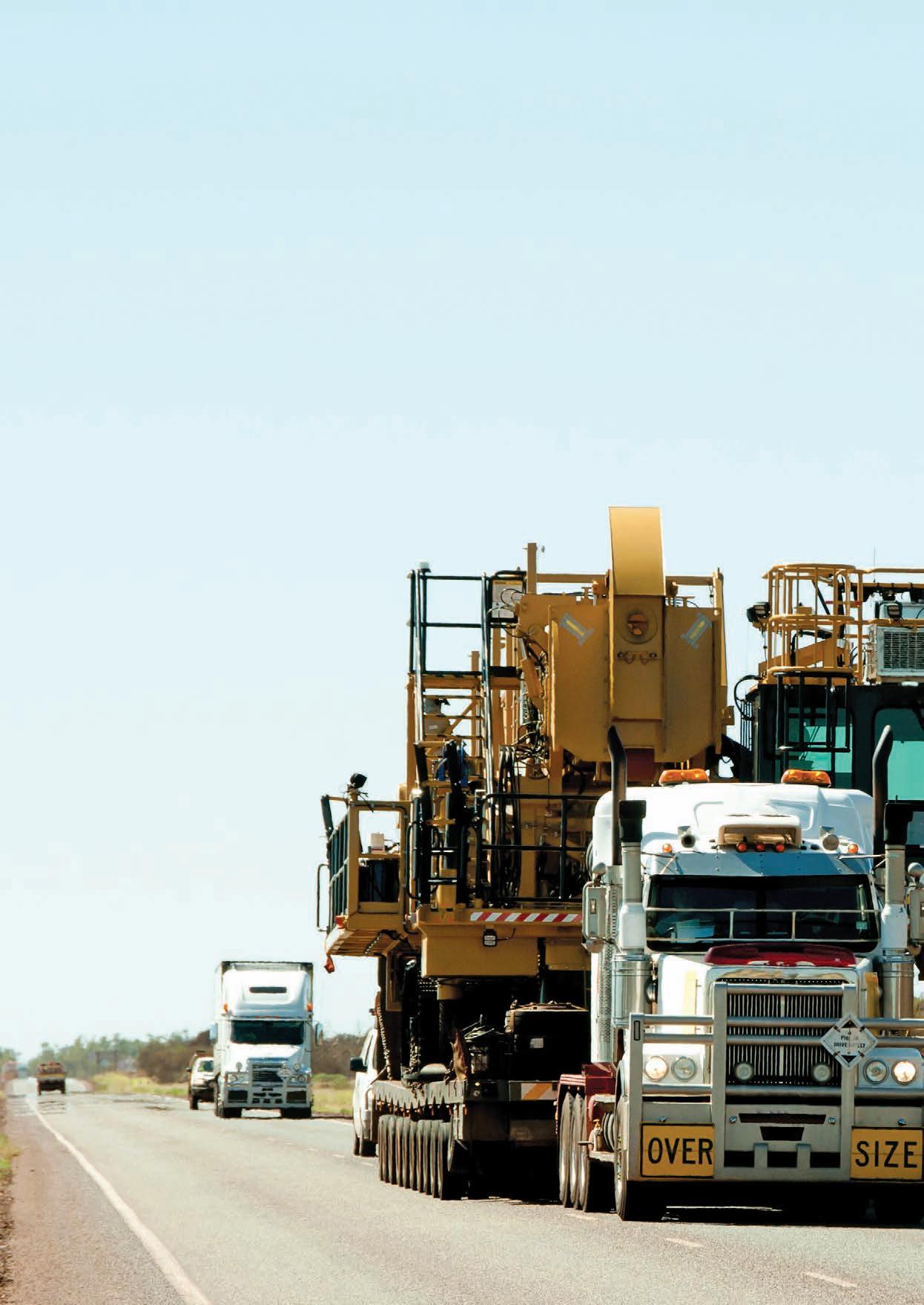
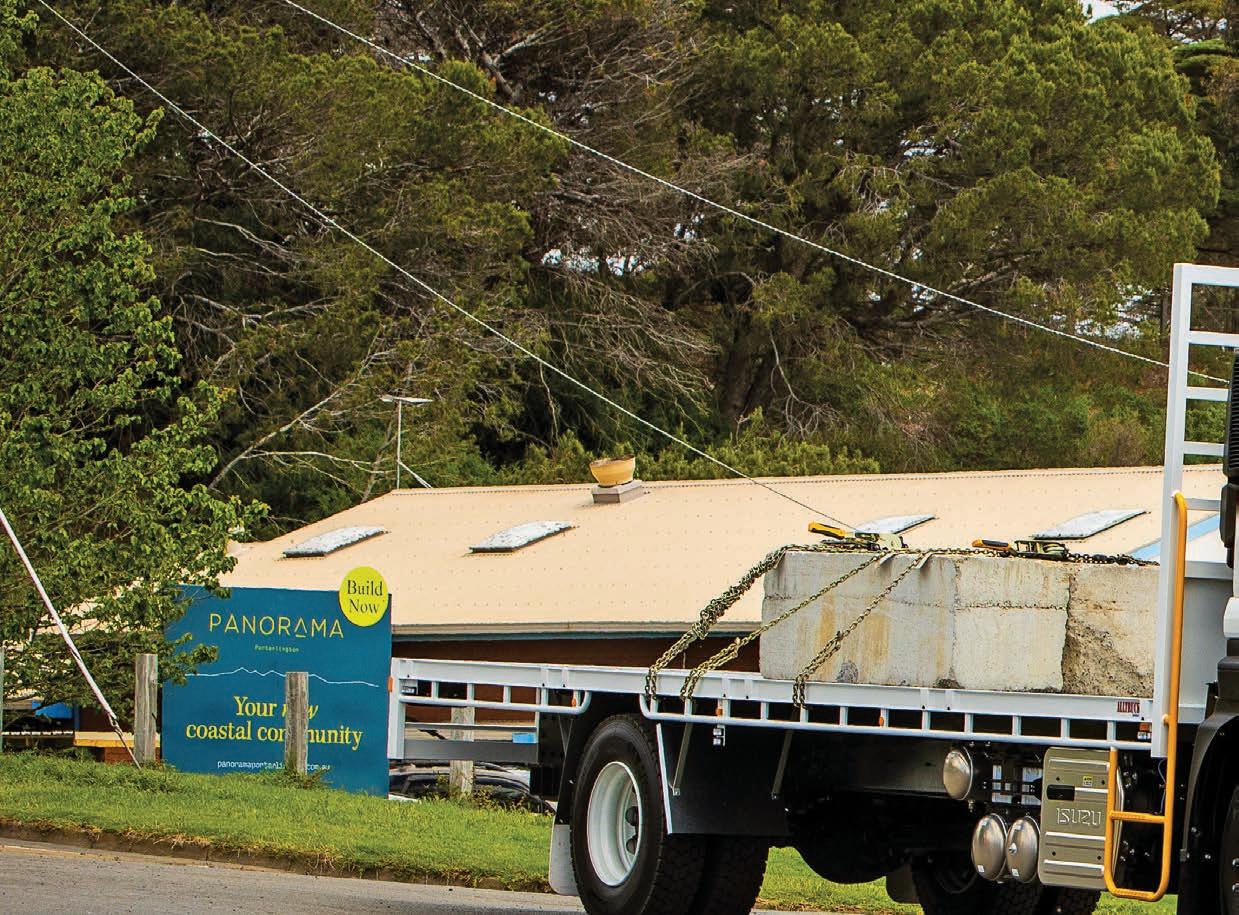
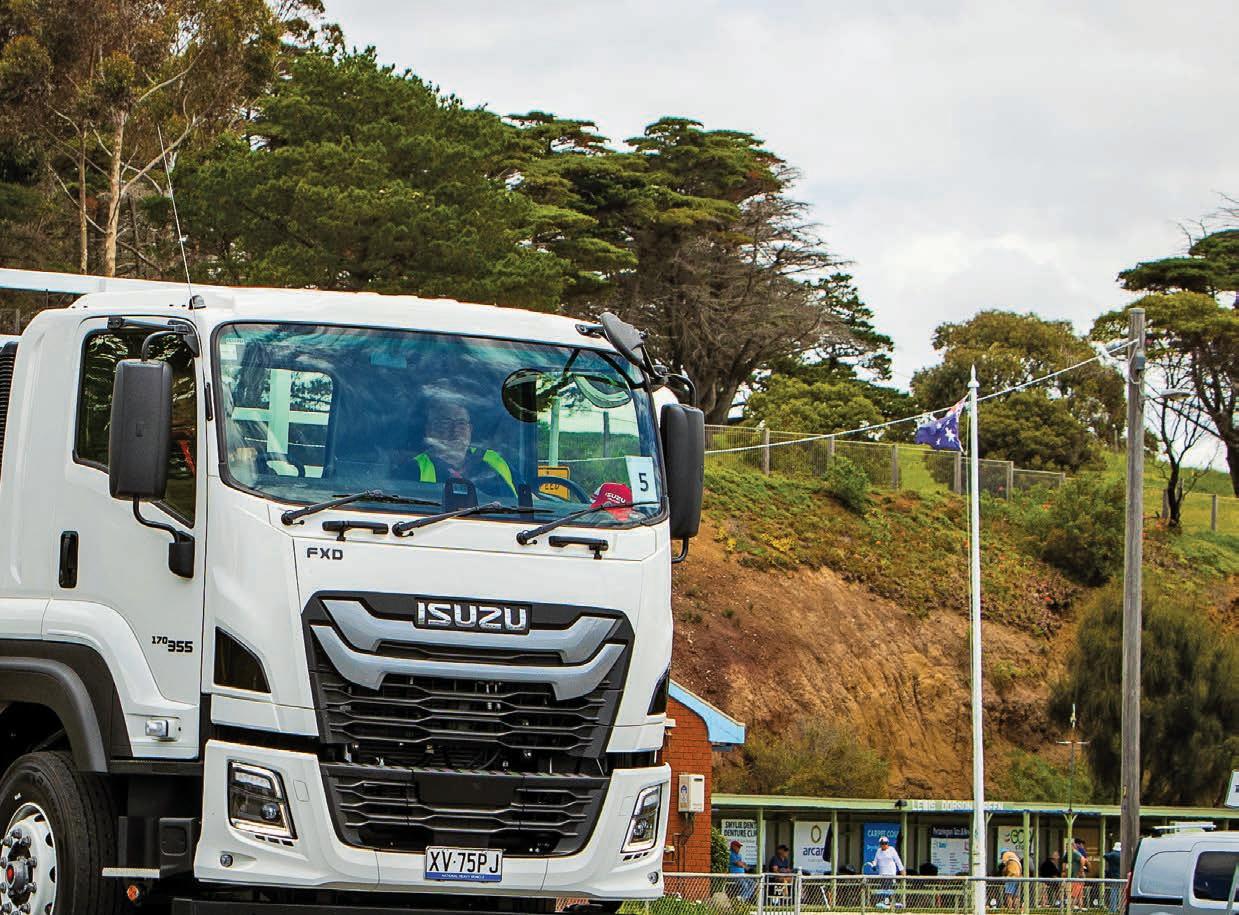
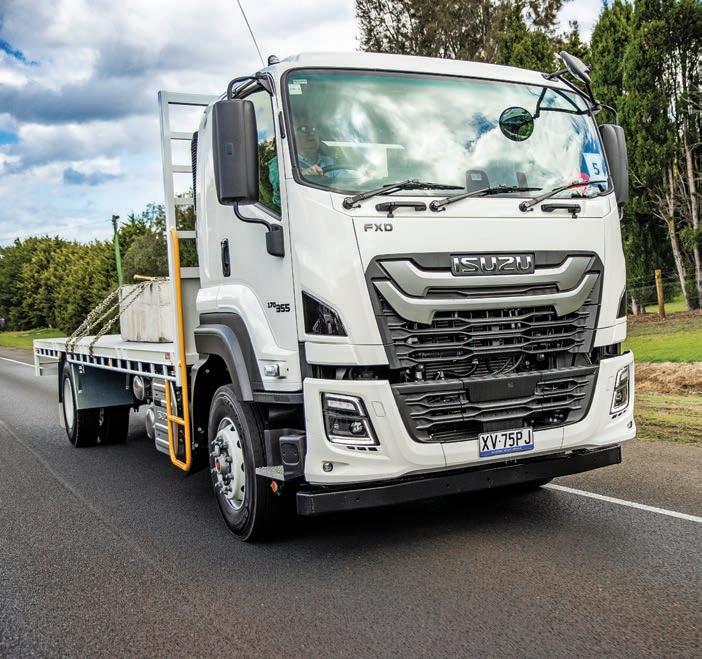
Is your workhorse pulling its weight? If youʼre still driving a ute, nowʼs the perfect time for an upgrade. The all-new Isuzu Ready-to-Work range tows and carries more than your average ute. It also comes with a sleek new cab design, more advanced safety features and car-like comfort.
With a wide choice of factory-built bodies designed to our exact specifications, Isuzu Ready-to-Work trucks are ready to get the job done. Are you ready to step up to a redefined workhorse?
Head to isuzu.com.au or visit your nearest Isuzu Trucks Dealer today.
MEET THE TEAM
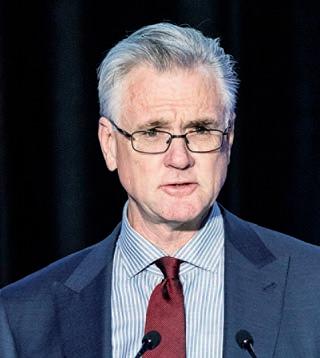
Australia’s leading truck magazine, Prime Mover, continues to invest more in its products and showcases a deep pool of editorial talent with a unique mix of experience and knowledge.
Christine Clancy | CEO
With more than two decades of experience as a media professional, Christine has worked in newsrooms across Canada, Vietnam and Australia. She joined the Prime Creative Media team 12 years ago, and today oversees more than 43 titles, including a dozen print and digital transportation titles. She continues to lead a team that focuses on continuous improvement to deliver quality insights that helps the commercial road transport industry grow.
William Craske | Editor
As the Editor of Prime Mover magazine since 2018 William has reported on the commercial road freight and logistics segments extensively. During that time he has been privileged to lead a team entrusted with covering the latest developments in trucks, transport, technology and the rapidly evolving domain of international supply chains and the role of leading Australian eets.
Peter
Shields
| Senior Feature Writer
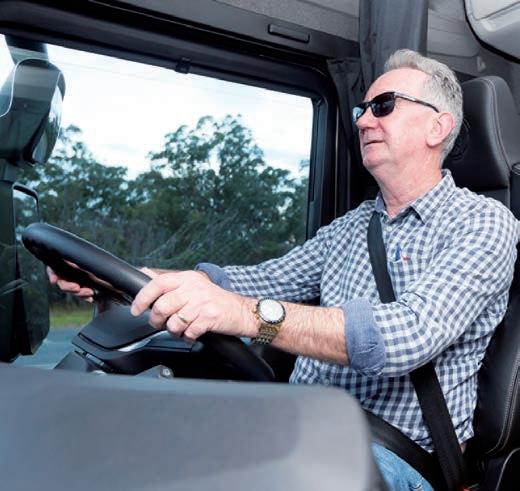
A seasoned transport industry professional, Peter has spent more than a decade in the media industry. Starting out as a heavy vehicle mechanic, he managed a fuel tanker eet and held a range of senior marketing and management positions in the oil and chemicals industry before becoming a nationally acclaimed transport journalist.
Sean Gustini | Journalist
Having completed a Bachelor of Arts majoring in Media and Communications at the University of Melbourne in 2024, Sean looks forward to bringing his passion for writing and journalism to the road freight and transport industries. He previously lived in the Philippines, Vietnam, Indonesia and Malaysia. In his downtime he enjoys playing the guitar and running.
Ashley Blachford | Business
Development Manager
Handling placements for Prime Mover magazine, Ashley has a unique perspective on the world of truck building both domestically and internationally. Focused on delivering the best results for advertisers, Ashley works closely with the editorial team to ensure the best integration of brand messaging across both print and digital platforms.
CEO Christine Clancy christine.clancy@primecreative.com.au
Editor William Craske william.craske@primecreative.com.au
Managing Editor, Luke Applebee Transport Group luke.applebee@primecreative.com.au
Senior Feature Peter Shields Writer peter.shields@primecreative.com.au
Business Ashley Blachford Development ashley.blachford@primecreative.com.au Manager 0425 699 819
Art Director Blake Storey blake.storey@primecreative.com.au
Design Jacqueline Buckmaster, Danielle Harris
Contributors Sean Gustini sean.gustini@primecreative.com.au
Client Success Ben Sammartino Manager ben sammartino@primecreative.com.au
Head Of ce 379 Docklands Drive, Docklands VIC 3008 info@primecreative.com.au
Subscriptions
03 9690 8766 subscriptions@primecreative.com.au
Prime Mover magazine is available by subscription from the publisher. The right of refusal is reserved by the publisher.
Annual rates: AUS $110.00 (inc GST). For overseas subscriptions, airmail postage should be added to the subscription rate.
Articles
All articles submitted for publication become the property of the publisher. The Editor reserves the right to adjust any article to conform with the magazine format.
Copyright
PRIME MOVER magazine is owned and published by Prime Creative Media.
All material in PRIME MOVER magazine is copyright and no part may be reproduced or copied in any form or by any means (graphic, electronic or mechanical including information and retrieval systems) without written permission of the publisher.
The Editor welcomes contributions but reserves the right to accept or reject any material.
While every effort has been made to ensure the accuracy of information Prime Creative Media will not accept responsibility for errors or omissions or for any consequences arising from reliance on information published. The opinions expressed in PRIME MOVER magazine are not necessarily the opinions of, or endorsed by the publisher unless otherwise stated.
COVER STORY
“We respect where we come from and having those family values goes a long way when it comes to maintaining trust and credibility.”
Prime Feature STORIES BULK IS BEST 32
FLEET FOCUS
26 First Principles
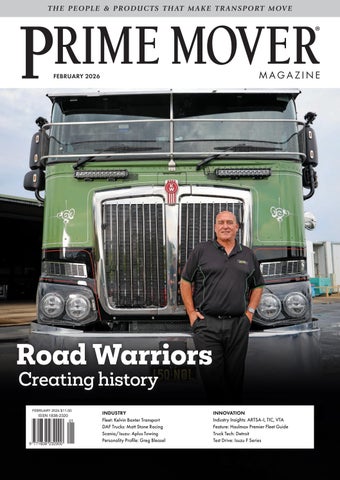
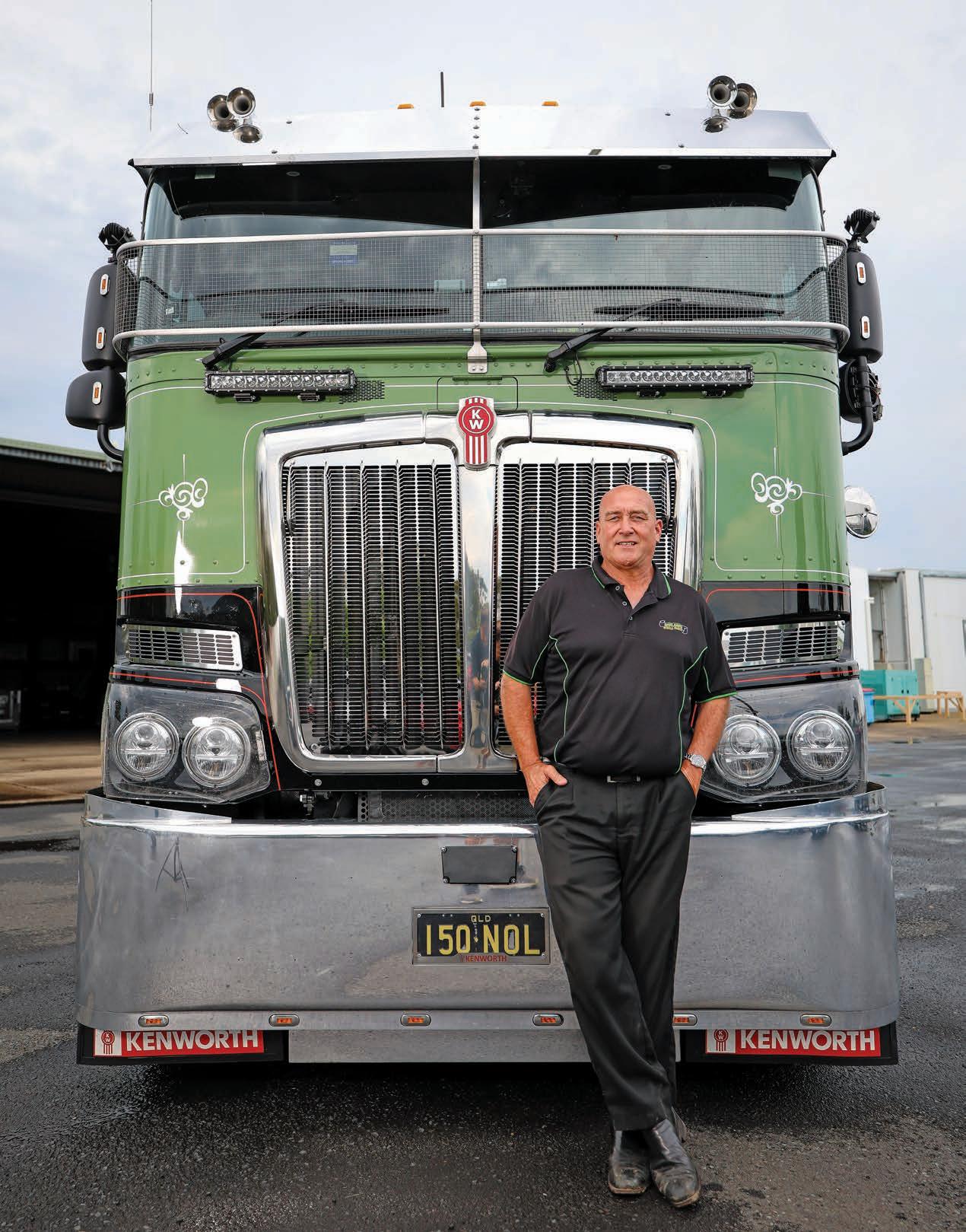
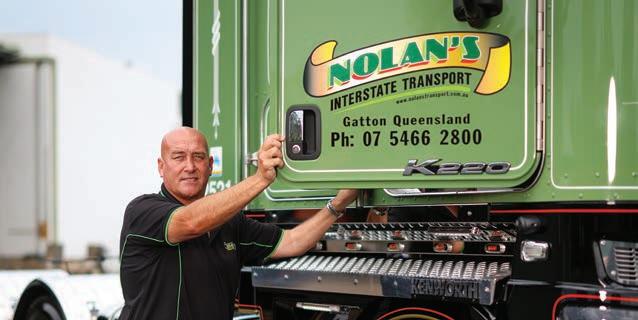
The delivery of its 150th Kenworth marks another milestone in the ongoing journey of fifth-generation family business Nolan’s Interstate Transport.
32 Bulk is Best
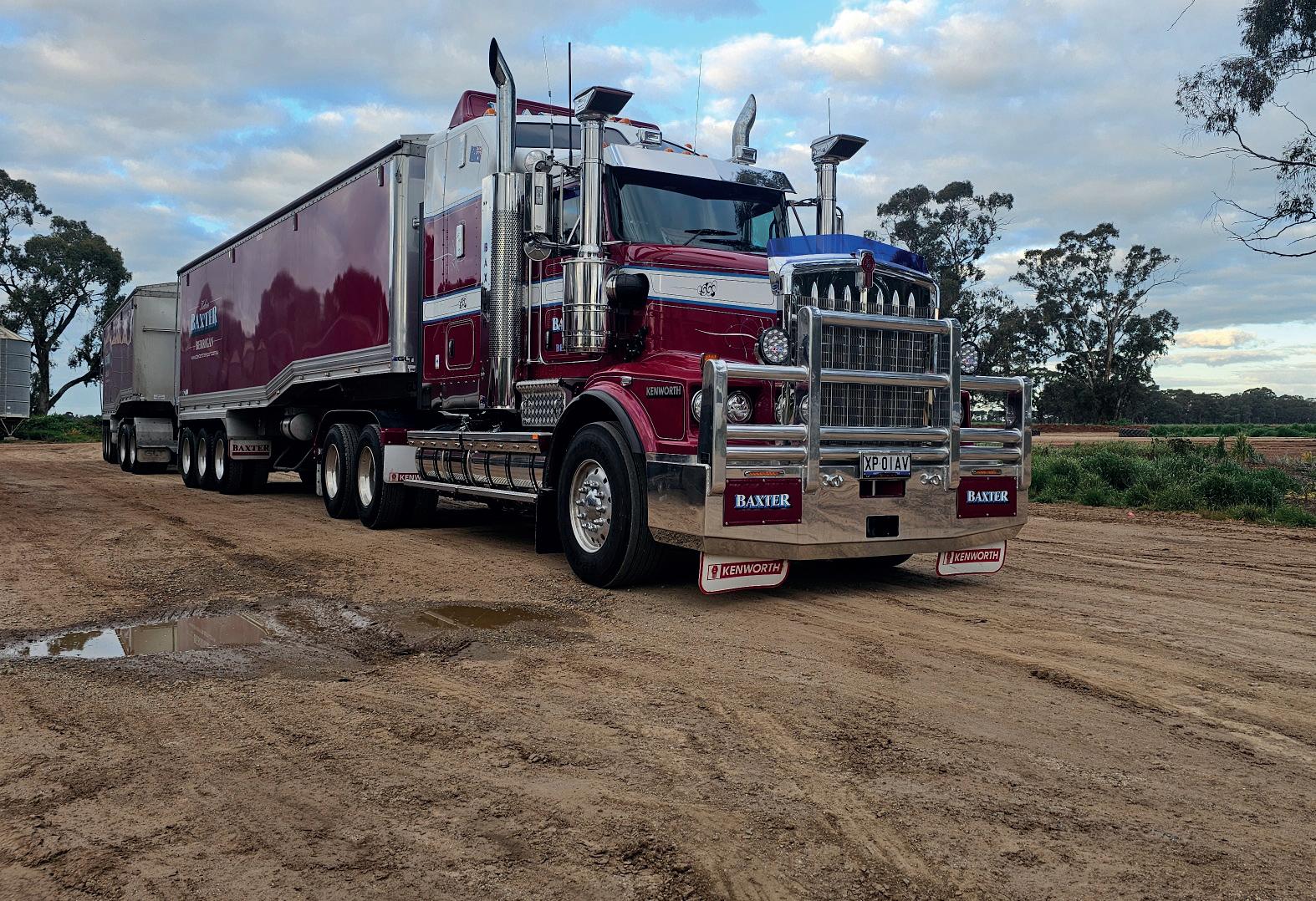
Kelvin Baxter Transport is acknowledged as a leader in the transport of bulk rural commodities and specifies and maintains its vehicles with safety, durability and reliability as key criteria.
36 Ride to the Rescue
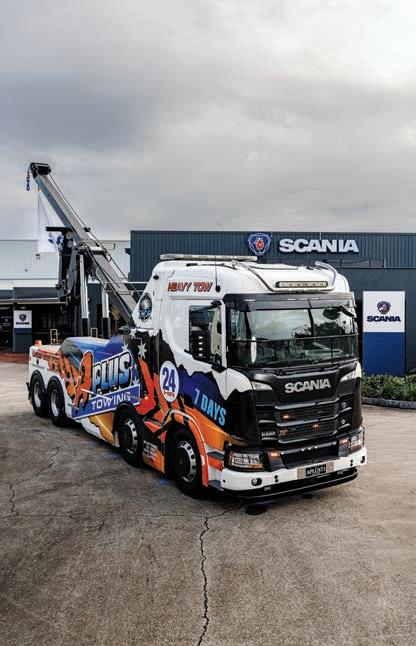
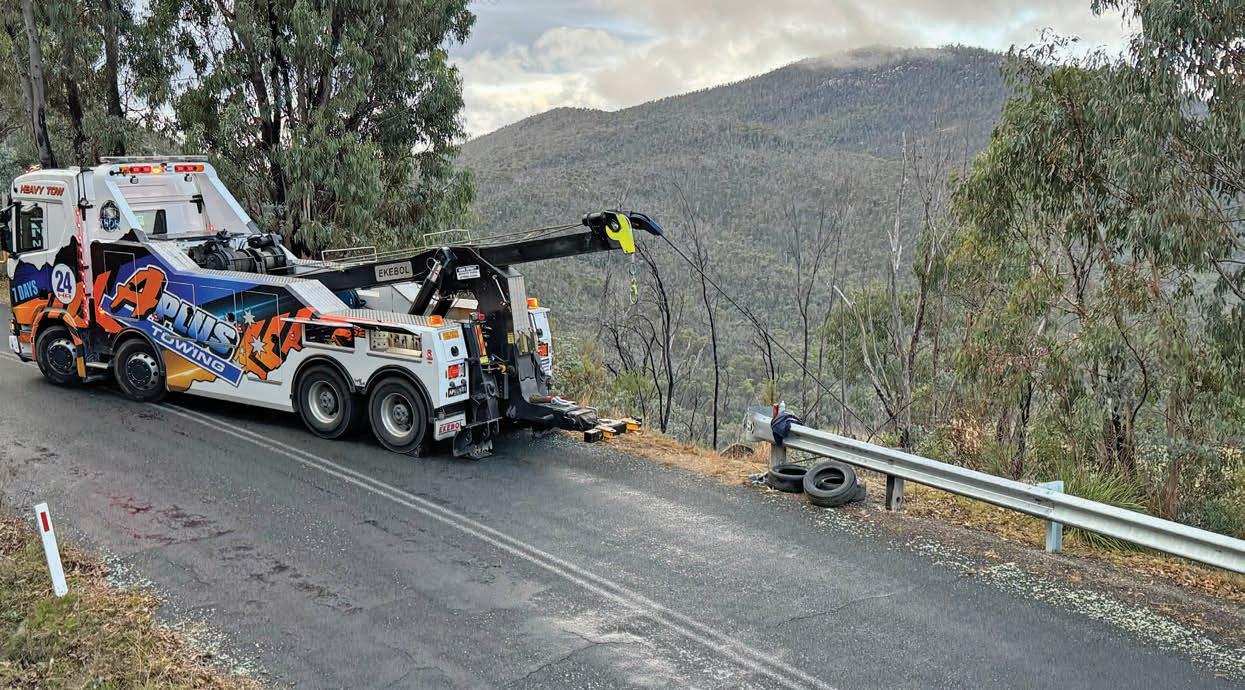
Canberra based Aplus Towing uses a unique, eye-catching Scania heavy tow truck to complement a fleet of Isuzu tilt trays.
52 Uplifting partners
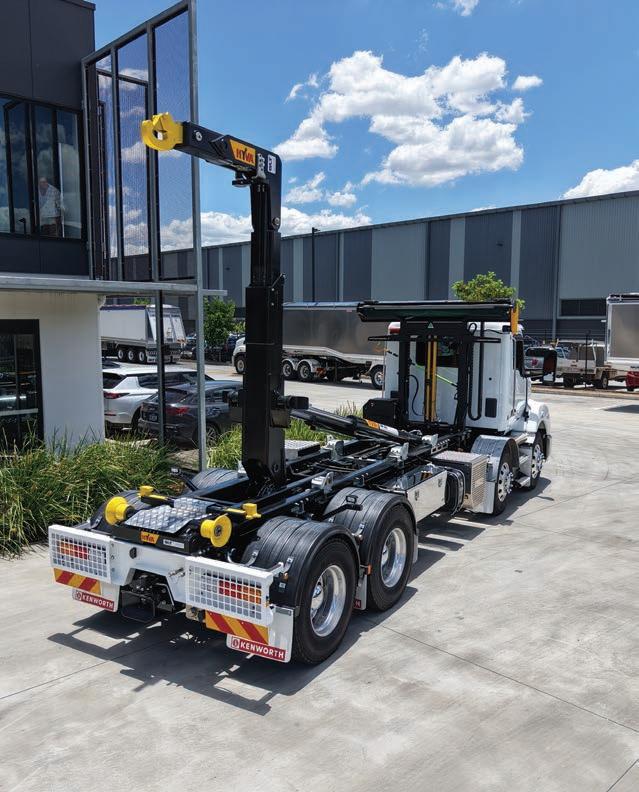
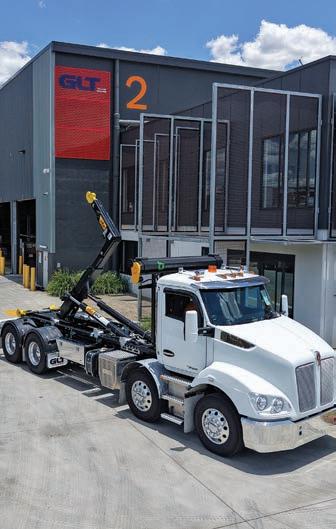
Queensland-based GLT Trailers provides complete, Australian-engineered solution for truck-mounted lifting systems through its extended partnership with JOST/Hyva.
TRUCK & TECH
40 Circuit Breaker
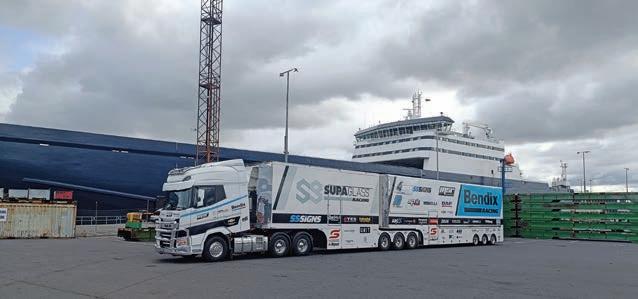
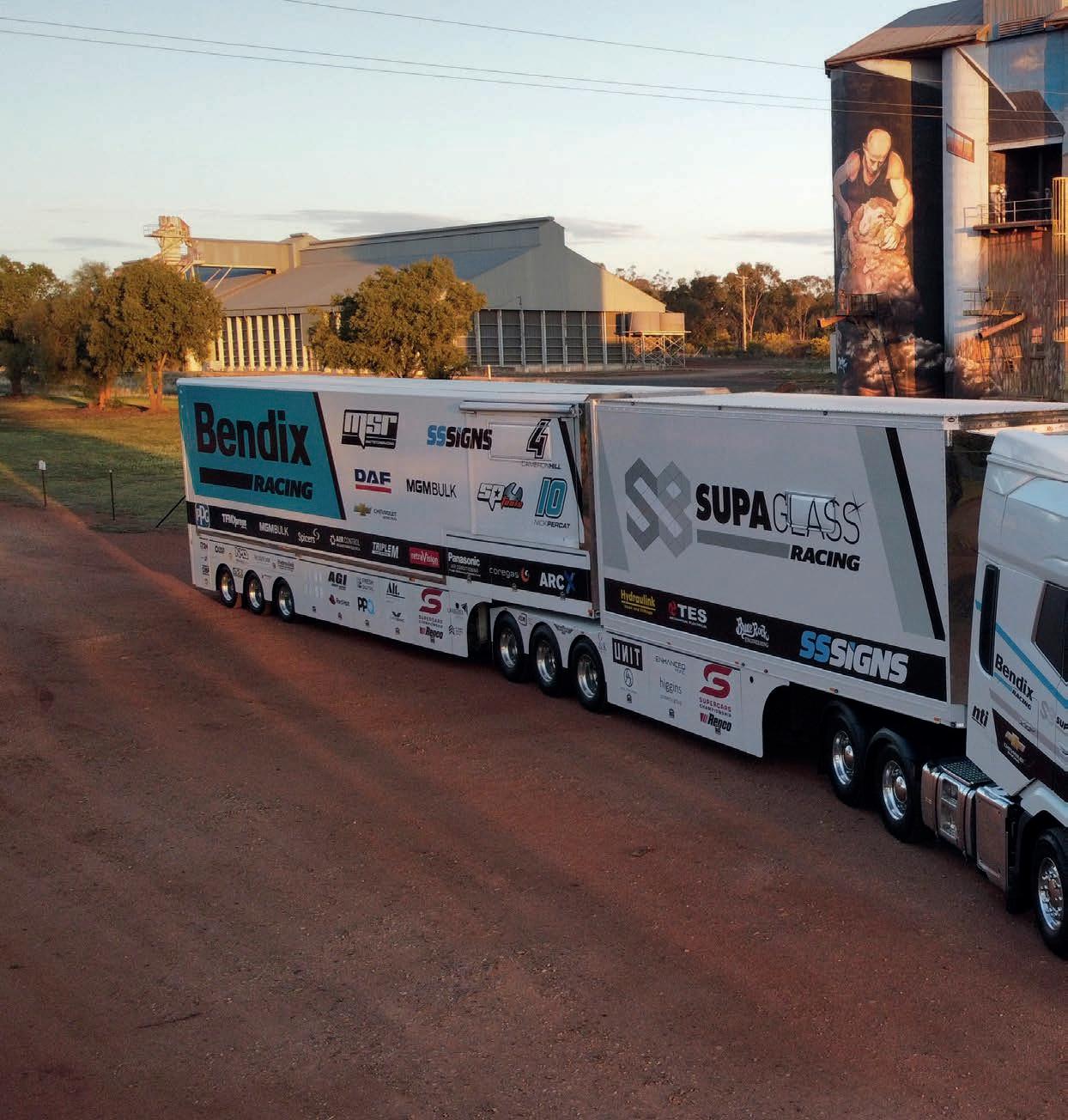
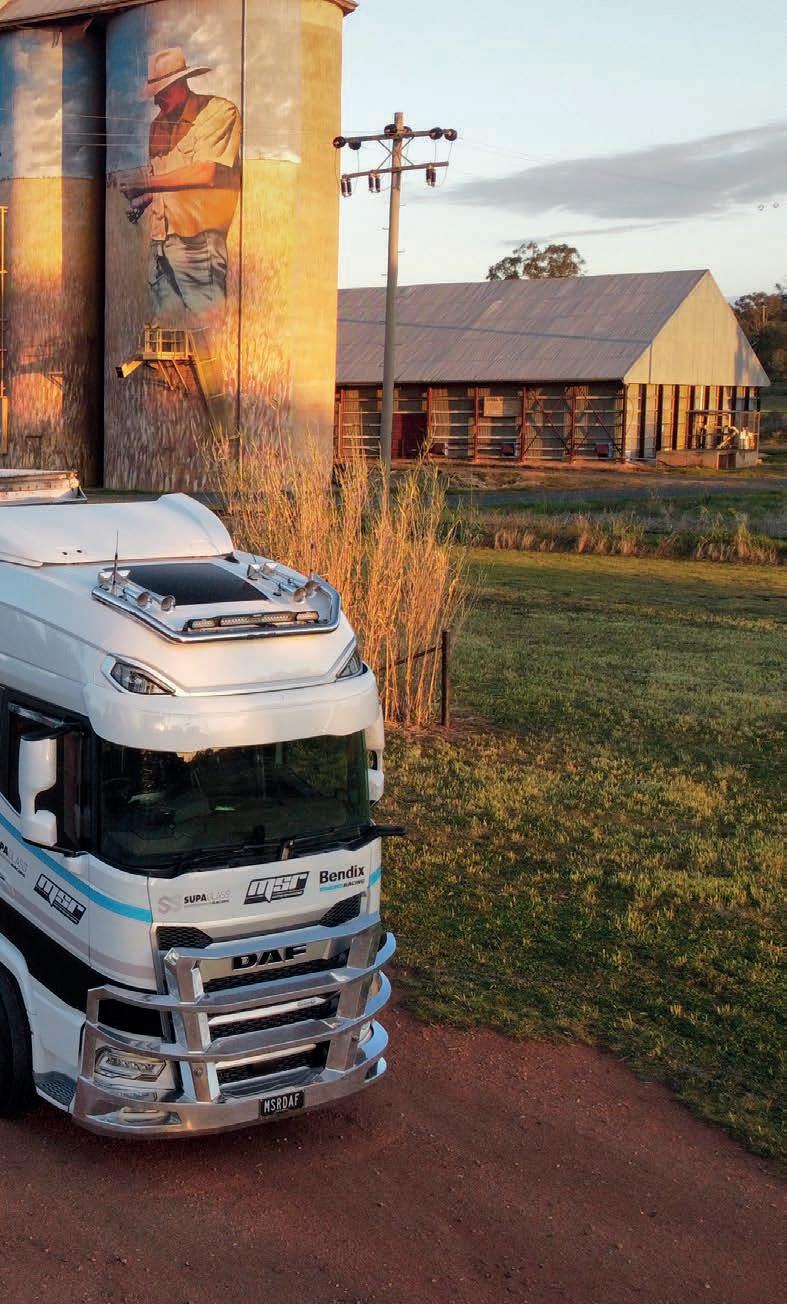
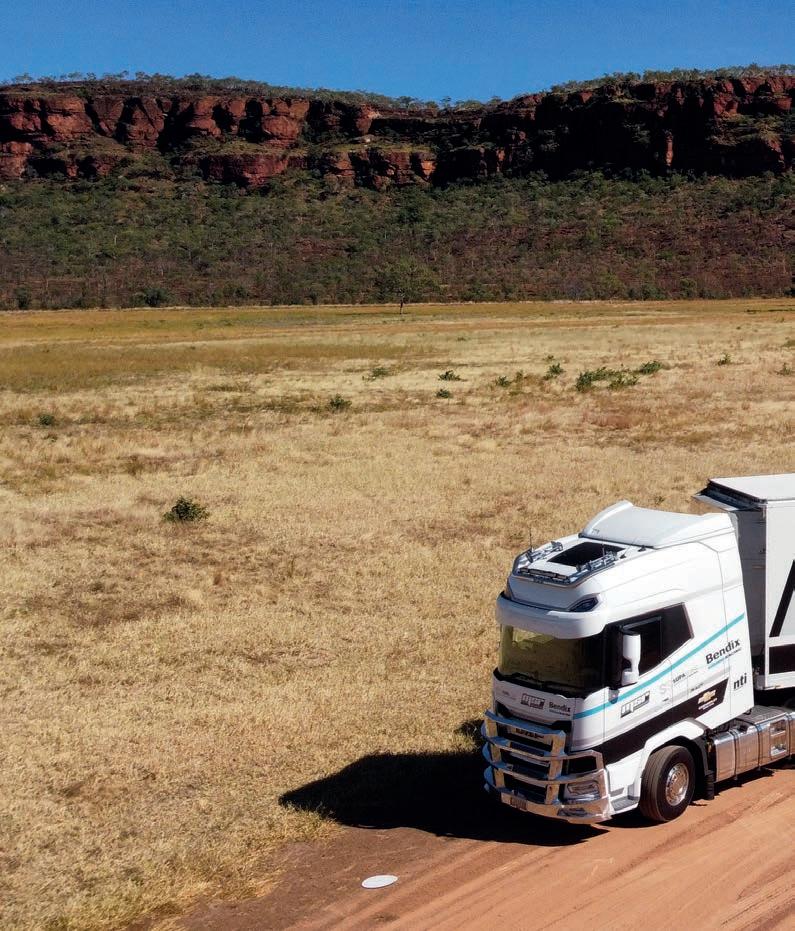
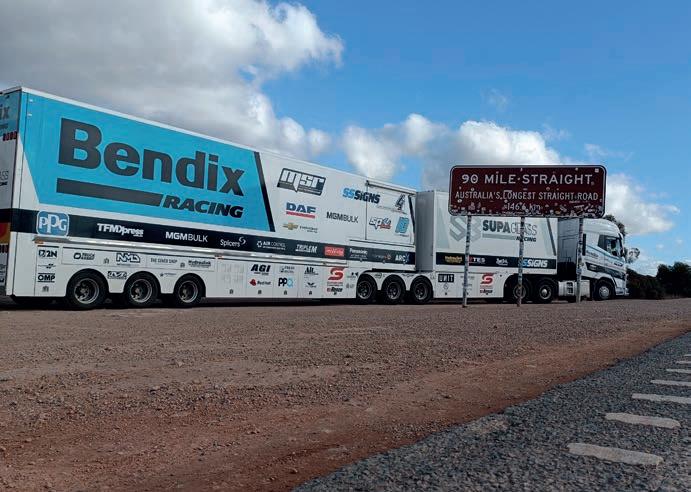
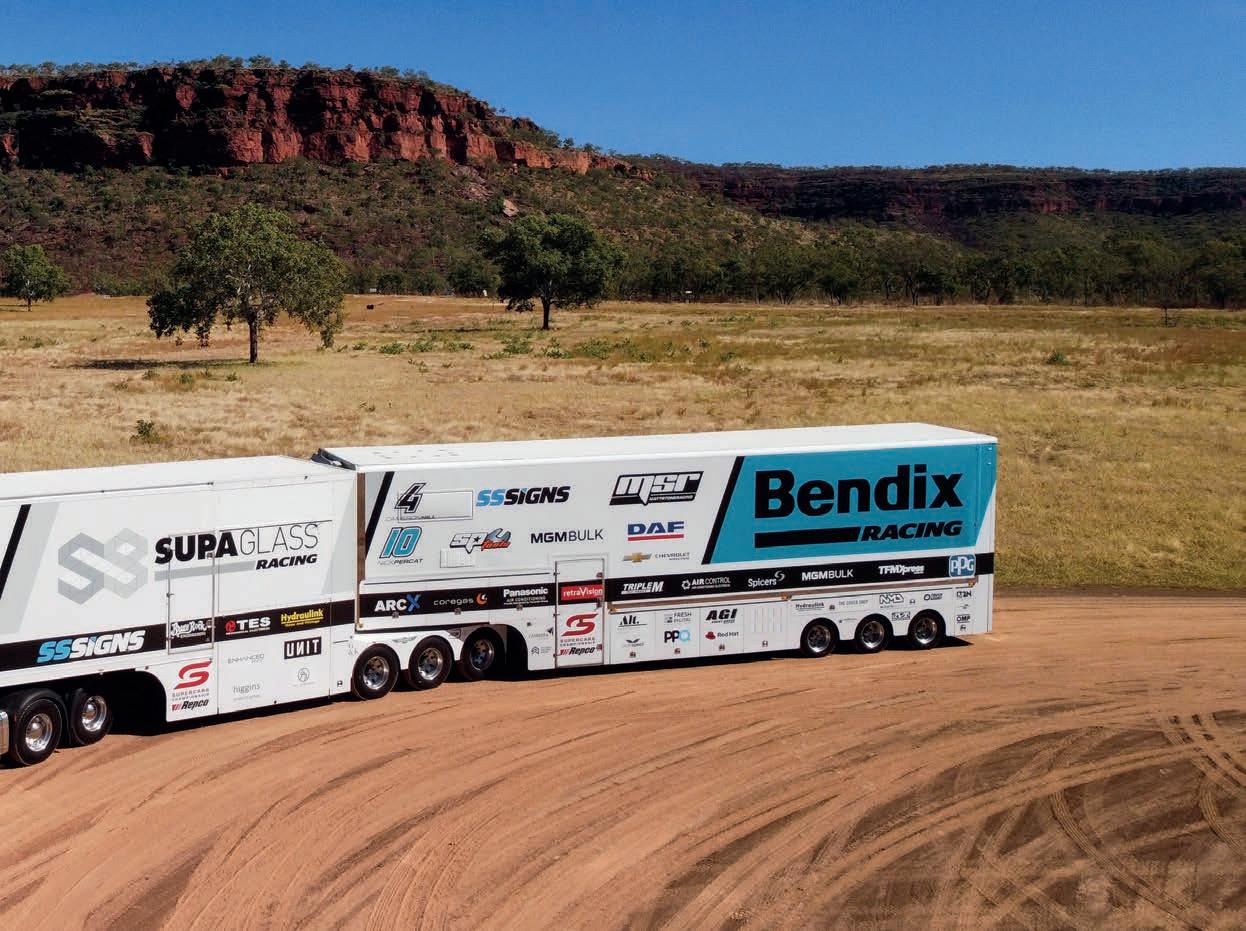
Matt Stone Racing recently upgraded to a DAF XG660 to haul its race cars around the country.
POWER TORQUE TECH
54 New Section
This newly created section features news and information relevant to the transport industry, with particular focus on trends, tech and new developments.
TEST DRIVE
70 Innovation Intersection
A comprehensive drive day affords a unique environment to evaluate the latest from Isuzu‘s MY25 model range now filtering into truck dealerships across the country.
William Craske Editor
Greek Fire, as it is often called, was the secret weapon of antiquity, a relic now lost to history that people who study such things posit was a petroleumbased incendiary projectile that burned wet and was near-impossible to extinguish. Introduced to the broader public through Game of Thrones and to the enemies of the Byzantian Romans by a bronze amethrower, usually emplaced on a moving ship, the medieval forerunner of napalm rst appeared in Constantinople around 678 AD after Kallinikos, a Greek engineer, brought the invention with him after escaping from Syria. It was particularly useful, not to mention devastating, in repelling Arab invaders of which there was no shortage over the next seven centuries.
Greek Fire helped the Byzantines become the dominant sea power of the Eastern Mediterranean. But their reign on the water was relatively short-lived. How is it that a people with access to this technology surrendered such an advantage?
One of downfalls of the Byzantines would lay in outsourcing their shipbuilding capabilities to the
Eternal Flame
Venetians. It turns out that offshoring manufacturing to a willing rival is not a sound strategy.
The arrangement afforded Venetian merchants privileged positions within the trading provinces of the Empire that included concessions to transport silks into the lucrative markets of Northern Italy. From 1126 onwards, Venice held the right to avoid paying any internal duties on commercial transactions, in addition to the original abolition of import-export duties on Venetian shipping. By the 1100s the Venetians had mastered assembly-line shipbuilding at the Arsenale producing galleys on a massive scale. In fact, the Venetians displayed a profound understanding of systems and, what’s more, had them in place. Henry Ford is usually credited with the invention of assembly-line manufacturing. The Venetians were his forerunner by some 700 years even demonstrating the importance of modularity. Tools and components, according to historian Roger Crowley, were standardised to ensure interchangeability and reduce assembly time. Materials were drawn from centralised warehouses, transported via internal barges, distributed to specialised departments, and tracked. Disruption was minimised by having the carpentry, foundry, and rope-making workshops arranged in accord with linear ow designs. Unlike Venice, Constantinople
wasn’t optimised for the same commercial dominance.
Once the cornerstone behind Byzantine superiority in the region was effectively surrendered to a rival power, the Venetians through mastery of manufacturing and supply chain, would supplant them as the chief naval power for nearly 400 years.
With its unique geography and unrivalled access to source materials like salt and timber, Venice saw the utility and value in a protectionist, neo-mercantilist approach which it exploited as the terminus on key trade route from the Adriatic and into Asia for Eastern goods. Venice even adopted double-entry bookkeeping well before the rest of Europe. For around three centuries this successful strategic adaptation helped it become a superpower in international trade and geopolitics proving that it’s isolation and detachment from the mainland were attributes that helped it to punch far above its weight. But as Professor Jakub Grygiel notes, “the ability to formulate and implement a foreign policy that re ects the underlying geopolitical reality is the key to achieving and maintaining a position of power, if not supremacy.”
THE NEW SHAPE OF EFFICIENCY.
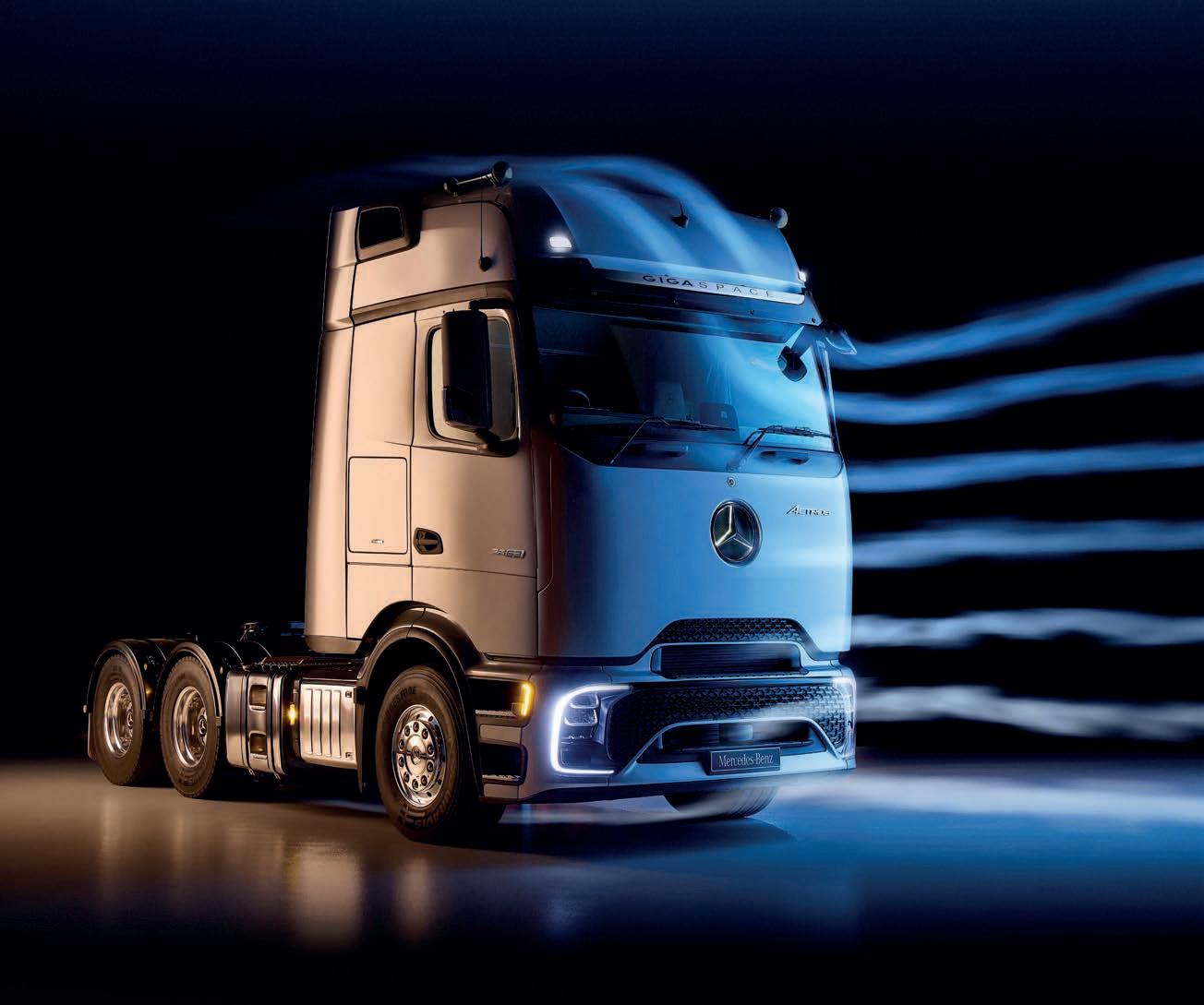
Introducing the Mercedes-Benz Actros ProCabin.
Evolution never stops. The redesigned Actros ProCabin has been reshaped to cut drag and boost your bottom line with ultimate fuel efficiency. Building on recent fuel economy and reliability upgrades, the ProCabin also delivers the kind of safety gains and driver comfort you expect from Mercedes-Benz Trucks.
> Lawson Port Logistics expands high productivity fleet
Lawson Port Logistics has added 15 new prime movers and a raft of other heavy duty equipment to its massive fleet.
The national container transport specialist continues to invest heavily in the renewal and expansion of its heavy vehicle fleet. Over the past six months the fleet has deployed new MercedesBenz Actros 2668s and Volvo FH600s along with significant upgrades it has made to its high productivity units and landside operations.
This includes three empty carrier Super B trailer sets, five quad-quad combinations, and two A-double sets — all supplied new from Freighter Group. The A-double combinations primarily service the high-volume corridors between Melbourne’s three major terminals and Lawson’s strategically located depots, with additional movements to empty parks as required.
Lawson Port Logistics operates one of Australia’s largest A-double fleets with nearly 70 A-double combinations running daily across Melbourne.
A-doubles were first introduced to the fleet in 2016, forming a major component of Lawson’s long-term productivity and sustainability strategy. Operations are also supplemented by a fleet of around 70 sideloader trucks, which includes twin-steer units, standard sideloaders, mini sideloaders, and a growing presence of midisideloaders. Steelbro is the sideloader manufacturer of choice. This includes the newly introduced split-tri-axle units capable of safely transporting 30-tonne containers.
“These assets allow us to support customers across Melbourne with unmatched same-day responsiveness,” said Lawson Port Logistics Managing Director Billy Eroglu. “Investments in new equipment ensure we remain at the forefront of efficiency, safety, and capability within the container transport sector.”
Adopting A-doubles as a high
productivity solution has delivered substantial environmental and operational benefits for the business. “By transporting significantly higher payloads per movement, we reduce the number of individual trucks required on the road, directly lowering our CO₂ emissions per tonne moved,” Eroglu told Prime Mover. “This also contributes to reduced urban congestion, which in turn decreases unnecessary fuel burn and emissions from idling traffic.”
It’s crucial to Lawson’s that it operates only the latest aerodynamic and fuelefficient truck designs.
Every truck in the fleet is less than seven years old.
From a fleet procurement perspective, prime movers are spec’d with extended aero fronts, advanced driveline optimisation, and intelligent fuelsaving software collectively to improve fuel economy and reduce AdBlue consumption across the fleet. Headquartered in Melbourne, where a majority of the trucks reside, the business also operates in Sydney, Adelaide, Brisbane and Perth.
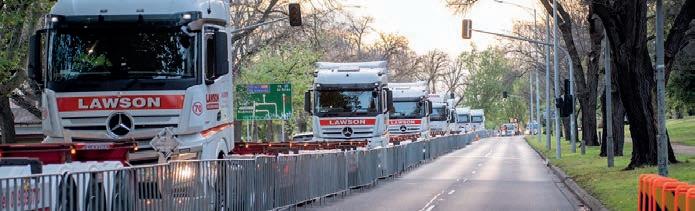
An allotment of its imposing A-double fleet was on show last month when Lawson Port Logistics partnered with the Nike Melbourne Marathon.
The A-doubles – 13 in total – were positioned strategically across the CBD and surrounds as mobile safety barriers throughout the event.
This initiative marked the first time anywhere in the world that equipment of this size and configuration has been used for crowd protection and event safety.
“Seeing our fleet lined up across the city at sunrise was a proud milestone for our team, showcasing that Lawson Port Logistics is not only a wharf
cartage and depot specialist but also an innovative solutions provider capable of responding to unique community needs,” said Sel Kayikci, Business Development Manager.
With cold-chain demand accelerating across food, FMCG, pharmaceutical, and value-added manufacturing sectors, Lawson’s has seized the opportunity to expand its reefer cartage for chilled and frozen freight into its logistics ecosystem.
A key advantage of this move is the ability to service customers through Melbourne’s cold-chain hubs located in the Derrimut and Truganina logistics precinct.
With direct connectivity to western arterial routes, the precinct supports rapid container turnaround, highvelocity cross-docking, and transport solutions.
Rather than building new assets from the ground up, the company has aligned with industry players to provide immediate access to high-grade coldstorage capacity.
This strategic step will allow the business to handle cold-store containers more effectively, optimise container flow, and provide a complete end-to-end pathway from port to temperature-controlled warehousing and local and national distribution.
“Our clients want more options, faster turnarounds, reduced doublehandling, and greater certainty in their temperature-controlled supply chain,” said Eroglu. “By working with coldstorage solutions providers we are expanding our logistics offering, we can manage the container cycle more efficiently and support our customers from port to pallet.”
Image: Lawson Port Logistics.
Mercedes Benz Actros trucks.
> Garry Willis Transport adds 110-tonne roadtrain ready Kenworth
South Australian long haul specialist
Garry Willis Transport has deployed its latest Kenworth T610SAR. The new prime mover is working on dedicated runs Adelaide to Perth return.
At a distance of 5500 kilometres, it’s one of the most gruelling road freight legs in the world. The truck was purchased in part for its versatility as it will be required to haul B-doubles, AB-triples and roadtrains on a weekly schedule.
It joins three other T610s that are also paired with a variety of different trailer combinations, two Kenworth K200s and a Western Star 48X.
“It seems to be quieter inside and the fuel economy is better,” said Company Director Mark Willis.
“The ergonomics are really good. Everything is at your fingertips. The T610s have good visibility with the sloping bonnet.”
The new truck will carry general freight in the main part. Outside provisional palletised applications sometimes it will be designated open trailer work hauling large machinery.
Garry Willis Transport often moves farm and mining equipment such as conveyer belt rolls on oversize loads. Trucks in the fleet also service Darwin from Adelaide and venture infrequently to outposts in Western Australia like Newman, Port Hedland and just last week Karratha.
The business predominantly caters to the resources and agriculture segments.
“We’re the people with the knowhow to do it,” said Willis.
His father Garry Willis, whose name the company still bears today, is now 80 and happily retired.
He started the business in 1963 when he was just 17 with the purchase of his first truck — a 27-horsepower Bedford that carted milk in the Adelaide Hills. A few years later Willis Senior began moving general freight to the small town of Cleve on the
Central Eyre Peninsula.
The interstate service to Perth began just over 40 years ago with Garry Willis driving a Mercedes-Benz 1418 across the Nullarbor which in those days was still a dirt track.
Today the Burton-based business is situated 15 kilometres north from the Adelaide CBD.
The first B-double was introduced into the fleet during the mid 1990s, making the roadtrain work it performs today something of an inevitability.
As the new Kenworth T610SAR will be deployed as a roadtrain driver comfort was a major consideration.
Featuring a big bunk, the cabin is also fitted with a TV, microwave and fridge, plus Icepack bunk cooler by Clare Valley Auto Electrical.
The bullbar comes courtesy of Chris Barron Engineering.
A dovetail with infill is from Custom Truck Components. The truck is finished in their signature grey with green and white trim — Panagraphix were entrusted with the livery.
“The drivers seem to like Kenworths. They certainly like to hop in them and from our point of view they look after them,” said Willis. “They take a shine to them because there’s pride in being responsible for a Kenworth.”
Adding new pieces of equipment to
the asset portfolio can help retain good drivers in what is generally considered a tough market.
“It can be difficult on a certain level especially with some of the work you do which can be hard going when you ask them to do deliveries and tie their own load down,” Willis told Prime Mover. “You really have to look after your drivers. The few good ones you come across you need to keep.
“The nature of the business is that you will see people join short-term and leave because it’s not for them.”
The driver of the new truck has acquitted himself well during the two years he has been with the business.
“When you get a good driver, you try and reward them with a nice truck and they look after us by washing it and keeping it clean and tidy inside and out.”
Rated to a load of 110-tonnes, the Kenworth T610SAR is powered by a 600hp Cummins X15 in the Euro 5 spec with Meritor differentials. The driver requested a manual 18-speed RoadRanger gearbox. CMV Truck & Bus handled the sale and delivery.
“The T610SAR is an all-round perfect truck,” said Willis. “Though it doesn’t have a massive wheelbase it can still pull a decent load, quite comfortably.”
The new Kenworth T610SAR. Image: Garry Willis Transport.
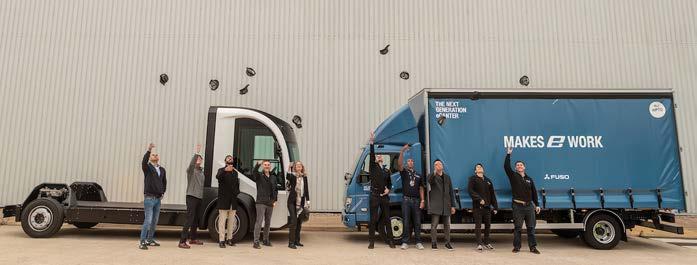
When the FUSO Canter first hit Australian shores, it delivered on a promise: a safe and practical work truck you could rely on to get the job done. And get jobs done it did. Since 1971, Aussies have been turning to an ever-evolving range of FUSO Canters for all kinds of jobs – cabs to carry crews and pantechs to help with moves, trays for loading and tippers for disposing. The work carries on with our latest FUSO Canter.
An updated design combines brighter LED headlights, sleek exterior styling and an enhanced 8” multimedia touch screen with the DNA of Australia’s hardest-working light-duty truck. Add in class-leading payload across most models, advanced active safety systems* and impressive 30,000km service intervals, and you have everything that you need to get the job done.
> Ares Group appoints new Chief Executive Officer
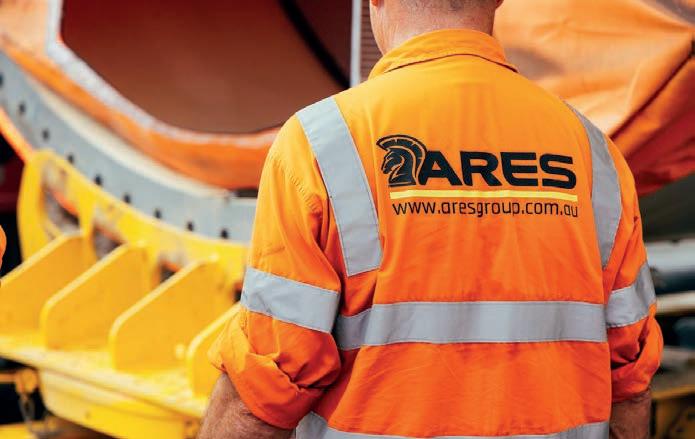
Specialised oversize transport provider, Ares Group, has announced the appointment of a new Chief Executive Officer. Davorin Jelaca, who recently served as General Manager, was promoted to the position of CEO. According to Ares Group, it marks an advancement in the company’s leadership, per a recent media release issued by the company..
The strategic move comes as demand surges for specialised oversized transport, heavy-haul engineering, and end-to-end project logistics across Australia’s energy and infrastructure sectors.
Jelaca brings extensive corporate, operational and project delivery experience across the heavy transport, renewable energy, and construction industries.
He will oversee the Group operations, growth in new markets and acquisitions.
“I’m honoured to lead Ares Group during this exciting period of growth,”
said Jelaca. “Our focus will remain on delivering innovative solutions and exceptional service, while strengthening our systems to support future opportunities.”
Australian-owned, Ares Group also provides engineering planning, route survey, and heavy-haul solutions.
Last month it appointed a new Health, Safety, Environment & Quality Manager. The company delivers integrated, end-to-end support for complex project logistics across the renewable energy, infrastructure, and industrial sectors.
> Ron Crouch Transport enters voluntary administration
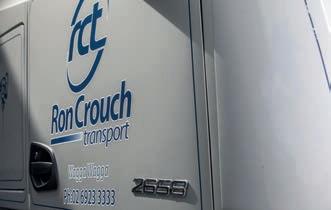
Ron Crouch Transport (RCT), a longstanding regional freight carrier with a 47-year history, has been placed into voluntary administration, with Managing Director Geoff Crouch describing the decision as one made “with the heaviest of hearts.”
In a statement issued recently, Crouch stressed the move was a voluntary step taken to provide clarity for employees, customers and suppliers as the business deals with mounting industry pressures.
“Whilst I love and have a passion for the Australian transport industry, as we all know it is a tough one that takes no prisoners,” he said.
Crouch cited challenging economic conditions, sustained pressure on freight rates, an ongoing driver shortage and “the never-ending burden of government over-regulation” as factors contributing to the company’s financial strain.
“Ultimate responsibility, of course, though is mine,” he added.
The appointed administrator’s first priority will be to seek a buyer for the business in an effort to secure “the best possible outcome for all staff and creditors.”
Despite the restructuring process, Crouch emphasised that operations will continue uninterrupted.
“With the valued support of my financiers, suppliers, customers and amazing staff it will be business as usual,” he said.
He also paid tribute to the workforce that has shaped the carrier over nearly five decades.
“May I take this opportunity to sincerely thank and appreciate the many hundreds of team members that have contributed to RCT over the last 47 years, and in particular, the 120 current team members who will be affected the most.”
RCT, founded by the Crouch family in Wagga Wagga, has grown into a respected regional and interstate operator.
The future of the business now hinges on the administration and sale process. Crouch was a director of the Australian Trucking Association (ATA) from 2013 to 2024 and was its Chair from 2017 to 2020. He is also a former President of ATA member association NatRoad. Recently, Crouch resigned as Director of Healthy Heads in Trucks and Sheds (HHTS) where he worked to improve the mental health and wellbeing of Australia’s logistics industry.
Ares Group has appointed a new CEO.
Ron Crouch Transport hits hard times. Images:
> Singh Transport boosts fleet with 130-tonne rated Kenworth
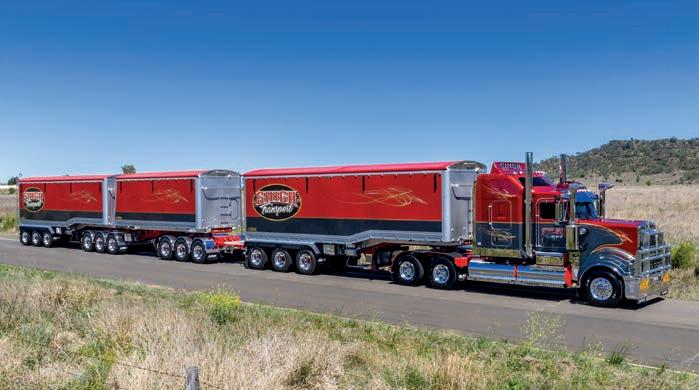
Singh Transport has taken delivery of a new Kenworth T909 prime mover. The arrival of this truck marks the tenth Kenworth and 15th overall unit in the family business’ fleet, which has carted grain, produce and other general freight out of Dalby, Queensland, for nearly 30 years.
“My dad started the company in 1998 with just one truck,” according to Operations Manager, Nathan Singh.
“He used it to assist with moving grain around his site, as well hauling it for customers, and continued to do so as business grew.
“All this time, it’s been a family affair. My brother and I were still in primary school when it began. Now, we each oversee part of the business.”
Today, Singh Transport’s operations have extended across Queensland and even as far down as New South Wales.
The new T909 will move where required. Initially, it will be carting grain in and around the Port of Brisbane, and cottonseed to the Darling Downs, and across the border into northern NSW.
The truck will be run in both ABtriple and A-double combinations depending on the load being carted.
“Dad likes the 909s, so we got one,” Singh told Prime Mover. “It’s not the first Kenworth in our fleet, either. We
like them because they are tough and sturdy, ideal for withstanding the travel we need them to do. And they have great resale value, too, which is what we’re looking for in our investments.”
As a rule of thumb, Singh Transport typically holds onto to each of its units for seven years to balance productivity on the road with a returnon-investment upon selling them. In addition to its rugged design and high resale value, Singh Transport’s new 130-tonne Kenworth T909 comes with a 600 horsepower Cummins X15 engine and rides on a Hendrickson Primaax Ex suspension — perfect for supporting heavy loads of grain across state boundaries.
After having received the truck
delivery from Brown and Hurley earlier this month, the Singh Transport team quickly went to work accessorising it to maximise comfort for its drivers.
It comes with two fridges, a TV, extra toolboxes, additional lights and stainless 8-inch monster stacks for improved exhaust flow.
“The delivery process was very straightforward due to the help and organisation from Brown and Hurley’s Toowoomba branch,” Singh said.
“But after we actually got the truck from them, we were quick to break the truck in and get in on the road.
“It wasn’t our first time receiving a Kenworth, so we were very comfortable with receiving and preparing it. It’s become second nature to us.”
> Lindsay Australia opens upgraded 35,000m² facility in WA
Lindsay Australia has officially opened its greatly expanded Perth depot. Located in Hazelmere, the new site includes on-site refuelling, a truck wash, weighbridge and a 1,350 m² expansion zone.
Investments in the upgrades have expanded capacity and are considered critical for strengthening its safety profile and boosting network reliability. Lindsay Australia also anticipates the new look depot will improve its overall operational efficiency across Western Australia.
“We are delighted with the new facility at Hazelmere,” said Lindsay Australia CEO Clay McDonald.
“The purpose-built site will enable us to provide enhanced service and solutions to our existing customers and support Western Australia’s growing freight needs.”
McDonald said the upgraded site would unlock the business’s ability to grow its rail and road network.
“I’d like to thank our WA staff for their hard work and dedication in successfully growing the business
and our major customers, freight partners and the entire project team for joining us on-site to celebrate the opening of the new facility.”
The 35,000m² property increases in size from 10,000m² with the hardstand area enlarged to 20,000m² from 2,100m².
Other expansions include 420m² of office space, 3,000m² of chiller warehousing, 850m² storage for frozen goods and an increase to 12 docks from two.
Image: Brown & Hurley Group.
Singh Transport’s Kenworth T909 in an AB-triple combination.
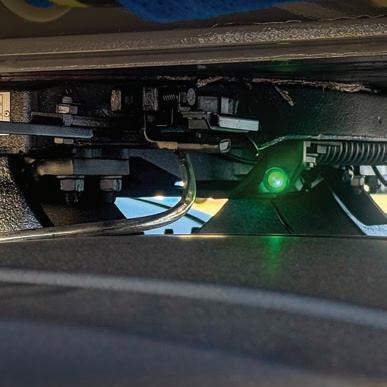
Secure your drive with JOST Australia's Loc-Light system. Upgrade your fifth wheel with the Loc-Light sensor light system. Dual sensors and LED throat illumination confirm secure coupling, reduce errors, and speed up pre-trip inspections.
> Local Freight confirms major fleet expansion
Queensland freight specialist, Local Freight, has invested heavily in its growing business with several new trucks and trailers. A pair of Kenworth K220 prime movers were added for peak season along with a new Volvo FH600, two rigids, two semi-trailers and a drop deck B-double.
In addition to this, the business has purchased new Toyota forklifts, a Speedywash trailer washer for the trailer fleet and two FWR Dollies to support its growing presence of multicombination units.
Local Freight has 16 linehaul prime movers in the fleet and another four prime movers dedicated to metropolitan runs.
The Kenworth K220s house a 550hp Cummins powerplant paired with an Eaton automated transmission.
These trucks, purchased from Brown and Hurley, are expected to cover 5000 kilometres weekly, running up the interior of the state to destinations such as Emerald.
They are spec’d in a sleeper cab for this purpose.
Based in Wacol, the company initially began as a small freight carrier focused on southeast Queensland, primarily operating on the Gold Coast, the Sunshine Coast and around Brisbane.
“We’ve upgraded older equipment that was due to be phased out but the new assets have primarily been acquired as part of our growth,” said Managing Director, Harry Manais.
Expansion has been the primary driver of the recent investments in trucks and trailers.
Local Freight has also begun the process of building a network of depots in central Queensland and North Queensland.
A new site opening in Rockhampton will go online in the new year.
It now has 80 trucks and trailers in total including a new 10-pallet Fuso Fighter and a 14-pallet UD Quon having started out with a solitary vehicle in 2010.
“That was originally a commitment
to transporting smaller freight,” said Manais. “But in 2017 we came up with the business name ‘Local Freight’ and from there on we have grown.”
The business is jointly owned by Manais and his brother Gary. In 2021 they acquired a lesser-known carrier by the name of Connect Trading Transport.
“The owner was leaving the industry. We took up his client base. That’s when we expanded into regional Queensland,” Manais told Prime Mover. “He was an old school guy who was still reliant on pen and paper for administrative tasks and record keeping. We had already adopted digital systems.
“The additional customers gave us a starting point to move into other areas while we onboarded freight from our own clientele and kept on expanding.”
Those other areas include building materials — mainly moving timber, cement and building materials for James Hardie up north.
Local Freight now moves an estimated 100 tonnes of timber every week. It also provides DG transport services.
“Anything that can be fitted onto a curtainsider trailer we can carry,” said Manais. “We move everything from a pallet to a full truck load though we are more focused on LTL than FTL.”
While the Kenworths have been designated roadtrain work “up through the guts” of Queensland – the business doesn’t operate interstate – the new Volvo will be deployed predominantly on the east coast direct to Rockhampton, Mackay and Townsville from Brisbane.
Local Freight operates a PUD fleet on local distribution runs. The linehaul units will travel to the depots and the rigids will from there complete the final mile.
“We don’t work with any of the bigger carriers as a third-party contractor,” said Manais. “So, we’re not providing services for anyone other than our own freight customers.”
Manais feels for other carriers in the current climate as insolvencies continue and longstanding businesses are faced with buyouts or going bust.
“It’s a really hard time the last few years especially with the labour shortages,” he said. “You can grab more work and expand but then you are at the mercy of the driver and it’s increasingly hard to find good ones.
“It’s no secret it has been a challenging time for road transport especially with operational costs and everything going up.
“We’re looking forward to what our future holds as we look to invest in the business.”
Queensland company, Local Freight, is expanding its fleet capacity.
We’re clearing all stocks of the DAF CF530 at the low price of $249,900* (ex. GST and Gov’t charges). Plus get a $30,000* BP Fuel voucher or 0% finance* (Max. 48 month term). Only while stocks last. See daf.com.au/CFrunout.
DAF CF530 $249,900* *Terms and conditions apply. See daf.com.au/CFrunout.
> Hendrickson names new GM
Hendrickson has appointed Luke Callaway as General Manager –Oceania, taking leadership of the company’s operations across the region.
Callaway said it was an honour to be entrusted with leading the Hendrickson team and guiding the next phase of growth.
“We are building something special here, and I’m excited for the next part of the journey,” he said.
“I look forward to continuing to work in close partnership with our OEM and fleet customers, our global divisions,
and our valued suppliers as we drive further value for this great industry through regionally tailored innovative solutions.”
Callaway brings extensive experience with Hendrickson, having worked across a range of senior roles that have given him deep insight into the company’s products, customers and global operations.
His background positions him well to continue strengthening relationships with OEMs, fleets and suppliers while supporting the delivery of solutions tailored to local market needs.
> Isuzu extends market lead with MY25 launch
Isuzu Australia capped off a milestone 2025 by securing its 37th consecutive year of Australian truck market leadership following the launch of its all-new MY25 truck range.
The result comes despite a softer overall 2025 market, with total industry sales down 12 per cent to 45,191 units. Against that backdrop, Isuzu delivered 12,420 trucks across all weight segments, lifting its market share to 27.5 per cent.
Isuzu Australia Director and CEO, Andrew Harbison, said the introduction of new Australian Design Rules (ADRs) made 2025 a “once in a generation” year for the brand.
“The introduction of the new ADRs was the trigger for the launch of our all-new MY25 truck range in Australia,” he said. “With our record atop the Australian truck sales race extending
back to 1989, there’s a lot of pressure and expectation with every product we bring to market.”
More than 200 MY25 models have been released across light, medium and heavy-duty segments over the
ISRI: DEALERS
past 12 months, helping Isuzu maintain its long-standing dominance.
Isuzu again led the light-duty segment with 6,941 deliveries, claiming a record 50.6 per cent share, while also topping the medium-duty market with 3,267 units and 49 per cent segment share. In the heavy-duty segment, Isuzu delivered 2,221 trucks to secure 15.5 per cent share and third place overall.
Isuzu Australia Head of Sales Craig White said the new range has garnered a strong public response to the new range had been strong since its public debut at the 2025 Brisbane Truck Show.
Both Harbison and White credited the Isuzu Dealer Network as a key factor behind the brand’s continued success, as competition intensifies and customer demands evolve across Australia’s heavy vehicle sector.
Image: Luke Callaway.
Luke Callaway has been appointed General Manager of Hendrickson’s Oceania division.
Image: Isuzu Australia.
The MY25 truck range has cemented Isuzu Australia’s position in the Australian market.
> Beveridge intermodal precinct to strengthen freight network: ALC
The Australian Logistics Council (ALC) has welcomed the Federal Government’s $1.62 billion investment in the Beverage Intermodal Precinct. The project is expected to strengthen Australia’s freight network and support more efficient, resilient, and sustainable supply chains.
The 1,100 hectare site, located at the southern terminus of the Melbourne–Sydney interstate rail corridor at Beveridge in Melbourne’s north, will enable a modal shift from road to rail, improving freight efficiency and unlocking billions in economic benefits for Victoria and Australia.
With construction set to start in 2026, the precinct will deliver Melbourne’s only terminal capable of servicing double-stacked Inland Rail trains.
Delivery of an initial rail terminal (Stage 1A) is targeted for 12-18 months following this, to provide the market with access to an independent terminal.
Stage 1 is targeting mid-2028 operations with capacity for up to 200,000 20-foot-equivalent units (TEUs) annually.
Double-stacked trains will operate between Melbourne and Perth via Parkes in New South Wales, for more efficient and lower-emission long-haul freight.
The precinct is designed to deliver smarter, more sustainable infrastructure. By shifting freight from road to rail, it is expected to:
• Remove 167,000 truck trips annually or up to 110 trucks per train.
ISRI
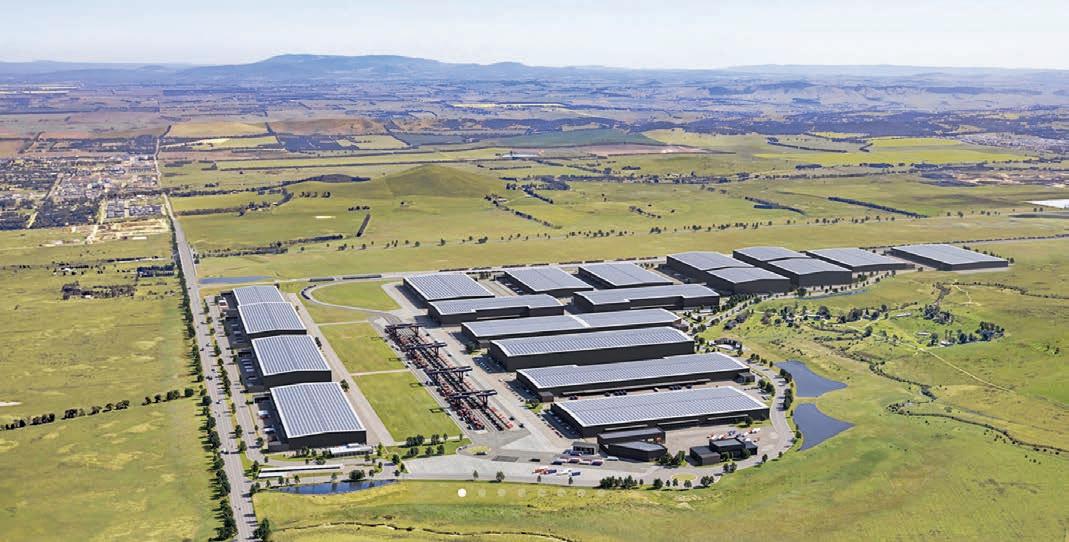
How the completed Beveridge Intermodal Precinct will resemble.
• Reduce emissions by 12.1 million tonnes of CO₂ over 25 years.
• Cut particulate pollution by 92 per cent compared with road freight.
The precinct will also integrate renewable energy solutions, with the potential for up to 200 MW of rooftop solar and battery storage.
The project includes a $900 million investment in the new Camerons Lane interchange, improving freight access and easing congestion in the surrounding area.
National Intermodal is developing the first of three terminals on the precinct.
The precinct is expected to create 8,000 direct jobs and support over 17,000 jobs at peak, with around 70 per cent of the workforce sourced locally from Melbourne’s northern suburbs.
• Supporting drivers for more than 50 years
• Seating – on a higher level
Image: National Intermodal.
NatRoad has warned of major impacts on
> RUC increases could drive businesses to the wall: NatRoad
Australian families could pay more for groceries and everyday essentials if governments push ahead with a proposed increase to truck fuel charges, the National Road Transport Association (NatRoad) has warned. NatRoad lodged a submission to the National Transport Commission opposing a proposed six per cent increase to the Heavy Vehicle Road User Charge for 2026–27 – double the current rate of inflation.
The peak body said the increase would lift the diesel charge paid by trucks from 32.4 cents to 34.3 cents per litre pushing struggling businesses further to the brink.
NatRoad CEO, Warren Clark, said the impact of the proposal goes far beyond trucking companies and will be felt directly by households.
“Every loaf of bread, every carton of milk and every box of fruit you see in a supermarket has arrived on a truck,” Clark said.
“When governments increase the
cost of running those trucks, the price pressure doesn’t stop at the depot gate. It flows straight through to the checkout.”
Clark said the proposed increase is particularly damaging because it comes at a time when freight businesses are already being squeezed from every direction.
He estimated that increasing the charge to twice that of inflation would cost the average truck using 100,000 litres of fuel an additional $2,000 each year on top of rising costs for insurance, Workcover, parts and maintenance.
“For a lot of owner-operators, this could easily be the straw that breaks the camel’s back. They’re not sitting on cash reserves. They’re working week to week, truck to truck, just to keep the doors open,” he said.
“When trucking businesses go under, competition disappears, particularly in regional areas. That means fewer operators, longer delivery times and
higher prices. Regional Australians feel it first, but everyone feels it eventually.”
NatRoad is calling for the increase to be capped at inflation for 2026–27, with broader reform considered through the upcoming ForwardLooking Cost Base process.
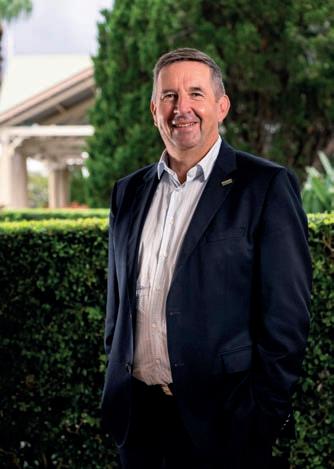
Warren Clark,NatRoad CEO. Image: NatRoad.
> Logistics operator deploys aerodynamic prime mover
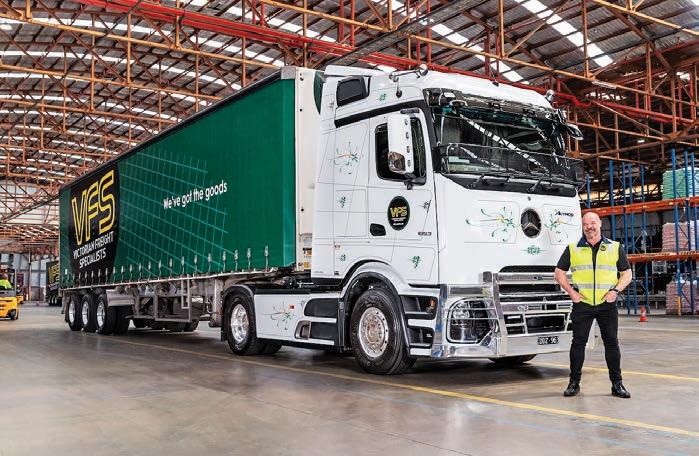
Logistics operator, Victorian Freight Specialists, has added a MercedesBenz Actros ProCabin to its fleet of over 160 units, servicing metropolitan and regional Victoria, along with Southern New South Wales and Canberra.
The new 13-litre, 1853 4x2 ProCabin joins a previous generation Mercedes-Benz Actros with the same specifications in the company’s fleet. This ProCabin introduces a new cab with a special aerodynamic design to further drive down fuel consumption, as well as an active safety package with an electronic platform that can respond 20 per cent faster than before.
Its compact size, manoeuvrability and versatility are also major operational benefits, according to Victorian Freight Specialists Director of Operations, Chris Collins.
“It is a great truck to have because you don’t have to send a big full-size semi into a tight spot,” he said. As it already operates the latest products from Mercedes-Benz
Trucks, Collins was one of the first fleets to place an order for the ProCabin model.
“I was keen to get into one straight away. I loved the fresh look of the ProCabin and knew that it brought other fleet improvements, like more advanced safety.”
Collins is a big advocate for the
> NHVR releases 2026 Master Code
The National Heavy Vehicle Regulator (NHVR) has released its 2026 Master Code, providing updated, practical guidance to help improve safety across Australia’s heavy vehicle industry.
Developed with extensive input from industry and supply-chain participants, the revised Master Code is designed to support owners, operators and all parties in the Chain of Responsibility (CoR) to better understand, manage and reduce safety risks in everyday operations.
NHVR Acting Chief Safety and Productivity Officer Kelli Walker said the updated Code was intended to clarify obligations under the Heavy Vehicle National Law (HVNL), not add new regulatory burdens.
“This revised and expanded Master Code is not about introducing new
rules or red tape,” said Walker.
“It provides a clear roadmap to safer operations, informed by the collective experience of industry, regulators and operators right across the heavy vehicle supply chain.”
While the Heavy Vehicle National Law (HVNL) sets specific legal requirements around matters such as driving hours, mass and dimension limits, it also places a Primary Duty on all parties to ensure safety so far as is reasonably practicable. The 2026 Master Code aims to bridge the gap between this legal duty and day-today business decisions by identifying common risks and outlining practical ways to prevent harm.
NHVR CEO Nicole Rosie said the Code would be released alongside supporting guidance material, with further resources to be developed in
ProCabin’s fuel consumption and handling, saying: “I haven’t looked in too much detail, but it is doing even better than the existing truck, which was already great on fuel.
“And it’s a beautiful truck to drive. It has brilliant performance with 530hp, and its driver loves its safety features.”
consultation with industry.
“The heavy vehicle industry operates in a complex and demanding environment, and we know operators and drivers are balancing safety, productivity and compliance every day,” said Rosie.
“By continuing to work alongside industry, we can help turn information into action and support safer outcomes for drivers, operators and the wider community.”
The regulator emphasised that the Master Code applies well beyond businesses that own trucks or employ drivers. Organisations that contract transport services, manage warehouses, operate loading facilities or otherwise influence heavy vehicle activities are also encouraged to use the Code to meet their CoR obligations.
Image:
Victorian Freight Specialists shows off its new MercedesBenz Actros ProCabin.
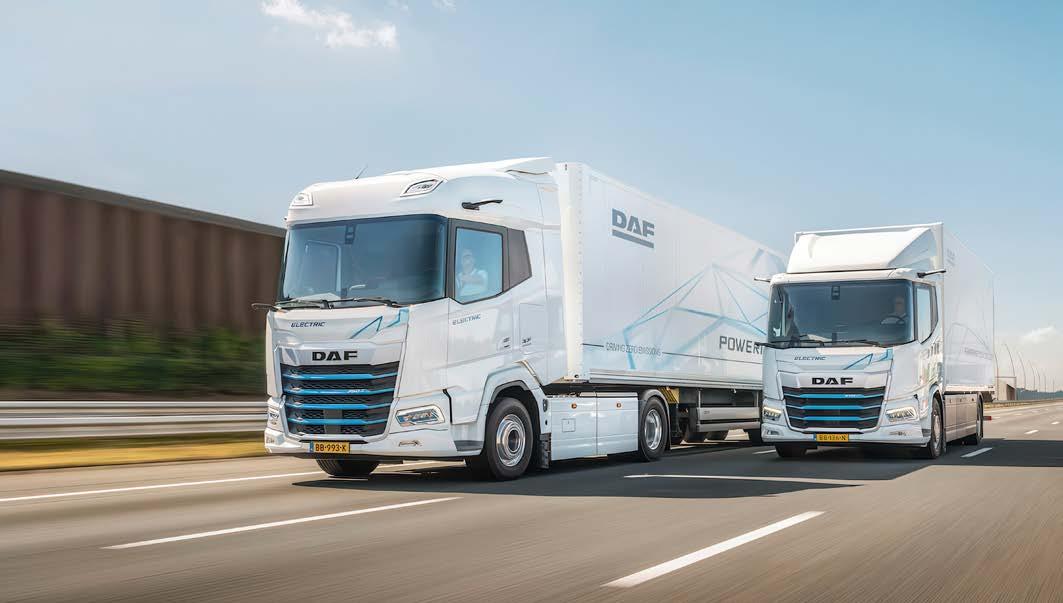
DAF electric trucks awarded International Truck of the Year 2026
The New Generation DAF XD Electric and XF Electric have jointly been elected ‘International Truck of the Year 2026’.
A jury of 23 commercial vehicle journalists from across Europe praised DAF’s XD and XF Electric truck series for their exceptional energy efficiency, refined yet powerful driveline, and advanced technical architecture.
The award-winning vehicles were also recognised for their long driving ranges, advantageous LFP battery technology, and superior driver comfort.
Harald Seidel, President of DAF Trucks, received the most prestigious award in the truck industry during an award ceremony at the Solutrans exhibition in Lyon, France.
It is the third win for DAF in only five years’ time, after the New Generation XF/XG/ XG+ and XD became ‘International Truck of the Year’ for 2022 and 2023.
In line with the rules of the International Truck of the Year (IToY) organisation, the title is awarded annually to the vehicle introduced in the previous 12 months that has made the greatest contribution to road transport efficiency.
The assessment covers a range
of criteria, including technological innovation, comfort, safety, drivability, energy efficiency, environmental performance and Total Cost of Ownership (TCO).
“During extensive test drives, jury members praised the XD and XF Electric for the perfection of their drivelines and the almost imperceptible gear changes. The modular vehicle concept, offering a wide choice of battery and axle configurations provide operators an exceptional flexibility,” said Florian Engel, Chairman of the International Truck of the Year jury. “With the new XD and XF Electric, DAF Trucks demonstrates that the combination of a central electric motor and a traditional rear axle can be at least as energy-efficient as a driveline with an e-axle. Moreover, this DAF configuration provides perfect weight distribution, enabling virtually all use cases to be covered by a single technical platform.”
The XD and XF Electric trucks are powered by PACCAR’s advanced EX-D1 and EX-D2 e-motors, delivering outputs from 170kW (230 hp) to 350kW (480 hp). With modular battery packs ranging from
210 to 525kWh, the 4x2 and 6x2 tractor and rigid vehicles offer zero-emission ranges of over 500 kilometres on a single charge, and even over 1,000 kilometres per day through optimal charging planning.
DAF’s XD and XF Electric trucks are designed for both city and regional distribution and long distance applications, combining excellent aerodynamics with a low cab position, ultra-low window beltlines, and advanced digital camera systems.
Harald Seidel said the international award was a symbol of proide for all DAF employees.
“This recognition underlines our commitment to drive the future of zeroemission transport through innovation, quality, and sustainability. We are thrilled that the jury of leading commercial vehicle journalists acknowledges the vehicles’ efficiency, safety, and exceptional driver comfort,” he said.
“Receiving the most prestigious award in the truck industry is another recognition of the hard work of the entire DAF organisation to deliver first class products and services to our customers.”
Image: DAF Trucks.
DAF’s award-winning electric trucks.
> Fuso signs MoU with Israeli tech pioneer
Mitsubishi Fuso Truck and Bus Corporation (MFTBC) has signed a memorandum of understanding (MoU) with REE Automotive to jointly develop and verify X-By-Wire and Software Defined Vehicle technologies. These will be for MFTBC’s commercial vehicles.
XBW technology replaces traditional mechanical linkages with electronic control, enabling steering, braking, acceleration and other critical functions to be managed via sensors and electrical signals. In addition to enhancing vehicle safety and operability, the technology, it is anticipated, will contribute to reduced vehicle weight, improved fuel efficiency, and the deployment of advanced driver assistance (ADAS) and autonomous driving systems. SDVs refer to next-generation vehicle architectures where key functions and performance are primarily controlled and updated through software. Independent of hardware constraints and through
SDVs offer potential for flexibility and scalability, extend vehicle lifespans, and reduce total cost of ownership, bringing long-term value to customers.
MFTBC and Israel-based REE Automotive have launched a joint initiative to evalidate the integration of XBW and SDV technologies,to unlock new possibilities for next-generation commercial vehicles with greater design flexibility, excellent controllability and advanced safety features, all while reducing costs for end customers.
build a Proof of Concept vehicle within one year.MFTBC will also evaluate REE’s technologies for further future technology collaborations.
“We believe that by combining Mitsubishi Fuso’s autonomous driving and ZEV technologies with REE’s XBW and SDV technologies, we can realise superior logistics solutions,” said Hironobu Ando, MFTBC Head of Product Engineering.
“We are very pleased to work with REE to address social issues such as global warming, traffic accidents, and driver
Representatives from REE and Mitsubishi Fuso celebrate the MOU.
PRINCIPLES FI R
PRINCIPLES ST
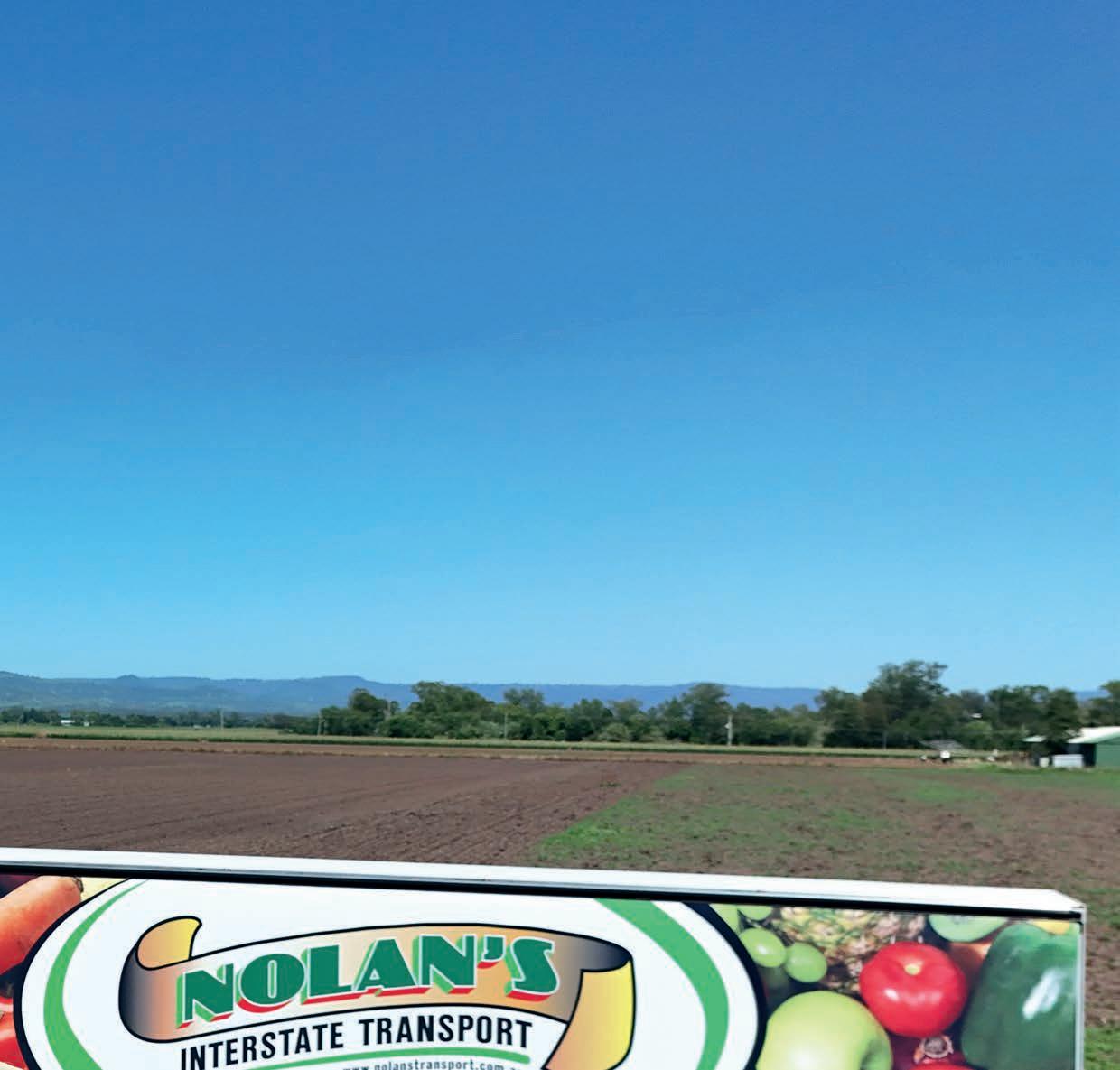
The delivery of its 150th Kenworth marks another milestone in the ongoing journey of fifth-generation family business Nolan’s Interstate Transport.
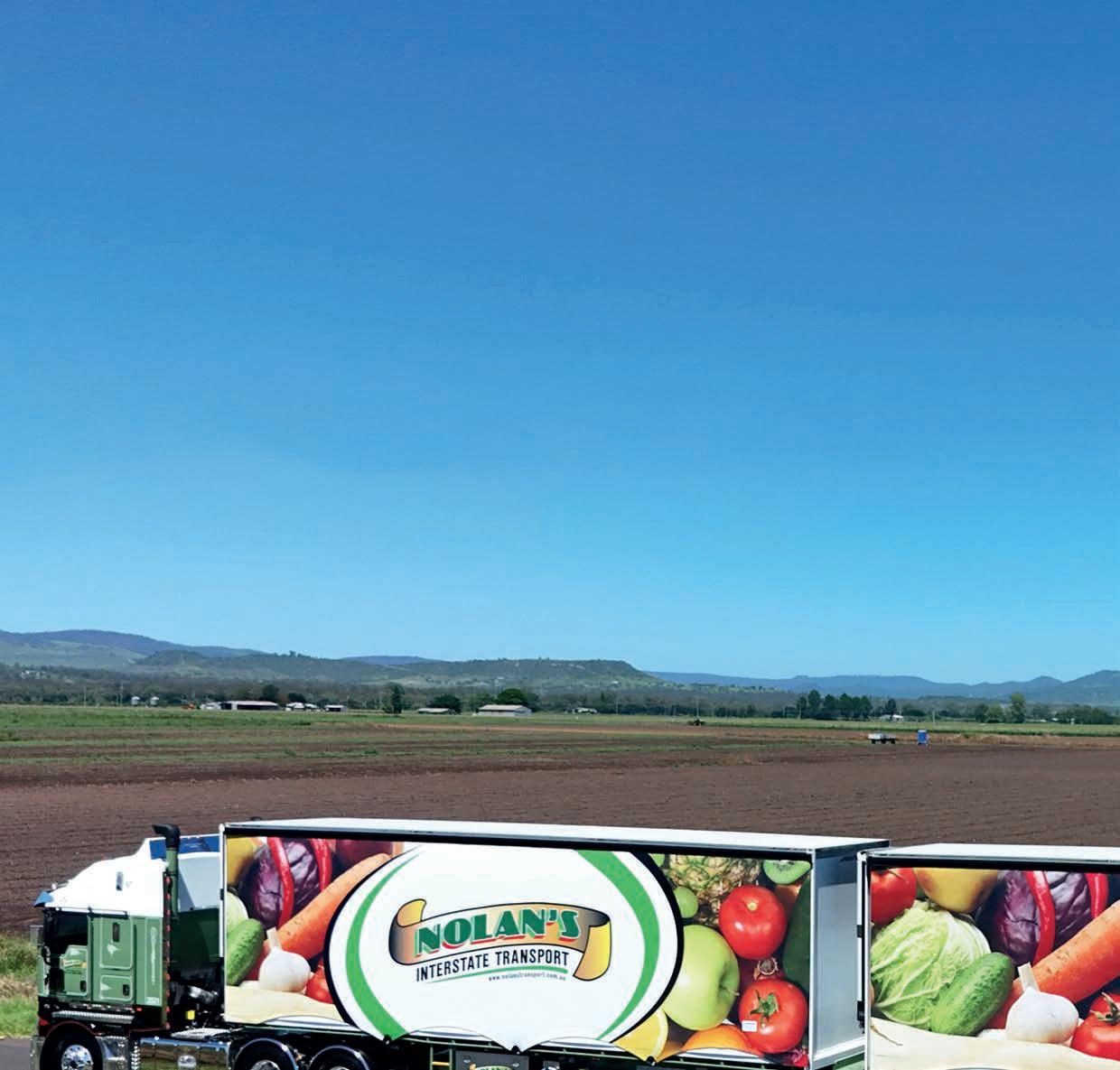
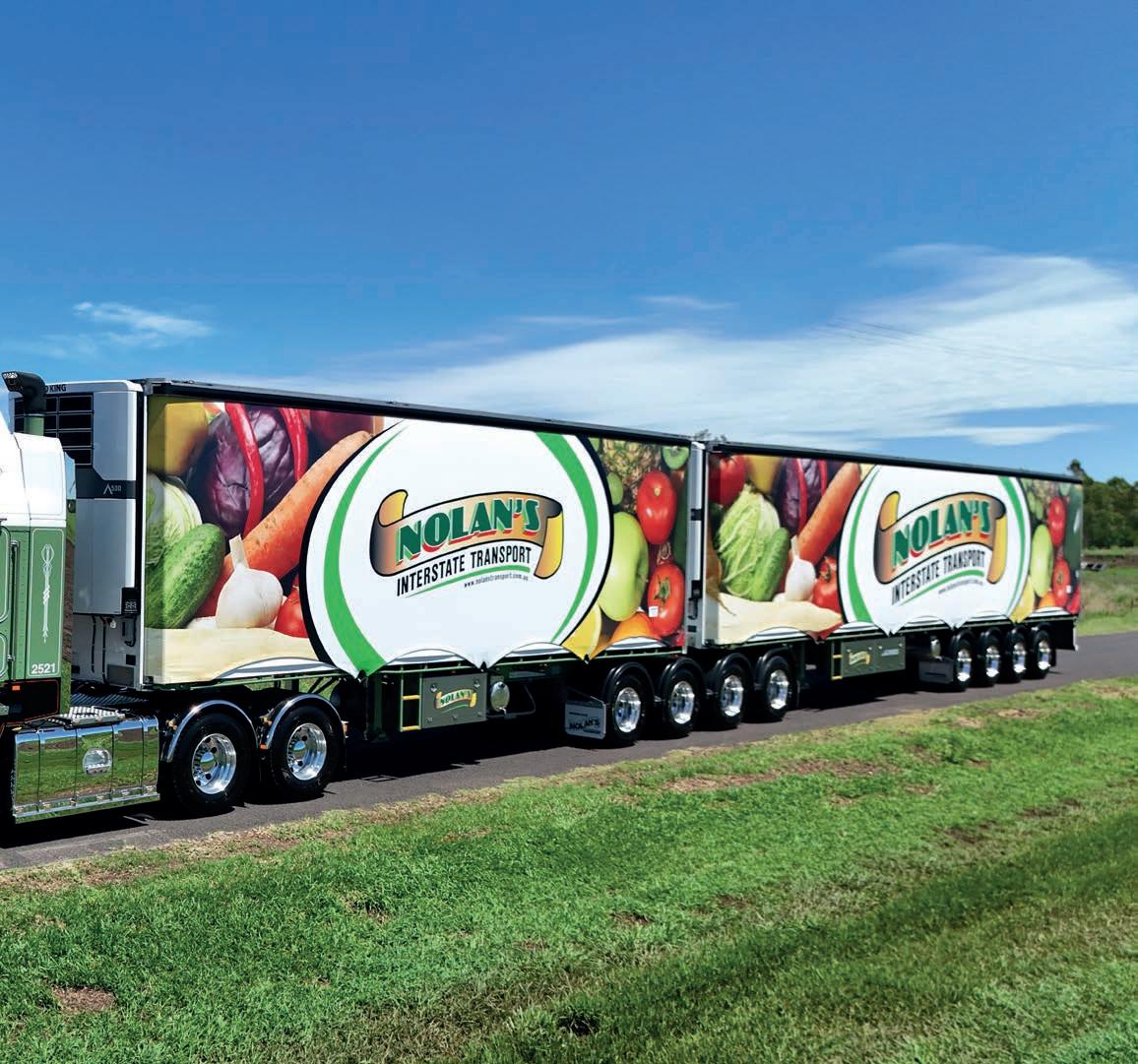
Kenworth K220 PBS quad quad combination moves through the Lockyer Valley.
Conceivably not more than a handful of major transport firms today can directly trace back their origins to the turn of the last century and horse drawn carts. Nolan’s Interstate Transport is, in this classification, one of a select few. But it’s not just here that the company is in a class of its own. It cherishes a set of values that it doesn’t feel the need to espouse even though they are integral to its mission. Loyalty. Integrity. Community. And the list doesn’t stop there.
Now into its 12th decade as an enterprise, the business is understandably proud of its heritage and good fortune in having pulled through many a challenge and come out the other side all the stronger for it. For better or worse, privately-owned businesses that retain their family values serve, whether they want to or
not, as bellwethers for many others in the industry who must look for aspirational examples when trying to survive in a rapidly contracting marketplace. They can do worse than to emulate Nolan’s Interstate Transport. Headquartered at Gatton, the biggest town in what is known in some corners as Australia’s salad bowl, the flattened alluvial plain of Lockyer Creek and valley of the same name, is fertile ground with black soils helping cultivate grains and vegetable growing. Regarding the latter, the region supports a $160 million-a-year industry mainly through small farms ranging from 100 to 1,000 hectares in size. Nolan’s Interstate Transport has serviced this area and the attendant farmers with road transport options for well over 100 years. Primarily a linehaul specialist brandishing a pristine prime mover fleet, one of
the biggest in Queensland, in often class-leading horsepower settings, the family business is capitalising on Performance-Based Standards engineered applications especially when it comes to transporting ambient and refrigerated goods. Because the idea here is to limit materials for moving products from one fixed address to another, by increasing the space with which to do it, the 42-pallet quad quad refrigerated van has become, over time, the go-to option.
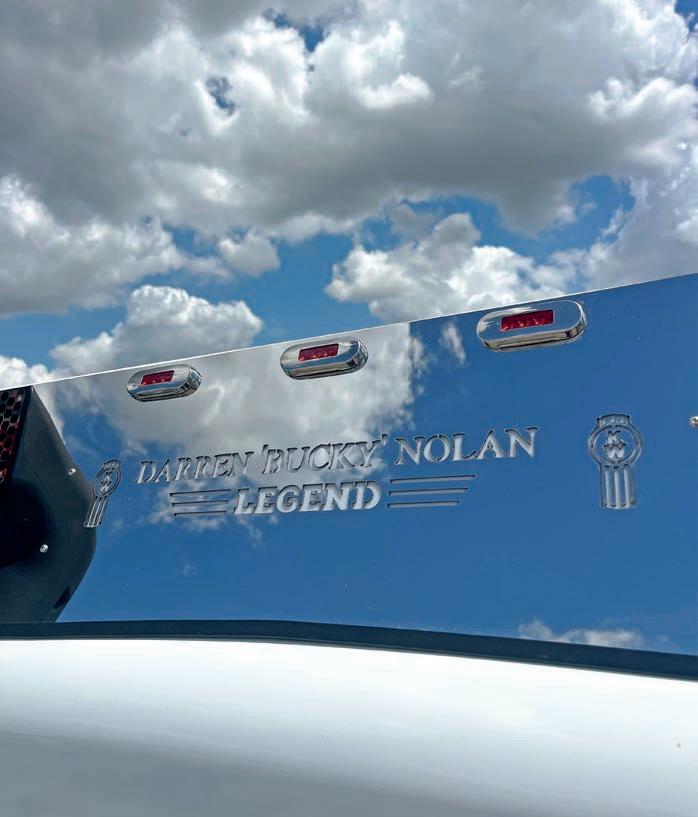
Dedication to Darren ‘Bucky’ Nolan.
Nolan’s runs 27 of these combinations in the fleet. It’s been something of an elixir on its east coast haulage carrying fresh produce and general freight since the first one was deployed in 2021. Such is its versatility the fleet has rapidly increased its commitment to this trailer configuration ever since then as it fits under a 30-metre approved PBS requirement.
“There’s really nothing specific that we don’t use them for,” says Adrian ‘Flea’ Nolan, Nolan’s Interstate Transport
Director. “A big part of our interstate fleet is now on the PBS scheme.”
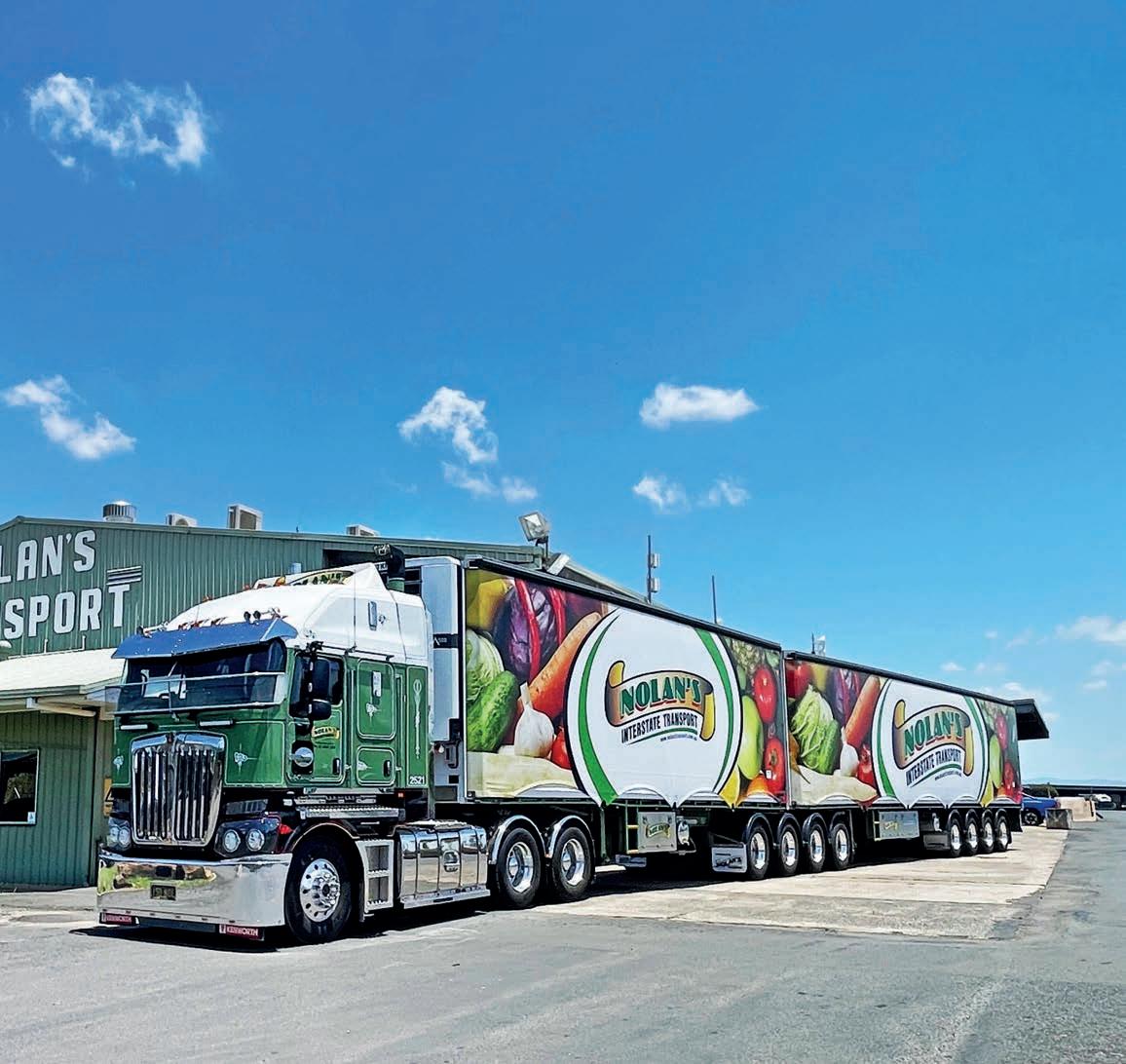
Late last year, Nolan’s was presented its 150th Kenworth unit from Brown and Hurley to pull one of these high productivity trailer combinations.
The commemorative Kenworth K220 features a powerful 600hp Cummins X15, automated transmission from Eaton, Meritor axles set at 4:3, a TV, microwave, inverters and other features prone to interstate trucking. Brown and Hurley equipped it with a bigger
bumper bar on the front and some additional customisations in the grille.
The fuel tanks have been wrapped. On the top of the ducktail there is a stainless steel plate inscribed with a dedication to Darren ‘Bucky’ Nolan, Flea’s brother who passed away, aged 54, in March of last year.
“It ticks the boxes for a number of our new PBS platforms with its size and durability and length,” says Flea. “Look, the technology has come a long way. All of the safety features and the Euro
The 150th Kenworth prime mover delivered by Brown and Hurley to Nolan’s Interstate Transport.
6 powertrain. You can’t do much more than invest in the latest and greatest product. We’re definitely proud to be a partner with the Brown and Hurley and PACCAR group.”
Scott Coleman, Brown and Hurley Sales Consultant in Darra also sold Nolan’s their first Kenworth. The exact date 30th July 2001. It was a K104 — also a cabover. Part of the initial attraction was that it met the 25-metre B-double rule back in those days. That truck came with a cryptic message inscribed on the stainless sunvisor, “Never Too Late”.
Flea recalls it as being an in-joke, referring to Brown and Hurley finally breaking through with its first Kenworth sale to the fleet. Scott Coleman, whose idea it was to add the comic touch to the sunvisor naming a truck that he couldn’t have known at the time would be the first of 150 units, remembers it differently.
“It wasn’t actually about the Kenworth,” he says. “It was about the guy who drove it. He was a bit of a character. When he would go to Melbourne he would get to the other side of Toowoomba, worn out by then, and go to bed. He would say it was never too late for him to get away because he could leave whenever he liked and still always get there.”
With over 200 prime movers in the Nolan’s fleet, Flea estimates 40 per cent of these have a Kenworth badge with another 300 trailers, on hand, from preferred supplier FTE in Melbourne. While the prime movers in the fleet are rated to 97 tonnes, the quad quads enable gross weights up to 80 tonnes. Every truck is now purchased to be PBS compatible.
Even the T610s, which will eventually become T620s, are hitched to 26- and 28-pallet singles.
“They’re all capable of roadtrains if need be,” says Scott. “Flea buys a lot of quad axle twin-trailer combinations now. The singles have a steerable rear liftable axle. It’s more efficient for running.”
Scott, who also sold Kenworths to Flea’s father Terry Nolan, appreciates dealing with honest authentic people.
“I can always have a really open and
frank discussion with Flea,” he says. “You’re dealing with people who make the decisions and they know trucks intimately. That’s what I love.”
Scott has a framed photo on the wall of the 100th truck he sold to Nolan’s. That truck, delivered in 2019, was a T610SAR with a 28-pallet single.
“They’re a wonderful family to deal with,” adds Scott.
Advocates of the business come in no better shape than other, smaller family operators like Moffatt Fresh Produce and Granite Belt Fruit Freighters, each of whom run their own trucks and have no qualms in singing the praises of Nolan’s and the support they have offered over the years.
Helping smaller businesses is something ingrained in Nolan’s legacy.
“Our family-owned business is fifth generation. We’ve been going since 1908,” says Flea. “Our philosophy is we love working with Australian companies whether big or small. We like to support local communities and help out where we can.”
The key to the company’s longevity and ongoing relevance is its family culture according to Flea, who notes the industry can be a difficult one to navigate when it comes to understanding the direction it is going. “We’ve got good people who work for us who embrace our family culture which I think helps immensely,” he says. “We respect where we come from and having those family values goes a long way when it comes to maintaining trust and credibility.”
Stability has been important in recent years following the intensity of the hyper regulatory environment that COVID supposedly helped justify.
In that time Nolan’s has added to its property portfolio investing in depots in Bowen in Northern Queensland and adding a new site to Victoria at Sunshine West. The scale of the business today is very different to the era in which Terry presided over operations. “We have technology and systems in place that they never had,” says Flea. “They certainly had challenges but it’s
hard to know how they compare. Did Australia go down the right path with COVID? We all didn’t know what we know today. We did what we had to do — what was asked of us. I think the transport industry as a whole was not recognised for what our staff and our drivers had to do to keep the country fed and watered.”
If there were few benefits to being a truck driver during the lockdowns it would only come in the form of reduced traffic conditions.
One report issued in the aftermath by Monash University claimed the Australian government’s “failure to introduce a nationally consistent or nationally recognised permit system is one of the most significant road transport policy failures of the pandemic”. These decisions or the absence of, as history records between 2020-22, exacerbated the conditions that made it certain declining workforce numbers across the industry would only be accelerated.
“Our drivers and staff had to be swabbed every second or third day to go interstate to keep people’s food on the table. Most people don’t understand the toll it took on people’s mental health as well as the physical strain,” says Flea. “At the end of the day those men and ladies that were driving up and down the highways to supply food and essential goods did an amazing job.
I think the government and greater society overlooked those fundamental
challenges. That’s my view any way.”
It certainly adds another layer of gravity to the historic carrier which has, to this day, remained a family-owned business in one of the toughest industries in the world. That’s no small feat.
“To be fifth generation outfit and in Australia and working as a family is something we don’t take lightly especially in today’s harsh market conditions,” says Flea. “In a nutshell, we’re very proud of that to be honest.”
Head office in Gatton.
BEST BULK IS
Kelvin Baxter Transport is acknowledged as a leader in the transport of bulk rural commodities and specifies and maintains its vehicles with safety, durability and reliability as key criteria.
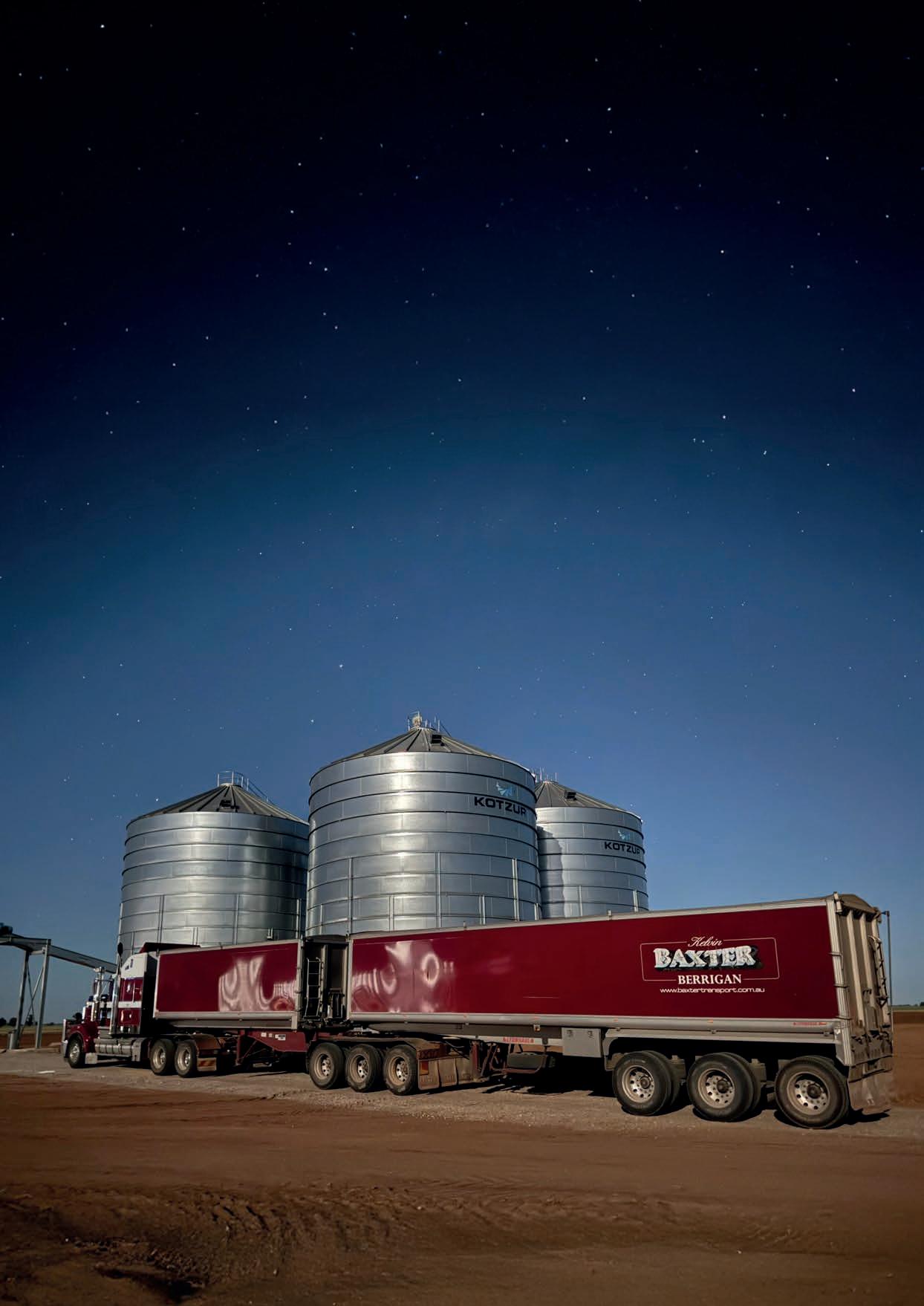
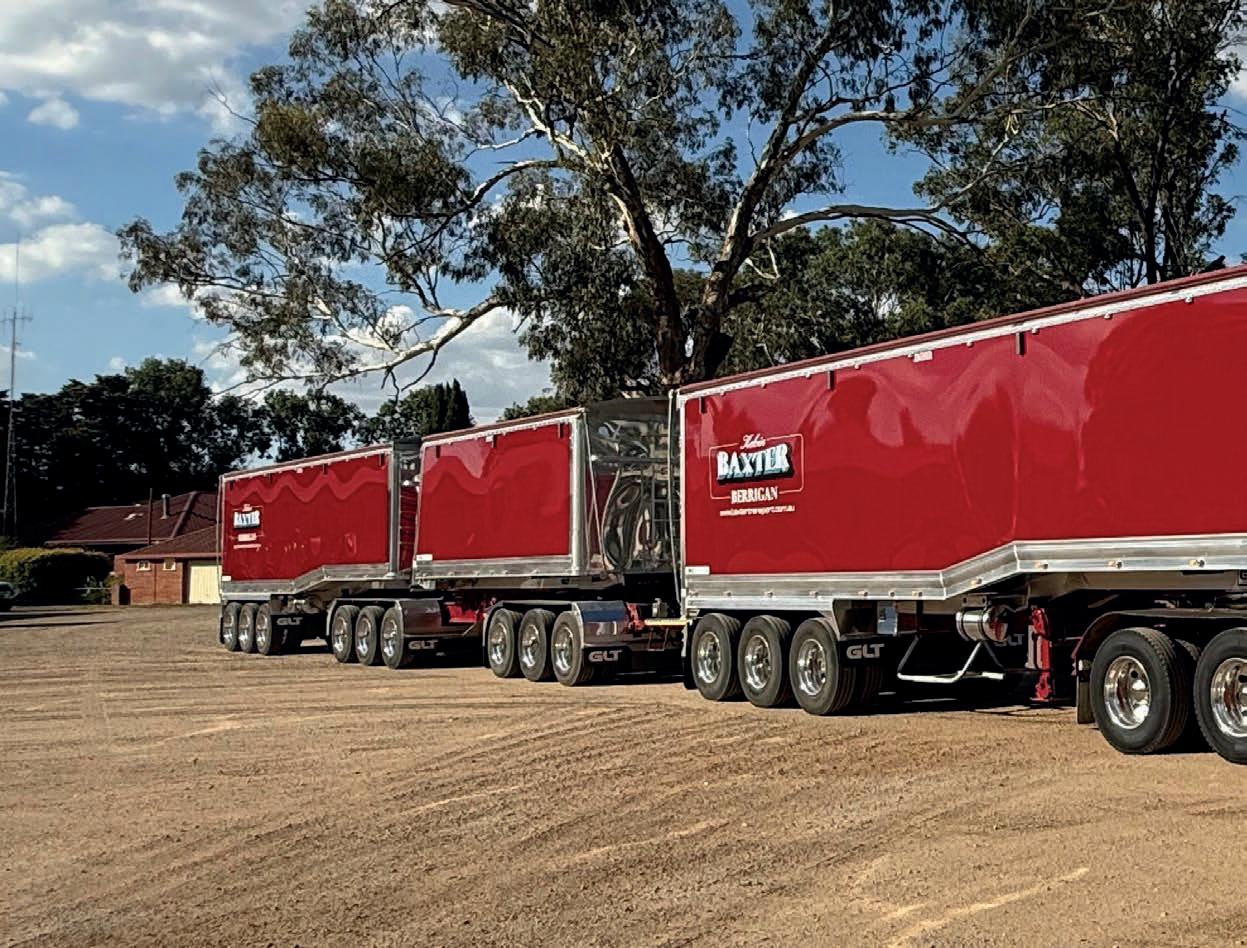
Kelvin Baxter Transport is king of its grain domain.
Berrigan is a town located in the Southern Riverina region of New South Wales, around 30 kilometres north of the Murray River. Kel Baxter started out farming in the district and quickly saw opportunities in transporting his own produce, consisting mainly of sheep and grain. Kel’s understanding of the freight requirements from a primary producer’s perspective meant that the transport operation soon became in demand by other growers.
“We started hauling the grain we produced on our own farm,” says Kel Baxter. “That led to taking grain to end users in Melbourne and other areas. I saw an opportunity to increase efficiency with roadtrains, which would help reduce supply chain costs and so, the transport business started heading in that direction.”
Kelvin Baxter Transport was founded in 1990, with two second-hand Kenworth trucks. As the business continued to expand Kel acquired additional secondhand trucks, with the first new truck, another Kenworth, joining the fleet in 1997.
The Baxter family continues to be involved in farming and today the transport outfit has grown to 60 trucks, predominantly Kenworths, connected to various trailer combinations including B-doubles, roadtrains, B-triple, AB-triples and PBS roadtrains.
The nature of the bulk transport business means there are no set runs, and clients vary from growers, grain agents and mills located throughout the eastern half of Australia. Due to seasonal demand some of Kel Baxter Transport’s vehicles have previously been dispatched to the west to assist
with the Western Australian grain harvests.
Farm work, by its very nature, is seasonal and when they’re not picking up from farms the trucks are kept busy throughout the rest of the year carting grain from depots to ports, mills or to end users’ facilities. Vital fertiliser products including gypsum and lime are transported back into the agricultural regions.
An emerging area of seasonal business is transporting bulk almonds which are increasingly being grown in the Murray Valley.
“It’s all about the value of water, which is a tradable commodity,” says Kel.
“The return per mega litre of water is what drives where it goes and which industry can pay the most for it.”
Other seasonal agricultural transport work includes carrying grapes, cotton seed and cotton modules from the irrigated cropping areas of NSW to wineries and gins.
The majority of the fleet has always been Kenworth, but Kel has also occasionally utilised other North American brands which have been built with similar specifications. Kel still owns the original first and second Kenworths he ever bought — a pair of T650s which have now been semiretired to carry out farm work.
“They’ve been great trucks,” says Kel. “The latest version of that cab is the T659 and we have more of those here than T909s. My favourite truck is the Kenworth T659. Drivers might like T909s, but you can’t beat the T659 for turning circle and vision. They are very durable trucks.”
In early 2025 Kelvin Baxter Transport reached a milestone when Kel took delivery of his 100th Kenworth truck and is currently trialling a Kenworth T610 equipped with an automated manual transmission which, according to Kel, the driver is very happy with.
“He actually stepped out of a fairly new ‘nine-oh’ into this new T610,” says Kel. This particular truck is also trialling a lithium battery-powered auxiliary air conditioner for the sleeper rather than
Kelvin Baxter Transport is a familiar sight on NSW roads.
one powered by a diesel engine.
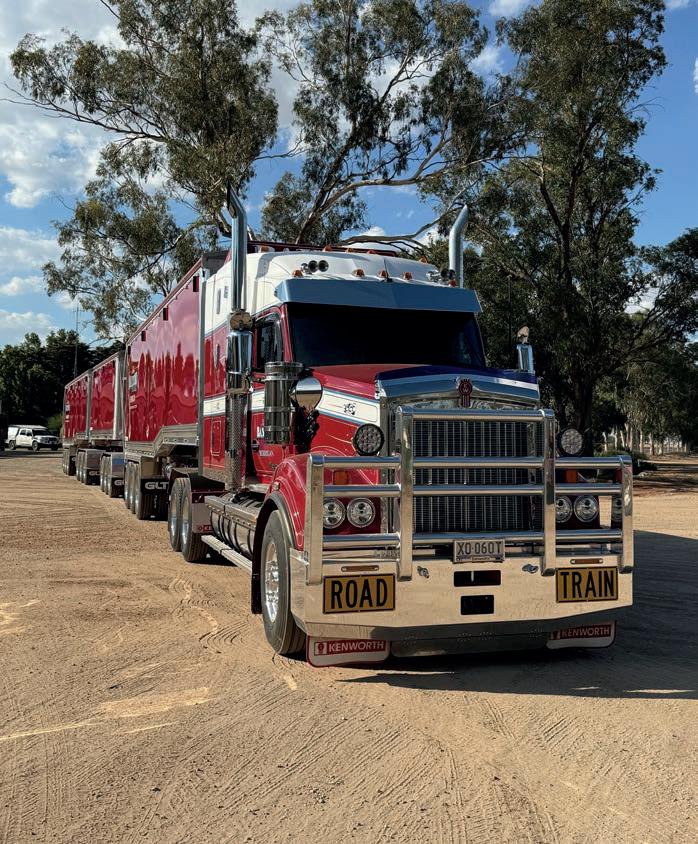
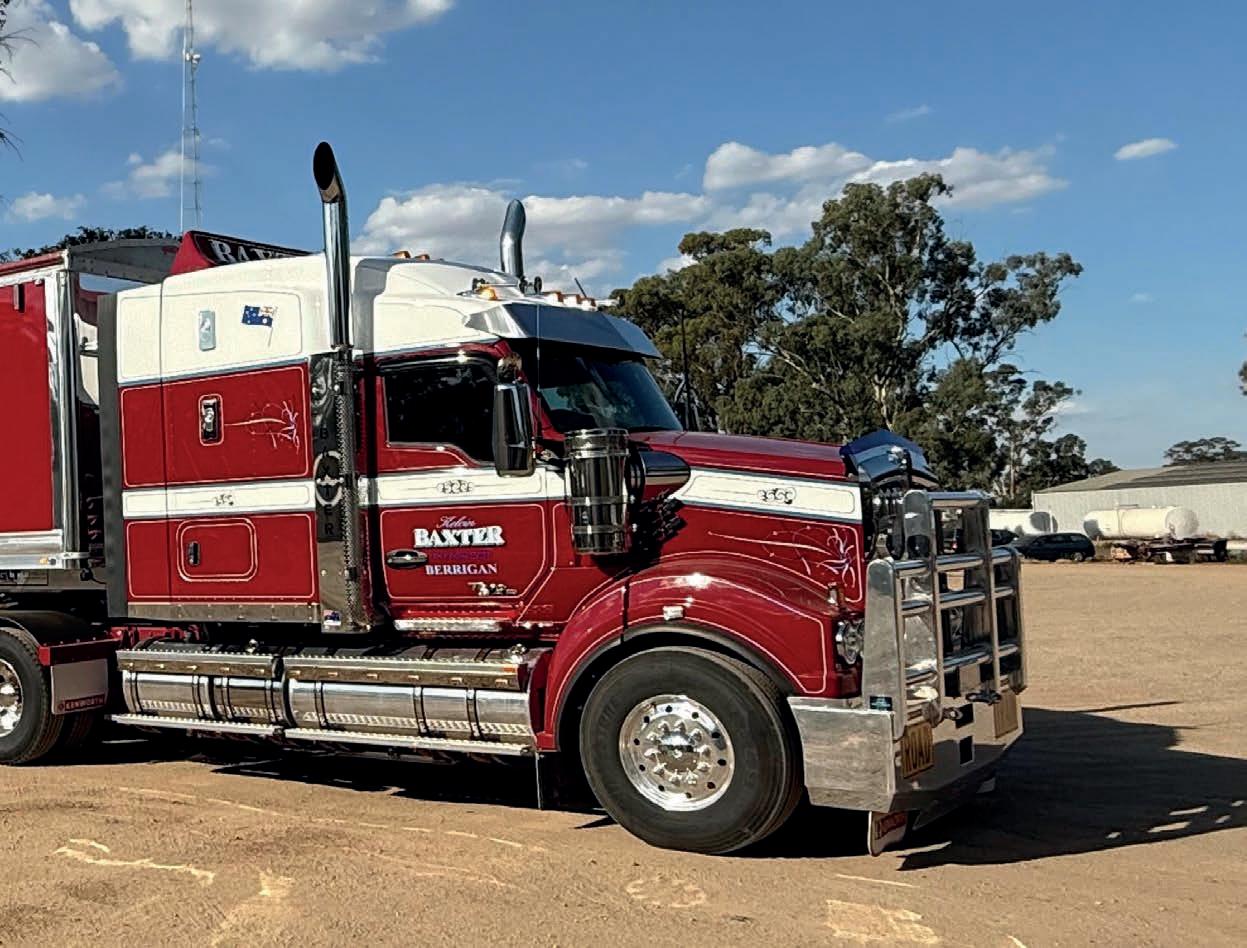
Kel Baxter’s trucks are noted for their subtle yet classy presentation and presence on the road.
“People do pass compliments on our fleet, which are appreciated,” says Kel. “We work them over a wide area and some of them don’t get home too often to get washed. We do ‘old school’ trucking where they might go away for a week or longer. We have our own washbay with vertical brushes which rotate and clean the sides of the trailers, but the prime movers are basically a hand wash job. In recent years I’ve probably opted for a bit more ‘bling’ which helps to attract and keep drivers.”
The trucks are now fitted with many features with driver comfort in mind.
“We also opt for practical things like roadtrain mudguards which are stronger and heavier, because we run in ‘roo’ territory quite a bit,” adds Kel. When ordering a new prime mover Kel
is mindful of specifying components that have proven performance and durability. Safety is a cornerstone of the company’s operations. It begins with the specifications of new trucks when the order is placed.
“I run disc brakes,” says Kel. “I mean, how long since you had drum brakes on your car? Dana can supply the full kit. They stop well and they last well. Discs need less attention and there’s no adjusting and I just think a good area to spend some money is on good braking systems.”
It’s not just the brakes which are sourced from Dana.
“Dana can offer a parabolic spring front axle with disc brakes, whereas right now the others can’t,” says Kel. “They’re rated to seven tonnes, and we run super single tyres on the steer. Dana supplies our rear axles as well and the pricing has long been competitive.”
During the past five years, Kel has ordered and taken delivery of almost 40 new Kenworths equipped with the
Dana D46-170 rear axles. The inherent engineering in these units provides extended trouble-free highway operation coupled with practical ‘on farm’ features such as driver-controlled diff locks to ensure maximum traction on unsealed surfaces. For more than a decade the fleet has specified the D46-170 product with a full Dana driveline. In heavy duty applications, the D46-170 singlereduction tandem drive axles have accomplished 1.2 million kilometres without issue and in one instance 1.6 million kms. The move to changing the diffs over at 1 million kilometres follows a recent update to its preventative maintenance policy.
“Everything wears out in the end so it’s better to be proactive before getting to that point,” says Stu McIntosh, Kel Baxter Transport Operations Manager.
“The reason for that is we are increasingly pulling bigger gear. A lot of triples and upwards of 70- and 75 tonnes in payload. It takes out that
A Kelvin Baxter Transport big rig in all its glory.
uncertainty. That’s something you always are looking to do in this game.”
In the workshop they will change a lot of things on the diesel engine well before it is actually needed. The same now applies to their rear axle assemblies.
“But we find most times it stops them from breaking down on the road because as soon as you’ve got to get a tow truck out it’s thousands of dollars,” says Stu.
“So, under that new policy we’ve incorporated doing diffs at a million kilometres. But we’ve never had any trouble with the Dana product.”
The Dana D46-170 has proven a versatile option across operations considering the different high productivity combinations in the fleet. Gross weights, swept paths and centrifugal force will naturally vary from, say, a legacy B-double to its more modern equivalent the A-double. Other components such as alternators, starter
motors, batteries, turbos, compressors, water pumps and air dryers are also routinely replaced at set intervals.
“When an alternator reaches 300,000 kilometres I change it,” says Kel. “They might last half a million, but then they mightn’t, and they usually break down at night. I can buy replacement components in bulk at wholesale prices, whereas out on the road they’ll charge full retail, plus a call out fee and a minimum charge for three hours labour. We could lose a time slot and then we don’t get job done on time.”
It’s hard to argue against Kel’s maintenance rationale and the costs of changing out components regularly is considered a very worthwhile investment in servicing convenience and reliability.
“With all the new configurations available to us such as B-doubles, roadtrains, and triples going from, say, 68 tonnes gross to 85 tonnes and then to 112 tonnes it takes a toll on diffs,
so we have a schedule for changing centres,” says Kel.
Kel is deservedly respected in the industry, achieving his place on the Wall of Fame at the National Transport Museum in 2015 and he was celebrated as a Kenworth Legend in 2019. He has long been active in industry associations and in recent years has provided significant practical input and support for the Livestock, Bulk and Rural Carriers Association (LBRCA) Heavy Vehicle Rollover Awareness Program, an initiative aimed at reducing heavy vehicle rollovers and crashes on Australian roads. Kel was an early adopter and advocate of the modern road train combinations such as B-triples and AB-triples and has been instrumental in securing wider access for road trains in the Riverina, which benefits other operators, farmers and the communities by reducing the number of truck movements required to get the harvests to market.
RIDE RESCUE TO THE
Canberra based Aplus Towing uses a unique, eye-catching Scania heavy tow truck to complement a fleet of Isuzu tilt trays.
More than 50 years after the completion of the famous irrigation and electricity scheme, the Snowy Mountains region of NSW is once again the scene of a massive infrastructure project worth around $12 billion and involves vehicles of many descriptions negotiating steep and sometimes snowand ice-covered roads. The potential for incidents, whether accidents or being stranded due to a lack of traction, is above average and Queanbeyan based
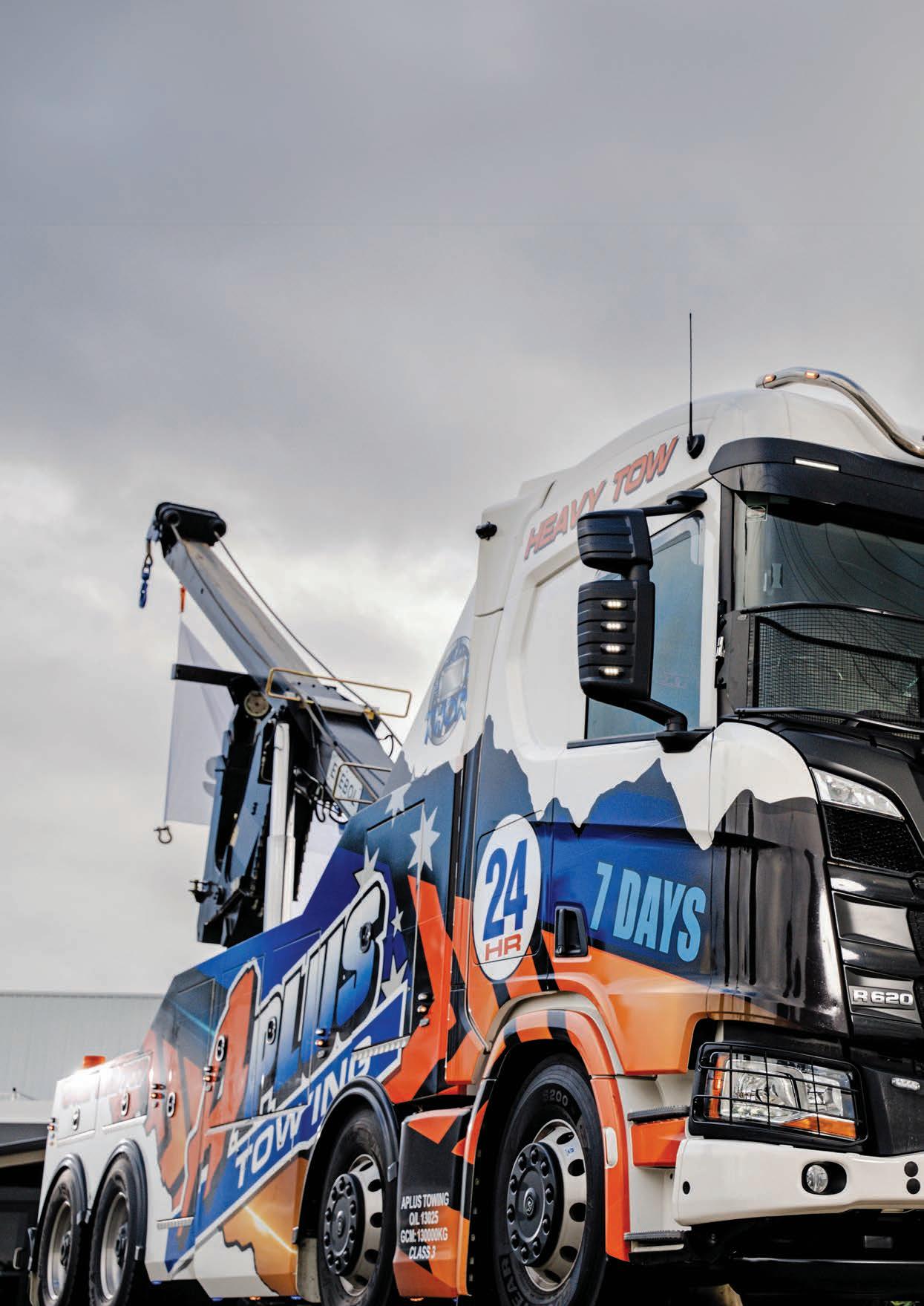
Aplus Towing is available to ride to the rescue with one of its many Isuzu tilt trays or the unique and imposing ‘Thor’ 8x4 Scania heavy recovery unit.
Gary Fleming first got into heavy towing when he took over another business when the owner retired, and part of the package was a 20 year old Freightliner heavy recovery truck which supported Aplus’s general towing services in the ACT.
On any given day (or night) Aplus Towing might be called upon to move anything from a loaded B-triple to a motor cycle, and it’s not just road vehicles as Aplus has the capabilities to transport shipping containers and
earthmoving equipment using its axlesliding super tilt trailer which is suited to delivering and collecting various pieces of equipment being used on the Snowy Hydro 2.0 project.
Problem solving is part of the Aplus service, whether it’s an accident damaged passenger car, a fleet of snow-bound trucks or a piece of forestry equipment which has broken down or even burnt out in a remote mountainous location. Often the vehicles or equipment being recovered are in precarious situations.
“We do get excited with a challenge,” says Gary who runs the business with the support of his wife Lisa and General Manager Trai Hildebrand. Isuzu trucks fitted with ATB bodies
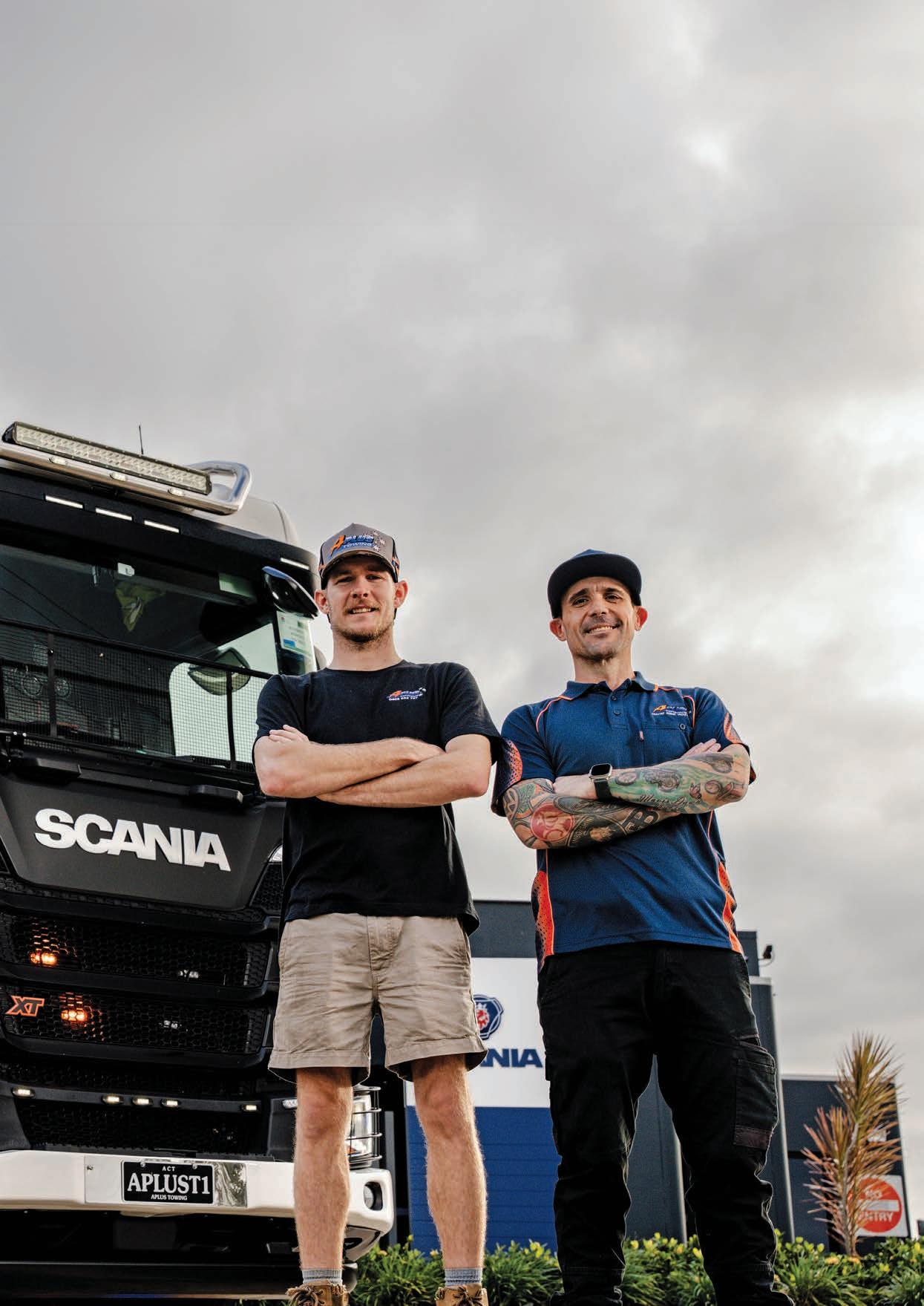
Gary and Ian Fleming with ‘Thor.’.
make up most of the fleet of rigid tilt tray trucks which are typically on the road from 5.30am through to 8.00pm. Several have lay-flat trays which suit the very low exotic European cars such as Lamborghini and Porsche. The increasing prevalence of electric vehicles has heralded a change in towing procedures as the technology in cars such as Teslas means they are sometimes unable to be mobilised and the wheels don’t rotate. For safety reasons, Gary is reluctant to use the typical method involving individual go-jacks to load such vehicles onto tilt trays, preferring to utilise under-lift hitches.
The Snowy Hydro 2.0 project was the genesis for ‘Thor’ and Gary recognised the opportunities for a super-duty tow truck service based close to the mountains. He went on a study tour to the US in 2018 and attended the Florida Tow Show where he absorbed many ideas about what a heavy tow truck should be like. He would consider building a bogie drive heavy recovery unit with a steerable lazy axle but such a rig wouldn’t be permitted under the local regulations.
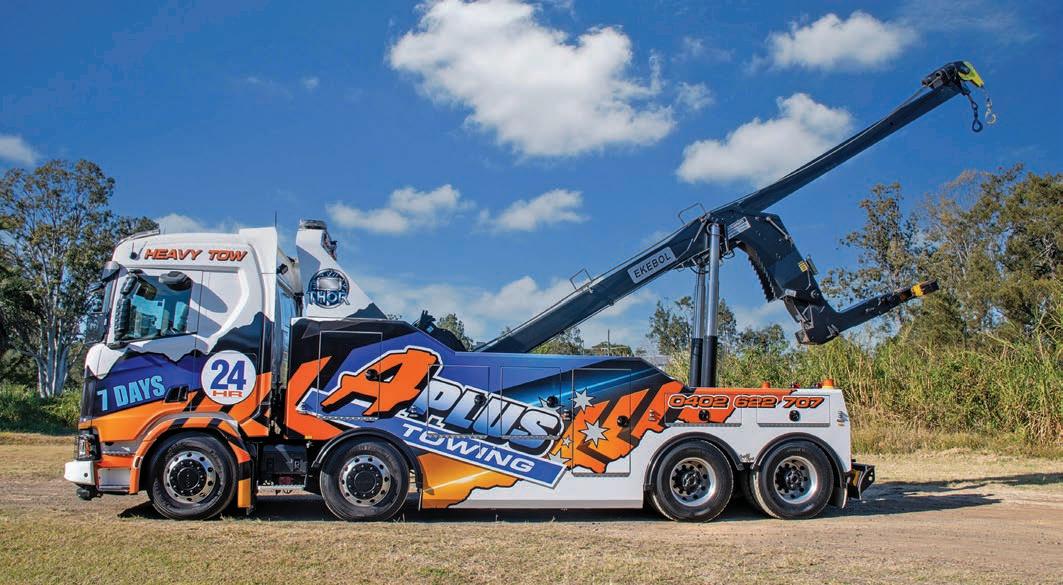
Gary commenced work on the Scania project during COVID and put much effort into the overall design and the result is ‘Thor’, a Scania 620XT 8x4 which weighs 22 tonnes and is rated
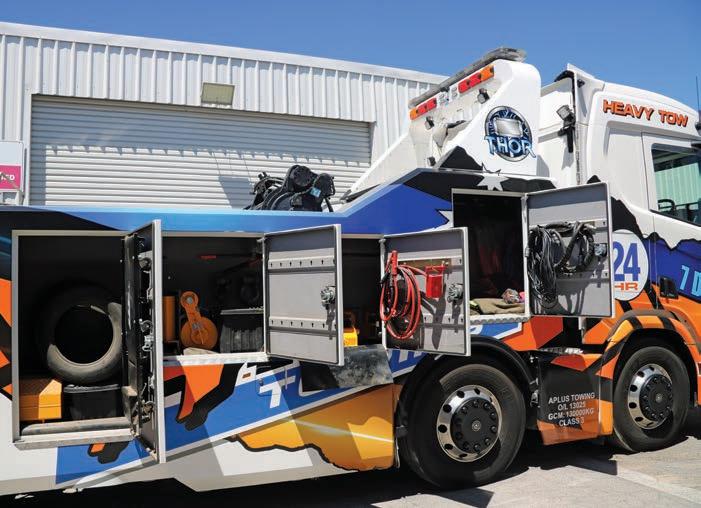
Gary also planned the details such as the layouts of the numerous storage lockers, which hold equipment such as chains, slings and even power tools. One locker holds a comprehensive charging station for the power tools and communication devices. There are no truck stops in the mountains so ‘Thor’ carries a lot of equipment including air lines and fittings and everything is located where it belongs and all the lockers have internal illumination. All chains are regularly checked for integrity and are colourcoded according to their individual length to enable quick selection when they are needed.
The operations of the Ekebol lifting equipment can be controlled remotely which is an important safety feature to keep people out of harm’s way. A heated hand wash station assists the operators in cleaning up before entering the cab.
“I love the Scanias”, says Gary. “They’re great through the mountains up in the snow with their V8 power and the retarders are terrific. I can tow a fully loaded B-double on this truck and not touch the brakes.”
The big Scania is equipped with airbag suspension on every axle and at the
press of a button can offset 500kgs from the rear to the front axles.
“It depends upon balance and weight. Some of the tippers we recover are actually overweight so I had ‘Thor’ built as a twin-steer so I could throw more weight forward,” says Gary. “With the airbags we can lift trucks 110mm which is great for negotiating spoon drains and it is stable on a dirt road at 80 km/h. It’s the only heavy wrecker with Ekebol gear and airbags. There’s nothing like this in Australia.”
The winch is driven off a PTO pump and has a long cable that can facilitate the recovery of cars, some of which can be 80 metres down an embankment.
“We don’t typically recruit people from the towing industry,” says Trai. “We prefer to train them up from the start.”
The training procedure involves two weeks on the road with another experienced driver, and once they go on their own, they send photos of every load to Gary and Trai for a month.
“I instil in the drivers that we don’t want to settle for ‘OK’, we want to be the best,” says Gary. “There’s no book for heavy recovery and we pride ourselves in our operational and risk management abilities. When we attend a major ‘event’ we control the area, and use tablets to take photos, record names, and note any concerns.”
This comprehensive attention to detail
at 108 tonnes GVM, equipped with an Australian made 7.5 metre Ekebol boom.
Scania 620XT 8x4 winches a wreck from an embankment.
is appreciated by the major insurers, most of which are regular clients of Aplus.
The Scania is equipped with Starlink satellite internet communications and once on site, the Aplus team utilise open messaging communications via headset units which can be synced with mobile phones. In addition to the rigorous maintenance of the towing equipment, regular servicing for the Isuzu’s is performed by local dealer Canberra Trucks, while the Scania is on a factory repair and maintenance contract through local Scania dealer Express Truck Service.
“They really look after us as we’re actually each other’s customers,” says Trai.
Gary has two of the new MY25 Isuzu’s on order for delivery early in 2026 and is looking forward to the latest model’s Cummins engines and engine brakes.
‘Thor’ is fitted with seven external cameras operated from a touch screen in the cab plus an internal AI camera unit for fatigue management.
Some of the incidents ‘Thor’ attends have involved pulling up to 14 trucks out of the snow, and this type of job requires the operators to be on site for some time. The cab is equipped
Multiple storage lockers house slings, power tools and chains.
with a fridge, kettle, microwave and TV and the driver and passenger are treated to ISRI air suspended seating with durable canvas covers protecting the leather underneath. Gary and Lisa’s son Adam is the regular operator of ‘Thor’ and is as passionate about the truck’s presentation as his parents are.
The Scania has won awards at regional truck shows and was a star in the Show & Shine at the 2025 Brisbane Truck Show.
Currently on order is another new
Scania XT to be delivered during 2026. It’s a low roof cab 6x4, again powered by 620hp V8 engine.
“I’ve always loved trucks and machinery and doing things other people can’t do,” says Gary. “I love the engineering side and looking at how can we make it better for everyone.”
The proof is in the pudding. Aplus Towing has the capabilities in people and equipment to handle broken down, stuck or accident damaged vehicles of all descriptions.
The Scania weighs 22 tonnes.
BREAKER CIRCUIT
Matt Stone Racing recently upgraded to a DAF XG660 to haul its race cars around the country.
There wouldn’t be too many drivers who would finish a work shift and jump in a truck and consider it a reward for the day’s work. Then again, Donny MacGregor isn’t your average truck driver, nor does he work an average workday. As the man responsible for the official car transporter for Matt Stone Racing (MSR), Donny travels the country carrying precious cargo which would nominally be the star of the show. In this
case the new DAF XG660, employed to move the million-dollar Chevy Camaros, gives them a run for their money. Donny is also the pit crew’s official tyre and wheels technician. When he’s not moving about raceways across the country as part of the Supercars Championship Donny works as a most critical function of the team on race days. He checks, cleans and measures the tyres ahead of when the drivers come in for pitstops. Prior to this, when
the tyres have been allocated to the team for each race, they mount them, mark them and have them pressured for the weekend of racing.
“The day on the track the engineers will tell us what pressures to run because every tyre is different,” says Donny. “They might do three laps, or one lap or five laps so they are all pressured accordingly. After the wheels are on the car and they come back in we record what pressures they are and we
have a bleed target that we have to let the wind out a little bit while they keep using the tyre, so the tyre is not over pressurising as it is getting hotter running around.”
At the end of the day Donny scrapes and measures all the tyres that have been used for what is called true depth wear. By measuring tread wear engineers can gain insights on each car’s performance and handling. “You can tell if the tyres out the back
are doing too much wearing and wheel spinning and not getting enough traction for one example,” says Donny. “The engineers will get a hold of the car in that case. Or if the tyres are wearing too much on one side and not all the way across that’s a camber issue and they can stand up or lay the tyre down more.”
The objective is to limit how hot the tyre gets. If there’s only part of the tyre liable for most of the work, then it will
soon overheat and degrade. Suddenly, according to Donny, the driver feels like he’s running around on water.
“He’s got no grip and the tyres are falling off the car, as they say,” he notes. “The tyres are nearly the most important part of the cars they are so even these days.”
For the final round of last season in Adelaide, Matt Stone Racing was given eleven sets of tyres. In short, 44 tyres per car. That includes eight pre-marked tyres from the tyre bank used for practice. Everything taken to the track including any spares, engines, gearboxes, uprights, suspension kits, panels not to mention front and rear chassis clips, are all carried on the truck’s pair of trailers.
The ‘A’ trailer of the B-double has been extensively refurbished and compartmentalised. There are lofts which have been customised with shelving to accommodate several tubs and footlockers. The engines are stored underneath. Minutely organised particulars, to borrow from William Blake, are one pathway to triumph, “Most of the team know if they’re looking for a certain part or component whereabouts on the trailers to go to get it,” says Donny.
The tyre job is not only in depth but labour intensive. Every wheel must be washed and every wheel nut, washer and clip removed for cleaning and inspection. Donny finds driving the DAF XG a place to decompress once the meet is over and he’s back on the road.
“Sometimes pulling into a truck stop everyone looks at you because you’re towing a Supercars transporter around,” recalls Donny. “They will notice it’s a new DAF, ask a few questions. Some of the Kenworth drivers will want to take a look and they’re always impressed by how good it is inside.”
The DAF XG doesn’t lack for creature comforts with two big fridges located under the bed, generous storage and a retractable steering wheel that rescinds over the dash which makes, according to Donny, climbing in and out much easier. Several other appointments
The DAF XG in front of silo art in Weethalle, South Australia.
standout for Donny who can be in the tropics or Tasmania depending on where the next race is. Integrated heating and air circulation enables for personalised climate control directly in the seat.
“Given the travel I do around the country whether you want a heated seat or a cooler seat is a nice touch for the driver,” he says. “It’s got ABS, EBS, cruise control and lane guidance so it keeps you at a safe distance from the vehicle in front. You can drive it all day and hop out and feel like you’ve hardly been anywhere.”
Another shrewd design feature inside the XG cab is the liftable bed.
“It’s fancy like a hospital bed because it can be used like a couch or recliner. Initially I didn’t get it until one of the guys pointed out that sometimes when you pull up stumps for the night in a truck rest area only to find your head is downhill,” says Donny. “In Canberra, for instance, and that means you have to swap your head around, so your head is not downhill. With this bed you can just tilt your head up and make it level.”
As part of the PACCAR partnership, MSR have been running a DAF prime mover for the past four years. Previous to the XG they had an XF. In 2024 the team were given the opportunity to evaluate a DAF XG demo prime
mover. Initially it was for one round of the Supercars Championship – Bathurst – before being extended to four meets at the end of the season. Donny went back to the DAF XF for the start of the 2025 season when, to coincide with the Melbourne Grand Prix weekend,
he was surprised with a new XG replete in MSR Bendix racing stripes. As part of the predelivery PACCAR equipped the prime mover with extra roof lights, larger super single tyres on the front and a big bullbar which was recently put to the test late evening outside Cobar when the wildlife is out in force. The truck hit a big ‘Roo at approximately 80 km/h.
“There was a bang and I kept looking at my headlamps to make sure I hadn’t blown a light out and checked to make sure I wasn’t losing any fluid,” recalls Donny. “I stopped an hour or so later for fuel and I had a look at the front expecting to see the large amount of damage but there wasn’t any. In fact, the number plate was pristine. It’s a great bullbar.”
The team last season, and by inference the MSR DAF XG transporter, travelled to points far and wide. Darwin. Perth. Townsville. Following the Gold Coast race, Donny took the truck to Perth some 4,200 kilometres by road. Then from Perth the DAF XG travelled to
At the 90 Mile Sign rest area on the Eyre Highway near Balladonia in Western Australia.
Darwin through Port Hedland. After Darwin it ran to Townsville.
“We circumnavigated the continent to do two race meetings,” says Donny.
“That was good driving on roads we’ve never driven on before.”
Donny sometimes travels in tandem with friend Wayne Cowper, who is responsible for the Shell V-Power Racing team’s prime mover. They will make a firepit at night at rest stops and cook up a healthy dinner. They can use generators from the trailer to power cooktops, toasters and portable ovens. This way they are self-sufficient and no longer dependent on truck stops for food.
The inline six-cylinder PX-15 diesel engine on the DAF XG660 features a single overhead camshaft. It produces a hefty 485 kilowatts. But does Donny need all that power?
“Oh, come on, we’re racing car drivers,” he jokes. “If we travel with other racing car teams we like to pass them on the hills.”
Motorsport teams, naturally, are all competitive even outside of the track. The drivers of the car transporters are no different, partaking in friendly banter and rivalry when on their crosscountry trips. With the older XF, which is rated to 530 horsepower, it would cruise along happily but sometimes get passed uphill. Wayne would go by and Donny would think, ‘damn I just got passed by some Mustangs’. When he was given the gold demo DAF XG660 his fortunes soon changed.
“I passed him on the Toowoomba Range and thought to myself ‘this is the life’,” says Donny. “I already say to our racing car drivers I’ve passed the cars already on the way down so your job is pretty easy now.”
Donny adds, “You can’t go any faster than what we’re regulated at but it’s nice to have some extra torque to climb a hill.”
Outside of Toowoomba, the highway is in poor condition, limiting speed in some places. In these sections of rough
“It’s a nice ride even in those conditions,” says Donny. “The prime mover and cab sit on a nice suspension. The air seat is great. The DAFs are not a bad truck, but this thing is out of this world.”
MSR Founder Matt Stone, who previously worked for the renowned Stone Brothers Racing team, started his own venture in 2010, supported by both his father Jimmy and uncle Ross Stone. Donny originally worked in the panel department. When he heard the transporter driver was leaving, he applied for the job. Being from New Zealand, Donny always wanted to see more of Australia.
“What better way to cart some race cars around and look out the window,” he says. “As soon as I started driving, I thought this is the reward for working a normal week and going away for a few days and taking in the scenery.”
road, the DAF XG660 comes to the fore.
South of Port Hedland in Western Australia.
TESTED TRIED AND
Product specialist Jonathon Wrightson shares his expertise gathered over a career of working closely with the powerplant technology from Detroit.
For roughly 14 years, Jonathon
‘Jono’ Wrightson has been a fixture at the Detroit business within Penske Australia. Newly appointed to the Detroit Business Manager role for Australia and New Zealand, with Bob Gowans taking a sabbatical, Jono will be focused on raising awareness, especially among the Western Star and Freightliner dealer networks, of the brand, which has its latest products — the DD13 Gen 5 and the DD16 now maturing in the marketplace.
For the majority of his career, Jono has been providing Detroit product support for Penske, whether it was in New Zealand, where he spent three and a half years travelling the countryside meeting with customers and offering diagnostic expertise before returning to Queensland eleven years ago as a senior technical specialist, now based in Brisbane.
“My role has involved liaising directly with the factory a lot,” he says. There is no more robust market than Australia where some of the heaviest truck combinations in the world are running. That makes engine data from roadtrains of particular interest to Detroit head office which evaluates it for R&D purposes.
The latest Detroit platform is GHG17 and GHG21 compliant, making it the only current engine in Australia that meets the stringent North American emissions level. Now that the stricter ADR 80/04 law has recently come
into effect, the newest Detroit engines which were introduced locally on the Western Star X-Series range and in the Freightliner Cascadia prime movers, have proven well ahead of the curve.
“Detroit has been meeting this new rule for quite some time,” says Jono.
“People don’t know it. They ask, ‘is this a Euro 6 engine?’ It exceeds Euro 6 by several factors depending on the Euro 6 level.”
Australia’s latest emission ADR is technically the equivalent of Euro 6C which, at present, has a lower function of testing than Euro 6D and 6E. The Euro standard didn’t focus on Greenhouse Gas emissions until the later standard, unlike the corresponding North American benchmark.
“Detroit is running way ahead of the Australian and New Zealand
mandatory compliance laws and we’ve been way ahead for quite some time,” explains Jono. “We’ve got quite a few years under our belt already running at that level.”
AdBlue consumption on the newest Detroit products is one notable feature. High usage has become synonymous with some Euro 6 engines without exhaust gas recirculation (EGR). But it need not be the case according to Jono.
“EGR has got a bad name because many manufacturers, when they did it in previous years, just bolted it onto an engine it wasn’t designed for,” says Jono. “Our AdBlue use is quite low for this emission level. We’re talking figures of 3-4 per cent. Because we’ve got a good exhaust gas recirculation system we don’t need to use as much AdBlue as some of the
others that have no EGR.”
Twenty-odd years ago, many engine manufacturers, in a box ticking exercise, decided to bolt on an EGR circuit instead of developing proprietary hardware. Detroit went down a different path.
“That’s where this platform we’ve got – the DD13 and DD16 – has been designed with this in mind from the get-go,” says Jono. “Our design platform doesn’t need to change going forward to meet any more stringent emissions. In that sense we’ve got commonality, in a matter of speaking, for quite some time. As a longstanding design platform, we’ll continue that again. There’s a new engine being designed in the US at the moment which will nearly look the same as what we have now, with a few different components but the
Detroit’s DD13 Gen 5 and DD16 are already GHG17/GHG21 compliant.
layout is essentially the same.”
In the United States, after the 2010 emission standard, the EPA identified fuel burn as the most efficient way to mitigate expulsion of greenhouse emissions like carbon dioxide, monoxide, and methane.
By concentrating on removing particulate matter and NOx it has helped to elevate the bar and, as a byproduct, emissions standards, which have technically risen most recently to GHG21.
The advantage for Detroit operators downstream of these developments are numerous. Jono estimates Detroit has reduced its greenhouse gas emissions by around 10 per cent since ADR80/03 engines in the process to lower fuel burn was undertaken.
“We were at 1.2 grams of NOx when this process began and we have dropped right down to 0.2 gramsper-horsepower-hours,” he notes.
“On top of that we’ve also got 0.7 per cent for particulate matter.”
Beyond the palpable improvements in fuel burn the Detroit 4th & 5th Gen platform lessens the wear and
friction of internal components to reduce maintenance and increase operator uptime. Having the cylinder liners mounted at the top and bottom, a design change originally introduced on the Detroit DD15, makes them more secure inside the block itself. Previously the cylinder liners were only top mounted on the Series 60 platform.
“Having reduced the movement and amount of twisting prevents things like head gasket leaks,” says Jono.
“It was part of the revamped design in the US for the 2007 DD15, and we’ve had it in Australia and New Zealand since 2010. We’re still running true to that same successful design.”
Because the canister filters Detroit uses are positioned above the chassis rail, workshop technicians can avoid going under the truck to hold up the heavy oil or fuel filters when they are servicing an engine. There is no need to pre-fill either fuel or oil filters.This also helps circumvent debris deposits in the oil circuit.
“Our oil filter is installed dry and then the oil pressure increases, it fills the canisters through the clean side of the filter,” explains Jono. “To that effect we have less contaminants and opportunity for contaminants to go through the system.”
Reducing the manual work synonymous with servicing, such as draining the filters much faster, limits waste by having the filter click directly into the cap with no metal around the filter media.
The cooling system of the Detroit DD13 and the DD16 differs with the thermostat positioned on the colder side of the engine rather than the hot side facilitating easier temperature modulation. Having a dual path into the engine block to fl ow coolant helps to drastically lower temperatures. With coolant fl owing through the block to the cylinder head and directly to the EGR cooler. Prior to this, the path of coolant would be sent through the EGR cooler and then into the block after many of the cooling properties had been already removed. In doing so the cooling temperatures around the
Detroit’s engine is the only current engine in Australia that meets the stringent North American emissions level.
cylinders behave more consistently.
“Some of the other engine manufacturers still rely on doing it that way today,” says Jono. “Having a separate path is important because it helps optimise the reliability of the EGR system.”
There are currently no other engine platforms that feature dual paths aside from Detroit’s that Jono knows of.
The EGR cooling was downsized mainly for weight savings in the Gen 5 DD13. A cleaner atomisation is produced under the favourable conditions of having a more effi cient fuel system design. While the high pressure pump of the amplifi ed common rail still makes ample pressure of up to 950bar, the injector actually amplifi es, through hydraulic principles, internally to create the extra high pressures of 2500bar in the injector according to Jono.
“Because we’re using the injector itself to create the higher pressure we don’t need to worry about camshafts or engine speeds or any of those things to increase injection pressure we can just turn it on and off based on what the computer thinks is the right timing,” he says. “From there we can adjust fuelling with small tolerances without the need to increase or decrease engine speed to change the fuel pressure.”
Crucially, it also means Detroit is not at the mercy of needing 2500bar-rated fuel system parts on the outside of the engine either, where people can hurt themselves if they disconnect the line as is still common in the market.
“Truly, 900bar is nothing to sneeze at, but it’s not the same as some of the others where they are running full pressure all the way through or using a camshaft to drive the injector to create the high pressure,” says Jono. “That’s also another longstanding feature that’s been around since the start of the engine design for the Gen 5 platform. There’s lots of practice with it.”
He adds, “It’s tried and tested.”
Having less of those components and parts underwrites what is an equally attractive warranty package. Detroit offers flexible options for customers depending on how long they want to hold onto the truck. There’s a standard package of four years/805,000kms and 400,000-litres of fuel burn and 12,000 hours. There is also a five year package paired with varying rates of kilometres and fuel burn.
Customers can option another three warranties depending on their fleet investment cycles — with lower mileage alternatives suited to
Keep your fleet on the road & out of the workshop. Book a
fleets that look to turn their trucks over every five years.
“It can be a good investment particularly when you think that after-treatment devices, wiring harnesses and towing and travel is all included,” says Jono. “It would save you money in the long run if something was to happen.”
The durability and cost-effectiveness over the life of the engine is evidenced on the DD15 product, where there is still no mid-life changeout of extensive componentry required.
“Everything is covered for that length of time. That is still the same,” says Jono. “We haven’t changed that all. You’re not paying for an extended warranty and then having to pay for maintaining that warranty.
“Detroit has long-term customers with the DD15 product such as HPS, ICF Haulage, Centurion, Dalrymple Landscape Haulage, and Baldy’s Heavy Haulage who have used and loved the DD15 and have now transitioned to the DD16 and DD13,” says Jono. “Whether they’re riding the highs and lows of the Blue Mountains, traversing the vast Nullarbor stretch, in the remote corners of WA and NT, or running the No.1 along the east coast, our customers know they can rely on Detroit.”
Geotab Connect 2026 promises to be a landmark event for fleet operators.
THE DATA STRIKES BACK
From reactive reporting to predictive intelligence, Geotab Connect 2026 signals a new chapter for global fleets and Australian operators are right in the middle.
When Geotab first launched its Connect conference in 2014, the focus was firmly on technology under the bonnet. Fast forward to 2026, and the conversation has shifted decisively from what telematics can do to how it is being used to solve real-world problems.
With more than 3,500 attendees expected in Las Vegas, Geotab Connect 2026 marks both a milestone event and a clear statement about where fleet management is heading next.
Now in its ninth iteration, Geotab Connect has evolved alongside the company itself. What began as a relatively small, technically oriented gathering has become Geotab’s flagship global conference, bringing together customers, partners and industry leaders from across the fleet and mobility ecosystem. According to David Brown, Associate Vice President – APAC at Geotab, that growth reflects a deeper shift underway across the industry.
“In the early days, telematics was largely about collecting vehicle data and turning it into actionable, but mostly reactive, insights,” says David.
“Scheduled maintenance, driver scorecards and post-event reporting were the norm. Today, we’re firmly in what we describe as second-generation telematics.”
That second generation is defined by data intelligence, advanced analytics and AI-driven capability. Instead of simply telling operators what has already happened, modern platforms are increasingly designed to anticipate risk, optimise performance and prevent incidents before they occur. Predictive maintenance, collision reconstruction, AI video telematics and advanced driver safety programs are now operational realities.
This evolution is front and centre in the Geotab Connect 2026 agenda. The conference places a strong emphasis on practical outcomes, peer learning and real-world use cases, supported by a significantly expanded Marketplace showcasing partner solutions. For fleet operators, the message is clear: technology is no longer just a reporting tool, but a decision-making engine. Across the global fleet sector, several themes are converging. Operators are under sustained pressure to improve
safety outcomes, manage costs, lift productivity and meet growing sustainability expectations — often simultaneously. At the same time, resourcing constraints mean fleets are looking for simpler, more integrated ways to manage complexity.
“There’s a growing demand for all-inone, single-pane-of-glass solutions,” says David. “Fleets want safety, maintenance and operational data brought together in a way that reduces workload, not adds to it. AI plays a key role here, turning complex data into practical actions that support faster, better decisions.”
Geotab Connect 2026 is designed to address these pressures head-on. The core focus of the event is on building smarter, safer, more efficient and more reliable fleets through applied technology. Customer stories will demonstrate measurable improvements in cost control, safety performance and operational efficiency, highlighting the value of Geotab’s ecosystem, including its SDK, Marketplace partners and AIdriven capabilities such as Geotab Ace. Hosting the event in Las Vegas reflects both the scale and ambition of the
conference. With more than 3,500 attendees expected from around the world, Geotab Connect has become a genuine global meeting point for the fleet industry. For Australian operators, that global perspective is particularly valuable.
“The challenges facing fleets in Australia, road safety, productivity, emissions reduction and operating costs, are front of mind everywhere,” says David. “The insights shared at Geotab Connect are directly applicable locally. While operating environments differ, the underlying problems and solutions are remarkably consistent.”
Sustainability is another pillar of the 2026 agenda.
Fleets are increasingly expected to measure, manage and reduce emissions without compromising operational performance, and technology is central
to that task.
“For Australian fleets, this is especially relevant,” David says.
“Decarbonisation, electrification and sustainability reporting are all progressing against the backdrop of vast distances and diverse operating conditions. The focus at Geotab Connect is on grounded, real-world experiences. What works, what doesn’t and how fleets can move forward with confidence.”
Policy and regulation also feature prominently, particularly in relation to road safety and compliance. As regulatory expectations continue to evolve, data and technology are playing a growing role in supporting safer outcomes and more informed decisionmaking. The conference provides a forum to explore how connected vehicle data can help fleets meet compliance
“For fleet operators, the message is clear: technology is no longer just a reporting tool, but a decision-making engine.”
obligations while also improving driver wellbeing and public safety.
Geotab’s goals for 2026 are closely aligned with these themes. The company is focused on continuing to help fleets operate more safely, efficiently and sustainably by unlocking the full value of high-quality data.
Central to that ambition is supporting customers as they integrate AI-driven tools into everyday operations, moving from insight to action with greater speed and confidence.
While Geotab Connect is not simply a product launch platform, it does offer a clear window into how Geotab’s technology, partnerships and ecosystem are evolving to meet real-world industry needs. More importantly, it reflects how far the fleet sector itself has come.
“Geotab Connect 2026 is about bringing the global fleet community together,” says David. “It’s about sharing knowledge, exploring innovation and focusing on practical solutions that deliver real impact for not just today, but well into the future.”
Neil Cawse, Geotab CEO presenting last year in Orlando, Florida.
THRESHOLD CROSSING THE
Calls to trial rail sensor tech grow to put an end to level crossing carnage
At approximately 6:35am on 3 April 2023 a tip truck entered the level crossing at Barwon Terrace in South Geelong from an unsealed side road that ran parallel to the broad gauge rail line. This positioned it between the boom barriers and the track as an oncoming passenger train approached and crashed into it. A subsequent investigation into the death of the 57-year-old driver, found that the unsealed access road, not identified as an emerging risk, allowed a truck to bypass the crossing’s safety features. The train driver and conductor were fortunately left uninjured.
New Year’s Eve, 2023. Two train workers are left dead in South Australia after a 75-year-old truck driver carrying avocados heading east towards Broken Hill collides with a Pacific National train, nearly two kilometres in length, travelling from Sydney to Perth at a level crossing on the Barrier Highway. The incident happened at 10.30am. Double stacked containers were toppled from the train near Bindarrah leaving behind a wild scene of wreckage.
Mary Gilmore Way near Bribbaree, in the central west of New South Wales. It’s late September 2025. Six rail carriages are derailed after a B-double carrying livestock collides with a freight train around 6.45am at a passive level crossing.
Initial reports suggest the truck driver may have been driving into the sun at the time, impairing visibility and potentially contributing to the collision. The truck reportedly hit the side of the train’s carriages after the driver swerved at the last minute to avoid a head-on collision. Less than a
month later, a Mackay cane train driver suffers critical injuries after colliding with a truck at a level crossing in north Queensland. These incidents and dozens of others like them are a dangerous reality across the country. In Victoria there are some 500 level crossings that trucks and other vehicles share with trains. Around 180 of these crossings have no physical form of barrier. Victorian Transport Association CEO, Peter Anderson first set out to find a solution to this real and present danger some nine years ago following the tragic Kerang rail incident in 2007 — the state’s worst rail disaster.
Where the Murray Valley Highway crosses the Piangil railway line, a truck loaded with timber and pipe fittings ploughed into a southbound train causing the death of 11 people and injuring 23 others. One fatal crash
previously occurred at the crossing 12 years earlier and several near misses between rail and road vehicles had been recorded in the months leading up to the 2007 accident. Warning signs at the rail crossing including flashing lights and bells, again, proved inadequate.
Anderson, after looking into the incident, decided there had to be another way. One of the observations he made concerned the preventative measures in place. Flashing signals are for naught, he surmised, if visibility is compromised at night or reduced in heavy fog or a hairpin bend conceals a train moving at over 80 kilometres-perhour. After explaining the issue to an IT team, they came up with a proposal involving a transponder situated further down the rail line that would send a signal triggered by an oncoming train. “For the next minute or two minutes anyone in the local area with a little receiver would know there’s a train in the area when they receive the signal,” says Anderson. “That would bring caution to the way that you drive if you’re in a truck. That was the idea and they gave me some costings. Key fobs could be made in China for about $20 each. It involved very little outlay.”
Anderson, by now had joined the Rail Safety Crossing Committee convened at the time by Jeroen Weimar, who was later appointed as CEO of the state’s Commonwealth Games Organising Committee. From this vantage Anderson began gathering data and information from reports and different incidents and got to see firsthand how the rail industry approached safety. He soon discovered it was entirely risk adverse.
Peter Anderson, VTA CEO with Nabeel Elias, WHG Director of Structural Health Monitoring.
“Unless something is foolproof it doesn’t get accepted in every perspective,” said Anderson. “It’s one of the things that holds back the development of rail in our country.”
WHG is an Australian telematics and technology provider that connects over 45,000 devices monthly. There is a business unit within the greater company dedicated to structural health monitoring. Chad Molenaar and Nabeel Elias both work within it creating data capturing technology. It’s one of the few companies in the segment where the designs of the hardware and circuit boards all get made in-house. They had, without access to the rail network, 3D-printed a replica rail section to facilitate an evaluation of an asset. They fixed a gauge to it — and It worked.
“Everyone is trying to sweat the assets,” says Elias. “The problem is you can’t sweat the assets unless you know the health of the asset.”
By chance, Anderson visiting the WHG offices liked what he saw and asked, given they could monitor the health of the rail, if they could tell if a train was on it.
Strain gauge has been around since the 1930s. Not much, like a lot of rail technology, has changed since then.
The issue with legacy strain gauges is the install. It is time consuming and costly. WHG came up with a spotweld strain gauge that would be unobtrusive and easy to install.
“You don’t need two layers of adhesive and a coating material and all these unbelievable requirements,” said Elias. “As a wireless device there is no need for cabling. It has circular solar panels that charge it. In terms of harvesting, a lot of our technology we have built we come back to when we need it.”
Power consumption on one of these units is minimal. It can be left on battery and require a charge every couple of years depending on the frequency at which it is sampling. The main unit provides two options. It can, as part of the structural health component store data in the cloud.
The other component on the unit is its utility as an amplification system that can message within a certain radius. It sends a signal down the line to any vehicle in that area or any worker in close proximity. An e-tag device or a keychain fob would get a ping inside the cabin to alert the driver of the nearby presence of a train.
“From an end-user functionality perspective, it’s brilliance is its simplicity,” says Molenaar. “We’re using proven technology in a unit we use in other areas of the business. We know that it is solid and it’s strong with connectivity that we use in the telematics side, so we have constant uptime.”
As long as the radii overlap between each unit, multiple units can be employed to send a signal down the line as far as needed.
“The cloud part of it is excellent because you’re getting a twofer one solution at that point,” said Elias. “You have the immediate benefits of people crossing over the rail and then the longterm monitoring of the health itself, so you don’t have to send people out there to do maintenance all the time. Or you might need to send them out sooner if you get questionable readings.”
The SMH Rail Sense System as it is unofficially known is not expensive to implement. To protect each level crossing, the rail industry could feasibly adopt it for as little as $5000. Building a controlled rail intersection with boom gates and flashing signals costs in today’s economic landscape over $2 million.
All the more reason for Anderson’s disappointment in failing to find support for the project from the rail sector which, to date, refuses to even entertain a trial.
“All we’re asking for is to demonstrate how it works,” he says. “And it’s a national solution. We’ve tried everything and so far. I’ve only encountered reluctance to accept anything different.”
Anderson applauded the team at WHG, whom, without any funding or access to a railway, got to work on the project. Molenaar echoed Anderson’s frustrations.
“We’ve got a lot of experience in delivering new applications to help alleviate this pain point that they have,” he said. “It really is just trying to add a layer of safety to an area that currently has none. It’s not like we’re trying to replace something in the space or we’re trying to say this is superior to the current system that is sitting there.” He added, “Because there isn’t anything sitting there.”
Anderson said governing bodies inside rail are unwilling to consider new potential solutions outside awareness campaigns and adding road signs.
“Signs are the cheapest form of road management,” says Anderson. “The prevailing attitude to risk – any risk at all – is so adverse they don’t want to adopt anything new.”
The typical and current flashing red warning signals at railway crossings were launched in rail infrastructure in 1913 when the horse and cart was still the dominant mode of travel. In road vehicle language it doesn’t adequately translate according to Anderson.
“Red, yellow, green. Solid red is stop. Yellow caution, green go. That’s our messaging. That’s our language in driving on the road,” he said. “Yet we’re trying to keep cars and trucks away from trains.”
Anderson added, “They’re still putting detonators on tracks to go bang to tell people there’s a train coming. That’s how archaic the rail industry is.”
There is a truck driver somewhere in Australia right now who could have his or her life saved by having a fob on their keychain or an e-tag equivalent in the cab.
“It’s 3 o’clock in the morning and I’m driving through the country and it’s pitch black,” says Anderson. “I’m driving through a town, and it suddenly goes off. Guess what I do? I slow down. Maybe I’m not even aware there’s a train line. But now I know there’s a train line close by. Now I’m on caution. I’m on yellow in road language looking for a train. Now we give the driver a chance to protect himself.”
UPLIFTING PARTNERS
Highly pedigreed trailer OEM, GLT Trailers, has expanded its collaboration with JOST, becoming an authorised dealer for Hyva Hooklift and Skiploader systems. GLT shares its motivation for collaborating with a world-renowned tipping brand.
By partnering with JOST and its subsidiary, Hyva, GLT Trailers combines advanced fabrication, body building, hydraulic integration, repairs, and PBS approvals within a single facility.
As a result, it delivers precise installations of Hyva equipment onto rigid truck chassis, ensuring each system is engineered for durability, efficiency and compliance.
The Carole Park-based company offers operators a complete, Australianengineered solution for truck-mounted lifting systems that are ideally suited for applications in the waste, construction, civil and heavy-industry sectors.
“Operators want confidence that their lifting system has been installed by a team that understands heavy-vehicle engineering from the ground up,” said GLT Trailers CEO, Shay Chalmers.
“Our in-house manufacturing and engineering capability allows us to optimise HYVA Hooklift and Skiploader systems for the specific truck application, whether that’s waste collection, infrastructure support or bulk material handling.”
GLT’s wide ranging body-building capabilities include custom truck body designs matched to Hyva’s equipment,
as well as full hydraulic system integration, structural fabrication and reinforcement for high-cycle lifting and necessary PBS approvals.
The latest collaboration is the most recent iteration of GLT Trailers’ longterm relationship with traditional JOST products, which spans back to GLT Trailers’ formative period in 2009.
In addition to the Hyva Hooks and Skips, GLT Trailers also supplies and fits Hyva tipping cylinders and tow couplings.
This far-reaching approach naturally fits in with the company’s business philosophy, which is built on innovation, agility, and genuine commitment to Australian manufacturing.
“We’re driven to create high-quality, purpose-built transport solutions that keep industries moving, backed by craftsmanship, long-term partnerships, and continuous improvement,” said Shay Chalmers.
“We focus on doing what others can’t or won’t. That means leading with smarter engineering, building a resilient and future-ready business, and strengthening Australia’s capability to manufacture world-class equipment on home soil.
“Above all, we’re committed to fostering
a workplace our people are proud of, collaborative, safe, and dedicated to excellence.”
Formative years
Like many formative businesses in the transport sector, GLT’s genesis began with a simple philosophy — to design and manufacture trailers that operators can depend on every single day - no matter the load, the route, or the conditions.
Over the years, that philosophy hasn’t changed, but its capabilities, technology, and product range have evolved significantly.
“We’ve grown from a modest fabrication operation into a specialist manufacturer known for engineering strength across our entire product lineup that spans across agriculture, mining, waste, landscaping supplies and civil markets,” Shay Chalmers explained.
“GLT is proudly Australian-owned, and all our trailers are built locally, which means we understand the realities of this industry; long distances, tough environments, and the need for equipment that delivers maximum uptime.”
Today, the manufacturer produces high-quality, custom aluminium
The GLT Trailers team of highly trained installers.
trailers and truck mounted equipment solutions, designed and built to meet the demanding conditions of the local transport industry.
The facility designs, fabricates and installs a wide range of trailers, including end tippers, side tippers, bottom dumpers, PBS combinations, hook lifters, skip loaders, container tippers, moving floors, drop decks, race car transporters and more; all engineered for durability, low tare weight, and maximum payload efficiency.
All GLT trailers are designed and built in Queensland using decades of industry experience, modern technology, and a commitment to innovation, sustainability, and craftsmanship.
As a result, GLT Trailers supports fleets nationwide with purpose-built, durable and functional equipment that meet specific operational requirements.
“Ultimately, GLT exists to make our customers’ operations smoother, safer, and more profitable by providing trailers that stand the test of time,”
Chalmers said.
Complementary to its trailer manufacturing, GLT provides full lifecycle support.
“We service, maintain, and stand by every trailer we produce, ensuring operators get long-term value and reliability from their equipment,” she said.
JOST/Hyva collaboration
The merger of JOST and Hyva was a natural fit for GLT, as it has been a long-term partner of both companies.
Becoming an authorised installer and dealer, installing and providing support for Hyva hooklifts and skiploaders, plus the hydraulic, control and electrical systems, made perfect sense.
“Their coming together aligned perfectly with our existing relationships and the work we already do with both,” said Chalmers.
“It allows us to integrate Hyva products seamlessly into our builds and provide customers with genuine components, certified installation, and strong ongoing support.”
The Carole Park outfit also handles repairs, fault diagnosis, and provides preventative maintenance.
“Our installation process focuses on smart design solutions that allow for consistency, adaptability and serviceability for your hook lift fleet,” the CEO said.
“In the Australian market, customers consistently point to Hyva’s reliability, strong engineering, safety performance, and extensive product range as key reasons they choose the brand.
“Hyva’s equipment is trusted for its durability in harsh operating conditions, its payload-optimised designs.”
An added bonus for JOST has been its strong working relationship with GLT, resulting in it knowing exactly that they were dealing with a high-quality, professional and reliable company.
The company’s recent move to a modern, bespoke facility in Carole Park has been a strategic move with an eye to the future, enabling it to cater for all facets of its business — from fabrication, installation, hydraulic and electrical integration, to full parts and repairs support.
“We relocated into this purpose built, state-of-the-art site to bring all our manufacturing, repairs, and innovation
capabilities under one roof,” said Shay Chalmers.
“The facility gives us full control over the entire production lifecycle, from engineering right through to fitout, which significantly enhances our quality, agility, and production capacity. It’s a big step forward for our business and for the level of service we can offer our customers.”
This has resulted in GLT evolving into a one-stop shop for hydraulic and tipping products has led it to clearly standing out in the marketplace.
“This gives our customers faster turnaround times, tighter quality control, greater flexibility, and a more seamless experience throughout the entire life of their trailer,” said Chalmers.
Future focus
Looking ahead, GLT is stepping into a new phase of growth defined by diversification, innovation, and the capability to scale rapidly as market conditions strengthen.
The company is deliberately positioning itself as an industry bellwether by investing in what others can’t or won’t do, rather than repeating what has been done previously, Chalmers said.
“This approach is creating a more resilient, adaptable, and future-ready business built for the realities of a changing transport and manufacturing landscape,” the CEO said.
“GLT’s focus on continuous improvement, new product development, and smarter ways of working is enabling us to evolve at a pace that matches customer expectations and emerging industry demands,” she said.
Importantly, what ultimately shapes GLT’s future is the strength of its partnerships — those with its customers, supply partners, such as Hyva, and the people who build its products, Chalmers added.
GLT is actively building its next chapter — trailer by trailer, idea by idea, and team by team — ensuring it remains a leader in an industry that rewards agility, quality, and forward thinking.
Carole Park base
Images: GLT Trailers.
As an authorised HYVA installer, GLT Trailers has the solutions for truck-mounted lifting systems.
SAFETY CONSTANT ON RESTRAINTS
There is no one-size-fits-all approach to load restraints. Image: Adwo/Stock.adobe.com
It is a common understanding that all vehicle loads are unique. The NHVR Director of Policy Implementation, Peter Austin, shares important insights into why drivers and operators need to be ever-vigilant on safety.
There is no one-size- ts-all approach to load restraint.
The appropriate restraint system will always depend on a variety of factors which include the nature of the goods being transported, the type of vehicle being used and the conditions in which the journey will take place.
For the majority of loads, the Load Restraint Guide (LRG) remains the most useful resource available that provides information which will assist in choosing the safest restraint system for a wide variety of circumstances. For larger, unusual or complex loads, it’s always best to seek professional assistance. These situations often require specialised equipment and expert guidance to ensure safety.
Revised LRG
During the early part of 2025, the National Heavy Vehicle Regulator (NHVR) rebranded and reformatted
the LRG to enhance its usability, with a review of the guide now underway to ensure it continues to meet the needs of our evolving industry and remains a practical tool for daily use.
As part of the recent refresh, the guide was reformatted to make it more userfriendly, inconsistencies corrected, and images replaced and updated. The result is a document that is clearer, easier to follow and more engaging for users. You can view the updated guide on the NHVR website at https://www. nhvr.gov.au/road-access/loading/loadrestraint-guide
It is important to note that the changes made last year were relatively minor and primarily cosmetic. The 2018 version of the guide remains current and valid for use and can continue to be used with con dence.
Vital resource
The guide is an important resource that is used across the heavy vehicle
industry to support safe and compliant loading and load restraint practices. Originally published back in the 90’s, it has undergone several updates since, but the core purpose remains unchanged: to help industry safely secure loads so they reach their destination without incident.
The guide remains one of the most widely used safety documents in the heavy vehicle industry and plays a critical role in safety and productivity. By reducing the risk of load movement or loss, operators can protect workers, other road users and the goods being transported.
The guide is an extensive document and to ensure it continues to remain current and re ect safe load restraint practices, the NHVR has now commenced a full review. It’s a signi cant opportunity to improve how the guide supports safe loading outcomes, compliance with loading requirements and promoting a safe, productive and ef cient heavy vehicle industry.
Review and education
The review will focus on improving how loading requirements and performance standards are explained and applied in the guide, ensuring the next edition is clearer and practical to use.
An important consideration we are applying in the review is how the guide supports training and education across the heavy vehicle industry. The guide is widely used by registered training organisations, transport companies and safety professionals to educate drivers, loaders and workers on safe and compliant loading practices. Making sure the content is clear and practical is essential to helping trainers deliver consistent and up to date messaging across the industry.
Enhancing the guide’s usability in learning and development settings will contribute to safer and more consistent loading practices across industry. As the industry continues to evolve, it’s important that the guide remains aligned with how people learn and apply that information to safety.
The industry is constantly changing. As new vehicle technology and load restraint systems emerge, it’s important that the guide keeps pace with modern equipment and methods. The review of the guide provides an important opportunity to make sure it remains relevant to current transport practices and considers newer technologies.
Keeping pace with innovation will help operators make the most of new equipment and techniques, supporting how loads are secured and transported in a manner that re ects communities’ expectations for safety.
The guide was developed for the road transport industry, and we want to ensure it continues to be a reliable source of information. Every load is unique, and safety must be prioritised above all. No two loads are the same, but the need to secure them safely will never change, which is why the guide can assist in choosing the safest restraint system.
In June last year, the NHVR opened a public consultation process to gather feedback from operators, drivers, loaders, trainers and other stakeholders. The consultation period has now concluded, and we thank everyone who took the time to share their views. Your feedback is vital in helping us understand how the guide is being used, where improvements are needed and what changes will best support industry into the future.
Although formal consultation has closed, we always welcome feedback on how the guide can be improved. If you have any queries or suggestions on the LRG or load restraint, please contact us at nhvr.regulatorystandards@nhvr. gov.au.
The next step is to review the feedback received and to work with industry
FAST FACTS – LRG
Load restraints depend on:
• Nature of goods transported.
• Type of vehicle being used.
• Conditions of the journey.
LRG rebranded and reformatted:
• Minor changes
• More user friendly
• Clearer
• Easier to follow
• More engaging for users
• Ongoing review
• Re ects industry needs
• Vital industry tool
• Educational role
stakeholders to implement their feedback into the next edition. One of the key changes we are exploring is presenting the guide in a modular format. This will allow users to access relevant information more effectively, making it more user friendly and adaptable to the needs of the user. We will continue to collaborate with industry and other stakeholders throughout this process.
The revision of the guide is a complex and detailed process, while we cannot provide a speci c timeframe at this stage, we do expect it will take some considerable time to complete. Please continue to monitor the NHVR website and communications for updates. In the meantime, we encourage operators to continue using the existing guide with con dence.
The next edition of the guide represents an important opportunity to build on a strong foundation. By enhancing clarity, improving usability and re ecting modern transport practices, we aim to deliver a guide that continues to support a safe, ef cient and productive heavy vehicle industry. Every load is unique, but the responsibility for safety is constant. The LRG is here to support industry in meeting that responsibility, and with your input, it will continue to do so well into the future.
CHANGE FOR THE BETTER
George Bernard Shaw could have been thinking about the transport industry when he penned: “Progress is impossible without change”. Bob Woodward explores the reasoning for some major transport developments and whether we should be revising designs, such as the triaxle converter dolly.
History tells us that the wheel is been around for about 5,500 years give or take a few hundred. Transport would certainly be a different world without it. Often, it’s the little things that make the big things better. Repeating the same thing over and over will not bring a different result and sometimes we need to be a little adventurous and think outside the norm. We need to be a pioneer and break the mould, asking ourselves: ‘Is there a better mouse trap?’
One should always question what we do, even when the result seems like a winner, keep thinking for the next improvement. If not, how will the transport industry progress technology and provide better safety and productivity outcomes?
Let’s consider some simple changes over the years that are now part and parcel of the transport sector.
Road train bull-bars
Many years ago, when designing a steel bull-bar for a road train operation (the aluminium bull-bars of the day were failing due to constant vibration and feral animal strikes), the design for the drop pin for manoeuvring converter dollies and dog trailers was offset to the kerbside.
That almost caused WWIII. ‘What idiot would put the drop-pin offset to the kerbside?’ was a common response upon seeing it. Following the explanation that it was done so for the driver to see down the side of the dog
trailer when manoeuvring, the logic suddenly clicked. The result? Those same drivers complaining all wanted all bull-bar drop pins offset. Maybe it wasn’t such an idiotic idea, just different!
19-metre B-Doubles
When some clever people were designing the first (fuel tanker) 19-metre B-double in 1996 they faced plenty of challenges over issues, such as axle group spacing, extreme axle measurement and load distribution. This directed design to a then notnormal axle spacing on the rear trailer tandem axle group. One engineer at the tank manufacturer said: “It won’t look good”. The retort was that the change was about productivity and safety, not looks. Fast forward nearly 30 years and no one blinks an eye at the layout today. It is now the norm.
Truck & Dogs
Sometimes we accept what is less than optimal, because that’s the way it is. Often there is no one single factor determining how something is; it can be multiple issues that come together for the better and sometimes the worse. One such example was a truck and dog combination that gave a few people grey hairs. Computer modelling could not identify the issue until the combination was observed for many kilometres.
New modelling, based on observations, identified the small issues that combined turned out to be a major
issue. The fix was to create a longer truck wheelbase, plus reduced coupling overhang and stiffer truck suspension lateral compliance. In this case these relatively small changes, working in combination, can make a world of difference.
Rigid Drawbar Converter Dollies
There has been much discussion regarding converter dollies in the past ten years or so. But there are also ‘good results’ that come from other factors. Rigid drawbars have significantly improved braking reactivity, reduced pitching, and dynamic performance of converter dollies. But ADR 63 has limited design by specifying that the coupling height needed to be specified, while the geometry restrictions of certain applications have required a coupling height much less, resulting in an ADR exemption being required. By default, a coupling height nearer the roll centre height of the towing vehicle suspension is needed - less lateral movement of the coupling through undulation pavement.
A longer drawbar is generally better (within reason), noting that increasing drawbar length decreases low speed off-tracking performance. Computer modelling suggested that a drawbar length of more than about 4.1 metres didn’t noticeably improve on-road dynamics.
The length of converter dolly drawbars is often determined by being compliant with the overall length of the combination. Many kilometres of
on-road observations provided some hints for rule of thumb judgements, where, by observed performance, a rule of thumb identified that if the coupling overhang ratio was more than about 69 per cent of the drawbar length then trailing fidelity degraded. This was a case of broad acceptance progressing safety.
Facing forward
Looking forward, it is fair to say that we have achieved a lot and come a long way, but we need to continue on this path of progress.
Could triaxle converter dolly geometry be improved in some way? For sure, but here are some design limitations that need to be addressed during the journey.
A rigid drawbar triaxle dolly has limitations in the vertical loading of the coupling that limits axle group spread to about 2600 mm, perhaps a little more. These limitations are in consideration of the vertical loads (not required by vehicle standards) at the coupling when crossing a spoon drain,
resulting in two of the three axles may be swinging in the breeze.
A triaxle is a group consisting of three axles that has an extreme axle spacing of equal to or less than 3.2 metres, but there is nothing in the vehicle standards that mandates equal spacing of those axles.
Triaxle converter dollies with a hinged drawbar and air suspension are treated as being equivalent to two axle groups typically one height control valve (HCV) mounted to the 1st axle controlling the 1st axle and a second HCV mounted to the 3rd axle controlling axles two and three. There are known applications (fulllog logging) where the rear bolster is turntable-mounted on what is effectively a three-axle dog trailer with a sliding drawbar. This is because the extreme axles of the dog are more than 3.2 metres, so by the ADRs the lead axle must be steered.
The principle being that the bolster is positioned to load the axle groups accordingly to reduce (not stop) the propensity for the dolly (dog) to pitch,
especially under braking (the longer the axle group spread resulting in a less pronounced pitching).
Therefore, considering this two-axle group approach there is no reason why similar could not be applied to a triaxle converter dolly, but without a steered axle.
So, while you are dreaming up reasons as to why not, consider the further benefits of TEBS, especially the ABS component as the first axle loads, where under braking there is an opportunity to increase and maximise braking (similar to a dog trailer), while the unloading of axle number three is reduced.
The result may look different, but that’s no reason not to consider change.
Irrespective of whether you agree with a non-equi-spaced axle group or not, ideally the ABS component of the TEBS of a triaxle dolly should control the first axle separately to axles two and three on all hinged drawbar triaxle dollies. This will result in a friendly talk with your TEBS supplier.
A new outlook on triaxle converter dollies is possible as seen with this design.
BURDEN BOUNTY HVNL HEAVY OR HEAVENLY
Will the recently passed amendments to the Heavy Vehicle National Law be a boon or a burden? This report looks at what the legislation and what it can mean for Australia’s heavy transport sector.
With the Heavy Vehicle National Law Amendment Bill 2025 recently passed by the Queensland Parliament, the law and regulations surrounding the use, operation and standards of heavy
vehicles is set to undergo significant changes which has some stakeholder groups and operators concerned about the ramifications for a transport industry that is already weathering uncertain times.
The underpinning philosophy of the Heavy Vehicle National Law (HVNL) reforms, tabled before Queensland’s parliament on 26 August 2025, will see heavy vehicle accreditation transition from a prescriptive, compliancebased system to a risk-based approach focused on safety management.
The amendments to the HVNL will place greater emphasis on driver health and wellbeing.
The amendments seek to modernise and enhance operators’ compliance with the HVNL as well as to clearly lay legal responsibilities.
The four key changes, or updates, of the HVNL Amendment Bill are:
• Prohibition on driving while ‘unfit to drive’, plus tougher penalties
• Streamlined accreditation systems and mandating Safety Management Systems (SMS)
• Audits of SMS can be used as evidence of compliance
• The National Heavy Vehicle Regulator (NHVR) will have the power to issue codes of practice.
Background
The HVNL is a set of regulations that governs the use of heavy vehicles with a gross vehicle mass (GVM) of more than 4.5 tonnes in most of Australia. It essentially covers aspects of these vehicles such as vehicle standards, operations, weight, dimensions, and driver fatigue.
The HVNL commenced on 10 February 2014 and was hosted by Queensland and passed by that state’s parliament. It was then adopted for implementation by the other participating states and territories.
It is administered by the National Heavy Vehicle Regulator (NHVR) and aims to improve the safety and productivity of the heavy vehicle industry by establishing minimum standards and promoting a shared responsibility for safety through a Chain of Responsibility (CoR).
The CoR extends legal responsibility for safety to parties other than the driver, such as employers, loaders, and receivers of goods, meaning that a
range of parties can be accountable for ensuring the vehicle’s and driver’s safety throughout a journey.
The legislation and the NHVR takes the stance that everyone who works with heavy vehicles - from the business that employs a driver or owns a vehicle, to the business that sends or receives goods, is accountable for the safety of the heavy vehicle, its driver, and its load throughout the journey.
A review of the HVNL, led by the National Transport Commission (NTC), commenced in 2019 and aimed to update the existing law to improve safety and productivity for Australia’s heavy vehicle sector.
The review identified a series of reform options to enhance the effectiveness of the HVNL for governments, industry and the broader community. This resulted in the development of the Heavy Vehicle National Law Amendment Bill 2025 and the Heavy Vehicle National Amendment Regulations 2025 introduced to the Queensland Parliament.
As part of the whole review process, the NHVR developed the National Audit Standard (NAS) to provide a nationally consistent audit framework founded on contemporary, safety-focused principles.
The NAS enables impartial audits of safety management systems and accreditation requirements, ensuring audits contribute to ongoing safety improvements.
Industry reactions
In its submission to a parliamentary inquiry into the proposed legislation, dated 16 September 2025, the Australian Trucking Association (ATA) said that,
despite its misgivings, it recommended that the Queensland Parliament pass the bill with the hope that it will undergo regular review and upgrading under its legislative provisions.
In its submission, the ATA said that the State Infrastructure and Transport Ministers agreed in September 2022 to implement the recommendations of the Ken Kanofski report, which it described as a “compromise” with “the scope of the immediate changes has been narrowed”.
“The Queensland Parliament should note the trucking industry’s disappointment with the extended length of the Heavy Vehicle National Law review and the lack of ambition in its outcomes,” the ATA submitted.
In its submission, the ATA said the Bill makes some good changes, such as:
• Moving technical content to regulations or standards, to ensure the law can keep up with changing technology and the needs of the industry.
• Requiring businesses in NHVAS to have documented safety management systems
• Simpler fatigue compliance and record keeping
• Decreasing 21 penalties, including minor fatigue and work diary offences.
The National Road Transport Association (NatRoad) welcomed the passing of the HVNL Amendment Bill through parliament, however it has called for clarity to be given to operators ahead of the reforms that will be implemented in July 2026, with a staged transition period to be implemented through 2026 and 2027 to give industry time to adjust.
Road trains are typical heavy vehicles that will come under greater scrutiny with the HVNL amendments.
NatRoad described the HVNL Amendment Bill as a significant step forward but warned the statutory instruments have not yet been finalised.
NatRoad CEO, Warren Clark, said this uncertainty was already playing on the minds of operators seeking to prepare for the changes.
“This Bill is a significant step towards modernising Australia’s heavy vehicle regulatory framework, however the details operators will rely on are still being developed,” he said.
“NatRoad will be advocating to ensure the regulations under development are practical, nationally consistent, and workable on the ground.
“We are ready to help members with the transition, which will need clear communication and carefully managed timelines.”
NatRoad said that, once fully implemented, the reforms are expected to introduce:
• More flexible fatigue arrangements, supported by new risk-based guidance.
• Updated accreditation and audit requirements, intended to reduce duplication and modernise national standards.
• Enhanced compliance and chain of responsibility alignment across jurisdictions.
• Greater use of digital systems for recordkeeping and reporting.
“We recognise there will be a level of ambiguity until the regulatory instruments are finalised, however ultimately operators will need certainty and time to prepare,” Clark said.
NatRoad will deliver a comprehensive support program throughout 2026, including guides and updates on what’s changing, compliance checklists and tools, and phone support for members. It said member feedback will assist the organisation to plan its advocacy with the NHVR, the National Transport Commission (NTC), and state and territory governments.
Major changes
Driving ‘unfit to drive’
The NHVR has previously noted that truck driving is among the country’s most high-risk occupations, with elevated rates of chronic health conditions such as diabetes, sleep apnoea, and cardiovascular disease. This change is therefore possibly the most impactful to the heavy vehicle industry, in that it significantly expands the previous HVNL duty on a driver to not drive while impaired by fatigue.
The significant change will see, for the first time, the rules relating to driver health and fitness, reaching beyond the individual driver to include the entire Chain of Responsibility (CoR).
The Amendment HVNL Bill will now require any driver of heavy vehicles
over 4.5 tonnes GVM must not drive while fatigued or when ‘unfit to drive’. This new classification could include a wide range of instances, such as physical illnesses, injuries, mental health issues, substance use, or factors that could impair the ability to drive, or compromise safety.
The Amendment Bill also proposes to increase the maximum penalty from the original $6,000 to $20,000.
As part of amendments, authorised officers, such as an NHVR inspector or police officer, to stop a vehicle if it perceives that the driver is ‘unfit to drive’.
This expanded duty means that drivers will now have to self-assess their own fitness before and during driving for signs of fatigue, illness, stress, or substance impairment. Drivers must now take all necessary action in response to those symptoms, including rest or seeking medical assistance, as well as notifying their employer. There will be a heavy onus on employers and fleet managers who will have to consider updating driver policies and training and monitoring procedures in order to support driver health and wellbeing.
Under the Chain of Responsibility provisions, a failure by employers to ensure driver fitness to drive could leave them liable under the HVNL amendments.
NTC review
A national review of the Assessing Fitness to Drive standards has been led by the National Transport Commission (NTC), with the ‘Fit to Drive’ laws representing a major shift in how the industry manages driver safety and potential risks.
The NTC’s review, which began in August 2025, aims to modernise those criteria by incorporating updated medical research, social changes and advances in road-safety technology. The new Fit to Drive standards form the basis for how driver licensing authorities will determine whether a driver is medically and functionally
capable of driving safely.
The new standards are expected to be rolled out in 2027 and will apply to both private and commercial drivers across Australia and will operate parallel to the new HVNL Fit to Drive standards.
Under the NTC review, operators will have to identify and assess risks to public safety associated with their transport activities, including the health and wellbeing of their drivers. They must also implement and document controls to mitigate those risks, meaning that driver fitness will no longer be treated as an individual issue; it becomes a shared responsibility for the entire operation.
The NTC review defines an ‘unfit’ driver as someone “not of sufficiently good health or fitness to drive the heavy vehicle safely”, with the maximum fine for directing or permitting a driver to operate while unfit, or fatigued, increasing from $10,000 to $20,000. The National Heavy Vehicle Regulator (NHVR) has already begun publishing guidance under its CoR framework, outlining the physical and mental health risks that affect heavy vehicle drivers.
The Fit to Drive framework encourages operators to address those risks in the same systematic way they manage fatigue, load restraint, or vehicle maintenance through structured policies, training and regular monitoring.
For operators, the practical outcome is that their Safety Management System (SMS) must now explicitly address driver fitness as a safety risk. Accreditation processes will likely require documented evidence that these systems are in place and actively reviewed.
Operators will also need to ensure that their procedures prevent any scheduling, rostering, or commercial pressure that might encourage a driver to take the wheel while unfit.
For drivers, ‘fit to drive’ goes beyond compliance. It is about understanding physical and mental limits and recognising when it is not safe to continue.
The NTC has said its reform program aims to strike a balance between fairness and safety. It wants to protect all road users while ensuring that drivers with medical conditions are assessed individually, not automatically excluded. The goal is to create a national system that is both scientifically sound and practically workable for the transport sector, it has stated.
Safety Management Systems
With respect to operators’ Safety Management Systems and accreditation requirements, the new HVNL amendments simplify the accreditation framework by replacing the previous
The HVNL amendments are designed to improve road safety in the heavy vehicle industry, but are
four accreditation categories with only two — general safety accreditation and alternative compliance accreditation.
The first requires operators to implement a comprehensive SMS detailing the public risks and outlines controls to mitigate them, whereas the alternative compliance accreditation permits operators to deviate from standard requirements if they meet the prescribed safety standards.
The General safety accreditation for all heavy vehicle operator aims to improve an operator’s ability to meet the safety duty obligations under the HVNL through its SMS and audits.
NatRoad CEO, Warren Clark, said that while the organisation commends the intention of the SMS, it warns the SMS must be “practical, scalable, and developed in genuine consultation with operators to lift safety outcomes without unfairly disadvantaging smaller businesses”.
Warren Clark said the 2018 review’s original terms of reference promised a risk-based fatigue system, improved accreditation frameworks, and a greater use of technology to reduce red tape, noting that the Productivity Commission called for legislation to
adopt an outcomes-focused approach, arguing prescriptive compliance adds cost without improving safety.
He said despite the states’ Infrastructure Transport Ministers endorsing the findings of a 2022 Kanovski report, the 2025 Bill delivers only piecemeal amendments. “For many operators, fatigue and mass management will remain complex, access decisions are still plagued by red tape, and the promised productivity uplift is yet to materialise,” Clark said.
NatRoad sees the SMS concept as being based on the pillars of risk identification and control, shared responsibility (including fitness for duty) and continuous improvement.
“In theory, this approach mirrors best practice in other high-risk industries, such as mining and aviation, shifting the focus from reactive enforcement to proactive prevention,” said Clark.
“NatRoad supports the concept of SMS in principle, however, once again warns the benefits must outweigh the risks.
“We need to avoid the experience we’ve had with accreditation schemes of the past, which often imposed heavy audit costs without apparent safety gains.
“The SMS must be scalable and proportional to business operations, keeping in mind many of the 50,000plus transport operators in Australia are small, family-run businesses.”
The NatRoad CEO said the SMS must be integrated with the proposed Alternate Compliance Framework, currently under development by the NHVR.
“Fatigue, mass, and maintenance risks should all be managed proportionately under this umbrella, giving operators flexibility while ensuring risks are controlled,” he said.
He added the SMS must be aligned with efforts to reduce red tape in enforcement and access.
“NatRoad has long advocated the need to remove 80 per cent of access permits. Without these incentives, the SMS risks being viewed as another compliance burden rather than a pathway to safer and more productive operations,” Clark said.
Ultimately, NatRoad sees the SMS as having the potential to embed a proactive safety culture across road transport. “But only if designed in close partnership with industry, scaled to fit businesses of all sizes, and supported by incentives that reward compliance,” Warren Clark said.
Conclusion
The raft of changes to the HVNL, although seen my many as contentious, marks a cultural turning point for Australia’s heavy vehicle and transport industries, signalling a move away from reactive enforcement toward proactive risk prevention.
In the years ahead, every transport business, from national carriers to small fleet owners, will need to show that their trucking operations protect not only their drivers and shipments, but everyone who shares the road with them.
FAST FACTS – HVNL
• Vehicle applicability: The law applies to all heavy vehicles over 4.5 tonnes GVM in Australia, except in WA and NT.
• Administering body: The NHVR is the independent statutory authority that administers and enforces the HVNL.
• Safety focus: A primary objective is to enhance public safety and manage heavy vehicles’ impact on roads and the environment.
• Scope: Sets minimum standards for various aspects, including vehicle dimensions, mass limits, load restraint, driver fatigue, and road access.
• Regulation updates: The National Transport Commission (NTC) manages maintenance and improvement of regulatory improvements to the HVNL.
• Effective date: The HVNL amendments are expected to come into effect in mid-2026.
LONG WAY TO THE TOP
Keeping up with a market currently governed by seismic consolidation makes the Australian commercial road transport an interesting one to observe.
The Haulmax Premier Commercial Fleet Guide affords the opportunity each year to take stock of the movers and shakers in industry and, progressively in recent times those that have fallen by the wayside. While a new year always offers renewal and renewed hope, the reality for key carriers in commercial road transport is that they have not paused while the rest of us went on holidays. In that sense activities of these fleets exist in a continuum that calendar dates might as well frame for the purposes of accountancy. It’s no secret that changes in the marketplace have had severe impacts on numerous operators and generational businesses, with some household names no less immune to
them. There are always shifts in those dominant businesses that top the lists for mobile assets in a given category, but as we have seen with increasing regularity over the past year, major fleets, especially the independent ones, are no longer invulnerable.
Ron Crouch Transport, Don Watson Transport, XL Express are headlines, lamentably, among dozens of others to have been brought undone by a combination of economic and market forces, some of which, it must be said, have been contrived against them. General insolvency data indicates that the business closure rate for the road transport sector in the 12 months to November 2025 reached 8.46 per cent, or approximately one in every 12 operators as the stressors of inflated
costs and compliance have taken a significant toll. We’re through the looking glass now.
The road transport segment has never been considered, by any measure, a picnic. To that end seasoned operators know it can get tough and the days, let alone the weeks, are rife with obstacles to be overcome often with little warning.
It’s always different, always the same to paraphrase a famous quote made by Radio One DJ John Peel on his favourite band The Fall. Longevity, for any group or organisation, hinges on maintaining a consistency of excellence that in this post-COVID era amounts to having, if a recipe can be summarised, shrewd digital integration, tried and true systems in place, additional
revenue streams and reliable people at the helm. As government keeps expanding, it doesn’t hurt to have contracts on projects aligned with strategic policy, infrastructure and growth commodities not subjected entirely to fluctuations synonymous with provincial markets. Certainly, the exponential growth sought out by all businesses is somewhat limited to a select few with room to scale, many of them now found within the middle tier of fleet categories who are actively investing in their own infrastructure, expanding their portfolios and filling vacuums in the absence left by others. That gap following a carrier closure is typically soon occupied either by a new entrant, of which there has been no shortage
One of Multiquip’s new 44-pallet high productivity units.
Minus 1 has boosted its fleet numbers significantly over the past 18 months.
since 2020, or a competitor. But for how long? Some in the industry consider it, at best, a bandaid for servicing the 26,000 tonne-kilometres of freight needed to be moved annually for every Australian. Yes, you read right. “A crisis is an opportunity riding a dangerous wind.” So goes a thousandyear old Chinese proverb. Regionally, Europe is following a
similar pattern. Bankruptcies in the European transport and storage sector have surged by roughly 180 per cent over the last five years compared to historical baselines, permanently removing a large number of small and mid-sized carriers from the market. Many others have downsized fleets or postponed investment, while thousands of smaller carriers have
exited the industry altogether. The traditional ‘safety buffer’ of spare capacity has largely disappeared and been replaced with what has been described as “a baseline of persistent volatility.”
The bank bailouts following the Global Financial Crisis in which several financial institutions were notoriously deemed “too big to fail” set a precedent the world is still coming to terms with. “Growth for the sake of growth,” author and environmentalist Edward Abbey famously once noted, “is the ideology of the cancer cell”. Taxpayers it would appear, by proxy, become the patient from which the metastasis is transferred. In Australia independent, longstanding and reputed road transport companies have had no such fortune unless of course they’re an airline. But in periods of downturn in which already vulnerable segments of the economy are left further exposed it can and often sets the scene for predictable financial panic. But as a rule, according to John Stuart Mill,
“panics do not destroy capital; they merely reveal the extent to which it has been previously destroyed by its betrayal into hopelessly unproductive works”.
With the land mass equivalent to western Europe to cover, Australia is prone to supply chain vulnerabilities. The COVID crisis made this obvious. An isolated island continent with a deepening reliance on imports is going to be subject to scarcity in times of crisis especially when it has a road network of 877,651 kilometres — the ninth longest in the world. One third of the country’s road freight crosses a state border accounting for an estimated 213.9 billion tonne-kilometres every year. A fact that accounts for the slow adoption of heavy battery electric vehicles not subsisted by ARENA funding. Even in metropolitan tasks, smaller fleets actively pushing for battery electric solutions are looking to defer ownership to its driver pool under current cost-benefit analysis.
According to the last serious survey conducted by the Australian Bureau of Statistics — Survey of Motor Vehicle Use released in December 2020, the Australian fleet consists of 924,860 registered heavy vehicles and trailers, including 521,255 heavy rigid vehicles and 104,442 articulated trucks. We now know that is shrinking.
Of the registered heavy vehicles in Australia, prime movers, according to ARTSA Institute data, have shown the largest reduction in the last 12 months at just over 20 per cent with trailers and heavy rigids also experiencing double digit reductions. Overall, the total new registrations for prime movers, trailers and rigids was just over 40,000 units for 2025, bringing it on a par with the 2022 calendar year but six to seven thousand units below the peak years of 2023 and 2024.
Following three years of considerable growth starting in 2021, total new heavy vehicle registrations have had a downturn of -0.6 per cent in the 2024 calendar year and a further 13.4 per cent contraction in 2025.
According to records compiled by Truck Industry Council members, 14,297 heavy-duty trucks were sold in 2025. Demand softened noticeably by 16.7 per cent on the previous recordbreaking year. In a statement, TIC CEO Tony McMullan, speaking on behalf of the peak body’s members, was concerned that the average age of the Australian truck fleet remained much older than that of Europe, North America and Asian countries like Japan and Korea.
“An old truck fleet is not conducive
to improved safety, public health and environmental outcomes for our society,” McMullan said.
“Governments across Australia must consider what more can be done to reduce the age of our nation’s truck fleet.”
It would be good to know what percentage of new prime mover sales are accounted for by the top fleets who have got their RFPs, notwithstanding supply chain shortages, down to a fine art. Perhaps the topic of a future edition of this report.
In such an established industry there a seldom radical changes at the top of the categories. Not unless it is relatively new one like battery electric. That said there is no shortage of people movements any given year within the industry. However, last year was arguably one of the most volatile for key decision makers, with the likes of Rob Dummer moving from Lindsay Transport to Followmont and Terry Bickerton moving to Cleanaway from Australia Post. Longtime Managing Director, Ivan Vanis of Tasman Logistics Services, a major mover on an impressive growth trajectory, vacated his post, Christine Holgate shifted roles to Chair at Team Global Express and Toll Group’s former Managing Director found a home at Primary Connect. Border Express, SRV Freight and Supagas all acquired companies while the Qube sale to Macquarie was still subject to approvals. The industries major players all share one thing in common that goes beyond their size, scale, IP and trucks. Each of their origin stories commenced with some form of risk being weighed up and taken. No doubt some went about it less conventionally than others. As the case will be for the future Centurions.
EQUAL
TO THE TASK
Keeping up with a market currently governed by seismic consolidation makes the Australian commercial road transport an interesting one to observe.
There are few linehaul carriers serious about optimising their palletised and bulk transport offering who have yet to adopt Performance-Based Standards (PBS). Not only do PBS-approved combinations give them an edge in moving essential goods across borders on key freight corridors, but they also afford significant efficiencies in cost savings, fuel, emissions, not to mention make something of a bold statement to prospective customers about the operational credentials of the business. They are, from concept through to building and approval, exacting investments. Therefore, a vital bumper-to-bumper solution for truck OEMs that are engineering vehicles to handle the demands of high productivity design itself requires a proven premium product.
Australian Tyre Traders has launched a new range of steer tyres to complement the nationally renowned Haulmax Tyres portfolio. Four new dependable options headline the series – the locally-engineered ATT420, ATT424, ATT499 and ATT120 variants which were specifically developed for Australia’s unique road and transport operations. The new Haulmax Tyres steer range is best suited for linehaul and regional steer applications. Each model was designed to provide better cost per kilometre performance, wear resistance – and upon deployment – reduce road noise and increase driver comfort.
Australian Tyre Traders National Marketing and Communications Manager, Daniel Sapsead, says the new selection presents the market with
another high-quality choice that can be relied on in line with ever-expanding government regulations.
“We want to be able to provide a full front-to-back solution for truck and trailer manufacturers, and operators alike,” he says. “Haulmax Tyres now has that complete package with the new steer tyre range.”
The ATT424 model is a dedicated super single steer tyre available in a 385/65R22.5 size. Meanwhile the ATT499, available in 315/80R22.5, was crafted with stone ejectors at the groove base to help eliminate stone retention and drilling, while also meeting the standards to Euro VI compliant vehicles. Accompanied by the ATT420 model which is available in the widely used 295/80R22.5 size. The ATT420, ATT424 and ATT499 are met with the ATT120 which, being smaller in size
(295/60R22.5), is more suitable for light trucks and local transport operators and direct changeovers from 275/70 R22.5 tyres for a wider footprint with the same overall diameter.
“Australia has some of the best operators and toughest terrains in the world,” Daniel says. “We’re trying to provide solutions that will work for everyone.”
The new steer tyre range underwent significant trials prior to launch. The products were tested in various applications across Australia, for example in Western Australia’s Pilbara region – an area that is notorious for its extremely harsh operating conditions.
The results were vastly positive according to Daniel.
“Steer tyres are one of the hardest types of tyres to design and manufacture because there’s a lot of technology included,” he explains.
“The driver also feels everything. Any vibration or movement is automatically felt through the steering column. It’s therefore very important to get it right for driver comfort as well as application.
“We’ve tested the product in areas it’s going to be the most challenged in.
If it works in extremely demanding environments, we know it’s going to work well in easier applications.”
Testing, of course, has been intensive including the punishing grades found in the mountainous terrain of New South Wales. Kilometres under load have been measured. Wear patterns recorded. In sum, Haulmax have recognised the increasing relevance of fit-for-purpose tyres for all applications and delivered a range equal to the task.
Image: Haulmax.
A new range of Haulmax steer tyres has has been launched.
INNOVATION INTERSECTION
A comprehensive drive day a ords a unique environment to evaluate the latest from Isuzu‘s MY25 model range now ltering into truck dealerships across the country.
Much more than a facelift, this has been the most comprehensive update of the Isuzu truck range since 2008 and Isuzu’s ‘root and branch’ revision results in a group of trucks which are safer, more fuel ef cient and better to drive than the models they replace. The multitude of improvements could be reasonably expected by the market from the number one brand and, particularly in terms of safety, Isuzu has gone well beyond the latest mandatory ADR requirements with an exhaustive list of safety features.
A feature of the new cabs is a more carlike driving position in relation to the seating and the steering wheel angles. Even the coloured dash instruments are reminiscent of a luxury car.
Isuzu’s Australian introduction of its MY25 (Model Year 2025) has been progressing since the unveiling at the 2025 Brisbane Truck Show, and there has been much to take in. For this latest media exercise some examples of the MY25 Isuzu range are loaded to around 65 to 75 per cent of their GVMs and are made available to drive in a variety of situations ranging from freeways to secondary roads in the rolling countryside north and west of Geelong. The test routes include some reasonable climbs to check out the performance of the drivelines, and some descents which test the braking abilities.
Although the larger F Series range is the main focus of this event, an intriguing N Series is included in the test drive offering. It might be the smallest truck in this group but the Isuzu NQR 88/80-
190 cannot be considered a ‘baby’ or even a glori ed ute. This eight palleter is a little ‘big’ truck which deserves its place alongside the higher GVM F-series models, ful lling an important ‘cross-over’ position in the market. This particular example of the NQR has had its GVM increased from 8.7 tonnes to 8.8 tonnes to offset the additional weight of the componentry associated with the SCR equipment. On paper it doesn’t look like a lot has changed but when we get behind the wheel, we notice the improved in-cab ergonomics and the substantial increase in technologies. The NQR retains the four cylinder 4HK1-TCC engine of 5.2 litres capacity producing 140kW/190PS which has been around a while and has now evolved to meet the latest ADR80/04 emission standards through
the use of Selective Catalyst Reduction (SCR) using AdBlue uid. The NQR is available with a six-speed manual plus the option of the six-speed singleclutch AMT which is now a different animal entirely compared with previous versions. Smarter electronics contribute to faster, smoother shifts and it genuinely drives like a full auto. A number of con gurations of the F Series are available on this drive program including 12- and 14-pallet curtainsiders and an example of each of an alloy tipper and a steel bodied tipper. Climbing up into the F-series, from the driver’s perspective one of the rst items of note is the new smaller diameter steering wheel. The Isuzu adaptive power steering doesn’t require as much physical effort from the driver thanks to an electric motor connected
to the steering column. The steering has intelligent control which delivers more assistance at lower speeds, with less at higher speeds which enhances the feel of the steering on the road, especially at highway speeds. The lane keeping assistance feature is in operation when travelling above 60 km/hr with the Cruise Control activated and is relatively subtle compared with some other vehicles we have driven. The ISRI driver’s seat is air-suspended and incorporates heating and ventilation in conjunction with the automatic climate control of the cab’s heating and cooling system to deliver a very comfortable work environment.
Among the array of electronic based safety systems, one feature which stands out during this test is the Traf c Sign Recognition (TSR)
which incorporates the use of the forward-facing cameras to identify the current speed limit of the area in which the truck is being driven. If a driver misses seeing a speed sign and continues to remain above the posted limit a warning shows on the multi-information display along with an audible alarm. In addition to the Adaptive Cruise Control there is the Intelligent Speed Limiter (ISL) and its setting is questioned by the TSR if it is set above the posted limit. This works great in circumstances such as 40 km/ hr temporary limits around roadworks. The DB6A engine is a product of one of the several alliances which Isuzu has formed in recent years including with Cummins. In the Isuzu speci cations EGR is not required for this engine to meet Euro VI emissions which
The steering on the Isuzu FXD has intelligent control that offers assistance at lower speeds.
translates to lower maintenance.
The engine’s components are from Cummins and the engines themselves are assembled by Isuzu. Not that there is any problem with Cummins, but this is another indication of Isuzu’s commitment to build quality. Cummins supplies the hardware to suit Isuzu’s speci cations including different turbos and sumps.
In the FV series the 300PS (221kW) engine now produces the same maximum 984Nm of torque as the previous version but noticeably across the wider range of 1,000 to 2,100rpm. A 260PS/883Nm version is also available. The engines’ at torque curves match exceptionally with the six-speed dual overdrive Allison full auto transmission. The Allison now has the latest Gen6 electronic controls and is standard in all Isuzu six cylinder trucks, the Allison 3500 model in three-axle trucks, and the Allison 3000 version in two-axle trucks. The Allison transmissions feature the familiar push button control panel in the cab. The engine compression brake delivers as much as 60 per cent more retardation than previous exhaust brake, which improves safety and saves on service brake maintenance. On the road, the engine brake produces a pleasing sound reminiscent of a ‘big banger’ Cummins, but much more subtle of course.
Braking is now ventilated discs on all wheels, producing a braking system that is less prone to heat fade and requires less compressed air per application. The sophisticated electronics inherent in the braking system remarkably deliver the same brake pedal feel whether the truck is loaded or empty.
The FV Series has a new chassis, new cab, new axles and a new engine and is available in a wide variety of con gurations with 4x2 and 6x4 trucks with the option of spring or Hendrickson airbag rear suspensions. The range of available wheelbases will allow this model to be tailored to the buyer’s speci c freight task. The FV
6x2 models are only available with airbag rear suspension and have a rear axle diff lock. Using a 7.3-tonne rated front axle has helped factor in a slight increase in GVM to 17 tonnes for two axle models and 26 tonnes on threeaxle variants which more than offsets the increase in tare weight due to the heavier chassis, AdBlue tank and SCR components. Nine-inch wide wheels and 315 section Michelin front tyres allow an additional 500kgs of GVM in every state and territory.
The FV’s new chassis is slightly wider than previously at 870mm, with no rivets on the at top anges which will please the body builders.
We don’t get the opportunity for any night driving during this test, which is a shame because we could have seen rst-hand the operation of Isuzu’s Adaptive Driving Beam feature which utilises the truck’s cameras to detect approaching vehicles at night, and automatically reduces the intensity of the truck’s headlamps by restricting the number of LEDs being activated. More recipients of the Isuzu “bumper to brake light” advances are the FE and
FX models which share the same new electrical architecture, safety and braking systems, and front axles. The Isuzu FX series is aimed at the tilt tray, hook lift, mining, civil and waste applications and is powered by the upgraded 6UZ1-TCC engine, producing 259kW of power and 1,437Nm of torque at a low 1,400rpm, driving through an Allison 4430 series six-speed auto which has increased reduction in its lower gear ratios.
The Isuzu MY25 trucks are at the leading edge of contemporary truck development and are now loaded with sophisticated features such as the Electronic Park Brake, Intersection Warning, and the Full Speed Adaptive Cruise Control which shows distance and speed readouts of the vehicle in front. Driveline and chassis hardware improvements have been matched with thoughtful considerations for the driver such as the special windscreen glass that reduces ultraviolet light passing into the cab by 90 per cent and also reduces infrared radiation by 60 per cent.
Images: Isuzu Australia.
Isuzu FX series targets the tilt tray, hook lift, mining, civil and waste applications.
“Please watch the road”
Act on the most urgent risks in seconds.
Geotab’s new all-in-one video telematics solution, the GO Focus Plus, automatically flags distracted driving, tailgating, hard braking and other serious events immediately, delivering instant in-cab voice feedback to enhance driver safety. For managers, patterns and urgent cases rise to the top for fast review and targeted coaching, all in one workflow that tracks follow-up and results. Spend less time searching and more time supporting every driver, addressing risk, encouraging improvement and recognising safer habits.
Ready to transform your fleet?
Visit www.geotab.com/au/ to learn how our telematics solutions can drive your business forward.
THE
GENUINE ARTICLE
A company-wide focus on customer satisfaction has helped improve Hino Australia’s network alignment and given it grounds to excel in product support and training.
Greg Bleasel is Vice President – Product Support for Hino Australia, which has won the manufacturer’s global parts award for 17 consecutive years and the global service award for 14 years straight.
Prime Mover: That’s an impressive record. How do you maintain that level of excellence?
Greg Bleasel: I’m fortunate to lead a great team, and we’re always focused on continuous improvement. In our network it starts with our technicians and frontline staff ensuring they are well trained and that our courses are regularly updated. Training is never a ‘set and forget’ activity for us. We constantly review materials, adjust content based on feedback, and incorporate new technology and diagnostic approaches as the product evolves. We also hold regular meetings with the parts and service managers to share insights and drive consistency across the network. Those discussions allow us to highlight best practice, address challenges, and reinforce our company-wide focus on customer satisfaction. Programs such as capped price servicing and various efficiency and productivity initiatives help us maintain high standards and keep the dealer network aligned with customer expectations.
PM: Is there a secret to your success?
GB: The key is to never stand still. We make sure the processes we have in place are being utilised and continually refined. In our industry, customer needs are always shifting, technologies are advancing, and vehicles are becoming more sophisticated, so our support functions must stay ahead rather than react. That mindset has played a big part in our long-term success.
PM: The Hino Skills Competition is almost unique in the Australian OEM landscape, is it driven by Hino Australia, or is it more of a dealership project?
GB: It’s definitely driven by Hino Australia. We launched it in 2008 with service technicians, and the positive feedback encouraged us to expand it a few years later to include parts and then sales. Each year we refine the format, update the technical challenges, and look for ways to make it more engaging and more reflective of the real-world pressures our staff experience. It really engages our dealerships, and even those who don’t win are motivated to return and aim higher the following year. It provides meaningful recognition, especially for technicians and frontline staff who don’t often receive it, and it reinforces their connection with the broader dealer network and the Hino brand. The competition also
encourages self-development, because participants spend time studying, preparing, and practising their skills in the lead-up. First place winners across the parts, service, and sales categories receive a cash prize and a trip to Japan, so it’s both a motivator and a reward. Beyond that, it’s a culture builder that strengthens pride in workmanship, reinforces technical excellence, and supports the collaborative spirit we value at Hino.
PM: Is the incidence of online training increasing?
GB: We’ve offered online training for many years, and it’s now an essential
Hino Australia’s Greg Bleasel.
part of how we support dealerships. We have induction programs for new parts and service managers to help them understand Hino’s fundamentals and procedures. Those programs cover everything from the brand’s history through to operational guidelines, warranty processes, and customer communication expectations. Often when someone starts in those roles, they’re very busy, so online training lets them learn at their own pace before moving into leadership courses that combine online and face-to-face components. This blended style lets us deliver more comprehensive training without taking people away from the dealership for long periods, which dealers appreciate.
PM: How widespread is this approach?
GB: For technicians and parts interpreters, we strike the balance between online modules and handson training, as some skills simply require in person instruction. Technical troubleshooting, advanced diagnostics, and workshop-based tasks clearly need physical practice, so we integrate both approaches. While we apply the same blended approach in service and parts,
warehouse training includes safety procedures, inventory management, and process optimisation which are all areas that lean more to face-to-face training in a practical setting.
PM: Are non-genuine parts an issue in the Australian market?
GB: Anyone who says they’re not an issue would be mistaken. They’ve been around since I was an apprentice, and they’re still here. A customer will always prefer genuine parts, but some look at non-genuine options because of cost. They may fit and appear to work, but they’re not ADR tested and not built to Hino’s standards, which factor in performance, safety, and durability over the lifecycle of the vehicle. To demonstrate this, we commissioned independent testing on non-genuine brake and headlight components, which showed overheating in the braking system including rotors, pads, and bearings, significantly reducing braking performance. That difference can be critical in avoiding an accident. Non-genuine headlights also failed to match the illumination levels of genuine components. These are the sorts of details that customers often don’t realise. The issue isn’t whether
a part fits, it’s whether it performs as intended under real operating conditions. We’ve made the testing videos available on the Hino website so customers can see the results for themselves. Ultimately, even if nongenuine parts fit, the real question is whether it’s worth the risk. Genuine components are engineered and tested for that specific vehicle, while nongenuine are not subject to the same testing and may affect performance, safety or warranty coverage.
PM: Is the Hino-Connect telematics system playing a bigger role in parts and service?
GB: It has evolved significantly. It began as a case-management tool, and now we have around 8,500 vehicles activated with Hino-Connect. Thanks to the reliability of Hino trucks, we don’t see large numbers of issues coming through, which is a positive sign, but the information we do receive is incredibly valuable. Every fault code is captured, which allows us to analyse trends and better understand what’s happening in the field. We also use Hino Connect for maintenance reminders and service scheduling. Retail customers increasingly use the Hino Connect online portal to monitor vehicle location and fuel usage, while fleet customers are digging deeper into diagnostics. For example, they can compare brake wear or fuel consumption across their fleet, which helps them coach drivers or identify where operational improvements can be made. Safety and driver behaviour analysis are key areas of interest, particularly for fleets with diverse applications or multiple drivers. From our perspective, aggregated and de-identified data, including things like heat-mapping and usage clustering, helps us make informed decisions about dealership locations and where support is most needed. It allows us to plan ahead, understand areas of growth, and ensure our customers have access to the right resources where and when they need them.
Hino prides itself on only using genuine, high-quality parts.
GRAIN GOING WITH THE
Joe Strawford has recently celebrated 25 years with Riordan’s –an impressive achievement fuelled by passion, adventure and the people around him.
Before Joe Strawford was a transport linchpin he was a truck fanatic. As is the case with many of his contemporaries, Joe’s initiation into the transport industry was more or less immediate. Hailing from the lush Western District of Victoria, he spent his childhood on his family’s sheep farm, supported by a small transport business that his parents ran. With these circumstances at play, Joe’s love for trucking was inevitable.
“I grew up in trucks,” he says. “All I wanted to do was drive them. As a kid, I’d take every opportunity to go out
with my dad and drive trucks in the yard. I’d even take days off school to do it. That was the priority for me.”
At 17, Joe’s passion for trucking was bolstered by a sea change – or, rather, a farm change – when he travelled to the small town of Culgoa in the Mallee region of the state to assist on a family friend’s farm during the harvest season. What was intended to be a short period of work proved to be a transformative pilgrimage, as Joe’s love for trucking grew to include a newer discipline: agriculture.
“When I first went to that farm, I didn’t know anything about grain,”
Joe recalls. “But as soon as I started working around it, I didn’t want to be doing anything else. The planting and harvesting of crops, the broadacre operations, the equipment and the heavy machinery, it was all so new to me.
“Growing up on my sheep farm, the biggest piece of equipment we had was a Fergy tractor. But in Culgoa, the paddocks themselves were twice as big as my family’s whole property, let alone the vehicles and silos.”
Joe spent eight years at this farm, during which he got his trucking licence and began carting grain to
Joe Strawford has celebrated 25 years with the Riordan transport business.
Melbourne. He was enamoured with the work, as well as Culgoa’s undeniable small-town charm.
“Culgoa was a town of 60 people,” he says. “It only had a pub, shop, garage and post office. Everybody knew everybody and no one locked their houses or cars. That culture was one of Culgoa’s wonderful attractions. The people were so genuine, and so fantastic to deal with and I still know good friends and customers from way back when.”
Culgoa and its residents made a lasting impression on Joe over his time working in the area — one that he would follow for the rest of his career.
Following his stint in the small town, Joe chased bigger trucks with bigger loads at a string of transport operators throughout the late 1990s.
The turn of the century brought what would become a career-defining opportunity for Joe. In the year 2000, one of Joe’s friends from Culgoa connected him with Riordan’s Managing Director, Jim Riordan, who was looking to purchase his second B-Double truck at the time.
“This friend of mine was driving Jim’s only B-double combination back then,” Joe says. “He came to me and said, ‘this guy’s going to buy another truck in Geelong, and he’s a bit of a goer. Do you want to see what it’s all about?’
“It was another chance to work with grain, with what seemed like a good man.”
That October, Joe joined the then small Riordan team, a move which seemed to perfectly complement his life plans.
“I was 27 at the time, and wanted to buy a house,” he says. “I figure there’d be better opportunities for that in Geelong compared to where I was. And I was working with grain. To this day, I still refer to that role as ‘agriculture by the beach’. I got to do what I loved, and by the seaside.”
Joe’s tenure as a driver for Riordan’s lasted six years, taking him on many demanding interstate trips. He loved the work, but its taxing nature made
him consider new opportunities.
“It was a great gig, but I wasn’t seeing my family too much,” he says. “We’d go to Queensland for the harvest and get back eight or nine weeks later. It was a lot of time away, and I felt that had to change. I spoke to Jim about it, and of course, he understood completely.”
Joe’s new opportunity was running the Riordan storage site in Lara, in which he handled grain, filled and emptied silos, and packed export containers. For 12 months, it was a welcome change of pace which brought with it a more suitable work-life balance.
“I went from sleeping in a truck for six out of seven days a week, to coming home to my family every night,” he says. “It certainly suited me better at that time.”
But in 2007, change found Joe yet again, when Riordan’s then transport manager left the business and with a gap for the role to be filled, Jim Riordan himself knew the perfect man for the job.
“Jim came out into the yard one day,” Joe recalls. “He told me that because I knew how the operations worked out there, and I knew how it worked on the highway, he was offering to teach me how it works in the office. And I’ve pretty much been doing what he showed me ever since.”
Taken directly under Jim’s wing, Joe was taught the wide range of skills necessary for a transport manager to oversee a major logistics operation. These spanned from basic administration problem solving to contract management, customer management, maintenance and compliance. Today, 35 company trucks currently fall under Joe’s purview, but to him, that’s the easy part.
The harder part of the role, which is simultaneously its most rewarding aspect, lies in the management of people.
“Managing and working with people takes a lot of effort,” Joe says. “It can pose a challenge at times, but when you get it right – creating the right culture
with the right values – everything else falls into place. That’s certainly something I’ve learnt from Jim and I’ve always aimed to achieve.
“I do my best to encourage honest and high-quality work, and I’m lucky to have a fantastic team of people supporting me in that mission. If there’s one thing I’ve taken away from my entire career, it’s the relationships I’ve built along the way.”
Joe’s admiration for the people he works with have been present all throughout his journey in transport, which recently hit a milestone. Earlier last year, Joe reached 25 years with the company, split over three different positions which have covered every aspect of the organisation’s transport operations. Reflecting on his quarter of a century in the business, Joe has consistently felt two things over this time – fortunate and excited.
“Not everyone has had the opportunity to work, learn and progress as I have,” he says. “I’ll never stop feeling thankful for the things I’ve been able to do, and how much I’ve enjoyed them.
People say to me that 25 years in one place sounds like a long time. But in agriculture, no two years are truly the same.
“You can go from extreme drought one year, to extreme rain in the other. Freight is sent off every which way, and we might assist with imports at one point, and exports at another.
I’ve certainly never been bored, and building a career based on my passion has made it very easy to wake up each morning and go to work.”
Twenty-five years on, Joe’s loving the job more than ever before. He knows what it takes to ride the many waves that road transport throws at him and isn’t going anywhere any time soon.
“Being adaptable and flexible is key to this industry” he says. “You need to have your finger on the pulse and know what’s going on every minute. And in 25 years with Riordan’s, I’ve never stopped learning. I’m always looking forward to the next chapter. I can’t wait to see what it brings me.”
WAYNE BAKER
ARTSA Institute are set to build on their solid research and collaboration credentials with an extensive new research program. For the first time, the safety and stability of a rigid drawbar roadtrain dolly will be rigorously tested and compared with a hinged drawbar dolly in controlled test track conditions. The test program will also measure the influence of other geometric variables, including drawbar length and fifth wheel centre location. The project is being funded by the National Heavy Vehicle Regulator’s Heavy Vehicle Safety Initiative, supported by the Australian Government.
The project continues ARTSA Institute’s Research program, which aims to generate an evidence base to improve the safety and compliance of roadtrains — the most productive heavy combinations. This will be the third collaborative research program looking into roadtrain and coupling integrity. Currently there is a lack of research results for regulators to depend on when setting standards and approving rigid dollies on roadtrain combinations. If the vehicle dynamics around converter dolly trailers can be better understood, improved combination settings could lead to less coupling damage, more effective braking, and improved stopping distance. The significant productivity gains that come
Research deepens on roadtrain coupling integrity
with running A-double combinations and other roadtrains should not be at the expense of community safety. This research will directly contribute to ensuring we have the safest possible heavy vehicle fleet.
The project will benefit from an excellent collaborative relationship with industry partners, who have generously contributed significant engineering expertise and experience to ARTSA Institute’s research program. These partners include component suppliers
BPW Transpec (Ringfeder), Knorr Bremse, Jost, ZF, and SAF Holland. Industry support and knowhow have been generously offered by ATA and TIC. Crucially, technical support for brake control systems is to be provided by engineering representatives from Knorr Bremse, who will continue their collaboration with ARTSA Institute as highly valued research partners.
Rigid drawbar dolly trailers are not in common use in Australia, despite being seen to have several significant advantages in braking, handling, tracking and stability. However, there is a lack of evidence for these potential benefits. It is also understood that rigid drawbar dolly couplings are subject to higher forces under extreme handling conditions and routine braking. This will also be measured and compared with hinged drawbar dolly forces. ARTSA institute’s test program will take place on a test track with the use of an
A-double combination with a custombuilt test dolly. The dolly is being designed so that its geometry can be adjusted between controlled test track runs, including:
• Interchangeable rigid or hinged drawbar
• Adjustable drawbar length
• Adjustable coupling location
• Reconfigurable brake control system settings.
Coupling forces, braking, body roll, body pitch and other variables will be measured using dozens of sensors fitted to the dolly trailer. Existing standards, rules and regulations will benefit from the evidence generated by the research, which will include:
• PBS treatment of rigid dolly trailers. Currently there is no difference within the PBS system when prescribing rigid vs hinged dolly trailers, despite their very different handling characteristics in pitch and yaw.
• Coupling selection for rigid dolly trailers may be different than hinged-drawbar dolly as the forces through couplings are understood to be higher. Testing will inform recommendations to update D-Value and V-Value formulae, if required.
• Brake timing and settings for optimal braking distance. Stability and control should be informed by test results.
• Electric system requirements for multiple trailer EBS modules, including modules on dolly converter trailers.
• Consideration of best practice in relation to the dolly specifications that support optimal braking. In particular, the effect of the brake reactivity of hinged drawbar dollies to the overall retardation of the combination. In other words, do rigid dolly trailers support a shorter braking distance due to a more even axle load distribution, without the dolly being able to ‘pitch’ under heavy braking?
• Rear trailer tracking: do rigid dolly trailers exhibit better rear trailer tracking while underway? This is particularly relevant to the increased use of A-doubles on increasingly narrow urban roads, such as on and near the West Gate Bridge. What is learnt from this testing will also apply to multiple trailer roadtrain combinations. Perhaps the most exciting aspect of the research program is that the instrumented and purpose built adjustable dolly will be made available for future testing. Industry partners and collaborators can test geometries, products, software settings or other tweaks on a test track or in the real world, with the ability to measure performance data and quantify the combination performance.
Braking, dynamic handling and coupling forces are the three main areas of interest:
• A hinged drawbar dolly trailer will ‘pitch’ forward during heavy braking, unloading its rear axle/s. This can result in poor brake distribution balance leading to wheel lock-up, or frequent operation of the Antilock brakes (if fitted) substantially reducing the maximum braking potential. This will be compared with rigid drawbar performance.
• In a rigid drawbar dolly trailer, some of the forward weight transfer is applied via the rigid drawbar and drawbar coupling to the towing vehicle. These forces must be considered when designing components, and quantifying these forces will be a key takeaway from the research. Standards for coupling D-values and V-values will also be taken into account.
• Rear trailer lane tracking is important. The numbers of A-double roadtrain combinations are surging under the Performance-Based Standards (PBS) scheme, and these are increasingly used on congested roads. In the past, roadtrains were reserved for Australia’s wide open
spaces. They are now commonplace in our urban roads. It is therefore important that their performance and lane tracking is optimised in order to ensure community confi dence in their use.
• The PBS braking standard known as Directional Stability Under Braking (DSUB), is about to change. Converter dolly trailers used in new PBS approvals will need to have trailer electronic braking systems, or TEBS. The improvement of handling and dynamic stability that can be achieved with TEBS on heavy trailers is phenomenal, comparable with ESC in light vehicles. The testing program will also consider TEBS settings in relation to the physical setup changes and dolly types during the proving ground tests.
ARTSA Institute’s research will allow Australia to continue to lead the world in heavy vehicle productivity. These efficiency gains are grounded on the careful, considered, collaborative research that guides regulatory standards and innovative heavy combination design.
Wayne Baker ARTSA Institute Deputy Chair
ARTSA-I will research the safety and stability of rigid drawbar roadtrain dollies. Image: ARTSA-I.
Every product that reaches a supermarket shelf, every input delivered to a farm or factory, and much of the coal, wheat and iron ore leaving Australian ports has travelled by road freight at some point in time. The efficiency of this system is therefore not only a transport concern but a national strategic imperative, one that underpins Australia’s economic strength, sovereign capability, and living standards. Today, the single greatest threat to that system is the ageing of Australia’s truck fleet. According to the Bureau of Infrastructure and Transport Research Economics Motor Vehicle Census 2024, Australia’s truck fleet now has a median age of 14.8 years, making it significantly older than comparable Organisation for Economic Co-operation and Development nations: Western Europe’s fleet averages 8.5 years, the United States nine years, and Japan 7.5 years. By 2030, one in five Australian trucks will be more than 27 years old, and around a third of the national fleet, approximately 273,000 vehicles, will be more than 23 years old. Age is not an abstract metric. It means that tens of thousands of trucks in operation by 2030 will predate basic safety features such as Anti-Lock Braking Systems and fall short of Euro V, or Euro VI, emissions standards. The consequences are significant for productivity, safety and the environment.
Ageing trucks, national productivity
A younger fleet improves four critical outcomes. Newer trucks are capable of participating in high-productivity vehicle combinations, moving more freight with fewer trips. They are more reliable, reducing downtime and protecting supply chain continuity. They include advanced safety features, such as electronic stability control and autonomous emergency braking, that dramatically reduce crash risk. They emit fewer noxious pollutants and greenhouse gases, zero in the case of electric and hydrogen vehicles. An older fleet undermines all four dimensions simultaneously.
Australia’s fleet age is not accidental. The industry is dominated by small operators, with 85 per cent of fleets having fewer than five trucks, with many lacking the access to affordable capital. Meanwhile, Australia provides few policy incentives for retiring or replacing older trucks. Unlike Europe, Japan or the United States, Australia lacks strict vehicle inspection regimes, emissions zones, or retirement subsidies, that encourage operators to modernise.
The ageing fleet imposes a three-part productivity drag on the economy. First, it is difficult for older trucks to participate in high-productivity PBS freight combinations, forcing operators to run more vehicles to move the same volume of freight, also increasing traffic congestion. Second, mechanical reliability declines sharply with age. Trucks over 15 years old have maintenance costs nearly double those of newer vehicles and suffer more frequent breakdowns. Every day a truck is in the workshop is a day of lost revenue and slows freight movements, particularly damaging for time-sensitive supply chains such as agriculture, food distribution, medical goods and e-commerce. Third, safety deficits grow as the fleet ages. Evidence shows trucks over 20 years old are involved in crashes at two to three times the rate of trucks
under ten years old, largely because they lack modern safety technology. This not only raises human risk but worsens workforce shortages. Heavy truck driving is already an occupation in chronic shortage, and heightened crash risks deter new entrants while driving up insurance costs.
The freight task is forecast to increase by 35 per cent in the next decade, driven by population growth, urbanisation and rising export volumes. By 2040, road freight volumes are projected to exceed 1,000 billion tonne-kilometres annually. If fleet age continues on its current path, congestion will increase, breakdowns will multiply and safety risks will rise. These inefficiencies will feed directly into higher consumer prices, with the Reserve Bank already identifying logistics costs as a driver of services inflation.
Environmental and trade implications are equally serious. Transport accounts for nearly 19 per cent of Australia’s total emissions, with heavy vehicles a growing share. New diesel and particularly zero-emission trucks, dramatically cut particulate, NOx and greenhouse emissions. Without fleet renewal, emissions will rise alongside freight demand, undermining Australia’s climate-reduction commitments and threatening export competitiveness as global customers increasingly demand low-carbon supply chains.
Australia’s ageing truck fleet is more than an industry issue. It is a national economic risk. Modernising the fleet is essential for productivity, safety, supply chain resilience and environmental performance. Without targeted government intervention, the freight network that underpins Australia’s prosperity will become an economic bottleneck at a time when demand for freight movement is accelerating.
Tony McMullan CEO, Truck Industry Council
TONY MCMULLAN
As we head into 2026, the Victorian Transport Association (VTA) remains focused on issues that matter most to our members: fair and lawful employment practices, practical regulatory reform, and sustained investment in the infrastructure that underpins a productive and sustainable freight industry across road, rail, and sea. Our goal – always – is to advocate for the transport operator and ensure the conditions exist for every member to compete, grow, and succeed. Sham contracting continues to distort our market, undermine compliant operators, and compromise driver welfare. In 2026 we will intensify our campaign for clearer definitions, firmer enforcement, and consistent penalties that remove the incentives for unlawful arrangements. Through submissions, consultation and direct engagement with regulators and policymakers, we will keep pressing for measures that protect drivers, support legitimate businesses, and lift standards across the sector.
The Heavy Vehicle National Law (HVNL) must reflect operational realities and deliver genuine safety benefits without imposing unreasonable burdens. Recent proposals for a two-tiered, risk-based accreditation framework have raised serious concerns across the industry. Together with other major associations, the VTA has
Keeping Victoria moving in 2026: the VTA’s advocacy priorities
called for a rethink on reforms that could increase costs, add complexity, and expose operators and auditors to unnecessary legal jeopardy. Accreditation should encourage safety improvements—not create punitive risks or reverse the burden of proof. In 2026, we will continue to advocate for proportionate, fair reforms that strengthen safety while supporting productivity and natural justice. Victoria’s freight economy depends on reliable corridors and intermodal connectivity. Over the past year we’ve highlighted the importance of strategic projects – from freeway upgrades to port and terminal expansions – and successfully advocated for funding that repairs and strengthens critical routes. With the West Gate Tunnel now operational and new intermodal capacity coming online, our focus in 2026 is ensuring these assets are integrated, accessible, and supported by sensible heavy-vehicle policy. Investment must be continuous and coordinated so operators can move goods efficiently, safely, and with confidence.
Working with our federal counterpart, the Australian Road Transport Industrial Organisation (ARTIO), the VTA contributed to the development and implementation of the Closing the Loopholes reforms. In practice, that has meant engaging on minimum standards, driver wait times, and enforcement settings that lift fairness and efficiency for operators and drivers alike.
In 2026, we will keep translating legislative intent into real-world outcomes—advocating through the Road Transport Advisory Group to
ensure determinations support safe, sustainable business models and reward compliant operators.
We’re proud to have secured the revocation of permit costs in Victoria from 1 January 2026, removing a state-specifi c impost on operators.
At the same time, the VTA Driver Delivery Program continues to produce qualifi ed, job-ready drivers, including growing numbers of women, helping members meet workforce demand with skilled professionals. In 2026, we will expand industry-based training and continue guiding members through the energy transition with practical decarbonisation pathways that safeguard viability and productivity.
Our recent AGM confi rmed Dennis Ryan as President and Cameron Murphy as Deputy President, providing stability and continuity for the year ahead. That continuity matters: it ensures the Executive Council and Secretariat can keep delivering practical wins, maintain strong government engagement, and stay focused on issues of critical importance to members.
The VTA’s purpose is straightforward: advocate for the transport operator. With leadership settled and a clear advocacy agenda, the VTA is wellpositioned to keep achieving outcomes that make a tangible difference to your businesses.
I look forward to continuing to advocate for operators and the broader freight and logistics industry on these pages in 2026 and engaging with readers on the issues that matter most to transport.
Peter Anderson CEO, VTA
STUART ST CLAIR
PETER ANDERSON
New Normals
The Australian economy had to deal with some challenges during 2025, and this was evidenced in the shutting down of a number of large and small transport operators as costs rose and margins shrank. Situations such as this inevitably affect new commercial vehicle sales due to the availability in the market of well-maintained late model vehicles as the closed-down fleets are liquidated. However, according to the new vehicle sales figures compiled by the Truck Industry Council, the 2025 results are the third best on record, and achieved without the additional tax write-off incentives which finished in mid-2023 and probably reflects a normalisation of the industry as it moves on from the record totals achieved during 2022-25.
The December 2025 result of 2,893 trucks across all GVM categories took the year’s total to 34,681 units, down 13.0 per cent on 2024. The Heavy Duty sector achieved 1,265 units for the month, 116 less than during December 2024 (-8.4 per cent), taking the 2025 total to 14,297 units. This was 2,855 less than 2024’s record result (-16.7 per cent).
The Medium Duty sector results show a similar easing of sales compared with 2024. December 2025 had 445 new units, 261 less than December 2024 (-37.0 per cent). The 2025 annual total for Medium Duty trucks of 6,672 units was 1,460 less than for 2024 (-18.0 per cent).
Light Duty trucks fared better than their larger stablemates, with December’s 1,183 units managing to exceed December 2024’s result by 20 units (+1.7 per cent). Across the full calendar year, a total of 13,712 Light Duty trucks was delivered in 2025, 856 less than during 2024 (-5.8 per cent.)
At the end of 2025 the segment for vans with GVM’s exceeding 3.5 tonnes showed a total of 10,510 units, 925 fewer than during 2024 (-8.1 per cent). December’s deliveries of 840 new Vans were 86 less than during December 2024 (-9.3 per cent).
TIC CEO Tony McMullen retained a positive view of the 2025 results. “Despite the challenging economic environment that prevailed across the Australian economy during 2025, it was pleasing to see new truck sales hold up well, culminating in the third best result for the heavy vehicle sector,” he notes.
As the industry moves into 2026, several manufacturers have already flagged some supply restrictions due to various global factors, particularly towards the end of the year, while others continue to present their usual positive outlooks for the immediate future.
“Australian Truck Radio is my trucking radio station. So many great trucking tunes with loads of industry news. I lock it on and leave it on all day long!”