First-in-Australia
![]()

First-in-Australia

Footprint. Same compact footprint as Übermilk One.
Uncompromised. Consistent microfoam for oat, soy, almond, more.
Trusted. Over 100 trusted venues in Australia & NZ.
Unifying Workflow. Streamlined workflow reduce steps, speed up service.
Reliable. Proven technology, trusted by cafés worldwide.
Evolved. Purpose, built for plant-based milk service.
The all-new Übermilk PB: Barista-trusted engineering, now made for plant-based milk.
With a single touch, Übermilk PB delivers flawless microfoam from oat, soy, almond, and more no workflow disruption, no compromise on quality.
Engineered for reliability and simplicity, Ubermilk PB streamlines your plant-based service so your team can focus on serving, not steaming.
Hundreds of Australia’s best venues trust Übermilk’s technology. Now it‘s ready for your plant-based menu.
Designed for the next generation of café

Book your demo: www.baristagroup.com.au sales@baristagroup.com.au


14 OPPORTUNITY KNOCKS
Inglewood Co ee Roasters Co-Founder Julien Moussi on his journey from co ee cart to café empire.
16 A FRESH COLD FRONT
e new technology that could rede ne cold brew.
74 ESPRESSO YOURSELF
Victor Vu recreates the camel latte-art design.
76 CAFÉ SCENE
Discover new venues across Australia.
78 GET TO KNOW
Karl Lee is taking his co ee knowledge to the world.
20 AUSTRALIA’S ‘BEST DAIRY PRODUCT’
Riverina Fresh’s historic Grand Dairy Awards win.
22 THE COFFEE PRICE QUESTION
Why now is the time for cafés to raise their prices.
24 KEEPING UP THE MISSION
KeepCup is sharpening its sustainable co ee focus.
27 AT YOUR SERVICE
How cafés can respond when equipment fails.
28 A LOOK AHEAD TO 2026
Keep track of what the NZSCA has planned this year.
30 THE CUP OF COMPETITION
Hany Ezzat on changing the co ee competition game.
32 BEYOND THE TRADE FLOOR
How attendees can make the most of their time at MICE.
34 THE SWEET SPOT
MONIN’s Olivier Monin on the importance of ‘wow’ moments in product creation.
37 G’DAY OATSIDE
Meet the new plant-based milk brand taking on Australia.
38 TEA’S HOSPITALITY POTENTIAL
At MICE26, T2 will awaken the co ee community to the extraordinary stories, blends, and origins of speciality tea.
40 SIDE DISH TO SUPERSTAR
Tapping into the potential of potato chips on café menus.
44 EVERY CLICK COUNTS
Simplicity was the north star in the creation of Stokd.
46 BLENDING TRADITION WITH SIMPLICITY
Empowering cafés to jump on the chilled beverage boom.
48 A LINE IN THE SAND
Franke Co ee Systems is bringing the New A Line to Australia – here’s what to expect.
50 THE INVISIBLE INGREDIENT
Why water quality and ltration matters in co ee.
52 WHEN HERITAGE MEETS FUTURE
How history is informing La Pavoni’s new generation of machines.
54 THE GOTO GRINDER
La Marzocco introduces Jay, it’s new grinder innovation.
56 SMART AND SUSTAINABLE
Roasting tech as a lever for boosting co ee’s resilience.
58 TALKING SHOP
Checking out CWE’s new range of products at MICE26.
60 BARISTA’S BEST FRIEND
Discover the e ciencies gained at a Sydney café that invested in six Übermilk One liquid dispensers.
62 SCIENCE BEHIND THE SHOT
How Rancilio engineers a perfect harmony inside the cup.
65 PRINTREADY
e packaging printing solution helping Ranges Co ee and other roasters expand their wholesale business.
67 PACKAGED WITH PURPOSE
BioPak Co-Founder Richard Fine on the big themes to come in sustainable foodservice packaging.
68 FOR THE PLANET
How roasters can align ecological consciousness with improving operations.
71 MORE THAN A CUP
Why custom packaging boils down to three key words.
72 POSTROAST PROTECTION
e turnkey solutions ensuring that co ee reaches the retail shelf untainted.


Barista Equip

Unit 4/314 Burleigh Connection Rd
Burleigh Heads
Queensland 4220
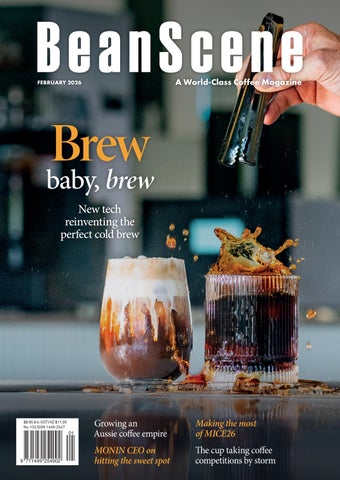
For BeanScene’s February cover, the Barista Equip team opened its showroom, just days before Christmas, for a quiet but striking shoot that captured the potential of the Baby Hardtank in action.
With the space emptied for the evening, Showroom & Warehouse Coordinator Darwin Frame showcased his photography skills, producing atmospheric images of two cold brew drinks – one featuring a vanilla cold foam – that highlight both the elegance and brewing power of the compact system.
At the heart of the Baby Hardtank’s appeal is its ability to compress an 18-hour cold-drip cycle into just 40 minutes, transforming what has traditionally been a slow process into a fast, repeatable work ow.
According to Barista Equip CEO Brett Bolwell, the real opportunity lies in reducing labour costs per cup while enabling cafés to expand into boutique, higher-value cold beverages.
Turn inside for the full cover story featuring Adam Wang who was among the rst to install Baby Hardtank at e Maillard Project in Brisbane – and who saw its immediate potential.
“A lot of newer cafés, especially in Melbourne, love using cold brew as the base for signature drinks. If you’re doing a mixed drink with cold brew, consistency is vital,” he says.
“With the Baby Hardtank you can achieve that; it’s not in uenced by factors like humidity, temperature, how much co ee you use –things that can a ect drip tower cold brew.
“With the Hardtank, your cold brew becomes much more replicable.”
For more information, visit baristaequip.com.au

CHIEF EXECUTIVE OFFICER
Christine Clancy christine.clancy@primecreative.com.au
PUBLISHER
Sarah Baker sarah.baker@primecreative.com.au
GROUP MANAGING EDITOR
Myles Hume myles.hume@primecreative.com.au
JOURNALIST
Daniel Woods daniel.woods@primecreative.com.au
JOURNALIST
Meg Kennedy meg.kennedy@primecreative.com.au
ART DIRECTOR/DESIGN
Daz Woolley
HEAD OF DESIGN
Blake Storey
BUSINESS DEVELOPMENT MANAGER
Charlotte Murphy charlotte.murphy@primecreative.com.au
CLIENT SUCCESS OFFICER
Caitlin Pillay caitlin.pillay@primecreative.com.au
CONTRIBUTORS
Jessica MacDonald, Victor Vu
HEAD OFFICE
PRIME CREATIVE PTY LTD
379 Docklands Drive, Docklands, Victoria 3008 p: 03 9690 8766 info@primecreative.com.au beanscenemagazine.com.au
SUBSCRIPTIONS 03 9690 8766 subscriptions@primecreative.com.au BeanScene magazine is available by subscription from the publisher. e rights of refusal are reserved by the publisher.
ARTICLES
All articles submitted for publication become the property of the publisher. e Editor reserves the right to adjust any article to conform with the magazine format.
COPYRIGHT


Contributors

Victor Vu is the three-time ASCA Australian Latte Art Champion. He placed seventh in the 2024 World Latte Art Championhip (WLAC) in Denmark. Born in Vietnam, Victor worked for three years in hospitality before coming to Australia to perfect his latte art skills. He won the 2018 MILKLAB Barista Battle and the 2020, 2024, and 2025 ASCA Australian Latte Art Championships.

Jessica MacDonald is the General Manager for the NZSCA. Her career has taken her to Auckland, Melbourne, Sydney, and London. She’s worn many hats but remains a roaster at heart. Jessica has volunteered on the Rules and Regulations Committee for World Coffee events and judges in barista competitions and Cup of Excellence programs. Her favourite thing about the industry is the passionate people who care deeply about coffee and the growth of its community.

Once upon a time, I recall searching for a café open during the summer holiday period. Hand-written notes would appear on café doors saying, “closed for January” or “gone shing” for the summer break, but those signs now appear a thing of the past. Granted, café owners are entitled to a well-deserved break and rest over Christmas, but just as so many patrons wind down over the summer months, our desire to connect with friends and socialise in a relaxed manner ramps up – and so does our beverage consumption.
Never before have I seen suburban and city cafés embracing the holiday vibes with such extensive beverage options, from cold co ee concoctions to signature drinks and everything in between, including trending Shanghai Dirty Co ees and reinvented versions of the Mont Blanc. What it means, is that cafés have a smart avenue to charge above the average Australian co ee price at $5.50, and li options above $7.50. When executed well – and adds value to a customer’s experience – it’s not the hip pocket that remembers the price. Instead, it’s the taste that lingers and a higher chance of gaining a repeat customer.


Like us on Facebook @BeanSceneCo eeMag
Making pricing decisions is easier said than done, but when green bean prices are nearly double what they were a year ago – thanks to lower co ee-bean supply from overseas producers, and below average rainfall in Brazil combined with the strength of the Brazilian real – there’s immense pressure on roasters and cafés to pass on those price rises in a climate where so many businesses are already struggling. Fruit and veg prizes are up
2.7 per cent, and meat and seafood prices have risen 3.9 per cent, according to the Australian Bureau of Statistics, further encouraging café operators to work smarter not harder.
One way of achieving this is via the tools cafés embrace. Baby Hardtank, this edition’s feature cover product, is a case in point. It possesses a compact but powerful cold-brew system that can compress an 18-hour cold-drip cycle into just 40 minutes. ere’s also Barista Group’s Übermilk technology.
Both e ciency-creating machines will be on display at the Melbourne International Co ee Expo (MICE).
Speaking of which, MICE is just around the corner (26–28 March). For anyone questioning what equipment can support higher work ow without compromising quality, co ee menu pricing, what drives long-term success, or how to get food products o the ground in the hospitality market – MICE is where you need to be. Explore the latest in co ee equipment, taste some of the country’s best brews from an outstanding lineup of exhibitors, and stay for the insights and knowledge-sharing at the Café Education Stage.
ere really is something for everyone. A er experiencing 13 editions of the expo, which has held two World Barista Championships, seen two venue changes and welcomed hundreds of exhibitors and thousands of visitors, I’m excited to see the show enter another realm and be the expo our industry deserves. I can’t wait to see you there, and wish everyone a prosperous new year, lled with delicious co ee and wonderful experiences that ll you with joy and passion.
SARAH BAKER PUBLISHER


Passion and tradition distinguish la Pavoni. Since 1905, espresso coffee machines, the company’s mission for more than 120 years, identify la Pavoni around the world.
Know-how, creativity, and style: these are the qualities that spring from la Pavoni’s Italian identity and characterise the company’s commitment to bringing coffee machines to life.


Co ee has emerged as one of the strongest in ation drivers in Australia’s latest Consumer Price Index (CPI), with prices for co ee, tea and cocoa surging more than 15 per cent in the year to November 2025, according to new data from the Australian Bureau of Statistics (ABS).
e spike – driven by lower co ee-bean supply from major overseas producers –has helped push non-alcoholic beverages
in ation to 4.7 per cent, well above the broader food and drink category and placing fresh cost pressure on roasters, cafés, and consumers alike.
Overall, Australian household in ation eased slightly in the year to November 2025, with CPI rising 3.4 per cent – down from 3.8 per cent in the year to October – according to the latest ABS data.
e CPI measures changes in the price
of a typical household “basket” of goods and services, including food, transport and housing.
e largest contributors to overall in ation during the past 12 months were housing (+5.2 per cent), food and non-alcoholic beverages (+3.3 per cent), and transport (+2.7 per cent).
Breaking this down further, non-alcoholic beverages prices increased 4.7 per cent in the 12 months to November 2025.
“ e annual rise was driven by co ee, tea and cocoa (+15.3 per cent), due to lower supply of co ee beans from major overseas suppliers,” the ABS says.
A further analysis of categories relevant to café businesses shows:
• Food products prices rose 3.6 per cent in the 12 months to November 2025, driven by snacks and confectionery (+7.1 per cent) due to ongoing cocoa shortages.
• Meals out and takeaway food prices climbed 3.5 per cent, a trend largely attributed to rising wages and ingredient costs
• Meat and seafood prices increased 3.9 per cent, with beef and veal (+11.4 per cent) and lamb (+12.3 per cent) leading the gains, re ecting strong global demand for Australian red meat.
• Fruit and vegetable prices also rose 2.7 per cent, with apples and citrus recording notable increases.

Hospitality Courses Australia has released data indicating the hospitality sector is Australia’s largest employer of young people, with nearly half (45 per cent) of all workers under the age of 25.
e café subsector is indicative of the trend of the industry employing young people, with an average age of just 21.
In total, the accommodation and foodservice industry employs more than
966,000 people, with an 18,700 job growth (two per cent) in the past 12 months.
Director of Hospitality Courses Australia, Samuel Bohr, says demand for hospitality and foodservice workers is at its highest for the year, with November to March serving as the busy period.
“From cafés and restaurants to pubs and hotels, we see a huge uptick in demand for sta over this period – particularly
employees who are well-trained or experienced,” says Samuel.
“Almost half of all hospitality workers are aged under 25. at means for many people, a role in hospitality is there rst job – and it’s a great sector for that, o ering experiences that range from customer service, to fast-paced food preparation, ne dining, and more.”
e average barista’s income is $32,447.


Brisbane-founded café chain Stellarossa will expand its presence out of Queensland and into India following a franchising agreement with the local arm of global consulting rm, Francorp.
Since being founded in 2009 by Phil Cronin and Darren Schulz, Stellarossa has expanded across the Sunshine State with more than 20 locations ranging from the Brisbane region
We’re thrilled to welcome Stellarossa, Australia’s beloved café brand, as they begin their India expansion journey with Francorp,” a Francorp statement reads.
“For 15 years, Stellarossa has proven that great cafés aren’t just about co ee – they’re about creating warm, engaging spaces
people love to return to.
“With beautifully cra ed beverages, premium café menus, and community-driven hospitality, Stellarossa is now ready to partner with passionate entrepreneurs across India.
“Whether it’s a Kiosk, Inline Café, Driveru, or Full Destination Format, the brand brings global standards with exible and scalable models.”

Helping you get your coffee fix!
Committed to innovation and quality to support your success.
Bringing together leading brands in processing, packaging and inspection equipment specifically for the coffee industry. Our solutions set the standard for yield, efficiency and safety. Whatever your product needs, we can meet it with precision and passion.


Australia’s leading specialty co ee professionals have been recognised following a landmark series of competitions hosted by the Australian Specialty Co ee Association (ASCA), with national champions crowned across barista, brewing, latte art, roasting, co ee in good spirits, and cup tasting disciplines.
At the centre of the celebrations was Gabrel Tan, who was crowned Australian Barista Champion a er years of near misses at Big Plans in North Melbourne in late November 2025.
A er nishing runner-up twice and third once over the past four years, Gabrel claimed the top honour, overcoming a strong nalist eld that included Angus Mackie, Liam Pratt, Ziggy Varamulia, Tom Hutchins, and Yeseul Choi. e Veneziano Co ee Roasters Brand Ambassador will now represent Australia at the World Barista Championships at World of Co ee Panama in 2026.
“Every year of not winning gave me great learning experiences,” he says. “Honestly, I just want to shout out my team – especially Craig Dickson. He’s been supporting me ever since I started at Veneziano and he’s believed in me this whole time.
“It took many, many years to get here, but I’m really grateful for everybody who has been part of this journey.”
Big Plans also hosted the Australian Brewers Championship and Australian Latte Art Championship.
Simon Gautherin of Zest Co ee and APAX Lab claimed the Australian Brewers Cup title.
“It’s been 10 years of hard work and dedication,” he says.


“I didn’t compete to win; I removed that from my mind. I wasn’t even too sure if I wanted to be on stage because of the hard work and commitment it takes, so for me it needed to have real meaning.”
In the Australian Latte Art Championship, Amy Zhang returned to the top step of the podium a er a more than two-year sabbatical from competition.
Amy’s victory followed her seventh-place nish at the World Latte Art Championships in Taipei in 2023, and she said revisiting and re ning past designs played a key role in her success.
“When I came in seventh in Taipei, I felt a little bit bad that I couldn’t show everyone my new design in the nal,” she says.
“I kept going to t my design, so when I recreated it and xed it here on stage today, everyone loved it. Now, I have the chance to y to America and show my designs to the world.”
Beyond the barista-focused events,

Australia’s roasting and sensory champions were also crowned late in 2025 and early 2026. e trio will be jetting o around the world to represent Australia at the various World Co ee Championships around the world in 2026.
Amy will be the rst to represent Australia, with the World Latte Art Championship taking place at World of Co ee San Diego in April.
Simon will be travelling to Belgium and World of Co ee Brussels in June, and a trip to Panama City and World of Co ee Panama await Gabrel in October.
Meanwhile, Danny Andrade of Blackboard Co ee Roasters was named winner of the 2026 Australian Co ee Roasters Championship, held at Criteria Co ee in Port Melbourne. He nished ahead of Stitch Co ee’s Peter Lam and Indie Hoop Roasters’ Ik Beom Kim in the three-stage competition, which assessed co ee evaluation, preparation, blending, and roasting skills.
Danny will now represent Australia at the World Co ee Roasting Championships in Belgium at World of Co ee Brussels in June 2026.
ASCA also crowned its 2026 Co ee in Good Spirits and Cup Tasters champions, with Serene Yu of Smay Co ee and Karl Lee taking top honours, respectively.
Serene delivered what judges described as a “performance full of creativity, skill, and air”.
Speaking the day a er his win, Karl said the result was still sinking in.
“Tasting and cupping has become part of my life … I competed rst in 2019, and now I’ve got a trophy, so it’s paid o ,” he says.
Karl will compete at the World Cup Tasters Championship in Bangkok in May 2026, while Serene will join Australia’s other champions on the world stage in Brussels in June.


Opening a new café – or any kind of hospitality venue – is hard work, but what do you learn when you’ve opened more than 40 of them?
Julien Moussi is always on the lookout for new opportunities. In the almost 14 years since opening his rst venue in Fitzroy, Melbourne, he’s created something of an empire with his group of venues, Only Hospitality.
Alongside that, he’s built one of Australia’s fastest growing and best-selling co ee roasters in Inglewood Co ee Roasters.
But it almost never happened.
A er starting his career as a personal trainer, Julien moved back to Melbourne to play VFL football with the Box Hill Hawks, before a severe knee injury changed the trajectory of not only his life, but Australia’s co ee scene.
“I discovered my love for co ee while I was playing footy and working as a personal trainer in Canberra,” says Julien. “I got injured a er coming back to Melbourne – I couldn’t play for a year. In that time, I asked the club if I could make co ees at the ground and, thankfully, they said yes.
“Dimattina Co ee gave me a co ee cart, and I ended up selling at around 10 to 15 other sporting venues. A er about 18 months of juggling I saved around $30,000 to start my rst café, Annoying Brother, in 2012.
“Since then, I’ve opened about 40 venues, around 30 of which have been cafés.”
From inner Melbourne to its outer suburbs and surrounds, and even a successful interstate foray to Burleigh Heads, Queensland, Julien and Only Hospitality have become experts at identifying the best spots for new venues.
When scouring for opportunities, he says it’s important to keep it simple and identify local trends.
“One of the rst things I look at is the housing market and the age demographic of people purchasing in the area. We look for young families in up-and-coming areas where people like to go out for breakfast or lunch and grab a co ee,” he says.
“It’s important to place yourself in areas with high amenities and high activity, like shopping centres or schools.
“Being o the beaten track also isn’t necessarily a bad thing, because you want good parking and for people to have the ability to walk there. ere are a lot of factors involved, but it’s not rocket science.”
A key point of di erence for Julien’s model is many of Only Hospitality’s venues require a new tout, giving him the capacity to reshape them entirely.
“ e more dilapidated the four walls, the better for us,” he says.
“I love seeing people enjoy themselves in
environments we’ve created, curating a vibe and making a venue have an energy to it –creating that soul.”
rough the success of Only Hospitality, Inglewood Co ee Roasters was born. Cory Slater, who was working with Julien as a barista, was key in starting the venture.
Julien says Only Hospitality’s venues were selling about 500 kilograms of co ee a week when Inglewood started roasting in 2017. Now, the business has grown to look internationally for new opportunities.
“Inglewood roasts about 12 tonnes of co ee a week and we supply roughly 350 venues and 250,000 homes around Australia, plus some around the world,” says Julien.
“We’re doing a lot of direct-to-home co ee, even internationally. With the cost of freight and logistics, we’re looking to roast in London and New York. Hopefully we’ll start this year.
“We’re also looking to upgrade our roaster for the second time in three years. We’re looking at a 350kg Brambati. at will increase our volume fourfold, which means we can start having big conversations with many di erent people.”
Despite its size, Inglewood is by no means immune from the past year’s signi cant green bean price rises. But it’s continued to grow, and Julien proudly
expresses its wholesale network has remained strong.
“We’ve really focused on trying to grow our revenue faster than costs have been rising. On a percentage of revenue basis pro tability isn’t what it was, but revenue growth has been able to overcome those barriers for us,” he says.
“Having that direct-to-consumer retail aspect has allowed us to put retail prices up a little. First and foremost, our wholesale partners need to make money, otherwise they’re not sustainable.
“We’ve been more patient with moving our wholesale price compared to retail. We’ve also pulled other levers, o ering free shipping on all online retail orders up until 12 months ago. at’s given us a new way to generate revenue to o set the C-price increase.”
Julien says the shi ing co ee habits of consumers o er signi cant opportunities in both Inglewood’s wholesale and retail spaces, but it’s a balancing act to keep both sets of customers happy.
“I don’t think co ee volume is dropping in venues, people are choosing to have one or even two co ees at home now, people are drinking more co ee, not less,” he says.
“Having a co ee machine is going to be like having an oven or stove. Within the next decade, there will be a co ee machine in every home, so our balance between retail and wholesale needs to be right.
“We haven’t lost one wholesale customer over anything to do with retail marketing, which shows we’re probably getting that balance right.”
In what is typically a low-margin and hyper-competitive industry, this approach has been a key contributor to its growth.
“We’re a tight knit crew and having that element of being hands-on operators is crucial,” he says. “I’m a barista by trade; I still jump on to pour co ees. Nobody is above jumping on the oor and being at the coalface.
“ at even helps from a team morale perspective when the sta see us help. My

wife was even doing dishes in one of our pubs before Christmas because we had a lot of functions on.
“ ings like that really help the culture, it’s what’s worked for us and is an important part of our make-up.”
It’s one of many lessons Julien took from opening Annoying Brother – almost all of which were learned the hard way – but those insights have held him in good stead.
“I was only 23 and I remember crying very,

very o en in those initial months because it was so stressful,” he says.
“I didn’t make a lot of money, barely enough to pay myself wages, but it was important because I learned to build a model with a cost of goods benchmark, a labour benchmark, and a rent pro le. ose things I learned are what our model is still today. Even things like the way we did payroll and reporting haven’t changed.
“It also taught me a lot of resilience, because that’s when everything was on my shoulders. It helped me learn a lot about who I was and who my people were, and they’re the same people now. It was a lot of fun alongside a lot of hard work and stress, but it shaped us.”
From that co ee cart at Box Hill City Oval to building Only Hospitality and Inglewood, Julien equally embraces opportunity and risk – and this tandem Only Hospitality –Inglewood Co ee Roasters juggernaut shows no signs of slowing down.
While there is an inherent risk starting something new, he says it’s critical to not let caution outweigh the potential.
“It’s human nature to have a negative bias but you must try and steer away from that – a lot of people overestimate risk and underestimate opportunity,” he says. “ ere’s never a perfect time to do something – the ones who just do it eventually come out on top,” he says.
“If you become biased towards the positive, you’ll nd yourself on a path to opening your own venue a lot quicker.”


One of Brisbane’s most reputable specialty coffee venues is putting the Baby Hardtank to the test, compressing cold brew from an 18-hour procedure into a 40-minute extraction that could reshape how Australian cafés approach cold coffee.
The Maillard Project in the heart of Brisbane feels less like a café and more like a co ee laboratory. It’s an environment where light stone, wood and glass create an atmosphere built for experimentation.
At the centre sits a low-set island bar, its espresso machines and pour-over stations arranged like instruments in a controlled study, each designed to showcase the exact avour pro les Adam Wang and his team develop in-house.
e newest exhibit in this co ee lab is the Baby Hardtank, a compact but powerful coldbrew system that’s capturing attention across the Australian café landscape.
Positioned beside the brew bar, it can compress an 18-hour cold-drip cycle into 40 minutes, turning what is traditionally a slow steeping process into high-e ciency, repeatable brewing.
For Adam, whose venues o en serve as testing grounds for innovative equipment, it’s another chance to push extraction into new territory without diluting the purity that de nes co ee at e Maillard Project.
e venue’s philosophy is to celebrate the co ees Adam’s team roast in their most authentic forms. Customers won’t nd decadent signature drinks packed with other ingredients on the menu.
“ e Maillard Project is a pure, co eefocused venue. We serve co ee in its original form,” Adam says, noting the only available cold drinks are iced long blacks or cold brew, which account for 15 to 20 per cent of sales.
“ ere are so many amazing origins, beans, processing methods, roasters… co ee is already pretty incredible on its own – why add more to it?”
When BeanScene spoke to Adam, the Baby Hardtank had been installed earlier that day. It’s now available in Australia through Barista Equip which is importing the machine from Polish cold co ee solutions manufacturer Hardtank – established by a trio of co ee enthusiasts wanting to help businesses of all sizes prepare “amazing cold brew in a fraction of the usual time”.
Adam is putting Baby Hardtank to work in his venue – and providing feedback about its performance in an Australian context. As one of the most in uential gures in the Brisbane specialty scene (his other venue Co ee Anthology was ranked eighth in the World’s 100 Best Co ee Shops in 2025) his endorsement may encourage more venues to diversify into cold brew – or supercharge their existing operations – with Baby Hardtank.
“Cold brew is easy drinking, o ering a cleaner, less bitter taste. We always use lter or lighter-roast co ee, and usually something a bit more interesting – funky, fruity. It’s almost like an iced fruit tea. More mellow, clean. And in warm weather, it’s like drinking a so drink,” he says.
“We ran several batches on the rst day alone with Baby Hardtank – 40 minutes for a cold brew batch is pretty impressive, and a step above the dripping tower we’ve traditionally used that can take anywhere up to 18 hours before we can serve the nal product to a customer.”
Baby Hardtank uses accelerated cold extraction technology based around recirculation. Water is constantly circulated and pushed through the extraction basket meaning the co ee, tea, or infusion ingredients are constantly agitated. It also features a unique basket
design that the company says “creates an extremely clean brew” without the need for additional ltration.
Adam says the Baby Hardtank enables high volume batch-brewing. A busy café can easily sell 10 litres of cold brew a day, but to keep up, this potentially requires four rounds of tower dripping unless multiple towers are in use.
“It can be challenging to keep up with the volume, but with the Baby Hardtank within half an hour you can brew four litres. And if you clean quickly in between batches – which is possible due to a quick and automated cleaning process – you could easily brew 30 to 40 litres a day.”
Hardtank has crunched the numbers itself and says a single Baby Hardtank batch has capacity for up to 350 grams of ground co ee and creates four to ve litres of cold brew.
rough multiple cycles, cafés can serve up to 300 portions per day.
A single Baby Hardtank batch can take 350 grams of ground coffee and creates four to five litres of cold brew.


Adam says this will enable his café to o er cold brew with various origins and blends on any given day. He also expects Baby Hardtank will drive diversi cation for other cafés that invest.
“A lot of newer cafés, especially in Melbourne, love using cold brew as the base for signature drinks. If you’re doing a mixed drink with cold brew, consistency is vital,” he says.
“With the Baby Hardtank you can achieve that; it’s not in uenced by factors like humidity, temperature, how much co ee you use – things that can a ect drip tower cold brew. With the Hardtank, your cold brew becomes much more replicable.”
The big opportunity
It seems Baby Hardtank’s arrival in Australia has been one of the worst kept secrets in the Australian café scene. Without much e ort, Barista Equip CEO Brett Bolwell has elded some 120 inquiries from a range of cafés, roasters, and other venues like golf clubs.
As this edition of BeanScene goes to print,
“Baby Hardtank isn’t influenced by factors like humidity, temperature, how much coffee you use – things that can affect drip tower cold brew. Your cold brew becomes much more replicable.”
THE MAILLARD PROJECT
there will be about a dozen Baby Hardtanks in the national market.
“I consider Adam at e Maillard Project the ‘King of Specialty’. He’s a roaster, a purist,


Riverina Fresh’s Lactose-Free achieved a score of 19.5 out of 20 at the Australian Grand Dairy Awards.

Riverina Fresh’s Lactose-Free Milk recently made history by being named Grand Champion Dairy Product at the Australian Grand Dairy Awards, and it holds the potential to shift the scope of Australia’s café scene.
At most cafés in Australia, the co ee menu reads like a carefully curated story. With discussion around origin, blends, and tasting notes, milk rarely takes the heading – but that’s exactly how Riverina Fresh likes it.
e historic dairy company has grown over more than a century with the philosophy that co ee leads, and milk supports.
Every now and then, though, the quiet achiever in every latte and at white does earn some recognition. In late 2025, Riverina Fresh’s Lactose-Free milk was named the Grand Champion Dairy Product at the Australian Grand Dairy Awards, o cially judged the best dairy product in Australia.
For a brand that sees itself as the backstage crew to the baristas it supports, Riverina Fresh Executive Chairman Craig Shapiro says the recognition is a moment of pride that has been accepted with humility.
“It’s incredibly special,” says Craig. “ is
award re ects the work of our farmers, our team, and the baristas who trust us every day. But ultimately our role is to help cafés serve amazing co ee.”
e Australian Grand Dairy Awards represent the highest recognition in the country. Only gold medal winners from statebased competitions qualify, and products are judged by industry experts across avour, technical excellence, and overall quality.
“ ere are 11 categories,” Craig explains. “Each has its own champion, and then one product across all categories is awarded the overall Grand Champion Dairy Product. To receive that honour with a score of 19.5 out of 20 – as close to perfect as you can get – is incredibly humbling.”
ough the winning product is lactose-free, Craig is quick to point out that its foundation is the same milk the company has produced for generations: fresh, natural dairy from a small group of Riverina based farmers.
“ e lactose-free version starts from our full-cream milk. We simply add lactase to break down the lactose into simpler, more digestible sugars,” says Craig.
“What matters most is the quality of the underlying fresh milk. Without that, nothing works.”
Riverina Fresh’s positioning as a support act to co ee, Craig says, is where the brand shows its true value. Rather than dominating the cup, he says the milk is designed to let the espresso lead to help create balance, sweetness, and texture without overshadowing the roast.
“When baristas talk to us, they don’t ask about awards,” says Craig. “ ey ask if the milk stretches consistently. If it pours cleanly. If it supports the avour of the co ee.
“ e fact our lactose-free milk does all that and has been recognised as the best dairy product in Australia means we’re doing our job.

“Having a high performing fresh lactosefree milk gives cafés another high-quality dairy option that performs beautifully in co ee.”
Behind every bottle of Riverina Fresh milk – Lactose-Free or otherwise – is a supply chain that has been built to prioritise speed, care, and minimal handling. It’s an approach Craig says Riverina Fresh rarely speaks loudly about, but it underpins why the brand has become such a staple in Australia’s specialty co ee scene.
“Our farmers produce exceptional milk every day,” he says.
“From there, our focus is on preserving that quality. We transport quickly, process gently, reduce exposure to heat and light, and get it to our customers as fast as we can.”
e emphasis on strength of supply chain is a practical requirement for producing milk that stretches predictably, froths consistently, and tastes clean and balanced.
Co ee professionals o en talk about consistency and the ability to deliver the same quality cup a er cup. Riverina Fresh’s role in that consistency is recognised across the specialty co ee sector, as the company continues to build strong roaster relationships to ensure it meets the ever-changing needs of co ee lovers.
One of those shi s in consumer behaviour Craig points to is an increasing interest in the role food plays in health and nutrition. e growth of weight loss drugs (GLP-1s) is having a major impact on that narrative, particularly in the United States (US), where upwards of 10 per cent of the population are reportedly now using them.
Diets are rapidly changing because of their
popularity, and this is impacting portion sizes and the type of food being ordered in cafés and restaurants. A focus on fresh food and reduced consumption of ultra-processed foods has taken grip in the US.
While lactose-free milk is far from a new product, it’s gaining traction due to the continuing shi away from ultraprocessed food and back towards fresh, natural products.
Craig says the impact will be similar in Australia once GLP-1s become more accessible.
“ ere’s a paradigm shi that is coming for the specialty co ee and café sector in Australia, because of weight loss drugs,” he says.
“People are going to be eating less, so they need to eat smarter. ere’s de nitely momentum back toward fresh, natural dairy.
“People want food that’s simple and nutritious. With cafés being such a part of daily life, the milk they choose really matters.”
But even as dietary habits change, the company doesn’t pitch lactose-free milk as the star. It’s one option within the broader rise of high-quality dairy.
“ e award shows that you don’t need to compromise,” Craig says. “Cafés can o er something for people who avoid lactose while still serving the best dairy product in Australia.”
Because lactose-free milk has a slightly higher cost to produce, cafés o en treat it similarly to plant-based alternatives – o ering it as a small premium option.
e natural sweetness created when lactose breaks down into glucose and galactose has a genuine impact on avour. Glucose is
naturally sweeter than lactose, which leads to a change in avour pro le. is added sweetness o ers greater avour balance in milk-based drinks, unlocking a point of di erence for iced co ees and signature beverages.
“ ere’s de nitely an opportunity for cafés to think di erently about lactose-free dairy,” Craig notes. “People who usually add sugar might not need to. And if the milk helps create a better-tasting drink, it’s something the café can be proud to stand behind.”
But again, Riverina Fresh stresses that milk should enhance the cup, not dictate it.
“Ultimately, cafés know their customers best, we’re just here to support them,” says Craig.
For Riverina Fresh, the Grand Champion Dairy Award is a company milestone – and a moment shared with baristas, café owners, and roasters around the country who use its milk to bring the best co ees to life.
“ e award belongs to the whole community: our farmers, our team, the cafés who trust us, and the baristas who work magic behind the counter,” says Craig.
“We just provide an ingredient. ey create the experience.”
For Craig, that is the simple way of summing up Riverina Fresh’s role in Australia’s specialty co ee scene. Not the headline act, but a trusted support act – a humble partner helping create the best cups in Australia.
And, now, the producer of Australia’s best dairy product.
For more information, visit riverinafresh.com.au

Cafés raising coffee prices has long been a topic of discussion in Australia. Dean Merlo details why it’s time for operators to bite the bullet.
Co ee is one of the world’s most heavily traded and valuable commodities, but as global demand has increased and green co ee production has stalled, price rises have shown little sign of slowing down in recent times.
e average price of green co ee almost doubled across 2025, and the early signs in 2026 indicate similar pressures. e consistent jumps have had Australian cafés and roasters feeling the squeeze in what Dean Merlo, founder of Merlo Co ee Roasters that supplies to more than 1500 venues, describes as the most tumultuous period he’s witnessed.
“It’s a tough time for roasters right now, the co ee prices aren’t just unprecedented, they’re ridiculous. ey’re closing in on double what they were a year ago. It’s incredibly hard to pass that onto cafés who are already struggling with rising costs,” says Dean.
“Co ee is basically a traded commodity now, I don’t believe this is just a spike – if you look at the history of the past 12 months, it’s kept rising. is is the greatest turmoil I’ve seen in the co ee market in my time.”
Merlo, under Dean’s stewardship, has grown to become one of Australia’s largest familyowned co ee roasters since being founded more than three decades ago. In that time, it has also opened 16 cafés in its home market of Queensland, from Brisbane to Toowoomba.
Dean has seen some roasters look to o set rising prices by changing their blends, a move he believes would send a negative message to Merlo’s loyal customer base.
“What I’ve explained to our people is everyone likes to buy cheap co ee, but no one wants to sell cheap co ee,” he says.
“We could have used cheaper origins or cheaper blends in the past year, but we refuse to do that and compromise the quality of the co ee. It doesn’t send the right message to customers, as well as culturally throughout our organisation.
“I simply will not do it. We use the same blend now as we did 33 years ago, and that’s important to us.”
What, then, is the tipping point? What levers can be pulled to ensure Australia’s roasters and cafés continue to not only survive, but thrive? e simple answer, according to Dean, is pricing changes in cafés.
According to the La Marzocco Future of Australian Co ee Report, the average co ee price in an Australian café in 2025 was $5.50 – which is signi cantly lower than other developed markets around the world. at

gure rises to $6 to $7 in major metropolitan hubs like Sydney and Melbourne and drops to under $4 in some regional areas and budget options.
e average price of a co ee in Brisbane sat at around $6 last year, and Dean believes raising prices to match the rest of the market doesn’t have to be as scary as it seems. In fact, Merlo’s own locations increased prices from
$4.90 to $5.50 in one fell swoop and felt next to no blowback from customers.
“We knew we just had to charge that price, otherwise it’s a question of when you go broke,” says Dean. “It’s tough when you’re talking to cafés out there and they’re nervous since their costs are going up and they’re getting strangled in their own business, and they’re too worried that the café across the
road isn’t putting their prices up,” Dean says.
“We’ve explained our pricing to all our customers. We charge $5.50 for a basic at white with $1 for extras. We only charge once for extras, so say if you have a double shot with soy and a shot of syrup, that’s still just $1 more.”
is approach is reasonable for both the café and the customer, he says. Dean discovered it’s di cult to individually charge for each addition on top of the co ee itself.
“We explain to our wholesale customers that’s what our cafés charge, and we’re in their business so it’s di cult – in some respects it’s hard to be a wholesaler and a retailer at the same time, because you’re e ectively selling wholesale to your competitors, but we don’t see any of the cafés we sell to as competitors as there are so many things that di erentiate the customer experience.”
Dean says that end consumers are willing to accept – or won’t notice – price increases as long as the other aspects of the café experience remain up to scratch.
“ e thing we’ve tried to impart onto our customers is that if you’re charging ve bucks for a co ee, you’re going broke. It’s as simple as that,” he says.
“If you have a quality product and o er a quality service, the food’s good, and you’re just doing all the right things as good retailers, people won’t even blink – they won’t even look at the price.
“We proved that with our stores in that the increases barely got a mention from our customers when it happened.”
Despite the external pressures, Merlo’s café locations did not stand still in 2025. e opening of a wholesale bakery at its Bowen Hills Roastery looks set to expand further in 2026.

“2025 was so big for us, we opened a bakery, and it’s a full-on wholesale bakery and we sell retail at our shop. It’s in our Bowen Hill Roastery and it’s been going incredibly well,” says Dean.
“It’s not easy to produce both in the same spot, but we’re excited about it, and we feel it’s an investment that makes us stand out.”
“It’s crucial to diversify, you can’t just stand still. If you’re trading exactly as you were last year, it’s not going to work,” says Dean.
“It could be as simple as a change in menu where you’re showcasing that you’re now making iced drinks or adding cold foams, but you must be up on all of that. I believe a big warning sign for a café is if they haven’t changed anything in the past 12 months. It doesn’t have to be something as large scale as switching up the entire t-out, but even small changes help step things up.”
For more information, visit merlo.com.au

As trailblazers in sustainable coffee culture, KeepCup is returning to the Melbourne International Coffee Expo in a big way.
Aer 15 years at the forefront of reusable co ee culture, KeepCup is sharpening its focus on younger drinkers.
Its Sip Check campaign, unveiled in December 2025, will take the stage at MICE in March 2026, positioning reusable cups as equal parts sustainability tool and style statement.
For MICE26, Co-Founder and Managing Director Abigail Forsyth says the KeepCup stand will focus on personalisation and everyday reuse, with Sip Check brought to life through an interactive mirror moment.
“I’ll just say that you’ll need to bring your phone along to our booth … it speaks to KeepCup as an accessory to your life … I can’t say much more than that.”
Alongside this, there will be a customisation-led element showing how cafés can merchandise multiple products and colourways together, as well as “playful opportunities” for visitors to personalise their cups on the trade oor.
It’ll also be a key chance for KeepCup to present its expanded range, as well as new co ee accessories, to potential wholesale customers and general co ee enthusiasts.
“We haven’t exhibited at MICE for a couple of years, so it’s an opportunity for us to showcase the whole range of new products we have online that cater to all the di erent styles and ways people are using the brand,” Abigail says.
Products that have experienced signi cant growth in the last few years include the Cold

and
reuse.
More are expected to be added to this list, to be unveiled at MICE.
With the expo serving as a signi cant gathering space for the co ee industry, Abigail is aware of its importance in forming connections and sharing innovations.
“ e support of the speciality co ee

industry has always been absolutely foundational to KeepCup – it’s where we got our start all those years ago,” says Abigail.
“It’s about nding that next generation of roasters, cafés, baristas, and people who are interested in the industry, and being able to get them all in one place and have those conversations.
“It’s very energising and we’re excited to be there.”
Working in the sustainability space for more than a decade, she has seen many changes in the industry.
She’s also seen a stronger appetite for local manufacturing, with consumers looking at supporting homegrown suppliers – KeepCup’s own Cold Cup is “100 per cent made in Australia”.
“It goes to who we are as a brand and to sustainability. Many cafés are about community, so there’s a ow-on e ect of supporting the businesses that surround that community,” she says.
Abigail also points to the signi cant shi toward making high quality co ee at home – and how the Australian industry is tapping into that.
At the same time, cafés are doubling as a retail space for companies like KeepCup, where consumers can purchase its re-usable cups and limit the environmental impact of takeaway co ee consumption.
“ e nice thing about KeepCup now is we’ve got a lot of breadth in our product range, where we can have a number of products that appeal to di erent customer types, di erent co ee drinking preferences. In that sense, we can become a one-stop shop for a café to purchase their reusables,” she says.
“It’s a way to connect people – you’re buying the beans; you buy the cup – it creates a sense of community.”
As MICE approaches, Abigail reiterates that word – connection – is front of mind.
“Having the chance to connect at MICE is essential. It allows us to establish our presence within the specialty co ee industry while engaging directly with the community,” she says.
“Whether that’s through a great experience of coming to visit the stand, showcasing our product range and the new items we have on o er, meeting new and existing customers, or even talking with industry peers: those moments – when you meet someone face-to-face – become so vital to building relationships … a er that, everything ows so much more e ortlessly.”
For more information, visit au.keepcup.com

At this year’s International Coffee Expo, Coffee Works Express is unveiling the newest gear from the world’s most trusted names — Astoria, Wega, Mazzer, and Franke.
From the Astoria AB200 to the Wega Polar, from Mazzer’s Mini Series to Franke’s sleek new A-Line systems, you’ll find the tools that shape the future of coffee.
Don’t just hear about the latest in coffee tech. See it, taste it, try it. Only at CWE.


activations


When coffee equipment fails at the worst possible time, Coffee Machine Technologies is ready to step in and ensure cafés are back trading in time for service.
Not a weekend goes by without Co ee Machine Technologies (CMT) receiving a phone call from a panicked café owner about malfunctioning equipment. It’s a high stakes moment: weekends are the busiest trading period, and the downtime can quickly spiral into lost sales and disappointed customers.
For more than 20 years, CMT has built its reputation on being the lifeline cafés call in these moments of crisis. With 24/7 support, the Victorian company’s nationwide network of trained technicians can diagnose issues and respond immediately to get machines back online – o en within a matter of hours and in time for peak service.
It’s this combination of speed, expertise, and reliability that’s made CMT one of Australia’s most recognised independent co ee machine service providers, says Founder John Colangeli.
It’s why the company is also trusted by everyone – from boutique cafés and roasters to national chains – businesses that have all been impacted by rising operational costs and green bean prices during the past 12 months.
“Downtime due to a machine fault, or grinder for that matter, is the last thing venues need,” John says.


“Across Australia, there are many good service providers, but what really sets us apart is our depth of knowledge across a wide range of equipment. Rather than being limited to a handful of manufacturers, we have the knowledge and capability to work across multiple brands, including the early models through to the latest technologies.
“Responsiveness is another key point of di erence. It’s an around-the-clock service, including weekends and a er hours. It’s not easy, but it’s vital we can respond quickly for our customers.”
CMT has intimate knowledge of almost every aspect of the co ee industry. Beyond its service department, it supplies equipment from some of the most reputable overseas manufacturers, runs a café out of its Lygon
Street, Carlton, showroom, and even manufactures its own Viper steamer, boiler and hot water systems.
e importance of a responsive service team therefore isn’t lost on John.
at’s why CMT operates an in-house service team of 12 technicians that work out of hubs in Victoria’s Tullamarine, Lygon Street, Mornington Peninsula, and Geelong, and Sydney – each on the road with their own van. at’s in addition to four technicians who work in CMT service centres refurbishing or xing equipment.
But the company’s reach extends nationally through a network of handpicked partner companies in each state.
“ ese partnerships allow us to support national businesses – cafés, restaurants, and multi-site chains – wherever they operate,”
John says. “ rough our preferred third-party technicians, we can deliver a consistent level of service nationwide.”
When a café calls with a problem, CMT works quickly to resolve it. In metropolitan areas, technicians are usually on-site within the hour, aiming to x the issue the same day. Nationally, around 90 per cent of the time, the company can maintain that response speed.
Finding and supporting skilled technicians is another key ingredient. So is keeping up with ever-more sophisticated electrical components in co ee equipment.

“All our techs are trained in-house across all equipment and where manufacturers o er training or technical support, we take advantage of it. Each van is stocked with a large range of parts. We don’t want them turning up only to nd they don’t have the right part to get the job done,” John says.
He believes cafés can minimise or even avoid downtime in the event of equipment meltdown.
“Maintenance is the most important thing. I’ve always said that even though café owners and sta aren’t technicians, they know their machines well and o en better than we do,” he says.
“If something doesn’t feel right or isn’t behaving normally, they’ll o en notice it early. at’s the point where they should call us in, so we can assess what’s wrong – or what could potentially go wrong – before it turns into a bigger issue.
“Sometimes it’s something simple like a leak, but leaks can quickly turn into bigger problems, especially if water reaches electronic components. Many modern machines are heavily reliant on electronics, so small issues can escalate if they’re not addressed quickly.”
Some cafés mitigate risk by running backup machines or grinders – a philosophy John supports.
“Bench space doesn’t always allow for that, but in our own café in Carlton, for example, we run two machines. In the unlikely event one fails, you’ve got a backup ready to go.”
As operational pressures mount, cafés can take comfort knowing CMT is just a phone call away, stopping small faults from turning into major disruptions.
“For customers using CMT as a national service provider, they really see the di erence – not just in their own operations, but in the experience they’re able to then deliver to their customers,” John says.


2025 turned out to be an incredible year for specialty coffee in New Zealand, but with 2026 now well underway, the next few months are filled with unmissable events, competitions, and opportunities.
2026 is shaping up to be an amazing year for New Zealand’s specialty co ee community. From competitions that spark creativity to gatherings that deepen connections, the New Zealand Specialty Co ee Association (NZSCA) is brewing up a full calendar of events designed to inspire, educate, and unite co ee lovers across Aotearoa. Here’s your rst look at what’s coming.
Mark your calendars for our Annual General Meeting, which will take place in Christchurch – also known as the Garden City. O ering a vibrant co ee scene and a welcoming atmosphere, it’s perfect for re ecting on the year that was and shaping our future together.
e AGM is more than a meeting; it’s a chance to connect with the Board and other members, share ideas, and enjoy a couple of days of co ee culture. We’re planning a fun lineup around the AGM, so stay tuned for details and make the most of what the city has to o er.
Regional competitions return in 2026 with a fresh, accessible format designed the celebrate local talent and encourage new faces to step into the spotlight. ese stripped-back events focus on connection and creativity, and also act as a so launch into Nationals for those who might feel intimidated by the big stage. Our goal? To remove barriers and create a space where more people feel con dent to

‘just give it a go’. Less pressure, more fun, and plenty of opportunities to learn and grow.
Two big weekends of national competition in Auckland means more spectators, more energy, and even a few friends from across the ditch.
e Cup Tasters Championship and Brewers Championship kick o the year in early May, and we’re thrilled to welcome the Brewers Cup back into the calendar for the rst time in years.
Late September will bring the artistry and precision of barista cra and latte art. ese competitions are about more than titles –they’re about skill development, community

connection, and creating pathways for co ee professionals at every stage.
We can’t wait to see fresh faces from the Regionals stepping up to the challenge.
In August we will be bringing back a past crowd favourite with the return of Symposium.
Designed as a space for learning, discussion, and professional development, Symposium has long been valued for bringing the co ee community together beyond competition.
More details will be shared in the coming months, but we can say now that we are looking forward to creating a meaningful and engaging experience for attendees.
With a full year of events on the horizon, 2026 is set to be a strong year for the specialty co ee community. Stay connected through our newsletter and social channels as we share more information and open registrations across the year.

For more information on the New Zealand Specialty Co ee Association, or to join, visit nzsca.org


Hany Ezzat started a movement in the world of coffee competition with a side hustle that has since become a major influence on the international scene.
People who compete in co ee competitions are always looking for an extra edge. From novel roasting processes to new water mineral concentrates, it’s the one-percenters that determine whether you make the nal round, li the title, or head home empty-handed.
Hany Ezzat knows all about what it takes to compete at these high levels. As an Australian Brewer’s Cup nalist every year between 2020 and 2025, and coach of 2024 Australian Roasting Champion and seventh-place winner at the 2025 World Roasting Championship, Sangchul Lee, he has seen how little changes can equal big results.
at desire to nd an extra edge inspired Hany to create Ni Wares cups. Over the past ve years his vessels have gained traction all over the world.
“I’ve been doing co ee competitions since 2017. Competitions were what inspired me to join the industry in the rst place, and I’m really lucky to work around a lot of inspiring people that have created a lot of incredible co ee tools,” says Hany.
“Working with the likes of Saša Šestić at Ona Co ee enabled me to see these things that changed the game, and it inspired me to nd my own way. When I was prepping for the 2020 Brewer’s Cup I was testing a bunch of vessels, and I ended up really liking two of them for my competition co ee.
“One of my co-workers had made his own cups for a competition before, and I thought I could try and make a hybrid between the two I really liked. e biggest features were the thick and thin elements of the rim which had a profound di erence on the way the co ee was perceived. I was connected with a renowned local ceramicist, Madeline Cardone, and I ended up nishing second in Australia.”
Ni Wares cups, on the surface, look like a perfectly smooth, pastel pink cup that, from the top down, look slightly asymmetrical with a small dimple poking up through the bottom. Every aspect, however, has been deliberately cra ed with the perfect delivery of co ee in mind. e speci c shade of pink has been scienti cally proven to make things taste up to 20 per cent sweeter, while the smooth texture has also been designed to positively in uence the experience of the user.
e di erent thickness of the two sides has also been carefully considered. e thinner, sharper lip promotes a thinner layer of liquid on the palate to support delicate notes like orality and brightness. On the other side a thicker, rounder lip supports more intensity, texture and sweetness.
Finally, the small, protruding dimple has

Ni Wares.
been designed to promote swirling in the liquid and prevent sediment from settling.
Hany says the current versions of the di erent Ni Wares vessels are the result of years of research.
“I ended up sending my rst handmade cups to someone in ailand and he ended up winning a competition with them, fast forward a couple of years of R&D where we slightly changed the shape, the colours, the weights, and I got really inspired,” says Hany.
“I found scienti c papers that proved things taste sweeter out of a pink cup, and that weight and shape all in uence the way co ee tastes. I started on my mission to design the perfect cup and started connecting with local
designers in Canberra, FORMSWELL, to start mass producing in 2021/22.
“ e rst prototypes from the factory came out in 2023 and I gave them to Kristóf Maróy for the World Brewer’s Cup, and he made the semi- nals using them. Since we fully launched in early 2024 it’s just been gangbusters.”
Currently, there are four di erent cups in the Ni Ware catalogue. e original Bouba, the thinner Kiki, and the Espresso and Milk Toto variants.
“ e Bouba cup is designed speci cally for co ee competitions, but the more I learned and developed I realised we had to make di erent cups for di erent co ees,
just like we do for wine,” says Hany.
“Bouba and Kiki are our lter options.
ey’re e ectively a red wine glass and a champagne ute – the thin shape and small surface area of the Kiki is going to intensify the sweetness and body of a co ee, so things like washed co ees taste amazing in thinner and more delicate cups.
“Big, natural co ee and co-fermented co ees taste better when you open them up, so that’s what the Bouba is perfect for. We want people to hold and swirl it like a wine glass. I was super lucky to work with Hugh Kelly who is a three-time Australian Barista Champion who made the world nals three times to create an espresso cup for his competition.” e espresso cup used by Hugh has also been used by the likes of recently crowned World Barista Champion Jack Simpson alongside a range of national champions from all over the world.
“I can’t even count how many champions have used them, but at least 13 di erent national champions used this at this year’s World Brewers Cup,” says Hany. “We’ve also had World Barista Championship nalists, and Jack won with them this year. We’ve even had them in latte art nals, and runner-up at the World Ibrik Championships Paul Ungureanu used them.
“ e espresso cup has become a bit of a staple in the world competitions. e goal is to put our cups in the hands of the best athletes

in the game, and they’ve been my biggest supporters and advocates.
“It’s amazing to know we’re changing the way people look at co ee. Having all these champions engage with it around the world,

it’s like a big family that extends across the globe. It’s super nice.”
Hany has become a leading voice in how each of the ve senses combine to alter the co ee experience. In 2025 he embarked on tours to the likes of South Korea, Kazakhstan, Kyrgyzstan, Japan, Qatar, and Indonesia, and demand for Ni Wares products continues to skyrocket.
Now, the brand has partnered with Co eeTools to help more co ee enthusiasts get their hands on the cups.
With a host of brands that prioritise the best possible co ee experience in its stable, Co eeTools Director Curtis Arnold says he’s excited to help Ni Wares continue to grow.
“Competition breeds technology and innovation, and that ends up trickling down to the consumer. is is the perfect example of that,” says Curtis. “Hany’s cups have been used in so many competitions at global and local levels all over the world.
“At that level of competition, you’re always looking for that small point of di erence, but this is also an opportunity for less sophisticated co ee drinkers to experience some of this competition-level equipment and experiment with these high-level concepts.
“Apart from the pleasure of working with someone like Hany, Ni Wares aligns really well with some of our other brands like Barista Hustle and xBloom, where the focus is on true specialty co ee and the attention to detail that comes along with it.
“ e Ni Wares cups are also beautiful and feel lovely in your hand, they’re appealing on a number of levels. You don’t have to have a world-class palate to appreciate the di erence they make and to enjoy using them.”
For more information, visit coffeetools.au or ni-wares.com

Following a record-breaking year in 2025, how can attendees make the most of their time at this year’s Melbourne International Coffee Expo?
While the Melbourne International Co ee Expo (MICE) trade
oor alone is a treasure trove of discovery, organisers of the 2026 event are building in plenty of golden opportunities outside of the con nes of the main expo.
An exciting line-up of activations are set to celebrate, educate, and connect the industry, including the BeanScene Café Owners Education Series; Co ee Industry Heroes Awards; the return of the Roaster’s Playground and Trip to Origin; and the inaugural MICE at Night.
Although attendees are spoilt for choice when it comes to curating their own MICE
experience, each of these initiatives operate with the same goal in mind: creating opportunities for connection.
“For some, it’s going to be the connections made through engaging with Trip to Origin, for others it’s going to be celebrating the industry at the o cial MICE a erparty and awards,” says Siobhan Rocks, General Manager – Events at Prime Creative Media, which organises MICE.
“It’s important to us that we are able to facilitate attendees creating di erent points of connection in their own way.”
e BeanScene Café Owners Education Series, sponsored by Grounded Packaging,
Representatives from the world’s origin hot spots will share their knowledge of coffee at its source.

will allow for café owners to step back from their day-to-day to obtain a stronger grasp of the industry in 2026, while providing actionable tips to ensure their businesses aren’t just existing, but thriving.
Topics to be covered include café management, the future of Australiangrown co ee, and navigating the cold co ee revolution.
“MICE is where the café community comes together, and the BeanScene stage is a place where owners can connect on shared industry topics,” says Siobhan.
“Our goal is to create an environment where owners feel empowered, inspired, and ready to take their business to the next level.”
e event will also feature the Global Co ee Report (GCR) Leaders Symposium, aiming to bring together leading roasters, business operators, and industry decision makers to unpack the trends, opportunities, and challenges shaping the global co ee landscape.
Attendees can expect a dynamic schedule from an extended panel of experts, and the opportunity to network and connect directly with industry leaders in the co ee industry.
MICE also marks the second year of the Co ee Industry Heroes Awards, which Siobhan says are “a real celebration of the trailblazers, the legends, and the newcomers within the co ee and café industry”.
“We’re putting people who are in the industry in the middle and shining a light on them as part of that,” she says.


is year will also see the expansion of four awards: the Sustainability champion, Co ee Educator, Best new café, and Home grown hero.
Following a record-breaking 2025, MICE organisers are harnessing that momentum, including the return of the highly successful Roaster’s Playground. It’s also the must-see event Siobhan recommends for MICE rsttime attendees.
“It’s the best representation of the Australian co ee scene: it’s a celebration of the diversity of di erent roasters, and it’s a cost-e ective way of getting their product out there. If there’s any argument on how good co ee is in Australia, it’s because of these people.”
e event will also see the expo’s rst extended-hours event, MICE at Night, which will turn the exhibition oor into an industry party for one night only.
Siobhan says it will allow key members of the co ee industry even greater access to the show.
“Although MICE typically runs across three action- lled days at the Melbourne Convention and Exhibition Centre, we have found café owners and operators can sometimes struggle to engage with the show as it falls during peak business times,” says Siobhan.
“We know how hard baristas, managers, and café owners work, so MICE at Night will

be an opportunity for them to let o steam while they network.”
She says the most exciting part of putting together this year’s event is the number of new exhibitors who’ve never attended MICE before, allowing the expo to continue to grow alongside the vibrant industry it serves.
“It’s really great to see a show that’s been
around for 13 years go through a phase of reinvention.”
MICE will be held from 26 – 28 March 2026 at Melbourne Convention and Exhibition Centre.
For more information, visit internationalcoffeeexpo.com/attend

TURNKEY SOLUTIONS BUILT TO ENHANCE YOUR COFFEE PERFORMANCE
INTEGRATED TECHNOLOGIES, SUPERIOR SUSTAINABILITY
Imagine a complete turnkey processing and packaging line for your coffee. From beans reception to end-of-line solutions, each machine is interconnected in a digital ecosystem, maximising performance, production efficiency, and ensuring superior sustainability through monitored processing, reduced energy consumption, lower emissions, and with the ability to handle all compostable and recyclable packaging materials. Imagine being able to have all this from one single source. IMA Coffee Hub. Look no further.
ima.it/coffee

More than five years since his last trip to Australia, MONIN CEO Olivier Monin sat down with BeanScene to discuss product advancement and sustainability driving his global gourmet flavour company.
From humble beginnings in France to a global industry leader, MONIN is no stranger to growth and innovation.
e fact the company now operates in over 160 countries and produces more than 200 avours is undeniable proof of this.
Distributed in Australia through Stuart Alexander since 2012, MONIN’s product line has become a staple for creative beverage makers in bars, hotels, and cafés – from premium syrups, frappe powders, gourmet sauces, fruit purees, to liqueurs and cocktail mixers.
Starting out as a liquor company before pivoting into its core business of syrups –family is the common thread throughout MONIN’s history. Its roots stem back to 1912, when Olivier’s grandfather, Georges Monin, founded the company in Bourges, central France, and passed it on to Paul, Olivier’s father.
Olivier later took the helm as president in 1993 – leaving his Chicago banking job and challenging himself to take the company to the next level. He achieved that and has been at the forefront ever since.
at family heritage still holds true, with Olivier’s 28-year-old daughter recently joining the company. He’s tasked her with visiting each of the company’s global plants,
located in the Americas, Asia, and Europe, to understand the di erences between each.
But he reiterates that whether a company representative carries the Monin last name or not, customers are treated with the exact same mentality: “nice people always want to help”.
“Every one of our plants and subsidiaries has a managing director, and they’re all easy to talk to. For us, that’s essential. We now have more than 1,400 MONIN employees, and any one of them can call me or send me an email. It’s important we keep that essence of the company, so we can continue to support our many customers across the world.”
Even with a 113-year history, Olivier recognises the need for MONIN to continually improve. A mindset shi in the way its products are presented to the market is an example of this, as well as its investment in sustainability initiatives (more on this soon).
On the rst point, he highlights the need for MONIN to evolve the way it serves its customers. One of those developments is an emphasis on “selling solutions”.
“We always say we are not selling the product, but the solution instead, because behind the scenes we have the skilled people who do that – so MONIN, and our distributors, are investing in a very high-level of professionalism,” he says.
“ e solution should be di erent for each venue, even if they are just a few metres apart. Most times, their customers are di erent, and so the expectation will be di erent.”
With MONIN products available in 165 countries, the company is privy to an array of trends across the co ee and café industries – the matcha explosion saw the company release a Green Tea Matcha syrup.
Olivier says the company hears from those on the ground in every country, including Australia. If the idea has merit, the company’s R&D team seek to understand how to maximise this opportunity so customers can bring new avours into their drinks menu.
“New trends are very di cult to de ne, but one trend we’re really working on is to now concentrate on avours that aren’t as sweet.
ere’s a global trend worldwide towards this, consumers are demanding it,” he says.
Before launching products, the company ensures the recipe matches the intended avour. Olivier o en gets the nal say on any new product.
“I always believe with every new syrup, if I don’t get that ‘wow’ moment, then we need to go back to work,” he says.
MONIN currently has more than 200 syrup recipes, thanks to access to variety of fruits from around the world. Olivier says
one of the most recent editions is jabuticaba, a Brazilian fruit that’s become a “very popular” avour.
“In every region where MONIN operates a manufacturing plant, we try to also develop a new syrup close to the local food,” he says. e company has recently established its own plantations, planting yuzu – a citrus plant – ve years ago in Europe and vanilla in Madagascar.
“Yuzu was the rst because we saw that there was going to be a decrease in production, mainly in South Korea, where 80 per cent of the production is coming from … we’ve done this beautiful plantation, but we think we should multiply by 10 because the global production is decreasing, and the demand is increasing.”
e company’s Madagascar operations started not long a er. e country itself produces at least 80 per cent of the worldwide vanilla supply.
Olivier says the company bought land in a small village, employing 80 locals, and has built a school classroom. e farm sits 1000 kilometres from the main production area and partners with local business for the production.
He says the way the farm has been set up “enables us to take care of each tree”.
“We take care of our environment, and I think very few companies can do that, especially in the syrups industry,” he says.
“It’s so important to take care of nature, because if you don’t teach your kids, then you will lose it. So it’s very important for us to be part of it.”
Olivier puts a strong focus on the increased naturality of ingredients, noting the trend’s rise in Australia. Currently, 98 per cent of MONIN products are made with 100 per cent natural ingredients.
“When I came on 40 years ago, there were just a few ingredients – around three, four or ve – in the recipes. Now it’s more like 15 to 25, and much more complex. To make it self-preserved, you need to add a lot more smaller types of spices, and di erent types of ingredients,” he says.
“Before [the change], we were producing new avours in almost a few days in the lab. Now it’s more like a few months, because we want to keep it stable, without using any preservatives,” he says.
On the sustainability front, each new MONIN plant aims to improve upon its environmental impact, with Olivier highlighting the company uses solar panels in Bourges that can save 80 per cent of its water waste.
“ e more people that use that system, the better for the planet,” he says.
Other goals include using 100 per cent recycled glass, and the company is looking to
overhaul each plant with water sustainability in mind, realising downstream models to target zero waste in the coming years.
Elsewhere, MONIN purchased a 13th generation orchard in France with more than 340 fruit varieties that was closing down. Although this farm doesn’t grow fruit for MONIN products per se, the company is selling the trees to ensure they get another lease on life.
On what advice he would give to MONIN customers, including cafés, Olivier says there’s an opportunity for cafés and other venues to avoid “cheap product, made the arti cial way” and lean into more natural ingredients that consumers are increasingly demanding.
“ at’s our advantage, and why we play at the premium end of the market. We may be a bit more expensive … that’s because our products contain high quality ingredients but it’s better for everyone.”
He hints there’s a “very interesting” range coming soon, which Australia will have access to. But that’s all he can say.
Whatever comes next, it’s guaranteed that MONIN will continue to both surprise and satiate its customers.
MONIN is distributed in Australia via Stuart Alexander. For more information, visit stuartalexander.com.au


The brand’s plant-based milk products are quickly becoming a go-to among baristas, with adoption by major chains and respected roasters now fuelling its push into the coveted Australian market.

Within ve short years, OATSIDE has cultivated a following across Southeast Asia, China, India, Canada, and the Middle East to become one of Asia’s fastest-growing plant-based milk brands.
In fact, it’s now present in more than 20 markets, with its café-grade Barista Blend Oat Milk used among specialty cafés, roasteries and co ee chains. Partnerships with names like Starbucks, Dunkin, e Co ee Bean & Tea Leaf, and Tim Hortons have only enhanced its reputation, along with boutique roasters such as % ARABICA and Blue Bottle Co ee.
e Singapore-born company has gained the most traction in its home region. e OATSIDE brand is now present in more than 500,000 retail and foodservice doors in the Asia-Paci c, and expanded production capacity in Indonesia and ailand now supports deeper collaboration with the region’s baristas and co ee professionals.
Now, the company has Australia in its sights. It is bringing its Barista Blend Oat Milk – and newly launched NOBO Barista Coconut and NOBO Barista Soy – to the nation’s cafés, aiming to replicate this success in one of the world’s most competitive and celebrated co ee cultures.
e Melbourne International Co ee Expo (MICE) in March 2026 will be Australia’s rst major taste of the brand.
Founded in 2021 by Benedict Lim as a home experiment, OATSIDE has grown into one of Asia’s rst full-stack oat milk producers, controlling everything from ingredient sourcing and oat extraction to manufacturing.
Barista Blend remains the hero product. e company says the product is celebrated for its ability to deliver stable micro foam, balanced sweetness and a neutral-yet-round base that lets espresso character shine.
“ rough early iterations, I realised the [oat milk] versions I loved most carried a touch of malt and toastiness – avours familiar to many of us in Asia,” says Benedict. “Seeing the specialty co ee community embrace OATSIDE over the years has been incredibly encouraging. Baristas push us to be better, and that dialogue continues to shape how we innovate.”
While Barista Blend Oat Milk is already served in some Australian cafés, MICE26 is shaping up the a key moment for OATSIDE to announce its arrival on the national specialty co ee scene.
“We’re also excited to be debuting our NOBO range of coconut and soy milk for baristas for the Australian market, which pair

nicely with co ee and gives a creamy body with its own unique avour,” Benedict says.
NOBO Soy Milk has been “reimagined for today’s health-driven cafés”, featuring 4.2g/100ml of protein – almost 50 per cent more than dairy milk – along with no gums, emulsi ers, or added oils. Specialised

OATSIDE is present in more than 500,000 retail and foodservice doors in the Asia-Pacific region.
extraction ensures a low beany taste, and mildly roasted avour that “pairs beautifully with espresso and matcha”, the company says. NOBO Coconut is described as a “cleaner, more balanced coconut milk designed for cafés”. OATSIDE says this 100 per cent plantbased product is “a delicious blend of coconut water and coconut cream” made for pairing with co ee. It’s made from fresh coconuts, not with frozen or aseptic coconut cream, and contains no added sodium caseinate.
“With NOBO, we applied the same obsession with taste and clean processes to categories that haven’t evolved in decades,” Benedict says. “Baristas asked for better coconut and soy options – so we made them.”
OATSIDE is encouraging MICE attendees to come taste its products on its booth and be among the rst in Australia to try NOBO Coconut and NOBO Soy. e stand will feature live barista demonstrations, product tastings and previews of upcoming café innovations.
“ e co ee community has a special place in our hearts,” Benedict says. “ ey were our earliest supporters, and café counters remain the rst place consumers truly experience what OATSIDE stands for.”
At MICE26, T2 aims to awaken the coffee community on the extraordinary stories, blends, and origins of speciality tea.
As a Melbourne International Co ee Expo (MICE) attendee works their way through the Melbourne Convention and Exhibition Centre, senses will be on high alert with the hum of activity, the smell of espresso, and the visual noise of competing stands vying for attention.
With more than 31,000 attendees passing through the doors at the Melbourne Convention and Exhibition Centre (MCEC) in MICE25, and another strong showing expected for MICE26, that connection piece between café and consumer has resonated with the broader industry.
is year, for the rst time in a decade, T2 will be exhibiting at the show –where it is also a Gold Sponsor. Key to its attendance is the desire to not only strengthen its connections with the café community, but to pique curiosity among the co ee professionals and lovers traipsing the aisles.
“We’re so excited to bring the story of tea – the world’s most-loved beverage a er water – to this most iconic of Melbourne co ee events,” says T2 Business Development Manager Nyssa Ehsani.
“Patrons will get to taste something special, learn something surprising, and walk away with a new sense of what tea can be,” she says.
“ e decision to take an immersive, sensory-led approach at MICE is very intentional. Most people in hospitality are familiar with serving tea, but the gap between ‘a tea bag in a cup’ and a high-quality, wellbrewed tea is huge, and the only way to bridge that gap is through experience.”
When asked about what consumers and attendees can expect at MICE, Nyssa and T2 kept their cards close to their chest.
e only way to nd out is by visiting the booth.
One teaser Nyssa o ered, however, is that immersion in key aspects of tea including
T2 is hoping its MICE display is something the tradeshow has never seen before.

origin and cra is at the centre of what they will be bringing.
“Tea isn’t a product you can explain into relevance, it must be felt,” she says.
“Our activation will invite visitors to pause and discover the aromas, avours, cra and extraordinary quality behind our tea.
“ e goal of the activation is simple: give people an embodied experience of quality. No sales pitch, no complexity, just a moment spent with our rare and special teas.”
ere are many similarities between the origin of rare and special tea, and some of the world’s best co ees. While the regions in which they are grown may di er, highlighting the cra of the farmers and producers is at the heart of some of the world’s foremost co ee roasters – and it’s the same for T2.
“At T2, origin is foundational to how we think about tea, but the way we approach sourcing di ers depending on the role the tea plays in our range,” says Nyssa.

“Tea carries far more of its cra at the point of origin than most people realise. e real expertise sits with the growers and makers –the people deciding how the leaves are picked, withered, rolled, oxidised, red, and blended.
“ ose decisions are what determine whether a tea becomes bright and oral, deep and malty, smoky, grassy, or anything in between.
“ e diversity of process in tea is enormous, and most of the magic happens long before the leaf ever gets near a café,” says Nyssa.
“Water temperature, steep times, and leaf quantity matter as brewing method can either elevate or atten a great tea, but there’s far less pressure on the barista. eir role is to protect what the producer has already cra ed and connect the consumer to the story of each tea.
“I sometimes explain it like this: in tea, the barista isn’t trying to transform the ingredient; they’re trying to honour it. If they handle the leaf with a little attention and care, the tea will do the rest. Customers can taste that through the clarity, the aroma, and the character, because it is the result of a chain of expertise that starts on the farm.”
T2 is committed to continuing to improve its sourcing standards and bring the rest of the tea industry with it. Like those involved in co ee sourcing, the tea industry is working hard to improve wages for producers, traceability, and conditions for the communities that rely on the commodity.
“Tea isn’t just a product; it’s an agricultural cra that carries whole communities, landscapes, and traditions behind it. When we talk about origin, we’re not just telling a nice

story, we’re making the invisible visible; the people who grew, picked, and cra ed the leaf, and the conditions that shape their lives and the tea’s avour and quality,” says Nyssa.
“High sourcing standards matter for two reasons. First, they protect the people and environments behind the tea. Origin transparency pushes brands to be accountable and to choose partners who respect workers, prioritise safety, and protect biodiversity. You can’t claim to love tea and ignore the

conditions it comes from.
“Second, it elevates the experience for customers. When you understand where a tea comes from, the cup suddenly has character, not just a avour. It deepens appreciation and helps people realise that tea is shaped by place in the same way wine or specialty co ee is.
“For a brand with a platform, educating customers isn’t an optional extra. It’s part of honouring the product and the producers. Over time, that education creates a more informed, curious market. We hope this will raises expectations not only for quality, but for ethics. is is how we see standards across the whole industry li ing.”
With MICE2026 on the horizon, T2’s commitment to engaging with the café and co ee community will be featured alongside its desire to bring more attention to tea origin stories.
Because connection and curiosity are at the heart of what T2 wants to achieve at the show, from the consumer drinking the tea in the café to the origins where the tea was grown, and every link in between.
“If we change minds, spark curiosity, build connections, and leave people wanting more, I will view it as a success. Everything else is just measurement,” says Nyssa.
“A MICE attendee understands avour, cra , origin, and ritual better than most audiences. Our goal is simply to open a door and show that tea has the same depth, diversity, and potential for creativity as co ee, if you know how to look for it.
“If we can spark curiosity, challenge a few assumptions, that’s a win. From there, conversations about pro tability, work ow, or menu development become easy. But the starting point is connection, curiosity, and respect.”
For more information, visit t2tea.com.au
Hot
Chips as a side. It’s a menu concept cafés around Australia use to complement dishes like burgers or toasted sandwiches, but what if the chips served weren’t French fries or wedges, but rather packaged potato chips?
Potato chips accompanying a main meal is less common than other, comparable markets like the United States and United Kingdom, however it holds signi cant potential for cafés that may not have the space or demand to operate a fryer.
Tony Tran runs 8oz Café in the inner-Sydney suburb of Surry Hills. Located just o Elizabeth Street, it’s in the centre of one of the city’s most active and fast-paced commercial areas.
In 2025, Tony made the shi to supply Smith’s potato chips at 8oz. First, it was a way to overcome the limitations of hot chips, but they have since developed into a menu staple.
“We o er loaded fries with a base of pulled beef or pulled pork that we would normally serve with hot chips,” says Tony. “But we found the chips were becoming too soggy, so we trialled using a corn chip and turning them into nachos. en, we started using Smith’s potato chips last year.
“Now we also use them in our Mexican chicken burger, which has chicken with chipotle mayo, salsa, avocado, then chips with a bun on top.”
Other cafés are following suit, adopting other category-leading brands from Smith’s Snackfood such as Smith’s Crinkle, inly Cut, Doritos, and Twisties, as well as premium Red Rock Deli or better-for-you options like Sunbites Grain Waves, Smith’s Baked, and Simply. All of these are sealed fresh, easy-to-
store and serve, making it simple for cafés to nd the right t for their menu and customers.
“We also sell them in combos with things like frappés on the side,” Tony adds. “Since it’s summer, and it’s really good for this time of year because it’s hot, and people might not want to eat something hot.”
Snacks like this also o er a point of di erence in retail sales, according to Tony, who alongside o ering potato chips as a menu item, also sells them in bags at the front of the store.
“I’ve been running this café for almost seven years now. It’s in an o ce-heavy part of the city, so most of our business is takeaway – both co ee and brunch. We wanted to nd something else we could supply our customers who only had ve minutes to come in and grab something, and the speed of having chips comes in handy,” he says.
“We don’t sell them overpriced, and they’re selling quite strongly.”
at grab-and-go ability and the way Smith’s chips can hit a customer’s cravings has also led to potential cost savings for 8oz.
“Times like school holidays are especially quiet for us, so we want to position the menu in a way where we don’t have to turn the deep fryer on just to make one or two bowls of French fries,” says Tony.
“ at’s going to waste a lot of time, energy, and oil. Deep fryers can sometimes break as well, so it’s good to be able to o er something di erent if that happens.”
At the time of writing, 8oz is one of a rapidly growing handful of cafés utilising Smith’s chips as a retail proposition and dinein menu ingredient.

He knows of other cafés in Sydney’s far north adopting a similar approach, including one near Mona Vale that doesn’t have an exhaust kitchen for deep frying.
“Instead of hot chips or sweet potato fries, they o er Smith’s chips as a way to complement the things they can make, like bacon and egg rolls.”
Matt Doherty, National Business Manager at PepsiCo that owns Smith’s Snackfood, says café owners are seeking ways to streamline kitchens, manage tighter labour, and simplify menus while still o ering value to customers.
“Snacks meet that need because they can be a grab-and-go item, paired with a toastie, or used as an ingredient to liven up a menu item – like Doritos loaded nachos. Our snacks are highly portable, and pairing them with a co ee or cold drink is one of the simplest ways to o er great value and make the customer’s visit feel more complete,” he says.
“Our brands are category leaders, and that recognition gives cafés a clear advantage in driving impulse and add-on purchases. We also o er a wide portfolio, allowing operators to tailor the right mix for their menu.”
Matt says Smith’s Snackfood can o er pointof-sale options, including premium countertop displays to fridge clip strips and larger frontof-store units, so cafés can showcase snacks in a way that suits their space.
“Our eld team also provides hands-on support, and our strong wholesaler network makes ordering simple, reliable, and consistent,” he says.
For more information, visit smiths-chips.com.au


The Jay Grinder combines precision grind/dose, simple intuitive control, and quick easy cleaning in a compact service friendly body. Ideal for any mid volume café or multi grinder workflow, the Jay Grinder makes consistent excellent espresso easy. lamarzocco.com.au
scan to learn more or to book a demonstration


Multi-supplier orders in a single click are a standout feature of the Stokd platform, putting simplicity at the centre of procurement for cafés.
At rst glance, a well-designed app can look deceptively simple. A clean interface, a few intuitive taps, and an e ortless experience. But creating that magic requires a complex blend of so ware engineering and industry expertise – with a large dose of tenacity.
For Joseph Stock, ‘simplicity’ was the north star when developing the wholesale supply ordering platform Stokd. Conceived seven years ago and launched in 2025, it’s produced an unexpected paradox: the platform is so easy to use that its underlying sophistication o en goes unnoticed.
“I’m a pastry chef and it’s designed to be simple for hospitality venues – quick to navigate, easy to click what you need, and then you’re done. But behind the scenes it’s extremely complex, analysing data and sending orders to the right suppliers based on your area and existing relationships,” he says.
“One of the biggest challenges of bringing this to market has been nding the right external technical partner, and when we nally did the concept came to life and early adopters are loving it.”
Stokd comes with many features that help cafés collectively streamline ordering, manage stock levels, connect with suppliers, access real-time cost visibility, view historical spending trends, and handle invoices.
One of Joseph’s proudest features is one-click ordering, removing the hassle and frustration of sourcing products from multiple suppliers to keep costs down.
“Growing up, we lived pretty tight, and my mum would collect supermarket pamphlets, circle the best deals from each store, and then shop around to get the best prices,” he says.
“Many hospitality owners face a similar scenario when, for example, they want to order milk, eggs, avocadoes, raspberries and other fruit and veg. We can facilitate this in a one-click checkout.
“You select each of these products in our app, hit ‘analyse’, and you’ll be presented with ve options to choose from. You can submit the order and process it through the checkout. Some items will go through your trade accounts, while others will be paid by card as a single transaction – but behind the scenes, the system is generating separate invoices for each individual supplier.”
e platform is simultaneously performing a cost analysis, ensuring venues secure the best price. In the face of rising operational costs, Joseph says venues are thinking more transactionally about their supplier relationships.
“As an owner of three venues, I see chefs punch through orders without thinking –it’s only $20, so they’ll just order from one supplier. But when you multiply that across weekly averages over a year, and then across thousands of SKUs some suppliers carry, the impact becomes massive.”
e platform is still in its infancy, but its simplicity has Joseph con dent that it’ll gain signi cant momentum in the next one to two years. As more venues begin using the app,
more suppliers will organically be added. Not only does it reduce costs for venues, but it exposes suppliers to new customers.
“We base our model on a venue’s existing suppliers – customers can invite their suppliers to join so they keep the same relationships, but gain the ability to compare products more e ectively and see what’s actually available,” Joseph says.
“In restaurants, you o en get deliveries with items marked as ‘zero stock’, which is incredibly frustrating. In our app, you can’t place an order if the product isn’t available; if one supplier is out, it automatically redirects to another, so you still receive what you need.
“ e more venues that use it, the more suppliers that join. We operate as an open marketplace: if your neighbouring café invites a supplier, that supplier becomes visible to you as long as your postcodes overlap. Suppliers load the postcodes they deliver to, upload their products, and the app displays what’s available to each venue based on delivery areas.”
Joseph is funding Stokd through two main streams: taking a percentage of each invoice generated and a $10-a-week subscription for venues.
“It o ers strong value when you consider the savings the platform can deliver. We’re also very open to customer feedback –what’s working, what’s not, and what could be improved.”
For more information, visit stokd.com


wants to help cafés capitalise on the increasing consumer appetite for drink aesthetics and novelty.
Leading tea brand Lipton is empowering Australian café owners to tap into the chilled beverage boom with its new bulk powdered iced tea range.
For local cafés, consumer demand for co ee-alternative drinks is only growing louder.
Just as matcha powder paved the way for ‘Insta-worthy’ lattes, Lipton’s bulk powdered iced tea range – from the famous peach avour to zesty lemon and grapefruit bases (with more avours to come) – is now available to hospitality owners in Australia for the rst time.
e innovative powder is making it easier than ever for independent co ee shops and co ee chains to o er incredible bespoke iced tea recipes that align with their seasonal menus, all while reducing labour, minimising waste, simplifying operations, and increasing pro tability.
According to a 2025 Gen Z industry survey, one third of 18-24-year-olds said matcha was their favourite beverage, with the novelty and new avours of tea paving signi cant sway for the demographic.
Lipton wants to help Australian cafés capitalise on the appetite for drink aesthetics and novelty, while making it as easy as possible for businesses to implement refreshing co ee alternatives into their menus.
e brand’s new Powdered Iced Tea 907g bulk pack format o ers unparalleled ease of use, with no brewing equipment needed, for unlimited tea applications and great margins.
e company says it is quick and consistent, without sacri cing on quality or taste.
“If I went to my local café, I’m probably going to get a smoothie, juice, co ee, or something out of the fridge. is new Lipton tea line provides an alternative, and something that can be hand-cra ed with those bespoke o erings,” says Anna Kiernan, Lipton Category Manager.
Already a success in overseas markets such as the United States, Japan, Korea, and Southeast Asia, the product is designed “for high-speed, high-margin service”. e product has a low base cost, starting from 19 cents per serve, and with a simple three-step recipe – just add water, ice, and serve – teams can create iced teas or signature creations in matter of seconds, quickly and consistently.
e iced tea powder o ers variety of serving opportunities – it can be used to make single serve drink, pre-batched in large jugs, dispensers, slushie machines, or even trendy cans and sold as RTD over the counter.
Beyond speed and simplicity, a single tin caters for more than 60 servings, o ering real advantages to business owners – eliminating unnecessary waste, ease of inventory control, and reducing freight, refrigeration storage, and backof-house clutter compared to heavy bottled drinks.
Multiply all these across multiple venues –and the operational and environmental ROI is signi cant, the company says.
In a country synonymous with long summers, Lipton says all three avours are essentials on scorching Australian days, with the powders easily adapted into a variety of refreshing iced beverages. “If you had ve cafés in a row and they all had the product; you could make ve completely di erent drinks – similar to di erent co ee blends in various cafés,” says Anna.
e company can also provide cafés with guidance on speciality recipes. Anna says it all comes down to the customer, and what they prefer in terms of their taste and creation pro le.
e product is already in use in multisite cafés and roasters in Australia. Lipton is also partnering with Australian drinks vending machine company Flying Turtle Beverages, as the product will be featured at the Australian Open as part of its iced drinks menu.
Regardless of a venue’s business size and complexity, Lipton Iced Tea says it o ers “unmatched serving exibility and taste”.
“ ere’s never been a better time to rethink your iced tea o er,” says Anna.
For more information, visit dkshgroceryconnect.com.au


Franke Coffee Systems unveiled its New A Line to exceptional interest at Host Milano in 2025, with the machines expected in Australia in the coming months.
When Franke Co ee Systems pulled back the curtain on its New A Line in Milan last year, the Swiss manufacturer set out to do more than introduce a new generation of machines. It was a statement about the future of fully automatic co ee technology and increasing demands placed on it by its users worldwide.
Designed as a con gurable platform, the New A Line brings together a renewed push for consistent in-cup quality, operational e ciency, exibility, and an environmentally conscious mindset. e aim is to meet the needs of a broad spectrum of businesses, from independent cafés to multinational operators, without compromising performance or reliability.
Fully automatic machines have long been associated with speed and convenience, but Franke Co ee Systems CEO Marco Zancolò says the category is evolving rapidly – perhaps faster than before.
“Premium expectations are rising while sta ng and cost pressures grow,” Marco says. “With the New A Line, operators get consistent in-cup quality at scale, true exibility for dairy and non-dairy menus, and simpler day-to-day running. All of this is backed by Swiss precision engineering. e New A Line is built for today’s realities and ready to evolve with future customer needs.”
Intentional evolution
at forward-looking approach is re ected in the six guiding values behind the evolution of the A Line: premium and consistent in-cup quality, enhanced o er, ease-of-use, cost
e ciency, aesthetic design, and an improved environmental footprint.
Over the past decade, the Classic A Line has become a familiar presence in cafés, hotels, and convenience stores worldwide. e New A Line builds on those foundations while introducing a suite of technological advancements designed to raise expectations of what fully automatic machines can deliver.
Among the updates is the New FoamMaster system, developed to produce consistent, barista-grade foam with full, undiluted avour at cold or hot temperatures. Precision and repeatability were key objectives in the push to ensure results remain consistent even during busy peak service periods.
Underpinning these developments is FrankeOS, the brand’s new digital backbone. e platform enables recipe management, remote updates, and performance insights, bringing so ware, connectivity, and user experience into a single, intuitive system. By simplifying navigation and daily routines, FrankeOS aims to reduce training time while giving operators clearer visibility over machine performance.
Together, these innovations carry forward the heritage of the Classic A Line while pushing the boundaries of what co ee drinkers can expect from a fully automatic machine.
Premiumisation is further reinforced through several core technologies now standard or available within the New A Line. Franke’s
patented iQFlow technology comes standard in the new A600 and A800, applying constant, intelligent pressure throughout extraction to enhance avour development and maintain consistency cup a er cup.
IndividualMilk is another key feature, allowing operators to serve dairy and plantbased alternatives from the same machine while keeping each milk type fully separate. From cooling unit to cup, the system eliminates the risk of cross-contamination.
Temperature control has also been re ned through the introduction of PrecisionTemp, which enables each co ee and tea to be brewed at its optimal temperature. e result is greater avour clarity, improved consistency, and broader menu versatility.
Alongside performance upgrades, Franke prioritised usability throughout the New A Line’s development. e company says large graphical touchscreens, visual prompts, and streamlined menu ows make the machines more intuitive and easier to operate, particularly in environments with high sta turnover.
e Design Spout Light adds another layer of guidance, supporting both sta ed counters and self-service settings while contributing to the machine’s distinctive visual identity.
Modularity plays a central role in how the New A Line adapts to di erent business environments. Operators can con gure machines to suit their speci c space constraints, work ow preferences, performance demands, and beverage o erings. A wide range of add-ons and options allows each installation to be tailored
with precision rather than compromise.
Taken together, Franke Co ee Systems Product Manager Patrice Schaer says this approach re ects the changing expectations placed on fully automatic machines.
“Every business is unique, and our machines must re ect that,” Patrice says. “ e New A Line is a con gurable platform. You de ne the capacity and features you need, and scale as your operation grows. Consistency is the baseline; creativity is the opportunity. Our goal was to make both achievable in the same shi , on the same machine.”
E ciency and sustainability were also central to the New A Line’s development.
Franke reports that its HeatGuard boiler insulation system reduces energy loss by up to 44 per cent in the new A600 compared to the classic A600 (no-milk version), while keeping the machine ready for peak service.
IndividualClean further supports e ciency by adapting cleaning cycles to actual usage. is reduces detergent consumption, streamlines work ows, and helps ease sta workload. Meanwhile, IndividualMilk’s precise dosing is designed to minimise dairy and alternative milk waste.
Collectively, these technologies aim to lower the environmental footprint of the New A Line while supporting cost e ciency and extending machine lifespan.
The next chapter of the A Line
e New A Line has initially launched with the new A600 and new A800, which Franke describes as the pinnacle of its co ee-brewing expertise to date.
e new A600 has been positioned as a versatile, premium all-rounder suited to cafés, bakeries, and restaurants requiring a broad beverage menu with reliable consistency.
e new A800, by contrast, is designed for high-volume venues where speed and output are critical, featuring capabilities such as parallel dispensing to prepare two

beverages simultaneously.
Together, the two models give operators a choice between exibility and highcapacity performance, depending on their operational needs.
While introducing new technologies and connected work ows, the New A Line retains the engineering principles that de ned the Classic A Line, including durable materials and robust components. Enhanced data connectivity and intuitive operation build on that foundation, reinforcing long-term reliability and trust.
Following its global debut at HostMilano 2025, the new A600 and new A800 are set to be rolled out globally through to the end of 2026, with updates and local availability available through regional Franke partners and distributors.
e machines will be available in Australia
and New Zealand in February 2026. Franke Co ee Systems Business Development Director Oceania, David Downing, says the New A Line meets the challenges of the local co ee market.
“ e Oceania co ee scene demands consistency and speed without compromising quality,” says David.
“ e New A-Line delivers exactly that –fully automated technology that ensures every cup meets the highest standard, while streamlining operations for busy cafés and hospitality businesses. It’s the perfect solution for a market that values e ciency and excellence.”
e New A Line is available in Australia and New Zealand from February 2026.
For more information, visit aline.franke.coffee

As Aqua-Pure Water Filtration emerges as the name behind some of the industry’s most trusted filtration technology,
In specialty co ee, one of the most in uential ingredients in the cup is arguably the most invisible. Water makes up to 98 per cent of every co ee served, and its quality can determine not only avour, but consistency, equipment health, and long-term café pro tability.
But that statistic alone doesn’t tell the full story. Water isn’t simply something added to roasted co ee beans; it is the active force that turns co ee from potential into avour. In short, water quality can’t be ignored.
Aqua-Pure Water Filtration™ is the brand many hospitality venue operators have come to appreciate in this space. It’s also a name they will be seeing much more of as part of a major rebranding e ort to bring water ltration products from Aqua Pure, 3M and Solventum under one umbrella.
“Aqua-Pure Water Filtration has been trusted to deliver water ltration systems for residential and commercial use since the 1960s,” the company says. “We are now expanding the Aqua-Pure Water Filtration brand to all of our water ltration products with a fresh new look.”
While customers may notice a new look, the technology will remain unchanged.
To understand the rebrand in greater detail, it begins with 3M. e brand has a long history of ltration expertise which was expanded to liquid ltration in the 1920s. Over time, that liquid ltration expertise expanded to drinking water ltration in both the commercial and residential settings in a wide variety of applications.
A signi cant structural change occurred in 2024 when Solventum was spun o from 3M and became an independently owned and operated company, encompassing 3M’s water ltration products. Solventum continues to manufacture water ltration technology and products that are sold under the 3M and Aqua-Pure brands. But now all water ltration products across

The ScaleGard High Flux Reverse Osmosis System delivers a 77 per cent water efficiency rate when used without softened water. Image: Aqua-Pure Brand.
these portfolios will come under the AquaPure Water Filtration brand.
One of the key professional-grade water ltration products in this stable is the 3M ScaleGard High Flux Reverse Osmosis system. Reverse osmosis systems, while e ective, are o en criticised for excessive water waste. is is where newer solutions are designed to challenge long-held assumptions.
“We are introducing the best combination of value, capacity, compact size and water e ciency rate,” the Aqua-Pure water ltration team says.
“ e 3M ScaleGard High Flux Reverse Osmosis system is a powerful system that is the innovative solution co ee shop and restaurant owners have been waiting for, with features like precision TDS (total
dissolved solids) blending and monitoring.
“Most reverse osmosis systems waste a tremendous amount of water to generate a single gallon of reverse osmosis water. However, when it comes to conserving water, the ScaleGard High Flux Reverse Osmosis System delivers big with 77 per cent water e ciency.”
ey’re the kind of gains café owners appreciate, and can now expect from products bearing the Aqua-Pure brand.
“Aqua-Pure Water Filtration has a new look, but nothing’s changed where it counts: ltration technology, product performance that protects equipment and products, and the team behind the brand,” the company says.
“ e brand expansion and redesign exemplify our promise to deliver cleaner, clearer, great-tasting water with a modern look that re ects who we are and what our customers have come to expect from us.”
e Aqua-Pure water ltration team say they have worked hard to ensure the brand transition is seamless so customers never have to think twice about what’s in their water – or who’s behind it.
“We’re delivering the same technology and the same standards under a new name with an even stronger focus on cleaner, clearer water,” it says. “ ough our look is new, our commitment to cleaner, clearer, great-tasting water remains the same.”
For more information, visit www.aquapure.com.au


Design elements of the historic La Pavoni Concorso can still be seen in machines today.

Australia’s coffee culture has never been about shortcuts, and neither has La Pavoni. The Italian manufacturer is celebrating 120 years since its first espresso machine – a story running parallel to espresso’s own rise in Australia.
Australia may be one of the world’s most isolated countries, but the growth of its espresso culture since the early days of Italian migration in the 1950s has seen key hubs like Melbourne and Sydney evolve into some of the world’s most respected co ee cultures.
Although the creation of the rst La Pavoni Ideale in 1905 predates the earliest days of Australia’s espresso boom, the concept of espresso as a avour benchmark brought to life by the world’s rst espresso machine laid the early foundations for the co ee rituals that have been made famous by Australia.
The growth of a craft
e post-war introduction of lever machines – the equipment La Pavoni is perhaps most renowned for – marked a turning point in espresso quality and, in turn, the role of the barista in Italy and around the world.
Manual pressure control demanded skill, timing, and sensitivity. While less manual machines may reign supreme on the benches of cafés around the country today, the
qualities needed by a barista to operate these machines still remain key to Australian co ee culture.
Co ee has remained performative, and Australia’s success on the global competitive scene and culture of technical literacy has become famous. Pressure pro ling, extraction theory, and mechanical understanding are part of everyday conversation whether it be a barista champion or a part-time enthusiast behind the bar.
From the Ideale onto the Cornuta and the Diamante, one of La Pavoni’s de ning traits over the past 120 years has been its ability to intertwine engineering and experience, and it’s a philosophy that is shared by many of Australia’s top café establishments – from minimalist Scandinavian-inspired cafés to grungy and forward-thinking laneway co ee bars.
Head of La Pavoni Australia, Leon Wolf, says the transformation of espresso from simple drink to multisensory experience was helped fostered by some of La Pavoni’s early machines.
“Machines like the Cornuta and Diamante weren’t just technical milestones – they turned espresso into a visual experience,” says Leon.
Australia’s co ee culture is uniquely placed to inform the future of co ee. From its heritage Italian roots to the desire to push the boundaries of technology and technique, it’s a breeding ground for innovation in the co ee world.
Manufacturers that pay attention to Australia look to be designing products that prioritise tactile feedback, mechanical clarity, and long-term serviceability, all of which align with the La Pavoni philosophy that was started with the Ideale according to Leon.
“In Australia, the espresso machine isn’t just equipment. It’s a statement about values, quality, transparency, and respect for cra ,” he says.
is philosophy has since extended into the home espresso market, where the educated and informed home user continues to shi
expectations on where excellent co ee can be enjoyed.
rough the evolution of its lever machines, La Pavoni anticipated this shi decades ago. Machines like the Europiccola require engagement, understanding, and patience, while the Cellini range, alongside the Botticelli and Diamantina, embrace the home enthusiast who see brewing as an extension of café-level cra .
Like the past 120 years, La Pavoni continues to look forward to the next era of co ee creativity and engineering, and its philosophy of rewarding curiosity is perhaps more relevant than ever.
Sustainability, improving user engagement, and the creation of machines that evolve with the cra of the barista, whether that be in the café or the home, are of paramount importance in 2026 and beyond, and brands that understand espresso as a living, breathing culture, rather than a static heritage, are primed to lead the way.
Pressure pro ling and manual control, temperature stability with minimum intervention, and machines that encourage learning rather than masking errors are all qualities in machines that Australia’s co ee culture drives.

What makes 2026 semi-professional machines special is how they bridge tradition and innovation,” says Leon.
“La Pavoni’s heritage taught us that quality comes from understanding every variable.
ey’re also qualities that La Pavoni has embraced when constructing their next range of machines to hit the Australian market later this year.

Today, that’s expressed through intelligent pre-infusion, digital timing, and PID stability – tools that empower the user while honouring the cra .”
For more information, visit


With the release of the Jay, La Marzocco has now released its third grinder in as many years. Beyond a sleek design the brand is known for, early adopters have been impressed by what’s under the hood.
La Marzocco is famed around the world for its co ee machines. Whether it be favourite commercial models like the Linea Classic S or GB5, home machines like the Linea Mini and Micra, or futurefacing innovations like the Modbar, the brand has an enviable reputation centred on high performance.
In recent years, the Italian machine manufacturer has expanded its range. With the release of its Jay Grinder, La Marzocco has now released three new grinders since 2023.
e Jay was unveiled in spectacular fashion at Host Milano 2025 and stole the show at the La Marzocco Out of the Box show, which took the theme of ‘roots and wings’.
While innovations like the OFB Strada paid homage to the heritage or ‘roots’ of La Marzocco, the Jay was an example of the manufacturer spreading its wings and taking ight into new parts of the specialty co ee industry.
Co ee Supreme has been a testing ground and valued partner for La Marzocco in Australia. e famed roaster’s Abbotsford café was one of the rst in the region entrusted with the Jay Grinder and put it through its paces against the unique demands of the Australian co ee community.
Samuel Colvin, part of Co ee Supreme’s Abbotsford team, was staggered by the Jay’s quality, and believes it has the potential to be a class leader.
“ e quality of ground co ee was exceptional,” says Samuel. “ e texture of the grinds and zero clumping was astonishing. ere was also a signi cant di erence in avour clarity and more consistent shot times.
“Channelling was reduced, shot times were more consistent, while the espresso avour and texture were beautiful.
“It’s also the best designed and engineered grinder for servicing by far. Everything was super simple to remove.”
e Jay is the rst La Marzocco grinder to be equipped with blind burrs, which are magnetically mounted from the back of the chassis. is design is to ensure there are no screw holes that can interrupt the cutting surface of the 68m-millimeter at burrs set at a 45-degree angle.
e angle of the burrs was determined as the best to minimise co ee retention in the grinder, meaning less purging is required when making grind adjustments, and to ensure dialling in is simpli ed while reducing waste.
According to the company, co ee contact

Introducing Jay, La Marzocco’s latest innovation on the grinder market.
is limited to stainless steel, which was used on every surface of the grinding chamber, while the machine itself is built on a painted aluminium frame.

Every Jay is also grind-by-weight compatible when paired with a La Marzocco connected scale, contributing to the brand’s long-held goal of creating a high-quality, interconnected system behind the co ee bar.
Finally, the Jay bucks the recent trends of large touchscreens on grinders. Instead, a minimalistic trio of buttons store di erent settings, with a digital display showing grind durations. An analogue dial controls grind setting.
La Marzocco Sales Manager and Product
La Marzocco has prioritised high-performance through simplicity with the Jay Grinder.


*Machine will be showcased at MICE


Capable of packing 20 x 1kg coffee bags per minute in whole bean coffee format, with other models capable of reaching speeds up to 80 bags per minute


xible packaging in both pre-made bag & rewind format
Dosing accuracy +/- 12.0g in 1kg whole bean format that minimises coffee giveaway
Block bottom bag style capability
To book an appointment, please scan the QR code: Carl D’Costa (Business Development Manager – Machinery)
M: +61 404 537 434
cdcosta@jet-ap.com
Fast changeovers and ability to work with newer sustainable laminates Gas flushing, in-line valve insertion and batch coding - as standard
As sustainability moves to the centre of coffee production strategy, roasting technology is emerging as a critical lever for reducing energy use, improving efficiency, and maintaining quality at scale.
Whether it’s a boutique microroastery or multinational producer, sustainability is no longer a peripheral consideration in co ee production. Instead, it’s increasingly shaping decisions around equipment investment, process design, and long-term business strategy.
Within this evolving landscape, IMA Co ee Hub is positioning technology and digitalisation as key enablers of more responsible co ee processing. With integrated solutions for co ee roasting and packaging, the company is helping roasters reduce their energy consumption and waste without compromising quality – a balance that has become central to modern co ee operations.
Nicola Panzani, CEO of IMA Petroncini and Commercial Director of IMA Co ee Hub, has observed a shi across the industry. He notes that while sustainability is now a shared priority, its implementation looks di erent depending on scale. Larger producers tend to invest in infrastructure upgrades and system-wide solutions, while independent roasters o en adopt more exible, locally focused approaches.
“In today’s landscape, quality, sustainability, and traceability have become essential elements in co ee production – especially in large-scale operations,” says Nicola.
“ ere’s a clear shi towards reducing energy waste, selecting environmentally friendly packaging materials, and maintaining high-quality standards throughout every phase of production.”
According to Nicola, digitalisation plays a critical role in enabling this shi . Real-time data collection and analysis are transforming how producers manage their operations, providing deeper visibility across the entire value chain – from green co ee intake through to roasting and packaging.
“With data-driven technologies, producers can ne-tune e ciency, limit their environmental footprint, and scale sustainably,” she says.
“At IMA Co ee Hub, we strive to support producers of every size in implementing these strategies, o ering innovative and eco-conscious technological solutions.

Digital transformation is not just a trend – it’s becoming the backbone of modern co ee production.”
Despite the progress, embedding sustainability at scale remains complex. Nicola notes how large roasters must integrate new technologies into existing work ows, manage natural resources more e ciently, and respond to increasing consumer expectations around environmental responsibility. All while maintaining economic viability.
“Aside from technological investments, companies need to adopt a long-term commitment to sustainable supply chain management and ongoing process optimisation. Striking a balance between pro tability and environmental responsibility is now a strategic priority,” he says.
Roasting remains one of the most energyintensive stages of co ee production, making it a key focus for innovation. As regulations tighten and energy costs uctuate, roasters are increasingly investing in heat recovery systems and advanced exhaust gas treatment technologies to reduce consumption and CO2 emissions.
In response, IMA Co ee Hub has developed a range of solutions aimed at improving energy e ciency across di erent production scales. One of its major projects is a modular hybrid roasting system designed for industrial operations. By combining traditional gas burners with a secondary electrical heating source, the system allows greater exibility and customisation.
“ is solution enables our customers to better calibrate their processes to reduce energy consumption while also cutting operational costs and CO2 output,” Nicola explains. “By combining di erent energy sources, we can ne-tune the roasting pro le and ensure both e ciency and quality.”
For smaller operations, IMA has focused on maximising the e ectiveness of heat recovery through the design of its Petroncini TTR EVO roasters. Using thermodynamic optimisation, these machines are engineered to reclaim and reuse heat more e ciently, delivering measurable reductions in energy use even at lower volumes.
e company says TTR EVO range
is designed with durability, safety, and environmental performance in mind. Lowimpact, recyclable materials are prioritised, while the roaster’s structure allows for targeted maintenance, reducing the need for replacements and limiting long-term resource consumption.
“Special attention has been given to energy e ciency: optimised thermal ows and improved insulation systems signi cantly reduce energy consumption during the roasting process, without compromising the quality of the nal result,” Nicola says.
“By minimising heat loss and optimising combustion e ciency, the TTR EVO achieves substantial energy savings and a reduction in CO2 emissions.
“ is systemic approach to sustainability enables the TTR EVO to meet the needs of a modern, responsible roasting facility, fully aligned with circular-economy principles and environmental accountability.”
Digital control is another pillar of the system. Integrated sensors and monitoring tools enable precise control of roasting parameters, supporting data-driven optimisation. e TTR EVO is paired with VIRTUO supervision so ware, designed to support consistent and transparent pro le management.
“Combining an intuitive interface with highly accurate control capabilities, VIRTUO o ers a clear real-time view of temperature, pressure and air ow curves, while allowing precise adjustment of the recirculation percentage,” Nicola says.
By enabling pro le storage, comparison, and data export, the system supports traceability and repeatability across production.
Re ecting on IMA’s journey, Nicla says: “Our goal is to remain a benchmark in research, development, and technological advancement for co ee processing. Innovation and digitalisation are intrinsically linked with sustainability. ey’re the drivers that help optimise production and eliminate waste, leading to a more resilient and responsible co ee industry.”
For more information, visit ima.it/coffee


JACK!
Ni Wares cups on stage with Jack Simpson, World Barista Champion 2025.

Scan to see why the world’s best baristas choose Ni Wares.

Coffee Works Express is ready to showcase a range of new, cutting-edge products for the Australian market at the Melbourne International Coffee Expo.
With nearly three decades in the co ee industry, Co ee Works Express (CWE) is preparing introduce a variety of exciting new products from global co ee equipment powerhouses at MICE26.
Attendees can expect an interactive look at cutting-edge innovations from CWE’s global
partners, bringing the world’s best co ee systems to Australian shores.
CWE Marketing Manager Natalie Kollar says the event allows the distributor a rare opportunity where the country’s industry leaders and experts gather under the same roof.
“It’s a great platform for us, because we get to interact with both the industry leaders and

peers, and then also the end user,” she says.
With this goal in mind, Natalie says it’s part of CWE’s mission statement to tailor to all areas of the industry, with MICE also bringing a sense of camaraderie.
“It’s about the distributor being able to have an opportunity to bring new things to the market, while also gathering invaluable


feedback from both industry peers and the end consumer,” she says.
is year’s exhibition centres on major product launches from four global titans: Mazzer, Franke, Astoria, and Wega.
CWE will also feature an area dedicated to Slayer, which will include speciality roasters at pop-up activations.
Beyond unveiling the new technology, the event serves as a critical touchpoint for the CWE team to gauge the industry’s pulse and experience the un ltered, live reactions of the co ee community as they interact with the machines for the rst time.
Grinder leader Mazzer will feature an impressive lineup, including the Mini G, Super Jolly G, Kony G, Ready, and its new ZZ burr lines. e company says the release “can become the answer to an increasingly demanding market”, positioning the grinders as an essential answer for the modern café.
For what Australian café owners can look out for speci cally, there’s one particular grinder in the range that looks set to steal the show.
“ e Mazzer Ready has been designed to be e ective and reliable during the most intense shi s, perfectly tting requirements of the Australian market, which demands fast service, quality in the cup and signi cant volumes,” says the company.
Reigning World Barista Champion Jack Simpson will also demonstrate Mazzer’s range on the ground as an ambassador.
“It’s so valuable to have someone with Jack’s knowledge and understanding,” says Natalie.
“With someone who’s a World Barista champion, can’t get much better than explaining the equipment, showcasing the equipment, and working with us.”
With the aim of taking e ciency to the next level, WEGA is ready to spotlight its new Polar
“It’s about the distributor being able to have an opportunity to bring new things to the market, while also gathering invaluable feedback from both industry peers and the end consumer.”
Natalie Kollar MARKETING MANAGER, COFFEE WORKS EXPRESS
machine, which it says combine ergonomic design with advanced technology.
At its core is the Advanced Boiler system, engineered to deliver up to 30 per cent higher performance. WEGA says the power boost results in co ee “always expressed at the highest quality,” allowing for reduced waiting times and maximum reliability.
Notably, the Polar integrates a programmable energy-saving system to help reduce consumption, with the insulated boiler contributing to maintaining stable temperature while minimising heat loss, which WEGA says ensures quick recovery and optimised energy use, without compromising performance.
Italian heritage meets modern functionality with Astoria’s new AB200 espresso machine, which includes a Compact 2G footprint, saving space without sacri cing professionalgrade performance and features demanded by the Australian specialty market.
e compact two-group retains full
commercial-grade build quality and ergonomics, designed to make it ideal for cafés, small bars, or venues with limited bench space.
e innovation continues with fully automatic co ee machine specialist Franke Co ee Systems launching its New A Line models: the New A600FM Plus/Pro and A800FM Plus/ Pro, which deliver consistent quality with minimal e ort.
“It’s always great to see how people interact with the machines, because Franke can be end-user operated,” says Natalie.
Franke highlights the machines features “impressive new capabilities that further expand our range of IndividualMilk technology”.
e company says many of the new operational and technical features will be available to see and taste during MICE, featuring innovations such as: the New FoamMaster, which further enhances quality by producing rich, undiluted milk foam – cold and hot; integrated FrankeCloud telemetry; the IndividualClean, which automated usagebased hygiene keeps quality high and frees up sta time; and the HeatGuard, the new boiler technology reduces energy loss and stabilises temperature.
e Franke team will be on the ground at the CWE booth to provide further insight into the New A Line technology and innovation. With all four manufactures servicing a di erent area of co ee production, Natalie says they share one common thread: high-quality equipment for Australia’s sophisticated co ee market.
“Australia does co ee exceptional well, so there’s always a demand for quality when it comes to the equipment, and this is what CWE always aims to deliver on.”
For more information, visit coffeeworksexpress.com.au


One café in the Sydney suburb of Barangaroo is leaning into the efficiency gains of Barista Group’s Übermilk One by installing six of the liquid dispensers – but why?
In a busy café, e ciency is the name of the game. Whether there’s one, 10, or even more customers waiting for a co ee, there’s an expectation that it comes out fast, at temperature, and at a high quality.
Greater e ciency demands are only fuelling innovation. e Übermilk range, supplied in Australia by Barista Group, is a piece of technology that has been quietly evolving in recent years, changing the way cafés texturise and dispense milk and other liquids.
Starting with the Übermilk One –introduced to market in 2017 – the range has now expanded to include the Übermilk Plant-Based. e next generation of the machine, the Übermilk Plus, was also so launched to Australia in late 2025, and is being positioned as an all-in-one machine.
Reiss Kyriakides from Barangaroo’s Espresso X has leaned into the Übermilk way of life since installing his rst Übermilk One in 2017. Since then, he’s installed ve more, with the sextet of machines sitting alongside each other on the bench.
Reiss says the machines have been a gamechanger in the work ow of his café.
“We came across the Übermilk about 10 years ago because one of my friends in the industry was using it at the time,” he says.
“We got in contact with [Barista Group Owner] Joe Chalhoub and organised a trial, and the rest is history. Ever since then we’ve been using a lot of his products.
“We have three Übermilk Ones – two fullcream and one skim – and we’ve got three plant-based – for almond, oat, and soy.” e six Übermilks are a sight to behold lined up on the benches of Espresso X. Placed front and centre next to a La Marzocco commercial machine, they’re impossible to miss.
With the Übermilk One possessing the

ability to pour one kind of milk, the way Reiss uses of the machines has necessitated the installation of six of them, but he says the capacity they’ve added to those working behind the bar have helped the business continue to ramp up its operations.
“ e Übermilks just help expedite things from an e ciency point of view,” says Reiss. “You have the exact amount of milk ready on demand, and it’s quicker than steaming milk. at isn’t the most important part of it though.
“Instead of steaming the milk and being occupied with that, you have time to do something else, whether that be call out a co ee, pour another co ee in between, or interact more with the customer.
“It frees up more time to be able to look a er other aspects of the shop.”
e Übermilks are a sight customers

Working with Barista Group has enabled the café to improve its efficiency and consistency.

Since the pair rst crossed paths in 2017, Espresso X has also installed a Markibar Izaga W grinder alongside its slate of Übermilks, being one of the rst cafés in Australia to test out the grind-byweight technology.
“We’re always looking for new things and better ways to innovate. We’re always searching for more ways to work more e ciently, more consistently, and make the co ee taste more consistent,” says Reiss.
“We started with a single Übermilk One for full-cream milk, and we kept expanding with more of them. Now, because we’re so busy, we usually have all the Übermilks running at the same time. ey’re very good.”
For more information, visit baristagroup.com.au

Rancilio’s Extraction Lab runs blind tastings and workshops to analyse espresso extractions, temperature profiling and other patented technologies.

Rancilio defines espresso as a “perfume you drink”, a dense liquid matrix of volatile and non-volatile compounds that must sit in perfect balance. This is how its engineering ensures Australian baristas achieve that harmony.
On any given day, an independent specialty café in Australia performs hundreds of extractions, each taking a matter of seconds. But every one of those moments is the result of years of meticulous engineering and product development.
Rancilio’s machines have become part of that quiet backbone. While an extraction may look straightforward, the real story starts long before a barista locks in a porta lter. Hours of data and human feedback have re ned the variables of water, heat and ow in machines that ultimately shape what Australians taste in the cup.
e Italian company, with almost 100 years in espresso machine manufacturing, consistently asks itself: what does quality extraction truly mean? Answers to this have come in the form of proprietary technologies like Advanced Temperature Pro ling (ATP), Steady Brew thermal-control system, and its pre- and post-infusion functions.
Technologies that can be found on professional machines like the top-of-the range Rancilio Specialty RS1 (featuring ATP, pre- and post- infusion), through to the Invicta (Steady Brew, pre- and post-infusion), and Classe 7 and Classe 5 (Steady Brew).
Machines that, according to Rancilio, many Australian cafés appreciate for their agility with di erent bean types, their reliability, and strong return on investment.
Carles Gonzalez, Co ee Competence and

Product Manager at Rancilio Group, says the company studies extraction quality from multiple angles, bringing together many disciplines and perspectives.
Much of this work takes place in the company’s Extraction Lab – a scienti c co ee facility that partners with universities and research institutes, running blind tastings and workshops to analyse espresso extractions, temperature pro ling and other patented technologies.
“Any parameter change, modi cation, or new technological development undergoes systematic internal panel validation,” Carles says.
“ is con rms not only the direction and magnitude of sensory e ects, but also their detectability by the target consumer. A/B testing and pre-launch acceptance trials provide advanced performance insights for new products or existing modi cations.
“With this combined framework – scienti c evidence, internal sensory panels, and pre-market testing – we can deliver a robust structure for proactive quality management, ensuring technological innovations translate into genuine, consistent cup experience improvements.”
Carles says Rancilio’s extraction technologies stand out for three key reasons.
One of its biggest di erentiators is its ATP technology. is proprietary system – only available on the RS1 – enables dynamic water temperature modi cation throughout the extraction, increasing or decreasing it by up to ve degrees Celsius.
“ at’s a highly signi cant range for compound extraction,” he says.
“Higher temperatures increase extraction e ciency. Initial high temperatures (descending) preferentially extract noble organic acids, producing oral and fresh fruit notes. Subsequent phases release sugars for dried fruit and roast sensations, culminating in roasted nuts, cocoa, spices, and pungency (typical of Asian co ees) from complex carbohydrates and late-stage oils.
“Conversely, ascending pro les – starting lower – limit acid extraction while favouring carbohydrates and lipids, boosting body and emulsion. is proves particularly e ective for washed arabicas, prized for oral/fruity notes but o en lacking body and crema in espresso; such pro les achieve optimal balance.”
Steady Brew thermal-stability technology is another vital piece of Rancilio extraction IP. It’s an evolution of the classic single thermosyphon design.
“ e thermosyphon circuit maintains baseline temperature, while extraction incorporates a third direct pathway from the maximum-temperature heat exchanger to the co ee bed alongside conventional conduits –reducing secondary ows for superior thermal stability and cup consistency in single-boiler con gurations, with independent group temperatures sans multi-boiler,” Carles says.
Rancilio’s pre- and post-infusion functions then complete the picture. ese features precisely control water ow through the co ee bed. In these early phases, Carles says lowpressure water evenly hydrates the grounds and prepares them for full extraction.
“When full pump pressure follows, water penetrates deeper into each particle, accessing greater mass for enhanced e ciency, solubilising more compounds, entraining solids, and emulsifying oils – yielding cups of superior sensory complexity, richness, body, and mouthfeel,” he says.
Much of Rancilio’s most meaningful innovation doesn’t happen in isolation. e company’s ability to push espresso forward depends on collaboration with experts outside its walls who help validate, challenge and strengthen every idea.
Partnerships with the universities of Turin, Milan and Girona play a central role, contributing research on extraction variables and even a doctoral thesis on temperature pro ling.
is research is reinforced by recognition from the industry’s most trusted bodies.
e RS1 is certi ed by the Specialty Co ee Association that speaks to its full set of
performance standards including temperature and pressure control stability, repeatability, lter consistency, and reliability under professional conditions.
All professional Rancilio machines are certi ed by the Istituto Espresso Italiano, an organisation Rancilio has supported since its inception. Additional involvement with the International Institute of Co ee Tasters enables ongoing sensory training, tastingpanel development and technical education for partners and clients.
Equally important are the relationships with roasters and professional baristas, who turn theory into practical insight.
“Expert baristas leverage our RS1 and Invicta machines in innovative ways, saving customised recipes for diverse co ees and o ering extensive point-of-sale menus,” Carles says. “ e machine interface automatically adjusts extraction parameters per selected recipe – an exceptional operational advantage in commercial settings.”
The Australian context
If collaboration fuels Rancilio’s research, adaptation is what brings that research to life in the real world. Every market approaches co ee di erently and understanding these nuances is the rst step in shaping how a machine should perform.
ese di erences, according to Carles, demand precise machine settings and rigorous control of parameters like temperature and extraction times, enabling the same machine to perform across markets with varying expectations.
One of those key markets is Australia –where Paul Baker serves as Rancilio’s primary point of contact.
e Rancilio ANZ product manager says one of the hallmark features beyond the brand’s extraction technology is the heritage and durability of its machines. As such, sales volume into the region has grown by around 40 per cent year-on-year in 2025.
Plus, with rising operational and green bean prices, he believes Rancilio machines become an even sounder proposition.
“Rancilio machines o er exceptional value for money. By lowering maintenance costs and o ering reliable performance, our machines provide a speedy return on investment,” he says.
Rancilio machines are found in various café settings across the country, from single-site independents through to specialty chains with 50-plus locations. Paul says the Classe 7 is a popular entry-level professional machine o ering reliability with excellent results.
“Many also go to the next level with the Invicta, and that’s where the specialty line really comes into play. e Invicta has settings for pre- and post-infusion, custom recipes, features two-position knobs, Steady Brew, and four-position T-Switch that means di erent extraction temperatures can be set for each group by a technician,” he adds.
“Cafés can step it up again to the RS1, which allows real-time micro-adjustments from the intuitive interface. It is a multi-boiler machine

and featuring ATP which helps unlock the intrinsic avours of each co ee.
“ is exibility is especially valuable when working with single origins for black co ee and blends for milk-based drinks, as you can set di erent groups to highlight the unique characteristics of each.”
“ ese machines are suited to high-volume environments and o er an impressive range of functionality.”
At the end of day, Paul believes cafés are seeking equipment that delivers consistently excellent co ee, day in and day out – the rest is super uous.
“You and I both know that 80 to 90 per cent of people in the trade just want a good-quality co ee. ey want reliability. ey want silky, velvety milk,” he says.
“ at’s exactly what the Rancilio machine portfolio delivers – solid, dependable performance with a quality cup at the end.”
For more product information, visit ranciliogroup.com. Official distributor (Australasian area): moffat.com.au/ brands/rancilio


A defining moment in Ranges Coffee’s story wasn’t a dramatic change in its roasting method, but a packaging solution that helped it fully realise potential it had long seen in the Victorian coffee scene.
When Trimatt Systems Founder Matt Johnson stops for a co ee in the Yarra Valley, he o en notices something familiar before he even reaches the counter. Lined up behind the espresso machine or stacked near the register are co ee bags he recognises instantly – not by the logo, but by the way they’re printed.
“Even though it has the café’s own branding on them, I hazard a guess and ask if they have their beans roasted at Ranges Co ee,” he says. “ e barista o en looks at me puzzled and says, ‘yes, but why are you asking?’ and I reply, ‘because I build a machine that prints on those bags’.”
For Matt, these moments are a sign of how his customisable, industrial digital colour printing solution – designed and manufactured in Boronia, also in Melbourne’s east – can help Australian co ee roasters improve, expand and even “supercharge” their operations.
e Ranges Co ee story exempli es this.
e Lilydale roaster, led by owner Gavin Williams, began to see packaging less as a nishing touch, and more as an opportunity to unlock a more scalable private label business while also innovating with its own branded products.
at moment crystallised when the roaster discovered Trimatt’s ColourStar AQ, which enables small- to medium-sized businesses to perform customised digital colour printing on packaging. Although Trimatt and Ranges Co ee are located just 15km apart, their worlds collided at the Melbourne International Co ee Expo in 2023, culminating in a deal months later.
“What caught our attention was the exibility of the ColourStar AQ system: foodsafe inks, local support, and the ability to run anything from a single co ee bag through to longer print runs,” says Joshua Williams, Head of Marketing at Ranges Co ee.
“By and large the co ee industry is made up of small operators who want to try new ideas without having to commit to huge volumes or outlay. Instead of being locked into large o shore print runs, generic bags, labels applied on site or using stamps – all methods Ranges had applied before – the ColourStar AQ has made it possible to print high quality packaging on-demand.”
e ColourStar AQ is put to work daily at Ranges Co ee in various ways.
e roaster prints its own branded bags which are supplied to wholesale café customers or purchased through its retail business by consumers.

For cafés wanting their own branded bags – but with Ranges-roasted beans – it can o er this too, known as private label roasting.
“Investing in the technology from Trimatt has allowed Ranges to signi cantly expand our private label business, with the ability to produce far more elaborate and intricate packaging designs for our customers,” Joshua says.
“Customised packaging helps build story and a sense of community. For us, it comes back to relationships – strengthening the connection between a café and its customers, and also between us and the café businesses we work with. It changes the experience, and how people feel about the product.”
Ranges Co ee also enjoys a level of agility it couldn’t previously. Co ee bag designs can be developed or changed easily, new concepts or limited releases able to be rapidly taken to market, and private label customers are given more freedom through customised packaging.
“Our new Black Spur blend is an example of this. A wholesale customer was looking for a speci c avour pro le, so our head roaster worked with them to develop it. e response was so good that it was launched as a standalone product,” Joshua says.
“Because Ranges wasn’t held up in a graphic design or packaging pipeline, the blend went from concept to being roasted, stocked and for sale within a matter of weeks.
“It’s improved our ability to keep product out and available. e last thing we want is
the inability to deliver product because the packaging isn’t ready.”
For Matt, who founded Trimatt in 2005, MICE23 clari ed the opportunity he sensed in the co ee industry. ere was excitement about how his solution could overcome longstanding issues with co ee bean packaging.
At the expo, Trimatt secured a contract with another roaster separate to Ranges Co ee and won the Product Innovation Award for Co ee Accessories.
It’s a big reason why the company will be returning to MICE26 taking place 2628 March.
“ ree years down the track, we now have a healthy pool of enquiries from the co ee industry. ere’s more awareness of what our systems o er, and we feel it’s the right time to return to MICE, increase brand exposure, and make our equipment available to businesses who haven’t yet had the chance to see it in person,” Matt says.
“ e main customers we want to reach aren’t just businesses printing for their own in-house products. We’re targeting businesses that see an opportunity in producing generic brands and selling co ee under smaller, ownbrand packaging.”
For more information, visit trimatt.com


As sustainable food service packaging grows in sophistication and Australian legislation continues to change, what trends does BioPak’s Richard Fine foresee in this space?
When Richard Fine founded BioPak in 2006, the word “sustainability” was o en dismissed as a corporate buzzword rather than a business mandate.
Nearly two decades on and the packaging industry is undergoing a serious overhaul – and the future he expects will be de ned by circularity, simplicity, and transparency. However, a focus only on the packaging, without considering the whole picture, Richard says, means our ability to meaningfully protect the planet and better manage resources is limited.
In the rapidly changing world of food service packaging, nothing is guaranteed, but Richard has some well-informed predictions – both long- and short-term – along with a roadmap for BioPak to actively engage with policymakers, ensuring businesses thrive and evolving legislation serves true environmental progress.
Among those key trends, he identi es stronger government regulation as a top contender, with an increasing duty on companies to ensure they’re accountable for all touchpoints of the supply chain.
“Governments are cracking down on single-use plastics and moving towards extended producer responsibility programs, meaning companies like ours, that supply the packaging, also take responsibility for what happens to it a er it has been used,” says Richard.
“We’re working closely with food service, waste management companies, composters and relevant industry associations as well as policymakers to make sure these changes lead to outcomes that result in truly circular solutions, not just nice words in a policy document.”
Richard also points to a shi towards simpler materials and systems that re ect how food service waste actually behaves. In cafés, packaging is almost always contaminated with food, which undermines paper recycling outcomes. Composting works because

it accepts this reality, allowing food and packaging to be recovered together and keeping organics out of land ll.
“ e packaging ts the waste system, rather than ghting against it.”
ere’s also an exciting shi towards reusables, or packaging as a service, allowing packaging to exist in a circular system – such as Huskee’s two reusable systems: Borrow by Huskee and HuskeeSwap. ( e company was acquired by BioPak in April 2024.)
is shi is being driven by rapid advances in technology, with library-style systems of smart packaging, tracking, and return schemes already disrupting the market.
“ e takeaway cups of 2026 might come with a data trail, and not just a drink. at’s an exciting thing to think about,” says Richard.
While BioPak stays ahead of industry trends and innovations, one recent development still caught Richard by surprise.
“I’ve noticed just how quickly the market has embraced sustainable alternatives. Before the regulations were implemented, sustainability used to be a compromise; now it’s a brand advantage,” he says.
“Cafés proudly tell customers about their compostable cups, and consumers are asking for lower impact options.”
It’s with these developments in mind that BioPak balances business prospects with its own sustainability objectives.
“We acquire and partner with companies where we see an opportunity to drive the industry forward. Every strategic move is measured against our purpose,” says Richard.
“We ask if the decision advances the transition away from the linear fossil fuel made, single-use packaging, and towards circular outcomes. If it’s yes, we invest; if it’s not, we rethink and recalibrate.”
Australia is quickly evolving its legislation around single-use plastic packaging, particularly at state and local levels. is is something that “keeps [BioPak] on our toes”, but Richard sees it as a chance to work with
government, rather than against it.
e company is regularly involved in policy discussions, sharing its expertise with policymakers. It’s closely tied to the Australian Packaging Covenant Organisation (APCO), with Richard participating in various working groups, and engaging directly with the organisation to identify and de ne sustainable packaging pathways for Australian businesses.
e company also engages with the Department of Climate Change, Energy, the Environment and Water (DCCEEW), the Environment Protection Authority (EPA), the Australasian Bioplastics Association (ABA), and the Australian Organics Recycling Association (AORA), to o er deep experience and insight from the food service industry, with a genuine dedication to environmental progress.
“We feel a responsibility to share our industry understanding and knowledge to ensure that any policies adopted by the Australian Government are based on actual data and facts, not assumptions,” he says.
“We push for decisions based on evidence. What’s missing today is consistency across the food service sector, particularly around single-use plastic bans and end-of-life pathways, so cafés and consumers aren’t forced to navigate multiple, con icting rules.”
Even with its many moving parts, Richard emphasises that lasting change in the packaging industry is ultimately achieved through one thing: collaboration.
“If the food service industry, suppliers, governments, waste management companies and recyclers all work together, Australia can lead the world in circular food service packaging,” he says.
“Co ee culture is built on community in this country – now we have an opportunity to build circularity, too.”
For more information on BioPak, visit biopak.com
With
ways
to
reduce environmental footprint taking centre stage in the coffee industry,
how can roasters align ecological consciousness while improving
operations?
Whether it be through responsible sourcing of beans, disposal of spent pucks, or use of modern, more energy e cient roasting methods, there are countless ways for roasters to improve their environmental footprint with the beans themselves, but packaging is just as important.
With a heritage of more than 50 years in the European packaging industry and more than 30 years in Australia with o ces in Melbourne, Sydney, and Brisbane, Jet Technologies has been helping the co ee industry improve its environmental footprint using its ShieldCycle technology and partnering with the likes of ST. ALi, Dimattina, and Inglewood Co ee Roasters.
Rather than using a non-recyclable aluminium layer within the packaging to prevent co ee oxidation, ShieldCycle uses a Polyole n-based plastic structure designed to enable all components to be melted down and reused.
is means all layers of plastic on the bag have similar melting points to facilitate easier recycling and reuse. Traditionally, aluminium enclosed within a lamination with other plastics is not commercially viable for Australian recycling facilities to process.
General Manager of Jet Technologies, Daniel Malki, says ShieldCycle was created in response to the Australian Packaging Covenant Organisation’s (APCO) targets of making 100 per cent of packaging reusable, recycling, or compostable.
“ShieldCycle is our response to this call for sustainable packaging solutions, addressing the long-standing issue of non-recyclable layers in co ee bags that contribute to land ll waste,” says Daniel.
“Our clients are looking for ways to reduce their environmental footprint without sacri cing product quality. ShieldCycle o ers


Cup & Carry has carved out a niche meeting the custom packaging needs of cafés and other businesses in Australia who love branding.
South Australian packaging experts Cup & Carry boils its mantra down to just three key words: easy, fun, and fast. is motto is at the beating heart of the business, and is something founder and CEO Zoe Detmold embodies every day along with her team.

e idea for Cup & Carry came a er parent company Detmold Ventures – a family business established in 1948 – saw a gap in the market for packaging solutions tailored to the needs of smaller, time-poor café and hospitality business owners.
“We could see these businesses really wanted to access custom printed packaging, and big quantities were not possible for them,” says Zoe.
is led to the creation of Cup & Carry’s curated product range – a streamlined process where customers can access the business’ self-service option online at any time, upload their artwork le, and place an order when it suits them.
For businesses without access to artwork or design professionals, the company also o ers an in-house graphic design service and two rounds of free edits. Zoe says the printed packaging industry can be challenging to navigate for a small café owner, so she was motivated to simplify the process.
“I decided early on that I wanted our service to o er the best of both worlds. at means online self-service, and also easy access to our awesome team members who are happy to do it all for you,” she says.
“It’s convenient and personal, whichever suits the customer. en we always make sure we make it easy for every customer.”
Cup & Carry adopts advanced printing methods, including digital and exographic ( exo) printing – both high-quality and economic options. It all takes place at its plant in Brompton, South Australia, catering to all di erent print runs and sizes.
e printed products include tissue and
& Carry has grown
since

wrapping paper, co ee cups, bags, and lids, as well as food paper.
“For small quantities, there’s no setup costs, the print quality is amazing … you can give us any workable le, as many colours as you like and we can print it,” says Zoe.
e company has grown exponentially since it rst came on the market in 2017, with several thousand customers now on board: from regular, promotional, to seasonal printing.
Zoe says the growth comes from Cup & Carry holding itself to its mantra and pushing the business to meet those standards.
“ at meant keeping the process and product range easy, making the pricing easily accessible, and making sure the design service is included,” she says.
With today’s packaging materials also doubling as walking billboards for smaller businesses, much consideration is put into how products can be best tailored for the digital world – a printed co ee cup with a funky design could lead to a photo shared to Instagram. Many cups are now printed with QR codes, enabling a variety of customer engagement and activations.
“I think everyone knows it’s a missed

opportunity if you’ve got plain packaging … we all know it’s a very crowded market now, and to get engagement and brand awareness is harder than ever,” says Zoe.
With sustainability top of mind for many businesses and consumers, it’s a key area for Cup & Carry when approaching its products.
“We are giving our customers good choices for either recyclable or compostable packaging,” says Zoe, noting the company complies with di erent legislation across Australia.
“It’s important to us we make [that process] simple for our customers, so we can speci cally tell them which product complies with their state.”
As for what’s next, Zoe highlights an exciting coup, with the company bringing an Australian- rst paper lid to the market in February with two versions – one recyclable, the other recyclable and compostable. She says Cup & Carry will also be the rst packaging company globally to o er a custom printed version of the paper lid.
“We’re seeing really fast growth now already, and I think that will continue – we’ll keep on expanding the product range,” she says.
In the meantime, ‘easy, fun, and fast’ remains Cup & Carry’s north star.
“We’ll keep on investing in more digital print technology that makes it easier for small customers to be able to access custom printing,” she says.
“ e hospitality industry is such a vibrant industry … digital printing suits it well, so I think the technology will keep evolving in this space – and we’ll ensure Cup & Carry stays ahead of the curve, so we continue o ering our quality service to the café sector.”
For more information, visit cupandcarry.com.au
Heat and Control on how its turnkey solutions help coffee roasters protect the quality of their product – and ultimately their margins.
Co ee roasters are dialled into everything that happens to get the best out of their beans. From green bean sourcing, roast pro les, to grind size, it’s a process that demands intense focus. Yet what happens a er this – how the co ee reaches the retail shelf untainted – o en gets less attention despite carrying major risks to quality, compliance and pro tability.
e post-roast stage is where small ine ciencies can scale into signi cant losses. Air leaks can turn premium roasts stale, metal fragments from grinders can halt production or trigger recalls, and even minor inconsistencies in ll weights across thousands of bags can quickly erode margins.
Heat and Control is one company addressing these challenges with turnkey solutions for co ee operations of all sizes in Australia.
Freshness, contamination, and precision are the decisive factors in roasted co ee production, according to Robert Marguccio, Packaging & Inspection Systems Business Manager within Heat and Control’s Australian operations.
He says industry gures may recall Heat and Control established its presence in co ee through its association with PROBAT Co ee Roasters, supplying high-end systems to large scale co ee manufacturers. Alongside this, the company also supported a broader range of co ee businesses – a role it continues today – delivering integrated inspection, weighing and packaging solutions to help bring roasted, ground, and instant co ee products to the market. is foundation has continued to evolve over time, expanding to include horizontal packaging technologies, and complete end-of-line solutions.
“We’re reintroducing ourselves to the co ee market and ensuring smaller and startup roasters understand the full scope of


support available beyond the roaster itself,” says Robert. “It’s a big part of why we will be exhibiting at the Melbourne International Co ee Expo in March 2026.”
Delving into those key components of roasted co ee production, Robert starts with freshness, noting that packaging integrity plays a critical role in preserving co ee quality. Oxipack leak detection solutions are one patented method for testing co ee bags, capsules, and pods. e process is also non-destructive, removing the need for submerging packaged products in water as part of random spot checks.
“ e rise of one-way degassing valves has made seal testing more complex, but the Oxipack solution blocks the valve during inspection, allowing accurate leak detection across co ee bags,” he says.
In the context of contamination, Robert says the inspection process is another critical step in protecting both consumer safety and brand reputation.
“Metal fragments are a known risk in co ee and that’s where our CEIA Metal Detectors come in,” he says.
Minimising product ‘giveaway’ through precise weighing is a priority for coffee roasters.
“ e beauty of CEIA is they’re the only metal detectors on the market using multispectrum, multi-frequency technology simultaneously, reducing product e ect errors and false rejects, along with achieving high sensitivity for better detection capabilities. CEIA is represented exclusively by Heat and Control in Australia, and the brand is trusted globally in military, aviation, and high-security environments, including airport screening and on Air Force One.”
In cases where co ee is sealed in foil bags, there are two options available: one is to use CEIA metal detection systems as the product is dropped into the bag, or to use x-ray systems available from Ishida. Both are sold and supported exclusively by Heat and Control. In both cases, Heat and Control also has test facilities in Australia that can help customers explore “what results can be expected”, giving full reports so they can make informed purchasing and business decisions.
Beyond inspection and packaging integrity, precision is the third key factor for co ee processors seeking to balance quality,

compliance and cost. “As raw material costs continue to rise, minimising ‘giveaway’ is becoming an increasing priority,” Robert says.
With a strong focus on automation, solutions like Ishida check weighing equipment can verify package weight and detect missing components. In co ee applications, Ishida Multihead Weigher & Baggers are said to o er high-speed, precise weighing and bagging. Co ee is weighed by the multihead weigher selecting the best combination from the available 14 weigh hoppers on a circular machine. e computer selects normally three buckets that’ll get closest to the target weight.
“We can get to within 0.1 grams of in minimum graduation of precision. It can maintain this accuracy while producing 60 to 80 co ee bags per minute,” Robert says. “ e weigher is performing 1200 permutations per second, identifying the optimum combination. Some of our customers have recouped their ROI in months – a er that it’s pure pro t.”
He says Heat and Control supports customers at di erent stages of growth, from individual equipment installations that can be added to over time, through to fully integrated processing lines.
“With more than 75 years experience, Heat and Control has a strong local presence in Australia, with more than 270 people on the ground, including engineering and project

management experts,” he says.
“We take a consultative approach, working closely with customers to identify the right solution for their operation. Turnkey integration, backed by strong service allows
the company to recommend a range of technologies, as requirements evolve. When the best solution sits outside of our portfolio, customers are directed to other suppliers.”
Looking ahead, Robert sees opportunities for Heat and Control to continue expanding into end-of-line automation solutions. is includes horizontal pouching technology from Volpak, where packaging starts as a roll of lm and is formed into stand-up co ee pouches with zippers or re ll packs. Systems are available across a wide performance range, from speeds of only 60 packs per minute, through to models capable of producing up to 400 products per minute. Smaller operations can also be supported with machines that open, ll, and seal pre-made pouches.
Once packaged bags are boxed, palletised, wrapped, and prepared for transport, co ee products then require signi cant manual handling. Robert notes that new robotic solutions are on the horizon to address this, with more details to be revealed in the future.
Heat and Control will showcase its latest and most innovative solutions for co ee and tea processing, conveying, weighing, packaging, inspection, and coating and avouring at the MICE tradeshow on booth #D14 taking place 26 – 28 March, 2026.
For more information, visit heatandcontrol.com


TThree-time Australian Latte Art Champion Victor Vu shares his step-by-step guide to recreating the desert camel design.
his desert camel design is all over the internet and has been recreated by baristas across the world. It’s disputed who first came up with it, but it’s often a go-to of competition baristas who want to show off their skills on social media.
Victor says the challenging design requires a high level of baristas experience to execute it well.
“To make it look lively, all the elements need
to be perfect,” he says. “You’ll need a steady hand as the humps and face are completed in one continuous dragging movement. One slip and you might need to start again.”
He advises sketching the design out multiple times on paper first to memorise the order in which the pours will need to be made. Once it’s in your head, then give it a go in the cup.


With the handle in the three o’clock position, from the centre of the cup pour an eight-leaf rosetta towards the handle to form the body.

Turn the handle to six o’clock. From the centre, pour a slightly curved seven-leaf rosetta towards the right-hand side of the cup to form the neck.

Turn the handle back to three o’clock. Using the wet foam, drag two front legs from the bottom of the neck at a slight curve. Repeat at the rear of the body to form the back legs.

32 Turbot Street
Open Monday to Friday 6am to 3pm
85 George Street
Open Monday to Thursday 5.30am to 3.30pm, Friday 5.30am to 3pm
61 Mary Street
Open Monday to Friday 6.30am to 2pm
Green Square
Open Monday to Thursday 5.45am to 3pm, Friday 5.45am to 2pm
Charlotte Street
Open Monday to Friday 6.30am to 2pm
Ann Street
Open Monday to Friday 6am to 3pm
With six locations across Brisbane, Espresso Engine has evolved from a local Fortitude Valley café to a cornerstone of the city’s thriving specialty coffee scene.
Its owners have worked hard to keep the heart of the business intact: it’s all about the bond between baristas and regulars.
For team member Portia Silwood, those relationships are the best part of the day.
“I love moving across the six cafés and seeing all the customers; I’ve known them for as long as I’ve been with the business, which is more than fi ve years,” she says.
“We know all of our customers’ names, coffee orders, even with how busy we are.”
To deliver on this value, the business strives for consistency across all six venues in its food and coffee service.
State Buildings, corner of St Georges Terrace and Barrack Street, Perth, Western Australia, 6000
Open Monday to Friday 6am to 4pm
Telegram Coffee didn’t begin with a grand plan. Instead, it grew out of a long-standing relationship and a chance conversation.
After nearly two decades in hospitality, owner Luke Arnold was no stranger to the realities of running a business. His first café – which he opened in 2009 with a business partner – was busy and lively, but when a regular customer

“We use the same recipes for all our food items across the venues, and we train all of our staff the same way, so you should be able to go into any Espresso Engine and have the same coffee from Fortitude Valley, all the way to George Street,” says Portia.
A big part of this is the quality of its beans sourced from Merlo Coffee, which Portia describes as almost a “brother-sister” type of relationship.
“Merlo has really proved themselves as the top coffee company for Australia; and the loyalty we’ve showed them, and they’ve shown us, is deeply important,” she says.
Seeking out talent is also key part of operations, with employees encouraged to grow
he’d known for 15 years walked in and asked how things were going, it was “one of those days”.
It turned out that customer was also a developer breathing new life into Perth’s historic State Buildings on the corner of St Georges Terrace and Barrack Street. He had a spot available for a committed café owner seeking a fresh challenge.
The landmark precinct, now home to a hotel, retail, and food and beverage venues, was being reintroduced to the city as a public space – and Luke’s Telegram Coffee became part of its daily rhythm in October 2015.

individually alongside the business.
“The big thing for Espresso Engine is when we see talent, we don’t just let them pass by –we really nurture and look after our people,” says Portia.
“I felt that throughout my whole career at the business, they’ve looked after me and seen the opportunities in me to grow, and have given me the room to do so, which is fantastic.”
With Espresso Engine at the epicentre of Brisbane’s burgeoning coffee culture, Portia is excited to continue expanding alongside it.
“We’re starting to see some real growth in the CBD, so that’s something to look out for in 2026; we’re really striving to grow into our own unique company.”
Set within the ground floor of the State Buildings, Telegram is unlike a conventional café. Designed as a “room within a room”, it sits inside a publicly accessible thoroughfare, open to passers-by at all hours. The challenge, Luke says, was creating something that respected the heritage architecture while still functioning as a working coffee bar – even when the café itself was closed.
The result is a compact, considered space that feels both permanent and self-contained, yet intrinsically connected to its surroundings. It’s a design that can’t be replicated, and one that has become central to Telegram’s identity.
More than 10 years on, Telegram continues to focus on the fundamentals: excellent coffee, thoughtful service, and steady improvement. The café serves espresso and a rotating lineup of batch-brewed filter coffees from Australian roasters, with multiple filter options always available. Pastries arrive fresh each morning from local bakery, Goods Bakery, rounding out a deliberately simple offering for its on-therun clientele.
For Luke, longevity comes down to people — both customers and staff. Retaining team members for years at a time has helped create consistency on the floor, while regular customers have turned Telegram into a daily ritual as well as a destination café.
“Without the people that we get to serve, there’s no business,” Luke says. “And without the people who choose to work here and stay, we couldn’t do what we do every day.”
24 Birdwood Lane, Lane Cove, New South Wales, 2066
Open Monday to Sunday 6am to 3pm
Seven years ago, Birdwood Café opened its doors on a quiet stretch in Lane Cove, facing what was little more than a community car park. Today, that outlook has changed dramatically into The Canopy – a precinct with green space, retail, playgrounds and performance areas.
Being located near a suburban community hub has generated plenty of momentum for the venue. What’s more, it’s in one of Sydney’s most sought-after areas, with Lane Cove recognised as Australia’s most liveable community in the 2025 Australian Liveability Census.
Over nearly two decades, owner Glenn Hatton has opened and operated about 15 cafés across Sydney’s North Shore, typically following a clear model: identify the right site, build the venue, establish systems and trade, then sell to an owner-operator ready to take the reins. But he has different plans for Birdwood.
“I think the landscape has changed,” he says. “Also, if you get hold of a good café with great locals and consistent business, that’s pretty rare now. So you hold on to them.”
With The Canopy project completed, the precinct has become a natural extension of the café. Families can spend entire days across the road before crossing for lunch or coffee, while older locals enjoy the green space and councilrun events.
102 Collins Street, Hobart, Tasmania, 7000
Open Monday to Friday 7am to 4pm, Saturday 8am to 2pm
A simple sign out the front of BLOOM Coffee x Bites sets the tone before customers even step inside: “Great Coffee. Tasty Snacks. Free Smiles.” For owner Manni Khosa, it’s a daily reminder as to why he took the plunge and opened his own venue in Hobarts CBD.
“I’ve always focused on making people’s day slightly better before they walk out the door,” he says.” The name BLOOM represents our ethos. A conversation over coffee blooms into new friendship. It makes us happy to play small parts in our customers’ journeys.”
Manni moved to Melbourne from India in 2007 and entered hospitality a couple of years later. His breakthrough came at Cafenatics, a regarded Melbourne café that employed multiple Australian Barista Champions while he worked there.
“I didn’t know anything about coffee before that,” he says. “I just happened to be around the right people, and I fell in love with coffee.”
From there, Manni built an impressive résumé across Melbourne, progressing from barista to head barista, then into management roles overseeing multiple venues.
“By the time I thought about opening my own place, it felt like the only logical next

The café serves Calibrate by Gabriel Coffee – an invite-only top-tier blend – alongside other premium products, like Minor Figures for its oat milk. Birdwood runs a seasonal all-day menu, refreshed twice a year.
On the menu, some dishes have earned permanent status. The Goodness Bowl, a pokestyle dish with sriracha-infused rice, has been a staple. Eggs Milano, featuring house-made pesto, prosciutto, fried eggs on soy and linseed toast and topped with and parmesan, is fast becoming another fi xture.
Experience designing his own cafés has informed Glenn’s open layout for Birdwood

using “timeless” dark trims and raw materials like timber, and concrete. This is complemented with plenty of natural light and bench seating around the perimeter.
After owning cafés for much of his adult life, Glenn has distilled what he believes are the non-negotiables of a successful café.
“Quality, service, speed and consistency –and it has to be 360 degrees,” he says.
“You’re greeted like a friend or familiar face the moment you walk in. It follows through the service, the food, the coffee, and all the way out the door when we’re cleaning up after you, thank you and hope to see you again.”
step,” he says. “Otherwise, I’d be shortchanging myself.”
In 2017, visa requirements brought Manni to Tasmania – a move that would eventually lead to opening BLOOM in 2022 with his partner Rosie. A few steps from the Hobart Bus Mall, the café quickly became a morning touchpoint for city commuters.
“Rosie loves baking and I love the intricacies of coffee brewing. We both have genuine love for the service industry. That’s what sets us apart in Hobart – having two people sharing the vision and driving the business.”
BLOOM’s offering centres on specialty coffee at accessible prices, with rotating single origins, batch-brewed filters, and a focus on precision. Food is equally considered, with pastries baked in-house and a growing brunch menu led by BLOOM’s own chef.
“We focus on balancing specialty coffee standards and making great coffee approachable and less intimidating for everyday customers,” Manni adds.
Small business ownership has come with its challenges. Long hours, tackling rising costs, and constant problem solving are the name of the game, but the vision remains intact.
“Hobart’s coffee scene is still young compared to Melbourne and I see tremendous room for growth for high quality coffee. It feels similar to being in Melbourne 15 years ago. I see BLOOM as a place for the community to hangout and not just a café.”
Karl Lee is preparing to head to Bangkok to compete in the World Cup Tasters Championship, but how did the renowned Brewer’s Cup judge get there?
Name: Karl Lee
Venue: KL Specialty Coffee Lab
Instagram: @barista_karl
What does it mean to win the ASCA Cup Tasters Championship, and how did you prepare for the competition?
Cupping and tasting have now become part of the routine of my life, I rst started to compete in the Cuptasters Championship in 2019, and now I’ve got the trophy, so it’s all paid o . Australia is so into co ee, especially specialty, and that motivated me to keep on doing things in this community – I’m also a certi ed judge and I work in my own co ee lab in Brisbane to help develop other people in the industry.
I didn’t do much di erently this time, but I worked more intensely. For the past three years the co ee for the competition has been supplied by Minas Hill Co ee, and they only deal with Brazilian co ee. It’s not easy, because the sets for triangulation used to be from di erent regions, but for the past few years it’s only been Brazilian co ee which makes it harder for competitors. I tried to get all the Brazilian lter co ee I could to practise with and make me more sensitive to the di erent attributes. It meant I could get deeper into it to nd those narrower di erences.
Because of this, Australia’s competition is more di cult than a lot of other countries, but we get trained by this and it’s made me more con dent going onto the world stage.
I try to stay aware of what I eat, I don’t have things that are too spicy, too sweet, or too salty because that could dull my sensitivity. Since I became a judge and have done more coaching and consulting, I’ve kept my eating habits the same. I keep all those things low to not dull my palate. If you’re a judge or sensory competitor in co ee, wine, or whiskey, you don’t go too crazy with what you eat – it’s just common sense. I’ve heard of people cutting out all salt months before a competition to help bring up their sensory level, but some people also just keep these more minimal habits all the time. It’s about nding what works for you.
When you start judging you can’t be subjective to your own tastes. You know your preferences, but if you keep yourself stuck there, you’re going to have a very narrow sensory spectrum when it should be more objectively wide and calibrated. I like smoky avours, but in co ee that’s not necessarily a good thing, but if you taste things like peach or jasmine that could be more valuable, in tea and wine as well.

How will you prepare for the World Championships in Bangkok, and what would it mean to win?
I had a break of about a week where I wasn’t doing any tasting a er the Australian Championship and have slowly been increasing how much I practise since. It started with a weekly session, increasing to twice a week. From late January I’ve increased it to every second day, in the two months before Bangkok I’ll practice nearly every day, sometimes twice a day. I just need to keep practising to sharpen my skills and not let them rust. Mentally you must be strong since it’s a mental game, and I also exercise to sustain myself. Bangkok is going to be super hot, so I need the trinity of mental, physical, and sensory training to sustain myself.
If I win, I think my career in competitions will stop and I’ll move even more into educating, consulting, and training. I’ve been judging on the world stage since 2022, so having world titles as a judge and world titles as a champion, that’s enough. en I want to focus on helping people improve their own skills. I can help other judges from Australian Speciality Co ee Association, or the Speciality Co ee Association, or people who just want to learn for fun.


