January 9, 2026 | 20 Tevet 5786
Candlelighting 4:54 p.m. | Havdalah 5:57 p.m. | Vol. 69, No. 2 | pittsburghjewishchronicle.org
The future of aging opens at Chabad of the JAA’s new personal care Monroeville expands with residence new building and vision for the future
NOTEWORTHY LOCAL Meet Eddie Shaw
Craftsman extraordinaire LOCAL
$2
By David Rullo | Senior Staff Writer
Page 2
C the former Charles M. Morris Nursing and Rehabilitation Center off Browns Hills Road, located on the same campus as the New Riverview Apartments and the organization’s AHAVA Memory Care Residence. “We like our rooms,” Shaw said. “Mine is smaller but cozier.” Schwartz noted that she had one of the largest rooms at Juniper but chose a smaller residence at the JAA facility for two reasons. “One was the view,” she said. “It looks out on the river and I like the view. The second is that it’s on the second floor so I don’t have to take an elevator.” Some of the views afforded by the new apartments have what Mary Anne Foley, JAA president and chief executive officer, calls “the wow factor.” “There are spectacular views,” Foley said. “One apartment spans the entire building. Every window, no matter where you are, looks at the river. If I lived there, I would wake up, go down and grab my Danish or cereal and go upstairs and read my newspaper by the window.”
habad of Monroeville will soon have a new home and, according to Rabbi Mendy Schapiro, the move is a logical step. “It is time,” he said. “Our current space has served us well for over 10 years but it’s a little bit limiting. When we saw this building was for sale, we saw what it could look like for Chabad of Monroeville. We saw a lot of potential. It’s time to make the move.” The new building is on Mosside Boulevard, a short ride from Chabad’s current location. The plan, Schapiro said, is to begin moving in the next few months. “For Phase 1 we are going to utilize part of the space so that we can be in our new home,” he explained. “During the next several months we’ll be going through architectural work and design for a full construction project to create a beautiful Chabad Jewish center that is warm and welcoming in the eastern suburbs.” Among other things, the new building will include a kitchen, event space and social hall. Schapiro said that while Chabad valued and felt at home in its current space, its leaders always understood that a move to a permanent location was inevitable. “We became very comfortable here but never really put in permanent structures,” he said. “That will all change when we move into the new space. It’s going to be beautifully designed and prepared for us, but will still have the idea of multi-use purposes for all of the spaces.” The new location, Schapiro said, will offer Chabad of Monroeville the prospect of additional programming and volunteering.
Please see Residence, page 10
Please see Chabad, page 10
Strengthening community relations
David Knoll’s new role at Federation Page 3
LOCAL A teen mission to LA
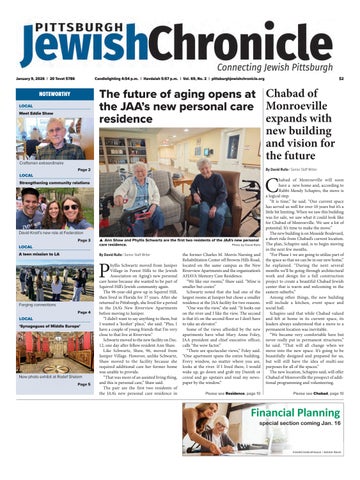
p Ann Shaw and Phyllis Schwartz are the first two residents of the JAA’s new personal care residence. Photo by David Rullo By David Rullo | Senior Staff Writer
P
Forging connections Page 4
LOCAL ‘Synagogues of Middle Europe’
New photo exhibit at Rodef Shalom Page 5
hyllis Schwartz moved from Juniper Village in Forest Hills to the Jewish Association on Aging’s new personal care home because she wanted to be part of Squirrel Hill’s Jewish community again. The 96-year-old grew up in Squirrel Hill, then lived in Florida for 37 years. After she returned to Pittsburgh, she lived for a period in the JAA’s New Riverview Apartments before moving to Juniper. “I didn’t want to say anything to them, but I wanted a ‘kosher’ place,” she said. “Plus, I have a couple of young friends that I’m very close to that live at Riverview.” Schwartz moved to the new facility on Dec. 12, one day after fellow resident Ann Shaw. Like Schwartz, Shaw, 96, moved from Juniper Village. However, unlike Schwartz, Shaw moved to the facility because she required additional care her former home was unable to provide. “That was more of an assisted living thing, and this is personal care,” Shaw said. The pair are the first two residents of the JAA’s new personal care residence in
Financial Planning
special section coming Jan. 16
InsideCreativeHouse / Adobe Stock
Headlines Getting to know: Eddie Shaw — LOCAL— By Adam Reinherz | Senior Staff Writer
A
pprenticed to a saddlemaker and a shoemaker in Paraguay 55 years ago, Eddie Shaw acquired a particular set of skills. That expertise, which includes sharpening knives, cutting leather and sewing with two needles still serves the Squirrel Hill resident well. Shaw, 77, recently returned from New York City where he was one of 50 vendors invited to participate in Tablet Magazine’s Hanukkah Bazaar. Billed as an “unapologetically fabulous mix of Judaica tastemakers,” the gathering afforded Shaw an opportunity to showcase various custom goods. Operating under the name Saba Eddie, Shaw sold leather aprons, small shoulder bags, wallets and laptop cases to holiday shoppers. Shaw’s works, which are intended to last decades, represent a commitment to handcrafted products and an ideology, he explained, running contrary to modern notions of disposability. Speaking to the Chronicle inside a Squirrel Hill coffee shop, Shaw pointed to several bags — some designed to schlep groceries, some for transporting small handheld objects — and said the carrying cases are directly linked to cattle raised in the United States and Argentina. His belt, phone holder, an envelope for documents or a tablet, are also all made of leather and meant to outlast “plastic” alternatives. Like many artisans, Shaw is proud of his work. Using a 5-pound fork, Shaw initially punctures the leather before using a 2-inch steel needle to sew. With the needle in hand, Shaw demonstrated the leather’s toughness and exhibited proper stitches. He spoke about the process of choosing and preparing materials, and how he used to travel to southeastern Ohio, but now frequents Greensburg for skins: “I’m much more selective about the hides I get.” Holding a shoulder bag, Shaw said, “This hide over here is from a water buffalo
p Eddie Shaw sits in a Squirrel Hill coffee shop.
Photo by Adam Reinherz
from Pakistan.” The pebbled quality makes it difficult to sew, but people appreciate flaws, he continued. Machine-made items are virtually impeccable. Handmade goods are desirable because they’re from human beings and have “imperfections.” Shaw’s person-centered approach carries through to his other pursuits. For years, he’s sharpened knives for individuals and local kitchens. Relying on skills he acquired in Paraguay, Shaw employs special stones to “make an edge,” he said. “That’s what the term is, making an edge on knives.” There’s a common misunderstanding, he said. Though some people are afraid of pointed blades, dullness is dangerous: “A sharp knife is a safe knife because the pressure will go where you intend it to. With a dull knife, you’re not particularly sure where the blade is going to end up.” Imagine cutting a tomato or onion. “You want to cut a slice of it, and you think you know where that blade is going to be. Your fingers might be a little bit too close to that area and all of a sudden the blade is going in a direction you didn’t intend it to,” he said. “People are surprised at how much easier it is, and how much more satisfying it is, to work in the kitchen with a sharp knife.”
p Eddie Shaw holds a wallet he made from leather.
Photo by Adam Reinherz
When Shaw joined the Peace Corps more than 50 years ago and traveled to Paraguay, he didn’t anticipate learning how to work with leather or sharpen knives. Instead, he was simply seeking adventure, he said. “I just had stars in my eyes about doing something exotic and different.” The skills he acquired in Paraguay have origins dating back millennia. Shaw’s continuance of those practices renders him less a luddite or stodgy historian detached from present-day norms than someone fervently striving for endurance. For years, he’s studied languages at the University of Pittsburgh and has become “bilingual in Spanish and intermediate level in Italian.” He volunteers with the Squirrel Hill Urban Coalition, has delivered tree request forms throughout the neighborhood and has planted about 100 street trees. He’s devoted to his family— two of his three children and multiple grandchildren live in Squirrel Hill — and regularly attends Congregation Shaare Torah. The decision to adopt an Orthodox Jewish lifestyle came after he and his wife, Wendy Levin-Shaw, moved to Pittsburgh in 1979, he said. The two had just returned from a sevenmonth stay at Kvutzat Yavne, a religious
cooperative kibbutz located near Ashdod, Israel. “I was in charge of the largest incubator in the Middle East,” he said. “They had a capacity of about 300,000 eggs every three weeks, and they were increasing it at that point.” Shaw’s responsibility for “hundreds of birds” required administering shots, cleaning manure and entering cages. “I was fine with it,” he said. “I’m really good with animals.” Though the kibbutz asked Shaw to stay, he eventually left and moved to Pittsburgh. Before life on the kibbutz, he felt no “particular attachment” to observance, but after settling in Squirrel Hill, he and his wife made a deliberate choice about their religious path. The route has yielded a life of meaning and a continuance of time-honored exercises. Before exiting the coffee shop to visit his grandchildren, Shaw asked this reporter to stop by Shaare Torah and inspect the first thing he made from leather after returning from Paraguay. “My tallis bag is 45 years old. You should see it,” he said. “It’s cool.” PJC Adam Reinherz can be reached at areinherz@pittsburghjewishchronicle.org.
5915 Beacon St., 5th Floor Pittsburgh, PA 15217
Main phone number: 412-687-1000
Subscriptions: 412-687-1000, ext. 2 SUBSCRIPTIONS subscriptions@pittsburghjewishchronicle.org 412-687-1000, ext. 2 TO ADVERTISE advertising@pittsburghjewishchronicle.org 412-687-1000, ext. 1 EDITORIAL DEPARTMENT Email: newsdesk@pittsburghjewishchronicle.org BOARD OF TRUSTEES Evan H. Stein, Chair Evan Indianer, Vice Chair Derek Smith, Treasurer Gayle R. Kraut, Secretary Gail Childs, Dan Droz, Malke Steinfeld Frank, Karen Gal-Or, Seth Glick, Judith Kanal, Cátia Kossovsky, Charles Saul, Lynn Zelenski GENERAL COUNSEL Stuart R. Kaplan, Esq.
2
JANUARY 9, 2026
Jim Busis, CEO and Publisher 412-228-4690 jbusis@pittsburghjewishchronicle.org EDITORIAL Toby Tabachnick, Editor 412-228-4577 ttabachnick@pittsburghjewishchronicle.org Adam Reinherz, Senior Staff Writer 412-687-1000 areinherz@pittsburghjewishchronicle.org David Rullo, Senior Staff Writer 412-687-1000 drullo@pittsburghjewishchronicle.org ADVERTISING Amy Weiss, Account Executive (412) 613-0697 aweiss@pittsburghjewishchronicle.org
PRODUCTION Jeni Mann Tough Production Manager Carl Weigel Art/Production Coordinator Subscriptions subscriptions@pittsburghjewishchronicle.org 412-687-1000, ext. 2 Published every Friday by the Pittsburgh Jewish Publication and Education Foundation 5915 Beacon St., 5th Floor Pittsburgh, PA 15217 Phone: 412-687-1000 POSTMASTER: Send address change to PITTSBURGH JEWISH CHRONICLE, 5915 BEACON ST., 5TH FLOOR PITTSBURGH, PA 15217 (PERIODICAL RATE POSTAGE PAID AT PITTSBURGH, PA AND AT ADDITIONAL MAILING OFFICES) USPS 582-740
PITTSBURGH JEWISH CHRONICLE
Manuscripts, letters, documents and photographs sent to the Pittsburgh Jewish Chronicle become the property of this publication, which is not responsible for the return or loss of such items. The Pittsburgh Jewish Chronicle does not endorse the goods or services advertised or covered in its pages and makes no representation to the kashrut of food products and services in said advertising or articles. The publisher is not liable for damages if, for any reason whatsoever, he fails to publish an advertisement or for any error in an advertisement. Acceptance of advertisers and of ad copy is subject to the publisher’s approval. The Pittsburgh Jewish Chronicle is not responsible if ads violate applicable laws and the advertiser will indemnify, hold harmless and defend the Pittsburgh Jewish Chronicle from all claims made by governmental agencies and consumers for any reason based on ads appearing in the Pittsburgh Jewish Chronicle.
PITTSBURGHJEWISHCHRONICLE.ORG
Headlines David Knoll to lead Federation’s Community Relations Council — LOCAL — By Adam Reinherz | Senior Staff Writer
S
quirrel Hill resident David Knoll was recently named associate vice president of public affairs at the Jewish Federation of Greater Pittsburgh. The role, which begins Jan. 26, places Knoll at the helm of the Community Relations Council and enables the self-described “son of immigrants” to focus on his two loves: community and politics. He succeeds Laura Cherner, who left Pittsburgh’s Federation last month to join the JCRC Bay Area. Along with serving as a member of Federation’s leadership team, Knoll, 47, will work with local, state and federal partners to “strengthen and safeguard our community,” he said. “We need to create meaningful partnerships with the broader Jewish community that benefit not only the Jewish community, but the broader Pittsburgh community as well.” Though his title is new, the task is familiar. Knoll recently served as board chair of the CRC and as a board member of the Federation, Jewish Community Center of Greater Pittsburgh, Congregation Shaare Torah, Beth Hamedrash Hagodol and Hillel Academy of Pittsburgh. Other volunteering includes establishing a Jewish-Hindu interfaith dialogue cohort and serving on the Squirrel Hill Urban Coalition’s tree committee. A familiar face to many Pittsburghers, Knoll’s recognition grew post-Oct. 7, 2023. Following Hamas’ attack on Israel, Knoll called out politicians and activists whose actions he said could endanger Pittsburghers. Running as a write-in candidate, he mounted a campaign to unseat Allegheny County Council member Bethany Hallam after she reposted a poem on X about breaking down walls alongside a video of terrorists heading toward Israel. Those terrorists murdered and raped Israeli civilians and abducted about 251 hostages. Announcing his candidacy shortly after Oct. 7, Knoll said, “Jews in Allegheny
p David Knoll, right, joins Adam Schiff, then a U.S. representative
County and worldwide understood immediately that responses like Hallam’s would make them unsafe wherever they lived, no matter their relationship to Israel, simply because they are Jewish.” After failing to oust Hallam, Knoll remained politically active, regularly speaking with local officeholders and others connected to city, state and federal government. Partnering with figures who often hold alternative views offered insight, he said. “There are some politicians that don’t have good intentions for our community, but as a whole, there’s a lot of misunderstanding.” Sitting together, speaking and listening yield “different paths of understanding,” he continued. Those practices are necessary to “create partnerships and friendships.” Knoll, who completed a marathon last year, chuckled when asked if he’s considering another run. “I’m asked on a weekly basis what I’m running for,” he said. “Could politics be in the future? Of course, but there are no
aspirations right now. I’m happy and I’m privileged to be doing what I’m doing.” That role, he continued, offers an opportunity to better residential life in an area he holds dear. Growing up in West Hempstead, Long
Photo courtesy of David Knoll
Island, to parents “who both came to the United States at an early age,” Knoll learned the importance of democracy and civic values. His father fled Germany shortly after Please see Knoll, page 11
Laurie Roba, MD • Joshua Paul, MD • Cataract Surgery • Glaucoma Care & Treatment • Diabetic Eye Exams • Macular Degeneration • Dry Eye Diseases Compassionate and Modern Eye Care
– Appointments available via call or text –
p David Knoll, left, joins Laura Cherner and City Controller Rachael Heisler at the Pittsburgh Pride Parade. Photo courtesy of David Knoll
PITTSBURGHJEWISHCHRONICLE.ORG
Call: 412-963-0414 Text: 412-704-9593 www.cvcofpgh.com
PITTSBURGH JEWISH CHRONICLE
1326 Freeport Road Suite 200 Pittsburgh, PA 15238 JANUARY 9, 2026
3
Headlines Local teens find community and purpose on social justice trip to LA — LOCAL — By Adam Reinherz | Senior Staff Writer
A
subsidized trip to Los Angeles granted Pittsburgh teens an opportunity to discuss Jewish values while creating new friendships. The Jewish Federation of Greater Pittsburgh organized the Dec. 28–31 trip in partnership with Tzedek America and The Fine Foundation, according to Federation representatives. Carolyn Linder, Federation’s associate director of Jewish Life and Learning, said the program “fills a gap in our community.” By bringing together 17 local Jewish high school students from the city and suburbs and enabling them to learn together, “they are not only deepening their understanding of social justice and Jewish values, but also widening their social networks and strengthening the bonds that tie our broader Jewish community together,” she said. For North Hills High School student Coleman Kline, participating in the mission marked a return to his religious and cultural roots. “I took a long break on going to my temple,” he said. “I recently thought it was a good idea to get back into Judaism.” Months ago, Kline, 16, started attending the She’elot Fellowship, a 12-week program, run by the Jewish Community Center of Greater Pittsburgh, encouraging high school students to investigate questions about life, community and Jewish identity. Kline said his mother noticed how much he enjoyed the program and asked if he wanted to go to Los Angeles with the Federation. The teen agreed. “I thought it would be cool to see how their Jewish community is different from the Jewish community in Pittsburgh,” he said. Upper Saint Clair High School student Makis Sobel-Drum said his interest in the mission grew from the opportunity to meet new people and explore a new city: “It looked like a lot of fun.” Now back in Pittsburgh, the teens said the multi-day excursion met their expectations. During discussions at site visits the participants bonded over topics including welcoming the stranger, t’shuvah (repentance) and personal responsibility. Both teens cited a stop at Beit T’Shuvah as being especially informative. The Los Angeles-based residential treatment center integrates Jewish spirituality, psychotherapy and the 12-step program to help individuals recover from addiction. One of the speakers there had this “horrific story” about growing up in a “great home” and things coming apart during eighth grade, Kline said. A conversation with a “former gang
p Jewish teens and chaperones gather in Los Angeles.
member who was struggling with a meth addiction,” was also impactful, Sobel-Drum said. “Drugs can lead to a very dark place.” Megan Amster, a Fox Chapel resident and Federation staffer who helped chaperone the trip, said the mission exposed teens to “relevant and real life social justice issues that they might not always have the ability to see at home.” “Social justice‑themed travel has the power to create a profound and lasting impact on our teens,” Linder said. “When they immerse themselves in the lived realities of marginalized communities, they gain a deeper understanding of the social, economic and cultural challenges people
face every day.” Kline said touring Los Angeles and discussing topics like homelessness and immigration offered experiences few Pittsburgh teens have and helped him view life in western Pennsylvania differently. “There are not a lot of Jewish kids at my school in the North Hills,” he said. “I’ve always felt different from other kids.” Having the chance to spend time talking with fellow Jewish teens, he continued, “I felt more normalized. I feel like there’s more people like me than I originally thought.” Researchers have long acknowledged the role of non-classroom experiences within adolescent development.
p Teens bond while discussing Jewish topics in California.
Photo courtesy of Jewish Federation of Greater Pittsburgh
Photo courtesy of Jewish Federation of Greater Pittsburgh
A 2022 study from Brigham Young University, Johns Hopkins University and the Heritage Foundation found that students who undertook multiple field trips during the school year achieved higher test scores, demonstrated fewer behavioral infractions and expressed “greater tolerance for people with different opinions and an increased desire to consume arts.” Although the trip was a one-off experience, Linder believes the mission’s purpose “goes far beyond tourism,” she said. “It fosters radical empathy and a true sense of global citizenship.” The value of going away, meeting Jewish peers and having challenging conversations is fairly easy to understand, according to the teens. “People’s worldview can be very closeminded,” Kline said. “It’s good to expand your worldview.” This trip made clear that “struggling people are normal people — they’re just in really bad circumstances,” Sobel-Drum said. While the trip led to new encounters and friendships, participation in the mission isn’t needed to apply its lesson, Kline said. “Nowadays there are a lot of screens, and a lot of people sit inside and don’t go out. Going out and socializing with the world — even on your own — can make a small difference,” he said. Whether it’s joining a group, contributing to a cause or “helping someone reach something high up on the grocery store shelf, even small steps make a larger difference.” PJC Adam Reinherz can be reached at areinherz@pittsburghjewishchronicle.org.
www.pittsburghjewishchronicle.org 4
JANUARY 9, 2026
PITTSBURGH JEWISH CHRONICLE
PITTSBURGHJEWISHCHRONICLE.ORG
Headlines David Aschkenas captures Jewish history in photo exhibit at Rodef Shalom — LOCAL — By Emma Riva | Special to the Chronicle
D
avid Aschkenas may be one of the few people in the world to photograph both the Butler County Fair and a synagogue from the year 1270. Aschkenas — whose exhibition “Synagogues of Middle Europe” opens Jan. 12 at Rodef Shalom Congregation’s Jewish Museum lobby space — points his camera at what interests him, regardless of the breadth of the subject matter. His photography doesn’t tell viewers what to think or strive to make a grand statement. Rather, Aschkenas allows the objects and spaces to speak for themselves. Aschkenas began photographing synagogues years ago with a project at Rodef Shalom while working for Pittsburgh Quarterly. “They let me into every nook and cranny and were so welcoming,” Aschkenas remembered. In 2014, he photographed the Jerusalem Synagogue in Prague and was invited to exhibit his photographs there. He found the spaces enchanting and continued traveling each year to Europe to photograph synagogues. He compiled his work into a photobook and is now sharing those photos with the public. The synagogues in Hungary, Czechia, Spain, Italy and Poland are staggeringly beautiful, with ornate architectural features and a grandeur. Most of them are now designated as museums, but several still have congregants. Some are the stuff of legend, including the Old New Synagogue, famous for the Golem of Prague, which is rumored to live in its attic. “I walked into the Old New Synagogue at 9 a.m. and this guard told me they didn’t open until 10, so we were in there all alone. It was sort of eerie, thinking I’m in there with the golem,” Aschkenas said.
p Venice, Canton Synagogue
Though no golems appear in Aschkenas’ photos, there are plenty of ghosts of the past. One photograph shows a lock-box where Jews placed coins for taxes to the king during the medieval period. The images are a testament to the long arm of Jewish history and the richness of European Jewish life.
Photo by David Aschkenas
“It was quite funny, hearing a curator in Venice speak Italian, then perfect English, then call her relatives in Israel and speak Hebrew,” Aschkenas recalled. The images show how Jewish life is a negotiation between the present and the past, preserving ancient language and tradition in an everchanging world.
But the photographs have an unsentimental quality, and Aschkenas approached the spaces with technical craft in mind. “I wish I could say it was spiritually enlightening, but it was just visual,” Aschkenas said. “It was very special to get to go inside and touch things and walk around.” Small details caught his eye, like door hinges or intricate stonework. “There was no rhyme or reason to it, I just looked for anything that appealed to me,” he said. Sometimes that was the view from the bimah, sometimes it was a piece of wood paneling on the floor. Some of the photographs resemble paintings because of how weathered the stone and wood are, rendering an almost pastel effect. Aschkenas has a particular talent for photographing light through stained glass windows, capturing it at just the right moment when color spreads across the room. Though Aschkenas’ images of county fairs and city streets might seem worlds away from medieval European synagogues, all his images show the craft of photography as an act of preservation. His work documents the passage of time. In one of his photobooks, Aschkenas displays photographs of Highland Park during every season of the year. (“I was trying to do a diet and get some exercise by walking in the park every day and it was so boring that I brought a camera with me,” he quipped.) His
Photo by David Aschkenas
Please see Photos, page 11
p Amsterdam, Portuguese Synagogue
PITTSBURGHJEWISHCHRONICLE.ORG
PITTSBURGH JEWISH CHRONICLE
JANUARY 9, 2026
5
Calendar Submit calendar items on the Chronicle’s website, pittsburghjewishchronicle.org. Submissions also will be included in print. Events will run in the print edition beginning one month prior to the date as space allows. The deadline for submissions is Friday, noon. q SUNDAYS, JAN. 11–FEB. 1 Jewish Art Camp: Fun Jewish learning through the arts for ages 0 to third grade. Mommy and Me (0 to 3-year-olds and their moms), Mini Makers (4 to 5-year-olds), Master Makers (grades 1-3). Ages 0 to 5: $40/semester; grades 1-3: $65/ semester. 10:30 a.m. 1700 Beechwood Blvd. chabadpgh.com/art q SUNDAYS, JAN. 11–JULY 26 Join Chabad of Squirrel Hill for its Men’s Tefillin Club. Services and tefillin are followed by a delicious breakfast and engaging discussions on current events. 8:30 a.m. 1700 Beechwood Blvd. chabadpgh.com Join a lay-led online Parashah study group to discuss the weekly Torah portion. No Hebrew knowledge needed. The goal is to build community while deepening understanding of the text. 8:30 p.m. For more information, visit bethshalompgh.org/online-parashah.
q MONDAY, JAN. 12 The Rodef Shalom Congregation Jewish Museum presents the opening reception for Synagogues of Middle Europe, a photographic exhibit by David Aschkenas. 6 p.m. Exhibit runs through March 27, 2026. Free. Reservations to reception requested. rodefshalom.org/middleeurope
q TUESDAY, JAN. 13 Holocaust Center of Pittsburgh ambassador Debbie Stueber tells the story of parents, both Holocaust survivors, as part of the Generation outreach program. 10 a.m. Free. Faith United Methodist Church, 261 West Chapel Ridge Road, Fox Chapel.
Make your own resin tzedakah box and enjoy light refreshments with Chabad of Squirrel Hill at Art and Soul. 7 p.m. $45. 1700 Beechwood Blvd. chabadpgh.com/resin
q TUESDAYS, JAN. 13–JUNE 30 Join Beth El’s Rabbi Alex Greenbaum and his Bible/Talmud Adult Education class for a thoughtprovoking weekly session of Bible and Talmudic study. This program is available both in person and virtually. Call the office at 412-561-1168 to receive the Zoom link or to make an in-person reservation. 10:30 a.m. 1900 Cochran Rd. bethelcong.org
q MONDAYS, JAN. 12–JULY 27 Join Congregation Beth Shalom for a weekly Talmud study. 9:15 a.m. For more information, visit bethshalompgh.org. Join Temple Sinai for an evening of mahjong every Monday (except holidays). Whether you are just starting out or have years of experience, you are sure to enjoy the camaraderie and good times as you make new friends or cherish moments with long-term pals. All are welcome. Winners will be awarded Giant Eagle gift cards. All players should have their own mahjong cards. Contact Susan Cohen at susan_k_cohen@yahoo.com if you have questions. $5. templesinaipgh.org
q WEDNESDAY, JAN. 21 Join Chabad of South Hills for its new JLI course,
T
Tuesday, January 20, 2026 · 7 pm ET | 6 pm CT
he Pittsburgh Jewish Chronicle invites you to join the Chronicle Book Club for its Jan. 18 discussion of “Unveiled,” by Jonathan Harounoff. The author will join us for the meeting. “‘Unveiled’ takes us inside the ‘Woman, Life, Freedom’ movement, sparked by the slaying of a young woman for wearing a loose hijab, in what became the most serious challenge the [Iranian] regime has faced in forty-six years. Harounoff has given us a nonfiction drama replete with heroines and villains, one that is sure to captivate readers.” –Peter Kann, Pulitzer Prize-winning foreign correspondent and former publisher, The Wall Street Journal.
$10 Per Session · Register by January 18 · Online Only www.events.hadassah.org/MWPittsburghCWB
Your hosts
Avi Ben-Hur Classrooms Without Borders
Join us for a virtual presentation by Classrooms Without Borders Scholar-In-Residence Avi Ben-Hur for the first in a series of discussions: The Rise of Contemporary Antisemitism: How Did We Get to This Moment? At this session, he will shed light on how we reached this point and discuss where things might be going. Save the Date! February 17 panel discussion: Antisemitism: What Can We Do? What Are We Doing? Questions?
847.205.1900
q THURSDAY, FEB. 5 Join Rabbi Amy Greenbaum and the Beth El community for the all-virtual Beth El’s Virtual Hope and Healing Program on the first Thursday of the month. This is a safe space to chant, breathe, pray for healing and seek peace. Feel free to keep your camera off and just listen. Call the office at 412-561-1168 to receive the Zoom link. 5:30 p.m. Free. bethelcong.org q SATURDAY, FEB. 7 Join Congregation Beth Shalom for Clues and Schmooze (with some booze), a fun trivia event, including an open bar and snacks. There will be a 50/50 raffle, so bring cash to participate. Trivia will be played with teams of three to six. Bring your own team or be matched up at the door. Must be 21 or older to participate. 7 p.m. $30. 5915 Beacon St. bethshalompgh.org/clues-and-schmooze2026 PJC
Join the Chronicle Book Club!
Hadassah Midwest
Pittsburgh, Hadassah, and Classrooms Without Borders: Discussions on Antisemitism
q WEDNESDAY, JAN. 14 Join Chabad of the South Hills for its monthly Seniors Luncheon, featuring tips on maintaining good posture as you age. Wheelchair accessible. For more information or to RSVP, call 412-278-2658. 1 p.m. Suggested donation, $5. 1701 McFarland Road. chabadsh.com
Captivating Cases in Rabbinic Responsa, a six-week course on the real-life questions Jews asked sages across history. 7:30 p.m. In person or online. 1700 Bower Hill Road. chabadsh.com
Email: Contact us at drullo@pittsburghjewishchronicle.org, and write “Chronicle Book Club” in the subject line. We will send you a Zoom link for the discussion meeting. PJC — Toby Tabachnick
Toby Tabachnick, Chronicle editor David Rullo, Chronicle senior staff writer
How it works
We will meet on Zoom on Sunday, Jan. 18, at 1 p.m.
What to do
Buy: “Unveiled.” It is available from online retailers, including Amazon and Barnes & Noble. It is also available through the Carnegie Library system.
midwest@hadassah.org
HADASSAH, THE WOMEN’S ZIONIST ORGANIZATION OF AMERICA, INC. ©2026 Hadassah, The Women's Zionist Organization of America, Inc. Hadassah®, the H logo, and Hadassah the Power of Women Who Do are registered trademarks of Hadassah, The Women's Zionist Organization of America, Inc.
6
JANUARY 9, 2026
www.pittsburghjewishchronicle.org
PITTSBURGH JEWISH CHRONICLE
PITTSBURGHJEWISHCHRONICLE.ORG
Headlines How Jewish politics are shaping the 2026 election map, from coast to coast — NATIONAL — By Andrew Lapin | JTA
A
fter a year in which Israel, antisemitism and political polarization scrambled long-standing alliances, the American Jewish political map is heading into 2026 unusually unsettled. From New York City Hall to swing-state governors’ mansions to some of the most crowded Democratic primaries in memory, the coming election cycle will test how much Jewish voters still cohere as a political bloc — and whether the issues that have dominated Jewish life since Oct. 7 will continue to shape the ballot box. The rise of outspoken pro-Palestinian candidates, fractures inside both parties over Israel, and the growing visibility of antisemitism on the left and the right have turned races that might once have seemed parochial into national bellwethers. As Democrats and Republicans jockey for control of Congress and key statehouses, Jewish candidates and Jewish issues are no longer confined to the margins. Instead, they are central — sometimes uncomfortably so — to debates about ideology, identity and power. These are the big political questions facing the American Jewish community in 2026.
The Mamdani era begins
After the most closely watched — and, in some Jewish corners, feared — mayoral race in generations, Zohran Mamdani was sworn in as New York City’s next chief executive on the first day of the year. For many Jews, both in and beyond New York, 2026 will be measured by how the democratic socialist mayor will wield his power and influence once in office — and by how many candidates in the midterms are able to follow in his footsteps when it comes to explicit pro-Palestinian activism. Ahead of his inauguration, Mamdani seemed to heed some of the Jewish alarms over his harsh criticism of Israel. During his transition he dismissed a staffer over her past antisemitic posts; met with the New York Board of Rabbis, which include some vocal critics of his; and, after the deadly attack on a Chanukah celebration in Australia, visited the grave of the Lubavitcher Rebbe. Tensions remain. The Anti-Defamation League has launched a controversial monitoring project focused on his administration. He also still pledges to arrest Benjamin Netanyahu should the Israeli prime minister visit New York, a threat that Netanyahu has shrugged off. Mamdani’s outreach efforts to Jews will continue to be closely scrutinized, as will Jewish leaders’ willingness to be in the same room with him — or to discourage, or encourage, further attacks on him.
Seismic shifts on the right
Republicans could have seized upon the rise of Mamdani as an effort to appeal to worried Jews ahead of the midterms as the PITTSBURGHJEWISHCHRONICLE.ORG
p Some of the political candidates likely to make waves among Jewish voters in 2026
Photos by: Lev Radin/Pacific Press/LightRocket; John Nacion/Deadline; Tom Williams/CQ-Roll Call, Inc.; Tom Williams/CQ-Roll Call, Inc.; Michael M. Santiago/Getty Images; Sophie Park/Getty Images; Noam Galai/Getty Images; John Lazenby/UCG/Universal Images Group; Bill Clark/CQ-Roll Call, Inc.; Micah for Assembly; Udo Salters Photography; Design by Jackie Hajdenberg
pro-Isael, anti-antisemitism party. Instead, the GOP now seems unsure what it thinks about Jews at all. While President Donald Trump says he remains resolutely pro-Israel, and many establishment Jewish groups continue their eagerness to work with him, his second-incommand JD Vance has opened the door to a rising tide of anti-Israel and antiJewish sentiment on the party’s hypernationalist wing. At Turning Point USA’s annual convention, Vance declined to join the critics of conservative antisemitism, and instead encouraged the party to widen its tent. Meanwhile, conservative thought leaders such as the Heritage Foundation and Turning Point USA, which have wielded power to vet and promote GOP candidates, have opened doors to outright conspiratorial talking points about Jewish and Israeli power, via figures such as open antisemite Nick Fuentes and podcaster Tucker Carlson, who has offered him a friendly platform. Already some Republican candidates, driven by “America First” ideology and their disdain for U.S. aid to Israel, are taking explicitly anti-Israel platforms. Florida gubernatorial hopeful James Fishback, for example, has pledged to refuse donations from AIPAC, the pro-Israel lobby, and praised Heritage for its defense of the Carlson-Fuentes interview. “Why is it that when we’re critical of Israel, it feels like a fourth branch comes out to almost criminalize our speech?” the Gen Z hedge fund manager has said. And in the Ohio gubernatorial race, the biotech entrepreneur Vivek Ramaswamy — who as a 2024 presidential candidate was one of the first major figures of his party to suggest cutting aid to Israel — appears to be the likely GOP nominee. He will likely face a Jewish Democratic candidate, former state health official Dr. Amy Acton.
A test for Josh Shapiro
A Jewish governor with a national profile, Josh Shapiro is seeking reelection in November. Stacy Garrity, his GOP opponent, is the only person to earn more votes in Pennsylvania history than Shapiro when she was elected state treasurer in 2024. A popular moderate with a reputation as a humanitarian war hero, Garrity hopes to unite the state as Shapiro did, despite her record of boosting election denials. She’ll remind Jewish voters that she boosted the state’s Israel bond investments. An upset — seen by insiders as unlikely but not impossible — could put a screeching halt to talk of Shapiro becoming the first Jewish president.
The Upper West Side story
Few Democratic primaries this year promise to be more circus-like than the race for the Manhattan district being vacated by longtime Jewish Rep. Jerry Nadler, a progressive on domestic issues who could read the haftarah at synagogue one day and offer what he considered loving criticism of Israel the next. Nine candidates have so far thrown their hats in, including three big Jewish names with very different takes on Jewish issues. The favorite is New York State Assembly member Micah Lasher — a close confidant of Nadler. But Lasher’s path to the nomination is far from guaranteed, especially if progressives want to send a message to a Democratic establishment that they are unhappy for a range of reasons — including Israel. Enter Cameron Kasky, a survivor of the Parkland High School shooting and Jewish Gen Z political activist. The 25-year-old, courting pro-Palestinian voters, has already made fighting “support for genocide” a central plank of his campaign (he recently returned from a pro-Palestinian solidarity mission to the West Bank). And Kasky isn’t alone among Jewish candidates popular with the online left: Jack Schlossberg, 32, a Kennedy scion with millions of social media
PITTSBURGH JEWISH CHRONICLE
followers, is running on what he describes as the “cost-of-living crisis” and erosion of democratic norms under Republican leadership.
Threading the needle on Israel
As support for Israel erodes in the Democratic party and in portions of the right, a number of Jewish candidates insist that there is room for progressive Jewish voices who can be critical of Israeli policy. A number of declared Jewish candidates this year are looking to represent this vanguard. In many cases they’re vying to replace long-serving Jews and/or stalwart Democratic leaders. Kasky exemplifies the trend. But progressive Brad Lander, the Jewish New York City comptroller and Mamdani ally, may have a clearer path to Congress: He is challenging Jewish Rep. Dan Goldman, a more typically pro-Israel lawmaker, for his House seat, and early polling has given him an advantage. Scott Wiener, a state senator in California, is running for the seat being vacated by retiring Democratic figurehead Nancy Pelosi. Wiener holds conventionally left-of-center views on housing reform, civil rights, LGBTQ+ issues, climate and tech regulation and has pushed for antisemitism prevention in schools. He has also publicly condemned actions by the Netanyahu government. And Daniel Biss, the progressive Jewish Israeli mayor of Evanston, Illinois, is running in the Chicago-area congressional district previously held by retiring Jewish Rep. Jan Schakowski. Like many pro-Israel centrists, he’s an advocate of the two-state solution, but has veered to their left by calling for an early ceasefire in Gaza and for pausing offensive U.S. weapons sales to the Israeli government amid the humanitarian crisis in Gaza. He is facing, amid a slew of challengers, Please see Politics, page 11
JANUARY 9, 2026
7
Headlines After Maduro ouster, Venezuela’s embattled Jews watch cautiously from sidelines — WORLD — By Zev Stub | The Times of Israel
V
enezuela’s small Jewish community is largely taking a wait-and-see approach following the ouster of socialist President Nicolas Maduro in a U.S. military raid early Saturday. Jews in the country’s capital city of Caracas and Venezuelan Jews living outside the country expressed cautious optimism about the prospects of regime change, but remain fearful of retaliation after decades of repression, with Venezuela’s leadership still partially intact and its future largely in limbo. “Everyone is very happy about the news, but they have to be very cautious,” said Daniel Behar, a Venezuelan expatriate who decamped for Israel 20 years ago as the authoritarian regime consolidated power under Maduro’s predecessor, Hugo Chávez. “There is fear that the entire community might face repercussions later on.” Maduro, who allied with Iran and embraced anti-Zionist rhetoric, was captured by U.S. forces in a stunning raid on Caracas and surrounding areas in the pre-dawn hours of Saturday. The deposed leader and his wife were whisked to New York to face federal narcotrafficking charges. As news of Maduro’s capture rippled out, exiled Venezuelans waved flags and celebrated in plazas from Madrid to Santiago. About 8 million Venezuelans have fled the grinding poverty and political suppression of their homeland, including most of the Jewish community, which once counted in the tens of thousands. In Caracas, though, streets were calm in the wake of the stunning raid, and Venezuela’s military said it recognized Delcy Rodriguez — previously Maduro’s vice president — as acting president, urging people to resume normal life. The Trump administration says it is willing to work with the remainder of Maduro’s government as long as Washington’s goals, particularly opening access to U.S. investment in Venezuela’s enormous crude oil reserves, are met. A history of violence and threats by government officials to expropriate Jewish schools, restaurants and other institutions has made community members fearful of rejoicing too soon, according to Behar. “The community’s chief rabbi has warned many times not to publicly oppose the government,” he said. “There was always
p Sinagoga Tiféret Israel in Caracas, Venezuela
Photo by Guillermo Ramos Flamerich/Wikimedia Commons
a fear that if something happens, people will blame Israel and the Jews.” The country’s Jewish community was put on edge after Rodríguez charged that the U.S attack on Maduro had “a Zionist tint.” Gustavo Aristegui, a Spanish diplomat and analyst who has written extensively about Venezuela’s regime, referred to her as “one of the most dangerous members of the current regime.” “The Jewish population is on standby,” said Samy Yecutieli, a member of the Security Forum of the Israel-Latin America Chamber of Commerce. “Everyone is staying low-profile. The regime controls everything, and repression could still be very aggressive.” Yet there is also cautious optimism, Yecutieli said. Opposition leader María Corina Machado, a Nobel Peace Prize recipient, is a potential future leader for the country who has expressed support for restoring ties with Israel. “That would be very good for Israel and for the local Jewish community,” Yecutieli said. For Donna Benzaquen, a 17-year-old from Caracas studying at Ohr Torah Stone’s Midreshet Lindenbaum in Jerusalem, the coming months will be critical as she watches events in her home country unfold. “I love Venezuela, but I can’t imagine making my future there,” she said. “I just hope things get better for my family and everyone there.”
Shifting tides
Venezuela’s Jewish history dates back at least 200 years, around the time the country achieved independence from Spain in 1821.
While it is believed that Conversos — Jews forcibly converted to Christianity — may have arrived centuries earlier, the first record of Jewish communities is found in coastal cities such as Coro and Caracas, where an influx of Sephardic Jews engaged in trade and commerce during the country’s early days. Later waves of immigration in the 20th century swelled the community’s ranks, and the country reached 25,000 to 45,000 Jews in the years before Chávez came to power in 1999, according to various estimates. In the years that followed, Venezuelans fled the country in droves as the government openly punished political opponents and nationalized the economy, vaporizing wealth and leading to rampant poverty, a trend that escalated after Maduro replaced Chávez in 2013. As much as 25% of the country’s total population is believed to have left in the last two decades, and the Jewish community dwindled to just 4,000 to 6,000, according to the latest estimates. Under both leaders, the country also allied openly with Iran and became a safe haven for the Lebanese Hezbollah terror group, both of which use its vast drug smuggling and money laundering networks to support their terror activities. It also adopted a stridently anti-Zionist and pro-Palestinian stance. “This used to be the richest country in South America, and one of the wealthiest in the world,” said Arie Kacowicz, the Chaim Weizmann Chair in International Relations and professor of International Relations at the
Hebrew University of Jerusalem. “The Jewish community was quite wealthy and generally pro-Israel, but 10 years after Chávez came to power, he broke off diplomatic relations with Israel in 2009. Since then, reports of antisemitism have been sporadic.” Most of the antisemitism that exists in Venezuela today tends to be directed by the political echelon and tied to the Israeli– Palestinian conflict, with state media using anti-Zionist rhetoric that blurs into classic antisemitic tropes. “The revolutionary left-wing government has an intrinsic distrust and hatred for the Jewish community, but they aren’t persecuted for being Jewish,” said Aristegui. “They are persecuted mainly for being against the regime and its relationships with Iran and Hezbollah.” Behar agreed. “Antisemitism in Venezuela is not the same as in Europe,” he said. “It’s mostly tied to the Palestinian issue, and it is encouraged by the dictatorship. The people on the streets have bigger problems to worry about.”
Suppressive violence
With political repression in the country rampant, Jews are largely unable to speak freely against the government’s anti-Israel stances or policies that have sapped the community of its resources. “You have to remember that we are talking about one of the most violent countries in the world,” said Aristegui. “The regime has used a constant threat of violence to repress its people.” While violent crimes in the country have declined substantially since peaking in the middle of the last decade, the country’s homicide rate is still among the highest in the world. Aristegui said the government takes advantage of that fact to silence its opponents. “Often, what looks like a mugging in the street, or a home robbery that leads to a whole family being killed, is really a political assassination,” he alleged. “The Jewish community is particularly vulnerable to these attacks, and that’s why you only see them speak out against the regime after they have left the country.” According to Aristegui, Venezuela also openly hosts terrorist training camps for Hezbollah and runs a massive network dealing in the illegal stimulant Captagon. “Venezuela is Tehran’s most important ally in Latin America,” Aristegui said. “Its 27-year relationship with Hezbollah and Iran has been very profitable.” “Hopefully this will all end with the fall of the regime,” he added. PJC
STEPHANIE DAVIS
LICENSED LIFE & HEALTH INSURANCE SPECIALIST
412.260.4149 (phone or text) sdvoice18@gmail.com Serving PA and FL Please contact Medicare.gov, 1-800-MEDICARE, or your local state health insurance program (SHIP) to get information on all of your options.
MEDICARE INDIVIDUAL PHONE NUMBER: 412-790-2881 8
JANUARY 9, 2026
PITTSBURGH JEWISH CHRONICLE
PITTSBURGHJEWISHCHRONICLE.ORG
Headlines — WORLD — Mamdani axes all Adams’ executive orders in past 15 months, including those defending Jews
On his first day in office, New York City Mayor Zohran Mamdani revoked all the executive orders that his predecessor, Eric Adams, had issued since Sept. 26, 2024, including several designed to protect Jews, in order, he said, to have a “fresh start for the incoming administration,” JNS reported. In the waning hours of his mayorship, Adams and the Mayor’s Office to Combat Antisemitism released an annual report on combating Jew-hatred. Adams created that office on Jew-hatred on May 13 via executive order No. 51. Mamdani told a reporter that he intended to keep the office. In the Dec. 30 report on Jew-hatred, Adams and the mayor’s office noted other executive orders that he issued — which Mamdani now appears to have axed. On June 8, Adams adopted the International Holocaust Remembrance Alliance’s working definition of Jew-hatred via executive order No. 52. On Dec. 2, Adams signed executive order No. 60, which barred city entities and personnel from boycotting or divesting from Israel, and No. 61, which directs the New York City Police Department to look into creating zones around houses of worship in which protesting would be prohibited. William Daroff, CEO of the Conference of Presidents of Major American Jewish Organizations, said Mamdani’s “decision
to revoke New York City’s adoption of the IHRA working definition of antisemitism, along with related executive orders aimed at confronting antisemitic discrimination, is a troubling indicator of the direction in which he is leading the city, just one day at the helm.”
New Chabad center deploys at site of Bondi terror attack, dispensing acts of kindness
A new Chabad center has been set up on Sydney’s Bondi Beach at the site of last month’s Chanukah terror attack, from which the Hasidic group specializing in Jewish outreach seeks to share acts of kindness with passersby, The Times of Israel reported. The center is being called “Ohel Eli and Yaakov” in memory of Rabbi Eli Schlanger and Rabbi Yaakov Levitan, two Chabad emissaries killed in the Dec. 14 attack in which 15 people were murdered and dozens injured. “It’s not really a full Chabad house,” said Rabbi Noach Koncepolski, the project’s founder. “It’s more like an expanded kiosk where we hand out food and help Jews put on tefillin [phylacteries]. The idea is to have a point of connection to share some kindness, to have a moment of sweetness, with anyone passing by.” “We’re calling it a ‘mitzvah house,’” he added, using the Hebrew word for good deeds. The morning after the attack, Koncepolski and some friends headed over to the Bondi Pavilion site and started offering to help people put on the phylacteries used in Jewish prayers. “It just blew up immediately,” Koncepolski recalled, saying his group put tefillin on
Today in Israeli History — ISRAEL — Items are provided by the Center for Israel Education (israeled.org), where you can find more details.
Jan. 9, 1952 — Israel accepts German reparations
The Knesset ends three days of debate by voting 61-50 to accept more than $800 million in Holocaust reparations over 14 years from the West German government. The decision sparks rioting but proves economically crucial.
Jan. 10, 1996 — King Hussein arrives in Israel Jord an’s King Hussein makes his first public visit to Israel after signing a peace treaty in 1994. He co-pilots a helicopter to Sde Dov, then visits two Jordanian soldiers being treated at Tel Aviv’s Ichilov Hospital.
p Jordan’s King Hussein visits a Jordanian soldier being treated at Tel Aviv’s Ichilov Hospital on Jan. 10, 1996.
By Moshe Milner, Israeli Government Press Office, CC BY-SA 3.0
Jan. 11, 1961 — Immigrant ship Egoz sinks near Morocco
The Egoz, a ship leased by the Mossad to secretly transport Moroccan Jews to Israel, sinks a few hours after leaving Al Hoceima on its 12th immigration trip. Forty-four would-be Israelis, half of them children, drown. PITTSBURGHJEWISHCHRONICLE.ORG
Jan. 12, 1981 — Bedouin Knesset member is assassinated
Hamad Abu-Rabia, the Knesset’s first Bedouin member, is shot dead by the sons of a Druze political rival outside the hotel where he stays during parliamentary meetings. It is the first assassination of a Knesset member.
Jan. 13, 1898 — Zola accuses French of antisemitism
L’Aurore publishes a 4,500-word front-page letter from acclaimed writer Emile Zola under the headline “J’Accuse” (“I Accuse”), charging the French government with antisemitism against Capt. Alfred Dreyfus.
Jan. 14, 1925 — Rabbi Carlebach is born Rabbi Shlomo Carlebach, an influential composer posthumously accused of abuse, is born in Berlin. He founds the House of Love and Prayer in San Francisco in the 1960s and starts a moshav in Israel in 1977.
p Rabbi Shlomo Carlebach helped transform modern Jewish liturgical music.
By 0503508090t, own work, CC BY-SA 4.0, via Wikimedia Commons
Jan. 15, 2014 — Israel joins CERN as full member
A flag-raising ceremony at the Geneva headquarters of the European Organization for Nuclear Research marks Israel’s status as the 21st full member of the physics organization known as CERN. PJC
1,500 people a day that week. “After that, we started handing out Shabbat candles and handing out food. During Chanukah, we gave out thousands of doughnuts to Jews and non-Jews alike.” Now, he added, the team still puts tefillin on “hundreds” of people each day, and hands out pastries and candies to passersby.
‘RAT JEW’ graffiti painted on Ireland road; police treating incident as a hate crime
A road in Ireland was defaced with antisemitic graffiti last week, including the words “RAT,” “JEW,” and “USA,” along with swastikas and Stars of David, according to The Times of Israel. The vandalism, on a rural road outside the small town of Ardee in Leinster province, spanned almost a hundred meters (just over 100 yards), according to a local official. The Louth County Council confirmed it was working to have the graffiti removed, according to The Irish Independent. Ireland’s national police force said the incident is being investigated as a hate crime, according to The Irish Times. Amid the global surge in antisemitic hate crimes since the Hamas terror group’s Oct. 7, 2023, attack on Israel, Ireland has been one of the Jewish state’s fiercest detractors in the West, and statements by political and cultural figures have frequently been accused of crossing the line into antisemitism. Israel shut its embassy in Dublin, explicitly accusing the Irish government of fostering and inciting antisemitism.
Landmark AI breast-cancer screening to be launched in Israel this year
A state-of-the-art AI system capable of detecting a patient’s risk of developing breast cancer is expected to be launched in Israel in 2026 in a worldwide first, a Massachusetts Institute of Technology computer science professor said last week, according to JNS. The new technology and another for detecting lung cancer, which is simultaneously being tested in both Taiwan and Croatia, highlight the spread of artificial intelligence in the medical field, which experts say has the potential to revolutionize health care. “By the nature of its organized and techsavvy health care system, Israel has the potential to be at the forefront of the health care AI revolution,” MIT professor Regina Barzilay told JNS. “It will be a game-changer on many levels, and a very powerful tool to help early treatment.” Barzilay’s academic focus on AI and cancer detection began nearly a decade ago after she was diagnosed with breast cancer in her early 40s, with no family history of the disease, she recounted in the interview with JNS. She would go on to develop AI tools that determine the likelihood of developing the disease within five years based on a simple mammogram, offering women the chance at early diagnosis, an easier treatment and an increased survival rate. PJC — Compiled by Toby Tabachnick
1916 MURRAY AVE. PITTSBURGH, PA 15217
412-421-1015 412-421-4450 FAX 412-421-4451
PRICES EFFECTIVE SUNDAY, JANUARY 11 – FRIDAY, JANUARY 16, 2026 Candle Lighting Time Friday, January 9, 2026 • 4:54 p.m. MEAT
WINE SPECIALS
HOURS
CHICKEN WINGS
HAJDU ZINFANDEL WINE
Check Out Playoff Special on Facebook!
$
2
.09 .6
LB
BONELESS CHICKEN BREAST
7
$ .49 LB .6
$
39.99 750 ML
BARTENURA MALVASIA WINES
STORE HOURS
12.99
750 ML
Sunday • 8 a.m. – 6 p.m. Monday • 8 a.m. – 6 p.m. Tuesday • 8 a.m. – 6 p.m. Wednesday • 8 a.m. – 6 p.m. Thursday • 8 a.m. – 8 p.m. Friday • 8 a.m. – 3 p.m.
GROCERY
COOKED FOODS
DELI
UNGER'S FROZEN GEFILTE FISH $ .99
VEGETABLE BEEF SOUP $ .99
MARINATED EGGPLANT $ .49
NESCAFÉ COFFEE $ .99
CABBAGE & NOODLES $ .99
SHOR HABOR OVEN ROASTED EGGPLANT $ .99
MON CUISINE FROZEN VEGETARIAN DINNERS $ .19
VEGETABLE CHILI $ .99
EMPIRE GOURMET TURKEY BREAST $ .99
TA’AMTI BOUREKAS $ .99
CHICKEN CHOW MEIN $ .29
OIL CURED OLIVES $ .90
LONDON BROIL
$
15
.49
8
8
5
.6
LB
LOAF
10 GR
EA
7
5 LB HOMEMADE SALADS & SOUPS DELI PARTY TRAYS
PITTSBURGH JEWISH CHRONICLE
$
11 6
8
11
QT
LB
LB
LB
We Prepare Trays for All Occasions UNDER THE SUPERVISION OF VAAD OF PITTSBURGH
8
11
10
LB
LB
LB
6
LB CATERING SPECIALISTS DELICIOUS FRIED CHICKEN WE RESERVE THE RIGHT TO LIMIT QUANTITIES.
JANUARY 9, 2026
9
Headlines Residence: Continued from page 1
So far, five people have rented four apartments in the renovated building, according to Foley. “Between now and Feb. 2 we will have three additional residents for a total of eight in seven apartments,” she said. The facility can accommodate up to 58 people in 30 apartments. The residence includes two studio apartments, 18 one-bedroom units and 10 two-bedroom units. And while the apartments have only begun to be occupied, life at the residence has been anything but stagnant. The January calendar includes yoga and exercise events, guided meditations, a lecture on Pittsburgh’s history, virtual classes and lectures, group television viewing and even a virtual flower show by Phipps Conservatory and Botanical Gardens at the JAA’s Weinberg Terrace, located on Murray Avenue. The newly renovated building, kosher food options, campus-style living, robust activities and first-class amenities, like the full-service salon and grab-and-go food options, are what the JAA had in mind when it began conceptualizing the future of aging in Squirrel Hill. “The idea is an intentional desire to create community,” Lou Plung, the JAA’s immediate past board chair, told the Chronicle in August 2025. The JAA, he said, is creating “an urban campus village. We’re really excited about it.” Foley said the beauty of the concept is a “continuum of care” that enables couples to stay together. “Somebody may move in and their spouse may be in AHAVA. They can go down and eat meals with them,” she said. “We’re going
p The JAA’s new personal care residence has plenty of spaces for residents to build community and spend time together. Photo by David Rullo
“The idea is an intentional desire to create community.” –LOU PLUNG to be able to accommodate individuals where they are in life.” That includes creating opportunities for families to share in activities and events, Foley said, pointing to multipurpose community spaces and conference rooms that can double as spaces for birthday parties and other celebrations. “We had a New Year’s party,” she said. “Families came in.” Since the apartments are housed in a personal care facility, Foley said medical care and services are paramount. Administrative
and nursing staff are split between the two residential floors, meaning they are never far away. A Jewish ethos exists throughout the building. There are mezuzahs in the outer doorways of each unit; Rabbi Dovid Small, the JAA’s director of pastoral care, has an office in the building; and a sanctuary, complete with a Torah and ark, is available for Shabbat and holiday services, and includes a kosher kitchenette for onegs and kiddushes. Kosher food is available for those who observe kashrut, supervised by the Vaad
Chabad: Continued from page 1
“We have some great ideas we will be launching once we have the space to house those kinds of events,” he said. “We plan on expanding some of the programming for children and teens. We have a plan for more community offerings.” And not just for the Jewish community, Schapiro said, pointing to support from the broader Monroeville community and eastern suburbs, including the mayor, council and community members. “There’s a buzz about the new space,” he said. That buzz is evident among the people Chabad of Monroeville engages throughout the year, drawing hundreds of participants annually across Shabbat and High Holiday services, classes, social gatherings, youth programs and more. That growth is consistent across the Chabad community in Greater Pittsburgh, with Monroeville just the latest example of a Chabad-afilliated organization buying new property. In 2021 Yeshiva Schools of Pittsburgh bought the former site of St. Rosalia in Greenfield, and in 2024 Chabad of the South Hills bought the former Good Shepard Lutheran Church. Schapiro said that’s because Chabad isn’t simply a synagogue. 10
JANUARY 9, 2026
p Chabad of Monroeville has purchased a new building to be its permanent home on Mosside Boulevard. Rendering courtesy of Chabad of Monroeville
“It’s much more than that,” he explained. “It’s a Jewish family that has a lot of offerings. The community finds ways to connect here. For some, it’s simply grabbing coffee with myself or my wife; for others it has to do with Jewish guidance or life cycle events. For others it’s events, and for others shul. People connect to Chabad in many different ways.” Charlie Rubin is one of those people finding a connection at Chabad of Monroeville. While the Forest Hills resident lives close enough to the city to attend
Jewish programming there, he said he enjoys both the Monroeville congregation and the Schapiros. “It’s a very heimish place,” he said. The new building, Rubin said, presents “all kinds of exciting new possibilities.” He noted there is a growing number of people participating in Chabad of Monroeville events and that the new building is needed. “Having more space will allow that to expand and allow the number of people
PITTSBURGH JEWISH CHRONICLE
Harabonim of Pittsburgh. That Jewish sensibility is featured in a modern building that offers residents plenty of natural light, opportunities for community — both in the building and across the JAA’s other facilities — and modern appliances like washers, dryers and kitchenettes. The two-bedroom units even feature large walk-in closets. Several of the units are ADA compliant and take into consideration the needs of residents who require a wheelchair. For those concerned with security, the personal residence has the same Blue Point Alert System featured in the city’s synagogues and other Jewish buildings, as well as large buttons that can be used to summon staff if residents are unable to connect to staff via wearable pendants. Active shooting trainings are offered and there are safe rooms within the building. “We have to educate our staff and residents,” Foley said. “We were recognized last year at the Association on Jewish Aging Services at their annual conference last year for being so aggressive at making sure our seniors are trained and secure.” Pricing is based on the size of the room and other factors, like the location of the room in the building. Tours for prospective residents are happening every day. “There were even three tours on New Year’s Eve,” she said.” Now that the residence is complete, Foley said, it’s exciting to see residents move in. “It’s hard to believe the reality is here,” she said. It’s a sentiment echoed by the new residents. “I’m very pleased to be here,” Schwartz said. “It’s heimish.” PJC David Rullo can be reached at drullo@ pittsburghjewishchronicle.org. who take advantage of it to expand as well,” he said. Those sentiments were echoed by Mindy Norman, who said Chabad of Monroeville has undergone tremendous growth during the last four years that she has been a member. Many people attend Chabad, she said, because of the warmth and kindness they experience there, along with its embrace of the “many traditions that have sustained Judaism” — seen in the wide range of programs that help participants connect Torah wisdom to modern life. “The need for a larger space is necessary to accommodate the numerous programs and new initiatives,” she said. “The new building opens the door to even greater growth.” For Schapiro, the new location is the closing of a circle in some ways. Over the years the building has housed many Jewish business owners and the rabbi frequently visited them for the holidays. “I stopped by this building many times to offer things like matzah, honey cakes and menorahs,” he said. The new building, he said, is the beginning of the next stage of Jewish life in Monroeville. “We want to be at the forefront of offering a home for Judaism in the eastern suburbs,” Shapiro said. PJC David Rullo can be reached at drullo@ pittsburghjewishchronicle.org. PITTSBURGHJEWISHCHRONICLE.ORG
Headlines Knoll:
an organization, there’s always a little bit of change.” He’s looking forward to continuing engagement with the CRC board — a new board chair has yet to be named — and connecting with local landsmen and those well beyond the city. “Doesn’t matter denomination or political leanings, I will be reaching out to everyone, because, again, the CRC is here for all of Pittsburgh’s Jews,” he said. “I’m going to try and bring together people with clarity, humility and purpose. That’s my main thing. There’s no ego. I’m here for the betterment of Jewish Pittsburgh and Greater Pittsburgh. I’m here to help people and I want people to reach out to me. I will do everything I can so that Jews in Pittsburgh can have a better life here.” PJC
Photo courtesy of David Knoll
Through his leadership of the CRC and his role at the Federation he’s looking forward to bringing Pittsburghers together while offering support. “The Jewish community is very diverse, and we are spread out all over Greater Pittsburgh. We all need to know each other and know what each other’s strengths are and where we need help,” he said. Traveling throughout the region and listening to residents will provide insight. So will speaking with a familiar teacher, he said. “I see Laura Cherner as a mentor,” Knoll said. “She was incredible, not only in doing her job, but also just in terms of guidance, in terms of talking through problems — how she was open to ideas — she was really just fantastic in every way.” Knoll said that while he plans to largely follow Cherner’s approach to the position, “anytime someone takes over
Photo by David Aschkenas
p Rome, The Great Synagogue of Rome
Photo by David Aschkenas
something different every day. It keeps me busy and poor.” When we spoke, he shared a quote attributed to Oscar Wilde that “Bankers get together and talk about art and artists get together and talk about money.” Life as an artist isn’t always easy, but Aschkenas has been doing it for 30 years and plans to do it for 30 more. Lately, he hasn’t been traveling as much and instead dedicates his time to
making prints of work that hasn’t yet come off his camera. For the exhibition at Rodef Shalom, he picked his favorites of the more than 200 photographs he has of synagogues across Europe. Whether viewers come to it thinking of their own family history, spiritual matters, or simply the beauty of the building is up to them. “I never give a statement,” Aschkenas said.
“Either you like it or you don’t — I just want you to look at it.” David Aschkenas’ “Synagogues of Middle Europe” will have an opening reception Jan. 12 at 6 p.m. at Rodef Shalom Congregation, 4905 Fifth Avenue. The show runs through March 27. PJC
is seeking reelection, former state assemblyman and ex‑Democratic National Committee vice chair Michael Blake has made Torres’ pro‑Israel stance a central issue of his campaign. Blake has accused Torres of prioritizing U.S. support for Israel over his constituents’ needs, including alleging that Torres’ positions effectively support what Blake calls a “genocide” — language that has drawn criticism from local Jewish leaders. In the Michigan Senate race, Rep. Haley Stevens, a non-Jewish pro-Israel stalwart who previously won AIPAC’s support over progressive Jewish incumbent Andy Levin, is the favorite in the race right now. But she faces two progressive challengers, including one, former county health executive Abdul el-Sayed, who has also labeled Israel’s military campaign in Gaza as “genocide” and opposes U.S. military aid to Israel.
A Jewish hopeful for New York governor
quit following revelations that the military veteran had a Nazi-era tattoo on his chest for years. Even after shedding staff and facing fiery condemnations over both the tattoo and derogatory comments he made on Reddit, a defiant Platner is still polling within range of establishment candidate Gov. Janet Mills ahead of the June 9 Democratic primary. Could the oyster farmer (who has claimed he didn’t know what the tattoo was, and covered it up following the revelations) actually pull off the upset primary win? Like Mamdani and several other progressive candidates this year, Platner also holds ardently proPalestinian views and has accused Israel of genocide. The elder statesman of the progressive wing of the Democratic Party, Vermont Sen. Bernie Sanders, has shrugged off questions about his tattoo, giving it a Jewish stamp of non-concern. PJC
Continued from page 3
Kristallnacht. His mother left pre-state Israel due to economic hardship. Knoll’s route to Squirrel Hill, he said, resulted from marrying Pittsburgher Rebecca Kentor. “Before I met Becca, I had heard of Pittsburgh in AP history class, but didn’t know anything about it. When I first came here it really was love at first sight, not only for my wife but for Pittsburgh.” Knoll said residents’ kindness and warmth made clear that this was a place to make home. Promoting those values, while strengthening and protecting all residents, remains Knoll’s mission. Convening people, problem-solving and bridge building “motivated me to take this opportunity to serve,” he said.
p David Knoll, right, speaks with second gentleman Doug Emhoff.
p Florence, The Great Synagogue of Florence
Photos: Continued from page 5
photographs of Pittsburgh history from the ’70s and ’80s show a vision of the city that no longer exists, “seasons” in their own way. “Some people think I just do street photography or just black and white or just music,” he said. “But I do everything. I want to do
Politics: Continued from page 7
the leftist Palestinian-American influencer Kat Abugazelah.
Israel and the midterms
Months after the tentative ceasefire, will voter sentiment about the Gaza war have an impact on midterm races? AIPAC, whose endorsements were once courted by politicians, is now seen as toxic by candidates who have been reading the tea leaves. Case in point: Rep. Seth Moulton, the Massachusetts Democrat, has publicly said he will return the campaign donations he previously received from AIPAC and will not accept future support from the organization. In New York’s 15th Congressional District race, where Democratic Rep. Ritchie Torres PITTSBURGHJEWISHCHRONICLE.ORG
Bruce Blakeman is the first Jewish county executive of Long Island’s Nassau County. He shouldered aside former frontrunner Elise Stefanik, upstate’s fiery Trump ally and scourge of college presidents, for both Trump’s endorsement and the likely Republican nomination to challenge Gov. Kathy Hochul. Blakeman’s hawkish pro‑ Israel advocacy aligns him with the segment of the Republican base that emphasizes strong U.S.-Israel ties and opposition to movements like BDS. In the 2026 governor’s race, he’s likely to draw a contrast with Democrats, even if Hochul herself has strong pro-Israel bona fides.
Much ado about a tattoo
Graham Platner, the progressive Maine Senate candidate running in what Democrats see as a must-win race, has refused to
PITTSBURGH JEWISH CHRONICLE
Adam Reinherz can be reached at areinherz@pittsburghjewishchronicle.org.
Emma Riva is a freelance writer living in Pittsburgh.
JANUARY 9, 2026
11
FRONT-RUNNER
We had fun giving these beautiful stallions names. You can keep the name or give your horse a new name if you like.
12
JANUARY 9, 2026
PITTSBURGH JEWISH CHRONICLE
PITTSBURGHJEWISHCHRONICLE.ORG
HORSE AUCTION YOUR HORSE. YOUR NAME. YOUR SHOT TO WIN. The Big Night Horse Auction goes live Friday, January 9 and closes at midnight on Monday, January 12. Scan the QR code. Choose a horse. Place your bid. Rename your horse whatever you want. Your horse will race in the A&L Derby at Big Night, March 7. When the race begins, you’re not just watching, you’re owning.
bit.ly/bignight26
Winning horse owners receive cash prizes.*
For more information: Sara Rhoades srhoades@jccpgh.org
PITTSBURGHJEWISHCHRONICLE.ORG
*Race betting will take place in person at Big Night March 7. Bettors receive cash prizes as well.
PITTSBURGH JEWISH CHRONICLE
JANUARY 9, 2026
13
Opinion What happens when I wear my IDF jacket? Guest Columnist Steven M. Albert
I
have two IDF jackets, both green with shoulder straps and a zipper, no hood. One I stole from my mother because I needed a second layer in a cold NYC winter. The other I bought on Ben Yehuda Street in Jerusalem. They are old, worn and indistinguishable from other knock-off army-navy surplus wear except for the yellow IDF insignia, “Israel Defense Forces,” in English and Hebrew. One has a broken shoulder strap now held in place by a safety pin. The zipper on the other one failed long ago. They are nothing fancy. (Even my limited Hebrew can identify “100% polyester” on the label.) I wear them all the time. It turns out they are a barometer of Jewish life in America. In Confluence, Pennsylvania, where my wife and I went to bike on the beautiful Allegheny Gap Trail, an older man saw the jacket and insignia and recounted his experience as a GI who liberated the death camp at Dachau. A work colleague in Pittsburgh noticed the insignia and envied my connection to Israel. The insignia is not prominent, and I am always surprised when people notice it, especially in the U.S., where camo military fatigues and hunting gear are everywhere. These comments come from non-Jews. I can honestly
say I have never had a bad word or nasty look from this public display of support for Israel. The jackets are different from the “Stronger Than Hate” T-shirt I also wear. That one is a response to the murders in Pittsburgh’s Tree of Life synagogue in 2018. It includes a Star of David (along with Pittsburgh Steeler star motif and black and gold football background). To its credit, the University of Pittsburgh distributed these shirts widely to the university community following the attack as part of its commemoration and support of the Jewish community. That shirt’s half-life is apparently short, and it is rare to see them now. In my experience,
about the response it might bring amid the anti-MAGA protests we attended, which always include well-organized groups of loud anti-Israel marchers. In fact, I got a completely different response. Wherever I wear the jackets, whatever the event, they get noticed. Not from antisemites or the pro-Hamas crowd, but from Jews. At the Chicago independent book festival, a bookseller noticed the jacket, thanked me for wearing it, and took 30 minutes to describe her upcoming biography of the young Golda Meir and her youth in Milwaukee. (I hope she succeeds in finding a publisher for the book. A published author, she has been gaslighted
Wherever I wear the jackets, whatever the event, they get noticed. Not from antisemites or the pro-Hamas crowd, but from Jews. the shirt never elicited much of a response. It is easier to be against antisemitic hate than to support Israel and Jewish self-determination. The response to the IDF jackets changed after the Oct. 7, 2023, Hamas attack. I expected hostility given the rise of antisemitism and an increasingly effective anti-Zionist media campaign in the U.S. Once we moved to Chicago, my kids cautioned me against wearing the gear in liberal circles or in certain neighborhoods. They were also worried
by publishing houses that find the book “no longer aligned” with their interests.) At the Wicker Park farmer’s market, shoppers give me a knowing smile and thank me, praising some kind of bravery. I have had this response on multiple occasions. It comes from people young and old, with beards or without, who push baby strollers or walk dogs (or both), and who cultivate the usual urban hipster elan. One reported her “relief ” to see a public display of support for Israel.
In a supermarket, thumbs up. Always, “I like your jacket.” The jackets uncovered a deep wellspring of support for Israel. Were our opponents too busy to notice the jacket? I wonder. I’d like to think they were cowed from voicing the usual drivel about apartheid and genocide to my face. After all, this is the IDF, the real thing. But I am hardly the exemplar of military muscle or youth. More likely, the public display of support for Israel and the IDF was enough to make clear that not everyone supports the destruction of Israel: Here is someone committed enough to say so in public. The best response to chants of “from the river to the sea” may simply be an IDF jacket worn proudly in the public square. How do we tap this wellspring? While I suspect there are many non-Jews happy to see public support for Israel, I would start with Jews. How about providing this apparel easily and at low cost as a complement to the messaging our many organizations provide? Wearing a jacket is an easy and powerful way to support Zionism. It may garner more support than we think. On my next trip to Jerusalem, I’ll bring home a few extra to seed the movement. PJC Steven M. Albert is a professor in the School of Public Health at the University of Pittsburgh. He has published academic papers and a number of books (most recently, “Health Promotion and Aging,” Springer Publishing, 2025). This article was first published on The Times of Israel.
Here’s how I make each day count: I keep a diary Guest Columnist Andrew Silow-Carroll
I
n January 2011, I wrote my first entry in a five-year diary. It seems I watched “No Country for Old Men” and had “anxiety over … board meeting.” I don’t remember the details of that meeting, but I remember the anxiety. Five years later I started another five-year diary on New Year’s Day, which began with a bang — literally. “Wake late to sound [of] car crash.” Someone had rear-ended a parked car across the street, pushing it into the back of the car belonging to my son’s friend (no one was hurt). Later that day we went on a two-hour hike in the woods near Mahwah, New Jersey. This week, I finished my third five-year diary — the latest installment in what is now a 15-year record of the often mundane, sometimes meaningful and occasionally dramatic
moments of my middle age. On New Year’s Day I started my fourth diary, which will take me well into — oh, let’s just say what my father would say when someone complained that they were getting older: “Consider the alternative.”
There’s not much room for reflection in the tiny spaces allotted in my five-year diary, which was designed by the graphic artist Tamara Shopsin. It’s set up so that entries on the same date line up one beneath the other.
Our metaphors about time are mostly about what’s lost. I started keeping the diaries on a whim. It was a milestone birthday year, and I suppose my thoughts had begun to turn to the parts of my life I’d already lost, either through the death of loved ones or as a result of my own crumbling or highly selective memory. Like most parents (especially in the pre-Facebook era), I wished I had kept a better record of my kids when they were young. Yes, we took photographs and shot videos (now trapped on 8-millimeter cassettes), but gone are the conversations, the routines, the little things that made us laugh.
For every entry you write, you can scan up to see what you did on that date one, two, three and four years ago. But even in telegraphic form the diary helps me preserve big moments and the humdrum things that I might otherwise forget. In the very first year there was a Very Big Moment — a health crisis that kept me away from the diary for a week. The handwriting changes abruptly as my wife takes over, chronicling my hospital stay and my recovery. My chicken-scratching returns in early May of that year. I have almost no memory of the time I was “away”; in more
ways than one, my wife brought back my life. In the years to come there were other Big Moments. Our parents passed away. Our middle son was married. I held three different jobs (four, if you count two separate stints at JTA). There were four presidential elections and a pandemic. But in some ways what I like most about the diary is the way it captures the boring, everyday stuff. What we ate for dinner. What we watched on television. Who we chatted with at kiddush. It’s something I learned from Irving Howe’s “World of Our Fathers,” when he describes how the old Forward newspaper took an interest in the ordinary goings-on among its immigrant readers. “Nothing seemed too mundane for the Forward staff,” Howe writes, and as a result back issues of the paper are a record of the everyday lives of real people. If you’re typically lucky, a five-year diary can remind you how little has changed over the years. My Shabbats, for example, are almost eerily identical. A typical Saturday Please see Silow-Carroll, page 15
What Michele Weiss’ election demands of American Jews Guest Columnist Shmuel Legesse
U
niversity Heights, Ohio, is not Jerusalem. It is a small suburb of Cleveland, not a global capital. Yet what happened there last week should reverberate through every synagogue, campus Hillel 14
JANUARY 9, 2026
and Jewish kitchen table in America. Michele Weiss, an Orthodox Jewish woman, stood before her community and took the oath of office as mayor. In a nation where Jews are often told to keep their heads down, where visibly Orthodox Jews have been attacked on American streets and vilified online, an observant woman put on the mayoral sash and said, in effect: We are not leaving. We are leading. She is being described as the first female Orthodox Jewish mayor in the United States. That alone is historic. It follows a path blazed,
in a different era and context, by figures like Meyera Oberndorf, the longtime mayor of Virginia Beach, Virginia, who was raised in an Orthodox Jewish home. But Weiss represents something even more urgent for this moment: a rejection of Jewish fear and passivity at a time when both have become dangerously tempting. This is not an isolated story. In November, the village of Bal Harbour in southeast Florida swore in an Orthodox Jewish mayor, Seth Salver, making him the third Orthodox mayor
PITTSBURGH JEWISH CHRONICLE
currently serving a municipality of Miami Dade County. Orthodox mayors now serve in multiple cities and suburbs across the country, including in New Jersey, New York state and Florida. And the same week Weiss took office in University Heights, another Orthodox Jew, Justin Brasch, was inaugurated as mayor of White Plains, New York. Taken together, these inaugurations mark more than a demographic fact. They pose a moral challenge. Please see Legesse, page 15
PITTSBURGHJEWISHCHRONICLE.ORG
Opinion Chronicle poll results: Will 2026 be better for Jews?
L
ast week, the Chronicle asked its readers in an online poll the following question: “Will 2026 be better for Jews?” Of the 197 people who responded, 53% said no; 21% said yes; and 26% said they weren’t sure. Comments were submitted by 71 people. A few follow. I hope 2026 will be better for Jews, but my knowledge of Jewish history suggests it certainly could be worse. We must continue to fight back to make a discernable difference. As long as we continue to allow antisemitism to flourish on both sides of the political landscape, it’s only going to get worse. We need to join together — very loudly — and stand up against this ancient hatred. The cynical side is me wants to answer, “How could it be any worse?!” The realistic side believes that we have unfortunately not hit bottom yet. In either event, our people
Silow-Carroll: Continued from page 14
in 2011 is not that much different than a typical Saturday in 2025. (If I wrote a selfhelp book, I could call it “Eat, Pray, Nap.”) Considering the alternative, there is comfort in this sort of consistency. (What’s the supposed Chinese curse: “May you live in interesting times”?) But monotony can also seem like a judgment and a goad to shake things up a little. Psalm 90:12 says, “Teach us to count our days [limnot yameinu], that we may get a heart of wisdom.” There are various interpretations of the verse, but the one I like most suggests that we’re being told to make each day matter — or, as it says in the old Silverman prayer book,
Legesse: Continued from page 14
For years, too many Jews in America have internalized a destructive message — that our role is to apologize, to keep a low profile, to rely on the authorities, the media, the universities, the NGOs to protect us. The Hamas-led terrorist attacks in southern Israel on Oct. 7, 2023, and the wave of open antisemitism that followed on American campuses and in city streets shattered that illusion. Weiss’ election is an answer. Jews are not just victims or commentators. We are actors. We are not a helpless minority waiting to be defended. We are citizens, covenantal partners, and, as Rabbi Lord Jonathan Sacks insisted, bearers of a responsibility to be a “light unto the nations” wherever we live. That calling is not poetic decoration; it is a job description. It means stepping forward to run for office rather than only lobbying those who hold it. It means writing budgets instead of merely complaining about them.
Will 2026 be better for Jews? 26%
and allow antisemitic activities, unlike the last administration that did very little out of fear of alienating their left radical base. I don’t see anything getting better until our vindictive, hate spouting leader is out of office. He makes hate acceptable. Hopefully a fresh government in Israel will help.
Not sure
53% No
21% Yes
shall persevere as we have for millennia under siege/jealousy/hatred. Am Yisrael Chai!
Given the long history of global antisemitism and protests for the destruction of Israel, it’s going to be tougher to be a Jew in America. I am hopeful but afraid. I was born the same year as Israel and I can’t believe what is happening today. What happened to “Never again”?
Part of our safety depends on how Israel behaves. New York Mayor Zohran Mamdani’s first day is a very bad omen. There is no indication that antisemitism is even plateauing; it is still on the rise. I think we will need a major cultural shift to see positive change. I do not envision this happening in 2026. Eventually it has to get better, but I don’t think this year is the year for things to improve. PJC — Compiled by Toby Tabachnick
Chronicle weekly poll question:
Yes, because President Trump and his administration continue to take assertive and strong action against entities that sanction
Until we all understand anti-Zionism is the new Jew hate, and push back on the new blood libels, things will not get better. Stand proud and be loud.
“May no day pass without bringing us closer to some worthy achievement.” Shopsin, I’ve since learned, was inspired to design her diary after reading a New York Times article about Florence Wolfson Howitt, who kept such a diary from 1929 through 1934, when she was a privileged Jewish teenager growing up on the Upper West Side. In 2003, a Times reporter, Lily Koppel, discovered the diary among the trash at a building on Riverside Drive. Koppel found Howitt still living in Florida; her story about a slice of recovered personal history and the passage of time became a book, “The Red Diary,” published in 2008. (Howitt died, at 96, in 2012.) “You’ve brought back my life,” Howitt told Koppel at one point, as she thumbed through the crumbling diary.
My previous diaries are dog-eared and stained, and dotted with stickers that I’ve picked up over the years at museums and events (including one I got at a vigil days after the Oct. 7 attacks). My new diary is fresh and the spine is stiff. It’s daunting to hold a book of mostly blank pages without knowing how they’ll fill up. But that’s just the objective correlative for how humans experience the future. And it’s exciting, puh puh puh, to imagine what these next 1,825 days will bring. Our metaphors about time are mostly about what’s lost. Time slips away. We lose time, or we waste it. “Every second we live can never be recovered,” Ezekiel Emanuel writes, alarmingly, in his new self-help book “Eat Your Ice Cream.” My diary is a small hedge against this kind of loss.
Each entry is like a receipt for a day that’s been stored away: I may never get the day back, but at least I can remember what it looked and felt like, and how I spent it when I had it. In Saul Bellow’s “Mr. Sammler’s Planet,” a character says, “Everybody needs his memories. They keep the wolf of insignificance from the door.” Of course, the wolf is eventually going to get in, but I keep filling out those blank pages. As the Jewish studies scholar Lori Lefkowitz has written about limnot yameinu: “Since our days are numbered, the trick is to make them count.” PJC
It means taking responsibility for protecting our communities, not only begging others to do it for us. And it means advocating for the needs of all our neighbors — Black, Latino, immigrant, Christian, Muslim, secular — precisely as Jews, not in spite of our Judaism. Sacks spoke of the Jew as a “moral agent in history,” a “human mosaic messenger” of dignity, justice and hope. That is exactly what a mayor is supposed to be at the local level — the one who sees each resident not as a number but as a neighbor; the person who says, “The broken sidewalk, the unsafe street, the underfunded school, the hateful graffiti — these are my problems to fix.” Weiss, Salver, Brasch and their Orthodox colleagues in other cities have chosen to step into that role with their kippahs, sheitels and Shabbat observance intact. They are not hiding their identity to gain power; they are using public power as an expression of that identity. That is precisely what makes their election so provocative. It cuts directly against the narrative, popular on
both the antisemitic far right and the anti Zionist far left, that Jews are somehow alien to the societies in which we live — that we are permanent outsiders, tolerated guests or sinister manipulators. The reality is different. We are mayors. We are council members. We are school board leaders. We are the people who pick up the phone when a streetlight is out, when a small business is collapsing, when a teenager has nowhere safe to go after school. Far from being the problem, Jews who follow the ethic of covenant and responsibility are often the ones who step up to fix problems. The rise of Orthodox mayors in the United States across red states and blue states, in suburbs and cities, should embolden Jews everywhere, and not only the religiously observant. It should encourage us to run for local office even when the climate feels hostile; to speak openly as Jews about safety, justice, education, housing and communal responsibility; and to insist that protecting Jewish life and protecting the dignity of every
human being in our cities are not competing agendas but the same moral project. The message of this moment should be seared into our political and spiritual memory. We are not just the people who remember pogroms and Oct. 7. We are the people who rebuild. We are not only the people who mourn injustice. We are the people who write just laws, pave safer streets and make sure that every neighbor is seen. That is what it means, in the words of Sacks, to carry moral diplomacy into the town hall and the city budget. That is what it means to be a Jew in University Heights, in Bal Harbour, in White Plains and in every place on earth where Jews still dare to believe that our task is not only to survive history, but to shape it. PJC
Do you support the decision to remove Nicolás Maduro from power in Venezuela? Go to pittsburghjewishchronicle.org to respond. PJC
Andrew Silow-Carroll is editor at large of the New York Jewish Week and managing editor for Ideas for the Jewish Telegraphic Agency, where this first appeared.
Shmuel Legesse, Ph.D., is an Israeli-American diplomacy expert, international educator and community activist from Ethiopia’s ancient Jewish community. This article was first published on JNS.
We invite you to submit letters for publication. Letters must include name, address and daytime phone number; addresses and phone numbers will not be published. Letters may not exceed 500 words and may be edited for length and clarity; they cannot be returned. Send letters to:letters@pittsburghjewishchronicle.org or Pittsburgh Jewish Chronicle, 5915 Beacon St., 5th Floor, Pittsburgh, PA 15217 We regret that owing to the volume of correspondence, we cannot reply to every letter. PITTSBURGHJEWISHCHRONICLE.ORG
PITTSBURGH JEWISH CHRONICLE
JANUARY 9, 2026
15
Life & Culture How to make pizza Ebraica — FOOD — By Miriam Szokovski | Chabad.org
P
izza Ebraica (“Jewish pizza”) is an Italian Jewish pastry, filled with nuts, raisins and other candied fruit. It might look like I left it in the oven too long, but that’s actually one of its distinctive features — it’s dark, almost charred, outside. The inside is soft, and the contrast — as well as the slightly burned fruit on the outside — give it its unique flavor. (The pictures aren’t doing justice to how dark it is, but you can — and should — definitely take it further than it looks in my pictures.} I have not had the original pizza Ebraica, which is sold in only one store in the Jewish Ghetto in Rome. But I was sent this recipe (attributed to Rina Piazza and Hamos Guetta) by an Italian friend. I then read and watched every recipe I could find, and I hope it is as close to the original as possible. One difficulty I ran into was finding the candied fruit. Candied fruit is not dried fruit. It’s a big part of Italian cuisine, but not as common in the U.S. I’m sure it is available in specialty and international food stores, or online, but at my local supermarket the closest I found was a “holiday mix” — for use in fruit cakes. It was already diced quite finely, and included some fruits that are
p Pizza Ebraica
Photo courtesy of Chabad.org
not typical for pizza Ebraica. Ideally, they would be in bigger chunks. So if you want to go authentic, and you have easy access to candied fruit (or the determination to hunt
some down) — you want to look for citron and melon, in particular.
Ingredients: Yields 8 pieces
1 cup white wine ⅔ cup raisins (100 grams) 9 tablespoons sugar (120 grams) ⅓ cup oil (70 grams) 1 ½ cups flour (210 grams) ½ cup pine nuts (75 grams) ¼ cup whole almonds (25 grams) ¾ cup mixed candied fruit, typically melon, citron, and cherries (100 grams)
Directions:
Soak the raisins in the white wine for at least 30 minutes. Do not discard the wine; you will need it later. Preheat oven to 475 F. In a medium-sized bowl, mix the sugar, oil and salt. Slowly add the flour and wine, alternatingly. When the dough starts to feel dry, slowly add some wine to loosen it up.
Then add more flour, etc., until all the flour has been incorporated. Dough should be soft and wettish, but not sticky. Mix in the nuts, raisins and candied fruit. Line a baking sheet with parchment paper. Shape the dough into a log, approximately 4 inches wide. Use a knife to make indents in the dough, approximately 1.5 inches apart. This is where you will cut it into individual bars once it is baked. Bake at 475 F for 20 minutes. It should be quite dark on the outside (the inside will be soft) — borderline charred. The raisins on the outside will be burned — that’s how it should be! Remove from the oven and let cool. Cut along the indents you made earlier, into individual rectangles. Store in an airtight container (or freeze). PJC Miriam Szokovski is a writer, editor, and member of the Chabad.org editorial team. She also shares her cooking and baking on Chabad.org/food.
3473 Butler Street, Pittsburgh, PA 15201 412.586.4347 sentirestaurant.com Free off street parking after 6:00PM 16
JANUARY 9, 2026
p Pizza Ebraica
Photo courtesy of Chabad.org
PITTSBURGH JEWISH CHRONICLE
PITTSBURGHJEWISHCHRONICLE.ORG
Life & Culture What’s funny about living next to a Nazi? — FILM — By Olivia Haynie | Forward
This article contains spoilers for the film “My Neighbor Adolf.”
I
n the oddball fiction film “My Neighbor Adolf,” soon to be released in the U.S. four years after premiering in Switzerland, a Holocaust survivor living in 1960s South America believes his new neighbor is Adolf Hitler; in fact he’s so sure, he sets out to prove it. As he researches and compares notes, we learn a lot about Hitler — his aversion to drinking and smoking, his short temper, his love for chess. Yet somehow, the film has little to say about the Holocaust itself. The film, directed by Leon Prudovsky, opens in 1934; title cards tell us, vaguely, that we are in Eastern Europe, but savvy audiences will be able to recognize it is Poland from the language. There, our protagonist, Marek Polsky (David Hayman), is a champion chess player with a big loving family. Then, the film flashes forward to 1960; now, he lives alone in South America — exactly where is unclear — the sole survivor of his family. The film’s writers have an aversion to specifics. Most of Marek’s experience during the war is obscured, with the exception of a few small hints. When he’s in the shower, a number tattooed on his arm is visible. He asks his neighbor Hermann Herzog (Udo Kier) to keep his dog — a German shepherd, of course — under control, because, he says, “I don’t like dogs,” an allusion to guard dogs in concentration camps. That’s about it.
p David Hayman, left, plays Holocaust survivor Marek Polsky, who is convinced his neighbor, played by Udo Kier, is Adolf Hitler. Photo courtesy of Cohen Media Group via the Forward.
Not all Holocaust films go into graphic details about the horrors their characters experienced. But they generally provide enough basic details to give the story some substance, like what camps they were at, when they were separated from their family, how they ended up in their new country or what kinds of emotional scars they now bear. “My Neighbor Adolf ” skips all of this, making the Holocaust more of a rushed plot point than a source of emotional depth. Even Marek’s Jewish identity feels sidelined; it’s primarily limited to his visits to the Israeli Embassy — where he is trying to convince officials that Hermann is Hitler — his penchant for homemade pickles and a few books he owns in Hebrew. Still, whatever unspecified horror Marek went through in the Holocaust, it made him bitter and paranoid. He decides Hermann must be Hitler after seeing the man’s eyes, which he usually hides behind sunglasses; Marek believes he met Hitler at a 1934 chess tournament and tells the Israeli Embassy he could never forget those eyes. While doing intensive research on
Hitler — including buying a copy of “Mein Kampf ” — Marek also notes that Hermann shares other qualities with Hitler, such as being left-handed and enjoying painting. In order to get closer to Hermann and prove he is Hitler, Marek strikes up a friendship with his neighbor. In a series of events that feel more fitting for a buddy comedy than a film about Hitler, the two play chess, share pickles and even spy on an undressing woman together (coincidentally). For the sake of finding the truth, it makes sense that Marek would be willing to play a chess game or two with the person he believes is responsible for the Holocaust. But it seems improbable that it would go as far as sharing heartwarming conversations. The film’s eventual big reveal is as underdeveloped as the rest of the film: Hermann tells Marek that he was forced to be a Hitler impersonator and now makes money from Nazi fanatics around the world. But he doesn’t quite explain how or to what end. Did the Nazi government force him? Did a non-governmental Nazi fan club see a way to market Hitler? If the premise wasn’t already confusing enough, Hermann also reveals it was actually him, not Hitler, at Marek’s long-ago chess tournament. Is the film suggesting Hitler died before 1945, and a body double was used to keep the Reich alive? Or was Hermann just a stand-in for Hitler at events the Fuhrer didn’t want to actually attend? Either way, this implies Hermann was cooperating with the Nazis. Yet for some reason, this revelation seems to win Marek over. Though at the beginning of the film Marek mutters “Bloody Krauts” under his breath multiple times every time he sees his neighbor, even
before suspecting he is Hitler, by the end, Marek has become fond of Hermann, even going so far as to warn him that the Israeli Embassy is sending officials to his house. It seems as though the movie wants us to think that, in the end, both men are victims of the Third Reich in their own ways. They have more in common than they have differences. It’s a lesson in empathy and humanity. Except for one problem: Hermann is an antisemite. In what is apparently meant to be a heartwarming moment, he tells Marek: “You may be a Jew, Mr. Polsky, but you are a good neighbor.” But, of course, this indicates that Hermann shares the prejudices that led to the slaughter of Marek’s family. Yes, he’s not the Fuhrer, but how much does that actually matter when the ideology is the same? Even Hitler had Jewish friends — that doesn’t negate his actions. Perhaps Hermann is meant to be the embodiment of the culpability of every German, that they all could be Hitler no matter how congenial they are. But even if that’s the case, it’s unclear how Marek, after losing his whole family due to the culpability of everyday citizens, is able to ignore the man’s prejudices and continue the friendship. The expectation that Marek would ignore Hermann’s antisemitism trivializes the harm such beliefs can cause. An antisemite that likes homemade pickles is still an antisemite. The film “My Neighbor Adolf ” opens in U.S. theaters on Jan. 9. PJC This story was originally published on the Forward. To get the Forward’s free email newsletters delivered to your inbox, go to forward.com/newsletters.
now o p e n
Lu x u r y l i v i n g at t h e JA A
a N e w P e r s o n a l C a r e R e s i d e n c e at
100 JHF Drive in Squirrel Hill tours by appointment o n ly
C o n tac t T r e n t W il bu r n 412 -58 6 -32 9 2 twilburn@jaapgh.org
Private pay and long-term care insurance accepted. We actively hire and provide services without regard to age, race, gender, color, national origin, ancestry, sexual orientation, religious affiliation, or disability.
PITTSBURGHJEWISHCHRONICLE.ORG
PITTSBURGH JEWISH CHRONICLE
JANUARY 9, 2026
17
Celebrations
Torah
Birth
History’s oldest lie: ‘We don’t know Joseph’
Molly and Robert Zacharias (and big sister Ruthie) of Edgewood are thrilled to announce the birth of Miriam Eve Zacharias. She was born at 12:34 p.m. on Tuesday, Dec. 23; 20 inches long and 8 pounds. Her proud grandparents are Karen Kornblum of Pittsburgh, Neal Berntsen of Pittsburgh, and Emily and Dan Zacharias of Maplewood, New Jersey. Miriam’s great-grandparents Elizabeth Humes and Sylvan Kornblum, a Holocaust survivor, reside in La Ciotat, France. A naming ceremony will be held at Congregation Beth Shalom at Shabbat services on Jan. 10. PJC
SPECIAL OF THE MONTH!
bagel factory and delicatessen
*Buy 2 quarts of 5885 Forbes Avenue • Squirrel Hill, PA 15217 our homemade Open 6 days a week (Tuesday-Sunday) • 412-521-8100 matzo ball soup, and Buy six, get six receive a FREE bag of our homemade Homemade, hot matzo ball soup at Bagel Factory— FREE every Tuesday! plus Valentine’s Day pastries worth celebrating. bagel chips
New Year’s Comfort. Valentine Sweetness.
Business & Professional Directory HOME CARE
Trusted In-Home Senior Care Helping seniors stay safe and comfortable at home Weekend & Overnight Care
Call Joanna:
412-277-9060 18
JANUARY 9, 2026
Please support our advertisers,
and mention that you saw their ad here.
We depend on them, and they depend on you!
Rabbi Mendy Schapiro Parshat Shemot Exodus 1:1 – 6:1
S
ometimes history doesn’t change with a roar, but with a shrug. Not with loud hatred, but with quiet denial. People don’t always turn against others, they simply decide to forget them. Parshas Shemot opens with a verse that feels unsettling at best, and truthfully quite shocking: “A new king arose over Egypt who did not know Joseph.” Not a king who disliked Joseph, or one who opposed Joseph. But one who did not know Joseph. How could that be? Joseph was Egypt’s hero. He saved the country from famine, reshaped its economy and elevated it to global power. These are not accomplishments one simply forgets.
That is until Moses enters the story and receives a very different message from G-d. Years later, Moses encounters the burning bush. G-d sends him to Pharaoh, and Moses hesitates. He asks the questions any reluctant leader would ask. Then he poses a question that cuts to the core: “When they ask me Your Name, what should I tell them?” G-d answers: “Ehyeh Asher Ehyeh” — “I will be what I will be.” Rashi explains that G-d was telling Moses: I am with them in this suffering, and I will be with them in every future challenge. Not a one-time rescue or a distant historical memory, but a constant presence in their lives. That message feels especially urgent today. We are living in a time when Jews are again being told — explicitly and implicitly
Jews are welcomed for what they contribute — until their Jewishness becomes too visible, too principled, or too uncomfortable. The truth is that Pharaoh’s problem was not ignorance of Joseph’s résumé. Pharaoh knew exactly who Joseph was. What he chose to forget was that Joseph was a Jew. Pharaoh chose to erase Joseph’s identity. As long as Joseph was seen as a brilliant statesman, he could be tolerated, even admired. But once Joseph was remembered as a Jew with values, loyalty and a spiritual mission beyond Egypt, he became inconvenient. So Pharaoh rewrote the narrative: Joseph the Jew disappeared, and with him, the legitimacy of the Jewish people. This was not merely a failure to appreciate Joseph’s contributions to Egypt. It was an intentional denial of who Joseph truly was. History has seen this pattern repeat itself again and again. Jews are welcomed for what they contribute — until their Jewishness becomes too visible, too principled, or too uncomfortable. Then suddenly, society says, “We don’t know you anymore.” A story I recently heard illustrates this painfully well. After Oct. 7, a Jewish professional noticed that colleagues who had warmly praised his work for years suddenly avoided eye contact. Nothing about his competence had changed. The one thing that had changed: They now saw him as Jewish. Joseph was remembered … until he was remembered as Joseph the Jew. Pharaoh did not say, “I hate Jews”; he said, “I don’t know Joseph.” And history knows where that leads. Once Joseph the Jew is forgotten, the Jewish people becomes vulnerable. That erasure leads directly to slavery.
PITTSBURGH JEWISH CHRONICLE
— to hide their identity, soften their visibility, or apologize for existing. Jewish students are made to feel unsafe on campuses. Israel is erased from maps. Israel’s contributions to the tech world and many other advancements are denied or “forgotten.” Jewish history is distorted or denied. People are praised, until they are recognized as Jews. Parshas Shemot reminds us that when the world forgets the Jew, G-d does not. When identity is challenged, G-dly presence and pride become our greatest strength. This is not ancient history. It is today’s reality and today’s calling. When the world forgets, we must remember. When others try to erase, we must stand taller. Our Jewish pride, our visibility, and our strength are not merely acts of defiance, but as we saw in Egypt and will see again, they are the very path to redemption. PJC This dvar Torah is dedicated in loving memory of my dear friend and classmate, Rabbi Eli Schlanger HYD, and the other precious lives taken in Sydney, Australia, while celebrating Chanukah, openly and proudly as Jews. May their memory strengthen the message that when the world forgets, we must remember; when others try to erase Jewish identity, we stand taller. Through living proudly and visibly as Jews, we honor their legacy. We remember. Rabbi Mendy Schapiro is the director of Chabad of Monroeville. This column is a service of the Vaad Harabonim of Greater Pittsburgh. PITTSBURGHJEWISHCHRONICLE.ORG
Obituaries ARNHEIM: Kathy Wolf Arnheim passed away swiftly and unexpectedly on Sunday Dec. 28, 2025. She was a strong and resilient breast cancer survivor of over 30 years. Born on Aug. 1, 1948, to the late Irwin and Flossie (Cromer) Wolf. Kathy was the cherished wife of the late Stuart Arnheim, beloved mother of Julie Arnheim and Rachel (David) Neuhaus, and devoted grandmother of Alex and Ben Neuhaus. She is also survived by her sister Dana Egert and brother Casey (Trina) Wolf, and also Sandy, wife of deceased brother Andrew. She is also survived by sister-in-law Nancy Arnheim Rosenthal, many cousins, nieces and nephews. Kathy was a graduate of Taylor Allderdice High School and attended the University of Miami. Kathy joined her husband as a Realtor with Arnheim & Neely, selling condos, co-ops, and managing commercial properties. She was the light of the family, made sure everyone’s feelings were taken into account, and invited all to get together for holidays and other reasons. Kathy was the rock of her family and friends, a shoulder to lean on, an ear to listen and a source of joy to anyone who knew her. Continuing her family’s legacy, Kathy was passionate about serving in the Jewish community. She held volunteer roles as membership chair of NCJW, president of the Ladies Hospital Aide Society and a board member of Rodef Shalom Congregation. Along with lifelong friend Holly Dobkin, they ran the Rodef Shalom Gift Corner/Gift Shop. She was also a very active, longtime supporter and trustee with Jewish Women’s Foundation. Weaving together a variety of people to create pathways for new friendships to flourish. Kathy will be deeply missed at many card tables by her mahjong and canasta friends. Being a hostess and cooking for others were among her greatest passions. She was on the cookbook committee for the Rodef Shalom Sisterhood, helping to test recipes. The cookbook is called “The Best of the Best,” and her caponata recipe is found in there. Many think Kathy was The Best of the Best in every way she connected with them. Services were held at Rodef Shalom Congregation. Interment at West View Cemetery of Rodef Shalom Congregation. In lieu of flowers, please donate to any of these nonprofits, or the nonprofit of your choice: Our Giving Kitchen, St. Jude’s, Parkinson’s Foundation of Western PA, or the Jewish Women’s Foundation. Arrangements entrusted to Ralph Schugar Chapel, Inc. schugar.com ZWANG: Linda Saree Skirboll Zwang, the heart of her family, left us on Jan. 2, 2026, at the age of 86. Linda was born in Pittsburgh on June 18, 1939. She was the devoted daughter of the late Jack and Anne Skirboll; the loving wife of the late Morris “Moe” Zwang; the proud mother of Frannie Tharrington (Tony), Debbie West (Joe), and Larry Zwang (Jodi); and the utterly adored “Gammy” to Madelyn Tharrington, Maya West, Jack West, Mitchell Zwang and Kendall Zwang. She was also the dear sister of the late Stanley and Alan Skirboll, a loving aunt to a whole crew of nieces and nephews, and a treasured friend to many. With her brother Alan by her side, Linda worked as a co-owner and bookkeeper at Franklin 5 & 10 and Franklin Fabrics. Later, she had a 20-plus-year career in the accounting department at Community Day School in Squirrel Hill. She enjoyed mahjong, vacations, and spending time with friends and family. Her grandkids were forever her “babies” — no matter how tall they grew — and she never missed a chance to sneak in a loving tushy pinch or an extra hug. Linda’s laughter, love and mischief will live in our hearts forever. Graveside service and interment were held at Beth Shalom Cemetery. In lieu of flowers, please consider a donation to Community Day School (comday. org) or a charity of your choice. Arrangements entrusted to Ralph Schugar Chapel, Inc. schugar.com PJC PITTSBURGHJEWISHCHRONICLE.ORG
Jewish Association on Aging gratefully acknowledges contributions from the following:
A gift from ...
In memory of...
Anonymous . . . . . . . . . . . . . . . . . . . . . . . . . . . . . . . . . . . . . . . . . . . . . . . . . . . . . . . . . . . . . . . . . . . Rhea Landau Anonymous . . . . . . . . . . . . . . . . . . . . . . . . . . . . . . . . . . . . . . . . . . . . . . . . . . . . . . . . . . . . . . . . . William Landau Anonymous . . . . . . . . . . . . . . . . . . . . . . . . . . . . . . . . . . . . . . . . . . . . . . . . . . . . . . . . . . . . . . . . . . . Louis Landau Anonymous . . . . . . . . . . . . . . . . . . . . . . . . . . . . . . . . . . . . . . . . . . . . . . . . . . . . . . . . . . . . . . . . . . Phillip Landau Luisa & Howard Cohen and Family . . . . . . . . . . . . . . . . . . . . . . . . . . . . . . . . . . . . . . . . . . . . . . . . Jack Wise Suzanne Falk . . . . . . . . . . . . . . . . . . . . . . . . . . . . . . . . . . . . . . . . . . . . . . . . . . . . . . . . . . . . . . . . . . . . Martin Falk Jeffrey L . Kwall . . . . . . . . . . . . . . . . . . . . . . . . . . . . . . . . . . . . . . . . . . . . . . . . . . . . . . . . . Saul and Clara Kwall Janice Mankin, Lee and Greg Levine . . . . . . . . . . . . . . . . . . . . . . . . . . . . . . . . . . . . . . . . . . . . . Mark Levine Janice Mankin, Lee and Greg Levine . . . . . . . . . . . . . . . . . . . . . . . . . . . . . . . . . . . . . . . . . . . Mamie Levine Cathey Massey . . . . . . . . . . . . . . . . . . . . . . . . . . . . . . . . . . . . . . . . . . . . . . . . . . . . . . . . . . . . . . . . . . Abe Zwang Paula Rofey Singer . . . . . . . . . . . . . . . . . . . . . . . . . . . . . . . . . . . . . . . . . . . . . . . . . . . . . . . . . . . Leonard Rofey Paula Rofey Singer . . . . . . . . . . . . . . . . . . . . . . . . . . . . . . . . . . . . . . . . . . . . . . . . . . . . . . . . . . . . . Anna Ruben Nancy Waldman Yuskovitz and Family . . . . . . . . . . . . . . . . . . . . . . . . . . . . . . . . . . . .William B . Waldman Contact the Development department at 412-586-2690 or development@jaapgh.org for more information.
THIS WEEK’S YAHRZEITS —
Sunday January 12: Hyman Cohen, Bessie Coltin, Jack Ginsburg, Jesse B . Guttman, Cecile G . Kluger, Tinnie Lange, Dr . Emerson N . Milligram, Ruth Friedman Oshry, Nathan Ripp, Ralph Hyman Rosenthal, Abe Sambol, David Silverstein, Abraham Teplitz, Harold C . Weiss, Freda Winerman Monday January 13: Helen Bloom, Perry S . Brustein, Arthur Cohen, Ella R . Finn, Lottie Gerber, Dr . Hyman D . Goldberg, Rhea Golden, Ruth S . Harris, Miriam Kaufman, Janet Martin, Rebecca Podietz, Louis Schwartz, Isaac Sunstein, Manuel Joseph Topp, Jack E . Wise Tuesday January 14: Morris J . Ackerman, Abner Crumb, Martin Falk, Lillian Adlow Friedberg, Dr . Robert Stanley Goldbloom, Nell Schechter Greenberger, Marc Alan Hersh, Esther Horvitz, Rose Jacobson, Julius Kertman, Harry Lazier, Murray S . Love, Frank G . Lowenstein, George Marcus, Mary Zweig Miller, Mark H . Rossen, Lena Weinstein, Marian Weiss, Meyer Weiss, Ida Finkel Williams Wednesday January 15: Jeremias Becker, Simon Beigel, Leon Bluestone, Oscar Bluestone, Max Boodman, Israel Chaiken, William G . Dubin, Fanny Frankel, Harry Friedman, Irving Friedman, Herbert A . Gold, Frances Kendal Haberman, Isadore E . Lample, Max T . Levine, Anna Lewis, Sol Lieber, Alvin Lippard, Joseph Littman, William Lubow, Mendel Miller, Dorothy Cottler Richman, Berel Louis Sachs, Dorothy B . Schneirov, Rose Serbin, Louis (Happy) Solomon, Lena Star, Caro Talisman, Abe Zwang Thursday January 16: Samuel Bernstein, Rose Schwartz Bodek, Pauline Caplan, Renee Cohen, Nathan Dektor, Leroy D . Fienberg, Freda Florman, Arthur W . Fried, Zola S . Heller, Sylvia Kalmick, Max Kalson, Pearl Klein, Jack Lange, Marcia Lieberman, Rita Marks, Byrde Marlin, Nellie E . Rudolph, Harry Selkovits, Samuel Solow, Sarah Rachel Teplitz, Morris Vinocur, Dora Zeidenstein Friday January 17: Ruth Boimel, Abraham J . Epstein, Max Levenson, Esther Mallinger, Julia Mankin, Rose H . Mirskey, David Newman, Eugene Neil Reuben, Rae Solomon Saturday January 18: Philip Backer, Bernard Bigg, Aaron H . Braunstein, David Dugan, Louis Fineberg, Abraham J . Friedman, Sam Gerson, Harry Glick, Nathan Greenberg, Frances S . Winsberg Gusky, Samuel Harris, Sarah Kallus, Betty Lenchner, Jacob Linder, Violet Semins Paris, Minnie Pecarsky, Bea Perer, Charlotte Rubin, Ben Scolnik, Jacob Shapiro, Dr . Bernard J . Slone, Jennie S . Solomon, Ann Tergulitza, Freda Venetsky
“Don’t let insecurity ruin the beauty you were born with.”
PITTSBURGH JEWISH CHRONICLE
Lee & Lisa Oleinick JANUARY 9, 2026
19
Obituaries Eva Schloss, Holocaust survivor who promoted the story of her friend and posthumous stepsister Anne Frank, dies at 96 — NEWS OBITUARY — By Philissa Cramer | JTA
E
va Schloss, a Holocaust survivor who launched a foundation to advance the legacy of her childhood friend and stepfather’s daughter Anne Frank, has died at 96. Schloss’ family said she died Saturday in London, where she settled after the Holocaust and became a prominent voice among survivors. In 1990, she founded the Anne Frank Trust UK, which promotes Holocaust education in Britain. “My wife and I are greatly saddened to hear of the death of Eva Schloss,” King Charles III said in a statement posted to social media. “The horrors that she endured as a young woman are impossible to comprehend and yet she devoted the rest of her life to overcoming hatred and prejudice, promoting kindness, courage, understanding and resilience through her tireless work for the Anne Frank Trust UK and for Holocaust education across the world. We are both privileged and proud to have known her and we admired her deeply. May her memory be a blessing to us all.” Schloss was born in Austria in 1929 and fled with her family in 1938 after it was incorporated into Nazi Germany. They settled in Belgium and later in the Netherlands, where Schloss befriended Anne Frank in Amsterdam. Their families lived on the same block, and she and Anne were only a month apart in age.
p Eva Schloss MBE, stepsister of Anne Frank and honorary president of the Anne Frank Trust UK and Camilla, then Duchess of Cornwall, meet during a reception to mark Holocaust Memorial Day, Jan. 20, 2022, in London. Photo by Chris Jackson - Pool/Getty Images
Like the Franks, the Schloss family went into hiding in Amsterdam but were later betrayed and arrested by the Nazis in 1944. Schloss and her mother survived Auschwitz, where her father and brother were killed. Returning to Amsterdam, the mother and daughter reconnected with Otto Frank, Anne Frank’s father and the family’s sole
The Original Our Only Location At
2145 BRIGHTON ROAD • PITTSBURGH, PA 15212 • 412-321-2235 Serving the Jewish Community Since 1924
PLAN AHEAD:
Protect Yourself and Your Loved Ones – Your Way
survivor. Her mother Fritzi and Otto Frank married in 1953. Schloss moved to London where she married and raised three children. She did not speak publicly about her Holocaust experience until after Otto Frank’s death in 1980. But then, having seen the impact of Otto’s efforts to share his daughter’s story, she embraced the work of Holocaust education, traveling England and beyond to tell her story. In 1990, she cofounded the Anne Frank Trust UK, and in 2012 was made a Member of the Order of the British Empire, one of England’s top honors, by Queen Elizabeth for her work. “Eva was a beacon of hope and resilience,” Dan Green, the trust’s executive director, said in a statement. “Her unwavering commitment to challenging prejudice through Holocaust education has left an indelible mark on countless lives.” Schloss’ death comes as the last Holocaust survivors old enough to be able to share their personal memories of the genocide are all in their 90s, posing a fresh challenge for Holocaust education. Several prominent
survivors have died in recent months. Schloss at times weighed in on contemporary politics, writing in 2016 that she believed Donald Trump, then running for U.S. president, was “acting like another Hitler by inciting racism.” She also likened the failure of countries to accept more refugees from Syria to the conditions faced by Jewish refugees from the Nazis. In 2021, Schloss reclaimed her Austrian citizenship, saying that it was time for her to reconcile with her native country. “The Austrians are sorry about what has happened. We can’t carry on the hatred and discrimination any more. The Nazis are not with us,” she said at a ceremony where the Austrian government honored her. At the time, she reflected on her legacy in an interview with the BBC. “I feel that perhaps I have achieved something in my life, to contribute a little bit to change people’s attitudes,” she said. But she added that she was unsatisfied with her impact, saying, “Obviously, I’ve not done enough as I’m very worried about the way the world is going now.” PJC
We provide expert help with long term care planning, powers of attorney, wills, trusts and special needs. We help you implement legal and tax strategies to protect your wealth during your life and afterwards. mhm@ahmpc.com 4927 William Flinn Highway Allison Park, Pennsylvania 15101 We make house calls!
www.pittsburghjewishchronicle.org 20
JANUARY 9, 2026
PITTSBURGH JEWISH CHRONICLE
PITTSBURGHJEWISHCHRONICLE.ORG
Real Estate
HOME FOR THE HOLIDAYS
REALTOR SERVICES
FOR RENT 5125 Fifth Ave.
2 & 3 Bedrooms Corner of Fifth and Wilkins Spacious 1500-2250 square feet
”Finest in Shadyside”
412-661-4456 THEwww.kaminrealty.kamin.com BEST OF THE
Contact me today to discuss all of your real estate needs!
h
Sherri Mayer, Realtor
Squirrel Hill Office C: 412-760-0412 O: 412-421-9121x225 sherrimayer@howardhanna.com HowardHanna.com
Are You Buying or Selling a Home? Let Us Guide You Through the Process! CALL THE SMITH-ROSENTHAL TEAM TODAY.
FULLY RENOVATED & MOVE-IN READY IMPERIAL HOUSE CONDO 2 BEDROOMS | 2 BATHS | 1100 SQ FT | PRIVATE BALCONY SECURE, ELEVATOR BUILDING WITH AMAZING AMENITIES 5600 MUNHALL RD, UNIT 501, PITTSBURGH, PA 15217 | $379,000
THE BEST OF THE
INTHE YOUR EMAIL BEST OF THE
h
INBOX h
IN YOUR EMAIL IN YOUR EMAIL INBOX 5 TIMES A WEEK. INBOX THE BEST OF THE
TIMES 5 5TIMES WEEK. h AAWEEK. IN YOUR EMAIL INBOX
5 TIMES A WEEK.
Sign up on
Smith-Rosenthal Team
Jason A. Smith & Caryn Rosenthal Jason: 412-969-2930 | Caryn: 412-389-1695 Jasonasmith@howardhanna.com Carynrosenthal@howardhanna.com
5501 Baum Blvd. Pittsburgh PA 15232 Shadyside Office | 412-361-4000
the right hand side
PROUDLY PRESENTED BY:
of our homepage.
MELISSA REICH
Sign up on
LUXURY HOME SPECIALIST
Sign up on
Sign up on side pittsburghjewishchronicle.org the right hand the right hand side
our homepage. of our homepage. theofright hand side
REALTOR® | GREEN | SRES
412-521-1000 OFFICE
WWW.PITTSBURGH-HOMES.COM
412-215-8056 MOBILE
pittsburghjewishchronicle.org ofpittsburghjewishchronicle.org our homepage.
SHOWCASE YOUR PROPERTIES EVERY WEEK IN THE PITTSBURGH JEWISH CHRONICLE
GREAT PRICE SHADYSIDE • $840,000
pittsburghjewishchronicle.org
Contact Amy Weiss to schedule your advertising aweiss@pittsburghjewishchronicle.org 412-613-0697
5000 Fifth Ave, Unit #101
3 bedrooms, 2½ bathrooms, balcony, 2 indoor parking spaces, full-time building attendant, guest suite, exercise room, own storage room, great amenities in this luxury building.
PENDING OAKLAND • THE MADISON • $799,000
advertising@pittsburghjewishchronicle.org
220 N Bellefield, Unit #1003
Light-filled spacious 3 bedroom, in-unit laundry, unbelievable closets. Great terrace, 2 parking spaces. Party room, guest suite, exercise room and great storage room. Luxury living near universities, hospitals and more.
PENDING SHADYSIDE BAYARD • $645,000
First time offered
OF THE h AIL FIVE TIMES A WEEK. PITTSBURGHJEWISHCHRONICLE.ORG
3 bedroom home
PITTSBURGH JEWISH CHRONICLE
JILL and MARK PORTLAND
RE/MAX REALTY BROKERS 412.521.1000 EXT. 200 412.496.5600 JILL | 412.480.3110 MARK JANUARY 9, 2026
21
WINTER/SPRING ADULT JEWISH LEARNING: EXPAND YOUR HORIZONS With Federation Gefsky Community Scholar Rabbi Danny Schiff
The Gefsky Community Scholar position is endowed by the H. Arnold and Adrien B. Gefsky Endowment Fund of the Federation’s Jewish Community Foundation.
Prophets 2
Jewish Humor: Laughing in Challenging Times
(ongoing course)
SEP. 29, 2025–MAY 11, 2026
APR. 15–JUNE 10
25 Sessions • ZOOM
8 Sessions • ZOOM
Talmud Top 40
The Shulchan Arukh— The Code You Need to Know
(ongoing course)
OCT. 22, 2025–MAY 13, 2026
APR. 16–MAY 14
25 Sessions • ZOOM
5 Sessions • ZOOM
Yochanan Ben Zakkai: The Man Who Most Transformed Judaism
Entebbe at 50: A Rescue With Global Impact MAY 19–JUNE 9 4 Sessions • ZOOM
FEB. 5–26
4 Sessions • ZOOM
Morality Through the Lens of Rabbi Jonathan Sacks MAR. 10–APR. 28 7 Sessions • ZOOM
QUESTIONS? Contact Ilana Schwarcz at learning@jfedpgh.org or 412-992-5233.
Continuing Legal Education 2025-2026 Series • 8:30-10:45 AM on ZOOM Underwritten by the Alan Papernick Educational Institute Endowment Fund.
Non-Compliance— Civil Disobedience Through a Jewish Lens
Be Fruitful & Multiply? The Jewish Legal Approach to Procreation
Questioning “Medical Aid in Dying” Laws—A Jewish Evaluation
Vaccinations & Public Health— The Jewish Perspective
JAN. 15
APR. 30
MAR. 12
JUNE 25
QUESTIONS? Contact Patti Dziekan at pdziekan@jfedpgh.org or 412-992-5221.
REGISTER TODAY
Classes are generously supported by the Elaine Belle Krasik Fund for Adult Education. Full inclusion is a core value of Jewish Pittsburgh. The Jewish Federation welcomes invitees of all abilities, backgrounds, races, religious affiliations, sexual orientations and gender identities. Please discuss accessibility accommodations with Ilana Schwarcz at learning@jfedpgh.org or 412-992-5233.
22
JANUARY 9, 2026
jewishpgh.org/explore/learning PITTSBURGH JEWISH CHRONICLE
PITTSBURGHJEWISHCHRONICLE.ORG
Community All the world’s a stage
Friendship Circle of Pittsburgh hosted Acting Club Share-Case. The program enabled participants to share what they’ve been learning in their acting classes in partnership with Pittsburgh City Theatre.
p Acting
Photo courtesy of Friendship Circle of Pittsburgh
Sweet visit
Pennsylvania’s First Lady Lori Shapiro visited Bunny Bakes to meet with representatives and learn how the bakery’s training program creates employment pathways for adults with disabilities. The visit, according to Friendship Circle of Pittsburgh representatives, reinforced Bunny Bakes’ commitment to working with the PA Office of Vocational Rehabilitation to expand its training and job placement program.
p Sharing a recipe for communal growth
Photo courtesy of Friendship Circle of Pittsburgh
Filling gaps with smiles
After nearly two weeks away, Community Day School students returned from winter break eager to learn and complete a kindergarten project promoting creativity, literacy and social-emotional learning.
p Rachael Buchman goes face-first into learning. Photo courtesy of Community Day School
Parsha and pals
Chabad Young Professionals welcomed men for another Thursday evening study session.
p Tackling Torah on Thursdays
Photo courtesy of Chabad Young Professionals
New season, new heights
Hillel Academy of Pittsburgh Girls High School basketball players finished second in the 2025 Winter Classic. Hosted by the Geibel Catholic Lady Gators, the two-day tournament culminated in a Dec. 30 championship game. Senior Sima Reinherz and freshman Tamar Isenberg were named to the All-Tournament team.
p Sima Reinherz, left, and Tamar Isenberg hold trophies during the awards ceremony. Photo by Rileigh Devine
p Catching the crew off court.
PITTSBURGHJEWISHCHRONICLE.ORG
PITTSBURGH JEWISH CHRONICLE
Photo by Adam Reinherz
JANUARY 9, 2026
23
HONORI NG U N IV ER SIT Y O F PIT T SBUR G H CHANC EL LO R J OA N G A BEL HONORARY CH A IR: EVA TA N SK Y BLUM CHAI RS: NANCY AND ST EV EN CO H EN • J O SH UA SH A PIR A
STARTING GATES OPEN Saturday, March 7 • 7:30 pm
JCC Squirrel Hill Downs • 5738 Forbes Avenue Valet Parking on Forbes Avenue
AT TIRE
Derby-Style & Photo Finishes Break out your boldest hats, sharpest suits and best race-day flair
PL ACE YOUR WAGERS
Tickets: $150 at bit.ly/bignight26
For more info: srhoades@jccpgh.org
24
JANUARY 9, 2026
PITTSBURGH JEWISH CHRONICLE
PITTSBURGHJEWISHCHRONICLE.ORG