December 19, 2025 | 29 Kislev 5786
NOTEWORTHY LOCAL “Rooted in Humanity”
Tree of Life’s new campaign LOCAL
Page 4
Candlelighting 4:38 p.m. | Havdalah 5:42 p.m. | Vol. 68, No. 51 | pittsburghjewishchronicle.org
$2
$200K state Community reacts to Australia Chanukah shooting grant to bolster student support and parent programming at Jewish day schools
JHF’s investment in community
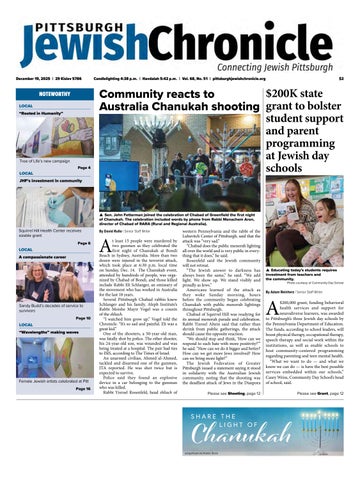
p Sen. John Fetterman joined the celebration of Chabad of Greenfield the first night of Chanukah. The celebration included words by phone from Rabbi Menachem Aron, director of Chabad of RARA (Rural and Regional Australia).
Squirrel Hill Health Center receives sizable grant Page 6
LOCAL A compassionate career
Sandy Budd’s decades of service to survivors Page 10
LOCAL “Wavelengths” making waves
Female Jewish artists celebrated at Pitt Page 16
By David Rullo | Senior Staff Writer
A
t least 15 people were murdered by two gunmen as they celebrated the first night of Chanukah at Bondi Beach in Sydney, Australia. More than two dozen were injured in the terrorist attack, which took place at 6:30 p.m. local time on Sunday, Dec. 14. The Chanukah event, attended by hundreds of people, was organized by Chabad of Bondi, and those killed include Rabbi Eli Schlanger, an emissary of the movement who has worked in Australia for the last 18 years. Several Pittsburgh Chabad rabbis knew Schlanger and his family. Aleph Institute’s Rabbi Moishe Mayir Vogel was a cousin of the shliach. “I watched him grow up,” Vogel told the Chronicle. “It’s so sad and painful. Eli was a great kid.” One of the shooters, a 50-year-old man, was fatally shot by police. The other shooter, his 24-year-old son, was wounded and was being treated at a hospital. The pair had ties to ISIS, according to The Times of Israel. An unarmed civilian, Ahmed al-Ahmed, tackled and disarmed one of the gunmen, JTA reported. He was shot twice but is expected to survive. Police said they found an explosive device in a car belonging to the gunman who was killed. Rabbi Yisroel Rosenfeld, head shliach of
western Pennsylvania and the rabbi of the Lubavitch Center of Pittsburgh, said that the attack was “very sad.” “Chabad does the public menorah lighting all over the world and is very public in everything that it does,” he said. Rosenfeld said the Jewish community will not retreat. “The Jewish answer to darkness has always been the same,” he said. “We add light. We show up. We stand visibly and proudly as Jews.” Americans learned of the attack as they woke Sunday morning, hours before the community began celebrating Chanukah with public menorah lightings throughout Pittsburgh. Chabad of Squirrel Hill was readying for its annual menorah parade and celebration. Rabbi Yisroel Altein said that rather than shrink from public gatherings, the attack should cause the opposite reaction. “We should stop and think, ‘How can we respond to such hate with more positivity?’” he said. “How can we do it bigger and better? How can we get more Jews involved? How can we bring more light?” The Jewish Federation of Greater Pittsburgh issued a statement saying it stood in solidarity with the Australian Jewish community, noting that the shooting was the deadliest attack of Jews in the Diaspora
p Educating today's students requires investment from teachers and the community.
Photo courtesy of Community Day School
By Adam Reinherz | Senior Staff Writer
A
$200,000 grant, funding behavioral health services and support for neurodiverse learners, was awarded to Pittsburgh’s three Jewish day schools by the Pennsylvania Department of Education. The funds, according to school leaders, will boost physical therapy, occupational therapy, speech therapy and social work within the institutions, as well as enable schools to host community-centered programming regarding parenting and teen mental health. “What we want to do — and what we know we can do — is have the best possible services embedded within our schools,” Casey Weiss, Community Day School’s head of school, said.
Please see Shooting, page 12
SHARE THE LIGHT OF
Chanukah
adogslifephoto/Adobe Stock
Please see Grant, page 12
Appeal
GOOD NEWS. BAD NEWS. YOUR VIEWS.
The Pittsburgh Jewish Chronicle is proud to bring you stories that matter and stories that delight. What kinds of news and features do we publish? • • • • • • • • • • • • • • • • •
Quality news Award-winning news Objective news News you can trust News no one else has News that connects the entire Pittsburgh Jewish community Good news and bad news Happy news and sad news Local news National news Israel news World news People news — machers and everyone else Organization news — big and small Breaking news Trends and analysis Series of news articles on special topics
• • • • • • • • • • •
News about the Orthodox, Conservative, Reform, Reconstructionist, new movements and the unaffiliated News about the political left, the right and everything in between News about the old, the young and everyone in between Features — culture, food, health, history, travel, sports and more Calendar of events Information you need to know Opinions Letters to the editor Polls Life cycle events — births, b’nai mitzvah, graduations, engagements, weddings and anniversaries Obituaries To make a donation, please scan this QR code or use the form below.
2025 ANNUAL APPEAL – CONTRIBUTION FORM Kindly fill out this form, and return it with your check or credit card information. Donations can also be made by major credit card by logging on to the Pittsburgh Jewish Chronicle website, www.pittsburghjewishchronicle.org, and selecting DONATE. We thank you, and the Pittsburgh Jewish community thanks you!
☐ One-Time Gift of: ☐ $72 ☐ $180
☐ $360
☐ $720
☐ Other
☐ Monthly Gift of: ☐ $10 ☐ $18
☐ $30
☐ $60
☐ Other
Name as it appears on the card Card # Expiration Date (mm/yy)
Security Code
LIST MY NAME (OR COMPANY) as: ☐ Enclosed is my check to the Pittsburgh Jewish Chronicle for $
ADDRESS
☐ Charge my credit card the amount indicated below:
CITY, STATE, ZIP
Payment in full $
Visa
Recurring Monthly charge $ MC
Discover
HOME PHONE ☐
I/WE WISH TO REMAIN ANONYMOUS
CELL Contributions are tax deductible.
5915 Beacon St. | Pittsburgh, PA 15217 | 412.687.1000 | pittsburghjewishchronicle.org 2
DECEMBER 19, 2025
PITTSBURGH JEWISH CHRONICLE
PITTSBURGHJEWISHCHRONICLE.ORG
Headlines In a critical moment for local news, the Chronicle needs your support Publisher and CEO Jim Busis
I
t’s a little more than two years since Oct. 7, when Hamas and its allies began a series of attacks aimed at destroying Israel, and more than two years since broad antisemitism, which had already been at high levels, exploded internationally, nationally and here in Pittsburgh. And now, just a few days ago, the Jewish community was targeted in a mass shooting at a Chanukah event in Australia, which resonates deeply with so many of us here. These two years have been hard for everyone. We hear it from you, our readers, whether you’re liberal or conservative, whether you’re traditional or not so traditional in your religious life, and whether you’re deeply involved or less involved in the Jewish community. Moreover, the raw tensions in our national political and social fabric don’t help. Some people tell us they’re overloaded with the bad news — that they value and love reading the Chronicle, but they wish we didn’t have to report so much bad news. We also wish that there wasn’t so much bad news, but it is our responsibility to
report the world as it is. You need to know what’s going on so you can act effectively to try to make, if not the whole world, then at least our city and community a better place for all.
our weekly poll. We at the Chronicle are constantly thinking about how best to provide our audience with the most useful and highest quality information. The internet, social
We at the Chronicle are constantly thinking about how best to provide our audience with the most useful and highest quality information. But there is lots of good news happening, too. Stories of successes, growth, inspiration. We report on all the good news that we can find, and we try especially hard to paint a balanced and accurate picture of everything of significance that’s going on in our community. We hope that by reading the Chronicle, every day on the internet and every week in print, that you feel uplifted more than you feel stressed. The world is increasingly a messy and complicated place, in which many people have very different takes on what’s going on. That’s why we also invest in giving you a range of quality opinions and perspectives on the events of the day, including the views of a wide range of community members via letters to the editor, opinion pieces and
media and now AI have transformed the news and information ecosystem beyond recognition, putting enormous responsibility and stress on any media outlet that wants to report accurately and fairly. The internet has made it possible for anyone to put anything out there, without expertise or regard for the truth. Social media allows misinformation and disinformation to spread farther and faster than ever. AI is making it even easier and more compelling to create false narratives and hide sources. Never has the need for accurate, carefully curated local Jewish news been more urgent. However, the need for resources and the economic threats are also greater than ever.
Last year the Chronicle was the only Jewish news publisher to receive one of the initial grants from Press Forward, a new national consortium devoted to supporting local news. Two months ago Press Forward gave us the opportunity to attend a national conference on the business of local news. Again, we were the only Jewish news outlet represented, but it was inspiring to see so many other local news publishers fiercely dedicated to their critical mission. The biggest takeaway from the conference was that despite the digital trends that threaten us, there are also lots of opportunities to serve our audiences even better, to help them be more informed, more connected and more engaged. All it takes is more reader engagement and support. It’s a two-way street. We hope that the more we engage you, the more you will support us. The more you support us, the more we can do to engage you. So, we ask you, to the extent possible, please support the Chronicle and support it generously. First your support enables us to keep the lights on, and then it enables us to keep on developing our ability to better serve you in this crazy news and technology environment. You’ll be helping yourself, and you’ll be helping the rest of the Pittsburgh Jewish community. PJC
Please consider making a gift to support local Jewish journalism | pittsburghjewishchronicle.org
5915 Beacon St., 5th Floor Pittsburgh, PA 15217
Main phone number: 412-687-1000
Subscriptions: 412-687-1000, ext. 2 SUBSCRIPTIONS subscriptions@pittsburghjewishchronicle.org 412-687-1000, ext. 2 TO ADVERTISE advertising@pittsburghjewishchronicle.org 412-687-1000, ext. 1 EDITORIAL DEPARTMENT Email: newsdesk@pittsburghjewishchronicle.org BOARD OF TRUSTEES Evan H. Stein, Chair Evan Indianer, Vice Chair Derek Smith, Treasurer Gayle R. Kraut, Secretary Gail Childs, Dan Droz, Malke Steinfeld Frank, Karen Galor, Seth Glick, Judith Kanal, Cátia Kossovsky, Charles Saul, Lynn Zelenski GENERAL COUNSEL Stuart R. Kaplan, Esq.
PITTSBURGHJEWISHCHRONICLE.ORG
Jim Busis, CEO and Publisher 412-228-4690 jbusis@pittsburghjewishchronicle.org EDITORIAL Toby Tabachnick, Editor 412-228-4577 ttabachnick@pittsburghjewishchronicle.org Adam Reinherz, Senior Staff Writer 412-687-1000 areinherz@pittsburghjewishchronicle.org David Rullo, Senior Staff Writer 412-687-1000 drullo@pittsburghjewishchronicle.org ADVERTISING Amy Weiss, Account Executive (412) 613-0697 aweiss@pittsburghjewishchronicle.org
PRODUCTION Jeni Mann Tough Production Manager Carl Weigel Art/Production Coordinator Subscriptions subscriptions@pittsburghjewishchronicle.org 412-687-1000, ext. 2 Published every Friday by the Pittsburgh Jewish Publication and Education Foundation 5915 Beacon St., 5th Floor Pittsburgh, PA 15217 Phone: 412-687-1000 POSTMASTER: Send address change to PITTSBURGH JEWISH CHRONICLE, 5915 BEACON ST., 5TH FLOOR PITTSBURGH, PA 15217 (PERIODICAL RATE POSTAGE PAID AT PITTSBURGH, PA AND AT ADDITIONAL MAILING OFFICES) USPS 582-740
PITTSBURGH JEWISH CHRONICLE
Manuscripts, letters, documents and photographs sent to the Pittsburgh Jewish Chronicle become the property of this publication, which is not responsible for the return or loss of such items. The Pittsburgh Jewish Chronicle does not endorse the goods or services advertised or covered in its pages and makes no representation to the kashrut of food products and services in said advertising or articles. The publisher is not liable for damages if, for any reason whatsoever, he fails to publish an advertisement or for any error in an advertisement. Acceptance of advertisers and of ad copy is subject to the publisher’s approval. The Pittsburgh Jewish Chronicle is not responsible if ads violate applicable laws and the advertiser will indemnify, hold harmless and defend the Pittsburgh Jewish Chronicle from all claims made by governmental agencies and consumers for any reason based on ads appearing in the Pittsburgh Jewish Chronicle.
DECEMBER 19, 2025
3
Headlines Tree of Life unveils new campaign ‘Rooted in Humanity’ — LOCAL — By David Rullo | Senior Staff Writer
T
he Tree of Life has kicked off a new campaign focused on building community and forging relationships. The campaign, “Rooted in Humanity,” began with the release of a video highlighting the community’s response to the 2018 Pittsburgh synagogue shooting. Carole Zawatsky, The Tree of Life CEO, said the organization has spent the last several years working with institutions, private donors and various government agencies to raise funds and build awareness of the building and programs The Tree of Life will create to combat hate and antisemitism. Now, Zawatsky said, is the time for the public to get involved. “This is the time; we are moving to a public phase of the campaign. It is time to say, ‘Count me in,’” she said. “What is happening in Pittsburgh is exciting. It is a model for the rest of the nation. Join us.” Zawatsky said that every gift, no matter the amount, is appreciated by the Tree of Life. “I have often said, ‘You cannot build community with million-dollar gifts, but you can’t build a building without million-dollar gifts’,” she said. “Now we’re asking the community to join us and be part of this incredible and exciting new initiative of The Tree of Life.” To mark the start of the campaign, The Tree of Life has added a new fence wrap surrounding the building’s footprint featuring images of some of the thousands of gifts left outside the building or sent to the three congregations — Dor Hadash, New Light and Tree of Life —that were targeted in the Pittsburgh synagogue shooting, as well as artwork from students across the country. The wrap also includes panels highlighting the theme of the campaign and various attributes of the organization — “Rooted in courage,” “Rooted in tribute,” “Rooted in resilience,” “Rooted in memory,” and “Rooted in compassion” — before the last frame naming the campaign, “Rooted in humanity.” The new building’s construction is scheduled to begin in early 2026. Designed by Studio Libeskind and architect Daniel Libeskind, and assisted by local architect IKM, the building will take approximately 15 months to complete. When finished, the building will house and support the work of The Tree of Life organization, which is centered on four pillars: • Memorialization, to remember the lives of those taken on Oct. 27.
p As part of its new “Rooted in Humanity” campaign, The Tree of Life has unveiled a new wrap around its building.
Photo courtesy of The Tree of Life
“The Tree of Life will be a place for dynamic, robust, exciting Jewish life and celebration.” –CAROLE ZAWATSKY • Education, including the Holocaust Center and the LIGHT Education Initiative, as well as a museum telling the history of antisemitism in America. • Jewish life and culture, consisting of the Tree of Life Congregation and programming for Jews and non-Jews alike. • A platform for national discussions, featuring programming like the traveling exhibition “Lessons from the Tree of Life: Lighting the Path Forward.” The lack of a building has not stopped The Tree of Life from creating programming. Most recently it hosted a discussion between Pulitzer Prize-winning journalist Bret Stephens and author Pamela Nadell. The pair discussed Nadell’s new book “Antisemitism, An American Tradition.” “Lessons from The Tree of Life: Lighting the Path Forward,” a traveling exhibition opened earlier this year and is making its way around the country, offering a preview of the museum that will be housed in the new building.
Both the Holocaust Center of Pittsburgh and LIGHT Initiative — currently in 35 schools —continue to create programming, as well. “The Tree of Life will be a place for dynamic, robust, exciting Jewish life and celebration,” Zawatsky said, while noting that it will also honor the 11 victims of the Pittsburgh synagogue shooting. To date, more than $46 million has been raised to rebuild and reimagine The Tree of Life. Donors include the Richard King Mellon Foundation, the Henry Hillman Foundation, the Heinz Endowments, the PNC Foundation and the Ford Foundation. The project also has received funding through federal grants secured by the Pennsylvania congressional delegation and through the Commonwealth of Pennsylvania’s Redevelopment Assistance Capital Program. The goal is to raise a total of $60 million, Zawatsky said, noting that a sizable portion of that money will go toward programming and
enabling the organization to “create an institution that will be sustainable.” “The more dollars we bring at the front, the stronger the institution is, the more robust our finances and the more successful we’ll be in bringing incredible programs to the community on an ongoing basis,” she said. The hope of the campaign, she said, is to invite more people to participate in The Tree of Life through remembrance, educational opportunities and bridge-building activities rooted in shared values. “It’s a very exciting time,” she said. “We are at the crest of a precipice in a very beautiful way. We have a new building design that truly speaks to the programmatic work that we are creating for the Tree of Life. “The community is at the core of what we’re doing.” PJC David Rullo can be reached at drullo@ pittsburghjewishchronicle.org.
STORIES COME TO life HERE. Connect with Pittsburgh Jewish Chronicle.
In your mailbox or all the time online at pittsburghjewishchronicle.org 5915 Beacon Street, 5th Floor, Pittsburgh, PA 15217 4
DECEMBER 19, 2025
PITTSBURGH JEWISH CHRONICLE
PITTSBURGHJEWISHCHRONICLE.ORG
Headlines Israeli Sammy Smooha presents his take on current Israeli government — LOCAL — By David Rullo | Senior Staff Writer
B
enjamin Netanyahu and the current Israeli government want to create a new Israel, according to Sammy Smooha. “They want to revolutionize Israel as a society, culture and state,” he said. “They want a new Israel. The don’t want the kind of Israel we have today.” Smooha’s Dec. 11 talk, “The Challenge of the Palestinian Arab Minority to Israel as a Jewish and Democratic State,” was presented by J Street Pittsburgh and attended by about two dozen people. Smooha is a professor emeritus of sociology at the University of Haifa and a recipient of the Israel Prize, the state’s highest cultural honor. The current government of Israel, he posited, is the most right-wing in the history of the country and is interested in replacing the top levels of society — which he dubbed the “elites” — with a new “elite,” separate from those who founded the country as part of the Labor Zionists. “They want elites that are loyal to the governing right-wing group, which is Netanyahu and other people,” Smooha said. In order to do this, the right needs a stable electoral majority, something that he said is already forming. He estimated that for every voter who defines themself as center or left, there are at least two who are on the right. Part of the goal of the right, Smooha said, is to prevent the partitioning of Greater Israel — which he defined as from the Mediterranean Sea to the Jordan River — to create a Palestinian state. “They want to take all kinds of measures to prevent any possibility that this will be partitioned,” he said. “After a partition, the option is, of course, to build a separate Palestinian state.” Eastern Europe, he said, is going through a similar “de-democratization,” citing Poland and Hungary, as examples. And like those countries, Smooha said, it is important for the right-wing elements of the government to rework the judiciary. Those who disagree with the government fall into two camps, or voting blocs, he said: liberals and centrists, and Arab citizens of the country. The government, Smooha said, labels the liberal voting bloc and its supporters as traitors and the Arab voting bloc as terrorists. “In politics, if you use this kind of strategy, deligitimacy, this is the strongest thing you can have within the bounds of democracy
PITTSBURGHJEWISHCHRONICLE.ORG
p Sammy Smooha
Screenshot from YouTube
because you can use force, you can have people arrested, people within the government,” he said. Hatred, Smooha said, is also used as a tool. “Disunity and incitement strengthen hate among their supporters,” he said. Smooha’s talk presented the Israeli government, and Netanyahu, as attempting to bend the arc of law to support their goals. As examples, he cited the prime minister’s corruption trial and said that Netanyahu and his supporters are claiming it is a fake trial. He also alleged the government is refusing to accept responsibility for the war in Gaza; instead, he asserted, they blame the army and the central left. Smooha said before Oct. 7, the center-left organized demonstrations against the government and its attempts at judicial reform. As part of those demonstrations, IDF reserve pilots threatened to not serve or train; as a result, Israel was not prepared for its war against Hamas. “They said, ‘We aren’t going to volunteer for training.’ As pilots, you have to train all the time,” he said. The Netanyahu administration, Smooha said, doesn’t want an inquiry into the lead-up and causes of Oct. 7, something he believes is part of a larger objective. “They want to destroy belief in the system. That’s the idea,” he said. The goal, he said, is a state that is both Jewish and democratic, favoring the former at the expense of the latter. “For them, democracy is secondary. It’s not a primary value. They want Israel to be as Jewish as it can be. Israel today is super Jewish,” Smooha said. “It is very much not democratic and very much extra Jewish, but they want it even more.” And, he said, “For them, Zionism is not ethnic, it’s not civic. It’s an ideology which includes every citizen.” The result, he said, is that if you live in Israel and are not Jewish, then you are an outsider.
This moves Israel away from being a classic, liberal democracy, where all individuals all equal and free, Smooha argued. It also leaves Arab Israelis as a minority. “They are a national minority. They are
a religious minority. They are a linguistic minority. They are a cultural minority. They are part of the Palestinian people, and they want to stay apart,” he said. On the other hand, Arab Israelis want both a Palestinian state and equality in Israeli. “They want a state-and-a-half,” he said. That goal, he said, is frustrated not only by the Israeli government but also by Palestinian leadership, which presents no viable partner for peace. In the end, he said, despite the challenges and Israel’s right-wing leadership, the country is a stable democracy that is struggling with many issues. “What I’m saying is that the situation will continue for a long time to come,” he said. PJC David Rullo can be reached at drullo@ pittsburghjewishchronicle.org.
Markets change. Our relationships endure. Managing wealth is our craft.
Markets may be shifting, but we’re here to help. With insightful advice that’s focused on your goals, we’ll guide you through the uncertainty. And with the strength and stability of UBS, you’ll have the power of 160 years of wealth management expertise working harder than ever for you. Together, we’ll find the solutions you need. Let’s talk. Lee Oleinick Financial Advisor Managing Director–Wealth Management 412-665-9914
Chris Butsko Financial Advisor Senior Vice President–Wealth Management 412-665-9918
Jack Greenberg Financial Advisor Vice President–Wealth Management 412-665-9911
Andrew Oleinick Financial Advisor 412-665-9902
Walnut Wealth Management Group UBS Financial Services Inc. 600 Grant Street, Suite 4650 Pittsburgh, PA 15219 advisors.ubs.com/walnut
As a firm providing wealth management services to clients, UBS Financial Services Inc. offers investment advisory services in its capacity as an SEC-registered investment adviser and brokerage services in its capacity as an SEC-registered broker-dealer. Investment advisory services and brokerage services are separate and distinct, differ in material ways and are governed by different laws and separate arrangements. It is important that you understand the ways in which we conduct business, and that you carefully read the agreements and disclosures that we provide to you about the products or services we offer. For more information, please review the client relationship summary provided at ubs.com/relationshipsummary, or ask your UBS Financial Advisor for a copy. © UBS 2025. All rights reserved. UBS Financial Services Inc. is a subsidiary of UBS Group AG. Member FINRA/SIPC. BO_10242025-1 IS2306586 Exp.: 11/30/2024
PITTSBURGH JEWISH CHRONICLE
DECEMBER 19, 2025
5
Headlines JHF helps offset rising costs and federal pressure with $500,000 grant to SHHC — LOCAL — By Adam Reinherz | Senior Staff Writer
W
ith rising healthcare costs and federal pressures taking their toll on the Squirrel Hill Health Center, a $500,000 grant from the Jewish Healthcare Foundation aims to offer stability. Days ago, JHF announced it was delivering the grant in an effort to “address urgent community needs, bolster safety-net health providers, respond to threats to state and federal human services funding and invest in the future healthcare workforce.” The grant is an investment in community, JHF president and CEO Karen Wolk Feinstein said. “What they do is essential to all of us,” she said. Federally qualified health centers, like SHHC, ensure patients receive the “best care possible, as early as possible, at the entry level, not when the condition has already escalated.” Without access to primary care, communities and healthcare suffer, SHHC CEO Susan Friedberg Kalson said. “People with chronic health conditions go untreated. People with diabetes, or with high blood pressure or with asthma, don’t have access
p A grant to the Squirrel Hill Health Center is aiding the federally qualified health center's continuance. Photo by Gustavo Fring via Pexels
to the services that keep those conditions under control.” Similarly, women don’t get prenatal care, children, older adults and those with communicable diseases aren’t seen, and the lack of access results in “ripple effects.” “Children miss school. Adults miss work. They may become unemployed. They end
up in the emergency room, and they end up receiving extremely expensive care for much more complicated medical conditions than they would have needed had they just been able to see a primary care clinician on a regular basis.” Federally qualified health centers stem the swell by wedding “good health and healthy
communities,” Kalson added. With origins dating back nearly half a century, federally qualified health centers provide communities with comprehensive primary care, dental and mental health services, regardless of clients’ abilities to pay. Supported by federal funding — and sliding scales of patient payment — and governed by a board consisting of at least 51% of the patients themselves, federally qualified health centers deliver outpatient safety nets. Feinstein credited the late Chuck Cohen, a former JHF chair, with advocating for the creation of SHHC almost 30 years ago. Since its inception, SHHC has been a “jewel,” Feinstein said. “It is a real honor to have been able to watch Susan Kalson, and her team with Jonathan Weinkle, take our wildest aspirations and make them real.” Kalson credited SHHC’s staff and JHF with understanding a federally qualified health center’s purpose. “Every human being should have access to the level of high quality medical care that exists in this country, “ Kalson said. “And it should not be dependent on how much money you earn, and it should not Please see JHF, page 13
SPONSORED CONTENT
ABERNETHY, HAGERMAN & MILLER ELDER LAW NOTE: NEW SQUIRREL HILL OFFICE LOCATION TO BE ANNOUNCED SOON!
EVERYTHING YOU NEED TO KNOW ABOUT POWERS OF ATTORNEY by Michael Marks Powers of Attorney are just as important in estate planning as Wills, because before someone becomes deceased, they may become disabled. That’s when Powers of Attorney are valuable. In a POA, you get to choose, select, appoint and authorize who will help you if you need help OR assistance during your lifetime because you’ve become unable to take care of business yourself. (You also need planning for after you are gone, such as a Will and/or Trust.)
If you become incapacitated and have not signed a POA, then whoever steps up to help you will have to go to court and bring proceedings before a judge, to be officially appointed as something different called your Legal Guardian. As you can imagine, that takes longer, it costs more, and it’s a lot less flexible than proceeding under private Power of Attorney. Create YOUR Powers of Attorney now, in advance, while you can, before anything bad happens in the future. Who should you choose and appoint: Someone you trust to take care of important business for you. Most people start by naming their own spouse, or adult child, or others. Anyone acting under your POA is called your Agent. They do things for you, and they have a fiduciary duty - an obligation in the highest degree - to act properly on your behalf.
6
DECEMBER 19, 2025
You should also name your choice as the backup or substitute or second choice, in case the first choice is not available to help you when needed. You may also appoint two or more people as Co-Agents, who may act together or each act individually and independently.
In recent years, Pennsylvania tightened the rules about how a financial POA must be signed, witnessed and notarized in precisely the right way to be valid and effective. That’s one good reason why trying to do it yourself might not be such a good idea in this instance.
I usually prepare two separate Powers of Attorney for my clients, a Business and Financial Power of Attorney, regarding finances, money, business and property, and a Health Care POA combined with a Living Will.
There are many cases of financial abuse by someone acting under a POA. Trying to recover improperly taken money or property can be involved, with unpredictable results. Your best protection is choosing someone who will turn out to uphold and not betray your trust, at the start.
It’s all about making your own choices in life and writing it down and signing it, to give it binding force If you don’t make your own choices, someone else who you did not choose will make decisions for you.
One kind of health care decision that someday might need to be made for me at the end of the story is end of life treatment decisions. That’s covered in the Living Will part of the Health Care Power of Attorney. It says, in effect, when it’s really my time to go, please let me go, don’t keep me alive on the machines and wires and tubes and needles. It comes into effect only when someone is about to die. You get to decide when the Power of Attorney will come into effect. For a financial POA, most of the time my clients choose to make it an immediately effective POA, that can be used when your Agent thinks you need their help. In this type, no doctor has to sign anything first.
Or you can make it a Springing POA that requires a doctor to sign off first. That kind is safer. but not as easy to use in an emergency. Your main protection is always that you will choose the person you trust the most in the whole wide world, to help you and do right by you.
PITTSBURGH JEWISH CHRONICLE
Although you have to do it just right to execute a valid Financial POA, it’s not hard to revoke it. Your revocation can be simple but must be in writing, and delivered.
Even young adults may be at risk of disability from injury or illness and should make POAs, to authorize parents, for example, to act on their behalf, in such an unfortunate event. One final important point to repeat: Don’t forget about planning for after your own inevitable passing, through a Will and or Trust, as well.
mhm@a-h.law NEW FIRM MAIN OFFICE 3960 William Flinn Highway (Route 8) Allison Park, PA 15101 10 minutes closer to town! (412)486-6624
PITTSBURGHJEWISHCHRONICLE.ORG
Headlines A Visit to Karmiel-Misgav: Bearing witness and giving thanks
p Park bench painted by Partnership2Gether teens featuring Pittsburgh, Karmiel and Warsaw Photo by Riley Crow
— ISRAEL — By Riley Crow | Special to the Chronicle
A
fter three canceled attempts due to the war, I finally traveled to our sister region of Karmiel-Misgav with a deep sense of purpose, to contribute, to listen, and to bear witness on behalf of our Pittsburgh community. Arriving just as the winter holiday season began in the U.S.,
I found myself viewing every moment through profound gratitude and amazement. Known around the Jewish Community Center of Greater Pittsburgh as the “camera guy,” I documented the journey through a photo journal, hoping to capture both the beauty and unwavering resilience of our extended family in northern Israel. I was warmly welcomed by partners including Shaked Gal, who leads the Diller Teen Fellows program, partially funded by the Jewish Federation of Greater Pittsburgh, connecting Jewish teens worldwide through
p Shaked overlooking the Karmiel-Misgav region
leadership and shared identity. One of the most powerful moments came at the Pittsburgh Promenade, where 11 trees honor the 11 lives taken on Oct. 27, 2018. Standing before this living memorial — half a world away — I felt the truth that Jewish community transcends geography. It binds us across continents with enduring responsibility and love. The realities of life in the region were also unmistakable. The home of Partnership2Gether, normally a lively hub of exchange between our communities, now
Photo by Riley Crow
doubles as a bomb shelter, a daily reminder of families who have just 30 seconds to seek safety. Yet even there, signs of partnership and creativity endure. As Thanksgiving approached, I returned home reminded of the strength of our global Jewish family and the unbreakable bonds that continue to sustain us, even in times of distance. PJC Riley Crow is the marketing and communications coordinator at the Jewish Community Center of Greater Pittsburgh.
p The Partnership2Gether home in Karmiel, serving as a partnership hub between our communities Photo by Riley Crow
p A worn Israeli flag hangs from the balcony of a family home in Karmiel Photo by Riley Crow
p A “Bring Them Home Now” bumper sticker on a parked car in Kibbutz Eshbal Photo by Riley Crow
p 10.27 memorial in Karmiel
PITTSBURGHJEWISHCHRONICLE.ORG
PITTSBURGH JEWISH CHRONICLE
Photo by Riley Crow
DECEMBER 19, 2025
7
Calendar Submit calendar items on the Chronicle’s website, pittsburghjewishchronicle.org. Submissions also will be included in print. Events will run in the print edition beginning one month prior to the date as space allows. The deadline for submissions is Friday, noon. q FRIDAY, DEC. 19–THURSDAY, JAN. 8 Chabad of the South Hills is collecting new toys for hospitalized and underprivileged children for its Chanukah Toy Drive. For more information, call 929-327-4837 or email RabbiMendel@ Chabadsh.com. q SATURDAY, DEC. 20 Join Chabad of the South Hills for Drinks & Dreidels, a Chanukah soiree. Enjoy a strolling magician, donuts, latkes, hors d’oeuvres and signature drinks. 7:30 p.m. $25. 1700 Bower Hill Road. chabadsh. com/dreidel.
q SUNDAY, DEC. 21 Tree of Life Congregation will join Calvary Episcopal Church for a joint Chanukah and Christmas celebration. Tree of Life congregants will join their friends from Calvary to celebrate the holidays with pageantry and, of course, food. 11 a.m. Free. Calvary Episcopal Church, 315 Shady Ave. treeoflifepgh.org. Join Chabad Young Professionals at Romp n’ Roll for Mommy and Me — an afternoon of play, climbing, music and laughter — the perfect way to celebrate Chanukah with your little ones. Kids will enjoy open gym time and plenty of fun while parents relax and connect. Light the menorah, sing Chanukah songs and enjoy pizza, crispy latkes and fresh donuts. 4 p.m. $36/family. cyppittsburgh.com/family. q SUNDAYS, DEC. 21–JULY 26, 2026 Join Chabad of Squirrel Hill for its Men’s Tefillin Club. Services and tefillin are followed by a delicious breakfast and engaging discussions on
current events. 8:30 a.m. 1700 Beechwood Blvd. chabadpgh.com. Join a lay-led online Parashah study group to discuss the weekly Torah portion. No Hebrew knowledge needed. The goal is to build community while deepening understanding of the text. 8:30 p.m. For more information, visit bethshalompgh.org/online-parashah. q MONDAYS, DEC.22–DEC. 29 Join Congregation Beth Shalom for a weekly Talmud study. 9:15 a.m. For more information, visit bethshalompgh.org. Join Temple Sinai for an evening of mahjong every Monday (except holidays). Whether you are just starting out or have years of experience, you are sure to enjoy the camaraderie and good times as you make new friends or cherish moments with long-term pals. All are welcome. Winners will be awarded Giant Eagle gift cards. All players should have their own mahjong cards. Contact Susan Cohen at susan_k_cohen@yahoo.com if you have questions. $5. templesinaipgh.org. q TUESDAY, DEC. 23 Join the 10.27 Healing Partnership for crafting and conversation at their wreath-making event. Learn how to make a wreath and bring your creation home. Greenery and materials will be provided. Program is free and open to everyone. Registration is required. This program will take place in room 316 of the Jewish Community Center. 2:30-4 p.m. 1027healingpartnership.org/ wreath-making.
Wishing the community a Happy Chanukah!
q TUESDAYS, DEC. 23–JUNE 30, 2026 Join Beth El’s Rabbi Alex Greenbaum and his Bible/Talmud Adult Education class for a thoughtprovoking weekly session of Bible and Talmudic study. This program is available both in person and virtually. Call the office at 412-561-1168 to receive the Zoom link or to make an in-person reservation. 10:30 a.m. 1900 Cochran Rd. bethelcong.org.
q WEDNESDAYS, DEC. 24–DEC. 31 Bring the parashah alive and make it personally relevant and meaningful with Rabbi Mark Goodman in this weekly Parashah Discussion: Life & Text. 2:15 p.m. For more information, visit bethshalompgh.org/life-text. Join Chabad of the South Hills for Baby Loves Shabbat, music and movement for ages 0 to 3. Challah making and Shabbat songs. 3:45 p.m. 1701 Bower Hill Road. chabadsh.com. q SUNDAYS, JAN. 4–FEB. 1 Jewish Art Camp: Fun Jewish learning through the arts for ages 0 to Grade 3. Mommy and Me (0 to 3-year-olds and their moms), Mini Makers (4 to 5year-olds), Master Makers (Grades 1-3). Ages 0 to 5: $40/semester; Grades 1-3: $65/semester. 10:30 a.m. 1700 Beechwood Blvd. chabadpgh.com/art. q THURSDAYS, JAN. 8, FEB. 5 Join Rabbi Amy Greenbaum and the Beth El community for the all-virtual Beth El’s Virtual Hope and Healing Program on the first Thursday of the month. This is a safe space to chant, breathe, pray for healing and seek peace. Feel free to keep your camera off and just listen. Call the office at 412561-1168 to receive the Zoom link. 5:30 p.m. Free. bethelcong.org. q MONDAY, JAN. 12 Make your own resin tzedakah box and enjoy light refreshments with Chabad of Squirrel Hill at Art and Soul. 7 p.m. $45. 1700 Beechwood Blvd. chabadpgh.com/resin. q SATURDAY, FEB. 7 Join Congregation Beth Shalom for Clues and Schmooze (with some booze), a fun trivia event, including an open bar and snacks. There will be a 50/50 raffle, so bring cash to participate. Trivia will be played with teams of three to six. Bring your own team or be matched up at the door. Must be 21 or older to participate. 7 p.m. $30. 5915 Beacon St. bethshalompgh.org/clues-and-schmooze-2026. PJC
Join the Chronicle Book Club!
Stephanie makes the whole confusing world of health insurance feel simple and manageable. With her patience, kindness, and constant support, we always feel cared for and confident that she has our best interests at heart.
— BY RABBI YISROEL ROSENFELD AND BLUMI
T
he Pittsburgh Jewish Chronicle invites you to join the Chronicle Book Club for its Jan. 18 discussion of “Unveiled,” by Jonathan Harounoff. The author will join us for the meeting. “‘Unveiled’ takes us inside the ‘Woman, Life, Freedom’ movement, sparked by the slaying of a young woman for wearing a loose hijab, in what became the most serious challenge the [Iranian] regime has faced in forty-six years. Harounoff has given us a nonfiction drama replete with heroines and villains, one that is sure to captivate readers.” –Peter Kann, Pulitzer Prize-winning foreign correspondent and former publisher, The Wall Street Journal.
Email: Contact us at drullo@pittsburghjewishchronicle.org, and write “Chronicle Book Club” in the subject line. We will send you a Zoom link for the discussion meeting. PJC — Toby Tabachnick
Your hosts
Toby Tabachnick, Chronicle editor David Rullo, Chronicle senior staff writer
How it works
We will meet on Zoom on Sunday, Jan. 18, at 1 p.m.
What to do MEDICARE INDIVIDUAL PHONE NUMBER: 412-790-2881
Buy: “Unveiled.” It is available from online retailers, including Amazon and Barnes & Noble. It is also available through the Carnegie Library system.
www.pittsburghjewishchronicle.org 8
DECEMBER 19, 2025
PITTSBURGH JEWISH CHRONICLE
PITTSBURGHJEWISHCHRONICLE.ORG
Headlines Pitt’s Jewish Studies Program revives antisemitism course first taught after Pittsburgh synagogue shooting — LOCAL — By Toby Tabachnick | Editor
J
ust three months after the Oct. 27, 2018, deadly antisemitic attack at the Tree of Life building, the Jewish studies department at the University of Pittsburgh offered a 12-week pop-up course titled “Antisemitism Then and Now: Perspectives after Tree of Life.” The professors who conceived of the course wanted to provide “a scholarly response to help the Pitt community put some of this into context and into perspective,” Rachel Kranson, an associate professor of religious studies at Pitt, told the Chronicle then. The class was a one-off — but that didn’t reflect on its value, said Kranson, now director of Jewish Studies at Pitt. “In an ideal world, we would have been doing this since 2018 and there never would have been a pause,” Kranson said. Now, seven years later, the class is being offered again. The timing of the course, called “Antisemitism Then and Now,” coincides with a rapid rise of antisemitism in the United States and around the world, which intensified after Hamas’ Oct. 7, 2023, attack on Israel and the Jewish state’s response. There were more than 9,000 antisemitic incidents reported across the U.S. in 2024, according to the Anti-Defamation League — a 344% increase over the past five years and an 893% increase over the past 10 years, and the highest number on record since ADL began tracking antisemitic incidents 46 years ago. On Sunday, 11 Jews were murdered while celebrating Chanukah at a Chabad event on Bondi Beach in Sydney, Australia. “While we created this course in response to the devastating shooting here in Pittsburgh, the most recent violence in Bondi Beach is yet another reminder of its urgency,” Kranson said. “Our students have inherited a world of rampant violence that they will be responsible for fixing. The least we can do as scholars is offer them the knowledge, frameworks and tools they will need to tackle the problems that older generations left for them.” Kranson said she’s been trying to reinstate the course for years. The challenge, she explained, was the model, which had 12 lecturers from a variety of disciplines exploring Jew-hatred in various historical and geographical contexts. “We can’t keep asking our colleagues to volunteer to give lectures again and again and again — that’s really a huge burden on them,” Kranson said. “So that model just wasn’t feasible for a continuous course.” The issue may be resolved now, though, as the new course, which begins next month, will feature recorded lectures that
PITTSBURGHJEWISHCHRONICLE.ORG
p Rachel Kranson
Photo courtesy of Rachel Kranson
can be used for years to come, hopefully making it “sustainable for the long term,” Kranson said. After the students view each video, they will meet in person for a discussion facilitated by Frayda Cohen, director of the Gender, Sexuality, and Women’s Studies Program and director of the Pittsburgh Consortium for Adoption Studies. Cohen is also on the faculty of the Jewish Studies Program. This will be the first class Cohen has led concerning antisemitism, but she is skilled at facilitating dialogue, Kranson said, adding “I fully trust her to do a great job with this.” As of press time, there were only 10 students enrolled in the seminar. Kranson said she would have liked “more and stronger support from the administration” for the course. “It’s very hard for students to find a course like this right now,” she said. “It is being sponsored by the Jewish Studies Program and the Religious Studies department, meaning that the only students who are seeing it are students who are interested in Jewish studies or religious studies.” Other universities, Kranson said, have offered one-credit courses presenting an overview of antisemitism tuition-free for all students, “which made them quite popular,” including a similar course at the University of Connecticut. “But we can’t do that unless the university either makes this tuition-free or gives it a university number so that all students are able to see it,” she said. “There are ways that the university could put more support behind the course, and I’d really like to see that happen.” Pitt spokesperson, Jared Stonesifer, said because of the high number of courses offered across campus, advertising those
Optimize your cloud storage.
Your data needs maintenance. FSA helps you develop data archiving strategies, implement cloud storage solutions, and provides ongoing management.
Contact Us
fsaconsulting.us | (412) 228-3100
Please see Pitt, page 13
PITTSBURGH JEWISH CHRONICLE
DECEMBER 19, 2025
9
Headlines A Career of compassion: Sandy Budd ends 33 years serving Holocaust survivors — LOCAL — By Deborah Weisberg | Special to the Chronicle
W
hen geriatric social worker Sandy Budd reflects on her 33-year career, many of her most poignant memories are of the Holocaust survivors she has helped care for in Pittsburgh. Set to retire from Jewish Family and Community Services of Pittsburgh Dec. 31, Budd has provided case management and counseling to 150 survivors over the years through a grant from the Conference on Jewish Material Claims Against Germany. Working with the survivor community has been “an honor,” she said, and epitomizes what it means to be a Jew working in a Jewish agency. “This, to me personally, is why we are here.” The Claims Conference, founded by Jewish world leaders in 1951, distributes funds provided by the German government as restitution for Holocaust-related suffering and property theft. The primary beneficiaries are now elderly and in need of financial support and social services. Many were inherently mistrustful of government, given what they had endured in their countries of origin, and when they first resettled in the U.S., Budd said. “They were not using government funding because of the processes. They would suffer in silence and the Jewish community just felt that funding from the Claims Conference was an opportunity to provide services to a group that in the past would not seek them out.” At its peak, Budd managed a caseload of 60 individuals. Today, there are four. The Claims Conference grant provides them with access to home-delivered kosher meals and assistance with housework, errands and personal care, thus enabling them to remain within their homes and stay active in the community “without going through a lot of rigamarole,” Budd said. Budd provides psychotherapy as needed. “I was a neutral but friendly third party,” she said. “Some at first were a little suspect, so I tried to make it as easy and gentle and unassuming an experience as possible. I gradually gained their trust as someone who was there to listen.” “Many shared stories with me that they had never shared with their families and opened up about deeply personal stuff. “It was incredibly moving.” Budd recalled one man with whom she worked years ago caught in the dilemma of where to live after his wife, diagnosed with dementia, could no longer care for him. “He was legally blind and pretty hard of hearing and his kids lived out of town,”
p Sandy Budd
Photo by Dan Singleton/Age-Friendly Greater Pittsburgh
“Sandy has been an incredible resource in helping survivors access the services they need and deserve, that they are entitled to.” –EMILY LOEB Budd recalled. “They wanted their parents to move to assisted living near them. It was a tough situation.” The man was religious and learned, and every time Budd visited, he would tell her a story. One day he described how at 19 he was about to be drafted into the military and didn’t want to go, so he went to the Rebbe and explained his situation and asked what he should do. The Rebbe advised him to go to the conscription center, at the local high school, and so he did. When, by the end of the day, his name hadn’t been called, he went to the desk to ask about it and was told he could go home. “At the end of the story, he said, ‘Sandy, I want you to be my Rebbe. Tell we what to do.’” At that moment, the phone rang, which felt like divine intervention, Budd recalls. “I wouldn’t tell him what to do. But in the end, he did move to a lovely place near his kids and lived out his life there.”
Perhaps listening with compassion had enabled him to arrive at the decision, she said. After his death, his son called to inform Budd and to thank her for what she had provided. Many survivors came to JFCS through word of mouth, Budd said, but with so few survivor clients remaining, the JFCS Claims Conference grant has been transferred to Philadelphia. The Holocaust Center of Pittsburgh has worked with Budd for decades. “Sandy has been an incredible resource in helping survivors access the services they need and deserve, that they are entitled to,” said Emily Loeb, Holocaust Center director of programs and education. “Because she has been doing this work for so long, she knows so many people and is so well respected in the community. She has built trust.” As happy as she is for Budd to embark on a new chapter, Loeb said “her retirement is a
loss for JFCS and for the community.” Budd admits she wrestled a little with the decision to retire but the timing seemed right, especially since her husband, Ray Engel, also a social worker, retired this past summer from the University of Pittsburgh. A native of Minnesota, Budd met Engel when they were in graduate school at the University of Wisconsin, Madison. Budd comes from a family steeped in Jewish communal service and spent two years doing community work in Israel. She and her husband live in Squirrel Hill and have two adult children. They celebrated their 40th wedding anniversary Dec. 1, and are making plans for retirement, Budd said. “We want to spend more time together, to travel. I want to learn pickleball. But, first, I need a period of time to decompress.” PJC Deborah Weisberg is a freelance writer living in Pittsburgh.
h THE BEST OF THE IN YOUR EMAIL FIVE TIMES A WEEK. Sign up on the right hand side of our homepage. pittsburghjewishchronicle.org 10
DECEMBER 19, 2025
PITTSBURGH JEWISH CHRONICLE
PITTSBURGHJEWISHCHRONICLE.ORG
Headlines — WORLD — Alon Leichman becomes first Israeli head pitching coach in the MLB
Alon Leichman was en route home to Israel to celebrate his wedding with family when he made a group chat with the new coaching staff for the Colorado Rockies to begin planning for his new role as the team’s head pitching coach, a first for any Israeli, JTA reported. Leichman, who grew up on Kibbutz Gezer and was first introduced to baseball on a field his father built, had just wrapped up a season as assistant pitching coach for the Miami Marlins when he received the news last week. Before joining the Marlins, Leichman served as the assistant pitching coach for the Cincinnati Reds the previous two years. Earlier in his career, he also played and coached for Team Israel, including a stint as bullpen coach at the 2017 World Baseball Classic. In March, Leichman is expected to be the head pitching coach for Team Israel at the 2026 World Baseball Classic. Leichman’s latest accolade appears to make him the first Israeli to hold a head pitching coach position in the MLB. (In February 2024, Assaf Lowengart made pro-baseball history as the first Israeli-born position player to secure a contract in the United States.)
Iceland joins 4 other countries in boycotting Eurovision over Israel’s participation
The public broadcaster of Iceland
announced last week that it will not participate in this year’s Eurovision Song Contest after Israel’s participation was confirmed by the European Broadcasting Union, JTA reported. The decision drew support from prominent Icelandic artists, including the singer Björk and the former Eurovision representative Paul Oscar, as well as a supportive rally outside of the broadcaster’s Reykjavik headquarters. The decision by the Icelandic public broadcaster Ríkisútvarpið, or RÚV, makes it the fifth country to bow out of the competition, following similar calls made by the public broadcasters of Ireland, Spain, the Netherlands and Slovenia. RÚV first signaled it would boycott competition with Israel in September. The boycott decisions came after the EBU, which organizes the competition, dismissed calls for a vote on Israel’s participation. Instead, the EBU approved a new set of rules prohibiting voter interference from governments and third parties following allegations that Israel interfered in last year’s competition. Iceland came in 25th out of 37 countries in the 2025 competition, where Israeli listeners noted that its song sounded remarkably similar to an Israeli pop hit. The Icelandic contestants denied knowing about the Israeli song before writing their own.
Columbia must add Middle East faculty who are ‘not explicitly anti-Zionist,’ antisemitism task force urges
Students at Columbia University have
Today in Israeli History — ISRAEL — Items are provided by the Center for Israel Education (israeled.org), where you can find more details.
Dec. 19, 1936 — Writer A.B. Yehoshua is born
Avraham B. Yehoshua, one of Israel’s most acclaimed writers, is born in Jerusalem. He leads a new wave of Israeli writers with novels including “The Lover,” “Mr. Mani” and “The Late Divorce.”
Dec. 20, 1936 — Toscanini arrives in Palestine
New York Philharmonic Symphony Orchestra conductor Arturo Toscanini arrives to conduct the opening performance of the Palestine Philharmonic six days later before a sold-out crowd of 3,000.
Dec. 21, 1968 — Writer Assaf Gavron is born
Assaf Gavron, a writer and musician, is born in Arad. After working as a newspaper food writer, he publishes his debut novel, “Ice,” in 1997. He also is a singer-songwriter for the band The Foot and Mouth.
Dec. 22, 1948 — Britain fears a Communist Israel
Dec. 23, 1907 — Stern Gang founder is born
By Howard Romero, CC BY-SA 3.0
PITTSBURGHJEWISHCHRONICLE.ORG
Israel’s ambassador to the U.N., Danny Danon, charged last week that Hamas stockpiled “tons” of baby formula in a Gaza warehouse, accusing the terrorists of stealing supplies to reinforce their “famine” narrative, JNS reported. “These terrorists have not hesitated to harm Palestinian children as well. Already decades ago, Golda Meir said, ‘Peace will come only when the Palestinians will love their children more than they hate us,’” Danon said. “Until then, we will continue to expose the truth and protect Israeli citizens,” the ambassador tweeted. Footage apparently showing baby formula and nutritional shakes for children being stacked away in a warehouse belonging to the Hamas-run Gaza Health Ministry was first shared to social media by Ahmed Fouad Alkhatib, a Gazan activist based in Washington, last week. Local activists discovered “the waste and deliberate disposal of tons of infant formula, nutritional children’s shake, and children’s powdered milk, which Hamas had hoarded away,” Alkhatib tweeted. PJC — Compiled by Toby Tabachnick
412-421-1015 412-421-4450 FAX 412-421-4451
MEAT
WINE SPECIALS
WHOLE FRYER
TEAL LAKE SHIRAZ WINE
$
3
.59 .6
LB
CUT UP FRYER
Dec. 24, 1969 — Missile boats are smuggled out of France
JEWISH TENDERLOIN ROAST
$
3
.69 .6
LB
HOURS
Happy Chanukah!
10.99
$
750 ML
BARKEN ALTITUDE 624 WINE
STORE HOURS
39.99 750 ML
Sunday • 8 a.m. – 6 p.m. Monday • 8 a.m. – 6 p.m. Tuesday • 8 a.m. – 6 p.m. Wednesday • 8 a.m. – 6 p.m. Thursday • 8 a.m. – 8 p.m. Friday • 8 a.m. – 3 p.m.
GROCERY
COOKED FOODS
DELI
LIEBER'S BEANS – BLACK, PINK, CHILI, KIDNEY $ .19
VEGETABLE SOUP $ .99
SHOR HABOR NAVEL PASTRAMI $ .99
CHICKEN LO MEIN $ .99
MARINATED EGGPLANT $ .79
FRIED RICE
OIL CURED OLIVES $ .99
$
13.79 LB .6
2
Geulah Cohen is born in Tel Aviv. She p Geulah Cohen fights with the Irgun speaks about an and Lehi. She is elected upcoming election to the Knesset with during a press Likud in 1973, then conference in Tel in 1988. breaks away over the Aviv By Vered Peer, National treaty with Egypt and Library of Israel forms a nationalist party that becomes Tehiya (“Revival”). PJC
Israeli UN envoy accuses Hamas of hoarding baby formula to bolster famine claim
PRICES EFFECTIVE SUNDAY, DECEMBER 21 – FRIDAY, DECEMBER 26, 2025 Candle Lighting Time Friday, December 19, 2025 • 4:38 p.m.
Avraham Stern, one of the most wanted members of the Jewish underground in Palestine, is born. After breaking from the Haganah and Irgun, he forms Lehi, known as the Stern Gang, to fight the British in 1940.
Israel uses a fake shipping company as a front to purchase five military boats and sneaks them out of Cherbourg, France, defeating an arms embargo enacted by Charles de Gaulle after the June 1967 war.
legitimate is underrepresented in Columbia’s course offerings, compared to a perspective that treats it as illegitimate,” the report says. “The University should work quickly to add more intellectual diversity to these offerings.” Columbia did not immediately commit to acting on the recommendation.
1916 MURRAY AVE. PITTSBURGH, PA 15217
A cable to the State Department from a U.S. envoy recounts British Foreign Secretary Ernest Bevin’s concerns about the likelihood of Israel becoming a Communist state and threatening the Suez Canal.
Dec. 25, 1925 — Tehiya founder Geulah Cohen is born p Assaf Gavron, shown in 2014, teaches creative writing to college students and leads a soccer team of Israeli writers.
little access to academic expertise on the Middle East that does not come from an “explicitly anti-Zionist” perspective, the school’s antisemitism task force found, according to JTA. The Ivy League university “should work quickly and energetically” to add expertise on Jewish and Israeli topics that do not come from an anti-Israel stance, Columbia’s Task Force on Antisemitism urges in its fourth report since forming amid the fallout over the school’s pro-Palestinian protests in 2024. Previous reports have focused on rules for demonstrations, experiences of antisemitism among students and the broader campus climate, all of which found that many Jewish students felt excluded and hurt by incidents on their campus. The latest report, issued last week, focuses on the classroom experience — and finds that anti-Israel sentiment reared its head not just in protests but during courses and in personal encounters with professors, including those who do not teach anything related to the Middle East. The report is the first to be released after Columbia agreed to pay the Trump administration $221 million to settle antisemitism investigations that emanated from the school’s pro-Palestinian encampment, which some faculty members joined, defended and even chose as a site for office hours. The most actionable recommendation is for the school to create new high-level faculty roles in Middle East history, politics, political economic and policy, to introduce perspectives beyond the anti-Zionist stance that most faculty in the field promote. “We heard from many students that an academic perspective that treats Zionism as
15 OZ
GEFEN SOAP PADS $ .99
2
EA
HAOLAM STRING CHEESE $ .99
13
18 OZ
DAGIM FROZEN TILAPIA FILET $ .99
7
14 OZ
HOMEMADE SALADS & SOUPS DELI PARTY TRAYS
PITTSBURGH JEWISH CHRONICLE
$
9
11
$ .99
4
QT
LB
EA
MEATLOAF WITH CHICKEN $ .99
12
LB
18 8 7
$
LB
LB
LB
SL NOVA .00
30
LB
We Prepare Trays for All Occasions
CATERING SPECIALISTS DELICIOUS FRIED CHICKEN
UNDER THE SUPERVISION OF VAAD OF PITTSBURGH
WE RESERVE THE RIGHT TO LIMIT QUANTITIES.
DECEMBER 19, 2025
11
Headlines Shooting: Continued from page 1
since the Oct. 27, 2018, Pittsburgh synagogue shooting. “This shooting was a deliberate act of terrorism targeting the Jewish community in Sydney as they celebrated the first night of Chanukah and it must be loudly and clearly called out as antisemitism.” Carole Zawatsky, CEO of The Tree of Life, said in a prepared statement that the shooting “feels like an attack on every Jewish person everywhere.” “Jewish tradition teaches that in the face of great tragedy, there are no words,” she said. “Yet today we must find the words because this antisemitic attack is another tragic reminder of the urgent need to uproot antisemitism and hate, which have taken too many and left too many in fear of what could happen.” Tree of Life Congregation Rabbi Jeffrey Myers, a survivor of the 2018 Pittsburgh synagogue shooting, said he was “heartbroken” to learn of the violence. “Hanukkah is supposed to be a time of light, celebrating the resilience of our people,” he wrote. “In the face of antisemitism and violence, my prayer is that we don’t let the fear win but instead lean into our Jewishness and practice our tradition proudly. And may the memories of those killed in Australia be for a blessing.” Several of Pennsylvania’s elected leaders were quick to respond. Sen. David McCormick wrote on X
that he and his wife, Dina, were horrified by the attack. “The images of the massacre at the celebration and candle lighting on the first night of Hannukah are awful,” he posted. Sen. John Fetterman noted that the attack came after years of anti-Israel protests in Australia. “Antisemitism is a rising and deadly global scourge,” he wrote on X. “I stand and grieve with Israel and the Jewish global community.” Fetterman attended Chabad of Greenfield’s Chanukah celebration, which also included words by phone from an Australian rabbi, Rabbi Menachem Aron, who was a close friend of Schlanger’s. “This year’s Chanukah festival featured the ‘World’s Sweetest Menorah,’ promoting the idea of adding sweetness and kindness in the world,” said Rabbi Yitzi Goldwasser, of Chabad of Greenfield. “We can all do a little bit to make the world sweeter and better. We also introduced a very special initiative — Project ARK, Acts of Random Kindness. Every child received a small charity box shaped like an ark to take home and were encouraged to give a small amount to the ark every single day — and when it gets full to empty it and give it to someone in need and start again. “This is really what Rabbi Schlanger was all about,” Goldwasser said. “Making the world a better place. He lived for this, and he died for this. Let us all do what we can to make the world a better place.” Pennsylvania Gov. Josh Shapiro, whose residence was attacked the first night of
Passover in an attempted assassination, noted that the story of Chanukah is one of “resilience and strength in the face of adversity.” “The First Lady and I are heartbroken by the attack on the Jewish community at a Chabad event in Sydney, Australia,” he wrote in a statement. U.S. Rep. Summer Lee, who represents Squirrel Hill, posted on X: “The tragic attack in Australia is a devastating reminder of the harm of antisemitism and the work ahead of us to root out hatred in all its forms.” Lee has not signed onto House Resolution 588, which condemns the slogan “globalize the intifada” as a call to violence against Israeli and Jewish people across the world, and urges U.S. national, state and local leaders to condemn it as such. “The pain of the shooting reminds us that we need to speak up,” said Temple Sinai Rabbi Daniel Fellman. “As a Jew, I very much appreciate the statements that have been made and I’m appreciative of the fact that it was an Arab Muslim who took down the second gunman, but more need to speak out against violence. This should be a wake-up call on which we all agree and unite around.” There were no threats directed at the Pittsburgh Jewish community as it readied to celebrate Chanukah, said Eric Kroll, Jewish Federation of Greater Pittsburgh deputy security director. “We’re monitoring this,” he said. “We’re coordinating with local, state and federal law enforcement and our other Federations. We want people to go out and be in community.” Kroll said that while there is security at all
Grant: Continued from page 1
The grant, which will be split evenly between the schools, is a credit to state Sen. Jay Costa’s assistance and recognizing the communal value of Pittsburgh’s Jewish day schools, Weiss continued. “We are all in this together.” Both Yikara Levari, Hillel Academy of Pittsburgh’s principal and educational director, and Rabbi Yossi Rosenblum, Yeshiva Schools of Pittsburgh’s CEO and head of school, credited Costa and Weiss with ensuring local Jewish learners have adequate services. More than a year ago, Weiss began spearheading the effort by gathering colleagues from the day schools to discuss growing needs and how they could strengthen their work together. “We believe wholeheartedly — all of us and I think our board chairs would agree — that the future of Jewry actually hinges primarily on our youngest Jewish learners and specifically on the success of our Jewish day schools,” Weiss said. “How do you combat antisemitism? Jewish day school. How do you raise proud Jews that want to continue practicing Judaism? Jewish day school. A core unifying statement is that we need these schools to be the best possible schools.” Ensuring excellence requires meeting the needs of nearly 1,100 students and their families. For many children post-COVID, additional aid is required in “mental health, reading support, math support, occupational therapy and speech,” Weiss said. The grant, and its ability to allow schools to provide assessment, intervention and ongoing support for students, isn’t about “babying” children, Rosenblum said. There are students who have “challenging home situations or have suffered anxiety. Upper elementary and high 12
DECEMBER 19, 2025
p A $200,000k grant from the Pennsylvania Department of Education aims to support students and parents at Pittsburgh's Jewish day schools. Photo courtesy of Hillel Academy of Pittsburgh
school kids deal with the stress over antisemitism and what’s going on in Israel. There are a whole host of issues that kids face, and if you can provide them those supports, and help remediate some of their issues, it helps across the board.” Researchers, writing in Frontiers in Public Health, stressed the importance of school intervention’s impact on adolescents: “The vast majority of behaviors and habits acquired at this age persist into adulthood, so these behaviors determine not only present, but also later health status.” Educators face several responsibilities beyond academic instruction, school leaders told the Chronicle. “There are many aspects to a child, and a child cannot effectively learn if they’re struggling. We need to be able to help them,”
Levari said. “Educating the whole child isn’t just teaching them a skill or a particular piece of knowledge or information,” Rosenblum said. “It’s dealing with their character. It’s dealing with their confidence. “It’s been proven time and time again that when you intervene and give support at a young age, children can be more successful,” he continued. “That’s what we’re doing here. We’re identifying issues and giving support.” Along with increasing school-based services, the grant money will go toward parent programming. “Many of our families are coming to us, wanting support, wanting good information, wanting to know how to meet the needs of their children,” Weiss said. In the coming months, day school leaders will
PITTSBURGH JEWISH CHRONICLE
public events, if members of the community see something suspicious, they should alert law enforcement. Maggie Feinstein, executive director of the 10.27 Healing Partnership, said members of the Pittsburgh Jewish community might experience vicarious trauma because of the attack. She said people’s reactions are individualized and there is no “correct” way to respond to the news. At a time when the community is gathering in public groups to celebrate Chanukah, she said, people might want to think about how they respond. “Isolation breeds trauma,” she said. “The ‘right’ response might be to be with some people but not large groups or going to big groups, but checking in with yourself and giving yourself permission to do both — to show up, but maybe not stay as long or to modify something.” And, she said, if you are experiencing trauma or anxiety, reach out to groups like the 10.27 Healing Partnership or Jewish Family and Community Services for support. And while the community mourns the lives lost and recognizes the gravity of the attack, Rosenfeld said it’s important to not let fear of antisemitism quell Jewish community. “We need to continue to do everything that we should throughout Chanukah,” he said. “Hopefully more light being spread in the world will cause people to see and learn and want to do more good things and kind things for everybody.” PJC David Rullo can be reached at drullo@ pittsburghjewishchronicle.org. roll out various adult learning opportunities. Levari hopes adults take advantage of the offerings. “Parents need to be informed,” she said. “We live in a society with other people and this programming helps foster sensitivity, understanding and empathy.” Every parent won’t necessarily attend a public workshop, but every parent should understand educational realities, Rosenblum said. A December 2024 survey of 990 educators by EdWeek Research Center described worsening student behavior post-pandemic. While behavioral problems ranged from classroom disruptions to “student fights broadcast on social media,” teachers also noted a decrease in students’ motivation. Among U.S. high school students in 2023, 40% reported persistent feelings of sadness or hopelessness, according to the Centers for Disease Control and Prevention. Although the figure represents a “slight improvement from 42% in 2021, the 10-year trend shows an alarming 10 percentage point spike from 30% in 2013,” the Annie E. Casey Foundation reported. For educators, the trend is obvious, Rosenblum said. “The number of children who are facing either academic, emotional or social challenges has grown over time — that’s my experience having been in education for 38 years.” “We need to expand the services that we can offer to best meet the needs of our current student population,” Weiss said. The grant will ease the financial burden of providing student services, but those supports existed well before the grant, Levari said. “Just like there’s academic support, there’s behavioral support. It’s what kids need.” PJC Adam Reinherz can be reached at areinherz@pittsburghjewishchronicle.org. PITTSBURGHJEWISHCHRONICLE.ORG
Headlines JHF: Continued from page 6
be dependent on who you know. Jewish Healthcare Foundation understands that, they believe in it, and we are very grateful that they are investing in us.” Feinstein said the grant recognizes an unprecedented “threat” to federally qualified health centers. “Appropriations have been delayed, but nobody in the past, in any administration, has really suggested any kind of long-term action to destabilize these community assets.” Last year, SHHC served nearly 10,000 individuals, Kalson said. “In addition to taking care of people with no insurance, we take care of people with every kind of insurance.” Historically, though, “Medicaid has been the single largest payer, the single largest source of patient reimbursement revenue, for SHHC.” Following passage of the One Big Beautiful Bill Act of 2025, and its cuts to Medicaid and other policy changes in the health insurance marketplaces, SHHC anticipates major economic shifts. Many people are insured through the Affordable Care Act, and “the premiums on those plans are about to take a big jump,” Kalson said. “The expectation is that people will be dropping that insurance because they simply can’t afford the premium.” Days ago, the American Medical Association warned that passage of the OBBBA means “delayed care, worse health outcomes and financial hardship for families,” while for physicians it corresponds to “more uninsured and underinsured
Pitt: Continued from page 9
courses “is typically handled by the units in which those courses are housed — in this instance, the Dietrich School of Arts and Sciences. The Dietrich School, which is the largest undergraduate school at Pitt with several hundred course offerings per semester, promotes individual courses at the request of faculty members, as we did with this course with the creation of a promotional flyer. The course was also promoted via Pittwire earlier this month. Additionally, he said, “Pitt does not currently have any non-tuition courses.” The lecturers for “Antisemitism Then and Now” primarily will be faculty members of Pitt or Carnegie Mellon University. So far, 11 lectures have been recorded and another three will be added to the cache before the semester begins. Topics include antisemitism in the Soviet Union; antisemitism in Eastern Europe; the Holocaust; antisemitism in Spain; antisemitism in the medieval and early modern world; the intersections between antisemitism, body size and Jewish bodies; antisemitism in
“Every human being should have access to the level of high quality medical care that exists in this country. And it should not be dependent on how much money you earn, and it should not be dependent on who you know.” p Rising costs and changes to federal policy are creating increasing pressures on the Squirrel Hill Health Center. Photo by Pranidchakan Boonrom via Pexels
–SUSAN FRIEDBERG KALSON
patients, less stability for safety net financing and growing pressure on already strained practices.” A federally qualified health center’s continuance cannot be divorced from economic realities, Kalson explained. “We exist to care for people whether or not they have insurance, but there’s a tipping point. We have to have enough revenue to be able to sustain our operation,” she said. “All of our costs have been
rising — the cost of supplies, of personnel — dramatically, especially since the pandemic.” At the same time, “our federal grant has stayed at pre-pandemic levels. Some other government grants have been cut, and we’re seeing more people without insurance.” The totality represents a “perfect storm,” Kalson continued. JHF’s grant is “just essential to us, and we could not be more grateful.” This $500,000 sum permits SHHC to “keep planning for the future
and ensuring that we will be here for another 20 years, and that we will continue to care for everyone who needs us, and do so with compassion and with dedication and with a commitment to continual improvement and to meeting the needs of our community, however they present themselves.” PJC
the United Kingdom; and antisemitism in Pittsburgh. “I think even folks who have some knowledge on the subject are going to find some real depth here, because we’ve got scholars from across the disciplines,” Cohen said. “That’s the part of what I see as so dynamic about this project, because it is so multidisciplinary.” A lecture dealing with anti-Zionism also will be delivered, although as of press time, the lecturer had not been finalized. While the other lectures will be presented by local scholars, Kranson said the talk on antiZionism would likely be given by a “worldwide expert on the topic.” Kranson said talks are being held with several scholars across the country. “We’re committing to finding one of them to give this lecture,” she said. “So we don’t know who it is yet, but it is something that is not only on our radar, but that we’re actively searching — not just for a person, but the right person.” The topic is not without controversy, as there is wide range of opinions as to whether — or when — anti-Zionism is antisemitic. “What we’re looking for is really somebody
who can take us through the stakes of the various approaches to this,” Kranson said. “So rather than somebody who is going to get up there and say, ‘This is what you have to believe; my idea of it should be everybody’s approach,’ what we really want is somebody who has thought deeply about a variety of different approaches to this very thorny issue, and can approach it in a way that is thoughtful and nuanced and accessible, so that students will have the tools to be able to make their own determinations based on real knowledge.” No lecture is scheduled specifically about antisemitism in the Arab world, but Cohen said other lectures will likely reference it. “We’re also always looking to add those kinds of subjects,” she said. “So that’s something I don’t think we have a specific lecture on, but certainly something that is folded into some of the timeframes that we’re talking about.” One central objective of the course is to foster constructive dialogue. “Myself and my colleagues in the program, we’ve been teaching this material for a very long time,” Kranson said. “We’ve been teaching students from a variety of backgrounds who are coming in with a variety
of perspectives on the Middle East, on Israel and Palestine, on antisemitism in general, and when you get them in the classroom together, and when you present this material in such a way that makes the stakes of these issues clear, that is based on real expertise and evidence, you can get them talking in ways that are productive, and it’s a chance that I think every student in the university deserves — to be able to have a carefully moderated conversation about even the most difficult subjects.” Cohen agreed. “Of course, we want them to learn and to have some expertise in the subject, the history, the geography and all the rest, but also, I think, helping them find ways to discuss this subject is really, in my view, a big part of what the university does best — teaching them, yes, about this particular subject, but also how to orient themselves in difficult conversations, how to move forward in productive ways, and move beyond just shouting at each other, and the kinds of difficult things they find on social media,” she said. PJC
Adam Reinherz can be reached at areinherz@pittsburghjewishchronicle.org.
Toby Tabachnick can be reached at ttabachnick@pittsburghjewishchronicle.org.
IT’S amazing WHAT PEOPLE ARE LOOKING FOR.
Selling? Buyers are flocking to the ’s Business & Professional Directory To advertise, call 412.687.1000 ext.1 PITTSBURGHJEWISHCHRONICLE.ORG
PITTSBURGH JEWISH CHRONICLE
DECEMBER 19, 2025
13
Opinion The implications of Bondi Guest Columnist Rabbi Danny Schiff
I
n the first few years of my life, my family lived in Bondi. Bondi Beach was a regular part of our landscape. As a small child, I understood nothing about what the beach likely meant to my mother and father. After all, when they were young children, they had both escaped Berlin with their parents just before Kristallnacht. In Australia, they were fortunate to grow up as far away as possible from the horrors of Europe. Like so many Jews of their generation, Australia represented a new beginning, a place of freedom and fresh air that was oceans distant from the anti-Jewish murderous hatred they left behind. The wide expanse of Bondi Beach was symbolic of that reality. Bondi was a place where Jews could live and thrive with nary a thought that they might suffer discrimination. To be sure, there was antisemitism in Australia. But Australia was called the “lucky country” for a reason. It was largely guided by a “live and let live” ethos: People might have their differences, but giving others
a “fair go” was the expected norm. As a result, the Australian Jewish community flourished within an environment of broad acceptance. But, over time, the world became smaller. The Australian reality transformed. When the digital age arrived, oceans could no
else. Periods of violent antisemitism often coincide with moments of heightened tension within a society.” Australia and the West should take note. While most Australians are not antisemitic, in the last several years they have allowed a lethal strain of Jew hatred to flourish within
Today, therefore, the choice is stark: Australia and the West must take decisive steps against Jew hatred or risk the long-term stability of their own societies. longer offer any barrier to viral calls for global intifada and threats could no longer be easily kept far away. And Bondi Beach, once a metaphor for Jewish liberty, safety and distance from strife, has now become Australia’s first entry on history’s long list of Jewish mass murder sites. The sun may shine and the water may sparkle, but the blood will forever cry out from the ground. David Wolfowicz, a thinker and researcher, recently offered this analysis: “If antisemitism is meant as an alarm for Jews, it should be treated as an air-raid siren for everyone
their midst. In large measure, that hatred stems from those who refuse to countenance the Jewish right to a state — meaning the Jewish right to be defended from harm. And, through the centuries, it has been repeatedly demonstrated that those who are indifferent to the well-being of Jews are not friends of peace and freedom. Today, therefore, the choice is stark: Australia and the West must take decisive steps against Jew hatred or risk the long-term stability of their own societies. A number of years ago at Chanukah,
the late Rabbi Jonathan Sacks made the following observation: “There were times when any other people would have given up in despair: after the destruction of the Temple, or the massacres of the crusades, or the Spanish Expulsion, or the pogroms, or the Shoah. But somehow Jews did not sit and weep. They gathered what remained, rebuilt our people, and lit a light like no other in history, a light that tells us and the world of the power of the human spirit to overcome every tragedy and refuse to accept defeat.” Much changed on the first night of Chanukah: Lives were horrifically extinguished, terrible injuries were inflicted, families were shattered, and a community was terrorized. The image of Bondi Beach was irreversibly altered. For Australian Jews there will always be a “before Bondi” and an “after Bondi.” But this much will assuredly remain the same: Through our tears and our pain, we will do as we have always done. We will gather those who remain, we will rebuild our people, and we will move forward to light a light like no other in history. For, against all the odds, that is what we do. PJC Rabbi Danny Schiff is the Gefsky community scholar at the Jewish Federation of Greater Pittsburgh.
The list is getting longer Guest Columnist Daniel S. Mariaschin
I
n recognizing an undefined Palestinian state on Aug. 10, Australia’s Prime Minister Anthony Albanese said that “the situation in Gaza has gone beyond the world’s worst fears. The Israeli government continues to defy international law and deny sufficient aid, food and water, to desperate children.” Ignoring the flow of reports carefully disputing charges of “starvation,” Albanese couldn’t resist joining the French, British and others in a reckless rush to punish Israel for a war it didn’t start and for its military campaign to defeat a genocidal, asymmetrical enemy. Albanese’s Australia has ideologically run its relationship with Israel and the Jewish people off the road. The Australia that was an international leader in the fight for free emigration of Soviet Jews and that has been known for its staunch support for Israel inside a U.N. system that feeds on incessant opprobrium of Israel has now become a leading voice in a camp of ostensible democracies seeking to isolate the Jewish state at every turn. Words do have consequences. The list of violent attacks on Jews globally is lengthening. The mass shooting on Bondi Beach joins a litany over the years that includes shootings at the Neve Shalom synagogue in Istanbul; the Jewish Federation of Seattle; the Jewish community center in Kansas City; the Tree of Life building in Pittsburgh; 14
DECEMBER 19, 2025
the synagogue in Halle, Germany; the Great Synagogue in Copenhagen; Chabad of Poway, California; a synagogue in Monsey, New York, involving a knife attack; a synagogue in Djerba, Tunisia; a synagogue in Colleyville, Texas; a kosher supermarket in Jersey City; a “free the hostages in Gaza” march in Boulder, Colorado.; and at the Jewish museum in Washington, D.C. The actual list is longer, but these are the ones that made the news for more than a single day. Especially since the Hamas-led terrorist attacks on Oct. 7, 2023, the steady drumbeat of venom spewed against Israel and its supporters hasn’t abated. The callous, reckless, blood libelous charges of war crimes, genocide and starvation that emerged from the war in Gaza — brought by diplomats, mainstream media reporters, news anchors and pundits, and, of course, the social-media influencers who rush to see who can be the first to flay Israel — are taking their toll. The stain of these big lies will seemingly not wash out. The brutality of Hamas’ horrific attacks is fading from public discourse. Even now, the terror organization brazenly says it will not disarm, nor will it stay out of future governance in the Gaza Strip, despite U.S. President Donald Trump’s 20-point plan that calls clearly for that to happen to bring about a more stable and secure region. The verdict that has produced the conventional wisdom is clear: The victim on Oct. 7 has, in two years, become the victimizer. The term that comes to mind for all of this is “open season.” There was no pushback from academic administrators when pro-Hamas demonstrators bullied and intimidated Jewish students
by declaring “Zionist-free zones” on university campuses, and presidents and prime ministers from Chile, Colombia, Ireland, Spain, Norway, the United Nations and others threw around the genocide charge like sweets at a pro-Hamas demonstration in Gaza. Special longer-length articles on “starvation” in Gaza were blared on the front pages of newspapers — most notably, The New York Times photo duplicity ostensibly depicting a mother and her starving child, but in reality showing a child with a severe pre-existing medical condition. The social media industry, powered by influencers whose résumés would suggest no knowledge whatsoever of the Middle East, was eagerly racing to outdo each other in trumpeting Israel’s “war crimes.” In what has become an unbridled obsession, Israel has been cast as a demonic outlier and its supporters as equally complicit in its nefarious deeds. One is tempted to make analogies to Europe in the 1930s, when Jews were first made to feel unwelcome and then officially barred from the societal mainstream. Take more modern-day examples: An Israeli orchestra conductor and a prominent cantor who happens to do service in the IDF are canceled from performing in Flanders and Amsterdam, respectively. Applicants for academic posts are asked questions about ties to Israel. The European music scene spent weeks grappling over whether or not Israel should be allowed to participate in next year’s Eurovision song contest. Is it any wonder, then, that those with automatic weapons or explosives are motivated to attack Jews where they live, work or celebrate? If you suggest, as Albanese has, that Israel is intentionally starving children, or, in the case
PITTSBURGH JEWISH CHRONICLE
of incoming New York City mayor, Zohran Mamdani, will not discourage chants like “globalizing the intifada,” you have the essential elements necessary for people to act on their own. Hate and disdain are in the air, and it is becoming ever more poisonous. With very few exceptions, there are now no checks on the floodgates of loathing that have brought us to this stage. We have good friends in most of these places, but to a large extent, their voices are being drowned out by a mob of pro-Hamas operatives, useful idiots, all-politics-is-local political figures, diplomats who run in packs where the prevailing winds are to push Israel into a corner and “don’t-confuse-me-with-the-facts” media types. It is past time that responsible political leaders, members of parliament, clear-eyed journalists and community leaders do a deep dive into who is funding much of this madness and what is out there that drives it. Rather than whipping the haters into a murderous frenzy, like a deranged father and son who took it upon themselves to murder 15 people on Bondi Beach and wound three times that number, there needs to be a reckoning by public officials and others in the public eye about the violent acts to which their words contribute. Within the memory of those who still might evoke Germany in the 1930s, that this kind of piling on Israel and its supporters — and Jews everywhere — should resurface is an outrage. In contemporary times, we experienced this once. We cannot ever accept that it is happening again. PJC Daniel S. Mariaschin is the CEO of B’nai B’rith International. PITTSBURGHJEWISHCHRONICLE.ORG
Opinion Chronicle poll results: Displaying a menorah in window on Chanukah
L
ast week, the Chronicle asked its readers in an online poll the following question: “Do you display your menorah in a window to publicize the miracle (pirsumei nisa)?” Of the 234 people who responded, 56% said yes; 43% said no; and 1% said they do not have a menorah. Comments were submitted by 63 people. A few follow.
Do you display your menorah in a window to publicize the miracle (pirsumei nisa)?” 1%
I do not have a menorah
While my family is very active in the Jewish community and I post online in favor of Israel, we do not broadcast our religion/ ethnicity. It is better to be safe than to invite trouble/vandalism. Publicizing the miracle is an essential element of Chanukah. It feels wrong not to do it, as if we’re hiding. Last year when I displayed my menorah in my window, someone threw a brick at my window, breaking the glass.
43% No
For many, many years we always had a menorah in the window, sometimes two on different sides of our home. But with the tremendous increase in antisemitism over the last few years, we have discontinued that tradition. In this environment of antisemitism, I do not display my Judaism at all. I have an 8-foot menorah on my front porch with blue and white lights.
56% Yes
I have an electric menorah in the window and a real menorah in a spot where I don’t risk my apartment catching fire. Always. For Jews it’s a message to be strong when we are under attack in our own city and across the world. For non-Jews it’s a message that we are not going away.
I would like to display it, but doing so would be a bullseye for some antisemite. If I lived in Squirrel Hill I would proudly display the menorah, but the suburbs are a whole different story.
How sad to admit this, but we do not live in a Jewish area and are afraid that if we do that, we risk having our windows broken. I don’t have anywhere to publicly display it. I do have a cardboard cutout on my front door. Although I have reservations about doing this in today’s environment, we must not allow antisemites to dominate our lives. Multiple windows, one on each of three floors. PJC — Compiled by Toby Tabachnick
Chronicle weekly poll question:
Has the Bondi Beach attack influenced your plans to attend large public Jewish events? Go to pittsburghjewishchronicle. org to respond. PJC
— LETTERS — Gratitude for Calvary’s quiet acts of kindness
I read with keen interest Deborah Weisberg’s article about the relationship between the Rev. Jonathon Jensen of Calvary Church and the Tree of Life community (“Tree of Life and Calvary Church celebrate faith, festivals and friendship,” Dec. 8). I want to add my own words of appreciation. In the winter/spring of 2022, during a painful and uncertain professional transition, I suddenly found myself unmoored and without a clear place to land. It was a deeply disorienting time for me and for my family, and one with enormous implications for my future. After 18 years as a rabbi in Pittsburgh, the ground beneath me felt less certain than it had ever been. Jonathon heard what I was experiencing and reached out. We met for coffee and spoke as colleagues about the challenges of leading congregations through polarized times. He intuitively understood what was happening, as well as what was needed. And before our conversation concluded, just as he had done for Tree of Life, the Rev. Jensen offered what he could. Welcoming me as a respected colleague, Jonathon Jensen invited me to hang my hat at Calvary. He gave me an office; a seat around his leadership table; and a role at his church as rabbi-in-residence. But even more, by seeing me in the fullness of my humanity, Jonathon returned to me a sense of acceptance and trust precisely when I needed it most. These generous acts of neighborliness and friendship — some might call it Christian charity; I call it human decency — reminded me that such qualities still did exist in congregational life. And as such simple gestures often do, his sincerity and kindness seeded a true partnership and friendship that have sustained us both these last four years. Deborah Weisberg’s article showed us what Jonathon Jensen and Calvary Church have done heroically for our Jewish community in moments of public crisis. I write simply to add: Jonathon Jensen and the good people at Calvary are no less extraordinary responding to the personal crises that unfold out of public view. For this, I shall remain ever profoundly grateful. Rabbi Aaron Bisno Pittsburgh
A world still waiting to be redeemed
In the space of just a few days during this holiday season, our world has suffered immeasurably: A massacre of Jews celebrating the Chanukah festival in Australia, which was reminiscent of the senseless slaughter which took place at the Tree of Life building in 2018 (“Community reacts to Australia Chanukah shooting,” online Dec. 14; this issue, Page 1); the murder of American soldiers and an American interpreter in Syria; a gun massacre at Brown University; and the slaying of accomplished actor and producer Rob Reiner and his wife. At the same time, peace in Ukraine and the Middle East appears elusive and the killing continues.
All of this takes place as we are seeking holiday cheer through the celebration of Christmas, Chanukah and Kwanzaa. We look to our leaders for moral guidance and comfort and often find those traits to be scarce. A cherished prayerbook that had been used at my synagogue includes the following in a passage of responsive reading: “In a world torn by violence and pain, a world far from wholeness and peace, a world waiting still to be redeemed ... “ The writer knew that our world would always be afflicted. Oren Spiegler Peters Township
Religious expression should be confined to private property
In regard to “Mt. Lebanon readies for first public Chanukah celebration” (Dec. 12): I was a resident of Mt Lebanon for over 30 years and served as its first municipal planner. I have always objected to expression of a religious group on public property, whether it is a Christmas Tree or a menorah. Such displays should be placed on property owned by the religious group that desires to affirm their religious belief where others can see it. Ruth Reidbord Pittsburgh
Please don’t fold your tents
Dear Judy Mars Kupchan (“How goodly were these tents,” Dec. 12): Please don’t fold your big white tents. In fact, erect more of them and more often where those same women and men from all the organizations in your neighborhood (Orthodox, Reform, Masorti) and all others can come together to celebrate the beauty of being Jewish. Let those be joyous occasions where people can share food and warm memories, present and past, about their own Jewish experiences. We as a culture historically have set yearly gatherings where we memorialize past events in our history and we gather in large numbers in response to a happening that endangers our Jewish welfare. What we Jews also need to do is create an occasion where people from all Jewish denominations gather together to share, in whatever form, the joy of being Jewish. We in Pittsburgh are fortunate that each Shavuot we can participate in a Tikkun Leil when our entire Jewish community comes together to learn. Beyond Shavuot our modern-day Jewish world should be able to create a positive annual event where we can all gather to share with others our own warm Jewish histories, not only for us, but also for today’s Jewish children. Howard Meyerowitz Pittsburgh
We invite you to submit letters for publication. Letters must include name, address and daytime phone number; addresses and phone numbers will not be published. Letters may not exceed 500 words and may be edited for length and clarity; they cannot be returned. Send letters to:letters@pittsburghjewishchronicle.org or Pittsburgh Jewish Chronicle, 5915 Beacon St., 5th Floor, Pittsburgh, PA 15217 We regret that owing to the volume of correspondence, we cannot reply to every letter. PITTSBURGHJEWISHCHRONICLE.ORG
PITTSBURGH JEWISH CHRONICLE
DECEMBER 19, 2025
15
Life & Culture ‘Wavelengths’ at University Art Gallery features work by Jewish women artists
p Installation view: Jane Haskell, “Asymmetry II” and Aaronel deRoy Gruber, “Septet”
— ART — By Emma Riva | Special to the Chronicle
A
ndy Warhol is often framed as the most prominent artist from Pittsburgh — and thought of as an anomaly. In many historians’ minds, Warhol was a singular talent in an uncultured industrial city. Pittsburgh was a place for artists to rise above, not a place to cultivate their careers. But the reality is that Pittsburgh has a rich place in contemporary art history, as proven with “Wavelengths,” an exhibition featuring four female artists from the modernist movement: Aaronel DeRoy Gruber, Sue Fuller, Josefa Filkosky and Jane Haskell. “Wavelengths” is on view in the University Art Gallery at the University of Pittsburgh through Jan. 30 Though Haskell, Gruber, Fuller and Filkosky did not know each other, curators Brittany Reilly, founder of the Pittsburgh Modern Committee and executive director of the Irving and Aaronel deRoy Gruber Foundation, and Alex J. Taylor, associate professor in Pitt’s Department of History of Art and Architecture, had some expertise in each’s work. Haskell and deRoy were both Jewish. Haskell grew up on Long Island and later moved to Pittsburgh. DeRoy Gruber was a member of one of Pittsburgh’s most prominent Jewish families, the daughter of Joseph Israel deRoy and Bessie Leyser deRoy. While their work doesn’t explicitly reference Judaism, both Haskell and deRoy Gruber exemplify values of meticulous crafting and intellectual discovery integral to Jewish life. Haskell’s work was on view at the Jewish Community Center of Greater Pittsburgh and at the American Jewish Museum in New York. Both artists studied with Samuel Rosenberg, who taught at the Young Men and Women’s Hebrew Association. “What’s been interesting is witnessing the four of these artists together,” said Shawn C. Simmons, a graduate research assistant who worked alongside Taylor and Reilly 16
DECEMBER 19, 2025
on the exhibition. “All of them used industrial materials and all had dreams of their art being accessible to the public in some way.” The University Art Gallery, which is free and open to the public, makes Haskell, deRoy Gruber, Fuller and Filkosky’s work available to anyone who wants to see it.
Photo by Emma Riva
p Aaronel deRoy Gruber
image of the artist in her studio gives the viewer a glimpse into her life. Even in photographs from 40 years ago, she exudes personality and vibrancy also present in her artwork. The gallery space opens with deRoy Gruber’s rotating plexiglass sculptures, flashes of color moving on 1-rpm motors. They
Abstract modernist art can be a way of accessing spirituality beyond words. The piece of Haskell’s work most recognizable to Pittsburghers is her neon sculpture “River of Light,” which can be seen in the Steel Plaza transit station. But “Wavelengths” shows she made explorations on canvas, too, and had a deep interest in science and mathematics. Modernist artwork requires an attention to material and an understanding of geometry, and in Haskell’s two-dimensional works she took that to heart. “Flight of the Blackbirds” shows a sea of triangles that appear to undulate in front of the viewer’s eyes through small variations in the shapes. Staged on a bright red wall, it’s remarkable and a little unsettling. The piece also defies documentation. Capturing it in a still image makes it lose its optical illusion effect. Haskell’s “Asymmetry II,” a pale blue neon shape on a black panel, is a study in how, in the artist’s words, “light and color spill onto the adjoining surfaces.” The resulting shape has an aquatic bent — it’s hard not to look at it and see a wave, or, if you look at it a little longer, the three rivers of Pittsburgh converging. Standing at the end of the gallery, there’s a fascinating effect where the neon from “Asymmetry II” reflects on the white graphite on paper drawings on the side wall. Anyone who’s seen photos of deRoy Gruber can sense her star power. One gets the impression that if more people knew about her work, she would have been as big as Warhol. Simmons described deRoy Gruber as “a true mid-century woman — she was chic.” An
look like something between living beings and still objects, like tropical fish or flower petals swaying in a breeze, challenging what viewers feel when they look at still sculptural or decorative pieces. In “Inside Womens Blues,” a hot pink color field with concentric squares, deRoy Gruber explores the subtlety of shape and what questions and emotions it can provoke, even without words. “Septet,” on an adjacent wall, shows the artist working with non-traditional frame shapes resembling butterfly wings, colored pink and neon orange with DayGlo acrylic. DeRoy Gruber’s sculptures were widely collected across Pittsburgh and remain in many local homes, but also in some surprising places. Jess Smith, a TikToker and artist, found one of deRoy Gruber’s pendants in a thrift shop for $1.99. Smith then consulted with the Irving and Aaronel deRoy Gruber Foundation and discovered her thrift shop find was worth $3,000. (It is now on loan to the Foundation.) Several of deRoy Gruber’s pendants are on display in “Wavelengths,” and it’s consistent with deRoy Gruber’s practice to ask questions about how the relationship to an object changes when it’s behind gallery glass versus on the shelf of a thrift store. Though Sue Fuller grew up in Squirrel Hill, she studied glassmaking in Great Britain and Italy, and calligraphy in Japan. From her humble upbringing in Pittsburgh, her career burgeoned into a solo exhibition at Storm King Art Center, home to one of the most prestigious public art installations in the country.
PITTSBURGH JEWISH CHRONICLE
Photo courtesy of the Gruber family
Fuller received a patent for “a technique for embedding a string composition within an acrylic panel whereby the composition effectively floats within a transparent medium.” Her string works on canvas are highly intricate, but her sculpture really shines. “The Column,” made of cast acrylic with polypropylene thread, is a clear prism that sticks up like an exclamation point against the neon pink wall. Fuller worked within the mid-century modern style but made it her own through her use of string, juxtaposing a small, delicate material with the harder, more indestructible plexiglass and metal. While deRoy Gruber has a striking studio portrait, Filkosky’s portrait shows her in a nun’s habit and a welder’s jacket. Accompanying the photo is a letter Filkosky wrote to Mother Superior of the Sisters of Charity, arguing why she should be allowed to wear clothing deemed immodest for a nun while in the welding studio. Filkosky’s sculptures have a serpentine look, enormous swoops of steel that seem to build on the negative space around them. Simmons noted that one of her sculptures is in public view at PPG, but it has fallen into disrepair and frequently been vandalized. “Wavelengths” hopes to educate more people on Filkosky’s work and her unusual life story as a devout nun and also a gifted artist. Though none of the artists represent faith in a literal way, their work serves as a kind of interfaith dialogue — that there is universal beauty in the fluidity of shapes, colors, lines and curves. Abstract modernist art can be a way of accessing spirituality beyond words. They show a vision of Pittsburgh as not a place for artists to leave, but a site of inspiration through its industrial history and unique character. “These artists have work ubiquitous to Pittsburgh’s history, but they don’t have name recognition,” Simmons said. Through “Wavelengths,” hopefully they soon will. PJC Emma Riva is a freelance writer living in Pittsburgh. PITTSBURGHJEWISHCHRONICLE.ORG
Life & Culture
Lighting the path forward,
while staying rooted in community.
Rooted in light, Hanukkah brings us together to celebrate our enduring community. During this joyful time, we also invite you to see what we’re building at The Tree of Life, a place where we can all come together to explore, strengthen, and celebrate those roots that connect us all.
Scan to follow us
PITTSBURGHJEWISHCHRONICLE.ORG
TheTreeofLife.org/Rooted
PITTSBURGH JEWISH CHRONICLE
DECEMBER 19, 2025
17
Torah Chanukah dreams
from
Rabbi Joe Hample Parshat Mikeitz Genesis 41:1 – 44:17
I
We are Here to Help 24/7 | A Private Duty/Private Pay Service
We are Here to Help 24/7 | A Private Pay Service • Lighthouse KeepingDuty/Private • Medication Reminders
• Escorts to Doctors appointments • Lighthouse Keeping • Shopping • Medication Reminders • Shopping • Escorts to Doctors appointments Call us today! (412)798-5320
Call us today! (412)798-5320
bagel factory and delicatessen
We have Hanukkah candles, gelt, cookies, potato pancakes, babkas, brisket, matzo ball soup and much much more! Stop by for all your Hanukkah needs!
5885 Forbes Avenue • Squirrel Hill, PA 15217 Open 6 days a week (Tuesday-Sunday) • 412-521-8100
SPECIAL OCCASIONS DESERVE SPECIAL ATTENTION
What is a special occasion…a birth, a b’nai mitzvah, an engagement, a wedding, an anniversary? Absolutely! But so is a birthday, a graduation, an athletic victory, an academic achievement… anything that deserves special recognition.
And there is no better place to share your joy than in...
18
DECEMBER 19, 2025
n my youth a therapist told me to write down my dreams. He said to keep pen and paper on the nightstand and record each dream the instant I awoke. If you wait till you brush your teeth, you’ll forget the details. Sigmund Freud called dreams “the royal road to the unconscious.” He was basically recycling an insight from the Talmud (B’rachot 55a): “An uninterpreted dream is like an unopened letter.” The language of dreams is symbolic, mythic, metaphorical, but the message is urgent. Dreams could fix many of our problems, if only we knew their meaning. Dreams can change the world. Our Biblical ancestors dreamed of the return to Zion (Psalms 126:1). Chemist August Kekulé dreamed the intricate molecular structure of benzene. Martin Luther King had a dream of a post-racial society. Peacenik James Simon Kunen quipped, “People should wake up and dream again.” In this week’s Torah portion, Pharaoh’s dreams baffle his court magicians (Genesis 41:1-8). Then Pharaoh’s cupbearer remembers a Hebrew prisoner who can interpret dreams (Genesis 41:9-13): Joseph. Joseph is freed from jail and rushed to the throne room, where he decodes Pharaoh’s dreams (Genesis 41:14-32) and is hired as Pharaoh’s prime minister (Genesis 41:38-44). Rags to riches. The book of Daniel offers a similar story with an extra twist. Nebuchadnezzar has a peculiar dream and receives a Hebrew interpreter, Daniel; but Nebuchadnezzar does not divulge the substance of his own dream (Daniel 2:25-26). Daniel recounts the dream and interprets it (Daniel 2:31-45). He out-Josephs Joseph! Daniel is probably the last-written book of the Hebrew Bible. The book concludes with an allegorical account of Greek oppression. Alexander the Great conquers Judea (Daniel 8:21); a series of Hellenistic kings rule it (Daniel 11:5-20); eventually one despotic king, Antiochus Epiphanes, tries to stamp out Judaism (Daniel 11:21, 31-32). From
PITTSBURGH JEWISH CHRONICLE
later texts we know the denouement: The Maccabees fight back and prevail. That’s what we celebrate at Chanukah. The mythology of the indigenous Australians is called Dreamtime. Actually, “Dreamtime” would be a good name for any religion. All religions, including Judaism, use surrealistic, dreamlike narrative to convey the mystery of divine engagement with humanity. Pharaoh and Nebuchadnezzar dream of crises that only God can resolve. The prophets dream of new directions for our people. The kabbalists dream that every mitzvah we perform helps to realign the cosmic energies and bring God back into the world. It’s kooky, but it’s powerful. In this week’s haftarah, Zechariah wakes from (or into) a dream of a golden m’norah between two olive trees (Zechariah 4:1-3). The olive trees represent the civil and religious leaders of the community rebuilding the Temple. This story is set immediately after the Babylonian exile (sixth century BCE), long before the exploits of the Maccabees (second century BCE), but the thematic connection is obvious. “Chanukah” means dedication. The dream is the rededication of the national shrine. A couple of years ago I happened to write down a vivid dream one morning. I dreamed I was appointed composer-in-residence at a university famous for its music program. In real life I have no talent in this area, yet the dream hints that I have some kind of unrealized potential. I’m still trying to figure out what that is. But I trust the Jewish people has plenty of unrealized potential. This Chanukah we dream of reconciliation between Israel and its neighbors. We dream of an end to antisemitism in America and everywhere. We dream that Jewish wisdom will find an everexpanding audience, that the Jewish people may be a light unto the nations (Isaiah 49:6). We dream that the crowds who turn out for our Chanukah parties will come back for Shabbat, will enroll their children in our religious schools, will join our synagogues. If you will it, it is no dream. PJC Rabbi Joe Hample is the spiritual leader of the Tree of Life Congregation in Morgantown, West Virginia. This column is a service of the Greater Pittsburgh Jewish Clergy Association.
PITTSBURGHJEWISHCHRONICLE.ORG
Obituaries EIDINGER: Marshall Joseph Eidinger, April 24, 1944 – Dec. 11, 2025. Marshall Joseph Eidinger, 81, passed away peacefully on Dec. 11, 2025. Born and raised in Pittsburgh, Marshall lived a life full of love, dedication, curiosity and adventure. Marshall began his Jewish education at Hillel Academy, attending preschool through sixth grade, and graduated from Taylor Allderdice High School in the January Class of 1962. Soon after, he embarked on what became a remarkable 60-year career as a proud member of IBEW Local 5 in Pittsburgh. As an electrician and electrical foreman, he played a key role in many major construction projects across the city he loved. Marshall was also a passionate union activist and an engaged member of the Democratic Party, always committed to fairness, dignity and opportunity for working people. Marshall also volunteered as a loan officer for the IBEW Local 5 credit union for over 10 years. Marshall served his country as a Navy veteran, working as a flight engineer on C-130 transport planes. Using his veteran benefits, he later fulfilled a personal dream and became a private pilot. In 1968, Marshall married the love of his life, Linda Eckert, beginning a partnership that lasted 57 wonderful years. Together they raised two sons, Adam and David, whom he cherished deeply and admired as devoted fathers themselves. One of Marshall’s greatest joys in later life was being a grandfather. He adored his two wonderful grandchildren, Arundhati and Eli, and was immensely proud of the people they are becoming. His love for them was boundless, and their time together brought him tremendous happiness. Travel was one of Marshall’s greatest passions. He and Linda explored the world together, taking 98 cruises over the years and, when he was able, unforgettable train journeys across Europe. Marshall delighted in planning every detail of their travels, while Linda planned the sights once they arrived — a beautiful collaboration and rhythm that was truly the fabric of their life together. They were partners in marriage, parenting, traveling and the joys of everyday life. Twenty-two years ago, Marshall retired to Fort Lauderdale, Florida, where he loved living by the beach and enjoying the warmth and beauty of the ocean. Marshall is survived by his devoted wife, Linda, and their sons, Adam and David (Holly) Eidinger, two incredible grandchildren, countless nieces, nephews and many cousins. He leaves behind a legacy of love, commitment and adventure — one built on hard work, strong values and an enduring devotion to his family. A graveside service was held at Temple Sinai Memorial Park. Marshall will be missed more than words can express and remembered always with love. Professional services trusted to D’Alessandro Funeral Home & Crematory, Ltd., Lawrenceville. dalessandroltd.com.
ELOVITZ: Mark Harvey Elovitz, PhD, JD, rabbi, passed away on Nov. 17, 2025, at the age of 87. He was born in Pittsburgh on May 20, 1938, to Lilian Werner Elovitz (z’l) and Meyer David Elovitz (z’l). Dr. Elovitz spent the last 55 years in Birmingham, where he raised his family. He was a USAF veteran, an educator, theologian, litigator and geopolitical expert who, along with his wife, Martha, traveled the world, when he wasn’t playing tennis or tending to his garden. Dr. Elovitz is survived by his wife, Martha; his brothers, Albert, Stuart and Shelley Elovitz; his children Rachel Aliza Elovitz (Alex/Sasha), Michal Aviva Elovitz (Ari) and Reuben Jeremiah Elovitz, as well as his stepchildren: Hugo Marx (Julia), Hallie Webber (Will), Alice Goodsell (Blake) and Nathan (Nat) Marx. Dr. Elovitz is also survived by 12 grandchildren: Benjamin, Justin, and Aaron Elovitz; Maya and Eliana Sherwood; Hannah and Will Webber; Sara and Joseph Goodsell; and Stella, Samuel and Julian Marx. He loved and was loved deeply. May his memory be for a blessing. GUMBERG: Ira Gumberg died on Dec., 13, 2025, while fighting and undergoing treatment for cancer. He was born on Aug. 27, 1953, and lived in the Pittsburgh area all his life, where he built a family, a corporation and a legacy. He died as he lived, with strength and courage. Ira graduated from Taylor Allderdice High School and the University of Pittsburgh. He later completed the advanced management program at Harvard Business School. He joined his family in his grandfather’s business J.J. Gumberg Company, where he grew the shopping center mall business, regionally, nationally and internationally. Ira built the first American-style mall on the subcontinent of India, making J. J. Gumberg Company a third-generation global real estate investment and development firm. He was an accomplished businessman whose strategic and practical advice was sought by so many who admired him. He also loved horses and horse racing, partnering with his father, Stanley, and people from around Please see Obituaries, page 20
Jewish Association on Aging gratefully acknowledges contributions from the following:
A gift from ...
In memory of...
Anonymous . . . . . . . . . . . . . . . . . . . . . . . . . . . . . . . . . . . . . . . . . . . . . . . . . . . . . . . . . . . . . . . . . . . . . . . . . Caroline Falk Anonymous . . . . . . . . . . . . . . . . . . . . . . . . . . . . . . . . . . . . . . . . . . . . . . . . . . . . . . . . . . . . . . . . . . . .Charlotte Ruthrauff Anonymous . . . . . . . . . . . . . . . . . . . . . . . . . . . . . . . . . . . . . . . . . . . . . . . . . . . . . . . . . . . . . . . . . . . . . . . . . . .David Miller David and Judith Clovsky . . . . . . . . . . . . . . . . . . . . . . . . . . . . . . . . . . . . . . . . . . . . . . . . . . Florence Meyers Clovsky Jean C . Horne . . . . . . . . . . . . . . . . . . . . . . . . . . . . . . . . . . . . . . . . . . . . . . . . . . . . . . . . . . . . . . . . . . .Sheldon A . Cohen Amy R . Kamin . . . . . . . . . . . . . . . . . . . . . . . . . . . . . . . . . . . . . . . . . . . . . . . . . . . . . . . . . . . . . . . . . . . . . . . Celia Kaddell Carl Krasik . . . . . . . . . . . . . . . . . . . . . . . . . . . . . . . . . . . . . . . . . . . . . . . . . . . . . . . . . . . . . . . Mary Podolney Goldberg JoAnne Kravetz . . . . . . . . . . . . . . . . . . . . . . . . . . . . . . . . . . . . . . . . . . . . . . . . . . . . . . . . . . . . . . . . . . . . . Albert Marcus Nadine Kruman . . . . . . . . . . . . . . . . . . . . . . . . . . . . . . . . . . . . . . . . . . . . . . . . . . . . . . . . . . . . . . . . . . . . Anna Arnowitz Esther and David Miller . . . . . . . . . . . . . . . . . . . . . . . . . . . . . . . . . . . . . . . . . . . . . . . . . . . . . . . . . . . . . . . Henry Miller Rona Mustin . . . . . . . . . . . . . . . . . . . . . . . . . . . . . . . . . . . . . . . . . . . . . . . . . . . . . . . . . . . . . . . . . . . . . . . Ada Hilsenrath Barry Rodin . . . . . . . . . . . . . . . . . . . . . . . . . . . . . . . . . . . . . . . . . . . . . . . . . . . . . . . . . . . . . . . . . . . . . . . . . . . Belle Rodin Martin, Andrea & Helene Sattler . . . . . . . . . . . . . . . . . . . . . . . . . . . . . . . . . . . . . . . . . . . . . . . . . . . . Helyn Spokane Karen K . Shapiro . . . . . . . . . . . . . . . . . . . . . . . . . . . . . . . . . . . . . . . . . . . . . . . . . . . . . . . . . . . . . .Esther Levy Shapiro Freda Spiegel . . . . . . . . . . . . . . . . . . . . . . . . . . . . . . . . . . . . . . . . . . . . . . . . . . . . . . . . . . . . . . . . . . . . Ethel Greenberg Edris C . Weis . . . . . . . . . . . . . . . . . . . . . . . . . . . . . . . . . . . . . . . . . . . . . . . . . . . . . . . . . . . . . . . . . . .Harry Tannenbaum Susie Zohlman & Sally Close . . . . . . . . . . . . . . . . . . . . . . . . . . . . . . . . . . . . . . . . . . . . . . . . . . . .Gilbert S . Goldman Contact the Development department at 412-586-2690 or development@jaapgh.org for more information.
THIS WEEK’S YAHRZEITS —
5509 Centre Ave Pittsburgh, PA 15232 (412) 621-8282 schugar.com
PITTSBURGHJEWISHCHRONICLE.ORG
Rose Au, Licensed Funeral Director and Supervisor Sharon Ryave Brody Owner, President, Licensed Funeral Director
Sunday December 21: Milton Backal, Baruch Berenstein, Bert Bergad, Sydney Bertenthal, Fredric Alvin Green, Samuel M . Hyman, Minnie Van Praagh Jacobs, Philip Katz, Joseph Levy, Ella Markowitz, Louis Miller, Gust H . Oppenheim, Ralph Pecarsky, Sol E . Podolsky, Abraham W . Shapiro, Rae Specter, William B . Waldman, Bernard H . Weiss, Ann Whiser Monday December 22: Harry I . Alpern, Isadore Caplan, Samuel Davis, Samuel Finkel, Louis Gallet, George J . Golden, Joseph Goldhamer, Celia Kaddell, Charles Kanselbaum, Lina Kapner, Phillip Larry Katz, Louis Kessler, Sarah E . Kramer, Blanche Levine, Louis Monsein, Jacob Robinson, Shirley B . Samuels, Sarah Stein, Albert Zweig Tuesday December 23: Pearl Alinikoff, Ethel Berry, Beyne R . Bricklin, Ida Briskin, Sheldon A . Cohen, Thomas Cohen, Abe Darling, Charles Finesod, John J . Fischer, Morris R . Gordon, William L . Kann, Arnold Kanselbaum, Gertrude C . Kimball, William Krapin, Samuel Fishel Londo, Sgt . Max Marcus, Mary Podolney Goldberg, Mollie Rubin Pretter, Joseph Recht, Harry Rice, Charlotte June Ruthrauff, Erma R . Spielberger Wednesday December 24: Edna Sarah Bennett, Max L . Berg, Moses Bluestone, Paul Cooper, Sadie Mermelstein Feinberg, Celia Garber, Henrietta Goldman, Phillip Goodman, Nathan Greenberg, Rose B . Gross, Ethel Farber Hoyt, Yetta Klein, Dr . Marvin Kurfeerst, Celia Levin, Racille Light, Ruben Marcus, Samuel Neustein, Belle Mandell Rodin, Ruth Sachs, Bessie Sands, Abraham Schulman, Julius Shapiro, Louis Shapiro, Raymond Weinberg, Bella Zeman Thursday December 25: Anna Arnowitz, Freda Blumenfeld, Dora Cole, Anna Sanes Cukerbaum, Esther Davis, Caroline Falk, Theodore Gold, Abe Goldstein, Josephine Levine Gottlieb, Ada Hilsenrath, Anna Hinkes, Harry Kellman, Harry Klatman, Josiah Drotman Lazar, Harry Levinson, Samuel Mandelblatt, Henry Miller, Abe Mullen, Sadie Segal, Jennie Shaffer, Tillie Simon, Louis B . Supowitz, Jeffrey S . Weiss, William Zeidenstein Friday December 26: Berul Amstey, Fannie Berner, Florence G . Davidson, Joseph Goldhammer, Ethel J . Greenberg, Helene Tumpson Horewitz, Albert Marcus, David Miller, Edwin L . Miller, Fannie Pecarsky, Fannie Robinson, Maida Rothaus, Esther Levy Shapiro, Meyer M . Snyder, Matthew Teplitz, Ida Sack Tobias, David Weinberger, Morris Wolf
Saturday December 27: Bess B . Aberman, Abraham Boodman, Henry E . Green, Esther Ruth Karpo, Joberta Kreimer Goldman, David Labowitz, Reuben B . Lando, Charlotte Love, Anna Miller, Laura Roth Miller, Jerome Myers, Samuel Roth, Samuel Shaffer, Edward H . Talenfeld
PITTSBURGH JEWISH CHRONICLE
DECEMBER 19, 2025
19
PITTSBU RGH NEWEST ’S FUNERA L HOME
Obituaries Obituaries: Continued from page 19
• Serving the Pittsburgh Jewish Community with Traditional Jewish funerals • Specially Developed Taharah Room with Mikva facilities for Chevra Kadisha • Accommodations for Shomer • Guaranteed advanced funeral planning LOCALLY OWNED and OPERATED
DEBORAH S. PRISE Licensed Jewish Funeral Director
1650 GREENTREE ROAD • PITTSBURGH, PA 15220 412.563.2800 • FAX 412.563.5347
SERVING Scott Twp., Greentree, Carnegie, Mt. Lebanon, Upper St. Clair and Bethel Park
D’Alessandro Funeral Home and Crematory Ltd. “Always A Higher Standard”
Dustin A. D’Alessandro, Supervisor • Daniel T. D’Alessandro, Funeral Director
4522 Butler St. • Pittsburgh, PA 15201 (412) 682-6500 • www.dalessandroltd.com
“Happiness is not something ready made. It comes from your own actions.”
Lee & Lisa Oleinick 20
DECEMBER 19, 2025
the world, in what he called the business fun in his life. Ira loved and was loved by his family; his wife, Anita Courcoulas, and children Jill (Jay), Amanda (Craig), Tessa and Stanley; brothers Larry (Ina) and Andrew (Christy); and grandchildren Max, Theo, Lilah and Cecilia. Ira also loved and was loved by his many colleagues, friends, and the friends he called brothers. Ira had a unique gift for finding those in need and helping to support so many individuals and organizations by way of his truly generous spirit. He had a presence larger than life and filled every room with it. He was a confidante, mentor, protector and a supreme problem-solver. In his 72 years of life, he most cherished the role of father. He was unapologetically proud of his four children and their accomplishments in life and within themselves. In the end, Ira was also incredibly grateful for the care, attention and comfort given to him by members of his household and so many wonderful healthcare professionals. Ira was a gentleman and an inspiration. Throughout his life, he touched so many individuals in countless ways and leaves behind this legacy of giving — both love and strength. May he be remembered this way. Services were held at Rodef Shalom Congregation. Interment Homewood Cemetery. Arrangements entrusted to Ralph Schugar Chapel, Inc. schugar.com ROSENSTEIN: Emma Lou Rosenstein passed away after a long illness on Saturday, Dec. 13, 2025. She was born on July 29, 1931, to the late James and Alberta (Blum) Smith. Emma Lou was the cherished wife of the late Eugene Rosenstein and the late Leonard Bass, beloved mother of Jerry (Susan) Bass, Craig (Susan) Bass, Carl (Brian) Bass Stofko and Jamie Bass Rose, and devoted grandmother of Jeremy (Carina) Bass and Sarah (Dustin Brown) Bass. She is also survived by three great-grandchildren and several nieces. Emma Lou was a longtime employee of CCAC-Boyce Campus. Post-retirement, she was an active volunteer at the VA Medical Center – Aspinwall. She was an active member of the Jewish War Veterans Ladies Auxiliary, serving multiple local and state offices before becoming national president from 2004-2005. The family wishes to thank the staff, both past and present, at Arden Courts of Monroeville for their compassionate care and support over the last four years. Graveside services were held. at Temple Sinai Memorial Park. Memorial contributions may be made to Temple David Rabbi’s Fund or the National Museum of American Jewish Military History. Arrangements entrusted to Ralph Schugar Chapel, Inc. schugar.com TUCKER: Phyllis Tucker, on Wednesday, Dec. 10, 2025. Beloved wife of the late Larry Tucker. Loving mother of Alex Tucker, Caryn (Jim) Simpson, Steven (Gwen) Tucker and the late Ronald Tucker. Sister of the late Eleanor Kanan, Lois Braden, Rosalyn Chizeck, Hermine Schwartz, Marshall, Irv and Gary Wnuk. Gram of Michael, Ronnie and Erin Tucker, Brian Gottesman, Erika Ross, Samantha, Dusty and Kyle Simpson, Nicole Fiorino, Benjamin and Jacob Tucker and the late Alan Tucker. Also survived by seven great-grandchildren and many cherished nieces, nephews and cousins. Phyllis was a devoted mother, grandmother and great-grandmother. She will be missed by all who loved her. Services were held at Ralph Schugar Chapel, Inc. Interment Torath Chaim Cemetery. Contributions may be made to the American Diabetes Association, 100 W. Station Square Drive, #1900, Pittsburgh, PA 15219 or a charity of the donor’s choice. schugar.com PJC
NOTICE OF HEARING IN RE: PETITION OF THE AGUDATH ACHIM CEMETERY FOUNDATION, INC., A PENNSYLVANIA NON-PROFIT CORPORATION TO APPROVE A FUNDAMENTAL CHANGE; Case No. 02-25-7063 in the Orphan’s Court Division of the Court of Common Pleas of Allegheny County, Pennsylvania. Notice is hereby given that the Court has set a hearing on the Petition of the Agudath Achim Cemetery Foundation Inc. to approve a Fundamental Change in the form of the transfer of the ownership and management of their cemetery (located in Forest Hills Borough, Allegheny County, Pennsylvania), and the transfer of certain funds held by them to the Jewish Cemetery and Burial Association of Greater Pittsburgh. The hearing will be held in the Orphans’ Court Division, Court of Common Pleas of Allegheny County, Pennsylvania, 437 Grant Street, 17th Floor, Pittsburgh, Pennsylvania on January 20, 2026, at 10:00 A.M., Courtroom No. 4. Any interested person is invited to attend. Information may be obtained from Robert J. Garvin Esq., Goldberg, Kamin & Garvin LLP, 437 Grant Street, Suite 1806, Pittsburgh, Pennsylvania 15219, phone (412) 281-1119; Attorney for Petitioner.
PITTSBURGH JEWISH CHRONICLE
PITTSBURGHJEWISHCHRONICLE.ORG
Real Estate
HOME FOR THE HOLIDAYS
REALTOR SERVICES
FOR RENT
Are You Buying or Selling a Home? Let Us Guide You Through the Process!
5125 Fifth Ave.
CALL THE SMITH-ROSENTHAL TEAM TODAY.
2 & 3 Bedrooms Corner of Fifth and Wilkins Spacious 1500-2250 square feet
FULLY RENOVATED & MOVE-IN READY IMPERIAL HOUSE CONDO 2 BEDROOMS | 2 BATHS | 1100 SQ FT | PRIVATE BALCONY SECURE, ELEVATOR BUILDING WITH AMAZING AMENITIES 5600 MUNHALL RD, UNIT 501, PITTSBURGH, PA 15217 | $379,000
”Finest in Shadyside”
412-661-4456 THEwww.kaminrealty.kamin.com BEST OF THE
h
Smith-Rosenthal Team
Jason A. Smith & Caryn Rosenthal Jason: 412-969-2930 | Caryn: 412-389-1695 Jasonasmith@howardhanna.com Carynrosenthal@howardhanna.com
THE BEST OF THE
INTHE YOUR EMAIL BEST OF THE
h
INBOX h
5501 Baum Blvd. Pittsburgh PA 15232 Shadyside Office | 412-361-4000
IN YOUR EMAIL IN YOUR EMAIL INBOX 5 TIMES A WEEK. INBOX THE BEST OF THE
TIMES 5 5TIMES WEEK. h AAWEEK. IN YOUR EMAIL INBOX
5 TIMES A WEEK.
Contact me today to discuss all of your real estate needs! Sherri Mayer, Realtor
Sign up on the right hand side
PROUDLY PRESENTED BY:
of our homepage.
MELISSA REICH
Sign up on
Squirrel Hill Office C: 412-760-0412 O: 412-421-9121x225 sherrimayer@howardhanna.com HowardHanna.com
LUXURY HOME SPECIALIST
Sign up on
Sign up on side pittsburghjewishchronicle.org the right hand the right hand side
our homepage. of our homepage. theofright hand side
REALTOR® | GREEN | SRES
412-521-1000 OFFICE
WWW.PITTSBURGH-HOMES.COM
412-215-8056 MOBILE
pittsburghjewishchronicle.org ofpittsburghjewishchronicle.org our homepage.
SHOWCASE YOUR PROPERTIES EVERY WEEK IN THE PITTSBURGH JEWISH CHRONICLE
SOLD SQUIRREL HILL • N OF FORBES • $1,195,000
pittsburghjewishchronicle.org
Contact Amy Weiss to schedule your advertising aweiss@pittsburghjewishchronicle.org 412-613-0697 advertising@pittsburghjewishchronicle.org
First time offered
Magnificent showplace. Large 4+ bedroom home on large lot. With a magnificent covered porch. Home is bright and airy center hall with exciting kitchen and first floor laundry. See the great bathrooms and more.
SOLD SHADYSIDE • $495,000
First time offered
Close to shopping and restaurants. Large charming 5 bedroom home with off street parking. Hardwood floors open kitchen and more.
SHADYSIDE • $875,000
5000 Fifth Ave, Unit #101
3 bedrooms, 2½ bathrooms, balcony, 2 indoor parking spaces, full-time building attendant, guest suite, exercise room, own storage room, great amenities in this luxury building.
OAKLAND - THE MADISON • $768,000 220 N Bellefield, Unit #1003
Light-filled spacious 3 bedroom, in-unit laundry, unbelievable closets. Great terrace, 2 parking spaces. Party room, guest suite, exercise room and great storage room. Luxury living near universities, hospitals and more.
OF THE h AIL FIVE TIMES A WEEK. PITTSBURGHJEWISHCHRONICLE.ORG
PITTSBURGH JEWISH CHRONICLE
JILL and MARK PORTLAND
RE/MAX REALTY BROKERS 412.521.1000 EXT. 200 412.496.5600 JILL | 412.480.3110 MARK DECEMBER 19, 2025
21
Life & Culture Marak katom: Israeli vegetable soup — FOOD — By Jessica Grann | Special to the Chronicle
I
had the urge to share an Israeli recipe this week, during Chanukah. This beautiful soup, that can be made vegan, is prepared from all orange vegetables — hence the name “orange soup,” or “marak katom.” It is both nourishing and filling, and one of the most underrated Israeli staples. We all know about hummus and falafel, but how many Americans have tasted this soup? I roast all the vegetables to bring out the natural sweetness and flavors — this method also makes the prep work safer and faster. I’ve been making soups several times a week. Soup is always perfect when you want a light dinner, and when you have a family with different schedules it’s easy to keep a pot on simmer so everyone can grab a hot meal at their convenience.
Ingredients
(Generously serves 8-10)
1 butternut squash 4 large sweet potatoes 4 large carrots 1 small whole pumpkin OR 1 can pureed pumpkin, small or large 1 large onion 1 whole intact bulb of garlic
p Marak katom: Israeli vegetable soup 6-8 cups chicken stock, vegetable stock or water 5-6 tablespoons of olive oil, divided 1 teaspoon sea salt 1 teaspoon paprika or pepper 2 teaspoons baharat spice (add extra spices to your taste)
Lay parchment paper on a large baking pan and preheat your oven to 400 F, placing
1-800-GET-PHIL
Pittsburgh, PA
AUTO ACCIDENTS PRELIMINARY HEARINGS CRIMINAL DEFENSE, DUI 22
DECEMBER 19, 2025
Photo by Jessica Grann
the wire rack in the upper third. Wash the squash, pumpkin and sweet potatoes well. Slice the squash and the pumpkin in half vertically and scrape out the seeds with a strong spoon. If you can’t find a small, fresh pumpkin, use canned pumpkin puree. It comes in two sizes, small and large cans; you can use whatever you have on hand. Just be sure it is 100% pumpkin and not a pre-spiced pumpkin puree. Trim and peel the carrots, leaving them whole, and slice the sweet potatoes in half, lengthwise. Peel the outer layers of an onion and cut in half. Take one whole average-sized bulb of garlic and use a sharp knife to cut across the very upper portion, exposing the garlic cloves. Place the garlic onto a foil square, drizzle with a little olive oil, and close the foil packet. Brush all the vegetables with oil on both sides and sprinkle them with kosher salt — you should not need more than 2-3 tablespoons of oil in total for this step. Place the squash, pumpkin and sweet potatoes flesh side down and roast — along with the carrots, onion and garlic — for at least an hour, up to 1 hour and 20 minutes. I can usually insert a knife easily into the squash at the 1 hour mark, but the roasted flavor of the vegetables improves if you keep them in a little longer without any burning. There is a nice amount of natural sugar in these vegetables and the flavor caramelizes the longer they roast. A few dark marks around the edges of the vegetables are fine. Remove from the oven and set the tray aside to cool for at least a half-hour or until the vegetables are cool enough to handle. This is my favorite method of roasting squash and especially sweet potatoes; it takes the flavor to the next level. Scoop the squash, pumpkin and sweet potatoes out of their skins and discard the skin. Remove the outermost layer of onion. Sometimes the onions and carrots can feel a bit firm, even after a long time in the oven. Roasting the vegetables is key for the flavor and we can soften them by cooking a bit longer in the broth or water if needed. As with all recipes, people like to use different spices, often with an accent on one or two favorites. I use baharat spice mix in
PITTSBURGH JEWISH CHRONICLE
this soup, otherwise known as Syrian 7 spice. There are recipes for the spice mix online, and if you cook or bake you may have some, if not all, of the spices needed. It’s a mix of allspice, coriander, cumin, nutmeg, pepper/ paprika and cloves. If there is one spice that you have an aversion to, then make your own mixture and leave that out. If there is something that you love, add more or serve it at the table. I season this lightly; many cooks use 3-4 times the seasoning I do. The vegetables have a beautiful flavor and there is such a soft, natural sweetness that I hate to cover it up. You can also roast a second bulb of garlic. Squeeze the roasted garlic paste out of the bulb; you can make 2, but you don’t need to add it all to the soup. If you’re a garlic lover this is the best spread on bread. Place a soup pot over medium-low heat. When the pot is warm add 3 tablespoons of olive oil to the pot and heat for a minute. If the carrots or onions are still firm, chop them and get them ready to go first; otherwise just put them into the pot at the same time as the other ingredients. Add your baharat, paprika/pepper to the oil and stir for 1 minute or until fragrant. Reduce the heat to low to avoid burning and squeeze in the roasted garlic. Stir well and cook for another minute. If the carrots or onions are still firm, put them into the oil first. Stir until they are well coated and add the broth of your choice, or water, to just cover the vegetables. Water works but it won’t have all the extra flavor, so keep that in mind when seasoning with salt or spices. Raise the heat to medium, cover the pot and cook the carrots and onions at a soft boil for about 20 minutes or until fork-tender. Add the rest of the vegetables, stirring them well into the broth. Add another cup of water if needed, cover the pot and reduce the heat to medium-low. Cook for 20-25 minutes to combine the flavors. If the carrots and onions already were soft, you can add them with the other vegetables all at once, cover the pot and reduce the heat to medium low and cook for 20-25 minutes. Remove the lid and remove the heat. Use an immersion blender to puree the vegetables. If it seems too thick, add half a cup of boiling water at a time and blend. Sometimes it needs more liquid, but it should still be a thick, hearty soup. If you made this vegan, add 2-3 more tablespoons of olive oil to thicken the soup. I like to leave some texture in my soups, but you can puree this until it’s very smooth. Check for taste; add more spices, salt and pepper as needed. You can use any kind of pepper/paprika that you like. You can serve immediately or cover and keep warm on the lowest heat to avoid scorching the bottom. This soup can be garnished with parsley, cilantro, garlic croutons or pumpkin seeds — add your favorite things. Chili oil is also fantastic in the soup. The flavor only improves the following day and this will last for several days in the fridge. It freezes well, so you can freeze half for later. Enjoy and bless your hands! PJC Jessica Grann is a home chef living in Pittsburgh. PITTSBURGHJEWISHCHRONICLE.ORG
Community Spending Shabbat together
Hillel JUC celebrated SHABBOP (Shabbat Over Pittsburgh). During the annual event, Jewish students from University of Pittsburgh and Carnegie Mellon University opened their homes to host Shabbat dinners and brunches with friends. Approximately 230 students participated.
p Brothers got to hug.
Photo courtesy of Hillel JUC
Winterfest
Community Day School hosted Winterfest. The Dec. 14 gathering enabled participants to prepare for Chanukah and enjoy fun indoor activities, including menorah making, sugar cookie decorating and face painting.
p Meital Barnett-Jolson enjoys Winterfest.
Photo courtesy of Community Day School
p Keep warming hearts.
Photo courtesy of Jewish Community Center of Greater Pittsburgh
More than 80 students participated in The Friendship Circle of Pittsburgh’s Teen Challah Bake. The Dec. 4 event at Temple Sinai welcomed students from Pittsburgh Allderdice, Pittsburgh CAPA and Winchester Thurston School, as well as community organizations, including BBYO, NCSY and the Jewish Community Center of Greater Pittsburgh.
p Watch us rise.
The unified Rodef Shalom Congregation and Temple Sinai Youth Group met to make Chanukah candles.
PITTSBURGHJEWISHCHRONICLE.ORG
With winter weather here, Jewish Community Center of Greater Pittsburgh Clubhouse AfterSchool Program students made the most of a snowy day.
Recipe for friendship
Signs of a spark
p Let the flames begin.
Let it snow
Photo courtesy of Rodef Shalom Congregation
Photo courtesy of The Friendship Circle of Pittsburgh JCC
Looking for light
Community members gathered at Chabad of Greenfield on Dec. 1 to publicly celebrate the first night of Chanukah.
p Spin until we win.
PITTSBURGH JEWISH CHRONICLE
Photo courtesy of Chabad of Greenfield
DECEMBER 19, 2025
23
Thanks to Our Big Night Sponsors!
TRIPLE CROWN PRESENTING SPONSOR
Nancy and Steven Cohen
WINNER’S CIRCLE
Anonymous PNC Bank S&B USA Joshua Shapira and Family Lori and Bob Shure University of Pittsburgh
SECRETARIAT
A&L BMW, Jaguar, Land Rover & The Lamfrom Family Sandra Block and John Suhrie Highmark® Blue Cross Blue Shield Stacey and Scott Seewald The Wilson Group
GARLAND OF ROSES
Anonymous Aladdin Food Management Services LLC Ceeva, Inc. Debbie and Bill Demchak Paula Garrick Klein Dana and Jason Kunzman Dory and David Levine Lisa and Jonathan Marcus NuGo Nutrition Nancy and Woody Ostrow Hilary Tyson and Charles Porter Lori and Jimmy Ruttenberg/ Equilibrium Wealth Advisors UPMC and UPMC Health Plan Nancy and James Wolf
THOROUGHBRED LEAGUE
Anonymous Deborah and Sam Berkovitz Nancy and David Brent Lamar Advertising Cindy Goodman-Leib and Scott Leib Oxford Development Company Jeffrey Markel and Carol Robinson
CHURCHILL DOWNS
Anonymous (2) Lauren and Scott Americus Deborah and David Baron Clark Hill, PLC Dickie, McCamey & Chilcote The Donald and Sylvia Robinson Family Foundation Mary Pat and Eric Friedlander Caryle Glosser Meyer “Skip” Grinberg Dana and Michael Laidhold Marcie Mitre and Ken Levin Kerry Bron and Robert Levin Pittsburgh Jewish Chronicle Pittsburgh Roots Endodontics | Laura & Jeffrey Parker S&T Bank Suzanne and Brian Schreiber TABLE Magazine Trust-Franklin Presss Co. Marcie and Matthew Weinstein Martha and John Wolf Jr Rachel and Steve Zoffer
MINT JULEP CLUB
Anonymous (2) A. Martini & Co. B&R Pools & Swim Shop big Burrito Restaurant Group Kate and Mac Booker Cathy Reifer and Samuel Braver Elizabeth Miller and Joshua Breslau Besty and Marc Brown Common Plea Catering Dean Damick Marion Damick Dentons Cohen & Grigsby Entertainment Unlimited Event Source Barb Murock and Carl Fertman Eva and Gary Friedman Karen and Jack Friedman Ina and Larry Gumberg
Rebecca Pomerantz and Lucas Heller Hens and Chicks Jewish Healthcare Foundation Carole and Jerry Katz Sue Berman-Kress and Doug Kress Liquid Screen Design Lobos Management Marbury Group Amy and Grant Mason Mosaic Linens Ellen Olshansky and Rich Pattis Pittsburgh Pirates PRISM Rivers Casino Rothschild Doyno Collaborative Dr. Stuart Silverman Shari and Rick Sweet Natalie and Brian Valen Lynn and Marc Zelenski
RIDERS UP
Sharon Dilworth and Dr. David Baker Rachel and Bryan Clark Andrea and Andrew Eller Fragasso Financial Advisors Beth Goldstein and Jeremy Goldman/ Goldstein Tax Advisors Mardi and Bill Isler Laura and Jonathan Kessler In Memory of Elaine Belle Krasik (z"l) Susan and Michael Kurtz Susan and Louis Leff Larry (z"l) and Claire (z"l) Levine Patty and Stanley Levine Sharon Werner and Eric Olshan Louisa and James Rudolph Darlene Cridlin and Robert Shreve Julie and Bob Silverman Marcia and Melvin Solomon Rachael and Alex Speck Sterling Paper Company Vigliotti Landscape and Construction, Inc. Walnut Capital
STARTING GATE
Agency Group Allegheny Roofing and Sheet Metal Company, Inc. Debra and Stewart Anderson Baptist Senior Family Laurie Moser and Stewart Barmen Liza and Adam Baron Brandywine Agency Maurice S. Cerul, MD
Gail and Norman Childs Clerici Family Community Day School Dodi Walker Gross and Daniel Edelstone Andrea Ehrenreich and Michael Regan, in loving memory of Marc Ehrenreich (z"l) and in honor of Ron Heyman, JCC Grief Support Federated Investors Foundation Fireman Creative Ruth and Alan Garfinkel Julie and Ed Gelman The Glickman Family Amy and Bob Gold Marcie Solomon and Nathan Goldblatt Susie and Don Gross Lissa Guttman The Hanover Insurance Group Vicky and Steve Hoffman Jennifer and Larry Honig Dr. Leslie and Steven Latterman Evelyn Levine Lieber Hammer Huber & Paul PC Littles Catherine Loevner Fara and Andy Marcus Mary McFadden Jane and Mark Mendlow Kimberly and Jim Meyers Stephanie Weinstein and Amit Patel Pittsburgh Penguins Foundation PJ Dick Incorporated / Trumbull Corporation/Lindy Paving Print Management Melissa and Peter Rackoff Nancy and William Rackoff Jane and Bruce Rollman Michele Levine and Jim Rosenberg Laura and Henry Schneiderman Sara and Kenneth Segel Sitko Bruno Yana and Michael Warshafsky Winchester Thurston School Carol and Michael Yahr Carrie and Doran Young Zelenkofske Axelrod LLC Dr. David Zubrow *as of 12/15/2025 For more information and to pledge, contact Sara Rhoades, Director of Annual Giving, at srhoades@jccpgh.org or 412697-3510 or scan the QR code below.
HONORING UNIVERSIT Y OF PIT TSBURGH CHANCELLOR JOAN GABEL HONORARY CHAIR: EVA TANSKY BLUM CHAIRS: NANCY AND STEVEN COHEN • JOSHUA SHAPIRA
24
DECEMBER 19, 2025
PITTSBURGH JEWISH CHRONICLE
PITTSBURGHJEWISHCHRONICLE.ORG