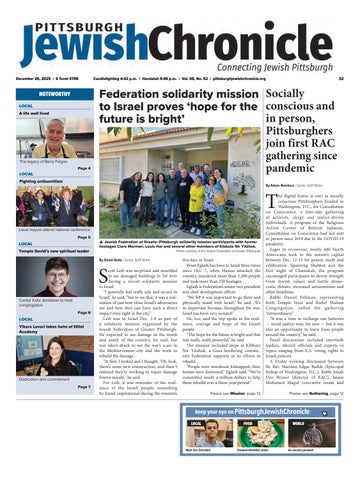
December 26, 2025 | 6 Tevet 5786
NOTEWORTHY LOCAL A life well lived
The legacy of Barry Faigan LOCAL
Page 4
Candlelighting 4:42 p.m. | Havdalah 5:46 p.m. | Vol. 68, No. 52 | pittsburghjewishchronicle.org
$2
Federation solidarity mission Socially to Israel proves ‘hope for the conscious and in person, future is bright’ Pittsburghers join first RAC gathering since pandemic
Fighting antisemitism
By Adam Reinherz | Senior Staff Writer
T five days in Israel. Brian Eglash has been to Israel three times since Oct. 7, when Hamas attacked the country, murdered more than 1,200 people and took more than 250 hostages. Eglash is Federation’s senior vice president and chief development officer. “We felt it was important to go there and physically stand with Israel,” he said. “It’s so important because, throughout the war, Israel has been very isolated.” He, too, said the trip spoke to the resilience, courage and hope of the Israeli people. “The hope for the future is bright and that was really, really powerful,” he said. The mission included stops at Kibbutz Nir Yitzhak, a Gaza-bordering community Federation supports in its efforts to rebuild. “People were murdered, kidnapped, their homes were destroyed,” Eglash said. “We’ve committed nearly a million dollars to help them rebuild over a three-year period.”
he digital hiatus is over as socially conscious Pittsburghers headed to Washington, D.C., for Consultation on Conscience, a four-day gathering of activists, clergy and justice-driven individuals. A program of the Religious Action Center of Reform Judaism, Consultation on Conscience had not met in person since 2019 due to the COVID-19 pandemic. Eager to reconvene, nearly 400 North Americans took to the nation’s capital between Dec. 12-15 for prayer, study and celebration. Spanning Shabbat and the first night of Chanukah, the program encouraged participants to derive strength from Jewish values and battle democratic threats, increased antisemitism and other hostilities. Rabbi Daniel Fellman, representing both Temple Sinai and Rodef Shalom Congregation, called the gathering “extraordinary.” “It was a time to recharge our batteries — social justice-wise, for sure — but it was also an opportunity to learn from people around the country,” he said. Panel discussions included interfaith leaders, elected officials and experts in topics ranging from U.S. voting rights to Israeli policies. A Friday evening discussion between Rt. Rev. Mariann Edgar Budde (Episcopal bishop of Washington, D.C.), Rabbi Jonah Dov Pesner (director of RAC), Imam Mohamed Magid (executive imam and
Please see Mission, page 12
Please see Gathering, page 12
Local mayors attend national conference Page 5
LOCAL Temple David’s new spiritual leader
p Jewish Federation of Greater Pittsburgh solidarity mission participants with former hostages Clara Morman, Louis Har and several other members of Kibbutz Nir Yitzhak. Photo courtesy of the Jewish Federation of Greater Pittsburgh By David Rullo | Senior Staff Writer
S Cantor Kalix Jacobson to lead congregation Page 6
LOCAL Yikara Levari takes helm of Hillel Academy
Dedication and commitment Page 7
cott Leib was surprised and unsettled to see damaged buildings in Tel Aviv during a recent solidarity mission to Israel. “I generally feel really safe and secure in Israel,” he said, “but to see that, it was a realization of just how close Israel’s adversaries are and how they can have such a direct impact even right in the city.” Leib was in Israel Dec. 3-8 as part of a solidarity mission organized by the Jewish Federation of Greater Pittsburgh. He expected to see damage in the north and south of the country, he said, but was taken aback to see the war’s scars in the Mediterranean city and the work to rebuild the damage. “At first, I looked and I thought, ‘Oh, look, there’s some new construction, and then I realized they’re working to repair damage from a missile,” he said. For Leib, it was reminder of the resilience of the Israeli people, something he found inspirational during the mission’s
keep your eye on PittsburghJewishChronicle LOCAL
Meet Zev Schreiber
FOOD
Smoked whitefish salad
WORLD
An ancient pendant
Appeal
GOOD NEWS. BAD NEWS. YOUR VIEWS.
The Pittsburgh Jewish Chronicle is proud to bring you stories that matter and stories that delight. What kinds of news and features do we publish? • • • • • • • • • • • • • • • • •
Quality news Award-winning news Objective news News you can trust News no one else has News that connects the entire Pittsburgh Jewish community Good news and bad news Happy news and sad news Local news National news Israel news World news People news — machers and everyone else Organization news — big and small Breaking news Trends and analysis Series of news articles on special topics
• • • • • • • • • • •
News about the Orthodox, Conservative, Reform, Reconstructionist, new movements and the unaffiliated News about the political left, the right and everything in between News about the old, the young and everyone in between Features — culture, food, health, history, travel, sports and more Calendar of events Information you need to know Opinions Letters to the editor Polls Life cycle events — births, b’nai mitzvah, graduations, engagements, weddings and anniversaries Obituaries To make a donation, please scan this QR code or use the form below.
2025 ANNUAL APPEAL – CONTRIBUTION FORM Kindly fill out this form, and return it with your check or credit card information. Donations can also be made by major credit card by logging on to the Pittsburgh Jewish Chronicle website, www.pittsburghjewishchronicle.org, and selecting DONATE. We thank you, and the Pittsburgh Jewish community thanks you!
☐ One-Time Gift of: ☐ $72 ☐ $180
☐ $360
☐ $720
☐ Other
☐ Monthly Gift of: ☐ $10 ☐ $18
☐ $30
☐ $60
☐ Other
Name as it appears on the card Card # Expiration Date (mm/yy)
Security Code
LIST MY NAME (OR COMPANY) as: ☐ Enclosed is my check to the Pittsburgh Jewish Chronicle for $
ADDRESS
☐ Charge my credit card the amount indicated below:
CITY, STATE, ZIP
Payment in full $
Visa
Recurring Monthly charge $ MC
Discover
HOME PHONE ☐
I/WE WISH TO REMAIN ANONYMOUS
CELL Contributions are tax deductible.
5915 Beacon St. | Pittsburgh, PA 15217 | 412.687.1000 | pittsburghjewishchronicle.org 2
DECEMBER 26, 2025
PITTSBURGH JEWISH CHRONICLE
PITTSBURGHJEWISHCHRONICLE.ORG
Headlines Why I joined the Pittsburgh Jewish Chronicle board Chronicle Board Member Karen Gal-Or
T
he Pittsburgh Jewish Chronicle is more than a newspaper. It is the institution that preserves, protects and amplifies our community’s voice at a moment when that voice is under assault from every direction. The gruesome shooting during the Chabad candle lighting on Bondi Beach in Sydney on Dec. 13 was a horrifying reminder of that reality. Within minutes of the news breaking, before the victims’ names were even known, the usual chorus online rushed not to mourn, but to blame the Jews. Social media accounts immediately called it a “false flag,” accusing Mossad and Israel of staging the attack. This is not an isolated incident; it is a pattern. Whenever tragedy strikes, there is a reflexive instinct among those who hate us to twist the story so that Jews — in Pittsburgh, in Israel, anywhere — become the villains. Lies spread at the speed of a repost. Conspiracy theories outpace facts. And too often, even traditional media, chasing clicks or bending to fashionable narratives, amplify these distortions instead of challenging them. In that environment, we need — more than ever — a place where the truth is recorded through our voice and our lens. The
Pittsburgh Jewish Chronicle is that place. I feel this urgently not only as a Jew in 2025, but as someone whose family story spans our people’s two defining traumas of the last 100 years. My grandparents survived the Holocaust. They watched most of their families betrayed by neighbors who happily gave them away to a murderous antisemitic regime that decided the world would be better without Jews. When the killing finally stopped, they were not welcomed home. They were displaced, stateless, haunted by profound loss. With the world largely indifferent to their future, they made their way to Israel as refugees and rebuilt their lives from nothing. Israel was not an abstraction to them; it was the place that gave them a future when every other door had been slammed shut. For a long time, I thought their experience was past tense — important, foundational, but safely consigned to history. Then came Oct. 7. On that day, my cousin was killed in Israel while trying to protect civilians from Hamas’ jihadist onslaught. Once again, our people were hunted in their homes and in their beds. Once again, the attackers justified their actions with a distorted ideology promising utopia only with the removal of the Jew. What has stayed with me is not only the loss itself, but the reaction that followed. People I knew celebrated my cousin’s killers online as “freedom fighters.” They called to “globalize the intifada” and repeated talking points that turned the murder of Jews into a morally righteous act.
Despite hearing my grandparents’ stories all my life, it was only in the aftermath of Oct. 7 that I fully understood how the Holocaust became possible. Those who kill Jews — and those who watch from the sidelines with approval or apathy — are not driven primarily by hate. Rather, they are convinced of their own righteousness. They believe Jews stand in the way of redemption, that if the world could only rid itself of Jews, or of the Jewish state, it would finally become pure, just, or free. This belief system erases empathy. It trains people to see us not as individuals with names, families and lives, but as legitimate targets. The Chronicle pushes back against this erasure and this inversion. It gives our community the power to tell our own story — truthfully, proudly and with the full complexity we deserve. Through careful reporting, it corrects misinformation, challenges lazy tropes, and provides the context so often missing from national coverage. It ensures that conversations about Jewish life and Jewish vulnerability include the voices of those actually living it — here, in Pittsburgh, where we have known both extraordinary resilience and staggering grief. At the same time, the Chronicle strengthens our internal bonds. It documents our congregations, schools, organizations, celebrations and milestones. It captures life cycle events and communal struggles. It highlights the breadth of Jewish life in Pittsburgh across denominations, ages, neighborhoods, backgrounds and viewpoints. In a world
determined to reduce us to hashtags or stereotypes, the Chronicle insists that we are a people, not a caricature. Most importantly, the Chronicle is creating an enduring record. Generations from now, when our grandchildren and great-grandchildren look back to understand what it meant to be Jewish in Pittsburgh during this era — in the long shadow of the Holocaust, after the Pittsburgh synagogue shooting, after Oct. 7, amid the disinformation and conspiracies that followed attacks from Sydney to Sderot — they will not be forced to rely on hostile social media feeds or distorted outside narratives. They will be able to turn to the Chronicle’s archives and see, in our own words, who we were, what we faced and how we responded. Our voice, as a Pittsburgh Jewish community, will have been preserved because of the exhaustive and remarkable work of the Chronicle’s reporters, editors and staff. They are a treasure — professional, committed and too often underappreciated. While others recycle outrage and amplify lies, they do the essential work of reporting, editing and fact-checking. That is why I am proud to be joining the board of the Chronicle. At a time when our story is being twisted, appropriated and attacked, the Chronicle is one of the few institutions ensuring that our truth is recorded. Supporting it is not only an act of communal responsibility; it is an act of self-respect and of faith in our future. PJC
Please consider making a gift to support local Jewish journalism | pittsburghjewishchronicle.org
5915 Beacon St., 5th Floor Pittsburgh, PA 15217
Main phone number: 412-687-1000
Subscriptions: 412-687-1000, ext. 2 SUBSCRIPTIONS subscriptions@pittsburghjewishchronicle.org 412-687-1000, ext. 2 TO ADVERTISE advertising@pittsburghjewishchronicle.org 412-687-1000, ext. 1 EDITORIAL DEPARTMENT Email: newsdesk@pittsburghjewishchronicle.org BOARD OF TRUSTEES Evan H. Stein, Chair Evan Indianer, Vice Chair Derek Smith, Treasurer Gayle R. Kraut, Secretary Gail Childs, Dan Droz, Malke Steinfeld Frank, Karen Galor, Seth Glick, Judith Kanal, Cátia Kossovsky, Charles Saul, Lynn Zelenski GENERAL COUNSEL Stuart R. Kaplan, Esq.
PITTSBURGHJEWISHCHRONICLE.ORG
Jim Busis, CEO and Publisher 412-228-4690 jbusis@pittsburghjewishchronicle.org EDITORIAL Toby Tabachnick, Editor 412-228-4577 ttabachnick@pittsburghjewishchronicle.org Adam Reinherz, Senior Staff Writer 412-687-1000 areinherz@pittsburghjewishchronicle.org David Rullo, Senior Staff Writer 412-687-1000 drullo@pittsburghjewishchronicle.org ADVERTISING Amy Weiss, Account Executive (412) 613-0697 aweiss@pittsburghjewishchronicle.org
PRODUCTION Jeni Mann Tough Production Manager Carl Weigel Art/Production Coordinator Subscriptions subscriptions@pittsburghjewishchronicle.org 412-687-1000, ext. 2 Published every Friday by the Pittsburgh Jewish Publication and Education Foundation 5915 Beacon St., 5th Floor Pittsburgh, PA 15217 Phone: 412-687-1000 POSTMASTER: Send address change to PITTSBURGH JEWISH CHRONICLE, 5915 BEACON ST., 5TH FLOOR PITTSBURGH, PA 15217 (PERIODICAL RATE POSTAGE PAID AT PITTSBURGH, PA AND AT ADDITIONAL MAILING OFFICES) USPS 582-740
PITTSBURGH JEWISH CHRONICLE
Manuscripts, letters, documents and photographs sent to the Pittsburgh Jewish Chronicle become the property of this publication, which is not responsible for the return or loss of such items. The Pittsburgh Jewish Chronicle does not endorse the goods or services advertised or covered in its pages and makes no representation to the kashrut of food products and services in said advertising or articles. The publisher is not liable for damages if, for any reason whatsoever, he fails to publish an advertisement or for any error in an advertisement. Acceptance of advertisers and of ad copy is subject to the publisher’s approval. The Pittsburgh Jewish Chronicle is not responsible if ads violate applicable laws and the advertiser will indemnify, hold harmless and defend the Pittsburgh Jewish Chronicle from all claims made by governmental agencies and consumers for any reason based on ads appearing in the Pittsburgh Jewish Chronicle.
DECEMBER 26, 2025
3
Headlines Barry Faigen, who had a love of family, community and helping others, dies at 71 — LOCAL — By Deborah Weisberg
G
rowing up, Robert Faigen and his brothers were accustomed to seeing their father, Barry Faigen, perform mitzvot as a way of life — whether it was helping a nonprofit with budgeting or delivering a home-cooked Shabbat meal. “I once asked him ‘Why do you do this?’ and my father talked about the importance of community,” Robert Faigen, of West Hempstead, New York, recalled. “He taught us that time is the most valuable thing we have and the most valuable thing we can give others.” Barry Faigen’s life of service is being remembered by family and countless friends and acquaintances as they mourn his death on Dec. 3, following a two-year battle with cancer. He was 71 and lived in Squirrel Hill. “Barry had a deep love for the Jewish people and the Pittsburgh community,” said Rabbi Chezky Rosenfeld, who spoke at Faigen’s funeral. “When something needed to be done, he would step up. You didn’t even have to ask.” The two men became close friends through Our Giving Kitchen, a nonprofit food distribution center Rosenfeld founded four years ago in Squirrel Hill. “Barry believed in our mission and from day one supported us in everything we did,” Rosenfeld said. “He’d roll up his sleeves and throw himself into whatever needed to be done — whether it was making meatballs or doing dishes.” Barry also was hands-on with the business side of things, Rosenfeld recalled. “We would have hard conversations about what was working or not. He wasn’t a ‘yes man.’ He’d lean into things and call out what he didn’t like. It came from a place of deep caring.” Robert Faigen described his father as warm, genuine, and a straight shooter: “He’d tell you what was for your own good even if you didn’t want to hear it because he genuinely cared. Everything he did, he did from the heart, not for
p Barry Faigan
Photo courtesy of Faigan family
recognition or glory.” Barry grew up in Greenfield and had his bar mitzvah at B’nai Emunoh. When it closed, he joined Poale Zedeck. He attended public schools and graduated from Penn State University as a CPA with a degree in accounting and finance — and a girlfriend, Debra Susan Eisman, a fellow Pittsburgher, whom he married in 1980. During his 30-year career, Barry worked as a chief financial officer for various companies, Robert Faigen said, and, after retiring, volunteered his expertise with Yeshiva Schools, Community Day School, Jewish Federation of Greater Pittsburgh, Chabad and other nonprofits. Jeffrey Finkelstein, president and CEO of the Jewish Federation of Greater Pittsburgh, remembers Faigen as an original, hardworking member of the organization’s audit committee. “He read everything ahead of time and came in with questions,” Finkelstein said. “And it came from a place of love.”
“He had a deep understanding not just of the numbers, but what they stood for, and he used his skills for the betterment of the community. He was deeply Orthodox, but he cared deeply about everyone in the Jewish community,” Finkelstein added. Barry was president of Hillel Academy twice. All three sons, including Robert’s twin Seth, and Matt, were educated at Hillel. “He didn’t care about fancy cars or clothes,” said Robert Faigen. “They weren’t a priority for him. He cared about Jewish education. That’s where the money went. Even after we graduated, he continued to give.” His children’s enrollment in Hillel also marked a deepening of Barry’s own immersion in Jewish studies, Robert Faigen said. “He was continuously educating himself, studying Torah on a daily basis. He finished the Talmud twice.” Debby Eisner, a retired audiologist, is also engaged in community service. She was named one of the Chronicle’s 2025
Volunteers of the Year. “My mom and dad were a team,” said Robert Faigen. “They were always doing nice things, even for strangers. My mom ran bingo at the Jewish Home (for the Aged) until it closed. She was always cooking meals for people who were sick.” Yet none of the outreach they performed took away from their parenting, Robert Faigen said, noting that his father shared his passion for golf with him and his brothers, and never missed their JCC basketball games, not only showing up, but acting fully engaged. “Every time I’d glance at him, he’d give me a nod,” he said. Barry was equally involved with his 12 grandchildren, ages 3 to 16, using FaceTime between in-person visits to stay in touch. “He was the most involved grandfather,” said Robert Faigen. “If one of our kids made an art project, he’d say ‘Let me see it’ on FaceTime. He’d want to know how a test went. He’d want to know the options for summer camp.” “He got to know the rabbi in my shul, and would give him a big hug every time he visited.” Barry’s warmth included strangers as well as people in his vast circle of friends, some of whom had joined him in weekly $1 poker games for 40 years. Barry modeled the importance of gratitude, Robert Faigen said, noting that he often would approach people in uniform, whether military or law enforcement, to thank them for their service. He made everyone in his orbit feel valued, Robert Faigen noted, as he described a visit the family had at the hospital near the end of his father’s life. “We had closed the door to visitors that last day when one of the nurses knocked and said someone named Darrell was coming to see us. It turned out that Darrell is the custodian at Poale Zedeck. He told us that my father would say hello to him every morning and ask how he was doing … how my father gave him time and got to know him.” PJC
Deborah Weisberg is a freelance writer living in Pittsburgh.
Jewish Federation board chair’s attacker sentenced — LOCAL —
J
ameel Huff was sentenced last month to a minimum of four and a maximum of 12 years in prison for assaulting Jan Levinson, board chair of the Jewish Federation of Greater Pittsburgh, in June 2024. An Aug. 21 plea deal followed a non-jury trial on charges of aggravated assault including attempts to cause serious bodily injury or to cause injury with extreme indifference.
Mamad/Adobe Stock
Huff, 26, attacked Levinson, then 73, in a brazen lunchtime attack on Fourth
Avenue, pursuing him and striking him in the head.
Huff was arrested shortly after the attack by Pittsburgh police, who reviewed surveillance footage. Levinson suffered a broken orbital bone, as well as cuts, from the attack. The attack was not motivated by antisemitism, Levinson said at the time, but instead was committed by “an individual with known mental health issues.” Huff will be credited with one year and 146 days for time served. PJC — David Rullo
www.pittsburghjewishchronicle.org 4
DECEMBER 26, 2025
PITTSBURGH JEWISH CHRONICLE
PITTSBURGHJEWISHCHRONICLE.ORG
Headlines Rankin, Sharpsburg mayors attend 2025 North American Mayors Summit Against Antisemitism — LOCAL — By David Rullo | Senior Staff Writer
R
ankin Mayor Joelisa McDonald experienced the type of protests Jews have been enduring since Oct. 7, 2023. McDonald was attending the Combat Antisemitism Movement’s 2025 North American Mayors Summit Against Antisemitism that took place in New Orleans earlier this month. It was while taking part in a second line — a celebratory parade associated with the city — that the mayors were confronted. “There were protesters along the way,” she said. “We walked about a mile and there was a lot of shouts and people calling us Zionists and things like that.” McDonald wasn’t ruffled by the interaction. She said she had spent time leading up to the summit thinking of everything that someone might call her. “I was already settled,” she said. “The protests didn’t shake me because I felt committed, like, ‘I’m here to combat hate in all forms, denounce hate in all forms.’” McDonald attended CAM’s conference with Sharpsburg Mayor Kayla Portis. Both are members of the African American
p Rankin Mayor Joelisa McDonald, right, and Sharpsburg Mayor Kayla Portis attend Combat Antisemitism Movevement’s 2025 North American Mayors Summit Against Antisemitism. Photo courtesy of Joelisa McDonald
Mayor’s Association, which has a partnership with the Combat Antisemitism Movement. It’s the second time McDonald has attended the conference through that partnership. But the mayor’s quest to find understanding and commonality with the Jewish community didn’t begin or end
with the summit. She visited Israel several years ago and was planning to take a second trip to the Jewish state, this time with CAM, earlier this year. That trip was canceled due to the war between Israel and Hamas. McDonald also took a 16-week introduction
to Judaism course to learn more about the Jewish faith and its history. The Combat Antisemitism Movement was created in 2019 and, according to its website, has partnerships with more than 850 interfaith organizations, influential decision-makers and a network of more than 5 million activists and 250 social media influencers. “We are a coalition dedicated to confronting antisemitism,” said Combat Antisemitism Movement Chief Government Affairs Officer Lisa Katz. “We work at every level, from grassroots engagement to strategic partnerships, and our Antisemitism Research Center tracks evolving trends and tactics so communities can respond with clarity and speed.” Katz, a former New Castle, New York, town councilmember, who later was elected to serve as town supervisor (a mayoralequivalent role), first encountered CAM as an elected official by attending its summits. “I left those convenings thinking this is serious, solutions-oriented work,” she said. “I remember saying, ‘I’m not running again. I want to dedicate my skills to Please see Mayors, page 13
JASON KUNZMAN, JCC PRESIDENT & CEO M E R R I S G R O F F,
JCC BOARD CHAIR
STAFF & BOARD OF THE JCC
PITTSBURGHJEWISHCHRONICLE.ORG
PITTSBURGH JEWISH CHRONICLE
DECEMBER 26, 2025
5
Headlines Cantor Kalix Jacobson named Temple David’s next spiritual leader — LOCAL — By David Rullo | Senior Staff Writer
C
antor Kalix Jacobson is getting ready to sing a new song. Jacobson, who has served at Temple Emanuel of South Hills since 2023, will assume the role of spiritual leader of Temple David in Monroeville in July, 2026. The appointment marks a first for both the Reform congregation — which has never had a cantor serve as its spiritual leader — and for Jacobson, who has not previously held a senior spiritual leadership role. Jacobson, who uses the pronoun they, said being raised in a family where every woman was a CEO instilled a strong expectation of leadership. In addition to being an ordained cantor, Jacobson has two business degrees — a bachelor’s in business administration and a master’s in Jewish nonprofit management. “I always dreamt about having my own congregation,” Jacobson said. “I’m a serial entrepreneur. And while being the Kol Bo (cantorial spiritual leader) of a congregation is not the same as being a CEO, there is some overlap.” The new role at Temple David is one that intrigued the cantor since learning of its availability. In fact, “I only looked at Temple David,” Jacobson said. Part of that interest is because of the congregation’s history. Not counting interim rabbis, Temple David’s spiritual leaders all have served a decade or more. “They’re not looking to hire someone for a short amount of time, which I deeply appreciate,” Jacobson said. The culture and leadership of the congregation is also something that interests Jacobson, who said it differs from Temple Emanuel, which is primarily staff-led. “It’s volunteer-led, but essentially they’re all full time, which I think is amazing,”
p Cantor Kalix Jacobson
the cantor said. “That’s something I really wanted.” Jacobson said the Monroeville congregation’s sense of volunteerism is akin to a congregation the cantor’s family founded in the 19th century in Little Rock, Arkansas. “I spend a lot of time at that congregation when I’m not on the bimah in Pittsburgh,” Jacobson said. “You see the congregants pouring in with their hand-baked challah and cookies and vegetable trays. That’s the environment I was looking for.” Jacobson, however, was attracted to Temple David by more than a culture of volunteerism and a sense of nostalgia. The 175-unit member congregation, they said, is looking to build on its history. “Temple David is looking for innovation,” Jacobson said. “They’re looking to try something different. They are a fabulous congregation, and they have told me they are looking to start expanding and doing new things. I’m full of ideas and they seem to only encourage them. It’s very exciting.”
PLAN AHEAD:
Protect Yourself and Your Loved Ones – Your Way We provide expert help with long term care planning, powers of attorney, wills, trusts and special needs. We help you implement legal and tax strategies to protect your wealth during your life and afterwards. mhm@ahmpc.com 4927 William Flinn Highway Allison Park, Pennsylvania 15101 We make house calls!
Photo courtesy of Cantor Kalix Jacobson
Jacobson believes Temple David is primed to begin attracting unaffiliated members of the community, including those from city neighborhoods like Squirrel Hill willing to make the short commute. The cantor presents an alternative to much of the senior Jewish clergy in the city, who are primarily male. Jacobson was the first cantor at Temple Emanuel in 50 years and was the first non-binary cantor to serve any congregation in Pittsburgh. Their role at Temple David will be another first. “There’s never been a non-binary cantor that’s also been a [senior] spiritual leader. That’s a big deal,” Jacobson said. Erika Schmitt served on Temple David’s search committee. She said the process of searching for a permanent spiritual leader began in 2023, after the congregation’s previous rabbi, Barbara Symons, announced she would be leaving. “We struggled to find the right match in the first and second year of searching,” Schmitt said. While the congregation endeavored to find a permanent spiritual leader, Rabbi Robert Jacobs served as interim rabbi. Temple David first sought a rabbi, but changed its bylaws to allow a cantor serve as its spiritual leader after consulting with both the Central Conference of American Rabbis — the principal organization of Reform rabbis in the United States and Canada — and the American Conference of Cantors — the professional organization that supports cantors in the Reform movement, explained Jay Goodman, Temple David’s president. Goodman said the role of cantors is different than what it was 25 or 30 years ago, and there is a large overlap in what they learn compared to rabbis. The congregation became comfortable with the idea of a cantor serving as its spiritual leader when its members realized a cantor would be able to perform pastoral
care and other “traditional” rabbinic services, Schmitt said. After the congregation got comfortable with the idea of a cantor serving as spiritual leader, the next discussion was about identity, something Schmitt said isn’t much of an issue. “While there are a few members that addressed Kalix being non-binary, most people addressed Kalix’s energy and their ability to take us into the future and their ability to connect with adults and children,” she said. The fact that Jacobson is local allowed Temple David’s members to spend time with the cantor, explained search committee member Mark White. He said that in addition to their voice, the cantor’s personality was a winning factor. “They are very pleasant and very warm,” he said. Jacobson plans to spend their first year at Temple David meeting with all its members, learning about the congregation and what their hopes and goals are for the future. “I’m going to use some of my business skills and have pastoral conversations and ensure we have the data we need to run the congregation efficiently,” Jacobson said. “I also want to bring us into the post-pandemic era.” That means looking at things like online services, which are only available on Zoom. Jacobson would like to see that updated to include platforms like YouTube and Facebook. Goodman said the future will hold a combination of new ideas and traditional elements — like a continuation of Friday and Saturday Shabbat services, the congregation’s choir and a once-a-month service with volunteer song leaders, as well as High Holiday services and the congregation’s religious school, which Jacobson will now lead. Jacobson will continue to live in the South Hills with their partner, Mickey Benson, who works as a member of the AgeWell team at the South Hills JCC. The two plan to marry in 2027. Though excited about the future, Jacobson expressed deep appreciation for time spent at Temple Emanuel. “It was a hard decision and not something I made lightly,” Jacobson said. “I have a really deep love for the Temple Emanuel community and all it’s done for me for the last 2 ½ years. I’ve made a family there. Even though I’m leaving, people have been nothing but the nicest. It confirms I made the right choice coming to Temple Emanuel in the first place.” The future, though, is calling, and it’s one Jacobson hopes will provide prolonged stability and growth. “I’m really hopeful that I’m at Temple David for a long time,” they said. PJC David Rullo can be reached at drullo@ pittsburghjewishchronicle.org.
www.pittsburghjewishchronicle.org 6
DECEMBER 26, 2025
PITTSBURGH JEWISH CHRONICLE
PITTSBURGHJEWISHCHRONICLE.ORG
Headlines Rooted in service: Yikara Levari’s two-decade path to leading Hillel Academy — LOCAL — By Adam Reinherz | Senior Staff Writer
I
t’s not quite a Horatio Alger tale, but Yikara Levari’s rise to becoming Hillel Academy of Pittsburgh’s principal is worth retelling. Announced weeks ago as the Jewish day school’s newest educational leader, Levari’s institutional service began 20 years ago as a part-time supervisor for morning prayers. Levari and her husband had just moved to Pittsburgh for his internal medicine residency. Then pregnant with her first child, Levari said she thought about attending the University of Pittsburgh for a master’s in social work but decided the timing wasn’t right. She’d previously considered the profession. Before getting married, and spending three years teaching in Israel, Levari was accepted to Columbia University’s School of Social Work. But with a baby on the way, and a new life ahead of her in Pittsburgh, Levari decided to pause again. Her plan changed on a Shabbat morning at Shaare Torah Congregation when she was asked about subbing at Hillel Academy. She agreed, only to discover the position was for physical education. “I was eight months pregnant, and I’m not a gym teacher, so I said, ‘No, but I really love teaching.’” During her time in Israel, Levari regularly taught at seminaries. On trips to the U.S., she routinely lectured at synagogues and partnered with individuals of all ages and abilities to study Jewish texts. Levari eventually asked to deliver a model lesson at Hillel Academy. School administrators welcomed her interest. Shortly thereafter, she entered a ninth grade girls’ classroom. “I remember that it was great. I loved it. I loved prepping for it,” she said. Levari delivered her model lesson in May 2005. The school year was virtually over. She was told no guaranteed positions existed for the fall. Levari delivered her baby in June. Her husband began his residency. “Things were busy and I didn’t think anything had worked out at Hillel Academy, but I got a call when the school year started asking if I would come in and supervise davening in the morning,” she recalled. Levari agreed, arranged childcare with her mother-in-law and began supervising morning prayers for middle school students. After the physics teacher quit a few weeks later and a Jewish studies teacher with a science background became the physics teacher, there was an opening for a 7th grade Jewish studies instructor. Administrators asked Levari to take the role. She acquiesced. Months later, a 10th grade teacher went on maternity leave, which created another vacancy. Administrators asked Levari to fill the gap. She agreed again. For the next couple of years, she taught two or three classes in the middle school and high school, and “loved it,” she said. Levari’s family grew, as did her connection to the school. Through various endeavors, she found new ways of contributing to students’ growth. When the student activities coordinator moved, Levari quickly adopted the role. “I laugh, and my high school friends laugh about that, because I was never the one who liked games and programs,” she said. Whether it was planning Chanukah parties, Rosh Chodesh activities, weekend retreats or the biennial high school production, Levari PITTSBURGHJEWISHCHRONICLE.ORG
p Yikara Levari is Hillel Academy of Pittsburgh’s principal and educational director. Photo courtesy of Yikara Levari
continued connecting with young learners and bolstering student affairs. An educational consultant working with the school at the time convinced her to reimagine her position. She wasn’t simply planning activities, she remembered him saying; she had become the dean of students. Even without the title, Levari held the role for years. Growth continued. When the principal of the girls high school went on maternity leave, several individuals covered her duties. Levari managed logistics. “It was this puzzle, from start to finish, where everything has to work in sync,” she said. Levari oversaw scheduling and continued serving as a liaison between students, parents and the school. With the encouragement of local educational leaders, Levari began a master’s in educational administration at Duquesne University. “I loved it,” she said. “I loved going back to school and learning.” Levari completed her degree in 2012. After Rabbi Avrumi Sacks, Hillel Academy’s then-principal, left, her role increased again when she became assistant principal to the girls high school and middle school. Beyond overseeing the entire school’s schedule, she was routinely asked by Hillel Academy’s new principal Rabbi Sam Weinberg and CEO Dan Kraut to weigh-in on school-wide decisions. “I felt like they always included me, they respected me, but didn’t take advantage of me,” she said. “I loved working with them.” When Weinberg announced his retirement last spring, Levari was asked to become interim principal. “I didn’t know what I was saying yes to. I didn’t know what it meant. But I just did it. And every step of the way, Danny [Kraut] has helped me, and people have supported me,” she said. Weeks ago, the interim title was dropped and Levari was announced as the school’s new principal and educational director. “Mrs. Levari’s more than 20 years of service to Hillel Academy as a teacher, administrator and parent, together with her outstanding leadership over the past nine months as Interim Principal and Educational Director, have shown us that she embodies all the qualities we sought for this role,” Kraut wrote in an email. “She has demonstrated clear educational vision across all divisions, a deep commitment to Torah and Orthodox values and the ability to build a warm, inclusive culture that reflects the diversity of our community.” Levari, 43, is well aware of her role. Fewer than 22% of Orthodox Jewish day schools “have women as their senior leader,” according to Prizmah, a network of North American Jewish day schools and yeshivas. While her journey offers a model for aspiring leaders, Levari hopes people
p Yikara Levari joins Hillel Academy of Pittsburgh students at the AIPAC Conference. Photo courtesy of Yikara Levari
understand she was chosen and has received support from the school’s executive board, “because they saw what I was doing and saw that I’m the best person for the job.” Though her title has changed, her commitments remain the same, she said. Before accepting the role of principal, she told colleagues she will remain consistent, flexible and communicative, while promoting a love of children and the school’s values. These traits have served her throughout her two-decade tenure at Hillel Academy and will be the means for collective growth, she said. “One of my goals is to help kids on the path that they’re on,” she said. “I don’t try to push any one agenda. I don’t try to push any one plan. I try to embrace where kids are and then help them grow further. That’s what Hillel Academy
PITTSBURGH JEWISH CHRONICLE
did for me, and that’s what I try to do.” Aware of the cliché, Levari credited her own teachers, “who opened their houses, opened their hearts, opened their everything to me,” with demonstrating an educational paradigm. Now 20 years past that model lesson, Levari noted she never imagined a part-time davening supervisor position would lead to principal. She said she’s proud of her professional journey, and what it says not only about her but this community. “If you’re committed to something and you love what you’re doing — even if it’s the smallest of jobs — you can be successful,” she said. “That’s what got me where I am.” PJC Adam Reinherz can be reached at areinherz@pittsburghjewishchronicle.org.
DECEMBER 26, 2025
7
Calendar Submit calendar items on the Chronicle’s website, pittsburghjewishchronicle.org. Submissions also will be included in print. Events will run in the print edition beginning one month prior to the date as space allows. The deadline for submissions is Friday, noon. q FRIDAY, DEC. 26–THURSDAY, JAN. 8 Chabad of the South Hills is collecting new toys for hospitalized and underprivileged children for its Chanukah Toy Drive. For more information, call 929-327-4837 or email RabbiMendel@ Chabadsh.com. q SUNDAYS, DEC. 28–JULY 26 Join Chabad of Squirrel Hill for its Men’s Tefillin Club. Services and tefillin are followed by a delicious breakfast and engaging discussions on current events. 8:30 a.m. 1700 Beechwood Blvd. chabadpgh.com. Join a lay-led online Parashah study group to discuss the weekly Torah portion. No Hebrew knowledge needed. The goal is to build community while deepening understanding of the text. 8:30 p.m. For more information, visit bethshalompgh.org/online-parashah.
q MONDAYS, DEC. 29–JULY 27 Join Congregation Beth Shalom for a weekly Talmud study. 9:15 a.m. For more information, visit bethshalompgh.org.
relevant and meaningful with Rabbi Mark Goodman in this weekly Parashah Discussion: Life & Text. 2:15 p.m. For more information, visit bethshalompgh. org/life-text.
Join Temple Sinai for an evening of mahjong every Monday (except holidays). Whether you are just starting out or have years of experience, you are sure to enjoy the camaraderie and good times as you make new friends or cherish moments with long-term pals. All are welcome. Winners will be awarded Giant Eagle gift cards. All players should have their own mahjong cards. Contact Susan Cohen at susan_k_cohen@yahoo.com if you have questions. $5. templesinaipgh.org.
Join Chabad of the South Hills for Baby Loves Shabbat, music and movement for ages 0 to 3. Challah making and Shabbat songs. 3:45 p.m. 1701 Bower Hill Road. chabadsh.com.
q TUESDAYS, DEC. 30–JUNE 30 Join Beth El’s Rabbi Alex Greenbaum and his Bible/ Talmud Adult Education class for a thoughtprovoking weekly session of Bible and Talmudic study. This program is available both in person and virtually. Call the office at 412-561-1168 to receive the Zoom link or to make an in-person reservation. 10:30 a.m. 1900 Cochran Rd. bethelcong.org. q WEDNESDAY, DEC. 31 Bring the parashah alive and make it personally
q SUNDAYS, JAN. 4–FEB. 1 Jewish Art Camp: Fun Jewish learning through the arts for ages 0 to Grade 3. Mommy and Me (0 to 3-year-olds and their moms), Mini Makers (4 to 5-year-olds), Master Makers (Grades 1-3). Ages 0 to 5: $40/semester; Grades 1-3: $65/ semester. 10:30 a.m. 1700 Beechwood Blvd. chabadpgh.com/art. q THURSDAYS, JAN. 8, FEB. 5 Join Rabbi Amy Greenbaum and the Beth El community for the all-virtual Beth El’s Virtual Hope and Healing Program on the first Thursday of the month. This is a safe space to chant, breathe, pray for healing and seek peace. Feel free to keep your camera off and just listen. Call the office at 412-561-1168 to receive
the Zoom link. 5:30 p.m. Free. bethelcong.org. q MONDAY, JAN. 12 Make your own resin tzedakah box and enjoy light refreshments with Chabad of Squirrel Hill at Art and Soul. 7 p.m. $45. 1700 Beechwood Blvd. chabadpgh.com/resin. q TUESDAY, JAN. 13 Holocaust Center of Pittsburgh ambassador Debbie Stueber tells the story of parents, both Holocaust survivors as part of the Generation outreach program. 10 a.m. Free. Faith United Methodist Church, 261 West Chapel Ridge Road, Fox Chapel. q SATURDAY, FEB. 7 Join Congregation Beth Shalom for Clues and Schmooze (with some booze), a fun trivia event, including an open bar and snacks. There will be a 50/50 raffle, so bring cash to participate. Trivia will be played with teams of three to six. Bring your own team or be matched up at the door. Must be 21 or older to participate. 7 p.m. $30. 5915 Beacon St. bethshalompgh.org/cluesand-schmooze-2026. PJC
Join the Chronicle Book Club!
T
he Pittsburgh Jewish Chronicle invites you to join the Chronicle Book Club for its Jan. 18 discussion of “Unveiled,” by Jonathan Harounoff. The author will join us for the meeting. “‘Unveiled’ takes us inside the ‘Woman, Life, Freedom’ movement, sparked by the slaying of a young woman for wearing a loose hijab, in what became the most serious challenge the [Iranian] regime has faced in forty-six years. Harounoff has given us a nonfiction drama replete with heroines and villains, one that is sure to captivate readers.” –Peter Kann, Pulitzer Prize-winning foreign correspondent and former publisher, The Wall Street Journal.
Email: Contact us at drullo@pittsburghjewishchronicle.org, and write “Chronicle Book Club” in the subject line. We will send you a Zoom link for the discussion meeting. PJC — Toby Tabachnick
Your hosts
Toby Tabachnick, Chronicle editor David Rullo, Chronicle senior staff writer
How it works
We will meet on Zoom on Sunday, Jan. 18, at 1 p.m.
What to do
Buy: “Unveiled.” It is available from online retailers, including Amazon and Barnes & Noble. It is also available through the Carnegie Library system.
www.pittsburghjewishchronicle.org
8
DECEMBER 26, 2025
PITTSBURGH JEWISH CHRONICLE
PITTSBURGHJEWISHCHRONICLE.ORG
Headlines Familiar face joins JCC in quest to strengthen adolescent engagement and bolster Diller program — LOCAL — By Adam Reinherz | Senior Staff Writer
S
ome see how the sausage is made and choose to renounce meat. Others witness the process and elect to improve operations. Nearly seven years after participating in Diller Teen Fellows through the Jewish Community Center of Greater Pittsburgh, Squirrel Hill resident Zev Schreiber has returned to lead the program. Guiding a cohort of adolescents through a yearlong Jewish leadership experience wasn’t necessarily Schreiber’s plan after graduating Case Western Reserve University in May. In fact, there was some “self-doubt” regarding his ability to manage such a serious task, he told the Chronicle. Schreiber, 23, formerly participated in the Diller Teen experience. But seven years had passed and the reality of Jewish life for teens felt different now, he said. Equipped with a psychology and sociology degree, Schreiber was considering other professional opportunities. However, a series of conversations with a Jewish professional altered his trajectory. Months before he graduated college, Schreiber spoke with Rebecca Kahn, then-director of teen leadership at the JCC. She needed a student intern — someone who would accompany teens to Israel for three weeks in the summer and aid other program aspects. Schreiber was a member of Pittsburgh Diller Cohort 10 — the program is now on Cohort 17 — and understood the responsibilities involved. He agreed and began preparing for the pivotal summer trip. Often billed as Diller’s capstone experience, Israel Summer Seminar enables fellows from 32 participating communities to congregate in the Jewish state. When last summer’s trip was canceled due to the Iran-Israel war, Schreiber pivoted with the program and accompanied Pittsburgh’s cohort to Washington, D.C., for a relocated seminar. He observed Diller’s operations and spoke with Kahn again before she moved to Massachusetts. “We had a heart-to-heart,” he said. “A couple weeks later, I ended up applying for the position. She convinced me, you could say.” Schreiber is now months into his tenure as JCC’s director of teen leadership. Apart from overseeing Diller — a program supported by the Jewish Federation of Greater Pittsburgh — he’s part of a JCC team who manage other teen
p Zev Schreiber sits in a teen-centered workspace inside the Jewish Community Center of Greater Pittsburgh.
p A dated photo of Zev Schreiber, left, and Israeli peers participating in the Diller Teen Fellows program. Photo courtesy of Zev Schreiber
activities, according to Rachael Speck, JCC’s chief program and innovation officer. Whether it’s Diller or other teen-centered endeavors, those working with the demographic understand “it’s been a challenging few years for the Jewish community,” Speck said. COVID reduced gatherings to virtual meetups and prevented Pittsburgh teens from traveling to Israel for summer seminars in 2020 or 2021. Once the pandemic ended, “we definitely found ourselves in a time of rebuilding,” Speck said. Although the JCC redoubled efforts to serve constituents, the commitment to growth faced further adversity. Following Hamas’ Oct. 7, 2023, attack and the resulting Israel-Hamas war, changes were again made to the Israel Summer Seminar, as fellows spent summer 2024 in Spain and 2025 in Washington, D.C. Meaningful alternate experiences were arranged by Diller International, but the “impact” was noticeable, Speck said. Recognizing the backdrop and current pressures on teens is essential, Speck and Schreiber told the Chronicle. “The program has always been grounded in
a strong sense of Jewish peoplehood — particularly in building that connection with our partnership city, Karmiel/Misgav — but over the past few years the program structure has really evolved,” Speck said. Significant emphasis is placed on “empowering teens” and cultivating an opportunity to explore and create a “meaningful relationship with Israel.” Growing, gaining awareness and developing new ties takes time. At this point in the year, Schreiber said last week, teens are focused on translating their Jewish identities into leadership skills. It’s all a lead-up to the annual Jewish Community Mifgash, where teens from the Karmiel and Misgav region will travel to Pittsburgh for 10 days in March for home hospitality and joint activities with the Pittsburgh cohort. Seven years removed from his own participation in the Jewish Community Mifgash, Schreiber is still in touch with the Israeli teens who stayed in his house and became his friends during the experience. Pointing to a dated photo of him alongside two Israeli teens, Schreiber said a “bond” develops when people get the chance to sit, talk
Photo by Adam Reinherz
and watch each other’s lives. Diller is predicated on building Jewish identity and a connection to Israel, and the peerto-peer exchange is a key ingredient, Speck said. Though she touted Diller for offering “it all,” the Jewish staffer noted there’s no one program that “fits every single teenager.” Best practices necessitate “meeting teens where they are at.” Determining that place is imperative, she continued. “It’s important to ask teens what’s going to get them engaged, and what we can do as educators and leaders in the community to get them engaged. That’s a difficult thing to do, but it’s incredibly important.” Since joining the JCC’s staff those thoughts keep swirling in Schreiber’s mind. “What gets me excited about my job isn’t just the position I have as Diller coordinator — and working on these mifgashim, or monthly meetings with the fellows or planning workshops and Shabbatons — it’s the idea of thinking about Jewish teens in Pittsburgh and what is going to get them engaged,” he said. PJC Adam Reinherz can be reached at areinherz@pittsburghjewishchronicle.org.
Christmas, made possible by Jewish Pittsburgh —HISTORY — By Eric Lidji | Special to the Chronicle
H
ere’s how Christmas works, as I understand it. At some point after Thanksgiving, although potentially as early as July, Santa Claus makes a tour of American shopping centers to hold negotiations with children. The children want gifts. Santa wants proof of good behavior. From these private negotiations, Santa makes two lists, one of “naughty” children and one of “nice” children. On the afternoon of Dec. 24, Santa sets forth upon a one-night global voyage. The nice children get gifts. The naughty children PITTSBURGHJEWISHCHRONICLE.ORG
p In its heyday in the mid-1960s, Papercraft built a massive factory at the new RIDC Park in O’Hara Township filled with specialized equipment for managing the entire production of wrapping paper. Photo courtesy of Rauh Jewish Archives
get coal. As an 11th-hour tactic, some children will prepare milk and cookies for Santa to enjoy, hoping to become “nice.”
This system was arduous but straightforward until the mid-20th century. Then, with skyrocketing global population, far-flung
PITTSBURGH JEWISH CHRONICLE
settlement, machine production of toys, mass media advertising and a new consumer culture, Santa’s job became overwhelming. And so at some point in the mid-1960s, Santa Claus partnered with two Jewishowned businesses in Pittsburgh to ensure the entire process would run more smoothly. A big component of the Christmas operation is wrapping paper. Each of these millions of gifts being delivered all over the world must be properly sheathed. By the late 1960s, the largest giftwrapping manufacturer in the world was Papercraft Corporation. Joseph Katz had immigrated to Pittsburgh from Odessa as a child. He learned to set type while volunteering in the printing Please see Christmas, page 13
DECEMBER 26, 2025
9
Headlines City’s incoming COO looks to Pittsburgh’s ‘new chapter’ and fostering greater engagement — LOCAL — By Adam Reinherz | Senior Staff Writer
S
haron Werner is responsible for overseeing operations in Mayor-elect Corey O’Connor’s administration. Along with “keeping the trains running,” Werner has another goal. Speaking with the Chronicle, the Squirrel Hill resident and Pittsburgh’s soon-to-be chief operating officer said she’d like to inspire younger residents to consider public service: “I hope to some degree that’s going to be one of my professional legacies.” Involvement is a critical element of communal betterment, she believes. It’s a lesson Werner, 48, has learned from decades in the public and private sectors. After graduating from Stanford Law School, the former State College resident worked as an attorney in New York City and later chief of staff to Rep. Jason Altmire (D-Pa.). Before relocating to Pittsburgh eight years ago, she served in the Obama administration as chief of staff to U.S. Attorneys General Eric Holder and Loretta Lynch. Since 2017, Werner has held senior positions at PNC Bank, including chief counsel and COO of the bank’s Corporate Responsibility Group. Werner’s professional posts have given her certain understandings. For instance, departments within larger organizations need to work together, she said. “When people are siloed, we can’t get big things done.” Cooperation for the greater good is critical; and the work isn’t only effectuated internally, she explained. During her time at PNC, Werner has observed partnerships between the city and corporate and foundation communities. Helping continue a process where stakeholders contribute to Pittsburgh’s growth is critical, she said. O’Connor touted Werner’s skills and experience in a statement: “She has led operations of large organizations, has extensive experience with federal-level policy and has deep ties across the Pittsburgh community to ensure every resident has a government that works for them.” “We’re building a city government that strengthens our neighborhoods with improved delivery of services, and Sharon Werner has a unique and impressive combination of private, public, legal and
p Sharon Werner with Attorney General Loretta Lynch and Rep. Shomari Figures
Photo courtesy of Sharon Werner
“We’re building a city government that strengthens our neighborhoods with improved delivery of services, and Sharon Werner has a unique and impressive combination of private, public, legal and community service experience necessary to oversee the effective operations of those services.” – MAYOR-ELECT COREY O’CONNOR community service experience necessary to oversee the effective operations of those services,” he said. Werner appreciates the support and says she looks forward to aiding the new administration. “It is an amazing group of people, and I do believe that everyone is there for the right reason,” Werner said. The commitment to bettering Pittsburgh “comes from the top,” she continued. “I think Mayor-elect O’Connor has all the right intentions, and that trickles down to the rest of the team.” Werner described a “new chapter that’s coming” for Pittsburgh and hopes residents are excited and ready to work toward a
greater future. Whether it’s through a career in public service or volunteering with local organizations — Werner has served on the boards of the Jewish Community Center of Greater Pittsburgh and Jewish Federation of Greater Pittsburgh — there are ways to bolster one’s surroundings while fostering civic engagement, she noted. Being the city’s chief operating officer enables countless involvements with Pittsburgh life. And although implementing a strategic vision engenders change, Werner’s desire to be a catalyst may make the biggest difference. “I think the more people that go into government and just try to do good for
their communities, and to try to actually make a difference on the ground for people, is one way that we can help show folks that government’s not all just about elections and politics,” she said. “There are folks that work in government just trying to make their city, or state or even the national landscape better for all people.” Conveying that lesson may prompt understanding. Or more importantly, she noted, it can lead to another generation asking, “how they can get more involved.” PJC Adam Reinherz can be reached at areinherz@pittsburghjewishchronicle.org.
STORIES COME TO life HERE. Connect with Pittsburgh Jewish Chronicle. In your mailbox or all the time online at pittsburghjewishchronicle.org 5915 Beacon Street, 5th Floor, Pittsburgh, PA 15217 10
DECEMBER 26, 2025
PITTSBURGH JEWISH CHRONICLE
PITTSBURGHJEWISHCHRONICLE.ORG
Headlines — WORLD — Toronto men, including 1 linked to ISIS, charged with targeting Jewish women for assault
Three Toronto men were arrested by Canadian police on Dec. 19 for allegedly attempting kidnappings targeting Jews and women, JTA reported. Waleed Khan, 26, Osman Azizov, 18, and Fahad Sadaat, 19, of Toronto each face over a dozen charges, including two counts of sexual assault with a weapon and two counts of attempted kidnapping with a firearm, according to the Toronto Police Service. Khan was also separately charged with multiple terrorism offenses, including providing property to fund ISIS and conspiring to commit murder on behalf of a terrorist group, according to the Royal Canadian Mounted Police. The arrests stemmed from an investigation into two failed kidnappings allegedly perpetrated by the men several months ago. The attempted kidnappings stemmed in part from “hate-motivated extremism,” according to Toronto police, who said they found evidence in the suspects’ homes that they were “particularly targeting women and members of the Jewish community.” The arrests were welcomed by Noah Shack, the CEO of Canada’s Center for Israel and Jewish Affairs, who warned that the recent terror attack in Sydney showed that “we are one intelligence failure away from a devastating loss of life.” “It is alarming that multiple Islamic Staterelated terrorist plots have been uncovered over the past two years in Canada,” Shack said in a statement posted on X. “This goes far beyond the safety of any one group. It is a matter of national security and public safety. There is
a ticking time bomb in our country that our leaders must confront before it’s too late.”
StopAntisemitism names Tucker Carlson ‘Antisemite of the Year’ as 2024 winner Candace Owens ramps up anti-Jewish rhetoric
The activist group StopAntisemitism has awarded the conservative personality Tucker Carlson its ignominious honor of “Antisemite of the Year,” citing his frequent invocation of classic antisemitic stereotypes, JTA reported. The announcement comes as Carlson sits at the center of controversy on the American right about whether extremists should be welcomed in the Republican Party. It also marks the second year in a row that StopAntisemitism has selected a right-wing figure for its accolade, after years of awarding the mantle to mostly left-wing figures. “Carlson mainstreams antisemitism by platforming and praising Holocaust revisionists and Nazi apologists, while hiding behind irony and plausible deniability,” the group said in a statement. “By legitimizing extremist voices and weaponizing conspiratorial imagery at massive scale, he has helped drag antisemitic ideas back into the mainstream.” A watchdog presence with more than 300,000 followers on X, StopAntisemitism regularly mobilizes against activists and social media posts. The group has faced criticism for what some perceive as an inordinate focus on Muslim personalities, pro-Palestinian actions and non-prominent individuals. Its defenders deny that, pointing out that StopAntisemitism also regularly spotlights neo-Nazis and Holocaust deniers on the right. Its finalists for Antisemite of the Year included pro-Palestinian celebrities Ms. Rachel, Cynthia Nixon and Marcia Cross; mixed-martial-arts
Today in Israeli History — ISRAEL — Items are provided by the Center for Israel Education (israeled.org), where you can find more details.
Dec. 26, 1968 — El Al flight is attacked in Athens
Two members of the Popular Front for the Liberation of Palestine attack an El Al flight during a layover in Athens between Tel Aviv and New York. Israeli engineer Leon Shirdan is killed.
Dec. 27, 1925 — Politician Moshe Arens is born
Moshe Arens, a Likud member who served as defense minister three times and foreign minister once, is born in Lithuania. He immigrates to the U.S. in 1939, fights in World War II and makes aliyah in 1948.
Dec. 28, 1907 — Linguist Ze’ev Ben-Chaim is born Ze’ev Ben-Chaim is born in Galicia. He is regarded as one of the greatest scholars of Hebrew and Aramaic. His research includes a Second Temple-era Samaritan tradition of reading Hebrew texts.
p Ze’ev Ben-Chaim served as the second president of the Academy of the Hebrew Language.
Hebrew Language Academy
PITTSBURGHJEWISHCHRONICLE.ORG
Dec. 29, 1946 — Irgun flogs British soldiers
athlete and Holocaust denier Bryce Mitchell; two personalities associated with the leftwing network The Young Turks; and social media personalities on both the far left (Guy Christensen) and far right (Stew Peters). Carlson received the accolade on Dec. 21, at the end of a weekend in which he was a keynote speaker at the convention of Turning Point USA, the young-conservatives group founded by Charlie Kirk, who was assassinated this fall. In its announcement, StopAntisemitism noted Carlson’s speech at Kirk’s memorial service, in which he described the murder of Jesus in a way that both his critics and fans interpreted as implying that Jews or Israelis had been behind Kirk’s assassination.
Ben Shapiro denounces Tucker Carlson at Heritage, urges policing of conservative movement
Ben Shapiro walked onto a Heritage Foundation stage on Dec. 17 and used it to draw a line against Tucker Carlson and a strain of conservatism Shapiro warned is drifting toward conspiracy theories and antisemitism, JTA reported. For a talk that lasted about an hour, Shapiro, one of the most prominent Jewish voices on the American right, denounced Carlson by name, arguing that the former Fox News host no longer belongs inside the conservative movement and urging the institution hosting him to enforce what he called “ideological border control.” “A conservatism that treats Tucker Carlson as a thought leader is no conservatism,” Shapiro said. “If conservatives do not stand up and draw lines, conservatism and the dream of America itself will cease to exist.” The speech was as notable for its venue as for its content. It was hosted by Kevin Roberts, Heritage’s president, who has come under fire
Prime Minister Yitzhak Shamir removes Science Minister Ezer Weizman from the cabinet after a c c u s i ng him of meeting with a senior PLO official in 1989 and corresponding with PLO head Yasser Arafat.
412-421-1015 412-421-4450 FAX 412-421-4451
PRICES EFFECTIVE SUNDAY, DECEMBER 28 – FRIDAY, JANUARY 2, 2026 Candle Lighting Time Friday, December 26, 2025 • 4:42 p.m. MEAT
WINE SPECIALS
HOURS
CHUCK ROAST
BARKAN RESERVE MERLOT WINE
See Our Selection of Sparkling Wines for New Year’s!
13
$
.79 .6
LB
18.99
$
750 ML
CHUCK STEAK
13
$
p Science Minister Ezer Weizman addresses the Knesset in November 1990.
By Ya’acov Sa’ar, Israeli Government Press Office, CC BY-SA 3.0
Dec. 31, 1898 — Israel Museum founder is born
Eliyahu Dobkin, a Declaration of Independence signer who founds the Israel Museum in 1965, is born in Belarus. He immigrates to Palestine in 1932 and works with the Jewish Agency’s immigration department for decades.
Jan. 1, 1837 — Earthquake devastates Safed
An earthquake estimated at 6.8 on the Richter scale starts a landslide that kills thousands and causes extensive damage in the Jewish and Arab sections of the Upper Galilee mountain city of Safed (Tzfat). PJC
— Compiled by Jarrad Saffren
1916 MURRAY AVE. PITTSBURGH, PA 15217
Angry that the British government administered 18 lashes to Irgun member Benjamin Kimkhi, the Irgun abducts British soldiers in Netanya, Rishon LeZion and Tel Aviv, and flogs them 18 times each in the streets.
Dec. 30, 1990 — Weizman is fired over PLO contacts
in recent months for publicly defending Carlson after Carlson interviewed Nick Fuentes, a white nationalist and Holocaust revisionist. Roberts’ comments triggered resignations and criticism from Jewish leaders and former Heritage affiliates. Two more trustees of the foundation resigned this week over Roberts’ support for Carlson. Despite the directness of Shapiro’s message, and his explicit call for Heritage to police the boundaries of the conservative movement, Roberts did not respond to the criticism or address antisemitism on the right during the event. In his opening remarks, Roberts praised Shapiro as a “patriot,” a “man of faith” and a “trusted counselor,” and described Shapiro’s book as “a truly good book,” without mentioning Carlson, Fuentes or the controversy that has engulfed the organization. When Roberts moderated the discussion that followed, he pivoted to policy topics including immigration, housing affordability and elections, again avoiding any reference to Carlson or antisemitism. Roberts also did not acknowledge the resignations or public criticism that followed his defense of Carlson, At the conclusion of the event, he broadly aligned Heritage with Shapiro’s message, telling the audience, “Count on Heritage to fight with you.” In his speech, Shapiro accused Carlson of abandoning free-market principles, rejecting constitutional governance and advancing conspiracy theories that echo antisemitic tropes, particularly around Israel and Jewish influence. He cited Carlson’s repeated criticism of Israel, his suggestion of “nefarious Israeli influence in American government,” and his hostility toward Christian Zionists. PJC
.99 .6
LB
ALL BARKAN SPARKLING WINES
STORE HOURS
3.69 LB
$
.6
18.99
750 ML
Sunday • 8 a.m. – 6 p.m. Monday • 8 a.m. – 6 p.m. Tuesday • 8 a.m. – 6 p.m. Wednesday • 8 a.m. – 6 p.m. Thursday • 8 a.m. – 8 p.m. Friday • 8 a.m. – 3 p.m.
GROCERY
COOKED FOODS
DELI
FRUIT A PEEL
ZITI WITH MEAT SAUCE $ .99
SOUP CHICKEN
$
$ .59
2
15 OZ
LESTIS ASSORTED ROGALIKI $ .49
7
12 OZ
CROYDEN HOUSE MATZO BALL OR MATZO BALL & SOUP $ .59
2
EA
GENEVE BONNE CHOCOLATES MILK ,DARK, & WHITE
99¢ 1.16 OZ
HOMEMADE SALADS & SOUPS DELI PARTY TRAYS
PITTSBURGH JEWISH CHRONICLE
8
QT
HUMMUS
$ .99
7
LB
CHOPPED LIVER $ .99
A&H LEAN PASTRAMI $ .99
JUMBO FRANK ’N BLANKETS $ .00
SHOR HABOR SMOKED TURKEY BREAST $ .09
10 3
LB
EA
CABBAGE SOUP .59
$
10
QT
19
12
LB
LB
PEPPADEW
$ .99
5
LB
We Prepare Trays for All Occasions
CATERING SPECIALISTS DELICIOUS FRIED CHICKEN
UNDER THE SUPERVISION OF VAAD OF PITTSBURGH
WE RESERVE THE RIGHT TO LIMIT QUANTITIES.
DECEMBER 26, 2025
11
Headlines
p Images from the Jewish Federation of Greater Pittsburgh’s solidarity mission to Israel
Mission: Continued from page 1
The group also spent time at the site of the Nova festival; Bat Yam; Partnership2Gether sister region Karmiel/Misgav; and Eshbal, a community of educators running a boarding school for some of Israel’s teens navigating difficult circumstances. They met with Brothers for Life, an organization similar to Wounded Warrior Project, shared a meal with Major General Doron Almog, chairman of the Jewish Agency for Israel, and celebrated Shabbat in Jerusalem. Eglash said a visit with former hostage Clara Marman was particularly meaningful. “She invited us into her home,” he said. “She hadn’t moved back in yet — she is in two weeks — but they had to completely remodel it because of damage.” Marman recounted being kidnapped by Hamas with her partner, sister, brother, niece and their dog, a Shih Tzu named Bella, who was potty trained while in Hamas’ custody. Clara and the other women, along with Bella, were released in November 2023; the
men were rescued by IDF commandos in February 2024. “It was really powerful to meet them,” Eglash said. Solidarity Mission co-Chair Debbie Resnick said she hadn’t been to Israel since 2019 but felt it important to go on the trip and share what she experienced. “I wanted to bring the story back to our community,” she said. “I wanted to be able to see it with my own eyes, hear it with my ears — hear the voices — and be able to learn the stories so they resonate in my heart.” She recounted meeting Shalev Biton, a Nova festival survivor, who was saved by Yunis Alkarnawi, a Bedouin Arab. Her husband, Josh Resnick, said learning Biton’s story was important because “it showed me how we can’t stereotype any one group. This guy’s life was saved, and the people with whom he was with were saved by this Arab Israeli — and they were all Jewish, Israeli.” Debbie Resnick said the mission also included time at different medical centers, meeting with wounded soldiers — including a 23-year-old IDF soldier who is a double amputee because of the war.
Photos courtesy of the Jewish Federation of Greater Pittsburgh
“The patriotism among these young adults is off the charts,” she said. “They love Israel. They felt that what they did was right and they would do it again.” She said many Israelis, including children, are facing post-traumatic stress disorder. “What they are finding is that PTSD is surfacing in children now,” she said. “Many of these children spent hours living in bomb shelter. Many are having behavioral problems now — that’s a big concern. The suicide rate is high. The divorce rate is high.” Michele Rosenthal said the mission provided opportunities to meet and talk with people “you wouldn’t get to on your own.” She called the trip “amazing,” “touching” and “meaningful.” As an example, she cited a visit to the Tkuma Car Cemetery, comprised of more than 1,500 cars burnt and destroyed during Hamas’ terrorist attack, many from the Nova festival. “The magnitude of that. They had to go through those cars, remove personal belongings, bodies. It’s so hard to grasp,” she said. Rosenthal was also struck by a shelter at the Nova site where people “squeezed in. Many were killed. A few were taken hostage. A few survived.”
Gathering: Continued from page 1
resident scholar, All Dulles Area Muslim Society Center), and Rabbi Liz P.G. Hirsch (CEO, Women of Reform Judaism) featured insights on being a faith leader today. Fellman told the Chronicle the conversation offered a meaningful perspective, as did a Sunday afternoon session with Reps. Jamie Raskin and Don Bacon, in which the two congressmen joined conference organizers to promote a voter turnout campaign. Susan Friedberg Kalson, a vice chair of the North American Board of the Union for Reform Judaism, said the conference was an “uplifting” opportunity to be with 400 Reform Jews and leaders from URJ’s movement in Israel during a “time of real darkness and fear.” Friedberg Kalson referenced shootings at Brown University and Bondi Beach, as well as the murders of Rob Reiner and Michele Singer Reiner, while noting that although a painful shadow loomed over 12
DECEMBER 26, 2025
p Participants in the Consultation on Conscience gathering meet outside Sen. John Fetterman’s office in Washington, D.C. Photo courtesy of Susan Friedberg Kalson
the gathering, strength is derived in being “in community and in joining together with those with whom you share common values.” A key component to Consultation on
Conscience, Friedberg Kalson said, was the one-day trip to Capitol Hill, where participants visited elected officials and their representatives and advocated for action on issues concerning “Jewish values.”
PITTSBURGH JEWISH CHRONICLE
The group also visited the Tree of Life memorial — a particularly poignant moment for Rosenthal, whose brothers, Cecil and David Rosenthal, were murdered on Oct. 27, 2018, during the Pittsburgh synagogue shooting. “That was probably my hardest moment,” she said. For Leib, who is on Federation’s board, the trip provided clarity and connection about the work the organization does. “We sit in Federation meetings, or in planning and impact meetings, and talk about approving funding and it seems kind of remote or intangible: ‘Oh, that’s nice, we’re doing some kind of art therapy thing.’ But when you see the center and hear from the children who do this every day instead of going out to play, it makes you realize that the work we’re doing in Pittsburgh does have an effect on the other side of the world, in Israel, and the people are appreciative of our community and the help we’re providing,” he said. “That was very meaningful.” PJC David Rullo can be reached at drullo@ pittsburghjewishchronicle.org. For more than 50 years, RAC has used its voice to partner with interfaith leaders and politicians on Reform Movement policy priorities, she added. Whether reproductive rights, attacks on immigrants or threats to the LGBTQ+ community, various issues were raised with elected officials on Dec. 15. According to RAC representatives, participants met with senators, representatives and their teams from New Jersey, California, Illinois, Arkansas, Minnesota, Pennsylvania, Florida, Wisconsin, Massachusetts and Ohio. Kalson described the visits as powerful reminders of democratic abilities. “As Jews, we need to draw strength from each other, and we need to remember how important it is to engage in American society,” she said. “As American Jews, we need to remember that we have a voice. We have a right to be in serious conversations about policy, and we have a right to advocate for policy based on the values we hold dear.” PJC Adam Reinherz can be reached at areinherz@pittsburghjewishchronicle.org. PITTSBURGHJEWISHCHRONICLE.ORG
Headlines Mayors: Continued from page 5
fighting antisemitism with CAM.’ Thankfully, they said yes, and now my focus is partnering with mayors across North America.” Mayors, Katz explained, are indispensable to this fight because they are closest to what residents are experiencing and can act quickly. “City leaders set the civic tone,” she said. “A mayor can look a community in the eye and say, ‘Hate has no place here’, and then back that up with action.” “Our conversations start with what mayors are seeing and facing on the ground,” Katz said. “We look at what’s happening in their cities through the lens of where and how antisemitism is showing up, and we also talk about hate more broadly, because you can’t build safer, more cohesive communities if you only confront some forms of hate and ignore others.” CAM, she added, designs programs based on what mayors face and stays engaged throughout the year, meeting with leaders one-on-one and in regional settings to keep momentum and support real implementation. The impact of CAM’s work is evident by the growth of its mayoral summit. Last year, the convention took place in Beverly Hills,
p Rankin Mayor Joelisa McDonald enjoyed her time in New Orleans during Combat Antisemitism Movevement’s 2025 North American Mayors Summit Against Antisemitism. Photo courtesy of Joelisa McDonald
California, and approximately 50 mayors attended. This year, the summit hosted more than 200 mayors. Cross-community partnerships are essential to lasting progress, Katz said. “We’ve built a strong collaboration with
Christmas: Continued from page 9
department of the Hebrew Institute on Wylie Avenue in the Hill District. With this skill, he started a small printing business out of his garage, making graduation and High Holiday cards with the help of his brothers. Annoyed by the high cost of supplies, Katz pivoted to wholesaling paper. He financed this move by selling a booklet of souvenir photographs of the 1936 flood. He bought images from Pittsburgh photographers, sent the materials out of town for publication, and then sold 100,000 copies in four days, while the floodwaters still raged. Locked out of the wholesale paper market by existing players, Katz purchased the unwanted “job lots” of paper manufacturers. He sold these odds and ends at a discount around the region. He shifted to stationary during World War II, creating a popular letter-writing kit for the thousands of people corresponding to their loved ones overseas. By the end of World War II, Katz and his brothers had earned enough to start Papercraft. Papercraft boomed in the postwar economy. From $900,000 in annual sales in 1946, it recorded $7.2 million in 1957. A period of expansion followed — growing sales, expanded inventory, an initial public offering, global branches and strategic acquisitions. Papercraft soon outgrew its Pittsburgh facilities. It built a 900,000-square-foot factory at the new RIDC Park in O’Hara Township in 1965. The factory was a quarter mile long and had road, rail and river access. During peak summer production season, the facility employed around 1,000 people in 13
DECEMBER 26, 2025
p In the late 20th century, HALCO Inc. was one of the largest manufacturers of Santa Claus suits in the country. The company had a sense of humor and occasionally made gag products, such as a lightweight and breathable “Santa’s Jogging Suit,” seen here modeled by HALCO Inc. President Allen Hoffman in 1980. Photo courtesy of Rauh Jewish Archives
three around-the-clock shifts and produced some 600 miles of giftwrap daily, according to a 1967 profile in Time magazine. In the merger and acquisitions frenzy of the 1980s, Papercraft Corporation attempted a leveraged buyout. A newly formed subsidiary of Citicorp Capital Investors Ltd. acquired the company for around $240 million. The new company was never
the African American Mayors Association,” she said. “There’s a historic legacy of solidarity between Black and Jewish communities, and we’re working to renew it by standing together as communities that understand what it means to be targeted and choosing able to clear its debt, leading to a declaration of Chapter 11 bankruptcy petition in early 1991. Another important aspect of Christmas is Santa’s wardrobe. Like Steve Jobs or Tom Wolfe, Santa has one outfit: a red fur suit and hat combo with white trim. By the 1980s, one of the leading manufacturers of Santa suits in the country was HALCO Inc. Julius Halpern started a toy and costume company in 1946 called Halco. Through its costume business, Halco became one of the “big four” Halloween companies, alongside Collegeville, Ben Cooper and Rubies. Its toy business was aimed at Christmas. Halpern sold the company to Kusan Inc. in 1967. A decade later, Allen Hoffman purchased the Christmas business from Kusan. HALCO Inc. established a factory in New Eagle, Pennsylvania. It relocated to Belle Vernon after an arson in 1986 and then to Verona in 2012. In addition to clothing thousands of Santa surrogates, HALCO suits appeared on Arnold Schwarzenegger in “Jingle All The Way” and Will Ferrell in “Elf,” as well as episodes of TV shows “Law and Order” and “The Late Show with David Letterman.” HALCO was part of a community of Christmas companies associated with the National Costumers Association. But HALCO had a sense of humor. In addition to its traditional red Santa suits, it made a blue Santa suit for Chanukah, a lightweight Santa “jogging suit,” and a bedazzled Santa suit designed to throw off its competitors. With the rise of globalization in the early 21st century, HALCO outsourced production overseas while retaining its local warehouse. In the early 2020s, owner Terri Hoffman Greenberg retired and sold the business to Morris Costumes in Charlotte, North Carolina.
PITTSBURGH JEWISH CHRONICLE
partnership over division.” The communities, she said, have a history of supporting one another. She pointed to the relationship between Rabbi Abraham Joshua Heschel and Martin Luther King Jr., as well as the murders of James Chaney, Andrew Goodman and Michael Schwerner, who were killed by the Ku Klux Klan in 1964 while advocating for voting rights in Mississippi. McDonald concurred. “I feel like we have a shared history of oppression,” she said. “Even just the longstanding alliance with the Civil Rights Movement marching in Selma. The Jewish community supported the NAACP and helped dismantle segregation. I think we have shared values of justice and liberation. I live my life in by the golden rule, treat people how you want to be treated, period.” One of McDonald’s plans, now that’s she back in Rankin, is to create a cultural day in the borough that will allow all cultures and religions to come together and learn about one another. At the end of the day, she said, CAM’s 2025 North American Mayors Summit Against Antisemitism was important and left an impact. “I left inspired,” McDonald said. “Education empowers you.” PJC David Rullo can be reached at drullo@ pittsburghjewishchronicle.org. Christmas is a bellwether of American retail and by extension the broader economy. And so the trajectory of these two Jewish manufacturing firms means more than mere trivia. It is an indicator of the evolving way our community has made its living. In the late 1930s, about 65% of the local Jewish population worked in sales or manufacturing, with 10% in “the professions.” By the early 1960s, about half worked in sales or manufacturing and a quarter were professionals. The community stopped asking the question in later surveys, but I suspect the trend continued. Think about your circle. How many have specialized training? How many make or sell things? The era of Jewish business left its imprint on communal life. The world of manufacturing and retail cultivates certain skills: comfort with money, acceptance of shortterm loses and gains, willingness to pivot as a market changes, knowledge of real estate and supply chains, ease with people of various background, flexible work hours. Jewish communal organizations in the late 20th century made the most of those skills. Just one example, the Jewish Federation of Greater Pittsburgh once structured its annual campaign around these local industries. The most respected Jewish car salesman, for example, would be asked to solicit donations from everyone else in the field. In those years, every operation and capital budget throughout the Jewish community had a bit of Christmas in it. That is the gift that Santa left under our tree. PJC Eric Lidji is the director of the Rauh Jewish Archives at the Heinz History Center and can be reached at rjarchives@heinzhistorycenter. org or 412-454-6406. PITTSBURGHJEWISHCHRONICLE.ORG
Opinion Death of American Jewish media leaving dangerous void Guest Columnist Zvika Klein
T
his is not a fun column to write. It probably will not be fun to read. But if you care about Jewish life in America, you need to sit with it for a few minutes. American Jewish media is dying. Not dramatically, with a front-page obituary and a big communal debate, but slowly, quietly, in budget meetings, staff cuts and shrinking page counts. What once felt essential, something that could change policy, topple a federation CEO, or rally a community, has turned into something that is “nice to have” if the money is there at the end of the year. Isn’t it absurd that we at The Jerusalem Post often have more readers in the United States than many local Jewish outlets that are physically based there? Think about that for a moment. An Israeli paper, edited in Jerusalem, is sometimes more central to the Jewish information diet in Los Angeles, Chicago, or Miami than the local Jewish newspaper that used to land on doorsteps every Friday. It is flattering in a narrow, ego-driven way. It is terrifying in every other way. For decades, American Jewish media was the nervous system of the community. It connected synagogues, schools, federations and activists. It told you which rabbi was moving, which shul was splitting, which kids were raising money for a trip to Israel. It covered the Soviet Jewry movement, the Ethiopian aliyah, the debates over intermarriage, and Jewish education. Today, that ecosystem is hollowing out. Titles are closing, going digital only, or operating on skeleton staffs that can barely rewrite press releases. Many function more as donor-relations newsletters than independent newsrooms. The business model, built on a mix of classifieds, synagogue ads, and federation support, has not survived the rise of social
media, Google and the decline of print. Inside the Jewish world, we sometimes comfort ourselves by saying that “Jewish media has depth.” It reaches a smaller, very committed audience. It is where rabbis, donors and communal professionals still read long analyses and inside baseball. Meanwhile, Black and Hispanic media have mastered width, reaching tens of millions, shaping culture, meme by meme, playlist by playlist. There is truth in that. But depth without oxygen eventually becomes a well that nobody bothers to visit.There is also the uncomfortable question of power. On paper, the Jewish nonprofit model should give media independence from advertisers. In reality, it often swaps advertiser pressure for donor pressure. One strongly worded email from a major foundation about Israel and Palestine, or one annoyed federation chair who did not like a headline, can threaten a budget line that keeps half the newsroom employed. Other minority media outlets are not exactly living in paradise. Many depend on algorithms, the tyranny of “engagement,” and advertising categories that quietly devalue serious content. If you cover policy instead of celebrity gossip, or antisemitism instead of a viral dance trend, platforms are less eager to show your work. Black and Asian American outlets talk openly about structural racism in ad-tech, where they are pushed into “DEI budgets” that are the first to be cut in a downturn. Jewish media, by contrast, has benefited from being seen, in many cases, as part of the “general market” and not only as a minority niche. That has allowed some outlets to sell ads to banks, law firms and defense contractors at mainstream prices. It sounds like an advantage, but it also encourages a certain comfort, a sense that the money will somehow keep coming and that the community will always step up one more time. That complacency is colliding with a brutal reality. Here is what this looks like from Jerusalem. At The Jerusalem Post, we have had to make some hard editorial choices in the past year. We have decided that we cannot write about every
swastika that appears on a school wall in New York, a playground in New Jersey, or a dorm room in California. Not because these incidents do not matter, but because they have become tragically normal — an everyday event. If we covered every single one, there would be little room left for anything else. That sentence should make your stomach hurt. We now have two full-time reporters whose beat is the Jewish world and the Diaspora. Once, this paper only had one. The volume of antisemitic incidents, campus crises, political battles and cultural fights is enormous. On any given day, we are choosing between writing about a violent assault, a university investigation, a local school board controversy, or a new piece of legislation. And then came the Oct, 7 massacre. After Oct, 7, we realized that no one was actually telling our story — our story as Israelis and as Jews under attack. Most American Jewish outlets did not have a reporter in Israel. So, who is supposed to tell that story? The New York Times? CNN? The Wall Street Journal? Or actual people who are connected to this story, who can tell it from within. There is a difference between looking at Israel from the outside and reporting as an insider who has skin in the game, family in uniform, and friends in shelters. We cannot simply outsource our narrative to mainstream media. They have been doing it for years, and to put it gently, the results have not been great. If we have learned anything since Oct. 7, it is that we need to build our own narrative. We need to tell our own story, in our own words, on platforms we control. In theory, this is work that local Jewish media should be sharing, if not leading. They should be the ones sending regular requests for comment to police departments, school districts, mayors, and university presidents. They should be the ones investigating which security grants are actually reaching synagogues and which are stuck in bureaucracy. They should be the ones profiling the new rabbis, the new ideas, the new Jewish schools that
are trying to respond to a post-October 7 world. Some still do. Many cannot. There is simply no one left in the newsroom to make those calls. People sometimes ask me, half joking, whether it really matters that a small Jewish weekly in a Midwestern city is struggling. After all, they say, Jews get news from everywhere now. From X, TikTok, WhatsApp groups, podcasts, The New York Times, The Jerusalem Post, you name it. Is another Jewish outlet really such a big deal? Yes, it is. When a local paper dies, you do not just lose articles. You lose memory. You lose an archive of communal fights that you do not want to repeat — of stupid ideas that were already tried, of brave experiments that worked. You lose the ability to track which synagogue keeps failing to pay its cantor, which school board always votes against security funding, which local politicians only discover their concern for antisemitism in election years. You also lose a place to argue safely inside the family, in print, with context. When those arguments move entirely to social media, they become content for outsiders, weaponized by antisemites and bad-faith actors. There are some bright spots. In California and New York, governments have started directing advertising and grant money to ethnic and community media. For smaller Black, Hispanic, or Asian American outlets, this can be the difference between survival and liquidation. Some Jewish outlets may benefit around the edges, especially those that are more commercial in nature. But many of the core Jewish institutions are nonprofits that still depend on the old formula: a heroic editor, a board, a gala, a letter at year’s end. At the same time, everyone is trying to reinvent themselves. Jewish media are flirting with being more commercial, buying niche newsletters and email lists, launching events and podcasts. Black and Hispanic outlets are experimenting with nonprofit arms that can fund serious reporting when advertisers and algorithms will not. Asian American media is Please see Klein page 15
When Santa Claus crashed the Chanukah party Guest Columnist Ari Ne’eman
A
midst the Boston Jewish community’s largest annual Chanukah party, I brought my kids to hear Chanukah stories in American Sign Language, a combination of my two great passions in life: Judaism and disability inclusion. To the surprise of many in the room, the story in question – “Shmelf the Hannukah Elf ” — begins in the North Pole, where “you’ll find Santa’s workshop, as most of you know.” Well, no, my children don’t know that, I thought, because we’re raising them Jewish, something I would have thought would be expected given the setting. As the book went on, we learnt about Shmelf the Elf ’s great sorrow for the good little Jewish boys and girls who don’t get to have Christmas. Moved by Shmelf’s concern for Jewish children, Santa tasks him with bringing magic and joy to Jews everywhere, gifting him a blue and white Santa suit and a flying sleigh pulled by “a Jewish reindeer by the name of Asher.” Thanks to Shmelf the Hannukah Elf, Santa’s magic is now ecumenical! 14
DECEMBER 26, 2025
Quite a few of the parents in the room were less than thrilled by this programming choice. Minutes in, an argument broke out about the surprise Christmas content. “I didn’t bring my kid to a Chanukah party to have him hear about Santa Claus,” exclaimed one parent, joining several others demanding an explanation from a representative of the local disability nonprofit organizing the activity. “I agree with you! But we only run the room — the museum picks the books!,” she countered, pointing in the direction of an accessibility staffer from the Museum of Fine Arts, our venue, who quickly took on an indignant tone in response to the complaints. “The story was selected by our Jewish! Deaf! Educator!,” the museum employee insisted, repeating the list of identities several times as if they were an incantation that could make complaining parents disappear. Another staffer hissed in a tone of disgust, “You need to respect other Jewish experiences — this is what mixed families want for their kids.” Perhaps it’s because the people I know in mixed marriages are mostly from synagogue or the pickup line at Hebrew school, but I have never had the impression that the cultural invisibility of Santa Claus was high on their list of concerns. In a broader sense, the reliance on Santa to kasher Chanukah as legitimate is
profoundly strange, given how long American Jews have worked to keep Christian religious iconography out of public schools. I never found the claim of Christmas as a secular American holiday tremendously compelling as a child. I have a vivid recollection of threatening to call the ACLU on my 6th-grade principal after the end-of-day announcements featured a cameo from Santa. Like many Jewish families, my wife and I struggle to decide whether we can afford day school, opting for public school while we see if we can make the finances work. But as part of that, it’s been important to us to hold the line against the kind of background Christianity that makes raising Jewish children outside of enclaves like Brookline and Newton so difficult. The idea that we might have to police that boundary at a Chanukah party put on by the Boston Jewish community’s leading communal organizations had genuinely never occurred to us. As the story came to a close, I joined several other annoyed-looking parents in ushering our kids elsewhere — a shame, as I had been looking forward to explaining sign language to my children and perhaps learning signs for Jewish words together. As I brought my daughter to the face-painting station, I overheard another 5-year-old ask his father the question no Jewish parent wants to hear: “Dad, is Santa Claus real?
PITTSBURGH JEWISH CHRONICLE
Why is he only for Christians?” A conversation had with millions of Jewish children over the years — but perhaps never before in response to the Chanukah programming of the Combined Jewish Philanthropies of Greater Boston. There was something darkly comedic about the experience. Christian normativity is not in the top 10 things we have to worry about this year. Since the mass shooting at Bondi Beach, I had approached the holiday with a mix of fear and defiance, bringing my family to every public Chanukah gathering I could manage, even as the threat of violence hung over them all. American Jewish life increasingly takes place behind a wall of private security and police protection. But locked and loaded to secure ourselves from the partisans of a globalized intifada, who should sneak down the chimney but our old enemy, Santa Claus! Obviously, this is a sideshow. But it also reflects a familiar failure of nerve within American Jewry with broader implications. Dara Horn, author of “People Love Dead Jews,” talks about the distinction between “Purim antisemitism,” which is explicitly genocidal against Jews, and “Chanukah antisemitism,” which merely tries to erase Judaism through assimilation. Though American Jewish organizations Please see Ne’eman page 15
PITTSBURGHJEWISHCHRONICLE.ORG
Opinion Chronicle poll results: Attending large Jewish events after Bondi
L
ast week, the Chronicle asked its readers in an online poll the following question: “Has the Bondi Beach attack influenced your plans to attend large public Jewish events?” Of the 233 people who responded, 58% said, “No I will continue attending”; 20% said, “Yes I will be more cautious”; 16% said, “Yes, I may avoid them”; and 6% said they were unsure. Comments were submitted by 60 people. A few follow. I am attending several, but being cautious while there. We will not be intimidated or deterred from doing what we do as Jews. We cannot let terrorists scare us into changing our lives for their sake. That said, ever since the shooting on 10/27, I am much more aware of my surroundings at Jewish events, including semi-public ones like synagogue services.
Has the Bondi Beach attack influenced your plans to attend large public Jewish events? 6%
I am unsure
16%
Yes, I may avoid them
20%
Yes, I will be more cautious
I do not attend large public Jewish events regularly, but if/when I do, I feel more at ease if I know there will be security present. As a queer Jew, I will be more Jewish and more queer in public spaces. For both Jews and queers: Silence = death. Your poll is missing the correct answer: “Yes, I will be more likely to attend them.” We the Jewish people need to assert our Jewish pride, our American rights to freedom of religion, and our refusal to allow the Islamic terrorists and their supporters to defeat us.
58%
No, I will continue attending
We should never be afraid. Fear lets them win. The real answer is, “Yes, I am more likely to attend.” I will not be cowed into hiding who I am. I will attend more events, more proudly, in public and in visible defiance of their hate.
I will admit that the Bondi Beach shooting gives me pause. Jews have been targets over the years, but now it seems both more spontaneous and targeted. I cannot say how I will participate in public events.
As long as right-wing Zionists continue to conflate opposition to the Netanyahu regime with antisemitism, no Jew in the Diaspora will be safe from extremists. Exacerbating matters is the surge of white nationalists like Nick Fuentes in the Republican Party who admire Hitler. So Diaspora Jews are hemmed in from both sides. The more that they hunt us, the more that we must resist. This is what “globalize the intifada” actually looks like. They have it right in Bondi: Each night thereafter people showed up to the lightings, with a crowd of 10,000 the eighth night. Add more light! PJC — Compiled by Toby Tabachnick
Chronicle weekly poll question:
I’ll continue attending, but I now worry more about our grandkids attending events.
I will attend, but always have my eyes open and look for security.
Unfortunately, I feel like we all need to be more cautious going forward. That said, I think that we will see more people carrying personal protection.
Klein:
around your synagogue, the politics of your day-school board, or the drama at your JCC pool. You need people who live there, who see each other at a kiddush, who understand that the person sending the anonymous tip is also sitting three rows behind them on Yom Kippur. We can, however, help fill a growing void on the national level. We can provide a steady, independent voice on antisemitism, Israel, American politics and the Jewish world that is not beholden to a specific federation or a particular donor. We can link stories from Pittsburgh to Paris, from Berkeley to Berlin, and show patterns that a small local paper cannot afford to track. But that does not let the American Jewish
community off the hook. Whether it is philanthropic funds or an idealistic business model, in a democratic world, we need as many media voices as possible — national, local, international. For Jews, that means supporting outlets that are rooted in the community, invested in Israel, and unafraid to ask hard questions of both. It means not relying solely on global brands that drop in when there is a war or a scandal, and then move on. If you are a philanthropist, maybe the next building does not need your name on the lobby quite as urgently as your local Jewish newsroom needs a multiyear grant and the freedom to annoy you once in a while. If you are a reader, maybe you subscribe to one more outlet instead
of relying entirely on screenshots shared in WhatsApp groups. If you are a rabbi or educator, maybe you encourage your community not only to “consume content” but to support the people who create the first draft of their history. This column is not fun to write. It is not meant to be. But a world in which American Jewish media becomes a nostalgic memory — a set of bound volumes on a back shelf in some archive — would be much less fun to live in. The choice to prevent that is still, for now, in the hands of American Jews themselves. PJC
As the Civil Rights Movement captured the moral imagination of America, understanding ourselves as “allies” became fundamental to American Jewish social identity. In retrospect, both of these tactics were means of purchasing safety through assimilation into the majority culture. By first translating the mass murder of one-third of our people into a generic meditation on the value of tolerance, we placed ourselves on a more equal footing with our neighbors. Then, by loudly affirming our status as privileged champions of the less fortunate by virtue of past discrimination, we implicitly framed ourselves as outside of prejudice’s reach today. We told ourselves a story in which antisemitism
was a thing of the past, enabling our political engagement to be for others, never ourselves. Now, as post-war Jewish safety begins to unravel, these innovations leave us unprepared to assert ourselves on our own behalf. Raised in a worldview according to which solidarity is the highest Jewish value, many Jews feel a deep reluctance to claim moral authority in our own right. Deep down, some of us yearn for a Shmelf to sprinkle just enough thinly veiled Christmas magic to render our distinctiveness acceptable by analogy. This tendency to assert legitimacy primarily by comparison to others implies a profound status anxiety — a social insecurity that is no longer tenable in an age when physical insecurity has returned to our communities to a greater degree
than we’ve experienced in my lifetime. American Jewry must learn to feel comfortable in our own distinctiveness, moving away from our bad habit of seeking validation by defining ourselves in relation to other peoples. Now more than ever, we must rediscover our own resilience — and be prepared to teach it to our children. PJC
Continued from page 14
trying to consolidate into something big enough to be noticed by investors. This is what convergence looks like. Everyone is borrowing from everyone else’s playbook, while hoping not to inherit their vulnerabilities.
Where does that leave American Jewish media, and where does it leave us in Jerusalem?
I do not believe that The Jerusalem Post can or should replace local Jewish papers in America. We cannot cover the zoning fight
Ne’eman: Continued from page 14
mostly stand against both, a more subtle version of Chanukah antisemitism holds sway within our own house. For many, distinctive Jewish identity is only permissible if it can be justified in non-Jewish terms. After the Holocaust, American Jews sought to universalize it as a means of social acceptance, converting the specifically Jewish trauma of the Shoah into a general expression of the dangers of prejudice suitable to all audiences. The concentration camps were translated into a universal allegory rather than deeply particularistic recent history.
How do you usually experience Christmas Day? Go to pittsburghjewishchronicle.org to respond. PJC
Zvika Klein is the editor-in-chief of The Jerusalem Post, where this article was first published.
Ari Ne’eman is a faculty member at the Harvard School of Public Health. Prior to entering academia, he led a national disability advocacy organization and served as an adviser to the federal government on disability policy across multiple presidential administrations. This article was first published on The Times of Israel.
— LETTERS — Summer Lee’s alligator tears
These are the words of Congresswoman Summer Lee on her Facebook page regarding the Bondi massacre: “The tragic attack in Australia is a devastating reminder of the harm of antisemitism and the work ahead of us to root out hatred in all its forms. As communities come together in Western PA and around the world to observe the first night of Hanukkah, I’m thinking of our Jewish neighbors and wishing you a peaceful and safe holiday.” (“Community reacts to Australia Chanukah shooting,” Dec. 19.) Summer Lee is as much a member of the hate Israel squad as Reps. Ilhan Omar and Rashida Tlaib. She never misses an opportunity to condemn Israel, has introduced legislation that would block the sale of arms to the Jewish state and voted against a resolution condemning
Hamas for its Oct. 7, 2023, massacre. Have no doubt about it, anti-Zionism has merged or morphed into the new Jew hate. No one disagrees that a person can be critical of things Israel does or some of the things its politicians say. That is being used as an excuse by the hard-core Israel haters or defenders of people like Ms. Lee. If you support Ms. Lee, you are supporting a member of Congress who is firmly in the company of the new antisemites, the anti-Zionists. And shame on Ms. Lee for avoiding any interaction with the Pittsburgh Jewish Chronicle. Rocky Wice Squirrel Hill
We invite you to submit letters for publication. Letters must include name, address and daytime phone number; addresses and phone numbers will not be published. Letters may not exceed 500 words and may be edited for length and clarity; they cannot be returned. Send letters to: letters@pittsburghjewishchronicle.org or Pittsburgh Jewish Chronicle, 5915 Beacon St., 5th Floor, Pittsburgh, PA 15217. We regret that owing to the volume of correspondence, we cannot reply to every letter. PITTSBURGHJEWISHCHRONICLE.ORG
PITTSBURGH JEWISH CHRONICLE
DECEMBER 26, 2025
15
Life & Culture Smoked whitefish salad — FOOD — By Jessica Grann | Special to the Chronicle
W
hen I’m lucky enough to find myself in a kosher bagel shop, whitefish salad is the first thing I order. It is one of my top five favorite Jewish foods, but I didn’t make it at home until this past year. I wasn’t happy with the quality, or the pool of seed oil, in the store-bought brands. I also wasn’t thrilled with paying $14 for a single serving of whitefish salad at the bagel shop — although that seems almost reasonable compared to the pricing for hand-cut lox or smoked sable. It’s strange to see basics from a bagel shop or deli almost becoming luxury items for our table, so I decided it was time to get it together in my own kitchen — and it was beyond worth the time spent picking out pin bones. This recipe calls for three cups of whitefish, but can be easily adapted to a smaller or larger amount. I’ve been very happy with the whole, sealed smoked whitefish available locally at Murray Avenue Kosher. I usually first serve whitefish whole, then I make the salad with any leftovers.
Ingredients:
3 cups smoked whitefish, removed from a whole fish
p Smoked whitefish salad ⅓ cup mayonnaise ½ cup finely chopped celery 2-3 tablespoons sour cream 2-3 tablespoons fresh lemon juice Black pepper to taste
Use a sharp knife to cut into the skin of the fish. Start with gently cutting into the belly of the fish, across the seam. Cut vertically near the head and tail of the fish and gently pull the skin back to reveal the flesh of the fish. You will notice there is a long horizontal line across the middle of each side of the fish. Cut across that line to loosen the filet from the bone, and then do the same on the top and bottom seams. Use a knife and a dinner fork to pull the fish away from the bones, and put
Photo by Jessica Grann
the chunks on a plate to the side. Get as much fish as you can from the first side before turning the fish over and repeating the process. Measure the fish for the salad after you’ve removed all the pin bones. It helps to use a colored platter or tray when looking for bones. Spread it out and mash it with the back of a fork, and then go over it with your fingers several times. A few will escape, so check it under a bright light to be safe. It takes about 15 minutes to remove the fish from the bones and to check it carefully, but it’s worth the time to get a fresh, homemade whitefish salad. Place the fish into a medium-sized mixing bowl. Sprinkle it with lemon juice. Start with 2 tablespoons of lemon juice —
you can add more to taste. Mix in the mayonnaise, celery and black pepper, if desired. Mix well with the back of a fork, breaking up any larger pieces, just as you would do with canned tuna or salmon. Add the sour cream last, starting with 2 tablespoons. If you want a little more or less mayo, sour cream, or lemon juice, just adjust it to your taste. The sour cream seems to be the secret ingredient. I’ve had pareve versions, but the sour cream makes it taste like the real deal. You can use your favorite mayonnaise, which means you can omit seed oils from this recipe if you’re avoiding them. I don’t generally add dill, but you can add a couple tablespoons of fresh dill if that’s the way you love it. Mix well, cover with plastic wrap and refrigerate. This will last for 3-4 days in the fridge, but trust me, if you love whitefish salad enough to make it, you won’t have any left over and everyone will be asking you to bring this to the next event. It’s hard to say exactly how many this recipe will serve since some people like to eat 2 tablespoons and others will take half a cup. Taking that into account, this should serve 6-10 people. Enjoy and bless your hands! PJC Jessica Grann is a home chef living in Pittsburgh.
Kosher winter comfort food: Delicious meatballs with aromatic mushroom sauce
I n - Ho m e Care S e r v i ce s
— FOOD — By Miriam Szokovski | Chabad.org
T Making Moments Matter • Companionship • Light Housekeeping • Transportation and Errands • Personal Care Services
6RXWK (DVW &LW\
Mushroom sauce ingredients:
Most offices independently owned and operated. • ©2015 CK Franchising, Inc.
Pittsburgh-247.ComfortKeepers.com
www.pittsburghjewishchronicle.org 16
DECEMBER 26, 2025
his is one of my favorite one-bowl winter dinners. What could be better than pillowy meatballs, mushroom sauce and fluffy rice? It’s the ultimate comfort food. The most important thing in this recipe is to use fresh mushrooms for the sauce. They make it flavorful and aromatic, in a way that canned mushrooms cannot. The other thing to keep in mind is not to overcook the meatballs. After you drop them into the sauce, make sure it’s simmering very gently so the meatballs don’t fall apart. Another option is to make this as a meat and mushroom sauce. Instead of rolling the mixture into balls, drop the ground meat into the mushroom sauce and stir while it cooks to make sure it doesn’t clump together. This recipe is also a great alternative for those who are allergic or sensitive to tomatoes and can’t eat the traditional meatballs in tomato sauce. 2 pounds mushrooms, sliced 2–4 tablespoons olive oil 1–2 teaspoons kosher salt 4 cups unsweetened almond milk 2 tablespoons soy sauce 1 cup non-dairy creamer
Mushroom sauce directions:
Lightly sauté the mushrooms in oil and salt. Add the almond milk and bring to a boil. Simmer for half an hour. Add the non-dairy creamer and soy sauce, and simmer for another few minutes.
PITTSBURGH JEWISH CHRONICLE
p Meatballs
Photo courtesy of Chabad.org
Meatball ingredients:
2 pounds ground beef ½ cup breadcrumbs ½ cup water or non-dairy milk ½ onion, finely diced 2 cloves of garlic, crushed 1 teaspoon kosher salt Pinch of basil Pinch of oregano
Meatball directions:
Put the breadcrumbs and water (or nondairy milk) into a small bowl for 10 minutes until soggy. Gently mix the wet breadcrumbs with the rest of the meatball ingredients until just combined. Roll the meat mixture into evenly sized balls and drop into the gently simmering sauce. Cook covered for 20 minutes, until cooked through. Do not overcook, or cook on too high, or the meatballs will fall apart. Serve over fresh rice. Garnish with fresh herbs. PJC Miriam Szokovski is a writer, editor, and member of the Chabad.org editorial team. She also shares her cooking and baking on Chabad.org/food. PITTSBURGHJEWISHCHRONICLE.ORG
Life & Culture 1,300-year-old menorah pendant shows Jews ‘didn’t stop’ visiting Jerusalem — ARCHAEOLOGY — By JNS Staff
A
1,300-year-old lead pendant decorated with a menorah was uncovered during an archaeological excavation beneath the southwestern corner of the Temple Mount in Jerusalem, north of the City of David, the Israel Antiquities Authority revealed last week. Only one other ancient lead pendant bearing the menorah symbol is known in the world, the government agency added. The personal necklace dates to the 6th to early 7th centuries in the Late Byzantine period, and was recently discovered in a large-scale archaeological excavation in the Davidson Archaeological Park of Jerusalem. It is decorated on both sides with an identical image of a seven-branched menorah and was apparently worn by a Jew who traveled to Jerusalem despite a ban prohibiting Jews from entry, said the IAA on Dec. 15. Ayayu Belete, a City of David worker, recounted how he found the pendant. “One day while I was digging inside an ancient structure, I suddenly saw
p The 1,300-year-old lead menorah pendant discovered this month in Jerusalem. The only other known pendant like it in the world is housed at Baltimore’s Walters Art Museum. Photo by Eliyahu Yanai/City of David.
something different, gray, among the stones. I picked up the object and saw that it was a pendant with a menorah on it. I immediately showed the find to Esther Rakow-Mellet, the area director, and she said it was an especially rare find. I was deeply moved and excited,” he said, according
tothe IAA statement. “Research has identified pendants of glass and other metals decorated with a menorah, but we know of only one other pendant in the world bearing the symbol of the menorah, made of lead. That pendant, of unknown origin, is housed in
The Walters Art Museum in Baltimore, USA,” said IAA researchers Yuval Baruch, Filip Vukosavović, Esther Rakow-Mellet and Shulamit Terem. Baruch assessed that wearing the personal item when access for Jews to Jerusalem was barred “is not only the essence of a personal commitment to one’s religious faith … but it also attests that during periods when imperial edicts were issued prohibiting Jews from residing in the city, they did not stop coming there!” He added that the choice of lead strengthens the assumption that the owner of the pendant wore it as an amulet, not jewelry. “There is a strong basis to this contention, because lead was considered a common and particularly popular material for making amulets at that time.” The rare artifact is being displayed to the public for the first time during Chanukah as part of family tours and activities taking place at the Jay and Jeanie Schottenstein National Campus for the Archaeology of Israel in Jerusalem. The excavation in the Temple Mount area has been conducted in recent years by the Israel Antiquities Authority, the City of David Foundation and the Company for the Restoration and Development of the Jewish Quarter. PJC
now o p e n
Lu x u r y l i v i n g at t h e JA A
a N e w P e r s o n a l C a r e R e s i d e n c e at
100 JHF Drive in Squirrel Hill tours by appointment o n ly
C o n ta c t Trent Wilburn 4 1 2 - 5 8 6 - 32 9 2 twilburn@jaapgh.org
Private pay and long-term care insurance accepted. We actively hire and provide services without regard to age, race, gender, color, national origin, ancestry, sexual orientation, religious affiliation, or disability.
PITTSBURGHJEWISHCHRONICLE.ORG
PITTSBURGH JEWISH CHRONICLE
DECEMBER 26, 2025
17
Torah Lessons from emotional reunions Rabbi Yisroel Altein Parshat Vayigash Genesis 44:18 – 47:27
Mazel Tov! Mazel Tov! Mazel Tov! bagel factory
New Year’s Day brunch? We’ve got you covered!
Here’s to a healthy, happy, and prosperous 2026 — and thank you for supporting your local, family-owned Best Bagel in Pittsburgh, voted #1 for 24 years!
and delicatessen
Wishing everyone a healthy, happy holiday season! Stop in for all your favorite treats — we’ll be open New Year’s Eve until 3 PM.
5885 Forbes Avenue • Squirrel Hill, PA 15217 Open 6 days a week (Tuesday-Sunday) • 412-521-8100
SPECIAL SPECIAL OCCASIONS OCCASIONS DESERVE DESERVE SPECIAL SPECIAL ATTENTION ATTENTION SPECIAL But soSPECIAL is a birthday,ATTENTION a graduation, What is a specialOCCASIONS occasion…a birth,DESERVE SPECIAL OCCASIONS DESERVE SPECIAL But so is a birthday,ATTENTION a graduation, What is a special occasion…a birth,
an athletic victory, ana academic a b’naiismitzvah, anoccasion…a engagement, But so is graduation, What a birth, an athletic victory, an a b’nai anoccasion…a engagement, But soSPECIAL is a a birthday, birthday, a academic graduation, What ismitzvah, a special specialOCCASIONS birth,DESERVE SPECIAL ATTENTION achievement…anything that deserves a wedding, an anniversary? an athletic victory, an academic a b’nai mitzvah, an engagement, achievement…anything that deserves wedding, an anniversary? an athletic victory, an academic a b’nai mitzvah, an engagement, But so is a birthday, a graduation, What is a special occasion…a birth, special recognition. Absolutely! achievement…anything that a wedding, special recognition. Absolutely! achievement…anything that deserves deserves a wedding, an an anniversary? anniversary? an athletic victory, an academic a b’nai mitzvah, an engagement, special recognition. Absolutely! special recognition. Absolutely! achievement…anything that deserves a wedding, an anniversary? special recognition. Absolutely!
And And there there is is no no better better place place to to share share your your joy joy And there is no better place to share your joy than in... And there is no better place to share your joy than in... than in... thanplace in... to share your joy And there is no better than in...
Mazel Tov! The The more more you you celebrate celebrate in in life… life… The more youiscelebrate celebrate in life… life… the more there in life to celebrate! The more you in the more there is in life to celebrate! the more there in to the more there iscelebrate in life lifeTOVS, to celebrate! celebrate! The more youis in life… SEND YOUR CELEBRATIONS, MAZEL AND PHOTOS TO: SEND YOUR CELEBRATIONS, MAZEL TOVS, AND PHOTOS TO: announcements@pittsburghjewishchronicle.org the more there is in life to celebrate! SEND YOUR YOUR CELEBRATIONS, MAZEL MAZEL TOVS, TOVS, AND AND PHOTOS PHOTOS TO: TO: announcements@pittsburghjewishchronicle.org SEND CELEBRATIONS, announcements@pittsburghjewishchronicle.org announcements@pittsburghjewishchronicle.org SEND YOUR CELEBRATIONS, MAZEL TOVS, AND PHOTOS TO: announcements@pittsburghjewishchronicle.org
I
n this week’s Torah portion, we encounter two deeply emotional moments of reunion. The first occurs when Joseph is reunited with his brothers. The Torah describes a powerful scene: “Joseph fell upon the neck of his brother Benjamin and cried, and Benjamin cried upon his neck.” Given their long separation and the suffering each had endured, this reaction seems entirely natural. Two brothers, torn apart for decades, are finally reunited. Tears are to be expected. Yet tradition hears something deeper in the Torah’s words. Rashi, citing the Talmud, explains that Joseph cried over the future destruction of the Temples that would stand in Benjamin’s territory, while Benjamin cried over the Mishkan of Shiloh that would one day stand in Joseph’s portion and later be destroyed. Their tears were directed outward, toward the future pain of the other. Why did they not cry for themselves? The answer is instructive. In Jewish thought, one’s own challenges demand responsibility and action. When a difficulty is mine, I am expected to confront it, rebuild and move forward. Tears for oneself can easily become a substitute for effort. In the words of Rabbi Shalom Dovber of Lubavitch, “A single act is better than a thousand groans. Our G-d lives, and Torah and mitzvot are eternal; quit the groaning and work hard in actual service, and G-d will be gracious to you.” Tears, by contrast, are appropriate when the situation lies beyond one’s direct control. When we see someone else’s struggle, our first response must be to help — to do all we can to assist, encourage and pray for them. The actual rectification, however, remains in their hands. When all efforts and encouragement have been exhausted and improvement does not come, tears become an expression of care and solidarity for pain that cannot be personally repaired. This explains why Joseph and Benjamin cried only for each other. Joseph could not
prevent the future destruction that would occur in Benjamin’s territory, nor could Benjamin avert what would later take place in Joseph’s portion. There is another lesson here. If they were able to see prophetically that destruction would occur, why cry at all? What is the purpose of tears if the decree has already been set? Here we learn that one must never give up. Prayer and sincere emotion have the power to change even a seemingly final decree. In the book of Kings II, chapter 20, the prophet Isaiah tells King Hezekiah that his life is coming to an end. Hezekiah turns to the wall, prays with a full heart, and weeps. G-d then sends Isaiah back with a new message: The decree has been overturned. Hezekiah’s life is extended, and the city is saved. Joseph and Benjamin teach us that while our own challenges demand action and others’ pain calls for compassion, prayer and effort are never wasted, and no future is beyond hope. The second reunion occurs when Jacob meets Joseph. Here the Torah tells us that “Joseph fell upon Jacob’s neck and wept upon his neck repeatedly.” Rashi observes, “But Jacob did not fall upon Joseph’s neck nor kiss him. Our Sages said that he was reciting the Shema.” Recently, we had the honor of hearing former hostage Eli Sharabi describe his harrowing experience. One of the moments he recounted was reciting the Shema while lying on the floor of a terrorist’s car and then again and again, during captivity, almost unconsciously. He added, “I have not stopped saying it every day ever since.” Historically, we have seen that the natural cry of a Jew in a moment of danger is to recite the Shema. What Jacob teaches us, and what Eli exemplifies, is that even when we witness miracles, Jacob reunited with Joseph, Eli freed from captivity, we continue to recite the Shema and recognize the hand of G-d in all that we experience. PJC Rabbi Yisroel Altein is the spiritual leader of Chabad of Squirrel Hill. This column is a service of Vaad Harabonim of Greater Pittsburgh.
SPECIAL OCCASIONS DESERVE SPECIAL ATTENTION What is a special occasion…a birth, a b’nai mitzvah, an engagement, a wedding, an anniversary? Absolutely!
But so is a birthday, a graduation, an athletic victory, an academic achievement…anything that deserves special recognition.
And there is no better place to share your joy than in...
18
DECEMBER 26, 2025
PITTSBURGH JEWISH CHRONICLE
The more you celebrate in life…
PITTSBURGHJEWISHCHRONICLE.ORG
Obituaries KANTROWITZ: Kenneth H. Kantrowitz, on Thursday, Dec.18, 2025. Beloved husband of the late Susan Hartmann Kantrowitz; loving father of Marci Kantrowitz Barnes, Ronald Hartmann Kantrowitz and Pamela Kantrowitz Calig. Brother of the late Richard B. Kantrowitz. Proud grandfather of Harrison Calig, Henry Barnes, Ross Calig, Dylan Calig, Alana Calig and Willow Kantrowitz. Ken was a graduate of Taylor Allderdice High School and Carnegie Institute of Technology. He was a proud Air Force veteran and lifelong registered architect who designed and built his dream home in Mt. Lebanon, where his three children grew up. Ken was an avid swimmer from his high school and college days. He competed in the Senior Olympics in Pittsburgh at the age of 65. He loved all Pittsburgh sports, ice cream, and especially his entire family. He and Sue loved vacationing in Hilton Head and going on cruises. Services were held at Ralph Schugar Chapel, Inc. Interment Beth Abraham Cemetery. schugar.com KAPLAN: James Martin Kaplan, born in McKeesport on May 29, 1930, passed away peacefully on Dec. 14, 2025, at the age of 95 years, aka 1146 months. He loved and was loved by his family; his wife Marcia and children Judy (Marc), Mark (Michael) and Rosalie, and grandchildren Anya and Jacob. He also loved and was loved by his many cousins, nieces, nephews and friends. Jim met his beloved wife, Marcia, at Carnegie Tech in the music department. Through their mutual interest in music and education, a wonderful life blossomed together. The two wed on Aug. 7, 1955, and shared over 70 years of marriage, a blessing beyond words. Jim was known for his love of all things music. Following his graduation in 1954, he began his tenure as band director at Rochester High School. After seeing the need for expanded music education in schools, he and his partner Jim Botti opened a small private lesson studio, Beaver Valley Music, in 1958. Both Jims wanted personalized music education for children of all ages and in 1962, it became a full-time business known as Brighton Music Center. As their reputation grew, they began a rental program, bringing instruments to thousands of students in hundreds of districts that continues to this day. Their desire to provide music education to students who wouldn’t have otherwise been able to experience it reached beyond anyone’s imagination. After retiring from Brighton Music, he continued teaching privately for many years and volunteered with Marcia in the Pittsburgh Public Schools’ Music Program. He passed on his passion for music to his children and grandchildren, who are all involved in music and the arts. Jim was very active in his local community and loved tennis, wallyball at the Y and breakfast at Bricker’s with his fellow band directors. He was a lifelong Pittsburgh sports fan and enjoyed countless summers on LBI with all the family. Wherever they went, Jim and Marcia ran into someone they knew. If they didn’t know you, it wouldn’t be long before Jim would initiate a conversation inquiring about what instrument you played in high school and telling you he knew your band director! The family is incredibly grateful for the care, attention, and comfort given to Jim by his many wonderful healthcare professionals and extraordinary caregivers. Special thanks to Dr. Emily Burns, and the team of Mirian, Lorenzo, Keauna, Clarnice, Krystle and Jordan. Additionally, many thanks to the kind and generous staff of The Bristol Cooperative. Services were held at Temple Sinai. Interment Temple Sinai Memorial Park. Arrangements entrusted to Ralph Schugar Chapel, Inc. schugar.com. In lieu of flowers, contributions can be made in Jim’s memory to the Botti-Kaplan Scholarship Fund sponsored by the Beaver County Foundation. It awards a $1000 scholarship to a collegebound high school senior who participated in their high school instrumental music program and will be pursuing a degree in music education. Please make a donation to the Beaver County Foundation, P.O. Box 569, Beaver, PA 15009 with Botti-Kaplan Scholarship in the memo line. Contributions may also be made to Mollie’s Meals: Mollie’s Meals, Jewish Family and Community Services of Pittsburgh. LEVINE: Samuel Matthew Levine, April 11, 2006 – Dec. 16, 2025. Samuel (Sam) Levine passed away in his sleep surrounded by love in his home on Dec. 16, 2025, at the age of 19 years, following a courageous 19-month battle with DIPG, a rare and aggressive brain tumor. Sam was the beloved son of Stephen Levine and Kara Levine, and the cherished twin brother of Leah Levine. He was a deeply loved grandson of Rosalind and Farrel Levine, Michael and Pamela Levinson, and Suzanne and Carl Zittrer. Sam was also treasured by his aunts, uncles, cousins, a large extended family, many, many friends and all who had the privilege of knowing him. Sam graduated from Upper St. Clair high school with high honors one month after his DIPG diagnosis. With initial intentions of attending The Ohio State University on a Buckeye
scholarship, after his diagnosis, Sam decided to attend the University of Pittsburgh, finally giving in to his love of Pitt since early childhood. Sam loved watching and playing sports, had a true passion for life, and felt an extraordinary love for the people in his orbit. He valued friendships deeply and had a rare ability to make others feel seen, supported and included. Whether in the school hallways, with his teammates and classmates, or simply spending time with friends, Sam thrived on connection and community. His kindness, determination, quiet humor, mischievous smile, easy laugh and genuine care for others left a lasting impression on everyone he met. Sam faced his illness with remarkable courage, strength and grace. Even in the most difficult moments, he remained thoughtful, resilient and deeply himself, inspiring those around him by the way he lived and loved. Sam will be remembered always for his generous spirit, his unwavering determination and the love he gave so freely. Sam will be profoundly missed and forever loved. Funeral services were held at Temple Emanuel of South Hills on Friday, Dec. 19, 2025, followed by interment at Mt. Lebanon Cemetery in Mt. Lebanon, Pennsylvania. In lieu of flowers, donations in Sam’s memory may be made to ChadTough, supporting research and families impacted by DIPG: chadtough.org/donate/. Arrangements entrusted to Ralph Schugar Chapel, Inc. schugar.com Please see Obituaries, page 20
Jewish Association on Aging gratefully acknowledges contributions from the following:
A gift from ...
In memory of...
Judy and Robert Danenberg . . . . . . . . . . . . . . . . . . . . . . . . . . . . . . . . . . . . . . . . . . . . . . . . . . . . . . . Trudi Danenberg Joan Finkel . . . . . . . . . . . . . . . . . . . . . . . . . . . . . . . . . . . . . . . . . . . . . . . . . . . . . . . . . . . . . . . . . . . . . . . . . David S Finkel Sherwin E . Glasser . . . . . . . . . . . . . . . . . . . . . . . . . . . . . . . . . . . . . . . . . . . . . . . . . . . . . . . . . . . . . . . . Eleanor Glasser Edward M . Goldston Z"L . . . . . . . . . . . . . . . . . . . . . . . . . . . . . . . . . . . . . . . . . . . . . . . . . . . . . . . . . . . . . . . .Izzy Brown Edward M . Goldston Z"L . . . . . . . . . . . . . . . . . . . . . . . . . . . . . . . . . . . . . . . . . . . . . . . . . . . . . . . . . . . . . Lepke Brown Edward M . Goldston Z"L . . . . . . . . . . . . . . . . . . . . . . . . . . . . . . . . . . . . . . . . . . . . . . . . . . . . . . . . . Anne B . Goldston Lynne Gottesman & Debra Ritt . . . . . . . . . . . . . . . . . . . . . . . . . . . . . . . . . . . . . . . . . . . . . . . . . . . . .Fred Gottesman Ruth Haber . . . . . . . . . . . . . . . . . . . . . . . . . . . . . . . . . . . . . . . . . . . . . . . . . . . . . . . . . . . . . . . . . Jonathan Daniel Haber Carl Krasik . . . . . . . . . . . . . . . . . . . . . . . . . . . . . . . . . . . . . . . . . . . . . . . . . . . . . . . . . . . . . . . . . . . . Edith Fleegler Belle Sue and Richard Linzer . . . . . . . . . . . . . . . . . . . . . . . . . . . . . . . . . . . . . . . . . . . . . . . . . . . . . . . . . . . . . . Sidney Linzer Howie & Shelley Miller . . . . . . . . . . . . . . . . . . . . . . . . . . . . . . . . . . . . . . . . . . . . . . . . . . . . . . . . . . . . Sylvia S . Cramer Robert Miller . . . . . . . . . . . . . . . . . . . . . . . . . . . . . . . . . . . . . . . . . . . . . . . . . . . . . . . . . . . . . . . . . . . . . Sylvia S . Cramer Rona Mustin . . . . . . . . . . . . . . . . . . . . . . . . . . . . . . . . . . . . . . . . . . . . . . . . . . . . . . . . . . . . . . . . . . . . . . . . Henry Mustin Ted Pinsker . . . . . . . . . . . . . . . . . . . . . . . . . . . . . . . . . . . . . . . . . . . . . . . . . . . . . . . . . . . . . . . . . . . . . Nathaniel Pinsker Debra Ritt and Lynne Gottesman . . . . . . . . . . . . . . . . . . . . . . . . . . . . . . . . . . . . . . . . . . . . . . . . . . .Fred Gottesman Richard, Mindy & Logan Stadler . . . . . . . . . . . . . . . . . . . . . . . . . . . . . . . . . . . . . . . . . . . . . . . . . . . . . . . . Milton Platt Marlene Terkel . . . . . . . . . . . . . . . . . . . . . . . . . . . . . . . . . . . . . . . . . . . . . . . . . . . . . . . . . . . . . . . . . . Melvin Silberblatt Edris C . Weis . . . . . . . . . . . . . . . . . . . . . . . . . . . . . . . . . . . . . . . . . . . . . . . . . . . . . . . . . . . . . . . . . . .Harry Tannenbaum Contact the Development department at 412-586-2690 or development@jaapgh.org for more information.
THIS WEEK’S YAHRZEITS — Sunday December 28: Mollie Gilberd, Ida L . Gusky, Israel Herring, Eva Katz, Rose Levine, Lib H . Levy, Stanley Myles Perilman, Milton Henry Platt, Elsie Wintner Rosenberg, Celia Siff, M . Alan Slone, Minnie Stein Monday December 29: Izzy Brown, Lepke Brown, Florence Burechson, Linda Elmaleh, Joseph L . Friedman, Anne B . Goldston, Harry Gordon, Fred Gottesman, Freda Halpert Gross, Irvin Grossman, William M . Kahanowitz, Bessie Levine, Joseph A . Mervis, Bessie Recht, Max Selkovits, Joseph Sigal, Harold Sylvan Soltman Tuesday December 30: Herbert Burechson, Nelson Carl Cotlov, Sylvia S . Cramer, Lena Diznoff, Fanny R . Goldstein, Jerome S . Goldstein, Jonathan Daniel Haber, Louis S . Klee, Seymour Kramer, Leah Krauss Lenchner, Simon Linton, Anita Middleman, Nathan A . Pearlman, Abe Robin, Esther Rothman, Anna Ruben, Edward F . Stein, Estelle Strauss, Eleanor Lee Swartz, Harry Tannenbaum, Rose Weinberger Wednesday December 31: Minerva Aschkenas, Rose Fruhlinger Berger, Joseph M . Cohen, Avrom Dobkin, Miriam L . Gallow, Harry Green, Max Greenberg, Rose Kalser, Harry Kaufman, Benjamin Knina, Edgar Landerman, Louis Levin, Jack I . Mallinger, Esther Marks, Helen Rosenbloom, Louis Silverblatt, Florence Silverman Thursday January 1: Trudi Danenberg, Mary Dine, Alfred Engel, Edith Fleegler Belle, Saul Franklin, Diane Friedman, Eleanor Glasser, Lena Goldstein, Saul M . Gordon, Tillie Green, Rena R . Labbie, Herbert Lenchner, Lillian M . Levick, Samuel Moses, Jeannette Pearlstein, Leonard Rofey, Lilly E . Rosenberg, Zelda Sadowsky, Hyman Schwartz, Marion Segal, Rachel Seidenstein, Kenneth Zapler Friday January 2: Darlene D . Beck, Harold E . Caplan, Abraham Cohen, Molly Crea, Jacob Harry Feingold, David S . Finkel, Samuel Goldblatt, Phillip Jacobson, Louis C . Klein, Leonard L . Launer, Sidney Linzer, Hyman Mallinger, Marvin L . Olender, Nathaniel Pinsker, Seymour N . Seltman, Belle Skirboll, Dorothy Stein, Lena Steinfeld, Arthur J . Stern, Ralph Morris Swartz, Sam Warmstein, Edith Wolinsky Saturday January 3: Dora S . Birnbaum, Hyman Bleckman, Violetmae Caplan, Sarah Gerson, Anna Lebovitz Glick, Jack Green, Benjamin Hushan, Helen Karnold, Sonia B . Lewinter, Henry Mustin, Carrie W . Nevins, Rose Rosenberg, Irvin Skirboll, Leo B . Stoller, M . D ., Yetta Weiss, Jacob Wolk
www.pittsburghjewishchronicle.org PITTSBURGHJEWISHCHRONICLE.ORG
PITTSBURGH JEWISH CHRONICLE
DECEMBER 26, 2025
19
Obituaries Obituaries:
Army Air Forces. Stationed in the Philippines, Earl became one Continued from page 19 of the first air traffic controllers. Back at Penn State, Earl M E N DL OW I T Z : Haro l d courted the great love of his life, Mendlowitz. Hal passed away on Bernese (Curson) Schaffer. Earl Dec. 13, 2025, at Solaris Imperial and Bee (Bernese only to family in Naples, Florida. He was born in Philadelphia) married in in McKeesport, Pennsylvania, February 1951, and Earl joined on June 20, 1935. Hal was the his father’s business. Over the only child of Samuel and Bertha decades that followed, Earl built Mendlowitz. He is survived by his Schaffer, Inc. into the largest daughter Debi, sons David and wholesaler of small appliances Dan, and four stepsisters, Barbara, in the Northeast. Other business Lynne, Adele and Hope. Also interests included a travel agency survived by six grandchildren and sporting goods stores. Earl and two great-grandchildren. was a fine athlete who played However, the love of his life was softball and handball well into Barbi, and they were married middle age and golf and bridge happily for 18 years. Hal gradin later years, and a fine musiuated from McKeesport High cian (clarinet and piano). He remained an avid reader throughout his life. For friends and School and attended University family, he was best known for his quick sense of humor. Earl was making people smile, of Pittsburgh. He spent the including hospital staff, until the day before his death. Earl was devoted to his family, all of majority of his career at Wander’s whom reciprocated his love fiercely. He was a steadfast friend and a champion for those who of McKeesport. Hal loved golf, which he played as long as he could at Springrun Country needed his help. Anyone seeking his counsel came away wiser. Earl returned to Pittsburgh Club in Bonita Springs, Florida. However, his main passion in life was talking to people and full time in 2024, after 20 years living in Sarasota. Earl was predeceased by his wife, Bee, bringing his many friends together. There are no words to describe the void he leaves behind. and their son Michael. He is survived by his children Eric Schaffer (Michele Gray-Schaffer), Hal, you fought an amazing fight, you finished the race! Services and interment were held Scott Schaffer and Melissa Schaffer (Don Rifkin), and grandchildren Abby Schaffer, Ethan at West View Cemetery of Rodef Shalom Congregation with Rabbi Aaron Bisno officiating. Schaffer (Marie Hildebrand), Gregory Schaffer, Moses Rifkin and Ezra Rifkin. Earl also is Arrangements entrusted to Ralph Schugar Chapel, Inc. schugar.com survived by many friends, including (and far from limited to) Sue Shapira and the residents and staff at Weinberg Terrace. Services were held at Rodef Shalom Congregation. Interment SCHAFFER: Earl Myron Schaffer, successful businessman and extraordinary husband, Beth Shalom Cemetery. In lieu of flowers, the family suggests donations to the Bee Schaffer father and grandfather, passed away surrounded by family at the age of 97. Earl was born Music Fund at Rodef Shalom Congregation. Gifts may be sent to Rodef Shalom Congregation, on March 10, 1928, to Harry and Edith (Abelson) Schaffer. He graduated from Taylor 4905 Fifth Avenue, Pittsburgh, PA 15213. Arrangements entrusted to Ralph Schugar Chapel, Allderdice High School. Following his freshman year at Penn State, Earl served in the Inc. schugar.com PJC
The Original Our Only Location At
2145 BRIGHTON ROAD • PITTSBURGH, PA 15212 • 412-321-2235 Serving the Jewish Community Since 1924
“The future belongs to those who believe in the beauty of their dreams.”
news JEWS CAN USE. Every Friday in the
Lee & Lisa Oleinick 20
DECEMBER 26, 2025
and all the time online @pittsburghjewishchronicle.org. For home delivery, call 412-687-1000, ext. 2.
PITTSBURGH JEWISH CHRONICLE
PITTSBURGHJEWISHCHRONICLE.ORG
Real Estate REALTOR SERVICES
FOR RENT 5125 Fifth Ave.
2 & 3 Bedrooms Corner of Fifth and Wilkins Spacious 1500-2250 square feet
Contact me today to discuss all of your real estate needs!
HOME HOME FOR FOR THE THE HOLIDAYS HOLIDAYS
GORGEOUS ESTATE HOME WITH SCENIC PARK & RIVER VIEWS DESIGNED FOR A 1st FLOOR IN-LAW SUITE LOCATED IN THE SUMMERSET AT FRICK PARK COMMUNITY 4+ BEDS | 4.5 BATHS | 2 CAR GARAGE | FENCED YARD | $1,695,000
”Finest in Shadyside”
412-661-4456 THEwww.kaminrealty.kamin.com BEST OF THE
h
THE BEST OF THE
Sherri Mayer, Realtor
Squirrel Hill Office C: 412-760-0412 O: 412-421-9121x225 sherrimayer@howardhanna.com HowardHanna.com
Are You Buying or Selling a Home? Let Us Guide You Through the Process!
INTHE YOUR EMAIL BEST OF THE
h
INBOX h
IN YOUR EMAIL IN YOUR EMAIL INBOX 5 TIMES A WEEK. INBOX
CALL THE SMITH-ROSENTHAL TEAM TODAY.
THE BEST OF THE
TIMES 5 5TIMES WEEK. h AAWEEK. IN YOUR EMAIL INBOX
5 TIMES A WEEK.
Sign up on
Smith-Rosenthal Team
Jason A. Smith & Caryn Rosenthal Jason: 412-969-2930 | Caryn: 412-389-1695 Jasonasmith@howardhanna.com Carynrosenthal@howardhanna.com
5501 Baum Blvd. Pittsburgh PA 15232 Shadyside Office | 412-361-4000
the right hand side
PROUDLY PRESENTED BY:
of our homepage.
MELISSA REICH
Sign up on
LUXURY HOME SPECIALIST
Sign up on
Sign up on side pittsburghjewishchronicle.org the right hand the right hand side
our homepage. of our homepage. theofright hand side
REALTOR® | GREEN | SRES
412-521-1000 OFFICE
WWW.PITTSBURGH-HOMES.COM
412-215-8056 MOBILE
pittsburghjewishchronicle.org ofpittsburghjewishchronicle.org our homepage.
pittsburghjewishchronicle.org SHOWCASE YOUR PROPERTIES EVERY WEEK IN THE PITTSBURGH JEWISH CHRONICLE
Contact Amy Weiss to schedule your advertising aweiss@pittsburghjewishchronicle.org 412-613-0697 advertising@pittsburghjewishchronicle.org
Business & Professional Directory HOME CARE
♥ HOME CARE ♥ Phar-More Care, LLC for your in-home Personal Care, Assisted Living, Independent Living and companion care services. Keeping your loved ones in their home, while we help to meet all their needs. We’re licensed, insured and experienced caretakers.
If we can help, please call Denise at
412-608-4616
Compassionate Home Care Service
BEYOND HOME HEALTH CARE is looking for private pay clients • 24/7 Availability • Meal Prep • Companionship • Alzheimer’s & Dementia Support • Medication • Errands Reminders • Excellent • Light References Housekeeping
Skilled, Friendly, Respectful & Reliable Licensed and Insured
Please Call Anita: (412) 507-6280
Email: beyondhhcare@gmail.com
PITTSBURGHJEWISHCHRONICLE.ORG
Jill and Mark Portland
Please support our advertisers, and mention that you saw their ad here.
We depend on them, and they depend on you! PITTSBURGH JEWISH CHRONICLE
JILL and MARK PORTLAND
RE/MAX REALTY BROKERS 412.521.1000 EXT. 200 412.496.5600 JILL | 412.480.3110 MARK
DECEMBER 26, 2025
21
Life & Culture ‘Light Up Tel Aviv’ brings Muslim influencers to Israel on Chanukah — ISRAEL — By Howard Blas | JNS
F
or 13 Muslim influencers and imams visiting Israel, this was a Chanukah to remember. The annual fourth candle “Light Up Tel Aviv” celebration, sponsored by CAM, the global Combat Antisemitism Movement, was attended by hundreds at the Daniel Rowing Center on Tel Aviv’s Yarkon River. This event was the group members’ last stop on their tour of the Holy Land. Their trip included visits to the site of the Oct. 7, 2023, Supernova music festival massacre and kibbutzim facing the Gaza Strip, Haifa, the Druze village of Isfiya and the Lebanese border. It included U.S. Army veteran and PakistaniMuslim Mansoor Hussain Laghari getting kicked off the Temple Mount in Jerusalem’s Old City, where he came to pray, for wearing a yellow pin in support of the hostages held in Gaza. The Chanukah party was part lovefest, celebrating the relationships CAM fosters between Jews and non-Jews, part tribute to those recently killed in Sydney, Australia, and part acknowledgement that antisemitism continues to be a major issue in the world. Attendees heard short speeches by Muslim and Jewish influencers and leaders, including Loay Alshareef, a leading influencer from the United Arab Emirates, and Montana Tucker, an American Jewish influencer and advocate, who came to the event right from the White House Chanukah party. Sacha Roytman, CEO of the 5-year-old organization, which pioneers global efforts to combat hatred, safeguard Jewish life and address the broader societal impacts of antisemitism, opened the evening by welcoming the diverse group, which included Ambassador Ezra Cohen of Panama. Rashi Elmaliah, board member of the Israel-Australia Chamber of Commerce, paid tribute to those slain in Sydney. Anila Ali, a Pakistani-American educator, author, civil-rights activist and the founder of the American Muslim and Multifaith Women’s Empowerment Council, is known for interfaith dialogue and combating extremism. The crowd clapped and cheered as she made the case for the right of the Jewish people to Israel. “Your connection to Israel can never be disputed — read the Koran!” she said. She spoke movingly of her visit to the Supernova festival site and kibbutzim and assured the assembled that she is working to “build a new generation of Muslim leaders in America.” Roytman encouraged Ali, who has visited Israel several times, including in 2022 on a mission with Pakistani expatriates. “Come with twice as many next time,” he said.
p Muslim influencers visiting Israel attend the “Light Up Tel Aviv” Chanukah celebration on Dec. 17, 2025. Photo by Howard Blas
p U.S. Army veteran and PakistaniMuslim Mansoor Hussain Laghari at the “Light Up Tel Aviv” Chanukah celebration on Dec. 17, 2025 Photo by Howard Blas
because of how great it is, how friendly it is, or for the great food. All true.” He continued, “The greatest thing about Israel is its history, which can never be disputed. I am proud to be here and stand with my Jewish brothers.” Alshareef singled out Gambian-born Sheikh Musa Drammeh, a community organizer and television host of “Muslim World News,” who is visiting Israel for the first time. Drammeh, a former Wall Street banker, told JNS that his commitment to Israel and activism dated to 9/11. “My wife and I were both investment bankers until 9/11. We saw what happened and decided to pack up and fix the world. We realized we need to focus on
fightagainst antisemitism. “We have a history during the Holocaust and had to face the truth because it was hidden for years. “We see the ghost of the past coming out in the form of antisemitism. We feel it is our historical legacy to connect and build bridges between Romania and Israel,” he said. Diamandi added that Romania is “on the side of the peace process” and that his country supports an eventual two-state solution. Ron Segev, a survivor of the Supernova massacre, lit candles for the fourth night of Chanukah. Segev shared his story of survival and rescue of others and his devotion to helping other survivors “as part of my healing journey.” PJC
Israel and Palestine. We needed to make sure the Muslim world recognized Israel like all other nations.” He views support of Israel as based on the Quran. “Any Muslim who is anti-Zionist, anti-Israel or antisemitic is either ignorant or a hypocrite, because the Quran is the most pro-Israel book you can find.” He proudly notes that he has been critical of New York mayor-elect Zohran Mamdani. “I told him there are lots of Muslims for Israel, and you don’t speak for us.” Sava Diamandi, counsellor at the Romanian embassy in Israel, who attended the event, said he talked to others about his country’s
‘Proud to stand with my Jewish brothers’
Alshareef also made the case for Israel. He playfully noted, “My love for Israel is not
p Muslim influencers and imams visiting Israel attend the annual “Light Up Tel Aviv” Chanukah celebration, sponsored by the Combat Antisemitism Movement, at the Daniel Rowing Center in the city’s Yarkon Park on Dec, 17, 2025. Photo by Howard Blas
www.pittsburghjewishchronicle.org 22
DECEMBER 26, 2025
PITTSBURGH JEWISH CHRONICLE
PITTSBURGHJEWISHCHRONICLE.ORG
Community Looking for light
Festive in Fox Chapel
p From left: Rabbi Yisroel Rosenfeld; Pennsylvania Supreme Court Justice David Wecht; President of the Pittsburgh Public Schools Board of Directors Gene Walker; City of Pittsburgh Controller Rachael Heisler; Pittsburgh police chief nominee Jason Lando; soon-to-be Mayoral Chief of Staff Dan Gilman Photo courtesy of Jim Busis
p From left: Head Chaplain of the VA Hospital Sharieda Patterson; The Jewish Spark Executive Director Shternie Rosenfeld; Rep. Mandy Steele; Bryna Finer; incoming County Council representative Lissa Geiger Shulman; Pennsylvania Supreme Court Justice David Wecht; Fox Chapel Mayor Alex Scott; Dr. Marc Rice, president of The Jewish Spark Photo courtesy of The Jewish Spark
Public officials joined Chabad of Squirrel Hill for a public menorah lighting on Dec. 16.
Special delivery
Pittsburgh Jewish Chronicle publisher Jim Busis presented Gov. Josh Shapiro a copy of the paper during a Dec. 15 Chanukah celebration in Harrisburg.
p Gov. Josh Shapiro and Pittsburgh Jewish Chronicle publisher Jim Busis Photo by Maureen Busis
The Fox Chapel Jewish community joined The Jewish Spark’s annual menorah lighting. Held at the Fox Chapel Borough Building, the Dec. 15 event featured live music, donuts, latkes and hot beverages.
Daily double
Hillel Academy of Pittsburgh middle school students participated in All Mishnah Jr., an OU program that encourages middle school students to learn two Mishnayot a day during their free time.
p Making meaning of text
Spreading light in Harrisburg
Rabbi Jeffrey Myers and representatives of the three congregations targeted in the Pittsburgh synagogue shooting lit a menorah they had presented to Gov. Josh Shapiro.
Photo courtesy of Hillel Academy of Pittsburgh
Super Sunday
Jewish Federation of Greater Pittsburgh hosted Super Sunday on Dec. 14. The annual phonathon raises money for Jews in Pittsburgh, Israel and across the world.
p On this night let us light two little candle fires.
Photo by Maureen Busis
p Little voice, big pitch
PITTSBURGHJEWISHCHRONICLE.ORG
PITTSBURGH JEWISH CHRONICLE
Photo by Eli Lambiotte
DECEMBER 26, 2025
23
HONORARY CHAIR: EVA TANSKY BLUM CHAIRS: NANCY AND STEVEN COHEN JOSHUA SHAPIRA TRIPLE CROWN PRESENTING SPONSOR
Nancy and Steven Cohen
WINNER’S CIRCLE
Anonymous PNC Bank S&B USA Joshua Shapira and Family Lori and Bob Shure University of Pittsburgh
HONORING UNIVERSIT Y OF PIT TSBURGH CHANCELLOR JOAN GABEL
SECRETARIAT
A&L BMW, Jaguar, Land Rover & The Lamfrom Family Sandra Block and John Suhrie Highmark® Blue Cross Blue Shield Stacey and Scott Seewald The Wilson Group
This year, the JCC is proud to honor University of Pittsburgh Chancellor Joan Gabel for her visionary leadership and partnership in co-hosting the inaugural 2025 JCC Maccabi® Campus Games.
GARLAND OF ROSES
Anonymous Aladdin Food Management Services LLC Ceeva, Inc. Debbie and Bill Demchak Paula Garrick Klein Dana and Jason Kunzman Dory and David Levine Lisa and Jonathan Marcus NuGo Nutrition Nancy and Woody Ostrow Hilary Tyson and Charles Porter Lori and Jimmy Ruttenberg/ Equilibrium Wealth Advisors UPMC and UPMC Health Plan Nancy and James Wolf
Under her guidance, the University of Pittsburgh opened its doors to 2,000 Jewish teen athletes from around the world, providing housing, dining and access to world-class facilities. This groundbreaking campus model created an unforgettable experience that embodied the true spirit of community, collaboration and belonging.
THOROUGHBRED LEAGUE
Anonymous Deborah and Sam Berkovitz Nancy and David Brent Lamar Advertising Cindy Goodman-Leib and Scott Leib Oxford Development Company Jeffrey Markel and Carol Robinson
CHURCHILL DOWNS
For more information and to pledge, contact Sara Rhoades, Director of Annual Giving, at srhoades@jccpgh.org or 412-697-3510 or scan the QR code below.
24
DECEMBER 26, 2025
Anonymous (2) Lauren and Scott Americus Deborah and David Baron Buchanan Ingersoll & Rooney, PC Clark Hill, PLC Dickie, McCamey & Chilcote The Donald and Sylvia Robinson Family Foundation Elyse and Martin Eichner Mary Pat and Eric Friedlander Caryle Glosser Meyer “Skip” Grinberg Dana and Michael Laidhold Marcie Mitre and Ken Levin Kerry Bron and Robert Levin Pittsburgh Jewish Chronicle Pittsburgh Roots Endodontics | Laura & Jeffrey Parker S&T Bank Suzanne and Brian Schreiber
PITTSBURGH JEWISH CHRONICLE
STARTING GATE
TABLE Magazine Trust-Franklin Presss Co. Marcie and Matthew Weinstein Martha and John Wolf Jr. Rachel and Steve Zoffer
MINT JULEP CLUB
Anonymous (2) A. Martini & Co. B&R Pools & Swim Shop big Burrito Restaurant Group Kate and Mac Booker Cathy Reifer and Samuel Braver Elizabeth Miller and Joshua Breslau Besty and Marc Brown Common Plea Catering Dean Damick Marion Damick Dentons Cohen & Grigsby Entertainment Unlimited Event Source Barb Murock and Carl Fertman Eva and Gary Friedman Karen and Jack Friedman Ina and Larry Gumberg Rebecca Pomerantz and Lucas Heller Hens and Chicks Jewish Healthcare Foundation Carole and Jerry Katz Sue Berman-Kress and Doug Kress Liquid Screen Design Lobos Management Marbury Group Amy and Grant Mason Mosaic Linens Ellen Olshansky and Rich Pattis Pittsburgh Pirates PRISM Rivers Casino Rothschild Doyno Collaborative Schneider Downs Dr. Stuart Silverman Shari and Rick Sweet Natalie and Brian Valen Lynn and Marc Zelenski
RIDERS UP
Sharon Dilworth and Dr. David Baker Rachel and Bryan Clark Andrea and Andrew Eller Fragasso Financial Advisors Beth Goldstein and Jeremy Goldman/ Goldstein Tax Advisors Mardi and Bill Isler Laura and Jonathan Kessler In Memory of Elaine Belle Krasik (z"l) Susan and Michael Kurtz Susan and Louis Leff Larry (z"l) and Claire (z"l) Levine Patty and Stanley Levine Sharon Werner and Eric Olshan Louisa and James Rudolph Darlene Cridlin and Robert Shreve Julie and Bob Silverman Marcia and Melvin Solomon Rachael and Alex Speck Sterling Paper Company Vigliotti Landscape and Construction, Inc. Walnut Capital
Agency Group Allegheny Roofing and Sheet Metal Company, Inc. Debra and Stewart Anderson Baptist Senior Family Laurie Moser and Stewart Barmen Liza and Adam Baron Eva Tansky Blum Brandywine Agency Maurice S. Cerul, MD Gail and Norman Childs Clerici Family Community Day School Dodi Walker Gross and Daniel Edelstone Andrea Ehrenreich and Michael Regan, in loving memory of Marc Ehrenreich (z"l) and in honor of Ron Heyman, JCC Grief Support Federated Investors Foundation Fireman Creative Fort Pitt Capital Group Ruth and Alan Garfinkel Julie and Ed Gelman The Glickman Family Amy and Bob Gold Marcie Solomon and Nathan Goldblatt Susie and Don Gross Lissa Guttman The Hanover Insurance Group Vicky and Steve Hoffman Jennifer and Larry Honig Dr. Leslie and Steven Latterman Evelyn Levine Lieber Hammer Huber & Paul PC Littles Catherine Loevner Fara and Andy Marcus Mary McFadden Jane and Mark Mendlow Kimberly and Jim Meyers Iris Nahemow Stephanie Weinstein and Amit Patel Pittsburgh Penguins Foundation PJ Dick Incorporated / Trumbull Corporation / Lindy Paving Print Management Melissa and Peter Rackoff Nancy and William Rackoff Jane and Bruce Rollman Michele Levine and Jim Rosenberg The Rubinoff Company and Rubinoff Realty Services Laura and Henry Schneiderman Sara and Kenneth Segel Sitko Bruno Marsha Zuckerman and Mike Tobias Yana and Michael Warshafsky Winchester Thurston School Carol and Michael Yahr Carrie and Doran Young Zelenkofske Axelrod LLC Dr. David Zubrow *as of 12/15/2025
PITTSBURGHJEWISHCHRONICLE.ORG