January 2, 2026 | 13 Tevet 5786
Candlelighting 4:47 p.m. | Havdalah 5:51 p.m. | Vol. 69, No. 1 | pittsburghjewishchronicle.org
A legacy of Torah and kindness: Hillel Academy honors former teacher Shirley Dorsey
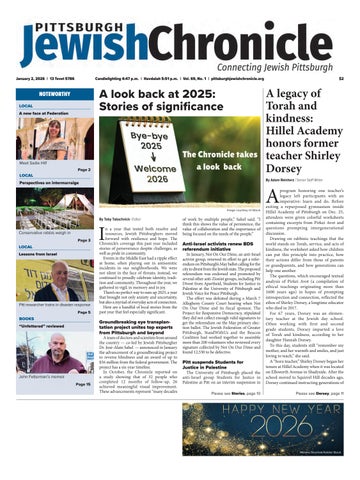
A look back at 2025: Stories of significance
NOTEWORTHY LOCAL A new face at Federation
Meet Sadie Hilf LOCAL
Page 2
By Adam Reinherz | Senior Staff Writer
Perspectives on intermarraige
By Toby Tabachnick | Editor
Page 3
LOCAL Lessons from Israel
Pitt researcher trains in disaster response Page 5
BOOKS
I
n a year that tested both resolve and resources, Jewish Pittsburghers moved forward with resilience and hope. The Chronicle’s coverage this past year included stories of perseverance despite challenges, as well as pride in community. Events in the Middle East had a ripple effect at home, often playing out in antisemitic incidents in our neighborhoods. We were not silent in the face of threats; instead, we continued to proudly celebrate identity, tradition and community. Throughout the year, we gathered in vigil, in memory and in joy. There’s no perfect way to sum up 2025, a year that brought not only anxiety and uncertainty, but also a myriad of everyday acts of connection. Here are a handful of local stories from the past year that feel especially significant.
Groundbreaking eye transplantation project unites top experts from Pittsburgh and beyond
“Unfettered” reviewed
John Fetterman’s memoir Page 15
A team of doctors and scientists from around the country — co-led by Jewish Pittsburgher Dr. José-Alain Sahel — announced in January the advancement of a groundbreaking project to reverse blindness and an award of up to $56 million from the federal government. The project has a six-year timeline. In October, the Chronicle reported on a study showing that of 32 people who completed 12 months of follow-up, 26 achieved meaningful visual improvement. These advancements represent “many decades
A
The University of Pittsburgh placed the anti-Israel group Students for Justice in Palestine at Pitt on an interim suspension in
program honoring one teacher’s legacy left participants with an imperative: learn and do. Before exiting a repurposed gymnasium inside Hillel Academy of Pittsburgh on Dec. 25, attendees were given colorful worksheets containing excerpts from Pirkei Avot and questions prompting intergenerational discussion. Drawing on rabbinic teachings that the world stands on Torah, service, and acts of kindness, the worksheet asked how children can put this principle into practice, how their actions differ from those of parents or grandparents, and how generations can help one another. The questions, which encouraged textual analysis of Pirkei Avot (a compilation of ethical teachings originating more than 1600 years ago) in hopes of prompting introspection and connection, reflected the ethos of Shirley Dorsey, a longtime educator who died in 2017. For 67 years, Dorsey was an elementary teacher at the Jewish day school. Often working with first and second grade students, Dorsey imparted a love of Torah and kindness, according to her daughter Hannah Dorsey. To this day, students still “remember my mother, and her warmth and smiles, and just loving to teach,” she said. A “born teacher,” Shirley Dorsey began her tenure at Hillel Academy when it was located on Ellsworth Avenue in Shadyside. After the school moved to Squirrel Hill decades ago, Dorsey continued instructing generations of
Please see Stories, page 10
Please see Dorsey, page 11
Image courtesy of iStock
Conservative rabbis weigh in
$2
of work by multiple people,” Sahel said. “I think this shows the value of persistence, the value of collaboration and the importance of being focused on the needs of the people.”
Anti-Israel activists renew BDS referendum initiative
In January, Not On Our Dime, an anti-Israel activist group, renewed its effort to get a referendum on Pittsburgh’s May ballot calling for the city to divest from the Jewish state. The proposed referendum was endorsed and promoted by several other anti-Zionist groups, including Pitt Divest from Apartheid, Students for Justice in Palestine at the University of Pittsburgh and Jewish Voice for Peace Pittsburgh. The effort was defeated during a March 7 Allegheny County Court hearing when Not On Our Dime and its fiscal sponsor, The Project for Responsive Democracy, stipulated they did not collect enough valid signatures to get the referendum on the May primary election ballot. The Jewish Federation of Greater Pittsburgh, StandWithUs and the Beacon Coalition had worked together to assemble more than 200 volunteers who reviewed every signature collected by Not On Our Dime and found 12,530 to be defective.
Pitt suspends Students for Justice in Palestine
Maryna Stryzhak/Adobe Stock
Headlines Getting to know: Sadie Hilf — LOCAL— By Adam Reinherz | Senior Staff Writer
S
adie Hilf went to a consignment store on the Upper West Side looking for a prom dress. She left with a silver-covered Haggadah and a life-changing reminder. Hilf and a friend had traveled to New York City six years ago, she said. Inside the Manhattan-based store, while searching for a memorable gown a Hebrew text captured Hilf ’s eye. She reached for the book. She quickly noticed it was a Haggadah. Hilf went to purchase the item, but a curious exchange ensued: The clerk asked Hilf if she’d been on Birthright Israel, a free 10-day trip to the Jewish state. Designed to foster connection to Jewish history and strengthen Jewish identity among 18- to 26- year-olds, according to organizers, Birthright has taken more than 900,000 young Jewish adults to Israel since 1999. Hilf was 17. She told the clerk she hadn’t participated in the trip as she wasn’t old enough. Though too young to participate in Birthright, the interaction triggered a memory. Growing up in Bethel Park, Hilf didn’t regularly attend a synagogue. Still, she said, “My family was very pro-Israel.” Hilf had heard about Birthright at some point in her childhood, she told the Chronicle, but forgot about the free trip until the shopkeeper’s reference. After entering college, Hilf eventually joined a Birthright mission to Israel. She described the excursion as her “first big interaction with the Jewish community” and a learning experience of enormous
p After living abroad, Sadie Hilf recently accepted a position with the Jewish Federation of Greater Pittsburgh.
p Sadie Hilf, center, joins participants on Birthright Israel.
Photo courtesy of Sadie Hilf
Photo courtesy of Sadie Hilf
“magnitude.” Birthright starkly countered her experiences at school where she was “the only Jewish student.” After graduating from Grove City College with a degree in mechanical engineering, Hilf frequented more Jewish spaces. She served as a regional adviser to Hasabara Fellowships and returned to Birthright. Between May 2022 and June 2025, Hilf staffed 12 trips to the Jewish state. All the while, she blogged for The Times of Israel, interned at the Knesset, completed a master’s degree in international relations from Johns Hopkins University and spent a year living in Italy. Hilf also developed a professional fluency in Arabic. “I really enjoy staying up to date on things that are happening in the region, and speaking with people about what a future could look like,” she said.
Six months ago, Hilf, 25, accepted a position at the Jewish Federation of Greater Pittsburgh as its senior development programming and missions associate. The job, she explained, involves planning international travel for donors and assisting with “donor-centric events,” including demographically tailored programs for women and young adults. Her goal as a Jewish professional, she said, is to not only gain a “better appreciation” for the work that was “poured into me as a recipient of different programs from the Jewish community, but also provide that experience to other people.” Hilf credits the Federation and other legacy organizations with offering pathways to understanding Jewish communal leadership. Through these opportunities, she said, younger people can develop skills that
are “crucial” to the Jewish community’s continuance. Hilf, a classically trained ballerina who still dances once a week at Texture Ballet School in McMurray, said her engagement with Jewish communal life has grown exponentially in recent years. She hopes others, regardless of age or location, consider increasing their involvement. “Get in touch with someone either at the Federation or somewhere else in the community and just dive in head first. The Jewish community is as strong as its people,” she said. “We’ve been here for 3,000 years, and we’ll be here for another 3,000 years, as long as there’s leaders in every generation that take up that mantle.” PJC Adam Reinherz can be reached at areinherz@pittsburghjewishchronicle.org.
5915 Beacon St., 5th Floor Pittsburgh, PA 15217
Main phone number: 412-687-1000
Subscriptions: 412-687-1000, ext. 2 SUBSCRIPTIONS subscriptions@pittsburghjewishchronicle.org 412-687-1000, ext. 2 TO ADVERTISE advertising@pittsburghjewishchronicle.org 412-687-1000, ext. 1 EDITORIAL DEPARTMENT Email: newsdesk@pittsburghjewishchronicle.org BOARD OF TRUSTEES Evan H. Stein, Chair Evan Indianer, Vice Chair Derek Smith, Treasurer Gayle R. Kraut, Secretary Gail Childs, Dan Droz, Malke Steinfeld Frank, Karen Galor, Seth Glick, Judith Kanal, Cátia Kossovsky, Charles Saul, Lynn Zelenski GENERAL COUNSEL Stuart R. Kaplan, Esq.
2
JANUARY 2, 2026
Jim Busis, CEO and Publisher 412-228-4690 jbusis@pittsburghjewishchronicle.org EDITORIAL Toby Tabachnick, Editor 412-228-4577 ttabachnick@pittsburghjewishchronicle.org Adam Reinherz, Senior Staff Writer 412-687-1000 areinherz@pittsburghjewishchronicle.org David Rullo, Senior Staff Writer 412-687-1000 drullo@pittsburghjewishchronicle.org ADVERTISING Amy Weiss, Account Executive (412) 613-0697 aweiss@pittsburghjewishchronicle.org
PRODUCTION Jeni Mann Tough Production Manager Carl Weigel Art/Production Coordinator Subscriptions subscriptions@pittsburghjewishchronicle.org 412-687-1000, ext. 2 Published every Friday by the Pittsburgh Jewish Publication and Education Foundation 5915 Beacon St., 5th Floor Pittsburgh, PA 15217 Phone: 412-687-1000 POSTMASTER: Send address change to PITTSBURGH JEWISH CHRONICLE, 5915 BEACON ST., 5TH FLOOR PITTSBURGH, PA 15217 (PERIODICAL RATE POSTAGE PAID AT PITTSBURGH, PA AND AT ADDITIONAL MAILING OFFICES) USPS 582-740
PITTSBURGH JEWISH CHRONICLE
Manuscripts, letters, documents and photographs sent to the Pittsburgh Jewish Chronicle become the property of this publication, which is not responsible for the return or loss of such items. The Pittsburgh Jewish Chronicle does not endorse the goods or services advertised or covered in its pages and makes no representation to the kashrut of food products and services in said advertising or articles. The publisher is not liable for damages if, for any reason whatsoever, he fails to publish an advertisement or for any error in an advertisement. Acceptance of advertisers and of ad copy is subject to the publisher’s approval. The Pittsburgh Jewish Chronicle is not responsible if ads violate applicable laws and the advertiser will indemnify, hold harmless and defend the Pittsburgh Jewish Chronicle from all claims made by governmental agencies and consumers for any reason based on ads appearing in the Pittsburgh Jewish Chronicle.
PITTSBURGHJEWISHCHRONICLE.ORG
Headlines Local Conservative rabbis respond to new intermarriage report — LOCAL — By David Rullo | Senior Staff Writer
R
abbi Alex Greenbaum would have liked more from the Joint Intermarriage Working Group report issued jointly by the Conservative Movement’s Rabbinic Assembly, the United Synagogue of Conservative Judaism and the Cantors Assembly. “It’s an apology with no action,” said Greenbaum, rabbi of Beth El Congregation of the South Hills. “An apology is better than nothing, though, so I do think it’s a step forward.” The report, released in December, cited a need for the Conservative movement to move from “disappointment” to “engagement” when it comes to intermarried couples. “The fact is that 75% of our children are intermarrying,” Greenbaum said, “and the movement has failed to keep up with the times.” The Conservative movement traditionally disapproved of intermarriage, the report said, noting that “the standard of practice froze conversations for five decades,” That attitude meant that the movement has not kept pace with an evolving culture in North America and other parts of the world, according to the report. “We acknowledge that our movement’s historical stance has resulted in hurt, alienation, and disconnection from our community,” it states. “We deeply apologize. We are committed to addressing the harm caused by our past categorical disapproval of multi-heritage and interfaith marriages and repairing these relationships.” The movement is now beginning the process of teshuvah, the report said. The working group spent nearly a year learning about the movement’s approach to intermarriage, conducting “a broad survey sent to over 100,000 people, which resulted in over 1,200 responses,” the report states. “It commissioned thirteen informal position papers from historians, social scientists, and rabbis. And it conducted nearly forty individual and group interviews to learn directly about the experience of people in our communities.” Four themes and values are recommended by the report: • The need to move from disappointment to engagement, allowing the movement to “move forward in engaging intermarried couples and families.” • The need to emphasize the value proposition of Jewish living, empowering “the individual to articulate for themselves the kind of Jewish life they seek to lead. If they seek a partner, their goal would be to find a partner aligned with that vision of Jewish life.” • The value of the movement’s “expansive, creative and relevant Halakhah,” which it said “already contains the necessary ingredients to address the needs of our constituents.” • The authority of clergy is derived from relationships allowing spiritual leaders to use the “rituals, tools, and teachings to engage people of all backgrounds to deepen their commitment to Jewish living and family life.” PITTSBURGHJEWISHCHRONICLE.ORG
Photo by Ekaterina_Lin via iStock
“I’m committed to helping the interfaith couples in our midst, accompanying them on their Jewish journeys, asking them to raise Jewish children and do whatever it takes to raise a Jewish family.” –RABBI SETH ADELSON The report also includes four steps for the movement: • Acknowledge the hurt in the community. • The creation of ritual options to “welcome, bless, and affirm couples with one Jewish partner and one partner who, while not formally Jewish, is firmly committed to co-creating an exclusively Jewish household.” • Offering those interested in conversion “accelerated, accessible, and personalized pathways to inclusion in Am Yisrael” and recognizing “the delicate balance between ensuring that non-Jewish partners are aware of the option to convert while avoiding undue pressure.” • And reframing the conversation on intermarriage, creating a curriculum “that explores what Jewish marriage means broadly (i.e., values, commitments, covenant, continuity, sacred partnership, and communal responsibility).” What it doesn’t do is offer the possibility of Jewish clergy marrying interfaith couples. Congregation Beth Shalom Rabbi Seth Adelson doesn’t think it should. “I believe that the most important element of the Conservative movement is that we must remain zealously committed to practicing Judaism as it has unfolded throughout our history,” he said. “I do not believe that Conservative rabbis should be officiating intermarriages.” Nonetheless, Adelson said he will continue to be as welcoming as he can to interfaith families. “When an interfaith couple asks me to marry them without conversion, my answer
will still be, ‘I’m sorry, that I cannot do, but we will embrace you at Beth Shalom in all the other ways that we can. We want you to feel loved and welcome here,’” he said. In fact, the rabbi said, many interfaith couples are members of the congregation and are “engaged and involved members of the community.” Those families include “non-Jewish parents who have committed to raising their children as Jews.” Greenbaum said his congregation is committed to “extraordinary inclusion.” The South Hills rabbi said that many interfaith couples he sees already have made adjustments based on the historic position of the Conservative movement. “Since the pandemic, approximately 75% of the couples I work with have already been married in a civil ceremony beforehand, and I perform a Jewish ceremony (afterward) for an interfaith couple,” he said. USCJ President Andy Schaer, a Pittsburgh native, seems to agree with Greenbaum’s approach, saying the intermarriage report doesn’t issue “one-size-fits-all recommendations.” Instead, Schaer said, it calls for “a careful review of existing policies, new resources, and greater trust in clergy to make thoughtful decisions based on Halakhah, relationships, and the norms of their communities.” The hope, he said, is that clergy will have the tools and license to “meet intermarrying couples where they are, help them explore the meaning and value of Jewish living, and support them in building Jewish homes.” Schaer understands that for some the report comes too late, but for many others, he said,
PITTSBURGH JEWISH CHRONICLE
“this moment can still make a real difference.” Conservative rabbis, he said, serve as mara d’atra, spiritual guides for their communities, understanding the nuances where they serve, each congregation with its own character and spirit. “We don’t rush change,” Schaer said, “but we don’t stop growing, either. That process is what gives our movement its energy and its hope.” For both Adelson and Greenbaum — whose positions on interfaith marriage differ — the end result is the same. “I’m committed to helping the interfaith couples in our midst,” Adelson said, “accompanying them on their Jewish journeys, asking them to raise Jewish children and do whatever it takes to raise a Jewish family. That’s where I feel like the Conservative community should be.” Greenbaum said that despite his criticism, he’s impressed with the report and the movement’s willingness to apologize. At the end of the day, though, he said, Beth El will continue to do what it has always done. “We’re doing everything we can do within the limits of the movement to honor our commitment to extraordinary inclusion,” he said. The Chronicle reached out to Rabbi Jeffrey Myer of Tree of Life, who was unable to respond before our publication deadline. The Chronicle also reached out to Rabbi Jonathan Perlman of New Light, who declined to comment. PJC David Rullo can be reached at drullo@ pittsburghjewishchronicle.org. JANUARY 2, 2026
3
Headlines Et tu, Wikipedia? — NATIONAL — By David Rullo | Senior Staff Writer
D
oes Wikipedia have a Jewish problem? Ask some Jewish community members and advocacy groups and you’ll get a simple answer: Yes. Earlier this year, the Anti-Defamation League released the report “Editing for Hate: How Anti-Israel and Anti-Jewish Bias Undermines Wikipedia’s Neutrality.” Researchers for the ADL’s Center for Technology and Science reported “extensive issues with antisemitic and anti-Israel bias” on the internet’s largest and most popular encyclopedia, including a “coordinated campaign to manipulate Wikipedia content related to Israel, the Israeli-Palestinian conflict, and similar issues.” A group of editors, the report states, “systematically evade Wikipedia’s rules to shift balanced narratives toward skewed ones, spotlighting criticism of Israel and downplaying Palestinian terrorist violence and antisemitism.” It further alleges that “pro-Hamas perspectives inform Arab-language content” on Israel and the Israeli Palestinian conflict. The ADL said it found evidence of “at least 30 editors” who circumvent Wikipedia’s
4
JANUARY 2, 2026
Photo by Gerd Altmann/Pixabay
policies in order to introduce antisemitic narratives, anti-Israel bias and misleading information. The report is the latest salvo in the war of information between the ADL and Wikipedia. A 2024 Tablet article, “Wikipedia’s Jewish Problem,” reported that a group
of Wikipedia editors and administrators, whose identity and credentials are unknown, rated the ADL as “generally unreliable” on the Israeli-Palestinian conflict and “roughly reliable” on antisemitism “when Israel and Zionism are not concerned.” Wikipedia’s “Reliable Sources/Perennial Sources,” a page the site said was “created to provide a list of repeatedly discussed sources, collected and summarized for convenience,” stated that “some editors regard the ADL’s opinion pieces as unreliable and should only be used with attribution.” As a comparison, the same page lists Al Jazeera as “a Qatari state-funded news organization” and said that there was consensus on Wikipedia’s Request for Comments page, which allows the community to provide input on an article, that Al Jazeera was “generally reliable.” Most editors, the page noted, said Al Jazeera was biased on the Arab-Israeli conflict and topics for which the Qatari government had a conflict on interest. In December 2025, the Jewish News Syndicate reported that Wikipedia editors decided to freeze discussion about the title of a page that refers to Israel committing a “massacre” in June 2024. The decision means that the title of the page, “Nuseirat rescue and massacre,” cannot be changed until at least August 2026. Daniel S. Mariaschin, CEO of B’nai B’rith International, told JNS that “Wikipedia, once again, seems to be misleading its readers.” Vlad Khaykin, executive vice president of social impact and North American partnerships at the Simon Wiesenthal Center, told JNS that use of the word “massacre” in the title of a page ostensibly about Israel’s liberation of four hostages from Gaza is “not a neutral descriptor.” “It is a verdict — one that draws its authority from casualty figures and claims that remain deeply contested, often circulated by those intent on recasting Israel’s efforts at self-defense as acts of villainy,” he said. Speaking about the ADL’s report, the Wikimedia Foundation told JNS in a separate
PITTSBURGH JEWISH CHRONICLE
article that it “categorically” condemned “antisemitism and all forms of hate.” The foundation said its preliminary review of the reports finds “troubling and flawed conclusions that are not supported by the Anti-Defamation League’s data,” and said that they are “undertaking a more thorough and detailed analysis.” It added that content on its site “must be presented, as far as possible, without editorial bias.” But even Wikipedia’s co-founder Jimmy Wales has noted the site’s apparent anti-Israel bias. Wales took the encyclopedia to task for its article “Gaza genocide” and the fact that it, too, was locked by administrators, as was the “Nuseirat rescue and massacre” page. The New York Post reported that Wales wrote, “This article fails to meet our high standards and needs immediate attention,” citing Wikipedia policies on neutrality and attribution to call out the biased tone of the entry. Squirrel Hill resident Audrey Glickman has firsthand experience with Wikipedia’s bias. Some of her friends, she said, were presenting troubling information about Zionism during discussions and said they got that information from Wikipedia. The claim surprised her because she believed the site was crowdsourced and would therefore have the best information about a subject, since it was culling information from various sources. Glickman, who has edited Wikipedia pages in the past, suggested changes to the Zionism entry. Wikipedia rejected her changes saying that, like the “Gaza genocide” and “Nuseirat rescue and massacre” entries, the online encyclopedia wasn’t accepting any edits to the page. “They said, ‘This page is closed. We voted on it.’ It was apparently a decision by a group,” she said. Glickman is concerned, not only about the fact that editors can restrict changes, but that decisions appear to be made by consensus opinion, a nebulous term not clearly defined but one that doesn’t favor the Jewish community since it’s only .2% of the world’s population. And while she understands the attempts to politicize a term like “Zionism,” Glickman said Wikipedia should be a neutral arbiter. “[The Wikipedia entry on] Zionism should be, ‘The desire of the Jewish people to have a presence in the Holy Land,’ and that should really be it,” she said. The inclusion of politics is especially concerning, given that at least one section of the page “Zionism and colonialism” seems to spend an inordinate amount of time on the argument that Israel is a colonial state, rather than present a balanced discussion of ideologies. Glickman views her stance as David taking on one of the internet’s Goliath’s as vital. “We need somebody out there saying what’s happening and we need to find a way to put forth what we mean,” she said. “We need to get this out there.” PJC David Rullo can be reached at drullo@ pittsburghjewishchronicle.org. PITTSBURGHJEWISHCHRONICLE.ORG
Headlines After training in Israel, a Pitt researcher considers return to emergency medicine — LOCAL — By Adam Reinherz | Senior Staff Writer
John Aronis’ happy place is in an ambulance. With retirement on the horizon, he’s thinking about spending more time in a rescue vehicle. For more than a decade Aronis, 68, has worked as a research scientist at the University of Pittsburgh. Within its department of biomedical informatics, he focuses on disease outbreak detection and characterization. “I do research. I publish papers. I hope that some people might read those papers, and maybe five or 10 years in the future, the work that I do in research will have a real effect in the U.S. health care systems,” he said. Though there’s enjoyment in applying computer methods to medicine, rolling up in a siren-sounding van offers a different thrill. Aronis knows — he just returned from a weeklong training in Israel for EMS professionals. Offered by Magen David Adom, Israel’s national emergency services system, the program welcomed 30 medical professionals from the U.S., Canada, Mexico, Sweden, Italy, Switzerland, Portugal and Taiwan. Aronis is a former paramedic — after a career teaching at Pitt and before becoming a research scientist, he spent a year working as a first responder. His connection to MDA grew from both his interest in emergency services and a desire to return to Israel. Months after his first trip to the Jewish state in May — he and his wife participated in a StandWithUs mission — Aronis sought a way back. “I had never been to Israel before, and it really wasn’t even on my radar to go there. But with all that was happening, I felt very strongly that I wanted to go and visit,” he said. “When I was there I just fell in love with the place.” While searching online, the Squirrel Hill resident, who is not Jewish, discovered MDA. Though the organization offered several opportunities for individuals to spend four to six weeks training, Aronis didn’t meet the programs’ age requirements. “I’m old. I’m close to retirement,” he said. “They’ve got these fantastic opportunities. Made me wish I was 21.” Aronis found a program for health care professionals that he was eligible for and signed up. From Dec. 7-12, the Pittsburgher and fellow participants volunteered with MDA ambulance teams. Through instruction and conversation, they developed skills for use during mass casualty incidents. They also learned about MDA’s activities during the Oct. 7 attacks and resulting Israel-Hamas war.
p John Aronis joins Maged David Adom crew in Israel.
Those episodes were in stark contrast to his own period in emergency services — and the experiences of his daughter, who is also a paramedic — Aronis said. “Here in the U.S., if you’re a medic, you can respond to crime scenes on a regular basis. The police are supposed to secure the scene before the medics go in, but there’s always a little bit of risk,” he said. “In Israel
— I’m thinking mostly of Oct. 7 and the days after — medics were being shot at.” Several EMTs were killed on Oct. 7 while treating the wounded, according to MDA. Hearing about the paramedics who were murdered or targeted on Oct. 7 was “heartbreaking,” Aronis said. Even hearing about the need for “bulletproof ambulances” was devastating.
p John Aronis stands beside a Magen David Adom ambulance. Photo courtesy of John Aronis
Photo courtesy of John Aronis
Now back in Pittsburgh, the expertise and insights gained in Israel are too valuable to ignore; with retirement soon to come, Aronis explained, he hopes to take advantage of his training and knowledge. Whether it’s reentering the field as a paramedic or joining MDA “in some capacity,” Aronis is considering his options: “When you retire, you have to figure out what you want to be when you grow up.” Like Alfred, Lord Tennyson’s Ulysses, Aronis seeks a path forward in the direction of the past. “Getting in the back of an ambulance and going, with its lights and sirens, to an emergency has an appeal,” he said. “You’re showing up on the worst day of somebody’s life, the absolute worst day of their life, and you go in and you help them.” The siren’s sound is enticing, but regardless of his post-retirement plans Aronis hopes others consider the profession and the training opportunities offered by MDA. “EMS is a calling anywhere in the world, but especially in Israel,” he said. The professionals there came from Jewish, Christian, Druze and Muslim backgrounds and helped “anyone regardless of their race or religion,” he continued. “I carry the MDA medics that I met in my heart.” PJC Adam Reinherz can be reached at areinherz@pittsburghjewishchronicle.org
www.pittsburghjewishchronicle.org PITTSBURGHJEWISHCHRONICLE.ORG
PITTSBURGH JEWISH CHRONICLE
JANUARY 2, 2026
5
Calendar Submit calendar items on the Chronicle’s website, pittsburghjewishchronicle.org. Submissions also will be included in print. Events will run in the print edition beginning one month prior to the date as space allows. The deadline for submissions is Friday, noon. q SUNDAYS, JAN. 4–FEB. 1 Jewish Art Camp: Fun Jewish learning through the arts for ages 0 to Grade 3. Mommy and Me (0 to 3-year-olds and their moms), Mini Makers (4 to 5-year-olds), Master Makers (Grades 1-3). Ages 0 to 5: $40/semester; Grades 1-3: $65/semester. 10:30 a.m. 1700 Beechwood Blvd. chabadpgh.com/art. q SUNDAYS, JAN. 4–JULY 26 Join Chabad of Squirrel Hill for its Men’s Tefillin Club. Services and tefillin are followed by a delicious breakfast and engaging discussions on current events. 8:30 a.m. 1700 Beechwood Blvd. chabadpgh.com. Join a lay-led online Parashah study group to discuss the weekly Torah portion. No Hebrew knowledge
needed. The goal is to build community while deepening understanding of the text. 8:30 p.m. For more information, visit bethshalompgh.org/online-parashah. q MONDAYS, JAN. 5–JULY 27 Join Congregation Beth Shalom for a weekly Talmud study. 9:15 a.m. For more information, visit bethshalompgh.org. Join Temple Sinai for an evening of mahjong every Monday (except holidays). Whether you are just starting out or have years of experience, you are sure to enjoy the camaraderie and good times as you make new friends or cherish moments with long-term pals. All are welcome. Winners will be awarded Giant Eagle gift cards. All players should have their own mahjong cards. Contact Susan Cohen at susan_k_cohen@yahoo.com if you have questions. $5. templesinaipgh.org. q TUESDAYS, JAN. 6–JUNE 30 Join Beth El’s Rabbi Alex Greenbaum and his Bible/ Talmud Adult Education class for a thought-provoking
weekly session of Bible and Talmudic study. This program is available both in person and virtually. Call the office at 412-561-1168 to receive the Zoom link or to make an in-person reservation. 10:30 a.m. 1900 Cochran Rd. bethelcong.org. q THURSDAYS, JAN. 8, FEB. 5 Join Rabbi Amy Greenbaum and the Beth El community for the all-virtual Beth El’s Virtual Hope and Healing Program on the first Thursday of the month. This is a safe space to chant, breathe, pray for healing and seek peace. Feel free to keep your camera off and just listen. Call the office at 412-561-1168 to receive the Zoom link. 5:30 p.m. Free. bethelcong.org. q MONDAY, JAN. 12 Make your own resin tzedakah box and enjoy light refreshments with Chabad of Squirrel Hill at Art and Soul. 7 p.m. $45. 1700 Beechwood Blvd. chabadpgh.com/resin. q TUESDAY, JAN. 13 Holocaust Center of Pittsburgh ambassador Debbie
Stueber tells the story of parents, both Holocaust survivors as part of the Generation outreach program. 10 a.m. Free. Faith United Methodist Church, 261 West Chapel Ridge Road, Fox Chapel. q WEDNESDAY, JAN. 14 Join Chabad of the South Hills for its monthly Seniors Luncheon, featuring tips on maintaining good posture as you age. Wheelchair accessible. For more information or to RSVP, call 412-278-2658. 1 p.m. Suggested donation $5. 1701 McFarland Road. chabadsh.com. q SATURDAY, FEB. 7 Join Congregation Beth Shalom for Clues and Schmooze (with some booze), a fun trivia event, including an open bar and snacks. There will be a 50/50 raffle, so bring cash to participate. Trivia will be played with teams of three to six. Bring your own team or be matched up at the door. Must be 21 or older to participate. 7 p.m. $30. 5915 Beacon St. bethshalompgh.org/clues-and-schmooze-2026. PJC
2,000-year-old Jewish ritual bath discovered under Western Wall Plaza in Jerusalem — WORLD — By JNS Staff
A
Jewish ritual bath, or mikveh, dating back to the final days of the Second Temple period has been unearthed near the Western Wall, the Israel Antiquities Authority announced on Monday. The bath, which still bears ash remains that testify to the destruction of the Temple, was
discovered recently beneath the Western Wall Plaza, the state-run archaeological body said. Hewn into the bedrock, the mikveh, which is rectangular in shape, measuring 3.05 meters in length, 1.35 meters in width and 1.85 meters in height, was found sealed beneath a layer dated to the year 70 C.E. Within this layer, which contains ash, numerous pottery vessels were discovered, along with stone vessels characteristic of the Jewish population that lived in the city on the eve of the destruction, according to the IAA.
p A 2,000-year-old ritual bath is unearthed beneath the Western Wall Plaza in a discovery announced on Dec. 29, 2025. Photo by Emil Aladjem/Israel Antiquities Authority
Join Us! PGHJGS membership is only $18/year and includes free access to regular programming, help sessions, past program recordings, and more. Learn more and sign up at pghjgs.org/membership.
Upcoming Programs SUN, JAN 25, 2026
SUN, FEB 15, 2026
Join the Chronicle Book Club!
“The Emotional Roller Coaster of DNA Testing” with Janice Lovelace
T
he Pittsburgh Jewish Chronicle invites you to join the Chronicle Book Club for its Jan. 18 discussion of “Unveiled,” by Jonathan Harounoff. The author will join us for the meeting. “‘Unveiled’ takes us inside the ‘Woman, Life, Freedom’ movement, sparked by the slaying of a young woman for wearing a loose hijab, in what became the most serious challenge the [Iranian] regime has faced in forty-six years. Harounoff has given us a nonfiction drama replete with heroines and villains, one that is sure to captivate readers.” –Peter Kann, Pulitzer Prize-winning foreign correspondent and former publisher, The Wall Street Journal.
1-2:30pm/Virtual on Zoom/$5
“Clued-In: More Case Studies from Sherlock Cohn, The Photo Genealogist” with Ava Cohn 1-2:30pm/Virtual on Zoom/$5
SUN, MAr 15, 2026
“A History of the South African Jews: From the Pale to Pretoria - Part 1” with Ralph Cilevitz
Buy: “Unveiled.” It is available from online retailers, including Amazon and Barnes & Noble. It is also available through the Carnegie Library system. Email: Contact us at drullo@pittsburghjewishchronicle.org, and write “Chronicle Book Club” in the subject line. We will send you a Zoom link for the discussion meeting. PJC — Toby Tabachnick
Toby Tabachnick, Chronicle editor David Rullo, Chronicle senior staff writer
Learn more about these and other programs at pghjgs.org/programming.
JANUARY 2, 2026
What to do
Your hosts
1-2:30pm/Virtual on Zoom/$5
6
The excavations are located in close proximity to the site of the ancient Temple and to what served as its main entrances some 2,000 years ago — the Great Bridge to the north and Robinson’s Arch to the south. According to Jewish law, people who wished to visit the temples were required to purify themselves via a ritual bath before entering. Researchers believe that the bath served the Jews who lived in the area as well as the many pilgrims who frequented the site and the Temple.
“Jerusalem should be remembered as a temple city,” explained Ari Levy, excavation director on behalf of the IAA. “As such, many aspects of daily life were adapted to this reality, and this is reflected especially in the meticulous observance of the laws of ritual impurity and purity by the city’s residents and leaders.” According to Israel’s Heritage Minister Rabbi Amichai Eliyahu, “The exposure of the ritual bath beneath the Western Wall Plaza strengthens our understanding of how deeply intertwined religious life and daily life were in Jerusalem during the Temple period.” The discovery was announced on the eve of the Jewish Tenth of Tevet Fast, which falls on Tuesday this year and commemorates the beginning of the Babylonian siege that led to the destruction of Jerusalem and the First Temple in the 6th century BCE. “The exposure of a Second Temple period ritual bath beneath the Western Wall Plaza, with ashes from the destruction at its base, testifies like a thousand witnesses to the ability of the people of Israel to move from impurity to purity, from destruction to renewal,” said Mordechai Eliav, the director of the Western Wall Heritage Foundation. PJC
How it works
We will meet on Zoom on Sunday, Jan. 18, at 1 p.m.
PITTSBURGH JEWISH CHRONICLE
PITTSBURGHJEWISHCHRONICLE.ORG
Headlines Ben Shapiro is mounting a last stand against right-wing antisemitism. It’s not going well. — NATIONAL — By Andrew Lapin | JTA
O
n the first day of AmericaFest, Turning Point USA’s convention in Phoenix, Ben Shapiro lit into a host of conservatives that he said were “frauds and grifters.” He listed Candace Owens, Tucker Carlson, Megyn Kelly and Steve Bannon as “charlatans who claim to speak in the name of principle but actually traffic in conspiracism and dishonesty.” Together, he said on Thursday, Dec. 18, they presented a danger to the conservative movement. Shapiro was extending an assault that he began earlier in the week during a speech at the Heritage Foundation, a heart of conservatism that has been thrown into turmoil by its president’s backing of Carlson after Carlson hosted the Holocaust denier and avowed antisemite Nick Fuentes on his podcast. An Orthodox Jew and avowed supporter of Israel, the conservative pundit has been mounting a public effort to repudiate antisemitism and similarly aligned forces within his own party. His campaign comes as the GOP’s younger flank have become increasingly disillusioned with American support for Israel in the aftermath of its war in Gaza. Conspiracy theories about Jews and Israel have proliferated in young right-wing spaces, to the point where Shapiro — who has long preferred to focus on conservative culture-war issues — is now staking his future on rooting them out. “If you host a Hitler apologist, Naziloving, anti-American piece of refuse like Nick Fuentes,” Shapiro told the AmericaFest crowd, “if you have that person on your show and you proceed to glaze him, you ought to own it.” Shapiro used a Gen Z slang term for flattery to allude to Carlson’s interview with Fuentes, elsewhere blasting other rivals for promoting conspiracy theories linking Jeffrey Epstein to the Mossad. But Shapiro’s address did not go over well with everybody. Much of the energy at AmericaFest, which TPUSA staged in the shadow of the shocking murder of the group’s founder, Charlie Kirk, earlier this year, appeared to be lining up behind the figures he targeted — several of whom, like Carlson, also took the stage. “To hear calls for deplatforming and denouncing people at a Charlie Kirk event, I’m like, what? That’s hilarious,” Carlson said in his own speech. Yet he also took the time to defend his thoughts about Jews. “I’m not an antisemite for a very specific reason. Not because it’s unpopular or my donors don’t like it. I’m not an antisemite because antisemitism is immoral in my religion.” Carlson wasn’t alone in his disdain for the Daily Wire CEO who, for years, had been considered a tastemaker for the young right. Steve Bannon, as part of a speech in which he also called to “re-Christianize America” and mocked the recent murder of Jewish director and Trump critic Rob Reiner, called
PITTSBURGHJEWISHCHRONICLE.ORG
p Donald Trump Jr. and Megyn Kelly speak on stage at Smart Financial Centre on Oct. 23, 2025, in Sugar Land, Texas.
Photo by Marcus Ingram/Getty Images
Shapiro a “cancer” to conservatism. And Owens, Shapiro’s own former protege, said, “F--k you, Ben Shapiro.” She made the comment on her YouTube page, where she has been promoting conspiracy theories that Israel had some involvement in Kirk’s murder. And in remarks to Vanity Fair while at the conference, Kelly, too, countered Shapiro. The former Fox News host blasted him as overly concerned with Israel and said that he and Bari Weiss, the Jewish CBS News editorin-chief recently in hot water after she pulled a “60 Minutes” story that reflected badly on the Trump administration, are themselves fueling antisemitism. “Tucker is not making antisemites. They are,” Kelly, a friend of Carlson’s, told Vanity Fair. She went on to describe Shapiro and Weiss as part of “this very loud group of pro-Israel activists that is trying to make this the litmus test about whether you get to call yourself a conservative, and they lack standing to do that.” Kelly also called Shapiro “Israel first,” adding, ““And I’m sorry, but his behavior has proven that charge to be correct. Why would you divide the American conservative movement — which was gelling, which was becoming much more cohesive for a moment after Charlie died — over Israel?” Other conference attendees Vanity Fair spoke to said they were siding with Shapiro’s opponents, and some were happy to debate Hitler’s merits between sessions. Shapiro’s effort to hold a line in the sand is reverberating through the highest levels of government. Vice President JD Vance, who also spoke at the conference and is close with Carlson, pointedly did not denounce antisemitism during his address. Instead, Vance seemed to discourage the idea that conservatives should be excommunicating anyone based on their views. The showdown at AmericaFest was the
latest visible sign of how the next generation of conservatives are increasingly turning against Israel while embracing antisemitic talking points. Openly antisemitic influencers like Fuentes and Myron Gaines are enjoying a rise in popularity on the right, and Gaines attended AmericaFest himself. The podcaster wore a sweater with a picture of Cookie Monster over an oven and the phrase “Let Em Cook” — a right-wing meme mocking Jews who were murdered in the Holocaust. A recent focus group of Gen Z conservatives, conducted by conservative think tank The Manhattan Institute, also found that several of them espoused antisemitic and pro-Hitler views. One declared that Jews are “a force for evil,” adding, “I don’t see why we support Israel. I think Israel’s a very evil state. The genocide in Gaza, killing all these poor people. And the only reason we really support them is because they are the biggest donors. We have AIPAC, and these are all Jewish-run organizations.” Asked what they thought of Hitler, one respondent said, “I think he was a great leader, to be honest.” Another, who called himself “Jewish by blood,” said he had read “Mein Kampf ” and concluded, “I strangely understood where he was coming from as far as wanting to improve the national state of Germany.” Histories of antisemitic rhetoric are also continuing to trail more Trump appointees to top government posts. This week Jewish Insider reported that a senior State Department nominee, Jeremy Carl, has stated, “Jews have often loved to play the victim rather than accept that they are participants in history,” continuing that Jews have a “misplaced religious impulse” because they are “searching for the Messiah that had actually been found.” He added that Jews “love the Groypers,” a reference to the antisemitic movement led by Fuentes, “because they’re
PITTSBURGH JEWISH CHRONICLE
just so discrediting of anyone who would ask questions about any of this.” Carl, a Jewish convert to Christianity, was nominated to the post of assistant secretary of state for international organizations, but his nomination expired at the end of this year’s Senate session without his formal appointment. Meanwhile, Rep. Elise Stefanik, a pro-Israel MAGA firebrand who had taken on campus antisemitism as a central cause, announced on Friday she was dropping her bid for New York Governor. Stefanik will also not seek reelection to Congress, leaving conservative (and many centrist) Jews with one less ally on the right who seemed to have a fast track to Trump. A right-wing schism, with Jews and Israel at the center of the divide, is increasingly taking shape. More conservative intellectuals continue to exit the Heritage Foundation, the influential think tank, over its founder’s defense of Carlson. Several are migrating over to a new venture started by former Vice President Mike Pence, a pro-Israel Evangelical who has come out in opposition to Trump since his work in the first Trump administration. It’s all building up to what Andrew Kolvet, a close friend and associate of Kirk who has taken over many TPUSA duties including hosting Kirk’s eponymous show since the founder’s murder, says are the conservative movement’s new flashpoints: Israel and antisemitism. “Charlie would go to some campuses, and like 50 to 60% of the questions were about Israel,” Kolvet recently told The New York Times’ Ross Douthat. “For two years that was true.” Young conservatives have been questioning not only the influence of proIsrael lobbyists like AIPAC, but also the entire U.S.-Israel relationship, Kolvet said. Kolvet added, “I think Israel has become a symbolic battle about: What does ‘America First’ really mean?” PJC JANUARY 2, 2026
7
Headlines 2025 saw sharp drop in immigration to Israel even as arrivals from Western nations surged — WORLD — By Zev Stub | The Times of Israel
S
ome 21,900 new immigrants moved to Israel in 2025, the Immigration and Absorption Ministry said Monday, a steep drop of about one-third from last year’s numbers as arrivals from Russia dried up. However, aliya (Hebrew for immigration to Israel) from the United States, France, the U.K. and other Western countries rose sharply, amid skyrocketing antisemitism affecting Jewish communities around the world, including high-profile deadly terror attacks against Jewish targets like the Yom Kippur attack on a Manchester synagogue and last month’s massacre at a Chanukah event in Sydney, Australia. Some 13,600 non-Russian immigrants arrived in 2025, a 23.6% increase from about 11,000 in 2024 and an 81% increase from the 7,500 new immigrants in 2023, according to an analysis of ministry data. As every year since the 1990s, the largest number of immigrants came from Russia, with about 8,300 arriving in 2025. That was a 57% decline from 19,500 in 2024, and a fraction of the 74,000 who arrived in 2022 following the country’s invasion of Ukraine. Most of Israel’s dramatic rise in immigration and subsequent decline since 2022 is attributable to the surge at the start of that war, demographers have noted. About 3,500 immigrants came from the U.S., an increase of 5% from the previous year and up 30% from 2023. French immigration rose 45% to 3,300, compared to 2,200 in 2024. Immigration from the U.K. rose 19% to 840, reflecting an ongoing upward trend. Some 420 immigrated from Canada, 220 from South Africa, and 180 from Australia, ministry data showed. About a third of all new immigrants during the year were aged 18–35, the ministry said. According to data provided by Nefesh B’Nefesh, an organization that facilitates immigration to Israel, overall North American immigration rose about 12% in 2025 to 4,150, one of the largest numbers in the organization’s 23-year history. “These new Olim are already helping to address Israel’s national needs and strengthen its future, and we recognize the significance of their decision to establish their lives in the State of Israel at this pivotal moment in the country’s history,” Nefesh B’Nefesh co-founder and executive director of Nefesh B’Nefesh Rabbi Yehoshua Fass said in a statement. Despite the strong numbers, Israel still has a net migration deficit, with more people leaving the country than coming. In 2024, a whopping 82,700 Israelis left the country, about 50,000 more than immigrated to Israel, and that trend is expected to continue in 2025, demographers have
8
JANUARY 2, 2026
p Aliyah and Integration Ministry Ofir Sofer and Jewish Agency chair Doron Almog pose with olim who arrived from France at the end of October 2023, immediately following the start of the war. Photo by Guy Yechiely/The Jewish Agency
noted. The exodus has largely been driven by the war that erupted following the Hamas massacre on Oct. 7, 2023, and disillusionment with the government that has pushed a judicial overhaul policy that critics say undermines democracy in the country. Preparing for larger immigration With antisemitism a mounting concern for Jewish communities, the Immigration and Absorption Ministry has been working to improve the country’s ability to attract and absorb rising numbers of new arrivals. It even held a drill testing the country’s readiness for a massive wave of emergency immigration last month. According to Jewish Agency data, about 30,000 Jews around the world opened files to start the immigration process in 2025, with large increases noted in the U.K. and Australia. The immigration process can
typically take about 18 months from start to finish, immigration officials have noted. More than 20,000 people around the world participated in immigration fairs organized by the Immigration and Absorption Ministry, the Jewish Agency, the Israeli Ofek Organization, and the World Zionist Organization throughout the year. More than 13,000 attended in France alone, alongside fairs in the U.S., Australia, U.K., Ukraine, Georgia, Argentina, Mexico and South Africa, where attendees received information and access to government offices. Thousands more participated in immigration fairs held by Nefesh B’Nefesh in North America, the ministry noted. “With the support of the prime minister, we are promoting a broad government decision to encourage immigration from countries where antisemitism is increasing,”
p New immigrants arrive in Israel after a Nefesh B’Nefesh charter flight, Aug. 20, 2025. Photo by Zev Stub/Times of Israel
Immigration and Absorption Minister Ofir Sofer said in a statement. “This, along with many programs to integrate immigrants in the fields of employment, housing, higher education and the community, is expected to encourage further immigration and strengthen the State of Israel.” In recent months, the Immigration and Absorption Ministry has launched a number of new initiatives to promote successful immigration, including a new plan to work with Israeli companies to provide employment for immigrants as soon as they arrive in the country. Last month, it also unveiled a new 0% income tax rate for immigrants arriving in 2026. In February, the ministry announced a NIS 170 million ($46.4 million) program to improve integration, along with a reform designed to speed up the licensing process for new immigrants to work in their professional fields. More recently, it launched a new government program offering incentives to attract successful Jewish candidates with in-demand skills to immigrate to Israel. Other initiatives, including expanding tax exemptions for immigrants who own businesses and offering personal assistance to potential olim throughout Europe, are also underway. “In most countries, people leave during a war, but in Israel, people come to help,” Sofer has frequently said as he touts strong immigration figures, even if the reality is somewhat more complicated. Approximately 1,200 members of India’s Bnei Menashe community are expected to immigrate to Israel in 2026, the ministry noted. PJC
PITTSBURGH JEWISH CHRONICLE
PITTSBURGHJEWISHCHRONICLE.ORG
Headlines — WORLD — 2 men found guilty in UK of plotting Islamic State-inspired antisemitic terror attack
Two men inspired by Islamic state ideology were convicted last week in Manchester, England, of plotting what prosecutors said could have been one of the deadliest antisemitic attacks in British history, JTA reported. Walid Saadaoui, 38, and Amar Hussein, 52, were both found guilty of preparing terrorist acts between December 2023 and May 2024. Saadaoui’s brother, Bilel Saadaoui, 36, was found guilty of failing to disclose information about an act of terrorism. Prosecutors told jurors that Saadaoui and Hussein had “embraced the views” of Islamic State and had a “visceral dislike” of Jewish people. By the time of his arrest in May 2024 following an undercover operation, Saadaoui had arranged the purchase and delivery of two assault rifles, an automatic pistol and almost 200 rounds of ammunition for the attack. The pair had planned to infiltrate a march against antisemitism in the Manchester city center before unleashing their attack. The convictions come as threats associated with the Islamic State appear to be on the rise. Last month, two men who authorities said were motivated by “Islamic State ideology” killed 15 people after opening fire on a Chanukah celebration in Sydney. In October on Yom Kippur, another man who pledged allegiance to the Islamic State carried out an attack on a Manchester synagogue during which two people were killed.
$100 million spent on anti-Israel efforts yearly at UN, says Israeli envoy Danon
Israel’s envoy to the United Nations claimed last week that the global body spends upward of $100 million on anti-Israel activity each year, JNS reported. Ambassador Danny Danon said the United Nations intends to soon approve its 2026 operating budget, and that his office has identified the $100 million “which is dedicated to activities against the state of Israel — to investigations, to discussions, to comprehensive decisions that work against us.” The U.N. Relief and Works Agency, commonly known as UNRWA, is tabbed to receive $86.5 million next year, according to documents viewed by JNS. The Palestinian-only aid and social services agency is under fire for ties to Hamas, and several countries and entities, including the United States, have suspended and reduced funding for the agency. Outside UNRWA, documents viewed by JNS attribute $4 million in budget requests for entities housed within the U.N. Division for Palestinian Rights, including the Committee on the Exercise of the Inalienable Rights of the Palestinian People, which largely acts as an advocacy organization. Without parallel in the U.N. system, the Division for Palestinian Rights employs 15 people, and Israeli officials accuse the entity, which falls under the purview of the U.N. Department of Political and Peacebuilding Affairs, not of aiming to resolve the IsraeliPalestinian conflict, but of disseminating a one-sided narrative.
Today in Israeli History — ISRAEL — Items are provided by the Center for Israel Education (israeled.org), where you can find more details.
Jan. 2, 1927 — Ahad Ha’am dies
Ahad Ha’am, the pen name of Asher Zvi Hirsch Ginsberg, leader of the movement for cultural Zionism, dies in Mandatory Palestine at 70. He argued that Zionism should put Jewish renewal ahead of political goals.
Jan. 3, 1919 — Faisal, Weizmann sign agreement Zionist leader Chaim Weizmann and Emir Faisal, son of Sharif Husayn of Mecca, pledge mutual respect and cooperation between Arabs and Jews in the Middle East. The mandate system blocks their accord.
p Chaim Weizmann (left) and Emir Faisal meet in Aqaba in April 1918.
Jan. 4, 1935 — Mosul-Haifa pipeline opens
A pipeline spanning 590 miles from Kirkuk, Iraq, to Haifa begins carrying oil from the Mosul fields to the Mediterranean Sea. Crude oil takes about 10 days to travel through the 12-inch-diameter pipe.
Jan. 5, 1930 — Mapai Party is founded
Two leftist political movements, David PITTSBURGHJEWISHCHRONICLE.ORG
Ben-Gurion’s Ahdut Ha’avodah (Labor Unity) and Joseph Sprinzak’s Hapoel Hatzair (Young Worker Party), merge into Mapai, which dominates early Israeli politics.
Jan. 6, 1942 — Toledano is installed as chief rabbi
Rabbi Jacob Moshe Toledano, a native of Tiberias who is the chief rabbi of Alexandria, Egypt, returns to the Land of Israel to assume the post of the Sephardi chief rabbi of Tel Aviv and Jaffa.
Regional elections deal blow to Spain’s anti-Israel leaders
Spanish Prime Minister Pedro Sanchez’s Socialist Party last week lost more than a quarter of its seats in regional elections, which right-wing parties carried handily, JNS reported. ACOM, a prominent pro-Israel nongovernmental organization in Spain, welcomed the result as a sign of weakness for a government that has led efforts to isolate and punish the Jewish state within the European Union and beyond. Angel Mas, ACOM’s president, said the result likely reflects a broader discontent with the Socialists nationally. It may mean a shift to the right in the next elections, he added, but only if the conservative bloc unites enough to govern together. The Socialists clinched 18 out of the regional parliament’s 65 seats. Their share was 28 seats in the 2023 elections. The share of the incumbent, center-right Popular Party remained steady. The right-wing Vox party more than doubled its seats, to 11. Sanchez’s party is currently facing several corruption scandals, including one involving last month’s arrest of one of his predecessors, Jose Luis Abalos, allegedly for taking bribes. Sanchez’s wife and younger brother are also facing graft allegations. Critics of the Sanchez government, including ACOM, have alleged that its hostility toward Israel is meant to divert attention from its scandals.
Scottish anti-Israel activist fined for antisemitic bullying
1916 MURRAY AVE. PITTSBURGH, PA 15217
Eliezer Ben-Yehuda, often credited as the father of the modern Hebrew language, is born in Lithuania. In 1881 he and his wife move to Jerusalem, where he undertakes the revival of Hebrew as an everyday language.
Jan. 8, 2008 — Gen. Moshe Levi dies
Moshe Levi, the first Mizrahi chief of staff of the IDF from 1983 to 1987, dies of a brain aneurysm at 72. Known as Moshe VaHetzi (Moshe and a Half) because of his height, he created a security zone in southern Lebanon. PJC
412-421-1015 412-421-4450 FAX 412-421-4451
PRICES EFFECTIVE SUNDAY, JANUARY 4 – FRIDAY, JANUARY 9, 2026 Candle Lighting Time Friday, January 2, 2026 • 4:47 p.m. MEAT
WINE SPECIALS
HOURS
BEEF STEW
PESCAJA SOLITER BARBERA D'ASTI WINE
Check Out Our Lower Dairy Prices!
12
.29
LB
.6
CHICKEN LEGS
Jan. 7, 1858 — Modern Hebrew advocate Ben-Yehuda is born
— Compiled by Toby Tabachnick
A court in the United Kingdom convicted
$
p Rabbi Jacob Toledano (left) meets with a Brazilian delegation while serving as Israel’s minister for religious affairs in 1960, near the end of his life.
an anti-Israel activist from Glasgow of intimidation motivated by antisemitic bias over a filmed exchange that he had with a local Jew in June, JNS reported. Mick Napier, co-founder of the Scottish Palestine Solidarity Campaign, behaved “in a threatening or abusive manner” toward the victim and his actions were “aggravated by prejudice relating to religion or, in the case of a social or cultural group, perceived religious affiliation,” the verdict said last week, according to the Jewish News of London. Napier was fined £600 ($810.) Napier, 78, called the victim, Samuel Stein, who is a member of the Glasgow Friends of Israel group, a “baby killer.” He asked Stein to comment on what Napier falsely described as an expression of support for rape during wartime by the Israel Defense Forces Chief Rabbi Brig. Gen. Eyal Krim. Krim was misquoted in the Israeli media on this matter in 2016. The Glasgow Jewish Representative Council and the Jewish Council of Scotland welcomed the verdict by the Glasgow Sheriff Court. “There must be no place for antisemitism — in any guise — in Scotland,” the groups said in a joint statement. The anti-Israel Gaza Genocide Emergency Committee group said in a statement that Napier’s lawyer was “launching an immediate appeal against shocking verdicts of ‘racially aggravated’ conduct handed down today at Glasgow Sheriff Court.” PJC
$
3
.69 .6
LB
$
33.99 750 ML
YOGEV ASSORTED WINES
STORE HOURS
16.66
750 ML
Sunday • 8 a.m. – 6 p.m. Monday • 8 a.m. – 6 p.m. Tuesday • 8 a.m. – 6 p.m. Wednesday • 8 a.m. – 6 p.m. Thursday • 8 a.m. – 8 p.m. Friday • 8 a.m. – 3 p.m.
GROCERY
COOKED FOODS
DELI
MEHADRIN CHOCOLATE LEBEN $ .59
SEAFOOD CHOWDER $ .99
EMPIRE TURKEY PASTRAMI $ .99
GLICK'S BARLEY
CHICKEN THIGH WITH BALSAMIC VINEGAR $ .99
EMPIRE SMOKED TURKEY BREAST $ .99
ENCHILADA CASSEROLE $ .99
FRENCH MEDLEY OLIVES $ .79
MEAL MART BUFFALO WINGS - HOT OR MILD
$
12
.99 .6
1
$ .79
1
LB
6 OZ
16 OZ
OSEM SOUP MANDELIN $ .89
5
EA
GLICK'S FLOUR ALL PURPOSE OR HIGH GLUTEN $ .99
4
5 LB
HOMEMADE SALADS & SOUPS DELI PARTY TRAYS
PITTSBURGH JEWISH CHRONICLE
$
12
10
12
LB
LB
EA
SALT ’N PEPPER KUGEL $ .99
7
LB
10 11 7
LB
LB
LB
HUMMUS
$ .99
7
LB
We Prepare Trays for All Occasions
CATERING SPECIALISTS DELICIOUS FRIED CHICKEN
UNDER THE SUPERVISION OF VAAD OF PITTSBURGH
WE RESERVE THE RIGHT TO LIMIT QUANTITIES.
JANUARY 2, 2026
9
Headlines
p Dr. José-Alain Sahel holds the PRIMA implant.
Photo courtesy of UPMC
p Jewish teen athletes join social media influencer Montana Tucker to dance on Aug. 4 during the Opening Ceremonies of the JCC Maccabi Campus Games.
p Jewish community leaders stand before the Allegheny County Courthouse after the BDS intiative is defeated.
Photo courtesy of David Heyman
Photo by Adam Reinherz
Stories: Continued from page 1
March. The suspension followed a Feb. 4 disciplinary hearing held after the group hosted a “study-in” at Hillman Library that university officials said may have violated Pitt event policies. During deliberations regarding potential disciplinary actions against the anti-Zionist group, SJP “improperly engaged in communications to members of the Conduct Hearing Board,” according to a letter signed by the university’s associate director of student conduct Jamey Mentzer. In April, the American Civil Liberties Union filed suit against Pitt on behalf of SJP. In August, a federal judge lifted the suspension, finding that the university violated the group’s free speech rights by suspending it from campus.
Pittsburgh residents charged with conspiracy, possession of destructive devices
A federal grand jury returned a superseding indictment in April against three Pittsburgh residents, charging them with conspiracy, defacing and damaging religious property, making false statements and possession of destructive devices. The charges were related to antisemitic vandalism at Chabad of Squirrel Hill and the Jewish Federation of Greater Pittsburgh in 2024. The nine-count indictment identified the defendants as: Mohamad Hamad, 23, of Coraopolis; Talya A. Lubit, 24, of Pittsburgh; and Micaiah Collins, 22, of Pittsburgh. Collins is the daughter of Chad Collins, a pastor at Valley View Presbyterian Church in Garfield and a national organizer with Friends of Sabeel North America, an organization the Anti-Defamation League has characterized as “a driving force behind various Boycott, Divestment and Sanctions campaigns.” Lubit is Jewish. Hamad “openly expressed support for Lebanon, Hezbollah and Hamas,” acting U.S. Attorney Troy Rivetti, said. “In addition to his previously charged role in defacing Jewish religious property, he conspired with others named in the Superseding Indictment to manufacture and detonate destructive devices.” In late April, Hamad was ordered to be detained in jail pending his trial. In May, Lubit pled guilty to conspiracy to commit an offense against the United States and damaging or defacing religious property. In September, Lubit was sentenced to five years of probation and to pay $10,534 in restitution. Collins is on home detention as she awaits trial.
Rodef Shalom, Temple Sinai members approve unification
The members of both Rodef Shalom Congregation and Temple Sinai approved a unification of the two Reform congregations during separate June 8 congregational meetings.
10
JANUARY 2, 2026
As the “vote symbolizes endings as well as new beginnings, we can and should be joyful,” the presidents of the two congregations wrote to their members. “We have much to be excited about as we build a robust and inspired future together.” The vote was the conclusion of an 18-month process that engaged leadership from both congregations, hundreds of volunteers across several committees and merger consultant David Weinberg. The new congregation will represent about 1,300 family units and will be the largest Reform congregation in the region. It will be housed at Rodef Shalom’s building on the corner of Fifth and Morewood avenues. Temple Sinai’s Rabbi Daniel Fellman and Cantor David Reinwald will become the spiritual leaders of the new congregation, along with Rodef Shalom’s interim Rabbi David Young. When Young’s term ends in 2026, the new congregation will add an assistant or associate rabbi.
Jewish pride shared, tributes paid at JCC Maccabi Campus Games Opening Ceremonies
Nearly 2,000 teenage Jewish athletes came to Pittsburgh in August to compete at the JCC Maccabi Campus Games. “The power of this moment isn’t just what we have built; it is what we have believed,” said Jason Kunzman, president and CEO of the JCC of Greater Pittsburgh. “We have said loudly and clearly, we believe in our youth. We believe in Jewish connection. We believe in experiences that last a lifetime.” The event was held at the University of Pittsburgh. It was the first time in the Games’ history that participating teens were housed and competed on a college campus. For 18 months, organizers strategized and planned the JCC Maccabi Campus Games, according to Scott Sewald, JCC Pittsburgh’s board chair. Along with celebrating Israel, community and heritage, the experience was about “Jewish pride.”
JAA unveils new senior residences, centered on community and Jewish values
In August, the Jewish Association on Aging began leasing 30 new personal care residences on its Browns Hill Road Campus, in the former Charles M. Morris Nursing and Rehabilitation Center. The residences were announced in 2024 as the first phase of the JAA’s new urban senior village. When completed, the two-phase project will be home to a senior community of almost 400 people across a spectrum of support: independent living, personal care and memory care. That includes up to 58 people in the new units, as well as those at the AHAVA Memory Care Residence and residents at The New Riverview Apartments.
The new personal care residence includes two studio apartments, 18 one-bedroom units and 10 two-bedroom units, with the option of converting another 30 units. Continental Real Estate Cos., a Columbusbased developer, partnered with the JAA on the new residences, assisted by the Jewish Federation of Greater Pittsburgh, which helped put together a task force dedicated to the project. Kosher food is available for those who observe kashrut, supervised by the Vaad Harabonim of Pittsburgh. A ribbon cutting and guided tour of the new units was held at the JAA’s annual meeting on Sept. 4.
Tree of Life unveils new building design
The Tree of Life held a ceremonial groundbreaking in June 2024, but rebuilding the site of the most violent antisemitic attack in U.S. history has not yet begun. That’s because after the groundbreaking, plans were reevaluated, according to Michael Bernstein, board chair of The Tree of Life organization. Leaders wanted to ensure the new building would be right, he said, not only for today but for decades into the future. To do that, The Tree of Life examined three criteria: cost, sustainability and how the new building will fit within the neighborhood. Tree of Life went back to Studio Libeskind and its principal architect, Daniel Libeskind, and began a new relationship with local architect IKM. “We took a solid six months and reviewed a number of different options,” Bernstein said. “The long and the short of it is, we’re very excited to have a design that meets all the requirements that we are now pushing quite aggressively into construction drawings and permits.” Besides a reimagined facade, the building will include a 300-seat state-of-the-art sanctuary/theater that will provide space for both religious and cultural programming, and will feature the Tree of Life Congregation’s stained glass windows. While the classrooms and social hall will be about the same size as they were in the original design, Bernstein said the exhibition space is about 4,000 feet smaller than initially planned. The Tree of Life organization has already raised more than $46 million, which Bernstein said covers the capital requirements for the building. It continues to work toward a $60 million goal, down from $75 million of the original design. The additional funds, he said, will be used for the museum costs and the memorial design. Construction is expected to begin in the first quarter of 2026 for what is estimated to be an 18-month project.
Notable comings and goings
Each year, several Jewish organizations in our
PITTSBURGH JEWISH CHRONICLE
community find themselves bidding farewell to longtime leaders and welcoming new ones. While this list is not comprehensive, here are a few of the notable comings and goings in Pittsburgh’s Jewish professional landscape. Laura Cherner: Laura Cherner, a Pittsburgh native, became director of the Federation’s Community Relations Council in 2020. She previously served as the CRC’s assistant director. Cherner left Pittsburgh’s Federation last month to take the helm of the JCRC Bay Area, in Northern California. Rabbi Sharyn Henry: After serving as a rabbi at Rodef Shalom Congregation for more than 20 years, Rabbi Sharyn Henry retired in June, marking the end of a career that focused on improving the lives of her congregants. She served as a rabbi with Senior Rabbis Marc N. Staitman, then Aaron Bisno, but she began her tenure at the Reform congregation in 1999 as the religious school principal, then the youth and education director. Before joining Rodef Shalom, she was a rabbi and educator at Temple Ohav Shalom in Allison Park. Cantor Kalix Jacobson: Cantor Kalix Jacobson, who has served at Temple Emanuel of South Hills since 2023, will assume the role of spiritual leader of Temple David in Monroeville in July, 2026. Jacobson will be the first cantor to lead the suburban Reform congregation Yikara Levari: Yikara Levari, who served as interim principal and educational director at Hillel Academy immediately following Weinberg’s resignation, was recently named principal and educational director. Levari has been with Hillel for 20 years, spending the last 12 as the girls’ assistant principal, grades 5-12. Rabbie Howie Stein: Rabbi Howie Stein has been a fixture in Pittsburgh’s Jewish community since finishing rabbinic school in 2009 and moving here with his wife, Debbie Swartz, for her job with the Jewish Federation of Greater Pittsburgh. Stein worked at several different congregations, including Temple Hadar Israel in New Castle and Temple Beth Israel-Shaare Zedek in Lima, Ohio, before serving as rabbi at Temple B’nai Israel in White Oak. When Temple B’nai Israel closed last summer, Stein found a new position as rabbi of Temple Emanuel in Roanoke, Virginia. Rabbi Sam Weinberg: Hillel Academy of Pittsburgh’s longtime Principal and Educational Director Rabbi Sam Weinberg resigned in April. Weinberg was employed at Hillel for 16 years — 13 as principal and educational director; one year as principal for both the boys’ and girls’ high school and middle school; and two years as the principal of the boys’ school. PJC Toby Tabachnick can be reached at ttabachnick@pittsburghjewishchronicle.org. PITTSBURGHJEWISHCHRONICLE.ORG
Headlines Dorsey: Continued from page 1
students both inside the school and out, her daughter said. Whether through Hebrew school and Sunday school at Congregation Shaare Torah — where she served as Sisterhood president and established tuition-free education — or during routine classroom study or an afterschool “Mitzvos and Middos” program at Hillel Academy, Shirley Dorsey conveyed Jewish knowledge and values with sweetness, Hannah Dorsey said. “Teaching was not a job for my mother. It was part of who she was.” Through an intergenerational program on Dec. 25, students and guests learned more about “Morah Dorsey” and her continued imprint on the school. Since 2021, Hillel Academy has operated the Morah Shirley Dorsey Middos Program. Chief among its offerings is the Be a Mensch initiative. Relying on an evidence-based framework to promote positive learning and prosocial behavior, BAM enables students to “teach, model and reinforce positive behavior” through common language and clear expectations, according to Hillel Academy Principal Yikara Levari. Dressed in colorful T-shirts, representing “houses” dedicated to respect, kindness, unity, leadership and integrity, students explained to guests — through song and dance — how these five values are the hallmark of a Hillel Academy education. At the heart of these lessons is Shirley Dorsey’s memory, Levari said. She was “magical,” someone who came to work every day and “smiled.” Hannah Dorsey, who co-taught with her mother for nearly 14 years, said her mother’s guidance continues to be relevant. “When you’re teaching important things and you’re teaching Torah, you have to get to know your students,” she said. “You can’t fool children. They know if you care for them and you love them.”
p Bernard Greenberg and Hannah Dorsey are joined by Hillel Academy of Pittsburgh CEO Dan Kraut near artwork created in memory of Shirley Dorsey by Burton Morris. Photo by Tzvi Friedman
That dedication extended beyond the classroom, said Bernard Greenberg, Shirley Dorsey’s brother. “She was a good sister to me, a good mother to Hannah, and I think of her every day. Everything we do, we do in honor of our family who raised us, who took care of us, taught us how to be a good person.” A generous $250,000 gift from the Dorsey and Greenberg family will ensure generations of students continue reaping Shirley Dorsey’s lessons, according to Hillel Academy CEO Dan Kraut. Before dedicating a renovated colorful elementary school wing in Shirley Dorsey’s name, Kraut told the 150 program attendees,
“I think Morah Dorsey taught in every single older room in this building, including downstairs.” To see the building now, complete with this new wing, is the “perfect way to remember Morah Dorsey and how much she’s meant to everybody who went here.” Faithe Milch, a former teacher at the school whose great-grandchildren attend Hillel Academy, marveled at the space. “I’m overwhelmed, and impressed and thrilled for Pittsburgh,” she said. “I taught here quite a few years ago and it’s just great.” Milch said that when she moved to Pittsburgh more than 50 years ago as a young mother, Shirley Dorsey was already a respected educator in the city.
p Students participate in a Dec. 25 program recognizing Shirley Dorsey's impact at Hillel Academy of Pittsburgh. Photo by Tzvi Friedman
PITTSBURGHJEWISHCHRONICLE.ORG
PITTSBURGH JEWISH CHRONICLE
To see someone’s service to teaching so communally valued and celebrated “makes me feel good,” Milch said. “It’s wonderful the way they appreciate here — and they teach that to the children — to appreciate people who you’re involved with.” Instilling similar educational lessons continued throughout the day, as the school encouraged students and guests to undertake service projects and study. With parents, grandparents and friends partnering with young learners, small groups scattered throughout Hillel Academy’s buildings. Participants prepared boxes, complete with candles, spices, liturgy and other Shabbat and Havdalah-related items, for delivery to hospital patients and families. Elsewhere, administrators taught classes for guests on the role of kindness in Jewish law. Before the day was complete, an activity encouraged students to probe grandparents for family histories while transcribing the tales. A particularly unique quality of Pittsburgh is its multi-generational families, Levari said. Asking students to collect anecdotes from relatives helps preserve personal and family events, “some of which even took place at Hillel Academy,” but the project actually promotes something greater. “It’s really giving grandparents and grandchildren a chance just to talk about their lives.” Tying the day together is a commitment to legacy, the educator continued. “We all do things in our lives that help shape the next generation. And that’s what Morah Dorsey did,” Levari said. “We have generations of students, of families, who are here spending the day together, learning Torah and doing chessed. That is the continuous chain of education that is Hillel Academy.” PJC Adam Reinherz can be reached at areinherz@pittsburghjewishchronicle.org. JANUARY 2, 2026
11
Opinion A New Year’s call to responsibility: Suggested resolutions for 2026 — EDITORIAL —
W
hile 2025 had its share of bad news, it was also marked by stories of resilience and compassion. Our local community, and the Jewish community more broadly, had many reasons to celebrate this past year, from the quiet care of Pittsburgh neighbors stepping up to support a Jewish woman displaced by an apartment fire, to the long-awaited release of the last living hostages from Hamas captivity. But still, we can all feel it. Antisemitism is increasing. In the past year, we saw it in the form of artistic and athletic boycotts, libels against Israel, online harassment and physical assaults, some deadly. It’s happening in the Middle East, in Europe, in Australia and on our own shores. It’s happening in Pittsburgh. We feel it escalating. Each day brings disheartening news, from our vice president failing to condemn antisemites in the
Republican Party, to various Democratic politicians tacitly or explicitly endorsing anti-Zionism, presenting it as an admirable social justice cause rather than a form of dangerous Jew-hatred. There’s no point in rehashing the plethora of stories we ran in 2025 about antisemitism, or cataloguing them one by one. Anyone paying attention knows we are living through an alarming period for our people. The articles and opinion pieces in national publications urging action are plentiful. Many of them call for the formation of a unified Jewish front, the creation of an organization or think tank devoted to strategizing ways to reverse the trend. That concept is admirable. We hope it happens and we hope it helps. But in the meantime, we all need to do our part as concerned citizens. When our children or grandchildren or great-grandchildren look back at this time, we hope they find strength in learning we did not sit idly by.
In that spirit, we urge you to consider adopting the following New Year’s resolutions for 2026: 1. Vet political candidates before you donate funds to campaigns or head to the polls. Check their social media accounts for signs of anti-Jewish hate. Google their name along with “Israel” or “Palestine” or “genocide.” Know where they stand on issues important to the Jewish people. The Beacon Coalition can be a helpful resource. While there are many national Jewish organizations and secular local organizations that research candidates, the Beacon Coalition does so locally through a Jewish lens. Vetting should be done for candidates of all offices — city, county, state and federal. Your vote carries power. Use it. 2. Do your part to educate others about Israel. If you don’t know the history of Jews’ presence in the land, educate yourself. Noa Tishby’s “Israel: A Simple Guide to the Most
Misunderstood Country on Earth,” is a good place to start. Many local organizations offer educational programming about Israel throughout the year. Attend those programs. In order to counter libels about the Jewish state, you need facts. While there are haters who have no interest in hearing the truth, there also will be good people who are. 3. Show pride in being Jewish. Don’t hide or denounce who you are. Celebrate your heritage with joy, and pass that joy on to the next generation. Take a cue from our ancestors: Our people did not survive for millennia by repressing their Jewishness; to the contrary, they kept it alive by continuing to gather as a community with dignity, love and common bonds. We pray for encouraging headlines in 2026. We look forward to the day when this paper is filled with mostly good news. In the meantime, we wish you, our readers, a peaceful and better new year. PJC
From Tehran to Turning Point USA: The political utility of Jew-hatred Guest Columnist Alex Goldenberg
G
unmen opened fire on families celebrating the first night of Chanukah at an event on Sydney’s Bondi Beach on Dec. 14, killing 15 people who ranged from an 87-year-old Holocaust survivor to a 10-year-old child. The attack followed an 893% increase in antisemitic incidents in Australia over the past decade. In the United States, the Anti-Defamation League documented 9,354 antisemitic incidents in 2024 — the highest in 46 years of tracking, with physical assaults up 21%. That’s more than 25 incidents per day. This isn’t abstract data. It’s Jews burying family members. The resurgence follows a pattern intelligence analysts recognize: convergence on a highvalue target by actors with disparate objectives. Antisemitism has become operationally useful across the ideological spectrum. For the far-right podcaster, it’s a monetizable business model. For Iran, it’s asymmetric information warfare. For Qatar, it’s diplomatic leverage. For China, it’s a destabilization vector targeting American institutions. For domestic grifters and ideologues, it’s the conspiracy theory that explains everything while requiring no evidence. For the media, it is clickbait and a ratings boost. The Turning Point USA conference revealed how this convergence manifests domestically. The central question: Are there any voices on the right espousing rhetoric too hateful to be platformed? The answer increasingly appears to be no, not even those voices trafficking in Holocaust denial. Ben Shapiro, a conservative political commentator, stood virtually alone in calling 12
JANUARY 2, 2026
out this normalization. He criticized former Fox News host and current podcaster Tucker Carlson for platforming self-avowed neo-Nazi and Holocaust denier Nick Fuentes, who has called for executing Jews. He challenged conservative media personality Megyn Kelly and others for refusing to denounce far-right conspiracist Candace Owens’ theories about Israeli intelligence murdering Turning Point co-founder Charlie Kirk in September. The response was predictable: Conservative political strategist and pundit Steve Bannon called Shapiro “a cancer.” Kelly declared their friendship over. Carlson mocked him from the stage. U.S. Vice President JD Vance’s position exemplified the problem. Days after the conference, he told the British outlet UnHerd that Fuentes could “eat s**t” for attacking his wife, Usha Vance, of Indian descent, with racial slurs. But when it mattered, on Sunday on the main stage at the conference, he chose coalition management over moral clarity. Vance argued that U.S. President Donald Trump “did not build the greatest coalition in politics by running his supporters through endless self-defeating purity tests” and declared that “we have far more important work to do than canceling each other.” Consider the threat indicators that went unaddressed. Owens urged millions of followers to read “Der Talmudjude,” an 1871 antisemitic forgery that even Jew-hating Germany exposed as fraudulent, but that the Nazis recognized as a source text. Myron Gaines, a far-right podcaster, influencer, and author, wore a “Cookie Monster” oven sweatshirt to the conference, a Holocaust-denial meme where cookies represent Jews and ovens represent crematoria. He posed for photos with influential conservatives. No one objected. Gaines (real name Amrou Fudl) isn’t subtle about his objectives. He boasts his Fresh &
Fit podcast is “the biggest platform talking about the JQ” and monetizes Holocaust denial through his storefront, where he advertised the sweatshirt with a discount code “271k” for “6% off.” He offers 6% off for merchandise mocking the factually verified total of 6 million murdered Jews, while the “271k” discount code is a dog-whistle nod to the baseless, alternatively lesser total of 271,000 Jews killed during the Holocaust that is promoted online by neo-Nazi, far-right or Holocaust-denial social media accounts. Gaines has called the Holocaust a “hoax,” praised Adolf Hitler as “a revolutionary leader” and routinely uses “fat Jew” as a slur. The business model works because the attention economy rewards escalation. Controversy generates engagement, engagement generates revenue, algorithms optimize for watch time. The foreign influence dimension follows established patterns. Iran’s Masaf Institute launched hashtag campaigns exploiting USS Liberty conspiracies (an incident during the 1967 war) with more than 2,000 accounts pushing antisemitic narratives. Those narratives migrated from Iranian information operations to the conference floor at Turning Point, where young activists now confront Jewish conservatives with similar talking points. Carlson’s trajectory illustrates how influence operations cultivate American voices. He recently appeared at Qatar’s Doha Forum, declaring his intention to buy property there. Qatar hosts Hamas leadership and has spent billions promoting Islamist extremism through Al Jazeera and affiliated networks. Carlson now argues that the Gulf State should replace Israel as America’s primary Middle Eastern ally, calling Israel’s actions “mass murder” by an “evil regime.” Whether this represents sincere conviction or successful cultivation, the operational effect is identical.
PITTSBURGH JEWISH CHRONICLE
The left presents a mirror image. Neville Roy Singham’s Chinese Communist Party-affiliated network organized campus groups after the Hamas-led terrorist attacks in Israel on Oct. 7, 2023. I testified before Congress about this constellation of nonprofits exploiting regulatory loopholes to bankroll what congressional investigators described as “radical, antisemitic entities,” including National Students for Justice in Palestine. House Republicans documented how Singham’s organizations (The People’s Forum, ANSWER Coalition, International People’s Assembly) function as “conduits through which CCP-affiliated entities co-opted pro-Palestinian activism to advance anti-American, anti-democratic and anti-capitalist agendas.” These groups organized “Shut It Down for Palestine” campaigns featuring eliminationist rhetoric and attacks on critical infrastructure. The threat picture: Iran amplifying far-right antisemitism through social media operations, Qatar cultivating conservative influencers through access and economic incentives, Russia weaponizing deceptively edited content, and China bankrolling radical antisemitic campus networks. Different vectors, same target. This is antisemitism’s operational advantage: Its utility transcends ideology. A Nazi and a Marxist, a theocrat and an atheist, a grifter and a communist operative can all deploy identical conspiracy theories while advancing separate strategic objectives. This is how institutional defenses fail — not through the initial breach but through immune system collapse. When calling out Holocaust denial makes you the target rather than the threat actor, then you’ve already lost. When boundary enforcement becomes boundary violation, there are no boundaries. The attack chain from “perfidious Jews” to “death penalty” Please see Goldenberg page 13
PITTSBURGHJEWISHCHRONICLE.ORG
Opinion Chronicle poll results: Christmas Day
L
ast week, the Chronicle asked its readers in an online poll the following question: “How do you usually experience Christmas Day?” Of the 237 people who responded, 32% said “as a quiet day off ”; 30% said “going out for movies/Chinese food”; 19% said “as a family gathering”; 7% said “as a regular work day”; and 12% said “something else.” Comments were submitted by 64 people. A few follow. A movie and Chinese food have been our tradition for years, mostly because they are some of the few options open on Christmas Day.
My mom is Jewish and my dad is Catholic, so I celebrate Chanukah and Christmas with each side of the family. It’s less about the beliefs and more about being together as a family. I work in the morning, get Chinese food in the evening and go to the movies in between if I feel like it. As a retired person, the day is not much different from any other day … just more Christmas-themed programming.
Goldenberg: Continued from page 12
to “Cookie Monster” ovens to mass casualty events isn’t theoretical. We have the historical case studies. The progression is consistent and accelerating. When this hatred achieves mainstream acceptance (amplified by podcasters with millions of followers, weaponized by hostile state actors, defended as “free speech”) and produces attacks like Bondi Beach, you’re not observing normal political friction. You’re watching the mechanics
How do you usually experience Christmas Day?
more affordable that way, not to mention more comfortable. I remember as a kid, I asked my mom why we had family get-togethers on Christmas if it wasn’t our holiday. She told me it was because everything was closed, so it made it easy for us to get together. I am 72 and I still think of it as a little bonus day.
7%
As a regular work day
12%
Something else
32%
As a quiet day off
19%
As a family gathering
I often share Christmas Eve and Christmas Day with Christian friends.
30%
Going out for movies/ Chinese food
We used to do a triple-feature at the bargain movies — when there was such a place in West Mifflin — then go to our favorite Chinese buffet nearby. The theaters were cold (we knew to bundle up well before going, including warm boots), not so clean, and the seats weren’t in the greatest shape — but the price was right at $1/person/movie. Four people times three movies each = $12! Those were the days. Now? We still binge on the movies, but we do it at home. Much of how democracies fail to protect their most vulnerable citizens. The threat requires decisive action. Platforms must enforce existing terms of service against coordinated inauthentic behavior. Law enforcement must treat incitement to genocide as the criminal act it is, not protected speech. Both conservative and progressive institutions must choose between coalition maintenance and moral clarity. Right-wing leaders must decide whether platforming Holocaust deniers is an acceptable price for audience growth. Left-wing activists must
As someone in an interfaith marriage, we do stockings and have a nice dinner, and enjoy some cocoa around a fire. My friends and I always have Christmas parties for anyone not celebrating Christmas. I cover the office so that my Christian colleagues can have the day off with their families. Over the years it has been a mix of celebrating with Christian friends/acquired confront how foreign adversaries have weaponized their movements to advance antisemitic agendas. Americans with platforms across the political spectrum must understand that silence functions as operational support. The historical pattern is clear and the contemporary threat indicators are impossible to ignore. Antisemitism has been repackaged as a multipurpose political and economic tool: profitable for podcasters, strategically valuable for hostile states and algorithmically optimized for maximum reach. What began as ancient hatred has evolved into modern infrastructure — and
family and going out for Asian food. And making sure to contact those who may be going through trying times, of whatever religion. I’m sick of the Chinese food fixation. Of course, people should do what they enjoy, but the joke is stale. I’m going to a Chinese dinner at an Orthodox synagogue and watching a movie. Great day to travel! Airports, highways, and border crossings tend to be almost empty. Unless I’m invited to join one of my non-Jewish neighbors, it’s just another day. PJC — Compiled by Toby Tabachnick
Chronicle weekly poll question: Will 2026 be better for Jews than 2025? Go to pittsburghjewishchronicle.org to respond. PJC
that infrastructure is producing body counts. The question is whether American institutions, left and right, will respond to these threat indicators before the next attack, and the one after that, and the one after that. PJC Alex Goldenberg is the president of AG Intelligence, a threat intelligence consultancy. He was formerly director of Intelligence at Narravance and is affiliated with New York University’s Institute for the Study of Emerging Threats. This article was first published on JNS.
— LETTERS — Pittsburgh faith leaders reject antisemitism, affirm allyship
The hateful shooting of Jews during Chanukah at Bondi Beach in Australia on Dec. 14 rightly horrifies the people of the greater Pittsburgh region (“Community reacts to Australia Chanukah shooting,” Dec. 19). It echoes the murder of Jews gathering for worship on Oct. 27, 2018 — an act of antisemitic violence that forever marked our own community. Sometimes non-Jewish leaders are too slow to recognize and articulate the hurt, fear and trauma experienced by our Jewish neighbors in the aftermath of such horrors. We understand that silence can deepen pain, and for this we are deeply sorry. Even when we struggle to find the right words or actions, we want to assure you that any apparent silence or inaction is neither acceptance nor indifference. On the contrary, we recognize that solidarity with our Jewish neighbors is essential to the moral integrity of our entire community. Antisemitism and hatred in any form are offenses against human dignity. Christians recall the words of the landmark document from the Second Vatican Council, Nostra aetate, which teaches that Christians “cannot truly call on God, the Father of all, if we refuse to treat any person as our brother or sister.” For people of faith, integrity requires attentiveness to those who are vulnerable or in distress, and a willingness to stand together against violence and fear. We affirm our shared resolve to stand united against hatred, to reject antisemitism in all its forms, and to continue building a community in which every person can live, worship and gather without fear. We are grateful for your partnership, your grace and your example as we seek to live up to the ideals we profess. Rev. Liddy Barlow, executive minister Christian Associates of Southwest Pennsylvania Bishop Mark Eckman Catholic Diocese of Pittsburgh Rev. Jessica McClure Archer, general minister Elder Carla Campbell, stated clerk Pittsburgh Presbytery
Pittsburgh’s art history goes beyond Warhol
The Chronicle’s review of “Wavelengths” at the University Art Gallery says, “In
PITTSBURGHJEWISHCHRONICLE.ORG
many historians’ minds, Warhol was a singular talent in an uncultivated industrial city” (“‘Wavelengths’ at University Art Gallery features work by Jewish women artists,” Dec. 12). But art historians as well as museums know the art of Philip Pearlstein and Mel Bochner. Classes at the Carnegie Museum, as well Samuel Rosenberg’s classes, which the Chronicle mentions, fostered many young artists. Arlene Weiner Squirrel Hill
Pendant could be evidence of coexistence
The dating of a menorah pendant described in “1,300-year-old menorah pendant shows Jews ‘didn’t stop’ visiting Jerusalem” (Dec. 26) is interesting. After being expelled from Jerusalem by the Romans following the Bar Kochba revolt, Jews were banned from the city for centuries. Mohammed died in 632 CE. Within a decade following his death Muslims gained control of Jerusalem. They allowed, for the first time in centuries, for Jews to return to the city. It is possible that the owner of that pendant was one of those Jews. So, it is possible for Muslims and Jews to coexist. Hopefully we won’t have to wait 1,300 years for that to happen again. Mitchell Nyer Pittsburgh We invite you to submit letters for publication. Letters must include name, address and daytime phone number; addresses and phone numbers will not be published. Letters may not exceed 500 words and may be edited for length and clarity; they cannot be returned. Send letters to: letters@pittsburghjewishchronicle.org or Pittsburgh Jewish Chronicle 5915 Beacon St., 5th Floor Pittsburgh, PA 15217 We regret that owing to the volume of correspondence, we cannot reply to every letter.
PITTSBURGH JEWISH CHRONICLE
JANUARY 2, 2026
13
Life & Culture How to make labneh at home Serve with:
— FOOD —
Extra virgin olive oil Za’atar spice blend Optional: fresh herbs, pistachios, olives, pita bread
By Miriam Szokovski | Chabad .org
L
abneh is a soft cheese commonly served as a dip with olive oil and spices in Israel and throughout the Middle East (typically as part of breakfast). It has a thick, spreadable texture similar to goat cheese, and a rich, tangy flavor. Making your own is much easier than you might think. All you need is yogurt, salt, and time. Other ways to use labneh: Spead a layer on a plate and pile roasted vegetables or a grain salad on top. You can also use it in desserts, to replace marscarpone or cream cheese. It is particularly delicious with lemon zest and roasted or grilled fruit.
Instructions:
p Labneh
Photo courtesy of Chabad.org
Ingredients:
Yields approximately 16 ounces labneh 32 ounces full-fat plain yogurt 1/2 teaspoon salt
Stir the salt into the yogurt until well combined. Line a fine-mesh strainer or colander with several layers of cheesecloth or a clean kitchen towel. Place the strainer over a bowl, making sure there’s enough space underneath to catch the liquid (whey) that will drain out. Pour the yogurt into the lined strainer. Gather the edges of the cloth and twist gently (or tie) to form a bundle, but don’t squeeze. Place the entire setup in the refrigerator. Let it strain for 12-24 hours, depending on
how thick you want your labneh. The longer it strains, the thicker and tangier it becomes. Check after 12 hours and continue straining if you prefer a firmer consistency. Once your labneh reaches the desired thickness (it should be spreadable like cream cheese), transfer it to a serving bowl or plate. Drizzle generously with extra virgin olive oil and sprinkle za’atar over the top. Serve with warm pita bread, fresh vegetables, or as part of a mezze spread. Store labneh in an airtight container in the refrigerator for up to 1 week. You can also roll it into small balls and store them in olive oil for longer preservation. PJC Miriam Szokovski is a writer, editor, and member of the Chabad.org editorial team, where this first appeared. She also shares her cooking and baking on Chabad.org/food.
How to make kasha knishes at home — FOOD — By Miriam Szokovski | Chabad.org
K
asha knishes are homey and nostalgic but becoming harder to find, so here’s how to make them at home. This recipe takes about 60 minutes. Note: These can be made meat by using schmaltz (rendered chicken fat), dairy (with butter), or pareve. The flavor will be better with
butter or schmaltz, but make sure to very clearly label the knishes so it is obvious to anyone who may eat them that they are not pareve.
½ cup lukewarm water 1 teaspoon white vinegar 2 teaspoon kosher salt
Dough ingredients:
Filling ingredients:
2 ½ + cups all-purpose flour 1 teaspoon baking powder 1 large egg, beaten ¼ cup neutral oil ¼ cup butter (for dairy) or schmaltz (rendered chicken fat) or neutral oil (for pareve)
1 cup uncooked kasha 1 large onion 4 tablespoons butter (for dairy) or schmaltz (chicken fat) or oil (pareve) ½ pound potatoes Kosher salt Black pepper You will also need 1 egg, beaten.
Directions:
Decide if you want your knishes to be meat, dairy, or pareve. I find the pareve version to be lacking flavor, but it’s definitely more convenient. For pareve, use oil or margarine in the dough, for dairy use butter, for meat use schmaltz. Make the dough: Whisk flour and baking powder together in a bowl. Create a well in the center and add the rest of the ingredients. Start mixing with a spoon until dough becomes too thick and sticky. Switch to your hands and knead until dough comes together in a ball. You may need to add more flour in small increments. Cover dough and set aside for an hour. Make the filling: Cook the kasha according the directions on the box. Dice the onions and saute in oil, butter, or schmaltz until soft and golden. Peel and boil the potatoes until soft. Drain and mash while still warm. Add in the fried onions and cooked kasha. Add salt and pepper to taste. Wait for the filling to come to room temperature before assembling. To assemble: Divide dough in half. Keep one half covered, and roll out the other half into a large rectangle. Rolling on parchment paper helps prevent the dough from sticking. Place about half the filling along the long edge of the dough, about 2 inches from the edge. Gently roll it up and cut off any extra dough at the ends. Using something thin and
p Kasha knishes
Photo courtesy of Chabad.org
rounded — like a chopstick or your finger — press down at intervals to create eight sections. Separate and shape each one into a round knish. The open sides will be the top and bottom. Gently press down the top and pull the edges of the dough together. Transfer to a baking sheet lined with parchment paper and brush generously with beaten egg. Bake at 375 F for 30 minutes, until golden. Repeat with remaining dough and filling. Alternative: After shaping into a log, use a sharp knife to cut slits in the dough every 1-2 inches. Brush with egg and bake as above. To serve, cut into pieces along the cuts you made before baking. This is definitely less time consuming, especially if baking for a crowd. Serve with: Knishes are traditionally served with spicy mustard and sauerkraut. Yields: 14-16 round knishes or two long rolls. PJC Miriam Szokovski is a writer, editor, and member of the Chabad.org editorial team. She also shares her cooking and baking on Chabad.org/food.
www.pittsburghjewishchronicle.org 14
JANUARY 2, 2026
PITTSBURGH JEWISH CHRONICLE
PITTSBURGHJEWISHCHRONICLE.ORG
Life & Culture ‘Unfettered’: John Fetterman’s frank account of politics, depression and principle — BOOKS — By Toby Tabachnick | Editor
“Unfettered” By John Fetterman Random House, 240 pages
J
ohn Fetterman, one of the staunchest pro-Israel Democrats in the Senate, knows that some of his positions are unpopular and could ultimately cost him his seat. “I’m completely at peace with that,” he writes in “Unfettered,” his refreshingly candid memoir published in November. For most readers of Fetterman’s 240-page account of his personal and professional life, that statement will ring true. Fetterman, who began his political career as mayor of Braddock, speaks honestly — and colorfully — about his history of depression, the stroke he suffered during his campaign for U.S. Senate, and his political rivals. Fetterman’s distinctive voice is clear throughout the book, although it’s been reported that an uncredited collaborator — University of Pennsylvania lecturer Buzz Bissinger — gave Fetterman a template for the memoir while Fetterman provided all content. Fetterman has been a reliable ally to Pittsburgh’s Jewish community, quietly showing up in his trademark hoodies and shorts to vigils for the hostages who were held in Gaza, at commemoration events marking the Pittsburgh synagogue shooting, and at public menorah lightings. During Israel’s war with Hamas, Fetterman displayed posters in his office of every hostage kidnapped by Hamas. His statements on social media and to traditional media have been unwavering in support of the Jewish state. He consistently votes on measures favorable to Israel. He has shown courageous moral clarity, even in the face of relentless criticism, including from members of his own party. Loyal, principled and honorable is how he comes off in his book, but that goes hand-inhand with unflinching self-awareness and, at times, self-deprecation: “My name is John Karl Fetterman,” he writes at the book’s beginning. “I am fifty-six years old. I am six foot eight, which makes me the second tallest senator in American history. At first glance, I look like a skinhead. I stand out everywhere, and I know my life would be very different if I were a mere six feet two. My ears stick out like the flaps of a jet wing. My bald head could be used as a practice putting green. I can be ornery, and as Gisele will tell you, no one will mistake me for a good time.” Fetterman lays himself bare in this memoir, and it is a compelling read. He tells us about his struggles as a youth, setting the record straight that
p Merav Amos, Sen. John Fetterman and Amitai Bin-Nun hold a sign with pictures of hostages being held by Hamas at a vigil in Squirrel Hill in October 2023 .
Photo by Adam Reinherz
“There was no choice for me but to support Israel.”
p Book cover
— SEN. JOHN FETTERMAN while he grew up “squarely middle class,” he did not come from a privileged upbringing, despite media reports. He was an awkward kid, had trouble making friends and was bullied. Life improved once he began playing football in high school — finally finding a place to fit in — but feelings of inadequacy continued to plague him. Those feelings persisted through his life and may persist still. He writes frankly of the severe depression that followed his stroke and his disappointing debate performance against Dr. Mehmet Oz. He won the Senate race, but felt he was undeserving. His depression worsened — he even considered suicide — until he finally checked into Walter Reed Hospital, where he got the help he needed. Still, he writes, he can’t forget the episodes and wounds that contributed to his depression. “I am not good at letting go of anything,” he writes. For example — and there are many — “the 2011 New York Times article undermining what I was doing as mayor of Braddock that relied on quotes from someone on the council who was later convicted of stealing over $170,000 from the town coffers; Conor Lamb and Malcolm Kenyatta accusing me of racism (without directly saying it) during the Democratic primary for Senate in 2022, a charge they knew was false. … ” He takes offense at politicians who are driven more by the pursuit of power than the desire to serve. Josh Shapiro, for example, is portrayed by Fetterman as being motivated by changing political winds when
voting on the release of prisoners while the two men were serving on the Pennsylvania Board of Pardons. But Fetterman also acknowledges those who ultimately did what he considers to be the right thing. He says some Fox News commentators apologized for referring to him as a “vegetable,” “moron” and “retard” on the air following his stroke. He notes Oz’s gracious concession call, despite a fraught campaign season. While Fetterman has become somewhat of a champion of the Jewish people since Hamas’ Oct. 7, 2023, attack, his allyship is only briefly mentioned in his memoir. He posits that some media outlets and former staffers may have turned on him because of his stance on Israel. He stresses, though, that his support for the Jewish state is not new
but something he spoke of during his 2022 primary campaign for Senate. “There was no choice for me but to support Israel,” he writes, framing it as a moral imperative. “Unfettered” is intended to give strength and encouragement to those struggling with mental health issues, and the senator dedicates the book to those suffering from depression. “I’ve been there,” he writes. “You are not alone. Give yourself a second chance and stay in the game.” There’s a lot about Fetterman’s story that will engage readers regardless of their political affiliation. His writing — often peppered with coarse language — never feels forced, contrived or motivated by politics. Rather, he comes off as wholly original, both as an elected official and a human being. PJC Toby Tabachnick can be reached at ttabachnick@pittsburghjewishchronicle.org.
PLAN AHEAD:
Protect Yourself and Your Loved Ones – Your Way We provide expert help with long term care planning, powers of attorney, wills, trusts and special needs. We help you implement legal and tax strategies to protect your wealth during your life and afterwards. mhm@ahmpc.com 4927 William Flinn Highway Allison Park, Pennsylvania 15101 We make house calls!
www.pittsburghjewishchronicle.org PITTSBURGHJEWISHCHRONICLE.ORG
PITTSBURGH JEWISH CHRONICLE
JANUARY 2, 2026
15
Life & Culture Slain journalist Daniel Pearl’s father charts recent ‘Zionophobia’ rise in new book — BOOKS — By Rich Tenorio | The Times of Israel
I
n 2002, Judea Pearl’s son, Wall Street Journal reporter Daniel Pearl, was kidnapped and murdered in Pakistan while reporting on religious extremist groups in the wake of the 9/11 attacks. A video showed the captive journalist making coerced statements before he was killed. In one, Daniel Pearl said that he was Jewish, as were his parents. Judea Pearl has not stopped thinking about that message. With his late wife Ruth Pearl and their two daughters, he established the Daniel Pearl Foundation to honor his son, including through a dialogue program with Muslim journalists. More recently, the Israeli-American scholar has also been contemplating what it means to be Jewish in the post-Oct. 7 landscape. A professor of computer science at the University of California, Los Angeles, and a frequent op-ed contributor to Jewish media outlets, Pearl has had a front-row seat to witness changing attitudes toward Israel among American university students, especially after the bloody Oct. 7, 2023, Hamas onslaught on Israel that saw 1,200 murdered and another 251 taken hostage and Israel’s subsequent war against Hamas in the Gaza Strip. Now Pearl has compiled some of his columns into a book titled “Coexistence and Other Fighting Words: Selected Writings of Judea Pearl 2002-2025.” Released on Dec. 10, the book shows Pearl is as creative a thinker on the op-ed page as he is in the science lab. He coins multiple terms and phrases — notably “Zionophobia,” which he distinguishes from antisemitism. “In one breath, it’s the denial of the Jewish people’s right to self-determination anywhere in the Middle East,” Pearl told The Times of Israel regarding Zionophobia. “It’s a simple definition.” And, he argues, it’s what university administrators should be focusing on instead of antisemitism. “We have been constantly speaking against antisemitism, not against anti-Zionism,” Pearl said. “The minute you mention antisemitism, you lose the game. Because someone will rush to appoint a task force, the task force will invite philosophers, the philosophers will climb Mt. Olympus, and you’ve lost 10 years of philosophical discussion in which nothing is being done. Antisemitism thus becomes a license for inaction — if not worse.” Throughout the book, Pearl is unafraid to make similarly counterintuitive claims. He mines primary sources for evidence that early Zionists such as Chaim Weizmann, Vladimir Jabotinsky and David Ben-Gurion sought a measure of accommodation with the native Arab population of Palestine. In
p Judea Pearl at NIPS in 2013
defending Jewish ties to the land of Israel, he contends that indigeneity doesn’t have to stem from physical connection to a place — it can also derive from cultural attachment, such as the many mentions of Zion in the birkat hamazon prayer after eating bread, or the Jewish pilgrimage holiday of Sukkot. He compares today’s anti-Zionist Jews to coreligionists of the past who rebelled against mainstream thinking and were eventually forgotten by history — such as the Karaites, or the Sabateans. Readers of the book will also learn about Pearl’s family background, which contains a significant amount of tragedy. In addition to the loss of his son in 2002, the author’s grandfather was murdered at Auschwitz during the Holocaust. Yet, Pearl added, “I know that his last thoughts were about his grandson [me] growing up free in Israel.” Pearl criticizes Holocaust museums, which he says do not include Israel in their narrative: “You see death and suffering, you don’t see Jewish revival. It’s a shame.” Pearl’s other grandfather immigrated from Poland to Israel and helped found the city of Bnei Brak. (This family connection to Bnei Brak was mentioned by Daniel Pearl in the video of his death, along with a statement criticizing “the unconditional support of the state of Israel” by the US, according to CNN.) Judea Pearl grew up in Israel, where his high school teachers were university professors who fled antisemitism in Europe, found no equivalent jobs across the Mediterranean, and took secondary-school positions as an alternative. “They were geniuses one by one,” said Pearl, who discussed this phenomenon with Bill Gates when they were seated side by side at a dinner. “Me and my generation were the beneficiaries of the most innovative educational experiment in history.” Pearl has taught at UCLA for 55 years. During this time, he won international recognition in the field of artificial intelligence and
Photo by Better Than Bacon, CC BY 2.0 , via Wikimedia.com
became director of the school’s Cognitive Systems Laboratory. All the while, he has contributed columns about Jews and Israel to various media outlets, from the Wall Street Journal to Moment magazine to the Jewish Journal of Greater Los Angeles. In the book, he documents anti-Israel conferences and protests at his university and on the streets of LA, including a symposium in 2014 where he says attendees chanted slogans against Israel. According to Pearl, pro-Hamas sentiments have grown on campus since then, especially in the wake of Oct. 7 and the war in Gaza. “It appears to me the idea that Israel should not exist has become mainstream,” Pearl said. “Before that, our adversaries used to say, ‘Of course we would like Israel to exist, if only she behaved the way we want her to behave.’” “No longer,” Pearl said. “It has suddenly become normative to deny the legitimacy of Israel’s very existence, and that worries me.” He was asked about the effects of Israel’s policy toward the Palestinians — including the war in Gaza, which has wrecked Gaza’s infrastructure, and, according to unverified figures from the Hamas-run Gaza Health Ministry, claimed roughly 70,000 Palestinian lives. Tens of thousands more have been injured. In his response, he primarily alluded to Israel’s actions in the West Bank, such as frequent raids by the Israel Defense Forces. “The presence of the IDF in the West Bank is necessary to prevent terror cells from planning and attempting terrorist acts in Tel Aviv and in Netanya,” the latter a reference to a deadly 2002 suicide bombing at a Passover seder during the Second Intifada. “Raiding houses night after night is painful,” Pearl said. “It’s extremely painful for Israeli boys to raid people in pajamas at night. But it’s necessary to gather preemptive intelligence as long as terror cells are planning acts of terror in civilian centers, including Tel Aviv and Haifa. Israel cannot simply leave the West Bank overnight and hope for Ben Gurion Airport to stay safe, at
p Book cover
rocket distance from Ramallah.” Pearl was also asked about Jewish critics of Israel, whom he calls “yester-Jews,” more focused on the past than the future. “Number 1, on a philosophical basis, they do not represent mainstream Judaism in its historical or current organization,” Pearl said. “You can go from Orthodox to Reform — Jewish leadership or communities in this country [are] strongly Zionist, except a few ultra-progressive Reform synagogues.” “You look at Jewish history — the longing for homecoming and reestablishing sovereignty in Israel has been a central theme of Jewish thought throughout history,” he said. Pearl laments that fellow faculty members have grown reluctant to publicly espouse their Zionism. He’s encouraged by the formation of a new Zionist faculty group on campus. “Four hundred Zionist professors have decided to come forward and declare, ‘Enough is enough,’” he said. While Pearl is excited about his book’s release, he notes that his late son’s namesake foundation hasn’t been as active as it once was. This includes its efforts to promote dialogue between Jews and Muslims. “We had a very strong program to bring journalists to the US from Muslimmajority countries,” Pearl said. “We used to have a dialogue program, the Daniel Pearl Dialogues, Muslim-Jewish dialogues. We used to go from town to town and talk about issues of concern to both communities.” But Pearl sounds pessimistic about the program’s future. “The countries from which we get journalism fellows are adamantly Zionophobic — it’s very hard for them to accept the idea of a normal Jewish state, and Zionism is the Jewish quest for normalcy,” he said. PJC
www.pittsburghjewishchronicle.org 16
JANUARY 2, 2026
PITTSBURGH JEWISH CHRONICLE
PITTSBURGHJEWISHCHRONICLE.ORG
The Story Behind the Headlines
Haviv Rettig Gur is a veteran Israeli journalist, host of the ‘’Ask Haviv Anything’’ podcast, Middle East analyst at The Free Press and senior analyst at The Times of Israel. He has covered Israel’s politics, foreign policy, education system and
Israel Right Now With Haviv Gur
since 2005, reporting from over
Monday, February 2 • 7 pm JCC Squirrel Hill • Katz Theater
20 countries. He served as director
$36/person
relationship with the Jewish diaspora
of communications for the Jewish Agency for Israel, Israel’s largest NGO, and has taught at prestigious pre-military academies.
VIP Reception • 6 pm
Light dinner and closed discussion before the event; limited tickets for an intimate gathering $250/person
For more info: Fara Marcus fmarcus@jccpgh.org
PITTSBURGHJEWISHCHRONICLE.ORG
PITTSBURGH JEWISH CHRONICLE
Register here
JANUARY 2, 2026
17
Torah From family to peoplehood Hazzan Barbara Barnett Parshat Vayechi Genesis 47:28-50:26
A bagel factory and delicatessen
* We will be closed
Get your Stop in for your favorite New Year’s treats! January 1stththrough 8 for our New Year’s Day We are open New Year’s Eve from 6 a.m. to 3 p.m. January employee yearly pretzels vacation, re-opening 5885 Forbes Avenue • Squirrel Hill, PA 15217 here! on January th9 Open 6 days a week (Tuesday-Sunday) • 412-521-8100
Business & Professional Directory HOME CARE
BUYING – AUTOS
Please support our advertisers,
Mazel Tov! ♥ HOME CARE ♥
Phar-More Care, LLC for your in-home Personal Care, Assisted Living, Independent Living and companion care services. Keeping your loved ones in their home, while we help to meet all their needs. We’re licensed, insured and experienced caretakers.
VEHICLES WANTEDWE PAY CA$H!
BUYING DOMESTIC & FOREIGN VEHICLES: CARS • TRUCKS • SUVS • VANS GOOD/WRECKED/ MECHANICAL PROBLEMS LEGAL TITLE TRANSFER PURCHASED AT YOUR LOCATION
and mention that you saw their ad here.
Mazel Tov! Mazel Tov! Mazel Tov! Mazel Tov!
If we can help, please call Denise at
412-608-4616
Call Denny Offstein
724-287-7771 Auto Sales 7 Days a Week
We depend on them, and they depend on you!
SPECIAL OCCASIONS DESERVE SPECIAL ATTENTION
But so is a birthday, a graduation, What is a special occasion…a birth, SPECIAL SPECIAL ATTENTION an athletic victory, an academic a b’nai mitzvah, an OCCASIONS engagement, DESERVE SPECIAL OCCASIONS DESERVE SPECIAL ATTENTION But so is a birthday, a What is a special occasion…a birth, achievement…anything that deserves a wedding, anniversary? But so is a birthday, a graduation, graduation, What is an a special occasion…a birth, an athletic victory, a b’nai mitzvah, an engagement, an athletic victory, an an academic academic a b’nai mitzvah, an engagement, special recognition. Absolutely! a a wedding, wedding, an an anniversary? anniversary? Absolutely! Absolutely!
achievement…anything achievement…anything that that deserves deserves special recognition. special recognition.
And there is no better place to share your joy SPECIAL OCCASIONS DESERVE ATTENTION And there is place to your than in...SPECIAL And there is no no better better place to share share your joy joy But so is a birthday, a graduation, What is a special occasion…a birth, than than in... in...
SPECIAL OCCASIONS DESERVE SPECIAL ATTENTION SPECIAL OCCASIONS DESERVE SPECIAL ATTENTION ansoathletic victory, an academic a b’nai mitzvah, engagement, But is a birthday, a graduation, What is aan special occasion…a birth, anachievement…anything athletic victory, an academic b’nai an engagement, But so is a birthday, a graduation, that deserves What is aaspecial occasion…a birth, a wedding, an mitzvah, anniversary? achievement…anything that deserves a wedding, an anniversary? an athletic victory, an academic special recognition. a b’nai mitzvah, an engagement, Absolutely! special recognition. Absolutely! achievement…anything that deserves a wedding, an anniversary? special recognition. Absolutely!
And there is nobetter better place to to share your joy And there is no place share your joy than in... than in... to share you life… And The there ismore no better place your joy The you celebrate in Themore more you celebrate celebrate ininlife… life… the more there is life the more is lifeto tocelebrate! celebrate! the morethere therethan is in inin... life to celebrate!
SEND YOUR CELEBRATIONS, MAZEL PHOTOS TO: SEND YOUR CELEBRATIONS, TOVS,AND AND PHOTOS SEND YOUR CELEBRATIONS, MAZEL MAZEL TOVS, TOVS, AND PHOTOS TO: TO: announcements@pittsburghjewishchronicle.org The more you celebrate in life… announcements@pittsburghjewishchronicle.org announcements@pittsburghjewishchronicle.org
the more there is in life to celebrate!
18
s we reach the end of the Torah’s first book, it is worth pausing to notice how the story of our people begins. Not with a nation, but with a household — Abraham and Sarah’s. Not with law, but with relationships, thorny though they may be. The Book of Bereishit is a multigenerational epic of origins: families, conflicts, rivalries and reconciliations — warts and all — that lead us into the next chapter of Jewish history, the Book of Shemot (Exodus). Its stories are intimate and dramatic, shaped by the complicated dynamics that frame every family’s history, then and now. The transition from family to something more begins when Jacob wrestles — physically and spiritually — and emerges transformed. No longer Ya’akov, “the heel,” he becomes Yisrael, “one who has struggled with God.” His sons — B’nei Yisrael, the children of Israel — form the bridge between a family saga and the beginnings of a people.
As we close the Book of Genesis, we say, Chazak, chazak, v’nitchazek — be strong, be strong, and let us strengthen one another. Yet it is Joseph’s story that brings this transformation into focus. Jacob’s favorite son with the famous coat is betrayed by his older brothers, sold into slavery, and eventually rises to power in Egypt. Only through reconciliation — between brothers, within the family, and with the aging Jacob — can the household truly begin to become B’nei Yisrael. Genesis ends with Jacob’s descendants settled in Egypt: still few in number, still thinking of themselves as sons and brothers. Not yet a nation. Not yet a people. Exodus opens with a shift in language: “Eleh sh’mot B’nei Yisrael” (“These are the names of the Children of Israel”). This is no longer merely a genealogy, but a people bound by shared fate and shared responsibility. Their enslavement makes community essential. Survival depends on mutual care. If Genesis asks, “How do we live as a family?,” Exodus will ask, “How do we live as a people?” At the heart of that shift lies one of Judaism’s most enduring ethical principles: Kol Yisrael arevim zeh bazeh — all Israel is responsible for one another. The phrase is Talmudic (Shavuot 39a), but its foundation is laid here, in the movement from family to peoplehood. Families, as many of us know — especially around the holidays — can disagree loudly and passionately and still show up for one another. I see this in my own family, where we sometimes disagree deeply and vocally about politics. And yet there is nothing one
The more you celebrate in life… PITTSBURGH JEWISH CHRONICLE theThe more there is in life to celebrate! more you celebrate in life… SEND YOUR CELEBRATIONS, MAZEL TOVS, AND PHOTOS TO:
announcements@pittsburghjewishchronicle.org DECEMBER 26, 2025
SEND YOUR CELEBRATIONS, MAZEL TOVS, AND PHOTOS TO:
of us would not do for the other. A people must do the same — only more so. “We are responsible for one another” has been spoken often in recent months in English and Hebrew, especially in moments of grief and fear, when differences must (at least temporarily) fall away and what remains is presence: showing up, holding one another, refusing to look away. After the horrific Chanukah massacre at Bondi Beach in Australia, many of us felt that instinct immediately. Disagreements about politics or ideology had no place in that moment. We were united in grief, in solidarity, and in the simple, powerful recognition that we are here for them — and for one another. Kol Yisrael arevim zeh bazeh. That instinct is not new. It is rooted in Vayechi. When Jacob blesses his sons, he is blessing not only individuals, but the founders of tribes. His words sketch a blueprint for a future people — one dependent on each part contributing to the whole. Reuben’s instability (Genesis 49:3–4), Judah’s leadership and royal destiny (Genesis 49:8– 10), Zevulun’s role in commerce and trade (Genesis 49:13), and Issachar’s devotion to learning and labor (Genesis 49:14–15,
as understood by rabbinic tradition) all point to a society in which difference is not a weakness, but a necessity. They will need one another. They will not always agree. But they will always belong to one another. Today, few of us know which tribe we might once have belonged to. We are simply B’nei Yisrael — the Children of Israel. Not the state, but the people. Am Yisrael. The Torah teaches that unity is not uniformity. Peoplehood does not require us to think alike. It requires us to care alike — to remain bound by a covenant of mutual responsibility. As we close the Book of Genesis, we say, Chazak, chazak, v’nitchazek — be strong, be strong, and let us strengthen one another. The blessing is communal. Strength, the Torah reminds us, is something we cultivate together. May this transition from family to peoplehood remind us that our differences are real, but our connection is deeper; that our debates matter, but our responsibility to one another matters more; and that we remain caretakers of a shared story, even when we write different chapters. Kol Yisrael arevim zeh bazeh — we are, and must always be, responsible for one another. PJC Hazzan Barbara Barnett is a Jewish educator and cantor living in Pittsburgh. This column is a service of the Greater Pittsburgh Jewish Clergy Association. PITTSBURGHJEWISHCHRONICLE.ORG
Obituaries BERGAD: Zelda Bergad, on Sunday, Dec. 21, 2025. Beloved daughter of the late Bert Bergad and Ida (Heike) Bergad. Sister of the late Marion Bergad Halfond. Zelda is survived by her cherished daughter Rochelle Markowitz and many relatives. Graveside services and interment were held at Beth Abraham Cemetery. Arrangements entrusted to Ralph Schugar Chapel, Inc. schugar.com EDELSTEIN: Hanna Huttner Edelstein, born Aug. 14, 1931, passed away Tuesday, Dec. 23, 2025. Daughter to the late Sally Huttner and Bernard Huttner, wife to the late David Edelstein and sister to the late Leo and Arnold Huttner. Survived by her children Mark Edelstein (Teri Edelstein) and Steven Edelstein (Stacey Edelstein), and her grandchildren Errin Tamari (Doron Tamari), Sydney Edelstein (Ben Pollak), Jordan Edelstein (Gena Edelstein), and Alex Edelstein (Carly Edelstein), and her two great-grandchildren Asher Tamari and Liv Edelstein. Hanna Edelstein began her life in Berlin, Germany, and emigrated to Ellis Island on the SS Deutschland, the last vessel from Hamburg, mid-August 1939. Hanna moved to Pittsburgh, and began her school years, age 7, first at Roosevelt Elementary School (lower Murray Avenue, now a Giant Eagle grocery store) and finished at Taylor Allderdice High School. She graduated Feb. 1, 1950. On June 29, 1952, Hanna married David Edelstein, and for 62 years, and they had a terrific relationship. Hanna was a phenomenal human being. A very kind, patient, gentle person who was also an amazing cook. She looked at everyone for their goodness and her life’s advice was to “Be kind to others” ... which is how she lived her 94 years of life. Services were held at Ralph Schugar Chapel, Inc. Interment Beth Shalom Cemetery. schugar.com
GIRSON: With a broken heart, I Barbara (Barb) Cherkin Girson share that my beloved husband of 46 years, Howard (“Howie”) Girson, passed away on Tuesday, Dec. 23, 2025, surrounded by love. Howie received a devastating diagnosis of metastatic pancreatic cancer in September. He faced the months that followed with courage, determination and sprinkled with levity. He pursued treatment at The James Cancer Hospital in Columbus, Ohio, and we were blessed to spend this time together staying with our daughter, Rayna, son-in-law, Jason, and frequent visits with Robyn. This time was filled with precious moments with his three grandchildren, who brought him endless joy and light. He was grounded in Jewish traditions and community. His life was centered around family, learning and friendship. Although his illness progressed quickly, Howie’s spirit sustained him. He was a devoted and loving husband, father and grandfather; a proud uncle; a respected teacher; and a loyal friend. He believed deeply in showing up for others — listening first, connecting heart to heart, finding meaning through conversation, curiosity and laughter. Even in the hardest moments, he found ways to connect, to joke and to remind us of what matters most. Howard was born in Pittsburgh and grew up in Squirrel Hill. He went to Taylor Allderdice High School. He was predeceased by his mother, Ruth Girson, and his brother, Richard “Richie” Girson. He came from modest beginnings and navigated a challenging upbringing, yet through perseverance and grit, his love of learning led him to a master’s degree and a meaningful career in special education. Howie became a revered teacher, helping students who dropped out of school return to earn their GEDs. He believed in meeting people through their humanity first — building trust, honoring their dignity and then inspiring learning. His love of education and teaching others was a defining thread throughout his life. We married by eloping after canceling a Please see Obituaries, page 20
Jewish Association on Aging gratefully acknowledges contributions from the following:
A gift from ...
D’Alessandro Funeral Home and Crematory Ltd. “Always A Higher Standard”
Dustin A. D’Alessandro, Supervisor • Daniel T. D’Alessandro, Funeral Director
4522 Butler St. • Pittsburgh, PA 15201 (412) 682-6500 • www.dalessandroltd.com
Contact the Development department at 412-586-2690 or development@jaapgh.org for more information.
THIS WEEK’S YAHRZEITS —
PITTSBU RGH NEWEST ’S FUNERA L HOME
• Serving the Pittsburgh Jewish Community with Traditional Jewish funerals • Specially Developed Taharah Room with Mikva facilities for Chevra Kadisha • Accommodations for Shomer • Guaranteed advanced funeral planning LOCALLY OWNED and OPERATED
DEBORAH S. PRISE Licensed Jewish Funeral Director
1650 GREENTREE ROAD • PITTSBURGH, PA 15220 412.563.2800 • FAX 412.563.5347
SERVING Scott Twp., Greentree, Carnegie, Mt. Lebanon, Upper St. Clair and Bethel Park
PITTSBURGHJEWISHCHRONICLE.ORG
In memory of...
Frani and Milo Averbach . . . . . . . . . . . . . . . . . . . . . . . . . . . . . . . . . . . . . . . . . . . . . . . Anita Schachter Middleman Reggie Bardin . . . . . . . . . . . . . . . . . . . . . . . . . . . . . . . . . . . . . . . . . . . . . . . . . . . . . . . . . . . . . . . . . . . . . . .Chales Bardin Rhoda & Jay Gefsky . . . . . . . . . . . . . . . . . . . . . . . . . . . . . . . . . . . . . . . . . . . . . . . . . . . . . . . . . . . . . . . . .Mollie Barnett Jan and Edward Korenman . . . . . . . . . . . . . . . . . . . . . . . . . . . . . . . . . . . . . . . . . . . . . . . . . . . . . . . . Freda Winerman Nadine Kruman . . . . . . . . . . . . . . . . . . . . . . . . . . . . . . . . . . . . . . . . . . . . . . . . . . . . . . . . . . . . . . . . . .Mayer Berenfield Nancy and Michael Lichtenstein . . . . . . . . . . . . . . . . . . . . . . . . . . . . . . . . . . . . . . . . . . . . . . . . . . . . . .Jack Ginsberg Barbara and Kenneth Love . . . . . . . . . . . . . . . . . . . . . . . . . . . . . . . . . . . . . . . . . . . . . . . . . . . Charlotte Cohen Love Faye Nickel . . . . . . . . . . . . . . . . . . . . . . . . . . . . . . . . . . . . . . . . . . . . . . . . . . . . . . . . . . . . . . . . . . . . . . . . . .Sam Melnick Bernice Printz . . . . . . . . . . . . . . . . . . . . . . . . . . . . . . . . . . . . . . . . . . . . . . . . . . . . . . . . . . . . . . . . . . .Lilly E . Rosenberg Joan Privman . . . . . . . . . . . . . . . . . . . . . . . . . . . . . . . . . . . . . . . . . . . . . . . . . . . . . . . . . . . . . . . . . . . . Maurice Margolis The Love and Rutman Families . . . . . . . . . . . . . . . . . . . . . . . . . . . . . . . . . . . . . . . . . . . . . . . Charlotte Cohen Love Karen K . Shapiro . . . . . . . . . . . . . . . . . . . . . . . . . . . . . . . . . . . . . . . . . . . . . . . . . . . . . . . . . . . . . . . . . . . . .Samuel Levy Eileen E . Snider & Family . . . . . . . . . . . . . . . . . . . . . . . . . . . . . . . . . . . . . . . . . . . . . . . . . . . . . . . . . . . . . . Dan Snider Sharon S . Snider . . . . . . . . . . . . . . . . . . . . . . . . . . . . . . . . . . . . . . . . . . . . . . . . . . . . . . . . . . . . . . . . . . . . . . Dan Snider Marcia J . Weiss . . . . . . . . . . . . . . . . . . . . . . . . . . . . . . . . . . . . . . . . . . . . . . . . . . . . . . . . . . . . . . . . . . . . . Anne C . Weiss Marcia J . Weiss . . . . . . . . . . . . . . . . . . . . . . . . . . . . . . . . . . . . . . . . . . . . . . . . . . . . . . . . . . . . . . . . . . . . Dr . Louis Weiss Alison Wolfson . . . . . . . . . . . . . . . . . . . . . . . . . . . . . . . . . . . . . . . . . . . . . . . . . . . . . . . . . . . . . . . . . . . . . . Joan Wolfson Joan M . Zeiden . . . . . . . . . . . . . . . . . . . . . . . . . . . . . . . . . . . . . . . . . . . . . . . . . . . . . . . . . . . . . . . . . . . . . Albert Epstein
Sunday January 4: Dorothy Augenblick, Mayer Berenfield, Harry Coffee, Harry Coffey, Isadore L . Cohen, Ronald E . Fishman, Ernie M . Friedman, Saul Garber, Sara Barbara Goldberg, Pauline Goldenson, Israel Heyman, Pearl C . Lazar, Samuel Levenson, Jerome Zachery Lieber, Morris K . Manela, Morris Nathan, Benjamin Raphael, Irwin Shapiro, Melvin Silberblatt, Joseph A . Simon, Esther Rose Singer, Dan Snider Monday January 5: Simon Alpern, Nathan G . Bagran, Howard Jay Dunhoff, Joseph Elias, George Goldberg, Louis Gordon, Sera Herskovitz, Morton J . Ives, Albert Lenchner, George A . Levenson, Beatrice Loeb, Morris Martin, Myna Shub, Rose Berkowitz Simensky, Esther Teplitz, Joan Wolfson Tuesday January 6: Herman Godfrey Bigg, Jacob Bloom, Esther Broad, Israel Buck, Samuel Davis, Albert Epstein, Sam Faigen, Mortimer M . Frankston, Maurice A . Golomb, Lillian Granoff, Elizabeth Kopelman, Samuel E . Latterman, Dr . Fred Laufe, Faye Lester, Sam Liebman, Katherine Greenberg Lincoff, Sam Melnick, Milton Moses, Bessie Silverstein Perman, Harry Rom, Ethel Sachs, Louis Seder, Anne Deutch Shapiro, Meyer S . Sikov, Seymour Solomon, Herman Spiegelman, Helyn R . Spokane, Ike Tepper, Mollie B . Weiss Wednesday January 7: Albert Ackerman, Mollie Barnett, Mollie Barnett, Julius Caplan, Jacob L . Cohen, Jacob Diznoff, Rose Friedberg, Morris Gross, Minnie Gusky, Gertrude P . Katz, Margaret Kopelson, Charles Lipsitz, Sylvia R . Litman, Irwin Luick, Maurice H . Margolis, Rose Steinman Morris, Philip H . Nevins, Dr . William Ratowsky, Kenneth E . Rosenberg, Bernard Roth, Belle Somach, Jennie Spokane, Rev . Alex Spokane, Nathan Stalinsky, Samuel Sidney Zelmanovitz Thursday January 8: Charles Bardin, Samuel Brill, Gertrude Cohen, Ithiel A . Cohen, Miriam Gusky Dajczmann, Philip B . Eatman, Anna Kitman Epstein, Gerson E . Friedlander, Mary L . Furman, Bessie Goldberg, Gilbert Goldman, Isadore L . Horewitz, Ernestine Gold Klein, Samuel Levy, Ben Lipsitz, Ida Makler, Mildred Broida Markowitz, Margaret Weinberg Milligram, Rose Pittler, Herschel Pretter, Sol Rattner, Nathan Rosenthal, Herman Skirble, Therese Wechsler Friday January 9: Isaac Joseph Bachrach, Harry Caplan, Lena Diamond, Gerald Field, Jennie Fienberg, Irwin Firestone, Rae Cohen Frank, Annie Genstein, Clara Schutte Gordon, Samuel Horwitz, Jacob Krimsky, Sarah Mervis, Jean Merwitzer Nydes, Rev . Rubin Rabinovitz, Dr . Arnie Stern, Rose Weisman Saturday January 10: Celia Berman, Chester M . Berschling, Leona Ruth Broad, Florence Cohen, Dr . Robert Diznoff, Nathan Florman, Freda Frank, I . Leon Friedman, Alison Beth Goldman, Edward L . Kimball, Ella Ruth Levy, Rita Lupovich, Louis J . Marks, Saul Osachy, Pauline Reznick, Henry Schor, Albert Shaer, Julius Lewis Shamberg, Elimalech Sigman, Lena Soffer
PITTSBURGH JEWISH CHRONICLE
JANUARY 2, 2026
19
Headlines Lawyers for Pittsburgh synagogue shooter ask court to reconsider his death sentence — LOCAL — By JNS Staff
A
ttorneys for the man who was sentenced to death on Aug. 3, 2023, for shooting and killing 11 worshippers at the Tree of Life building on Oct. 27, 2018, are asking the U.S. Court of Appeals for the Third Circuit to re-sentence their client, the Pittsburgh Post-Gazette reported on Sunday. The lawyers claimed earlier last month that they weren’t given enough time to make the case that they disagreed with potential jurors that the prosecution excluded and included, and that their client should not have been shackled in the courtroom, which they say prejudiced the jury. “U.S. district judge Robert J. Colville, who presided over the (defendant’s) trial, dismissed (the defendant’s) initial appeal in early 2024. It’s taken nearly two years for
p Memorials for the victims of the Pittsburgh synagogue shooting, on Oct. 31, 2018 Photo by Dmitry Brant via Wikimedia Commons
shooter’s attorneys, a team of federal public defenders, to finalize their appeal to the Third Circuit,” the Post-Gazette reported.
“Even then, records show, attorneys argued they’d not been given sufficient time to go through five years of pretrial motions and
three months of trial testimony.” Per the paper, lawyers said that the prosecution “improperly excluded potential jurors who were black, Hispanic and Jewish” and that the prosecution “improperly struck, or excluded, jurors who said they were opposed to the death penalty but could follow the law — that is, that they could impose the death penalty if they believed prosecutors had sufficiently argued for it.” The judge opted to have the defendant shackled due to concerns from U.S. marshals. The lawyers said that it took months after the trial for them to be told the reason that he was shackled — that marshals said he had “made efforts in recent days to close the distance between himself and the armed deputy” and that “Butler County prison officers have reported that (the defendant) told them he knows who is armed and he feels confident he could disarm them,” according to the paper. PJC
Obituaries Obituaries: Continued from page 19
“Act as if what you do makes a difference. It does.”
Lee & Lisa Oleinick
large wedding we had carefully planned just two weeks before. Pretense never suited Howie. What mattered was meaning, intimacy and authenticity, and so we chose a quiet ceremony to share our vows, beginning a life that was anything but ordinary, yet was extraordinary. Life with Howie was a true adventure. I married for love, and together we worked hard to create the life we envisioned. We embarked on a business venture side-by-side, owning, operating and growing a Tupperware distributorship that became recognized among the top franchises in North America. At its heart, the business was about people — building teams, developing leaders and helping others perform at their best. Our energy, commitment and belief in people carried us far. Eventually, Howie returned to complete his 30-year teaching career. As we raised our daughters, we approached parenthood as full partners. He was so proud of the strong women and mothers our daughters grew to be. Jason, our son-in-law, became his favorite sports-watching companion and spirited commentator. And the joy he found playing with his three grandchildren made him the undeniable rock star of our family. Howie was a natural satirist; humor and laughter were woven into our daily lives. He taught me to cherish the things that have nothing to do with money — nature, art, animals, good food and simple pleasures. A master cook, he turned everyday meals into five-star experiences, bringing love and creativity to the table. Our lives were enriched by family vacations, time with joint vacations with my brother and his family, and meaningful travel around the world. Howie left an indelible imprint on everyone he touched. He was known for his uncommon kindness, playfulness and selfless devotion to those he loved. The world is dimmer without him. Funeral service and shiva information at epsteinmemorialchapel.com/obituaries/howard-girson and online guest book. In lieu of flowers, donations may be made in Howard’s memory to organizations supporting pancreatic and liver cancer research, or a tree may be planted in his honor. ROSENFELD: Gerald “Jerry” Rosenfeld, on Wednesday, Dec. 24, 2025, peacefully, at age 92. Beloved husband of the late Sandra Z. Rosenfeld; loving father of Maura Rosenfeld, Rachel Rosenfeld (Benjamin Rosenthal) and Susan Kaplan (Mike). Brother of the late Belva (Sam) Schiff. Proud Grandpa of Jack and Ana Rosenthal, and Matthew and Zachary Kaplan. Jerry was also a devoted uncle and brother-in-law. Services were held at Beth El Congregation of the South Hills. Interment Mt. Lebanon Cemetery, Beth El Section. In lieu of flowers, contributions may be made to Beth El Congregation of South Hills or the Greater Pittsburgh Community Food Bank, One N. Linden Street, Duquesne, PA 15110. Services entrusted to Ralph Schugar Chapel, Inc. schugar.com PJC
www.pittsburghjewishchronicle.org 20
JANUARY 2, 2026
PITTSBURGH JEWISH CHRONICLE
PITTSBURGHJEWISHCHRONICLE.ORG
Real Estate
HOME FOR THE HOLIDAYS
REALTOR SERVICES
FOR RENT
Are You Buying or Selling a Home? Let Us Guide You Through the Process!
5125 Fifth Ave.
CALL THE SMITH-ROSENTHAL TEAM TODAY.
2 & 3 Bedrooms Corner of Fifth and Wilkins Spacious 1500-2250 square feet
FULLY RENOVATED & MOVE-IN READY IMPERIAL HOUSE CONDO 2 BEDROOMS | 2 BATHS | 1100 SQ FT | PRIVATE BALCONY SECURE, ELEVATOR BUILDING WITH AMAZING AMENITIES 5600 MUNHALL RD, UNIT 501, PITTSBURGH, PA 15217 | $379,000
”Finest in Shadyside”
412-661-4456 THEwww.kaminrealty.kamin.com BEST OF THE
h
Smith-Rosenthal Team
Jason A. Smith & Caryn Rosenthal Jason: 412-969-2930 | Caryn: 412-389-1695 Jasonasmith@howardhanna.com Carynrosenthal@howardhanna.com
THE BEST OF THE
INTHE YOUR EMAIL BEST OF THE
h
INBOX h
5501 Baum Blvd. Pittsburgh PA 15232 Shadyside Office | 412-361-4000
IN YOUR EMAIL IN YOUR EMAIL INBOX 5 TIMES A WEEK. INBOX THE BEST OF THE
TIMES 5 5TIMES WEEK. h AAWEEK. IN YOUR EMAIL INBOX
5 TIMES A WEEK.
Contact me today to discuss all of your real estate needs! Sherri Mayer, Realtor
Sign up on the right hand side
PROUDLY PRESENTED BY:
of our homepage.
MELISSA REICH
Sign up on
Squirrel Hill Office C: 412-760-0412 O: 412-421-9121x225 sherrimayer@howardhanna.com HowardHanna.com
LUXURY HOME SPECIALIST
Sign up on
Sign up on side pittsburghjewishchronicle.org the right hand the right hand side
our homepage. of our homepage. theofright hand side
REALTOR® | GREEN | SRES
412-521-1000 OFFICE
WWW.PITTSBURGH-HOMES.COM
412-215-8056 MOBILE
pittsburghjewishchronicle.org ofpittsburghjewishchronicle.org our homepage.
SHOWCASE YOUR PROPERTIES EVERY WEEK IN THE PITTSBURGH JEWISH CHRONICLE
pittsburghjewishchronicle.org
Contact Amy Weiss to schedule your advertising aweiss@pittsburghjewishchronicle.org 412-613-0697 advertising@pittsburghjewishchronicle.org
Jill and Mark Portland
OF THE h AIL FIVE TIMES A WEEK. PITTSBURGHJEWISHCHRONICLE.ORG
PITTSBURGH JEWISH CHRONICLE
JILL and MARK PORTLAND
RE/MAX REALTY BROKERS 412.521.1000 EXT. 200 412.496.5600 JILL | 412.480.3110 MARK
JANUARY 2, 2026
21
Life & Culture Israeli skier’s journey to Winter Olympic slopes was an up- and downhill battle “At the beginning, I think they didn’t even think that it’s realistic that I would go to the Olympics,” he said. But “they are very supportive at this point.” Kertesz is hopeful that his Olympic debut can inspire young — and not so young — Israelis to think about winter sports in general and cross-country skiing specifically. “I was 30 years old when I decided to do it on a competitive level,” he pointed out. “So it’s never too late if you have the motivation.” His efforts have been totally self-funded. “If I had known in the beginning how much it would cost, maybe I wouldn’t have even started,” he admits, saying he has so far spent around $140,000 on his efforts. Professional cross-country skiers, he pointed out, “end up with 40, 50 or even 60 pairs of skis” for different types of snow conditions. “I only have one pair of professional or racing-level skating skis,” said Kertesz, and at each event, he holds out hope that “on racing day, you get the kind of snow which is good for my skis.”
— SPORTS — By Amy Spiro | The Times of Israel
A
ttila Mihaly Kertesz is an unlikely Olympian. But he’s an even more unlikely Israeli Olympian. Come February, Kertesz — a 37-year-old veterinarian who was born and raised in Hungary and now lives in Thailand — will take to the cross-country ski slopes with the Israeli emblem on his arm at the 2026 Milano Cortina Winter Olympics. And he only began training in the sport in 2018. “In the beginning, I told a very few people because I thought… people [would be] skeptical,” Kertesz told The Times of Israel in a recent phone interview. He said he expected to hear, “‘Oh, this is not realistic. You are too old. Try something else.’ And I didn’t want to hear these negative voices. So I told very few people about my goal.” But on Dec. 7, Kertesz accomplished what many thought impossible, hitting the qualification criteria at the FIS Cross-Country World Cup in Trondheim, Norway, and clinching a spot in the Olympic Games. He will be one of just a handful of athletes expected to represent Israel in Milano Cortina next year. Israel, which made its Winter Olympics debut in 1994, has never won a medal at the cold-weather games. The country — known more for its sunny Mediterranean climate than snow or ice — sent just six athletes to the 2022 Games in Beijing, and has never sent more than 10. For Kertesz, making history is one of the things that pulled him toward the Olympics and to competing for Israel as its first-ever Olympic cross-country skier. “It’s historic to be the first [Israeli] crosscountry skier,” he said. “I thought, OK, this is something I can give back to my nation.”
p Israeli skier Attila Mihaly Kertesz takes a selfie following a cross-country race.
p Israeli cross-country skier Attila Mihaly Kertesz at an event in South Tyrol, Italy, in December 2024 Courtesy photo via The Times of Israel
As soon as he had his Israeli citizenship in hand, Kertesz said he hit the ground — or rather the ski slopes — running, competing in enough races to qualify for the FIS Nordic World Ski Championships in February 2025. There, “I missed the Olympic quota by only three seconds on a 30-minute course,” he recounted. “And I was so devastated, I was so sad, depressed — but I thought, OK, at this point, I just cannot give up.” There were several more opportunities to make the Olympic quota, including a November race in Finland, where “I missed the quota again by 16 seconds,” he said. Coming into the next opportunity in Norway in early December, Kertesz admitted that “I thought, OK, I have no chance here,” in particular because the race was the skating style, rather than the classic style in which he mostly trained. “So I was like, OK, I have no realistic chance here, just be calm, don’t blow it, pace yourself very calmly — and it was enough. And I was surprised,” he said. The moment when he got the news that he had hit the qualification criteria, “I couldn’t believe I was in, I was crying.” Now, with just two months until he makes his Olympic debut, Kertesz is setting realistic goals for his time on the slopes. “Everybody is preparing very hard, because nobody wants to be the last in the Olympic Games — but somebody has to,” he said, noting that he believes he can be competitive among other countries without strong winter sports athletes, including South Africa, Macedonia, Morocco and Venezuela. No matter the ultimate result, he said, “we already achieved our dream to start at the Olympic Games.” Kertesz said that throughout his many years pursuing his dreams, “there were very, very hard parts of this journey … my message would be that if you can dream it, you can achieve it.” PJC
PITTSBURGH JEWISH CHRONICLE
PITTSBURGHJEWISHCHRONICLE.ORG
Courtesy photo via The Times of Israel
and get all the paperwork done.” For now, he said, they remain in Thailand, where his two kids “are in a really good school.” But “definitely, we want to move [to Israel] as soon as we are able to do that.”
Olympic pipe dream
Parallel to that bumpy journey toward obtaining Israeli citizenship, Kertesz was also pursuing his Olympic pipe dream, in a sport he had only picked up in 2018. As a teenager, he said, he competed in kayaking on a
high level, which he halted when he entered veterinary school. “In 2018, it was maybe the second time I was on cross-country skis, and I immediately fell in love,” said Kertesz. “It’s a full-body sport … You have to push with your arms, with your shoulders, and also you have to have a very strong core.” Israel has no national skiing federation, and the Olympic Committee of Israel was understandably skeptical about Kertesz’s chances, he said.
Long path to citizenship
Kertesz’s journey to becoming an Israeli citizen has been almost as arduous as his path to the Olympics. In 2015, he said, he and his family decided that they wanted to move from Hungary to Israel, where they were eligible for citizenship due to his wife’s Jewish heritage. After working toward that goal, they finally moved to Tel Aviv in February 2020, “and we were waiting for the last step of the aliyah — and then COVID hit and the bureaucracy froze, and we didn’t have the legal documents to stay in Israel, so we had to move back to Hungary. We didn’t want to, but we had to.” In February 2022, when Russia invaded Ukraine, the family felt a need to flee Hungary and ended up settling in Thailand since their documentation for Israel was not yet finalized. The next year, they restarted the immigration process, “gathered all the documents again, and we got all the green lights, and we even had our flight scheduled,” said Kertesz. That flight was scheduled for Oct. 10, 2023 — and was canceled in the wake of the Hamas massacre three days earlier. Finally, said Kertesz, in the summer of 2024, “we were able to fly to Israel, get the citizenship,
22
JANUARY 2, 2026
After qualifying, everything else is gravy
Community Goals, gelt and good times
Shining light at The Branch
p It’s a Chanukah hockey night in Pittsburgh. Photo courtesy of Chabad Young Professionals Pittsburgh
p From left: Alison Brown Karabin, Nancy Gale and Max Gelernter light the menorah.
What a wicked Chanukah
So much heritage
Members of Chabad Young Professionals traveled to PPG Paints Arena on Dec. 16 for Jewish Heritage Night. Along with watching the Pittsburgh Penguins battle the Edmonton Oilers, attendees marked the third night of Chanukah with a menorah lighting ceremony.
The Friendship Circle of Pittsburgh hosted a Wicked-themed Chanukah party at the Schenley Ice Rink. More than 260 participants enjoyed 300 donuts, 400 latkes and countless laps on ice.
p Still not in Kansas
Photo courtesy of The Friendship Circle of Pittsburgh
Wax facts
Community Day School fourth graders dedicated time to learning and teaching about Chanukah. Through a student-created wax museum, participants showcased holidayrelated research.
p Lyria Crish, Penny Feiner and Olivia Madrid demonstrate Chanukah-themed teachings.
Photo courtesy of Community Day School
PITTSBURGHJEWISHCHRONICLE.ORG
The Branch, a Squirrel Hill-based organization supporting individuals with psychiatric, intellectual or developmental disabilities, organized a Chanukah party.
Photo courtesy of The Branch
Students, parents, alumni and friends of Hillel Academy of Pittsburgh joined Jewish Heritage Night at PPG Paints Arena on Dec. 16.
p Celebrate good times
Photo courtesy of Hillel Academy of Pittsburgh
Romp, roll, unite
Young families affiliated with Chabad Young Professionals Pittsburgh gathered at Romp n’Roll for a last day of Chanukah celebration.
p So much to celebrate.
PITTSBURGH JEWISH CHRONICLE
Photo courtesy of Chabad Young Professionals Pittsburgh
JANUARY 2, 2026
23
Tickets now on sale!
S TA R T I N G
G AT E S O P E
N
7 • 7:30 pm Saturday, March owns JCC Squirrel Hill D e u 5738 Forbes Aven rbes Avenue Fo n o g in rk a P t Vale AT T I R E
oto Finishes Derby-Style & Ph est hats, ld Break out your bo ce-day flair d best ra sharpest suits an R PL ACE YOU
WA G E R S
/bignight26 .ly it b t a 0 15 $ : ts Ticke
24
JANUARY 2, 2026
PITTSBURGH JEWISH CHRONICLE
PITTSBURGHJEWISHCHRONICLE.ORG