THINGS YOU SHOULD KNOW
Volume 1: BEFORE THE SHOW
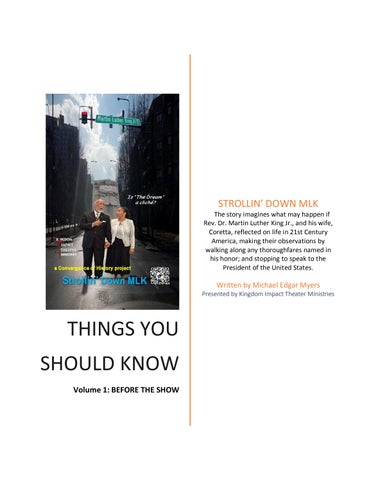
STROLLIN’ DOWN MLK
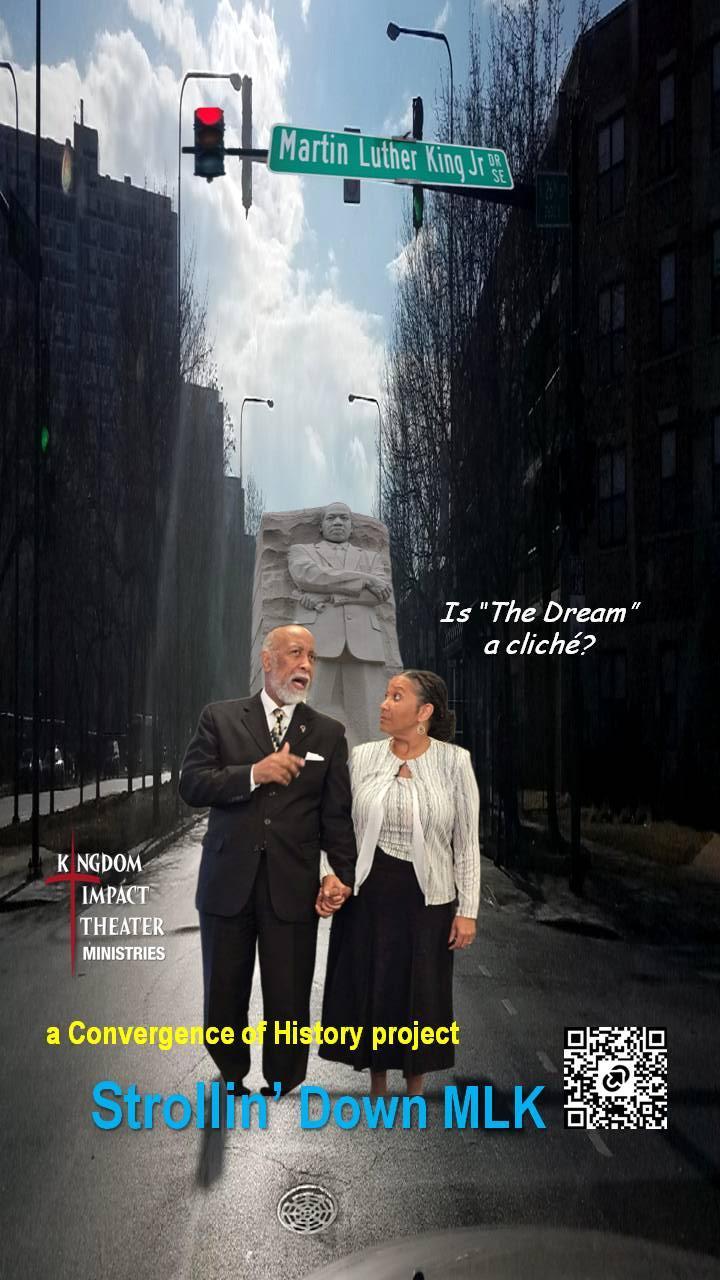
The story imagines what may happen if Rev. Dr. Martin Luther King Jr., and his wife, Coretta, reflected on life in 21st Century America, making their observations by walking along any thoroughfares named in his honor; and stopping to speak to the President of the United States.
Written by Michael Edgar Myers
Presented by Kingdom Impact Theater Ministries
Table of Contents
“Convergence of History: Four Anniversaries, One Faith” Page 2
About the Show Page 4
Things You Should Know Page 5
About the Guide Page 6
“How the Script Came About” Page 7
People You Should Know: The Principals Page 9
Things You Should Know: The Times Page 10
Things You Should Know: Personal Lives Page 11
Things You should Know: Public Knowledge Page 12
People You Should Know: Artists Page 13
People You Should Know: Theologians Page 14
People You Should Know: Presidents Page 15
People You Should Know: Politicians Page 17
People You Should Know: Influencers Page 18
“The Best Script is Scripture” Page 19
Supporting Our Dream Page 21
“Convergence of History” Performance Options Page 20 About Kingdom Impact Theater Ministries Page 23
The Script says: MARTIN
When I see what has happened in America since we I left, I am sometimes grieved.
CORETTA
As am I. The Scripture says:
GENESIS
“Here cometh the dreamer. Let us slay him and see what becomes of his dreams.” – Joseph’s brothers debating whether to kill or sell him.

1723 Roosa Lane Elk Grove Village, IL 60007 www.kit-ministries.com 630-659-9170
info@kit-ministries.com
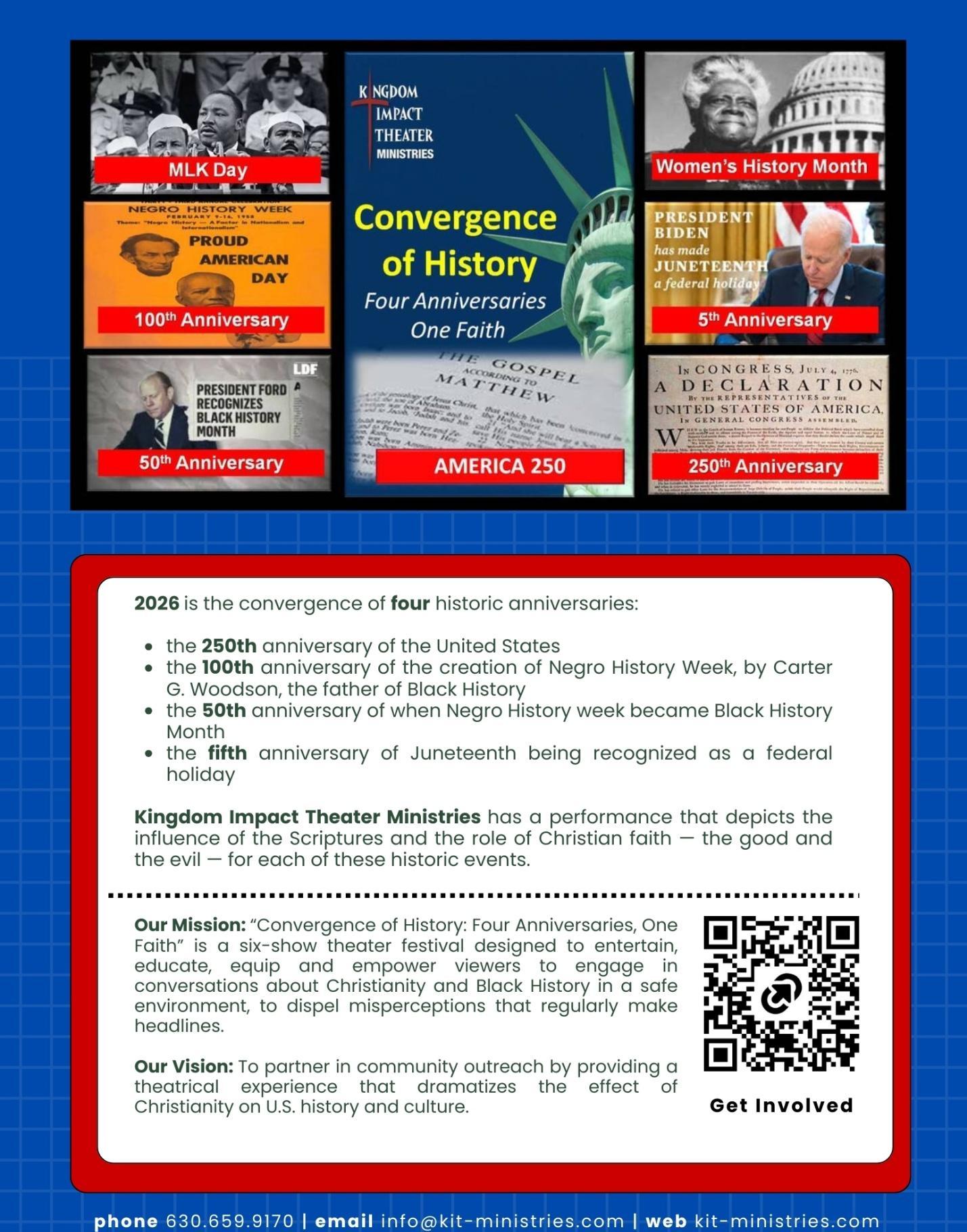
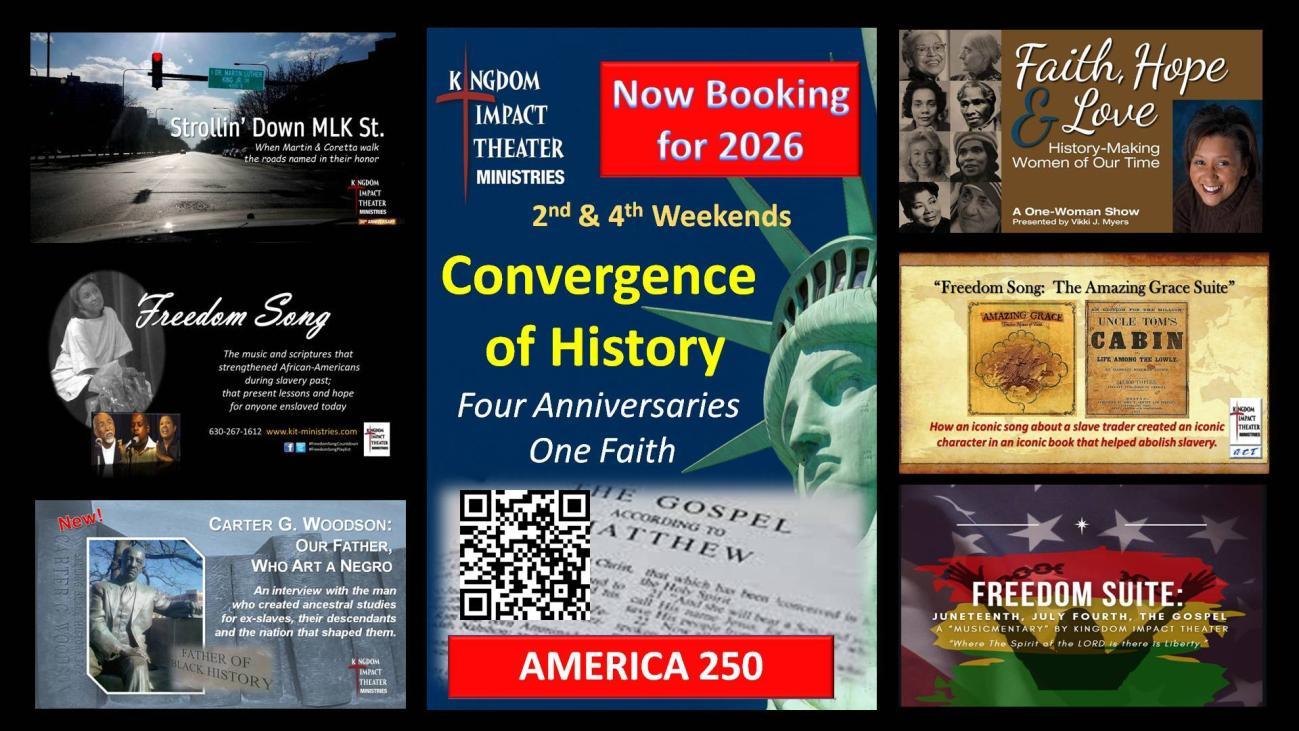
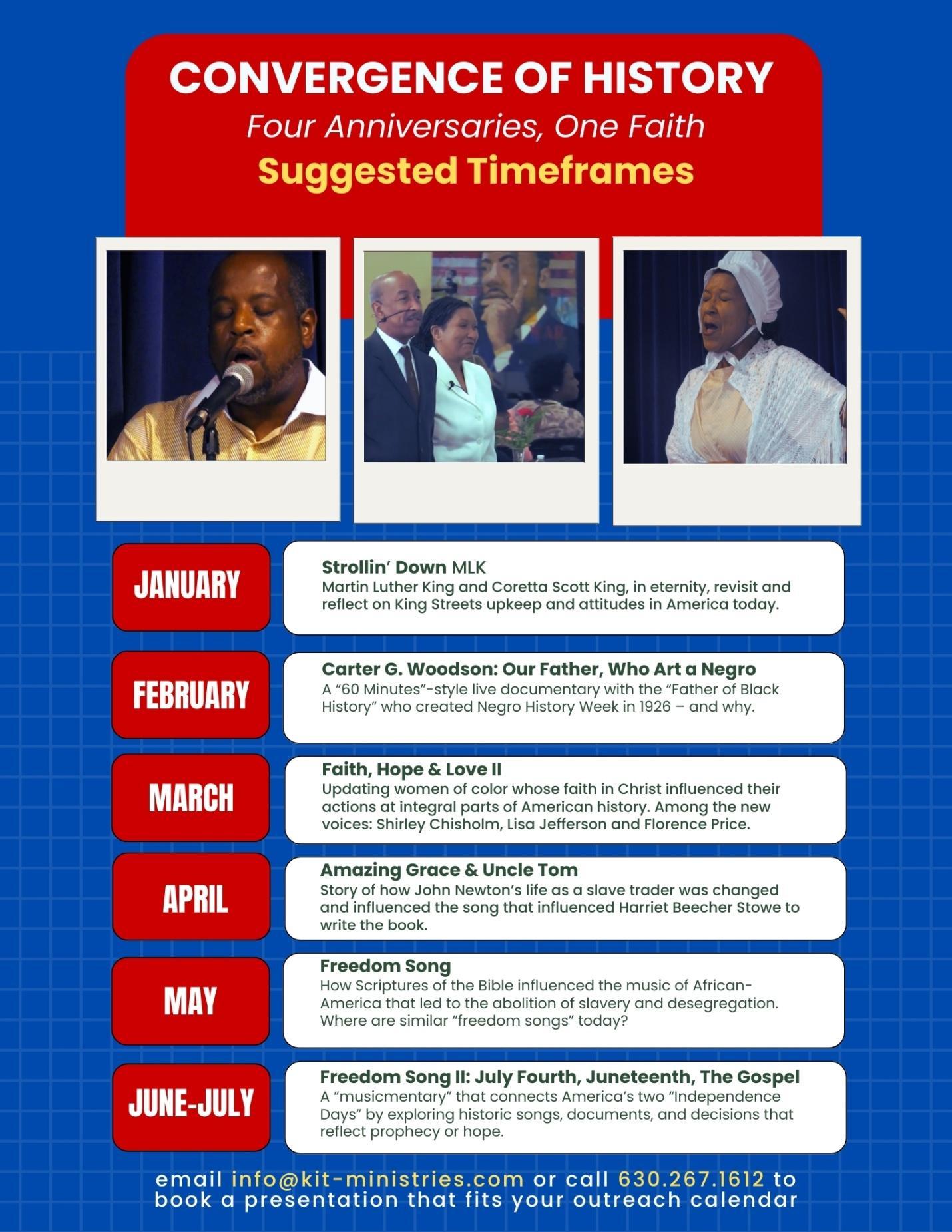
Convergence of History: Four Anniversaries, One Faith
“Strollin’ Down MLK” launches a six-month festival of original theater performances by KIT Ministries that are curated from the history plays dramatizing the relationship between Christian faith and African American history. Wecreated five shows from 2002 and 2023. We have added a new play for 2026 to celebrate the establishment of Negro History Week in 1926.
We thank corporate and personal sponsors whose generosity has allowed us to create the foundation for this project. Sustaining productions and content such as this guide will benefit from continued contributions from audience participants and other agencies that see value this project.
We do not charge admission to attend our productions, though we have production expenses. We invite you to add yourself to our growing list of sponsors and supporters of “Convergence of History: Four Anniversaries One Faith.”
ABOUT THE SHOW
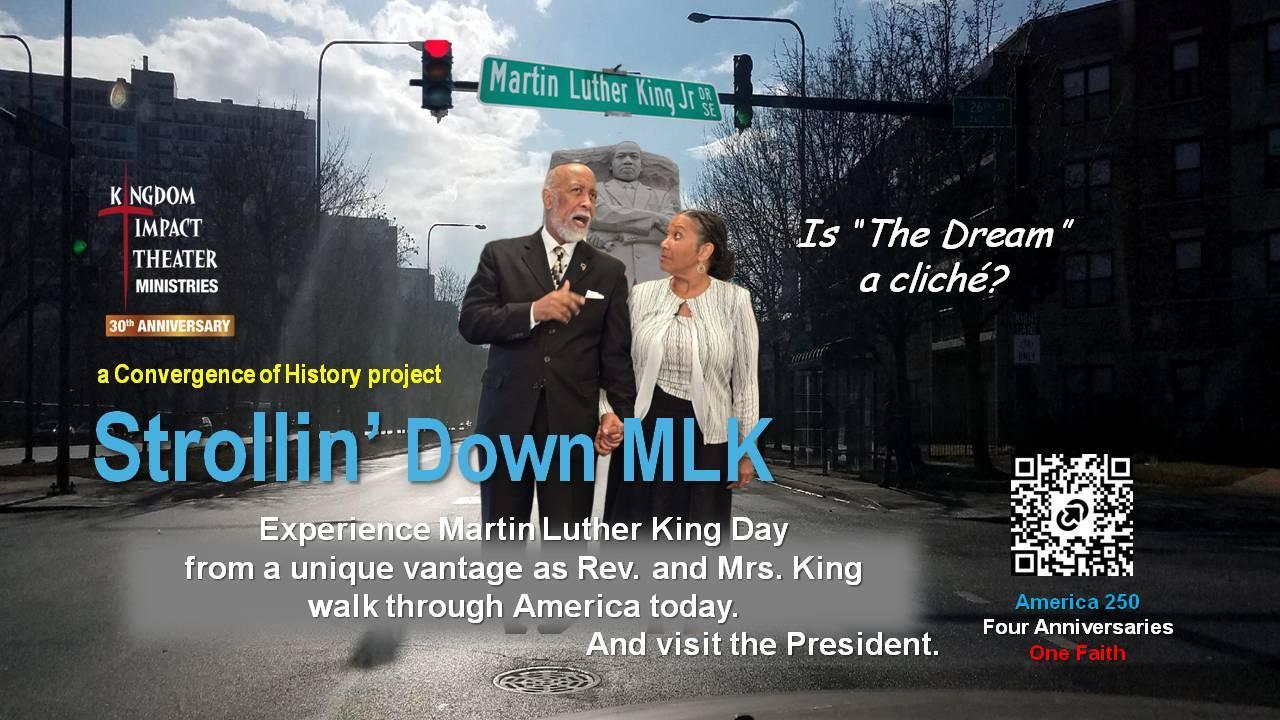
“Strollin’ Down MLK” imagines what may happen if Rev. Dr. Martin Luther King Jr., and his wife, Coretta, reflected on life in 21st Century America, making their observations by walking along any thoroughfares named in his honor; and if Rev. Dr. King spoke with the President of the United States alone in the Oval Office
“Strollin’ Down MLK” was written by Kingdom Impact Theater Ministries at the request of the Hoffman Estates Cultural Awareness Commission and debuted January 21, 2018 as part of the Commission’s 17th Annual MLK Celebration. The show was reprised at the HECAC’s 24th Annual Breakfast in 2024.
WRITTEN & PERFORMED BY Michael Edgar Myers
Vikki J. Myers
Musical Accompaniment: Garlan Garner
1723 Roosa Lane Elk Grove Village, IL 60007 www.kit-ministries.com 630-659-9170
info@kit-ministries.com
Things You Should Know, Vol. 1: Before the Show
This book is a guide to biographical and historical information that will be helpful in understanding their references when mentioned in dialogue in “Strollin’ Down MLK.”
Although most individuals are well-known by name, their impact in history, and their relation to Rev. Dr. King may be more obscure both among generations born after Dr. King’s passing, and among those who may remember the events of the era but not details.
Many hard facts (dates, awards, relationships) in the bios are edited from Wikipedia’s online encyclopedia. Where feasible, further online information has been made accessible through embedded links.
We have also provided, when necessary, links to videos, full texts of Rev. King’s writing, newspaper accounts and commentaries written during his lifetime. These accounts have provided direct quotations or atmospheric background that are transformed into dialogue in the script.
“Strollin’ Down MLK” is created to reflect the Kingdom Impact Theater Ministries mission to use performing arts to entertain, educate, equip and empower audiences into action, starting with Safe-Faith Conversations
We believe this is achieved through the common theatrical experience followed by guided questions and activities for personal or group discussion. These questions are provided in Volume II.
Volume 1 lets you learn about the people, events and beliefs surround Rev. Dr. King and his wife, Coretta Scott King, that will be helpful enjoying the play. Please read. And enjoy the play.
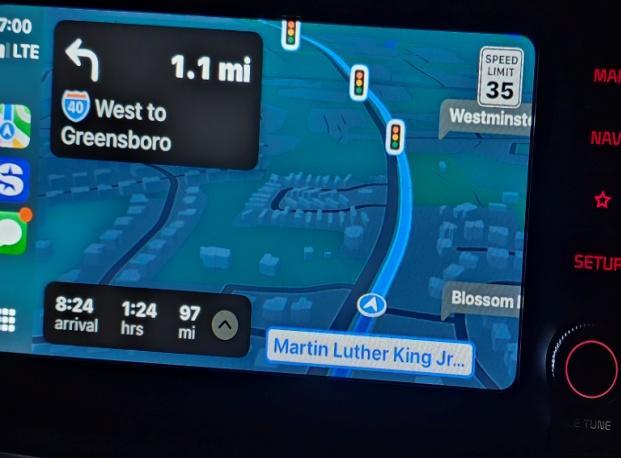
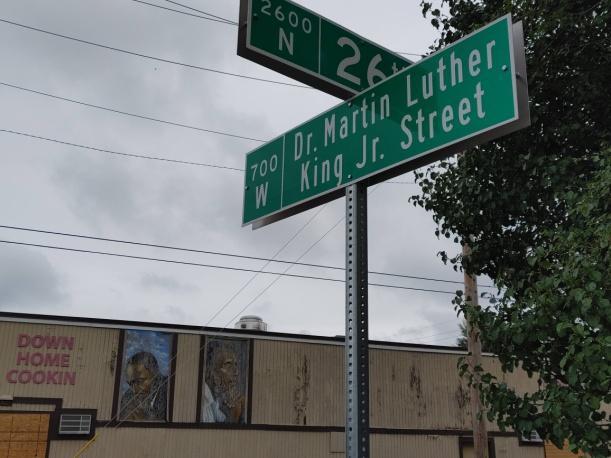
Charlotte, NC; Indianapolis
ABOUT THE GUIDE
The layout of the guide is also for entertainment enjoyment. It’s a mix between a stage script and prose literature. Assorted sections include lines of dialogue as they look in the script in Courier New typeface the actors see. Such as:
THE SCRIPT CORETTA
”I saw a movie once. About a young couple. There was a line they kept saying… ‘Love means never having to say you’re sorry.’ Remember?”
This is followed by biographical or historical commentary in another typeface. There are also still photos used as background in the multimedia stage performance and as part of the video narrative. For further research, we have included links to pertinent websites or documents. For fun, we have linked videos to music alluded to in the script.
Much of our biographical research is from
Wikipedia, the online encyclopedia of the millennium
Google and Bing AI summaries
IMBD.com, film and television data site
newspapers.com, a treasure trove of digitized newspaper edition dating to the 1800s.
Photographs in this guide are mostly saved from online searches. Photo credits and article citations are not always attributed. This is not to undermine artistic or journalistic credit. Citing sources is an academic must and a courtesy. We wish to respect the intellectual property of the researchers and to make all attributions in subsequent revisions. What we include here is within the parameters of sharing public content. None of our material is being sold. Where accessible, just copyright it provided.

A
MEMo From Michael Edgar Myers
How the Script Came About
This guide is compiled from research, isolated thoughts, historical tours, memories, and work/vacation photo safaris of adulthood that began emerging one autumn afternoon in a spurof-the-moment to visit a pastor-friend at his church in Chicago’s historic Bronzeville community a few blocks from Dr. Martin Luther King Drive
Originally named Grand Boulevard, then South Park Way, the thoroughfare was one of the first in the country renamed in King’s honor – in 1968, a few months after his assassination; just weeks before the city hosted the Democratic National Convention National Convention. The change was compassionate, controversial. And political. All hallmarks of King’s lifetime of work.
My talk with Pastor Michael Neal, himself a King-like activist-preacher, included kicking around how our suburban-based ensemble of theater missionaries, Kingdom Impact Theater Ministries, may partner with his Glorious Light Church to creatively proclaim the Gospel of Jesus Christ in the city. Pastor Neal even pointed out potential summertime performances that could be done in the shared lot of the facility next door – Martin Luther King High School
Knowing an hour-drive awaited me, he recommended a restaurant on King Drive that I may enjoy while waiting for rush hour traffic to thin. The stately brownstone homes and painted murals en route merited more than drive-by glances. I parked a few blocks away to take in closer looks on foot, a benefit after lunch because my auto was already full of gas.
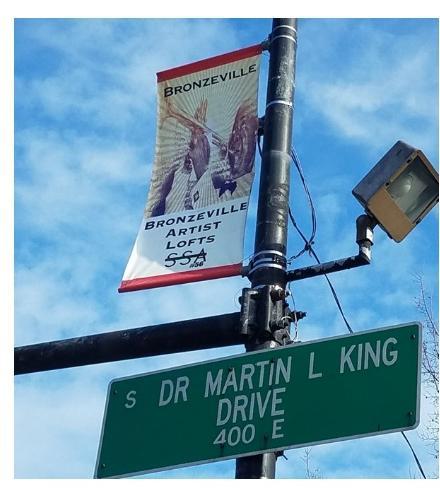
Bronzeville, Chicago,
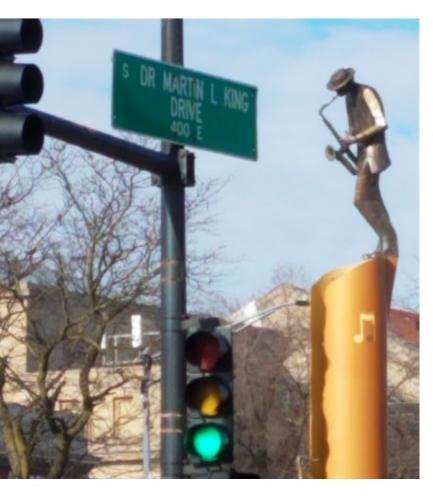
Heading home was a cruise. I drove, walked, photoed when neighborhood artistry beckoned. As the landscape changed to less aesthetic, my mind began wandering – imagining what Dr. King may say about the sites and events on his namesake street in Chicago had he walked with me that day. My imagination expanded on the drive home, and reverberates whenever I enter a city
with a Martin Luther King thoroughfare, or come across an artistic or architectural homage to King across the nation.
My walk along King Drive, my travels across the country, my passion for things historical, my memories of April 4, 1968, began melding into a story outline we that became, “Strollin’ Down MLK.”
Ironically, the script idea of what would Dr. King and his wife say about King Streets came to fruition through the request of a suburbanite, who found our ministry on the internet. The caller was a black male involved in politics in a community where the African-American population is only 5.5 percent. Wecreated the show for an integrated audience of adults, students, educators, and politicians for a Martin Luther King Breakfast. It’s the kind of audience Rev. King would have requested.
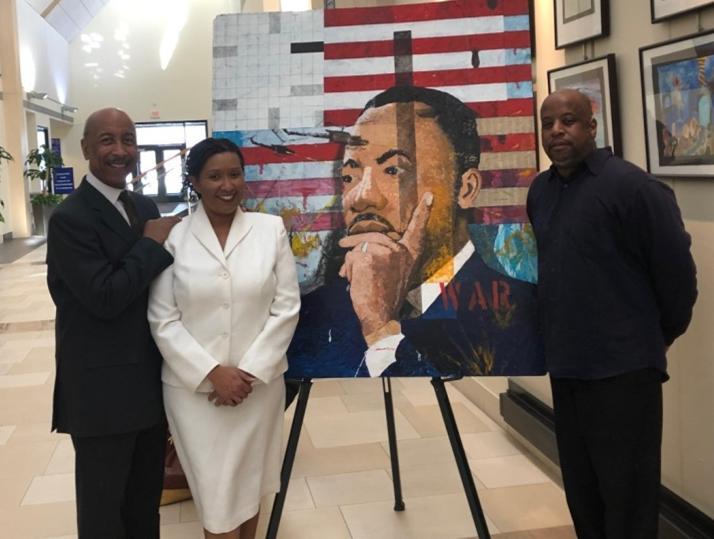
Michael, Vikki and Garlan after the first “Strollin’ “ performance in Hoffman Estates, IL, 2018.
As daily headlines of 2025 seemed so contradictory to the life that existed when Rev. and Mrs. King lived, bad as that was, their voices seem more apt, prophetic and poignant. Then Pastor Neal, his wife, Delores, and the glorious light of Timothy Community Corporation relit.
It’s been almost a decade since that dream shared with Pastor Neal was spoken. (A fact I realize only re-reading this essay written before the pandemic.) Our presentation in 2026 is our first self-produced series of shows, and is hosted groups whose values are akin to the Kings.
Our tour begins in two divergent communities … our debut in historic Bronzeville with Pastor Neal, and suburban Elk Grove Village, a municipality that’s existed but 70 years, with a black population of 2.9 percent, but an active multiethnic community involved in addressing issues common to both sets of demographics: equitable education, homeless families, recovery from substances, domestic violence, medical affordability, mental health guidance and others matters of humanity Rev. and Mrs. King believe are best addressed by partnership of faith and state.
We trust the journey in both sites brings joy to the King, and King of kings.
1723 Roosa Lane Elk Grove Village, IL 60007 www.kit-ministries.com 630-659-9170
info@kit-ministries.com
People You Should Know: The Principals
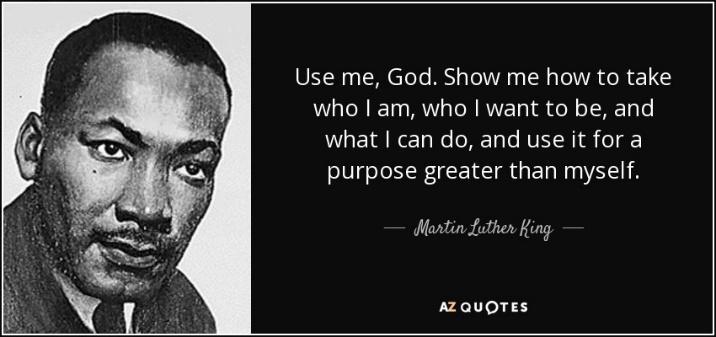
Martin Luther King Jr. Jan. 15, 1929 – April 4, 1968
THE SCRIPT CORETTA
“Martin…you made a difference. Still! Even this very day.”
Martin Luther King Jr., born Michael King Jr., was an American Baptist minister and activist who became the most visible spokesperson and leader in the civil rights movement from 1954 until assassinated in Memphis, TN in 1968. Born in Atlanta, King is best known for advancing civil rights through nonviolence and civil disobedience, tactics his Christian beliefs and the nonviolent activism of Mahatma Gandhi helped inspire. For his commitment to civil rights in 1964, he received the Nobel Prize for Peace in 1964.
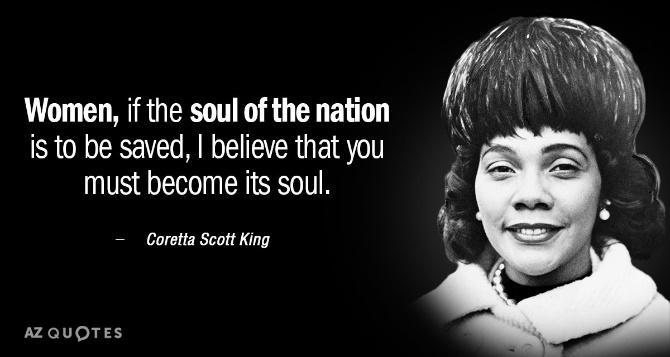
Coretta Scott King
April 27, 1927 – January 30, 2006
THE SCRIPT MARTIN
“Dreams become reality through preparation, sacrifice…and a helpmate.”
Coretta Scott King was an American author, activist, civil rights leader. The wife of Martin Luther King Jr., Mrs. King helped lead the Civil Rights Movement in the 1960s. She was an active advocate for African-American equality. King met her husband in Boston while she was attending graduate school and he was pursuing his doctorate. They both became increasingly active in the American Civil Rights Movement. She was also a classical singer. She sacrificed a professional singing career to work with her husband, and often incorporated music into her civil rights work . They married in 1953. After his death she established her own career as an advocate for non-violence.
Things You Should Know: The Times
THE SCRIPT MARTIN
”Sometimes I wonder if all they know about me is That Speech and Memphis.” Public Perception
Martin Luther King was not as popular when he lived as he became after his assassination.
His birthdate, January 15 (1929), became a national U.S. holiday in 1983 during Ronald Reagan’s presidency. However, the date was not recognized in all 50 states until 2000.
He was criticized by black and white contemporaries.
He was criticized as a civil rights advocate because he either moved too fast, or too slow.
He was criticized as an American citizen by those who thought he should only protest about civil rights and not politics, economic or military matters such as the Vietnam War.
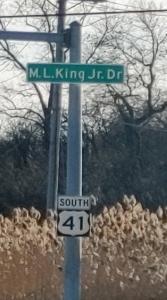
The Streets
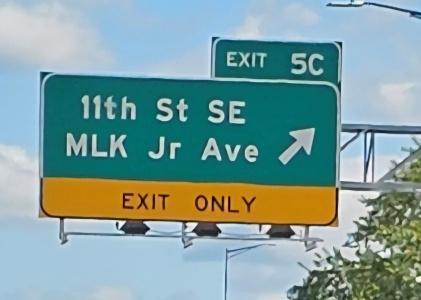
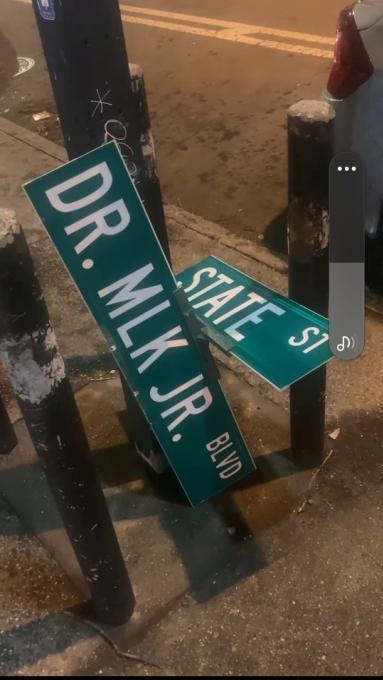
More than 1,000 roadways worldwide honor Rev. Dr. Martin Luther King Jr., a reflection of his enduring impact across cultures.
The first street renamed in his honor occurred less than a week after his assassination, April 4, 1968. This was in Haarlam in the Netherlands.
There was not a street named for him in Memphis, the city where he was slain, until 2012
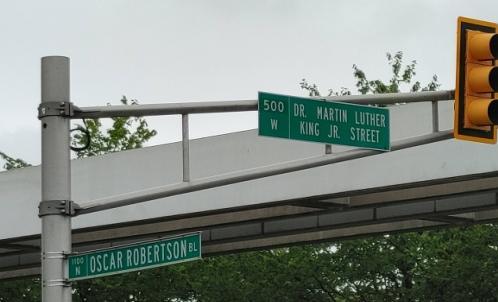
Indianapolis, Waukegan, Washington, D.C.
1723 Roosa Lane Elk Grove Village, IL 60007 www.kit-ministries.com 630-659-9170
info@kit-ministries.com
Things You Should Know: Personal Life
THE SCRIPT MARTIN
“I dream that children partake of the advantages afforded this nation…”
Education and Work Credentials
Freshman, Morehouse College, Atlanta, 1945. Age 15.
Graduate, Morehouse, 1948: Bachelor of Arts (Sociology), Age 19.
Graduate, Crozer Theological Seminary, Chester, PA, 1951: Bachelor of Divinity, Age 21.
Graduate, Boston University, 1955: Doctorate of Philosophy in Systematic Theology, Age 26.
Pastor, Dexter Avenue Memorial Baptist Church, Montgomery, AL,1954-1960.
Influences
Henry David Thoreau, 19th century author
Benjamin E. Mays, pastor, president, Morehouse College
Mahatma Ghandi, lawyer, non-violence activist
Educational Background: Sparknotes Biography
Musical Impact
Both Kings were musicians.
Coretta was a classical singer and pianist.
Martin played guitar.
Renowned gospel music singer Mahalia Jackson was a close family friend.
Music in The Show
The following songs were referenced in the script. Enjoy the videos. Soon and Very Soon
Everybody Talkin’ About Heaven Ain’t Going There Free at Last
The Stroll (Dance Illustration) – Dick Clark’s American Bandstand (1968)
The Impossible Dream – Brian Stokes Mitchell
1723 Roosa Lane Elk Grove Village, IL 60007 www.kit-ministries.com 630-659-9170 info@kit-ministries.com
Things You Should Know: Public Knowledge
The Movement and Activism
His name was changed by his father, Rev. Michael King Sr., who visited Germany in the 1930s and became fascinated by the radical, non-violent work of 16th century monk Martin Luther. “Daddy” King also changed his own name in honor of Martin Luther.
As happened with Martin Luther, followers of Martin Luther King were prone to violent rebellion countering the principles of their founder.
King’s work later expanded to include economic and social injustice, which included, to him, opposition to the war in Vietnam.
After Rev. King’s assassination, Mrs. King took up his causes and became more vocal about injustice and continued so until her death.
Controversies
King’s alliances with multi-ethnic coalitions led to charges that he was a Communist. This fear led to investigations and wiretaps by the Federal Bureau of Investigation
The wiretaps were approved by attorney general Robert Kennedy hoping to disprove theories of Communist infiltration, as feared then as the fear of terrorist cells today.
The wiretaps exposed that King had extra-marital affairs. Recordings of these affairs were sent to his wife hoping the embarrassed Kings would stop their civil rights work.
The tapes showed King was as vulnerable to temptation as any man; and that the Kings had marital challenges, as any couple. They remained a couple.
Events
in
1968 Rev. King Did Not Live To See
Robert Kennedy Killed Riots at Democratic National Convention
Mexico City Olympics Boycott
First Manned Flight to Moon
Richard Nixon Elected President
The movie “Love Story”
1723 Roosa Lane Elk Grove Village, IL 60007 www.kit-ministries.com 630-659-9170 info@kit-ministries.com
City Unknown.
People You Should Know: Artists
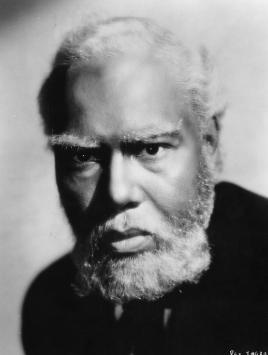
Rex Ingram
October 20, 1895 – September 19, 1969
CORETTA
“Rex Ingram. No, Rex Ingram was ‘De Lawd.’ ”
Rex Ingram was an American stage, film, and television actor whose career spanned 50 years Ingram was born near Cairo, Illinois, on the Mississippi River; his father was a riverboat steamer fireman Ingram graduated from the Northwestern University medical school in 1919 and was the first African-American man to receive a Phi Beta Kappa key from Northwestern. He went to Hollywood where he was discovered on a street corner by the casting director for Tarzan of the Apes (1918) He won widespread acclaim for his portrayal of “De Lawd” in The Green Pastures, a 1936 American film depicting stories from the Bible as visualized by black characters. In 1940, Ingram portrayed The Devil in the classic musical, “Cabin In The Sky,” He was the first AfricanAmerican actor hired for a contract role on a network soap opera, on the religious-themed The Brighter Day on CBS. (Sources: Wikipedia, IMBD. Photo: Getty Images.)
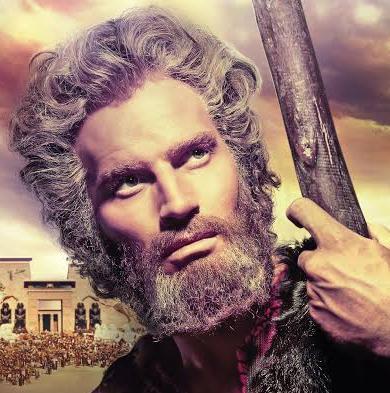
Charlton Heston
October 4, 1923 – April 4, 2008
THE SCRIPT CORETTA
“You’re more an ebony Charlton Heston.”
Charlton Heston was an American actor known for his leading man roles in biblical epics films in the 1950, the most notable of which was portraying Moses in the 1956 film, “The Ten Commandments.” Heston was among the more politically vocal actors of his time, as an independent artist and as president of the Screen Actors Guild. His activism was most visible during the 1963 March on Washington where he was instrumental in arranging the participation of numerous popular actors, thus bringing extra attention to the social issues of the time. He said, “This (civil rights) is not a political issue, it’s a moral issue.” He called Rev. King “a 20th -Century Moses.” Heston’s social and political causes evolved over his career gaining him criticism as a centrist, a liberal and conservative
People You Should Know: Theologians
Martin Luther November 10. 1483 – February 18, 1546
THE SCRIPT CORETTA
“You were both born to be rabblerousers which is why Daddy King changed your names.”
Martin Luther was a German professor of theology, a priest, author, composer and Monk. As a Catholic priest he questioned the processes and leadership of Pope Leo X He expressed his protests in a series of Biblically-based questions and ideas to reform the Catholic church. These became known as Luther’s 95 Theses, the most inflammatory challenging Pope Leo’s status as the only person who could interpret Scripture. Martin Luther’s theses established two theological ideas: Protestantism, denominations of believers in Jesus Christ whose methods of worship differ from Catholic methods; Lutheranism, the denomination of Protestant believers whose worship and study are similar to Luther’s original interpretations of Catholic beliefs.
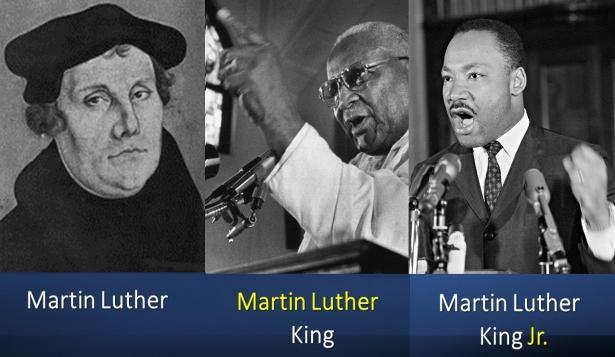
Martin Luther King Sr. December 19, 1899 – November 11, 1984
THE SCRIPT MARTIN
“But do they know WHY Daddy King changed our names?”
The father of a family devoted to Christian service the man known as “Daddy King” was given the name Michael at birth. After meeting ministers who were prepared to stand up for racial equality, Michael was inspired to become a preacher and followed their encouragement to study theology at the university level, still a novel and limited opportunity among Negroes. After receiving his bachelor’s degree in 1931, he became senior pastor of Ebenezer Baptist Church in Atlanta, a position held until 1975. During a mission trip in Germany in 1934, Rev. King became infatuated studying how Martin Luther’s protests led to church Reformation He connected that passion to his observations of growing anti-Semitism and Nazism in Germany and issues States. Upon returning to the U.S., he changed his name and that of his eldest son from “Michael King” to Martin Luther King as an ongoing reminder to the source of their mission.
1723 Roosa Lane Elk Grove Village, IL 60007 www.kit-ministries.com 630-659-9170
info@kit-ministries.com
People You Should Know: Presidents
John F. Kennedy
May 29, 1917 – November 22, 1963
THE SCRIPT
MARTIN
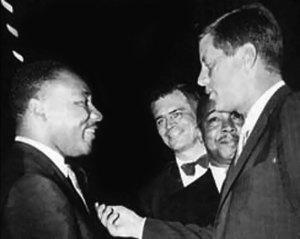
“The President was tenuous. ‘Take your time, Dr. King. Be patient.’ I had to ask him, “It’s been century since the Emancipation How long do we have to wait for its promises?”
John F. Kennedy was the youngest person elected President. He was 43, and the first person born in the 20th Century to hold the office which he did from 1961 until his assassination in 1963. His youth and athleticism excited the nation; his looks and celebrity connections ushered in the era of media-centric campaigning. Negroes expected he would lead civil rights reforms, but he was reluctant to move quickly, fearing segregationist members of his Democrat Party would prevent his re-election in 1964 when he intended to push a Civil Rights platform. Some, attributed Kennedy’s reticence to elements of his Catholic faith of which many Americans were skeptical. Among the skeptics, Rev. Martin Luther King Sr., who supported Republican Richard Nixon in the 1960 Presidential elections. However, Martin Jr.’s conversations and viewing unprecedented televised violence against Negro protesters in 1961 motivated Kennedy to order federal intervention to protect civil rights. He was assisted by his brother, Robert Kennedy, then Attorney General of the U.S., who engineered legal intervention and protection. The Kennedy brothers established a relationship with the King family during the 1960 campaign when JFK called Mrs. King to offer support when her husband was in jail and his life was threatened. Robert Kennedy, meanwhile, was among those working behind the scenes to secure King’s release.
Kingly Presidential Influence
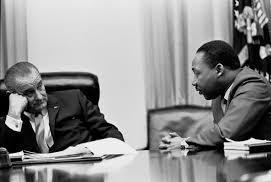
Few pastors, before or since, have had the access and spiritual independence to speak to Presidents as did Martin Luther King. That reality inspires a fictional, private White House conversation with the current President of the U.S. The monologue includes King’s actual words, imagined statements, and improvisation input based current events.
Lyndon B. Johnson
August 27, 1908 – January 22, 1973
THE SCRIPT MARTIN
“It took a lot of arm-twisting to get LBJ to push through the Civil Rights Act and the Voting Rights Act.”
Lyndon Johnson became president after the assassination of John F. Kennedy, and was elected President on his own in a landslide victory in 1964. Johnson served in the Congress and Senate for 23 years as a Southern Democrat at a time when the Party policies were often shaped segregationists called Dixiecrats. As President, with the counsel of Rev. King, among others, LBJ broke with Dixiecrats to establish laws JFK could not, that eliminated, reduced or rectified discrimination in many areas of American society, notably The Civil Rights Act (1965), The Voting Rights Act (1965),.Medicare and Affirmative Action. LBJ’s social programs, known as “The Great Society,” made him among the most popular presidents in history At the same time, however, he escalated military action expanding war in Vietnam. Rev. King was among his critics, saying economic costs and a disproportionate number of black males drafted into the military distracted from domestic needs. Such criticism caused a personal rift between King and Johnson, and partly led to LBJ’s choice to not seek re-election in 1968
Barack H. Obama
Born August 4, 1961
THE SCRIPT
CORETTA
“I showed him my scrapbook and told him what you taught me..”
In 2008, Obama was the first African American elected to the Presidency. Much of the nation believed his election was the fulfillment of King’s dream of racial harmony. Two years earlier, while a U.S. Senator in Illinois contemplating whether seek the Presidency, Obama visited Mrs. King and her family to gain any insights on how a Black American may prepare run for that office. Mrs. King passed before his election.
1723 Roosa Lane Elk Grove Village, IL 60007 www.kit-ministries.com 630-659-9170
info@kit-ministries.com
People You Should Know: Politicians
Robert F. Kennedy
November 20, 1925 – June 6, 1968
THE SCRIPT CORETTA
“Yes, I know what Bobby did.”
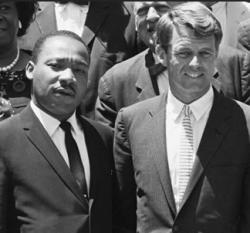
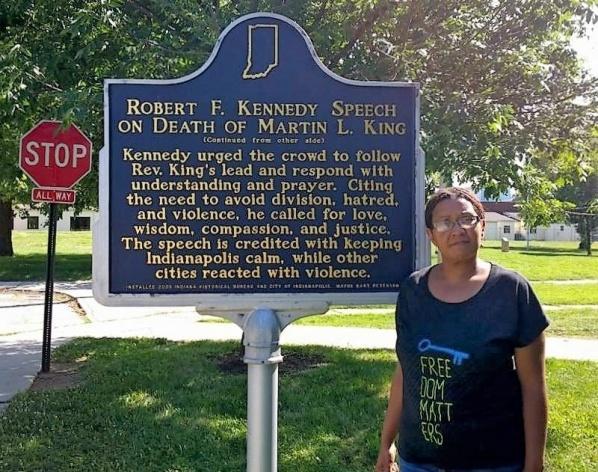
Often called RFK or Bobby, Robert Kennedy was appointed U.S. Attorney General when his brother, John F. Kennedy, became President. Bobby was responsible for implementing legal government intervention to protect civil rights activities and neutralize segregationists. RFK’s most controversial action was permitting the FBI to wiretap Rev. King’s phone calls He did this to disprove rumors that King was a Communist which, if true, would have undermined JFK’s civil rights policies and the entire movement. While the wiretaps exonerated King of Communist affiliations, they did record him having extramarital affairs. The FBI sent the tapes to Mrs. King in an effort to embarrass the Kings into stopping their civil rights work. They did not. The night Rev. King was assassinated, then-Sen. Robert Kennedy announced the murder to a predominately black crowd in Indianapolis. His extemporaneous speech is credited with preventing retaliatory riots there that befell other cities. Afterwards he visited Mrs. King at her home to offer condolences and empathy from a person who had a loved one shot to death. Two months later, RFK was assassinated after a presidential primary victory in Los Angeles
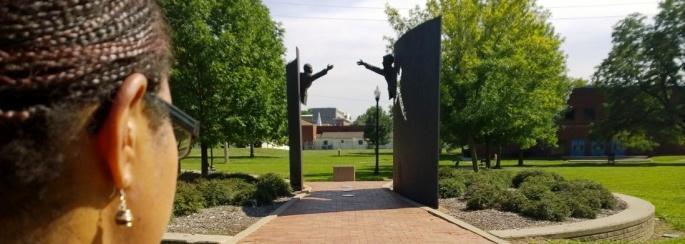
Memorials at 17th & Broadway Park site of Robert Kennedy ‘s peace-keeping announcement of Martin Luther King’s death.
People You Should Know: Influencers
George Wallace
Augusts 25, 1919 – September 13, 1998
THE SCRIPT
MARTIN
…among the young people. I don’t know what set them off quicker: hate speech by George Wallace or witnessing for Jesus Christ.
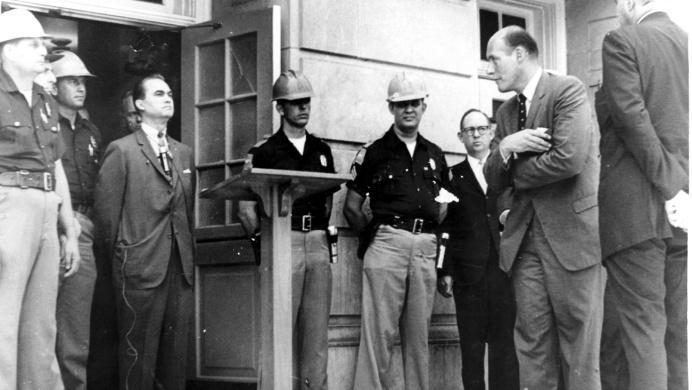
George Wallace was among the Southern Democratic governors who openly confronted presidents Kennedy and Johnson in their civil rights efforts integrating public schools. When inaugurated in 1963, Wallace proclaimed, “I say segregation now, segregation tomorrow, segregation forever.” He famously stood in the doorway of the admissions building at the University of Alabama to prevent two Negro students from enrolling. President Kennedy issued an executive order to send in the National Guard to escort the students and remove the governor from the doorway. Later in life, he renounced segregation, and reconciled with the two students.
Asa Philip Randolph April 15, 1889 – May 16, 1979
THE SCRIPT
MARTIN
“If anybody should have a holiday it should be Brother Randolph.”
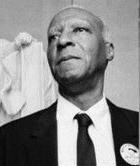
Asa Philip Randolph was a leader in the Civil Rights Movement, the American labor movement, and socialist political parties. In 1925, he organized the Brotherhood of Sleeping Car Porters, the first AfricanAmerican labor union. He proposed a March on Washington for jobs in 1941 to change unfair labor practices toward people of color, but convinced President Franklin D. Roosevelt to issue an Executive Order to end discrimination in the defense industries during World War II. He revived the March Washington in 1963 and was the emcee.
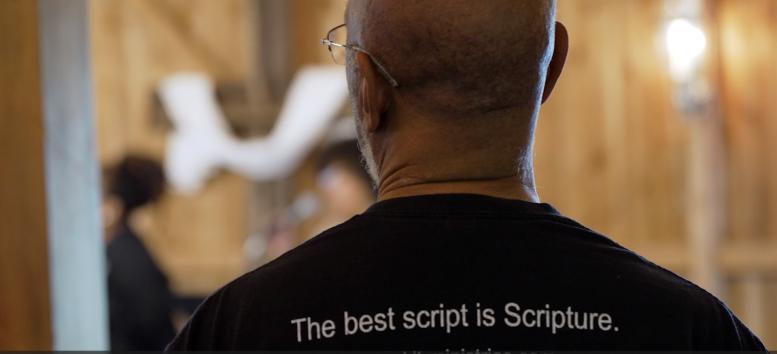
Things You Should Know: “The Best Script is Scripture”
The motto of Kingdom Impact Theater Ministries is “The best script is Scripture.” Thus, with each piece we create, it’s imperative to make certain the story is guided by The Word of God as it relates to the events in the piece and daily life
We include Scripture to make it clear that Martin Luther King included principles of Jesus Christ as a guide for his commitment to non-violence, as well as practice actions of other leaders in history.
Rev. King: “They said, one to another, ‘Here cometh the dreamer. Let us slay him and we shall see what becomes of his dreams.” -- Genesis 37:20 (King James Version)
Mrs. King: “O love the Lord, all ye his saints: for the Lord preserveth the faithful, and plentifully rewardeth the proud doer.” – Psalm 31:23 (King James Version)
Mrs. King: “Precious in the sight of the LORD is the death of his saints.” – Psalm 116:16 (King James Version)
Rev. King: “If my people, which are called by my name, shall humble themselves, and pray, and seek my face, and turn from their wicked ways; then will I hear from heaven, and will forgive their sin, and will heal their land.” – 2 Chronicles 7:14 (Multiple Translations)
Rev. King: “ ‘And it will be in the last days,’ says God, “ ‘that I will pour out my Spirit on all people; then your sons and your daughters will prophesy, your young men will see visions, and your old men will dream dreams.’” – Joel 2:28 (Multiple Translations)
Rev. King: “I beheld, and, lo, a great multitude, which no man could number, of all nations, and kindreds, and people, and tongues, stood before the throne, and before the Lamb…” Revelation 7:9 (Multiple Translations)
Convergence of History: Four Anniversaries, One Faith
Save the Dates Saturday, February. 14
“Carter G. Woodson: Our Father, Who Art a Negro” at 2 p.m. Connection Church, Libertyville
June 19–21
“Juneteenth, July Fourth, The Gospel” Bellevue Ministry Center, Chicago
Receive Schedule Updates
Support our Dream
“Convergence of History” programs are made available thanks to our sponsors and generous individuals who believe in the KIT Ministries dream. Feel free to add your name to our family of supporters.

Bruce and Linda Andresen
Jack and Sue Kitten
Nancy Avitia, Lamarr and Brenda Lark
Bill and Madeline Baltrus
Lloyd Biddle,
Shavon Coleman
Charles and Jacqueline Deberry
Samantha Diesel
Wilondja L Masongezi
Michael and Delores Neal
Dorothy Norquist
Winfred and Michelle Obleton
Deborah Renaud
Schlcendije Elmazi (Dije) Pyar Seth
Bradley Harbaugh
Kathryn Jarosch
R. Razz Jenkins
Faith Johnson
John Werner
Joe and Ronda Wright
Waukegan Community Church
Margie Yeager
Sponsor Convergence of History
1723 Roosa Lane Elk Grove Village, IL 60007 www.kit-ministries.com 630-659-9170
info@kit-ministries.com
SUPPORTING OUR DREAM
Our dream is to present quality performances live and online without being a financial burden to groups wishing to use our programs.
We always invite and welcome contributions from individuals, groups or corporations who have a similar passion for our mission.
Partnering with Kingdom Impact Theater Ministries is about building relationships.
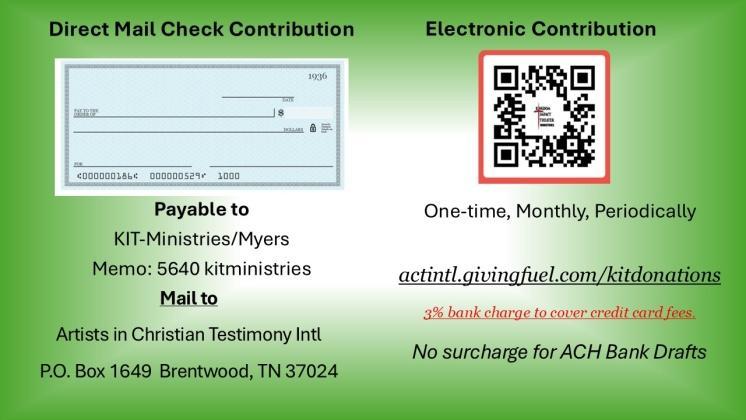
Monthly, one-time, quarterly or annual gifts allow us to adapt live content to emerging technologies with quality.
If you’d like to partner with us, Invest in the Dream and become a KIT Road Buddy at
actintl.givingfuel.com/kitdonations
info@kit-ministries.com
ABOUT THE COMPANY
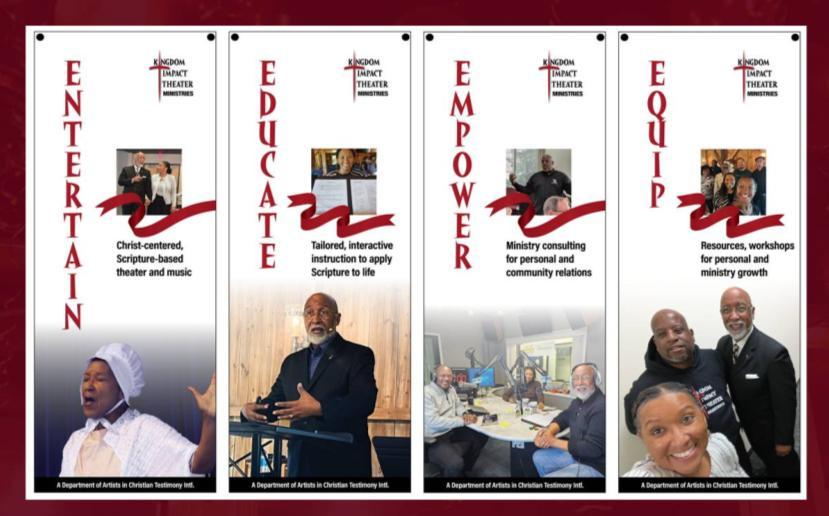
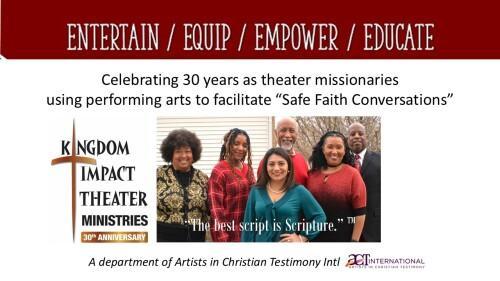
Kingdom Impact Theater Ministries is an ensemble of theater missionaries who entertain, engage, empower and educate using performing arts to facilitate Safe Faith Conversations.
KIT Ministries is a department of Artists in Christian Testimony Intl, a fully registered 501(c)(3) organization serving 590 people in 402 Ministry Departments Serving 37 Countries & 40 States.
Our purpose is to stimulate conversations on matters of faith, particularly the role of the religion of Jesus the Christ and its relation to daily life in homes and local communities.
Kingdom Impact Theater offers training and consultation in ensemble performance, personal storytelling, and group presentations. We also provide theater-based training in leadership skills such as interpersonal communication, team collaboration, and conflict management.
Our focus is working with smaller and mid-sized congregations, schools, community agencies and businesses who wish to improve relationships and expand cultural understanding.
1723 Roosa Lane Elk Grove Village, IL 60007 www.kit-ministries.com 630-659-9170
info@kit-ministries.com