
AI for Business
“Ireland is a strong voice in Europe, advocating for harmonisation and coherence across
Niamh Smyth
TD, Minister of State at the Department of Enterprise Page



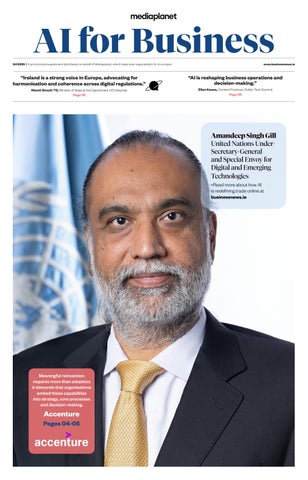
Amandeep Singh Gill United Nations UnderSecretary-General and Special Envoy for Digital and Emerging Technologies
~Read more about how AI is redefining trade online at businessnews.ie
AI readiness starts with data – not hype
Despite the noise surrounding AI, most organisations still face the same challenge: understanding what problems they’re trying to solve, and whether their data is ready to support it.

That’s the gap Showoff, a Salesforce partner, with global experience and Irish roots, sees in many organisations it works with. “We’ve gone from building apps for startups to solving problems for large organisations across the UK and US,” says Barry Sheehan, Showoff’s chief commercial officer. “Our heritage is in data, integrations and migrations”.
Garbage in = garbage out
As the team refocuses on the Irish market, they’re finding that many organisations are excited about AI, but struggling to determine where best to use it to realise value.
While tools and platforms get the headlines, the real differentiator is still data. “People say they want to bring everything from the past into their new systems, but don’t bring your garbage. Be smarter about what you keep and why. Garbage in equals garbage out.”

they can call it AI, software as a service or automation. Whether that’s right or wrong doesn’t really matter, if it’s used for the right reason.”
Although much of Showoff’s work is in the Salesforce ecosystem, Sheehan stresses their focus is on helping companies understand their business challenges and goals — not implementing new systems for the sake of it.
For many businesses, the first step toward AI is not AI at all — it’s fixing the basics.
For many businesses, the first step toward AI is not AI at all — it’s fixing the basics. Legacy systems, paper forms and “swivel-chair” processes remain widespread. “These problems have existed for years. Integration is still key, and lots of people still aren’t doing it,” Sheehan says.
The result: organisations often mislabel automation as artificial intelligence. Sheehan is pragmatic about this, “If somebody knows the problem they’re trying to solve,
“Maybe you don’t need all the new bells and whistles,” he says. “Maybe what you’ve got is fit for purpose. We can give that independent view: are you ready for AI?”
After years of delivering projects internationally, the company has built a diverse team. “We’ve got people originating from all over the globe, all based here in Ireland.”Sheehan says. He notes that proximity and familiarity still matter, “There’s a bit of honesty, a bit of good old-fashioned relationship building. And we’re close by.”
As organisations in Ireland figure out data and AI, Sheehan says the focus should be less about selling technology and more about clarity. “It’s all about helping people figure out where they’re coming from — and delivering something valuable once we understand what that something is,” he says.

Ireland as a Leader in AI Innovation and Adoption
Ireland is accelerating AI adoption, innovation and regulation in enterprise. Discover how national strategy and new initiatives aim to position Ireland as a global tech leader.

Ireland has positioned itself as a forward-thinking digital economy, but we cannot be complacent. I’m determined that Ireland fully embraces the opportunities that AI offers across our economy and society.
Ambitions for AI in enterprise
My priorities with AI are best understood in terms of three ambitions for enterprise:
Fast-tracking enterprise technology adoption
• Establishing Ireland as a choice location to test, develop and scale the latest technologies
• Cementing Ireland’s position as a centre of regulatory excellence and a strong voice in Europe, advocating for welldesigned digital regulation
Government’s soon-to-be-published National Digital and AI Strategy (2025) will lay out concrete actions to facilitate the delivery of each of these ambitions.
Since taking on the role of Ireland’s first Minister of State designated with a specific portfolio for AI, I’ve seen firsthand the impact that AI can have on enhancing productivity and encouraging innovation in firms of all sizes. I’m committed to ensuring that Ireland’s SMEs can maximise the potential of AI. To fast-track widespread enterprise digitalisation, I’m working with LEOs, European Digital Innovation Hubs and enterprise agencies to ensure that every SME is aware of the support available to them. These range from consultancy, vouchers, process innovation, to marketing and R&D grants.
Ensuring compliance in innovation
For all enterprises, compliance must be built into innovation from the outset. Looking to the months ahead, the National
Artificial Intelligence Office is set to be established by August 2026. The Office will act as Ireland’s central authority for implementing the EU AI Act. The Office will coordinate EU AI Act implementation, promote research and adoption and ensure that Ireland’s approach to AI governance remains proactive. Although many AI systems used by small firms won’t fall under the “high-risk” scope of the EU AI Act, all businesses should begin assessing their AI use and compliance. There are resources already in place to guide businesses on AI compliance: through CeADAR, Ireland’s national centre for applied AI, the Department of Enterprise website and the EU AI Act Service Desk’s Compliance Checker.
Positioning Ireland as a global tech leader
Our ambition is also to grow our leadership position as a location for global companies. Sixteen of the top twenty global technology companies, and eight of the leading providers of foundational AI models, have their main EU establishment here. Positioning Ireland as a location of choice to research, test, develop and scale the latest digital technologies and as a hub for AI and cybersecurity will enhance our leadership status.
I’ve championed the idea of hosting an AI and Digital Summit during Ireland’s EU presidency to showcase our strengths and values in AI innovation, adoption and regulation. I’m pleased to confirm that work is now underway on this summit, which will take place on 14 October 2026.
Lastly, Ireland is a strong voice in Europe, advocating for harmonisation and coherence across digital regulations. For my part, I represent Ireland on the D9+ group of digital frontrunner EU Member States, and I’ll continue to advocate for well-balanced regulation and a digital single market which underpins EU competitiveness and innovation.
Niamh Smyth TD Minister of State at the Department of Enterprise, Tourism and Employment with special responsibility for Trade Promotion, AI and Digital Transformation
Barry Sheehan Chief Commercial Officer, Showoff

Irish firms look for efficiency beyond early AI experiments
Irish law firms are moving beyond early trials of artificial intelligence and focusing instead on how it can meaningfully improve everyday legal work.
Across the legal profession, firms are recognising that the business and practice of law can no longer operate as separate tracks. With client expectations rising, matters growing more complex and teams under increased pressure to work efficiently, practices are beginning to rethink how legal work is organised and delivered.
It is in this context that global legal technology company Clio has introduced Clio Work to the Irish market, a platform designed to help firms shift from light experimentation to more connected, outcome-focused use of AI.
From system of record to system of action
Traditional practice management systems have long served as systems of record, storing documents, communications and activity histories. Valuable, but ultimately static. Irish firms are now seeking technology that not only stores information but helps advance the legal work itself.

A more outcome-focused approach
Today, leading law firms evaluate technology based on its ability to strengthen legal reasoning, identify strategic issues and reduce administrative drag. Rather than adopting tools in isolation, they are looking for solutions that connect operational workflows with the substantive work of law.
This platform is designed to support that shift. By reducing context switching, surfacing insights earlier and tying legal knowledge directly to matter activity, the platform helps firms deliver more consistent, efficient and informed outcomes. With its EMEA headquarters based in Dublin for more than a decade, the company has had a front-row view of how Irish firms’ needs are evolving.
Leading law firms evaluate technology based on its ability to strengthen legal reasoning, identify strategic issues and reduce administrative drag.
“Ireland has always been home to forward-thinking legal professionals, and we are seeing a real appetite for tools that strengthen both the quality and speed of legal work,” said Sarah Murphy, General Manager, International at Clio. “Our platform gives firms of all sizes the ability to deliver stronger outcomes without adding administrative burden.”
This platform is built for this evolution. By connecting case and client information with the world’s largest global legal library in a single workspace, the platform links matter activity with relevant legal sources as work unfolds. It interprets documents and correspondence in context, helping practitioners move more quickly from questions to answers without switching between tools.
Harnessing AI to drive business productivity
A pioneering Irish software developer is harnessing AI to boost productivity and drive organisational transformation within the performing rights industry.
MA future where technology powers legal work
As AI becomes embedded in Irish legal practice, new digital tools point toward a future where technology does more than record what lawyers do. It actively supports how they think, analyse and progress their matters. For many firms, that shift marks the beginning of a new chapter, one where efficiency and expertise can advance together.
atching Engine — which uses AI, machine learning and natural language processing to provide relevant connections between two sets of data — is being adapted to pair music with copyright owners.
Developer John Corley, who heads an Irish software company specialising in the field, explained that AI systems can identify, secure and distribute billions of euros in copyright payments to creators.
Digital transformation

As CEO of Spanish Point Technologies, he explains, “Our system is used by customers across thirteen markets in Europe and North America that distribute over €2.6 billion in royalties annually. It makes sure that 758,000 rights
holders get paid.”
Yet the work with CMOs (collective management organisations) on copyright issues through its matching engine solution is just one string to its bow.
Spanish Point, founded in 2005, also focus on digital transformation for businesses and helps other software companies make the most of their transition to the cloud to deliver real-world AI business applications, underpinned by a longstanding partnership with Microsoft. An example is their work with Kefron to redesign its next-generation platform, which embeds AI for automatic recognition and coding of invoice documents.
Improving productivity
Spanish Point is Microsoft Ireland’s AI Innovation Partner of the Year for
2025, and recognised in the top 1% of Microsoft cloud partners worldwide through the prestigious Azure Expert Managed Service Provider (MSP) program.
Corley said, “We’re always trying to find innovative ways and technology to help businesses drive productivity, giving them a massive competitive advantage. AI is a key enabler of that.”
“Often, smaller, more nimble companies can adapt more quickly, so there are opportunities for organisations to start learning how to drive productivity through AI.”
Their Chief Operating Officer, Daire Cunningham, said AI enables businesses to automate repetitive tasks and repurpose personnel for more complex work. However, they emphasise each project should be examined individually, and companies should implement AI incrementally rather than seek full automation from the outset.
He explained that the AI landscape continues to evolve, such as Agentic AI being able to make decisions on behalf of humans, and multiagent systems working together. For example, onboarding new employees with an AI agent controlling aspects of finance, HR and IT as it interacts with human staff.
According to Cunningham, “Through our strategic relationship with Microsoft, we can bring together the best technology coming out of Microsoft with our understanding around business scenarios, integration and development; it’s a very important partnership for us.”


Sarah Murphy General Manager, International, Clio
John Corley CEO, Spanish Point Technologies
Daire Cunningham COO, Spanish Point Technologies
Sponsored by Clio
Sponsored by Spanish Point
WRITTEN BY Mark Nicholls
The agentic AI shift is happening — is your business prepared for true reinvention?
Agentic AI is reshaping industries, only prepared organisations will thrive.

Agentic artificial intelligence — AI systems that can reason, collaborate, plan, make decisions and execute tasks autonomously — isn’t the far-fetched technology of some distant future. It’s here now and has entered business reality, so organisations must move quickly to prepare — or risk being left behind.

Agentic AI represents the next evolution of AI, advancing from systems that can produce responses and generate outcomes to systems capable of executing tasks and delivering measurable impact — and that distinction is going to transform the workplace, explains Denis Hannigan, AI & Data Consulting Lead, UK and Ireland, at professional services company Accenture.
“At its core, agentic AI brings a higher degree of autonomy to how work is carried out,” he says. “These systems can plan, adapt and interact with tools and data to manage complex activity. Agentic architectures — networks of AI agents that coordinate and execute tasks — mark a shift from basic automation to more sophisticated operational execution. That is where the transformative potential lies.”
Why you should care about agentic now rather than later Three enablers have simultaneously developed to make agentic AI possible: enterprise-grade AI infrastructure, data governance and advanced model capabilities, making operational, autonomous agents viable — not just theoretical.
“AI, and increasingly, agentic AI, are reshaping industries. But meaningful reinvention requires more than adoption; it demands that organisations embed these capabilities into strategy, core processes and decision-making,” says Liam Connolly, AI & Data Consulting Lead, Accenture Ireland. “Companies that delay will struggle to catch up. As with previous technological revolutions, the advantage compounds quickly — and leaders are separating themselves through capabilities in data, talent, change adoption and C-suite leadership. In the end, it’s likely readiness and ambition will likely be the defining factors.”
Currently, Accenture is noticing two types of AI investments. The first is a broad adoption of the technology (eg. enterprise chatbots, coding assistants) to boost productivity. However, the second focuses on strategic bets to drive real transformation and requires end-to-end process reinvention across value chains.
Examples of where agentic AI is already generating significant returns include banking (‘know your customer’ operations and mortgage processing), insurance (fraud detection and claims optimisation), communications (self-healing automated networks) and utilities (workforce operations optimisation). The trouble is, fewer than 15% of organisations have

the capabilities to scale agentic AI beyond pilot programmes and unleash its full power, based on Accenture’s research.
AI systems that can reason, collaborate, plan, make decisions and execute tasks autonomously — isn’t the far-fetched technology of some distant future.
“Common obstacles include fragmented processes, underdeveloped data and AI foundations, unclear priorities and value measurement, limited change capability and slow adoption,” says Hannigan. “To move beyond experimentation, organisations are establishing AI Centres of Excellence to coordinate effort and build the capabilities required to scale. Our research points to a set of essential data and AI competencies — and five imperatives — that determine whether investment translates into impact.”
How to prepare for and deploy agentic AI Hannigan and Connolly outline key steps for any business preparing to deploy agentic AI. First, lead with value: identify a small number of high-impact workflows where AI can deliver a clear outcome. Second, ensure the technical foundations are in place — a secure, AI-enabled digital core, modernised data, governed architectures and integration patterns capable of supporting agents. Third, prepare the workforce by equipping people with rapidly evolving skills and encouraging a culture of curiosity. “And from a governance perspective, autonomous agents will require new control frameworks,” Connolly adds.
Other steps include running controlled pilots with built-in safeguards such as failure-recovery mechanisms, observability and human-in-the-loop oversight. “The mantra is: start small, instrument everything and build for scale — and measure it all,” says Connolly.
“This is a defining moment for the workplace,” stresses Hannigan. “Organisations need to treat AI reinvention as a business transformation, not a technology upgrade. That means strengthening data, talent and governance capabilities, embedding the five imperatives into enterprise strategy, and aligning AI systems with human decision boundaries and business outcomes. Without these, progress stalls — with them, the value opportunity compounds.”


INTERVIEW WITH Denis Hannigan AI & Data Consulting Lead, UK and Ireland, Accenture
INTERVIEW WITH Liam Connolly AI & Data Consulting Lead, Accenture in Ireland
WRITTEN BY Tony Greenway
Culture, Skills, and Trust: Navigating the agentic AI workplace
Embracing change: Why reskilling and openness matter in the age of agentic AI


TSpread Sponsored by

hanks to artificial intelligence (AI), workplaces will enter a new era of intelligence. Audrey O’Mahony, Talent & Organisation Lead at professional services company Accenture, doesn’t downplay its challenges, but insists organisations must be prepared to embrace them. She also wants leaders to recognise the big picture business value of AI, specifically agentic AI (autonomous systems that require minimal human intervention) and content-creating Gen AI.
“It can’t simply be about improving efficiency or reducing costs,” she says. “Instead, it’s a huge opportunity to think differently and reimagine how to create more high-value work using agentic or Gen AI capabilities.”
Wendy Walsh, Talent & Organisation Lead, agrees. She sees AI as “a new task-level disruptor” and thinks its immediate impact will be to drive process, therefore job redesign. While machines take care of mundane and language-heavy tasks, the human workforce will have more time to focus on judgment calls and client relationships and ultimately drive more top-line value.
Building a positive culture with a clear narrative
To prepare, leaders should tell their people about what they’re trying to achieve with AI and the impact it’ll have on them. Being open and transparent with consistent messaging will help reduce employee anxiety, build trust and create an environment where staff can experiment with AI. Crucially, they must have permission for, and the opportunity to, experiment with and learn how to work with and alongside new technologies.
Many of Accenture’s clients — from financial services organisations to technology companies to government departments — are starting to embrace agentic and Gen AI. “For example, we’ve seen organisations use Gen AI capabilities to optimise data quality, better enabling complex technology programmes,” says O’Mahony. “And now we are helping our clients design how multi-agent capability can transform everything from customer experience, to sales and support, pricing and product innovation as well of course as all middle and back-office activity.”
A challenge of scaling agentic is ensuring that leaders understand its capabilities and how best to deploy it.
“We’re spending a lot of time supporting clients with the reskilling agenda — both the workforce and also C-suite leaders”, says O’Mahony. “They know they
need to understand the technology and what they must do to accelerate their digital infrastructure to enable deployment. Equally, they need to understand how it will require a rewiring of their company DNA as well as the impact on both employee experience and behaviour.”
Importance of sound AI governance
To successfully scale AI adoption, the reskilling of frontline employees is vital because they’ll be at the centre of it. “However, while we’re seeing recognition of this importance, there’s more to be done to ensure the workforce reskilling agenda is a priority,” admits O’Mahony. “The good news is, because of digital tech and government supports and interventions, training is more readily accessible, but getting to apply learning in roles is what’s actually key.”


To
successfully scale AI adoption, the reskilling of frontline employees is vital because they’ll be at the centre of it.
Reskilling must be a priority, says Walsh, who says it’s critical for responsible AI deployment and use.
“AI governance will become as important as the technology itself,” she says. “The EU AI Act is putting companies under pressure to be AI literate, which means everyone must be trained and empowered to understand what the tools can do. For example, Accenture has made sure it’s been walking the AI walk with mandatory staff training. “I’m always thinking about the AI agents I can create,” says Walsh. “As leaders, we have to embrace this because the next generation has already come to expect it.”
Organisations need to think of agentic capability not as a ‘bolt-on’ tool, but as an entirely new workforce. “But it’s not a workforce that’s a silver bullet,” stresses O’Mahony. “It’s a workforce with imperfections that’s learning and growing, so designing processes with a human in the loop is critical. Ultimately, it’s about humans operating with AI to bring ongoing and enduring value to a business. The Irish workforce is a proven pioneer in technology and digital, and this is the next wave of opportunity to capitalise on.
INTERVIEW WITH Audrey O’Mahony Talent & Organisation Lead, UK and Ireland, Accenture
INTERVIEW WITH Wendy Walsh Talent & Organisation Lead, Accenture in Ireland
WRITTEN BY Tony Greenway
Ireland’s AI wave is building — let’s widen the flow
Momentum is growing among Irish SMEs embracing AI. With the right networks, small wins can turn into national transformation.
The AI conversation has shifted. At this year’s National AI Meet, what stood out wasn’t the hype; it was the hunger. Irish SMEs, once cautious, are now curious with intent. They’re no longer asking ‘Should we use AI?’ but ‘How do we start, and where can we learn from others?’
That sentiment is echoed in our recent AI Readiness Pulse findings. While just 7% of businesses claim full confidence in AI, a growing number are experimenting: trialling tools, creating internal champions, forming peer learning circles. The appetite is there.
Why AI virtual customers are your next competitive advantage
Customers are now using AI to make decisions, and now, they’re buying through it. If your business isn’t utilising this feature and understanding AI-native customer behaviour, you may be left behind.
When I speak with business leaders about AI synthetic personas, I usually get a strange look, but hear me out. No one predicted the meteoric rise of AI chatbots. Sarah Friar, CFO of OpenAI, revealed they had reached 1 billion users with 800 million active monthly. ChatGPT recently announced ‘Click to Buy’ in the US, where customers purchase products through Etsy and Stripe directly in chat.
The shift is already here
Success relies on sharing failures, learning from peers and collaborating across sectors.
Building together, scaling faster Momentum alone won’t deliver results, but collective progress can. AI isn’t just a technical shift. It’s an organisational one. Success relies on sharing failures, learning from peers and collaborating across sectors.
That’s where Technology Ireland ICT Skillnet comes in. We work with industry and trusted partners to build hands-on, businessfirst learning pathways — designed with companies, not just for them. Whether it’s upskilling a team lead or launching a use-case pilot, we help SMEs reduce risk, avoid wheel reinvention and accelerate real-world results. Our goal is to create the infrastructure that turns AI interest into lasting capability, through training, support networks and shared experience.
The power of small wins
What we see, again and again, is how one small win can shift a whole organisation’s mindset. A retail SME using AI to forecast demand. A services firm improving client onboarding with automation. These aren’t moonshots; they’re smart, tangible steps — and they spread. Ireland’s AI future must be collaborative, not competitive. Companies avoid common pitfalls. They see what’s working in businesses like theirs. That’s the compound value of collaboration, and it’s the force that will close Ireland’s AI readiness gap faster than any one company could alone.
AI doesn’t have to be overwhelming. It just has to be shared. The wave is building. Let’s make sure every business gets to ride it.

Susan Kelly Operations Director,
The massive scale of platforms like ChatGPT represents a clear shift. Your customers are thinking, searching and buying with AI. Forward-thinking businesses can leverage these same tools to understand customers faster and more cost-effectively than ever. This creates an untapped opportunity to harness AI virtual customers and accelerate market research.
What are virtual customers?
Build synthetic personas — AI ‘virtual customers’ — that model your key segments: a busy parent, a student, a small-firm CFO. Input anonymised survey data and demographics into each persona, then instantly ask them to react to a new feature, pricing strategy or sales message. You get directional insight in minutes, not weeks. Peer-reviewed research confirms these personas respond with approximately 90% human-like accuracy, making them ‘good enough to decide what to test next.’
Intelligent sequencing: the winning strategy AI personas cannot replace the nuance and emotion of human interviews. Their strength is quick concept testing and surfacing unexpected angles. The most effective approach sequences human and AI research:
• Initiate: Start with your team’s core questions
• Explore: Run fast rounds with AI personas, testing multiple options
• Validate: Bring top two to three ideas to human interviews
Refine: Loop back to AI to polish final concepts
Real business impact
This integrated approach delivers immediate value: product teams rank features and reduce rework; marketing tests headlines by segment before spending budget; sales practices objection handling with realistic scenarios; UX designers identify friction points before coding.
By combining people and AI deliberately, you learn faster, spend less and go to market with confidence, always confirming findings with real customers.

Practical AI Solutions 2026
Intro DTS 2026 will tackle AI adoption, cybersecurity and practical solutions for organisations to succeed in 2026.
As the digital landscape evolves, organisations are facing growing pressure to adopt AI responsibly and at scale.
Thriving with AI safely
Dublin Tech Summit spotlights practical artificial intelligence applications and the growing challenges of cybersecurity, guiding businesses through rapid change. The real measure of success is moving beyond pilots to systems that deliver measurable returns, using smart technologies to support human work, not replace it.
AI’s impact: practical solutions for 2026 AI is reshaping business operations and decision-making, while also enriching customer experiences and streamlining processes. Leaders now focus on integrating AI into daily workflows, continually evaluating impact and adapting strategy. This journey depends on upskilling staff, making innovation a partnership between humans and AI tools.
Critical challenges for enterprises Companies heading into 2026 face dual challenges: scaling AI adoption and maintaining cybersecurity. Transitioning from experiments to organisation-wide AI triggers complex questions about governance, ROI and new compliance rules like the EU AI Act and DORA. Advanced threats require AI-powered monitoring and layered cyber defences, making robust security and regulatory foresight essential for safeguarding data and trust.
Practical, human-centred insights
DTS 2026 is shaped by attendee feedback that demands practical, step-by-step learning and real-world case studies. Human-centred workshops are designed to build confidence and reduce friction, supporting teams as they adapt to smarter systems. Investment in culture and skills, alongside transparent communication, remains central to any successful transformation.
Ten learning outcomes for responsible AI
Building on previous summits, ten foundational outcomes continue to guide progress: AI must be secure, collaborative across teams, quick to deliver tangible value and scalable globally through investment in people and communication. Human-centred design and multidisciplinary co-creation maximise impact, while unified data strategies and constant oversight drive ethical and effective enterprisewide AI adoption.
What attendees really want
Attendees are calling for credible advice on affordable AI, new technologies like Web3 and quantum computing and resilient frameworks for long-term success. Networking and shared learning empower organisations to thrive, adapt and innovate as technology evolves.

Mark
Founder, AI Ireland
AI upskilling is essential for a future-proofed IE economy
SOLAS, the State agency for further education and training in Ireland, offers a wide range of AI courses for both the public and business employees.
To find out how to upskill your workforce, visit: Skills to Advance: solas.ie/ programmes/ skills-to-advance/ eCollege: ecollege.ie
Micro-qualifications: solas. ie/microqualifications/
As AI, automation and ongoing digitalisation disrupt the working world, the Irish workforce must be equipped with the skills to adapt, stay competitive and confidently engage with innovative technologies.
Skills to Advance
According to Mary Lyons, Director of Enterprise, Employees and Skills at SOLAS, “Recent reports highlight that more than 900,000 people in Ireland urgently need to upskill in AI to keep pace with workplace adjustments.”
Skills to Advance is an upskilling and reskilling initiative, created and funded by SOLAS, assisting employers to develop skills within their teams, increasing their competitiveness through highly subsidised training. “Through Skills to Advance, we’ve provided over 110,000 skills development opportunities since 2019. The initiative is designed around the real needs of employees and enterprises, offering flexible delivery (online, blended or in person) and targeting emerging skills in areas like AI and sustainability,” explains Lyons.
All Skills to Advance courses are delivered locally by the Education and Training Boards (ETBs) around Ireland and are specifically designed to align with pre-identified national skills needs. “Our upcoming FET strategy supports the adoption of new technologies, focusing on nationally important areas like AI, digitalisation and the environment. Further education plays a key role in providing flexible learning, broad access, future-focused skills and research informed by real-world data.”
becoming a priority across all sectors, and our short courses help people to build confidence to use AI ethically and effectively, dispel fears and understand how to leverage its benefits in the workplace.”
Adapted to all levels of learning, microqualifications are offered to accommodate access, welcoming both those looking to develop foundational AI competency and more advanced employees of businesses looking to develop strategic expertise. “Our Level 4 micro-qualification ‘Introduction to AI’ is designed for all learners and builds fundamental AI literacy, while the Level 5 ‘Enhancing productivity with AI’ goes a step further, empowering learners to integrate AI tools into the workplace,” explains Fitzpatrick.
Two Level 6 micro-qualifications are also awaiting validation, covering both the legal and ethical use of AI and codesigned with industry partners. “There’s already a huge appetite from employers for these higher-level programmes,” says Fitzpatrick. “Our cost-offset model means the financial burden on employers is negligible, reducing barriers for small companies and ensuring time and course relevance remain the priority.”
eCollege
eCollege is the national online learning service for further education and training, funded by SOLAS. Some flexible learning opportunities on offer lead to industry-aligned certification and are essential for thriving in the digital era.


Sponsored by SOLAS

Further Education and Training (FET) microqualifications, delivered as part of the Skills to Advance initiative, provide bite-sized, accredited programmes that deliver targeted training in rapidly transforming skill areas, designed with the realities of full-time employment in mind.
“Micro-qualifications have been developed collaboratively with industry partners, allowing employees to receive short, targeted bursts of learning relevant to their sector, delivered flexibly across 50 hours,” explains Noreen Fitzpatrick, Employee Development Manager. “AI skills are

“We provide a wide range of certified and noncertified courses across IT, business, sustainability and digital skills, making it an ideal platform for anyone looking to upskill,” explains Ciara Ni Fhloinn, Flexible Learning Manager. “AI is increasingly becoming a core part of digital competency, and it now threads through much of our curriculum. We’re continually updating our programmes to reflect the new realities shaped by AI, and we are seeing a huge amount of interest from people across all sectors.”
“All eCollege courses are free and fully online, which makes them particularly valuable for people in time-poor or resource-limited environments,” adds Ni Fhloinn.

Director of Enterprise, Employees and Skills, SOLAS, The Further Education and Training Authority
Noreen Fitzpatrick Employee Development Manager, Enterprise, Employees and Skills, SOLAS, The Further Education and Training Authority
Ciara Ni Fhloinn Flexible Learning Manager, Enterprise, Employees and Skills, SOLAS, The Further Education and Training Authority
WRITTEN BY Bethany Cooper
Why lifelong learning matters in an AI world, and how ETBs are leading the way

As AI integration reshapes the Irish workforce at pace, lifelong learning is the anchor keeping people adaptable, employable and confident to manage technological advancement.

Artificial Intelligence (AI) has become deeply integrated into nearly all aspects of everyday life, reshaping industry sectors, from healthcare, finance and education. While AI can drive technological innovation and enhance workforce productivity, people need to be equipped with the knowledge and practical skills to utilise it effectively, efficiently and ethically.
Why lifelong learning matters in an AI-driven world
“Lifelong learning is no longer optional, but essential,” says Dr Joseph Collins, Director of Further Education and Training at ETBI. “AI is accelerating change across every sector, and roles are evolving faster than traditional education can keep up. To stay future-ready, every learner and organisation needs ongoing opportunities to reskill, upskill and build confidence in using emerging technologies.”
Flexible AI upskilling across Ireland Education and Training Boards Ireland (ETBI), the national representative body for Ireland’s 16 Education and
Training Boards (ETBs), is supporting each region to be agile and fully equipped to upskill workers as rapidly as technologies evolve, in close collaboration with state agency SOLAS. ETBI is committed to excellence in education, training and support, with individual ETBs serving as the driving force for local community development.
“ETBs are the bridge between education and employment, providing practical, industry-aligned training that ensures every learner can participate effectively within the economy,” says Collins. “AI is a huge priority, with each of the 16 ETBs providing practical pathways at every level, from first-step digital confidence to advanced technical training.”
Courses designed to cover digital competency and AI literacy are regularly updated to remain relevant as the technological landscape evolves. Learners can access flexible online, hybrid or in-person training on sectorspecific AI applications.
“Whether it’s AI literacy, prompt engineering, data skills or sectorspecific applications, ETBs are responding quickly with flexible,
accessible programmes,” says Jessica Mullen, FET Professional Learning & Development Hub Manager. “We cater to a diverse range of students, and providing courses that are accessible is extremely important.”
Network collaboration driving development Collaboration is a fundamental component of Ireland’s Further Education and Training (FET) network. Course leaders work with industry experts and each ETB is closely connected to the evolving needs of their region. Programmes are developed with industry partners and aligned with government goals.
“Each ETB’s educational offering reflects the needs of its region and is aligned to the national further education and training strategy,” says Mary Walsh O’Shea, Adult Education Officer at Waterford and Wexford ETB. “What’s really incredible is how everyone works together. Innovation developed in one ETB quickly inspires progress across the whole network, so when someone develops something new, everyone benefits.”
AI is accelerating change across every sector, and roles are evolving faster than traditional education can keep up.
Immersive technology
AI is also being utilised as a tool to expand and enhance lifelong learning opportunities. The SOLAS Innovation through Collaboration Fund has supported the development of a new immersive learning platform integrating AI into Healthcare training leveraging an XR platform to develop and enhance transversal skills.
This project enables multiple ETBs to utilise technology which allows us to move beyond information delivery to true experience-based understanding,” explains O’Shea. “It enhances the whole network’s ability to deliver education, modernising practical training and guides our learners in a way that is engaging and futurefocused. Employers then benefit from the immediate application of new skills.”
Every ETB is accessible to local learners and businesses, offering tailored courses in AI and digital skills. From immersive technology and micro-qualifications to programmes specifically designed to meet the needs of local business, ETBs provide flexible, practical learning for the future needs of the Irish AI-driven economy.



Jessica Mullen Professional Learming and Development Manager, Education and Training Boards Ireland
Dr Joseph Collins Director of Further Education and Training, Education and Training Boards Ireland
Mary Walsh O’Shea Adult Education Officer, Waterford and Wexford ETB Sponsored
WRITTEN BY
Bethany Cooper