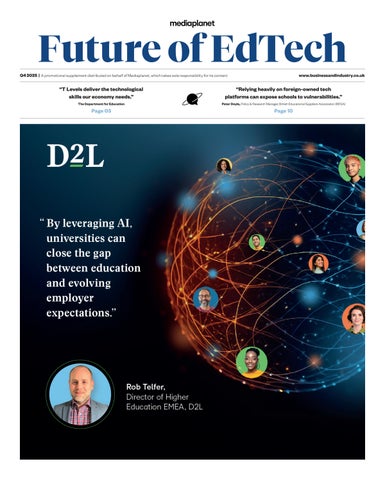

Future of EdTech
“T Levels deliver the technological skills our economy needs.”
The Department for Education Page 03

“Relying heavily on foreign-owned tech platforms can expose schools to vulnerabilities.”
Peter
Page 10

Doyle, Policy & Research Manager, British Educational Suppliers Association (BESA)

Bett UK 2026 offers free CPD and tech training

Organisers gear up for an exciting EdTech event that provides opportunities for key teacher training, empowering educators with the skills and tools to inspire and shape future generations.

Bett UK is the world’s leading event for education technology, where educators, policymakers and innovators from around the globe meet with the mission to drive better education globally. As the world’s biggest celebration of education, Bett UK brings together over 30,000 leaders across the education community for three inspiring days of collaboration and discovery.
Hannah Fry, Amol Rajan, Sir Martyn Oliver and many more as we explore this year’s theme: learning without limits. Your ticket gives you access to hundreds of hours of inspiring CPD-accredited content, led by the global changemakers who are transforming education through technology and innovation.
Hands-on innovation: Tech User Labs and more
From artificial intelligence (AI) and EdTech innovation to SEND and inclusion, expect headline sessions at the Bett Arena, immersive Tech User Labs where educators get hands-on with the latest tools and the return of TableTalks, peerto-peer discussions that connect education professionals worldwide.
Don’t miss this opportunity to share ideas, spark connections and celebrate the future of education. Educators go free. Get your ticket today!
Unlock a world of CPD-accredited content
This January, at Excel London, Bett UK 2026 is bringing you world-class sessions from speakers including
Protecting digital identities can’t wait: securing UK schools with deviceless MFA
A student’s digital identity — their secure access to apps, files and data — isn’t just an IT problem; it’s a learning and security crisis.

In the UK, 60% of secondary schools and 44% of primary schools identified a breach or attack in the past 12 months.1 A single stolen student record can fetch up to £200+ on the dark web. Schools need a unified identity foundation that ensures secure, easy access to learning and prevents identity theft that can follow a student for life. Unified identity is one of the first steps to meeting the DfE’s six core digital technology standards by 2030.2
The problem: when security traps learning
Multifactor authentication (MFA) is the first line of defense, and the Government’s guidance makes it non-negotiable.3 Yet, most solutions fail in the classroom. Why? Most MFA options rely on personal mobile phones — a technology often banned or impractical in classrooms. This forces a terrible choice: a secure system that disrupts learning, or an accessible one that invites risk.
The risks are significant. IT Director Roger Nixon starkly illustrates the reality: “One school had printed usernames and passwords stuck into student planners... unfortunately, that’s more the norm than the exception.”

Classroom MFA does not just meet this challenge; it redefines classroom security with a second layer of protection without requiring a personal device. It uses student-friendly methods like Badges (physical, encrypted QR codes for instant, passwordless access), login pictures and 6-digit PINs. This classroom-friendly solution allows schools to set distinct MFA policies based on age and ability. For large trusts, this is essential: “We can tailor the logon journey for every year
Preparing young people for tomorrow’s workplace
The Government’s priority is ensuring that every young person leaves education equipped not just for their first job, but for a lifetime of opportunity and adaptability.
Wgroup,” says Andrew Edmondson from Co-Op Academies Trust.
Automate security, accelerate learning Fragmented EdTech creates two critical resource drains: manual data tasks for IT and lost learning time. Our goal is simple: automate security, accelerate learning.
We eliminate manual tasks by automating the account and access lifecycle for over 1,000+ apps (including Google, Active Directory and Entra ID). This frees IT teams for strategic work by minimising PII sharing and eliminating manual data transfers.
We also reclaim lost learning time. Students can lose up to 20 minutes of a lesson struggling to log in.4,5 The Clever SSO portal, paired with Badges, ensures students can log in safely and instantly. A unified identity platform from Clever proves that schools never have to choose between best-in-class security and effortless, equitable access.
References:
1. Department for Science, Innovation & Technology, & Home Office. (2025). Cyber security breaches survey 2025: education institutions findings. GOV.UK. https://www.gov.uk/government/ statistics/cyber-security-breaches-survey-2025/cyber-security-breaches-survey-2025education-institutions-findings
2. iCT4. (2025). Meeting the core digital Standards by 2030. https://ict4.co.uk/blog/meeting-DfEstandards
3. Department for Education. (2025). Narrowing the digital divide in schools and colleges. GOV. UK
4. Browner, E. (2023). Badges: how teachers saved 200k hours in a school year. Clever. https:// www.clever.com/blog/2023/08/badges-how-teachers-saved-100k-hours-in-a-school-year
5. Whitney, C. (2025). 20 Minutes Back: How one Australian school uses Clever to save teaching time and boost security. Clever. https://www.clever.com/blog/2025/10/australia-badges

orkplaces are evolving at an unprecedented pace. Artificial intelligence (AI), automation and digital innovation are transforming every sector of our economy. That’s why we’re revolutionising technical education through T Levels — transformative, employerled qualifications that provide a genuine alternative to A levels. We’re committed to working closely with employers and colleges to ensure T Levels deliver the technological skills our economy needs and remain responsive to rapid digital change across every industry sector.
Industry placements: education in action
Every T Level includes a minimum 45-day industry placement, ensuring students don’t just learn theory but apply their knowledge in real workplace settings, building professional networks and confidence alongside technical expertise.
T Levels have helped people like Fernanda, who completed a T Level in Digital Production, Design and Development, and spent her industry placement at global tech leader IBM. She discovered a passion for AI through her T Level and secured a prestigious degree apprenticeship in AI with IBM. Fernanda isn’t alone — around
a third of T Level students who progress into employment get jobs with their industry placement employer.
Building digital skills from primary school
From primary school onwards, pupils will learn to navigate our digital world critically and confidently — spotting misinformation, understanding data and using technology effectively and safely.
We’re introducing data science and AI qualifications for 16-18-yearolds, as these technologies will shape virtually every career path. We’re also strengthening computing education to be more future-facing and practical.
The Prime Minister has set a target for two-thirds of young people to study a degree or an apprenticeship by age 25. T Levels are central to achieving this ambition — providing prestigious, up-to-date qualifications that open doors to skilled employment, apprenticeships or higher education.
We’re building a future-ready education system, where every young person can develop the knowledge, skills and confidence to thrive in tomorrow’s workplace. Through T Levels and our wider curriculum reforms, we’re ensuring no young person is left behind as our economy transforms.

WRITTEN BY Derek Devine Director, International Market Growth, Clever
WRITTEN
How AI can reduce teacher workload — and enhance student engagement
The teaching profession is under pressure like never before. However, new AI-powered technology can help boost their productivity and bring joy back into the classroom.

Worldwide, education systems are under pressure. Tight budgets, lack of training and staff shortages mean that teachers are expected to achieve more with fewer resources, putting their careers, wellbeing — and profession — under stress. And when teachers suffer, pupils suffer. Lessons become a chore and learning loses its appeal.

“This isn’t just a UK problem,” says Luigi Pessina, Director of Global Education Segment at technology provider, Intel. “From a global perspective, we’re seeing similar trends in teacher challenges. Teachers are burnt out. They want to be creative and spend more time on student interactions — not administrative tasks.”
Bogdan Pop, High Performance Computing and Artificial Intelligence Specialist at Intel, agrees. He notes the problem is so acute, it’s driving teachers from the profession. “But their replacements will be in exactly the same situation when they burn out,” says Bogdan. “So, we have to ask: ‘what are we trying to solve here?’”
This is where the latest EdTech innovations can make a difference, particularly with artificial intelligence (AI). “We’ve developed AI-powered tools that support the automation of routine admin tasks and save teachers time,” says Luigi. “In fact, a McKinsey report1 states that teachers can save up to 13 hours per week by using AI tools.”

AI solutions can help with lesson planning, attendance taking and personalisation of educational materials.

putting joy back into the classroom.
“Teachers can also utilise AI to ensure the information they’re teaching is accurate and the curriculum is being followed the right way,” says Brian Horsburgh, UK
Education Sales Director at technology company Dell Technologies. “Of course, AI isn’t the answer on its own — it needs to work in sync with teacher collaboration and is about increasing educational outcomes for students.”
Boosting productivity and student engagement
AI solutions can help with lesson planning, attendance taking, personalisation of educational materials and supporting students with special educational needs. Plus, they can assist with analysing tests and assignments to better understand individual pupil performance and enable teachers to give near real-time feedback. This has the power to deliver educational change that’s truly sustainable,
AI adoption must be done safely and securely. Data sovereignty — including pupils’ names, addresses, educational needs and parental environment — is paramount. “We’re seeing schools start to implement AI by creating policies that support ethical, responsible engagement with this technology,” says Luigi. And when it comes to overcoming cost barriers to rollout, flexible financing is often available so that solutions can align with budget availability.
Helping integrate technology skills into the classroom
Dell and Intel have also joined forces with educational institutions — and each other — to deliver two important initiatives: Ed360 and Intel Skills for Innovation (SFI).
Brian describes Ed360 as “a central depository... a free to access, comprehensive, future-ready platform for students,


INTERVIEW WITH Luigi Pessina Director, Global Education Segment, Intel
INTERVIEW WITH Bogdan Pop High Performance Computing and Artificial Intelligence Specialist, Intel
INTERVIEW WITH Brian Horsburgh UK SB & K12 Sales Director, Dell
WRITTEN BY Tony Greenway


can learn from industry experts and explore best practice via webinars, podcasts and more.
Meanwhile, Intel SFI is an online professional development platform and support initiative developed in response to a growing need for digital literacy among pupils. Designed to give educators the skills to integrate future-ready technology and innovative teaching practices into classrooms, it aims to transform the learning process, improve lessons and empower students to thrive in a digital world.
It seems to be making a difference. A report from Harvard University found that 85% of teachers who took advantage of the programme2 said it made them more confident using technology in the classroom, while 92% of student respondents reported that they were more engaged and interested in class activities when they used new technology as part of the Intel SFI programme.
Thanks to innovations like these, teachers don’t have to feel isolated. “I know that can be an issue because of the conversations I’ve had with teachers,” says Bogdan. “They can be by themselves at times, trying to construct lesson plans and not have anyone
to ask if they have a question. Now, they have a platform and a technology that offers a helping hand. It doesn’t replace teachers — it helps them.”
Nevertheless, AI is clearly the biggest disruption the education sector has ever faced. “So, it will take all of us — school leadership, teachers, parents and organisations like us — to get this right,” says Bogdan. “We all have to be aware of the potential of AI, and how it can best be implemented. If we do, we have a great opportunity to make it a really fantastic experience.”
References:
1. Bryant, J. et al. 2020. How artificial intelligence will impact K-12 teachers. McKinsey
2. Pereira, V. et al. 2024. Skills for innovation impact report. Intel.


How teachers
can turbocharge their digital skills — and revolutionise lessons
An online learning programme has been designed to enhance the digital knowledge of teachers, helping them integrate technology and innovation skills into the classroom.
Not all teachers are digitally savvy, admits James Culley, Chief Technology Officer at London Design & Engineering (LDE).
“Some subjects — such as History and English — haven’t traditionally required teachers to be well-versed in tech, but arguably, all teachers should be teaching digital skills these days,” he explains
This is where Intel’s free Skills for Innovation (SFI) training programme comes in. It equips educators with essential digital skills, continues their professional development and offers a set of activities designed to integrate technology and innovation skills into the classroom. “It’s one of the tools I use to enhance the digital knowledge of our staff,” says James.
Teachers can access the SFI website through Dell’s E360 landing page, choose an activity or piece of content — all mapped to the national curriculum — and, by dipping in and out, learn new skills at their own speed. The hope is that by improving the staff’s digital and technical know-how, LDE will be able to achieve its aim of moving to 100% digital teaching and learning wherever possible.
Transformative for teachers and their students
Meanwhile, the programme’s lesson plans can help teachers create more inspirational, dynamic, tech-driven lessons. “A teacher might have been teaching a concept for 10 years without the help of technology. Now they can understand how to teach that same concept, but by embedding a digital tool or digital method.” This allows teachers to look at their lessons differently, which can be transformative for them and students, notes James. It certainly offers students a more interesting digital experience across the curriculum.
James, who teaches digital media at LDE, has benefitted from the programme personally, using it to devise a six-week digital twin project for his students. “We created a virtual version of our classroom and embedded sensors around the room to study the movement of people and power usage, and then presented our findings to an audience,” he says. “The students really enjoyed that because it felt ‘real’ to them — and real-world, tech-enhanced projects always feel more exciting.”

INTERVIEW WITH
WRITTEN BY Tony Greenway
AI in education: Turning innovation into impact with support from NAACE


Artificial intelligence (AI) is reshaping education at a pace few could have predicted. From adaptive learning tools and automated assessment to intelligent tutoring systems and data-driven decisionmaking, AI holds the potential to personalise learning, reduce workload and empower teachers and students. Yet with such rapid advancement comes a pressing question: how can schools harness these benefits safely, strategically and equitably?
NAACE’s role in supporting schools
This is where NAACE, the Education Technology Association, plays a vital role. As schools across the UK and beyond navigate the complexities of AI adoption, there needs to be structure, support and standards to ensure technology enhances education rather than overwhelms it.
ERF: building readiness and resilience
Artificial intelligence (AI) is redefining education. Intelligent tools are transforming lesson planning, personalising learning and reducing teacher workload — offering new ways to engage students and enhance outcomes.
about safeguarding, cybersecurity and data ethics — critical considerations as AI tools process increasing amounts of student information.
Empowering educators for digital leadership
It is recognised that AI is not a standalone innovation but part of a broader digital transformation. For many schools, computing coordinators and digital leads are now expected to offer strategic guidance far beyond their original remit. By providing frameworks, professional development and a collaborative community, we want to empower educators to manage this expanded role confidently and coherently.
AI’s success in education depends not on the technology itself, but on how it is implemented and understood.
Through the EdTech Review Framework (ERF), NAACE helps schools evaluate their digital maturity — from infrastructure and leadership to teaching and learning impact. This evidencebased approach enables schools to assess their readiness for AI integration, ensuring decisions align with their vision, values and capacity. It also supports leaders in making informed choices
Shaping a responsible AI future Ultimately, AI’s success in education depends not on the technology itself, but on how it is implemented and understood. With guidance, schools can develop thoughtful strategies that balance innovation with inclusion, ethics and wellbeing — ensuring that AI serves learning, not the other way around.
In an era defined by data, disruption and digital opportunity, we should be helping schools stay ahead of the curve — supporting leaders to build a resilient, future-ready education system where technology and humanity work hand in hand.

WRITTEN BY Phil Blackburn Chair, NAACE
Why AI is higher education’s biggest test
— and how universities can pass it
By leveraging artificial intelligence (AI), universities can close the gap between education and evolving employer expectations.

What’s the biggest challenge facing universities today? For Rob Telfer, it can be summed up in just two letters: AI.
“Since generative AI emerged into the mainstream, the shock waves in higher education have been seismic,” says Telfer, Director of Higher Education EMEA at learning innovation company D2L, creator of the Brightspace learning management system (LMS). “It’s had an impact on everything, from policy to procedure, and opened up concerns around plagiarism and academic integrity.”
This has created a troubling disconnect across higher education. While students are often told not to use AI in their assessments, AI literacy is becoming essential in the workplace and, therefore, a must-have graduate skill. Basic digital literacy is no longer enough. “Employers are going to need people who can prompt AI and evaluate its outputs, but also adapt workflows when the technology changes,” says Telfer.

However, there’s a way to square the AI circle. While it’s important for higher education institutions to be fully aware of the technology’s pitfalls — and have policies and guidelines in place to mitigate them — they should also recognise the positive impact AI can have in areas such as student support, equitable access and freeing up educators’ time.
Future-proofing education through professionalisation of EdTech
Educational technology (EdTech) is now firmly established as a core part of the curricula and curriculum delivery in compulsory schooling through to further and higher education, and increasingly also within work-based and professional learning.
BUsing AI as part of the teaching and learning process
“We need to destigmatise the use of gen AI and create a safe, fully transparent space where it can be used as part of the teaching and learning process,” says Telfer. “There also needs to be sufficient staff enablement and training. Because educators can’t teach AI if they don’t understand AI.”
Thankfully, technology can support closer partnerships between learning institutions and employers to ensure graduates have the skills companies need. For example, universities, colleges and corporates can use learning management systems to construct online courses and other virtual learning activities with AI literacy built into online programmes.
“These platforms offer users a multitude of synchronous and asynchronous educational opportunities,” says Telfer. “They’re a place where tuition content and learning pathways adapt in real time to individual student needs, with a suite of tools that encourage deeper engagement, comprehension, critical thinking and mastery of skills.”
Ultimately, Telfer advises educators to lean into AI, not fear it. “The institutions that will win in this new era will be the ones that invest in these new capabilities while deploying them intentionally,” he says. “Students and employees will gravitate towards educational institutions that offer them the best chance of success, including access to the best technology and the best learning opportunities.”

eyond enhancing teaching and learning by providing additional interactive ways to engage, technology can also make access to education and training more flexible and personalised. Furthermore, the embedding of digital tools and practices in formal and professional education ensures greater opportunities for people to develop digital literacies for life-wide and lifelong purposes, including employment and citizenship.
Professionalisation of EdTech as a field
Over the past decade, and accelerated by the pandemic,
there’s been a movement towards professionalisation and mainstreaming in the use of EdTech and digital education practice, including to meet the changing needs and expectations of learners. Whereas in the not-toodistant past, most practitioners became accidental, or incidental, professionals in digital education, there are now defined career paths dedicated to digital education with multiple routes to enhance professional practice.
The development of digital education knowledge and skills is embedded in teacher and lecturer training, and competence in
using EdTech is now a key part of professional recognitions and accreditations for educators. Alongside in-house continuing professional development provided by employers, there’s a wide range of academic and professional courses available, including wellestablished specialist Master‘slevel programmes. Professional associations and bodies with a focus on, or strong commitment to, digitally enabled education offer a range of membership services and networking opportunities.
Contradiction of Edtech as a field With EdTech and digital education practice becoming ever more ‘the norm’, it would be valid to question why it needs to be developed and supported as a specialist area of practice. Part of the answer lies in education as a sector needing to catch up with how technology is being used beyond our schools, colleges and universities. Part of it is in the challenge of how we develop education in meaningful ways post-pandemic and in the age of Generative Artificial Intelligence. Ultimately, it’s about striving for equity in the provision of good, engaging and meaningful digitallysupported learning experiences in a post-digital world.


WRITTEN BY Susan Martin CEO, Association for Learning Technology
WRITTEN BY Professor Keith Smyth Chair of the Association for Learning Technology
INTERVIEW WITH Rob Telfer Director of Higher Education EMEA, D2L
WRITTEN BY Tony Greenway
How creativity and AI tools help build digital confidence in the classroom


Creativity and AI tools have been found to boost engagement in the classroom while equipping students with the skills and confidence they need to thrive in an AI-driven future.

“Some people have the idea that digital technology and AI tools can be inhibitors to learning,” admits Mohamed Elrefai, Senior Director, WW Education Sales & Customer Success at multinational software company Adobe. “That may be due to legacy thinking, or maybe it’s a question of educators not being confident with digital tools. However, we think digital tech and AI are learning accelerants — and, frankly, they’re going to be part of the future.”
To test this theory, Adobe conducted a study (to be published in January) to understand how creativity and AI tools are transforming teaching and learning, with a particular focus on writing skills and metacognitive development in primary classrooms. Results from the research suggest that creativity and AI can drive meaningful change in education by supporting metacognitive growth, equitable participation and personalised learning.
“We definitely had a sense that creativity, digital tools and AI improved learning,” reveals Elrefai, noting that the study was carried out in primary, secondary and special schools from LEO Academy Trust and Discovery Trust.
“For example, tools that give students instant feedback were seen as strongly beneficial, because they could immediately reflect on their work and improve their results.”
Strengthening student collaboration and inclusion
Students also welcomed the chance to use generative AI to demonstrate their understanding visually using tools like Adobe Express. “These tools helped the students tell stories in different ways,” says Elrefai. “Engaging with others on a digital platform was also found to strengthen student collaboration and foster inclusion, dignity and equity.”
Additionally, the study showed that flexible use of digital tools and formats was a way to support diverse learning needs and backgrounds. Finally, the use of digital tech for creative expression led to calm, focused classroom environments and empowered students to take ownership of their learning. “When you give students a choice about how they want to communicate and express ideas, you’ll often get a better result,” says Elrefai.
Kingsland CE Academy, a primary school in Stoke-onTrent, is a good example of how the right tech, used in the right way, can boost learning. It first adopted Adobe Express in 2021 so students could design digital book covers for a World Book Day competition. However, the technology was so well-received that it’s now being used to teach subjects across the curriculum. “Students are more engaged,” says Elrefai. “They’re producing work that gives them digital confidence and confidence with AI tools. So, there’s a double benefit. Their learning is deeper — but they’re also being prepared for the future.”


INTERVIEW WITH Mohamed Elrefai Sr. Director, Worldwide


Why simple AI tools are a creative “game-starter” for students and teachers
While student disengagement is increasing, the right AI technology can inspire their creativity and enhance their educational experiences.
Students are becoming disengaged from learning — and for various reasons. “Learners are overwhelmed, and learning formats are outdated,” says Brian Johnsrud, PhD, Global Head of Education Learning and Advocacy at Adobe. “There’s also the sense that school doesn’t match the world students live in. They’re asking, ‘Why am I learning this? And why am I learning it this way? Why am I filling in a worksheet when I know I don’t have to do that in real life?’”
Some teachers might think that edtech will ride to the rescue. But Johnsrud points out that tech for tech’s sake isn’t the answer. It must be able to fire students’ imaginations and empower their self-expression.
“Creativity is key to student engagement,” he explains.
because it gets them over the fear of the blank page, or that voice in their head that tells them: ‘You’re not an artist, and you’re not creative.’ Because suddenly they can come up with variations of different ideas in formats that match their strengths.” Aside from engaging their learning, these tools equip them with essential skills they’ll need when they enter the workforce.
Of course, some teachers have anxieties about the safety and accuracy of AI — and that’s understandable, agrees Johnsrud. But even short professional development sessions can alleviate their fears and break down barriers to AI adoption.
When students create to learn, they don’t just participate more — they care more.
“Because when students create to learn, they don’t just participate more — they care more. And usually, they’re creating something they see in the real world, like a poster, video or a restaurant menu. They think, ‘There are people in the real world who do these kinds of things.’ That gets the wheels turning and, suddenly, they’re engaged.”
How generative AI can be a ‘game-starter’ Generative AI is particularly useful in this regard. However, Johnsrud calls it ‘a gamestarter’ rather than a ‘game-changer’.
“AI helps teachers teach, enabling them to do the things they’ve always wanted to do in the classroom,” he says. “And it helps students
And while teaching students AI literacy may sound daunting, it doesn’t need to be because it’s not about coding or computer skills. It’s about using the technology responsibly to make learning more inspiring. “The message is: educators don’t need to overhaul their practice,” says Johnsrud. “But they do need simple and safe tools that can help students think, create and communicate in more dynamic and engaging ways.”

How digital skills help pupils flourish today — and prepare for tomorrow
Students who are technologically confident and digitally fluent won’t just flourish in the classroom. They’ll also be ready to meet the demands of an evolving workplace.
How do schools make learning both fun and engaging while preparing students for the jobs of the future? For Kingsland CE Academy — a primary school in Stoke-onTrent — the answer is as easy as ABC. By helping children become confident and creative with technology, teachers are also equipping them with first-class digital skills.
Preparing students for the workplaces of tomorrow
The thinking goes that if students are technologically savvy and digitally fluent from an early age, they won’t just flourish in the classroom — they’ll be able to thrive in life. They’ll also be ready to meet the demands of an evolving workplace, because some will be doing jobs that haven’t even been invented yet.
With that in mind, Kingsland has created a safe, supportive environment where every pupil is encouraged to explore, express themselves and grow. Adobe Express is an educational tool in the classroom that’s been able to connect children with key topics, bring learning to life and help them navigate an increasingly digital-first world.
Valuable technology for special educational needs students
“It’s all about being intentional with technology,” explains Kenny Bartonshaw, whose roles include Assistant Principal, Year Two teacher and Computing Lead at Kingsland. “Students are learning that it can help them achieve really worthwhile things, beyond researching in class and gaming at home.”
Another plus is that this type of tech makes digital literacy accessible to all. As an alternative to pen-and-paper tasks, it’s been especially valuable for those who find reading and writing a challenge.
“We’ve also found that our SEN (Special Educational Needs) children have been able to attempt work they perhaps wouldn’t have beforehand due to learning barriers,” says N Salt, Teaching & Learning Practitioner at Kingsland.
Overall, Kingsland has seen big improvements in digital literacy, communication and collaboration across the board. “These aren’t just digital skills pupils are gaining,” emphasises Bartonshaw. “They’re skills for learning, life and work.”
INTERVIEW WITH Brian Johnsrud PhD Global Head of Education Learning and Advocacy, Adobe
WRITTEN BY Tony Greenway

Supporting British EdTech

Government policy continues to support large multinational tech corporations that don’t always act in the interests of the UK. In this article, we’ll explain why this approach is wrong.
EdTech ranks among the UK’s largest and most respected sectors, generating over £2bn in exports and accounting for more than 50% of all inward investment in the European EdTech market.
Growth in homegrown EdTech
We are great at it because it leverages two areas where the UK has a strong pedigree in excelling in: technology and education. By prioritising a sovereign EdTech sector, the UK can further capitalise on this strength, exporting home-grown digital platforms, assessment tools and learning resources.
By investing in sovereign capacity, the UK can ensure that data, content and delivery systems remain secure and resilient.
This supports the Government’s growth agenda by boosting GDP, creating high-skilled jobs and fostering innovation within the domestic tech ecosystem, putting our schools at the forefront of technology development.
Protecting digital infrastructure
The prevalence and dependence of technology
within education were perhaps most obvious during the pandemic. Though, as several recent high-profile cyberattacks have shown recently, our dependence on tech extends far beyond exceptional global events.
Relying heavily on foreign-owned tech platforms can expose schools to vulnerabilities, including data security risks. By investing in sovereign capacity, the UK can ensure that data, content and delivery systems remain secure and resilient, protected from foreign interference or geopolitical tensions.
Making tech accountable to schools
A sovereign EdTech sector empowers the UK to hold technology providers fully accountable to domestic regulatory standards.
This is especially vital in areas such as data privacy, safeguarding, accessibility and quality assurance. The introduction of the Online Safety Act has demonstrated that some foreign tech companies have resisted compliance, prioritising legal loopholes over the protection of children.
Full legal accountability upholds the rights and interests of learners, educators and schools, as well as ensuring that tools are fully compliant with existing laws.
Building a sovereign capacity for educational technology is essential for the UK’s economic prosperity, national security and regulatory sovereignty. It is an investment in the nation’s future, ensuring that British EdTech remains robust, innovative and globally influential for years to come.

AI offers huge potential in schools, but also pitfalls - the right training is crucial
The digisphere offers benefits and opportunities, alongside risks, for teaching and learning. AI has added another dimension — but how can schools ensure its safe and effective use?
Some schools are already using artificial intelligence (AI) to assist with tasks like lesson planning, designing resources and assessments, low-stakes marking and admin tasks. But teachers and leaders need support in using AI and helping pupils deploy the technology appropriately and productively inside and outside school.
AI use in schools
Teachers have a vital role in highlighting the benefits of AI for pupils, but also its limitations and pitfalls. AI reinforces the importance of children developing skills like problem solving and critical thinking — to be questioning and able to identify good and bad information, biased perspectives and harmful content, which may not be filtered out. It’s vital students’ use of the technology is closely supervised. They must understand the importance of data privacy and the risks of plagiarism.
The Department for Education is producing guidance for teachers on the safe use of AI and for leaders on integrating AI within digital strategies. But the landscape is fast-moving, and the government must ensure schools receive ongoing support and funded training. While AI has significant potential to reduce workload, substantial human moderation is initially needed, and teachers need space to develop their AI skills.
Limitations of AI
No AI tool is infallible, and the technology cannot replace the judgment and deep subject knowledge of teachers. It’s not simply about technology doing work for us, but how it supports and enhances learning. AI tools could eventually be integrated with student data to tailor lesson plans and resources. But this would still be no substitute for the nuanced understanding teachers develop of students, and it raises important data privacy considerations. We should embrace AI, but with caution, balancing the benefits against considerations of ethics, privacy and safety. While schools have a responsibility to engage with children on the use of AI, they cannot do this alone. The government, industry and communities must match this commitment to ensure everyone can reap the rewards without taking unnecessary risks.

WRITTEN BY Paul Whiteman


