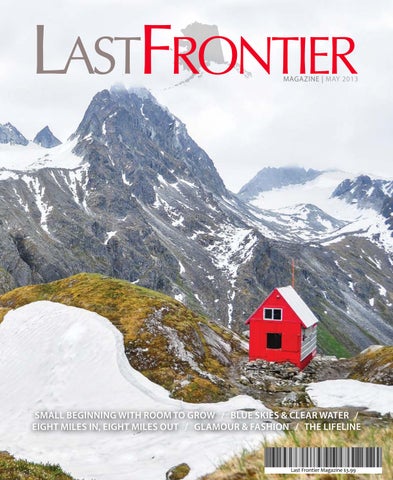

A LastFrontier MAGAZINE | MAY 2013 Small Beginning with Room to gR ow / Blue Skie S & Clea R wate R / e ight m ile S in, e ight m ile S o ut / g lamou R & Fa S hion / t he l i F eline Last Frontier Magazine $3.99
&
Glamour


Grilled Copper


Social Media


May 2013 | 3 18
Gold Mint Glacier t rail
Calendar of events 6 may 2013 Local events, fairs and community gatherings. loCal Business 8 Cafe Beignet A southern tradition making a stand in the north. arts
Culture 22
& Fashion A local photographer with a full measure of talent. reCreation 18 Gold Mint Glacier Trail Eight miles in, eight miles out. alasKa GardeninG 10 Seeds Small beginnings with room to grow. travelinG outside 26 St. Augustine, FL Experiencing America’s oldest city. outdoors 12 Blue Skies & Clear Water Touring through the Prince William Sound. PHoto GallerY 14 Landscapes reCiPe 28
River Red A local’s recipe of how to prepare one of Alaska’s local cuisine. HistorY 30 The Lifeline Accessing the deep sea port of the Prince William Sound. user resPonse 29
Response The one place you’ve always wanted to go. user resPonse 17 Social Media Response What is your favorite hike?

4 | Last Frontier Magazine Treating: ~ Headaches and Neck Pain ~ Muscle and Joint Pain ~ Back/Neck Pain/Stiffness ~ Sprains and Strains ~ Whiplash Injury With: ~ Chiropractic Adjusting ~ Myofascial Release ~ Physiotherapy and Rehabilitation ~ Conservation Care ~ Massage Arctic Chiropractic “Life Is Good When You’re PAIN FREE!” Arctic Chiropractic 18 locations to serve you www.arcticchiropractic.com 1-800-PAIN FREE W e s t M at S u • Soldotna•Unalaska •Dutch Harbor • Prudhoe Bay • Nome•Barrow •Valdez • Sitka • De l t a • Anchorag e Midtown •AnchorageSouth • Bethel • Dillingham • Fairbanks •Kotzebue•East Mat S u • J un e a u • West Mat-su (Wasilla) 892-7246 Mi 51 Parks Hwy • Meadow Lakes Why Drive All The Way To Downtown Wasilla east Mat-su (PalMer) 746-7846 Located In The Hemmer Building Next To Peak Fitness • Palmer Wasilla Hwy
A LastFrontier
MESSAGE FROM THE EDITOR
The Team
Alaska is overflowing with interesting people, beautiful scenery, and opportunities for exciting adventures. Although Alaska’s population amounts to only a fraction of other states, the way Alaskans interact with each other and their unique environment has captured a worldwide audience. Alaska is a place of extremes; boasting an overabundance of untamed wilderness, daunting mountains, and a long list of intrepid pioneers who have made history through their survival and ability to make a life in the wilds of the last frontier.
With our premiere issue, we at Last Frontier Magazine would like to welcome our readers to what we hope is just the beginning of an in-depth look at the experience of life in Alaska. Our goal is to provide individuals with stunning photography and insightful stories that celebrate the place we call home and the people in it. At the forefront of our minds while building this first issue was to create something that would attract a broad audience. We believe the following pages illustrate the premise of Last Frontier Magazine, which is to entertain readers, promote local businesses, and engage our community.
We are thankful for the outpouring of support preceding this first issue, and hope you will extend that same support to our advertisers. Our vision for this magazine is to be long-lasting; to reach future generations, and we know that even with hard work and dedication that vision has no chance without YOU, the reader. We look forward to the future as we embark on this journey into the Last Frontier.
Anne Sanders Editor
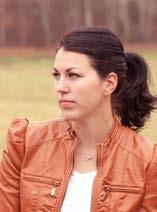
Anne was born and raised in Alaska. She graduated with a B.A. in English Literature from the University of Alaska Anchorage. With a love for the written word, she recognizes the treasure of stories and fascinating people Alaska offers. Paired with her husband, Cecil, who compliments her narratives with his eye for the visual, Anne is on a mission to bring her beloved home of Alaska to life on the pages of Last Frontier Magazine.
After almost a decade as an Alaska resident, Johnathan has a deep admiration and respect for the state. He owned and managed a successful resort for eight years. Since then he has done consulting work for numerous businesses. His passion for advertising started in high school while working for a magazine and local newspaper. Johnathan is intrigued by the history and evolution of advertising, and how social media affects it. “I don’t really consider anything I do as work. I just find things I enjoy doing and sincerely try to help others along the way.”
Johnathan Jester Advertising Director

Mission Statement
Cecil Sanders Publisher/Photographer
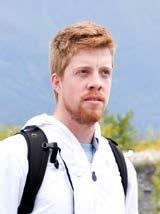
Inspired at a young age, Cecil has turned his love of photography into a lifestyle and a business, with a desire to capture the beauty and character of wherever his camera takes him. Always primed to set off on a new adventure Cecil and his wife Anne have spent the first five years of their marriage going on road trips, touring Alaska and the country, and planning ahead to their next destination. Cecil has combined his artists perspective and aptitude for design in order to contribute his talents to the collaborative effort of bringing Last Frontier Magazine into a reality.
The Team
Johnathan Jester Jr. Circulation
Lindsey VanTassel Circulation/accounting
At Last Frontier Magazine we strive to captivate our readers with an entertaining experience; to propel our advertisers forward in a competitive market; to actively enrich our community and serve our Lord with all our heart, mind, soul and talents.
May 2013 | 5
MAGAZINE
CALENDAR May
WHAT: Anchorage Salmon Run
WHERE: Anchorage
CONTACT: info@anchoragesalmonrun.com
WEB: www.anchoragesalmonrun.com
WHAT: AK Law Enforcement Torch Run
WHERE: Statewide (See Website)
CONTACT: State Office 1-888-499-7625
WEB: www.SpecialOlympicsAlaska.org
WHAT: Mat-Su Rotary 5K (aka Menard Run)
WHERE: Palmer CONTACT: Sondra Kaplan 227-3486
WEB: www.matsurotary5k.com
W HAT: Eagle River Challenge
25 04 18
11 12 18
W HERE: Eagle River Nature Center
C ONTACT: Asta Spurgis 694-2108
W EB: www.ernc.org
WHAT: MS Walk/Run
WHERE: Lake Hood - Anchorage CONTACT: Francesca Rogers 562-7347
WEB: www.WalkMSnorthwest.org
WHAT: Mother’s Day Fun Run
WHERE: Palmer CONTACT: Maribel Torres 745-2691
WEB: www.amazinggraceacademy.org
WHAT: March for Babies
11 19 26 27 31
WHERE: Westchester Lagoon - Anchorage CONTACT: Susan Churchill 276-4111
EMAIL: www.marchforbabies.com
WHAT: Gold Nugget Triathlon
WHERE: Bartlett High School - Anchorage
CONTACT: Betsy Haines 223-7792
W EB: www.goldnuggettriathlon.com
WHAT: Miners Day Softball Tournament
WHERE: C Street, Talkeetna
WHAT: Sunday BBQ & Music on the Lawn
WHERE: Tug Bar on KGB CONTACT: Terry 376-5720
WHAT: Memorial Day Veterans Wall
WHERE: Mile 33.5 Parks Highway CONTACT: 376-8810
WHAT: Relay For Life
WHERE: Cuddy Park - Anchorage CONTACT: Jess Hinker 273-2066
WEB: www.anchoragerelay.org
6 | Last Frontier Magazine s m t w t f s 1 2 3 4 5 6 7 8 9 10 11 12 13 14 15 16 17 18 19 20 21 22 23 24 25 26 27 28 29 30 31 04
to list an event, email publisher@lastfrontiermagazine.com
May 2013 | 7
Cafe
ARTICLE BY LINDSEY VANTASSEL
 BY CECIL SANDERS
8 | Last Frontier Magazine
PHoToGRAPHY
Business: Cafe Beignet
Beignet [ben-yay!] A southern tradition making astand in the north.
Cafe Beignet
hink of a melt-in-your-mouth fried piece of dough with sugar sprinkled, spread, or poured over its golden warm surface. For most, the only word that comes to mind is ‘doughnut’. But down in the southern bayou resides a cultural staple that provides another fitting term, a beignet. This cultural gem, according to expert opinion, is so unique and specialized that it would be a crime to describe it as just a doughnut.
T
Beignets (pronounced ben-yay) are French style gourmet doughnuts that have been popularized at the heart of Louisiana in the vibrant city of New Orleans. Their popularity has spread to surrounding southern states, but the authority on beignets resides undoubtedly in the jazz, mardi gras, Creole capital of the U.S. Beignets are traditionally served on a plate in sets of three and sprinkled with a generous dose of powdered sugar.
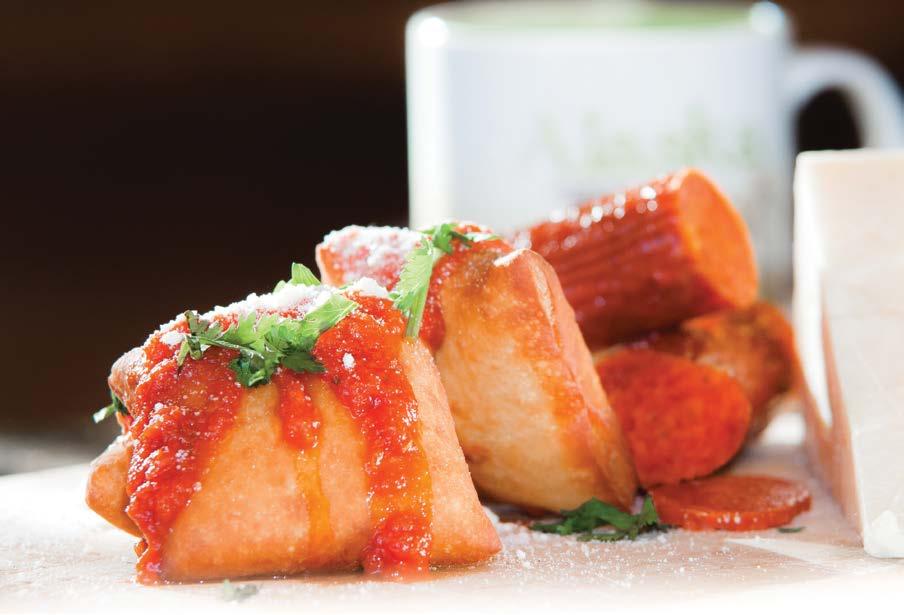
Within a little red enclosed trailer (converted from an old parking toll booth) Café Beignet Alaska has added some flair to the southern tradition by enhancing the beignet with their own creative touches. Their menu includes beignets topped with sweet blueberries, or tossed in cinnamon sugar drizzled with a rich honey glaze. For those seeking a hearty meal they offer pizza beignets; doughy squares stuffed with mozzarella and pepperoni slices, then topped with marinara and parmesan cheese. Anyone who has enjoyed Nutella can only imagine how good it would taste biting into a beignet that’s been filled with the smooth chocolate hazelnut spread. If your sugar tooth really has a hold of you, try the ‘Salty Turtle.’ This is a nutella stuffed beignet topped with salted caramel and toasted pecans.
Pronounced: [ben-yAy]
definition: a light square doughnut usually sprinkled with powdered sugar circ A : 1835
Last summer Café Beignet debuted at the Thursday Market by the Lake in Wasilla. Cafe Beignet hopes this unique treat will be a modern day gold mine in Alaska. Despite beignets foreign nature to Alaskan soil, the owners, Lindsey VanTassel, Anne Sanders, and Gil Hjellen, received eager customers who became immediate fans of the southern delicacy. They were even faced with a challenge from a New Orleans visitor who questioned whether they were ‘the real deal’. After taking his first bite, he eagerly stated, “Yup, you are!” Cafe Beignet Alaska, with their little red cart in tow, is working to secure many events throughout Alaska for the summer of 2013. Do not pass up the chance to try one of these gourmet treats. You will be hard pressed to find beignets anywhere else in the last frontier.
- Wasilla Thursday Market by the Lake
- Friday Fling in Downtown Palmer
- Wasilla Thursday Market by the Lake
- Relay for Life in Anchorage at Cuddy Park
- Relay for Life in Anchorage at Cuddy Park
- Wasilla Thursday Market by
Lake
- Wasilla Thursday Market by the Lake
- Friday Fling in Downtown Palmer Park
- Wasilla Saturday Market by the Lake
- Wasilla Thursday Market by the Lake
- Wasilla Saturday Market by the Lake
- Wasilla Thursday Market by the Lake
- Scottish Highland Games-Eagle River
oriGin: french
- Wasilla 4th of July Parade
- Wasilla Saturday Market by the Lake
- 14 BearPaw Festival
- Wasilla Thursday Market by the Lake
- Friday Fling Downtown Palmer Park
- Wasilla Saturday Market by the Lake
- Wasilla Thursday Market by the Lake
- Friday Fling in Downtown Palmer Park
- Wasilla Thursday Market by the Lake
- Friday Fling in Downtown Palmer Park
- Wasilla Saturday Market by the Lake
- Wasilla Thursday Market by the Lake
- Friday Fling in Downtown Palmer Park
- Wasilla Thursday Market by the Lake
May 2013 | 9
Business:
May 23
24
30
31
August 1
2
8
9
10
15
16
22
June 1
7
the
13
14
15
20
22
27
29
July 4
6
10
25
26
27
Schedule of Events for Cafe Beignet - Stay updated via Facebook.com/cafe-beignet
Alaska Gardening
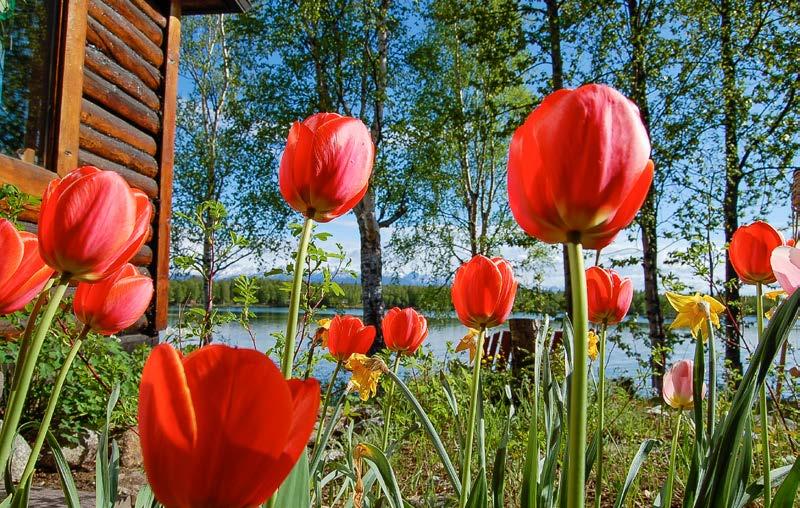
Our south central Alaska gardening season has begun and I am honored to be part of the premier issue of Last Frontier Magazine’s Alaska Gardening section. I recently retired from my job and the two plus hour commute to Anchorage and back, so the timing is perfect to renew my love of gardening. I’m excited to be out from behind a desk, out of the driver’s seat and am ready to get behind a shovel and watering hose. Through this column I would like to share my knowledge of Alaska gardening, and take you all on my journey from working a full-time job in the fast-lane to slowing down, rejuvenating my home gardens, and taking time to smell the flowers.
My husband and I are blessed to live on a portion of property my great-grandparents, Alice and Gerrit ‘Heinie’ Snider, lived on in the Matanuska Valley. My greatgrandparents did not have the convenience of a local grocery store. With ingenuity and plenty of physical labor they had to plan and work with their community to feed their family. They grew crops, fished, hunted, and raised chickens and other farm animals. In the early 1900’s life in Alaska was about survival. I often marvel at how our lives are so different from when my
by Wendy Wesser, Master Gardener
great-grandparents immigrated to Alaska from Holland. My great-grandparent’s were living in a tent city in the Ship Creek area of Anchorage when my grandmother, Elizabeth ‘Pat’ Hjellen, was born in 1916. They eventually moved to Wasilla and made a home on the fertile land.
Many of us today are becoming so far removed from where our food comes from that we have lost touch with some of the basic skills needed to sustain ourselves. One of my goals in retirement is to re-learn these skills and become as self-sufficient as possible when it comes to feeding my family. I still imagine we will have our weekly trips to the grocery store. Why ignore such a great resource full of variety and fresh items? What I want though, is to be able to provide enough fruits, berries and vegetables through efforts in our own garden to not only supplement our own table throughout the year, but to have enough to share with family and friends. We are fortunate to live in a location where our weather and long days of sunshine are ideal for growing healthy crops of broccoli, cabbages, peas, carrots, potatoes, etc... My great-grandparents grew enough to help sustain their family on the very plot of land we now live on, so why can’t we? My husband and I intend to try. I will share our successes and/or failures with all of you.

10 | Last Frontier Magazine alaska Gardening
JUST FOR STARTERS

These days we have many local commercial greenhouses to choose from if we don’t have the space, time, or inclination to start our own seeds. There is absolutely no shame in buying starts from our many local nurseries and supporting our economy. I love browsing our local plant nurseries every spring, and I can rarely resist buying something for our home garden. But for those who love a challenge and want an extended gardening season, starting seeds will do just that. For me, one of the most satisfying parts of gardening is watching the miracle of seeds I planted sprout and flourish.
S TARTING S EEDS
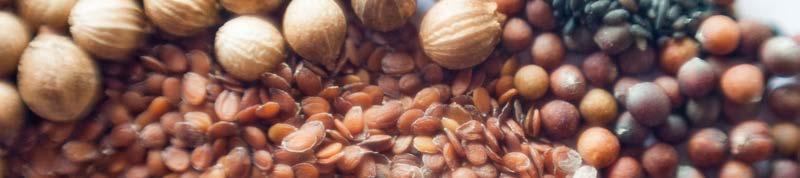
Most of my mail-ordered seeds from Anchorage based, Denali Seed Co., are already sprouting and maturing in flats under grow-lights. Broccoli, brussel sprouts, cabbage, chives, cilantro, kale, kohlrabi, lettuce and onions. Someday I hope to have a heated greenhouse to start my seeds in, but for now grow lights set up in our basement work just fine. Around the first of May I will be starting cucumber, zucchini and other squash seeds inside in individual pots. Some of our favorite seeds will be sowed directly into the garden such as beets, carrots, peas, spinach and radishes.
H ARDENING O FF S EED LINGS

Once the snow is gone and the ground finally thaws enough to work we can start thinking about hardening off our seedlings. The hardening off process takes a week to 10 days of taking plants outside to gradually expose them to the outdoor elements. It is especially important to be careful when exposing your tender seedlings to the sun. At first set them outside in the shade for a few hours a day. Increase the amount of time spent outside until they are strong enough to spend the entire day and night outside.
P LANTING TIME
The general rule of thumb I follow is when the birch leaves are the size of a squirrel’s ear it is safe to plant hardened off seedlings. The proper time to plant outside
varies widely by up to two weeks depending on your location. We must be careful and realize we risk losing our tender seedlings to frost or sunburn if we plant too soon. It is best to start planting your more hardy seedlings that can handle a light frost and wait until all danger of frost is gone before planting more tender seedlings. The safe planting date for most areas is generally June 1st.
This year I am adding row covers to our garden beds to extend our season and productivity. Flexible PVC piping attached to the raised beds with pipe brackets will be covered with plastic sheeting to help warm the soil. Rather than using one solid sheet I am using two and planning to secure them together at the top with clothes pins. This way planting and watering will be easier and if our days do get too warm I can release the hot air easily. Using this method I also plan to try some squash and bush bean types that normally don’t do well in our cool summers. I will let you all know what succeeded and what failed at the end of the season.
Wendy Wesser is a certified master gardener living in Wasilla, Alaska. She and her husband, Ralph, raised their 3 daughters on a portion of land her great-grandparents originally homesteaded in the 1930’s. She has enjoyed Alaska gardening for 29 years in Anchorage, Juneau and the MatanuskaSusitna Valley.

May 2013 | 11
alaska Gardening
WRITTEN BY ANNE SANDERS
PHoToGRAPHY BY CECIL SANDERS
Blue Skies & Clear Water
touring through the Prince william Sound

I t is a moment of anticipation, emerging through the Anton Anderson Memorial Tunnel, announcing your official arrival to Whittier, Alaska.
The two and a half mile tunnel leaves plenty of time to deliberate over what kind of weather will greet you in the secluded city; settled in isolation with superior access to the coveted waters of Prince William Sound. Even with a forecast of rain Whittier is an impressive place to visit. During the brief summer months visitors flock to Whittier’s dense harbor where hundreds of marine vessels line the sheltered docks. The coastal city is protected by a barricade of mountains. Before World War II spurred the construction of a tunnel through the base of Maynard Mountain, the only feasible land access to Whittier was a dangerous hike across Portage Glacier
and subsequent mountain passes. Today, Whittier is a crucial deep-sea port that provides a vantage point for exploration of Prince William Sound.
For those lucky enough to encounter clear skies and calm waters their fortune is even greater if their plans include a scenic wildlife cruise aboard a Major Marine vessel. Several times now, my husband, Cecil, and I have thoroughly enjoyed their professional tour through the stunning sound; discovering wildlife and having a personal look at Alaska’s awe-inspiring landscape.
With tickets in hand we followed the signs directing guests to the ship where Major Marine’s welcoming crew helped us aboard. After a greeting from the captain we slowly departed the protected harbor. Everyone’s attention was soon drawn to the water where a pair of otters were sending us off with an early view of the wildlife we had been hoping to see. Floating on their
WHittier faC ts
RAINFALL:
SNOWFALL:
backs, swimming through the surf, otters look so relaxed and happy that watching them is a special treat. Even with a history of being excessively hunted and having to endure the Exxon oil spill of 1989, the resilient critters are recovering. Their population in the Prince William Sound area steadily increases every year.
12 | Last Frontier Magazine
POPuLATION: 300 ANNuAL VISITORS: 700,000+ ANNuAL
197 inches (approx. 16 feet) ANNuAL
241 inches (approx. 20 feet)
The Chugach National Forest Ranger aboard the ship began introducing us to their extensive knowledge of the area. All the rangers we’ve had in the past were very enthusiastic and loved Alaska. They were eager to give information on whatever people were curious to know, which included explanations about geographical features along with historical accounts of the Native Alaskans who previously inhabited the area.
On our way to Blackstone and Beloit Glaciers we stopped at a place called Hidden Falls. It was a unique opportunity to get a picture taken next to the massive waterfall cascading off the mountain directly into the ocean. The captain expertly guided the vessel as close to the rush of water that safety would allow. Surrounding the falls are precariously growing spruce trees clinging to the steep mountain slopes whose rocky surfaces disappear into the water. This treacherous habitat is
home to stealthy mountain goats that a keen eye can usually spot climbing among sheer cliffs.
stretch back to Whittier.
Blue Skies & Clear Water
When we reached the rivers of ice, everyone eager to spot portions of the glaciers calving into the ocean stood on the outer decks in silent expectancy.
Chunks of ice no larger than a basketball produce deep and loud rumblings equivalent to an approaching thunderstorm. Seeing the glaciers up close was a highlight of the trip that Major Marine accompanied with their delicious salmon and prime rib buffet. After plenty of time to view the glaciers we eventually began making the return trip to Whittier taking a slightly different route. On the way we stopped by a small rocky island inhabited by dense colonies of kittywakes. The white and grey seabirds perch themselves on every available ledge continuously filling the air with their noisy chatter. The bird watchers paradise was our last major stop before travelling the final
I asked Cecil what he enjoyed most out of the several cruises he has taken with Major Marine. He began to say it was the food, but continued with a more honest answer. An answer I wasn’t surprised to hear from a photographer whose main passion is capturing landscapes. What pleased him most about the cruises was being taken outside of the boundaries of human settlement. Being able to glimpse nature in its primal element. The raw experience of cruising through the water, rain or shine, and seeing parts of Alaska that have been shaped almost exclusively by forces of nature. His answer matched my own and is the reason we’ll take advantage of every opportunity to experience Alaska’s scenic waters. Even after living in Alaska my entire life the unique and rugged beauty is something I can never stop admiring.
Feature: Blue skies & Clear Water
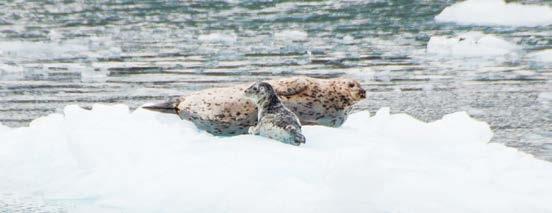
Leopard Seals rest on ice beneath Blackstone Glacier
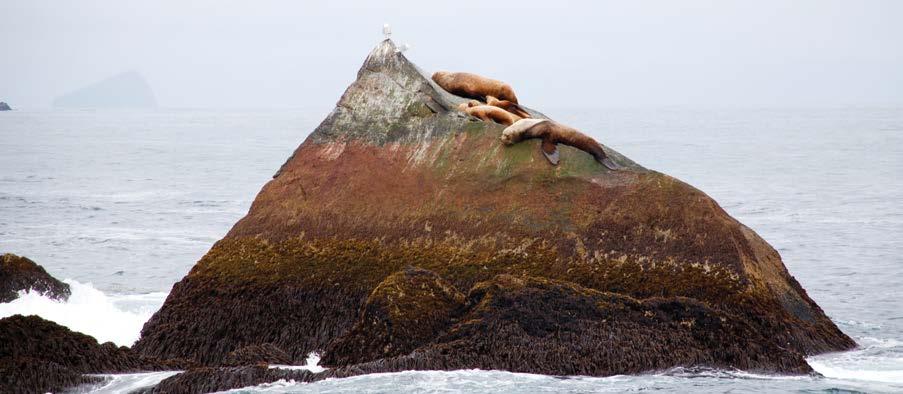
Sea Lions rest on a large rock outcropping in the Kenai fjords.
The raw experience of cruising through the water, rain or shine, and seeing parts of Alaska that have been shaped almost exclusively by forces of nature.
Welcome to Last Frontier Magazine’s “Photo Gallery”.
We’re all about photography and hope our readers enjoy this useful resource. Along with each photo we’ve included the metadata. The metadata information is recorded with each exposure on the majority of all digital cameras today.
One aspect of the metadata listed is the manual settings used to capture each image. Also, the GPS coordinates - in case you want to go and replicate these images.
We challenge you to go out and photograph Alaska, then submit one to us through the LF Magazine’s Facebook page. We will post several reader submitted photos each day!
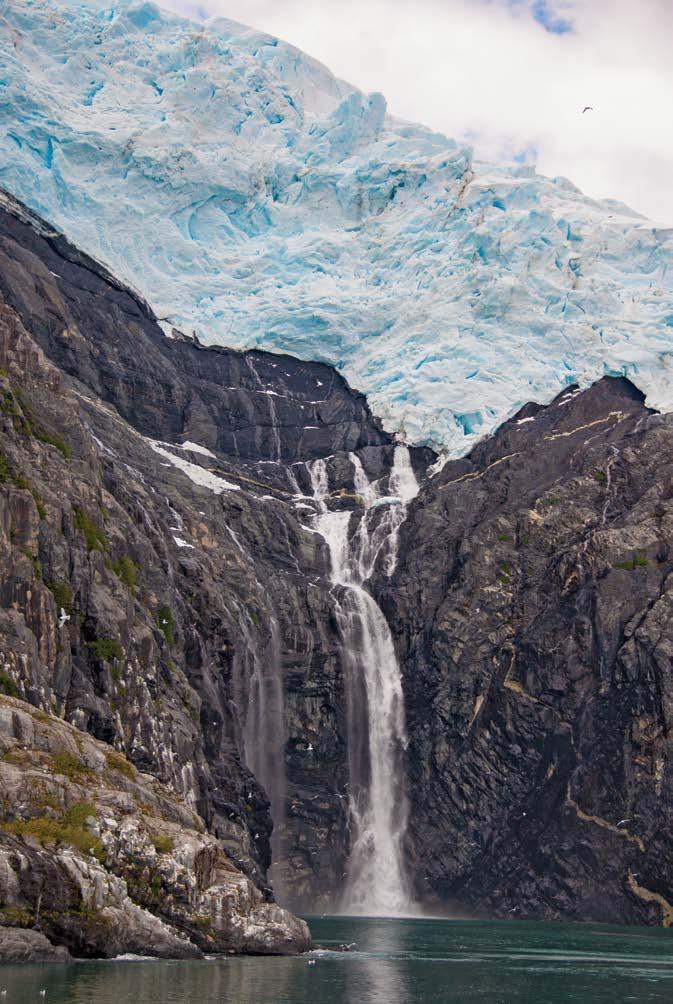
Sea birds gather around the glacial run off in Blackstone Bay, outside of Whittier, AK.
photographY BY CECIL SANDERS
Blackstone Bay, Chugach Nat’l Forest GPS: 60° 42’ 0.26” N 148° 39’ 32.75” W Exp. 1/800th sec | f4.8 | ISo 200 | 56mm
To see More I M ages, s can Here

14 | Last Frontier Magazine
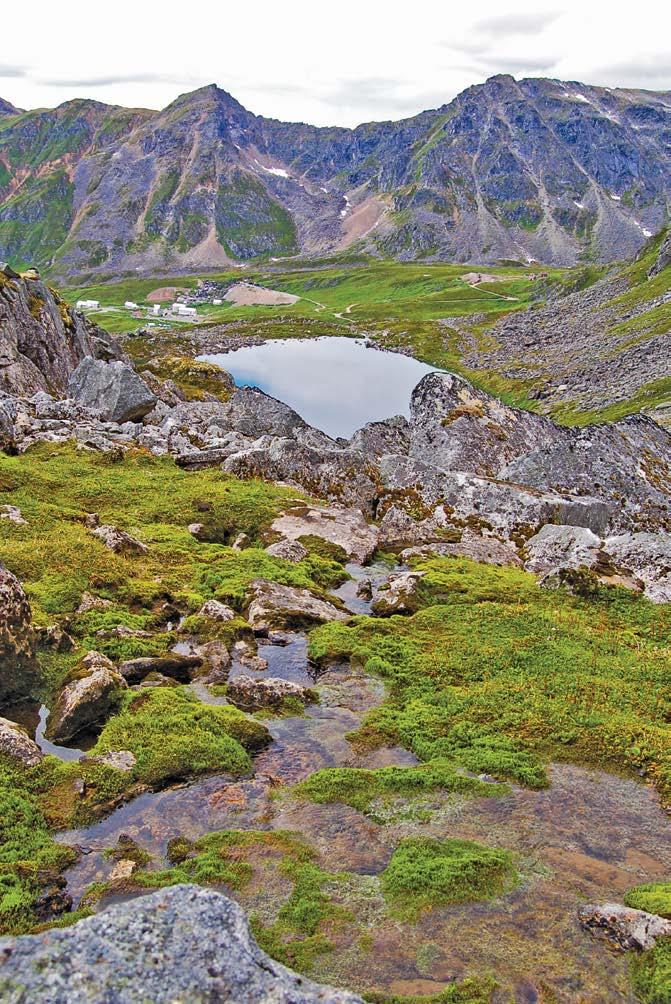

May 2013 | 15 Independence Mine, Hatcher Pass GPS: 61° 47’ 33.22” N 149° 15’ 25.48” W Exp. 1/250th sec | f8 | ISo 200 | 23mm Independence Mine in Hatcher Pass sits in the background of this image of Gold Cord Lake. PHOTO GALLERY photographY CECIL SANDERS Photo Gallery To see More I M ages, s can Here

16 | Last Frontier Magazine numBeRS & FaCtS 365,000,000 Approximate acres in Alaska 710,231 Current Alaska Population 513 .9 average acres per person in the state of Alaska 291,826 Current population in Anchorage Interesting statistics and information you may, or may not know! Do you know something interesting about Alaska? Email us at publisher@lastfrontiermagazine.com Besides English, Alaska’s languages include 20 different Native American languages. The average annual temperature in March for Juneau is 32 F. 1093 miles to the northwest, the average annual temperature in Barrow is -15 F. A 47 degree difference! Of the 20 highest mountains in the United States, 17 are in Alaska.
SOCIAL MEDIA|READER RESPONSE


We’ve asked, you’ve replied. Here are comments from topics we’ve discussed through Facebook and Twitter.
your Smart
Hannah H. - “Arkose Ridge!! It’s a long, intense one, but definitely my favorite!”
Rick P. - “It’s been years since I’ve hiked it, but always loved Crow Pass Trail on the Girdwood side.”
Emily S. - “My favorite hike is up to Reed Lakes in Hatchers Pass. No matter how many times I hike up there I'm amazed at how beautiful the blue water is.”
Anywhere in Hatcher Pass
Shannon G. - “Everything in Hatcher’s is great...but we especially love Gold Cord trail - great for kiddos, beautiful, not boring, but they’re not likely to dive over a cliff, either. “
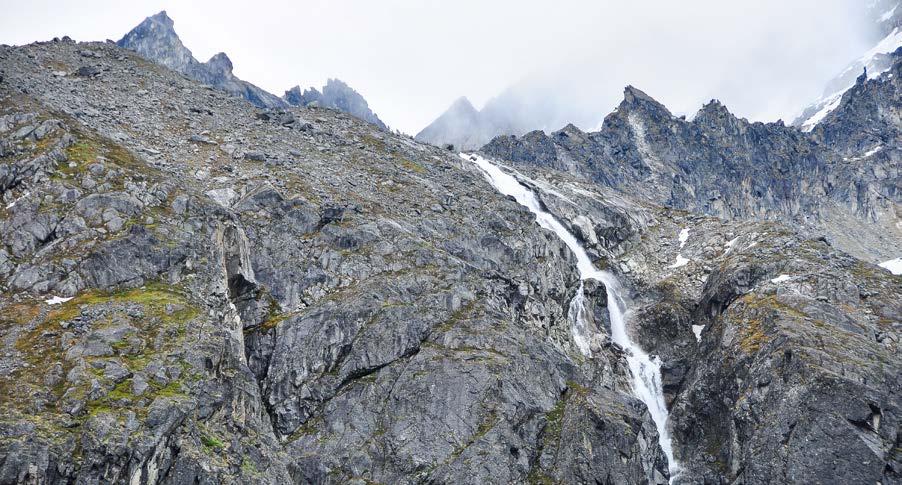
Jeremiah B. - “Lane Hut hike in Hatchers. Another good one for the kids. It’s about 4 miles (RT) and my 6 year old hiked it herself. Great scenery and a nice high mountain stream most of the way up with a nice water fall not far from the trail.”
Deer Mtn. Ketchikan April Bowl HP
The Butte Butte South Fork Eagle River
Kepler Park Palmer Lane Hut HP
Flat Top Anchorage
Reed Lakes Trail HP Gold Cord Lake HP
Lost Lake Seward
Lazy Mtn. Palmer Crow Trail Pass Girdwood
Arkrose Ridge Mat-Su Archangel HP
Gold Mint Trail HP
May 2013 | 17 social Media reader response
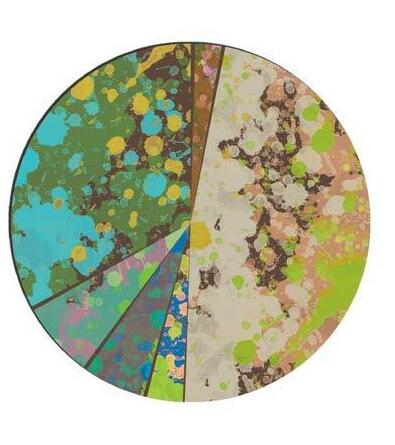
“What is your favorite hike in Alaska?”
“Favorite Hike” Pie Chart
Scan
with
Phone to visit our LF Magazine Page
WRITTEN BY ANNE SANDERS PHoToGRAPHY BY CECIL SANDERS
Gold Mint Glacier Trail
18 | Last Frontier Magazine
8 Miles in, 8 Miles Out recreation: Gold Mint Glacier trail
Throughout the year people of all ages enjoy the visually captivating mountain pass occupying a portion of the Talkeetna Mountain Range. Hatcher Pass is named after Robert Lee Hatcher, a forerunning prospector of the Willow Creek mining district, which encompasses Hatcher Pass and the surrounding areas.
Independence Mine, Archangel, and Gold Mint are familiar place names that all pertain to the Hatcher Pass area. Hatcher was the first man to find gold in all three of these popular locations, where many have claimed as their favorite hiking or recreational destination.
The Gold Mint Trail holds a special sort of significance in the Hatcher Pass area because Hatcher, with the help of his wife, spent almost four years of hard labor mining the Gold Mint claim. Most of his gold claims in the Talkeetna region Hatcher either sold or leased. The Gold Mint Mine and the Talkeetna Mine (located near the headwaters of Archangel Creek) were two of his claims that Hatcher chose to work himself. Unfortunately, the Gold Mint Mine was not as prosperous as he had hoped. After an unsuccessful few years Hatcher left the Willow Creek mining district for the Kenai Peninsula, where he continued to be an important figure in the history of Alaska gold mining.
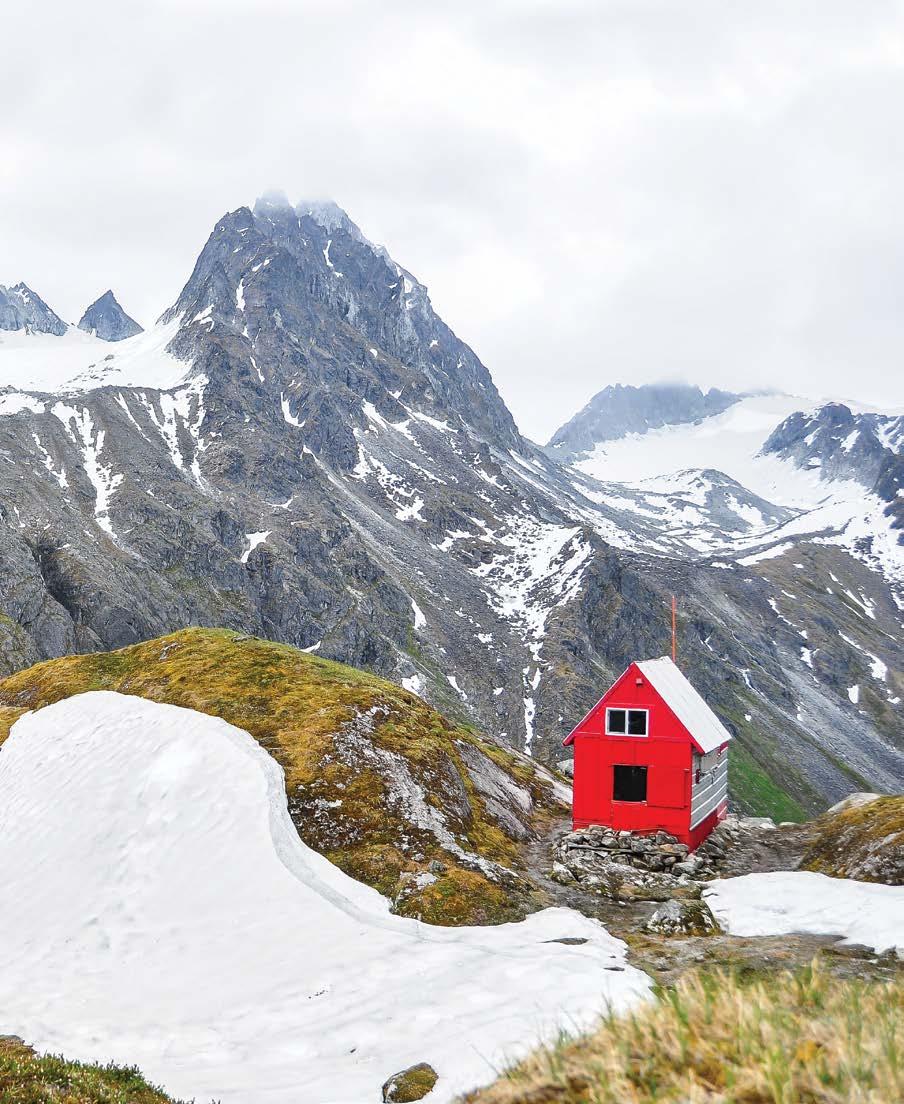
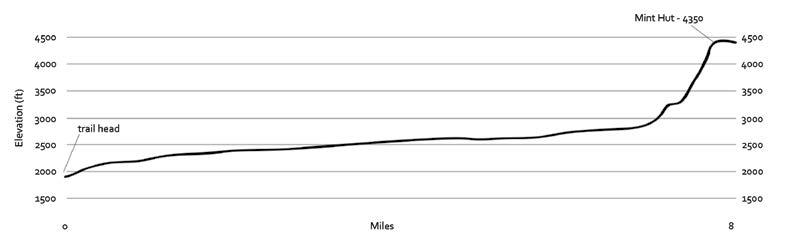
Although the Gold Mint Mine yielded a disappointing amount of gold, the area today supplies a different form of treasure. Situated just past the Mother Load Lodge, the Gold Mint Trail begins at the opposite end of a large parking lot, and parallels the glacially fed Little Susitna River. A little over eight miles away at the end of the trail is Mint Glacier. Most hiking blogs and other trail information will tell you that the terrain is relatively easy for the majority of the hike. At the end of the trail there is a rapid incline leading to the glacier, but the scenery from up high makes it well worth the effort.
As with every type of excursion there are a number of ways one should prepare themselves when entering the wilds of Alaska. Young and in love would only begin to explain the lack of precautions my husband and I took when we started off from the trail head on a promising spring morning three years ago. Sometimes growing up in Alaska, surviving the cold winters and building a thick skin against the harsh elements can create a dangerous attitude. An attitude that creates a false sense of security, and the feeling that preparedness belongs to the tenderfoot, and has no business with the rough, tough, born and raised Alaskan. We weren’t completely naive. With a little food, decent footwear, and a couple of water bottles we had the bare necessities of survival. Throughout the rest of the day we gradually realized there were other items that may have been useful to bring.
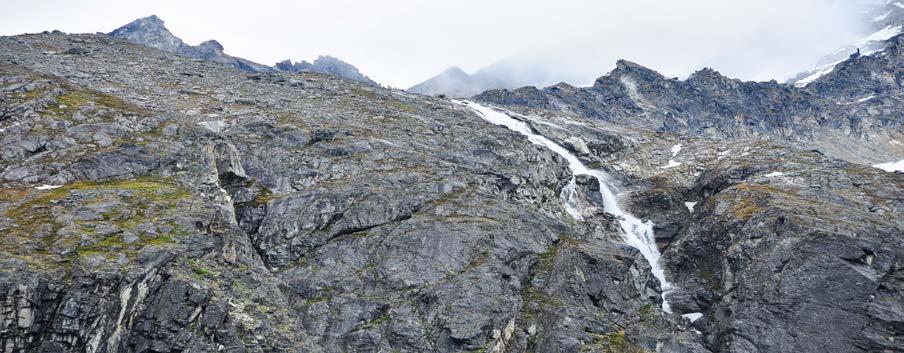
At one point in the hike we ran into a creek where spring snow melt and recent rains made the water too high for us to boulder hop across. This minor setback would not deter us from our goal. Our shoes were far from waterproof so off they went and I began mentally preparing myself for the icy water. I’ve waded through mountain streams, swam in lakes in the spring months when their shields of ice haven’t fully melted away, but no matter how many times I subject myself to the stabbing sensation
May 2013 | 19
recreation: Gold Mint Glacier trail
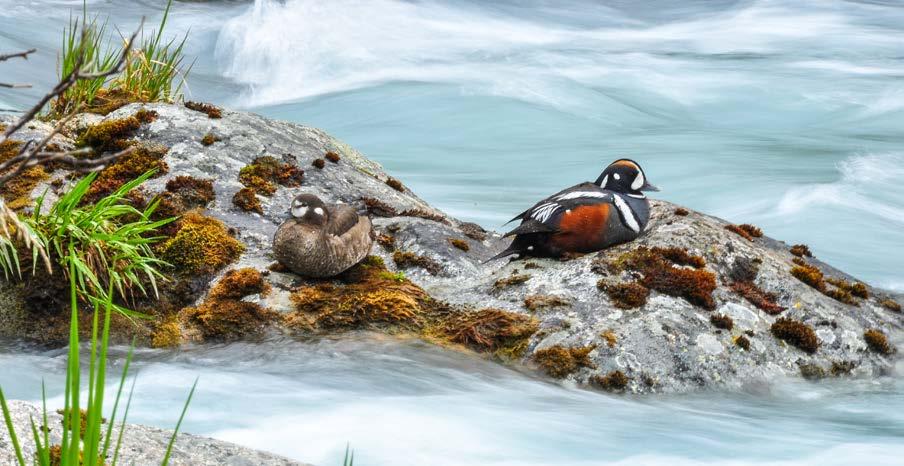
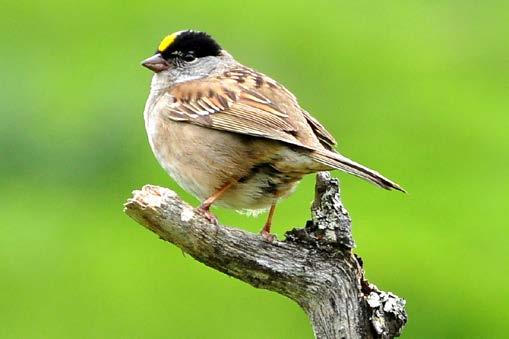
A Golden Crowned Sparrow perched on a dead tree along the trail.
Wading throughthe creek was a cruel torture yet it gave me an exhilarating sense of accomplishment.
of breathtakingly cold water; I never get used to it. Wading through the creek was a cruel torture yet it gave me an exhilarating sense of accomplishment. After making it to the other side, I silently congratulated myself while nursing my poor feet, and had the sobering realization I would be repeating the same process on the way back.
As we reached the steep portion of the trail, leading to the glacier, it started to rain. This was the point of the hike where lack of preparedness
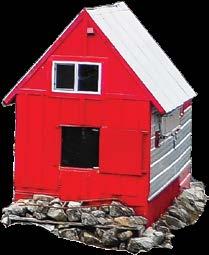
came in. Neither of us had rain gear. To make matters worse the climb became very slippery and more difficult. We hustled up the steep slope and found relief at the Mint hut; a small cabin run by the Mountaineering Club of Alaska, and useful resource for mountain climbers planning overnight trips in the area. Also, it was a welcome reprieve from the dowsing of rain outside. After a while the rain subsided, but we decided it would be safer to forgo hiking the extra distance to get a closer look at Mint Glacier. We were cold, wet, and at the swift rate the weather was changing it

20 | Last Frontier Magazine
Elevation Guide for Mint Glacier Trail
was possible we’d spend the next eight miles back to our car completely soaked.

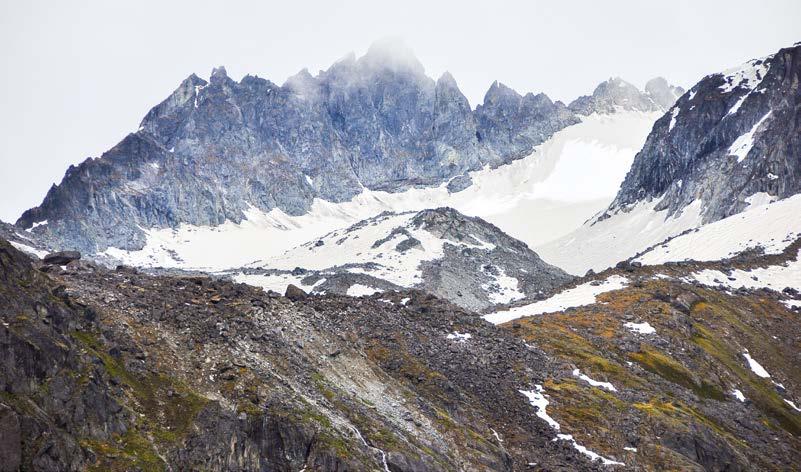
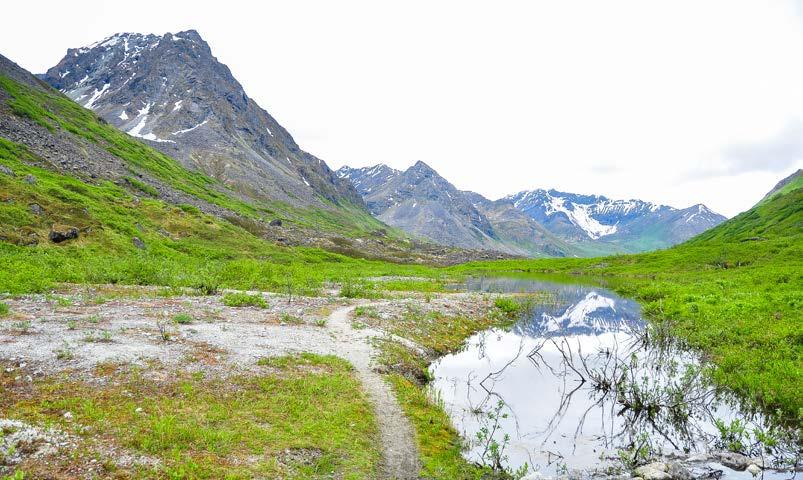
The views surrounding the cabin made us glad to have made it as far as we did. Even with limited visibility the scenery up close was enough to overwhelm our senses, and convince us that returning would have to be part of our future plans. With the rain easing off and some good pictures of the mountain valley, we finally hit the trail. It was a long trek through endless puddles and slick rocks. Our wet feet quickly began to ache and develop raw blisters. The lack of sun combined with a sharp breeze made us chilled, even though we kept ourselves constantly on
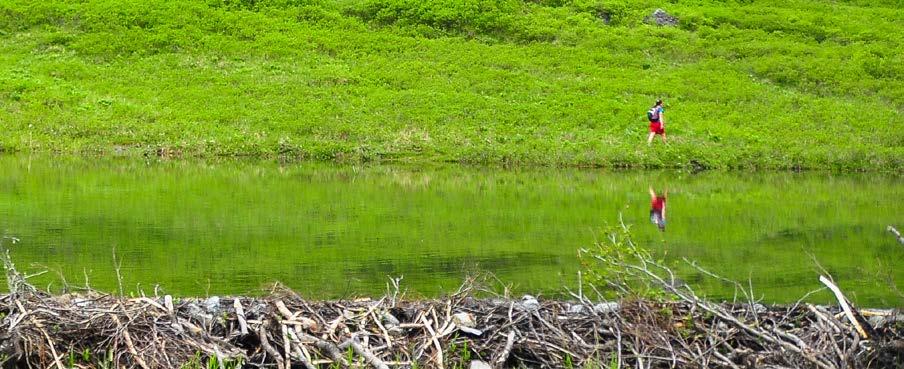
the move. Down the steep slope, past the large beaver dams, through the freezing creek waters, over the rocky trail, and after the sixteen mile round trip hike, we were finally back to the warmth of our car.
The Gold Mint Trail is one of numerous hiking destinations just off the winding mountainous road, leading to the cluster of old mining claims that make Hatcher Pass a historic landmark and scenic beauty. If you’re looking for a fun hike, good exercise, and quintessential Alaska beauty, then plan a trip up the Gold Mint Trail.
May 2013 | 21
recreation: Gold Mint Glacier trail

Culture & arts: Glamour & Fashion in alaska
Glamour & Fashion
When someone mentions glamour, fashion, or modeling, the first thing that comes to mind is probably not Palmer, Alaska. Those terms are most frequently associated with the high fashion realms of Hollywood, celebrities, and international magazines. But why can’t the world of style and vogue be recreated in a place like Alaska, where a creative community of local artists produce works deserving of recognition and acclaim. The work of one Alaskan woman displays a full measure of talent and artistry that proves elegance and class can make a home in the most unexpected places. Katie Cannon of Palmer, Alaska has spent the last three years offering her photography services all over Southcentral Alaska. In her spare time Katie organizes fashion shoots with
In Alaska
local friends and models. Inspired by a palette of colors or a stretch of fabric Katie follows her love of fashion in order to gather stunning images and rouse emotions from her visual artwork.
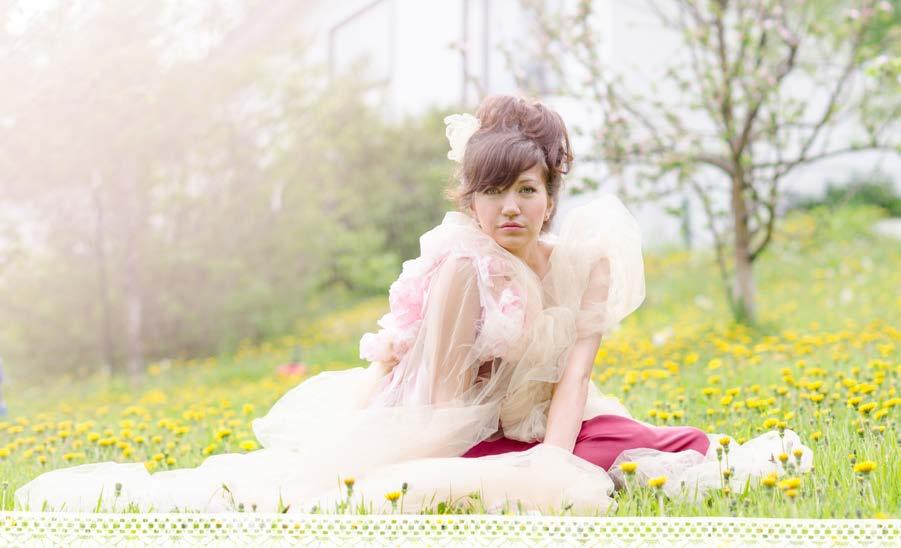
In an interview with Katie she explained how her interest in photography began. A picture of her first born son, taken by her brother, was the catalyst that encouraged her to pursue the challenging art form. She spent the next two years photographing family and friends and learning the technical functions of her camera. Creating a professional series of photos requires a high caliber camera and the knowledge and skills to use it. Although such equipment has become increasingly affordable there are distinguishing

Culture & arts: Glamour & Fashion in alaska
factors that separate professionals from the recreational user. Training, practice, an understanding of evolving techniques, and exclusive use of a camera’s manual mode is essential; total immersion in the world of shutter speed, aperture, white balance, and ISO. Determining the correct settings needed in order to produce a desired effect is a true test of a person’s multi-tasking and problem solving skills. Katie admitted that the technical side of photography was what she struggled with the most. Learning how to “properly use her camera” was difficult, and as technology improves keeping herself proficient is a constant process.

Artistic creativity in photography requires an understanding of elements like composition, color, and perspective. With a love for art that began in childhood, Katie has devoted herself to a wide mixture of art forms. Through personal interest and college art courses, Katie studies her photos with a trained eye, and artist’s outlook. Being familiar with a variety of art mediums has given her an advantage when it comes to creating not just a picture but one that will leave a lasting impression.
Photographing people has always been Katie’s passion and now she has years of experience doing family portraits, weddings, and a multitude of other types of photography. She feels “the time of static poses are a thing of the past. Capturing the twinkle of an eye, a baby’s slobbery grin, a family laughing hysterically at each other, a heated embrace shared by a newly wed couple, is what brings me joy, it is real.” Although she seeks the joyful candid moments of life in the natural light and beauty of the outdoors, Katie is not averse to the creative possibilities of formal poses and indoor settings. Sifting through Katie’s portfolio reveals versatility and shows that instead of sticking with what comes easiest she challenges her abilities with a variety of settings, poses, and lighting. To challenge herself even further Katie experiments with
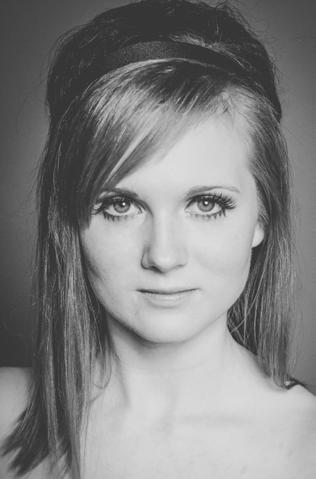
Culture & arts: Glamour & Fashion in alaska
the multifaceted genre of fashion photography. Many of her shoots feature dresses and outfits that she has made herself. With a talented team of trained beauticians, and aspiring models Katie uses her camera to create a mood, evoke a feeling, or simply take advantage of a brilliant sunset or fresh covering of snow.
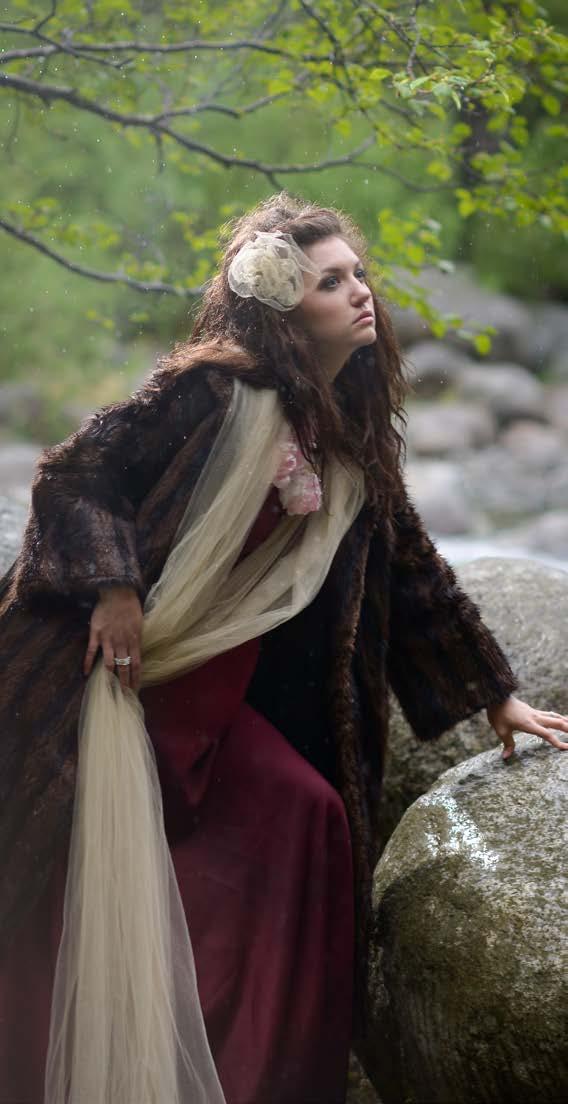
Katie Cannon is one of the lucky few who have been able to successfully meld their favorite pastime with the success of entrepreneurship. Her artistic eye and creative nature have grabbed a hold of the exciting medium of photography, and with her business she offers her professional skill to all Alaskans. Katie refers to her fashion photography as a “creative outlet”, but her work shows remarkable artistry and endless potential.
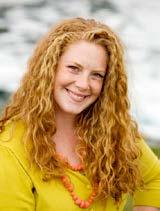
To see more fashion photography or to inquire about portrait photography services from Katie Cannon, go to: www.katiecannonphotos.com or Katie Cannon Photography on Facebook.
 Culture & arts: Glamour & Fashion in alaska
photo credit: Kristen Duke Photography
TRAVELING OuTSIDE St. Augustine, Florida
Writ ten BY anne sanders
PHotoGraPHY CeCil sanders
Cit Y of st. auGustine
FACTS:
St. Augustine is the oldest con tinuously occupied Europeanestablished city and port in the continental United States
 FOuNDED BY: Spain
SMALLEST STREET:
“
St. Augustine is home to the narrowest street in the United States. Treasury Street is just 7 feet wide and connects the wa terfront Bay Street to the Royal Spanish Treasury. The street was purposely built to provide barely enough room for two men to carry a chest of gold to the treasury from ships docked on the bay. This was done to minimize the chances of a horse-drawn carriage riding by and stealing the money.”
St. Augustine Florida is nothing less than beautiful. Settled on the coast of northeastern Florida, the oldest city in America welcomes visitors with a rich history and charming atmosphere. At night, during the holiday season, every building, walkway, lamp post, palm tree, and historic monument in view is outlined or wrapped in strings of brilliant white lights. We approached the glowing historic district by crossing over the famous Bridge of Lions. The brightly illuminated city was an unexpected sight after our drive along the eastern coast that began in Daytona and took us north on Highway A1A. The coastal road rewarded us with ocean views and a brief glimpse of seaside living next to miles and miles of sandy beaches. As we entered St. Augustine we drove through the streets and watched people strolling down the sidewalks, mingling through shops, and enjoying their evening meal.
In the day time, walking along the waterfront, the Bridge of Lions is a distinguishing member of St. Augustine’s unique architecture. It
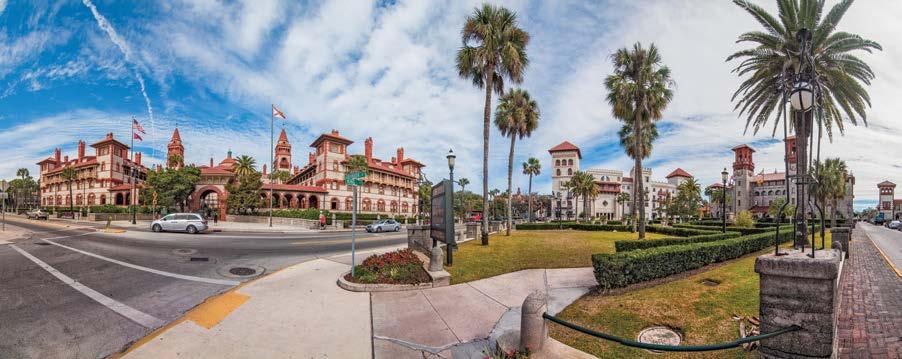
crosses the Matanzas River connecting St. Augustine with Anastasia Island. The bridge is a tribute to Ponce De Leon, the first man to explore the area and claim the region for the Spanish
crown in 1513. The name Matanzas derives from a deadly massacre that occurred in the area over four hundred years ago. A massacre that would portend St. Augustine’s turbulent future and constant exchange from one powerful nation to the other.
(See highlighted section for detailed account of the Matanzas Massacre.)
26 | Last Frontier Magazine
FOuNDED: 1565
- uSA TODAY
sesame
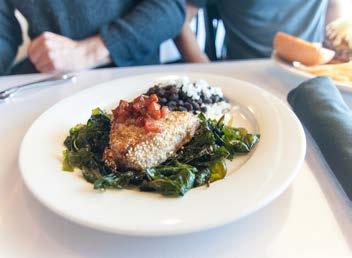
crusted seared ahi with fried spinach and beans with rice from a1a Bar & Grill. traveling outside: st. augustine, FL
Another worthy landmark, whose presence cannot be ignored, is the Castillo de San Marcos; the oldest masonry Fort in America. The fort was first built by the Spanish to protect their treasure ships from pirates when sailing to and from South America. St. Augustine was a valuable asset to the Spanish crown, and attracted countless attacks from enemy nations. Never once were it’s thick walls conquered by military aggression. The fortification has exchanged hands five times during its over three hundred year old history, and each transfer was made through a peaceful treaty. The fort is just one of many remnants indicating how St. Augustine has been shaped by the numerous flags that have flown over the city’s limits.
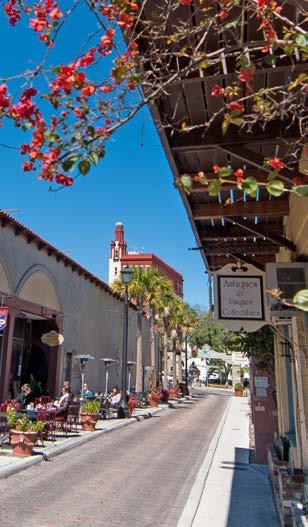
The five hundred year old city has aged handsomely. Like a priceless antique, the city is distinctly marked by the passing of time, and has survived to become an attractively preserved artifact. Walking around the city’s narrow streets quickly illustrates the lessons learned in history books. With a pleasant semi-tropical climate, elegant architecture, and remnants of historical milestones, St. Augustine held our undivided attention.
HISTORY OF FORT MATANZAS
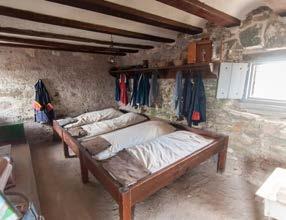

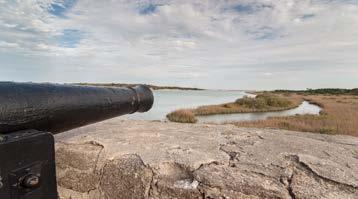
In 1565, General Pedro Menéndez de Aviles was sent by the Spanish crown to lead his people to Florida’s shores. When Menendez arrived he mistakenly guided his ship through an inlet leading straight to Fort Caroline, a French stronghold built on land claimed by the Spanish. Menendez directed his ships south and establish his people in the place he chose to call St. Augustine.
Within months the French sailed south to attack the Spanish. While sailing to St. Augustine the French were caught in a hurricane that thrust them further south than they intended. Menendez took advantage of their misfortune, and led his men north by land and attacked Fort Caroline. He killed most of the men that had been left to protect the fort, sparing the women and children. After the fall of Fort Caroline, the shipwrecked Frenchmen were sighted south of St. Augustine with low food supplies, and no way of crossing an inlet blocking their way north. Menendez told the French that Fort Caroline had been captured and gave them the option to surrender, which they did. Menendez chose to spare the Frenchmen who would renounce their Protestant religion and pledge their faith to the Catholic Church. Two hundred and fortyfive men were executed while less than two-dozen either surrendered their beliefs, or were found too valuable to kill. Matanzas is the Spanish word for slaughters. It’s the name the Spanish gave to the inlet the French were unable to cross and the river running beside St. Augustine today.
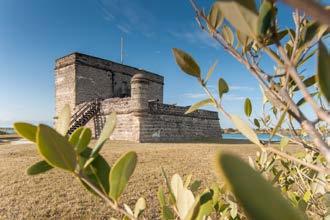
s cenes from Fort Matanzas, t op Left: Guns protecting the entrance to the s t. John r iver. t op r ight: s mall window opening looking n W through the marsh. Bottom Left: Hay filled bunks in the living quarters. Bottom r ight: Fort Matanzas.
traveling outside: st. augustine, FL
LOCAL RECIPES

Directions:
Prepare Salmon - Rinse fillet and pat dry. Debone.
Seasoning - Mix together Thyme, Cilantro, and Garlic in melted butter. Spread over top of salmon fillet. Sprinkle salt and pepper over top.
Grilling Salmon - Preheat Grill to medium high heat (approximately 325 to 350 degrees) and place salmon either on tin foil or directly on the grill grate, skin side down (for cooking without tin foil, make sure to brush oil onto the grill grate before placement).
Allow 10 to 15 minutes for the salmon to cook undisturbed. The most important part of grilling salmon is to not overcook. A minute too long can make the salmon dry and tough. The filet will easily flake and begin to ooze its white fat when ready.
Remove from grill and enjoy!
Ingredients:
Salmon Fillet (w/ skin)

Seasoning
1 tsp Thyme
1 tsp Cilantro
1 tsp Garlic Salt & Pepper (to taste) 1/4 cup melted butter
Mustard Sauce
3 Tbs Mayonnaise
2 Tbs Brown Mustard
1 Tbs Horseradish
Kitchen Tip
The best way to debone a fish is the run your finger from the head of the fillet down to the tail and locate the pin bones of the fish.The pin bones are spaced approximately half an inch apart along the topside of the fish. There are special tweezers for deboning fish, however any type of tweezer or even needle nose pliers will do. Grab a hold of the bone and pull gently at a 45 degree angle towards the head of the fish.
28 | Last Frontier Magazine
Local recipes: Grilled salmon
Grilling Salmon Do you have a favorite “Alaska” recipe that you would like to share? Email us to submit your recipe!
SOCIAL MEDIA|READER RESPONSE
We’ve asked, you’ve replied. Here are comments from topics we’ve discussed through Facebook and Twitter.
Scan with your Smart Phone to visit our LF Magazine Page


Name the one spot in Alaska that you’ve always wanted to experience,
Alyssa H. - I am still kicking myself for not taking a free flight tour to one of the glacier's on McKinley... I also want to hike Denali National Park this year.
Katie C. - I want to take the cruise from Seattle/Vancouver to AK and also visit Seldovia
Debbie C. - Nome for the Iditarod
Chuck K. - Eagle Trail!!!
NEVER
but have yet to do.
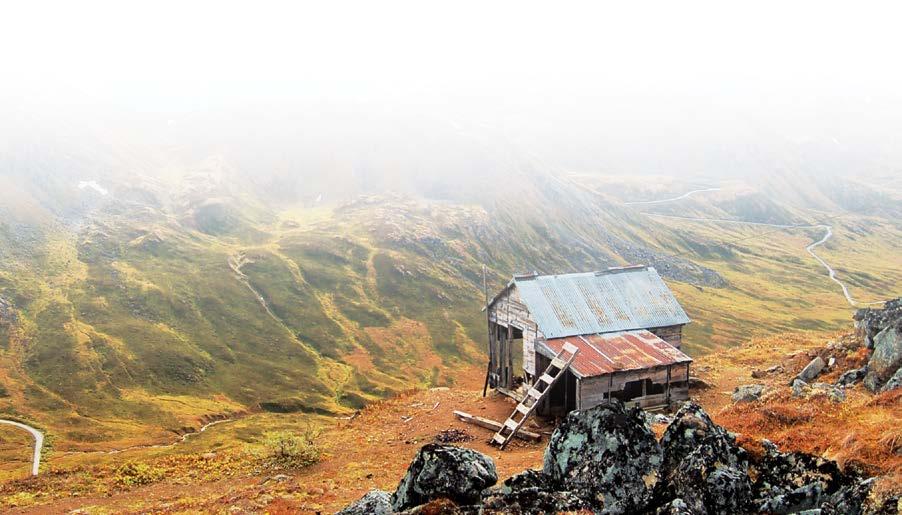
Jeremiah B. - Most definitely Cape Hinchinbrook Lighthouse on Kayak Island out of Cordova. Have wanted to go stay there for a long time now.
Sara U. - Harding Ice field trail
Tiffany R. - Kenai Fjords tour
Sara W. - Kasugi Ridge in Denali State Park
Anne S. - Chilkoot Trail!
May 2013 | 29 teXt
MISS AN ISSUE Get Your FREE Last Frontier T-Shirt with a 1 - year Subscription at $39.99 - 12 issues scan the code or visit us at lastfrontiermagazine.com
The LIFELINE
In the 1940’s, while World War II wreaked havoc across the earth, protection of the homefront brought numerous advances to Alaska’s infrastructure. With Alaska’s strategic location and viable resources, Japanese forces occupied the Aleutians in an attempt to obstruct Alaska’s ability to defend the Pacific Coast. Vital improvements to transportation were made in order to ensure the military would have the necessary supplies to defend against enemy advances. Many underestimate the extent to which military defense projects influence civilian life today.
Along with the formation of essential military bases and the construction of the Alcan Highway, the idea to build a railroad spur connecting the deep sea port of Whittier to the rest of Alaska was considered a necessary defense strategy. The idea for the spur
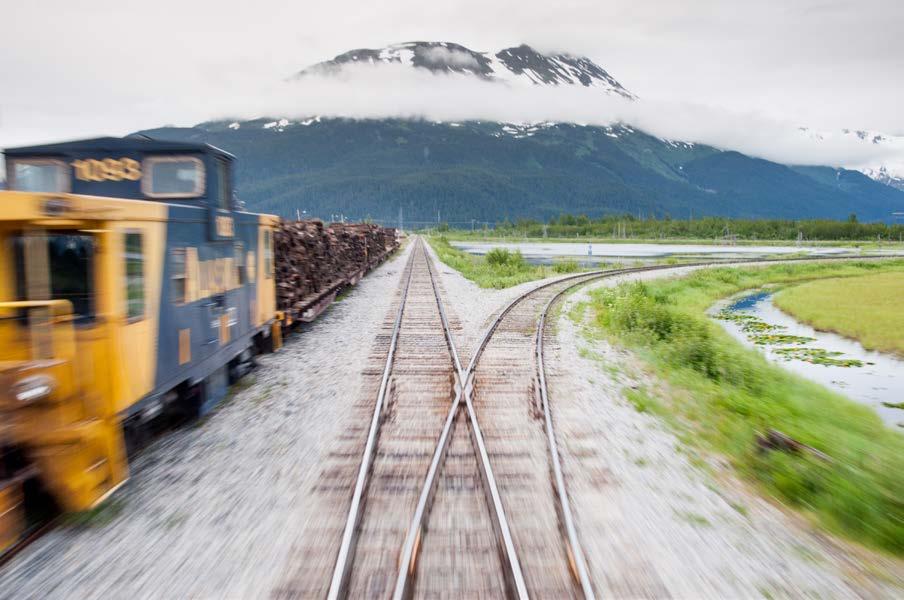
was first proposed by the Alaska Railroad in 1914, but it wasn’t until the urgency of war that the project became a reality. Construction of the spur to Whittier began in 1941, and was completed two years later on April 23, 1943. The spur included three and a half miles of tunnels. A one mile tunnel was built under Begich Peak and the other tunnel was impressively hammered two and a half miles through the base of Maynard Mountain.
After the railway’s completion, the deep sea port of Whittier became the primary supply line for Alaska during the war. Whittier’s climate and location were considered ideal conditions for the wartime effort. Today, visitors and residents of Whittier may find the weather to be a nuisance. But during the war the considerable amount of rain, fog, and cloud cover was a fortunate obstacle. The weather conditions
History: the Lifeline
Accessing the Deep Sea Port of Whittier: one of WWII’s top Engineering feats
Spur
to Whittier through Portage Valley
successfully hindered enemy forces from disrupting Alaska’s lifeline. Whittier’s location also spared the railroad the extra fifty two miles of steep terrain to travel further south, down the Kenai Peninsula to Seward; the next viable alternative route.
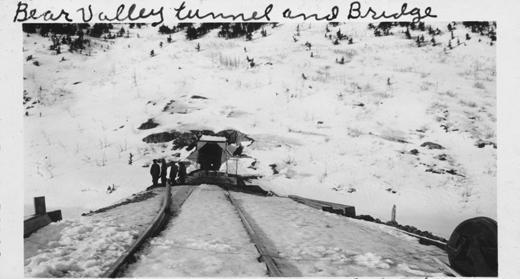
After the end of WWII the railroad spur to Whittier continued being the primary supply route for Alaska. Without the threat of war the beauty of Whittier and Prince William Sound brought a rush of visitors to the area. The railroad soon began shuttling people through the tunnels, in their vehicles, on flatbed rail cars. As years went by an easier and more affordable means of traversing to and from Whittier became necessary. Thus, in 1998 construction began to convert the two and a half mile tunnel under Maynard Mountain to accommodate both vehicle and railroad traffic. On June 7, 2000 the Anton Anderson Memorial Tunnel was opened for the first time to automotive vehicles, and was fittingly named after the army engineer who led the construction of the tunnel over fifty years prior. More commonly referred to as the Whittier Tunnel, the underground passage is the longest tunnel in North America to serve both highway and rail traffic.
According to Gordon Burton, the Whittier tunnel’s facilities manager, the first few years operating the tunnel were very challenging. Not surprising considering the tunnel, designed to support both modes of transportation, was the first of its kind. After thirteen years, operation of the tunnel now runs smoothly. An average of over 100,000 round trips are made through the tunnel each year. Gordon says that the tunnel could support a significant increase in traffic, so they are well prepared to handle eight more cruise ships scheduled to dock in Whittier this summer.
The necessity of wartime mobilization brought forth record achievements accomplished by the US Army Corps of Engineers. Their ingenuity has given Alaskans and tourists access to the convenience and beauty of the Prince William Sound.

May 2013 | 31
“Bear Valley Tunnel and Bridge. Bridge Blown out March 1946”
Photo Credit: Elmer Williams photograph album, Archives and Special Collections, Consortium Library, University of Alaska Anchorage