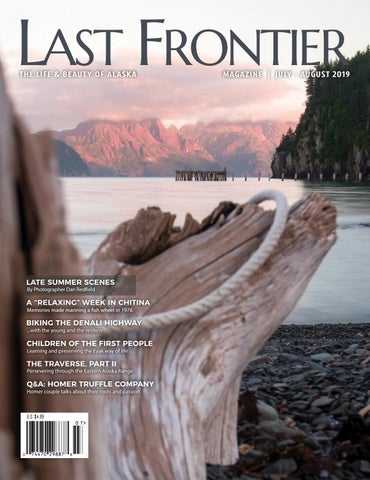
LAST FRONTIER THE LIFE & BEAUTY OF ALASKA
MAGAZINE | JULY - AUGUST 2019
LATE SUMMER SCENES By Photographer Dan Redfield
A “RELAXING” WEEK IN CHITINA Memories made manning a fish wheel in 1976
BIKING THE DENALI HIGHWAY ...with the young and the restless
CHILDREN OF THE FIRST PEOPLE Learning and preserving the Eyak way of life
THE TRAVERSE, PART II
Persevering through the Eastern Alaska Range
Q&A: HOMER TRUFFLE COMPANY Homer couple talks about their roots and passion
U.S. $4.99
J U LY - AU G U S T
20 1 9 1
2
L A S T F R O N T I E R M AG A Z I N E www.lastfrontiermagazine.com
J U LY - AU G U S T
20 1 9 3
ON THE COVER
This WWII era pier watches the sunset light up the mountains surrounding Resurrection Bay as it has for decades. See more photos by Dan Redfield in the gallery starting on page 16.
A small plane coming in to land on a gravel strip in the Knik River Valley. Photo by Dan Redfield.
CONTRIBUTORS
ADVERTISING
CONTRIBUTING
HOMER TRUFFLE, CO.
If you are an Alaskan business, or a business
LINDA MYERS-STEELE
Alaska depends on for services, and would like
Do you have an Alaskan experience and/ or photos you would like to share? We love publishing authentic Alaska stories!
PATTI BERKHAHN DAN REDFIELD TRICIA BROWN MICHAEL HOPPER LAURA LOWDERMILK
THE PREVIOUS ISSUE
to place an ad in Last Frontier Magazine, we welcome your call or email. We want to partner in advertising with you! Email: info@lastfrontiermagazine.com Phone: 907-775-0816
SOCIAL MEDIA
SUBSCRIBE
Connect with us on these social media platforms.
$19.99 for a 1 yr. / 6 issue subscription to LFM. Go to: lastfrontiermagazine.com/subscribe or call 907.775.0816. Gift subscriptions available for $15.99 with the purchase of one full price subscription. Missed an issue? Back issues are also available.
STAFF
MAY/JUNE 2019 DENALI, IN ALL HER GLORY “DAY HIKING SOUTHCENTRAL AK” THE AIRSHIP NORGE RHUBARB MUFFINS THE TRAVERSE, PART 1 SPRUCE BARK BEETLE
4
Contact Anne Sanders at: editor@lastfrontiermagazine.com
Editor, Anne Sanders editor@lastfrontiermagazine.com Assistant Editor, Wendy Wesser wendy@lastfrontiermagazine.com Designer, Cecil Sanders publisher@lastfrontiermagazine.com Advertising, Jesse Carnahan ads@lastfrontiermagazine.com
L A S T F R O N T I E R M AG A Z I N E www.lastfrontiermagazine.com
@LastFrontierMagazine @alaskalfmag @lastfrontiermagazine Last Frontier Magazine
CONTACT INFORMATION Phone: 907.775.0816 Email: info@lastfrontiermagazine.com Web: lastfrontiermagazine.com Mail: PO Box 4514 Palmer, AK 99645
EDITOR’S NOTES
LFM STAFF
We created Last Frontier Magazine a little over six years ago. A somewhat spontaneous idea turned very quickly into reality when we gathered all the content, submitted it to a printer, and received lots and lots of boxes of magazines that needed to be distributed. The adventures Anne and I had experienced throughout Alaska and turned into stories were soon depleted which required us to adventure more, and more.
CECIL SANDERS
We’ve dipnetted the swift and silty waters of the Charlie Sanders Copper River, climbed high into the backcountry of the Sheep Mountains, and explored remote and rocky beaches on the Kenai Peninsula. We’ve been fortunate to tour Western Alaska villages, and bumpy iconic highways from Cantwell to Paxson, to Chicken and farther.
ANNE SANDERS
None of these experiences and adventures have compared to the last eight weeks with our first born child. The summer’s warmth and green landscapes have spurred our adventurous spirits forward. A drive to Haines is in our plans and perhaps a ferry ride to Skagway and/ or Juneau. Charlie’s first trip up to Hatcher Pass is right around the corner as soon as the roads are passable. We can’t wait to share these experiences and many more Alaska adventures in the future with him, starting with a trip to beautiful Homer after we send this issue off to the printer! -Cecil
MISSION STATEMENT At Last Frontier Magazine we strive to captivate our readers with an entertaining experience; to propel our advertisers forward in a competitive market; to actively enrich our community and serve our Lord with all our heart, mind, soul, and talents. We are Alaskans and above all want to promote a healthy community that can come together and celebrate Alaska and its people, culture, beauty, and identity. Our desire is that through the content of LFM a positive representation of Alaska will be felt and enjoyed.
Inspired at a young age, Cecil has turned his love of photography into a lifestyle and a business, with a desire to capture the beauty and character of wherever his camera takes him. Always primed to set off on a new adventure, Cecil and his wife, Anne, have spent their eleven years of marriage going on road trips, touring Alaska and the country, and planning ahead to their next destination. Cecil has combined his artist’s perspective and aptitude for design in order to contribute his talents to the collaborative effort of bringing Last Frontier Magazine into a reality.
Anne was born and raised in Alaska. She graduated with a B.A. in English Literature from the University of Alaska Anchorage. With a love for the written word, she recognizes the treasure of stories and fascinating people Alaska offers. Paired with her husband, Cecil, who complements her narratives with his eye for the visual, Anne is on a mission to bring her beloved home of Alaska to life on the pages of Last Frontier Magazine.
WENDY WESSER Writing, history, gardening, and traveling are a few of Wendy’s interests. She grew up in Alaska, living as far south as Metlakatla and as far north as Fairbanks. Her family’s history of six generations in Alaska reaches back to the Gold Rush years. She loves reading, hearing and sharing Alaskan stories of newcomers and oldtimers alike—Last Frontier Magazine has provided her the opportunity to work in this very venue.
JESSE CARNAHAN Raised in Alaska, Jesse has a special affinity for the state and the people that live here. Along with his wife and two children, Jesse loves being outdoors and experiencing this amazing place. He has always loved hearing the unique stories that can only come from Alaska, and is excited to be able to share more of them through Last Frontier Magazine.
J U LY - AU G U S T
20 1 9 5
TABLE OF CONTENTS
O U T D O O R S A N D R E C R E AT I O N
7
BIKING THE DENALI HIGHWAY ...with the young and the restless
ALASKA HISTORY
10
A “RELAXING” WEEK IN CHITINA
Memories made manning a fish wheel in 1976
BUSINESS
14
Q&A: HOMER TRUFFLE COMPANY
Homer couple talks about their roots and passion
PHOTO GALLERY
16
LATE SUMMER SCENES
Featuring photos captured by Dan Redfield
LIFE IN ALASKA
22
CHILDREN OF THE FIRST PEOPLE
Learning and preserving the Eyak way of life
O U T D O O R S & R E C R E AT I O N
24
THE TRAVERSE, PART II
Persevering through the Eastern Alaska Range
LIFE IN ALASKA
34
THE ALASKAN
Understanding the Alaskan way, mind, and soul
THE TRAVERSE, PART II
Blazing a trail in the Eastern Alaska Range
6
L A S T F R O N T I E R M AG A Z I N E www.lastfrontiermagazine.com
BIKING THE DENALI HIGHWAY ....WITH THE YOUNG AND THE RESTLESS STORY AND PHOTOS BY PATTI BERKHAHN
“W
hat
we
our campsite for the night. The Denali Highway begins in Cantwell
experience?” That was my biggest question
kind
of
wildlife
encounter
will
with a short three-mile smooth stretch of pavement before turning
when we began our bicycle trip on the Denali
to gravel for most of the 135 miles to Paxson. Once we encountered
Highway with our 11-year-old grandson. With that in mind, the three
gravel we determined it was safe to pedal side by side. There was no
of us carried bear spray at our sides. My husband, Bill, and I are long-
traffic! Bill’s last words to us were, “Enjoy the scenery and stop to
time Alaskans and even our young companion, Gauge, understands
smell the roses.” We stopped briefly at creek crossings to marvel at
how to safely react to bears and moose and properly use bear
the varied waterfowl and admire the blooming flowers.
deterrent. We’d only traveled eight miles when the sky darkened and then, We brought along our cab-over camper to be our “support and
BOOM, it lit up with lightening. We were heading right into a
gear” vehicle, known as a SAG in the biking world. This presented
thunderstorm. Bill had passed us about 20 minutes earlier and was
our first dilemma. Both Bill and I wanted to pedal every inch of the
nowhere in sight. Thankfully, we came upon him at a lakeside pullout
highway, however, someone had to drive the truck. In order to
just as the skies opened. We enjoyed a nice break in the comforts of
accomplish this feat, we needed to journey from Cantwell to Paxson
the dry camper as we waited for the storm to pass. Gauge and I
and back to Cantwell taking turns pedaling. We created a journal
eventually biked another 10 miles, under blue skies, until we found
noting mileposts ridden by each biker so we could fill in the gaps on
the camper at a serene location along the Nenana River. We were
the return. Gauge was not sure how much he wanted to pedal, but
just in time for happy hour and a hot dinner. Aaah, the benefits of
he was certain he wanted to outdistance his grandparents.
traveling with support versus hauling tents and food on your bike!
We began our nine-day adventure on a beautiful, sunny day in early
The next morning dawned bright and sunny. We had another short
June knowing we were very lucky to have such nice weather. I
day ahead of us since we planned to stay at the Brushkana River
was riding my hybrid, which is similar to a mountain bike, but with
Campground and explore the area. Bill and I traded duties; while I
tires sized between a road and mountain bike. Gauge was on my
buttoned up the camper and cleaned the campsite, Gauge pedaled
mountain bike and Bill reluctantly left his mountain bike on the rack
with Papa. Of course, their day started with a big climb—love all
and drove the first leg of the trip. Since we had a late start, Bill was
those gears on our bikes! I passed the two of them on another
to drive along behind us, catch us for a break, then set out to find
uphill section and found a lunch spot on a high overlook. Despite
J U LY - AU G U S T
20 1 9 7
Biking the Denali Highway the uphill climbs, the bikers were in good humor and anxious for
The next morning Gauge and I biked for 10 miles, then Bill pedaled
the downhills. It became routine for the driver to fill a garbage
solo for most of the afternoon. Later, Gauge and I took another
bag with trash at each rendezvous or campsite along the way.
shift biking. Ten miles farther we finally found Bill standing in the
Unfortunately, not everyone practices Leave No Trace along the
road waving us into our hidden site for the night. We had high
Denali Highway’s numerous and scenic pull-offs.
hopes of making it to Tangle Lakes Campground the next night, which was only 44 miles away. Divvied into shifts the distance was
We had our choice of campsites at the Brushkana Campground as
easy to accomplish except for the uphill section from Maclaren
we were the only travelers. We selected a nice site on the river’s
River to Maclaren Summit, a 3,000 foot elevation gain in five miles.
edge and then hiked a trail that eventually led us to a high bluff
Gauge and I had the honors of owning that section. Although we
overlooking the Brushkana River. Below the bluff, we spotted a
stopped for a break on the crest of each false summit, we pedaled
moose cow with her calf resting in the vegetation. The red hue of
every inch of that hill. We created a mantra we shouted to each
the newborn calf was highlighted against the green grass below.
other to keep the momentum going—“my legs are pumping and
This calf was only a few days old! We watched as the cow crossed
my heart’s a thumping.” Bill even stopped and asked Gauge if he
the river and its calf attempted to follow. The calf struggled in
wanted a lift to the top. Gauge said, “If a 62-year-old can make it,
the current and retreated to shore. The cow seemed unfazed and
then I can too.” I thought to myself, If an 11-year-old can make it,
continued to browse on the other side of the river while the calf
then I can too.
bedded down. On our hike back to camp, we came upon several more cows and young calves, which had us all on edge. You
Teamwork prevailed! It was a delight to finally reach the summit,
definitely do not want to get between these ungulates and their
especially since the miles ahead of us were gently rolling hills
young.
in open country. The scene revealed a snowy Alaska Range with Landmark Gap beckoning in the distance. We were at 4,100 feet in
Back at the campsite, Gauge was exploring along the riverbank,
elevation. We dodged Arctic ground squirrels crossing the road and
when all of a sudden he ran back to the camper shouting, “There is
stopped to listen to the whistling marmots. A nice downhill cruise
a lone newborn calf across the river bleating loudly!” There was no
lay ahead and we were pleasantly surprised when our tires found
cow in sight, so we all stayed near the camper. This little calf cried for
the smooth chipped seal of the road long before we expected
a good 30 minutes then decided to cross the river to our campsite.
pavement. True pavement begins east of the Tangle River.
We yelled, hoping to frighten it from crossing as the current was quite rapid. Amazingly, this leggy youngster made it across the
We camped three nights at the Tangle Lakes Campground, partially
river and came right to us. We retreated into the camper just as we
because of the weather. It was our home base while we alternated
spotted the cow on the other side of the river thrashing and calling
cycling to Paxson, the end of the Denali Highway, and back to our
for her calf. The cow slid down the bank and crashed across the river
campsite. The following morning we woke up to four inches of snow
as the little one ran to mom to suckle; united at last. We wondered if
and decided to layover an additional day. Time to fish for Arctic
they were the same pair we watched from the high bluff two hours
grayling! Bill and Gauge caught breakfast for us during a sloppy
earlier.
8
L A S T F R O N T I E R M AG A Z I N E www.lastfrontiermagazine.com
Biking the Denali Highway snow storm while I ventured to Tangle Lakes Lodge seeking pie for an after-dinner treat. The next day appeared promising for Bill’s turn to pedal up and over Maclaren Summit. Gauge and I set off in the camper, keeping an eye on the sky, and checking in with Bill at convenient locations. Just prior to reaching the top of the summit we drove into a blinding snowstorm. Bill was a couple of miles behind us, the road was narrow, and we couldn’t see to turn around. Instead I found a wide spot in the road to wait. It must have been a miserable uphill grind for Bill, however, he persevered. When the storm passed, we pressed on, switched bikers, and made good progress despite the snow delay. During the last two days of our trip we collectively biked 85 miles. Bill and I accomplished our goal by pedaling the 135 mile length of the Denali Highway (one way or another). Gauge, true to his word, pedaled 138 miles. Luckily, we never crossed a bear, merely saw fresh scat, and only had one moose jump out in front of us on the road. Indeed, it was a wonderful trip and a great experience to share with our amazing grandson. Next summer, the McCarthy road!
PATTI BERKHAHN is a retired fishery biologist from the Alaska Department of Fish & Game (ADF&G), Soldotna office. She volunteers for Alaska State Parks, ADF&G, and local non-profit agencies between adventures.
ENJOY WORKING OUT OF THE OFFICE?
Explore and apply for careers at MEA Alaska’s oldest and second largest electric Co-op VISIT WWW.MEA.COOP FOR CURRENT JOB OPPORTUNITIES J U LY - AU G U S T
20 1 9 9
Watercolor of the Copper River by Kevin Wesser
A “RELAXING” WEEK IN CHITINA MEMORIES MADE MANNING A FISH WHEEL IN 1976 STORY BY LINDA MYERS-STEELE
T
he year was 1976, the bicentennial of the United States of
to the early 1900s. The Chitina of 1976 was a sleepy little spot in the
America. I had a goal to knit my two children, Jenny, age 10,
road. I did hear of one person who lived there year round, but most
and Sam, age 8, sweaters with patriotic red, white, and blue
used the area as their favorite summer fishing spot. Almost 40 years
yarn. All I needed was the time to sit and do it.
later, the population blossomed to 126 people per the 2010 census.
While at work one day, my friend Barb announced she was looking
Manning a fish wheel seemed like a challenge our family could
for families to help operate her family fish wheel the coming
handle. It is a fairly large device, about the size of a refrigerator,
summer. It would entail committing to stay a week in the remote
although they do vary in size. They are designed to stay in place
community of Chitina. That sounded interesting, I knew my husband
along a rocky edge in a river where salmon are likely to swim. The
liked to fish, and I thought to myself, I’ll have some peaceful and
river current makes the scoop rotate continuously and drops the
relaxing time to catch up on my knitting.
fish into a basket which is below water level keeping the fish fresh.
Where The Hell Is Chitina? was a popular bumper sticker slogan during
My friend’s husband, Jim, worked for the Bureau of Land
the late 70s. It was an apt question considering Chitina is a long way
Management. In the course of his work, he knew the Copper
from populated areas. In those days, after leaving the serenity of
River like the back of his hand. His job was to study the river and
driving on smooth asphalt, the small community was over an hour
the routes of the red salmon, their habits, the current of the river,
farther on a gravel road—a long gravel road. Chitina serves a part
and the estimated yearly fish escapement. Copper River Reds are
in Alaskan history associated with the copper mining in the Copper
prized as the best tasting salmon of all four species. In recent years,
River Valley and Kennecott Copper Mine near McCarthy dating back
there has been much publicity about eating the first of this salmon
10
L A S T F R O N T I E R M AG A Z I N E www.lastfrontiermagazine.com
of the season. Jim had watched and studied fish wheels for years.
above the truck cab. A lounging chair inside would have been nice,
The most attractive ones were made by the Alaska Native people,
but there was no room for such luxuries. Still, I knew I would have
usually from wood tied together with leather straps from animals
plenty of time to knit those sweaters sitting in a camping chair.
they had hunted. Even the baskets were made from the leather. If metal was used, it was a more “modern” fish wheel. Over time,
On the outer edge of Chitina on our way into town, we noticed a
caging material became commonly used.
garbage dump off the side of the road. It was fairly typical in rural communities at that time to find an easily accessible sloping hill and
Jim was not Alaska Native. He made his fish wheel out of whatever
use it for a dump. There was little concern about contaminating
he had in his Anchorage garage stock pile. His fish wheel consisted
the land in those days … people did whatever was convenient. We
of Styrofoam sheets, pipes, airplane parts, chicken wire, and rabbit-
noticed that there was a freezer in the dump with bullet holes in it.
cage wire, plain old wire used like a twist-tie, nails, screws, bolts, and even some wood. Once constructed it was placed on a trailer
We relieved the Van family who were anxious to get back to
to be hauled to Chitina. This was not an easy task since it entailed
civilization after their week on the river. The Vans introduced us to
a 246-mile drive from Anchorage. Upon arriving in Chitina, the fish
the fish wheel, told us how it worked, and about their catch. They
wheel had to be unloaded, hand-carried down to the shore, and
also mentioned that the beautiful wooden fish wheel near ours
then placed into the river. To keep
belonged to a Native family and we’d
it from escaping while it was being
see them coming and going to check
placed into the river, holding ropes
their catch.
were attached to prevent it from floating away. This is a job for three to
RESTING WAS NOT AN In order to empty the fish wheel basket,
four strong men wearing hip boots and
OPTION EITHER. THE FISH
heavy gloves. It stands to reason that
WERE IN CHARGE OF THIS
wooden plank, bend over while trying
OPERATION AND THEY WERE
haul up the heavy fish, and carry them
placing the fish wheel for one week was not practical. Thus, my friend was recruiting families they could depend on to stay for at least a week to tend
RUNNING LIKE CRAZY!
someone had to traverse a narrow not to fall into the fast moving river, back to shore, once again traversing the narrow wooden plank. This was
the fish wheel around the clock. The
not a task for a weak-hearted soul. It
volunteers had to promise not to leave
had to be done. If the basket became
the fish wheel until the next scheduled family arrived to take over
overloaded with floundering fish, their weight would ruin the entire
the watch. Jim and Barb’s plan was to keep the fish wheel in the
fish wheel. Resting was not an option either. The fish were in charge
water for six weeks.
of this operation and they were running like crazy!
The bonus for spending a week in Chitina and working 24/7 was we
When we met the Native family next door they were not happy.
could keep all the fish we caught. At that time, Alaska Native people
Their beautiful fish wheel was not catching. Their week had been
could keep 400 fish per season, and other Alaska residents could
dismal, and they depended on that fish to feed their family all
keep 200 fish per season. Two hundred salmon is a tremendous
winter. Their catch was out of our control. Each of the fish wheels
amount of fish; more than enough to feed a family of four for
had been placed and there was no way to move them without a lot
several years. The whole scenario seemed like quite the adventure,
of disruption to others.
so we agreed to be a part of Jim and Barb’s schedule to operate the fish wheel for one week.
Our 8-year-old son was in heaven. There was water, mud, rocks, fish, boulders to climb, and no bathtub or shower. He was in his
It just so happened that our daughter, Jenny, was going to spend
element! His dad was on-duty day and night, traveling across the
that same week at Girl Scout Camp. We dropped her off on the way,
wooden plank bringing fish to be cleaned and wrapped, and trying
and Art, Sam, and I headed to Chitina. We had a simple camper on a
to catch a little sleep now and then. My job was to cook meals and
1965 pickup truck. It was adequate, but certainly lacked some of the
process fish, which consisted of cleaning, wrapping them in plastic,
modern conveniences of home. There was no shower or toilet. We
and making room in the ice chest. I was actually able to get some
made due with a portable potty that needed to be tended to after
knitting done as well.
each use. A two-burner stove and small refrigerator finished off the amenities. A table made into a bed and there was sleeping quarters
Within two days the ice chest we brought was full. I believe we
J U LY - AU G U S T
20 1 9 11
A “Relaxing” Week in Chitina squeezed 20 salmon in a chest designed for eight (I’m not sure what
permit tag from our fish wheel and allowed them to place their
we were thinking bringing the one ice chest). We were looking for
tag on our wheel since ours was catching and theirs was not.
any alternative sources of freezer space. The little refrigerator in the camper was cleared to make room for more fish. We had fish in every
The next problem to solve was transporting the fish home. We
container we could find and they just kept coming. Where were we
remembered that old freezer we saw in the dump. If we could
going to put 200 fish? We explained our dilemma to our new friends
figure out a way to get that pulled out, we could clean it up, put
and they put their thinking caps on. At this point, we offered to share
it on the trailer, and use it for transporting the frozen fish home.
fish with them as they still were not catching.
First, however, we had to find a wench. Again, our friends helped us out. They were more than willing to lend a hand. Inch by
Our new friends told us that they could let us into the Chitina
inch the freezer was drawn up the hill through the trash heap.
Emporium (general store). There was a freezer in the old store, but
Although the freezer had bullet holes in it, there was enough
the power had gone out last winter and they hadn’t been in the store
insulation in the walls to keep the fish frozen solid for the 246-
since. If we were willing to clean out the freezer, they would plug it in
mile trip back home. Of course, out came the Pine-Sol and face
to the electricity and we could store our fish there until we left town.
handkerchiefs again for the cleanup job. Oh my gosh, I had never
Of course, we were willing to do that. We weren’t afraid of cleaning
been so dirty in my life!
or hard work... We breathed a sigh of relief when the work was done and we still Armed with a jug of Pine-Sol as a cleaning agent, we walked into the
had a few days left to enjoy our visit to Chitina. I was ready for
decades-old general store. It was a step back in time. There were very
a little rest and relaxation. “How about going out to dinner?” I
high shelves behind the counters on each side of the store, just as I had seen in historic photos of merchandise stores of the early 1900s. In the unheated back room was a black faded door labeled “Coffin Room.” Inside the Coffin Room were long shelves, enough to hold
BY THE END OF THE FOURTH
perhaps six or eight coffins. This was a necessary storage area for
DAY, WE HAD OUR 200 FISH.
those dearly beloved who passed away during the winter months
THAT SEEMS LIKE A GOOD
when the frozen ground could not yet be dug. Ah yes, and there was the chest freezer. Upon opening the lid, we discovered it was half full of maggots! Ugh! Like I said, we’re not afraid
PROBLEM TO HAVE, BUT ALAS, IT CAUSED GREATER ISSUES.
of hard work, but bad smells are something else!! With handkerchiefs over our faces and shovels we cleaned the freezer of maggots by putting them into a plastic-lined trash barrel, and then we wiped the whole freezer numerous times with more Pine-Sol. When that task was completed, the freezer was plugged back into the electric outlet to cool. Each fish was wrapped several times with plastic and frozen as quickly as possible. By the end of the fourth day, we had our 200 fish. That seems like a good problem to have, but alas, it caused greater issues. We could not leave to take our fish back to Anchorage until our relief family arrived at the end of the week. Not only did we have several days before departure, we had 200 frozen fish to haul home without a container to accomplish that mission. Our friends were almost relatives by now. The wife loved my husband I really didn’t figure he’d give me up for this cutie pie. In reality, we
Fish wheels on the Copper River outside of Chitina. Photo by Doug Noon /
both smelled pretty much like old fish. We removed the state fishing
Wikimedia Creative Commons
because he was so big and strong. Was I jealous? I guess a little, but
12
L A S T F R O N T I E R M AG A Z I N E www.lastfrontiermagazine.com
A Chitina
A “Relaxing” Week in Chitina asked Art. “I thought I saw a little restaurant on the way coming
Realization set in all at once on every face in the room. This was not
in last weekend.” Yes, it was a tiny yellow house and had red tin
a restaurant, but a private home with a large collection of Coca Cola
Coca Cola signs all over the front. They must have sandwiches or
signs! There we were making ourselves comfortable in someone’s
something there.
house. Of course, we apologized profusely and repeatedly. Our hosts broke out in laughter and we all enjoyed the silly mistake.
We cleaned up as best we could and went to the restaurant. Upon walking in the front door we noticed there was only one table, but
The next day or so was spent relaxing—no more walking the plank
that was not too surprising as Chitina is a very small community
day and night. I kept knitting and did finish the two sweaters I’d
and only comes to life once per year, during fishing season. Sam,
planned to make before we headed home. We’d had a successful
Art, and I sat at the table waiting for our server to appear. In a few
trip to Chitina, made some new friends, had plenty of fish for the
minutes someone appeared and asked us what we were doing
home freezer, and a big story to tell. A
at their table. “We just stopped in for a bite to eat,” I replied.
THIS WAS NOT A RESTAURANT, BUT A PRIVATE HOME WITH A LARGE COLLECTION OF COCA COLA SIGNS! THERE WE WERE MAKING OURSELVES COMFORTABLE IN SOMEONE’S HOUSE.
LINDA MYERS-STEELE Moving from California to Alaska in 1963, when she was 18 years old, changed the direction of Linda’s life for the better. Believing that knowledge is power and willing to step out or step-up, she has been able to create a life story with many happy trails along the way. Now that she is retired from the Matanuska-Susitna Borough School District, her travel business, and her framing business, Linda enjoys traveling, gardening, and volunteer work. She lives in Wasilla, Alaska, with her husband, Jim, in what they like to call, “Our little corner of the world.”
M J UALY R C-HAU - AGPURSITL
20 201199 13 13
Q&A: HOMER TRUFFLE COMPANY HOMER COUPLE TALKS ABOUT THEIR ROOTS AND PASSION
G
et to know the owners of Homer Truffle Co. in this Q&A with the husband and wife team, David and Evangelina. Learn about the rewards and challenges of owning a chocolate
business in Homer, Alaska. LFM: What is your education, training, and experience in the art of making chocolate? Evangelina: I have a Bachelor’s in Sociology, University of Texas at San Antonio, a Culinary Certificate, Auguste Escoffier School of Culinary Arts, and a Baking and Pastry Certificate, Auguste Escoffier School of Culinary Arts. David: My mom owned Tundra Chocolates in Wasilla, so candy was present in my life in a very different way as a child than most. I would help my mom with packaging candy and got paid in delicious currency. Every Sunday we’d head over to the shop for goodies. LFM: What is your personal Alaska history? Evangelina: I am from San Antonio, Texas. I met David in the Navy’s Master-at-arms (military cop) academy. When I was getting ready to separate from the Navy David and I had two choices: Alaska or Texas. David encouraged me to visit Alaska during the winter to decide whether or not it was right for me. When the plane landed in Anchorage in the winter of 2015, I felt like I was coming home; a deep sense of peace enveloped me. We searched for two weeks all along the Seward/Sterling Highway and found our way to Homer. The Bay, the ocean, the enormity, and the calm embrace of the mountains all came together and welcomed us in. We knew this was where we wanted to raise our son. It was perfect. David: I was raised in Anchorage and Wasilla. My grandparents moved here in the 1950s, my mother was raised in Anchorage, and my sister and her family still live in Wasilla and Palmer.
14
L A S T F R O N T I E R M AG A Z I N E www.lastfrontiermagazine.com
Evangelina and David
LFM: Does Homer’s climate make creating truffles difficult with the heat, cold, moisture, etc.? Evangelina: Yes. Working with chocolate requires attention, patience, and persistence, but if you don’t have the perfect temperature and humidity control, it is that much more of a struggle. We have regulators that help with the humidity and keep our temperature just right. David: It has been a challenge. We originally thought we’d be fine with the open
Visit Homer Truffle Company online at www.homertruffle.co or call 907.435.7941 for ordering information.
windows in Alaska, but we ended up having one of the only buildings here with air conditioning. LFM: Was there a defining moment before you started the business, that gave you confidence to begin this venture? Evangelina: Making candy and chocolate is the BEST way to make a life in Alaska without sacrificing time away from our boys. I was all too familiar with being away from my first son 14 to 15 hours at a time and not having physical contact with him or my husband for months at a time. We agreed we wanted something different for our children; we wanted to be present. They are the motivation behind our confidence. Helen Keller said, “We can do anything we want to if we stick to it long enough.” That statement can’t be any more true. However, along with not giving up, David and I add passion, persistence, focus, creativity, adaptability, and the willingness to learn and improve our craft. David: We were not expecting to go down this road. It was a suggestion and we ran with it. LFM: What has been the biggest surprise so far? Evangelina: The amount of personal growth and full circles chocolate has brought to my life. Many times, I felt as though I was walking down linear paths. Chocolate has made it more as though I was an electrical signal passing through one neuron of the brain to another. It’s been two very enlightening years, and I hope for many more. David: We are extremely thankful and humbled with the overwhelming support for our products. Customers genuinely love what we create. The experience, so far, has been surreal, and not something we ever thought we would do. It is a great feeling and encourages us to continue exploring our creativity and produce new sweet treats for our community. A
J U LY - AU G U S T
20 1 9 15
PHOTO GALLERY A jet skier explores Surprise Cove. Credit: Dan Redfield 16
L A S T F R O N T I E R M AG A Z I N E www.lastfrontiermagazine.com
J U LY - AU G U S T
20 1 9 17
PHOTO GALLERY The many veins that run off the Knik River. Credit: Dan Redfield 18
L A S T F R O N T I E R M AG A Z I N E www.lastfrontiermagazine.com
J U LY - AU G U S T
20 1 9 19
PHOTO GALLERY The Nirvana rests in Captains Bay, Dutch Harbor. Credit: Dan Redfield 20
L A S T F R O N T I E R M AG A Z I N E www.lastfrontiermagazine.com
DAN REDFIELD is a full-time EmmyÂŽ nominated filmmaker and adventure photographer. Dan created Alaska Photoventures to fulfill his love for both film and photography. It is his excuse to meet amazing people and explore new places in Alaska. @alaskaphotoventures @alaska_photoventures alaskaphotoventures.com @alaskaphotoventures
J U LY - AU G U S T
20 1 9 21
CHILDREN OF THE FIRST PEOPLE LEARNING AND PRESERVING THE EYAK WAY OF LIFE
REVIEW BY WENDY WESSER | STORY BY TRICIA BROWN | PHOTOGRAPHS BY ROY CORRAL
BOOK REVIEW: CHILDREN OF THE FIRST PEOPLE “Fresh Voices of Alaska’s Native Kids” is an apt subtitle for Tricia
has become an inspiration to James and Metlakatla. I loved seeing
Brown’s new book: Children of the First People. Brown shares
the photos in Brown’s book dominated by Tsimshian designs and
uplifting profiles of ten kids from all across Alaska, along with
reading about James William’s aspirations to learn more about his
photographs by Roy Corral illustrating these children’s experiences.
culture. We didn’t have a totem pole in front of our school when I lived in Metlakatla and when I showed my dad the story and photos
The first story I read was about James Williams from Metlakatla,
in the book he smiled.
a Tsimshian [sim-she-ANN] community. I chose his story because I lived in Metlakatla myself for three years, attending elementary
The other nine unique stories I read, including the story about Aaliya
school while my parents taught and coached at the local schools.
Tiedeman from Cordova on the next page, were just as engaging as
I could relate to James exploring Yellow Hill, attending multiple
the story of James Williams. A map in the book shows where the
church youth groups, and staying busy with various opportunities.
various Native cultures are located and a very helpful glossary in the back teaches how to properly pronounce many Native names
My dad, Gil Hjellen, was surprised at the lack of native art in the
and words. If you are an Alaskan, a visitor, or someone interested
community when we were living there from 1969-1972, and
in the multitude of cultures that make up today’s Alaska, this is a
encouraged community leaders to embrace their culture. His
book you will want to read and learn from. The positive outlooks
ideas were not well received at the time, but since then, David A.
each of these children share are inspiring and give me much hope
Boxley, a successful Tsimshian artist and one of my dad’s students,
for the future of Alaska.
22
L A S T F R O N T I E R M AG A Z I N E www.lastfrontiermagazine.com
G
rowing up in Cordova sets Aaliyah Tiedeman apart. First, by geography: Cordova is nestled at the base of Eyak Mountain on the Gulf of Alaska’s Orca Inlet, surrounded by deep forests, migratory bird nesting areas, and
sparkling water. The town is unreachable by road, so everyone comes and goes on planes or ferries (aka the Blue Canoes) of the Alaska Marine Highway. Cordova was a mining boomtown that was officially organized in 1906. It was the end of the line for the Copper River & Northwestern Railway and a deepwater port for outgoing gold, silver, and copper. But centuries before the miners arrived, the Eyak [EE-yack] people lived in villages throughout this region. The place was and is bountiful—deer, fish, birds, and marine mammals for food and clothing; tall, thick trees for building homes and making art.
NEARLY ALL OF TODAY’S EYAKS ARE A BLEND OF CULTURES, INCLUDING AALIYAH. HER FATHER, NICK, HAS UNANGAXˆ (ALEUT), TLINGIT, AND ATHABASCAN ANCESTORS.
“There was no town,” Aaliyah says. “This was just all trees. There were villages at Eyak Lake and other places. They used the Alaganik Slough to catch reds and silvers [salmon]. They just used all the natural resources. It’s like a protected area now. You can’t dig artifacts up.” The Eyaks are the fewest in number among all of Alaska’s first people. They clashed with neighboring cultures to protect their hunting and fishing grounds. The Alutiiqs lived to the west, Athabascans to the north, and just beyond their eastern border, the mighty Tlingit. Eyak identity has survived through border disputes, a shrinking population, intermarriage, and the death of the last Eyak Native language speaker. Nearly all of today’s Eyaks are a blend of cultures, including Aaliyah. Her father, Nick, has Unangaxˆ (Aleut), Tlingit, and Athabascan ancestors. Her mother is from the Upper Midwest and is part Chippewa Indian. Together, Aaliyah’s parents teach their three daughters about living traditionally. They built their own cabin, fish and hunt for meat, and process the fish. They also preserve berry and currant jams, jellies, and sauces to last until the next summer. Each year, grades six and under participate in the school’s Culture Week, where elders share language skills, traditional crafts, and old stories. In summers, Aaliyah’s creative side blooms at Nuuciq [NEW-check] Spirit Camp.
Above photo: As a reward for passing a hunter safety class, Aaliyah’s parents gave her a pink camo rifle. Page 22 photo: Aaliyah explores the small-boat harbor’s protective breakwater along Orca Inlet.
“I’m really, really artistic,” she says. “So I’ll do a lot of skin-sewing. I’ve probably done about fifty things with skin-sewing and beading.” Using furs of seals and sea otters, she has made wallets, pillows, and beautiful bags. At camp, her imagination casts back to the ancestors who walked this land and kayaked these waters. This year she made a model kayak. J U LY - AU G U S T
20 1 9 23
Children of the First People “It’s like the real thing,” Aaliyah says. “That’s exactly how they used to make it. Wood floats, obviously, but they needed to put a cover on it, and it was seal or sea-lion skin, but we used nylon.” Aaliyah’s little hometown is a popular destination for tourists exploring its historic streets, the Pioneer Hall, the modern museum and library, and the Ilanka Cultural Center. They walk the fishing docks and enjoy seafood at local
AALIYAH AND HER FATHER
restaurants. There are no traffic lights here. The one flashing light is for the
IDENTIFIED A SMALL BUCK
school zone.
ABOUT SIXTY YARDS AWAY.
Each February since 1961, itchy for spring, locals have hosted the Iceworm Festival. There are games, food, and a Miss Iceworm competition with a $2,500 scholarship prize. When she’s old enough, Aaliyah hopes to enter. The
HER HEART POUNDED AS HE
parade finale features the town mascot, a blue iceworm, slithering down the
COACHED HER.
street like a Chinese dragon, dozens of Cordovans walking inside. “It has a huge face,” Aaliyah says. “The person in the front, they have to work hard to keep the head up. And you kind of move it up and down. “We do have iceworms here,” she adds. “It’s not a fairy tale.” Aaliyah’s right. Since the mysterious worms were discovered in 1887, scientists have learned they’re only a few centimeters long, and that living on glacial ice suits them fine. If the temperature soars to 40°F, iceworms actually melt and die from the heat. Most Cordova residents fish commercially or work in fish-processing plants. They were deeply affected when the Exxon Valdez tanker went aground in 1989 and brought disaster to their beloved Prince William Sound. The massive oil spill killed birds, marine mammals, fish, and other wildlife. For families that fished and gathered food for survival, it was devastating. Aaliyah helps feed her family by dip-netting for salmon and deer hunting. Her .243 rifle, in pink camo, was a reward for passing the hunter safety course. She was thrilled to bring it on her first deer hunt. “We were in a marshy area where the deer beds were,” Aaliyah remembers. “We hiked up a couple hills; they weren’t that steep. There were little hemlocks—the perfect tree for a gun positioner— so when you shot, your gun would be steady.” Aaliyah and her father identified a small buck about sixty yards away. Her heart pounded as he coached her.
24
L A S T F R O N T I E R M AG A Z I N E www.lastfrontiermagazine.com
Photo: Wearing traditional regalia, Aaliyah and other Eyak Dancers perform at the elementary school.
Children of the First People “I was shaky—I was like, ‘Okay, calm down,’” Aaliyah says. “My dad
Excerpt from Children of the First People: Fresh Voices of Alaska’s
was holding my shoulders and saying, ‘Steady breathing.’ Then I shot
Native Kids, ©2019 by Tricia Brown, photos by Roy Corral, Alaska
at it once, and it dropped. I was so proud of myself.”
Northwest Books, reprinted by permission.
Afterward, Aaliyah followed the tradition of her people. “I thanked the animal, because I know my ancestors did it. They’ve given their life for you, for your family. That’s the first thing we do. Once you drop the animal, you go down there and thank it.” In the spring, Aaliyah will fly to Anchorage for the Native Youth Olympics. She’ll compete against girls from around the state in the Alaskan High Kick, which requires exceptional balance and strength. She also loves basketball, both watching it and playing it. Plus there’s listening to music while working out, spending time with friends, babysitting, and schoolwork. She’s in advanced math and plans to study sports medicine someday. As much as she has learned, Aaliyah still has many questions for her teachers. Not surprisingly for the future doctor, most are about health. “The medicine men . . . how did they figure out the people who were affected by this disease and what medicine they needed? And how did the first Eyak people learn how this plant was good [for medicine] and this plant wasn’t?” Aaliyah is still learning. A
TRICIA BROWN has written and edited dozens of books since she first made Alaska her home in 1978. In a career that evolved from newspapers to magazines to book publishing, her writing is inspired by Alaska, reflected in nearly thirty titles on Native cultures, dog mushing, Last Frontier living, reference, and travel. She travels often for school and library visits, where she urges students to water the creative seeds inside of them. Tricia and her husband Perry make their home in Anchorage.
ROY CORRAL has traveled extensively throughout the Far North’s remote regions photographing and writing about remarkable people and places for more than three decades. His photographic images have appeared in National Geographic, Forbes, Alaska, and First Alaskans. His collaborative book projects include Alaska Native Ways, My Denali, A Child’s Glacier Bay, Children of the Midnight Sun, and Chugach: Reflections of the People, Land and Sea. Roy calls Eagle River, Alaska, home.
J U LY - AU G U S T
20 1 9 25
Photo by Steven Miley
THE TRAVERSE
PART II: PERSEVERING THROUGH THE EASTERN ALASKA RANGE STORY: MICHAEL HOPPER
PHOTOGRAPHY: STEVEN MILEY & GRANT WILSON
I
gave them an out. It had rained all night long and, as I shivered through the endless grey summer night curled up under the upper half of my old down sleeping bag—the lower half, a soggy ball of feathers leftover from an ill-managed river crossing the day before, slowly leaking its contents onto the floor of my tent—I knew my trek was over. By morning I’d convinced myself that we all might be better off to call it quits. Our team of eight was cut in half. Senior of its remnants was Peter Winsor, a UAF professor of oceanography, climber of serious note, long-distance hiker, and, in his apparently not-so-distant youth, a member of Sweden’s Special Forces. Next in line, Steven Miley, was a 32-year-old engineer-turned-professionalwilderness photographer who alone among us had previously visited—on his own—much of the terrain that had to date seriously challenged our team. And finally, carrying the heavy bulk of our drone videography and battery charging gear, the Brothers
26
Wilson, Philip and Grant, at 23 and 18 years old respectively, were technologically gifted throwbacks to a time when men were men in Alaska. Of these four remaining stalwarts the youngest was gimpy. Grant’s recently sprained ankle fared well, but the accompanying knee for some reason was seriously bothering him. They had little reason to think that the rain and fog that had pursued us for seven days would lift any time soon. And it was getting noticeably colder. I caught glimpses of new snow dusting the impossibly distant slopes that somehow still seemed to hang over us. Close by but still a safe couple hundred yards away, the East Fork of the Little Delta roared flood-stage warning to any who would approach; crossing that was a consideration only for the suicidal. I was the titular head of this ambitious exploratory expedition setting out to assess the feasibility of a thru-hike route in the Eastern
L A S T F R O N T I E R M AG A Z I N E www.lastfrontiermagazine.com
Alaska Range, from Black Rapids to an exit somewhere along the Parks Highway in the vicinity of the Denali Park entrance. But I had long ago ceded operative authority to the younger, stronger hearts of my trail partners. So when I weakly suggested maybe we should end the “thru” part of the hike here, set up a base camp and spend the five-day depot supply of stashed food and fuel exploring up the Gillam Glacier and visiting the seldom seen ramparts of Mountains Hess and Deborah, it wasn’t a directive. In my fanciful imagination I had secretly hoped at the start of the thru-hike to be able to pause at this point in the hike to do just that. Mt. Deborah boasts the largest vertical face—7000’—in North America and though we can see its shadow from Fairbanks, few have ever seen it up close… My teammates acted like they didn’t even hear me and I can now, in retrospect, thank them for their grace and kindness in simply ignoring me. There was no hesitation in the four men who saddled up in the rain and fog and confidently disappeared up river into terrain I had long imagined, but have yet to see. Eighty miles of rugged Eastern Alaska Range backpacking awaited them if they could find a way across the massive outpouring of rock and ice that is Gillam Glacier. Stepping over a Dall sheep skull on a game trail, not one mile from the one easy way out, was a bony reminder that not all who traveled these parts survived. As the team approached the glacier’s terminal snout, they realized
the relatively narrow but raging river outflow channel they’d followed upstream was fed by a wide lake in a vast outwash plain. Skirting that lake they mounted the rock-covered ice of the glacier’s southern edge. The rain intensified as they once again labored up and down the hilly morass of tippy, terminal moraine, seeking to bypass the glacial lake outflow and gain the northern valley shore. Alas, the glacier gods were not quite done with them and a very wide, slowly moving stream of muddy grey, ice-cold glacier water soon blocked the final passage to the valley slopes and their intended route. Giant chunks of collapsed glacier ice floating by in the gloom did not deter Peter’s exploratory pokes with hiking poles of the stream’s murky depths; he briefly breasted chest-deep water before retreating and finding an alternate water route he could safely navigate. The remaining crew was not assured. Philip was less than 24 hours removed from an earlier dunking with me during a much smaller stream crossing after following in Peter’s confident footsteps. So the three seriously considered winding their way farther up the glacier, seeking to cross above the outflow’s source. But in the foggy murk of the ever-present rain, the thought of uncertain miles of challenging moraine steeled their resolve and bolstered their confidence in Peter’s lead. He now stood hypothermic on a shore too far away to hear his chattering encouragement. Steven entered the freezing torrent first and when the river reached his upper thighs and he felt the full force of the current he second-guessed that brave choice. A simple misstep
Trail map—hiking from east to west, the group set out from The Lodge at Black Rapids. J U LY - AU G U S T
20 1 9 27
The Traverse in his sideways shuffle could spell disaster and wash him downstream; aide would be impossible and death, if not inevitable, at least uncomfortably close. But at that critical moment of doubt, the glacier gods smiled; his next step found the stream floor closer to the surface and soon he moved easily towards his shivering teammate and the far shore. The Brothers Wilson seriously considered turning back. Grant had a ready excuse with his bum knee and Philip already had one brush with watery catastrophe. But boys never really outgrow peer pressure and they soon found themselves happily on the far shore, thighs stinging and feet frozen. The rain let up long enough to boil water for drinks, lunch, and spiritual renewal before the burdened slog up a steep wall of brush and onto a broad bench overlooking Gillam Glacier. They were finally free of glacier crossings, having mastered six in seven days; the miles of unbroken tundra leading towards Buchanan Creek and Pass beckoned like a soggy green welcome mat. After several miles the tired team decided to set up camp in the ongoing drizzle rather than risk the anticipated arrival of heavier rain. By now their nighttime ritual had become routine: set up a tent still wet from its morning packing, throw “dry” sleeping bag and pad into the tent, unpack some warm clothing and cooking gear, change into said clothing, scrounge around for dinner water, and finally settle into the tent and debate with your tentmate over whose turn it was to hunch at the entrance and cook. Sleep came soon after with the serenade of rain on the fly. Never does shelter feel more cozy than when listening to the shedding of nighttime raindrops on thin nylon. While they slept, the comforting pitter turned to the soft sighs of wet snowflakes. The misery of a long slog in still-wet boots and socks over snow-speckled tundra to Buchanan Creek and then steadily up on snow-covered streambed rocks to a pass somewhere in the clouds was leavened by considerations of equal measure: retreat would have meant recrossing Gillam Glacier while advance would be rewarded by the promise of air-mailed Big Macs courtesy of the bush-pilot dad of Philip’s girlfriend, Mary. The team slogged on. The ironman, Peter, would ultimately admit that he regretted only for that day his choice of ultra-light hiking shoes—glorified tennis shoes really. His momentary regret, however, did not prevent him from proudly displaying his shredded footgear in the terminal celebration at Healy’s 49th State Brewery.
28
L A S T F R O N T I E R M AG A Z I N E www.lastfrontiermagazine.com
Top Photo: Two of the team members crossing one of the glacial rivers. Photo by Grant Wilson
Bottom Photo: Wet and weary coming off the Gillam Glacier. Photo by Grant Wilson
The Traverse You’d think finding their way down the other side of Buchanan Pass towards the West Fork of the Little Delta would be simple. But with the low ceiling of clouds nothing was obvious. A close look at a topo map would have warned that a slight lean to the west could redirect the team into a maze of glaciers and dead-end cirques. But the team’s Army scout, Steven Decker [see The Traverse, Part 1 in LFM May/June 2019 issue] wasn’t around with his maps so the team blindly relied on their phones. In time the team came down from the clouds and descended the gently sloping, no-name creek bed that drained the pass’s northern aspect. They soon found themselves winding through bear-friendly brush. In the lead, Philip and Peter began routinely chanting the Alaskan bush mantra, “Hey, Bear,” while, like acolytes of some animalistic cult, Grant and Steven marched, heads bowed, eyes on the ground, for miles along behind until… …the chant suddenly became an insistent alarm, “HEY BEAR!” The acolytes scrambled to join their brethren and saw over their suddenly still shoulders two sizeable grizzly bear cubs less than a dozen yards away, returning their startled gaze. All four hikers anxiously started scanning the thick surrounding brush for Mama Bear, but when she didn‘t appear in the ensuing minutes, the cubs moved off into the brush allowing the team to pass. What doesn’t kill you, makes for awesome video footage! The way was finally clear for Ronald McDonald. Nearing the drainage’s confluence with the West Fork, the team set up on a hillside blueberry patch like kids waiting by the chimney for Santa. Steven sat patiently, watching smoke rise from the chimney of a remote hunting cabin in the valley below. But his thoughts Top Photo: Peter descending from Buchanan Pass in fog/snow. Photo by Grant Wilson
Middle Photo: McD’s food drop. Photo by Steven Miley
Bottom Photo: Making their way to the Wood River. Photo by Steven Miley J U LY - AU G U S T
20 1 9 29