LAST FRONTIER THE LIFE & BEAUTY OF ALASKA
MAGAZINE | SEPTEMBER - OCTOBER 2019
THE LITTLE YELLOW AIRPLANE A close call in the Taylor Mountains
GRANDVIEW ROADHOUSE
Adventuring to the remains of Alaska Nellie’s historic lodge
THE ART CAFE
Creative atmosphere of art and Alaskana
FALL FLY FISHING ON THE KENAI
Local couple joins Dan Redfield on an episode of Alaska Photoventures
HISTORY OF THE PERMANENT FUND DIVIDEND An economic boom in the Last Frontier
HONEYMOON SHEEP HUNT Thirty days in the wilderness
U.S. $4.99
S E P T E M B E R - O C TO B E R
2019 1
2
L A S T F R O N T I E R M AG A Z I N E www.lastfrontiermagazine.com
LAST FRONTIER MEDIA CREATIVE AGENCY
M E E T I N G
Y O U R
B U S I N E S S
N E E D S
VIDEO
WEB DESIGN
MARKETING
Commercial Production Marketing Assets Documentary Features
Design • Wireframe Email • Domain Hosting E-commerce • Refresh
Consultation • Placement Strategy Assistance Planning • Social Media
PHOTO
PRINT DESIGN
SOCIAL MEDIA
Headshots • Real Estate Corporate Assets Exclusive & non-exclusive
Logo • Signage Booklet • Rack card Magazine • Business cards
Consultation • Post Design Strategy • Management Campaign Evaluation
W W W. L ASTFRO NTIE R. M E DIA
90 7.35 7.57 00
I NFO@LAS TF RONTI ER.MEDIA
S E P T E M B E R - O C TO B E R
2019 3
ON THE COVER
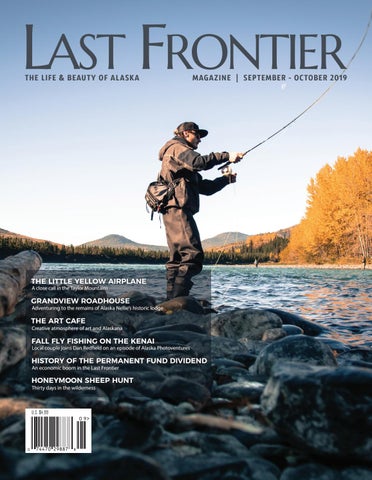
Kory casts into the Kenai River anticipating a rainbow hitting his line. See more photos by Dan Redfield in the gallery starting on page 16.
CONTRIBUTORS LINDSEY VANTASSEL DAN REDFIELD LEWIS BRADLEY MICHAEL HANKINS TESSA SHETTER KIERRE CHILDERS
The early morning sun shines brightly at the Kenai River as Tessa, Kory, and Dan prepare for a day of fishing and filming. Read more about this trip on page 16. Photo by Dan Redfield.
ADVERTISING
CONTRIBUTING
If you are an Alaskan business, or a business
Do you have an Alaskan experience and/ or photos you would like to share? We love publishing authentic Alaska stories!
Alaska depends on for services, and would like to place an ad in Last Frontier Magazine, we
JESSE COLE
welcome your call or email. We want to partner
LAURA LOWDERMILK
in advertising with you!
CECIL SANDERS
Contact Anne Sanders at: editor@lastfrontiermagazine.com
Email: info@lastfrontiermagazine.com
THE PREVIOUS ISSUE
Phone: 907-775-0816
SOCIAL MEDIA
SUBSCRIBE
Connect with us on these social media platforms.
$19.99 for a 1 yr. / 6 issue subscription to LFM. Go to: lastfrontiermagazine.com/subscribe or call 907.775.0816. Gift subscriptions available for $15.99 with the purchase of one full price subscription. Missed an issue? Back issues are also available.
STAFF
JULY/AUGUST 2019 LATE SUMMER SCENES A “RELAXING” WEEK IN CHITINA BIKING THE DENALI HIGHWAY CHILDREN OF THE FIRST PEOPLE THE TRAVERSE, PART II Q&A: HOMER TRUFFLE COMPANY
4
Editor, Anne Sanders editor@lastfrontiermagazine.com Assistant Editor, Wendy Wesser wendy@lastfrontiermagazine.com Designer, Cecil Sanders publisher@lastfrontiermagazine.com Advertising, Jesse Carnahan ads@lastfrontiermagazine.com
L A S T F R O N T I E R M AG A Z I N E www.lastfrontiermagazine.com
@LastFrontierMagazine @alaskalfmag @lastfrontiermagazine Last Frontier Magazine
CONTACT INFORMATION Phone: 907.775.0816 Email: info@lastfrontiermagazine.com Web: lastfrontiermagazine.com Mail: PO Box 4514 Palmer, AK 99645
EDITOR’S NOTES
LFM STAFF
I’ve always tried to appreciate the blessings in my life. My family is loving and supportive, I have a roof over my head at night, and I live in a wonderful state that people from around the world come to see.
CECIL SANDERS
As many of our readers are already aware, Cecil and I welcomed our son into the world this last April. Becoming a parent has made me take an even closer look at all I have to be thankful for. In particular, the people who have impacted my life. One such person, Lew Bradley, has a story featured in this issue. I know Lew as a basketball coach—I went to the camps he Charlie Sanders and his wife Carol put on every summer and winter, and I owe much of the success I had as a basketball player to his dedication to working with kids. Not only did he teach fundamental skills of the sport, but valuable lessons for life: to be tough both mentally and physically, to be a team player, and to behave with integrity. And now as an adult, I have the honor of publishing one of his stories about sheep hunting with his wife, an excerpt from his book Rampages. I hope and pray that our son Charlie will have people like Lew Bradley in his life. Already, Charlie has benefited from Alaskans who have made it their life’s work to help others. When Charlie was born at Mat-Su Regional Medical Center he didn’t start breathing right away. Without an amazing medical staff he would have at the very least suffered brain damage, and at the worst not survived. Alaska may have one of the smallest populations in the country, but it is home to special people I am blessed to have in my life.
MISSION STATEMENT At Last Frontier Magazine we strive to captivate our readers with an entertaining experience; to propel our advertisers forward in a competitive market; to actively enrich our community and serve our Lord with all our heart, mind, soul, and talents. We are Alaskans and above all want to promote a healthy community that can come together and celebrate Alaska and its people, culture, beauty, and identity. Our desire is that through the content of LFM a positive representation of Alaska will be felt and enjoyed.
Inspired at a young age, Cecil has turned his love of photography into a lifestyle and a business, with a desire to capture the beauty and character of wherever his camera takes him. Always primed to set off on a new adventure, Cecil and his wife, Anne, have spent their eleven years of marriage going on road trips, touring Alaska and the country, and planning ahead to their next destination. Cecil has combined his artist’s perspective and aptitude for design in order to contribute his talents to the collaborative effort of bringing Last Frontier Magazine into a reality.
ANNE SANDERS Anne was born and raised in Alaska. She graduated with a B.A. in English Literature from the University of Alaska Anchorage. With a love for the written word, she recognizes the treasure of stories and fascinating people Alaska offers. Paired with her husband, Cecil, who complements her narratives with his eye for the visual, Anne is on a mission to bring her beloved home of Alaska to life on the pages of Last Frontier Magazine.
WENDY WESSER Writing, history, gardening, and traveling are a few of Wendy’s interests. She grew up in Alaska, living as far south as Metlakatla and as far north as Fairbanks. Her family’s history of six generations in Alaska reaches back to the Gold Rush years. She loves reading, hearing and sharing Alaskan stories of newcomers and old-timers alike—Last Frontier Magazine has provided her the opportunity to work in this very venue.
JESSE CARNAHAN Raised in Alaska, Jesse has a special affinity for the state and the people that live here. Along with his wife and two children, Jesse loves being outdoors and experiencing this amazing place. He has always loved hearing the unique stories that can only come from Alaska, and is excited to be able to share more of them through Last Frontier Magazine.
S E P T E M B E R - O C TO B E R
2019 5
TABLE OF CONTENTS A R T S & C U LT U R E
7
PEDRO’S PAN, A GOLD RUSH STORY Reviewing Matthew Lasley’s children’s book
LIFE IN ALASKA
8
THE LITTLE YELLOW AIRPLANE A close call in the Taylor Mountains
ALASKA HISTORY
12
GRANDVIEW ROADHOUSE
Adventuring to the remains of Alaska Nellie’s historic lodge
ALASKA BUSINESS
15
THE ART CAFE
A creative atmosphere of art and Alaskana
O U T D O O R S & R E C R E AT I O N
16
FALL FLY FISHING ON THE KENAI Local couple joins Dan Redfield on an episode of Alaska Photoventures
ALASKA HISTORY
24
THE PERMANENT FUND DIVIDEND An economic boom in the Last Frontier
O U T D O O R S & R E C R E AT I O N
28
HONEYMOON SHEEP HUNT Thirty days in the wilderness
LIFE IN ALASKA
34
THE ALASKAN
Understanding the Alaskan way, mind, and soul
A Kenai River
FALL FLY FISHING ON THE KENAI, PG. 16 6
L A S T F R O N T I E R M AG A Z I N E www.lastfrontiermagazine.com
PEDRO’S PAN, A GOLD RUSH STORY REVIEWING MATTHEW LASLEY’S CHILDRENS BOOK REVIEW AND PHOTO BY LINDSEY VANTASSEL
P
edro’s Pan, A Gold Rush Story, written by Matthew Lasley and illustrated by Jacob Souva, has colorful, pleasing illustrations with hands down the cutest gold pan I have ever seen. This gold pan, “Pan” for short, narrates a
heartwarming tale of a prospector, his pan, and their search for gold. Discover the historical roots of Pedro the prospector in a two-page educational spread on Pedro’s place in Alaskan (specifically Fairbanks) history, how to pan for gold, and some very interesting facts such as the size of the biggest gold nugget ever found! Expressive color contrasts and textures found in the illustrations will beckon the eye, and the soft comical theme harmonious in picture and pen creates lovable characters who will surely make you smile. The reviewer’s children enjoying Pedro’s Pan. The underlying message of perseverance in this adventure story will hit home in any Alaskan heart. I would highly suggest checking out this book and letting it inspire a gold panning expedition of your own. A
J U LY - AU G U S T
2 0 1 9 7
THE LITTLE YELLOW AIRPLANE A CLOSE CALL IN THE TAYLOR MOUNTAINS STORY BY JESSE COLE
W
hat do you call a really steep hillside that plunges down to the bottom of a steep, deep canyon? Not quite a cliff, but nearly. There is just such a hillside at the bottom of the gravel runway at the Taylor Mountain Mine.
The Taylor Mountains are a small range about 100 miles southwest of Stony River, Alaska. During my high school days there was an adventurous family from Coos Bay, Oregon, out trying to rejuvenate the old mine in those mountains, and the 47 Creek Mine located over in the Aniak Hills as well. There was a father and mother, and a pair of grown sons, probably in their 30s. I was still a teenager of 16 or 17. In the course of their work at the mines, this family had opened up the area’s runways. Because the runway at Taylor was open, and we knew of the large number of caribou that came through the Taylor Mountains, my little brother Clint and I decided we should do some caribou hunting out there. One October day in 1982 we loaded our gear in our little yellow airplane and flew out. The little yellow airplane, 8525D, was a Piper Tri-pacer (PA-22/20). Several of us Cole kids learned to fly in the Kuspuk School District’s flight program. It was a great deal. If we maintained a B average in
Photo of Jesse with 8525D wearing
our course work, then we were eligible to fly the school district’s planes, free of charge. I got
tires, at the airport in Fairbanks.
my pilot’s license in this way without spending a dime.
Photo taken approximately two years after the story related here.
The 8525D was a beautiful little plane. Dad had it covered with new fabric and painted yellow with a blue stripe. It matched the blue and gold colors of Stony River school! It was a little squirrelly on the ground because the PA20 is very short coupled, but it had a 160 Lycoming engine in it. Lots of power. You could get in and out of a pretty short runway (or gravel bar, or blueberry patch) with that plane. So Clint and I took the yellow plane out to the Taylor Mountains and got in one beautiful day of hunting. We hiked all over the snow-covered range scouting for caribou. I remember teaching Clint how to build snow shelters way up on a high ridge with a lovely wave of windswept snow drifting at the edge. We never got close to any “Bou,” but we made our battle plans for the next day and figured we had a great chance to get a couple of them.
8
L A S T F R O N T I E R M AG A Z I N E www.lastfrontiermagazine.com
But before the night was out, my caribou luck (bad luck) held. To
unfriendly when I went to find Clint so I wasn’t 100% sure where
this day I have never harvested a caribou. But that is another story!
he was. I assumed he had somehow gotten a ride home to Stony River, but I had no way to contact home; no phone; my airplane
There was a conflict between the younger of those Coos Bay
radio wouldn’t do me any good with a dead battery. I was in a
brothers and another fellow they had out working the mines (a
tight spot.
wily woman was involved). As a result, I was pressed into service the next morning to fly the younger brother out of the Taylor
I decided that I’d have to try to “prop start” the airplane, so that
Mountains to Red Devil, a small mining village about 100 miles
I could get home and make sure Clint was all right, AND put some
away on the Kuskokwim River. I had to leave Clint, who was 10
distance between myself and the other men at the mine.
years old at the time, with the family at the mine. Dad had reconfigured the little yellow airplane back to the original We lugged a very heavy bucket of gold sludge (the heavy silty
design of a tail dragger—meaning that it no longer had a wheel
mud that is left after a lot of raw material has been run through
under the nose of the airplane, but rather it had a small wheel at
a sluice box) up to the airplane and headed out. To get off the
the tail end of the airplane. This setup is popular in Bush Alaska
Taylor Mountain runway, I taxied up to the top of the runway
because it changes the orientation of the airplane when it touches
which was tucked right up in the arms
down onto the ground, the propellor
of the mountain. Then I turned around
(prop for short) being a couple of feet
and headed downhill for takeoff. This was the routine regardless of the wind, because the runway sloped up fairly steeply, and the hills beyond climbed up to the mountain top even more steeply. We made it safely to Red Devil. But, by the time I was refueled and ready to fly back to rejoin Clint some bad weather had kicked up and my plane was grounded. I spent the night on a couch in Red Devil, worrying about how Clint was getting along with the three adults back at the
I decided that I’d have to try to “prop start” the airplane, so that I could
higher in the air. This simple change in the airplane’s physical orientation makes it so that you are less likely to damage your prop when landing.
get home and make
Our airplane engine generated the
sure Clint was all right,
spark for the spark plugs using a little
AND put some distance
a small generator about the size of your
mechanism called a magneto. Basically,
between myself and the
fist. When the crankshaft of the engine
other men at the mine.
of the magneto, which is located in line
mine. When I got back the next day, I
turns, this would also spin the magnets with the crankshaft, usually close to the face of the flywheel of the engine.
learned Clint had been picked up by someone and taken away.
These magnets spin within a set of copper windings, and voila,
The three at the mine didn’t know or wouldn’t tell me exactly
the spinning magnet within the copper windings creates a spark
what had happened. Seems they weren’t clear on the details, and
which is fed to the spark plugs. No battery required.
more than just a little under the influence. So, the process of prop starting an airplane involves grasping the Because of all these machinations, I found myself late one
propellor and giving it a good spin, which turns the magneto and
afternoon, at the bottom of the Taylor Mountain gravel runway.
creates the spark which causes the gas in the cylinders to explode
The little yellow airplane was suffering from a dead battery.
and the piston to move and the crankshaft to begin turning. Imagine back in the olden days when automobiles came with a
I was 100 miles from home, in the middle of nowhere. I was about
hand crank to turn the engine over. Same process.
one mile from the mining cabin, where there was no electricity to re-charge my battery. So no help there really.
The Piper PA 20-22 has high wings over the cockpit. They are supported by a pair of stout wing struts on either side of the
I was out of favor with the two men and the woman who were
fuselage and since the airplane is rather short coupled, there is
present at the mine, because I had flown the younger brother
not much room between these struts and the propellor. There
and his bucket of gold sludge out. In fact, they had been quite
are doors into the cockpit on both sides of the cabin—they open
S E P T E M B E R - O C TO B E R
2019 9
The Little Yellow Airplane forward, so you have to be standing behind the struts, basically
You also need to understand that, after you prime the engine with
behind the wing, in order to access these doors and climb into the
fuel, using the primer knob, if and when you start the engine there
cockpit.
WILL be a burst of power as the engine burns through the fuel supply.
The incident I’m describing happened in October, so we had the airplane rigged with skis for landing on snowy runways, or landing
Now that you understand the machinery, let me place you back in
on a frozen lake top. Skis are great for snowy conditions, but as
the setting.
you might imagine … they are a bit slippery!! Taylor Mountains are a small, remote cluster of mountains at the Now, typically when you “prop start” an airplane it is a two person
headwaters of the Holitna River, a good sized tributary to the
job. One person is in the cockpit with his or her feet on the brakes,
Kuskokwim. They are surrounded by the tundra which carpets
and their hand on the throttle. A small single-engine airplane’s
the floor of the vast Kuskokwim River Valley. There are no towns
engine has several important differences from your typical car
close by. No roads leading in. Only one small mining camp, which
engine. These days, cars don’t come with a “choke” knob. They
is equipped with one narrow and relatively short gravel airstrip.
used to! The choke allows you to have more control over how rich
This airstrip is nestled between two of the major foothills which
the fuel/air mixture is on its way into the throat of the carburetor.
are like the shoulders and arms of the mountain, reaching down, down, down to the tundra. The runway is by no means flat, but
In addition to the choke the airplane had a primer knob. You give
has a significant slope downward, finally ending in a cliff that drops
that knob a couple of pumps and it injects raw gasoline right
steeply down to the stream at the valley floor. More of a canyon
into the carburetor. It takes some practice to know how to use
than a valley.
the primer. Too many pumps and you could easily “flood” the carburetor, causing your engine NOT to start.
In short, I was in the middle of nowhere, with my airplane pointed downhill towards a steep drop, at the bottom end of a pretty
ENJOY WORKING OUT OF THE OFFICE?
Explore and apply for careers at MEA Alaska’s oldest and second largest electric Co-op VISIT WWW.MEA.COOP FOR CURRENT JOB OPPORTUNITIES 10
L A S T F R O N T I E R M AG A Z I N E www.lastfrontiermagazine.com
The Little Yellow Airplane sketchy little gravel mining “strip,” which is “bush” speak for
I crawled up over the strut into the moving plane, wriggled into the
runway.
pilot’s seat, and stomping on the left rudder, I fed the engine more throttle to keep me moving into a turn away from the canyon and
In retrospect, I should have grabbed my little plane by the tail
back up the runway.
feathers and turned her around and aimed her uphill! I never let the plane come to a stop; I taxied several hundred yards But I didn’t.
up to the top of the runway, and counted my lucky stars as I spun her around and headed back down at full power. I took off safely
So there I am on a chilly winter morning. I’d just walked a few miles
and headed back home to Stoney River.
roundtip down the canyon to the mining camp to get Clint, only to learn from the grumpy miners that he was gone. By the time I
When I got there I learned that Dan VanEaton had just happened to
got back to my airplane it had cooled down, and I was in a hurry to
come through the Taylor Mountain mine, and he had delivered Clint
get out of there and get home. I was dressed warmly, including my
safely home.
home made martin hat with earflaps, and my homemade black bear gauntlet-style mittens. Moral of the Story: I took off a mitten, and got my finger under the little door latch, opened her up and jumped in the cockpit. I flipped the master switches on, set the throttle so the engine would catch at about 1400 rpms, primed her with a pump, and turned the key. Nothing!
Get your airplane aimed in the right direction before you prop start it. Don’t leave your little brother in the care of crazy miners at remote Alaskan gold mines.
Tried again. Nothing. Dead battery. Without thinking too long about it, I gave her another pump of primer fuel and climbed out of the cockpit. I ducked around and under the wing strut, positioning myself in front of the strut and just behind the propellor beside the engine cowling. I set my Sorrels in the snow and ice, reached up my left hand, which was still wearing that heavy black bear mitten, to the tip of the propellor blade and
Make sure your batteries are well charged before venturing into the wilderness. Take along a spare battery and a toolkit. Have the self confidence to prop start your plane. Your guts, brains, and breeding will pull you through and you’ll have a good story to tell. A
gave it a big yank downward. It kicked right back up, like a boxer throwing a counterpunch. The cold engine didn’t want to turn over, so I edged up a little closer to get better leverage on the prop. This time I reached up with both hands and gave a mighty yank, throwing
JESSE COLE
all my weight and power behind that downward pull. The prop spun
Mom and Dad traveled to Bush Alaska in 1965
over, the engine coughed, sputtered and burst to life with a roar!
with my two older siblings to teach school in
The little yellow airplane lurched forward on its red skis; the struts
remote villages. I was born in Bethel during that
caught me in the small of my back just as I was coming back up from
part of their adventure. I went to high school
my heave and knocked me flat on my face into the snow.
in Stony River, a small town at the confluence of the Stony River and the Kuskokwim River.
In a split second the plane was moving forward, the tail feathers
Our family packed a lot of excitement into those years. I went on to
passing right over me, not more than 100 yards from the steep cliff
serve a Chinese (Cantonese) speaking mission for the LDS church,
down, and headed right for it! I surged up out of the snow and burst
get an engineering degree from Brigham Young University, marry a
into an adrenaline-filled race to catch the plane! I managed to do it
lovely girl, my wife Holly, and we have six amazing children. When
and get the cockpit door open; I was mighty glad that I had already
the Dot Com bubble burst I decided to get out of the tech industry
taken the mitten off my right hand. The little door had slammed shut
and went to dental school. After graduating with my DDS, we
when the blast of air from the prop hit, and if I had that mitten on, it
moved to northern Idaho. We’ve been here nine years now enjoying
would have taken a couple more precious seconds for me to get in.
a lot of adventures, raising our family, and loving life.
S E P T E M B E R - O C TO B E R
2019 11
GRANDVIEW ROADHOUSE
ADVENTURING TO THE REMAINS OF ALASKA NELLIE’S HISTORIC LODGE STORY BY MICHAEL HANKINS
Three people stand on porch of roadhouse near curve of railroad tracks at Grandview roadhouse, Mile 45 Alaska Railroad, ca. 1915. Credit: Nell Lawing-3d-Mile 45, Alaska State Library Photo Collection
I
’ve never had much of a desire or need to visit foreign countries.
In 2002 I began historical research on Alaskan pioneer Nellie Neal
Canada is the only one I’ve been to, and I love that country
Lawing for a future story. She’s best known as “Alaska Nellie.”
because certain parts are very similar to Alaska. At 62 years of
Nellie Lawing came to Alaska from Missouri in 1915. She operated
age, I’ve not seen enough of the 49th state to satisfy my appetite.
various roadhouses along the Alaska Railroad. A stop named Curry
Places like Kiska, a volcanic island in the Aleutian Chain occupied
on the way to Fairbanks is most notable. One of her food and
by Japan during WWII, are still on my “to do” list. Kiska is now
lodging locations was in Grandview at milepost 44.9. My burning
a federal wildlife sanctuary, home to thousands of seabirds.
desire was to find remnants of the place, and experience some
Giant rats inhabit the island as well. My initial goal was to take a
things she talked about in her book, “Alaska Nellie.” I own and
mountain bike to the summit of Kiska Volcano. At this point in life,
covet a signed copy, finding it one of those “read ‘til finished”
my strenuous dream will have to become someone else’s!
publications. In her book, Nellie talks exclusively about Grandview.
One place I wanted to plant my feet and have thankfully been able
It was September 2003. My good friend Tom Doupe had
to cross off my bucket list is Grandview, or Grandview Roadhouse
connections with higher-ups in the Alaska Railroad. Telling him of
near Portage. This scenic wonder sits along the Alaska Railroad
my plan, Tom assured me he could arrange exclusive tickets for
amongst rugged mountains and spectacular glaciers, such as the
the expedition. Two days later he called saying things were a go.
renowned Spencer Glacier. Until recently, Grandview was basically
If there was anyone I wanted with me on a three-day expedition
off limits as far as a summer stopping place for hikers. Unless you
into Alaska’s backcountry, it’s Tom Doupe. Big and strong, he was
had special permission, the only way to travel and stay was during
an asset in both carrying goods and added protection. Tom was
winter months when special railroad excursions dropped skiers off
well versed in what snacks to bring along, which was especially
during the snow season for a day of winter adventure.
important.
12
L A S T F R O N T I E R M AG A Z I N E www.lastfrontiermagazine.com
We drove from Anchorage, Alaska’s largest city, to Girdwood which is approximately 43 miles south. There we caught a southbound passenger train at the Girdwood terminal. The train’s final destination was Seward, but Tom and I would hop off long before reaching the town. Loading all our gear, including Tom’s .375 Winchester Magnum, into a baggage car, the rifle immediately raised eyebrows amongst tourists. Tom, being a good spokesperson, told inquisitive passengers what we were up to. He informed them that I was a writer and he was going along as bodyguard. This was indeed fact as large brown bears are known to inhabit the Grandview area. “Alaska Nellie” talked about them at length in several chapters of her book. Nellie had a ‘pet’ black bear in Grandview that was unfortunately attacked and killed one night by a ferocious brown. Our journey from Girdwood to Grandview didn’t last long. I believe we were sitting in comfort for only 30 minutes before the train stopped. Outside it was raining cats and dogs. Frigid wind howled with gusts strong enough to blow things around. Particles of snow and ice could be seen amongst huge droplets of water. Our conductor placed a small platform down while our gear was quickly offloaded. We thanked him before stepping off. A few of our lighter bags decided to immediately take off and fly. As the train pulled away tourists snapped pictures and waved. I told Tom the late and great adventurer Lowell Thomas, Sr. could not have elicited as much attention as we.
Top: The rail sign for Grandview. Credit: Michael Hankins.
With the train gone, we immediately looked for a place to pitch camp. Tom located a flat spot amongst thick alders, and he quickly went to work clearing them. It took some doing
Bottom: Tom along the tracks at Grandview. Credit: Michael Hankins
with a razor sharp machete, but eventually the skinny trees were reduced to kindling. I knew with all the wet and cold, hypothermia wasn’t far behind if we didn’t get shelter. Strong winds made getting our tent erected next to impossible, but we prevailed. I looked at copies of vintage photographs inside the tent while sipping hot coffee from a thermos, and noticed we were camping in the exact spot where the old roadhouse once stood. Tom gave me a high five. A surprise of all surprises happened our second day. The old saying, “You can bump into friends in the strangest places,” rang true. Tom and I were a considerable distance from camp when a railroad security vehicle rolled up. Through sleet and rain, the officer onboard instantly recognized Tom. Looking at me for a spell he coughed out, “Mike Hankins?” George Nolan was a schoolmate of mine at East High. I hadn’t seen him since another pal, Bob Malone, got married almost 30 years before. Telling us to be safe, George could only shake his head before cruising on down the tracks. We spent nearly three full days in raingear plodding through bushes and trees, recording our findings. Because of all the excessive moisture, vegetation is extremely dense in that neck of the woods. We were always wary of bears. A root cellar was located amongst birch trees. It marked where an old dwelling once stood. Root cellars are holes dug into the ground. They lie underneath cabin floors with trap doors for access. Because of no refrigeration, early settlers relied on them to keep food from spoiling. The landscape of Alaska is dotted with root cellar holes, their once protective log structures totally rotted away. Around the Grandview Roadhouse site we discovered several rusty cans and broken glass. Tom and I left things undisturbed. I was able to locate piping evidently used by Nellie for supplying water. In her book she mentions
S E P T E M B E R - O C TO B E R
2019 13
Grandview Roadhouse pipes moving water from a stream to the roadhouse. Nellie
okay. We were in our own Grandview Station so to speak and all
Lawing was indeed a very ingenious woman!
was dandy. Other than a little inclement weather outside, stress was nowhere to be found.
After spending three days and nights in the harshest weather I’ve ever camped in, Tom and I were ready to leave. With the
Things have changed for the better since 2003 regarding excursions
train due around 1:00 that afternoon, we packed things up 30
to Grandview. The Alaska Railroad now offers ‘day trips’ to the
minutes early. Hearing it coming miles away, we waited patiently
Grandview and Spencer Glacier areas during summer months. I
alongside the track for our cushy ride home. Both of us remained
highly recommend taking one. Look for the tall Grandview sign
standing as it rolled right on past. Tom and I looked at each other
erected alongside the tracks. That sign pretty much marks the spot
with surprise. That’s when my friend said, “They musta’ forgot?”
where Nellie Lawing’s roadhouse once served hot food and warm beds to weary travelers and railroad workers. I suggest you find the
With rain continuing to pour and wind howling we walked a
book “Alaska Nellie.” If you love Alaskan history, you’ll truly enjoy
ways to an unoccupied railroad cabin. Thankfully the door was
reading her amazing story! A
unlocked. Hours later, hearing another train approach from Portage, Tom ran outside to flag it down. That was a sight to see! He held up a shirt waving it like a crazy man. The train slowed before grinding to a halt. After several minutes of my pal explaining our situation, the engineer called someone on his radio. He received news back we’d be picked up late that afternoon. Evidently there had been a communication glitch. Tom and I didn’t mind at this juncture. The cabin was dry and we had plenty of snacks. If the train never arrived it would’ve been
14
L A S T F R O N T I E R M AG A Z I N E www.lastfrontiermagazine.com
MICHAEL HANKINS and his wife, Joleen, can be found in Lake Havasu City, Arizona, when not traveling in their RV. Michael does freelance writing when not exploring the desert. Alaska will always be their true home! michael-hankins.com
THE ART CAFE
A CREATIVE ATMOSPHERE OF ART AND ALASKANA STORY BY CECIL SANDERS | PHOTOS BY LAST FRONTIER MEDIA
B
arb Stigen and her husband, Greg, opened the Art Cafe in Palmer a year and a half ago, but its origin can be traced back to the Stigen family home many years before. The present location, an old mechanic shop converted to a
storefront, serves Palmer as a creative outlet for families, events, and classroomstyle instruction. The Stigen’s Alaska story began in the 1980s. Barb had jumped aboard the Alaska ferry to seek adventure, and soon found a job working for the State of Alaska. She met Greg who had been working at Prince of Wales Island. Before long, Greg and Barb were married and moved to Wrangell. In time, and after several children, the family moved to Haines and operated Grizzly Greg’s Pizzeria. After an economic downturn hit Southeast Alaska, and with the kids having grown up, Barb and Greg picked up and moved to Wasilla, seeking new opportunities. Even though she had no formal training, Barb was adept in several art mediums so she started offering classes. As interest grew, her operation moved from a room in their home, to their remodeled home garage. An increasing number of clientele and their need for more space to incorporate art parties motivated their new direction. A local businessman, Tony Berberich, purchased the mechanic shop and offered the space for lease to Barb and Greg. With a lot of elbow grease they turned the building into what it is today, a fantastically creative atmosphere of art and Alaskana. As Barb states, “I wanted to create a comfortable place for the community to walk in and feel at home.” Now Barb works with local artists from around the state to offer all kinds of classes and event opportunities, making the Art Cafe a gathering place for the community. The Art Cafe provides a creative space for artists of all levels and mediums to come in and work on their projects, while also offering up a wonderful place to anyone, artist or not, to enjoy an espresso, have some homemade fudge, or cool down with some premium ice cream. The Art Cafe pairs perfectly with Palmer’s effort to establish itself as Alaska’s premier destination and a great place to live. A
The Art Cafe AK 131 E. Blueberry Ave., Palmer, AK, 99645
HOURS
(907) 745-6100 Mon. Tue. Wed. Thu. Fri. Sat. Sun.
11:00 am – 7:00 pm 11:00 am – 7:00 pm 11:00 am – 7:00 pm 11:00 am – 7:00 pm 11:00 am – 7:00 pm 11:00 am – 7:00 pm 12:00 pm – 5:00 pm
To see more about The Art Cafe AK, check out our video interview with Barb at lastfrontiermagazine.com.
FALL FLY FISHING ON THE KENAI
LOCAL COUPLE JOINS DAN REDFIELD ON AN EPISODE OF ALASKA PHOTOVENTURES STORY BY TESSA SHETTER | PHOTOGRAPHY BY DAN REDFIELD
M
y boyfriend, Kory, and I have lived in Alaska for most
Our morning began with waking up at 5 a.m., loading our gear, and
of our lives. We both grew up fishing, but our love of
hooking up the drift boat. Since we were well into autumn, the
the sport really took off when we started dating. Our
sun didn’t rise until about 8 a.m., and we wanted to give ourselves
schedule mainly consists of work, school, and fishing, so when we
enough time to make the two-hour drive from Anchorage so we
were given the opportunity to film a fall fishing episode for Alaska
could be at the river at first light.
Photoventures with Dan Redfield, we couldn’t pass it up. However, incredibly thick fog had rolled into the Cooper Landing To give some background information not mentioned in our
area, which slowed our driving time (but made for some beautiful
episode, Kory and I were filming a wedding in Talkeetna the day
scenery captured by the drone).
before until about 10 p.m. and had to be in Cooper Landing the next morning. For those who don’t know Alaska’s geography, we
By 8:30 a.m., we had met up with Dan at our launch point and
were 210 miles north of our fishing destination with Dan. By the
began the shuttle process as all drift boaters do. We set up our
time we got home and by the time we had to leave for the river,
rods, put on our waders, and unloaded the drift boat into the river.
we didn’t get much sleep. Although we were tired, we were still
From there, Dan and Kory took both vehicles down to our takeout
determined to make a good day out of it.
location and dropped the trailer off while I waited with the boat. That way when we were exhausted at the end of the day, the trailer would be already waiting for us to load everything up.
16
L A S T F R O N T I E R M AG A Z I N E www.lastfrontiermagazine.com
Once we were ready, Dan and Kory jumped into the boat and I pushed us out of the shallows into the vast, swift-flowing Kenai River. About 60 seconds later, we landed and got out. Our first fishing spot was only a few hundred yards downstream from the launch. It was a section we mainly fish for salmon, but we thought that even though the salmon weren’t running, the landscape was perfect for a Photoventures episode. We began by using flesh flies. During this time of the year, the salmon have gone through their spawning cycle and begin to deteriorate, making those little pieces of salmon flesh perfect snacks for trout. After what seemed like forever, we had no takers. I felt like giving up and began to walk back to the drift boat when I happened upon two salmon just ahead of the bow of our shore-anchored boat. After observing the fish, I realized they were swimming together to spawn. We call these types of fish stragglers, since the prime spawning season had already passed, but they were still in cycle. With that new knowledge of our situation, we changed our setups and fished some more with renewed hopes. Kory and I each put a painted bead on our lines and began working the feeding lanes close to the spawning sockeyes. Feeding lanes are fast sections of water where food is most likely to flow. Not long after we had changed our setups, I heard Kory downriver yelling for the net. No matter what the size, Kory is always beaming with joy when he hooks into a fish. Though this was a small rainbow, we were ecstatic to finally get a fish into the net. It’s a rewarding feeling to go from “I don’t know this area. I don’t know what the fish like here. I don’t know where they hold or where they feed,” to “oh, there’s some spawning salmon right there. Let me put on a bead and see what happens.”
Page 16: Tessa casting into the Kenai on a crisp autumn morning.
The Kenai River is big water and is hard to figure out. Especially when you’re in a drift boat and only get one pass and one chance to get it right. It can be overwhelming. But persistence and focused observation narrows it down and reminds us that it’s just another rewarding place to fish. As the day went on, we became more optimistic and we were much more motivated. After Kory released his trout, I hooked into one soon
Dan Redfield
Above: Tessa and Kory quickly pose for a photo before releasing a nice rainbow trout back into the Kenai River. Above: Tessa wades into the clear Kenai River
after—the game of numbers had begun. Our next stop was at a braided section of the river with various log jams. In the fall, log jams are considered by anglers to be fish strainers.
S E P T E M B E R - O C TO B E R
2019 17
18
L A S T F R O N T I E R M AG A Z I N E www.lastfrontiermagazine.com
Fishing the Kenai As salmon carcasses flow down steam, many get hung up in the log jams throughout the river. This makes a great place for trout to congregate and feed on scraps. I was already exhausted and decided to take a little river nap, which to be honest is pretty rare for me. But given the nice day, I thought it was the perfect time to catch some z’s, as Dan would say. This gave Kory a chance to study the river and target the log jams with more flesh flies. Kory noticed a log jam structure that had the perfect feeding ledge, which is an area of the water that leads into a deeper drop where fish lay and wait for food to pass above them in the slower moving current. With Kory’s vast experience with fishing those types of structures, he knew exactly the fly he needed to tie on, and had a fish fooled within minutes. For this section, the fish Kory landed would be considered a qualitysized rainbow. After some quick pictures and videos of the fish, it was released and swam quickly back to his feeding spot, as Kory set up to catch yet another fish moments after. When we take our photos, we like to use a high-speed shutter to capture as many images as possible in order to release the fish in a timely manner. In most cases, to save time, we don’t even look through the viewfinder. At this point, I didn’t have time to save up any more energy and had to get back into the game, as Kory was now up by two fish. With this spot fished out now, we floated farther downstream in search of another fishy-looking location to try our luck in. We ended up floating into a shallow area that was filled with numerous, bright red sockeyes. Despite trying various beads, Kory and I only managed to catch one small rainbow each, which made it pretty clear that the fish were starting to slow down their egg consumption for the season.
Kory casting in the Kenai with blazing yellow leaves on the shoreline. Dan Redfield S E P T E M B E R - O C TO B E R
2019 19
20
L A S T F R O N T I E R M AG A Z I N E www.lastfrontiermagazine.com
Fishing the Kenai In the peak of the egg drop, a run of spawning salmon like this should have produced a trout on every cast. So, with that, we decided to move on. I still wanted to remain consistent with the number of spawning fish we were seeing, so I kept my bead on and fished from the boat as we floated closer to the takeout. To my surprise, as we were nearing the end of our float, in a section of water where I didn’t expect fish to be, my rod began to bend. And of course, Dan was taking his third lunch break and missed the hookset (we still love him, though). As the sun was setting in the trees, we snapped a few final photos to cap off a great day. With the temperature (and our energy) dropping, it was time to go home. We couldn’t have picked a better day to experience the full potential of fall in Alaska. The colors, the fish, the people—there is no such thing as a bad day of fishing to us and getting to experience it with Dan made it a trip that we will never forget. A
Fishermen stand along the shoreline of the Kenai River in this aerial scene. Dan Redfield
DAN REDFIELD is a full-time Emmy® nominated filmmaker and adventure photographer. Dan created Alaska Photoventures to fulfill his love for both film and photography. It is his excuse to meet amazing people and explore new places in Alaska. @alaskaphotoventures alaskaphotoventures.com @alaska_photoventures @alaskaphotoventures
S E P T E M B E R - O C TO B E R
2019 21
Fishing the Kenai
Dan Redfield
TESSA SHETTER
22
Growing up in Alaska, it is not uncommon to know how to fish by the age of 3, the very age I caught my first silver salmon. Alaska is the state of all things big and beautiful … mountains, rivers, fish, animals – everything. Winters are rough and long, but when summer comes, the sky’s the limit and so is the sunlight! With nightfall somewhere around 3 a.m., it is possible to have literally all day to accomplish your goals, which in my case is an extreme advantage when it comes to fishing.
Tessa holding her recently caught rainbow below the surface.
Now, even though I’ve been fishing most of my life, I find this little hobby of mine is still a daily learning experience that I have by no means mastered yet. However, I’ve picked up a few hints and tips along my journey so far that I can share. So from me to you, happy fishing, and may the fish gods be with you!
L A S T F R O N T I E R M AG A Z I N E www.lastfrontiermagazine.com
@tessashetter907
@tessashetter
S E P T E M B E R - O C TO B E R
2019 23
HISTORY OF THE PERMANENT FUND DIVIDEND AN ECONOMIC BOOM IN THE LAST FRONTIER ARTICLE BY KIERRE CHILDERS
A
laska’s first decade of statehood was a bumpy one. Speckled with natural disasters including the Good Friday Earthquake (1964) and the Fairbanks
Flood (1967), the Last Frontier was battling the elements and had limited economic prospects. Although the state’s first substantial commercial oil field was discovered in 1957 on the Kenai Peninsula, oil had yet to make a significant financial impact on the state. Main economic activities of the 1960s were related to fishing, timber, and mineral extraction, as well as a large federal military presence. One critical change statehood brought was how Alaska’s resources and land would be managed, a topic worth its own discussion, but nevertheless a segue into how the permanent fund came to be. The U.S. Congress, under
24
L A S T F R O N T I E R M AG A Z I N E www.lastfrontiermagazine.com
YEAR
STATE POPULATION
TOTAL AMOUNT PER PERSON
TOTAL DISPERSED AMOUNT
the Statehood Act (U.S. Public Law 85-803), permitted the State of Alaska
2018
737,428
$1,600.00
$1,022,795,200
2017
739,786
$1,100.00
$696,305,500
The 1968 discovery of oil in Prudhoe Bay and subsequent lease sale of
2016
739,828
$1,022.00
$652,217,916
subsurface rights to 179 tracts of land on the North Slope in 1969 would
2015
737,625
$2,072.00
$1,329,314,392
forever change Alaska. To put things in an economic context, the state’s
2014
735,601
$1,884.00
$1,200,652,476
entire state budget in 1969 was less than $200 million. The bonus lease sale
2013
736,399
$900.00
$570,929,400
that same year generated over $900 million in revenue, practically overnight.
2012
732,298
$878.00
$563,363,432
A booming population (approximately 226,000 in 1960 compared to 282,000
2011
722,190
$1,174.00
$757,181,866
in 1969) had left the state with growing needs, and now it suddenly had the
2010
710,231
$1,281.00
$817,115,313
2009
692,314
$1,305.00
$815,478,840
2008
679,720
$2,069.00
$1,275,505,396
2007
674,510
$1,654.00
$992,859,812
2006
670,053
$1,106.96
$658,824,955
2005
663,253
$845.76
$505,459,160
to another with huge unmet needs.” Ideas for how to allocate these new
2004
656,834
$919.84
$551,896,641
revenues included a bonus for all Alaskan citizens, improving public facilities,
2003
647,747
$1,107.56
$660,300,690
expanding health and welfare efforts and even transferring the state capital.
2002
640,544
$1,540.76
$909,096,163
Governor Egan and the state’s sixth legislature decided to place the lease
2001
632,241
$1,850.28
$1,085,833,117
funds into the state’s General Fund and use a portion of the funds to fill gaps
2000
627,533
$1,963.86
$1,146,173,503
in areas including education, infrastructure and public services. These fiscal
1999
622,000
$1,769.84
$1,014,691,748
decisions sparked debate, with some Alaskans feeling the cash windfall had
1998
617,082
$1,540.88
$871,609,558
been frivolously ‘wasted’. Resource management would dominate Alaska’s
1997
609,655
$1,296.54
$719,954,400
planning and policy discussions over the next decade.
1996
605,212
$1,130.68
$618,087,352
1995
601,581
$990.30
$537,135,749
1994
600,622
$983.90
$526,561,634
1993
596,906
$949.46
$501,693,714
1992
586,722
$915.84
$479,074,988
1991
569,054
$931.34
$477,557,623
IN RECENT YEARS
1990
553,171
$952.63
$474,835,565
2008 - $2,069.00 + $1,200 Alaska Resource Rebate by Gov. Palin
1989
538,900
$873.16
$444,185,223
2016 - $1,022.00 (estimated to be $2,052 before Gov. Walker’s veto)
1988
535,000
$826.93
$429,775,367
2017 - $1,100.00 (estimated to be over $2,300; reduced by legislative action)
1987
541,300
$708.19
$375,761,364
2018 - $1,600.00 (estimated to be $2,700; reduced by legislative action)
1986
550,700
$556.26
$296,661,801
1985
543,900
$404.00
$209,842,852
1984
524,000
$331.29
$159,726,504
1983
499,100
$386.15
$176,938,949
1982
464,300
$1,000.00
$470,897,000
to claim over 40 million hectares (approximately one quarter of the state’s land) of vacant, unappropriated federal land within its borders. One of the state government’s selections was a piece of land bordering the Arctic Ocean on the northwest coast of Alaska. The claim opened up the possibility for exploring resources in this area, and it didn’t take long for companies to begin test drilling for oil.
funds to do something about it. In an interview with Alaska Public Media, Eric Woolworth, Alaska’s Commissioner of Revenue under Governor Bill Egan, recalls the relief the influx of cash brought the state. As he describes, “the state of Alaska in the late 60s was close to being a basket case, fiscally … limping from one session
Milestones of the 1970s included the Alaska Native Claims Settlement Act (1971), the Trans-Alaskan Pipeline Authorization Act (1973), and the
Header design: Gov. William Egan on left and Gov. Jay Hammond right. Governor Bill Sheffield holds an oversized check for $200,000,000 for the Alaska Permanent Fund,
Alaska Permanent Fund statistics from https://pfd.alaska.gov/.
Juneau, Dec. 6, 1984. Credit: ASA-A1-RG348-SR612AS7453-PFD Alaska State Archives Collection S E P T E M B E R - O C TO B E R
2019 25
History of the PFD
construction of the Trans-Alaska Pipeline (1975-1977). With oil production and the subsequent revenues imminent, it was decision time for the state. One major contender being discussed was a dedicated permanent fund for generating income into perpetuity. Supporters of this approach believed such a fund would help create a sustainable way to generate future income for the state, if and when oil revenues ran out. Those in favor of a permanent fund also supported the idea of limiting the amount of oil revenues sent to the legislature’s budget, thus preventing excessive or unnecessary spending. A ballot proposition was placed before voters in the 1976 General Election. By a margin of 75,588 to 38,518, a Constitutional Amendment establishing the Permanent Fund (Alaska Constitution Article IX, Section 15. Alaska Permanent Fund) was approved, but the state’s fiscal debate was far from finished. The Permanent Fund received its first oil revenue deposit of $734,000 on February 28, 1977, and the focus then shifted to how to best manage the Fund. Elected officials would debate the topic for the next few years—one side in favor of short term investments being managed like a development bank for the state, the other side in favor of a more long term view, as an investment fund. With steady flowing oil funds, discussions around the Fund’s investment strategy also brought debate about the state’s existing income tax. In a presentation to the Fairbanks Chamber of Commerce in the fall of 1979, Governor Jay Hammond explained:
“
Income taxes now provide about the only source of recurring income to pay for ongoing state government. If we eliminate that major source, we must further invade our one time oil-wealth. This wealth should either go into our savings account and earn annual interest which we can spend in good conscience or capital construction projects which incur no new operational costs.
“
Summer of 1977: Governor Jay Hammond talking with Wasilla mayor Pat Hjellen in Wasilla at Alcantra Field. Photo courtesy of Wendy Wesser
Construction of the Trans-Alaska Pipeline System. Pipe is
Governor Hammond would eventually shift his position on the
being buried near the Brooks Range.
issue, and in 1980 the legislature repealed the state’s individual
Credit: Alaska Blue Book, Alaska Department of Education, Division of State Libraries, Robert M. Burnett.
26
L A S T F R O N T I E R M AG A Z I N E www.lastfrontiermagazine.com
History of the PFD
income tax. That same year, Governor Hammond signed the Permanent Fund Act creating the Alaska Permanent Fund Corporation (APFC) to manage the Permanent Fund as a long term investment, placing a list of permissible investments into state law. The legislature originally approved the Permanent Fund Dividend (PFD) program to payout dividends to residents based on length of residency. Residents of at least 18 years of age were eligible. The Permanent Fund and dividend program of today are somewhat modified versions of what was created in 1980. The payment based on years of residency was deemed unconstitutional, the legislature made significant changes to how the Fund could be invested—eliminating the investment list from state law and charging a governor appointed Board of Trustees with managing the Fund’s investments, and the dividend payout is now calculated using the net income averaged from the fund over the previous five fiscal years.
1971: Prudhoe Bay Oil Fields: Aerial view of British Petroleum (BP) and ARCO oil fields on the North Slope. Credit: U.S. Fish and Wildlife Service
The state’s first dividend checks were distributed on June 14, 1982 in the amount of $1,000. Worth noting, these first payments were not actually made from Permanent Fund income, but rather from surplus oil revenues. As of May 31, 2019, the Fund’s total value was roughly $64.3 billion with $45.3 billion in principal (unspendable) funds and $19 billion in the earnings reserve account (available for appropriation). What remains unchanged in the Fund’s four decades of existence is the continued debate over what is the best way for the state to manage these resource revenues per the Alaska Constitution, Article VIII – Natural Resources, Section 2 - General Authority, while contributing to “the maximum benefit of Alaska’s people.” A
ALASKA CONSTITUTION ARTICLE IX, SECTION 15 SECTION 15. ALASKA PERMANENT FUND At least twenty-five percent of all mineral lease rentals, royalties, royalty sale proceeds, federal mineral revenue sharing payments and bonuses received by the State shall be placed in a permanent fund, the principal of which shall be used only for those income-producing investments specifically designated by law as eligible for permanent fund investments. All income from the permanent fund shall be deposited in the general fund unless otherwise provided by law.
(like Pierre but with a K)
KIERRE CHILDERS is an outdoor enthusiast based outside Denali National Park. She has been calling Alaska home since 2015 and has a soft spot for Willow, where she spent her first summer volunteering as a trail crew member for Nancy Lake State Recreation Area. She loves learning about the Last Frontier from its history, to its people, to its flora and fauna.
T H I S A RT I C L E WA S MA D E P OS S I BL E B Y
kierrelikepierre
S E P T E M B E R - O C TO B E R
2019 27
HONEYMOON SHEEP HUNT
THIRTY DAYS IN THE WILDERNESS, FROM THE BOOK RAMPAGES, ALASKA’S GREAT WHITE DALL VOL. 1 STORY BY LEWIS D. BRADLEY
I
n 1970 my new bride, Carol, was not keen on the idea of me hunting alone, so she decided to tag along. She didn’t really know what she was in for. We had to pack 180 pounds of gear and food 10 miles to where we would set up
a base camp on Icicle Creek in the Chugach Mountains. Our goal was to scout as much country as possible in the next three weeks, giving us the best chance of locating the biggest ram possible to hunt during our fourth week. Carol hauled 50 pounds in her pack and I had 130. She did really well. I have been on forced marches in the Army where guys packing less weight were dropping out because they weren’t tough enough to handle conditions less demanding than what she did. Just a few months earlier she was pregnant and miscarried at six months—an experience that takes a lot of strength to recover from. I was proud of her and happy she was with me. We took along a good-sized aluminum wash pan for base camp, so Carol could bathe and wash clothes each time we returned for supplies. This was not a priority for me, but Carol felt that cleanliness was next to godliness. On the back of the pan I drew a picture of a large ram and wrote “45”er or Bust.” The day after reaching our base camp was taken up building a shelter out of alders and Visqueen which would be left up for us to use when we returned from our spike camps. I threw a weighted parachute cord line over a high limb in a cottonwood tree and pulled up our extra supplies to be used for later excursions. That night, just as we were drifting off to sleep, a pack of coyotes cut loose maybe 50 yards away in the woods. Less than a minute later, their yelping and piercing cries were on the other side of us, fading into the distance. Carol said nothing until morning, when she let me know she had been scared. The following day, we packed a week’s supply of food and lit out for Eagle Lake, at the head of Eagle River Valley. We crossed Eagle River, went up Camp Creek through Moraine Pass, and down Bird Creek into the North Fork of Ship Creek. We saw sheep and a few rams, but not the 45-incher I was looking for. We did find a nice set of 36-inch full curl horns from a winter kill. It started raining hard all day and night, so we left early for base camp. The heavy rains caused the river to rise significantly and water was flowing over the banks so I did not want to risk crossing with Carol. We made a lean-to against a cottonwood log that had been deposited when the water was even higher. There was plenty of wood
Top: Most of the 180 lbs. of food and gear we
to burn, so we planned on waiting for the water to go down before crossing.
hauled in for our 30 day sheep scouting/hunt.
Carol’s face was really puffy from the strain so a day of rest was welcomed. However, one day grew into two and by the end of the third day, I’d had all
Bottom: Sleeping between two army ponchos
the rest I could stand and we were running out of food. It was still raining the
in the fog defies good sense.
28
L A S T F R O N T I E R M AG A Z I N E www.lastfrontiermagazine.com
next morning and the water remained high. I picked a wide spot and tried something that has worked very well over the years on difficult crossings. I tied off the head of one of our army ponchos so it didn’t leak and secured our packs inside. Then I put my rifle, boots, and clothes on top and lashed everything down. It floated really well and gave me something to hang onto for balance and support as I walked it across the swift water to the far bank. I threw Carol a double line of parachute cord and kept it tight for her to hang onto as she crossed. A few hours later, we arrived back at base camp. The following morning, we backtracked to Dishwater Creek, one drainage back from our base camp. A game trail paralleled the creek that eventually took us out of the alpine into the tundra where we set up a spike camp. On the far mountainside, 13 rams were digging in an area that was rich in minerals, a natural salt lick. We watched them for a couple hours. Two were really good, probably over 40 inches and more than full curls. Then we climbed to the top of the mountain and found a small old caribou antler and pieces of an airplane from an old crash. We dropped down the following day and as we were preparing to cross the river, two old-timers were walking up the trail. They were in their 60s and very friendly. One was packing a military woodstove. We told them where we’d been and one said the airplane remains we had found were from his plane. He crashed attempting to land and crushed several vertebrae in his back and now he was over two inches shorter. They were headed for their cabin near where Camp Creek flows into Eagle River. The stove was the second destined for that cabin; the first was lost earlier while crossing the
Al Hassen was an Anchorage teacher we had met while attending Muldoon Road Baptist Church. He was bringing
river.
along one of his junior high students, Mark, who did not
After we said our goodbyes, we crossed the river near Heritage Falls to
started. Carol and I had been tromping around in these
check out the area I’d hunted the year before. Carol is a flower buff and enjoyed the variety of mountain flowers. She also liked the pika and hoary marmots living in the boulder field leading into the Heritage Falls bowl on the backside of Mt. Organ and Polar Bear Peak. Black bears are abundant in this area and we saw three on our way in. We camped just above the boulder field and the next morning we woke up to see a nice billy goat 100 yards above us feeding unconcerned. I set up the spotting scope and found 13 rams spread out on a grassy slope. They eventually made their way to the skyline by late evening. Several rams were nice, but not huge, so we again
have a father. They arrived the day before the season mountains for almost three weeks, and were down to fighting weights. Our lungs, stomachs and feet were toughened in. Opening day, we had bluebird skies for crossing Eagle River, and climbing around Heritage Falls to our hunting destination. Carol and I would climb for five minutes and wait ten minutes for our friends to catch up. It was an easy day for us because of the previous three weeks’
returned to our main base camp on Icicle Creek.
conditioning. Later, as we cooked dinner, a billy goat,
We had just enough time left before sheep season opened to make one
earlier, worked his way down from the crags, descended to
more trip and wanted to check out the side valley that harbored Icicle Creek. This last area was the most rugged of all the territory we had scouted. From the river, rams could be seen back near the glacier that supplied Icicle Creek, but it was too far to tell much more than they looked promising. A day’s climbing allowed us to position ourselves for a good look at the white specks we had seen from below. These rams were what we had hoped to find, and would be the ones we would try for, but first we had friends coming in to hunt.
possibly the same one Carol and I had seen over a week the front of the valley overlooking the river, and dropped over the edge. I hadn’t planned on getting a goat, but this was providence. I grabbed my pack, gun, and sleeping bag and followed it. The edge where he had gone over was almost vertical and he was bedded down on a ledge not far below. I climbed up about 100 yards, rolled out my bag, and tied it to some rocks to keep me from sliding or rolling down. I thought the goat would probably feed his way
S E P T E M B E R - O C TO B E R
2019 29
Sheep Hunt back up the mountain in the morning and he would have to go by me. I didn’t really sleep—more like dozed. I was awake, ready and waiting, an hour before dawn. An hour after daybreak the billy popped up over the edge and stood staring down the mountain for another hour. Finally he turned and started straight for me with his head down. When he was well away from the edge of the mountain and about 75 yards from me, I shot, aiming for the hump in his back. The goat stopped, stiffened up, shook all over, and then proceeded to walk towards me. I fired again. This time the goat tumbled down the mountain coming to rest in the alders. Goats are blockier animals than sheep and more massively constructed, bone and muscle-wise. The first shot was two inches off his backbone, and did not knock him off his feet. The second shot was two inches from the first, but hit the spine. I had heard that these animals were tough. I was using 180 grain Nossler Partition ammo fired from a Weatherby .300 Magnum. That would have knocked the world’s strongest man for a loop, but not this goat, which was impressive. I was back with the rest of the gang by noon. After breakfast and lunch rolled into one, I located a band of rams feeding less than a mile away. Al decided he and Mark would go after them. Carol and I watched the stalk which ended with both of them taking a ram, but when they shot, a band of close to a dozen rams boiled out on the other
Carol is packing 50 lbs. in the Camp Trail’s
side of the ridge. They had been down in the cut feeding and escaped detection until
pack, which does not have a belt. Ouch!
now. The lead ram was really big. He led the others up to and across the glacier below
Note the army sleeping bags with no
Mt. Organ. Through the spotting scope I could see his wide sweeping horns that hung
protective covering. You live and learn.
out wider than the ram’s shoulders, seemingly too big for his body. It was a hog and
30
L A S T F R O N T I E R M AG A Z I N E www.lastfrontiermagazine.com
Sheep Hunt definitely a shooter—Boone and Crocket for sure, but where they
above them, and catch them bedded down on the lower edge
went was impossible to follow. Al and Mark never saw the band
of a boulder field that dropped almost straight off to the glacier.
of rams, which is a good example of how easily a fine ram can go
Clouds had rolled in and were spitting snow. We moved as close
undetected almost under your nose in rugged country.
as we dared without being seen. I could see one ram’s horns well and he was big and heavy, but I wanted to see the other ram
Carol and I walked out with them to take care of our goat and
before making a decision. My thoughts were to shoot them as
carry out the set of sheep horns we had found. Al and his wife,
soon as they stood up and anchor them, fearing that if they were
Berta, were storing our belongings at their house. After our hunt,
moving when we shot, they might go over and fall to the glacier
we planned to collect our things and drive down the Alcan to
a quarter mile below. However, the statement by Robert Burns,
Oregon where I was scheduled to continue my education at the University of Oregon, since my service with the Army was over. Berta fixed us a good dinner. The warm shower and comfortable bed felt great, but the evening of the next day we returned to our Icicle base camp, anxious to
“The best laid schemes of mice and men go often
...we saw 17 full curls, not counting other sheep and goat.
go after our rams.
askew,” seems appropriate here. We were hunkered down and our sweaty bodies were beginning to shake as the temperature dropped. I was squirming around to stay warm, and the visible ram caught my movement and
bolted. I didn’t have time to wait, so I put the cross hairs on the The sun had not yet peeked over the mountains the next morning
ram and downed him. Carol and I ran to our left, and caught the
as we departed, jumped across the creek and climbed about 300
other ram coming up at us. We squatted down and as he came
yards up a shale slide opposite our camp. This gave us a good look
along side, I helped her hold the gun. He was so close, almost
at the mountain behind our camp. All total, we saw 17 full curls,
point blank, and she pulled the trigger. That would be her one
not counting other sheep and goat. The two best rams were
and only ram, as she really doesn’t like the killing part. She has
located about a quarter mile above the glacier that fed our creek.
gone with me several times. She doesn’t mind that I hunt, and will
Their location allowed us to climb a long shale slide, circle around
help cut up the meat, but prefers not to shoot anything herself.
S E P T E M B E R - O C TO B E R
2019 31
Sheep Hunt While I was working on my ram, Carol’s gave way, rolling 100
back or face. Carol’s job was to free me of the alders, grab my
yards below my ram, and got hung up in a steep narrow slot.
pack, and help me get on my feet again. Many times, all I could
If it hadn’t hung up there, the next stop would have been the
do was crawl out of the pack, set it upright, sit down and put it
bottom. It was dangerous getting to her ram and I had to tie
on, and roll over onto my hands and knees before I could stand
it to a rock in order to cape and bone it. Just packing her ram
up again under all the weight.
back to mine was harder than the pack back to our spike camp. Because it was getting dark, I didn’t peel the heads out of the
We went higher to get out of the alders, but that got us into
capes to lighten the load until we were back at camp by the
more trouble. The terrain became too steep, and we started
light of our fire. Then I threw a tape on the horns—both were
seeing sheep again. To make matters worse, fog rolled in
over 40”. Needless to say, I was very happy, and would worry about the pack out after a good night’s rest! Some things we do in life are repeaters, while others are a one-time affair. If I had the option to repeat this hunt with the same equipment and walking straight through the alders my
and we couldn’t see where we were going.
We prayed for the fog to lift by morning so we could descend safely.
answer would be, “No way!” It was torturous.
Nightfall caught us in the alders on the side of the mountain that was anything but flat. There was room for only one sleeping bag, so we both crawled in and covered up with an army poncho. Alders gouged us for the next eight hours. I think we stayed half way warm from constantly moving around. The bag was soaked from our own body heat that
Carol was packing all she could handle. I had
condensed because it couldn’t escape through
around 150 pounds with two sets of horns tied to the back of
the non-breathable poncho. That night was without a doubt
the pack. As we floundered through the alders on our way out,
the most miserable either of us has ever endured.
a resounding thought like a stuck record was revolving in my
32
head, Why did we shoot two rams? The horns constantly hung
We prayed for the fog to lift by morning so we could descend
up on alder limbs, impeding my progress or flipping me on my
safely. Our prayers were heard, and at daybreak we were glad
L A S T F R O N T I E R M AG A Z I N E www.lastfrontiermagazine.com
Sheep Hunt to have alders to hang onto as we worked our way back to the more gradual slope with a slightly improved attitude towards the alder abyss. At least it was only difficult going, and not dangerous as well. Eventually we arrived at the one really steep section about an hour from the valley floor. I had 100 feet of ¼-inch mountain climbing rope I doubled around alder bases and rocks as anchors. I took both packs down one at a time, and when Carol got down, I let go of one side of the rope and pulled it down. We did this several times to get down safely. I venture to say that our experience was tougher than 90% of sheep hunts. Many hunters would not have finished the course. They would have pitched the load, and bagged the hunt. I am lucky to still be married. After such a hunt, one might expect that the honeymoon was over, but we have enjoyed 49 years together after that ordeal. Lesser women would have thrown in the towel, and asked for a refund on the honeymoon expenses due to poor accommodations or possibly even an annulment, vowing to get as far away from this guy as possible! Forty years later in 2010, Carol and I were in our 60s and ventured on another sheep hunt with our son. We packed in 25 miles from the trailhead, and returned in snow at the end of September. Ice was forming on the streams, and it was cold. It was not as demanding as our 1970 hunt, but Carol was not 23 either. I truly believe that the confidence she gained from those earlier hunts, when we were young, helped her find out what she is made of, and developed a grit that truly helps carry her through whatever life throws her way. That and the fact that she trusts in God to deliver her in times of peril makes her one tough gal! A
LEWIS D. BRADLEY, known as Coach Bradley to
Top: I was thoroughly pleased with our two rams, the culmination of a month’s effort. Middle: I had pretty good springs in those days, when all body parts were fully functional and testosterone was at peak level. Bottom: Carol preparing campfire biscuits in a pan.
most of his students, arrived in Alaska in 1968, with the US Army. After completing his tour of duty, he returned in 1973 to begin his teaching and coaching career in Wasilla, Alaska, spanning the next 35 years. After retiring he took up antler, horn, and bone carving which fit well with his love for hunting and fishing. He spent 11 years researching and writing his masterpiece, Rampages, a three volume set of books about the history of Dall sheep and the hunting of them up to 2018. While it includes many of his own stories, hundreds of other Alaskan hunters are featured in a mix of Alaska history dating back to 1914. Lewis served a three-year term on Alaska’s Board of Game, giving him an education and exposure into the management and plight of Alaska’s Dall sheep populations. Rampages’ stories and characters are real, and are a record of many individuals who helped settle this state, capturing their place in Alaska’s history before being lost in time. If you are interested in Alaska history, early pioneers, hunting, the management of Alaska’s game, and the biology of Dall sheep, then this collection of 1289 photos and over 1800 pages is worth checking out at www.rampages123.com.
S E P T E M B E R - O C TO B E R
2019 33
I
t has come to this … the kids need new winter gear. Maybe it was the firmly-worded letter sent home from school or the excessive whining from the kids themselves as they headed outside. Perhaps even their parents felt the sting of a guilty conscience
waterproof mittens costing as much as $50 a pair! These parents have “done their best” by their kids! But hold the congratulations for this earnest (and somewhat naive) bunch. They’re too busy scrounging in the back of their vehicle for the (now missing) best-
when the kids returned cold and chapped instead of rosy-cheeked and cheerful. Whichever the call to action, it’s past time to take action.
mittens-money-can-buy. Plus, it turns out that Antarctic-rated snow boots can fill up with snow just as fast as the regular kind. So all that money spent and the kids still end up crying from wet, icy feet and frost-nipped hands.
Now for context: Alaska’s cold isn’t what passes for cold down south where kids in light jackets trot happily outside for recess all winter long. The local schools around here (Interior Alaska) also do outdoor recess, but down to -20°F. Why then would any loving parent hesitate to rush to the nearest store? All they need to do is simply pick out for each child a warm, well-fitting coat, hat, neck warmer, mittens, snow pants, boots, thick socks, etc. Before judging the reluctant Alaskan parent too harshly for putting off this basic necessity as long as possible, let’s pry into the situation a little further. Kids clothing isn’t cheap to start with, or if it’s cheap, you pay for it over and over again as shoddy fabrics and workmanship wear out within months, sometimes even weeks of purchase. One of the highest costs of living in the country only exacerbates the shopping frustration. Alaskan parents facing this dilemma tend to fall into two main camps, each with its own financial goals and acceptable standards for child provisioning. The first camp, heavily populated by newbie parents, finds the best gear, no expense spared. Their little darlings waddle off into the snow outfitted for an Antarctic expedition, complete with
This cost vs benefit conundrum drives many Alaskan parents into the second camp. These are the seasoned (some might say hardened) ones hunting through bargain bins and thrift stores for the cheapest items, which are then crammed into closets for children to ransack at will. No matter how many gloves get lost at school, in the car, at the store, or in the backyard, the glove bin has enough of something to get everyone out the door again. It’s the same system for snow pants, jackets, hats, etc. Those kids who whine about the mismatched, ill-fitting selection can enjoy a timely lecture along the theme of “If you won’t bother to keep track of your stuff, then neither will I.” Ironically once ROI (return on investment) is calculated, parents from both camps, the high-end shoppers and the bargain-bin hunters, spend nearly the same amount on winter gear, as measured in parental frustration and children’s tears. Which is why it’s no surprise (or is it simply more cosmic irony?) that just when Alaskan parents drag ourselves to the store to buy mounds of winter clothing for our kids to whine about and then lose, just as the price tags squeeze whimpers from our wallets, it’s into this costly, agonizing season that our PFDs (Permanent Fund Dividends) arrive, just in time for winter! A
Stick around, because in each new volume of Last Frontier Magazine we dig deeper into the many mindsets, modalities, and manias that make up — The Alaskan.
34
*An interesting anthropological observation: this confluence of cold-climate and cost factors during the formative childhood years is a likely cause of Alaskan culture’s widespread disregard for outof-state fashions.
L A S T F R O N T I E R M AG A Z I N E www.lastfrontiermagazine.com
S E P T E M B E R - O C TO B E R
2019 35
THE LODGE AT BLACK RAPIDS
EXPERIENCE THE AURORA 2 2 7 . 4 R i c h a r d s o n H i g h way
“We came to photograph the Northern Lights and we're not disappointed. We were able to get fantastic shots from the second floor deck at all hours of the night.”
“...the best thing was the glorious view of the Northern Lights from the back deck! Oh and the lovely people! Highly recommended!” “Thousands of stars and the northern lights put on quite a show...”
“Seeing the Northern Lights over the mountains was brilliant too. We would highly recommend staying here!!” “...to top it off the views of the northern lights right from our balcony with the mountains as a backdrop is an image I will never forget.”
certificate of excellence 2014, 2015, 2016, 2017
“...We were able to see the northern lights and sit out on the patio by the fire. I highly highly recommend this place to anyone visiting the area! It was truly a life changing trip.”
ASK ABOUT OUR WINTER PACKAGES
photo by Rick Larson
Begin planning your dream winter vacation today, call us at 877-825-9413 or go online to: www.lodgeatblackrapids.com 36
how toE www.lastfrontiermagazine.com photograph the northern lights with our L A S T F R O N TLearn I E R M AG AZIN
professional photographer.