LAST FRONTIER THE LIFE & BEAUTY OF ALASKA
MAGAZINE | MARCH - APRIL 2019
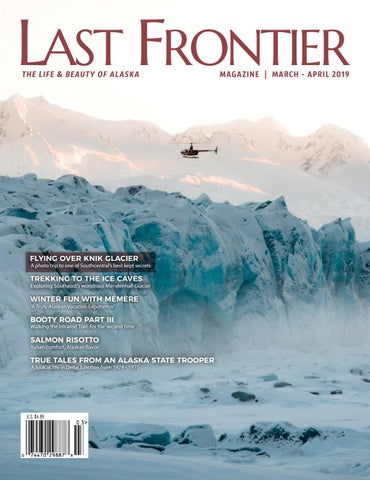
FLYING OVER KNIK GLACIER
A photo trip to one of Southcentral’s best kept secrets
TREKKING TO THE ICE CAVES
Exploring Southeast’s wondrous Mendenhall Glacier
WINTER FUN WITH MÉMÈRE “A Truly Alaskan Vacation Experience”
BOOTY ROAD PART III
Walking the Iditarod Trail, for the second time
SALMON RISOTTO Italian comfort, Alaskan flavor
TRUE TALES FROM AN ALASKA STATE TROOPER A look at life in Delta Junction from 1974 - 1975
U.S. $4.99
M A R C H - A P R I L
20 1 9 1
2
L A S T F R O N T I E R M AG A Z I N E www.lastfrontiermagazine.com
M A R C H - A P R I L
20 1 9 3
THE PREVIOUS ISSUE
JANUARY/FEBRUARY 2019 WHERE THE MOUNTAINS MEET THE SKY FEBRUARY TRAPLINE WINTER TIME IN ALASKA INSTANT POT WHITE BEAN CHILI ARCTIC VALLEY SURVIVAL TERROR AT MOOSE BURGER FARM
Christian Hollums, founder of photography group Wayfare Collective, exits a helicopter on Knik Glacier during a photo trip. Read more about this adventure on page 16. Photo by Lay Renner
ON THE COVER ADVERTISING
SUBSCRIBE
If you are an Alaskan business, or a business Alaska
$19.99 for a 1 yr. / 6 issue subscription
depends on for services, and would like to place an ad in Last Frontier Magazine, we welcome your call or email. We want to partner in advertising with you! Visit lastfrontiermagazine.com/advertise to see ad and pricing information or call 907.775.0816. Your ad will be spread across Alaska, displayed online, and promoted via social media. We can also help you Helicopter hovering over Knik Glacier on photo trip with Anchorage Helicopter Tours. Photo by Dan Redfield
Read more about this photo adventure starting on page 16.
SOCIAL MEDIA
with ad design.
MARCH / APRIL 2019 CONTRIBUTORS Suzette Lord Weldon, pg. 7
Denis Douglas, pg. 24
Elizabeth A. Minton, pg. 8
Lindsey VanTassel, pg. 29
Mary Wargo, pg. 14
David H. Carpenter, pg. 30
Dan Redfield, pg. 16
Laura Lowdermilk, pg. 34
Connect with us on your favorite social media channels: LastFrontierMagazine @alaskalfmag lastfrontiermagazine Last Frontier Magazine
4
CONTRIBUTING Do you have an Alaskan experience and/or photos you would like to share? Contact Anne Sanders at: editor@lastfrontiermagazine.com
L A S T F R O N T I E R M AG A Z I N E www.lastfrontiermagazine.com
to LFM. Go to: lastfrontiermagazine. com/subscribe or call 907.775.0816. Gift subscriptions available for $15.99 with the purchase of one full price subscription. Missed an issue? Back issues are also available.
CONTACT INFORMATION Phone: 907.775.0816 Email: info@lastfrontiermagazine.com Web: lastfrontiermagazine.com Mailing: PO Box 4514 Palmer, AK 99645
Editor, Anne Sanders editor@lastfrontiermagazine.com Assistant Editor, Wendy Wesser wendy@lastfrontiermagazine.com Designer, Cecil Sanders publisher@lastfrontiermagazine.com Advertising, Jesse Carnahan ads@lastfrontiermagazine.com
EDITOR’S NOTES
LFM STAFF waiting three to five years before we had children. Five years turned to 11 and in that period of time other surprises popped up, like starting this magazine.
Anne, Gretel and Cecil
Big changes are coming to the team of Last Frontier Magazine. On April 12th, Anne, our editor and my wife, is due to give birth to a baby boy! It’s hard to say what the effect this little addition will have on the LFM team (besides making our lives even more busy!), but we are eagerly awaiting his arrival. When Anne and I were first married, other than having the urge to travel, you could say we were somewhat aimless. The only solid plan we had was
Neither of us had any real experience with this type of business, besides my work as a graphic designer and photographer, and Anne’s English degree. Needless to say, it has been a consuming venture, with its highs and lows, but very rewarding. Being able to provide an outlet for Alaskans to share their stories and photos—work that may have never been published elsewhere, is an amazing and humbling experience. We’ve learned so much about Alaska, and so much about life. We’ve met so many people, and heard countless stories and experiences. We look forward to sharing this life and these experiences with our child. - Notes from Cecil Sanders
MISSION STATEMENT At Last Frontier Magazine we strive to
to promote a healthy community that
captivate our readers with an entertaining
can come together and celebrate Alas-
experience; to propel our advertisers for-
ka and its people, culture, beauty, and
ward in a competitive market; to actively
identity. Our desire is that through the
enrich our community and serve our Lord
content of LFM a positive representa-
with all our heart, mind, soul, and talents.
tion of Alaska will be felt and enjoyed.
We are Alaskans and above all want
CECIL SANDERS Inspired at a young age, Cecil has turned his love of photography into a lifestyle and a business, with a desire to capture the beauty and character of wherever his camera takes him. Always primed to set off on a new adventure, Cecil and his wife, Anne, have spent their eleven years of marriage going on road trips, touring Alaska and the country, and planning ahead to their next destination. Cecil has combined his artist’s perspective and aptitude for design in order to contribute his talents to the collaborative effort of bringing Last Frontier Magazine into a reality.
ANNE SANDERS Anne was born and raised in Alaska. She graduated with a B.A. in English Literature from the University of Alaska Anchorage. With a love for the written word, she recognizes the treasure of stories and fascinating people Alaska offers. Paired with her husband, Cecil, who complements her narratives with his eye for the visual, Anne is on a mission to bring her beloved home of Alaska to life on the pages of Last Frontier Magazine.
WENDY WESSER Writing, history, gardening, and traveling are a few of Wendy’s interests. She grew up in Alaska, living as far south as Metlakatla and as far north as Fairbanks. Her family’s history of six generations in Alaska reaches back to the Gold Rush years. She loves reading, hearing and sharing Alaskan stories of newcomers and oldtimers alike—Last Frontier Magazine has provided her the opportunity to work in this very venue.
JESSE CARNAHAN Raised in Alaska, Jesse has a special affinity for the state and the people that live here. Along with his wife and two children, Jesse loves being outdoors and experiencing this amazing place. He has always loved hearing the unique stories that can only come from Alaska, and is excited to be able to share more of them through Last Frontier Magazine.
M A R C H - A P R I L
20 1 9 5
TABLE OF CONTENTS Old Knik River Road leading to Knik Glacier. BUSINESS
7
CLUB PARIS
Just what you’re hoping to find in Alaska
Photo by Christian Hollums / Wayfare Collective
O U T D O O R S & R E C R E AT I O N
8
TREKKING TO THE ICE CAVES
Exploring Southeast’s wondrous Mendenhall Glacier
LIFE IN ALASKA
14
WINTER FUN WITH MÉMÈRE “A Truly Alaskan Vacation Experience”
ADVENTURE & PHOTO GALLERY
16
FLYING OVER KNIK GLACIER A photo trip to one of Southcentral’s best kept secrets
OUTDOORS & ADVENTURE
24
BOOTY ROAD: PART III Walking the Iditarod Trail, for the second time
RECIPE
29
SALMON RISOTTO Italian comfort, Alaskan flavor
ALASK A HISTORY
30
TRUE TALES FROM AN ALASKA STATE TROOPER A look at life in Delta Junction from 1974 - 1975
LIFE IN ALASKA
34
6
THE ALASKAN Understanding the Alaskan way, mind, and soul
L A S T F R O N T I E R M AG A Z I N E www.lastfrontiermagazine.com
CLUB PARIS JUST WHAT YOU’RE HOPING TO FIND IN ALASKA
H
ARTICLE AND PHOTO BY SUZETTE LORD WELDON
aving been in the food service business for over 40 years,
days. Most restaurants serve premade soups which are loaded with
I know what makes a restaurant special and a great place
sodium and preservatives. Their chili is so good it blew me away.
from its ambience to the quality of the food and service.
I’ve judged the chili cook-offs at the fair for years and this is the win-
I’ve had the pleasure of writing for three different newspapers in
ner by far, a recipe created a long time ago by their grandmother
the Napa Valley, reviewing restaurants and seeking out the best of
using their prime rib.
the best. One of my favorite things about Club Paris is that whether it’s lunch When I moved to Alaska about 18 years ago, I set out to discover the
or dinner you are served a complete meal with generous portions,
best restaurants that Alaska has to offer. To my delight, I found that
none of this having to order and pay for everything separately. And
there’s a very nice variety of foreign, regional, and local restaurants
you get to choose from a large array of side dishes, such as rice
to choose from. I have several favorites that I’m quite fond of but
pilaf, baked potatoes, fries, fresh veggies, etc.
my favorite by far is Club Paris. From the first time I walked into Club Paris it felt like going back in time to the days of the Barbary Coast
I also love their lunch specials, like their tenderloin tips, but be sure
and feeling Alaska’s connection to San Francisco—it felt exactly like
to get there early as other folks like them as well and they could run
what I was hoping to find here in Alaska.
out. One of my favorite things about their dinner plates is the spiced apple ring they use as a garnish; the nicest steak houses in the Bay
Club Paris is located right in the heart of downtown Anchorage and
Area always served these with their dinner plates. Be sure to taste
has been in business there since 1957. It survived the big earthquake
it—it’s not just a garnish.
of 1964 and even their awesome vintage neon sign still stands out front. This family-run business takes great pride in the quality of
No matter what you choose to try, whether it’s their steak, lobster,
their food and service with a warm and cozy atmosphere, not too
halibut, shrimp, or even a huge salad, you’ll be happy and want
big, not too small, but just right.
to come back to try some of their other offerings. Be sure to save some room for one of their desserts, all made from scratch. Delec-
The owner proudly told me that when people come to work at Club
table choices like Scott’s chocolate sweet potato pie, Cheyenne’s
Paris they don’t leave. Take for example their own in-house butcher
macadamia nut pie, Key lime pie, New York cheesecake, crème
who has been with them for 35 years. His sole responsibility is to
brûlée, and carrot cake (the best I’ve ever had), are all so delicious!
do all the cutting, aging, smoking, and roasting while overseeing the quality of all the meat and fish (which they are famous for) and
Club Paris is truly an Alaskan tradition, their quality has stood the
only serving the best. The chef has been with them since 1988 so
test of time, and the prices are very reasonable. Needless to say, I
customers can count on the same quality each time they visit. It’s
love Club Paris. A
awful when you find a place you like and the next time you go there it’s completely different—Club Paris is consistently great.
SUZETTE LORD WELDON is a travel
All the burgers are made with filet mignon, they are also known as
journalist, Master chef, food stylist/photogra-
the home of the 4-inch thick filet mignon. I’ll be back to try one very
pher, event coordinator and cookbook author.
soon. The soups are all homemade which is very hard to find these
907-357-2433
Monday - Saturday 11:30 a.m. to 2:30 p.m. Dinner 5 p.m. to 10 p.m. Sunday 5 p.m. to 10 p.m. 417 W 5th Ave., Anchorage, Alaska 907-277-6332 | www.ClubParisRestaurant.com M A R C H - A P R I L
20 1 9 7
TREKKING TO THE ICE CAVES EXPLORING SOUTHEAST’S WONDROUS MENDENHALL GLACIER STORY BY ELIZABETH A. MINTON
8
L A S T F R O N T I E R M AG A Z I N E www.lastfrontiermagazine.com
T
hough they seem frozen still in the moment, the ice caves
to me, and I knew I could not count on another person with a rope
at Mendenhall Glacier are eternally transforming into new
nearby to pull me out if I were to fall in.
works of art each day. The handiwork of one of nature’s
greatest forces compels me to visit these wonders each winter. Yes,
I waited another four days with temperatures continuing in the single
I can see them in the summer by taking a long hike in the woods or
digits and teens. When the masses began heading out to the caves,
kayaking across Mendenhall Lake, but winter is arguably the ideal
it was time for me to go as well. I packed my bag: camera, tripod,
time to visit the caves and witness their splendor. It is during this
spare batteries, extra layers, shoes, ice cleats (an absolute must), as
season that nature offers me the choice to walk, ski, ice skate, or
well as water and snacks for the journey. Some people opt to bring
bike across the frozen lake amongst sculptures of ancient glacial ice.
a helmet for protection from falling ice in the caves, but I didn’t have mine at my house at the time. I wanted to maximize my time
The Mendenhall has been the most well-known glacier to captivate
at the caves so, with the distance to the caves increasing every year
Juneauites and visitors for centuries. Droves of tourists travel to
and the limited winter daylight, I planned to skate ski to the glacier.
this glacier’s viewing points every summer. The glacier used to reside where the visitor’s center is today, but now it is a 1.75 mile trek
I set off on a beautiful day with the sun poking through overcast
across a glacial lake to access the face. The receding nature of the
skies. Skate skiing on the lake requires following the snow-packed
glacier is what causes the ice caves to be so distinct from year to
path of other people who have already found their way to the
year.
caves—otherwise your skis slide out too far, leaving you doing embarrassing and painful split maneuvers on the slippery ice.
There are only fleeting segments of time when making this trek is safe, although it is never without risk. The lake in front of the glacier
The gliding that day was peaceful and smooth. The chill on my face
needs to be frozen solid, necessitating at least several days of tem-
grew colder as I approached the glacier, but my body warmed up
peratures well below freezing. Every year people fall through the
with each ski stroke and the increasing beat of my heart—I could
ice by going too early or traveling where the ice is thinner. In fact,
not help but smile at the striking beauty looming before me. I made
just four days before I took my first trek out to the ice caves this
it! Standing at the face staring into the recent areas of calving is
winter, a man on a mountain bike fell through the ice while biking
magnificent, but not a place I like to visit too closely or tarry for too
along the face of the glacier. Lucky for him, another person walking
long. Because of the regular calving and erosion that occurs there,
out to the caves that day saw him fall through, noticing just his head
the face of the glacier that touches the frozen lake is one of the
and helmet sticking above the shards of ice surrounding him. The
most dangerous spots to be. When I see a dark, deep blue section
bystander was carrying a rope and helped to pull the man out of the
of the face, I stay away. That is a sign of recent calving and likely an
frigid water. Saving grace? That’s the last thing I wanted to happen
unstable area. This day, I’d prefer the face of the glacier not be my final resting place.
Skiing to the face of the glacier.
Exploring ice shards strewn
Photo: Elizabeth Minton
throughout the cave’s interior. Photo: Elizabeth Minton
M A R C H - A P R I L
20 1 9 9
100 Days in Denali
EXPERIENCING KNIK GLACIER A PHOTO TRIP TO ONE OF MATANUSKA VALLEY’S MOST IMPRESSIVE LOCATIONS STORY BY DAN REDFIELD | PHOTOS BY DAN REDFIELD AND WAYFARE COLLECTIVE
16
L A S T F R O N T I E R M AG A Z I N E www.lastfrontiermagazine.com
INTRODUCTION by Cecil Sanders Knik, known as ‘fire’ in the Inupiaq language, is a relatively common geographical name in the Cook Inlet and southcentral area of Alaska. On many occasions I’ve looked across the varying terrain of the Knik River Valley from atop Bodenburg Butte, which juts above the town of Butte, to the icy spectacle tucked back into the Chugach Mountains—Knik Glacier. Located near the southeastern corner of the Matanuska-Susitna Borough, Knik Glacier is a fascinating ornament covering the landscape and mountain valleys, but its breadth and depth are difficult to behold unless you are able to get a closer look. Although there are no roads leading to the face of the glacier, it has grown in popularity among ATV owners, pilots, skiers, fat-tire bikers, and tour providers who access the glacier by land and air. It wasn’t until a flightseeing trip several years ago that I understood how incredibly large the glacier actually is. I marveled at its deep crevasses, bright pools, and the rugged gorge cut out by the silty Knik River. No matter what means you choose to reach this river of ice, Knik Glacier is a worthy place to visit. My advice is to try them all. Christian Hollums, owner of Wayfare Collective and media manager for Last Frontier Magazine, set out with a couple of extremely talented local photographers, Dan Redfield and Lay Renner, to capture Knik Glacier via helicopter. The following is their visual and written account of the experience. (A big shout out to Anchorage Helicopter Tours for providing transportation.)
Deep crevasses and frozen pools dominate Knik Glacier.
Photographer Dan Redfield enjoying the sights around Knik Glacier while in flight.
Photo by Christian Hollums / Wayfare Collective
Photo by Lay Renner / Wayfare Collective
Warm hues cast across the Chugach Range and Knik Glacier.
Christian Hollums and Dan Redfield exit the helicopter on Knik Glacier.
Photo by Christian Hollums /
Photo by Lay Renner /
Wayfare Collective
Wayfare Collective
M A R C H - A P R I L
20 1 9 17
Experiencing Knik Glacier
18
L A S T F R O N T I E R M AG A Z I N E www.lastfrontiermagazine.com
Experiencing Knik Glacier
Afternoon light plays on the fog rolling through a large gorge near the face of Knik Glacier. Photo by Dan Redfield
M A R C H - A P R I L
20 1 9 19
Experiencing Knik Glacier
A warm afternoon sun highlights the peaks above Knik Glacier as Anchorage Helicopter Tours pilot, Josiah, explores. Photo by Christian Hollums / Wayfare Collective
20
L A S T F R O N T I E R M AG A Z I N E www.lastfrontiermagazine.com
Experiencing Knik Glacier
M A R C H - A P R I L
20 1 9 21
Experiencing Knik Glacier
I
n January I received an invitation to take a helicopter trip from
shots. This setting included low hanging fog, sun illuminating the haze,
Merrill Field in Anchorage to Knik Glacier in Palmer. The pur-
and endless colors of glacier blue and warm orange.
pose—to gather content for Last Frontier Magazine. On the
day of our flight Anchorage was completely socked in with no
The sun was already beginning to set as we flew to our next location.
blue sky on the horizon. The biggest issue wasn’t visibility. In-
Off in the distance I noticed a small black dot. Since the entire glacier is
stead, it was the moisture in the air and freezing temperatures.
covered with snow, anything black really stands out. When I pointed it
While waiting for the sky to clear we met with our pilot, Josiah,
out to Josiah, he exclaimed, “That’s a moose!” We decided to ignore
and went through the safety brief. Shortly after, a blue patch of
our second location in favor of possibly getting shots of the moose.
sky opened directly above us. Christian, Lay, Josiah, and I loaded
Moose on a glacier, such a uniquely Alaskan moment! We arrived and
up and got off the ground knowing that the clear patch would
noticed three moose had navigated through crevasses across the ice
probably be gone by the time we came back.
sheet. Josiah’s etiquette as an Alaskan pilot was admirable. Though it was never mentioned, he knew to keep a safe distance from the
We rose a few thousand feet until we emerged above the fog and
moose. We were able to photograph and enjoy watching them. We
flew toward the mountains with weather that was clear and blue.
didn’t want to spook them for fear of the fatal crevasses around them.
Our view of the mountains was spectacular, peaks as far as the
My hat’s off to you, Josiah!
eye could see. As we approached the last peak Josiah informed us the glacier was next. I had set my camera down for a second,
Since the sun was falling and the level of our fuel tank was as well, it
so I think that was his way of saying, “You might want to get
was time to head back. We followed the Knik River out to the highway
your camera ready.” He was right. The glacier was surrounded
in order to view the last bit of sun and rolling fog over Eagle River. The
by mountains, a pretty incredible view! The colors and textures,
fog was still present as we approached Anchorage, but luckily for us
with the rock and ice, left me overwhelmed. There was so much to
the hole that let us take off had stayed open. After hours of standing
soak in. Christian spotted our first location to land and get some
on a glacier in sub-zero temperatures we were all happy to be back. We couldn’t wait to warm up and peek at our photos! On my drive home I couldn’t help but reflect on such an awesome experience and the sights we saw. I never would have expected to see moose on a glacier watching the sun set … something I will never forget! A
DAN REDFIELD is a full-time Emmy® nominated filmmaker and adventure photographer. Dan creat-
@alaskaphotoventures @alaska_photoventures
ed Alaska Photoventures to fulfill his love for both film and photography. EXCLUSIVE CONTENT Visit LastFrontierMagazine.com for more photos and additional content on our winter ATV tour to Knik Glacier.
It is his excuse to meet amazing people and explore new places in Alaska.
alaskaphotoventures.com @alaskaphotoventures
Enjoy Knik Glacier with these tour providers: Photographer Lay Renner explores an area of Knik Glacier.
Anchorage Helicopter Tours - AnchorageHelicopterTours.com Alaska Glacier Experience - AlaskaGlacierExperience.net
Photo by Christian Hollums 22
L A S T F R O N T I E R M AG A Z I N E www.lastfrontiermagazine.com
Moose traversing Knik Glacier with an evening glow upon the landscape. Photo by Christian Hollums / Wayfare Collective
M A R C H - A P R I L
20 1 9 23
BOOTY ROAD: PART III WALKING THE IDITAROD TRAIL, FOR THE SECOND TIME STORY BY DENIS DOUGLAS
A
s some readers may know, I walked the 1100 mile Iditarod Trail from Knik to Nome a number of years ago to raise medical funds for a friend with a terminal brain tumor. (See
LFM March/April and May/June 2017 issues to read Booty Road Parts I & II.) A few years later I had another reason to walk to Nome and raise money for a worthy group of people. September 11, 2001, is a day that none of us will forget. I was in a remote location without radio or TV communications. My first vision of this horrific event in our history was viewing a video recap of various heart-tugging images about six weeks after the Twin Towers fell. As many of us were, I was moved to do something; I decided to walk the Iditarod Trail again to raise funds for the Leary Firefighters Foundation and other charities. First I need to clear up the reason for calling these stories Booty Road. It was pointed out to me that booty is usually associated with a person’s posterior, butt, and/or hind-end, as in shake your booty. That is not what I had in mind. I noted in Part I of Booty Road, that I often saw dog booties along the trail. Mushers put booties on the feet of their dogs when it gets super cold or when sharp ice might cause injuries. These booties are made of soft material in a broad range of colors as well as a variety of camo patterns. I couldn’t help collecting the colorful booties as I walked.
Next I ordered a heavy duty military style harness, aluminum drag poles, and the attachment hardware for the sled. I built wood laminated runners about an inch high and attached them to the bottom of the sled. Then I attached aluminum rails to the bottom of the wooden runners to affix ultrahigh-density polyethylene plastic runners. This kept the sled out of the overflow, most of the time, and made it much easier to pull. Similar hardware is used on the bottom of dog sleds.
After spending about two days dragging the sled around the neighborhood, it was time for my wife to drop me off at Big Lake, just outside of Anchorage.
During my first Iditarod Trail trip, I decided that if I ever walked it again, I would improve my gear, particularly the sled. I looked through several sporting goods stores in Anchorage, before I blundered into Plaschem Supply & Consulting in Wasilla, now known as Arctic Fiberglass. After talking to the wonderful people there and looking at the products they had to offer, I asked what the price would be for a seven-foot-long fiberglass sled (also known as an Akhio). Since I was doing the trip for charity, they donated the sled. I can’t tell you how much I appreciated their gesture of support! My next stop was Alaska Tent and Tarp. I dragged my new sled into the store and asked if they could build a tent on it. I think I may have
24
been the first person to request a tent like this. After a little head scratching, they indicated that it was possible and we discussed the design. I sat in the sled and asked them to measure it so I could sit up. The cost was $1800.00 to build and attach the tent. I said, “OK, call me when it’s ready.” About a week later I picked up my sled and it was everything I could have ever hoped for. If you need a tent, go see the people at Alaska Tent and Tarp.
The sled weighed about 40 pounds without the tent, runners, and harness gear. With my noninflatable/self-inflating mattress (they don’t inflate at 30 below), sleeping bag, Coleman stove and fuel, freeze-dried meals, snowshoes, and everything else needed for the trip, the sled weighed in at a little over 100 pounds. Now, a hundred pounds isn’t much if it’s on a dog sled, or in the trunk of your car, but when you have to pull it yourself, the weight becomes a little more noticeable! In the words of one of my friends in Galena, who pulled my first sled about 50 feet on the Yukon River, “You have to be a mule to pull this son of a @#$%.” After spending about two days dragging the sled around the neighborhood, it was time for my wife to drop me off at Big Lake, just outside of Anchorage. It was a bright sunny day on February 17, 2002, when I began my second Iditarod Trail hike. Even after everything that happened on the first trip to Nome, I was excited to start another adventure for good causes. There was a lot of activity because of the start of a snow machine race. Knowing what lay ahead was frightening. Previous experiences proved I could expect a variety of challenges. I was fighting a battle between what was left of my gray matter
L A S T F R O N T I E R M AG A Z I N E www.lastfrontiermagazine.com
and the excitement of adventure. As usual with me, logic lost and supporting charities and my yearning for adventure won. After the last snow machine left the starting line, I said goodbye to my wife and headed out across Big Lake for Nome. It’s incredible how fast one can transition from civilization to utter wilderness. I could hardly wait to get pooped out so I could try out my new home away from home. Since this was my first day, and it was late when I began walking, it wasn’t long before that opportunity came. The modified sled worked out better than I anticipated. Since I was able to keep my bed made, I wouldn’t have to deal with trying to inflate my non-inflating/self-inflating air mattress anymore. During the next few days I made some adjustments and got used to my new equipment. It was an immediate relief not having to mess with setting up a tent every night as I did during my first trip. However, no matter how comfortable I tried to make myself, walking the Iditarod Trail is still an energy-consuming undertaking involving uncomfortable situations.
understand my problem with his line of thinking. After that, I stayed well ahead of him until I had to stop for the night. I learned that some of the people who competed in the ultra-sport race didn’t carry enough gear to take care of themselves in the variety of situations they might encounter. My sled was equipped with a small, collapsible, vestibule for storing gear at night. It was too short for anyone to sleep in, so I cut a hole in one end so Scott could sleep with most of his body inside. It was tight quarters for both of us and he may have been breaking his race rules by depending on me for help.
Denis with his custom tent and sled.
When it’s cold outside, it can take a bit of fiddling just to get a stove lit. Sometimes I would have to hold the Peak stove under my coat until it warmed enough to light. Just pumping the stove would sometimes result in frozen fingers. While we’re on the subject, let’s talk about matches. There are many brands on the market and I think it’s fair to say that about half of them are fireproof. It’s a good idea to check your matches outside in the cold before including them in your winter gear. Since lighters just don’t work at 30 below, make sure your matches will! The trail from Big Lake to Skwentna was relatively uneventful. I crossed fairly flat stretches to the Little Susitna River and on to the Big Susitna River just below the Yentna River. We have property about seven miles up the Yentna River and I would have spent a night at our cabin if it weren’t up a steep incline of deep snow. The trail continues up the Yentna River, past several fishing lodges, Yentna Station, Lake Creek, and other places before reaching the Skwentna Roadhouse where I stayed and visited one night. After a wonderful breakfast with my friends it was time to reluctantly say goodbye. As I made my way up into the Alaska Range through deep snow, I came upon a man I will call Scott, not any brighter than myself, who was competing in an ultra-sport race. With my long trail snowshoes, I was doing all right in the snow. Scott’s snowshoes were just slightly longer than his feet and were essentially useless for the snow conditions. He was also carrying a bicycle over his shoulder! He was glad to follow me while I broke trail. Before long Scott decided that placing his bike on my sled for me to carry would be a good idea. I did not agree. Scott didn’t speak English well and couldn’t
The next morning I was on the trail before daylight. I had to be fast on my feet to beat Scott out of camp. He still thought his idea to have me carry his bike was valid. The wind was blowing and neither of us were having very much fun. I could hear him yell occasionally, “Dennneeeess, wait for meeeee.” Gradually the wind diminished and the snow didn’t seem as deep. Throughout the day, I would stay far enough ahead of Scott that I could stop and rest or just drink a little water and eat an energy bar. He would just about catch me and I would once again break trail for him. “Denneess wait for meeee.” Shortly after reaching the summit of Rainy Pass, the trail became hard-packed so I could shed my snowshoes. I was making better time and it wasn’t long before Scott came up behind me on his bike. I moved off the trail so he could pass, and as he went by he said, “See you later, Denneess.”
M A R C H - A P R I L
20 1 9 25
TRUE TALES FROM AN ALASKA STATE TROOPER A LOOK AT LIFE IN DELTA JUNCTION FROM 1974 - 1975 STORY BY DAVID H. CARPENTER
W
e had the boys singing “Home on the Range” as we drove the last ten miles into Delta for the first time in June 1974, knowing there were bison in the area. We fell in love right away with this small town, located at the junction of the Alaska and Richardson Highways. This is one of the few towns in Alaska that you can travel out of in three different directions by road, each going through completely different terrain. Following the Richardson Highway northwest takes you through a hundred miles of hilly country to Fairbanks. The Alaska Highway to the southeast leads you through mountains and by numerous rivers to Tok and then east to the Alaska/Canada border. Taking the Richardson Highway south leads you up and over a high mountain pass with rugged snow-capped peaks and glaciers on both sides. There was a lifetime of experiences possible in this wilderness country filled with wild animals. It was perfect for our young family with adventurous blood, ready for hiking, fishing, and exploring. The town had no side streets then, just the highway. There was a lumberyard, general store, liquor store, bank, trooper post/courthouse, and four bars. The building of the Alaska Pipeline was just
30
getting under way in the early 1970s and there was a pipeline construction camp located just a few miles outside of town. The previous state trooper had quit and left the town without any form of law enforcement for a few months. The local people had gotten used to that idea and some were getting drunk and racing their cars up and down the highway, right through the middle of town. The middle of town just happened to be where we three troopers had just moved in to our state-owned mobile homes. It didn’t take long for the locals to learn that we were there and active. Our mobile home was secured tightly to a cement foundation, because, as we later learned, a previous mobile home on that site was hit by the famous Delta wind and sent across the field, rolled up into a ball. Out in the side yard of our residence was an old weather-beaten shed. It was about four feet wide and eight feet long. There were no windows—just a solid wooden door. It had been the local jail before the new one was built.
L A S T F R O N T I E R M AG A Z I N E www.lastfrontiermagazine.com
We were advised before leaving my previous post in Anchorage that our state housing in Delta was completely furnished, so we sold all of our furniture, beds and all. I felt bad for my wife, Linda, when we walked into the trailer to find it empty except for a telephone sitting on the floor, the phone Linda needed because she was expected to be my volunteer dispatcher. A wide variety of people lived in Delta. There were the locals who made their living in areas such as farming, retail sales, government work, or working for the newly arrived pipeline camp. There were the non-resident pipeliners who were mostly from Texas. We also had soldiers from the nearby army base at Fort Greely, numerous hitchhiking transients, and the Sleepy Hollow bunch. Yes, we had Sleepy Hollow people. They lived back in the bush off a dirt trail and were trying to remain old-fashioned in a relatively modern world. They had a hand-painted sign on their trail that read, “If you enter Sleepy Hollow, be prepared to step back 50 years or you won’t come out alive.” Linda and I worked together giving driver’s tests and issuing licenses, another trooper wife’s volunteer job. When we started cracking down on drivers and their licenses, many of the Sleepy Hollow people hurried in to get their outdated licenses renewed. One man’s license had not been renewed for so many years that it was handwritten. This is the honest truth!
Above: Dave Carpenter’s last day working as a blue-shirt trooper. He is standing in front of the Arctic entry to his family’s mobile home. The rough looking shed on the left was the Delta jail before a new one was built. June 24, 1975
The amazing thing about the different groups of people living in this area is that none of them got along. This was never more obvious than in the bars. We had one bar in particular, the most popular in town, where many fights took place. After repeatedly receiving calls to come and break up bar fights, we troopers recommended to the owner that he hire someone who might be able to keep the peace and stop the fights before they got out of control. The guy he hired turned out to be a bigger problem as he was tougher than any three guys combined in town, and he loved to fight. We weren’t getting called to break up bar fights, but too many patrons were getting roughed up. So we had to recommend that the bar owner either calm down his new employee or get rid of him. A number of comical incidents happened while we were stationed in Delta. One of them was the “Case of the Barefoot Burglar.” I received a call one night about a lodge out on the Clearwater River that had been broken into and money stolen from a secret cabinet. As I approached the lodge, with flashlight in hand, I did a walk-around checking all four sides of the building. There in two feet of snow, at twenty below zero, was a set of footprints. Not boot prints, but bare footprints. I was dumbstruck! They went up to a window, which had been broken from the outside. The burglar then had walked across the barroom, located the money, and went back out the same window. The tracks then went a few hundred yards to where he had parked his vehicle. I took photos and drew sketches of the footprints and tire tracks. We didn’t have digital cameras or smart phones in those days. I interviewed the few people who were in the living quarters of the lodge, took foot measurements and eliminated them as suspects. It was pretty apparent
M A R C H - A P R I L
20 1 9 31
Friends don’t let friends miss the PFD application deadline.
Practically speaking, a PFD is like the windfall of your wildest dreams: predictably arriving in October, worth at least hundreds of
Paperwork is no fun. Government bureaucracy, budget fights,
dollars (often more), good at any retailer, and even multiplied by
politics, all of that really-not-fun stuff envelops the Alaska
each additional child you have. So missing out is unspeakably awful.
Permanent Fund in a suffocating fog. Yet, Alaskans pay close
But somewhere between January, when the application period
attention for good reason.
begins, and March 31st, life can get crazy. Who knows what we get busy with? It’s still winter, after all, and one might assume there isn’t
There are plenty of explanations out there about what exactly the
that much to do. Maybe it was a vacation, or school assignments,
Permanent Fund Dividend (PFD) is, how one qualifies, and so on. I
or work drama, or the brain fog of cabin fever. Whatever it was,
recommend pfd.alaska.gov for all the official descriptions, details,
March rolls around leaving us frighteningly close to missing that
dates, etc…
crucial deadline.
Personally, I think of our Permanent Fund, and its annual dividend
This has actually happened to some Alaskans. Missing out on a PFD
disbursements to Alaskans, as an astounding example of an
that one was perfectly eligible for is a sickening loss. You can see it
economy bucking the prevalent trend of deficit spending. Many
in their faces, a hollowness behind the eyes in the place where the
major world economies fund current expenses by borrowing on
brain calculates annual income and compares it with Alaska’s high
their grandchildren’s and great-grandchildren’s income. Years ago
cost of living.
Alaska did something very different and invested surplus oil income into Alaska’s future economy, creating something that grows more
I could get a dozen reminders a day to file my PFD application
of what was put into it, something we hope our descendants will
and I would thank every person for their consideration. Applying
perhaps even thank us for preserving. It’s not an entirely altruistic
for our PFD is perhaps the most profitable chore any Alaskan can
investment, as we Alaskans also expect to enjoy our annual PFDs
complete. In this, procrastination simply doesn’t pay, but in case
for ourselves.
we are absent-minded, we can count on our fellow Alaskans to have the PFD very much on the forefront of their minds.
However, with the hassle of tax season overlapping the PFD application period, it can be frighteningly easy to forget. By all
P.S. Don’t let March 31st pass you by. If you haven’t applied yet, get
means, be sure to file those taxes, but personally, my husband and
on it! You can thank me in October! A
I always apply for the PFD before doing taxes. Between the two of us, those two deadlines, and all the helpful reminders from others, we sure hope to never get so absent-minded that we miss out. An approved PFD application is worth the effort!
Stick around, because in each new volume of Last Frontier Magazine we dig deeper into the many mindsets, modalities, and manias that make up — The Alaskan. 34
L A S T F R O N T I E R M AG A Z I N E www.lastfrontiermagazine.com
M A R C H - A P R I L
20 1 9 35
36
L A S T F R O N T I E R M AG A Z I N E www.lastfrontiermagazine.com