LAST FRONTIER THE LIFE & BEAUTY OF ALASKA
MAGAZINE | NOVEMBER - DECEMBER 2018
100 DAYS IN DENALI PART II
Honoring the centennial of Denali National Park
THE PERCY JOHN BLATCHFORD STORY An Alaskan legend and hero
MANLEY ROADHOUSE
An Alaska-style building serving Alaskan hospitality
THE ALASKA RAILROAD A visual of the northern routes
F-89 CRASH IN WASILLA
A little known USAF tragedy on Fairview Loop
CROQUEMBOUCHE
Celebrate the holidays with a mountain of cream puffs
U.S. $4.99
N O V E M B E R - D E C E M B E R
2 0 1 8 1
2
L A S T F R O N T I E R M AG A Z I N E www.lastfrontiermagazine.com
N O V E M B E R - D E C E M B E R
2 0 1 8 3
THE PREVIOUS ISSUE
LAST FRONTIER THE LIFE & BEAUTY OF ALASKA
100 DAYS IN DENALI
MAGAZINE | SEPTEMBER - OCTOBER 2018
PG.14
100 DAYS IN DENALI
Honoring the centennial of Denali National Park
WITHOUT A TRACE
What has become of Yeager’s Service Station
INTRO TO SUBSISTENCE
Seasons of abundance & challenges in Unalakleet
THE ALASKA RAILROAD A visual of the southern routes
U.S. $4.99
HOMEMADE PRETZEL BUNS Tasty bread that’ll become a family favorite
ALASKAN WILD BERRIES An introduction to making jams & jellies S E P T E M B E R - O C TO B E R
20 1 8
1
SEPTEMBER/OCTOBER 2018 100 DAYS IN DENALI PART I WITHOUT A TRACE INTRO TO SUBSISTENCE THE ALASKA RAILROAD HOMEMADE PRETZEL BUNS ALASKAN WILD BERRIES
ON THE COVER
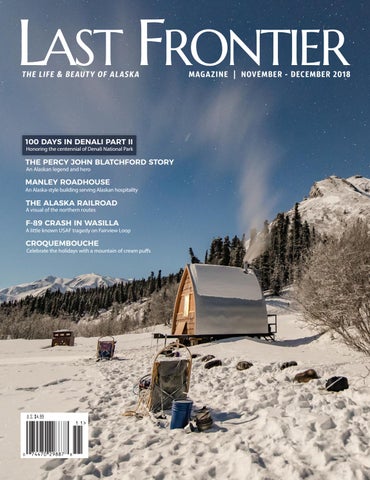
100 DAYS IN DENALI - Page 14 It was day 100! I made it! I felt excitement, accomplishment, and exhaustion but I still had a good morning of mushing left. Photo: Laura Lyn Gregory
ADVERTISING
SUBSCRIBE
If you are an Alaskan business, or a business Alaska
$19.99 for a 1 yr. / 6 issue subscription to
depends on for services, and would like to place an ad in Last Frontier Magazine, we welcome your call or email. We want to partner in advertising with you! Visit lastfrontiermagazine.com/advertise to see ad and pricing information or call 907.775.0816. Your ad will be spread across Alaska, displayed online, and promoted via social media. We can also help you I was hoping for some clear skies for the aurora but the moon was so bright on day 97, December 28, 2017. The moon lit the little cabin where we were staying, with the hard working sled dogs asleep out front. Photo: Laura Lyn Gregory
SOCIAL MEDIA
with ad design.
NOV/DEC 2018 CONTRIBUTORS Ray Bonnell, pg. 7
Teena Findley, pg. 22
Lindsey VanTassel, pg. 8
Frank Keller, pg. 26
Roger Lincoln, pg. 10
Michael Hankins, pg. 29
Laura Gregory, pg. 14
Laura Lowdermilk, pg. 34
Connect with us on your favorite social media channels: LastFrontierMagazine @alaskalfmag lastfrontiermagazine Last Frontier Magazine
4
CONTRIBUTING Do you have an Alaskan experience and/or photos you would like to share? Contact Anne Sanders at: editor@lastfrontiermagazine.com
L A S T F R O N T I E R M AG A Z I N E www.lastfrontiermagazine.com
LFM. Go to: lastfrontiermagazine.com/subscribe or call 907.775.0816. Gift subscriptions available for $15.99 with the purchase of one full price subscription. Missed an issue? Back issues are also available.
CONTACT INFORMATION Phone: 907.775.0816 Email: info@lastfrontiermagazine.com Web: lastfrontiermagazine.com Mailing: PO Box 4514 Palmer, AK 99645
Editor, Anne Sanders editor@lastfrontiermagazine.com Assistant Editor, Wendy Wesser wendy@lastfrontiermagazine.com Designer, Cecil Sanders publisher@lastfrontiermagazine.com Advertising, Jesse Carnahan ads@lastfrontiermagazine.com
EDITOR’S NOTES
Wendy and Grandsons One of my jobs as the assistant editor is to fact check our stories. It’s fun when I don’t allow myself to get too distracted by bunny trails. Often in the process I end up learning much more about the subject and realizing that the short story we are sharing within our pages is worthy of a book. One of these in this issue is the Percy John Blatchford story by Michael Hankins. What I’ve read about Blatchford’s life is captivating and I hope his full biography is written someday.
LFM STAFF While researching, I came across an interesting article in a CIRI newsletter. I read that one of our previous authors, Kelly Turney of Alaska Picker in Palmer, Alaska, was offered a large collection of Blatchford’s trunks a few years ago. Turney organized the various military items and then searched the internet where he discovered many newspaper articles about the man from all across the country. Turney was impressed. He knew that the Blatchford memorabilia should not be broken up and did not belong in his shop. A while later Kaleigh Wotring happened to come into the Alaska Picker store for another reason. Turney found out that she was on the board of the Alaska Veterans Museum in Anchorage and he told her about his Blatchford collection. “Take it. It belongs in a museum,” he said. If you are intrigued by Michael Hankins’ story on page 29 and want to learn more about Percy Blatchford, the museum now has a nice display and it would be a great place to visit as we honor our veterans this November. - Wendy Wesser
MISSION STATEMENT At Last Frontier Magazine we strive to
to promote a healthy community that
captivate our readers with an entertaining
can come together and celebrate Alas-
experience; to propel our advertisers for-
ka and its people, culture, beauty, and
ward in a competitive market; to actively
identity. Our desire is that through the
enrich our community and serve our Lord
content of LFM a positive representa-
with all our heart, mind, soul, and talents.
tion of Alaska will be felt and enjoyed.
We are Alaskans and above all want
CECIL SANDERS Inspired at a young age, Cecil has turned his love of photography into a lifestyle and a business, with a desire to capture the beauty and character of wherever his camera takes him. Always primed to set off on a new adventure, Cecil and his wife, Anne, have spent their ten years of marriage going on road trips, touring Alaska and the country, and planning ahead to their next destination. Cecil has combined his artist’s perspective and aptitude for design in order to contribute his talents to the collaborative effort of bringing Last Frontier Magazine into a reality.
ANNE SANDERS Anne was born and raised in Alaska. She graduated with a B.A. in English Literature from the University of Alaska Anchorage. With a love for the written word, she recognizes the treasure of stories and fascinating people Alaska offers. Paired with her husband, Cecil, who complements her narratives with his eye for the visual, Anne is on a mission to bring her beloved home of Alaska to life on the pages of Last Frontier Magazine.
WENDY WESSER Writing, history, gardening, and traveling are a few of Wendy’s interests. She grew up in Alaska, living as far south as Metlakatla and as far north as Fairbanks. Her family’s history of six generations in Alaska reaches back to the Gold Rush years. She loves reading, hearing and sharing Alaskan stories of newcomers and oldtimers alike—Last Frontier Magazine has provided her the opportunity to work in this very venue.
JESSE CARNAHAN Raised in Alaska, Jesse has a special affinity for the state and the people that live here. Along with his wife and two children, Jesse loves being outdoors and experiencing this amazing place. He has always loved hearing the unique stories that can only come from Alaska, and is excited to be able to share more of them through Last Frontier Magazine.
N O V E M B E R - D E C E M B E R
NOV / DEC 2015 |
2 0 1 8 5
TABLE OF CONTENTS
HISTORY
7
MANLEY ROADHOUSE An Alaska-style building serving Alaskan hospitality
RECIPE
8
CROQUEMBOUCHE Celebrate the holidays with a mountain of cream puffs
HISTORY
10
F-89 CRASH IN WASILLA A little known USAF tragedy on Fairview Loop
ADVENTURE & PHOTO GALLERY
14
100 DAYS IN DENALI, PART II Honoring the centennial of Denali National Park
LIFE IN ALASKA
22
LEGENDS, GHOSTS, & HEROES Experiencing the remote islands of Southeast Alaska
ADVENTURE & PHOTO GALLERY
26
“We reached the cabin across from Sanctuary River Campground as the sun set on day 95, December 26, 2017.” Photo by Laura Lyn Gregory
THE ALASKA RAILROAD A visual of the northern routes, Anchorage to Fairbanks
HISTORY
29
THE PERCY JOHN BLATCHFORD STORY An Alaskan legend and hero
LIFE IN ALASKA
34
THE ALASKAN Understanding the Alaskan way, mind, and soul
In 1952, after already serving for ten years, Percy attended Abn Jump School at Ft Benning and Desert and Arctic Phase Training. When he returned, Percy was officially moved to the Pararescue team. He went on many search and rescue missions and received Commendation Letters for several of them. Credit: Alaska Veterans Museum
6
L A S T F R O N T I E R M AG A Z I N E www.lastfrontiermagazine.com
HISTORY
MANLEY ROADHOUSE AN ALASKA-STYLE BUILDING SERVING ALASKAN HOSPITALITY
I
ILLUSTRATION AND ARTICLE BY RAY BONNELL
n 1902, John Karshner was prospecting for gold about 75 miles west of Fairbanks when he stumbled across a hot spring in the hills just north of a small Tanana River tributary. Karshner had a farming background and saw more potential for profit in selling food to prospectors and miners than in actually mining, so he immediately staked out a homestead north of the stream, which became known as “Hot Springs Slough.” A trading post supplying goods to prospectors in the Tofty and Eureka areas to the north was located about 10 miles to the east, at the confluence of Baker Creek and the Tanana River. However, seeing the advantages of the hot springs site, entrepreneurs soon built a general store on the north side of Hot Springs Slough, eclipsing the Baker Creek operation. The Baker Creek site was located along the route of the Washington-Alaska Military Cable and Telegraph System (WAMCATS) telegraph line and survived for a time as a telegraph station, but except for a small sawmill, otherwise passed into obscurity.
32 miles. The temperature during his run was about 55 degrees below zero (F) and one newspaper article reported that upon arriving at the Manley Roadhouse, Kalland’s mittens were frozen to the sled’s handle bar. The roadhouse proprietor reportedly poured boiling water over the handle bar to free Kalland’s mittens. (I’m assuming the roadhouse had not been moved before the serum run took place.) The roadhouse has gone through a succession of owners, but its basic appearance has changed little over the years. The front portion of the establishment, a 2½ story wood-frame structure with a gable roof, looks pretty much the same as it did when moved across the slough. It is very typical of commercial buildings built during the early 1900s. The rear section of the building has changed gradually during the
Hot Springs (also called Baker Hot Springs and eventually Manley Hot Springs) was in the ascendant though, and other facilities sprouted up. According to the Manley Roadhouse website, in addition to the store, Sam’s Meals and Rooms (which eventually became the Manley Roadhouse) opened in 1903, also on the north side of the slough. Most of the new town’s businesses appear to have been clustered along the base of the hills on the north bank of the slough, rather than on the flatter ground to the south. This was in part because of the Martin Sabin homestead, which occupied about 150 acres on the south side of the slough where the town airport is now. I think it was also because of a military presence established on the slough’s south bank to support the WAMCATS telegraph line. When the landlines were replaced by wireless telegraphy (radio) most of the telegraph stations closed. Consequently, the military occupied space at Hot Springs was abandoned, and businesses began moving across the slough. In the biography of Stanley Dayo, a long-time Manley resident, he states that the Manley Roadhouse was moved across the slough to its present location in 1925. Late January and early February of 1925 was also when the serum run from Nenana to Nome occurred, during which 20 mushers relayed diphtheria anti-toxin to combat an outbreak of the deadly disease. The book, The Cruelest Miles: The Heroic Story of Dogs and Men in a Race Against an Epidemic, relates the story of Edgar Kalland, an Athabascan musher who carried the serum from Tolovana to Manley, a distance of
years — morphing from a small one-story addition (with additional additions tacked on, Alaska-style) to the present two-story structure. The roadhouse is still operating, serving Alaskan hospitality to locals and visitors year-round.A
RAY BONNELL Ray Bonnell specializes in pen & ink drawings of historic buildings, and is also a columnist for the Fairbanks Daily News-Miner newspaper. His column won the Alaska Historical Society’s “Contributions to Alaska History” award in 2011. His books include: “Interior Sketches, Ramblings around Interior Alaska historic sites” and “Interior Sketches II, More ramblings around Interior Alaska historic sites.” Original drawings are also available. Check out Ray’s blog at http:// sketchesofalaska.blogspot.com.
N O V E M B E R - D E C E M B E R
2 0 1 8 7
RECIPE
CROQUEMBOUCHE
PRONOUNCED (KROH-KUH M-BOOSH)
CELEBRATE THE HOLIDAYS WITH A MOUNTAIN OF CREAM PUFFS RECIPE BY LINDSEY VANTASSEL | PHOTO BY CECIL SANDERS
Croquembouche (loosely translated as crunch-in-the-mouth) is a French dessert found at very special occasions such as weddings, baptisms, and holidays. What made me want to bring this cream puff tower to my Alaskan kitchen? Perhaps some of that crazy Alaskan spirit to seek challenges that test the limits. Maybe I was inspired by the mountain-like beauty this tower of pastry mirrors. The likely answer is that I really just wanted to taste this ‘crunch-in-the-mouth’ delicacy, and since France is about 4,818 miles from my home, the quickest way to achieve this experience was to make it myself. It is important to read through the instructions once or twice before beginning. With attention to detail and proper planning the croquembouche can be the star of your next special gathering. 8
L A S T F R O N T I E R M AG A Z I N E www.lastfrontiermagazine.com
CHOUX PASTRY 1 cup water 1/2 cup milk 1/2 tsp salt 1 1/2 stick butter 2 tsp sugar 1 ½ cups flour 6 eggs Heat water, milk, salt, butter, and sugar on stovetop over medium heat until just boiling then turn heat to low and add flour all at once. Keep stirring until mixture pulls away from the pan and is a play-dough consistency. Remove from heat. Add one egg at a time, stirring zealously til mixed in completely. You should have a glossy mixture that barely falls off the spoon and holds its shape while piping. Preheat oven to 375°F. Rinse the top of your baking sheet with water, shake off excess, then cover with parchment paper. The extra moisture helps the pastry puff up. Pipe 1 ½” round mounds about 1” tall, 1 ½” apart. Dip a finger in water and smooth down any peaks that formed when piping your mound. Bake each batch for 25-27 minutes. Do not open the oven til the last few minutes. The buns should be a light medium brown and feel evenly light, not heavy on the bottom. If undercooked they will lose their shape once pulled out of the oven. This recipe makes about 50-55 choux buns. These can be made ahead and kept at room temperature for a day or two, in the fridge for about a week, or the freezer for a few months. If they become soft while stored just throw them back in the oven at 375°F until they are crunchy again.
CHOCOLATE PASTRY CREAM 2 1/2 cups milk 1/2 cup sugar 3 egg yolks 1/4 tsp salt 1/4 cup cornstarch 3 Tbs butter 1 tsp vanilla 3 oz unsweetened chocolate Whisk together egg yolks and sugar, then whisk in salt and cornstarch. Bring milk to a low boil on medium-high heat, stirring frequently. Reduce heat and, while constantly stirring, add half the milk slowly to your egg mixture and then pour the egg and milk mixture back into the rest of the milk. This process will slowly heat the eggs up without curdling them. Turn the heat back up to medium and stir constantly until thickened and bubbly. Remove from heat and add butter, vanilla and chocolate. Keep mixture chilled and covered with plastic wrap (press wrap right on top of the cream to prevent a skin from forming) until ready to fill your choux buns. Do not pipe until cream is cooled down to room temperature or you will have a goopy mess! Stored in the refrigerator, this pastry cream can also be made a few days in advance.
Assembly Plan on filling your choux buns with pastry cream and constructing the tower within a couple hours of serving so your choux buns are fresh and not soggy! Make a cone about 4” wide and 12” tall out of parchment paper. You could use a glass or styrofoam cone underneath the parchment paper for added stability. It can also be done with no paper if you want to build your tower free hand. Spray the paper and serving platter with oil to prevent the caramel from sticking. Poke a small hole in the bottom of each bun and pipe in about 1 Tbs of cream filling per bun.
CARAMEL “GLUE” (To be made right before constructing tower) 2 cups sugar 1/2 cup water Place sugar and water in medium sized pot and heat over medium high heat. Do not stir. Use a pastry brush dipped in water to brush away any crystals that start to form on the sides of the pan. Watch for a steady even boil that will eventually turn a light amber color. At this point take the pan off the heat and begin to assemble your croquembouche! Construction Very carefully (I advise finding a good pair of tongs to use in this step because the caramel will burn if it hits the skin! Do not do this with or around kids) dip a bun into the caramel and then place caramel side down onto your greased plate to create a circle around the parchment cone. Continue adding layers, making each circle smaller and smaller. Reheat the caramel if it cools and thickens too much before you finish. Decorate with candy, sugared berries, flowers, mint leaves, chocolate, sprinkles, more drizzled caramel, let your creativity run wild! I used gumdrops, powdered sugar, a star made from leftover caramel, and the traditionally used croquembouche decoration, spun sugar. For added special effect you can carefully lift the croquembouche up and put a light underneath that will shine thru the holes just like a Christmas tree with lights. NO REAL CANDLES!!!
LINDSEY VANTASSEL Lindsey enjoys living in the Last Frontier with her family of four, eight if you count the dogs! She loves spending time in the kitchen creating and perfecting recipes to share with her family, friends, and community.
N O V E M B E R - D E C E M B E R
2 0 1 8 9
HISTORY
F-89 CRASH IN WASILLA A LITTLE KNOWN USAF TRAGEDY ON FAIRVIEW LOOP Story by Roger Lincoln
F
ew Alaskans are aware that an Air Force jet fighter once crashed in a recently harvested potato field at mile 3.2 of Fairview Loop Road near Wasilla. The tragic crash occurred 65 years ago on a clear, cool, fall day. The trees were bare and earlier that week a light snow had fallen. At the time the area was sparsely populated. The houses were much farther apart in the 1950s, inhabited mostly by farmers and homesteaders trying to make a living raising potatoes, gardening, and dairying. The crash site, farmed by Ralph Bradley, is in the square of land now bounded by Fairview Loop, Alder Lane, and Teds Place. A forest forms the fourth side. Homebuilders in the area occasionally excavate pieces of wreckage from the crash. One homebuilder found a piece of internal wing bracing with a birch tree growing through it.
Air Force F-89, tail number 50-777A, piloted by Capt. Ralph L. Ethridge was flying at 20,000 feet on a routine training mission. In the back seat sat Lt. Dale E. Cooey, the radar intercept officer. Suddenly, a loud explosion shook the entire aircraft. Several smaller blasts followed. The right over-temperature light came on, soon followed by the left over-temperature light. Smoke filled the cockpit as the fire warning lights began glowing, indicating the engines had caught fire. Smoke increased in density as the plane began to burn. Ethridge scanned through his emergency checklist and quickly determined it was necessary to abandon the plane. He informed Cooey in the back seat. Cooey acknowledged. Ethridge heard another explosion indicating Cooey had ejected. Ethridge then ejected and his parachute opened. He watched from the air as the F-89 smashed into the ground and exploded at noon on October 29, 1953. Shortly after seeing the plane impact the empty field, Ethridge landed safely. Spreading his parachute so the Air Rescue helicopter dispatched from Elmendorf Air Force Base could find him, he waited for rescue. Circling an ever larger circumference
Capt. Ralph L. Ethridge
10
L A S T F R O N T I E R M AG A Z I N E www.lastfrontiermagazine.com
Top: The only complete family photograph of Royce, Caroline, and children. Credit: Diane Yeager Peterson
from the crash site, the rescue crew soon located Ethridge and then returned to the airplane debris. There, they discovered Cooey had failed to eject and perished in the crash.
Bradley, to put his property back in order, but he refused. “Aw no,” he said in his Midwest farmer’s accent. “I couldn’t take any money, someone died there.”
Jewel Holstein, who lived on a farm across the road, remembers the accident clearly.
A follow-up investigation indicated failure of the right engine compressor as the probable cause. The low-slung engine of the F-89 earned the reputation of the “world’s largest vacuum cleaner.” According to the accident report, an object was probably sucked into the intake during take-off causing damage to the compressor blades. An hour into the flight, the compressor came apart, resulting in the ensuing explosion and crash.
“I was just coming out of the root cellar,” she said, “when I heard a loud noise that sounded like the end of the world.” Looking up, she saw a jet plane hurtling toward the ground, one wing on fire. “It looked like it was going to hit our house. I’ll never forget that day as long as I live.” Barely missing another house across the road, the airplane went through the trees and burst into flames in the potato field on the other side of the woods. Like the good neighbors they were, nearby farmers got together and provided meals for the Air Force clean-up crew that had been sent from Elmendorf to recover the wreckage. Some say the crew was disappointed when the Air Force began supplying C rations to replace the local home cooking. The damage compensation team made a generous offer to Ralph
Nearly forgotten for forty years, the story of the crash surfaced during the Knik Watershed Storytelling Symposium in 1993. During the 1950s discussion night, some old timers remembered the crash of October 1953, intriguing me to the point where I wanted to find out what became of the pilot and the reason for the crash. My first step was to call Elmendorf Air Force Base where I was referred to the 3rd Wing Historical Office and Staff Sgt. Gary Boyd. Although he was helpful, he could tell me nothing without the approximate date of the crash. I went to the archives of the local newspaper, the Frontiersman, and found a three-paragraph newspaper report.
N O V E M B E R - D E C E M B E R
2 0 1 8 11
F-89 Crash In Wasilla I again contacted Boyd. He was a history-trivia buff, and immediately took a personal interest in my project. He phoned me the next day with enough information for me to continue my research. Next, I wrote a letter to the Air Force Historical Research Agency at Maxwell Air Force Base in Alabama and received a history of the aircraft, including the accident report, from date of manufacture to the date of the crash. It had been built by Northrup Aircraft, in Hawthorne, California, and delivered to the U.S. Air Force on February 29, 1952, arriving at the 65th Fighter Interceptor Squadron at Elmendorf a year later. The history succinctly states it was “Dropped from the inventory due to flying accident near Wasilla, Alaska.” The history also provided the name of the pilot: Ralph Ethridge. After contacting a locator service, I found eight Ralph Ethridges in the United States. I eliminated three names because they were the wrong age. I called two more, who were both courteous but said they were the wrong Ralph Ethridge. On the third try I found him in Aurora, Colorado.
Ethridge seemed surprised that someone would have an interest in an event that happened so long ago. After the initial shock, he was quite friendly and happy to talk. “The engine sounded like a spoon in a garbage disposal,” he recalled. “I activated the fire suppressor, but it was too late. I told Dale that we needed to eject. He acknowledged. In that aircraft, the radar intercept operator had to stow the radar scope before ejecting or he would have his legs torn off. He said that the radar was stowed.” “I heard another explosion and believed that he had ejected. I then ejected. While I was still in the air I saw the crash and explosion. After landing, I spread out my parachute and waited for Air Rescue to pick me up.” “After they picked me up, we flew to the crash site where I learned that Dale had not ejected but had died in the crash. The back seat was very cramped, and it is believed that he probably got tangled up in the canopy and was prevented from leaving the aircraft.” Ethridge continued with a distinguished career in the Air Force. He had previously flown P-38s in Europe during WWII and is
MTA is proud to be a technology leader and remains focused on partnering with the communities we serve to make a positive impact. Our company is proud of its rich history in Southcentral Alaska and embraces our vital role as a technology provider in the world around us.
Life. Technology. Together. mtasolutions.com 12
L A S T F R O N T I E R M AG A Z I N E www.lastfrontiermagazine.com
|
Life. Technology. Together.
F-89 Crash In Wasilla credited with 2.5 victories. In Korea he flew F-86s and in Vietnam, F-4s and the O1E. He retired as a Lieutenant-Colonel, and with his wife Doris made their home in Aurora, Colorado. Ethridge passed away in 2008. Ethridge had never returned to Alaska after 1953, but after talking about taking a tour with his wife, he accepted my offer to show him around the area. Some people who remembered the incident said they would like to meet him. But the story took another twist when an incredible coincidence occurred in July of 1994. Paul Jackson, who had been stationed at Elmendorf between 1952 and 1954, was touring the state with his wife Glenys when he stopped to visit his old base that he had left forty years before. In the course of his efforts to find an old map of the base and perhaps a photo of an F-89, he was directed to the 3rd Wing Historical Office and Staff Sgt. Boyd who asked Jackson if he was familiar with the F-89 crash near Wasilla in 1953.
“I’ll never forget the accident,” said Jackson. “The plane had been in the air about an hour when we received word that it had crashed. The first thing I did was make sure we had removed all the safety pins before we sent the airplane off. Fortunately, we had removed them all, so we knew the ground crew hadn’t made any mistakes.” Jackson said he has never forgotten Lt. Cooey, a guy so short that, “When he sat on the seat with his survival pack under him, his feet couldn’t touch the floor.” “That day, Cooey left swinging his feet and singing a popular song of the time, ‘I’m Sitting On Top Of The World,’” recalled Jackson. After leaving the Air Force in 1954, Jackson went to work as a sales representative for Ashland Oil Company in Kentucky until he retired. The Jacksons spent their retirement touring North America by motorhome.
“That was my airplane,” replied Jackson. “I was the crew chief.” Jackson expressed surprise at Boyd’s extensive knowledge of the airplane and the accident. The next weekend he stopped at the Dorothy Page Museum in Wasilla where he asked if anyone had knowledge of the accident. He was directed to LeRoi Heaven and Heaven directed him to me. I was surprised to receive a phone call from Jackson but immediately invited him and his wife to my house. We toured the crash site, and I introduced them to the property owner.
“This meeting and the opportunity to visit the old crash site was never even planned when we came to Alaska,” he said, still amazed at the sequence of events that led him back to it. “It’s been the highlight of the trip.” Since that chance meeting, Paul and Glenys Jackson returned to Alaska and we visited again. Then in the summer of 2001, while on a family vacation, we stopped and visited them in Ashland, Kentucky, and again in 2007 and 2008. Regrettably, Jackson passed away in 2012. It is amazing the number of people who got together as a result of an obscure plane crash in Alaska in 1953. We have all made new friends because of a shared history. A
ROGER LINCOLN arrived in Wasilla in 1950. His parents homesteaded the property where Snowshoe Elementary School is now located off Fairview Loop Road. He graduated from Wasilla High School in 1965 and witnessed firsthand the area’s significant growth and change. After retiring from the Matanuska Susitna Borough School District as a computer/ electronics technician, he and his wife, Nancy, relocated to Utah. He has a passion for preserving history and currently volunteers as a historical re-enactor at a living history site in Wellsville, Utah. Despite no longer physically living here, in his heart he considers Alaska home.
N O V E M B E R - D E C E M B E R
2 0 1 8 13
PHOTO GALLERY
100 DAYS IN DENALI PART 2 OF HONORING THE CENTENNIAL OF DENALI NATIONAL PARK STORY AND PHOTOS BY LAURA LYN GREGORY
[In the Sept/Oct issue of LFM Laura Gregory gave us a glimpse of her 100 Days of Denali. She’d taken the 2016 slogan of the National Park Service’s centennial celebration “Find Your Park” to heart, and in an effort to honor the 2017 centennial of Denali National Park, she made it her quest to spend 100 days exploring and capturing, through photography, the incredible experiences throughout one year in the life of Denali. The following pages are a stunning reveal of the adventures she had in her last days in Denali.] 14
Top Photo: “After a little hike on day 81, Friday, October 13, we sat under the stars and watched the colors dance above us at the Riley Creek Campground.” Photo by Laura Lyn Gregory
L A S T F R O N T I E R M AG A Z I N E www.lastfrontiermagazine.com
Right Photo: “We hiked the morning of day 98 on December 29. The sky was again clear, the sun was beginning to rise, and we were the only people for miles on end. I thought back on the summer months and the bustling array of buses traveling the now snowy road.” Photo by Laura Lyn Gregory
DAY 95-100
W
hen I first thought of my 100 Days of Denali adventure, I envisioned rolling in on my 100th day via dogsled. After all the planning, bus rides, hikes, bikes, snowshoeing, and driving, it was time to finish my journey. Denali’s winter dog sled concessionaire is through EarthSong Lodge out of Healy, Alaska. I contacted them early and they accommodated my unique request to enter east of the park and head west. Much of the trip was weather dependent. There had to be enough snow for the dogs to pull the sleds. Again, luck was on my side and my dream trip was about to come true. We had a training day that seemed to go by rather quickly, so when it was game time on day 95 of my 100 Days of Denali, I was pretty nervous. I was leading a team of six dogs into the Denali National Park wilderness alongside my husband, Josh, who
Campground and Mountain Vista Trail. It was beyond incredible to see the entire park blanketed in white. Down the trail I watched as our guide dipped out of view. I barely had time to react; we were going down a steep downhill. I tried holding on but I was flung into the air. I landed partially on the trail and quickly rolled into the deep snow because I knew Josh’s team was right behind me. Not more than a few seconds later his team came barreling down the hill. I was impressed that he stayed on!
The guide collected my sled, I got back on, and we headed up to the Savage River. Not all of the river was completely frozen. We ended up losing the park service trail and the guide had to take a look around. When he found where They surged we were supposed to go he was quickly off. I took the anchor out of the ground and my dogs took off. forward and Instead of following the guide’s trail, my dogs cut
also had a team of six dogs, and a guide who had the corner and ended up in the deep snow. I tried started to run a team of eight dogs. We were the first multi-night to walk behind the sled to help them but the dogs trip of the year heading into the park from the quickly got back their footing. They surged forward while I was left east. I had heard that the park rangers and their and started to run while I was left dragging behind dog team had already made trail to the areas we the sled. At first I tried pulling myself up but the dragging behind were heading, but trails can be easily covered and dogs quickly followed the guide onto the ice. I lost in new or windblown snow. The dogs took off don’t mind being dragged as much in the thick the sled. like a rocket after we pulled out the anchor that snow, but on ice … no way. I let go and watched had slid under the sled. They weaved through trees my team cross the river. Josh let me hop on his sled like agility poles. I am a pretty cautious person who likes control but I quickly fell off when the dogs tried to leap across a crack in and this was way out of my comfort zone. Once we got above the ice. I began to think of my many talents as a human and that some of the trees I could see the snow-covered park road which dog mushing is not one of them, but I got back on. I stayed on was now closed at mile 3. We went through the Savage River longer this time.
N O V E M B E R - D E C E M B E R
2 0 1 8 15
100 Days in Denali We stopped to have hot cocoa and snacks. EarthSong Lodge provided all the food, snacks, and hot beverages for us. After our quick break we headed on. We were almost to our first little cabin at Sanctuary Campground when we had to travel across a hill at a pretty steep angle. I slowed the dogs hoping this would help but I saw the guide’s sled was tipped over. He righted himself and quickly headed off the slope. I tried hard to stay up but I also tipped over. I righted the sled and took one anchor out no problem. When I went for the other anchor the dogs pulled and we were off. My footing was poor and I was soon being dragged alongside the other anchor. I didn’t want to let go but I didn’t want to hurt myself on the anchor. The guide again had to collect my sled and dogs. Josh continued to stay on like a champ. We got to the cabin and enjoyed a nice hot dinner and afterward I watched the sunset from the bridge over the Sanctuary River. I learned a lot about mushing that first full day in the park, including how dangerous it is to let go of your team. The guide was able to collect my sled and dogs each time so I was very lucky, and more careful in the coming days doing everything I could to stay on my sled. We opted to stay at the Sanctuary Cabin for the second day, snowshoed up and down the river, explored around the road corridor, and enjoyed relatively nice weather. We didn’t see much in the way of wildlife, but the scenery was breathtaking.
After another delicious dinner we made frequent star checks. One goal of mine was to view the northern lights. The stars began to appear but the moon overshadowed most of them. It was going to be a long night if I wanted to photograph the aurora. I went to bed but woke up every hour to
Every once in awhile I would swear I heard an unfamiliar noise of a tree branch snap or crunching snow.
On day three we headed west to the Igloo Cabin. We had more river crossings and hills planned for the day, but I did pretty well and stayed on the entire day! On the huge drop before sliding onto the Teklanika River, the guide did take my sled for me just in case! After seeing how steep it was, I didn’t mind. I just wanted everyone safe. I had a difficult time slowing the dogs down at times, even while stomping hard on the brake the dogs were able to run on.
16
Once we arrived at the cabin, which was right across from the Igloo Campground, we had almost the whole day left to explore. We hiked up Igloo Creek and found abundant wolf prints! The wildlife we were able to see included snowshoe hares, willow ptarmigan, and grey jays. It was a beautiful sunny day. After walking almost to Tattler Creek and Sable Pass, we saw a way to get up to the park road. We walked back to the cabin using the Denali park road, where we had a vantage point over the river bed and enjoyed watching the sun slowly sink below the mountains.
check for the lights. The moon finally set around 4 a.m. and I ventured out of the dark cabin, entering the dark night. The dogs were fidgeting on their lead line and I also heard the soothing ripples of Igloo Creek. I was so thankful that the clouds hadn’t snuck in to cover the sky. Instead I saw millions of stars and a green band of the northern lights! I walked 50 yards from the cabin and was out photographing in the bitter cold for over an hour. Every once in awhile I would swear I heard an unfamiliar noise of a tree branch snap or crunching snow. Luckily, I didn’t actually see another critter. I slipped back into my sleeping bag and slept another few hours.
The morning was cold and breezy. We walked on the river until we could easily access the road. With the force of the wind it felt like we weren’t going anywhere. I walked behind Josh to help block it. We went off the road in a ravine and dug out seats for ourselves in the snow. I was pretty tired from my middle-ofthe-night excursion and ended up falling asleep! After about a
L A S T F R O N T I E R M AG A Z I N E www.lastfrontiermagazine.com
100 Days in Denali
Top Photo: “I woke up every hour on the hour in hopes that the moon would set below the horizon so the aurora would light up the sky on day 98, December 29, 2017. My persistence paid off, but the snow was so high I had to almost climb through the snow to take this photo.”
Bottom Photo: “We were walking back from a full day of hiking around Igloo Canyon on December 29, 2017, day 98. The sun was setting on the snow dusted trees and jagged mountains, which made for one of my favorite scenery photos of all my 100 days.” Photo by Laura Lyn Gregory
Photo by Laura Lyn Gregory
N O V E M B E R - D E C E M B E R
2 0 1 8 17
PHOTO GALLERY
18
L A S T F R O N T I E R M AG A Z I N E www.lastfrontiermagazine.com
“It was our first night after our first day mushing. We reached the cabin across from Sanctuary River Campground as the sun set on day 95, December 26, 2017.� Photo by Laura Lyn Gregory
N O V E M B E R - D E C E M B E R
2 0 1 8 19
100 Days in Denali half hour, Josh woke me up and we watched the sun rise above the mountains. Soon it was time to get the dogs ready to head back to the Sanctuary River Cabin.
disappear, it was another steep hill. This was my test! I slowed the dogs down as much as I physically could. There was a turn in the hill and I could feel the sled slide; I was going over. The sled shook and before I knew it, the sled and I were in the brush on By day five of this trip I had gotten much more comfortable the ground. I got up and corrected the sled. I pulled the anchors mushing my dogs. I knew their names and and away we went, with me still on the sled! I was so would praise them along the way. Hopping I have hiked, biked, proud of myself for staying on and not giving up. As back onto the Teklanika River I almost fell we continued I felt thankful there was enough snow snowshoed, skied, over, but instead I was elated when the sled to go on this mushing adventure and I appreciated thunked on the frozen ice and I hadn’t made a all the opportunities I had been given. We mushed mushed, driven, thunk myself. Crossing back over the river we past the Savage River Campground and back into the ran into some water. The area we were going spruce forest. We were getting close. We had some climbed, and flown bumps and jumps avoiding trees and little creeks. over was not frozen but it was not super deep. It was deep enough to go over my boots and As the opening approached, I almost shed a tear. through my 100 soak my socks. As I was thinking about my I was back at the park headquarters. I had made it cold feet, I thought of the dogs and how cold through 100 Days in Denali National Park, across all days of Denali. their feet must be! After 25 yards in the water I its seasons. helped push the sled back onto the frozen ice. We had to stop immediately back on the ice to knock off the slush I have hiked, biked, snowshoed, skied, mushed, driven, climbed, that had accumulated on the bottom of the sleds. After relieving and flown through my 100 Days of Denali. I have photographed the sleds, we headed back over the snow-covered tundra. When everything from bears and wolves to ptarmigan and pika. While we made it back to the Sanctuary River cabin, we quickly took off I was fortunate enough to see so much wildlife and scenery our gear to dry and changed our socks. With the adrenaline of in Denali, not every day was epic for photography. I learned to moving on the sled, I didn’t notice how cold my feet really were. appreciate the smallest wildflower or bug, not just the larger We had another great meal before heading to bed. mammals. People come from all over the world to see the mountain, bears, and moose, but Denali National Park is full of Waking up on day 100 of my 100 Days of Denali National Park life. Throughout the journey I learned quite a bit about the park caused a mix of emotions. I was excited, exhausted, and and myself. I started this journey curious and excited, but hesitant emotional. What an incredible journey it had been. As we suited to adventure on my own, hike on my own, and travel on my own. up the dogs for one final run back to the park headquarters I Although I finished the year of 2017 more confident, I realized was able to reflect on my days. At one point I saw the guide how much I enjoyed company on my trips. I appreciated the park
“I finally got the hang of mushing my dog team on day 100, December 31, 2017. We were coming up to the Savage River, our final larger river pass.” Photo by Laura Lyn Gregory
100 Days in Denali rangers I got to know, the support from my family and friends, all those people I met, and all the people who followed along on social media. I not only feel like I have had a full year of adventure in Denali, but I feel like I became part of it. When I started on day one, I didn’t know what would come from spending 100 Days in Denali. Of my 100 days, I saw 98 bears, but only saw bears on 25% of my days. I saw 158 moose and saw them on 53% of my days. I was fortunate enough to see Denali, the mountain, on 40% of my 100 days. Now that this challenge is complete, I feel very accomplished and grateful for the experience, and surprisingly I can’t wait for more Denali adventures. A
LAURA LYN GREGORY Although I have only been selling photos for about 5 years, I have been photographing from a pretty early age. When I was around 8 years old my mom took my brother and me to the Grand Canyon. It was there, my first National Park, where I went through over 12 disposable cameras photographing the beauty I was seeing. I saved up my money for a few years to buy my first 35mm camera. I was pretty excited walking into the camera shop and selecting my new artistic instrument
to capture the world around me! About 6 months later I remember watching a commercial for DSLRs. With that commercial came a new era in photography. I saved up again and purchased a DSLR when I was in college. I didn’t have a whole lot of time to pursue a business in photography until I was in graduate school. I took photos of what wildlife there was in the middle of nowhere in Illinois and did some family and action photography. I got married after my first year of graduate school and we spent our honeymoon in Alaska. This is where I truly fell in love with the state. Its beauty was beyond describable and the photos, even though I tried, did not fully do justice to the scenery. A year and a half later I applied for an internship in Fairbanks. Without much hesitation, I accepted an offer and we moved on up! Since then we have tried to see and experience as much of Alaska as possible. I am for the most part self-taught. In high school I took a few classes in film photography, a beautiful process that I would love to keep alive someday, but for now I photograph with DSLRs. My passion is wildlife photography but I also enjoy scenery and real-life/natural photography. @Laura.Lyn.Gregory.Photography www.laura-lyn-photography.smugmug.com @lauralynphotography
N O V E M B E R - D E C E M B E R
2 0 1 8 21
LIFE IN ALASKA
LEGENDS, GHOSTS, AND HEROES “COME HOME A HERO, OR BRING HOME ZERO.” STORY AND PHOTO BY TEENA FINDLEY
[In the July/August 2018 issue of Last Frontier Magazine, in her story, “Off the Grid,” Teena Findley introduced us to her first trip to Alaska, when she visited her son at a remote lodge in Southeast Alaska. The following story is a continuation of her experience.]
Coronation Island. The latter two are protected wilderness, meaning there are no roads, human habitation, hunting, or logging activities. As we snapped photos, my son pointed out that the next island past these three would be Japan. This statement left us all staring at the horizon in awe.
“Come home a hero, or bring home zero.” As the boat entered the cove, I heard those words fall off of my son Lee’s tongue. I’m not surprised, as he has always had a witty quip or sarcastic comeback for every occasion. On this particular day, we were returning from a good day boating and fishing the waters near Prince of Wales Island and the surrounding area. The day had been absolutely perfect weather wise and consequently the water was calm and smooth as glass. We spent a good deal of this day enjoying the sunshine, exploring islands from the boat, and enjoying a couple of onshore excursions.
Our first onshore excursion gave us the opportunity to see totem poles up close and personal. I was so intent checking out the shore that I missed how my daughter got off the boat. I soon found myself in a terribly awkward pose standing atop the bow. Between my daughter’s hysterical laughter and my son’s (barely under his breath) swearing, I quickly squatted and took a mental note to pay better attention from here on out. I had to laugh at myself too. We hiked up into the woods and as promised there were two totems standing the test of time amid a forest of trees and a history we could only imagine. I found myself whispering and respecting the silence of this reverent spot. This area was once inhabited by many Tlingits. The waterways were lined with families camped along the shores. They fished the streams in this area, widely known for its salmon. My imagination was running full force, backwards in time, as I stood on the mossy floor of this island. Feeling like I was an intruder and even wary I might upset the ancient ghosts by taking pictures, I was almost thankful to be heading back to the boat. Mindful that I had been warned of the damp rain forest’s mossy floor being slick, I still took a fall as I descended the slope. I glanced back quickly at the statues half expecting to see smiles etched in the wooden faces.
I glanced back quickly at the statues half
expecting to see
Earlier that morning, we had laid down a long fishing line. As the boat pulled away, I looked back at the bright colored ball floating and wondered if today would be our lucky day or not. These buoys are each labeled with permanent marker with the name of the owner of the line and his or her address. These lines are the “locals’ grocery store,” as are the surrounding woods. The nearest actual store was a two to three hour trip away (one way) and that involves a combination boat/drive or fly trip. In the summer, fresh produce and dairy items arrive along with the lodge fishing guests by float plane. On occasion, barges bring their fuel or larger items.
smiles etched in the wooden faces.
My son gave my daughter and me a wonderful tour of the islands on this particular day. We boated out to open water where he pointed out three islands: Whale Island, Warren Island, and
22
Back safely in the boat, we cruised through the waters spotting countless birds, ducks, geese, and seagulls. A few times we saw an ever growing group of birds flying in a circle and hovering above the water. These birds were evidence of bait balls below
L A S T F R O N T I E R M AG A Z I N E www.lastfrontiermagazine.com
the surface. Bait balls happen when large fish are feeding on a big group of smaller fish. The debris floats to the surface providing food for the birds. Wildlife abounds in this area and we later saw a group of bald eagles flying above the trees on, aptly named, Eagle Island. Whales were viewed daily and on this day we settled at the edge of a cove and watched the fins and tails of eight orcas hanging out. We decided they were most likely moms and calves. My daughter and I had crawled out onto the front of the boat to get a closer watch and hopefully see one breach farther out of the water. As we sat there in the sunshine watching whale spouts shoot up here and there, my son relayed a story of when he was tagging along behind a cow and calf orca. As he closed in just a little closer a massive whale breached right in front of his boat. Evidently the male was being protective and issuing a back off order. This story made me a tad nervous, so I wasn’t entirely opposed to the suggestion that we climb back into the boat and continue the cruise. We drove to a point of an island, and there in clear view was the grave of Chief Tonawec. My son told us that there were two wooden statues standing guard at each end of the wooden grave. The Chief’s grave was made known to Lee by local residents, and according to his source, the legend is, as you boat by, if you throw an offering into the water to the Chief good fortune will come to you. As we snapped our cameras in awe once again, my son handed me his beer bottle and instructed me to “pour a little offering out to the chief, but don’t be too generous,” he smirked. I did as he requested and bent down to reach into my backpack. I poured out two Tic Tac mints and silently dropped them into the waters as my personal offering. We were also able to get in some good fishing that day. I landed a flounder, which is a flat fish. Flounder and halibut are bottom swimmers. They have an ugly brown speckled side and the other side is white. They swim in camouflage with the brown side up. When these fish are born, their eyes are on either side of their body, but at about six months of age, one eye migrates so that both eyes are on one side. They are a good tasting, but ugly fish. When we returned early that evening to bring in the long line set earlier, we noticed right off that our ball had moved some. This made my son think we had something good on the end! As he started winding up the hundreds of feet of line, we found a couple of sand sharks had been caught. The hooks are spaced out, so we waited in anticipation for each hook to appear, disappointed when something had stolen our bait. The line became more strenuous to reel in, so it became obvious we had something attached. To our delight, we saw the first of two halibut surface and he wasn’t happy either. These fish are fighters and once again, my daughter and I marveled at how Lee does this all alone at times.
N O V E M B E R - D E C E M B E R
2 0 1 8 23
Legends, Ghosts, and Heroes
Motoring back to the lodge, I glanced to the back of the boat. Both fish were tied but still flopping around. Lee yelled back, “settle down there, fellas.” Back at the lodge we were fighting what little daylight was left to get our fish hung up for a photo op and cleaned and processed. The fish were measured and we proudly placed the 92 and 109 pound labels on them before setting up the camera timer. I insisted my flounder be in the picture as well. He wasn’t a shrimp, but looked like one next to the two halibut! Lee made the fillet process look easy but as I took my turn, I found an even deeper appreciation for that task. The fish was slick and heavy, and getting a clean cut proved difficult. As we flipped the fish over, he remarked that my work wasn’t too bad, but my fillet had notches where his did not. As we finished up on the fillet table, Lee made a comment that Chief Tonawec had granted us good fortune today. I remembered my two white mints and told my children about that offering. Coincidence or good fortune, it makes for a great story. Luckily, we have the pictures that make us look like heroes … this isn’t just one of those legendary fish stories where the fish gets larger and larger. At least, not this time. A
TEENA FINDLEY Born and raised in Indiana, Teena Findley loved outings as a child with her family to a local creek to fish and picnic. When her youngest son moved to Southeast Alaska to work as a fishing guide and captain, she was eager to see and experience life “off the grid.” Always being one to journal, she wrote down the adventures of her trip. Outside of her work as an administrative assistant, Teena enjoys family time, especially those spent as “Meemo” to her four grandchildren. Passionate about community service, she spends time volunteering with several local non-profit organizations including one that provides assistance to youth in crisis and homeless situations. www. offthegridinalaska.blogspot.com
N O V E M B E R - D E C E M B E R
2 0 1 8 25
ADVENTURE
THE ALASKA RAILROAD A VISUAL OF THE NOTHERN ROUTES STORY BY FRANK KELLER
[The following is a continuation of Frank Keller’s article and photo gallery of the Alaska Railroad’s southern routes in the September/ October 2018 issue of LFM.]
A
s mentioned in the first segment of this photo gallery in the previous issue the Alaska Railroad’s northern route also has two daily departures from Anchorage during the summer season. The first is the Denali Star traveling the entire route to Fairbanks. The second is the Healy Express, which only travels north as far as Healy. It should be noted that the Healy Express is operated with Alaska Railroad crews but it is a Holland America Princess (HAP) train and as such needs to be booked through HAP as opposed to the Alaska Railroad. With that being said they travel the same line so the information will be the same for both.
26
A photo of your train at the Anchorage depot will certainly be a memorable one as in the distance will be Mount Susitna, also known as Sleeping Lady. Within a few miles of departing the historic depot on 1st Street in downtown Anchorage the rails enter Joint Base Elmendorf Richardson (JBER). Unless you have military access, the train offers a unique view of something most folks can’t see. The railroad travels right along the flight line and it is often possible to see numerous military aircraft in and around the tarmac. Past the flight line you will enter a more rugged section of JBER, an area where wildlife abounds. Keep your eyes open and your camera ready as it is in this area that I saw my first and only wolf. Once off the base the railroad skirts the Knik Arm of Cook Inlet for a few miles near Birchwood before turning inland around Eklutna. As you near Wasilla there are some amazing views of the Chugach and
L A S T F R O N T I E R M AG A Z I N E www.lastfrontiermagazine.com
Talkeetna Mountains including Pioneer Peak and Twin Peaks around Palmer. Although ultimately you are traveling north the railroad needs to first head northeast before turning west to negotiate Knik Arm. You’ll get another chance through Wasilla and on to Houston to photograph Mount Susitna much as you did in Anchorage. North of Houston and on a clear day is when you will get your first opportunity to see the highest peak in North America, Denali. At 20,320 feet it isn’t likely that you will mistake it for something else. Hopefully you will be one of the 30% that actually get to see Denali in all her glory. The railroad will make a passenger stop at the Talkeetna depot. For a number of travelers Talkeetna will be their destination as it allows them some time, about 6 hours, to look around and experience the eclectic town. There are plenty of quaint shops and restaurants, not to mention zip lining and jet boat excursions to keep people busy until the southbound Denali Star arrives to whisk them back to Anchorage. As you continue north you will cross the Talkeetna River on a large bridge and parallel the Susitna River as you enter a very remote part
of Alaska. You will not see another road for some 60 miles. Don’t let the remoteness fool you, however, as the next 60 miles are filled with cabins of those folks that use this area as a way to get away from hectic city life. This region was made famous by the reality show Railroad Alaska, which featured this area pretty extensively. There are a number of spectacular views along this section and many chances for seeing wildlife. I have photographed moose and bear frequently in this stretch. There are also a number of places where Denali will make herself known. The railroad conductor and onboard staff do an excellent job of pointing out all of the sights along the way. Just south of Hurricane you will cross the Parks Highway and from here to Denali Park the road and tracks travel in the same general direction.
Left: The Hurricane Turn sits atop its namesake bridge above Hurricane Gulch. Hurricane Creek is 296’ below the train.
Below: On a clear fall day Denali can be seen from many vantage points but one of my favorite places is the area between Summit and Broad Pass. Lots of great colors contrast nicely with the snow-capped Denali.
Just north of Hurricane you will notice the train will slow down appreciably. This decrease in speed is due to Hurricane Gulch. The railroad crosses the gulch on a 901 foot cantilever bridge 300 feet above Hurricane Creek, an engineering marvel. They slow
N O V E M B E R - D E C E M B E R
2 0 1 8 27
Alaska Railroad
down to allow everyone a chance to admire the beauty of the surroundings. The railroad climbs to the summit of Broad Pass and the scenery from here to Cantwell is spectacular with nearly every twist and turn of the rail offering incredible views of the Alaska Range. There always seems to be a river nearby, first the Chulitna and then the Nenana, which you will follow most of the way to Fairbanks. Once north of Cantwell the railroad, river, and highway all share the pass through the mountains and things tighten up noticeably. The Denali Park Depot is immediately following the crossing of Riley Creek on Riley Creek Trestle. If you happen to be riding and photographing in the fall, the colors here are tremendous. The Denali Park Depot is located in Denali National Park & Preserve and this is where many of your traveling companions will exit the train and spend a few days exploring the park. Upon leaving the station you will cross the Park entrance road and shortly thereafter you can look down and see the appropriately named Horseshoe Lake. I wouldn’t be the least bit surprised if you saw a moose swimming in the water. Farther below is the Nenana River and in another couple of miles the train will enter the treacherous, yet equally beautiful, Nenana River Gorge. This is a short but incredibly scenic section of the railroad. Once through the gorge you will pass through the railroad town of Healy. There isn’t much left of this once bustling town, at least along the rail, as much of the town has relocated along the Parks Highway. From Healy to Fairbanks is 110 rail miles and once north of Healy the valley widens up quite a bit. As you continue north you will pass the Usibelli Coal tipple where Alaska Railroad coal trains are loaded for local and export delivery. From there you’ll cross the Nenana River on a large truss bridge at Ferry. By this time the scenery has
Above Photo: The northbound Denali Star departs Broad Pass after meeting its southbound counterpart on a very colorful fall afternoon. Photo: Frank Keller 28
changed dramatically with less mountains and a more wide open feel. Arrival in Nenana is via a large horseshoe and another large bridge, this time across the Tanana River. It is at the north end of this bridge that the golden spike was driven home by President Harding in 1923 signifying the completion of the Alaska Railroad. From Nenana to Fairbanks is about 50 miles and for the most part is away from the road system. And while not as scenic as the southern part of the railroad there are still plenty of open vistas and gently rolling hills that make great subjects for photographers. The railroad travels along the bottom of a valley which it climbs out of as it nears Fairbanks. The last 20 miles or so the rails regain civilization making photos possible from the road and the train. Arrival into Fairbanks is at 8:15 PM capping off a great day of photography. Riding the train is one of the easiest options for photography as you can take photos from the train anytime you see something worthy. When driving I like to find a photogenic spot and wait for the train. As the schedules are published this is fairly easy to accomplish. When I travel anywhere via car from my home in Anchorage I usually make time for some train shots along the way. Whether I ride the train or take shots from the highway it seems I never end up disappointed. I hope the end result will be the same for you. A
FRANK KELLER
I have been interested in photography since my uncle bought me my first camera, a Nikon EM, when I was a junior in high school. I was fortunate that he also had a darkroom in his garage and he took his time to teach me the finer points of black and white photography/printing—a lost art these days. In the early days of my photography I was mostly interested in transportation subjects: heavy equipment, ships, planes, and trains, especially trains. Not really sure why trains inspired me so much, but they were an early influence. Over the years I traveled the US and expanded the scope of my photography, but I stuck with transportation subjects as my bread and butter. After making a life-changing move to Alaska in 2011, my horizons really broadened and I began to explore a much greater part of the photography world. Now, I often head out to photograph landscapes and wildlife, incorporating transportation subjects with the beautiful scenery surrounding them when I can, which I feel has made me a much more rounded photographer.
www.frankkeller.smugmug.com
L A S T F R O N T I E R M AG A Z I N E www.lastfrontiermagazine.com
HISTORY
THE PERCY JOHN BLATCHFORD STORY AN ALASKAN LEGEND AND HERO BY MICHAEL HANKINS
I
t’s said that some of the strongest people on earth are the quietest. This holds true for men and women alike where physical and mental strength is concerned. Many such folks walk amongst us totally unnoticed. They do not seek special recognition. They’re content in their accomplishments, requiring no public accolades or praise for ego’s sake. I met such a person. His name is Percy John Blatchford. Let me give you a quick background on the man. Percy was born in the village of Golovin, Alaska, October 9, 1920. His parents were Jenny and Charles Blatchford. By age 13 both of them were gone, and from that point his grandmother raised him in the tiny village of Elim. Percy was a full-blooded Inupiaq and proud of it. He was an accomplished whale hunter providing meat for his family and many others. At an early age Percy’s mother informed him he’d be in the military for a long time. When asked how she knew that the woman replied, “Jesus told me!” Percy served in the Army during WWII. He was part of an elite force of men known as “Castner’s Cutthroats.” These troops, under the command of Colonel Lawrence Varsi Castner, performed reconnaissance missions on the Aleutian Islands. At that time they were regarded as the most dangerous guerrilla fighters in the world. After a six-year stint in the Army Percy enlisted in the Air Force working in surveillance and pararescue. What I found most interesting involved him helping to train beluga whales for the Navy. With attached electronic devices they were used for eavesdropping on enemy ships and submarines.
1952, Percy Blatchford completes his training. He now moves from Land Rescue Team to Pararescue Team. Credit: Alaska Veterans Museum
Before retiring from the military in 1972 he had 30 years of combined military experience. Afterwards Percy helped design the WWII memorial in Washington D.C.. President Reagan presented him with the prestigious “Medical Medal of Merit.” Percy Blatchford was an Alaska legend before I was born. N O V E M B E R - D E C E M B E R
2 0 1 8 29
Percy John Blatchford I was employed as a partsman for the State of Alaska Department of Transportation, State Equipment Fleet when I first encountered Percy. The year was 1982. He was a heavy equipment operator assigned to the road maintenance section. Percy stood on the opposite side of a parts counter curiously peering at me. I was new to the shop and I’m sure he was puzzled at my being there. The man was built like a tank. There was something unique about his look that immediately caught my eye. I don’t recall what Percy wanted that day, yet I do remember his smile. With native accent he asked if I was the new kid in town. Evidently he’d listened to the Eagles a time or two. When I replied, “Yes,” he shook my hand and welcomed me aboard. I’ll never forget that handshake. I’m no slouch in the strong claws department, but Percy had mine beat by a country mile. The man’s hands were huge and rock hard. I still visualize Percy in his orange coveralls driving the Etnyre Black Topper—a diesel powered truck holding a large black tank of heated oil or tar for crack sealing roads. Percy and co-worker, Eddie Berkley, generally manned it. Their attire as you can imagine was stained with drops of gooey tar. The seat of their vehicle was dotted with the same. I worked with Percy for approximately 7 years. Over that period I heard nothing but praise: his
Above Photo: In 1952, after already serving for ten years, Percy attended Abn Jump School at Ft Benning and Desert and Arctic Phase Training. When he returned, Percy was officially moved to the Pararescue team. He went on many search and rescue missions and received Commendation Letters for several of them. This is the search and rescue of a downed C-47. Credit: Alaska Veterans Museum
30
Right Photo: “The personnel officer said March was a winter month in Panama.” It was well known that Blatchford was coming from an arctic climate. Percy received this painted sign, along with a “Panama Hat,” the day he received a Commendation Medal. The sign now resides at the Alaska Veterans Museum along with many of Percy’s personal artifacts. Credit: Alaska Veterans Museum
L A S T F R O N T I E R M AG A Z I N E www.lastfrontiermagazine.com
Percy John Blatchford work ethic was stellar, he was a mentor to those around him, he had a sympathetic ear and offered words of wisdom in helping to solve problems. There was one occasion where he stood between two bigger fellows about to duke it out. Most likely he saved them from being fired.
During WWII, besides being a legendary soldier, Percy Blatchford is reported to have sparred with world renowned boxer, Joe Louis. Several articles written about him mention this. More than likely Percy was instructed not to hurt the fabled boxer. It was no secret Percy broke four ribs on one of the toughest men in the Army during a match. Joe Louis was a valuable asset to the war effort. His enlistment in the service helped boost troop morale, along with bringing in needed monetary donations. The United States was could ill afford for mighty Joe to be hurt.
The person who taught me the most about Percy Blatchford was my good friend and next door neighbor, Bill Devine. Percy and Bill served together in the Air Percy Force. They were involved in clandestine missions of all types. Bill would never tell me exact details an expert of their assignments, but did say they carried no survivalist identification in the event of capture. Laos and Cambodia were mentioned. He chuckled after knowing how saying, “If I told you I’d have to kill you!” They kept in contact after retiring, and Bill considered Percy one of his closest friends.
to live off the land.
One of the herculean things I remember about Percy was his ability to lift a 55-gallon drum of cleaning solvent into the bed of a pickup without the use of a crane or lifting device. When co-worker, Lawrence Everett, first told me that story I rolled my eyes. Such a drum weighed approximately 350 pounds. Over time, more and more of Percy’s co-workers came forth claiming it was true. Only after viewing him do it with my own eyes did I become a believer. At that point Percy was 62 years old, something a stranger would have never guessed. Percy carried his age better than most. He had a dignified persona along with having a well-sculpted brawny physique. Bill Devine told me about Percy being dropped by helicopter in a mountainous, totally inaccessible region of the Philippines. A military plane had crashed and Tech. Sgt. Blatchford was the most able to reach the site. He was highly trained in all phases of rescue, having over 200 parachute jumps under his belt. The lone pilot of the downed aircraft was dead. Several days later Percy arrived at a helicopter pickup zone, having single handedly carried the man’s body down the mountain.
After the exhibition match Joe Louis’ outgoing personality must have rubbed off on Percy as it did with many soldiers. Just like him, Percy saw fit in his later years to help young fighters. Percy Blatchford’s fighting nickname was ‘Noseemo.’ I’m not positively sure what the Eskimo interpretation is but I assume it’s, “Bad to the bone!”
The column written by United Press Sports writer Malcolm Donnelly on August 2, 1946, has Blatchford potentially seeking a match against Joe Louis. It’s clear from Malcolm Donnelly’s comments, plus Percy’s, that he’d been refrained from hitting Joe Louis. This takes nothing away from Percy’s extraordinary boxing skills. If you look at matches won vs matches lost, Percy’s record far exceeds that of Joe Louis. Percy “Noseemo” Blatchford never lost a fight! In retrospect, if a Percy Blatchford vs Joe Louis bout had taken place, my opinion on the outcome is straightforward. According to writer Malcolm Donnelly, the fight couldn’t have happened until 1948. That was the year Percy was discharged from the Army. He would’ve been 28 at this time and in prime fighting condition.
Percy was the heavyweight boxing champ of Alaska in the 1940s. He often sparred or gave boxing tips to Eddie Berkley, Lawrence Everett, Roger Strickler, and Bruce Hannan. Those Anchorage residents were avid participants of the sport. Bruce (K.O.) Hannan was an Alaska heavyweight champ himself during the 1970s. Each man mentioned they’d never want to actually fight Blatchford. There was ample reason for it! N O V E M B E R - D E C E M B E R
2 0 1 8 31
Percy John Blatchford Sports reporters have Joe Louis winding down by 1949. The wind pretty much had gone out of his sails. Not trying to tarnish the world champion’s remarkable career, but I believe Blatchford would’ve knocked Louis out in the third round. Archived editions of newspapers throughout the country contain stories of Percy’s heroics and exploits:
trapping before his military career began. Besides many things he was gifted in handling a dog team and a successful hunter. Maxwell Air Force Base was Percy’s assigned base during the early 1950s. It was here that he taught other soldiers survival techniques. Percy was an expert survivalist knowing how to live off the land. Much of his survival knowledge he’d been taught by his parents and grandparents.
On March 10, 1952 in Jackson, Mississippi, Percy instructed a group of Civil Air Patrol cadets in the skills needed to survive a plane crash. An article in the local Clarion-Ledger detailed how excited the students were to have Percy as their instructor. They asked him some unusual questions. One girl wanted to know why Eskimos rub noses. To paraphrase Percy’s blushed reply, “It’s hard to kiss when you’re wearing parka and fur trimmed hood!”
A story in the February 1952 “Outdoor Life” tells of Sgt. Percy Blatchford and Maj. Gen. J.H. Atkinson hunting brown bear. There’s a photo of the sergeant holding a 30.06 rifle along with several dead ptarmigan. Atkinson said Percy was so accurate, that he was able to pop heads off birds from a far distance with his high-powered weapon.
Another student inquired if he’d heard about a penguin lay-
In an October 7, 1958 issue of Alamogordo Daily News (New Mexi-
ing an egg in Mississippi. With a laugh Percy answered, “Do you think it’ll hatch?” He went on to tell the young person he’d never seen a penguin, because penguins live in the Antarctic.
co), there’s an article about Percy helping save three men after their plane crashed near Unalakleet. The trio had walked away from the wreck and spent 10 days in the wilds until being rescued. All survivors were given life-saving medical treatment on the return flight. Percy was well trained in medical procedures.
The Montgomery Advertiser (Montgomery, Alabama) April 3, 1952 highlights Percy’s exploits during WWII, including some tasks he did before the war. Percy spent a short period of time gold mining and
32
On June 7, 1962, according to the Fairbanks Daily News-Miner, Percy helped guide Gen. Curtis Lemay and Prince Bernhard of the Nether-
L A S T F R O N T I E R M AG A Z I N E www.lastfrontiermagazine.com
Percy John Blatchford lands on a successful hunt. Without Percy’s help more than likely the outing would’ve been a bust. Percy received a letter of recognition from Lemay for his assistance. Percy did the same for Gen. James “Jimmy” Doolittle. He was Doolittle’s guide on stalking then shooting a polar bear. A signed letter from the famous pilot thanking Percy resides in the Alaska Veterans Museum. An article in the November 8, 1964 Independent Press – Telegram (Los Angeles) has a plethora of information on Percy. It tells of 10 men crashing in a remote area near Nome. Eight passengers stayed with the aircraft while two decided to walk out. Percy and other rescuers eventually found the two men froze to death. The eight staying with the plane survived. Percy preached to students afterwards that remaining at a crash site was best. This same L.A. newspaper article tells of Percy killing a brown bear with a single .22 bullet. He also held off a pack of wolves with the identical rifle. Evidently this was the only weapon he owned in his early years. Ironically, during Percy’s tenure as a “Castner Cutthroat,” the .22 rimfire was their weapon of choice. In the 1970s, during an interview, Percy tells of having to help remove the remains of 12 soldiers killed in an airplane crash in Columbia. There was another rescuer with him named “Red” Willis. The bodies had been on top of a mountain almost two weeks in tropical jungle heat. Without going into gory detail Percy summarized what’d become of them. One of the crash victims was found perched on a log. The man appeared to be alive, but when Percy touched his face it was cold. The soldier had an open Bible in his hands turned to the 23rd Psalm. Percy picked the Bible up and read, “The Lord is my shepherd, I shall not want. He maketh me lie down in green pastures.” Percy John Blatchford died at the age of 82 on January 12, 2003. His legacy is forever implanted in the mountains, tundra, and waters of The Last Frontier! A
Photo: Percy was a well known and well respected hunter and guide. Here he is pictured with the Alaskan Air Command Commander, Major General Atkinson, who served from 1945-1948. During this time, Percy made himself available to many of his commanding officers. This particular hunt was note-worthy Atkinson may have taken the second or third or fourth largest brown bear on record. Maj. Gen. Atkinson shared the whole story in the February 1952 issue of Outdoor Life Magazine. MICHAEL HANKINS and his wife, Joleen, can be found in Lake Havasu City, Arizona, when not traveling in their RV. Michael does freelance writing when not exploring the desert. Alaska will always be their true home!
N O V E M B E R - D E C E M B E R
2 0 1 8 33
THE ALASKAN
I
f you’ve heard anything about Alaska, you’ve probably heard
(which we never fully appreciate until it freezes up during a low-
about how long and cold and dark and dreary and miserable
snow year), and a gracious reprieve for that bed of tender plants
the winters are. Alaskans diligently maintain that public image.
you really hoped might survive until spring. Snow warms again
Something like jury duty, it’s a community-wide obligation to prop
when you have to shovel heaping mounds of it just to get to work
up the illusion that Alaska is not a favorable place for people to
or the bus stop. Finally, a bonus point in snow’s favor, it warms a
live. We tolerate our summer visitors, but when distant relatives,
third time when you romp around in it.
tourists, and seasonal workers flee with winter nipping at their heels, we all kick back with a sigh of relief because Alaskans have a
And bright, there is nothing like the 24-hour brightness of a fresh
top-level secret we’ve been working to hide.
snowfall, whether it’s glittering under starlight, glowing under a full moon, shimmering pink as the sun rises, or giving a head-splitting
It’s the snow.
case of snow blindness under a late winter noon-day sun. Yes, you can go blind from the brightness of snow. It’s unpleasant, but
A winter without snow is morose at best and is more often a ghastly
temporary. The winter sky can be gloomy with too many clouds
season to endure. Cold weather longs for its better half—for snow.
and a negligible amount of sun, but snow on the ground makes
However, a winter well layered with blankets of snow is more lovely
everything fresh, clean, and beautiful.
than most people will ever realize. So here I’ve gone and shoveled out the big secret, which is okay, Snow makes wintertime warmer and brighter.
because non-Alaskans won’t believe me. They’ll think I’m either crazy or pulling their leg, which is fair because those are both
That chilly frozen mess dumped on us by masses of bleak clouds?
legitimate possibilities when dealing with an Alaskan. However,
Yes! Snow is truly wonderful!
those people who can step outside, smell the next snowfall on the wind, and actually feel their heart ache momentarily with gladness,
Some of you don’t believe me. Consider this. On the claim of warmth
well, those people are already part-Alaskan. Perhaps a wintertime
snow is like firewood—it warms you twice. First, snow warms when
visit is all it will take to prove that this snowy frontier is where
it falls, covering your roof and the earth with Mother Nature’s
they were meant to live and thrive. Meanwhile, snow will remain
proprietary blend of non-toxic, sustainable insulation. There are
an Alaskan secret and a primary reason why most Alaskans aren’t
savings on your heat bill, a literal saving of the humble leach field
tempted (too much) to live anywhere else. A
Stick around, because in each new volume of Last Frontier Magazine we dig deeper into the many mindsets, modalities, and manias that make up — The Alaskan.
34
L A S T F R O N T I E R M AG A Z I N E www.lastfrontiermagazine.com
N O V E M B E R - D E C E M B E R
2 0 1 8 35
CLUB PARIS CELEBRATING 61 YEARS OF EXCELLENCE
Located in the heart of downtown Anchorage, Club Paris has been serving steaks and seafood to Alaskans and visitors alike since the late 1950’s. Anchorage’s oldest steakhouse is housed in a building that was constructed in the late 1920s.
RESERVATIONS RECOMMENDED LUNCH: MONDAY - SATURDAY 11:30am - 2:30pm DINNER: SERVED NIGHTLY AT 5:00pm - 10:00pm 417 W. 5TH AVE. ANCHORAGE | 907-277-6332 WWW.CLUBPARISRESTAURANT.COM 36
L A S T F R O N T I E R M AG A Z I N E www.lastfrontiermagazine.com