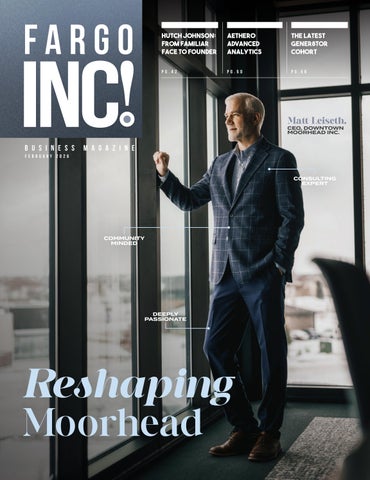
Matt Leiseth Steps In as Downtown Moorhead's Momentum Turns Real
Hutch Johnson: From Familiar Face to Founder
Aethero Advanced Analytics Wants to Keep Buildings Healthy
The Latest gener8tor Cohort
I Can Advertise There!?
Women You Should Know: Traci Weible
Mission-Driven Flavor
From Service to Scale
10 Questions With John Machacek: David Batcheller (Josda)
Home
fargoinc@spotlightmediafargo.com
Brady Drake, Fargo INC! Editor
Brady
Kim Cowles
Ty
Paul Hoefer Paul@SpotlightMediaFargo.com
Al
Austin Cuka
AustinCuka@SpotlightMediaFargo.com
Spencer
Spencer@SpotlightMediaFargo.com
ClientRelations@SpotlightMediaFargo.com
Jessica Ventzke
Tyler Duclos
Missy Roberts
John Stuber
CHECK OUT
SPOTLIGHT MEDIA'S OTHER PUBLICATIONS
We always hear that the people are what make the Fargo-Moorhead community great. So, why not meet them? Each month we cover a different topic led by local voices. We meet advocates, experts, and people just like you!
meetfargo.com /meetfargo @meetfargo @meetfargo
Growth Leaders is one of Spotlight's annual publications dedicated to showcasing our local companies and the services they bring to the Fargo-Moorhead area.
Bison Illustrated is your number one source for all of the behind-the-scenes action inside the North Dakota State University Athletic Department.
You may already be familiar with our Faces of Fargo-Moorhead-West Fargo publication which we publish once per year in order to highlight the faces behind all of the great businesses in the community.
Future Farmer is our farming publication which brings great tech-focused content to readers across North Dakota and Minnesota.
futurefarmermag.com /FutureFarmerMag
Are you in need of a new career? The Great Places to Work FargoMoorhead-West Fargo Annual Career Guide highlights amazing businesses in the area that provide great growth opportunities, benefits, and more!
By Jordan Green
WHY RIG? ELEVATING YOUR EVENT PRODUCTION
hen planning a live event, one of the simplest ways to upgrade the look and feel of a room is to decide where your audiovisual and lighting equipment lives. At Livewire, we can help you make the best decisions for your event across traffic flow, fire code, and the overall ambiance of your venue.
While ground-supported floor stands are great for smaller setups, moving your lighting, audio, and video gear to overhead rigging is a straightforward step that can significantly improve the guest and presenter experience!
One of the most noticeable benefits of rigging is how it cleans up the room. By moving equipment overhead, you increase floor capacity, reclaiming square footage for seating, service, or a larger dance floor. It also creates superior sightlines; guests enjoy an unobstructed view of the stage without having to look around a forest of speaker or projector stands.
From a safety standpoint, rigging allows for controlled cable management, keeping power and data lines tucked neatly in the ceiling, rather than taped across floors where they pose tripping hazards (if someone trips hard enough, it could derail your show, too!).
Overhead rigging also offers a level of technical precision ground stands simply cannot match. Our audio team can achieve optimal sound dispersion and coverage by angling speakers to reach the back of the room evenly, and use precise lighting angles to ensure presenters look their best while keeping the bright lights out of their eyes. It also ensures perfect video projection alignment, hitting the screen "dead-on" for a sharp, consistent, vibrant image.
Beyond the clear technology benefits, truss acts as a skeleton for branding and decor, from sponsor banners to floral installations, and it takes color well from LED lighting to help brand your event!
Truss systems are modular and scalable, and can be accommodated in almost any venue. Furthermore, using a venue’s standardized weight distribution points is often the most stable way to support heavy gear.
While we know rigging sounds expensive, trust us: it’s not! The cost of flying truss is often offset by reduced labor costs; because the setup is streamlined, we spend less time leveling individual stands and managing miles of cable tape.
While overhead rigging is a great tool, practical constraints may make ground-support the better choice. In rooms with low ceiling heights, overhead trussing can feel crowded. Additionally, if a venue has rigging point limitations and isn't rated to hold weight, a sleek groundbased setup is the safest way to go. Throughout our planning process, Livewire is there to advise you on what’s best for your vision, event requirements, and budget.
Ultimately, choosing to rig is about removing the "clutter" of production, allowing your guests to be fully immersed in the event without the distraction of the technology.
Whether you know exactly what gear you need or need a little guidance on the best solution for your event size and budget, our team is ready to help you unlock your event’s full potential!
Contact Livewire today to learn more about how we can elevate your next project.
By Brady Drake | J. Alan Paul Photography
Matt Leiseth Steps In as Downtown Moorhead’s Momentum Turns Real
DAbout Matt Leiseth
Matt Leiseth is the President and CEO of Downtown Moorhead Inc. He brings decades of business leadership to the role. A Concordia College graduate and longtime Moorhead resident, Leiseth spent more than 30 years with Hornbacher’s, rising from entry-level roles to senior leadership positions and developing a reputation for people-focused management and community engagement. He previously served on the Downtown Moorhead Inc. board and numerous local nonprofit boards, and now leads the organization at a pivotal moment, guiding downtown redevelopment efforts with a collaborative, long-term vision for Moorhead’s future.
owntown Moorhead, Inc. (DMI) is the nonprofit group the City of Moorhead partners with to help move downtown redevelopment from vision to reality by connecting developers, businesses, and public leaders around one coordinated plan. In the last year, that work has gotten a lot more tangible as the former Moorhead Center Mall site (a nine-block redevelopment area) has been cleared and prepped for new mixeduse development—housing, street-level storefronts, and public space designed to reconnect downtown to the river.
In December 2025, DMI entered a new chapter with longtime Moorhead resident and regional business leader Matt Leiseth stepping in as president and CEO after Derrick LaPoint’s tenure. In this interview, Leiseth talks about why he made the leap from board member to the day-to-day role, what he learned leading in the private sector, and what’s next: early developer interest, how incentives and approvals actually work, the coming impact of The Loop (the new community center and library hub), and why the biggest wins downtown are usually built one project at a time.
You started this role in mid-December, correct? What interested you in it?
Yes. I was on the board since before Derek got hired—about eight and a half or nine years. Downtown Moorhead Inc. started with some really good business leaders who wanted to create more excitement and do something different. The three college presidents on the Moorhead side and Superintendent Lunak from Moorhead Area Public Schools were all asking: how do we enhance what we’ve got to make it more livable and more exciting? How do we create our own destiny? Businesses said, “We can play a role here.” I’ve lived in Moorhead for 36 years. I came here for college and never left. I love Moorhead. You have to take economic development and planning into your own hands instead of waiting for it to happen. The city, business leaders, and the community all have to be involved.
What were some early milestones?
We had a downtown vision that eventually turned into demolishing the Moorhead Center Mall—which was no easy task because of how the building was structured. Downtown Moorhead Inc. became a true publicprivate partnership: a nonprofit supported by businesses, contracting with the City of Moorhead to provide economic development. We set a goal of 500 new housing units in the downtown core in five years, and we hit it. That included projects like Kevin Bartram’s work on the Simon Warehouse and the corner of Eighth and Main, where Eventide has offices and apartments.
About Downtown Moorhead Inc.
Downtown Moorhead Inc. (DMI) is a local nonprofit organization focused on catalyzing economic growth and revitalization in Moorhead’s downtown district. The group champions a communitydriven vision to transform downtown into a vibrant place to live, work, play, and learn by building partnerships with local businesses, residents, developers, and public institutions. Its work includes advocacy, strategic planning support, and helping advance the city’s downtown master plan through coordinated development efforts.
Since its launch in 2018, DMI has played an active role in shaping the redevelopment of the former Moorhead Center Mall site, supporting housing goals and catalytic mixed-use projects, and guiding initiatives that strengthen walkability, economic activity, and community engagement downtown. It operates as a relationship builder, educator, and advocate for downtown Moorhead’s long-term growth, working alongside public and private partners to help turn planning into tangible investment and new opportunities.
CONTINUED
When was that milestone hit?
I’d have to look it up exactly, but probably within the first couple years. It was before I was in this role.
What made you want to move from board member to full-time leader?
I separated from Hornbacher’s in the end of 2024 and started consulting, which I really enjoyed and still do on the side. When Derek said he was leaving, I just felt like we were in such an exciting spot—for the city and for downtown. I’ve got a passion for this town, for growth, and for the storytelling that comes with redevelopment. I don’t think I thought about it for more than four seconds. Moorhead has always felt like home to me, despite growing up in Red Wing, MN. My parents grew up here. I’ve had family here longer than I’ve lived here. There’s legacy here.
What does your consulting work look like?
My consulting work helps leaders close the gap between strategy and operations. Most businesses don't fail from bad ideas, they fail because their resources don't support what they say matters.
I use three circles:
• What are you good at? (Be honest)
• What do your customers want?
• What will you get credit for?
Where those overlap is your strategy. Then, you need to look at your operations piece, and that's where
Matt Leiseth Steps In as Downtown Moorhead’s Momentum Turns Real
Leiseth Steps In as Downtown Moorhead’s Momentum Turns Real
the disconnect really comes in. A lot of operators have their own strategy. They know what they're good at, but when they start digging into where they're putting their money and resources, they find that they're not necessarily in alignment with their strategy. Sometimes, people get stuck doing things that they've always done, and that costs them a lot of money. I help businesses get to an operational excellence model because that's the only way that you survive.
Can you give an example?
Customers always want cheaper prices. But will you get credit for it? If you’re competing with Walmart or Amazon, and you discount a superior product, you’re probably not getting credit anyway. If your only reason for struggling is price, you might as well close—you’ll never be Walmart. So you focus on service, quality, people, cleanliness, and presentation. But to do those things right, you have to invest in people, and many businesses don’t want to.
How do you think about marketing spend?
Some advertising is ROI-driven. Some is just being part of the community—like buying an ad in a high school program. That's great, but you have to know why you’re spending the money. If you pretend everything drives business, you’re fooling yourself. Be honest about the purpose.
What are key updates for downtown Moorhead right now?
Before demolition, the Moorhead Center Mall—minus city-owned property—had a taxable value of $15 million. Kevin Bartram’s 650 Center
Matt
Downtowns aren’t overnight successes.
Fargo wasn’t. Moorhead won’t be either—but it’s moving, and everyone’s rowing in the same direction."
project, on about one-tenth of that land, has a taxable value of $19 million. One project already exceeds what we had before. The city owns the land and has done all the mitigation, so it’s truly greenfield—no contamination. You can build with confidence. The Loop will begin move-ins around March, with a grand opening in April. It includes the Moorhead Public Library, Lake Agassiz Regional Library offices, a children’s play center, a secondfloor walking track, and the Spark Center for Entrepreneurship led by Laura Caroon. The underpass will be done in the fall. Highway
About Laura Caroon
Laura Caroon is a well-known local leader in the FargoMoorhead area whose work spans entrepreneurship, community building, and public service. A former Moorhead City Council member, she has played a central role in shaping downtown revitalization efforts and supporting business development. Caroon has co-founded community organizations like Ladyboss Midwest, an empowerment network for women in business, and has worked professionally in marketing, content strategy, and engagement roles that emphasize connection, growth, and opportunity in the region. Caroon is currently leading the Spark Center for Entrepreneurship, a new downtown resource being developed as part of The Loop, which is Moorhead’s upcoming public library and community center. Guided by her vision of making entrepreneurship accessible and welcoming, the Spark Center will offer mentorship, coworking space, workshops, and support to aspiring and existing business owners, with special attention to historically underserved groups and the full spectrum of business ideas from food concepts to creative and service enterprises.
75 and Highway 10 will be rerouted through it, and Google Maps will automatically take people through— no more train delays downtown.
How does the development approval process work?
It’s a downtown redevelopment and Tax Increment Financing district, so there are incentives—but with expectations. We want high density, mixed use, people living there. If someone wanted to put a $1 million building on land intended for a $20 million project, that doesn’t fit. This protects developers too—they know their neighbors will be held to the same standard.
Are downtown Fargo vacancies a concern?
Commercial vacancies are always a concern, but our commercial footprint will be limited. Rents will likely be lower on the Moorhead side, which could attract small businesses. Apartment mix matters too— efficiencies, one-bed, two-bed, price range. Both extremes don’t work. You want a mix of people downtown to support programming and vibrancy.
How would you describe your leadership style?
Collaborative. I empower people. I’m not a micromanager. As long as we’re aligned on the goal, I’m open to different paths to get there. In this role, it’s about connecting people— developers to the city, helping
Matt Leiseth Steps In as Downtown Moorhead’s Momentum Turns Real
navigate permitting and incentives, and making sure people understand the process.
Where can developers learn about incentives?
It’s on the City of Moorhead website under economic development. But we prefer meetings—me and Amy Thorpe (economic development program administrator), so we can talk through vision, steps, timelines, and the approval path, which goes through the EDA first, then City Council. The key is you need incentives approved before certain construction steps—like don’t put in a foundation before approvals, or the incentive may not apply. We can help walk people through that.
What’s your message to readers right now?
Momentum and potential. Nine blocks won’t be nine developers in one year, but if we get one or two every year, this is a five- or six-year plan. It’s not instantaneous. But it’s moved from “wouldn’t it be great if…” to “it’s actually happening.” The city is committed to programming and vibrancy, and it’s a true public-private partnership with city investment, business investment, and nonprofit structure all rowing in the same direction.
How has interest been so far from developers?
Really good. Since the mall was completely demolished this fall, we already have development done, and there are two or three groups in talks
About The Loop
The Loop is a major new public space rising in downtown Moorhead at the intersection of 5th Street and Center Avenue, set to open in Spring 2026. It combines the new Moorhead Public Library with a community center designed to be a gathering place for people of all ages, offering room to read, study, play, and engage with neighbors in a welcoming environment. The name The Loop reflects both the idea of bringing people together and the facility’s indoor walking loop. The Loop will include spaces such as children’s areas, presentation halls, and public gathering spots, as well as the Spark Center for Entrepreneurship, a dedicated resource to support business development and innovation. The project embodies Moorhead’s commitment to connection, continuous learning, and inclusive community engagement—creating a central destination where families, students, creatives, entrepreneurs, and visitors can come together.
If you're not a developer and want to learn more, scan this code!
Matt Leiseth Steps In as Downtown Moorhead’s Momentum Turns Real
right now. Developers are thinking about what would work for them, and they know what our expectations are—mixed use, high density, people living there, figuring out parking, all of that.
The city is going to do a lot more programming along the river. We’re fortunate that Moorhead is higher, so we don’t have a wall blocking the river like Fargo does. That opens up great space, and more programming will come. Eventually, it ties into the plaza west of City Hall. All these pieces start coming together.
What are some other common hang-ups you hear from developers?
A big one has been the unknown. Some assume everything is better in North Dakota because they understand it. On the Minnesota side, we weren’t communicating well enough that similar support exists—different programs, but the same goal. Kevin Bartram is a shining
example—he understands Minnesota funding and has done successful projects in the Simon Warehouse, the Armory, new development at 14th and Main, and now 650 Center, and plans to redo the FM Center once City Hall moves. The programs work. The numbers pencil. Developers just need to understand them and see that they can succeed. People get used to what they know. If you did your first 10 projects in Fargo, you’re comfortable there. We have to keep communicating that Moorhead can work too.
What kinds of businesses do you envision downtown?
More entrepreneurial, niche businesses like coffee shops, small cafes, sweets/ice cream-type places. It’s smaller spaces, high-quality concepts, and places that people line up for.
How do you help developers who are unfamiliar with Minnesota or Moorhead navigate the process?
A lot of it is just education and communication. If you’ve only developed in North Dakota, South Dakota, or somewhere like Texas, you don’t know Minnesota’s system. In Minnesota, most regulations are passed at the state level in St. Paul, not city by city. That changes timelines and expectations. Running a business in Moorhead versus Fargo is the same stress, the same struggle—finding customers, managing margins. Starting a business is where it’s different. Permitting in Fargo is largely local. In Minnesota, there are more state-driven processes. Our job is to help people understand that and navigate it so they don’t get surprised.
This is about momentum and potential. It’s a great time to dream, but it’s also a time when things are actually happening."
What kind of mistakes do you help people avoid?
Timing mistakes. Incentives have to be approved before certain steps happen. You can knock down a building and clear the site, but if you pour a foundation before approvals, you might lose eligibility for incentives. So we walk developers through what they can do and when. We want people to succeed. That’s the whole point—helping them understand the rules before they accidentally disqualify themselves.
What else do you want readers to know?
This is about momentum and potential. It’s a great time to dream, but it’s also a time when things are actually happening. Downtown Moorhead is a true public-private partnership. The city is invested. Businesses are invested. Downtown Moorhead Inc. is a nonprofit focused on economic development. When things work, it’s because people are working together. Everyone rowing in the same direction—that’s how you build something lasting.
provided by Downtown Moorhead Inc
By Brady Drake | Geneva Nodland
HUTCH JOHNSON FROM FAMILIAR FACE TO FOUNDER
or decades, Hutch Johnson has been a constant in Upper Midwest households. He has guided viewers through blizzards, tornado warnings, and everything in between. Today, he’s still doing exactly that. The difference? He’s doing it on his own terms, through a platform he built from the ground up.
More than two years into launching Hutch’s Weather, Johnson has evolved from a trusted television meteorologist into a full-fledged entrepreneur—one who now manages live streaming, app development, sales, content strategy, and community engagement, often simultaneously.
“When people see the lights, camera, and action on TV, that’s just a small piece of what actually happens,” Hutch said. “Everything from the lighting to the audio to the graphics— there’s so much behind the scenes.”
It’s that behind-the-scenes knowledge—earned over nearly 30 years in broadcast meteorology—that has allowed Hutch to make a transition many talk about but few successfully pull off: turning personal expertise into a scalable, independent business.
MORE THAN ON-CAMERA EXPERIENCE
What many viewers didn’t realize during Hutch’s television career was how deeply involved he was in the technical and creative process. Across three stations, including nearly two decades at KVLY, Hutch didn’t just deliver forecasts—he helped design the entire visual experience.
“I built the complete suite of weather graphics you saw on air,” he said. “From the background maps to state lines, interstates, spacing, labels—everything.”
That experience proved invaluable when Hutch stepped away from traditional broadcasting. While many on-air personalities rely heavily on production teams, Hutch entered the digital space already fluent in graphic design, data integration, and broadcast software.
Still, the transition hasn’t been simple.
“Streaming platforms changed everything,” Hutch explained. “You can make a graphic that looks great on a TV, but if someone’s watching on their phone, suddenly that doesn’t work anymore.”
Learning to serve viewers across televisions, desktops, tablets, and phones—without creating dozens of versions of the same content—has become one of Hutch’s ongoing challenges. It’s also one of the reasons his platform continues to evolve.
“I’m still learning,” he said. “But it’s been fun.”
FROM FAMILIAR FACE TO FOUNDER
INTERACTIVE WEATHER FOR A CHANGING AUDIENCE
The most significant shift from television to digital is relational.
In traditional broadcast meteorology, interaction with viewers is limited. Phone calls were rare. Feedback was delayed. Programming followed rigid schedules and geographic assumptions.
That all changed once Hutch began streaming live.
“Now it’s instant,” he said. “Someone can say, ‘I’m driving from Crookston to Fargo—what does it look like?’ And I can address that in real time.”
Rather than relying on consultant-driven rules—such as only focusing on Fargo or ignoring surrounding regions—Hutch tailors each broadcast to what’s actually happening across the area.
“Every weather event that moves across our region matters to someone,” he said. “Now I can customize what I’m doing that day to fit that.”
The result is weather reporting that feels less like a presentation and more like a conversation—one that adapts as conditions change and viewers engage.
WORK WITHOUT WALLS
The life of a modern meteorologist isn’t confined to a studio. Hutch’s schedule may look unconventional to some—he jokes he’s working “eight days a week”—but it’s a continuation of the intensity he embraced during his TV days. Severe weather doesn’t wait for a weekday, and neither does Hutch.
“I’ve broadcasted non-stop from hotel rooms during tornadoes, car shows, even while traveling for personal matters,” he said. “The work schedule hasn’t changed much, but now I’m doing it for you—directly for the viewer.”
Unlike traditional broadcasts constrained by programming schedules, Hutch’s streaming model allows him to reach viewers whenever weather conditions demand it. Whether it’s a sudden wind event, a winter storm, or summer heat, Hutch can deliver actionable information in real time— without worrying about interrupting other content.
“It’s not cutting in—it’s creating content in real time,” he said. “That’s the advantage of this platform.”
CHOOSING INDEPENDENCE
While Hutch grew up around family businesses—helping run a service station and supporting his father’s computer sales—he had never started a business himself.
“I had roots here, four kids I raised in this area, and a grandmother from Kindred. This is my community,” he said. “I took my time, asked trusted people for advice, and slowly built a plan. I didn’t just wing it. The viewers were always there. Without them, I’d have very little to go off. But being present and earning trust is everything.”
DID YOU KNOW?
Hutch was featured in the 2024 FACES of Fargo-Moorhead-West Fargo as the Face of Weather! Read the article here.
EVERY
WEATHER
EVENT THAT MOVES ACROSS OUR REGION MATTERS TO SOMEONE. NOW I CAN CUSTOMIZE WHAT I’M DOING THAT DAY TO FIT THAT.”
FROM FAMILIAR FACE TO FOUNDER
A WEATHER APP BUILT FOR THE UPPER MIDWEST
The recently released app Hutch’s Weather is a carefully designed tool that integrates decades of meteorological experience with modern technology. From interactive radar and road reports to customized notifications for golfers, farmers, or anyone monitoring severe weather, the app brings local weather to life.
“People here care about the weather because it impacts everything—agriculture, trucking, construction, even holiday travel,” Hutch said. “I wanted to put all that information right in their hands.”
The app’s features include:
Forecast videos with Hutch’s commentary for a personal touch
Road condition updates and snow reports for safe travel planning
Real-time alerts for lightning, fog, and other hazards
Community engagement tools for users to share photos and videos
Hutch’s How-To guides for new users to navigate the app effectively
Developed with a mix of local and national partners over a year and a half, the app is designed to be accurate, timely, and highly functional.
THE GOAL IS SIMPLE, PROVIDE A TOOL THAT’S GENUINELY USEFUL AND RELIABLE FOR THE PEOPLE IN OUR REGION.”
FROM FAMILIAR FACE TO FOUNDER
LESSONS FROM THE LAUNCH
The most significant shift from television to Starting his own business brought challenges Hutch hadn’t anticipated. Every aspect, from learning sales techniques to adapting to digital platforms, required dedication. Travel, personal obligations, and family health situations added layers of complexity, but each obstacle became a learning opportunity.
“Everything’s been a challenge, but it drives me,” Hutch said. “I learn from my viewers, adjust based on their feedback, and continue to grow. Starting slow has been perfect for me— every month, every interaction, adds to the foundation.”
Hutch credits his success to careful planning, persistence, and community support.
ADVICE FOR ASPIRING ENTREPRENEURS
Hutch’s advice that he would give to anyone planning to pursue and entrepreneurial venture would be:
LAY THE GROUNDWORK:
Learn skills, save a financial cushion, and understand your market before taking the leap.
LEVERAGE EXPERTISE:
Seek advice from professionals in areas where you lack experience—sales, technical skills, or operations.
BUILD TRUST:
Relationships and credibility with your audience or clients are essential.
BE PATIENT:
Growth is incremental, and success rarely happens overnight.
“START PLANNING NOW, PUT SOME AWAY FOR A RAINY DAY, AND WORK HARD. EVEN MONTHS THAT ARE SLOW CAN TEACH YOU LESSONS. GROWING GRADUALLY IS SUSTAINABLE AND REWARDING.”
COMMUNITY AND GRATITUDE
Underlying Hutch’s professional endeavors is a genuine appreciation for the community that has supported him for decades. From loyal viewers to family and colleagues, he credits his success to those who offered guidance and trusted him along the way.
“The viewers are incredibly loyal—they say, ‘We won’t get the weather from anyone else,’” he said. “I’m just grateful to be able to do what I love and continue to serve them.”
GET HUTCH'S WEATHER APP
Want to check it out for yourself? Download Hutch's free weather app today!
A VISION FOR THE FUTURE
Looking forward, Hutch’s focus remains on growth, adaptation, and community connection. He plans to continue enhancing the app, adding features based on user feedback, and exploring new ways to provide value for residents of the Upper Midwest.
From streaming live weather events to expanding educational resources like “Hutch’s How-To,” his goal is to make the app an indispensable part of everyday life.
By Brady Drake | provided by Aethero
CONTINUED
AETHERO ADVANCED ANALYTICS WANTS TO KEEP BUILDINGS HEALTHY
ost building failures don’t announce themselves. They develop quietly—behind façades, inside materials, along seams and joints—until the cost of ignoring them becomes unavoidable.
Aethero exists to surface those problems early.
Founded in North Dakota and operating nationally, Aethero Advanced Analytics uses drones, thermal sensing, and physics-based modeling to evaluate how buildings are performing.
“We’re not a commercial real estate company,” said Karthik Balaji, Aethero’s Head of Technology & Development. “We don’t target buildings as assets. We work with buildings as operating systems.”
That distinction shapes everything Aethero does—and who their work is built for.
A COMPANY BUILT ON PRECISION
Aethero’s leadership combines entrepreneurial experience with deep technical grounding. CEO and founder Matt Dunlevy brings a background in drone operations and venture building, while Balaji’s expertise spans energy systems, infrastructure, and applied physics.
Together, they’ve positioned Aethero less as a flashy startup and more as a technical partner—one designed to become a standard part of how facilities understand and maintain their assets.
When architects, engineers, and operators plan long-term performance, Balaji wants Aethero to be a given.
“We want to be the part people assume is there,” he said. “The data layer that helps everything else work better.”
BUILT FOR FACILITIES, NOT SPECULATION
While Aethero operates in the built environment, its customers aren’t traditional commercial real estate owners. Instead, the company works with organizations where building performance directly affects operations and revenue: hospitals, schools, data centers, and specialized facilities.
“In these environments, the building itself is part of the business,” Balaji said. “If it underperforms, the organization feels it immediately— through downtime, inefficiency, risk, or cost.”
That focus has pulled Aethero into healthcare systems, public infrastructure, education, and largescale facilities management—sectors where maintenance decisions carry real consequences and guesswork is expensive.
"Aethero’s technology takes the guesswork out of finding solutions to optimize the performance of infrastructure that is critical to the success of businesses," Dunlevy said.
BEYOND THERMAL IMAGES
At a glance, Aethero’s work looks familiar: drones capturing highresolution RGB and thermal imagery across roofs, walls, windows, joints, and façades.
But the real differentiation happens after the flight.
“We’re not just producing thermal images,” Balaji said. “We’re extracting per-pixel sensor data and running it through physics-based models to quantify material performance.”
Rather than highlighting vague “hot” or “cold” spots, Aethero analyzes how heat, moisture, and materials interact—allowing the team to identify insulation breakdown, sealing failures, moisture behavior, and early-stage degradation before visible damage appears.
The result is a defensible, databacked understanding of building health—one that facilities teams can use to prioritize repairs, plan capital improvements, and justify decisions with confidence.
KARTHIK BALAJI, PH.D. Head of Technology & Product Development
A $7 MILLION PROOF POINT IN COLORADO
One of Aethero’s clearest validations came in 2023 during an assessment of a 670,000-square-foot hospital in Denver.
Engineers had warned the hospital that nearly 10,000 exterior trim stones were at risk of detaching, recommending a full replacement estimated at $8 million.
Aethero scanned the building and applied a non-destructive analysis using thermal imaging and modeling to determine which stones were actually failing, and which were not. Months later, an independent masonry team confirmed the findings.
Because of this, the hospital replaced only a fraction of the stones, avoiding more than $7 million in unnecessary costs.
“That project changed the conversation,” Balaji said. “It proved that this wasn’t just interesting technology—it was operationally valuable.”
MATT DUNLEVY CEO and Founder
FROM SNAPSHOTS TO SYSTEMS
Aethero’s workflow follows a consistent structure:
Data capture
Drone-based RGB and thermal imaging across the entire building envelope.
Modeling and integration
Imagery is assembled into orthomosaics and 3D digital
twins, preserving spatial accuracy and context.
Material and defect analysis
Sensor-level data is evaluated using Aethero’s U.S. patent-protected technology to identify degradation, moisture behavior, insulation failures, and performance anomalies.
Actionable outputs
Findings are delivered through reports and dashboards that help owners prioritize maintenance and allocate capital based on real performance—not assumptions.
AETHERO’S TECHNOLOGY TAKES THE GUESSWORK OUT OF FINDING SOLUTIONS TO OPTIMIZE THE PERFORMANCE OF INFRASTRUCTURE THAT IS CRITICAL TO THE SUCCESS OF BUSINESSES."
- MATT DUNLEVY
While the company initially delivered one-off assessments, its direction is moving toward recurring analytics— allowing clients to track changes over time and shift from reactive maintenance to proactive planning.
"Our team has developed worldclass technology that is U.S. patent-protected and powered by proprietary software developed inhouse to deliver unmatched insights to our customers," Dunlevy said.
SCHOOLS, HOSPITALS, AND PUBLIC FACILITIES
Beyond healthcare, Aethero has completed paid projects for public school facilities, including a multi-building site comprising an elementary school, middle school, and high school in collaboration with ICON Architects.
For public institutions facing aging infrastructure and limited budgets, Aethero’s data provides clarity— identifying where intervention matters most and where costly
overcorrection can be avoided.
“These are environments where you have to be right,” Balaji said. “There’s no margin for guesswork.”
“Our major play is infrastructure imaging,” Balaji said. “Understanding what’s happening across complex systems—not just structures, but facilities and infrastructure as a whole.”
The same sensing and modeling approach used on buildings can be adapted to hangars, industrial facilities, and other critical infrastructure. Aethero has already completed work in specialized environments, including aircraft hangars for defense and aerospace partners.
For now, the company’s go-tomarket focus remains squarely on buildings—a wide, immediate need with clear demand. The broader infrastructure vision is a deliberate expansion, not a distraction.
“We’re building this step by step,” Balaji said. “You earn the right to scale by proving value first.”
“OUR MAJOR PLAY IS INFRASTRUCTURE IMAGING. UNDERSTANDING WHAT’S HAPPENING ACROSS COMPLEX SYSTEMS—NOT JUST STRUCTURES, BUT FACILITIES AND INFRASTRUCTURE AS A WHOLE.”
- KARTHIK BALAJI
SEEING WHAT OTHERS MISS
In a country facing aging buildings, deferred maintenance, and rising infrastructure costs, Aethero’s value proposition is straightforward: identify problems early, quantify them accurately, and reduce unnecessary spending.
And in a world where failure often hides in plain sight, that clarity can make all the difference.
By Brady Drake provided by gener8tor
gener8tor, a nationally ranked venture capital firm and accelerator, in partnership with the North Dakota Growth Fund and 50 South Capital, has been working in our state to assist startups in our area and attract more businesses to North Dakota.
Their gBETA program runs multiple times every year in cities across the United States. Companies from a range of verticals are selected from a competitive applicant pool to participate in the free seven-week program.
Let’s meet five from the most recent cohort.
Bossin Hooks
By Kellen Feeney | Spotlight Media
arketing has changed dramatically over the past few years. Consumers are streaming their shows, movies, and sports, not just on their TV but also on tablets and phones. They're listening to podcasts as much as they listen to music. As their media consumption habits and purchasing habits change, it's important that businesses are able to stay in front of them. And now more than ever, it's important to stay in front of their audiences over multiple channels because we are consuming more media and seeing more ads than ever before.
To help local businesses keep pace with where consumers' attention is going, we’ve expanded our services to include a new suite of premium advertising solutions designed to reach people across streaming platforms, audio, Amazon, and digital screens throughout the community.
These new offerings give businesses of all sizes access to the same high-impact channels used by major brands, without the complexity or wasted spend of traditional advertising. From streaming TV and live sports to Amazon's network, we’re making it easier for businesses to connect with the right audiences, in the right places, at the right time.
Amazon Advertising & Amazon DSP Solutions
Amazon is no longer just an e-commerce platform—it’s one of the most powerful advertising ecosystems in the world. These solutions allow businesses to tap into Amazon’s unmatched data and reach audiences far beyond Amazon.com.
Amazon Display Advertising
What it is:
Display ads shown across Amazon.com, IMDb, and Amazon’s third-party partner sites. Target users based on Amazon 1st party data from people's purchase and search habits.
Why it matters:
Amazon’s data allows ads to be shown based on real shopping behavior and intent. This is also one of the most visited websites in the world and people are in the mentality of spending money when they're on this website.
Who it's for:
• E-commerce Brands
• Brands selling on Amazon
• Travel/Hospitality
Amazon
Streaming TV – Twitch Only
What it is:
Video ads are delivered exclusively on the Twitch streaming platform. Great for targeting younger, tech-savvy audiences and gaming audiences.
Why it matters:
Twitch offers direct access to highly engaged communities that are difficult to reach through traditional advertising. This audience is primarily a younger demographic, with over 75% of users ages 18-35.
Who it's for:
• Brands targeting younger, tech-savvy, and gaming audiences
• Companies that want culturally relevant placements
Amazon
Streaming TV – Prime Plus
What it is:
Get all of the same access to the Prime audiences but you also get access to run your commercials on other premium platforms like Hulu, Disney+, and Paramount+.
Why it matters:
Prime Plus combines Amazon’s data with wider streaming distribution for increased frequency and impact. Your brand is also seen on the top streaming platforms in the world, showing your local audience that your brand is.
Who it's for:
• Businesses focused on premium, brand-safe placements
• Brands looking to use Amazon's 1st Party Purchase Data
• But also want to expand reach to other premium channels outside of Amazon's Network
Amazon Streaming TV – Prime Only
What it is:
Streaming TV ads delivered 100% within Amazon Prime environments. Commercials run during Thursday Night Football, Amazon Originals, and Prime exclusive content.
Why it matters:
This option offers strong reach and consistency within one of the largest streaming audiences in the United States. Amazon also has one of the largest streaming audiences with ads enabled. So you get more access to more of your audience.
Who it's for:
• Brands that want to stay fully inside Amazon’s ecosystem
• Businesses focused on premium, brand-safe placements
• Brands looking to use Amazon's 1st Party Purchase Data
• Brands that are looking to target women
• Travel/Hospitality
Twitch ad example
Premium OTT Package (Disney+, Peacock, Discovery+, Paramount+, Hulu, HBO Max)
What it is:
Our Premium OTT Package allows businesses to get direct access to the major streaming platforms, making sure your commercials are running on popular streaming platforms to build trust and recognition.
Why it matters:
This gives brands the impact of television advertising with modern targeting, measurable results, and far less waste than traditional broadcast TV. While also getting better analytics and reporting than you would with traditional television.
Who it's for:
• Brands looking to replace or supplement traditional TV advertising with a scalable plan and premium placement.
Streaming Audio Advertising
What it is:
Audio ads are served across platforms like Spotify, Apple Podcasts, Pandora, iHeartRadio, and SoundCloud
Why it matters:
Streaming audio allows brands to reach customers while they’re driving, working, exercising, or relaxing—moments when visual ads can’t reach them. Audio builds familiarity and trust through repetition, voice, and tone, making it ideal for brand awareness and local recall.
Who it's for:
• Healthcare/Medical/Gyms
• Auto & Rec Vehicles Dealerships
• Local/Regional Service Businesses
• B2B & Professional Services
• Event Marketing
Live Sports OTT Advertising
What it is:
Video ads are delivered during live-streamed sporting events across streaming platforms. Commercial show up during sporting events for NBA, NHL, NFL, MLB, PGA, UFC, ATP, NCAA, and more.
Why it matters:
Live sports remain one of the few moments where audiences are highly attentive—making this one of the most powerful environments for brand impact. Sports audiences are a captivated audience because viewers don't want to miss out on the action.
• Sports are often watched live. Not recorded or on demand.
• Sports fans are emotionally invested in the game. During breaks, they often keep the TV on that channel because they don’t want to miss the moment play resumes, which increases exposure to ads.
• Timeouts, halftime, and intermissions are expected parts of sports. Viewers are conditioned to accept ads during these natural pauses rather than seeing them as interruptions.
Who it's for:
• Brands wanting real-time attention and engagement
• Brands looking to target men and sports lovers Get This Now! services here!
Netflix
What it is:
Ads served within Netflix’s ad-supported environment, targeted by geography and audience signals.
Why it matters:
Netflix delivers massive reach and credibility, as they are the largest streaming platform audience with over 80 millions users in the US. Your brand appears alongside some of the most-watched content in the world—without needing a national TV budget.
Who it's for:
• Larger brands looking to associate with premium content.
YouTubeTV
What it is:
YouTube TV is a live TV streaming service that replaces traditional cable. It delivers live local and national channels, such as sports, news, and entertainment, through streaming devices instead of cable boxes. Advertising on YouTube TV allows businesses to run full-screen, nonskippable video ads within live TV programming, just like traditional broadcast TV, but with modern targeting and measurement.
Why it matters:
YouTube TV gives local businesses access to live TV advertising without traditional cable limitations. Instead of paying for broad, expensive reach, businesses can focus ads specifically on households in their service area. This means:
• Less wasted spend
• Better geographic precision
• Measurable performance & Better reporting
The Perception Advantage
When audiences see a local business advertising on live TV through YouTube TV, it signals legitimacy, success, and professionalism. Viewers associate live TV advertising with established brands, which helps local businesses instantly feel larger, more credible, and more competitive.
Who it's for:
• Anyone who currently or has previously run traditional TV
• Businesses that want to run TV ads but want better reporting
• Businesses that want to build local/regional trust and perception
Digital Out of Home
What it is:
Digital Out-of-Home(DOOH) advertising delivers video or static ads across digital screens in high-traffic physical locations, including:
• Billboards and roadside displays
• Gas stations and convenience stores
• Grocery stores and retail locations
• Gyms, bars, and entertainment venues
• Airports, transit centers, and downtown areas
Why it matters:
DOOH brings your brand into the real world, placing highimpact ads where people live, work, commute, and shop; combining the visibility of traditional billboards with the targeting and flexibility of digital advertising.
Who it's for:
Brands looking to increase local awareness
Home Services: HVAC, plumbing, roofing, electricians, landscaping, home improvement
Retail/Restaurants
Healthcare/Medical/Gyms
Auto & Rec Vehicles
Dealerships
Addressable OTT/CTV
What it is:
Serve streaming ads specifically at the household level using an address list from your CRM or mailing list.
Why it matters:
This channel allows you to specify exactly which households are seeing your ads. This allows you to remarket to current clients and prospects or use multiple channels on digital to accompany a direct mail campaign. You can also accompany this tactic with addressable geofencing so these households are getting streaming ads and display banner ads on all of their devices in the home.
Who it's for:
• Retail
• Banks/Finance
• Businesses who use direct mail marketing
WOMEN YOU SHOULD KNOW EMPOWERED BY
alk into Bee Seen Gear on any given day, and you’ll see it: embroidery machines humming, the smell of fresh screen print ink, shelves stacked with workwear, hoodies, and custom gear. But behind all the busy production is a story that’s stitched together with resilience and a refusal to say “no.”
“I didn’t really set out to build an apparel company,” Traci Weible, founder and CEO of Bee Seen Gear in Fargo, said. “I just kind of fell into it.”
In 2009, Weible bought a tiny embroidery business from a woman looking to retire. It came with just a three-head and a single-head machine. The scale was modest. Today? “We do more in a month than she did in a year,” she said.
And that’s only part of the story.
A Business Built by Saying Yes
Weible didn’t have a background in fashion or apparel production. In fact, she ran a dog grooming business and helped manage her family’s electrical company before pivoting into custom gear. What she did have was business instinct and an appetite for change.
Traci Weible
FOUNDER AND CEO, BEE SEEN GEAR
“If there’s one thing we’ve never been afraid of, it’s switching things up,” she said. “We’re constantly upgrading software, bringing in new equipment, and trying new processes. If something doesn’t work, we figure out what will.” That attitude has helped Bee Seen Gear grow into a full-service custom apparel and promotional product company. They do embroidery, screen printing, laser work, direct-to-film transfers, and
By Jordan Woods | Provided by Ladyboss Lifestyle
“Keep
going. Keep changing. Keep learning.”
- Traci Weible
even sewing, all in-house. The front half of the building is retail; the back is production. “It runs like a machine now,” she said.
Enter: Frontline Gear
This past year marked a new chapter: the launch of Frontline Gear, a spinoff brand under Bee Seen, dedicated to outfitting first responders. What started as a few custom orders for local fire departments has grown into fully managed online stores for groups like Fargo Fire, West Fargo PD, Southern Valley Fire, Sanford paramedics, West Fargo Fire, Fargo Police Department, and Moorhead Police Department.
It’s a niche Weible didn’t plan for, but she saw the need.
“There wasn’t really a local resource dedicated to them,” she explains. “So we created one.”
Frontline Gear is growing fast, and now she’s building out retail space specifically for responders to stop in, pick up gear, and order custom items. The next phase includes expanding to other first responders and agencies.
Adapt or Stay Stuck
Being a business owner for 17 years, Weible’s seen some things. She’s worked through the recession, COVID, staffing shortages, and the constant evolution of customer expectations. Her secret? Stay flexible.
“Every year brings a different kind of challenge,” she said. “You can’t just do
one thing and expect that to carry you forever. People want online ordering now. They want speed. You’ve got to be willing to adjust.”
That ability to pivot is something she credits for the business’s continued growth. “We don’t ever say no,” she adds. “We’ll try just about anything.”
That mindset was especially useful during COVID, when she had to navigate unpredictable supply chains and shifting demands. “It wasn’t easy,” she said. “But you figure it out, because you have to.”
Built for More Than Business
For Weible, entrepreneurship has never been about building an empire. It’s about independence and building something her team is proud of.
She and her husband, a master electrician, have always worked for themselves in one form or another. “We just liked doing our own thing,” she said. “And I guess I don’t know how to do it any other way.”
That doesn't mean it’s been easy. In the early days, juggling motherhood, business ownership, and long hours made for tough seasons. “Being a working mom is a challenge in itself,” she said. “You want to grow a business, but you’re also trying to be everything at home.”
And yet, she kept pushing. Even now, with a successful business behind her, she still sees herself as a student of change.
Looking Ahead
So, what’s next?
Weible said she’s already thinking about great ways to keep growing Frontline Gear and Bee Seen Gear for years to come.
When she’s not working, you’ll probably find her and her husband up at the lake, where they spend as many weekends as possible.
Advice for the Next Traci
To anyone thinking of starting their own business, especially women unsure of the leap, Weible keeps it simple: “Don’t be afraid to try. And don’t be afraid to change. That’s the only reason I’m still here.”
And what would she tell her younger self?
“Keep going. Keep changing. Keep learning.”
Bee
“THE JOLLY JALAPENO” COMMANDS A PEOPLE-FIRST BUSINESS
BY WENDY KLUG DEPUTY DISTRICT DIRECTOR, NORTH DAKOTA SBA
the heart of the North Dakota marketplace, where the chill of the prairie meets a burgeoning sense of entrepreneurial grit, one man is proving that heat isn’t just found in a jar of his salsa or a shake of his jalapeno salt or taco seasoning, but that it’s also found in the fire of human connection. Alfredo Lugo, the founder and face of The Jolly Jalapeno, has become a staple of the local business ecosystem. Yet, if you sit down with him, he won’t lead with sales figures or distribution metrics. Instead, he will talk about the weight of a shared meal and the integrity of a promise.
For Lugo, business isn’t merely about breaking bread or banking profit; it is about building people. In a world often obsessed with the "hustle" and rapid scaling, Lugo’s story is a refreshing masterclass in calculated growth, military-grade discipline, and a refusal to compromise family values.
THE GENESIS OF A DREAM: FROM DEPLOYMENT TO THE KITCHEN
Alfredo Lugo’s journey to the helm of a successful condiment brand was anything but linear. A lifelong lover of the culinary arts, Lugo describes himself as someone who has been "cooking forever." This wasn’t just a domestic hobby; it was a skill he carried into the most demanding environments
imaginable during his military service.
Lugo recalls a pivotal moment during a deployment that crystallized his understanding of leadership through food. Tasked with coordinating a massive meal for his installation, he managed the preparation of a staggering 33 kilograms of food. In that high-pressure environment, amidst the dust and the distance from home, he witnessed a transformation.
"Food and famine really bring people together," Lugo reflects. "It’s not just about breaking bread. It’s about sharing food, enjoying each other’s company... I think that is the fastest way to build people, or a team, or cohesiveness."
This realization, that a meal could be a vehicle for morale and unity, became the foundational DNA of The Jolly Jalapeño. His transition into the formal business world was bolstered by the SBA “Boots to Business” program, an initiative designed to help veterans translate military precision into entrepreneurial success. With the encouragement of a supportive mentor, Lugo dived into the mechanics of product development, marketing, and design. He wasn't just selling salsa; he was building a brand that reflected the discipline of his past and the warmth of his kitchen.
THE MORAL INGREDIENT: INTEGRITY AND FAMILY FIRST
The Jolly Jalapeño’s mission statement is deceptively simple: produce a good, clean product without compromising ethical standards. In the food industry, "clean" is often a marketing buzzword, but for Lugo, it is a non-negotiable family pact.
The Lugo family adheres to a strict philosophy: no unnatural preservatives and no chemical additives. In an era where mass-market salsas are often engineered for infinite shelf life at the cost of nutritional integrity, The Jolly Jalapeño stands its ground. This commitment naturally leads to higher production costs and a premium price point, but Lugo remains unfazed by the 99-cent competition.
"Profits are cool and all," Lugo says with a shrug of authenticity. "But if I’m going to eat it, and give it to my children and my family, I really don’t want anybody else eating unhealthy ingredients either."
This ethical compass extends far beyond the ingredient label. Lugo has built a reputation for radical transparency and a "people-first" gatekeeping of his brand. He recounts numerous occasions where he was approached for lucrative partnerships or distribution deals, only to walk away because the "vibe" or the values didn't align.
"If our business ethics don’t align, we don’t do it," he confirms. This steadfastness even applies to his competitors. When other entities tried to "glean knowledge" or mimic his recipes, Lugo didn't respond with litigation or hostility. Instead, he offered a hand. "We’re still going to help people, because everybody starts somewhere." For Lugo, the true currency of the North Dakota business scene isn't the dollar, it's the handshake.
STRATEGIC GROWTH: NAVIGATING THE NORTH DAKOTA MARKET
Lugo’s approach to scaling is a study in patience. Rather than chasing explosive, unsustainable growth that might fracture his family life, he has opted for a "slow and low" method. However, this measured pace was not accidental; it was built on a foundation of expert mentorship and federal resources.
Lugo’s entrepreneurial journey gained significant momentum when he attended a Boots to Business (B2B) class, an SBA initiative tailored for transitioning service members. This initial training opened the door to SBA Resource Partners, providing him with one-on-one consulting services that helped demystify the complexities of business ownership.
Lugo has also connected with Marcus Haney, CEO of AllegiantVets. Working directly with Haney provided the clarity Lugo needed to bridge the gap between military service and market success. "Marcus has been an incredibly helpful, honest, and open partner in helping me realize my goals as an entrepreneur," said Alfredo.
With this strategic backing, The Jolly Jalapeño has achieved impressive retail growth. Lugo has successfully cracked the "tricky" Fargo market, a feat for any
local producer. Today, his products, ranging from signature salsas to highly sought-after seasonings, can be found in key locations such as Minn-Dak Market and Scheels Home & Hardware. His expansion remains guided by a commitment to work-life balance that is rare in the startup world—a balance made possible by having the right mentors in his corner from day one.
A LEGACY IN PROGRESS
Perhaps the most heartwarming aspect of The Jolly Jalapeño is the involvement of the next generation. Lugo’s youngest son often accompanies him to events. The young man is learning the value of a hard-earned dollar. However, Lugo is careful to ensure his children don't feel burdened by the business. "I want to make sure they know it isn't their responsibility. But if they want to learn, they can pull up a chair."
A few pointers from Alfredo Lugo:
• Prioritize the Long Game: Lugo avoids flashy wins. He builds for stability. "It's always about long-term gain instead of short-term wins," he emphasizes. This applies to everything from the seal on his jars to the relationships with his suppliers.
• People are the Product: Financial profit is a byproduct of human connection. Lugo views his network as his greatest asset. "People, that’s actually where I make my money. Conversation and relationship building are the real investments."
• The Experience is the Marketing: In an age of digital storefronts, Lugo knows that his personal presence is his competitive advantage. His friendliness at a market stall isn't just "good service." It is an essential ingredient of the product itself.
MORE THAN SPICE, IT’S HEART.
Alfredo Lugo is a long way from the 33-kilogram meals he once prepared during deployment. Yet, the mission remains the same: to bring people together. The Jolly Jalapeño is more than a successful condiment company; it is a living testament to the power of "People Over Profit." From the shelves of West Acres Mall to the family dinner tables across Grand Forks, Lugo’s legacy is measured in the relationships he’s built and the integrity he’s maintained. In a world of massproduced shortcuts, Alfredo is content to take the long way home, ensuring that every jar he sells is a product worthy of his name, his family, and the community he serves.
Alfredo Lugo has proven that in the bustling, often cold climate of North Dakota, there is plenty of room for warmth. By serving a clean product, cultivating deep roots, and holding fast to his integrity, The Jolly Jalapeño isn't just adding spice to the Fargo food scene; it's adding heart.
From Service to Scale:
How Veteran-Owned Businesses in the Dakotas Can Prepare for Their Next Growth Phase in 2026
By Michael Danielson, Veterans Business Outreach Specialist
Courtesy of VBOC of the Dakotas
About the VBOC
The Veterans Business Outreach Center (VBOC) program is designed to provide entrepreneurial development services such as business training, counseling, and resource partner referrals to transitioning service members, veterans, National Guard and Reserve members, and military spouses interested in starting or growing a small business. U.S. Small Business Administration (SBA) has 22 organizations participating in this cooperative agreement and serving as VBOCs.
For many veterans, entrepreneurship is not simply a career choice but a continuation of service through leadership, responsibility, and contribution to local communities. The transition from military service to business ownership often feels natural, particularly in North and South Dakota where independence, problemsolving, and resilience are valued traits. Veterans bring discipline, adaptability, and mission focus into their businesses, qualities that are especially important in a region shaped by weather extremes, geographic distance, and economic cycles. As 2026 approaches, however, many veteran-owned businesses across the Dakotas find themselves facing a new phase of challenge and opportunity.
Photo
Having moved beyond the uncertainty of startup, they must now decide how to grow in a way that is sustainable, strategic, and aligned with long-term goals.
The early stages of business ownership tend to reward intensity and personal effort. Long hours, hands-on problem solving, and the owner’s direct involvement often drive early success. Over time, however, this approach can limit progress. Growth introduces complexity, and complexity demands structure. As customer demand increases and operations expand, the owner can no longer be everywhere at once. What once felt like control begins to feel like constraint. For veterans, this moment may feel familiar. It reflects the transition from tactical execution to strategic leadership experienced during military service, where success increasingly depends on planning, delegation, and trust in others rather than individual action.
Scaling a business requires a fundamental shift in mindset. Instead of focusing solely on completing tasks, owners must focus on building systems and people who can carry out those tasks consistently. This shift can be uncomfortable, especially for veterans accustomed to high standards and personal accountability. Yet growth depends on moving from being the primary operator to becoming the chief architect of the organization. The goal is not to work harder, but to work
lson, Veterans Busine
differently, ensuring the business can perform reliably even when the owner steps back from daily operations.
Strategic planning plays a critical role in this transition. Growth without direction can strain finances, exhaust teams, and dilute focus. As 2026 nears, veteran business owners benefit from stepping away from day-to-day pressures to assess where their business is headed. This process involves clarifying long-term objectives, identifying the most promising opportunities, and acknowledging the constraints that come with operating in the Dakotas. Workforce availability, seasonal fluctuations, infrastructure limitations, and geographic distance all influence how and where growth makes sense. A clear strategy does not eliminate uncertainty, but it provides a framework for decision-making that keeps the business aligned with its mission.
Leadership development becomes increasingly important as businesses scale. Many veteran-owned businesses rely heavily on the owner’s leadership, which can create a bottleneck if not addressed. While veterans often possess strong leadership skills, civilian workplaces function differently than military units. Authority must be earned differently, communication styles vary, and motivation is shaped by individual career goals rather than rank
or command. Scaling successfully requires building leadership capacity within the organization so decisions do not always flow back to the owner. This means clearly defining roles, setting expectations, and developing systems for accountability that fit a civilian environment. When leadership is shared and supported, the business gains resilience and flexibility.
Operational discipline is another essential component of growth. Military experience reinforces the value of clear procedures and repeatable processes, and these principles translate directly into business. Informal workflows that work in the early stages often break down as volume increases. Veteranowned businesses preparing to scale benefit from examining how work is performed across the organization and documenting key processes. This includes financial management, customer interactions, hiring and training, and daily operations. Clear systems reduce errors, speed onboarding, and allow performance to be measured and improved. They also free the owner from constant troubleshooting, creating space for strategic thinking.
Financial readiness is closely tied to successful growth. Expansion often requires investment, whether in people, equipment, technology, or facilities. Access to capital depends on preparation, and preparation takes time. Veteran entrepreneurs sometimes delay financial planning until funding becomes urgent, which can limit options. As businesses look toward 2026, understanding cash flow, profitability, and financial capacity becomes increasingly important. Sound financial management supports informed decision-making and helps ensure that growth strengthens the business rather than introducing unnecessary risk. Veterans are often comfortable with calculated risk, but scaling
responsibly requires balancing ambition with discipline and longterm sustainability.
Workforce challenges continue to shape the business landscape in North and South Dakota. Tight labor markets, competition for skilled workers, and rural geography require thoughtful hiring strategies. Growth depends not only on finding employees but on retaining them. Veteran-owned businesses often excel at creating mission-driven cultures, which can be a significant advantage. However, scaling a team requires recognizing that civilian employees may value flexibility, development opportunities, and work-life balance differently than military service members. Investing in training, communication, and clear expectations helps create stability as teams grow. A strong workforce becomes a competitive advantage when it is aligned with the company’s mission and prepared to adapt as the business evolves.
The sustainability of the business owner is an often-overlooked aspect of scaling. Growth increases demand on time, energy, and decision-making capacity. Without intentional boundaries, burnout becomes a real risk. Veterans are trained to persevere under pressure, but business ownership is not a short-term deployment. It is a longterm commitment that requires pacing and support. Delegating responsibility, trusting others, and seeking outside perspective are essential for maintaining effectiveness over time. Advisory relationships, peer networks, and professional guidance can provide valuable insight and accountability, helping owners navigate complex decisions without isolation.
As 2026 approaches, veteran-owned businesses in the Dakotas are well positioned to build on their strengths.
The transition from startup to scale represents a shift in leadership, not just in size. It requires intentional planning, disciplined execution, and a willingness to evolve. The skills developed through military service remain powerful assets in this process. Mission focus, adaptability, and accountability continue to serve veteran entrepreneurs well as they build organizations capable of lasting impact. By preparing thoughtfully for growth, veteran business owners can create companies that are resilient, scalable, and aligned with their longterm vision.
The journey from service to entrepreneurship is already a significant achievement. Preparing for the next phase of growth is the continuation of that mission. With clarity, discipline, and support, veteran-owned businesses across North and South Dakota can scale with purpose and contribute meaningfully to their communities for years to come.
ohn Machacek, Chief Innovation Officer for the Greater Fargo Moorhead Economic Development Corporation, has worked with countless startups throughout our community over the years. He knows their ups, and their downs, but most of all, he knows the questions to ask them. Here are John Machacek’s 10 questions for David Batcheller, Co-Founder, Josda.
By John Machacek
Photo provided by David Batcheller
01
Will you please tell me your elevator pitch for Josda?
When someone you love passes away, there is a ton of administrative work to do. It’s a job that eats hundreds of hours. We’re not trained to do it. Most people struggle knowing what to do, when, and how to do it.
That is why we built Josda.
Josda is for anyone responsible for settling an estate. If you’ve been tasked with handling someone’s affairs after they’ve passed, Josda is for you.
Our mission is to help people focus on what matters during one of life’s hardest chapters—their family—by making it easy for them to handle estate work while spending less time, less money, and having confidence that they’re identifying all the benefits that should accrue to the estate.
02
Can you give me a better idea of what people may often be going through when settling an estate, as far as the time, cost, and I’m guessing, likely confusion?
Most people don’t seriously think about the process of handling a loved one's estate after the funeral. Mostly, before someone has passed away, how a person practically deals with transferring ownership of their vehicles, homes, and accounts, canceling subscriptions, filing taxes, etc. hasn’t been thought through. Then, one day, you’re face-toface with these questions, and it’s overwhelming. You don’t know where to start, and you’re not sure how to handle any of these obvious items, let alone the less-thanobvious ones.
Some things that surprise people are:
• Being “next of kin” doesn’t automatically give you access. Even if you’re a spouse or adult child, many institutions won’t share details or let you act until you have the right legal authority. That often means waiting for a formal document or a specific set of forms. Typically for a court.
• Yes, often you end up in court. Even if there is a will. If someone is dead and there is property titled in their name, such as a car, house, bank account, etc., the court is the only legal means to transfer ownership of that property without a living person to sign for its transfer or sale.
• There are “gotchas” all over in the process. Things like homes left vacant by a loved one's death. Even if they are insured, and even if the policy is paid up, most homeowners' policies don’t cover a vacant home—so you must contact the insurer and update the policy. Otherwise, God forbid something were to happen to the home, good chance you wouldn’t be covered.
• Speaking of homes, there are security things that are super easy to miss. If a home is vacated by someone’s passing, then you should change the locks, garage codes, etc. Why? It’s impossible to say who has had access to that home from years of sharing keys, access codes, etc. with people. Caregivers, neighbors, old friends, etc. One can’t be sure that one of those people won’t let themselves into the home and avail themselves of some of its property. Notifying credit bureaus, canceling IDs, and other fraud prevention measures are often missed in the process of settling an estate, and sometimes it creates real problems.
Then there are a lot of confusing things. You often must file a tax return for the decedent, then create an employer identification number, and file another tax return for the estate. Often, more than one year of tax returns for the estate. Valuing assets in the estate has very particular rules—how to value stocks, for example, is done using the average price for the stock on the day the decedent died, not the value at the end of that trading day. Some assets need formal appraisals, and some do not. Things like firearms can have particular rules for transfer of ownership and need to be transferred through a gun dealer.
All of these are confusing hangups, and this is just scratching the surface of it.
10 Questions
03
So, this definitely sounds like a problem to be solved, but what led you to start Josda?
A friend of mine’s mom passed away. Her passing wasn’t necessarily surprising, but all the work he had to do as a result caught him totally unaware. There was much more to the process than he ever expected, and it was much harder for him to get the direction than he needed. As a result, while he was dealing with other challenges in his life and generally having a stressful time of things, his free time was a veritable buffet of dead ends, run arounds, aggravation, and confusion.
To me, this seemed like the kind of thing modern software and artificial intelligence are perfect at helping people through. There is a lot of complexity, but it is also rules-based. We believed that connecting a nice workflow and task management system, with all the tasks it takes to settle an estate, coupled with an AI assistant that would answer your questions along the way, would be a godsend to folks.
04 Is Josda a substitute for a lawyer or CPA?
No. We don’t fancy ourselves a replacement for professional service providers, but we maintain that using Josda helps reduce your reliance on those service providers to answer simple questions—saving
you money in the process.
For example, rather than showing up to a meeting with an attorney partially prepared, spending that meeting exploring all the things you’re missing, only to return again nearly complete, and finally finish things off with the attorney in a third meeting—using Josda makes you prepared so you engage that attorney only for what you need them for and arrived armed with the information they’re going to need to work on your behalf. With providers billing at $350/hr., and Josda costing $50 a month, it doesn’t take much savings on billable hours to make our product worth it. Also, frankly, it helps the attorney deliver a higher-value experience for you as a client.
05
Have you had many significant changes, pivots, or learnings from when you kicked off your work on Josda to where you sit today?
Absolutely. I expect we’ll continue to do so.
I’ve been blessed to launch and grow products from ideas to tens of millions of dollars of revenue in my career. Never, not once, did we get it totally right the first time. There is always change. The important thing is getting the mostly-right product into the hands of people it can help, talking to them about their experience, listening to their feedback, and using that feedback to make something better.
So far, we’ve changed how we took the product to market, from a monthly subscription instead of an annual subscription; changed how
we work with resellers like funeral homes to sell the product; and added a couple of significant features to the software every month in an effort to make the product better performing for current and future customers. Mostly, this is going to look like adding more and more automation.
To me, the two truths of product development are:
1. It takes longer. However long you think it’ll take to create the product that really takes off, it’ll take longer.
2. It costs more. However much you think you’ll have to spend or sacrifice to make the thing. It’ll be harder, It’ll take more and It'll cost more.
But it’s also worth it. When you get it right, you leave a little dent in the industry, you reshape consumer expectations for the better, and you really help families in the process. It’s rewarding in ways I can’t succinctly describe.
06
You
and your co-founder recently went through the gener8tor North Dakota Accelerator. Both of you already have a lot of experience developing and scaling new products, so can you please tell me about your motivations for joining the accelerator and your positive outcomes?
I feel like I need to answer this question from two perspectives. One as a member of the community.
The other as a businessperson.
First, let me say that I think we’re fortunate to have gener8tor in our community. When we grew our last business, scaling from a couple of college kids in a research park office to hundreds of employees, we did it without raising venture capital. Growing a business like that is really difficult. Our lack of capital forced decisions that, at times, really were not the best things for the business but seemed necessary at the time.
That is all to say, sometimes you can grow a business without taking on outside capital, and that is great. That works for some businesses.
Realistically, some businesses can’t grow and scale without outside capital. Or, said differently, you’ll never build the business into what it could be because you’ll starve it. You won’t be able to afford the inventory to grow.
You won’t be able to afford to invest in the right next product. These limitations stunt what the business could become, making space for competitors that shouldn’t be there.
Whether or not to take on venture capital is its own decision. I will say that deciding to take on that capital can have a huge impact on a business. Properly capitalized companies have the wherewithal to make better decisions.
Let’s assume you want to raise money for your business. Doing so has the potential to build the next Bobcat, Great Plains Software, BNG, Bushel, Appareo, Phoenix International, or any number of great businesses that were started here and became major employers in Fargo. We want that kind of thing to happen. But it’s hard to do.
It’s hard to do because part of the problem is capital, part is network, and part is guidance. Twenty years ago, if you didn’t have those things
and you wanted to grow a business in Fargo, good luck. Today it’s a different story. Gener8tor can give you all three, working with local, Midwest people who understand the business culture of the region. That is really cool.
We joined the North Dakota Accelerator because venture capital was new to us. We wanted a place where it felt safe to work with a VC outfit that would accommodate our ignorance. We know what we’re doing technically; we’ve built products like this before, but venture capital was generally new to us. Gener8tor has been awesome to work with in that area, and we’ve met a lot of fantastic people in their network that will be really helpful in growing Josda.
07
It’s been almost 20 years since I first met you, when you moved back to Fargo to co-found Appareo with your dad. A lot of time and blood, sweat, and tears went into scaling Appareo, as a hardware & software company that grew to probably a couple hundred employees. Do I assume correctly that a company like Josda wouldn’t need to get that large and complex, which may make jumping back into entrepreneurship a little less daunting?
Being an entrepreneur at 42 looks different than 22. There are a lot of
different sides to this statement, and I could easily spend an article on this topic. I’ll try to be brief.
A person needs to think carefully about the end state of the business you’re trying to build and what it takes to make that business successful. That influences the kind of business you build, the market you participate in, the technology you’re leveraging, etc.
Some businesses you can start and grow successfully to scale. Some businesses you start and unless you scale first, you can’t be successful at all.
This is an important distinction.
The former is a business that can grow its way to scale, which gives you a lot of flexibility to grow the business at a natural pace. The latter must quickly achieve scale and urgently needs to transition to profitability, because it is large and burning lots of cash, and if it doesn’t achieve profitability quickly, it starves. That is, by nature, an unnaturally paced business. Everything must be very, very fast.
I’m a dad. I have three girls, and my partner in life, Victoria, has one.
In the former business, you can trade a little growth trajectory to be a dad and still win. In the latter, you can’t bet on having that luxury.
So yeah, I think it’s totally fair to say we chose a problem that gave us the flexibility to build a business that could grow into scale rather than needing to burn the proverbial candle at both ends to build a huge business that we hope to turn into a unicorn just before it implodes. That doesn’t mean we’re not grinding away at it; we are. It doesn’t mean we don’t believe Josda will grow into a large, successful business. It will. It just means we have a more forgiving business and industry that affords us the space for the business to find its
10 Questions
way, rather than to force its way. Also, we’re in a SaaS space. Software as an industry has been turned on its head and shaken. The industry is very different from what it was ten years ago. What we accomplished with tens of thousands of dollars of investment and a couple of dedicated, hard-working people would have cost a million ten years ago. And it would have taken longer.
Sometimes it is much easier to build a brand-new disruptive business around a new paradigm of working and technology than it is to transform an institution in an industry that has always done it a certain way. We think that right now is an incredible moment in time to start a SaaS business on a very focused, highvalue problem.
08
David, from knowing you over the years, I’m aware that you've started to advocate for making sure to better take care of yourself both mentally and physically. Would you like to share anything on that for entrepreneurs, or I guess anyone really, who may be reading this interview?
Zinger John. For real. The last question could have been an article in itself. This could be a series of articles.
I could provide a laundry list of cliches. Putting your oxygen mask on before helping others. So on and so forth. My entrepreneurial experience is littered with a graveyard of mistakes. Mostly around managing stress poorly. Feeling isolated. Not having the tools to handle the combination of those two things very well.
I ate too much. I drank too much. I worked too much. I added smoking as a cherry on top of these other poorly conceived stress management tactics.
I believe there is a link between the psychological load and the effect on your body. With all the stresses in my personal and professional life, I developed serious back issues. Enjoyed a pandemic neurosurgery. Spent the better part of a year recovering. On top of it, I was miserable for years.
That misery affected how I showed up as a dad, as a partner, and as a friend.
Suffice it to say, your psychological well-being is really, really, important. You need to take it seriously. Because, at the end of the day, you choose how you experience life. It all happens in the six inches between your ears. How you choose to perceive and process the events of your life dictates your life experience.
The best advice I can give entrepreneurs, in a general sense, is to love the process. Don’t focus on the end state. The goal of building a great business, selling that business, whatever. Do not cast your eyes to that place, compare it against your current state, and find reasons to lament. It is, unfortunately, often done and it never helps. It’s a lonely challenging thing that we try to do building these businesses.
I think you need to, instead, look at the process that produces the outcome that you want. How much of what activity, every single day, steps you toward the long-term goal. Then, throw your energy into loving that activity, learning everything you can about it, and doing it really, really, well. Love the process of achieving the outcome.
Because it takes a long goddamn time to build a business. Ten years if you’re lucky. That end state, the destination, whatever good looks like for you there, is a rather brief experience. You reach the summit, see the vista, take a deep breath, and then you’re faced with the reality that it is all done. The climb is no more, and you’ll need to find another climb. Covet another vista.
If it’s only about the view from the top, you’ll spend a crapload of miserable time in the ups and downs.
But, if you love to climb, the brevity vista is a rewarding bonus, but it is unnecessary to make the climb a good time. Also, I’ve got zero stats to back this up, but in my experience, people who are having a good time doing what they are doing are a hell of a lot better at doing it, and get much better outcomes than those who don’t.
If you could talk to David from years ago, aside from maybe what you already just talked about, what kind of hindsight advice would you give yourself as an entrepreneur?
It would be about not running from the stresses and difficulties of your life. That sounds kind of wrong now that I say it that way.
By running, I mean not trying to cover them up. Being more courageous in the face of internal and external conflicts. Spending more time thinking and less time doing, when things were going poorly.
I think that is a common trap. Things are problematic; that is always true at some point in a business. Things just go absolutely sideways, and you’re reacting. I think I used to run into those situations just trying to work as hard and fast as possible in whatever direction was right in front of me at the time. I would use effort to distance myself from the internal or external conflict, especially
when I didn’t like the direction things were going.
I think that I’ve learned that contemplative approaches to those problems are always more effective. The feverish action for sure needs to come, but it should follow serious consideration for the direction you’re going to point that intensity.
Responding. Not reacting.
I’ve learned that journaling and gratitude are transformative forces in the face of stressful and challenging times. So, in short, I’d tell myself to write a lot more. To process the circumstances of my life and the feelings and intuitions I didn’t really understand about those circumstances, rather than grind like a crazy perso,n assuming I’d ultimately grind through that discomfort and land in a happy place. I think if I’d done that, I’d have grown a much larger business last time around and been a lot healthier doing it.
If you know someone who is settling an estate, we’d love to help them out. They can try Josda risk-free for 30 days.
If you have been through the process of settling a loved one's estate, we’d love to talk to you about it, especially if there were parts of it that were particularly difficult. Those stories are places we go to find opportunities to make sure other families don’t have to experience the same kinds of aggravation.