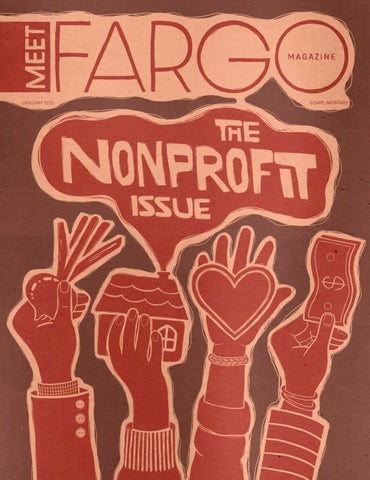
Volume 02 / Issue 13
January 2026
Meet Fargo Magazine is published 12 times a year and is free. Copies are available at more than 500 Fargo-Moorhead locations and digitally at meetfargo.com.
Publisher EDITORIAL Editorial Team Lead Art Director Editorial Graphic Designer Contributor INTERACTIVE Business Development Associate Director of Creative Strategies Web Project Manager Senior Graphic Designer Web Design Agency Project Manager Director of Agency Social Media Senior Digital Advertising Specialis ADVERTISING VP of Business Development Sales Representative
Mike Dragosavich Brady Drake Brady@SpotlightMediaFargo.com Kim Cowles Ty Betts Ashley Morken (Unglued), Amanda Frost (Folkways), United Way of Cass-Clay Kellen Feeney Megan Suedbeck Matthew Haire Sarah Cabler Sara Jentink Mhairi Christopherson Tammy Fogle Paul Hoefer Paul@SpotlightMediaFargo.com Al Anderson Al@SpotlightMediaFargo.com
Business Development Representative
Austin Cuka AustinCuka@SpotlightMediaFargo.com
Business Development Representative
Spencer Hall Spencer@SpotlightMediaFargo.com
Senior Digital Advertising Specialist Client Relations Director of Client Success Marketing Admin Accounting Specialist DISTRIBUTION Delivery
Matt Purpur Matt@SpotlightMediaFargo.com ClientRelations@SpotlightMediaFargo.com Jessica Ventzke Tyler Duclos Missy Roberts John Stuber
Meet Fargo is published by Spotlight, LLC. Copyright 2026 Meet Fargo and meetfargo.com. All rights reserved. No parts of this magazine may be reproduced or distributed without written permission of Meet Fargo and Spotlight, LLC is not responsible for, and expressly disclaims all liability for, damages of any kind arising out of use, reference to, or reliance on such information. Spotlight, LLC accepts no liability for the accuracy of statements made by the advertisers.
Spotlight, LLC 4609 33rd Ave S Suite #304 Fargo, ND 58104 or info@spotlightmediafargo.com ADVERTISING: 701-478-SPOT (7768)
TABLEOFCONTENTS
MEET FARGO // JANUARY 2026
COVER STORY
42
Partner Content:
18 Icon Systems Inc.: National Software, Fargo Roots 20 Native Inc.: A Place to Belong 28 Strive Chiropractic: Fight Sickness From the Inside Out 30 Catholic Charities North Dakota 34 The Village Family Service Center: From Darkness To Hope 38 SCHEELS: Employee Owned & Community Minded
106
76
108
The Nonprofit Issue 44 Giving Hearts Day: Join the Movement 52 How The FM Area Foundation Helps Donors-And Dollars-Do More 64 Detroit Mountain Recreation Area 68 United Way Of Cass - Clay 76 Great Plains Food Bank 90 8 Tips For Donating To The Great Plains Food Bank 98 How To Start A Nonprofit 106 Meet the Maker: There And Back Designs 108 Folkways: How Local Nonprofits Shaped My Sense Of Belonging
FROMTHEEDITOR
GIVING HEARTS DAY G
iving Hearts Day has become one of the most important in the Fargo–Moorhead region because it works. Giving Hearts Day is a largescale exercise in collective responsibility. For 24 hours, individuals, businesses, and organizations are asked to
contribute to the nonprofit infrastructure that supports this community year-round. Nonprofits across the region rely on Giving Hearts Day funding to operate. These dollars help keep shelters open, food programs stocked, mental health services accessible, arts
organizations active, and educational initiatives moving forward. For many organizations, the funds raised are essential. What makes Giving Hearts Day effective is its simplicity. It removes barriers to participation and concentrates attention into a
single day, which encourages many donors to act decisively rather than indefinitely postponing support. It also levels the playing field, giving small and mid-sized nonprofits visibility they may not otherwise receive.
government programs do not cover all community needs. Philanthropy fills critical gaps, often responding faster and more flexibly than larger systems can. Learn More!
Just as important is the role of local businesses and employers. Matching gifts, team fundraising, and public participation reinforce the idea that community health is not the responsibility of nonprofits alone. It is shared. Giving Hearts Day also reflects the broader reality that public funding and
Brady Drake Meet Fargo Editor
Partner Content
Icon Systems Inc. NATIONAL SOFTWARE, FARGO ROOTS By Brady Drake Photo by J. Alan Paul Photography
Icon Systems Inc. has always carried a slightly unusual story for a Fargo tech company because it’s national in reach, but local in posture. In an industry that often feels obsessed with “moving fast” in the abstract, Icon’s growth has been rooted in relationships, trust, and a stubborn commitment to making complicated work feel doable for everyday people.
Building nationally, living locally The company’s leaders talk about roots in North Dakota going back generations, and the way that shapes how they think about work, community, and family. Fargo is where they’ve raised families, built careers, and found a workforce that fits their values. That matters because building a national software company from a mid-sized Midwest city takes a certain kind of grit. It means you don’t rely on hype; you rely on whether the product works and whether customers feel taken care of. Icon has leaned into that. Their growth isn’t about being the loudest player in the space—it’s about being the one people trust when the stakes are real.
Staying connected to community values Icon is deeply tied to the local organizations it serves. Their connection to Fargo and North Dakota is practical, not performative. They build software by listening to churches, nonprofits, and community groups and collecting feedback, taking calls, asking what’s hard, and then shaping features around what those organizations actually need. That loop is a big part of why Icon has stayed relevant. It also keeps the company grounded. When your users are your neighbors, you don’t have the luxury of shipping something half-baked or hiding behind corporate distance. If the software isn’t helping people, you hear about it fast. And Icon seems to see that closeness as a strength, not an inconvenience.
Supporting missions across North Dakota Nonprofits and churches across North Dakota are often doing a lot with a little. They’re running food programs, youth ministries, shelters, community outreach efforts, counseling services, and countless other mission-driven projects with small staffs and tight budgets.
The Icon Systems Inc. team
18 | JANUARY 2026 | MEETFARGO.COM
Icon’s role, as they describe it, is to clear the administrative brush so those groups can do what they’re actually here to do. If the bookkeeping is clean, if donations are tracked correctly, if communication tools are simple, the organization doesn’t get stuck in maintenance mode. Time shifts back toward mission. And when that happens at scale, across towns and cities throughout the state, entire communities benefit.
The biggest challenges nonprofits are facing right now
in, automated thank-you messages can send immediately.
Icon hears the same pain points from organizations everywhere, and North Dakota is no exception: • Costs are rising while resources shrink. Employment costs, overhead, and day-to-day expenses keep climbing, even as many nonprofits are seeing fewer donors and smaller gifts. • Staffing is thin. With budgets tighter, teams are smaller, and the workload doesn’t shrink to match. • Systems are outdated or fragmented. Many organizations still rely on old software or a patchwork of disconnected tools—one for donations, another for accounting, another for communication. That setup wastes time, creates errors, and makes it harder to see the full health of the organization.
Online giving also removes barriers. Donors can give faster, from anywhere, in ways that feel natural to them. When the process is easy and responsive, recurring giving rises, and small gifts become sustainable support over time.
Making day-to-day management easier Icon’s answer is simple on paper and hard to execute well. However, they're able to reduce the friction of running an organization by bringing core functions into one integrated platform—accounting, donations, membership, and communication working together instead of living in separate systems. When those pieces connect, a lot of work disappears: • deposits flow cleanly into accounting • donor records stay accurate • reports mirror reality • staff doesn't have to duplicate entry • leaders can see what’s happening without waiting for someone to stitch together numbers For small and mid-sized organizations, this kind of integration doesn’t just save time. It lowers the mental load. It makes administration feel less like a constant firefight and more like something you can manage.
Changing how organizations connect with donors One of the more visible shifts in nonprofit life over the last decade is how giving happens, and how fast communication needs to be. Icon’s text, email, and online giving tools are built around that reality. Instead of generic campaigns, organizations can tailor outreach by donor, ministry, or community need. Once a gift comes
It’s not flashy. It’s just the kind of infrastructure that helps nonprofits keep donors close, even when life gets busy.
One platform instead of a patchwork Disconnected systems don’t just slow people down, they create risk. A donation recorded in one place but not another, a membership update that never reaches the finance side, a staff member working from a spreadsheet because “that’s how we’ve always done it.” Over time, those gaps cost real money and real trust. Icon’s integrated approach is meant to solve that at the root. One system, one source of truth, fewer errors, and a clearer financial picture. For organizations trying to stay lean, that consolidation alone can feel like hiring another staff member— without the payroll cost.
How readers can try Icon for themselves Icon offers a 30-day free trial with no strings attached. The trial is preloaded with test data, so readers don’t need to set anything up. There’s no payment info required and no auto-subscription waiting at the end. It’s meant to be a true test drive, not a funnel.
Learn more! | iconsystemsinc.com | /IconSystemsInc92 | @iconsystemsinc | /iconsystemsinc
19
A Place to Belong Envisioning A New Cultural Center in Bismarck he idea for a cultural center did not begin with blueprints, fundraising targets, or architectural renderings. It began with lived experience— shaped by disconnection, survival, and the realization that something essential was missing in this community. For Lorraine Davis, that realization came in 2002, as she began her recovery journey in the Bismarck–Mandan area. A young Native American woman, single parent, and survivor of trauma and addiction, Davis was doing everything the system asked of her. She secured housing after a year-long wait. She worked to stabilize her life. She sought help. But when she went looking for something deeper—traditional healing, cultural connection, and identity reclamation—she found there was no place to go for this. “I was looking for a Native space,” Davis said. “An Indian center. A cultural center. A spiritual
20 | JANUARY 2026 | MEETFARGO.COM
leader. Someone who could help guide me when I was ready to walk a good life.” She calls that path Canku Luta—the Red Road. For many Indigenous people in recovery, walking the Red Road means returning to culture, spirituality, and identity as the foundation for healing. But in Bismarck at the time, access to those traditional supports didn’t exist. Treatment programs addressed addiction. Social services addressed rental assistance and employment. But the systems designed to help people heal rarely acknowledged who they were—or where they came from. “I knew I needed to go a spiritual route,” Davis said. “But I didn’t have access to my traditional ways. I was hungry for my identity.” That aspiration for belonging, for cultural connections, for a place where healing and learning could be whole rather than fragmented—became the seed of a vision that would grow over the next two decades.
Founder and CEO Lorraine Davis Photos by J. Alan Paul Photography Renderings by EAPC Architects
Reach out to Lorraine Davis to make a major gift today! lorraine@ndnadc.org 701-557-7313
The five tribes of North Dakota have formally supported this cultural center and the services it provides to serving their off reservation tribal members.
When Systems Treat Symptoms, Not Roots
From Personal Need to Collective Vision
Davis’ experience is not unique. Many Indigenous people navigating poverty, recovery, reentry, or major life transitions describe a similar gap: services that focus on behavior without addressing identity.
That realization did not immediately become a building project. It became a commitment. A commitment made in 2002 by Mrs. Davis. A commitment she has followed through with.
Addiction, incarceration, homelessness, and mental health challenges are often treated as individual failures rather than outcomes of disconnection— disconnection from family, culture, language, land, and community. For Indigenous people, those layers of disconnection are often compounded by historical and intergenerational trauma.
By 2012, Davis began working directly with others facing the same barriers—people leaving incarceration, parents trying to stabilize their families, individuals navigating addiction and mental health challenges, youth searching for identity in environments where they felt invisible or misunderstood.
“When you’re trying to recover,” Davis said, “you start asking yourself, ‘Who am I?’ And if you don’t have access to culture, that question goes unanswered. Leaving us lost."
During her professional experience, again and again, she noticed the same needs being left underaddressed in the community.
Without that support, progress can be fragile. Housing without healing often leads to relapse and rehomelessness. Employment without belonging leads to disatisfaction, emptiness, and an eventual transition elsewhere. Treatment without cultural relevance often fails to reach a deeper sense of self for the people seeking to understand themselves and life. “That’s when I knew,” she said. “If someone wakes up one day and says, ‘I’m done—I want a better life,’ our community needs to be ready to catch them, and guide them and support them through this journey."
People could access pieces of help, but not a holistic approach of services by the people they are familiar with and comfortable with. They could find services, but not community. They could survive—but struggle to heal. And all the while, North Dakota’s urban Native population continued to grow. Today, nearly half of the state’s Native population lives in urban areas. Bismarck is home to the largest and most tribally diverse urban Native community in North Dakota. Yet there remains no dedicated urban cultural center—no permanent, visible place where Indigenous culture, services, and community life intersect. That gap is what Davis is now working to fill.
CONTINUED>
21
The Mission of Native Inc. The proposed Cultural Center in north Bismarck is the next evolution of the work Davis has been building for more than a decade through Native Inc. and the Native American Development Center, but the concept began in 2002 on a hill in Mandan. Native Inc. was founded on a belief that healing is most effective when culture, services, and opportunity are integrated—not siloed. Culture isn't just feathers, arts, crafts, etc. Culture is in the social norms. This is how we create a sense of belonging for all indigenous and all other people. No one is judged. Everyone is believed in. The organization provides behavioral health services, housing stabilization, workforce development, transportation assistance, peer support, and cultural programming. Many of those services are delivered by people with lived experience—individuals who understand the challenges participants face because they have walked similar paths. What Native Inc. has learned is that progress in one area rarely lasts without stability in other areas. It has to be holistically addressed. “You can’t separate the human being into pieces,” Davis said. “We’re not designed that way.” The Cultural Center is designed to reflect that truth—physically, programmatically, and symbolically.
22 | JANUARY 2026 | MEETFARGO.COM
The NATIVE Inc. Vision Statement We are Native Americans within the greater Bismarck Mandan Metropolitan Area. We are respected and appreciated. We are prosperous and healthy families, proud of our Native American heritage. We are respected political and civic leaders. We are well known for our athleticism and healthy lifestyles. Our languages link current generations to the ancient indigenous people who lived in harmony with the earth. Our ancestors’ ancient wisdom instructs us today. We are a courageous people telling the truth about a history of conflict, yet willing to forgive and to reconcile with brothers and sisters. We are a welcoming people, sharing with those new to the community and those who cannot meet their basic needs. We are respectful and generous, and we stand in solidarity with those who seek to improve their lives. Our center helps transform those who feel helplessness and are filled with despair to strong people full of hope.
Culture as a Foundation, Not an Add-On Research supported by the U.S. Department of Health and Human Services identifies culture as a protective factor that promotes well-being and resilience. Cultural traditions, values, and practices have been shown to strengthen family and community connections, support identity development, and buffer the negative effects of trauma and stress, thereby improving outcomes like family stability and youth well-being (Child Welfare Information Gateway, 2025). In prevention frameworks, cultural connectedness is recognized as one of the protective factors that is positively associated with health and social outcomes, including reduced risks for substance misuse and behavioral challenges, especially among American Indian and Alaska Native youth (Substance Abuse and Mental Health Services Administration, 2019). Studies show that stronger cultural identity and participation in traditional practices are associated with improved mental health outcomes, reduced substance use, and greater resilience among Indigenous people. Culture is not simply a heritage—it is a social determinant of health. Yet cultural programming is often treated as optional or ceremonial, rather than foundational. “What’s missing is a place where culture isn’t an event,” Davis said. “It’s part of everyday life for everyone." The Cultural Center is designed to change that dynamic.Rather than offering culture as a standalone activity, the center integrates cultural practices directly into human services—recovery programming grounded in tradition, workforce and
business development informed by Indigenous values, and community gatherings that reinforce belonging. This approach recognizes that healing is not linear and not clinical. It is relational. It happens in community. And for many Indigenous people, it begins by reclaiming identity.
A Space Designed for Belonging At its core, the Cultural Center is about creating a space where Indigenous people feel seen, safe, connected, and welcomed. For indigenous populations, planned features include areas for cultural gatherings, community meetings, educational programming, and traditional practices. It will be a place where elders can teach, youth can learn, families can gather, and individuals in recovery can find grounding. "Indigenous people won't have to leave parts of who they are at the door," Davis said. For many Indigenous people in North Dakota, everyday public spaces are not always experienced as welcoming. Research shows that ongoing discrimination and exclusion can limit participation in community life and affect well-being. A cultural center changes that experience. Designed by and for Indigenous communities, it offers a place where culture, language, and identity are not questioned— but celebrated. Here, Indigenous families enter not as guests, but as hosts. The result is a sense of belonging that strengthens individuals, families, and the broader fabric of our state.
CONTINUED>
23
Movement, Sport, and Everyday Community The Cultural Center is designed to support everyday life as much as long-term healing, and that includes physical activity and recreation. A full basketball court will serve as a gathering place for all youth, adults, and families—offering space not only for organized leagues and open gym time, but for informal connection. “Basketball brings people together,” Davis said. “It’s where relationships start.”
The gymnasium is needed for indigenous populations to revitalize their culture through powwows to encourage wellness through their cultural way of life. Not only are powwows to be shared with the whole community, but the gymnasium is open for the whole community to use for their own recreational and community events. The auditorium, with seating for up to 200 people, will be used to host Indigenous exhibitions shared with all community members. It can also be used by the community to host the various ethnic cultural exhibitions as well. The outdoor amphitheater will be used to host exhibitions during summer months and will also be open for public use.
Kinship:
We are all related. We believe in cultivating social and cultural connections with each other.
NATIVE Inc.'s Values
Culture:
We foster ongoing cultural growth for individuals and families.
Wellness:
We strive to create a place for Native American people to heal and make space for healthy living.
A Space for Spirituality and Healing Equally central to the Cultural Center is spirituality. For Indigenous people, healing is not only physical or mental—it is spiritual. The center will provide a healing room for ceremony, and two sweat lodges for prayer and traditional practices that support recovery, reflection, and balance. These practices are not tied to one path or belief system, but rooted in Indigenous ways of understanding wellness
24 | JANUARY 2026 | MEETFARGO.COM
Education:
We offer community members an opportunity to begin and continue their educational journeys about Native American history, culture, and ways of life.
Community:
We provide a sense of belonging through cultural events, gatherings, services, and advocacy.
as a connection between mind, body, spirit, and community. “For a lot of people, spirituality is what grounds them,” Davis said. “It’s what helps them stay on the Red Road.” By making space for spiritual practice, the center acknowledges that healing looks different for everyone—and that cultural and spiritual identity are essential parts of that process.
A Place for Everyone While the Cultural Center is rooted in Indigenous culture, it is intentionally designed to be inclusive. “This isn’t a closed door,” Davis said. “It’s a place for everyone who comes with respect.” The center welcomes families, elders, youth, and community members from all backgrounds who want to learn, connect, and participate. Cultural events, educational opportunities, and community gatherings are designed to foster understanding and relationship-building across cultures. By opening its doors to the broader community, the Cultural Center becomes a bridge—creating opportunities for shared learning, collaboration, and mutual respect for all cultural ethnicities.
A Community Investment With Broad Impact While the Cultural Center is designed to serve Indigenous people, its impact extends beyond Native communities. Healthier families mean stronger neighborhoods. Stable employment means a stronger workforce. Reduced system involvement eases strain on public resources. “This isn’t just a Native issue,” Davis said. “It’s a community issue.” The center represents a proactive investment—one that prioritizes dignity, prevention, and long-term success over short-term fixes.
CONTINUED>
25
A Hub for Partnership
A Place to Belong
The center will also serve as a hub for connecting participants to the services Native Inc. already provides, while creating opportunities for collaboration with healthcare providers, educators, commerce, and community organizations across the region and state.
At its heart, the Cultural Center answers a simple but profound need.
By centralizing culture for indigenous populations in one place to serve all ages and backgrounds, the ability to address the longstanding impacts of displacement, cultural erasure and the need for healing through shared space, learning and community is powerfully reinforced.
A place to remember who you are.
“We don’t want to duplicate what already exists,” Davis said. “We want to strengthen it.” The center creates a shared space where collaboration is not only possible, but practical.
A place to belong. A place to heal.
A place to build prosperity. For the Indigenous community in the Bismarck region, it represents not just a building—but a promise. And for the region as a whole, it represents the power of investing in people, culture, and community—together.
To learn more, look out for a new webpage! | ndnadc.org
| /NDNATIVEINC | @ndnativeinc | /native-inc-nd
26 | JANUARY 2026 | MEETFARGO.COM
Partner Content
Fight Sickness from the Inside Out
By Dr. Jake Grinaker, Owner, Strive Chiropractic
Every year, “sick season” rolls in, bringing with it coughs, fatigue, and the endless cycle of missed work/school days and low energy. Most people intuitively double down on vitamins, rest, and hand sanitizer, but what if your strongest immune advantage isn’t in a bottle, but in your body’s own design?
The Hidden Link Between Your Spine and Immunity
alignment and improving nervous system function, chiropractic adjustments help your immune system stay sharp, balanced, and ready to defend.
Your spine isn’t just about posture; rather, it is your body’s communication hub. Through it runs your nervous system, the control center that tells every organ, cell, and immune response what to do. When your spine is not correctly aligned, the signals from your nervous system are disrupted. This interference impacts your body’s ability to adapt to stress and fight off illness, among many other things.
Less Stress, More Defense
This is why more and more people are turning to chiropractic care, not just when back pain arises, but for maintaining overall wellness. By restoring spinal
One of the biggest threats to immunity isn’t germs, it’s chronic stress. High stress levels trigger inflammation and suppress the immune response. Regular chiropractic care can help your body manage stress more effectively by promoting balance and stability within the nervous system. When your brain and body are in sync, your immune system can do its best work.
Simple Ways to Stay Strong This Season Stay consistent:
Regular adjustments keep your nervous system clear and responsive.
Sleep deep:
Recovery happens at night. Give your body the rest it needs.
Hydrate and move:
Circulation helps immune cells reach where they’re needed most.
Lower stress:
Prayer, gratitude, and breathing routines complement chiropractic care beautifully.
Your Body Was Built to Heal Chiropractic care doesn’t “fight” germs. It empowers your body to do what it was created to do: heal, adapt, and stay strong. This season, take care of your spine, and you just might find your immune system returning the favor.
| strivechiropractic.com 28 | JANUARY 2026 | MEETFARGO.COM
| /striveFargo
| @strivechiropractic
By Brady Drake
PARTNER CONTENT
Catholic Charities North Dakota atholic Charities North Dakota serves individuals and families across the state with compassion, dignity, and respect, offering a wide range of programs designed to support people through life’s most complex challenges. From guardianship and adoption services to counseling, pregnancy and parenting support, and community resource assistance, the organization's work is rooted in advocacy, care, and empowerment. Open to all regardless of faith, background, or ability to pay, Catholic Charities North Dakota is committed to strengthening individuals, families, and communities by helping people build stability, independence, and hope for the future.
Guardianship Division: Intellectual Disabilities
Guardianship Services: Vulnerable
Catholic Charities North Dakota serves individuals and families across the state with compassion, dignity, and respect, offering a wide range of programs designed to support people through life’s most complex challenges. From guardianship and adoption services to counseling, pregnancy and parenting support, and community resource assistance, the organization's work is rooted in advocacy, care, and empowerment. Open to all regardless of faith, background, or ability to pay, Catholic Charities North Dakota is committed to strengthening individuals, families, and communities by helping people build stability, independence, and hope for the future.
The Guardianship Services – Vulnerable program, offered by Catholic Charities North Dakota, is dedicated to supporting vulnerable elderly individuals and adults with mental health challenges or other vulnerabilities who lack appropriate sources of support. The program provides guidance and advocacy to help these individuals make informed, person-centered decisions, emphasizing dignity, health, and safety. Guardianship may be general, limited, emergency, or successor, depending on the needs and legal circumstances of the individual. The service is available to all North Dakota residents, regardless of religion, race, age, or ability to pay, and is established through a legal process involving the courts and attorneys.
328 children were adopted through Adults Adopting Special Kids in 2024-2025.
30 | JANUARY 2026 | MEETFARGO.COM
In 2024-2025, Guardianship Workers in the Guardianship Division for Adults with Intellectual Disabilities traveled 94,232 miles to visit and provide care to their clients.
In 2024-2025, the Pregnancy Parenting and Adoption Services program served 1,423 individuals in need through their Bundle Up Your Baby Bump events.
DID YOU KNOW?
Catholic Charities North Dakota serves the entire state, with offices stretching from Beach to Fargo. For communities without a physical location, we offer convenient telehealth services. Wherever you live in North Dakota—rural or urban— we’re here to support you.
Adults Adopting Special Kids The AASK (Adults Adopting Special Kids) program, operated by Catholic Charities North Dakota, is dedicated to building permanent, nurturing families for children in foster care through adoption. The program focuses on recruiting and preparing families to adopt children who have experienced trauma, abuse, or neglect, and who may have physical, emotional, or psychological challenges. AASK works in partnership with the North Dakota Department of Health and Human Services, Tribal entities, and other states to deliver adoption services. Families interested in adopting are guided through a comprehensive process that includes training and education, application and background checks, and a thorough assessment to help determine preparedness for adoption. The program also provides post‑adoption support through the ND Post Adopt Network for families who have adopted from foster care, as well as families who have adopted infants or children domestically or internationally. It also offers support to guardianship families. AASK’s mission is to ensure every child finds a stable, committed, and permanent family, emphasizing patience, commitment, flexibility, and trauma-informed care.
the state. Licensed social workers guide individuals experiencing an unexpected pregnancy through the decision-making process, providing education and resources for the options of parenting and adoption. The program ensures a non-judgmental environment, empowering women to make the best choice for their baby. Women choosing adoption can select the adoptive family and determine the level of openness they would like post-adoption. Services include counseling, help with basic needs, and referrals for community resources. The PPAS program supports families throughout the state looking to expand their family through adoption, offering comprehensive services, including family assessments, placement, post-placement follow-up, and birth parent counseling. Families can choose from domestic adoption programs in North Dakota or across the United States as well as international or identified adoption options. Our individualized approach ensures that each family receives education, assessment, and support tailored to their unique adoption journey, welcoming people of all faiths. Additionally, Catholic Charities North Dakota offers postadoption search and disclosure services, helping adopted adults, birth parents, and siblings seek information or contact. The process respects privacy and includes both non-identifying and identifying search options. Ongoing support is provided throughout the search and disclosure process.
Counseling
Community Resource Assistance
Catholic Charities North Dakota offers comprehensive counseling services to individuals, couples, children, and families across North Dakota, including both in-person and telehealth options. Our approach is holistic and strengthsbased, empowering clients to address life’s challenges and achieve personal growth. Services include play therapy, therapy for children and adolescents, individual and couples counseling, family therapy, marriage enrichment, mindfulness/self-care, and more. The program is open to all, regardless of religion, race, age, gender, or ability to pay, with flexible payment options.
The Community Resource Assistance program at Catholic Charities North Dakota offers support to North Dakota residents experiencing hardship. Led by the Community Resource Coordinator, the program provides information and referrals to a wide range of community resources, helping individuals connect with services that address their needs. The coordinator serves as a point of contact for those seeking guidance, ensuring that citizens can access available assistance efficiently.
Pregnancy Parenting and Adoption Services The Pregnancy, Parenting, and Adoption Services (PPAS) program at Catholic Charities North Dakota offers compassionate support to women and families across
Learn More!
| catholiccharitiesnd.org | /catholiccharitiesnd | /catholic-charities-north-dakota
31
From Darkness to Hope
Casey’s Journey Toward Healing By The Village Family Service Center Photos submitted by The Village Family Service Center
M
Meet Casey, a man in his 30s living in the Fargo-Moorhead area. After facing a difficult breakup, he encountered incredibly dark thoughts that led to a pivotal moment in his life, a suicide attempt. Thankfully, that attempt was not successful and became the catalyst for a new chapter filled with healing and hope.
Seeking help can be scary and difficult. With encouragement from a friend and thorough research, Casey discovered The Village Family Service Center’s Intensive Outpatient Program (IOP). This program offers evidence-based tools for healing through both group and one-on-one mental health sessions. When Casey began his IOP journey, he showed many signs of depression, feeling aimless, stuck, and unable to imagine a future. That began to change within the first couple of weeks. Casey absorbed the skills shared by the program’s clinicians and began implementing them in his daily life, starting a journey of personal transformation. “Before I started IOP, I really didn’t see a future for myself. The more I was in the program, the further I could see the future I wanted to build for myself,” Casey shared.
34 | JANUARY 2026 | MEETFARGO.COM
partner content
About The Village Family Service Center
The Village Family Service Center provides compassionate, evidence-based mental health and family services designed to help individuals and families navigate life’s challenges. Serving communities across North Dakota and Minnesota, The Village offers counseling, intensive outpatient care, and support programs for people of all ages. With a commitment to creating a welcoming, judgment-free environment, The Village partners with clients on their journey toward healing, resilience, and hope—because no one should have to face life’s hardest moments alone.
By August 2025, Casey graduated from the program. Today, he lives with renewed hope and a positive outlook on life. Community support is at the heart of stories like Casey’s. By supporting The Village Family Service Center, you make it possible for individuals to access lifechanging care. Care that goes beyond one individual and helps support families, workplaces, and communities. “At The Village Family Service Center, our goal is to enhance the lives of those we serve. We strive to create a welcoming, judgment-free environment to support healing,” Development Director Amanda Nordick said.
Life is hard, but at The Village, we are honored to walk beside anyone who needs support. Watching individuals grow, heal, and reclaim their lives is something we never take for granted. Casey’s journey is one of many that show that with the right support, transformation is possible.
The Village Family Service Center | thevillagefamily.org | /thevillagefamily | @thevillagefsc
Support The Village This 35
38 | JANUARY 2026 | MEETFARGO.COM
39
42 | JANUARY 2026 | MEETFARGO.COM
43
Join the Movement Every February, something special happens across North Dakota and beyond. Families talk about where they want to give. Coworkers rally around causes they care about. Students organize drives, volunteers show up in red, and neighbors support neighbors in ways both big and small. This is Giving Hearts Day. It brings thousands of people together around a shared purpose: supporting the local nonprofits that make our communities stronger, more connected, and more compassionate. Giving Hearts Day isn’t just about one day on the calendar. It’s about who we are, what we value, and how kindness grows when we choose to show up together.
An annual day of giving that supports hundreds of local nonprofits working across nearly every area of community life. From food pantries and shelters to arts organizations, schools, health services, animal rescues, and more, Giving Hearts Day connects people to causes that matter close to home. Since its start in 2008, Giving Hearts Day has raised more than $200 million for nonprofits across
44 | JANUARY 2026 | MEETFARGO.COM
the region. That support fuels programs, fills gaps, and helps organizations continue their work long after the day itself has passed. But it's about more than dollars raised. It’s about participation. It’s about shared momentum. It’s about creating a moment when generosity feels possible, accessible, and meaningful for everyone.
$200 MILLION Since its start in 2008, Giving Hearts Day has raised more than $200 million for nonprofits across the region.
Local nonprofits do essential work every day. They provide food, care, shelter, creativity, education, and connection. Often, they do it quietly—meeting needs most people never see. Giving Hearts Day helps make that work visible. It gives nonprofits a platform to tell their stories, connect with supporters, and receive the resources they need to keep showing up for their communities.
It also matters because of how it brings people together. When thousands of people give on the same day, something shifts. Giving becomes contagious. Conversations start. Pride grows. People are reminded that even small actions—when taken together—can create real change. Generosity grows when we practice it together.
You don’t have to give in a single, specific way. Instead, there are many entry points— so everyone can participate in a way that fits their life. Some people give financially. Others volunteer their time. Many host goods drives, spread the word, or encourage their workplace or school to get involved. All of it matters. You don’t need to give a lot. There is no wrong way to participate. What matters most is choosing to take part.
CONTINUED> 45
Donating is one of the most direct ways to participate. Individuals can support one nonprofit or several, depending on what resonates with them. Some give in honor of someone they love. Others involve their children and turn the decision into a family conversation. Businesses often choose to match employee donations or provide Giving Hearts Day gift cards, empowering team members to support causes that matter personally to them.
Many nonprofits welcome volunteers around Giving Hearts Day. Volunteering offers a hands-on way to connect with a cause and see impact firsthand. Even a short time commitment can make a meaningful difference.
Goods drives turn generosity into something tangible. Schools, businesses, and community groups collect items nonprofits have specifically requested—like hygiene products, winter gear, school supplies, or food. These drives help meet immediate needs while bringing people together around a shared goal.
Sharing Giving Hearts Day is powerful. A post, a conversation, or an invitation can spark participation from someone who may not have known about the day otherwise. Awareness builds momentum, and momentum builds impact.
46 | JANUARY 2026 | MEETFARGO.COM
Giving looks different depending on where it shows up—and that’s part of what makes it work. For families, it often becomes a tradition. Parents involve their kids in choosing causes, talking about values, and learning what it means to care for others. These moments help shape how young people understand generosity and community. In schools, students lead. Goods drives, fundraising challenges, and service projects give students a chance to see that their actions matter. Giving Hearts Day becomes a lesson in empathy, leadership, and collective impact. In workplaces, Giving Hearts Day builds culture. When businesses participate, they show employees that generosity is part of who they are—not just what they do. Teams connect around shared purpose, and employees feel pride in supporting both their workplace and their community. Strong communities are built when families, schools, and businesses all take part.
CONTINUED>
While the day happens annually on the second Thursday of February, its impact reaches far beyond a single date. The funds raised help nonprofits plan, grow, and respond to needs throughout the year. The relationships built between donors, volunteers, and organizations continue. The conversations sparked around generosity don’t end when the day does. It’s a movement. A reminder of what’s possible when people choose to give together.
The purpose remains clear: to strengthen communities through generosity. The movement continues to be shaped by the people who show up—by families making giving part of their story, by students leading with heart, by businesses investing locally, and by nonprofits serving with dedication. Each year adds to the impact. Each participant adds to the momentum. Kindness isn’t a moment. It’s a movement. And Giving Hearts Day is one way that movement comes to life.
48 | JANUARY 2026 | MEETFARGO.COM
Whether this is your first Giving Hearts Day or one of many, there’s a place for you. Give if you’re able. Volunteer if you can. Bring one item. Invite one person. Choose one cause that matters to you. When we give together, the impact multiplies. To explore participating nonprofits, find ways to get involved, or learn more, visit:
| givingheartsday.org | /givingheartsday | @givingheartsday
Helps Donors—and Dollars—Do More By Brady Drake
The FM Area Foundation plays a role unlike any other nonprofit in Cass and Clay counties. While many organizations focus on delivering services or strengthening nonprofit operations, the Foundation’s mission is centered helping people become better, more intentional philanthropists. “We strive to be the voice of philanthropy in this community,” President of the FM Area Foundation Eric Wilkie said. “At our core, we work with citizens to promote giving by helping them give back in ways that are smart, impactful, and meaningful for both the community and themselves.” As one of roughly 1,000 community foundations nationwide—and the oldest and largest in the region—the FM Area Foundation has spent more than six decades cultivating deep knowledge. That perspective allows the organization to act as a trusted guide, helping donors navigate the increasingly complex intersection of generosity, tax strategy, and long-term community impact.
The FM Area Foundation Team Photo provided by Eric Wilkie 52 | JANUARY 2026 | MEETFARGO.COM
A Different
Unlike most nonprofits, the FM Area Foundation does not primarily serve clients or provide direct programming. Instead, it works upstream by partnering with individuals, families, financial advisors, and attorneys to help donors structure their giving in ways that maximize both impact and sustainability. “Other nonprofits are working directly with people who need services, or they’re helping nonprofits become stronger organizations,” Wilkie said. “We work with citizens. Our job is to help people figure out how to give back—and how to do it well.” In a region with more than 2,200 nonprofits across Cass and Clay counties, donors are often overwhelmed by choices. Many want to give generously but aren’t always sure where their dollars will do the most good, or how to align their giving with personal values, family goals, and long-term planning. That’s where the Foundation steps in. One of the FM Area Foundation’s core strengths is its ability to simplify charitable giving without sacrificing intentionality. Through donor-advised funds, designated funds, endowed funds, and other charitable vehicles, the Foundation provides what Wilkie describes as a “one-stop shop” for philanthropy. Donors can make a single charitable contribution—often during a year when itemizing makes the most financial sense—receive the full tax benefit, and then take their time distributing grants to nonprofits over months or even years. “For many people, it’s about flexibility,” Wilkie said. “They may have a year where they sell a business, receive an inheritance, or realize significant capital gains. They want to be thoughtful about giving—but they don’t want to give everything away all at once.” By housing those funds at the Foundation, donors can invest charitable dollars, allow them to grow over time, and create predictable, annual support for the organizations they care about most. In some cases, families establish legacy or endowed funds designed to give forever—spending only the investment growth while preserving the principal. “It becomes a long-term, thought-out way to give,” Wilkie said. “And it’s often something families can pass down to the next generation.”
Philanthropy
That generational component is central to the Foundation’s work. Many donors use their funds as a way to teach children and grandchildren about generosity, stewardship, and local responsibility. After Wilkie's father passed away, the family established a memorial fund rather than receiving flowers or other traditional tributes. “Now my kids—his grandkids—will decide each year where to give in honor of their grandpa,” Wilkie said. “It keeps his memory alive, but it also helps them understand why giving back matters.” This kind of intentional philanthropy is increasingly important as wealth transfers between generations. The Foundation helps families formalize their giving in a way that reflects shared values while remaining adaptable to future needs. Donor dollars flow anywhere, and impact causes these families care about all over, but because those funds are housed locally, the likelihood that dollars stay in the FargoMoorhead area increases significantly. “When people made their living here, built their businesses here, and raised their families here, keeping those dollars local really matters,” Wilkie said. “Eating local, shopping local, giving local—it all strengthens the community.”
55
Connecting Passion
While donor intent always comes first, one of the FM Area Foundation’s most valuable roles is helping donors understand where needs are greatest—especially when circumstances change quickly. When shifts in public policy or economic conditions affect vulnerable populations, the Foundation is often among the first to see the ripple effects locally. During periods of uncertainty around SNAP benefits and food insecurity, for example, the Foundation didn’t just make grants— it proactively reached out to fundholders. “We’ll say, ‘If you’re looking for impactful places to give this year, here are organizations that are really making a difference right now,’” Wilkie said. “A lot of donors appreciate that guidance. They want to give smart. They want to know their dollars are being used wisely and locally.” That role—as a philanthropic advisor—mirrors what financial professionals do in other areas of life. Donors turn to the FM Area Foundation not just to facilitate giving, but to ensure it has maximum reach. “People work with financial advisors to make sure their money is working as hard as possible,” Wilkie said. “This is the same idea, but just applied to generosity.”
Grantmaking Beyond donor-advised giving, the FM Area Foundation also plays a critical role in direct grantmaking. Each year, the Foundation distributes between $7 million and $10 million to nonprofits, depending on donor activity. Of that, approximately $500,000 is awarded through a competitive annual grant round open to nonprofits in Cass and Clay counties. The process is intentionally accessible. Applications open in the spring, are completed online, and are designed to take no more than an hour. “We try to make it easy,” Wilkie said. “Nonprofits are busy doing the work. The last thing we want is an overly burdensome process.” Grants are awarded in five broad areas: • Basic human needs • Women and children • Education • Arts and culture • Community building Basic human needs represent the largest funding pool, reflecting the Foundation’s commitment to addressing essential services and complex social challenges. Roughly 90 nonprofits receive grants each year, with awards ranging from a few thousand dollars up to about $15,000. Importantly, grants are not limited to special projects. “We do fund general operating,” Wilkie said. “We encourage that, because nonprofits are businesses. They have real overhead costs, and supporting those costs is often what allows them to do their work effectively.” For donors, the Foundation’s grantmaking provides assurance. When a nonprofit receives a grant from the FM Area Foundation, it signals fiscal responsibility, operational stability, and mission alignment. That vetting process becomes invaluable for fundholders deciding where to direct their own giving. “If we’ve taken the time to understand an organization, review their budgets, and grant to them, that’s often a strong indicator for donors,” Wilkie said. “It helps them feel confident that their money is going to a good investment.” This trust is foundational to the FM Area Foundation’s role as a connector that links community needs, nonprofit capacity, and donor generosity.
57
Meeting Donors
As philanthropy grows more complex, the FM Area Foundation continues to look for ways to meet donors with practical, accessible tools. One of the organization’s newest initiatives is the launch of an AI-powered resource on its website called FM Phil—a digital guide designed to help individuals explore charitable giving options with confidence. “For some people, philanthropy can feel intimidating,” Wilkie said. “They may have questions they don’t even know who to ask, or they might feel silly bringing them up. AI gives them a safe, easy way to start that conversation.” Through FM Phil, users can ask questions about donating appreciated stock, maximizing deductions in a particular tax year, or understanding the differences between various charitable funds. The tool doesn’t replace professional advice, but it helps donors become better informed—often serving as the first step toward more intentional giving. “It’s about removing barriers,” Wilkie said. “The easier it is to understand your options, the more likely you are to give— and to give well.”
58 | JANUARY 2026 | MEETFARGO.COM
Beyond
In a community that rallies powerfully around Giving Hearts Day each February, the FM Area Foundation fully embraces the momentum of that annual event. Each year, the Foundation helps channel six figures in gifts from fundholders to Giving Hearts Day nonprofits. But Wilkie is quick to point out that oneday generosity, while important, is only part of the philanthropic picture.
At its heart, the FM Area Foundation’s mission is about stewardship of resources, relationships, and the community itself. By offering guidance, structure, and long-term vision, the organization helps ensure that generosity doesn’t just happen—but that it lasts. “For families who’ve built their lives here, keeping that connection to community through philanthropy is incredibly powerful,” Wilkie said. “It’s about making sure the next generation understands where they came from—and how they can give back.” As Fargo-Moorhead continues to grow, the FM Area Foundation remains a steady presence behind the scenes— quietly guiding generosity, strengthening nonprofits, and helping local dollars do the most good possible.
“Giving Hearts Day is fantastic,” he said. “It brings awareness and participation. But for people who are looking to make a long-term, intentional impact—and to involve their families in that process— we’re the best solution.” The Foundation’s work is designed for donors thinking beyond a single campaign or calendar year. It’s for those who want to create lasting support structures for nonprofits, plan multi-year giving, or establish family legacies tied to the Fargo-Moorhead community.
| areafoundation.org | /fm.areafoundation | @fmareafoundation | /fmareafoundation
60 | JANUARY 2026 | MEETFARGO.COM
N I A T N U O M T I O R DET A E R A N O RECREATI Photos provided
You can even go tubing at Detroit Mountain!
You can find at least one troll on Detroit Mountain!
64 | JANUARY 2026 | MEETFARGO.COM
n Recreation Area
by Detroit Mountai
Detroit Mountain Recreation Area is a community-driven nonprofit dedicated to making outdoor recreation accessible, inclusive, and inspiring for people of all ages and abilities. As a year-round hub for skiing, snowboarding, and Nordic recreation, Detroit Mountain blends natural beauty with a mission rooted in opportunity, wellness, and community connection. Through strategic partnerships with local nonprofits, schools, and civic organizations, Detroit Mountain works to remove financial and social barriers to outdoor access while making sure that cost, experience level, or ability never stand in the way of enjoying the outdoors. This article highlights Detroit Mountain Recreation Area and several of the partners that help expand its impact across the Detroit Lakes region.
Did you know? Detroit Mountain is one of only three lift-servede downhill mountain bik parks in Minnesota!
Bike rentals available.
The Partnership: Adaptive Access & Inclusive Recreation Detroit Mountain Recreation Area partners with Hope Inc. to help ensure individuals with disabilities can fully participate in winter recreation. Through this partnership, Detroit Mountain provides free ski tickets to all Hope Inc. participants, as well as complimentary access for the volunteers who accompany and support them on the slopes. This collaboration removes financial barriers while creating a welcoming, inclusive environment where participants can experience the joy, confidence, and freedom that come with outdoor recreation.
About Hope Inc. Hope Inc. is a Detroit Lakes–based nonprofit dedicated to supporting individuals with developmental and intellectual disabilities through inclusive programs, skill-building opportunities, and meaningful community experiences. By fostering independence, confidence, and connection, Hope Inc. helps participants engage more fully in community life—including recreational opportunities like skiing and outdoor activity. Their partnership with Detroit Mountain exemplifies how recreation can be a powerful tool for empowerment and belonging.
| hopeinc.org | /HOPEIncAdaptivesports
> D E U N I T N CO 65
The Partnership: Community Art, Tourism & Placemaking Detroit Mountain Recreation Area is home to several eye-catching and imaginative public art installations made possible through a financial and strategic collaboration with Project 412. This partnership brought one of Project 412’s iconic troll sculptures to the mountain. These installations enhance the visitor experience while positioning Detroit Mountain as a unique cultural and recreational destination for both locals and tourists.
About Project 412 Project 412 is a creative placemaking organization known for bringing large-scale, whimsical art installations to communities as a way to encourage exploration, tourism, and connection to place. By blending art, nature, and community engagement, Project 412 helps create memorable public spaces that invite people to slow down, look closer, and experience their surroundings in new ways.
| project412mn.org | /Project412MN | @project412mn | /project-412-mn
66 | JANUARY 2026 | MEETFARGO.COM
Long Leif Troll by Thomas Dambo
Trail located in Mountain View Rec Area
The Partnership: Youth Development & Outdoor Access Detroit Mountain Recreation Area partners closely with the Detroit Lakes Nordic Ski Club, a not-forprofit community club dedicated to expanding access to Nordic skiing. Through this collaboration, the Nordic Ski Club has use of Detroit Mountain’s lodge space and Nordic ski trails at no cost, allowing the club to host practices, events, and gatherings without financial strain. The partnership also provides free trail access for club members, including the Detroit Lakes High School Nordic ski team, supporting youth development, athletic growth, and lifelong engagement in outdoor recreation.
About the Detroit Lakes Nordic Ski Club The Detroit Lakes Nordic Ski Club promotes cross-country skiing as a healthy, accessible, and community-building activity for skiers of all ages and skill levels. Through youth programs, school teams, and recreational opportunities, the club encourages outdoor activity, teamwork, and appreciation for winter sports while helping build a strong local Nordic skiing culture.
| dlxcski.com | /dlxcski
For nearly 100 years, United Way of Cass-Clay has been entrusted to lead how our community comes together to solve our region’s toughest challenges. We know that many of our neighbors are working hard to build stable lives, yet still encounter barriers to success. Families face challenges like access to food, housing, quality childcare, transportation, mental health, and the community resources needed to thrive. Built by the community and for the community, United Way exists on the belief of this simple idea: when we unite, we achieve more than any one organization can alone. First, United Way listens to gather data and insights about our community’s needs and what it will take to create better outcomes. This information guides a set of bold community goals designed to address root causes, not just immediate needs. Then, we bring together partners across nonprofit, business, and public sectors. Collaboration is part of our identity, and it ensures that investments made by donors, partners, and volunteers directly fuel measurable, lasting change right here at home. These Verified Impact Partners listed below work with United Way, each other, and the community to create measurable and lasting social change. Receiving a United Way grant means these nonprofits are the best at what they do. These programs were carefully reviewed by the community, evaluated financially, and aligned with United Way’s mission—that's what makes them “verified.”
B y t h e U n i t e d Way o f C a s s - C l ay
Together, we believe that all families and children should have food and housing that meet their basic needs. We believe children can thrive when they are ready to learn and succeed in school and life. And ultimately, families can build resilience and find pathways to prosperity. Together, these nonprofits work toward three bold goals designed to lift families out of poverty across Cass and Clay Counties.
Prevent Hunger and Homelessness Prevent hunger and homelessness for families and children through collaborative system-wide initiatives that provide food and stable housing.
68 | JANUARY 2026 | MEETFARGO.COM
69
P r e pa r i n g C h i l d r e n to Succeed Support children from cradle to career, ensuring they start kindergarten ready and graduate prepared for their future.
70 | JANUARY 2026 | MEETFARGO.COM
S t r e n g t h e n i n g Fa m i l i e s Helps families increase employment, income, and access to mental health and social support to lift families out of poverty.
72 | JANUARY 2026 | MEETFARGO.COM
73
GREAT PLAINS FOOD BANK As North Dakota and western Minnesota continue to face rising food insecurity, the Great Plains Food Bank stands at the center of a vast, quietly powerful network working to ensure no neighbor goes hungry. As the region’s only food bank, Great Plains Food Bank partners with hundreds of local nonprofits, food pantries, shelters, and community organizations to distribute nutritious food to families, seniors, and children across more than 40 counties. Beyond simply moving food, the organization plays a critical coordinating role—leveraging large-scale sourcing, nutrition programs, and community partnerships to strengthen the capacity of frontline nonprofits and expand access to healthy meals. This article takes a closer look at the Great Plains Food Bank and some of the nonprofit partners Great Plains Food Bank uses to carry out its critical mission.
FARM IN THE DELL
FARM IN THE DELL OF THE RED RIVER VALLEY The Partnership: CNH Industrial’s Case IH plant in Fargo has a commitment to “feed their own backyard” by partnering with local organizations that grow and distribute food. In these efforts, Great Plains Food Bank partners with Farm in the Dell to plant, maintain, and harvest fresh vegetables to then distribute to neighbors in need. Scan the QR Code to learn more!
76 | JANUARY 2026 | MEETFARGO.COM
About Farm in the Dell of the Red River Valley Farm in the Dell of the Red River Valley is a unique nonprofit dedicated to providing meaningful agricultural and therapeutic experiences for individuals with developmental disabilities. By combining hands-on farming, gardening, and animal care with vocational training, the organization fosters independence, skill-building, and personal growth. Participants have the opportunity to engage in real-world farm work, develop social connections, and contribute to the local food system, all within a supportive and inclusive environment.
Through its programs, Farm in the Dell not only nurtures confidence and self-sufficiency but also strengthens ties between the community and individuals with disabilities, creating a space where everyone can thrive.
| farminthedellrrv.org | /farminthedellrrv | @farminthedellrrv
PARTNERSHIP TYPES Most partnerships with the Great Plains Food Bank fall under a number of categories. Including:
RETAIL RESCUE PARTNERS The Great Plains Food Bank's Retail Rescue Initiative is when a grocery store, retailer, or food business donates safe, surplus food to the Great Plains Food Bank instead of sending it to waste. Through this partnership, food such as fresh produce, dairy, bakery items, and shelf-stable items is recovered and redistributed to local food pantries and meal programs. Retail Rescue partners play a critical role in reducing food waste, strengthening local communities, and helping ensure more families have access to nutritious food.
PARTNER FOOD PANTRYS
THE GREAT NORTH POLE The Partnership: The Great Plains Food Bank is able to use its purchasing power as a food bank to provide bulk food at a discounted rate for The Great North Pole's annual giving event that takes place in December. About the Great North Pole The Great North Pole is a 501(c) (3) nonprofit based in West Fargo, dedicated to supporting children and families in need in Cass and Clay Counties, especially during the holiday season. The organization partners with generous donors, corporate sponsors, schools, local nonprofits, and hundreds of volunteers to assemble and distribute “Helpful Holiday Boxes” filled with essential items—including winter clothing, personal care products, food, and gifts—to families facing financial stress. Their work aims to provide warmth, reduce the burden of seasonal expenses, and help families experience the joy and spirit of Christmas. The Great North Pole’s efforts also include fundraising events like an annual gala and communitywide initiatives that expand their impact across the region each December.
| thegreatnorthpole.org | /theGreatNorthPole | @thegreatnorthpole
A Great Plains Food Bank partner food pantry is a trusted, community-based organization that works alongside the organization to ensure neighbors have consistent access to nutritious food. These pantries serve individuals and families facing food insecurity by offering food distribution in their local communities. Through this partnership, a pantry receives access to food, resources, and support.
KITCHEN COALITION PROGRAMS Kitchen Coalition serves up well-balanced, freshly prepared meals and a whole new way to fight hunger. We know that not everyone facing hunger has the home, health, or ability to use the groceries our food bank or partner pantries offer. The Great Plains Food Bank has partnered with a few local restaurants and caterers that turn food bank ingredients into nutritious, freshly prepared meals to be delivered to community partners that help distribute to neighbors.
MEAL SITE PARTNER A Great Plains Food Bank meal site partner is a community organization that prepares and serves free, nutritious meals to neighbors facing food insecurity. Working in partnership with the Great Plains Food Bank, meal sites receive food and support to help provide welcoming, reliable meal services in community settings. These partners help ensure neighbors have access to ready-to-eat meals while fostering connection, dignity, and care within their communities.
POP-UP DISTRIBUTIONS Pop-up distributions bring fresh and shelf-stable food to locations across the metro area to support partner pantries in the demand for food access. These drive-through events are open to everyone, where volunteers load a variety of food items that may include shelf-stable items, produce, dairy, meat, and more directly into your vehicle. A Pop-Up Pantry champion is a community organization, school, or business that provides space and local support for a temporary food distribution in partnership with the Great Plains Food Bank. Champions help identify local needs, promote the event, and assist with ensuring the event is successful.
77
A PLACE FOR HOPE WEST FARGO EATS The Partnership: Partner Pantry + Retail Resuce Receiver About West Fargo Eats West Fargo Eats is a collaborative hunger‑relief nonprofit that brings dignity, choice, and food security to individuals and families facing food insecurity in West Fargo and the surrounding region. What began in 2020 as a seasonal pop‑up food pantry out of a refrigerated truck has grown into a permanent Food Share Alliance, formed through a partnership between Lutheran Church of the Cross, Gate City Bank, YWCA Cass Clay, and the Great Plains Food Bank. West Fargo Eats offers a shopping‑style pantry experience, drive‑thru distributions, and monthly food distributions that include nutritious staples like canned goods, fresh produce, dairy and protein items, and hygiene products—all provided with respect and empowerment for the community it serves. Volunteers and partner support help make food access more equitable, and the organization continues to meet growing needs with outreach, retail rescue pickups, and community engagement throughout the year.
The Partnership: Partner Pantry + Retail Rescue Receiver About A Place For Hope A Place For Hope in the Fargo‑Moorhead area is a community‑based nonprofit that offers vital support to individuals and families experiencing food insecurity and social isolation. Best known locally for its food shelf, the organization provides scheduled food distributions—serving hundreds of families and thousands of pounds of groceries each month—to help neighbors facing financial hardship supplement their household needs. In addition to food assistance, A Place For Hope hosts a recovery and wellness center where adults can find social support, life enrichment activities, and opportunities to build connections in a welcoming environment. This includes peer mentoring, educational resources, and access to basic necessities like snacks, household goods, and hygiene items, all aimed at enhancing overall well‑being and reducing isolation.
| aplace4hope.org | /thesocialconnextion
| lcc-wf.com/west-fargo-eats | /westfargoeats
DON'T FORGET ABOUT FILL THE DOME! Fill The Dome is a long‑standing, student‑driven hunger‑relief initiative in the Fargo‑Moorhead area that brings the community together each fall to combat food insecurity. Launched in 2007 by the Metro Area Student Ambassadors, the event began with a bold goal: cover the floor of the FARGODOME with donated food to benefit local families in need. Over nearly two decades, more than 50 area schools have participated, collecting millions of pounds of non‑perishable food and raising substantial funds that support the Great Plains Food Bank’s mission to fight hunger across the region. In addition to food and monetary donations, Fill The Dome raises awareness about local hunger needs and empowers young leaders to make a tangible impact, with collected items distributed through food pantries, direct community distributions, and partner agencies. 78 | JANUARY 2026 | MEETFARGO.COM
NEW LIFE CENTER The Partnership: Partner Meal Site + Retail Rescue Receiver About New Life Center New Life Center is a long‑standing Fargo nonprofit mission dedicated to helping men experiencing homelessness and crisis move from surviving to thriving through a combination of emergency services, community support, and transformational programs. Founded in 1907, the organization offers daily free meals, an emergency shelter, case management, life‑skills and recovery programs, and housing assistance rooted in compassion and the love of Christ. In addition to direct care services, New Life Center’s work includes specialized support such as long‑term recovery programs, veteran housing assistance in partnership with the Fargo VA, and opportunities for community engagement through volunteer roles and its thrift store, New Life Center Thrift Store, which helps fund its mission while offering affordable goods.
| fargonlc.org | /FargoNLC | @fargonlc
YMCA OF THE NORTHERN SKY The Partnership: Pop-up Pantry Champion About the YMCA of the Northern Sky YMCA of the Northern Sky is a nonprofit community organization dedicated to strengthening the spirit, mind, and body of individuals and families across the Fargo‑Moorhead‑West Fargo region and beyond. Rooted in the YMCA’s mission of youth development, healthy living, and social responsibility, the Y provides a wide range of programs and services that support people of all ages and backgrounds—regardless of income or ability to pay. These offerings include child care and early learning centers, before‑and‑after‑school programs, summer camps, youth sports and aquatics, adult fitness and wellness opportunities, and community outreach initiatives that promote inclusion and well‑being. The organization also partners with community resources to address food insecurity through meal programs and seasonal assistance, and hosts initiatives like the YMCA Giving Tree to help families in need during the holidays. Through these efforts, YMCA of the Northern Sky fosters a welcoming environment where neighbors can connect, grow, and thrive together.
| ymcanorthernsky.org | /YMCANorthernSky | @ymcanorthernsky
81
YOUTHWORKS The Partnership: Partner Pantry + Retail Rescue Receiver
IMMIGRANT DEVELOPMENT CENTER The Partnership: Partner Pantry + Retail Rescue Receiver About Immigrant Development Center Immigrant Development Center (IDC) in the Fargo‑Moorhead area is a nonprofit organization dedicated to empowering immigrants, refugees, and other new Americans to achieve economic self‑sufficiency and fully contribute to their communities. Since its founding in 2003, IDC has offered a broad range of services aimed at overcoming barriers faced by newcomers—including business incubation and entrepreneurial support, micro‑lending, workforce development, translation and interpretation services, and technical assistance for navigating systems and accessing essential resources. The organization also partners with the Great Plains Food Bank to provide regular food distributions and supports educational programs that build financial literacy, job‑ready skills, and confidence in participants. Through these efforts and its work to foster inclusive economic and cultural spaces like the International Market Plaza, IDC strengthens both individual opportunity and the broader social fabric of the region.
| /ImmigrantDevelopmentCenter | @immigrant_development_center
82 | JANUARY 2026 | MEETFARGO.COM
About Youthworks Youthworks of North Dakota in Fargo is a nonprofit organization committed to supporting at‑risk, homeless, runaway, and otherwise vulnerable young people and their families throughout the Fargo‑Moorhead area and across North Dakota. Operating since 1986, Youthworks provides a wide range of direct services designed to help youth under 22 find safety, stability, and hope—from emergency shelter and crisis intervention to street outreach, drop‑in support, counseling, and transitional housing for young adults. The organization also offers school‑based programs, family counseling, case management, and targeted services such as anti‑human‑trafficking support, diversion programs, and cultural initiatives that foster belonging and positive development. Through these comprehensive efforts, Youthworks creates safe places for youth to be heard, connected, and empowered to build stronger, more independent futures.
| youthworksnd.org | /youthworksND | @youthworksnd
JEREMIAH PROGRAM The Partnership: Kitchen Coalition Program About Jeremiah Program Jeremiah Program – Fargo‑Moorhead is a nonprofit dedicated to disrupting the cycle of generational poverty for single mothers and their children through a proven two‑generation approach that supports both parent and child simultaneously. At its Fargo campus, the organization provides safe, affordable housing, high‑quality early childhood education, and one‑on‑one coaching that helps mothers pursue career‑track college degrees and build economic stability without sacrificing care and opportunity for their children. By combining education, life skills development, leadership support, and community resources, Jeremiah Program empowers families to achieve long‑term success and break barriers that too often keep women and their children in poverty.
| jeremiahprogram.org | /JeremiahProgramFargoMoorhead | @jeremiah_fargomoorhead
LAKES & PRAIRIES COMMUNITY ACTION PARTNERSHIP (CAPLP) The Partnership: Kitchen Coalition Program About the Lakes & Prairies Community Action Partnership (CAPLP) Lakes & Prairies Community Action Partnership (CAPLP) is a regional nonprofit and certified Community Action Agency committed to eliminating poverty, empowering families, and engaging communities through a holistic network of programs and services. Guided by the national Promise of Community Action, CAPLP works across multiple areas including Head Start early childhood education, economic empowerment and workforce development, housing stability and homelessness prevention, child care support and connections, financial coaching, and health and nutrition assistance. Its comprehensive approach helps children, families, seniors, and individuals facing financial hardship build stability, access resources, and achieve long‑term success. By addressing the root causes of poverty and fostering community partnerships, CAPLP plays a vital role in strengthening the well‑being and opportunities of residents throughout the Moorhead and surrounding region.
| caplp.org | /CAPLPLakesAndPrairies
85
HEART-N-SOUL COMMUNITY CAFÉ The Partnership: Kitchen Coalition Catering Partner About the Heart-N-Soul Community Café Heart‑N‑Soul Community Café is a Fargo‑based nonprofit dedicated to addressing food insecurity and fostering community connection through shared, nourishing meals served with dignity. Operating with a “pay‑what‑you‑can” model, the café ensures that everyone—regardless of income—can enjoy fresh, locally sourced and nutritious food, whether they contribute what they’re able, pay it forward, volunteer their time, or simply come for a meal.
| heartnsoulcafe.com | /HeartnSoulCommunityCafe | @heart_n_soulcommunitycafe
GREAT PLAINS FOOD BANK IS THE REGION'S ONLY FOOD BANK.
| greatplainsfoodbank.org | /GreatPlainsFoodBank | @greatplainsfoodbank
86 | JANUARY 2026 | MEETFARGO.COM
8
TIPS FOR DONATING TO THE
It’s always a good time to support your community, but with Giving Hearts Day and other seasonal drives approaching, many people are looking for the best ways to help. To make sure donations have the greatest impact, we connected with Great Plains Food Bank—North Dakota’s only food bank—for updated guidance on what items are most needed right now. Over the years, Great Plains Food Bank has shifted its focus from simply providing food to ensuring access to nutritious, culturally appropriate, and essential household items. In addition to food, the organization distributes hygiene products, diapers, and even pet food—items that are often overlooked but critically important. Below is an updated guide to help you donate thoughtfully and effectively.
THINK BEYOND FOOD
If you’d use it in daily life, chances are someone else could too. Great Plains Food Bank is skilled at finding the right place for a wide range of donated items—even leftover Halloween candy.
90 | JANUARY 2026 | MEETFARGO.COM
PROTEIN-RICH FOODS ARE A TOP PRIORITY Protein remains one of the most requested categories. These items help families build balanced, filling meals: • Ground beef • Chicken (whole, parts, or frozen) • Halal meats (beef, chicken, lamb) • Canned tuna or salmon • Beans (canned or dry) • Peanut butter and other nut butters
AVOID GLASS CONTAINERS!
For safety reasons, donations should be packaged in nonglass containers to protect volunteers and staff.
PANTRY STAPLES & BAKING SUPPLIES Pantry basics allow families to stretch meals and cook at home. Baking items are especially helpful for households trying to make food last: • Flour (all-purpose or whole wheat) • Sugar (granulated, brown, powdered) • Baking powder and baking soda • Salt • Cooking oils (vegetable, canola, olive) • Pasta and rice • Canned tomato products (sauce, diced, paste) • Shelf-stable meals like mac & cheese, soups, and stews
91
FRESH PRODUCE, DAIRY & REFRIGERATED ITEMS Access to fresh food is a growing priority. Great Plains Food Bank works hard to distribute perishable items safely and efficiently. • Fresh produce • Canned fruits and vegetables • Milk (fresh or shelf-stable) • Shelf-stable milk alternatives (soy, almond, oat) • Cheese (blocks, shredded, or slices) • Yogurt (single-serve or multi-pack) • Butter or margarine
OTHER WAYS TO HELP
Volunteer: Individuals and groups of many ages can help at the Fargo warehouse. Donate Funds: Monetary donations allow the food bank to purchase exactly what’s needed. Host a Virtual Food Drive: A great option for workplaces, schools, or families. You can learn more at the Great Plains Food Bank website.
BREAKFAST ITEMS Breakfast foods are especially helpful for families with children: • Hot and cold cereal • Oatmeal packets • Pancake mix and syrup
93
WOMEN & CHILDREN’S ESSENTIALS These items are always in high demand and move quickly through the warehouse: • Diapers (all sizes) • Baby wipes • Baby formula (all types, including specialty formula; must be unopened and unexpired) • Baby food (cereal, purees, jars, pouches) • Toddler snacks
DONATION DROP-OFF LOCATIONS
Fargo Warehouse: 1720 3rd Ave North, Fargo, ND 58102 Bismarck Warehouse: 1315 South 20th Street, Bismarck, ND 58504
HYGIENE, PAPER & CLEANING PRODUCTS These non-food items are rarely covered by assistance programs but are essential for dignity and health: • Body wash or soap • Shampoo and conditioner • Toothpaste and toothbrushes • Feminine hygiene products (pads, tampons) • Deodorant • Lotion • Paper products and basic cleaning supplies All hygiene items should be unopened and donated separately from food.
94 | JANUARY 2026 | MEETFARGO.COM
PET FOOD One lesser-known but impactful donation: pet food. Great Plains Food Bank offers pet food because many individuals will share their own food with their pets when resources are limited. Supporting pets helps keep families together during hard times.
| greatplainsfoodbank.org | /GreatPlainsFoodBank | @greatplainsfoodbank | /greatplainsfoodbank
SNACKS & CONVENIENCE ITEMS These items are especially useful for kids, seniors, and individuals on the go: • Single-serve snack items (granola bars, fruit snacks, crackers) • Trail mix or nuts • Popcorn
95
How to Start a
Nonprofit We know there is no shortage of people who want to do good in our community, but trying to answere the questions of how and where to start can stop a lot of people from taking their first steps. However, if you are ready to make change, starting a nonprofit can be a good way to go about it. When you start a nonprofit, you’re turning a community need into an organized effort that can raise funds, hire staff, and make a lasting impact. Below is a practical, concrete playbook tailored for our locale.
The big picture Choose your mission and make sure it’s a permitted charitable purpose (educational, religious, charitable, scientific, etc.).
Form a legal nonprofit corporation with the North Dakota Secretary of State (articles of incorporation). Filing creates the entity under state law.
Adopt bylaws, appoint an initial board, hold an organizational meeting, and create basic policies (conflict of interest, record retention, financial controls).
Apply to the IRS for recognition of federal tax-exempt status (usually Form 1023 or 1023-EZ). Recognition makes donations tax-deductible.
Register with North Dakota for charitable solicitations/any state fundraising registrations required before you solicit public donations.
HOW TO START A NONPROFIT > > > > > > > > > > > > > > > > > > 98 | JANUARY 2026 | MEETFARGO.COM
step 1: Start With a Clear Mission Before filing paperwork, get clear on why your nonprofit exists. Ask yourself: • What problem are we solving? • Who are we serving? • What will success look like in 3–5 years? Your mission should be a short and specific one or two sentences you can use everywhere, from grant applications to your website.
step 2: Form a Nonprofit Corporation in North Dakota Most nonprofits start by becoming a nonprofit corporation with the North Dakota Secretary of State. What you’ll need to do: • Choose a unique name for your organization • File Articles of Incorporation • Pay a $40 filing fee Your articles must include: • A charitable purpose statement • Language stating no profits benefit individuals • A dissolution clause (what happens to assets if you close) Once approved, your nonprofit legally exists in North Dakota.
step 3: Get an EIN from the IRS An Employer Identification Number (EIN) is like a Social Security number for your nonprofit. You’ll need it to: • Open a bank account • Apply for grants • File for tax-exempt status You can apply online through the IRS for free.
STEPS
1
2
3
HOW TO START A NONPROFIT > > > > > > > > > > > > > > > > > > > >
step 4: Build Your Board and Adopt Bylaws Your board of directors governs the nonprofit and provides oversight. Best practices: • 5–9 board members is ideal for small nonprofits • Include people with financial, legal, fundraising, and community experience • Avoid having only founders or family members
You’ll also need bylaws, which explain: • Board roles and terms • How meetings work • Voting rules • Officer responsibilities Hold your first official board meeting to: • Approve bylaws • Elect officers • Approve opening a bank account • Adopt basic policies (especially conflict of interest)
step 6: Register to Fundraise in North Dakota Before asking the public for donations, most nonprofits must register with the state. In North Dakota, this is done through the FirstStop Portal.
step 5: Apply for Federal taxexempt status (501(c)(3)) To allow donors to give tax-deductible contributions, you must apply to the IRS for tax-exempt status. Most nonprofits apply using: • Form 1023-EZ (simpler, for smaller organizations), or • Form 1023 (longer, for more complex nonprofits) The IRS will review: • Your mission and programs • Your governance structure • How money will be raised and spent Approval can take weeks or several months.
STEPS
4
5
100 | JANUARY 2026 | MEETFARGO.COM
6
You’ll need to: • Register as a charitable organization • File annual updates • Follow rules for raffles or paid fundraisers, if applicable • How money will be raised and spent This step is often overlooked—but it’s important for staying compliant.
STEPS
7
8
9
step 7: Set Up Finances the Right Way Strong financial practices build trust with funders and the community. Key steps: • Open a bank account in the nonprofit’s name • Use accounting software that tracks nonprofit funds • Adopt a simple budget • Require board oversight of finances You should also consider: • General liability insurance • Directors & Officers (D&O) insurance
step 8: Build Visibility and Trust You don’t need anything fancy to start. Focus on: • A simple website with a mission, programs, and donation options • Clear messaging about who you serve • Transparency about leadership and finances Annual impact summaries—even one page—go a long way.
step 9: Ongoing Responsibilities Each year, most nonprofits must: • File an annual report with the ND Secretary of State (due February 1) • File an IRS Form 990 (or 990-N) • Keep board meeting minutes • Renew charitable registrations as required Missing filings can lead to penalties or loss of status.
Common Mistakes to Avoid
Planning early helps prevent burnout later.
Poor recordkeeping Applying for grants before legal status is complete
Fundraising without registering
Weak or inactive boards
Relying on one funding source
A Realistic Timeline • Month 1: Define mission, recruit board, file incorporation
• Month 2: Adopt bylaws, open bank account, apply for EIN • Month 2–4: Apply for 501(c)(3) status
• Month 3+: Register for fundraising and begin outreach
103
MAKER By Ashley Morken, Owner, Unglued
There and Back Designs
Meet The
Photos provided by Ashley Morken
F
argo winters are a fantastic time to discover slow craft— usually a craft in the fiber art world like crochet, embroidery, weaving, knitting, etc. that requires more of your time and, often, attention. The results can be so cozy, too! It’s a perfect time to introduce you to maker Kaeleigh of There and Back Designs, who started and leads our Stitch and Sip group on Tuesday nights through Unglued at Brewhalla! Discover more about this maker and find some inspo to take on your own slow craft this winter! Tell us a bit about yourself.
I'm Kaeleigh, the maker behind There and Back Designs and Stitch & Sip! I'm from all over— most recently Canada—and have had the chance to live in a few different places; you'll get to hear my British slang if you come to the stitch group, haha. I work as a librarian currently (dream job!), and my main hobby is knitting, but I also crochet, embroider, sketch, paint, read, and puzzle. I definitely don't limit myself when it comes to hobbies! I also do a little of everything else—lifting, running, baking, gardening—I just pick up whatever I want to do, and dive in!
Describe what type of products and craft work you do under There and Back Designs?
I previously envisioned There and Back as a yarn-dyeing business, so you'll see a lot of "There and Back Yarn" stuff around, but recently I've felt the desire to expand a bit, hence
106 | JANUARY 2026 | MEETFARGO.COM
the switch to "Designs" instead of just yarn. I still have hand-dyed yarn (and it's my favorite), but I also have knitting patterns, finished knitted objects (think cowls and knit hats), and you might have seen my embroidered ornaments in Unglued in December.
You also started and lead Stitch and Sip through us at Unglued! We've loved having this every Tuesday night, where anyone can come (for free, of course!), bring a project, and craft with others. Can you tell us what inspired you to start this group? In the past three places we've lived, I've been part of stitch groups, and they played a big role in getting me connected to the craft community and giving me a sense of place, which is important to me. I was really missing that here in Fargo. I just wanted a casual place to sit, knit, and hang out, and I thought Brewhalla would be a perfect spot! I already loved coming to Brewhalla, and I thought it might be a good fit with Unglued's crafty mandate and community. I'm so grateful other people feel like it is, too!
What have been some of your favorite parts about leading Stitch and Sip?
One of the best things is just having people show up and sit down, honestly. I love that people have found us! It's wonderful to hear, "I'm going to tell my *person* about this," because we love to have new people join us. I also love to see what people are working on; people bring the most beautiful and interesting crafts, and we all love to hear about whatever they've got, whether it's just learning to crochet or some complicated cross-stitch. Our "good problem to have" right now is just finding a spot big enough to fit everyone!
What advice would you give to someone else looking to get into a slow craft like fiber art?
I think the hint is in the name: these crafts are SLOW. So take it slow. Expect to need your patience, and remember that to get better, first you have to start. You can never improve on your craft if you don't begin, and whether you love or hate your first project, at least it's happening! When I started crochet, I couldn't make a square at all—those edge chains ruined me, haha. It's totally okay. Never underestimate the power of your patience and what you can accomplish if only you just take it one stitch at a time. Even a bunch of squares together makes a blanket!
As a second piece of advice, remember there are two ways to begin: pick something simple and approachable to get your feet under you, or pick something you REALLY want to make, even if it's super hard. Motivation is so important, and if you don't actually want to make a washcloth, you'll never finish your project because you just don't care. Some of our group members have picked really complicated first projects, but they finish them because they're engaged and excited, even when it's so hard. If you're bored, you'll just drop it because you aren't interested. Pick the most interesting thing for YOU, and don't let others' approaches dictate how you craft.
What advice would you have given yourself five years ago?
Wow, five years ago was an interesting time! We had just moved here to Fargo, and to be honest, I couldn't see very far ahead—it was COVID after all, and things were definitely in a weird place. I think if I could tell myself anything at that time, it would just be: hold steady, and do what you love. It took me a long time to shake off the pressure of trying to do and be lots of things I wasn't (hey, when you're in your twenties, things are hard that way), and coming out on the other side of that, it's been a whole journey to find out what I actually love and want to do.
Where can people find your work or connect with you?
Find me at Brewhalla on Tuesday evenings! Stitch & Sip meets from 6-8 p.m. (though people often come earlier and stay later), and even if you don't know how to do the craft you bring, we can help. Or you can find a new craft at Unglued and bring it up! You can also find me on Instagram at thereandbackyarn, and my designs are on Ravelry under the same name. I may even show up in the Unglued shop from time to time :)
There and Back Designs | @thereandbackyarn
SHAPED MY SENSE OF BELONGING BY AMANDA FROST, MARKETING COORDINATOR, FOLKWAYS | PHOTOS PROVIDED BY FOLKWAYS
rowing up in the Midwest, helping my neighbor wasn’t a grand gesture. Being helpful to others has always just been a part of my routine. I will happily shovel a sidewalk that technically isn’t mine or pick up a friend from the airport. These moments of caring for my community are more than being “Minnesota nice”; they are a way to stay connected to the place and people around me. The same mindset applies to showing up for local nonprofits, which play a vital role in strengthening communities by meeting needs and creating connections.
FOLKWAYS: Mission: Folkways creates shared experiences that bring people together and combat social isolation and loneliness. I’ve been attending Folkways events since 2015, back when the Red River Market was held in an empty building. Today, it’s the largest farmers' market in North Dakota, but the feeling remains the same. What Folkways gave me wasn’t just access to local food; it was consistency. Every Saturday morning, I knew I’d see familiar faces. Time with friends didn’t require planning weeks in advance; it was built into the habit of showing up. At every Folkways event, I’m guaranteed to run into friends and family, and over time, those surprising encounters strengthened my relationships, creating a stronger sense of belonging.
108 | JANUARY 2026 | MEETFARGO.COM
As a teenager, I began volunteering with local nonprofits. At first, if I’m honest, it was partly for college applications, but something shifted the longer I stayed. The more time I spent volunteering or using resources, the more I realized nonprofits weren’t just filling gaps. They were quietly shaping my sense of belonging within the Red River Valley. Much of what I love about the region and its resources exists because someone chose to show up. These ten local nonprofits have shaped how I experience belonging in Fargo–Moorhead:
HOPE BLOOMS: Mission: Hope Blooms uses donated flowers to build meaningful connections, often delivering bouquets to elders and others experiencing isolation. Participating in a Hope Blooms bouquet-making workshop showed me how something simple can become connective. Arranging flowers alongside strangers naturally sparked conversation, and knowing where those flowers would end up gave the moment even more meaning. Their work has made me more aware of the isolation many elders experience. It inspired me to call my grandpa more often and to chat with my elderly neighbor. I also love that their mission is sustainable and they use flowers that might have been thrown away to spark moments of joy.
RIVER KEEPERS: Mission: River Keepers advocates for the Red River through education, stewardship, and community engagement. Through cleanups, classes, and reforestation efforts, River Keepers helped me see the Red River not just as something I pass by, but as a living ecosystem worth understanding and protecting. Their interpretive signs in local parks invite people to slow down and learn the history and impact of the river on our region. Because of them, my walks and bike rides feel more intentional, and more connected to the land I live on.
PRAIRIE PUBLIC BROADCASTING: Mission: Prairie Public provides educational, cultural, and community-focused media that informs and connects people across the region. In college, my car limited what I could listen to, so I relied on CDs and local radio. That limitation gave me a deeper appreciation for local broadcasting. I upgraded my car, but public radio remains playing on our vintage receiver. It’s comforting knowing the media I consume feels personal, and I enjoy hearing music and stories chosen by someone who is near me.
AUDUBON SOCIETY: Mission: The Audubon Society works to conserve and restore natural ecosystems, focusing on birds and the habitats they depend on. The local Audubon Society hosts Mindful Birding events that are less about naming birds and more about noticing the world around you. Now, when I’m in local parks, I listen more closely. I notice how trees move in the wind. I pay attention to migration, to cycles of leaving and returning. Noticing birds has become a reminder to incorporate moments of stillness and observation into my routine.
HABITAT FOR HUMANITY: Mission: Habitat for Humanity works to ensure everyone has access to safe, decent, and affordable housing. I love to shop at the ReStore in Moorhead whenever I need a new piece of furniture or have a home improvement project. This thrift store is run by Habitat for Humanity, and the resold furniture and materials support their mission. It is also a great way to keep items out of the landfill. Every time I look at the hutch in my home, I’m reminded that I was able to furnish my space affordably while supporting housing initiatives in my community.
109
ND LEAGUE OF WOMEN VOTERS:
PLAINS ART MUSEUM:
Mission: The North Dakota League of Women Voters is a nonpartisan organization dedicated to protecting and expanding voting rights.
Mission: The Plains Art Museum connects artists and audiences to foster creative, welcoming, and resilient communities.
Their resources, especially Vote411, have helped me feel more confident and informed during elections. Instead of feeling overwhelmed, I feel empowered, knowing I have access to clear and reliable information.
The museum’s free admission and rotating exhibitions make it an accessible place to reflect and recharge, especially during long winters. Every visit refreshes me and sparks my own ideas and imagination.
Belonging also means feeling like your voice matters, and their work reinforces that.
A great way to support the museum is to attend a class, which goes toward supporting both the museum and the teaching artist. They also have a ton of free artist talks throughout the year, making conversations around the arts accessible.
110 | JANUARY 2026 | MEETFARGO.COM
FM TRAILBUILDERS:
UNSEEN MINISTRIES:
Mission: FM Trailbuilders builds and maintains sustainable trail systems that connect people to the outdoors. Though I’m not a mountain biker, their work has made trail walking more enjoyable and accessible. Parks like MB Johnson, Gooseberry, and Lions Trail feel more immersive because of the care put into them. Their work reminds me that access to nature is often the result of community effort.
Mission: Unseen Ministries supports organizations fighting human trafficking by strengthening funding, collaboration, and capacity. This was the first nonprofit where I became deeply involved, using my skills in art and photography. I organized files, made calls, and created thank-you cards, and through that work, I learned that impact doesn’t always look dramatic. Sometimes it looks like consistency, care, and contributing your skills to something larger than yourself. I feel more connected to my community and get so much fulfillment when I engage with organizations around me. For me, local nonprofits have been some of the strongest teachers of what belonging and caring for a community can look like.
| /WEAREFOLKWAYS | @WEAREFOLKWAYS | /COMPANY/FOLKWAYSCO
| @CAMPUS.FM | @CAMPUSFM
111