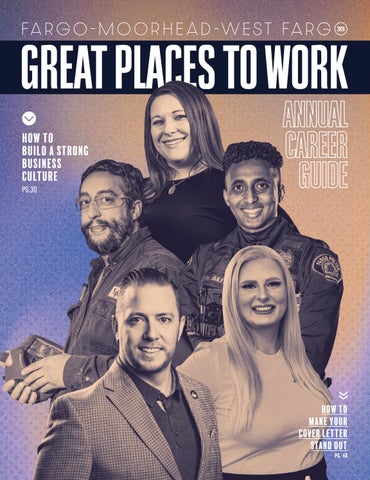
2026 FA R G O - M O O R H E A D - W E S T FA R G O
GREAT PLACES TO WORK How to Build a Strong Business Culture PG.30
ANNUAL CAREER GUIDE
How to make your cover letter stand out pg. 48
TABLEOFCONTENTS
2026
14
20
40
GREAT PLACES TO WORK 12 Better Together ND 14 Fargo Police Department 26 Cardinal IG 28 Dakota Fence Company 36 Olson Pools & Spas 38 Livewire 40 TLC Cleaning 44 True North Steel 46 Unseen Guardians 58 M State
ADVICE 20 What Makes A Good Place To Work? 30 A Comprehensive Guide To Build A Strong Business Culture 48 How To Make Your Cover Letter Stand Out
46
GREATPLACES.WORK | 1
CHECK OUT SPOTLIGHT MEDIA'S OTHER PUBLICATIONS
Fargo INC! is our very successful business magazine which covers all things business in the Fargo-Moorhead area! fargoinc.com /fargobusiness @fargoincmag /company/fargo-inc
Growth Leaders is one of Spotlight's annual publications dedicated to showcasing our local companies and the services they bring to the Fargo-Moorhead area.
2 | GREAT PLACES TO WORK 2026
We always hear that the people are what make the Fargo-Moorhead community great. So, why not meet them? Each month we cover a different topic led by local voices. We meet advocates, experts, and people just like you! meetfargo.com /meetfargo @meetfargo @meetfargo
You may already be familiar with our Faces of Fargo-Moorhead-West Fargo publication which we publish once per year in order to highlight the faces behind all of the great businesses in the community.
Future Farmer is our farming publication which brings great tech-focused content to readers across North Dakota and Minnesota. futurefarmermag.com /FutureFarmerMag
Bison Illustrated is your number one source for all of the behind-the-scenes action inside the North Dakota State University Athletic Department. bisonillustrated.com /bisonillustrated @bisonmag @bisonillustrated
Volume 04 / Issue 4
2026
GREAT PLACES TO WORK Great Places To Work Magazine is published once a year and is free. Copies are available at more than 500 FargoMoorhead locations and digitally at greatplaces.work.
Publisher EDITORIAL Editorial Team Lead Art Director Editorial Graphic Designer INTERACTIVE Business Development Associate Director of Creative Strategies Web Project Manager Senior Graphic Designer Web Design Agency Project Manager Director of Agency Social Media Senior Digital Advertising Specialis ADVERTISING VP of Business Development Sales Representative
Mike Dragosavich Brady Drake Brady@SpotlightMediaFargo.com Kim Cowles Ty Betts Kellen Feeney Megan Suedbeck Matthew Haire Sarah Cabler Sara Jentink Mhairi Christopherson Tammy Fogle Paul Hoefer Paul@SpotlightMediaFargo.com Al Anderson Al@SpotlightMediaFargo.com
Business Development Representative
Austin Cuka AustinCuka@SpotlightMediaFargo.com
Business Development Representative
Spencer Hall Spencer@SpotlightMediaFargo.com
Senior Digital Advertising Specialist Client Relations Director of Client Success Marketing Admin Accounting Specialist DISTRIBUTION Delivery
Matt Purpur Matt@SpotlightMediaFargo.com ClientRelations@SpotlightMediaFargo.com Jessica Ventzke Tyler Duclos Missy Roberts John Stuber
Great Places To Work Magazine is published by Spotlight, LLC. Copyright 2026 Great Places To Work and greatplaces.work. All rights reserved. No parts of this magazine may be reproduced or distributed without written permission of Great Places To Work and Spotlight, LLC is not responsible for, and expressly disclaims all liability for, damages of any kind arising out of use, reference to, or reliance on such information. Spotlight, LLC accepts no liability for the accuracy of statements made by the advertisers.
Spotlight, LLC 4609 33rd Ave S Suite #304 Fargo, ND 58104 or info@spotlightmediafargo.com ADVERTISING: 701-478-SPOT (7768)
GREAT PLACES TO WORK
BETTER TOGETHER ND ABOUT BETTER TOGETHER ND When Better Together ND was founded in June 2022 by Mason Ware and Marie Knodel in Fargo, the vision was simple and powerful: to ensure that no North Dakotan has to navigate the road to recovery alone. In just a few short years, that vision has expanded statewide. Better Together ND has grown into a vital support network serving communities across North Dakota through the Free Through Recovery, Community Connect, and 1915(i) programs. With regional hubs in Fargo, Grand Forks, Wahpeton, Bismarck, and Dickinson, the organization provides essential care coordination and peer support services that bridge healthcare, housing initiatives, and social services. At every level, the work is guided by the belief that meaningful recovery happens when people are supported, respected, and connected.
A FOUNDATION FOR SUCCESS Better Together ND’s growth reflects both the increasing need for compassionate, low-barrier support and the strength of its mission-driven culture. The organization is guided by its core values of Compassion, Integrity, and Equity, with a strong emphasis on high-quality service delivery and collaboration with community partners. Internally, this mission shapes how team members work each day. Rather than simply managing cases, staff build genuine relationships that help individuals regain stability and independence while strengthening the communities they call home. Employees consistently describe the work as challenging and deeply rewarding.
12 | GREAT PLACES TO WORK 2026
HIRING FOR Looking into 2026, Better Together ND anticipates hiring for: CARE COORDINATORS PEER SUPPORT SPECIALISTS DIRECTOR OF OPERATIONS (ANTICIPATED MID-2026) EXECUTIVE DIRECTOR (ANTICIPATED MID-2026)
A THOUGHTFUL, SUPPORTIVE START Joining Better Together ND feels less like starting a job and more like joining a movement. Because the work is impactful, onboarding is intentionally designed to be both comprehensive and supportive. New hires receive thorough training in care coordination while also being immersed in a culture rooted in empathy, collaboration, and connection. From day one, staff are supported in prioritizing strong client outcomes and effectively leveraging community partnerships. This approach ensures that new team members feel confident in their roles while building meaningful relationships across the organization.
INVESTING IN EMPLOYEE WELLNESS AND GROWTH
experiences that support overall well-being.
WHO THRIVES AT BETTER TOGETHER ND
Better Together ND believes that caring for others begins with caring for its staff. The organization invests in professional development through specialized training opportunities, conference attendance, and community engagement that allow employees to strengthen their skills and grow professionally. Connection and morale are equally important. Team-building activities and organizationhosted community events foster trust, collaboration, and a sense of belonging among staff, clients, and partners. In a unique commitment to employee wellness, Better Together ND also offers access to a corporate membership at Immersion LLC, providing sauna and cold plunge
| 305 Roberts St N Fargo, ND 58102 | 701.404.9180 | bettertogethernd.com
Better Together ND seeks individuals who lead with heart and are passionate about helping others while strengthening North Dakota communities. Ideal candidates bring experience working with individuals impacted by mental illness and addiction, along with a strong belief in collaboration and highquality service as pathways to long-term stability. Looking ahead to 2026, Better Together ND anticipates hiring for several key roles, including Care Coordinators, Peer Support Specialists, and future leadership positions as the organization continues to grow.
| Search "Better Together ND" | @better_togethernd | /better-together-nd
GREATPLACES.WORK | 13
GREAT PLACES TO WORK
FARGO POLICE DEPARTMENT
A Q&A WITH
CHIEF OF POLICE DAVID ZIBOLSKI By Brady Drake provided by The Fargo Police Department
Q: HOW WOULD YOU DESCRIBE T H E C U LT U R E O F T H E F A R G O POLICE DEPARTMENT TO SOMEONE CONSIDERING A CAREER HERE? A: The culture at The Fargo Police Department (FPD) is built on strong relationships with each other and with the community we serve. Employees are committed to professionalism and earning community trust through guardianship, accountability, and consistent service. There is a strong emphasis on teamwork and looking out for one another, recognizing that policing is not just a job but a shared responsibility that extends beyond the badge. The FPD also values wellness and family, understanding that healthy employees are essential to effective public safety. Our department fosters a supportive environment where staff feel connected, respected, and encouraged to take care of themselves and their families while serving the community with pride and purpose.
Q: WHAT CORE VALUES GUIDE OFFICERS AND STAFF IN THEIR D AY-T O - D AY W O R K ? A: The Fargo Police Department’s core values were developed by employees through the
14 | GREAT PLACES TO WORK 2026
department’s Vision, Mission, and Values Committee and serve as the foundation for everything we do. Officers and staff strive to be fair and accountable in their decision-making, ensuring consistency, transparency, and trust. Respect guides how we treat community members and one another, while guardianship reflects our commitment to protecting life and serving the community with care and responsibility. Officerwellness is recognized as essential to effective policing, reinforcing the importance of physical, mental, and emotional health. We also hold ourselves to the highest standards of being professional and diverse, valuing integrity, excellence, and the perspectives that strengthen both our organization and the community we serve.
Q: WHAT OPPORTUNITIES ARE AVAILABLE FOR OFFICERS TO GROW AND ADVANCE THROUGHOUT THEIR CAREERS? A: The Fargo Police Department offers extensive opportunities for
professional growth, specialization, and promotion for both sworn and civilian employees. Officers can pursue a wide range of specialized assignments, including on the Crowd Management Team, Honor Guard, Traffic Safety Team, K-9 Unit, SWAT, School Resource Officer, Community Engagement Team, and training roles. For those interested in investigative work, opportunities exist as detectives or investigators within units such as Adult Violent Crimes, Adult Sexual Assault, Property Crimes, Crimes Against Children, Metro Area Street Crimes, Intelligence and Analysis, and the Cass County Drug Task Force. The FPD also provides clear promotional pathways to leadership positions, including Detective, Sergeant, Lieutenant, and Captain. Civilian staff are equally supported through professional development opportunities, specialized training, and pathways for growth within their respective roles. The department strongly encourages continued education, advanced certifications, and leadership
development, empowering all employees to build diverse, rewarding careers that evolve alongside their interests, skills, and professional goals.
Q: HOW WOULD YOU DESCRIBE THE LEADERSHIP STYLE WITHIN THE FARGO POLICE DEPARTMENT? A: Leadership at The Fargo Police Department is grounded in communication, accountability, and growth. Leaders place an emphasis on listening to employees at all levels and maintaining an environment where dialogue and feedback are encouraged. There is a shared expectation that leaders remain accessible, transparent, and willing to engage in meaningful conversations. FPD leadership also focuses on developing people, not only as employees but as future leaders. By holding one another accountable and supporting professional development, leaders work to ensure individuals have the tools, guidance, and support needed to
GREATPLACES.WORK | 15
grow, contribute, and succeed throughout their careers.
Q : I N W H AT W AY S D O LEADERS SUPPORT OFFICERS BOTH P R O F E S S I O N A L LY A N D P E R S O N A L LY ? A: Department leaders at The Fargo Police Department place a strong emphasis on professional development by supporting a wide range of training opportunities both internally and externally. Employees are encouraged to continue learning, develop new skills, and pursue growth that strengthens them in their current roles while preparing them for future leadership opportunities. Leaders also recognize that policing can be challenging and stressful, making officer wellness and work-life balance essential to long-term success. Through the use of a 10-hour shift model and by encouraging wellness and peer support resources, the
16 | GREAT PLACES TO WORK 2026
department works to support employees as people first, understanding that a healthy and balanced life is key to being an effective police officer in Fargo.
Q: HOW DOES THE DEPARTMENT BALANCE ENFORCEMENT WITH COMMUNITY ENGAGEMENT AND RELATIONSHIPBUILDING? A: The Fargo Police Department believes that strong relationships and community engagement are at the heart of effective policing in Fargo. Officers work closely with residents through community meetings, meeting people where they are, and engage with neighborhoods, neighborhood associations, and local businesses to address concerns. The department also collaborates with city leaders, elected officials, and community partners, and actively hosts and participates in community events across Fargo.
While enforcement remains an important responsibility, FPD emphasizes communication, problem-solving, and daily interactions as essential tools for building meaningful relationships to enact change. By working alongside the community, the department ensures that public safety is a shared effort grounded in trust, respect, and collaboration.
Q: WHAT RESOURCES OR PROGRAMS ARE IN PLACE TO SUPPORT OFFICER WELLNESS A N D M E N TA L H E A LT H ? A: At the Fargo Police Department, wellness is a top priority because resilient officers create safer, stronger communities. We support the physical, mental, emotional, financial, and spiritual health of every team member, and foster a culture where seeking help is encouraged, not stigmatized.
From day one, employees have access to confidential mental health services, peer support programs, and guidance from our Health & Wellness Coordinator. Many programs also include support for spouses and loved ones, recognizing that healthy families help build healthy officers. Wellness isn’t just a program; it’s how we operate. From leadership to recruits, everyone plays a role in creating a supportive, resilient department. Through ongoing training, national partnerships, and open communication, the FPD ensures officers are equipped to navigate the challenges of policing and thrive both on and off the job.
Q: HOW DOES THE DEPARTMENT HELP EMPLOYEES MAINTAIN A H E A LT H Y W O R K- L I F E BALANCE? A: The Fargo Police Department understands that a healthy work-life balance is essential for
both professional success and personal well-being. Through fair scheduling, including a 10-hour shift model, paid leave, wellness programs, and flexibility, when possible, employees are supported in balancing the demands of policing with family and personal life. Employees are encouraged to take time to recharge and prioritize their families, knowing that balance at home helps them perform at their best. By fostering a culture that values personal wellbeing alongside the demands of shift work, the FPD can help employees build sustainable, fulfilling careers with our agency.
Q: WHAT EXCITES YOU MOST ABOUT THE DEPARTMENT’S FUTURE? A: What excites us most about the future of The Fargo Police Department is the combination of innovation, community support, and opportunity. With the recently renewed 10-year
Axon contract, we are expanding our use of technology in bold new ways, including the use of the Drone as a First Responder Program that allows our team to respond faster and safer to incidents. We also continue to enhance our new RealTime Crime Center to support investigations and officers in the field, giving our team tools to be more effective than ever. At the same time, strong community support and the new public safety sales tax are fueling growth, creating new positions and staffing opportunities that allow the next generation of officers and civilian employees to build meaningful, fulfilling careers in our agency. The FPD is focused on developing a skilled, adaptable team while staying rooted in its core values that define policing in Fargo. The future is full of opportunity, innovation, and ways to serve our community with excellence.
GREATPLACES.WORK | 17
Q: WHAT IS THE DEPARTMENT HIRING FOR IN 2026? A: The Fargo Police Department is hiring for our Fargo Police Academy, beginning in July 2026. We are seeking individuals who want to be part of something bigger than themselves, who understand their why, are passionate about learning and growth, and are willing to put in the work to make a meaningful difference in their community. Recruits are hired on day one of the academy and earn a starting wage of $31.97 per hour, while receiving high-quality training, mentorship, and support directly from Fargo Police Officers. The Fargo Police Academy prepares
recruits not only for a career in policing, but for a lifetime of service, leadership, and community impact.
MINIMUM QUALIFICATIONS INCLUDE: • Minimum of 60 semester hours or 90 quarter credits of post-high school education from an accredited college, university, or technical school, Or at least four years of full-time active-duty military service with an Honorable Discharge • 21 years old upon completion of the Fargo Police Academy • United States citizen • No prior felony convictions
• Misdemeanor offenses and juvenile records are reviewed on a case-by-case basis • Successful completion of required pre-employment assessments and testing • Ability to pass the Montana Physical Abilities Test (MPAT) • Obtaining a North Dakota peace officer license upon completion of the academy (which our team prepares you for)
If you are driven to serve, ready to work hard, and motivated to help build safer, stronger communities, the Fargo Police Department invites you to take the next step. Learn more and connect with a recruiter at JoinFargoPD.com. | FargoPolice.com | /fargopolicedepartment | @fargopolicedepartment
18 | GREAT PLACES TO WORK 2026
Brittany Leigh Photography
WHAT MAKES A GOOD PLACE TO WORK? About Brittany Schank
A Counselor's Perspective Q&A With Brittany Schank Q: From a counselor’s perspective, what truly makes a workplace a “great place to work” beyond pay and benefits? A: A great workplace is one where people feel psychologically safe. When employees believe they can speak up, be human, make
20 | GREAT PLACES TO WORK 2026
mistakes, and bring their full selves to work without fear of punishment, judgment, or exclusion, everything changes. People stay where they feel seen, valued, and supported, not just compensated. A healthy workplace is one where relationships matter, leadership is approachable, and
Brittany is Schank a licensed clinical social worker, owner of Solace Counseling, a group counseling practice with two locations in North Dakota, and Founder of the Solace Co Directory, a directory for therapist supervisors, supervisees, and consultants to find one another. She is a firm believer that we need less fixing and more loving, less perfection and more appreciation for who we are, and less criticism and more encouragement around us. Brittany can be found in her spare time with her husband chasing around their four young children, working at her therapy private practice, or all geared up for her part-time military career. Brittany is an audiobook narrator and author of "Narrating Audiobooks: Everything You Need To Know To Get Started". Brittany identifies herself as a time management guru, lover of all things coffee, and takes pride in her competitive but humorous nature.
CONTINUED
Q: How can leaders create psychological safety so employees feel heard, respected, and valued?
there's genuine care for the whole person, not just their productivity.
Q: What are the most common workplace issues you see affecting employee morale and mental health today?
A: Psychological safety starts with how leaders respond to vulnerability. Do they listen or become defensive? Do they make space for concerns, or do they shut them down?
A: Three themes show up again and again: 1.
Lack of communication or unclear expectations. As a new business, this one can be so tricky!
2.
Feeling unappreciated or unseen, or feeling like a number.
3.
Unmanaged stress or chronic understaffing
When people don't know what success looks like, or they feel like they're constantly behind, morale drops quickly. The emotional load employees carry today, both at work and at home, is heavier than ever!
Leaders build safety when they: ask questions before giving answers, acknowledge their own humanity and imperfections, follow through on what they say, and invite feedback instead of fearing it. Safety is not the absence of conflict; it's the presence of trust.
Q: What role does communication play in workplace well-being, and where do organizations most often get it wrong? A: Communication is everything. It prevents assumptions, decreases
anxiety, and increases connection. Sometimes I misstep in assuming silence equals understanding; however, sometimes it can mean people don't agree and don't feel safe stating so. It can also mean they don't understand and are scared to ask questions. Clear communication is the glue of a healthy culture.
Q: How can companies support employee mental health in meaningful ways without being intrusive? A: The key is offering resources, not pressure. Healthy support can look like providing access to therapy or EAP services—even having a sign for a therapy clinic or two in your breakroom shows care for their mental health. • Encouraging time off • Normalizing mental health conversations • Training leaders to recognize burnout signs • Creating policies that prioritize well-being
Some simple yet fun things you can do to show you care about mental health are provide some fun stress balls/fidgets, send your team a great YouTube video about self-care, praise your team when they are caring for themselves, and support their time off by asking how you can help so they don't come back to a full plate.
Brittany Schank and her family. |
Ten Little Chickens Photography
GREATPLACES.WORK | 21
Q&A With Brittany Schank Q: What does healthy accountability look like in a workplace culture? A: Health accountability is clarity + support. It cannot be punitive, and it cannot be shame based. It could sound like "I want you to be successful, and here's what that looks like. Let's work together to get there."
Q: What are some small, practical changes businesses can make that have a big impact on employee satisfaction? A: There are so many simple things you can do that are rooted in truly caring about your people. Send out specific and genuine praise. "Jonny had a beautiful baby boy! Mom and baby are doing great! Here's the deets!" or "Cindy graduated with her Bachelor's in Business Administration today! Here's a photo!" Small things can be celebrated too. "Thank you Jonathan, for organizing the breakroom! We are so grateful for you!" Celebrate small wins! Write a handwritten note or Post-it note and place it on someone's desk saying, "You presented so confidently at the meeting! Great work!" Celebrate life events! Currently, we have two staff members who are pregnant. In our breakroom, each week there are signs updated for each of them to let the staff know what week in pregnancy they are and the size of the baby. For example, this week's says "Katrina's 33 weeks pregnant and her baby is the size of a Ferret," with an
22 | GREAT PLACES TO WORK 2026
adorable picture of a ferret! These are fun ways to truly celebrate people!
protections. A person can burn out in either of these two categories or both.
Reduce unnecessary meetings. Time is so valuable. Consider what meetings are truly needed and which ones are taking up time, energy, and space.
Structural protections: Reasonable workloads, protected time off, staffing support, and clear boundaries around what success and failure look like.
Offer flexibility when possible. In this day and age, people value time and flexibility. When possible, allow flexibility. This might be making up hours during a non-traditional time when something big arose. This might be flexibility in making decisions. This could even be the flexibility of decorating their office space or cubicle.
Employees burn out when they care deeply, but feel chronically unsupported.
Check in, not just on work, but on how the person is doing. Your one-on-ones should start with the person, then the tasks.
Q: What does a healthy workplace response look like when employees are struggling personally?
Show genuine care for people— this is really getting to know your employees in the workplace. You can show you know them by simple gestures like writing down a quote that reminded you of them or sending them a meme that made you think of them. One thing we do here is we stock the breakroom with employees' favorite drinks and snacks. They love having drinks and snacks on hand, but absolutely light up when their favorite arrives!
A: A well-supported response looks like, "I'm here. I care. How can I support you while you navigate this?"
Q: How should organizations approach burnout prevention, especially in high-pressure or understaffed environments? A: I firmly believe burnout prevention has two parts: structural protections and cultural
Cultural protections: Leaders modeling balance, normalizing asking for help, redirecting guilt or pressure, and celebrating effort, not just output.
It does not require fixing, prying, or overstepping. Simply offer empathy, flexibility, and structure while maintaining boundaries. People will remember forever how their workplace treated them during a hard season of life.
Q: What are the signs that a workplace culture is becoming unhealthy—and how can leaders course-correct? A: A few tell-tale signs to look out for would be increased gossip, high turnover, silent meetings, low morale, irritability and low work performance.
CONTINUED
Course correction starts by naming the problem, inviting honest feedback, and rebuilding transparency. Cultures shift when leaders shift.
Q: From your experience, what can employees do to set themselves up for a healthier relationship with work? A: It is important for people to truly find how to make their occupation fit their life, instead of their life fit their occupation. Part of having a healthy work relationship is finding love in both what you do and where you do it. If the work is not fulfilling or the environment is draining you, it's time to look deeper and consider a change. Employees can: • Get clear on what energizes them vs drains them • Share with your supervisor what goals and dreams you have, so they can assist working towards them • Communicate needs before they become stifling • Build rituals of rest • Separate self-worth from productivity
A healthy relationship with work is intentional, not accidental.
Q: What boundaries should employees consider setting to protect their mental health at work? A: Some helpful boundaries could include: • "I don't check emails after ____ time."
GREATPLACES.WORK | 23
Q&A With Brittany Schank • "I can take this on, but not until _____."
tasks I hate, someone else loves. Let's talk about if there are tasks someone else would prefer to take on
• Blocking time for uninterrupted work
• Taking actual breaks
• Protecting lunch breaks
• Using grounding strategies daily and even more during busy seasons
• Saying "I need clarification" when expectations feel unclear.
• Reminding yourself you are one person, and you're doing your best!
Q: How can individuals manage stress when they love their job but feel overwhelmed? A: Loving your job does not mean you are immune to overwhelm. In fact, I imagine 100% of people who love their job have felt overwhelmed. Some things that can be done are: • Asking for help before a crisis • Bringing forward ideas of what would create less overwhelm • I try to remind myself that the
Q: How can employees navigate difficult managers or coworkers in a healthy way? A: Start with curiosity, not assumptions. Many conflicts come from unmet expectations or communication gaps. Healthy navigation looks like: • "I" statements
• Asking clarifying questions • Documenting concerns • Involving leadership when patterns emerge • The goal isn't to win, it's to work together without losing yourself
Q: What misconceptions do people often have about workplace happiness or work-life balance? A: The biggest misconception is that balance is a destination. It is not. It's something you adjust daily. Another misconception is that "happiness at work" means loving every moment. That's not true. It actually means feeling safe, valued, connected, and able to be human. People don't need a perfect workplace. They need a workplace that genuinely cares.
For more tips, visit:
24 | GREAT PLACES TO WORK 2026
solacecounselingfargo.com
@solacecounselingfm
/SolaceCounselingND
/solace-counseling-fargo
GREAT PLACES TO WORK
CARDINAL IG ABOUT CARDINAL IG Founded in 1962, Cardinal Glass Industries has grown to have 49 locations across the United States with nearly 10,000 teammates. In 1998, Cardinal IG in Fargo was established and has since become a leader in the residential window and door industry in North America. "As a significant employer in the Fargo-Moorhead area, we take pride in our safety, quality, and diverse work environment," Cardinal IG said. In recognition of the company's safety commitment, Cardinal achieved an OSHA VPP Star for its safety and health programs and has since retained the award since 2017. The Star level is the highest level of certification companies can earn from the Occupational Safety and Health Administration’s Voluntary Protection Program for maintaining a safe environment and promoting health programs.
HIRING FOR 2026 INDUSTRIAL MAINTENANCE TECHNICIANS PRODUCTION TECHNICIANS
26 | GREAT PLACES TO WORK 2026
WHY WORK FOR CARDINAL IG? C O M PA N Y C U LT U R E
SAFE & COMFORTABLE
C O M P E T I T I V E PAY
WORK ENVIRONMENT
WHAT'S IT LIKE TO START WORKING AT CARDINAL IG?
This program focuses on building up emerging leaders and strengthening current leaders.
"Our onboarding and orientation process extensively focuses on the attention to safety that is required to work here along with reminders to maintain a safety mindset outside of work. Since everyone at Cardinal may not be fluent in English, after orientation, new teammates are assigned a master trainer capable of communicating in their native language. Additionally, teammates are provided with the proper protective equipment required to safely conduct their daily tasks," Cardinal IG said.
"We truly believe in promoting leaders from within; most of our plant’s senior leadership started right where you’ll be starting, and many of you will become our future leaders. Some of our teammates have even gone on to be plant managers," Cardinal IG said.
LEADERSHIP TRAINING Cardinal IG promotes leadership readiness in teammates who show leadership qualities and express interest in growing their careers. BedRock Level I and Level II leadership training programs are unique to Cardinal IG. In these programs, teammates are given the opportunity to travel to Minneapolis to attend a three-day training.
ANNIVERSARY GIFTS After each teammate's first year with the company, Cardinal IG recognizes teammates by gifting them a winter jacket. After every five years, teammates get the opportunity to choose generously priced items from a catalog which includes diverse gift options, from diamond accessories to complete tool sets!
PROFIT SHARING All Cardinal IG teammates are rewarded through profit sharing when a profit is made!
CARDINAL IG'S VALUES F A M I LY
TEAMWORK
SAFETY
EXCELLENCE
RESPECT
| 4611 15th Ave NW, Fargo ND, 58102 | 701-492-0920 | cardinalfargo.com
GREATPLACES.WORK | 27
GREAT PLACES TO WORK
DAKOTA FENCE COMPANY ABOUT D A K O TA F E N C E C O . Founded in 1972 in a backyard garage in Fargo, North Dakota, Dakota Fence has grown into what is now known as DFC Company—a family-owned organization spanning three generations and rooted in hard work, integrity, and community commitment. Today, DFC Company serves as the parent organization to 11 operating companies, including Dakota Fence, 3D Specialties, West River Striping, Dakota Playground, Sign Solutions USA, Park & Play USA, Stadium Steve, Town & Country Fence, Dakota Unlimited, International Security Products, and DFC Property Management. Together, these companies form a growing specialty contracting organization that sells, installs, services, and manufactures a wide range of products—from residential and commercial fencing to traffic control solutions, pavement marking, playground equipment, signage, and park and recreation amenities. With eight branches across North Dakota and Minnesota, DFC Company primarily serves a fivestate region while also supporting nationwide retail operations through two of its businesses. At the heart of this continued growth is a strong commitment to people. Known internally as the Blue Family, DFC Company’s employees are the driving force behind its success. The company consistently invests in its people, equipment, and facilities, creating meaningful career opportunities while delivering exceptional value to customers.
28 | GREAT PLACES TO WORK 2026
A C U LT U R E T H AT S TA R T S O N D AY O N E
RECOGNIZING W H AT M AT T E R S
Starting a career at DFC Company means more than stepping into a new role—it means becoming part of the Blue Family. From day one, employees experience a welcoming and well-organized onboarding process designed to set them up for success. New hires follow a clear two-week schedule created by their supervisor, allowing them to focus on learning their role, building relationships, and understanding company expectations.
Recognition is another cornerstone of DFC Company’s culture. Through the Blue Yeah! employee recognition program, team members can acknowledge one another for actions that reflect the company’s core values. Whether it’s demonstrating exceptional teamwork, prioritizing safety, or delivering outstanding service, Blue Yeah! celebrates the everyday wins that make a difference.
THE TRUE BLUE DIFFERENCE
Building on this program, DFC Company recently introduced Big Blue Yeah!, a monthly recognition honoring two employees who go above and beyond in living out the company’s values. These initiatives reinforce appreciation, motivation, and a shared sense of pride across the organization.
One of the most distinctive aspects of DFC Company’s culture is the True Blue Committee, a company-wide initiative designed to strengthen connections, engagement, and giving across all branches and operating companies. Made up of 20 employees representing all eight branches and 12 companies, the committee ensures that every voice within the Blue Family is represented. The True Blue Committee brings employees together through meaningful events, volunteer opportunities, and charitable initiatives. From summer BBQs and holiday parties to happy hours, group outings, and celebrations, these experiences help foster a positive, inclusive workplace where employees feel connected beyond their day-to-day roles.
INVESTING IN GROWTH AND THE FUTURE DFC Company is deeply committed to employee growth and development. Through DFC Academy, the company’s exclusive online learning platform, employees have access to ongoing training, industry education, and professional development resources. The company also partners with Minnesota State Community and Technical College’s Workforce Development Solutions program to provide off-site, handson training in leadership, mechanical skills, and electrical expertise.
HIRING FOR 2026 FENCE LABORERS
PAVEMENT MARKING LABORERS
TRAFFIC CONTROL LABORERS
CDL PAINT TRUCK DRIVERS
| 2060 Sheyenne St Ste 100, West Fargo, ND 58078 | 701.237.6181 | dfccompany.com
| /DFCCompanyND | @dfc_company/ | /dfc-company/
GREATPLACES.WORK | 29
A Comprehensive Guide to
BUILDING A STRONG BUSINESS CULTURE company’s culture is often its most critical competitive advantage. Culture is the invisible force that shapes employee behavior, decision-making, and even the way customers experience your brand. Businesses with a strong, intentional culture outperform their peers, retain top talent, and adapt more effectively to change. Building a thriving culture is a deliberate process that requires vision, consistency, and involvement from every level of the organization. Here’s how to do it step by step.
1.
Define Your Core Values Clearly and Thoughtfully
The foundation of a strong culture is a clear, actionable set of core values. These values serve as a compass for decision-making, communication, and behavior across the company.
How to define meaningful values: Involve multiple perspectives: Engage leaders, employees, and even customers in identifying what the company truly stands for. Keep it concise: Focus on 3–5 values that are memorable and actionable. By Brady Drake
30 | GREAT PLACES TO WORK 2026
Translate values into behavior: For example, if “innovation” is a value, define what behaviors demonstrate innovation—sharing new ideas, experimenting responsibly, or challenging outdated processes.
CONTINUED
2.
Lead by Example
Employees watch how leaders act more than what they say. Leadership sets the tone for what is acceptable and expected.
Ways leaders can embody culture: Demonstrate core values daily: If transparency is valued, openly discuss challenges and mistakes. Make values visible in decisions: Hiring, promotions, and budget decisions should reflect the company’s values. Communicate consistently: Reiterate why the culture matters and how it aligns with business goals.
3.
Hire for Cultural Alignment, Not Just Skills
Employees watch how leaders act more than what they say. Leadership sets the tone for what is acceptable and expected.
Ways leaders can embody culture:
4.
Embed Culture in Onboarding and Training
The first days and weeks of employment are critical in shaping an employee’s perception of your company’s culture. Onboarding is more than paperwork—it’s the moment you introduce new hires to your values, mission, and behavioral expectations.
Ways leaders can embody culture: Introduce the “why”: Explain not just what the company does, but why it exists and what it stands for.
Demonstrate core values daily: If transparency is valued, openly discuss challenges and mistakes.
Assign cultural mentors: Pair new employees with seasoned team members who exemplify the company’s values.
Make values visible in decisions: Hiring, promotions, and budget decisions should reflect the company’s values.
Provide real-world scenarios: Use case studies or role-playing to show how values influence decisions and behavior.
Communicate consistently: Reiterate why the culture matters and how it aligns with business goals.
Reinforce through training: Include culture-focused modules in ongoing development programs, ensuring that values are revisited beyond the first few weeks.
GREATPLACES.WORK | 31
A Comprehensive Guide to Building a Strong Business Culture
5.
Recognize and Reward Behaviors That Reflect Culture
Culture thrives when the right behaviors are reinforced. Employees notice what is rewarded, not just what is written in policy manuals. Recognition and rewards turn abstract values into concrete actions.
Ways leaders can embody culture: Public recognition: Highlight employees who demonstrate core values in meetings, newsletters, or internal social platforms. Tie rewards to culture: Bonuses, promotions, or perks should consider alignment with values as much as output. Encourage peer-to-peer recognition: Platforms where employees recognize each other’s efforts reinforce collective ownership of culture.
6.
Foster Open, Transparent Communication
7.
Build Community and Connection
A strong culture depends on trust, and trust depends on communication. Employees need safe channels to share ideas, feedback, and concerns.
Culture is strengthened through shared experiences and relationships. Employees who feel connected are more engaged, collaborative, and loyal.
Ways leaders can embody culture:
Ways leaders can embody culture:
Regular town halls: Keep employees updated on company performance, challenges, and decisions.
Team-building initiatives: Activities that encourage collaboration and reflect company values.
Anonymous feedback channels: Let employees voice concerns without fear of reprisal.
Celebrate milestones: Recognize both individual and collective achievements.
Actively listen and respond: Showing that feedback leads to real change strengthens credibility.
Support employee-led initiatives: Clubs, volunteer projects, or affinity groups empower employees to shape culture organically.
32 | GREAT PLACES TO WORK 2026
9.
Monitor, Measure, and Evolve Your Culture
Culture is not static—it grows and changes as your company evolves. Regularly assessing how well your culture is working ensures it remains relevant and effective.
Ways leaders can embody culture: Employee engagement surveys: Ask questions about alignment with values, satisfaction, and trust in leadership. Behavioral audits: Observe if day-to-day actions reflect stated values. Exit interviews: Gain insights into cultural gaps or misalignments from departing employees. Customer feedback: Happy employees often create happier customers; feedback can reveal cultural strengths or weaknesses.
8.
Align Culture with Business Strategy
Culture is most powerful when it supports the company’s strategic objectives. Misalignment can cause frustration, inefficiency, or disengagement.
Ways leaders can embody culture: Ensure core values support business goals. For example, if innovation drives growth, foster curiosity and experimentation in the culture. Communicate how everyday behaviors contribute to long-term goals. Integrate culture into performance metrics and decision-making processes.
Strong culture is not a side project. It is a strategic asset that impacts performance, retention, innovation, and customer experience. Companies that invest in building a deliberate culture see benefits ripple across every area of the organization. By defining values, modeling behaviors, hiring thoughtfully, embedding culture in processes, recognizing the right behaviors, fostering communication and connection, and continuously evolving, businesses can create a culture that inspires employees, drives results, and differentiates the company in the marketplace. Culture is not just what a company does—it’s who they are. And businesses that treat it as a priority build resilience, loyalty, and long-term success.
GREATPLACES.WORK | 33
By Brady Drake
The Questions You Should Ask Your Potential Employer job interview is often framed as a test—one where the employer evaluates whether you’re qualified, capable, and culturally aligned. But that framing is incomplete. An interview is not just about proving you’re good enough to be hired. It’s about determining whether the role, the company, and the people you’ll work with are good enough for you.
Questions About the Role Itself
Asking thoughtful, intentional questions during an interview is not a formality. It’s one of the most powerful tools you have to protect your time, your mental health, your career trajectory, and your longterm satisfaction. The questions you ask can reveal red flags, clarify expectations, uncover growth opportunities, and help you decide whether you’re walking into a role where you can actually thrive.
“What does success look like in this role in the first 30, 60, and 90 days?”
This article breaks down the most important categories of questions you should ask a potential employer—and explains why each one matters.
“What are the biggest challenges someone in this position will face?”
34 | GREAT PLACES TO WORK 2026
This question forces clarity. A good employer should be able to articulate what early success looks like beyond vague statements like “getting up to speed.” If they can’t define expectations, you may be walking into a role with unclear priorities or moving goalposts.
Every role has challenges. Employers who acknowledge them honestly tend to be more transparent and realistic. If the answer sounds overly
And Why They Matter More Than You Think!
polished or evasive, that’s worth noting. “Why is this position open?”
Is the role newly created because the company is growing? Or is it open because someone left? If someone left, why? The answer can tell you a lot about turnover, internal dynamics, and whether this role has been historically sustainable. “What does a typical day or week look like?”
Job descriptions rarely reflect reality. This question helps bridge the gap between what’s written and what’s actually expected—especially around workload, meeting frequency, and priorities.
CONTINUED
Questions About Performance and Evaluation “How is performance measured for this role?”
Clear metrics are a sign of a healthy organization. You want to know whether success is measured objectively or subjectively—and whether feedback is ongoing or only happens during annual reviews. “How often are performance reviews conducted?”
Regular feedback is critical for growth. Infrequent or inconsistent reviews can lead to misalignment, frustration, or surprise criticisms later. “Can you give an example of someone who has excelled in this role?”
This question helps you understand what the company truly values. Listen closely to whether they emphasize results, collaboration, innovation, long hours, or loyalty.
Questions About Management and Leadership “How would you describe the management style of the person I’d report to?”
Your manager will have a massive impact on your experience. Look for answers that mention communication, trust, support, and accountability—not micromanagement or constant urgency.
“How do managers support employee growth and development?”
Questions About Team Dynamics
Strong leaders invest in their people. Weak ones expect employees to figure it out alone. The difference shows up quickly in how this question is answered.
“Who would I be working most closely with?”
“How do leaders handle conflict or mistakes?”
No workplace is conflict-free. A healthy culture treats mistakes as learning opportunities, not reasons for blame or punishment.
Questions About Company Culture “How would you describe the company culture in practice, not just on paper?”
Most companies can recite their values. Fewer can explain how those values show up in everyday behavior. This question encourages concrete examples. “What types of people tend to succeed here What types struggle?”
This can be one of the most revealing questions you ask. It often exposes whether the environment rewards collaboration, independence, conformity, or constant availability. “How does the company s support work-life balance?”
Listen carefully. If the answer revolves around “flexibility” without boundaries—or praises long hours as dedication—that may be a warning sign.
Understanding team structure helps you anticipate collaboration styles, communication flow, and potential bottlenecks. “How does the team communicate and collaborate?”
Is communication primarily synchronous or asynchronous? Formal or informal? Remote-friendly or meeting-heavy? These details shape your day-to-day experience more than most people realize. “How does the team handle disagreements?”
Healthy teams disagree productively. Unhealthy teams avoid conflict or let it fester. This question helps you gauge emotional maturity and psychological safety.
Questions About Growth and Advancement “What opportunities for growth or advancement exist from this role?”
This isn’t just about promotions. Growth can include skill development, leadership opportunities, or expanded responsibilities. “Can you share examples of career paths from this position?”
Examples matter more than vague promises. If no one has advanced from this role, ask yourself why.
GREATPLACES.WORK | 35
The Questions You Should Ask Your Potential Employer “How does the company support ongoing learning?”
Training budgets, mentorship, conferences, and internal development programs are strong indicators that a company invests in its people long-term.
Questions About Stability and Strategy “What are the company’s priorities for the next year?”
This gives insight into whether leadership has a clear direction—and whether your role aligns with those priorities. “What challenges is the company currently facing?”
Every organization faces challenges. Transparency here signals trust and realism. “How has the company changed in the last few years?”
Every organization faces challenges. Transparency here signals trust and realism.
Questions About Compensation and Logistics “How is compensation structured, and how are raises or bonuses determined?”
Compensation shouldn’t be a mystery. Clarity here prevents disappointment later. “What benefits are offered, and how do employees typically use them?”
36 | GREAT PLACES TO WORK 2026
Health insurance, retirement plans, parental leave, and flexibility policies matter—but only if employees feel safe using them.
welcomes thoughtful questions because they signal selfawareness, professionalism, and long-term thinking.
“What does onboarding look like?”
Why These Questions Matter
A strong onboarding process shows that the company is intentional about setting new hires up for success.
Questions That Reveal Red Flags Some questions don’t just gather information—they surface warning signs. • If answers are consistently vague or defensive, transparency may be lacking. • If interviewers contradict each other, alignment may be weak. • If questions about burnout, turnover, or feedback are brushed aside, trust your instincts. The goal is not to interrogate—but to understand. A good employer
Accepting a job is not just a financial decision. It’s a decision about how you’ll spend a significant portion of your life—your energy, your attention, and your creativity. The right questions help you move beyond surface-level impressions and make informed choices. When you ask strong questions, you shift the interview dynamic. You stop being a passive candidate hoping for approval and start acting like a professional evaluating a partnership. That shift alone can change how employers perceive you—and how confidently you walk away, whether you get the offer or not. In the end, the best job interviews don’t end with “Do you have any questions for us?” They end with clarity—on both sides—about whether this opportunity truly fits.
GREAT PLACES TO WORK
OLSON POOLS & SPAS
ABOUT OLSON POOLS & SPAS Founded in 1976 in the garage of the current owner Steve’s father, Olson Pools & Spas began as a true one-man operation built on hard work, craftsmanship, and a genuine commitment to helping families enjoy their backyards. What started humbly 50 years ago steadily grew through decades of dedication and trust, evolving into the full-scale company it is today. Today, Olson Pools & Spas provides complete sales, service, and installation for inground and above-ground pools, spas, saunas, and a full range of accessories designed to center backyard living around water. From the first conversation through long after installation, the company focuses on quality, reliability, and creating spaces where lasting memories are made. At its core, Olson Pools & Spas exists to give families a place to relax, unwind, and enjoy years of fun with friends and loved ones.
38 | GREAT PLACES TO WORK 2026
B U I LT O N VA L U E S THAT LAST
understand that exceptional customer experiences begin with a strong internal culture.
While the company has grown significantly since its early garage days, its foundation remains unchanged. Olson Pools & Spas continues to operate with a strong emphasis on honesty, craftsmanship, and long-term relationships. Every project— regardless of size—is approached with the same care and attention to detail that defined the business from the beginning. That commitment to doing things the right way has earned Olson Pools & Spas a reputation for reliability and trust. Customers know they can expect clear communication, thoughtful recommendations, and solutions tailored to their specific needs, rather than one-size-fits-all approaches.
A TEAM-FIRST APPROACH TO SERVICE A defining characteristic of Olson Pools & Spas is its teamfirst mentality. The company has intentionally cultivated a positive, supportive environment where employees are valued and empowered because they
Unlike many sales-driven organizations, Olson Pools & Spas does not rely on highpressure tactics. Sales team members are paid a salary alongside commission, allowing them to focus on listening, educating, and guiding families toward the right solution for their backyard and lifestyle. Regardless of who a customer works with, the shared mission remains the same: deliver outstanding service through honesty, collaboration, and expertise.
SHARED SUCCESS THROUGH PROFIT SHARING One of the ways Olson Pools & Spas reinforces accountability and pride in workmanship is through its employee profitsharing program. The philosophy is simple: when customers are well taken care of, everyone benefits.
and long-term satisfaction. This approach ensures that every installation, service call, and customer interaction is handled with genuine care, responsibility, and passion.
CREATING SPACES WHERE MEMORIES ARE MADE At the heart of everything Olson Pools & Spas does is the belief that water brings people together. Pools, spas, and saunas are more than products—they are gathering places for connection, celebration, and relaxation. Fifty years after its founding, Olson Pools & Spas continues to honor its roots while looking ahead, combining experience, integrity, and a people-first mindset to help families create backyards that will be enjoyed for generations to come.
By sharing the company’s success with its employees, Olson Pools & Spas creates a culture where each team member has a vested interest in quality, follow-through,
| 1110 Hobart St Hawley, MN 56549 | 218.483.3541
| olsonpoolsandspas.com | /olsonpoolsandspas
GREATPLACES.WORK | 39
GREAT PLACES TO WORK
LIVEWIRE
ABOUT LIVEWIRE Founded in 1999 by Kent Kolstad in Alexandria, MN, Livewire was built on the bold and ambitious idea to deliver world-class audio, lighting, live video, staging, scenery, streaming, and video production to events across the region and beyond. For more than 25 years, Livewire has partnered with thousands of event planners to produce exceptional corporate events, conferences, nonprofit galas, concerts, and theatrical productions of every size and scope. Now proudly headquartered in Fargo, Livewire operates without geographic boundaries, serving clients nationwide and even internationally. Backed by a team of more than 60 highly skilled fulltime professionals, the company combines deep expertise, cuttingedge technology, and a relentless commitment to excellence to deliver experiences that set new benchmarks in live and hybrid event production.
40 | GREAT PLACES TO WORK 2026
A DYNAMIC I N D U S T R Y, A FORWARDTHINKING TEAM One of Livewire’s defining strengths is the dynamic, everevolving nature of its work. As client needs, technologies, and event formats continue to change, Livewire evolves alongside them by expanding services, embracing innovation, and strategically growing its capabilities. Livewire empowers team members to contribute meaningfully from day one, inspiring curiosity, collaboration, and ownership. The company is large enough to offer complex, high-profile projects and advanced technology, yet lean enough to avoid stagnation.
WHAT IT’S LIKE TO WORK AT LIVEWIRE Starting at Livewire is both structured and hands-on. New team members are grounded quickly with clear policies, a comprehensive handbook, and colleagues who genuinely care about doing things the right way. At the same time, Livewire believes real growth comes from experience. Team members are trusted early on to jump in, learn by doing, and build confidence through real-world projects. Questions are encouraged, no two days are the same, and learning happens constantly through collaboration and action. Team members often gain insight into every phase of a project—from
concept and planning to execution and post-event wrap-up—much faster than they might elsewhere. As Livewire adapts to evolving client demands, the Livewire team is empowered to problem-solve, innovate, and grow alongside the company.
WHY TEAM MEMBERS LOVE LIVEWIRE To understand what makes Livewire a great place to work, the company turned to its team. Their reasons consistently center on five themes: the pride of bringing client visions to life, the thrill of creating moments that matter, the camaraderie of a talented and supportive team, the intersection of technology and creativity, and the excitement of doing something new every day. From transforming empty rooms into extraordinary experiences to hearing the genuine “wow” from attendees, Livewire team members take deep satisfaction in the impact of their work.
INVESTING IN THE FUTURE Recognizing the demands of the live events industry, Livewire is also focused on smart planning that supports balance, longevity, and well-being—while maintaining a culture of trust, accountability, and shared purpose. Looking ahead to 2026, Livewire is intentionally investing in a culture built for longterm growth and sustainability.
| livewirenow.com | /livewire.fargo
The company is clarifying career paths, expanding cross-training, and strengthening communication and feedback to ensure transparency as it continues to grow.
BENEFITS, VALUES, AND WHAT’S NEXT Livewire’s commitment to its people is reflected in its benefits like competitive pay, meaningful paid time off, travel opportunities with company-paid lodging, and unique perks like ARTS Time—paid hours dedicated to engaging with and supporting the local arts community. Add in a fun, collaborative workspace, new challenges to creatively solve for every day, and a massive selection of comfortable, fashionable company swag, and it’s clear that Livewire values both professional excellence and personal fulfillment. Rather than hiring for rigid roles, Livewire remains intentionally nimble. As a project-driven, client-focused organization, its hiring evolves with opportunity. The company is always open to connecting with curious, collaborative individuals who are passionate about immersive event production and eager to help shatter the status quo. At Livewire, talent isn’t just hired and managed—it’s trusted, empowered, and invited to help shape what comes next.
| @livewire_now | /livewirenow
GREATPLACES.WORK | 41
GREAT PLACES TO WORK
TLC CLEANING ABOUT TLC CLEANING At TLC Cleaning, people are the heart of the company. From day one, TLC has been built on kindness, compassion, and the belief that when you take great care of your team, they will take great care of the families they serve. That philosophy has shaped every part of the workplace culture and created an environment where employees feel supported, appreciated, and inspired to grow.
A WELCOMING START AND A FOUNDATION FOR SUCCESS Joining TLC Cleaning means stepping into a workplace that is ready to invest in you. New employees begin with highly structured, hands-on training led by experienced team members who teach not only the “how,” but the “why” behind the work. From cleaning techniques and safety protocols to time management and client experience, every detail is introduced thoughtfully and with encouragement. New hires also get to know the leadership team, connect with coworkers, and experience firsthand the values that guide every part of TLC’s culture: kindness, accountability, teamwork, and celebrating wins big and small. No one is ever thrown in alone; instead, new team members are welcomed into a supportive environment that sets them up to feel confident and valued from day one.
42 | GREAT PLACES TO WORK 2026
LOOKING AHEAD TO 2026 With continued growth and expansion, TLC Cleaning will be hiring throughout 2026 for: CLEANING TECHNICIANS
OFFICE SUPPORT POSITIONS
TRAINERS
L E A D E R S H I P -T R A C K
CLIENT CARE ROLES
A COMPANY THAT T R U LY C A R E S F O R ITS PEOPLE TLC Cleaning has created a workplace culture centered on appreciation and generosity. Every Thanksgiving, team members receive a full holiday basket to help make the season easier. At Christmas, employees are surprised again with thoughtful, generous baskets for their families. And throughout the year, milestones are celebrated in meaningful ways. One tradition is the personalized anniversary lunch with leadership, which is a time dedicated to celebrating each employee individually. At five years, team members get to go on an allexpenses-paid trip together. At ten years, the reward is a vacation anywhere the employee chooses for their entire family! TLC also offers multiple bonus opportunities, from performance pay to referral incentives, to make sure hard work is recognized and
OPPORTUNITIES
rewarded. Their points-based bonus system allows employees to earn points for strong performance, positive customer feedback, and leadership qualities—redeemable for everything from paid days off to dream vacations to tattoos. The reward possibilities are as unique as the people on the team.
WHY PEOPLE LOVE WORKING AT TLC CLEANING
A WORKPLACE ROOTED IN COMMUNITY AND PURPOSE
• A people-first culture rooted in kindness and respect
Giving back is a core part of TLC’s identity. The company proudly provides free cleanings to individuals undergoing cancer treatment through Cleaning for a Reason and regularly partners with organizations such as Cat’s Cradle, Homeward Animal Shelter, and the YWCA. Employees don’t just clean homes—they help change lives. This shared sense of purpose strengthens the team and adds meaning to every workday.
| 15 15th St S, Fargo ND 58103 | 701.412.3298 | tlccleaningexperts.com
TLC Cleaning stands out as a workplace where employees feel genuinely valued, supported, and inspired to grow. Team members consistently point to these top reasons:
• Clear opportunities for advancement and leadership development • Competitive pay with multiple bonuses and incentive programs • Exceptional perks like holiday baskets, milestone trips, and anniversary celebrations • A supportive, family-like environment where coworkers cheer each other on
| /tlccleaningfargo | @tlccleaningexperts | /tlc-cleaning-llc
GREATPLACES.WORK | 43
44 | GREAT PLACES TO WORK 2026
GREATPLACES.WORK | 45
GREAT PLACES TO WORK
UNSEEN GUARDIANS
B U I L D I N G A C U LT U R E OF PURPOSE THAT FIGHTS HUMAN TRAFFICKING Unseen Guardians is a growing movement of businesses using their influence, people, and everyday operations to help end human trafficking in the U.S. and around the world. Through sustainable, business-driven support, Unseen Guardians funds and accelerates the work of Unseen, a platinumtransparency 501(c)(3) nonprofit dedicated to stopping exploitation and addressing its root causes. In the last year alone, Unseen and its 33 global antitrafficking partners directly served more than 132,000 people. At its core, Unseen Guardians envisions a world where exploiters are stopped, vulnerable people have access to safe livelihoods, and survivors pursue lives of freedom and impact. The program empowers businesses of any size or industry to build a culture rooted in purpose—one where employees know their work matters beyond the bottom line. By simply coming to work each day, employees of Official Unseen Guardian businesses are actively helping fight human trafficking.
A SIMPLE MODEL WITH POWERFUL IMPACT Unseen Guardians was designed to make social impact accessible and sustainable for employers. Becoming an Official Unseen Guardian business is intentionally simple: companies sign up, enter their business name, and choose a monthly donation to support the fight against human trafficking. The recommended model—$1 per day, per employee— symbolizes the impact employees make simply by showing up to work. Once enrolled, businesses receive tools and resources to engage their teams, communicate their impact, and share
46 | GREAT PLACES TO WORK 2026
WHY WORK WITH UNSEEN GUARDIANS? Organizations choose to align with Unseen Guardians because the program: Creates shared purpose that strengthens company culture
Empowers employees with education, volunteerism, and community connection
Builds pride and improves retention through meaningful internal engagement
Amplifies impact beyond what any single organization could achieve alone
their commitment with their communities. Marketing assets, employee engagement guides, and storytelling resources help businesses integrate purpose into their culture—not as an add-on, but as a shared value.
FOUNDED BY ENTREPRENEURS WHO BELIEVE IN PURPOSE-DRIVEN WORK Unseen Guardians was co-founded by Ryan Goodman and Brady Nash, entrepreneurs and CEOs passionate about cultivating positive, philanthropic workplace cultures. Recognizing that human trafficking is one of the greatest injustices in the world—and that businesses have the power to respond—they created Unseen Guardians as a way for employers to easily bring their teams into the fight. Their belief is that employees are most fulfilled when their work connects to purpose. When businesses lead with values, everyone wins—the organization, the employee, and the broader community.
WHAT IT’S LIKE TO BE AN UNSEEN GUARDIAN Employees of Official Unseen Guardian businesses are considered Unseen Guardians themselves. Their participation goes far beyond a donation. Through the program, employees can: • Participate in training to recognize and appropriately report signs of human trafficking • Volunteer remotely or in person with Unseen or its partner organizations
• Support direct-relief projects that help expand survivor services and prevention efforts • Engage with a community forum, newsletters, and stories of hope from around the world
This shared mission builds pride, strengthens connection, and gives employees a tangible way to contribute to meaningful change together.
A GROWING MOVEMENT WITH LOCAL AND NATIONAL REACH Unseen Guardians is on track to become the first nationally recognized impact badge for businesses committed to fighting human trafficking and modern slavery. In Fargo alone, more than 60 businesses have already signed on as Official Unseen Guardians, demonstrating how local leadership can fuel global change. With an estimated 50 million people experiencing human trafficking worldwide—13.5 million of them children—the need for action is urgent. Unseen Guardians believes businesses can use their platforms to help stop exploiters, protect the vulnerable, and restore freedom.
JOINING THE MOVEMENT The only requirements to become an Official Unseen Guardian business are a commitment to support the fight against human trafficking through a monthly donation and a desire to be part of something bigger. By sharing that commitment openly, businesses help raise awareness, mobilize communities, and create lasting change.
| unseenguardians.org
| @unseen_guardians | /unseenguardians
GREATPLACES.WORK | 47
By Brady Drake
How to Make Your Cover Letter
48 | GREAT PLACES TO WORK 2026
CONTINUED
cover letter is your chance to make a great first impression on a future boss. While your resume lists your skills and experience, a cover letter shows your personality and explains why you’re perfect for the job. Here’s how to make yours stand out!
Make It Job Specific Don’t send the same cover letter to every job. Find out the name of the person hiring, if you can, and include it. Talk about how your skills match the job and how you can help that specific company and team.
Start with Something Interesting Your first sentence should grab attention. Don’t just say, “I’m writing to apply.” Instead, try: A quick story that shows your skills. A big accomplishment that fits the job. Why you’re excited about the company’s mission.
Give Examples Again, don't just say, “I’m a great leader.” Show it with a real example. For instance, “As a team leader, I helped my group finish a big project early and under budget.” Numbers and facts make your achievements clearer!
Explain How You Can Help Them Companies want to know what you can do for them. Look up their goals or problems and explain how your skills can make a difference. For example, say, “I’m excited to use my [skill] to help [company] achieve [goal].”
GREATPLACES.WORK | 49
Keep It Short Write only 3-4 paragraphs and keep it to one page. Use simple and professional language, and avoid overused phrases like “I’m detail-oriented.”
End with Confidence Finish strong by asking for an interview. For example: “I would love to talk about how I can help [Company Name] succeed. You can reach me anytime at [contact info].”
Check for Mistakes Small errors can make you look unprofessional. Read your letter a few times, or ask someone else to check it for you.
Don't skip this step!
Add a Personal Touch Make your letter unique. Talk about something you admire about the company or a shared interest. This will help you stand out.
By following these tips, you’ll write a cover letter that shows off your skills and makes a great impression. Good luck!
50 | GREAT PLACES TO WORK 2026
CONTINUED
irst impressions are crucial, and your outfit plays a significant role in how you're perceived during a job interview. Dressing appropriately not only shows respect for the opportunity but also demonstrates that you understand the company culture and industry norms. Here are some essential tips to ensure your attire works in your favor. By Brady Drake
Before deciding on your outfit, research the company's dress code. Is the company known for its formal corporate environment, or does it have a more relaxed vibe? Visit the company’s website or social media to observe how employees dress if you can. This will give you a clearer idea of whether to aim for business formal, business casual, or creative casual.
Neutral colors like black, navy, gray, or white convey professionalism and are universally flattering. You can add a pop of color with a tie, scarf, or accessory, but avoid overly loud or busy patterns that can be distracting.
52 | GREAT PLACES TO WORK 2026
When in doubt, it’s better to overdress than underdress. A polished, professional look shows that you take the opportunity seriously. For most traditional industries like finance, law, or consulting, a suit and tie for men and a tailored suit or conservative dress for women are standard. For tech startups or creative fields, business casual—like a blazer with slacks—may be more appropriate.
Your clothes should fit well and be comfortable. Illfitting or overly tight clothing can make you appear sloppy or uneasy. Similarly, don’t wear something so tight that it restricts movement, as this can make you visibly uncomfortable. If you're buying a new outfit, consider having it tailored.
HOW TO DRESS FOR A JOB INTERVIEW
Your overall appearance should be neat and wellgroomed. Make sure your shoes are clean and polished, your hair is tidy, and your nails are trimmed. Subtle makeup and minimal jewelry are ideal for a professional look. Avoid heavy fragrances, as some people may be sensitive to strong scents. Men should also make sure their facial hair is well-groomed or clean-shaven unless the company culture embraces a more relaxed style.
Lay out your outfit the night before your interview to avoid last-minute stress. Make sure everything is clean, wrinkle-free, and in good condition. If necessary, iron your clothes or take them to the dry cleaner in advance. Doing a trial run of your outfit can also help you catch any discomfort or potential wardrobe malfunctions.
Small details matter. Make sure your socks match your pants and that your belt matches your shoes. Carry a clean, professional-looking bag or portfolio to hold your resume and other materials. Pay attention to accessories like watches, ties, and scarves—you want them to be subtle and to enhance your outfit.
For virtual interviews, your top half will be the focus, but don’t neglect your overall outfit. Wear a professional top, such as a button-down shirt or blouse, and make sure the color doesn’t clash with your background. Good lighting and a neat background also contribute to your professional image. Make sure your internet connection is stable, and double-check your webcam angle to avoid any unflattering views.
54 | GREAT PLACES TO WORK 2026
Consider the specific role you’re interviewing for and dress accordingly. For example, if you’re interviewing for a managerial position, aim for a look that reflects authority and competence. This might mean opting for a power suit or adding a structured blazer to your outfit. For creative roles, add a touch of your unique style to demonstrate your personality while maintaining professionalism.
While dressing professionally is essential, it’s also important to feel like yourself. Choose an outfit that shows your personality and makes you feel confident. Your comfort and confidence will shine through during the interview. Avoid forcing yourself into a style that feels unnatural, as this can make you appear less self-assured.
Dressing for a job interview doesn’t have to be daunting. By taking the time to plan your outfit, you can make a strong first impression that reflects your professionalism and preparedness. Remember, the goal is to let your qualifications and personality shine while ensuring your attire complements the overall picture you present. A well-thought-out outfit can set the tone for a successful interview and show your prospective employer that you mean business.
GREAT PLACES TO WORK
M STATE
BUILDING A WORKFORCE THAT WORKS HOW M STATE’S WORKFORCE DEVELOPMENT SOLUTIONS IS HELPING EMPLOYERS RETHINK T R A I N I N G , L E A D E R S H I P, AND RETENTION By Brady Drake |
Provided by M State
Across the Fargo–Moorhead region and beyond, employers are facing a shared reality that finding people is hard, keeping them is harder, and preparing them for what’s next is harder still. Technology shifts quickly. Regulations evolve. Leadership expectations change. And too often, training lags behind real-world needs. That’s where Workforce Development Solutions (WDS) at Minnesota State Community and Technical College comes in. Operating on the noncredit side of the college, WDS works directly with employers to design training that fits their workforce, their schedules, and their goals. They do this through leadership development, technical upskilling, compliance-driven education, and workforce readiness. Unlike traditional classroom models, WDS meets employers where they are by bringing together industry experts, customized curriculum, and a process built for speed and relevance. For employers looking to strengthen culture, retention, and performance, investing in employee development through programs like WDS can be a powerful differentiator.
58 | GREAT PLACES TO WORK 2026
10% OFF! Mention this article and get 10% off your first customized training!
A PARTNERSHIP WDS exists to strengthen the regional workforce by partnering with employers to solve real problems by listening and then acting. Each engagement starts with a needs assessment. What’s working? What isn’t? Where are teams getting stuck? From there, WDS builds training around the employer’s reality, which includes but is not limited to, job roles, equipment, internal processes, and long-term objectives. Because WDS operates outside the traditional academic calendar, it can pivot quickly to create curriculums, source instructors, and deliver training on timelines that match business needs rather than semesters.
A NEW LEADER WITH A GLOBAL PERSPECTIVE That mission has taken on fresh momentum under Sean Collins, who stepped into the role of Director of Workforce Development Solutions in October. A Fargo native and Fargo South graduate, Collins brings an unusually broad background to the role. He spent five years in the U.S. Marine Corps working in Signals Intelligence, followed
Director of Workforce Development Solutions Sean Collins
Director of Business and Industry Amy Hochgraber
by a decade with the National Security Agency, where his work took him around the world. Over an 18-year career in IT and leadership, he’s built and led high-performing teams in complex, high-stakes environments.
clearly in the work of WDS’s Custom Training Representatives.
Before joining M State, Collins worked in IT leadership at RDO, which gave him experience in the realities of regional industry. “I’m extremely passionate about helping leaders transform their organizations into places people actually want to work,” Collins said. “That means empowering employees to make decisions, building trust, and making sure leaders know how to support their teams while moving the organization forward.”
CUSTOMIZED TRAINING That commitment to customization shows up most
Director of Business and Industry Amy Hochgraber, who focuses on business, technology, leadership, safety, and industrial training, describes her role as part relationship-builder, part project manager. “I go out to business and industry and learn what’s actually happening inside their organization,” Hochgraber said. “Then we bring in the right instructor, do a deeper needs assessment, and build training around exactly what they need— whether that’s 4 hours or 144.” Rather than relying solely on academic faculty, WDS intentionally uses industry experts, people who are still working in the field or have deep, hands-on experience. “There’s a moment when the maintenance manager and the instructor start talking the same
GREATPLACES.WORK | 59
"AS WE HAVE EXPANDED OUR TECHNICAL TRAINING PROGRAMS FOR OUR WORKFORCE, WE REQUIRED A PARTNER WITH THE FACILITIES FOR HANDS ON LAB WORK AS WELL AS INSTRUCTORS WITH THE REQUISITE EXPERTISE. M STATE HAS BEEN ABLE TO PROVIDE THIS WITH PROGRAMS LIKE WELDING, MECHANICAL SKILLS ENHANCEMENT TRAINING, OUR MECHANIC HELPER PROGRAM, AND LEADERSHIP TRAINING. BEING ABLE TO OFFER THESE OPPORTUNITIES GIVES US THE BENEFIT OF A HIGHER-SKILLED AND MORE ENGAGED WORKFORCE.” -Branden Kuersteiner, American Crystal Sugar Company
language,” Hochgraber said. “That’s when the light bulb goes off. They realize, ‘You actually understand our world.’” Customization extends beyond topics into materials and delivery. Leadership training incorporates a company’s existing tools, values, and evaluation processes. Technical training uses the same equipment, spreadsheets, or systems that employees work with every day. Hands-on learning is prioritized, with many industrial courses structured as roughly 70 percent practical application.
WHY LEADERSHIP T R A I N I N G M AT T E R S While some WDS programs focus on compliance or certification, much of the demand centers on leadership. “Companies often promote their best technical people into leadership roles,” Hochgraber said. “But being a great welder or nurse doesn’t automatically mean you know how to lead a team.” Leadership training helps bridge that gap. It equips new
60 | GREAT PLACES TO WORK 2026
supervisors with tools for communication, coaching, conflict resolution, and time management. These are the skills that directly affect morale and retention. “It’s not always about hiring more people,” Hochgraber said. “Sometimes it’s about investing in the people you already have, building their confidence and skill sets so they stay, and so you don’t need to hire as many new employees in the first place.”
STRENGTHENING H E A LT H C A R E Few industries feel workforce pressure more acutely than healthcare. Staffing shortages, regulatory requirements, and burnout create constant strain, particularly in rural and regional settings. Director of Health Training Jenna Stammen, who is focused on healthcare and emergency services, works closely with employers to build training pathways that are practical, accessible, and immediately applicable. Much of that work centers on
Director of Health Training Jenna Stammen
Certified Nursing Assistant (CNA) and Trained Medication Aide (TMA) programs, which are roles that form the backbone of longterm care, assisted living, and clinical support teams. “These programs aren’t just about credentials,” Stammen explains. “They’re about creating a pipeline so organizations can grow their own workforce.” WDS offers both customized training for employers and open enrollment options for individuals entering or advancing within the field. In many cases, training can be scheduled around shifts, delivered onsite, or structured to help employers retain
“I’M VERY THANKFUL FOR THE OPPORTUNITY TO TAKE THE CERTIFIED NURSING ASSISTANT CLASS. I’VE LEARNED SO MUCH, AND THIS EXPERIENCE HAS OPENED A NEW DOOR FOR ME. I REALLY ENJOYED THE CLASSES AND LEARNING NEW THINGS. OVERALL, IT WAS A GREAT EXPERIENCE.”
recognizing that not every skill learned in emergency services applies exclusively to firefighters. While some fire programs require participants to be affiliated with a department, many offerings translate directly to broader workplace safety, including CPR, fire extinguisher training, and emergency preparedness. “These are skills that make sense for almost any organization,” Stammen said. “Safety training shouldn’t be limited to one industry.”
-Karianna Kroger, Certified Nursing Assistant Program Participant employees while they complete required education. Beyond CNAs and TMAs, WDS supports healthcare employers through nurse refresher courses, local anesthesia training for dental assistants, and continuing education opportunities that allow professionals to maintain licensure while advancing their skills.
Director of CDL Training Bailey Wothe
T R A N S P O R TAT I O N TRAINING
F I R E , S A F E T Y, AND TRAINING T H AT A P P L I E S EVERYWHERE
In transportation and logistics, demand for skilled drivers continues to outpace supply. For Director of CDL Training Bailey Wothe, speed and quality are equally important.
WDS also delivers specialized training for fire departments,
WDS’s Commercial Driver’s
License (CDL) training is designed with employers in mind and offers flexible scheduling, one-on-one instruction, and third-party testing that streamlines the path from training to employment. “Our goal is to help people become workplace-ready from day one,” Wothe said. “That means high standards, strong instructors, and a process that doesn’t slow employers down.” M State’s CDL program combines self-paced online theory (typically 20–30 hours) with hands-on range and road training (20 hours for Class A, 15 hours for Class B), ensuring students meet Federal EntryLevel Driver Training (ELDT) requirements before taking their Road Skills Test.
MANUFACTURING AND SKILLED TRADES TRAINING In manufacturing and industrial settings, customization often means mobility—literally. Rather than expecting employees to travel offsite, WDS frequently brings training directly to employers, including through its mobile welding trailer, which
"WORKFORCE DEVELOPMENT SOLUTIONS HELPED GET 12 OF OUR EMPLOYEES THEIR CDLS WITH BOTH HAZMAT AND TANKER ENDORSEMENTS, WHICH IS A BIG UNDERTAKING. M STATE IS VERY GOOD AND HELPS THROUGH THE WHOLE PROCESS TO MAKE IT EASY." -Mike Poplin, Minnesota Valley Irrigation
GREATPLACES.WORK | 61
allows instruction to happen where workers already are.
For more information, reach out to the WDS team.
Industrial training with WDS focuses on practical application, safety, and alignment with real production environments. Training content incorporates client-specific processes, equipment, and scenarios to make sure that learning transfers immediately to the job.
MAKING TRAINING F I N A N C I A L LY ACCESSIBLE
BALANCING CUSTOMIZED TRAINING WITH OPEN ENROLLMENT ACCESS While customized training remains the heart of WDS’s work, open enrollment (OE) programs play a critical supporting role— particularly for individuals and small employers who need access to high-quality training without commissioning a custom course. Open enrollment offerings span a wide range of fields, including:
A key part of WDS’s value lies in helping employers navigate funding and grant opportunities that support workforce development. Rather than leaving employers to decipher complex programs on their own, WDS assists with identifying and applying for grants such as: • The Good Jobs Challenge through the Fargo Moorhead West Fargo Chamber of Commerce • The Incumbent Worker Grant through RMCEP By aligning training plans with available funding, WDS helps reduce financial barriers while maximizing return on investment.
A PARTNER TO EMPLOYERS OF EVERY SIZE
• Leadership development • Welding • Healthcare training and continuing education (CEUs) • Motorcycle safety • AI and emerging technologies • Mandatory inspection Many OE courses are eligible for industry recognized credentials.
Over the past two decades, WDS has supported hundreds of organizations across a wide range of industries. That includes global giants like Korber, manufacturers such as Swanson Health Products and American Crystal Sugar Company, infrastructure and utilities
providers like Cass County Electric, and locally owned businesses such as Dakota Fence Company. Organizations like CAPLP and KLN have partnered with WDS for more than seven years, investing in professional development and leadership training that evolves alongside their teams. As leadership needs shift and roles change, WDS adapts the training accordingly. In addition to these large employers in the area, WDS has helped small businesses like Crete and Co. out of Bemidji, which employees just six people, and medium-sized businesses like CCRI. They’ve also partnered with cities like West Fargo and Ada, MN.
MEASURING I M PA C T AT S C A L E The scope of WDS’s work is substantial and growing. Each year, Workforce Development Solutions delivers: • 100,000+ training hours • 9,000+ learners served • 500+ business partners supported
INTERESTED IN LEARNING MORE? SCAN THE QR CODE! | /MStateWDS | @mstatecollege | /school/msctc/
62 | GREAT PLACES TO WORK 2026
| 218.299.6523 | customtraining@minnesota.edu