
I am convinced that a systemtic program for political education, ranging from the simplest to the highest level, is imperative for any successful organization or movement for Black liberation in this country.
- Assata Shakur

I am convinced that a systemtic program for political education, ranging from the simplest to the highest level, is imperative for any successful organization or movement for Black liberation in this country.
- Assata Shakur
Value #1: We Are Critical Thinkers
Week One
• Robert Allen, “The Dialectics of Black Power” Part I
• Frantz Fanon, Wretched of the Earth, Conclusion
• Fred Hampton, “On Political Education” (video)
• Excerpts from Consolidation, Ideology and Organization, A Discussion Paper
• Ed Whitfield, “The Power of Ideas and the Idea of Power” (video)
Value #2: We are Curious About This Moment
Week Two
• CLR James, A History of Pan-African Revolt (Ch 1 - 3)
• Robert Allen, Black Awakening in Capitalist America - Introduction
• Manning Marable, How Capitalism Underdeveloped Black America, Introduction
Week Three
• Huey P. Newton, “Functional Definition of Politics” (1969)
• The New Afrikan Prison Movement, “The Black Men Missing in Our Communities”
• Soledad Brother 1971 (video)
• Assata Shakur, “Women in Prison: How It Is With Us”
Week Four
• Muhammad Ahmad, “ Synthesis: Resurgence of The Black Liberation Movement and the Future” in RAM: A Case Study
• General Baker at League of Revolutionaries for a New America (video)
Value #3: We are coming together to take an active, responsible role in freeing our community
Week Six
• Fredrick Harris, “The Price of the Ticket - Clash of Ideas”
• The Negro Voter (1964) (28 mins)
• Kwame Ture, Black Power: The Politics of Black Liberation, “Afterword”
• Walter Rodney, “Black Power, A Basic Understanding”
• James and Grace Lee Boggs, “The City is the Black Man’s Land”
• George Jackson, Blood In My Eye (American Justice + Fascism)
1) What does Fanon mean when he speaks of the crimes of Europe?
Value #4: We are transforming to meet the moment
2) If we are not simply to mimic, or to catch up, but rather to “walk in the company of man, every man, night and day, for all times” -- how would this idea influence a revolutionary culture?
3) What goes into the creation of a new man?
Week Seven
• James Boggs, “The Myth and Irrationality of Black Capitalism”
• Russell Maroon Shoatz, “Black Fighting Formations”
• Atiba Shana, On Transforming the Colonial and Criminal Mentality
• Safiya Bukhari, “Coming of Age: A Black Revolutionary”
• Dhoruba Bin Wahad, Assata Shakur, and Mumia Abu-Jamal, Still Black, Still Strong, “The Man Malcolm”
• Malcolm X's Legacy — Charlie Rose Show May 1992
A concise definition of Culture as “socially transmitted behaviors” is offered, as well as a framework for thinking through Ideology. We don’t talk enough about Ideology (Identity, Analysis, Purpose and Values ), although it is our worldview that, ultimately, determines our course of action. A reactionary culture breeds reactionary behaviors.
Value #5: We are bonded with Black women and all Black people in the fight for true freedom
Week Eight
• Audre Lorde, “Hierarchy of Oppression” (audio)
• People’s College, Abdul Alkalimat et al, “Black Women in the Family”
• Farah Jasmine Griffin, “Ironies of the Saint”
Fred Hampton, On Political Education (video)
• Huey P. Newton, “The Women’s Liberation and Gay Liberation Movements”
• Russell Maroon Shoatz, “Respect Our Mothers; Stop Hating Women”
Chairman Fred doing what he does. In this video he underscores the importance of political education in developing community programs. “With no education you’ll have neo-colonialism instead of colonialism”. He explains here, too, the prerequisite that members of the party must go through an 8-week political education.
1)What’s the danger of developing programs without political education?
Week Nine
WWW.BLACKMEN.BUILD
• Combahee River Collective Statement (1977)
2)Chairman Fred said, “we don’t hate white people. we hate the oppressor” -- what is he saying and why is it important for us?
• Claudia Jones, “An End to the Neglect of the Problems of the Negro Woman”
3)What separates neo-colonialism from colonialism?
• Marsha P. Johnson and the Stonewall Rebellion: Crash Course Black American History #41
• Sylvia Rivera “Y’all Better Quiet Down”1973 Gay Pride Rally NYC
Ed Whitfield, “The Power of Ideas and the Idea of Power” (video)
• Street Transvestite Action Revolutionaries (STAR), “Introduction: Queens Against Society - Rapping with a Street Transvestite Revolutionary: An Interview With Marsha P. Johnson”
Glossary
Ed Whitfield describes a few fundamental ideas; 1) the relationship between resistance, advocacy and do-ityourself; 2) the community as developers; and 3) SASH (spirit, art, science and habits) of Democracy.Each of these concepts is useful in thinking through the difference between reactionary and revolutionary culture. Ed underscores the importance of thinking together.
1) Ed says there ought to be more democracy -- that people have the capacity and the right to make decisions that affect their lives; can we build a revolutionary culture without democracy?
** ere will be a break during Week 5 of the Crow Reader Program**
2) How much of your work is focused on resistance? How much is advocacy?
3) How about do-it-yourself?If democracy is thinking together, what would we need to create more democratic communities?
The Crow Reader is a 9-week political education intensive for Black Men Build organizers and member-leaders.
The Crow Reader is more than a study program—it’s a disciplined practice of revolutionary learning. Over nine weeks, we engage in a structured, collective study of Black revolutionary ideas, theories, and practices that have shaped liberation movements across generations. This program is designed to deepen our political clarity, sharpen our organizing skills, and strengthen our capacity to build power in our communities.
Every movement that has transformed the material conditions of our people has been rooted in study, strategy, and collective discipline.
Fred Hampton:
Understood this when The Black Panther Party made political education a mandatory requirement for membership, because revolutionaries must be thinkers as much as fighters.
Malcolm X:
Used study as a weapon, transforming prison libraries into classrooms for liberation, mosques, ballrooms, and the street corner into learning labs.
Martin Luther King Jr:
Grounded his organizing in deep theological and philosophical study, proving that movements need both heart and analysis.
Queen Mother Moore:
She believed that true education was revolutionary and necessary for Black liberation. She encouraged independent study outside of Eurocentric institutions and emphasized learning from African scholars and activists.
Black August:
We commemorate our fallen comrades and political prisoners during the month of August by studying, training, fighting, and fasting.
The Crow Reader continues this legacy. This is not just about reading—it’s about applying knowledge in service of our struggle. Each week, we engage with texts, discuss their meaning for our work today, and commit to turning theory into action.
Member-leaders who are ready to strengthen their political foundation
Those committed to the long-term study necessary for liberation
This is for those who understand: Freedom doesn’t come by chance, it’s built through study, struggle, and strategy.
This curriculum should be approached alongside a group of comrades, within a BMB Hub-however, rigorous self-study is the foundation for meaningful engagement. The curriculum is meant as an introduction. For many, the ideas and sources will be new, but even the most veteran organizer should find value in the curriculum.
We do not endeavor to teach you what to think. Rather, this curriculum may be thought of as an orientation to how to think about history, culture, and politics.
Throughout this curriculum there are critical questions and key concepts which you are encouraged to reflect upon. We value the adage that, “practice without theory is blind,” and that, “theory without practice is sterile.” In addition to critical questions and key concepts, there are field assignments which should be carried out alongside the curriculum. This is not an extra or optional piece of the curriculum; it is the essence.
Topics and areas of study include: Philosophy, history, imprisoned intellectuals and revolutionaries, political economy, organizational theory, and organizing methods.
Pre-Brief
Before the 9-week sessions begin, the Director of Political Education and Culture will conduct a pre-brief and initial assessment with participants.
Pre-Recorded Workshops
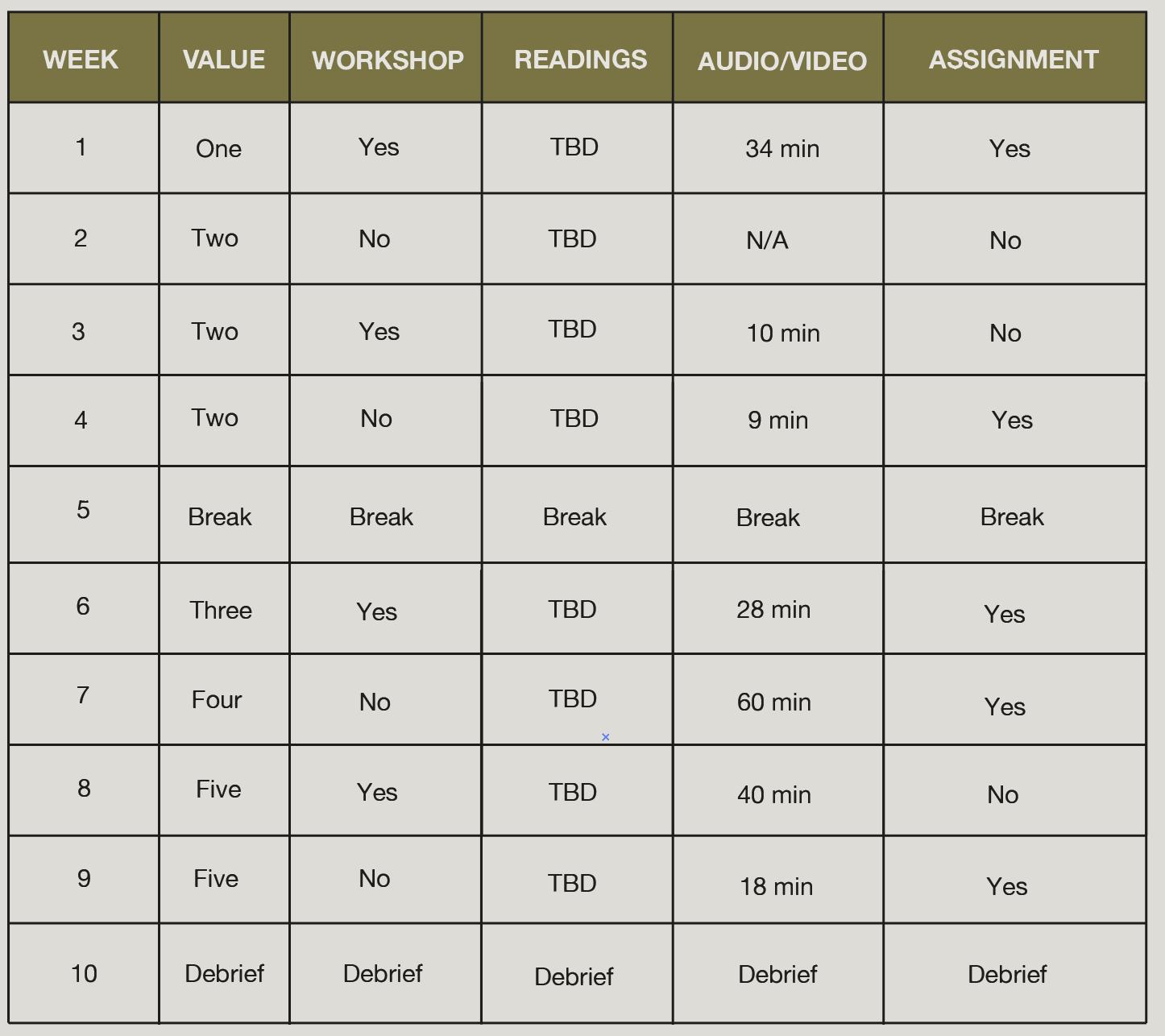
Each of the four values in the Crow Reader has a pre-recorded workshop (theory as a weapon, historical materialism, dialectics, and popular education). These workshops should be viewed every other week during the 9 week program.
Mid-Point Check in
At week 5, we will do a check in with all participating hubs. We want to ensure the material’s quality and effectiveness and members’ clarity and understanding of the content.
Debrief
At the end of the 9 weeks, a final debrief and assessment will be held with the National PE Caucus.
Curriculum
Weekly readings, videos/audios and assignments. See tentative schedule on next page.

Group Composition & Formation
• Study groups will consist of 3–9 members each.
• The Political Education Chair will oversee the creation of additional study groups.
• Within the group, each person should identify a buddy/accountability partner.
• Roles:
▪ Co-Facilitators
▪ Notetakers
▪ Timekeeper
• Balanced Composition of Participants (Experience, Knowledge, Background)
Meeting Frequency & Expansion
• Groups should meet weekly for at least 90 minutes for consistent engagement.
• After completing a cycle, each group will identify 1–3 members to lead the next iteration.
• The goal is for each hub to facilitate 2–4 study group cycles per year, ensuring ongoing political education.
• This structure ensures sustainable, scalable learning, building leadership at every level while deepening collective revolutionary analysis.
Necessary: Making time for study is very difficult for most of us.A schedule is necessary to develop our capacity to study and turn it into a habit. At the beginning of the week, make a schedule and think carefully about what time that week you could fit in any amount of studying.
Consider things like, when you are likely to achieve better focus (for some people the early morning hours are ideal because a busy home is quiet and still), the times of the day when you are most productive and awake, moments of the day or the week where you can be undisturbed and have access to places in your home that others won’t be using, etc. Consistency is important; if you set a routine, do your best to stick to your schedule.
Have a clear objective
Necessary: Knowing your study goals boosts motivation and commitment. Unlike academic pursuits, political education serves community development. Remember your community relies on your knowledge and contribution as an educator to the movement.
Optional: Setting specific study goals (e.g., hours/minutes per week, pages read) can aid program adherence. Daily, weekly, or monthly trackers can also be encouraging. Dense subjects like economics or philosophy demand endurance, similar to exercise. Initial concentration may be brief (under 10 minutes), but endurance will improve with practice, allowing longer focus on difficult reading.
Create the necessary conditions for focused study
Necessary: A dedicated study space is crucial for focus. Ensure comfort with good seating and lighting to avoid discomfort. Eliminate distractions by silencing your phone, closing email, and avoiding domestic interruptions.
Optional: For some people, creating a “study ambience” by playing music, having a clutterfree space, and even some form of decoration, can really help to make study a pleasant experience.
Necessary: Effective understanding and retention of study material necessitate organized note-taking and a systematic approach. Few individuals can recall theoretical text well enough to explain, teach, reference, or dispute its arguments without such a system. There are many note-taking methods, so find the one(s) that works best for you.
Some basic ideas to get started:
Theoretical texts present a main argument supported by others. Identify these by highlighting the main argument in one color and supporting arguments in another. In your notes, state the author's question and outline key arguments, distinguishing them from supporting evidence. Always head your notes with the text's name, author, and date. Organize your notes for future use, as they can be valuable for writing, teaching, or related readings, saving you from rereading. Filing your notes in a way that they are easy to find is key because it saves you all the effort of having to re-read something you already read just because you can’t remember where your notes are.
Optional: As you progress, build a personal glossary of new terms and concepts, expanding on existing definitions with examples (use the glossary provided as a starting place). Also, create a topic-organized list of additional readings. Theoretical texts often build on prior knowledge or engage with other ideas. Footnotes and bibliographies can help you discover more sources on topics of interest, ensuring you deepen your knowledge base.
By Assata Shakur
Carry it on now.
What is the role of ideology in the transformation of
In newspapers. In meetings. In arguments and street ghts. We carried it on.
Carry it on.
Carry it on now.
How do we understand the intricacies of systems of exploitation and oppression? 1
Carry it on.
Carry on the tradition.
2 3
In tales told to children. In chants and cantatas.
In poems and blues songs and saxophone screams, We carried it on.
What can be learned from the “Black Radical Tradition”?
eir were Black People since the childhood of time who carried it on.
In Ghana and Mali and Timbuktu
We carried it on.
Carried on the tradition.

In classrooms. In churches. In courtrooms. In prisons. We carried it on.
These questions and this curriculum should be approached alongside a group of comrades, within a BMB Hub or Chapter -- however, rigorous self-study is the foundation for meaningful engagement. The curriculum is meant as an introduction. For many, the ideas and sources will be new, but even the most veteran organizer should find value in the curriculum.
We hid in the bush.
When the slave masters came holding spear
And when the moment was ripe, leaped out and lanced the lifeblood of our would-be masters. We carried it on.
On soapboxes and picket lines. Welfare lines, unemployment
Our lives on the line, We carried it on.
This curriculum follows five core workshops, which will be offered throughout by BMB. In its design, the curriculum will ideally take ten weeks to complete -- however, a hub may decide longer is needed. The reading is meant to be manageable. It breaks down to an average of less than 50 pages per week; one should, realistically, expect to commit at least two hours of reading per week. Each workshop is also two hours. At minimum, you’ll dedicate forty hours -- including workshops, study groups and field assignments -- to the completion of this curriculum.
In sit-ins and pray ins
And march ins and die ins, We carried it on.
Our understanding begins with a question. Throughout this curriculum there are critical questions and key concepts which you are encouraged to reflect upon. These questions can be the basis for group disussions, inspiration for a field assignment, or a prompt for personal reflection. Take the time to consider the questions; consider how each question might shape or shift your commitment and your practice.
On slave ships, hurling ourselves into oceans.
Slitting the throats of our captors. We took their whips.
On cold Missouri midnights
Pitting shotguns against lynch mobs
We value the adage that, “practice without theory is blind,” and that, “theory without practice is sterile.” Indeed, in addition to critical questions and key concepts there are field assignments which should be carried out alongside the curriculum. This is not an extra or optional piece of the curriculum; it is the essence.
And their ships
Blood owed in the Atlantic and it wasn't all ours. We carried it on.
On burning Brooklyn streets
Pitting rocks against ri es, We carried it on.
You’ll also notice excerpts from interviews, quotes, poems and narratives which are meant to offer context, perspective and insight. These should be considered part of your personal toolkit, which you will add to throughout this curriculum. A living glossary is at the end; some terms, as used in BMB and throughout the curriculum are defined. Here, too, you’re expected to continue to add to the glossary as your understanding grows.
Fed Missy arsenic apple pies.
Stole the axes from the shed. Went and chopped o master's head. We ran. We fought. We organized a railroad. An underground. We carried it on.
Against water hoses and bulldogs. Against nightsticks and bullets.
Against tanks and tear gas. Needles and nooses.
Bombs and birth control. We carried it on.
The purpose is to invite folks into a crash course on systems thinking, critical analysis and Black radical politics -- where we are each both student and teacher. We do not endeavor to teach you what to think. This is not the same as a course in Black History, though we will need to think historically. Nor is this a course on Black Sociology or Theory, though we, most certainly, will look at different theories about society. Rather, this curriculum may be thought of as an orientation tohow to think through the Values of Black Men Build. As an orientation, the process is designed around elaborating upon and making connections to our Values. As is, our Values represent the most forward facing reflection of what distinguishes Black Men Build from any other organization.
In Selma and San Juan. Mozambique, Mississippi.
In Brazil and in Boston, We carried it on.
So, we begin with values.
Maria Mies and Veronika Bennholdt-Thomsen summarize some of the “main features of a new subsistence paradigm”:
rough the lies and the sell-outs, e mistakes and the madness. rough pain and hunger and frustration, We carried it on.
1. How would work change? There would be a change in the secular division of labour: Men would do as much unpaid work as women [childcare, elderly care, care for the sick and infirm, household duties]. Instead of wage work, independent self-determined socially and materially useful work would be at the centre of the economy. Subsistence production would have a priority over commodity production.
Carried on the tradition.
Carried a strong tradition.
2. What are the characteristics of subsistence technology? It must be regained as a tool to enhance life, nurture, care, share, not to dominate nature but to cooperate with nature. . . . Technology should be such, that its effects could be “healed” and repaired.
Carried a proud tradition.
Carried a Black tradition.
Carry it on.
Pass it down to the children.
3. What are the “moral” features of subsistence economy? The economy respects the limits of nature. The economy is just one subsystem of the society, not the reverse . . . The economy must serve the core life system [which militates against the patriarchal capitalist—unspoken—morality that says: “War is an extension of politics, and politics is the tool best suited to increase one’s economic worth short of war”; thus anti-core life system—RMS]. It is a decentralized, regional economy.
Pass it down.
Carry it on.
4. How would trade and markets be different? Local and regional markets would serve local needs. . . . Local markets would also preserve the diversity of products and resist cultural homogenization. Long distance trade would not be used for meeting subsistence needs. Trade would not destroy biodiversity.
Carry it on now. Carry it on
TO FREEDOM!
Assata Shakur
5. Changes in the concepts of need and sufficiency. A new concept of satisfaction of needs must be based on direct satisfaction of all human needs and not the permanent accumulation of capital and material surpluses by fewer and fewer people. A subsistence economy requires new and reciprocal relations between rural and urban areas, between producers and consumers, between cultures, countries and regions. The principle of self-reliance with regard to food security is fundamental to a subsistence economy. . . . Money would be a means of circulation but cease to be a means of accumulation.²²
It is imperative that this new vision not be lumped in with the talk about “green energy” and the other fashionable ideas about saving the planet from global warming. In none of these schemes do the advocates make the bottom line what it needs to be: the absolute destruction of the ideals and institutions that define and help patriarchy to continue its exploitation and brutality toward women that has been going on for thousands of years. We must even reject some of those ideas that claim to put destruction of capitalism up front, patriarchal socialism included.
Conclusion
e liberation of women is not an outcome of revolution. It is the precondition for it.
—Stan Goff ²³
By now some of you men will be saying, “Yeah, Maroon, you make some good points. I’ll have to check out what you’re saying. But what has all of this got to do with “Respect our mothers”? You’re totally out of order to suggest that we don’t respect our moms! Forget about all those other BI_____ (I mean women). I’ve always respected my mom! In fact, I think you and Stan Goff done got y’alls in, now in y’alls old age, y’all are feeling all guilty and shit. Fall back on us young brothers. It takes time to digest and adjust to all these changes. Plus, how do we know that women ain’t gonna act crazy too?”
Let me end by saying everything written here speaks to ways that women have always—as a whole, all of our mothers for sure—been forced to the bottom of the bowels of patriarchal capitalism’s Matrix-like slave ship. So if you and I are not working to destroy that setup, then we cannot really say we respect our mothers.
We are critical thinkers
“The ruling clique approaches its task with a ‘what to think’ program; the vanguard elements have the more difficult job of promoting ‘how to think’.”
- George L. Jackson, Field Marshal of the Black Panther Party
“The most potent weapon in the hands of the oppressor is the mind of the oppressed.”
- Steve Biko, South African anti-apartheid activist
Critical Question(s):
Concepts
What is Ideology?
What does it mean to build a revolutionary culture?
Materialism - Idealism - Dialectics - Contradictions - Conditions - Political Spectrum (Left to Right).
We become critical thinkers by using a scientific approach to understanding the world and engaging in political education.
Without political education, our analysis will remain underdeveloped; this is because the forces of capitalism, white supremacy, and patriarchy are actively limiting our capacity as Black men and Black people to think about what it takes for us to be free.
Critical thinking opposes those forces–it builds our capacity to assess the material world and our ideas so that we can distinguish between conditions that tend to liberate us and conditions that tend to oppress us. This method is called dialectics. With this knowledge, we can expand our collective imagination and build an ideology that we choose, not one that has been chosen for us.
The Crow Reader is designed to challenge us as Black men to reassess our conditions. It equips us to analyze the oppression that capitalism, white supremacy, and patriarchy produce in our lives and communities. The goal is to take ownership of our actions and ideology in ways that we believe will liberate us.
First, write about your own political transformation: when did you first become politically conscious?
What were the major influences? What did you believe then and what do you believe now?
Then, interview or have a discussion with two people about their politics and political development.
By Robert Allen
Reading Questions:
• What are the five formulations of Black power that Allen identifies?
• Name at least one example (historical or present-day) of each formulation.
• Which one of these formulations would be most revolutionary, and why?
• What obstacles exist for the formulation of Black power that you identified as most revolutionary?
By the time of the Newark Black Power Conference in July, 1967, it was clear that black power meant different things to different people, and the divisions in the political spectrum which black power represented became manifest at that historic meeting.
Within this spectrum five different formulations of black power can be roughly distinguished. All of them are permeated by varying degrees of cultural nationalism, and there is a good bit of overlapping between categories. In addition, orthodox black nationalists, being a political potpourri, can be found in all five categories. Moving from the political right to the political left in this spectrum, we can distinguish:
1. Black power as black capitalism. This is espoused, for example, by the nationalist Black Muslims who urge blacks to set up businesses, factories and independent farming operations. Whitney Young, executive director of the National Urban League, essentially endorsed this formulation in his recent call for "ghetto power." Another exponent is Dr. Thomas W. Matthew, a black neurosurgeon and president of the National Economic Growth and Reconstruction Organization (NEGRO), who in a speech Feb. 1, 1968, before a Young Americans for Freedom audience eschewed government handouts and called instead for whites to provide capital to black businessmen through loans. The most recent supporter of black capitalism is presidential aspirant Richard M. Nixon. In a speech April 25, 1968, Nixon called for a move away from massive government-financed social welfare programs to "more black ownership, black pride, black jobs ... black power in the most constructive sense." Black militants, according to Nixon, should seek to become capitalists—"to have a share of the wealth."
2. Black power as more black politicians. Several years ago electoral politics was endorsed by SNCC as a means to achieving power. SNCC urged that black people organize independent parties, such as the Lowndes County (Alabama) Freedom party, which can place in office black men who will remain responsible to their people. This was ethnic politics. But it soon was distorted into integration politics. For example, the January, 1968, issue of Ebony magazine, which is integration-oriented and aimed at the black middle class, described the election of Negro mayors in Gary, Ind., and Cleveland, Ohio, as "Black power at the polls." But in those elections and their aftermaths the essential ingredients of ethnic group loyalty were missing. As militants have said time and again, "A black face in office is not black power."
In addition to these examples, electoral politics as a means of realizing black power has taken some unexpected turns, particularly in Newark. In a city with a growing black majority population but run by an Italian minority government, one has a situation comparable with the classic colonial model.
LeRoi Jones, well-known black nationalist and member of the United Brothers, Newark's black united front which is seeking control of the city, actively sought to cool out the riots which developed after the murder of Rev. Martin Luther King Jr. Jones believes that control can be won through the ballot, not the bullet.
On April 12, 1968, Jones participated in an interview with Newark police captain Charles Kinney and Anthony Imperiale, leader of a local right-wing white organization. During the interview Jones suggested that white leftists were responsible for instigating the riots. The policeman then named Students for a Democratic Society and the Newark Community Union Project (NCUP) as being behind the riots. Jones did not make this specific charge but the inference was that he agreed. Later in the interview it was suggested that Jones and Imperiale would be working together with the cops to maintain the peace.
A week later Jones elaborated on his position in an interview with the Washington Post. "Our aim is to bring about black self-government in Newark by 1970," Jones said:
“We have a membership that embraces every social area in Newark. It is a wide cross-section of business, professional and political life."I'm in favor of black people taking power by the quickest, easiest, most successful means they can employ. Malcolm X said the ballot or the bullet. Newark is a particular situation where the ballot seems to be advantageous. I believe we have to survive. I didn't invent the white man. What we're trying to do is deal with him in the best way we can ... Black men are not murderers ... What we don't want to be are die-ers."
Jones added that he had "more respect for Imperiale, because he doesn't lie, like white liberals." Imperiale, he said, "had the mistaken understanding that we wanted to come up to his territory and do something. That was the basic clarification. We don't want to be bothered and I'm sure he doesn't want to be bothered." White Provocateurs?
From other such fragmentary evidence the explanation of Jones's new tactics appears to be complex but instructive. It should be noted parenthetically that a factor which confuses the matter further is found in unconfirmed reports, originating with neither the police, right wingers or nationalists, that certain whites actually were attempting to distribute molotov cocktails to blacks during the riots.
In Newark the opportunity exists for militant black nationalists to gain control of the city, assuming that they can avoid being wiped out by the police or right wingers. From their point of view, then, it is of crucial importance to buy time and maintain the peace until a nonviolent transfer of power can be effected, hopefully in the 1970 municipal elections. A violent confrontation right now, the nationalists might argue, would be disastrous for their young and still relatively weak organization.
In the meantime, during this period of stalemate, and with the real power of the city government and right-wing whites on the wane as their supporters emigrate from the city, every effort would be made to unify the black community around the aspiring new leaders and to eliminate potentially "disruptive" elements. Such elements may derive from two sources: independent political operations which have some black support, particularly one such as NCUP which also controls one of the city's eight antipoverty boards, and, on the other hand, groups which advocate arming and what may be regarded as premature violence against the establishment. Both sources exist in Newark and the essential question at issue is not that they are white or black; right, left or apolitical. The point is that they're working in the black community but are independent of the group which is seeking control, and because they, too, may grow in strength, unlike the white establishment, they could pose a long-term, even immediate threat.
Of course, as far as the police and Imperiale were concerned, Jones's statements were very useful since they publicly set one group of militants in the black community against another. The cops and Imperiale are also playing a waiting game: waiting to exploit what they hope is a growing rift among Newark's militant groups. But the situation is very much in flux, and it remains to be seen whether Jones will maintain the position he has taken.
What is strongly suggested when this dynamic is examined is that problems such as this may be expected to arise in other metropolitan areas as more and more U.S. cities find themselves with black majority populations, and the struggle for power is transformed from militant rhetoric into actual practice.
Since 1968 is a presidential election year it is natural to ask what kind of policy black militants have adopted. The answer is that no uniform strategy has been agreed upon. Some groups advocate abstention, others support Socialist Workers party candidates and still others are allied with the various Peace and Freedom party campaigns. The Black Panther party is running Eldridge Cleaver for President. Assorted nationalist groups have called for a write-in vote for exiled militant Robert F. Williams, and to top matters off, comedian-activist Dick Gregory is running his own spirited campaign.
All of this adds up to a lack of political direction which may well make it easier for establishment politicians to co-opt many black militants. Sen. Robert F. Kennedy was successful in getting militants in Indiana to campaign for him, and it is not beyond the realm of possibility that one of the major party candidates may receive the tacit or explicit support of one of the militant national organizations.
Richard Nixon, for example, recently proclaimed a new political alignment which includes Republicans, the "new South," "new liberals" and black militants. According to The New York Times of May 17, Roy Innis, associate national director of the Congress of Racial Equality, described Nixon as the only presidential candidate who understood black aspirations.
3. Black power as group integration. Nathan Wright, chairman of the Newark Black Power Conference, expressed this view most clearly in his book, "Black Power and Urban Unrest." Wright urges black people to band together as a group to seek entry into the American mainstream. For example, he calls for organized efforts by blacks "to seek executive positions in corporations, bishoprics, deanships of cathedrals, superintendencies of schools, and high-management positions in banks, stores, investment houses, legal firms, civic and government agencies and factories." Wright's position differs from black capitalism or integration politics in that he calls for an organized group effort, instead of individual effort, to win entry into the American system. This might be regarded as simply another version of ethnic politics.
4. Black power as black control of black communities. This is the political center of the black power spectrum and the most widely accepted formulation. It is what SNCC, in part, originally meant by the term and how the Congress of Racial Equality (CORE) views black power today. It implies a group effort to seize total control of black communities from the white governing structure and business interests.
"Black people," said Floyd McKissick, national director of CORE in a speech July 31, 1967, outlining the group's program, "seek to control the educational system, the political-economic system and the administration of their own communities. They must control their own courts and their own police ... Ownership of businesses in the ghetto must be transferred to black people—either individually or collectively." The difficulty with this program is that it overlooks conflicting interests within the black community. It doesn't specify who is to control or in whose interest. Thus, it is open to co-optation by the power structure or may degenerate into black capitalism.
In the 1930s and '40s the Communist party supported black separatism under the slogan, "Self-determination in the black belt areas of Negro majority." Party theorists argued that black people formed a colony and that the fundamental task of the black liberation movement was to "complete the bourgeois-democratic revolution" (i.e., the Civil War) by forming a separate black nation in the Southern states, thus ending white domination and the semi-feudal status of Southern blacks. The party recognized that the Negro petty-bourgeois class, attempting to play the role of a black bourgeoisie or ruling class, has traditionally been the "most aggressive carrier of nationalism," but it thought that the proletarian and nationalist revolutions could occur simultaneously, resulting in the creation of a separate proletarian black state. At the time this might have been termed working class control of the black community. The party later changed its line and became integrationist.
The underlying logic of the Communists' arguments, however, appears to be motivating white ruling-class efforts to co-opt black power and forestall further urban revolts. The power structure has apparently concluded that direct white rule of the ghettos, at least in some instances, is no longer operating satisfactorily. It is instead seeking out appropriate black groups to administer the colonies. Traditional Negro leaders are not acceptable, having been discredited both within and without the black communities and obviously exercising no real control.
Therefore it is the new black elite, which ironically was created by both the successes and failures of the civil rights movement, to which the power structure must now turn. Some of the members of this group are militant nationalists, even separatists. They tend to be drawn from the traditional black petty-bourgeois class or to be upwardly mobile members of the working class whose mobility in some measure was made possible by early civil rights victories.
But they share a common frustration with the failures of the civil rights movement and often exhibit a genuine desire to improve the lot of black people. Because they are committed militants they also enjoy a certain credibility and acceptance in the ghetto.
It is these factors which make this group ideal administrators of the ghetto. They seek improvement, not revolution. Having moved up on the social ladder they do not share the nihilism of the youthful ghetto resident. Because they are accepted, they also have the potential to restore ghetto peace and tranquility. Even the more opportunistic members of this group have their use since they will work for "law and order" in return for the right to control and exploit the ghetto.
In short, black control of the black community is slowly being transformed into black elite control of the black community, and the bourgeois-democratic revolution is being completed, but in a manner designed to buttress the power of the white establishment over the black ghettos.
5. Black power as black liberation within the context of a U.S. revolution. This wing of the black power movement, represented by the Black Panthers, many members of SNCC and various local groups, views black people as a dispersed internal colony of the U.S., exploited both materially and culturally. It advocates an anticolonial struggle for self-determination which must go hand-in-hand with a general revolution throughout the U.S. It urges alliances with white radicals and other potentially revolutionary segments of the white population since, according to its analysis, genuine self-determination for blacks cannot be achieved in the framework of the present capitalist imperialism and racism which characterize the U.S. Links with the revolutionary third world are also stressed since the black struggle will supposedly be anticolonialist like other national liberation movements, and directed against a common enemy: U.S. imperialism.
But the black radicals, with some exceptions, have been unable to apply this analysis concretely or transform it into a program for struggle. There is a widespread feeling among militants that this is the way things ought to be, but few are sure as to why or how to make it reality.
For example, there has been no elaboration of the relationship between a general U.S. revolution and the black national liberation struggle. Only the theories of the orthodox white left are available, but these are explicitly rejected by black militants.
The question of third world link-ups has also presented difficulties. Aside from trips to third world countries or meetings with third world representatives, the only program developed for a direct link-up is found in the Panthers' call for a UN-supervised black plebiscite and the stationing of UN observers in U.S. cities. And even this is simply a variation on Malcolm X's plan in 1964 to secure UN intervention.
An indirect link to the third world exists in the black antiwar movement. Most militant black antiwar activists openly endorse revolutionary liberation struggles around the world while opposing imperialist wars of aggression. These activists also have a potential base from which to operate. For example, two days before President Johnson announced his noncandidacy, the Philadelphia Tribune, a black community newspaper, completed a seven-week "Vietnam Ballot" in which 84.5% of those polled favored a "get out of Vietnam" position. Only 11% favored a "stop the bombing-negotiate" position, and fewer than 5% supported what was then U.S. policy.
Unfortunately, this sentiment by and large has not been transformed into organization or action. The black antiwar movement has suffered from opportunism and weak or ineffective organizing efforts. A new group, the National Black Antiwar Antidraft Union, headed by SNCC's John Wilson, hopes to solve some of these problems, but it is still too young to have had any noticeable effect.
Aside from these problems the pressure of events is also overtaking black radicals. On the one side they are facing the prospect of increasing repression, on the other there is the escalating anger and nihilism in the ghettos. Black power did in some sense speak to the anger and frustration of urban masses and increased their militance. Their response has been bigger and better rebellions. The outbreaks are political in that they clearly challenge property rights, but black power militants have not brought this political undertone into conscious focus, except among black students, nor have they been able to deal with the resulting repression and co-optation. Instead, those who have not been co-opted, jailed or killed have tended to yield to nihilism and fatalism.
The inability of the white left to seriously deal with racism and repression has accelerated this process. Many black militants increasingly believe that there simply are no effective revolutionary elements in the white population. White students have largely confined themselves to the campuses, where the left has grown stronger, and have not organized poor whites or white workers, groups which have simply persisted in their support of U.S. racism and imperialism. The older middle-class white left has opted out by joining with itself in a middle-class antiwar movement or thrown in with the liberals in supporting McCarthy. A handful of white leftists maintain the proper rhetorical posture vis-a-vis the blacks, but they aren't able to produce the goods.
So, Stokely Carmichael, under these conflicting pressures, announces that whites are the enemy or, at best, irrelevant. He organizes black united fronts, whose unity consists in shared blackness and concern for survival. And survival quickly becomes the uppermost concern.
Socialism becomes irrelevant for Carmichael because he foresees a race war: black against white. He does not anticipate any class struggle in the orthodox sense, hence class analysis has no use. To Carmichael all blacks form one class: the hunted. All whites form another class: the hunters and their accomplices.
Not all militant leaders have yielded to these pressures. Even within the same organization there are differences. H. Rap Brown, present chairman of SNCC and a veteran of white America's jails, contends that it is not possible to judge a revolutionary by the color of his skin. At last October's Guardian meeting Brown expressed his position: "We don't need [white] liberals, we need revolutionaries ... So the question really becomes whether you choose to be an oppressor or a revolutionary. And if you choose to be an oppressor then you are my enemy. Not because you are white but because you choose to oppress me."
Brown, a man who has ample reason to be bitter against whites, has nevertheless frequently contended, and still does, that the revolutionary forces and their allies must be judged by the same standards: commitment and action. But these are tough standards to meet and Brown, too, is known to have growing doubts about the existence of revolutionary forces both within and without the black communities.
By Frantz Fanon
Reading Questions:
• What does Fanon mean when he speaks of the crimes of Europe?
• Fanon wrote, “What we want to do is to go forward all the time, night and day, in the company of Man, in the company of all men.” How can we connect this to collective critical thinking?
• Fanon wrote, “[W]e must make a new start, develop a new way of thinking, and endeavor to create a new man.” What goes into the creation of a new man?
Now, comrades, now is the time to decide to change sides. We must shake off the great mantle of night which has enveloped us, and reach for the light. The new day which is dawning must find us determined, enlightened and resolute.
We must abandon our dreams and say farewell to our old beliefs and former friendships. Let us not lose time in useless laments or sickening mimicry. Let us leave this Europe which never stops talking of man yet massacres him at every one of its street corners, at every corner of the world.
For centuries Europe has brought the progress of other men to a halt and enslaved them for its own purposes and glory; for centuries it has stifled virtually the whole of humanity in the name of a so-called "spiritual adventure." Look at it now teetering between atomic destruction and spiritual disintegration.
And yet nobody can deny its achievements at home have not been crowned with success.
Europe has taken over leadership of the world with fervor, cynicism, and violence. And look how the shadow of its monuments spreads and multiplies. Every movement Europe makes bursts the boundaries of space and thought. Europe has denied itself not only humility and modesty but also solicitude and tenderness. Its only show of miserliness has been toward man, only toward man has it shown itself to be niggardly and murderously carnivorous.
So, my brothers, how could we fail to understand that we have better things to do than follow in that Europe's footsteps?
This Europe, which never stopped talking of man, which never stopped proclaiming its sole concern was man, we now know the price of suffering humanity has paid for every one of its spiritual victories.
Come, comrades, the European game is finally over, we must look for something else. We can do anything today provided we do not ape Europe, provided we are not obsessed with catching up with Europe.
Europe has gained such a mad and reckless momentum that it has lost control and reason and is heading at dizzying speed towards the brink from which we would be advised to remove ourselves as quickly as possible. It is all too true, however, that we need a model, schemas and examples. For many of us the European model is the most elating. But we have seen in the preceding pages how misleading such an imitation can be. European achievements, European technology and European lifestyles must stop tempting us and leading us astray.
When I look for man in European lifestyles and technology I see a constant denial of man, an avalanche of murders.
Man's condition, his projects and collaboration with others on tasks that strengthen man's totality, are new issues which require genuine inspiration.
Let us decide not to imitate Europe and let us tense our muscles and our brains in a new direction. Let us endeavor to invent a man in full, something which Europe has been incapable of achieving.
Two centuries ago, a former European colony took it into its head to catch up with Europe. It has been so successful that the United States of America has become a monster where the flaws, sickness, and inhumanity of Europe have reached frightening proportions.
Comrades, have we nothing else to do but create a third Europe? The West saw itself on a spiritual adventure. It is in the name of the Spirit, meaning the spirit of Europe, that Europe justified its crimes and legitimized the slavery in which it held four fifths of humanity.
Yes, the European spirit is built on strange foundations. The whole of European thought developed in places that were increasingly arid and increasingly inaccessible. Consequently, it was natural that the chances of encountering man became less and less frequent.
A permanent dialogue with itself, an increasingly obnoxious narcissism inevitably paved the way for a virtual delirium where intellectual thought turns into agony since the reality of man as a living, working, self-made being is replaced by words, an assemblage of words and the tensions generated by their meanings. There were Europeans, however, who urged the European workers to smash this narcissism and break with this denial of reality.
Generally speaking, the European workers did not respond to the call. The fact was that the workers believed they too were part of the prodigious adventure of the European Spirit.
All the elements for a solution to the major problems of humanity existed at one time or another in European thought. But the Europeans did not act on the mission that was designated them and which consisted of virulently pondering these elements, modifying their configuration, their being, of changing them and finally taking the problem of man to an infinitely higher plane.
Today we are witnessing a stasis of Europe. Comrades, let us flee this stagnation where dialectics has gradually turned into a logic of the status quo. Let us reexamine the question of man. Let us reexamine the question of cerebral reality, the brain mass of humanity in its entirety whose affinities must be increased, whose connections must be diversified and whose communications must be humanized again.
Come brothers, we have far too much work on our hands to revel in outmoded games. Europe has done what it had to do and all things considered, it has done a good job; let us stop accusing it, but let us say to it firmly it must stop putting on such a show. We no longer have reason to fear it, let us stop then envying it. The Third World is today facing Europe as one colossal mass whose project must be to try and solve the problems this Europe was incapable of finding the answers to.
But what matters now is not a question of profitability, not a question of increased productivity, not a question of production rates. No, it is not a question of back to nature. It is the very basic question of not dragging man in directions which mutilate him, of not imposing on his brain tempos that rapidly obliterate and unhinge it. The notion of catching up must not be used as a pretext to brutalize man, to tear him from himself and his inner consciousness, to break him, to kill him.
No, we do not want to catch up with anyone. But what we want is to walk in the company of man, every man, night and day, for all times. It is not a question of stringing the caravan out where groups are spaced so far apart they cannot see the one in front, and men who no longer recognize each other, meet less and less and talk to each other less and less.
The Third World must start over a new history of man which takes account of not only the occasional prodigious theses maintained by Europe but also its crimes, the most heinous of which have been committed at the very heart of man, the pathological dismembering of his functions and the erosion of his unity, and in the context of the community, the fracture, the stratification and the bloody tensions fed by class, and finally, on the immense scale of humanity, the racial hatred, slavery, exploitation and, above all, the bloodless genocide whereby one and a half billion men have been written off.
So comrades, let us not pay tribute to Europe by creating states, institutions, and societies that draw their inspiration from it.
Humanity expects other things from us than this grotesque and generally obscene emulation.
If we want to transform Africa into a new Europe, America into a new Europe, then let us entrust the destinies of our countries to the Europeans. They will do a better job than the best of us
But if we want humanity to take one step forward, if we want to take it to another level than the one where Europe has placed it, then we must innovate, we must be pioneers.
If we want to respond to the expectations of our peoples, we must look elsewhere besides Europe.
Moreover, if we want to respond to the expectations of the Europeans we must not send them back a reflection, however ideal, of their society and their thought that periodically sickens even them.
For Europe, for ourselves and for humanity, comrades, we must make a new start, develop a new way of thinking, and endeavor to create a new man.

Reading Questions:
• What’s the danger of developing programs without political education?
• Chairman Fred said, “We don’t hate white people. We hate the oppressor.” What does he mean by this, and why is it important for us?
• Chairman Fred spoke of colonialism and neo-colonialism. What are some of the examples he mentioned? Can you think of any additional examples?
Reading Questions:
• Why is it important to have a solid ideological foundation?
• What sort of principles does BMB ideology contain? Refer to past and contemporary Black history and movement history, the 9 bars, and BMB principles of Unity for support.
• How does the author explain the philosophical understanding of the world as materialist and dialectical?
In essence, an ideology is a set of principles drawn from the historical experience of a given people, a people submitted to the same general social, economic and cultural realities, in a common historical situation. An ideology can also have revolutionary or reactionary aims; it can be for oppression or for liberation from oppression. If it is revolutionary, the aims of this set of principles is to explain to this given people the causes of their past situation and their present situation, and the ways and means to bring about a future situation consistent with their desire of an independent and free existence. Ideological principles come about through research. Once they have emerged through research and are correctly put together in a coherent whole, they serve for action. Brie y, then, an ideology is a set of principles drawn from the historical experience of a particular people; as such it provides the guidelines for action, for change, in the direction desired by that people.
— Sister Shawna Maglanbayan, Garvey, Lumumba, Malcolm: Black Nationalist Separatists (Third World Press)
All ideologies arise from the historical experience of a given people, which means ideologies are indigenous, and not importable. And, any given ideology can be revolutionary or reactionary. The ideology explains causes and puts forth ways and means. The development of an ideological framework demands research, study, analysis. In seeking ideological consolidation for the organization, the Movement and the entire nation, We seek a particular, a specific order for ourselves, as We struggle for independence and, after independence, as We further consolidate and develop the new socialist society.
We understand that We struggle to liberate New Afrika - not 19th century Germany or France - not 1917 Russia. We struggle to liberate New Afrika, not China, Angola, Vietnam or Guinea-Bissau, Cuba, Brazil or Zimbabwe. We understand relationships that exist in the world, and We also understand that ideological/theoretical principles coming from other places may be useful to us - but the ideology that will successfully guide us in the process of liberating New Afrikans must be an indigenous creation of New Afrikan people.
Our ideological formulation is New Afrikan Revolutionary Nationalist. Before We can reach the point of more clearly articulating and practicing our ideology, We must become more familiar with ideology in general, and with the ideo-theoretical formulations that have come to us from other places. And, at bottom, We must get deeper into the study and analysis of our own history - the history of New Afrika.
Ideology: generally speaking, and its philosophical foundation.
..political, social and moral behavior, such that unless behavior of this sort fell within the established range, it would be incompatible with the ideology...The ideology of a society is total. It embraces the whole life of a people, and manifests itself in their class structure, history, literature, art, religion...If an ideology...seeks to introduce a certain order which will unite the actions of millions towards speci c and de nite goals, then its instruments can also be seen as instruments of social control, because "the notion of a society implies organized obligation."
— Nkrumah, Consciencism
To some bloods, all this sounds very elementary, something they "already know." To other bloods, it sounds "too academic," unrelated to their urge to "get down." But any bloods with eyes and ears will be able to relate this to the state of the nation fifteen years after the death of Malik, as We find it hard to arouse the enthusiasm of the masses because "the $ ain't what it used to be."...
Bloods who regard all talk about ideology as elementary and/or academic, who spend the bulk of their time body-building and quoting dogmas, have and will continue to fail until We learn that the strategy of armed struggle must be able to guide us in developing consciousness and uniting our people around programs which will aid us in building the New Society politically, economically, and socio-culturally - as We fight.
"The struggle for national liberation must transform the masses from their present passivity and dependence on others. It must develop in them and through them the power, the will, the capacity, and the structure to govern their own accelerated development. The masses must begin to see themselves as making their own history. Only through this fundamental transformation in attitudes, and through the creation of new infrastructures by the people themselves, can the social productive forces of the people be liberated."
We feel the need to have a clear understanding about ideology because We must have such an understanding in order to put ideology into practice. In many respects, the importance of ideology as the guide to all our actions evades us because ideology is "largely implicit," e.g., each of the principles are not entirely and immediately capable of being compiled into "handbooks" - especially when the ideology is emerging in the course of revolutionary struggle, simultaneously opposing an oppressive, reactionary order, and raising a new, revolutionary one.
Although "largely implicit," the instruments of ideology are very pervasive and concrete in their expression.
"Every society stresses its permissible ranges of conduct, and evolves instruments whereby it seeks to obtain conformity to such a range. It evolves these instruments because the unity out of diversity which a society represents, is hardly automatic, calling as it does for means whereby unity might be secured and, when secured, maintained. Though in a formal sense, these means are means of 'coercion,' in intent, they are means of cohesion. They become means of cohesion by underlining common values, which themselves generate common interests, and hence common attitudes and common reactions. It is this community, this identity in the range of principles and values, in the range of interests, attitudes, and so of reactions, which lies at the bottom of social order. It is also this community which makes social sanction necessary, which inspires the physical institutions of society, like the police force, and decides the purposes for which they are called into being."
The ideology is the foundation, and the ideology itself has a foundation. The ideology presents us with a set of principles drawn from our historical experience, and these principles ultimately rest upon a particular analysis of "the way the world works." In other words, We say, the ideology has a particular philosophical foundation.
We've said that the ideology explains the causes of the present situation, and points out the ways and means of changing the present and creating a specific future situation. We've said that the ideology uses political, social and moral theory, and establishes a particular range of political, social and moral behavior; that it manifests itself in class structure, history, literature, art and religion; that its instruments become means of cohesion by underlining common values, interests and reactions, and that it "inspires the physical institutions of society, like the police force, and decides the purposes for which they are called into being." How are all these things done, and why?
The ideology gives us our beliefs about the nature of the individual, the relationship between individuals, between individuals and the society, between individuals/society and nature, and it does these by having a philosophical foundation which provides a general analysis or description of the basis for such beliefs. Just as the ideology is drawn from particular historical experience, ultimately, the philosophical foundation also has its roots in particular social experiences, and particular interpretations of those experiences, based on how We think "the world works" - how We believe things develop, how things relate to each other.
Revolutionaries, in particular, cannot afford to take for granted the ways in which the masses conceive natural and social development. It is precisely these conceptions which are the basis for the ways in which the people will respond to efforts of agitation, education, organization and mobilization.
In 1980 We find that as We approach the masses with talk about police repression, POW's, and national independence, in many instances the "money fetish" is an obstacle blocking our progress. The masses have no idea about the actual workings of the capitalist production and distribution process. The people don't know what it means that "the cost of money has risen." The myth of amerikkkan "democracy" and the feeling of powerlessness and total inability to confront and overcome those who rule, are the dominant attitudes among our people.
We have to understand that simply pointing and saying "that is the enemy" will not suffice. We can't organize workers at the point of production if we can’t help them to first understand the production process and the ways that our exploitation is conducted in the real, day-to-day world. We can’t organize the tenants in the rat-infested buildings if they are in awe of private property, if they fear the landlord and police more than they love and respect their revolutionary vanguard, or if they regard city hall as more of a legitimate authority than their “provisional government.”
Fifteen years after the death of Malik, and We still hear our people say “but what can I do” or “it’s always been this way” - expressing a particular conception of how the world works as their reason for not involving themselves in a struggle to change the present situation.
Our ideology contains principles regarding the spirituality, humanity, and dignity of our people; a belief in the Community as a Family, and a belief that the Community is more important than the individual. These are principles that We are struggling to make live, and in the present situation We are confronted by a complex set of opposing beliefs and principles which are based, ultimately, upon a philosophy of the world which is antagonistic to ours.
The belief that our own oppression continues because We lack the power to control our own lives, rests upon a particular understanding of the world as it really is, as it really has been, and as it can be.
We believe that We can win because we understand the world as a material force, and that everything which exists in both nature and society comes into being and passes away on the basis of interconnected change and development.
So, when We see that We have an ideology which puts forth certain beliefs about the U.S. police force, as well as certain beliefs about our national reality and the war We’re engaged in, how people make change and make revolution, We understand that these beliefs rest on a philosophical understanding of the world and society that is materialist and dialectical. This philosophical understanding underlies our agitation, education and organizing round acts of U.S. police aggression, calls for "community control” of U.S police, and calls for the “disbanding” of same. Since our struggle is both against the dominating power of the oppressive U.S. Imperialist state - which the police force is an organ of - and a struggle to establish a “state of a new type,” a call to “disband” the police stems from our revolutionary ideology and its philosophical foundation.
Therefore, as We work to promote and realize the aims of our revolution…We will be able to respond to the feelings of powerlessness and inability expressed by our people. We will be able to respond, in part, because our understanding of the world as it really is and as it really works, informs us that:
the world is, by its very nature, material, and everything which exists comes into being on the basis of material causes, arises and develops in accordance with the laws of the motion of matter; activity - part of the subjective conditions that must exist before We can entertain thoughts of victory.
Raising consciousness means more than calling a pig a pig... We have to understand that even "generalizing support for armed struggle" involves a total process of changing minds, of altering the presently held assumptions regarding the nature of the oppressive state, its law, and the explicit and implicit ideological/philosophical beliefs that allow these to stand in the face of mounting genocide.
By Ed Whit eld

• Whitfield says there ought to be more democracy -- that people have the capacity and the right to make decisions that affect their lives; can we build a revolutionary culture without democracy?
• How much of your work is focused on resistance? How much is advocacy?
• How about “Do For Ourselves?” If democracy is thinking together, what would we need to create more democratic communities?
By Mari Evans
Who can be born black and not sing the wonder of it the joy the challenge And/to come together in a coming togetherness vibrating with the res of pure knowing reeling with power ringing with the sound above sound above sound to explode/in the majesty of our oneness our coming together in a comingtogetherness
Who can be born black and not exult!
Value #2:
We are curious about this moment
“We suffer political oppression, economic exploitation and social degradation. All of 'em from the same enemy.”
- Malcolm X
"You must understand that your pain is trivial except insofar as you can use it to connect with other people’s pain...as I can tell you what it is to suffer, perhaps I can help you to suffer less."
- James Baldwin
Critical Question(s):
What are the dominant ideologies of those currently in power in the US and across the globe?
What does history tell us about the current political, cultural/social and economic context of Black struggle?
Who are the enemies of Black people, specifically?
Field Assignment:
Concepts
Ideology - Capitalism - Patriarchy - Domination - Exploitation - Alienation – the tactics of an oppresive society.
We must analyze the current political moment by examining its historical roots, material conditions, and ideological conflicts. This means studying contemporary movements which include protests, policies, and compounding crises as part of ongoing struggles, not isolated events. Key players include the state, capitalists, the left, and the reactionary right, but we must also expose how their actions reinforce empire (U.S. hegemony, militarized borders, neocolonialism) and racial capitalism (exploitation built on racial hierarchy). Only by understanding these systems can we move with strategic action.
Top Five - ask five people to name the top five reasons why their life, their neighborhood, this country, our people, and the world is the way it is?
Write each response on an index card; on the back of the index card write if their explanation is material or idealist.
By CLR James
Reading Questions:
• What are the reasons that CLR James gives for Haiti being the site of the first successful slave revolt?
• What do Denmark Vesey, Gabriel Prosser and Nat Turner have in common? How were they different?
• Why is it important to study the historical significance of Haiti, particularly its revolution and postcolonial struggles, alongside the slaveholding colonies and early territories of the United States prior to the Civil War?
The history of the Negro in his relation to European civilization falls into two divisions, the Negro in Africa and the Negro in America and the West Indies. Up to the 'eighties of the last century, only one-tenth of Africa was in the hands of Europeans. Until that time, therefore, it is the attempt of the Negro in the Western World to free himself from his burdens which has political significance in Western history. In the last quarter of the nineteenth century European civilization turned again to Africa, this time not for slaves to work the plantations of America but for actual control of territory and population.
Today (1938) the position of Africans in Africa is one of the major problems of contemporary politics. An attempt is made here to give some account and analysis of Negro revolts through the centuries; in the days of slavery; in Africa during the last half-century; and in America and the West Indies today. It is impossible in this space to deal with the slave-trade and slavery; the same consideration has made it necessary to omit accounts of the early revolts in the West Indies and the incessant guerrilla warfare carried on in all the islands by the maroons (or runaway slaves) against their former masters. Negroes have continually revolted and once in Dutch Guiana the revolting slaves held almost the entire colony for months. But in the eighteenth century the greatest colony in the West Indies was French San Domingo (now Haiti) and there took place the most famous of all Negro revolts. It forms a useful starting point.
1789 is a landmark in the history of Negro revolt in the West Indies. The only successful Negro revolt, the only successful slave revolt in history, had its roots in the French Revolution, and without the French Revolution its success would have been impossible.
During the eighteenth century French San Domingo developed a fabulous prosperity and by 1789 was taking 40,000 slaves a year. In 1789 the total foreign trade of Britain was twenty-seven million pounds, of which the colonial trade accounted for only five million pounds. The total foreign trade of France was seventeen million pounds, of which San Domingo alone was responsible for eleven millions. "Sad irony of human history," comments Jaures, "the fortunes created at Bordeaux, at Nantes, by the slave-trade gave to the bourgeoisie that pride which needed liberty and contributed to human emancipation." But the colonial system of the eighteenth century ordained that whatever manufactured goods the colonists needed could be bought only in France.
They could sell their produce only to France. The goods were to be transported only in French ships. Colonial planters and the Home Government were thus in bitter and constant conflict, the very conflict which had resulted in the American War of Independence. The American colonists gained their freedom in 1783, and in less than five years the British attitude to the slave-trade changed. Previous to 1783 they had been the most successful practitioners of the slave-trade in the world. But now not only was America gone, but it was British ships which were supplying a large proportion of the 40,000 slaves a year which were the basis of San Domingo's prosperity.
The trade of San Domingo almost doubled between 1783 and 1789. The British West Indian colonies were in comparison poor, and with the loss of America, were of diminishing importance. The monopoly of the West Indian sugar planters galled the rising industrial bourgeoisie, potential free-traders. Adam Smith and Arthur Young, economists of the coming industrial age, condemned the expensiveness of slave labor. India offered the example of a country where the laborer cost only a penny a day, did not have to be bought, and did not brand his master as a slave-owner.
In 1787 the Abolitionist Society was formed and the British Government, which only a few years before had threatened to sack a Governor of Jamaica if he tampered with the slave-trade in any shape or form, now changed its mind. If the slave-trade was brought to a sudden close, San Domingo would be ruined. The British islands would lose nothing, for they had as many slaves as they seemed likely to need. The abolitionists, it is true worked very hard, and Clarkson, for instance, was a very honest and sincere man. Many people were moved by their propaganda. But that a considerable and influential section of British men of business thought that the slave-trade was not only a blot on the national name but a growing hole in the national pocket, was the point that mattered. The evidence for this is given in detail in the writer's Black Jacobins published in 1938 with a revised edition in 1963.
The Abolition Society was formed in 1787. France at that time was stirring with the revolution, and the French humanitarians formed a parallel society, "The Friends of the Negro." They preached the abolition not only of the slave-trade but of slavery as well, and Brissot, Mirabeau, Condorcet, Robespierre, many of the great names of the revolution, were among the members. They ignored or minimized the fact that, unlike Britain, two-thirds of France's overseas trade was bound up with the traffic. Wilberforce and Clarkson encouraged them, gave the society money, and did active propaganda in France. This was the position in Europe when the French Revolution began.
San Domingo possessed at that time 500,000 slaves, and only 30,000 Mulattoes and about the same number of whites. But the slave-owners of San Domingo at once embraced the revolution, and as each section interpreted liberty, equality and fraternity to suit itself, civil war was soon raging between them. Some of the rich whites, especially those who owed debts to French merchants, wanted to follow the example of America and virtually rule themselves.
The Mulattoes wanted to be rid of their disabilities, the poor whites wanted to become masters and officials like the rich whites. These classes fought fiercely with one another. The white colonists lynched and murdered Mulattoes for daring to claim equality. But the whites themselves were divided into royalists and revolutionaries. The French revolutionary legislatures first of all evaded the question of Mulatto rights, then gave some of the Mulattoes rights, then took the rights away again. Mulattoes and whites fought, and under the stress of necessity began to arm their slaves. The news from France, the slogans of liberty, equality and fraternity, the political excitement in San Domingo, the civil war between rich whites, poor whites and Mulattoes, it was these things which after two years awoke the sleeping slaves to revolution. By July, 1791, in the thickly populated North they were planning a rising.
The slaves worked on the land, and, like revolutionary peasants everywhere, they aimed at the extermination of their masters. But, working and living together in gangs of hundreds on the huge sugar-factories which covered the North Plain, they were closer to a modern proletariat than any group of workers in existence at that time, and the rising was, therefore, a thoroughly prepared and organized mass movement. On a night in August a tropical storm raged, with lightning and gusts of wind and heavy showers of rain. Carrying torches to light their way, the leaders of the revolt met in an open space in the thick forests of the Morne Rouge, a mountain overlooking Cap François, the largest town.
There Boukman, the leader, after Voodoo incantations and the sucking of the blood of a stuck pig, gave the last instructions. That very night they began. Each slave-gang murdered its masters and burnt the plantation to the ground. The slaves destroyed tirelessly. They knew that as long as those plantations stood, their lot would be to labor on them until they dropped. They violated all the women who fell into their hands, often on the bodies of their still bleeding husbands, fathers and brothers. But they did not maintain this vengeful spirit for long. As the revolution gained territory they spared many of the men, women and children whom they surprised on plantations. To prisoners of war alone they remained merciless. They tore out their flesh with red-hot pincers, they roasted them on slow fires, they sawed a carpenter between his boards. Yet on the whole, they never approached in their tortures the savageries to which they themselves had been subjected.
The white planters refused to take the slave revolt seriously. They continued to intrigue against the Mulattoes and to threaten the French Government. But as the chaos grew, the rich royalists swallowed their color prejudice and united with the Mulattoes against the revolutionary planters. Meanwhile the insurrection prospered, until a few weeks after it began there were about a hundred thousand revolting slaves divided into large bands. The leaders were Jean-Francois and Biassou, and Toussaint L'Ouverture joined them a month after the revolt began. He was forty-six, first his master's coachman and afterward, owing to his intelligence, placed in charge of the livestock on the estate, a post usually held by a white man.
He had a smattering of education, but he could not write correct French, and usually spoke Creole i.e. the local French patois. Baffled in their first spring at the city, these leaders did not know what to do, and when the French Government sent Commissioners who boasted of the armed forces (quite imaginary) which were on their way, the Negro leaders sought to betray their followers. They wrote to the Commissioners promising that in return for the freedom of a few hundred they would cooperate in leading the others back into slavery and would join in hunting down the recalcitrant.
Toussaint, in charge of the negotiations, reduced the offer from 400 to 60. The French Commissioners gladly accepted, but the white planters with great scorn refused. Toussaint therefore gave up hopes of even a treacherous solution and began to train a small band of soldiers from among the hordes.
The French legislature was by this time under the leadership of Brissot and the Girondins. These managed to persuade the colonial interests that it was to their advantage to give all rights to the Mulattoes, and in April 1792, this became law. But Brissot, doughty propagandist for abolition before he came to power, now would not go a step further than rights for Mulattoes. Far from abolishing slavery, he and his government dispatched a force to crush the slave revolt. These troops landed in San Domingo, but before they could begin the attack, events had occurred in Paris which altered the whole course of the French Revolution, and with it, the black revolution in San Domingo.
On August 10, 1792, the Paris masses, tired of the equivocations and indecision of the Parliamentarians, stormed the Tuileries and dragged the Bourbons off the throne. A wave of enthusiasm for liberty swept over France and from indifference to slavery at the beginning of the revolution, revolutionary France now hated no section of the aristocracy so much as the colonial whites, "the aristocrats of the skin." In San Domingo the news of August 10 so split the slave-owners that the civil war between them which had ended began again. Every conflict among the slave-owners was a source of added strength to the slaves.
By February 1793 war had broken out between revolutionary France and England and Spain. The Spaniards in Spanish San Domingo from the start had helped the slaves against the French. Now they offered them a formal alliance and the slaves trooped over to join Spain. Whether France was a republic or reactionary monarchy, made no difference to the colonial slave if each was prepared to keep him in slavery. Toussaint L'Ouverture went with the others but he secretly offered to the French the services of his trained band if they would abolish slavery. They refused. He made a similar offer to the Spanish commander who likewise refused. Toussaint decided to stay where he was and watch developments.
Sonthonax, the French Commissioner, at his wits' end, threatened by Britain and Spain and increasingly deserted by the French blacks, abolished slavery as his last chance of gaining some support. His maneuver failed. Toussaint remained with the Spaniards and won most of the North Province for them. For the planters, abolition was the last straw and they offered the colony to Pitt, who dispatched an expedition from Europe to capture the French colonies in the West Indies. The British carried all before them, and by June 1794 over two-thirds of San Domingo and almost every French island of importance were in the hands of the British. The rest seemed only a matter of days.
But meanwhile the revolution had been rising in France. Before the end of 1793 Brissot had been swept out of power. Robespierre and the Mountain ruled and led the revolution against its enemies at home and abroad. By this time all revolutionary France had embraced the cause of the slaves, many refusing even to touch coffee as being drenched with the blood of their own human kind. On February 4, 1794, the Convention abolished slavery without a debate. "The English are beaten," shouted Danton. "Pitt and his plots are riddled." The great master of revolutionary tactics had seen far. The British fleet prevented assistance going to the hard pressed colored revolution but the decree of abolition would throw the blacks wholeheartedly on the side of the French. Toussaint joined the French at once, and slaughtered his Spanish allies, white and black, of yesterday; while in Martinique, Guadeloupe, and the other French colonies, the black slaves, singing the Ça Ira and the Marseillaise and dressed in the colors of the Republic, began to drive the British out of the French islands, and then carried the war into British territory. Spain made peace, in 1795, and by 1799 the British had been driven out of San Domingo and most of the French colonies by Negro slaves and Mulattoes. Fortescue, the Tory historian of the British army, gives a vivid account of this colossal disaster. Britain lost 100,000 men in the West Indies in these four years, two and a half times as many as Wellington lost in the whole of the Peninsular War.
Fever took a heavy toll, but Toussaint L'Ouverture, and Rigaud, a Mulatto, in San Domingo; and Victor Hugues, a Mulatto, in Martinique and the smaller islands, won one of the most important victories in the French revolutionary wars. Aided by the fever, they, in Fortescue's phrase, "practically destroyed the British army."
For six years Britain was tied up in the West Indies, and to quote Fortescue once more, if Britain played so insignificant a part in the attack on revolutionary France in Europe during the first six years of the war, the answer is to be found in "the two fatal words, San Domingo. The part played by the blacks in the success of the great French Revolution has never received adequate recognition. The revolution in Europe will neglect colored workers at its peril.
With the British driven out, L'Ouverture occupied a powerful position. He was Commander-in-Chief, appointed by the French Government, of a French army, with white officers under him. But as soon as the British were driven out, the French started to intrigue against him. They engineered a quarrel between himself and Rigaud, the Mulatto, whence was fought a bitter civil war. Toussaint was victorious, then brought Spanish San Domingo under his control. He established a strong government over the whole island, drew up a constitution which made him First Consul for life, and gave San Domingo "dominion status"; concentrating all the power in his own hands, he governed.
In eighteen months he had restored a colony, devastated by years of civil war, to two-thirds of its former prosperity. He was a despot, confining his laborers to the plantations and brooking no interference with his will under harsh penalties. But he protected the laborers from the injustice of their former owners. He saw that they were paid their wages. He established free trade and religious toleration, abolished racial discrimination, tried to lay the foundations of an educational system, sent young Mulattoes and Negroes to France to be educated so as to return and be able to govern.
He treated the whites with exceptional consideration and courtesy, so much so that the black laborers began to lose confidence in him. Too confident of his influence over the blacks, he sacrificed his popularity to please the French.
But the political situation in France had changed for the worse. The revolution had stabilized itself under Bonaparte. And Bonaparte sought to restore slavery. He sent an expedition under his brother-in-law Leclerc which finally amounted to nearly 60,000 men. Toussaint vacillated at first, then fought and finally came to terms. Captured by a trick he was sent to France, and died in an Alpine prison. But as soon as Bonaparte's plans for the restoration of slavery and all the discrimination of the old regime became known, the population, which bad been partially deceived by Leclerc's false proclamations, revolted.
Dessalines, one of Toussaint's lieutenants, had by this time seen what Toussaint never saw, that only independence could guarantee freedom. The Mulattoes, who had previously supported Bonaparte, joined the blacks, and together they fought a desperate war of independence. To win they had almost to destroy the island. France, from casualties in battle and fever, suffered the loss of over 50,000 men. The cruelties practiced by the French during the last stages of the civil war exceeded in barbarism the worst of the old slavery days. Dessalines, uncultured and lacking Toussaint's genius, led his people with a ruthlessness quite equal to that of the French. The attitude of the whites toward changes in the San Domingo regime throws a valuable light on race prejudice. Before the revolution Negroes were so despised that white women undressed before them as one undresses today before a dog or a cat.
Ten years after, when former slaves were now ruling the country, most of the whites accepted the new regime, fraternized with the ex-slave generals and dined at their tables; while the white women, members of some of the proudest families of the French aristocracy, threw themselves recklessly at the black dictator, sent him locks of hair, keepsakes, passionate letters, etc. To the laboring Negroes, however, they showed as much of their old hostility as they dared. When the Leclerc expedition came, the whites rushed to join it, and took a leading part in the gladiatorial shows where dogs ate living Negroes, etc. But when they saw that Leclerc's expedition was doomed to defeat, they disentangled themselves from it and turned again to the blacks.
Dessalines, the new dictator, declared the island independent, but promised them their properties. This was enough for them. When the French commanders were about to evacuate the island they offered the white colonists places on the boats. The colonists refused, being quite content to continue living under blacks who were no longer French even in allegiance: the San Domingo blacks gave their island its old Carib name, Haiti, to emphasize the break with France.
But the British and the Americans, themselves the greatest slave-holders in the world, were all for the victory of the blacks in order to drive out the French. All through Leclerc's campaign the British and American newspapers cursed the French and praised Toussaint and the blacks. That Frenchmen should remain in the island did not suit them. While Dessalines, who hated the whites for their accumulated treacheries, wanted to kill as many as possible, Christophe and Clairveaux, his two trusted lieutenants, disapproved, and the great bulk of the people wanted no more bloodshed. But Cathcart, an English agent in San Domingo, told Dessalines that the British would neither trade with him nor accord him their protection unless every Frenchman were killed. Not long after the French were massacred. M. Camille Guy tells the story and gives his original sources in pamphlet No. 3 of the Bulletin de geographic, published in Paris in 1898. There too he gives details of the presents that were sent to Dessalines for his coronation from London in a British cruiser and from America. Needless to say, in most books on this subject, black Dessalines bears the sole responsibility for this massacre.
The success of the San Domingo blacks killed the West Indian slave-trade and slavery. France hoped for many years that she would regain the colony. The Haitians let her know that they would resist to the last man and burn everything to the ground. France therefore resigned herself to the loss and with the removal of San Domingo from the West Indian trade, abolition of the slave-trade in 1807 and of slavery in 1834 followed. The English planters fought hard but history was against them. The revolution in France in 1848, during its short-lived span of success, abolished slavery in the French colonies.
The San Domingo revolution is the only successful Negro revolt, and therefore the reasons for that success must be noted. First the blacks themselves fought magnificently and glowing tributes have been paid to them by their opponents. But many had fought well before and have fought well since.
They were fortunate in that they had had time to organize themselves as soldiers. And this was due to the fact that they not only received inspiration from the revolution in France but between 1794 and 1797 had active support from revolutionary France. Such supplies and reinforcements as did actually arrive were comparatively small, but were directed toward assisting and not retarding the slave revolution. This was the decisive factor. The international situation also helped them.
But the conflict between Britain and France, then between France on the one hand and Spain on the other was also the result of the revolution. During the last campaign, at a very critical moment, the declaration of war between France and Britain, after the short interval which followed the Treaty of Amiens, made the victory of the San Domingo blacks inevitable. But the blacks maneuvered with great skill. The Spaniards, and in the later stages after their defeat, the British, both offered terms to the blacks with the secret intention of turning upon them afterward and restoring slavery. Maitland, the British general, say so very clearly in his letter to the Foreign Secretary, Dundas, dated December 26, 1798, and preserved in the Public Record Office. But Toussaint never compromised himself with the British. While taking from them as much assistance as was convenient, he refused any entangling alliances. He thus made the most skillful use of imperialist contradictions when revolutionary France, crushed, was no longer able to assist him.
There remains to be noted a certain aspect of the struggle which though derivative is yet of extreme importance. During the revolutionary period the blacks fought under the slogans of liberty and equality. They embraced the revolutionary doctrine, they thought in republican terms. The result was that these slaves, lacking education, half-savage, and degraded in their slavery as only centuries of slavery can degrade, achieved a liberality in social aspiration and an elevation of political thought equivalent to anything similar that took place in France. Hundreds of Toussaint's letters, proclamations, etc., are preserved, some in the national archives in France, others in San Domingo. Papers of contemporary blacks and Mulattoes also exist. Christophe and Dessalines, who shared the leadership with Toussaint, were quite illiterate, slaves sprung from the ranks. But they and their fellow officers not only acted but spoke and dictated like highly-trained modern revolutionaries.
Some examples should be given. All the blacks did not join the French. Some remained with the Spanish rulers of Spanish San Domingo. The leader of these, full of racial pride, rejected the overtures of the French and told Laveaux, the French Commander, that he would only believe in his pretended equality when he saw Monsieur Laveaux and gentlemen of his quality giving their daughters in marriage to Negroes. But the blacks who were republican had the utmost scorn for the blacks who were royalist. Witness the following proclamation in reply to overtures made on behalf of the Spanish authorities by the blacks who supported royalism.
We are republicans and, in consequence, free by natural right. It can only be Kings whose very name expresses what is most vile and low, who dared to arrogate the right of reducing to slavery men made like themselves, whom nature had made free.
The King of Spain furnishes you abundantly with arms and ammunition. Use them to tighten your chains. As for us, we have no need for more than stones and sticks to make you dance the Carmapole....
You have received commissions and you have guarantees. Guard your liveries and your parchments. One day they will serve you as the fastidious titles of our former aristocrats served them. If the King of the French who drags his misery from court to court has need of slaves to assist him in his magnificence, let him go seek it among other Kings who count as many slaves as they have subjects.
When Toussaint L'Ouverture began to suspect in 1797 that the French Government was now the representative of forces which might ultimately aim at the restoration of slavery, he addressed to them a letter which seems to come straight from the pen of Mirabeau, Danton or Robespierre, instead of from a slave who dictated in the local patois and then had his thoughts written and rewritten until his secretaries had achieved the form which he desired.
Do they think that men who have been able to enjoy the blessing of liberty will calmly see it snatched away? They supported their chains only so long as they did not know any condition of life more happy than that of slavery. But today when they have left it, if they had a thousand lives they would sacrifice them all rather than be forced into slavery again. But no, the same hand which has broken our chains will not enslave us anew. France will not revoke her principles, she will not withdraw from us the greatest of her benefits.
She will protect us from all our enemies; she will not permit her sublime morality to be perverted, those principles which do her most honor to be destroyed, her most beautiful achievement to be degraded, her Decree of the 16th Pluviose which so honors humanity to be revoked. But if, to re-establish slavery in San Domingo, this was done, then I declare to you it would be to attempt the impossible: we have known how to face dangers to obtain our liberty, we shall know how to brave death to maintain it.
This, Citizen Directors, is the morale of the people of San Domingo, those are the principles that they transmit to you by me. My own you know. It is sufficient to renew, my hand in yours, the oath that I have made, to cease to live before gratitude dies in my heart, before I cease to be faithful to France and to my duty, before the god of liberty is profaned and sullied by the liberticides, before they can snatch from my hands that sword, those arms, which France confided to me "for the defense of its rights and those of humanity, for the triumph of liberty and equality."
Race prejudice was rampant before the revolution and blacks and Mulattoes hated each other as much as did the blacks and whites. Yet by 1799 when the civil war was about to begin between the blacks of the North and West and the Mulattoes of the South, a civil war based on the different social interests of the two classes, Rigaud the Mulatto leader, instead of emphasizing the difference in color as Mulattoes always did before the revolution, now defended himself with moving passion against the conception that he was hostile to Toussaint, the Commander-in-Chief, because Toussaint was a Negro.
Indeed, if I had reached the stage where I would not wish to obey a black, if I had the stupid presumption to believe that I am above such obedience, on what grounds could I claim obedience from the whites? What a grievous example would I be giving to those placed under my orders? Besides, is there so great a difference between the color of the Commander-in-Chief and mine? Is it a tint of color, more or less dark, which instills principles of philosophy or gives merit to an individual? I have consecrated my life to the defense of the blacks. From the beginning of the revolution I have braved all for the cause of liberty. I have not betrayed my principles and I shall never do so. Besides, I am too much a believer in the Rights of Man to think that there is one color in nature superior to another. I know a man only as a man.
The revolution under the encouragement of the French revolutionaries seemed to have created a new nation. The great tragedy of San Domingo was that as the revolution in France retreated before reaction, the old slave-owners regained influence and harassed the exhausted blacks.
The revolts in the United States follow the same line as those in the West Indies before 1789, constant ill-organized uprisings which are always crushed with comparative ease. A typical revolt was that which took place at Stono, a plantation some twenty miles to the West of Carolina, in September 1739. A few score of slaves killed the two guards of a magazine, armed themselves and set out for the Edisto river. Other Negroes joined them, they marched with colors displayed, drums beating, shouting for liberty, and killing and burning all in their path. They killed about twenty-five whites, but spared one who was a good man and kind to his slaves. After some miles of this destruction they stopped to rest, but were surprised by their white owners who had followed in pursuit. They fought bravely, but they were defeated, and most of them were either shot in battle, hanged, or gibbeted alive.
That is the theme on which the variations were played in state after state in America as in island after island in the West Indies. The slaves gained nothing by these revolts. No attempt is made to treat them more kindly. Instead revolts are savagely repressed and the severity of slave legislation increased.
Yet these American revolts between 1670 and 1860 follow certain laws. This of 1739 was one of a series which took place in South Carolina between 1737 and 1740, a period of grave economic difficulties. There is imperialist intrigue at work. Spain still had colonies in America and the Spaniards were encouraging these American slaves to rebel. Many of the Negroes had been captured in Angola, and being Catholic, were attracted to the Spaniards. When the revolting Negroes set out for the Edisto river, they intended to follow it to its mouth, which was in Spanish territory. Finally the Negroes outnumbered the whites four to one in this state. Yet despite these favorable circumstances the revolt seems to have neglected the thousands of slaves who, it may be presumed, were not unwilling to join. While their masters lived in constant terror, the Negroes themselves seemed unconscious of their revolutionary potentialities when organized on an extensive scale.
The San Domingo revolution and its success dominated the minds of Negroes in the West Indies and America for the next generation. In America, where the slaves had periodically revolted from the very beginning of slavery, San Domingo inspired a series of fresh revolts during the succeeding twenty years. Documented accounts of these American slave revolts have appeared in the United States. In 1795 a revolt in Louisiana failed to take place owing to a quarrel as to the method. But this revolt is notable because an important feature now appears which seems to have been the direct result of the revolutionary ferment of the age: there were whites in alliance with the Negroes from the very beginning. Five years afterward, in 1800, there took place the well-known revolt headed by the Negro slave Gabriel, in Virginia.
The white authorities, fortunately for them, heard about it before the uprising actually began and were thus able to take precautions. About a thousand slaves, armed with clubs and swords, which they had been making since the last harvest, gathered six miles away from the town of Richmond. But a tremendous storm flooded the rivers, lore down bridges and made it impossible to conduct military operations. The revolt ended as always in failure and bloody suppression.
Yet Gabriel and his followers were slave revolutionaries above the average. They intended to spare Frenchmen because the Frenchmen were associated in their minds with liberty, equality and fraternity. They were also going to spare Quakers and Methodists because these were consistently opposed to slavery. They confidently expected the poorer whites to join them. After the fore-doomed defeat, Gabriel was captured, tried and executed. It is not known how many Negroes were concerned, but the numbers suggested varied between 2,000 and 10,000.
Despite the accidents which overtook this revolt at its beginning, it is impossible to see what other result but defeat awaited it. It had no support among powerful revolutionary elements in the country. It had no support abroad. Similar failures awaited the plots in Virginia and North Carolina in 1801-2. For these, however, we have clear evidence that the poor whites of the districts had definitely allied themselves with the Negroes. This is the recruiting speech of one of the revolting Negroes: "I have taken it on myself to let the country be at liberty, this lies upon my mind for a long time. Mind men I have told you a great deal I have joined with both black and white which is the common men or poor white people, Mulattoes will join with me to help free the country, although they are free already.
I have got eight or ten white men to lead me in the fight on the magazine, they will be before me and hand out guns, powder, pistols, shot and other things that will answer the purpose... black men I mean to lose my life in this if they will take it."
There were risings in 1811 and again in 1816, but even as late as 1822 in Virginia, one Denmark Vesey, a free Negro, attempted to lead a revolt which was partially inspired by San Domingo. Vesey based his attempt on his readings of the Bible, but he also had the San Domingo revolution in mind, for he wrote to the rulers of Haiti, telling them of his plans and asking for aid. Despite his religious outlook, or because of it, all who opposed the rising were to be killed. The numbers involved were said to have been between 6,000 and 9,000, and some of his supporters came from as far away as eighty miles. The insurrection was betrayed, probably by that mischievous type-the house-slave who was kindly treated by his master and wore his cast-off clothes.
The last important American revolt was Nat Turner's, born out of the anti-slavery agitation which was to end in the abolition of slavery in the British colonies. Mexico abolished slavery in 1829 and in this period, right through the West Indies and Spanish America, there was slave revolt after slave revolt. Turner's revolt was not very wide in scope. An intelligent and gifted man, he took his inspiration from the Bible. In February 1831 about seventy Negroes, some of them mounted, covered an area of about twenty miles and killed about sixty women and children. They were ultimately defeated by hundreds of state troops. Turner was caught and hanged. So far, Turner's revolt was commonplace.
But this revolt had an effect out of all proportion to its size. Though there are reports of slave conspiracies and of plots all over the Southern states for the next thirty years, nothing on a large scale seems to have been attempted. On the other hand at the time of the Turner revolt the Southern slave owners realized that the unrest "was not confined to the slaves." Henceforward the fear of unity between the blacks and the poor whites drove the South to treat with great severity any opposition to slavery in the South from whatever source it came. A rigid censorship was instituted. In the years before the American Civil War the turmoil among the slaves was widespread all over the South. Their chance came, however, not from the poor whites of the South but from the economic and political necessities of the Northern whites.
Before we consider the course of emancipation in America, let us see what the Negroes were to be emancipated from. In 1860, little more than seventy-five years ago, Negro slavery was still widespread in the Southern states of America. We know what slavery was like during the eighteenth century.
It had not changed much in the last half of the nineteenth. Here is a case that reads as if it came straight from San Domingo, Barbados or British Guiana in 1749. The Negro was tied to a tree and whipped with switches. When Souther became fatigued with the labor of whipping, he called upon a Negro man of his and made him "cob" Sam with a single. He also made a Negro woman of his help to 'cob' him. And, after "cobbing" and whipping, he applied fire to the body of his slave, about his back, belly and private parts. He then caused him to be washed down with hot water in which pods of red pepper had been steeped. The Negro was also tied to a log, and to the bedpost, with ropes, which choked him, and he was kicked and stamped upon by Souther. This sort of punishment was continued and repeated until the Negro died under its affliction. The records of the time tell the same tale of burnings, mutilations, etc., as in the West Indies 150 years before.
Every slave-owner did not spend every hour of the day beating and torturing his slaves. But few of his neighbors cared if he did, and if he tortured them, it was done so infrequently that it occasioned no surprise in those who saw it. In this respect 1860 was not very different from 1660. Gladstone and The London Times both supported the slave-owners against the North in the American Civil War. In this very period, Governor Eyre of Jamaica, without the slightest justification, authorized a murderous persecution of Negroes who had revolted under great provocation and had behaved with great moderation. Maroons were called in, who dashed out the brains of children and ripped open pregnant women; while the more civilized Provost Marshal Ramsay shot victims with his own band and flogged victims until their flesh bespattered the ground. Nearly 500 Negroes were killed and thousands of Negroes were whipped, sometimes with a cat in the strings of which piano-wire was interwoven; as many as two hundred lashes each were administered.
Britain was divided, Carlyle leading the defense of Eyre, who was retired on pension. Coming as it did just at the time of the American Civil War, this incident is related here, so that the cruelty of Americans to their slaves might be seen in reasonable perspective.
Obviously the conscience of mankind or growing enlightenment was not going to abolish Negro slavery in America. These forces in the heart of man had not abolished slavery for 250 years. Why should they suddenly be potent in 1850?
First of all, as we have seen, the Negro was no docile animal. He revolted continuously. By 1850 he had changed his tactics. For over a generation before the outbreak of the Civil War, the bolder slaves of the South sought freedom by flight to the North, whose economic structure had no need of slavery. In the South, the mountaineers of North Carolina, Kentucky and Tennessee had no need of slaves. They formed anti-slavery societies, and Christian and Liberal revolutionaries assisted fugitive slaves to escape. These and some bold Negroes organized the famous Underground Railway to assist escaping slaves.
By various special routes slaves were conducted from the South to the Northern states, where they were free. Thousands of blacks gained their freedom in this way. Bravest and most famous of these underground guides was the Negro, Harriet Tubman. Born a slave, she escaped, but rifle in hand she devoted her life to assisting others to actual freedom by means of the Underground. The Southern owners offered a reward of 40,000 dollars for her capture, but she used to penetrate into the very heart of the South in order to achieve her aims. Not only slaves but free Negroes took part in all this agitation and organization. When John Brown made his famous raid there were Negroes with him, some of whom lost their lives in the fighting, and others at the hands of Southern law.
The agitation of the abolitionists, the sensational escapes by the Underground Railway, the ferment among the Negroes, all helped to focus public attention on slavery. But long before the Civil War the great issues at stake were becoming clear. The South had dominated the Federal Legislation for more than half a century, but with the increasing industrial expansion of the North, that domination was now in danger. Both North and South were expanding westward.
Should the new states be based on slavery as the South wanted or on free capitalism as the North wanted? This was not a moral question. Victory here meant increasing control of the legislature by the victors. The moment the North were strong enough they decreed that there was to be no further extension of slave territory. Nothing else remained for the South but war. Had the Southerners won, their reactionary method of production and the backward civilization based upon it would have dominated the United States. No wonder Karl Marx hailed the Civil War as the greatest event of the age. He was not concerned with the morality or immorality of slavery. What he could see so early was the grandeur of the civilization which lay before the States with the victory of the North. Thus if the Civil War resulted in the abolition of slavery it was not fought for the benefit of the slaves.
Yet Negro slavery seemed the very basis of American capitalism. Slavery made cotton king; cotton became the very life food of British industries, it built up New England factories. This accounts for not merely the support given to the South by Conservatives but even by certain British Liberals. The protagonists had no illusions. Lincoln once told a Massachusetts audience cheerfully, "I have heard you have abolitionists here. We have a few in Illinois, and we shot one the other day." Lincoln said openly that to save the Union he would free all the slaves, or free some, or free none.
What we are really witnessing here is not that sudden change in the conscience of mankind so beloved of romantic and reactionary historians, but the climax of a gradual transformation of world economy. Where formerly landed property had dominated, the French Revolution marks the beginning of the social and political domination of the industrial bourgeoisie. It began in the French Revolution, in Britain its outstanding dates are the Reform Bill of 1832 and the Repeal of the Corn Laws in 1846, and it reached its culmination with the Civil War in America. The process worked itself out blindly and irrationally. In territories like San Domingo and later Brazil, where new and rich lands cried out for cultivation, the slave remained profitable for years. But we can see today that once capitalism had begun to throw off feudal shackles, slavery was doomed.
The millions of slaves were not only ignorant and backward, with a low productivity of labor. Their potential consumption as free men widened the scope of the market. Thus the San Domingo revolution, the abolition of the slave-trade in 1807, the emancipation of the slaves in 1833, and emancipation during the Civil War in America, all these events are but component parts of a single historic process. However confused, dishonest, selfish, idealistic or sincere might be the minds of the abolitionists, they were in the last analysis the agents of the economic necessities of the new age, translated into social and political, sometimes, even, religious terms.
Lincoln long maintained his attitude. It was the pressure of war which forced him to accept emancipation. The South were using Negroes to build fortifications, roads, etc., all the important labor of their armies. Where at first be feared a slave revolt which would weaken his political position in the North, he now saw the necessity of at least using slaves for labor purposes. Refugees poured over to the Northern forces and Lincoln tried to get some of them dispatched to Africa, to Haiti and other territories outside America. He was at that time considering a scheme of gradual abolition based upon compensation. But the Negro refugees were establishing themselves in the army as capable teamsters, mechanics, and general workers. They were industrious and loyal.
The South was proving more difficult to conquer than had at first been thought, and the Negroes would have to be used as soldiers. In 1862 Congress declared that after January 1, 1863, all slaves in rebel territory were free. Northern generals were urging Lincoln to enlist Negroes, and one had already taken the step on his own initiative. The South formed corps of free Negroes who were fighting in its army. Thus Lincoln's objections were finally overcome by the necessity of events. Before the end of 1865 four Negro regiments were in the field and at the end of the war, three years afterward, 178,875 Negroes had been enrolled in the Northern army. Seventy-five commissions were given, but the Negroes were commanded chiefly by white men. They were discriminated against, being treated as less than the equals of whites. Two regiments refused to accept their pay until it was made equal to that of white men, and one sergeant was court-martialed and shot because he made his company stack arms before the captain's hut as a protest against discrimination.
White troops often used them for fatigue duty. This unfair treatment affected the morale of the blacks, who were often sullen and insubordinate. But of their military quality there was never any question. They defeated some of the crack Southern troops, men who had formerly owned them. Surgeon Seth Rogers said of his soldiers that braver men never lived, and Colonel T.W. Higginson declared that "it would have been madness to attempt with the bravest white troops what he successfully accomplished with the black": the white troops were not fighting for freedom. Brave as were these blacks, there was nothing naive about them. "They met death coolly, bravely; nor rashly did they expose themselves, but all were steady and obedient to orders." Lincoln himself admitted that but for the assistance given by the Negroes, the North might have lost.
He spoke more wisely than he knew. Negro scholarship in America has conducted investigations, which tend to show that not only the Negro soldiers but the Negroes left behind in the South played a decisive part in the outcome. In the first years of the war the Southern blacks took the side of their masters. They knew them, they did not know the North, and as both were for the maintenance of slavery the difference between them was of no importance. But after the proclamation of emancipation, the news spread and it is claimed that there took place a sort of general strike, an immense sabotage, which helped to bring the South to its knees. Slavery degrades, but under the shock of great events like a revolution, slaves of centuries seem able to conduct themselves with the bravery and discipline of men who have been free a thousand years.
The American blacks were far more indebted to the political conflicts between North and South America for their freedom than the San Domingo blacks had been to the French Revolution. They were only four million, a minority, even in the South. They were tied indissolubly to America. What was now to become of them?
The Negroes themselves knew what they wanted-the land- and had they been strong enough to take it, or had the Northern capitalists the wisdom to give it to them, the possibilities opened up both for the Negro and American capitalism would have been immense. The bourgeois revolution against feudalism is only economically complete when the peasants have the land. It was so in France in 1789 and in Russia in 1917. Peasants today are politically alert as never before. The Negroes tried to take the land.
They had fought with an instinctive confidence that it was going to be theirs, so much so that much of the idleness and discontent in certain areas after the Civil War could be traced to the fact that they had not got what they expected. In certain areas they actually seized the land and refused to return it.
The Negro soldiers and the militia were trained to arms, they and their allies secured large quantities of ammunition, and in the latter part of 1865 the South lived in fear of a slave insurrection. The proposal was actually made to oppose the return of confiscated property and substitute instead a scheme for dividing the estates of the leading rebels into forty-acre plots for each freed man.
The rest would be sold to pay off the national debt and fifty dollars would be given to each homestead as a start. Revolutionary as these proposals were, yet nine-tenths of the population of the South would have been untouched. But Congress, though busy expropriating the farmers of the West and even the South for the benefit of the railroad and mining companies, would not touch Southern property for the benefit of the Negroes. It would have meant the creation of a body of peasant proprietors for whom co-operative and similar schemes would have been comparatively easy, it would have resulted in a great extension, of the internal "market," and the Negro question would never have been the problem that it is today in America.
This revolution could easily have been accomplished in the early days after the Civil War. The Southerners were too cowed to resist, the sporadic efforts of the Negroes only needed coordination. Why was the opportunity missed? First, because the peasants in a revolution have to seize the land. Only the Jacobins, as late as 1793, ratified the seizure in France. The Kerensky government in Russia could go no further than an elaborate land law, and the peasants had to wait for the Bolsheviks to encourage and legalize the seizure. Only a revolution in which the poor were the driving force would have held out its hand to the blacks and made common cause of its own objectives and land for the blacks.
There was no such revolution in America. What the dominant American bourgeoisie did, however, is as revealing of the true nature of American race prejudice as the behavior of the San Domingo whites during the black revolution.
The war had divided the Northern bourgeoisie into the small men on the one hand and on the other, the bankers, the magnates of iron and steel and the railways, linking themselves into great corporations. Monopoly capitalism was on its way. But it was as yet small. In a new country its control of propaganda, organs of publicity, etc., was not sufficient to ensure its control of elections. The small capitalists would outnumber the big capitalists and gain control of the government. Writing in the American Mercury of April 1938, a Southerner has shown that the huge patriarchal estates of the South are a tenacious legend with no foundation in fact. Most of the Southern slave-owners were farmers on a not very large scale. There was also a small capitalist class growing in the South. A combination between these and their brethren in the North would be fatal to the monopolists.
By illegally excluding representatives of the Southern States from the legislature, the big bourgeoisie passed legislation to ensure their predominance and enfranchised the Negroes in order to use these votes against their white rivals in the South. They then dispatched special agents, the carpet-baggers, to pose as the friends of the Negro and to manipulate the Negro vote in their favor. Thus the North did not allow race prejudice against the Negro to impede its wishes, accepted the fact that he was needed to help hold the South in control, and cooperated politically with him. The Southern states were offered the choice of military government or universal manhood suffrage "without regard to color, race or previous condition of servitude."
They were thus trapped either way. Some of the states accepted the Negro voter, others refused, among them Virginia, Georgia and Texas. Between 1868 and 1872 certain states were governed by whites and blacks, many of the blacks being newly-emancipated slaves.
The idea that the Negroes dominated is wholly false. Only twenty-three Negroes served in Congress from 1868 to 1895. Many Negro state officials were illiterate; in certain state legislatures more than half the Negro members could scarcely read or write. Yet there were among them many capable men. There is no evidence to prove that they were more than usually corrupt or rapacious.
The Northerners who entered these Southern governments and plundered them were potent sources of corruption. The black officials naturally sided with Northerners against the old slave-owners. When in a few years the Southern states were restored to Southern control, in nearly every state the white officers in control of the funds defaulted. But no exposure was made of this. In another generation, Northern monopoly capitalism had America in its grasp. It left the Negro to his fate, and the South turned on him. Landless, his Northern collaborators gone, he was whipped back to an existence bordering on servitude.
Yet despite the inevitable ignorance and backwardness, the few years during which the Negroes were associated with the government of certain Southern states marked the high watermark of progressive legislation in the South. Little publicity is given to the things they helped to do. "They obeyed the Constitution and annulled the bonds of states, counties and cities which were issued to carry on the War of Rebellion and maintain armies in the field against the Union. They instituted a public school system in the realm where public schools had been unknown.
They opened the ballot-box and jury-box to thousands of white men who had been debarred from them by lack of earthly possessions. They introduced Home Rule in the South. They abolished the whipping post, the branding-iron, the stocks, and other barbarous forms of punishment which, up to that time, prevailed. They reduced capital felonies from about twenty to two or three. In an age of extravagance, they were extravagant in the sums appropriated for public works. In all that time no man's right of person was invaded under the forms of law. Every Democrat's life, home, fireside and business were safe.
No man obstructed any white man's way to the ballot-box, interfered with his freedom or boycotted him on account of his political faith." It was the policy of a people poor and backward seeking to establish a community where all, black and white, could live in amity and freedom. It deserves to be remembered.
By Robert Allen
Reading Questions:
• What does Allen think is the difference between rebellion and revolution?
• Why does Allen call Black America a “semicolony” which suffers from “domestic colonialism”? How did Stokely Carmichael explain this idea? How did J.H. Odell explain it?
• Allen says in addition to “a willingness to engage in revolutionary action,” a revolutionary must have _______________?
• Beyond being a system of political and economic exploitation, what else does colonialism entail? What are the features of neocolonialism?
The course of a social revolution is never direct, never a straight line proceeding smoothly from precipitating social oppression to the desired social liberation. The path of revolution is much more complex. It is marked by sudden starts and equally sudden reverses, tangential victories and peripheral defeats, upsets, detours, delays, and occasional unobstructed headlong dashes. It may culminate in complete victory, crushing defeat, or deadening stalemate. It may enjoy partial success but then be distorted by unforeseen circumstances. The final outcome is not predicted automatically by the initial conditions. The revolutionaries must contend not only with conscious reactionaries and counterrevolutionaries but also with subtle social dynamics which act to stop or divert the revolution.
The black revolt is no exception to this process. Black America is an oppressed nation, a semicolony of the United States, and the black revolt is emerging as a form of national liberation struggle. But whether this struggle can be characterized primarily as a rebellion for reforms or a revolution aimed at altering basic social forms—even so basic a question as this cannot be given an unequivocal answer. Rebellion and revolution are interrelated, but they are not identical, and no amount of militant posturing can alter this reality.
It must be asked: Are black militant leaders simply opposed to the present colonial administration of the ghetto, or do they seek the destruction of the entire edifice of colonialism, including that subtle variant known as neocolonialism? The answer, as remarked, is not immediately clear. The reason for this lack of clarity lies partly in the fact that militant black leaders themselves are divided and in disagreement about what they are seeking. All speak of revolution.
But revolution has become a cheap word in modern America. It is necessary to probe beyond oratory and rhetoric if one wishes to determine the substance and meaning of the black revolt. Initially, about all that can be said with certainty is that aggressive black anger, the distilled essence of four hundred years of torment and struggle, has burst upon the American scene. It is almost as though the scales of history, unbalanced by the spilled blood of countless black martyrs and heroes, were finally being set right by urban rebellions which were directly comparable to colonial insurrections.
The fact of black America as a semicolony, or what has been termed domestic colonialism, lies at the heart of this study. It is at one and the same time the most profound conclusion to be drawn from a survey of the black experience in America, and also the basic premise upon which an interpretation of black history can be constructed.
Many, blacks as well as whites, will object to the use of the term domestic colonialism to describe what they prefer to call the "race problem." Some object because they contend that the solution to the "race problem" is to be achieved by extending American democracy to include black people. Racial conflict would vanish as blacks are integrated into the American political and economic mainstreams and assimilated into American culture. Of course there will be problems, say these critics, but in the long run this is the only feasible solution.
Black militants (and many not-so-militant blacks) respond to this objection by asking what is meant by "in the long run." Black people have been on the run in this land for four centuries. Even after their so-called emancipation, blacks had to run several times as fast as whites just to maintain their status as impoverished and perennially exploited residents of the United States. These critics, say the militants, can cling to the myth of evolutionary change because they refuse to admit that for the oppressed victims of the United States, both at home and abroad, American democracy is nothing more than a sham, a false face which acts to hide the murder, brutality, exploitation, and naked force upon which the socioeconomic system of American capitalism is predicated.
The critics deny the voices of protesters who, throughout the political history of this country, have indicted the masquerade of American democracy. They ignore a Robert Purvis, a black abolitionist, who more than one hundred years ago vented his contempt for "your piebald and rotten Democracy, that talks loudly about equal rights, and at the same time tramples one-sixth of the population of the country in the dust, and declares that they have 'no rights which a white man is bound to respect.'"¹
But certainly things have changed since those words were spoken? Not so if one takes seriously the cries of outrage emanating from the supposed beneficiaries of change. Ernest W. Chambers, a black barber from Omaha, Nebraska, gave eloquent testimony to the illusory nature of "racial progress" when he told President Johnson's Riot Commission: "We have marched, we have cried, we have prayed, we have voted, we have petitioned, we have been good little boys and girls. We have gone out to Vietnam as doves and come back as hawks. We have done every possible thing to make this white man recognize us as human beings. And he refuses."² The consequence of this refusal was a black revolt which threatens to grow into a full-blown revolution.
The argument for democratization of the American social system assumes that there is still room in the political economy for black people. But this overlooks, for instance, the fact that black unemployment normally is double the rate for whites, and in some categories it runs at several times the white jobless rate. The jobs which black workers do hold are largely the unskilled and semiskilled jobs which are hardest hit by automation. Government-sponsored retraining schemes are at best stopgap measures of limited value. Retraining programs are frequently unrealistic in terms of jobs actually available; people are trained in skills already obsolete. Realization of this fact led one female retrainee to exclaim: "We are being trained for the unemployed."
Integration thus fails, not because of bad intentions or even a failure of will, but because the social structure simply cannot accommodate those at the bottom of the economic ladder. Some individuals are allowed to climb out of deprivation, but black people as a whole face the prospect of continued enforced impoverishment. Increasing numbers will be forced out of the economy altogether.
Blacks tend to blame whites as a whole for this situation, but not all American whites are blind to the implications of their country's history. Here and there a Truman Nelson will speak out in defense of the "right of revolution." Referring to the bitter lessons of the Reconstruction and post-Reconstruction eras, Nelson wrote: It is no answer to this argument of the right of revolution [as expressed, for example, in the U.S. Declaration of Independence] to say that if an unconstitutional act be passed, the mischief can be remedied by a repeal of it, and that this remedy can be brought about by a full discussion and the exercise of one's voting rights.
The black men in the South discovered, generations ago, that if an unconstitutional and oppressive act is binding until invalidated by repeal, the government in the meantime will disarm them, plunge them into ignorance, suppress their freedom of assembly, stop them from casting a ballot and easily put it beyond their power to reform their government through the exercise of the rights of repeal.
A government can assume as much authority to disarm the people, to prevent them from voting, and to perpetuate rule by a clique as they have for any other unconstitutional act. So that if the first, and comparatively mild, unconstitutional and oppressive act cannot be resisted by force, then the last act necessary for the imposition of a total tyranny may not be.... In sum, if there is no right of revolution there is no other right our officials have to respect.³
Nelson's analysis is essentially right. And implicit in it are the conclusions drawn by black revolutionaries: that the American oppressive system in its totality is "unconstitutional"; that this same system long ago decided and still maintains that oppressed blacks indeed have "no rights which a white man is bound to respect"; that the right of revolution is not something safely ensconced in the documents of Western history but is indelibly inscribed in the hearts and souls of all men.
But if all these conclusions are valid, then a violent conflict is in the offing. Peaceful coexistence is impossible if the contradictions are too great. It is precisely this possibility, nay, probability, of conflict, and fear of its consequences, which motivate some to discount any talk of domestic colonialism and imperialism. For if it is admitted that blacks comprise an oppressed nation, then it must also be admitted that as blacks press for liberation a violent and anti-colonial struggle becomes increasingly likely.
Imperialist powers are not wont to relinquish gracefully and peacefully their proprietary claims over their colonial subjects. Hence to take seriously the concept of domestic colonialism is to require a revolutionary realignment on the part of those blacks and whites who support the liberation struggle. This is not an easy thing to do.
It is not easy because of the depth of commitment required. It is not easy because more than a willingness to engage in revolutionary action is asked; another prime requisite is a willingness to study and to sort out the implications and repercussions of the revolutionary act. This means that the revolutionary must not only be armed with the weapons of his trade but armed also with sufficient knowledge and political understanding to put those weapons to best use
Of utmost importance for the revolutionary is a cogent analysis of the situation in which he finds himself. Many black writers and spokesmen have tried to define and analyze domestic colonialism. Back in 1962, social critic Harold Cruse wrote: "From the beginning, the American Negro has existed as a colonial being. His enslavement coincided with the colonial expansion of European powers and was nothing more or less than a condition of domestic colonialism.
Instead of the United States establishing a colonial empire in Africa, it brought the colonial system home and installed it in the Southern states. When the Civil War broke up the slave system and the Negro was emancipated, he gained only partial freedom. Emancipation elevated him only to the position of a semi-dependent man, not to that of an equal or independent being. The only factor which differentiates the Negro's status from that of a pure colonial status is that his position is maintained in the 'home' country in close proximity to the dominant racial group."4
Malcolm X sought to relate the black freedom movement to the general and anticolonial revolt taking place throughout the world. After his assassination, this ideological work was continued by SNCC (and later by the Black Panthers), which viewed black people as an internal colony of the United States. At a meeting of Latin American revolutionaries in Cuba in 1967, Stokely Carmichael elaborated upon this theme:
We greet you as comrades because it becomes increasingly clear to us each day that we share with you a common struggle; we have a common enemy. Our enemy is white Western imperialist society. Our struggle is to overthrow this system which feeds itself and expands itself through the economic and cultural exploitation of non-white, non-Western peoples—the THIRD WORLD.
Black people in the United States are a part of this Third World, Carmichael said, and he continued:
Our people are a colony within the United States; you are colonies outside the United States. It is more than a figure of speech to say that the black communities in America are the victims of white imperialism and colonial exploitation. This is in practical economic and political terms true.
There are over thirty million of us in the United States. For the most part we live in sharply defined areas in the rural black belt areas and shantytowns of the South, and more and more in the slums of the northern and western industrial cities. It is estimated that in another five to ten years, two-thirds of our thirty million will be in the ghettos—in the heart of the cities. Joining us are the hundreds and thousands of Puerto Rican, Mexican-American and American Indian populations. The American city is, in essence, populated by people of the Third World, while the white middle class flee the cities to the suburbs.
In these cities we do not control our resources. We do not control the land, the houses or the stores. These are owned by whites who live outside the community. These are very real colonies, as their capital and cheap labor are exploited by those who live outside the cities. White power makes the laws and enforces those laws with guns and nightsticks in the hands of white racist policemen and black mercenaries.
The capitalist system gave birth to these black enclaves and formally articulated the terms of their colonial and dependent status as was done, for example, by the apartheid government of Azania [South Africa], which the U.S. keeps alive by its support.5
Perhaps the best starting point for an analysis of domestic colonialism was provided by J. H. O'Dell, an editor of Freedomways magazine:
Generally speaking, the popular notion about colonialism is one of an overseas army and an overseas establishment set up by the colonial power thousands of miles away from its home base. Thus, the idea of colonialism becomes identical with an overseas territory and strange, unfamiliar people living on that territory.
However, this picture of colonialism is a rigid one and does not allow for its many varieties. A people may be colonized on the very territory in which they have lived for generations or they may be forcibly uprooted by the colonial power from their traditional territory and colonized in a new territorial environment so that the very environment itself is "alien" to them. In defining the colonial problem it is the role of the institutional mechanisms of colonial domination which are decisive. Territory is merely the stage upon which these historically developed mechanisms of super-exploitation are organized into a system of oppression. [Emphasis in original.]6
O'Dell's central point is that colonialism consists of a particular kind of institutional or social system, and this system does not necessarily have to be tied to a specific disposition of territory. It can take a variety of forms, of which domestic colonialism in this country is one.
From this thesis, a working definition and analysis of domestic colonialism can proceed. Broadly speaking, colonialism can be defined as the direct and overall subordination of one people, nation, or country to another with state power in the hands of the dominating power. Politically, colonialism means the direct administration of the subordinate group by persons drawn from the dominant power.
Thus, in the classic African situation, European officials controlled the parliaments and governments of the colonies. Although there may have been some token representation of the indigenous population, effective power was in the hands of the European settlers. This political control was buttressed by a legal system designed to serve the interests of the white settlers. Europeans sat on the courts and operated the prisons, and white-controlled legislative bodies made laws, which carefully discriminated between settlers and natives in application. Under this legal system there was no such thing as a native winning a case against a white man.
Finally, this whole political and legal edifice was protected and maintained by colonial armies composed of white and native mercenaries or members of the indigenous population who had been press-ganged into service. These colonial armies were charged with enforcing undemocratic colonial laws and generally keeping the natives in a state of subjugation.
If the status of the black population in the United States before World War II is examined, a situation strikingly similar to this colonial model is immediately evident. Even after emancipation, in states where blacks constituted clear voting majorities, political power was usurped by whites. (The brief Reconstruction era was the only period when blacks held some measure of political power roughly commensurate with their numbers.) This was done openly and blatantly without even the courtesy of a shame-faced renunciation of the principles of democracy—principles upon which this country was supposedly founded.
Legally, black people were always at the mercy of whites. The Constitution decreed that slaves were not whole human beings, and a separate system of laws was relied upon in meting out "justice" to any unfortunate slave who provoked the ire of his master.
Robert Allen
Each slave state had a slave code which was designed to keep slaves ignorant and in awe of white power. Slaves were forbidden to assemble in groups of more than five or seven away from their home plantation. They were forbidden to leave plantations without passes and they could not blow horns, beat drums or read books. Slave preachers were proscribed and hemmed in by restrictions; and slaves were forbidden to hold religious meetings without white witnesses. Other provisions forbade slaves to raise their hands against whites and gave every white person police power over every Negro, free or slave.7
After Reconstruction these slave laws were in effect reinstituted in the form of the infamous Black Codes and segregation statutes. Under these codes, "It was a crime for black people to be idle.... In some states, any white person could arrest any black person. In other states, minor officials could arrest black vagrants and 'refractary and rebellious Negroes' and force them to work on roads, levees, and other public work without pay. Special provisions in other states forbade or limited the black man's right to own firearms."8 Right up through modern times laws such as these were vigorously enforced against blacks even though the "laws" may not have been formally inscribed in any codebook.
Behind the political and legal framework of domestic colonialism stood the police power of the state, the state militia, and the U.S. Army. As if this were not enough, an informal colonial army was created by the Ku Klux Klan and other "white citizens" groups. It was the armed terrorism of these groups that helped in successfully undermining Reconstruction. And anyone who has lived in a "modern" black ghetto knows, it is no mere figure of speech when the predominantly white police forces which patrol these communities are referred to as a "colonial army of occupation."
Colonialism is not, however, a system of domination and oppression which exists simply for its own sake. There are very specific factors which account for the creation and continuation of colonialism. "Colonialism enabled the imperialist powers to rob the colonial peoples in a variety of ways. They were able to secure cheap land, cheap labor, and cheap resources.
They were free to impose a system of low-priced payments to peasant producers of export crops, to establish a monopoly-controlled market for the import of the manufactured goods of the colony-owning power (the goods often being manufactured from the raw materials of the colony itself), and secure a source of extra profit through investment."9 Certainly not all of these specific factors were operative under the American form of domestic colonialism, but general economic motivation was of utmost importance. The colonial subjects were transported from their native land and brought to the "mother country" herself.
There they became a source of cheap labor for a rapidly expanding economy. In large measure the foundation of American capitalism was built upon the backs of black slaves and black workers. As with other colonial peoples, the colonized blacks were prevented from developing a strong bourgeois middle class which could engage in widespread economic activity and compete with the white masters. Instead, the blacks were restricted to providing unskilled labor in the production of raw materials (e.g., cotton) for "export" to northern mills and foreign consumers.
But colonialism does make for some class divisions within the ranks of the colonized. In fact, colonial rule is predicated upon an alliance between the occupying power and indigenous forces of conservatism and tradition. This reactionary alliance was made in order to minimize the chances that the colonial power would have to resort to brute force in preserving its domination. This was an early version of modern "pacification" techniques.
Thus, the colonial power played tribes off against each other and used traditional tribal chiefs as puppets and fronts for the colonial administration. In return, the rajahs, princes, sheikhs, and chiefs who collaborated with the colonial powers were rewarded with favors and impressive-sounding but usually meaningless posts. Hence, although colonialism is defined as direct rule of one group by another, it does nonetheless involve a measure of collaboration between the colonists and certain strata of the indigenous population.
Robert Allen
Under American domestic colonialism, since the African social structure was completely demolished, the beginnings of class divisions had to be created among the slaves. The most important such division was between "house niggers" and "field niggers." The former were the personal servants of the masters. They were accorded slightly better treatment than the field hands and frequently collaborated and consorted with the white rulers. Vestiges of this early social division still can be found in black communities today. Another important collaborator and force of conservatism was the black preacher. The black minister remains today an important, if not the most important, social force in most black communities. This is because historically the black preacher was the first member of the black professional class, the black elite. He frequently had, no matter how small, some degree of education; he enjoyed a semi-independent economic status, and he had access to God-given truths which were denied to ordinary blacks. Consequently, he was highly respected and looked upon by the black community as its natural leader.
While it must be said that the black church has performed an essential function in maintaining social cohesion in black communities through decades of travail and suffering, it cannot be denied that the black preacher is often identified as an "Uncle Tom," a collaborator. He is seen as a traitor to the best interests of his people. This is not a role which the black minister consciously assumed. Like the modern black middle class, he is torn with conflicting loyalties, sometimes drawn to his own people, sometimes drawn to the "foreign" rulers. The minister, in accepting Christianity, also in some degree identified with the major moral values and institutions of white society. Consequently it was relatively easy for him to work with whites, even though this sometimes amounted to a betrayal of blacks.
In general the black community experiences little difficulty in seeing white so-called morality for the hypocrisy and cant that it is. Yet the black middle class, of which the black preacher is only the most conspicuous part, as the artificially created stepchildren of white society, acts as though it is driven to uphold that society's values and attitudes—even when whites fail to do so themselves.¹0
Colonialism is more than simply a system of political oppression and economic exploitation. It also fosters the breakup of the "native" culture. Family life and community links are disrupted, and traditional cultural forms fall into disuse. Under domestic colonialism this process is even more destructive. Slave families were completely shattered and cultural continuity almost totally disrupted.
The blacks who were kidnapped and dragooned to these shores were not only stripped of most of their cultural heritage, they soon lost the knowledge of their native African languages. They were forced to speak in the tongue of the masters and to adapt to the masters' culture. In short, blacks were the victims of a pervasive cultural imperialism which destroyed all but faint remnants (chiefly in music) of the old African forms.
(2) Despite the analysis just made, there will still be those who object to the application of a framework of domestic colonialism to the internal structure of the United States. Their chief argument is that black people more and more are being granted the same political rights as those accorded to whites. The passage of a host of civil rights laws and their enforcement, even though less than vigorous, clearly supports this conclusion, it can be argued.
It must be admitted that there is some merit to this argument. Certainly the situation of black people has changed in recent years. However, whether this can be counted as anything more than a mixed blessing is the subject matter to be investigated in this book. To be more explicit, it is the central thesis of this study that black America is now being transformed from a colonial nation into a neocolonial nation; a nation nonetheless subject to the will and domination of white America. In other words, black America is undergoing a process akin to that experienced by many colonial countries. The leaders of these countries believed that they were being granted equality and self-determination, but this has proved not to be the case.
Under neocolonialism an emerging country is granted formal political independence but in fact it remains a victim of an indirect and subtle form of domination by political, economic, social, or military means. Economic domination usually is the most important factor, and from it flow in a logical sequence other forms of control. This is because an important aim of neocolonialism is "to retain essentially the same economic relationship between imperialism and the developing countries as has existed up until now."¹¹
An especially instructive example in the methods of neocolonialism is provided in the case of Ghana. Ghana became an independent country in 1957 and projected throughout the progressive world the hope that all of Africa might soon be composed of free nations pursuing an independent, self-determined course to economic development. Kwame Nkrumah, the new nation's leader, was known as an outstanding opponent of colonialism and a champion of African unity.
But in 1966 Nkrumah was overthrown in a bloodless coup and the face of neocolonialism—a neocolonialism which had been active in Ghana since independence—was exposed.
Briefly, Ghana achieved formal independence, but the government's belief that foreign financial and economic institutions could provide the vehicle for economic development resulted in Ghana's being subservient to foreign capital. Ultimately a coup was prompted by the contradictions stemming from this situation.
Until 1961 governmental passivity and reliance on foreign economic institutions was Ghana's economic development strategy. For example, cocoa is Ghana's chief export product. The owners of Ghanaian cocoa farms are Ghanaian. However, the prices paid to cocoa producers and the export of cocoa were controlled by the British-dominated Cocoa Marketing Board.
The CMB was set up in 1948 ostensibly to protect the cocoa farmer from the uncertainties of the world cocoa market and to provide a reserve fund which could be used to develop the country's economy. In actual operation, the CMB served as a convenient way for Britain to drain off Ghana's "surplus" capital. This capital was then used to enhance Britain's economic standing.
Imports from Great Britain into Ghana were controlled by the United Africa Company, a firm which was active in several African countries and which accumulated yearly net profits higher than the tax revenues of most of them. The UAC, because of its interest in maintaining its market for foreign imports, adopted a tacit policy of containing or taking over for itself any independent manufacturing operations which threatened to get under way in Ghana.
Consequently, the UAC played a prominent role in preventing the development of a genuine and strong native, capitalist class. Rather, Ghanaian capitalists were kept dependent on foreign capital and foreign economic institutions. This entrenchment of huge amounts of foreign, merchant capital, coupled with the fact that foreign-owned banks largely controlled the availability of domestic investment capital, assured that Ghana could not be economically independent.
In 1961 Ghana sought to break free of the grip of neocolonialism. An increasing balance of payments deficit, dwindling financial reserves, and failure to attract new foreign investment capital forced the Ghanaian government to search for a new development strategy.
The government adopted a new Seven-Year Plan which held out socialism as a goal. However, by socialism the ruling Convention People's Party meant merely "a set of techniques and institutions which enable rapid economic progress and economic independence in the face of a colonial heritage."¹² It did not mean the restructuring of property relations and the reorganization of the whole mode of production which is normally identified with socialism.
In any event, the change came too late. Ghana's economic condition had deteriorated dangerously, and a new military-bureaucratic elite was preparing to replace the old political elite of the CPP. This new elite believed that by consciously acting in favor of the old colonial power (instead of "flirting" with socialism), and by proclaiming its intention to govern in the name of austerity and efficiency, it could resolve the economic problems with which Ghana was afflicted. But in reality this new elite was simply pursuing in revised form the old policies which the CPP advocated until 1961. And Ghana remains a victim of neocolonialism.
One further point deserves comment. Neocolonialism is a form of indirect rule, which means that there must be an agency in the indigenous population through which this rule is exercised. Fitch and Oppenheimer in their study of Ghana noted that:
Robert Allen
The colonial governments yield administrative powers to the "natives" only when vital British interests are reasonably secure. These natives must show themselves willing and able to serve as post-colonial sergeants-of-the-guard over British property: rubber in Malaya, land in Kenya, oil in Aden, bauxite in British Guiana. When no cooperative stratum has yet emerged, "independence" is delayed. Meanwhile, elements hostile to British interests are liquidated, shoved aside or co-opted.
The problem for the British in colonial Africa has been to shape a native ruling class strong enough to protect British interests, but still weak enough to be dominated.¹³
The Nkrumahan political elite served for a time as just such a "native ruling class," even though the members of this elite were militant nationalists. When Nkrumah awoke to this reality and attempted to reverse himself, he was soon ousted from office.
(3) In the United States today a program of domestic neocolonialism is rapidly advancing. It was designed to counter the potentially revolutionary thrust of the recent black rebellions in major cities across the country. This program was formulated by America's corporate elite—the major owners, managers, and directors of the giant corporations, banks, and foundations which increasingly dominate the economy and society as a whole¹4—because they believe that the urban revolts pose a serious threat to economic and social stability. Led by such organizations as the Ford Foundation, the Urban Coalition, and National Alliance of Businessmen, the corporatists are attempting with considerable success to co-opt¹5 the black power movement. Their strategy is to equate black power with black capitalism.
In this task the white corporate elite has found an ally in the black bourgeoisie, the new, militant black middle class which became a significant social force following World War II. The members of this class consist of black professionals, technicians, executives, professors, government workers, etc., who got their new jobs and new status in the past two decades.¹6
They were made militant by the civil rights movement; yet many of them have come to oppose integrationism because they have seen its failures. Like the black masses, they denounced the old black elite of Tomming preachers, teachers, and businessmen-politicians. The new black elite seeks to overthrow and take the place of this old elite. To do this it has forged an informal alliance with the corporate forces which run white (and black) America.
The new black elite announced that it supported black power. Undoubtedly, many of its members were sincere in this declaration, but the fact is that they spoke for themselves as a class, not for the vast majority of black people who are not middle class
In effect, this new elite told the power structure: "Give us a piece of the action and we will run the black communities and keep them quiet for you." Recognizing that the old "Negro leaders" had become irrelevant in this new age of black militancy and black revolt, the white corporatists accepted this implicit invitation and encouraged the development of "constructive" black power. They endorsed the new black elite as their tacit agents in the black community, and black self-determination has come to mean control of the black community by a "native" elite which is beholden to the white power structure.
Thus, while it is true that blacks have been granted formal political equality, the prospect is—barring any radical changes—that black America will continue to be a semicolony of white America, although the colonial relationship will take a new form.
But this is getting into the substance of the study. To understand the meaning of this process and how it has come about, it is necessary to recall the events of a certain summer day when a new phrase was thrust into the popular American vocabulary.
¹ Floyd B. Barbour (ed.), The Black Power Revolt (Boston: Porter Sargent, 1968), p. 49.
² Ebony, April 1968, p. 29.
³ Truman Nelson, The Right of Revolution (Boston: Beacon Press, 1968), pp. 37-38.
4 Harold Cruse, Rebellion or Revolution? (New York: William Morrow & Co., 1968), pp. 76-77.
Robert Allen
5 The text of this speech was published as a mimeographed pamphlet by the Third World Information Service, 35 Johnson Avenue, Thornhill, Ontario, Canada.
6 Freedomways, Vol. 7, No. 1.
7 Lerone Bennett, Jr., Before the Mayflower (Chicago: Johnson Publishing Co., 1964), p. 93.
8 Bennett, Black Power U.S.A. (Chicago: Johnson Publishing Co., 1967), pp. 50-51.
9 Jack Woddis, An Introduction to Neo-Colonialism (New York: International Publishers, 1967), p. 16.
¹
0 It was this peculiar compulsion to which E. Franklin Frazier addressed himself in his classic study, Black Bourgeoisie.
¹¹ Woddis, p. 87.
¹² Bob Fitch and Mary Oppenheimer, Ghana: End of an Illusion (New York: Monthly Review Press, 1966), p. 109.
¹³ Fitch and Oppenheimer, p. 12.
¹
4 For an insightful recent study of corporate domination of American society, see Who Rules America? by G. William Domhoff (Englewood Cliffs, New Jersey: Prentice-Hall, 1967). Domhoff concludes in this carefully documented study that an identifiable "governing class," based upon the national corporate economy and the institutions nourished by that economy, exercises effective control over the national government and indeed the whole of American society.
¹
5 That is, to assimilate militant leaders and militant rhetoric while subtly transforming the militants' program for social change into a program which in essence buttresses the status quo. Domhoff's conclusion is supported by an investigation of the American economy.
In 1967, the most recent year for which complete figures were available, there were over one and a half million corporations active in the economy. Yet, of this corporate multitude, a mere five hundred, the top industrial companies, accounted for nearly 45 percent ($340 billion) of the total Gross National Product for that year. Economist A. A. Berle has estimated that the 150 largest corporations produce half the country's manufactured goods, and that about two-thirds of the economically productive assets of the United States are owned by not more than five hundred companies.
Markets for whole industries are each dominated by fewer than five corporations: aircraft engines, automobiles, cigarettes, computers, copper, heavy electrical equipment, iron, rubber, structural steel, etc. All of this places enormous economic power in the hands of a small number of semiautonomous firms. These firms in turn are controlled by largely self-perpetuating and interlocked managerial groups consisting in all of a few thousand managers and directors—the core of the corporate elite. The fantastic economic power of these autonomous corporations has direct repercussions in the nation's political and social life.
In fact, the corporations are a primary force shaping American society. Andrew Hacker, writing in The Corporation Takeover (New York: Harper & Row, 1964), remarked that "A single corporation can draw up an investment program calling for the expenditure of several billions of dollars on new plants and products. A decision such as this may well determine the quality of life for a substantial segment of society: Men and materials will move across continents; old communities will decay and new ones will prosper; tastes and habits will alter; new skills will be demanded, and the education of a nation will adjust itself accordingly; even government will fall into line, providing public services that corporate developments make necessary." (Emphasis added; p. 10.) Multiply this by five hundred, and the magnitude of corporate power is immediately evident. More and more, a relative handful of firms dominate the society, yet they are not subject to the sort of democratic checks and balances which are (formally, at least) imposed on the government.
These firms can decisively affect the fate of American society, but they are not controlled by that society. Consequently, bringing corporate power under social control should be a major problem listed on the public agenda.
¹6 In size this new black middle class is still quite small, although it has grown rapidly. A rough estimate of its dimensions can be gathered from the fact that in 1966 about one-eighth of all black families had annual incomes of $10,000 or more. In that same year, however, more than 70 per cent of black families received incomes of less than $7,000, and about half of these reported incomes below the poverty level.
By Manning Marable
Reading Questions:
• What is the first and decisive component of patriarchy?
• What is the triple burden against black women?
Both the ideological and coercive apparatuses of white power were mediated also by yet another powerful structure—patriarchy, or institutionalized sexism.
By patriarchy, I mean a sex/gender system of authoritarian male dominance and reinforced female dependency, characterized within capitalist society by certain characteristics:
1. The first and decisive component is males’ ownership of almost all private property and an absolute control over all productive resources.
2. Second, all men are able to earn more money than women who perform identical or comparable tasks in the workplace. Men under patriarchy experience greater income mobility, and most women are identified in the ideological apparatuses as “homemakers," a vocation for which no real financial compensation is given.
3. Third, women have few rights within the legal system.
4. Fourth, women are either denied suffrage (prior to 1920) or are severely under-represented within the state apparatus.
5. Fifth, various patriarchal institutions deny sexual rights for women such as abortion and birth control information.
6. Sixth, cultural and social authority is invested in the symbolic figure of the father. The (usually white) male’s penis is the necessary and logical prerequisite for power.
Finally, the “coercive glue" that holds the patriarchal order in balance is systemic violence against women: rape, involuntary sterilization, “wife beatings," and the constant threat of physical punishment. Male-dominated societies existed before the emergence of capitalism, and the struggle to uproot patriarchy even in socialist or transitional states is often problematic.
But under capitalism, patriarchy reinforces and converges with racism in numerous ways, affecting the daily lives of all Blacks and all women. The two groups have been historically victimized by white male violence, denied their civil rights, and their undercompensation in the workplace is accumulated in the form of higher profits for white capitalists. The existence of both systems creates a triple burden for every Black woman—for she is victimized, exploited, raped and murdered because of her class, race and sex. For the Black woman under capitalism, each rape is symbolically also a lynching.
The historical product of racist and sexist underdevelopment for Black America has been the creation of a unique national minority within the world’s second-most racist state (South Africa deserving honors in this category). Blacks are an integral and necessary part of an imperialistic and powerful capitalist society, yet they exist in terms of actual socioeconomic and political power as a kind of Third World nation.
As a result, Black America shares some similarities with other national minorities or oppressed nationalities within European countries; e.g., the Basques in northern Spain, the Welsh and the Irish in the United Kingdom, the Sardinians of Italy, the Corsicans of France. The critical distinction between our conditions and theirs is the factor of white racism—the systemic exploitation of Blacks as a subcaste in both the economic sphere and within civil society, like Africans and West Indians, Black Americans are not only victims of class but also white racist exploitation.
Because of its peculiar historical development, the U.S. is not just a capitalist state, but with South Africa, is a racist/capitalist state. The immediate task before the Black movement in this country is to chart a realistic program to abolish racist/capitalist underdevelopment. We must analyze the historical foundations of underdevelopment, and articulate a theory of social transformation which will overturn capitalism, patriarchy and white supremacy.
By Huey P. Newton
Reading Questions:
• What does it mean to have political consequence?
• What are examples of the profit motive at work within racist institutions of today?
• What is the role and the function of the police in Black communities?
Politics is war without bloodshed. War is politics with bloodshed. Politics has its particular characteristics which differentiate it from war. When the peaceful means of politics are exhausted and the people do not get what they want, politics are continued. Usually it ends up in physical conflict which is called war, which is also political.
Because we lack political power, Black people are not free. Black reconstruction failed because Black people did not have political and military power. The masses of Black people at the time were very clear on the definition of political power. It was evident in the songs of Black people at that time. In the songs it was stated that on the Day of Jubilee we’d have forty acres and two mules. This was promised Black people by the Freedman’s Bureau. This was freedom as far as the Black masses were concerned.
The Talented Tenth at the time viewed freedom as operative in the political arena. Black people did operate in the political arena during reconstruction. They were more educated than most of the whites in the south. They had been educated in France, Canada and England and were very qualified to serve in the political arena. But yet, Black Reconstruction failed.
When one operates in the political arena, it is assumed that he has power or represents power; he is symbolic of a powerful force. There are approximately three areas of power in the political arena: economic power, land power (feudal power) and military power. If Black people at the time had received 40 acres and 2 mules, we would have developed a powerful force. Then we would have chosen a representative to represent us in this political arena. Because Black people did not receive the 40 acres and 2 mules, it was absurd to have a representative in the political arena. When White people send a representative into the political arena, they have a power force or power base that they represent.
When White people, through their representatives, do not get what they want, there is always a political consequence. This is evident in the fact that when the farmers are not given an adequate price for their crops the economy will receive a political consequence. They will let their crops rot in the field; they will not cooperate with other sectors of the economy. To be political, you must have a political consequence when you do not receive your desires—otherwise you are non-political.
When Black people send a representative, he is somewhat absurd because he represents no political power. He does not represent land power because we do not own any land. He does not represent economic or industrial power because Black people do not own the means of production. The only way he can become political is to represent what is commonly called a military power—which the BLACK PANTHER PARTY FOR SELF-DEFENSE calls Self-Defense Power.
Black people can develop Self-Defense Power by arming themselves from house to house, block to block, community to community, throughout the nation. Then we will choose a political representative and he will state to the power structure the desires of the Black masses. If the desires are not met, the power structure will receive a political consequence. We will make it economically non-profitable for the power structure to go on with its oppressive ways. We will then negotiate as equals. There will be a balance between the people who are economically powerful and the people who are potentially economically destructive.
The White racist oppresses Black people not only for racist reasons, but because it is also economically profitable to do so. Black people must develop a power that will make it non-profitable for racists to go on oppressing us.
If the White racist imperialists in America continue to wage war against all people of color throughout the world and also wage a civil war against Blacks here in America, it will be economically impossible for him to survive. We must develop a strategy that will make his war campaigns non-profitable. This racist United States operates with the motive of profit. He lifts the gun and escalates the war for profit reasons. We will make him lower the guns because they will no longer serve his profit motive.
Every man is born, therefore he has a right to live, a right to share in the wealth. If he is denied the right to work, then he is denied the right to live. If he can’t work, he deserves a high standard of living, regardless of his education or skill. It should be up to the administrators of the economic system to design a program for providing work or livelihood for his people.
To deny a man this is to deny him life. The controllers of the economic system are obligated to furnish each man with a livelihood. If they cannot do this or if they will not do this, they do not deserve the position of administrators. The means of production should be taken away from them and placed in the people’s hands, so that the people can organize them in such a way as to provide themselves with a livelihood. The people will choose capable administrators, motivated by their sincere interest in the people’s welfare and not the interest of private property. The people will choose managers to control the means of production and the land that is rightfully theirs. Until the people control the land and the means of production, there will be no peace. Black people must control the destiny of their community.
Because Black people desire to determine their own destiny, they are constantly inflicted with brutality from the occupying army, embodied in the police department. There is a great similarity between the occupying army in Southeast Asia and the occupation of our communities by the racist police. The armies are there not to protect the people of South Vietnam, but to brutalize and oppress them for the interests of the selfish imperial power. The police should be the people of the community in uniform.
There should be no division or conflict of interest between the people and the police. Once there is a division, then the police become the enemy of the people. The police should serve the interest of the people and be one and the same. When this principle breaks down, then the police become an occupying army. When historically one race has oppressed another and policemen are recruited from the oppressor race to patrol the communities of the oppressed people, an intolerable contradiction exists.
THE RACIST DOG POLICEMEN MUST WITHDRAW IMMEDIATELY FROM OUR COMMUNITIES, CEASE THEIR WANTON MURDER AND BRUTALITY AND TORTURE OF BLACK PEOPLE, OR FACE THE WRATH OF THE ARMED PEOPLE.
“ e Black Men Missing in Our Communities”

Reading Questions:
• What’s the difference between a political prisoner and a politicized prisoner?
• One brother talked about prisoners not “fooling ourselves that we can go back out into society and become part of something that is crumbling” -what keeps the prisoner from being part of society even after release?
• How do we understand the notion of crime and criminality?
By Assata Shakur
By Robert Allen
Reading Questions:
• What does Allen think is the difference between rebellion and revolution?
Reading Questions:
• Why does Allen call Black America a “semicolony” which suffers from “domestic colonialism”? How did Stokely Carmichael explain this idea? How did J.H. Odell explain it?
• When Assata talks about the abuses the women in prison face, what’s the role of patriarchy in creating and maintaining the prison?
• Allen says in addition to “a willingness to engage in revolutionary action,” a revolutionary must have _______________?
• What is the nature of the “crimes” that many of the women are charged with and how does that relate to the political, social and economic conditions of our communities?
• Beyond being a system of political and economic exploitation, what else does colonialism entail? What are the features of neocolonialism?
• What separates the prison guard from the prisoner?
Assata Shakur / Joanne Chesimard published in The Black Scholar, April 1978
Assata Shakur was a member of the Black Panther Party who went underground to evade police repression, joining the Black Liberation Army. She was captured in 1973 and held as a political prisoner until 1979 (one year after this article was written), when she was broken out of prison by a unit of the Black Liberation Army. She made her way to Cuba where she lives to this day, despite increasing pressure from the United States for her extradition.
We sit in the bullpen. We are all black. All restless. And we are all freezing. When we ask, the matron tells us that the heating system cannot be adjusted. All of us, with the exception of a woman, tall and gaunt, who looks naked and ravished, have refused the bologna sandwiches. The rest of us sit drinking bitter, syrupy tea. The tall, fortyish woman, with sloping shoulders, moves her head back and forth to the beat of a private tune while she takes small, tentative bites out of a bologna sandwich. Someone asks her what she’s in for.
Matter-of-factly, she says, “They say I killed some nigga. But how could I have when I’m buried down in South Carolina?” Everybody’s face gets busy exchanging looks. A short, stout young woman wearing men’s pants and men’s shoes says, “Buried in South Carolina?” “Yeah,” says the tall woman. “South Carolina, that’s where I’m buried. You don’t know that? You don’t know shit, do you? This ain’t me. This ain’t me.” She kept repeating, “This ain’t me” until she had eaten all the bologna sandwiches. Then she brushed off the crumbs and withdrew, head moving again, back into that world where only she could hear her private tune.
Lucille comes to my tier to ask me how much time a “C” felony conviction carries. I know, but I cannot say the words. I tell her I will look it up and bring the sentence charts for her to see. I know that she has just been convicted of manslaughter in the second degree. I also know that she can be sentenced up to fifteen years. I knew from what she had told me before that the District Attorney was willing to plea bargain: Five years probation in exchange for a guilty plea to a lesser charge.
Her lawyer felt that she had a case: specifically, medical records which would prove that she had suffered repeated physical injuries as the result of beatings by the deceased and, as a result of those beatings, on the night of her arrest her arm was mutilated (she must still wear a brace on it) and one of her ears was partially severed in addition to other substantial injuries. Her lawyer felt that her testimony, when she took the stand in her own defense, would establish the fact that not only had she been repeatedly beaten by the deceased, but that on the night in question he told her he would kill her, viciously beat her and mauled her with a knife. But there is no self-defense in the state of New York.
The District Attorney made a big deal of the fact that she drank. And the jury, affected by T.V. racism, “law and order,” petrified by crime and unimpressed with Lucille as a “responsible citizen,” convicted her. And I was the one who had to tell her that she was facing fifteen years in prison while we both silently wondered what would happen to the four teenage children that she had raised almost single-handedly.
Spikey has short time, and it is evident, the day before she is to be released, that she does not want to go home. She comes to the Bing (Administrative Segregation) because she has received an infraction for fighting. Sitting in front of her cage and talking to her I realize that the fight was a desperate, last-ditch effort in hope that the prison would take away her “good days.”
She is in her late thirties. Her hands are swollen. Enormous. There are huge, open sores on her legs. She has about ten teeth left. And her entire body is scarred and ashen. She has been on drugs about twenty years. Her veins have collapsed. She has fibrosis, epilepsy, and edema. She has not seen her three children in about eight years. She is ashamed to contact home because she robbed and abused her mother so many times.
When we talk it is around the Christmas holidays and she tells me about her bad luck. She tells me that she has spent the last four Christmases in jail and tells me how happy she is to be going home. But I know that she has nowhere to go and that the only “friends” she has in the world are here in jail. She tells me that the only regret she has about leaving is that she won’t be singing in the choir at Christmas. As I talk to her I wonder if she will be back. I tell her goodbye and wish her luck. Six days later, through the prison grapevine, I hear that she is back. Just in time for the Christmas show.
We are at sick call. We are waiting on wooden benches in a beige and orange room to see the doctor. Two young women who look only mildly battered by life sit wearing pastel dresses and pointy-toed state shoes. (Wearing “state” is often a sign that the wearer probably cannot afford to buy sneakers in commissary.) The two are talking about how well they were doing on the street. Eavesdropping, I find out that they both have fine “old men” that love the mess out of them. I find out that their men dress fly and wear some baad clothes and so do they. One has 40 pairs of shoes while the other has 100 skirts. One has 2 suede and 5 leather coats. The other has 7 suedes and 3 leathers. One has 3 mink coats, a silver fox, and a leopard. The other has 2 minks, a fox jacket, a floor-length fox, and a chinchilla. One has 4 diamond rings and the other has 5. One lives in a duplex with a sunken tub and a sunken living room with a waterfall. The other describes a mansion with a revolving living room. I’m relieved when my name is called. I had been sitting there feeling very, very sad.
There are no criminals here at Riker’s Island Correctional Institution for Women, (New York), only victims. Most of the women (over 95%) are black and Puerto Rican. Many were abused children. Most have been abused by men and all have been abused by “the system.”
There are no big-time gangsters here, no premeditated mass murderers, no godmothers. There are no big-time dope dealers, no kidnappers, no Watergate women. There are virtually no women here charged with white-collar crimes like embezzling or fraud. Most of the women have drug-related cases. Many are charged as accessories to crimes committed by men. The major crimes that women here are charged with are prostitution, pick-pocketing, shoplifting, robbery and drugs. Women who have prostitution cases or who are doing “fine” time make up a substantial part of the short-term population. The women see stealing or hustling as necessary for the survival of themselves or their children because jobs are scarce and welfare is impossible to live on. One thing is clear: amerikan capitalism is in no way threatened by the women in prison on Riker’s Island.
One gets the impression, when first coming to Riker’s Island that the architects conceived of it as a prison modeled after a juvenile center. In the areas where visitors usually pass there is plenty of glass and plenty of plants and flowers. The cell blocks consist of two long corridors with cells on each side connected by a watch room where the guards are stationed, called a bubble. Each corridor has a day room with a T.V., tables, multi-colored chairs, a stove that doesn’t work, and a refrigerator. There’s a utility room with a sink and a washer and dryer that do not work.
Instead of bars, the cells have doors which are painted bright, optimistic colors with slim glass observation panels. The doors are controlled electronically by the guards in the bubble. The cells are called rooms by everybody.
They are furnished with a cot, a closet, a desk, a chair, a plastic upholstered headboard that opens for storage, a small bookcase, a mirror, a sink, and a toilet. The prison distributes brightly colored bedspreads and throw rugs for a homey effect. There is a school area, a gym, a carpeted auditorium, two inmate cafeterias and outside recreation areas that are used during the summer months only.
The guards have successfully convinced most of the women that Riker’s Island is a country club. They say that it is a playhouse compared to some other prisons (especially male): a statement whose partial veracity is not predicated upon the humanity of correction officials at Riker’s Island, but, rather, by contrast to the unbelievably barbaric conditions of other prisons. Many women are convinced that they are, somehow, “getting over.” Some go so far as to reason that because they are not doing hard time, they are not really in prison.
This image is further reinforced by the pseudo-motherly attitude many of the guards; a deception which all too often successfully reverts women to children. The guards call the women inmates by their first names. The women address the guards either as Officer, Ms. --- or by nicknames (Teddy Bear, Spanky, Aunt Louise, Squeeze, Sarge, Black Beauty, Nutty Mahogany, etc.). Frequently, when a woman returns to Riker’s she will make the rounds, gleefully embracing her favorite guard: the prodigal daughter returns.
If two women are having a debate about any given topic the argument will often be resolved by “asking the officer.” The guards are forever telling the women to “grow up,” to “act like ladies,” to “behave” and to be “good girls.” If an inmate is breaking some minor rule like coming to say “hi” to her friend on another floor or locking in a few minutes late, a guard will say, jokingly, “don’t let me have to come down there and beat your butt.” It is not unusual to hear a guard tell a woman, “what you need is a good spanking.” The tone is often motherly, “didn’t I tell you, young lady, to…”; or, “you know better than that”; or, “that’s a good girl.” And the women respond accordingly. Some guards and inmates “play” together. One officer’s favorite “game” is taking off her belt and chasing her “girls” down the hall with it, smacking them on the butt.
But beneath the motherly veneer, the reality of guard life is ever-present. Most of the guards are black, usually from working-class, upward-bound, civil service-oriented backgrounds. They identify with the middle class, have middle-class values, and are extremely materialistic. They are not the most intelligent women in the world and many are extremely limited.
Most are aware that there is no justice in the amerikan judicial system and that blacks and Puerto Ricans are discriminated against in every facet of amerikan life. But, at the same time, they are convinced that the system is somehow “lenient.” To them, the women in prison are “losers” who don’t have enough sense to stay out of jail. Most believe in the bootstrap theory - anybody can “make it” if they try hard enough. They congratulate themselves on their great accomplishments. In contrast to themselves they see the inmate as ignorant, uncultured, self-destructive, weak-minded, and stupid. They ignore the fact that their dubious accomplishments are not based on superior intelligence or effort, but only on chance and a civil service list.
Many guards hate and feel trapped by their jobs. The guard is exposed to a certain amount of abuse from co-workers, from the brass as well as from inmates, ass-kissing, robotizing, and mandatory overtime. (It is common practice for guards to work a double shift at least once a week.) But no matter how much they hate the military structure, the infighting, the ugliness of their tasks, they are very aware of how close they are to the welfare lines. If they were not working as guards most would be underpaid or unemployed. Many would miss the feeling of superiority and power as much as they would miss the money, especially the cruel, sadistic ones.
The guards are usually defensive about their jobs and indicate by their behavior that they are not at all free from guilt. They repeatedly, compulsively say, as if to convince themselves, “This is a job just like any other job.” The more they say it the more preposterous it seems.
The major topic of conversation here is drugs. Eighty percent of inmates have used drugs when they were in the street. Getting high is usually the first thing a woman says she’s going to do when she gets out. In prison, as on the streets, an escapist culture prevails. At least 50 percent of the prison population take some form of psychotropic drug. Elaborate schemes to obtain contraband drugs are always in the works.
Days are spent in pleasant distractions: soap operas, prison love affairs, card playing and game playing. A tiny minority are seriously involved in academic pursuits or the learning of skills. An even smaller minority attempt to study available law books. There are no jailhouse lawyers and most of the women lack knowledge of even the most rudimentary legal procedures. When asked what happened in court, or, what their lawyers said, they either don’t know or don’t remember. Feeling totally helpless and totally railroaded, a woman will curse out her lawyer or the judge with little knowledge of what is being done or of what should be done. Most plead guilty, whether they are guilty or not. The few who do go to trial usually have lawyers appointed by the state and usually are convicted.
Here, the word lesbian seldom, if ever, is mentioned. Most, if not all, of the homosexual relationships here involve role-playing. The majority of relationships are either asexual or semi-sexual. The absence of sexual consummation is only partially explained by prison prohibition against any kind of sexual behavior. Basically, the women are not looking for sex. They are looking for love, for concern and companionship. For relief from the overwhelming sense of isolation and solitude that pervades each of us.
Women who are “aggressive” or who play the masculine roles are referred to as butches, bulldaggers or stud broads. They are always in demand because they are always in the minority. Women who are “passive,” or who play feminine roles are referred to as fems. The butch-fem relationships are often oppressive, resembling the most oppressive, exploitative aspect of a sexist society. It is typical to hear butches threatening fems with physical violence and it is not uncommon for butches to actually beat their “women.” Some butches consider themselves pimps and go with the women who have the most commissary, the most contraband or the best outside connections. They feel they are a class above ordinary women which entitles them to “respect.” They dictate to fems what they are to do and many insist the fems wash, iron, sew and clean their cells for them. A butch will refer to another butch as “man.” A butch who is well-liked is known as “one of the fellas” by her peers.
Once in prison, changes in roles are common. Many women who are strictly heterosexual in the street become butch in prison. “Fems” often create butches by convincing an inmate that she would make a “cute butch.” About 80 percent of the prison population engage in some form of homosexual relationship. Almost all follow negative, stereotypic male/female role models.
There is no connection between the women’s movement and lesbianism. Most of the women at Riker’s Island have no idea what feminism is, let alone lesbianism. Feminism, the women’s liberation movement and the gay liberation movement are worlds away from women at Riker’s.
The black liberation struggle is equally removed from the lives of women at Riker’s. While they verbalize acute recognition that amerika is a racist country where the poor are treated like dirt they, nevertheless, feel responsible for the filth of their lives. The air at Riker’s is permeated with self-hatred. Many women bear marks on their arms, legs and wrists from suicide attempts or self-mutilation. They speak about themselves in self-deprecating terms. They consider themselves failures.
While most women contend that whitey is responsible for their oppression they do not examine the cause or source of that oppression. There is no sense of class struggle. They have no sense of communism, no definition of it, but they consider it a bad thing. They do not want to destroy Rockefeller. They want to be like him. Nicky Barnes, a major dope seller, is discussed with reverence. When he was convicted practically everyone was sad. Many gave speeches about how kind, smart and generous he was; no one spoke about the sale of drugs to our children.
Politicians are considered liars and crooks. The police are hated. Yet, during cop and robber movies, some cheer loudly for the cops. One woman pasted photographs of Farrah Fawcett-Majors all over her cell because she “is a baad police bitch.” Kojak and Baretta get their share of admiration.
A striking difference between women and men prisoners at Riker’s Island is the absence of revolutionary rhetoric among the women. We have no study groups. We have no revolutionary literature around. There are no groups of militants attempting to “get their heads together.” The women at Riker’s seem vaguely aware of what a revolution is but generally regard it as an impossible dream. Not at all practical.
While men in prison struggle to maintain their manhood there is no comparable struggle by women to preserve their womanhood. One frequently hears women say, “Put a bunch of bitches together and you’ve got nothin but trouble”; and, “Women don’t stick together, that’s why we don’t have nothin.” Men prisoners constantly refer to each other as brother. Women prisoners rarely refer to each other as sister. Instead, “bitch” and “whore” are the common terms of reference. Women, however, are much kinder to each other than men, and any form of violence other than a fistfight is virtually unknown. Rape, murder and stabbings at the women’s prison are non-existent.
For many, prison is not that much different from the street. It is, for some, a place to rest and recuperate. For the prostitute, prison is a vacation from turning tricks in the rain and snow. A vacation from brutal pimps. Prison for the addict is a place to get clean, get medical work done and gain weight. Often, when the habit becomes too expensive, the addict gets herself busted (usually subconsciously) so she can get back in shape, leave with a clean system ready to start all over again. One woman claims that for a month or two every year she either goes to jail or to the crazy house to get away from her husband.
For many the cells are not much different from the tenements, the shooting galleries and the welfare hotels they live in on the street. Sick call is no different from the clinic or the hospital emergency room. The fights are the same except they are less dangerous. The police are the same. The poverty is the same. The alienation is the same. The racism is the same. The sexism is the same. The drugs are the same and the system is the same. Riker’s is just another institution. In childhood, school was their prison, or youth houses or reform schools or children shelters or foster homes or mental hospitals or drug programs and they see all institutions as indifferent to their needs, yet necessary to their survival.
The women at Riker’s Island come there from places like Harlem, Brownsville, Bedford-Stuyvesant, South Bronx and South Jamaica. They come from places where dreams have been abandoned like the buildings. Where there is no more sense of community. Where neighborhoods are transient. Where isolated people run from one firetrap to another. The cities have removed us from our strengths, from our roots, from our traditions. They have taken away our gardens and our sweet potato pies and given us McDonald’s. They have become our prisons, locking us into the futility and decay of pissy hallways that lead nowhere. They have alienated us from each other and made us fear each other. They have given us dope and television as a culture.
There are no politicians to trust. No roads to follow. No popular progressive culture to relate to. There are no new deals, no more promises of golden streets and no place else to migrate. My sisters in the streets, like my sisters at Riker’s Island, see no way out. “Where can I go?” said a woman on the day she was going home. “If there’s nothing to believe in,” she said, “I can’t do nothin except try to find cloud nine.”
I can imagine the pain and the strength of my great-great-grandmothers who were slaves and my great-great-grandmothers who were Cherokee Indians trapped on reservations. I remembered my great-grandmother who walked everywhere rather than sit in the back of the bus. I think about North Carolina and my hometown and I remember the women of my grandmother’s generation: strong, fierce women who could stop you with a look out of the corners of their eyes. Women who walked with majesty; who could wring a chicken’s neck and scale a fish. Who could pick cotton, plant a garden and sew without a pattern. Women who boiled clothes white in big black cauldrons and who hummed work songs and lullabies. Women who visited the elderly, made soup for the sick and shortnin' bread for the babies. Women who delivered babies, searched for healing roots and brewed medicines. Women who darned socks and chopped wood and laid bricks. Women who could swim rivers and shoot the head off a snake. Women who took passionate responsibility for their children and for their neighbors’ children too.
The women in my grandmother’s generation made giving an art form. “Here, gal, take this pot of collards to Sister Sue”; “Take this bag of pecans to school for the teacher”; “Stay here while I go tend Mister Johnson’s leg.” Every child in the neighborhood ate in their kitchens. They called each other sister because of feeling rather than as the result of a movement. They supported each other through the lean times, sharing the little they had.
The women of my grandmother’s generation in my hometown trained their daughters for womanhood. They taught them to give respect and to demand respect. They taught their daughters how to churn butter; how to use elbow grease. They taught their daughters to respect the strength of their bodies, to lift boulders and how to kill a hog; what to do for colic, how to break a fever and how to make a poultice, patchwork quilts, plait hair and how to hum and sing. They taught their daughters to take care, to take charge and to take responsibility. They would not tolerate a “lazy heifer” or a “gal with her head in the clouds.” Their daughters had to learn how to get their lessons, how to survive, how to be strong. The women of my grandmother’s generation were the glue that held the family and the community together. They were the backbone of the church. And of the school. They regarded outside institutions with dislike and distrust. They were determined that their children should survive and they were committed to a better future.
I think about my sisters in the movement. I remember the days when, draped in African garb, we rejected our foremothers and ourselves as castrators. We did penance for robbing the brother of his manhood, as if we were the oppressor. I remember the days of the Panther Party when we were “moderately liberated.” When we were allowed to wear pants and expected to pick up the gun. The days when we gave doe-eyed looks to our leaders. The days when we worked like dogs and struggled desperately for the respect which they struggled desperately not to give us. I remember the black history classes that did not mention women and the posters of our “leaders” where women were conspicuously absent. We visited our sisters who bore the complete responsibility of the children while the brotha was doing his thing. Or had moved on to bigger and better things.
Most of us rejected the white women’s movement. Miss Ann was still Miss Ann to us whether she burned her bras or not. We could not muster sympathy for the fact that she was trapped in her mansion and oppressed by her husband. We were, and still are, in a much more terrible jail. We knew that our experiences as black women were completely different from those of our sisters in the white women’s movement. And we had no desire to sit in some consciousness-raising group with white women and bare our souls.
Women can never be free in a country that is not free. We can never be liberated in a country where the institutions that control our lives are oppressive. We can never be free while our men are oppressed. Or while the amerikan government and amerikan capitalism remain intact.
But it is imperative to our struggle that we build a strong black women’s movement. It is imperative that we, as black women, talk about the experiences that shaped us; that we assess our strengths and weaknesses and define our own history. It is imperative that we discuss positive ways to teach and socialize our children. The poison and pollution of capitalist cities is choking us. We need the strong medicine of our foremothers to make us well again. We need their medicines to give us strength to fight and the drive to win. Under the guidance of Harriet Tubman and Fannie Lou Hamer and all of our foremothers, let us rebuild a sense of community. Let us rebuild the culture of giving and carry on the tradition of fierce determination to move on closer to freedom.
is country, with its institutions, belongs to the people who inhabit it. Whenever they shall grow weary of the existing government, they can exercise their constitutional right of amending it, or their revolutionary right to dismember or overthrow it.
—Abraham Lincoln, First Inaugural Address
By Muhammad Ahmad
Reading Questions:
• What was the ideology of RAM and how was it unique for its time, place and conditions?
• What were some of the identified failures of RAM and in what ways do you see organizations of today repeating some of these failures?
• How have the time, place and conditions shifted from Ahmad’s analysis and do you still fundamentally agree with his conclusions?
In this chapter, the author who was a former leader in RAM will present a personal analysis of the failures of RAM during the 1960s. Also, this chapter will evaluate aspects of the contemporary conditions of black people and develop a black paradigm for the future of the black liberation movement.
Though the Revolutionary Action Movement failed in its objective of achieving a black nationalist social revolution and national independence of the black nation, it was an important movement in the history of the black liberation movement in the United states. It was the first revolutionary nationalist movement to emerge in the 1960s and the first black organization to advocate revolutionary violence against the capitalist system. It was the prototype for later developments such as the Black Panther Party, the Republic of New Africa, the League of Revolutionary Black Workers and African People's Party.
It was the first black organization in the 1960s that attempted to analyze the condition of black people in the U.S. through a dialectical and historical materialist approach. It attempted to apply Marxism-Leninism-Mao Tse-Tung thought to the unique conditions of the founders of scientific socialist thought, particularly Marx, Engels and Lenin; it advanced the theory that the black liberation movement in the U.S. was part of the vanguard of the world socialist revolution. Its major weaknesses were its failure to develop a long-range strategy for the overthrow of the capitalist system and its failure to investigate how its actions would relate to other sectors of the population, i.e., white, Chicano, Puerto Rican, Asian and Native American communities.
The Revolutionary Action Movement's confrontation politics was a singular approach strategy and was not flexible or comprehensive enough to guide the movement to a successful socialist revolution in the United States. In only having a singular approach, that is, violent confrontation politics against the state, RAM was out-maneuvered by the U.S. capitalist state and was isolated from its potential support base, the radical sector of the black middle class.
As an organization advocating urban guerrilla warfare to achieve black liberation, RAM was constantly attacked by moderate Negro leaders as a violent suicidal organization with which the majority of black people identified. RAM also failed to develop a thorough analysis of how the black revolution would succeed, the steps, and stages the revolution would go through and what type of society would be created afterwards.
This weakness became increasingly apparent as the militancy of the black masses escalated. The lack of a cohesive theoretical framework and revolutionary strategy limited the direction that RAM cadre could offer to the people. RAM cadre's grasp of revolutionary theory and its application in practice was embryonic.
From 1965 to 1969, urban rebellions had become a mass phenomenon. During this period, it was estimated about 250 people were killed, 12,000 injured, and 83,000 arrested. Property damage was estimated to be several hundred millions. But urban rebellions were feared by the traditional civil rights organizations such as NAACP, SCLC and the Urban League.¹ The riots eventually stopped as the police became more sophisticated and learned how to nip them in the bud and as local black leaders, seeing the enormous damage that had ensued, called for an end to that form of social protest.²
Another major RAM flaw was its inability to perceive, until 1968, that the nature of the black liberation struggle in the United States would be protracted. Had the leadership of RAM understood protracted warfare, it would never have projected the theory of a "90-day" war of liberation. Its strategy towards confrontation politics would have been much different.
RAM also failed to develop a comprehensive ideological analysis and methodical approach to how the Afro-American national democratic revolution would transform itself into a struggle for self-determination and national independence. RAM also did not perceive how the black community participating in a general black strike and supporting urban guerrilla war would survive the continuous assaults by the State in what would be a very long war for independence. In its perception of the potential of a minority revolution, RAM failed to appeal to different classes or strata of the U.S. imperialist state. These groups, because of common class interests, might support an Afro-American war of national liberation if the objective was to establish a socialist state. Dr. Mack Jones, Chairman of the Atlanta University Political Science Department has said:
The political history of any people can be determined by looking at their political thought. The political thought is the sum of a people's trying to end oppression.³
RAM's history reflects its failure to develop a comprehensive political analysis, program, strategy and tactics that would lead to its objectives.
The Revolutionary Action Movement was an embryonic revolutionary nationalist, scientific socialist movement—the first of its kind in the history of the black liberation movement. While RAM was instrumental in transforming the civil rights movement from a non-violent movement seeking peaceful reform to a black movement seeking radical change or revolution through armed struggle, it never was able to become the hegemonic group in the black liberation struggle. It therefore failed to gain leadership of the movement.
Because of the underground nature of the movement, it failed to utilize most of the avenues of mass communications and thus did not utilize all of the resources in the black community. While RAM had a major impact on northern inner city black communities, as was evident in the increase in black nationalist activities in northern black communities from 1964 to 1968, it was unable to consolidate this mass movement and to lead it to its historical conclusions. RAM was plagued with the problem of translating theory into practice, that is, developing a day-to-day style of work (mass line) related to the objective materialist reality in the United States. Like most black revolutionary organizations, RAM was not able to deal successfully with protracted struggle. RAM as a social movement is an important study because it was instrumental in the mass urban rebellions of the 1960s. It also set the stage for more advanced types of liberation organizations to emerge in the 1960s.
The 1960s was the most active period in the history of the United States of black people en masse trying to radically transform the American social order. For this reason, the 1960s has become an increasing concern for social researchers. The significance of the 1960s is that it provides a legacy and is a forerunner for the present day black liberation movement.4 Racism keeps non-European people at the bottom of the ladder, economically, socially and politically, allowing all people of European ancestry to ascend to higher levels in American society with the WASP Anglo-Saxon stock being supreme. On the other hand, power at all levels is basically consolidated in the hands of 50 multi-billionaire families and their executive managerial class who economically and politically super-exploit the working class.
The capitalist class keeps the working class divided by maintaining racism that keeps white workers from seeing that black and other third world workers in the United States are their allies. This is called a race-class synthesis. But is this analysis an adequate paradigm for black liberation? While this chapter is not intended to answer this, the question should be posed.
Black unemployment nationally is estimated at about 24 percent;5 a comparison between 1968 and 1979 shows the average jobless rate for blacks has nearly doubled from 6.7 percent to 12.3 percent and 12 percent higher for black teenagers. The average black income is 57 percent of white income, on the same level as ten years ago and five percent less than during the 1975 recession.6
Several reverse discrimination cases threaten the concept of Affirmative Action. In the educational sphere, the Bakke case has been upheld in the U.S. Supreme Court. At the point of production and concerning hiring practices and upgrading, the Sears and Weber cases threaten to reverse much of the economic gains black people have achieved through affirmative action programs.
With the 1,500 elected black politicians, black politicians represent less than one percent of elected political representatives in the United States. In the last five years, there have been numerous cases of elected black politicians being indicted for one charge or another. Howard Dodson, executive director of the Institute of the Black World says, "Obviously there is a conspiracy against black elected officials. It is part of the overall genocidal plan of the capitalist state to crush black people's movement for freedom."7
The KKK has been reemerging in the South as well as the North. Blacks have organized mass marches against police brutality, and cutbacks in Macon, Georgia, Los Angeles, California, Tupelo, Mississippi, Philadelphia, Pennsylvania and New York City. The United League, a statewide armed mass action organization in Mississippi has been in armed struggle against the Ku Klux Klan for two years. Black United Fronts have emerged in New York and Philadelphia to organize the black community against repression there.8 From the data released on the FBI's COINTELPRO Program and the existing political and economic conditions, the author concludes that the RAM analysis was the most applicable for developing a paradigm for black liberation. Given that white workers have a low level of class consciousness, have traditionally allied with the State against black people, a paradigm for liberation has to be developed independent of them. The conclusion the author draws is that in order for black people to achieve liberation, they must have a revolutionary black organization willing to wage struggle and capable of developing a program that speaks to the majority of black people.
Notes
"How It Happened," The New York Times, 22 February 1978, p. 1. Ibid.
Dr. Mack Jones, Blacks and the American Political System, Political Science Class, Atlanta University, Spring, 1978.
A Re-Evaluation of the 1960's, pp. 1-2.
Vernon Jarrett, "Black Caucus Loudly Disagrees," Chicago Tribune, 28 January 1969, p. 34.
Lynora Williams, "Blacks First Fired, Scorch Carter," The Guardian, 14 March 1979, p. 7. Interview with Howard Dodson, Atlanta, Georgia, March 20, 1979. "Black Mass Movement Re-Emerges," Black Star, Volume 4, Number 4, p. 1.

Reading Questions:
• What’s the trend and structure of work today?
• As jobs continue to disappear, what happens to the labor of Black people?
• Why is it important that we understand the economic situation of our communities?
• How are people resisting some of the economic shifts happening today?
By Amir Sulaiman
I am not angry; I am anger.
I am not dangerous; I am danger.
I am abominable stress, eliotic, relentless.
I’m a breath of vengeance.
I’m a death sentence.
I’m forsaking repentance, to the beast in his hench men.
Armed forces and policemen that survived o of oils and prisons until there cup runneth over with lost souls. at wear over-sized caps like blind-folds
Shiny necklaces like lassoes
Draggin’ them into black-holes
And I may have to holla out to Fidel Castro
To get my other brothers outta Guantanamo
And the innocence on death row?
It’s probably in the same proportion to criminals in black robes at smack gavels at crack domes at smack gavels at smash homes
Justice is somewhere between reading sad poems and 40 oz of gasoline crashing through windows
It is between plans and action
It is between writing letters to congressmen and clocking the captain
It is between raising legal defense funds and putting a gun to the baili and taking the judge captive
It is between prayer and fasting
Between burning and blasting
Freedom is between the mind and the soul
Between the lock and the load
Between the zeal of the young and the patience of the old Freedom is between a nger and the trigger
It is between the page and the pen
It is between the grenade and the pin
Between righteous and keeping one in the chamber
So what can they do with a cat with a heart like Turner
A mind like Douglass
A mouth like Malcolm
And a voice like Chris?!
at is why I am not dangerous; I am danger
I am not angry, I am anger
I am abominable, stress, Eliotic relentless
I’m a death sentence
For the beast and his henchmen
Politicians and big businessmen
I’m a teenage Palestinian
Opening re at an Israeli checkpoint, point blank, check-mate, now what?!
I’m a rape victim with a gun cocked to his cock, cock BANG! Bangkok! Now what?!
I am sitting Bull with Colonel Custard’s scalp in my hands
I am Sincay with a slave trader’s blood on my hands
I am Jonathan Jackson and a gun to my man
I am David with a slingshot and a rock
And if David lived today, he’d have a Molotov cocktail and a Glock
So down with Goliath, I say down with Goliath
But we must learn, know, write, read
We must kick, bite, yell, scream
We must pray, fast, live, dream, ght, kill and die free!
We are coming together to take an active, responsible role in freeing our communities
No one is going to give you the education you need to overthrow them. Nobody is going to teach you your true history, teach you your true heroes, if they know that that knowledge will help set you free.
- Assata Shakur
For the only great men among the unfree and the oppressed are those who struggle to destroy the oppressor.
- Walter Rodney
Critical Question(s):
What are the institutions of power and control within our communities?
What is the history of Black radical organizing?
What does Black Power look like today?
What does power and control (Self Determination) look like within our communities and in the organizations we build?
What does it mean to build a revolutionary culture?
Field Assignment:
Concepts
Radical Organizing - Black Power - Black electoralism - Fascism – Black radical organizing and the reactionary backlash
We will look at how organizers and political organizations have addressed the task of freeing our communities from false information and mistreatment by looking at the specific myths that hold up the capitalist agenda and how reactionary thought benefits and often supports this propaganda. The basic point, however, is to provide language and history for folks to understand the dominant institutions: the school, the media, the church and the state.
With your camera, take a series of photos that demonstrates Black radical organizing or its potential in your community.
By Fredrick Harris
• What have been the two dominant Black electoral politics viewpoints and strategies?
• Why is the “Ballot or the Bullet” speech a vital reference to our understanding of electoral politics?
• How is Black Power a framework for electoral strategy toward self determination?
ON JANUARY 25, 1972, Congresswoman Shirley Chisholm mounted the podium at Concord Baptist Church’s school auditorium in Brooklyn and declared herself a candidate for the presidency of the United States. Her small frame barely visible behind the podium, the candidate, who stood five feet tall and weighed barely one hundred pounds, was a heavyweight in the rough-and-tumble politics of central Brooklyn and a rising political star on the national stage.
As the first black woman elected to Congress, Chisholm declared her candidacy for the presidency on her own terms: “I am not the candidate of black America, although I am black and proud,” Chisholm told the crowd of five hundred mostly black women. “I am not the candidate of the women’s movement of this country,” she continued, “although I am a woman, and I am equally proud of that.” Chisholm proclaimed: “I am a candidate of the people, and my presence before you now symbolizes a new era in American political history.”¹
Chisholm’s announcement stands as the symbolic beginning of the long, winding, and complicated trek that led to the election of Barack Obama as the nation’s first black president.
The actual path leading to the election of a black president started a few years earlier, in the mid-1960s, on the eve of the passage of the 1965 Voting Rights Act. It was then that black leaders began discussing strategies blacks should pursue to obtain greater influence at the ballot box. Should black voters organize separately among themselves to gain political power or should they work with other racial minorities and “fair-minded” whites to press for change? These two viewpoints on black electoral politics—the desire to build a cohesive, independent bloc of black voters who push for a black agenda versus the practicality of supporting the Democratic Party as a part of a larger coalition in the pursuit of progressive policies that benefit all Americans—have been at odds for decades.
In 1964, Malcolm X’s fiery speech “the ballot or the bullet” offered black voters a framework to understand how they should use their votes effectively. Malcolm X questioned blacks’ wholesale support of the Democratic Party, especially since white southern Democrats had a stranglehold on civil rights legislation in Congress. Distrustful of white politicians and black politicians who were dependent on white party support, Malcolm X believed that “the black man should control the politics and the politicians in his own community.” This independent perspective on black electoral politics viewed the black vote as leverage to advance the interests of black communities, as well as a means to hold politicians accountable if they ignored the interests of black communities.
Malcolm X believed that the 1964 presidential election offered an opportunity for blacks to exercise their political independence, and he declared that the year posed the choice of either the “ballot or the bullet”—a veiled warning that if blacks did not receive their rights as citizens, they would turn to violence to express their discontent. The Black Nationalist leader urged blacks to use their unity at the ballot box to “determine who will go to the White House and who will stay in the dog house.” When Malcolm X broke with the Nation of Islam and founded the Organization of Afro-American Unity—created to defend and promote the interests of black Americans—the development of an independent, black political force was a central mission of the organization. They planned to “organize the Afro-American community block by block to make the community aware of its power and potential.”
Voter registration drives would be undertaken “to make every unregistered voter in the Afro-American community an independent voter,” Malcolm X proclaimed. Only “independent candidates for office” and elected officials who “answer to and [are] responsible to the Afro-American community” would receive support from his organization. Though Malcolm X did not live to see how electoral politics would come to dominate black politics (he was murdered in 1965), his viewpoints on independent black politics would shape perspectives on black political life for decades.²
In what became a manifesto for independent black politics, Black Power activist Stokely Carmichael and political scientist Charles V. Hamilton wrote a widely acclaimed book, Black Power: The Politics of Liberation, first published in 1967. The book, apparently inspired by the principles articulated in Malcolm X’s “ballot or bullet” speech and his plans for the Organization of Afro-American Unity, would be used as a blueprint for black politics.
Carmichael and Hamilton advocated black self-determination—“Black Power”—at the ballot box and, like Malcolm X, argued that blacks should control the politics in their communities. Electing blacks to public office did not automatically lead to the representation of black interests. Black Power was “not merely putting black faces into office,” Carmichael and Hamilton reasoned, because “black visibility is not black power.” Their stand for independent black politics, which called for racial solidarity and asked blacks to remain skeptical of casting their lot with one political party, clashed with the vision of a progressive, multiracial coalition of progressive Democrats.
The architect of the coalition school was civil rights activist Bayard Rustin, who wrote a widely influential essay, “From Protest to Politics: The Future of the Civil Rights Movement,” two years after Malcolm X’s précis on black politics. In contrast to the independent strategy of black politics, the coalition strategy, as articulated by Rustin, laid out a strategic vision that called for transforming foot soldiers of the movement into dependable voters for the Democratic Party.
Rustin believed that the future of black political struggle “depends on whether the contradictions of this society can be resolved by a coalition of progressive forces which becomes the effective political majority in the United States.” This coalition, the one formed to press for passage of the civil rights reforms of the mid-1960s, was composed of “Negroes, trade unionists, liberals, and religious groups,” the same coalition that laid the basis for Democrat Lyndon Johnson’s landslide election in 1964. Eschewing calls for the black vote as the swing vote in elections, Rustin believed that black voters needed allies and that coalitions were inescapable in the real world of politics. “Independence,” Rustin reasoned, “is not a value itself... The difference between expediency and morality in politics is the difference between selling out a principle and making smaller concessions to win larger ones.” Rustin proclaimed: “The leader who shrinks from this task reveals not his purity but his lack of political sense.”³
This old ideological battle between independent black politics and coalition politics is slowly fading, but its imprint on contemporary black political life still survives. While political pundits and journalists describe black political life today as the “new black politics” (a proclamation that occurs every fifteen years or so as blacks pass political milestones) that represents a generational rift between old-guard leaders who exploit blacks’ grievances and “pragmatic” young leaders who wish to reach beyond race to solve problems, the current state of black politics is far more complex.
To understand that complexity is to journey back into time to explore the ideological tensions that existed between the two schools of black politics. Civil rights leaders, Black Power activists, and black politicians felt that 1972 was the year when a black man should run for president. Blacks were winning highly visible public offices as mayors in Cleveland, Ohio; Gary, Indiana; and Newark, New Jersey, and recent additions to the House of Representatives had produced a critical mass of black House members who vowed to flex their political muscle through the recently formed Congressional Black Caucus.
This was really the era of the “new black politics.” Like the trope of the “New Negro” that emerged in the late nineteenth century and reemerged during critical moments of black progress in the first half of the twentieth century, proclamations of the new black politics emerged and reemerged during the later part of the twentieth century and into the twenty-first. In a 1972 essay titled “Emerging New Black Politics,” St. Louis Congressman William Clay proclaimed: “Today the old politics of accommodation has been replaced by the new politics of confrontation... Those leading the politics of the new, the articulate, the dedicated—those who possess a deep sense of personal commitment to the concept of justice and equality at any cost.”
Comparing the vanguard of black politicians from that era with today’s cadre of new black political leaders produces a topsy-turvy picture of ideological opposites. While today’s so-called postracial politics—a repackaged version of the coalition school—focuses on politics and policies benefiting all Americans, the new black politics of 1972 advocated an approach to politics and policy that focused on the concerns of blacks and other minorities.
ere is a new breed of blacks in politics who are demanding a reevaluation of the old concept that “what is good for the nation is good for minorities.” We now couch our thinking in the fundamental concept that “what’s good for minorities is good for the nation.” is position necessitates the development of a new political philosophy. Black politics must start with the premise that we have no permanent friends, no permanent enemies, just permanent interests. We must learn and use the art of retaliatory politics—reward our friends and punish our enemies.4
A factor that spurred the idea to run a black candidate for president in 1972 emerged from the Democratic Party’s efforts to increase the diversity of the party. After the contentious 1968 Democratic National Convention, the party mandated that more blacks, women, and youth be delegates at the party’s 1972 convention in Miami Beach. The mandates created the possibility for the emergence of a candidate who could build a multiracial coalition of blacks, other minorities, feminists, youth, and the poor. The mandate also influenced the independent school of black politics, which believed that greater participation of blacks within the nominating process could be used as leverage to bargain for policy priorities and black political appointments.
In a May 1971 meeting to plot a strategy for a black presidential run, a group of black leaders gathered in Chicago (a second and larger, secret meeting would take place in the city the following November) to discuss whether blacks should seek “audacious power” by running one of their own for president. Cleveland Mayor Carl Stokes, who was considered a possible candidate, believed that a black candidate could only be successful if he built a multiracial coalition. “We must get Black, brown, Chicano, poor whites and marginal persons involved in the politics of coalitions,” Stokes told the gathering. Manhattan Borough President Percy Sutton, who was one of several masterminds behind the idea of a black presidential candidacy in 1972, believed that black leadership could provide presidential leadership because black leaders were the ones truly concerned with the “problems of racism, war, and poverty”—the “triple evils” that Martin Luther King, Jr., fought against.
Foreshadowing the language that Obama—and his supporters—would use to justify his run for the presidency in 2008, Sutton told a Jet magazine reporter covering the meeting: “I believe in America. America is a democratic society and why shouldn’t there be a black candidate for president? I believe white people will vote for a black man for president. This is audacious thinking and we must get white people to believe this.”5
Throughout the summer of 1971, Jet magazine asked its readers to fill out a mail-in survey listing ten potential black presidential candidates. Readers were asked to check off whether they believed a black person should run for president and if so, who among the ten would be their choice. The list included Percy Sutton, Carl Stokes, three members of the Congressional Black Caucus—Detroit Congressman John Conyers, Shirley Chisholm, and Detroit Congressman Charles Diggs—Massachusetts Senator Edward Brooke, Supreme Court Justice Thurgood Marshall, former United Nations Representative Ralph Bunche, Georgia State Representative Julian Bond, and Arthur Fletcher, a Republican and a Nixon appointee at the Department of Labor.
Shirley Chisholm was the only woman listed in the poll. Though the results were an unscientific portrait of black America—indeed of Jet readers—the results, nonetheless, uncovered problems Shirley Chisholm faced in convincing black voters to support her candidacy. The poll showed nearly unanimous support for the idea of a black presidential candidacy: 98 percent. But Chisholm polled poorly, mustering only 5 percent of support from readers. Two politicians captured nearly 60 percent of readers’ interest—Julian Bond, who polled 30 percent, and Carl Stokes, who followed with 27 percent. Bond, who would turn thirty-two in 1972, was not qualified to run because he could not meet the constitutionally required age of thirty-five to be president. Carl Stokes had no interest in running although he was interested in the black vote being leveraged to gain concessions from the Democratic Party. Blacks “do not have to continue to be the unrewarded servants of either major political party,” Stokes insisted.
Jesse Jackson, who was managing the Southern Christian Leadership Conference’s “Operation Breadbasket” program in Chicago, believed that a national strategy to run a black candidate for president would deliver to black people “one-fifth of the spoils—jobs and authority—of the Democratic Party” because black people represented 20 percent of the party’s base.6 Percy Sutton wanted to leverage the black vote for “real power.” He saw that power in political appointments, a “black being named Secretary of the Treasury or chairing the Securities Exchange Commission, the Federal Trade Commission, and the Federal Reserve Bank and other such nonblack positions in America’s power structure.”7
Black politicians could not agree on what was the best way for blacks to exert their influence in the 1972 presidential election. In a series of closed-door meetings from the summer to the fall of 1971, several strategies were put forward. One was that blacks could unify behind a prominent white candidate and hope that the candidate would win. A proposal offered by Julian Bond suggested running local black politicians as “native son and daughter” candidates; a strategy that would build local power bases, as well as bring a bloc of delegates that could be used as leverage at the convention. Others thought that blacks should run as uncommitted delegates in their communities—a strategy that would also produce a bloc of black delegates at the convention. Another strategy proposed running a black presidential candidate, which would produce the benefit of a more coordinated national strategy and would also draw a bloc of delegates to the convention.
The group could not agree on a strategy or a candidate. Chisholm, who did not attend any of the strategy sessions, tossed her hat into the race. Chisholm did not believe she could win the nomination but saw her campaign as a “catalyst for change”; that is, a means to place issues on the agenda that were important to groups on the margins. She was a strong believer in blacks joining coalitions with Chicanos, women, the poor, and labor—clearly a politician from the coalition school
However, her strategy switched when she arrived at the convention. Chisholm tried unsuccessfully to mobilize and leverage black delegates to gain concessions. Though Chisholm received the support of Percy Sutton and commitments were made to start an advisory group of black politicians that would help guide her campaign, there were bad feelings. Participants in the strategy sessions disliked Chisholm’s unilateral decision to jump into the race. It forced many to reluctantly lend support to her candidacy. Percy Sutton said it succinctly: “She put a number of us on the spot... I found I could not go around the country committed to a black Presidential candidate concept and not support Shirley.” Although, he reasoned, “If I joined her, she is accountable to me.”
For the sake of unity, a deal was struck between Chisholm and politicians active in the strategy discussions. But the deal merely reflected the multiple and conflicting strategies that were still on the table. During a round of secret and complex negotiations, Chisholm agreed not to run in the District of Columbia, where Walter Fauntroy was running as a native-son candidate. She also agreed not to run in Ohio, where Mayor Carl Stokes and his brother Congressman Louis Stokes pursued the strategy of supporting uncommitted delegates in Cleveland. (They would later support George McGovern, the party’s presumptive nominee at the convention.)
These deals would deny Chisholm the opportunity to amass as many delegates potentially available to her. Sutton made it clear that support for Chisholm was consistent with national black political strategy and hoped that the campaign would “make it extremely difficult for anyone claiming to be black to support a white candidate.”8 Chisholm performed poorly in the primary contests she chose to compete in, receiving on average 5 percent of the black vote. Hubert Humphrey, the Democratic Party’s nominee, who was defeated by Nixon in 1968, received a majority of the black vote during the primaries, averaging 70 percent. Humphrey’s long-standing civil rights record attracted the majority of black primary voters to his second bid for the nomination.9

Reading Questions:
• What is Fannie Lou Hamer’s experience in the struggle for voting rights? What is similar today?
• How does the documentary frame the act of voting not just as a civic duty, but as a hard-won tool of political power and liberation for Black Americans?
• What strategies and arguments do the different political organizations (e.g., NAACP, SNCC, the Democratic Party, the GOP) use to appeal to, persuade, or mobilize Black voters, and what does this reveal about their assumptions and goals?
By Kwame Ture
Reading Questions:
• What are Ture’s major critiques about Black Power and electoral politics?
• What is Ture’s assessment of reforms compared to revolution?
• Why is the international, Pan African perspective important to understanding the conditions of Black people in the US?
by Kwame Ture
A quarter of a century ago, Black Power: The Politics of Liberation in America was published. The great Fidel Castro assures us in living testament that only “history will absolve us.” Thus we have twenty-five years of history to judge the hypotheses of this book. There is at present no human endeavor without errors. Twenty-five years of struggle have allowed our vague, general views to become more precise and specific and provided us with the opportunity to correct previous mistakes.
A great deal of hostility greeted the book upon its publication. This was most surprising. The book does not advocate Revolution. It preaches reform. It states its anticapitalist position and solution with a vision of a society free from exploitation. All action proposed in the book is totally legal. We might add that none of the suggestions of the book have been implemented.
In dialectics, we know everything contains positive and negative attributes. Reforms can be used to advance Revolution or to forestall Revolution. Dialectics inform us that when the negative dominates the positive in reform it becomes an obstacle on the road to freedom; it must give way to Revolution.
The authors clearly stated on the page preceding the Preface that only these reforms could avoid Revolution. Here they were in error. The reforms advocated in the book will not avoid Revolution; rather, they will help advance the African Revolution and consequently the world socialist Revolution.
The book proclaims to present an ideology. We can say today that the need for an ideology coming from our culture and in which nationalism played its necessary role was met. The book proposed ideological cohesion through “Black Consciousness.” Conscious elements of the African Revolution have resolved this problem. Today, terms employed in the book are directing us toward this cohesion; thus from New York City to Azania/South Africa we hear of Black Consciousness Movements.
The ideological struggle has been consciously dominant in some Revolutions, and especially the African Revolution. The betrayal of the principles of Marxism-Leninism by reactionary elements in some states formerly recognized as socialist has quickened the ideological struggle worldwide. The ideological struggle plagued SNCC. The All African Peoples Revolutionary Party, founded by Osagyefo Kwame Nkrumah, offers Nkrumahism-Tureism as its ideological solution. Thus, while 25 years ago the authors, preoccupied with ideology, incorrectly claimed to present one, today conscious African Revolutionary organizations worldwide present ideologies coming from African culture to the masses of our People!
The book deals with the problem of identity for Africans in America. Attacking the then popularly accepted term “negro,” it suggested among others “African-American.” This struggle has intensified. When the book was written the word “Black” was becoming the popularly accepted term. Today the most conscious elements use “Africans born in America.” Thus, African-American was a pointer of future political direction.
In chapter III, this page, we say, “If we do not learn from history, we are doomed to repeat it.” We must precisely state that what we repeat is not history but our errors under ever-changing material conditions. History does not repeat itself; it cannot. Nothing can. The first law of the universe is everything changes, all the time. Only those who see history as events and not as a process can make this error. Thus, we may have helped spread the bourgeois lie that “history repeats itself.” Black Power was published two years after the Watts rebellion of Los Angeles in August 1965. (Another error of the book was that it sometimes referred to rebellion as “riots.” Both authors were displeased with what the editors insisted was objective use of terms.) This afterword is written two months after the Los Angeles rebellion of April–May 1992. Many may think that history is repeating itself, even if they have to admit that the 1992 rebellion was quantitatively greater than that of 1965.
In this chapter, the author who was a former leader in RAM will present a personal analysis of the failures of RAM during the 1960s. Also, this chapter will evaluate aspects of the contemporary conditions of black people and develop a black paradigm for the future of the black liberation movement.
But so much has changed. In 1967, when this book was written, conservative Africans and African organizations denounced the rebellion, blaming it on criminals. In 1992, not one can do so! In 1967, the entire political structure of Los Angeles was white power. In 1992, an African ex-policeman is mayor. In 1967, Africans held no political positions in the Democratic Party. Today, over 320 Democratic mayors in the biggest cities in the U.S.A. are Africans. The head of the Democratic Party, Ron Brown, is an African and the most popular Democrat worldwide is an African, Jesse Jackson. The African masses could not have dreamt of these changes in 1967! Thus, reforms were made—just not those advocated here. As a matter of fact, dialectically speaking, the reforms were the very opposite.
Though the Revolutionary Action Movement failed in its objective of achieving a black nationalist social revolution and national independence of the black nation, it was an important movement in the history of the black liberation movement in the United states. It was the first revolutionary nationalist movement to emerge in the 1960s and the first black organization to advocate revolutionary violence against the capitalist system. It was the prototype for later developments such as the Black Panther Party, the Republic of New Africa, the League of Revolutionary Black Workers and African People's Party.
In chapter II, this page, we clearly warned that visibility did not equal power. We can be more precise today and say the more visible the African politician, the less power wielded. We showed integration as an insidious subterfuge for the maintenance of white supremacy. The Democratic Party today proves this dictum. Africans are more integrated into the Democratic Party today than ever before; they have more elected officials than any other ethnic group, yet they have no power at all in the Democratic Party! They represent powerless visibility.
It was the first black organization in the 1960s that attempted to analyze the condition of black people in the U.S. through a dialectical and historical materialist approach. It attempted to apply Marxism-Leninism-Mao Tse-Tung thought to the unique conditions of the founders of scientific socialist thought, particularly Marx, Engels and Lenin; it advanced the theory that the black liberation movement in the U.S. was part of the vanguard of the world socialist revolution. Its major weaknesses were its failure to develop a long-range strategy for the overthrow of the capitalist system and its failure to investigate how its actions would relate to other sectors of the population, i.e., white, Chicano, Puerto Rican, Asian and Native American communities.
The reforms suggested in the book have not been implemented because U.S. capitalism heightened its oppression of the masses while “integrating” its political structures. Thus the statement made by Africans everywhere, “the more mayors we get, the more wretched becomes the condition of the masses.” The book warned against individual advancement as a marker for progress. Over and over again, the book showed that the character of our struggle was mass-based. It is only mass struggle that advances us and only when the masses advance do we advance. Thus, the capitalist reforms of the government to stave off Revolution will inevitably bring it about.
The Revolutionary Action Movement's confrontation politics was a singular approach strategy and was not flexible or comprehensive enough to guide the movement to a successful socialist revolution in the United States. In only having a singular approach, that is, violent confrontation politics against the state, RAM was out-maneuvered by the U.S. capitalist state and was isolated from its potential support base, the radical sector of the black middle class.
As an organization advocating urban guerrilla warfare to achieve black liberation, RAM was constantly attacked by moderate Negro leaders as a violent suicidal organization with which the majority of black people identified. RAM also failed to develop a thorough analysis of how the black revolution would succeed, the steps, and stages the revolution would go through and what type of society would be created afterwards.
Malcolm X had said just before his assassination that the U.S.A. could avoid violent Revolution; perhaps. Revolutionaries do not take to the path of spilling blood easily. But Malcolm’s statement is no longer true despite the fact that U.S. capitalism has been doing everything to make it so. Everywhere in the U.S.A. reforms are imposed on us as the only means of change. The Watts rebellion of 1965 was a signal of the masses’ continued willingness to use increased Revolutionary violence to change conditions. The action spread like wildfire. By 1968, over 250 cities had seen mass rebellions by Africans. But the book calls for fundamental changes, not for changes of form. And all reforms have been of form only, with some color thrown in. The Los Angeles rebellion of 1992 signals the end of reforms as a corrective means even for the capitalist system; that the masses of our people accept that Revolution is our only alternative is now crystal clear.
Many have attacked our analogy of regarding the African communities as colonies. Imperialism, trying to preserve itself in the face of the oppressed masses’ anticolonial struggle, presented neocolonialism to the masses. Neocolonialism means powerless visibility. You see an African president, but the entire country is controlled by France or Belgium or England—its former colonial master. In Los Angeles, after 27 years of reform (or colonial independence), and with an African mayor who was a lieutenant in the police force, racist police terrorism increases! If this is not raw neocolonialism, what is? This analogy should not allow us to lose sight of the fact that the U.S.A. is a settler-colony; only the indigenous people are its just owners.
This weakness became increasingly apparent as the militancy of the black masses escalated. The lack of a cohesive theoretical framework and revolutionary strategy limited the direction that RAM cadre could offer to the people. RAM cadre's grasp of revolutionary theory and its application in practice was embryonic.
From 1965 to 1969, urban rebellions had become a mass phenomenon. During this period, it was estimated about 250 people were killed, 12,000 injured, and 83,000 arrested. Property damage was estimated to be several hundred millions. But urban rebellions were feared by the traditional civil rights organizations such as NAACP, SCLC and the Urban League.¹ The riots eventually stopped as the police became more sophisticated and learned how to nip them in the bud and as local black leaders, seeing the enormous damage that had ensued, called for an end to that form of social protest.²
Freedom song sings, “they say that Freedom is a constant struggle!” We know old backward ideas habits die hard and reactionary ones must be destroyed. After reading chapter VI, all readers must be convinced with Nkrumah’s axiom “seek yet first the political kingdom.” Yet outright reactionary and confused forces continue to speak of the need for Africans to organize themselves first economically and then politically. That this incorrect axiom is still imposed on our People shows the determination of capitalism to keep us oppressed.
Another major RAM flaw was its inability to perceive, until 1968, that the nature of the black liberation struggle in the United States would be protracted. Had the leadership of RAM understood protracted warfare, it would never have projected the theory of a "90-day" war of liberation. Its strategy towards confrontation politics would have been much different.
this incorrect axiom is still imposed on our People shows the determination of capitalism to keep us oppressed. All of the individual economic advancement made by Africans since the 60’s has been as a result of mass political struggle, from athletes to members of capitalist corporate boards! Usually, all this individual economic advancement has done has been to corrupt individuals and make them ungrateful to the very masses whose sweat and blood made possible their advancement. The masses become more politically conscious!
The authors stated the need for an independent African political party, giving Lowndes County as a practical example. (Incidentally, this is one of the very few books clearly showing that the Black Panther Party was founded by SNCC in the Deep South and not on the streets of California.) SNCC was seriously condemned here. Martin Luther King, Jr., powerfully denounced this move and even some of SNCC leadership publicly supported King. In 1992, segments of labor, women’s organizations, and even liberals are speaking of the need for more than two parties. The most active sector of the Africans involved in electoral politics have already begun work on a third party. History alone will absolve us.
The book used Frantz Fanon’s term “Third World.” Kwame Nkrumah’s pamphlet “The Myth of the Third World” caused Kwame Ture to abandon the term. Political consequences since the betrayal of Marxism-Leninism by the former “Eastern bloc” verify the pamphlet. Although the authors used the term in their discussion on coalitions, the concept is clearly absent. Authors make errors, history, does not! In the chapter on new forms, coalition work with Puerto Ricans is documented. Conscious political coalition works with other oppressed nationalities were in early forms then; Africans were arrested with indigenous People over fishing rights. Thus, while much documentation is lacking, general views held then have been proved correct.
This aspect is one of the most exciting political developments not forecast in the book. This coalition, whose real power is felt among the Revolutionary and progressive forces, is reflected in Jesse Jackson’s Rainbow Coalition’s bourgeois electoral politics. One very interesting development is the coalition with Arab forces in general and the Palestinian cause in particular, especially when remembering Dr. King’s incorrect unconditional support for Zionism. This coalition of oppressed minorities plus poor whites represents the real force for change. The 1992 Los Angeles rebellion reflects this reality; other oppressed nationalities joined the rebellion in mass character.
This coalition represents a break with racist dogmatism from the left; whom—in spite of clear material reality—insisted that white workers were the only main force for initiating and ensuring Revolutionary struggle. The role of nationalities in struggle had always been marginalized by white leftists worldwide. At best they were to follow white workers and trail Revolutionary struggle. (In fact, the book gave many examples of betrayal by white workers.) Twenty-five years of history has clearly put the oppressed nationalities at the forefront of Revolutionary struggle worldwide. Thanks to their consistent struggle, this development augurs well for international relations with all oppressed forces.
One of the strategies of racism is to confuse the victims into believing all their victories should be awarded to the oppressor. In the U.S.A., when Africans verbally attack capitalism they are told that they must be thankful to the U.S. capitalist system, which gives them the right to free speech. In this one sentence, centuries of African struggle are obliterated. When Africans came to the U.S.A. speaking only African languages, their tongues would be cut out and held up as an example to others. Did the system change on its own or did Africans force the change, through consistent, uncompromising struggle?
Africans were told that one of the main reasons for their victories in the 60’s was the capitalist press. In some renditions of our struggle the capitalist press claims that they in fact spread Revolution. Capitalism does not lie some of the time, it lies all of the time. Hundreds of books claim that it was the press that was the crucial factor in spreading Black Power, some state that without the press we would still be calling ourselves Negroes.
In our communities today the word African is not greeted with the same hostility that capitalism created through all its means, including the press. The capitalist press played no role in moving us from Black to African, and is doing everything to thwart the process. The capitalist press simply records history, it never makes it; only the masses make history! Africans have been fighting against exploitation before the capitalist press and on their march to freedom will smash the capitalist press. The Watts rebellion occurred in August of 1965; Black Power became a popular slogan in June 1966! The capitalist press supports reform movements which forestall Revolution; these reform movements come to depend on the press and even tailor their activities to fit headlines. The capitalist press wants to intoxicate the masses with this reform movement. Intoxicated reform “leaders” believe that political power grows out of the lens of press cameras, and the more lenses, the more power. Just political power comes only from the organized masses. The great Mangaliswo Sobukwe said of the African Revolution, “The press did not make us, the press cannot break us.” A popular slogan of the 60’s said, “The Revolution will not be televised.” All of this is to seriously underscore the assertion that just because the capitalist press does not record history does not mean history is not being made.
The capitalist press intervened in the struggle since the 60’s with all its guns. Among its many targets for overkill was (1) history of struggle of Africans and (2) relations with Africa. Thus, Black Power was portrayed as an isolated phenomenon, an aberration that would soon pass. History is. We cannot make it otherwise. Slave revolts and Black Power rebellions clearly demonstrate history. Africans demonstrate the universal law of human nature: Where there is oppression there is resistance, and “where oppression grows, resistance grows.” Thus, yesterday Africans burned agricultural plantations in slave revolts; today they burn industrial cities in urban rebellions; tomorrow they will burn a technological nation in Revolution, but they will be Free!
Black Power is totally linked to all African struggles worldwide. Africans have known slavery and colonialism for centuries. These struggles are one and the same for the African Revolution and cannot be separated although they are geographically dispersed. The task of imperialism is to divide and rule, isolate and dominate. The aim of capitalism is not only to isolate the African Revolution to its divided “countries” on our motherland and to the “countries” of our dispersion, but also to destroy the continuity of struggle in these areas. Thus, Black Power had nothing to do with isolated slave revolts, nothing to do with the Honorable Marcus Garvey, nothing to do with the urban rebellions of the 1900’s, 1920’s and 1940’s, nothing to do with Richard Wright’s book of the 50’s, Black Power, dedicated to Osagyefo Kwame Nkrumah, etc., etc., etc. History is the unbroken march of struggle to advance humanity. Thus all struggles are connected, some more strongly than others. Black Power emerged among the masses in the 60’s because of centuries of struggles by Africans worldwide, and that is why it affected Africans worldwide.
Human action is divided in relation to control into two domains, the conscious and the unconscious. History has its laws, which affect all in spite of ignorance of said laws. Osagyefo, in the pamphlet, “The Spectre of Black Power,” published in 1968, explained one: “It must be understood that liberation movements in Africa, the struggle of Black Power in America or in any other part of the world can only find consummation in the political unification of Africa, the home of People of African descent throughout the world.” Later in his book, Class Struggle in Africa, the historical law on African nationalism is stated: “All people of African descent, whether they live in North or South America, the Caribbean or any other part of the world, are Africans and belong to the African nation.”
One can fight for justice consciously or unconsciously, the laws of history dominate nonetheless. Thus the unconscious fighters’ energies are channeled in the process of history. Of course we can fight for injustice through false consciousness. Vietnam is clear, representing another of the tragedies of capitalism. Young men left the U.S.A., traveling 10,000 miles to a country they had never heard of before, actually believing they were sacrificing their lives to advance democracy, to advance history, when in fact they were fighting against themselves. Nowhere is this more clearly seen than in the case of Africans leaving Los Angeles to go fight in Vietnam or Iraq for U.S. imperialism and having to fight the army of U.S. imperialism in Los Angeles.
The African struggle in the U.S.A. is part and parcel of the African Revolution. Twenty-five more years of struggle now embeds this fact irreversibly in our Peoples’ ideologies. The book spoke of the need for Africans born in the U.S.A. to be prepared for struggle in Azania/South Africa. The South African reform movement in the U.S.A. alone shows that the Africans in the U.S.A. recognize the struggle in Azania as theirs. Black Power spoke of the need for Africans to “trace their roots.” In chapter II it forewarns that Africans “are becoming aware that they have a history which predates their forced introduction to this country.” It continues, their “history means a long history beginning on the continent of Africa.”
While Pan Africanists like Fanon and Nkrumah were highlighted, the book did not mention Pan Africanism. We cannot speak of its history here, only encourage all to know it. The Fifth Pan African Congress (PAC) of 1945 called on Africans worldwide to build mass movements for the final confrontation with colonialism. It was co-chaired by W.E.B. DuBois, Kwame Nkrumah, and George Padmore, all of whom were familiar with vanguard movements and parties. Yet, they called for mass parties and movements. Immediately following the call, the African masses answered. Mass parties sprang up everywhere in Africa. Osagyefo founded the Convention People Party (CPP) in Ghana in 1947. The PDG (Democratic Party of Guinea) under the wise and courageous leadership of Sekou Toure began functioning. In Tanzania, the Tanzania African National Union (TANU), today the CCP (Chama Cha Mapenduzi), with Nyerere would follow, and Frantz Fanon would play a prominent role in the Algerian mass Revolution, which the French wrapped in blood. In the Caribbean, the independence movement was nothing less than mass and in England and the U.S.A., where Africans are found in significant numbers, mass movements sprang up by the mid-fifties.
We say that even if the capitalist press does not record it, history is made by the masses! From the recent mass rebellion in Los Angeles to the mass movement in Azania/South Africa we can see that, despite all attempts to crush this mass movement by imperialism, it not only continues, it also grows and develops. The movement must qualify itself. This can only be done by consciously making the masses eternally conscious through permanent organization.
A system does not collapse because of betrayals. Christianity is still here in spite of Judas. Betrayals of socialism does not mean collapse. Of the two economic systems, socialism is the only just one. Based on human instinct for justice alone, it will inevitably become the world economic system. Pan Africanism is the total liberation and unification of Africa under scientific socialism. Black Power cannot be isolated from the African Revolution. It can only be comprehended within the context of the African Revolution. Thus with Black Power, whether all its participants (authors included) were conscious of it or not, came an intensification of the 5th Pan African Congress resolutions, as the African Revolution from Watts to Soweto went into the phase of armed struggle. While Black Power did not mention Pan Africanism explicitly, the 6th PAC held in Dar Es Salaam, Tanzania, in 1974 confirmed Pan Africanism’s socialist content.
For the Africans in the U.S.A. all the necessary ingredients—plus the political milieu—are present to create mass Pan African organization. One must not assume that because the Mississippi Freedom Democratic Party did not succeed in displacing racism, exploitation, and corruption from the body politic of U.S. capitalism that the struggle diminished. One must not assume that because LCFO-BPP did not achieve independent party status, the struggle was diminished. On the contrary, Revolutionary history shows that the People do not nurse their wounds. After defeat, they begin immediately planning the next step in the forward ever march.
Since Black Power was first published, the masses have acquired more political experience, even in bourgeois electoral politics. Their international understanding has grown, as exemplified by their support for the Palestinian Cause and their identification with African struggles worldwide. They know more about Africa, and their knowledge of Africa is taking on mass character. The political, social, and economic conditions are becoming worse. It is crystal clear to the African masses worldwide that capitalism cannot be reformed; it must be destroyed.
The greatest obstacle to accepting Revolution is the shedding of blood. We hear the Pan Africanist Malcolm X saying, “Revolution is bloody. It knows no compromise. It overturns and destroys everything in its path.” Unfortunately, because of the level of human development, human endeavors to advance humanity cost human blood. Political logic will be discerned by the conscious and it will impose itself upon the unconscious. The masses of Africans since slavery and colonialism have been shedding blood for reforms! And as we have said, shedding of blood is an obstacle, and this obstacle does not exist for the African Revolution. Our obstacle is lack of mass conscious political organization. That is to say, we must transform mass movement to mass organization. This is the difference between spontaneous rebellions and organized Revolution. The political logic can be seen by anyone. Since we shed blood continually but sporadically and in a disorganized manner for reforms, let us permanently organize ourselves and make Revolution.
We said none of the suggestions in the book have been implemented. The reason, we repeat, is heightened repression by white power. History moves at its own pace, not ours, even if we are catalysts to help speed up the process. The authors wanted the suggestions implemented in 1967; it is only in 1992 that we can clearly see the beginnings. It is clear that mass political organization on a Pan African scale is the only solution. Thus, Black Power can only be realized when there exists a unified socialist Africa. We therefore wish to impose upon all oppressed Peoples worldwide the need to belong to a political organization, our only route to power.
By Walter Rodney
Reading Questions:
• What does Walter Rodney say is the essence of white Power?
• How does Rodney understand the relationship between color and power in the imperialist world? What is the aim of the white imperialist world?
• What examples are given to highlight the fact that, “all of the Black leaders who have advanced the cause in the USA since Garvey’s time have recognized the international nature of the struggle against white power?”
• How would you explain Rodney’s understanding of violence? What does he say about the violence aimed at the recovery of human dignity?
Black Power is a doctrine about black people, for black people, preached by black people. I’m putting it to my black brothers and sisters that the colour of our skins is the most fundamental thing about us. I could have chosen to talk about people of the same island, or the same religion, or the same class – but instead I have chosen skin colour as essentially the most binding factor in our world. In so doing, I am not saying that is the way things ought to be. I am simply recognising the real world – that is the way things are. Under different circumstances, it would have been nice to be colour-blind, to choose my friends solely because their social interests coincided with mine – but no conscious black man can allow himself such luxuries in the contemporary world.
Let me emphasise that the situation is not of our making. To begin with, the white world defines who is white and who is black. In the USA, if one is not white, then one is black; in Britain, if one is not white then one is coloured; in South Africa, one can be white, coloured or black depending upon how white people classify you. There was a South African boxer who was white all his life, until the other whites decided that he was really coloured. Even the fact of whether you are black or not is to be decided by white people – by white power. If a Jamaican black man tried to get a room from a landlady in London who said, 'No coloureds’, it would not impress her if he said he was West Indian, quite apart from the fact that she would already have closed the door in his black face. When a Pakistani goes to the Midlands, he is as coloured as a Nigerian. The Indonesian is the same as a Surinamer in Holland; the Chinese and New Guineans have as little chance of becoming residents and citizens in Australia as do you and I. The definition which is most widely used the world over is that once you are not obviously white, then you are black and are excluded from power – power is kept pure milky white.
The black people of whom I speak, therefore, are non-whites – the hundreds of millions of people whose homelands are in Asia and Africa, with another few millions in the Americas. A further subdivision can be made with reference to all people of African descent, whose position is clearly more acute than that of most nonwhite groups. It must be noted that once a person is said to be black by the white world, then that is usually the most important thing about him; fat or thin, intelligent or stupid, criminal or sportsman – these things pale into insignificance. Actually I’ve found out that a lot of whites literally cannot tell one black from another. Partly this may be due to the fact that they do not personally know many black people, but it reflects a psychological tendency to deny our individuality by refusing to consider us as individual human beings.
Having said a few things about black and white, I will try to point out the power relations between them. By the outbreak of the First World War in 1914, the capitalist division of the world was complete. It was a division which made capitalists dominant over workers and white people dominant over black. At that point, everywhere in the world white people held power in all its aspects – political, economic, military and even cultural. In Europe, the whites held power – this goes without saying. In the Americas the whites had committed mass murder as far as many 'Red Indian’ tribes were concerned, and they herded the rest into reservations like animals or forced them into the disadvantageous positions, geographically and economically, in Central and South America.
In Australia and New Zealand, a similar thing had occurred on a much-smaller scale. In Africa, European power reigned supreme, except in a few isolated spots like Ethiopia; and where whites were actually settled, the Africans were reduced to the status of second-class citizens in their own countries. All this was following upon a historical experience of 400 years of slavery, which had transferred millions of Africans to work and die in the New World. In Asia, Europe’s power was felt everywhere, except in Japan and areas controlled by Japan.
The essence of white power is that it is exercised over black peoples – whether or not they are minority or majority, whether it was a country belonging originally to whites or to blacks. It is exercised in such a way that black people have no share in that power and are, therefore, denied any say in their own destinies.
Since 1911, white power has been slowly reduced. The Russian Revolution put an end to Russian imperialism in the Far East, and the Chinese Revolution, by 1949, had emancipated the world’s largest single ethnic group from the white power complex. The rest of Asia, Africa and Latin America (with minor exceptions such as North Korea, North Vietnam and Cuba) have remained within the white power network to this day. We live in the section of the world under white domination – the imperialist world. The Russians are white and have power, but they are not a colonial power oppressing black peoples. The white power which is our enemy is that which is exercised over black peoples, irrespective of which group is in the majority and irrespective of whether the particular country belonged originally to whites or blacks.
We need to look very carefully at the nature of the relationships between colour and power in the imperialist world. There are two basic sections in the imperialist world – one that is dominated and one that is dominant. Every country in the dominant metropolitan area has a large majority of whites – USA, Britain, France, etc. Every country in the dominated colonial areas has an overwhelming majority of nonwhites, as in most of Asia, Africa and the West Indies. Power, therefore, resides in the white countries and is exercised over blacks. There is the mistaken belief that black people achieved power with independence (e.g., Malaya, Jamaica, Kenya), but a black man ruling a dependent state within the imperialist system has no power. He is simply an agent of the whites in the metropolis, with an army and a police force designed to maintain the imperialist way of things in that particular colonial area.
When Britain announced recently that it was withdrawing troops from East of Suez, the American secretary of state remarked that something would have to be done to fill the 'power vacuum’. This involved Saudi Arabia, India, Pakistan, Ceylon and Malaysia. The white world, in their own way, were saying that all these blacks amounted to nothing, for power was white and when white power is withdrawn a vacuum is created, which could only be filled by another white power.
By being made into colonials, black people lost the power which we previously had of governing our own affairs, and the aim of the white imperialist world is to see that we never regain this power. The Congo provides an example of this situation. There was a large and well-developed Congolese empire before the white man reached Africa. The large Congolese empire of the fifteenth century was torn apart by Portuguese slave traders, and what remained of the Congo came to be regarded as one of the darkest spots in dark Africa. After regaining political independence the Congolese people settled down to their lives, but white power intervened, set up the black stooge Tshombe, and murdered both Lumumba and the aspirations of the Congolese people.
Since then, paid white mercenaries have harassed the Congo. Late last year, 130 of these hired white killers were chased out of the Congo and cornered in the neighbouring African state of Burundi. The white world intervened and they have all been set free. These are men who for months were murdering, raping, pillaging, disrupting economic production, and making a mockery of black life and black society. Yet white power said not a hair on their heads was to be touched. They did not even have to stand trial or reveal their names. Conscious blacks cannot possibly fail to realise that in our own homelands we have no power, abroad we are discriminated against, and everywhere the black masses suffer from poverty. You can put together in your own mind a picture of the whole world, with the white imperialist beast crouched over miserable blacks. And don’t forget to label us poor. There is nothing with which poverty coincides so absolutely as the colour black – small or large population, hot or cold climates, rich or poor in natural resources – poverty cuts across all of these factors in order to find black people.
That association of wealth with whites and poverty with blacks is not accidental. It is the nature of the imperialist relationship that enriches the metropolis at the expense of the colony, i.e., it makes the whites richer and the blacks poorer.
The Spaniards went to Central and South America and robbed thousands of tons of silver and gold from Indians. The whole of Europe developed on the basis of that wealth, while millions of Indian lives were lost and the societies and cultures of Central and South America were seriously dislocated. Europeans used their guns in Asia to force Asians to trade at huge profits to Europe, and in India the British grew fat while at the same time destroying Indian irrigation. Africa and Africans suffered from the greatest crimes at the hands of Europeans through the slave trade and slavery in the West Indies and the Americas. In all those centuries of exploitation, Europeans have climbed higher on our backs and pushed us down into the dirt. White power has, therefore, used black people to make whites stronger and richer and to make blacks relatively, and sometimes absolutely, weaker and poorer.
'Black Power’ as a movement has been most clearly defined in the USA. Slavery in the US helped create the capital for the development of the US as the foremost capitalist power, and the blacks have subsequently been the most exploited sector of labour. Many blacks live in that supposedly great society at a level of existence comparable to blacks in the poorest section of the colonial world. The blacks in the US have no power. They have achieved prominence in a number of ways – they can sing, they can run, they can box, play baseball, etc., but they have no power.
Even in the fields where they excel, they are straws in the hands of whites. The entertainment world, the record-manufacturing business, sport as a commercial enterprise are all controlled by whites – blacks simply perform. They have no power in the areas where they are overwhelming majorities, such as the city slums and certain parts of the southern United States, for the local governments and law-enforcement agencies are all white controlled. This was not always so. For one brief period after the Civil War in the 1860s, blacks in the USA held power. In that period (from 1865 to 1875) slavery had just ended, and the blacks were entitled to the vote as free citizens. Being in the majority in several parts of the southern United States, they elected a majority of their own black representatives and helped to rebuild the South, introducing advanced ideas such as education for all (blacks as well as whites, rich and poor).
The blacks did not rule the United States, but they were able to put forward their own viewpoints and to impose their will over the white, racist minority in several states. This is a concrete historical example of Black Power in the United States, but the whites changed all that, and they have seen to it that such progress was never again achieved by blacks. With massive white immigration, the blacks became a smaller minority within the United States as a whole, and even in the South, so that a feeling of hopelessness grew up.
The present Black Power movement in the United States is a rejection of hopelessness and the policy of doing nothing to halt the oppression of blacks by whites. It recognises the absence of Black Power, but is confident of the potential of Black Power on this globe. Marcus Garvey was one of the first advocates of Black Power and is still today the greatest spokesman ever to have been produced by the movement of black consciousness. 'A race without power and authority is a race without respect,’ wrote Garvey. He spoke to all Africans on the earth, whether they lived in Africa, South America, the West Indies or North America, and he made blacks aware of their strength when united. The USA was his main field of operation, after he had been chased out of Jamaica by the sort of people who today pretend to have made him a hero. All of the black leaders who have advanced the cause in the USA since Garvey’s time have recognised the international nature of the struggle against white power.
Malcolm X, our martyred brother, became the greatest threat to white power in the USA because he began to seek a broader basis for his efforts in Africa and Asia, and he was probably the first individual who was prepared to bring the race question in the US up before the UN as an issue of international importance. SNCC, the important Black Power organisation, developed along the same lines; and at about the same time that the slogan Black Power came into existence a few years ago, SNCC was setting up a foreign affairs department, headed by James Foreman, who afterwards travelled widely in Africa. Stokely Carmichael has held serious discussions in Vietnam, Cuba and the progressive African countries, such as Tanzania and Guinea. These are all steps to tap the vast potential of power among the hundreds of millions of oppressed black peoples.
Meanwhile, one significant change had occurred since Garvey. The emphasis within the US is that black people there have a stake in that land, which they have watered with their sweat, tears, and blood, and black leadership is aware of the necessity and the desirability of fighting white power simultaneously at home and abroad. Certain issues are not yet clear about the final shape of society in America. Some form of coexistence with whites is the desired goal of virtually all black leaders, but it must be a society which blacks have a hand in shaping, and blacks should have power commensurate with their numbers and contribution to US development. To get that, they have to fight.
Black Power as a slogan is new, but it is really an ideology and a movement of historical depth. The one feature that is new about it as it is currently exercised in the US is the advocacy of violence. Previously, black people prayed, we were on our best behaviour, we asked the whites 'please’, we smiled so that our white teeth illuminated our black faces. Now it is time to show our teeth in a snarl rather than a smile. The death of Martin Luther King gave several hypocritical persons the opportunity to make stupid remarks about the virtues of non-violence. Some of the statements made in the Jamaica press and on the radio and TV were made by individuals who probably think that the Jamaican black man is completely daft. We were told that violence in itself is evil, and that, whatever the cause, it is unjustified morally. By what standard of morality can the violence used by a slave to break his chains be considered the same as the violence of a slave master? By what standards can we equate the violence of blacks who have been oppressed, suppressed, depressed and repressed for four centuries with the violence of white fascists? Violence aimed at the recovery of human dignity and at equality cannot be judged by the same yardstick as violence aimed at maintenance of discrimination and oppression.
White Americans would certainly argue the moral and practical necessity of their participation in the First and, particularly, the Second World War. What is curious is that thousands of black people fought and died in these wars entirely in the interest of the white man. Colonialism is the opposite of freedom and democracy, and yet black colonials fought for this against the Fascism of Hitler – it was purely in the interests of the white 'Mother Countries’. Slaves fought for American Independence and for the North in the American Civil War. Black oppressed Americans went in thousands to fight for justice in the world wars, in Korea and in Vietnam. We have fought heroically in the white men’s cause. It is time to fight in our own.
Violence in the American situation is inescapable. White society is violent, white American society is particularly violent, and white American society is especially violent towards blacks.
Slavery was founded and maintained by violence, and in the one hundred years since the 'emancipation’ of slaves in the US, the society has continued to do black people violence by denying them any power or influence (except for the occasional individual). Their interests are therefore ignored, so that thousands of black babies die each year because of lack of proper food, shelter and medicine; while hundreds of thousands are destroyed emotionally and intellectually because of conditions of poverty and discrimination.
This is the worst sort of violence, and it is accompanied by many acts of individual violence against blacks carried out by white citizens, police and sheriffs.¹ Most incidents of rioting in recent years arose spontaneously out of self-defence and out of anger against brutality. When black Americans react to meet force with force, this should surprise nobody, because even the most harmless animal will finally turn in desperation against its hunters. It is useful to know that this is the conclusion arrived at not only by Black Power leaders, but also by the official committee of the US Senate which was appointed to investigate the racial situation.
Apart from local violent protest (riots), US society faces the possibility of large-scale racial war. The book Black Power, written by Stokely Carmichael and Charles Hamilton (and now banned by 'white power’ Jamaican government), stresses that its aim was to present an opportunity to work out the racial question without resort to force, but that if that opportunity was missed the society was moving towards destructive racial war. In such a war, black people would undoubtedly suffer because of their minority position, but as an organised group they could wreck untold damage on the whites.
The white racists and warmongers cannot drop their bombs on black people within the USA, and whatever damage is done to property means damage to white property. We have nothing to lose, for they are the capitalists. Black people could not hope to, nor do they want to, dominate the whites, but large sections of the black youth realise that they cannot shrink from fighting to demonstrate the hard way that a 10 per cent minority of 22 million cannot be treated as though they did not exist. Already the limited violence of the past few years has caused more notice to be taken of the legitimate social, economic, political and cultural demands of black people than has been the case for the previous one hundred years.
The goal is still a long way off, for it is not only in a crisis that the blacks must be considered. When decisions are taken in the normal day-to-day life of the USA, the interests of the blacks must be taken into account out of respect for their power – power that can be used destructively if it is not allowed to express itself constructively. This is what Black Power means in the particular conditions of the USA.
By James and Grace Lee Boggs
Reading Questions:
• Why does Boggs raise the importance of Black political power within cities?
• Why do we focus on economics and economic power without a focus on political power?
• What would it mean to organize the struggle around the concrete grievances of the masses?
The City is the Black Man’s Land James and Grace Lee Boggs
" e City Is the Black Man's Land" rst appeared in the April 1966 issue of Monthly Review and was also included in James Boggs's Racism and the Class Struggle: Further Pages from a Black Worker's Notebook. Grace Lee Boggs coauthored this essay.
The City Is the Black Man's Land
Population experts predict that by 1970 Afro-Americans will constitute the majority in fifty of the nation's largest cities. In Washington, D.C., and Newark, New Jersey, Afro-Americans are already a majority. In Detroit, Baltimore, Cleveland, and St. Louis they are one-third or more of the population and in a number of others—Chicago, Philadelphia, Cincinnati, Indianapolis, Oakland—they constitute well over one-fourth. There are more Afro-Americans in New York City than in the entire state of Mississippi. Even where they are not yet a majority, as in Detroit, their schoolchildren are now well over 50 percent of the school population.
In accordance with the general philosophy of majority rule and the specific American tradition of ethnic groupings (Irish, Polish, Italian) migrating en masse to the big cities and then taking over the leadership of municipal government, Black Americans are next in line. Each previous ethnic grouping achieved first-class citizenship chiefly because its leaders became the cities' leaders, but racism is so deeply imbedded in the American psyche from top to bottom, and from right to left, that it cannot even entertain the idea of black political power in the cities. The white power structure, which includes organized labor, resorts to every conceivable strategy to keep itself in power and the black man out: urban renewal or Negro removal; reorganization of local government on a metropolitan area basis; population (birth) control. Meanwhile, since their "taxation without representation" is so flagrant, safe Negroes are appointed to administrative posts or handpicked to run for elective office. In Hitler-occupied Europe such safe members of the native population were called collaborators or Quislings.
All these schemes may indefinitely delay or even permanently exclude the black majority from taking over the reins of city government. There is no automatic guarantee that justice will prevail. But those who invent or support such schemes must also reckon with the inevitable consequences: that the accumulated problems of the inner city will become increasingly insoluble and that the city itself will remain the dangerous society, a breeding place of seemingly senseless violence by increasing numbers of black youth, rendered socially unnecessary by the technological revolution of automation and cybernation, policed by a growing occupation army that has been mobilized and empowered to resort to any means considered necessary to safeguard the interests of the absentee landlords, merchants, politicians, and administrators, to whom the city belongs by law but who do not belong in the city and who themselves are afraid to walk its streets.
America has already become the dangerous society. The nation's major cities are becoming police states. There are only two roads open to it: either wholesale extermination of the black population through mass massacres or forced mass migrations onto reservations as with the Indians (white America is apparently not yet ready for this, although the slaughter of thirty-two blacks in Watts by the armed forces of the state demonstrates that this alternative is far from remote); or self-government of the major cities by the black majority mobilized behind leaders and organizations of its own creation and prepared to reorganize the structure of city government and city life from top to bottom.
This is the dilemma northern liberals have been evading since May 1963, when the Birmingham city masses (Birmingham is over 40 percent black) took the center of the stage away from Dr. Martin Luther King and precipitated a long hot summer of demonstrations, followed by a long hot summer of uprisings in Harlem, Philadelphia, Rochester, New York, and New Jersey in 1964.
The McCone Commission has warned that the 1965 revolt in Watts may be only a curtain-raiser to future violence in the nation's ghettos unless the public adopts a "revolutionary attitude" toward racial problems in America; and Vice-President Humphrey proclaims that the "biggest battle we're fighting today is not in South Vietnam; the toughest battle is in our cities." But the war is not only in America's cities; it is for these cities. It is a civil war between black power and white power whose first major battle was fought last August in Southern California between eighteen thousand soldiers and the black people of Watts.
A revolution involves the conquest of state power by oppressed strata of the population. It begins to loom upon the horizon when the oppressed—viewing the authority of those in power as alien, arbitrary, and/or exclusive—begin to challenge this authority. But these challenges may result only in social reform and not in the conquest of power unless there is a fundamental problem involved that can be solved only by the political power of the oppressed.
It is because labor is becoming more and more socially unnecessary in the United States and another form of socially necessary activity must be put in its place that a revolution is the only solution. And it is because Afro-Americans are the ones who have been made most expendable by the technological revolution that the revolution must be a black revolution.
If the black liberation movement had erupted in the 1930s in the period when industry was in urgent need of unskilled and semiskilled labor, it is barely possible (although unlikely in view of the profound racism of the American working class and the accepted American pattern of mobility up the economic and social ladder on the backs of others) that Afro-Americans might have been integrated into the industrial structure on an equal basis. But the stark truth of the matter is that today, after centuries of systematic segregation and discrimination and only enough education to fit them for the most menial tasks abandoned or considered beneath their dignity by whites, the great majority of black Americans now concentrated in the cities cannot be integrated into the advanced industrial structure of America except on the most minimal token basis. Instead, what expanding employment there has been for Afro-Americans has been in the fields of education and social and public service (teaching, hospitals, sanitation, transportation, public health, recreation, social welfare).
It is precisely these areas that are the responsibility of city government, and it is also precisely these areas of activity that are socially most necessary in the cyber-cultural era. But because the American racist tradition demands the emasculation of blacks not only on the economic and sexual but also on the political level, the perspective of black self-government in the cities cannot be posed openly and frankly as a profession and perspective toward which black youth should aspire and for which they should begin preparing themselves from childhood. Instead, at every juncture, even when concessions are being made, white America makes clear that the power to make concessions remains in white hands. The result is increasing hopelessness and desperation on the part of black youth, evidenced in the rising rate of school dropouts, dope addiction, and indiscriminate violence. Born into the age of abundance and technological miracles, these youths have little respect for their parents who continue to slave for "the man" and none for the social workers, teachers, and officials who harangue them about educating themselves for antediluvian jobs.
The fundamental problem of the transformation of human activity in advanced America is as deeply rooted as the problem of land reform in countries that have been kept in a state of underdevelopment by colonialism. Like the colored peoples of the underdeveloped (i.e., super-exploited) countries, Afro-Americans have been kept in a state of underemployment, doing tasks that are already technologically outmoded. But where 75 to 80 percent of the population in a country like China or Vietnam lives in the countryside, a comparable proportion of Afro-Americans now lives in the cityside
And whereas countries like China or Vietnam still have to make the industrial revolution (i.e., mechanize agriculture and industry), North America has already completed this revolution and is on the eve of the cyber-cultural revolution. Socially necessary activity for the majority in an underdeveloped country is essentially industrial labor; education for the majority is vocational education.
The peasantry has to be educated to the need to abandon outmoded farming methods, prepare itself for technological change, and meanwhile be mobilized to work to provide the necessary capital for modern machinery. It can be educated and mobilized for this gigantic change only through its own government. In an advanced country like the United States, on the other hand, the black population, concentrated in the cities, has to be educated and mobilized to abandon outmoded methods of labor and prepare itself for the socially necessary activities of political and community organization, social services, education, and other forms of establishing human relations between man and man. As in the case of the underdeveloped countries, this can be achieved only under its own political leadership. Hence the futility of the War on Poverty program, which is essentially a program to keep the poor out of the political arena where the controlling decisions are made and to train them for industrial tasks that are fast becoming as obsolete in advanced North America as farming with a stick already is in Asia, Africa, and Latin America.
Marcus Garvey and Elijah Muhammad, the only two leaders who ever built mass organizations among urban blacks, both recognized the need for self-government if the Afro-American was ever to become a whole man. Both of them seemed to understand intuitively Aristotle's dictum that "man is a political animal." Garvey created a political apparatus and proposed a "Back to Africa" program, which to many seemed fantastic. It was difficult for him to do otherwise in the period after World War I when Negroes were making their first mass migration to the big cities from the agricultural hinterland but had not yet reached sufficient numbers or development for him to envisage their political leadership of the cities.
Muhammad's strength has also been in northern cities. His most pronounced achievement, the rehabilitation of black men and women, was based on his philosophy that the so-called Negro would inevitably rule his own land and his creation of an organizational framework (the Nation of Islam) that approximates the structure of government, including leaders, followers, taxation, discipline, and enforcement agencies. Muhammad's weakness was his failure to recognize the significance of technological development in an advanced country; hence his concentration on landownership and small businesses. Also, as so often happens with those who build a powerful organization, he became preoccupied with the protection of the organization from destruction by a determined enemy.
As a result, when the northern movement erupted in 1963, he did not take the offensive which, consciously or unconsciously, large numbers of non-Muslim blacks (the so-called 80 percent Muslims) had been hoping he would take. It was this failure to take the offensive that led to Malcolm X's split from the organization. That such a split was inevitable was already portended in Malcolm's now famous speech to the Northern Negro Grassroots Leadership Conference in Detroit on November 10, 1963, in which he analyzed the black revolution as requiring a conquest of power in the tradition of the French Revolution and the Russian Revolution. Malcolm was assassinated before he could organize a cadre based on his advanced political ideas, but in one of his last speeches he made very clear his conviction that "Harlem is ours! All the Harlems are ours!"
It was in 1965 that black militants began to discuss Black Power seriously. Before 1965 the movement had been so dominated by the concept of integration, or the belief that the "revolution" would be accomplished if American Negroes could win equal opportunities to get jobs, housing, and education, that even black militants who were profoundly opposed to the American way of life devoted a major part of their time and energies to the civil rights struggle.
What, up until 1965, few black militants had grappled with is the fact that jobs and positions are what boys ask to be given, but power is something that men have to take and the taking of power requires the development of a revolutionary organization, a revolutionary program for the reorganization of society, and a revolutionary strategy for the conquest of power.
As early as August 1963, at the March on Washington, the idea of Black Power had been anticipated in John Lewis's speech threatening to create some source of power and in the announcement of the formation of a Freedom Now Party by William Worthy. In 1964 the Freedom Now Party won a place on the ballot in the state of Michigan and conducted a statewide campaign, running candidates for every statewide office and stressing the need for independent black political action. The party did not win many votes, but it contributed to establishing the idea of independent black political power inside the northern freedom movement. In early 1965 a Federation for Independent Political Action was created in New York by militant black leaders from all over the country who went back into their communities to link the idea of black power with the concrete struggles. On May 1, 1965, a national Organization for Black Power was formed in Detroit.
The first task the Organization for Black Power set itself was to establish a scientific basis for the perspective of black political power in the historical development of the United States. Thus, the following statement was adopted at the founding conference.
At this juncture in history the system itself cannot, will not, resolve the problems that have been created by centuries of exploitation of black people. It remains for the Negro struggle not only to change the system but to arrive at the kind of social system tting to our time and in relation to the development of this country.
at Negroes constitute this revolutionary social force, imbued with these issues and grievances that go to the heart of the system, is not by accident but a result of the way in which America developed. e Negroes today play the role that the agricultural workers played in bringing about social reform in agriculture and the role that the workers played in the 1930s in bringing about social reform in industry.
Today the Negro masses in the city are outside of the political, economic, and social structure, but they constitute a large force inside the city and are particularly concentrated in the black ghettos.
e city itself cannot resolve the problems of the ghetto and/or the problems of the city. e traditional historical process by which other ethnic groupings were assimilated into the economic and political structure has terminated with the arrival of the Negroes en masse (1) because of the traditional racism of this country that excludes Negroes from taking municipal power as other ethnic groupings have done and (2) because of the technological revolution that has now made the unskilled labor of the Negroes socially unnecessary. e civil rights movement that originated in the South cannot address itself to the problems of the northern ghetto, which are based not upon legal (de jure) contradictions but upon systematic (de facto) contradictions. It remains therefore for the movement in the North to carry the struggle to the enemy in fact, i.e., toward the system rather than just de jure toward new legislation.
At this conference we arrived at the recognition that the prop, the force, that keeps the system going is the police, which is an occupation force of absentee landlords, merchants, politicians, and managers, located in the city, and particularly in the black ghetto, to contain us. Negroes are the major source of the pay that goes to police, judges, mayors, common councilmen, and all city government employees, taxed through tra c tickets, assessments, etc. Yet in every major city Negroes have little or no representation in city government. WE PAY FOR THESE OFFICIALS. WE SHOULD RUN THEM
e city is the base we must organize as the factories were organized in the 1930s. We must struggle to control, to govern the cities, as workers struggled to control and govern the factories of the 1930s. To do this we must be clear that power means a program to come to power by all the means through which new social forces have come to power in the past.
1. We must organize a cadre who will function in the cities as the labor organizers of the 1930s functioned in and around the factories.
2. We must choose our own issues around which to mobilize the mass and immobilize the enemy.
3. We must prepare ourselves to be ready for what the masses themselves do spontaneously as they explode against the enemy—in most cases, the police—and be ready to take political power wherever possible.
4. We must find a way to finance our movement ourselves.
Since the founding conference, and particularly since the Watts revolt and the deepening crisis from the U.S. occupation of Vietnam, black revolutionaries all over the country have been working out the theory and practice of building a black revolutionary organization.
• They are clarifying what black political power would mean in real terms, that is to say, the program that black government in the cities would institute. Thus, for example, black political power would institute a crash program to utilize the most advanced technology to free people from all forms of manual labor. It would also take immediate steps to transform the concept of welfare to one of human dignity or of well-faring and well-being. The idea of people faring well of the fruits of advanced technology and the labors of past generations without the necessity to work for a living must become as normal as the idea of organized labor has become. There should be no illusion that this can be accomplished without expropriating those now owning and controlling our economy. It could not therefore be accomplished simply on a citywide basis, i.e., without defeating the national power structure. However, by establishing beachheads in one or more major cities, black revolutionary governments would be in the most strategic position to contend with and eventually defeat this national power structure. In elaborating its program, the black revolutionary organization, conscious that the present Constitution was written nearly two centuries ago in an agricultural era when the states had the most rights because they had the most power, also aims to formulate a new Constitution that establishes a new relationship of government to people and to property, as well as new relationships between the national government, the states, and the cities, and new relationships between nation-states. Such a Constitution can be the basis for the call to a Constitutional Convention and also serve to mobilize national and world support for the black government or governments in the cities where they establish beachheads and where they will have to defend themselves against the counterrevolutionary forces of the national power structure.
• They are concentrating on the development of the paramilitary cadres ready to defend black militants and the black community from counterrevolutionary attacks. The power these cadres develop for defense of the community can in turn bring financial support from the community as well as sanctuary, when needed, in the community.
• The most difficult and challenging task is the organizing of struggle around the concrete grievances of the masses, which will not only improve the welfare of the black community but also educate the masses out of their democratic illusions and make them conscious that every administrative and law-enforcing agency in this country is a white power. It is white power that decides whether to shoot to kill (as in Watts) or not to shoot at all (as in Oxford, Mississippi, against white mobs); to arrest or not to arrest; to break up picket lines or not break up picket lines; to investigate brutality and murder or to allow these to go uninvestigated; to decide who goes to what schools and who does not go; who has transportation and who doesn't; who has garbage collected and who doesn't; what streets are lighted and have good sidewalks and what streets have neither lights nor sidewalks; what neighborhoods are torn down for urban renewal and who and what are to go back into these neighborhoods. It is white power that decides which people are drafted into the army to fight and which countries this army is to fight at what moment. It is white power that has brought the United States to the point where it is counterrevolutionary to, and increasingly despised by, the majority of the world's peoples. All these powers are in the political arena, which is the key arena that the black revolutionary movement must take over if there is to be serious black power.
• It is extremely important that concrete struggles and marches, picket lines and demonstrations, be focused on the seats of power so that when spontaneous eruptions take place the masses will naturally form committees to take over these institutions rather than concentrate their energies on the places where consumer goods are distributed. Political campaigns to elect black militants to office play a useful role in educating the masses about the importance of political power and the role of government in today's world. They are also a means of creating area organizations. But it should be absolutely clear that no revolution was ever won through the parliamentary process and that as the threat to white power grows, even through the parliamentary process, it will resort to all the naked force at its disposal. At that point, the revolution becomes a total conflict of force against force.
• The most immediate as well as profound issue affecting the whole black community and particularly black youth is the war in Vietnam. The black revolutionary organization will make it clear in theory and practice that the Vietcong and the Black Power movement in the United States are part of the same worldwide social revolution against the same enemy and that, as this enemy is being defeated abroad, its self-confidence and initiative to act and react are breaking down at home. This is the revolutionary task Malcolm was undertaking and the reason why he was assassinated. Like the black youth of Watts, the black revolutionary organization will make it clear that black youth have no business fighting in the Ku Klux Klan army that is slaughtering black people in Vietnam. Their job is to defend and better their lives and the lives of their women and children right here. Moreover, speaking from a power base in the big cities even before there is national revolutionary government, black city governments are the only ones that could seriously talk with the governments of the new nations without resorting to the power that comes out of the barrel of a gun, as the United States must do today.
One final word, particularly addressed to those Afro-Americans who have been brainwashed into accepting white America's characterization of the struggle for black political power as racist. The three forms of struggle in which modern man has engaged are the struggle between nations, the struggle between classes, and the struggle between races. Of these three struggles, the struggle of the colored races against the white race is the one that includes the progressive aspects of the first two and at the same time penetrates most deeply into the essence of the human race or world mankind.
The class struggle for economic gains can be, has been, incorporated within the national struggle. Organized labor is among the strongest supporters of the Vietnam War. The struggle of the colored races cannot be blunted in such ways. It transcends the boundaries between nations because historically the colored peoples all over the world constitute a black underclass that has been exploited by the white nations to the benefit of both rich and poor at home.¹
In the struggle of the colored peoples of the world for the power to govern themselves, the meaning of man is at stake. Do people of some races exist to be exploited and manipulated by others? Or are all men equal regardless of race? White power was built on the basis of exploiting the colored races of the world for the benefit of the white races. At the heart of this exploitation was the conviction that people of color were not men but subhuman, not self-governing citizens but "natives." White power not only exploited colored peoples economically; it sought systematically to destroy their culture and their personalities and anything else that would compel white people to face the fact that colored peoples were also men.
When Western powers fought each other, they fought as men. But when they fought colored peoples, they killed them as natives and as slaves. That is what Western barbarism is doing in Vietnam today. Now the black revolution and the struggle for black power are emerging when all people are clamoring for manhood. Thereby they are destroying forever the idea on which white power has built itself: that some men (whites) are more equal or more capable of self-government (citizenship) than others (colored).
The City is the Black Man’s Land James and
Note ¹ Because Afro-Americans were the first people in this country to pose the perspective of revolutionary power to destroy racism, I have been using the word "black" as a political designation to refer not only to Afro-Americans but to people of color who are engaged in revolutionary struggle in the United States and all over the world. It should not be taken to mean the domination of Afro-Americans or the exclusion of other people of color from black revolutionary organizations.
By George Jackson
Reading Questions:
• What’s the purpose of what Jackson refers to as the chief repressive institutions?
• Jackson talks about pathogenic character types under capitalism: 1) compulsive behavior, 2) obsessional longings, and 3) individualism; how have you seen each of these characteristics show up in our communities?
• Considering Ahmad’s earlier analysis of the failures of RAM, what’s your assessment of Jackson’s analysis?
• How does Jackson define fascism, what are its aims, and when did it emerge in the states?
• Why does Jackson have such a focus on property relations and corporatism?
• What do we make of the international character of capitalism?
For their freedom to prey on the world's people ... whatever the cost in blood.
Dear Greg,
In order for capitalism to continue to rule, any action that threatens the right of a few individuals to own and control public property must be prohibited and curtailed whatever the cost in resources (the international wing of the repressive institutions has spent one and one-half trillion dollars since World War II), whatever the cost in blood (My Lai, Augusta, Georgia, Kent State, the Panther trials, the frame-up of Angela Davis)! The national repressive institutions (police, National Guard, army, etc.) are no less determined. The mayors that curse the rioters and the looters (Mayor Daley of Chicago has ordered them summarily executed in the streets) ignore the fact that their bosses have looted the world!!!
I refuse to make any argument with statistics compiled by the institutions and associations that I indict. Yet it is true that even official figures prove the case against capitalism. The Federal Bureau of Investigation compiles and indexes almost all information on crime in the United States—I have the figures as it states them right here: Vital Statistics—FBI Crime Report—property crimes, 87 percent of the total in 1969, 28 percent of these crimes occurring in the ghetto. Since 1960, the number of men and women prisoners in state and federal penitentiaries has fluctuated slightly around the quarter-million mark. These statistics conceal the living reality.
This is my eleventh year of being shoveled into every major prison in the most populous state in the nation—and the largest prison system in the world. What I have seen in these eleven years is the living situation. The experience is quite different from the columns of figures neatly arranged to give the impression of well-studied, detached, scientific and calculated analysis. Hidden are the facts that, at each institution I've been in, 30 to sometimes 40 percent of those held are black, and every one of the many thousands I've encountered was from the working or lumpenproletariat class. There may be a few exceptions, but I simply have not met any of them in my eleven years. Where I am confined now in San Quentin Prison, California, awaiting trial for two alleged crimes,¹ conviction on either of which would subject my lungs to the poison-gas treatment, there are seventeen cells in what is euphemistically called "the adjustment center" but is far more accurately known as the hole. The A./C. is San Quentin's triple maximum security, and all of these cells are filled—eleven of them with black men—every one of them without exception from the working class.
I've been arrested, interrogated or investigated more times than I care to count. I've learned ten times more about the process than the most expert single groups of inquisitors. From the first moment I'm brought into this scenario, I attempt to establish control over the exchanges that will take place between myself and my captors. Depending on the situation, one learns to feign either indignation, surprise, idiocy or fear. At times the peasant-philosopher face will work. I don't think I am an exception at all, as most blacks learn by age fifteen how to handle the cretins who hire out as guns for the privileged. There is only one type of inquisitional situation that I personally cannot control—the sessions that begin with violence. In those cases, guile fails and blacks learn to fight multiple opponents while handcuffed, or at least learn how to protect the groin area. I simply have never managed to develop a technique against nine armed men who are fascinated with damaging my private parts!! But, I'm still learning!
"All black people, wherever they are, whatever their crimes, even crimes against other Blacks, are political prisoners because the system has dealt with them di erently than with whites. Whitey gets the bene t of every law, every loophole, and the bene t of being judged by his peers—other white people. Blacks don't get the bene t of any such jury trial by peers.
Such a trial is almost a cinch to result in the conviction of a black person, and it's a conscious political decision that blacks don't have those bene ts" (Howard Moore Jr., attorney, o cial "of" the court, but not "for" the court—he's in a position to know—he's honest, black, and dedicated enough to tell).”
The purpose of the chief repressive institutions within the totalitarian capitalist state is clearly to discourage and prohibit certain activity, and the prohibitions are aimed at very distinctly defined sectors of the class- and race-sensitized society. The ultimate expression of law is not order—it's prison. There are hundreds upon hundreds of prisons, and thousands upon thousands of laws, yet there is no social order, no social peace. Anglo-Saxon bourgeois law is tied firmly into economics.
One can even pick that out of those Vital Statistics. Bourgeois law protects property relations and not social relationships. The cultural traits of capitalist society that also tend to check activity—(individualism, artificial politeness juxtaposed to an aloof rudeness, the rush to learn "how to" instead of "what is")—are secondary really, and intended for those mild cases (and groups) that require preventive measures only. The law and everything that interlocks with it was constructed for poor, desperate people like me.
Jonathan, my younger brother, understood this point perfectly. The purport of the raid on the Marin County Courthouse was more significant by far than its calculable effects. I knew him well, since he was and still is my alter ego. He went to liberate and to educate with aggressive and free action. He knew that as he proceeded in liberating there would be more action. He wasn't a speechmaker, and neither am I. Escape from the myth, the hoax, by moving people into action against the terror of the state—counter-terrorism—is the real significance of the August 7th affair. To Jonathan, the striking exposure was "audacity, audacity, and more audacity." Theory and practice, strategy and tactics were based in his mind on actual confrontation within "this" particular historical development.
He must have calculated that foco army activity that was hidden and nameless, operating where the objective conditions for revolution already existed and had existed for a dozen decades, would survive and grow if, at the same time, the Black Panther political apparatus continued to develop its autonomous infrastructure. Proof of his theory was built right into the action: five desperate men were offered arms as a means to freedom—three took them. Proof of the role of law within the totalitarian-authoritarian relationship was also built into the action. In a fit of reckless, mindless gunfire, one hundred automated goons shot through the bodies of a judge, district attorney, and three female noncombatants to reestablish control over all activity. To prevent certain actions, no cost in blood is too high.
It would seem that so much free fire would be difficult to explain, but it is not. Freedoms are invariably being protected with this gunfire. Freedom must then be interpreted a thousand separate ways, but it actually comes down to freedom for a few families and their friends—freedom to prey upon the world.
Acceptance of enslavement is deeply buried in the pathogenic character types of capitalism. It is a result of the sense of dread and anxiety which is the lot of all men under capitalist rule. Compulsive behavior and disordered obsessional longings are actually made synonymous with "character" in our disordered society. But to emphasize these conditions before examining the institutions from which they spring is to confuse effect with cause and further cloud the point of attack. So far, cultural analysis has established that the psychosis is so ingrained, the institutions so centralized, that what is needed is total revolution, the armed struggle between the have-nots with their vanguard and the haves with their hirelings or macabre freaks that live through them, civil war between at least these two sections of the population is the only purgative.
Total revolution must be aimed at the purposeful and absolute destruction of the state and all present institutions, the destruction carried out by the so-called psychopath, the outsider, whose only remedy is destruction of the system. This organized massive violence directed at the source of thought control is the only realistic therapy.
Analysis of the oppressed mentality and the psychopathic personality that accrue from contact with the prevarications of Amerikan culture must be carefully integrated with the analysis of the source. Simple interpretation of effects tends to calcify—it certainly promotes defeatism. "Action makes the front." One can quietly refuse to accept the constrictions of bourgeois culture, can reject himself, hate the self and turn inward. By so doing he accomplishes a form of individual revolt, but here again we find another unconscious manifestation of the thing we hate—individualism—a now attitudinal instrumentality of bourgeois culture. We cannot escape—one simply cannot reject constrictions without rejecting and putting to death the constrictor. An armed attacker cannot be ignored. Gandhi and the gurus were all abject fools. I would certainly be dead if, when critical flash points matured, I hadn't backed my rejection with blows. I would hate to have been a Vietnamese in My Lai without arms. I hate encounters like the one at my last court appearance on April 6, 1971,² when the enemies who attacked me had all the weapons. I would hate to run into freaks who have Mike Hammer/J. Edgar Hoover complexes without being armed. My pledge is to arms, my enemies are institutions and any men with vested interests in them, even if that interest is only a wage. If revolution means civil war—I accept, and the sooner begun the sooner done.
I don't think the enemy can be identified any more carefully than this. Further identification must be made in the process. I feel elated that my brother died with two guns in hand. I'm going to miss him and all the others, though death in our situation is only a release. I miss people intensely. I miss him intensely, but he and the others who sought freedom died at the throat of the principal repressive institution of the empire—they died making real attempts at freedom.
I paraphrase Castro on trial after Moncada: "I warn you, gentlemen, I have only begun!"
Notes ¹ The author was under indictment for two counts: first-degree murder, and assault on a non-inmate causing death which, under Section 4500 of the California Penal Code, automatically involves a sentence of death upon conviction.—Ed. ² On April 6, 1971, at a preliminary hearing of the Soledad Brothers' murder trial, a bailiff persisted in jabbing George Jackson in the ribs despite repeated warnings. Finally Jackson wheeled around and decked the bailiff with a karate blow to the head.—Ed.
Fascism
Its most advanced form is here in Amerika.
Comrade John,¹
I've just finished rereading Angela's analysis of fascism (she's a brilliant, "big," beautiful revolutionary woman—ain't she!!). I've studied your letters on the subject carefully. It could be productive for the three of us to get together at once and subject the whole question to a detailed historical analysis. There is some difference of opinion and interpretation of history between us, but basically I think we are brought together on the principal points by the fact that the three of us could not meet without probably causing World War III.
Give her my deepest and warmest love and ask her to review these comments. This is not all that I will have to say on the subject. I'll constantly return to myself and reexamine
I expect I will have to carry this on for another couple of hundred pages. We'll deal with the questions as they come up, but for now this should provoke both of you to push me on to a greater effort.
The basis of Angela's analysis is tied into several old left notions that are at least open to some question now. It is my view that out of the economic crisis of the last great depression fascism-corporativism did indeed emerge, develop and consolidate itself into its most advanced form here in Amerika. In the process, socialist consciousness suffered some very severe setbacks. Unlike Angela, I do not believe that this realization leads to a defeatist view of history. An understanding of the reality of our situation is essential to the success of future revolutionizing activity. To contend that corporativism has emerged and advanced is not to say that it has triumphed. We are not defeated. Pure fascism, absolute totalitarianism, is not possible.
Hierarchy has had six thousand years of trial. It will never succeed for long in any form. Fascism and its historical significance is the point of my whole philosophy on politics and its extension, war. My opinion is that we are at the historical climax (the flash point) of the totalitarian period. The analysis in depth that the subject deserves has yet to be done. Important as they are, both Wilhelm Reich's and Franz Neumann's works² on the subject are limited. Reich tends to be overanalytical to the point of idealism. I don't think Neumann truly sensed the importance of the antisocialist movement. Behemoth is too narrowly based on the experience of German National Socialism. So there is so much to be done on the subject and time is running out. If I am correct, we will soon be forced into the same fight that the old left avoided.
6/20/71
It is not defeatist to acknowledge that we have lost a battle. How else can we "regroup" and even think of carrying on the fight. At the center of revolution is realism. To call one or two or a dozen setbacks defeat is to overlook the ebbing and flowing process of revolution, coming closer to our calculations and then receding, but never standing still. If a thing isn't building, it must be decaying. As one force emerges, the opposite force must yield; as one advances, the other must retreat. There is a very significant difference between retreat and defeat.
I am not saying that our parents were defeated when I contend that fascist-corporativism emerged and advanced in the U.S. At the same time it was making its advance, it caused, by its very nature, an advance in world-wide socialist consciousness: "When U.S. capitalism reached the stage of imperialism, the Western great powers had already divided among themselves almost all the important markets in the world. At the end of World War II when the other imperialist powers had been weakened, the U.S. became the most powerful and richest imperialist power. Meanwhile, the world situation was no longer the same: the balance of forces between imperialism and the socialist camps had fundamentally changed; imperialism no longer ruled over the world, nor did it play a decisive role in the development of the world situation" (Vo Nguyen Giap).
In my analysis, I'm simply taking into account the fact that the forces of reaction and counterrevolution were allowed to localize themselves and radiate their energy here in the U.S. The process has created the economic, political and cultural vortex of capitalism's last re-form. My views correspond with those of all the Third World revolutionaries. And if taken in the international sense, they are aggressive and realistic.
The second notion that stands in the way of our understanding of fascist-corporativism is a semantic problem. When I am being interviewed by a member of the old guard and point to the concrete and steel, the tiny electronic listening device concealed in the vent, the phalanx of goons peeping in at us, his barely functional plastic tape-recorder that cost him a week's labor, and point out that these are all manifestations of fascism, he will invariably attempt to refute me by defining fascism simply as an economic geo-political affair where only one political party is allowed to exist aboveground and no opposition political activity is allowed.
But examine that definition of totalitarianism, comrade. No opposition parties are allowed in China, Cuba, North Korea or North Vietnam. Such a narrow definition condemns the model revolutionary societies to totalitarianism. Despite the presence of political parties, there is only one legal politics in the U.S.—the politics of corporativism. The hierarchy commands all state power. There are thousands of ways, however, to attack it and place that power in the hands of the people.
6/20/71
All levels of struggle must be conceived as inclined planes leading inexorably to a point where armed conflict will engulf two or more sections of the people. Armed struggle or organized violence is the natural outcome of a sequence of historical events that have matured to the point of impasse. This is not to say that war is for us the only immediate recourse or the spontaneous result of a breakdown in lesser forms of political activity. I have always tried to emphasize that through every stage of political mobilization there must be a corresponding and equal military mobilization of the people's forces. One is inextricably tied into the other, and not simply for the reason unwittingly put forward by the old guard that fascism allows for no valid opposition political activity, though there is some truth in that position. My position is based on historical precedents that indicate the probable scope and range of violence in an Amerikan revolution.
In the present class structure we represent the group with the greatest revolutionary potential. We are black—the significance of which needs very little analysis here, though I will go into the mechanics of race at length later in dealing with the contextual structure of fascist hierarchy.
But mainly my position is rooted in the long history of the Amerikan business oligarchy's penchant for violent repression of any forces that have threatened its centralist movement, and in the very natural defense reflexes of any form of state power. Although, as victims of one of history's most brutal contradictions, as the poorest of the poor, as blacks, it is quite justifiable and completely possible for us to destroy this country as a modern nation-state, to attack it with a totally destructive counter-sweep of frustrated retaliatory rage; that is not our purpose. As revolutionaries, it is our objective to move ourselves and the people into actions that will culminate in the seizure of state power. Our real purpose is to redeem not merely ourselves but the whole nation and the whole community of nations from colonial-community economic repression.
The U.S. has established itself as the mortal enemy of all people's government, all scientific-socialist mobilization of consciousness everywhere on the globe, all anti-imperialist activity on earth. The history of this country in the last fifty years and more, the very nature of all its fundamental elements, and its economic, social, political and military mobilization distinguish it as the prototype of the international fascist counterrevolution. The U.S. is the Korean problem, the Vietnamese problem, the problem in the Congo, Angola, Mozambique, the Middle East. It's the grease in the British and Latin American guns that operate against the masses of common people.
6/21/71
The nature of fascism, its characteristics and properties have been in dispute ever since it was first identified as a distinct phenomenon growing out of Italy's state-supported and developed industries in 1922. Whole libraries have been written around the subject. There have been a hundred "party lines" on just exactly what fascism is. But both Marxists and non-Marxists agree on at least two of its general factors: its capitalist orientation and its anti-labor, anti-class nature. These two factors almost by themselves identify the U.S. as a fascist-corporative state.
An exact definition of fascism concerns me because it will help us identify our enemy and isolate the targets of revolution. Further, it should help us to understand the workings of the enemy's methodology. Settling this question of whether or not a mature fascism has developed will finally clear away some of the fog in our liberation efforts. This will help us to broaden the effort. We will not succeed until we fully accept the fact that the enemy is aware, determined, disguised, totalitarian, and mercilessly counterrevolutionary. To fight effectively, we must be aware of the fact that the enemy has consolidated through reformist machination the greatest community of self-interest that has ever existed.
Our insistence on military action, defensive and retaliatory, has nothing to do with romanticism or precipitous idealistic fervor. We want to be effective. We want to live. Our history teaches us that the successful liberation struggles require an armed people, a whole people, actively participating in the struggle for their liberty!
The final definition of fascism is still open, simply because it is still a developing movement. We have already discussed the defects of trying to analyze a movement outside of its process and its sequential relationships. You gain only a discolored glimpse of a dead past.
No one will fully comprehend the historical implications and strategy of fascist corporativism except the true fascist manipulator or the researcher who is able to slash through the smoke screens and disguises the fascists set up. Fascism was the product of class struggle. It is an obvious extension of capitalism, a higher form of the old struggle—capitalism versus socialism. I think our failure to clearly isolate and define it may have something to do with our insistence on a full definition—in other words, looking for exactly identical symptoms from nation to nation. We have been consistently misled by fascism's nationalistic trappings. We have failed to understand its basically international character. In fact, it has followed international socialism all around the globe. One of the most definite characteristics of fascism is its international quality.
6/22/71
The trends toward monopoly capital began effectively just after the close of the Civil War in Amerika. Prior to its emergence, bourgeois democratic rule could be said to have been the predominant political force inside Amerikan society. As monopoly capital matured, the role of the old bourgeois democracy faded in process. As monopoly capital forced out the small dispersed factory setup, the new corporativism assumed political supremacy. Monopoly capital can in no way be interpreted as an extension of old bourgeois democracy. The forces of monopoly capital swept across the Western world in the first half of this century. But they did not exist alone. Their opposite force was also at work, i.e., "international socialism"—Lenin's and Fanon's—national wars of liberation guided not by the national bourgeois but by the people, the ordinary working-class people.
At its core, fascism is an economic rearrangement. It is international capitalism's response to the challenge of international scientific socialism. It developed from nation to nation out of differing levels of traditionalist capitalism's dilapidation. The common feature of all instances of fascism is the opposition of a weak socialist revolution. When the fascist arrangement begins to emerge in any of the independent nation-states, it does so by default! It is simply an arrangement of an established capitalist economy, an attempt to renew, perpetuate and legitimize that economy's rulers by circumflexing and weighing down, diffusing a revolutionary consciousness pushing from below. Fascism must be seen as an episodically logical stage in the socio-economic development of capitalism in a state of crisis. It is the result of a revolutionary thrust that was weak and miscarried—a consciousness that was compromised. "When revolution fails... it's the fault of the vanguard parties."
It is clear that class struggle is an ingredient of fascism. It follows that where fascism emerges and develops, the anti-capitalist forces were weaker than the traditionalist forces. This weakness will become even more pronounced as fascism develops! The ultimate aim of fascism is the complete destruction of all revolutionary consciousness.
6/23/71
Our purpose here is to understand the essence of this living, moving thing so that we will understand how to move against it.
This observer is convinced that fascism not only exists in the U.S.A. but has risen out of the ruins of a once eroded and dying capitalism, phoenixlike, to its most advanced and logical arrangement.
One has to understand that the fascist arrangement tolerates the existence of no valid revolutionary activity. It has programmed into its very nature a massive, complex and automatic defense mechanism for all our old methods for raising the consciousness of a potentially revolutionary class of people. The essence of a U.S.A. totalitarian socio-political capitalism is concealed behind the illusion of a mass participatory society. We must rip away its mask. Then the debate can end, and we can enter a new phase of struggle based on the development of an armed revolutionary culture that will triumph.
On May 14, 1787, the Constitutional Convention with George Washington presiding officer, the work of framing the new nation's constitution proceeded with fifty-five persons and only two were not employers!!!
There have been many booms and busts in the history of capitalism in this nation and across the Western Hemisphere since its formation. The accepted method of pulling the stricken economy out of its stupor has always been to expand. It was pretty clear from the outset that the surplus value factor eventually leads to a point in the business cycle when the existing implementation of the productive factors makes it impossible for the larger factor of production (labor) to buy back the "fruits of its labor." This leads to what has been erroneously termed "overproduction." It is, in fact, underconsumption. The remedy has always been to expand, to search out new markets and new sources of cheaper raw materials to recharge the economy (the imperialist syndrome).
Conflicts of interests develop, of course, between the various Western nations and eventually lead to competition for these markets. The result is always an ever-increasing international centralization of the various capitalists' elites, world-wide cartels: International Telegraphic Unions (now International Tele-communications Union), universal postal union, transportation, agricultural, and scientific syndicates. Before World War I there were forty-five or fifty such international syndicates, not counting the purely business cartels. The international quality of capitalism is not happenstance.
It is clearly in the interests of the ruling class to expand and unite. I am one Marxist-Leninist-Maoist-Fanonist who does not completely accept the idea that the old capitalist competitive wars for colonial markets were actually willed by the various rulers of each nation, even though such wars stimulated their local economies and made it possible to promote nationalism among the lower classes. War taken to the point of diminishing returns weakens rather than strengthens the participants, and if the rulers of these nations were anything at all they were good businessmen. Expansion, then, which often led unavoidably to war, was the traditional recourse in the solving of problems created by a vacuous, uncontrollable system, which never considered any changes in its arrangement, its essential dynamics, until it came under a very real, directly threatening challenge from below to its very existence.
Fascism in its early stages is a rearrangement of capitalist implementation in response to a sharpening, threatening, but weaker egalitarian socialist consciousness.In regional or national economic crisis the traditional remedies also include measures which stop just short of massive expansion on the international level. Traditional controls short of expansion and war have always existed in the form of government intervention, tariffs, public expenditure, government export subsidy and limited control of the capital market and import licenses, and monopolies have always used government to help direct investment.
Notes ¹ John Thorne, the author's lawyer. ² The Mass Psychology of Fascism, by Wilhelm Reich; Behemoth: The Structure and Practice of National Socialism, by Franz Neumann.
By Assata Shakur
I believe in living.
I believe in the spectrum of Beta days and Gamma people. I believe in sunshine. In windmills and waterfalls, tricycles and rocking chairs.
And i believe that seeds grow into sprouts. And sprouts grow into trees. I believe in the magic of the hands. And in the wisdom of the eyes.
I believe in rain and tears. And in the blood of in nity. I believe in life.
And i have seen the death parade march through the torso of the earth, sculpting mud bodies in its path.
I have seen the destruction of the daylight, and seen bloodthirsty maggots prayed to and saluted.
I have seen the kind become the blind and the blind become the bind in one easy lesson.
I have walked on cut glass.
I have eaten crow and blunder bread and breathed the stench of indi erence.
I have been locked by the lawless. Handcu ed by the haters. Gagged by the greedy.
And, if i know any thing at all, it’s that a wall is just a wall and nothing more at all. It can be broken down.
I believe in living.
I believe in birth.
I believe in the sweat of love and in the re of truth.
And i believe that a lost ship, steered by tired, seasick sailors, can still be guided home to port.
Value #4: We are transforming to meet the moment.
Imperialism leaves behind germs of rot which we must clinically detect and remove from our land but from our minds as well.
- Frantz Fanon
Let us decide not to imitate Europe; let us combine our muscles and our brains in a new direction. Let us try to create the whole man, whom Europe has been incapable of bringing to triumphant birth.
- Frantz Fanon
...for ourselves and for humanity, comrades, we must turn over a new leaf, we must work out new concepts, and try to set afoot a new man.
- Frantz Fanon
In this period of the building of socialism we can see the new man and woman being born. The image is not yet completely finished — it never will be, since the process goes forward hand in hand with the development of new economic forms.
- Che Guevara
Critical Question(s):
Concepts
What is the role of organization in developing leaders and building a liberated future?
What capacities will we need to develop within ourselves and our organizations to transform to meet the moment?
Transformation - Self-Determination - Organization - Base-Building - Labor
Transformation requires a clear understanding of the political, economic, and social structure of our communities. Equally important is a commitment to constantly examine our own limitations, determine the skills we need for development, and be transformed in service of the work. Here we engage with the constructive program of BMB; not just as a means to meet our immediate survival needs, but as a living blueprint for revolutionary social transformation.
We recognize that true change demands more than reaction; it requires the disciplined building of new worlds within the shell of the old. This work is both deeply personal and fundamentally collective: a daily practice of unlearning oppression while organizing to replace oppressive systems. Transformation isn’t abstract, it’s the choices we make in our study groups, our mutual aid networks, our workplaces, and our neighborhoods. Through collective discipline and political organization, we turn survival into strategy, and necessity into power.
The author of “This Man Malcolm" is a political prisoner and Black Panther by the name of Mumia Abu-Jamal.
Write a letter to a political prisoner and share your piece with this person.
By James Boggs
Reading Questions:
• Why is Black capitalism considered a dream and delusion?
• What is the difference between the colonial situation in Africa, Asia, or Latin America and the colonial situation in America?
• Why does, “development for the Black community mean getting rid of these exploiters, not replacing white exploiters by Black ones?”
• Why is the concept of Social Ownership and Control important?
James Boggs
" e Myth and Irrationality of Black Capitalism" was rst published in James Boggs's book Racism and the Class Struggle: Further Pages from a Black Worker's Notebook. It is the text of a speech delivered at the Black Economic Development Conference, a national gathering of black activists convened on the campus of Wayne State University in Detroit on April 25-27, 1969. e conference proceedings were dominated by the "Black Manifesto," a document calling for white religious institutions to pay $500 million in reparations to African Americans. Activist James Forman presented the "Black Manifesto" during his keynote address, and the conferees adopted it as the o cial conference statement.
I cannot account for why many of us are here, but the fact that we are here indicates to me that the black movement has now reached the stage where it compels us to confront the question: What kind of economic system do black people need at this stage in history? What kind of economic system do we envisage, not as a question for abstract discussion but as the foundation on which we can mobilize the black masses to struggle, understanding that their future is at stake.
It is now fifteen years since the black movement started out to achieve civil rights through integration into the system. Year after year the movement has gained momentum until today millions of black people in all strata of life consider themselves part of the movement. At no other time in our four hundred years on this continent have black people sustained such a long period of activity. We have had rebellions and revolts of short duration, but it is quite apparent that what we are now engaged in is not just a revolt, not just a rebellion, but a full-fledged movement driving toward full growth and maturity and therefore requiring a serious examination of the fundamental nature of the system that we are attacking and the system that we are trying to build.
It is also now quite clear that black people, who have been the chief victims of the system that is under attack, are the ones who have to make this examination; because for us it is a very concrete and not just an abstract question. We have evaded this question because in reality we recognized that to tamper with the system is to tamper with the whole society and all its institutions.
Now we cannot evade the question any longer.
When we talk about the system, we are talking about capitalism. I repeat: When we talk about the system, we are talking about capitalism. Let us not be afraid to say it. And when we talk about capitalism, we are talking about the system that has created the situation that blacks are in today! Let us be clear about that, too. Black underdevelopment is a product of capitalist development. Black America is underdeveloped today because of capitalist semicolonialism, just as Africa, Asia, and Latin America are underdeveloped today because of capitalist colonialism. We cannot look at the underdevelopment of the black community separately from capitalism any more than we can look at the development of racism separately from capitalism.
The illusion that we could resolve racism without talking about the economic system came to an end when we arrived at the point of talking about power to control and develop our communities. Now we are forced to face the question of what system to reject and what system to adopt. This has forced us to face squarely the relationship of racism to capitalism.
Capitalism in the United States is unique because, unlike capitalism elsewhere which first exploited its indigenous people and then fanned out through colonialism to exploit other races in other countries—it started out by dispossessing one set of people (the Indians) and then importing another set of people (the Africans) to do the work on the land.
This method of enslavement not only made blacks the first working class in the country to be exploited for their labor but made blacks the foundation of the capital necessary for early industrialization.
As I pointed out in the Manifesto for a Black Revolutionary Party:
Black people were not immigrants to this country but captives, brought here for the purpose of developing the economy of British America. e tra c in slaves across the Atlantic stimulated northern shipping. e slave and sugar trade in the West Indies nourished northern distilleries. Cotton grown on southern plantations vitalized northern textile industries. So slavery was not only indispensable to the southern economy; it was indispensable to the entire national economy.
At the same time the land on which American southern plantations and northern farms were developed was taken from the Indians. us Indian dispossession and African slavery are the twin foundations of white economic advancement in North America. No section of the country was not party to the defrauding of the red man or the enslavement of the black.
What white people had achieved by force and for the purpose of economic exploitation in the beginning, they then sancti ed by ideology. People of color, they rationalized, are by nature inferior; therefore, every person of color should be subordinated to every white person in every sphere, even where economic pro t is not involved. e economic exploitation of man required by capitalism, wheresoever situated, having assumed in this country the historical form of the economic exploitation of the black and red man, this historical form was now given the authority of an eternal truth. Racism acquired a dynamic of its own, and armed with this ideology white Americans from all strata of life proceeded to structure all their institutions for the systematic subordination and oppression of blacks....
e early struggles to abolish the relatively super cial manifestations of racism in public accommodations have now developed into struggles challenging the racism structured into every American institution and posing the need to reorganize these institutions from their very foundations. Housing, factories, schools, and universities; labor unions, churches, prisons, and the armed services; sports, entertainment, the mass media, and fraternal organizations; health, welfare, hospitals, and cemeteries; domestic and foreign politics and government at all levels; industry, transportation, and communications; the professions, the police, and the courts; organized and unorganized crime; even a partial listing of the institutions now being challenged suggests the magnitude of the social revolution that is involved.
In the course of its escalating struggles, the black movement has steadily and irreversibly deprived all these institutions of their legitimacy and their supposed immunity.
I said earlier that black underdevelopment is the result of capitalist development. At the bottom of every ladder in American society is a black man. His place there is a direct result of capitalism supporting racism and racism supporting capitalism.
Today, in an effort to protect this capitalist system, the white power structure is seeking once again to re-enslave black people by offering them black capitalism. Now, scientifically speaking, there is no such thing as a black capitalism that is different from white capitalism or capitalism of any other color. Capitalism, regardless of its color, is a system of exploitation of one set of people by another set of people. The very laws of capitalism require that some forces have to be exploited.
This effort on the part of the power structure has already caused certain members of the black race, including some who have been active in the movement, to believe that self-determination can be achieved by coexistence with capitalism—that is, integration into the system.
In reality, black capitalism is a dream and a delusion. Blacks have no one underneath them to exploit. So black capitalism would have to exploit a black labor force that is already at the bottom of the ladder and is in no mood to change from one exploiter to another just because he is of the same color.
Nevertheless, as residents and indigenous members of the black community we recognize its need for development. Our question, therefore, is how can it be developed? How should it be developed? To answer these questions, we must clarify the nature of its underdevelopment.
The physical structure and environment of the black community is underdeveloped not because it has never been at a stage of high industrial development but because it has been devastated by the wear and tear of constant use in the course of the industrial development of this country. Scientifically speaking, the physical undevelopment of the black community is decay. Black communities are used communities, the end result and the aftermath of rapid economic development. The undevelopment of black communities, like that of the colonies in Africa, Asia, and Latin America, is a product of capitalist development. At the same time there is an important difference between the economic undevelopment of a colony in Africa, Asia, or Latin America and the economic undevelopment of the black community inside an advanced country like the United States.
The economic undevelopment of a colony is the result of the fact that the colony's natural and historical process of development was interrupted and destroyed by colonialism, so that large sections of the country have been forced to become or remain pre-industrial or agricultural. For example, many of these societies once had their own handicraft industries, which were destroyed by Western economic penetration. Most were turned into one-crop countries to supply raw materials or agricultural produce to the Western imperialists. In struggling for independence from imperialism, these societies are fighting for the opportunity to develop themselves industrially.
On the other hand, the physical structure of the black communities inside the United States is the direct result of industrial development, which has turned these communities into wastelands, abandoned by an industry that has undergone technological revolutions. The physical structure of black communities is like that of the abandoned mining communities in Appalachia whose original reason for existence has been destroyed by the discovery of new forms of energy or whose coal veins were exhausted by decades of mining. It would be sheer folly and naivete to propose reopening these mines and starting the process of getting energy from their coal all over again. When one form of production has been rendered obsolete and a community devastated by an earlier form of capitalist exploitation, it would be supporting a superstition to propose its rehabilitation by a repetition of the past. You don't hear any proposals for white capitalism in Appalachia, do you?
Second, the black community is not technologically backward in the same way as the majority of communities in undeveloped nations in Asia, Africa, or Latin America are. In these countries the vast majority of people still live on the land and, until recently, had had experience in using only the most elementary agricultural tools, such as the hoe or the plow. In these countries a revolution in agriculture must accompany the industrial revolution. By contrast, the mechanization of agriculture has already taken place in the United States, forcing the black people (who were this country's first working class on the land) to move to the cities. The great majority of blacks have now lived in the city for the last generation and have been exposed to the most modern appliances and machinery. In the use or production of these appliances and machines, the blacks are no less developed than the great majority of white workers.
The undevelopment of blacks is primarily in two areas.
1. They have been systematically excluded from the supervisory, planning, and decision-making roles that would have given them practical experience and skills in organizing, planning, and administration.
2. They have been systematically excluded from the higher education that would have given them the abstract and conceptual tools necessary for research and technological innovation at this stage of economic development, when productivity is more dependent on imagination, knowledge, and the concepts of systems—on mental processes—than it is on manual labor.
From the preceding analysis we can propose certain fundamental guidelines for any programs aimed at developing black communities.
• Black communities are today capitalist communities, communities that have been developed by capitalist methods. Their present stage of decay, decline, and dilapidation—their present stage of undevelopment—is a product of capitalist exploitation. They have been used and reused to produce profit by every form of capitalist: landlords, construction industries, merchants, insurance brokers, bankers, finance companies, racketeers, and manufacturers of cars, appliances, steel, and every other kind of industrial commodity. Development for the black community means getting rid of these exploiters, not replacing white exploiters with black ones.
• Any future development of the black community must start from the bottom up, not from the top down. The people at the very bottom of the black community, the chief victims of capitalist exploitation, cannot be delivered from their bottom position by black capitalist exploitation. They are the ones in the most pressing need of rapid development. They are also the fastest-growing section of the black community. They are the black street force, the ADC mothers, welfare recipients, domestic servants, unskilled laborers, etc. These—not the relatively small black middle class—are the people who must be given an opportunity to exercise initiative, to make important decisions, and to get a higher education if the black community is to be developed. The creation of a middle class of black capitalists would make the distribution of income inside the black community less equal, not more equal. It would be the source of greater chaos and disorder inside the black community, not more order and stability, because the layer at the bottom of the black community, far from seeing these black capitalists as models and symbols to be admired and imitated, would be hostile to and strike out at them.
• Struggle should be built into any program of black community development in order to stimulate crisis learning and escalate and expand the sense of civic rights and responsibilities. The struggles should be on issues related to the concrete grievances most deeply felt by the lowest layer of the black community—on issues of education, welfare, health, housing, police brutality—and should be aimed at mobilizing this layer for control of these institutions inside the black community as the only means to reverse the manifest failure of these institutions to meet the needs of black people. It is only through struggle over such grievances that the largest and most important section of the black community can be involved in decision making. The most important obstacle to the development of the black community is the lack of power on the part of blacks, and particularly on the part of this section of the black community, and therefore the lack of conviction that anything they do can be meaningful. It is only through struggles for control of these institutions that they can achieve a degree of power and an increasing awareness of their importance and their responsibilities. Only through struggle can a community be developed out of individuals and the leadership necessary to any community be created.
• Any program for the development of the black community must provide for and encourage development at an extremely rapid, crash program pace and not an evolutionary or gradual pace. Otherwise, in view of the rapid growth of the black population, and particularly of its most oppressed sector, deterioration will proceed more rapidly than development. For example, in a community where there is a pressing need for at least ten thousand low-cost housing units, the building of a couple hundred units here and there in the course of a year does not begin to fill the need for the original ten thousand units—while at the same time another thousand or more units have deteriorated far below livable level. The same principle applies to medical and health care. To set up a program for a few hundred addicts a year is ridiculous when there are hundreds of new addicts being created every week.
• The black community cannot possibly be developed by introducing into it the trivial skills and the outmoded technology of yesteryear. Proposals for funding small businesses that can only use sweatshop methods or machinery that is already or will soon become obsolete means funding businesses that are bound to fail, thereby increasing the decay in the black community. Proposals for vocational training or employment of the hard core in black or white businesses (on the theory that what black people need most to develop in the black community is the discipline of work and money in their pockets) are simply proposals for pacification and for maintaining the black community in its present stage of undevelopment. There is absolutely no point in training blacks for dead-end jobs such as assembly work, clerical bank work, court reporting, elevator operating, drafting, clerking, meter reading, mail clerking, oil field or packinghouse working, painting, railroad maintenance, service station attending, steel mill or textile working. There is little point in training blacks for status quo jobs such as accountant, auto mechanic, bank teller, brick layer, truck driver, TV and appliance repairman, sheet metal worker. There is great demand for these jobs now, but new methods and new processes will make these jobs obsolete within the next decade. The jobs for which blacks should be educated are the jobs of the future, such as aerospace engineers, recreation directors, dentists, computer programmers, mass media production workers, communication equipment experts, medical technicians, operations researchers, teachers, quality control experts. There can be no economic development of the black community unless black people are developed for these jobs with a bright future.
• At the same time the preparation of blacks for these bright-future jobs must not be confined to simply giving them skills. In the modern world, productivity depends upon continued innovation, which in turn depends upon research and the overall concepts needed for consciously organized change. The only practical education for black people, therefore, is an education that increases their eagerness to learn by not only giving them a knowledge of what is known but challenging them to explore what is still unknown, and to interpret, project, and imagine. The only practical enterprises to develop the black community are those that are not producing for today but include research and development and the continuing education of their employees as an integral part of the present ongoing program.
• Black youth, born during the space age, are particularly aware not only of the racism that has always confined blacks to dead-end jobs but of the revolutionary changes that are a routine part of modern industry. Any attempt to interest them in dead-end jobs or in education for dead-end jobs will only increase the decay and disorder in the black community because rather than accept these jobs or this education, black youth will take to the streets. Any programs for developing the black community must have built into them the greatest challenge to the imagination, ingenuity, and potential of black youth. What youth, and particularly black youth, find hard to do are the "little things." What can mobilize their energies is "the impossible."
• Any program for the development of the black community must be based on large-scale social ownership rather than on private individual enterprise. In this period of large-scale production and distribution, private individual enterprises (or small businesses) can only remain marginal and dependent, adding to the sense of hopelessness and powerlessness inside the black community.
• The social needs of the community, consciously determined by the community, not the needs or interests of particular individual entrepreneurs must be the determining factor in the allocation of resources. The philosophy that automatic progress will result for the community if enterprising individuals are allowed to pursue their private interests must be consciously rejected. Equally illusory is the idea that development of the black community can take place through the operation of "blind" or "unseen" economic forces. The black community can only be developed through community control of the public institutions, public funds, and other community resources, including land inside the black community, all of which are in fact the public property of the black community.
• Massive educational programs, including programs of struggle, must be instituted inside the black community to establish clearly in the minds of black people the fact that the institutions that most directly affect the lives of the deepest layer of the black community (schools, hospitals, law-enforcement agencies, welfare agencies) are the property of the black community, paid for by our taxes, and that therefore the black community has the right to control the funds that go into the operation and administration of these institutions. This right is reinforced and made more urgent by the fact that these institutions have completely failed to meet black needs while under white control.
• All over the country today the police are organizing themselves into independent political organizations, outside the control of elected civilian officials, and challenging the right of civilian administrations and the public, whom they are allegedly employed to protect, to control them. Community control of the police is no longer just a slogan or an abstract concept. It is a concrete necessity in order to overcome the increasing danger of lawlessness and disorder that is inherent in the swelling movement toward independent bodies of armed men wearing the badges of law and order but acting as a rallying point for militant white extremists.
• In these campaigns special emphasis should also be placed on the question of land reform and acquisition. Over the last thirty years, the federal government has changed land tenure and agricultural technology through massive subsidies involving the plowing-under of vast areas of land, rural electrification, agricultural research, etc., but all this has been for the benefit of whites who have become millionaire farmers and landowners at the expense of blacks who have been driven off the land altogether or have been retained as farm laborers, averaging less than $5 a day, or $800 a year, in wages.
• In the South the black community must undertake a massive land reform movement to force the federal government to turn these plowed-under lands over to the millions of blacks still in the South for black community organizations to develop. Black community development of these areas in the South should include not only the organization of producers' and distributors' cooperatives but also the organization of agricultural research institutes, funded by the federal government, where blacks working on the land can combine production and management with continuing education, research, and innovation. The responsibility of the government for funding research in relation to agricultural development is well established. Nobody has a greater right to these funds than the blacks now in the South and other blacks who will be drawn back to the South to assist in community development of agricultural lands.
• In order that the black people in these agricultural areas do not fall behind their brothers and sisters in the cities, land in these communities should also be set aside for recreation, medical facilities, and advanced community centers. A similar campaign for land reform and acquisition should be organized in the urban areas of the North where the great majority of blacks are now concentrated. The concept of "eminent domain," or the acquisition of private property for public use, has already been well established in the urban renewal program.
• A similar campaign for land reform and acquisition should be organized in the urban areas of the North where the great majority of blacks are now concentrated. The concept of "eminent domain," or the acquisition of private property for public use, has already been well established in the urban renewal program. However, up to now "eminent domain" has been exercised only in the interest of white developers and residents, and against the interests of black homeowners and the black community. Any program for the development of the black community must be based on comprehensive planning for at least a five-year period. Piecemeal, single-action, one-year, or "one hot summer" programs are worse than no programs at all. They constitute tokenism in the economic sphere and produce the same result as tokenism in any sphere: the increased discontent of the masses of the community.
• The purpose of these five-year comprehensive programs must be the reconstruction and reorganization of all the social institutions inside the black community that have manifestly failed to meet the needs of the black community. Any programs for the development of the black community worth funding at all must be programs that are not just for the curing of defects. Rather they must be for the purpose of creating new types of social institutions through the mobilization of the social creativity of black youth, ADC mothers, welfare recipients, and all those in the black community who are the main victims of the systematic degradation and exploitation of American racism. Development for the black community at this stage in history means social ownership, social change, social pioneering, and social reconstruction.
By Russell Maroon Shoatz
Reading Questions:
• Name two of the fighting formations that Shoatz identifies. What was learned from these formations?
• Why would Maroon advocate keeping political work (motivation, education, marches) separate from military work (armed self-defense)?
• How does professionalism advance the development of fighting formations?
A study of the various Black political organizations in the United States between the years of 1960–1994 will reveal a number of “fighting formations.” These formations were usually subdivisions or offshoots of larger organizations, which were not primarily envisioned as combat groups. This lack of original dedication to a “fighting mission” will go a long way in helping to explain their strengths, weaknesses, and potentials.
Not included in this study are the nonpolitical Black fighting formations found among the street gangs or those dedicated to criminal activity. However, mention will be made of them in regard to the loss of potential that Black political fighting formations originally had.
We must look to Sun Tzu (ca. fifth century BC) and Karl Von Clausewitz (nineteenth century AD) for the most concise writings on the philosophy of warfare, the ultimate reasons for engaging in it and the main dynamics controlling its many variables. The Art of War (Sun Tzu) and On War (Von Clausewitz), are mentioned by military practitioners around the world as two of the best, tried and true, volumes available on the subject. There have been many outstanding military practitioners of African descent as well: Thutmose III (the first imperial conqueror), Ramses II and Ramses III (consistent subduers of the barbarian and savage hordes of Europe and Asia), Queens Nzinga and (the) Candace(s) of Angola and Ethiopia, Shaka Zulu (warrior par excellence), and Toussaint L’Ouverture and Antonio Maceo (who out-led and out-fought vastly superior European armies in Haiti and Cuba). Finally, we must add the outstanding guerrilla leaders among the maroons and the African anti-colonial fighters. Although guerrilla warfare is often sufficient, it must be kept in mind that “guerrilla warfare” is only a subdivision of and sometimes a forerunner to “total war.” Despite the successes of these African warriors there is very little written work available about them and thus we must rely on the work of Sun Tzu and Karl Von Clausewitz.
Sun Tzu, in his e Art of War, instructs:
War is a matter of vital importance to the state. [It is] the province of life and death, [and] the road to survival or ruin. It is mandatory that it be thoroughly studied.¹
In On War, Karl Von Clausewitz states:
War is an extension of politics, politics by different means.²
Both of these authors demonstrate the connection between politics and warfare and the relative importance of both. (“Politics” here is simply the science and art of governing people.) It follows that those who are involved in shaping political affairs must recognize that they will, at some point, be required to pursue their political objectives “by different means” (Von Clausewitz) as “the road to survival or ruin” (Sun Tzu): warfare!
For the revolutionary, warfare cannot be a haphazard or belated consideration, as ignoring these principles (nonviolent pacifism) will ultimately lead to total destruction.
Therefore, all of our Black political organizations should have had a military component right from the beginning. From their inception it would have been the mission of these military components to study and prepare for war.
This presupposes that the political and military leadership is sagacious enough to discern both the long-range interests of their people and the potential conflicts that they will invariably encounter by pursuing these interests. In other words, our Black political organizations should have known, right from the beginning, that they had to build a military component capable of defending our people from the attacks they were undergoing as a result of working to free themselves from oppression. Sadly, this was not the case.
In order to understand better what must be done now we need to learn from the mistakes of the past. When 1960 dawned, there were no Black fighting formations with the exception of the Nation of Islam’s paramilitary wing known as the Fruit of Islam. This was formed largely in response to Malcolm X’s tireless efforts. However, the Fruit of Islam was completely dedicated to internal security and static defense of the Nation of Islam’s leadership and property.
It was further hobbled (in qualitative development) by the group’s unwillingness to become actively involved in the civil rights struggle, where most of the action was taking place. Members of the Fruit of Islam were not much better than department-store security guards, far removed from the reality of “total war.” Subsequent events would expose its weaknesses.
To its credit, however, the Fruit of Islam had perfected a method of recruiting, organizing, and training (to the extent that training was done) that is unparalleled to this day. The secret of its success rested on the fact that it concentrated its main recruiting efforts among the most downtrodden segments of the Black community: the drug addicts, prison inmates, prostitutes, and destitute poor. It took a great effort to recruit and organize these people, but once they were fully brought into the organization they became steadfast and loyal members of their new (psychological) family.
By the time the Nation of Islam had “fished” them out of the mud, they had no other family that would stand by them, as they had burnt their bridges well. These recruits were kept under extremely close supervision and were always provided with the means to acquire food, clothing, shelter, security, and entertainment (which was usually social fellowship in religious trappings). The Fruit of Islam provided everything that a functioning family would provide its members.
The organization itself had a nationalist-sounding program but no grand strategy to achieve any of its ends. The first dictum of war, “war is a matter of vital importance to the state . . . and it is mandatory that it be thoroughly studied” (Sun Tzu) was not observed. This statement is not just a matter of opinion—events have proven this to be true. It does not take long to build military capability.
Of course, the organization has not had a free ride, as it continues to fight the government’s infiltration and manipulation in addition to the petty jealousies and rivalries that exist among leaders. Nevertheless, it is clear that with a few exceptions, the Fruit of Islam has thus far missed the boat when it comes to being an important Black fighting formation.
The civil rights movement was launched in 1955 with the Montgomery bus boycott and quickly spread throughout the South. In addition to many local groupings, which in some cases had already been active in their communities, a number of other organizations began to emerge on the national scene by 1960: the Southern Christian Leadership Conference (SCLC), the Congress of Racial Equality (CORE), the Urban League, and the Student Nonviolent Coordinating Committee (SNCC). The National Association for the Advancement of Colored People (NAACP) had been around since the early 1900s.
From 1955 to 1965, all of the major actions taking place in the Black freedom struggle occurred in the South, and the aforementioned organization led these struggles. Each of these organizations professed nonviolence as their strategy, but ultimately relied on someone else’s armed force to protect them, usually that of the U.S. government (with disastrous results). These groups would call ahead to the FBI and alert them to their plans, requesting protection. The FBI, in turn, would contact members of the local police force, who were often card-carrying Ku Klux Klansmen, or it would contact their undercover agents/operatives in the Klan who would subsequently organize a shooting, burning, bombing, or killing. These organizations were violating every rule in the “art of war.”
Instead of observing the rule “destroy your enemy and preserve yourself,” they were actually aiding their enemy in their own destruction. This exact pattern was repeated, to one degree or another, when the government provided U.S. Marshals or federal troops. Despite this short-sighted, cowardly, and disastrous strategy, because of the heroic sacrifices made by the rank-and-file (largely Black men, women, and children) a number of changes were forced through during this period of time. And these groups did, albeit belatedly, give rise to a few armed fighting subdivisions and offshoots.
The Monroe County, North Carolina NAACP branch was headed by a Black man named Robert F. Williams who saw early on that his chapter of the NAACP would suffer countless casualties and could not survive unless they got rid of the nonviolent approach and adopted an armed self-defense strategy. This brother strongly advocated that all Blacks in the United States should adopt armed self-defense.
Williams walked his talk as his Monroe Country NAACP branch was both armed and trained. Because of this, its members survived a number of shootouts with the local KKK (citizens and police). Unfortunately, he could not affect any widespread acceptance of his methods and his chapter was therefore isolated. After a so-called kidnapping of some white people, he was forced to leave the country.³ He continued his work while in exile by traveling throughout Africa and visiting China in an attempt to raise support for the struggle in the United States. He became a nationalist and published a paper called The Liberator in which he advocated the overthrow of the United States through guerrilla warfare. After a number of years, he was able to return to the United States as head of the revolutionary group, Republic of New Africa (RNA). He avoided prison, as RNA was able to expose and squash the trumped-up kidnapping charge.
At the same time, an organization called “Deacons for Defense and Justice” was formed in both rural Alabama and Mississippi. Unlike Williams’s Monroe County chapter, the Deacons for Defense and Justice was not a subdivision of the NAACP. Rather, it was an offshoot, and therefore autonomous, from the national nonviolent leadership. The Deacons recruited, organized, and trained solely from this perspective. Because of this, they were more sophisticated than any other part-time militant Black organization during the civil rights struggle. For instance, the Deacons provided a tightly organized security and communications net around some of the most important civil rights marches.
While the civil rights groups provided their posted marshals with armbands, the Deacons had roving patrols armed with automatic rifles. After a few skirmishes and firefights with Klan and Night Riders (part-time Klan who were afraid to show their faces during the day), they gave the Deacons a wide berth. Ultimately, however, the Deacons had a circumscribed potential for growth due to the civil rights movement’s overall strategy of reliance on the U.S. government for protection.
Rural Mississippi had also made believers out of the young SNCC cadre. SNCC had started its “Mississippi Freedom Summer” campaign in 1964 as nonviolent activists. After experiencing the death of several of their comrades and supporters and the raw terror that the police and Klan/Night Riders inspired, all of the SNCC cadre had armed themselves by the time they left Mississippi.
SNCC leader H. Rap Brown was arrested when a rifle and banana clips were found in his luggage after a flight from Mississippi. SNCC eventually changed its name to the “Student National Coordinating Committee,” dropping the “Nonviolent” description. Yet it was too little, too late, as the momentum was already shifting to the cities of the North and the West. SNCC’s last effort in 1965 was to organize the Lowndes County Freedom Organization, whose emblem was a black panther (with no direct association to the Black Panther Party founded in October 1966). The Lowndes Country Freedom Organization adopted armed self-defense from the beginning. Although they experimented with the slogan “Black Power,” they did not make any far-reaching progress, as their political goal was still “civil rights.”
The 1965 Watts rebellion in California was the signal that the momentum in the Black struggle was shifting to the cities. Within two years, a number of rebellions occurred in other major cities and small towns. This was a qualitatively different situation. Rather than peaceful demonstrators seeking to acquire “civil rights,” these events were massive and widespread rebellions (Watts: thirty-four dead; New York, Philadelphia, Birmingham, and Newark: twenty-six dead; Detroit: forty-three dead. And in each case there were hundreds wounded, with massive property damage). The keen political observer could not miss the parallels between these rebellions and those that had preceded revolutions and armed struggles in other countries. But guess what was missing from this equation? No urban-based Black political groups had armed components.4
There were no Black fighting formations to organize, control, and direct these rebellions. The Fruit of Islam was clearly not up to the job because they had not been able to properly respond to the killings and shootings of their members by the local police. Nor could the rural-based groups lend any support, as they were still involved in life-and-death struggles with the Klan and southern police. SNCC made a half-hearted attempt to transfer their operations to urban areas. However, besides H. Rap Brown and a few others, it seemed that after their southern experience SNCC was scared off.
The urban rebellions brought forth scores of new political formations and these formations generally adhered theoretically to the idea of armed self-defense. Along with this shift in tactics came the new nationalist (sounding) politics, which were usually of a separatist bent—although the rediscovery of pan-Africanism began to occur as well. Unfortunately these new formations adopted the “high profile” strategy of the civil rights movement, which brought excessive media coverage. In reality, these organizations were no longer part of the civil rights movement and were now involved in the “Black liberation struggle.” The civil rights people needed this type of exposure to get their message across and to help protect them against the most flagrant abuses. The Black liberation struggle, however, demanded a more clandestine way of handling affairs. It had to prepare for a guerrilla war and to take on this preparation in secret.
This fact was lost on the new, younger organizations. They were impressed by Malcolm X and the fiery orators but did not realize that Malcolm X had served as a motivator and educator. They did not understand that they were embarking on a new phase that demanded quiet, patient organizing and training.
The tens of thousands of potential recruits were already showing, through the massive rebellions, that they were already sufficiently stimulated and were waiting for someone to show them how to get the job done. (“Rattling a sword makes a lot of noise . . . drawing one is silent.”) There was still a good deal of agitation, propaganda, and education that needed to be done, but not by those who saw their mission as forming Black fighting formations. This mistake was usually made because these groups tried to combine the activities of the military and political workers in the same cadre. They did not realize that the situation demanded specialization: both political workers (motivators, educators, marchers, etc.) and military workers (armed self-defense and assault units). The Deacons had had it right!
An outstanding practitioner of this new form of resistance was the Revolutionary Action Movement (RAM) which began an intensive organizing campaign in the Northeastern states in 1966 and 1967. Much of its activity was centered in Philadelphia. RAM was militant, nationalist, and high profile. Its cadre spray-painted “Join the Black Guard” slogan on walls in the communities. (The Black Guard was their public military arm). RAM’s leaders were in front of the cameras on all the important issues and the Black Guard cadre could often be seen at their “cultural centers,” wearing fatigues and black berets. The sisters and brothers in RAM’s youth group, “The Liberators,” dressed in black with black berets.
These activities helped members of the Black community feel good and believe that revolution was right around the corner. (Ironically, no one in Philadelphia had heard of the similar group, which began in California, known as the Black Panther Party for Defense and Justice.) RAM’s activity scared white folks, especially because some members of RAM went out of their way to ensure this. They reasoned that they had been kept down long enough and it was time to strike back!
Unfortunately in 1967 the white establishment struck back too, and over a period of months H. Rap Brown and other leaders and key cadre were arrested. While RAM advocated self-defense and owned weapons, its members did not carry them in public. Consequently, they were arrested for everything from jaywalking to conspiring to put cyanide in police department rations at a major holiday celebration.5 RAM had not fired a shot, however some alleged members and supporters were arrested bringing dynamite back from Canada (allegedly to blow up the Statue of Liberty!).
These arrests crippled RAM and the organization never regained its former vitality. Its leaders and cadres were forced to deal with the trumped-up charges for years afterward. RAM was not the only group facing this scenario, as it was also played out in Black communities around the country. In fact, the FBI—the original coordinators of this attack on RAM—transmitted its results to police forces throughout the country. The government’s success in carrying out this campaign resulted from the fact that all of these groups were inexperienced. They were never given the time to get grounded after they publicly demonstrated their militancy. These Black fighting formations never had the chance to fight and many of their members became discouraged after such experiences, turning to crime and/or drugs.
The situation with the Black Panther Party for Defense and Justice (BPP) was somewhat different. This group, founded 1966 in Oakland, followed the same pattern as RAM, but it had an advantage. There was a clause in the California State law that allowed citizens to carry arms in public as long as they were not loaded. The BPP took full advantage of this clause in order to brandish weapons wherever they went. At that time, this seemed to be the height of militancy and they received more attention than any other group from the community, media, and police.
Despite this attention, they could not be dealt with as easily as RAM because RAM always carried loaded weapons. After a few confrontations with the police it became apparent that the police could not bluff or intimidate these young Blacks. Because of this, BPP members were provoked into gun battles with the police and, within a year, cofounder Huey Newton had been shot and was imprisoned for killing the cop who shot him. “Little” Bobby Hutton was the first BPP member to be killed after two carloads of Panthers were ambushed by the police. Others were wounded and jailed. Bobby Seale, the other cofounder, had been jailed for marching into the state capital with other Panthers to protest a new law which prohibited carrying guns in public. The top three leaders, Newton, Seale, and Eldridge Cleaver (who was captured after the shootout with the police in which Hutton was killed) were all in prison, along with other key leaders and cadre.
There was a positive side to all of this, however—membership in the BPP skyrocketed! Chapters were formed up and down the West Coast, in the Midwest, Northeast, and South. The BPP became a magnet that attracted most of the smaller local organizations which were of a similar mindset. Additionally, the assassination of Martin Luther King in 1968 inspired even greater numbers to join. At this time the BPP was not carrying guns in public and yet the police onslaught continued. BPP offices and homes of Panthers were raided from coast to coast. Police agents infiltrated their ranks, provoked deadly confrontations with local police, and instigated rivalries with other Black organizations. BPP members were actually hunting and killing each other because of these agent-provocateurs. The Panthers were a potentially strong Black fighting formation but they were forced to take to the streets before they were ready. (“The field of battle is a land of standing corpses.”) Panthers were dying in the streets, in raids, and in prison (Soledad, San Quentin, Attica, and Atmore-Holman to name but a few). It was a “war to the knife!”6
The Panthers were not the only Black fighting formation. There were other revolutionaries and “free shooters” who were every bit as committed, armed, and involved in the Black liberation struggle. Examples of these others include:
• Fred Ahmad Evans and his squad of Black guerrillas who were able to trap the Cleveland, Ohio, police in a deadly ambush in which a number of police were wounded and killed. Some guerrillas were unfortunately killed as well and others were wounded, while Evans was imprisoned. He later died in prison. In response to the ambush the police demanded more men and guns and displayed a .50 caliber heavy machine gun that had raked their squad cars.
• Mark Essex, a “free shooter,” held off an army of police atop a high-rise hotel in Louisiana and inflicted many casualties. A helicopter gunship had to be called in to kill him.
• Jonathan Jackson, who walked into a courtroom in San Rafael, CA, and pulled out a submachine gun from his duffel bag, disarmed all of the sheriffs (and gave pistols and shotguns to James McClain, William Christmas, and Ruchell Cinque Magee, who were comrades of his brother George Jackson). They rounded up the white judge, district attorney, and a number of jurors as hostages. After forcing their way past the rest of the sheriffs and other police, their get-away van was riddled with bullets, killing Jackson, McClain, and Christmas. Magee was wounded but survived. Before they died, they shot the judge in the head with the shotgun they had taped under his chin. The DA and a juror were also shot, but survived. Jonathan Jackson’s brother George was a field marshal in the BPP and was killed the following year in San Quentin, although not before he was able to kill three prison guards and two inmate snitches. As it turned out, all of these brothers were set up by agent-provocateur Louis Tackwood, who had married one of their sisters!7
• The revolutionary Republic of New Africa (RNA) that Robert F. Williams once headed, gunned down a number of Detroit police after they tried to storm a meeting RNA’s leaders were holding out in a church. A few years later they killed a sheriff after their headquarters was raided in Jackson, Mississippi. That raid sent their entire leadership to prison.8
• “Free shooters” killed police in sniper attacks in projects in Philadelphia, Chicago, St. Louis, and New Orleans.
• H. Rap Brown became a fugitive after a bomb in his comrade’s car went off outside of a court building. A year or so later he was wounded and captured after a gun battle between his “liberators” from East St. Louis and the police in New York City. A number of the liberators were captured.
Police were being attacked while they sat in their cars or directed traffic. It was war: There were sisters and brothers hijacking passenger jets to Cuba and Algeria, where the BPP had a branch of fugitives headed by Cleaver. (Cleaver had left the country to avoid going back to prison for the Little Bobby Hutton shootout.) All of this was very sobering for BPP members. The early flash and profile was giving way to a desperate search to find a way to regain the initiative and plug the security gaps. Finally, it was decided that what was needed was an autonomous strike force that could handle all of the armed actions while the rest of the BPP would keep up and expand the community programs, such as free breakfast, education, sickle-cell testing, clothing drives, and so forth. In reality, it was again too little, too late.
Most of the mistrust had been instigated by the actions of the agents and their handlers (FBI, police). This was only possible because the youthful leadership had no firm understanding of intelligence and counterintelligence activities or how to combat them. More importantly, they did not have a firm grip on The Art of War, which included instructions on how to deal with all that troubled them. Unfortunately there was no turning back. Orders went out to the field marshals to begin organizing a separate guerrilla group known as the “Black Liberation Army.”
A very important piece was missed at this point and that was the recruitment of the street gangs. The BPP had only made a half-hearted attempt to reach them and a lack of experience hindered that effort. The fact of the matter is that the street gangs were only susceptible to a program that included fighting as its main component. The street gangs told the old BPP, who wanted cadres who were both political and military workers, “Come back when you’re ready to fight.” Now the time for fighting had come, but in its haste to begin this new phase, the BPP ignored the gangs again.
It must be recognized that events were happening at such a rapid and desperate pace that it was hard to do anything but proceed full steam ahead. Nevertheless, a little foresight would have indicated that there were benefits to thinking a strategy through in a more developed manner.
A major stumbling block in the launching of this new phase was the growing unrest among the rank-and-file because of the leadership’s belated effort to deal with these problems. Despite this, the “new phase” was launched with the BPP cadres studying texts on guerrilla warfare, refusing to be arrested for any reason, and launching planned attacks on various targets. In New York City, a gun battle broke out between the police and BPP members after an attempted arrest for carrying concealed weapons. When the smoke had cleared, a cop was dead along with BPP member Harold Russell.
Two other BPP members, Robert Ra’uf Vickers and Anthony Kimu White, were wounded and Kimu was arrested. Ra’uf escaped and went underground where doctors helped him heal his wounds. He was then able to return to the field. In California, Geronimo ji-Jaga Pratt was out on bail in connection with the 1969 gun battle that resulted from a police raid on the Los Angeles BPP headquarters. He went underground and formed a guerrilla group. In Philadelphia, a guerrilla group raided a police station, killing one cop and wounding another. BPP guerrilla groups were raiding banks for funds, hijacking food to give to the community, and acquiring sophisticated military weapons.
This intensified activity was bringing the pressure down on the BPP political workers and, after the raid on the Philadelphia police station, the police raided every BPP office in the city. The BPP, however, was ready for them.
After gun battles at two of the offices, the Panthers were forced to surrender. This activity also provoked gun battles between the police and other Blacks. In a forty-eight-hour period the score was: six cops in the hospital with gunshot wounds and one cop in the morgue, Panthers and guerrillas in prison, and other guerrillas on the run. They were learning! All of the Panthers were released because the police could not officially justify the raids in the face of a massive protest from the Black community. It is unfortunate that groups in the Black liberation struggle did not operate this way from the beginning.
The growing awareness on how to attack their problems had not being digested at all by the larger movement, and a split developed between those who advocated the new phase of resistance and other leaders who advocated taking armed struggle out of the movement altogether. The latter group was moving backward and did not recognize that the lessons learned from Philadelphia were crystal clear: police were killed and wounded while the Panthers were released from prison and there were no Panther casualties. There was also heightened community support and participation.
A few weeks after the Philadelphia incident, BPP members held a major convention in the city without any police interference. The convention was also held despite police intelligence sources within the BPP correctly informing their superiors that the guerrillas accused of the raids had been regularly seen at BPP offices and that one of them, Robert Saeed Joyner, was there every day. The Black community could clearly see a tenuous separation between those who were participating in planned assaults (the guerrillas) and the BPP political workers. It was also clear that there was no reason to suspend armed action and it was probably too late to do so.
Beyond the disagreements and splits over the issue of arms in the struggle, there were numerous complaints about the new “opulent” lifestyle that various leaders of the BPP had adopted. After his release from prison in 1970, Huey Newton hung out with Hollywood stars and rented expensive apartments. Despite disgust and anger over these developments, the real beef was with the poor strategy that continued to get members killed and imprisoned. Newton, who was still the top leader, advocated no guns. For those who wanted to fight or who were underground, he sent an open communiqué to the North Vietnamese government that he would make one thousand BPP members available to fight in Vietnam against U.S. forces.
This was very odd to say the least. Of course the Panthers were highly supportive of the Viet Cong’s fight, but very few could see any reason why they should not show their support by stepping up armed action within the United States rather than offer to fight on foreign ground. The Vietnamese government was of a similar opinion. It openly declined the offer and suggested that the BPP could better help by supporting them from within the United States.
At this point, other Panther leaders started speaking against Newton more strongly. Eldridge Cleaver (who had been feuding with Newton from Algeria) stated emphatically that it was time to stop bullshitting and that the armed struggle needed to be fully supported. He made arrangements with the Algerian government for Panthers and others to come to Algeria for military training. Similarly, Field Marshall George Jackson continued to advocate and write about the necessity for a similar shift in the struggle and how it needed to be carried out. He unquestionably would have been the most effective leader to implement this new strategy because of his superior theories, his desire to implement them, his desperation (at the time he was preparing to go to trial for the killing of a prison guard), and most importantly because of the widespread respect and admiration he received from others.
It would not have been difficult to “liberate” him from prison, provided that the BPP put its full resources behind the effort. There was no lack of BPP members, female and male, who would have volunteered for such an honored mission. Sadly, the West Coast leadership of Newton and company, along with the police and prison establishments, had cut him off from direct contact with those who were ready, willing, and able to carry it out. Consequently, he was set up by these establishments and was assassinated—though not before Jackson and his prison “Black Guerrilla Family” killed five of the enemy. Magee had recovered from his courthouse wounds and was in the battle as well.9 August 21, 1971, the date of Jackson’s death, was a sad day. After his memorial, Attica exploded and the battle ended with forty-three deaths. Black guerrillas walked into a California police station, killed a sergeant and shot up the station. The George L. Jackson Assault Team of the BLA took credit for that act.
The question of the “split” on policy and strategy was solved after a force dispatched by Newton shot and killed Robert Webb when he revealed unfavorable details about the inner workings of the West Coast leadership clique. Robert Webb was a top Panther leader and bodyguard of Newton. It was his words at a New York meeting, attended by disgruntled Panthers from all over the country, that were the most damaging to the West Coast leadership. Allegations of opulence (penthouses, limousines, etc.), pimping BPP female members, and cocaine addiction were raised.
The following day, the main West Coast representative, central committee member Samuel Napier, was found dead in a burned-out office. He had been tied to a chair and riddled with bullets. Shortly thereafter, the West Coast delegation placed themselves under police protection until they could make arrangements to return to California! The word went out that the police were looking for a number of people in connection with the shooting and the previously held meeting and this forced many to go underground. Although the Panthers should have been prepared for a situation like this, sadly they were not. Once again, the dictums of The Art of War were ignored. While some tried to adhere to them, too many others were still running their operations and actions in a haphazard and shortsighted manner.
This unfortunate situation did swell the ranks of the guerrillas considerably, however. Intensive training was undertaken by these new guerrillas. They raided banks for funds and gun stores for arms and ammunition. Once again, this should have been a new beginning, but because the situation was forced on them as a result of the actions of older BPP members, aboveground political work and activity was all but destroyed. The same mistake that the civil rights movement had made was revisited upon the BPP: Both had put too much stock in one facet of the resistance. With the civil rights movement there was too much focus on political work and not nearly enough on military components, and with the guerrilla groups it was just the opposite. It was not clear to either of these groups that professionals must lead revolutions if destruction is to be avoided.
One may not be professional from the start, but it’s imperative that professionalism be acquired as soon as is possible. The hallmark of the professional is the ability to proceed from point A to point B without wasting energy, learning from the mistakes of others and one’s own, not repeating them, and emulating the successes of others whenever possible.
This new phase had not been solidly launched—rather it was launched in an unprofessional manner. Adequate time was not taken to evaluate where the movement had been, where it was at, and where it was going. After finally adopting the right style, it lost contact with the substance of what the struggle was all about. “War is an extension of politics”; it is “politics by different means.” It follows that the military wing had to take its cue from whatever was happening in the political arena, as the Deacons had done. But it was not to be.
The BLA groups were busy acquiring and consolidating their logistical base (raiding banks, gun stores, acquiring transportation, safe houses, etc.) and this was understandable and proper. At the same time they were launching deadly attacks on the police, and since these were planned assaults they were much more successful than the old BPP shootouts. Usually these attacks were carried out so swiftly that when the smoke had cleared the cops were either dead or wounded and the guerrillas had disappeared. They had learned how to reverse the killed and wounded ratio.
Once again, they should have been operating this way from the beginning. They still suffered casualties from the rare operations that resulted in a running gunfight, when they were subjected to car stops, and when they were forced into confrontations. The casualties in these situations were devastating because the BLA did not have an adequate political apparatus to replenish their forces, nor did they understand the necessity to integrate local street gangs into their activities.
The BLA became the top priority of the special FBI/local police task forces. To a great degree, BLA guerrilla groups did not fall victim to being infiltrated by agents. If they had not been caught off balance, they would have had to make some other mistake to give these task forces an advantage, such as increased surveillance. The BLA fielded the most effective Black assault units since the maroons! Their primary weakness, and the situation which caused them the most harm, was their failure to properly integrate themselves with the Black masses and their inability to interact with aboveground revolutionary political groups. The BLA did attempt to reintegrate political workers who had left or been expelled from the BPP. Since most of these workers were located on the East Coast, they were known as the East Coast Panthers.
This group did not have any of the same vitality, stature, resources, or connections that they had previously enjoyed, but they did have the know-how to put together a new political organization that could eclipse even the BPP by using aboveground recruiting from former Panthers and other political Blacks. In order to do this, they would have had to channel their energies and resources away from their armed activities while taking time to rebuild a political apparatus. Before the BLA guerrillas would come to this conclusion, however, they were imprisoned, killed, and exiled.
BLA members continued their revolutionary commitment after being imprisoned and several were able to escape or attempt escape:
• BLA member John Andalewa Clark was killed in 1976 at Trenton State Prison in New Jersey, after he and other BLA members fought a battle against armed guards. Clark and his allies were armed with homemade weapons and bombs. The State Police discovered a van parked a few blocks from the prison that was loaded with weapons and camping supplies.
• A BLA member was killed in a fall from a high-rise prison in New York, after another prisoner had descended on the same rope.
• BLA member Herman Bell was overpowered after holding a guard hostage while attempting to escape from Rikers Island prison in New York. A rubber raft and other gear were discovered outside of his building.
• Russell Maroon Shoatz and three other BLA members escaped in 1977 from the State Prison at Huntingdon, PA. Two of these brothers were recaptured and BLA member Wayne Musa Henderson was killed. Maroon was recaptured after a twenty-seven-day hunt.
• BLA member Assata Shakur was liberated in 1979 by a BLA task force which walked into the Clinton Prison in New Jersey and commandeered the visiting area. She later resurfaced in Cuba.
• BLA member Kuwasi Balagoon escaped from a New Jersey state prison. He was part of the BLA task force that liberated Assata Shakur.
• Arthur Cetawayo Johnson and Robert Saeed Joyner, two BLA members, took over a cellblock in the State Prison at Pittsburgh, PA, in 1979 in an attempt to escape. They and a few of the brothers, who had helped, were overpowered.
Russell Maroon Shoatz and Cliff Lumumba Futch escaped from a state mental hospital in PA in 1980. They and Phyllis Oshun Hill, who had smuggled them the escape weapons, were captured three days later after a gun battle with the police and FBI.
BLA member Sundiata Acoli and a number of other prisoners were almost killed in 1980–1981 when guards at the federal prison at Marion, IL, opened fire after they learned that they were trying to cut through the security fence.
BLA member Joseph Joe-Joe Bowen and three other brothers held guards at gunpoint for six days in 1981 after a failed escape at the State Prison at Graterford, PA. Joe-Joe and the BLA member Fred Muhammad Kafi Burton had assassinated the warden and deputy warden at the Holmesburg prison in Philadelphia in 1973.
There were many more incidents and the prison authorities dealt with them by keeping BLA members in the hole for five, ten, even fifteen years. BLA member Ruchell Cinque Magee (courthouse shootout and the San Quentin rebellion in which Jackson was killed) has spent most of his thirty years in the hole. The prison authorities cut them off from the general population, just like they had done to Field Marshal George Jackson.
Most of them have sentences that make it unlikely that they will ever be released back into society. A campaign for their deportation to a foreign (African) country holds real possibilities that can serve as an organizing tool. There is much more that needs to be said about the lessons these Black fighting formations learned on a tactical level. However, that is another paper.
Notes
1. Sun Tzu, The Art of War (New York: Oxford University Press, 1984).
2. Karl Von Clausewitz, On War (New York: Viking Press, 1983).
3. Editors’ note: The details about this complex and unfortunate frame-up cannot be detailed in full here. Readers are encouraged to investigate this further in the Robert and Mabel Williams Resource Guide (San Francisco: Freedom Archives, 2005) and in Radio Free Dixie: Robert F. Williams and the Roots of Black Power by Timothy B. Tyson (Chapel Hill: University of North Carolina Press, 1999).
4. National Advisory Commission on Civil Disorders, Report of the NACCD, Washington, DC: U.S. Government Printing Office, 1968, 19–21.
5. Maxwell C. Stanford/Akbar Muhammad Ahmed, “Revolutionary Action Movement (RAM): A Case Study of an Urban Revolutionary Movement,” Master’s Thesis, Atlanta: Atlanta University, 1986.
6. George Jackson, Blood in My Eye (Baltimore: Black Classic Press, 1990).
7. See Gregory Armstrong, The Dragon Has Come (New York: Harper and Row, 1974), and Paul Liberator, The Road to Hell (New York: Atlantic Monthly Press, 1996).
8. See: Imari Abubakari Ohadele/Milton Henry, Free the Land! (Washington, DC: House of Songhay, 1984.)
9. Eric Mann, Comrade George: An Investigation into the Official Story of His Assassination (Cambridge, MA: Hovey Street Press, 1972.)
By Atiba Shana
Reading Questions:
• Why is it important to destroy the legitimacy and prestige of the state before transformation of the criminal mentality?
• What is the critique of organized crime in our community?
• What are two important factors identified in the development of a party or political organization? Why are these factors important?
Revolutions are fought to get control of land, to remove the absentee landlord and gain control of the land and the institutions that ow from that land. e black man has been in a very low condition because he has had no control whatsoever over any land. He has been a beggar economically, a beggar politically, a beggar socially, a beggar even when it comes to trying to get some education. e past type of mentality that was developed in this colonial system among our people, today is being overcome. And as the young ones come up, they know what they want (land!). And as they listen to your beautiful preaching about democracy and all those other owery words, they know what they're supposed to have (land!)
So you have a people today who not only know what they want, but also know what they are supposed to have. And they themselves are creating another generation that is coming up that not only will know what it wants and know what it should have but also will be ready and willing to do whatever is necessary to see that what they should have materializes immediately.
— El Hajj Malik El Shabazz (Malcolm X), “The Black Revolution,” from Malcolm X Speaks
During a conversation with a Comrade, the movie Battle of Algiers was mentioned, within the context of using that film as a way of making a comment on the present and probable direction that many prisoners are taking and that many more will take, in the escalating class and national liberation struggles inside U.S. borders. An apology is made in advance, should We make errors in our recollection of events taking place in the film, or the order of their appearance.
In the opening scene, or, in one of the early scenes, the setting is a prison, and the principal character was, We believe, portrayed as Ali Aponte.
Ali Aponte was an Algerian who had entered the prison as a "common criminal," or a "bandit,"—and was then in the process of being politicized, and of politically educating himself. He was being approached by a revolutionary—a Prisoner of War—who had noticed Ali's strong sense of nationalism and his revolutionary potential; thus, his potential of becoming a Revolutionary Nationalist, rather than his remaining a bandit, a criminal, or a "lumpen" with nationalist sentiments, an emotional commitment to nationalism.
We know this already sounds familiar to many: "I've been in rebellion all my life. Just didn't know it." (Comrade-Brother George Jackson.) And, "For a young New Afrikan ("black") growing up in the ghetto, the first rebellion is always crime."
A clear distinction must be drawn between "rebellion" and "revolution," because unless this is done, We become confused in our thought and our actions. Arriving at clarity on this and other issues is a necessary aspect of transforming the criminal, and the colonial, mentality.
We can rebel against something, without necessarily "rebelling" or making revolution for something. A rebellion is generally an "attack" upon those who rule—but it is an "attack" which is spontaneous, short-lived, and without the purpose of replacing those who rule.
Rebellions bring into question the methods of those who rule, but stop short of actually calling into question their very right to rule, without calling into question the entire authority and the foundation upon which that authority or "legitimacy" rests.
We rebel as a means of exposing intolerable conditions and treatment, but We seek to have someone other than ourselves change these conditions, and to change the treatment, rather than to assume responsibility ourselves for our whole lives. A rebellion essentially wants to "end bad housing," have "full employment" and "end police brutality and change prison conditions," etc.—to reform the system, and leave the power to make these reforms in the hands of the massa.
A revolution, on the other hand, seeks not merely to reform the system, but to completely overthrow it, and to place the power for overthrowing it, and the power for running the new system that is established, in the hands of the revolutionary masses. Thus the slogan, "All Power To The People!"
"It is hard to go beyond rebellion to revolution in this kountry because of the widespread belief that revolutions can be made as simply and instantly as one makes co ee. erefore the tendency is to engage in acts of adventurism or confrontation which the rebels believe will bring down the system quickly. It is always much easier for the oppressed to undertake an adventuristic act on impulse than to undertake a protracted revolutionary struggle. A protracted revolutionary struggle requires that the oppressed masses acquire what they never start out with -- con dence in their ability to win a revolution. Without that con dence, the tendency of many militants is toward martyrdom, in the hope that their death may at least become an inspiration to others... "Revolutionary thinking begins with a series of illuminations. It is not just plodding along according to a list of axioms. Nor is it leaping from peak to peak...
"...A revolution...initiates a new plateau, a new threshold...but it is still situated on the continuous line between past and future. It is the result of both long preparation and a profoundly new, a profoundly original beginning. Without a long period of maturing, no profound change can take place. But every profound change is at the same time a sharp break with the past... "What is the relation between wants and thoughts? Between wants and needs? Between masses and revolutionists? Masses have wants which are not necessarily related to human needs. Revolutionists must have thoughts about human needs. ey cannot just rely on the spontaneous outbursts of the masses over their wants. A revolutionist must absorb and internalize the lives, the passions, and the aspirations of great revolutionary leaders and not just those of the masses. It is true that revolutionary leadership can only come from persons in close contact with the masses in movement and with a profound conviction of the impossibility of profound change in (a new) society without the accelerated struggle of the masses. But leaders cannot get their thoughts only from the movement of the masses.
"A revolution begins with those who are revolutionary, exploring and enriching their notion of a 'new man/woman' and projecting the notion of this 'new man/woman' into which each of us can transform ourselves.
" e rst transformation begins with those who recognize and are ready to assume the responsibility for re ecting on our experiences and the experiences of other revolutionary men and women. us the rst transformation can begin with our own re-thinking. at is why We believe it is so crucial that before We undertake to project the perspectives for (New Afrikan) revolution, We review what previous revolutions of our epoch have meant in the evolution of man/womankind. As We study these revolutions, the rst thing We shall learn is that all the great revolutionists have projected a concept of revolution to the masses. ey did not just depend on the masses or the movement of their day for their idea of what should be done. ey evaluated the state of the world and their own society. ey internalized the most advanced ideas about human development which had been arrived at on a world scale. ey projected a vision of what a revolution would mean in their own society. ey analyzed the di erent social forces within their country carefully to ascertain which forces could be mobilized to realize this vision. ey carried on ideological struggle against those who were not ready to give leadership to the masses or who were trying to lead them in the wrong direction. Only then did they try to lead their own masses..."
The failure to make a similar distinction between a rebellion and revolution is what prevents many bloods from recognizing, and then making, the transformation from Captive Colonials to Political Prisoners, and prevents those outside the walls from making the transformation from colonial subjects to conscious citizens and active cadres.
It prevents us from consciously and systematically "bringing up a new generation" who know the difference between New Afrikan reform and rebellion, and New Afrikan revolution. It prevents us from consciously and systematically creating New Afrikan revolutionary leadership, to lead a revolutionary movement, as opposed to new forms of "civil rights" struggles under bourgeois leadership, for bourgeois ends.
It prevents us from making a class analysis of the forces inside our own neo-colonized nation, so that We can carefully ascertain exactly which forces can be mobilized to realize the vision of a New Afrikan revolution.
More of Comrade-Brother George Jackson's words are familiar to us: "Prisons are not institutionalized on such a massive scale by the people. Most people realize that crime is simply the result of a grossly disproportionate distribution of wealth and privilege, a reflection of the present state of property relations..." And, "We must educate the people in the real causes of economic crimes. They must be made to realize that even crimes of passion are the psycho-social effects of an economic order that was decadent a hundred years ago. All crime can be traced to objective socio-economic conditions -- socially productive or counter-productive activity. In all cases, it is determined by the economic system, the method of economic organization..."
Many prisoners, and many people outside the walls -- many Political Prisoners and even some POW's -- have, We believe, not taken the interpretation of the above words far enough. We feel this way because many Comrades have based many of their beliefs and positions on the "inherent" revolutionary capacity of "lumpen" on their understanding of the above-quoted statements. We tend to overlook the fact that Comrade George was making a broad analysis, describing objective factors and presenting a general ideological perspective. The grossly disproportionate distribution of wealth and privilege, and the "crime" that results from it, does not automatically make us revolutionaries.
The real causes of crime are not necessarily—not of themselves—the causes of commitments to revolutionary struggle. Objective economic conditions, the method of economic organization, are not of themselves factors which inspire and/or cement conscious activity in revolutionary nationalist People's War.
Comrade George described the objective set of conditions—the economic basis of "crime"—and he recognized that he had been objectively in "rebellion" all his life. But he also said "Just didn't know it." He wasn't aware of his acts as being forms of rebellion. He wasn't conscious of himself as a "victim of social injustice." And, he wasn't consciously directing his actions toward the destruction of the enemy.
I met Marx, Lenin, Trotsky, Engels, and Mao...and they redeemed me. For the rst four years, I studied nothing but economics and military ideas. I met the black guerrillas, George "Big Jake" Lewis, and James Carr, W.C. Nolen, Bill Christmas, Tony Gibson and many others. We attempted to transform the black criminal mentality into a black revolutionary mentality.
And Comrades asked, in the past, "What is the difference between these mentalities?" primarily because it was hard to see the difference, and it had been assumed that there was no difference between the "lumpen" and the "outlaw" or the revolutionary. Some bloods simply want the "lumpen" to be the outlaw, the revolutionary, and some say that this is what "George said." George said that the revolutionary was a lawless man, because revolution is illegal in amerikkka.
Thus, the revolutionary, the "outlaw" and "the lumpen" would make the revolution...Some bloods read revolutionary actuality into the potentiality alluded to by George in his analysis of the economic basis of crime. This is also related to the "learning by rote" of Marxism-Leninism, and to the overemphasis of the "economics of Marxism" and failure to grasp the significance of the "conscious element."
e materialist doctrine that men are the products of circumstances and education, that changed men are therefore the products of other circumstances and of a di erent education, forgets that circumstances are in fact changed by men and that the educator himself must be educated. (Marx)
Marxist philosophy holds that the most important problem does not lie in understanding laws of the objective world and thus being able to explain it, but in applying the knowledge of these laws actively to change the world...Only social practice can be the criterion of truth. (Mao)
In order for us to know Ali Aponte today as an Algerian revolutionary, he had to become politicized, consciously joining with the Algerian F.L.N., and point his guns at the enemies of the Algerian people. The employment of the skills he acquired and sharpened as a "bandit" continued to "violate the law" of the colonial state—but the difference was fundamental.
Aponte's previous violations of the colonialist state's law were violations of an individual, for personal gain. But more important, they were seen even by him at that stage as true "violations of law" because the "law" and the state that it upheld were still recognized by Aponte as being legitimate. He was a "criminal" because he still saw himself as a "criminal" within the definition and the practice of colonialist oppression. This is an aspect of the "criminal" and the colonial mentality: continued recognition and acceptance of the legitimacy of colonial rule; to continue to feel that the colonial state has a right to rule over the colonized.
For every system of state and law, and the capitalist system above all, exists in the last analysis because its survival, and the validity of its statutes, are simply accepted (by the colonized)... e isolated violation of those statutes does not represent any particular danger to the state as long as such infringements gure in the general consciousness merely as isolated cases. Dostoyevsky has noted in his Siberian reminiscences how every criminal feels himself to be guilty (without necessarily feeling any remorse). He understands with perfect clarity that he has broken laws that are no less valid for him than for everyone else. And these laws retain their validity even when personal motives or the force of circumstances have induced him to violate them.
— George Lukacs, "Legality and Illegality," History and Class Consciousness: Studies In Marxist Dialectics
When We break this down more, We see that key phrases are those pointing to the isolated violations of the oppressive state's law—isolated violations because they do not represent a danger to the oppressive state. And they do not represent a danger to the oppressive state because they continue to "figure in the general consciousness merely as isolated cases." Now, "general consciousness" represents both the general consciousness of individuals, who have not yet come to recognize the oppressive state as illegitimate, and it represents the general consciousness of the masses of the oppressed. Because We continue to regard the massa as a legitimate, rightful authority, We continue to feel that the laws it imposes upon us are laws "that are no less valid for us than for anyone else."
This is why We can feel guilty, without feeling remorse—the lack of remorse stemming from the "bad conditions" We know to exist, which becomes the reformist-oriented "rebellious tendency." As long as We continue to see the oppressive state as legitimate ruler, even the circumstances and personal motives which push us toward "crime" continue to be isolated cases, presenting no danger to the foundations of the oppressive state, and offering no benefits toward the struggle for independence and socialism.
This "criminal/colonial" mentality was similarly described by Comrade-Sister Assata Shakur: "I am sad when I see what happens to women who lose their strength. They see themselves as bad children who expect to be punished because they have not, in some way, conformed to the conduct required of 'good children' in the opinion of prison guards.
Therefore, when they are 'punished' they feel absolution has been dealt and they are again in the 'good graces' of the guards. Approval has been given by the enemy, but the enemy is no longer recognized as an enemy. The enemy becomes the maternal figure patterning their lives. It's like a plantation in prison. You can see the need for a revolution. Clearly..."
Before Comrade George met Marx and the black guerrillas, his mentality was best characterized as "criminal." It was only after he was "redeemed" that he was able to see himself as a victim of social injustice; that he was able to know that his past "criminal" acts had been an embryonic form of rebellion, had constituted a tendency and potential for undermining the oppressive state's "authority," its prestige, the "legitimacy" of its law, and to overthrow it.
e prestige of power as the subjective e ect of a past deed or reputation, real or fancied, then has a very de nite life process. e prestige of the capitalist class inside the U.S. reached its maturity with the close of the 1860-1864 civil war. Since that time there have been no serious threats to their power; their excesses have taken on a certain legitimacy through long usage.
Prestige bars any serious attack on power. Do people attack a thing they consider with awe, with a sense of its legitimacy?
In the process of things, the prestige of power emerges roughly in that period when power does not have to exercise its underlying basis -- violence. Having proved and established itself, it dri s, secure from any serious challenge. Its automatic defense-attack instincts remain alert; small threats are either ignored away, laughed away, or in the cases that may build into something dangerous, slapped away. To the masters of capital, the most dreadful omen of all is revolutionary scienti c socialism. e gravedigger evokes fear response. Prestige wanes if the rst attacks on its power base nd it wanting. Prestige dies when it cannot prevent further attacks upon itself.
— Comrade-Brother George Jackson
To kill the prestige of the oppressive state, is, first of all, to kill the image of its legitimacy in the minds of the people. To transform the criminal mentality, and the colonial mentality, into a revolutionary mentality, is to destroy within the minds of the people the sense of awe in which they hold the oppressive state.
For Comrade George to become first the Political Prisoner, and then a Prisoner of War, he had to move beyond the mere understanding of the objective economic law and its relationship to "crime"; he had to begin applying his knowledge of revolutionary activity aimed toward changing the world, toward changing these objective economic laws and eradicating their effect upon the people. We know George today as a revolutionary because he educated himself and then went on to change existing circumstances.
If We were to leave the objective analysis/understanding of the economic basis of "crime" and proceed no further, We end up legitimizing the dope pushers in our communities, the pimps and other backward, reactionary elements who engage in such activity because of the circumstances caused by the present economic order. We can't continue to say "the devil made me do it." If We don't move beyond an explanation of objective socio-economic conditions, and consequently don't move beyond the acceptance of "criminal" activity on the part of "lumpen" as somehow honorable and inherently revolutionary, simply because they reflect the present state of property relations, what We will end up doing is condoning those relations in practice if not in words. We will end up accepting the ideology behind those relations as well.
Revolution within a modern industrial capitalist society can only mean the overthrow of all existing property relations and the destruction of all institutions that directly or indirectly support the existing property relations. It must include the total suppression of all classes and individuals who endorse the present state of property relations or who stand to gain from it. Anything less than this is reform.
And this applies not only to those who rule, to the monopoly capitalist, the world-runners. It applies to "lumpen" as well:
Actually, for those who are not incorporated into the system, for whatever reasons, (capitalist) society provides its own alternative -- organized crime. In the ghetto this alternative is legitimized by the fact that so many people are forced to engage in at least petty illegal activity in order to secure a living income. e pervasiveness of the lucrative numbers racket and dope peddling rings further enhances organized criminality in the eyes of ghetto youth. Social scientists have observed that the role of criminal is one model to which such youth can reasonably aspire. It provides a realistic "career objective," certainly more realistic than hoping to become a diplomat or a corporation executive. Consequently, many ghetto youths turn to illegal activity -- car thievery, pimping prostitution, housebreaking, gambling, dope pushing, etc. -- as a way of earning an income. ose who don't turn to crime still come into contact with and are a ected by the mystique of organized crime, a mystique which is widespread in the ghetto. is mystique asserts that it is possible to spit in the face of the major legal and moral imperatives of (amerikkkan capitalist) society and still be a nancial success and achieve power and in uence.
To the extent that the Panthers were successful in penetrating the hard core of the ghetto and recruiting black youth, it would seem that they would be forced to confront the social implications of organized crime and its meaning for black liberation. ey were well equipped to do this, since many of their own activists and leaders -- such as Cleaver -- were ex-criminals. Cleaver did attempt to present such an analysis shortly before he disappeared from public view...but he did not take his analysis far enough and consequently his conclusions only served to confuse the matter further.
Numerous sociological studies have shown that in many respects organized crime is only the reverse side of amerikkkan business. It provides desirable -- though proscribed -- goods and services, which are not available to the public through "normal" business channels. And, although there is much public ranting against crime, organized crime -- and it must be organized to succeed as a business -- enjoys a certain degree of immunity from prosecution due to the collusion of police and public o cials. Moreover, organized crime constantly seeks -- as would any good corporation -- to expand and even legitimize its own power, but it has no serious motive to revamp the...
What We've said about the need for conscious awareness and conscious activity, in order for there to be a transformation of the "criminal" and colonial mentalities, into revolutionary mentality, also applies to the definition of Political Prisoners and Prisoners of War.
We think that Howard Moore's definition of Political Prisoners, as quoted by Comrade-Brother George Jackson in Blood In My Eye, is insufficient:
All black people, wherever they are, whatever their crimes, even crimes against other blacks, are political prisoners because the system has dealt with them di erently than with whites. Whitey gets the bene t of every law, every loophole, and the bene t of being judged by his peers -- other white people. Black people don't get the bene t of any such jury trial by peers. Such a trial is almost a cinch to result in the conviction of a black person, and it's a conscious political decision that blacks don't have those bene ts...
This definition is cool for helping to explain the colonial relationship that blacks have to amerikkka—as a people. But it fails to lay out the true, proper, and necessary criteria for Political Prisoners: Practice is that criteria. On the bottom line, Political Prisoners are revolutionaries; they are conscious and active servants of the people. Political Prisoners direct their energies toward the enemies of the people—they do not commit "crimes" against the people.
We say that Moore's definition—and any similar definition—is insufficient because it simply defines the situation of New Afrikan ("black") people vis-a-vis the oppressive state. The definition says that all New Afrikan people—the whole New Afrikan nation—have a particular political relationship to amerikkka which is clearly separate and distinct from the political relationship that white people share with their government and its institutions. But this definition is insufficient from the perspective of a theory put forth by the nation, with the aim of building consciousness and providing a guide in the successful execution of a struggle for national liberation. In developing and spreading such a theory, it becomes necessary to analyze "the different social forces within (the nation) carefully, to ascertain which forces can be mobilized to realize the vision of a New Society."
In Book Two of the Journal, the following position was put forth in regard to Captive Colonials, Political Prisoners, and Prisoners of War:
"Moving to de ne Afrikan Political Prisoners and Prisoners of War must also be within the context of national liberation revolution. Remembering that We're in the process of freeing and Building a nation.
" e rst and major problem We run into is the present tendency to view all Afrikan prisoners as Political Prisoners. ere are reasons why many or most of us say that all Afrikans (in prison) are PP's or POW's. Some folks start from the fact of our kidnapping and enslavement more than three centuries ago, and the continuous struggle to break de chains. Some folks deal with the fact of 'objective socio-economic conditions,' and trace the 'cause of all crime' to this source. By this means, to say that 'political economic' circumstances make all those who become a 'victim' of them, automatic Political Prisoners and/or Prisoners of War. Still others point to the enemy 'criminal justice system,' which deals with Afrikans in ways di erent from whites. " e point is that all these de nitions simply point out the objective colonial relationship.
" e objective existence of Afrikan peoples' enslavement over three centuries ago don't alone make for national liberation. e objective conditions of the socio-economics of our neo-colonial status don't alone make for building a nation.
e objective reality of a 'criminal justice system' which operates throughout the empire, and touches neo-colonial subjects as well as the oppressed inside the mother kountry, but treats the oppressor nation nationals di erently from those of the oppressed nation, don't alone make for the independence and socialist development of New Afrika.
"What We got to see more clearly is that, while all colonial subjects are 'the same,' vis-a-vis the oppressor, one of the requirements for genuine and successful national liberation revolution is the making of an analysis of the oppressed nation's social structure. e conditions that all Afrikans in amerikkka experience are essentially and objectively colonial. But this doesn't mean that all Afrikan people have the same revolutionary capacity or inclination.
"When We de ne all Afrikan prisoners as Political Prisoners and/or POW's, We aren't really de ning 'Political Prisoners' -We're simply de ning Afrikan prisoners as colonial subjects -- captured colonial subjects.
"Plain and simply: our objective status as colonial subjects gives the political content to our entire lives, our overall condition and experiences. Yeah, all Afrikans are POW's and PP's, whether inside or outside of prison -- if We simply deal from our status as a neo-colonized nation. But in dealing in this way, We only see ourselves as opposed to the oppressor, and the implications of this view are that We only perceive a re-form of the oppressor's system, so that We'll be treated 'the same' and with 'equality' with the oppressor and the masses in the oppressor nation.
Such a view is not revolutionary, and runs counter to other ideo-theoretical and political lines rooted in a colonial perspective, and aim toward independence and state power -- the building of a nation, based on class analysis of the colonized people."
If We continue to see nothing but "all Afrikans are POW's and PP's," We'll end up struggling against imperialism, but not necessarily for national liberation. Saying that all Afrikans are "political prisoners" is, if the truth be told, an essentially idealist and bourgeois nationalist position.
It would allow stool pigeons and all kinds of backward and reactionary elements to claim the status of Political Prisoners and even of POW's, simply by pointing out that they are in amerikkka against their will, had their culture destroyed, etc. Such a position actually liquidates the politics behind the status of Political Prisoners and Prisoners of War, thus, in the same process, liquidating the politics behind the struggle for national liberation.
All New Afrikans in amerikkka are members of an oppressed nation, which in itself is "political," and lends automatic political meaning to the conditions suffered by us all, whether in prison or out. But the recognition of the political significance that our colonial status has, does not define revolutionary nationalist consciousness or practice.
Recognizing objective colonial status is the point of departure, but We won't begin the journey of nation building without an analysis of our own internal, neo-colonial, social structure. Just as We see the need for class analysis to take place outside the walls, the same analysis must take place for those inside the kamps.
Thus We say that in making our analysis of the nation, and in focusing particularly on those of us inside the kamps, We see three sectors: the Captured Colonials, the Political Prisoner, and the Prisoner of War.
The Captured Colonials are the mass, general prison populations which Afrikans comprise. The simple status of a 20th century slave gives political character and significance to us all. But it doesn't determine whether that political character and significance will be good or bad -- for the nation and the struggle.
The New Afrikan nation in amerikkka was formed because of and during the battles with europeans in which We lost our independence. During our enslavement the many nations and tribes from the Continent shared one history, developed essentially one consciousness, acquired objectively one destiny -- all as a result of the suffering We all experienced as a dominated New...Afrikan nation.
" ...But so far as the struggle is concerned, it must be realized that it is not the degree of suffering and hardship involved as such that matters: even extreme suffering in itself does not necessarily produce the prise de conscience required for the national liberation struggle." (Amilcar Cabral, Revolution In Guinea) While the "criminal" acts of all Afrikans are the results of our general economic, political and social relationships to the oppressive, imperialist state, there is no automatic, unquestionable revolutionary nationalist capacity and consciousness.
If We say that "crime" is a "reflection of the present state of property relations," then We must also say that for us, these relations are those between a dominated nation and its oppressor and exploiter. T
he method of economic organization which governs our lives is an imperialist, a neo-colonialist method. Altho this colonial system is structured so as to force many of us to take what We need in order to survive, and altho there are conscious political decisions made by the oppressor, once We find ourselves in the grips of his "criminal justice system," it must also be seen that a conscious political decision must also be made on the part of the colonial subject before his acts can have a subjective, functional political meaning within the context of the national liberation struggle.
Put another way: if the "criminal" acts of Afrikans are the results of a "grossly disproportionate distribution of wealth and privilege," which stems from our status as a dominated, neo-colonized nation, then the only way to prevent crime among us is to make a conscious decision to liberate the nation and establish among ourselves a more equitable distribution of wealth and privilege.
Thus, We see Captured Colonials.
For us, the Political Prisoner is one who has made and who acts on a conscious political decision to change the present state of property relations. Altho the Political Prisoner and the Prisoner of War levels of thought and practice sometimes over-lap, We use the element of organized revolutionary violence to distinguish between them -- organized revolutionary violence of a distinct military type
Political Prisoners are those arrested, framed, and otherwise imprisoned because of relatively peaceful political activity against the oppressive conditions of the people. Political Prisoners are also those Captured Colonials inside the walls who have adopted a "revolutionary mentality" and become politically active. Activity on the part of PP's behind the walls results in denial of release, punitive transfers, harassment and brutality, long periods of isolation, close censorship of mail and visits, behavior modification attempts, and even assassination at the hands of prison administrators, who sometimes employ reactionary prisoners to do their jobs for them.
We regard as Prisoners of War those Afrikans who have been imprisoned as a result of their having taken up arms or otherwise engaged in acts of organized revolutionary violence in its military form, against the U.S. imperialist state. The act of expropriation, acts of sabotage, intelligence and counter-intelligence activities, and support activities when directly linked to acts of military organized violence and/or organized groups which are part of the "armed front." Also, those activities of an overt or covert nature which are linked to the actions of armed people's defense units—those New Afrikans involved in such activities and imprisoned because of them, are considered as Prisoners of War.
We also regard as Prisoners of War those Captured Colonials and Political Prisoners who consciously commit acts of military organized revolutionary violence while behind the walls, as well as those who join or form organizations which are or will become part of the organized "armed front" and/or part of the armed people's defense units of the "mass front."
"Prestige bars any serious attack on power. Do people attack a thing they consider with awe, with a sense of its legitimacy?" While destroying the legitimacy of the enemy, We must establish our own! The allegiance of the people must pass from the enemy state to the New Afrikan.
Ali Aponte's "military" activity was political activity—was inspired by, complemented, and was guided by the politics of the F.L.N., was guided by the new revolutionary nationalist theory and practice of the emerging Algerian People's State.
Ali could make no serious attack on the power of the colonialist state until its prestige had been destroyed. And this destruction of the colonialist state's prestige and its substitution by the prestige, the legitimacy, of the people's state—this does not take place all at once, but is a process; it builds in stages. Decreeing that dope pushers must find other means of survival is a part of the process. Enforcing the decree is part of the process. Satisfying the needs of the people, involving the people in the actual control of their own lives, moving with the people in seizing and using and further developing control of the productive forces and means of production is the process in its essence.
Ali Aponte's elimination of pimps and dope pushers was the fulfillment of a "state function." When Ali abandoned his "criminal mentality" and became a conscious revolutionary cadre, he became one of the most responsible members of the revolutionary people's state.
Ali Aponte, ex-bandit, aspiring revolutionary, was formally politicized in prison, made a general commitment to the people, a particular commitment to the F.L.N.—both of which had to first base themselves on a commitment to himself.
We come to a scene in the film where We see Ali after his release from prison, about to carry out an order, using his "skills" for the first time in the conscious commission of a revolutionary, rather than a "criminal"/personal, act.
In brief, Ali has been told to walk in a certain place, at a certain time, where he'll be met by a Sister carrying a piece inside a basket. He's to approach the Sister, take the piece, and approach a dog from behind and render a bit of criticism. Then he's to return the piece to the Sister's basket, and then space.
But, rather than follow these instructions, Ali takes the piece and jumps in front of the dog, waving the piece and running off at the mouth. When Ali's lungs are tired and his ego satisfied, he pulls the trigger only to learn that the piece is empty.
Ali had been tested—a test which revealed more than it was designed to.
There are many factors involved in the process of successful revolutionary struggle, a successful party or organization. Only two of these factors are discipline and security. Discipline and security are concerns of parties and organizations, but parties and organizations are composed of individuals. What happens to each individual in the party or organization happens to the entire body, and vice versa. When Ali went back and screamed on comrades for giving him an empty piece, it was pointed out to him that the issue was not the empty piece, but Ali's failure to follow orders. This failure to follow orders endangered Ali, the Sister, and in effect, endangered the entire organization.
Of course, in a general sense, any failure to follow instructions demonstrates a lack of one or a combination of several things. In this case, We think Ali demonstrated that his commitment to himself, the people, and the organization was, at that point in time, still primarily emotional. When he jumped in front of the dog, he did so because he wanted to be seen. For him, at that point, his commitments were based heavily on the fact that the colonialists wouldn't "see him as a man, as a human being," and he wanted to be heard, to be recognized—by the oppressor!
As slaves, colonial subjects, We tend not to feel worthy unless the oppressor in some way acknowledges our existence. When Ali jumped in front of the dog, he demonstrated that emotionalism in commitments is one of the major hindrances in the development of the degree of sophistication We need for success. He demonstrated that, at that point, the struggle for him was not yet a struggle for power, a struggle for self-government, and for seizure of property.
Tests of the kind mentioned here, as well as other kinds, will continue to be necessary. An understanding of, and a practice of discipline and adequate security are things that more attention should have been devoted to before Ali was released from prison. More attention should have been devoted to ridding Ali of his emotional commitments and related lingerings of a colonial mentality.
We see this in Algeria, but most of us see it better in places like Guinea-Bissau, Angola, and Zimbabwe: Cadre are sent to training schools. PAIGC cadre spent years in their school in Conakry before they returned and began their work with the people. In other countries where national liberation struggles were and are taking place, the leading bodies in these struggles had schools established inside and outside the country where ideological and military training took place. ZANU cadre were so trained in Tanzania; our cadres are being and will be trained in places like Stateville, Trenton, San Quentin, Attica and Angola, La.; our cadres are in what We must consciously recognize as training schools in Bedford Hills, Jackson, Terre Haute, Dwight, Atlanta and Alderson and all other prisons and jails in amerikkka.
As Comrade-Brother Sundiata Acoli has reminded us: "The jails (and prisons) are the Universities of the Revolutionaries and the finishing schools of the Black Liberation Army. Come, Brothers and Sisters, and meet Assata Shakur. She is holding seminars in 'Getting Down,' 'Taming the Paper Tiger," and 'The Selected Works of Zayd Malik Shakur.' So Brothers and Sisters, do not fear jail (and prison). Many of you will go anyway -ignorance will be your crime. Others will come -- awareness their only crime." (Sundiata Acoli, "From the Bowels of the Beast: A Message," from Break De Chains)
The prisons and our communities must establish "cadre training centers." There must be planned, systematic programs to meet us when We arrive behind the walls. "Seminars" are part of a well-thought out, concretized curriculum. Organized.
" e 'Prison Movement,' the August 7th Movement, and all similar e orts educate the people in the illegitimacy of the establishment power and hint at the ultimate goal of revolutionary consciousness at every level of struggle. e goal is always the same: the creation of an infrastructure capable of elding a people's army."
From one generation to the next, Build To Win The War! For Independence and Socialism! All Power To The People!
By Sa ya Bukhari
Reading Questions:
• What was Bukhari's reason to become a revolutionary?
• What does Bukhari describe as the “easy part” and the “hard part” of creating a new society?
• Why did Bukhari describe her position in the Black Panther Party in 1971 as “vulnerable?”
Greek mythology tells the story of Minos, ruler of the city of Knossos. Minos had a great labyrinth (maze) in which he kept the Minotaur, a monster that was half man and half bull, whose victims were boys and girls who would make it to the center of the maze only to be killed when they came face to face with the Minotaur. If an intended victim chanced to survive the encounter with the Minotaur, the person perished trying to find a way out of the many intricate passages. Finally, Theseus of Athens, with the help of Ariadne, Minos's daughter, entered the labyrinth, slew the beast, and found his way out by following the thread he had unwound as he entered.
The maturation process is full of obstacles and entanglements for anyone, but for a Black woman in America it has all the markings of the Minotaur's maze. I had to say that, even though nothing as spectacular takes place in the maturation process of the average Black woman. But the day-to-day struggle for survival and growth reaps the same reward in the end in ten thousand different ways. The trick is to learn from each defeat and become stronger and more determined, to think and begin to develop the necessary strategies to ensure the annihilation of the beast....
I am one of a family of ten children. My parents were strict and religious, but proud and independent. One of the strongest influences of my childhood was my mother constantly telling us to hold our heads up and be proud because we were just as good or better than anyone else, and to stand up and fight for what we believe to be right.
There was a lot of competition in my family. You had to be competitive with ten children (all two years apart) growing up, each trying to live up to the other or be better. We were determined not to be caught up in the rut of the ghetto. We were going to get out, so each of us worked on our separate goals, ten individuals, one family, in our separate world. We believed that with the right education we could "make it," so that is the route we took searching for the "American Dream."
I was going to be a doctor. In my second year of college, I pledged a sorority; it was here that the rose-colored glasses were cracked and rays of reality were allowed to filter in. The sorority had decided to help "disadvantaged" children as one of our projects for the year and we were trying to decide what country to work with when one of the sisters suggested that we work in the ghettos of New York. Personally, I had never even thought of people in the United States being disadvantaged, but only too lazy to work and "make it." I was in for one of the biggest rude awakenings of my life.
A few of us were sent to Harlem to investigate the situation. We talked to people on the street, in the welfare centers, from door to door, and watched them work and play, loiter on the corners and in the bars. What we came away with was a story of humiliation, degradation, deprivation, and waste that started in infancy and lasted until death—in too many cases, at an early age. Even at this point, I did not see this as affecting me personally, but only as a sorority project. I was sort of a tourist who takes pity on the less fortunate.
The sorority decided to do what we could to help the children. The Black Panther Party was already running a free breakfast program to feed the children. I had a daughter of my own at this point and decided that I would put my energies into this. I could not get into the politics of the Black Panther Party, but I could volunteer to feed some hungry children; you see, children deserve a good start and you have to feed them for them to live to learn. It is difficult to think of reading and arithmetic when your stomach is growling.
I am not trying to explain the logic of the Free Breakfast for Children Program, only showing how I had to be slowly awakened to the reality of life and shown the interconnection of things.
At five a.m. every morning, my daughter and I would get ready and go to the center where I was working on the breakfast program. It entailed cooking and serving breakfast, sometimes talking to the children about problems they were encountering, or helping them with their homework. Everything was going along smoothly until the number of children coming began to fall off. Finally, I began to question the children and found that the police had been telling the parents in the neighborhood not to send their children to the program because we were "feeding them poisoned food."
It is one thing to hear about the underhanded things the police do—you can choose to ignore it—but it is totally different to experience it for yourself. You must either lie to yourself or face it. I chose to face it and find out why the police felt it was so important to keep Black children from being fed that they told lies. I went back to the Black Panther Party and started attending some of their community political education classes.
Not long after that, I was forced to make a decision about the direction I was going in politically. I was on Forty-second Street with a friend when we noticed a crowd gathered on the corner. In the center of the crowd was a Panther with some newspapers under his arm. Two police officers were also there. I listened in. The police were telling the Panther he could not sell newspapers on the corner and he was insisting that he could. Without a thought, I told the police that the brother had a constitutional right to disseminate political literature anywhere, at which point the police asked for my identification and arrested the sister and myself, along with the brother who was selling the papers.
I had never been arrested before and I was naive enough to believe that all you had to do was be honest and everything would work out all right. I was wrong again. As soon as the police got us into the backseat of their car and pulled away from the crowd, the bestiality began to show. My friend went to say something and one of the police officers threatened to ram his nightstick up her if she opened her mouth again, and then ran on in a monologue about Black people. I listened and got angry.
At the Fourteenth Precinct, they separated us to search us. They made us strip. After the policewoman searched me, one of the male officers told her to make sure she washed her hand so she would not catch anything.
That night, I went to see my mother and explained to her about the bust and about a decision I had made. Momma and Daddy were in the kitchen when I got there. Daddy was sitting at the table and Momma was cooking. After I told them about the bust, they said nothing. Then I told them about how the police had acted, and they still said nothing. I said I could not sit still and allow the police to get away with that. I had to stand up for my rights as a human being. I remember my mother saying, "If you think it's right, then do it." I went back to Harlem and joined the Black Panther Party.
I spent the next year working with welfare mothers, in liberation schools, talking to students, learning the reality of life in the ghettos of America, and reevaluating many of the things I had been taught about the "land of the free and the home of the brave." About this time, I quit school and looked for a full-time job. I had education and skills, but there was always something wrong. What it was only became clear after I went to International Telephone and Telegraph to apply for a job as a receptionist-clerk. They told me I was overqualified. I ended up working in my friend's mother's beauty parlor and spent all my spare time with the Party.
By the summer of 1970, I was a full-time Party member and my daughter was staying with my mother. I was teaching some of the political education classes at the Party office and had established a liberation school in my section of the community. By listening to the elderly, I learned how they could not survive off their miserly social security checks—not pay the rent and eat, too—so they would pay their rent and eat from the dog food section of the supermarket or the garbage cans. I had listened to the middle-aged mother as she told of being evicted from her home and how she was sleeping on a subway with her children. She did so because welfare refused to help her unless she signed over all her property; out of desperation, she fraudulently received welfare.
I watched a mother prostitute her body to put food in the mouth of her child, while another mother, mentally broken under the pressure, prostituted her eight-year-old child. I had seen enough of the ravages of dope, alcohol, and despair to know that a change was needed to make the world a better place in which my child could live. My mother had successfully kept me ignorant of the plight of Black people in America. Now I had learned it for myself, but I was still to learn a harsher lesson: the plight of the slave who dares to rebel.
The year 1971 saw many turbulent times in the Black Panther Party and changes in my life. I met and worked with many people who were to teach and guide me: Michael Cetewayo Tabor of the Panther 21; Albert Nuh Washington; and "Lost One" Robert Webb, who was responsible for my initial political education. Cet taught me to deal in a principled fashion, Nuh taught me compassion, and Robert taught me to be firm in my convictions.
When the split took place in the Black Panther Party, I was left in the position of communications and information officer of the East Coast Black Panther Party. Much later, I was to discover the vulnerability of that position. Many Party members went underground to work with the Black Liberation Army (BLA).² I was among those elected to remain aboveground and supply necessary support.
The police murders of youths such as Clifford Glover, Tyrone Guyton, etc., and the BLA's retaliation with the assassinations of police officers Piagentini and Jones and Laurie and Foster made the powers-that-be frantic.³ They pulled out all the stops in their campaign to rid the streets of rebellious slaves. By spring 1973, Comrades Assata Shakur and Sundiata Acoli were captured, along with Nuh and Jalil (Anthony Bottom); Twymon Myers was on the FBI's Ten Most Wanted List,4 and I was still traveling back and forth across the country trying to build necessary support mechanisms.
In 1972, I had recognized the need to depend on something other than myself. In less than two years, I had come to realize that nothing is permanent or secure in a world in which it is who you know and what you have that counts. I had seen friends and loved ones killed or thrown into prison; associates who I believed would never go back turned state's evidence or melted into the woodwork. Nuh introduced me to Islam, which gave me a new security, sense of purpose, and dignity.
By 1973, I was receiving a great deal of flak from the police because of what they "suspected" I might be doing. Mostly, it was because I did not have a record, they could not catch me doing anything, and I had gained the community's support. All the while, I actively and vocally supported BLA members.
On January 25, 1975, some other members of the Amistad Collective of the BLA5 and I went into the country in Virginia to practice night firing. We were to leave Virginia that night on our way to Jackson, Mississippi, because I wanted to be there on Sunday to see someone. Before returning to the crib where we were staying, we decided to stop at a store to pick up cold cuts for sandwiches to avoid stopping at roadside restaurants on the way down. We drove around looking for an open store. When we came to one, I told the brothers to wait in the car and I would go in and be right back.
I entered the store, went past the registers, down an aisle to the meat counter and started checking for all-beef products. I heard the door open, saw two of the brothers coming in, and did not give it a thought. I went back to what I was doing, but out of the corner of my left eye, I saw the manager's hand with a rifle pointed toward the door. I quickly got into an aisle just as the firing started. Up to this point, no words had been spoken.
With the first lull in shooting, Kombozi [Amistad] (one of my bodyguards and a member of the Amistad Collective) came down the aisle toward me. He was wearing a full-length army coat. It was completely buttoned. As he approached, he told me he had been shot. I did not believe him at first, because I saw no blood and his weapon was not drawn. He insisted, so I told him to lie down on the floor and I would take care of it.
Masai [Ehehosi] (my codefendant) apparently had made it out the door when the firing started because he reappeared at the door, trying to draw the fire so we could get out. I saw him get shot in the face and stumble backward out the door. I looked for a way out and realized there was none. I elected to play it low key to try to get help for Kombozi as soon as possible. That effort was wasted. The manager of the store and his son, Paul Green Sr. and Jr., stomped Kombozi to death in front of my eyes. Later, when I attempted to press countercharges of murder against them, the Commonwealth attorney called it "justifiable" homicide.
Five minutes after the shoot-out, the FBI was on the scene. The next morning, they held a press conference in which they said I was notorious, dangerous, etc., and known to law enforcement agencies nationwide. My bail was set at one million dollars for each of the five counts against me.
On April 16, 1975, after a trial that lasted one day, I was sentenced to forty years for armed robbery; that night, I arrived here at the Virginia Correctional Center for Women in Goochland. Directly following my arrival, I was placed in the maximum-security building. There I stayed until the threat of court action led them to release me into the general population. The day after my release to general population, I was told that the first iota of trouble I caused would land me back in the maximum-security building and there I would stay.
My emphasis then and for the next two years was on getting medical care as well as educational programs and activities for myself and the other women, with the priority being on medical care for myself. Inside the prison, I was denied care. The general feeling was that they could not chance hospitalization for fear I would escape; as such, they preferred to take a chance on my life. The courts said they saw no evidence of inadequate medical care, but rather a difference of opinion on treatment between the prison doctor and me.
The quality of "medical treatment" for women prisoners in Virginia must be at an all-time low. Their lives are in the hands of a "doctor" who examines a woman whose right ovary has been removed and tells her there is tenderness in the missing ovary.
This "doctor" examines a woman who has been in prison for six months and tells her that she is six weeks pregnant and there is nothing wrong with her. She later finds her baby has died and mortified inside of her. Alternatively, he tells you that you are not pregnant and three months later, you give birth to a seven-pound baby boy. The list includes prescribing Maalox for a sore throat and diagnosing a sore throat that turns out to be cancer.
In December 1976, I started hemorrhaging and went to the clinic for help. No help of any consequence was given, so I escaped. Two months later, I was recaptured. While on escape a doctor had told me that I could endure the situation, take painkillers, or have surgery. I decided to use the lack of medical care as my defense for the escape to accomplish two things: (1) expose the level of medical care at the prison and (2) put pressure on them to give me the care I needed.
I finally got to the hospital in June 1978. By then, it was too late. I was so messed up inside that everything but one ovary had to go. Because of the negligence of the "doctor" and the lack of feeling on the part of the prison officials, I was forced to have a hysterectomy.
When they brought me back to this prison in March 1977, because of the escape, they placed me in cell 5 on the segregation end of the maximum-security building—the same room they had placed me in on April 16, 1975. Today I remain in that cell, allegedly because of my escape, but in actuality because of my politics. How do I know? Since I was returned to this institution on March 24, 1977, other women have escaped, been brought back, and been released to general population. Yesterday, after twenty-two months, my codefendant on the escape charge was okayed for release to general population. I was denied.
Despite my emotional and physical setbacks, I have learned a great deal. I have watched the oppressor play a centuries-old game on Black people: divide and conquer. Black women break under pressure and sell their men down the river. Then the oppressor separates the women from their children. In two strokes, the state does more damage than thirty years in prison could have done if the women had supported the men.
Now, more than ever before, Black women (New Afrikan women)6 have developed a mercenary outlook on life. No longer are they about family, community, and us as a people. They are about looking good, having fun, and "making it." Women's liberation is what they are talking about. Genuine women's liberation for Black women, however, will only come about with the liberation of Black people as a whole; that is, when for the first time since our forefathers were snatched from the African continent and brought to America as slave labor, we can be a family, and from that family build a community and a nation.
The powers-that-be were disconcerted when Black mothers, wives, and daughters and Black women in general stood by and, in many cases, fought beside their men when they were captured, shot, or victimized by the police and other agents of the government. They were frightened of the potential of Black women to wreak havoc when these women began to enter the prisons and jails in efforts to liberate their men. They were spurred into action when they were confronted with the fact that Black women were educating their children from the cradle up about the real enemies of Black people and about what must be done to eliminate this ever-present threat to the lives of Black people.
During the last four years of my incarceration, I watched and refrained from speaking because I did not want to alienate the "Left." Black men and women have fooled themselves into believing we were "making progress" because Patricia Harris, a Black woman, joined the president's cabinet and Andrew Young became ambassador to the United Nations.
They failed to realize that it is simply politics, American style. There is no real progress being made. Indeed, one of Jimmy Carter's best friends, Vernon Jordan, head of the Urban League, had to concede in his annual economic review, The State of Black America, 1979, that the "income gap between Blacks and whites is actually widening."7
The sacrifices made by Black women in search of Black womanhood, like those made by the people of Knossos in attempting to slay the Minotaur, have been many, harsh, and cruel. We, too, can slay the beast (in our case American racism, capitalism, and sexism) and out of the ashes build a true and independent Black Nation in which we can take our rightful place as women, wives, and mothers, knowing that our children will live to be men and women, and our men will be allowed to recognize their manhood to support and defend their families with dignity.
Together building a future for ourselves! Build to win!
Afterword One: Coming of Age; An Update [January, 1981]
It has been two years since I wrote the original article. Many things have happened: Assata Shakur was liberated, Imari Obadele (former president of the Republic of New Afrika) was released, the Ku Klux Klan regrouped and was revamped, sixteen Black children are missing and presumed to be dead in Atlanta, eight Black men were murdered in Buffalo, pregnant Black women were shot in Chattanooga, and Ronald Reagan takes office in two days.8
It has been two months since I was released from the maximum-security building (after spending a total of three years and seven months). I had to go to court to do it... it too was an eye-opening experience. The reason they were keeping me housed in that building was that I was a "threat to the security of the free world." What can I say? It seems that the political scene in America has come full circle and Black people are once again the scapegoats for everything that goes wrong in white America. They no longer feel the need to pacify us with poverty programs and token jobs.
Sitting in a maximum-security cell for three years and seven months afforded me an opportunity to reflect upon my life and the lessons I was forced to learn. Now the learning process is over... it is time to put what I have learned into practice; freedom will only be won by the sweat of our brows.
Afterword Two: [Thirteen] Years Later [October, 1994]
Yesterday, October 21, 1994, we buried a close comrade, friend, and brother—Breeze Barrow. Less than two weeks ago, we buried another close comrade, friend, mentor, and father figure—Nathaniel Shanks.9 Both of these brothers were strong Panthers and had been on the streets holding the line, maintaining the stand while we had been locked down in the dungeons of this country.
Reverberating through my mind for years has been the incantation of Che Guevara: "Wherever death may surprise us, it will be welcome as long as this our battle cry reaches some receptive ear and new hands reach out to intone our funeral dirge with the staccato of machinegun fire and new cries of battle and victory." Today, this minute, this hour (as Malcolm would say), I have come to realize that picking up the gun was/is the easy part. The difficult part is the day-to-day organizing, educating, and showing the people by example what needs to be done to create a new society. The hard, painstaking work of changing ourselves into new beings, of loving ourselves and our people, and working with them daily to create a new reality—this is the first revolution, that internal revolution.
I am coming to understand what they meant when they sang the words, "The race is not given to the swift, nor is it given to the strong, but to him that endures to the end," and what was meant by the fable of the hare and the tortoise. Some people declare themselves to be revolutionaries, members of one organization or another, i.e., "I was one of the first Panthers," or "I used to be a Panther." They only come out when there is a major celebration where Panthers are on display and live off their former glory, not understanding that it is not about what you used to be, but what are you doing now. They ran a quick race, using all for the moment, grew tired, and gave up.
It may take a little longer to do it the hard way, slowly and methodically, building a movement step by step and block by block, but doing it this way is designed to build a strong foundation that will withstand the test of time and the attack of the enemy. If we truly are to create a new society, we must build a strong foundation. If we truly are to have a new society, we must develop a mechanism to struggle from one generation to the next. If we truly are to maintain our new society after we have won the battle and claimed the victory, we must instill into the hearts and minds of our children, our people, ourselves this ability to struggle on all fronts, internally and externally, laying a foundation built upon a love for ourselves and a knowledge of the sacrifices that went before and all we have endured.
There is much to be done to achieve this. There is a long road ahead of us. Let's do it.
Afterword Three: 2002
Safiya originally wrote this third afterword as an introduction to "Coming of Age" in the journal Social Justice.¹0 In early 2002, Joy James, then professor in the department of Africana Studies at Brown, and others organized a conference at Brown University titled "Imprisoned Intellectuals: A Dialogue with Scholars, Activists, and (Former) US Political Prisoners on War, Dissent, and Social Justice." The invited speakers were asked to submit a version of their remarks for inclusion in a journal. Safiya spoke at the conference and submitted the essay, "Coming of Age: A Black Revolutionary," with this new introduction.
Many sixties radicals distrusted an overemphasis on theory, which we saw as an excuse for inaction by radical generations before our own. In this short piece, Safiya sums up her ambivalence about the project of writing, which she began while in prison. Her conclusion that we must write our own history—provides the impetus for the collection of her writings and speeches.
At the beginning of this conference, I had problems with accepting the label of being a "prison intellectual." "Intellectual" had always carried the connotation of being a theorist, an armchair revolutionary, if you will. Therefore the idea of being seen as an intellectual was anathema to me. I had always thought of myself as an activist, an on-the-ground worker who practiced rather than preached.
This conference forced me to face a reality. I was there because I had spent some time in prison writing and thinking. Thinking and writing. Trying to put on paper some cogent ideas that might enable others to understand why I did some of the things that I had done and the process that had brought me/us to the point we were at. I had also come to the conclusion that if we didn't write the truth of what we had done and believed, someone else would write his or her version of the truth.
If we can't write/draw a blueprint of what we are doing while we are doing it, or before we do it, then we must at least write our history and point out the truth of what we did—the good, the bad, and the ugly.
1. Safiya wrote "Coming of Age" in 1979. It was first published in New Afrikan Prisoners Organization, Notes from a New Afrikan P.O.W. Journal, book 7 (Chicago: Spear and Shield, 1979). It was reprinted in Joy James, ed., Imprisoned Intellectuals: America's Political Prisoners Write on Life, Liberation, and Rebellion, Transformative Politics Series (Baltimore: Rowman and Littlefield, 2003). Some footnotes have been added or expanded here.
2. For information on the Black Liberation Army and its relationship to the Black Panther Party, see Akinyele Omowale Umoja, "Repression Breeds Resistance: The Black Liberation Army and the Radical Legacy of the Black Panther Party," in Kathleen Cleaver and George Katsiaficas, eds., Liberation, Imagination, and the Black Panther Party (New York: Routledge, 2001).
3. On April 28, 1973, police officer Thomas Shea, searching for "two black males in their early twenties," shot and killed ten-year-old Clifford Glover in a South Jamaica, New York, lot after pursuing Glover and his fifty-year-old stepfather Add Armstead. Shea was later acquitted. See Murray Schumach, "Police-Call Tape Played at Trial," New York Times, May 24, 1974, 37; Laurie Johnston, "Jury Clears Shea in Killing of Boy," New York Times, June 13, 1974, 1. New York police officers Joseph A. Piagentini and Waverly M. Jones were murdered in Harlem on May 21, 1971. While the legitimacy of the evidence in the case was questionable, Jalil Abdul Muntaqim (Anthony Bottom), Herman Bell, and Albert Nuh Washington—all of whom had been members of the Black Panther Party—were convicted of the murders. NYPD officers Rocco Laurie and Gregory Foster were killed in January, 1972 on New York City's Lower East Side. Witnesses were unable to identify any suspects, but police announced that the killings were carried out by the BLA. (Gerald Fraser, "4 at Murder Site Testify at Trial," The New York Times, 30 January 1974, 21.)
According to Akinyle Umoja, "Between 1971 and 1973, nearly 1,000 Black people were killed by American police.... American police were seen as the occupation army of the colonized Black nation and the primary agents of Black genocide. So the BLA believed it had to defend Black people and the Black liberation movement in an offensive manner by using retaliatory violence against the agents of genocide in the Black community." ("Repression Breeds Resistance: The Black Liberation Army and the Radical Legacy of the Black Panther Party," Akinyele Omowale Umoja, in Kathleen Cleaver and George Katsiaficas, eds., Liberation, Imagination, and the Black Panther Party, New York: Routledge, 2001, 12.)
4. Twymon Ford Myers, a twenty-three-year-old BLA member, was killed in a shoot-out with the FBI and New York Police Department officers on November 14, 1973. See John T. McQuiston, "Fugitive Black Militant Is Killed in Bronx Shootout with Police," The New York Times, November 15, 1973, 93. Police had named Twymon as a suspect in the shooting of Foster and Laurie.
5. Amistad was the name of a slave ship involved in a famous mutiny. In 1839, a group of African people who were sold into slavery and were being shipped from Cuba to the United States rebelled and commandeered the ship. The participants, led by a man named Cinqué, were recaptured and prosecuted for murder and piracy. The rebellion and trial fueled the growth of the abolitionist movement.
6. New Afrikan is a term used to denote the membership of Black people in a nation. See chapter 4, "What is Security? And the Ballot and the Bullet... Revisited," note 2, page 42.
7. Vernon Jordan, The State of Black America (New York: National Urban League, 1979).
From September 22 to 24, 1980, four Black men were shot in the head in Buffalo. On October 8 and 9 the same year, two Black Buffalo taxi drivers were murdered and found with their hearts cut out. On December 29 and 30, two Black men were fatally stabbed, one in Buffalo and the other in Rochester. In addition, four men of color, three Black and one Latino, were stabbed to death in New York City, an incident that police suspected was linked to at least some of the Buffalo-area murders. Joseph Christopher, a white private in the US Army, was convicted of three of the Buffalo shootings, but the decision was overturned by the New York State Court of Appeals in 1985 ("Murder Convictions Against '22-Caliber Killer' Overturned," Los Angeles Times, July 6, 1985, 11; "Inquiry on Killings Shifted to Georgia," The New York Times, April 26, 1981, 43). Dorothy Brown, a pregnant Black woman, was shot to death by police in Jackson, Mississippi, in August 1980. A week later, Black and some white community members marched in front of the City Hall in protest of Brown's death and several other incidents of police violence against Black people. The murder of Brown may be the incident to which Safiya refers.
8. Edwin "Breeze" Barrow died on October 16, 1994, and Nathaniel A. Shanks died on October 9, 1994. Both were former members of the Panthers memorialized in articles in The Black Panther, Black Community News Service 4, no. 1, Winter, 1995 (Kai Lumumba Barrow, "Edwin 'Breeze' Barrow, the Stand-Up Warrior, 1951-1994" and Mumia Abu-Jamal, "Nathaniel A. Shanks, The Passing of a Panther, 1926-1994").
9. Social Justice 30, no. 2 (2002).
By Dhoruba Bin Wahad, Assata Shakur, and Mumia Abu-Jamal
Reading Questions:
• What is the “learned myth” Malcolm is going beyond? How is this myth anti-Black?
• [Challenge Question] What does Mumia mean when he says Malcolm’s father was an “idealistic ‘race man’”?
• What lesson is Mumia trying to teach when he talks about “individual anecdotes” and “Mississippi’s first Black governor”?
• What made Malcolm so universally loved according to Mumia?
What you talking 'bout, "down South?" Long as you south of the Canadian bor der, you "down South!" - Malcolm X
Rarely has a name fit its owner so badly as the name bequeathed upon the child, Malcolm, by his forebears. Malcolm Little was his birth name, but as is common in African and Asian societies, the names given one at birth may no longer fit at life's end.
Malcolm, who in his brief term of years strode across the world's stage, mesmerizing the Black world, electrifying the white, was many things - "Little" was not one of them.
If white America had its way, however, "Little" he would have been, and his impact upon the lives of millions would have been little indeed, if at all.
As a junior high school student in Lansing, Michigan's Mason Jr. High, the tall teen attended a Careers Day Counseling Session and confided to one white counselor that he wanted to be a lawyer. The counselor smirked at the young man's ambition, suggesting he take courses in carpentry, a more "realistic occupation for a nigger."
The intensely sensitive youth smarted at the remark, as if stung, and this crucial point marked his alienation from school, the rural setting of Lansing, and white America.
Denied an education fitted to his quick, natural intellect, he would later gravitate to the grim education of the streets, and begin his swift descent into hell.
"Hell" as in a true, temporal dwelling of torment; no Danteist Inferno of vision and eventual enlightenment, no! Hell, de facto, as in man-made dungeons designed to dehumanize Black life, as in American prisons.
There, at the dawn of his manhood, twenty-one years, after four years of hustling on Harlem's mean New York streets, selling marijuana and committing armed robbery, the man Malcolm, now transformed into 'Detroit Red' (a street sobriquet), would enter America's brutal Bastilles.
So alienated was he in the midst of this dreaded experience that he became further embittered, and fellow inmates tagged the lanky, reddish-brown complexioned convict with the ultimate nickname from the realm of negativity - "Satan."
Confused, angry, bitter, he earned the name and charged the prison air with the promise of malice.
Rejected by a society that never accepted him, locked down in America's uniquely hellish prisons, he was a study in alienation.
His brothers, Wilfred and Philbert, wrote him and sent him tracts from an organization which expounded Black pride and the spiritual superiority of Black folk. "Satan" was ripe for transformation.
Within months, his sharp mind honed on the extraordinary message coming from this little-known group, the Nation of Islam, Malcolm emerged from behind the satanic mask, and embarked upon a campaign of learning via correspondence courses, studying English and the Romanic root language, Latin.
He devoured books on religion, philosophy, and history.
Due solely to his warrior's will, and his teaching, he emerged from seven years in hell, a sharp, disciplined soldier for the Nation, committed to the millenialist, nationalist movement headed by the NOI Messenger, Elijah Muhammad. From that day forward, in whatever highway of life he found himself, he would hearken back to his days in the pit, and there find strength for transformation.
He became Malcolm X, and after a painful psychic and organizational split with his aging mentor, became El-Hajj Malik El-Shabazz, following his eye-opening Hajj to the Saudi Arabian city of Mekkah.
Malcolm's life, then, is an intense study in human transformation, from disillusioned youth to hardened criminal, from naive convert to national spokesman, from authentic Afro-American leader to martyr, and from Satan to Sage.
His extraordinary life touched lives globally, causing Africans and Afro-Americans both to react lovingly to a truly remarkable kindred soul.
According to NOI cosmology, American Blacks were descendants of "Asiatics."
Malcolm, almost singlehandedly, utilizing his extraordinary intellect, went beyond the learned myth, and energized a potent reality when he visited African states, dusting off centuries of negative propaganda, thus restoring Mother Africa as the rightful origin of the earth's Black peoples (and, indeed, all people).
His life, and his remarkable personal legacy of human transformation, led directly to the militant era of the Black Cultural and Political Revolts of the late 1960s and 1970s.
The late Dr. Huey P. Newton, ex-Minister of Defense of the Black Panther Party, drew direct inspiration from Malcolm's challenge that Blacks defend themselves from the racist society.
Dr. Newton often opined that the Panthers were the "Heirs of Malcolm," so vital was his teaching to its worldview.
It is not coincidental that one of the Party's first public armed actions was the assemblage of escorts for Malcolm's widow, Dr. Betty Shabazz, when she visited the Bay Area in the late 1960s.
Malcolm's life, however, must be placed in its proper historical context.
His father, the Rev. Earl Little, was an idealistic "race man," as the term was used at the time, a man Malcolm described as "very, very dark."
Rev. Little was a devotee of the fiery Jamaican orator, journalist, and organizer, Marcus Garvey, and was an organizer of Garvey's Universal Negro Improvement Association, assigned to organize Blacks in Malcolm's home town of Omaha, Nebraska.
Rev. Little's courage in the late 1920s sparked fiery response from the Ku Klux Klan, who burned the Little homestead to the ground.
Young Malcolm's perception, then, of America was its own "nativist" terrorism against Blacks, without official response.
Several years thereafter, Rev. Little's body would be found severed, decapitated, silent tribute to America's response to an uppity Nigger.
Traumatized, bitter to the core, alienated from a culture most foreign, Malcolm's eventual transformation into a whole, loving, integrated human being, takes on all the trappings of miracle.
How many Malcolms sit unripened in today's classrooms throughout urban America, their natural intelligence dulled by a process which fails to teach them?
How many Malcolms cum "Satans" sit stewing in pits of state-designed hatred, imprisoned in soul and in mind?
How many Malcolms, submerged in deadly street life, use their quick minds to compute poisonous profits from crack, instead of contributing their wills and skills to the collective good?
In short, where are today's Malcolms? In schools, potential untapped. In prisons, potential entrapped. In streets, potential sapped.
Malcolm, in his many lives, touched so many because he lived so many lives. His is a tale of Overcoming. Malcolm once noted: "History is the best subject to reward our research." Since his 1965 assassination, the history of Africans in America shows a marked decline in the wellbeing and momentum of the Black masses. Individual anecdotes of "success" are emblazoned across American media to show a face of Black America patently at odds with reality.
True, Americans elected their first Black governor (a Mulatto millionaire lawyer), but how many major media outlets tell the world that in Virginia, with its 18% Black population, well over 51% of that state's death row was Black, as of November 1987; or that, since 1930, of the 93 persons put to death by the state, 75% plus were Black, many for rape!
If El-Hajj Malik El-Shabazz were alive today, he would look at the plight of African-Americans today and weep. What made him so universally loved was his love for everyday, average Black folk, for whence did he come? It is the malaise, the lack of momentum, the omnipresent feeling of utter aloneness in a wilderness of hostility that marks life for far too many Africans in the U.S.
Malik Shabazz would weep - and then he would work to liberate the many unfound Malcolms rotting in America's schools, streets, and prisons.
No history exists in a vacuum.
Events of centuries, decades, years ago flow like waves through time, to reach our shores of today.
Malcolm truly has meaning when we of this age understand his message of self-defense, as the Panthers did, as MOVE does, today.
On the Move! Long Live John Africa's Revolution! 2/8/90 (Death Row)

Reading Questions:
• Why does Sister Souljah say Malcolm was a powerful influence on her?
• What are the pros and cons of the Yakub mythology employed by the Nation of Islam?
• How did Malcolm influence African leaders after his visit to the OAU?
• What happened four days after the founding meeting for the Organization for Afro American Unity?
By Amiri Baraka
ere is no last Revolutionary, state & media bastards until the planet itself disappears & who can speak on that?
e real ghters are still ghters!
e actual strugglers are actually strugglingLet the bullshit rise be blown away
No television magic or all purpose gibberish
No Hollywood squares or militant roach advertisements can change or estrange us from ourselves or each other there are still and will be till - revolutionaries in the landscape in factories, community centers workshops, and bowling alleys in theaters, coal mines, hospitals and tobacco elds
Real Revolutionaries hidden among the awakening mass there is no last revolutionary till the planet itself explodes . .
So, Long Live the death of bourgeoisie clowns!
Long live the death of any illusion that they are revolutionaries! He had to come out
He had to. We know. & in the factories and across the broad black belt and tierra de la raza in the southwest. We let loose our joy cries and laughter
Goodbye, motherfucker, we call Goodbye. Welcome to Disneyland we say. And smiling, we know you never really le !
We are bonded with Black Women and all Black people in the ght for true freedom.
The hard, painstaking work of changing ourselves into new beings, of loving ourselves and our people, and working with them daily to create a new reality - this is the first revolution, that internal revolution. - Safiya Bukhari
Without new visions, we don’t know what to build, only what to knock down. We not only end up confused, rudderless, and cynical, but we forget that making a revolution is not a series of clever maneuvers and tactics, but a process that can and must transform us.
- Robin D.G. Kelley
Critical Question(s):
Concepts
What has been the role of women and queer peoples in the Black radical tradition?
How do we as men and boys enact violence within our communities? What are the ways we are most vulnerable to community and state violence??
What is our role in challenging patriarchy and intra-community violence?
Patriarchy - Community Defense - Homophobia/Transphobia - Gender-Based Violence - Triple Oppression
We need to talk about a range of issues that revolve around violence and safety within our communities, particularly against children, women, and those who don’t conform to gender expectations. This is the hard work of undoing patriarchy within our communities and in society, of confronting the ways it poisons our relationships and distorts our movements. We have to name the silence around abuse, the excuses made for predators, and the ways respectability politics leave the most vulnerable exposed.
At the same time, we must also understand how the history and legacy of Black women and queer liberation movements has contributed to the Black liberation struggle—not as sidelines, but as foundational forces that have always pushed us toward freedom that means something real. These movements taught us that liberation isn’t just about who gets to sit at the table, but about smashing the table altogether if it’s built on exploitation. They remind us that none of us are free until we’re all free, and that starts with protecting each other right now, in the ways that matter most.
Field Assignment:
Using the 9 Bars as a starting point, write a detailed analysis of an issue you see in your community.
After completing your analysis, transform it into a creative piece (poem, song, painting, essay, etc).
By Audre Lorde

Reading Questions:
• What is meant by a hierarchy of oppression?
• What’s the relationship between sexism, heterosexism, and racism?
• What is the danger of dividing ourselves along various identities and separating our struggles?
By People’s College, Abdul Alkalimat et al
Reading Questions:
• What are the three factors of the special oppression of Black women?
• What factors of the slave period carried over into later periods with regards to Black women?
• How did the economic demands of rural life affect the development of patriarchy in Black families?
• How have Black women been on the “front lines” of liberation struggles?
Note ¹ Because Afro-Americans were the first people in this country to pose the perspective of revolutionary power to destroy racism, I have been using the word "black" as a political designation to refer not only to Afro-Americans but to people of color who are engaged in revolutionary struggle in the United States and all over the world. It should not be taken to mean the domination of Afro-Americans or the exclusion of other people of color from black revolutionary organizations.
Since her arrival on these alien shores, the black woman has been subjected to the worst kinds of exploitation and oppression. As a black, she has had to endure all the horrors of slavery and living in a racist society; as a worker, she has been the object of continual exploitation, occupying the lowest place on the wage scale and restricted to the most demeaning and uncreative jobs; as a woman she has seen her physical image defamed and been the object of the white master's uncontrollable lust and subjected to all the ideals of white womanhood as a model to which she should aspire; as a mother, she has seen her children torn from her breast and sold into slavery, she has seen them le at home without attention while she attended to the needs of the o spring of the ruling class.
Today, the Afro-American woman sees her children a icted by dope addiction, the lack of a decent education and subjected to attacks by a racist society, legal lynchings, cannon fodder for America's imperialist wars of aggression, populating the prisons of this nation, etc. In addition, besides su ering the common fate of all oppressed and exploited people, the Afro-American woman continues to experience the age-old oppression of woman by man. In the home, she becomes the "slave of a slave!" By giving men a false feeling of superiority in the home or in relationships with women, certain aspects of capitalist tension are alleviated. Men may be cruelly exploited and subjected to all sorts of dehumanizing tactics on the part of the ruling class, but at least they can take out their frustration on someone else - their women.
— Frances Beal, "Slave of a Slave No More," 1975.
The particular problems and concerns of Black women must be discussed not as isolated questions, but as a part of the problems faced by all Black people. Over 52% of all Black people in the United States are women. Women play a special role in bearing children and in the family, and increasingly are becoming sole heads of households. However, Black women face greater discrimination than any other group in this society - in income, in job opportunities, in education, in holding political office, and in other areas of social life.
The oppression of Black women has its historical roots in the foundation and development of capitalism and imperialism in the United States. This special oppression is based on three things:
1. Most Black women are workers and are subjected to economic (class) exploitation at the hands of the rich. Black women have always worked and this more than anything else has shaped the experience of Black women in the United States. In fact, the work experiences of Black women make their concerns somewhat different from those of the women's liberation movement which seeks to get white women into the work place. Both Black and white women, however, share the demand of equal pay for equal work.
2. Black women, as do the masses of Black men, suffer from many forms of racist national oppression, like job discrimination and the denial of basic democratic rights.
3. Black women, like all women, face male supremacy (sexism) which attempts to put women into subordinate roles in a male-dominated society. This is reflected in the role of women in the Black family. In short, the oppression of Black women grows out of the same system of capitalism that exploits and oppresses the masses of Black people and everybody else, and it is buttressed by patriarchal ideology. The particular content of this oppression has been transformed as the experiences of Black people have changed from slavery to the rural experience to the urban experience. These three periods provide the historical framework for our analysis of Black women and the family.
There was full employment for Black people during slavery. It is estimated that half of the slaves in the United States in 1860 were women. Their labor was exploited in three main sectors of the economy: in the fields, in the household, and in industry
As field slaves, women's main activity (like men's) was to produce crops (first tobacco and sugar and later cotton), which were pivotal to the early development of the United States. As house slaves, women (more so than men) were used as domestic servants, keeping the slaveowners' houses, cooking their food, and raising their children. Women were also exploited in many industries in the South. Robert Starobin reported in his 1970 study of industrial slavery:
Slave women and children comprised large proportions of the work forces in most slave-employing textile, hemp, and tobacco factories. Florida's Arcadia Manufacturing Company was but one example of a textile mill run entirely by 35 bondswomen, ranging in age from een to twenty years, and by 6 or 7 young slave males. Young slaves also operated many Kentucky and Missouri hemp factories. Slave women and children also worked at "light" tasks in most tobacco factories; one prominent tobacco manufacturer, who employed twenty slave women "stemmers," six boys, and a few girls, used for the arduous task of "pressing" the tobacco only ten mature-slave males in the entire factory.
Slave women and children sometimes worked at "heavy" industries such as sugar re ning and rice milling. During the height of the rice milling season, one large steam rice mill added y bondswomen to the normal work force of forty-eight bondsmen, while another steam rice mill supplemented twelve slave men with ten boys and girls.
Other heavy industries such as transportation and lumbering used slave women and children to a considerable extent. In 1800, slave women composed one-half of the work force at South Carolina's Santee Canal. Later, women o en helped build Louisiana levees. Many lower South railroads owned female slaves, who worked alongside the male slaves. Two slave women, Maria and Amelia, corded wood at Governor John A. Quitman's Mississippi woodyard. e Gulf Coast lumber industry employed thousands of bondswomen.
Iron works and mines also directed slave women and children to lug trams and to push lumps of ore into crushers and furnace.
In the view of many factory owners, women cost less to maintain. Because they could work faster in certain jobs, they also produced more than men in industries like textiles. For women who were field slaves and industrial slaves, long hours of housework (cooking, sewing, etc.) were usually added to a full day of production work.
The necessity of (forced) work left little time to raise a family. However, stable family relations did develop among slaves, though these were always subject to the economical and political dictates of the slave system. The common plight of oppression and exploitation suffered by slave men and slave women created a concrete basis for equality, as well as developing strong and independent Black women. Some slaveowners respected the mother/father/child relationship because this often increased the slave family's economic efficiency (and discouraged rebellious male slaves from running away).
Many, however, broke up families in order to profit from the sale of slaves. Solomon Northup, a slave himself, described a familiar scene during the slave period:
e same man also purchased Randall. e little fellow was made to jump, and run across the oor, and perform many other feats, exhibiting his activity and condition. All the time the trade was going on, Eliza was crying aloud, and wringing her hands. She besought the man not to buy him, unless he also bought herself and Emily. She promised, in that case, to be the most faithful slave that ever lived. e man answered that he could not a ord it, and then Eliza burst into a paroxysm of grief, weeping plaintively. Freeman [owner of the slave-pen] turned round to her, savagely, with his whip in his upli ed hand, ordering her to stop her noise, or he would og her. . .
She kept on begging and beseeching them, most piteously, not to separate the three. Over and over again she told them how she loved her boy. A great many times she repeated her former promises - how very faithful and obedient she would be how hard she would labor day and night, to the last moment of her life; if he would only buy them all together. But it was of no avail; the man could not a ord it. e bargain was agreed upon, and Randall must go alone. en Eliza ran to him; embraced him passionately; kissed him again and again; told him to remember her - all the while her tears falling in the boy's face like rain.
Freeman damned her, calling her a blubbering, bawling wench, and ordered her to go to her place, and behave herself, and be somebody. He swore he wouldn't stand such stu but a little longer. He would soon give her something to cry about, if she was not mighty careful. ...
Despite these difficulties, the slave family played an essential role. As John Blassingame concluded in The Slave Community, the slave family "was primarily responsible for the slave's ability to survive on the plantation without becoming totally dependent on and submissive to his master."
In e Negro Family in America, E. Franklin Frazier described the special role of the mother in the slave family: Among the vast majority of slaves, the Negro mother remained the most stable and dependable element during the entire period of slavery. Most of the evidence indicates that the slave mother was devoted to her children and made tremendous sacri ces for their welfare. She was generally the recognized head of the family group. She was the mistress of the cabin, to which the "husband" or father o en made only weekly visits. Under such circumstances a maternal family group took form and the tradition of the Negro woman's responsibility for her family took root.
Two main forms of oppression based on sex were suffered by slave women. First, female slaves were subjected to the grossest sexual abuse. According to Frederick Douglass "the slave woman is at the mercy of the fathers, sons, or brothers of her master," not to mention the slaveowners themselves. Rape and unwanted pregnancies became the common plight for slave women. Forcing Black women to become "breeders" to reproduce the supply of slave labor, especially after the end of the slave trade, was the most extreme form of this sexist oppression. Second, Black female slaves who were forced to work in production could spend very little time with their families. As a house slave, many a slave woman was forced to become a "mammy" to the children of her oppressors while her own children were neglected.
Black women were actively engaged in the struggle to overturn slavery. There were individual struggles, like those recounted by an ex-slave whose mother provided a model for her struggle out of slavery:
Ma fussed, fought and kicked all the time. I tell you, she was a demon. She said that she wouldn't be whipped, and when she fussed, all Eden must have known it. She was loud and boisterous, and it seemed to me that you could hear her a mile away. ... With all her ability for work, she did not make a good slave. She was too high-spirited and independent. I tell you, she was a captain.
e one doctrine of my mother's teaching which was branded upon my senses was that I should never let anyone abuse me. "I'll kill you, gal, if you don't stand up for yourself," she would say. "Fight, and if you can't ght, kick; if you can't kick, then bite."
There were also collective efforts, like those of Harriet Tubman. She was called the "Black Moses" because of her role as a leader in the underground railroad, a secret escape route to the North used by many slaves. Free Black women like Frances Ellen Watkins Harper were active in the abolitionist movement in the North, traveling and speaking to mobilize support for the struggle against slavery. Thousands of other Black women, whose contributions have yet to be recorded, undoubtedly played active roles in this struggle.
Black women were also active in the struggle against the special oppression of women. Many white women were inspired by the fight against slavery. The struggle against slavery and the women's rights movement had a common enemy. The same arguments regarding the human rights of slave were applied by women in the struggle against their own oppression, especially as they demanded the right to vote and full equality in politics, education, employment, and marriage. Black women who were militant anti-slavery activists played active roles in the women's movement.
Sojourner Truth articulated the thoughts of many Black women:
I've been lookin' round and watchin' things, and I know a little mite 'bout Woman's Rights, too. I come forth to speak 'bout Woman's Rights, and want to throw in my little mite, to keep the scales a-movin'.... Now, women do not ask half of a kingdom, but their rights, and they don't get 'em. When she comes to demand 'em, don't you hear how sons hiss their mothers like snakes, because they ask for their rights; and can they ask for anything less? ... But we'll have our rights; see if we don't; and you can't stop us from them; see if you can. You may hiss as much as you like, but it is comin'. Women don't get half as much rights as they ought to.... I wanted to tell you a mite about Woman's Rights, and so I came out and said so. I am sittin' among you to watch; and every once and awhile I will come out and tell you what time of night it is.
Indeed, Sojourner Truth continued to speak out on women's rights. In 1867 as Black men were gaining their civil rights, she declared:
ere is a great stir about colored men getting their rights, but not a word about the colored women; and if colored men get their rights, and not colored women theirs, you see the colored men will be masters over the women, and it will be just as bad as it was before. So I am for keeping the thing going while things are stirring; because if we wait till it is still, it will take a great while to get it going again. I want women to have their rights. In the courts women have no right, no voice; nobody speaks for them. I wish woman to have her voice there among the pettifoggers. . .
I have done a great deal of work; as much as a man, but did not get so much pay. I used to work in the eld and bind grain, keeping up with the cradler; but men doing no more, got twice as much pay. We do as much, we eat as much, we want as much.... What we want is a little money.... When we get our rights, we shall not have to come to you for money, for then we shall have money enough in our own pockets; and maybe you will ask us for money. But help us now until we get it. It is a good consolation to know that when we have got this battle once fought we shall not be coming to you any more....
I am glad to see that men are getting their rights, but I want women to get theirs, and while the water is stirring I will step into the pool. Now that there is a great stir about colored men's getting their rights is the time for women to step in and have theirs.... [M]an is so sel sh that he has got women's rights and his own too, and yet he won't give women their rights. He keeps them all to himself. . .
Not only did women not get their rights, but Black men soon lost most of theirs in the rural South.
In the rural period, Black women assumed roles in the system of agricultural production that were similar to those of Black men. They were sharecroppers under the tenant system that emerged to replace slavery. Freed from the restraints of slavery, northern industrial capital rapidly expanded into southern railroads, lumber, and cotton and tobacco manufacturing. Because of racist exclusion, job opportunities outside the tenant system were severely limited for Black men, and only 3.1% of Black women were employed as workers in manufacturing and mechanical trades (and 55% of these women were dressmakers outside the factories). The main jobs of Black women outside of agricultural were in traditional areas of "women's work": 43% of black women were employed in domestic service and 52% - almost all of the remainder - were employed in agriculture.
Angela Davis comments in her work on women:
During the post-slavery period, most Black women workers who did not toil in the elds were compelled to become domestic servants. eir predicament, no less than that of their sisters who were sharecroppers or convict laborers, bore the familiar stamp of slavery. Indeed, slavery itself had been euphemistically called the "domestic institution" and slaves had been designated as innocuous "domestic servants." In the eyes of the former slaveholders, "domestic service" must have been a courteous term for a contemptible occupation not a half-step away from slavery.
Domestic service carried with it the special burden of sexual harassment. Davis describes what that historically has meant for Black women:
From Reconstruction to the present, Black women household workers have considered sexual abuse perpetrated by the "man of the house" as one of their major occupational hazards. Time a er time they have been victims of extortion on the job, compelled to choose between sexual submission and absolute poverty for themselves and their families.
The end of slavery caused significant changes in the family. The new economic conditions in the rural South gave the Black family a boost of a strange sort. The survival of the family now depended on its own ability to produce under the brutal tenant system. For Black men, this meant directing the family as an economic unit and exercising more leadership and authority in the family than was possible under slavery. In "The Negro Family in America," Frazier described this transformation from the slave system to the tenant system:
When conditions became settled in the South the landless and illiterate freedman had to secure a living on a modi ed form of the plantation system. Concessions had to be made to the freedman in view of his new status. One of the concessions a ected the family organization. e slave quarters were broken up and the Negroes were no longer forced to work in gangs. Each family group moved o by itself to a place where it could lead a separate existence. In the contracts which the Negroes made with their landlords, the Negro father and husband found a substantial support for his new status in family relations. Sometimes the wife as well as the husband made her cross for her signature to the contract, but more o en it was the husband who assumed responsibility for the new economic relation with the white landlord. Masculine authority in the family was even more rmly established when the Negro undertook to buy a farm. Moreover, his new economic relationship to the land created a material interest in his family. As the head of the family he directed the labor of his wife and children and became concerned with the discipline of his children; who were to succeed him as owners of the land.
The Black family also developed a set of values and ideas to meet their new conditions. Ideas about sexual relationships, illegitimacy and marriage reflected the legacy of an oppressive slavery and the immediate social needs which existed.
As Charles S. Johnson reported in his 1934 study, many “marriages" were quite stable as economic and social units, but many Blacks saw no need to seek the legal sanctions which had not been necessary under slavery. Neither was illegitimacy a recognized concept. All children "born out of wedlock" were accepted without stigma and treated on an equal basis by the family and community. Frazier further explicated the Black family that evolved on the heels of slavery:
Many of the ideas concerning sex relations and mating were carried over from slavery. Consequently, the family lacked an institutional character, since legal marriage and family traditions did not exist among a large section of the population. e family groups originated in the mating of young people who regarded sex relations outside of marriage as normal behavior. When pregnancy resulted, the child was taken into the mother's family group. Generally the family group to which the mother belonged had originated in a similar fashion. During the disorder following slavery a woman a er becoming pregnant would assume the responsibility of motherhood. From time to time other children were added to the family group through more or less permanent "marriage" with one or more men. Sometimes the man might bring his child or children to the family group, or some orphaned child or the child of a relative might be included. us the family among a large section of the Negro population became a sort of amorphous group held together by the feelings and common interests that might developing the same household during the struggle for existence.
Part of the oppression of Black women during this period grew out of the conditions of rural life. Because every available hand was necessary for economic survival, large families were the rule in the rural South. This imposed a tremendous and oppressive burden on Black women. Black women continued as full-time field hands and as full-time housewives and mothers. However, they received no wage payments directly. The resulting economic dependency on men was the concrete basis for the development of ideas about male supremacy (or male chauvinism) that exist even today in this society.
Moreover, the male supremacist notion that because women are childbearers they must also single-handedly bear the burdens of childrearing and housework took even firmer hold in this period. Charles S. Johnson, in discussing perceptions of the ideal wife of the rural period, pointed to a man who specified three attributes: "She must be able to work, she must be good looking, and she must be willing to acknowledge him as the head of the house.” It was a clear articulation of the male supremacist view that the man must be dominant. It is a view that held throughout the rural period and operates to an unfortunate extent even today - in both Black and white families. Because of the continuing oppression of Black people throughout the rural period, Black women were active in many aspects of the struggle for freedom.
• Enfranchisement - Some women (e.g., Josephine St. Pierre Ruffin, Mary Church Terrell, Ida Wells Barnett, and Mary McLeod Bethune) formed Black suffrage clubs and participated in the women's suffrage campaigns.
• Anti-lynching campaigns - Between 1900 and 1914, there were more than 1,079 recorded lynchings of Blacks in the South. Women like Ida Wells Barnett crusaded against lynching. As a newspaper editor in Memphis she wrote an anti-lynching pamphlet called The Red Record (1895) which resulted in attacks on her newspaper.
• Her life was threatened and she was eventually forced to leave Memphis, but not before defending herself and going about her work with a six-shooter strapped to her side. As she put it; "I felt that one had better die fighting against injustice than to die like a dog or a rat in a trap. I had already determined to sell my life as dearly as possible if attacked. I felt if I could take one lyncher with me, this would even up the score a little bit." Driven out of the South, she went to Chicago to continue her militant work for Black people's freedom.
• The lynchings, as well as the sexual abuse of Black women and attacks on the morality of Black people, motivated women to form the National Association of Colored Women in 1896. The NACW unified Black women and led to the proliferation of women's clubs that addressed not only lynching, but also the educational, and welfare needs of Black people.
• Social uplift programs - Many women dedicated their careers to improving the social conditions of Black people. During the Reconstruction period, hundreds of Black women went South to help establish schools and other institutions designed to aid ex-slaves. Violence was often leveled against Black schools and teachers, especially with the defeat of the Reconstruction governments. But women continued to push for the education of Blacks. Mary McLeod Bethune became one of the most well-known educators, and served as an administrator and advisor in Black youth programs during Roosevelt's "New Deal." Countless women in women's clubs and church organizations also volunteered their time to improve health, child welfare, railroad travel, and prison conditions, as well as to build community institutions.
• Black liberation movement - During this period, the struggle for Black liberation increased its level of organization. The Niagara Movement (1905) led to the NAACP (1909) and the Urban League was formed in 1911. Organizations of Black women, like the National Association of Colored Women, played an important role in founding the Niagara Movement and were important forerunners of other freedom organizations.
World War I, which spurred the migration of Black people from the rural South to the city, also pulled Black women off the farms and into the industrial work force. Their experience in the industrial work force during this period was aptly described by Eugene Gordon and Cyril Briggs:
In 1917 ... women were used to replace men, either wholly or partly, in many industries. White women so employed were paid less than the men had been getting, while Negro women received still lower wages. In addition, the Negro women were assigned to the heaviest and most hazardous jobs in the war industries, and to the more menial and grueling work in other lines, such as textiles and clothing factories, food industry, wood-product manufacture, etc. . .
Negro women, tormented by the memory of the drudgery and humiliations of farm and domestic service, happily imagined themselves rmly planted in the industries, with their relatively better conditions. en came the end of the World War, the collapse of war-time "prosperity" which, because of the correspondingly high cost of living, was con ned mainly to the munition barons and other war pro teers and 100 percent "patriots." e crisis of 1921 led to wholesale ring of workers, with the women, and particularly the Negro women workers, the rst to be discharged. Hand in hand with the mass ring went the slashing of wages for those still employed, and the replacement of women workers with the demobilized men at greater speed-up and a resultant increase of pro ts for the employers.
Only in the laundry industry, notorious for its high speed-up, low pay and terrible working conditions, and in certain departments of textiles, etc., with similarly bad reputations, were the Negro women able to hold their own.
By 1930, only 5.6% of all Black women were employed in manufacturing and mechanical industry (as compared to 25% for Black men). But more Black women had moved into the service sector: over 64% in 1930.
World War II drew more Black women into the war-related industries, but once again many were dropped when the war ended. It was clear, however, that service and industrial work had replaced agricultural and domestic work as the main areas of employment for Black women, with service the primary source.
In 1970, of the 2.7 million Black women in the labor force, 25% were service workers (maids, etc.), 21% were clerical workers (like office clerks and secretaries), 16% were operatives (like factory workers), and 18% were private household workers (like maids and cooks). The special oppression of Black women (as compared to white women) is revealed in statistics showing the over-representation of Black women in certain occupations (and under-representation in certain others). Though they are only 11.4% of the female work force, Black women comprise 65% of all maids, 63% of all household cooks, 41% of all housekeepers, and 34% of all cleaning service workers. Conversely, Black women represent only 4% of all women lawyers and doctors and 5.5% of all women college teachers. Clearly, Black women (along with Black men) have provided U.S. capitalism with essential labor in some of the hardest, lowest-paying, and dirtiest jobs of all the necessary "shit work" of an advanced capitalist society.
We can also use similar statistics to illustrate the triple oppression of Black women in 1980. Class (economic) exploitation, racism, and sexist oppression have combined to put Black women at the bottom rung on most measures of social equality: below white males, Black males, and white females.
The integration of Black women into the urban economy has had a dramatic impact on her role as a worker and on her role in Black family life. First, the necessity of working reduces the time that Black women have to discharge their role as parents. This is even more so with Black women who are single heads of households. Second, the urban economy has provided Black women with the economic basis of their independence. This has freed many Black women from their dependence on Black men that emerged during the rural period. But this has also increased competition between Black men and Black women. The historical and continuing male-supremacy ideology, on the one hand, and the objective economic independence of Black women, on the other, have-in part set the basis for a struggle.
Black women (and women in general) are punished by existing sexist practices because of their role in the biological division of labor relating to childbirth. For example, an adequate system of sex education, birth control, and family planning is not provided in this society (witness the debate over sex education in the schools and the use of federal funds for abortions). Many young Black women have also been irreversibly sterilized without their knowledge as the price for seeking abortions or family planning assistance! An adequate system of paid maternity leaves is not available. In effect, the U.S. Supreme Court ruled in 1977 that such paid leaves would cost the corporations too much of their profits.
The following year, because of the importance of the issue and the pressure of the women's movement, Congress was forced to pass a bill amending Title VII. It mandated that in situations where men were compensated for disabilities, women should receive compensatory pay for pregnancy leaves. However, this applies only to employers who award any disability payments. Low cost or free daycare facilities still are not available. The point here is that the resources of this society are not allocated to meet the special needs of Black women or women in general - needs which are essential to the very functioning of the society.
Any analysis of Black women must also take into account the historical imbalance in the ratio of Black women to Black men, especially in the urban period. Every census since 1840 has registered more women than men in the Black population.
In 1970, there were 1.1 million more Black women than men. Further, this varies by locale. The pattern for any particular region, state, or city is a function of the demand for Black labor in that locale (i.e., the available employment opportunities). For example, the ratio of Black men to Black women in Chicago dropped from 104.5:100 in 1920 to 88.7:100 in 1940 as the demands for Black women workers increased leading up the World War II. In a society where marriage is the norm, this presents a special problem for Black women.
There has been considerable controversy over the concept of the Black matriarchy, or female-dominated family. As we have pointed out, concrete conditions have given rise to the increasing independence of Black women. But the concept of "Black Matriarch" has been overemphasized and often discussed without attention to important facts. Joyce Ladner points to one obvious error in these discussions:
e matriarchy has been de ned as: "... a society in which some, if not all, of the legal powers relating to the ordering and governing of the family—power over property, over inheritance, over marriage, over the house are lodged in women rather than men." e standards which have been applied to the so-called Black matriarchy depart markedly from this de nition. In fact, it has been suggested that no matriarchy (de ned as a society ruled by women) is known to exist in any part of the world.
She also outlines another fallacy in the Black matriarchy thesis:
A popular theme projected by social scientists and in the popular literature is that Black men have been psychologically castrated because of the strong role Black women play in the home and community. Moreover, it is o en assumed that the male's inability to function as the larger society expects him to is more a function of his having been emasculated by the woman than the society. Although the scars of emasculation probably penetrated the Black man more deeply than the injustices in icted upon the woman, there has, however, been an overemphasis upon the degree to which the Black man has been damaged. Some writers on the subject would have us believe that the damage done is irreparable. ey also refuse to place the responsibility on the racist society, but rather insist that it is caused by the so-called domineering wife and/or mother.
For Ladner, the position of the Black man is the fault of the system and not Black women. Lastly, the matriarchal thesis can be faulted because it does not take into account the fact that most Black families consist of both parents, as do most white families. In 1982, 85% of white families and 55% of Black families had two parents. It is among the very poor that the majority are single-parents, for both Blacks and whites.
The continuing oppression of Black people, and especially Black women, has meant that Black women have continued to be on the front lines of all aspects of the Black liberation struggles throughout the urban period. In the 1930s, Black women were active organizers for CIO unions like the Steelworkers and were active in organizations like the National Negro Congress. Black women led militant protests and demonstrations against unemployment, against discrimination in housing and jobs, and for social welfare legislation.
During the civil rights struggles of the 1960s, women like Fannie Lou Hamer of the Mississippi Freedom Democratic Party inspired oppressed people all over the world by standing up to racist political repression in the South and fighting for her rights. Unheralded, but persistent women like Ella Baker were active in such organizations as the NAACP and SCLC (the Southern Christian Leadership Conference). She was a veteran civil rights worker who guided the spontaneous student sit-in movement toward organizing the Student Non-Violent Coordinating Committee (SNCC) in 1960.
As the more radical orientation of the Black liberation movement emerged, women were active militants in such organizations as the Black Panther Party, in community struggles, in organizing opposition to war in Vietnam, and in building anti-imperialist support among Black people for the liberation struggles in Africa. Black women have played and are continuing to play leading roles in developing the anti-imperialist and revolutionary orientation of the Black liberation struggle in the United States.
Currently, there are significant developments that must be taken into account in discussing Black women and the family. There has been a dramatic increase in the number of families headed by Black women. According to the 1984 Statistical Abstract of the United States, whereas in 1970 approximately 28% of Black families were headed by women, in 1982 approximately 41% were headed by women. Moreover, in 1982, 47% of all Black children (as compared to 15% of white children) under eighteen were living in female-headed households. Since 1977, over 50% of all newborn Black children were born into families headed by women. Black women and these families suffer a greater share of oppression in terms of income and employment. In 1981, the median income of Black female-headed households was $7,921 as compared to $13,076 for whites.
In addition, the social decay characteristic of advanced capitalism in crisis is increasing the divorce rate among Blacks. All of these forces are beginning to undermine the possibility of strong family relationships. This is especially serious in view of the historical role that the Black family has played in the survival and struggle of Black people for liberation.
The same social crisis, however, also contains its positive seeds. It is creating a greater objective need for and interest in the struggle for Black liberation and social change among Black women who bear a disproportionate burden of the current crisis. The crisis is laying the basis for a collective approach to solving problems that more and more Black women are experiencing along with the entire society.
It is becoming increasingly clear to Black women that their liberation cannot be achieved under capitalism nor in isolation from the masses of working-class Black people. This is a fundamental difference which distinguishes most Black women from many feminists in the women's liberation movement. Many women (both white and Black) in the women's liberation movement in the United States basically accept the capitalist system and simply work toward integrating women into that system on an equal basis. Though they may understand the oppressive nature of patriarchy, many do not see that the capitalist system itself ensures the exploitation of people. This is not how the masses of Black women have analyzed their situation and have plotted the course of their struggle.
In summary, Black women face conditions of oppression and mounting problems that are similar to but also different from Black men. But Black women will continue to go forward to uphold their rich legacy as active fighters for the full freedom of all Black people and an end to their own special "triple oppression." As Frances Beal put it:
e history of our people in this country portrays clearly the prominent role that the Afro-American woman has played in the on-going struggle against racism and exploitation. As mother, wife and worker, she has witnessed the frustration and anguish of the men and women and children in her community and on the job. As revolutionary, she will take an active part in changing this reality. e slave of a slave is a creature of the past. I doubt very seriously, given our history of resistance and struggle, whether working class and poor Afro-American women are going to exchange a white master for a Black one.
KEY CONCEPTS
• Family
• Motherhood
• Female-headed household
• Population sex ratio
• Male supremacy/Sexism
• Sterilization/Abortion
• Marriage/Divorce
• Triple oppression
• Matriarchy/Patriarchy
• Women's rights movement
STUDY QUESTIONS
1. What role have Black women played in the economy? Compare the work experience of Black women to white women and Black men in each historical period.
2. What is the "triple oppression" of Black women? Illustrate this concept using historical examples and statistics.
3. What is the current status of "matriarchy" in Black family life? Discuss the historical relevance of this concept.
4. How have Black women contributed to the Black liberation struggle? In what ways have Black women been involved in the struggle against the oppression they face?
SUPPLEMENTARY READINGS
• Angela Y. Davis, Women, Race and Class. New York: Vintage Books, 1983 (first published in 1981).
• Mari Evans, Black Women Writers (1950-1980): A Critical Evaluation. Garden City: Anchor Books, 1984.
• Gloria T. Hull, Patricia Bell Scott, and Barbara Smith, eds., *All
By Farrah Jasmine Gri n
Reading Questions:
• Why are Black women hesitant to be critical of Malcolm X?
• In your own words, summarize the “promise of protection” Malcolm advocated for. What are its limitations?
▪ What evidence do we see that Malcolm’s patriarchy influenced this approach?
• How did Malcolm’s views on women change throughout his life?
• Why is it important to affirm the beauty of Black people while challenging hierarchy?
This essay grows out of two concerns: First, the re-rise of what I want to call a “promise of protection” as a more progressive counter-discourse to elements of misogyny in black popular culture; second, my feeling that the emergence of Malcolm X as an icon of younger African Americans requires a serious and sustained examination and engagement of all aspects of his legacy. Malcolm X has not been the subject of a black feminist critique in the way that Richard Wright or Miles Davis have been. When I looked to black feminist thinkers who have written on Malcolm, few of them were as critical of his views on women as I had expected. Patricia Hill Collins, Barbara Ransby, and Tracye Matthews are among the few to call attention to Malcolm’s gender politics.¹
Black women are reluctant of being critical of Malcolm X: theirs is a reluctance born from the desire not to have such a critique co-opted by those who already hold him in contempt and disdain and a reluctance grounded in the genuine love, respect, and reverence that many black women have for Malcolm. I must admit that even as I write this essay, I share this reluctance, for there are few black male leaders whom I hold in as much esteem as I do Malcolm. Nonetheless, while I recognize Malcolm to be a man of his times and a man with tremendous capacity for growth, I am disturbed by any tendency to uncritically adopt his political and rhetorical stance, particularly around gender.
In this essay I will articulate some of the reasons why so many black women, even black feminists, appreciate and revere Malcolm and his legacy. Then I hope to offer a reading of his position on women, not as a means of discrediting the esteem in which we hold him, but as a means to move us beyond the oppressive gender politics embedded in his rhetoric. Malcolm X offered black women a promise of protection, an acknowledgment of the significance of white racist assaults on black beauty and an affirmation of black features, particularly hair and color. In the remainder of this essay, I will examine these two important aspects of his legacy.
Her head is more regularly beaten than any woman’s and by her own man; she is the scapegoat for Mr. Charlie; she is forced to stark realism and chided if caught dreaming; her aspirations for her and hers are, for sanity’s sake, stunted; her physical image has been criminally maligned, assaulted, and negated; she’s the rst to be called ugly, yet never beautiful, and as a consequence is forced to see her man . . . brainwashed and wallowing in self-loathing, pick for his own the physical antithesis of her. . . . en to add insult to injury, she . . . stands accused as emasculator of the only thing she has ever cared for, her black man. . . Who will revere the black woman? Who will keep our neighborhood safe for black innocent womanhood? . . . black womanhood cries for dignity and restitution and salvation. black womanhood wants and needs protection and keeping and holding. Who will keep her precious and pure? Who will glorify and proclaim her beautiful image? To whom will she cry rape?
—Abbey Lincoln²
Malcolm X’s appeal to a broad range of black women lay first in his courage and commitment to black liberation and second in his attempt to address the call sent out by Abbey Lincoln and cited above; a call that had been voiced many times prior to Lincoln’s articulation of it: “Who will revere the black woman? Who will keep her precious and pure? Who will keep our neighborhoods safe for innocent black womanhood? Who will glorify and proclaim her beautiful image?”
The terms “precious,” “pure,” “innocent,” “beautiful,” and “revere” were (and in many instances, continue to be) particularly important to African American women. Each of these terms has been equated with white womanhood and thereby with femininity—both privileged spheres in our society; spheres where black women have historically been denied access. Poor and working black women, and dark-skinned black women especially, have been excluded from the discourse of the precious, pure, and protected.
However, as appealing as the promise of protection and the guarantee of purity are, they are also intensely problematic: These are the very same terms used by white American men, particularly white Southern men, to repress white women and to systematically brutalize black men—all in the name of protection and (race) purity.
My term “promise of protection” is influenced by Jacquelyn Dowd Hall’s term, “rhetoric of protection.” Hall uses the phrase to describe the discourses of a pure and protected white womanhood in the American South. According to Hall, “the rhetoric of protection [was] reflective of a power struggle between men.” She continues, “the right of the southern lady to protection presupposed her obligation to obey.”³ I have chosen not to use the word “rhetoric” because I want to avoid the implications of the word that suggest a discourse lacking in conviction or earnest feeling.
Malcolm’s desire to “protect” black women grew out of a sincere concern for their emotional, psychic, and physical safety; it was also reflective of the power struggle between black and white men and black men and women. Furthermore, the pure and protected black woman of his vision was also obligated to obey her protector—the black man. The exchange is as follows: The woman gets protection; the man acquires a possession.
Nonetheless, many black women were willing to accept the terms of this contract. Barbara Omolade explains, “The extremes of American patriarchy, particularly under slavery, pushed black women outside traditional patriarchal protection.” Consequently, the promise of patriarchal protection was certainly much better than the methodical abuse suffered by black women throughout much of their history in the New World.
As had been the case a century earlier with their recently freed foremothers, the assurance of their safety was a very appealing vision for many black women: It stood in direct opposition to the degrading images that bombarded them on a daily basis and the harsh reality of many of their lives. Omolade notes, “Most black women accepted traditional notions of patriarchy from black men because they viewed the Afro-Christian tradition of woman as mother and wife as personally desirable and politically necessary for black people’s survival.”4
Malcolm X’s promise of protection comes from a long tradition in African American writing and organizing. The National Association of Colored Women was formed in 1896 in part to protect the name and image of black women. Leaders like W. E. B. Du Bois and Alexander Crummell both called for the protection of black women from rape, physical abuse, and economic poverty.5
Large numbers of the urban women to whom Malcolm X spoke were the daughters of or were themselves women who fled the South in an attempt to escape the threat of rape from white males. Black women also found themselves the victims of economic exploitation, unfair employment practices, medical experimentation, and domestic violence. Who was deemed better to play the role of protector than black men? This, of course, is a role that had been denied black men throughout history.
Malcolm’s promise of protection assumes a stance of victimization on the part of those who need to be protected without allowing much room for their agency in other spheres. It places the woman in the hands of her protector—who may protect her, but who also may decide to further victimize her. In either case her well-being is entirely dependent on his will and authority. Note Malcolm’s words upon hearing the dynamic Fannie Lou Hamer speak of her experiences in Mississippi:
*When I listen to Mrs. Hamer, a black woman—could be my mother, my sister, my daughter—describe what they have done to her in Mississippi, I ask myself how in the world can we expect to be respected as men when we will allow something like that to be done to our women, and we do nothing about it? How can you and I be looked upon as men with black women being beaten and nothing being done about it? No, we don’t deserve to be recognized and respected as men as long as our women can be brutalized in the manner that this woman described, and nothing being done about it, but we sit around singing “We shall overcome.”*6
Later, when introducing her at the Audubon, Malcolm would refer to her as “the country’s number one freedom-fighting woman.” However, the predominant tone of this passage refers to Hamer only as victim in need of protection—not the protection afforded to citizens by their governments (which the South and the nation at large did not provide) but the protection of a black man. Hamer’s victimization makes black men the subject of Malcolm’s comment. When read closely, the above statement is not a paragraph about Fannie Lou Hamer but about the questionable masculinity of black men, particularly those black men of the southern Civil Rights Movement such as Martin Luther King. If black men protected “their” women, then Ms. Hamer would not be a victim of such abuse. Nor would she be a freedom fighter—that would be a position monopolized by black male protectors.
According to Malcolm in his Autobiography, “All women by their nature are fragile and weak: they are attracted to the male in whom they see strength.”7 This assertion of the nature of black women leaves little room for women like Fannie Lou Hamer, Ella Baker, Septima Clark, Harriet Tubman, Mary McLeod Bethune, Ida B. Wells, or Angela Davis. Malcolm’s general understanding about the nature of women was acquired in childhood through witnessing the abusive actions of his father as well as from his days on the streets of Boston and New York.
While the discourse of protection emerges from the Nation of Islam, it does not challenge Malcolm’s earlier notions of women’s nature. Instead, the Nation provides him with a framework that still accepts women’s nature as fragile and weak, that also sees women as manipulative, but that encourages men to protect and respect instead of abuse them. Malcolm’s mentor Elijah Muhammed shared his sense that the protection of the black woman guaranteed black men their manhood: “Until we learn to love and protect our woman, we will never be a fit and recognized people on earth. The white people here among you will never recognize you until you protect your woman.”8 In all of the instances cited above, women are subordinate to men whether as the objects of abuse or protection. In the Autobiography, Malcolm notes:
*Islam has very strict laws and teachings about women, the core of them being that the true nature of man is to be strong, and a woman’s true nature is to be weak, and while a man must at all times respect his woman, at the same time he needs to understand that he must control her if he expects to get her respect.*9
Protection is not in and of itself a bad thing. Patriarchal societies such as ours foster misogyny from which all women need protection. A racist patriarchal society is particularly dangerous for black women. However, protection need not be equated with possession. Of course, until the day arrives when we no longer live in a patriarchal society, women need to be protected from misogyny and paternalism; however, instead of fighting simply to protect women from misogyny, we must all engage in the fight to eradicate patriarchy as well as racism. This dedication is nowhere apparent in Malcolm’s writing. Finally, it is one thing to protect an individual so that she may actually live with a greater degree of freedom, that is, make our streets safe so that women may walk alone at night. It is another thing entirely to “protect” someone and in so doing to limit their freedom and mobility. We must be careful to distinguish offers of protection that are made in a context that places limitations on women’s freedom.
In a brilliant Afro-centric feminist critique of African American nationalism, “Africa on My Mind: Gender, Counter Discourse and African-American Nationalism,” E. Frances White argues that “black nationalism is an oppositional strategy that both counters racism and constructs utopian and repressive gender relations.”¹0 Herein lies the paradox of Malcolm’s promise of protection. When considered only in contrast to the external discourse of white supremacy, Malcolm’s proposal of protection seems to offer a radical stance on black womanhood. However, if we consider what his discourse shares with white sexist discourse, we see something altogether different. Again White warns:
*In making appeals to conservative notions of appropriate gender behavior, African-American nationalists reveal their ideological ties to other nationalist movements, including European and Euro-American bourgeois nationalists over the past 200 years . . . European and Euro-American nationalists turned to the ideology of respectability to help them impose the bourgeoisie manners and morals that attempted to control sexual behavior and gender relations.*¹¹
Malcolm X’s promise of protection falls under the rubric of the “ideology of respectability.” The protected woman is the “respectable” woman. The man who protects her is the respected man.
I knew he loved me for my clear brown skin—it was very smooth. He liked my clear eyes. He liked my gleaming dark hair. I was very thin then and he liked my black beauty, my mind. He just liked me. —Betty Shabazz¹² In addition to the promise of protection, Malcolm X also offered all black people, and black women in particular, an affirmation of black features and physical characteristics. In so doing, he followed the lead of Marcus Garvey and Elijah Muhammad. To many this may seem unimportant or shallow, but when considered in light of constant white supremacist assaults on notions of black beauty, it is of profound significance. From the minstrel caricatures to “serious scientific” studies, black difference has always been predicated on black bodies. Big black lips, nappy black hair, large black thighs and derrieres, black black skin, “oversized” black genitals.
Though African Americans always fought such assaults by establishing and maintaining their own sense of their humanity, dignity, capability, and beauty, perhaps in no realm have our oppressors been more successful than in convincing us of our own ugliness. Throughout our history on this continent, black Americans have accepted and revised white standards of beauty.
Yet for large numbers of black women these standards continue to be oppressive, particularly when they are upheld by other African Americans. In 1925, Walter White observed: “Even among intelligent Negroes there has come into being the fallacious belief that black Negroes are less able to achieve success.”¹³ The color tension between Marcus Garvey and W. E. B. Du Bois is legendary. Garvey questioned Du Bois’ credibility as a leader by accusing him of wanting to be “everything but black” and Du Bois referred to Garvey as “fat, black, and ugly.”¹4
Du Bois’ comment is something of a floating trinity in black America. Like the floating blues lyric that appears in diverse songs and contexts, so too does the phrase, “fat, black and ugly”—readily available as an all too familiar taunt. Or, witness Colin Powell’s statement in an interview with Henry Louis Gates—“I ain’t that black.”¹5
If black men have used color and features as weapons against each other, the impact of a color hierarchy on black women has been especially devastating. In a heterosexist society, standards of beauty always impact upon women more harshly than upon men. Because black women were always compared to “the white woman”—the standard bearer—in the eyes of mainstream society and in the eyes of far too many black men, they fell short of this ideal.¹6
By the time Malcolm X began speaking to black audiences, black women had suffered centuries of “humiliating and detested images of [them]selves imposed by other people.”¹7 Pages of black magazines were filled with advertisements for hair-straightening and skin-lightening products; most black sex symbols were café au lait at best: Lena Horne, Dorothy Dandridge, Eartha Kitt. As Malcolm gained notoriety, black audiences would see the emergence of darker beauties like Abbey Lincoln, Cicely Tyson, and Nina Simone, but these would still be rare. It is in this context that we must be aware of the appeal of Malcolm’s affirmation of black features and color. Also, we must remain cognizant of the class connotations of a color hierarchy in black communities.
When Malcolm X spoke out against racist hierarchies of beauty, black women heard an admired and respected leader who finally took seriously an issue that had affected them profoundly—an issue that is often not given serious attention by black leaders and thinkers because it is not considered “political” and because it calls for a self-critique that few leaders have been willing to endure. This was not the case with Malcolm X: “Out in the world, later on, in Boston and New York, I was among the millions of Negroes who were insane enough to feel that it was some kind of status symbol to be light-complexioned—that one was actually fortunate to be born thus.”¹8
Many black people, particularly women, welcomed Malcolm’s willingness to break the silence around “the color thing.” The issue of colorism, of distinctions based on grade of hair and keenness of features, tears at the very fabric of who we are as a people. In the way that certain feminist critiques of the nuclear family uncovered the sexist aspects of that institution, so too do critiques of white standards of beauty and desirability reveal hidden dimensions in black family life.
Malcolm exposed this when he said, “I actually believe that as anti-white as my father was, he was subconsciously so afflicted with the white man’s brainwashing of Negroes that he inclined to favor the light ones. . . . Most Negro parents . . . would almost instinctively treat any lighter children better than they did the darker ones.”¹9 With humor and pathos Malcolm taught black people to see the way they came to hate their color, their hair, their features. He also connected this understanding with their political awakening.
*You know yourself that we have been a people who hated our African characteristics. We hated our heads, we hated the shape of our nose, we wanted one of those long dog-like noses, you know; we hated the color of our skin, hated the blood of Africa that was in our veins. And in hating our features and our skin and our blood, why we had to end up hating ourselves.*²0
While contemporary black critics like Lisa Jones and Kobena Mercer²¹ challenge the adequacy of the notion of self-hatred for understanding the personal aesthetics of African Americans, Malcolm still has much to teach us about the way we have often uncritically adopted white supremacist standards. Although the black church has also been a sight of affirming black beauty, Malcolm went a step further and suggested that we rid ourselves of all remnants of the white supremacist legacy, including straightened hair.
It is quite ironic that other members of the Nation would later charge the organization with its own brand of colorism. In a CBS documentary on Malcolm X, one member even claimed that Malcolm’s ascendancy to a position of leadership was aided by his fair coloring.²² In fact, Malcolm X is even somewhat oppositional from the official Nation of Islam stance on issues like hair and color in his celebration of unstraightened black hair.²³
For black women in Malcolm’s audience, greetings like “My beautiful black brothers and sisters” with which he opened some of his talks, must have come as rare and welcome salutations.²4 In February 1992, Essence magazine ran a special issue on “Honoring Our Heroes.”
Malcolm was on the cover and one of the featured articles was an as-told-to narrative by his widow, Betty Shabazz. Audrey Edwards and Susan Taylor opened the narrative with the following: “He has come to embody the best in black men: strong and uncompromising, clear—committed to securing power ‘by any means necessary.’”²5 In that quotation, Malcolm’s wife Betty Shabazz recalls her own feeling of affirmation in Malcolm’s aesthetic appreciation of her blackness.
Black women cherished Malcolm’s willingness to affirm them as worthy of respect, love, and admiration. All hierarchies of beauty are ultimately oppressive. And yet in a context where black women have been constructed as ugly just because they are black, it has been necessary to affirm them by acknowledging the beauty of blackness in all of its various guises. Still, our challenge isn’t to reverse this hierarchy but to redefine beauty while questioning it as the most important characteristic for a woman to possess. Finally, our goal ought to be to dismantle all such oppressive hierarchies altogether.
The appreciation of the variety and diversity of black beauty is nowhere more evident than in black nationalist movements. However, this affirmation of black beauty rarely leads to a progressive gender politics. In fact, nationalist movements of all sorts also have been characterized by their patriarchal ambitions. At best black women can expect to be called black queens and we all know that where there are queens there are kings: a pairing that is rarely an equal one (not to mention the class and antidemocratic implications of such titles).
During his time, Malcolm’s promise of protection and affirmation of black beauty were welcome and needed. However, even then they held evidence of a very problematic gender politics. Our task is to scrutinize this aspect of his legacy with a critical eye. Of course we must hold on to and value that which sought to affirm black women, but we must rid ourselves of and revise all elements of his philosophy that might be detrimental to them.
do not speak to me of martyrdom of men who die to be remembered on some parish day. i don’t believe in dying though i too shall die and violets like castanets will echo me. —from “Malcolm” by Sonia Sanchez It is quite significant that in spite of the profound sexism of some of his writing, Malcolm X continues to be a hero for many black women, even many black womanist critics, theorists, and artists, myself included. Most black women who had the opportunity to hear Malcolm never flocked to cover their bodies and hair, walk two steps behind their men, and join the Nation of Islam. Nevertheless, many of them appeared to have voiced their admiration and respect for his vision and for his commitment to black women and families.
In my classes, it is most often white women who are the first to raise concerns about the sexist moments in the Autobiography, while many of my black women students immediately jump to Malcolm’s defense, claiming him as a hero.
Black women thinkers like Angela Davis, bell hooks, and Alice Walker have all acknowledged his impact on their intellectual development and politicization. Davis and Walker have sought to rescue his legacy from the misogyny of those black leaders who followed him. hooks applauds his affirmation of blackness in the midst of a society that despises all that is black. Patricia Hill Collins is one of the few contemporary black feminist thinkers to provide a sustained critique of Malcolm’s gender politics in an effort to make black nationalism more accountable to black women.²6 Perhaps Collins is able to launch such a critique because she shares Malcolm’s black nationalist politics.
If black women critical thinkers have been reluctant to forward a critique of the sexism inherent in much of Malcolm’s legacy, black women creative writers, particularly our poets, have praised him in terms that celebrate the very patriarchy of his masculinity and held that up as his value to us as a people. Sonia Sanchez, Lucille Clifton, Margaret Walker Alexander, Gwendolyn Brooks, and Alice Walker are all among the women who have written poems in honor of Malcolm X. In 1968, Brooks published “Malcolm X”:
Original. Ragged-round. Rich-robust. He had the hawk-man’s eyes. We gasped. We saw the maleness. e maleness raking out and making guttural the air and pushing us to walls. and in a so and fundamental hour a sorcery devout and vertical beguiled the world. He opened us— who was a key, who was a man.
Brooks’s Malcolm is the one who is loved and revered by many black women: a black man, male, malcolm who could protect us and “open” us as he was a key. The “us” of this poem is a feminized black people who are in need of a very masculinized black leader.
Some black women have pinned their hopes on “What might have been the direction of Malcolm’s thinking on questions of gender had he not been so cruelly assassinated?” For some sense of this, we all turn to one statement in particular that has come to represent a kind of beacon light for us:
*One thing that I became aware of in my traveling recently through Africa and the Middle East in every country you go to, usually the degree of progress can never be separated from the woman. If you’re in a country that is progressive, then woman is progressive. If you’re in a country that re ects the consciousness toward the importance of education, it’s because the woman is aware of the importance of education. But in every backward country you’ll nd the women are backward, and in every country where education is not stressed it’s because the women don’t have education. So one of the things I became thoroughly convinced of in my recent travels is the importance of giving freedom to the woman, giving her education, and giving her the incentive to get out there and put that same spirit and understanding in her children. And frankly I am proud of the contributions women have made in the struggle for freedom and I’m one person who’s for giving them all the leeway possible because they’ve made a greater contribution than many of us men.*²7
This is the comment that leads some black women to say that Malcolm began to reconsider his stance on women, their nature, and their role in the black freedom struggle. It is seen as part of the overall growth and change he experienced following his travels through Africa and the Middle East. Patricia Hill Collins has pointed out that even here, women are not agents. They are given freedom and education so that they may better act upon their roles as mother.²8
By the end of his life, it appears Malcolm not only changed his opinion about women’s position in society, but he also began a much needed self-critique. In the important essay “Black Popular Culture and the Transcendence of Patriarchal Illusions,” Barbara Ransby and Trayce Matthews cite the following excerpt from a letter Malcolm wrote to his cousin-in-law in 1965:
*I taught brothers not only to deal unintelligently with the devil or the white woman, but I also taught many brothers to spit acid at the sisters. ey were kept in their places—you probably didn’t notice this in action, but it is a fact. I taught these brothers to spit acid at the sisters. If the sisters decided a thing was wrong, they had to su er it out. If the sister wanted to have her husband at home with her in the evening, I taught the brothers that the sisters were standing in their way; in the way of the Messenger, in the way of progress, in the way of God himself. I did these things brother. I must undo them.*²9
If Malcolm himself came to be aware of the need to “undo” the work of his teachings about women, certainly we must recognize this need as well. Beyond wondering how Malcolm’s view of women might have changed, we are left with the task of critiquing and revising what he left us. The re-emergence of his popularity with young black people, the use of his discourse by present-day nationalist leaders requires us to provide a systematic critique of those elements of his thought that place limits on black women. Angela Davis suggests we concern ourselves with “the continuing influence of both those who see themselves as the political descendants of Malcolm and our historical memory of this man as shaped by social and technological forces that have frozen his memory, transforming it into a backward imprisoning memory rather than a forward looking impetus for creative political thinking and organizing.”³0
Just as there are some who want only to preserve the racial politics of the pre-Mecca Malcolm, so too are there those persons who want to freeze his pre–Mecca statements on women. We must move from Abbey Lincoln’s call for a Malcolm-like black man who will revere and protect us in the traditional sense of these words. And we must imagine the possibility that Malcolm’s legacy might lead to a celebration of the Malcolm X of Alice Walker’s poem, “Malcolm”:
ose who say they knew you o er as proof an image stunted by perfection. Alert for signs of the man to claim, one must believe they did not know you at all nor can remember the small, less popular ironies of the Saint: that you learned to prefer all women free and enjoyed a joke and loved to laugh.
—Alice Walker³¹
Walker’s Malcolm is a man who “learned to love all women free.” A mythical Malcolm, yes (for perhaps the real ironies of the Saint are that he loved black women—yet could not imagine them as equal partners and in this way he is no different than most men of his time), but no less mythical than the one who fuels contemporary images of him in popular culture and nationalist discourses.
Malcolm’s tremendous capacity for self-reflection, growth, and revision can serve as an example for us. A serious and critical engagement with his words and thought leads us to the understanding that we must respect and acknowledge his continuing importance and significance while moving beyond the limitations of his vision.
Notes
1. See Barbara Ransby and Tracye Matthews, “Black Popular Culture and the Transcendence of Patriarchal Illusions,” in Beverly Guy-Sheftall, ed., Words of Fire: An Anthology of African American Feminist Thought (New York: The New Press, 1995), 526–35; and Patricia Hill Collins, “Learning to Think for Ourselves: Malcolm X’s Black Nationalism Reconsidered,” in Joe Wood, ed., Malcolm X: In Our Own Image (New York: Anchor Books, 1992), 59–85.
2. Abbey Lincoln, “Who Will Revere the Black Woman?” Negro Digest (September 1966), reprinted in Toni Cade, ed., The Black Woman (New York: Signet, 1970), 82–84.
3. Jacquelyn Dowd Hall, “‘The Mind That Burns in Each Body’: Women, Rape, and Racial Violence,” in Ann Snitow, Christine Stansell, and Sharon Thompson, eds., Powers of Desire (New York: Monthly Review Press, 1983), 335.
4. Barbara Omolade, “Hearts of Darkness,” in Snitnow, Powers of Desire, 352.
5. See Alexander Crummell, Destiny and Race: Selected Writing, 1840–1898, edited by Wilson Jeremiah Wilson (Amherst: University of Massachusetts Press, 1992); and W. E. B. Du Bois, “The Damnation of Women,” in Darkwater: Voices from Within the Veil (New York: Harcourt, Brace, 1920), 164–85.
6. George Breitman, ed., Malcolm X Speaks: Selected Speeches and Statements (New York: Grove Weidenfeld, 1965), 107.
7. Malcolm X and Alex Haley, The Autobiography of Malcolm X (New York: Ballentine Books, 1990).
8. Again, here as with Malcolm, protection is really about manhood. It is quite significant that the editorial from which this statement is taken was recently republished in an edition of The Final Call devoted to black women. Reprinted in The Final Call, July 20, 1994, 18.
9. Malcolm X, The Autobiography, 226.
10. E. Frances White, “Africa On My Mind: Gender, Counter Discourse and African-American Nationalism,” Journal of Women’s History, 2, no. 1 (Spring 1990), 76.
11. Ibid.
12. Betty Shabazz, “Loving and Losing Malcolm,” Essence (February 1992): 107.
13. Walter White, “Color Lines” Survey Graphic VI (March 1925): 682
14. For an exploration of the color debate between Garvey and Du Bois, see V. P. Franklin, Living Our Stories, Telling Our Truths: Autobiography and the Making of the African American Intellectual Tradition (New York: Oxford University Press, 1996), 122–25.
15. See Henry Louis Gates, “The Powell Perplex,” in Thirteen Ways of Looking at a Black Man (New York: Random House, 1997), 84.
16. Even today, more than twenty years after the “black is beautiful” sixties and the Afro-centric nineties, colorism continues to thrive among African Americans. As recently as 1994, psychologist Midge Wilson of DePaul University asserted, “Studies show that successful Black men are particularly likely to marry light-skinned women.” Karen Grisby Bates, “The Color Thing,” Essence (September 1994): 132. See also Kathy Russell, Midge Wilson, and Ronald Hall, The Color Complex: The Politics of Skin Color Among African Americans (New York: Anchor Books, 1992).
17. Editor’s Statement from the first issue of Essence, April 1970.
18. Malcolm X, The Autobiography, 4.
19. Ibid.
20. Malcolm X on Afro-American History (New York: Pathfinder, 1967), 86.
21. See Kobena Mercer, Welcome to the Jungle: New Positions on Black Cultural Studies (New York: Routledge, 1994); Lisa Jones, Bulletproof Diva: Tales of Race, Sex and Hair (New York: Doubleday, 1994).
22. See “The Real Malcolm X: An Intimate Portrait of the Man,” CBS News Video, 1992. Executive Producer Andrew Lack, Producer, Brett Alexander.
23. See E. Frances White, “Listening to the Voices of Black Feminism” Radical America, 7–25.
24. Malcolm X, The Autobiography, 201.
25. Betty Shabazz as told to Audrey Edwards and Susan Taylor, “Loving and Losing Malcolm,” Essence 22, no. 10 (February 1992): 50.
26. See bell hooks, “Sitting at the Feet of the Messenger: Remembering Malcolm X,” in Yearning: Race, Gender, and Cultural Politics (Boston: South End Press, 1990), 87; Angela Y. Davis, “Meditations on the Legacy of Malcolm X” and Patricia Hill Collins, “Learning to Think for Ourselves: Malcolm X’s Black Nationalism Reconsidered,” in Joe Wood, ed., Malcolm X: In Our Own Image (New York: Anchor Books, 1992), 36–47, and 59–85.
27. Paris interview, November 1964.
28. Collins, “Learning to Think for Ourselves,” 79.
29. I am grateful to Tracye Matthews for calling my attention to this letter. Letter cited in Guy-Sheftall, ed., Words of Fire, 530. It originally appeared in an unpublished manuscript by Paul Lee, “Malcolm X’s Evolved Views on the Role of Women in Society.”
30. Davis, “Meditations on the Legacy of Malcolm X,” 44–45.
31. Alice Walker, “Malcolm,” in Her Blue Body Everything We Know: Earthling Poems 1965–1990 Complete (New York: Harcourt Brace Jovanovich, 1991), 291.
By Huey P. Newton
Reading Questions:
• How should we justify the behaviors of a revolutionary value system?
• Why is it important to condemn sexism and homophobia?
• What’s the importance of unity across difference and strong coalitions such as referenced by Huey Newton?
On August 15, 1970, Huey P. Newton, the co-founder of the Black Panther Party, gave a speech in New York City where he outlined the Party’s position on two emerging movements at the time, the women’s liberation movement and the gay liberation movement. Newton’s remarks were strikingly unusual since most conservative, moderate, and radical black organizations remained silent on the issues addressed by these movements. e speech appears below.
During the past few years strong movements have developed among women and among homosexuals seeking their liberation. There has been some uncertainty about how to relate to these movements.
Whatever your personal opinions and your insecurities about homosexuality and the various liberation movements among homosexuals and women (and I speak of the homosexuals and women as oppressed groups), we should try to unite with them in a revolutionary fashion. I say “whatever your insecurities are” because as we very well know, sometimes our first instinct is to want to hit a homosexual in the mouth and want a woman to be quiet. We want to hit a homosexual in the mouth because we are afraid that we might be homosexual; and we want to hit the woman or shut her up because we are afraid that she might castrate us or take the nuts that we might not have to start with.
We must gain security in ourselves and therefore have respect and feelings for all oppressed people. We must not use the racist attitude that the White racists use against our people because they are Black and poor. Many times the poorest White person is the most racist because he is afraid that he might lose something, or discover something that he does not have. So you’re some kind of a threat to him. This kind of psychology is in operation when we view oppressed people and we are angry with them because of their particular kind of behavior, or their particular kind of deviation from the established norm.
Remember, we have not established a revolutionary value system; we are only in the process of establishing it. I do not remember our ever constituting any value that said that a revolutionary must say offensive things towards homosexuals, or that a revolutionary should make sure that women do not speak out about their own particular kind of oppression. As a matter of fact, it is just the opposite: we say that we recognize the women’s right to be free. We have not said much about the homosexual at all, but we must relate to the homosexual movement because it is a real thing. And I know through reading, and through my life experience and observations that homosexuals are not given freedom and liberty by anyone in the society. They might be the most oppressed people in the society.
And what made them homosexual? Perhaps it’s a phenomenon that I don’t understand entirely. Some people say that it is the decadence of capitalism. I don’t know if that is the case; I rather doubt it. But whatever the case is, we know that homosexuality is a fact that exists, and we must understand it in its purest form: that is, a person should have the freedom to use his body in whatever way he wants.
That is not endorsing things in homosexuality that we wouldn’t view as revolutionary. But there is nothing to say that a homosexual cannot also be a revolutionary. And maybe I’m now injecting some of my prejudice by saying that “even a homosexual can be a revolutionary.” Quite the contrary, maybe a homosexual could be the most revolutionary.
When we have revolutionary conferences, rallies, and demonstrations, there should be full participation of the gay liberation movement and the women’s liberation movement. Some groups might be more revolutionary than others. We should not use the actions of a few to say that they are all reactionary or counterrevolutionary, because they are not.
We should deal with the factions just as we deal with any other group or party that claims to be revolutionary. We should try to judge, somehow, whether they are operating in a sincere revolutionary fashion and from a really oppressed situation. (And we will grant that if they are women they are probably oppressed.) If they do things that are unrevolutionary or counterrevolutionary, then criticize that action. If we feel that the group in spirit means to be revolutionary in practice, but they make mistakes in interpretation of the revolutionary philosophy, or they do not understand the dialectics of the social forces in operation, we should criticize that and not criticize them because they are women trying to be free.
And the same is true for homosexuals. We should never say a whole movement is dishonest when in fact they are trying to be honest. They are just making honest mistakes. Friends are allowed to make mistakes. The enemy is not allowed to make mistakes because his whole existence is a mistake, and we suffer from it. But the women’s liberation front and gay liberation front are our friends, they are our potential allies, and we need as many allies as possible.
We should be willing to discuss the insecurities that many people have about homosexuality. When I say “insecurities,” I mean the fear that they are some kind of threat to our manhood. I can understand this fear. Because of the long conditioning process that builds insecurity in the American male, homosexuality might produce certain hang-ups in us. I have hang-ups myself about male homosexuality. But on the other hand, I have no hang-up about female homosexuality. And that is a phenomenon in itself. I think it is probably because male homosexuality is a threat to me and female homosexuality is not.
We should be careful about using those terms that might turn our friends off. The terms “faggot” and “punk” should be deleted from our vocabulary, and especially we should not attach names normally designed for homosexuals to men who are enemies of the people, such as Nixon or Mitchell. Homosexuals are not enemies of the people.
We should try to form a working coalition with the gay liberation and women’s liberation groups. We must always handle social forces in the most appropriate manner.
By Russell Maroon Shoatz
Reading Questions:
• What is the relationship between patriarchy and capitalism?
• How do patriarchal behaviors show up in our relationships, at work and in our community?
• What are the different aspects of the new vision that Maroon advocates?
• What would it mean and how would we measure respect for our mothers?
This essay is mainly for men, although it will also make some women examine some of the ideas and practices in which they indulge. With exceptions, men love or at least have loved their mothers—or so they think. This fiction of loving our mothers has also translated into “respect” for mom more than for most other women. Plus, men will (mostly) protest that they don’t hate women. Guys like me are experts in deceiving themselves in this manner. I deceived myself a lot—despite, in my youth, practicing the vilest forms of woman hating, attempting to be the ultimate street thug during the heyday of Philadelphia’s street gang craze in the 1950s and early 1960s. Afterward, I was an equally insane, ruthless, low down, dirty, drug-dealing hustler.
Nonetheless, after becoming politically conscious, I further deluded myself into believing that being a “revolutionary” made me a champion dedicated to the uplifting of all humanity. It turned out, however, that I had just transferred many of my woman-hating practices to another arena. That’s the special fate of male revolutionaries who put so much stock in the testosterone-dominated armed struggle.
One can see a similar paradigm being followed by men who come from “the other side of the track.” Stan Goff—who’s white, while I’m Black—followed this same macho script:
In a distinguished career in elite Ranger, Airborne and Special Forces counterterrorist units, Stan Go went to Vietnam, Guatemala, El Salvador, Grenada, Panama, Venezuela, Honduras, South Korea, Colombia, Peru, Somalia, and in 1994, Haiti. ere he refused to turn away from the implications of his own experience. . . . Hideous Dream is a revealing look inside U.S. foreign policy, inside the elite echelon of the Special Forces and inside the racist history of American imperial domination of Haiti. It is also a deeply personal account of a man trapped between his emerging political consciousness and the cynical mandates of his life as a professional soldier.¹
But Goff has also grown a great deal in his understanding and commitments to truly egalitarian social change. He has written books and essays, and he organizes in the streets to help bring this about. So here I’ll quote from his writing to help make my points: Two former “macho men”—once from opposing camps—are now joined in an effort to prevent others from making the same kinds of anti-women mistakes they made.
Some of the knee-jerk men are already thinking: “This guy’s talking to the nut cases. I don’t hate women. In fact, I really love women more then I feel comfortable discussing!” What’s really being said there is “I love sex! Period.” Of course, that’s how most males are made. But don’t get that confused with what’s really being pointed out here. It’s similar to when the plantation owners in the American South used to swear to outsiders about the supposed affection they had for their “niggras”—especially after the North’s abolitionists began to make inroads with their anti-slavery efforts prior to the outbreak of the Civil War. What the slavers (too) were saying was; “I love what all my niggras can and are doing for me.”
In a passage from Stan Goff’s Sex and War, he writes about how the related “male power is not simply father-right but sex-right. It’s about men having access to the bodies of women in a relationship of domination and subjection.”²
That’s not love; it’s exploitation like master and slave. To really get a handle on all of this we must clear away centuries of built-up diversions that hinder us from simply accepting the reality of so many woman-hating practices, by going to the root of the problem: the ancient and still-operational, institutionalized, and culturally ingrained practices of a system known as “patriarchy.”
Patriarchy as a system of male dominance over women emerged some 5,000–6,000 years ago among certain tribes living in the central Asian steppes north of the Black Sea. . . . e Kurgan People were able to make warfare and conquest of other tribes and their territory the main source of their wealth. e secret . . . was not their superior intelligence or culture, or some kind of genetic superiority, but mainly more e cient means of transport, namely tamed horses and camels, and their more e cient means of destruction, namely bows and arrows and spears and other long distance weapons. . . . is monopoly over e cient means of destruction, however, changed not only the relationship between those tribes and other tribes, but also the relationship between humans and nature and also, in particular, the relationship between men and women. . . . It also changed the whole conceptualization about the originator of human life. Whereas before it was clear that women were the beginning . . . of human life, this logic could now be turned upside down. A new logic could be created, namely that of “He who kills is.” . . . “He who kills is” has remained the core of all patriarchal logic until today.³
There have been exceptions, in particular in Sub-Saharan Africa, due to women being responsible for the production of 80 percent of the food—at least up until European colonialism. But even there, and everywhere else inhabited by humans, patriarchy has developed and held sway until this very day. Patriarchy’s most virulent manifestation, however, developed with the early European capitalist system and has since metastasized into patriarchal capitalism, which dominates the world today. It is a male-dominated system that’s totally irrational and can never hope to satisfy the needs or desires of its participants.
“In a system that is driven mainly by the motive of constant growth of money and because capital cannot say ‘It is enough,’ there is no concept of sufficiency.”4 Nonetheless the history of our species runs counter to any idea that we are beings who have not in the past, or cannot today, satisfy our needs and wants—when not indoctrinated into believing otherwise. “Capitalism had to transform needs into wants and addictions by producing ever more fashionable ‘satisfiers.’ . . . Only when thirst will no longer be quenched by water but only by Coca-Cola or wine or beer is it possible to extend production of these beverages limitlessly.”5
Even with patriarchal capitalism dominating our world, most of the needs of its billions of inhabitants are still met in other ways.
Economists de ne growth as the increase of all goods and services produced and marketed in the course of one year in one country, . . . GDP or GNP (gross domestic product, or gross national product). . . . [But] the bulk of the work done on this planet is not included in this indicator, namely the work of housewives and mothers, the work of subsistence farmers and artisans, most of the work in the informal sector, particularly in the South, and, of course, the self-generating activity of mother nature. All this production and work does not count. On the other hand all destructive work—like wars, environmental and other accidents, oil spills, arms production, trade and so on—is included in GDP, because it “creates” more wage labor, more demand and economic growth.6
For generations some thinkers have been explaining how irrationally an economic system like capitalism functions, mostly to be ignored, vilified or silenced in other ways. Here’s a quick rundown on just why capitalism—ultimately—does not work:
In non-capitalist subsistence . . . Use values are produced for the satisfaction of limited human needs. When they are exchanged in the market, use-value is exchanged for use-value, for example, potatoes against apples. Marx called this the “simple circulation of goods.”
His formula is C-M-C (Commodity –> Money –> Commodity). But the capitalist production process has a di erent beginning and aim. It starts with money and its aim is more money . . . M-C-M´ (Money –> Commodity –> Money´) . . . In the next production round the increased money (money´) is again invested with the aim of again producing more money (money´´). And thus ad in nitum. Use-value production and exchange-value production realise two di erent economic goals: the one life, the other money. e aim of use-value production—we also call it subsistence production—is ful lled with the satisfaction of limited, concrete needs. It makes no sense to work longer once one has produced the things—or services—one needs for a good life. Exchange-value production, on the other hand, is by its very logic unlimited. Its aim is extended accumulation of ever more money, or abstract wealth.7
In this logic lies the basic clue for the understanding of the capitalist growth mania, not in insatiable human greed, as some think.
—Veronika Bennholdt- omsen and Maria Mies8
A final but very important aspect must be touched on here. “A subsistence perspective can be realised economically only in smaller, regionally limited decentralised areas. Only in such regional or local economics can production and consumption be integrated in such a way that the interests of the producers and the consumers are not antagonistic.”9
Although patriarchal capitalism is a world-wide system, it cannot be grappled with or defeated using its methods: massive, regimented, faceless armies of dissidents who will also fall victim to an inability to adequately understand, and thus empathize with, the needs of other dissidents who are geographically and culturally removed from them. The antithesis of global patriarchal capitalism, therefore, must be a global, decentralized localization, that nevertheless still shares a common need to be rid of patriarchal capitalism’s exploitation and domination. We must develop ways and means to coordinate our efforts in order to accomplish such a goal. Failure to both decentralize and (ultimately) coordinate will allow patriarchal capitalism room to develop new and better ways to continue to pursue its goal of accumulation.
Many of my readers already desire and work toward the realization of egalitarian goals—they believe—but by now may be troubled by some of what I’ve written so far. Let’s call them “left alternative thinkers.” It seems to me that many of these thinkers have been confused by a blind following of doctrines and practices of what I’ll call “patriarchal socialism.”
We discovered that women’s work to reproduce . . . labor power did not appear in the calculations of either capitalists or of the state, or in Marx’s theory. On the contrary, in all economic theories and models this life-producing and life-preserving subsistence work of women appears as a “free good,” a free resource like air, water, sunshine. It appears to ow naturally from women’s bodies. . . . We began to understand that the dominant theories about the functioning of our economy, including Marxism, were only concerned with the tip of the iceberg visible above the water, namely only capital and wage labor. e base of that iceberg under the water was invisible, namely women’s unpaid housework, caring work, nurturing work . . . the production of life or subsistence production. . . . And nally we saw that nature herself was considered to be a “free good,” to be appropriated and exploited with no or little costs for the sake of accumulation. erefore we called all those parts of submerged “hidden economy” which are under the water in our iceberg metaphor—nature, women and colonised people and territories—the “Colonies of the White Man.”¹0
Even the followers of Marx, Mao, Che, Nkrumah, Cabral, Newton, and George Jackson fall woefully short in grasping the true nature of patriarchy, even though they strive mightily to overcome capitalism. The author fit into that category, too, until as recently as four years ago anyway. “In revolutionary practice, women were relegated to being revolutionary helpmates with certain exceptions and the most immediate forms of women’s oppression—often in the home—went unrecognized or were ‘deferred’ for resolution within the socialist project until after the revolution.”¹¹
Even though we’ve all seen those iconic posters of the woman guerrilla, rifle in hand and baby on her back, how many posters do you know of male guerrillas with babies on their backs?! Even during times of war the “life preserving” work of women appears as a free good, a free resource, that appears to flow naturally from women’s bodies.
That’s patriarchy at work: propaganda designed to encourage women to support and participate in movements labeled “anti-oppression.” It’s a sleight of hand that’s hidden by patriarchal socialization. Thus we inadvertently propagate our own blindness about how the patriarchal woman-mother stereotype is perpetuated.
And it’s apparent that those tens of thousands of women guerrillas who participated in the wars of national liberation from Angola to Vietnam to Nicaragua, as well as anti-oppression struggles globally, have all but been forgotten today, except by those who lived through those times or by the diligent student or researcher: “Everyone knows who Dr. Martin Luther King Jr. was. Only some know who Ella Baker was. Yet her contribution to the Black Freedom Struggle was contemporaneous with King’s and just as significant.”¹²
In the United States, one can locate scores of streets, buildings, programs and even a national holiday named after black men who contributed to the civil rights and Black liberation movements of the last hundred years. But one would be hard pressed to find a dozen named for Black women. Without being a student of the subject, everybody has images of black women and children being set upon by cops or dogs, or being dragged away and arrested. We can visualize the sisters in their huge afros showing defiance in the front ranks of all manner of struggles during that same period. If it wasn’t for the capitalists recognizing that a dollar could be made recording those images, we would really be at a loss!
Earlier, I quoted Veronika Bennholdt-Thomsen and Maria Mies concerning the fight against patriarchal capitalism and about decentralization. Here’s something from our comrade who spent decades in the U.S. military and should know a thing or two about the strengths of centralization and decentralization, and how this fits with his/our desire to dismantle patriarchal capitalism.
Women have been able to contest for power with men more e ectively at the local level where these communal networks (more o en than not organized by women) were strongest, and that “the more centralized, bureaucratic, and trans-local working-class organizations are, the easier it is for men to monopolize decision making and marginalize women.”¹³
Again quoting Johanna Brenner, he continues:
Limitations on women’s participation were cultural (de nitions of leadership, and notions of masculine authority and the role of women in the public sphere) but also material. In the rst instance, caregiving responsibilities restricted women’s leadership beyond the local level. Until quite recently most women union leaders and organizers were single, childless or had grown children.¹4
Once again we see patriarchal privilege manifesting itself in order to keep the women union members from effectively exercising power, albeit without really saying so or even recognizing it. The women union members were expected to do the bulk of the work in raising the children, and to the union men that seemed natural. Of course, in 2010, an ever-growing number of men do the bulk of work in raising children, usually because the capitalist class has discovered it can discard large sections of higher-paid men and replace them with lower-paid women, leaving couples with little option but to switch roles. Yet most men and women still adhere to patriarchal norms: the men resenting the women for taking their jobs, and the women accepting women’s (patriarchal) wages for work they know men are or would be paid more to do. The overwhelming majority would not dream of blaming or challenging the real culprits, the twin pillars of capitalism and patriarchy.
Once again Goff comments on centralization and its history in supporting patriarchy:
As resistance struggles begin they are more local, and increasingly as the struggle transforms into a nationwide (and even internationalized) coordinated one, from war of maneuver to war of position, from guerrilla to conventional, the organizational tendency is to centralize. Given that many forms are necessarily centralized and trans-local, the question becomes how to be intentional about preventing sectoral patriarchal defaults from kicking in.¹5
I would wager that most men who consider themselves to be combating capitalism’s many ramifications—whether they consider themselves to be seeking “socialist” solutions or not is besides the point, since another wager says that they fit the bill otherwise—have not seriously wrestled with the issues presented so far about patriarchy. That’s been left for some future time, until after the primary problems of national, racial, and class oppression within the capitalist framework are solved. This author lived this position as well, until former macho-man Stan Goff’s writings, coupled by earlier shoves by a couple of women comrades, forced me to go back to school where I discovered the neglected writings of radical feminism. In fact, it took another former macho-man to provoke me to read titles such as Ecofeminism by Maria Mies and Vandana Shiva. At that time, feminism evoked for me visions of middle class, pampered, northern white women who were struggling to be like the ruling class capitalists. Of course, many so-called feminists fit that bill. But I was floored to be introduced to some real radical revolutionary feminists from whom I’ve learned more in a few years than I did in the previous few decades!
Many of my white comrades believe that most other whites become more open to seriously examining their racist views and practices only after being patiently and intelligently engaged by other whites, and work hard challenging others in that way. Similarly, the radical feminists say the main task of true liberation-minded men is to challenge other men to first recognize how deep a hold patriarchy has on all of us, then move forward to help them really fight patriarchal capitalism. In my case, they were right.
“We need to organize a community of organic and academic intellectuals and activists who are committed to the refoundation of a revolutionary le that makes gender, national oppression, and ecological science as central to its theory and practice as class and—here is my own wish—that we recruit, educate, and incorporate those with military backgrounds (especially women) into this revolutionary process.”¹6
Getting Off the Patriarchal Capitalist Merry-Go-Round
Not convinced? Of course you’re not. Most men have gone their whole lives being socialized to either exploit women or simply ignore—as much as possible—the obvious disadvantages that a majority of women are forced to live with.
Furthermore, the most exploited or brutalized man still believes in his heart that he’s better than any woman. This is one of the reasons for so much otherwise-senseless violence against women. To men, it’s the pecking order, similar to the way many whites feel about non-whites in matters dealing with race. Yet most men also know—deep inside—that the world we live in is very, very fucked up! Bear with me. If I get too graphic, the Agents (as in the movie, The Matrix) will keep you from reading this. Things are so bad that this film is as close as Hollywood likes to come in depicting the control exercised over our lives. It raked in untold millions and has become a classic.
And, as in the movie, we don’t really know who’s unplugged from the Agents. Those who are unplugged must keep trying to stay out of the Agents’ way as they search for ways to defeat the Matrix. Let’s face it: every attempt to fight patriarchal capitalism (our Matrix) has failed. Yet most of the male-dominated efforts today are still trying to get the job done with the same tools (ideologies and ideas) that our matrix has repeatedly defeated for centuries.
A new vision is needed. And, ironically, like in The Matrix Revolutions, maybe it’s time that we look to some wise women to help guide us, like the Oracle and the woman head of Zion’s council of elders.
Allow me a little digression here, in case the reader is thinking my Hollywood references have no place in this discussion. Patriarchy is so clever and deep that an anti-establishment blockbuster like The Matrix can be stolen from the original script of an African American woman by two white movie-making brothers. And its legions of fans will remain in awe of these men producing a sci-fi movie that so clearly mirrors patriarchal capitalism’s development—a very rare thing indeed! Yet it was another anti-woman undertaking from its beginning:
Sophia Stewart led a federal lawsuit in the U.S. District Court of California against Hollywood defendants Andy and Larry Wachowski, Joel Silver, and Warner Brothers alleging copyright infringement of the movie e Matrix and the Terminator movies’ original script. . . . Stewart, a Black woman from the Bronx, New York, now living in Salt Lake City, Utah, led her case in 1999 a er she saw the Matrix. . . . She was certain that it was based upon her own manuscript, “ e ird Eye.” It was copyrighted in 1981, ’83, and ’84. . . . Ms. Stewart sent her manuscript to an address given by the Wachowski Brothers. . . . “ ird Eye” is an epic plotted in the past, present, and future—about a woman whose baby is part of a prophecy—or “the one.” ere is also a Terminator-like gure that comes from the future to protect the baby so that the prophecy is ful lled. Considering herself a very conscious observer of society, Stewart wrote the script as a counterbalance to the impression le by the “Blaxploitation” lms of the 1970’s.
“I am the oracle,” she said. “I write myself in my work. I know two white boys are de nitely not the oracle.” ere were so many changes made and ghost writers for e Matrix and Terminator. Holding out for more meaningful legal retribution, she rejected the initial court settlement. “ e rich steal because they’re greedy; the poor steal because they’re needy,” asserted Stewart. “Some people said they were just validated because they could not believe it was the Wachowskis’ because they would never explain anything about the movie,” she said. “ ey never went on any talk shows. e rst Matrix went through seven di erent plot changes and copyrights. America will be throwing stones at the Wachowski brothers because they pulled the Milli Vanilli on everybody.” e defendants have led several unsuccessful motions to have the lawsuit dismissed. If successful, Stewart will receive damages from both trilogies. She could receive one of the largest payouts in copyright infringement history.¹7
My digression reflects so many aspects of patriarchal capitalism that I’ll just leave the reader to ponder them, while I hope you will now be more open to the remainder of this essay, which also requires that we dig more deeply into our already-molded ideas and practices.
The new vision that’s needed is not really new. It must contain aspects of ways of life that have been practices (and to a degree are still practiced) by what we call “underdeveloped” societies. It is a way of living that is more balanced and sustainable than what “developed” societies have become addicted to, a way of living and of viewing life that is going to be very hard for the reader to accept because I will not have enough space to adequately take you through the steps that led me my conclusions.
A few assumptions that underpin most peoples’ economic, social, and world-views can be touched on, however: the fallacies of pursuing a catching-up-with-the-rich (or “developed”) strategy; the reliance on technological fixes for all problems, and the belief that a good life can only be had by societies and individuals who have access to the trappings that surround the middle and upper classes of the global North.
A way out of this destructive and irrational system of commodity production cannot be found in catching-up development and technological xes, even if technological alternatives could be quickly found to end and repair some of the environmental damage caused by industrialism. . . . If, for example, we note that the 6 per cent of the world’s population who live in the United States annually consume 30 per cent of all the fossil energy produced then, obviously, it is impossible for the rest of the world’s population, of which about 80 per cent live in the poor countries of the South, to consume energy on the same scale. . . . But even if the world’s resource base was unlimited it can be estimated that it would be around 500 years before the poor countries reached the living standard prevailing in the industrialized north; and then only if these countries abandoned the model of permanent economic growth, which constitutes the core of their economic philosophy.
It is impossible for the South to “catch-up” with this model, not only because of the limits and inequitable consumption of the resource base, but above all, because this growth model is based on a colonial world order in which the gap between the two poles is increasing, especially as far as economic development is concerned.¹8
Do not think that the present author or the activists whose books he’s been liberally quoting are anti-technology; we’re not. Basic and well-known facts are here being unhinged/liberated and presented without concern that they might trample certain sacred cows that have prevented many of us from questioning what we’ve been doing for a long time.
ese facts are widely known, but the myth of catching-up development is still largely the basis of development polices of the governments of the north and south as well as the ex-socialist countries . . . if one tries to disregard considerations of equity and of ecological concerns it may be asked if this model of the good life, pursued by the societies of the North, this paradigm of “catching-up development” has at least made people in the north happy. Has it ful lled its promises there? Has it at least made women and children there more equal, more free, more happy? Has their quality of life improved while the GDP grew?¹9
Those of us who live in the United States in the twenty-first century cannot but come to the conclusion that even the bulk of the middle classes, to say nothing of its lower classes, are not experiencing happiness, even in the midst of so many material possessions. Our ubiquitous media thrives on delivering statistics to attest to our consumerism, added to the TV images of people trampling each other in a headlong rush to purchase the latest gadget or article of clothing that they believe will make them happy. If not, then millions turn to their search engines, overeating, prescription drugs, TV sports, video games, cyber-sex, channel surfing, and any number of other addictions that patriarchal capitalism daily produces in order to keep them hooked.
“It has been found that in the United States today the quality of life is lower than it was ten years ago. There seems to be an inverse relationship between the GDP and the quality of life. . . . The affluent society is one society which in the midst of plenty of commodities lacks the fundamental necessities of life: clean air, pure water, healthy food, space, time, and quiet.”²0
The primary contradiction (materially) is that not only is the catching-up strategy not viable for most of us outside of the privileged classes, but that patriarchal capitalism’s trajectory cannot even be sustained for the most privileged sectors of society, forcing these societies to throw tens of thousands to the wolves every day, while trying to hold the starving millions from the global South at bay, and engaging in an ongoing war to steal their resources.
Look at how the former “privileged” workers in the Midwest of the United States have been forced out of their labor-aristocracy jobs, to become homeless, jobless, and all but destitute—not knowing how they’re going to feed themselves and loved ones once their (formerly taboo) handouts run out. And on the bottom—overall—are women and children.
Our radical feminists have been advocating for decades that our new vision must be what they term a “subsistence perspective.” For a number of years, I too had been thinking along those lines. But I was not strong-minded enough to totally go against everything I’d previously championed. And most of my comrades were also stuck in the same dead end. So I remained in limbo, beating a dead horse. But now that I’ve read these writings and further researched the subject, I also believe that a subsistence perspective is the vision that holds promise. There are certain reservations that I harbor, but on a scale of one to ten, they would register a two. On that same scale, my current clarity about what needs to be done, and my determination to pursue it is a nine. (Nothing is a ten, except maybe hindsight.)
In fact, others are being forced to adopt a similar strategy even though they may not use the word “subsistence” in their explanations. That word tends to generate misunderstanding about what is being advocated. Here’s an example of what is actually meant:
e World Wide Fund For Nature Living Planet Report 2006 pointed to Cuba as the only nation in the world to have achieved sustainable development. . . . Some large state farms were transformed into cooperatives, where large machinery was replaced by human and animal labor. . . . In cities, unused plots of land were turned into urban farms . . . and gardens, increasing food production, providing employment for 30,000 people in Havana alone. . . . In Havana, these now supply 100 percent of the city’s fruits and vegetables and are supplemented by urban patios, which number 60,000 in Havana. . . . ey have developed pasture techniques to increase milk productivity and help recycle nutrients. . . . Specialist[s] work closely with farmers, learning from each other and overcoming the arti cial gap between manual and mental labor. In electricity, Cuba uses a variety of renewables: biomass, mainly from waste products of sugar cane . . . hydroelectric, which is small in scale and largely used for local needs, biogas, produced from the decomposition of organic waste, . . . solar energy, . . . wind farms. Santa Clara University develops eco-materials for use in small-scale localised production of housing, . . . low-energy re clay bricks, . . . laminated bamboo sheeting, . . . light but strong micro-concrete roo ng tiles. . . . Wildlife and biodiversity are also protected in Cuba. . . . Now forest cover has risen to 24.3 percent. Cuba’s internationalist solidarity and its building of the Bolivian Alliance for the Americas (ALBA) with Venezuela, joined by Bolivia, Nicaragua, Dominica, Honduras (under Zelaya), Ecuador, St. Vincent and the Grenadines, and Antigua and Barbuda, with its policy of humanitarian, economic and social cooperation through non-market, non-pro t-based exchanges show the only sustainable and workable basis to deal with the e ects of climate change. Socialism is good for the environment.²¹
Nowhere in that article was the word “subsistence” used. But although Cuba and other ALBA countries continue to do a lot of good—often under the “socialist” heading—what they’re doing is a lot of what subsistence-perspective advocates believe is needed for a new vision. If they also work as hard to root out all forms of patriarchy—that’s the dividing line between a subsistence perspective and patriarchal socialism.
Maria Mies and Veronika Bennholdt-Thomsen summarize some of the “main features of a new subsistence paradigm”:
1. How would work change? There would be a change in the secular division of labour: Men would do as much unpaid work as women [childcare, elderly care, care for the sick and infirm, household duties]. Instead of wage work, independent self-determined socially and materially useful work would be at the centre of the economy. Subsistence production would have a priority over commodity production.
2. What are the characteristics of subsistence technology? It must be regained as a tool to enhance life, nurture, care, share, not to dominate nature but to cooperate with nature. . . . Technology should be such, that its effects could be “healed” and repaired.
3. What are the “moral” features of subsistence economy? The economy respects the limits of nature. The economy is just one subsystem of the society, not the reverse . . . The economy must serve the core life system [which militates against the patriarchal capitalist—unspoken—morality that says: “War is an extension of politics, and politics is the tool best suited to increase one’s economic worth short of war”; thus anti-core life system—RMS]. It is a decentralized, regional economy.
4. How would trade and markets be different? Local and regional markets would serve local needs. . . . Local markets would also preserve the diversity of products and resist cultural homogenization. Long distance trade would not be used for meeting subsistence needs. Trade would not destroy biodiversity.
5. Changes in the concepts of need and sufficiency. A new concept of satisfaction of needs must be based on direct satisfaction of all human needs and not the permanent accumulation of capital and material surpluses by fewer and fewer people. A subsistence economy requires new and reciprocal relations between rural and urban areas, between producers and consumers, between cultures, countries and regions. The principle of self-reliance with regard to food security is fundamental to a subsistence economy. . . . Money would be a means of circulation but cease to be a means of accumulation.²²
It is imperative that this new vision not be lumped in with the talk about “green energy” and the other fashionable ideas about saving the planet from global warming. In none of these schemes do the advocates make the bottom line what it needs to be: the absolute destruction of the ideals and institutions that define and help patriarchy to continue its exploitation and brutality toward women that has been going on for thousands of years. We must even reject some of those ideas that claim to put destruction of capitalism up front, patriarchal socialism included.
Conclusion
The liberation of women is not an outcome of revolution. It is the precondition for it.
—Stan Goff ²³
By now some of you men will be saying, “Yeah, Maroon, you make some good points. I’ll have to check out what you’re saying. But what has all of this got to do with “Respect our mothers”? You’re totally out of order to suggest that we don’t respect our moms! Forget about all those other BI_____ (I mean women). I’ve always respected my mom! In fact, I think you and Stan Goff done got y’alls in, now in y’alls old age, y’all are feeling all guilty and shit. Fall back on us young brothers. It takes time to digest and adjust to all these changes. Plus, how do we know that women ain’t gonna act crazy too?”
Let me end by saying everything written here speaks to ways that women have always—as a whole, all of our mothers for sure—been forced to the bottom of the bowels of patriarchal capitalism’s Matrix-like slave ship. So if you and I are not working to destroy that setup, then we cannot really say we respect our mothers.
Stan Goff ain’t Morpheus, I ain’t Neo. Bennholdt-Thomsen, Maria Mies, Vandana Shiva, and company ain’t no shape-shifting oracle. But I believe in much of what they have written (here and elsewhere), primarily because much of it aligns with my own thinking and reasoning. So I ask you to take the red pill. Get a hold of their writings and let them show you how deep the rabbit hole goes.
Note: e alternative spellings “womyn,” “wimmin,” “humyn,” etc. have not been used here in order not to confuse the reader, because the conventional spelling of those words has been used by all of my quoted radical feminist sources. at does not mean I reject such alternative spellings. at’s a subject for another work.
Notes
1. Stan Goff, Hideous Dream (New York: Soft Skull Press, 2000), back cover.
2. Goff, Sex and War (New York: Soft Skull, 2006), 196.
3. Veronika Bennholdt-Thomsen and Maria Mies, The Subsistence Perspective: Beyond the Globalised Economy (London: Zed Books Ltd, 1999), 32–33.
4. Ibid., 54.
5. Ibid., 55.
6. Ibid., 56–57.
7. Ibid., 57–58.
8. Ibid., 58.
9. Ibid.
10. Ibid., 31–32. “White Man” here stands for the Western industrial system.
11. Goff, Sex and War, 182.
12. Ibid., 182.
13. Johanna Brenner, “On Gender and Class in U.S. Labor History,” Monthly Review 50, no. 6 (November 1998): 1–15.
14. Goff, Sex and War, 172.
15. Ibid.
16. Ibid., 187.
17. Philadelphia News Observer, December 8, 2004, and February 23, 2005.
18. Maria Mies and Vandana Shiva, Ecofeminism (London: Zed Books, 1993), 60.
19. Ibid., 60–62.
20. Ibid., 61.
21. David Hetfield, “Socialism Is Good for the Environment,” Fight Racism Fight Imperialism 214 (April–May 2010).
22. Bennholdt-Thomsen and Mies, Subsistence Perspective, 62–63.
23. Sex and War, 177.
Recommended Books and Articles
• Bennholdt-Thomsen, Veronika. “Subsistence Production and Extended Reproduction.” In Of Marriage and the Market: Women’s Subordination in International Perspective. Edited by Kate Young, Carol Wolkowitz, and Roslyn McCullagh, 41–54. London: CSE Books, 1984.
• Bennholdt-Thomsen, Veronika. “Toward a Theory of the Sexual Division of Labor.” In Households and the World Economy. Edited by Joan Smith, Immanuel Wallerstein, and Hans-Dieter Evers, 252–71. Beverly Hills, CA: Sage, 1984.
• Bennholdt-Thomsen, Veronika. “Women’s Dignity is the Wealth of Yucatan.” Journal of Interdisciplinary Economics 3, no. 2 (1991): 327–34.
• Goff, Stan. Hideous Dream. New York: Soft Skull Press, 2000.
• Goff, Stan. Full Spectrum Disorder. New York: Soft Skull Press, 2004.
• Goff, Stan. Sex and War. New York: Soft Skull Press, 2006. http://www.insurgentamerican.net/download/StanGoff/Sex-n-War.pdf.
• Mies, Maria. Patriarchy and Accumulation on a World Scale: Women in the International Division of Labor. London: Zed Books, 1999.
• Mies, Maria, and Vandana Shiva. Ecofeminism. London: Zed Books, 1994.
• Mies, Maria, Veronika Bennholdt-Thomsen, and Claudia von Werlhof. Women: The Last Colony. London: Zed Books, Ltd., 1988.
• Mies, Maria. “Women, Food and Global Change: An Ecofeminist Analysis of the World Food Summit–Rome,” Institute for the Theory and Practice of Subsistence (ITPS) November 13–17, 1996, Bielefeld.
• Mies, Maria, and Veronika Bennholdt-Thomsen. The Subsistence Perspective: Beyond the Globalized Economy. London: Zed Books Ltd., 1999.
• Shiva, Vandana. The Violence of the Green Revolution. London: Zed Books, 1991.
• Shiva, Vandana. “Food Security: The Problem,” in Seminar 433, New Delhi, India, 1995.
• Shiva, Vandana. Captive Minds, Captive Lives: Ethics, Ecology, and Patents on Life. New Delhi, India: 1995.
• Shiva, Vandana, Afsar H. Jafri, and Gitanjali Bedi. “Ecological Cost of Economic Global Isolation: The Indian Experience,” Prepared for the UN General Assembly Special Session on Rio + 5.
By e Combahee River Collective
Reading Questions:
• The Combahee River Collective (CRC) claim several identities they believe guide their ideology. Can you list them and why the CRC believe they are important for liberation?
• What are some of the reactions to Black feminism that limit its development in our movements? How do the CRC approach solidarity with Black men?
• When discussing the “personal genesis for Black feminism” the CRC state it is a “political realization that comes from the seemingly personal experiences of individual Black women’s lives.” What do they mean by seemingly personal?
• How do the CRC explain the concept of “identity politics”?
• Quoting “Sisterhood is Powerful” by Robin Morgan the CRC write, “I haven’t the faintest notion what possible revolutionary role white heterosexual men could fulfill, since they are the very embodiment of reactionary-vested-interest-power.”
• As revolutionaries who believe everyone has a role to play in struggle, how can we challenge this statement using the CRC’s own framework for identity politics?
We are a collective of Black feminists who have been meeting together since 1974. [1] During that time we have been involved in the process of defining and clarifying our politics, while at the same time doing political work within our own group and in coalition with other progressive organizations and movements. The most general statement of our politics at the present time would be that we are actively committed to struggling against racial, sexual, heterosexual, and class oppression, and see as our particular task the development of integrated analysis and practice based upon the fact that the major systems of oppression are interlocking.
The synthesis of these oppressions creates the conditions of our lives. As Black women we see Black feminism as the logical political movement to combat the manifold and simultaneous oppressions that all women of color face.
We will discuss four major topics in the paper that follows: (1) the genesis of contemporary Black feminism; (2) what we believe, i.e., the specific province of our politics; (3) the problems in organizing Black feminists, including a brief herstory of our collective; and (4) Black feminist issues and practice.
Before looking at the recent development of Black feminism we would like to affirm that we find our origins in the historical reality of Afro-American women’s continuous life-and-death struggle for survival and liberation. Black women’s extremely negative relationship to the American political system (a system of white male rule) has always been determined by our membership in two oppressed racial and sexual castes. As Angela Davis points out in “Reflections on the Black Woman’s Role in the Community of Slaves,” Black women have always embodied, if only in their physical manifestation, an adversary stance to white male rule and have actively resisted its inroads upon them and their communities in both dramatic and subtle ways.
There have always been Black women activists—some known, like Sojourner Truth, Harriet Tubman, Frances E. W. Harper, Ida B. Wells Barnett, and Mary Church Terrell, and thousands upon thousands unknown—who have had a shared awareness of how their sexual identity combined with their racial identity to make their whole life situation and the focus of their political struggles unique. Contemporary Black feminism is the outgrowth of countless generations of personal sacrifice, militancy, and work by our mothers and sisters.
A Black feminist presence has evolved most obviously in connection with the second wave of the American women’s movement beginning in the late 1960s. Black, other Third World, and working women have been involved in the feminist movement from its start, but both outside reactionary forces and racism and elitism within the movement itself have served to obscure our participation. In 1973, Black feminists, primarily located in New York, felt the necessity of forming a separate Black feminist group. This became the National Black Feminist Organization (NBFO).
Black feminist politics also have an obvious connection to movements for Black liberation, particularly those of the 1960s and I970s. Many of us were active in those movements (Civil Rights, Black nationalism, the Black Panthers), and all of our lives were greatly affected and changed by their ideologies, their goals, and the tactics used to achieve their goals. It was our experience and disillusionment within these liberation movements, as well as experience on the periphery of the white male left, that led to the need to develop a politics that was anti-racist, unlike those of white women, and anti-sexist, unlike those of Black and white men.
There is also undeniably a personal genesis for Black Feminism, that is, the political realization that comes from the seemingly personal experiences of individual Black women’s lives. Black feminists and many more Black women who do not define themselves as feminists have all experienced sexual oppression as a constant factor in our day-to-day existence. As children we realized that we were different from boys and that we were treated differently. For example, we were told in the same breath to be quiet both for the sake of being “ladylike” and to make us less objectionable in the eyes of white people. As we grew older we became aware of the threat of physical and sexual abuse by men. However, we had no way of conceptualizing what was so apparent to us, what we knew was really happening.
Black feminists often talk about their feelings of craziness before becoming conscious of the concepts of sexual politics, patriarchal rule, and most importantly, feminism, the political analysis and practice that we women use to struggle against our oppression. The fact that racial politics and indeed racism are pervasive factors in our lives did not allow us, and still does not allow most Black women, to look more deeply into our own experiences and, from that sharing and growing consciousness, to build a politics that will change our lives and inevitably end our oppression. Our development must also be tied to the contemporary economic and political position of Black people.
The post World War II generation of Black youth was the first to be able to minimally partake of certain educational and employment options, previously closed completely to Black people. Although our economic position is still at the very bottom of the American capitalistic economy, a handful of us have been able to gain certain tools as a result of tokenism in education and employment which potentially enable us to more effectively fight our oppression.
A combined anti-racist and anti-sexist position drew us together initially, and as we developed politically we addressed ourselves to heterosexism and economic oppression under capitalism.
Above all else, Our politics initially sprang from the shared belief that Black women are inherently valuable, that our liberation is a necessity not as an adjunct to somebody else’s may because of our need as human persons for autonomy. This may seem so obvious as to sound simplistic, but it is apparent that no other ostensibly progressive movement has ever consIdered our specific oppression as a priority or worked seriously for the ending of that oppression. Merely naming the pejorative stereotypes attributed to Black women (e.g. mammy, matriarch, Sapphire, whore, bulldagger), let alone cataloguing the cruel, often murderous, treatment we receive, Indicates how little value has been placed upon our lives during four centuries of bondage in the Western hemisphere. We realize that the only people who care enough about us to work consistently for our liberation are us. Our politics evolve from a healthy love for ourselves, our sisters and our community which allows us to continue our struggle and work.
This focusing upon our own oppression is embodied in the concept of identity politics. We believe that the most profound and potentially most radical politics come directly out of our own identity, as opposed to working to end somebody else’s oppression. In the case of Black women this is a particularly repugnant, dangerous, threatening, and therefore revolutionary concept because it is obvious from looking at all the political movements that have preceded us that anyone is more worthy of liberation than ourselves. We reject pedestals, queenhood, and walking ten paces behind. To be recognized as human, levelly human, is enough.
We believe that sexual politics under patriarchy is as pervasive in Black women’s lives as are the politics of class and race. We also often find it difficult to separate race from class from sex oppression because in our lives they are most often experienced simultaneously. We know that there is such a thing as racial-sexual oppression which is neither solely racial nor solely sexual, e.g., the history of rape of Black women by white men as a weapon of political repression.
Although we are feminists and Lesbians, we feel solidarity with progressive Black men and do not advocate the fractionalization that white women who are separatists demand. Our situation as Black people necessitates that we have solidarity around the fact of race, which white women of course do not need to have with white men, unless it is their negative solidarity as racial oppressors. We struggle together with Black men against racism, while we also struggle with Black men about sexism.
We realize that the liberation of all oppressed peoples necessitates the destruction of the political-economic systems of capitalism and imperialism as well as patriarchy. We are socialists because we believe that work must be organized for the collective benefit of those who do the work and create the products, and not for the profit of the bosses. Material resources must be equally distributed among those who create these resources. We are not convinced, however, that a socialist revolution that is not also a feminist and anti-racist revolution will guarantee our liberation. We have arrived at the necessity for developing an understanding of class relationships that takes into account the specific class position of Black women who are generally marginal in the labor force, while at this particular time some of us are temporarily viewed as doubly desirable tokens at white-collar and professional levels.
We need to articulate the real class situation of persons who are not merely raceless, sexless workers, but for whom racial and sexual oppression are significant determinants in their working/economic lives. Although we are in essential agreement with Marx’s theory as it applied to the very specific economic relationships he analyzed, we know that his analysis must be extended further in order for us to understand our specific economic situation as Black women.
A political contribution which we feel we have already made is the expansion of the feminist principle that the personal is political. In our consciousness-raising sessions, for example, we have in many ways gone beyond white women’s revelations because we are dealing with the implications of race and class as well as sex. Even our Black women’s style of talking/testifying in Black language about what we have experienced has a resonance that is both cultural and political. We have spent a great deal of energy delving into the cultural and experiential nature of our oppression out of necessity because none of these matters has ever been looked at before. No one before has ever examined the multilayered texture of Black women’s lives. An example of this kind of revelation/conceptualization occurred at a meeting as we discussed the ways in which our early intellectual interests had been attacked by our peers, particularly Black males. We discovered that all of us, because we were “smart” had also been considered “ugly,” i.e., “smart-ugly.” “Smart-ugly” crystallized the way in which most of us had been forced to develop our intellects at great cost to our “social” lives. The sanctions In the Black and white communities against Black women thinkers is comparatively much higher than for white women, particularly ones from the educated middle and upper classes.
As we have already stated, we reject the stance of Lesbian separatism because it is not a viable political analysis or strategy for us. It leaves out far too much and far too many people, particularly Black men, women, and children.
We have a great deal of criticism and loathing for what men have been socialized to be in this society: what they support, how they act, and how they oppress. But we do not have the misguided notion that it is their maleness, per se—i.e., their biological maleness—that makes them what they are. As BIack women we find any type of biological determinism a particularly dangerous and reactionary basis upon which to build a politic. We must also question whether Lesbian separatism is an adequate and progressive political analysis and strategy, even for those who practice it, since it so completely denies any but the sexual sources of women’s oppression, negating the facts of class and race.
During our years together as a Black feminist collective we have experienced success and defeat, joy and pain, victory and failure. We have found that it is very difficult to organize around Black feminist issues, difficult even to announce in certain contexts that we are Black feminists. We have tried to think about the reasons for our difficulties, particularly since the white women’s movement continues to be strong and to grow in many directions. In this section we will discuss some of the general reasons for the organizing problems we face and also talk specifically about the stages in organizing our own collective.
The major source of difficulty in our political work is that we are not just trying to fight oppression on one front or even two, but instead to address a whole range of oppressions. We do not have racial, sexual, heterosexual, or class privilege to rely upon, nor do we have even the minimal access to resources and power that groups who possess anyone of these types of privilege have.
The psychological toll of being a Black woman and the difficulties this presents in reaching political consciousness and doing political work can never be underestimated. There is a very low value placed upon Black women’s psyches in this society, which is both racist and sexist. As an early group member once said, “We are all damaged people merely by virtue of being Black women.”
We are dispossessed psychologically and on every other level, and yet we feel the necessity to struggle to change the condition of all Black women. In “A Black Feminist’s Search for Sisterhood,” Michele Wallace arrives at this conclusion:
We exists as women who are Black who are feminists, each stranded for the moment, working independently because there is not yet an environment in this society remotely congenial to our struggle—because, being on the bottom, we would have to do what no one else has done: we would have to fight the world. [2]
Wallace is pessimistic but realistic in her assessment of Black feminists’ position, particularly in her allusion to the nearly classic isolation most of us face. We might use our position at the bottom, however, to make a clear leap into revolutionary action. If Black women were free, it would mean that everyone else would have to be free since our freedom would necessitate the destruction of all the systems of oppression.
Feminism is, nevertheless, very threatening to the majority of Black people because it calls into question some of the most basic assumptions about our existence, i.e., that sex should be a determinant of power relationships. Here is the way male and female roles were defined in a Black nationalist pamphlet from the early 1970s:
We understand that it is and has been traditional that the man is the head of the house. He is the leader of the house/nation because his knowledge of the world is broader, his awareness is greater, his understanding is fuller and his application of this information is wiser… After all, it is only reasonable that the man be the head of the house because he is able to defend and protect the development of his home… Women cannot do the same things as men—they are made by nature to function differently.
Equality of men and women is something that cannot happen even in the abstract world. Men are not equal to other men, i.e. ability, experience or even understanding. The value of men and women can be seen as in the value of gold and silver—they are not equal but both have great value. We must realize that men and women are a complement to each other because there is no house/family without a man and his wife. Both are essential to the development of any life. [3]
The material conditions of most Black women would hardly lead them to upset both economic and sexual arrangements that seem to represent some stability in their lives. Many Black women have a good understanding of both sexism and racism, but because of the everyday constrictions of their lives, cannot risk struggling against them both.
The reaction of Black men to feminism has been notoriously negative. They are, of course, even more threatened than Black women by the possibility that Black feminists might organize around our own needs. They realize that they might not only lose valuable and hardworking allies in their struggles but that they might also be forced to change their habitually sexist ways of interacting with and oppressing Black women. Accusations that Black feminism divides the Black struggle are powerful deterrents to the growth of an autonomous Black women’s movement.
Still, hundreds of women have been active at different times during the three-year existence of our group. And every Black woman who came, came out of a strongly-felt need for some level of possibility that did not previously exist in her life.
When we first started meeting early in 1974 after the NBFO first eastern regional conference, we did not have a strategy for organizing, or even a focus. We just wanted to see what we had. After a period of months of not meeting, we began to meet again late in the year and started doing an intense variety of consciousness-raising.
The overwhelming feeling that we had is that after years and years we had finally found each other. Although we were not doing political work as a group, individuals continued their involvement in Lesbian politics, sterilization abuse and abortion rights work, Third World Women’s International Women’s Day activities, and support activity for the trials of Dr. Kenneth Edelin, Joan Little, and Inéz García. During our first summer when membership had dropped off considerably, those of us remaining devoted serious discussion to the possibility of opening a refuge for battered women in a Black community. (There was no refuge in Boston at that time.) We also decided around that time to become an independent collective since we had serious disagreements with NBFO’s bourgeois-feminist stance and their lack of a clear politIcal focus.
We also were contacted at that time by socialist feminists, with whom we had worked on abortion rights activities, who wanted to encourage us to attend the National Socialist Feminist Conference in Yellow Springs. One of our members did attend and despite the narrowness of the ideology that was promoted at that particular conference, we became more aware of the need for us to understand our own economic situation and to make our own economic analysis.
In the fall, when some members returned, we experienced several months of comparative inactivity and internal disagreements which were first conceptualized as a Lesbian-straight split but which were also the result of class and political differences. During the summer those of us who were still meeting had determined the need to do political work and to move beyond consciousness-raising and serving exclusively as an emotional support group. At the beginning of 1976, when some of the women who had not wanted to do political work and who also had voiced disagreements stopped attending of their own accord, we again looked for a focus. We decided at that time, with the addition of new members, to become a study group.
We had always shared our reading with each other, and some of us had written papers on Black feminism for group discussion a few months before this decision was made. We began functioning as a study group and also began discussing the possibility of starting a Black feminist publication. We had a retreat in the late spring which provided a time for both political discussion and working out interpersonal issues. Currently we are planning to gather together a collectIon of Black feminist writing. We feel that it is absolutely essential to demonstrate the reality of our politics to other Black women and believe that we can do this through writing and distributing our work. The fact that individual Black feminists are living in isolation all over the country, that our own numbers are small, and that we have some skills in writing, printing, and publishing makes us want to carry out these kinds of projects as a means of organizing Black feminists as we continue to do political work in coalition with other groups.
During our time together we have identified and worked on many issues of particular relevance to Black women. The inclusiveness of our politics makes us concerned with any situation that impinges upon the lives of women, Third World and working people. We are of course particularly committed to working on those struggles in which race, sex, and class are simultaneous factors in oppression. We might, for example, become involved in workplace organizing at a factory that employs Third World women or picket a hospital that is cutting back on already inadequate heath care to a Third World community, or set up a rape crisis center in a Black neighborhood. Organizing around welfare and daycare concerns might also be a focus.
The work to be done and the countless issues that this work represents merely reflect the pervasiveness of our oppression. Issues and projects that collective members have actually worked on are sterilization abuse, abortion rights, battered women, rape and health care. We have also done many workshops and educationals on Black feminism on college campuses, at women’s conferences, and most recently for high school women.
One issue that is of major concern to us and that we have begun to publicly address is racism in the white women’s movement. As Black feminists we are made constantly and painfully aware of how little effort white women have made to understand and combat their racism, which requires among other things that they have a more than superficial comprehension of race, color, and Black history and culture. Eliminating racism in the white women’s movement is by definition work for white women to do, but we will continue to speak to and demand accountability on this issue.
In the practice of our politics we do not believe that the end always justifies the means. Many reactionary and destructive acts have been done in the name of achieving “correct” political goals. As feminists we do not want to mess over people in the name of politics. We believe in collective process and a nonhierarchical distribution of power within our own group and in our vision of a revolutionary society. We are committed to a continual examination of our politics as they develop through criticism and self-criticism as an essential aspect of our practice. In her introduction to Sisterhood is Powerful Robin Morgan writes:
Combahee River Collective Statement (1977)
I haven’t the faintest notion what possible revolutionary role white heterosexual men could fulfill, since they are the very embodiment of reactionary-vested-interest-power.
As Black feminists and Lesbians we know that we have a very definite revolutionary task to perform and we are ready for the lifetime of work and struggle before us.
[1] This statement is dated April 1977.
[2] Wallace, Michele. “A Black Feminist’s Search for Sisterhood,” The Village Voice, 28 July 1975, pp. 6-7.
[3] Mumininas of Committee for Unified Newark, Mwanamke Mwananchi (The Nationalist Woman), Newark, N.J., ©1971, pp. 4-5.
THE COMBAHEE RIVER COLLECTIVE: “The Combahee River Collective Statement,” copyright © 1978 by Zillah Eisenstein.
By Claudia Jones
Reading Questions:
• How did the resistance of Negro mothers against lynching and terror represent a fundamental defense of their families and a potent force for working-class unity?
• How does the failure of trade unions to seriously organize domestic workers, a field dominated by Negro women, expose the deeply entrenched chauvinism within the labor movement?
• In what ways has the militant and leading role of Negro women in mass organizations historically been a cornerstone for advancing the broader struggle against capitalism and racism?
• How does the chauvinistic dismissal of issues like domestic work, sexual violence, and economic exploitation as merely 'personal' problems serve to politically disarm the super-exploited Negro woman and fragment working-class solidarity?
An outstanding feature of the present stage of the Negro liberation movement is the growth in the militant participation of Negro women in all aspects of the struggle for peace, civil rights, and economic security. Symptomatic of this new militancy is the fact that Negro women have become symbols of many present-day struggles of the Negro people. This growth of militancy among Negro women has profound meaning, both for the Negro liberation movement and for the emerging anti-fascist, anti-imperialist coalition.
To understand this militancy correctly, to deepen and extend the role of Negro women in the struggle for peace and for all interests of the working class and the Negro people, means primarily to overcome the gross neglect of the special problems of Negro women. This neglect has too long permeated the ranks of the labor movement generally, of Left-progressives, and also of the Communist Party. The most serious assessment of these shortcomings by progressives, especially by Marxist-Leninists, is vitally necessary if we are to help accelerate this development and integrate Negro women in the progressive and labor movement and in our own Party.
The bourgeoisie is fearful of the militancy of the Negro woman, and for good reason. The capitalists know, far better than many progressives seem to know, that once Negro women undertake action, the militancy of the whole Negro people, and thus of the anti-imperialist coalition, is greatly enhanced.
Historically, the Negro woman has been the guardian, the protector, of the Negro family. From the days of the slave traders down to the present, the Negro woman has had the responsibility of caring for the needs of the family, of militantly shielding it from the blows of Jim-Crow insults, of rearing children in an atmosphere of lynch terror, segregation, and police brutality, and of fighting for an education for the children. The intensified oppression of the Negro people, which has been the hallmark of the postwar reactionary offensive, cannot therefore but lead to an acceleration of the militancy of the Negro woman. As mother, as Negro, and as worker, the Negro woman fights against the wiping out of the Negro family, against the Jim-Crow ghetto existence which destroys the health, morale, and very life of millions of her sisters, brothers, and children.
Viewed in this light, it is not accidental that the American bourgeoisie has intensified its oppression, not only of the Negro people in general, but of Negro women in particular. Nothing so exposes the drive to fascization in the nation as the callous attitude which the bourgeoisie displays and cultivates toward Negro women. The vaunted boast of the ideologists of Big Business—that American women possess "the greatest equality" in the world is exposed in all its hypocrisy when one sees that in many parts of the world, particularly in the Soviet Union, the New Democracies and the formerly oppressed land of China, women are attaining new heights of equality. But above all else, Wall Street's boast stops at the water's edge where Negro and working-class women are concerned. Not equality, but degradation and super-exploitation: this is the actual lot of Negro women!
Consider the hypocrisy of the Truman Administration, which boasts about "exporting democracy throughout the world" while the state of Georgia keeps a widowed Negro mother of twelve children under lock and key. Her crime? She defended her life and dignity—aided by her two sons—from the attacks of a "white supremacist." Or ponder the mute silence with which the Department of Justice has greeted Mrs. Amy Mallard, widowed Negro school-teacher, since her husband was lynched in Georgia because he had bought a new Cadillac and become, in the opinion of the "white supremacists," "too uppity." Contrast this with the crocodile tears shed by the U.S. delegation to the United Nations for Cardinal Mindszenty, who collaborated with the enemies of the Hungarian People's Republic and sought to hinder the forward march to fuller democracy by the formerly oppressed workers and peasants of Hungary.
Only recently, President Truman spoke solicitously in a Mother's Day Proclamation about the manifestation of "our love and reverence" for all mothers of the land. The so-called "love and reverence" for the mothers of the land by no means includes Negro mothers who, like Rosa Lee Ingram, Amy Mallard, the wives and mothers of the Trenton Six, or the other countless victims, dare to fight back against lynch law and "white supremacy" violence.
Very much to the contrary, Negro women—as workers, as Negroes, and as women—are the most oppressed stratum of the whole population.
In 1940, two out of every five Negro women, in contrast to two out of every eight white women, worked for a living. By virtue of their majority status among the Negro people, Negro women not only constitute the largest percentage of women heads of families, but are the main breadwinners of the Negro family. The large proportion of Negro women in the labor market is primarily a result of the low-scale earnings of Negro men. This disproportion also has its roots in the treatment and position of Negro women over the centuries.
Following emancipation, and persisting to the present day, a large percentage of Negro women—married as well as single—were forced to work for a living. But despite the shift in employment of Negro women from rural to urban areas, Negro women are still generally confined to the lowest-paying jobs. The Women's Bureau, U.S. Department of Labor, Handbook of Facts for Women Workers (1948, Bulletin 225), shows white women workers as having median earnings more than twice as high as those of non-white women, and non-white women workers (mainly Negro women) as earning less than $500 a year! In the rural South, the earnings of women are even less. In three large Northern industrial communities, the median income of white families ($1,720) is almost 60 percent higher than that of Negro families ($1,095).
The super-exploitation of the Negro woman worker is thus revealed not only in that she receives, as woman, less than equal pay for equal work with men, but in that the majority of Negro women get less than half the pay of white women. Little wonder, then, that in Negro communities the conditions of ghetto-living—low salaries, high rents, high prices, etc.—virtually become an iron curtain hemming in the lives of Negro children and undermining their health and spirit! Little wonder that the maternity death rate for Negro women is triple that of white women! Little wonder that one out of every ten Negro children born in the United States does not grow to manhood or womanhood!
The low scale of earnings of the Negro woman is directly related to her almost complete exclusion from virtually all fields of work except the most menial and underpaid, namely, domestic service. Revealing are the following data given in the report of 1945, Negro Women War Workers (Women's Bureau, U.S. Department of Labor, Bulletin 205): Of a total 7.5 million Negro women, over a million are in domestic and personal service. The overwhelming bulk—about 918,000 of these women workers are employed in private families, and some 98,000 are employed as cooks, waitresses, and in like services in other than private homes. The remaining 60,000 workers in service trades are in miscellaneous personal service occupations (beauticians, boarding house and lodging-house keepers, charwomen, janitors, practical nurses, housekeepers, hostesses, and elevator operators).
The next largest number of Negro women workers are engaged in agricultural work. In 1940, about 245,000 were agricultural workers. Of them, some 128,000 were unpaid family workers.
Industrial and other workers numbered more than 96,000 of the Negro women reported. Thirty-six thousand of these women were in manufacturing, the chief groups being 11,300 in apparel and other fabricated textile products, 11,000 in tobacco manufactures, and 5,600 in food and related products. Clerical and kindred workers in general numbered only 13,000. There were only 8,300 Negro women workers in civil service.
The rest of the Negro women who work for a living were distributed along the following lines: teachers, 50,000; nurses and student nurses, 6,700; social and welfare workers, 1,700; dentists, pharmacists, and veterinarians, 120; physicians and surgeons, 129; actresses, 200; authors, editors, and reporters, 100; lawyers and judges, 39; librarians, 400; and other categories likewise illustrating the large-scale exclusion of Negro women from the professions.
During the anti-Axis war, Negro women for the first time in history had an opportunity to utilize their skills and talents in occupations other than domestic and personal service. They became trail blazers in many fields. Since the end of the war, however, this has given way to growing unemployment, to the wholesale firing of Negro women, particularly in basic industry.
This process has been intensified with the development of the economic crisis. Today, Negro women are being forced back into domestic work in great numbers. In New York State, for example, this trend was officially confirmed recently when Edward Corsi, Commissioner of the State Labor Department, revealed that for the first time since the war, domestic help is readily obtainable. Corsi in effect admitted that Negro women are not voluntarily giving up jobs, but rather are being systematically pushed out of industry. Unemployment, which has always hit the Negro woman first and hardest, plus the high cost of living, is what compels Negro women to re-enter domestic service today. Accompanying this trend is an ideological campaign to make domestic work palatable. Daily newspaper advertisements which base their arguments on the claim that most domestic workers who apply for jobs through U.S.E.S. "prefer this type of work to work in industry," are propagandizing the "virtues" of domestic work, especially of "sleep-in positions."
Inherently connected with the question of job opportunities where the Negro woman is concerned, is the special oppression she faces as Negro, as woman, and as worker. She is the victim of the white chauvinist stereotype as to where her place should be. In the film, radio, and press, the Negro woman is not pictured in her real role as breadwinner, mother, and protector of the family, but as a traditional "mammy" who puts the care of children and families of others above her own. This traditional stereotype of the Negro slave mother, which to this day appears in commercial advertisements, must be combatted and rejected as a device of the imperialists to perpetuate the white chauvinist ideology that Negro women are "backward," "inferior," and the "natural slaves" of others.
Actually, the history of the Negro woman shows that the Negro mother under slavery held a key position and played a dominant role in her own family grouping. This was due primarily to two factors: the conditions of slavery, under which marriage, as such, was non-existent, and the Negro's social status was derived from the mother and not the father; and the fact that most of the Negro people brought to these shores by the slave traders came from West Africa where the position of women, based on active participation in property control, was relatively higher in the family than that of European women
Early historians of the slave trade recall the testimony of travelers indicating that the love of the African mother for her child was unsurpassed in any part of the world. There are numerous stories attesting to the self-sacrificial way in which East African mothers offered themselves to the slave traders in order to save their sons and Hottentot women refused food during famines until after their children were fed.
It is impossible within the confines of this article to relate the terrible sufferings and degradation undergone by Negro mothers and Negro women generally under slavery. Subject to legalized rape by the slaveowners, confined to slave pens, forced to march for eight to fourteen hours with loads on their backs and to perform back-breaking work even during pregnancy, Negro women bore a burning hatred for slavery, and undertook a large share of the responsibility for defending and nurturing the Negro family.
The Negro mother was mistress in the slave cabin, and despite the interference of master or overseer, her wishes in regard to mating and in family matters were paramount. During and after slavery, Negro women had to support themselves and the children. Necessarily playing an important role in the economic and social life of her people, the Negro woman became schooled in courageous and selfless action.¹
There is documentary material of great interest which shows that Negro family life and the social and political consciousness of Negro men and women underwent important changes after emancipation. One freedman observed, during the Civil War, that many men were exceedingly jealous of their newly acquired authority in family relations and insisted upon a recognition of their superiority over women. After the Civil War, the slave rows were broken up and the tenant houses scattered all over the plantation in order that each family might carry on an independent existence. The new economic arrangement, the change in the mode of production, placed the Negro man in a position of authority in relation to his family. Purchase of homesteads also helped strengthen the authority of the male.
Thus, a former slave, who began life as a freedman on a "one-horse" farm, with his wife working as a laundress, but who later rented land and hired two men, recalls the pride which he felt because of his new status: "In my humble palace on a hill in the woods beneath the shade of towering pines and sturdy oaks, I felt as a king whose supreme commands were 'law and gospel' to my subjects."
One must see that a double motive was operative here. In regard to his wife and children, the Negro man was now enabled to assume economic and other authority over the family; but he also could fight against violation of women of his group where formerly he was powerless to interfere.
The founding of the Negro church, which from the outset was under the domination of men, also tended to confirm the man's authority in the family. Sanction for male ascendancy was found in the Bible, which for many was the highest authority in such matters.
Through these and other methods, the subordination of Negro women developed. In a few cases, instead of legally emancipating his wife and children, the husband permitted them to continue in their status of slaves. In many cases, state laws forbade a slave emancipated after a certain date to remain in the state. Therefore, the only way for many Negro wives and children to remain in the state was to become "enslaved" to their relatives. Many Negro owners of slaves were really relatives of their slaves.
In some cases, Negro women refused to become subject to the authority of the men. In defiance of the decisions of their husbands to live on the places of their former masters, many Negro women took their children and moved elsewhere.
This brief picture of some of the aspects of the history of the Negro woman, seen in the additional light of the fact that a high proportion of Negro women are obliged today to earn all or part of the bread of the family, helps us understand why Negro women play a most active part in the economic, social, and political life of the Negro community today.
Approximately 2,500,000 Negro women are organized in social, political, and fraternal clubs and organizations. The most prominent of their organizations are the National Association of Negro women, the National Council of Negro Women, the National Federation of Women's Clubs, the Women's Division of the Elks' Civil Liberties Committee, the National Association of Colored Beauticians, National Negro Business Women's League, and the National Association of Colored Graduate Nurses. Of these, the National Association of Negro Women, with 75,000 members, is the largest membership organization. There are numerous sororities, church women's committees of all denominations, as well as organizations among women of West Indian descent. In some areas, N.A.A.C.P. chapters have Women's Divisions, and recently the National Urban League established a Women's Division for the first time in its history.
Negro women are the real active forces—the organizers and workers—in all the institutions and organizations of the Negro people. These organizations play a many-sided role, concerning themselves with all questions pertaining to the economic, political, and social life of the Negro people, and particularly of the Negro family. Many of these organizations are intimately concerned with the problems of Negro youth, in the form of providing and administering educational scholarships, giving assistance to schools and other institutions, and offering community service. The fight for higher education in order to break down Jim Crow in higher institutions, was symbolized last year, by the brilliant Negro woman student, Ada Lois Sipuel Fisher of Oklahoma.
The disdainful attitudes which are sometimes expressed—that Negro women's organizations concern themselves only with "charity" work—must be exposed as of chauvinist derivation, however subtle, because while the same could be said of many organizations of white women, such attitudes fail to recognize the special character of the role of Negro women's organizations. This approach fails to recognize the special function which Negro women play in these organizations, which, over and above their particular function, seek to provide social services denied to Negro youth as a result of the Jim-Crow lynch system in the U.S.
The negligible participation of Negro women in progressive and trade-union circles is thus all the more startling. In union after union, even in those unions where a large concentration of workers are Negro women, few Negro women are to be found as leaders or active workers. The outstanding exceptions to this are the Food and Tobacco Workers' Union and the United Office and Professional Workers' Union.
But why should these be exceptions? Negro women are among the most militant trade unionists. The sharecroppers' strikes of the '30's were sparkplugged by Negro women. Subject to the terror of the landlord and white supremacist, they waged magnificent battles together with Negro men and white progressives in that struggle of great tradition led by the Communist Party. Negro women played a magnificent part in the pre-C.I.O. days in strikes and other struggles, both as workers and as wives of workers, to win recognition of the principle of industrial unionism, in such industries as auto, packing, steel, etc.
It is incumbent on progressive unionists to realize that in the fight for equal rights for Negro workers, it is necessary to have a special approach to Negro women workers, who, far out of proportion to other women workers, are the main breadwinners in their families. The fight to retain the Negro woman in industry and to upgrade her on the job, is a major way of struggling for the basic and special interests of the Negro woman worker. Not to recognize this feature is to miss the special aspects of the effects of the growing economic crisis, which is penalizing Negro workers, particularly Negro women workers, with special severity.
One of the crassest manifestations of trade-union neglect of the problems of the Negro woman worker has been the failure, not only to fight against relegation of the Negro woman to domestic and similar menial work, but to organize the domestic worker. It is merely lip-service for progressive unionists to speak of organizing the unorganized without turning their eyes to the serious plight of the domestic worker, who, unprotected by union standards, is also the victim of exclusion from all social and labor legislation. Only about one in ten of all Negro women workers is covered by present minimum-wage legislation, although about one-fourth of all such workers are to be found in states having minimum-wage laws.
All of the arguments heretofore projected with regard to the real difficulties of organizing the domestic workers—such as the "casual" nature of their employment, the difficulties of organizing day workers, the problem of organizing people who work in individual households, etc.,—must be overcome forthwith. There is a danger that Social-Democratic forces may enter this field to do their work of spreading disunity and demagogy, unless progressives act quickly.
The lot of the domestic worker is one of unbearable misery. Usually, she has no definition of tasks in the household where she works. Domestic workers may have "thrown in," in addition to cleaning and scrubbing, such tasks as washing windows, caring for the children, laundering, cooking, etc., and all at the lowest pay. The Negro domestic worker must suffer the additional indignity, in some areas, of having to seek work in virtual "slave markets" on the streets where bids are made, as from a slave block, for the hardiest workers. Many a domestic worker, on returning to her own household, must begin housework anew to keep her own family together.
Who was not enraged when it was revealed in California, in the heinous case of Dora Jones, that a Negro woman domestic was enslaved for more than 40 years in "civilized" America? Her "employer" was given a minimum sentence of a few years and complained that the sentence was for "such a long period of time." But could Dora Jones, Negro domestic worker, be repaid for more than 40 years of her life under such conditions of exploitation and degradation? And how many cases, partaking in varying degrees of the condition of Dora Jones, are still tolerated by progressives themselves!
Only recently, in the New York State Legislature, legislative proposals were made to "fingerprint" domestic workers. The Martinez Bill did not see the light of day, because the reactionaries were concentrating on other repressive legislative measures; but here we see clearly the imprint of the African "pass" system of British imperialism (and of the German Reich in relation to the Jewish people!) being attempted in relation to women domestic workers.
It is incumbent on the trade unions to assist the Domestic Workers' Union in every possible way to accomplish the task of organizing the exploited domestic workers, the majority of whom are Negro women. Simultaneously, a legislative fight for the inclusion of domestic workers under the benefits of the Social Security Law is vitally urgent and necessary. Here, too, recurrent questions regarding "administrative problems" of applying the law to domestic workers should be challenged and solutions found.
The continued relegation of Negro women to domestic work has helped to perpetuate and intensify chauvinism directed against all Negro women. Despite the fact that Negro women may be grandmothers or mothers, the use of the chauvinist term "girl" for adult Negro women is a common expression. The very economic relationship of Negro women to white women, which perpetuates "madam-maid" relationships, feeds chauvinist attitudes and makes it incumbent on white women progressives, and particularly Communists, to fight consciously against all manifestations of white chauvinism, open and subtle.
Chauvinism on the part of progressive white women is often expressed in their failure to have close ties of friendship with Negro women and to realize that this fight for equality of Negro women is in their own self-interest, inasmuch as the super-exploitation and oppression of Negro women tends to depress the standards of all women. Too many progressives, and even some Communists, are still guilty of exploiting Negro domestic workers, of refusing to hire them through the Domestic Workers' Union (or of refusing to help in its expansion into those areas where it does not yet exist), and generally of participating in the vilification of "maids" when speaking to their bourgeois neighbors and their own families.
Then, there is the expressed "concern" that the exploited Negro domestic worker does not "talk" to, or is not "friendly" with, her employer, or the habit of assuming that the duty of the white progressive employer is to "inform" the Negro woman of her exploitation and her oppression which she undoubtedly knows quite intimately. Persistent challenge to every chauvinist remark as concerns the Negro woman is vitally necessary, if we are to break down the understandable distrust on the part of Negro women who are repelled by the white chauvinism they often find expressed in progressive circles.
Some of the crassest expressions of chauvinism are to be found at social affairs, where, all too often, white men and women and Negro men participate in dancing, but Negro women are neglected. The acceptance of white ruling-class standards of "desirability" for women (such as light skin), the failure to extend courtesy to Negro women and to integrate Negro women into organizational leadership, are other forms of chauvinism.
Another rabid aspect of the Jim-Crow oppression of the Negro woman is expressed in the numerous laws which are directed against her as regards property rights, inter-marriage (originally designed to prevent white men in the South from marrying Negro women), and laws which hinder and deny the right of choice, not only to Negro women, but Negro and white men and women.
For white progressive women and men, and especially for Communists, the question of social relations with Negro men and women is above all a question of strictly adhering to social equality. This means ridding ourselves of the position which sometimes finds certain progressives and Communists fighting on the economic and political issues facing the Negro people, but "drawing the line" when it come to social intercourse or inter-marriage.
To place the question as a "personal" and not a political matter, when such questions arise, is to be guilty of the worst kind of Social-Democratic, bourgeois-liberal thinking as regard the Negro question in American life; it is to be guilty of imbibing the poisonous white-chauvinist "theories" of a Bilbo or a Rankin. Similarly, too, with regard to guaranteeing the "security" of children.
This security will be enhanced only through the struggle for the liberation and equality of all nations and peoples, and not by shielding children from the knowledge of this struggle. This means ridding ourselves of the bourgeois-liberal attitudes which "permit" Negro and white children of progressives to play together at camps when young, but draw the line when the children reach teen-age and establish boy-girl relationships.
The bourgeois ideologists have not failed, of course, to develop a special ideological offensive aimed at degrading Negro women, as part and parcel of the general reactionary ideological offensive against women of "kitchen, church, and children." They cannot, however, with equanimity or credibility, speak of the Negro woman's "place" as in the home; for Negro women are in other peoples' kitchens. Hence, their task has been to intensify their theories of male "superiority" as regards the Negro woman by developing introspective attitudes which coincide with the "new school" of "psychological inferiority" of women.
The whole intent of a host of articles, books, etc., has been to obscure the main responsibility for the oppression of Negro women by spreading the rotten bourgeois notion about a "battle of the sexes" and "ignoring" the fight of both Negro men and women—the whole Negro people—against their common oppressors, the white ruling class.
Chauvinist expressions also include paternalistic surprise when it is learned that Negroes are professional people. Negro professional women workers are often confronted with such remarks as "Isn't your family proud of you?" Then, there is the reverse practice of inquiring of Negro women professionals whether "someone in the family" would like to take a job as a domestic worker.
The responsibility for overcoming these special forms of white chauvinism rests, not with the "subjectivity" of Negro women, as it is often put, but squarely on the shoulders of white men and white women. Negro men have a special responsibility particularly in relation to rooting out attitudes of male superiority as regards women in general. There is need to root out all "humanitarian" and patronizing attitudes toward Negro women. In one community, a leading Negro trade unionist, the treasurer of her Party section, would be told by a white progressive woman after every social function: "Let me have the money; something may happen to you." In another instance, a Negro domestic worker who wanted to join the Party was told by her employer, a Communist, that she was "too backward" and "wasn't ready" to join the Party.
In yet another community, which since the war has been populated in the proportion of sixty per cent Negro to forty per cent white, white progressive mothers maneuvered to get their children out of the school in this community. To the credit of the initiative of the Party section organizer, a Negro woman, a struggle was begun which forced a change in arrangements which the school principal, yielding to the mothers' and to his own prejudices, had established. These arrangements involved a special class in which a few white children were isolated with "selected Negro kids" in what was termed an "experimental class in race relations."
These chauvinist attitudes, particularly as expressed toward the Negro woman, are undoubtedly an important reason for the grossly insufficient participation of Negro women in progressive organizations and in our Party as members and leaders.
The American bourgeoisie, we must remember, is aware of the present and even greater potential role of the masses of Negro women, and is therefore not loathe to throw plums to Negroes who betray their people and do the bidding of imperialism.
Faced with the exposure of their callous attitude to Negro women, faced with the growing protests against unpunished lynchings and the legal lynchings "Northern style," Wall Street is giving a few token positions to Negro women. Thus, Anna Arnold Hedgeman, who played a key role in the Democratic National Negro Committee to Elect Truman, was rewarded with the appointment as Assistant to Federal Security Administrator Ewing.
Thus, too, Governor Dewey appointed Irene Diggs to a high post in the New York State Administration. Another straw in the wind showing attempts to whittle down the militancy of Negro women was the State Department's invitation to a representative of the National Council of Negro Women—the only Negro organization so designated—to witness the signing of the Atlantic Pact.
There are many key issues facing Negro women around which struggles can and must be waged. But none so dramatizes the oppressed status of Negro womanhood as does the case of Rosa Lee Ingram, widowed Negro mother of fourteen children—two of them dead—who faces life imprisonment in a Georgia jail for the "crime" of defending herself from the indecent advances of a "white supremacist." The Ingram case illustrates the landless, Jim-Crow, oppressed status of the Negro family in America. It illumines particularly the degradation of Negro women today under American bourgeois democracy moving to fascism and war. It reflects the daily insults to which Negro women are subjected in public places, no matter what their class, status, or position.
It exposes the hypocritical alibi of the lynchers of Negro manhood who have historically hidden behind the skirts of white women when they try to cover up their foul crimes with the "chivalry" of "protecting white womanhood." But white women, today, no less than their sisters in the abolitionist and suffrage movements, must rise to challenge this lie and the whole system of Negro oppression.
American history is rich is examples of the cost—to the democratic rights of both women and men—of failure to wage this fight. The suffragists, during their first jailings, were purposely placed on cots next to Negro prostitutes to "humiliate" them. They had the wisdom to understand that the intent was to make it so painful, that no women would dare to fight for her rights if she had to face such consequences. But it was the historic shortcoming of the women's suffrage leaders, predominantly drawn as they were from the bourgeoisie and the petty-bourgeoisie, that they failed to link their own struggles to the struggles for the full democratic rights of the Negro people following emancipation.
A developing consciousness on the woman question today, therefore, must not fail to recognize that the Negro question in the United States is prior to, and not equal to, the woman question; that only to the extent that we fight all chauvinist expressions and actions as regards the Negro people and fight for the full equality of the Negro people, can women as a whole advance their struggle for equal rights. For the progressive women's movement, the Negro woman, who combines in her status the worker, the Negro, and the woman, is the vital link to this heightened political consciousness. To the extent, further, that the cause of the Negro woman worker is promoted, she will be enabled to take her rightful place in the Negro proletarian leadership of the national liberation movement, and by her active participation contribute to the entire American working class, whose historic mission is the achievement of a Socialist America—the final and full guarantee of woman's emancipation.
The fight for Rosa Lee Ingram's freedom is a challenge to all white women and to all progressive forces, who must begin to ask themselves: How long shall we allow this dastardly crime against all womenhood, against the Negro people, to go unchallenged! Rosa Lee Ingram's plight and that of her sisters also carries with it a challenge to progressive cultural workers to write and sing of the Negro woman in her full courage and dignity.
The recent establishment of the National Committee to Free the Ingram Family fulfills a need long felt since the early movement which forced commutation to life imprisonment of Mrs. Ingram's original sentence of execution. This National Committee, headed by Mary Church Terrell, a founder of the National Association of Colored Women, includes among its leaders such prominent women, Negro and white, as Therese Robinson, National Grand Directoress of the Civil Liberties Committee of the Elks, Ada B. Jackson, and Dr. Gene Weltfish. One of the first steps of the Committee was the visit of a delegation of Negro and white citizens to this courageous, militant Negro mother imprisoned in a Georgia cell. The measure of support was so great that the Georgia authorities allowed the delegation to see her unimpeded. Since that time, however, in retaliation against the developing mass movement, the Georgia officials have moved Mrs. Ingram, who is suffering from a severe heart condition, to a worse penitentiary, at Reedsville.
Support to the work of this committee becomes a prime necessity for all progressives, particularly women. President Truman must be stripped of his pretense of "know-nothing" about the Ingram case. To free the Ingrams, support must be rallied for the success of the million-signatures campaign, and for U.N. action on the Ingram brief soon to be filed.
The struggle for jobs for Negro women is a prime issue. The growing economic crisis, with its mounting unemployment and wage-cuts and increasing evictions, is making its impact felt most heavily on the Negro masses. In one Negro community after another, Negro women, the last to be hired and the first to be fired, are the greatest sufferers from unemployment. Struggles must be developed to win jobs for Negro women in basic industry, in the white-collar occupations, in the communities, and in private utilities.
The successful campaign of the Communist Party in New York's East Side to win jobs for Negro women in the five-and-dime stores has led to the hiring of Negro women throughout the city, even in predominantly white communities. This campaign has extended to New England and must be waged elsewhere. Close to 15 government agencies do not hire Negroes at all. This policy gives official sanction to, and at the same time further encourages, the pervasive Jim-Crow policies of the capitalist exploiters. A campaign to win jobs for Negro women here would thus greatly advance the whole struggle for jobs for Negro men and women. In addition, it would have a telling effect in exposing the hypocrisy of the Truman Administration’s "Civil Rights" program.
A strong fight will also have to be made against the growing practice of the United States Employment Service to shunt Negro women, despite their qualifications for other jobs, only into domestic and personal service work. Where consciousness of the special role of Negro women exists, successful struggle can be initiated which will win the support of white workers. A recent example was the initiative taken by white Communist garment workers in a shop employing 25 Negro women where three machines were idle. The issue of upgrading Negro women workers became a vital one.
A boycott movement has been initiated and the machines stand unused as of this writing, the white workers refusing to adhere to strict seniority at the expense of Negro workers. Meanwhile, negotiations are continuing on this issue. Similarly, in a Packard U.A.W. local in Detroit, a fight for the maintenance of women in industry and for the upgrading of 750 women, the large majority of whom were Negro, was recently won.
Winning the Negro women for the struggle for peace is decisive for all other struggles. Even during the anti-Axis war, Negro women had to weep for their soldier-sons, lynched while serving in a Jim-Crow army. Are they, therefore, not interested in the struggle for peace?
The efforts of the bipartisan warmakers to gain the support of the women's organizations in general, have influenced many Negro women's organizations, which, at their last annual conventions, adopted foreign-policy stands favoring the Marshall Plan and Truman Doctrine. Many of these organizations have worked with groups having outspoken anti-imperialist positions.
That there is profound peace sentiment among Negro women which can be mobilized for effective action is shown, not only in the magnificent response to the meetings of Eslande Goode Robeson, but also in the position announced last year by the oldest Negro women's organization, under the leadership of Mrs. Christine C. Smith, in urging a national mobilization of American Negro women in support of the United Nations. In this connection, it will be very fruitful to bring to our country a consciousness of the magnificent struggles of women in North Africa, who, though lacking in the most elementary material needs, have organized a strong movement for peace and thus stand united against a Third World War, with 81 million women in 57 nations, in the Women's International Democratic Federation.
Our Party, based on its Marxist-Leninist principles, stands foursquare on a program of full economic, political, and social equality for the Negro people and of equal rights for women. Who, more than the Negro woman, the most exploited and oppressed, belongs in our Party? Negro women can and must make an enormous contribution to the daily life and work of the Party. Concretely, this means prime responsibility lies with white men and women comrades. Negro men comrades, however, must participate in this task.
Negro Communist women must everywhere now take their rightful place in Party leadership on all levels. The strong capacities, militancy and organizational talents of Negro women, can, if well utilized by our Party, be a powerful lever for bringing forward Negro workers—men and women—as the leading forces of the Negro people's liberation movement, for cementing Negro and white unity in the struggle against Wall Street imperialism, and for rooting the Party among the most exploited and oppressed sections of the working class and its allies.
In our Party clubs, we must conduct an intensive discussion of the role of the Negro women, so as to equip our Party membership with clear understanding for undertaking the necessary struggles in the shops and communities. We must end the practice, in which many Negro women who join our Party, and who, in their churches, communities and fraternal groups are leaders of masses, with an invaluable mass experience to give to our Party, suddenly find themselves viewed in our clubs, not as leaders, but as people who have "to get their feet wet" organizationally. We must end this failure to create an atmosphere in our clubs in which new recruits—in this case Negro women—are confronted with the "silent treatment" or with attempts to "blueprint" them into a pattern. In addition to the white chauvinist implications in such approaches, these practices confuse the basic need for Marxist-Leninist understanding which our Party gives to all workers, and which enhances their political understanding, with chauvinist disdain for the organizational talents of the new Negro members, or for the necessity to promote them into leadership.
To win the Negro women for full participation in the anti-fascist, anti-imperialist coalition, to bring her militancy and participation to even greater heights in the current and future struggles against Wall Street imperialism, progressives must acquire political consciousness as regards her special oppressed status.
It is this consciousness, accelerated by struggles, that will convince increasing thousands that only the Communist Party, as the vanguard of the working class, with its ultimate perspective of Socialism, can achieve for the Negro women---for the entire Negro people----the full equality and dignity of their stature in a Socialist society in which contributions to society are measured, not by national origin, or by color, but a society in which men and women contribute according to their ability, and ultimately under Communisum receive according to their needs.

• What were some of the things that emerged from Stonewall?
• Why was being queer or trans dangerous in Marsha’s time?
▪ How do these dangers still exist for queer and trans people?
• Why do you think Stonewall serves as an inspiration for future generations of revolutionaries?
By Sylvia Rivera

Reading Questions:
• Sylvia explicitly distinguishes her calls for Gay Power from those who want to be part of a “white, middle class, white [repeated for emphasis] club.” Why does she do this?
• Who are the opposing forces Black and brown trans revolutionaries are fighting?
• Who makes up the base of people the Street Transvestite Action Revolutionaries (STAR) are organizing?
Reading Questions:
• What does the author warn about viewing revolutionaries primarily as martyrs
heroes?
• How do we understand and build the “ecology of revolt”?
• How did Marsha and Sylvia not being “respectable queers” affect their approach to struggle?
• What was the context that led to STAR’s creation?
• The author warns of a weaponization of identity politics to “condemn queer riots today.” How do we think this happens and how does it betray the intended purpose of identity politics?
BY EHN NOTHING INTRODUCTION
It seems obvious that the study of history is a necessary element of continued war against the present world. There are tools lying in every failed insurrection, every temporarily-established zone of free play, every campaign of sabotage that ended in a jail cell or shootout. To ignore these lessons is to forfeit valuable weaponry and strategic insight. History is a weapon.
Additionally, creating a narrative of revolt against the constraints of civilization gives us a lineage to draw motivation from, to keep us warm when we feel broken under the weight of this miserable world. By understanding ourselves as part of an ongoing war that has been raging for 12,000 years, we dynamite a history that would keep us as either spectators or pawns in a theater created by bosses, politicians, and police. History is a compass.
By Robert Allen
As we search the past for weapons and inspiration, we must also be careful. Every “revolutionary” murderer has been made into a martyr by historians trying to “reclaim” the past. The end result of that path is the establishment of political cults, with their own party purity and sacred texts. As individuals who would like to see the entire tradition of managed revolution go up in flames, it is not for us to establish the dead as heroic martyrs, but rather to understand them as individuals like us, exemplary in the context of pacified contentment, but flawed nonetheless. To “honor our dead,” then, cannot take the form it takes for the religious purists (whether they be Catholic or Leninist in nature), but can only exist as sustained attack against society and the proliferation of spaces and relationships from which that attack can be realized.
Currently, this strategy is elaborated upon in the vandalism, sabotage, and arson taken up by individuals or informally-organized groups of individuals in solidarity with prisoners of war, deceased comrades, or others lost to or harmed by the operations of power. Underlying these attacks is an ecology of revolt that extends far beyond any specific smashed window, glued lock, or torched police car. Our relationships of support, our solidarity with imprisoned comrades, our criminal intimacies, our squats, our syntheses of survival and attack are the materials from which our insurrectional practice springs forth.
Reading Questions:
• What does Allen think is the difference between rebellion and revolution?
I. born in a time of war there is little memory of denmark vesey and those who betrayed him, nat turner’s revolt centuries before the turner diaries, harriet tubman and the fear her name evoked, sojourner truth and people running from her words, frederick douglass refusing to accept whiplash, marcus garvey daring to organize millions of Black people without the permission of whites, w.e.b. du bois committed to thinking outside the box, circle and lies of white conquerors. ida b. wells challenging the real fake news. elijah muhammad’s confirmation of Black as integral to self-definition and giving malcolm x a voice. fred hampton daring to tell the people the truth about their lives decades before black lives mattered, in a time, as today, where white lives mattered more as anti-democracy movements entrenched themselves....
It is with this in mind that I wish to critically engage with STAR (Street Transvestite Action Revolutionaries) and its activities in the post-Stonewall gay liberation movement. As a broke, gender-variant person who desires an insurrectional break with the existent, the activities of Sylvia Rivera and Marsha P. Johnson hold valuable lessons on revolt, survival, street-level self-organization, the failure of leftism and feminism, and the interruption of the gender order. I do not wish to make martyrs out of Sylvia or Marsha, nor do I wish to uncritically valorize their activities; the failures and limits of STAR are of more interest to me than mythologized stories of Sylvia Rivera throwing shoes or bricks or Molotov cocktails at police during the Stonewall riots. I hope to engage STAR as a historical weapon and as a precedent of contemporary queer insurrectional projects.
• Why does Allen call Black America a “semicolony” which suffers from “domestic colonialism”? How did Stokely Carmichael explain this idea? How did J.H. Odell explain it?
I am not the first to engage with STAR or attempt to rescue its activities from the dustbin of history. Beginning with Martin Duberman’s Stonewall in 1993, there has been a renewed interest in STAR, including academic essays, anthology contributions, documentary films, and archiving. While this may seem like a lot of attention for a group that existed for just a few years in the early 1970s, the lack of critical engagement or archiving of gay street culture and the self-organized networks that existed within it makes material hard to come by.
• Allen says in addition to “a willingness to engage in revolutionary action,” a revolutionary must have _______________?
• Beyond being a system of political and economic exploitation, what else does colonialism entail? What are the features of neocolonialism?
So while much of the wider current that made ruptures like the Stonewall and Compton’s Cafeteria riot¹ possible has been lost to history or remains uninvestigated and unarchived, STAR exists as a relatively well-documented example of street queens’ resistance.
This renewed interest in STAR is not without its problems. Much of the critical writing and archiving is coming from professional academics or activists: positions whose prejudices affect the interpretations of STAR’s history. In addition, the main audience for this work is the self-described “radical queer” milieu, which is often also coming from positions within academia, the non-profit industrial complex, or gay activism. While I am reluctant to level accusations of appropriation against middle-class, white leftist queers, this transference of history from “radical queer” academia/activism to “radical queer” academia/activism traps that history in a framework completely divorced from the reality Sylvia Rivera and Marsha P. Johnson existed in.
CLR James gives an broad account of the revolts, beginning with the Haitian Revolution, the first successful slave revolt. We will focus on the first three chapters - San Domingo, The Old United States and The Civil War. It is crucial to see the role that slavery and genocide played in the development of the wealth of the United States, while also acknowledging that enslaved Africans were never passive participants, rather active rebels.
So we see an attempt to pull STAR into a framework of feminism, communism, or “radical queer;” and a reduction of lived experiences to facts one can repost on the internet to maintain one’s image in the “radical queer” subculture. What we are left with is individuals scrambling to mobilize STAR to reinforce their ideologies, political positions, or self-constructed images, no matter how divorced those things may be from the lives of street queens or the methodology of resistance embodied by STAR.
1) What are the reasons that CLR James gives for Haiti being the site of the first successful slave revolt?
2)What do Denmark Vesey, Gabriel Prosser and Nat Turner have in common? How were they different?
It could be said that, in my writing, I too am guilty of appropriation. Admittedly, I am not a sex worker, in quite the same position of economic precarity, or oppressed by white supremacy in the way Sylvia and Marsha were. However, my approach to STAR is not in service of protecting or reinforcing any ideology. Unlike the academics and activists who wish to position STAR in a context of charitable social work (Benjamin Shepard), or “transgender” liberation (Leslie Feinberg and others), my goal is to draw out currents within STAR’s praxis and relate them to a project of insurrection, allowing Marsha and Sylvia to speak for themselves and refusing to situate STAR within frameworks, such as anarchism, that I identify with. I feel that Marsha and Sylvia’s words, while I may ethically diverge from them significantly at times, speak their own truths.
CONTENT
WEEK ONE
3) CLR James comments that by 1850 Blacks in early America had changed tactics; how did the tactics shift and what were the goals?
By Atiba Shana
In the following essay, I draw out particular attitudes, positions, and issues embodied in STAR and the culture of gay liberation that they fought in: conflict with the white gay left, street-level survival, self-defense, anti-police and anti-prison politics, direct action, and anti-assimilationist queerness.
In broad strokes, covering much of the history that CLR James covered, Manning Marable offer a concise and convincing account of the ways in which Blacks in America have existed as a permanent underclass, straddled with legacy of slavery and the continued violences, rooted in ideologies of domination.“Development was, more than all other factors combined, the institutionalization of the hegemony of capitalism as a world system”“The constant expropriation of surplus value created by Black labor is the heart and soul of underdevelopment”
In order to understand STAR’s practices and ideas, it is important to understand the context they existed in, both within the wider society and within the gay subculture. With the increase in historical studies of Stonewall, the fact that gender-variant people, queers of color, and gay street kids were at the front lines has become more evident. However, the continued resistance to this narrative by assimilationist gays and the view of Stonewall as a disconnected, exceptional moment of gay revolt, has allowed only traces of the wider context of white supremacy, class oppression, transphobia, and hegemonic reformism to be brought to light.
Reading Questions:
1) Marable insists that the capitalist system does not exist to develop Black people, but to underdevelop Black people; what does he mean by underdevelopment and what examples of underdevelopment do you see?
The resistance that STAR faced as a multi-racial group of revolutionary street queens illuminates the wider dynamics of the gay liberation movement, and allows us to understand the foundation upon which the current white supremacist, cissexist, middle-class gay assimilationist movement is built upon.
2) In what ways did the barbarities and violence of chattel slavery continue on after the legal abolishment of slavery? Why does Marable suggest that we must overturn capitalism, patriarchy and white supremacy? Might we tackle one without the others?
• Why is it important to destroy the legitimacy and prestige of the state before transformation of the criminal mentality?
• What is the critique of organized crime in our community?
3) Thinking back to our discussion of democracy, what insight does Marable point toward in DuBois understanding of democracy? Why is socialism essential to the transformation of society?
• What are two important factors identified in the development of a party or political organization? Why are these factors important?
Sylvia Rivera and Marsha P. Johnson were not respectable queers, nor were they poster-children for the modern image of “gay” or “transgender.” They were poor, gender-variant women of color, street-based sex workers, with confrontational, revolutionary politics and, in contrast to the often abstract and traditionally political activists of Gay Activists Alliance, focused on the immediate concerns of the most oppressed gay populations: “street gay people, the street homeless people, and anybody that needed help at that time” (Sylvia Rivera quoted in Feinberg). Within the predominantly white, non-gender-variant, middle-class, reformist gay liberation movement, Sylvia and Marsha were often marginalized, both for their racial, gender, and class statuses, and for their no-compromise attitudes toward gay revolutionary struggle.
After the initial rupture of Stonewall – which, as Sylvia describes, “was street gay people from the Village out front - homeless people who lived in the park in Sheridan Square outside the bar - and then drag queens behind them and everybody behind us” (Feinberg interview) – the gay liberation movement had to deal with uppity street queens who rejected abstract politics in favor of street-level concerns. Those with nothing to lose are often those who push hardest when the time comes; this was true at the Stonewall riots, and continued into the gay liberation movement, much to the dismay of those whose idea of “gay liberation” was either inclusion in straight society or managed revolution. These forces of gay normativity and revolutionary management marginalized, erased, and silenced those whose bodies, histories, or ethical orientations refused dominant models. Gay Liberation Front and Gay Activists Alliance meetings became battlefields. As Martin Duberman describes in Stonewall: “If someone was not shunning [Sylvia’s] darker skin or sniggering at her passionate, fractured English, they were deploring her rude anarchism as inimical to order or denouncing her sashaying ways as offensive to womanhood.” The particular position Sylvia and Marsha occupied was, by nature of their very identities, resistant to the goals of the increasingly-assimilationist gay movement. Revolutionary street queens of color were an impediment to the goal of assimilation into the white straight capitalist world, leaving the general membership of GAA “frightened by street people” (Arthur Bell quoted in Gan).
By Atiba Shana
This marginalization continues today in the revisionist history favored by the modern equivalents of GAA assimilationists. The presence of gender-variant people, people of color, poor people, and street people at Stonewall and in the gay liberation movement that followed has been erased or minimized by assimilationists who wish to present a respectable movement of reformist white gays seeking inclusion in capitalism and state institutions.
“Transgender Liberation”
This selective history has also been reconfigured and replicated by the burgeoning transgender movement. The activists and politicians of this movement, seeking the same inclusion of transgender individuals into white capitalist society that the GAA assimilations sought in the 1970s, have created a generalized “transgender” subject in the narrative of Stonewall and the gay liberation movement. As Jessi Gan points out, “the claim that ‘transgender people were at Stonewall too’ enacted its own omissions of difference and hierarchy within the term ‘transgender’” and, as they celebrated Sylvia Rivera’s visibility as transgender, concealed her status as a broke woman of color.
• Why is it important to destroy the legitimacy and prestige of the state before transformation of the criminal mentality?
• What is the critique of organized crime in our community?
This erasure of the complexities of Sylvia and Marsha’s lives is one example in an ongoing white supremacist, colonialist project taken up by transgender activists, who wish to subsume all variations from Western binary gender under the umbrella of “transgender,” regardless of the origins of the term or the self-understanding of gender-variant individuals.
• What are two important factors identified in the development of a party or political organization? Why are these factors important?
CONTENT CONTEXT
WEEK TWO
This flattening of complex experiences also allows for transgender individuals who are white, middle or upper class, assimilationist, or institutionally educated to appropriate the experiences and struggles of radical gender-variant people of color as part of a grand narrative of “transgender,” thereby separating themselves from any responsibility to engage and attack systems of oppression outside of the vague “transphobia.” The “transgender” or “genderqueer” movements, true to their origins within academia and activism, remain dominated by – to utilize Sylvia’s characterization of the gay liberation movement at the 1973 Liberation Day rally – “a white, middle-class, white club.”
Feminist & Assimilationist Betrayal
1) What does it mean to have political consequence?
The infamous speech where Huey defines politics as “war without bloodshed”. Much of our reading, thus far, has illustrated a long war against African people where Black people have resisted at each turn.How do we understand politics and our own political commitment and resistance today?
In a similar move, some feminists have celebrated STAR as an early example of trans women’s participation in feminist organizing, but usually without acknowledgement of both the history of feminism’s violence against male-assigned-at-birth gender-variant people, or how this violence played out against STAR and Sylvia in particular. While both Sylvia and Marsha noted respectful treatment by lesbians situationally (see the interview with Marsha in this zine and Duberman’s Stonewall), the growing tide of radical feminism and lesbian separatism played out violently against STAR, specifically at the 1973 Christopher Street Liberation Day rally in Washington Square Park. Blocked from speaking and physically attacked by lesbian feminists for parodying womanhood, Sylvia stormed onto the stage, grabbed the mic, and confronted the audience for its whiteness, class privilege, and lack of concern for prisoners.
2) What are examples of the profit motive at work within racist institutions of today?
3) What is the role and the function of the police in Black communities?
CONTENT
WEEK TWO
CONTEXT
As Sylvia describes it: “I had to battle my way up on stage, and literally get beaten up and punched around by people I thought were my comrades, to get to that microphone. I got to the microphone and I said my piece.” The betrayal, led by lesbian-feminist Jean O’Leary, caused Sylvia to drop out of the movement for decades and attempt suicide.
The New Afrikan Prison Movement ( Soledad Brothers 1971), The Black Men Missing in Our Communities
By Atiba Shana
Brothers behind the wall in Soledad Prison offering their wisdom and insight into the nature of the prisons and the oppression targeted at Black prisoners for their beliefs and the purposes of social control.We seek to have a deeper understanding of the function of prisons and punishment.
While the incident proved to be the dramatic end to STAR, it occurred within a context of betrayal by the gay liberation movement and growing hatred for male-assigned gender-variant people within feminist theory and activism. With the dropping of transvestites from the New York antidiscrimination bill - which Sylvia was arrested climbing the walls of City Hall in a dress and high heels to crash a meeting on (Wilchins) and which she attacked a Greenwich Village councilwoman with a clipboard in the service of (Highleyman) - the gay liberation movement turned toward assimilation and reform and began to distance itself from revolutionaries, street people, queers of color, and gender-variant individuals. STAR’s politics – “picking up the gun, starting a revolution if necessary” (see Marsha interview in this zine) – could find no harmony with a movement of white middle-class gays seeking inclusion in white supremacist capitalist patriarchy.
1) What’s the difference between a political prisoner and a politicized prisoner?
2) One brother talked about prisoners not, “fooling ourselves that we can go back out into society and become a part of something that is crumbling” -- what keeps the prisoner from being part of society even after release?
3) How do we understand the notion of crime and criminality?
CONTENT
CONTEXT
WEEK TWO
Reading Questions:
Assata Shakur, “Women in Prison, How it is with us”
• Why is it important to destroy the legitimacy and prestige of the state before transformation of the criminal mentality?
Prisons have structured amerikan society since it’s inception, taking the place of slavery “by another name”. While often talked about as a male phenomenon, Assata’s essay (as well as her life in exile) challenge easy assumptions. “Women can never be free in a country that is not free. We can never be liberated in a country where the institutions that control our lives are oppressive. We can never be free while our men are oppressed. Or while the amerikan government and amerikan capitalism remain intact.”
It is no surprise that STAR would come into conflict with a gay movement turning its focus onto integration into capitalist society. From the beginning, STAR’s concerns were not for sloganeering, posturing, masturbatory intellectualism, or “movement building.” Survival, as both an attempt to provide for basic needs of living and as a tension toward self-defense and offensive struggle against a society that threatened them, was central to all of STAR’s activities, and is key in understanding their positions in the conflict within the gay liberation movement.
• What is the critique of organized crime in our community?
1)When Assata talks about the abuses the women in prison face, what’s the role of patriarchy in creating and maintaining the prison?
Before exploring STAR’s projects and revolt, I would like to complicate the narrative - favored today by those who would like to ignore the necessity of struggle in their immediate lives - of Stonewall as the origin of queer struggle against society.
• What are two important factors identified in the development of a party or political organization? Why are these factors important?
2) What are the nature of the “crimes” that many of the women are charged with and how does that relate to the political, social and economic conditions of our communities?
3) What separates the prison guard from the prisoner?
Stonewall, like the Compton’s Cafeteria riot before it, was only possible because of pre-existing conflictual zones – metropolitan neighborhoods “where social tolerance for sexual difference was high and police interference with neighborhood life was lax or nonexistent” and in which queers shared money from hustling, food, housing, self-defense, and tricks of the trade (Freidman)
STAR, therefore, should be seen as one particularly visible manifestation of a wider network of self-organization amongst street queens and poor queer people. Their true origins, then, are not necessarily “political” in nature, but rooted in an informal type of solidarity and mutual aid, often linked to criminality and hatred for the police.
STAR as an organization came out of the occupation of NYU’s Weinstein Hall in 1970. The university had refused to allow gay dances, organized by a gay student group, to occur on campus, so gay liberationists occupied the hall and held a sit-in. The arrival of the Tactical Police Force caused the gay liberationists to abandon the occupation. STAR, initially called Street Transvestites for Gay Power, was born of the frustration with the gay liberation movement for its refusal to defend itself and be committed to struggle against the police (see STAR NYU statement in this zine).
The immediate concerns of life – food, housing, money, safety – were central to all of STAR’s projects. Sylvia and Marsha – who, in a common practice amongst street queens and queer sex workers, had secretly turned hotel rooms into temporary communal living spaces, sometimes for 50 or more people (Feinberg) – began work on self-organizing spaces and projects to provide for their needs and those of other street kids. Prior to the formation of STAR House, Sylvia and Marsha had a trailer truck in a parking lot in Greenwich Village, housing two dozen street kids.
This was short lived, as Sylvia and Marsha came home one day with food for the kids, only to discover that their home was driving away, with 20 kids still sleeping in it. (Duberman). They then formed STAR House: “We fed people and clothed people. We kept the building going. We went out and hustled the streets. We paid the rent. We didn’t want the kids out in the streets hustling. They would go out and rip off food. There was always food in the house and everyone had fun” (Feinberg).
By Atiba Shana
This living situation proved to be temporary, and they were evicted for not paying rent. Before leaving, however, they destroyed any work they had done on the building and removed the refrigerator (Duberman). With the members of STAR in precarious living situations, STAR had difficulty actualizing its planned projects, which included dance fundraisers, another STAR home, a telephone line, a recreation center, a bail fund for arrested queens, and a lawyer for queer people in jail (see Marsha interview).
Equally important to establishing living situations and securing food was the need for self-defense against bashers and police. The generalized sharing of skills amongst queer street kids and sex workers focused heavily on discerning what situations were safe and which weren’t, and protecting each other from police. Police and imprisonment were violent and intense, especially for broke street queens. Marsha recalled one transvestite being “grabbed right out of her lover’s arms” while on the street (see Marsha interview). In jail, gender-variant prisoners faced rape and abuse by police and inmates, and legal manipulation that caused some queens to have to wait years to get a court date.
• Why is it important to destroy the legitimacy and prestige of the state before transformation of the criminal mentality?
• What is the critique of organized crime in our community?
It is no surprise then, that STAR originated in the frustration with gay liberationists’ failure to confront police at NYU; that STAR’s first public appearance was at a Young Lords demonstration against police repression (Feinberg) ; that Sylvia’s impassioned 1973 speech indicted the gay liberation and women’s movements for forgetting its prisoners of war; or that, upon reentering gay struggle in the 90s, Sylvia focused on police violence against Amadou Diallo and Abner Louima, in addition to the murders of Matthew Shepard and Amanda Milan. Sylvia’s attitudes on the police are clear: “We always felt that the police were the real enemy.
• What are two important factors identified in the development of a party or political organization? Why are these factors important?
We expected nothing better than to be treated like we were animals- and we were.” (see Feinberg’s interview with Sylvia)
WEEK THREE
To conclude, I would like to address others with whom I share common enemies and common projects. STAR is just one historical note in a legacy of queer insurgency. With the rise of queer theory and transgender history as respectable subjects of study, other accounts of queer and gender-variant revolt are being rescued from oblivion. Much of the time, those doing this historical rescue work have little more in mind than furthering academic careers or reforming systems of exploitation and control. For queer insurgents, then, recovering our history from obscurity and recuperation is a necessary element of struggle.
Chapter 8, “ Synthesis: Resurgence of The Black Liberation Movement and the Future” in RAM: A Case Study.
Muhammad Ahmad offers a template for an engaged reflection and analysis of movement. In his personal assessment of the failures of the Revolutionary Action Movement, he pulls out lessons and opportunities for the future of the Black liberation movement.
If we do not critically engage this history, we not only lose analytical tools that could aid the spread and sharpening of our revolt, but also abandon the dead to vultures who reduce everything to image and commodity. Everywhere we falter in our analysis or fail to recognize the tools and weapons lying in history, queer academics, “radical queer” scenesters, assimilationist filth, and all other types of gay managers and cops will turn those struggles toward their ends.
1) What was the ideology of RAM and how was it unique for it’s time, place and conditions?
2) What were some of the identified failures of RAM and in what ways do you see organizations of today replaying or rehearsing some of these failures?
The struggle for queer liberation, fed on the sweat and blood of individuals like Sylvia Rivera and Marsha P. Johnson, continues. Many in the gay world today would have us abandon struggle as an antiquated reaction to domination. If they speak of Stonewall, it is to cordon it off as an antique to be admired. This gay pacifism is not merely the result of gays and lesbians seeing their revolution come to be via gay marriage and hate crime legislation; it is an attempt by newly-integrated bosses and police to prevent revolt in their ranks. Our war, then, is against the gay defenders of society as much as it is against the straight ones.
3) How have the time, place and conditions shifted from Ahmad’s analysis and do you still fundamentally agree with his conclusions?
CONTENT
WEEK ONE
CONTEXT
By Atiba Shana
But it is not only gay capitalists and professional politicians who seek to stifle revolt. Time and again, we have seen the partisans of “radical queer” one moment celebrate queer riots of the past, and the next mobilize identity politics to condemn queer riots today. We have seen these careerists use images of past queer insurrection to sell their books and further their art careers, all with a barely contained hatred for all forms of struggle outside of their control.
General Baker at League of Revolutionaries for a New America (video)
For those of us who, through our ethical inclination toward insurrection, have come into conflict with these perennial enemies, the distinction is clear. Glitter is not a basis for affinity. We prefer to forge our friendships in a shared practice of revolt, because we can only truly know each other when we cease to be servile, that is, when we are destructive together.
Reading Questions:
General Baker gives a cogent economic analysis of the ongoing crises that are affecting our communities. In a steady attempt to develop a race-class-gender analysis, we must strengthen our ability to identify the trends within the broader economy.
Note ¹ The Compton’s Cafeteria riot was an uprising against police repression of queer people that occurred in 1966 in San Francisco. After a queen fought back against police who attempted to arrest her, queers and street people destroyed furniture, smashed out the windows of the business, smashed out the windows of a police car, and burned down a sidewalk newsstand. The next night a picket occurred, during which the replacement windows of the cafe were again smashed. For more on this, see Susan Stryker’s film Screaming Queens.
• Why is it important to destroy the legitimacy and prestige of the state before transformation of the criminal mentality?
1) What’s the trend and structure of work today?
2) As jobs continue to disappear, what happens to the labor of Black people? Why is it important that we understand the economic situation of our communities?
3) How are people resisting some of the economic shifts happening today?
• What is the critique of organized crime in our community?
• What are two important factors identified in the development of a party or political organization? Why are these factors important?
SOURCES (Below is a list of secondary sources cited in this essay. All other sourced material is reprinted later in this zine.)
• Duberman, Martin. Stonewall.
• Feinberg, Leslie. “Street Transvestite Action Revolutionaries”: http://www.workers.org/2006/us/lavender-red-73/
• Friedman, Mack. “Queens, Hookers, and Hustlers: Organizing for Survival and Revolt Amongst Gender-Variant Sex Workers, 1950-1970”: http://zinelibrary.info/files/queenshookershustlers_read.pdf
• Gan, Jessi. “Still at the back of the bus’: Sylvia Rivera’s struggle”
• Highleyman, Liz. “Sylvia Rivera: A Woman Before Her Time” in Smash the Church, Smash the State: The Early Years of Gay Liberation
• Wilchins, Riki. “A Woman for Her Time”: http://www.villagevoice.com/2002-02-26/news/a-woman-for-her-time/
“No one is going to give you the education you need to overthrow them. Nobody is going to teach you your true history, teach you your true heroes, if they know that that knowledge will help set you free.” - Assata Shakur
Critical Question(s):
What does Black Power look like today?
By Atiba Shana
What does power and control look like within our communities and in the organizations we build?
What are the institutions of power and control within our communities? We will focus our task of "freeing our communities from false information and mistreatment" by looking at the specific myths that hold up the capitalist agenda and how reactionary thought benefits and often supports this logic. The basic point, however, is to provide language and history for folks to understand the role of dominant institutions: the school, the media, the church, and the state.
Analyzing the shape of Fascism (Western Chauvinism), Neoliberalism, and Materialism in the moment-- the pillars of Capitalism.
Reading Questions:
With your camera, take a series of photos that speaks to the crisis and contradictions apparent within the Black communities.
• What is the critique of organized crime in our community?
Field Assignment: Concepts
• Why is it important to destroy the legitimacy and prestige of the state before transformation of the criminal mentality?
• What are two important factors identified in the development of a party or political organization? Why are these factors important?

James Boggs, “The City is the Black Man’s Land”
This was after one Molotov cocktail was thrown and we were ramming the door of the Stonewall bar with an uprooted parking meter. So they were ready to come out shooting that night.
Acknowledging the numerical majority of Black folks within cities, Jimmy Boggs puts forth an argument for organizing the city as a base for Black Power politics. He raises the important banner of “self-governance”.“...taking of power requires the development of a revolutionary organization, a revolutionary program for the reorganization of society, and a revolutionary strategy for the conquest of power.”
Finally the Tactical Police Force showed up after 45 minutes. A lot of people forget that for 45 minutes we had them trapped in there.
You were starting to tell me a few minutes ago that a group of STAR people got busted. What was that all about?
1) Why does Boggs raise the importance of Black political power within cities?
2) Might we focus on economic power without a focus on political power?
All of us were working for so many movements at that time. Everyone was involved with the women’s movement, the peace movement, the civil-rights movement. We were all radicals. I believe that’s what brought it around. You get tired of being just pushed around.
3) What is understood by white power?
Well, we wrote an article for Arthur Bell, of the Village Voice, about STAR, and we told him that we were all “girlies” and we’re working up on the 42nd Street area. And we all gave our names – Bambi, Andorra, Marsha, and Sylvia. And we all went out to hustle, you know, about a few days after the article came out in the Village Voice, and you see we get busted one after another, in a matter of a couple of weeks. I don’t know whether it was the article, or whether we just got busted because it was hot.
4) What would it mean to organize the struggle around the concrete grievances of the masses?
STAR came about after a sit-in at Weinstein Hall at New York University in 1970. Later we had a chapter in New York, one in Chicago, one in California and England.
Were they arresting a lot of transvestites up around there?
Oh, yes, and they still are. They’re still taking a lot of transvestites and a lot of women down to jail.
Kuwasi Balagoon, “Anarchy Can’t Fight Alone” and “The Continuing Appeal of Anti-Imperialism”(5 + 5 Pages)
How do they make the arrests?
Kuwasi Balagoon is a figure like no other; a member of the BLA and avowed anarchist, he articulated and acted upon a politic that might be seen as atypical. At the heart of his movement involvement is the phrase “Freedom is a habit” and in Anarchy Can’t Fight Alone he comes with a number of suggestions as to how we might act as revolutionaries. The second essay, “Tee Continuing Appeal” is a look at J. Sakai and Balagoon’s analysis of the left.
STAR was for the street gay people, the street homeless people and anybody that needed help at that time. Marsha and I had always sneaked people into our hotel rooms. Marsha and I decided to get a building. We were trying to get away from the Mafia’s control at the bars.
1) If “freedom is a habit”, what habits does Balagoon suggest we develop and which are we to avoid?
2) How do we understand the national and class characteristics of struggle in the states?
They just come up and grab you. One transvestite they grabbed right out of her lover’s arms, and took her down. The charges were solicitation. I was busted on direct prostitution. I picked up a detective – he was in a New Jersey car. I said, “Do you work for the police?” And he said no, and he propositioned me and told me he’d give me fifteen dollars, and then told me I was under arrest. So I had to do twenty days in jail.
We got a building at 213 East 2nd Street. Marsha and I just decided it was time to help each other and help our other kids. We fed people and clothed people. We kept the building going. We went out and hustled the streets. We paid the rent. We didn’t want the kids out in the streets hustling. They would go out and rip off food. There was always food in the house and everyone had fun. It lasted for two or three years. We would sit there and ask, “Why do we suffer?” As we got more involved into the movements, we said, “Why do we always got to take the brunt of this shit?”
3) Balagoon suggests the immediate building of grassroots collectives and revolutionary institutions; Where do you see these efforts in effect or what would it require? How will grassroots collectives move us toward the political power Boggs spoke of?
Was the situation in jail bad?
How are relations between the transvestites and the straight prisoners? Is that a big problem?
1)What’s the purpose of what Jackson refers to as the chief repressive institutions?
George Jackson gives us a sobering analysis of American politics, identifying the long trend of liberalism encapsulated in the New Deal, as but one face of fascism.He is clear about our living situation: we live within a country with a destructive will to power, which covets property relations, and is buttressed by a number of socio-political institutions that produce dread and fear.Here, too, he hints at the political work of building autonomous infrastructure.
Yes, it was. A lot of transvestites were fighting amongst each other. They have a lot of problems, you know. They can’t go to court, they can’t get a court date. Some of them are waiting for years. You know, they get frustrated and start fighting with one another. An awful lot of fights go on there.
Later on, when the Young Lords [revolutionary Puerto Rican youth group] came about in New York City, I was already in GLF [Gay Liberation Front]. There was a mass demonstration that started in East Harlem in the fall of 1970. The protest was against police repression and we decided to join the demonstration with our STAR banner. That was one of first times the STAR banner was shown in public, where STAR was present as a group. I ended up meeting some of the Young Lords that day. I became one of them. Any time they needed any help, I was always there for the Young Lords. It was just the respect they gave us as human beings. They gave us a lot of respect. It was a fabulous feeling for me to be myself-being part of the Young Lords as a drag queen-and my organization [STAR] being part of the Young Lords.
Oh, the straight prisoners treat transvestites like they’re queens. They send them over cigarettes and candy, envelopes and stamps and stuff like that – when they got money. Occasionally they treat them nice. Not all the time.
2) Jackson talks about pathogenic character types under capitalism: 1) compulsive behavior, 2) obsessional longings and 3) individualism; how have you seen each of these characteristics show up in our communities?
3) Considering Ahmad’s earlier analysis of the failures of RAM, what’s your assessment of Jackson’s analysis?
I met [Black Panther Party leader] Huey Newton at the Peoples’ Revolutionary Convention in Philadelphia in 1971. Huey decided we were part of the revolution - that we were revolutionary people.
4) How does Jackson define fascism, what are its aims, and when did it emerge in the states?
5)Why does Jackson have such a focus on property relations and corporatism?
Is there any brutality or another like that?
6) What do we make of the international character of capitalism?
I was a radical, a revolutionist. I am still a revolutionist. I was proud to make the road and help change laws and what-not. I was very proud of doing that and proud of what I’m still doing, no matter what it takes.
No, the straight prisoners can’t get over by the gay prisoners. They’re separated. The straight prisoners are on one side, and the gay prisoners are on another.
Jared Ball and Leaders of A Beautiful Struggle (Dayvon Love + Lawrence Grandpre) (video conversation.
Can you say something about the purpose of STAR as a group?
A grounded book conversation on the myths of Black capitalism. BMB Dayvon, Lawrence Grandpre and Jared Ball discuss “The Myth of Black Buying Power”. It raises the question of community wealth and resources and the use of politics and institutional resources as a means toward community development.
Today, we have to fight back against the government. We have to fight them back. They’re cutting back Medicaid, cutting back on medicine for people with AIDS. They want to take away from women on welfare and put them into that little work program. They’re going to cut SSI. Now they’re taking away food stamps. These people who want the cuts-these people are making millions and millions and millions of dollars as CEOs. Why is the government going to take it away from us? What they’re doing is cutting us back. Why can’t we have a break?
1) Why is Black buying power considered a myth? Where have you heard the argument about Black dollars before? What’s the alternative put forward?
We want to see all gay people have a chance, equal rights, as straight people have in America. We don’t want to see gay people picked up on the streets for things like loitering or having sex or anything like that. STAR originally was started by the president, Sylvia Lee Rivera, and Bubbles Rose Marie, and they asked me to come in as vice president. STAR is a very revolutionary group.
I’m glad I was in the Stonewall riot. I remember when someone threw a Molotov cocktail, I thought: “My god, the revolution is here. The revolution is finally here!”
2)What are the limits of a do-it-yourself, pooling of resources? Why might it still be necessary?
3)What are examples of how policy can be used to build towards Black power?
We believe in picking up the gun, starting a revolution if necessary. Our main goal is to see gay people liberated and free and have equal rights that other people have in America. We’d like to see our gay brothers and sisters out of jail and on the streets again. There are a lot of gay transvestites who have been in jail for no reason at all, and the reason why they don’t get out is they can’t get a lawyer or any bail. Bambi and I made a lot of contacts when we were in jail, and Andorra, she went to court and she walked out.
What do you mean she walked out?
“If I leave here alive, I'll leave nothing behind. They'll never count me among the broken men...."
Well, when you’re picked up for loitering and you don’t have a police record, a lot of times they let you go, and they let your police record build up, and then they’ll go back there and look at it – and then they give you a lot of time. That’s how they work it down there at the courthouse. Like my bail was $1,000, because I have a long record for prostitution, and they refused to make it lower than $500. So when I went to court they told me they’d let me go if I pleaded guilty to prostitution. That’s how they do it, they tell you ahead of time what you’re going to get.
What would have happened if you’d pleaded not guilty?
I would still be there. They gave me 20 days to serve. And a lot of people do that a lot of times. That’s how come their record is so bad, because they always plead guilty just so they can come out, cause they can’t get no lawyer or no money or no kind of help from the streets. What are you doing now about these people who are still in there who need lawyers?
We’re planning a dance. We can help as soon as we get money. I have the names and addresses of people that are in jail, and we’re going to write them a letter and let them know that we’ve got them a lawyer, and have these lawyers go down there and see if they can get their names put on the calendar early, get their cases put out of court, make a thorough investigation.
I remember when STAR was first formed there was a lot of discussion about the special oppression that transvestites experience. Can you say something about that?
We still feel oppression by other gay brothers. Gay sisters don’t think too bad of transvestites. Gay brothers do. I went to a dance at Gay Activist Alliance last week, and there was not even one gay brother that came over and said hello. They’d say hello, but they’d get away very quick. The only transvestites they were very friendly with were the ones that looked freaky in drag, like freak drag, with no tits, no nothing. Well, I can’t help but have tits, they’re mine. And those men weren’t too friendly at all. Once in a while, I get an invitation to Daughters of Bilitis, and when I go there, they’re always warm. All the gay sisters come over and say, “Hello, we’re glad to see you,” and they start long conversations. But not the gay brothers. They’re not too friendly at all toward transvestites.
Do you understand why? Do you have any explanation for that?
Of course I can understand why. A lot of gay brothers don’t like women! And transvestites remind you of women. A lot of gay brothers don’t feel too close to women, they’d rather be near men, that’s how come they’re gay. And when they see a transvestite coming, she reminds them of a woman automatically, and they don’t want to get too close or too friendly with her.
Are you more comfortable around straight men than around gay men sometimes?
RIVERA: People started gathering in front of the Sheridan Square Park right across the street from Stonewall. People were upset — “No, we’re not going to go!” and people started screaming and hollering.
Oh, I’m very comfortable around straight men. Well, I know how to handle them. I’ve been around them for years, from working the streets. But I don’t like straight men. I’m not too friendly with them. There’s only one thing they want – to get up your dress, anything to get up that dress of yours. Then when you get pregnant or something, they don’t even want to know you.
WE ARE EVOLVING IN EVERY WAY AND RECLAIMING
PIG: One drag queen, as we put her in the car, opened the door on the other side and jumped out. At which time we had to chase that person and he was caught, put back into the car, he made another attempt to get out the same door, the other door, and at that point we had to handcuff the person. From this point on, things really began to get crazy.
Do you find that there are some “straight” men who prefer transvestites to women?
PIG: Well that’s when all hell broke loose at that point. And then we had to get back into Stonewall.
There are some, but not that many. There’s a lot of gay men that prefer transvestites. It’s mostly bisexual type men, you know, they go both ways but don’t like anybody to know what’s happening. Rather than pick up a gay man, they’ll pick up a gay transvestite.
OURTRUE HISTORY TO BUILD A FUTURE THAT WE CREATE, NOT THAT IS CREATED FOR US. WE ARE NOT THE IMAGES OF BLACK MANHOOD SOLD BY THE EUROPEANS. WE TRANSFORM TO MEET THE MOMENT.
When you hustle on 42nd Street, do they know you’re a transvestite, or do they think you’re a woman? Or does it depend?
MEDIA PIG: My name is Howard Smith. On the night of the Stonewall riots I was a reporter for the Village Voice, locked inside with the police, covering it for my column. It really did appear that that crowd – because we could look through little peepholes in the plywood windows, we could look out and we could see that the crowd –well, my guess was within five, ten minutes it was probably several thousand people. Two thousand easy. And they were yelling “Kill the cops! Police brutality! Let’s get ‘em! We’re not going to take this anymore! Let’s get ‘em!”
“Imperialism leaves behind germs of rot which we must clinically detect and remove from our land but from our minds as well.” - Frantz Fanon
PIG: We noticed a group of persons attempting to uproot one of the parking meters, at which they did succeed. And they then used that parking meter as a battering ram to break down the door. And they did in fact open the door — they crashed it in — and at that point was when they began throwing Molotov cocktails into the place. It was a situation that we didn’t know how we were going to be able control.
What is the role of organization in developing leadership and building a liberated future?
Some of them do and some of them don’t, because I tell them. I say, “It’s just like a grocery store; you either shop or you don’t shop.” Lots of times they tell me, “You’re not a woman!” I say, “I don’t know what I am if I’m not a woman.” They say, “Well, you’re not a woman.” They say “Let me see your cunt.” I say, “Honey, let tell you something.” I say “You can either take it or leave it,” because, see, when I go out to hustle I don’t particularly care whether I get a date or not. If they take me, they got to take me as I want ‘em to take me. And if they want to go up my dress, I just charge them a little extra, and the price just goes up and up and up and up. And I always get all of my money in advance, that’s what a smart transvestite does. I don’t ever let them tell me, “I’ll pay you after the job is done.” I say I want it in advance. Because no woman gets paid after their job is done. If you’re smart, you get the money first.
RIVERA: I remember someone throwing a Molotov cocktail. I don’t know who the person was, but I mean I saw that and I just said to myself in Spanish, I said, oh my God, the revolution is finally here! And I just like started screaming “Freedom! We’re free at last!” You know. It felt really good.
What capacities will we need to develop within ourselves and our organizations to transform to meet the moment?
What sort of living arrangements has STAR worked out?
Self-Determination, Organization, and Base-Building Concepts Critical Question(s):
PIG: Remember these were pros, but everybody was frightened. There’s no question about that. I know I was frightened, and I’d been in combat situations, and there was never any time that I felt more scared than I felt that night. And, I mean, you know there was no place to run.
RIVERA: Once the tactical police force showed up, I think that really incited us a little bit more. Here this queen is going completely bananas, you know jumping on, hitting the windshield. The next thing you know, the taxicab was being turned over. The cars were being turned over, windows were shattering all over the place, fires were burning around the place. It was beautiful, it really was. It was really beautiful. I wanted to do every destructive thing that I could think of at that time to hurt anyone that had hurt us through the years. A lot of heads were bashed. But it didn’t hurt their true feelings — they all came back for more and more. Nothing — that’s when you could tell that nothing could stop us at that time or any time in the future.
Today I’m a 38-year-old drag queen. I can keep my long hair, I can pluck my eyebrows, and I can work wherever the hell I want. And I’m not going to change for anybody. If I changed, then I feel that I’m losing what 1969 brought into my life, and that was to be totally free.
Using the BMB 9Bars as a starting point, write or record as detailed an analysis of one of the issues: food, school, land, checks, health, justice, peace, the ballot, technology. After completing your analysis, transform your analysis into a creative piece ( poem, song, painting, etc).
We begin laying out more of the constructive program of BMB, where we can project beyond the service programs as survival and towards the constructive program of collective development. Our goal here is to understand the long arc of how a politics rooted in self-determination has taken shape and manifested in different organizational forms. Field Assignment:
Well, we had our STAR home, at 213 E. 2nd Street, and you know, there was only one lesbian there, and a lot of stuff used to get robbed from her and I used to feel so sorry for her. People used to come in and steal her little methadone, because she was on drugs. I seen her the other day. She was the only lesbian who was staying with us. I really felt bad. She’s back on drugs again. And she was really doing good. The only reason I didn’t take her from STAR home and bring her here was the simple reason that I couldn’t handle it. My nerves have been very bad lately, and I’ve been trying to get myself back together since my husband died in March. It’s very hard for me. He just died in March. He was on drugs. He went out to get some money to buy some drugs and he got shot. He died on 2nd Street and First Avenue. I was home sleeping, and somebody came and knocked at the door and told me he was shot. And I was so upset that I just didn’t know what to do. And right after he died, the dog died, and the lesbian that was staying there was nice enough to pick the dog up out of the street for me. I couldn’t hardly stand it. I had two deaths this year, my lover and then the dog. So I’ve just had bad nerves; I’ve been going to the doctor left and right. And then to get arrested for prostitution was just the tops!
We are fighting for the 9 Bars aka “Food, Schools, Land, and Checks”:
STREET TRANSVESTITES FOR GAY POWER
What about job alternatives? Is it possible to get jobs?
FOOD:
STATEMENT ON THE 1971 NYU OCCUPATION GAY POWER WHEN DO WE WANT IT? OR DO WE?
Healthy foods that are widely available and affordable and access to fertile land and technology to produce and provide what we need.
SCHOOL:
Free education that nurtures critical thinking and builds full, connected people.
This is the question that is running through our minds. Do you really want Gay Power or are you looking for a few laughs or maybe a little excitement. We are not quite sure what you people really want. IF you want Gay Liberation then you’re going to have to fight for it. We don’t mean tomorrow or the next day, we are talking about today. We can never possibly win by saying “wait for a better day” or “we’re not ready yet” If you’re ready to tell people that you want to be free, then your ready to fight. And if your not ready then shut up and crawl back into your closets. But let us ask you this, Can you really live in a closet? We cant.
Oh, definitely. I know many transvestites that are working as women, but I want to see the day when transvestites can go in and say, “My name is Mister So-and-So and I’d like a job as Miss So-and-So!” I can get a job as Miss Something-or-Other, but I have to hide the fact that I’m a male. But not necessarily. Many transvestites take jobs as boys in the beginning, and then after a while they go into their female attire and keep on working. It’s easier for a transsexual than a transvestite. If you are a transsexual it’s much easier because you become more feminine, and you have a bust-line, and the hair falls off your face and off your legs, and the muscles fall out of your arms. But I think it will be quite a while before a natural transvestite will be able to get a job, unless she’s a young transvestite with no hair on her face and very feminine looking.
LAND:
What about job alternatives? Is it possible to get jobs?
Clean, protected public land, water, and air, the building of comfortable, quality, and secure housing for everyone that needs it, and the ability to move freely and safely to places of work and leisure.
So now the question is, do we want Gay Power or Pig Power. We are willing to admit that we need pigs. But we only need them for crime control. We do not need them to beat and harass our gay brothers and sisters. The pigs are not helping the people who are being robbed on the streets and being murdered. How can they when theyre to busy trying to bust a homosexual over the head. Or theyre to busy trying to catch someone hustling so they can arrest them. But they do give us an alternative. All we have to do is commit sodomy with them and they’ll forget they were saw us. Until next time that is. So again we ask you, do you want pig power or gay power? This is up to each and every one of you.
Oh, definitely. I know many transvestites that are working as women, but I want to see the day when transvestites can go in and say, “My name is Mister So-and-So and I’d like a job as Miss So-and-So!” I can get a job as Miss Something-or-Other, but I have to hide the fact that I’m a male. But not necessarily. Many transvestites take jobs as boys in the beginning, and then after a while they go into their female attire and keep on working. It’s easier for a transsexual than a transvestite. If you are a transsexual it’s much easier because you become more feminine, and you have a bust-line, and the hair falls off your face and off your legs, and the muscles fall out of your arms. But I think it will be quite a while before a natural transvestite will be able to get a job, unless she’s a young transvestite with no hair on her face and very feminine looking.
CHECKS:
The full automation of our work, as much as possible; the implementation of shorter work weeks, full unionization of workplaces, wages that meet the needs of working families, a universal basic income, and a transition to a world where living a dignified life is not based on our ability to work and produce.
If you want gay power then youre going to have to fight for it. And youre going to have to fight until you win. Because once you start youre not going to be able to stop because if you do youll lose everything. You wont just lose this fight, but all the other fights all over the country. All our brothers and sisters all over the world will return to their closets in shame. So if you want to fight for your rights, then fight till the end
HEALTH:
Isn’t it dangerous sometimes when someone thinks you’re a woman and then they find out you’re a man?
The highest standard of physical, mental, social, health, and reproductive care. For free. For everybody.
We would also like to say that all we fought for at Weinstein Hall was lost when we left upon request of the pigs. Chalk one up for the pigs, for they truly are carrying there victory flag. And realize the next demonstration is going to be harder, because they now know that we scare easily.
JUSTICE:
You people run if you want to, but we’re tired of running. We intend to fight for our rights until we get them. Street Transvestites For Gay Power
Humane and restorative accountability and justice for wrongs committed and an economic and social program directed at the true causes of violence: poverty, racism, sexism, and patriarchy.
TRANSVESTITES: YOUR HALF SISTERS AND HALF BROTHERS OF THE REVOLUTION BY
Yes it is. You can lose your life. I’ve almost lost my life five times; I think I’m like a cat. A lot of times I pick up men, and they think I’m a woman and then they try to rob me. I remember the first time I ever had sex with a man, and I was in the Bronx. It was a Spanish man, I was trying to hustle him for carfare to come back to New York City. And he took my clothes off and he found out I was a boy and he pulled a knife off of his dresser and he threatened me and I had to give him sex for nothing. And I went to a hotel one time, and I told this young soldier that I was a boy, and he didn’t want to believe it and then when we got to the hotel I took off my clothes and he found out I was a boy for real and then he got mad and he got his gun and he wanted to shoot me. It’s very dangerous being a transvestite going out on dates because it’s so easy to get killed. Just recently I got robbed by two men.
PEACE:
SYLVIA RIVERA
IN COME OUT!, 1971
An end to all U.S. wars foreign and domestic, covert and overt, by all known and unknown branches of the U.S. government and the freedom of all political prisoners that have been captured by this empire.
THE BALLOT:
Universal access to the ballot box and the implementation of strategies for full voter participation of the masses.
Transvestites are homosexual men and women who dress in clothes of the opposite sex. Male transvestites dress and live as women. Half sisters like myself are women with the minds of women trapped in male bodies. Female transvestites dress and live as men. My half brothers are men with male minds trapped in female bodies. Transvestites are the most oppressed people in the homosexual community. My half sisters and brothers are being raped and murdered by pigs, straights, and even sometimes by other uptight homosexuals who consider us the scum of the gay community. They do this because they are not liberated.
Transvestites are the most liberated homosexuals in the world. We have had the guts to stand up and fight on the front lines for many years before the gay movement was born.
TECHNOLOGY:
They robbed me and tried to put a thing around my neck and blindfold around my face. They wanted to tie my hands and let me out of the car, but I didn’t let them tie me up. I just hopped right out of the car. There was two of them, too. I cut my finger my accident, but they snatched my wig. I don’t let men tie me up. I’d rather they shoot me with my hands untied. I got robbed once. A man pulled a gun on me and snatched my pocketbook in a car. I don’t trust men that much any more. Recently I haven’t been dating. I’ve been going to straight bars and drinking, getting my money that way, giving people conversation, keeping them company while they’re at the bar. They buy you a drink, but of course they don’t know you’re a boy. You just don’t go out with any of them. Like my friend; she gets paid for entertaining customers, talking to them, getting them to buy a drink. I’m just learning about this field. I’ve never been in it before. That’s what I’ve been doing. I’ve been getting a lot of dollar bills without even doing anything. I tell them I need money for dinner.
Free, open and secure usage of the internet and technologies, and the ending of the social and economic segregation of the technological world.
As far back as I can remember, my half sisters and brothers liberated themselves from this fucked up system that has been oppressing our gay sisters and brothers - by walking on the man’s land, defining the man’s law, and meeting with the man face to face in his court of law.
We’re calling on you to join us as we fight for the souls of our cities, the lives of our families, and the future of our people. History isn’t made, it’s built.
Queens Against Society - Rapping with a Street Transvestite Revolutionary: An Interview With Marsha P. Johnson
Is one of the goals of STAR to make transvestites closer to each other? Do transvestites tend to be a close-knit group of friends?
Ed Whitfield, “On Building Liberated Zones” (audio)
We have liberated his bathrooms and streets in our female or male attire. For exposing the man’s law we are thrown into jail on charges of criminal impersonation; that dates back as far as the Boston Tea Party when the English dressed up as Indians because the motherland had raised the taxes. We have lost our jobs, our homes, friends, family because of lack of understanding of our inner-most feelings and lack of knowledge of our valid life style. They have been brainwashed by this fucked up system that has condemened us and by doctors that call us a disease and a bunch of freaks. Our family and friends have also condemned us because of their lack of true knowledge.
Usually most transvestites are friendly towards one another because they’re just alike. Most transvestites usually get along with one another until it comes to men. The men would separate the transvestites. Because a lot of transvestites could be very good friends, you know, and then when they get a boyfriend. . . Like when I had my husband, he didn’t allow me to hang around with transvestites, he wanted me to get away from them all. I felt bad, and I didn’t get away from them. He didn’t like me to speak to them and hang around with them too much. He wanted me to go in the straight world, like the straight bars and stuff like that.
“I have come to think very differently. Freedom is not a single event. It is a process of being free. We can have some freedom now. It is not just something far in the future. We don’t have to wait until we know how to have it completely and overthrow all oppression. We can start freedom now and build on it more and more, never losing sight of the guiding vision, our “north star”. Ed Whitfield puts forth a compelling argument for Liberated Zones as our North Star. Liberated Zones are those spaces where, at root, we grow food, we create people, create meaning, and we defend what we have made.
By being liberated my half sisters and brothers and myself are able to educate the ignorant gays and straights that transvestism is a valid life style.
1.What’s the relationship between labor and freedom?
Do you think there’s been any improvement between transvestites and other gay men since the formation of STAR, within the gay world, within the gay movement?
2.How do you understand Audre Lorde’s quote, “The master’s tools will never dismantle the master’s house”?
3.What are three differing views on power? What are the political consequences of each view on power?
4.What is the value and importance of making people?
Remember the Stonewall Riots? That first stone was cast by a transvestite half sister June 27, 1969 and the gay liberation movement was born. Remember that transvestites and gay street people are always on the front lines and are ready to lay their lives down for the movement. Remember the transvestite half sister that was out gathering signatures for the Homosexual Civil Rights Bill petition and was arrested on 42nd Street. Remember the NYU sit-in? Transvestites and gay street people held the fort down and didn’t want to give in that Friday night after we had been removed from the sub-cellar.
Well, I went to GAA one time and everybody turned around and looked. All these people that spoke to me there were people that I had known from when I had worked in the Gay Liberation Front community center, but they weren’t friendly at all. It’s just typical. They’re not used to seeing transvestites in female attire. They have a transvestite there, Natasha, but she wears boys’ clothes with no tits or nothing. When they see me or Sylvia come in, they just turn around and they look hard.
Some of the transvestites aren’t so political; what do they think about your revolutionary ideas?
So sisters and brothers remember that transvestites are not the scum of the community; just think back on the events of the past two years. You should be proud that we are part of the community and you should try to gain some knowledge of your transvestite half brothers and sisters and our valid life style. Remember we started the whole movement that 27th day of June of the year 1969!
Lloyd Hogan, “The Role of Black Americans in the social reconstruction of the future” (chapter from Principles of Black
They don’t even care. I’ve talked to many of the transvestites up around the Times Square area. They don’t even care about a revolution or anything. They’ve got what they want. Many of them are on drugs. Some of them have lovers, you know. And they don’t even come to STAR meetings.
Street Transvestite Action Revolutionaries meet Friday at 6:00 p.m. at Marsha Johnson’s, 211 Eldridge Street, New York, N.Y., apt. 3. For information write: S.T.A.R., c/o Marsha Johnson, at the same address.
How many people come to STAR meetings?
Power to all the people!
The closing chapter to a detailed analysis of Black political economy. Hogan looks at the different epochs of Black economics in amerika (slavery, feudalism, capitalism and the coming future) and points toward the task at hand. Hogan talks about the need to rid ourselves of capitalist exploitation and faith in market principles.He offers some compelling ideas for where instead we turn our labor.
About 30, and we haven’t even been holding STAR meetings recently. Like Sylvia doesn’t have a place to sleep, she’s staying with friends on 109th St.
RAPPING WITH A STREET TRANSVESTITE REVOLUTIONARY AN INTERVIEW WITH MARSHA P. JOHNSON
1.The internal labor process is the activities and means of reproducing a community (think, raising children) and the external labor process is the production of goods and services for exchange; according to Hogan, what happens to Black labor in each historical stage of Black American History?
2.What three things does Hogan suggest for the future course of Black America? Are these three things sufficient?
3.Why is labor so critical?
Is there something you’d like to add?
4.What do you find most compelling about the safety net?
You were starting to tell me a few minutes ago that a group of STAR people got busted. What was that all about?
I’d like to see STAR get closer to GAA and other gay people in the community. I’d like to see a lot more transvestites come to STAR meetings, but it’s hard to get in touch with transvestites. They’re at these bars, and they’re looking for husbands. There’s a lot of transvestites who are very lonely, and they just go to bars to look for husbands and lovers, just like gay men do. When they get married, they don’t have time for STAR meetings. I’d like to see a gay revolution get started, but there hasn’t been any demonstration or anything recently. You know how the straight people are. When they don’t see any action they think, “Well, gays are all forgotten now, they’re worn out, they’re tired.” I would like to see STAR with a big bank account like we had before, and I’d like to see that STAR home again.
Well, we wrote an article for Arthur Bell, of the Village Voice, about STAR, and we told him that we were all “girlies” and we’re working up on the 42nd Street area. And we all gave our names – Bambi, Andorra, Marsha, and Sylvia. And we all went out to hustle, you know, about a few days after the article came out in the Village Voice, and you see we get busted one after another, in a matter of a couple of weeks. I don’t know whether it was the article, or whether we just got busted because it was hot.
Russell Maroon Shoatz, “Black Fighting Formations” + “The Dragon and The Hydra”
Russell Maroon Shoatz offers one of the more compelling histories of Black radical organizations.
Were they arresting a lot of transvestites up around there?
Do you have any suggestions for people in small towns and cities where there is no STAR?
Oh, yes, and they still are. They’re still taking a lot of transvestites and a lot of women down to jail.
1.Why would Maroon advocate keeping political work (motivation, education, marches) separate from military work (armed self-defense)?
Start a STAR of their own. I think if transvestites don’t stand up for themselves, nobody else is going to stand up for transvestites. If a transvestite doesn’t say I’m gay and I’m proud and I’m a transvestite, then nobody else is going to hop up there and say I’m gay and I’m proud and I’m a transvestite for them, because they’re not transvestites. The life of a transvestite is very hard, especially when she goes out in the streets.
2.How does professionalism advance the development of fighting formations?
3.What might some of the benefits/challenges of decentralization be?
4.What might a consideration of Maroon’s MOSAIC organization mean for BMB activities?
How do they make the arrests?
Is it one of the goals of STAR to create a situation so transvestites don’t have to go out in the street?
They just come up and grab you. One transvestite they grabbed right out of her lover’s arms, and took her down. The charges were solicitation. I was busted on direct prostitution. I picked up a detective – he was in a New Jersey car. I said, “Do you work for the police?” And he said no, and he propositioned me and told me he’d give me fifteen dollars, and then told me I was under arrest. So I had to do twenty days in jail.
Was the situation in jail bad?
So we don’t have to hustle any more? It’s one of the goals of STAR in the future, but one of the first things STAR has to do is reach people before they get on drugs, ‘cause once they get on drugs it’s very very hard to get them off and out of the street. A lot of people on the streets are supporting their habits. There’s very few transvestites out on the streets that don’t use drugs.
What about the term “drag queen?” People in STAR prefer to use the term “transvestite.” Can you explain the difference?
Yes, it was. A lot of transvestites were fighting amongst each other. They have a lot of problems, you know. They can’t go to court, they can’t get a court date. Some of them are waiting for years. You know, they get frustrated and start fighting with one another. An awful lot of fights go on there.
How are relations between the transvestites and the straight prisoners? Is that a big problem?
A drag queen is one that usually goes to a ball, and that’s the only time she gets dressed up. Transvestites live in drag. A transsexual spends most of her life in drag. I never come out of drag to go anywhere. Everywhere I go I get all dressed up. A transvestite is still like a boy, very manly looking, a feminine boy. You wear drag here and there. When you’re a transsexual, you have hormone treatments and you’re on your way to a sex change, and you never come out of female clothes.
WE ARE BONDED WITH BLACK WOMEN AND ALL BLACK PEOPLE WHO ARE FIGHTING FOR TRUE FREEDOM FOR BLACK PEOPLE*. WE MUST END THE HURT AND PAIN THAT WE CAUSE AND WORK TOGETHER TO HEAL AND TRANSFORM OURSELVES, OUR FAMILIES AND OUR COMMUNITIES. THERE IS NO POWER, NO VICTORY, NO HOPE FOR A BETTER WORLD WITHOUT THE PARTNERSHIP AND LEADERSHIP OF BLACK WOMEN.
Oh, the straight prisoners treat transvestites like they’re queens. They send them over cigarettes and candy, envelopes and stamps and stuff like that – when they got money. Occasionally they treat them nice. Not all the time.
You’d be considered a pre-operative transsexual then? You don’t know when you’d be able to go through sex change?
Is there any brutality or another like that?
Oh, most likely this year. I’m planning to go to Sweden. I’m working very hard to go.
It’s cheaper there than it is at Johns Hopkins?
No, the straight prisoners can’t get over by the gay prisoners. They’re separated. The straight prisoners are on one side, and the gay prisoners are on another.
What does violence look like within our communities ( between different identities within the Black community?
It’s $300 for a change, but you’ve got to stay there a year.
Can you say something about the purpose of STAR as a group?
Critical Question(s):
How do we understand our role in challenging patriarchy and intra-community violence?
Do you know what STAR will be doing in the future?
How do we frame our understanding of risk and vulnerability?
What’s that thing going to be?
This value will complement our mens circles, but in essence we would use this to talk about a range of issues that revolve around violence and safety within our communities – particularly against children (young boys and girls), women, and those who don’t conform to gender. This is the long, hard work of undoing patriarchy within the structure of society.
We’re going to be doing STAR dances, open a new STAR home, a STAR telephone, 24 hours a day, a recreation center. But this is only after our bank account is pretty well together. And plus we’re going to have a bail fund for every transvestite that’s arrested, to see they get out on bail, and see if we can get a STAR lawyer to help transvestites in court.
We want to see all gay people have a chance, equal rights, as straight people have in America. We don’t want to see gay people picked up on the streets for things like loitering or having sex or anything like that. STAR originally was started by the president, Sylvia Lee Rivera, and Bubbles Rose Marie, and they asked me to come in as vice president. STAR is a very revolutionary group. We believe in picking up the gun, starting a revolution if necessary. Our main goal is to see gay people liberated and free and have equal rights that other people have in America. We’d like to see our gay brothers and sisters out of jail and on the streets again. There are a lot of gay transvestites who have been in jail for no reason at all, and the reason why they don’t get out is they can’t get a lawyer or any bail. Bambi and I made a lot of contacts when we were in jail, and Andorra, she went to court and she walked out.
What thing?
Patriarchy and Community Defense
Concepts
That thing you just made.
It’s a G-string. Want to see? This is so that if anybody sticks their hand up your dress, they don’t feel anything. They wear them at the 82 Club. See? Everybody that’s a drag queen knows how to make one. See, it just hides everything.
If they reach up there, they don’t find out what’s really there!
Well, when you’re picked up for loitering and you don’t have a police record, a lot of times they let you go, and they let your police record build up, and then they’ll go back there and look at it – and then they give you a lot of time. That’s how they work it down there at the courthouse. Like my bail was $1,000, because I have a long record for prostitution, and they refused to make it lower than $500. So when I went to court they told me they’d let me go if I pleaded guilty to prostitution. That’s how they do it, they tell you ahead of time what you’re going to get.
Field Assignment:
Host a men's circle with the closest boys and men in your life to talk about the effects of patriarchy on men, women and children. Collectively create strategies for how y'all can immediately address one or several dynamics in your personal lives.
CONTENT
What would have happened if you’d pleaded not guilty?
CONTEXT
I don’t care if they do reach up there. I don’t care if they do find out what’s really there. That’s their business. guess a lot of transvestites know how to fight back anyway!
I would still be there. They gave me 20 days to serve. And a lot of people do that a lot of times. That’s how come their record is so bad, because they always plead guilty just so they can come out, cause they can’t get no lawyer or no money or no kind of help from the streets.
Audre Lorde, “Hierarchy of Oppression” (audio)
What are you doing now about these people who are still in there who need lawyers?
Did you ever have to use it?
Not yet, but I’m patient.
1.What is meant by a hierarchy of oppression?
A poem by Audre Lorde that questions the tendencies to separate out our various identities and how they affect us differently; she questions the source of all oppression: a belief in inherent superiority and right to dominance over another.
I carry my wonder drug everywhere I go – a can of Mace. If they attack me, I’m going to attack them, with my bomb.
We’re planning a dance. We can help as soon as we get money. I have the names and addresses of people that are in jail, and we’re going to write them a letter and let them know that we’ve got them a lawyer, and have these lawyers go down there and see if they can get their names put on the calendar early, get their cases put out of court, make a thorough investigation.
2.What’s the relationship between sexism, heterosexism and racism?
3.What is the danger of dividing ourselves along various identities and separating our struggles?
I remember when STAR was first formed there was a lot of discussion about the special oppression that transvestites experience. Can you say something about that?
CONTENT
We still feel oppression by other gay brothers. Gay sisters don’t think too bad of transvestites. Gay brothers do. I went to a dance at Gay Activist Alliance last week, and there was not even one gay brother that came over and said hello. They’d say hello, but they’d get away very quick. The only transvestites they were very friendly with were the ones that looked freaky in drag, like freak drag, with no tits, no nothing. Well, I can’t help but have tits, they’re mine. And those men weren’t too friendly at all. Once in a while, I get an invitation to Daughters of Bilitis, and when I go there, they’re always warm. All the gay sisters come over and say, “Hello, we’re glad to see you,” and they start long conversations. But not the gay brothers. They’re not too friendly at all toward transvestites.
Huey P. Newton “ The Women’s Liberation and Gay Liberation Movements”
CONTEXT
Huey P. Newton, the co-founder of the Black Panther Party, gave a speech in New York City where he outlined the Party’s position on two emerging movements at the time, the women’s liberation movement and the gay liberation movement.
Do you understand why? Do you have any explanation for that?
Of course I can understand why. A lot of gay brothers don’t like women! And transvestites remind you of women. A lot of gay brothers don’t feel too close to women, they’d rather be near men, that’s how come they’re gay. And when they see a transvestite coming, she reminds them of a woman automatically, and they don’t want to get too close or too friendly with her.
1.How should we justify the norms of a revolutionary value system?
2.Why is it important to condemn sexism and homophobia?
3.What’s the importance of unity across difference and strong coalitions such as referenced by Huey Newton?
Are you more comfortable around straight men than around gay men sometimes?
CONTENT
CONTEXT
Oh, I’m very comfortable around straight men. Well, I know how to handle them. I’ve been around them for years, from working the streets. But I don’t like straight men. I’m not too friendly with them. There’s only one thing they want – to get up your dress, anything to get up that dress of yours. Then when you get pregnant or something, they don’t even want to know you.
Russell Maroon Shoatz, “Respect Our Mothers: Stop Hating Women”
Russel Maroon Shoatz writes about patriarchy and the need for men to reevaluate our ideas and practices.
Do you find that there are some “straight” men who prefer transvestites to women?
There are some, but not that many. There’s a lot of gay men that prefer transvestites. It’s mostly bisexual type men, you know, they go both ways but don’t like anybody to know what’s happening. Rather than pick up a gay man, they’ll pick up a gay transvestite.
1.What is the relationship between patriarchy and capitalism?
2.How do patriarchal norms show up in our relationships, at work and in our community?
3.What are the different aspects of the new vision that Maroon advocates?
4.What would it mean and how would we measure respect for our mothers?
When you hustle on 42nd Street, do they know you’re a transvestite, or do they think you’re a woman? Or does it depend?
By June Jordan
This flattening of complex experiences also allows for transgender individuals who are white, middle or upper class, assimilationist, or institutionally educated to appropriate the experiences and struggles of radical gender-variant people of color as part of a grand narrative of “transgender,” thereby separating themselves from any responsibility to engage and attack systems of oppression outside of the vague “transphobia.” The “transgender” or “genderqueer” movements, true to their origins within academia and activism, remain dominated by – to utilize Sylvia’s characterization of the gay liberation movement at the 1973 Liberation Day rally – “a white, middle-class, white club.”
“Where is Abu Fadi,” she wailed.
“Who will bring me my loved one?”
— e New York Times, 9/20/1982
Feminist & Assimilationist Betrayal
Some of them do and some of them don’t, because I tell them. I say, “It’s just like a grocery store; you either shop or you don’t shop.” Lots of times they tell me, “You’re not a woman!” I say, “I don’t know what I am if I’m not a woman.” They say, “Well, you’re not a woman.” They say “Let me see your cunt.” I say, “Honey, let me tell you something.” I say “You can either take it or leave it,” because, see, when I go out to hustle I don’t particularly care whether I get a date or not. If they take me, they got to take me as I want ‘em to take me. And if they want to go up my dress, I just charge them a little extra, and the price just goes up and up and up and up. And I always get all of my money in advance, that’s what a smart transvestite does. I don’t ever let them tell me, “I’ll pay you after the job is done.” I say I want it in advance. Because no woman gets paid after their job is done. If you’re smart, you get the money first.
I do not wish to speak about the bulldozer and the red dirt not quite covering all of the arms and legs
What sort of living arrangements has STAR worked out?
Nor do I wish to speak about the nightlong screams that reached the observation posts where soldiers lounged about
Well, we had our STAR home, at 213 E. 2nd Street, and you know, there was only one lesbian there, and a lot of stuff used to get robbed from her and I used to feel so sorry for her. People used to come in and steal her little methadone, because she was on drugs. I seen her the other day. She was the only lesbian who was staying with us. I really felt bad. She’s back on drugs again. And she was really doing good. The only reason I didn’t take her from STAR home and bring her here was the simple reason that I couldn’t handle it. My nerves have been very bad lately, and I’ve been trying to get myself back together since my husband died in March. It’s very hard for me. He just died in March. He was on drugs. He went out to get some money to buy some drugs and he got shot. He died on 2nd Street and First Avenue. I was home sleeping, and somebody came and knocked at the door and told me he was shot. And I was so upset that I just didn’t know what to do. And right after he died, the dog died, and the lesbian that was staying there was nice enough to pick the dog up out of the street for me. I couldn’t hardly stand it. I had two deaths this year, my lover and then the dog. So I’ve just had bad nerves; I’ve been going to the doctor left and right. And then to get arrested for prostitution was just the tops!
Nor do I wish to speak about the woman who shoved her baby into the stranger’s hands before she was led away
Nor do I wish to speak about the father whose sons were shot through the head while they slit his own throat before the eyes of his wife
What about job alternatives? Is it possible to get jobs?
Nor do I wish to speak about the army that lit continuous ares into the darkness so that the others could see the backs of their victims lined against the wall
Nor do I wish to speak about the piled up bodies and the stench that will not oat
Oh, definitely. I know many transvestites that are working as women, but I want to see the day when transvestites can go in and say, “My name is Mister So-and-So and I’d like a job as Miss So-and-So!” I can get a job as Miss Something-or-Other, but I have to hide the fact that I’m a male. But not necessarily. Many transvestites take jobs as boys in the beginning, and then after a while they go into their female attire and keep on working. It’s easier for a transsexual than a transvestite. If you are a transsexual it’s much easier because you become more feminine, and you have a bust-line, and the hair falls off your face and off your legs, and the muscles fall out of your arms. But I think it will be quite a while before a natural transvestite will be able to get a job, unless she’s a young transvestite with no hair on her face and very feminine looking.
Nor do I wish to speak about the nurse again and again raped before they murdered her on the hospital oor
Nor do I wish to speak about the rattling bullets that did not halt on that keening trajectory
Isn’t it dangerous sometimes when someone thinks you’re a woman and then they find out you’re a man?
Nor do I wish to speak about the pounding on the doors and the breaking of windows and the hauling of families into the world of the dead
Yes it is. You can lose your life. I’ve almost lost my life five times; I think I’m like a cat. A lot of times I pick up men, and they think I’m a woman and then they try to rob me. I remember the first time I ever had sex with a man, and I was in the Bronx. It was a Spanish man, I was trying to hustle him for carfare to come back to New York City. And he took my clothes off and he found out I was a boy and he pulled a knife off of his dresser and he threatened me and I had to give him sex for nothing.
I do not wish to speak about the bulldozer and the red dirt
not quite covering all of the arms and legs because I do not wish to speak about unspeakable events that must follow from those who dare “to purify” a people those who dare “to exterminate” a people those who dare to describe human beings as “beasts with two legs” those who dare “to mop up” “to tighten the noose” “to step up the military pressure” “to ring around” civilian streets with tanks those who dare to close the universities to abolish the press to kill the elected representatives of the people who refuse to be puri ed those are the ones from whom we must redeem the words of our beginning
because I need to speak about home
I need to speak about living room where the land is not bullied and beaten to a tombstone
I need to speak about living room where the talk will take place in my language
I need to speak about living room where my children will grow without horror
I need to speak about living room where the men of my family between the ages of six and sixty- ve are not marched into a roundup that leads to the grave
I need to talk about living room where I can sit without grief without wailing aloud for my loved ones where I must not ask where is Abu Fadi because he will be there beside me
I need to talk about living room because I need to talk about home
I was born a Black woman and now I am become a Palestinian against the relentless laughter of evil there is less and less living room and where are my loved ones? It is time to make our way home.
This flattening of complex experiences also allows for transgender individuals who are white, middle or upper class, assimilationist, or institutionally educated to appropriate the experiences and struggles of radical gender-variant people of color as part of a grand narrative of “transgender,” thereby separating themselves from any responsibility to engage and attack systems of oppression outside of the vague “transphobia.” The “transgender” or “genderqueer” movements, true to their origins within academia and activism, remain dominated by – to utilize Sylvia’s characterization of the gay liberation movement at the 1973 Liberation Day rally – “a white, middle-class, white club.”
And I went to a hotel one time, and I told this young soldier that I was a boy, and he didn’t want to believe it and then when we got to the hotel I took off my clothes and he found out I was a boy for real and then he got mad and he got his gun and he wanted to shoot me. It’s very dangerous being a transvestite going out on dates because it’s so easy to get killed. Just recently I got robbed by two men. They robbed me and tried to put a thing around my neck and blindfold around my face. They wanted to tie my hands and let me out of the car, but I didn’t let them tie me up. I just hopped right out of the car. There was two of them, too. I cut my finger my accident, but they snatched my wig. I don’t let men tie me up. I’d rather they shoot me with my hands untied. I got robbed once.
Feminist & Assimilationist Betrayal
A man pulled a gun on me and snatched my pocketbook in a car. I don’t trust men that much any more. Recently I haven’t been dating. I’ve been going to straight bars and drinking, getting my money that way, giving people conversation, keeping them company while they’re at the bar. They buy you a drink, but of course they don’t know you’re a boy. You just don’t go out with any of them. Like my friend; she gets paid for entertaining customers, talking to them, getting them to buy a drink. I’m just learning about this field. I’ve never been in it before. That’s what I’ve been doing. I’ve been getting a lot of dollar bills without even doing anything. I tell them I need money for dinner.
Is one of the goals of STAR to make transvestites closer to each other? Do transvestites tend to be a close-knit group of friends?
Usually most transvestites are friendly towards one another because they’re just alike. Most transvestites usually get along with one another until it comes to men. The men would separate the transvestites. Because a lot of transvestites could be very good friends, you know, and then when they get a boyfriend. . . Like when I had my husband, he didn’t allow me to hang around with transvestites, he wanted me to get away from them all. I felt bad, and I didn’t get away from them. He didn’t like me to speak to them and hang around with them too much. He wanted me to go in the straight world, like the straight bars and stuff like that.
Do you think there’s been any improvement between transvestites and other gay men since the formation of STAR, within the gay world, within the gay movement?
Well, I went to GAA one time and everybody turned around and looked. All these people that spoke to me there were people that I had known from when I had worked in the Gay Liberation Front community center, but they weren’t friendly at all. It’s just typical. They’re not used to seeing transvestites in female attire. They have a transvestite there, Natasha, but she wears boys’ clothes with no tits or nothing. When they see me or Sylvia come in, they just turn around and they look hard.
Some of the transvestites aren’t so political; what do they think about your revolutionary ideas?
They don’t even care. I’ve talked to many of the transvestites up around the Times Square area. They don’t even care about a revolution or anything. They’ve got what they want. Many of them are on drugs. Some of them have lovers, you know. And they don’t even come to STAR meetings.
How many people come to STAR meetings?
About 30, and we haven’t even been holding STAR meetings recently. Like Sylvia doesn’t have a place to sleep, she’s staying with friends on 109th St.
Is there something you’d like to add?
material (objective) - The material world includes the things we can interact with physically, whether by sight, smell, taste, touch, etc. These are things that are more observable, measurable, and indepedently verifiable; they tend to be more quantitative
Example(s): housing; clean water; hospitals; schools; birth; death; medicine; food
I’d like to see STAR get closer to GAA and other gay people in the community. I’d like to see a lot more transvestites come to STAR meetings, but it’s hard to get in touch with transvestites. They’re at these bars, and they’re looking for husbands. There’s a lot of transvestites who are very lonely, and they just go to bars to look for husbands and lovers, just like gay men do. When they get married, they don’t have time for STAR meetings. I’d like to see a gay revolution get started, but there hasn’t been any demonstration or anything recently. You know how the straight people are. When they don’t see any action they think, “Well, gays are all forgotten now, they’re worn out, they’re tired.” I would like to see STAR with a big bank account like we had before, and I’d like to see that STAR home again.
Do you have any suggestions for people in small towns and cities where there is no STAR?
materialism - The concept that matter is primary and that the world is material. All ideas and theories are secondary or subject to interactions in the material world. Matter and nature are objective reality because they exist outside and independent of our mind. The only real objective reality is the material world, i.e. physical matter. Not to be confused with the other common defnition of "materialism" which is the belief that having money and possessions is the most important thing in life
Examples: I am, therefore I think; "if a tree falls in a forest, it makes a sound"; "I prayed for twenty years, but received no answer until I prayed with my legs" (Frederick Douglass); "actions speak louder than words.”
Start a STAR of their own. I think if transvestites don’t stand up for themselves, nobody else is going to stand up for transvestites. If a transvestite doesn’t say I’m gay and I’m proud and I’m a transvestite, then nobody else is going to hop up there and say I’m gay and I’m proud and I’m a transvestite for them, because they’re not transvestites. The life of a transvestite is very hard, especially when she goes out in the streets.
ideological (subjective) - The ideological world is centered on ideas, feelings, emotions, perceptions, etc.; These are things that tend to be more qualitative.
Is it one of the goals of STAR to create a situation so transvestites don’t have to go out in the street?
Example(s): motivation; political consciousness; emotional regulation; memories
So we don’t have to hustle any more? It’s one of the goals of STAR in the future, but one of the first things STAR has to do is reach people before they get on drugs, ‘cause once they get on drugs it’s very very hard to get them off and out of the street. A lot of people on the streets are supporting their habits. There’s very few transvestites out on the streets that don’t use drugs.
idealism - The concept that states the mind is primary and matter is secondary; that all things originate from the idea and that matter is only a reflection of what exists in the mind, as one perceives it. In idealism, the physical world can only be conceived as relative to or dependent on mental image. Not to be confused with the other common definition of "idealism" which is the belief in striving for our morals and convictions about the world
What about the term “drag queen?” People in STAR prefer to use the term “transvestite.” Can you explain the difference?
Examples: "I think, therefore I am"; Manifesting; Vibes; "pull yourself up by your bootstraps"; 48 Laws of Power by Robert Greene; "thoughts and prayers"; Law of Attraction; Mind Over Matter
A drag queen is one that usually goes to a ball, and that’s the only time she gets dressed up. Transvestites live in drag. A transsexual spends most of her life in drag. I never come out of drag to go anywhere. Everywhere I go I get all dressed up. A transvestite is still like a boy, very manly looking, a feminine boy. You wear drag here and there. When you’re a transsexual, you have hormone treatments and you’re on your way to a sex change, and you never come out of female clothes.
dialectics - Dialectics is a method for examining change and how it happens. It originally referred to dialogue between people holding different points of view about a subject but wishing to arrive at the truth through reasoned argumentation. The "dialogue" between competing or collaborating forces is called a "dialectic." To be dialectical means to understand the contradictory and aligned forces at play and how they interact to shape outcomes.
You’d be considered a pre-operative transsexual then? You don’t know when you’d be able to go through the sex change?
Oh, most likely this year. I’m planning to go to Sweden. I’m working very hard to go.
Example(s): "the more things change, the more things stay the same"; we are living and dying at the same time; applying heat to (or removing heat from) water changes its state (solid <-> liquid <-> gas) over time
It’s cheaper there than it is at Johns Hopkins?
It’s $300 for a change, but you’ve got to stay there a year.
dialectical materialism - a philosophical method for understanding how change happens which states that our material conditions shape our ideas and consciousness, and in return our ideas and consciousness help us transform our material conditions.
Do you know what STAR will be doing in the future?
We’re going to be doing STAR dances, open a new STAR home, a STAR telephone, 24 hours a day, a STAR recreation center. But this is only after our bank account is pretty well together. And plus we’re going to have a bail fund for every transvestite that’s arrested, to see they get out on bail, and see if we can get a STAR lawyer to help transvestites in court.
Matter is primary because it is the source of ideas, sensations and consciousness. It refers to anything that has objective existence beyond our internal perception (e.g. a tree that falls in the forest will still make a sound even if you're not there to hear it). The idea is secondary and derivative because it is a reflection of matter and varies by individual perception.
What’s that thing going to be?
What thing?
That thing you just made.
dialectical materialism (continued) - Therefore, dialectics states that the observable, material world takes priority over the ideal (the material world is primary), but the ideal plays a major role in shaping the material world--the two are in dialogue with each other. Dialectical materialists approach every subject by assessing all dimensions of it, studying the relationships within it, and accounting for ideological evidence while prioritizing material evidence to arrive at a deeper analysis.
It’s a G-string. Want to see? This is so that if anybody sticks their hand up your dress, they don’t feel anything. They wear them at the 82 Club. See? Everybody that’s a drag queen knows how to make one. See, it just hides everything.
If they reach up there, they don’t find out what’s really there!
DM when applied to political economy and class society is called Marxism. Marxism is the study and practice (“science”) of moving society away from capitalism and toward communism. It uses dialectical materialism, national liberation, and class struggle to achieve this purpose.
I don’t care if they do reach up there. I don’t care if they do find out what’s really there. That’s their business. I guess a lot of transvestites know how to fight back anyway!
Example(s): BLA Study Guide; Stuart Hall centennial lecture on Karl Marx; "Curriculum on the Basic Principles of Marxism-Leninism" by the Vietnamese Ministry of Education; Dialectical Materialism by Josef Stalin; Marxism and African Liberation by Walter Rodney; Michael Parenti "Blackshirts and Reds Chapter 8: A Holistic Science"
I carry my wonder drug everywhere I go – a can of Mace. If they attack me, I’m going to attack them, with my bomb.
Did you ever have to use it?
Not yet, but I’m patient.
contradiction - Contradiction is fundamental to understanding Dialectical Materialism. A contradiction arises when two or more forces that are in opposition -- in the function, purpose, or interests they serve -- are brought together. We must understand that every individual, collective or organization, as it grows and develops, faces contradictions.
Y’ALL BETTER QUIET DOWN
Example(s): Black capitalism; bosses vs. workers; landlords vs. renters
SYLVIA RIVERA’S SPEECH AT THE 1973 LIBERATION DAY RALLY
Y’all better quiet down.
ideology - A coherent set of principles derived from a people’s shared historical experiences under common social, economic, and cultural conditions. Ideology is a way of understanding what is and prescribing what ought to be. It can serve revolutionary or reactionary ends—either guiding liberation or justifying oppression. Ruling class ideologies aim to reinforce the status quo and justify inequality. Revolutionary ideologies analyze the causes of a people’s past and present oppression, then chart actionable paths toward self-determined freedom.
I’ve been trying to get up here all day, for your gay brothers and your gay sisters in jail! They’re writing me every motherfuckin’ week and ask for your help, and you all don’t do a god damn thing for them. Have you ever been beaten up and raped in jail? Now think about it. They’ve been beaten up and raped, after they had to spend much of their money in jail to get their self home and try to get their sex change. The women have tried to fight for their sex changes, or to become women of the women’s liberation. And they write STAR, not the women’s group. They do not write women. They do not write men. They write STAR, because we’re trying to do something for them. I have been to jail. I have been raped and beaten many times, by men, heterosexual men that do not belong in the homosexual shelter. But do you do anything for them? No!
Example(s): Zionism; American Exceptionalism; Black Nationalism; feminism
right wing - the range of political ideologies that view certain social orders and hierarchies as inevitable, natural, normal, or desirable; this is opposed to left-wing politics which aim to dismantle hierarchies and establish egalitarian social orders
You all tell me, go and hide my tail between my legs. I will no longer put up with this shit.
I have been beaten.
Conservatism - a right-wing cultural, social, and political approach which seeks to promote and preserve “traditional” institutions, customs, and values. This manifests as a general preference for the existing order of society and an opposition to all efforts to bring about rapid or fundamental change in that order.
I have had my nose broken. I have been thrown in jail. I have lost my job.
I have lost my apartment.
For gay liberation, and you all treat me this way?
What the fuck’s wrong with you all?
Conservative ideologies characteristically strive to show that existing economic and political inequalities are well justified and that the existing order is about as close as is practically attainable to an ideal order and often base their claims on the teachings of religion and traditional morality while rejecting social theories propounded by secular and/or radical scholars, organizers, philosophers, economists, and other social thinkers. They aim to "conserve" the status quo.
Think about that!
Queens Against Society - Rapping with a Street Transvestite Revolutionary: An Interview With Marsha P. Johnson
I do not believe in a revolution, but you all do. I believe in the gay power. I believe in us getting our rights or else I would not be out there fighting for our rights. That’s all I wanted to say to your people. If you all want to know about the people that are in jail - and do not forget Bambi l’Amour, Andorra Marks, Kenny Messner, and the other gay people that are in jail - come and see the people at STAR House on 12th Street, on 640 East 12th Street between B and C, apartment 14.
the Left - an umbrella term for those with political ideologies opposed to capitalism imperialism, and identity-based domination (white supremacy, patriarchy, etc.). It originally referred to a practice during 18th century French political assemblies. Those who supported the revolution to overthrow the king and build a representative democracy sat on the left side of the assembly, while those who supported the monarchy sat on the right.
The people who are trying to do something for all of us and not men and women that belong to a white, middle-class, white club. And that’s what y’all belong to.
REVOLUTION NOW!
Give me a G!
Give me an A!
Give me a Y!
As revolutionaries, it’s important to engage these concepts and theories from our own perspectives and histories. While the French might draw inspiration for and understanding of leftist ideas from their European revolution, the Black Left should look to the French colony of Saint-Domingue for our origins. It is in the Haitian Revolution that we see a violent, revolutionary overthrow of colonialism and a blueprint for Black nationalism rooted in solidarity with indigenous peoples and a challenge to the capitalist mode of production. This transformative project terrified the US and its fellow European empires.
Give me a P!
Give me an O!
Give me a W!
reactionary - A reactionary is fully opposed to any shift of material/ideological conditions in a liberatory direction, and actively fight to shift material/ideological conditions in a more repressive direction.
Give me an E!
Give me an R!
Example(s): the MAGA movement in the US; COINTELPRO; Dr Umar on gender and sexuality; Bolsanaro in Brazil; Boosie on trans people; Candace Owens; Clarence Thomas
GAY POWER!
Louder!
GAY POWER!
liberal - A liberal says they are committed to shifting material/ideological conditions in a liberatory direction. However, in their actions they attempt to maintain the existing (racist/patriarchal/capitalist) status quo; they are especially protective of their own individualism, access to capital, and narrow conception of "civil rights." Liberals will accept a certain level of reform in the political economy and society, but do not actively seek it out.
Example(s): Nancy Pelosi; the New York Times; the Ford Foundation; CNN/MSNBC
progressives - Progressives say they are committed to shifting material/ideological conditions for the sake of societal “progress.” Despite this intention, there are limitations on their ability to transform the world, because they do not tend to have (or employ) a deep leftist political and historical analysis to define this progress. This means their efforts to shift conditions tend (1) not to clearly define the society they want to create, and (2) to be directed toward reform of the existing (racist/patriarchal/capitalist) political economy, rather than fundamentally changing it.
Example(s): the Fight for $15 campaign; the Economic Policy Institute; Democratic Socialists of America
radical - Supports people and movements organizing/struggling for a complete end to racist/patriarchal/capitalist oppression and the creation of a new society; engages in some level of organizing/struggle.
Example(s): the Student Nonviolent Coordinating Committee; Students for Justice in Palestine
democracy - A system of collective self-governance where communities directly control the decisions and resources that affect their lives. True democracy requires the abolition of capitalism, white supremacy, and patriarchy—systems designed to centralize power among elites while creating the illusion of popular participation.
literally "rule by the people" from the Greek demos (the people) + -kratia (power/rule)
Example(s): community land trusts; worker-owned cooperatives; neighborhood assemblies; and Indigenous models of consensus-based governance
revolutionary - A revolutionary is consistently and actively organizing/struggling for a complete end to racist/patriarchal/capitalist oppression and the creation of a new society. They connect study and political struggle. They have a dialectical-materialist analysis.
Example(s): the Black Panther Party; the PAIGC (Guinea-Bissau); Assata Shakur; Ho Chi Minh; Winnie Mandela
historical materialism - Historical materialism is the application of dialectical materialism to our understanding of history.
Example(s): Black Reconstruction by W.E.B. DuBois; Women, Race, and Class by Angela Davis; An Indigenous People’s History of the United States by Roxanne Dunbar Ortiz; Capitalism & Slavery by Eric Williams; How Europe Underdeveloped Africa by Walter Rodney
Value 2
domination - a relationship where one person/group systematically controls another through violence, coercion, or institutional power; it is enforced by hierarchies like white supremacy, patriarchy, capitalism, or colonialism.
Domination operates both materially (e.g., police violence, wage theft) and ideologically (e.g., propaganda, cultural erasure). Unlike temporary conflict, it describes structured oppression designed to reproduce itself across generations.
Example(s): Apartheid; caste; colonial occupation; intimate partner violence
capitalism - an economic system built on the endless pursuit of profit by the capitalist class through dispossession and exploitation of the labor, lives, and land of the working class around the world.
Example(s): United States of America; Nigeria; Australia; Canada; Japan; Argentina
exploitation - the process by which capitalists steal surplus value that workers have created through their labor.
Example(s): A worker at a coffee shop is employed for $10/hour, works a five-hour day, and gets paid $50 for their labor. During the five hours, the worker has also made and sold 100 cups of coffee for $2 each, generating $200 of value for the store owner (capitalist) through their labor. The worker got paid $50, but they produced $200 worth of value, meaning that they produced $150 of surplus value. The capitalist has therefore exploited the worker in the amount of $150, stealing that value from the worker.
alienation - Alienation is a process by which we become foreign to the world we are living in by being disconnected from the productive processes that create what human societies need to survive. Under exploitative systems like capitalism, workers create all value but are denied control over their labor's products and conditions. Since the entire capitalist economy (and society) is shaped by workers' production and capitalist' profit, our relationships become shaped by things, rather than by our connections to each other as humans. This is the process of alienation.
Example(s): enslaved Africans' stolen labor used to build colonial empires; factory workers' labor in "undeveloped" countries enriches owners in "developed" countries; unwaged domestic labor (mostly by women) sustaining the workforce they cant fully participate in; construction workers building housing they can't afford to live in.
power - “Now, power properly understood is nothing but the ability to achieve purpose. It is the strength required to bring about social, political, and economic change.”
“To us power is, first of all, the ability to define phenomena, and secondly the ability to make these phenomena act in a desired manner.”
colonialism - domination of a people or area by a foreign state or nation; the practice of extending and maintaining a nation's political and economic control over another people or area; the policy of or belief in acquiring and retaining colonies (Merriam Webster).
colony: an area over which a foreign nation or state extends or maintains control
etymologically, the word "colony" comes from the Latin colōnia – "a place for agriculture"
the conquest and direct control of other people's land, is a particular phase in the history of imperialism, which is now best understood as the globalisation of the capitalist mode of production, its penetration of previously noncapitalist regions of the world, and destruction of pre- or non-capitalist forms of social organisation. (Colonial Discourse and Post Colonial Theory: A Reader)
imperialism - a total system of foreign power in which another culture, people, and way of life penetrate, transform, and come to define the colonized society. The function and purpose of imperialism is exploitation of the colony. Using this definition, Hawai’i is a colony of the United States (From a Native Daughter, Typology on Racism and Imperialism, Haunani-Kay Trask).
the process whereby the dominant investor interests in one country bring to bear military and financial power upon another country in order to expropriate the land, labor, capital, natural resources, commerce, and markets of that other country. (Face of Imperialism, Chapter 1, Michael Parenti).
electorialism - The belief that political change is best or exclusively achieved through participation in elections, formal government institutions, and other mainstream channels for civic participation.
Often framed as "working within the system" (voting, lobbying, or running candidates), radical critiques highlight how electoralism often diverts energy from grassroots organizing, direct action, or building alternative institutions; reinforces the legitimacy of systems designed to exclude marginalized people (e.g. voter suppression, corporate-funded campaigns); and prioritizes reform over structural change, even when facing crises (e.g., climate collapse, housing crisis, unaffordable healthcare, etc.).
Civil rights groups debated electoralism in the 1960s—while voting rights were essential, leaders like Ella Baker warned that "change comes from the bottom up," not just the ballot box.
Example(s): Vote Blue No Matter Who; Vote Like Your Life Depends On It; "Write your local congressman"; "That can't happen because it's unconstitutional."; "You can't complain if you don't vote in local elections."
Black Power - Realizing the right of all Afrikan people to determine their own destinies; “a redefinition of the world from our own standpoint”
Walter Rodney outlines one example of how Black Power emerged in the Caribbean: "Black Power in the West Indies means three closely related things:
(1) a break with imperialism which is historically white and racist
(2) assumption of power by the black masses in the islands
(3) cultural reconstruction of society in the image of the blacks.”
Rodney continues that Black Power should be “commensurate with our numbers and contribution to society.” If we remember that millions of enslaved Africans were the most valuable asset to American and European colonies, then the assumption of Black Power would require a complete realignment of the global economic order to address this contribution.
Example(s): Walter Rodney "Groundings with my Brothers"; Kwame Ture & Charles Hamilton "Black Power"; the Black Panther Party "All Power to the People"
fascism - Fascism is the immune system of capitalism--when the capitalist status quo is under threat, fascism is the response that fights back. Since capitalism always has crisis periods, fascism is present wherever there is capitalism. Fascism appears in the form of worker repression (depressed wages, attacks on unions, overpolicing) and increasing concentration of wealth and resources to the capitalist class. It also encourages glorification of a strong, masculine leader who embraces patriarchal values; an embrace of nationalism centered on ethnic supremacy and conquest of other nations; and xenophobia & racism.
Example(s): repression of student pro-Palestine/anti-genocide protests; Jim Crow; Hitler's Germany; State response to the long Attica revolt
organizing - To organize means to coordinate the activities of a group of people efficiently. We say “efficiently” because organizers have measurable goals they need to accomplish and there are different ideas and methods for achieving them. Great organizers evaluate their conditions and look for the best ideas and methods available for their specific challenges. "Grassroots" organizing requires direct participation from communities to define the nature of the problem and build the appropriate solutions. It builds power using ordinary members of a group who represent the “base” or “roots” in a bottom-up approach instead of using the elite, powerful members of a group in a top-down approach.
Organizing is a method for building political power. It consists of coordinating the activities of a group of people efficiently toward measurable goals. Black Men Build’s approach to organizing is “Radical.” Both in its focus on the root issues facing Black people and in its bottom-up approach of organizing everyday poor and working people. Radical organizing must be buttressed by an organization and an ideology to be effective. Organizations engage in organizing work.
Example(s): Black Men Build; Black Alliance for Peace; Community Movement Builders
grassroots - political organizing that originates from and is driven by members of a community, from the "bottom up," rather than from the "top down" by established leadership, political parties, charities, or corporations. It emphasizes collective power, local participation, and democratic decision-making.
opportunism - the practice of exploiting a smoment of crisis, struggle, or social movement to advance one’s position by muting radical politics, trimming demands, or cutting backroom deals. These actions sacrifice the movement's long-term strategy, political clarity, solidarity, and/or power for short-term, low-risk wins like minor reforms that leave the overall system in tact.
nationalism - overall, cultural, revolutionary
transformation - (systemic) A fundamental change in how society is organized that rejects superficial fixes and uproots foundational systems of oppression (like white supremacy, patriarchy, or capitalism) replacing them with new ways of living and governing.
Example(s): Cuba & the Cuban Revolution; Grenada & The New Jewel Movement; China & The Chinese Communist Revolution
(individual) The process of critical self-reflection, ideological development, and personal growth necessary to align one’s consciousness and actions with one's values. Individual transformation challenges internalized oppression and cultivates discipline, accountability, and revolutionary commitment.
Example(s): Malcolm X—whose life of transformation moved him from the street hustler Detroit Red to the Pan-African revolutionary Omowale ("the child who has returned")
self determination - The right of individuals or communities to autonomously govern their lives, bodies, and futures, free from external coercion. Historically, self-determination has been a core demand of oppressed nations, Indigenous peoples, and colonized groups. It encompasses political sovereignty, economic control (e.g., land redistribution), and cultural preservation. For marginalized genders/sexualities, self-determination may include bodily autonomy (e.g., abortion access, gender-affirming care) and freedom from patriarchal control.
Example(s): Anti-colonial struggles like Algeria’s revolution or the Black Power movement; "Black is beautiful," wearing our own (Afrikan) hair, and establishing our own (Afrikan) beauty standards; choosing our alliances with other groups
base building - The intentional work of organizing everyday people in your community—particularly the most marginalized (workers, tenants, undocumented folks, etc.)—into a collective force for change. Unlike superficial outreach, base building focuses on developing leadership within the community ("Those closest to the pain, closest to the power"); shared analysis through political education (e.g., study groups on racial capitalism); and sustainable structures like tenant unions or neighborhood assemblies.
Example(s): the Black Panther Party; Make the Road New York; SNCC; The Mississippi Freedom Democratic Party
labor - Human activity (time and energy) that produces the goods and services necessary for society's survival and development. Marx described this as humanity's "metabolic interaction with nature" - the conscious process of transforming materials to meet human needs.
Example(s): farming; computer programming; midwifery; childcare; construction; mining; teaching
liberalism - [personal] individualism (using our struggle for personal or financial gain), unprincipled analysis (refusing to study and apply it to practice), lack of integrity (violating our values), an averstion to discipline and accountability, etc. there are individual manifestations of the broader right wing political ideology of liberalism
gender-based violence - Any act of physical, sexual, psychological, or economic harm inflicted on a person due to their gender identity, expression, or perceived adherence (or non-adherence) to patriarchal norms. GBV is systemic, rooted in sexism, misogyny, transphobia, and heteronormativity, and serves to enforce gendered hierarchies. Examples include intimate partner violence, femicide, sexual harassment, forced sterilization, and anti-trans hate crimes.
It can also refer to the ways Black boys and men were historically targeted for rape, genital mutilation, and lynching based on false claims of their hypersexuality and low intelligence. However, GBV disproportionately targets women, girls, and LGBTQ+ people, with intersecting oppressions (e.g., race, class, disability) intensifying risk. The term highlights how such violence is not incidental but structural—enabled by legal, economic, and cultural institutions.
Example(s): Diddy; Bill "the Pill" Cosby; Tory Lanez; Chris Brown; Anita Hill; Emmett Till
community defense - The collective right and practice of oppressed people to protect themselves from state or vigilante violence by any means necessary. Rooted in traditions like the Black Panthers’ armed patrols, Indigenous land reclamation, or LGBTQ+ street patrols, it rejects reliance on police and asserts autonomy. It includes both physical defense (e.g., blocking deportations) and building alternative systems (e.g., independent news, community mediation, disaster response).
Example(s): The Zapatista communities in Chiapas (Mexico) sustain self-defense units to resist state and cartel violence while governing autonomously; neighborhood cop-watch groups; neighborhood ICE watch groups; the Deacons for Defense protected civil rights activists and their communities from violence and discrimination by the Ku Klux Klan and police during the Civil Rights Movement
patriarchy (sexism) - An ideology and social, political, and economic system that positions men, masculinity, and heterosexuality as the ideal. Under patriarchy, men are deemed naturally superior to and dominant over other genders/sexualities and granted power to exploit these groups.
Similar to how white supremacy employs racism, patriarchy employs sexism to explain, justify, and reproduce itself; it attributes gender inequality to inherent natural differences between men and women, divine commandment, and/or other fixed structures, rather than analyzing social organization and political economy.
Example(s): traditional gender roles (e.g. women clean and men go to work); women are too emotional; pay gap; rape culture
heteronormative - the worldview and set of social structures that promote heterosexuality as the default, preferred, or "normal" sexual orientation. It assumes a binary gender system and that romantic relationships are only "natural" between a man and a woman, marginalizing LGBTQ+ identities and relationships.
reproductive justice - A Black feminist, human-rights framework asserting everyone’s right to bodily autonomy; to have children, not have children; and to raise the children they have in safe, sustainable communities—linking reproduction to housing, healthcare, environment, policing, immigration, and economic justice.
Misogyny (misogynoir) - a term that specifically refers to a hatred of women and femininity. The word is formed from the Greek roots misein (“to hate”) and gynē (“woman”). In addition to patriarchy and sexism, misogyny is a force that normalizes and justifies violence against women and other marginalized gender identities and sexual orientations. Misogynoir (“noir" is a French word for "black") refers to the specific ways misogyny targets Black women in our white supremacist, colonial society. Misogyny and misogynoir serve to violently discipline members of society into their designated gender roles.
Example(s): calling women b*tches and other dehumanizing language; blaming single mothers for social problems; victim blaming (calling girls "too fast" or asking what women were wearing when they were assaulted); criminalizing and policing Black women's hair
transphobia - the ideology that justifies the fear, exploitation, persecution, and extermination of trans and non-gender conforming people. Transphobia enforces the strict gender binary necessary for patriarchy to function
Example(s): references to people's Adam's apples; gendered bathrooms; anti-trans panic in sports; misgendering; "don't ask, don't tell"; murder by cis romantic partners (see gender-based violence)
triple oppression - An explanation of Black women’s oppression that links class exploitation, national (aka racial) oppression, and patriarchal subjugation. Under triple oppression, the primary explanation for these three pillars of Black women’s oppression is colonialism/imperialism. While triple oppression was formulated to specifically theorize Black women’s oppression, its principles can be applied to other colonized women and gender/sexual minorities
Example(s): "Ain't I a Woman" (Sojourner Truth); Black women as lowest-paid workers; mass sterilization of Black & Puerto Rican women; Black girls disproportionately punished in school
feminism(s) - Feminism is an umbrella term for various liberation ideologies designed to combat patriarchy. For this reason, some prefer to say feminismS to highlight to the important distinctions between how various populations engage the struggle against patriarchy depending on their historical experience (e.g. Africana womanism, Black queer feminism, proletarian feminism, Native feminism, etc.). Similar to the concept of "nationalism," feminism has conservative and revolutionary strains. Feminism can also be understood as the movement to end sexist oppression. Radical feminism is working for the eradication of domination and elitism in all human relationships. This would make self-determination the ultimate good and require the downfall of society as we know it today.
Example(s): Combahee River Collective; women's suffrage movement; Feminist Theory: From Margin to Center by bell hooks; #MeToo movement; reproductive justice; pussy hats vs. Moms for Housing
gender binary - the societal or cultural belief that there are only two categories of gender: men and women gender binary, system that classifies sex and gender into a pair of opposites, often imposed by culture, religion, or other societal pressures. Within the gender binary system, all of the human population fits into one of two genders. man or woman, with predetermined roles and attributes
Example(s): gendered bathrooms; blue and pink gender reveals; Biblical creation story (Adam and Eve)
“If I leave here alive, I'll leave nothing behind. ey'll never count me among the broken men...."
- George Jackson