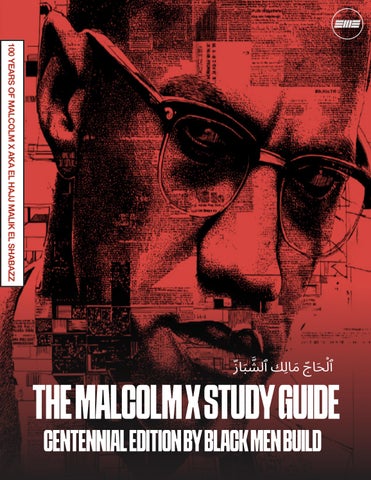
100 YEARS OF MALCOLM X AKA EL HAJJ MALIK EL SHABAZZ
THE MALCOLM X STUDY GUIDE CENTENNIAL EDITION BY BLACK MEN BUILD
TABLE OF CONTENTS 1. Letters from Brothers Alkalimat and Pope....................................4 2. Something New 1990 x Something Familiar 2025........................6 3. Malcolm X and the Black Radical Tradition..................................8 4. !e Autobiography of Malcolm X................................................11 5. Dr. Betty Shabazz............................................................................16 6. !e End of White Supremacy........................................................18 7. Malcolm X Speaks / Speeches........................................................19 8. Malcolm X in Africa........................................................................23 9. !e Legacy of Malcolm X is Militant Action...............................31 10. Ironies of the Saint Revisited.......................................................33 11. Everyone Has a Role to Play........................................................39 12. About BMB....................................................................................40 13. Further Reading............................................................................41 14. Principles for Action....................................................................43
NOTE: The best way to respect Malcolm X is to read his work in a very serious and careful way. Then, we need to have an open, honest debate about his ideas in the 1960s and our own ideas right now. Our greatest challenge is to follow Malcolm X’s method of critical, independent thinking.
NEED SOMETHING HERE
Introduction by Brother Alkalimat (1990) !is study guide was written in 1989 by Abdul Alkalimat as part of the practice of Peoples College to develop popular educational materials for the Black liberation movement and Black Studies. !is followed the important 1985 issue of the Black Liberation Month News that focused on Malcolm X. Both were newsprint publications and were widely distributed. 50,000 copies of the Malcolm X BLM News were distributed, and 25,000 copies of the study guide were as well. !us, we have given away over 100,000 copies of educational materials on Malcolm X. !e study guide was used to build the important 1990 New York Conference on Malcolm X: Radical Tradition and Legacy of Struggle. Writers and Readers published a second revised edition of the study guide as part of their “For Beginners” series. Path"nder Press sued to protect their ownership of Malcolm’s words. !ey alleged to be acting in the interest of Betty Shabazz. !ey charged unfair use of quotes even though the quotes used did not in any case exceed more than one paragraph. Writers and Readers and Abdul Alkalimat were forced to back down and withdraw the remaining copies of the book. Writers and Readers then dumped the plan to prepare a new revolutionary activist oriented book for a reformist oriented narrative. Two questions remain. What is the radical Black tradition? Who owns the radical Black tradition? —–Abdul Alkalimat, People’s College 1990
“Go back and get it” T he Sankofa bird is a West African Adinkra symbol (from Ghana’s Akan people) representing looking to the past for wisdom to build a better future.
4 / ALKALIMAT (1990) | THE MALCOLM X STUDY GUIDE
Introduction by Brother Pope (2025) In November 1990, more than 3,000 people from 25 countries attended the Malcolm X: Radical Tradition and a Legacy of Struggle conference held in New York City. More than 100 speakers led 24 sessions that deeply explored, contextualized, and situated El Hajj Malik El Shabazz in the genealogy of Black radical internationalism as a Pan Africanist. Sessions included discussions on Malcolm X in Ghana [Vicki Garvin]; !eoretical Perspectives on Malcolm [Lou Turner & Bro Abdul Alkalimat]; Malcolm in New York [Yuri Kochiyama]; new Research on Malcolm [James Cone & William Sales]; Black Liberation and Social Revolution [Abdul Rahman Muhammad Babu]; Does the Southern Struggle Still Exist? [Saladin Muhammad]; Black Women and Black Liberation: Fighting Oppression and Building Unity [Barbara Ransby & Fran Beale]; Black Workers Unity and Resistance to Economic Barbarism [General Baker & Ashaki Binta]. Several key questions animated the discussions: Has the quality of life changed for Black workers since the days of Malcolm X?; Have computers and robots impacted the lives of Black workers?; Are trade unions active contributors to the "ght for Black liberation?; What is the role of Black organizations? Discuss the case of Assata Shakur; why is she forced to live in exile in Cuba?; Discuss the nature of triple oppression faced by Black women: race, class, and gender; What is the role of Feminism in the Black liberation movement? and more. In 1990, many grassroots activists and youth sought a return to a more militant movement, continuously drawing from Malcolm X’s thought. Each generation since the 1960s, confronting unique struggles, has rediscovered Malcolm X, whose voice continues to inspire radical thinking. Brother Malcolm’s legacy endures through the love and respect of his people and freedom-loving people worldwide. !is study guide, as reprinted by BMB, was developed to provide context for us to extend the work of El Hajj Malik El Shabazz. It is our duty to study, practice, assess, and repeat [SPAR]. —–James Pope, Africa World Now 2025
POPE (2025) / THE MALCOLM X STUDY GUIDE / 5
Something New is Happening in 1990. Something Good. Something We Need. !ere is a rising interest in Malcolm X. People are searching for a radical Black perspective, especially young Black people who want a more militant leadership and a By any means necessary type of commitment. Dig the problems we face–homeless people living on the street, whole families without jobs or hope, drugs more common than soap and water, racial violence exploding on the campus and in the community–including vicious murders and police cover-ups. If we ever needed what Malcolm X stood for, we need it now! Malcolm was a great person because of his bold honesty and sacri"ce, his intellectual power, and brilliant rap. But not only that–Malcolm X was a living representative of our great radical tradition of struggle created by millions of people whose names we will never know. We study Malcolm because he is a window through which we can see and understand this tradition. We study Malcolm to learn how we can keep the tradition alive by making our original contribution to it. Eurocentrism has snatched Black people out of human history, and rewritten world history based on racist lies. By denying our true history, exploiting us as workers, and raping and ravaging our humanity, Europeans attempted to turn Black people into deaf, dub, and blind slaves who hate themselves and love their oppressors.
Lynching of Will Brown Omaha, Nebraska (1919)
!e Black radical tradition is about change. It proves that Black people have always fought for progress and a better life. !is "ght is clari"ed through militant action and vigorous debate. In the 19th century, the main debate that shaped our radical tradition was the EMANCIPATION debate, how to end slavery and institutionalize freedom. In the 20th century the debate has been about SELF DETERMINATION, freedom from urban capitalist structures, especially in terms of culture, economic, life, and political power. 6 / SOMETHING IS HAPPENING IN 1990
Something Familiar is Reemerging in 2025. Let’s Make it Plain. Written by Black Men Build’s Political Education Team
It has been one hundred years since the birth of Malcolm Little, the boy who would transform into the man that people know worldwide as Malcolm X. In 2025, the life and legacy of Malcolm X continues to have a profound effect. In times of chaos and confusion, Malcolm’s words, Malcolm’s theories, Malcolm’s practice, and Malcolm’s commitment to organization are looked to as beacons of clarity. Malcolm’s brand of militant leadership and undying love for Black people provide a compelling way forward. We are living in critical times. Today, the cost of living—rent, healthcare, food, and childcare—has skyrocketed, while wages have stagnated. We have watched politicians and misleaders cower and censor themselves in the face of genocide. More of our people rot in jails and prisons now than when Malcolm was incarcerated in 1946. !e illusion that Democrats or Republicans will provide bold, visionary leadership is fading day by day. Across the globe, there is a rising tide of fascism. If we ever needed what Malcolm X stood for, we need it now! By any means necessary! Something is happening in 2025 where our people, young and old, are returning to !e Autobiography of Malcolm X for inspiration. Our people are quoting !e Ballot or the Bullet for political demands. Our people are revisiting Message to the Grassroots to challenge these corporate, co-opted social movements entangled in what’s been called “the nonpro"t industrial complex.” And our people are struggling to “make it plain,” so that we may all see things for what they are. Malcolm didn’t shrink from power and he didn’t hide from responsibility. Because of Malcolm, we understand that we must take an active and responsible role in freeing our communities. Our brother and ancestor Malcolm set the standard. Lincoln Heights Safety and Watch Program responds to neo-Nazi rally (2025) !e Black radical tradition continues its unyielding struggle for freedom, dignity, and human rights. !e Black Radical Tradition is reflected in the wisdom and sacri"ce of many. Our tradition is anti-capitalist (socialist), anti-imperialist (Pan-Africanist), and anti-patriarchal (feminist). As we look toward Malcolm, we should understand, with "rm conviction, the need to carry the tradition forward. As we look toward Malcolm, we are developing Men’s Circles, Wartime Roundtables, survival programs, and power building campaigns that seek to honor our tradition and revolutionary ancestors. In 2025, like Malcolm, we must commit to building organizations, to practicing solidarity, and to transforming to meet the moment. Let us continue to look toward Malcolm. SOMETHING IS HAPPENING IN 2025 / 7
Malcolm X and the Black Radical Tradition Radical Ideology as a Black Tradition
19th Century: !e Emancipation Debates
Martin Robison Delany (1812-1885)
Dr. Henry Highland Garnet (1815-1882)
Frederick Douglass (1818-1895)
From 1830 through the Civil War, Black activists and community leaders met in local, state, and national conventions to discuss their views on ending slavery and improving the lives of Black people. !ese meetings ranged in size from 15 to several hundred, but they reflected the views of millions. !e debates were carried out by such leaders as Samuel Cornish, founder of the "rst Black newspaper, Richard Allen, founder of the "rst Black church, James Forten, Martin R Delaney, David Walker, Harriet Tubman, Sojourner Truth, Frederick Douglass, Henry Highland Garnet, and others. !e Emancipation Debates of the National Negro Convemention Movement clari"ed a varity of strategies and tactics: united front cooperation with liberal whites, militant armed struggle, and other forms of collective self determination including emigration, moral suasion, and electoral participation. !e main principle of unity was "ghting slavery. Debate without action is a waste of time, so it is important to understand that Black people did take militant action to "ght against slavery. Black people participated in the abolitionist movement, including the underground railroad. Blacks led countless armed slave insurrections (notably by Gabriel Prosser 1800, Denmark Vesey 1822, and Nat Turner 1831) and initiated armed struggle with John Brown at Harper’s Ferry in 1859. Even by going to the movies to see “Glory,” and an earlier "lm “Buck and the Preacher” it is clear to everyone that Black people fought for their freedom in and after the Civil War. !e Emancipation debate contributed to militant Black revolutionary struggle to overthrow slavery. We give thanks to those who fought. We praise the Black radical tradition.
Harriet Tubman (1822-1913)
8 / MALCOLM X AND THE BLACK RADICAL TRADITION
20th Century: !e Self-Determination Debates World domination by imperialism de"nes the 20th century. After World War II, the USA became the number one imperialist power because the economic strength of Europe had been destroyed. US political domination was based on an economic relationship, exploiting the people and natural resources of the third world for its industrial development and control of all international markets. Modern imperialism herds people into cities like cattle and transforms them into industrial workers. US imperialism did this to Black people in the "rst half of the 20th century. !is set the stage for the great Self-Determination debate. Part of the debate was over how Blacks who remained in the south could “catch up” with the north. !is gave energy to the Civil Rights Movement (or what organizers on the ground preferred to call !e Freedom Movement). Part of the debate was over economic issues of jobs and housing and involved both Black capitalists and workers. !is ignited an ideological throwdown over capitalism and socialism/communism. And part of the debate united Blacks in the US with Blacks all over the world. !is sparked new forms of Pan-Africanism. !e moral power of Black religion and the collective strength of Black nationalism held the militant radical tradition together while the leading ideological forces in the self-determination debate became PanAfricanism and socialism/communism. African Americans were in the belly of the beast of US empire and were "ghting as part of the wretched of the earth: workers of the world and African peoples everywhere. !e radical Black tradition has been kept alive because the past could be remembered, but more important than that was the fact that each generation of Black people continues to "ght. !rough militant struggle Black activists are always led to rediscover the lessons of the past. In fact, this is a necessary process, summing up a struggle based on lessons learned from all previous struggles. !is is the kind of literature that best contributes to the rich texture of our glorious Black radical tradition.
Booker T Washington (1856-1915)
Claudia Jones (1915-1964)
W.E.B. DuBois (1868-1963)
Marcus Mosiah Garvey (1887-1940)
MALCOLM X AND THE BLACK RADICAL TRADITION / 9
20th Century: Reform to Revolution
Elijah Muhamad (1896-1975)
!e self-determination debates exploded in the 1960s. !e winds of change centered a worldwide storm in the third world, kicked off by the high points of struggle against colonialism (e.g., Ghana in 1957), neocolonialism (e.g., Cuba in 1959), and internal colonialism (e.g. the Black Power Movement in 1960s USA). !e "ght for reform, even when successful, often continued oppression in new forms. Everywhere the watchword became “revolution,” from Paris to Peking, from Mozambique to Mississippi. Malcolm X reached his greatest level of leadership in the 1960s. He was the ideological leader for Black radicalism: Black religion (spirituality and morality), Black nationalism (institution building and collective action), Pan-Africanism (identity and internationalism), and Socialism (freedom, justice, equality, and anti-imperialism).
Paul Robeson (1898-1976)
Queen Mother Moore (1898-1997)
!e explosion of struggle released many forces of change. It propelled Black culture to unprecedented visibility in the 1990s, fundamentally reshaping the mainstream. Black innovation in music, speech, dress, and sexuality became the engine of popular culture, eagerly absorbed by white, Asian, and Latino youth. !is adoption, however, was inextricably linked to commodi"cation, as corporate interests mined cultural expression for pro"t, often divorcing it from its origins and context. !us, even as America’s cultural style became more Black, systemic inequities ensured that Black communities themselves did not share equally in the rewards. !e Black middle class began to chill, but for most Blacks life was all the way raw. !is leads us to Malcolm. He offered a class analysis when he talked about the difference between house Negroes who identi"ed with their masters and "eld Negroes who wanted to burn the plantation down. Malcolm became the "eld Negro that the white ruling class and their uncle Toms had nightmares about. His rap was his weapon, truth was his ammo, and the western imperialist racist system was his target. Yo! !is is addressed to all "eld Negroes, and all other progressive minded people, to all serious students in Black studies. Malcolm was our leader in the 1960’s and we can continue to learn from him in the 1990’s. All we ask is that you check him out. We hope you use this study guide to help you.
Martin Luther King Jr (1929-1968)
10 / MALCOLM X AND THE BLACK RADICAL TRADITION
!e Autobiography of Malcolm X !e Text and !e Tradition !is is one of the most important books published in the 1960s. It is a classic 20th century autobiography and has been cherished by progressive people around the world. It ranks with the best: Frederick Douglass (great African American abolitionist), Kwame Nkrumah (father of independent Africa), and Assata Shakur (exiled Black Panther revolutionary). !e autobiographical text, beginning with the innovative slave narratives, is the foundation of the Black literary tradition. !e Autobiography of Malcolm X is required reading to understand the contemporary Black experience. !e book covers life as lived by the masses of people, what Malcolm called “bottom of the pile Negroes.” Here are the problems of family life, street life, drugs and violence, crime and prison. But we can also "nd religious transformation and moral discipline, consciousness and commitment, study and struggle. Malcolm X dictated this book to Alex Haley who provided editorial support. He "nished it shortly before he died, but it was published after he was murdered.
HOW TO READ THIS BOOK 1. Read this book in relation to its historical context, from 1925 to 1965 2. Keep in mind Malcolm went through four stages and !e Autobiography should be read in four parts as well. A. Malcolm Little (1925-1941): chapters 1-2; B. Detroit Red (1941-1952): chapters 3-10; C. Malcolm X (1952-1964): chapters 11-15; and D. Omowale (1964-1965): chapters 16-19. 3. Malcolm X was stopped. We face the challenge of going forward. !us, this book must be read as a guide to action: use it to examine your own life, use it to evaluate leadership, use it to think about the future.
THE AUTOBIOGRAPHY OF MALCOLM X / 11
MALCOLM LITTLE &1925'1941( Malcolm Little was a kind boy who wanted to live a full life but was stopped by American racism. His father was assassinated by white terrorists and his mother kidnapped and forced into an insane asylum. He was left to fend for himself in foster care until his sister Ella took him in. From the moment his elementary school teacher told him being a lawyer was no job for a “nigger,” he knew America hated his people.
DISCUSSION: !e family is essential to the social organization of society. Malcolm was born into a strong family, but it was destroyed. How did this happen? What role did racism play? Furthermore, discuss how Malcolm was discouraged by a racist teacher in school. How typical were/are the experiences of Malcolm Little?
12 / THE AUTOBIOGRAPHY OF MALCOLM X
Somehow, I happened to be alone in the classroom with Mr. Ostrowski, my English teacher (in 8th grade)...I had gotten some of my best marks under him, and he had always made me feel that he liked me…He told me, “Malcolm, you ought to be thinking about a career. Have you been giving it thought?” The truth is, I hadn’t. I never have figured out why I told him, “Well yes, sir, I’ve been thinking I’d like to be a lawyer.”...He kind of half-smiled and said, “Malcolm, one of life’s first needs is for us to be realistic. Don’t misunderstand me, now. We all here like you, you know that. But you’ve got to be realistic about being a nigger. A lawyer—that’s no realistic goal for a nigger. You need to think about something you can be. You’re good with your hands—making things. Everybody admires your carpentry shop work. Why don’t you plan on carpentry? People like you as a person—you’d get all kinds of work. The more I thought afterwards about what he said, the more uneasy it made me…It was then that I began to change—inside. (Autobiography pgs 36-37)
DETROIT RED &1941'1952( Detroit Red was a drug dealing pimp who was a danger to himself and his community. He chemically burned his hair straight with a signature “conk” due to the shame taught to him and other Negroes about afro hair texture. Like most Black youth, he was exploited at dead end jobs with terrible pay. He became deeply antisocial and with his reddish brown skin, red hair, and dark disposition, he earned the nickname Satan.
DISCUSSION: Most
of
us know people who
survive in the underground economy, sometimes through illegal means. Fast money means drugs and guns, stealing and robbery. !en comes either prison or the cemetery. Why do people use drugs? Who pro"ts? What can be done to stop drugs? In this context discuss Malcolm’s description
I was a true hustler - uneducated, unskilled at anything honorable, and I considered myself nervy and cunning enough to live by my wits, exploiting any prey that presented itself. I would risk just about anything. Right now, in every big city ghetto, tens of thousands of yesterdays and today’s school dropouts are keeping body and soul together by some form of hustling in the same way I did. And they inevitably move into more and more, worse and worse, illegality and immorality. Full time hustlers never can relax to appraise what they are doing and where they are bound. As is the case in any jungle, the hustler’s every waking hour is lived with both the practical and subconscious knowledge that if he ever relaxes, if he ever slows down, the other hungry restless foxes, ferrets, wolves, and vultures out there with him won’t hesitate to make him prey. (Autobiography pgs 109-110)
of the hustler.
THE AUTOBIOGRAPHY OF MALCOLM X / 13
MALCOLM X &1952'1964( Malcolm X was a disciplined leader who transformed himself to serve his community. In prison, he abandoned his slave master’s last name “Little” as he immersed himself in study. He studied Latin, theology, politics, law, and history. Malcolm understood that his people had been intentionally deprived of knowledge they needed to understand their place in the world and how to change it. He emerged a Black nationalist minister in the Nation of Islam who exposed the savage, racist nature of American society and the duty Black people had to organize and defend ourselves. He led by example, constantly working to embody the lessons he gave others.
DISCUSSION: Religion and nationalism are major aspects of our Black radical tra-
Elijah Muhammad spoke of how in this wilderness of North America, for centuries the “blue-eyed devil white man” had brainwashed the “so-called Negro.” He told us how, as one result, the Black man in America was “men-
dition. What role did each play in
tally, morally, and spiritually dead.” Elijah Muhammad
the transformation of Malcolm X?
spoke of how the Black man was the Original Man, who
Discuss each of the points Malcolm
had been kidnapped from his homeland and stripped of
makes in relation to the teaching of Elijah Muhammad.
his language, his culture, his family structure, his family name, until the Black man in America did not even realize who he was. He told us, and showed us, how his teachings of the true knowledge of ourselves would lift up the Black man from the bottom of the white man’s society and place the Black man where he had begun, at the top of civilization. (Autobiography pgs 109-199)
14 / THE AUOBIOGRAPHY OF MALCOLM X
OMOWALE &1964'1965(
Omowale, Yoruba for “the child who has returned,” was the name bestowed upon Malcolm by African students during his trip to the University of Ibadan in Nigeria. Malcolm visited Africa four times; twice in the "nal year of his life, 1964. Omowale learned from and inspired Africans across the continent as he traveled. He is still loved and celebrated there to this day. His political outlook, strategic vision, and institutional goals sharpened as he connected the struggles of Africans across the world. Omowale was a revolutionary Black nationalist and a Pan-Africanist. He also earned the name el-Hajj Malik el-Shabazz after his trip to Mecca, a rite of passage in Islam. His devout faith connected him to liberation movements in the Arab world extending his Pan African vision to the struggle for a free Palestine.
It was a big order—-the organization that I was creating in my mind, one which would help to challenge the American Black man to gain his human rights, and to cure this mental, spiritu-
DISCUSSION: In the last year of his life Malcolm created two organizations: Muslim Mosque Inc. and the Organization of Afro American Unity. What
al, economic, and political sicknesses. But if you ever intend to do anything worthwhile, you have to start a worthwhile plan. Substantially, as I saw it, the organization I hoped to build would differ from the Nation of Islam in that it would embrace all faiths of Black men, and it would carry into practice what the Nation of Islam had only preached…One of the major troubles that I was having in building the organization that
are the differences between them?
I wanted–an all-Black organization whose ultimate objective
Also, one of the greatest points of
was to help create a society in which there could exist honest
controversy about Malcolm is the extent to which his life changes in the last 2-3 years. Discuss what changes took place in Malcolm’s point of view.
white-Black brotherhood—-was that my earlier public image, my so-called “Black Muslim” image, kept blocking me. I was trying to gradually reshape that image. I was trying to turn a corner, into a new regard by the public, especially Negroes; I was no less angry than I had been, but at the same time the true brotherhood I had seen in the Holy World had influenced me to recognize that anger can blind human vision. (Autobiography pgs 320, 381) THE AUTOBIOGRAPHY OF MALCOLM X / 15
Dr. Betty Shabazz
PROFESSOR, WIDOW, CULTURAL ATTACHÉ, SINGLE MOM, NURSE, HAJJAH, GRANDMOTHER, SCHOLAR ACTIVIST, MRS. MALCOLM X Dr. Betty Shabazz lived a life that was both exceptional and familiar. She was a woman of unshakable faith, "erce dignity, and deep love for her people. As Myrlie Evers-Williams described, Betty possessed “a rare inner strength” that allowed her to survive the unimaginable. While she represents the everyday power of Black womanhood, she also stood apart through her sacri"ce, her grace under "re, and her lifelong dedication to her husband’s legacy. Together with Myrlie Evers and Coretta Scott King, Betty became one of “the three widows” who bore the weight of losing their husbands to assassination in the Black freedom struggle. Childhood, Upbringing, and Historic Conditions Born Betty Dean Sanders, her exact birth details remain uncertain, though most records indicate she was born in Pinehurst, Georgia around 1934, later raised in Detroit by adoptive parents. Her formative years reflected the turbulent racial environment of mid-20th-century America, shaped by the vibrant Black community of Detroit. Organizations like the Housewives League of Detroit mobilized Black women to support Black-owned businesses, boycott racist white businesses, and build economic independence. At the same time, white supremacist terrorism erupted over efforts to desegregate housing, such as during the 1942 Sojourner Truth Housing Project conflict, where white mobs violently opposed Black families moving into federally funded homes. !is atmosphere boiled over again during the 1943 Belle Isle unrest, when white attacks against Black citizens led to one of the deadliest so-called “race riots” in Detroit’s history. Young Adulthood, Professional Education, and the Nation of Islam Betty pursued her professional calling as a nurse, "rst studying at Tuskegee Institute in Alabama, where encounters with Southern racism deeply affected her consciousness. Moving to New York in 1953 to complete her nursing education at Brooklyn State College, Betty was introduced to the Nation of Islam through peers, drawn by its vision of racial pride and empowerment. Her involvement deepened when she met Malcolm X, whom she would marry in 1958.
16 / DR. BETTY SHABAZZ
“Black Nationalism stood for the unity and dignity of Black people everywhere. Malcolm recognized Black people in America will never be free until Africa is free... Afro Americans and Africans were one, not only sharing a common heritage but also a common destiny. Malcolm’s uncompromising demand of his fellow Afro Americans is that [we] take the Afro American struggle out of a domestic civil rights issue and put it in its proper context as a human rights struggle and so internationalize it and thereby seek redress before the nations of the world.” —Dr. Betty Shabazz (1970) Marriage to Malcolm X Married nearly seven years, Malcolm and Betty Shabazz had six daughters. Betty balanced motherhood and active engagement in the Nation of Islam’s community work, supporting Malcolm’s organizing while protecting against relentless threats, surveillance, and ultimately, the "rebombing of their family home—events orchestrated by a combination of forces in the Nation of Islam, FBI, CIA, and NYPD. “She ran between the hillocks of grief and duty,” like Hajar in the desert, never losing faith that she would "nd sustenance for her family and her people. Note: H)jar (Arabic:) is a revered woman in the Islamic faith. She was the wife of the patriarch and Islamic prophet Ibrahim (Abraham) and the mother of Ism)’*l (Ishmael).
Carrying the Legacy Forward Embodying Hajar’s strength, Betty completed her own transformative pilgrimage to Mecca (earning the title “Hajjah”) in 1965. She continued Malcolm’s legacy by pursuing further education, becoming a professor and cultural ambassador, passionately preserving Malcolm’s teachings, advocating accessible education for working mothers, and fostering cultural awareness and pride among future generations. Dr. Shabazz earned a doctorate in education administration in 1975 and worked at Medgar Evers College in Brooklyn, where she helped develop programs that supported returning students, especially Black women. She also traveled internationally to speak about Malcolm’s legacy, human rights, and the dignity of African life. In 1997, Betty Shabazz tragically died from injuries sustained in a "re accidentally set by her grandson, Malcolm III. Mourned worldwide, she was buried beside her husband at Ferncliff Cemetery in Hartsdale, New York. She is survived by her "ve daughters; her sixth daughter, Malikah, passed away in 2021, leaving behind her own daughter—Betty’s granddaughter, Bettih Bahiyah. DR. BETTY SHABAZZ / 17
THE END OF WHITE WORLD SUPREMACY: FOUR SPEECHES
MALCOLM X, THE END OF WHITE SUPREMACY: FOUR SPEECHES (NEW YORK: MERLIN HOUSE, 1971). !e text consists of four speeches given by Malcolm X while he was a minister in the Nation of Islam during 1962 and 1963
One of the greatest strengths of our Black Radical Tradition is its relentless opposition to Eurocentrism. !e Eurocentric viewpoint is that Greece and Rome laid the foundation for the eternal white European dominance of the world. Elijah Muhammad continued the Black radical tradition of exposing this lie and in its place articulated an Afrocentric philosophy of history that links the fall of countries to the extent that their wealth was based on exploitation. Malcolm X stressed this point to liberate our consciousness to consider a post-American history of the world.
DISCUSSION: While in the Nation of Islam, Malcolm spoke out against US imperialism based on world history and religion. One aspect of this was limited to a Black perspective, while in another sense it suggests a universal understanding of history. How and why does Malcolm explain the rise and fall of countries? What “sins” are being committed against Black people in the USA? Why will the USA fall? 17 / THE END OF WHITE SUPREMACY
The Honorable Elijah Muhammad teaches us that as it was the evil sin of slavery that caused the downfall and destruction of ancient Egypt and Babylon, and of ancient Greece, as well as ancient Rome, so it was the evil sin of colonialism that caused the collapse of the white nations in present-day Europe as world powers. Unbiased scholars and observers agree that the wealth and power of white Europe has rapidly declined during the nineteen-year period between World War II and today. So we of this present generation are also witnessing how the enslavement of millions of Black people in this country is now bringing White America to her hour of judgment, to her downfall as a respected nation. and even those Americans who are blinded by childlike patriotism can see that it is only a matter of time before White America too will be utterly destroyed by her own sins, and all traces of her former glory will be removed from this planet forever (pgs 121122) December 1963.
MALCOLM X SPEAKS: SELECTED SPEECHES AND STATEMENTS
MALCOLM X SPEAKS: SELECTED SPEECHES AND STATEMENTS (NEW YORK: PATHFINDER PRESS, 1965). !is is a classic collection of material organized in 15 sections, edited by George Breitman.
Malcolm X was a premier Black nationalist leader and he also articulated his views as a universal statement for progressive people of all nationalities. Malcolm was a leader who ran down revolutionary views that became popular themes for everyone in struggle. His speeches are full of analyses and comment, and his impact was to unify progressive forces, "rst and foremost in the Black liberation movement, then in the broader anti-imperialist movement as well. He clari"ed the role of religion in struggle and laid the basis for Black liberation theology. Malcolm also put the race/class struggle of Blacks in the USA in a universal world context of the oppressed "ghting their oppressors.
Malcolm on Religion and Resistance There is nothing in our book, the Koran, that teaches us to suffer peacefully, Our religion teaches us to be intelligent. Be peaceful, be courteous, obey the law, respect everyone; but if someone puts his hand on you, send him to the cemetery. That’s a good religion. In fact, that’s that old time religion. that’s the one that Ma and Pa used to talk about: an eye for an eye, and a tooth for a tooth, and a head for a head, and a life for a life. That’s a good religion. And nobody resents that kind of religion being taught but a wolf, who intends to make you his meal…No, preserve your life, it’s the best thing you’ve got. And if you’ve got to give it up, let it be even-steven. (Malcolm X Speaks pgs 12-13) November 1963.
Malcolm on Global Rebellion I believe that there will ultimately be a class between the oppressed and those that do the oppression. I believe that there will be a clash between those who want freedom, justice, and equality for everyone and those who want to continue the systems of exploitation…It is incorrect to classify the revolt of the Negro as simply a racial conflict of Black against white or as a purely American problem. Rather we are today seeing a global rebellion of the oppressed against the oppressor, the exploited against the exploiter. (Malcolm X Speaks pgs 232-233) January 1965. MALCOLM X SPEAKS / 18
MALCOLM X SPEAKS: SELECTED SPEECHES AND STATEMENTS
MESSAGE TO THE GRASSROOTS During the 1960s the term “grassroots” gained popularity in opposition to the “elite” Civil Rights leaders. One of the most important speeches by Malcolm X is his Message to the Grassroots. !is speech was delivered all over the country in late 1963 and laid the basis for the Black liberation movement that coalesced with the war cry of “Black Power” in 1966.
DISCUSSION: In this speech Malcolm discusses common problems and Black nationalism. In this way he lays the basis for Black unity in an overall way. However, he also discusses the differences between the house slaves and "eld slaves, a difference that still exists today. Both issues need to be discussed. !e issue also involves leadership: How can we develop progressive working class leadership within the Black community?
19 / MALCOLM X SPEAKS
Malcolm on Common Problems …America has a very serious problem. Not only does America have a very serious problem, but our people have a very serious problem. America’s problem is us. We’re her problem…Once you face this as a fact, then you can start plotting a course that will make you appear intelligent, instead of unintelligent…We have a common enemy. We have this in common: We have a common oppressor, a common exploiter, a common discriminator. But once we all realize that we have a common enemy, then we unite— on the basis of what we have in common. And what we have foremost in common is that enemy—the white man. He’s an enemy to all of us. I know some of you alll think that some of them aren’t enemies. Time will tell. (Malcolm X Speaks pgs 4-5) November 1963
MALCOLM X SPEAKS: SELECTED SPEECHES AND STATEMENTS
THE BALLOT OR THE BULLET
Malcolm X made a great contribution in helping to clarify the relationship between reform and revolution, between solving problems through electoral action versus solving problems through retaliatory violence. He stressed that Blacks were kept down through the force of racist violence and murder. But Malcolm X did more than this, because he attempted to lay down a program of Black unity, what he called Black nationalism. !e issue he raised is the relationship of Black nationalism to reform and to revolution. !is is an ideological issue of great importance. November 1963
Malcolm on Common Solutions The political philosophy of Black nationalism means that the Black man should control the politics and the politicians in his own community…The economic philosophy of Black nationalism is pure and simple. It only means that we should control the economy of our community…The social philosophy of Black nationalism only means that we have to get together and remove the evils, the vices, alcoholism, drug addication, and other evils that are destroying the moral fiber of our community. we ourselves have to lift the level of our community, the standard of our community to a higher level, make our own society beautiful so that we will be satisfied…We’ve got to change our own minds about each other. We have to see each other with new eyes. we have to see each other as brothers and sisters. We have to come together with warmth so we can develop unity and harmony that’s necessary to get this problem solved ourselves…if we see fit then to form a Black nationalist party, we’ll form a Black nationalist party. If it’s necessary to form a Black nationalist army, we’ll form a Black nationalist army. It’ll be the ballot of the bullet. It’ll be liberty or it’ll be death. (Malcolm X speaks pgs 38-41) April 1964 DISCUSSION: Over the last 25 years there has been a great practical struggle, most dealing with electoral struggle (especially with the election of Black mayors, and campaign on the state and national levels). !e electoral experience needs to be summed up, and discussed in terms of who bene"ts and whose life has remained the same or gotten worse. Furthermore, we have to discuss how to carry out Malcolm X’s program at the grass roots level? MALCOLM X SPEAKS / 20
By Any Means Necessary You tell me what kind of country this is. Why should we do the dirtiest jobs for the lowest pay? Why should we do the hardest work for the lowest pay? Why should be pay the most money for the worst kind of food and the most money for the worst kind of place to live in? I’m telling you we do it because we live in one of the rottenest countries that ever existed on this earth. It’s the system that is rotten…It’s a system of exploitation, a political and economic system of exploitation, of outright humiliation, degradation, discrimination—all of the negative things that you can run into… under this system that disguises itself as a democracy…And the things that they practice against you and me are worse than some of the things that they practiced in Germany against the Jews…And you run around here getting ready to get drafted and go someplace and defend it. Someone needs to crack you up side your head. (pgs 47-48)
Malcolm X on Afro-American History …when you go back into the past and find out where you once were, then you will know that you weren’t always at this level, that you once had attained a higher level, had made great achievements, contributions to society, civilization, science, and so forth. And you know that if you once did it, you can do it again; you automatically get the incentive, the inspiration and the energy necessary to duplicate what our forefathers formerly did. But by keeping us completely cut off from our past, it is easy for the man who has power over us to make us willing to stay at this level because we feel that we were always at this level, a low level. That’s why I say it is so important for you and me to spend time today learning something about the past so that we can better understand the present, analyze it, and then do something about it (pgs 4-5)
DISCUSSION: What kind of economic system is Malcolm X talking about? Was Malcolm a Black capitalist or a Black socialist? Our history can be understood in economic, political, and/or cultural terms. We have always had to "ght for progress, so the main discussion should focus on our best examples of struggle in each area. 21 / MALCOLM X SPEAKS
Malcolm X: !e Last Speeches MALCOLM X: THE LAST SPEECHES (NEW YORK: PATHFINDER PRESS, 1989). A collection of 4 speeches and 2 interviews, edited by Bruce Perry. !ere are over 100 speeches given by Malcolm X that have yet to be published. Malcolm X: !e Last Speeches is a great publishing event, especially for the two speeches given in Malcolm’s last month. Malcolm is clear: the world is dominated by imperialism and the solution can only come through united independent action. One thing I noticed in both the Middle East and Africa, in every country that was progressive, the women were progressive. In every country that was underdeveloped and backward, it was to the same degree that the women were undeveloped, or underdeveloped, and backward (pg 98) There is a worldwide revolution going on…what is it revolting against? The power structure. The American power structure? No. The French power structure? No. The English power structure? No. Then what power structure? An international Western power structure. An international power structure consisting of American interests, French interests, English interests, Belgian interests, European interests. These countries that formerly colonized the dark man formed into a giant international combine. A structure, a house that has ruled the world up until now. And in recent times there has been a revolution taking place in Asia and Africa, whacking away at the strength or at the foundation of the power structure (pg 127) …we set up the Organization of Afro-American Unity in which anybody in the community could participate in an action program designed to bring about complete recognition and respect of Black people as human beings. And the motto of the Organization of Afro-American Unity is By Any Means Necessary. We don’t believe in fighting a battle…in which the ground rules are to be laid down by those who suppress us. We don’t believe that we can win a battle where the ground rules are laid down by those who exploits us. We don’t believe that we can carry on a struggle trying to win the affection of those who for so long have oppressed and exploited us (pg 175) DISCUSSION: Discuss the “international power structure” today. How will the unity of Europe in 1992 change things; and what kind of OAAU do we need to build today? What rules of struggle should we follow? MALCOLM X SPEAKS / 22
Malcolm X in Africa In March of 1964, Malcolm X left the Nation of Islam. In the year leading up to his assassination, he made two trips to Africa that are often left out of conversations regarding his legacy yet had a major influence on his political development. !ough Malcolm "rst traveled to Africa in 1959, during his second set of trips, which included a pilgrimage to Mecca, he was deeply inspired by the revolutionary movements emerging on the continent. el-Haj Malik el-Shabazz met with many African leaders who sharpened his worldview, deepened his resolve, and prompted him to adopt a Pan-Africanist ideology that understands the African and African American struggle are connected by the "ght against colonialism and the "ght for socialism. It’s "tting this is where he earned the name Omowale—the child has come home.
Kwame Nkrumah of Ghana Leader of the "rst colonized African country to claim its independence; regarded as the father of Pan-Africanism. !e US government made it known they did not want a meeting granted to Malcolm by Ghana, but after consideration Nkrumah ignored the threat and met with Malcolm during both of his African trips. !e two men learned from each other and maintained a deep respect. Malcolm later referred to these meetings as “the highest honor of [his] life” in his diary.
Malcolm visits Ghana (May 1964); President Kwame Nkrumah (1909-1972); Maya Angelou (left), Malcolm X (middle), and others pose in Ghana (1964)
23 / MALCOLM IN AFRICA
Ahmed Sékou Touré of Guinea Pan-African leader of the Guinea Revolution against France who presided as a "erce opponent of neocolonialism. Similar to Nkrumah, Touré was under pressure by the West not to meet with Malcolm. When Malcolm asked him about this, Touré responded “African people need dignity more than money”, helping cement Malcolm’s deep respect for Touré’s commitment to African self-determination.
Malcolm and Shirley Graham DuBois in Ghana (May 1964); President Ahmed Sekou Toure (1922-1984)
MALCOLM IN AFRICA / 24
Gamal Abdel Nasser and The PLO of Egypt and Palestine Led Egypt’s 1952 revolution as a champion of anti-imperialist struggle and later implemented land reforms as president. Malcolm spent two months in Cairo where he met with Nasser and attended the 2nd summit of the Organization of African Unity (OAU). He was inspired by the government’s strong one-party system and support for industrialization, writing in his diary “No African nation needs a political system that will allow division and bickering while it is trying to decolonize itself.” Malcolm X visited the Khan Younis refugee camp in Gaza. While there, he met renowned Palestinian poet Harun Hashem Rashid. !is experience inspired Malcolm to publish his article titled, “Zionist Logic” challenging Israel’s genocidal occupation of the Palestinian people and their land. Additionally, while in Cairo, Malcolm met with members of the newly formed Palestinian Liberation Organisation (PLO), including Ahmad al-Shukeiri, the group’s "rst chairman.
Malcolm in front of Muhammad Ali Mosque in Cairo (July 1964); Malcolm speaks with members of the Palestinian Liberation Organisation (Sept 1964)
25 / MALCOLM IN AFRICA
Julius Nyerere of Tanzania Revolutionary who led Tanganyika’s liberation from the British and oversaw their uni"cation with Zanzibar into Tanzania. Malcolm and Nyerere met at the OAU’s 2nd Summit in Cairo where Nyerere helped rally support for a resolution proposed by Malcolm that condemned American racism against Black Americans. !is inspired Malcolm to later visit Tanzania where he and Nyerere spoke for hours, further shaping Malcolm’s world views.
President Julius Nyerere (1922-1999); Malcolm smiles with his comrade Tanzanian socialist Abdul Rahman Muhammad Babu (July 1964)
MALCOLM IN AFRICA / 26
Nn Nnaamdi Azikiwe of Ni Niggeria Revolutionary writer & founder of nationalist newspaper the West African Pilot; "rst president of post-colonial Nigeria. Malcolm also delivered a speech at the University of Ibadan on the necessity of independent African nations helping bring a case before the United Nations charging the USA with genocide for its treatment of Afro Americans. At a reception after, the Muslim Students’ Society bestowed the Yoruba name ‘Omowale’ (the child has come home) upon him. Malcolm later regarded this reception as one of the highest honors he had ever received.
Malcolm visiting the University of Ibadan where he received the name Omowale (May 1964); President Nnamdi Azikiwe (1904-1996)
27 / MALCOLM IN AFRICA
Jomo Kenyatta and The Mau Mau of Kenya Malcolm X met Pio Gama Pinto in 1959 which had a huge impact on his Pan African politics. In 1964, he revisited the country, meeting with revolutionaries of the Mau Mau movement, and President Jomo Kenyatta. !e Kenyan Land and Freedom Army (KLFA), also known as the Mau Mau, carried out massive worker strikes paralyzing the British empire. !ey formed military units to resist British colonizers. !ey expanded the oral tradition through new music, developed independent newspapers in Kenyan languages, and carried out popular education efforts ultimately leading to Kenya’s independence. It was these efforts that led Malcolm X to conclude “We need a Mau Mau in Harlem! We need a Mau Mau in Mississippi!”
Kenyan Independence Fighter Dedan Kimathi (1920-1957); Women of the KLFA Uprising (1952-1960)
MALCOLM IN AFRICA / 28
Sudan !roughout his travel diaries and letters, he frequently references the Sudanese. In one 1964 entry, he admires their “quiet con"dence,” and in another, remarks, “I am endlessly impressed by the Sudanese.” His experience speaks directly to his love for African culture and our collective resilience. Malcolm "rst visited Sudan in 1959 as an ambassador for the Nation of Islam, and he arrived already knowing quite a bit about Nubia—evidence that Africa’s past is deep, organized, and sophisticated, even when Black people in the USA are trained to believe we have no history or culture. He was also captivated by Al Mahdi, whose movement broke the back of British power in Sudan in the 1880s and seized Khartoum, proving that Africans were not simply “ruled,” but fought, won, and shaped history. Sudan also pressed Malcolm’s religious education forward. Visiting the Grand Mosque of Omdurman and the Ahfad Women’s College placed him inside living institutions—worship, learning, and women’s leadership—that didn’t "t neatly into the Nation’s narrow framework. And because Malcolm did not speak Arabic, he leaned on Sudanese comrades like Ahmed Osman, who lived in Harlem and would teach and debate Malcolm about Islam—pushing him to learn Islam as a global, historical tradition rather than a closed doctrine. !ose lessons—Sudan’s ancient depth, its anti-imperial victory, and its wider Islamic world—helped sharpen the turn Malcolm made in 1964 as he built Muslim Mosque, Inc. and the Organization of Afro-American Unity to carry both spiritual discipline and international Black unity into organized struggle. In this brief documentary “Malcolm X and the Sudanese,” Malcolm’s friend Ahmed Osman provides an oral history of his relationship with Malcolm in Harlem, Malcolm’s relationship with Sudan, and Malcolm’s evolving spiritual practice as he deepened his study of Islam. Osman was Malcolm’s gateway to the Black Arab world and helped organize Malcolm’s hajj (pilgrimage to Mecca). Scan QR Code to watch Malcolm X and the Sudanese on Vimeo
Malcolm on his hajj with spiritual advisor Sudanese Islamic scholar Sheikh Ahmed Hassoun (1964); Ahmad Osman shows a letter Malcolm wrote him (Nov 1963) asking for guidance interpreting the Quran
29 / MALCOLM IN AFRICA
MALCOLM IN AFRICA 20
The Legacy Of Malcolm X Is Militant Action Malcolm X / Malik Shabazz was killed on February 21, 1965 and from that point forward he entered the all time hall of fame of revolutionary "ghters. !e following year his legacy burst forth when SNCC activists advanced a new slogan-BLACK POWER. !is slogan expressed the rage and fury of Black people. !e legacy of Black radicalism once again was grounded in militant action. !e power of the movement Black is Beautiful
was its mass mobilization in local communities, its moral authority over evil, and not the talents of a single personality. For over a decade militant action implemented the politics expressed by Malcolm X. One major aspect of this legacy of struggle is aggressive self-defense by any means necessary. Tactics were expanded beyond non-violence to include armed action if necessary. !e critical organizational leap was the formation of the Black Panther Party for Self Defense and Jus-
Black Power
tice, and hundreds of local groups that followed. New organizations are needed today. Another form of self-defense emerged among students who fought for Black Studies to protect their minds from the miseducation of white racist lies and distortions. !e struggle for Black studies required militant action, mass protests and building seizures. !ese tactics are being
Black Studies
used today to defend Black studies. Self Defense continues to be at the top of our agenda today as Black youth continue to be victimized by killer cops and white racist lynch mobs, in the cities and on the campus. !e drug wars have added a new dimension to the need for self defense, but the answer is the same-violence against the community has to be stopped, as Malcolm X said, BY ANY MEANS NECESSARY!
Black Liberation Theology
31 / THE LEGACY OF MALCOLM X
In many ways the 1960’s was a replay of the SELF-DETERMINATION debates/struggles that had dominated the 20th century, updated with increased militancy. For the "rst few years action was centered in the South until national legislation “appeared” to update and democratize the segregationist system. Six months after Malcolm X was murdered Watts (Los Angeles) led inner city ghettos in insurrection, and exposed the racism experienced by urban Black workers in the north. !e great-
African Liberation Day
est organization of Black workers was the League of Revolutionary Black Workers formed in Detroit by Black autoworkers. Malcolm X always directed his comments to Black people at the bottom, the people who suffered the most. He was a revolutionary working class Black leader who refused to be seduced into the “chill out” careerism of the Black middle class.
Black Liberation Army
Malcolm X had insisted that Black people in the USA become more internationalist, both in their cultural identity as African Americans, as well as in their political solidarity and support of liberation struggles, and economic organization against the capitalist “bloodsuckers.” Just as people today champion the cause of Nelson Mandela in South Africa, Malcolm X tried to get Black people to support the cause of
League of Revolutionary Black Workers
Patrice Lumumba in the Congo. !e legacy of Malcolm X was taken up in 1972 with a massive African Liberation Day demonstration in Washington, DC and other cities, and the subsequent formation of the African Liberation Support Committee. !e ALSC convened the highest ideological discussions in the 1970’s, and from that point forward Black radicals have been anti-imperialists. People’s College
THE LEGACY OF MALCOLM X / 32
Ironies of the Saint: Confronting Malcolm’s Patriarchy Written by Black Men Build’s Political Education Team
Malcolm X loved Black people. We know this without a shadow of a doubt. His love was not abstract—it was rooted in action, in study, and in the sincere belief that our liberation was worth "ghting and dying for. Even when he made mistakes or held views we now know to be limiting or harmful, Malcolm acted from a place of genuine commitment to what he believed was in our best interest. It was this deep love for Black people that allowed him to evolve, to learn, and to grow. He challenges us to do the same. Malcolm was born into a patriarchal* society, adopting many of its norms, beliefs, and practices. As a young hustler and a pimp, he ran the streets as Detroit Red viewing women as tools for pro"t and undeserving of respect. But as he grew politically conscious of American racism, African history, and colonial oppression, Malcolm began to challenge these inherited ideas and work to make amends for the harm he caused in the community. His life was a testament to constant transformation through critique, reflection, and integrity.
33 / IRONIES OF THE SAINT
As a member of the Nation of Islam, Malcolm’s ideology was initially shaped by patriarchal beliefs, such as those expressed in the NOI’s “Message to the Black Man,” which envisioned a Black nation led by men with women supporting quietly from behind. However, these beliefs had consequences and were part of what led Malcolm to confront and eventually break with the Nation of Islam, particularly over the sexual exploitation of women and girls within the organization. Malcolm’s lived experiences and active participation in liberation struggles exposed him to powerful Black Nationalist and Communist women such as his mother Louise Little (UNIA), his sister Ella Collins (OAAU), comrades Vicki Garvin, Maya Angelou, Yuri Kochiyama, and elders like Queen Mother Moore (UNIA; CPUSA), Shirley Graham DuBois (NAACP; CPUSA) and Claudia Jones (West Indian Gazette; CPUSA). !ese revolutionary women shaped Malcolm’s evolving consciousness and challenged rigid gender roles and sexist practices within the Freedom Movement, making it clear that our struggle to transform society will involve transforming the foundations of how we relate to one another in community. Colonialism has always enforced harmful systems, including patriarchy, homophobia*, and transphobia*, across Africa and the Diaspora. !ese systems are historically embedded in the foundations of capitalism, from the sexual exploitation of women and girls on the plantations and industrial sweatshops of Europe and its colonies, to today’s cocoa plantations in Mali, garment factories in Haiti, and industrial mines in the Congo. !ey also persist through the genocidal pressures faced by Black men today—mass incarceration, lynching (police murder), sexual assault (stop and frisk), unemployment, lack of healthcare, gun violence, and suicide. Yet, we must also ask ourselves: what of our queer African siblings who "ght relentlessly for the freedom to be who they are and the love and belonging of community? What of our transgender African siblings who challenge the colonizer’s pseudoscienti"c de"nitions of “man” and “woman” and the gender roles we are destined to play under their system that bred us like cattle? What genocidal pressures do they face? How does their position at the intersection of multiple forms of oppression inform their consciousness? And what lessons do their struggles and resilience offer our collective liberation movement? Malcolm loved what he called “bottom of the pile Negroes.” It is a love that resonates deeply with the legacies of ancestors like Marsha P. Johnson and Huey P. Newton, who fought "ercely against all forms of oppression and advocated for women’s and gay liberation.
IRONIES OF THE SAINT / 34
BLACK MEN BUILD EMBRACES THIS LEGACY. WE AFFIRM: We are transforming to meet the moment. We are bonded with Black women and all Black people in the "ght for true freedom. We are against patriarchy and heteronormative bullsh*t and we will be bold enough to say it with our chest. We embrace all processes of decolonization with our full hearts and maximum effort.
Black Men Build aims to decolonize our masculinity, so we can engage the "ght for true freedom as connected, loving, and conscious Africans. We understand this society was built by us but not for us, and so what we are taught about the world, how we should exist in it, what is “natural,” and even what we believe it takes to “be a man” is imposed on us by the same oppressors we aim to defeat. !is means decolonization is a constant process, or as the elders say “freedom is a constant struggle.” We recognize patriarchy, homophobia, and transphobia are corrosive and antithetical to our liberation project. But this recognition is only one step. We understand this is a daily process of education and transformation at the individual and community level. We understand the stakes are life and death. !ey always have been. Malcolm reminds us “!e price of freedom is death.” Too many of our people pay that price without ever achieving freedom, especially our LGBTQ+ family. “For the only great men among the unfree and the oppressed are those who struggle to destroy the oppressor.” —–Walter Rodney, How Europe Underdeveloped Africa
Scan to read Huey P. Newton’s, “!e Women’s Liberation & Gay Liberation Movements”
35 / IRONIES OF THE SAINT
DEFINITIONS
Patriarchy (sexism): an ideology and social, political, and economic system that positions men, masculinity, and heterosexuality as the ideal. Under patriarchy, cis heterosexual men are deemed naturally superior to and dominant over other genders/sexualities and granted power to exploit those groups especially for socially reproductive labor (i.e. the work involved in sustaining human life, reproducing the workforce, and maintaining social structures like child rearing, cooking, cleaning, intimacy, taking care of elders, etc.). Men are also granted control of property (de"ned as land, the home, "nances, wives, children, etc.). !is system’s rigid construction of gender and sexuality harms all people including men. Similar to how white supremacy employs racism, patriarchy employs sexism to explain, justify, and reproduce itself by attributing gender inequality to inherent natural differences between men and women, divine commandment, or other "xed structures rather than social organization and political economy. Misogyny (misogynoir): a term that speci"cally refers to a hatred of women and femininity. !e word is formed from the Greek roots misein (“to hate”) and gyn+ (“woman”). In addition to patriarchy and sexism, misogyny is a force that normalizes and justi"es violence against women and other marginalized gender identities and sexual orientations. Misogynoir (“noir” is a French word for “black”) refers to the speci"c ways misogyny targets Black women in our white supremacist, colonial society. Misogyny and misogynoir serve to violently discipline members of society into their designated gender roles. Homophobia: the ideology that justi"es the fear, exploitation, persecution, and extermination of lesbian, gay, bisexual, transgender, queer, and other gender and sexual identities. !e social function of homophobia is to enforce rigid gender distinctions and police our intimate relationships (see also heteronormativity). !e term was adopted in 1972 by George Weinberg (b.1935), an American psychologist. !e use of ‘phobia’ has been criticized as implying a pathological and irrational fear rather than a form of prejudice analogous to racism. !e ideological forces weaponized against LGBTQ+ people pre-date this o,cial designation. Transphobia: the ideological justi"cation for the fear, exploitation, persecution, and extermination of trans and gender nonconforming people. Transphobia enforces the strict gender binary necessary for patriarchy to function Feminism: an umbrella term for various liberation ideologies designed to combat patriarchy. For this reason, some prefer to say feminisms to highlight the important distinctions between how various populations engage the struggle against patriarchy depending on their historical experience or avoid the term altogether (e.g. Africana womanism, Black queer feminism, proletarian feminism, Native feminism, etc.). Similar to the concept of “nationalism,” feminism has conservative and revolutionary strains. “Feminism is a struggle to end sexist oppression. !erefore, it is necessarily a struggle to eradicate the ideology of domination that permeates western culture on various levels as well as a commitment to reorganizing society so that the self-development of people can take precedence over imperialism, economic expansion, and material desires.” —Feminist !eory: From Margin to Center.
IRONIES OF THE SAINT / 36
Excerpt from “Malcolm & Martin & America - Chapter 10 Nothing But Men” by James H. Cone We must not romanticize Martin and Malcolm. Like all humans, they had their strengths and weaknesses. To focus on their weaknesses does not detract from their strengths. On the contrary, it enables us to view the men in a larger context and thereby relate to them as human beings who were fundamentally no different from ourselves. Seeing them as human beings, we are encouraged to take up the cause of freedom where they left off, building on their strengths and avoiding, as much as possible, their weaknesses. !e most glaring and detrimental limitation of Martin's and Malcolm's leadership was not seeing sexism as a major problem connected with and as evil as racism. Like most white and black men of the 1960s, their attitude toward women was shaped by their acceptance of patriarchal values as the norm for the family and society. Following the pattern of white religious bodies, the black church and the Nation of Islam provided religious justi"cation for the subordination of women. While Martin and Malcolm challenged white values regarding race, their acceptance of black male privilege prevented them from seeing the connection between racism and sexism… A similar but much more rigid perspective on the role of women was held by Malcolm during his Black Muslim years. His view was de"ned by the "very strict laws and teachings" of the Nation of Islam and by his experience as a hustler and a steerer in Harlem. Interpreting Black Muslim teachings, Malcolm said that "the true nature of a man is to be strong, and a woman's true nature is to be weak, and while a man must at all times respect his woman, at the same time he needs to understand that he must control her if he expects to get her respect. Furthermore, Malcolm combined this patriarchal religious doctrine with a misogynistic view derived from the ghetto; that combination resulted in his extremely negative attitude toward women. Explaining why he remained single for many years, abstaining from sexual involvement with women, he said, "I'd had too much experience that women were only tricky, deceitful, untrustworthy flesh. I had seen too many men ruined, or at least tied down, or in some other way messed up by women." Malcolm's temple addresses during the 1950s particularly reveal his ultrasexist views, and many sisters in the Nation of Islam complained to Muhammad about his grossly offensive sayings against them. Non-Muslim sisters sometimes walked out rather than listen to his tirade against them, blaming women for the miserable condition of black men. In 1956 at the Philadelphia Temple, Malcolm gave a series of addresses on black women, accusing them of being the "greatest tool of the devil." "How do you think this black man got in this state?" he asked his audience. "By our women tricking him and tempting him, and the devil taught her how to-do this." "!e trickiest in existence is the black woman and the white man." “If you go to court with your wife, she will always win over you because the devil can use her to break down more of our black brothers.... It is this evil black woman in North America who does not want to do right and holds the man back from saving himself." Scan QR Code to full chapter DISCUSSION • Why are these gender roles con"ning women to the home limitations to our movement? • In this full chapter Cone also mentions “classism” as a limitation? What did he mean? • Did Malcolm ever make the connection between racism and sexism and evolve his views? [Hint: Look in the section “Malcolm X: !e Last Speeches”]
37 / IRONIES OF THE SAINT
Excerpt from “Ironies of the Saint” by Farah Jasmine Gri,n !is essay grows out of two concerns: First, the re-rise of what I want to call a “promise of protection” as a more progressive counter discourse to elements of misogyny in black popular culture; second, my feeling that the emergence of Malcolm X as an icon of younger African Americans requires a serious and sustained examination and engagement of all aspects of his legacy. Malcolm X has not been the subject of a black feminist critique in the way that Richard Wright or Miles Davis have been. When I looked to black feminist thinkers who have written on Malcolm, few of them were as critical of his views on women as I had expected. Patricia Hill Collins, Barbara Ransby, and Tracye Matthews are among the few to call attention to Malcolm’s gender politics. Black women are reluctant of being critical of Malcolm X: theirs is a reluctance born from the desire not to have such a critique co-opted by those who already hold him in contempt and disdain and a reluctance grounded in the genuine love, respect, and reverence that many black women have for Malcolm. I must admit that even as I write this essay, I share this reluctance, for there are few black male leaders whom I hold in as much esteem as I do Malcolm. Nonetheless, while I recognize Malcolm to be a man of his times and a man with tremendous capacity for growth, I am disturbed by any tendency to uncritically adopt his political and rhetorical stance, particularly around gender. In this essay I will articulate some of the reasons why so many black women, even black feminists, appreciate and revere Malcolm and his legacy. !en I hope to offer a reading of his position on women, not as a means of discrediting the esteem in which we hold him, but as a means to move us beyond the oppressive gender politics embedded in his rhetoric. Malcolm X offered black women a promise of protection, an acknowledgment of the signi"cance of white racist assaults on black beauty and an a,rmation of black features, particularly hair and color. In the remainder of this essay, I will examine these two important aspects of his legacy. Scan QR Code to full article DISCUSSION • Why are Black women hesitant to be critical of Malcolm X? • In your own words, summarize the “promise of protection” Malcolm advocated for. What are its limitations? • What evidence do we see that Malcolm’s patriarchy influenced this approach? • How did Malcolm’s views on women change throughout his life? • Why is it important to a,rm the beauty of Black people while challenging hierarchy?
IRONIES OF THE SAINT / 38
Everyone Has a Role to Play
Fannie Lou Hamer (1917-1977)
George Jackson (1941-1971)
Walter Rodney (1942-1980)
One of the great leaps that Malcolm X achieved is when he changed his views on women. In his last year or so of rapid transformation he rejected the sexism of conservative tradition and moved toward a revolutionary position that insisted on the principle of absolute equality between men and women. He frequently repeated the revolutionary maxim that the progress of a society can best be gauged by the condition of women in that society, therefore a revolutionary society can exist only when women have been liberated from the chains of male supremacy. Black women have always played essential roles in radical movements, usually doing most of the “shit” work and getting damn little credit for it. In the 1960’s, the spirit of Tubman, Truth, Wells, and others was reborn as the sisters spoke out and began to "ght against their oppression both in the society as well as in the movement itself. !e Black women of SNCC, the Black Panther Party, and the League of Revolutionary Black Workers, along with other groups like the National Welfare Rights Organization and the !ird World Womens Alliance led to a new Black women who claimed the radical Black tradition as her own! In the "nal analysis, the only tradition worth having is one that has a useful purpose as it lives today, as it can be reborn by each generation making its own original contribution to it. Otherwise, we can be imprisoned by tradition, held in check by it. !e point of this study guide is to get you into Malcolm X so you can grasp the tradition as a guide to action. !e good news in 1990 is that more and more people want to learn about Malcolm X. !is is a sound basis on which to rebuild our movement.
Winnie Mandela (1936-2018)
39 / EVERYONE HAS A ROLE TO PLAY
About Black Men Build OUR MISSION Black Men Build (BMB) is a grassroots membership organization whose mission is to give Black Men and their families all the tools necessary to become a powerful organized political force for liberation. We recruit, develop, and organize Black Men in ways that no other organization is doing with a commitment to love, grace, accountability, and power. We are bringing Black men into the movement for racial, gender, and social justice through healing, power-building campaigns, and political education. Our vision is to be one of the country’s most powerful and effective Left political organizations, preparing and organizing Black Men and their families to win and govern.
9 BARS - What We Fight For Our task is clear, we must organize and "ght to live full lives with our families, in communities that have everything that they need, in cities built to sustain life and land, in a country we govern and design, in a world that can support plant, animal and human life for the distant future. 1. Healthy foods that are widely available and affordable and access to fertile land and technology to produce and provide what we need. 2. Free education that nurtures critical thinking and builds full, connected people. 3. Clean, protected public land, water, and air, the building of comfortable, quality, and secure housing for everyone that needs it, and the ability to move freely and safely to places of work and leisure. 4. !e full automation of our work, as much as possible; the implementation of shorter work weeks, full unionization of workplaces, wages that meet the needs of working families, a universal basic income, and a transition to a world where living a digni"ed life is not based on our ability to work and produce. 5. !e highest standard of physical, mental, social, health, and reproductive care. For free. For everybody. 6. Humane and restorative accountability and Justice for wrongs committed and an Economic and Social program directed at the true causes of violence: poverty, racism, sexism, and patriarchy. 7. An end to all U.S. wars foreign and domestic, covert and overt, by all known and unknown branches of the U.S. government. 8. Universal access to the ballot box and the implementation of strategies for full voter participation of the masses. 9. Free, open, and secure usage of the internet and technologies, and the ending of the social, and economic segregation of the technological world.
www.blackmen.build | @blackmenbuild ABOUT BMB/ 40
Further Reading The Diary of Malcolm X (2013) – Edited by Herb Boyd & Ilyasah Shabazz A rare look into Malcolm’s personal thoughts during his 1964 travels to Africa and the Middle East. Shows his evolving perspectives. Betty Before X (2018) – Ilyasah Shabazz & Renée Watson A novel about Malcolm’s wife, Betty Shabazz, as a young girl. Great for younger readers or anyone interested in the people who shaped Malcolm’s life. A Lie of Reinvention (2012) – Jared Ball & Todd Steven Burroughs A critical response to Manning Marable’s shallow, gossipy, and revisionist Malcolm X biography “A Life of Reinvention.” Offers deeper perspectives about how Malcolm’s legacy is interpreted. OAAU Political Program (1964) – Malcolm X !e founding document of Malcolm’s Organization of Afro-American Unity. Short but powerful—shows his program for Black nationalism and vision for Black liberation. Malcolm X: By Any Means Necessary (1993) – Walter Dean Myers A concise, engaging biography for teens and adults. Covers key moments in Malcolm’s life in an easy-to-read style. Malcolm X, The CIA, and Other Blacks (2024) – Herb Boyd & Don Rojas Investigative look at U.S. intelligence surveillance of Malcolm X and other Black leaders, drawing on declassi"ed "les and reporting to show how state power targeted Black radical movements. Seventh Child: A Family Memoir of Malcolm X (1998) – Rodnell P. Collins & A. Peter Bailey A nephew’s intimate portrait of Malcolm’s early life, family networks (especially Ella Collins), and legacy— offering details you won’t "nd in standard biographies. From Civil Rights to Black Liberation: Malcolm X and the Organization of Afro-American Unity (1994) – William W. Sales Jr. !e de"nitive study of the OAAU—its program, structure, and internationalist vision—situating Malcolm’s late politics within Black nationalism and global anticolonialism. Basic Tenets of Revolutionary Black Nationalism (c. 1964) – Muhammad Ahmad (Max Stanford) & the Revolutionary Action Movement (RAM) !is foundational document by RAM co-founder Muhammad Ahmad outlines the group’s ideology. It is essential for understanding the strategic vision that shaped Malcolm X’s late work and legacy, as he was a key "gure in developing this militant underground organization. 41 / FURTHER READING
FURTHER READING / 42
Principles for Action In the 1990s, !e Campaign to Remember Malcolm worked to reignite a radical consciousness and spur mass action. Today, Black Men Build carries that torch. We combine our foundational values pledge with "ve updated mandates for action, presented here to guide the struggle forward:
1. FOLLOW MALCOLM X’s EXAMPLE - WE ARE CRITICAL THINKERS !ere are more myths than truth about Malcolm X. !e "rst task is to study what Malcolm actually said and did. It is important to follow his entire life and not just one part of it. He went through four stages. !e challenge for us is to begin where Malcolm X left off while avoiding his mistakes. Malcolm’s ability to be self-critical helped him learn and grow. !ere are no easy answers or solutions. We have to be serious, disciplined, and studied.
2. SPREAD THE WORD – WE ARE CURIOUS ABOUT THIS MOMENT To enable others to follow Malcolm X’s example, we must make his works widely available. !ese materials should be present in every library, bookstore, and home, and treated as essential tools for education. His speeches should be recited on holidays, and his writings shared as gifts on birthdays and other occasions. Students should study Malcolm X in school, with particular attention to his "nal months as Omowale, the organizations he formed, the circumstances surrounding his assassination, and why his work continues to matter.
3. BUILD INTERNATIONAL SOLIDARITY - WE ARE COMING TOGETHER TO TAKE AN ACTIVE, RESPONSIBLE ROLE IN FREEING OUR COMMUNITIES Malcolm X demanded a global analysis that stressed unity with colonized peoples in the United States and around the world. When Malcolm said, “Plymouth Rock landed on us” his words speak to America’s foundation and ongoing conquest. The twin births of Native genocide and African chattel slavery mean the Black struggle in the U.S. has never stood alone: it has taken place on stolen land, alongside Native nations whose resistance to that theft shapes our path forward as we jointly define freedom and self-determination. Our struggle is and always has been international. We must unite through concrete acts of solidarity with our friends in Haiti, Sudan, Palestine, Cuba, Hawai‘i, Puerto Rico, and the Congo, and we must unite within these borders, where the Black community is continually renewed by Africans from across the Diaspora—Jamaican, Haitian, Nigerian, Ethiopian, Ghanaian, Nicaraguan, Guyanese, Kenyan, Somali, Dominican, and more—who are forced here by policies that destabilize their homelands. Xenophobia (the fear and rejection of displaced people) within the Black community serves only to divide a people whose displacement is and always has been manufactured by a common enemy. We must prepare for the worldwide struggle against new forms of imperialism (empire building) and neo-colonialism imposed by Western powers across Africa, Asia, and Latin America. From the ghettoes to the refugee camps, our ancestors Kwame Nkrumah and John Henrik Clarke warned us plainly: it is Pan-Africanism or perish. 43 / PRINCIPLES FOR ACTION
4. ORGANIZE COMMUNITY SELF DEFENSE - WE ARE TRANSFORMING TO MEET THE MOMENT Self-love and self-respect require self-defense against different forms of attack. Black people are attacked on all fronts: mentally, culturally, socially, economically, politically, physically, and, in this era, electronically. In the USA, racist attacks have always threatened our survival, and these attacks continue to evolve. Meeting the moment requires transformation in how we study, organize, and defend our communities. What we need is the local organization of militant activist study groups. !ese groups must be independent, embed themselves in our radical tradition, organize communitybased networks of resources to provide for people’s needs, develop collective democratic decision making, nurture a revolutionary culture, and avoid corporate media misinformation. Most importantly, our self-defense must include standing with the millions of Black people held behind the walls of U.S. penitentiaries—the latest chapter of a prison struggle that began in captivity pens on the shores of Afrika and continues today in modern cages, where the state claims the power to hold human beings as legal slaves—a blatant violation of international law. We must support our people inside, and we must defend political prisoners—freedom "ghters wrongfully incarcerated for resisting oppression—such as Black Panther Mumia Abu-Jamal and the Pendleton 2. !e primary tactic of self-defense is to educate and mobilize the community to arm themselves with knowledge, and to "ght their oppressors by any means necessary.
5. ADVANCE THE CONDITION OF BLACK WOMEN - WE ARE BONDED WITH BLACK WOMEN AND ALL BLACK PEOPLE IN THE FIGHT FOR TRUE FREEDOM Black women must build independent political power to confront the racial, sexual, and economic oppression that shape our lives. !e collective self-defense and well-being of our communities must include advancing reproductive justice—de"ned as the right to have children, to not have children, and to raise our children in safe, healthy, and selfdetermined communities—alongside bodily autonomy, economic security, "nancial independence, positive self-image, and freedom from interpersonal and state violence. !e movement must make intentional, sustained efforts to develop Black women as leaders—particularly Black women who are working-class, queer, trans, and/or gender-nonconforming—through political education, public speaking, skill building, and organization. Black people in general, and Black men in particular, have a responsibility to support and defend this work by confronting the patriarchal indoctrination and socialization that have historically limited our capacity to engage this mandate with the full commitment and integrity it requires. !e liberation of Black people as a whole is impossible without the full liberation of Black women. PRINCIPLES FOR ACTION / 44