Grab a handful of seed and look closely at it. Everything you need to achieve a great crop is packed into that tiny package. All the genetics, the vigour, the stamina to compete, to turn sunshine into protein, to reach maximum yield – it’s all there in that tiny little factory we call a seed.
And yet, the first stumbling block to reaching that potential is strong, uniform crop emergence. That’s why seed treatments are a valuable part of any crop protection plan. They help emerging plants fight against seed- and soil-borne disease, and early-season insects, and set crops firmly on the road toward a successful harvest.
At Bayer, we continuously strive to bring you the latest information, application advice, equipment and seed treatment products that help you achieve uniform, healthy stand establishment.
Seed is an amazing thing, so let’s work together to get the most out of it. Here’s to a fantastic 2021 season!
The Bayer SeedGrowth Team
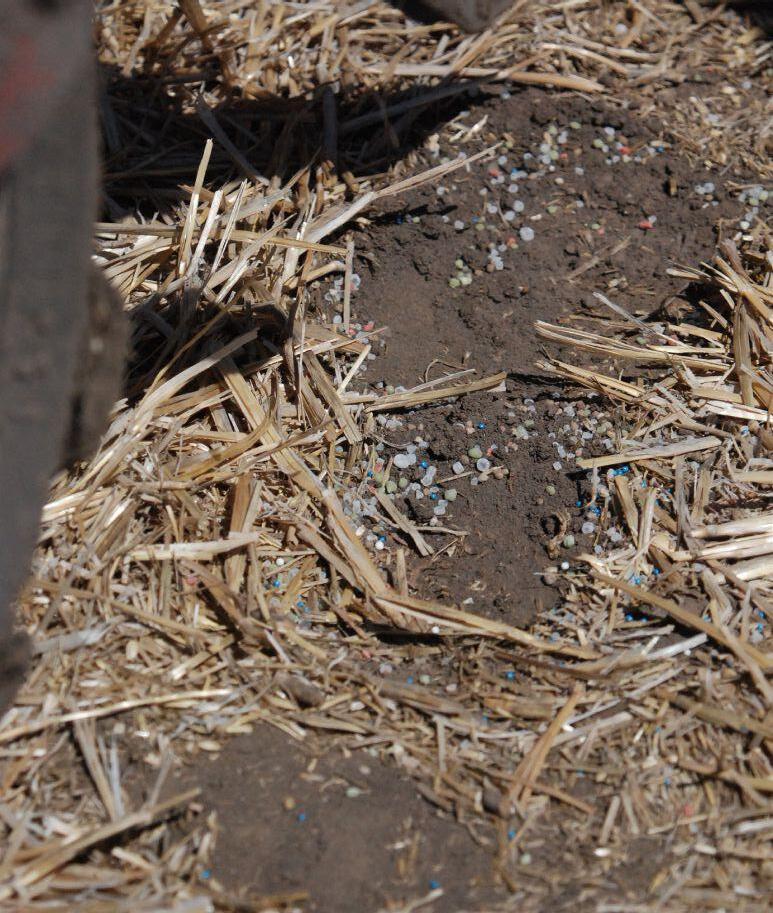
ABOVE: Treated canola seed (blue) is the foundation of a healthy stand establishment.
SEED TREATMENT
GUIDE 2021
Seed treatment options for Canadian growers continue to evolve. Products are reviewed and phased out, new products are launched, and recommendations change each year. The industry keeps up with the changes, launching new technologies and giving producers access to a variety of seed treatments to grow healthy, strong and profitable crops – but the
Continued on page 3
PHOTO COURTESY OF BRUCE BARKER.
A BREAK THROUGH SEASON
Seed Treatment Guide 2021
Top Crop Manager would like to thank Bayer for sponsoring this year’s Seed Treatment Guide. Through their support we are able to publish this information guide to assist our readers.
We are grateful to the numerous weed and pest management specialists for their assistance and helpful suggestions contained in Top
Seed Treatment
Continued from page 1
Published as part of Top Crop Manager, February 2021, by: Annex Publishing & Printing Inc.
PO Box 530, 105 Donly Drive South, Simcoe, ON N3Y 4N5 Canada Tel: (519) 429-3966 Fax: (519) 429-3094 EDITORIAL
AGRICULTURE Stefanie Croley ASSOCIATE
Alex Barnard
onus is on all stakeholders to make smart and mindful decisions when it comes to choosing tools to use each growing season. That’s why Top Crop Manager is pleased to publish the 2021 Seed Treatment Guide, our annual reference tool listing products registered for cereal, corn, soybean, pulse and canola crops. We compile these charts on a yearly basis, collecting the most up-to-date-information available to us at publication time. As always, we strive to make the tables in this guide as accurate and user-friendly as possible. With that said, however, this guide is adapted and compiled from crop protection resources and companies, and is not a definitive text. Growers should always double-check provincial guides and product labels, and consult a professional, to avoid errors.
We hope this guide assists you in choosing some of the right products for your upcoming growing season. Wishing you all the best for a successful year.
PHOTO BY BRUCE BARKER.
INTERCROPPING CHICKPEA WITH FLAX
This intercrop combination can reduce risk and provide yield stability.
by Donna Fleury
Intercropping flax and chickpea has the potential to expand the area of economic adaptation for both crops. Flax can expand into drier areas, hopefully reducing disease severity in chickpeas. For chickpeas to expand into wetter regions, an intercrop with flax can reduce risk and provide yield stability. Chickpeas have an indeterminate growth habit and require drought stress after pod formation for improved seed development and grain yield with reliable, uniform maturity. This drought stress can be induced by a flax intercrop, which provides competition for water and light. Researchers are working to develop an agronomic system for flax-chickpea intercropping across potential regions in Saskatchewan.
In 2019, researchers launched a study at five locations across Saskatchewan to study intercropping chickpea and flax as a way to expand the area of adaptation for chickpea, and also to effectively increase the area of economic adaptation of flax. The locations included Indian Head, Redvers, Swift Current, Saskatoon and Melfort. Researchers are
investigating multiple interactions among 22 treatments comparing crop placement (intermixed or alternate rows), flax seed density (zero, 75, 150, 300 and 600 seeds per square metre, or /m2) and N (zero and 60 kg/ha). Unfortunately, due to COVID-19, the trials did not go ahead in 2020, but are expected to continue in 2021 and 2022.
“In the crop placement experiment, the intercrop was seeded either as an intermix of both crops in the same seed row, or seeded as individual crops grown in single alternative rows,” May says. “In the two crop placement treatments, flax and chickpea density per square metre stays the same. In Indian Head, there seemed to be benefits from alternate rows, however in Redvers, mixed rows seemed to perform best. We don’t have enough data yet to explain the differences, but hope the next two years will provide more information.”
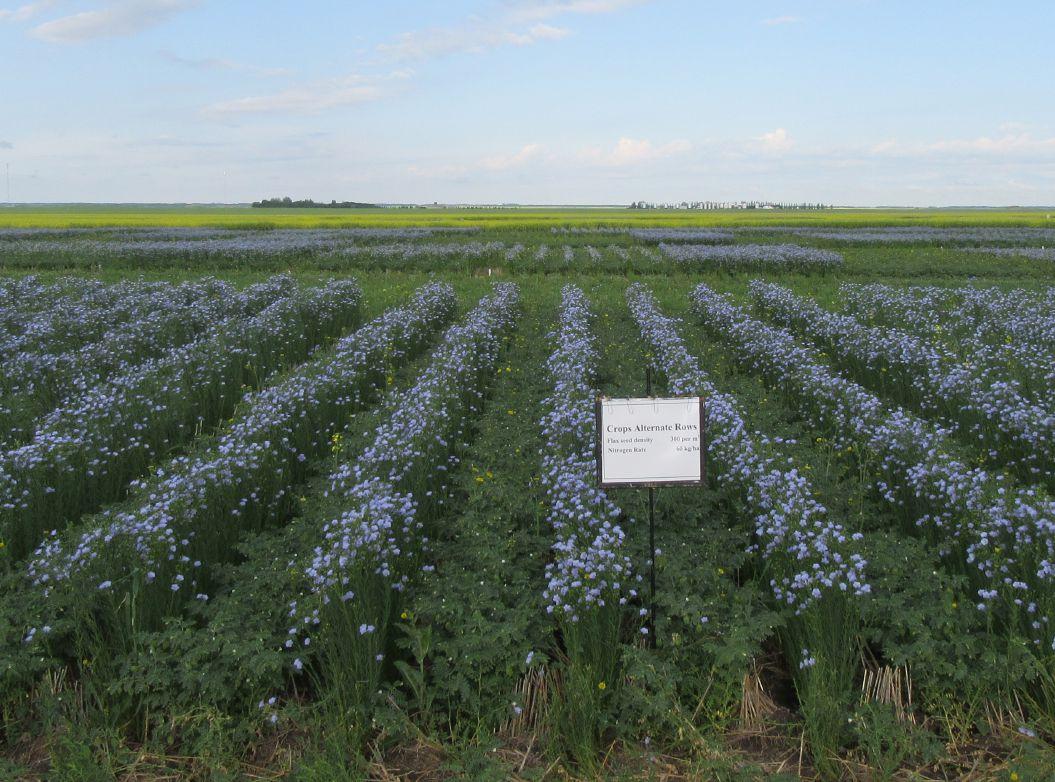
ABOVE Flax seeding rate of 300 seeds/m2 with 60 kg/ha N in alternate rows with chickpeas.
May notes that for growers, selecting the strategy that works best for them may depend on their objectives. If chickpea is the main crop focus and flax is being grown mostly to reduce disease severity in chickpeas, improve maturity and reduce green seed, then mixed rows are probably just as good as alternative rows. However, if the flax crop is expected to be a bigger component of yield, then using alternate rows can help manage N and increased seeding rates in the flax. Alternate rows can provide the potential to tweak the flax crop to increase the yield in this combination better than mixed rows.
“We do need wetter conditions to see how this intercrop performs and if we can expand the area for growing chickpeas,” May explains. “We are seeing that we can expand the areas we can grow flax as a complement to chickpeas. However, we don’t know yet how far we can expand the chickpea production out to wetter areas until we have more information. Our goal is to come up with a combination that will reduce risk and give yield stability for growers. Some of our preliminary indications are that we can get really big benefits from the flax in the intercrop in wet years, but we need additional data and information.”
From the preliminary results, flax seeding rate is the factor that is having the largest impact on intercropping chickpea and flax. In this study and in previous work, there is good evidence that green seed in the harvested chickpea is reduced by intercropping flax. Chickpeas in an intercrop also consistently mature faster and have produced consistent high-quality grain, while monocropped chickpea yields and quality have been very variable. Increasing the flax seeding rate does decrease chickpea grain yield, but the overall economic return appears to be fairly stable once the flax seeding rate reaches 150 viable seeds/m2) .
Generally, under low disease pressure, increasing the flax seeding rate also decreased disease incidence in chickpea. The results showed that the flax seeding rate had a significant impact on disease severity in both Redvers and Melfort, as well as on relative humidity and temperature in the canopy microclimate. However, the results were very different between the two locations. As expected, under more humid conditions in Melfort, intercropping flax with chickpea was associated with less severe disease and decreased relative humidity. However, the Redvers results showed the opposite, with higher flax seeding rates and reduced disease coinciding with higher relative humidity and lower temperatures. This relationship between chickpea/flax intercropping and canopy microclimate will be evaluated further over the rest of the project. Researchers are also assessing pasmo disease in flax.
“The most encouraging finding so far is that including flax in the intercrop provides yield stability and consistent gross returns,” May explains. “When comparing the effects of flax seeding rates on the combined gross return of chickpea and flax, the results showed that at the 150 seeds/m2, the gross returns of the intercrop are reasonably consistent. The gross returns/ha of the intercrop at the flax seeding rate of 150 seeds/m2 averaged between $1,750 and $2,000 in 2019. Although the gross returns of the chickpea monocrop was higher, at around $2,500 to $2,700 per hectare, in wet years, a chickpea monocrop can also have zero yield with little-to-no returns. So having the flax and chickpea intercrop provides a consistent stable return every year, rather than a hit and miss of chickpeas alone as we have experienced in Indian Head and other locations in some years. A wider range of environmental conditions, including wetter conditions in our trials, are required during the growing season to fully describe this relationship.”
As the research continues over the next couple of years, May expects they will have more information about how far the area that chickpeas can profitably grow with an intercrop can be expanded. It definitely is not just for the drier areas and he expects that the Saskatoon area for example should be well adapted to an intercrop mix, but that Melfort will likely be too wet. May notes there are some key considerations for growers to think about and that every ecosystem is different, so growers need to find out what works best on their own land.
“It is really a continuum of what you are trying to achieve, depending on your ecoregion or area of adaptation, and how much risk is involved in growing chickpeas in that area,” he says. “There are several objectives and they apply to different regions as you move from location to location. If chickpeas are being grown in an area where disease pressure is a concern, then flax should be a major component of the intercrop. Finding cultural practices that help manage disease pressure in chickpea is important, and intercropping chickpea with flax is a cultural practice that can help reduce disease pressure, green seed and improve maturity and yield.
“In regions where it is typically too wet to grow chickpeas, or on the edge – where half the time chickpeas can be successfully grown and the other half they can’t – then including flax as an intercrop can help stabilize the chickpea yield and overall gross returns for the intercrop. A flax-chickpea intercrop can help reduce risk, improve yield stability and maintain gross revenues.”
PHOTO COURTESY OF BILL MAY.
PHOTO COURTESY OF BILL MAY.
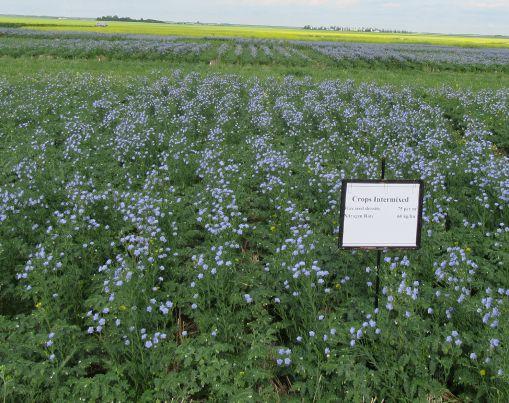
Flax seeding rate of 300 seeds/m2 with zero kg/ha N in mixed rows with chickpeas.
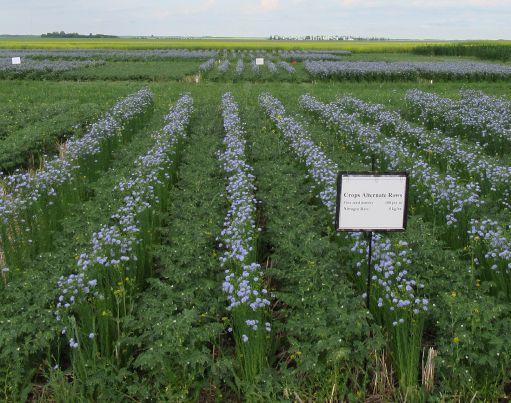
Flax seeding rate of 75 seeds/m2 with 60 kg/ha N in mixed rows with chickpeas.
FLAX
MANAGING ROOT ROT IN FLAX
Integrated approach minimizes the impact
by Bruce Barker
The good news about seedling blight and root rot in flax is that the occurrence is relatively low, and it can be managed to reduce the impact of the disease complex. As a result, rarely is there bad news to report.
“We see little root rot in flax in our disease survey and some years none. We conduct the survey when the flax plants are mature or maturing in August and September, which plays a role as well,” says Cory Jacob, provincial specialist, oilseed crops with the Saskatchewan Ministry of Agriculture in Regina.
In 2019, there was a concern that root rot was impacting a flax crop near Weyburn, Sask., possibly caused by Rhizoctonia species. It was identified in the lab from some of the fields affected, but so were some other pathogens and saprophytes, so it was unclear if Rhizoctonia was the only reason for the spotty emergence.
Seedling blight and root rot can be caused by fungal species of Fusarium, Pythium and Rhizoctonia In flax, Rhizoctonia solani is main pathogen, and survives as a composite of strains that differ in host range and pathogenicity. Strains attacking alfalfa and field peas also attack flax, and loose, warm and moist soils favour the development of the disease.
Yellow-seeded flax varieties are more susceptible to cracking and splitting of the seed coat, making them more vulnerable to infection by root rot pathogens. This may have been a contributing factor in Weyburn in 2019, as the affected field was a yellow flax variety.
Rhizoctonia solani infects flax at early stages of development, destroying the root and causing thinning, and even death of the seedling. Infected seedlings may occur singly or in patches. Roots of affected plants show red to brown lesions, and may later turn dark and shrivel. Blighted seedlings turn yellow, wilt and die.
The major reason root rot in flax has not become a major issue is that seedling blight and root rot can be controlled with a combination of farm
practices. Jacob recommends using Certified seed of a recommended variety that has good germination and vigour. Combine settings at harvest should be adjusted to reduce cracking of seed.
A fungicide seed treatment should be used. At least three years between flax crops is also recommended, and legumes and sugar beets should be avoided in rotation. Flax sown on cereal stubble is a good practice, and summerfallow should be avoided. Seed into a firm seedbed and use recommended fertility practices to promote vigorous stand establishment.
Seedling blight and root rot of flax can be confused with flax wilt (fusarium wilt). Flax wilt is caused by Fusarium oxysporum, a common pathogen that causes wilt in many field crops. Early infections may kill flax seedlings shortly after emergence, while delayed infections cause yellowing and wilting of leaves, followed by browning and death of plants. The tops of wilted plants often turn downward and form a “shepherd’s crook.” Affected plants occur more commonly in patches, but may also be scattered throughout the field. The most important control measure is the use of available resistant or moderately resistant varieties. A three-year crop rotation is recommended, and a seed treatment with recommended fungicides may protect the crop from early infection at the seedling stage and helps maintain good stands and seedling vigour.
Flax wilt has typically been of little concern. In the 2020 disease survey, in Saskatchewan and Manitoba, flax wilt was found on eight per cent of all flax crops (18 per cent in Manitoba, six per cent in Saskatchewan), and the prevalence was only slightly higher than it was in 2019. The low prevalence of flax wilt could be attributed to the hot, dry weather conditions in 2020.
With little impact of seedling blight, root rot or fusarium wilt on flax production, farmers and agronomists have found ways to use integrated management practices to keep the diseases under control.
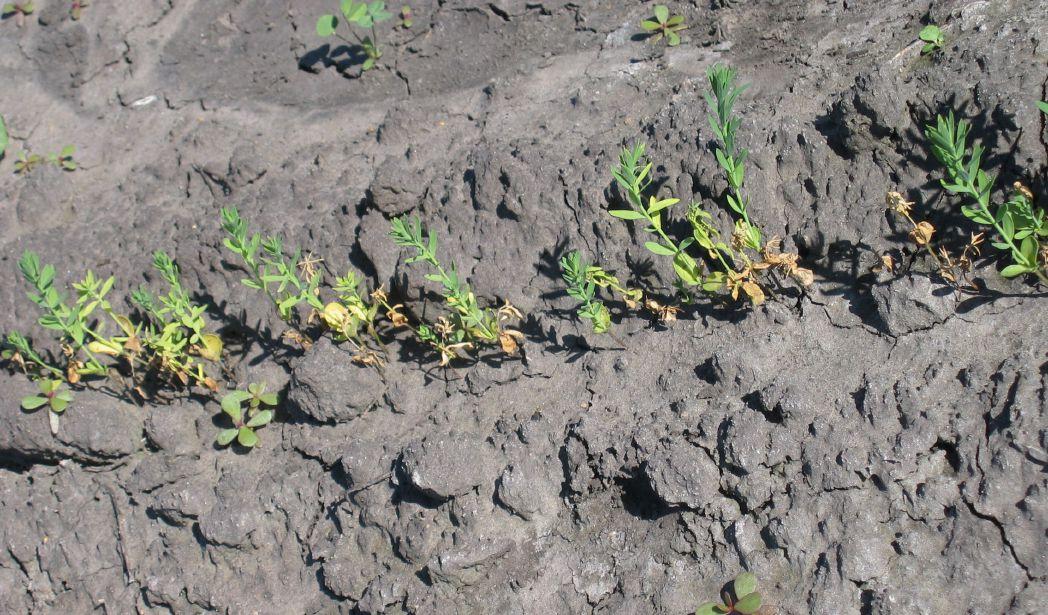
TOP: An integrated approach has kept flax seedling blight and root rot from impacting production.
PROTECT THAT START OF THE SEASON FEELIN’ FROM FLEA BEETLES
Introducing BUTEO™ start, a powerful new seed treatment that protects your canola and your start of the season spirit. BUTEO start is speci cally engineered to defend your canola against early ea beetle pressure, delivering unparalleled protection right through the three-leaf stage putting you on the path to strong plants and even stronger yields. So make this year one for the record books and start strong with BUTEO start.
Seed and seedlingrots/blights(1) Cochliobolus sativus Smuts Seed-borne septoria Seed-borne dwarf bunt Soilborne dwarf bunt Common bunt Common root rot Pythium damping off Take all Barley leaf stripe Wireworms Cutworms Armyworms
• • W, B, O W W**, B**, O** • B
• •**
• •**
• W, R W, R • •** • •**
• • W, R W, R W, R •** • •**
• • • • • •
• • • • • •
• •** • • •** •
• • W,B,O W •** • B
W, B, O, R, T W, B, O, R, T W, B, O, R, T W, O, R, T W**, B**, O**, R**, T** W, B, O, R, T B
W, B, O W, B, O W, B, O W, O W**, B**, O** W, B, O B
•
• •** • W, R W, R • •** • •**
• W ,B, R, T W, B, O W W W W, B, O, R** • B
• W, B
NOTES
Suppresses crown and foot rot caused by Fusarium spp. in wheat, barley, oats and rye.
• For control of wireworms, plus seedborne and soilborne diseases.
Penicillium Three Leaf Dieback is labelled for minor use.
Supresses seedling blight and root rot caused by Cochliobolus sativus and crown and foot rot caused by Fusarium spp
• • • For control of wireworms, cutworms and armyworms.
•
• Suppresses common root rot caused by Cochliobolus sativus
Suppresses crown and foot rot caused by Fusarium spp. in wheat, barley, oat, rye and triticale.
Suppresses seed rot, pre-emergent damping off and root rot caused by Rhizoctonia solani in wheat, barley, oats, rye and triticale.
• Suppresses seed rot, pre-emergent damping off and root rot caused by Rhizoctonia solani in wheat, barley and oats.
• Compatible with most fungicide seed treatment products.
Supresses seedling blight and root rot caused by Cochliobolus sativus and crown and foot rot caused by Fusarium spp
Compatible with rhizobium-based inoculants. Please check with inoculant manufacturers for details prior to use.
Suppresses early season root rot caused by Phytophthora sojae. Compatible with rhizobium-based inoculants. Check with inoculant manufactuers for details prior to use.
• • • • • Registration work on cutworms is ongoing.
• Compatible with most fungicide seed treatment products.
• • • Suppresses sudden death syndrome. •
Compatible with most fungicide seed treatment products.
(12), metalaxyl-M and S-isomer (4), sedaxane (7), ethaboxam (22)
(7), thiram (m)
(7)
(4A)
Chickpeas (CP)
•
CROPS
SEED TREATMENT GUIDE 2021
DISEASES
INSECTS NOTES
(D)
•
•
Fababeans (F)
Registered for use with lupins.
Potato Leaf Hopper and Anthracnose specific to dry beans.
Suppresses Aphanomyces root rot and early season root rot caused by Phytophthora sojae. Compatible with rhizobium-based inoculants. Check with inoculant manufactuers for details prior to use.
Suppresses seedling root rot caused by Fusarium spp. in chickpeas, dry beans, lentils, and peas. •