in mid-August, as Canadian students prepared for another post-secondary school year, Iain Klugman, CEO of Communitech, and Kevin Lynch, Vice-chair of Bank of Montreal, cowrote an article for The Globe and Mail entitled Toronto-Waterloo Corridor Could be Canada’s own Silicon Valley.
30%
The Toronto to Waterloo corridor is home to 30 percent of Canada’s university students, according to Klugman and Lynch, and the country’s best chance of developing a Silicon Valley-like ecosystem..
The authors recognize Canada, given its breadth, holds several internationally competitive pockets of innovation like Toronto, Vancouver and Montreal. Innovation is an ambiguous term and certainly Calgary can be added to the list for its efforts in the energy sector, while Halifax can be noted for tackling the modern demands of key domestic natural-resource sectors like the fisheries.
Klugman and Lynch, however, relate innovation to the revolution of Information Technology: “Only one region – the Toronto-Waterloo corridor – carries the unique potential to develop as Canada’s answer to Silicon Valley, and in the process, significantly move the needle on our national economy.” They point to the corridor’s strong research universities and technical colleges, international airport, population density (more than six million, accounting for 21 percent of the country’s population), vibrant immigration and an existing culture of entrepreneurship. “The Toronto-Waterloo corridor already has many of the ingredients essential to building a Silicon Valley-like innovation super ecosystem in Canada.”
This potential IT ecosystem, they argue, can be fueled by holding a majority of Canada’s corporate headquarters, Canadian industry-led R&D spending and venture capital.
It is near absurd to poke holes in an economic argument presented by the Vice-chair of BMO, but it can be argued that much of the systematic economic problems in the United States for more than a decade was the result of its dwindling manufacturing base, which ultimately led to a crippling trade account deficit, when imports far exceed exports.
Silicon Valley, in fact, presents an easy way to relate this trade account conflict between manufacturing and information innovation. As the region developed world-changing Information Technology, the hardware needed to use it like computers and monitors was being manufactured overseas. The Toronto-Waterloo corridor holds exciting potential to become a Canadian IT hub, but the government arms ultimately needed to drive such development must not lose sight of the fact that manufacturing is the backbone of this corridor.
Printing is a unique industrial sector in many ways, including how its future will be determined by a marriage be-
tween capital-intensive manufacturing and pervasive Information Technology. The concern of a crippling Canadian trade deficit is described in a July article by David Parkinson, economics reporter for The Globe: “For the first five months of 2015, Canada has now rung up a massive $13.6-billion trade deficit.” Parkinson explains how Canadian exports fell for the fifth straight month in May, despite improved prices, and that exports are now 4.5 percent below their endof-2014 levels.
The printing industry, still one of Canada’s most-significant industrial sectors, despite the dismissiveness of outsiders, will surely do its best to increase exports to the United States by leveraging a lower Canadian dollar. At the same time, it is also important to recognize opportunities for domestic development in the printing industry, as Canada begins to wrestle with the forces of manufacturing and information innovation that played out in the United States over the past three decades.
With full respect to the country’s many strong printing centres, the Toronto-Waterloo corridor is the demographic heart of Canadian printing and perfectly situated to engage the emerging Silicon Valley-like innovation super ecosystem described by Klugman and Lynch. Printing leaders embrace the challenge of melding creativity, manufacturing and IT.
Curwin Friesen, during an interview for the cover story about Friesen Corp.’s investment in a new 73-inch manroland perfecting press, describes such potential: “The themes I try to get through to our staff is that print is in a constant state of innovation. That print is not dead and it continues to find a way to be relevant. What is frustrating to all of us in this industry is the dismissiveness that print is just yesterday’s news and everything exciting is happening in digital. There are so many exciting things happening in print and technology allows us to be competitive.”
Despite operating out of a town of just 4,000 people in Altona, Man., Friesens Corp., at age 107, has been a world-leader in book manufacturing for decades now by believing in the innovation of print. As the 2015 school year begins, the printing industry would be well served by creating its own innovation network within the Toronto-Waterloo corridor, home to 30 percent of Canada’s university students.
Editor Jon Robinson jrobinson@annexweb.com 905-713-4302
Contributing writers
Zac Bolan, Wayne Collins, Peter Ebner, Victoria Gaitskell, Martin Habekost, Nick Howard, Angus Pady, Nicole Rycroft, Abhay Sharma, Trish Witkowski
Publisher Paul Grossinger pgrossinger@annexweb.com 905-713-4387
Associate Publisher Stephen Longmire slongmire@annexweb.com 905-713-4300
Director of Soul/COO Sue Fredericks
National Advertising Manager Danielle Labrie dlabrie@annexweb.com 888-599-2228 ext 245
For a 1 year monthly subscription (12 issues): Canada — $39.99 ($35.39 + $4.60 HST) United States — CN$69.99 Other foreign — CN$139.99
Mailing address
Annex Business Media 222 Edward Street Aurora, ON, L4G 1W6 printaction.com
Tel: 905-727-0077
Fax: 905-727-0017
PrintAction
with
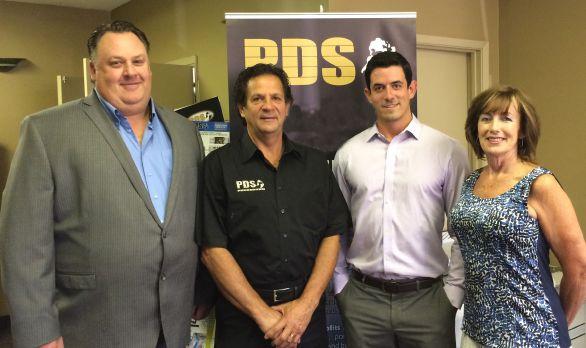
pDs becomes a Canadian distributor of Duplo technology, for both office and production equipment. Duplo was established in Japan in 1951 after it manufactured one of the first duplicators in the printing industry. The company is now focused on developing short-run finishing systems.
Heidelberg, for its first quarter (April 1 to June 30, 2015), reported its sales under review increased to €563 million (previous year: €435 million) and that all of its regions achieved higher sales, while incoming orders climbed to €703 million (previous year: €588 million). The first quarter operating result improved with an EBITDA of €46 million (previous year: €6 million) and EBIT of €28 million (previous year: €-11 million). Income from the takeover of PSG totaling about €19 million had a positive impact on both EBIT figures. The quarterly revenue figure at €-14 million was better than in the same quarter of the previous year (€-17 million).
Canadian bank note Company of Ottawa, Ont., acquired commercial printer Unicom Graphics of Calgary. Unicom is to be integrated into CBN’s McAra Printing division, also of Calgary. The merged operation is currently being referred to as McAra Unicom. Over the past six years, CBN has invested more than $10 million in printing technology alone for its McAra operation,
Kodak opened a new manufacturing line at its Columbus, Georgia, facility to produce Sonora Process Free Plates, which the company states are being used by more than 2,700 printers worldwide. Sonora plates are currently being used in a range of commercial print, newspaper, book and packaging facilities, with models rated for up to 200,000 run lengths.
CalenDar
September 13-16
Graph expo 2015 Chicago, IL
September 16-19
sign China Shanghai, China
September 23
opia london Golf Classic Pine Knot, Dorchester, ON
September 25-26
Consac imagemakers International Centre, Mississauga, ON
September 28-30
including the December 2013 installation of a new Heidelberg XL106 10P+UV sheetfed press.
rr Donnelley & sons of Chicago is to form three independent, publicly traded companies: with one business focused on financial communications and data services (12-month net sales of approximately US$1 billion); one business focused on publishing and retail-centric print services (12-month net sales of US$3.5 billion); and one focused on customized multichannel communications (12-month net sales of US$7 billion).
U.s. postal service reported a net loss of US$586 million for the third quarter of its fiscal 2015, which is actually a positive step relative to the massive net loss of US$2 billion for corresponding period last year. The world’s largest mailing system had doubledigit growth in shipping and package revenues for its 2015 third quarter. The USPS reported total mail volume of 36.8 billion pieces in the third quarter of 2015, which represents a drop of 738 million pieces from 37.5 billion pieces in the corresponding 2014 quarter.
shanghai electric Corporation of China entered into an agreement to sell Goss International, a global web-offset printing press supplier, and its subsidiaries to New York’s American Industrial Partners (AIP), which is a middle-market private equity firm that has been investing in North American industrial businesses since 1989. In November 2012, AIP, through its MAI Holdings affiliate, purchased Presstek Inc., which develops DI presses, CTP systems and plate technology. In August 2014, AIP sold its majority interest in Mark Andy, which develops flexographic press technology, to an investment group formed by P.J. Desai.
Cansel acquired Ernest Green & Son Ltd., which has been a staple of Canada’s printing industry for more than 60 years. Ernest Green began as a small family-owned business in Montreal, opened by Ernest Green and his son, Ric, to distribute pressroom technologies. Ernest Green moved its headquarters to Toronto in 1963.
mi5 print & Digital Communications of Markham, Ont., purchased certain assets and intellectual capital of two Toronto companies, including Magnum Fine Commercial Printing, controlled by John Popovski, CEO of Media-Vision. Mi5 also acquired intellectual capital of Media-Vision. In late July, the Ontario Supreme Court of Justice approved Mi5’s auction bid for specific assets of J. F. Moore Lithographers Inc. of Scarborough, including its book of business.
Correction notice: In the July issue of PrintAction, Harmony Printing of Toronto was omitted from an article about Canopy’s ranking of the most environmentally progressive printers in North America. Harmony placed third in Canopy’s final 2015 Blueline Report
packexpo Las Vegas, NV
October 7
printaction education series: business of printing Delta Markham, Markham, ON
October 8-10
aiGa Design Conference New Orleans, LA
October 17-18
project space art/book Fair Vancouver, BC
November 4-6
sGia expo Atlanta, GA
November 8-10
bmi annual Conference Boca Raton, FL
November 12
Canadian printing awards Gala
The Grand Luxe, Toronto, ON
December 4
mutoh rip software Workshop series, Flexi Los Angeles, LA
May 31-June 10, 2016 drupa Dusseldorf, Germany
September 25-28, 2016
Graph expo 2016 Orlando, FL
April 7-8, 2017 Grafik’ art Montreal, QC
March 19-24, 2018
ipeX 2018 London, UK
Daniel Grant of Duplo (L to R)
PDS’ Dave Kisiloski, President, Brett Kisiloski, Sales Manager, and Jackie Kisiloski, Vice President.
Dirk Kaliebe, Heidelberg, CFO and Deputy CEO.
Jeff Clarke, CEO, Kodak.
thomas Quinlan III, CEO, RR Donnelley.
Megan Brennan, Postmaster General and CEO, uSPS.
installs
abhay parasnis becomes Chief Technology Officer of Adobe, as well as the California company’s Senior Vice President of platform technology and services. He is tasked with driving Adobe’s technology strategy, architecture and innovation road map for its cloud services, which includes flagship Creative Cloud, Adobe Marketing Cloud, and most recently Adobe Document Cloud. Parasnis was instrumental in building the early cloud-computing platforms at both Microsoft and Oracle.
John mitchell becomes Vice President of Sales, North America, for Ultraflex Systems Inc., which provides specialty substrates. Mitchell joined Ultraflex in 2013 and served as its Canadian Sales Representative, where he had increased domestic sales by 30 percent. With 25 years of experience in the printing industry, Mitchell previously served as President of 3deltaE, providing sales, marketing and technical support for graphic manufacturers by selling through a dealer channel in Canada.
alain paquette, President of Artcraft Label led the company to become an official Esko HD Certified printing operation, based out of Burlington, Ont. Paquette purchased Artcraft a little more than three years ago and earlier this year installed Esko’s HD Flexo technology for prepress.
ralph abdelhak assumes the newly created Director of Product Management position at Roland DGA. With more than 18 years of product marketing and management experience under his belt, Abdelhak is responsible for overseeing all of Roland DGA’s product managers. He joins Roland after spending the past two years as a marketing consultant. Prior to that, Abdelhak was a Marketing Manager with Sun Chemical.
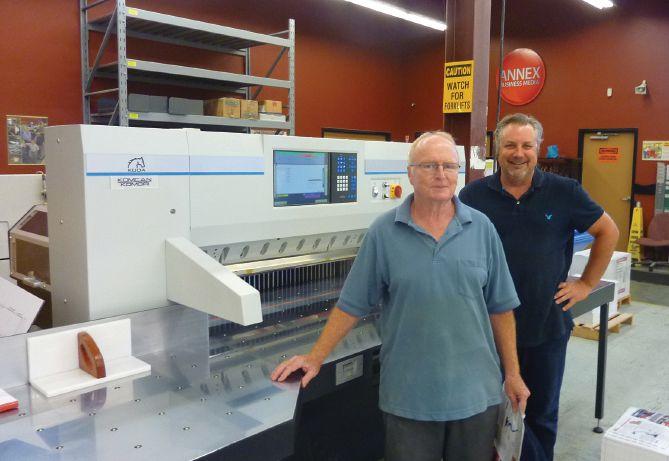
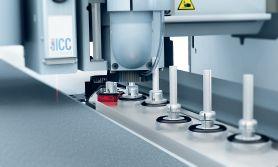
annex business media, publisher of PrintAction, installed a new Kuda 115 CL cutting system into its Simcoe, Ont., facility. Purchased through KOMCAN, the fully programmable cutter, pictured with Annex operator Ivan Glendinning (left) and Bob Staz, Production Manager, cuts at 45 cycles per minute.
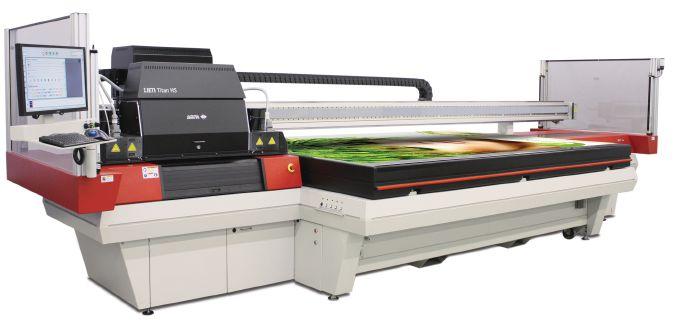
sina printing doubled its large-format production capacity with the installation of a new Agfa Titan HS system and an Esko Kongsberg C Series cutter. Both machines were installed in its Markham, Ont., facility in June of this year and have been fully operational since July.
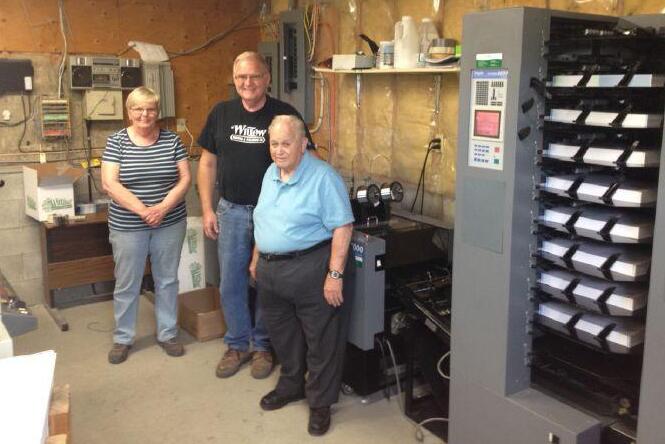
Willow publishing of Brighton, Ont., updated to a reconditioned 20-bin Duplo System 4000 collator, bookletmaker and face trimmer. The system, purchased through Sydney Stone, was fully reconditioned by the distributor’s Duplo factory-trained technicians and replaces an older model Bourg system.
Maximize Your Possibilities
At the 2015 SGIA Expo in Atlanta — you’ll see all the possibilities and newest equipment, applications and trends for growing your specialty imaging business, including: high-speed roll-to-rolls, flatbeds, hybrids, installation, finishing and so much more.
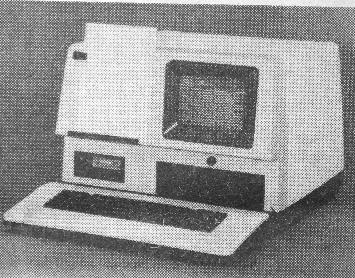
A compact, desktop standalone unit, the CRTronic offers the full advantage of digital typesetting, yet is no more costly than a conventional direct entry system. It sets type from four to 72 point in 1/10-point increments at up to 40 lines per minute. Maximum line length is 45 picas, and the CRTronic uses standard eight-inch type paper or film.
Type quality is exceptionally high with a resolution of 1,270 scan lines per inch, and it accepts the complete Mergenthaler, Stempel, Haas type library of over 1,000 different faces. Fonts are stored digitally in mini-floppy disks and 23 different font widths can be held in the machine’s memory at one time. Additional features include interactive hyphenation and justification, multiple language hyphenation with exception word dictionary storage, automatic page and file management. To ensure operator comfort the machine has a moveable keyboard and tilt-able screen.
1980
Southam Printing Ltd. of Toronto has signed an agreement to purchase Agency Press Limited of Vancouver, BC, lithographers of advertising promotional materials, annual reports, labels and maps. There will be no changes in the management or policies of Agency Press. Mr. Dodd Clippingdale will remain as President.
1985
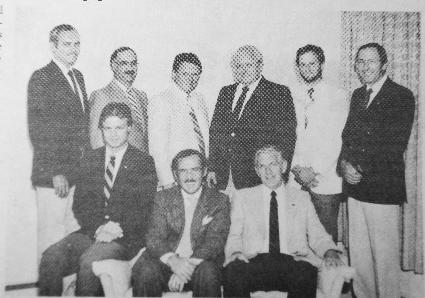
GAIA Ontario appoints new board
The new Graphic Arts Industries Association board for Ontario includes, standing (L to R): Richard Guse of Aljon Print-Craft, Bob Davis of Fairway Press, Don Williams of Fine Papers London, Don Morgan of Loder-Sutherland, Stuart Seldon of D.G. Seldon Printing, and Bill Hurley of The Hurley Printing Co. Seated are (L to R): Brian Kelly and Carl Hearn of GAIA with Joe Potje of Twin City Printing. Absent from the photo are: John Barney, George Ashby, Ted Minhinnick and Peter Cober.
1995
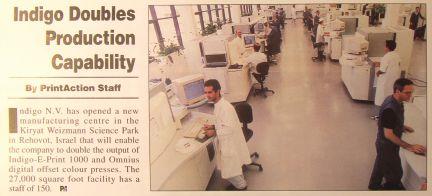
Indigo Doubles Production Capability
Indigo N.V. has opened a new manufacturing centre in the Kiryat Weizmann Science Park in Rehovot, Israel, that will enable the company to double the output of Indigo E Print 1000 and Omnius digital offset colour presses. The 27,000-square-foot facility has a staff of 150.
1975
Supermarket scanning in Quebec
In July 1974, Steinberg’s Dorval, Quebec, supermarket became the first store in Canada to have a completely electronic front end installed. More than a year later, it is still the only store in Canada so equipped. The groceries zip through the scanning equipment, which totes up prices and prints out the product name and price on the cash tape. Estimates in checkout time savings are around 20 percent.
The real value of the system is that it will also eliminate individual price labeling of supermarket items and expedite price changes. But the Consumers Association of Canada says the Universal Product Code does not allow consumers to compare the price on a package with the cash-register print out after leaving the store.
800
Number of miles of Peruvian territory covered by Grupo El Comercio facility in Lima. With increased newspaper circulation in the country, Groupe El Comercio has built a new southern plant in Arequipa that will include the printer and publisher’s third Goss Community press.
Meredith-Webb to add 81-inch KBA
This October, Meredith-Webb Printing Company of North Carolina is scheduled to add its fourth KBA press to have been installed in the past five years, which amounts to an investment of more than $20 million. The newest press is an 81-inch KBA Rapida 205, worth around $9 million, including auxiliary equipment.
“We’re eagerly anticipating the arrival of this giant 81-inch press from KBA,” says Kelly Webb, Executive VP at Meredith-Webb. “Currently, our company’s capabilities are limited to printing products up to 65 inches. Our new Rapida 205 press will have the capability of printing display and packaging graphics for the corrugated industry, point-of-sale signage for the retail environment, and sublimation materials for the garment and fashion industries.”
With 105 employees, Meredith-Webb’s pressroom is currently equipped with a 64-inch, six-colour KBA Rapida 164 10-unit press, with double coaters and UV; a 64-inch, seven-colour Rapida 162a press with coater and UV; and a 41-inch, six-colour KBA Rapida 106 10-unit press with double coaters and UV. The new Rapida 205 is a six-colour press with inter-station drying and end-of-press aqueous/UV coating.
Mengis Druck’s first digitally printed newspaper
Starting at 11:00 pm on June 15, the Swiss daily Walliser Bote was printed completely digitally by Mengis Druck AG. The feat was accomplished by using Mengis Druck’s FoldLine from manroland Web Systems, which is a format and cut-off variable finishing line, as well as its HP T400 inkjet press and mail-order house technology from Muller Martini.
“The realization of this project was [the result of] great teamwork,” said Thomas Knaier, Project Manager at manroland web. “The cooperation of all the involved partners with Mengis Druck AG will be kept in our minds for a long time. The schedule was tight but together we could realize it. As promised in the contracts that have been signed in January 2015, we went into production according to plan.”
Walliser Bote provides the news to the Valais region of Switzerland. It is published from Monday to Saturday with a circulation of between 22,000 and 32,000 copies featuring approximately 24 pages. The Walliser Bote is produced in tabloid format with a postal fold and as a broadsheet product in Berliner format.
D5 die cutting at The Works
A Rollem D5 Die Cutter was recently installed at The Works Printing Group, which is an Australian trade supplier of unique printed products. The company has been printing for over 30 years and carries a mindset to embrace new printing techniques for a range of products like magnets (fridge, car, clip, bookmarks, photo frames), as well as badges, car hangers, drink coasters, key tags and luggage tags, mouse pads, rulers and even T-Shirts. The Works Printing Group also produces a range of display signage.
The D5 Die-Cutter is a new sheetfed flexo-magnetic model that performs die-cutting, kiss-cutting and creasing on stocks from 20 lb paper to 0.22 carton board. It handles sheet sizes from 8 x 8 inches up to 15 x 22 inches and operates at speeds of up to 5,000 sheets per hour.
3
Size of the ink drop in picoliters delivered by the Epson MicroPiezo print heads used on the recently introduced SurePress L-4033AW press. SnugZ USA, a promotional products printer from Long Beach, CA, recently installed two such machines along with three Epson SureColor F-Series dye-sublimation printers to produce lanyards.
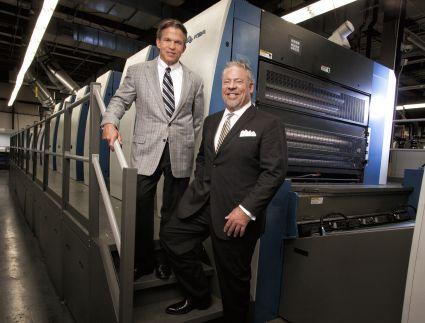
Brothers Kelly Webb, Executive VP, and travers Webb, President, of Meredith-Webb Printing.
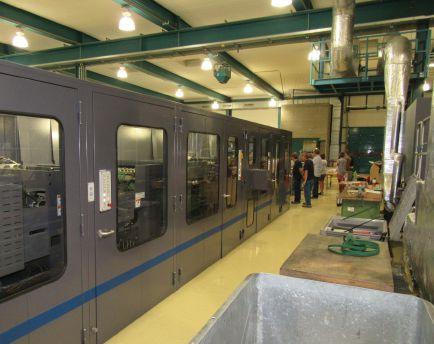
the flexible folding technology of Mengis Druck’s manroland FoldLine finishing system.
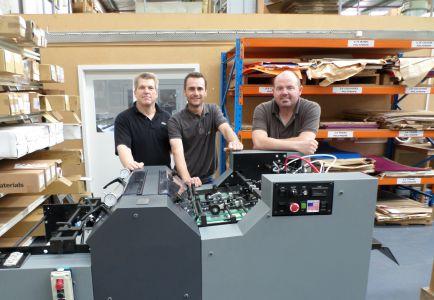
the Works employees Marcus and Andrew with Rollem technician Brian Simons.
Speed networking at PackEx
Looking at the effectiveness in new forms of networking to determine how professionals are connecting to develop business
By Victoria Gaitskell
With today’s limits on staff, time and resources, both exhibitors and visitors are seeking a return on the investment they make (financial and otherwise) to attend trade shows. One reason is that electronic media provides a host of other effective and often less expensive ways to launch, demonstrate or research new products; train sales reps and resellers; generate leads; and brand a company strategically in a competitive space. Consequently, participation in major industry trade shows is no longer universally regarded as essential to these important business functions.
A year ago, when I interviewed Rafael Peñuela Torres, Chief Executive Officer of manroland Sheetfed GmbH in Offenbach, Germany, who said: “I think it’s time to rethink the role of trade shows. To keep repeating the same thing we have done for the last 50 years is the wrong response for an industry that has changed dramatically over the last 10 years for both customers and manufacturers. I personally believe we have too many exhibitions around the world, and that they need to come up with new concepts to change the way they operate. I don’t know what they will be, but how strongly we participate in trade shows in the future will depend on how strongly we believe in these new concepts.”
Over the past few years, the printing industry has seen significant growth in technology suppliers producing their own trade shows and conferences. Esko in June ran its 23rd EskoWorld event featuring more than 70 educational sessions. In January, EFI hosted its 15th Connect user conference in Las Vegas, which drew approximately 1,500 attendees from 25 countries, described as a 20 percent increase over the previous year. HP’s successful Dscoop group, which is run by an independent body of HP technology users, draws thousands of
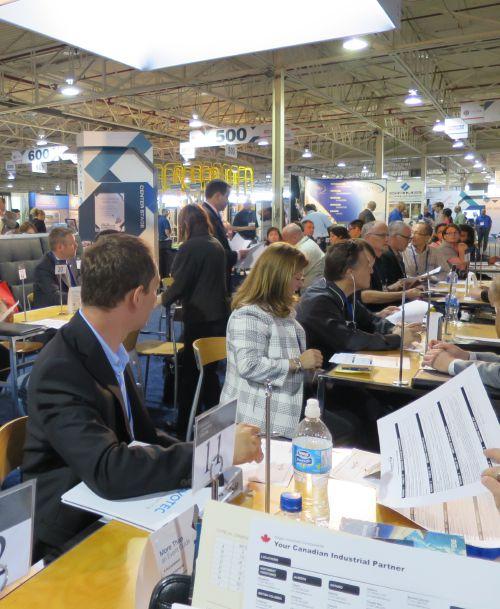
PackEx took place in toronto in late June, featuring an hour-long session on speed networking. 50
Number of participants needed for an effective speed-networking event, which borrows from the speeddating model developed in the late-1990s by Rabbi Yaacov Deyo..
printers to events held around the globe. All of these vendor conferences feature partner pavilions, small equipment showcases of third-party technologies that might normally be considered as competitors. The biggest draw to these events, however, is the unique ability to network with other like-minded printers from different regions.
This networking ability is one of the main reasons why I continue to attend trade shows, with the amazing efficiency of being able to meet face to face with a large number of targeted people, all in one place. Typically my approach is to maximize this opportunity by researching the exhibitors in advance, as well as any new developments they may be presenting, and the demographics of the visitors who typically attend the show, including their business activity, job titles, and decision-making power. (My sources for this kind of information include exhibition organizers, trade associations and clients.) Then I set up appointments in advance with the specific people I particularly want to meet, so that I do not waste too much time on browsing, small talk, and chatting with old friends, rather than focusing on meeting the people most likely to help advance my current goals.
In hopes of expediting this networking process, I registered for a 75-minute Speed Networking session scheduled among various other free, value-added events on the expo hall floor of PackEx Toronto. Held for the 37th time from June 16 to 18, the show bills itself as
Canada’s longest-running national packaging exhibition. I discovered an interesting approach to develop new business connections.
Mechanics of speed networking
Although by now a recognized business practice, Speed Networking is thought to derive from Speed Dating, a system of romantic matchmaking that operates along similar lines, supposedly begun in Beverly Hills by Rabbi Yaacov Deyo in 1998 (at least, if you believe Wikipedia.) By contrast, Speed Networking is intended to accelerate introductions, which in optimal scenarios turn into mutually useful working relationships.
Although Speed Networking can operate in a variety of formats, the PackEx session, facilitated by a Chicago company called SpeedNetworking.com (founded in 2001), gave each participant a printed schedule for a series of 10 six-minute, one-on-one meetings at numbered stations where a new acquaintance was scheduled to appear each time.
Typically in the allotted six minutes each pair exchanged quick summaries of themselves, their companies, their goals, and what they hoped to achieve from the meeting, along with contact information and whatever further discussion time allowed. Most importantly, as part of online pre-registration for the event, participants were asked to fill out a brief multiple-choice questionnaire with their own business profile and the type(s) of individuals they wish to meet. The profiles were then matched electronically to generate a schedule of meetings for each participant based on these preferences. With the demographics of PrintAction’s readership in mind, I basically indicated on my pre-registration questionnaire that I most wanted to meet people who were directly involved in the design and manufacture (preferably printing) of packaging.
SpeedNetworking.com’s Website explains: “Our smart-matching software enables participants to pre-select the types of people they are interested in meeting, which is based on customized matching parameters put together by our clients. We take the guess-work out of networking events and determine the best possible connections for each person to make. For instance, if you meet 20 people in a room full of 100 possible connections, you could potentially meet 20 irrelevant contacts and miss out on meeting the RIGHT people. SpeedNetworking.com gives event planners the ability to run a TARGETED networking event that is contingent upon the preferences for each participant. We substantially increase the odds of meeting the RIGHT connections.” Elsewhere, the company’s Website confirms that its proprietary software is
Annex Business Media going BIG with KOMCAN and Komori
With all the recent acquisitions Annex Business Media has made recently it was decided that their existing 29 inch 8c press would not be able to handle the workload. With that Lance Hill and his team went out to the market to look for a 40 inch perfecting press to replace it. What they came up with was a fully automated Komori LS 8c 40 inch perfector. The press has the highest automation level that includes fully automatic plate changers, close looped spectrophotometry, fully automatic wash up systems and so much more. The LS series is part of a complete line up of sheetfed presses offered by Komori that includes the GL-40 and the all new GLX 40 rated at 18,000 sheets per hour. Be sure to visit Komori while at Graph Expo at booth number 1248.
capable of matching pairs based on a variety of criteria, depending on whether the desired matches are between peers, vendors and prospects, mentors and mentees, or prospective employers and job seekers.
Targeting was essential at PackEx, since California-based show organizer UBM Canon staged it at the same time and in the same location as five of their other exhibitions: PLAST-EX (for the plastics industry), Design & Manufacturing Canada (for design engineering), ATX Canada (for automation technology), plus two new shows called PBS Toronto (for powder and bulk solids) and Quality Expo (for manufacturing quality management).
My speed networking experience
It turned out that, although all my meetings proved interesting and enjoyable, the five scheduled matches I met did not all derive from my targeted fields. They included:
• Greg Mais; Sales and Marketing Manager at San Chung and Associates Inc., a supplier of prepress and in-the-round platemaking services for the flexographic industry.
• Bohdan Dolban; President of Botama Holdings, a packaging sales agent specializing in metal and plastic packaging for liquids and solids, including pails, drums, bottles, pumps, sprays, and polybags.
• Fernando Kapelusznik; Regional Sales Manager at Cavotec Canada Inc., a supplier of automation, assembly, electronic, and industrial engineering products and solutions.
• Steven Wexelman; VP Sales and Marketing for Flamesoft Systems Inc., a Web-based, hosted transportation-management software system that facilitates shipping by third parties and customized warehouse controls.
• Antonio Rodricks; Outside Sales Representative for Laird Plastics, whose products have a wide range of applications, including signage and displays.
My remaining five meetings were with random substitutes, promptly assigned by SpeedNetworking.com’s on-site Event Facilitator, Shalom Klein, whenever a person I was scheduled to meet failed to show. The substitutes were:
• Kevin De Vos; Outside Sales Representative for Laird Plastics
(see company description above)..
• Michael Robev; an engineer who helps Canadian companies outsource their manufacturing needs to Bulgaria.
• Peter Pfingst; Managing Director of Air Cargo Solutions Limited, who is seeking opportunities to apply his expertise to the packaging industry.
• Alain Cubric; Engineering Product Analyst at 511 Food Service, a co-op student from the University of Toronto’s Engineering program, presently engaged in product testing.
• Chris Armstrong; of Origination, a consulting business that helps companies reduce their energy costs.
At the end of the full session, Klein announced a total of 48 people had participated, although his company’s Website specifies 50 as the minimum number of participants needed for an effective event. I wonder how many other participants experienced my same rate of 50 percent no-shows, despite SpeedNetworking.com’s autoreply to pre-registrants that cautioned: “Your participation is critical to this event, as each schedule is customized and no-shows will leave your conversation partners without someone to meet. Please do not skip this event.
I am optimistic that the session would have yielded matches closer to my goals if more people had participated. Perhaps this outcome will occur eventually as Speed Networking becomes more mainstream in Canada.
Until then, it seems I’ll have to continue to rely on my customary do-it-yourself networking approach. As SpeedNetworking. com’s Website points out and research by the Harvard Business Review confirms, “Networking continues to be one of the most powerful tools to create and sustain successful business relationships.” And – provided you are operating on an effective advance plan based on solid research – when it comes to trade-show networking I still believe in Woody Allen’s dictum that 80 percent of success is showing up.
ViCtoria GaitsKell is a seasoned journalist, who has extensive printing industry experience having worked for human resource firms and associations tied to the sector. vgaitskell@gmail.com
Mike Fredericks, President & CEO
The wild west of large format
colour management for wide format has made significant inroads over the past couple of years, but key challenges remain and need attention to properly hit targets
By Angus Pady
in commercial printing, we have lots of targets to aim for and to control the process: GRACoL, Fogra and ISO to name a few and I recommend that you use the same standards/specifications in large-format printing. This allows for creating consistency between offset and large format. The first step is to get an idea where you are starting. You have a few options when evaluating colour. If you have an in-house inkjet-proofing device you can print a visual reference image to compare your large-format device to a known standard such as GRACoL.
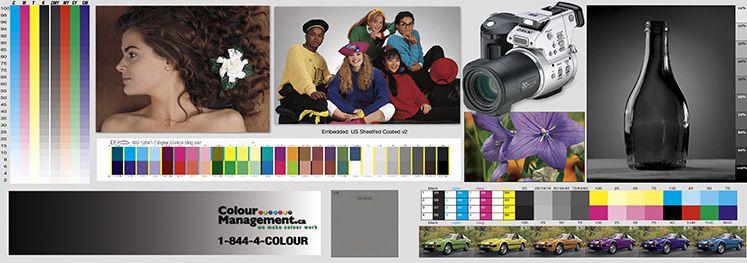
Figure 1 is an example of a test image that I use to show me a ton of great information about how a device is printing. (Please email me if you want a PDF of this image.) Starting on the left, I look at the solid ink densities. In large format, usually the magenta is the weakest ink. If you have a densitometer from your press measure the CMYK values. For most decent medias, you should achieve at least the following densities: Cyan 1.301.70; Magenta 1.30 - 1.60; Yellow 0.901.10; and Black: 1.60 - 1.90.
If your numbers are lower, then consider going back to look at how the per channel ink limiting in your RIP was set up. If, for example, your magenta is too low at around 1.10 to 1.20 then you will have a tough time achieving a decent red.
Image evaluation
Next, I evaluate the images across the top. The 1970s group shot will show you all the primary and secondary colours, as well as the transitions to darker regions as the colours move into the shadows. The dark transitions are often where ICC profiles fall apart and posterize and can make an abrupt transition.
Next, the grey bottle is very important. Grey is the one colour that we can agree on as to how it should look. If your grey has a magenta or green cast, for example, then your ICC profile is not going to reproduce colours accurately. If this is the case, consider re-calibrating your device or building a new output profile and linearization.
Remember, this grey image is being printed with four colours but must look neutral. The circular blend behind the bottle must not have any discolouration
1.10
A
low
and it must be smooth. Look at this image next to a window (i.e. daylight) and you may see a big colour shift when compared to office lighting. This can be an indication that you need to increase the GCR and/or start with the black earlier in your profile build.
Verifying colour
Other than a visual inspection there are a number of tools to verify colour when using a measurement device. The ISO 12647-7 control wedge is the best option when if comes to process control and colour verification. The bar can be measured with an i1 device from X-Rite but you will need software to calculate and compare the measurements to known values.
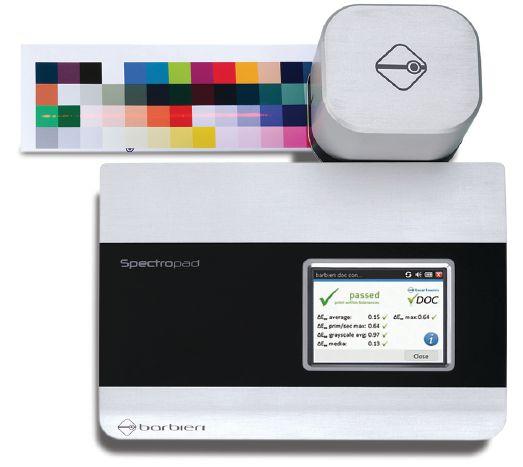
Another option that is very cool is the SpectroPad from Barbieri. This device can be placed directly onto the surface of the print and the top head slides across the colour bar. You are guided by a laser to ensure you are properly aligned. Once the measurements are completed, the device will perform the calculations and show on screen the pass/fail Delta e values. The device can also be set up to send the measurements via WiFi to a nearby computer.
So what can you do, if after measuring and analyzing your device, you find that you are not matching to GRACoL? First, determine what is not matching. Is it simply the difference in paper white or is it the actual colour. I try to remind people that white is the fifth colour in printing and, unfortunately, the only one we cannot adjust. If it is a difference in colour then you may need to create a new ICC profile for your device.
Some RIPs make this process fairly simple while others make you read a 60page manual. Regardless of what RIP you are using, the steps are always the same and it’s the first step that is most important. Aside from naming and setting up the parameters of the profile, the first chart you print is the “per channel ink limits.”
This is where you limit the individual ink channels (CMYK) to the optimum levels. And this is where a lot of profiles are limited too much as a result of inexperience. I’ve developed a few unique techniques to squeeze as much as possible from a device while maintaining the ideal total ink load.
anGUs paDY is President of ColourManagement.ca of Toronto, providing products and technical support. Angus@ColourManagement.ca
Figure 1 is a useful test image with great information about how a device is printing.
the SpectroPad from Barbieri can be placed directly onto the surface of the print.
magenta print target, such as the number above, will make it difficult to hit reds..
A key piece of the Puzzle
canadian printers step up to support Quebec government and cree announcement of new protected area for Boreal forests
By Neva Murtha
on July 13, 2015, Canopy joined Quebec Premier Philippe Couillard and Eeyou Istchee from the Grand Council of the Crees, and Grand Chief Matthew Coon Come as they announced additional protection in the Broadback Forest. As a result of this agreement, 543,600 hectares of globally significant Boreal forest and lakes will be protected in addition to the Assinica Cultural Heritage Park, protecting a total of 913,400 hectares.
This remarkable step of additional protection in the Broadback Forest could not have been accomplished without the support and engagement of many Canadian printers who have helped to advance solutions in Canada’s vast Boreal forests for many years now.
In a July 2014 article by The Globe and Mail’s Oliver Sachgau, Canopy’s founder and Executive Director, explained, “Logging in Canada’s Boreal has been rife with controversy, largely due to the lack of there being adequate protection. … The Broadback has been recognized as one of those high-value – ecologically as well as culturally – regions in Canada’s Boreal forest.”
Printers protecting Broadback
The Boreal requires a series of large-scale, ecologically significant forests to be conserved across the country for it to maintain its ecological integrity and functions. Although not complete in terms of protection needs, the Broadback has taken another significant step towards that goal. The Broadback Forest protected area is now 1.5 times the size of Prince Edward Island and the trees, which have never been logged, provide prime habitat for bears, lynx and threatened woodland caribou.
In Sachgau’s article, Rycroft says: “They really require large intact pieces of forest. Experience suggests – and there’s a lot of good evidence for this – that the more development takes place in their ranges, the more likelihood there is that
they cannot persist,”
An ecosystem that cannot be recreated by tree planting, Broadback is also an area critical to our climate, storing approximately 320 million tonnes of carbon – equivalent to 1.2 billion flights between Vancouver and Montreal.
Canadian printers and large print customers have taken a leadership role in bringing major paper and pulp customers from the printer, book, magazine, newspaper and clothing sectors to support this protected area proposal.
Francois Olivier, CEO of TC Transcontinental based in Montreal, offered the keynote address at a forum of customers and investors brought together in support of the Broadback Forest plan in Spring 2014. Following this forum, numerous customers of and investors in forest products directly engaged their forest products suppliers and key government decision makers to advance this new protected area.
Be it in Canada’s Boreal forests, the Great Bear Rainforests or Indonesian rainforests, this kind of marketplace engagement is invaluable in forwarding solutions in our global forests. By engaging collaboratively with Canopy, printers have shown critical economic interest in creating certainty for a sustainable supply of paper products and for solutions that meet the needs of communities, the environment and a healthy future for Canada’s forest sector. Thank you and congrats!
There are other conditions, in addition to printers’ support, that made this re-
the Broadback River is a river in northern Quebec, Canada. It drains into Rupert Bay, just south of the Rupert River and Cree community Waskaganish.
markable achievement possible. The Broadback Forest was not under immediate threat, allowing parties the time it takes to agree on what should happen next. In fact, environmentalists and forest companies had agreed on moratorium to logging in the full 1,300,000-hectare area plan proposed for protection by the Cree seven years ago. And this included agreement not just with Canopy, but also between some of those making the headlines of conflict today in other critical areas of Canada’s Boreal – Greenpeace and Resolute Forest Products.
Now is an exciting moment: To see if we can all translate this remarkable collaborative outcome in the Broadback across other landscapes in Canada’s Boreal forest. Our expectation is that all governments with Boreal forests under their jurisdiction follow suit and that forest companies will look to create moratoria in other hotspot regions to curb the flow of controversial fibre into the market and create meaningful opportunities for stakeholder engagement and conservation solutions.
What’s next and your role?
Canopy looks forward to working with all relevant parties to secure the outstanding third of the region not yet protected in the Broadback that will help ensure its ecological integrity.
To maintain the space for solutions for this next stage of protection, it is key for forestry companies in the region (Chantier Chibougamau, Eacom Timber Corporation, Kruger, Norbord, Resolute Forest Products and Tembec) to extend the moratorium on logging in the outstanding section that is not yet protected by the July 13 announcement. It is also helpful to encourage forwarding conditions for solutions, including logging moratoria, in other key ecological hotspots as well.
Length of the Broadback River in kilometres, which has a massive basin area of 20,800 km² and a discharge rate of 350 m³/s.
On October 16, 2015, many of you will be contributing updated information to Canopy’s online assessment of key environmental performance areas of North American Printers to improve your rankings. We encourage you to contact us to see how supporting conservation solutions, like the Broadback Forest, is recognized in this assessment and by your print customers.
Congratulations to all parties who worked so hard to secure this new protected area in Canada’s Boreal. It’s a success we all share!
neVa mUrtHa works with Canada’s magazine publishers and printers to develop visionary procurement policies. neva@canopyplanet.org
Looking good on paper matters. ColorLok® Technology gives paper more vivid colors, bolder blacks, and faster drying times.* Learn more at colorlok.com
Domtar EarthChoice® Office Paper is a great-looking, everyday paper that represents your commitment to environmental responsibility. Featuring ColorLok ® Technology, it is designed to provide optimal printing results. To learn more visit www.egpaper.com or domtar.com.
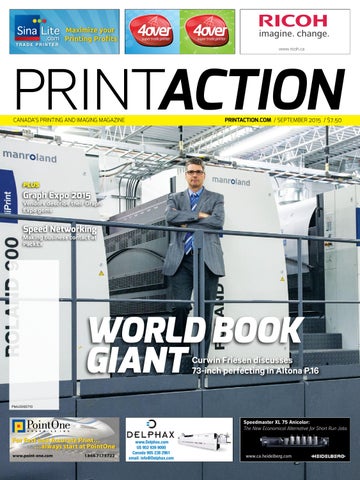
World Book Giant
Friesens of altona, Manitoba, began to install its new 73-inch manroland R900 HiPrint XXL perfecting press in March on its way to building one of the world’s most efficient pressrooms
By Jon robinson
The town of Altona i n southern Manitoba holds slightly more than 4,000 people in an economic landscape primarily driven by farming- and agriculture-based businesses, as well as the manufacture of books. In early March, the town became home to one of the world’s three 8-colour, 73-inch manroland R900 HiPrint XXL perfecting presses, which Friesens Corporation is leveraging for short-run book work.
Most presses of this size are saved for the packaging sector, where perfecting is usually not needed to print on both sides of the substrate. Of course, Friesens’ press also required significant inline colour management tools to deal with a massive sheet that will often hold 64 unique and different pages at one time.
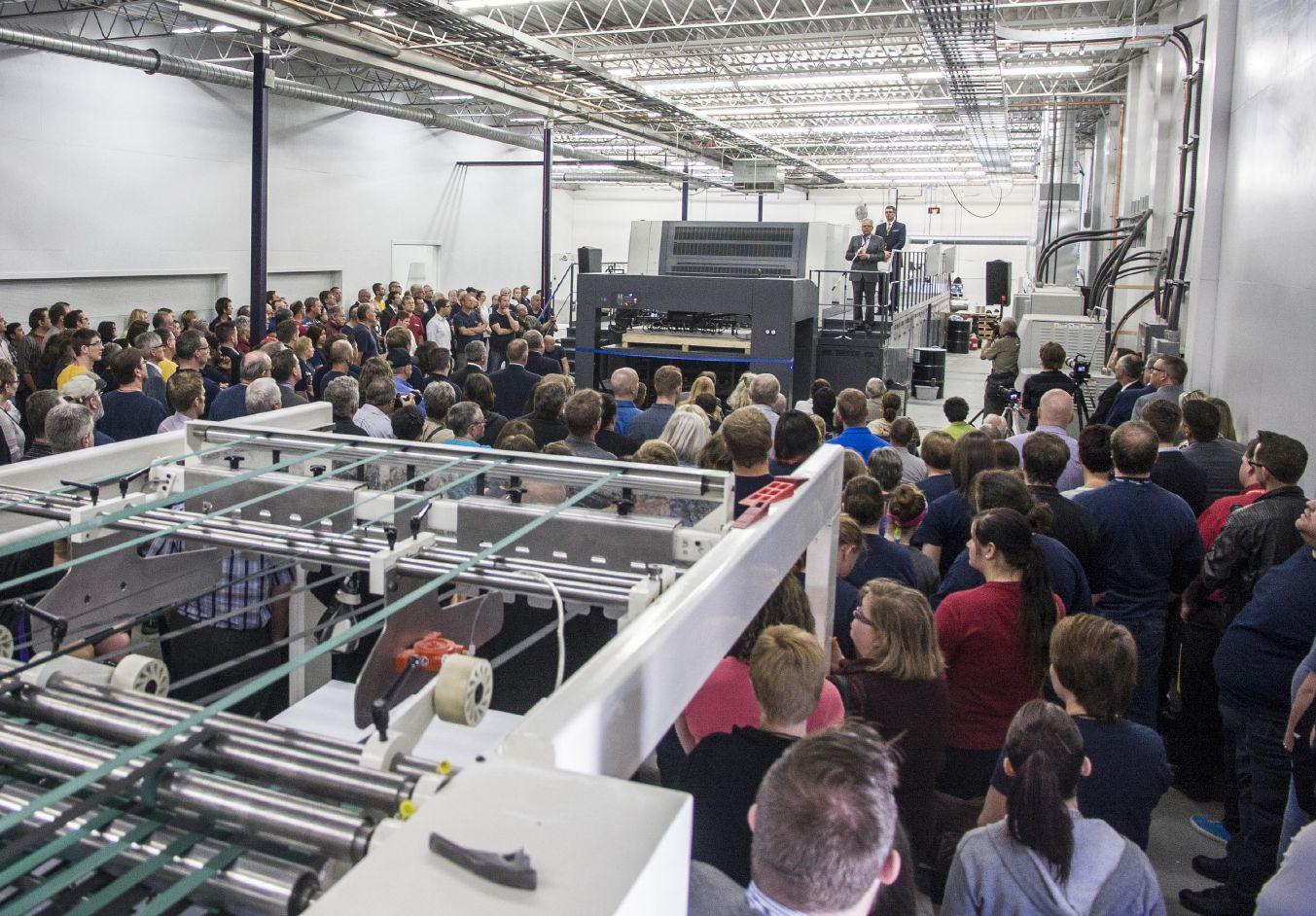
the installation of the manroland R900 HiPrint XXL was celebrated by more than 500 people, including hundreds of employees and about 75 dignitaries, during a July ribbon-cutting ceremony led by David and Curwin Friesen.
The company is well known by other printers for its near-spotless pressroom and by North American publishers for its ability to print short-run, colour-intensive works of art.
“I never want to lose the underdog mentality that has existed as part of the fabric of this company for 107 years. We are in the middle of nowhere, but that just breeds ingenuity and hard work,” says Curwin Friesen, CEO of Friesens Corp., which provides an ownership model for its approximate 600 employees, tying the highly respected book manufacturer even closer to the community.
When the R900 arrived in Altona by dozens of tractor-trailers, it was too large for Friesens’ shipping bays and the company needed cut a massive hole into the side of the building for direct entry into what would become a newly configured pressroom. Installed, the press is
approximately 100 feet long and weighs half a million pounds. Before commissioning the press in July, celebrated with a ribbon-cutting ceremony with hundreds of staff members and around 75 dignitaries, Friesens conducted three and half months of set up and testing.
FORM EFFICIENCy
The decision to go with the R900 was made a little more than a year ago, after first discussing the possibilities of moving to very large format technology at the drupa 2012 trade show in Germany. It would be a challenge to handle such a large sheet and perfect it without marking, which can be a technical struggle even with 40-inch perfectors.
“It is very much an efficiency play and a progression from where we have moved in our history,” says Friesen. The company began working 8-page signatures, four pages on each side of a sheet sent through the press twice, drying twice before folding. When press technology improved the crew moved to a machine printing 16-page signatures, again twice through. “In the late-80s, we went to 50inch format when others were on 40-inch format and that allowed us to go to a 32page, 8 ½ x 11 signature.” The press sheets still traveled twice through the press, but the company’s 50-inch ma-
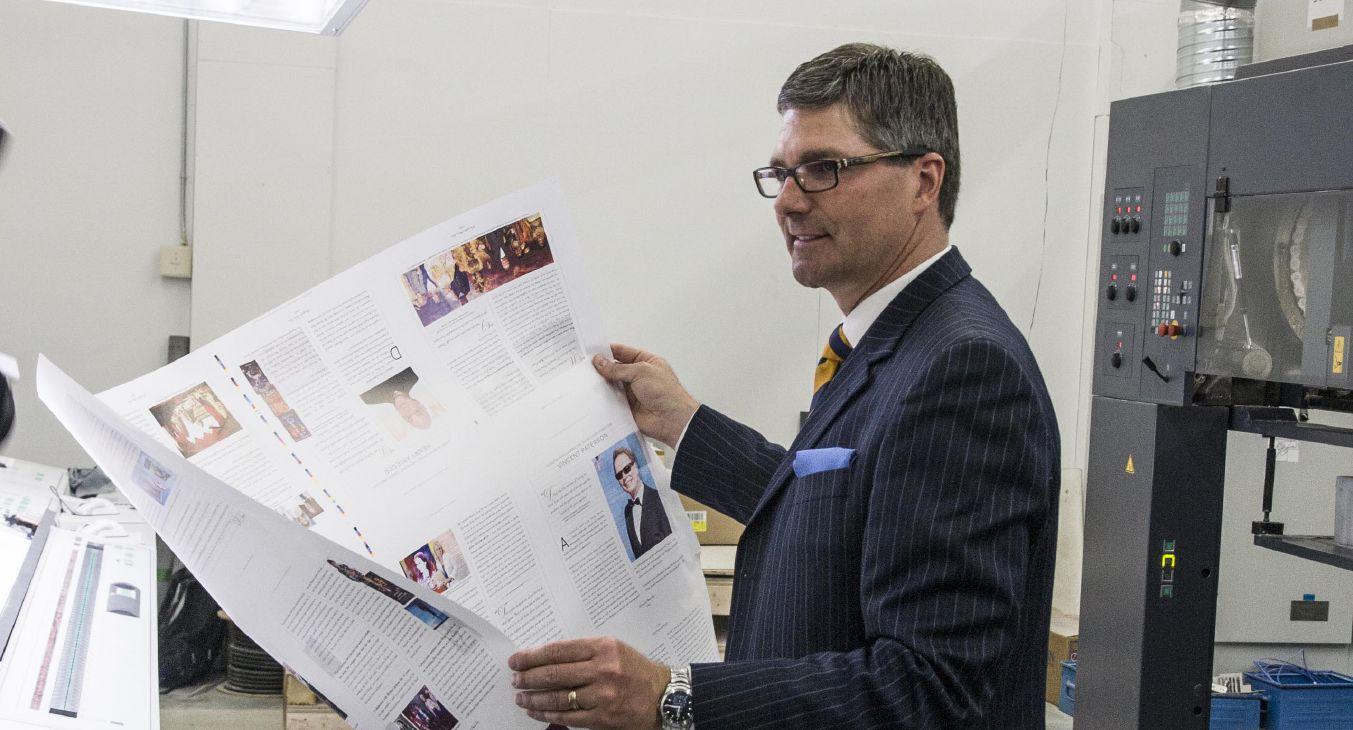
Curwin Friesen, President and CEO of Friesens Corp., with a sheet produced by the company’s new manroland R900.
chines were printing a 64-page children’s book with just two sheets and four make-readies.
The new 8-colour, 73-inch manroland R900 perfector allows Friesens to print a 64-page children’s book with one sheet and one make-ready. The relative efficiency of the new press, over the 50-inch machines, is increased by anywhere from 300 to 400 percent, with a more precise number expected after more time with the R900 reveals figures like wastage, press speed, and finely-tuned make-ready – with the latter number ending up slightly more than a quarter of 50-inch machine make-ready.
“There are hardly any book manufactures in North America who are running 50s and almost none overseas. It is basically a 40-inch world and we live in the 50-inch world and now we are trying to live in the 73-inch world,” says Friesen. “Is it more efficient – absolutely. Are we excited about the productivity numbers we are starting to see – you bet we are. Since the ribbon cutting, every week is getting better and our crews are getting more familiar with it, more comfortable.”
PRESSROOM BuILD
The multi-million-dollar technology investment included the purchase of a massive Maxson Automatic Machinery
“Our goal was to create the most efficient pressroom in the world and everything follows this mindset”
- Curwin Friesen, CEO, Friesens Corp.
Co. precision sheeter, because Friesens has traditionally converted its own stock, which now sits about 15 feet in front of the press.
A new large-format platesetter –about 65 feet long in its own controlled positive air space – is also close by and integrated with robotics to move the massive 73 x 50-inch plates – in addition to 50-inch plates – through the imaging process, before a specialized conveyor is wheeled about 10 feet to modified catwalk rails where crews finally touch the plates for mounting on the R900.
The manroland R900 configuration is also unique because Friesens’ management decided to maintain its bindery set-up for 32-page signatures, resulting in an inline slitter system integrated with the new press, as well as the continuing interest in 50-inch machines. “One of the other things unique about this press is that we put an engineered pit underneath it, so we have better access and that is not done anywhere else in the world,” says Friesen, noting how much the company’s mechanics were involved in the R900 investment project.
“The beauty of it is that we were starting from scratch and our goal was to create the most-efficient pressroom in the world and everything mirrors this mindset,” says Friesen.
MARKET MATTERS
Despite its massive size, the efficiency of the press and pressroom allows for incredibly short runs of around 4,000 books and up, with an ideal range at around 10,000. “We are a short-run book manufacturer that is what we specialize in within our book division,” says Friesen. The company already produces long runs that may measure around 100,000, but the R900 also presents a
new opportunity to provide sheetfed press quality on some lower-end Web offset press speeds.
“Books are not DVDs. Books are not music. Books are different. As we see with business cards, some players in the market believe that business cards are going to be around forever and they certainly do not seem like they are going away,” says Friesen. “One large player has also used large format on short-run business cards to change the game.”
Friesens generates approximately 55 percent of its revenue from the U.S., which Friesen has noticed picking up because of the lower dollar, and 45 percent domestically. Based on various avenues of research, he notes the book market has been very stable for the past five years, to the point where independent bookstores are growing for the first time in a decade. Friesen explains it appears the concentration of e-readers has hit a saturation point in North America. “E-books have their niche and have an important role in the book business, but not the only role,” he says. “Publishers see that sales are bearing that out and so we continue to believe there is a strong future for books.”
Friesen describes one recent report from Deloitte based on polling a sample
300%
A conservative estimate of Friesens’ increase in press productivity based on the installation of a 73-inch manroland R900 perfecting press.
of 18 to 24 year olds who exhibited a strong propensity toward printed books. “Despite the fact that they live in a digital world they still like print for a bunch of reasons.” Friesen is also noticing more on-shoring of book printing, relating that many publishers are returning to North American printers instead of having the work done in China.
The trend is driven by much busier Chinese ports and the need for shorter turnaround times, as well as more preference to print lower run totals; for example, two 5,000 jobs instead of 10,000 at once. Friesen explains it is not in a printer’s best interest to print 10,000 books and have the publisher only sell 2,000. “Is China still going to be a big printing force – absolutely – but if five percent of that business returns, or 10 percent, on a billion-dollar industry, that is significant.”
In addition to its strong roots in yearbook production, typically with runs measured in the hundreds, self publishing is a growing sector for Friesens, through its FriesenPress division that sells packages – potentially with editing, copywriting, designing and proofreading services in addition to printing – that might cost around $3,500 run on digital presses instead of $15,000 via litho.
“We believe that we are going to be in books for a long, long time and if we are going to be in books then we better be geared up for it and not just dabbling,” says Friesen, projecting a relatively stable market for at least the next decade. A little more than five years ago, however, Friesens’ managers were tasked with expanding the company’s interest in packaging, which resulted in think4D, consisting of around 40 employees.
After purchasing a Toronto company and related patents, and investing a few million into R&D, think4D is a unique operation in the world that marries thermoforming and printing. “We found thermoforming and print were two different worlds,” says Friesen. “With some of the technologies we were researching, we thought that we could combine those worlds. Why not print on the plastic and then thermoform that piece out of the plastic already printed.”
This innovation in packaging is built from a culture that developed over decades by leveraging technology to innovate the process of manufacturing books. “It isn’t always just the numbers we paint on press at times. There are efficiencies and robotics and workflow… yet the product we are producing is an art piece, often at the end of a creative chain.”
When every impression counts, you can count on Ricoh.
Invigorate your print operations with Ricoh’s ultra-reliable production printing systems and market leading service & support. Our cutting edge technology delivers outstanding colour consistency, quality and speed so you can handle the big jobs and quick turnarounds with precision. And with a wide range of size, media as well as our market leading service and support team, Ricoh has the machine you need to meet your printing demands – and grow your business.
For more information, talk to a Ricoh printing systems representative today. Expand your production printing horizons.
ricoh.ca/production
High productivity and image quality
Expanded application support
Best in Class Media Handling
5th colour station for Clear & White Toner
Smarter print to market
Veteran journalist gareth Ward shares his views on the future of print as part of the drupa Expert article Series leading up to the May 2016 trade show in düsseldorf. He looks at how print can play in a world of online and mobile media, e-commerce and the pervasive consumerism trends of branding and quality
By Gareth Ward
The successful printer of the future will deliver customers a full service offering that extends well beyond printing and finishing. The exact mix of digital communications, value added print, data manipulation and logistics will depend on the customer base and how the printer positions himself, or perhaps how he forms partnerships with others with expertise in these areas. But what is going to make print a successful communications medium in the next decade is already clear: print has to be relevant.
This was not necessary when print was the prime channel for advertising, information, communication with government and so on. Much of this mundane printing has transferred to digital and will
never come back, but print is not shrinking. It is evolving into something smarter, more versatile and above all more relevant to those who receive it.
If a printer is not part of this development, the only option is to sell print services as cheaply as possible and this is no way to build for the future nor to create enduring partnerships with customers. There are many printers, unfortunately, who lead with price and face the same inevitable fate as the woolly mammoth: Extinction.
IT DRIVES PRINT RELEVANCE
Tomorrow’s printer must become as comfortable with IT as he is with offset litho. That can stretch from operating a website to harvest jobs, to creating automated workflows that minimize touch points where errors can be introduced, using Management Information Systems
drupa
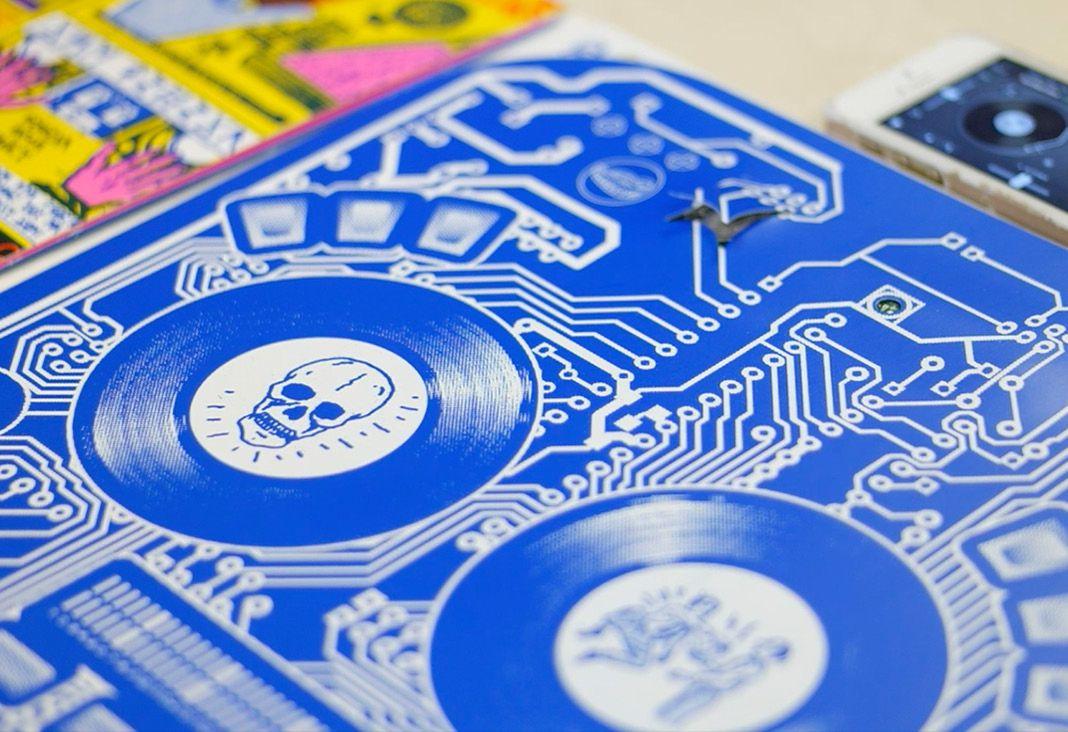
Printed circuitry, such as those produced by Novalia, enables electronics to turn a printed page into a loudspeaker or a label into a light show.
- to record and present up to the minute details of how a company is performing through to data handling to create personalized communications for customers to talk to their customers in the most relevant way. If that means using social media alongside print, the new print house has to deliver.
The problem here is that printers continue to prefer to invest in a new printing press rather than in IT. It is as if the press is tangible and understandable. If it runs at 18,000 sheets per hour (and machines at drupa 2016 are likely to hit 20,000 sph) this is 20 to 30 percent faster than their current machine, so it must make sense. But few give due thought to how jobs are to be processed either before reaching the press, or once printed. Across the globe, print runs are falling and time allotted is shrinking. A faster press magnifies the problem of handling more jobs in less time without introducing errors. In addition, too few consider training for their staff to be an investment rather than an imposition.
The first drupa Global Insights Report published in October 2014 highlighted this: “Only 23 percent of the drupa expert panel report an increase in IT spend in the last five years, and virtually all decision makers stated a lack of IT specialists. This is a major challenge for printers,” says Sabine Geldermann, Director of drupa 2016.
IT knowledge is key for automation at the process level. Those supplying software to the industry take it as read that JDF compliance is essential. Workflows have to become more sophisticated. Producing an eight-page section on standard paper is simple, but tomorrow’s customers will want something far more than this. They will want their printed products to stand out, to have the impact to cut through the thousands of marketing messages that are received each day.
“In some years from now there will be fewer printing companies but they will be larger and more industrial with a broad service range. In the commercial sector printers will turn into marketing service providers for print and online services,” drupa President and CEO of KBA Claus Bolza-Schünemann predicts. “The connection between print, online and mobile activities will grow stronger.”
The transition is in its infancy. A well known commentator on advertising and the Internet pointed out last year that consumers spend vast amounts of time with their smartphones, but these only take a small proportion of the overall marketing spend, whereas the fast shrinking newspaper sector receives a disproportionate amount of advertising spend. One must shrink its share while the other one grows – unless the newspaper becomes more relevant to its reader. This means hyper local sections, printed digitally with targeted advertising.
REVALIDATING PRINT IN A DIGITAL WORLD
The same can be noticed in magazines where the mass circulation titles that used to be printed gravure are losing circulation while magazines that focus on the special interests of readers remain healthier. There will be fluctuations across national boundaries and as fashions change, but the magazines that focus on this sort of reader will not be displaced by digital delivery of content because reading a magazine is so much more than the information presented.
A decade ago it was predicted that with the growth of the Internet, video on demand and the ability to interact with websites, fashion magazines must disappear because Websites can show clothes being worn, have links to prices and instant ordering. But fashion magazines are stronger than ever because possession of Vogue makes a statement about the
ogies that are spreading through the industry. It means being able to enhance the printed product using varnish, foils, raised print effects, die cutting and other processes that enhance the value of the printed product and make it more exciting and engaging to the consumer.
This can involve the inclusion of printed electronic circuitry to turn a printed page in a book or magazine into a loudspeaker to tell a story, the dashboard of a car which comes alive when various buttons and switches are activated, a printed label which can light up when a sensor detects movement.
Embedded codes within the printed page are scannable by smartphones to unlock digital information for the consumer, perhaps an offer to be redeemed in a certain store or restaurant, while providing the company making the offer
“The connection between print, online and mobile activities will grow stronger.” -Claus Bolza-Schünemann
women carrying it. Online fashion Websites like ASOS and Pret-a-porter have launched printed magazines because of this phenomenon.
The doomsayers who predicted the same fate for catalogues have also been thwarted by human nature. We like to browse a catalogue or holiday brochure. They spark our imagination in a way that digital fails to do. And retailers that either exist only online or dropped their print catalogues are returning to print to remind customers to visit their Websites to complete a purchase. If online shopping is going to grow, (though it remains only a relatively small share of consumer spending even in the industrialized countries) more and more print is going to be needed.
But it is not going to be the same sort of print as of old. Why send someone who always takes a vacation in Mexico details of holidays in Canada for example? Instead the holiday company, with the help of the printer, can tailor a brochure that features the best hotels and resorts in Mexico. It will be a smaller publication with a shorter production run, but production standards can be higher in terms of print, paper and personalization.
The printer must be ready to deliver this to his customers. It means investment in technology that can cope with shorter print runs. It means the ability to print on uncoated papers that are popular because of their tactile qualities, and this can be addressed through the new UV technol-
with information about who has scanned the code, where and when. The printed poster or advertisement acquires a measurable value because it proved to be relevant to that consumer at that time.
MARKETING INNOVATION
The sorts of high quality print and finishing effects that sell the premium bottles of spirits are finding their way to other types of packaging, especially as the movement for artisan produced goods gathers pace. While overall volumes are small, the value of the printed pack is that much more important. And the printer can have far more influence on the quality than the company working for global brands with extensive product marketing teams forcing printers to toe the line. However, even these global companies must become more flexible in order to match society’s craving for innovation and novelty. It means that printed packaging becomes a major marketing tool, consider the impact that Share a Coke has had for example. The printer must be able to help cut the time to market for new products, either through automated workflows or perhaps by also taking on prototype creation using 3D printing technology.
There is room too for using the new inkjet technologies by printing directly to the bottle or package itself, what is called direct to shape printing. The printing system becomes part of the bottling or packing line and rather than printing and
Ready to Deliver Brand on Demand
When we asked offset printers in 2007 to describe the perfect short run press solution, they didn’t mince words. The print quality needs to be as good as offset litho. Use standard coated and uncoated stocks, and load-up and off-load of sheets shouldn’t require an owners manual to figure out. The prints should be smooth, without any pile-height issues, and look and feel like an offset sheet. Prints need to be durable too, especially when using finishing equipment. And please…no more click charges.
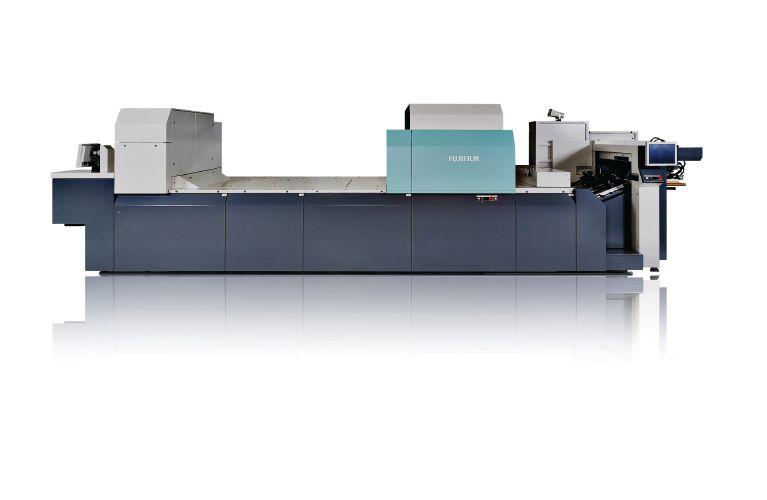
Fujifilm’s J Press 720S technology delivers these benefits and J Press installations have produced millions of brand on demand impressions where it counts most – in the field. So why wait on the promises of new technology, when proven Fujifilm innovation can help you dominate the high-quality, short-run market today.
Seeing is believing. Visit fujifilminkjet.com today.
delivering labels, the print company’s task becomes managing this new technology and establishing a new workflow.
It is going to require a whole new approach to marketing what a printer is and can do, and this is very much unknown territory for many print service providers. The exceptions are the online printers that have grown rapidly in recent years, sweeping away swathes of small print businesses as they have done so. But even these rarely lead on price; they are selling convenience and ease of access and that is down to constant marketing and sponsorship to raise brand awareness.
INCREASING ThE VALuE
Printers should focus on benefits such as personal service, same day printing, wide choice of substrates, design, fulfillment and so on. Even this requires marketing skills that need to be developed.
ledge change and then embrace it. The industry needs to evangelize the inherent beauty and effectiveness of print in a digital world,” says BarShany.
Printing will remain at the heart of it, but printers must become like project managers, shepherding the different aspects of the communication chain to achieve the result that the customers want, reaching a measurable return on investment.
The focus on reducing overheads in the end-to-end supply chain has already transformed how books are printed and distributed; digital printing is starting to eat into packaging for the same reason. It is not the cost of producing an individual
carton or label that is important, it is the overall cost of wasted materials and time in the supply chain that is important. Printers need to expand their thinking beyond the creation of the box.
For those companies that can do this, that become engaged with their customers and work together to find solutions that embrace print at some level, the future is bright. “Print can still create emotions and print lasts, preserving moments and memories,” says Bar-Shany.
Print is no longer the dumb sheet of paper that is recycled in moments. The smart printers are discovering this. Value now is a function not of scarcity but of relevance.
How We Developed the J Press 720S
FUJIFILM R&D
Fujifilm has developed expertise in a wide range of core technologies, including advanced material chemistry, nanotechnology, fine chemicals, software and electronics.
FUJIFILM INNOVATION ON J PRESS
The answer will be different depending on the printing company, says Bolza-Schünemann: “Every printing house knows its customers and its strengths best. Therefore, it is of little help to simply copy the recipe for success of others. If every company offered the same this would automatically lead to over abundance in the market with the familiar consequences.
“Large trade fairs, such as drupa, offer good opportunities to find out more about new technologies and future-focused business models and the appropriate path for a company,” says Bolza-Schünemann.
Alon Bar-Shany, Vice President and General Manager of HP Indigo, agrees: “There is pressure to commoditize, options for lower quality and lower pricing, but that would spell disaster for the industry. The opportunity is for less pages but higher value ones.”
“Printers need first to acknow-
Several proprietary technologies were achieved by Fujifilm in the creation of the J Press 720S production inkjet press:
■ Dimatix SAMBA™ 1200dpi printheads using MEMs nano-technology deliver unprecedented inkjet precision and higher drop densities in a single pass.
■ Our VIVIDIA aqueous ink system provides a consistently smooth, high-quality print with the durability and finishing characteristics of offset.
■ Our RCP in-line coating process allows the use of most standard coated or uncoated offset paper, eliminating the expense of pre-treated inventories.
top Left: Claus Bolza-Schünemann, drupa President and CEO of KBA. top Right: Alon Bar-Shany, VP and GM, HP Indigo. Bottom: Sabine Geldermann, Director, drupa 2016.
Graph Expo 2015
Booth highlights at the annual chicago printing exhibition
Leading into North America’s largest trade show for the printing industry, exhibitors were asked to provide their booth highlights for the mid-September show.
Epson
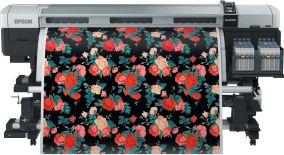
SureColor F9200: Available September 2015, the SureColor F9200 is a 64-inch production dye-sublimation transfer printer designed for the roll-to-roll digital textile market. It leverages a dual PrecisionCore TFP print head and UltraChrome DS ink system with high density black ink.
SureColor P800: Released in July 2015, Epson describes the SureColor P800 17-inch professional photo printer as a new benchmark in photographic print quality, using MicroPiezo AMC print head technology and new UltraChrome HD 8-colour pigment ink.
SureColor S70675: Released in June 2015, the SureColor S70675, part of Epson’s recently introduced S-Series line of 64-inch solvent printers, is built to produce photographic signage output at production speeds up to 190 square feet per hour.
Mutoh
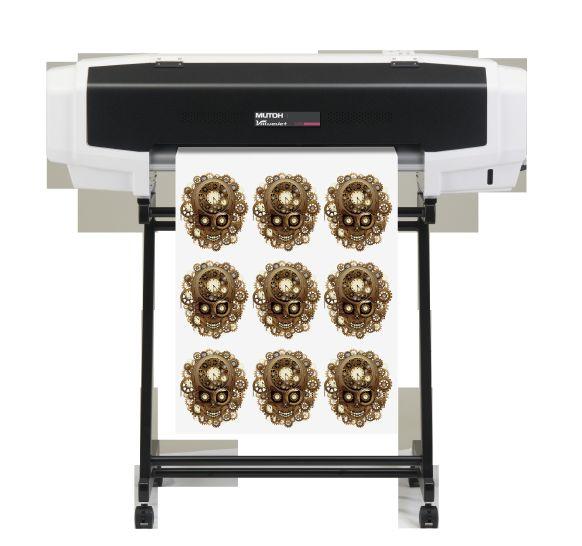
Metalic Inks: Released in 2015, Mutoh’s new ValueJet 1628X and 628X printers, designated as Eco-Ultra printers by the company, feature CMYK plus white and metallic colour capabilities. The systems are available in a 64- and 24-inch sizes.
ValueJet 426UF: The new ValueJet 426UF UV-LED tabletop printer is a 19 x 13-inch machine that prints CMYK with white and varnish capabilities on virtually any substrate up to 2.75 inches thick.
ValueJet 1626UH: The new 64-inch UV-LED hybrid printer prints on both rigid and roll substrates, with CMYK plus white and varnish ink, up to a half inch thick. Mutoh explains it is well suited for sign shops, packaging prototypes, trade show graphics, POP signage, yard signs and indoor signage.
KBA
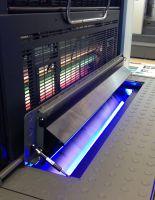
VariDry LED-UV: Introduced in summer 2014, the VariDry LED-UV system, explains KBA, allows sheeted printers to leverage the industry’s fastest-growing low-energy drying technology. The instant cure-to-print system offers low energy costs, flexibility to move LED-UV lamps on press, as well as environmental and safety benefits.
Rapida 105 PRO: Launched in June 2015, the Rapida 105 PRO is a medium-format sheetfed offset press. At 17,000 sph, the press delivers a slightly higher level of performance in terms of production, a larger standard sheet format of 740 x 1,050 mm, shorter makeready times based on more automation and a new operating concept. One of the Rapida 105 PRO’s key features, according to KBA, is the full preset capabilities from the feeder through the printing units to delivery.
RotaJET L and VL: Released in January 2015, the RotaJET L and VL inkjet presses serve a range of applications for book, advertising and publications printing, as well as additional industrial application fields, like decorative and packaging printing. RotaJET presses, explains KBA, feature a web guidance system over two large cylinders without turner bars, which result in optimum web tension and
a high print and register quality even on thin paper.
Xerox
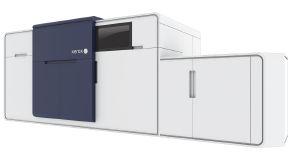
iGen 5: Introduced in July 2015, the iGen 5 Press is Xerox’ next-generation platform of the iGen family with offerings at three print speeds: 90 ppm, 120 ppm and 150 ppm. The press features an optional fifth colour unit to match a larger amount of Pantone colours or unknown spot colours.
Rialto 900: Introduced in February 2015, the full-colour Rialto 900 is designed for producing 1.5- to 5-million impressions per month. Xerox also states
Mutoh ValueJet 1626uH.
KBA’s LED curing system on a Rapida press.
the Rialto 900 has the smallest footprint of any inkjet press on the market, measuring 11.9 x 5.1 feet (3.58 x 1.55 metres), including the press tower.
XMPie StoreFlow Cloud: Introduced in July 2015, XMPie StoreFlow Cloud is a subscription-based solution for creating Web-to-print portals. With little or no IT investment required, StoreFlow Cloud can create and manage e-commerce Websites that enable visitors to upload their documents, or select a template from a catalogue and personalize it, price the job, and submit it for processing and handling.
Komori
Minimum number of exhibitors filling the McCormick Place show floor for Graph Expo 2015.
Lithrone GLX: Launched worldwide at the beginning of 2015, the Lithrone GLX sheetfed press features a fully automatic, non-stop feeder and delivery, camera inspection and inline colour control. The GLX’ A-APC plate changers can change plates in one minute regardless of the number of printing units. The new Komori GLX is rated at 18,000 impressions per hour, and although focused on the carton market, it is described as a versatile machine also suitable for the high-end or ultra-quick make-ready commercial market, IS 29: Scheduled for a launch after Graph Expo 2015, the Komori IS 29 is a B2-format sheetfed UV inkjet press that can operate in perfecting or straight mode, printing on up to 18 point board substrates. It runs at 3,300 sheets per hour in straight mode.
PQA-S: Introduced in 2014 for Komori press integration, the PQA-S system is an external camera inspection system designed to detect defects like hickies,
RS SuperiorSuperior Binder y Ser vices Inc.
scratches, dry-up, lost image, oil drops, that can occur during printing. In addition to detecting colour changes, PQA-S automatically corrects them. The system is focused through a narrow slit in the catwalk to the last impression cylinder. It photographs each sheet at press speed for comparing to master sheet.
Kodak
Heavy boards, plastics, laminations or digitally printed works up to 30 pt can now die crease, fold and even glue in-line.
2. SUPERIOR TECHNOLOGY — Die crease without a die, then fold and even glue all on the same machine, up to 30 pt.
3. INTEGRATED MODULAR UNITS — Combined in-line finishing: crease, fold, glue, tipping, envelope inserting, ink jetting (Duplex), clip seal (3 sides), mail prep.
4. SAVE ON POSTAGE COSTS
As a Certified Canada Post Direct Marketing Specialist, we get contract pricing reductions.
5. RETURN MAIL PRODUCTS — Customized “Return Mailers” created in-line with “U” or “BOX-shape” remoistenable glue, time perfed applications and envelope formation.
6. MINI-BOOKLETS — Saddle-stitch and trim 2-up booklets in-line to the size of a business card. No need to trim off-line, or do 2 passes.
7. HIGH SPEED EQUIPMENT — High speed Tipping, Folding, Saddle-stitching and soft folding ensuring on time delivery.
Prinergy 7: Introduced in May 2015, Prinergy Workflow 7 software focuses on automating core workflow functions like job creation, collaboration, file processing, trapping, proofing, imposition and colour management. Prinergy 7 includes what the company describes as layered PDF versioning enhancements, which provide error detection and better control over multiple layers of files.
Trendsetter Q2400/Q3600: The new Q2400/Q3600 large format thermal platesetters can image plates up to 1,422 x 1,804 mm or 1,600 x 2,083 mm, respectively, featuring Kodak Squarespot imaging.
Electra Max: Being introduced at Graph Expo, the new Kodak Electra Max thermal plates (available in Q1 for United States and Canada) are designed for commercial and packaging printers. Kodak explains it provides solvent resistance for harsh environments like UV, 10-micron FM screening, long unbaked runs, fast processing speeds and low chemistry usage.
Delphax
elan 500: The elan 500, manufactured in the Greater Toronto Area, which became commercially available worldwide earlier this year, provides an operator with selectable simplex or duplex sheetfed printing. Powered by Memjet technology, every stationary print head has 70,400 jets that fire up to 700 million drops of ink per second. The elan prints on a range of coated and uncoated substrates, including 60 to 350 gsm and up to 8 x 8 to 18 x 25.2 inches (203 x 203 mm to 450 x
640 mm-SRA2). It allows for printing up to 500 A4 images per minute at up to 1,600-dpi resolution.
Ricoh
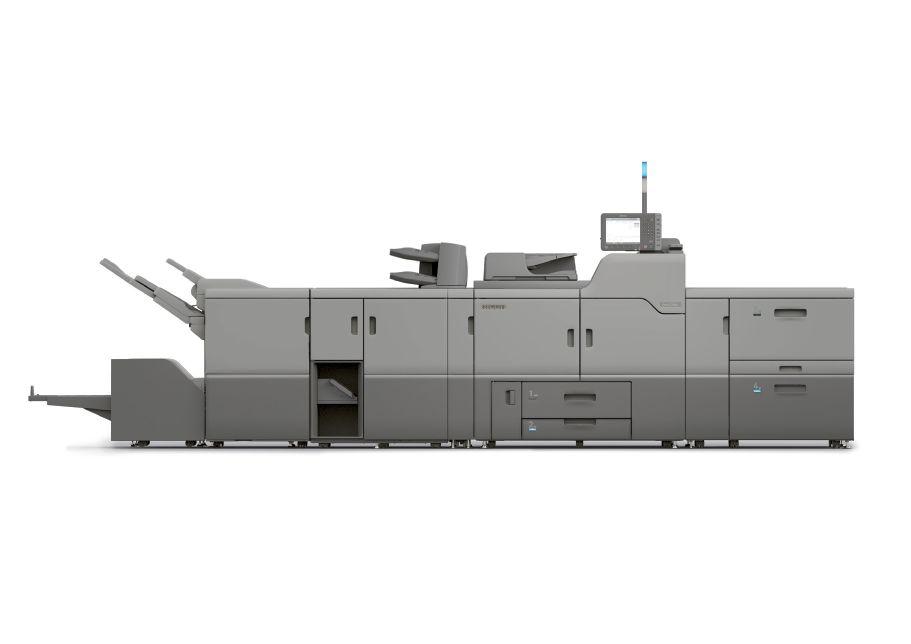
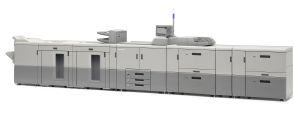
Pro C7110X 5th Color Kit: Ricoh describes its 5th Color Kit as a selling tool developed to empower commercial printers with practical samples that demonstrate the capabilities of the Pro C7100X series.
Pro 8120s: The Pro 8120s is a black-and-white production printer designed for producing documents like bank statements or insurance explanations of benefits.
TotalFlow Prep: TotalFlow Prep is PDF workflow software that allows users to track how settings adjustments affect output via a live-updating visual model presented in an interface. Printers can also combine several files into a single job and assign job ticketing properties and instructions.
Standard horizon
Horizon SmartSlitter: Making a global premiere at Graph Expo, available Q4 2015, the SmartSlitter is designed as an all-in-one sheet processing system that can slit, gutter cut, edge trim, cross-cut, perforate, and crease in one pass. Perforation and creasing can be performed in both horizontal and vertical directions in the same pass.
Hunkeler DP8: Making a North American debut at Graph Expo, the new Hunkeler DP8 Dynamic Punch and Perforation Module is running on the booth as part of a Roll-to-Booklet solution processing pre-printed rolls into finished booklets with perforations throughout. The DP8 adds perforation and punching patterns that can vary from sheet to sheet. At processing speeds up to 720 fpm, this module keeps pace with newer inkjet engines, inline or offline.
Hunkeler WI6 Web Inspection System: Making its North American Premiere at Graph Expo, the Hunkeler WI6 Web Inspection System is being shown inline with a Roll-to-Booklet solution. By capturing high resolution colour images of every page of the full web, the WI6 provides continuous print quality assurance. It performs a number of quality checks, including colour Delta E, pattern matching, white space verification, voids, jetouts, and smearing. Incomplete
books, or books with quality defects, can be automatically diverted.
Xeikon
calculates and displays the number up of each item on the gang sheet and then shares that information throughout the entire Slingshot system, driving production planning, scheduling and job costing.
RISO
9800 press: Introduced in 2014, the Xeikon 9800 model is described as a document and commercial printing press, which uses Xeikon’s new QA-CD toner, delivering print quality of up to 1,200 x 3,600 dpi at speeds of up to 70.5 feet per minute (308 letter-size impressions per minute). During the show, the press is running inline with Xeikon’s Web Varnishing Module (WVM) to produce UV-coated direct marketing and direct mail applications in unique format sizes.
Avanti
Slingshot Grand Format Estimating: Introduced in August 2015, the Avanti Slingshot Grand Format Estimating module uses algorithms to simplify the estimation and
management of grand-format jobs. It takes into consideration unique imposition/layouts (number across/ number along), material requirements, edge sealing, grommet placement, ink coverage, square inch/feet calculations, and substrate utilization to optimize workflow. Slingshot Automated Press Sheet Optimizer: Introduced in August 2015, Slingshot’s rules-based Automated Press Sheet Optimizer automatically processes ganging criteria and calculates the optimal layout for an estimate and sales order. Taking into account specifications of the press and substrate, details for the gang run (plates, ink, substrate, and press calculations) are determined. Avanti Slingshot
ComColor X1: Released in 2012, the ComColor X1 series of production printers integrate multiple processes into what RISO describes as one compact, inline unit. RISO’s High-Capacity Transactional Solution is suited to high-speed printing of variable data work like direct mail, billings and transactional documents of every type. RISO describes the inkjet system as a bridging technology for short runs and jobs too small for more high-volume printers, and as a reliable backup system.
Print-to-Mail: Released in 2013, the Print-to-Mail solution is described
as a self-contained, high-speed mailing facility that prints, folds, inserts, addresses, and seals in one pass. It provides increased mailpiece integrity, as inserts and envelope are printed simultaneously. RISO explains the solution is aimed at those transitioning from offset to the inkjet technology, or as a backup system for short runs, reprints and smaller jobs.
Perfect Binder: Released in 2013, the RISO Perfect Binder is designed to hold a small footprint as a self-contained, high-speed book manufacturing solution for oneoffs, proof copies, and short runs. RISO’s inkjet Perfect Binder technology prints, collates, trims and binds full colour books up to 600 pages.
Challenge Machinery
CMT 130TC: To be made available around the first quarter of 2016, Challenge Machinery’s new TC control system is at the show operating the CMT-130TC On-Demand Book Trimmer. The large colour touch screen interface with graphical display of the book path throughout the machine, integrated
Sydney Stone is going to graph expo 2015 – and we want to see you there !
The Sydney Stone team will be on the show floor to support our vendors. Register today and receive the Sydney Stone “passport to savings”. Your Passport to savings will highlight all of the important new finishing technologies on display along with special money saving offers only available to passport holders.
sEE thE latEst tEchnoloGiEs from our latEst vEndors:
• MORGANA
• DUPLO
• FORMAX
• VIVID LAMINATING TECHNOLOGIES
• CHALLENGE MACHINERY CO
• AKILES BINDING PRODUCTS
• Map to Vendor locations !
• Special Pricing and Offers only available to passport holders !
• Priority Demonstration Appointments
bar code reading system, and integrated in-line and off-line book feeding components makes the CMT-130TC trimmer well suited for on-demand and short run perfect bound book production. Pak Rak XL: Now available, the new stock truck with 14 x 20-inch shelves is designed to accommodate today’s expanding toner print engine sheet sizes.The inward slant on each shelf keeps stock tight to the cart during transportation. Twelve separate shelves are included with an optional four additional shelves to provide high capacity storage of up to 500 pounds of material.
Roland
VersaUV LEJ-640FT: Launched in October 2014, the VersaUV LEJ640FT flatbed UV printer is described as an industrial-strength inkjet system capable of printing directly on substrates up to six inches thick and weighing as much as 220 pounds, including larger three-dimensional objects. In addition to CMYK, the LEJ-640FT offers white and clear coat inks for creating POP displays, art, architectural signs and 2-sided signs with high visual impact and unique dimensional effects.
VersaEXPRESS RF-640: Launched in July 2014, Roland’s VersaEXPRESS RF-640 printer is a high-speed eco-solvent inkjet system. It incorporates new generation print head technology, a robust take-up system, and GREENGUARD Gold-certified Eco-Sol MAX 2 inks. The RF-640 creates prints at speeds of up to 48.5 m2/h (521.9 ft2/h), with an ink savings of up to 20 percent compared to previous Roland models.
VersaUV LEF-20: Launched in September 2013, the Roland VersaUV LEF-20 bench-top UV flat-
bed prints directly on a range of substrates, including curved and three-dimensional objects up to 3.94 inches thick. It features UVLED print technology and a large 12 x 11 x 3.94 inch print format. The LEF-20 uses Roland’s ECO-UV inks in CMYK, white and clear to create customized products with unique varnish and embossing effects.
INX International
EcoPure HPJ: Designed for commercial printing, EcoPure HPJ soy inks are described as a premium, quickset ink that are formulated with high percentages of soy and other vegetable oils and the product contains a cobalt-free drier package. EcoPure HPJ Soy also qualifies for the American Soy Seal and is GRACoL G7 certified. INX states it offers superior ink transfer for faster start ups and minimum
density variation, fast set times to turn jobs, a wide water balance window, and high trap percentages.
EcoTech LM: Designed for package printing, the EcoTech LM process colour inks are for Low Migration jobs involving substrates, brand colour specs and converting demands. These process inks are specifically formulated for the sheetfed folding carton segment and indirect food contact containers. EcoTech LM is free of mineral oil and cobalt, formulated from vegetable oils and other bio-renewable resources. The system averages 65 percent by weigh from these user-friendly raw materials while meeting ISO 2846-1 standards and are GRACoL G7 certified.
INXKote: This recently introduced INXKote line of aqueous coatings and ProCure UV Coatings are composed of water-soluble resins and styrenated acrylic polymers. It eliminates the need for conventional press varnish and solvent-based topcoats and is environmentally safe, according to the company. ProCure, explains INX, can be used over nearly all sheetfed and flexo inks.
Aleyant
Pressero Version 6: Released in August 2015, Aleyant completely redesigned its Web-to-print platform, Pressero, to improve scalability and reliability for what the company defines as both a B2B and B2C solution. It is built as Software-as-a-Service (SaaS) technology. Pressero Version 6 is scheduled for an August 2015 launch. The company explains it rewrote thousands of lines of code with scalability, ease of distribution and reliability in mind, building on its claim of being one of the first to support responsive design for print buyer-facing storefronts. Aleyant explains its responsive design enables print buyers to use the screen of their choice from phone to tablet to desktop to place orders.
Mohawk
Performance Polyester: Launched in September 2015, Mohawk Performance Polyester is a new digital synthetic film designed for a variety of everyday durable applications. Mohawk claims to hold the industry’s broadest portfolio of synthetics. Mohawk Performance Polyester is available in 5-, 8-, 10-, and 14-mil calipers in a 93 bright white shade for printing on dry toner presses.
KIP
800 Color Series: To be released September 2015 worldwide, the KIP 800 Color Series incorporates new print technology utilizing KIP System K Software. KIP explains the system’s workflow provides print control for any production environment from a range of print submission applications, cloud printing, scan and copy, variable data printing and fully integrated stacking and folding.
for colour plus black and white copy, print and scan operations. Multi-touch solutions combined with System K Software applications are designed to improve productivity and simplify the user experience. System K Software is integrated with KIP 70 Series and the KIP 940 colour print system. Features include touchscreen tablet navigation, standardized system icons with tile interface, print submission applications, SNMP protocols, cost center control and cloud collaboration.
940 Color Print System: Introduced June 2015 worldwide, the 940 Print System is designed for all types of wide format printing, according to KIP. Its features include smart multi-touch controls, high speed black and white and full colour printing, stacking and folding capabilities, and integration with new KIP System K Software.
GTI
SOFV-1xiQ: Introduced a year ago, but now made available as a commercial product, the Soft View SOFV-1xiQ is a desktop soft proofing system that provides accurate colour comparisons between hard copy prints and computer monitors.
System K Software: Introduced June 2015 worldwide, System K provides control and productivity
The SOFV-1xiQ includes a viewing station and the wireless iQ sensor (no USB required). The system enables lighting uniformity with a small desktop footprint that meets ISO 3664:2009 D50 light quality for colour rendition.
VPI Vertical Inspectors: Introduced in 2014, VPI is an ISO 3664:2009 D50 compliant viewing system that has been designed for the visual evaluation and comparison of large-format output in a vertical format.VPI viewing stations are available in three sizes of 40-, 52- and 64-inches wide. The addition of an optional lower light source provides better evenness of light on the printed piece. Select models offer a digital dimming option for soft-proof comparisons.
PRINTING NEEDS
Printware
iJetColor 3.0: The iJetColor 3.0 press and workflow is scheduled to begin shipping after Graph Expo. It ships with what Printware describes as an enhanced CPU with Windows 10 operating system, running the latest iJetColor RIP and Workflow Version 10.1. It features what the company describes as three critical customer improvements: Color Boost technology, high-speed variable printing and fast network output. The new iJetColor 3.0 features enhanced profiles and PMS colour matching.
iJetColor Direct Mail Press: This compact, tabletop, 4-colour inkjet press is powered by Memjet technology and suitable for supporting production paper stocks as heavy as 0.02 inch (0.5 mm) on up to 8.5 by 17 inch substrates for product personalization of envelopes, direct mail and postcards, as well as stationery. It operates at 60 feet per minute and features gap mark sensing, black mark sensing and an integrated cutter.
ultimate Technographics
PrintSys: Introduced in July 2015, the new Ultimate PrintSys is based on a technology development partnership between two Montreal companies, Ultimate Technographics and Prisme Technologies. Ultimate PrintSys provides an online catalogue through a hosted Website and a back-end production system with billing, reporting and tracking of orders. The technology can integrate with accounting software tools like Excel, CSV or XML Export. PrintSys is based on a PDF workflow with preview for approval, basic job status for production, routing jobs to different Digital Front Ends, and dynamic imposition for press and paper optimization.
Ultimate Bindery v.4: Introduced in late 2014, Ultimate Bindery v.4 is now available to drive additional devices automatically
such as the Daeho I-Cutter 780 and the Horizon SmartStacker. Ultimate Bindery now supports 19 different finishing devices from eight manufacturers. It offers a new user interface for easier finishing automation.
Impostrip v.9.2: Released in September 2015, Impostrip v.9.2 now allows for the ability to automatically manage customizable banner pages on top of the banner sheets it already provides. With Impostrip v.9.2, users can also add two new modules: AutoFlow Gang Run Estimator for more accurate estimations and new optimized dynamic imposition calculations to maximize the capability of the Horizon SmartStacker. AutoFlow Gang Run Estimator allows for gang-run estimation with a brand name or homegrown MIS system, to plan out costs within different scenarios.
GMG
OpenColor 2.0: Introduced in March 2015, OpenColor 2.0 has a new interface, colour correction tools and a test-chart generator. OpenColor, which tackles the interplay of inks for creating predictive profiles for overprinting, now provides a project-based view with more flexibility in handling measurement data and creating profiles, while at the same time allowing for more safety in terms of data control and transparency. Each packaging product can be managed via a project folder, which holds all related information in one place. Also new to version 2.0, a centralized data management system provides for more accurate and consistent results across multiple sites.
ColorMaster 2.0: Introduced in March 2013, ColorMaster 2.0 is a virtual colour space used as a preview profile for Photoshop or soft-proofing applications, when using process-neutral RGB image workflows. It is designed for those who create data from a variety of media and printing processes, or who oversee global print production in different countries with diverse print standards. ColorMaster 2.0 supplies predefined settings and optimized profiles for most popular target colour spaces. It also offers a colour space that covers all common printing gamut.
Zünd
ARC: To be released in October 2015, ARC (Automatic Router bit Changer) is integrated with the Zünd Cut Center workflow for the G3 digital cutting/routing systems.
It offers the user a magazine that can hold a selection of up to eight bits for different thicknesses and/or routing tasks. The system automatically selects the appropriate bit for the job and material at hand, guaranteeing optimal results and eliminating the potential for operator error common in higher-volume routing applications.
Cut Center V2.4: Zünd’s latest release of ZCC offers a variety of new features including tool usage monitoring, user-definable register marks, edge-detection for rolled materials, and a user-friendly nesting option. Eliminating unnecessary guesswork and waste, ZCC now lets the user know when a given bit/blade has reached the end of its expected life; after each automatic roll feed, detects any shifts in the material and compensates accordingly; captures any shape the user has pre-defined as register mark.
PB-10: This new system, debuting at Graph Expo, performs on-demand drilling of digitally printed products such as perfect bound books, stitched books, manuals, coated sheets or plastics. Hole patterns, from a single hole up to a 23 hole Wire-O pattern, are programmed into the PB-10 DOD for easy recall and job changeovers. Using the touch screen panel, all adjustments including hole pattern, paper size, spine margin, read stroke and spindle speed are automatically set.
Jetstream XY: Debuting at Graph Expo, the Jetstream automated XY Cutter/Collator produces card pack products. Sheets of
multiple-up products are trimmed, slit, scored, perforated and cut in one pass. This eliminates guillotine cutting, while users can produce playing cards, game cards, retail shelf tags, business cards, or rewards cards.
Insignia: The Insignia Series is a new class of sheetfed rotary Die Cutters, designed for producing labels, packaging, and mail applications. The system performs die-cutting, kiss-cutting, perforating, scoring, and cut-scoring papers, while working with plastics, magnetic material, PVC, and styrene up to 24 point. Key features include speeds up to 5,000 sph, ease of operation and quick changeover. Insignia5 handles sheet sizes 20 x 15 inches, and Insignia7 handles 24 x 30-inch sheets. It is designed for producing promotional products, garment and industrial tags, labels, photo products, pocket folders, folded cartons, and stickers.
SmartSoft
PressWise: This print shop management software, introduced in Canada in mid-2015, is a cloud-based MIS and print automation platform. It includes new improvements to the print estimating, Web storefronts, job editor and production management tools, as well as enhanced support for third-party APIs and improved formatting across documents including purchase orders, job tickets, invoices, and quotes.
X-Rite
i1iSis 2: Introduced in March 2015, X-Rite i1iSis 2 is a next-generation automated chart reader for prepress/premedia, photo and pressroom colour management and profiling. It uses i1 spectral technology to accommodate M0, M1 and M2 measurement illumination conditions to manage the complexities of measuring optically brightened substrates. In high production environments like prepress, photo processing, or high-speed digital printing, the i1iSis 2 is able to read up to 2,500 patches printed on a single A3 page in minutes.
Rollem
Solutions for the Printing Industry
❏ One program manages entire company
❏ Enter data once and use it many times
❏ Enhances client service
❏ Work smart, work efficiently
❏ Increases speed - accuracy from estimates to invoices
eXact spectrophotometer with Scan Option: Launched worldwide in May 2014, the X-Rite eXact spectrophotometer with Scan Option is a handheld colour measurement tool to accurately read conventional and non-continuous strips for quality assurance applications, such as flexo printing. It is suited for offset litho printers that have large investments in older presses that are not equipped with inline colour measurement capabilities. It can be combined with InkKeyControl software from X-Rite to improve quality control through ink keys. It displays real-time measurement results in a graphical red/yellow/green traffic light report, which enables press operators to quickly manage changes as they print.
Duplo
600i Booklet System: Released June 2015, the 600i Booklet System is Duplo’s new high-end collating and bookletmaking solution. Integrating the automatic DBM-600 Bookletmaker with the high-speed DSC10/60i Suction Collators, the 600i Booklet System produces professional saddle, side, or corner-stitched booklets, as well as letter landscape applications. The 600i Booklet System can produce up to 5,200 booklets or collate up to 10,000 sets per hour into a stacker. Booklet production can be doubled by adding the optional 4-stitch head kit and DKT-200 Two-Knife Trimmer and Gutter Cutter for 2-up bookletmaking.
20 inches. Additionally, the optional Cover Feeder can be added to feed letter landscape applications.
150Cr Booklet System: Released in March 2015, the 150Cr Booklet System is Duplo’s compact, fullbleed bookletmaking system for shorter volume demands. Incorporating the creasing and slitting functions of the DC-445 Creaser with the stapling, folding, and trimming capabilities of the entry-level DBM-150/T Bookletmaker and Face Trimmer, the 150Cr Booklet System automates the finishing process and produces up to 1,387 booklets per hour.The 150Cr Booklet System eliminates the need for a guillotine cutter and creasing machine, reducing time-consuming setups, wasted material, and turnaround times.
MPI Print
Trade printing: The Toronto-based trade printer with two production facilities in the city is discussing its recently installed 32-page KBA web press focused on print products like magazines, books and flyers. MPI explains the press is rated to print at 110,000 sheets per hour.
PSI Engineering
Color Laser Mail 7000: Debuting at Graph Expo, PSI Engineering’s Color Laser Mail 7000 prints up to 70 full-colour personalized envelopes per minute. It is available in 4- and 5-colour models with on-demand variable data/variable image printing and can be used as a multifunctional office colour laser printer or high-quality proofing. It features a straight-thru print path to handle thicknesses up to 450 gsm and uses LED imaging technology to deliver an optical resolution of 1,200 x 1,200 dpi. The Color Laser Mail 7000 holds up to 1,000 envelopes or 4,000 sheets of bond paper.
DSF-600: To be released in late 2015, Duplo’s new high-speed sheet feeder, the DSF-6000, is designed for customers with higher production demands. Configurable with the DBM-600 Bookletmaker or iSaddle System, the DSF-6000 processes pre-collated digital or offset documents from multiple print sources up to 600 sheets per minute. The DSF-6000 features the PC Controller software for easy job setup, improved paper separation, and handles paper sizes up to 14 x
Infigo
Catfish MegaEdit: Introduced into the North American market in March 2015, MegaEdit is publishing software designed for printing companies wanting to offer enterprise-level production of photo books and photo gifts. It can be used its own or in combination with other Catfish Web-to-Print features to have an all-encompassing system for variable data, email marketing and SMS.
For sale Well established (since 1974) profitable PRINT/SIGN SHOP in Toronto. Turn Key operation: Low rent in 1,500-square-foot shop, positive cash flow, and loyal repeat customers. The owner is retiring. Asking $260K. E-mail: firestoneprinting@rogers.com
looKinG For used Heidelberg or Komori presses, as well as Book Binders, for export.
Please contact 647-244-3153 for a quick response or email fahimsharif@hotmail.com.
quotes@teckmark.com • www.teckmark.com
prepress teCHniCian/XeroX operator
We are an expanding company and are looking for a motivated, energetic individual to work in the prepress department.
The candidate we’re looking for must have these qualification(s):
• Mac operation is a must
• Preps imposition software
• Prinergy or apogee
• Xerox digital press operation with finishing
• CTP operation Maintenance
Required experience:
• Mac Operation: 3 years
Email resume to: peterm@barriepress.com
prepress operator neeDeD at CommerCial printinG sHop
We are looking for an experienced prepress operator. The candidate that will be selected should have the following:
• Experience in imposition/layout
• Knowledge of colour management
• Work within the Mac and PC platforms
• Work with Adobe Cloud
• Have the ability to preflight files, troubleshoot, and prep files for production
• A minimum 5 years experience in a print manufacturing environment is required
• Be able to work day and afternoon schedules and overtime as required
• Excellent time management skills
• CTP operation and maintenance experience preferred, but not mandatory
• Digital printing experience preferred, but not mandatory
Please send resume to jschwab@battlefieldgraphics.com
Heidelberg: K-Line/S-Line/Speedmaster/GTO/MO
Komori: 1, 2, 4 or 5 colours & any size
Adast: 714/715/724/725
Mitsubishi: Any model
Ryobi: 2800CD/3200CD-MCD/640K
Itek: 960/975/985
Hamada: 600/700/800/E47/RS34
Shinohara/Fuji: 66/65 1,2 or 4 colours
Sakurai: 1, 2 or 4 colours and any size (newer model)
Polar: any size/older or newer models (66/72/76/78/82/90/92/107/115)
Horizon-BQ: 220/240/260/440/460
Vinay Tewathia / President and founder / New Era Print Solutions / Mississauga, Ont.
at the age of 17, Vinay Tewathia, after a high-school co-op placement with a local print brokerage, began to build a printing business in the basement of his family’s home. He initially designed and brokered print, developing a business model around the high-impact possibilities of modern production technology.
By 2004, Tewathia founded New Era Print Solutions and focused on adding value to print through special finishing treatments. He acquired New Era’s first major press in 2012 with a Heidelberg DI. This August, as he was in the process of doubling his shop’s space from 3,200 to 6,400 square feet, to accommodate a 29-inch, 5-colour Heidelberg press with coater, PrintAction spoke with Tewathia about his passion for print.
Why have you invested in a 29-inch press?
VT: We already have one Heidelberg machine. We have windmills and letterpresses where we do all of the finishing, from foil stamping, embossing, offline UV, and the OPP laminations and more of the specialty stuff. So we are just expanding more on the production side… we are known as higher-end printers within our local community. So the whole point of us acquiring the machine is so we can take on more and more, not outsource as much and be cost effective for the current brokers that we are dealing with.
Why focus on high-end print?
VT: Everybody knows how to get a quick postcard, business card or flyer done, but a lot of people get stumped or have questions when it comes to creating something with a foil stamp or adding a finish or some sort of elegance to the job.
Starting from the age of 17 and coming up in this industry, you are young and see how traditional technologies can be married with new technologies, so you just try to create something different and use new looks and feels.
Why print instead of digital media?
VT: We are in both. Print has been the stronger revenue for me. It is kind of where I started… I did a lot of the design for free [in the beginning] just to get the work flowing, incorporating it into my print price. What I find today is that digital is becoming more and more over-saturated and people want that tangible good in their hands and that is why we went the route of specialty and high-end finishing versus just everyday print production.
How significant was the DI press purchase?
VT: Purchasing the DI was probably the best move we have ever made… it is probably why we are in the position to now acquire the 5-colour Heidelberg. Without the DI, I just had a digital machine and we
were outsourcing so I would always have to gang things up on a bigger sheet. It was very tough to offer different stocks and types of jobs, outside of just ganging things up and trying to make a profit.
How will the 29-inch format help New Era?
One of New Era’s high-end finishing projects, this business card went through letterpress six times. It features 5-colour foil (black, silver, blue, red and gold) and is embossed with OPP soft-touch lamination.
VT: A lot of the work I outsource now is to 40-inch machines and I find this is a happy medium to bridge the gap between outsourcing jobs and keeping them in-house. I am hoping the Speedmaster will allow us to do pretty much 95 percent of our work in-house... we definitely anticipate becoming a lot more profitable.
How will the facility expansion help?
VT: Right now in our one side we have the DI, three letterpresses, offline UV coater, OPP laminator, a folder and our cutter, with a whole bunch of skids and paper on the floor. We are now putting the press on the other [newly expanded] side with all of the paper, which will give us an easier workflow and customer-pick up area on the current side.
Why do you have such optimism for print?
VT: Everybody has new challenges and new things they want to do and I always feel like we are helping them out. Sure, printing is a tangible good, but I also feel like it is a service industry because you are serving people who have needs on a daily and
weekly basis… to be honest that is what drives me all of the time… driving for success, trying to get bigger and better companies through our door.
What key print challenges are you finding?
VT: A lot of the market is underselling and undercutting each other and the truth is if the bigger companies put their heads together and stabilize costing I think it would really revive where print can go in the next five to 10 years. I think print is being undervalued and that is a significant challenge.
What is the risk with this new press?
VT: It is just over a half-million-dollar investment… the biggest one we have made thus far. It is the most critical time, being at an age where I am, but I feel it is going to get us over the next hump in business. Why invest in offset, and not digital toner?
VT: Offset is traditionally what I have been dealing with for the last 14 years… I still feel like it is going to be almost impossible to replace conventional offset machines. There is still going to be a need for bulk work and specialty work; and you are still very limited when it comes to digital machines. The investment on a brand new digital machine to me is too risky... I know what I can produce, create and generate with this offset machine.
When combined with the right vision, print media makes an impression.
Fine Paper
Digital Products
Specialty Media
Envelopes
Banner & Film
Rigid Board
PSA Products
Synthetics
Textiles
Delivering solutions.
We source, stock and distribute one of the most extensive selections of printable media to help carry your vision to life.
A leading distributor of printing paper, graphic arts supplies, sign and display media and packaging products. 877 790 2335
Sun Chemical has been developing, testing and promoting the use of technology and products for low migration packaging for decades. Our patented SunPak™ LMQ inks provide the lowest odor and migration possible to ensure you can confidently address the most demanding product safety requirements.
Count on Sun Chemical to help lead the way in low migration packaging solutions.