How packaging printers will evolve over five years of market growth P.9
Offset and digital carton
New opportunities and challenges for commercial printers looking to capitalize on specialized and short-run folding-carton work P.17
ENTERING DIGITAL LABEL PRINTING
An attractive segment for printing growth led by significant new demands from brand owners P.11
Editor
Alyssa Dalton
adalton@annexbusinessmedia.com
416-510-5225
Associate Publisher
Stephen Longmire
slongmire@annexbusinessmedia.com
416-510-5246
Media Designer
Lisa Zambri lzambri@annexbusinessmedia.com
Account Coordinator
Alice Chen
achen@annexbusinessmedia.com
416-510-5217
Circulation Manager
Barbara Adelt
badelt@annexbusinessmedia.com
416-442-5600 ext. 3546
Circulation
apotal@annexbusinessmedia.com
Tel: 416-510-5113
Fax: 416-510-6875 or 416-442-2191
Mail: 111 Gordon Baker Rd., Suite 400, Toronto, ON M2H 3R1
Group Publisher
Diane Kleer dkleer@annexbusinessmedia.com
President and CEO
Mike Frederick
Annex Business Media 111 Gordon Baker Rd., Suite 400, Toronto, ON M2H 3R1 printaction.com Tel: 416-442-5600 • Fax: 416-442-2230
How packaging printers will evolve over five years of market growth 11
Entering digital label printing
An attractive segment for printing growth led by significant new demands from brand owners
15 Connecting to corrugated
More than 1,200 print professionals gather in Las Vegas to see the direction of digital packaging
17
Offset and digital carton
New opportunities and challenges for commercial printers looking to capitalize on specialized and short-run folding-carton work
21
Adopting intelligent packaging
Five mistakes that keep brands from adopting intelligent packaging illustrate how printing can help
6 Packaging machines in Austria, Connecticut and Dallas
24 Latest packaging technology from Canon, DuPont, Epson, Esko, Fujifilm, HP, Infigo Software, Kodak, Markem-Imaje, Mimaki, Xaar and more
Mark Andy acquires Brandtjen & Kluge
Mark Andy has acquired Brandtjen & Kluge, a U.S. manufacturer of print finishing equipment for foil stamping, diecutting, folding and gluing, and UV coating.
Dedicated to small- and medium-size formats, Kluge offers equipment suitable for commercial printers and finishers, direct mail manufacturers, as well as packaging converters.
“Mark Andy is excited to add a company with such a recognizable brand that has been built over decades with thousands of installations and satisfied customers worldwide,” Kevin Wilken, Mark Andy CEO, said. “We look forward to continuing Kluge’s tradition of high quality products, services, and consumables with the broader support of Mark Andy’s global infrastructure.”
Headquartered in Chester-
manufacturer and marketer of envelopes and a growing provider of packaging and specialty products, has concluded the acquisition of Groupe Deux Printing (G2) and its related company Pharmaflex Labels Inc. of Laval, Que.
ope market continues,” said Stewart Emerson, Supremex President and CEO. He says the acquisition “perfectly complements” its previous packaging acquisitions and growing labels business.
field, Mo., Mark Andy develops technologies for the label and packaging industries. The Brandtjen & Kluge purchase comes shortly after Mark Andy’s acquisition of Presstek, a global supplier of direct imaging (DI) offset plates and presses and CTP solutions, in March.
Supremex strengthens packaging business with G2 Printing deal
Supremex, a North American
The parties say the transaction was concluded for total cash consideration of $11.25 million on a cash-free and debt-free basis subject to customary adjustments for working capital and other items.
“With packaging representing close to 30 percent of our revenues on a pro-forma basis, we are now one step closer to reach our 50/50 diversification objectives, which is critical to our long-term success as the secular decline in the Canadian envel-
G2 is a family-owned fully integrated manufacturer of folding cartons with annual revenues of approximately $12 million over its most recent 12-month period, including its related labels business, Pharmaflex. Employing 60 people across its two facilities, G2 offers in-house prepress operations and printing.
Freeley named Komori Inkjet Sales Manager
Komori America has announced the addition of Richard Freeley to its sales team as Inkjet Sales Manager. He joins Komori America from
MBO America, where he served as Director of Sales.
In this position, he worked closely with customers, providing solutions to help boost revenue and profits.
Prior to his time at MBO America, he held the role of Sales Development Executive/Inkjet Specialist for Canon Solutions America. Freeley has also held positions with Hewlett Packard, Kodak/ NexPress Solutions, Indigo, Heidelberg and Kodak Polychrome Graphics.
“This is a significant hire for Komori as Rich’s deep understanding of this dynamic marketplace and proven track record of sales success are
tremendous assets to Komori,” said Jacqueline Hudmon, SVP, Komori America.
“Rich is well positioned to assist our customers in realizing what a significant impact inkjet technology can have on their existing business as well as helping our customers drive growth and revenue through Komori’s extensive portfolio of inkjet products.”
“Komori has the technology and expertise needed to help customers seize the huge market opportunity available today around inkjet print and packaging,” said Freeley.
Transcontinental buys Coveris for $1.7 billion
In April Transcontinental announced an agreement to acquire Coveris Americas for C$1.72 billion, in the Montreal company’s continuing push to
become a North American leader in flexible packaging.
Coveris Americas is a business held by Coveris Holdings
S.A., a portfolio company of Sun Capital Partners.
Since entering the market in 2014, this is TC Transcontinental’s seventh flexible packaging acquisition, including its March 2018 purchase of Multifilm Packaging Corporation.
Headquartered in Chicago, Ill., Coveris Americas manufactures a variety of flexible plastic and paper products, including rollstock, bags and pouches, coextruded films, shrink films, coated substrates and labels. As of December 31, 2017, Coveris Americas operated 21 production facilities worldwide, primarily in the Americas, the United Kingdom and Australasia.
X-Rite, Flint form colour partnership
Flint Group’s Paper & Board business has entered into a new partnership with X-Rite to distribute and support a colour-management solution, called VIVO Colour Solutions, that leverages the X-Rite eXact and NetProfiler in the package print supply chain.
Flint explains the move is based on the need to run tighter workflows between brand owners and print and packaging suppliers, given the need for colour consistency across wider geographies and packaging substrates.
Flint describes VIVO Colour Solutions as a colour communication and service platform supported by its centralized colour service provider, the Global Colour Centre (GCC). VIVO ColourCloud utilizes the eXact device to provide a Web-based self-service colour repository, containing thousands of approved and tested colours. It allows customers to search and download CxF files, DigiSwatches, and ink recipes.
Along with the eXact spectrophotometer, the solution will leverage X-Rite’s NetProfiler software for verifying device performance. “When paired with VIVO Colour Solutions, this technology will provide the basis for converter confidence in their ink supply, and a competitive advantage to deliver consistent colour packaging,” said Ray Cheydleur, Printing and Imaging Product Portfolio Manager for X-Rite.
Komori America
Richard Freeley Inkjet Sales Manager
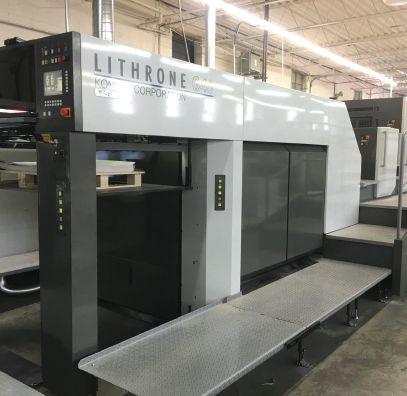
Vaughan, Ontario-based Whitehouse Graphics has purchased a Komori GL640C press. The company’s new press, replacing an existing press, will produce all of Whitehouse’s offset work.
“The folks at Komcan were not only extremely helpful but also knowledgeable and insightful,” said Wade Lapointe of Whitehouse Graphics. “We came away from our meetings with Komcan
feeling 100 percent confident we had made the right decision to move forward with the purchase of our new Komori GL640C.”
Whitehouse Graphics’s GL640C will be equipped with fully automatic plate changers, PDC-SX closed-loop colour control, and Komori’s productivity improvement system, KHS-AI, which optimizes press presets by self-learning.
“When we initially met with Whitehouse, it was determined that the advanced automation features that Komori has, were going to be of paramount value to them,” said Brett Rogers of Komcan Inc.
Whitehouse Graphics serves specific packaging markets and is looking to expand within its 32,000-square-foot plant, which provides prepress, printing, die-cutting and folding/gluing for packaging services.
Canpak Trade Print
&
Services
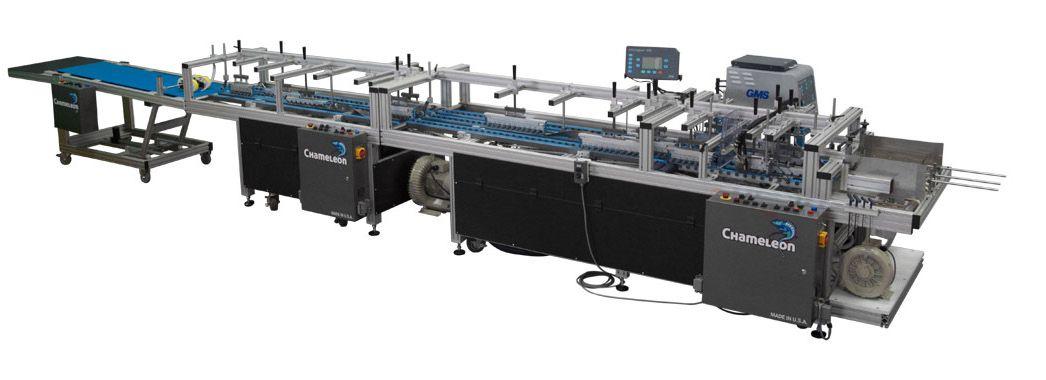
, a trade printer located in Richmond Hill, Ont., has recently acquired a Chameleon finishing system for standard and specialized folding, gluing, taping and affixing of die-cut products.
Eric Fok of Canpak says the system will allow the printing company to produce packaging products ranging from lock/hymes bottoms to a variety of shapes and sizes of straight-line boxes, as well as direct mail products that require non-traditional folding and gluing.
The purchase follows the company’s recent installation of a 28 x 40-inch die-cutter with full stripping capabilities.
“The addition of the system in conjunc-
tion with our new die-cutter allows us to offer our customers a new level of creativity. While some may turn away jobs because of their complexity, the Chameleon system allows us to work closer with our clients to create products that stand out,” said Henry Fok of Canpak.
Canpak’s range of services include:
• Heidelberg CD 102 6C + AQ, up to 28 x 40 inches,
• Heidelberg SM 52 5C + AQ, up to 14 x 28 inches,
• Ricoh 7110 with white and clear colour option, up to 13 x 27 inches, and
• In-house folding, drilling, shrink wrapping, saddle stitching and full bindery.
Smurfit Kappa installs HP PageWide C500 digital press
Smurfit Kappa says it has installed a new industrial-scale HP PageWide C500 digital press for corrugated printing to provide greater customization and flexibility for its customers. Headquartered in Dublin, Ireland, Smurfit Kappa is a provider of shelfready and eCommerce packaging development delivered through its
Ten-colour Rapida in Berkshire Mountains
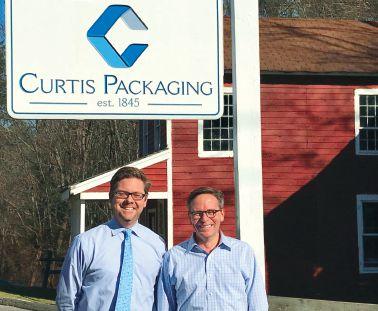
Based in the Berkshire Mountains of Connecticut, Curtis Packaging has invested in a 41-inch, 10-colour Koenig & Bauer Rapida 106 double coater press. The 150,000-squarefoot facility in Sandy Hook already includes two 51-inch Koenig & Bauer Rapida 130 large-format presses. The
ShelfSmart and eSmart services. It explains the graphic flexibility and quality of the new press will further enhance its service to help drive brand recognition and provide fit-for-purpose packaging.
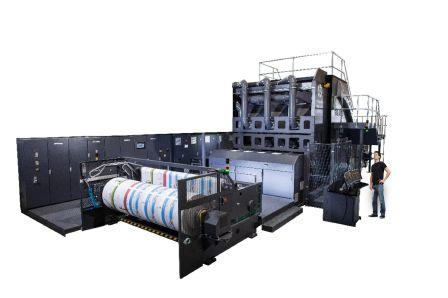
Installed in its Interwell plant in Austria in April, the PageWide C500 Press will be the first commercial HP single-pass press in Europe. With a fully integrated stack-tostack workflow, the press is described as combining “digital simplicity with
offset replaceable print quality” on both coated and uncoated paper. Furthermore, the HP water-based inks facilitate printing on both primary and secondary food packaging without an additional barrier in compliance with global food safety regulations, explains Smurfit Kappa.
Installed in Interwell, Austria, the PageWide C500 Press is said to be the first commercial HP single-pass press in Europe.
“We are delighted Smurfit Kappa will be the first in Europe to install the C500 Press which showcases brand new technology and offers all the flexibility of digital printing. This press is going to fundamentally change the corrugated industry by digitalizing it,” said Cristóbal Macedo, Director, EMEA Corrugated Business, HP.
firm says a third Rapida 130 will be removed for the new press installation.
“It will be a key press for us, dedicated to short-run, fast changeover jobs,” said Kerry Brown, Vice President of Operations at Curtis. “We have completely customized its capabilities with a unique double coater formation and other exclusive configurations. Once it begins operation this spring, we’re
projecting a 60 percent improvement in makeready and a 40 percent improvement in run rates.”
Curtis chose to have its new Rapida 106 specified with Koenig & Bauer’s inline QualiTronic Color Control capability and System Brunner Instrument Flight, which emphasizes colour balance and gray balance, taking into account more than 30 process variables.
Kerry Brown, Vice President of Operations, and Don Droppo, President of Curtis Packaging.
Second SurePress at SixB in Dallas
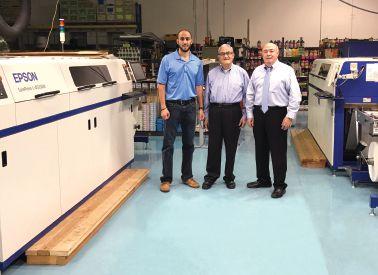
SixB Labels, a printer of labels, decals and barcodes based in Dallas, Texas, installed its second Epson SurePress L-4033AW inkjet label press to expand its short-run label printing services. The company explains the press will be used to meet a growing demand
Durst Delta in Austria
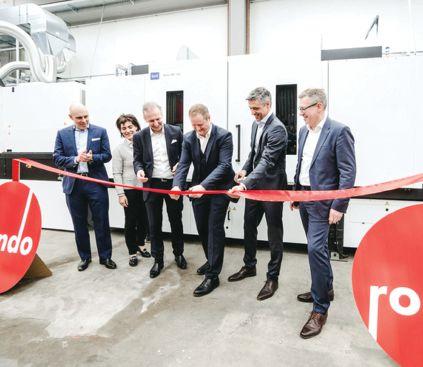
Rondo Ganahl AG is an Austrian corrugated board manufacturer, producing packaging and displays with offset and flexo technologies. The company is setting up a digital centre at its St. Ruprecht/Raab facility, featuring a Durst Corrugated flagship Delta SPC 130, which achieves print speeds of up to 9,350 m2/h based on Durst single-pass printing technology and, in combination with Durst Water Technology, enables what the com-
for its semi gloss and BOPP labels.
SixB’s new SurePress L-4033AW is a seven-colour system running waterbased inks to produce high-quality labels. Epson explains it runs a range of standard, off-the-shelf materials like gloss, semi-gloss, matte, film, clear and metallic substrates.
“The amount of detail on the labels printed by the SurePress was tremen-
dous,” said President Fari Bakhshian, describing the company’s recent Hibiscus Mint award-winning project.
“The Hibiscus Mint was also only the beginning, as the project lent itself to multiple label variations created on the SurePress – House Black, Mango and Texas Gold Iced Teas – with labels including clear and colourful imagery of ingredients.”
pany describes as sustainable and odourless packaging products.
With this investment, Rondo explains it is responding to changing demands in the corrugated board market that requires rapid and flexible solutions for the sampling, versioning and personalization of promotional activities. In particular, Rondo says trade and brand manufacturers are also looking for partners to support them with seasonal promotions, special editions and individual products in a timely and high-quality manner.
Durst explains other print providers in the country have recognized this trend and have invested in Durst Delta WT Corrugated Multi-Pass printing systems.
“We’re delighted our digital Durst Delta SPC 130 high-performance printing system, that we produce for the corrugated board industry from our location in Lienz, East Tyrol, has also impressed Rondo,” said Christoph Gamper, Chief Executive Officer at Durst Group.
SixB Labels received a Premier Print Award from Printing Industries of America for labels created on its first SurePress L-4033AW.
An open house celebration was held for Rondo Ganahl’s new digital centre built a round a Durst Corrugated flagship Delta SPC 130 press.
Products need to stand out in a crowded market and your customers need exceptional packaging designs which can be rapidly changed. Our digital technology streamlines your workflow and makes short run printing faster and more cost-effective - allowing customers to test and perfect their packaging.
Want to learn more about packaging & opportunities for your business?
Océ Arizona® 6100 High Flow Vacuum Series
Easily pull down porous & warped substrates for:
• Short Run Packaging
• Package Prototyping
• Printed Plywood Panels
• POP Displays
• Hoarding
Océ ProCut® Series with Auto Pilot
Fast forward finishing by reducing operator intervention with the Auto Pilot option that automatically identifies and initiates processing of all jobs placed on the cutter.
We’ve got you covered. Canon has put together this special feature on how packaging is changing and, most importantly, what print opportunities exist for your business.
CHECK IT OUT NOW
Five forces of packaging
How packaging printers will evolve over five years of market growth
By Jon Robinson
Smithers Pira in mid-January 2018 published a study called The Future of Global Packaging to 2022, which estimates packaging demand will grow steadily at 2.9 percent to reach $1.3 trillion in 2022 (all figures converted into Canadian funds), starting from $1.1 billion in 2017. The report looks at current and future figures for packaging in 17 major and 33 minor national markets.
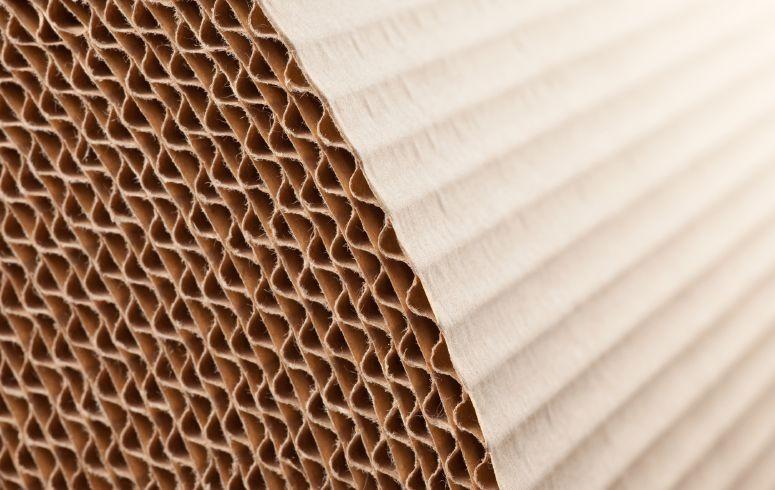
Smithers explains the evolution of packaging companies over the next five years will be driven by five primary forces. Because e-commerce provides a near unlimited product range and transparency for consumers, Smithers predicts it will change the way in which brand owners interact
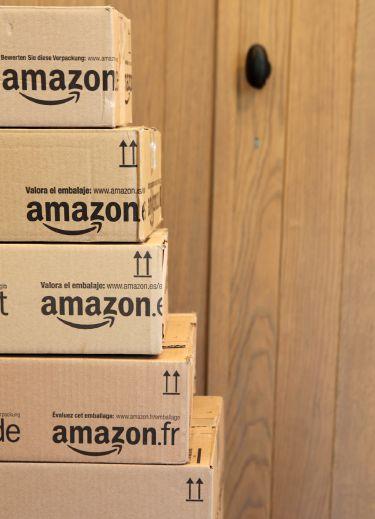
with consumers, which will ultimately affect packaging producers. The report describes the demand for packaging in retail outlets as steady but unspectacular when compared to growth in e-commerce. This has certainly been boosted by Amazon’s maturing online platform as competitors try to keep up with its disruptive distribution model.
The value of packaging demand in the e-commerce sales channel, according to Smithers, was $36 billion in 2017 and will more than double by 2023. Smithers found that more than 75 percent of this demand is for corrugated formats.
Secondly, Smithers points to digital printing as a maturing technology that
will impact packaging producers. The sheetfed-offset dominated space of folding carton has only just begun its transition to digital press technology, which allows for new entrants to produce specialized or short-run work.
The HP Indigo 30000 series, a 29-inch format press aimed at folding carton, has seen growing market penetration.
Landa’s B1-format S10 press began beta testing in Israel in April 2017.
Late 2017 saw shipments begin for
Heidelberg’s Primefire digital packaging press with series production set for the beginning of 2018. Fujifilm’s J Press 720 suddenly has more than 100 worldwide installations and can be easily converted to produce up to 24-point carton work. Looking at entities like Heidelberg and Fujifilm, as well as the inkjet developments of Komori and Koenig & Bauer, these traditional suppliers touch the vast majority of offset-based printers and
are motived by their own heavy investments to drive digital technology into packaging.
Smart and intelligent packaging is the third major evolution driver for packaging producers, according to Smithers, because it opens new possibilities for converters and brand owners. Contract packaging is by far the largest segment, explains Smith-
ers, creating around 70 percent of the industry’s overall value. While it is not a new concept, Smithers describes contract packaging as the fourth primary force of evolution because “it fits well with deeper collaboration across the value chain, and can deliver major cost savings.”
To this end, packaging companies are expected to take on more services, such as design and traceability.
Smithers estimates packaging services will grow at 9.5 percent, beginning at $44 billion in 2017 and reaching $65 billion by 2022.
The final two forces of packaging evolution truly fit together as Industry 4.0 and Big Data. By their nature of producing longer and more consistent print runs, offset-driven packaging producers have a relative-
Board and paperboard is the largest packaging material type covered in the Smithers Pira study. It accounted for 35.7 percent of world packaging consumption in 2016, followed by flexible packaging (plastic, paper and foil) with 23.3 percent, rigid plastic packaging with 18.2 percent, and metal with 12.2 percent. 36%
ly high Overall Operating Efficiency when compared to commercial printers, but it will still be critical for packaging producers to embrace Industry 4.0 strategies like automation, data exchange and IoT. Smithers also points to investments in communicating robots on the factory floor and in distribution chains. Smithers explains analyzing Big Data, such as sensor data for temperature, vibration and rotation speed, will allow packaging companies to improve and rationalize; as well as implement predictive maintenance.
Leveraging Big Data for clearer production transparency will also drive packaging growth.
These five evolutionary forces outlined by Smithers will create new business models and ultimately
greater vertical integration, which the packaging world has been seeing for a number of years. “The continuing trend towards large-scale mergers and acquisitions – for example the creation of WestRock from MeadWestVaco and RockTenn – is testament to the relative maturity of the packaging industry in developed world regions, like North America and Western Europe.” Smithers indicates that emerging and developing economies will contribute more than 70 percent of world packaging consumption growth from 2017 to 2022.
Smithers describes Asia as the largest market accounting for 42.1 percent of world packaging consumption in 2016. North America is second accounting for 24.3 percent, ahead of Western Europe with 18.4 percent.
Despite the West’s packaging maturity, these five forces of evolution create significant opportunities for innovation in North America’s printing and packaging industries.
Entering digital label printing
Digital labels is one of the most attractive segments for printing growth led by significant new demands from brand owners for short-run versioning and variable print work
By Jon Robinson
The digitization of label production began years ago with bleeding-edge projects but only now is beginning take a foothold across the printing world, which is still dominated by flexography. Some of the globe’s largest brands are reinvesting in print with the shifts in advertising effectiveness to younger generations, who may never watch a television ad or block them entirely online.
A recent report by Future Market Insights estimates the demand for digital printing in packaging will grow at 15.3 percent to surpass US$52 billion in revenues by 2026. By product type,
labels is currently the largest segment, accounting for over US$7.1 billion in revenues in 2016. Future Market Insights estimates demand for digital labels will increase at 16.7 percent
CAGR to reach US$38.4 billion in revenues. The labels segment is estimated to hold the highest market share by the end of the projected period, accounting for more than 70 percent of the global market share by the end of 2027, up from 64.1 percent in 2016.
Consider for example, the money invested by Coca-Cola to produce its largest-ever personalized brand campaign, Share a Coca-Cola, launched
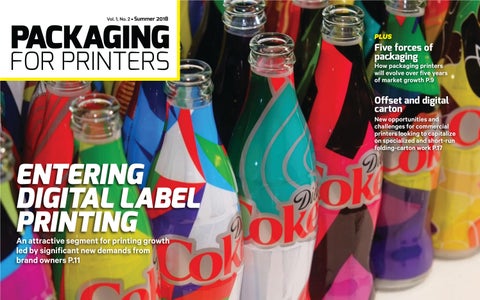
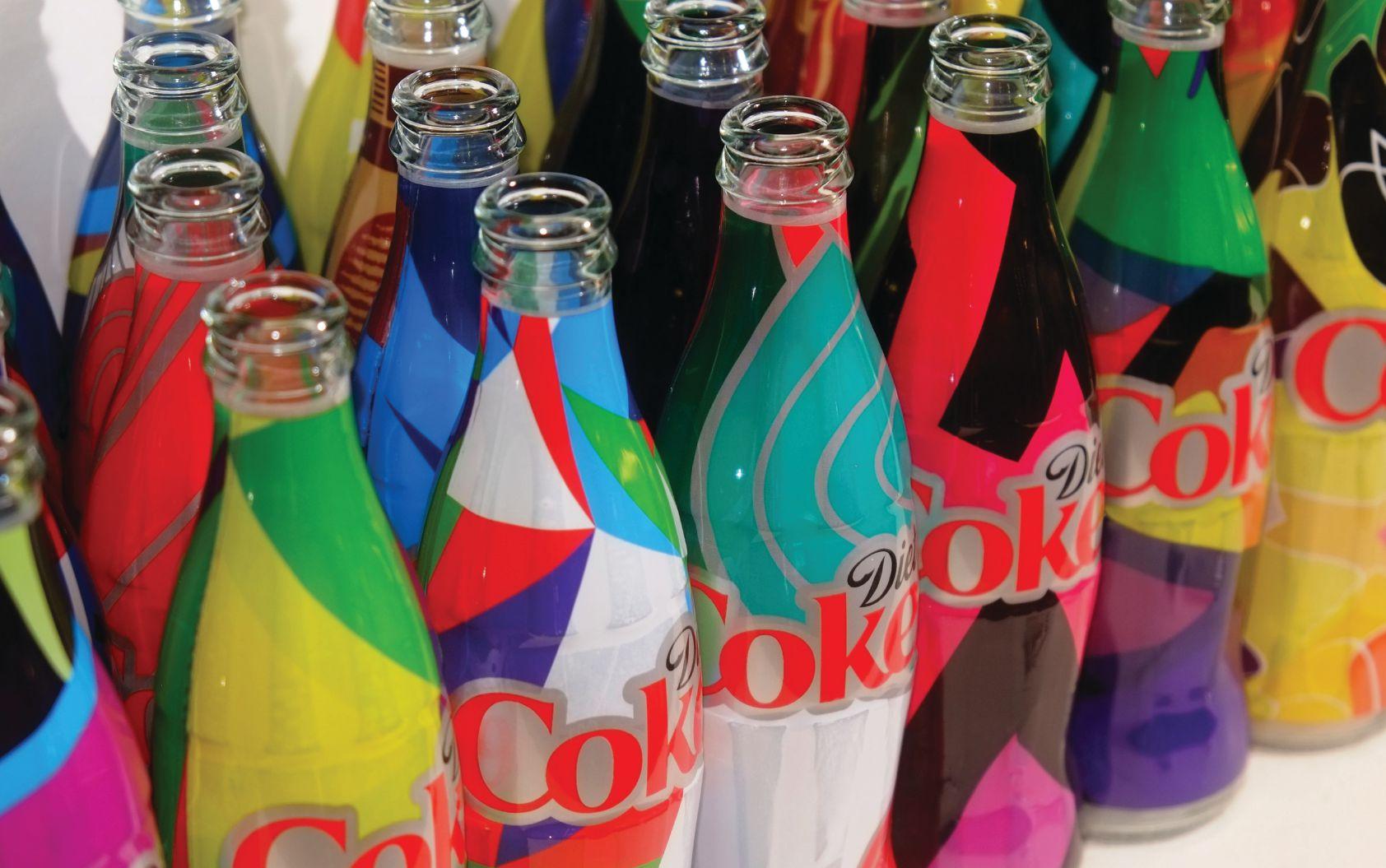
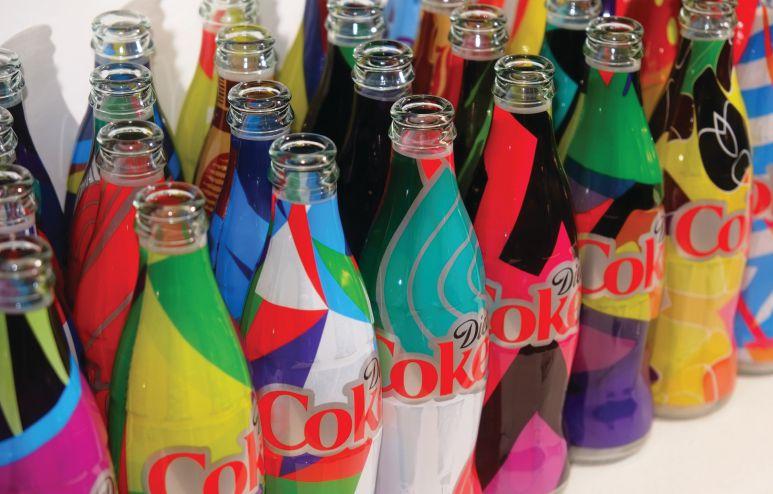
In 2014, Coca-Cola printed two million unique Diet Coke labels via Q Digital and HP Indigo. The campaign followed its 2013 Share a Coca-Cola project, which signalled a key change in the use of digital printing systems for label production.
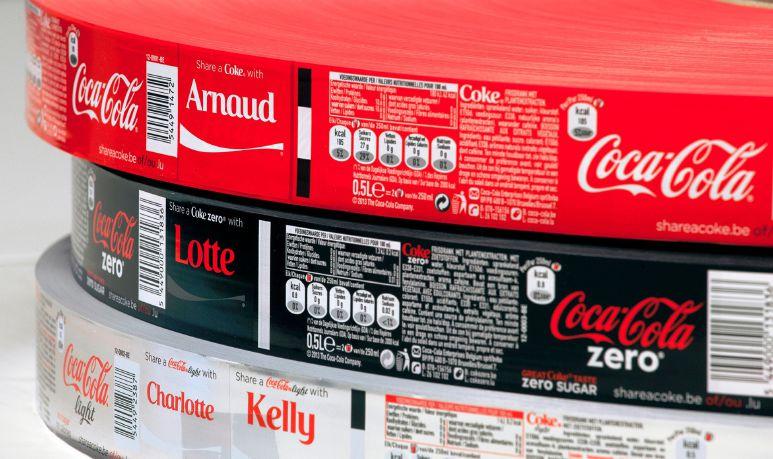
in 2013 across 32 countries. Coke used printing operations with HP Indigo presses to digitally print labels with 150 of the most popular first names, nicknames and terms of af-
fection – initially 800 million high-quality personalized labels.
The Share a Coca-Cola campaign became famous across the printing world because it signified a paradigm
shift in what is effective marketing, leveraging print. It is an example of long-run versioning through digital, but the possibilities of digital labels burst open. Commercial printers are attracted to the potential of digital labels but without a large client base, will find it hard to invest millions in capital equipment and workflow infrastructure. Instead, many will take the route of entry-level inkjet- or toner-based printing engines, which can be integrated with a range of finishing technologies to work with existing clients and build up a base before committing significant resources. PrintAction spoke with Brett Kisiloski, PDS Sales Manager, about the potential of digital label printing, and the challenges and opportunities of investing in entry-level digital printing systems.
Kisiloski, PDS Sales Manager.
What kind of systems do printers need to enter digital labels?
Kisiloski: Essentially you need two machines for a full production label system. You have your roll-to-roll label printer and your label finisher, which will laminate, die-cut custom shapes, waste matrix, and then you can slit into singles from a multiple-up format. We focus on tonerbased printers rather than inkjet – rollto-roll toner. For us specifically, we use the OKI engines. We carry a few different die-cutters but essentially they do the same sort of thing.
When is a die-cutter not needed?
Kisiloski: The only time we ever suggest to a customer that it is okay for them just to purchase a label printer is if they are only doing one or two sizes of labels...then it is easy for them to print pre-diecut and they only need to
stock one or two sizes in their shop. If you have a lot of other custom sizes, you can’t just phone up your label material provider saying you need new shapes...it is going to cost you twice as much. The flexibility isn’t there.
Are more commercial printers looking into digital labels?
Kisiloski: A lot of printers like the idea of it. The problem is that even for an
entry-level system it is fairly costly if you want to get into a new machine. You are looking at probably an entry cost of definitely no less than $50,000, between $50,000 and $60,000. So you have to think that these printers already have a built-up label business of some sort. I have seen the most random, small print shops that are looking for a label printer. They might be doing hundreds of thousands a
Coke used printing operations with HP Indigo presses to digitally print the labels.
Brett
month and they have been outsourcing it, because they just happened to stumble across these customers who want labels.
800M
The 2013 Share a Coca-Cola campaign kicked off with the digital production of 800 million high-quality personalized labels.
Another challenge with digital labels is finding that sweet spot...Is it going to be six cents a label, eight cents a label, because there is a difference when you have a trade printer quoting five cents a label. What really comes into play is that there is a lot of short-run or variable-data label printing.
How much work do you need for ROI on an entry-level system?
Kisiloski: You actually do not need that many jobs per month for this to make sense. It is likely you are selling that thousand let’s say for $300 and it is costing you maybe $80 to $100 to print. That’s printing, labour and everything, so let’s say $100, and you
are making really good margin. If you are making $200 on every order and you get two orders a week, you can pay off the machine. So that is really not a ton of volume for someone to jump into it based on getting one or two orders per week.
What are the pros and cons of inkjet versus toner?
Kisiloski: We carry smaller systems so I do not want to compare too much to the bigger guys...Systems for under $100,000 let’s say. We still sell Memjet printhead [inkjet] systems for envelopes and labels. It is great in the sense that it is really fast and it is quite inexpensive to print in terms of the ink costs. You are printing 60 feet a minute which is two to three times as fast as you are going to get on a toner printer, so it was really interesting a few years ago.
The downfall is that you have to print on inkjet-coated material. About three or four years ago it was still cheaper when all was said and done to print on inkjet with the coated material. In the last two to three years, however, coated material prices have gone up big time, so it is very difficult. I would say it is 25 percent cheaper to print any size label using a toner printer rather than an inkjet just because of the material cost. Inkjet is also very finicky. It might have 70,000 print nozzles in a tiny little bar stretching 8 1/2 inches wide, so those things clog easily, whereas toner is very consistent.
When does entry-level inkjet make sense today?
Kisiloski: I have a customer who prints post-it notes, for example, and because it is a paper you do not need inkjet coating…The paper stock will absorb the ink...an inkjet system is perfect for him, because it is super
The Share a Coca-Cola campaign became famous across the printing world because it signified a paradigm shift in what is effective marketing, leveraging print.
cheap. He is just paying for the ink and it is really fast. But most people print on gloss paper or polyesters or vinyl, which has to be inkjet coated and you are doubling or tripling your cost.
What is most exciting about digital label printing?
Kisiloski: The label business is huge. Packaging is a massive industry so it is very exciting to be able to offer that...It is nice to be able to provide different options for a customer when they walk in the door and open up their mind a little bit to other ways of making money.
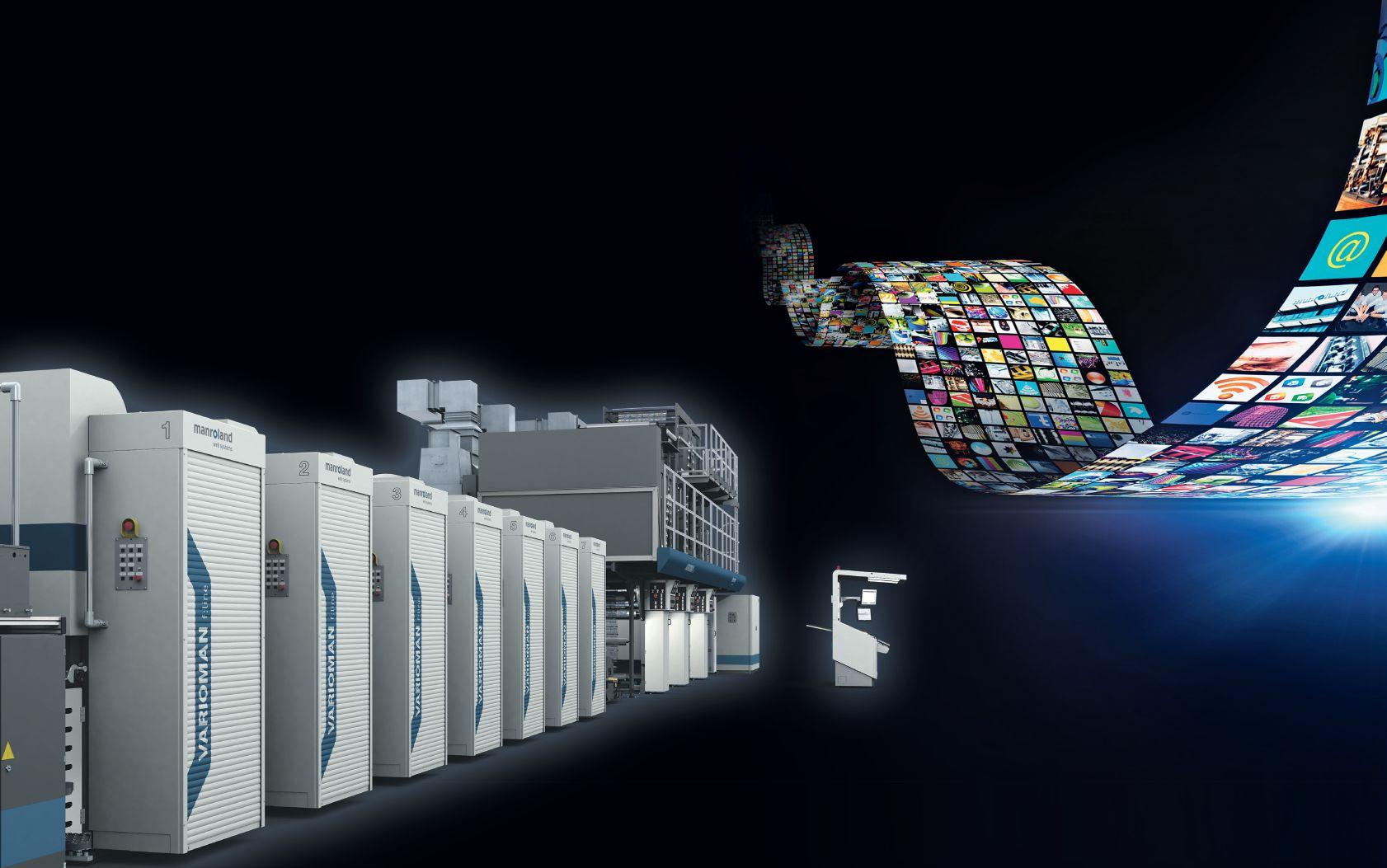
VARIOMAN – Boost Quality – Cut Costs
A new dimension for flexible packaging printing: VARIOMAN is the new technology platform for modern flexible packaging printing. The market demand is a press that offers brand differentiation, increased comfort and additional packaging sizes. This is given by the extraordinarily designed VARIOMAN. As offset hybrid press, it bypasses weak points of other technologies. In combination with gravure-, inkjet- or flexo printing units, the VARIOMAN covers production gaps at medium print runs with excellent offset printing quality. manroland web systems
manroland-web.com
Connecting to corrugated
More than 1,200 print professionals gather in Las Vegas to see the direction of digital packaging
By Martin Habekost
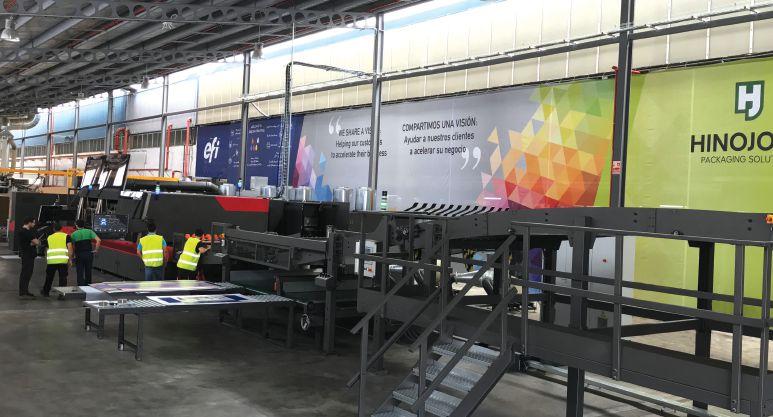
EFI held its annual Connect conference from January 23 to 26, 2018, at the Wynn Hotel in Las Vegas. On the first day of Connect, EFI CEO Guy Gecht hosted a fireside chat with two European customers who are the first to install a Nozomi C18000 digital UV LED inkjet press. This machine is intended for corrugated packaging, corrugated display and independent converters. It can be run in single-lane mode where the corrugated board is as wide as the feeder of the press or in dual-lane mode, which prints the corrugated pieces side-by-side in one pass. In this dual-lane mode, the print speed is up to 6,600 sheets per hour.
The first customer Gecht spoke with was Eric Barcourt, CEO of Hinojosa Packaging Solutions, with 12 production sites in Spain. It uses offset, flexo and gravure to service the middle-market to the small customer. One important statement was big customers do not require value-added production of their packaging products. Hinojosa started out by serving the shoe and textile industry in Spain printing simple, single-colour boxes. This is now changing with the outside of packaging products becoming more colourful and individualized.
In the past, some of Hinojosa’s customers transferred their packaging printing to low-cost countries to save
money, but now they are bringing business back to Spain, because of relatively short delivery times. In Europe, the market is consolidating and production and shipping costs need to be reduced. Barcourt said the Nozomi C18000 offers the best image quality for the substrates the company uses and allows it to print on substrates that are not always 100 percent flat, while providing individualized solutions.
Beyond EFI’s achievement in de-
veloping its dual-lane mode, the Nozomi prints CMYK with the ability to add orange and violet for extended gamut coverage. Supporting full variable data printing, installations include North America, Europe and Asia.
At Connect, EFI also highlighted its inkjet textile printing with the Reggiani line of fabric printers. EFI acquired Reggiani in July 2015. The target for these machines is in fast fashion sold in stores like H&M. These fast fashion
The first two installations of the EFI Nozomi C18000 press were at Hinojosa Group in Spain (pictured) and McGowarns Print in Ireland.
stores don’t have four fashion seasons, explains EFI, they have 12. Every month new designs and patterns are revealed and the Reggiani machines can supply these fast fashion chains with necessary prints. On this note, EFI launched the Optitex 3D Design Illustrator to validate and customize 3D garments in Adobe Illustrator. This is a plug-in tool allowing designers to create and view garments in 3D. The visualization is accurate in proportion and scaling. The Illustrator plug-in allows users to customize the fabric, texture, print patterns and graphic placement without the need for a printed sample. This reduces the amount of physical prototypes in the design process, allowing for shorter design cycles. Another key emerging market for EFI is in printed ceramics. The Cretaprint line of printers offer various print widths and special effects that can be applied to ceramic tiles. These machines allow for total custom production of ceramic tiles.
The Vutek line of inkjet printers offers a variety of applications particularly with Super Draw inks that can be used for thermoforming of printed plastic substrates. It was mind-boggling for me to see what can be done these days with inkjet printing. The possibilities are almost endless.
At the conference, Xerox and EFI announced a new Fiery-powered DFE for Xerox engines. Xerox in February 2017 sold its line of FreeFlow print servers to EFI. The new DFE combines unique features of the FreeFlow print server and the EFI
Fiery line of DFEs. This new DFE offers the support of the application of metallic toner-based inks. I had the opportunity to see a Xerox press with six print stations that could apply silver toner in the first print station, followed by CMYK, and the option to apply opaque white or gold in the sixth print station. This type of technology is definitely interesting for the
custom packaging print market, where metallic inks can convey high quality and exclusivity.
EFI also unveiled its MarketDirect Customer Engagement Platform at Connect. It has been developed out of the DirectSmile’s VDP solution, which EFI acquired in 2014 and has now integrated into its productivity suites. This allows users to build and execute personalized communication and marketing programs for Web, email, print, mobile and social media. The user interface is HTML5-based.
The software can be purchased and hosted on a local server or purchased as SaaS (Software as a service) hosted on an EFI server. You might be tempted to say, “Well, this is great, but I will use MailChimp for my email campaigns.” Programs like MailChimp offer you landing pages as well, but the MarketDirect suite allows you to combine electronic and print communications. Its use appears to be quite intuitive by simply selecting
options like email blasts, PURLs and printed materials. A user just clicks on the check-boxes for the various features they want to leverage in a marketing campaign. Another great feature is that MarketDirect’s user interface can be customized and it comes with built-in theme templates.
Among the many announcements at Connect, the one that struck a chord with me, presented by Gabriel Matsliach, was the use of a common interface for all EFI software. I found this very important, since it gives customers a common look and feel for all of EFI’s solutions. This might seem like a cosmetic change, but it allows users to become comfortable with different EFI software products, which continue to expand every year.
Martin Habekost received his Ph.D. in Analytical Chemistry from Universität Hannover. He is Associate Chair for Ryerson University’s School of Graphic Communications Management.
Offset and digital carton
Offset and digital advances in the folding-carton sector provide new opportunities and challenges for commercial printers looking to capitalize on specialized and short-run folding-carton work
By Jon Robinson
By most accounts, packaging is a stable future market relatively untouched by digital printing technologies, making it a logical direction for high-end commercial printers, even if they move slowly with primary clients into relatively lowcost label printing or specialized short-run folding carton work. Flexography remains a unique process and long-run carton will continue to be dominated by established players, but new digital – toner and inkjet –press technologies provide more packaging opportunity for commercial printers. The continuing automation of 40-inch offset presses also provides short-run packaging opportunities, as newer generation digital
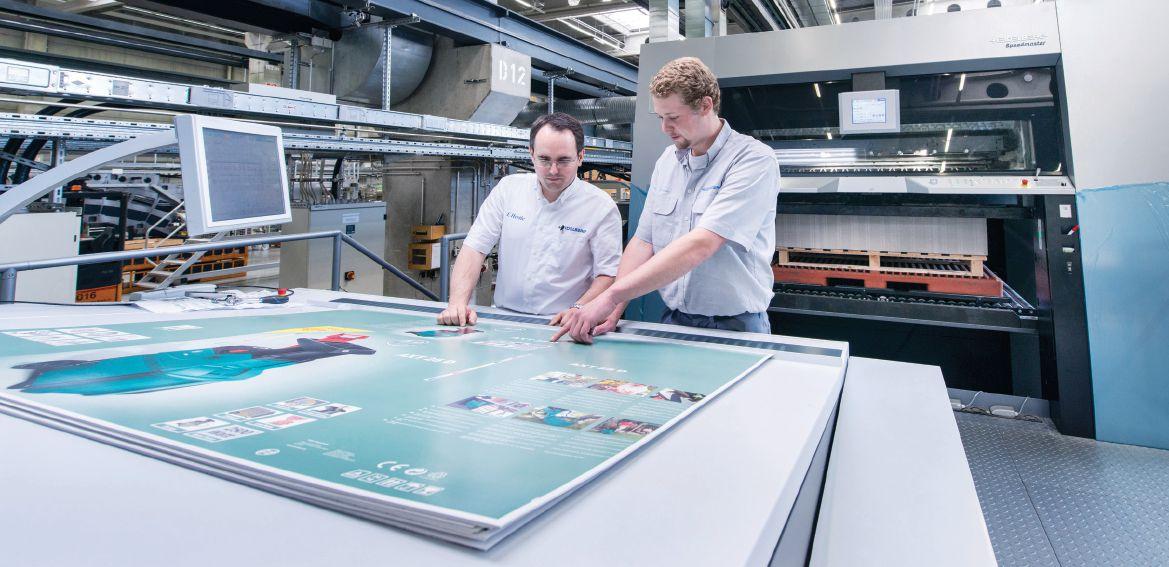
Testing offset carton work in Wiesloch, Heidelberg entered 2018 ready to begin series production of its Primefire press for carton, illustrating a key connection between offset-minded press makers and commercial printers.
presses in the space mature in performance and price.
Offset carton opportunities
Press manufacturers like Manroland Sheetfed, Heidelberg, Koenig & Bauer and Komori hold strong positions in offset carton work, with the latter three deep into the development and installation of inkjet systems, while Manro-
land is actively working on the technology. These press makers will be key facilitators of packaging adoption by offset-driven commercial printers.
“Sixty-eight percent of all of our [offset] press sales are going into packaging and the remainder are going into highend commercial,” says Sean Springett, CEO of Manroland Sheetfed North America. “In most cases where
I see [a commercial printer] making a move into packaging, they have done it through acquisition...It doesn’t seem to be very organic in nature unless they have found their way into [with an existing customer].”
Springett explains the space needed to hold one truckload of coated text or cover versus carton stock as one common challenge facing commercial printers transitioning toward long-run packaging. “Just looking at skids of paper, say 100-lb coated, you might have a truck load that would be 80,000 to 90,000 sheets,” he says. “If you do the same truckload with 24-point board it’s 32,000 sheets…A lot of commercial printers do not have that kind of space.”
Springett sees potential in 40-inch packaging based on the advances of offset presses. “Since about the middle half of [2016] and through [2017] there has been more demand for specialized packaging and that generally is dedicated to the B1 or
40-inch-press format. You can do a lot more with a 40-inch press than you can on a larger format.” He sees specialized carton work growing in markets like convenience products for food, cosmetics and pharmaceutical. “They are all trending back to the 40inch specialized luxury aspects of print added to the package.”
Around 80 percent of the Manroland presses sold into packaging are now 40-inch machines, explains Springett, whereas the previous eight years hovered around a 50/50 split between large-format and 40-inch machines. This movement toward 40inch for luxury packaging falls in line with Manroland’s new 40-inch Evolution press, introduced in 2016 with new levels of automation. “The lines were getting a little more blurred in 2017, because what was not typically considered feasible in 2012/2013 with an offset press is now very feasible. Some companies do it all day long–run lengths of 900 to 1,000.”
Digital systems provide the ability for carton producers to apply simple and complex variable data inline, increasing turnaround times.
As more printers define their production platform in terms of Overall Operating Efficiency, which might hover around 35 percent for a typical company, press suppliers are moving quickly to provide even greater press-production transparency for clients.
“A strength of the supplier is being able to provide that information, but more importantly is being able to disseminate it and intelligently communicate it to the printer,” says Springett. “The biggest element we see in the ideology of selling a printing press is that features of the press alone are less interesting to a printer [than] the ability for them to have transparency in understanding the production going on with the press.”
Percentage of the packaging sector’s most widely used printing process, flexography, in the current global printed packaging market, which accounts for a value worth approximately $340 billion per year. 40%
fitting the Industry 4.0 movement – is an advantage for production inkjet, as this technology was developed in line with the use of Big Data analytics. Inkjet press makers are focused on proving the value of capital investments applied to an individual facility’s production. By consulting with customers, typically on a print-application level, there has been significant growth in the adoption of inkjet presses.
Ed Pierce, Fujifilm J Press
“We are shipping our 31st in North America and we have a population of over 100, globally,” says Pierce. “We have been seeing a growing install base in the folding carton market as well. In the early days, that was not an area we focused on because we wanted to first gain traction in the commercial space, but we have a lot of flexibility to address the folding-carton market.”
allows the press to become the F version printing 8-point to 24-point stock.
“We see a lot of 18 to 20 point and have some customers with dedicated presses for folding carton working with 20 to 24 point,” says Pierce. “We also have some who switch back and forth.”
Digital carton opportunities
Transparency in press production –
Product Marketing Manager, saw major growth in J Press 720 installs over the past 12 to 18 months. The J Press blazed a trail for cutsheet inkjet engines with its introduction at drupa 2008. The first-generation J Press debuted in 2011 and the next generation – producing quality offset work –reached the market in mid-2015.
Pierce describes this flexibility in nextgen developments like higher fidelity in colour, repeatability and the use of aqueous pigment inks, which are favourable in commercial cutting, creasing and folding. This allows inkjet presses, explains Pierce, to more easily fit into a commercial printer’s existing post-press operations –“You do not have to retool.”
The Fujifilm’s J Press 720S for commercial work is able to run 3-point to 14-point stock, but with the addition of a couple of parts – in about an hour –
He shares an example of a customer running an average run length of 1,300 folding cartons for pasta, but with 156 different SKUs based on printing a different brand name on the box. This is an extreme example of how commercial printers might benefit from packaging in a growing shortrun carton market.
“I believe in digital and it will be a growth aspect of the industry, but I would say that there are just as many pitfalls in digital inkjet as there are in traditional offset,” says Springett. “It is just different scales of economies, productivity and throughput.”
– Suitable for all packaging/POP
– Robust, multifunctional tooling
– Now with Over Cutter Camera for highspeed, one-shot register mark capture
– Automatic/robotic load & off-load options
– Modular, upgradeable, easy to use
Available for personal demonstrations any time in Franklin (Milwaukee), WI
Adopting intelligent packaging
Five mistakes that keep brands from adopting intelligent packaging illustrate how printing can help
By Udo Panenka
As CES wrapped up in Las Vegas at the start of 2018, and visions of all sorts of intelligent products swim in the heads of marketers and consumers, I feel the need to reflect. Packaging needs to catch up to the rest of the 21st century and undergo its own digital transformation. But is brand packaging really ready to leverage the capabilities of a smartphone?
Consumer packaged goods (CPG) companies are aware of the need to close the gap between physical and digital marketing channels, aiming to countermeasure slow product growth through a better, more engaging consumer experience. They are starting
to align their marketing efforts, tying together physical packaging and digital marketing, all while working to implement new technologies like intelligent packaging and a million other bits into their overall strategy.
In November 2017, I discussed how CPG brands can digitize, automate, and connect their packaging at the Active and Intelligent Packaging conference in Amsterdam. While the conference was inspirational, I can’t help but challenge its positioning. We sit there and talk about producing packaging that motivates consumers beyond the point of purchase to achieve brand loyalty, yet many companies struggle to accurately and effi-
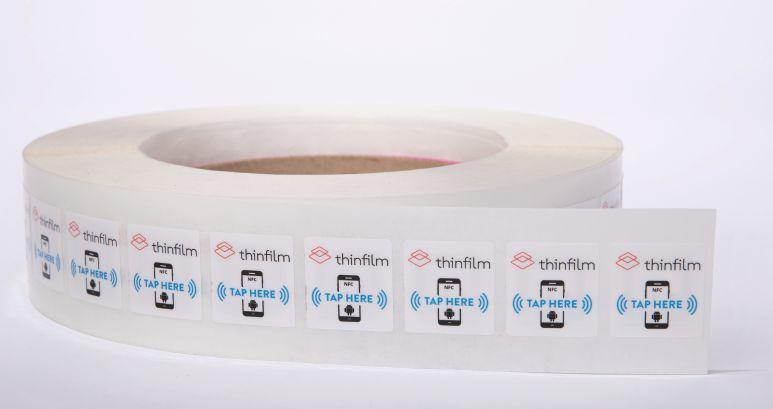
Jones Packaging of London, Ont., is one of Canada’s intelligent-packaging leaders, currently bolstering client carton security with NFC tags engineered by ThinfilmMemory called OpenSense.
ciently produce simple, analogue, unintelligent packaging?
For context: intelligent packaging uses electronic and digital capabilities like near field communication (NFC) or radio-frequency identification (RFID) chips to engage the consumer through their smartphone. Through this connectivity, the packaging may provide a micro-service such as authenticating the product or showing the product’s journey to the retailer. But we still see analogue packaging errors in colour consistency, content
labelling, and print quality on store shelves. Beyond that, marketing continues to create new content and ignore the work already produced during the packaging process, including high-quality, regulated content and photo-realistic, computer-generated images. These are seldom reused for marketing purposes when they easily could be. In fact, not using them is wasteful. In order to take advantage of intelligent packaging, brands need to remember that consumers’ physical interaction with packaged products is still very important, especially for fast-moving consumer goods.
With more than 320 total patents and patent applications, Thinfilm is becoming one of the most powerful NFC providers, with more than 26 million of its EAS and NFC tags delivered in its most recent fiscal year.
vanced packaging realm?
It’s like attempting to slamdunk when you can’t dribble. Running a marathon when you can’t complete a 5k. Writing a sonnet when you can’t write a sentence. I think you get the picture.
By now you may be thinking, “But why can’t we just skip analogue basics and move straight into the bigger, fancier stuff – it will keep us cutting-edge and on top of consumer trends!” To which I argue that building process muscle isn’t the same as adopting new technology.
Every brand I speak with reiterates in slightly different ways the same five mistakes:
packaged goods industry;
2. They don’t measure their product packaging responsiveness. Most do not know how long it takes to execute a packaging change and the impact it has on their path to market;
3. They exclude packaging from innovation projects and then have feasibility or budget surprises in execution;
4. Their marketing departments relay poor briefs to their packaging agencies (one brand went as far as to say that 98 percent of the information in their briefs is incorrect); and
Design, marketing and packaging need to organize product data, colour and imagery. It’s time for brands to get their packaging functions digitized and streamlined so they can drive consistency and quality for a better consumer experience, which is delivered at the highly responsive speed consumers expect and at a cost that keeps the brand profitable. That way we can confidently move from simple to “intelligent” packaging, making what seem to be far-reaching dreams a more secure reality.
This article was originally featured in BrandingMag in February 2018.
If brands struggle to master the packaging basics, then how can they honestly expect to move into the ad-
1. They forget that packaging is literally at the centre of their consumer
5. They hardly use any of the components of packaging (content, artwork, shape, colour) to feed their marketing channels, even though many of these are digital already.
Udo Panenka is President of Esko, which he joined in 2014 as Senior VP of Sales, Marketing and Service. Prior to Esko, he served as VP and GM of Europe & India for the industrial automation business at Kollmorgen, which like Esko is part of Danaher.
IT’S NOT A MYTH.
Flenex FW offers the highest quality and f astest speeds.
Only the world leader in printing plates could bring you water-washable flexo plates you truly have to see to believe. With a total processing time of less than 40 minutes, Flenex FW from Fujifilm offer the fastest platemaking process in the industry – and they do it with unmatched print quality.
With exclusive Fujifilm water-washable chemistry, Flenex FW plates provide improved ink transfer capability and greater durability than other leading plates. That means faster job turnaround, maximized press time and lower labour costs. And with a one percent flat dot structure that consistently produces 200 lpi at 4,400 dpi with brighter, cleaner print results, your next choice in flexo plates should be clear.
To learn more visit: Fujifilm.ca/Flexo
HP One Package workflow suite
HP describes the new One Package workflow suite for PageWide Industrial corrugated presses as the industry’s first ecosystem for digital corrugated printing. Designed to streamline the submission and preparation of orders, the suite enables converters to take advantage of value-added possibilities, including solutions for brands’ consumer engagement and piracy protection using variable data, imagery and unique ID serialization, HP says. One Package’s production management and automation software are also designed to help enhance operational performance.
Esko Text Recognition
Esko has extended its portfolio of solutions with Text Recognition, a new plug-in for Adobe Illustrator that aims to make last-minute copy changes to outlined text fast and simple. Designed to eliminate cumbersome work-arounds, Text Recognition, Esko explains, converts outlined text in artwork to live, editable text directly in Illustrator. When a copy change needs to be made, the software compares the character in the artwork to the fonts on the user’s computer, choosing the best matching active font. The Compare function highlights copy changes in a ‘before and after’ view. The plug-in is available as a part of the Esko DeskPack collection of plug-ins for packaging professionals, or as a standalone product for anyone working with Adobe Illustrator.
Epson and GMG Americas partner for package proofing solution
The Epson SureColor S80600 64-inch roll-to-roll solvent printer has been certified by GMG Americas for use with software GMG
ColorProof 5.10 and GMG OpenColor 2.1.5. GMG Americas says it selected the Epson SureColor S80600 due to its high-performance white ink printing capabilities, advanced printhead technology, and ultra-wide colour gamut with light black, red, and orange inks. Leveraging Epson UltraChrome GS3 9-colour ink featuring red and orange ink and optional white or metallic silver, the SureColor S80600 boasts the highest Pantone coverage in its class. In addition, it touts a high performance Dual-Array PrecisionCore TFP printhead and an all-new precision media feeding system, which Epson says will provide unmatched levels reliability and impressive production speeds.
Esko says the OCR plug-in helps packaging professionals eliminate cumbersome work-arounds.
Afinia and Infigo team up for label printing
A new collaboration between Infigo Software and Afinia Label aims to enable instant, in-store, real-time printed personalization across a range of products. With Afinia’s industrial colour label printing equipment, Infigo Software will deliver the front-end user experience to enable product and brand websites as well as live 3D product previews. “For the first time ever, everything needed to run a complete, end-to-end personalization campaign in-store in real time, on any number of products, is available to any business, no matter its size; and all from one unique collaborative solution,” says Infigo.
The HP One Package workflow suite was introduced in June 2018.
Mimaki UCJV300 series
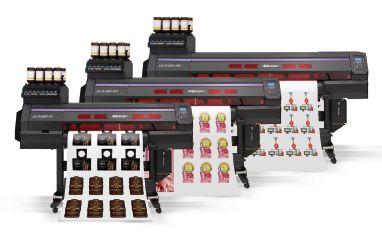
Mimaki is releasing the UCJV300-75, UCJV300-107 and UCJV300-130 printers, boasting a smaller footprint with the same operational features of the UCJV300-160. The new models suit various applications with four-layer printing in addition to five-layer printing capabilities. As well, the integrated cut functionality is designed for labels, decals and more. They utilize UV-curable inks described by Mimaki as offering greater opacity with less ink consumption, noting the high-opacity white ink enables block-out printing with a single layer for specialized applications.
The print-and-cut machine features the newest version of the RasterLink6 Plus software.
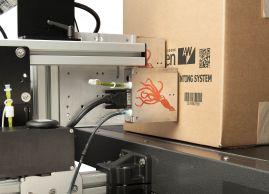
CoPilot 500 conveyor kit
Squid Ink Manufacturing and Eastey Enterprises have introduced an all-in-one package for product transport and inkjet printing. The combination of Eastey EC-Series conveyors and Squid Ink’s CoPilot 500 inkjet printer is suitable for customers looking to begin printing on their corrugate cases. Included in the kit is an 18-inch wide Eastey conveyor complete with guide rails and casters, Squid Ink’s CoPilot 500 printing system with one or two printheads, encoder kit for barcode and logo printing, and conveyor mounting brackety for printing on one or both sides of the case in a single pass.
Fujifilm food-safe ink
Fujifilm is launching a new food-safe ink designed to extend the application versatility of the Jet Press 720S for packaging production, suitable for finishing applications on carton board or synthetic media up to 600 microns thick. The company explains the new food-safe ink forms a key additional component of the Jet Press folding carton solution, described by the Fujifilm as the first B2 digital press approved for primary food packaging. The low migration, aqueous food-safe ink, Fujifilm explains, has been specially formulated to work with inline (via a bridge) and nearline UV or aqueous coating. For companies looking to diversify into packaging, Fujifilm explains the Jet Press folding carton solution can also incorporate Phoenix imposition and planning software from Tilia Labs, optimizing how jobs are collated.
Kodak Nexfinity press platform
Kodak introduced its Nexfinity sheetfed toner press platform in March 2018, which builds from its NexPress systems. The new platform is built with Dynamic Imaging Technology (DIT), a patented Kodak technology for digital printing. DIT technology works by applying algorithmic adjustments to specific areas of an image, explains Kodak, which optimizes image quality and consistency based on the image content in each area. Kodak explains this imaging technology produces crisp text, hard lines, soft skin tones, and beautiful skies on the same page. Featuring a new high resolution and multi-bit LED writing system, Nexfinity is designed to work with a range of applications, including direct mail, commercial print, publishing, and packaging. The press runs at speeds of 83 to 152 pages per minute, working with expanded sheet lengths of up to 48 inches and is capable of handling stocks up to 24 pt.
The CoPilot 500 can print up to 5.6 inches of hi-resolution characters, says Squid Ink.
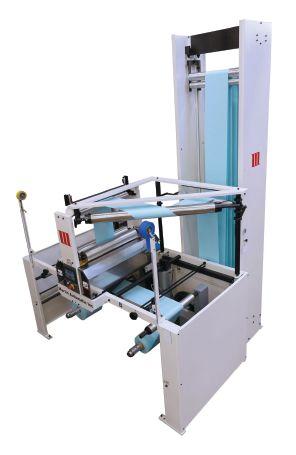
The MBS splicer features an integrated 90-degree turnbar that occupies 77 inches.
Martin Automatic MBS splicer with right-angle turnbar
Martin Automatic says it will run a space-saving non-stop roll changer at Labelexpo Americas 2018. Boasting a streamlined design, the MBS automatic splicer features an integrated 90-degree turnbar that occupies 77 inches of a press line, making it suitable for label printers tight on space, the company explains. Martin says it will run an LRD automatic transfer rewinder in conjunction with the splicer to demonstrate continuous operation.
Xaar 2001+ printhead for Canon Océ LabelStream 4000 press
Xaar says its 2001+ U printhead brings speed, quality and reliability to the Canon Océ LabelStream 4000 press for digital label printing. The roll-to-roll industrial-scale UV inkjet press provides CMYK+W printing and features the latest Xaar 2001+ U printheads. Targeting label and flexible packaging converters, it can print on various standard label stocks including PP and PE plus selected special substrates. The Océ LabelStream 4000 uses different printhead variants from the 2001+ U family, Xaar explains, noting the small drop size of the 2001+ GS6U provides crisp details in CMYK, whereas the larger drop size of the 2001+ GS12U helps achieve high opacity with white ink. As a result, the Océ LabelStream 4000 is said to deliver an 80 percent opacity (“alpine white”) at speeds of 48 m/ min in its Graphics mode, and a 67 percent opacity (“true white”) in a faster production mode at 68 m/min. Available in a number of configurations, the Océ LabelStream 4000 will launch in two widths at 330 mm and 410 mm.
DuPont Printing Plate
DuPont Advanced Printing has announced the addition of the DuPont Cyrel EASY EPC to its plate portfolio. The Cyrel EASY EPC, a soft digital plate, is equipped with a built-in flat top dot for post-print corrugated printers. It also comes with medium durometer plates designed with flat-top dots which fit into the FAST and solvent workflow. Cyrel EASY EPC plates minimize fluting when printing on a variety of corrugated boards, says DuPont. Other features include simplified workflow, consistent ink transfer and printing, high exposure resolution, quality reproduction, and efficient make-ready times.
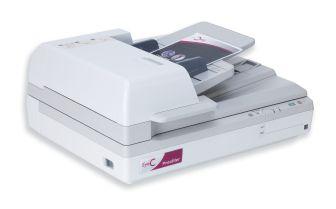
EyeC ProofBook inspects multi-page documents
With the new version of its ProofBook, EyeC says printers can inspect multi-page documents with greater speed, examining up to 20 pages a minute at 300 dpi. The system compares the front and back of each page against the approved PDF template and shows the operator the suspicious pages for more precise examination. As well, it features a duplex scanner with an automatic feeder that can take up to 200 pages. Scanning and inspecting size A6 to A3 documents at up to 600 dpi, the system can pull in paper from 35 to 128 g/m². Moreover, regular operation as a flatbed scanner allows random sample inspection of folding boxes, labels and flexible packaging. With additional software options, the new EyeC ProofBook can also read 1D and 2D codes.
Both systems are suitable for coated and uncoated media, from 80 gsm to 350 gsm.
HP PageWide T1190, T1170
In May 2018, HP introduced the PageWide T1190 and PageWide T1170 ultra high-volume inkjet web presses for pre-print corrugated packaging. The addition of six-colour printing (CMYKOV) expands the colour gamut for matching colours, allowing for “new digital possibilities for brands, including short-runs, faster turnaround time and versioning,” HP says. Additionally, the presses use HP A30 true water-based inks, which HP says contains no UV-reactive chemistries and does not require additional barriers for food packaging applications. The T1170 and T1190 are suitable for coated and uncoated media, from 80 gsm to 350 gsm.
The system is said to reduce packaging run costs by 15 percent by helping users minimize coding errors.
Markem-Imaje CoLOS Version 6.0 systems
Markem-Imaje has released Version 6.0 of its CoLOS information management system, a software designed to provide users with higher uptimes, throughput and compliance in product coding and packaging activities. The CoLOS information management system, Markem-Imaje explains, aims to minimize risk of coding errors, ensuring compliance with regulations that is described as helping to reduce overall packaging running costs by up to 15 percent. The company says the resulting automation cuts manual data entry and message data maintenance by up to 90 percent.
New PantoneLIVE flexo colour libraries
X-Rite and Pantone announce six new libraries for PantoneLIVE, a Cloud-based colour communication ecosystem. Developed with their PantoneLIVE Preferred Partner for ink supply Sun Chemical, the new dependent standard libraries is designed to help UVcured flexography printers and converters match Pantone colours in label and carton applications. The six new libraries are: Metalized Paper Label with White Ink–UV Flexo; Clear Film with Varnish–UV Flexo; Clear Film with Base White Varnish–UV Flexo; Clear Film on Clear Plastic Bag–UV Flexo; Clear Film on White Base–UV Flexo; and Recycled Carton Board with Varnish–UV Flexo.
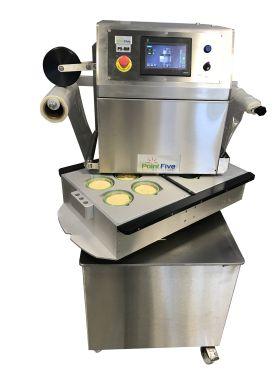
Point Five Packaging P5-RM tray seal system
Point Five Packaging has introduced the P5-RM semi-automatic seal system. Designed for food production or packaging environments, the machine can be configured for sealing trays or cups using Modified Atmos phere packaging (MAP), vacuum skin pack aging (VSP), or seal-only packaging. The manual rotary table is described as cutting cycle times and optimizing output as it enables sealing, loading and unloading to occur simultaneously. The operator loads pre-filled containers into the machine and manually rotates the table under the seal head; while the seal head engages to seal, MAP or VSP the containers, the operator readies the second nest plate with product.
The machine handles film widths up to 14.5 inches and tray depths up to 5.5 inches.