Craft a more impactful and e ective direct mail campaign with these three guidelines
14 Networking 101
Top tips for developing your networking skills and growing your business circle
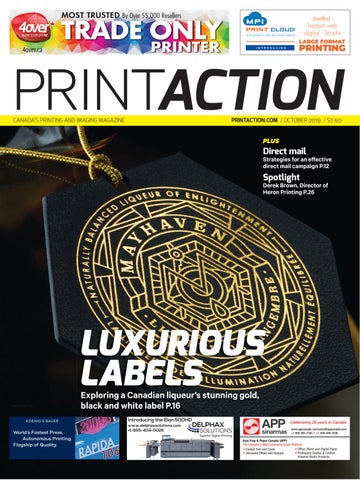
16 Luxurious labels
Exploring the creative process behind a Canadian liqueur’s embellished gold, black and white label
DEPARTMENTS
GAMUT
5 News, People, Installs, Calendar
TECHNOLOGY REPORT
18 A look at some of the new technologies and services on display at Printing United 2019
NEW PRODUCTS
20 New solutions from Canon, Epson, Esko, EyeC, Fujifilm and Inca Digital, HP Indigo and Agfa, Komori, Kornit, Mark Andy, Pantone and Roland
SPOTLIGHT
26 Derek Brown, Director, Heron Printing
COLUMNS
FROM THE EDITOR
4 Alyssa Dalton
How Mountain Dew turned its branding “oops into opportunity” and won fans along the way
CHRONICLE
8 Nick Howard
Lessons learned from the golden years of Wall Street printers
Branding oops turned opportunity
ITOP 4
The top four qualities people use to describe why they are loyal to a brand are cost, quality, experience and consistency, according to a survey of 15,000 consumers by Facebook. The findings suggest consumers want quality products they can a ord and a consistent experience with a brand every time they interact.
n June, Mountain Dew released the Dewnited States Collection, a limited-edition bottle series representing all 50 American states, inspired by home-state pride. The e ort follows the trend of beverage companies looking to build brand loyalty through personalized, region-specific connections, rather than widespread national and international campaigns. Each collectible bottle features artwork unique to the state it represents.
“The animated, playful designs include one for California that includes images of surfboards and redwood trees. New York’s shows the Brooklyn Bridge and the Illinois bottle includes an illustration of Chicago’s public art sculpture known as the Bean,” AdAge reports in its article, Mtn Dew made 50 bottle designs, one for each state
The ambitious campaign was supported by more than 450 unique creative assets, including 50 separate 15-second videos, in-store displays, social media ads, augmented/virtual reality experiences and more, customized for each state, as well as a national television ad from parent company PepsiCo. Mountain Dew also o ered consumers a US$100 prepaid gift card to those who collected all 50 limited-edition bottles.
Agencies on the campaign include BBDO New York, which handled the TV and digital creative; and Motive, which oversaw label design and static creative, AdAge reports.
However as the beverage brand rolled out the campaign, consumers soon spotted a geography error in the creative assets — Michigan’s Upper Peninsula was incorrectly coloured in the same green and white pattern as the state of Wisconsin in a map of the United States. Unfortunately, the illustration had already begun appearing in the national commercial spot and in the introduction of each state-specific ad. About a month into the campaign, the error was called out publicly by the Upper Peninsula’s official Twitter handle, urging Mountain Dew to “fix this.” The Upper Peninsula tweeted, “@MountainDew do you want to gain a bunch of fans? I triple dog dare you to come out with an Upper Peninsula edition for your #DEWnited [campaign].”
tweeted back, asking Yoopers (residents of the Upper Peninsula) to send in design ideas for a limited-edition bottle: “Hey, Upper Peninsula: we hear you, and we’re sorry for misplacing you on our #DEWnited map. Give us a chance to right our wrong. Help us fill this special-edition label by telling us all of the things you love about the Upper Peninsula (note to self: located in MICHIGAN).”
The brand was flooded with thousands of comments and suggestions about how the label should look, Portwood told Adweek, and soon there were several drafts for a bottle design.
“As luck would have it, the man who ran the Upper Peninsula handle, Bugsy Sailor, also has a background in graphic design and helped them arrive at a final iteration. Mountain Dew then worked with its bottlers in the region to print the labels and ultimately produce 906 bottles. Portwood estimates the whole process, from concept to finished product, took about a month,” writes Erik Oster in the Adweek article, How Mountain Dew turned a geography error into a source of love for the brand. Because the labels weren’t commercialized, Mountain Dew was able to expedite the creation and production of the specially-created bottles, and used them as giveaway prizes at the Upper Peninsula State Fair within weeks of the Twitter exchange.
“Behind brands are groups of people.We are fallible, we bring heart and energy to our work and if you have the right type of [moral] compass, I believe that shows to our fans,” continued Portwood, in her interview with Adweek. “It’s hard to put in an ROI model, but if you couple that kind of true north-guided behaviour with other table-stakes marketing fundamentals, I believe it has an amplification e ect that shows its value well-beyond sales goals and things like that.”
In addition to delivering top-notch products and services, a business must create strong brand identity and positive customers experiences that resonate with audiences. In this case, Mountain Dew addressed the error promptly – turning “oops into opportunity,” as creative agency Motive puts it – and ultimately created an opportunity to build deeper bonds with existing consumers and expand its consumer base within the Upper Peninsula community.
“We saw that and immediately thought, ‘We have to fix this.’ We dishonoured the people of this place,” Nicole Portwood, VP Marketing for Mountain Dew, said in an interview with Adweek. Mountain Dew responded swiftly and ALYSSA DALTON, editor adalton@annexbusinessmedia.com
111 Gordon Baker Rd., Suite 400, Toronto, ON M2H 3R1 printaction.com
Tel: 416-442-5600
Fax: 416-442-2230
Annex Privacy O icer Privacy@annexbusinessmedia.com 800-668-2384
PrintAction is printed by Annex Printing on Creator Gloss 80lb text and Creator Silk 70lb text available from Spicers Canada.
ISSN 1481 9287 Mail Agreement No. 40065710
Nearly 70 post-secondary students studying graphics communications will receive CPISTF scholarships for the 2019/2020 academic year.
Sixty-eight new and returning students at five Canadian post-secondary institutions have been selected by Canadian Print Scholarships to receive national scholarships for the 2019/2020 academic year. Ranging from British Columbia Institute of Technology, Manitoba Institute of Trades and Technology, Nova Scotia Community College, Ryerson University and Southern Alberta Institute of Technology, the students will each receive a $1,500 scholarship to help support their studies in graphic communications. The students, Canadian Print Scholarships explains, meet the academic requirements necessary to qualify for the awards in either their first or subsequent years in one of the approved university or college programs. The mission of The Canadian Printing Industries Scholarship Trust Fund (CPISTF) is to attract students to the industry by providing financial assistance to enrol and continue in a post-secondary management or technical program at an approved institution.
Domtar has released its 2019 Sustainability Report, detailing the progress the company has made on emissions and waste reduction, and other environmental initiatives. The report indicates Domtar has met most of its goals for 2020, including increasing the level of FSC-certified fibre it uses to at least 20 percent, reducing its direct greenhouse gas emissions and indirect emissions from purchased energy by 15 percent, and developing a full-cost-of-water model. Among the highlights: 38 percent of the fibre procured for Domtar’s pulp and paper mills was certified, including 21 percent from Forest Stewardship Council (FSC)-certified sources; 19-percent reduction in waste to landfill from pulp and paper mills since 2013, while beneficially using 69 percent of the manufacturing byproducts generated; and 72 percent of the energy used in Domtar’s pulp and paper mills came from renewable biomass fuels, along with self-generating an equivalent of 72 percent of the electricity they used. The company’s outstanding goals
include reducing total waste to landfill from pulp and paper mills by 40 percent of 2013 levels (status: 19 percent), implementing its EarthChoice Ambassador program for employee engagement in sustainability e orts across all of its facilities (status: 86 percent), and reducing its recordable safety incident rate to 0.50 (status: 0.74).
The label material is a 100-percent wood-based solution originating from sustainably managed forests, UPM Raflatac says.
UPM Raflatac says it is the first label material producer to bring a new wood-based polypropylene film material into the market. The UPM Raflatac Forest Film label material was developed in collaboration with UPM Biofuels using UPM BioVerno naphtha, a 100-percent wood-based solution originating from sustainably managed forests, it explains. The film, it says, will answer brand owners’ needs to replace traditional fossil-based virgin materials with renewable ones, o ering companies a way to “reach beyond their sustainability goals without compromising on product performance.” “At UPM Raflatac, we support the circular economy by innovating circular labeling solutions, but that is not enough. We are aiming higher by making sure that the raw materials we use are as sustainable as possible. By replacing fossil-based raw materials with renewable ones we can ensure a truly sustainable packaging solution,” says Antti Jääskeläinen, Executive Vice President, UPM Raflatac.
Signs under the Print Three banner,” says Andrew Hrywnak, President of Print Three Franchising Corporation. “Our plan is to grow and open more Optic Sign franchises in Canada; we’re already looking for independent sign shops that want to join the Print Three family under our new brand.”
Keundo Canada has opened its new Vancouver head o ce – ENS Digital – for Keundo and Grando wide-format printing machines. A subsidiary of Keundo Canada, Grando specializes in hybrid UV printers, dye-sublimation printers, and eco-solvent printers for sign and display shops, flags, banners and local franchises that want to capture higher volumes of indoor and outdoor signage business. Housing both Keundo and Grando presses, the Vancouver head o ce will o er 20 di erent wide-format machines developed for the sign and print sectors. The company recently named Zeya Maswood of Sign & Imprint Co. its western Canada dealer, covering Alberta, Saskatchewan and Manitoba.
TC Transcontinental has sold the majority of its specialty media assets and event planning activities to event planning and media company Contex Group Inc. and Newcom Media Inc., a Canadian company dedicated to specialty publishing and event planning. Contex Group – headed by Pierre Marcoux, son of Transcontinental Inc. founder Rémi Marcoux – becomes the owner of Les A aires, Les A aires Plus, Les Événements Les A aires, Acquizition.biz, Benefits Canada, Avantages, Canadian Investment Review, Canadian Institutional Investment Network and Contech, while Newcom Media is acquiring Finance et Investissement, Investment Executive, Advisor’s Edge and Conseiller
Domtar’s latest Sustainability Report indicates the company has met most of its goals for 2020.
Print Three has added Optic Signs, a new division focused on custom signage printing products. Businesses in British Columbia’s Okanagan Valley have relied on the locally-owned and operated signage shop for the past 12 years. Optic Signs specializes in a range of business signage solutions, including banners, outdoor signs, tradeshow products, vehicle graphics, window decals and more. “We’re excited to bring Optic
In July Agfa Corporation announced the sale of its Duratex Media business of wide- and grand-format substrates to Grimco Inc., a supplier of wholesale sign supplies, substrates and sign printing equipment. As well, Grimco acquired Agfa’s business relating to the purchase and resale of certain third-party manufactured wide-format products such as flexible, rigid and aqueous substrates, and certain HP- and Epson-manufactured printing equipment, inks and service and maintenance activities.
Sappi has appointed Mike Haws (left) President and CEO of Sappi North America, e ective immediately. Haws was previously Vice-President Manufacturing at Sappi North America. He succeeds Mark Gardner, a 38-year veteran of Sappi in North America, who held the position of Sappi North America President and CEO for more than a decade. Haws joined Sappi in 2012 as Managing Director of the Somerset Mill before being promoted to Vice-President Manufacturing in October 2015.
The HP Inc. Board of Directors has named Enrique Lores, current President of HP’s Imaging, Printing and Solutions business, to succeed Dion Weisler as the company’s President and CEO. Weisler is stepping down due to a family health matter and will be returning home to Australia. Weisler joined the company in 2012 and has served as President and CEO since 2015.
Domino is welcoming Sarah Ervin and Dennis Moore to its Digital Solutions Program. A Certified G7 Expert who has completed FTA First Training: Levels 1 and 2 (Integration Specialist), Ervin joins the company as a Digital Solutions Specialist, Digital Printing North America. She joins Moore who transitions to the Digital Solutions team, also as a Digital Solutions Specialist. Moore joined the company in February 2015 as an Applications Engineer. A G7 Expert, Microsoft Certified Solutions Expert and Color Management Professional Master, he has over 24 years of experience in colour management and printing technologies with previous employment at GMG Color, xpedx and Watt Printers.
Marcus A. Wassenberg has been named CFO by the Supervisory Board of Heidelberger Druckmaschinen AG. He succeeds Dirk Kaliebe, who left the company at his own request at the end of September. Wassenberg was most recently CFO at Rolls-Royce Power Systems AG in Friedrichshafen. Before that, he served as the CFO at plant manufacturer Senvion SE.
INSTALLS
The Flag Shop of Vancouver, B.C. has installed an EFI VUTEk FabriVU 340i dye-sublimation printer. “The EFI 340i will be fabulous for our existing ‘bread and butter’ product line but, equally important, it opens up a whole new world of products that don’t yet exist in our marketplace,” says Susan Braverman, President.
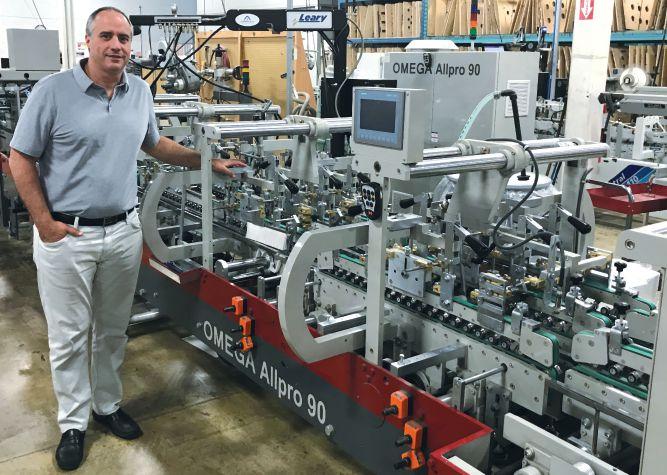
Canadian packaging specialist Ellis Paper Box, a member of the Ellis Group, installed a new Koenig & Bauer Duran Omega Allpro 90 folder gluer – the first in North America – in its postpress department at its 60,000-squarefoot Mississauga, Ont., facility this spring.
UPM Raflatac recently announced that Brinder Gill has joined its North America Sales Team as Area Sales Director for the Eastern United States and Canada. He joins the company from Silgan Dispensing Systems, where he served as Senior Manager, Global Beauty Category Marketing. Gill is based out of Philadelphia, Penn. He brings more than 10 years of experience in the packaging and logistics industries to the position, with a focus on sustainable packaging.
Prime Data of Aurora, Ont., is welcoming Jim Wisner to its team as Vice-President, Business Development. In addition to developing successful direct marketing strategies, Wisner has taken a leadership role for more than 25 years with the Direct Marketing Association of Canada and has been active in the National Association of Major Mail Users (NAMMU), the Canadian Marketing Association (CMA) and the U.S. Direct Marketing Association (DMA).
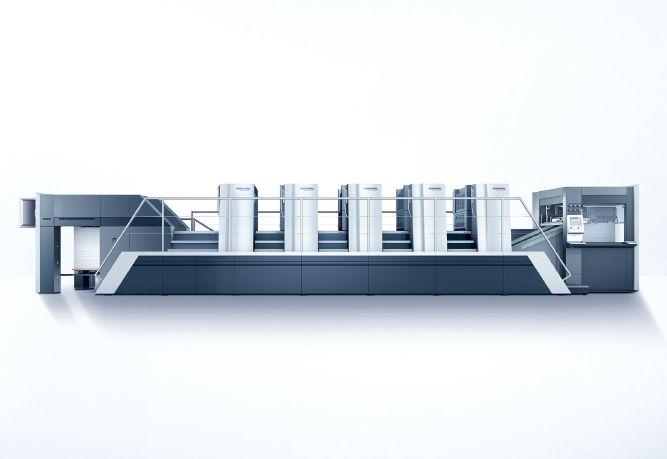
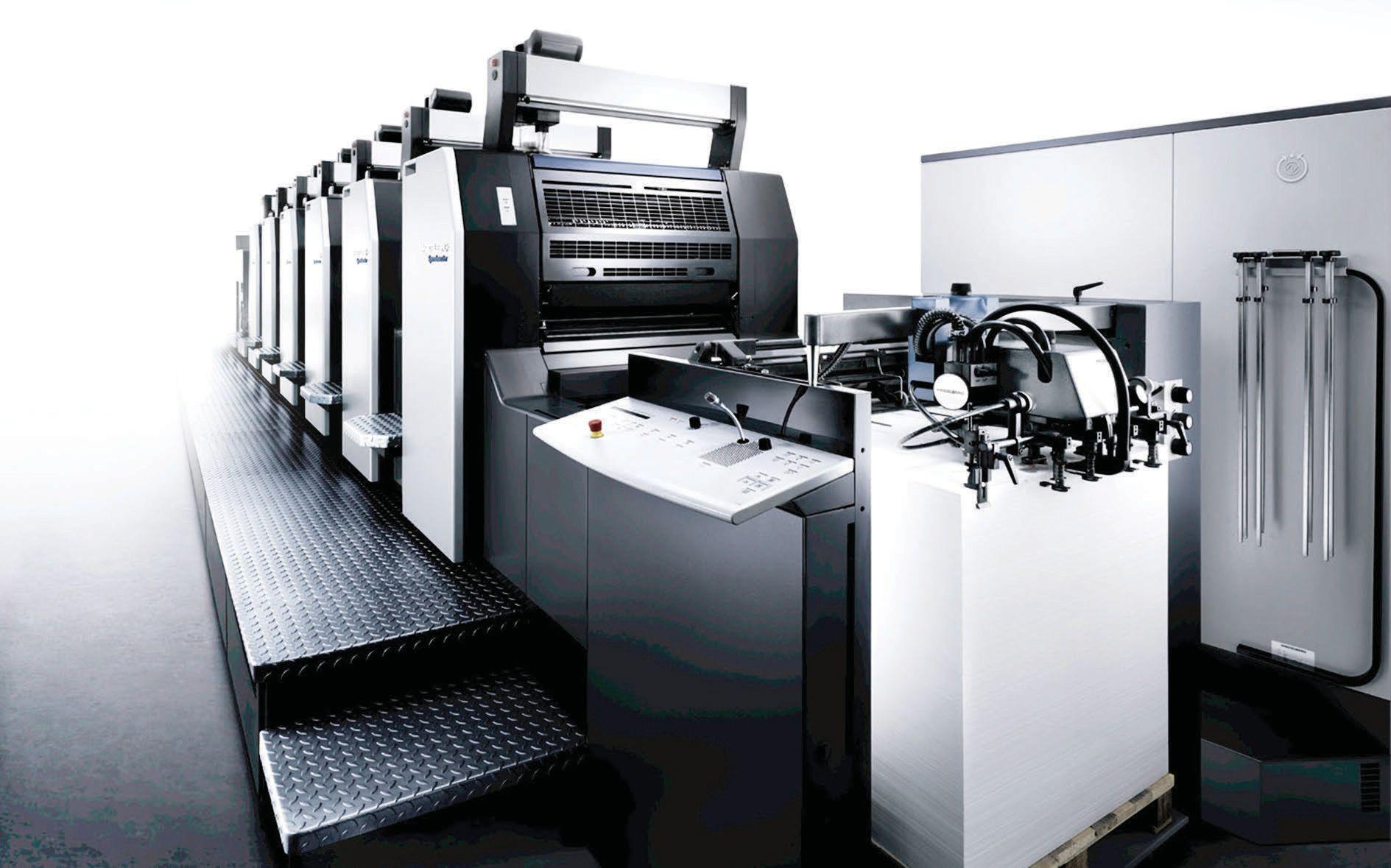
The latest equipment investment for Quebec-based PDI is a Heidelberg Speedmaster XL 106-5 with LED drying technology. Boasting the latest in UV curing technology, the Speedmaster is equipped with a Heidelberg DryStar LED curing system at the end of the press.
Getting an education
Lessons learned from the golden years of Wall Street printers
By Nick Howard
Iwas the only guy not in a suit. It’s 1986, and after picking up a bunch of executives at the airport, here we were all clustered around a press console of an almost-new Miller TP 104 five-colour press. The Miller, a 41-inch double perfector, had barely reached its first birthday. Pandick Inc. was the buyer and one of a close group of financial printers headquartered in New York City. Bowne & Co., Charles P. Young, Sorg Inc., Merrill Corp, and R.R. Donnelly were the other members of a prestigious and lucrative club — the voice of Wall Street. In Bowne’s case, a rich history going back to 1775.
CALENDAR
October 10, 2019
Celebration of Life:
Remembering Mary Black Ryerson University, Toronto, Ont.
October 23-25, 2019
Printing United 2019 Dallas, Texas
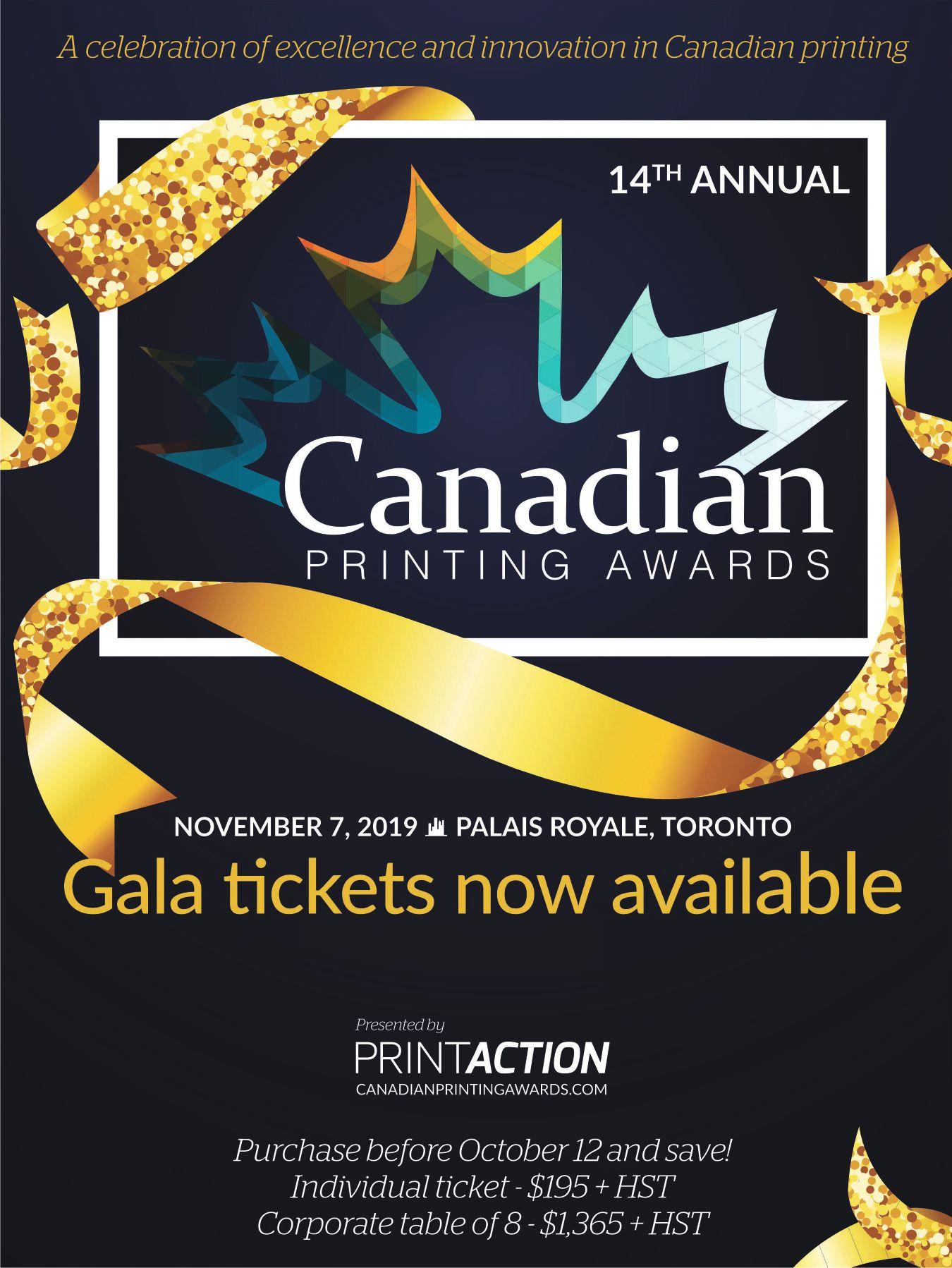
November 7, 2019
Canadian Printing Awards Palais Royale, Toronto, Ont.
November 25-28, 2019
Shanghai World of Packaging Shanghai, China
June 16-26, 2020
drupa 2020
Düsseldorf, Germany
September 15-17, 2020
Labelexpo Americas 2020
Rosemont, Ill.
No one would have guessed that the Black Friday market crash of October 1987 would not only unsettle financial markets but would also lead to the collapse of most of these printers. Today, only Merrill Corp. (founded in 1968) and R.R. Donnelly (RRD) would survive. Annual report and financial print was so desirable and envied, and few printers could provide the quality or the 24/7 turnaround time. However, it was also a Wurlitzer that only played one song.
On this early fall day in Waterloo, Ont., Pandick bought the Miller and to celebrate, I took them for lunch in the quaint town of St. Jacobs, Ont.
The Miller sale was a milestone, and we also got the contract to install it. Not everyone was thrilled about that. One of the Pandick executives had brought along his local Miller mechanic, who seemed very unhappy to lose out on the installation.
Now into November, we were busy dismantling the press, which included the removal of all inkers so it could be hoisted up eight floors at 345 Hudson Street in lower Manhattan. Eager to start the install, we had to be onsite bright and early on a Saturday morning. The street had to be blocked o , and a Saturday was the only possi-
bility. Because of the vicinity to Newark, N.J., we decided to fly there and stay across the river in Jersey City. Our first calamity didn’t take long. On Friday night, we arrived at the old Toronto Pearson Airport terminal 1 where a batch of flights departed from the same gate. Not paying attention, we somehow missed our plane by boarding an aircraft headed for Boston! The penny dropped when a passenger, staring at his ticket, told me I was in his seat. What a mess this caused. Not only did we miss our flight but all our baggage and tools ended up in Newark, while we headed on another plane to LaGuardia Airport in Queens, N.Y. A ridiculously expensive taxi ride later got us to our motel after midnight. Things didn’t get much better.
On a sunny Saturday morning, we watched the riggers hoist units that weighed 12,000 pounds each into a massive century-old building in New York’s famous “Printer’s Row.” However, there was a new problem. The riggers refused to take the delivery, saying it was too large to fit the elevator shaft. They insisted – and as I later discovered through their pal, the Miller mechanic – we were forced to disassemble the delivery, but the work had to be carried out at their yard in Brooklyn. This was another delay,
which also required massive amounts of electrical disconnections as the delivery panel housed the majority of the controls for the press.
The weather started to turn nasty, as cold winds from the north quickly reminded us we were in November. To argue proved futile, even though we demonstrated that the unit could fit by showing both Pandick and riggers how we’d twist and raise the delivery somewhat like the launch-pad of a V1 rocket. A Pandick limo picked us up and there we were in a dank, unheated and dimly lit warehouse, ripping apart the delivery.
A few days later the press was on
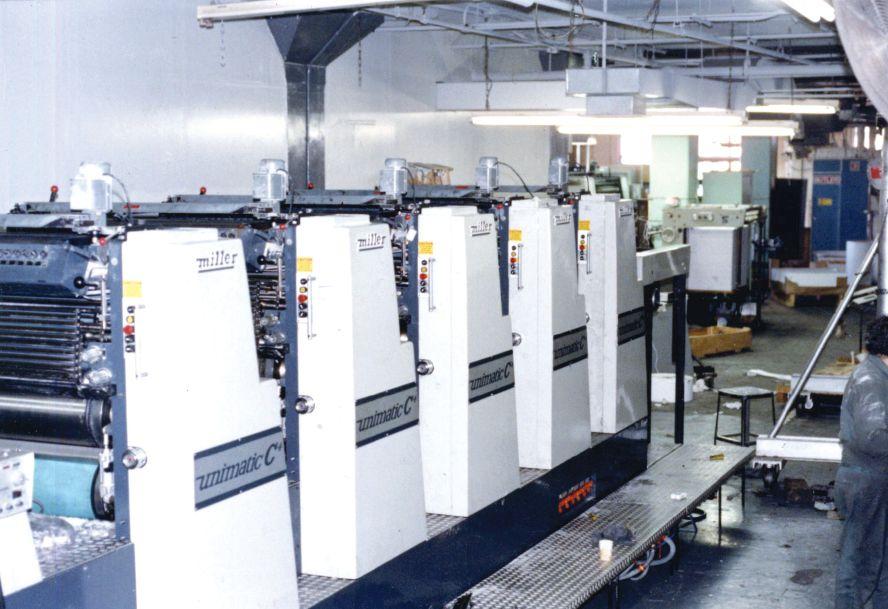
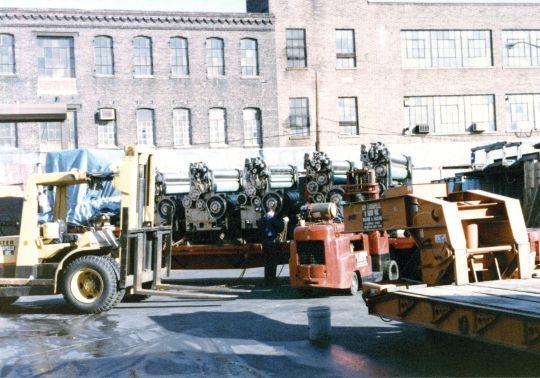
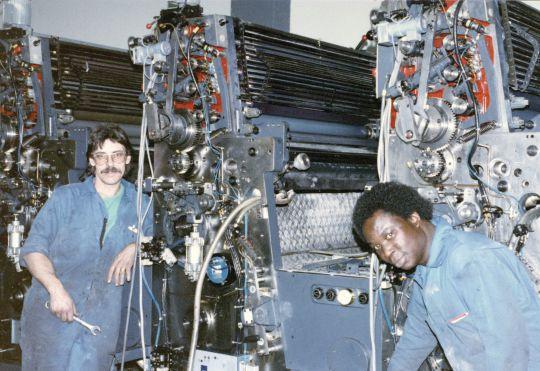
Photo 1: Completion of the Miller TP 104 press at Pandick.
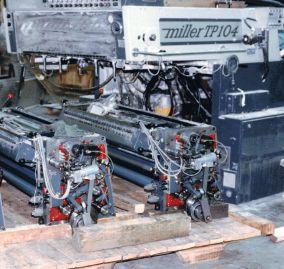
Photo 2: Inker removal of the Miller TP 104.
the eighth floor, and we busied ourselves getting it assembled; first the printing units, then using a gantry, the inkers, and finally the feeder, delivery and agony of reassembling inkers and delivery sub-assemblies. Each day seemed longer than the last. A few 16-hour days later, the press was ready for power and we were all exhausted, not only of the long hours but due to the travel back to Jersey every night. The routine involved packing up our tools, hiding them, walking to the subway, and a short ride to the World Trade Center to catch the PATH subway that took us under the Hudson River to Jersey City — repeated each morning. Usually, we were the last to leave the plant, and we’d wave goodbye to the janitor, who we later noticed, had bathroom supplies stu ed under his coat.
The production equipment at Pandick was ancient. Most of the bindery equipment looked like it had arrived on the Mayflower. Old Sheridan stitchers, a Juengst gatherer and covering machine, and Baum and Dexter folders covered the vast expanse. The pressroom consisted of old Miller TP-38 perfectors and a couple of Coldset web presses. Our almost-new Miller TP 104 looked out of place. As rolls of paper came o the freight elevator and were carted into the pressroom, the entire press shook from the vibration that reverberated right across the production floor.
The press finally went into production, though days late as a result of troubleshooting the electrics. Everything from rags to tools would routinely vanish each night. We were surprised that all the Miller tools had also grown legs and walked away. Even more, we were rattled to have the foreman chastise us for these loses as if we could do anything about that. Learning quickly, we scattered through the pressroom searching (and occasionally finding) some of the tools. It turned out pretty much all the pressmen either hoarded consumables, or like our friend the janitor, took them home. Lesson learned: Don’t leave anything of apparent value laying around.
One takeaway in rich abundance was the incredible amount of print produced each day. Financial printers seemed to defy gravity with a constant, endless amount of Wall Street work. That would change over the next few years. First, Xerox Docutech industrial copiers eroded the B/W litho press then as imagesetters appeared, whole prepress departments started to vanish, as the Internet eventually lead to the unplanned obsolescence of jobs. Many of the Pandick sta had been employed for decades doing precisely the same tasks. Customer press OK lounges looked more like the lobby of a Four Seasons and making money was as easy as taking a breath.
The Episcopal Trinity Church chartered in 1697, owns a large block of real estate including the building where Pandick used to be. Today, the holdings are valued at US$6 billion. Landlords have a virtually recession-proof business model. As printers started to leave Manhattan for cheaper locals in Long Island and New Jersey, Trinity remodelled existing factory buildings and increased rent for the few that remained, so locals opined that Trinity strongly encourage printers to leave by not renewing leases. The New York real estate business hardly missed a beat and was una ected by technology trends or the rise of the Internet, as buildings over 100 years old continued to bring in fantastic revenue. Trinity shed no tears seeing the backend of many printers, including Pandick.
Another old printer, Latham Process, was located on nearby Varick Street. I installed a 50-inch two-colour Planeta PZO-6 in the plant back in 1983. Latham was a museum of printing machines even back then. Anchored by a George Mann 56-inch perfector and pre-war Plamag web press, Latham had all the work it could handle, including printing a daily stock guide for Standard & Poors. Latham is but a distant memory today.
Gentrification was upon New York. Financial printing, while still around, bears no resemblance to the magnitude that existed in the 1980s. Our press sale was just one of the hundreds closed by machinery suppliers all over the world.
We, machinery dealers, were also hypnotized by what was immediately ahead of us that we never stopped to realize there could be an end date to this success. I learned a great deal from that Pandick installation, both during the install and after the Black Monday crash of October 19, 1987, when the Dow dropped almost 23 percent. Never assume anything will stay the same and learn how to improvise when strategies suddenly take a detour. Because of our relationship with Pandick and after seeing the carnage of Black Friday in real time, we proceeded more cautiously into the 1990s, and assumed future economic disruptions would change our world repeatedly. We also thought more about a goal than a rigid plan, and this proved successful.
The print industry has completely changed since 1987. At one time print shops were filled with skilled workers, who took years to learn and develop their craft. Today’s youngsters have grown up in the digital age and are completely comfortable with the interface of operator and machine. They have the necessary skills to produce work on intelligent equipment that simply needs a mouse click to start operating. Production equipment, primarily digital, has a short usable life as we are inundated with even more straightforward to run machines. In Pandick’s day, a machine’s usefulness was measured in decades, not years. Looking back, I see how businesses such as Pandick didn’t have a chance and were unprepared to navigate future technology shifts and tighter margins. So preoccupied, Pandick saw no need to assume the days of financial printing were numbered. Instead of branching out into other print segments, such as general commercial colour work or buying another printer, Pandick stayed its course. In comparison Bowne never failed by spreading its services, especially in its Canadian operations, and only ceased trading when RRD purchased it.
I still see this type of myopia today. When industry focus is primarily about the mechanics of print or the twists and turns of new colour control tools, that’s a mistake. Running a digital (even o set) press has never been as easy. Colour control and file manipulation is no longer wishful thinking but rather expected on any new machine. Print must exploit the equipment we have and create new products that help our customers sell more. Today’s successful printers are already doing that.
NICK HOWARD, a partner in Howard Graphic Equipment and Howard Iron Works, is a printing historian, consultant and Certified Appraiser of capital equipment.
nick@howardgraphicequipment.com
Photo 3: Unloading the Miller TP 104 press at Pandick. Photo 4: Howard technicians at Pandick.
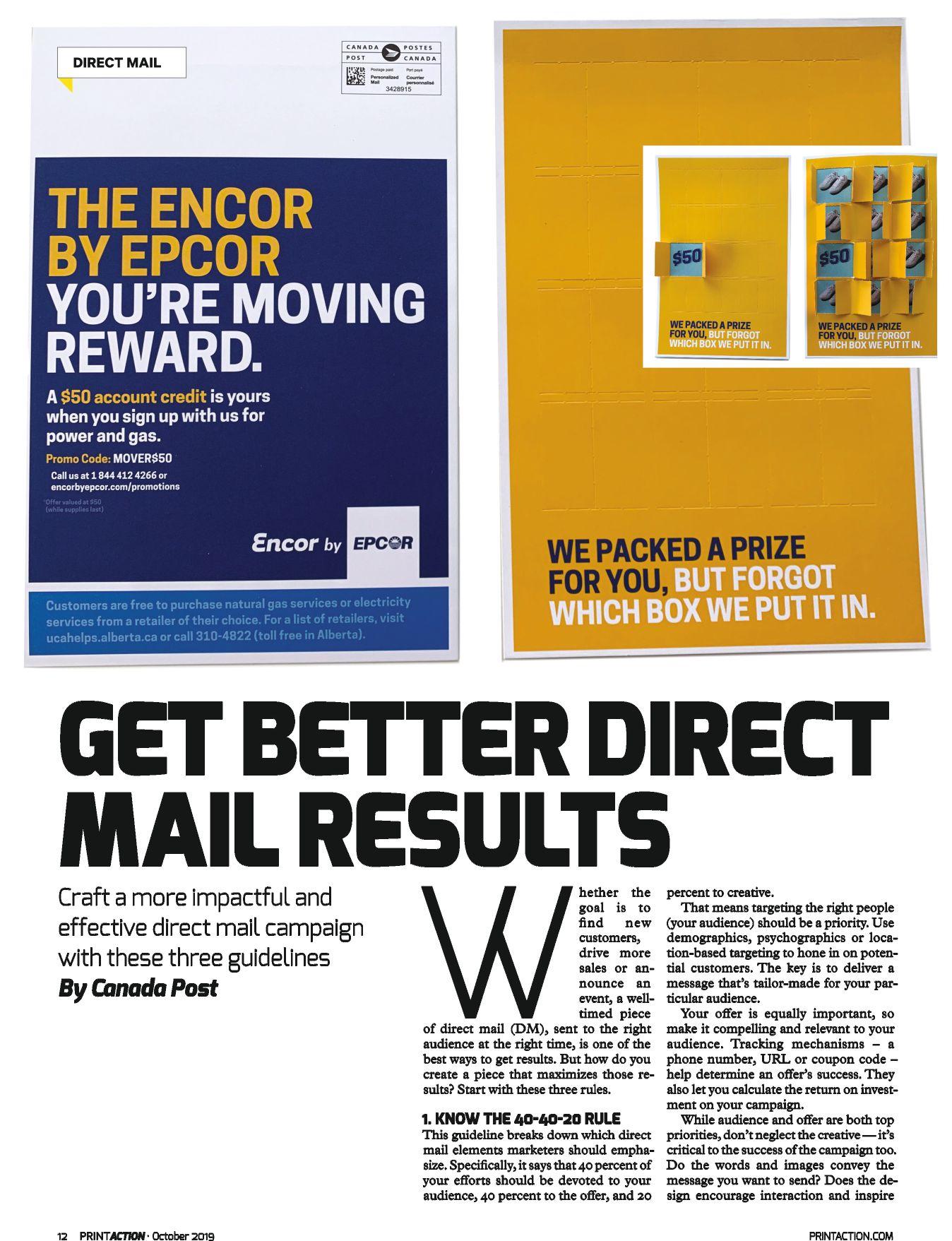
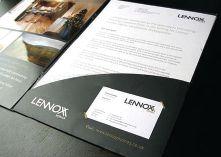
Burke Group recently produced 1,000 advent-style mail pieces for Epcor’s new customer promotion. Featuring 12 windows – with one hiding a $50 account credit –the piece was printed CMYK 4/4 on a Heidelberg 8-colour low energy UV press, 2-up CITO Rotary Chem Mill Die on 80-lb Lynx Opaque Ultra Smooth Cover. Creative Manager Tyson Dueck says the challenge was making a die that perfs the windows and scores the hinges while maintaining structural integrity to avoid rips. Partners for the project include DDB (agency).
action? It needs to be strategically designed to get results.
2. USE FORMATTING TO YOUR ADVANTAGE
When it comes to direct mail shape and size, marketers have many choices. Each format has features and benefits that could work for you, depending on your particular campaign.
Self-mailers
• Self-mailers, including postcards, are one of the most cost-e ective forms of DM. There’s no need for an envelope, since the customer address is printed directly on the piece.
• The creative can be produced in many shapes. A pizza shop could print a paper “slice” announcing a weekly special. A real estate brokerage might send out a notice in the shape of a house. A moving company might develop a DM in the shape of a truck. With self-mailers, that level of customization is easy.
• Self-mailers are good for simple messages. Use them to notify existing customers about upcoming sales and promotions.
• Self-mailers stand out in the mailbox — the message gets seen quickly since people don’t have to open an envelope to read it.
• You need to choose durable card stock, but your self-mailer doesn’t have to be a postcard, it can have multiple folding panes.
Outer envelope and le er
• Include your pitch, announcement, o er or other message on the letter. A #10 envelope has a clear pane, so the name and
address can be seen, which makes it ideal for personalizing your o er.
• The outside of the envelope provides more real estate for your message. Adding copy to this area also creates visual interest and will help your direct mail stand out.
Catalogues
• Catalogues and mini-catalogues allow you to include more information than other direct mail options. Use them to tell your brand story and to describe products in detail.
• If you incorporate aspirational photography and inspiring content, a catalogue can help re-engage lapsed customers and increase order sizes. If you use trigger marketing, you can amplify your results: send lookbooks, gift guides or other catalogues around important dates for your customers. They could be for a relevant holiday, like Father’s Day, for example; a season, think back-to-school time; or a milestone, such as a birthday. These options are more expensive than other formats, so make sure to send them to highly-targeted prospects or current customers.
3. CHOOSE THE RIGHT PAPER
As a printing partner, you can advise about the best paper weights and colours for a direct mail campaign. Di erent types of mail require di erent paper. For example, since postcards have no envelopes, the paper stock needs to be heavy enough to travel safely through mail sorting equipment. If you choose an outer envelope and letter combination for your campaign, you can opt for lighter
20%
Format, design & copy
40%
40/40/20 RULE
Mailing li 40%
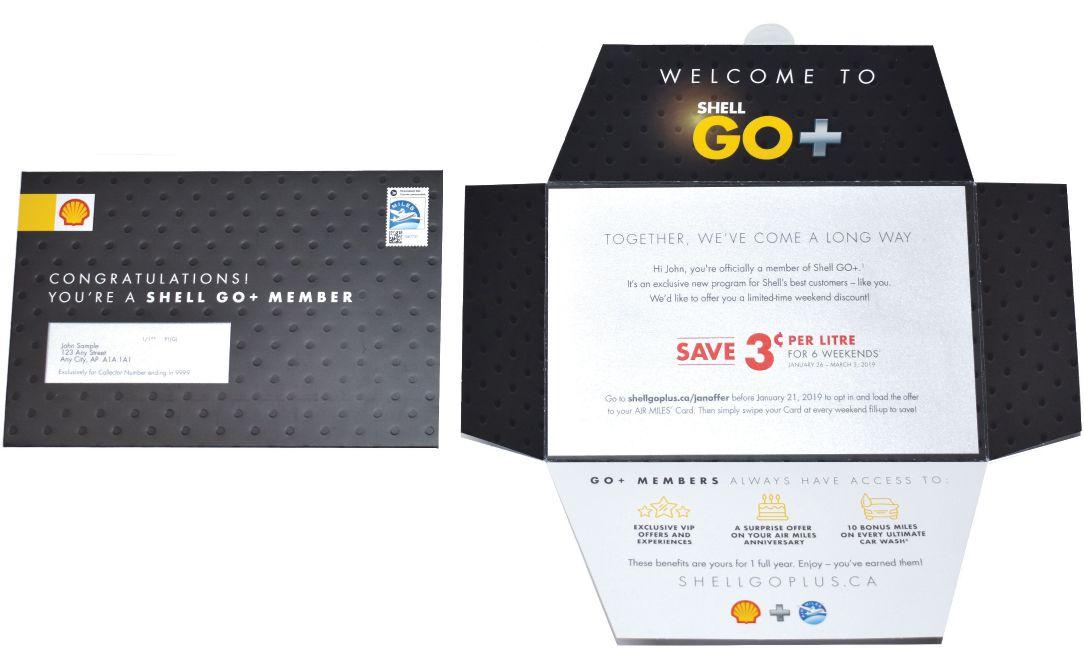
The Air Miles Shell GO direct mail campaign, created and printed by TC Transcontinental, targeted Shell’s best customers to join the Shell GO+ program. The carrier was printed 4/4 on a Heidelberg XL + soft touch AQ + spot gloss UV on 80-lb silk cover stock, o line deboss and die-cut, while the letter was printed 4/4 variable on an HP Indigo. A matte silver foil sticker seal added to the invitation-type look.
paper because your message is protected by the envelope.
Catalogues and mini catalogues have weight and size requirements, and you need to consider the binding as well. The binding is the part along the seam — will it be stapled or glued? Your answer will impact the paper you can use. When it comes to outer envelopes and letters, paper colour lets you show a little personality by choosing a brand colour, for example, or something other than standard white. Colour also a ects legibility — make sure there’s enough contrast between your paper and ink colours for the address to be read properly.
This article was originally published on the Canada Post blog.
Networking 101
Top tips for developing your networking skills and growing your business circle
By Minuteman Press International
ou know the saying: It’s not what you know, it’s who you know that matters. When it comes to life in business, who you know plays a vital role in the resources, growth and connections you can generate. And how do you get to know people? Through a skill called networking.
No matter who you are or what your role is in the business, networking is an important skill to have. But while networking comes naturally to some, it can definitely be a challenge for others. Networking skills aren’t just something
you’re born with — they’re something you can learn and grow. By developing your networking skills, you can continue to expand your business circle, which provides more resources and opportun-
ities. Here is how to grow your circle.
1. Study before networking
If you’re planning on going to a networking event or situation, the most
valuable thing you can do is study. Just like with a test in school, studying will help grow your networking skills. For instance, if you go to an event and are able to obtain the registration list of possible attendees, see what you can study beforehand to feel better prepared. Learn as much as you can about the people attending, the business they represent, and the products or services they provide. Whenever possible, take advantage of as much information you can gain before the networking opportunity arises.
2. Prepare questions
If you are someone who feels awkward or uncomfortable when networking, don’t worry. Something that can combat your nerves is to prepare yourself with questions. Networking revolves around intentional conversation, which includes questions. Instead of worrying about coming up with questions on the spot, prepare some beforehand and keep them top of mind. Then, whenever there is an awkward pause, use your prepared questions to break the ice. The conversation will keep flowing and you will feel confident as a top networker in your circle.
3. Practice active listening
Of course, once you ask a question, then
The use of collaborative words (such as “we” instead of “I”) increases the success rate of sales calls by 35 percent, according to gong.io research.
comes the challenging part — listening. No matter who you are, human beings tend to speak first and listen second. When someone talks to us, we spend half the time preparing our own answer in the back of our minds, rather than actually registering what they say. Instead, become a better networker and grow your circle by practicing active listening throughout the conversation. Then once you respond, you can utilize important details from the person’s comment to show them you cared enough to listen and actively engage in the conversation.
4. O er solutions
What’s the best way to grow your circle of networking relationships? O er solutions for other people’s problems. Whenever possible throughout the conversation, see how you can o er a solution to help the person you’re talking to. Depending on the business and its products or services, consider collaborating together to help meet each other’s needs. A solution can mean a variety of di erent things, from emailing a helpful article to someone, to connecting them with another business professional, to even collaborating on an idea or event together. When you o er solutions to others, they will o er solutions in return, helping to enhance your
business and grow your networking circle.
5. Don’t forget the followup
As a professional, you probably already know this popular saying: The fortune is in the followup. When it comes to networking, this could not be more true. The most critical step of every networking relationship is to followup with the person you spoke with. For instance, if you o er someone a solution, be sure to actually provide the solution to them in the followup. Even if you have a simple conversation with someone, send an intentional note thanking them for their time and sharing your excitement for the relationship in the future. When you followup, you show that you care about the relationship, and strengthen each connection you make. Networking is one of the most valuable and important skills to have when it comes to promoting your business and expanding your brand. Fortunately, anyone can learn how to network and grow their circle. Use these tips the next time you find yourself in a networking situation, and watch your business grow because of it.
This article was originally published on the Minuteman Press International blog.
The Board Handling System
Luxurious labels
Exploring the creative process behind Mayhaven’s embellished gold, black and white label
By PrintAction Staff
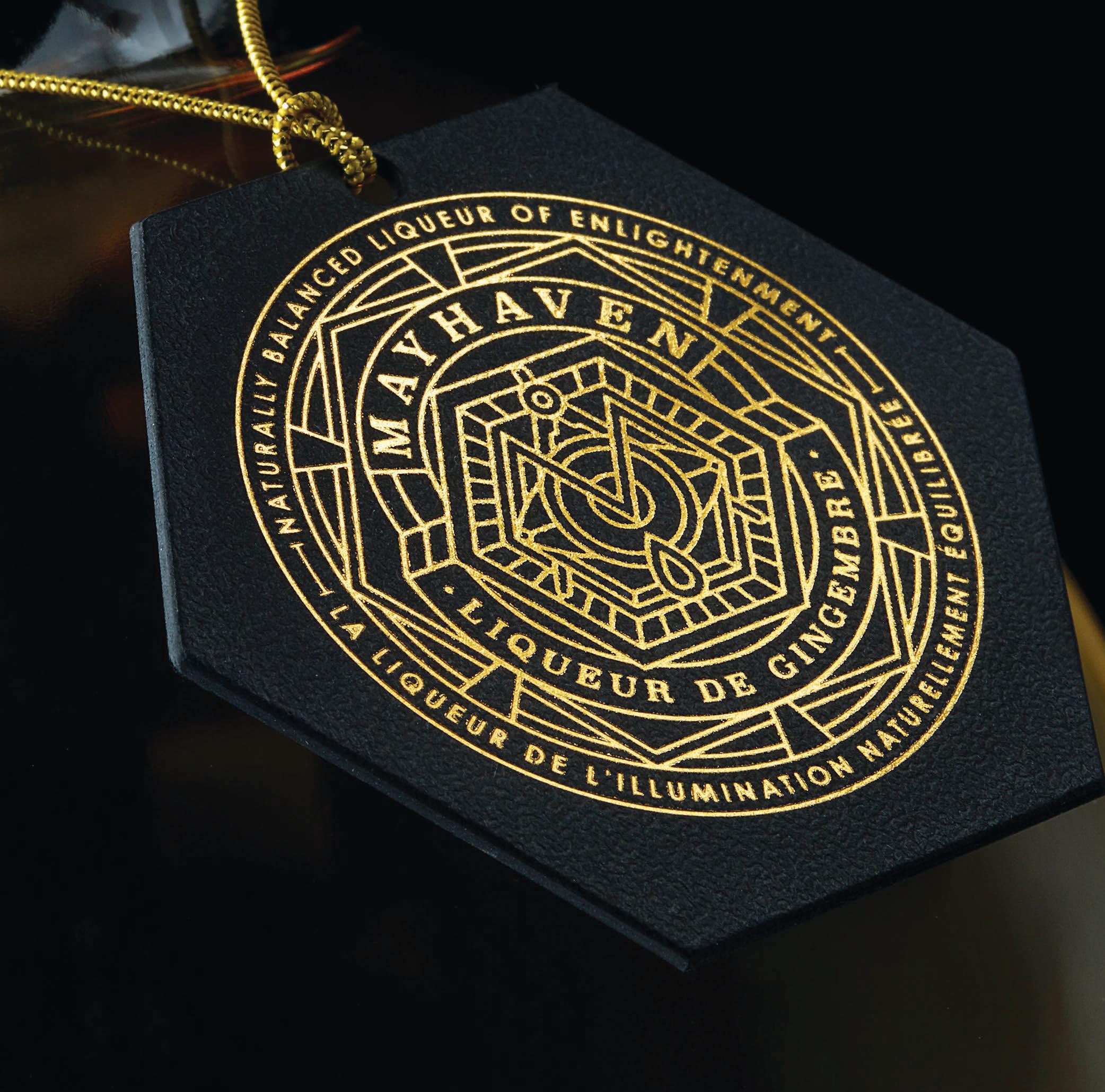
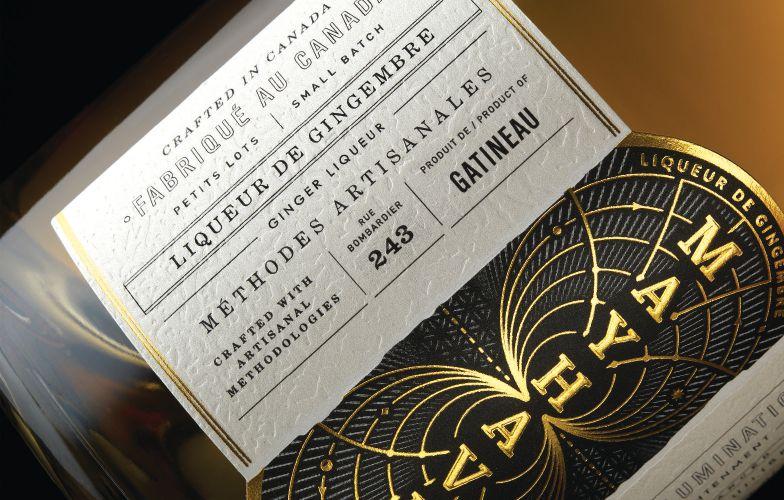
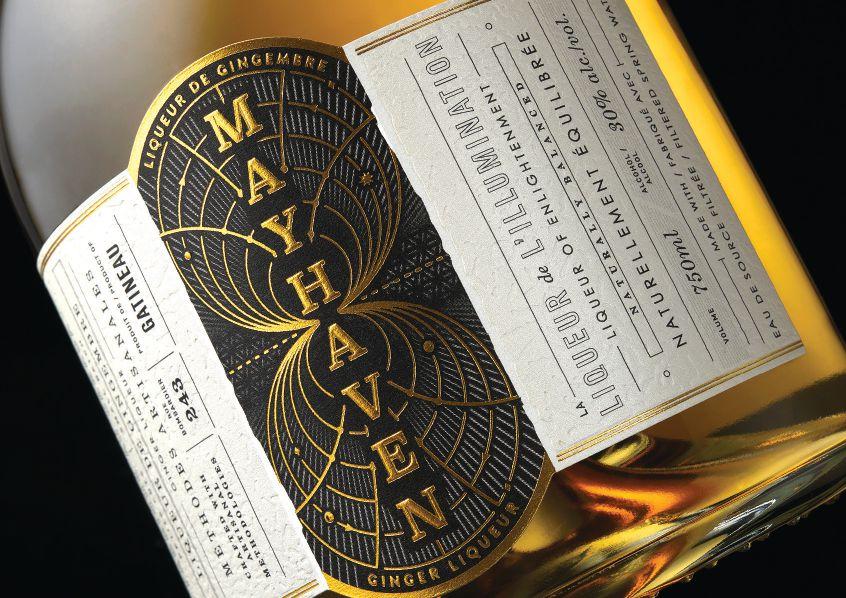
he concept for this liqueur came about while researching avenues that we could hinge the brand’s story on,” Chad Michael explains, Owner and Designer at Chad Michael Studio, describing the creative process behind the elegant Mayhaven ginger liqueur label. Handcrafted by Quebec-based Artist in Residence Distillerie, the liqueur features notes of lime, pepper and ginger. “The client had described the liquid as a flavour profile that was ‘out of this world.’ That’s all we needed to build from. Thereafter the brand grew legs and became the spirit of infinite possibilities, one that gives enlightenment, and essentially a universe in a bottle, thus the concept was derived out of a single phrase. Visual inspiration was then pulled from galaxies, constellations and the idea of ‘the unknown.’”
“T
Michael says the key achievements in bringing the label to life was the selection of Kurz gold foil and its placement throughout the label. Another was the paper stock, Wausau’s Allure Starlight, which gives the entire label an elegant shimmer as it reflects light. The initial run came with a letter-pressed, gold-foiled neck tag displaying the Mayhaven logo on Neenah’s Epic Black Stipple stock. The biggest challenge, he says, was the custom blind debossing texture on the left and right panels of the label. “This was extremely tricky because if the deboss was hit too hard on the stock, the text becomes unreadable. It worked to a certain extent on the first print run but we eventually had to remove it because [it] couldn’t be made subtle enough.”
Chad Michael Studio worked with Imprimerie Ste-Julie (IMPSJ) of SainteJulie, Que., for the project. Founded in 1975, Imprimerie Ste-Julie specializes in label printing and shrink sleeve printing and operates graphic design, prepress, digital printing, flexography, conventional cutting, laser, shrink sleeve and finishing departments. “The [decision] to use IMPSJ was made not only because they were so close to the client but because
Partners for the project include Chad Michael Studio (design agency), Imprimerie Ste-Julie (printer), and Rusty Hill (photography).
we’ve worked with them in the past for one of our clients, St. Laurent Distillerie, where they did exceptional work.”
He stresses the importance of staying on top of print trends. “Recognizing packaging trends is imperative because if you want to put out work that breaks through the noise, you need to know the trends so you avoid mimicking them. No client wants their product to look like someone else’s, even if they say they do,” Michael says. “Printers are producing some mind-blowing processes that combine varnishes, embossings and even scent that are pretty amazing to touch. Papers have the ability to no longer feel like paper, but [rather] like feathers and leather. My goal is to try to bring more of this into the packaging I create.”
“No client wants their product to look like someone else’s — even if they say they do.”
Printing United preview
The inaugural Printing United tradeshow is set for October 23 to 25 in Dallas, Texas. Described as the next generation of the SGIA expo, more than 600 exhibitors are expected to showcase new technologies at the show.
Crawford Te nologies
Toronto, Ont.-based Crawford Technologies plans to showcase its range of software solutions at booth 9962. Products to be highlighted include: PRO Conductor, an integration platform solution designed to orchestrate every step of an endto-end print production workflow; PRO Inkjet Express to help print and mailing service providers and in-plant operators take advantage of
the e ciency of inkjet when converting to inkjet presses; and QA in the Cloud, a solution that automates document testing and manages continuous regression testing, as well as comparisons with on-premises or secure Cloud licensing options.
Ricoh Ricoh invites visitors to booth 7001 to learn how it digs deeper into
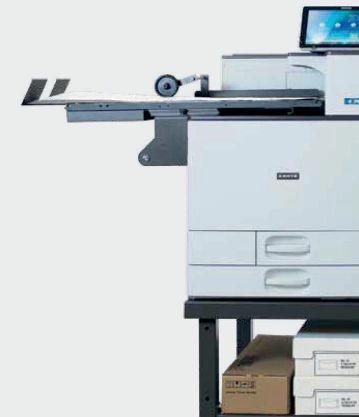
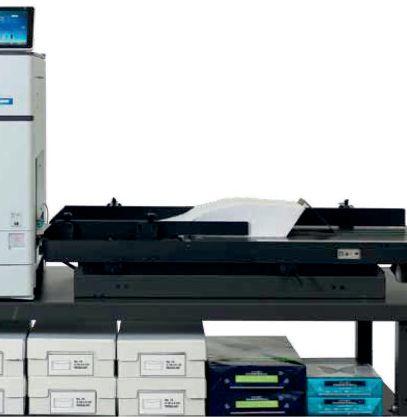
LOWEST COST PER PRINT
Less than 1¢ per full colour envelope
AMAZING PRINT QUALITY
Resolution up to 4800
BLAZING FAST PRINT SPEED
Up to 4,000 full colour envelopes per hour
Built on the same structure as the Ricoh Pro T7210, the Ricoh Pro TF6250 large-format UV flatbed (above) boasts versatility and high image quality.
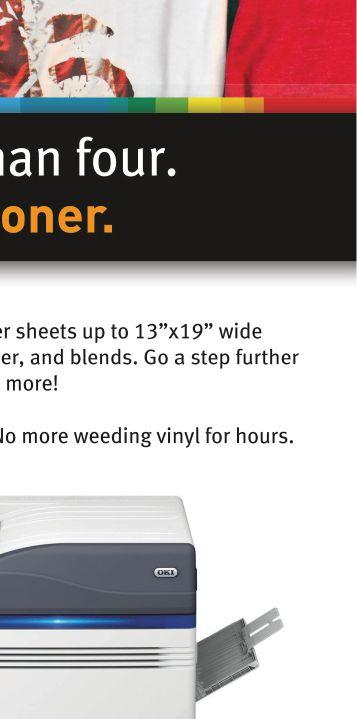
Way more than an envelope press.
The En/Press is, by far, the best machine for printing not only envelopes, but also for NCR business forms, stationery, posters, flyers, brochures, banners, newsletters, magnets, stickers, decals and much more.
customers’ premier partner, with onsite experts, technology displays and demonstrations. Its booth will highlight how Ricoh strives to empower printers to adapt and thrive: Making expanding wide-format offerings easier, pushing the boundaries of substrate versatility, creating gorgeous and precise colours, and helping deliver fast turns. All of these are top concerns for modern print buyers, who want eye-catching applications, fast, Ricoh explains. Visitors can also explore the newly available Ricoh Pro TF6250 in action. For every badge scanned during the show, Ricoh will make a charitable donation to the U.S. Wounded Warrior Project, which supports wounded military veterans and service members. There will also be special times when attendees can double their donation and be entered in a ra e for a Wounded Warrior gift basket.
MPI Print
MPI Print Inc. of Toronto, Ont., describes itself as the largest trade printer in Canada. Since 1999, it has grown into two plants and almost 100,000 square feet. “At MPI, we continuously strive to find ways to lower print costs. We have invested heavily in automation, bulk paper purchasing and converting, and we bring those savings to our trade clients,” it says. With capabilities in o set sheetfed, high-volume web, full bindery and bookbinding, digital and large-format as well as specialty finishing on a Scodix Ultra Pro 2, the trade printer goes by the motto: “From 100 business cards to 1 million magazines, all under one roof — now two.”
swissQprint
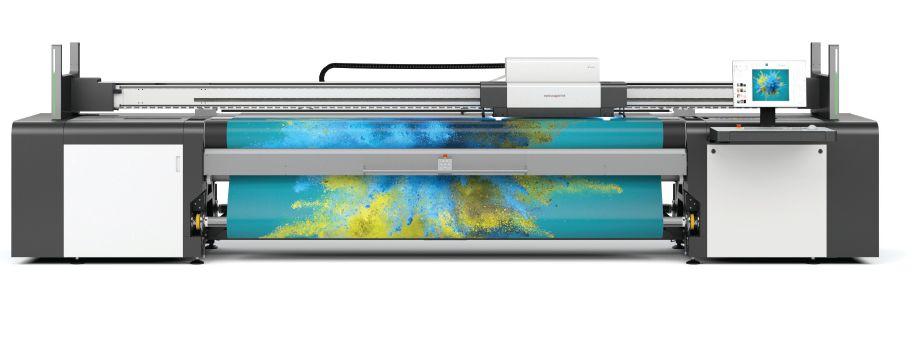
Karibu, swissQprint’s first roll-toroll printer, will make its North American debut at booth 8845. The Swiss manufacturer will also present its other flatbed solutions, including its flagship flatbed printer, Nyala 3. Now available internationally, the UV inkjet printer delivers a maximum print width of 3.4 metres and features a lightbox next to the printing area for on-the-spot inspection of backlit prints. Four beacon-like status indicators are a xed to the print beam, informing the operator of machine status and printing progress. For users who regularly print in parallel, swissQprint o ers a dual roll option capable of handling two rolls each up to 1.6 metres wide, doubling Karibu’s productivity. The roll holders are split into two sections with each half of the shaft driven individually, which
swissQprint says will help ensure optimum web tension on both rolls.
INX International
INX International Ink Co. plans to feature a complete line of ink and coating products. On the digital side, INX (booth 10555) will highlight high-performance Triangle brand alternative inks, plus dye-sublimation and Prodigy brand inks for industrial print applications. The Evolve Advanced Digital Solutions custom integration hardware program will also be represented. From a conventional perspective, INXhrc natural-based inks are designed to reduce regulatory risk for brand owners and improve production efficiencies for printers and converters with a 25 to 30 percent lower CO2 footprint than standard aqueous inks, INX explains. HFB multipurpose UV Curable inks boast a premium formulation that runs cleaner than OEM inks, with “truer reds and excellent adhesion and flexibility on a range of graphic medias,” the company says, noting they are optimized for curing both UV and LED on HP FB printers, and intended for jetting on HP Scitex FB500, FB700 and FB900 printers. As well, GSU is formulated to attain GRACoL standards and hit G7 targets to match colour and produce consistent print quality while running on EFI VUTEk GS series hybrid model printers.
Delphax Solutions
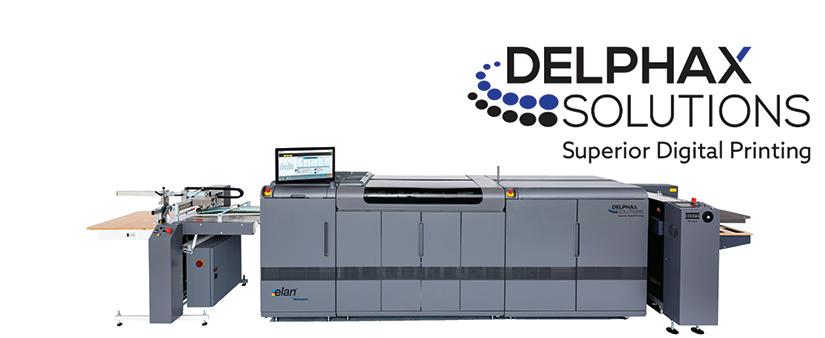
Toronto, Ont.-based Delphax Solutions, a manufacturer of production inkjet equipment, plans to highlight its Elan HD product portfolio with a new high-speed monochrome print platform at booth 8458. Designed to address the continuing need for monochrome output, the expandable solution continues Delphax Solutions’ model of providing “no click” and self-maintenance options to reduce the TCO for end-users.
Sakurai Screen Foil LQM 105 hot foil amper
Sakurai, a provider of sheetfed screen printing technology, will introduce the LQM 105 inline hot foil stamper to the North American market in booth 1420. Sakurai will conduct live demonstrations of a Maestro MS-102AX cylinder screen press equipped with a Natgraph UV dryer, stacker and new LQM 105 inline hot foil stamper. The ScreenFoil LQM 105 aims to bring a “new level of flexibility, quality and performance” when combined with any size or vintage Sakurai screen press, the company explains, and is designed for PSP, folders, leaflets, business cards, loyalty cards, magazines, book covers, packaging, promotional items, labels, roll-to-roll, greeting card, automotive, appliance and plastic card applications. The featured Sakurai Maestro MS102AX is a suitable screen press for a myriad of specialty finishing applications, such as specialty e ects foil, glitter, soft touch, flood, soft spot coating and more, it adds. The 29 5/8 x 41 1/2-inch MS-102AX operates at speeds up to 4,000 IPH and accepts stock from .003 to .032 inches thick. The Maestro is capable of printing on a range of substrates, such as plastic film for electronic applications, membrane switches, display panels, touchscreens as well as paper, board and foil.
Muller Martini
Visitors to Muller Martini’s booth 10543 can see live demonstrations of finishing technologies designed to reduce workflow bottlenecks. Boasting zero makereadies, touchless workflow, format variability, and short runs (including runs of one), machine demos include: Presto II Digital singular saddle stitching solution for books, direct mailers and catalogues; Vareo perfect binder in conjunction with the InfiniTrim three-knife trimmer; and Endsheet Feeder, which automates
the hardcover book block process for either round or straight spines.
Quadient
A Neopost Digital company, Quadient will co-locate with Neopost in booth 11759 to highlight its Customer Communications Management solutions. Quadient Inspire boasts quick and easy repurposing of existing print-based content into high-impact digital communications. Meanwhile, Quadient Interactive is designed to digitize key processes and empower business users within service providers and their enterprise clients to streamline content change management.
Heidelberg
Heidelberg North America will showcase its solutions for the commercial, packaging, and label markets at booth 10143. Aimed at empowering commercial and folding carton customers to expand into new areas of business, Heidelberg will premiere its new Digimatrix 60 FC die-cutter and hot-foiler as well as the Diana Go 85 folder gluer –both aimed at short-run and digital packaging solutions – at the show. A small-format die-cutter and foil stamper, the Digimatrix 60 FC is designed for digital run lengths. It runs up to 5,500 sheets/hour and can process sheets up to 23.6 x 17.7 inches for finishing various shortrun or small-format jobs.The foiling version of the machine (FC) allows for hot-foiling on a range of substrates. The machine can be equipped with Masterset, which registers each sheet individually via print marks for print-to-cut registration. At less than 33 feet in length, the Diana Go 85 folder gluer can produce cartons at speeds up to 250 m/min and widths up to 33.4 inches, handling di erent carton styles, such as straight-line and lock-bottom cartons, as well as special styles with attachments, such as envelopes and presentation folders.
The Karibu features a lightbox next to the printing area for on-the-spot inspection and quality control.
Detailing new solutions from Canon, Epson, Esko, EyeC, Fujifilm and Inca Digital, HP Indigo and Agfa, Komori, Kornit, Mark Andy, Pantone and Roland
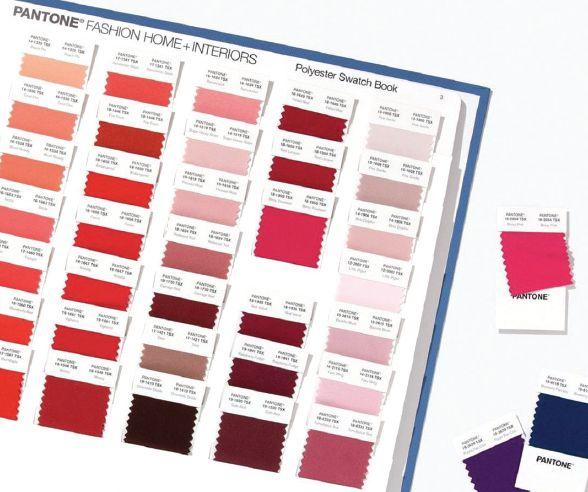
Pantone Polyester Swatch Book
Pantone has introduced the Pantone Fashion, Home + Interiors Polyester Swatch Book, a collection of 203 colour options in one convenient binder. Features of the new swatch book include: 2-inch x 2-inch loose format poly swatches dyed in 100-percent warp knit polyester; removable swatches for easy colour selection and palette development; colours arranged chromatically by colour family; and visualization of 35 colours on each binder page. As new markets highlighting engineered materials continue to emerge and new inorganic materials enter the market, there is an increasing desire for more saturated colours, Pantone explains. Serving as a companion to the Pantone Fashion, Home + Interiors cotton products, the new Fashion, Home + Interiors Polyester Swatch Book addresses the market demand for a deeper level of colouration; displaying a colour depth best achieved with a non-cotton based textile dyed system. Creating a special system of colours using dyes specifically for polyester removes the guesswork and enhances product
speed to market by enabling quick and accurate reproduction of these colours in polyester as well as other synthetic fibres, Pantone notes. With 203 unique colours for designers and colourists working in apparel, textiles and soft home, Pantone’s Polyester Swatch Book aims to support designers through their workflow and increase speed to market.
Mark Andy Digital Pro line
Mark Andy has launched its Digital Pro product line, the latest development to its digital product offerings, with a production speed of 77 fpm (23.4 mpm) for various applications. Available for immediate order, the CMYK dry toner Digital Pro line includes a roll-to-roll press, Digital Pro 1, and a configurable
APP celebrates 20 years in Canada Leads with innovation to address current market needs
APP Canada is celebrating 20 years of growth and success in a market segment that has undergone significant transformation. To mark this milestone, the company looks back at its strategy of evolution and its ability to respond to more informed consumer choices especially with a growing trend of moving away from plastics. In our conversation with David Chin-Bing, president of APP Canada, we track the company’s journey and innovative products that will guide its future.
A BRIEF TIMELINE OF APP’S EARLY YEARS IN CANADA:
Two decades ago APP Canada, an independent subsidiary of an Asian company operating in Canada, was established with one small location in Mississauga, two sales offices in Montreal and Vancouver, and the strong hope that the printing industry would respond favourably to its offering.
During the early years, the company focused on sales of coated and uncoated Riviera paper, photocopy paper and stationery and in 2005, APP introduced its coated paper and board products to the Canadian market.
“Twenty years ago, the industry was somewhat resistant to Asian paper, with concerns over its quality and how it will affect the machines and the finished products,” said David Chin-Bing president of APP Canada. “But the printing industry soon realized the benefits of paper from Asia and how competitive it was with North American or European alternatives.”
In 2007, APP Canada moved to its current location on Hereford Street in Brampton for added space to accommodate its 50-person staff and the need for a larger warehouse for its expanding product lines that now also included Paperline photocopy paper. The company also opened additional sales offices in Calgary, Winnipeg and Edmonton.
“The market became more competitive with the merger of vendors and several key acquisitions. There were also newer players, like ourselves, looking to service wide customer segments and meet demands for faster turn- around times, online functionality and the desire for collaboration, ”said Chin-Bing.
ADAPTING TO NEW MARKET DYNAMICS THROUGH PRODUCT INNOVATION:
Over the next decade, APP Canada continued to reach new milestones. It received PEFC certification, introduced thermal paper and stationery products to the market and expanded its sales network nationwide.
The company invested in increased support for the paper packaging segments for consumables, household items and logistics.
In 2019, APP Canada is known for far more than photocopy and printing paper. With a looming ban on single use plastics in Canada, the company is leading the way in innovation with the recent announcement of a completely biodegradable foopak line of disposable cups and food containers. This year, it also announced the production of one of the first paper straw alternatives on the market fully capable of performing as well as its plastic alternatives.
Today’s market is also prioritizing sustainable development at the local level and once again, the company is at the forefront. In Indonesia and China it focuses on best practices for training, education, poverty alleviation for famers working and living within their forests. Pay-it-forward programs integrating community engagement, NGOs and local governments are as much a part of APP’s business strategy as the technology invested in the paper production itself.
About Asia Pulp & Paper
Asia Pulp & Paper (APP) is a trade name for a group of pulp and paper manufacturing companies in Indonesia and China. APP is responsible for delivering quality products to meet the growing global demand for tissue, packaging and paper, with an annual combined pulp, paper, packaging product and converting capacity of over 19 million tons per annum. On any given day, APP’s products find their way into the hands of consumers in various branded forms from all over the world.
Ensuring supply chain integrity and commitment to the Sustainable Roadmap Vision 2020 are crucial to APP’s operations. Learn more about APP’s path to operational excellence by reading our Sustainability Reports and Forest Conservation Policy at www.asiapulppaper.com.
David Chin-Bing
Pantone’s Polyester Swatch Book aims to support designers through their workflow and increase speed to market.
Digital Pro 3, a configurable inline CMYK digital hybrid toner press.
inline hybrid model, Digital Pro 3. Digital Pro 1 is a roll-to-roll machine, fitted with an unwind, print engine and rewind, providing 12.5inch digital print width. The introductory Digital Pro system is important for plants with established converting and finishing workflows, simplifying digital print for operators to a click of the button, the company explains, noting that as business and workflows evolve, the modular nature of Digital Pro 1 provides an upgrade path with scalable inline printing and converting options. Digital Pro 1 is joined by the advanced inline hybrid model: Digital Pro 3. This system includes a multi-purpose flexo station for inline embellishment and is fuelled by a robust DFE that supports variable data printing and versioning needed in the short- and micro-run market segment. Digital Pro 3 can be configured with a single slot die station or with a semi-rotary die module to finish labels inline. The semi-rotary system is designed to reduce die inventory and comes with a standard 19-inch magnetic cylinder to accommodate most repeats without tool changeover. The Digital Pro system is fuelled by a high-yield toner and supports a range of substrates and applications with no priming or coating required. Additional media capabilities supported by the product line include vinyl, PVC and foil.
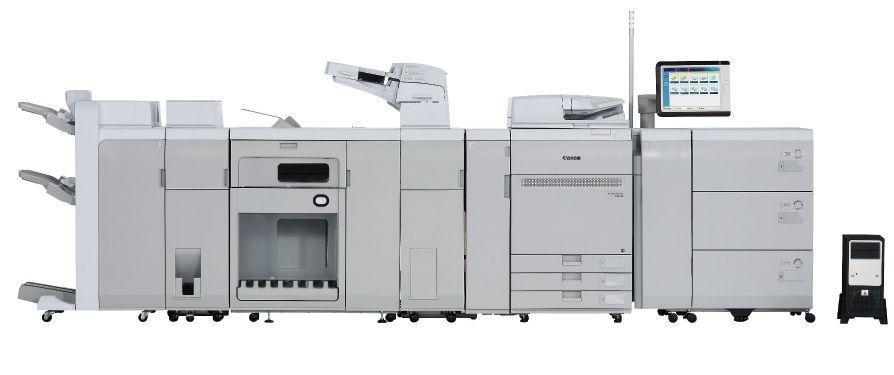
Canon imagePRESS C910
Canon Canada’s new imagePRESS C910 Series builds on its predecessor, the imagePRESS C850 Series. Comprised of three models, the imagePRESS C910, C810 and C710, the colour digital press series o ers production speeds of up to 90 pages-per-minute (ppm), 80 ppm and 70 ppm respectively, while sporting a flexible design that makes
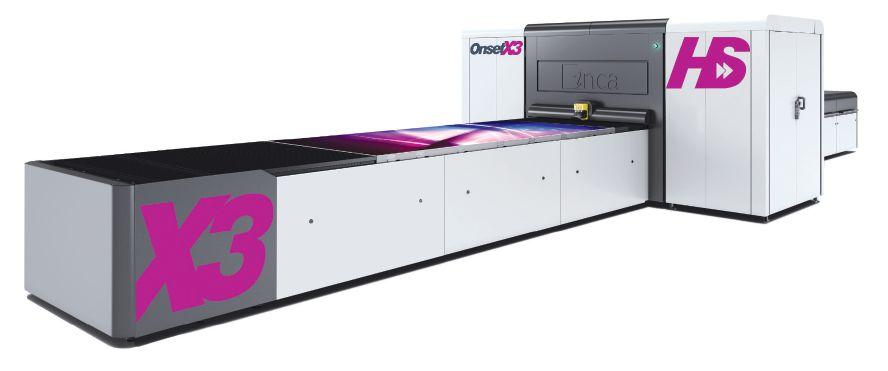
The new OnsetX HS series is distributed exclusively in North America by Fujifilm.
it versatile for printing establishments of varying shapes and sizes. The series is engineered to help print service providers meet today’s challenging demands and tight deadlines. The colour press boasts embedded colour controls, allowing operators from entry-level to the most experienced to produce “brilliant output on a wide range of media while also shortening turnaround times for both simple and complex jobs,” the company says. The updated series includes a range of new finishing options and extended media support to further increase application flexibility, including: Double punching on tabloid size sheets; a new inline booklet maker; an open Document Finishing Device (DFD) adapter and bridge interface that allows for third party finishing to connect to the Canon Staple/Booklet Finisher-W1 for corner stapling and advanced inline finishing on the imagePRESS C910/C810 devices; and support for media up to 130-lb Cover (350 gsm) and up to 51.2 inches (1300 mm).
OnsetX HS UV inkjet flatbed
Fujifilm and Inca Digital have introduced a new addition to the OnsetX UV flatbed series – the OnsetX HS (High Speed) range. Featuring two
new machines, the Onset X2 HS and the Onset X3 HS, the range can print up to 15,597 square feet/hour, utilizing a new single-cycle mode. Compatible with Inca’s range of application-specific robotic handling systems, and incorporating 30-second job setup and single-cycle printing mode, the new HS range is said to deliver a “step change” in inkjet printing. The OnsetX HS launch is partnered with a new Fujifilm inkjet range, Uvijet OX. Uvijet OX features a new ink technology developed and manufactured at Fujifilm Speciality Ink Systems in the U.K., designed for the Onset family of printers to print on rigid plastic media at high speeds. The addition of the new single-cycle print mode to the OnsetX HS, made possible by optimizing the print jetting profiles and jetting frequencies, means the HS range can print at speeds up to 15,597 square feet/hour – more than 50 percent higher than previously published throughput figures, they explain. As well, the intelligent bonding properties of the new Uvijet OX ink opens up a new range of applications and possibilities in markets where the demand is growing for shorter-run printing on corrugated board, packaging and non-PVC rigid plastics, they note,
adding that on- and o -loading systems, UV shutter alignment and table skin adjustments have all been automated, reducing operator intervention and bringing job setup time down from an average of 15 minutes to around 30 seconds.
EyeC Audit Trail Viewer so ware
EyeC has introduced the EyeC Audit Trail Viewer, a new software designed to simplify the preparation and review of audit trailing data that complements inspection solutions, such as the EyeC Proofiler for print sample testing or the EyeC Proofiler Graphic for prepress proofing. Explaining that the solution will help pharmaceutical companies comply with strict legal and normative regulations, EyeC says users can use the new software to analyze and document process interventions for auditing in a controllable and comprehensive way. The software enables users to load and visualize trailing data and provides information in a human-readable format. Various filter options enable refining entries to focus on critical events. For instance, the user can search for criteria such as date, user or event type, or use alternative or a combination of search terms. Created search queries can be saved and modified, allowing companies to perform consistent audit trail reviews. Reports can also be generated from the reviewed results at any time and be used to bring evidence to auditors, EyeC explains.
Kornit Konne workflow so ware
Kornit Digital describes Kornit Konnect as a new Cloud-based, mobile workflow software platform designed to help businesses maximize the productivity of their digital printing solutions, by better delivering data-driven insights and performance metrics. In its first phase, Kornit Konnect will help businesses monitor production, analyze in -
Comprised of three models, the C910, C810 and C710, the Canon imagePRESS C910 series boasts production speeds of up to 90 ppm, 80 ppm and 70 ppm, respectively.
OUR
to see the Digibook 200 and Digibook 450 in action!
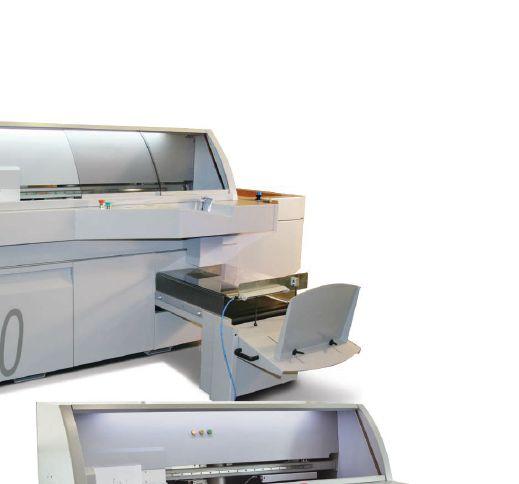
From entry level to high volume automatic systems perfect for all levels of production, Morgana offers the widest range of small format PUR binders to suit your production needs. All Morgana Machines are ULC Factory Certified for sale in Canada
KEY FEATURES
Up to 450 books per hour (DigiBook 450)
Closed tank PUR nozzle application system
Automatic cleaning and sealing of the glue head
Touch screen operation with memory function
Spine preparation by sophisticated milling and notching device
Spine thickness from 1 to 50 mm
The Morgana DigiBook 450 Perfect Binder was the perfect solution for us,” says Rich Pauptit from Flash Reproductions “The 450 offers the widest range in book sizes in the category, it’s easy to use and reliable, plus the finished product looks fantastic.
sights and manage their fleet in order to help eliminate blind spots, through a fleet management dashboard, data-driven benchmarks, actual production costs and cost structures per job. Future phases and releases of the Kornit Konnect, are expected to o er deeper insights and actions as it comes to optimizing production management and enabling a seamless software workflow environment.
Esko Dual Heavy Du Unit
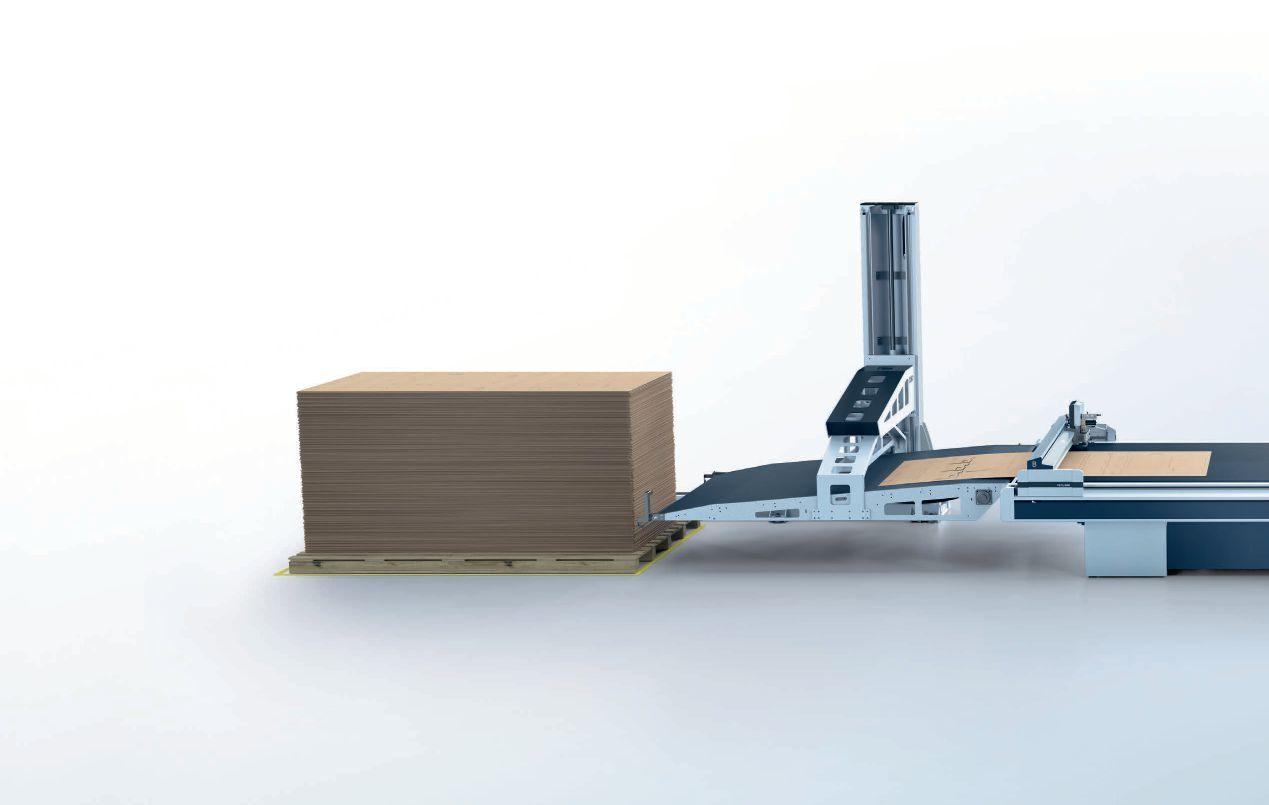
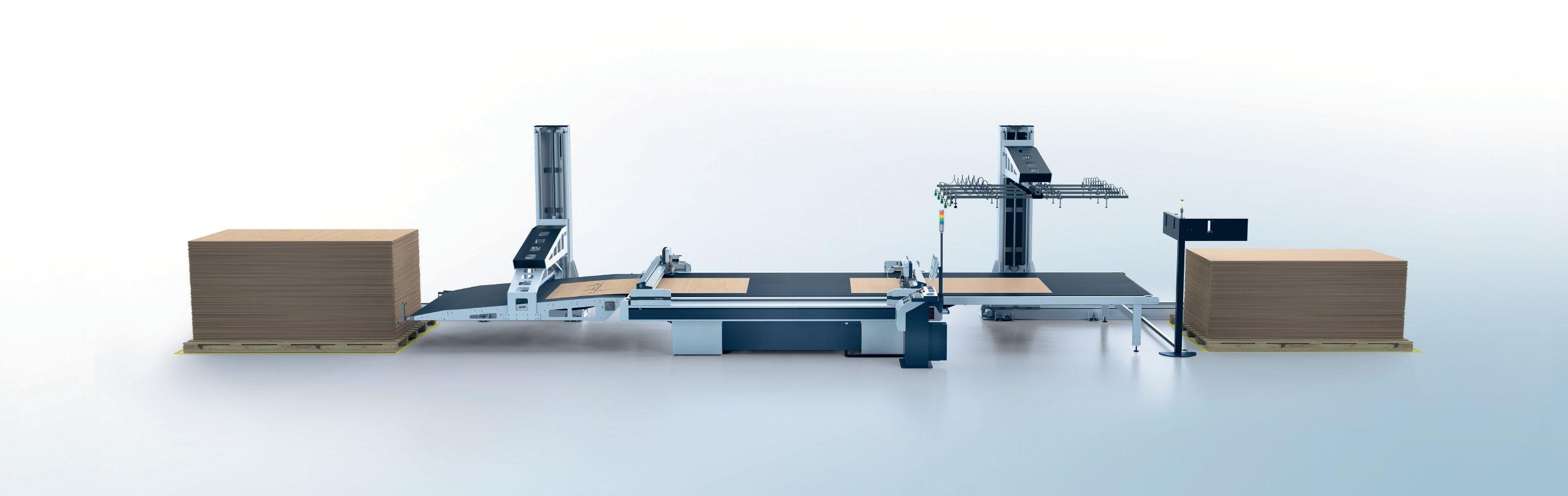
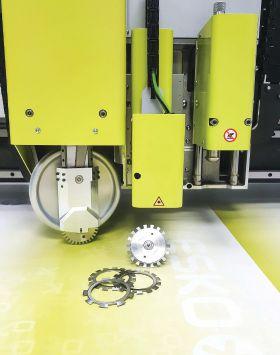
The latest Kongsberg digital cutting and creasing innovation from Esko is designed to help corrugated converters cut, crease and perforate jobs without the need to change tools, boosting finishing productivity by up to 50 percent. The newly launched Dual Heavy Duty Unit means operators no longer need to manually intervene in tool changes on Kongsberg digital cutting tables for jobs that require creasing, cutting and perforation, Esko says. The machine is designed to automatically switch and use the right tool throughout the job, thus ramping up production efficiency. As well, it combines, for the first time, two independent wheels in one heavy-duty unit. The uniquely engineered design of a Kongsberg table makes it possible to exercise 50 kg of downforce on corrugated materials from single to triple wall, without compromising speed or quality, Esko says. The Dual Heavy Duty Unit boasts better crease quality, even on materials with a high recycled material content. When combined with the Esko CorruSpeed Tool, converters can cut and perforate corrugated substrates at full machine speeds of up to 100 m/min. The CorruSpeed Tool is designed specifically for high-speed digital finishing of corrugated board and is unique in that it uses a static knife in combination with a patented knife foot design to simulate the e ects of ejection rub-
Esko’s Dual Heavy Duty Unit boasts up to 50 percent increased productivity in corrugated finishing.
bers in conventional die tooling.
Roland DGA Texart RT640M dye-sub printer
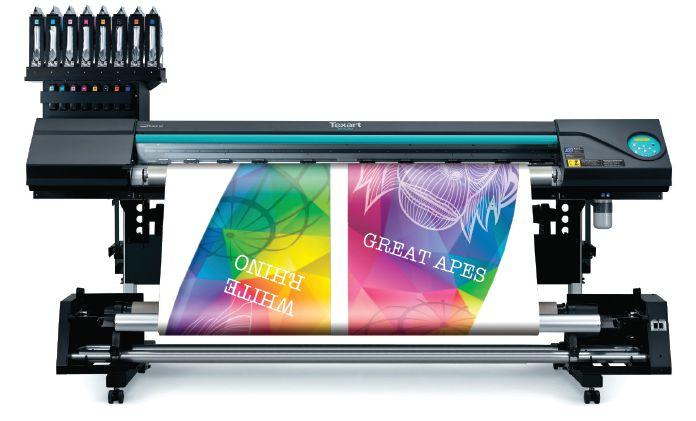
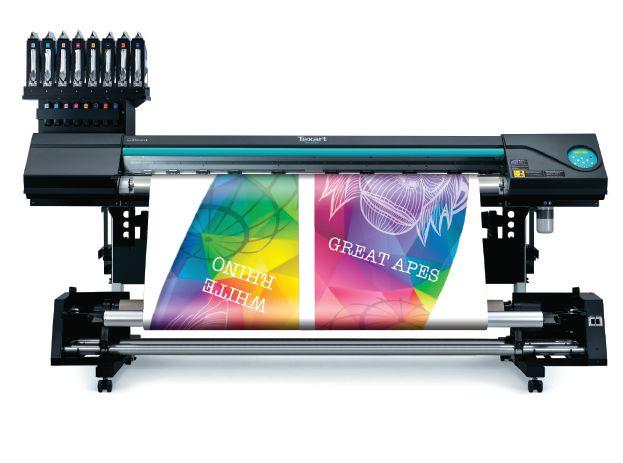
Roland DGA describes the new Texart RT-640M as an intelligent multi-function dye-sublimation printer that gives users the freedom to print directly onto coated polyester fabrics or sublimation transfer paper using the same specially-formulated Texart SBL3 sublimation inks. The Texart RT-640M is said to simplify dye-sublimation production for soft signage with its direct-to-textile print option, while maintaining the versatility of printing to transfer paper for creating sublimated apparel, décor, rigid signage and hard goods. The system boasts advanced features that maximize print quality, productivity and convenience. The media take-up incorporates adjustable front rollers for no-skew printing, as well as magnet weights for improved tensioning and performance. Meanwhile, eight-channel printheads boast unmatched colour and image results on a range of materials, while optimizing ink coverage for lower operating costs. Designed to bring out the best in the RT-640M,
— Die
without a die, then fold and even glue all on the same machine, up to 30 pt.
3. INTEGRATED MODULAR UNITS — Combined in-line finishing: crease, fold, glue, tipping, envelope inserting, ink jetting (Duplex), clip seal (3 sides), mail prep.
4. SAVE ON POSTAGE COSTS
—As a Certified Canada Post Direct Marketing Specialist, we get contract pricing reductions.
5. RETURN MAIL PRODUCTS — Customized “Return Mailers” created in-line with “U” or “BOX-shape” remoistenable glue, time perfed applications and envelope formation.
6. MINI-BOOKLETS — Saddle-stitch and trim 2-up booklets in-line to the size of a business card. No need to trim off-line, or do 2 passes.
7. HIGH SPEED EQUIPMENT — High speed Tipping, Folding, Saddle-stitching and soft folding ensuring on time delivery.
Roland introduced the Texart RT-640M multi-function dye-sublimation printer in June.
FULL SERVICES
QUICK TURNAROUND
Roland’s Texart SBL3 inks are available in four-colour (CMYK), eight-colour (CMYKLcLmOrVi), and eight-colour fluorescent (CMYKOrViFyFp) configurations. The RT-640M also offers users the advantages of the Roland Bulk Ink Switching System, which features 1000 cc pouches and automatically switches to a backup pouch for nonstop printing in four-colour configuration.
Over 75,000 sq ft plant housing state-of-the-art finishing and bindery
Personalized account management and complete control over production
24/7 Production with fully automated and barcode controlled plant
FSC / PEFC / SFI certified
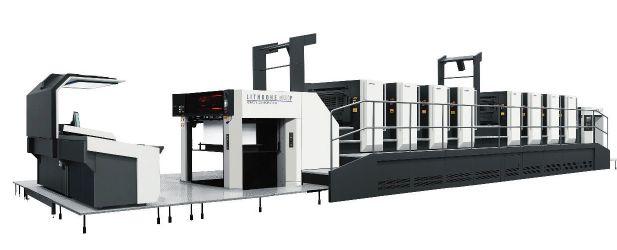
Komori Corporation has added the new Lithrone GX40 perfector GX40P to its portfolio of Lithrone 40-inch sheetfed presses suitable for double-sided, one-pass and straight multicolour printing. Featuring a three double-sized cylinder perfecting mechanism, the GX40P’s impression cylinder, transfer cylinder and perfecting cylinder are each double-sized to avoid stress on the paper, says Komori. Simplified and highly rigid, the use of the new perfecting mechanism delivers twosided printing at speeds of 18,000 sheets/hour for both single- and double-sided printing, the press manufacturer explains. Additionally, the GX40P boasts environmentallyand workplace-friendly printing that saves energy and space and reduces exhaust heat. The Lithrone GX40P offers a variety of options designed to enhance productivity, such as Parallel Makeready to shorten makeready times and Autopilot for non-stop automation from test printing to production printing. The A-APC (Asynchronous Automatic Plate Changing System), PDC-SX (Spectral Print Density Control - SX model) and PQA-S (inline Print Quality Assessment System) can also be added to make additional quality and productivity improvements possible, the company notes. The Lithrone GX40P perfector is now available through Komcan Inc.
HP Indigo Secure Studio
HP Indigo and Agfa at Labelexpo 2019 announced a new variable de-
sign security solution for brand protection and security printing. The solution, HP Indigo Secure Studio Powered by Agfa, is designed to create unique graphic designs with endless variations, the parties say, while also blending with the original design without compromising the look and feel of the original document or product. The first version of the solution is designed to create complex security and embellishment designs for label and packaging printing.The goal, they say, is to help protect digital prints from counterfeiting, as well as improve their aesthetic appearance and shelf appeal as designer creativity can be elevated to give a high-end look to digitally printed packages, labels or documents, with security embedded in the design itself.
Epson SureColor F6370 dye-sub inkjet printer
Epson America in August announced the next-generation SureColor F6370 44-inch dye-sublimation printer. Featuring speeds up to 680 square feet/hour, the printer for promotional products, soft signage and cut-and-sew fabrics is equipped with new Epson Edge Print workflow software, as well as a built-in cutter for roll-to-sheet convenience and an optional take-up reel system for unattended printing. The SureColor F6370 replaces the SureColor F6200 to join Epson’s line of SureColor F-Series printers, including the SureColor F9370 and SureColor F7200. The F6370’s Epson Edge dashboard, a remote printing management software, features an interface with detailed views on current activity, ink supply levels, and important warnings or errors. As well, the Epson Edge Print workflow software features an Adobe Postscript 3 engine and includes job nesting, custom spot colour, project libraries, pattern repeats and the ability to import new media settings, when available, and the option to edit media settings and manage projects remotely.
The Komori Lithrone GX40P perfector is capable of double-sided, one-pass and straight multicolour printing.
Polar: any size/older or newer models (66/72/76/78/82/90/92/107/115)
Horizon-BQ: 220/240/260/440/460
Derek Brown / Dire or / Heron Printing
Heron Printing, a printing company based in Edmonton, Alta., recently announced the acquisition of its first HP Indigo 7900. The fully configured seven-colour HP Indigo 7900 is equipped with a range of capabilities, such as raised/ textured print, One Shot printing on synthetics, and specialty inks white, silver, clear, fluorescents, invisible and Pantone spot colours. “For us, purchasing the Indigo was two-fold; to ensure we have the capability to o er our existing customers the highest quality short-run printing available, and to introduce exciting new products to our marketplace,” Derek Brown, Director of Heron Printing, explains. “For years we’ve pushed the limitations of dry toner technology. We’ve simply come to a time in our business where we’ve outgrown dry toner.”
Established in 1982, Heron Printing produces stationery, marketing materials, booklets and newsletters, point-of-purchase materials, direct mail pieces, tickets and forms, and o ers kitting and fulfilment services. In this Q&A, Brown discusses the new installation, print technology trends, and his thoughts on the future of the industry.
PA: Why did Heron Printing opt for the HP Indigo 7900?
DB: We simply outgrew the limitations of dry toner technology. Having our roots in sheetfed o set production for the past 35 years, we always felt that our dry toner o ering came at a compromise in quality, colour consistency and uptime reliability. Dry toner devices are great for printing on coated sheets day in and day out. However, once you start playing outside the realm of the standard coated sheet, the technology starts to show its weakness. Textured sheets, uncoated stocks, synthetics, foiled board — this is where the HP Indigo really shines and excels above dry toner. With the HP Indigo, we are producing sheets that rival our o set o ering with all the benefits of digital production.
PA: What applications will the new press be used for?
DB: In addition to our everyday 4/4 output, we are also experimenting with white ink, invisible ink, spot coating, and many textured and specialty stocks. We print about 54 percent of our full-colour digital commodity work without black ink. Using EPM [Enhanced Productivity Mode], we can rip a CMYK job into CMY, no K. Removing black ink saves us money, while making the press run about 25 percent faster. The results are amazing. The CMYK sheet and its CMY counterpart is almost identical. We print a fair volume of repositionable vinyl and synthetics. The press has One Shot
technology that lays down all four colours of ink on one pass on the blanket. It works well on soft vinyls, which can distort from heat and multiple passes through the impression cylinder.
We are eagerly awaiting the release of metallic silver. We have several clients that demand short-run metallic ink printing which we currently do via o set. Being able to o er the spectrum of metallic colour digitally will be a game changer for us.
Smithers research predicts the global digital printing market will grow 65 percent over the next decade to reach US$230 billion by 2029, largely driven by package printing, as well as books and other graphic printing areas.
PA: How has the new press performed so far?
DB: The press has performed fantastically. Its learning curve is definitely steeper than dry toner production, it’s a true digital o set press. Our operators did their training at HP’s learning center in Alpharetta, Georgia. Their support network and followup is top notch. We are particularly impressed with the Print OS integrated software. Print OS gives us instant feedback on the press’s performance, print volume, availability and supplies status, among other features.
PA: What are some challenges you see in the print industry?
DB: E-commerce has made the world a smaller place. We can now source almost
anything from anywhere. This is not unique to our industry; it’s a real hurdle for all shops in all industries. We must get our shops online or deliver value that cannot be o ered in that space. Heron Printing has faced this head on and developed its own e-commerce storefront: Impactica.ca.
PA: How does Heron Printing continue to innovate after nearly 40 years of business?
DB: We don’t listen to the “doom and gloom” culture of our wonderful industry. We continue to innovate, o er new and exciting products to our clients and deliver on what we promise. We have to o er value beyond the “4/4, 100-lb gloss cover” job. Everyone is pushing commodity print and chasing slim profit margins. We try our best to engage our clients in a meaningful way and show them what print can do for their businesses.
PA: Where does digital fit in the future of print?
DB: Simply put — digital is the future of print.
For more Spotlight Q&As with newsmaking print professionals, please visit www.printaction.com/profiles.
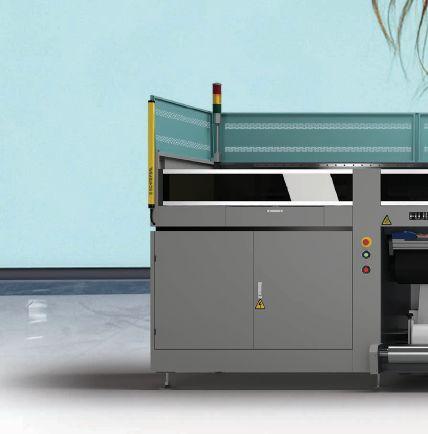
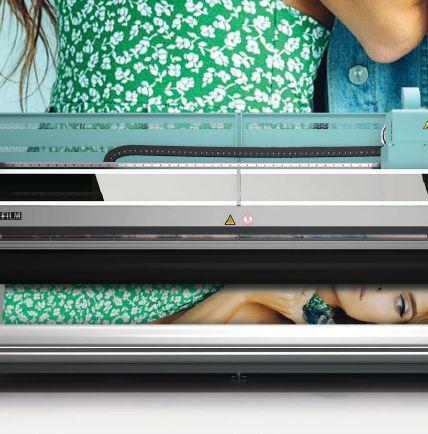
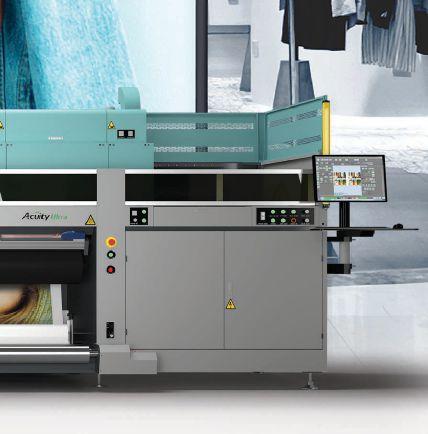
Unlike anything currently available, the Acuity Ultra produces almost photographic quality at unprecedented speeds of up to 236 sq. m. per hour, ideal for high-end interior graphics. And with a new low film weight and highdensity UV ink, running costs are impressively low. Capable of printing on up to three 160 cm rolls simultaneously, as well as graphics up to 500cm wide, the Acuity Ultra is set to become the new superwide standard. Visit