22 Detailing new products from Avanti, Canon, Brandtjen & Kluge, CRONECRM, CTI Paper, Domino, EFI, EPS, Epson, Esko, Fujifilm, HP, Kodak, MGI, Nilpeter, Quark, TRESU, Ultimate TechnoGraphics, Veritiv and Xerox
MARKETPLACE
29 Industry classifieds
SPOTLIGHT
30 Guy Gecht, Chief Executive Officer of Electronics For Imaging, discusses recognition of revenue
COLUMNS
FROM THE EDITOR
4 Jon Robinson
Mills retool, print shifts
With the CAGR drop in newsprint and printing paper grades, new investments by mills are signalling growth areas for the future of print
CHRONICLE
10 Nick Howard
Made in Japan, rise of Komori
In Part II of an article series, the author looks at how Komori leveraged Lithrone innovation to stamp its position and push toward the future
DEVELOPMENT
12 Dave Fellman
Five fundamental questions
In the print sales game, simplicity is often best and it can be boiled down into a series of key questions to identify needs and wants 14 18 10 6
Mills retool, print shifts
Kruger Inc. in September announced a $377.6-million transaction to diversify operations at four Quebec operations, including mills in Brompton and Wayagamack, that will focus on specialty niches like flexible food packaging, labelling and digital printing.
This project, undertaken in partnership with the Government of Québec, will help to maintain more than 500 jobs in the Mauricie and Estrie regions. The announcement was made in the presence of Philippe Couillard, Premier of Québec, and Dominique Anglade, Minister of Economy, Science and Innovation.
May 2017 report by McKinsey & Company shows containerboard to be amongst the most stable paper-based products produced today with a CAGR of 2.5 percent between 2010 to 2015, while newsprint had a CAGR of -5.6 percent over the same period.
Kruger and the Government of Québec have formed a partnership by which Investissement Québec, acting as the government’s agent, will grant loans and a loan guarantee totalling $59.8 million and acquire an equity participation of 37.5 percent, or $44.6 million, in the new entity Kruger Specialty Papers Holding L.P.
To carry out this diversification project, Kruger Specialty Papers will invest $107.5 million over the next three years to enable the Brompton and Wayagamack Mills to gradually reduce the production of some publication paper products that are in decline, such as newsprint and magazine paper, while accessing new markets that are on the rise.
Kruger Specialty Papers will supply products that are in high demand due to changing market trends around the world, specifically increased demand for sustainable packaging and the growing popularity of e-commerce. New specialty products include food packaging paper, labelling products (backing paper) and coated paper for digital inkjet web presses to print mass-circulation catalogues and flyers that can be customized for targeted mailings. By the end of the project, the Brompton Mill will focus exclusively on specialty products and will no longer manufacture 200,000 metric tonnes of newsprint annually.
This massive Canadian project speaks to market shifts taking place as paper suppliers invest millions of dollars to find stable markets. These trends are outlined in a May 2017 report by McKinsey & Company, called Pulp, paper, and packaging in the next decade: Transformational change. “From what you read in the press and hear on the street, you might be excused for believing the paper and forest-products industry is disappearing fast in the wake of digitization. The year 2015 saw worldwide demand for graphic paper decline for the first time ever, and the fall in demand for these products in Europe
and North America over the past five years has been more pronounced than even the most pessimistic forecasts,” wrote Peter Berg and Oskar Lingqvist, authors of the McKinsey report. “If you thought the paper industry was going to disappear, think again. Graphic papers are being squeezed, but the industry overall has major changes in store and exciting prospects for new growth.”
The authors agree the paper and forest-products industry is growing at a slower pace than before, but point to growth in packaging and how more pulp is being used for textile applications, both of which reflect positive printing trends. From 2010 to 2015, McKinsey finds that global production of newsprint has suffered the largest drop in compound annual growth rate (CAGR) at -5.6 percent, while printing-and-writing grades have dropped -1.5 percent over this period.
These drops are more significant when comparing the past five years to growth between 1992 and 2007, when newsprint had a CAGR of 1.1 percent and printing-and-writing 3.2 percent. Carton and containerboard remained relatively stable with a CAGR of 2.2 and 2.5 percent, respectively, between 2010 and 2015. Even this sector, however, has dropped from 3.3 (carton) and 4.3 (container) percent CAGR between 1992 and 2007.
“We would argue that the industry is going through the most substantial transformation it has seen in many decades,” explain Berg and Lingqvist. “The changes are not dramatic individually, but the accumulation of changes over the long term has now reached a point where they are making a difference.”
The McKinsey report shows consolidation to be a major factor in many segments, describing how the world’s largest paper companies have not grown much, if at all. The authors explain this environment has forced many to focus on fewer segments. In other words, these mammoth paper and forest companies are retooling in a race to the claim their spot at top of growth sectors that mirror sentiments in printing.
Along these lines, the specialty papers being developed by Kruger will include the use of cellulose filaments, a biomaterial described as Kruger’s proprietary strengthening additive that is manufactured at the world’s first CF plant in TroisRivières (2014). Tests have shown that adding CF helps to make products stronger, lighter and more sustainable.
Editor Jon Robinson jrobinson@annexweb.com
Contributing writers
Zac Bolan, Wayne Collins, David Fellman, Victoria Gaitskell, Martin Habekost, Nick Howard, Neva Murtha, Abhay Sharma
Publisher Paul Grossinger pgrossinger@annexweb.com
416-510-5240
Associate Publisher Stephen Longmire slongmire@annexweb.com 416-510-5246
Media Designer Lisa Zambri
Circulation Manager Barbara Adelt badelt@annexbizmedia.com
Customer Service
Angie Potal apotal@annexbizmedia.com
Tel: 416-510-5113
Fax: 416-510-5170
Mail: 80 Valleybrook Drive, Toronto, ON, M3B 2S9
COO Ted Markle tmarkle@annexweb.com
President & CEO
Mike Fredericks
Subscription rates
For a 1 year monthly subscription (12 issues): Canada — $40.95 Canada 2 year— $66.95 United States — CN$71.95
Other foreign — CN$140.00
Mailing address
Annex Business Media 80 Valleybrook Drive Toronto, ON, M3B 2S9 printaction.com
Tel: 416-442-5600
Fax: 416-442-2230
JON ROBINSON, editor jrobinson@annexweb.com
grow at a CAGR of 17.4 percent from 2016 to 2021 in the U.S. and Western Europe.
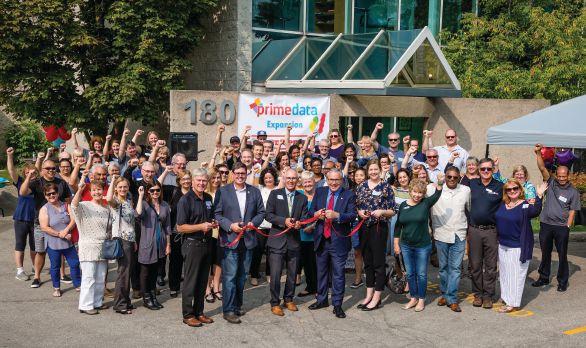
Prime Data’s September 15 ribbon-cutting ceremony is attended by local MP Kyle Peterson, Chris Ballard, Minister of the Environment and Climate Change, and Geoff Dawe, Mayor of Newmarket-Aurora.
Prime Data, led by President Steve Falk, centralized its production, IT and administration into a single, expanded facility in Aurora, Ont. Employing more than 40 people, Prime Data leverages an elan inkjet press to produce print and mail campaigns, under the term ResponsivePrint, for fundraising and marketers.
Shutterfly, an online retailer and manufacturer of personalized products like photo-books, calendars, stationery, cards and keepsakes, reached an agreement to acquire a second phase of 29-inch HP Indigo 12000 presses. In its most recent quarter, Shutterfly generated net revenues of US$209.0 million. The new deal comes a year after Shutterfly acquired a first phase of 25 HP Indigo 12000 presses. It will also use HP PrintOS software for the fleet.
Inc.
Lightning Source LLC, part of the Ingram Content Group, signed a deal to deploy 24 HP PageWide Web Presses through 2024 across five of its printing facilities on three continents. Centred around PageWide T240 HD presses, HP explains this multi-million dollar deal is the largest ever for its graphics business. HP explains its PageWide customers are currently printing 5.5 billion pages in
aggregate every month. Year-overyear customer page growth in 2017 was over 15 percent.
C.J. Group of Companies of Toronto, Ont., merged with nearby Annan & Sons. Both Paul and John Annan, along with several of their staff members, are scheduled to join C.J. Graphics in that company’s new Mississauga location at the end of October 2017.
Printing Industries of America presented its Best of Category Benny Awards in the 2017 Premier Print program. Canadian winners include: C.J. Graphics, Toronto (8 Bennys); Friesens of Altona, Manitoba (1) ; Pollard Banknote of Winnipeg, Mtb. (1); and PrintWest of Regina, Saskatchewan (2).
Messagepoint of Toronto, Ont., for the second consecutive year, has been named to the PROFIT 500, a ranking of Canada’s fastest-growing companies based on five-year revenue growth. Messagepoint ranked 314 on the list, with a five-year revenue growth rate of 185 percent, moving up from No. 347. The company develops a hybrid-cloud software platform for omnichannel communications.
Xerox and Fujifilm North America entered a reseller agreement for Xerox to market and sell Fujifilm’s J Press 720S sheetfed inkjet press in the U.S. and Canada. Additionally, Fujifilm has a new reseller agreement for three Xerox inkjet presses, the Trivor 2400, Rialto 900 and Brenva HD. According to InfoTrends, placements of B2 format digital printing devices will
Aylmer Express Graphics held its 7th annual 3 Port Tour bicycle ride through Aylmer and Elgin County. More than 400 cyclists helped to raise almost $15,000 with most of the proceeds going to the Forest City Velodrome in London, Ont., and to East Elgin Secondary School’s Environmental Leadership Program. Founded by Aylmer Express President John Hueston in 2011, the 3 Port Tour ride offers three distances, 50, 100 and 160 kilometres, which correspond to one, two or three ports, starting and finishing in Aylmer. Collectively, the seven rides have raised $70,000.
intelliFLEX Innovation Alliance is the new name of the Canadian Printable Electronics Industry Association (CPEIA) based in Ottawa, Ont. The association was established in November 2014 to focus on printable electronics. The name intelliFLEX reflects an expansion in the association’s focus on smart materials, related semiconductors, integrated circuits, flexible and wearable electronics, smart textiles, hybrid electronics and software.
Ricoh Japan is replacing some traditional metal tooling with lightweight 3D printed jigs and fixtures for its Production Technology Center assembly line dedicated to large-format printers. Ricoh is specifically assembling an electronic component using a 3D printed fixture produced in anti-static ABS plastic on the Stratasys Fortus 900mc 3D printer. Operators on the line will typically handle more than 200 parts a day. Ricoh also explains it will typically outsource machine cut tools that could take two weeks or more.
Global Market Insights released a report about the growth of packaging inks and coatings by 2024, projecting these consum-
ables in cosmetics to grow at a CAGR of more than four percent. Inks used in the pharmaceuticals industry is expected to grow at a CAGR of more than six percent during the forecast period.
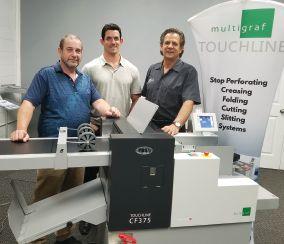
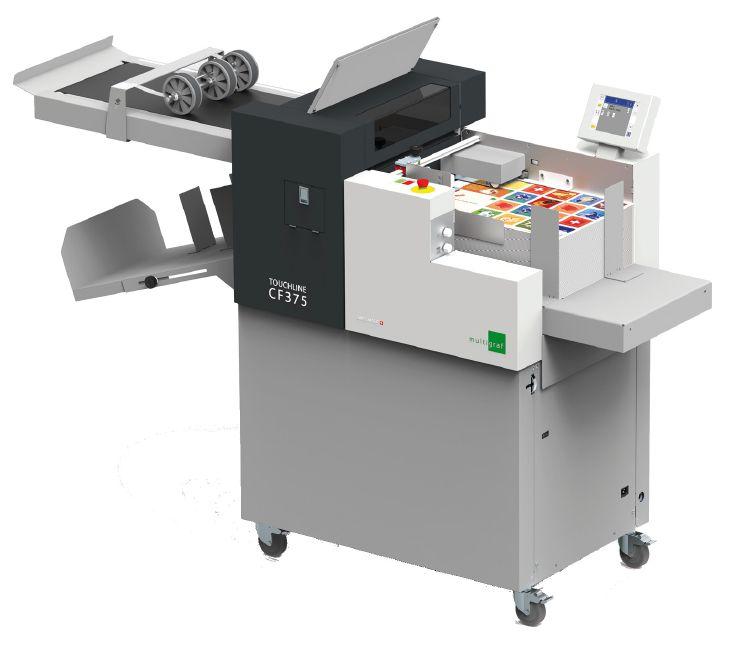
PDS named Robert E. Thistle of Toronto as a dealer for the Multigraf Touchline family of folding, creasing and perforating equipment. In September 2016, PDS became the Canadian master distributor of Multigraf Touchline technologies. Headquartered in Switzerland, Multigraf became one the first companies to focus on the short-run finishing market in 1984.
Kodak will increase the price of all offset printing plates globally by up to nine percent. Over the past 12 months, Kodak explains it has been absorbing significant increases in costs for raw materials that are used to produce its offset plates, including: aluminum, chemicals and packaging materials. The company states its newest and most advanced plate products will see the least increases relative to more mature plates. Plate price increases were previously announced for China in January 2017.
FASTSIGNS International opened two new franchises in Canada in the first half of 2017 and signed four other agreements to develop additional locations in Calgary, Winnipeg, and Oshawa. Currently, there are 36 locations throughout the country. FASTSIGNS expects it may add eight locations in 2017.
Appleton Coated of Wisconsin filed a voluntary Chapter 128 petition for receivership to allow operations to continue under a court-appointed receiver. In December 2014, Appleton was purchased by Virtus Holdings, a company formed by its management team. The company employs around 570 workers.
3 Port Tour riders head west across Nova Scotia Line toward Port Bruce.
Enrique Lores, President, Imaging & Printing, HP
Steve Thistle of Robert E. Thistle Inc. (left to right) with Brett and Dave Kisiloski of PDS.
INSTALLS
Rich Bassett, Vice-President, Direct Mail, St. Joseph Communications Print Group, has moved the Bassett Direct group into the company’s Toronto Print Campus in Concord, Ont. Acquired in late2016, Bassett Direct is one of Canada’s most experienced providers of direct marketing services and variable printing programs. Bassett Direct’s fleet of digital equipment, including Xerox and Xeikon toner presses, has also been relocated to the 150,000-square-foot Toronto Print Campus. St. Joseph explains the acquisition of Bassett fits its vision to become the supplier of choice for brands and retailers requiring multi-channel content.
ence in product and service development, marketing, sales, integration and support. Erwin will be responsible for expanding advisory services, including developing customer strategy and consulting sessions, as well as managing customer events and industry conferences for the technology segment.
Ryan Arakaki becomes Advertising and Events Manager for Mutoh America, a manufacturer of wide-format printers and cutters for the North American market. Reporting to David Conrad, Arakaki has been with the Mutoh marketing team for more than two years. Also, Mark Rugen joins Mutoh with more than 30 years of experience in the sign and print market and is described as an expert in FlexiSIGN software, as well as colour management. Rugen will develop training and education for Mutoh including eco-solvent, dye-sublimation, UV and textile printing devices.
David Erwin joins Madison Advisors as Director, Technology Practice and Principal Analyst. Madison Advisors specializes in offering Fortune 1000 companies context-specific guidance for a range of content delivery strategies, particularly those addressing enterprise output technologies and print and electronic customer communications. Erwin brings to Madison Advisors more than 20 years of experi-
Jason Hamilton joins Hughes Container Group as Vice President of Technology & Business Development for the company’s Decorr/Planet Display & Packaging interests, based in Concord, Ontario. Hamilton most recently served as Vice President, Innovation and Business Development, with TI Group and prior to that Director of Digital Operations for Advocate Printing & Publishing. He also spent time with Spicers Canada as a Technology and Solutions Manager for Eastern Canada. Hamilton is involved in managing the Digital Imaging Association.
Stephan Doppelhammer , André Jochheim and Dennis Hubbeling have joined Asahi Photoproducts. All three have extensive experience in flexographic printing for the labels and packaging industry. Doppelhammer joins Asahi Photoproducts Europe as Sales Manager. Jochheim, who most recently served as Director Sales & Marketing of TLS Anilox GmbH, brings 19 years of experience in print and packaging to his new role as sales manager responsible for sales in Germany, Austria and Switzerland. Hubbeling previously provided sales and technical support at Schawk and becomes a Technical Sales Representative for Asahi Photoproducts.
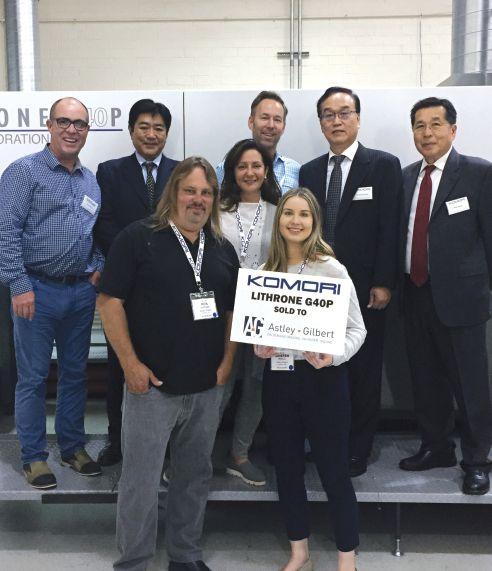
Astley Gilbert of Toronto, Ont., acquired a new Komori GL 840 perfecting press, purchased through Komcan Inc. The new press will include a tower coater, HUV and UV curing capabilities, and extended delivery, as well as A-APC plate changing and Komori’s PQA-S dual camera system for inspecting both sides of the sheet.
Santo Scaglione joins Agfa Graphics as the North America Controller. Most recently, he was Vice President of Finance Operations at Sony Electronics North America, where he worked for more than 30 years. Scaglione was on the senior leadership team of Sony’s $550 million business-to-business products and services division. Also, Mark Levitan becomes Director of Inside Sales for Agfa Graphics. Prior to Agfa, Levitan was the Director of Sales & Business Development for Sustainable Minds LLC, a developer of cloudbased marketing solutions for globalscale manufacturers.
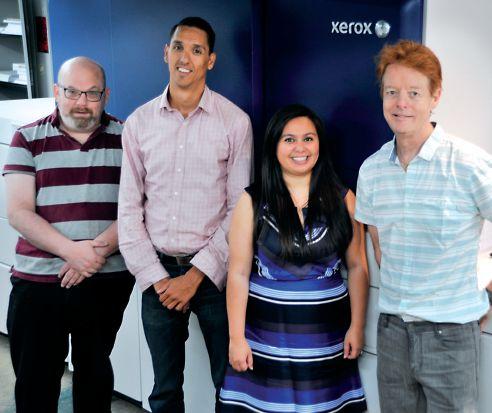
East Van Graphics of Vancouver, BC, installed a Xerox iGen 5 press, featuring an expanded format (14 x 26 inches), matte finishing, and heavyweight capacity (24 pt), pictured with Phillip Debrokin, Xerox’s John Zurowski and Shahla Carter, and East Van founder Jeff Grayston.
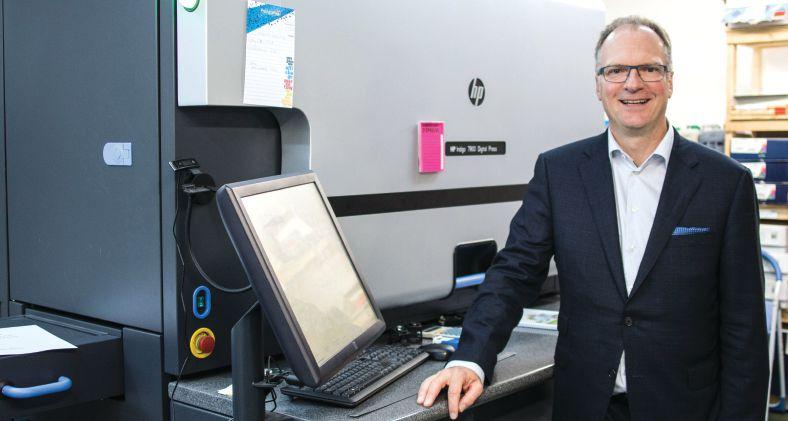
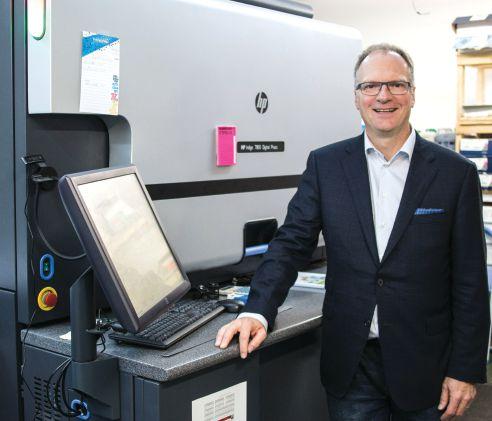
Précigrafik of Sherbrooke, Que., is the first Canadian company to install the HP Indigo 7900, pictured with President Gilles Blais. With more than 70 employees, Précigrafik has nearly doubled its colour production since installing the press earlier this year.
North America’s first Nozomi in North Carolina
Complete Design & Packaging (CDP), an independent corrugated packaging provider based in Concord, North Carolina, will be the first business in North America to install EFI’s Nozomi C18000 single-pass LED corrugated packaging press. Installation of the six-colour press for direct-to-board printing is scheduled to begin in the fourth quarter of 2017, with production operations going live by the end of the year.
CDP’s founder, Howard Bertram, started the business in 2002. Today, the company offers analogue flexo and litho lamination corrugated printing for retail packaging applications. CDP currently does some prototyping and very short-run digital work on a multipass flatbed inkjet printer, but Bertram and his business partner, Scott Sumner, aim to use the Nozomi to provide regionalized and customized packaging.
“There are a lot of flexo and litho lamination options out there today, but customers face limitations in their marketing without digital printing, and as a young, independent company, we want to be on the leading edge of that offering,” said Bertram, who also serves as of CDP. The world’s first EFI Nozomi C18000 was installed in Spain.
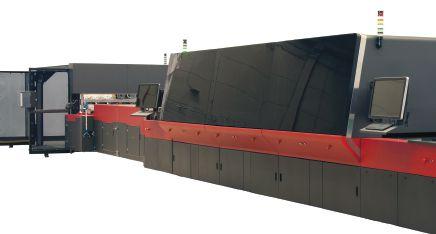
The 71-inch wide EFI Nozomi C18000 single-pass press is rated for speeds of up to 246 linear feet per minute with throughput of up to 6,600 2.6 x 3.3-foot boards per hour. The EFI Fiery NZ-1000 digital front end for the press is based on new, scalable Fiery XB bladed architecture.
Seven Rapidas for TCPL in India
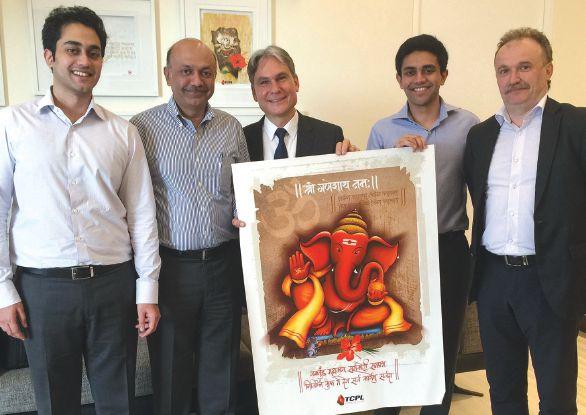
TCPL Packaging, one of the largest packaging printing companies in India, ordered three Rapida 106 sheetfed presses from Koenig & Bauer at drupa 2016, including its second long special press. Now a total of six Rapida 106 presses are in operation at TCPL, two at each of its three locations in Haridwar, Silvassa and Guwahati. A seventh – and the third from the drupa package – is expected to arrive shortly. The company was only established in 1990 and today employs a workforce of 1,200.
The Guwahati plant received a special press with six inking units, coating tower, two intermediate drying units, each with a further inking unit and coating tower, and a three-fold delivery extension. It has a UV function, pile logistics and has been set 450 mm higher for packaging production. The newest Rapida 106 is the company’s second with a such a special configuration. In Haridwar, a long Rapida 106 with eight inking units, coating tower and extended delivery, as well as a cold foil module, has been in production for two years. It has additional packages for printing cardboard and foils, is equipped for UV/mixed operation and, among other things, is automated with pile logistics, a non-stop automatic function and FAPC plate changing.
The six Rapida 106 presses currently in operation at TCPL have a total of 50 printing and finishing units, including seven coating towers for conventional and UV production, a corona unit and several units for inline finishing. They were all installed between 2012 and 2017.
Reindl buys Impremia, its fifth Komori
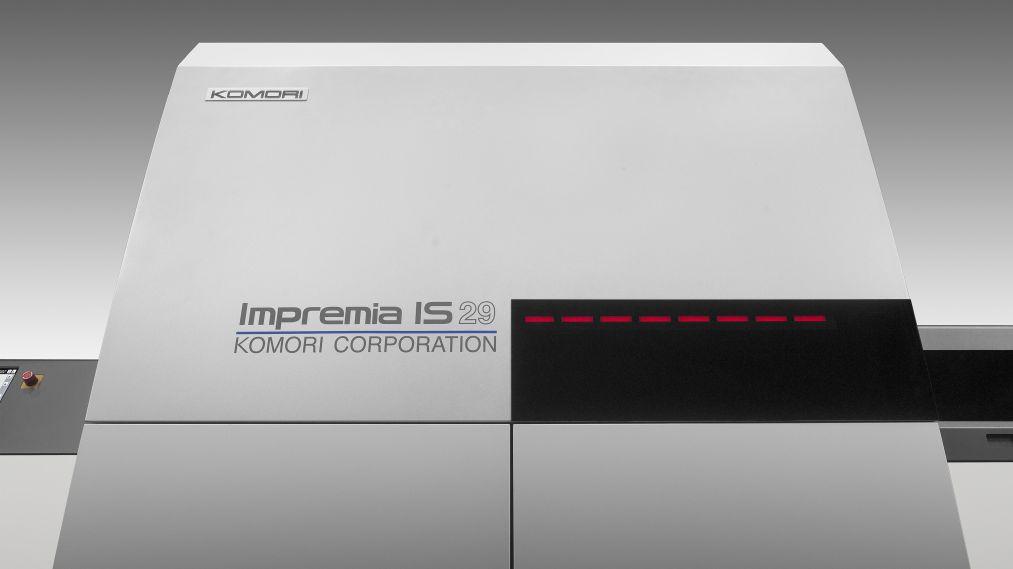
Wisconsin-based Reindl Printing has acquired Komori’s Impremia IS29, a 29-inch inkjet sheetfed UV printing system with the goal of filling the gap between mainstream offset and digital. This is Reindl Printing’s fifth Komori press purchase since 1997.
“As a G7 Master Printer, we wouldn’t purchase anything that didn’t deliver on superior colour quality. This made the IS29 the perfect choice for meeting our shortrun variable print needs,” said Rick Reindl, co-owner of Reindl Printing. “Having experience with the print quality and quick drying capabilities of Komori’s H-UV system on our eight-colour GL40, we were sold when we learned that the IS29 offered UV inkjet characteristics as well as perfecting.”
The company noted other positives of the IS29 included the fact the press runs a 23 x 29-inch sheet, well suited for six-up print production with full variable print applications. The IS29 operates in both perfecting or straight mode, does not require pre-coated paper, and runs at speeds of 3,000 sheets per hour in straight mode.
Elif, headquartered in Istanbul, Turkey, is a global supplier of flexible packaging for food, beverage, pet, home and personal care sectors. With more than 1,300 co-workers, Elif exports more than 50 percent of its production to more than 50 countries. The company recently invested in Esko’s Equinox colour management technology, which allows for extended gamut printing with CMYK + 1, 2 or 3 additional inks.
The EFI Nozomi C18000 single-pass LED inkjet press is aimed at corrugated board production.
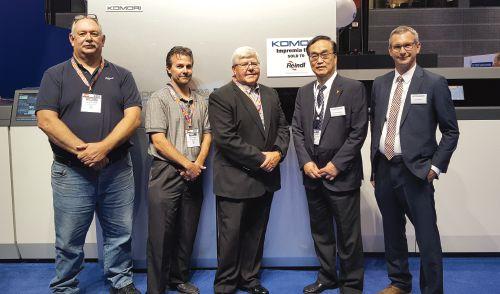
Warren Simon, Scott Reindl and Rick Reindl (President of Reindl Printing); Satoshi Mochida, CEO, Komori Corporation; and Clark Scherer, District Sales Manager, Komori America.
The management of TCPL and KBA’s Dietmar Heyduck (centre) present the first print on the new Rapida 106.
25 years ago
Digital Technology Means
Growth for Lowe-Martin: Don Griffin, President of Lowe-Martin Printing in Ottawa, sees the issue of direct-to-press technology in relatively simple terms: “No one else in town has this kind of digital technology. That’s the way we’re going, and its part of the reason for our success.” The company is the second in Canada to purchase the GTO-DI press form Heidelberg, and it has been up and running for more than two months.
“I think a lot of the market is a new market, similar to what happened when Xerox brought out their copiers and replaced small offset duplicators,” said Gerry Moodie, head of Lowe-Martin’s Imagraph division. “The quality maybe isn’t as good as the traditional offset presses, but it is suitable for a lot of things that weren’t printed in colour before.”
The GTO-DI is an adaptation of Heidelberg’s GTO Series of offset presses, but instead of using metal plates that are mounted on the cylinders, the Direct Imaging press includes an electrical imaging systems controlled by a computer. The printing images for each colour are burned into plates by an electrical spark from an imaging head that moves back and forth across the cylinder to create the image. At each spark, a tiny inkwell is formed. Ink is trapped in the well and then transferred to the sheet much like the intaglio process.
20 years ago
PointOne Graphics
Focuses on Maintaining Growth: Seven years ago, Dennis Low and his father, C.K. Low, decided to bring Dennis’ front-end knowledge and C.K.’s press experience together to create PointOne Graphics in Toronto. Today, due to its rapid growth in the trade-printing sector, the company is currently searching for a building large enough to merge its prepress and press departments and to house its recently ordered Heidelberg 10-colour, five-overfive perfecting press.
180K
A 2002 report by TrendWatch Graphic Arts, called E-Books, Can’t Hear the Revolution , found that Palm Digital Media recorded sales of almost 180,000 e-book titles in 2001. The Open E-Book Forum, which was noted in the report, states that book publisher McGraw-Hill saw its e-books sales increase 55 percent from July 2001 to July 2002.
15 years
$145K
For sale (1992 classified): 2C Heidelberg 1984
SORMZ 20 x 29 inch with Royce alcohol dampening, IR dryer, sheet decurlar, etc. Excellent condition. Will to trade in 1C GTO. $145,000.
At its print shop in Mississauga, the company manages to keep its two four-colour 40-inch Mitsubishi presses running two shifts, and often around the clock. Dennis and C.K. purchased the 10-colour Heidelberg press during Print 97 in Chicago. It will be the only second such press installed in Canada. This year, PointOne was listed in Profit Magazine’s Top 100 Fastest Growing Companies in Canada.
$80K
For sale (1997 classified): 1988
Adast 725P 19 x 25 inch 2 colour perfector, excellent running condition, good step up press to mid-size multi-colour printing. Film to plate to press punch register system. Bar Back damps, new rollers in spring 1997, service record on request. Asking $80,000.
ago
Community Relations: More than a decade ago, half of all community newspapers printed with black ink only. Slowly, publishers began adding sporadic colour. Printers adapted by installing 2- and 4-colour presses. Recently many community newspapers have been following the dailies by providing full-colour issues and special sections. This has compelled printers to increase their colour capacity.
Metroland Printing of Toronto has made a large capital investment to prevent problems with colour capacity. The company has ordered a KBA Colora press, which is expected to be running by March 2014. This offset press has the ability to print 75,000 full-colour newspapers or supplements per hour.
According to a 2002 report by the Canadian Community Newspaper Association, more than 60 percent of community papers have under 5,000 readers, with an average weekly circulation of about 14,000. Twenty-one percent of community papers are broadsheet and 78 percent are tabloid. Total yearly circulation of community newspapers in Canada is 583 million.
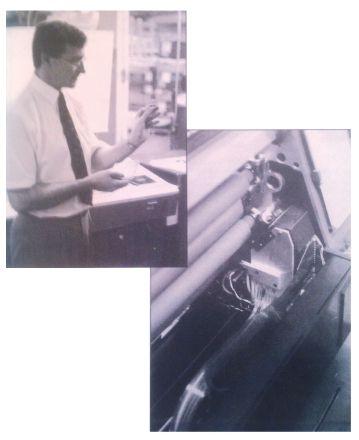
Gerry Moodie of Lowe-Martin holds an GTO-DI electrical imaging head, which is also pictured below moving across the press’ printing cylinders.
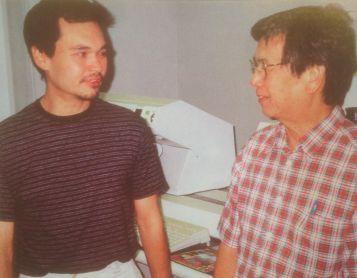
Dennis and C.K. Low in the prepress department of PointOne Graphics.
Metroland Printing of Toronto invests in a new KBA Colora press to address the growth in colour for community newspapers.
CALENDAR
FACE OF CANADA at Royal Ontario
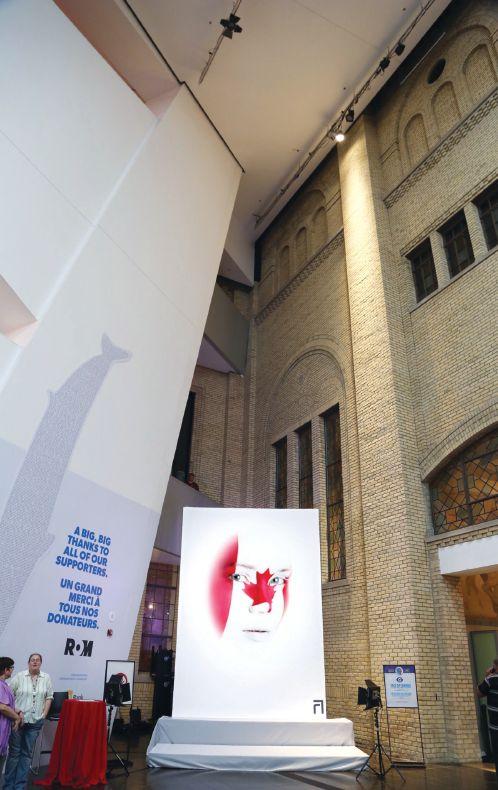
The Royal Ontario Museum in Toronto, Ont., recently installed FACE OF CANADA, The Canada 150 Commemorative Edition, created by artist Robert Young. This special textile artwork from his YOUNG WORLD FACES collection was produced in Electronics For Imaging’s Meredith, N.H., inkjet technology facility using a VUTEk FabriVU soft signage printer. The photograph, which features a Canadian citizen with the Nation’s flag painted on her face, was displayed this past August in the ROM’s Hyacinth Gloria Chen Crystal Court as part of the museum’s Canada 150 festival programs.
The 14-foot tall by 10-foot wide portrait shows the detail of Young’s photography, while featuring the colour of Canada’s flag. The artwork, which was produced with EFI aqueous dye sublimation inks, reflects many of the artistic themes and motivations that drive Young’s imagery. “I’m a storyteller who uses literature, photography and film to create imagery that inspires and motivates people,” said Young. “I wanted to create a human experience with this print, especially on Canada’s 150th year as a nation.”
Previously produced on EFI soft signage printers for the Pan American Games in Toronto in 2015, this new print is one of more than 40 largescale images in the YOUNG WORLD FACES collection. “When the installation went in, I was working on a project in Anguilla, and I’m a Canadian American with Jamaican roots, working with EFI, an American company with Italian textile printing technology that has printed this beautiful work that was originally captured in Canada. And then the work went back to Canada for display in one of Canada’s greatest museums. It’s a great example of how YOUNG WORLD FACES brings the world together,” said Young.
EFI printed the one-off installation with a white background instead of black, direct-to-substrate on A. Berger Lighttex, a single-sided polyester textile for backlit applications.The 3.4-metre wide VUTEk FabriVU 340 printer used for the installed art piece prints in four colors in resolutions up 2,400 dpi, providing deep colour saturation for fabric display graphics.
In 2015, Mississauga, Ont., textile graphics specialist McRae Imaging used the first EFI Reggiani printer installed in North America to produce the original YOUNGWORLD FACES as a textile series, consisting of 41 faces, each painted with professional makeup featuring the flag of a country that participated in the 2015 Pan American Games.
The colourful FACES images of those 7-foot tall prints pop against black backgrounds. Robert Young explained he created these images to inspire the revelation of human stories that help citizens of every nation recognize, not only their own beauty but also the global commonality.
“I wanted to create a human experience with this print, especially on Canada’s 150th year as a nation.”
October 13, 2017
Toronto Graphic Arts Day Ryerson GCM, Toronto, ON
October 18, 2017
DIA 30th Anniversary Celebration
Cirillo’s Culinary Academy, Etobicoke, ON
October 23-25, 2017
Digital Packaging Summit 2017 Ponte Vedra Beach, FL
October 27-28, 2017 Sign Expo Canada International Centre Mississauga, ON
October 31-November 3, 2017
IPEX 2017 Birmingham, UK
November 9, 2017 12th Annual Canadian Printing Awards Gala Palais Royale, Toronto, ON
January 23-26, 2018
EFI Connect The Wynn Las Vegas, Nevada
February 22-24, 2018
Graphics of the Americas Fort Lauderdale, Florida
March 22-24, 2018 Sign Expo 2018 Orlando Convention Center, FL
May 1-2, 2018 InPrint USA
Palmer House Hilton, Chicago, IL
May 15-18, 2018
FESPA 2018 Global Print Expo Messe Berlin, Germany
September 26-27, 2018 Label Expo
Donald E Stephens Convention Center, Chicago, IL
September 30-October 3, 2018 Graph Expo 2018 McCormick Place, Chicago, IL
October 18-20, 2018
SGIA Expo Las Vegas Convention Center
October 24-28, 2018
All in Print
New International Expo Center, Shanghai, China
June 16-26, 2020 Drupa 2020 Dusseldorf, Germany
Robert Young, a Canadian-American artist, recently produced a special edition print for the Royal Ontario Museum displayed in August as part of the ROM’s Canada 150 celebration.
Made in Japan, rise of Komori
In Part II of an article series, the author looks at how Komori leveraged Lithrone innovation to stamp its position and push toward the future
By Nick Howard
To get a grasp of the monumental changes that were brought by the engineer design of Komori’s new Lithrone platform in 1981, you must look back to 1965 and a company known as Planeta, in the former East Germany. Planeta was also rather isolated, locked behind The Iron Curtain, but the press maker had some brilliant ideas. Few in the rest of West Germany and Europe paid much attention when Planeta launched its Variant press platform, but Komori certainly did. The Japanese press maker quickly saw the benefits of the double-size impression and transfer cylinders on the Variant. Although the Kosmo was a unitized press, the Kony was a bit of a discombobulation of upper and lower unitized units. Komori saw the light and embraced the Planeta Variant’s forward-thinking unitized double-size cylinder design. Planeta is now a part of Koenig & Bauer.
Not everything Planeta was borrowed. Komori retained the upper swing arm first used on Miehles, then Rolands, and made its own version of the Mabeg feeder head and essentially improved or re-engineered every part of the Planeta design principles with a press that remains today as a watershed beacon of Komori engineering achievement. And it was fast. At 13,000 iph, the Lithrone eclipsed both Roland and Heidelberg by 3,000 iph in 1981. I could go on and on about various features but suffice to say the Lithrone made Komori what it is today. Twentysix-, 28-, 44- and 50-inch Lithrones would soon enter production.
During the early 1980s, the packaging industry soon discovered the benefits of using aqueous coatings instead of varnishes. Komori became the first to build
a factory tower coater. True – Planeta had done so earlier but these were simply printing units less the inker. Komori fashioned its own three-roll coating apparatus and followed Planeta’s lead by offering extended deliveries. Unless you ordered a hollow transfer Lithrone, however, running short-grain carton was not ideal. Both the solid and skeleton, or hollow cylinder, still only allowed substrates of up to .032 inches (0.8 mm). Roland and Heidelberg (1986) already eclipsed this and of course Planeta had the widest range up to 1.4mm or over .050 inches. This is why even today Koenig & Bauer still carries the reputation as the ultimate carton press. In 2017, when every manufacturer can essentially run the same caliper of board (including Komori), Planeta’s early penetration into that market continues to pay dividends for Koenig & Bauer.
Buoyed by its strong sales – especially into the U.S. and Europe, Komori pushed to acquire the Harris Graphics Corporation in 1988. In fact, Komori had made what it assumed to be a deal with the principle owner AM International, and even released a press statement confirming the acquisition. At that time, Harris web division was a leader in commercial and insert printing web systems. When the dust settled, however, Komori
A
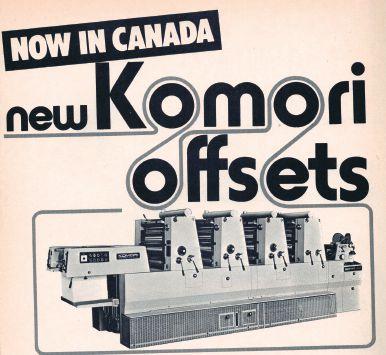
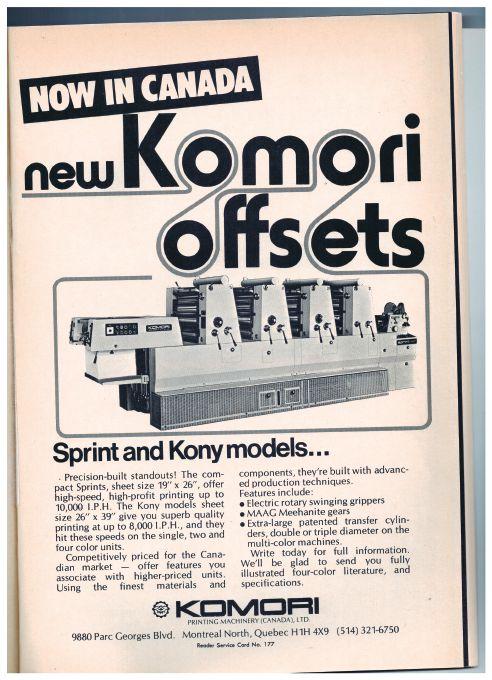
1974 advertisement in Canadian Printer magazine showcases new Komori presses arriving in Canada.
was trumped at the final hour by Heidelberger Druckmaschinen. No doubt anger sidelined Komori executives, but not for long as Komori swooped in to buy the small French specialist packaging narrow-web manufacturer Chambon. In retrospect, considering the depressing state of the web-offset business today, Komori may have been done a favour.
It’s
in the metal
Komori grasped another sales tool. When Japanese exports took off in the early 1970s, the West handed out the moniker of “Japanese Junk,” from early cars that would rust away to machinery that would break from poor foundry methods. There were a lot of consumer products leaving Japan that had only one saving grace –price. This story is an old one and we have seen it reappear again with China’s entry onto the world stage. In short, made-inJapan in 1970 meant inferior goods at very cheap prices. It’s incredible to consider how this has changed in less than 50 years.
I don’t know about you, but I can go for days without thinking about cast iron. But to machine builders, it’s a very important topic. Komori was well aware of the uphill battle it faced trying to export a machine that was about 80 percent cast iron. In fact just about every heavy machinery exporter did too.
Nebiolo S.p.A. of Italy faced the same backlash. With a tarnished reputation, Nebiolo turned to Meehanite to prove to the world their cast was as good as any. So Komori did a smart thing. Komori’s major castings come from a company called Kasakura Metech Co. and Kasakura became a certified Meehanite foundry in 1981, although its roots go back to 1919. Meehanite is a process to increase the quality of grey castings. It was developed back in the 1920s by the Ross Meehan Foundry in Chattanooga, Tennessee. Meehanite Corporation was formed to, among other things, license third parties to use the technology which essentially increased the Perlite and removed Ferrite from the cast, strengthening it.
Heidelberg, which owns its own foundry, already had a century of skill making superior castings, but Komori’s supplier was unknown outside Japan. Now Komori would emblazon their castings with the famous “M” logo in bas relief to show the world it could supply castings as strong as anyone. Ironically, Mitsubishi took a slightly different path when it did the unthinkable by having a non-Japanese company (Beiren of China), make much of theirs. Kasakura now has a foundry in China, too.
No one today should question the superior engineering of Komori presses. After all the upheaval in the offset business, Komori has remained the undisputed leader in Japan and one of the world’s top three press manufacturers in the world. Quite a feat for a company that always holds its cards close to the vest. Like Heidelberg, KBA and Manroland, Komori too finds the lithographic business dwindling from the highs of the 1990s as digital devices take more and more of offset’s position away.
Made in Japan and Israel
Landa Digital’s S10 press is already made up of Komori transport, coating and perfecting components. Komori signed an agreement with Landa to both provide traditional press components and also exclusively market its own version of the Landa S-10 as the Komori Impremia NS40. Since there is no way yet to determine the success or failure of this platform, the industry sits and ponders if these very expensive Landa presses will be stars or dogs. Knowing Komori, I’d put my money on the former. However at eye-watering prices even as a success others will make that determination.
Konica Minolta also partnered with Komori on the smaller Impremia IS29. Komori even started selling its own guillotines in 2014. I didn’t really think the world needed another guillotine but... All the while Komori keeps selling new generation GL(X) 29- and 40-inch presses and perfectors to a satisfied user group of commercial printers. The crafty HUVdoped UV, which uses much less power and produces less heat, was a Komori-Iwasaki-EYE invention that for a
brief few years had the market all to themselves. Now pretty much everyone has a low-energy UV alternative to offer. Rarely first with new designs, Komori researches the market well. If a competitor’s leap is deemed important enough, you will see it worked into a Komori press. Just look at the up and over delivery from Manroland, vacuum feeder from Roland and Heidelberg, or even the Wallscreen and Inpress concepts from Heidelberg. They all made it into the Komori GL40 a few years later. There is also a flat line across all major press makers today as everyone makes an outstanding press.
Few know the inner workings behind the Japanese mystic, even fewer care. Mitsubishi MHI’s recent exiting of its sheetfed business, handing the keys to Ryobi, has not done much to eliminate a competitor. If, as many suspect, the Mitsubishi Web program may be shuttered or sold off entirely, the landscape may only alter inches not feet.
There is a source of puzzlement when benchmarking Made in Japan with the rest of the world. Certainly exporters are heavily supported by government incentives (as well as periodic tax benefits for the domestic market), and almost all Japanese branch units run lean with very low head counts. With such world-acclaimed products, some find it ironic that basic functions such as spare parts and communication vary greatly from region to region. The Germans remain leaders with greater transparency in customer relations. In short, to outsiders it seems the only thing holding back Japanese companies is in fact themselves.
When Toyota was named the world’s largest car company in 2016, it might
have been a statement that some in the automotive industry questioned. Not the fact that Toyota was the largest and so successful, but why it took them so long.
Virtually every manufacturing segment has a Japanese company ranked at or near the top. Komori is no exception. The new super factory/assembly hall opened in 2003 in Tsukuba, Japan, was years in the planning and built with the next technology leap in mind. KANDO, the new catchword meaning, as Komori interprets: “Beyond Expectations... is an expression of who Komori wants to be and why it’s important to you.”
Every press manufacturer has a few product embarrassments in their closets. Some more than others. No one is exempt. In Komori’s case they have been rather fortunate in successfully dodging major blunders over its 94 years. Not only do they have a dedicated following but their management team has taken great pains to run a conservative, profitable world-class company.
The year 2018 marks Komori’s 95th year in business and a very good reason to celebrate a special company that from 1923 to now has been in the offset business almost exclusively. You may not see Komori race out in front of the pack in a marathon, but you will sure see them at the finish line.
NICK HOWARD, a partner in Howard Graphic Equipment and Howard Iron Works, is a printing historian, consultant and Certified Appraiser of capital equipment. nick@howardgraphicequipment.com
95
In 2018, Komori Corporation based in Tokyo, Japan, will celebrate its 95th year of operation, as the press maker is now making a push into digital after remaining highly focused on offset for nine decades.
The 29-inch sheetfed UV inkjet press Impremia IS29 features volume production that is associated with offset printing.
Five fundamental questions
Simplicity is often the best approach in print sales and that can be led by five questions to identify the needs and wants of clients
By David Fellman
have long believed that the best selling is interrogatory rather than declaratory. In other words, it’s more about the questions you ask than the statements you make. Yes, there comes a point where you have to tell someone why you think they should buy from you, but great salespeople get to that point by asking questions to identify needs and wants. To put that another way, they ask questions to identify hot buttons, and then make statements that push those specific buttons.
What I find to be even more interesting is that great salespeople question themselves as part of the process. In fact, of the five most fundamental questions a salesperson should be asking, only one of them is directed to the buyer. Here are those five questions:
1. How can I bring value to this situation?
2. What do you want your counterpart to say yes to today?
3. Is there anything you would change if you could?
4. What do I do next?
5. When do I do it?
What to ask the buyer
The question you ask the buyer is pretty straightforward: Is there anything you would change if you could? As I hope you’ll remember, in last month’s column, I wrote that being willing to meet with you is often a long way from being ready to buy from you. So the first meeting with a prospect is your opportunity to learn exactly how you can differentiate yourself from the printer in place. And that leads to another important understanding, the fact that there is always a printer in place. Okay, maybe not always because there are new businesses opening up, but will you agree that anyone who is currently buying enough printing to make them a desirable customer for you is currently buying it from someone other than you? Your challenge is to displace that other
You should have a specific objective whenever you interact with a customer or prospect, in person, or by phone or even via email.
printer and the best way to do that is to identify something they are not doing well and convince the prospect that you can do it better. Of course, you can also try competing only on price.
Do you really want to do that? The great salespeople know that you cannot just walk in and ask the question, no matter how straightforward it may be. But they understand the importance of the question. As one very talented and successful printing salesperson once told me, “I don’t start with that question, but it is the end that I work toward.”
What to ask yourself
To a large degree, the answer to the question, Is there anything you would change if you could? is also the answer to, How can I bring value to this situation? Obviously, you can bring value by solving a problem or eliminating pain. The problem for you, however, is connected to the likelihood that your prospect may have only minor issues with the printer in place, maybe lukewarm buttons as opposed to hot buttons. If that’s the
case, you may have to suggest points of value. The key point here is that it’s all about value! So keep asking yourself how you can bring it.
Now here’s a question for you: Do you set goals for each sales call? You should. You should have a specific objective whenever you interact with a customer or prospect, in person, or by phone or even via email. It’s been my experience that most salespeople do not think that way, and because their goals are vague, their results tend to be vague, too. So to help you frame your goal, I’m suggesting a question that many salespeople have found helpful: What do I want this person to say yes to today? Once you know that answer, you can start thinking about a strategy for making it happen.
The other two questions you ask yourself come after the interaction. What do I do next and When do I do it? These questions are often another missing piece for most salespeople. What I’m really suggesting is an individual marketing plan for each customer or prospect.
Think of it this way: No matter what you accomplish with today’s interaction, there is probably a next level you want to reach. That may involve winning a specific order. It might also involve building or broadening a relationship. What happened today hopefully represents progress, but until you reach the “maximized customer” stage, there will always be a next level.
Less than 10 percent of top salespeople, according to The Harvard Business Review , were classified as having high levels of discouragement and being frequently overwhelmed with sadness. Conversely, 90 percent were categorized as experiencing infrequent or only occasional sadness.
Now let’s tie this all together. The two questions you ask at the end of the interaction must be connected to the question about bringing value, because it’s always about value, otherwise you are letting it be about price. And what you do next must be connected to what you want your counterpart to say yes to in the future.
And here’s one more thing to consider: It’s a good idea to ask your customers every once in a while if there’s something they would change about their relationship with you. If there’s something you are not doing well, I think you want to learn about that and fix it before some competitor finds out that your customer has pain or problems.
DAVE FELLMAN is the president of David Fellman & Associates, a graphic arts industry consulting firm based in Raleigh, NC, USA. He is a popular speaker who has delivered keynotes and seminars at industry events across the United States, Canada, England, Ireland and Australia. He is the author of “Sell More Printing” and “Listen To The Dinosaur.” Visit his website at www. davefellman.com.
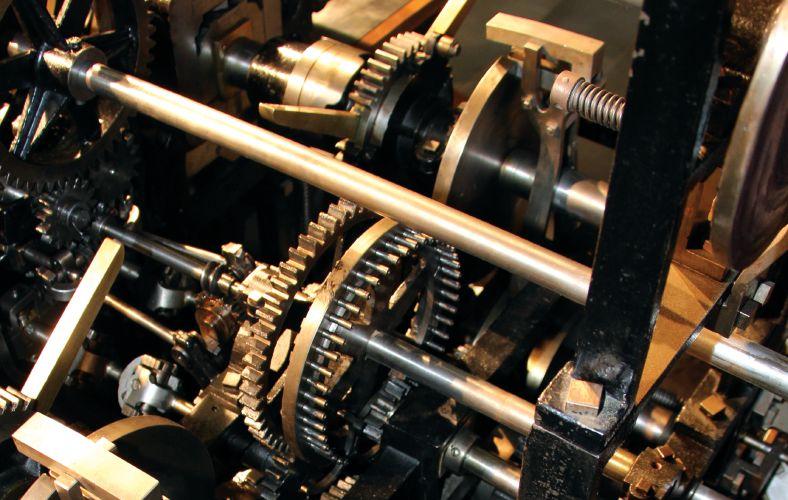
The Times press (first sold in 1814) was the first press to not only have a cylinder but also tapes to feed a sheet. The most incredible feature was how Koenig worked out the system with cams and gears to stop and start the cylinder and keep register to a moving bed – all powered by steam.
200 YEARS OF INNOVATION
Koenig & Bauer enters a third century of transforming print with a new brand identity and a breadth of technology reaching into security, sheetfed and web offset, metal decorating, inkjet, flexo and packaging
By Jon Robinson
As more than 700 guests poured into the Vogel Convention Center in Würzburg, Germany, for Koenig & Bauer Group’s 200-year-annivesary celebration, two operators stood on either end of a scaled replica of the Times Press and printed programs for the evening ahead. In addition to Claus Bolza-Schünemann, Koenig & Bauer’s seventh-generation leader, executives from some of Europe’s oldest companies were scheduled to speak, including Axel Hentrei, CEO, Bertlesmann Printing Group, which generated $2.5 billion in sales for its $24.9-billion global parent, founded in 1835 Hentrei was to be followed by CEO Hans Schur, representing sixth-genera-
tion family ownership for Schur International, a Danish packaging and technology company founded in 1846. He was to be followed by Ralf Wintergerst, CEO of Giesecke & Devrient, founded in 1852 and now generating $3.1 billion in physical and digital security products. Horst Köhler, President of Germany from 2004 to 2010 – following four years of running the International Monetary Fund – would provide the keynote address for Koenig & Bauer’s 200th jubilee. Germany traces its roots to age of antiquity as a region called Germania and, after the collapse of the Roman Empire, the German Confederation was formed in 1815 (Germany became a nation state in 1871). A year prior to German Confederation, Friedrich Koenig finished the Times Press, a machine named after its purchaser, the Times newspaper of Lon-
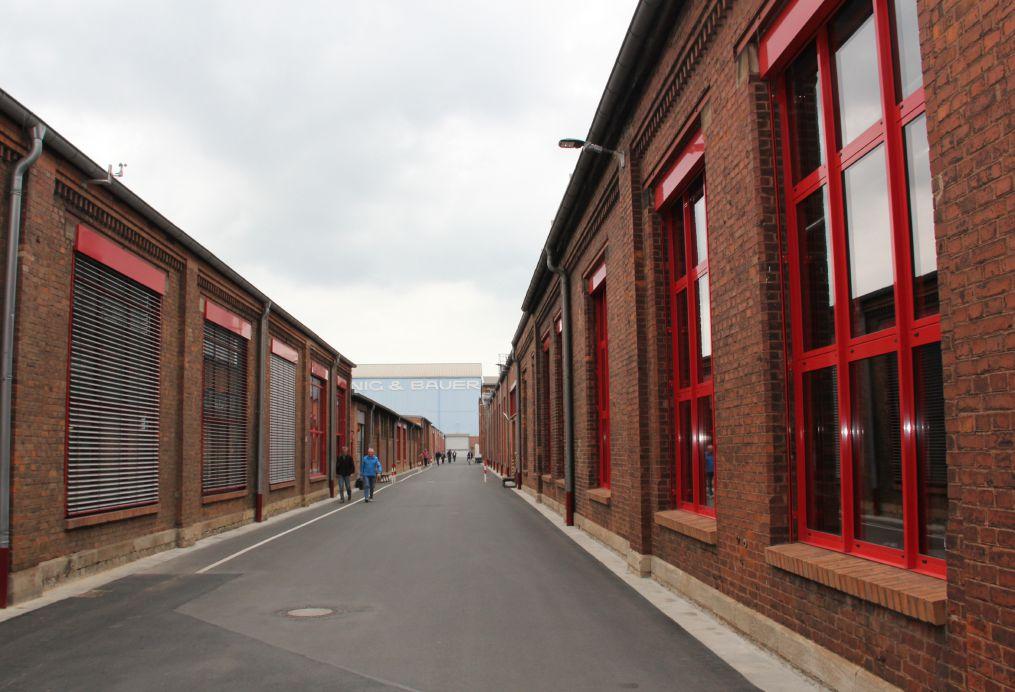
Koenig & Bauer’s massive Würzburg facilty welcomed two new production halls in 2003 and 2008.
Back to the roots with a view forwards: the new word mark of the Koenig & Bauer Group (above). The ampersand from the original brand name will be leveraged for future promotions.
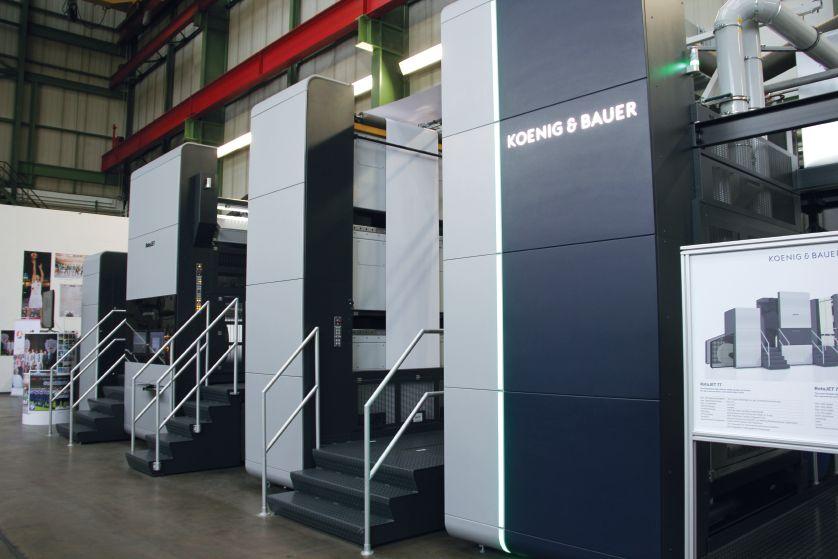
Koenig & Bauer had a RotaJET L with the new product design in its Würzburg manufacturing facility. Its goal is for all technology to carry a uniform design by drupa 2020.
Koenig & Bauer today holds 80 percent market share in the banknote printing.
don. Koenig developed the press with eventual business partner Andreas Bauer, an engineer from Stuttgart who had been working as a watchmaker. Bauer joined Koenig in 1817 to found Koenig & Bauer at the Oberzell monastery near Würzburg.
An old world
Another way to consider the importance of the Times Press is to understand it as the world’s first printing machine – ma-
chine being the operative word, as opposed to the world-changing press introduced by Johannes Gutenber around 1440. The Times Press invented by Koeing arrived at a time when newspapers were being distributed in large cities in the throes of The Industrial Revolution, which historians peg as happening sometime between 1760 and 1840.
The Times Press was the first press to not only have a cylinder but also tapes to
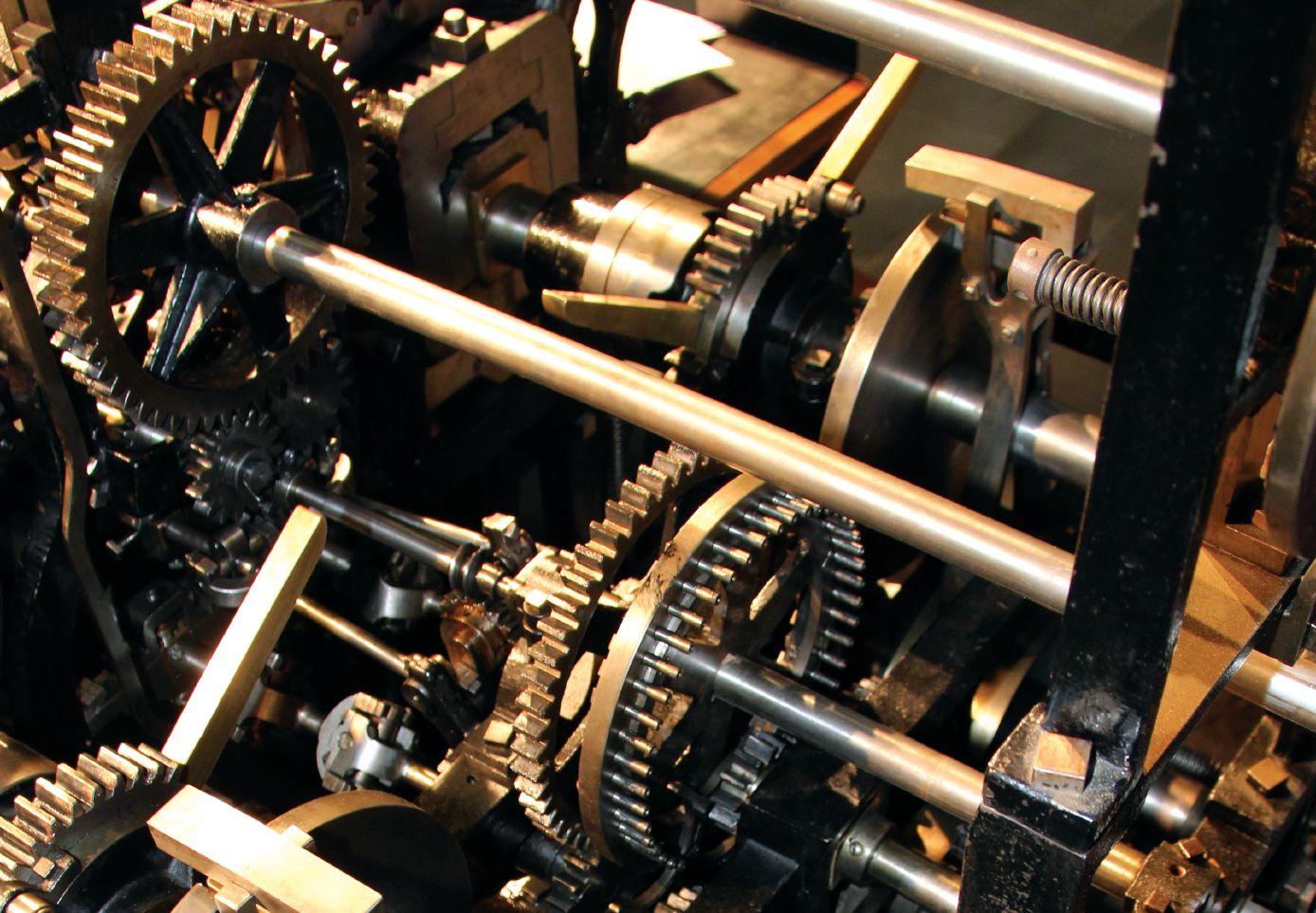
feed a sheet, all powered by steam, providing high speeds with a new ability to print on both sides of the paper. Print historian Nick Howard explains, “The most incredible feature was how Koenig worked out a system with cams and gears to stop and start the cylinder and keep register to a moving bed. What may be even more stunning is how long it took afterwards for his concepts to become commonplace.”
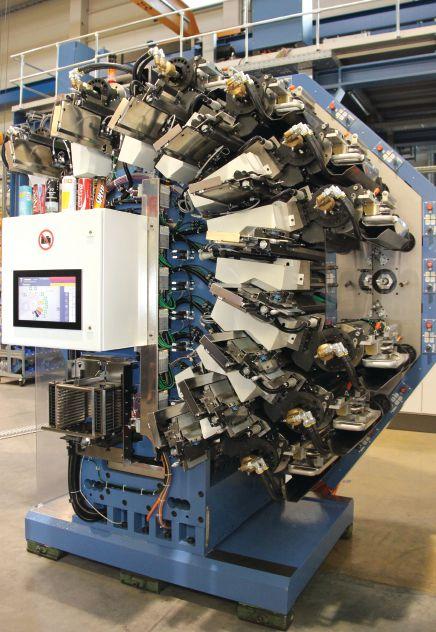
Clockwise from top left: A prototype press in Würzburg signals Koenig & Bauer’s ambition to provide printing for the 2-piece market, complementing its strong current position in the production of 3-piece cans.
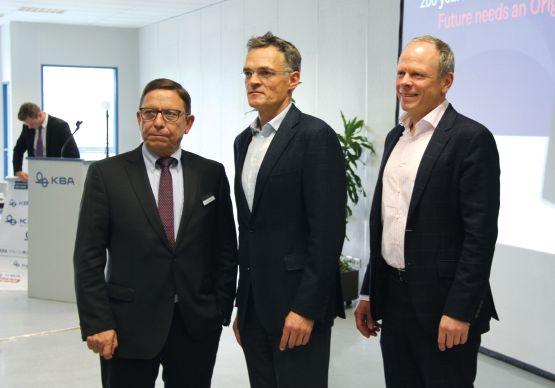
Director of Marketing, Klaus Schmidt; CEO Claus Bolza-Schünemann; and CFO Mathias Dahn at Koenig & Bauer’s 200-year-celebration press conference in Würzburg.
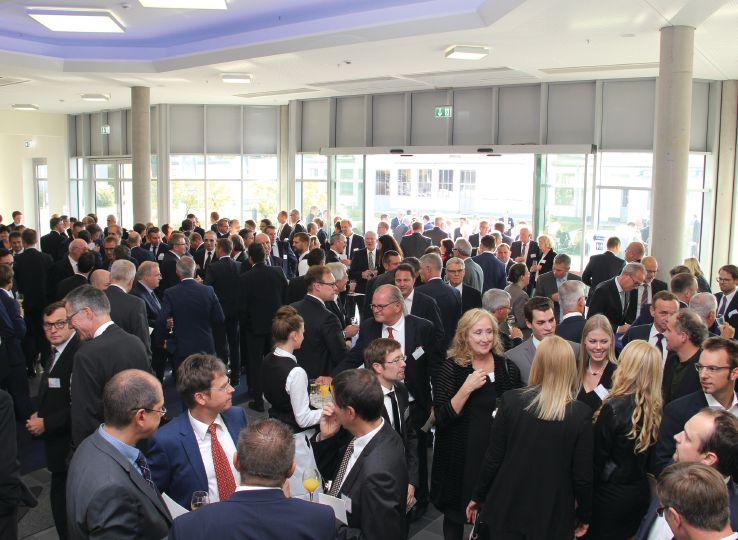
More than 700 guests attended Koenig & Bauer’s 200-year party held at the Vogel Convention Center.
Dr. Horst Köhler, former President of Germany, provides the keynote address during Koenig & Bauer’s jubilee celebration.
John Walter, publisher of the Times in 1814, clearly saw the advantages of Koenig and Bauer’s press and, on the night of November 29, 2014, ran sheets of the newspaper all night at 1,100 an hour (five times as many as a conventional printing press). Historic records show Walter was most impressed with how consistently sharp the press printed. As the company’s 200-year anniversary book describes from that faitful night: “This machine is the revolution. It will help overthrow kings, spread philosophies across the globe and carry knowledge to the farthest reaches of the earth. Thus begins the age of media.”
A new world
Claus Bolza-Schünemann, who has been CEO of Koenig & Bauer since 2011, after joining the company in 1989 as head of electrical planning and engineering for web, sheetfed and security presses, welcomed the
bicentennial guests by describing company milestones. He made particular mention of the acquisitions made over the past 25 years, which have turned the company into a leading player in package printing. Previously, its main focus had been on media-oriented markets like newspaper, book, magazine and catalogue printing.
Today, the world’s second-largest press manufacturer develops technologies for almost all print markets, as Bolza-Schünemann explains: “From morning to evening, we meet printed products that were produced on Koenig & Bauer presses: from the directly printed perfume bottle in the bathroom in the morning, the newspaper at the breakfast table, banknotes, credit cards and a wide range of packaging when going shopping, to books or magazines in the evening.”
Bolza-Schünemann would later introduce the crowd to the new
Koenig & Bauer corporate name and branding. He explained the company’s previous brand, best known by the abbreviation KBA, was introduced in 1990 to carry the names of its founders while also accounting for the takeover of Albert-Frankenthal AG. The company is now entering its third century of transforming print by reverting to the surnames of its founders and the original brand of Koenig & Bauer.
“Koenig & Bauer AG today has 33 subsidiaries. Twelve of them produce their own products for their own customers.We see the company anniversary as an ideal time to place all activities of the group, from classic printing to digital printing, including prepress and post-press and top service, under a strong common roof again,” explains Bolza-Schüneman. “The relaunch is intended to strengthen the employee’s pride in the history of the
Koenig & Bauer today holds 80 percent market share in metal decorating and glass and hollow container printing.
company and the pride of new employees.”
In addition to its new logo, which carries a unique ampersand font to be leveraged in promotional materials, the company also introduced a new moniker – “We’re on it” – and a completely new product design. This product design will be implemented immediately for new products, and successively up until drupa 2020 for all other Koenig & Bauer product families. The company explains its well-known colour of blue becomes warmer and more accentuated, with the use of new dark and light shades of grey.
A new factory
A day before the jubilee celebration, Bolza-Schünemann shared the new branding and logo for the first time with a group of 60 journalists at a morning press conference at the Würzburg facility, which focuses on the production of banknote printing systems, web offset presses, a foundry, and a range of R&D aimed at printing systems for flexography, metal decorating and inkjet work.
After the press conference, the group began its factory tour at a nearly complete demonstration centre for digital and flexo printing presses. At the March 2017 groundbreaking, Bolza-Schünemann explained 70 percent of the company’s new press revenue is generated in the packaging sector. The 2,100-square-metre Würzburg demo centre – an investment of $8.9 million – is to feature a RotaJET, a flexo rotary press, and a flexo press for direct printing on corrugated cardboard. This is the latest in a series of new buildings at the Würzburg factory, following a new logistics centre in 2001, two new production halls in 2003 and 2008, and a new foundry in 2012.
The tour continued with a look at Koenig & Bauer’s massive banknote production hall, including a Super Olof Intaglio III press and NotaSys, from where the company controls 80 percent share in banknote printing. After walking through the foundry’s modern milling machines, the group looked at the Genius 52UV and the new RotaJET L, which printed a 2.2-metre long poster of the Würzburg-born basketball star Dirk Nowitzki. The tour wrapped up with a look at the world’s largest inkjet press, the HP T1100S, produced for HP to print on corrugated board.
A new century
During the jubilee ceremony, Bolza-Schünemann announced the
order of the first CorruJET sheetfed press at a German printer producing corrugated board. Koenig & Bauer’s strategy to expand in the packaging market can also be seen in the July 2016 purchase of Spanish die-cutter manufacturer Iberica – a quiet but potentially impactful move for its lead position in large-format sheetfed carton. Packaging will continue to be a major focus for the future, but the compnay now holds a diverse technological imaging portfolio.
“After a decade of declining sales, growth has become the central pillar of our corporate strategy. All business units should contribute to this and work profitably,” says Chief Financial Officer, Dr. Mathias Dähn. For its anniversary year, Koenig & Bauer set a goal to generate a turnover of approximately 1.25 billion euros and an EBIT margin of around six percent. Its planning for the period up to 2021 targets sales growth of four percent per year and – depending on the world economy – an annual EBIT margin between four and nine percent.
These ambitious goals are supported by a new holding structure and Koenig & Bauer in 2015 largely completing a comprehensive restructuring, after a prolonged economic slump in the industry. Koenig & Bauer actually achieved the best result in the its long history in 2016, with an EBIT of 87.1 million euros. The company also saw an increase in its share price from 10 euro at the start of 2015 to more than 60 euro by October 2017.
“A lot has happened here at Koenig & Bauer... And it was always about wanting to make a contribution instead of just waiting for what was going to happen.You need to be courageous to do so,” Dr. Horst Köhler shares. “The lives of Mr. Koenig and Mr. Bauer are good examples… it always sounds a little bit abstract when you talk about lifelong learning and a society of knowledge and innovation management, but in companies such as Koenig & Bauer you can actually feel how this is reality and how it has been real for decades. At the same time, it becomes clear how important it is to stay ahead of technical innovation in order to not be run over one day by new products, to not be pushed out of the market.
“Innovation, enthusiasm, dedication, to always want to learn and improve – these are characteristics and qualities that we need in Germany more than ever to safeguard our prosperity.”
63%
Koenig & Bauer today holds 30 percent market share in commercial web and newspaper printing.
Koenig & Bauer today holds a 63 percent market share in sheetfed-offset large-format and packaging printing.
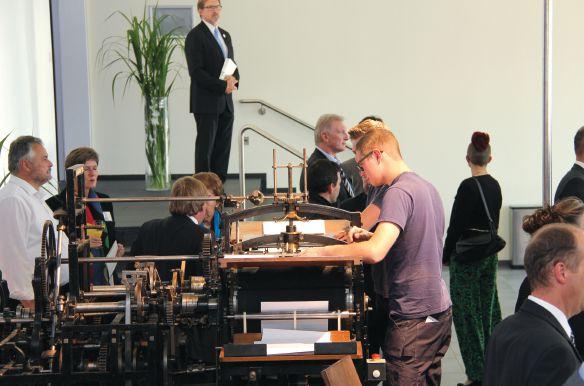
Operators produce evening programs for Koenig & Bauer’s anniversary celebration on a replica of the Times Press.
“We saved as much as eight hours/day just in order input, tracking, and managerial tasks.”
IS THERE REALLY ANY ROI IN A PRINT MIS?
For many shops, the answer is “Yes”. But what about yours?
At Avanti we’ve helped hundreds of printers significantly improve profitability with our award-winning JDF-certified Print MIS. Avanti Slingshot helps you deliver more jobs, in less time, with the confidence in knowing that every aspect of your shop is integrated into one powerful Print MIS platform.
Is there and ROI for YOUR shop with a Print MIS? Visit avantisystems.com/ROI for answers
FACES OF PRINT 17
Running from September 10 to 14 in Chicago, Illinois, PRINT 17 featured new technologies from more than 450 exhibitors, including several Canadians suppliers and printers who are featured below with some of the people who attended North America’s largest printing exhibition.
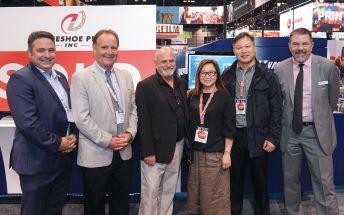
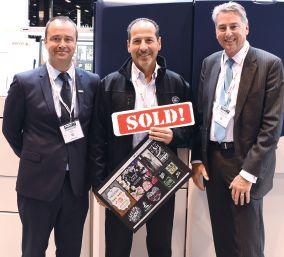
Horseshoe Press of Burnaby, BC, founded by Dickey Tam in 1988, celebrates becoming the first printer in Western Canada to acquire Konica Minolta’s MGI JETvarnish 3D Evolution system.
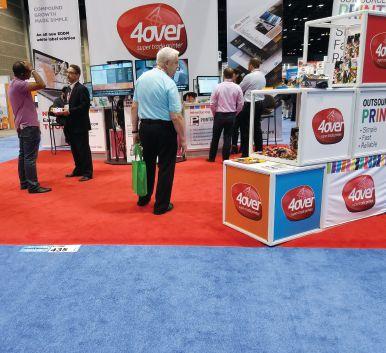
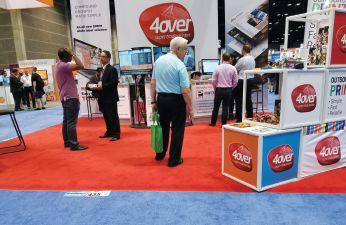
Now with more than 17 facilities across North America, including a shop in Mississauga, 4over’s booth focused on new trade printing initiatives like Suede Cards, Roll Labels and Digital Envelopes.
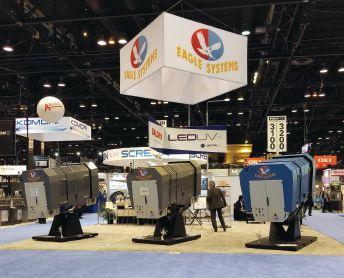
Eagle Systems displayed a range of its foil enhancement equipment. Founded 42 years ago by Mike King, Eagle Systems received a key patent in late 2016 for its method in optimizing the usage of cold foil in commercial printing.
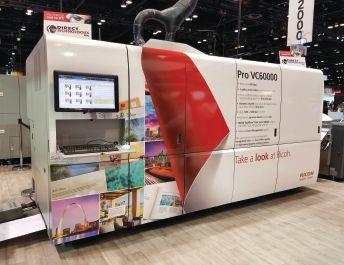
Ricoh displayed its Pro VC60000 continuous-feed inkjet press, a version of which was installed in Canada at Copywell of Woodbridge, Ont., in 2016. The VC60000 runs at up to 394 feet per minute with full variable-data capabilities.
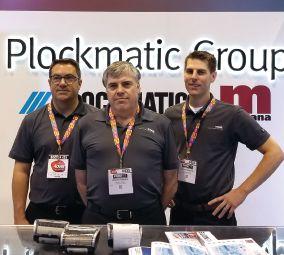
and
Sydney Stone’s Michael Steele, Brad Munro, and Dylan Westgate at Plockmatic Group’s booth, featuring both Plockmatic
Morgana systems.
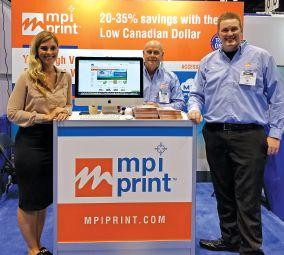
Team members from MPI Print of Concord, Ont., which recently invested $12 million into its second print facility in Mississauga.
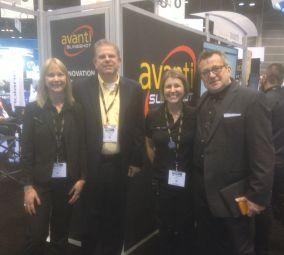
Toronto’s Avanti showcased its award-winning Slingshot MIS solution.
Karl Belafi Jr., Vice President of KBR Graphics, at RMGT’s booth, featuring a 9 Series long perfector with the chamber coater, automatic plate changing and LED UV curing.
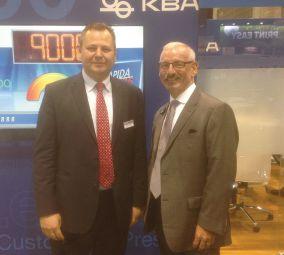
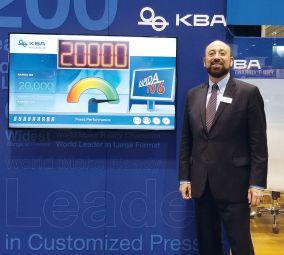
Aleks Lajtman, Koenig & Bauer’s Regional Sales Manager for Canada, with Regional Sales Director Alex Stepanian.
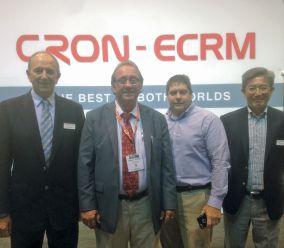
CRON-ECRM’s Don Langston, Marshall Hogenson, John Marzec and CEO Alex Lee.
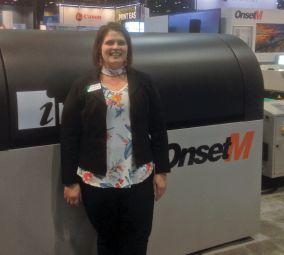
Becky McConnell of Fujifilm with the new and unique Onset M press, which is a B1 (27.8 x 39.4 inches) format inkjet printer designed for high-quality, short-run printing.
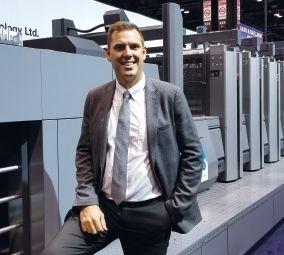
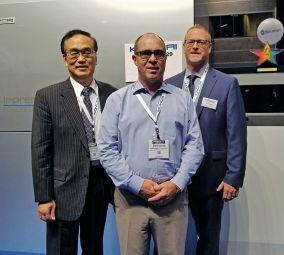
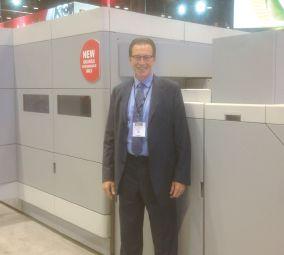
Satoshi Mochida, CEO, Komori Corp.; Steve Ranson, President, Komcan; and Brett Rogers, Komcan Technical Sales Manager in front of Komori’s 29-inch Impremia IS29 press.
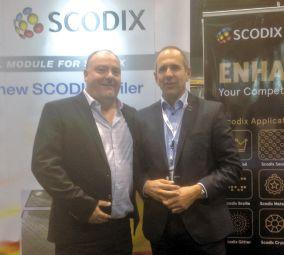
Tim Self of Compact Foilers and Canadian Scodix agent Christian Knapp, President of CMD Insight.
Paul McCarthy, Director, Industrial Print, and Chris Dewart, President and CEO, Konica Minolta Business Solutions Canada.
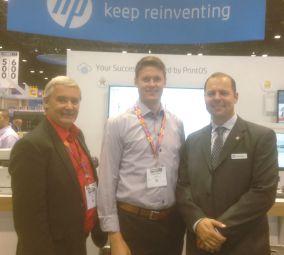
Peter Cober and Todd Cober of Kitchener-based Cober with HP Canada’s Wes McCallum.
Koenig & Bauer’s Eric Frank, Vice President of Marketing and Product Management.
Alec Couckuyt, Senior Director of Canon Canada’s Professional Printing Solutions Group, in front of the Oce VarioPrint i300, producing 294 letter images per minute.
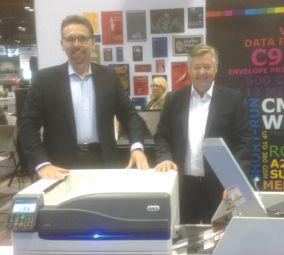
OKI Data America’s Peter Lougas and Mark Price, both focused on Canada, with the C900 series, printing CMYK plus White or Clear toner, and 1,200-dpi resolution.
Dan Mustada, Show Director of Graphics Canada, which is next scheduled to run in April 2019.
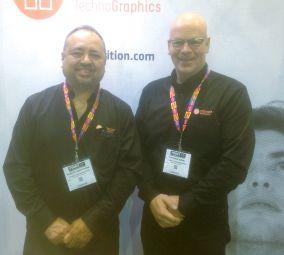
Roberto Marroquin and Raymond Duval of Montreal’s Ultimate TechnoGraphics, which highlighted its Ultimate Bindery v5 software.
manroland web systems, including CEO Greg Blue (right centre) highlighted the new VARIOMAN.
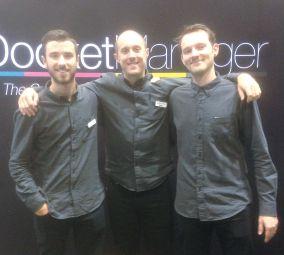
DocketManager of London, Ont., focused on version 3.0 of its cloud-based print management system, developed by printers.
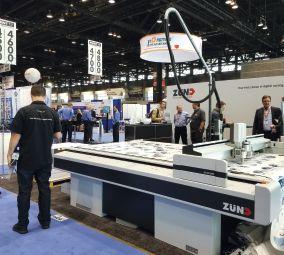
Zund displayed its M-2500 cutting system, which provides modular tool and material-handling options for a range of cutting needs.
Westkey Graphics of BC invests in White Dry Ink, celebrated by Xerox’ Andrew Gunn, Alfie Karmal, President, Westkey, and Fred DeBolt of Xerox.
Warren Werbitt, CEO of Pazazz Printing in Montreal, with Komori America Senior Vice President Jacki Hudmon.
Standard Horizon debuted the StitchLiner Mark III with expanded booklet size and productivity of up to 6,000 booklets per hour.
ICON Digital’s CFO Alex Christopoulos with company co-founder and CEO Juan Lau.
Ricoh VP John Fulena and Brian Dollard, Director of Strategic Planning and Business Development, with a customer at PRINT 17.
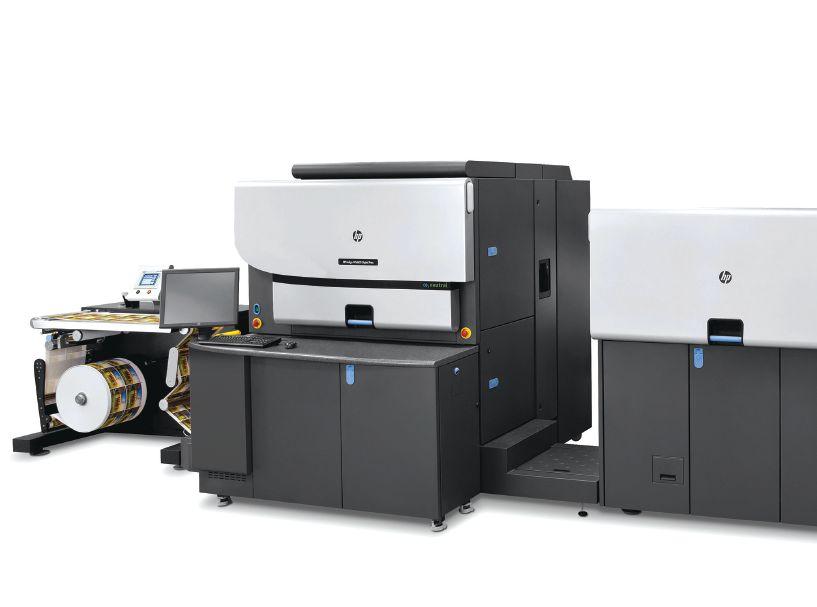
In September, HP Inc. introduced a range of new technologies for digital labels, including the new HP Indigo GEM, a one-pass digital embellishment system that will begin shipping in the spring of 2018. HP Indigo also announced a new ElectroInk Silver, now in beta customer testing. The new formula is capable of generating a wide gamut of metallic colours, combining metallic effects with digital capabilities.
Integrated with the HP Indigo WS6800 press, GEM produces labels with foil, screen, tactile, varnish and other special effects, using one workflow, one operator, and one design file without the need for tooling. The HP Indigo GEM utilizes GEM Coat and GEM Clear, developed in conjunction with JetFX. The HP Indigo WS6800 with Indigo GEM will be powered by the new HP Production Pro with what the company describes as five times faster processing to handle large volumes of variable data.
Xerox Trivor 2400 High Fusion
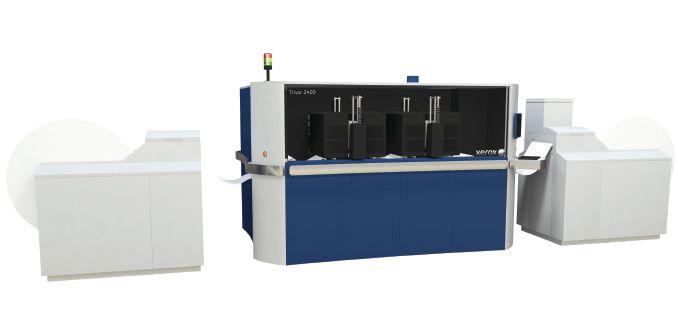
In August, Xerox introduced the Trivor 2400 High Fusion Inkjet Press with the company’s new High Fusion Ink to print direct to offset coated paper. The company explains the new High Fusion Ink is designed to remove one of the cost hurdles of commercial printers adopting inkjet technology, which often includes the expense of pre- or post-coating, adding hardware, or purchasing specialty
inkjet coated paper.The Trivor 2400 High Fusion Inkjet Press was to be available worldwide for installation starting in October. High Fusion Ink is specially formulated to optimize printing and drying on offset coated media including matte, silk and glass stock from 60 to 250 gsm, up to 250 feet per minute. While High Fusion Ink is optimized for commodity offset coated papers, it also runs on a range of uncoated media.
Avanti Slingshot Module Updates
In September, Avanti highlighted its Slingshot’s Mail and Postage Accounting module to manage and streamline mailing processes. Designed to reduce the effort required to consolidate postage receipts, payments and reporting, the module allows users to analyze mailing activities by account, department, project or postal class, as well as generate postage reports based on a specific date range for a customer.
Avanti’s recently introduced Slingshot Scheduling Reservation System, which allows employees to reserve press time before the receipt of a confirmed sales order to communicate the earliest possible date of completion to the customer before their commitment. The company also recently introduced Slingshot’s Wireless Warehouse Management tool designed to be implemented in a warehouse location with the addition of wireless
HP’s roll-fed Indigo WS6800 digital press features a wider frame and new ink capabilities for expanded applications.
scanners that report back to the Avanti Slingshot Inventory modules.
Ultimate TechnoGraphics Bindery v5
In September, Ultimate TechnoGraphics introduced new features in its Ultimate Bindery v5 software, designed to build finishing workflows for nearline and inline finishing equipment. The company explains it automates the make-ready of each bindery module involved in a paper transformation to reduce waste, increase throughput, and optimize short run print manufacturing.
As a new feature to the software, Ultimate Bindery v5 preflights each job for the intended finishing workflow and delivers JDF commands to each device in the line. Ultimate Bindery v5 has a concatenated finishing device logic with an emphasis on machine interoperability to offer the level of controls that permits job validation. Ultimate Bindery v5 also introduces new dashboard capability to monitor results of the finishing modules. The dashboard displays critical status for users to react instantly to problems. It becomes a single point of integration into a print management or tracking system for further data analysis for all the finishing devices it manages.
Canon Océ VarioPrint 6000 TITAN
Xerox’s enhanced Trivor 2400 High Fusion Inkjet Press prints direct to offset coated papers.
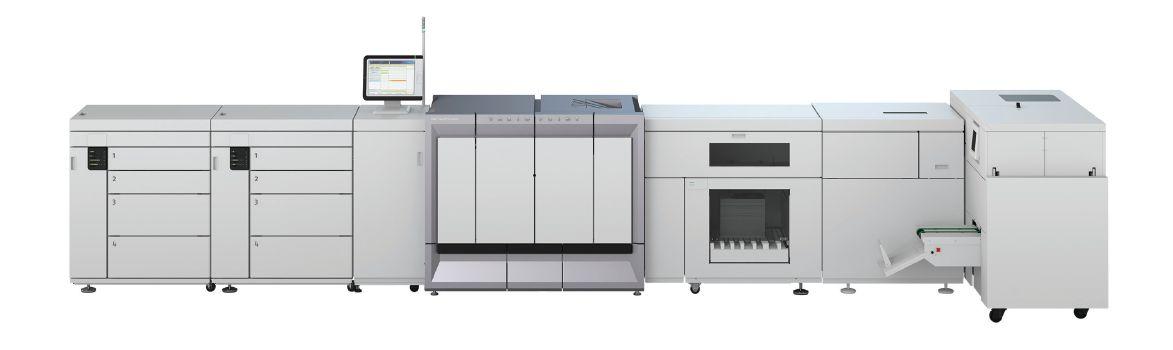
In August, Canon unveiled the Océ VarioPrint 6000 TITAN Series of sheetfed monochrome production presses, which builds off the existing Océ VarioPrint 6000 Series and its Gemini Instant Duplex Technology.The technology, explains Canon, has been developed with increased quality, speeds and a wider selection of media weights and formats. Supporting volumes of up to 10 million letter-size impressions per month, Canon explains the new presses are ideally suited to produce commercial print materials, books and transactional documents. The
Canon’s TITAN Series builds on the Océ VarioPrint 6000 platform.
Océ VarioPrint 6000 TITAN series will be available in three versions, including Standard/TP(Transactional Print)/ MICR, with a range of finishing options that include booklet-making, perfect binding, tape binding, die punching and trimming. The TITAN series also offers an open Document Finishing Device (DFD) Interface for connectivity to compatible third-party finishers.
The redesigned Océ VarioPrint 6000 TITAN series offers maximum running speeds of up to 320 letter images per minute in perfecting mode, which translates to a potential of more than 30,000 additional letter prints in one week in a one-shift operation. Four new speed models will be available to meet different production requirements (VarioPrint 6180, 6220, 6270 and 6330).
Veritiv Distributes Streamline Inkjet Inks
In August, Sun Chemical named Veritiv as a distribution partner of its Streamline solvent inkjet inks for wide format and super wide format printers. The new distributor partnership, according to a Sun Chemical statement, allows the two companies to reach their North American inks customers faster and more efficiently and jointly provide customers with technical and product support. Veritiv customers will now have access to Sun Chemical’s range of Streamline inkjet eco solvent inks for Mutoh and Roland printers, as well as super wide format inks for three- and five-metre solvent printers.
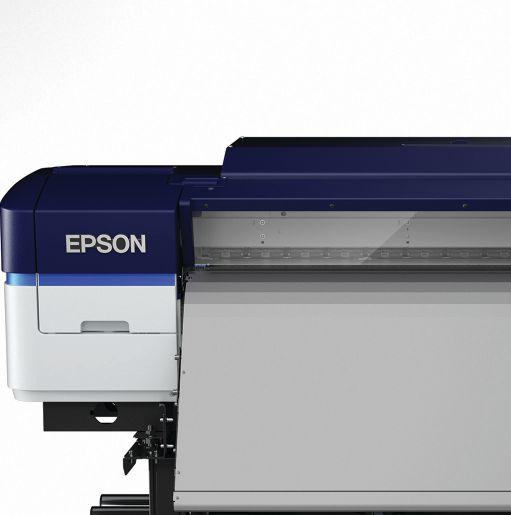
Epson SureColor F9370
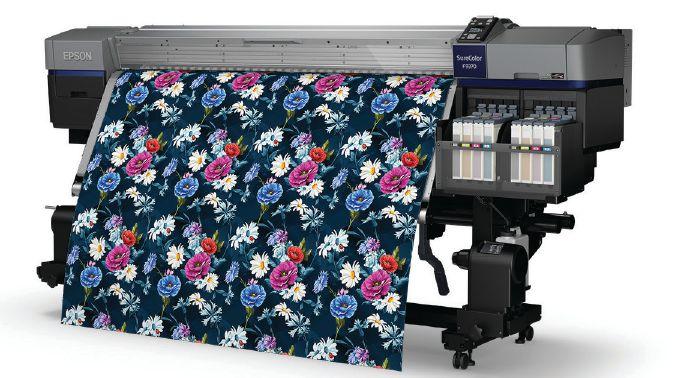
In September, Epson introduced a new wide-format printer to produce digital dye-sublimation transfers for a range of polyester textile and apparel applications. The 64-inch Epson SureColor F9370 provides speeds up to 1,169 square feet per hour and features an integrated new fabric wiping system coupled with what the company de -
Epson’s SureColor F9370 hits speeds up to 1,169 square feet per hour.
scribes as a highly accurate roll-to-roll media support system to handle economical lightweight transfer papers. Designed to support high-speed medium- to large-volume dye-sublimation transfer printing, the SureColor F9370 replaces the SureColor F9200 to join Epson’s line of SureColor F-Series printers, including the SureColor F6200 and SureColor F7200.
The SureColor F9370 leverages dual PrecisionCore TFP printheads and Epson’s latest dye-sublimation ink technology – Epson UltraChrome DS with High-Density Black. The new media feed system also provides support for heavier media rolls and transfer paper as thin as 40 gsm. It is designed for fabric production and customized promotional production, as well as producing soft signage, cut-and-sew sports apparel and home decor applications.
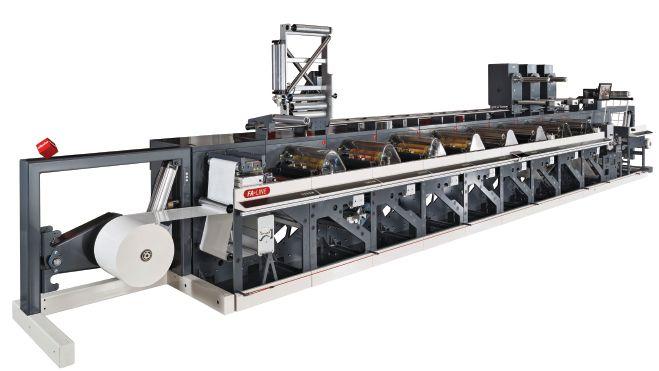
Nilpeter FA Flexo Press
In August, Nilpeter introduced a newly updated FA flexo press which the company describes as the most versatile flexo press on the market. It includes a new user interface and fully mobile print controls. The FA provides a high level of stability, explains the company, with a tight register tolerance and quality printing on multiple substrates.
Based on Nilpeter’s Clean-Hand design approach, the company explains the FA flexo press ensures clean hands during press operation, with a minimum of hands-on press interaction; all data is saved, jobs are recalled, and the press will auto register.The new FA platform allows printers to enhance the performance and capability of their press with Value-Adding Units, as well as Application and Automation Packages, according to application needs and budget.
Nilpeter’s FA flexo press is based on what the company calls Clean-Hand design.
Over 75,000 sq ft plant housing state-of-the-art nishing and bindery
Personalized account management and complete control over production
24/7 Production with fully automated and barcode controlled plant
FSC / PEFC / SFI certi ed
Xerox White Dry Ink
In October, Xerox is releasing a White Dry Ink for the fifth print station of its iGen 5 digital press. With the addition of White Dry Ink to the iGen 5 platform, print providers can apply spot effects to produce printed pieces with a physical look and feel. Xerox’s White Dry Ink features the ability to print White Dry Ink only, as white layers under or over CMYK. The company claims it provides strong brightness and opacity that’s achievable in a single pass of white. The iGen 5’s automated multi-pass mode can also be leveraged to produce up to two layers of white. Additional layers of white can be manually printed for custom applications.
Fujifilm Superia ZD
In September, Fujifilm North America debuted the Superia ZD offset plate technology, a new addition to its processless plate portfolio for the commercial market. The company describes the Superia ZD as a true no-process thermal plate, with no effluent to dispose of and no additional consumables.
Superia ZD performance is maximized with Fujifilm Hunt fountain solutions, including Superia PressMax JRDC-AB, compatible with UV/LED-UV/HUV or conventional inks; along with the single-step Superia PressMax PPF-DC, a fountain solution with
calcium control additive, also suitable for UV/LED-UV/H-UV or conventional inks.
Esko QuickStart
In September, Esko launched two simplified turnkey workflow solutions, Automation Engine QuickStart for Labels and WebCenter QuickStart for Labels. The QuickStart workflows are pre-configured to meet the needs of specific applications. The company explains the key advantage of these tested, preconfigured workflows is their easy implementation and deployment.
WebCenter QuickStart for Labels can be either cloud-based software as a service (SaaS) or deployed on premises, with pre-configured process flows. A built-in graphical viewer is coupled with collaborative approval tools for the review and approval of both 2D and 3D assets. The software manages a database of these centralized digital assets, allowing asset search and re-ordering of existing labels. It also comes with a dashboard and builtin operational reporting.
Automation Engine QuickStart for Labels offers most of the essential label prepress tasks, including preflighting, adding and checking barcodes and content, trapping, step and repeat, and inserting marks and control strips. Automation Engine QuickStart for Labels is also scalable. It can be upgraded with
Xerox’ White Dry Ink is for the iGen 5.
Esko’s WebCenter QuickStart for Labels is available as cloud-based software.
to 200 lpi. Run length is rated for up to 50,000. For UV ink printing, Blackwood offers UV double coating plate, HUV whose run length is over 50,000 and dot reproduction 1-98% at 350 lpi. For normal ink printing, HU-PXX the run length can go up to 100,000 and dot reproduction 1-98% at 350 lpi.
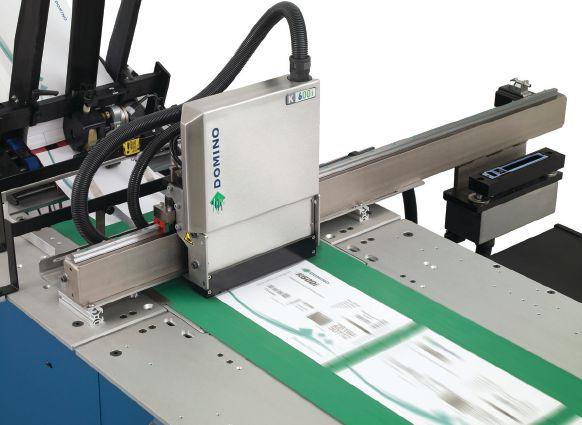
Domino Fluorescent Ink
In September, Domino Digital Printing Solutions launched a new fluorescent ink for its K600i piezo drop on demand ink jet printer. The company explains this latest ink addition, UV80CL, is designed for security printing and brand protection to help firms battle counterfeit-
complexity rating which would be extremely difficult to replicate. This makes it well suited to add security marks and features to currency, stamps, tax stamps, passports and certificates to prevent forgery, tampering or counterfeiting of such items. It can also be used to incorporate security features onto labels and packaging for traceability. The Domino K600i printer can be integrated into an existing web-fed press, or used as a standalone rollto-roll solution or finishing line. The UV80CL ink is compatible with standard medias including polyethylene, polypropylene and coated and uncoated papers.
CTI Paper Kromekote
laser equipment. CTI Papers are available in Canada through a range of paper merchants such as Ariva.
The newly launched Kromekote Jade Text and Cover line brings highly reflective, embossed pearlescent textures to the brand for the first time. It is available in luxe surfaces – Brush, Wave, Linen and Pinweave – with immediate availability of folio, digital and cut-size sheets, plus envelopes. New for HP Indigo presses, following the growing demand for heavyweights, is a 14- and 18-point Kromekote ultra bright-white board. CTI Paper now offers HP Indigo papers in a variety of weights and thicknesses, from 8 pt to 18 pt (350 gsm), the majority of which are certified by the Rochester Institute of Technology (RIT). CTI Paper USA has also received certification for Kromekote on the Konica Minolta bizhub press platform, while the company explains the paper line is engineered for digital presses from Xerox, Kodak, Canon, Epson, Oce and Ricoh.
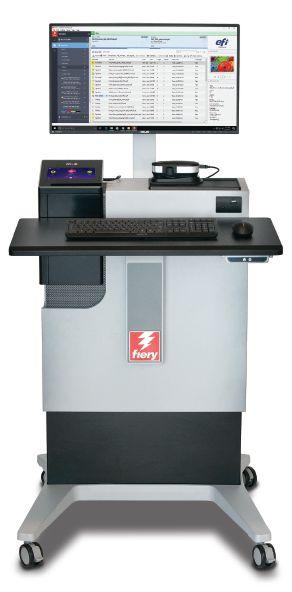
EFI Fiery FS300 Pro
interface and supporting new versions of EFI’s Fiery Impose, Compose and JobMaster make-ready software products.
EFI also introduced its new Productivity Workbench dashboard; EFI Metrix planning and impositioning software for ultra-highspeed inkjet presses; EFI iQuote estimating and planning software for folding carton and label production; and an EFI Corrugated Packaging Suite integration with Esko ArtiosCAD software. The EFI Productivity Workbench provides visibility (one-click access to taskbased, business-critical data) across all components of a Suite and is described as a launch pad for common user activities. The product gathers data with what EFI describes as ContextSense links back into the system, and Workbench widgets display information most critical to each user.
Quark Content Automation Platform
jetting (Duplex), clip seal (3 sides), mail prep. 4. SAVE ON POSTAGE COSTS —As a Certified Canada Post Direct Marketing Specialist, we get contract pricing reductions. 5. RETURN MAIL PRODUCTS — Customized “Return Mailers” created in-line with “U” or “BOX-shape” remoistenable glue, time perfed applications and envelope formation.
MINI-BOOKLETS — Saddle-stitch and trim 2-up booklets in-line to the size of a business card. No need to trim off-line, or do 2 passes.
In September, Electronics For Imaging debuted the Fiery FS300 Pro technology as the next-generation platform for its digital front ends (DFEs). The Fiery FS300 Pro platform features what EFI describes as a major upgrade to its job management software, EFI Fiery Command WorkStation 6, with a new
In August, Quark Software introduced what it describes as significant new updates to its content automation platform. The new release, the second major update in 2017, adds enhancements to content management and Web-based content review, including the ability to assemble and manage PowerPoint slides at a component level. Quark explains its content automation platform enables business users and editorial teams to collaborate throughout the multi-channel content life cycle – from creation and management to publishing and delivery. By creating and reusing content components – rather than traditional static documents and files – teams can share, search, track, and reuse content, which translates into greater cost savings and more valuable content.
The Quark Content Automation Platform consists of modules, including the following ones affected by the new update: Quark Publishing Platform, QuarkXPress Server, Quark Author Web Edition and Quark XML Author. QuarkXPress Server leverages the graphic capabilities of QuarkXPress with server-based automation. New updates to this module include the ability to directly access new productivity and design enhancements to QuarkXPress 2017, such as responsive HTML5 output and native image manipulation. It also now includes automated item styles to produce infographics using the new automation features for
boxes,
ows, and more. The new features also include transaction-based font management, which can include licensed fonts as part of a rendering request.
TRESU MaxiPrint Concept
In September, TRESU showcased its MaxiPrint Concept that combines a compact ink supply system with an integrated cleaning system with the goal of creating low ink loss and setup times in wide web and corrugated flexo printing. The chambers are available in widths between 1,600 mm (63 inches) and 6,000 mm (236 inches), with ceramic or carbon fibre surfaces offering protection against corrosion by substances up to pH12. The MaxiPrint Concept chamber’s cleaning nozzles, with what the company describes as robust watershot mechanisms, provide an ink change and cleaning cycle within three to five minutes. It comes with a peristaltic or diaphragm ink supply system and can be adapted to any press. TRESU chamber doctor blades prevent leakage and air contamination based on patents seals, to help create clean, blister-free print results with fast drying characteristics, better reflection and higher gloss values. When doctor blades need replacing, TRESU’s patented clamping systems enable changeovers in less than two minutes.
Kodak Prinergy Fiery Integration
In August, EFI introduced expanded capabilities between its Fiery digital front ends and Kodak’s Prinergy Workflow 8.1 that allows printers to better integrate their digital and conventional presses.
The new bi-directional integration for hybrid digital and conventional printing is designed to make decisions in real time for the most cost-efficient production scenarios. The new bi-directional communication between Prinergy and Fiery-driven presses specifically allows users to check job progress and device status for efficient production with the browser-based Prinergy Track.
The new Fiery DFE integration with Prinergy Workflow 8.1 provides the flexibility to add equipment from different digital toner-based or high-speed inkjet press manufacturers without changing workflows. EFI also points to Fiery DFE printer capabilities to dynamically submit jobs with specified media, colour, layout and finishing settings. The integration also allows user to make last-minute production scenario changes for cost optimization by rerouting jobs to a different digital press after submission, with capability to modify job settings. Users can also define mixed media, mixed colour mode, and more with page range, inserts, and covers straight from Prinergy Workflow.
Brandtjen & Kluge ApexFoil
In September, Brandtjen & Kluge released its new ApexFoil foil stamping and die-cutting press for small- to medium-format work. First unveiled in the summer of 2017, ApexFoil is described by company as technology that provides innovations in application range, makeready and efficiency. Kluge explains operators can use the ApexFoil’s Compass control system that includes patented features to control time, temperature
TRESU MaxiPrint Chamber Doctor Blade features a self-cleaning water jetting system.
Solutions for the Printing Industry
ApexFoil’s Compass control system that includes patented features to control time, temperature and tonnage.
and tonnage, which the company describes as three key properties of foil stamping that have historically proven difficult to measure and control. Kluge explains Compass allows operators to greatly reduce – and in some cases eliminate – job makeready.
Kluge points to ApexFoil’s programmable dual surface heat control with timer control to pre-heat die and makeready surfaces prior to a shift start up, as well as a foil, die and makeready alignment system that trims set-up time and increases setup efficiency. ApexFoil, explains the company, also features quickset toolless registration adjustments and an ultra-lightweight die mounting plate, which can save up to five minutes of set-up time during job changeover. The foil system that can hold a tolerance of +/- .016 inches at the foil gap and also provides programmable step-and-repeat capability.
MGI JETvarnish 3D Web Color +
In September, MGI Group previewed its new JETvarnish 3D Web Color + press which features semi-rotary cutting and slitting functions, as well as both corona treatment and flexo primer coating stations for substrate diversity and
print surface flexibility. The range of flexible packaging and label materials can include plastic, synthetic and paper-based stocks. These substrate management tools are also complemented by an automatic rewinder utility and a self-cleaning inkjet system. The JETvarnish 3D Web Color + analyzes each piece with the AIS Smartscanner intelligent and adaptive registration system.
EPS Roto-JET
In September, Engineered Printing Solutions (EPS) launched the RotoJET industrial inkjet printer, designed for cylindrical object printing.The Roto-JET is a multi-colour, UV-LED printer aimed at applications like promotional products, craft brewers, wineries and ad specialty companies. With average speeds of 800 parts per hour (pph), the Roto-JET features a synchronized printing and curing operation which prints CMYKWW, with optional primer and varnish printheads available. The system can accommodate either manual or automatic operation, while it features an elliptical-style racetrack transport system and vertical design. The Roto-JET uses Xaar 1003 print heads with TF Technology (ink recirculation).
FIELD SERVICE TECHNICIAN, HIGH SPEED INK JET PRESS
The Field Service Technician, High Speed Ink Jet Press will provide comprehensive technical service support for all HSIJ equipment sold by Fujifilm. This position will be responsible for providing superior service to internal and external customers to ensure that equipment operates properly and meets established quality and reliability levels.
The ideal candidate must have a minimum of 5 years of experience working on High Speed Ink Jet presses in a technical support capacity, a post-secondary diploma or degree in Electrical or Mechanical Engineering, and proven technical skills including knowledge of electronics, robotics, pneumatics, and PLC code. Interested candidates can apply for this position by visiting www. fujifilm.ca and clicking on “Careers”.
CUSTOMER SERVICE REPRESENTATIVE
We have an immediate opening for a Customer Service Representative. The successful candidate will be a team
player that possesses strong organizational skills, interpersonal skills, initiative, sound judgement and the ability to work well under pressure. Experience within the Print industry is a prerequisite.
Sound knowledge of digital flow would be a definite asset. Duties include representing our customer’s requirements throughout the various production activities to ensure successful job completion, planning work schedules in the most efficient manner and liaisoning with customers on a daily basis.
Email resume to: rjoudrey@renaissanceprinting.ca
HOT FOIL DEBOSSER
We need an experienced foil stamper for our hand bookbinding company. The person should be able to deboss hard and soft case book covers, binders and certificate holders made in bookbinder cloth or leather using fonts and dies. The person must have experience with heat, pressure and various foils. Established 38 years we have a loyal clientele including governments, universities, companies and individuals.
Any experience in hand bookbinding or willingness to learn is an asset. Our company is know in the industry for its high standard of work and excellent customer service. We have 4 varying sized kwikprint and Kensol foil stamping machines. We are looking for a mature self starter with a good sense of humour.
Email resume to: rasmussenbindery@
gmail.com. www.rasmussenbindery. com
HEAD PRESSMAN
As Head Pressman you are responsible for assisting in the efficient operation of a web press, and ensuring schedules are met, high quality and large volume. Providing instruction and supervision of the press crew. Must have previous experience as a Second or Rollman on a web press. Applicants with related education and/or experience will be considered.
Email resume to: rjoudrey@renaissanceprinting.ca
FUJIFILM LUXVEL V9600 FOR SALE
Auto loader with 3 cassettes, under Fuji service contract since new. In excellent working order - $18,000 OBO. Contact Lenore Scott at lscott@hdsgraphics.com
PRESS FEEDER
Located in Burlington, Eclipse Imaging
is a leader in the large format printing market. We have an opportunity available for a Heidelberg Press Feeder. This role will be responsible for feeding the press and assisting press persons as required during the operation of the press. You must have a mechanical aptitude, proven attention to detail and organizational skills, and the ability to work as a part of a team. In addition, you must be able to lift up to 50lbs., and handle large sheets of paper. Shift work is a must. Email resume to: astreet@eclipseimaging.ca
FOIL STAMPING AND EMBOSSING PRESSMAN
Require a full-time Foil Stamping and Embossing Pressman. Minimum 5 years experience. Please call 416-505-0963. Email resume to: sascha@theariesgroup.com
Sakurai: 1, 2 or 4 colours and any size (newer model)
Polar: any size/older or newer models (66/72/76/78/82/90/92/107/115)
Horizon-BQ: 220/240/260/440/460
Guy Gecht / Chief Executive Officer / Electronics For Imaging / Freemont, California
Electronics For Imaging postponed releasing its preliminary results for the second quarter of 2017 to complete an assessment of the timing of recognition of revenue. The news reverberated around the printing world as EFI has been one of the financial lights for the industry over the past several years, regularly reporting record quarterly revenue.
The Audit Committee of EFI’s Board decided to conduct an independent review related to certain transactions where a customer signed a sales contract for one or more large format printers and was invoiced, and the printers were stored at a third-party warehouse prior to delivery.
EFI’s shares quickly crashed after the announcement, falling by around 45 percent to a three-year low of $26.05. Its 52-week high was $51.15. The company anticipated to find a material weakness in internal control over financial reporting, but also stated it did not expect total revenues to be materially different from what had been previously reported.
Two days before PRINT 17 began in Chicago in September, EFI completed assessments of its revenue recognition and of its controls. The company then released its delayed quarterly report noting it did not find any material error requiring a restatement of results, while acknowledging its disclosure controls were not effective in prior periods. For the second quarter ended June 30, 2017, EFI reported revenue of US$247.0 million, up one percent compared to 2016 second quarter revenue, while cash flow was at US$24.1 million, up five percent.
EFI’s CEO Guy Gecht addressed the concerns over recognition of revenue head on at the beginning of the company’s PRINT 17 press conference in Chicago.
State of recognition of revenue
GG: What happened is that the shipping company picked up [the printer] from EFI to take it to the customer... We invoiced the customer and then the shipping company put it in a storage location and then we started the conversation when can we deliver… Some time back in 2014, one of our shippers changed [the documenting] process slightly… and nobody thought much about it.
Now fast-forward to recent weeks. We realized this little change might of changed the timing of which we could recognize the revenue… when we changed the ownership of the printer… A lot of those windows would make no difference, [but] it’s a public company and it might actually be a mistake. You should report it in another quarter.
Accounting mistakes made
GG: One thing was clear, those sales were
real. The customer got the printer. We sold it. They used it. Salespeople were happy to get their commissions. So there was nothing wrong with the sales… Sometimes you make mistakes and you do not know. But once you have figured out it might be a mistake, then you need to be really serious about it… It was going to take a while because they have to essentially look at almost three years of transactions in a few weeks.
Dramatic drop in EFI share price
$1B
EFI set an ambitious target to reach $1 billion in revenue by the end of the 2016 fiscal, falling just short at US$992.1 million.
GG: We might have a revenue-timing issue and compounded by people who were thinking it was a much worse problem… that it could be terrible or maybe EFI doesn’t have as much revenue as they think. ‘Well, you know what, I am going to [rate] the price of the stock at $28.’ The stock [dropped] straight away and, of course, we were devastated. We were shocked. We said, ‘Look the business is healthy.’ We actually had a record Q2. Cash flow was up 20-something percent for the first half of the year. We were heading to a record Q3… but the stock was down 45 percent. First of all, let’s figure out the problem. We invested a tremendous amount of time, brought in a lot of outside accountants and lawyers…. if you look at using different accounting methodology, that we should
have used, the numbers are pretty much the same – materially the same, which is great news. But we did find some material weakness. Material weakness means you can have the right control and you can have an error. It doesn’t mean the error happened but it says you could have an error. And of course we need to use the right accounting methodology.
Pending shareholder lawsuits
GG: In the process, as an open public company and the stock dropping, you get sued by law firms on behalf of a shareholder. We got sued in New Jersey… there were like 15 different press releases… It is actually all one class-action lawsuit. The action in the class action is that those law firms are competing. They want to be the one that is going to be representing the shareholders so they make a lot of noise… The one company that actually filed the initial lawsuit, the one class-action lawsuit has a shareholder that owns 80 shares…. It is going to be months before anything happens. Statistically, 40-some percent of those shareholder lawsuits get dismissed, because there is no evidence the company misled and they need to prove the company willfully misled, not just made a mistake but purposefully made a mistake.