The dance of print plus How GRACoLPlus and G7 can impact your business 11 16
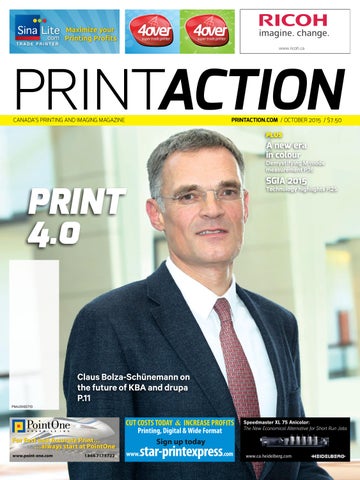
Claus Bolza-Schünemann discusses the future of two print institutions, including the restructuring of KBA and the direction of drupa
16 New era of colour
Original Ryerson research demystifies M-mode measurement with the use of emerging instruments for metallic inks and optical brighteners
22 Inkjet: State of the art or Sci-Fi?
Analyzing the state of production inkjet by looking at early adopters, growth opportunities, and compatible inks and substrates
Departments
GAMuT
5 News, People, Calendar, Installs, Globe, Archive
TeChnoloGy RePoRT
25 SGIA 2015 highlights
MARKeTPlACe
29 Industry classifieds
SPoTliGhT
30 Lance Hill, Director of Plant Operations, Annex Business Media
ColUmns
FRoM The eDiToR
4 Jon robinson Ahead of Industry 4.0
ChRoniCle
8 nick Howard
We are not alone
The impact of mobile computing and its effect on lightography
DeveloPMenT
10 Wayne Collins
Ahead of Industry 4.0
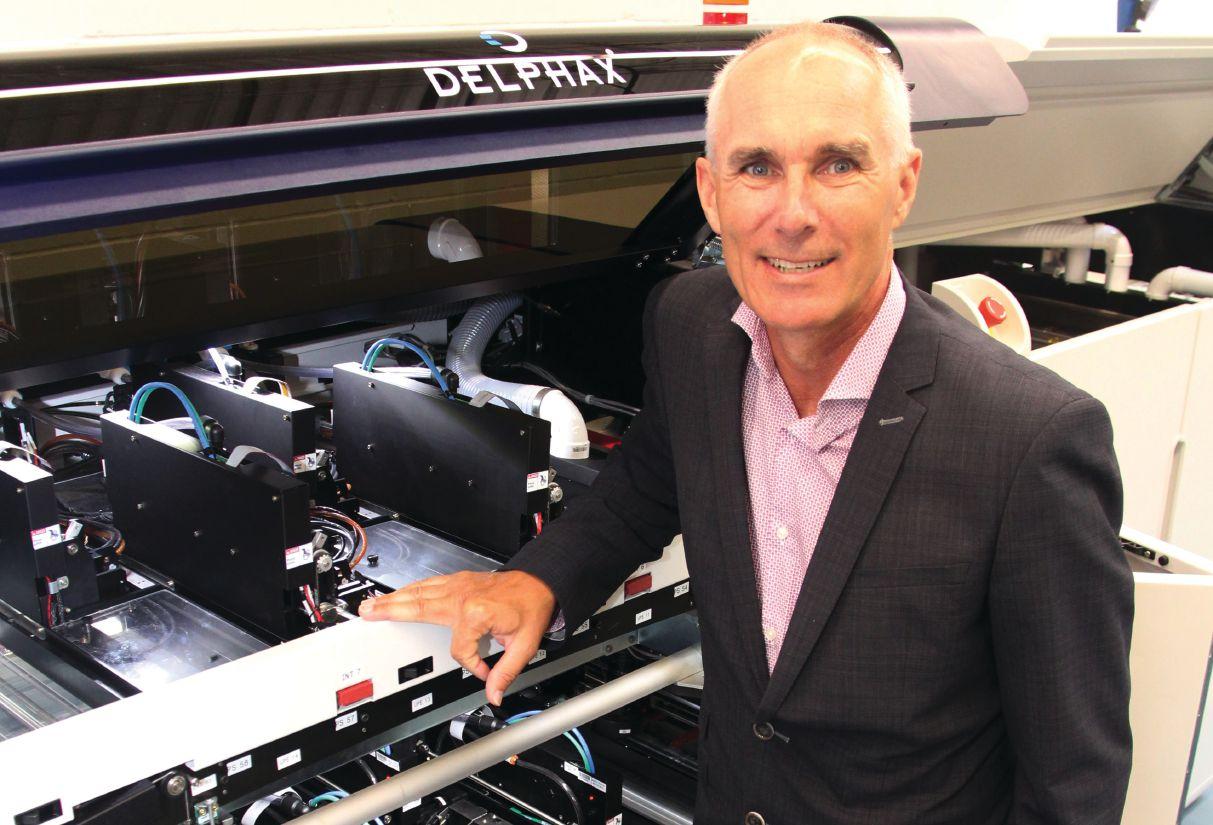
the German government, in an effort to boost its economy and numerous domestic technology giants involved with the computerization of manufacturing, is seen as the originator of the term Industry 4.0, which will become a major part of the industrial lexicon in 2016. It is a term now being embraced outside of Europe as powerful conglomerates in the United States have jumped on the movement to funnel future strategy.
6,979
Average labour hours saved per year by printers who implement JDF, according to Infotrends.
It can be difficult to accept ambiguous industrial terms, but in fact a significant piece of Industry 4.0 was embraced by the global printing industry well more than a decade ago, because of its unique needs for customized manufacturing, requiring so many third-party machine interfaces to communicate with each other over the course of a day. This initiative to streamline IT to drive print via JDF data exchange was lead by the CIP4 standards body. CIP4 currently consists of more than 1,600 individuals from approximately 300 member companies. The printing industry has much more work ahead to fully leverage the concept of Industry 4.0, but it is now heavily experienced in combining automation, data exchange and manufacturing technologies.
Industry 4.0 is ultimately described as the modern world’s fourth industrial revolution. An article by Joe McKendrick of ZDNet explains, “A favourite theme many speakers –especially futurists – like to invoke is that we’ve passed the industrial revolution, or even the information revolution that superseded it, and we’re now in some kind of post-information revolution. Some people, especially on the European side of the pond, have another name for it, calling it Industry 4.0.”
McKendrick outlines the four industrial revolution phases as a matter of manufacturing power: Industry 1.0, water/steam power; Industry 2.0, electric power; Industry 3.0, computing power; and Industry 4:0, Internet of Things (IoT) power. Industry 4.0 is also defined by various German working groups as a collective term drawing together cyber-physical systems, the Internet of Things and the Internet of Services. Boston Consulting Group (BCG) takes the concept of Industry 4.0 further, looking specifically at nine advances in technology that form its foundation, which are already used in manufacturing, but will collectively transform production: Big Data and Analytics, Autonomous Robots, Simulation, Horizontal and Vertical System Integration, The Industrial Internet of Things, Cybersecurity, The Cloud, Additive Manufacturing, and Augmented Reality.
The printing industry touches all nine of these technology areas, in varying degree, and certainly now excels at Horizontal and Vertical System Integration, which BCG indicates to be lacking in most other industries: “Most of today’s IT systems are not fully integrated. Companies, suppliers, and customers are rarely closely linked. Nor are departments such as engineering, production, and service. Functions from the enterprise to the shop floor level are not fully integrated… But with Industry 4.0, companies, departments, functions and capabilities will become much more cohesive, as cross-company, universal data-integration networks evolve and enable truly automated value chains.”
The graphic communications industry also has a significant handle on the possibilities of Augmented Reality, although this technology arena will expand well beyond marketing initiatives to provide practical industrial support services like warehousing, maintenance and even engineering. The Industrial Internet of Things is probably one of the more intriguing concepts of Industry 4.0 that the printing industry can exploit. As BCG explains the Industrial Internet of Things, based on embedded computing, decentralizes analytics and decision-making, enabling real-time responses.
Additive manufacturing, or 3D printing, remains a question mark in terms of whether it is a truly viable pursuit for the printing industry, but it will certainly have a major presence at drupa 2016, sparked by the fact that many of the industry’s major technology players are ultimately positioned to provide the R&D and products needed for additive manufacturing. The organizers of drupa 2016 also plan to leverage the concept of Industry 4.0 and the printing industry’s strong starting position in what may turn out to be a new industrial revolution.
“Print 4.0 is the enabler for individualization and personalization in digital printing, high-quality packaging and the fast-growing range of solutions in industrial and functional printing – and it will be the megatrend at drupa 2016,” says Claus Bolza-Schünemann, Chairman of the drupa Committee and Chief Executive of Koenig & Bauer AG. “Thanks to its networked process chains, Print 4.0 is already the leader of Industry 4.0.To us this means an end-to-end digital workflow made possible by the intelligent networking of our machines and systems.”
editor Jon Robinson jrobinson@annexweb.com 905-713-4302
Contributing writers Zac Bolan, Wayne Collins, Peter Ebner, Victoria Gaitskell, Martin Habekost, Nick Howard, Angus Pady, Nicole Rycroft, Abhay Sharma, Trish Witkowski
Publisher Paul Grossinger pgrossinger@annexweb.com 905-713-4387
Associate Publisher Stephen Longmire slongmire@annexweb.com 905-713-4300
Director of Soul/Coo Sue Fredericks
national Advertising Manager Danielle Labrie dlabrie@annexweb.com 888-599-2228 ext 245
Media Designer Lisa Zambri lzambri@annexnewcom.ca
Circulation Barbara Adelt badelt@annexweb.com 866-790-6070
Subscription rates
For a 1 year monthly subscription (12 issues): Canada — $39.99 ($35.39 + $4.60 HST) United States — CN$65.99 Other foreign — CN$85.99 Mailing address
Annex Business Media 222 Edward Street Aurora, ON, L4G 1W6 printaction.com Tel: 905-727-0077
Fax: 905-727-0017
nD Graphics, a technology distributor primarily focused on large-format imaging, purchased Western Rim Industries (WRI), which has offices in Kelowna, British Columbia, and Mississauga, Ontario. ND Graphics is headquartered in Greater Toronto with more than 100 employees and a network of stocking locations in Dartmouth, Montreal, Ottawa, London, Winnipeg, Saskatoon, Edmonton, Calgary, Vancouver, as well as Toronto. WRI will operate as a standalone business with Frank Braeuer as General Manager of the company.
C.J. Group of Companies , which controls C.J. Graphics, acquired Toronto-based SBC Media, one of Canada’s leading sports lifestyle media companies. The purchase, including six magazines, two annual guides and all related Websites, social media platforms and assets, will operate under the C.J. Oyster Publishing division of the C.J. Group. Former printing industry journalist Filomena Tamburri joined C.J. Oyster Publishing several weeks ago as Group Publisher. The SBC titles and brands moving to the C.J. Group umbrella include: Snowboard Canada , SBC Skateboard , SBC Skier, SBC Wakeboard, SBC Business, SBC Ski & Snowboard Resort Guide (annual), Snowboard Canada Women’s (annual), and SBC Surf
tC transcontinental entered into a definitive agreement to acquire Ultra Flex Packaging Corp., a supplier of flexible packaging, located in Brooklyn, New York. The acquisition for US$80 million is to be paid in cash at closing, plus an additional payment if certain financial targets are hit. Ultra Flex Packaging employs close to 300 people and generated US$72 million in annual
revenues and US$12 million in operating income before amortization in its last fiscal year. The transaction is subject to regulatory approval in the United States and is expected to close before the end of Transcontinental’s fiscal year. When the acquisition is completed, TC Transcontinental expects to report annualized revenues of over US$150 million in its packaging division.
iKea Canada promoted the arrival of its 2016 catalogue with the use of Twitter-activated vending machines that dole out gift cards at store locations across the country. The social media vending machines give users a unique PIN number that, when tweeted to @IKEACanada with #GrabLifeByTheCatalogue, generate a variety of prizes, including the opportunity to win a grand prize.
patented technology include HP’s Pro X office printers, T-Series commercial presses, and PageWide XL series products.
Komori a merica and Screen GP Americas entered a strategic selling agreement in which Komori will be the sole distributor in the United States of Screen GP’s new Truepress Jet520HD, a high-speed inkjet press powered by the Equios Digital Front Workflow technology.
Graphic systems north america, the distributor for Ryobi offset presses in North America, introduced a re-branding to RMGT to reflect the combined entity of Ryobi Ltd. (US$1.9 billion) and Mitsubishi Heavy Industries Printing and Packaging Machinery Ltd. (US$28 billion). Integrated 20 months ago, these two companies have manufactured printing presses for more than 50 years in Japan.
CalenDar
October 21, 2015
Dia seminar, security printing Spicers Canada, Vaughan, ON
October 28, 2015
Cma Creativity X insights Conference Vancity Theatre, Vancouver, BC
November 4-6, 2015 sGia expo World Congress Center, Atlanta, GA
November 8-10, 2015 bmi annual Conference
Boca Raton Resort, Boca Raton, FL
November 12, 2015
Canadian printing awards Gala The Grand Luxe, Toronto, ON
December 4, 2015 mutoh software series, Flexi Mutoh, Los Angeles, CA
December 5-8, 2015 pia Color 2015 Conference
Managing Director of Sustainability,
asia pulp & paper committed to what the company describes as the world’s first-ever retirement of commercial plantations on tropical peatland to cut carbon emissions. The move, retiring around 7,000 hectares, will have a significant impact on climate change because peatland development in Indonesia represents one of the largest terrestrial sources of greenhouse gas emissions in the world. Retiring these plantation areas, explains Asia Pulp & Paper, will help support the government of Indonesia’s target of a 26 percent reduction in emissions by 2020.
memjet filed a patent infringement lawsuit against Hewlett-Packard in the United States District Court for the Southern District of California, alleging infringement of eight Memjet patents related to its Waterfall printing technology. Memjet’s lawsuit also claims it is entitled to recover damages resulting from HP’s use of patented technology in HP’s PageWide printer products. The HP PageWide products using what Memjet claims to be
adobe reported revenue of US$1.22 billion for its third quarter of 2015, ended August 28. The record-setting quarter for the software developer represents growth of 21 percent when compared to the same quarter one year ago.
Adobe’s Digital Media Annualized Recurring Revenue grew to US$2.65 billion at the end of the third quarter 2015. The company’s Marketing Cloud assets reached Q3 revenue of US$368 million.
Hilton Squaw Peak, Phoenix, AZ
Dec 9-12, 2015 pamex 2015
Bombay Exhibition Centre, Mumbai, India
January 6-9, 2016
Consumer electronics show 2016 Multiple hotel locations, Las Vegas, NV
February 3-4, 2016 Cma, the Gathering Multiple locations, Banff, AB
February 18-20, 2016 Graphics of the americas Convention Center, Miami Beach, FL
March 20-23, 2016 taGa 68th annual technical Conference Sheraton Downtown, Memphis, TN
May 31-June 10, 2016 drupa Düsseldorf Fairgrounds, Germany
September 25-28, 2016 Graph expo 2016 Orange County Center, Orlando, FL
November 19-21, 2016 print World
Direct Energy Centre, Toronto, ON
April 7-8, 2017
Grafik’ art Place Bonaventure, Montreal, QC
March 19-24, 2018
ipeX 2018
ExCeL Centre, London, UK
Frank Braeuer (left), GM of WRi, and Mark West, President of nD Graphics.
François olivier, Ceo, TC Transcontinental.
len lauer, Ceo, Memjet.
Shantanu narayen, Ceo, Adobe.
Aida Greenbury,
APP.
people
s elma s ingh becomes Operations Manager for Grovetree Press, a trade lamination and coatings company in Toronto. Singh, formerly with Coatings Canada, brings 16 years of experience and a wealth of knowledge in print finishing to Grovetree Press. She will be responsible for all operations, including customer service, with the company.
Grovetree runs eight lamination systems covering film and heat-seal applications, as well as a range of related finishing services like drilling, cornering, eyeletting, grometting, easeling, slot punching and handwork.
paul m cCrossan becomes a Service Technician, based out of the Greater Toronto Area, for KBR Graphics. McCrossan has an extensive electronic and mechanical background with over 25 years of industry experience. For the past seven years, he was a field engineer for a German press and bindery equipment manufacturer.
nachum Korman becomes Vice President & General Manager, North America, for Landa Digital Printing, which is preparing to commercialize its Nanography-branded printing presses. Over the past 20 years, Korman has held senior positions with inkjet technology players Scitex, Nur Macroprinters and Hewlett-Packard.
lynn Worley joins Gandy Digital as National Sales Manager to develop the company’s wide-format-system footprint in North America. Worley spent the past 18 years at xpedx and most recently as a Print Solutions Manager with Veritiv Corp. focusing on wide-format technology.
James tressler becomes VP of Sales for postpress equipment manufacturer
C.P. Bourg Inc., while Brian Rutter becomes VP of Operations for the company. Maurice Soucy joins C.P. Bourg as Interim National Technical Manager.
C.P. Bourg also named five regional managers in a new support structure, including Donald Schroeder, who is now responsible for most of Canada.
Kathy popovich becomes North American Director of Dscoop, the Digital Solutions Cooperative focused on HP imaging technologies. She brings more than two decades of agency and corporate experience to her new role at Dscoop.
paul steinke becomes National Sales Manager for Standard Finishing Systems. Having spent the past 27 years with Standard, including the last 15 in sales.
Craig surette joins substrate developer GPA as its Toner Fusion Market Director. For the past six years, he served as VP of Sales at Kernow North America. Surette also spent 10 years with Avery Dennison as Group Manager of Strategic Alliances and e-Business.
installs
Glenmore
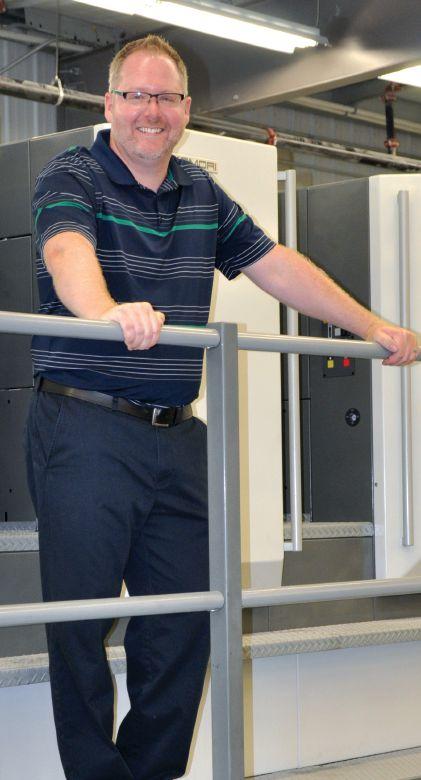
Custom print + packaging of Richmond, BC, completed the installation of an Eco-Eagle Cold Foil system, shown with Glenmore GM James Rowley (L to R), Eagle President Mike King, and Glenmore Operations Manager Stefan Congram. The system is integrated on a Heidelberg XL 106 UV press.
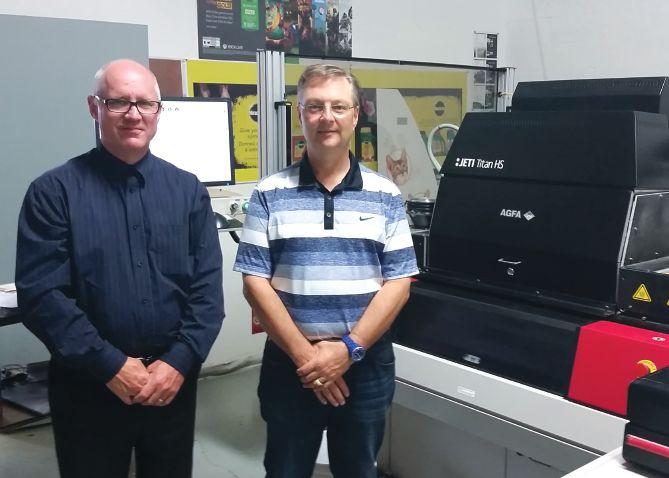
namoji inc. of Concord, Ont., added an Agfa Jeti Titan HS, shown with James Burghgraef (left), Agfa Account Manager, and Dave Jenkins, Business Manager of Namoji. The company has existing large-format inkjet and screen printing technologies, as well as finishing, plastic fabricating, cutting, die-cutting and vacuum forming.
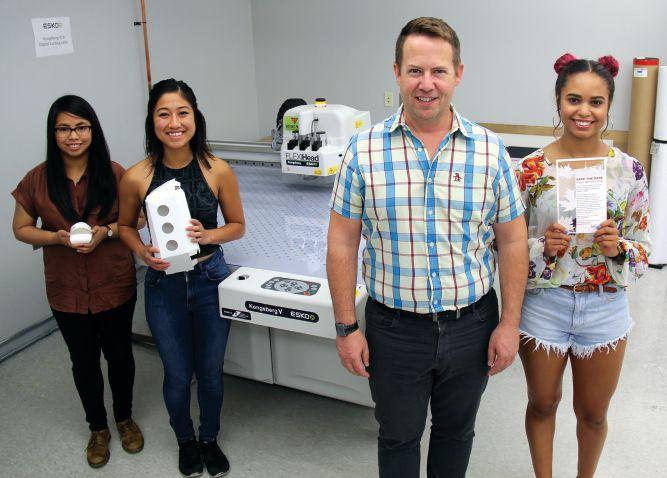
ryerson University’s Graphic Communications management program installed a new Esko Kongsberg V20 cutting system, shown with GCM Chair Ian Baitz and students (left to right) Alyssa Kaye Andino, Jessica Luong and Tabrina Loch-Williams, in its dedicated GCM building in downtown Toronto.
panel Solutions inkjet tile production for rVs
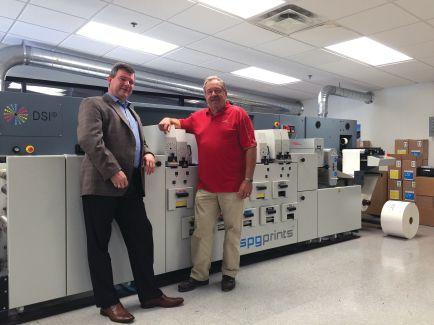
Panel Solutions, a supplier of synthetic tiles for recreational vehicles in North America, widened its design offering after installing SPGPrints’ Digital System Integration (DSI) UV-curable inkjet press and a new converting workflow. The six-colour 330mm (13 inch) standalone DSI press, running CMYK process colours, opaque white and digital primer, complements three existing toner presses. The Elkhart, Indiana, company currently has a customer base of more than 200 major retailers and RV manufacturers.
Intermittent pinning between print stations instantly cures the ink, which, according to SPGPrints, allows for reproduction at higher resolutions than previously possible. A water-cooled chill drum to maintain the stability of plastic substrates at higher speeds allows the company to print on more substrates. These include 96 gms (65 lb) papers, clear and white polyesters of 0.25 to 0.76 mm in thickness, and metallized products. Panel Solution’s RV wallcovering solutions are made from polyvinyl or paper materials and laminated with a temperature-resistant, slippage-preventing hotmelt adhesive. The material is easy to apply, light, durable and avoids breakage associated with ceramic tiles as a result of vehicle movement or changes in temperature.
nEpa adds 57-inch KBa with System Brunner
NEPA Carton and Carrier Company located in Moosic, PA, has installed a new 57-inch, six-colour KBA Rapida 145 large-format press. Automated features on the Rapida press include CleanTronic, SIS Sensoric infeed system, DensiTronic Professional, inline QualiTronic Professional and LogoTronic Professional. NEPA’s new Rapida 145 is replacing three older KBA presses. With the installation, NEPA will become one of the first printers in North America to have System Brunner and its Instrument Flight system featured on its new KBA press. This feature allows the press to be controlled via grey balance with the QCC option from KBA, for printing to G7 specifications. KBA explains it is the only system on the market allowing a printer to change and select preferred grey balance on press.
arCHiVe
1965
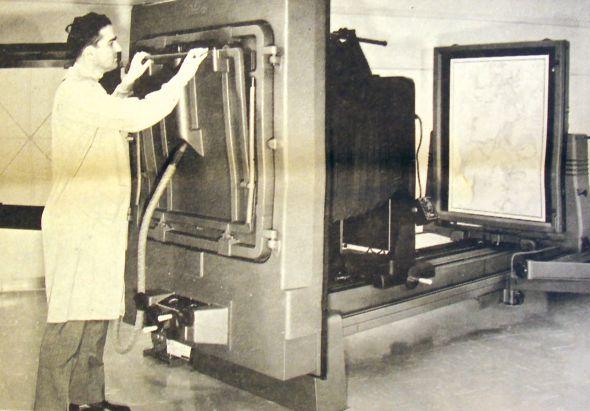
robertson photo-mechanix inc.
A new type of vertical camera (size 18 x 24 inches) by Robertson is designed for lithographers in general and particularly in the offset newspaper field.
82,000
Impressions per hour speed of the new 16-page, 5-unit Goss Sunday 2000 press to be installed in Henry Wurst Inc.’s Kansas City printing facility this December, replacing two existing 5- and 8-unit presses. The investment is part of the company’s long-term growth strategy to provide both short-run (targeted or versioned products) and long-run print work.
1985
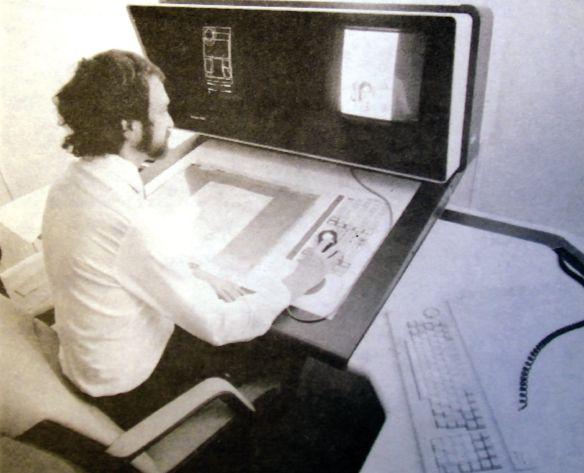
Crosfield launches new Studio 800 generation
The new system levels of *825 *870 *880 embody the latest developments in computer power and imaging-handling techniques for electronic page composition. Studio 825 is the first step from colour scanning to full electronic page composition. A centrally positioned monochrome-planning monitor, integrated within the new operation console, displays the keyline page grid and any alphanumeric data and system messages.
Working from planning films made at the time of input scanning, the operator makes the page up with all of the planning instructions implemented by simple electronic cursor operation. The cursor also functions as a densitometer enabling the operator to obtain a density or dot percentage read out from any coordination position within the image. A floppy disk is provided for the content storage of page layout information, while scanned images and completed pages are held on removable 300MB disk drives with up to four drives possible.
12,000
PET beer bottles printed per hour on world’s first Direct Print KHS with Xaar 1002 heads, at Martens Brouwerij brewery in Belgium.
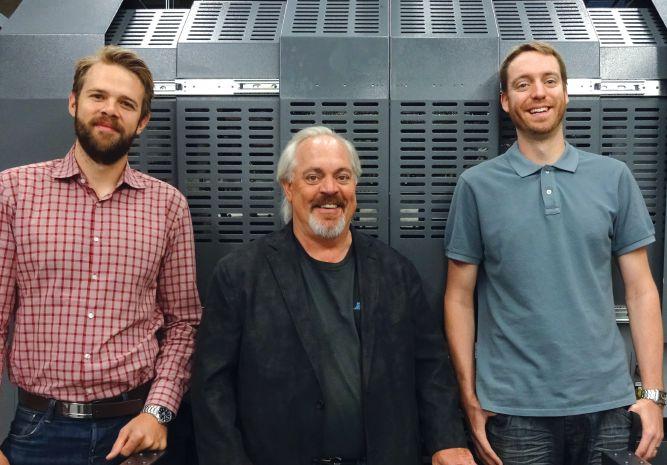
edward Scheppink, Managing Director of SPGPrints (left), and Tom Zurek, President of Panel Solutions.
We are not alone
after years of seeing promising new printing processes reach the graphic arts industry, the gist of today’s narrative remains go big, go better or go home.
By Nick Howard
Go bigger in printing vernacular still refers to the luxury of larger job volume and, as we know, the lithographic process does not have limitations on run lengths or increased costs. There are no differing click charges or maintenance fees for a litho job of 2,000 sheets or one that is 200,000 sheets. Bigger just means better economics for both the printer and client.
Go better in today’s market can often refer to leveraging collateral print as a loss-leader to attract more valuable work, such as controlling a client’s full marketing campaign and providing them with direct links to their customers. This loss-leader approach often manifests itself in providing gang-run work like business cards or postcards. Better, of course, can also mean providing unique capabilities in print manufacturing like special effects with inks and coatings, or perhaps the now commonplace use of both digital and offset.
Go home – Well, we know what that means. A growing portion of our industry considers this possibility regularly. It can mean an attempt to merge, but in many instances it signals that it’s time to look at new opportunities outside of the printing industry.
We are not alone in considering this approach. Print is often viewed as the ultimate victim of digital communications, but the Internet and mobile computing have ravaged the manufacturing base of many industries.
communications revolution
It was less than 20 years ago that the mighty music industry made nothing but money. The ridiculous contracts, which even the biggest names in music had to
sign, guaranteed riches beyond belief for the silent powers of Music Inc. If a percentage of say five percent royalty is agreed to, musicians were in line to lose half of that to deductions by the industry. Creation of album covers, production printing of albums, breakage (a certain percentage was deducted to cover theft and breakage of shipments) were just some of the fees an artist would see coming off their royalty payments.
No wonder artists hated their record companies. How else could musicians have their music delivered, but through what was a quasi-monopoly? Then along came the Internet and revolutionary Websites like Napster. The end was near for the manufacturing monopolies of music, as artists found new routes to keep more of their money and music lovers could hold entire collections on a tiny smartphone.
Consider the genius of Steve Jobs and how he changed the fortunes of so many industries. His foresight to know that the cell phone would become so much more and offer the world instant access to almost everything. The new iPhone 6 looks like an incredible communications tool.
Before the iPhone wave, mobile text was almost an exclusive domain of Research In Motion, once a small Waterloo company that had the world in its pocket with the Blackberry device. In fact, the Blackberry created the email/phone concept. Technology was changing fast, however, and again Steve Jobs understood the future of mobile computing was not solely about hardware, but also the rich imaging tools that a computer phone could provide. Blackberry lives on today trying to hold on to its secure network abilities, which in of itself is a monumental feat with so many options today.
in its most recent quarter, BlackBerry generated 40 percent of its $658 million in revenue from hardware sales, while 38 percent came from services and 21 percent from software.
2003
The year the first convergent smartphone BlackBerry was released, supporting push email, mobile telephone, text messaging, Internet faxing, Web browsing and other wireless information services.
Challenges remain
Our piece of the communications industry, manufacturing and distributing print, has such a long legacy. Being centuries older than any other communications medium, however, does not mean a thing to Millennials or the worker generations to come, so we too are changing. The offset press appears as if it will continue on its downward trajectory as more inkjet and other digital processes come to market. Ten years from now there will be very few offset machines sold. Even today many printers look upon offset investment as a necessary evil and find ways to hold onto their current machines longer. The reason is simple. Technology has not changed a great deal from 2004 to the present day and shelling out $2 million plus for a new offset press when digital systems cost half as much and better fit current commercial shifts.
The printing industry is in the middle of a era-defining communications transformation. Yes, we are aware of the increased closures and amalgamations. We see what is happening to the printed newspaper industry. But papers are still being printed, direct mail still arrives daily, magazines and promotional materials are in circulation and life seems relatively normal. Every day, however, more and more of what we print vanishes. It’s a jerky pattern but the decline is inevitable. Larger printers and trade shops grab more of the work because they can usually produce it cheaper than smaller traditional shops. Variable and versioned printing with digital technologies is growing exponentially and set to take more of the pie.
Before Benjamin Franklin was in short pants, however, printers have howled against unfair competitor pricing, rising pulp prices and governmental legislation against everything from alcohol to by-products of the print process. There have also always been industry pioneers who see the future of print and drive it forward. They certainly do not attract the cult following of tech-giant CEOs, but paying attention to those in our industry who are prospering has never been more important. A few have taken steps to re-define our industry for the better, even by employing offset because they research market trends. Not since Gutenberg has our industry faced such challenges – Go big, go better or go home.
niCK HoWarD, a partner in Howard Graphic Equipment and Howard Iron Works, is a printing historian, consultant and Certified Appraiser of capital equipment.
nick@howardgraphicequipment.com
The dance of print plus
gracoL plus will find its way into printing in 2016 based on new idealliance research exploring the maximum practical colour gamut achievable on an offset press with just four inks.
By Wayne Collins
the dance floor used to intimidate the heck out of me. The music always inspired me to want to get out there and move. I did not relish the predicaments my two left feet got me into, particularly in the presence of a beautiful woman. I took a few lessons though and lately I have been able to float complete strangers around the floor reasonably well. I had to put some serious time into learning a few basic principles and it opened up another world.
For many business owners, adopting colour management standards in their businesses is like learning to dance. Some had to lose a few customers to be motivated to get in step. Others just want to achieve better colour to make sure their product is the best it can be. It takes some serious efforts upfront to lose the intimidation factor, but the rewards of doing the media dance with more business partners makes it worth the effort.
Achieving a G7 certification for your business is an important step in the colour management process, but it is only the first one. It is critical to understand that by conforming to that standard you are limiting colour production on your equipment to a “common denominator” that is achievable by most equipment worldwide. Achieving G7 certification is an important service to offer your customers when they are managing global communications campaigns. It is like learning how to two-step, and having to sit out the waltzes and foxtrots.
G7 certification requires one to measure colour reproduction equipment and discover how it compares to global standards, and to measure how repeatable your manufacturing processes are. These are the wider benefits of achieving G7 certification. It is useful to distinguish
two facets of the certification. The first is achieving and maintaining grey balance throughout the spectrum. The second is measuring and limiting colour gamut to conform to a global standard. Achieving and maintaining grey balance usually means establishing a regular maintenance routine for linearizing and calibrating each machine.
Measuring and limiting colour gamut requires measuring profiling charts, establishing destination profiles for each machine, and achieving the gamut of a source profile that sets the global standard. It is this last step that bares some examination in my opinion.
If you look closely at the profile for each piece of equipment to be measured, you can compare the gamut to a global standard like GRACoL, and discover which parts of the gamut are being clipped to conform to the standard. This is the step that will let you discover how colourful a dancer YOU are! How much of the colour gamut can your facility reproduce accurately.
You had to create ICC profiles for each of your imaging engines in order to achieve G7 certification. You may have had to work out a few bugs to get some parts of the colour gamut to align with the gamut in the G7 specification. Most certainly though, you will have had to clip some of the colour gamut that your equipment is capable of reproducing in order to align to the global standard.
In my opinion, this is the opportunity lost when a business hangs their G7 certification sign on their door and limits their reproduction to that standard. You are not achieving the widest range of colour your equipment is capable of. The ICC profiles show you how your equipment reproduces beyond the specification. Look at those areas. You may find you can add a dimension to your “print
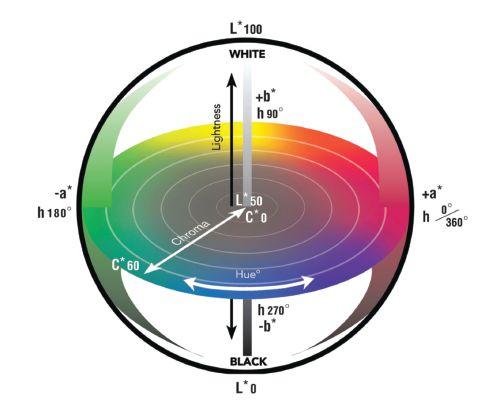
Cie l*a*b* (CielAB) was developed by the Commission internationale de l’eclairage and describes all the colours visible to the human eye (image produced by Printing.org).
green” marketing slogan, if you find your equipment produces greens way beyond the G7 specification.
The emerging GRACoLPlus initiative, being driven by Idealliance, sets a newer global standard that is slightly beyond the G7 colour gamut. Idealliance explains its program goal is to develop a new characterization data set with a larger colour gamut than GRACoL, using inks from multiple vendors. The organization states standardized ICC profiles and support tools will soon be released, along with educational programs to help printers and buyers take advantage of GRACoLPlus. At a recent PrintAction event, Kodak’s William Li spoke about the new efforts behind GRACoLPlus, explaining it uses FM screening technology and allows you to print with higher CMYK densities to achieve a wider gamut.
When considering GRACoLPlus, compare your equipment to the new GRACoL 2013 standard. It is a simple exercise in the Color Sync utility to load the GRACoL 2013 profile and “hold for comparison” when opening the measured profile for each of your colour reproduction imaging engines. You will quite quickly see the colours that are outside the GRACoL profile. Take some notes, and then find some images that demonstrate to you and your customers which colours you can reproduce with more colour saturation than the standard. I think that is important information for your sales team to have.
40%
Percentage that blue takes as the world’s most popular colour, according to ucreative, based on a survey conducted by several global marketing firms. Purple was the world’s second favourite colour at 14 percent, followed by red and green.
G7 certification is not a standard to cling to and to limit your manufacturing processes. It is actually a specification and intended to give us all some basic steps to allow us to participate in a global communications dance. Our industry still needs more of that, but let go of remaining lock step in the standard. Discover what is unique about the way your facility reproduces colour. You may only want to use a wider gamut on some images for certain clients. It will help you be unique in the marketplace if you can offer that service.
I asked a woman I had never met before out on to the dance floor this week. When I suggested she loosen up and let go just a bit, she exclaimed, “Oh no – I’m not good at letting go! When I let go of things - I leave claw marks!”
Have a look at your business. Now that you have achieved a global standard, find out what makes you a unique and more colourful partner.
WaYne Collins is the program head of BCIT’s Graphic Communications Technology program and has more than 25 years of industry experience. wayne_collins@bcit.ca
Print 4.0
the global printing industry is taking on a new shape, influenced by the many storied institutions continuing to form its backbone, as it drives into the future of communications
By Jon Robinson
claus Bolza-Schünemann over the past two years has been tasked with leading the restructuring of two global printing institutions. As Chief Executive Officer and President of Koenig & Bauer Group (KBA), he led a major overhaul of one of the printing industry’s primary press makers, which is two years away from celebrating its 200-year anniversary.
In 2013, KBA began a massive restructuring effort, following the suit of its historic German press-making rivals Heidelberg and manroland, by focusing on consolidating its manufacturing platform. By mid-2015, everything needed for the assembly of a Rapida sheetfed press in Radebeul is derived from two KBA sites instead of five scattered across Germany
After arriving in Chicago for Graph expo from Tokyo’s iGAS event, Claus Bolza-Schünemann updated the industry on the progress of drupa 2016 and KBA’s restructuring.
and Austria. Radebeul continues to make the world’s largest sheetfed press in the Rapida 205. There are currently 25 of these 81-inch giants operating in North America, based on the level of automation now found in even the largest of modern printing presses and also because of the growth in the signage market fuelled by wide-format inkjet.
The second global print institution Bolza-Schünemann is helping to steer toward the future is the dominating drupa exhibition, which underwent a very public overhaul since its last Düsseldorf showing in 2012. He relates the direction of the industry, in terms of potential, to the emerging, process-driven concept of Industry 4.0, which printing has been at the forefront of for more than a decade. Bolza-Schünemann describes drupa 2016, running May 31 to June 10, as a platform for Print 4.0. PrintAction caught
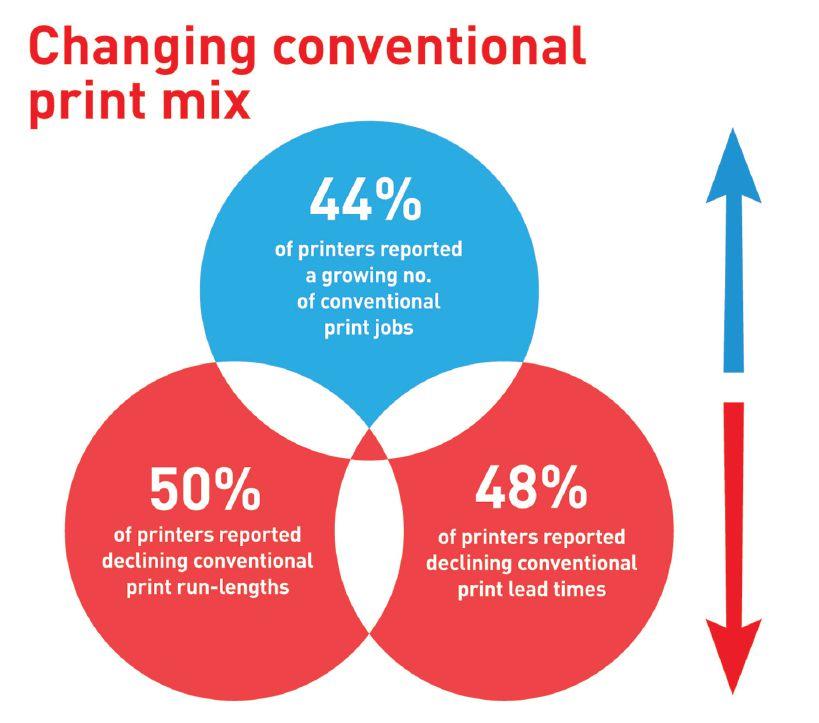
The drupa Global Trends Report 2015 is based on a survey conducted in october 2014 in which more than 1,100 participants took part globally, including 810 printers.
up with Bolza-Schünemann at Graph Expo, just hours after he landed in Chicago from a 20-hour flight out of Tokyo’s IGAS event, to discuss what has been an incredibly busy two years for one of the printing world’s most influential leaders.
Why is drupa still important to print?
It is the largest stage on earth for the printing industry, where you realize printing is not dead. For years and years, the whole industry had a very bad standing with investors and bankers. Everybody was thinking that printing is something out of date. Everything was going down. On the other hand, we certainly know that printing is still a very strong industry and I’m absolutely convinced it will not disappear.
It is important for our industry in total to have confidence for investors, for young students who are looking for future jobs, that this is not a dead industry but a very interesting industry. Therefore, drupa, or a large exposition like Graph Expo, is very important, not only from a sales point of view or for vendor-customer relations, but to also show the public, yes, printing is something we cannot live without.
What is Industry 4.0 and how does it relate to printing?
The starting point of Industry 4.0 was in Germany actually, when the German government was looking for ways to strengthen German technology through-
out the world. We have several very large companies making industrial controls and drives and the idea is to have common interfaces to link different vendors and machinery very easily together. Every car manufacturer, for example, writes a specification and if you want to be a supplier of a robot you have to put in their specifications regarding the interface.
And the printing industry started very, very early – minimum 10 years ago – with standard interfaces because we realized that complex software interfaces are not affordable to redo depending on the customer or the components you are using. To have a flawless interface, it takes years to develop and [today in print] it is very easy to hook up different vendors’ colour or register controls, consoles, prepress systems or whatever. The printing industry was really way head of Industry 4.0, which is the big hype in Europe and there are now some big U.S. companies with these types of working groups.
What will drupa 2016 be remem
bered as?
It will be The Everything drupa. We will have a good mixture of traditional and newer processes. For example, I’m convinced there is still a big gravure market. If you look to China, 80 percent of all flexible printers in China are gravure, 20 percent are flexo. [In North America] it is just the opposite. So there are different needs around the world and I think every vendor in this industry has reasons for
providing different products, not to only focus on digital, or offset or flexo… much like KBA does today. We have a very wide variety of products and processes for the demands of the market.
What did you learn about KBA during restructuring?
To be very honest, I could not learn much since I have been with the company for 27 years now. It was mainly market driven that our business, the revenue of the business, was declining. This started in 2008 as everywhere and we did some restructuring by cutting workforce, but we did not rearrange the whole organization whatsoever. Then in mid-2013 the sheetfed, web and security businesses were not really picking up. We came fairly quickly to the conclusion that we have to reorganize the core part of the group to be more efficient and maybe even to cope with a decline in business.
Then we decided at the end of ‘13 to do a consolidation, mainly of our manufacturing. In the old days, we casted iron at four sites and we produced printing cylinders at four sites. Today, we cast iron at one of our main plants in Würzburg –nowhere else. In Radebeul, where our sheetfed division is located, we produce our cylinders and gears. So each location has a very clear focus now.
How difficult was the decision to consolidate manufacturing?
It was a very expensive process mainly to cut the workforce. We cut the workforce by more than 1,000 employees within the last one and a half years. We closed two manufacturing facilities.We moved about 50 large tool machines, about the size of private homes, around Europe while having the factories running because we could not stop production for three months to restructure.
But it went extremely well and also every one involved, all employees, were really focused to get this done and also saw the benefits for the company once the restructuring is over. Most important was to tell the employees not only what we are going to do, but also why we are going to do it. This is one of the key things to watch, so that you do not lose the faith of the employees.
How is KBA positioned today relative to its competitors?
Looking backward, it is always too late when you do a restructuring. When you are done you always think we could have started a year earlier, maybe two years earlier, but I think the timing was very good. It was not overdue, but it was the right thing to do. We took exactly the right decisions two years ago and if we had to do it all over again I do not know a single item to do differently.
Did KBA ever consider divesting
some of its operations?
That was never on the table, but we certainly did discuss if it makes sense to stay in the newspaper business, for example, since the market is today about 20 percent of what it was 10 years ago. We have an extremely solid customer base with a very good service business, but if you step out of a product line you lose over time this customer base. Our approach was to streamline the organization; that even with a fairly small business in newspapers, for example, we can still be profitable.
Why has KBA experienced a 30 percent increase in order intake over the past year?
Several reasons: Some markets picked up such as Germany, which has been fairly slow over the last few years, and I think investments were just overdue; not only for us but also the competition did well in Germany – there is no question. The U.S. did very well and thanks to an extremely good team in the U.S. and in Canada we increased our market share, which is nice. Then also the order intake of digital web was higher than estimated for the first half of this year. The metal decorating business is doing very well. Overall, we can be satisfied but it can always be better.
Is KBA starting to see fruits of its 2013 Flexotecnica acquisition?
It is an analogue technology; you can say an old technology. We used to build flexo presses in the old days mainly for newspapers. So from an engineering point of view we would be in the position to design and manufacture a press for flexible packaging, but we thought this is not very smart, because then there is an additional vendor in the market and you need a good product with market access. We would have been an absolute no-name in the flexible packaging business and, therefore, it was quite smart to buy a fairly small manufacturer with a very high quality product… it is a very good fit and we have been very successful in the U.S. As a newcomer, we fairly quickly have five orders in our hands. It is a new market segment for us, printing on foil – aluminum foil. But we have a core expertise to put ink on any substrate.
How is LED technology revolutionizing perfecting?
It is not only perfecting – we have several presses running in a straight mode, single-sided for the packaging industry. LED is very interesting technology and it has several benefits. The room it needs is very small since LED lamps are very small. The energy efficiency is wonderful, so the cooling is much less than a conventional UV curing system. The ozone is gone, which has always been an issue with UV drying. It is a brilliant technology and especially KBA’s design in that we can interchange the same system no matter if
it is conventional UV or LED UV, which is unique.
What is the status of KBA’s RotaJET inkjet initiative?
To be open and frank it was a quick shot for drupa [2012]. We started 14 months prior to drupa, from scratch, jointly with R.R. Donnelley, and took the position that drupa must be the goal we achieve. It was a prototype and, as an absolute newcomer and within an extremely short period of time, we achieved quite a product even if it wasn’t ready for the market. The printing quality was not what customers were expecting for their particular market needs and we have enhanced mainly ink and software over the past 18 months since drupa [2012] to tremendously improve the printing quality. We didn’t change anything on the iron or on the hardware. The first installation is with a printer who has nothing to do with our traditional customer base. It is a lamination floor producer which is absolutely new for us – a new niche.
How did you find this first RotaJET customer?
The customer approached us. We knew him from the old days since laminating floor printing is typically gravure. [These operations] are confronted with more and more design changes from customers, so the gravure process of producing cylinders is very costly and complicated, and he approached us with the idea of the RotaJET printing on laminated paper really… and it did not take many changes to the RotaJET. The press is running day in and day out. I did not know the quality demands on these floor printers is so incredible. I think it is more demanding than for a commercial printer.
Where is RotaJET’s sweet spot going to be?
Definitely niches – we showed a second even larger [88-inch format] RotaJET to another floor manufacturer.The RotaJET is dedicated for niche industrial printing applications. KBA is a supplier who is used to the customization of equipment. It has been the strength of KBA no matter if it is the web, sheetfed or security business. We listen to our customers and if they ask us for a special solution we find a special solution. Therefore, I think also the RotaJET is perfect for special markets.
Where is KBA and HP at in developing the 110-inch inkjet corrugated machine?
We are on time and on budget. We planned jointly with HP to have an open house at the end of this year and we will certainly do this in early December. It is running very well. We have a very, very fine collaboration with HP. The engineers and technicians are working day in and day out on a superb basis and I am absolutely confident it will be a very fine product with outstanding print quality for the corrugated market. It is not ready for market yet, but we are very well underway. You have to understand I cannot tell you the details.
Will this 110-inch inkjet press dramatically change the corrugated sector?
Definitely yes – a digital press 110-inches wide is state of the art.
How will KBA hold onto its dominance in large-format sheetfed?
We started a long time ago… the old Planeta operation actually, before we stepped in in 1991, already had large-format machines mainly for the packaging industry. Today, we have about 300 large-format machines running in the U.S. One hundred of them are less than 10 years old, all Rapida-based, 127s, 142s, 145s, 164s… mainly folding-carton printers. It is a very good market for us and the packaging industry is something to enjoy in the printing world.
Is the future of offset dire relative to new processes?
Introducing digital printing technology for commercial or packaging printers is a driving factor for enhancing traditional offset machines regarding changeover, fully automated paper orders, SPCs, single drives for the units that we can change within three minutes from one product to another. There was no need really [to add so much automation] five or 10 years ago since there was no competition. But these newer technologies drove the development of conventional offset and today I am absolutely convinced this will remain for years to come. No digital process, whether it is liquid toner, dry toner, inkjet, whatever, is even close to the low cost of offset printing in relation to the quality it can achieve.
We moved 50 tool machines, about the size of private homes, around Europe.
25% of publishing printers reported more than 25% of turnover.
48% of printers and 51% suppliers expect their company to improve in 2015.
11% of packaging printers reported more than 25% of turnover.
The drupa Trends Report tracks the efforts of printers to develop non-print turnover, which is happening slowly. The impact of Web-to-print varies between markets. it is commonplace in commercial and functional print, but few had a significant proportion of turnover coming in this way. Just 17% of such installations globally were handling more than 25% of company turnover.
The leader in digital printing
Since inventing the pen plotter in the late 70’s, HP has been a leading innovator in large-format printing. Today, HP has a robust line-up of products to help you meet and exceed your customers’ demands. Driving the digital transformation of large format printing with a versatile portfolio of industrial presses, HP Scitex and HP Latex are equipped with the latest technologies in digital printing. From sign and display to POP/ POS and corrugated packaging solutions, HP has what you need to capture attention and achieve streamlined production.
HP Scitex Industrial Presses takes digital productivity to the next level. The suite of presses can help you meet specialized market demands allowing you to expand your offering all the while reducing workflow complexities and improving your bottom line Stay ahead of competitors by meeting demanding turnarounds with the quality you need. Plus, you can rely on end to end support from HP.
What is the latest in the HP Scitex Portfolio?
HP Scitex 11000 Industrial Press: Outstanding versatility and productivity
Expand opportunities and grow profits with application versatility and agility. You can improve margins with the industrial productivity and quality offered by the HP Scitex 11000 Industrial Press. Confidently convert more projects to digital with ongoing press enhancements, tools, and support services.
Additional features include:
• More than one million m2/year production capacity
• HP Scitex HDR printing technology enables small ink drops for quality and large drops for speed
• HP Scitex Smart Coat Technology provides surface durability and flexibility
• HP HDR Scitex inks offer exceptional media versatility—from paper to plastics
Visit us at www.hp.com/go/scitex11000 to arrange a product demo with an HP Product specialist
Expand your expertise and be unstoppable with HP Latex printers.
From building wraps and POP to wallcoverings and canvas applications, large-format print service providers around the world are turning to HP Latex Printing Technologies to expand their capabilities, shorten turnaround times and differentiate their prints and their business while keeping costs low. HP Latex printing can generate higher profit than ecosolvent—with advantages including wider application versatility and prints that come out completely dry, allowing same-day delivery. Buy in at an affordable price, and keep your running costs low.
What is the latest in the HP Latex Portfolio?
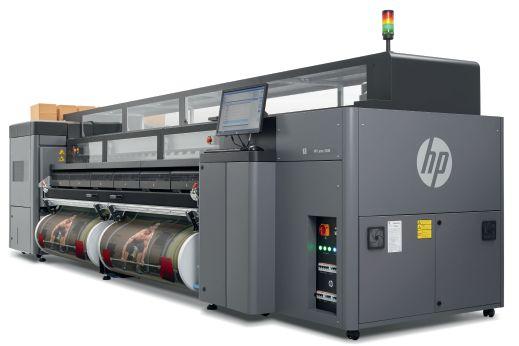
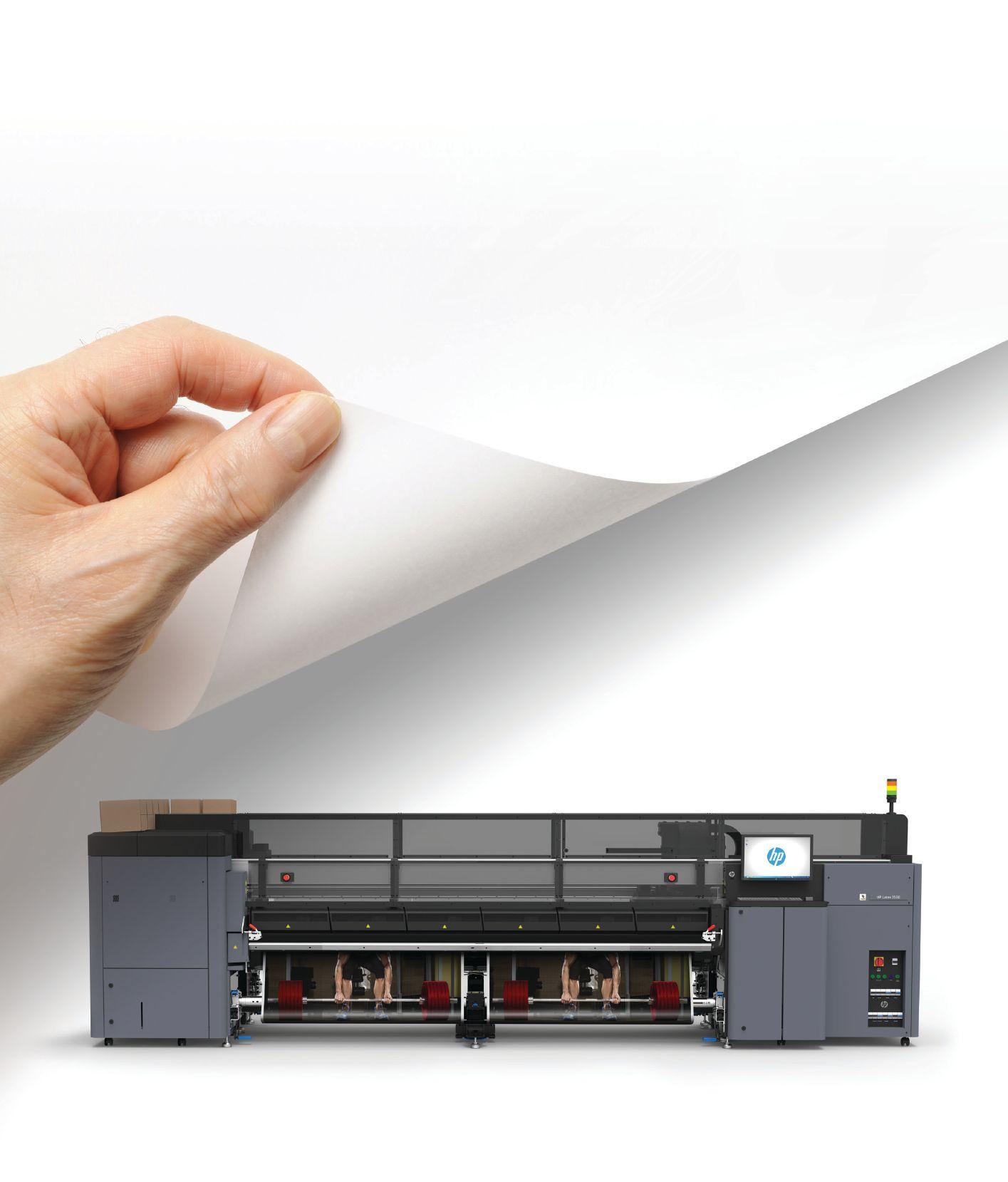
The newly launched HP Latex 3500 Printer incorporates a new level of efficient production with heavy-duty roll handling and 10-liter ink supplies leading to increased production capacity and reduced costs.
Additional Features Include:
• Heavy duty roll handling—up to 300 kg (650 lb) and 40 cm (16-in) diameter
• HP 3M 891 10-liter Latex Ink Cartridges
• Dual-roll split spindles
• HP Latex In-line Slitters
• LED Proofing Lights
• Printer Status Beacon
*Note: For a detailed list of our products please visit us online at www.hp.ca.
https://www.youtube.com/watch?v=--uvSWYjVUQ
www.hp.com/go/latex3500
There’s nothing to lose but cost.
• Increased capacity with heavy-duty rolls and 2.6-gallon ink supplies
• Longer runs with up to 12 continuous, uninterrupted hours
• Faster proofing with in-line LED proofing lights
• Quicker turnaround times using in-line slitters for edge trimming
• Higher productivity with unattended printing with the HP Latex Mobile App
• Improved profits due to reduced media, ink and finishing waste
A new erA in Colour
With the introduction of the m measurement modes, the past couple of years has brought a range of incredible new measurement devices that can change the way any commercial printer approaches their pressroom
By Martin Habekost and Abhay Sharma
there are some exciting new developments in the world of measuring instruments that tackle the perennial issues of measuring wet and dry press sheets, measurement of papers with optical brighteners, doing a press check with metallic inks or trying to match a press sheet to a proof – new standards and new instruments are now available that eradicate many of these practical colour issues.
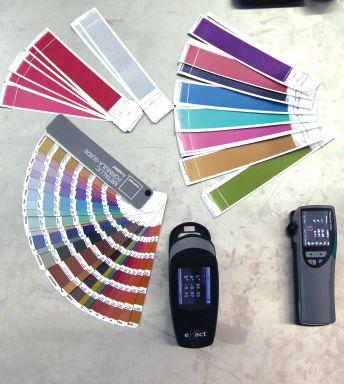
The Barbieri SpectroPad2, the Techkon SpectroDens and the X-Rite eXact have been tested and evaluated in Ryerson University’s pressroom in different applications from inkjet photo papers to metallic PANTONE inks on press.
Spectrophotometers are routinely used for colour measurement and colour management in many commercial printing and proofing workflows. In the case of
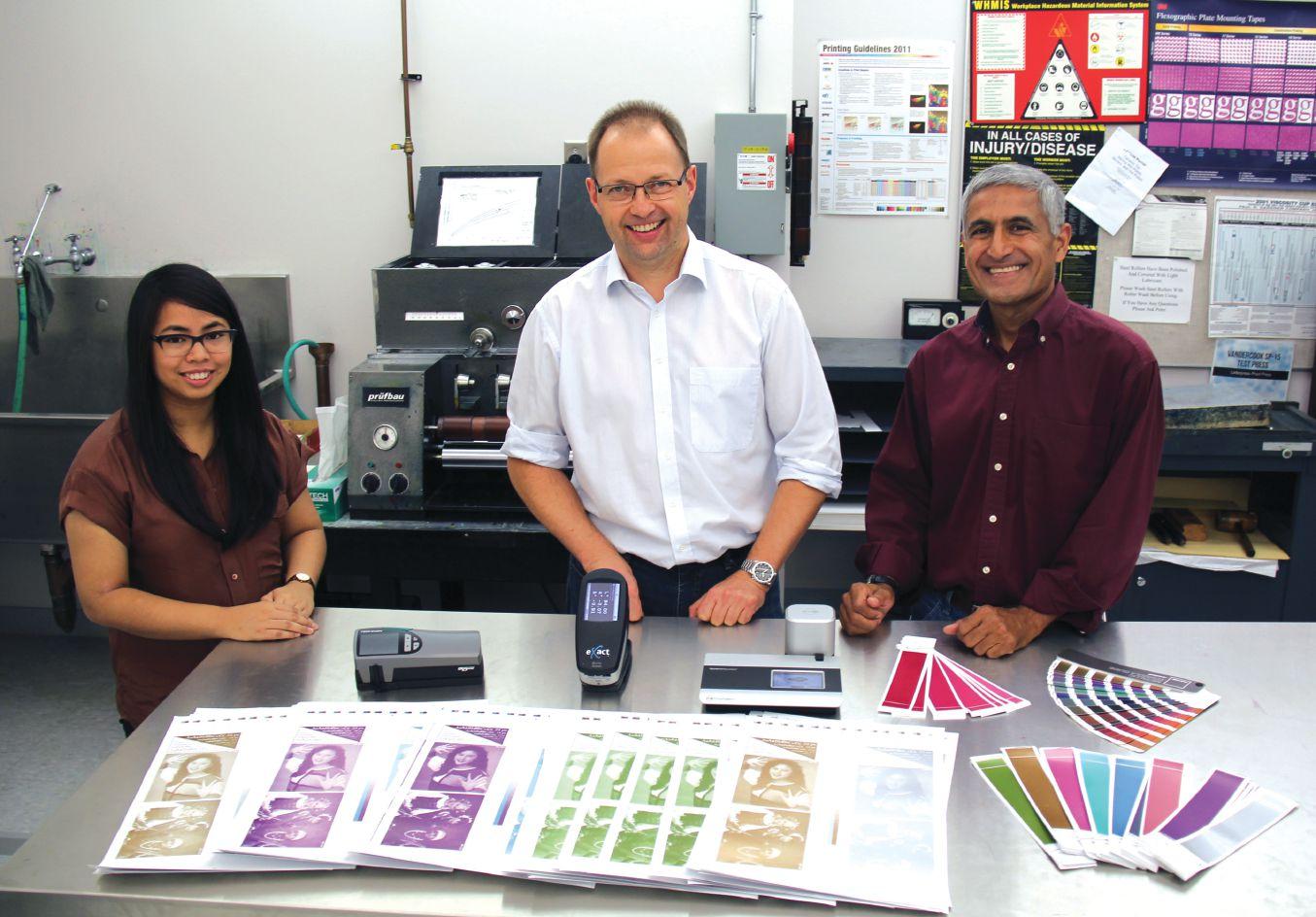
Fourth year student Alyssa Andino, Martin habekost, and Ahbay Sharma in Ryerson GCM’s colour lab, where original research for this report was produced.
media containing optical brightening agents, UV-induced fluorescence has lead to poor levels of agreement between models from different manufacturers, or different models from the same manufacturer. If instruments produce different readings, then problems with colour matching can occur when colour management is done in prepress with one instrument, but a different instrument is used to do spot checks at press-side. A major contributor to inter-model differences is the amount of ultraviolet (UV) energy in the instrument. When a paper contains brightening agents, instruments have reported different measurements for the same sample. The new standard ISO 13655 now clearly defines four measurement modes: M0, M1, M2 and M3. In broad terms, M0 is a legacy mode for all devices prior to the implementation of the new measurement modes, while M1 and M2 are UV-included and UV-ex-
Ready to Deliver Brand on Demand
When we asked offset printers in 2007 to describe the perfect short run press solution, they didn’t mince words. The print quality needs to be as good as offset litho. Use standard coated and uncoated stocks, and load-up and off-load of sheets shouldn’t require an owners manual to figure out. The prints should be smooth, without any pile-height issues, and look and feel like an offset sheet. Prints need to be durable too, especially when using finishing equipment. And please…no more click charges.
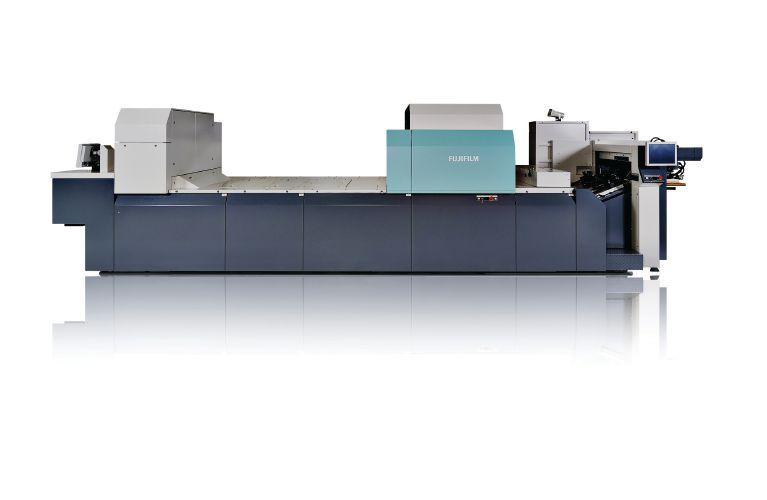
Fujifilm’s J Press 720S technology delivers these benefits and J Press installations have produced millions of brand on demand impressions where it counts most – in the field. So why wait on the promises of new technology, when proven Fujifilm innovation can help you dominate the high-quality, short-run market today.
Seeing is believing. Visit fujifilminkjet.com today.
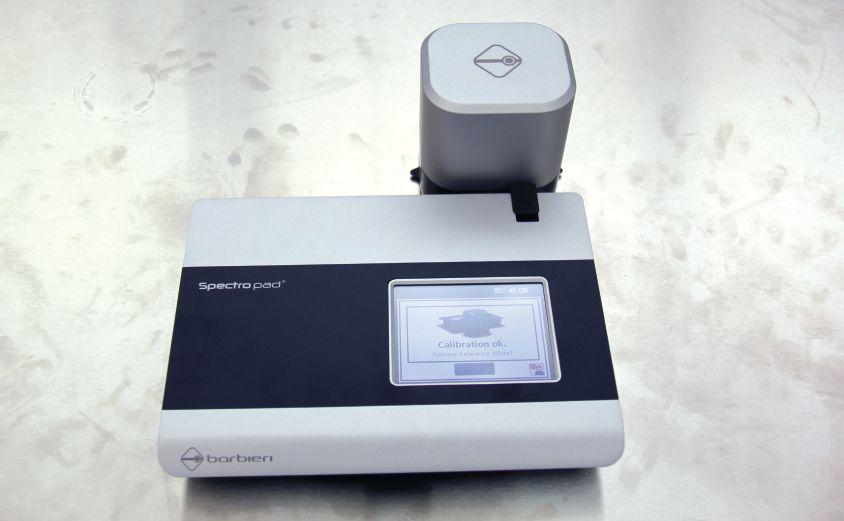
The Barbieri SpectroPad2 can be used in all offset and digital applications. it can be connected via WiFi or uSB connectivity to collect spectral data.
cluded modes, respectively. The M3 mode is a polarizing mode for use in ink dry-back on press or for measuring metallic inks and other special effect inks.
NEW ISO 13655 mEASuREmENT
The problem to date has been that there was no clear specification for handheld spectrophotometers for prepress and pressroom use. The new ISO 13655 standard provides much more clarity for the instrument measuring conditions, which has brought instruments from different suppliers into closer agreement. The instruments evaluated here are new instruments that meet this standard.We provide an explanation for ISO 13655 and its implementation for the general user.
mode. The light source in the instrument must create the effect of CIE Illuminant, D50. A major difference (and improvement) over earlier specifications is that in this mode the spectral power distribution of the illuminant should approximate D50, thus the relative amount of UV and visible wavelengths is now clearly and unambiguously specified.
measurement source… shall only contain substantial radiation power in the wavelength range above 400 nm...” M2 is thus a UV-cut mode, filtering out any UV component below 400 nm, in the instrument’s light source. How is this mode used in practice? There will be times when a customer will request a print to be measured using M2 because the lighting used to display the job is expected to be free of UV content. A museum is an example of one such place that may use UV-free lighting. In colour management circles there may be instances that require removing UV light from the measurement system. With the new standard there is a specific definition for “UV-cut” and the wavelength at which it occurs.
Number of different metallic inks produced on Ryerson’s Prüfbau printability tester for this research report. Of which six colours were chosen for a press run on GCM’s 2-colour Heidelberg Quickmaster QM46.
The legacy mode M0 represents the majority of measuring instruments used in the field today. The X-Rite 530, i1Pro and iSis are all M0 instruments. M0 is directed to instruments that use a tungsten lamp to illuminate the specimen being measured. The tungsten bulb based device used to be the primary type of device on the market. It should be noted that the UV component can be very weak in these instruments as they have very low energy in the 300-400 nm range.
An M0 instrument can safely be used for process control applications where it is adequate to make repeatable measurements, it can be used in situations where it is not necessary to know the “absolute” measurement value and there is no exchange of information or correlation with other measurement scenarios. In general, the M0 mode exists as a catch-all mode so that we have within the new ISO standard a category for legacy devices. The M0 mode enables older devices to have a place within the new standard.
The clarification for spectral power distribution in measuring instruments, ISO 13655, is accompanied by a similar clarification in the standard for viewing booths ISO 3664. Via updated standard ISO 3664, emphasis has turned to requiring a closer simulation of Illuminant D50 thus clarifying the amount of UV illumination in the viewing booth. In the current context, ISO 3664 has called for tighter tolerances on the quality of the light source to ensure that it closely matches the D50 (M1) curve especially in the UV part of the spectrum. We may say that M1 is, in fact, nothing more than an ISO 3664 source in the instrument. By implementation of these two ISO standards, we arrive, for the first time at a situation where instrument reported values are in agreement with what is observed visually in a viewing booth. D50, one of the standard viewing booth modes, is the basis for the Profile Connection Space in the ICC architecture. M1 mode within instruments corresponds to ISO 3664 for viewing booths, all of which make M1 the most desirable mode for today’s colour measurement and colour management systems. Instruments that offer M1 mode are devices such as X-Rite’s i1Pro2 and iSis2 – note the “2” in the model name, indicating they are second generation instruments for the new ISO standard.
M3 is a polarizing mode (for measurement of wet offset press sheets) and consists of UV-cut, up until 400 nm and then a polarizing filter is applied to the remaining wavelengths. The main use of M3 is to limit or completely remove surface reflections. In the offset printing sector, the customer pays for the final dry product. One of the main concerns is that the press sheets come off the press wet and as they dry the density of the ink drops. The M3 mode can aid printers in cutting the surface gloss from wet inks, and if drying is primarily represented by a change in surface gloss, then by removing the gloss, we may have a better prediction of the final expected dry density. It is generally agreed that a polarization filter can give less difference in density readings between a wet and a dried-back press sheet, so the use of a polarizing filter can provide a better predictor of dry density from wet density readings.
New in the market today, from different companies, are instruments that meet the ISO 13655 standard. The Barbieri SpectroPad2 spectrophotometer was evaluated at Ryerson GCM for use in photo papers containing high amounts of optical bright10
M1 is known as the “D50 mode” or “UV included mode” – devices can use two different methods to achieve this
M2, defined as a “UV-cut” mode, removes all UV light from the measurement system, below 400 nm. ISO 13655 states, “The spectral power distribution of the
There is considerable debate around the use of polarization filters for density measurements and for use in metallic inks. The use of polarization filters is somewhat controversial since the effect is not controllable and each situation will produce different results, until now there have been no published standards for the use of polarization filters. The situation was akin to the use of UV light in the instrument, it was not stipulated or clearly defined. ISO 13655 now clarifies the situation for the response of the polarizing filter. The M3 mode is examined in the present study for use in measurement of metallic inks – an area that has been a thorny issue for measurement and control of metallic inks on press. Practical testing using the Techkon SpectroDens and X-Rite eXact show that the M3 mode provides huge improvements when controlling metallic inks on press.
BARBIERI SPECTROPAD2
Looking good on paper matters. ColorLok® Technology gives paper more vivid colors, bolder blacks, and faster drying times.* Learn more at colorlok.com VIVID COLORS BOLDER BLACKS FASTER DRYING
Domtar EarthChoice® Office Paper is a great-looking, everyday paper that represents your commitment to environmental responsibility. Featuring ColorLok ® Technology, it is designed to provide optimal printing results. To learn more visit www.egpaper.com or domtar.com.
eners.The SpectroPad2 has a novel upright design with a large, clear panel.To measure, the head moves along for a small distance until a small beep reports the measurement in the touch-screen LCD panel.The device connects directly to a laptop or other computer via Barbieri Gateway software using USB or WiFi, or at press-side the LCD panel can be set to immediately report a pass or fail colour test. Importantly, the SpectroPad2 is compliant with the M0, M1 and M2 measurement modes – it is highly recommended that a press shop should only buy a device that complies with these standards. The white calibration tile is neatly hidden and is unlocked when white calibration is done by the user. The device is clean, simple, elegant and a charm to use, and has applications in offset printing as well as all digital applications such as large-format inkjet. Barbieri is an Italian company, run by brothers Stefan and Markus Barbieri, supplying a range of spectrophotometers with a wide European user base, and support here in Toronto.
TECHKON SPECTRODENS
The Techkon SpectroDens is a sophisticated German instrument in which we focused on the use of the M3 measurement mode. The SpectroDens also has a neatly hidden calibration tile in the
charging base for the instrument. The SpectroDens can also be used to see if a press sheet is in compliance with the G7 process. The latest model even offers a hand-scanning mode for the measurement of the G7 target.
In the current evaluation we focused on the M3 mode, which can be used for measuring metallic inks and other special effect inks. The M3 measurement mode describes the use of two polarizing filters before the reflected light from the sample hits the sensor.
In the test, we measured wet and dry metallic inks to see how well the new M3 measurement mode works when it comes to measuring such inks. Ten metallic inks with PANTONE P877 silver or P874 gold as base metallic ink were printed on a Prüfbau printability tester and measured. The reference point was the printed metallic ink in the PANTONE metallic book. A range of samples with declining
ink amounts were printed. The Techkon SpectroDens was used to measure L*a*b* values and the density of the samples.
The colour data and the density were recorded using the SpectroDrive software from Techkon, which can be downloaded for free. The software can connect to the instrument over WiFi, if both devices are on the same wireless network. The other option is to connect the instrument with the supplied USB cable to a USB port of your computer. With help of the software a colour standard can be set and then measurements can be taken of the samples and compared to the standard. The colour difference between standard and sample can be calculated in various colour differencing equations. For the evaluation of the M3 measurement mode, we used the DE2000 equation because the calculated DE2000 values correspond quite well with how we, as human observers, perceive colour differences.
Since the SpectroDens, and all other modern spectrophotometers measure the light spectrum that is reflected back from the sample, they do not calculate density in the same way as traditional filter-based densitometers. In spectral-based densitometers, the reflected light spectrum is used from which to calculate density. This is the reason why the measuring device is capable of giving L*a*b* values and printed ink density at the same time.
PRESS RuN WITH SILvER AND GOLD mETALLIC INKS
After printing 10 different metallic inks on the Prüfbau printability tester, six colours were chosen for a pressrun on our 2-colour Heidelberg Quickmaster QM46. Again, we used the printed ink density from the PANTONE metallic book as a yardstick. After a proper set up and achieving the target ink density, we turned the ink ductor off and ran 200 consecutive prints. For the analysis, a press sheet was measured every 10 sheets and the results collected with the SpectroDrive software and recorded in Excel. The results from the prints on the Prüfbau printability tester and the QM46 press run aligned quite well in regards to which metric can be used for controlling metallic inks on press.
For the metallic ink project we also used an X-Rite eXact which has been switched into M3 measurement mode. The same samples (Prüfbau and QM46) that were measured with the SpectroDens were also measured with the eXact. X-Rite offers the DataCatcher software which can connect via Bluetooth or USB-cable with instrument. The data can also be stored directly into an Excel spreadsheet.
Very important and relevant findings show that the M3 mode can be used to measure spectral density and the density relates well to ink film thickness of metallic ink. When we increase or decrease the amount of metallic ink, the density reading increases or decreases accordingly, thus we have an instrument and metric to control metallic ink on press. The other critical result here is that two different instruments – the Techkon SpectroDens and the X-Rite eXact agree in their measurements of the same sample. A main result from this project is that there is close agreement in terms of density between the Techkon SpectroDens and the X-Rite eXact for the metallic colours. The density function on both measurement devices allows to easily track the printed ink density on press. Differences start to show up when thick ink films are being printed, when one tries to print a real intense or dense colour. At this point, the measurement values start to drift, but you have to keep in mind that at a heavy ink film and high ink densities very little light reaches the light sensor and, therefore, the calculated L*a*b* values and ink densities can start to be slightly different.
Another option would be to track the L*-value of the printed ink. L* is a lightness measurement. So, if the L* value is below the target L*-value than the ink is too dark and too much ink is applied on press. If the L* value is above the target value then the ink is too light and a little bit more ink has to be printed.
Our results clearly show that the recorded density values decrease as the printed ink film thickness decrease. A decreasing ink film thickness means that the print gets lighter, which in return, in shown in the increasing L*-values. A higher L*-value means, that the colour is less intense than the desired colour and a thicker ink film has to be printed on press by either opening the ink keys more, or by increasing the ink dwell in the ink fountain.
mORE THAN HyPE
In many print shops there are different devices used in prepress and press, or a printer may have a Toronto and Ottawa location with an instrument in each facility. The new ISO 13655 standard brings all these different instruments into close alignment. Further, the ISO 13655 enables different measurement modes for UV-included and UV-excluded measurements and also the M3 mode for measurement of metallic inks. Together these changes provide huge advantages to practical colour measurement and colour matching at press-side.
It is not marketing hype, press shops should genuinely seek to upgrade their instrumentation and in this work we evaluated the Barbieri SpectroPad2, Techkon SpectroDens and X-Rite eXact – these all meet the new ISO standards and are all easy to use, software-driven devices. Specifically in this testing, the Techkon SpectroDens and the X-Rite eXact can both be used to measure metallic inks on press, using the M3 measurement mode. A relatively easy to understand metric for on press control is the printed ink density that both instruments can show in their LCD displays. Using the printed ink density allows press operators to measure and control metallic inks like they are controlling four process colours!
VIVID PRINTING
THE NEW JETI TAURO . FOR IMPRESSIVE COLORS, DETAIL AND PRODUCTIVITY.
Dazzled by these colors? That’s the Jeti Tauro effect! This next-generation high-end hybrid UV-inkjet wide-format printer is built on our extensive R&D knowledge and totally delivers exceptional print quality at high speeds for both rigid and flexible media. It is THE solution for sign makers and display producers to color up their high-volume production.
StAte of tHe Art inkjet or SCi-fi?
UK journalist sean smyth provides insight on the emerging state of production inkjet as part of the drupa expert article series leading up to print’s massive may 2016 tradeshow in germany.
By Sean Smyth
parents know this refrain well, “Are we there yet?”
– just as they know the answer, “In a little while.” I spend my working life with printing technology and have heard this for many years. In the case of inkjet, it is a recurring theme. And while we are not there yet, we are getting much closer.
Some print providers have arrived. A great example is REAL Digital International based in South London. In 2004, the company was founded based on the belief that transactional and direct-mail production could be improved using a flexible inkjet solution. They invested heavily in secure premises and powerful workflow with finishing systems to cut, fold, collate and insert almost anything.
REAL Digital invented 650-mm-wide high-quality colour duplex web inkjet printing by mounting a pair of single pass inkjet presses on a flexible transport system. Further, the company developed new paper coatings to reach acceptable quality for leading brands, printing personalized carriers, mailers and magazines.
REAL Digital’s journey continues by upgrading to a pair of Screen Jet520 duplex lines in 2014, but is not stopping there. “Inkjet technology provided the flexibility enabling us to deliver solutions that address latent customer demand and to drive new demand in areas where we have seen further opportunities,” David Laybourne, REAL Digital’s Managing Director, explains. “The technology continues to evolve, and inks are more flexible with increased colour gamut, reducing the need for special substrates
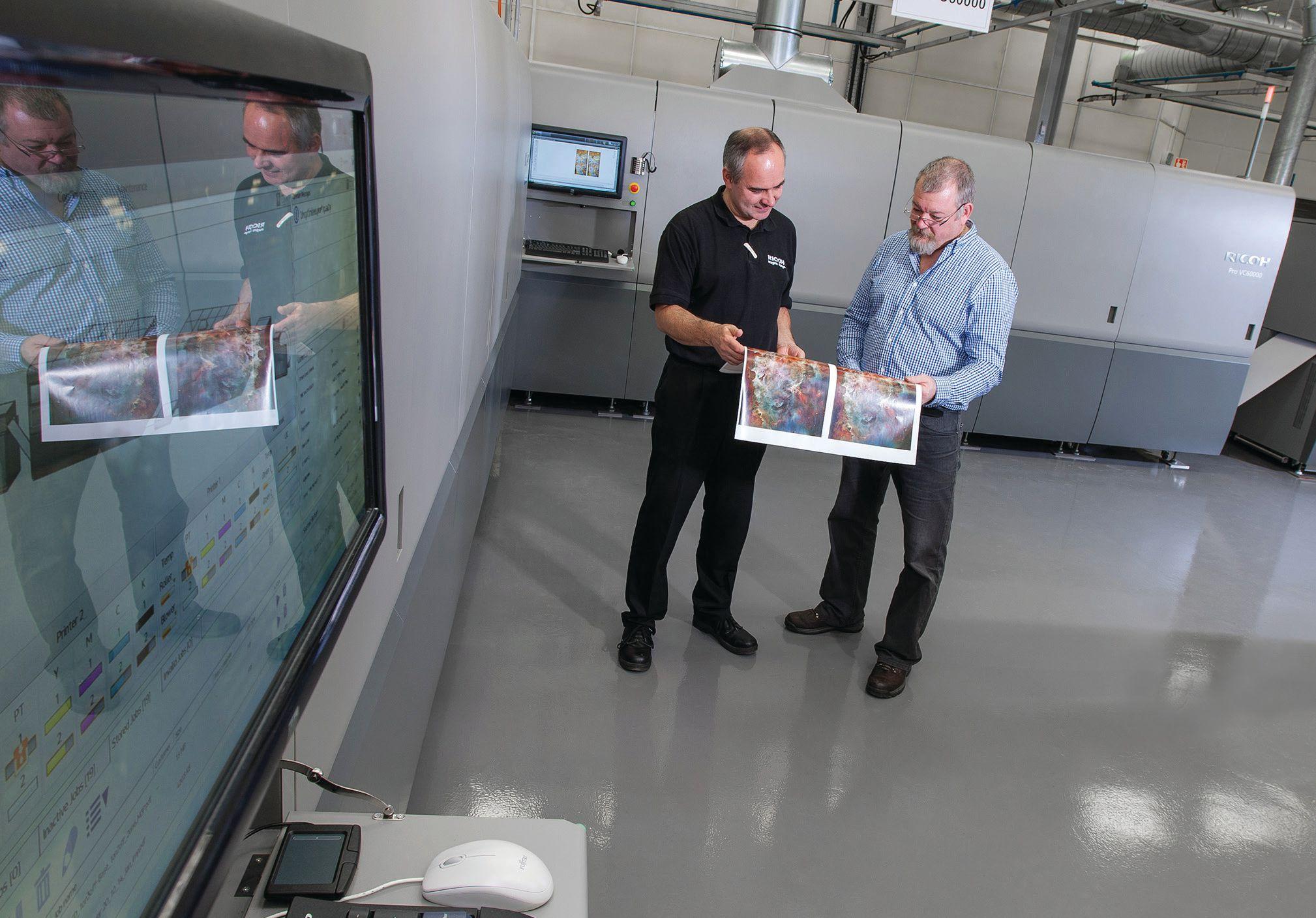
The new high speed Ricoh Pro vC60000 press, launched in 2015, has early adopters like hansaPrint in Finland.
whilst increasing productivity. As the ink manufacturers accept more viable pricing models, the proportion of the marketplace that inkjet solutions are able to address will only increase.”
Ink cost makes medium to long runs with high ink coverage uneconomical in inkjet, as compared to analogue print. Suppliers want to maximize profit and this disconnect is holding back adoption of inkjet in commercial print, publishing and packaging.
Printers using analogue presses think the ink is too expensive. There are several supply models for equipment, service and consumables (mostly ink, but cleaning fluids and replacement heads must be considered). High value recurring consumable revenue is attractive to suppliers, but print service providers are not used to this. They buy a litho press and negotiate for plates, inks and support from the established supply base – although some press manufacturers are competing there. Costly ink is turning some potential customers away from inkjet.
Another historical barrier to wider adoption of inkjet, especially for commercial printing applications, was the need to use specially treated papers and the inability to effectively print on glossy coated stocks. The latest generation of production inkjet presses is rapidly eroding those barriers.
“With the latest system introductions of the ImageStream, the reachable range of applications extends even further, due to the printability of offset coated material for matte, silk and glossy applications,” says Peter Wolff, Director of Commercial Printing Group Canon EMEA “With these new capabilities, additional applications like magazine printing, catalogue printing and others are now doable on inkjet with all the benefits in regards of individualization and customer targeted content without additional cost related to special inkjet treated papers.”
BOOKS AND GROWTH OPPORTuNITIES
It is important to note that the costing of inkjet production is different from that of analogue print. It has lower prepress and set-up cost, but ink – and until recently, paper – is more expensive, often much more expensive. This means long run, high ink coverage inkjet is not cost effective, so there is little appetite for printers to change.
€70 BILLION
Amount (in current values) Smithers Pira forecasts that the value of inkjet printing output for graphics and packaging will reach by 2020, from €23 billion in 2010. This equates to a CAGR forecast of 12.7 percent between 2015 and 2020.
In book production, however, there are advantages in combining inkjet with inline finishing, delivering finished blocks ready for cover application and final trimming. This is particularly true for monochrome books. Publishers and book printers have gone beyond just comparing print costs to considering the total cost of manufacturing, since inkjet can deliver folded, collated and glued blocks for a simple cover application and final trim for books in any format or pagination with minimal waste. The flexibility of inkjet allows book production to be re-engineered with overall cost and service advantages, enabling book publishers to reduce their stocks and their publishing risk. Colour books are quickly following the mono lead.
In 2015, there are many inkjet early adopters and profitable users. Ricoh is at the forefront of quality with the high-speed Pro VC60000 press launched in 2014. It has several early adopters, including HansaPrint in Finland, a €70m turnover firm specializing in retail and publishing.
“Prior to experiencing the Ricoh Pro VC60000, I did not believe that there would be a major shift from offset printing to inkjet. But the new press has changed my mind,” says Jukka Saariluoma,
Your
Heavy boards, plastics, laminations or digitally printed works up to 30 pt can now die crease, fold and even glue in-line.
2. SUPERIOR TECHNOLOGY — Die crease without a die, then fold and even glue all on the same machine, up to 30 pt.
3. INTEGRATED MODULAR UNITS — Combined in-line finishing: crease, fold, glue, tipping, envelope inserting, ink jetting (Duplex), clip seal (3 sides), mail prep.
4. SAVE ON POSTAGE COSTS
—As a Certified Canada Post Direct Marketing Specialist, we get contract pricing reductions.
5. RETURN MAIL PRODUCTS — Customized “Return Mailers” created in-line with “U” or “BOX-shape” remoistenable glue, time perfed applications and envelope formation.
6. MINI-BOOKLETS — Saddle-stitch and trim 2-up booklets in-line to the size of a business card. No need to trim off-line, or do 2 passes.
7. HIGH SPEED EQUIPMENT — High speed Tipping, Folding, Saddle-stitching and soft folding ensuring on time delivery.
HansaPrint Business Unit Director.
The print world is certainly changing. All the key analyst organizations predict very high growth continuing for inkjet print volumes and values. Smithers Pira forecasts that the value of inkjet printing output for graphics and packaging will more than triple over 10 years, from €23 billion in 2010 to more than €70 billion in 2020 (in current values), with a CAGR forecast of 12.7 percent between 2015 to 2020.
HP alone reports that its customers have produced more than 100-billion inkjet pages since its first installation of a production inkjet press in 2009.
BEyOND TRADITIONAL
The applications for inkjet are many: Coding and marking, addressing, security numbering and coding, photo-printing, wide-format (sheet, roll-fed and hybrid), flatbed imprinting systems, narrow web, tube and irregular shapes, high-speed wide web and sheetfed, to name a few. Outside of traditional printing, inkjet has revolutionized ceramic tile printing and it is growing very strongly in textiles and other industrial decoration applications – from pens and memory sticks to architectural glass and laminated decor.
“Inkjet has become the preferred decoration process for ceramics and other decorative materials,” explains Jon Harper Smith, Fujifilm Specialty Ink Systems Business Development Manager.
Thus, inkjet offers opportunities for expansion into related areas that may not normally be considered by traditional print providers. “Not too long ago, inkjet was praised as an alternative to conventional systems for its ability to offer single-off sheets, short runs and personalized prints. In the meanwhile, the technology is challenged to offer higher speeds and higher volumes to replace some of the conventional systems,” says Paul Adriaensen of Agfa Graphics. “But the technology is also introduced in new areas never related to the printing industry before. This creates interesting dynamics in the industry.”
From a technical perspective, inkjet has a major advantage over all other print processes because it is the only non-contact, high-quality, high-performance process. The advances are primarily in new and better control of print heads, better inks and a much wider selection of readily available and more affordable inkjet treated papers. New applications are developing almost daily. For example, Canon has in-
stalled lines in Nigeria to print election ballot papers.
INKJET DEvELOPmENT
In low-end wide-format inkjet, there are independent third-party ink suppliers competing with the OEM. That is probably the healthiest part of the market for end users, with thousands of machines sold each year consuming millions of litres of inks. This is not the case for high-performance systems, where the equipment supplier typically provides the ink tailored to optimize performance within the system.
There are indications, however, that this is changing. Collins Inkjet is an independent inkjet ink manufacturer that sells a range of inkjet inks, innovating in many applications including new electron beam curing. It makes water-based inks for many of the high-speed single-pass presses. It remains to be seen how effective this company and others will be in establishing itself as a third-party ink provider.
“Low consumables costs promote growth and easier adoption. When customers see competitive pricing for the more efficient inkjet technology, it is easier to switch, and they are more willing to change,” says Chris Rogers, Collins’ VP of Sales & Marketing.
As productivity grows, inkjet is becoming greedy, with suppliers now turning toward siphoning volume from analogue print markets for additional growth and offering directly competing solutions. The productivity, quality and economics are pushing inkjet firmly against sheetfed litho and narrow web flexo, and it has larger format flexo and web offset in its sights.
While a few inkjet suppliers may be guilty of hyperbole (sorry, they are very guilty of it in some instances!), it is good to see users and customers voting with their wallets. That being said, we will continue to see enhancements to productivity of inkjet. Some totally new formats and systems are coming to market that will be aimed at the heartland of offset and flexo printing.
Choice of printing methods changes because of one or more reasons: to reduce cost, to improve quality, to achieve greater levels of service, or to do new things. Inkjet allows printers to do all four – and no doubt there will be other new reasons going forward. In technology terms, inkjet is state of the art. In business terms, inkjet is being used to re-engineer supply chains, making money. That certainly is not fiction.
SGIA Preview
agfa Jeti mira/tauro
n November 2015, thousands of eager printers will arrive in Atlanta, Georgia, to look at the latest developments in large-format inkjet printing. The following technologies are highlights at the show, which is one of North America’s fastest growing exhibitions.
Released in April 2015, Agfa explains the Jeti Mira and Jeti Tauro are ideally suited for a strong combination of both high quality and high productivity printing. The Mira is a six-colour plus white system that prints up to 206 m²/hour. It is well suited for printing boards, objects and double-sided imaging with two table size options. Jeti Tauro is a 2.5-metre wide, high-end hybrid six-colour system, plus white or primer, that features multiple automation options. Both systems are powered by Asanti workflow and manufactured in Mississauga, Ontario.
HP Scitex 11000
Released in early 2015, HP explains the Scitex 11000 Industrial Press allows customers to increase versatility and productivity for their high-volume indoor signage and display applications. PSPs can leverage the system to cost effectively produce short runs to meet tight turnarounds. New HP Scitex Smart Coat Technology provides surface durability without an additional overcoat. This places a thin, invisible layer on top of the image to enhance rigidity and protect against rubs, without compromising on flexibility.
Jeti Mira prints up to 206 m2/hour.
Komori: 1, 2, 4 or 5 colours & any size
Adast: 714/715/724/725
Mitsubishi: Any model
Ryobi: 2800CD/3200CD-MCD/640K
Itek: 960/975/985
Hamada: 600/700/800/E47/RS34
Shinohara/Fuji: 66/65 1,2 or 4 colours
Sakurai: 1, 2 or 4 colours and any size (newer model)
Polar: any size/older or newer models
(66/72/76/78/82/90/92/107/115)
Horizon-BQ: 220/240/260/440/460
HP Latex 3100/3500
Introduced in May, the 3.2-metre (126-inch) HP Latex 3500 and 3100 printers join more than 26,000 Latex already installed worldwide. With heavy-duty roll handling up to 300 kg (660 lbs) and 10 litre ink supplies, the printer is capable of unattended, overnight printing. The machines also hold dual-roll split spindles for what HP describes as safer handling of oversized rolls; as well as inline slitters to reduce bottlenecks in finishing; and built-in LED lights to support on-the-fly proofing.
mutoh valueJet 628X
Released in April 2015, the ValueJet 628X is an economical eco-solvent printer with a small footprint. Able to fit on a desktop in any print shop, this 24-inch printer has three ink configurations offering up to eight colours, including CMYK, Lc, Lm, white and metallic inks.
from the ground up, the SureColor S30675 and 50675 feature PrecisionCore TFP print heads and UltraChrome GS2 inks with a newly formulated cyan ink for what the company describes as enhanced durability and performance. The Epson S70675 leverages the company’s UltraChrome GSX ink set with its newly formulated Cyan and Light Cyan, plus an all-new Orange Plus ink for an expanded colour gamut.
epson’s new S-Series features PrecisionCore TFP print heads.
Drytac Polar
valueJet 628X is a 24-inch desktop printer.
Epson SureColor S-Series
Introduced in April 2015, the SureColor S-Series of solvent inkjet printers consists of three models: S30675, S50675 and S70675. Designed and manufactured by Epson
Released March 2015, Polar is an 80 micron (3.2 mil) premium polymeric self-adhesive print vinyl with a high quality, gray cross linking acrylic adhesive and a high opacity which provides a consistent print surface and strong white point. It is available in matte and gloss finishes with permanent and removable adhesive versions. Permanent adhesive is suited for outdoor applications such as general purpose signage and construction barricades; while removable adhesive is best suited for advertising graphics and point-ofpurchase displays.
Esko Kongsberg Tools
In May 2015, Esko unveiled a new range of Kongsberg tools, on top of the more than 100 existing cutting blades, router bits and accessories. Some of the newest tools include a
latex 3100 prints at indoor quality at speeds of up to 77 m2/hr.
psaligraphy (paper cutting) knife tool, perforation wheel and braille tool. All three tools are available for usage on the Kongsberg XN, Kongsberg V and Kongsberg XL Series of digital finishing systems. The tables are suitable for packaging, display and signage using a range of substrates like foam, plastics and vinyl to paper, corrugated boards and folding carton.
Psaligraphy knife tool cuts out fine details in paper and folding carton.
Esko Kongsberg v
Released in late 2013, the Esko Kongsberg V series is available in two standard configurations, including one earmarked for sign and display work based on a MultiCUT tool head for cutting and routing. The MultiCUT has various insert options with an air-cooled milling spindle of up to 45,000 rpm, suitable for acrylics and other synthetics. The second Kongsberg V configuration for packaging focuses on sample making, short-run production of mockups and other packaging-specific applications. It is outfitted with a FlexiHead for more demanding material cutting and creasing, such as folding carton and corrugated board. The FlexiHead is attached to a servo axis controlling the tool depth when cutting, creasing and routing.
Drytac WipeOut Dry Erase Overlaminate
Released April 2014, WipeOut Dry Erase Overlaminate is an optimized adhesive coat weight with a new formulation. The company’s Interlam Pro overlaminating films can now be used on most inkjet printed output, including pigment, (eco) solvent, latex and UV. Drytac explains the new development provides a strong bond, the elimination of tenting around raised inks, and easy flow characteristics that minimize the chance of silvering when applied at room temperature or an optimum temperature of 110°F (43°C). The technology provides Drytac’s standard finishes of Glossy, Matte, Lustre, and Emerytex (pebble-textured) to enhance colours and provide protection against scuffs and abrasions. UV stabilizers
are added, Drytac explains, to prevent discoloration and degradation of both the film and adhesive.
Zund Cut Center v2.4
The latest release of the Zund Cut Centre (ZCC) software offers a range of new features, including tool usage monitoring, user-definable register marks, edge-detection for rolled materials, and a new nesting option. ZCC now allows a user to know when a given bit/blade has reached the end of its expected life; after each automatic roll feed, detects any shifts in the material and compensates accordingly; and captures any shape the user has pre-defined as register mark.
ZCC 2.4 tells users when its time to change a blade or bit.
Sihl TexBanner 3275
In mid-2015, Sihl introduced its newest banner material, called 3275 TexBanner Xtrem white 145, which the company describes as an economical alternative to existing high-quality products. TexBanner 3275 is a 100 percent synthetic nonwoven material coated with Sihl’s water-fast matte inkjet formulation.
Zund ARC
To be released in October 2015, Automatic Router bit Changer (ARC) is integrated with the Zünd Cut Center workflow for Zünd G3 digital cutting/routing systems. It offers the user a magazine that can
We specialize in:
Equipment Sales, Service, and Refurbishing Part Sales and Service Production Enhancement Programs Plant Relocation Training Programs
hold a selection of up to 8 bits for different thicknesses and/or routing tasks. The system automatically selects the appropriate bit for the job and material at hand, guaranteeing optimal results and eliminating the potential for operator error common in higher-volume routing applications.
Ricoh Pro L4160
The Ricoh Pro L4160 is a system for printing signs, banners, wall coverings, indoor and outdoor advertising, point-of-sale displays and more. With the Pro L4160, users can deliver output of up to 63-inch wide and as long as the roll being printed on. Leveraging eco-friendly, aqueous latex ink and seven-colour printing, users can print on clear, plastic, vinyl, textile and backlit substrates.
Durst Rhotex 180 TR
Released in April 2015, the 72-inch Rhotex 180 TR dye sublimation textile printer is equipped with Durst’s patented QuadroZ printhead technology and employs what the company describes as eco-friendly, water-based, odourfree dispersion inks that are free of
volatile organic compounds (VOCs). The company explains the system is suitable for polyester and polyester blends, sportswear, home textiles, and various POP display/ soft-signage output.
Fujifilm Inca Onset R50i
Released in May 2015, the Onset R50i flatbed UV printer, distributed by Fujifilm, features 14 picolitre Fujifilm Dimatix Spectra print heads and an eight-channel, dual CMYK configuration. The new system prints at 600 m2/hr with automation. It is positioned between what Inca describes as the high-quality 400 m2/hr Onset R40i and the high-speed 720 m2/hr Onset S50i.
mutoh valueJet 1624X
Being unveiled for the first time at SGIA 2015, the 64-inch ValueJet 1624X and 54-inch 1324X are part of a new dye-sublimation and aqueous printer line. The four-colour inkjet system prints at up to 600 f2/ hr and has a maximum resolution of 1,400 dpi. It includes Intelligent Interweave to eliminate banding and ValueJet Status Monitor for remote printing.
Rhotex 180 TR uses new QuadroZ print heads.
Komori operators anD FeeDers aFternoons/niGHts
Busy west-end plant requires a Komori operator and feeder for afternoon and night shifts. Preference giving to those with PDC and Chamber coating systems. Leading-edge technology to make press operation easier. Secure full-time job – we do not send people home. These are long-term jobs with benefits.
If you can operate windmills and cylinder presses that would be a bonus, but is not necessary.
Contact Paul Kett paulk@4over.com
FolDer/CUtter/mUeller operator
Minimal 5 years experience. Polar cutting station, MBO folder and Mueller 6 pocket collator. Full-time days and overtime. Benefit plan and excellent working conditions. Email resume to blaine@aulwardgraphics.com
DiGital print proDUCtion
CoorDinator
Digital Print Production Coordinator, required for busy digital print and mail shop in East Toronto. Successful candidate will be key contact for clients and
Product Support Specialist
The ideal candidate is looking to grow his/her career and thrives in a highly collaborative and fast paced environment.
We are looking for an enthusiastic self-starter who has a background in the print industry. You will become an expert in the use and implementation of Avanti’s software.
As a Product Support Specialist you will be responsible for delighting Avanti’s customers. This position will require the successful applicant to collaborate with internal development, quality assurance and implementation teams to drive tickets to closure and provide a world class support experience to our customers. The Product Support Specialist will combine excellent technical and functional problem solving skills with a keen business sense.
Requirements
• Superior communication, organizational, and problem solving skills
• Enjoy sharing knowledge and helping others
• Ability to work flexible shifts
• Bachelor’s Degree in Graphics Communication Management, Computer Science, Engineering, or equivalent print/software/computer disciplines
If you have the right expertise and energy to succeed, we’d love to hear from you.
Please email your resume to Shiraz (sisrael@avantisystems.com).
be the liaison between clients and production department. Must be bondable. Must be detail oriented to ensure accurate data entry of high volume of work orders in a fast paced environment. Accuracy in specifications, pricing, monitoring client inventory, closing dockets and creating invoices for jobs in timely, efficient manner, a must. Must be able to prioritize work efficiently and multi task, with proven experience in coordinating client projects in digital print and mail industry. Must have minimum of 2 years experience in Digital Print Coordinator role. The position requires intermediate to advanced computer skills to ensure accurate and fast paced order entry. Please forward resume, please reference Digital Print Production Coordinator. Only those candidates being considered will be contacted. Email resume to mary@taylor-demers.com
DieCUttinG press operator
Cenveo MM&T requires an enthusiastic team player with experience as a Bobst 102 and Bobst 104 blanker Die Cutter Operator. The successful applicant must be competent in all make-
ready procedures on both Bobst 102 and Bobst 104 blanker die presses. Email resume to hr.canada@cenveo.com
Data entrY position
Data entry person required for busy digital print and mail shop in East Toronto. Must be bondable. Must be detail oriented to ensure accurate data entry of high volume of work orders in a fast paced environment. As the successful candidate will also be key contact for clients and be the liaison between clients and production department, some digital print and mail industry experience a definite asset. Accuracy in specifications, pricing, monitoring client inventory, closing dockets and creating invoices for jobs in timely, efficient manner, a must. Must be able to prioritize work efficiently and multi task. The position requires intermediate to advanced computer skills to ensure accurate and fast paced order entry. Only those candidates being considered will be contacted.. Please forward resume and reference Data Entry to mary@taylor-demers.com
Lance Hill / Director of Plant Operations / Annex Business media / Simcoe, Ont.
annex Business Media in August began to install its new 40-inch Komori LS perfecting press in Simcoe, Ont. A new pad was poured to handle the extra weight of the raised full-size sheetfed machine, replacing a 29-inch Heidelberg perfector the publishing-printing operation has run for close to 10 years. The entire 15,000-square-foot pressroom has been reflowed to leverage the company’s boost in press power, which fits a new growth position for Annex as Canada’s largest B2B publisher after its January 2015 purchase of Glacier Media assets.
The 2009 Komori LS press, purchased through KOMCAN Inc., is equipped with a range of automation features, including: APC fully automatic plate changers, PDC-SII closed-loop colour control, AMR make-ready, fully automatic wash-up systems, and KHS Komori high-speed inking. PrintAction spoke with Lance Hill, Director of Plant Operations at Annex Business Media, as the company’s pressroom team – currently at 15, with plans to add staff – was training on the Komori and just days away from live production.
What challenges do you anticipate moving from 29- to 40-inch perfecting?
LH: Most of the day-to-day stuff we won’t really know until we get into it. There is going to be a learning curve for us because we have been on a 29-inch press for so long, but the 40-inch better suits our business… to go from 8-up to 16-up is huge for us. With the addition of the work coming from the new [Glacier] acquisition it made the justification for this move much more needed.
Was Annex looking at a 40-inch machine before acquiring Glacier assets?
LH: We have been discussing the idea of a new press probably for the past two years. If we hadn’t grown, we might have still gone to the 40-inch, but it would have diminished our number of shifts on press. Right now we will be able to put all of that new work on our press without increasing our shifts. We will still run two shifts a day and be able to output twice as much work. The acquisition also justified acquiring a larger-sized folder – a [Heidelberg] TH82.
Why did you decide on this press?
LH: We were looking for a 40-inch sheetfed press with low impressions and features like automated plate change and automated make-ready at a good price point and this press hit those targets. We sent KOMCAN over [to France] to look at the press and to do an analysis. Then we went through the process of the cost for getting it cleaned, new rollers, everything, so that when we put the Komori into production it is not really a used press – it is a fully refurbished press.
how do you approach maintenance, having run the 29-inch for a relatively long time?
LH: We have been running the 29-inch press for about 10 years and it has 265-million impressions on it. It has been a great press for us, which is a reason why we looked strongly at Heidelberg. We have a checklist that we go through every single day. We have preventative maintenance schedules. We also keep a steady stock of common items that will wear down, so that we can replace them ourselves to keep running. We will look to do something similar with the Komori. We have savings by maintaining the press using our own maintenance crew.
Number of magazine brands controlled by Annex Business Media, which became Canada’s largest business-to-business publisher in January 2015 with the purchase of Glacier Media assets.
Did you purchase a new imaging system?
LH: No – I used to be the prepress manager and, when we were looking at a new CTP unit and workflow, it was always in the back of our minds that in the future we may go to a 40-inch if we get any bigger, because our production levels were so high already on the 29-inch. [Three years ago], we went with a new [Agfa] CTP, new autoloader and a new plate stacker – the whole system. We had additional costs at the time and now it has more than paid for itself. Does the larger format change your demands on Annex publishers?
LH: On our 29-inch press we had four sheet sizes, which is not bad, and we ran one brand on the bulk of that work. When we move over to the 40-inch, we are trying to do the same and, ideally, if we can streamline into two sheet sizes that is even better. It is more efficient and it allows me to create a stronger production level on our press. how important is streamlining sheet sizes to gain purchasing power?
LH: Right now to get paper at a low cost is a huge goal just because paper is your largest direct cost and it always seems to be fluctuating. We try and get our pricing at a decent margin, while maintaining a longstanding relationship with our suppliers... Paper can make life very rough for a printer, especially a publishing printer. is the pressroom team enjoying the spotlight in a large publishing company?
LH: This brings us into the forefront and we are heavily involved in the future. A team of 15 is not huge, but we run lean here and we do it quite well. My team has been with Annex for a long time. They have their own reservations about it just because it is new, but they are looking forward to the challenge, especially now that the press is here... this new stage is going to be very good for us.
PAPER PRODUCTS
BANNER & FILM
PRESSURE SENSITIVE ADHESIVES
LAMINATES
TEXTILE
RIGID BOARD
Sign
Delivering
A CONCISE RANGE OF MEDIA FOR QUALITY INKJET PRINTING.