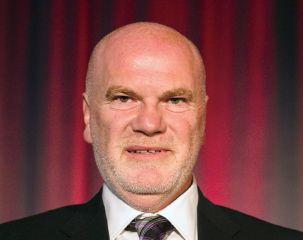
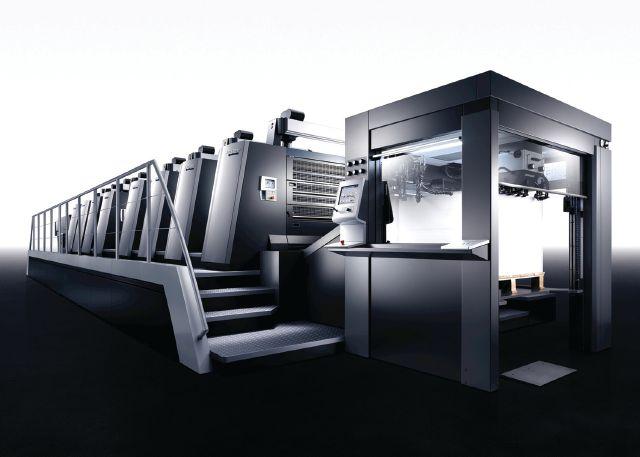
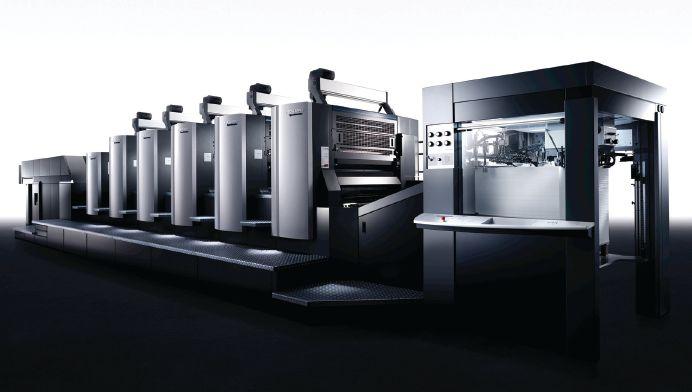
Rafael Peñuela Torres, CEO of Manroland Sheetfed in Offenbach, Germany, discusses restructuring, the state of the global printing market, modern machine manufacturing, and the road ahead
16
wide-format leverage
Fifteen leading suppliers, in addition to sharing booth highlights for SGIA’s lateOctober show, rank the top-three business issues printing companies should consider when investing in wide-format inkjet
6
News
Guinness World Records evaluates a 606word stamp, RP Graphics of Mississauga and Rhino Print of Vancouver form an alliance, and Transcontinental completes its $75 million buy of 74 Quebec weeklies
7
Market
Kwik Kopy Printing Vaughan is named Best in the World, 4over installs a 40-inch Komori press in Mississauga, and Multi-Action Labels of Quebec City adds a 13-inch, 8-colour DSI UV inkjet press
20
techNOlOgy repOrt
New products including Asahi Photoproducts’ photopolymer flexo plates with Pinning Top Dot technology, Xeikon’s five-colour Cheetah press aimed at label printing, and Xerox C60/ C70 light-production printers
Nick hOward
heidelberg’s greatest gift
Nick Howard details the 100-year history of the Tiegel Platen, from its prototype unveiling at Bugra 1914 in Leipzig to its 165,000 global install base and continuing operation in most pressrooms
26
October 1984
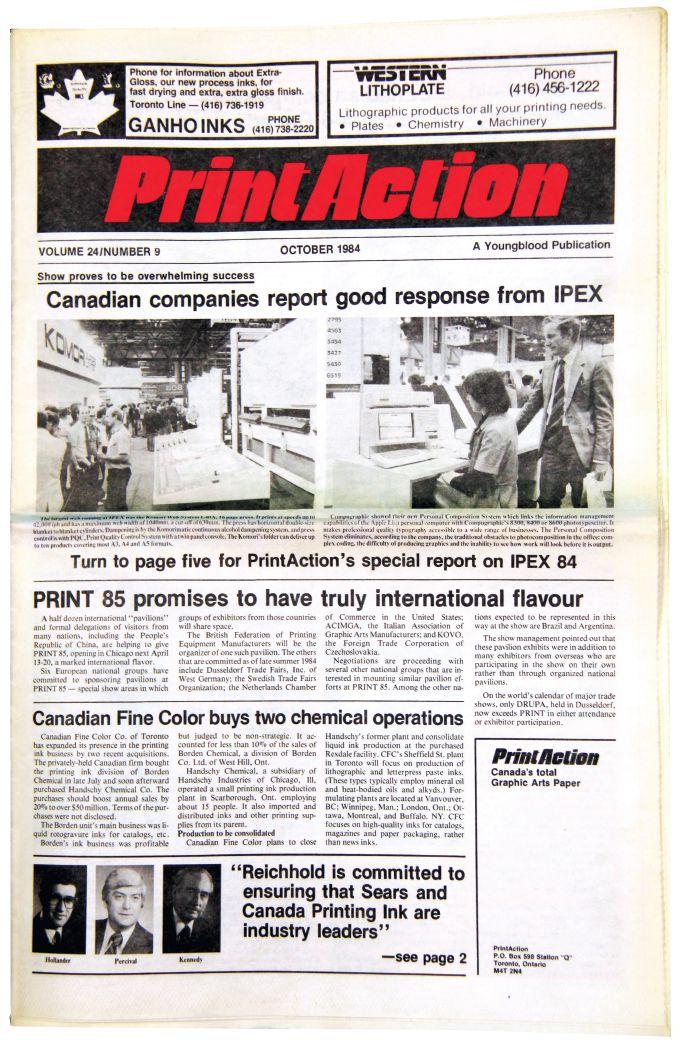
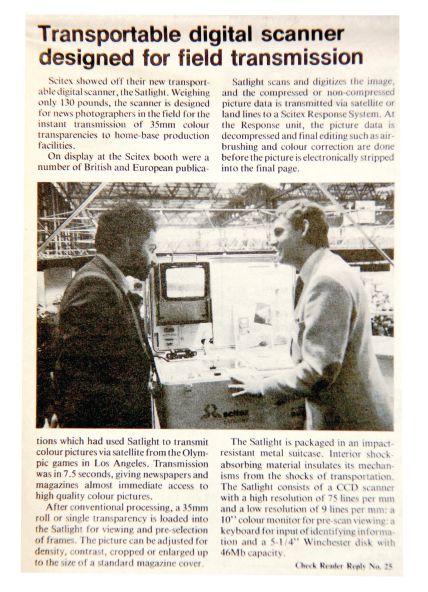
Marc Garneau becomes the first Canadian in space, Islander Mike Bossy records his 30th career hat trick, and Scitex shows off the Satlight transportable digital scanner –weighing only 130 pounds
Inkjet Franchises on the Rise
Aresearch report released in September predicts the wide-format systems market is to reach $9.2 billion by 2020, suggesting this sector is to continue along its path of dynamic investment with both printers and suppliers. The report by MarketsandMarket, which publishes more than 1,500 papers annually, is built around different print widths (17 to 72 inches) ink types (aqueous, solvent, UV, latex and dye-sublimation), applications (apparel, signage, advertising, tile murals and CAD), and geography. The predicted growth to 2020 represents a compound annual growth rate of 6.69 percent.
Commercial printing companies, with a long history in large-format-inkjet production, whether through proofing or early adoption, and established, eager client bases, are likely to drive much of this growth. Screen printers transitioning away from offset processes will also play a significant part, as will the recent exponential rise of signage-specific franchise operations, organized through companies like Fastsigns International.
In early September, Fastsigns, which has more than 550 franchisor locations worldwide, released a statement about targeting expansion in Canada. The company has established 26 centres throughout Canada with an additional five new locations currently under development – noting existing shops can join the network with a $10,000 down payment. Fastsigns was also looking for a Quebec master franchise partner to open 15 centres in the province and noted other target markets as Alberta, British Columbia, Manitoba, Saskatchewan and Greater Toronto.
The startup of hundreds of quick-printing entrepreneurial operations and franchises during the 1990s, which turned into thousands by the new millennium, was largely based on keen business insight – by the likes of Paul “Kinko” Orfalea and Canada’s own Earle O’Born – and the ability to leverage established toner technologies in terms of colour reproduction, substrate latitude, data processing and speed.
Fastsigns and similar organizations are now building around sound large-format technologies to begin a new era of powerful global printing networks. Wide-format inkjet franchises suddenly have an enormous branding and storefront advantage over the dozens of quick-printing networks. It is not a coincidence that Fastsigns’ CEO, Catherine Monson, was previously President of PIP Printing (around 600 locations in 13 countries) and held management positions with Sir Speedy and MultiCopy Europe.
The rise of wide-format-printing networks is also just as likely – and quickly – to put significant downward pressure on pricing because of equipment saturation. A primary difference between the toner and inkjet franchise eras, however, is that commercial printers as a group will not hesitate as much to jump into wide-format inkjet as they initially did with toner.
Jon Robinson, Editor
Canada’s Graphic Communications Magazine. Proudly published for two generations. Editor Jon Robinson • 905.713.4302 • jrobinson@annexweb.com
Contributing Writers Zac Bolan, Peter Ebner, Chris Fraser, Victoria Gaitskell, Dr. Martin Habekost, Nick Howard, Thad McIlroy, Nicole Rycroft, Dr. Abhay Sharma, Trish Witkowski
Publisher Sara Young • 905.726.5444 • syoung@annexweb.com
Associate Publisher Stephen Longmire • 905.713.4300 • slongmire@annexweb.com
Group Publisher Paul Grossinger • 905.713.4387 • pgrossinger@annexweb.com
Advertising Sales Sara Young • 905.726.5444 • syoung@annexweb.com Stephen Longmire • 905.713.4300 • slongmire@annexweb.com
RP Graphics Group of Mississauga, led by CEO George Mazzaferro (pictured), and Rhino Print Solutions of Vancouver, BC, formed what the companies describe as a “strategic alliance designed to deliver coast to coast print solutions.” The alliance results in RP Graphics agreeing to acquire and integrate Rhino’s Toronto operations effective September 22, 2014. Rhino’s Toronto facility, formerly Marcam Cross Media Ltd., provides print-on-demand and services for multi-channel communications. RP Graphics has a staff of over 140 employees operating out of two facilities, while Rhino has plants in Vancouver and Calgary.
TC Transcontinental completed the $75 million acquisition of 74 weeklies in Quebec from Sun Media Corporation. After the newspaper deal was first announced in December 2013, Canada’s Competition Bureau set a requirement for Transcontinental to put 33 of 154 newspapers from its full portfolio up for sale for a period of 60 days, beginning in June, including some that were part of the Sun Media deal. Out of the 33 newspapers put up for sale, 14 found buyers. Of that number, three will continue to be published as weekly newspapers and 11 will now be published online only. Transcontinental also shuttered 20 of its own weeklies, impacting around 80 jobs.
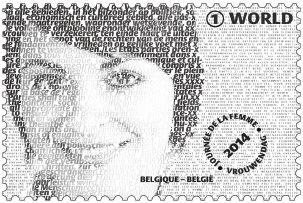
Guinness World Records sent an adjudicator to evaluate a stamp, designed for bpost Belgium to mark International Women’s Day, containing the image of a face formed by more than 606 words taken from the The Convention on the Elimination of all forms of discrimination against women. The stamp’s designer, Ann Bessemans, combined gridded letters for the woman’s face and a digital microtext for the background. The bpost stamp was printed on a 4-colour Manroland 704 3B P 2/2 press, which was installed in 2000 and now accounts for 15 percent of the organization’s production. The Women’s Day
stamp with 606 words was printed as 108,000 sheets with five stamps each.
Barnes & Noble, according to Publishers Weekly, began a testing program allowing its customers to use the Espresso Book Machine at three of its outlets, including locations in New York City (Union Square), Paramus, NJ, and Willow Grove, PA. Publishers Weekly also points to Books-A-Million installing two Espresso machines in November 2014.
Goldman Sachs Merchant Banking Division and Koch Equity Development LLC completed their acquisition of Flint Group from funds managed by CVC Capital Partners. Flint Group is a global supplier of inks and other print consumables such as flexographic printing plates, blankets, image transfer products and chemicals for pressrooms. It controls 137 sites in 40 countries and employs around 6,600 people, which generated revenues of €2.2 billion (US$2.9 billion) in 2013.
Udo Panenka becomes Senior VP of Sales for Esko’s global operations. He replaces the departing Christian Korte. Prior to joining Esko, Panenka was VP and GM for Danaher’s Kollmorgen Industrial Automation Business in Europe and India. Also, Jon Giardina becomes VP Americas for Esko to lead its operations in North and Latin America. He replaces Tony Wiley. Most recently, Giardina was VP and GM for Danaher’s Dynapar and West/PMA businesses. Danaher is the parent company of Esko.
United States Postal Service plans to reduce its workforce by up to 15,000 more employees and close up to 82 more processing centres over the next year, despite a growing call from the country’s lawmakers to limit postal-service cuts. USPS, which closed 141 processing facilities in 2012 and 2013, estimates it could save $750 million annually from its new round of planned cuts. In mid-August, USPS reported its third quarter results with a net loss of US$2 billion, compared to a net loss of US$740 million for the same period last year. The USPS has recorded a loss in 21 of the last 23 quarters — the excepted quarters being the two in which Congress rescheduled the Retiree Health Benefits prefunding payments.
Tim Mercy has been promoted to the newly created position of Managing Director, Asia Pacific, for Goss International. He is to lead sales, service and support for the region’s (excluding China) commercial, packaging and newspaper printing sectors. He has represented Goss in this region for the past 20 years. Mercy has 40 years of experience in the graphic arts industry, including time also spent with Heidelberg Web Systems and Harris. He earned a Masters of Business Administration degree, as well as a Bachelors degree in Industry and Technology, from Northern Illinois University.
Mark Andy of Missouri, led by CEO Kevin Wilken (pictured), was sold by American Industrial Partners (AIP) to a new investment group formed by P.J. Desai, a former Mark Andy CEO, and members of the current management team. AIP remains a minority investor in Mark Andy along with Graycliff Partners. Mark Andy develops presses and related technologies for the packaging industry. “Combined, there are over 10,000 Mark Andy and Rotoflex machines currently installed with a replacement value of over $1 billion,” said Desai.
Anderson & Vreeland
Executive
ly served as VP and GM since 2008, is responsible for sales, marketing, national accounts, technical support, manufacturing of AVantage liquid photopolymers, and R&D. Drew Elisius, as Executive VP, is responsible for operations, purchasing, product and raw material procurement, logistics and distribution. AV Canada and AV Mexico report to Elisius. The moves also affect Anderson & Vreeland Distribution, Nova Polymers and The Provident Group.
Resolute Forest Products of Montreal is closing its Laurentide paper mill in Shawinigan, Quebec, effecting approximately 275 employees. Scheduled for an October 15 shutdown, the mill has been in operation for over 126 years and currently holds annual production capacity of 191,000 metric tonnes, primarily focused on commercial printing papers. The company owns or operates nearly 40 pulp and paper mills and wood products facilities in the United States, Canada and South Korea.
Domtar of Montreal celebrated a North American first in the sale of its five millionth tonne of Forest Stewardship Council (FSC) certified uncoated fine paper, primarily through its EarthChoice product line. Domtar also became the first company in North America to offer FSC-certified copy paper in 2005 and continued to develop partnerships with environmental organizations like Rainforest Alliance and World Wildlife Fund. The EarthChoice line now accounts for more than 20 percent of Domtar’s total paper sales.
Fujifilm sold its first Graphium, designed as a four-colour plus white UV inkjet press, to Distinct Packabilities (DP) in Shepherdsville, Kentucky. DP, a wholly owned subsidiary of Publisher’s Printing, a fifth-generation family-run business founded in 1866, produces flexible packaging and labels. Developed by FFEI Ltd., Graphium runs greyscale print heads producing drop sizes from six to 42 picoliters. Handling a printing width of 13 or 16 inches, the press reaches speeds of up to 164 feet per minute at a resolution of up to 1,080 dpi.
Parker MacDonald becomes Color-Logic’s sales representative for Eastern Canada, including Ontario, Quebec and the Maritimes. Color-Logic of West Chester, Ohio, develops the Process Metallic Color System, which applies decorative effects into branded products and associated collateral. It is compatible with offset, inkjet, flexography, toner, screen-printing and gravure processes. In related news, Color-Logic has now certified the Xeikon X-800 Digital Front End for use with Color-Logic files.
of Bryan, Ohio, appointed two
VPs and named Howard Vreeland (pictured) as Chairman and CEO, replacing President and CEO, Thomas Gavin. As Executive VP, Darin Lyon, who previous-
4over Canada Installs 40-inch Komori
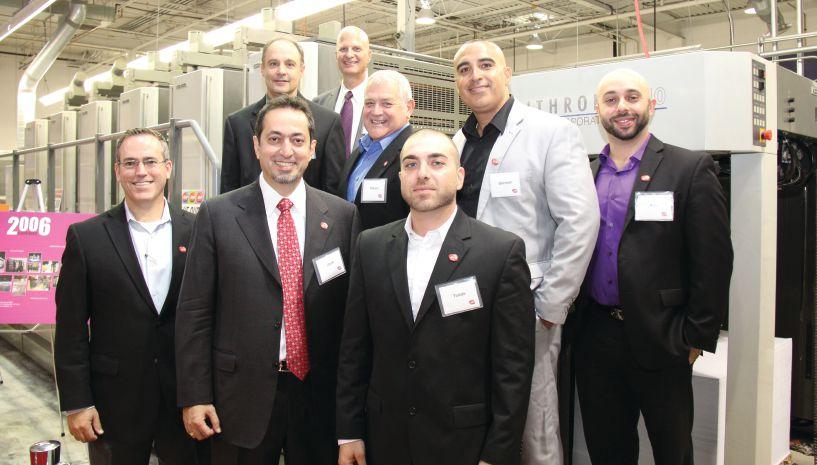
An open house was held at the 50,000-square-foot Mississauga facility of 4over to celebrate the installation of a 40-inch Komori press. The online-focused trade printer began operating out of its Canadian plant in late 2011.
4over now runs more than 400,000 square feet of production space with facilities also in California, Ohio, Texas, New Jersey, Illinois, Arizona and Florida. The press put into Mississauga is a 6-colour Lithrone S40. It joins an existing 29-inch Komori press put into operation when the plant first opened.
After beginning the California-based company in 2001 with a used 4-colour Heidelberg GTO, in a 2,000-square-foot storefront shop in Burbank, Megerdichian continued to build his network as an all-Komori press operation. In April 2002, 4over took delivery of a Komori S226 II and a year later began preparations to move into a 10,000-square-foot space.
By 2004, 4over was running Komori LS840P and LS640P perfecting presses, as well as an HP Indigo 2000.
In 2005, Megerdichian added an HP Indigo 5000, as well as new UV coating technology. In 2006, he then installed the United States’ first Komori LS-540 SP CC, a super perfector double coater, with the move into a new 72,000-square-foot facility in Los Angeles. The company also added a brand new Komori 29inch LSX.
By 2009, Megerdichian began the expansion of 4over’s network with initiatives in Newark, New Jersey; Miami, Florida; and Arlington, Texas. Ultimately, the company expanded to Mississauga, Ontario, in December 2011 with the 29-inch Komori. Mississauga Mayor Hazel McCallion attended 4over’s August 26 open house, as she did back in mid-2012 when 4over held its ribbon-cutting for the new Canadian plant.
Multi-Action Leverages Unique DSI Inkjet Press
Multi-Action Labels of Quebec City continues its growth into short-run and prototyping label work with a DSI UV inkjet press, a North American-first installation, that remains as the only such system in Canada.
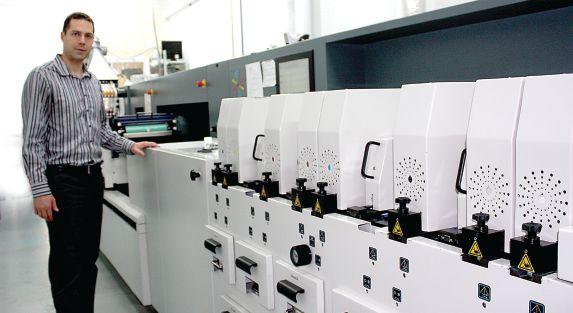
Developed by SPGPrints of the Netherlands, the unique 330-mm (13-inch) wide, eight-colour DSI press, which has been running at Multi-Action since 2012, is designed for high-quality, just-in-time label production. It is described by Multi-Action as a complete print-converting line for single-pass production, which complements three existing ETI flexo lines in the company’s pressroom.
Jonathan Bourbonnière, President of Multi-Action Labels, describes the UV inkjetbased DSI as producing identical quality to the flexographic process, which provides Multi-Action with the flexibility to switch any analogue job shorter than 10,000 square feet [3,048 metres] onto the inkjet machine. Multi-Action’s job run lengths on the SPGPrints DSI average 260 square metres (850 feet). The press is rated to reach speeds of up to 35 metres per minute (114 feet per minute). He continues to explain Multi-Action is working to leverage its unique press position by collaborating with other label printers, particularly those with flexo-only assets, who need fast turnaround or variable-imaging work.
KKP Vaughan Named Best in the World
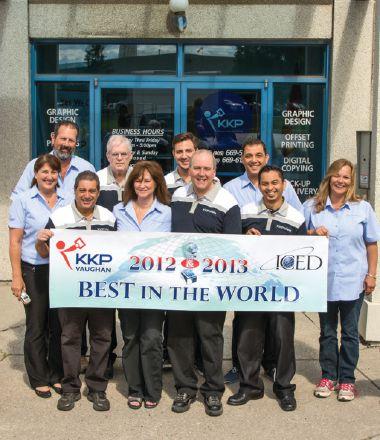
Kwik Kopy Printing Vaughan, operated by Howard and Lisa Simson, received the Best in the World Award from the International Centre for Entrepreneurial Development (ICED) for the second year in a row. ICED is the franchise head office for hundreds of print franchise operations throughout the world, including KKP Vaughan.
The Best in the World Award is given to the franchise in the ICED system, which, as defined by the organization, has demonstrated exemplary customer service, quality, efficiency and sales excellence. KKP Vaughan opened its doors in 1980 with a staff of three. The print shop, running four offset presses and three toner presses, now has a staff of 10 housed in a 6000-square-foot facility. The Toronto-area operation also holds a full bindery, graphics department and, most recently, wide-format printing capabilities.
In addition to CMYK, the DSI at Multi-Action has been customized with options, including orange and violet (to cover over 90 percent of the colour gamut), opaque white, and a digital primer. The press features intermediate LED pinning and a chill drum, as standard features, while Multi-Action also installed some inline converting options on its press. This includes a flexo-coating station and semi-rotary die-cutting technology supplied by AB Graphic.
With the new 6-colour Komori S40 in Mississauga are: (back row, L to R) Eric Findon, Director of Customer Experience; Paul Kett, Plant Manager; (middle row) Robert Godwin, Director of Business Development; German Rameriz, Director of Print Operations; Arby Tatavossian, Business Development; (front row) Preston Herrin, VP of Marketing and Sales; CEO Zarik Mergerdichian; and Todde Kamali, Business Development.
The Kwik Kopy Printing Vaughan team in front of their award-winning MacIntosh Boulevard location.
Jonathan Bourbonnière, President of Multi-Action, with the SPGPrints DSI.
CALENDAR
Best Color Installs Heidelberg XL 75 with UV
Best Color Press Ltd. of Vancouver, British Columbia, expanded its trade-printing operation with the installation of a six-colour Heidelberg Speedmaster XL 75, inlcuding coating and UV capabilities. The Speedmaster XL 75, running a maximum sheet size of 530 x 750 mm (20.87 x 29.53 inches), reaches production speeds of up to 15,000 sheets per hour. Best Color, founded in 1989, previously focused on its range of 40-inch sheetfed presses, as well as prepress and postpress services.
In addition to continuing to run its original single-colour Heidelberg MO for small print jobs, Best Color’s press fleet includes the Speedmaster XL 75; a 10-colour Speedmaster SM 102 perfector; and a 6-colour, 40-inch press also equipped with UV decks.
“Many jobs do not require a 40-inch press; short runs, 6-page brochures, presentation folders, etcetera,” says Best Color CEO Sunny Chan, describing some of his rationale behind installing the 29 ½-inch XL 75. “We can plan jobs more efficiently, which increases productivity. UV print is a very important part of the Vancouver market, so I must
have this ability to serve my clients. This press suited all of my needs at this time.”
Chan also points to the XL 75’s flexibility to change sheet size and thickness on a job-by-job basis, which is primarily driven through the press’ new generation Intellistart Operating System. Best Color’s XL 75 also includes Wallscreen and AxisControl for automating operator control. The press’ UV system, developed by IST METZ GmbH, features interdeck and end-of-press curing, allowing Best Color to expand its use of substrates into more plastics and foils.
Employing more than 50 full-time workers, Best Color primarily serves the printing community of Greater Vancouver, but also south into the United States. “I offer good service, good quality and timely delivery to my clients. As a result of this many of my daily print runs are from repeat clients. That tells me I am doing something right,” says Chan. “We don’t advertise in traditional ways, and you won’t find me on Twitter, but we grow and put the equipment in our plant that our clients need to be successful.”
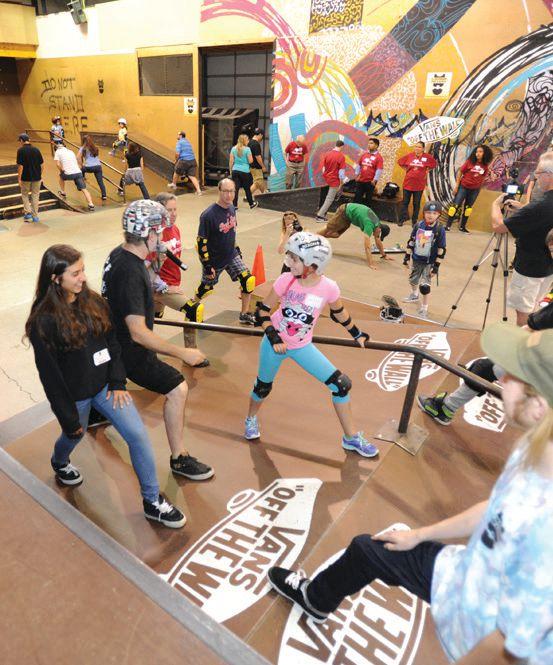
In late-July, C.J. Skateboard Park and School, a not-for-profit indoor skateboard facility controlled by C.J. Group of Companies, held a fundraising event with CIBC and Ontario Parents Advocating for Children with Cancer (OPACC). Established in 1995, OPACC is an independent registered charity.
As part of the park’s CIBC program, “Kids Being Kids,” children and their families are invited to spend the day at the Toronto-area skate park, which includes scooter riding, knee-sliding, a foam pit and a Sony PlayStation room. The event also included a vertical ramp demonstration by some of the park’s volunteers and experienced riders.
“No matter what they are going through, kids still need to be kids,” said Jay Mandarino, President and Founder of C.J Group. “They happen to be going through a tough time and being able to brighten their day, in whatever way, is so rewarding.”
October 17
Xplor Western Canada Conference
River Rock Resort and Hotel, Richmond, BC
October 21 – 22
2014 Printed Electronics Symposium
Las Vegas Convention Center, Las Vegas, NV
October 22 – 24
SGIA Expo 2014
Las Vegas Convention Center, Las Vegas, NV
October 30 –
November 1
Proveer/Avery Dennison 2014 Car Wrap Training
Riley’s Reproductions, Calgary, AB
November 6
Canadian Printing Awards, hosted by PrintAction
Toscana Conference Centre, Hilton Garden Inn, Toronto, ON
November 9 – 11
BMI Annual Conference
Hyatt Regency Coconut Point Resort, Bonita Springs, FL
November 12
CMA 2014 B2B Conference Allstream Centre, Toronto, ON
November 14 – 17
All in Print China 2014
Shanghai New International Expo Center, Shanghai, China
November 27
Xplor Canada Annual Holiday Meetup Details to come
December 5
2014 Canadian Marketing Awards Westin Harbour Castle, Toronto, ON
February 23 – 26, 2015
Hunkeler Innovation Days Luzern, Switzerland
February 26 – 28, 2015
Graphics of the Americas 2015
Miami Beach Convention Center, Florida
March 1 – 3, 2015
Print UV
Las Vegas, Nevada
April 16 – 18
Graphics Canada
Toronto International Centre, Toronto, ON
May 7 – 9
Grafik Art Montreal 2015
Place Bonaventure, Montréal, QC
With Best Color’s Heidelberg XL 75 are (clockwise from top left) Ken Yeun, Plant Manager, Sunny Chan, owner and CEO, Wing Cheung, Press Operator, and Kelvin Tynes, Press Operator.
C.J. Group holds Skateboarding Fundraiser
ONLY PRESS OF THIS CLASS IN NORTH AMERICA
Let PointOne help you break through conventional printing stigmas.
RECORD MAKE READY TIMES. BLAZING FAST SPEED. SHARPER COLOUR CONSISTENCY.
THE ALL NEW BEST IN CLASS FOR NORTH AMERICA UNIQUELY AT POINTONE GRAPHICS.
Heidelberg XL106
18,000 SHEETS PER HOUR 8 COLOR PERFECTOR
Peak Performance Class Technology and Productivity That Know No Compromise
18,000 sheets per hour in straight printing and in perfecting mode are unrivaled peak values. A 20 percent higher production means new opportunities The perfect interplay between preset functionality, a sheet travel optimized for maximum production speed and a machine that is consequently designed for top print quality as well as straightforward operation make the Speedmaster XL 106 the Peak Performance machine
Prinect Inpress Control
The Spectrophotometric Inline Measuring System for Maximum Productivity
Prinect Inpress Control automatically measures and controls colour and register on the fly and at any speed. Integrated directly into the press, the measuring unit measures process colours, spot colors and register in the print control strip. Any corrections required are forwarded directly to the Prinect Press Center for adjustment. As the press does not need to be stopped for either make-ready or monitoring of the production run, Prinect Inpress Control achieves maximum productivity.
EQUIPMENT FOR TODAY’S PRINTING
At PointOne there are no sacrifices for quality. We offer trade competitive prices without going over your budget, while still keeping the environment in mind. We have leading edge technology to keep our cost and our quality in line. Come in and work with us to make your print job a work of art.
FINISHING
• 3 saddle stitchers
• 8 folders
• 3 cutters
• Drilling and shrink wrapping
• Climate control
• VideoJet capabilities
• Perfect binding and die cutting available at trade partners
• Online spectrometer to monitor ink densities and control colour consistency
2007 MAN Roland Rotoman 5 printing units + aq with remoistenable gluer, pattern perf, spine gluer, inline folding and sheeting capabilities.
2014 Heidelberg XL 106 4 Color perfecter with auto colour and registration system, 28 x 40 with roll to sheet
2014 Heidelberg XL 106 4 Color perfecter with coater, 28 x 40 with roll to sheet
2013 Heidelberg XL 105 5 Color with coater, 28 x 40 with roll to sheet
Heidelberg Suprasetter 40 plates/hr 30 x 40
PRINT MARKET & INSTALLATIONS
Agfa Holds Open House at Inkjet Facility
Agfa Canada in early September held an open house to demonstrate its newest wide-format inkjet technologies, including the recently launched Jeti Titan S and HS systems, which are manufactured in its 160,000-square-foot Mississauga facility.
SupremeX Inc. of Montreal announced a $500,000 investment to install a Winkler + Dunnebeir 234DL inkjet-based press into its Ville LaSalle plant. The 234DL is aimed at full-colour, personalized direct mail and prints at speeds of up to 30,000 pieces per hour. SupremeX, self described as Canada’s largest provider of envelopes and related packaging products, with approximately 500 employees, plans to launch this new print-
ing service to its Canadian and American customer base in the fourth quarter of 2014.
“Mailing a printed envelope continues to offer marketers the highest open and read rates and recall values when compared to all other media and remains an important tool for building customer relationships and brand equity,” said Stewart Emerson, President and CEO of SupremeX.
Bassett Installs Canada’s First Xeikon 8600
Bassett Direct of Richmond Hill, Ontario, one of Canada’s variable-data-printing pioneers, installed Canada’s first Xeikon 8600 press, which provides a combination of true 1,200-dpi resolution, 4-bit depth and 20.2-inch format. Handling web widths of up to 20.2 inches, the Xeikon 8600 is rated for a 6-million-page monthly duty cycle, printing on both sides of the sheet simultaneously. It runs media weights from 27-lb text up to 350-gsm/130-lb cover stock.
“The Xeikon 8600 has given us the ability to do something in our shop that very few companies in North America are doing,” said Rich Bassett, President and owner of Bassett Direct, which works closely with clients to build marketing programs.
Howard Donates Clothing to Scott Mission
Howard Graphic Equipment Ltd. of Mississauga has donated hundreds of shirts, caps and jackets to the Scott Mission of Toronto, which works to provide shelter and sustenance to the poor and homeless in the region. The Scott Mission is a non-denominational organization that has been helping the underprivileged since 1941. “We are very proud and happy to have been able to contribute something useful to these marvelous people,” said Liana Howard.
Howard Graphic explains the clothing items were no longer required as its sister company, K-North Inc., exited the new machinery business last July. Howard Graphic, currently in its 47th year, is focused on the sale and refurbishment of latemodel printing machinery.
Trade printer Prodigy Graphics of Concord, Ontario, made a $12,000 donation to Evangel Hall Mission (EHM), a Toronto-area charity that helps homeless and socially isolated individuals find a safe haven from the streets. Since 1913, EHM has been reaching out to people suffering from homelessness, poverty and social isolation.
“This very generous gift will be put to very good use,” stated Jo Ann Hislop, Director of Programs at Evangel Hall Mission. In addition, EHM also provides rent-geared-to-income housing for 110 people previously homeless or at risk of becoming homeless.
Open 365 days a year, EHM offers a daily hot meal, a voluntary trust-
eeship program, a health and dental clinic including access to 12-step and counseling programs, a clothing bank as well as programs for women, men and youth. Their youth programs assist more than 100 at-risk youth with social, recreational and educational activities every week.
Agfa Canada’s Steve Fournier (left to right), Ruben Silva and Lawrence Robinson; St. Joseph’s Ryan Anderson; and Brian Paradis and James Burghgraef of Agfa.
Bob Price, Drop-In Manager, EHM (left to right); Gordon McCauley, President, Prodigy Graphics; Joseph Taylor, Executive Director, EHM; and Jo Ann Hislop, Director of Programs for EHM. Prodigy
Heidelberg’s Greatest Gift
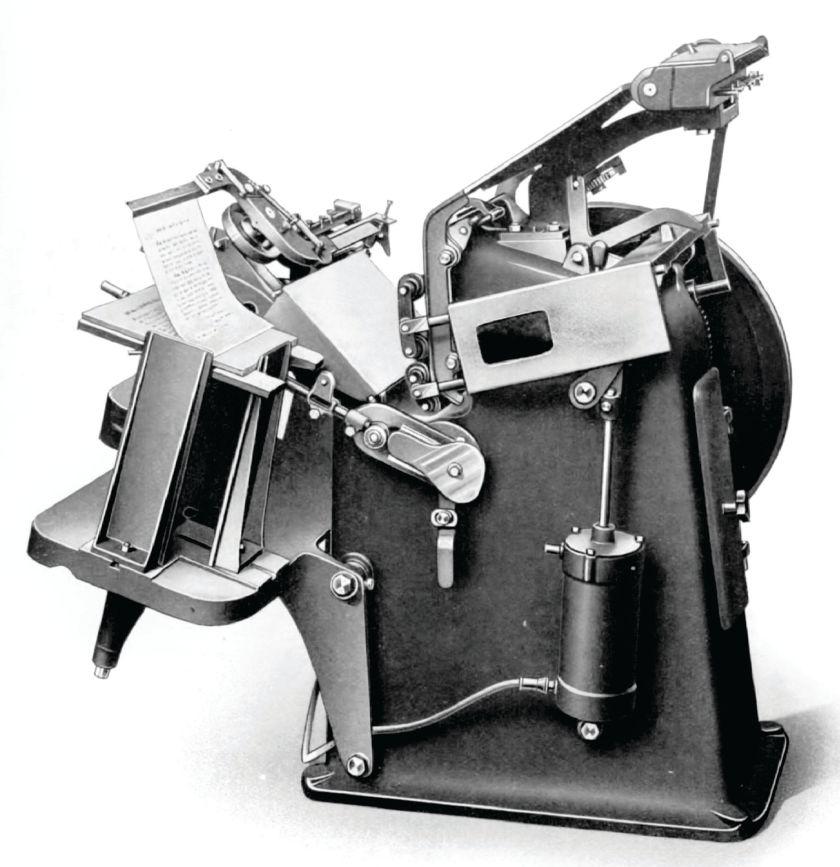
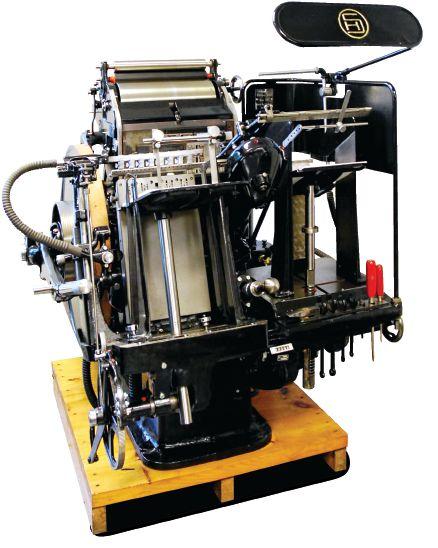
In the early 1980s, a local garden hose manufacturer called our small press-sales office because he had a printing problem. The round cardboard discs, used for product branding within the the hose-reel, were missing their Made in Canada. Somehow its inclusion overlooked by everyone involved in the printing process. The garden hose manufacturer now had thousands of printed and die-cut pieces of cardboard he could not use. “Any suggestions?” he asked. It took a split second to solve his problem: The Heidelberg platen! Certainly there were other possibilities. Machines from Kluge, Victoria or Chandler & Price (with feeder) could do it, but there was an easier, obvious solution with the Heidelberg – problem solved. The T platen, or Tiegel platen as the German’s called their brilliant little press, can feed and deliver virtually anything. From one-up business cards to folded signatures, thin stitched booklets, odd-shaped labels and –yes – even round Made in Canada cardboard wrappers for garden hoses. The platen quite literally came with everything; initially, there were no options one could buy. It came standard with two chases, small-size kit, twoup kit, odd-shape kit, die-cutting plate and ink knife. Since the creation of metal type there has never been such a successful printing machine as the Heidelberg T platen. Even today, you would have a tough time finding a commercial printer without one of these versatile, solid machines still working away in their pressroom.
Birthing the tiegel Schnellpresse, as Heidelberg was called in the early days, truly began building its now massive business around the Tiegel platen when it was born in 1912. T platens were sold all over the world and by the time mass production stopped, in 1985, more than 165,000 had been sold. There was of course, competition. The British Thompson was a close facsimile of the Heidelberg machine, especially before WWII when Thompson used the same rotary gripper system.
A few years after WWII, the Czechoslovak Grafopress appeared as an almost identical T platen clone. Many suggest this was the driving force behind why Heidelberg began to use the branding term Original Heidelberg, as the German press maker tried to separate its products from Iron Curtain machines impervious to litigation. I have doubts about this connection, however. German manufacturers regularly employed the word Original and Schnellpresse mostly likely used it well before the Czech clone arrived.
We called the Grafopress the Scrap-o-Press, because it was such an inferior printing machine to the T platen. Grafopress, however, did have one key feature incorporated into the Heidelberg machine by Drupa 1967: The ability to lock out form rollers. Both the Soviet Union and China also made knock-offs of the Heidelberg T platen, but they were terrible machines. Over the years at Howard Graphic Equipment, which primarily sells and reconditions used printing ma-
chinery, we have hauled Heidelberg platens out of and into basements, garages, through windows, and often stripped down in order to fit through narrow doorways, as if the old building itself had been built around the press. It seems no place existed where a Heidelberg platen could not go. I lost track years ago of how many platens our company has overhauled and sold.
When crash numbering reached its apex, it was not uncommon to see one operator in control of four presses. The operator could keep track of each machine’s progress by listening to its click-clack as they hurried the loading and unloading of feeders and deliveries. The Heidelberg platen faced many challenges as safety concerns increased when unionization returned to manufacturing plants. Some Ts were encapsulated by Plexiglas and wire mesh to keep the inspectors at bay.
Eventually it became impossible to operate these presses in such situations. Greeting-card companies, with an ideal T platen application, might have had more than 10 machines and discarded them all for fear of injuring workers.
This amazing and still relevant printing machine was born when Schnellpressenfabrik Heidelberg purchased the patents from a Köln print shop owner and tinkerer named Karl Gilke. Not much is known about Gilke, but his platen with the “propeller-gripper” changed the world. Previously, essentially all platen presses required intensive labour for both feeding and delivering each sheet by hand. It was incredibly slow production amid a new world of industrialization.
growing the tiegel
Gilke forever changed the efficiency of platens by using the favoured Boston Principle, which equates to a platen with a stationary bed, and incorporating both feeder and delivery into it. Back in 1896, the Harris Brothers of Niles, Ohio, developed a similar game-changing machine in the EI rotary card press. It had a unique shuttle feeder and could run at an astounding 15,000 sheets per hour. Because the E1 was rotary, however, it required a stereo plate, which is a curved lead cast plate common on letterpress newspaper presses. This lead
The Tiegel prototype was first introduced to the world 100 years ago during the 1914 Bugra (Austellung Buchgewerbe Und Graphik) exhibition in Leipzig. By the end of production in 1985, Heidelberg had produced more than 165,000 T platens.
dept.
• 4 Epson 9900 Color Proofers, CGS O.R.I.S. RIP, 44” Certified GRACoL 7 with Built-in SpectroPhotometers
• Two 44” Fuji Fully Automated CTP Machines: 300 Line Screen Standard
• Canon IPF8000s 2 Sided Digital Color Dylux Proofer
• 2 Konica Bizhub Pro with Perfect Binding and Saddle Stitching
• Xerox Nuvera 120
• Digital UV Coater
• Inca S40i Onset Larger Format Super High Speed Digital Printer with Pro-Brite.
• Inca S20 Onset Large Format High Speed Digital Printer with White
• Fuji 96” Acuity Advance HS HD2545 x2 Color High Speed Flat Bed and Roll Feed, with White Ink
• 98” Scitex 6 Color Flatbed and Roll-Fed UV Printer
• Epson 64” Stylus Pro GS6000, 8 Color Ultra Chrome GS High Speed Roll Feed
• Durst 50” Lambda Photographic Imaging
• Two 62” Laminator / Mounters
• Zund I-cut Digital Flatbed Cutter
• Kongsberg Digital Flatbed Cutter with Auto-Load
dept.
dept.
• Heidelberg CD 102 40” UV 6 Color with Interdeck Curing and UV Anilox coater/Aqueous
• Heidelberg 40” 8 Color Perfector with Aqueous Coater
• Heidelberg 40” 6 Color with Aqueous Coater
• Mitsubishi UV 40” 6 Color with Inline UV Curing and Aqueous / UV Coater
• Color King 40” 4C (2/2) Web, Folds 32 pg. Signatures at 20,000 sph
• Heidelberg 20” 5 Color GTO
• Heidelberg 18” 2 Color Speedmasters
• Royal Zenith 5 Color Web Press
• 9 Pocket, 8 Pocket, and 6 Pocket Saddle Stitchers
• Mûller Martini 21 Pocket Perfect Binder
• 7 STAHL, 3 MBO Folders
• 85”, 60”, 44” and 30” Guillotines
• 40” Brausse Diecutter
• Digital Diecutting
• Horizon 9 Bin Collator / Stitcher
cast plate was its Achilles Heel and why the Harris E1 failed to make nearly as much impact as Heidelberg’s T. Small print shops used type and printers could not afford the cost of making stereos needed by the E1. In 1921, American Robert Miehle came out with his revolutionary Vertical Miehle. This press was later called the V-36 for its high running speeds of 3,600 sheets per hour. It employed a cylinder in a vertical incline – a very unique press design. The Vertical Miehle was well received and had a bigger sheet size of 14 x 20 inches, as compared to Schnellpress’ 10 x 15-inch size. But the Vertical was also a harder press to run, particularly when it came to make-ready. The Heidelberg platen was so quick to set up and feed that it ran circles around the Vertical. Only when run lengths were bigger, and the sheet size increased, did the Platen begin to lose some of its advantage. Before WWII, it was common to see both a Vertical and a Tiegel in the same shop. One’s weakness was the other’s strength and this environment remained throughout the letterpress era.
Schnellpressenfabrik Heidelberg has roots going back to 1850, before Andreas Hamm and Andreas Albert joined forces in 1863. Hamm owned an iron foundry specializing in bells. Albert was a foreman at C. Reichenbach’s Press Works in Augsburg (later to become MAN). But the two partners had a falling out and Hamm continued on with the company. Albert, on the other hand, formed a new company called Albert & Cie, which grew exponentially. After Hamm’s passing in 1894, his son sold the company to Wilhelm Müller.
Not much happened at Schnellpress during the years 1873 to 1912, when press building gave rise to powerful players. VOMAG, Koenig & Bauer, MAN, Maschinen-
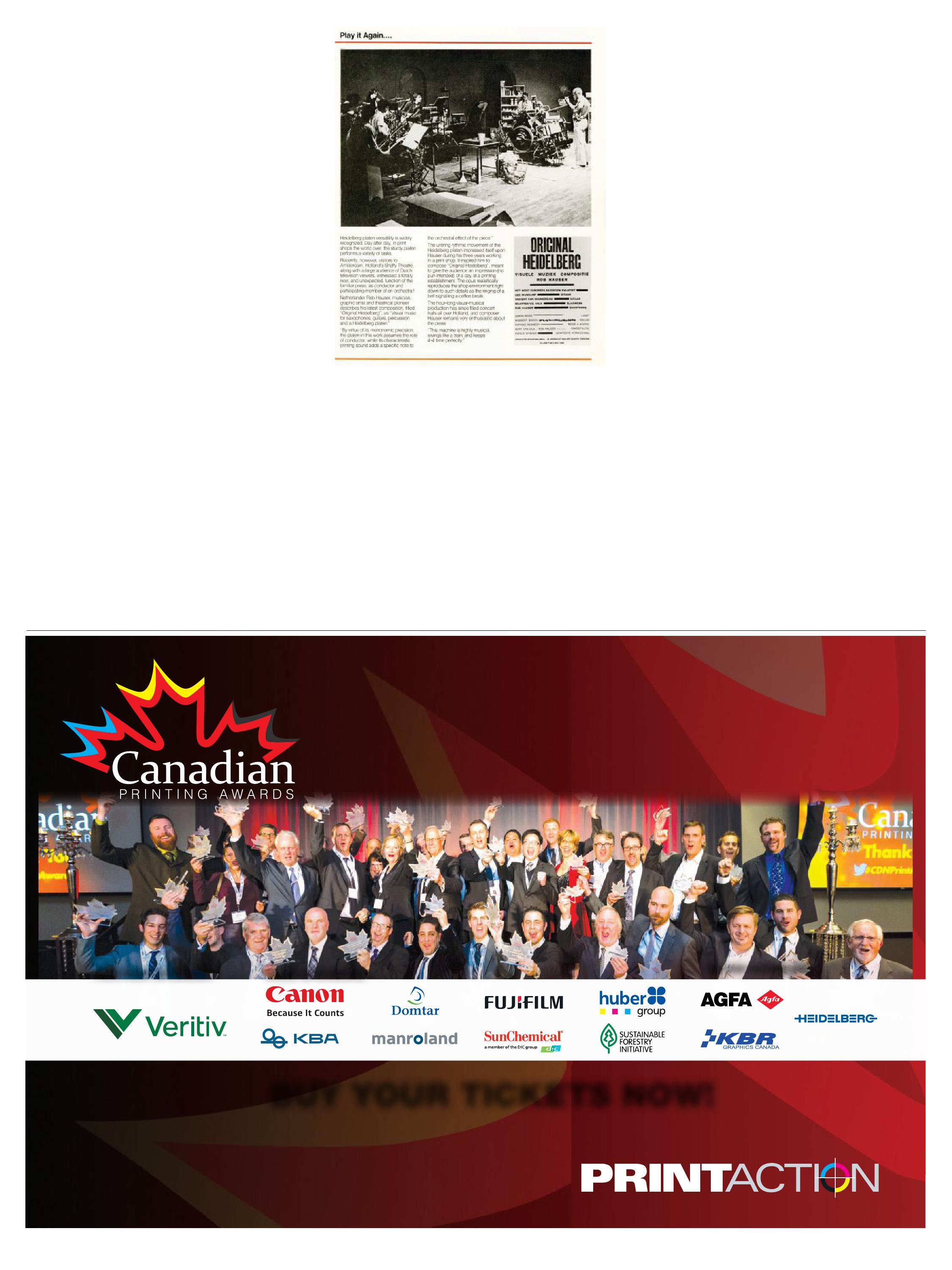
In 1975, Dutch artist Rob Hauser developed a musical, called Original Heidelberg, about the metronomic precision of a T platen. One of his hour-long performances in Amsterdam’s Shaffy Theatre was nationally broadcast on TV.
fabrik Johannisberg-Geisenheim (MJG), Dresdner Schnellpressenfabrik Coswig (Planeta) and Hamm’s former partner, Albert & Cie. all became major makers of mostly cylinder presses. Tiny Schnellpress made facsimiles of the standard German stop cylinder press, as well. Although Schnellpress released the Exquisit cylinder, in 1921, there was no magic in this press.
Gilke’s design was the one and only watershed moment for Schnellpress. German platen presses were all mostly knock-offs of the American Gally parallel
impression design. At least 20 companies were making very good versions of this press; Victoria being the best known. Any developments to automate feeding and delivery were all Band-Aid approaches with discombobulated devices affixed to an already mature handfed platen design. Schnellpress understood if they could make its little platen work, it would rip apart the whole industry. Even back in the early twentieth century, the majority of printers were small shops. Not everyone wanted or could afford large cylinder presses. Jobs were mostly handled 1- or 2-up on smaller handfed platens. If Heidelberg could make a press that would feed and deliver easily then the printing world would come calling.
By the end of WWI Heidelberg had such a press. Although the company faced management issues and very difficult times, Schnellpress had one more vital ingredient. It had a foundry. Richard Kahn, the owner at the time, also owned Maschinenfabrik Geislingen (MAG) and this allowed Schnellpresse to work completely autonomously on its design. Heidelberg castings are unique. When I was a young kid I could see even then the quality differences between a Heidelberg and any other machine – German, English, or American. There was a special quality to a Heidelberg.
Whatever notions one had prior to the Heidelberg platen, these were tossed aside because not only was the feed/delivery unique, so was the inker and adjustable bearers. Having a windmill, as the platen was also often referred to, in your shop almost guaranteed success, because you could obliterate any competitors who were still hand-feeding work or trying to make the crude add-on feeders work.
Continued on page 24
The New Press Builder
Rafael
Peñuela Torres, CEO of Manroland Sheetfed, discusses restructuring,
the state
of the printing market, modern machine manufacturing and the road ahead
by VicToria GaiTskell
In late-July, I had the opportunity to interview Rafael Peñuela Torres, Chief Executive Officer of Manroland Sheetfed GmbH in Offenbach, Germany. A polyglot born in Spain, educated in Economics in Germany, and employed in the printing industry since 1992, Peñuela took charge of Manroland’s Spanish organization in 1999. By 2003, he was managing the company’s Western European market and by 2006 Manroland Sheetfed sales worldwide. Following Manroland Sheetfed’s takeover by an British industrial conglomerate controlled by Tony Langley, Peñuela Torres temporarily shared the role of Managing Director of Service and Sales with a colleague until 2013, when he became Manroland Sheetfed’s sole CEO.
In our interview, Peñuela Torres, 54, candidly discusses Manroland’s change of direction after its 2011 insolvency and 2012 acquisition by Langley Holdings PLC. He describes several aspects of the company’s restructuring efforts, working through Germany’s tough labour laws.
Peñuela Torres offers analyses of how dramatically the offset equipment and printing markets have changed since being hard hit by the global financial crisis of 2008. He also divulges how Manroland Sheetfed’s research-and-development division is currently adapting its printing machines to meet a whole new set of customer needs and expectations.
Victoria Gaitskell: What do you consider to be the most important sheetfed-offset technology your company has introduced over the past five years or so – and why?
Peñuela Torres: For decades, Manroland has been leading the development of new technologies for offset printing – although not all these developments have been commercially successful. For example, in 2000 we launched the DICOweb plateless press, enabling a digital changeover from
job to job in less than 10 minutes. It was amazing technology for the time, but it was not a commercial success, because the cost was much too high.
In 2009, we developed the world’s largest perfector, the Roland 900 XXL, to serve the demand for high-volume book printing. It allowed offset printers to produce 64 A4 pages in one pass, enabling them to compete with web process productivity.
But after commercial and editorial printers took a hit in the 2008 financial crisis, the demand for this technology was greatly reduced. Press productivity is only important if customers have jobs for it. So some of our new developments did not succeed because of the wrong timing or costs.
But many others were successful because they were exactly what our customers wanted: In 2003, for example, we built the Roland 500, the first press to print 18,000 sheets per hour; and time has proven that this innovation in speed was the right trend for our market.
We also launched an InlineFoiler that can print cold foil in one pass on a conventional press. Although at first it proved popular, it generated complaints that the process wasted too much very expensive foil; so later we developed an indexing function to reduce waste in the inline process by up to 50 percent. This is an example of how we are trying increasingly to generate value for our customers by our technology.
Our innovations have not only taken the form of heavy metal, but also the integration of software processes into a single electronic workflow, as we achieved in our Printnet network management system.
In 2006, we launched the Roland 700 DirectDrive. The DirectDrive technology allowed customers to change plates simultaneously while the press is washing the cylinders, allowing for zero plate-changing time. Since then many of our competitors have introduced similar technology, and
so far it forms the biggest step towards a significant reduction of make-ready time.
Peñuela Torres continues to discuss R&D… PT: Among these successful technologies, I can’t identify one single development as the most important; but I can say that many of our recent developments have focused on increasing automation and reducing make-ready time, rather than on increasing press speed. One reason is that in today’s world we have discovered that speed is not the issue for our customers. The general trend is that run lengths are becoming shorter, so increasing press speed does not really help. A precondition for the improvements we introduce now is not just that they satisfy our R&D people but that they satisfy our customers.
Since 2008, it has been increasingly difficult for Manroland and our competitors to sell the same amount of equipment we used to sell. The market has shrunk by 50 percent because print shops are disappearing or merging, so less demand for machinery exists.
Customers are also running machinery for longer than planned. The average age of a press now is 13 years, and our customers’ requirements and business models are changing rapidly; so we are developing new technology like the InlineFoiler in a way that allows customers to add it on through upgrades or retrofits to get different or better value out of their existing press.
In addition to shortening make-ready, another of our R&D goals is to make it easier to handle a press by creating an easier interface with the user. Our customers are finding it more and more difficult to obtain highly skilled operators to run presses, because fewer of these operators are available; so we are spending a lot of brainpower and resources to make it easier to operate our technology. Especially because runs are becoming shorter, automation plays a tremendous role.
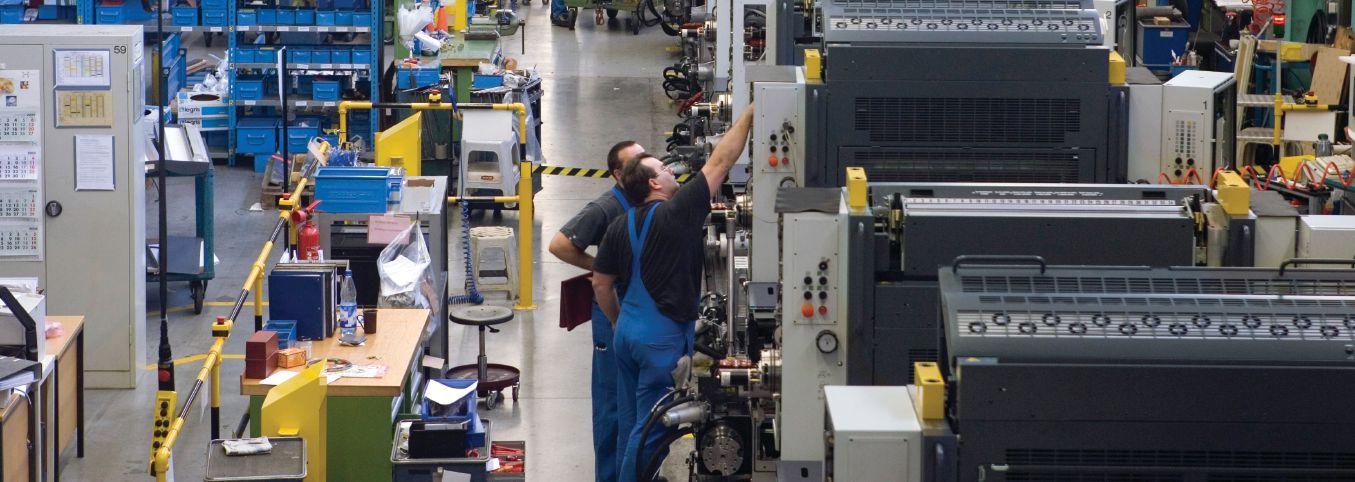
Half of Manroland Sheetfed’s 1,800 employees work in the press maker’s Offenbach plant, while the other half are spread out across the printing world.
Solvent printing has never been smarter, faster and more beautiful. The EPSON SureColor S-Series line of printers represents a step forward, combining performance, quality and reliability. Developed for high-performance printing and a low cost of ownership, this suite of solvent printers delivers print speeds that are the fastest in their class with image quality that’s simply amazing. And, with three unique 64” models to choose from, there’s an S-Series printer that’s right for your business. Learn more about the way solvent printing should be at epson.ca/solventprinter
Since skilled labour is critical to the manufacture of high-performance presses: What was the size of the labour force in your three manufacturing plants before restructuring and what is it now in your single plant after restructuring?
PT: You are correct – Skilled labour is crucial for press manufacturers. Manroland decided years ago and confirmed under Langley its plan not to do any manufacturing outside of Germany. One reason is that, although we realize many skilled people work outside of Germany, in other countries we find it more difficult to find the right number of them with expertise in all the different disciplines we need to build a press.
In the insolvency, we lost 50 percent of our workforce. Beforehand we had roughly 4,300 employees and we have 1,800 today. Of these, 900 work in the German factory and the other 900 take care of our markets and aftermarket services in various parts of the world.
How did you select which workers to keep and which to downsize?
PT: I don’t know if you are aware of it, but German labour laws require a company undergoing massive restructuring to apply for approval on who goes and stays via a so-called social plan.
The government works with unions to establish criteria for this process. Workers are assigned points based on factors like seniority, age and family situation. Adding up the points results in a pre-selection of employees who have to leave the company. Because the point system gives preference to older workers with seniority and families, normally you have to ask younger people, sometimes with promising talent, to leave the company – which happened in our case. Sometimes, if you have certain workers with critical expertise, you can offer a successful argument here and there to avoid the social plan and keep them on board. But we had only a short time to discuss the plan with the union and workers council during the last week of insolvency. I don’t know if the results were right or wrong, but we tried to do our best.
With a reduced workforce, how are you ensuring your machinery continues to be of high quality?
PT: We are still continuing to fine tune our human resources management strategy after restructuring. Langley was convinced that with our remaining capabilities we are still able to keep our whole production portfolio. Not one press was eliminated. This challenge has required us to cross-train people who were specialists before. For example, experts on 700 perfectors have also become qualified
to handle 500 perfectors.
It was quite a challenge, especially for the first six months of 2012; but now we have a more flexible workforce of people who can change from one model to another on the production line and still maintain high-quality standards. The employees say they are happy with the new system, because they have acquired more skills and are doing work that is more challenging and less routine.
In 2012, I was concerned that we would not be able to manage the whole portfolio with a reduced workforce; but in fact the presses we ship out today are costing less overall after delivery. This fact proves that we have been able to manage with half our original workforce and achieve an even better result in terms of quality.
With restructuring behind you, what is the biggest challenge facing your company today?
PT: After the Langley takeover, our immediate challenge was to serve customers as well as before, or even better, despite having reduced resources. Even before then, the company had experienced different phases of restructuring, but it was only because of the insolvency that we became aware that our old culture and huge-corporation mentality were responsible for the insolvency itself. We had become too heavy, too bureaucratic, too self-confident that we couldn’t fail, and too slow in managing, reacting to the market, and responding to our customers.
Our new shareholder Tony Langley knew we needed to change our attitude first. During the first year, he spent three days a week helping to transform us into a mittelstand [German for middle-sized] company with a handson attitude and quicker response times.
Now the biggest challenge is to keep this new culture as part of our daily business and avoid falling back into the old ways. Especially in the last two years, when profits have been better than expected, it creates the expectation of going back to the good old days when salaries were higher and expenses less controlled. It’s an issue I need to keep an eye on.
Why should new sheetfed-offset presses continue to interest commercial printers in North America, one of the world’s most mature printing markets?
PT: Commercial printers in industrialized Western countries are in a different position than commercial printers in China, India, and Latin America, where other electronic media are still less widespread and print is still the main transmitter of commercial messages. In North America and other Western economies, the commercial sheetfed-offset print segment has suffered more since the 2008
financial crisis because it must defend its position against electronic media and digital print.
But after 20 years, digital printing is still far from dominating the market. It still represents one single digit of total printed volume, although the marketing noise is very loud and gives the impression that digital is dominating. In reality it will take years for digital to achieve a bigger percentage than what they have today, because the cost per copy is high for digital and many enhancements, such as UV and foil coating, are not available in digital. I think for many, many years sheetfed offset will remain the dominating technology. It may be less loud and less sexy, but for sure it is the best way to print massive volumes of sheets of cardboard or paper for packaging or commercial print. When it comes to cost-per-copy for industrial volumes, no method is cheaper. Today, we see Western commercial printers finding new business models to stay in the market or even grow by adding value to commercial print and escape from the commodity print market. We see more and more commercial sheetfed-offset printers who have managed to find their own niche by focusing on a specific application, or way of adding value, or way of servicing customers.
For example, sheetfed offset is still the most used method to print business cards, and it also lets printers develop workflows to produce simple products for customers on 24-hours’ demand. So today’s successful business models include Web-to-print production of business cards and other simple products, printed with the highest efficiency at an unbeatable price.
What is the best advice you can share with the many small- to mid-sized commercial printers in Canada who continue to rely on sheetfed offset as their primary production process?
PT: I’m not the guy to give advice to printers. They are professionals who know best what they have to do.
But one thing I know from observation is that it is crucial for printers to identify and follow the right model for their business. They need know what they can do better than others.
Basically they have a choice between two ways of moving forward: One is to find a way to be different from their competitors with a different product or a different approach to customers through their services, response time, flexibility of workflow, or other factors. The second way is to achieve excellence by increasing productivity and reducing the cost per copy; for example, by using a large commercial press to produce large volumes with good or good-enough quality. The right business model can be either mass productivity or differentiation.
Rafael Peñuela Torres, Chief Executive Officer, Manroland Sheetfed GmbH.
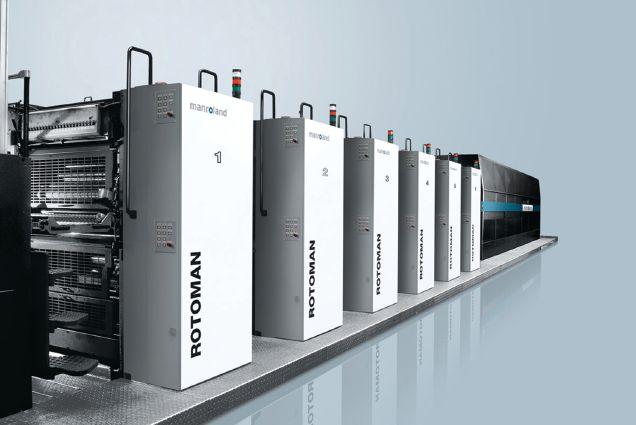
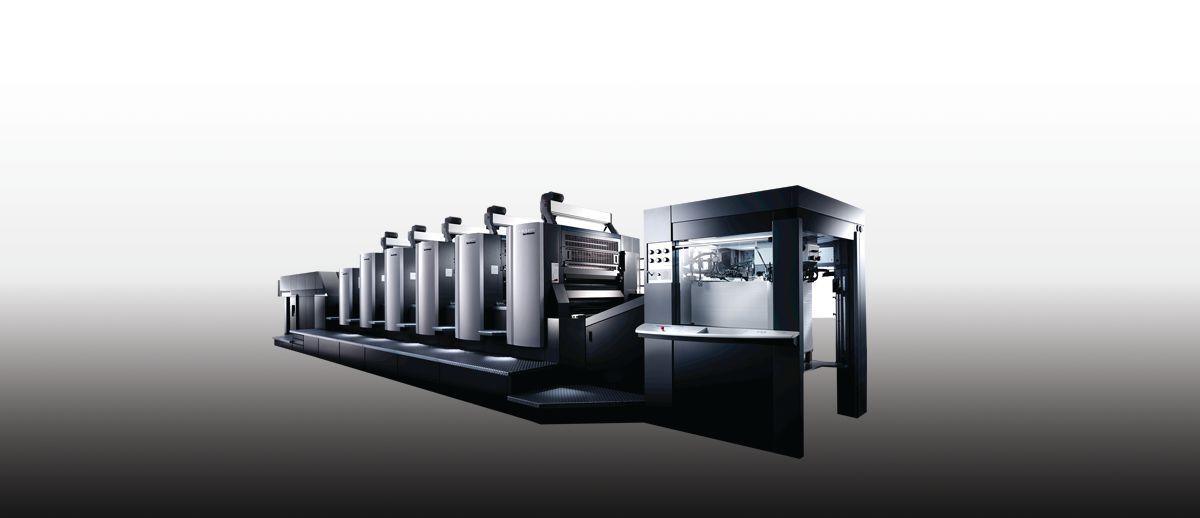
Manroland R&D focuses on make-ready rather than press speed.
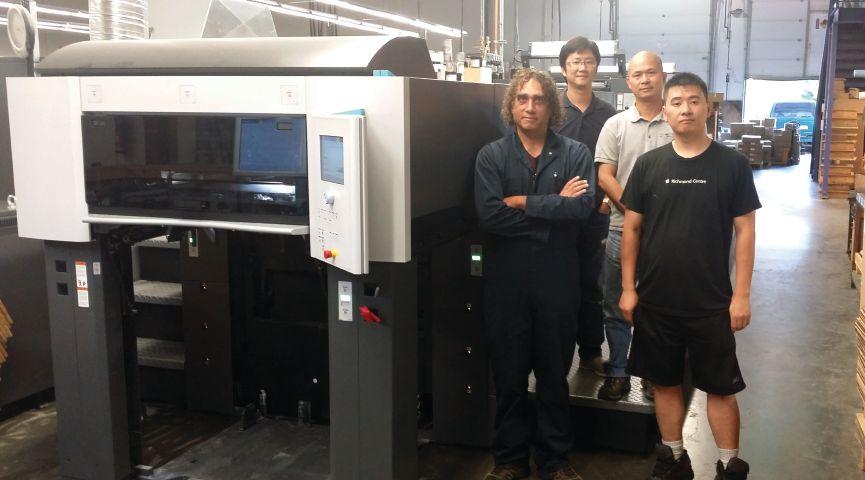
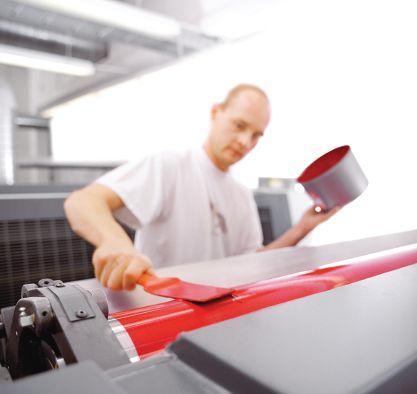
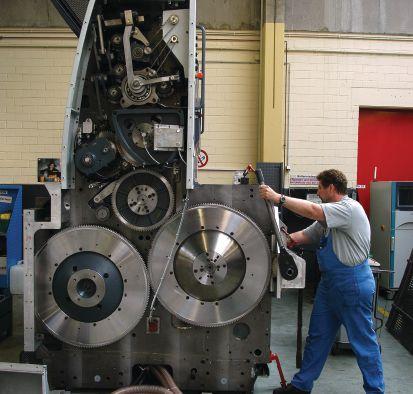
One of Manroland’s skilled German workers prepares a 900 press unit.
Bringing inkjet productivity to life
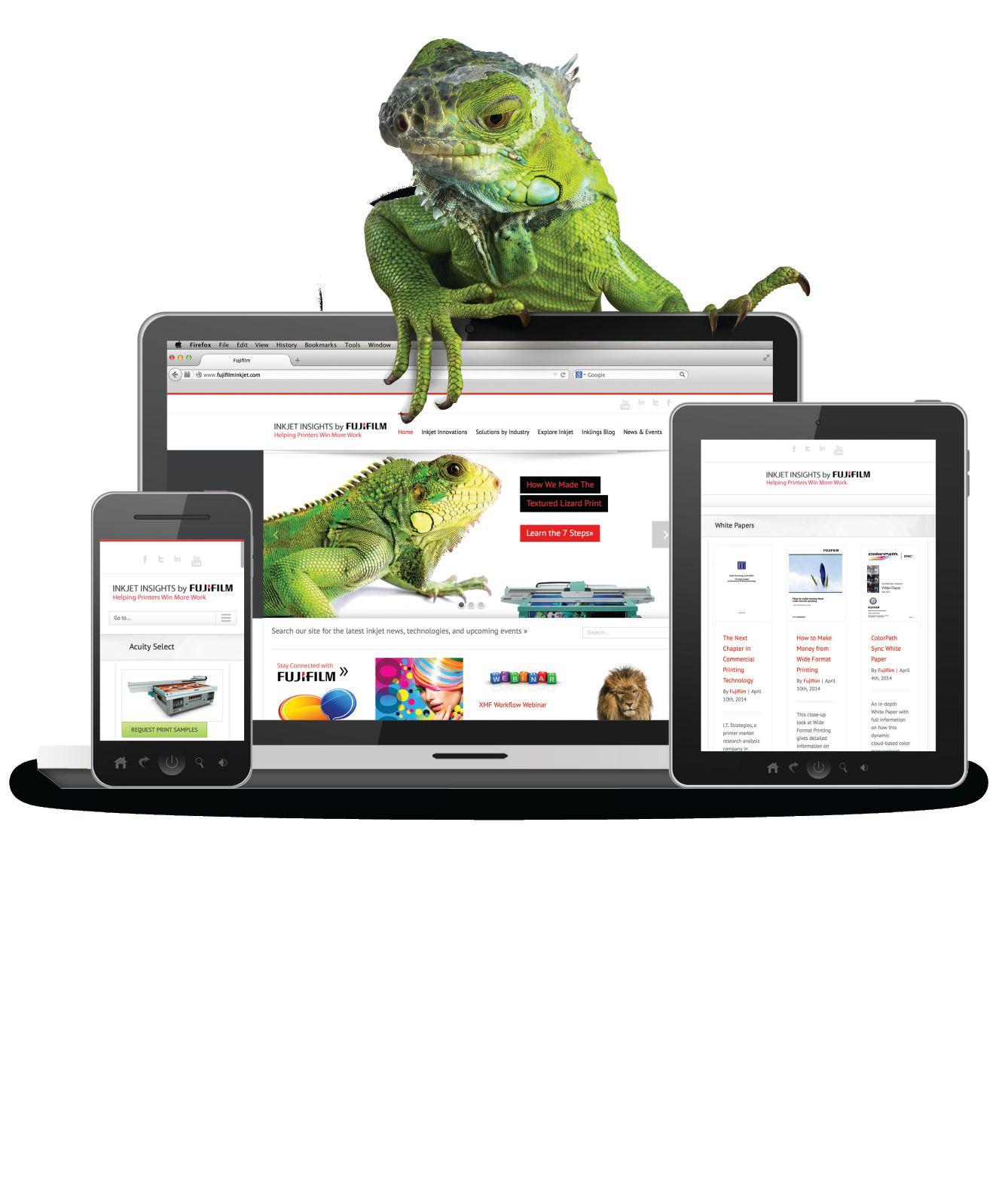
Now there’s a website dedicated to helping printers win more of their customers work by providing the latest insights in inkjet technologies. Visit fujifilminkjet.com for:
• White papers
• Videos
• Printer testimonials and case histories
• Latest inkjet solutions by industry
• Inkjet education and webinars
• Print samples and demonstration opportunities
• And more
One site dedicated to keeping you up to date on the latest inkjet innovations, trends and information. Visit fujifilminkjet.com today to experience inkjet productivity coming to life!
INKJET INSIGHTS by Helping Printers Win More Work
fujifilminkjet.com
W D I E FORMAT L EVERAGE
Fifteen leading technology suppliers, representing a range of technology development for wide-format inkjet, rank the top-three business issues that printing companies should consider when investing in this sector. Several of the companies also provide their planned booth highlights for the upcoming 2014 SGIA exhibition, running from October 22 to 24 in Las Vegas.
H EWLETT-PAC k ARD C ANADA
Top-three investment considerations
1. Are there new markets/applications that the new equipment can allow the printer to target?
2. Will the new equipment provide the printer additional printing capacity?
3. Will the new equipment help the printer increase its profitability per job?
SGIA highlights
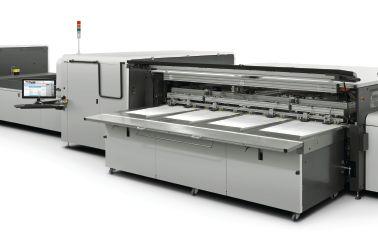
Scitex FB10000 (released June 2013): This six-colour industrial system has a bed size of 1.6 x 3.2 metres and can produce up to 125 full-sized sheets per hour. Latex 300 Series (released June 2014): This third generation of HP Latex printers includes the 310, 330 and 360 models, which reach 48 m2/hr, 50 m2/hr and m2/hr, respectively, in two-pass mode.
F UJIFILM N ORTH A MERICA
Top-three investment considerations
1. Selecting the right production speed and image quality to produce close-view to display print
2. High-resolution, greyscale print heads
3. White ink options
New products
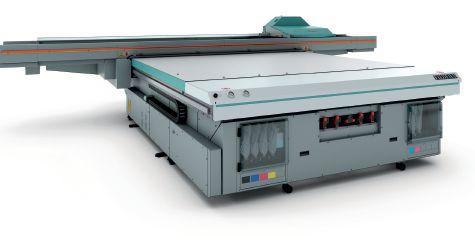
Acuity Advance Select HS (released July 2013): This 6-channel system, hitting speeds of 535 f2/hr, can be configured with clear + white or white+ white channels. Acuity F (released September 2014): Designed for volume rigid media production, the 6- or 7-channel device reaches speeds of up to 155 m2/hr. Inca Onset R40i (released June 2014): Fujiflm also distributes Inca Digital technology worldwide, including the new Onset R40i flatbed.
E S k O N ORTH A MERICA
Top-three investment considerations
1. Differentiating by incorporating contours, shapes and 3d designs into signs
2. Focus on temporary 3D in-store displays
3. Investigate textile banners and signs instead of only vinyl substrates
New products
Kongsberg C Series (October 2013): This semi-industrial C64 model works with 126 x 126-inch-wide materials, while the C60 model accommodates 126 inch wide x 63-inch long sizes. Kongsberg V Series (April 2014): The new series, with the i-cut Vision Pro camera system, is available in two sizes with the V20 at 66 x 51 inches and V24 at 66 x 126 inches. i-cut Layout+ (June 2014): As part of Esko Suite 14, this next-generation layout editor (available as a SaaS subscription) is designed with a cleaner, task-oriented user interface.
C ANON C ANADA
Top-three investment considerations
1. Diversification of services
2. Complimentary services
3. Finishing solutions
New products
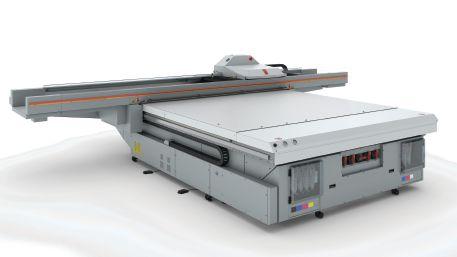
Océ Arizona 6100 XTS (released September 2014): The 6- and 7-colour devices in this new series use a 8-by-10 foot vacuum table for high speeds. ColorWave 900 (available January 2015): Reaching speeds of up to 12 inches per second (more than 800 B2 sheets per hour), the device achieves 1,600 x 1,600 dpi. It can be used for point of purchase, exhibit and tradeshow displays, as well as technical documents (GIS).
C olor GATE
Top-three investment considerations
1. Perfect colour management for optimal image quality and consistency
2. Excellent reproduction according to international colour standards like ISO, Fogra, PSD, Gracol, G7
3. Preserving flexibility to keep up with changing markets
New products
SmartControl IP OS (released March 2014): Standing for Industrial Printing Operating System, IP OS covers functions like data management and transmission to print-head controllers, as well as ink supply and maintenance. Productionserver 8 (released December 2013): RIP software for printing to standards like ISO, FOGRA, PSD, Gracol and G7, as well as for textile or for screen printing, and print and cut.
E PSON C ANADA
Top investment consideration
1. Purchasing a printer that allows for the widest possible media selections to maximize the investment
SGIA highlights
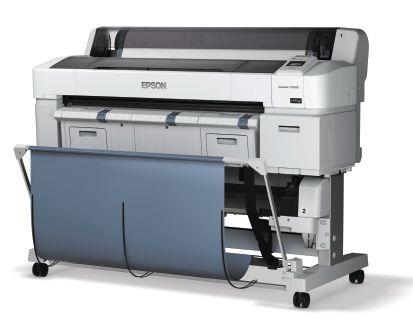
SureColor T Series (planned release Ocober 2014): Available in widths from 24 to 44 inches, the new multifunction series, with an optional scanner that produces colour at six inches per second, supports dual roll media. epson surecolor F7170 (released January 2014): This roll-to-roll dye sublimation series, using new generation of PrecisionCore TFP print heads, hits resolutions of up to 1,440 x 720-dpi (8pass mode) for fabrics and soft signage.
The Scitex FB10000, with High Dynamic Range printing, takes on jobs that used to require flexo or offset.
A GFA G RAPHICS
Top-three investment considerations
1. Media alternatives and applications expertise
2. Workflow including a Web-to-print/e-commerce frontend
3. Experienced, well-trained personnel
SGIA highlights
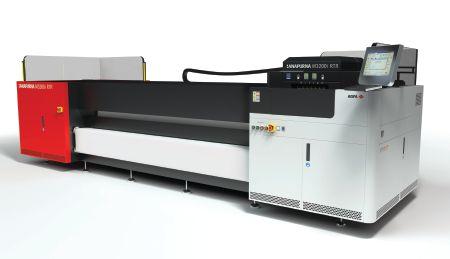
Jeti Titan S/HS FTR (released February 2014): Featuring a 2 x 3-metre bed, the HS model includes two rows of Ricoh Gen 5 print heads (1,280 nozzles), while the Titan S comes with one row and is field upgradeable. Anapurna M3200i
RTR: A 6-colour, 3.2-metre wide, roll-to-roll UV-curable machine reaching up to 116 m2/hr. Available with new dual roll and mesh options (released May 2014).
D Ry TAC C ANADA
Top-three investment considerations
1. Keeping up with technological advances
2. Customer base consolidation
3. Decreasing margins due to saturation of the market, as a result of low-cost materials
SGIA highlights
WipeOut (released April 2014): A premium, dryerase, hard-coat laminate with a chemical- and scratch-resistant gloss surface, which can be paired with graphics printed on ReTac Wall. ReTac Wall (released Dec. 2013): Formerly called WallTac, this adhesive matte PVC film creates removable wall graphics with most solvent, UV and latex printers.
M UTOH A MERICA
Top-three investment considerations
1. Labour savings
2. System footprint
3. Return on investment
SGIA highlights
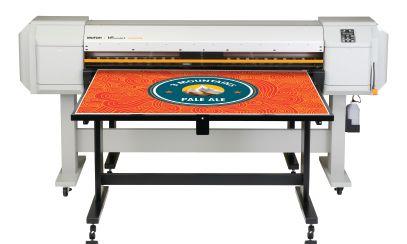
ValueJet 426UF (released April 2014): A 19-inch UVLED printer, available in 6- or 4-colour models, can be used for packaging prototypes. ValueJet 1626UH (released January 2014): This hybrid 64-inch UV-LED printer can also be used for prototypes.
R OLAND DGA
Top investment consideration
1. The need to diversify output to appeal to a wider audience and withstand economic rollercoasters
SGIA highlights
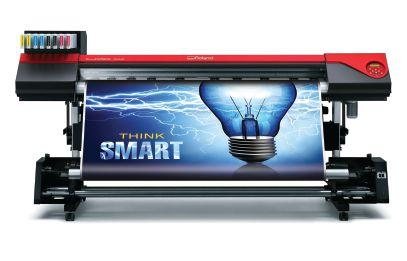
monoFab ARM-10 (released September 2014): The company’s first additive 3D printer, the ARM-10 is designed for prototyping or modeling of complex shapes, while the new SRM-20 is for 3D subtractive milling. VersaEXPRESS RF-640 (July 2014): This 64inch system uses Eco-Sol MAX 2 inks and reaches speeds of up to 48.5 m2/h (521.9 ft2/hr). It includes a new Roland Ink Switching System to load backup cartridges. DisplayStudio (released April 2014): Roland enters the digital sign market with DisplayStudio which includes content management software, media player, mounting hardware and 32- to 55-inch LCD displays.
SWISS Q PRINT
Top-three investment considerations
1. Business plan
2. Qualified staff
3. Marketing
New products
Nyala 2 (released April 2014): The 3.2 × 1.6-metre Nyala reaches a top speed of 200 m2/hr. swissQprint also offers 3D Moiré Effect and T-Ink for technical applications (released April 2014).
3M C ANADA
Top-three investment considerations
1. Printing capabilities/production levels, adhesion testing for various surfaces
2. Finished product installation by professional installers
3. Real-world product testing and warranties
New products
Envision Print Wrap Film 480Cv3 (released January 2013): This non-PVC film is phthalate-free and uses less solvent, while reducing issues with incineration as no chlorine or other halogens are added during manufacturing. Envision Translucent Film Series 3730 (released January 2013): This 2-mil, long-term coloured vinyl translucent film features high transmission levels for bright sign faces and a reduced need for LED sources.
The Océ Arizona 6100 XTS produces up to 50 boards per hour in Production Mode.
The 426UF is priced at $19,995 MSRP and the ValueJet 1626UH at $49,995.
Epson’s new 36-inch SureColor T5270D has an MRSP of US$5,995.
The VersaEXPRESS RF-640 has an MSRP of US$16,995.
Agfa’s Jeti Titan S/HS FTR series features a new primer option for ink adhesion.
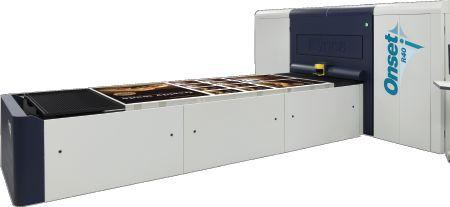
The new Onset R40i delivers a 14-picolitre drop at 400 m2/hr or 80 full-bed sheets per hour.
C ALDERA
Top-three investment considerations
1. Print-to-cut workflow
2. Colour management
3. Production resource planning and management
New products
Caldera Version 10 (available October 2014): Caldera’s software with PDF/X compatibility builds upon its existing unique colour management tools to integrate with display graphic devices and cutters.
Zü ND A MERICA
Top-three investment considerations
1. Be aware of adding printing capabilities without the corresponding cutting/finishing equipment to handle the additional output, thereby, avoiding inevitable bottlenecks
2. Look for cutting/finishing equipment that is versatile and modular so you can maximize capabilities and throughput – with additional automation features – as the business grows
3. Look for simplicity in the digital workflow and user interface – no matter how fast the machine, if the operator has to spend excessive amounts of time setting up and running the machine, it won’t be productive
SGIA highlights
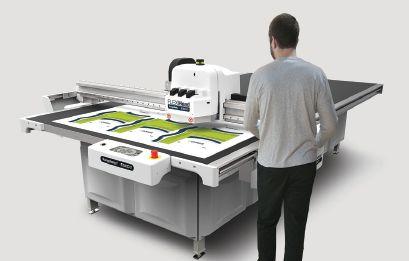
Zünd EOT-250 (released March 2014): This oscillating tool is designed to process sandwich board/honeycomb materials, cardboard and tough leather, among other materials. Zünd S3 (released October 2013): This automated sheet feeder, powered by Zünd Cut Center, can be integrated with a universal roll-off unit to ease setup for rolled goods. Zünd Design Center (released October 2013): This Adobe Illustrator plug-in – with 3D preview and 3D PDF export – creates 3D designs for packaging and displays.
I NCA D IGITAL
ITop-two investment considerations
1. How the investment complements your business today and allows you to move forward
2. Investing in a technology that can be adapted to meet future changing needs
New products
Inca Onset R40i (released June 2014): Distributed exclusively by Fujifilm, this new device can be upgraded from four to seven colours in the field. Inca Onset S40i plus white (released October 2013): The new device includes a double white ink capability for producing backlit/frontlit and double-sided day/night POS display graphics. Inca Onset S50i (released November 2013): The modular device has a top throughput of 725 m2/hr (equivalent to 144 full beds).
G RIMCO (formerly Proveer)
Top-three investment considerations
1. Resources for pre-site inspections and installation services
2. The ability to migrate existing relationships from being an ink-on-paper printer to signage-and-display supplier and/or understanding current local competition in the sign market
3. Finishing and mounting methods for signs and displays
New products
Falconboard, New Wood Finish (released April 2014): This high-quality material is designed for a range of uses in producing visual merchandising products, such as displays, signs and kiosks. Stinger (released June 2013): This rigid honeycomb board is made from polypropylene and described as 100 percent recyclable, without creating harmful byproducts in waste-toenergy systems.
7 Ways RS Superior Saves You Time and Money
1. ONE-STOP SHOP
Die Cutting, Bindery, Data & Lettershop –all under one roof.
2. ONGOING INVESTMENT IN SUPERIOR TECHNOLOGY
Die crease without a die, then fold and even glue all on the same machine, up to 30 pt.
3. INTEGRATED MODULAR UNITS
Combined in-line finishing: crease, fold, glue, tipping, envelope inserting, ink jetting (Duplex), clip seal (3 sides), mail prep.
4. SAVE ON POSTAGE COSTS
As a Certified Canada Post Direct Marketing Specialist, we get contract pricing reductions.
5. RETURN MAIL PRODUCTS
Customized “Return Mailers” created in-line with “U” or “BOX-shape” remoistenable glue, time perfed applications and envelope formation.
6. MINI-BOOKLETS
We can saddle-stitch and trim 2-up booklets in-line to the size of a business card. No need to trim off-line, or do 2 passes.
7. HIGH SPEED EQUIPMENT
High speed Tipping, Folding, Saddle-stitching and soft folding ensuring on time delivery.
RePORT
A range of new or updated technologies are beginning to hit the market as North America’s printing tradeshow season swings into high gear with events like Labelexpo Americas, Graph Expo and SGIA 2014. This includes Asahi’s new photopolymer flexo plates with Pinning Top Dot technology, Xeikon’s five-colour Cheetah press aimed at label printing, and the Xerox C60/C70 light-production device for printing on unique substrates.
Asahi TOP and AWP plates
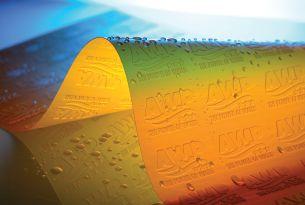
Asahi Photoproducts in August launched what the company describes as two new premium digital photopolymer flexo plates, called TOP (solvent washable) and AWP (water-washable), which use Pinning Top Dot (PTD) technology. PTD is designed to provide clean ink transfer and to prevent ink accumulating on the plate surfaces and
Technologies Featured
• Asahi TOP and AWP plates
• Coveris Magic PCW-MATTE
• Durst Tau LFS 330 finishing
• Kodak Prinergy 6.1
• Manroland R700 HiPrint
• Mark Andy, DigiFlex
• OMET XFlex X4
• Quark QuarkXPress 10.2
• SPGPrints LM UV inkjet inks
• Sydney Stone, MultiLoft
• Xeikon Cheetah press
• Xerox C60/C70 printers
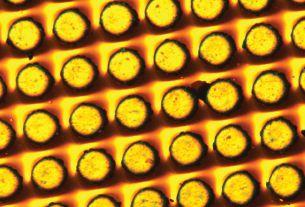
shoulders in screen areas. It allows what Asahi refers to as a kiss-touch printing pressure setting. Its polymer chemistry provides low plate surface tension to inhibit liquid flow. The ink forms a globule, with a large contact angle and high pinning point. This results in a cleaner and homogeneous ink transfer from plate to substrate.
Asahi explains the higher pinning point also allows reduced printing pressure throughout the printing run, regardless of ink set used, which leads to lower dot gain.
Asahi’s PTD plates offer a resolution of 80 l/cm (200 lpi), minimum isolated dot of 150 µm micron, and is available in thicknesses of 1.14mm (shore A hardness 77) and 1.70mm (shore A hardness 69). It is compatible with all commonly available laser types, as well as the latest high-definition microcell screening technology.
Xeikon Cheetah press
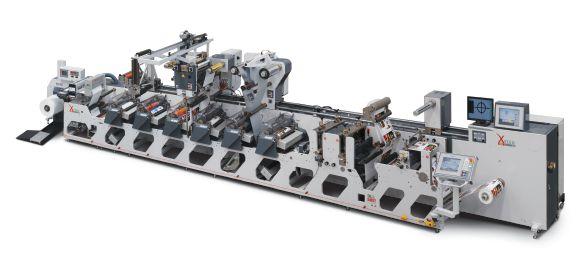
Xeikon at Labelexpo Americas 2014 showcased its new Cheetah press and described it as “the most important advancement for the digital label market in 15 years.” Xeikon plans to make the Cheetah commercially available in 2015, which will be the sixth press model in its portfolio. Xeikon states the five-colour Cheetah, aimed at self-adhesive/
Printing Sells Products
You print packaging for your clients to sell more products. We provide the tools and resources to keep your client’s happy and grow your business.
A Collaborative Approach
Business should be based on relationships - not transactions. At Anderson & Vreeland, we do not simply sell products to the flexo market; we work with our clients and vendors to introduce new, innovative technology that improves the efficiency and quality of flexographic printing.
The flexo industry is evolving and so are the demands of the market. Today, everything is a rush and perfection is demanded. As a printer, you need a partner that offers more to keep your clients happy. Call Anderson & Vreeland to find out how we can help you and your business grow.
Asahi’s Pinning Top Dot digital flexo plate technology.
Magnified image of the Pinning Top Dot plate with no ink remaining after printing.
pressure-sensitive label printing, is 60 percent faster than any other model in its current press portfolio. It reaches speeds of up to 98 feet per minute (30 metres per minute). The Cheetah can handle substrate widths of up to 13 inches (330 mm) with a true print resolution of 1,200 x 3,600 dpi. Xeikon explains it utilizes full rotary printing where the press speeds are independent of the number of colours used and the repeat length of the job. The press can also run Xeikon’s dry toners that meet FDA regulations for food contact and the ability to print opaque white toner in one pass. In addition to the standard CMYK + white, the fifth station on the Xeikon Cheetah can be used to print gamut expansion colours or security toner. The press also includes automatic inline register and density controls. The imaging width is up to 12.7 inches (322 mm) while the repeat length is variable from zero to 180 feet (zero to 55 metres). Media weights range from 40 gsm to 350 gsm.
OMET XFlex X4
OMET in September introduced its new 17-inch (440 mm) width XFlex X4 converting system, which includes the company’s patented chilled impression roll print head design and automatic (MD & LD) register control system. This includes twin servomotors on each printing unit for label and thin film printing. The extended 17-inch width of the XFlex X4, according to OMET, is geared toward printing companies that produce short to medium runs of labels and long runs of flexible packaging.
Xerox C60/C70 printers
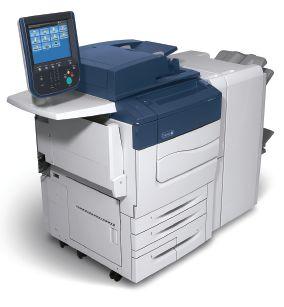
Xerox is to begin taking orders this October for its new C60/C70 light-production printers with the ability to print on a range of substrates from magnets and linens to polyester labels and vinyl window clings, in addition to traditional papers. Based on Emulsion Aggregation (EA) toner printing, with what the company terms as ultra low-melt technology, the C60/C70 series reaches speeds of up to 70 pages per minute (ppm) in colour and 75 ppm in black-and-white. It produces 2,400 x 2,400-dpi resolution.
The C60/C70 devices can be equipped with Xerox’ recently introduced FreeFlow Print Server Integrated with Microsoft Windows architecture, while also leveraging pre-programmed workflow tools for job accounting, job security, monitoring and tracking.
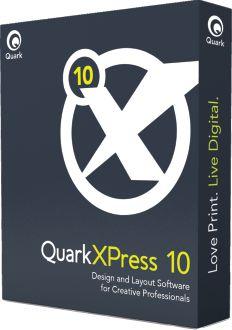
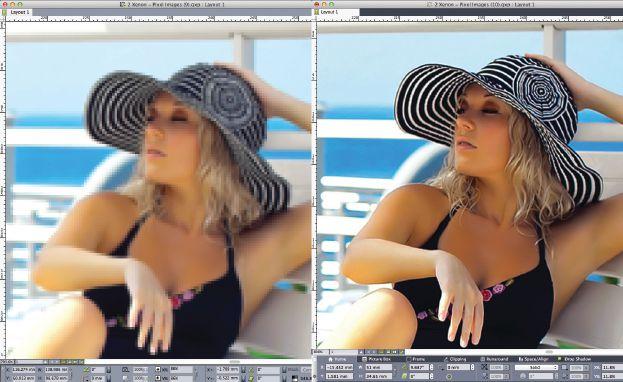
QuarkXPress version 10.2
Quark Software in August launched QuarkXPress 10.2 to address performance and output issues related to the software’s new Xenon Graphics Engine. The update is available free to QuarkXPress users currently on version 10 – or as a full 30-day trial. QuarkXPress 10.2 also includes new features for collaboration, such as “Redlining”, which allows users to track changes within QuarkXPress documents to be viewed by a range of users. Using the Redline feature, Quark explains teams can view the inserted and deleted text content made in a project and decide whether to accept or reject the changes.
QuarkXPress 10.2 also includes “Notes”, allowing users to store comments in a project without affecting its actual content. This feature can involve adding
the speed with pneumatic
5,000 sheets
Are you being rewarded for your supplies purchases?
Introducing another industry first from the finishing experts at Sydney Stone. Join our no fee partner points program today and start saving!
Receive up to 10,000 welcome bonus points with your first online order.
The 17-inch XFlex X4 is geared toward mid-run labels.
The C60/C70 series prints 70 colour pages per minute.
reminders and comments on the text content. Notes, with a “sticky note” look, can also be exported as PDF content. In version 10.2, Quark explains there are no limitations on nesting anchored boxes, whereas previous versions of QuarkXPress have a limit of two levels. As well, users can export and import hyphenation exceptions created for a document and share the exceptions across projects to maintain uniformity.
Sydney Stone, MultiLoft
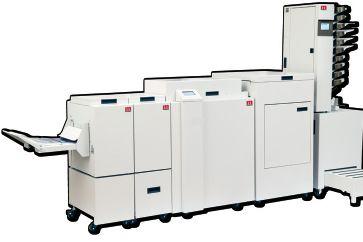
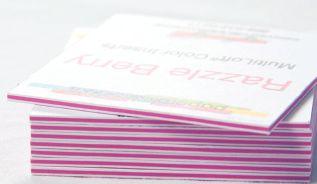
Sydney Stone in September announced it would begin selling MultiLoft products in Canada. MultiLoft, according to Sydney Stone, allows for producing materials in up to 64-pt thickness in forms like business cards and post cards. Working with print from toner presses, MultiLoft allows front and back cover sheets to be assembled back to back, and insert sheets to be added to increase thickness. Pressure from the trimming clamp then seals the sheets together. After assembly, the sheets can also be die-cut into specialty shaped cards.
kodak Prinergy version 6.1
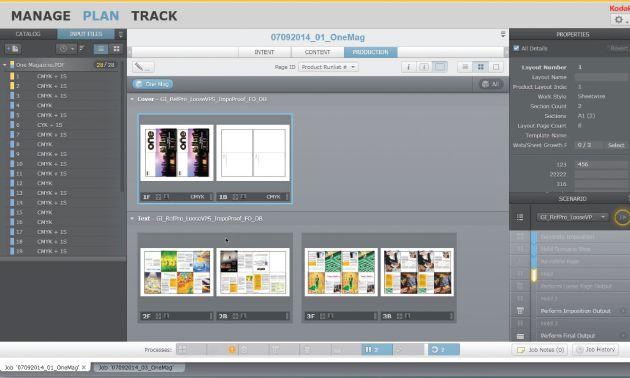
Kodak in August updated its Prinergy print production workflow software to version 6.1 with what the company describes as an improved Web-based interface and new job management tools, including a scenario builder, job intent window, part and section views and a separation list.
Scenario Builder is a new production automation tool designed to facilitate the creation of workflows from intent to output. Job Intent Window is a single
Pixel comparison of QuarkXPress 9 vs QuarkXPress 10.
MultiLoft can create thick business cards.
location where users define job specifications in one menu that describes the completed product. Prinergy v6.1 also includes new and updated Part and Section views, where users can change properties quickly. The new Separation List function, as requested by customers, is found in the Production tab. Its simplified view is designed for operators to streamline output for separations.
SPGPrints LM UV inkjet inks
SPGPrints in September launched new low-migration UV-inkjet inks aimed at food and pharmaceutical packaging applications. Optimized for SPGPrints’ (Digital System Integration) press, the inks meet the guidelines of the European Printing Ink Association (EuPIA) and are compliant with the Swiss Ordinance on Materials and Articles (SR 817.023.21). Furthermore, the inks do not contain any materials that have been excluded by the Nestlé Guidance on Packaging Inks.
Durst Tau LFS 330 finishing
Durst in September introduced its new inkjet-based Tau LFS 330 (Laser Finishing System) press, aimed at creating a more complete production workflow for label production. The Tau LFS 330 adds a new inline laser finishing system into the company’s existing Tau 330, which itself is designed for short- and medium-run narrow web applications, in widths from 6.5 to 13.0 inches, running at print speeds of up to 157 feet. The new Laser Finishing System is based on laser die-cutting technology from Spartanics and a 1,000-watt laser.
Manroland R700 HiPrint
Manroland Sheetfed this September plans to introduce an updated R700 HiPrint press. The first generation of the machine was introduced in the mid-1990s. The company states new changes to the press for September 2014 include an increased speed to 17,200 sheets per hour. Manroland Sheetfed is to also present an update for its InlineFoiler with indexing technology.
Available for the HiPrint and HiPrint HS (high speed) presses, this cold-foil process allows printing of any colour on the metal particles. This September, Manroland Sheetfed will also introduce LEC-UV drying to the R700 HiPrint press. This is a UV module for low-energy curing. Manroland Sheetfed plans to install the updated R700 HiPrint into its Chicago-area demonstration centre before the end of September.
Coveris Magic PCW-MATTE
Coveris’ Advanced Coatings Digital Imaging division in August launched the new Magic PCW-MATTE paper. PCW-MATTE is a 14 mil, 100 percent post-consumer waste matte paper for inkjet printing. It is compatible with water-based, solvent, eco-solvent and UV-cure inks. The paper is designed with what Coveris describes as an ultra-smooth surface combined with high ink saturation, which is suited for photographic and indoor promotional graphics.
Mark Andy, DigiFlex
Mark Andy Print Products (MAPP) added DigiFlex to its flexographic platemaking distribution lines. DigiFlex’ FlexoJet 1725 system is an inkjet-based computer-to-plate imager for photopolymer flexographic, letterpress, dry-offset, and rotary silk-screen printing. It is compatible with DuPont’s Cyrel solvent and Cyrel FAST plates, which MAPP also distributes. DigiFlex is an Israeli company founded in 2008.
Tau LFS 330 can now include a new Spartanics die-cutter and 1,000-watt laser.
DigiFlex’ FlexoJet 1725 runs DuPont Cyrel plates.
❏ One program manages entire company
❏ Enter data once and use it many times
❏ Enhances client service
❏ Work smart, work efficiently
❏ Increases speed - accuracy from estimates to invoices
Heidelberg’s innovation to build the T platen on Germany’s first mechanical assembly line brought the prices down so that every printer could afford one. The small jobbing printer was the key customer for Heidelberg and its new machine was priced accordingly. Along with its small footprint, the T platen required nothing more than a drive motor or belt driven from a driveshaft.
leveraging the tiegel
Why then was Heidelberg able to eclipse much larger companies in Germany, such as VOMAG, MAN and Koenig & Bauer, the latter of which is recognized as the founder of printing machinery manufacturing. Heidelberg also faced stiff competition from Albert Frankenthal and Faber & Schleicher. All of these firms, however, were focused on making innovative but complicated cylinder sheetfed machines, Web presses and even offset machines in the early 1920s. So much that they all failed to notice a big hole in jobbing presses which is exactly what Schnellpresse filled.
Another major reason for Heidelberg’s meteoric rise was its unique sales approach. Instead of staying close to home, as many of the German builders did, Heidelberg sought out new markets and customers in America, Britain and around the entire globe. The early vision of globalization among Heidelberg’s leaders is a fundamental reason why its T platens, and the company itself, became so successful.
At the Bugra trade fair of 1914, Heidelberg displayed the first prototype T platen to the world. This early press, known as the Express, would be altered several times before it finally became legend. 1914 was also the year The Great War began and very little development or production materialized on the T platen until 1921. By 1927, the press had another facelift. The gripper mechanism was vastly improved and remained remarkably similar to the last version of 1985. Impression throw-off and micro adjust was really easy. Changing packing was just as simple as on a Gordon. The use of a Geneva motion or Maltese cross allowed for better registration and more stable movement of the grippers. This feature alone was an incredible advancement for its time.
World crisis in the first half of the twentieth century had an impact not just on Schnellpress but every manufacturer. The crash of 1929 was a worldwide financial epidemic and Germany faced hyperinflation and eventually the rise of the Nazi party in the 1930s.
loving the tiegel
Why then does this little press mean so much to so many? History shows there was ample press competition and, certainly, for work like heavy embossing one must give the Parallel press or Kluge a leg up. Why then? Heidelberg was very clever. The company designed its press to be the easiest to run. Feeding was easy, clean up, running difficult materials –even printing on paper bags is possible. Watching a Heidelberg run is precision in motion, exact and measured in its movements. Even when compared to a high-end Gordon platen, it is actually frightening how much better the Tiegel was. It worked in harmony with the operator. I remember my father showing me how to run the press, never forcing its workings and making it sing. The better the pressman, the easier the work.
My memories of the Heidelberg platen trump everything else. Its sound, its strength, the fact it was almost indestructible are fond recollections. Heidelberg built its company on the T platen, later followed by the GT (larger size) and the OHC (cylinder). What Heidelberg learned with the T platen can be seen still today. Its unique suction feeder was used on the cylinder S and K models, as well as the K, M and GTO offset presses. In fact, the unique hardware first used on the T can be seen on the Speedmaster as late as 1994.
The wonderful T platen made it possible for Heidelberg to move past all of the German press makers and stay on an incredible roll right up to its flagship Speedmaster line. Heidelberg owes everything to the platen. It took the unique machine-building genius of Heidelberg to refine and build it in their personal style.
Perhaps this affection has been lost on many of the greybeards in the industry, but to the new generation of letterpress artisans, the Tiegel is making them fall in love with printing all over again. Today, Heidelberg makes some of the finest printing machines in the world. Look at the XL 106 or XL 162 – amazing technology. The lithographic world is changing very fast. It’s fighting to keep digital devices away from their offset pages. I doubt there will ever be another printing machine that is truly loved like the Heidelberg platen. I remain in love my Heidelberg platens. We have a 1928 and 1985 in our collection.
In 1975, a Dutch artist created a musical about his Heidelberg T, running it on stages across Holland. One of Japan’s largest printers has a T monument ensconced in glass. Loved by so many, the Tiegel transcends printing. It was Heidelberg’s gift to the printing world.
DIGITAL/BINDERY
OPERATOR WANTED
FT experienced Digital/Bindery Operator required in SW Mississauga. Operating Konica/Xerox with Fiery & Creo Software and related bindery operations include cutting, folding, numbering, scoring, stapling.
Send resume to george.stern@minutemanpress.com (10/14)
PART-TIME MARKETING NINJA
We are ambitious and need someone to drive our marketing program.
• You know the difference between Sales and Marketing.
• You write succinctly and coherently.
• You understand the e-universe and the distinct roles of Graphic Design, Web Coding, Copywriting, SEO, Inbound and Outbound marketing.
• Your commute would be short living east of the GTA.
Make your pitch to join our team (along with compensation expectations) by sending your resume to marketingninja2014@gmail.com (10/14)
EXPERIENCED WD ENVELOPE MACHINE ADJUSTER
Required Immediately. Excellent wages and benefits. Shift work. Transportation required. (10/14) Apply by email to hr@aslprintfx.com
SENIOR MAC OPERATOR
Senior Mac Operator, PrePress Department, Mississauga based screen printer. 5 yrs+ experience - screen printing experience preferred but not mandatory. Enthusiastic with a positive attitude. Ability to troubleshoot,preflight, prepare, edit, proof, colour match, and impose files. Solid understanding of colour profiles, use of preflight software and build preflight profiles. Proficient with Adobe Creative Suite CS5+, Quark 8.0+, RIP software and file archiving. Provide technical support to Sales, CSRs and Clients. (10/14) Contact: m.macleod@ibec-training.com
EXPERIENCED PRESSMAN
Experienced pressman full time. Heidelberg SM74-5P colour with coater. (09/14) Contact: info@mormarkonline.com
DIGITAL PRESS OPERATOR
Digital Press Operator required for our Printing Services Group which specializes in the production of photo gifts including photobooks, calendars and cards. Reporting to the Production Manager, this position is responsible for the operation and maintenance of the Giftlab’s iGen digital press. (09/14) For additional details and to apply, visit www.fujifilm.ca and click on “Careers”.
Digital operator required in North Etobicoke. Working with Xerox equipment. Some experience preferred. Day shift, however hours flexible including some weekends. Resumes to hr@harmonyprinting.com
WANTED: SALES ASSISTANT
Must have knowledge of commercial print and related services, strong communication and organization skills. Responsibilities: Quote and job input into MIS system, assists account managers, various administrative duties. Commercial Printing Company, Mississauga. Contact: Toronto.jobs@lmgroup.com
PRESSMAN FOR QM-46-2
Full time position open immediately. Experience needed. Folding and cutting an asset. (09/14) Contact: info@mormarkonline.com
PREPRESS DIGITAL OPERATOR
Prepress digital operator wanted. Full time position open immediately. Experience with Konica Minolta bizhub Colour C7000 and B/W 1051, bindery/ shipping experience an asset. (09/14) Contact: info@mormarkonline.com
- www.alertprinters.com
FOR SALE
Small, long-established printing company for sale in central Nova Scotia. No debt, marginally profitable with “walk in” business only. Owners live in Ontario and the company needs “boots on the ground” to manage, make sales calls and follow up, to be more profitable. Includes; Land and 3,360 sq. ft. building valued at $114,000 with two-bedroom apartment above that may be used for rental income or living quarters. $250,000 Call 613.527.5840
FOR SALE
Muller Martini Stitcher 321 3 bases four-306 feeders, cover feeder-delivery. Service Available Candartech@hotmail.com
FOR SALE
Heidelberg Windmill Redball one head paper drill, AB Dick 350 single colour, cutter Challenger size 305, MBO right angle folder T49/44 #c0408, AB Dick 2/C with T head, Toko 4750 2/C, Multi 1250 w. Price $20,000. (09/14) For more info call (416) 992-1661 or email doabaprinting@gmail.com
FOR SALE
MBO T49 Folder with Right Angle, 20” x 29”, 1990s. In Great Condition. 1990 Heidleberg Quickmaster 46-2, Baum Ultrafold 714 table top folder, Tabber Challenge single head drill Epson Ultrachrome 7880 ink jet printer, 24” Royal Shrink wrapper - eliminates the need for traditional “L” sealer and tunnel shrink wrap machine formations for manual operations by encasing the heating zone under a transparent hood. Save space by dropping that old dryer tunnel and switching to a nexgen machine. Light table - 30 x 40 inches Duster 1800 Island Air - filtration system, best offer.The Duster 1800 removes dust, odors, smoke, voc’s, mists, spray powder, toxic fumes, pollen and bacteria, and a lot more. This unit is perfect for industrial or print shops where fumes and particles are present in the air. Used to clean 2200 sq. ft. building. Call 416-222-4021 with best offer.
FOR SALE
2006 Xante violet CTP system. Plates from 10 x 15 to 36 x 25. Processor with preheat and gumming included. True rip adobe (Symphony) with preflight, trapping and proofing included. Epson 7880 connected on rip also included. System is installed and may be shown. (09/14) Contact flabrecque@division.ca
FOR SALE
Konica Minolta bizhub Press C6501. External Creo image controller RIP IC304, hot folders and spot colours. Low impressions with Pantone Goe Library. 11x17 scanner, 3LCTs. Call (905) 607-5788
Heidelberg: K-Line/S-Line/ Speedmaster/GTO/MO
Komori: 1,2,4 or 5 colours & an Adast : 714/715/724/725
Mitsubishi: Any model
Ryobi: : 2800CD/3200CD
Itek: 960/975/985
Hamada: 500/600/700/800
Polar: 72/82/90/92/107/115 CM
Horizon-BQ: 220/240/260/440/460
October 1984
Marc Garneau becomes the first Canadian in space aboard the Space Shuttle Challenger; Islander Mike Bossy records his 30th career hat trick; Provisional Irish Republican Army attempts to assassinate Prime Minister Margaret Thatcher; and Prime Minister of India Indira Gandhi is assassinated by her two Sikh security guards in New Delhi.
Atex shows new state-of-the-art editing terminal
The Atex state-of-the-art VDT terminal incorporates high-quality-graphics terminal technology using greyscale characters generated from Bitstream fonts. The terminal also boasts such ergonomic features as vertical height adjustment, a flicker-free display, a slim keyboard and user-selectable cursor style and text scrolling rates. In addition, the terminal allows a user to display white text on a black background or black text on a white background.
Atex, a Kodak company, in March launched what it calls the Total Publishing Environment (TPE). A key element of TPE is Atex’ new Publication Design and Ad Placement software. This package defines the shape of the ad stacks on each page using information in the Atex Integrated Advertising System database. Electronic page dummies are passed to the Atex new Layout System, which provides editors tools to design and produce news pages.
Heidelberg Advertisement
German press maker Heidelberg announces plans to open a new Canadian subsidiary in the New Year.
Transportable digital scanner
Scitex showed off its new transportable digital scanner, the Satlight. Weighing only 130 pounds, the scanner is designed for news photographers in the field for the instant transmission of 35-mm colour transparencies to home-base production facilities. Recently, a number of British and European publications used Satlight to transmit colour pictures via satellite from The Olympic Games in Los Angeles. Transmission was 7.5 seconds.
After conventional processing, a 35-mm roll or single transparency is loaded into the Satlight for viewing and pre-selection of frames. The picture can be adjusted for density, contrast, cropped or enlarged up to the size of a standard magazine cover. Satlight scans and digitizes the image, and the compressed pictured data is transmitted via satellite or land lines to a Scitex Response System. At the response unit, the picture data is decompressed and final editing such as airbrushing and colour correction are done before the picture is electronically stripped into the final page.
The Satlight is packaged in an impact-resistant metal suitcase. Interior shock-absorbing material insulates its mechanisms. The Satlight consists of a CCD scanner with a high resolution of 75 lines per mm and a low resolution of nine lines per mm; a 10-inch colour monitor; a keyboard for input; and a 5 ¼ inch Winchester disk with 46MB capacity.
Make it count from your first morning cup
Make every moment count with HP digital printing technology.
Make each day count (and each day more profitable) with the innovation of the HP Digital graphic arts portfolio. Amazing print quality that you have come to expect with added capabilities such as white ink, raised ink, digital watermark effects, invisible red ink, and so much more! And, we’re helping you make it count!
Your first cup is on us! Visit us at: hp.ca/wakeuptodigital to learn how you can make each moment count!
To receive a custom-printed HP package and a FREE BAG of premium coffee log on to: hp.ca/wakeuptodigital by November 21, 2014
Flexible and retail packaging are just a few of the markets that HP can help you grow in to. To get your free samples and to learn more about the possibilites, visit us today!