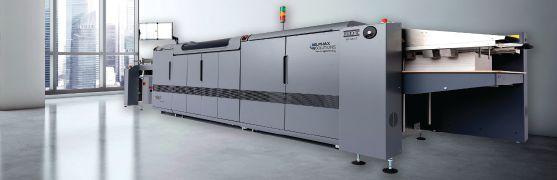
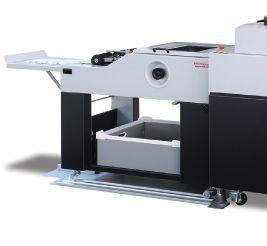
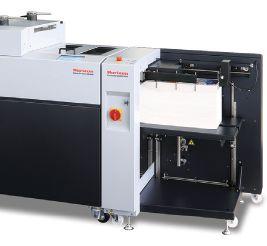
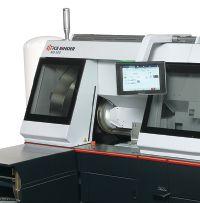
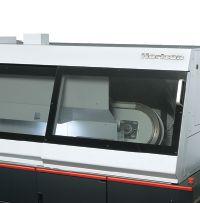
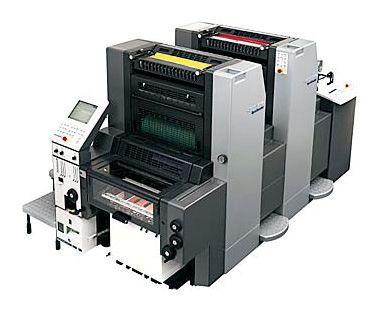
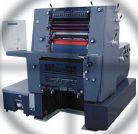
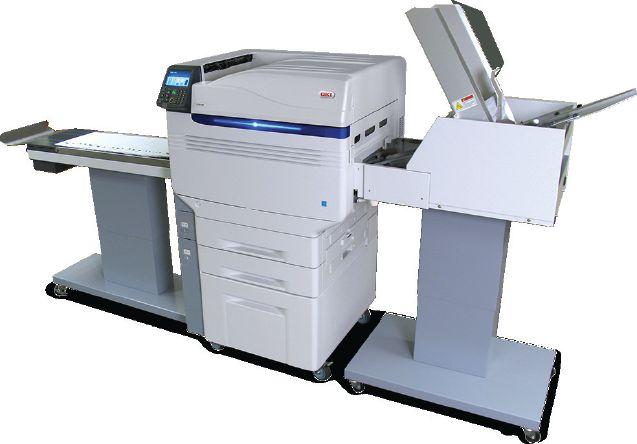
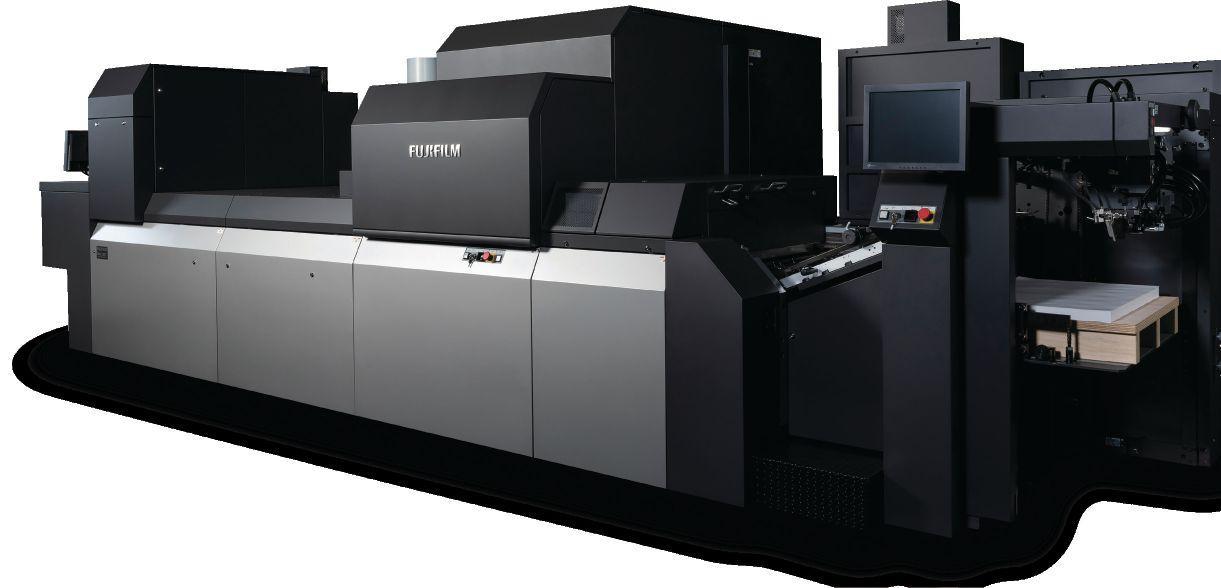
The Standard Horizon BQ-500 Perfect Binder features the quickest set-up and changeover for variable book production in its class, especially for book-of-one.
• PUR-friendly design with gentle delivery system for 5mm drop and low temperature setting
• Easy glue changeover, between PUR and EVA
• Automated controls for adjusting roller height, nipping height, and amount of side glue
A Cut, Fold & Stitch Above
RM Machinery has partnered with Standard and Horizon—the world leader in finishing solutions including folding, binding, stitching and cutting—to provide fully integrated finishing solutions that take your print products from the pressroom to the marketplace. Get ahead of the fold by contacting RM Machinery at 855-RMGT-123 or visiting us online: www.rmmc.ca.
Rotary Die Cutting
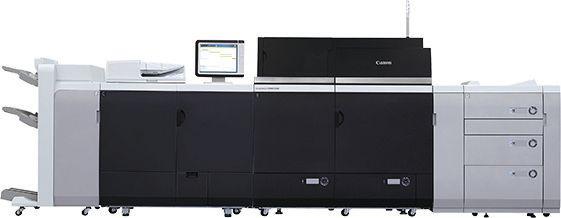
With dual magnetic cylinders, the RD-4055DMC Rotary Die Cutter is designed to simultaneously die-cut and crease/score short-run product from both sides of the sheet. It can also perforate, slit, hole punch, and round corners in one process for digital and o set printed sheets.
• Crack-free creasing and clean, sharp creases
• Multiple-up applications from single-up die
• Handles complex creasing patterns and light packaging applications
Equipping Canada to cut, fold, stitch and print.
RM Machinery Inc.
905-238-9797 • 1-855-RMGT-123
5250 Satellite Drive, Unit 9 Mississauga, ON L4W 5G5 www.rmmc.ca
FEATURES
12 Reading the data
Automated offset presses can help a shop form future plans
14 The right exit
Business succession planning for privatelyheld firms
DEPARTMENTS
GAMUT
5 News, Calendar, People, Installs
TECH REPORT
Manage with data: Tools for empowerment 14 8 22 12
18 A look at the latest releases in the plates and imaging hardware space
NEW PRODUCTS
19 Detailing new products and solutions from Xeikon, Domino, ArconvertRitrama and Canon
SPOTLIGHT
22 Ernie Crawford, president and CEO, Crawford Technologies
A chance encounter: How three Americans created the folding carton industry
INSIDER
10 Bob Dale
Preparing for the future
What has the pandemic taught business owners?
For many in our essential industry, it has instructed business owners on how to operate with agility, so that even the worst storms can be weathered.
Montreal-based Ultimate TechnoGraphics recently released a whitepaper called Future-Proof your Print Business, Part 2, which follows up from Part 1 released in April of this year.
product and services portfolio, it is vital to develop a long-term strategy to capture your share of the developing and changing markets.
Part 2 of the whitepaper sees Zwang use case studies from real printers who have successfully implemented a future-proofed print production process, including details on why they decided to make the switch and tips on how every printer can future-proof its own business.
Bob Dale, Linda K. Fairburn, Gary Forget, Nick Howard
Associate Publisher Stephen Longmire slongmire@annexbusinessmedia.com 416-510-5246
Media Designer Lisa Zambri lzambri@annexbusinessmedia.com
Account Coordinator
Alice Chen achen@annexbusinessmedia.com 416-510-5217
How much the global printing market is expected to grow on an annual basis by 2024, according to the Smithers Global Printing Market Forecast. It is expected to top US$874 billion by that time.
Written by industry analyst and author David Zwang, Part 1 looked at market opportunity and basic workflow concepts that can help future-proof print businesses to address the many pressures on print, publishing and packaging service providers. According to the whitepaper, many PSPs have not made the necessary internal changes to suitably address these demands, which is why the whitepaper has proposed some solutions that it says can be implemented to help future-proof growth.
“Future-proofing means looking for best-in-class solutions that offer scalability and flexibility. David Zwang’s whitepaper offers some great insights on what Print Service Providers should consider when looking at futureproofing their print workflow.”
According to the Smithers Global Printing Market Forecast, it is estimated that the printing market will grow by 1.3 per cent on an annual basis, and it is expected to top US$874 billion by 2024. While this is going on, it is also projected that the share of digital in the market will increase from 15.7 per cent in 2017 to 19.3 per cent by 2022, as the next generation of presses increases productivity and quality.
The whitepaper finds that whether you are a PSP looking to grow your margins or expand your
“The pandemic of 2020 has created some hardships but taught us some very valuable lessons,” said Zwang, in a press release following the release of the white paper. “Social distancing has limited the amount of people in the same business at one time, meaning we have to do more with less. In addition to that, remote working has become part of the ‘new normal’. Creating a holistic and collaborative workflow internally and externally, and how you do business with your customers, is no longer a niceto-have. It is a critical business decision.”
This study-based report helps provide PSPs with some tools to protect their business from health, economic, social and other unexpected difficulties that can happen now or in the future.
“Digitalization has already transformed the print industry, and will continue to do so in the next years,” says Julie Watson, CEO of Ultimate TechnoGraphics. “Future-proofing means looking for best-in-class solutions that offer scalability and flexibility. David Zwang’s whitepaper offers some great insights on what Print Service Providers should consider when looking at future-proofing their print workflow.”
Speaking of preparing for the future, this issue, succession planning expert Linda K. Fairburn discusses how privately-held firms can start their own business succession plans (p. 14). This issue also features a rundown on automated sheetfed offset presses and how the data they gather can be used (p. 12), and a Q&A with Ernie Crawford, president and CEO of Crawford Technologies, on his company’s new training courses to help others better understand document accessibility (p. 22).
PrintAction is printed by Annex Printing on Creator Gloss 80lb text and Creator Silk 70lb text available from Spicers Canada.
ISSN 1481 9287 Mail Agreement No. 40065710
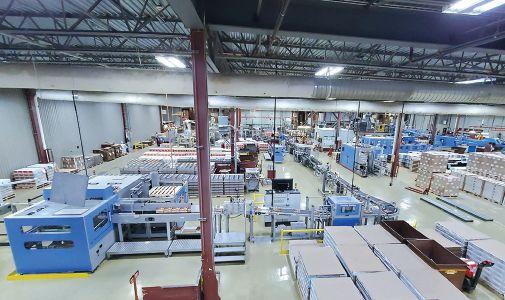
TC Transcontinental Printing has announced it has invested over $10 million over the past eight months into its book printing platform in Québec, mainly at its Transcontinental Interglobe plant in the Beauce region.
The investments have allowed the plant to improve its manufacturing efficiency to better meet demand from North American customers and the fast delivery times expected by the market, while reducing its environmental footprint.
Most of the investments were used to purchase robotic equipment installed in the binding and bagging departments in order to increase production capacity and speed, while reducing the use of the local workforce, given labour constraints in the region. Some of the investments have also been allocated to modernize the colour systems on web and sheetfed presses to improve register control and colour reproduction.
Canadian
Print Scholarships has announced that it will be awarding 76 scholarships to students in five graphic communications programs across Canada for the 2020/2021 academic year.
“With support from industry, Canadian Print Scholarships has provided scholarships to hundreds of graphic communications students. The financial support helps cover the high cost of a college or university education. Upon graduation, these students bring the skills, energy, and ideas we need to keep our industry moving forward,” said Jeff Ekstein, chair.
Digital printing, display graphics and packaging are just some of the many areas of study for students in graphic communications programs.
Hemlock Printers has announced a further expansion to its ZERO Carbon Neutral Printing Program. Hemlock has teamed up with Rolland, a Quebec-based mill, as part of the initiative to embrace “the companies’ commitment to the circular economy by reducing and mitigating CO2 emissions throughout the paper and printing supply chain lifecycle.”
Over the last two years, Hemlock’s ZERO program has expanded its availability of carbon neutral papers and products. Now, the program is expanding with the addition of Rolland Enviro 100% PC, an FSC and Ancient Forest Friendly certified 100 per cent post-consumer waste paper, which is now automatically carbon neutral when specified by the customer.
Rolland says its manufacturing processes demonstrate the company’s commitment to the circular economy and reducing emissions. “From recycled fiber sourcing to biogas energy supply to closed-loop water systems and hydrogen peroxide bleaching processes, their recycled paper is one of the most environmentally sustainable in North America.”
The now-100-per-cent carbon neutral sheet also provides Hemlock’s customers with high quality and cost-effective options with Enviro Satin and Enviro Cover sheets that can be used for both offset and digital print projects. Swatch books and samples are available from Hemlock and its representatives.
A
Ricoh Europe has announced plans to renew its focus on developing virtual client communication via different channels due to the ongoing threat of the coronavirus pandemic, including a series of virtual events. In addition, Ricoh Europe has announced it has withdrawn from drupa 2021. Ricoh cites the health and safety of its clients, partners and staff as the reason for its withdrawal.
In addition, Canon has announced it is has also pulled out of exhibiting at drupa 2021, due to the concerns and risks involved with travelling and gathering large groups of people at this point in time.
Konica Minolta, Inc. has also
announced that it will not participate at drupa 2021, instead choosing to focus on new digital or hybrid formats of engagement with its target groups.
“Our highest priority is always to make sure that our customers, colleagues and all their families stay safe and healthy. And while the coronavirus pandemic continues to disrupt on a global basis, we have taken a decision to withdraw our physical presence from drupa,” said Toshitaka Uemura, executive officer, division president of Professional Print Headquarters at Konica Minolta, Inc.
My Press Needs (MPN) and Manroland Sheetfed have teamed up on a new sales and marketing partnership, which will see Manroland Sheetfed North America represent MPN’s Crest Clamshell product line throughout the U.S., Canada and Mexico, effective immediately. The partnership will provide Manroland with exclusivity in the packaging, corrugated, publishing, commercial printing, point of purchase display/retail graphics markets.
Transcontinental Inc. has announced that it is closing its last printing plant in Winnipeg, Man., which currently employs 93 workers. The plant, which prints magazines and flyers, is scheduled to shut down by 2021, although workers will be let go as the work load lessens. The workers at the plant are members of Unifor Local 191. Over the past 15 years, Transcontinental has closed 20 locations in Manitoba. In addition, this news comes after Transcontinental committed to at least five years of production in Winnipeg, with the possibility of extending to 10, only two years ago, a move which Unifor western regional director Gavin McGarrigle says will “effectively kill large-scale commercial printing in the province of Manitoba.”
Transcontinetal’s Interglobe plant has seen over $10 million in investments this year to help advance its book printing platform.
swatchbook of Rolland’s Enviro 100% PC paper, made from 100 per cent post-consumer waste.
Jeff Ekstein
Crawford Packaging has announced that Doug Crowe will take on the role of regional sales manager for Southwestern Ontario, tending to the packaging needs of all market sectors in the region, including produce, distribution, food processing and industrial. Doug has been with the company for 30 years.
As regional sales manager, Doug will manage a team of sales representatives to service all customers in the region, a sales model that is new to Crawford. The team will work together to serve all accounts in the region.
RM Machinery has hired Virginia DaCosta to its Canadian team to drive sales of its core products. Virginia brings over 20 years of experience to the role, selling consumables for companies in the graphic arts industry, including Ernest Green & Son, Presstek and Heidelberg Canada
As RM Machinery’s sales manager based out of Montreal, Que., Virginia looks forward to providing eastern Canadian printers with customer service and solutions to help them capture more business.
Standard Finishing Systems has hired Karl Belafi as territory sales manager for eastern Canada. Karl has been in the industry for 27 years, since starting his career at KBR Graphics , his family’s business.
While at KBR, Karl was able to learn the industry from all angles by holding positions including service technician, horizon operator trainer, marketing manager and director of sales & major accounts. Karl is very familiar with Standard’s lines of finishing solutions, as they were the top product lines at KBR for over 32 years.
Francisco Soto , Rotocontrol ’s director of sales for Latin America and the Caribbean, has just added Canada to his portfolio of responsibilities.
Francisco brings over 14 years of experience in label finishing machines to the role, as well as a degree in Electronics and Engineering Technology, fluency in English and Spanish, and a strong connection to the print industry due to his previous role at Rotoflex as international sales manager.
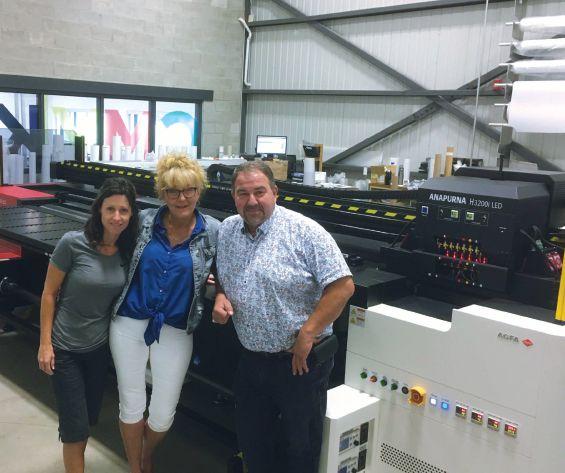
Publiforme, a Sherbrooke, Que.-based signage company, recently acquired a new Agfa Anapurna H3200i LED, a hybrid UV LED inkjet printer that can print rolls or rigid media up to 10 feet in width. In addition to its versatility, the printer boasts high print quality and productivity, with average print speeds of up to 600 square feet per hour.
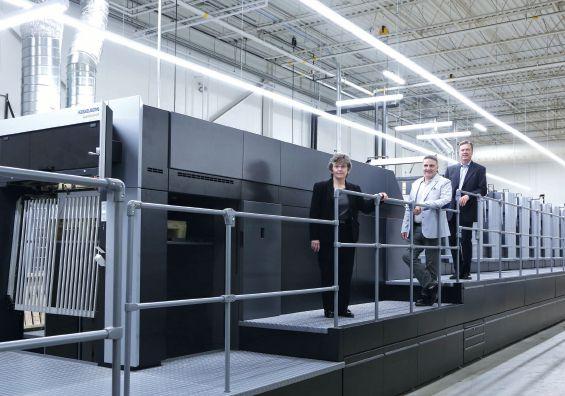
Bellwyck recently installed a Heidelberg Speedmaster CX 102-8+LY-1+L with “Push to Stop” technology at its Toronto plant. The press’ custom configuration includes nine printing units, two coating stations and UV capabilities, and is the longest press of its kind in Canada.
Brandford, Ont-based Wholesale
Pocket Folders & Trade Only
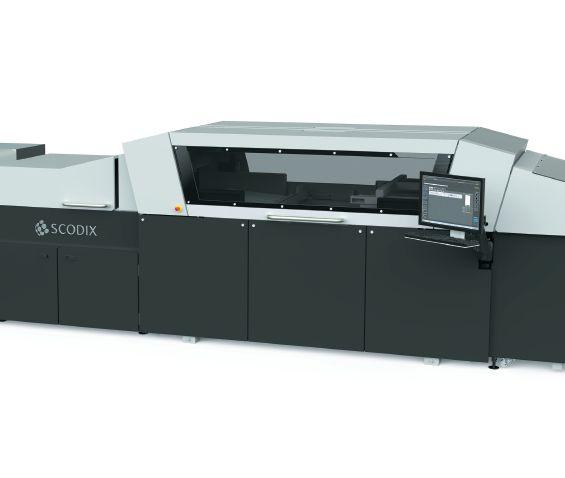
Folders has installed a new Scodix Ultra 101 digital enhancement press to help support the company’s finishing capabilities with various printed products. The press supports up to six different embellishment options.
November 9-12, 2020
PACK EXPO Connects 2020 Online
March 9-12, 2021
FESPA Global Print Expo 2021
Amsterdam, The Netherlands
April 15-17, 2021
Graphics Canada Mississauga, Ont.
April 20-30, 2021 drupa 2021 Düsseldorf, Germany
June 8-10, 2021
Labelexpo Americas 2021 Chicago, Ill.
June 8-10, 2021
Brand Print Americas 2021 Chicago, Ill.
June 10, 2021
DIA Annual Golf Tournament Aurora, Ont.
August 12, 2021
OPIA Toronto Golf Classic Brampton, Ont.
Sept. 9-11, 2021
Sign Expo Canada 2021 Mississauga, Ont.
Editor’s note: Please note, we’ll be postponing the Canadian Print Awards until further notice. However, we’ll still be accepting submissions produced from August 31, 2019 to August 31, 2020 once nominations open. Please stay tuned for more information.
“Welty somehow caught wind of the need to bend and cut steel rule into intricate shapes for use in paper labels and gaskets.”
A chance encounter
How three Americans created the folding carton industry
By Nick Howard
Despite what is currently on display now in the United States, both politically and in relation to COVID-19, it doesn’t impact how I see Americans overall. A great deal of my business life has involved working with our neighbours to the south, and I always found Americans more progressive than the rest of the world. It seemed that selling in the U.S. was much more accessible due to Americans having a more open and broad appreciation of whatever you were selling. It appeared they cared less about the little things and instead focused more on what the machine was able to do, and how it was able to make money for them. Americans tend to look forward, not backward. Perhaps this explains why so many genuinely great innovations come out of America.
Three innovators used this willingness to invent to take a unique idea and develop it. In 1853, 14-year-old Robert Gair arrived in New York City from Edinburgh, Scotland. An enterprising young man, in 1864, Gair soon set himself up as a paper jobber (buying and selling paper and cardboard goods) at a remote location in Brooklyn. With the arrival of newly-invented corrugated materials before 1870, Gair invented several machines to manufacture these fluted corrugated sheets. The idea of a paper box was still
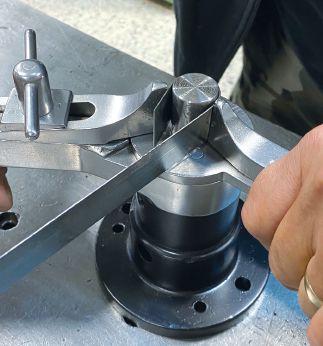
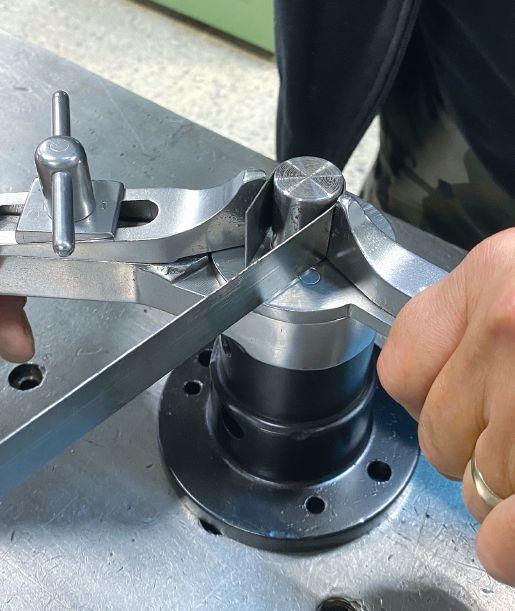
An operator forcing a Welty steel (hardened) rule (ca. 1902 and restored at Howard Iron Works Museum), to bend around the central round anvil.
in its infancy, as most goods were either wrapped in paper with string or placed in veneer-wood boxes.
In 1879, Gair went further and was credited with the machine invention that would produce “folding boxes.” In so doing, he is also credited with manufacturing the first pliable steel rule. The use of a metal rule was first attempted earlier when Gair had been manufacturing flat-bottom paper bags. One day a simple metal ruler used to crease the bags shifted, and instead cut a bag. That mistake lead to the discovery that in using a steel rule, both scoring and die-cutting were possible simultaneously, which prompted Gair to go on to manufacture prefabricated boxes. Later in 1887, the British printing giant E.S. & A. Robinson (soon to be known as the Dickinson Robinson Group) caught wind of Gair’s break-
through and brought the technology back to England.
An old process called “dinking” actually predated Gair’s invention but not in the paper industry. Shoe manufacturers developed a sharpened die to cut out various shoe and boot parts appearing in the mid19th century. Although occasionally used to punch metal, dinking techniques were closely held and seemed bespoke to shoes, and possibly other leather goods.
Along the way, Gair would amass a sizable fortune in New York City real estate, primarily in an area called “Down Under the Manhattan and Brooklyn Bridge Overpasses,” which the locals refer to as DUMBO.
Robert Gair set about patenting his invention in 1879. He referred to it as “the improved apparatus for cutting and creasing paper in the manufacture of paper boxes” when he swore an
oath for a U.S. patent application. Unfortunately, Gair never completed the paperwork, and a U.S. patent was never granted to him. During the remaining years of the 19th century, the steel rule concept spread around the world as various industries appreciated its usefulness and labour-saving profitability.
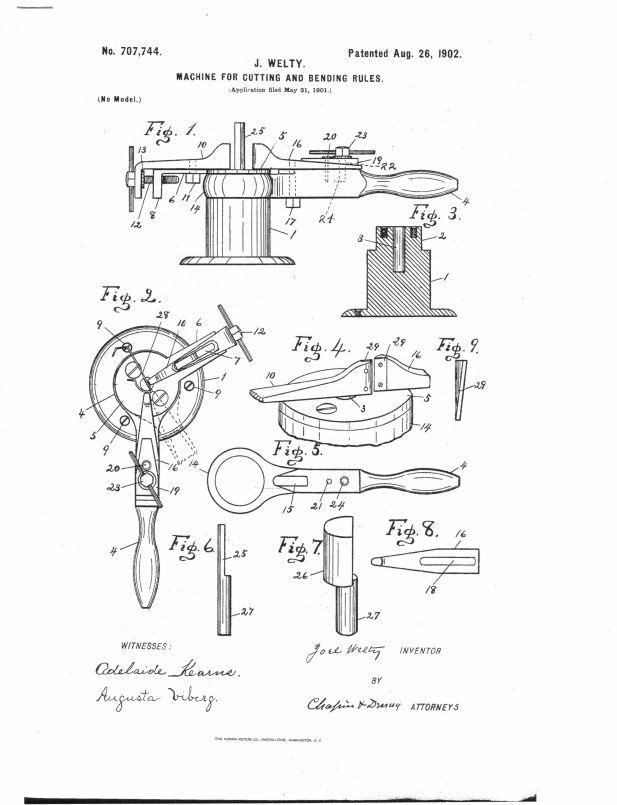
Meanwhile, fast forward to Fort Wayne, Indiana, and an inventor by the name of Joel Welty. With no previous experience in the printing industry, Welty somehow caught wind of the need to bend and cut steel rule into intricate shapes for use in paper labels and gaskets. The device he would invent, in 1902, would form the next critical phase of steel rule die development, now including the growing paper-box industry. Branded the “Multiform,” this little gadget borrowed from similar technologies used in the sheet metal industry.The Iron-Worker, a multifaceted tool, still in everyday use, showcases some basic concepts Welty applied to invent his little bender. When I say little, I mean little, as it weighs less than 10 pounds with two levers working in an arc around a center mandrel. Just bolt it to a bench, and you were ready to use it. Welty sold quite a few; however, one lucky sale Welty made was to the Fort Wayne Paper Box Company.
The final phase would not appear until shortly after Welty died in 1910. On a spring day, John Richards, who hailed from Albion, Michigan, was returning to the train station after visiting his brother. The path took him past the Fort Wayne Paper Box building, and through the window, Richards noticed a young man using an unusual tool to bend steel rule. He enquired and found out that the device was made across the street. Off Richards went to meet Welty’s widow and purchased the patents, patterns and business of the J. Welty Co in a very short time.
As written later in Richards’ book, The Art of Die Making , he says, “[Welty] had sold [Multiforms] all over the world, but in a remarkable coincidence, I first saw it where it was designed and built.” No stranger to the printing industry, Richards had worked as a mechanic for the Miehle Printing Press Co. then the Campbell Printing Press Co. In 1906, Richards would start his print shop, which included making dies and even designing a bender.
Richards’ fortune would result in a dynamic business that would become the centre of a booming die-making industry – the J.A. Richards Company. Months later, the firm improved the original Multiform bender with a patent issued in 1911 and made substantial changes by 1913. With his growing family, which would eventually include ten children, Richards needed a bright mind and the urgency to support his brood. In 1916, the company relocated to Kalamazoo, Michigan. Rapid new developments in tools to manufacture complex shapes and now using Lignostone base plywood uncovered a further unique opportunity for Richards as these boards needed kerfs cut. Complex machines incorporating a jig-saw, drill and saw made it easier for a skilled die maker to create the inlay necessary to fit the rule.
Indeed, most of the printing and paper box industry is familiar with the J.A. Richards Co, but steel rule travels far beyond print. Metal punching proliferated with everything from fan blades, automotive body panels, and even aircraft com ponents “punched” with equipment made in Kalamazoo. Then there are the gasket and fabric/leather industries, which quickly noticed the massive production savings using a hardened flexible rule that could be bent to any shape.
The J.A. Richards Co would re main in business until 2003. They prospered in both good and bad economic times, continually in venting and improving all sorts of die-making machinery. They also supplied special tooling, blank ing-dies and die-board. However, the paper box industry was rapidly changing.The arrival of the laser, to cut a die board, started to eat into sales of mechanically jigged dieboards, and with it went the die-saw business.
Furthermore, computerized tools to bend the rule had left Rich ards without an answer in this seg ment as well, although thousands of Richards’ tools are still in use for smaller jobs or emergency rule re pairs.
Today the remnants of the J.A. Richards Co are owned by the Porth Products Co in Paw Paw, Michigan. It was during an after noon conversation with Mr. Karl Porth that I learned of the demise
1879
The year Gair was credited with the machine invention that would produce “folding boxes.”
of J.A. Richards Co. I had called him to see about a replacement spring for a Richards cutter we were restoring for the Museum. Although familiar with the company, having bought and sold quite a few of their tools in the past, I had no idea of Richards’ historical background and mostly how vital Mr. Richards was in developing today’s flourishing paper-box industry. During that call, Porth mentioned he had an original Welty “Multiform” from pre-1910 and was gracious enough to donate it to our Museum.
We are indebted to Mr. Porth and also to the American spirit, which may not seem beaming as bright in 2020. I’m confident our “can-do” neighbour will be back again soon to continue bringing the world revolutionary inventions!
NICK HOWARD, a partner in Howard Graphic Equipment and Howard Iron Works, is a printing historian, consultant and Certified Appraiser of capital equipment. nick@howardgraphicequipment.com
Manage with data
Providing some tools for empowerment
By Bob Dale and Gary Forget
Successful change management is the greatest challenge for most companies, re gardless of size. Whether it is onboarding a new client or implementing a new Enter prise Resource Planning (ERP) system or Management Information System (MIS), change management is critical.
Implementing a new ERP system is one of the most challenging and disruptive changes that can be done. If it is not done right, it can have a devastating impact.
Change management is a science and requires dedicated effort and experienced project management disciplines in order to be successful. It is the process, tools and techniques to manage the people side of change that achieves the required business outcome. Today, we want to focus on one company that has successfully implemented a new ERP system.
tools they were acquiring.
Their technology focus led them to a new ERP system, which had to meet several criteria, the most important being ease of use and the utility of the reports to the employees.
Leadership – Empower your employees
Leadership – Hands-on approach
Richard Kouwenhoven is president and COO of Hemlock Printers in Burnaby, BC. Based on some points made at a recent Industry Leaders forum, here are some insights he shared during a recent interview. In 2016, Hemlock identified the need for a new ERP system and had a number of specific requirements. One area of focus was the effective use of data to empower the business development efforts of the company’s sales team. In Richard’s words, he wanted to, “expand their role from hunter-gatherer to services provider.” After looking at a number of options, they realized they needed to focus on the reporting power of an ERP system. Given the rapid changes in technology and
Since it was an ERP, it had to have connectivity across all processes, integrate all applications end to end and help transition to a more participative culture. As a result, with tools that empower the employees, performance management is quite different with such a system in place.
With the transition affecting everyone, the impact on people needed to be the key focus, not the technology and equipment. Richard ensured everyone understood why the change was necessary and the benefits from all perspectives.
The senior management team invested a significant amount of time into the process. Similarly, they asked their employees to commit to learning and using the tools. With younger employees, the need to share goals and involve the team early on was apparent. Whether it was one-on-one or in town hall
meetings, personal, interpersonal and formal means were used to manage through the changes.
What are the notable differences? On the employee side, personal growth has expanded. Everyone participates in strategic goal setting and the reports available online give them real-time access to their status and much greater visibility into what’s going on throughout various departments.
The sales staff now have relevant data on prospects and clients, sophisticated reports with real time charts and diagrams. Simpler jobs can be estimated by the sales staff, providing faster customer response, and freeing up the estimators to focus on more complex projects.
A word of caution to those who make major change initiatives: focus on the people side of change, and ensure that the leadership team remains involved. We wish you continued success!
Bob Dale and Gary Forget are with Connecting for Results Inc. Their focus is to facilitate mergers and acquisitions that maximize results for all parties, and provide recruitment and consulting services. They can be contacted at info@connectingforresults.com or visit https://connectingforresults.com
silver? more in Are words worth
xerox.ca/beyondcmyk
READING THE DATA
Automated offset presses can help a shop form future plans
By Kavita Sabharwal-Chomiuk
Competition and efficiency are just two reasons why analytics are important to a print shop. In a recent webinar about the Smart Print Shop held by Heidelberg and moderated by PrintAction, industry players highlighted how they were able to use the data produced by their automated offset presses to plan the rest of their equipment acquisitions and process flows. Here are just a few reasons why a smart print shop, and automated equipment, are helpful for printers.
Training and development
In terms of training and professional development, April Burke, vice president of operations at Bellwyck, pointed out that analytics and data points can help a printer decide on plans for skilled trade operators. She also noted that data produced by an automated offset press helps an operator understand a shop’s capacity loading and operations, and aids in driving some decisions.
“They’re more informed decisions, as opposed to the emotional decisions that we can get caught up in,” she said. “It doesn’t take away that this industry is a very tactile and sensory industry where we still have that emotional connection to the visual product that we produce.
However, we need to remain competitive and lean at our operations and become more efficient and when we can really do that is by understanding, truly, how your machines are operating.”
According to Richard Kouwenhoven, president and COO at Hemlock Printers, the data provided by automated offset presses helps operators see how they’re doing against benchmarks. This is something Hemlock is really focusing on right now, he said, adding that the company is designing a new dynamic feedback system for operators.
“We’re spending a lot of time on that kind of design for the reporting system because we don’t want it to be a rear-view mirror; we want it to be live to the operator because it’s not really that valuable when it’s a month old,” he said. “For a press operator, [we’re focusing on] what kinds of cues help them change their habits or give them some feedback to how they’re measuring against the standard without it being overbearing or negative.”
Workflow mapping
During the webinar, Kouwenhoven added that every shop is different, and it takes quite a bit of commitment to get the data out of the printer, and then be able to use it effectively.
Using and reporting the data created by Hemlock’s automated offset presses is where the company is focusing its efforts now. In order to manage and analyse the data being created by Hemlock’s automated offset presses, the company hired an intern to help with some workflow mapping, which has now become a full-time data and workflow analyst position.
“It is no small undertaking,” he said. “This person is in high demand at our company because every department wants to map and dissect workflows. We really didn’t have that role in the company, and now it’s a central role.”
The data and workflow analyst at Hemlock helps administer the analysis and the reporting, something which Kouwenhoven said is becoming invaluable because it’s helping the company tackle some long-term tasks, such as sales reporting.
“We’re really just at the beginning of that journey, but I’m quite excited to see what we’re going to be able to
accomplish in the next year or so,” added Kouwenhoven.
Process flows
Within a short time, Hemlock realized a 75 per cent reduction in make ready waste once it implemented its latest automated offset press.
For Jay Mandarino, president and CEO of CJ Graphics, the data is important to track jobs and determine whether the company is charging enough for a job, or other client-related decisions.
“We use it for more than just tracking automation, we use it for all aspects of our operation,” said Mandarino. “It shows all the special colours we use. How many special colours, how many long run jobs, short run jobs, so we’re able to plan production-wise; we can guesstimate, we can come up with averages.”
According to Mandarino, the data is also vital for making decisions such as getting like-minded machines and technologies to “talk to” one another.
“With the machines and manufacturers willing to work more together than they used to and share information, we can track a lot of things that we couldn’t track before, but some [manufacturers] don’t allow their
pact how a print shop operates because challenges could arise that a shop perhaps did not recognize as challenges, but that’s precisely the value of analytics that come out of automated presses.
Mandarino agreed. “In this day and age, data is more important than ever. I mean, we’re not just using data in our pre-press, we’re using it in our mail division,” said Mandarino. “We’re using it when we’re doing variable data and selective marketing campaigns. And all these bits of information put together help come up with how we’re going to do certain things.”
“I think what we’re trying to do is not just use that data that is in our manufacturing to improve our productivity and quality, but we’re also trying to figure out how to use that data further upstream to benefit the planners and the estimators so you get a real-time picture on how we’re performing against their standards, and also to add value to the customer experience,” added Kouwenhoven, mentioning order status or auto-
“They’re more informed decisions, as opposed to the emotional decisions that we can get caught up in.”
machines to talk to other machines, so it’s hard to get that full integration when you’re using all different types of machines,” said Mandarino. “If they don’t all talk to each other, it’s hard to track some of that stuff.”
Operations
Burke added that the data can im-
mated pricing as two examples. “I think that’s the thing that can give a printer a competitive advantage, if you’re able to leverage that insight to the customer in a variety of ways. Those printers that are able to harness that information and make it travel upstream, I think they’re going to do well.”
THE RIGHT EXIT
A look at business succession planning for privately-held firms
By Linda K. Fairburn
You own and operate your own business. You are one of those people who enjoys the challenge of being your own boss, the master of your own destiny.
Now you are about to take on one of the greatest challenges to face any business owner — preparing and choosing new leadership for the business and planning for the transfer of its ownership. In short, the challenge of succession planning.
Whether it’s because you’ve reached an age where retirement has ceased being an abstract concept, a friend or family member has recently passed away, leaving you to wonder what your family would do in the same situation, or questions have started to arise from your children about the roles they will play in your
company’s future, you’re not alone.
According to surveys conducted by Deloitte (2020) and PwC (2019):
• Ninety per cent of North American privately held businesses are family firms.
• Thirty-five per cent of Fortune 500 companies are family controlled.
• Forty per cent of the leaders of these firms plan to retire in the next five years.
• The mean age of the leader in family-controlled companies is 60.2.
• Eighty-two per cent do not have a formal succession plan.
What
is succession planning?
Simply put, succession planning is all the thinking, planning, preparation
SOURCEYOURFOR EVERYTHING WIDE FORMAT
NAVIGATE OUR ONLINE PRODUCts BY APPLICATION, BRAND AND Helping you get back to business
and activities that take place in anticipation of and before a defined departure date.
In private companies, succession planning is a process that involves personal ownership, familial considerations and organization development. This process can be complicated further if accounting for family members working in the business, multiple shareholders, several businesses, high net worth and the desire to treat heirs equitably in estate planning.
The succession planning process
Succession planning means many things to many people. To some, it is an estate planning or financial planning task.To others, it is just a part of the strategic planning process.To still others, it’s about ensuring that management and executive leadership positions are filled by qualified people — a training and development task.
In my experience, the most effective succession plans are the ones that have been developed using an integrated, holistic approach. Each part has been undertaken with the whole in mind.
Succession planning is a component of strategic planning, yet just having a sense of what you’ll do is not a plan. In fact, only 18 per cent of privately held companies have one. There is a perceived lack of urgency to develop a formal exit plan that gets attention only when there is an unexpected accident, injury, illness or death. In the absence of a succession plan, any of these situations can become a crisis.
If you found out you only had six
months to live, would you want to tackle your bucket list, or would you rather spend that time selling your business?
The best time to sell your business is when you don’t have to. And the best reason to sell is when you’re retiring. But without some thought and preplanning, it’s doubtful business owners will be able to sell when they’re ready because they don’t have an exit strategy and haven’t taken the steps necessary to get the full value for their businesses.
Are you ready?
Succession planning can seem overwhelmingly complex. It necessitates assessing the competencies of all involved parties. It involves personal issues, family issues and business management issues as well as legal, financial and taxation issues — all of which touch upon each other in a variety of ways.
In my experience, the minimum amount of time required to develop a succession plan is 2.5 years, but can be much longer if you intend to transfer ownership to second generation children working in the business.
Where to start? Here are a few suggestions.
1. Have a Business Valuation prepared by a professional who sells businesses, is aware of the current marketplace and who can:
• Lead you through the sales process;
• Recommend structural reorganization to minimize taxes on transition;
• Facilitate a long-term strategic planning program;
• Perform a due diligence analysis of your business from a potential buyer’s perspective to identify corrective actions;
• Help you set up an advisory board of outside expertise;
• Identify property and/or excessive cash in the business that may disqualify your capital gains exemptions; and
Succession planning is a component of strategic planning, yet just having a sense of what you’ll do is not a plan.
• Refresh the valuation annually until you’re ready to sell.
2. Assess future wealth requirements and the need for restructuring to reduce after-sale taxation that may require share redistribution and take two years to crystalize.
3. COVID-19 has provided a unique opportunity for any kind of ownership transition over the next one to two years where it would be advantageous to have a lower share value.
4. Business-owning families must pay special attention to the preparation of their children to step into the ownership circle through education, training, participating in strategic planning and assessment of their capabilities to work together and to fill your shoes. While children may already be working in the business, it will take several years in leadership and decision-making roles to create a cohesive family team.
You can come to succession planning from any number of directions. Whatever the approach, it is a process that every business owner has to deal with sooner or later. The world is full of business owners who unfortunately neglected to prepare a qualified, experienced successor or failed to put the financial structures in place that would fund their retirement and reduce taxation.
Your willingness to confront the task is in your hands. Effective planning can mean the difference between a smooth transition and chaos for your business. Everyone grows old, but effective planning can allow you to maintain control of your destiny in your “golden” years.
Linda K. Fairburn is an expert in succession planning and the bestselling author of Exit Right: A guided tour of succession planning for families-in-business-together. Her company, Make Things Happen, offers consulting, training and coaching to support succession planning and leadership change in family businesses.
SPOT UV FOIL
Luxury Business Cards
Luxury Presentation Folders - 9x12
16 pt - Soft Touch Laminated 4/4 CMYK + Raised Spot UV or Raised Foil (Gold or Silver)
16 pt - Matte Laminated 9x12 4/0 CMYK + Raised Spot UV or Raised Foil (Gold or Silver)
Luxury Greeting Cards - 8.5x5.5 16 pt - Soft Touch Laminated 4/4 CMYK + Raised Spot UV or Raised Foil (Gold or silver) 1 Side Only
The bigger picture
A
look at the latest releases in the plates and imaging hardware space
Flint Group Catena+
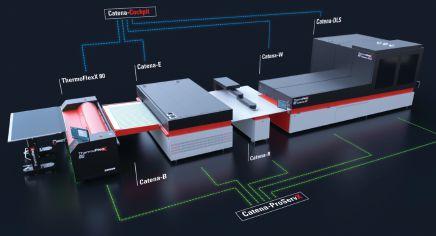
Flint Group recently announced its Catena+ fully automated plate processing line, featuring equipment modules Catena-E (UV LED exposure), Catena-W (solvent plate processor) and Catena-DLS (dryer, light finisher and plate stacker combination with robotized plate transport). The modular system can join together for various levels of automation with minimum operator intervention.
A Catena-DLS module can be connected to a Catena-W for automatic plate processing. The Catena-DLS has 10 drying units, 7 stacking positions and a light finisher. Robotic movements ensure plates are fully finished with no operator intervention after loading into the washer.
Catena+ brings everything together, resulting in fully automated flexo plate making. Once the operator has removed the cover sheet, the plate is automatically loaded into the imager, and is completely processed and fully finished with no further operator interventions required, eliminating any possible damage from manual plate handling.
Designed as an open system, Catena+ allows easy loading of plates from other imagers into the Catena-E LED exposure unit. Plates from other exposure frames can also be loaded.
Flint Group recently announced its Catena+ fully automated plate processing line.
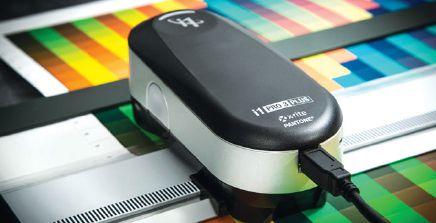
The redesigned i1Pro 3 spectrophotometer claims to be more accurate and reliable as well as two times faster than the previous model.
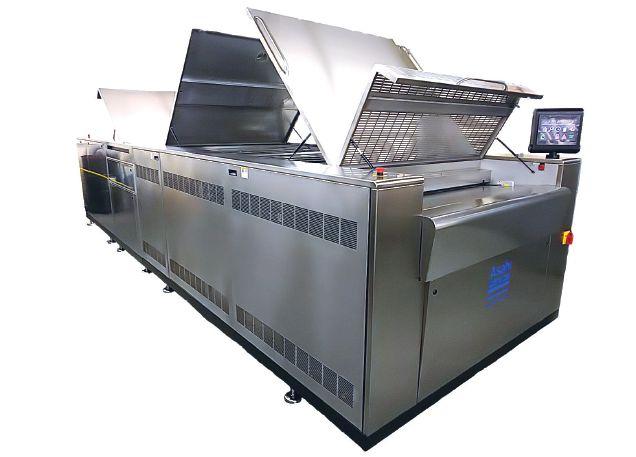
The AWP-DEW 4260 PLF is the first water-wash processor of its kind with an automated process from plate wash-out to the UV finished plate.
Asahi AWP-DEW 4260 PLF
Asahi Photoproducts’ next-generation larger format water-wash flexographic plate processor, the AWPDEW 4260 PLF, is the first water-wash processor of its kind with an automated process from plate wash-out to the UV finished plate including plate processing, rinsing, drying and UV post exposure within one system. This processor follows up Asahi’s 1116PD processor with new features, including:
• Integrated plate punching system for pin bar
• Integrated air knife after plate rinsing unit to dry the plate
• Higher post-exposure uniformity with inline UVA and UVC light finishing
• Filter unit is located inside the machine with easy roll-out operator access
• New machine maintenance concept including low maintenance pumps and easy pipe layout
• Water safety tray located on the side frame without the need to clean leaked solution
The system is designed to be able to use two standard formats at approximately three to five plates per hour, either 1200 x 900 mm or 1067 x 1524 mm. In addition, the product is an automated combination of washer-dryer-light finishing, providing the opportunity for reduction of
operator hands-on requirements and any potential associated errors.
The product also has a modem communication link to the processor’s human machine interface (HMI), allowing Asahi’s technical support team to connect with the machine from any location.
AWP-DEW digital flexo plates can be used with UV, EB, waterbased and solvent-based inks and help ease the transition to Fixed Colour Palette printing. Asahi says they also deliver improved plate lifetime on press.
X-Rite i1Pro3
X-Rite and Pantone LLC have launched the i1Pro 3 spectrophotometer. X-Rite says the redesigned spectrophotometer is “more accurate and reliable as well as two times faster than its predecessor.”
The i1Pro 3 can be used to track and verify monitor and print quality and capture spot colour measurements. According to X-Rite, the product offers a custom, full-spectrum LED light source; measures M0, M1 and M2 simultaneously in a single pass while accounting for optical brighteners; reads smaller patch sizes twice as fast as the i1Pro 2 with improved accuracy; achieves correct calibration on ultra-bright displays; and more.
“The third-generation i1Pro takes colour management to the next level by significantly improving on device speed and supporting new high brightness display requirements,” said Ray Cheydleur, printing and imaging product portfolio manager at X-Rite.
The i1Pro 3 comes in four models: i1Basic Pro 3, i1Photo Pro 3, i1Publish Pro 3 and i1Pro 3 Plus. All models come with the latest version of i1Profiler colour profiling software.
Detailing new products from Xeikon, Domino, ArconvertRitrama and Canon
Xeikon’s FEU offers label printers and converters the flexibility to completely finish and embellish their labels.
Xeikon Fusion Embellishment Unit
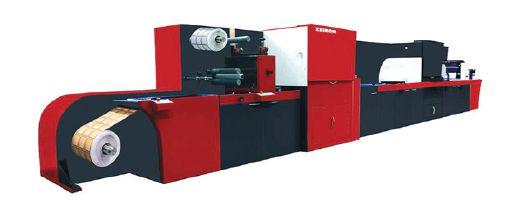
Xeikon has announced the launch of its new Fusion Embellishment Unit – Xeikon FEU. This new piece of digital equipment for labels offers label printers and converters maximum flexibility to meet the demands of brand owners and designers.
With complete digital finishing and embellishment capabilities, Xeikon’s FEU is based on MGI technology and provides UV spot varnish, tactile varnish, foiling, 3D textures and holograms across a wide range of substrates.
The equipment eliminates the need for tooling and allows for reduced setup times, allowing superior levels of creative quality finishing on smaller volumes of labels. Using inkjet technology, any defined label area can receive spot UV varnish with or without raised 3D texture effects. For foiling applications, the digital label area can receive digitally controlled foil with or without raised 3D effects with limited complexity compared to analogue.
Xeikon’s FEU is a stand-
alone solution, which allows it to embellish printed materials originating from different technologies. It is also able to preprint foil onto substrates. Owners can also optionally equip Xeikon’s FEU with a semi rotational die cut unit so that it will deliver fully embellished and finished labels.
Domino N730i digital label press
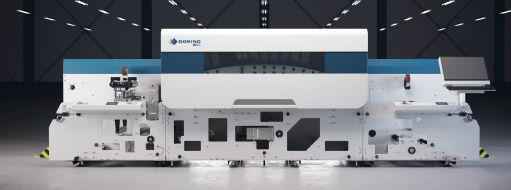
Domino Printing Sciences has launched its new N730i press, which includes new features such as the Brother Bitstar 1200 dpi piezo print head, the SunLight graphical user interface and the newest automated Domino i-Tech intelligent technology featuring i-Tech SetAlign and i-Tech CleanCap2.
The Brother Bitstar 1200 dpi print head uses a combination of drop sizes of 2.1 pl and nominal drop sizes of 2.8 pl and 3.3 pl to provide consistent ink density across the image, with sharper edges and smoother gradients. Patented triple-layer polycrystalline micro piezo technology minimizes cross talk and delivers precise nozzle
Your Superior choice for Print Finishing and Lettershop Ser vices
ONE-STOP SHOP — Die Cutting, Bindery, Data & Lettershop.
2. SUPERIOR TECHNOLOGY — Die crease without a die, then fold and even glue all on the same machine, up to 30 pt.
3. INTEGRATED MODULAR UNITS — Combined in-line finishing: crease, fold, glue, tipping, envelope inserting, ink jetting (Duplex), clip seal (3 sides), mail prep.
4. SAVE ON POSTAGE COSTS
—As a Certified Canada Post Direct Marketing Specialist, we get contract pricing reductions.
5. RETURN MAIL PRODUCTS — Customized “Return Mailers” created in-line with “U” or “BOX-shape” remoistenable glue, time perfed applications and envelope formation.
6. MINI-BOOKLETS — Saddle-stitch and trim 2-up booklets in-line to the size of a business card. No need to trim off-line, or do 2 passes.
7. HIGH SPEED EQUIPMENT — High speed Tipping, Folding, Saddle-stitching and soft folding ensuring on time delivery.
Domino’s new N730i digital UV inkjet label press includes features to improve efficiency, function and reliability.
control for optimum drop placement accuracy, according to Domino.
Domino’s i-Tech features were designed to improve efficiency, use, function and reliability. I-Tech SetAlign is a new automated system that sets density and accurately aligns the printheads for uniform quality across the full web width. Domino has also enhanced performance with i-Tech CleanCap2, an automated printhead cleaning and capping system reducing manual operator intervention and waste. Other i-Tech features include the established i-Tech ActiFlow, UltraMix and WebRev.
The N730i features a newly rewritten user interface featuring Domino SunLight. It also adds support for the JDF/JMF data transfer, allowing automated job set-up and reporting.
Arconvert-Ritrama
Eden FSC
Arconvert-Ritrama has
launched a natural paper comprised of dried grass fibres and natural cellulose fibres. The Eden FSC AP1300 WG74 is a revolutionary self-adhesive paper, specifically manufactured for the labelling of wines, spirits, craft beers and cosmetics.
The paper’s face material features a unique grain, colour and scent of grass. The paper also ensures the lowest possible environmental impact. Because of its natural composition, the paper’s appearance may vary depending on the specific batch of grass used in production, making each label unique.
Canon imagePRESS C10010VP and C9010VP
Canon Canada, Inc. has launched its new imagePRESS C10010VP/C9010VP digital colour presses in Canada.
The imagePRESS C10010VP series features improved paper handling and registration designed to help users increase productivity, as well as introducing new accessories and print server options.
The new imagePRESS presses feature Ultrasonic Multi-Sheet Detection, an Active Registration System, Inline Spectrophotometric Sensors and Multi DAT colour consistency technology, and can produce up to 90 ppm (C9010VP) and 100 ppm (C10010VP) of one-up images on letter-sized sheets, and up to 112 ppm (C10010VP) of twoup images on tabloid-sized sheets. It also features Dual Fixing technology to help maximize production up time and maintain high image quality.
The presses feature a GBC eWire to help remove the bottleneck that the manual twin loop wire binding process requires, which allows the automated creation of up to 80-sheet wire bound books with minimal operator involvement.
The presses can include either Canon’s PrismAsync Print Server or the Fiery-powered imagePress Server B700 V2/B600 V2.
Arconvert-Ritrama’s Eden FSC paper is comprised of dried grass fiber and natural cellulose fibres.
Canon Canada, Inc. has launched its new imagePRESS C10010VP/ C9010VP digital colour presses in Canada.
Sakurai: 1, 2 or 4 colours and any size (newer model)
Polar: any size/older or newer models (66/72/76/78/82/90/92/107/115)
Horizon-BQ: 220/240/260/440/460
Ernie Crawford / President and CEO / Crawford Technologies
Ernie Crawford founded Crawford Technologies in 1996. Ernie is one of only 17 people in the world with an M-EDP (Master Electronic Document Professional) designation, and has over 30 years of senior marketing and management experience in the high-volume electronic printing market.
Now, Crawford Technologies has introduced the CrawfordTech Accessibility Academy, a training ground to help companies dealing with difficulties in understanding mandated requirements related to document accessibility standards. We spoke with Ernie about launching the Academy and the importance of document accessibility.
What is the Accessibility Academy?
It is a professional, live, web-based training centre. There is a variety of courses tailored to each student’s specific needs and delivered when and where they are needed. These are hands-on training courses, not seminars. The course material is developed and delivered by certified instructors and kept up to date with industry standards.
How did the idea for the Accessibility Academy come about?
Crawford Technologies has been offering document accessibility solutions for many years and throughout this time, we noticed there was a gap which needed to be filled. When many of our customers started coming to us in search of solutions for making their information accessible, they only knew they needed to fix the immediate problem—non-accessible data—but they didn’t know too much about the actual world of document accessibility. As we listened to our customers’ requests for not only the solutions we offer, but for education in the world of digital accessibility, we knew we needed to find a way to accommodate them. We wanted to make it easy for them to expand their accessibility knowledge, regardless of their level of expertise. We decided to come up with a way to enhance our already robust suite of solutions by offering classes ranging from introductory basic courses to advanced accessible web design.
What led the company to place this
focus on document accessibility?
17
Ernie Crawford is one of only people in the world with an M-EDP (Master Electronic Document Professional) designation.
There is a need for accessible documents worldwide. Making information accessible to everyone is the right thing to do and as rules and regulations started governing digital content, it was obvious that people were not familiar with all the associated aspects of digital accessibility and therefore needed training to be able to deliver accurate, accessible, usable and valid content.
Crawford Technologies was just named one of Canada’s fastest-growing companies. How does that make you feel?
I am very proud to be leading the team we have assembled, and that the team is able to fight all challenges to meet our goals and those of our customers and partners. I think our unique blend of innovation and reliability strikes a chord in the market. Organizations are struggling to keep up with the demands of their customers, so they need innovative solutions. They also have large volumes of documents to get out every day, so they need the reliability and stability that we bring to them.
How did Crawford Technologies
manage the changes to business that came with the COVID-19 pandemic? Fortunately, we had put a pandemic plan in place after the SARS epidemic, so our team members all had laptops and our network had the strength needed to handle everyone working from home. In our accessibility production centre, we spread our team out over multiple shifts to minimize the number of operations staff in the building at any time. Our customers reinforced that they needed us to keep on track with meeting SLAs. We have also met many special requests from our customers who have had different types of struggles. One of our customers has been able to manage three large print shops from the CTO’s kitchen table. Another needed to defer support costs due to temporary revenue shortages. We are showing the market that many of our solutions are ideal for organizations dealing with the changes they have had to make during the pandemic and the risks they are operating under.
Ernie’s responses were edited for length. For more Q&A Spotlight interviews, please visit www.printaction.com/profiles.